The Evolution of Software Development
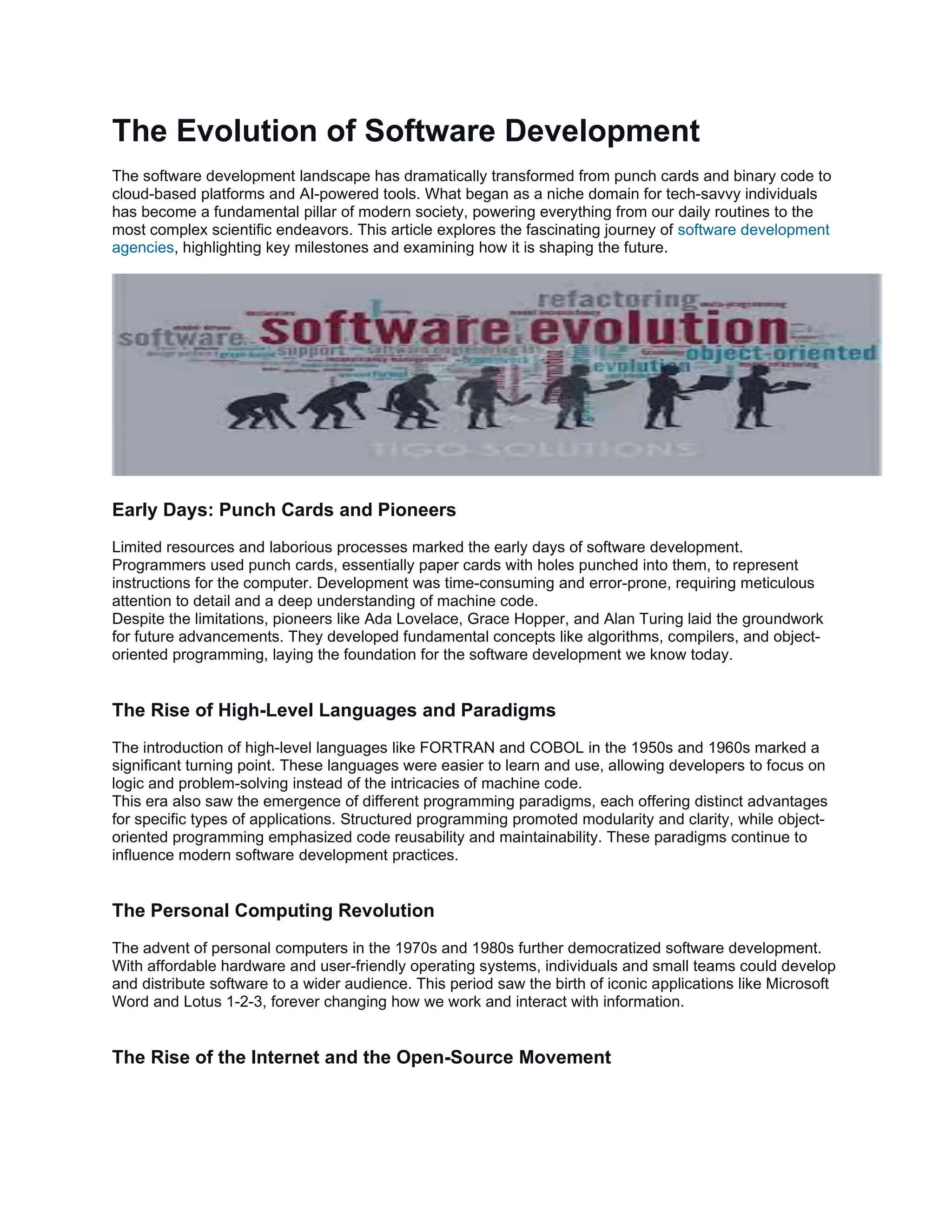
The software development landscape has dramatically transformed from punch cards and binary code to
cloud-based platforms and AI-powered tools. What began as a niche domain for tech-savvy individuals
has become a fundamental pillar of modern society, powering everything from our daily routines to the
most complex scientific endeavors. This article explores the fascinating journey of software development
agencies, highlighting key milestones and examining how it is shaping the future.
Early Days: Punch Cards and Pioneers
Limited resources and laborious processes marked the early days of software development.
Programmers used punch cards, essentially paper cards with holes punched into them, to represent
instructions for the computer. Development was time-consuming and error-prone, requiring meticulous
attention to detail and a deep understanding of machine code.
Despite the limitations, pioneers like Ada Lovelace, Grace Hopper, and Alan Turing laid the groundwork
for future advancements. They developed fundamental concepts like algorithms, compilers, and object-
oriented programming, laying the foundation for the software development we know today.
The Rise of High-Level Languages and Paradigms
The introduction of high-level languages like FORTRAN and COBOL in the 1950s and 1960s marked a
significant turning point. These languages were easier to learn and use, allowing developers to focus on
logic and problem-solving instead of the intricacies of machine code.
This era also saw the emergence of different programming paradigms, each offering distinct advantages
for specific types of applications. Structured programming promoted modularity and clarity, while object-
oriented programming emphasized code reusability and maintainability. These paradigms continue to
influence modern software development practices.
The Personal Computing Revolution
The advent of personal computers in the 1970s and 1980s further democratized software development.
With affordable hardware and user-friendly operating systems, individuals and small teams could develop
and distribute software to a wider audience. This period saw the birth of iconic applications like Microsoft
Word and Lotus 1-2-3, forever changing how we work and interact with information.
The Rise of the Internet and the Open-Source Movement
The 1990s ushered in the Internet age, creating a global software development and collaboration
network. Open-source software emerged as a powerful force, allowing developers to freely share and
contribute to software. Tools like Linux and Apache provided open-source alternatives to proprietary
software, fostering innovation and rapid development.
The Age of Agile and DevOps
The turn of the millennium saw the emergence of agile methodologies, emphasizing flexible and iterative
development processes. This shift led to faster release cycles, improved responsiveness to changing
requirements, and closer collaboration between developers and business stakeholders.
The rise of DevOps further bridged the gap between development and operations, promoting continuous
integration and delivery for faster deployment and improved software quality.
The Cloud and the Era of Artificial Intelligence
Cloud computing has revolutionized software development in recent years. Developers can now demand
powerful computing resources and development tools without expensive hardware infrastructure. This
has allowed for rapid scaling of applications and reduced development costs.
Artificial intelligence (AI) is poised to be the next major game-changer in software development. AI-
powered tools are already automating repetitive tasks, improving code quality, and assisting developers
in building more intelligent and adaptive applications.
The Future of Software Development: What Lies Ahead?
The future of software development holds exciting possibilities. Emerging technologies like blockchain,
quantum computing, and augmented reality are poised to transform further how we build and interact with
software.
Software development will continue to be driven by a focus on user experience, security, and efficiency.
The development process will become more data-driven, with AI and machine learning playing a key role
in optimizing workflows and predicting user behavior.
The Impact of Software Development on Society
The evolution of software development has had a profound impact on society. It has revolutionized
industries, transformed communication, and driven innovation across all sectors. From healthcare and
education to finance and entertainment, software plays a key role in shaping our lives.
As we move forward, the responsibility of software developers to create ethical, responsible, and inclusive
technologies will be more crucial than ever. Developers will be challenged to ensure that their work
benefits society and addresses the complex challenges of the 21st century.
Conclusion
The evolution of software development is a remarkable story of human ingenuity and innovation. From
punch cards to AI-powered tools, we have come a long way in building the software that shapes our
world. The future holds exciting possibilities, with new technologies and paradigms promising to continue
transforming how we create and experience software. As software development evolves, it is essential to
remember its potential to improve lives and create a brighter future for all.

The Evolution of Software Development.pdf

  • 1.
    The Evolution ofSoftware Development The software development landscape has dramatically transformed from punch cards and binary code to cloud-based platforms and AI-powered tools. What began as a niche domain for tech-savvy individuals has become a fundamental pillar of modern society, powering everything from our daily routines to the most complex scientific endeavors. This article explores the fascinating journey of software development agencies, highlighting key milestones and examining how it is shaping the future. Early Days: Punch Cards and Pioneers Limited resources and laborious processes marked the early days of software development. Programmers used punch cards, essentially paper cards with holes punched into them, to represent instructions for the computer. Development was time-consuming and error-prone, requiring meticulous attention to detail and a deep understanding of machine code. Despite the limitations, pioneers like Ada Lovelace, Grace Hopper, and Alan Turing laid the groundwork for future advancements. They developed fundamental concepts like algorithms, compilers, and object- oriented programming, laying the foundation for the software development we know today. The Rise of High-Level Languages and Paradigms The introduction of high-level languages like FORTRAN and COBOL in the 1950s and 1960s marked a significant turning point. These languages were easier to learn and use, allowing developers to focus on logic and problem-solving instead of the intricacies of machine code. This era also saw the emergence of different programming paradigms, each offering distinct advantages for specific types of applications. Structured programming promoted modularity and clarity, while object- oriented programming emphasized code reusability and maintainability. These paradigms continue to influence modern software development practices. The Personal Computing Revolution The advent of personal computers in the 1970s and 1980s further democratized software development. With affordable hardware and user-friendly operating systems, individuals and small teams could develop and distribute software to a wider audience. This period saw the birth of iconic applications like Microsoft Word and Lotus 1-2-3, forever changing how we work and interact with information. The Rise of the Internet and the Open-Source Movement
  • 2.
    The 1990s usheredin the Internet age, creating a global software development and collaboration network. Open-source software emerged as a powerful force, allowing developers to freely share and contribute to software. Tools like Linux and Apache provided open-source alternatives to proprietary software, fostering innovation and rapid development. The Age of Agile and DevOps The turn of the millennium saw the emergence of agile methodologies, emphasizing flexible and iterative development processes. This shift led to faster release cycles, improved responsiveness to changing requirements, and closer collaboration between developers and business stakeholders. The rise of DevOps further bridged the gap between development and operations, promoting continuous integration and delivery for faster deployment and improved software quality. The Cloud and the Era of Artificial Intelligence Cloud computing has revolutionized software development in recent years. Developers can now demand powerful computing resources and development tools without expensive hardware infrastructure. This has allowed for rapid scaling of applications and reduced development costs. Artificial intelligence (AI) is poised to be the next major game-changer in software development. AI- powered tools are already automating repetitive tasks, improving code quality, and assisting developers in building more intelligent and adaptive applications. The Future of Software Development: What Lies Ahead? The future of software development holds exciting possibilities. Emerging technologies like blockchain, quantum computing, and augmented reality are poised to transform further how we build and interact with software. Software development will continue to be driven by a focus on user experience, security, and efficiency. The development process will become more data-driven, with AI and machine learning playing a key role in optimizing workflows and predicting user behavior. The Impact of Software Development on Society The evolution of software development has had a profound impact on society. It has revolutionized industries, transformed communication, and driven innovation across all sectors. From healthcare and education to finance and entertainment, software plays a key role in shaping our lives. As we move forward, the responsibility of software developers to create ethical, responsible, and inclusive technologies will be more crucial than ever. Developers will be challenged to ensure that their work benefits society and addresses the complex challenges of the 21st century. Conclusion The evolution of software development is a remarkable story of human ingenuity and innovation. From punch cards to AI-powered tools, we have come a long way in building the software that shapes our world. The future holds exciting possibilities, with new technologies and paradigms promising to continue transforming how we create and experience software. As software development evolves, it is essential to remember its potential to improve lives and create a brighter future for all.