The Evolution of
Performance
Management
In recent years, leading companies have been rethinking their
traditional performance management approaches, moving away
from annual performance appraisals and embracing more
continuous, feedback-driven models. This shift has been driven
by a desire to increase employee engagement, reduce
bureaucracy, and foster a culture of ongoing development and
growth.
Adobe Leads the Way
Abandoned Annual Appraisals
In 2012, Adobe made the bold move to eliminate its annual performance
appraisal system, which it found to be archaic and ineffective. The process was
consuming 80,000 management hours per year, the equivalent of nearly 40 full-
time employees.
Introduced Continuous Feedback
Adobe replaced annual appraisals with regular one-on-one check-ins and
frequent feedback, both positive and constructive. This new approach has led to a
30% decrease in voluntary turnover.
Empowered Managers and Employees
Adobe allows different parts of the organization to determine the frequency of
check-in conversations, based on their work cycles. Managers are also trained on
the nuances of giving and receiving feedback.
Deloitte's Transformation
1 Eliminated Annual Reviews
In 2015, Deloitte announced it was scrapping once-a-year
performance reviews, 360-degree feedback, and objective cascading,
which were consuming 2 million working hours per year across the
organization.
2 Implemented Weekly Check-Ins
Deloitte's new process requires every team leader to check in with
each team member once a week to discuss near-term goals, provide
feedback, and offer coaching.
3 Quarterly Performance Reviews
In addition to the weekly check-ins, Deloitte also conducts quarterly
reviews, where team leaders are asked to respond to future-focused
statements about each team member.
GE Abandons Forced Ranking
The "Rank and Yank" System
Under former CEO Jack Welch,
GE was known for its annual
performance ratings and forced
distribution curves, where the
bottom 10% of employees were
fired each year. This created an
environment of unhealthy
competition and reduced
teamwork.
Frequent Feedback and
Goal-Setting
In 2015, under CEO Jeff Immelt,
GE announced it was replacing
this approach with frequent
feedback and regular
"touchpoints" to review progress
against agreed-upon near-term
goals.
Annual Summaries and
Learning
Managers will still have an
annual summary conversation
with employees, but this will be
more about standing back,
discussing achievements, and
setting new goals, rather than a
fraught annual review.
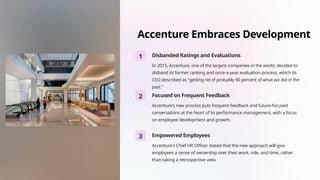
Accenture Embraces Development
1 Disbanded Ratings and Evaluations
In 2015, Accenture, one of the largest companies in the world, decided to
disband its former ranking and once-a-year evaluation process, which its
CEO described as "getting rid of probably 90 percent of what we did in the
past."
2 Focused on Frequent Feedback
Accenture's new process puts frequent feedback and future-focused
conversations at the heart of its performance management, with a focus
on employee development and growth.
3 Empowered Employees
Accenture's Chief HR Officer stated that the new approach will give
employees a sense of ownership over their work, role, and time, rather
than taking a retrospective view.
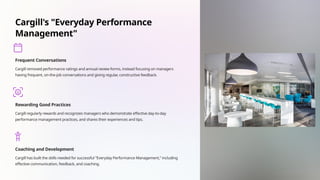
Cargill's "Everyday Performance
Management"
Frequent Conversations
Cargill removed performance ratings and annual review forms, instead focusing on managers
having frequent, on-the-job conversations and giving regular, constructive feedback.
Rewarding Good Practices
Cargill regularly rewards and recognizes managers who demonstrate effective day-to-day
performance management practices, and shares their experiences and tips.
Coaching and Development
Cargill has built the skills needed for successful "Everyday Performance Management," including
effective communication, feedback, and coaching.
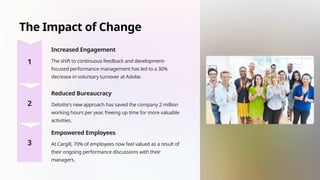
The Impact of Change
Increased Engagement
The shift to continuous feedback and development-
focused performance management has led to a 30%
decrease in voluntary turnover at Adobe.
Reduced Bureaucracy
Deloitte's new approach has saved the company 2 million
working hours per year, freeing up time for more valuable
activities.
Empowered Employees
At Cargill, 70% of employees now feel valued as a result of
their ongoing performance discussions with their
managers.
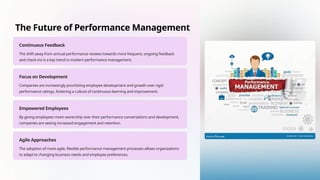
The Future of Performance Management
Continuous Feedback
The shift away from annual performance reviews towards more frequent, ongoing feedback
and check-ins is a key trend in modern performance management.
Focus on Development
Companies are increasingly prioritizing employee development and growth over rigid
performance ratings, fostering a culture of continuous learning and improvement.
Empowered Employees
By giving employees more ownership over their performance conversations and development,
companies are seeing increased engagement and retention.
Agile Approaches
The adoption of more agile, flexible performance management processes allows organizations
to adapt to changing business needs and employee preferences.

The-Evolution-of-Performance-Management.pptx

  • 1.
    The Evolution of Performance Management Inrecent years, leading companies have been rethinking their traditional performance management approaches, moving away from annual performance appraisals and embracing more continuous, feedback-driven models. This shift has been driven by a desire to increase employee engagement, reduce bureaucracy, and foster a culture of ongoing development and growth.
  • 2.
    Adobe Leads theWay Abandoned Annual Appraisals In 2012, Adobe made the bold move to eliminate its annual performance appraisal system, which it found to be archaic and ineffective. The process was consuming 80,000 management hours per year, the equivalent of nearly 40 full- time employees. Introduced Continuous Feedback Adobe replaced annual appraisals with regular one-on-one check-ins and frequent feedback, both positive and constructive. This new approach has led to a 30% decrease in voluntary turnover. Empowered Managers and Employees Adobe allows different parts of the organization to determine the frequency of check-in conversations, based on their work cycles. Managers are also trained on the nuances of giving and receiving feedback.
  • 3.
    Deloitte's Transformation 1 EliminatedAnnual Reviews In 2015, Deloitte announced it was scrapping once-a-year performance reviews, 360-degree feedback, and objective cascading, which were consuming 2 million working hours per year across the organization. 2 Implemented Weekly Check-Ins Deloitte's new process requires every team leader to check in with each team member once a week to discuss near-term goals, provide feedback, and offer coaching. 3 Quarterly Performance Reviews In addition to the weekly check-ins, Deloitte also conducts quarterly reviews, where team leaders are asked to respond to future-focused statements about each team member.
  • 4.
    GE Abandons ForcedRanking The "Rank and Yank" System Under former CEO Jack Welch, GE was known for its annual performance ratings and forced distribution curves, where the bottom 10% of employees were fired each year. This created an environment of unhealthy competition and reduced teamwork. Frequent Feedback and Goal-Setting In 2015, under CEO Jeff Immelt, GE announced it was replacing this approach with frequent feedback and regular "touchpoints" to review progress against agreed-upon near-term goals. Annual Summaries and Learning Managers will still have an annual summary conversation with employees, but this will be more about standing back, discussing achievements, and setting new goals, rather than a fraught annual review.
  • 5.
    Accenture Embraces Development 1Disbanded Ratings and Evaluations In 2015, Accenture, one of the largest companies in the world, decided to disband its former ranking and once-a-year evaluation process, which its CEO described as "getting rid of probably 90 percent of what we did in the past." 2 Focused on Frequent Feedback Accenture's new process puts frequent feedback and future-focused conversations at the heart of its performance management, with a focus on employee development and growth. 3 Empowered Employees Accenture's Chief HR Officer stated that the new approach will give employees a sense of ownership over their work, role, and time, rather than taking a retrospective view.
  • 6.
    Cargill's "Everyday Performance Management" FrequentConversations Cargill removed performance ratings and annual review forms, instead focusing on managers having frequent, on-the-job conversations and giving regular, constructive feedback. Rewarding Good Practices Cargill regularly rewards and recognizes managers who demonstrate effective day-to-day performance management practices, and shares their experiences and tips. Coaching and Development Cargill has built the skills needed for successful "Everyday Performance Management," including effective communication, feedback, and coaching.
  • 7.
    The Impact ofChange Increased Engagement The shift to continuous feedback and development- focused performance management has led to a 30% decrease in voluntary turnover at Adobe. Reduced Bureaucracy Deloitte's new approach has saved the company 2 million working hours per year, freeing up time for more valuable activities. Empowered Employees At Cargill, 70% of employees now feel valued as a result of their ongoing performance discussions with their managers.
  • 8.
    The Future ofPerformance Management Continuous Feedback The shift away from annual performance reviews towards more frequent, ongoing feedback and check-ins is a key trend in modern performance management. Focus on Development Companies are increasingly prioritizing employee development and growth over rigid performance ratings, fostering a culture of continuous learning and improvement. Empowered Employees By giving employees more ownership over their performance conversations and development, companies are seeing increased engagement and retention. Agile Approaches The adoption of more agile, flexible performance management processes allows organizations to adapt to changing business needs and employee preferences.