The evolution of HPGR 
Modelling 
Roberto Carlos Medrano Nina
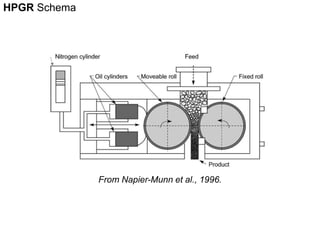
From Napier-Munn et al., 1996. 
HPGR Schema
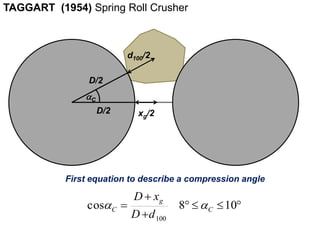
TAGGART (1954) Spring Roll Crusher 
aC 
d100/2 
xg/2 
D/2 
D/2 
First equation to describe a compression angle 
D x 
cos a  8 a 
10 
    
 
 
100 
C 
g 
C D d
EARLY MODELS 
The Guevara & Menacho model (1987) 
The Fuerstenau, Shukla & Kapur model (1991) 
The Austin, Weller & Lim model (1993)
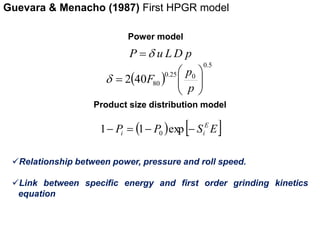
Guevara & Menacho (1987) First HPGR model 
Power model 
P  u LD p 
 
p 
0.25 0 
  
0.5 
 
80 2 40  
 
 
 
  
F 
p 
Product size distribution model 
P  P   S E E 
i i 1  1 exp  0 
Relationship between power, pressure and roll speed. 
Link between specific energy and first order grinding kinetics 
equation
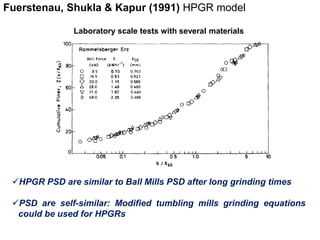
Fuerstenau, Shukla & Kapur (1991) HPGR model 
Laboratory scale tests with several materials 
HPGR PSD are similar to Ball Mills PSD after long grinding times 
PSD are self-similar: Modified tumbling mills grinding equations 
could be used for HPGRs
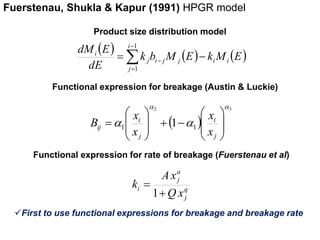
Fuerstenau, Shukla & Kapur (1991) HPGR model 
Product size distribution model 
  
k b M E k M E 
dM E 
i   
dE 
i i 
i 
j 
j i j j 
 
 
 
1 
1 
Functional expression for breakage (Austin & Luckie) 
a a 
2 3 
 
  
 
 
x 
i 
a a 
1 1 1 
 
 
 
 
 
 
ij x 
 
  
 
 
 
 
 
 
 
i 
j 
j 
x 
x 
B 
Functional expression for rate of breakage (Fuerstenau et al) 
q 
j 
a 
j 
Ax 
i Q x 
k 
 
 
1 
First to use functional expressions for breakage and breakage rate
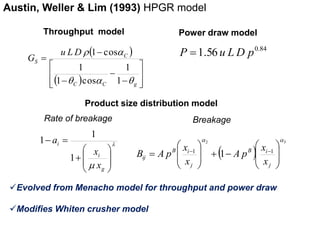
Austin, Weller & Lim (1993) HPGR model 
Throughput model 
  
 
 a 
C 
1 
1 cos 
    
 
 
  
 
 
 
 
 
 
C C g 
S 
u LD 
G 
 a 1 
 
1 
1 cos 
Power draw model 
0.84 P 1.56 u LD p 
Product size distribution model 
Rate of breakage 
 
 
 
x 
  
 
 
 
 
 
 
  
g 
i 
i 
x 
a 
1 
1 
1 
a a 
2 3 
 
 
 
 
 
 
x 
x 
   
A p 
Evolved from Menacho model for throughput and power draw 
Modifies Whiten crusher model 
  
1 1 1 
 
 
 
 
 
 
  
 
 
 
 
j 
B i 
j 
B i 
ij x 
x 
B A p 
Breakage
BREAKTHROUGH STUDIES 
Peripheral and axial pressure distribution 
Power draw models
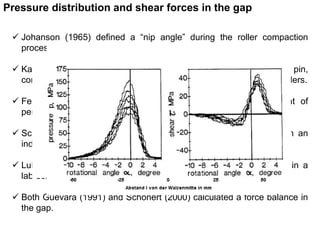
Pressure distribution and shear forces in the gap 
 Johanson (1965) defined a “nip angle” during the roller compaction 
process. 
 Katashinski (1966) was the first to measure, with a sensor pin, 
compressive and shear forces during the compression of metal powders. 
 Feige (1989) used the sensor-pin method for the measurement of 
peripheral and axial pressure distributions in a roller crusher. 
 Schwarz and von Seebach (1990) discovered the “edge effect” in an 
industrial HPGR. 
 Lubjuhn (1992) characterized the peripheral pressure distribution in a 
lab-scale HPGR using quartz and limestone. 
 Both Guevara (1991) and Schönert (2000) calculated a force balance in 
the gap.
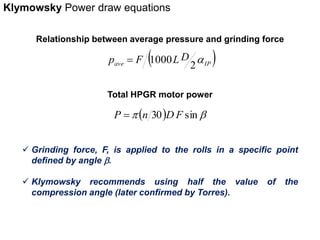
Klymowsky Power draw equations 
Relationship between average pressure and grinding force 
ave  IP  
p F LD a 
2 
 1000 
Total HPGR motor power 
P  n 30DF sin 
 Grinding force, F, is applied to the rolls in a specific point 
defined by angle  . 
 Klymowsky recommends using half the value of the 
compression angle (later confirmed by Torres).
RECENT MODELS 
The Morrell, Lim, Shi & Tondo Model (1997) 
The Schneider, Alves & Austin Model (2009) 
The Torres & Casali Model (2009)
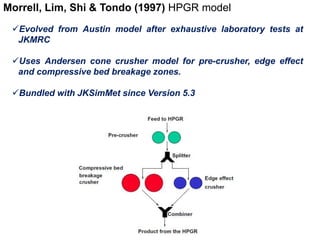
Morrell, Lim, Shi & Tondo (1997) HPGR model 
Evolved from Austin model after exhaustive laboratory tests at 
JKMRC 
Uses Andersen cone crusher model for pre-crusher, edge effect 
and compressive bed breakage zones. 
Bundled with JKSimMet since Version 5.3
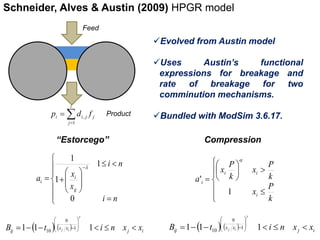
Schneider, Alves & Austin (2009) HPGR model 
i i j j p d f 
 
 
 
 
 
 
 
Product Bundled with ModSim 3.6.17. 
“Estorcego” 
i n 
  
 
 
 
 
 
 
 
 
 
  
 
i n 
x 
x 
a 
i 
g 
i 
0 
1 
1 
1 
 
 
 
ij B t i n x x j i         
    j i 
1 1 x x 
1 1 
 
  
 
9 
10 
 
Evolved from Austin model 
Uses Austin’s functional 
expressions for breakage and 
rate of breakage for two 
comminution mechanisms. 
Compression 
 
 
  
 
 
 
 
  
 
 
 
 
P 
P 
k 
i i 
x 
k 
x 
P 
k 
x 
a 
i 
i 
1 
' 
a 
 
 
ij B t i n x x j i         
    j i 
1 1 x x 
1 1 
 
  
 
9 
10 
 
Feed 
 
 
i 
j 
1 
,
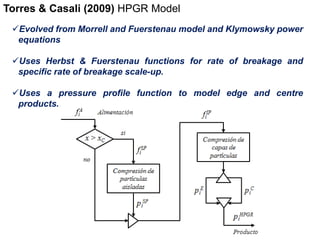
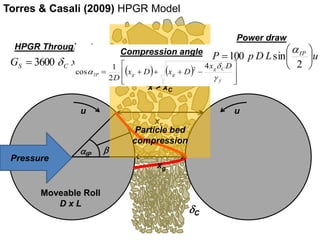
Torres & Casali (2009) HPGR Model 
Evolved from Morrell and Fuerstenau model and Klymowsky power 
equations 
Uses Herbst & Fuerstenau functions for rate of breakage and 
specific rate of breakage scale-up. 
Uses a pressure profile function to model edge and centre 
products.
    
1 
cos 2 
     
xc 
HPGR Throughput 
G x Lu S C g  3600  
aIP Pressure 
 
xg 
u 
C 
 
 
 
u 
Moveable Roll 
D x L 
Single particle 
Compression 
x > xC 
Particle bed 
compression 
 
 
 
 
 
 
g C 
f 
IP g g 
x D 
x D x D 
D  
a 
4 
2 
 
 
Compression angle P p D L IP u  
 
 
2 
100 sin 
a 
Power draw 
Torres & Casali (2009) HPGR Model
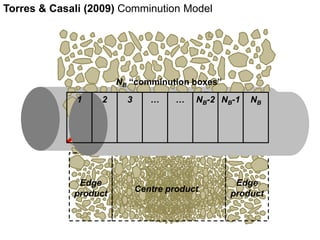
Torres & Casali (2009) Comminution Model 
Parabolic pressure profile 
Centre product 
Edge 
product 
Edge 
product 
NB “comminution boxes” 
1 2 3 N NB-1 NB B… … -2
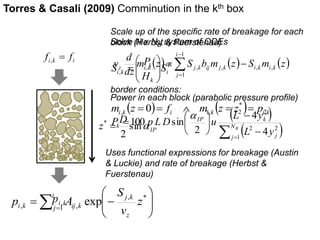
Torres & Casali (2009) Comminution in the kth box 
Scale up of the specific rate of breakage for each 
block (Herbst & Fuerstenau) 
Solve N x NB system of ODEs 
P 
 
, , ,   
 
 , 
v k 
i k i k 
S  
i k S 
z i k j k ij j k , , 
 
 
d 
j k 
S 
i k i f f  , 
    
 
  
  
z 
i k ij k  
i 
j 
z 
v 
p A 
1 
, * 
, , exp 
IP 
D 
z sina 
2 
*  
i k p , 
m z S b m z S m z 
dz 
i 
j 
1 
1 
 
 
border conditions: 
m  z  f m  z z * 
 p i k i i k i , 
k  0     , ,  L 2 y 
2 
 
IP k 
   
  
 
 
 
 
 
 
 
 
NB 
j j 
k 
L y 
P p LD u 
1 
2 2 
4 
4 
2 
100 sin 
a 
E 
i 
k 
H 
 
  
 
Power in each block (parabolic pressure profile) 
Uses functional expressions for breakage (Austin 
& Luckie) and rate of breakage (Herbst & 
Fuerstenau)
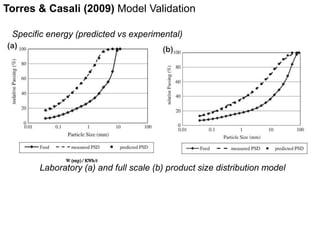
Torres & Casali (2009) Model Validation 
Specific energy (predicted vs experimental) 
Damp sample 
Laboratory (a) and full scale (b) product size distribution model
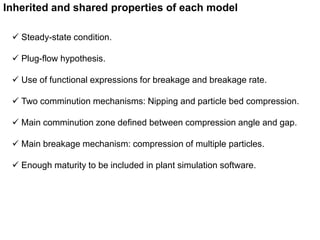
Inherited and shared properties of each model 
 Steady-state condition. 
 Plug-flow hypothesis. 
 Use of functional expressions for breakage and breakage rate. 
 Two comminution mechanisms: Nipping and particle bed compression. 
 Main comminution zone defined between compression angle and gap. 
 Main breakage mechanism: compression of multiple particles. 
 Enough maturity to be included in plant simulation software.
Schönert 
Taggart 
Austin et al 
Schneider et al 
Torres & Morrell et al 
Casali 
Fuerstenau et al 
Lubjuhn 
Schwarz & von Seebach 
Klymowsky 
Katashinskii 
Johanson 
Feige 
Guevara & 
Menacho 
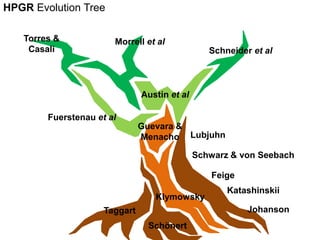
HPGR Evolution Tree

The evolution of hpgr modelling final

  • 1.
    The evolution ofHPGR Modelling Roberto Carlos Medrano Nina
  • 3.
    From Napier-Munn etal., 1996. HPGR Schema
  • 4.
    TAGGART (1954) SpringRoll Crusher aC d100/2 xg/2 D/2 D/2 First equation to describe a compression angle D x cos a  8 a 10       100 C g C D d
  • 5.
    EARLY MODELS TheGuevara & Menacho model (1987) The Fuerstenau, Shukla & Kapur model (1991) The Austin, Weller & Lim model (1993)
  • 6.
    Guevara & Menacho(1987) First HPGR model Power model P  u LD p  p 0.25 0   0.5  80 2 40       F p Product size distribution model P  P   S E E i i 1  1 exp  0 Relationship between power, pressure and roll speed. Link between specific energy and first order grinding kinetics equation
  • 7.
    Fuerstenau, Shukla &Kapur (1991) HPGR model Laboratory scale tests with several materials HPGR PSD are similar to Ball Mills PSD after long grinding times PSD are self-similar: Modified tumbling mills grinding equations could be used for HPGRs
  • 8.
    Fuerstenau, Shukla &Kapur (1991) HPGR model Product size distribution model   k b M E k M E dM E i   dE i i i j j i j j    1 1 Functional expression for breakage (Austin & Luckie) a a 2 3      x i a a 1 1 1       ij x           i j j x x B Functional expression for rate of breakage (Fuerstenau et al) q j a j Ax i Q x k   1 First to use functional expressions for breakage and breakage rate
  • 9.
    Austin, Weller &Lim (1993) HPGR model Throughput model     a C 1 1 cos               C C g S u LD G  a 1  1 1 cos Power draw model 0.84 P 1.56 u LD p Product size distribution model Rate of breakage    x           g i i x a 1 1 1 a a 2 3       x x    A p Evolved from Menacho model for throughput and power draw Modifies Whiten crusher model   1 1 1             j B i j B i ij x x B A p Breakage
  • 10.
    BREAKTHROUGH STUDIES Peripheraland axial pressure distribution Power draw models
  • 11.
    Pressure distribution andshear forces in the gap  Johanson (1965) defined a “nip angle” during the roller compaction process.  Katashinski (1966) was the first to measure, with a sensor pin, compressive and shear forces during the compression of metal powders.  Feige (1989) used the sensor-pin method for the measurement of peripheral and axial pressure distributions in a roller crusher.  Schwarz and von Seebach (1990) discovered the “edge effect” in an industrial HPGR.  Lubjuhn (1992) characterized the peripheral pressure distribution in a lab-scale HPGR using quartz and limestone.  Both Guevara (1991) and Schönert (2000) calculated a force balance in the gap.
  • 12.
    Klymowsky Power drawequations Relationship between average pressure and grinding force ave  IP  p F LD a 2  1000 Total HPGR motor power P  n 30DF sin  Grinding force, F, is applied to the rolls in a specific point defined by angle  .  Klymowsky recommends using half the value of the compression angle (later confirmed by Torres).
  • 13.
    RECENT MODELS TheMorrell, Lim, Shi & Tondo Model (1997) The Schneider, Alves & Austin Model (2009) The Torres & Casali Model (2009)
  • 14.
    Morrell, Lim, Shi& Tondo (1997) HPGR model Evolved from Austin model after exhaustive laboratory tests at JKMRC Uses Andersen cone crusher model for pre-crusher, edge effect and compressive bed breakage zones. Bundled with JKSimMet since Version 5.3
  • 15.
    Schneider, Alves &Austin (2009) HPGR model i i j j p d f        Product Bundled with ModSim 3.6.17. “Estorcego” i n               i n x x a i g i 0 1 1 1    ij B t i n x x j i             j i 1 1 x x 1 1     9 10  Evolved from Austin model Uses Austin’s functional expressions for breakage and rate of breakage for two comminution mechanisms. Compression               P P k i i x k x P k x a i i 1 ' a   ij B t i n x x j i             j i 1 1 x x 1 1     9 10  Feed   i j 1 ,
  • 16.
    Torres & Casali(2009) HPGR Model Evolved from Morrell and Fuerstenau model and Klymowsky power equations Uses Herbst & Fuerstenau functions for rate of breakage and specific rate of breakage scale-up. Uses a pressure profile function to model edge and centre products.
  • 17.
       1 cos 2      xc HPGR Throughput G x Lu S C g  3600  aIP Pressure  xg u C    u Moveable Roll D x L Single particle Compression x > xC Particle bed compression       g C f IP g g x D x D x D D  a 4 2   Compression angle P p D L IP u    2 100 sin a Power draw Torres & Casali (2009) HPGR Model
  • 18.
    Torres & Casali(2009) Comminution Model Parabolic pressure profile Centre product Edge product Edge product NB “comminution boxes” 1 2 3 N NB-1 NB B… … -2
  • 19.
    Torres & Casali(2009) Comminution in the kth box Scale up of the specific rate of breakage for each block (Herbst & Fuerstenau) Solve N x NB system of ODEs P  , , ,     , v k i k i k S  i k S z i k j k ij j k , ,   d j k S i k i f f  ,          z i k ij k  i j z v p A 1 , * , , exp IP D z sina 2 *  i k p , m z S b m z S m z dz i j 1 1   border conditions: m  z  f m  z z *  p i k i i k i , k  0     , ,  L 2 y 2  IP k              NB j j k L y P p LD u 1 2 2 4 4 2 100 sin a E i k H     Power in each block (parabolic pressure profile) Uses functional expressions for breakage (Austin & Luckie) and rate of breakage (Herbst & Fuerstenau)
  • 20.
    Torres & Casali(2009) Model Validation Specific energy (predicted vs experimental) Damp sample Laboratory (a) and full scale (b) product size distribution model
  • 21.
    Inherited and sharedproperties of each model  Steady-state condition.  Plug-flow hypothesis.  Use of functional expressions for breakage and breakage rate.  Two comminution mechanisms: Nipping and particle bed compression.  Main comminution zone defined between compression angle and gap.  Main breakage mechanism: compression of multiple particles.  Enough maturity to be included in plant simulation software.
  • 22.
    Schönert Taggart Austinet al Schneider et al Torres & Morrell et al Casali Fuerstenau et al Lubjuhn Schwarz & von Seebach Klymowsky Katashinskii Johanson Feige Guevara & Menacho HPGR Evolution Tree