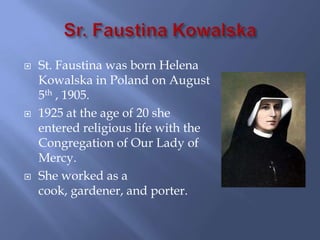
   St. Faustina was born Helena
    Kowalska in Poland on August
    5th , 1905.
   1925 at the age of 20 she
    entered religious life with the
    Congregation of Our Lady of
    Mercy.
   She worked as a
    cook, gardener, and porter.
   Just as in the Old Testament
    God used prophets to
    spread His word; God used
    St. Faustina to help explain
    the message of Christ.
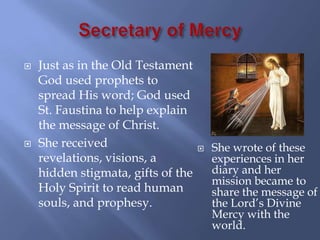
   She received                       She wrote of these
    revelations, visions, a             experiences in her
    hidden stigmata, gifts of the       diary and her
                                        mission became to
    Holy Spirit to read human           share the message of
    souls, and prophesy.                the Lord’s Divine
                                        Mercy with the
                                        world.
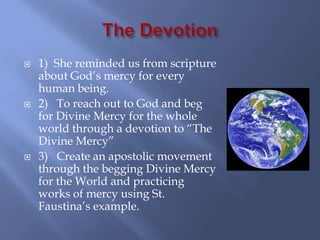
   1) She reminded us from scripture
    about God’s mercy for every
    human being.
   2) To reach out to God and beg
    for Divine Mercy for the whole
    world through a devotion to “The
    Divine Mercy”
   3) Create an apostolic movement
    through the begging Divine Mercy
    for the World and practicing
    works of mercy using St.
    Faustina’s example.
   Because of various documents and varying
    practices the devotion was banned by the
    Vatican in the 1950’s.
   1965 the Bishop of Krakow Poland investigated
    Sr. Faustina and the devotion. In 1978 the ban
    was officially lifted.
   Pope John Paul II (from Poland) made the
    message of Divine Mercy a part of his papacy
    and encouraged others to follow her example.
   On April 30, 2000 JPII canonized St. Faustina
    which is celebrated on October 5th.
   She wrote and suffered in secret with only her
    spiritual director having any knowledge of
    what was going on.
   The suffering and deep mystical experiences
    that she had she hid with joy from her
    associates.
   She had no desire to make her experiences or
    diary known to the world.
   She only wanted the prayer and message of
    mercy given to her shared with others.
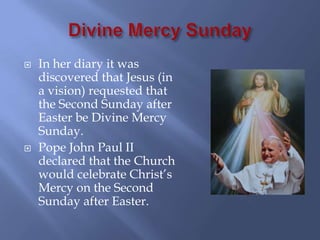
   In her diary it was
    discovered that Jesus (in
    a vision) requested that
    the Second Sunday after
    Easter be Divine Mercy
    Sunday.
   Pope John Paul II
    declared that the Church
    would celebrate Christ’s
    Mercy on the Second
    Sunday after Easter.
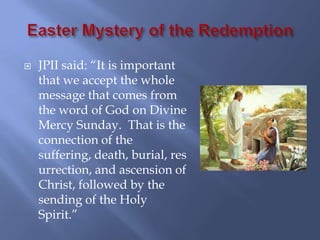
   JPII said: “It is important
    that we accept the whole
    message that comes from
    the word of God on Divine
    Mercy Sunday. That is the
    connection of the
    suffering, death, burial, res
    urrection, and ascension of
    Christ, followed by the
    sending of the Holy
    Spirit.”
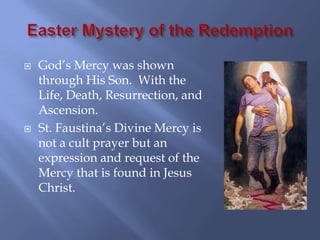
   God’s Mercy was shown
    through His Son. With the
    Life, Death, Resurrection, and
    Ascension.
   St. Faustina’s Divine Mercy is
    not a cult prayer but an
    expression and request of the
    Mercy that is found in Jesus
    Christ.
   Sincerely repent all of our sins.
   Place our complete trust in
    Jesus.
   Go to confession.
   Receive Holy Communion on
    the day of the Feast.
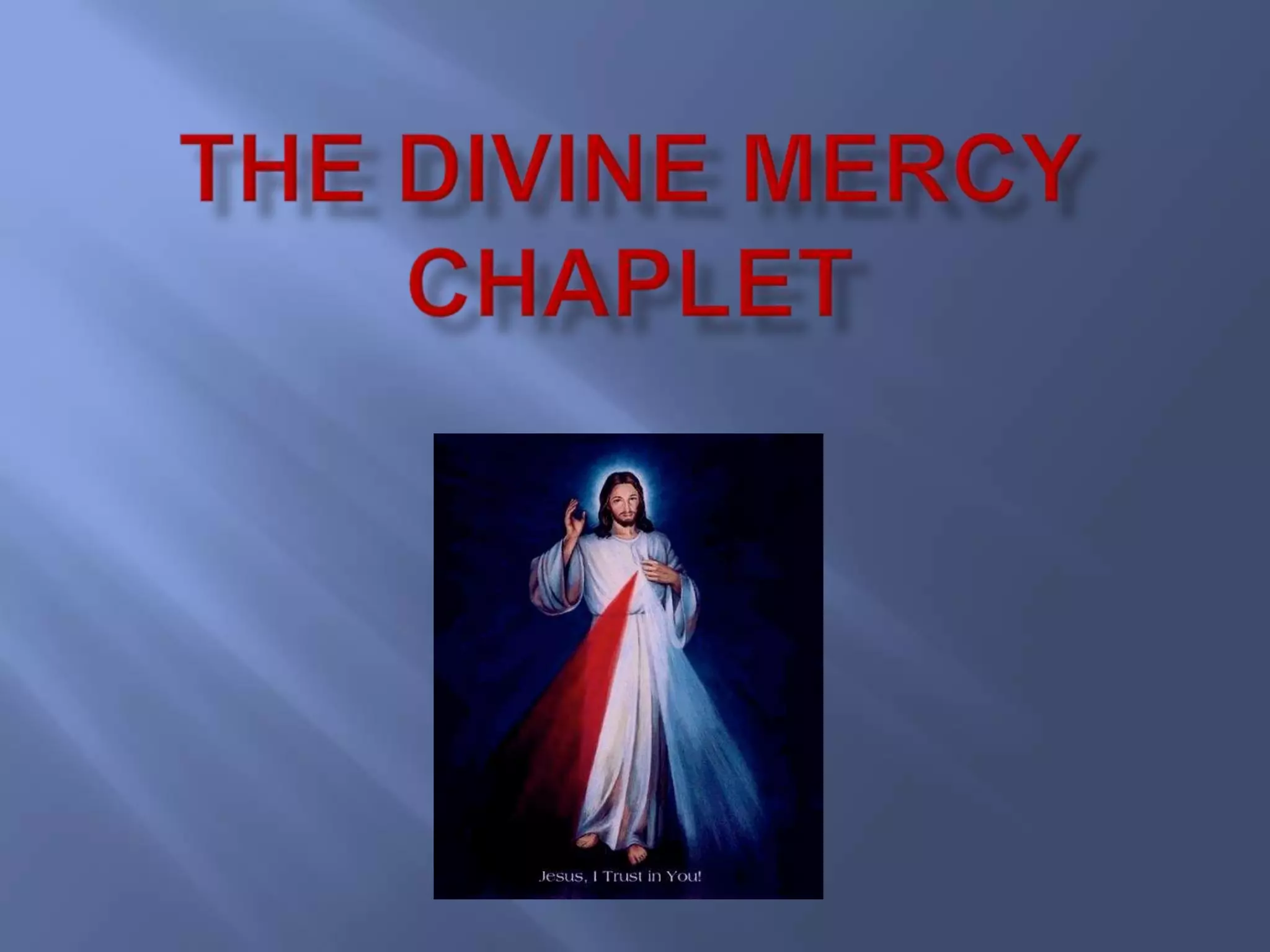
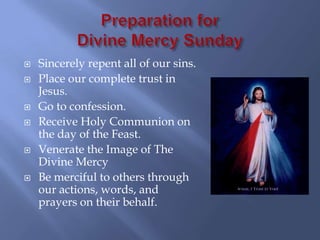
   Venerate the Image of The
    Divine Mercy
   Be merciful to others through
    our actions, words, and
    prayers on their behalf.
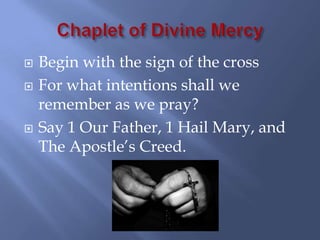
   Begin with the sign of the cross
   For what intentions shall we
    remember as we pray?
   Say 1 Our Father, 1 Hail Mary, and
    The Apostle’s Creed.
   The Apostle’s Creed:
   I believe in God, the Father Almighty, Creator of
    Heaven and earth; and in Jesus Christ, His only
    Son Our Lord, Who was conceived by the Holy
    Spirit, born of the Virgin Mary, suffered under
    Pontius Pilate, was crucified, died, and was buried.
    He descended into Hell; the third day He rose
    again from the dead; He ascended into
    Heaven, and sitteth at the right hand of God, the
    Father almighty; from thence He shall come to
    judge the living and the dead. I believe in the
    Holy Spirit, the holy Catholic Church, the
    communion of saints, the forgiveness of sins, the
    resurrection of the body and life everlasting.
    Amen.
   Eternal Father, I offer you the Body and Blood,
    Soul and Divinity of your dearly beloved Son,
    Our Lord Jesus Christ in atonement of our sins
    and those of the whole world.
   For the sake of His sorrowful passion, have
    mercy on us and on the whole world (repeat 10
    times).
   Eternal Father, I offer you the Body and
    Blood, Soul and Divinity of your dearly
    beloved Son, Our Lord Jesus Christ in
    atonement of our sins and those of the whole
    world.
   For the sake of His sorrowful passion, have
    mercy on us and on the whole world (repeat 10
    times).
   Eternal Father, I offer you the Body and
    Blood, Soul and Divinity of your dearly
    beloved Son, Our Lord Jesus Christ in
    atonement of our sins and those of the whole
    world.
   For the sake of His sorrowful passion, have
    mercy on us and on the whole world (repeat 10
    times).
   Eternal Father, I offer you the Body and
    Blood, Soul and Divinity of your dearly
    beloved Son, Our Lord Jesus Christ in
    atonement of our sins and those of the whole
    world.
   For the sake of His sorrowful passion, have
    mercy on us and on the whole world (repeat 10
    times).
   Eternal Father, I offer you the Body and
    Blood, Soul and Divinity of your dearly
    beloved Son, Our Lord Jesus Christ in
    atonement of our sins and those of the whole
    world.
   For the sake of His sorrowful passion, have
    mercy on us and on the whole world (repeat 10
    times).
   Holy God, Holy Mighty One, Holy Immortal
    One, have mercy on us and on the whole
    world. (Repeat Three Times)
   St. Louis de Montfort ….. Pray for Us.
   Make the Sign of the Cross.

The divine mercy chaplet

  • 2.
    St. Faustina was born Helena Kowalska in Poland on August 5th , 1905.  1925 at the age of 20 she entered religious life with the Congregation of Our Lady of Mercy.  She worked as a cook, gardener, and porter.
  • 3.
    Just as in the Old Testament God used prophets to spread His word; God used St. Faustina to help explain the message of Christ.  She received  She wrote of these revelations, visions, a experiences in her hidden stigmata, gifts of the diary and her mission became to Holy Spirit to read human share the message of souls, and prophesy. the Lord’s Divine Mercy with the world.
  • 4.
    1) She reminded us from scripture about God’s mercy for every human being.  2) To reach out to God and beg for Divine Mercy for the whole world through a devotion to “The Divine Mercy”  3) Create an apostolic movement through the begging Divine Mercy for the World and practicing works of mercy using St. Faustina’s example.
  • 5.
    Because of various documents and varying practices the devotion was banned by the Vatican in the 1950’s.  1965 the Bishop of Krakow Poland investigated Sr. Faustina and the devotion. In 1978 the ban was officially lifted.  Pope John Paul II (from Poland) made the message of Divine Mercy a part of his papacy and encouraged others to follow her example.  On April 30, 2000 JPII canonized St. Faustina which is celebrated on October 5th.
  • 6.
    She wrote and suffered in secret with only her spiritual director having any knowledge of what was going on.  The suffering and deep mystical experiences that she had she hid with joy from her associates.  She had no desire to make her experiences or diary known to the world.  She only wanted the prayer and message of mercy given to her shared with others.
  • 7.
    In her diary it was discovered that Jesus (in a vision) requested that the Second Sunday after Easter be Divine Mercy Sunday.  Pope John Paul II declared that the Church would celebrate Christ’s Mercy on the Second Sunday after Easter.
  • 8.
    JPII said: “It is important that we accept the whole message that comes from the word of God on Divine Mercy Sunday. That is the connection of the suffering, death, burial, res urrection, and ascension of Christ, followed by the sending of the Holy Spirit.”
  • 9.
    God’s Mercy was shown through His Son. With the Life, Death, Resurrection, and Ascension.  St. Faustina’s Divine Mercy is not a cult prayer but an expression and request of the Mercy that is found in Jesus Christ.
  • 10.
    Sincerely repent all of our sins.  Place our complete trust in Jesus.  Go to confession.  Receive Holy Communion on the day of the Feast.  Venerate the Image of The Divine Mercy  Be merciful to others through our actions, words, and prayers on their behalf.
  • 12.
    Begin with the sign of the cross  For what intentions shall we remember as we pray?  Say 1 Our Father, 1 Hail Mary, and The Apostle’s Creed.
  • 13.
    The Apostle’s Creed:  I believe in God, the Father Almighty, Creator of Heaven and earth; and in Jesus Christ, His only Son Our Lord, Who was conceived by the Holy Spirit, born of the Virgin Mary, suffered under Pontius Pilate, was crucified, died, and was buried. He descended into Hell; the third day He rose again from the dead; He ascended into Heaven, and sitteth at the right hand of God, the Father almighty; from thence He shall come to judge the living and the dead. I believe in the Holy Spirit, the holy Catholic Church, the communion of saints, the forgiveness of sins, the resurrection of the body and life everlasting. Amen.
  • 14.
    Eternal Father, I offer you the Body and Blood, Soul and Divinity of your dearly beloved Son, Our Lord Jesus Christ in atonement of our sins and those of the whole world.  For the sake of His sorrowful passion, have mercy on us and on the whole world (repeat 10 times).
  • 15.
    Eternal Father, I offer you the Body and Blood, Soul and Divinity of your dearly beloved Son, Our Lord Jesus Christ in atonement of our sins and those of the whole world.  For the sake of His sorrowful passion, have mercy on us and on the whole world (repeat 10 times).
  • 16.
    Eternal Father, I offer you the Body and Blood, Soul and Divinity of your dearly beloved Son, Our Lord Jesus Christ in atonement of our sins and those of the whole world.  For the sake of His sorrowful passion, have mercy on us and on the whole world (repeat 10 times).
  • 17.
    Eternal Father, I offer you the Body and Blood, Soul and Divinity of your dearly beloved Son, Our Lord Jesus Christ in atonement of our sins and those of the whole world.  For the sake of His sorrowful passion, have mercy on us and on the whole world (repeat 10 times).
  • 18.
    Eternal Father, I offer you the Body and Blood, Soul and Divinity of your dearly beloved Son, Our Lord Jesus Christ in atonement of our sins and those of the whole world.  For the sake of His sorrowful passion, have mercy on us and on the whole world (repeat 10 times).
  • 19.
    Holy God, Holy Mighty One, Holy Immortal One, have mercy on us and on the whole world. (Repeat Three Times)  St. Louis de Montfort ….. Pray for Us.  Make the Sign of the Cross.