The Cosmic Hologram
An Amateur Scientist’s Interpretation
by John Winders
John A. Wheeler summarized the concept of his "It from Bit" hypothesis as follows. "Our perception of phenomena consists
of a series of binary yes/no decisions made through observations. In short, the physical universe emerges from
information." I believe he was actually describing a hologram comprised of information – quanta – from which the physical
universe emerges as a holographic image or projection.
"Our perception of phenomena" is through five sensory channels: sight, hearing, touch, smell, and taste. All of those
channels depend on electromagnetism. Light stimulates the rod and cone cells of the retina directly, producing electrical
pulses that the brain assembles into visual images. Sound is produced from acoustic pressure waves impinging on the
eardrums, which is possible because of electrostatic repulsion among the molecules in solids, liquids and gases. Heat, cold,
and pressure are transmitted to nerve endings to produce the sensation of touch, again made possible due to electrostatic
forces. Electrical forces between different chemical compounds and receptor proteins in the gustatory and olfactory organs
produce taste and smell. When sense organs are stimulated via electromagnetism, they send electrochemical signals along
neural pathways to the brain, where the signals are assembled into "our perception of phenomena." Everything we can
possibly discern about exterior physical reality – if in fact such a thing exists – is perceived through electromagnetism.
Electromagnetism is mediated or carried out by photons, the quanta of light. Quanta are the "bits" of the "It from Bit"
model. It is said that photons travel through space at the speed of light relative to objects possessing mass, but in fact
photons don't "travel" at all because they are "stuck" motionless in spacetime. Instead, all objects possessing mass travel
through four-dimensional spacetime at the speed of light, making it seem that light travels through space. Photons fill the
three-dimensional region within the light cone, whose surface expands at the speed of light in accordance with the
Minkowski equation. The light cone region requires three dimensions because the electric and magnetic field vectors are
90 apart with their perpendicular cross product pointing in the direction of a light-like path along which proper time is
constant. Consequently, there is no passage of time within the light cone and “Now” is everywhere throughout.
The three-dimensional light cone "contains" four-dimensional spacetime within it, similar to how the two-dimensional skin
of an apple contains the three-dimensional fruit. The light cone is in spatial contact everywhere within spacetime, but the
two are in temporal contact with each other only in the "Now" moment. The passage of time that we experience is encoded
in the three-dimensional light cone, but the fourth dimension of time can only be actualized as a projection in four-
dimensional spacetime. This is analogous to a two-dimensional hologram that encodes a three-dimensional chessboard on
its surface. The third dimension of the chessboard can be revealed as a holographic projection in three-dimensional space.
Spacetime is encoded in the photons within the Cosmic Hologram.
When we observe a very distant star through a powerful telescope, astronomers say we are looking at the star as it "was" a
long time ago. But since light travels along a light-like path from the star to the telescope, the passage of time from the star
to the telescope is zero along that path. Anything we can ever discern about that star must be from interacting with its
image in the telescope, but the star's image in the telescope must exist in the same moment as when the light emerged from
that star. In short, everything that happens in our universe happens "Now." As soon as something happens, it slips into the
"past," which is out of reach; therefore, anything that persists over time must be recreated moment-by-moment.
The passage of time we experience does not occur within the Cosmic Hologram. Nevertheless, the boundary of the Cosmic
Hologram increases at the speed of light, according to the Minkowski equation, requiring the creation of new quanta of light
(photons) to fill that space. This is how the passage of time is encoded in the Cosmic Hologram. Quanta, information, and
entropy are equivalent to each other, and recent studies have shown that time as measured by clocks is the same as
accumulation or flow of entropy. Time is unidirectional because the second law of thermodynamics forbids an overall
decrease in entropy. The reason why quantum uncertainty exists is to allow free will to determine phenomena as a series of
binary yes/no decisions described by Wheeler. Nothing is predetermined, and making those decisions strongly implies there
is a fundamental, underlying Consciousness that is both the creator and observer of phenomena.
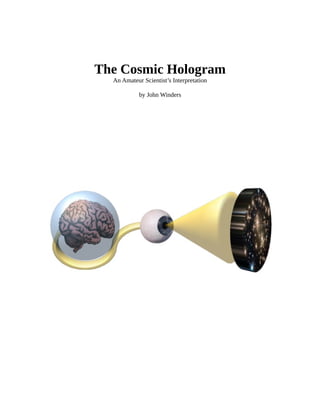
The figure on the cover of this essay shows my interpretation of the Cosmic Hologram derived from "it from bit." An
eyeball peers through a yellow light cone, representing all five senses and not only the sense of sight. Each of the senses is
stimulated by photons within the Cosmic Hologram and transmit signals via photons along neural pathways, shown as a
curved yellow band, to the brain, which assembles the signals into a four-dimensional spacetime model of physical exterior
reality, as shown by the disc-shaped group of stars beyond the light cone. Consciousness, represented by the hazy blue
sphere, is the true Observer of reality constructed in the brain. It must be stressed that Consciousness is immaterial and does
not typically interact with material objects directly. However, Consciousness is able to interact with the brain in the "Now"
moment, possibly through interactions at the quantum level. Stranger yet, the physical brain is actualized as part of the
four-dimensional holographic projection encoded in the Cosmic Hologram itself! This may be what Wheeler was referring
to as a "self-excited circuit" and a "feedback loop" with Consciousness being fundamental to reality.
Note to my readers:
You can access and download this essay and my other essays directly from the Amateur
Scientist Essays website using this link:
https://sites.google.com/site/amateurscientistessays/
You are free to download and share all of my essays without any restrictions, although it
would be very nice to credit my work when quoting directly from them.
If you would like to leave comments via email, you can send them using this link:
mailto:Amateurscientist@hotmail.com

The Cosmic Hologram

  • 1.
    The Cosmic Hologram AnAmateur Scientist’s Interpretation by John Winders
  • 2.
    John A. Wheelersummarized the concept of his "It from Bit" hypothesis as follows. "Our perception of phenomena consists of a series of binary yes/no decisions made through observations. In short, the physical universe emerges from information." I believe he was actually describing a hologram comprised of information – quanta – from which the physical universe emerges as a holographic image or projection. "Our perception of phenomena" is through five sensory channels: sight, hearing, touch, smell, and taste. All of those channels depend on electromagnetism. Light stimulates the rod and cone cells of the retina directly, producing electrical pulses that the brain assembles into visual images. Sound is produced from acoustic pressure waves impinging on the eardrums, which is possible because of electrostatic repulsion among the molecules in solids, liquids and gases. Heat, cold, and pressure are transmitted to nerve endings to produce the sensation of touch, again made possible due to electrostatic forces. Electrical forces between different chemical compounds and receptor proteins in the gustatory and olfactory organs produce taste and smell. When sense organs are stimulated via electromagnetism, they send electrochemical signals along neural pathways to the brain, where the signals are assembled into "our perception of phenomena." Everything we can possibly discern about exterior physical reality – if in fact such a thing exists – is perceived through electromagnetism. Electromagnetism is mediated or carried out by photons, the quanta of light. Quanta are the "bits" of the "It from Bit" model. It is said that photons travel through space at the speed of light relative to objects possessing mass, but in fact photons don't "travel" at all because they are "stuck" motionless in spacetime. Instead, all objects possessing mass travel through four-dimensional spacetime at the speed of light, making it seem that light travels through space. Photons fill the three-dimensional region within the light cone, whose surface expands at the speed of light in accordance with the Minkowski equation. The light cone region requires three dimensions because the electric and magnetic field vectors are 90 apart with their perpendicular cross product pointing in the direction of a light-like path along which proper time is constant. Consequently, there is no passage of time within the light cone and “Now” is everywhere throughout. The three-dimensional light cone "contains" four-dimensional spacetime within it, similar to how the two-dimensional skin of an apple contains the three-dimensional fruit. The light cone is in spatial contact everywhere within spacetime, but the two are in temporal contact with each other only in the "Now" moment. The passage of time that we experience is encoded in the three-dimensional light cone, but the fourth dimension of time can only be actualized as a projection in four- dimensional spacetime. This is analogous to a two-dimensional hologram that encodes a three-dimensional chessboard on its surface. The third dimension of the chessboard can be revealed as a holographic projection in three-dimensional space. Spacetime is encoded in the photons within the Cosmic Hologram. When we observe a very distant star through a powerful telescope, astronomers say we are looking at the star as it "was" a long time ago. But since light travels along a light-like path from the star to the telescope, the passage of time from the star to the telescope is zero along that path. Anything we can ever discern about that star must be from interacting with its image in the telescope, but the star's image in the telescope must exist in the same moment as when the light emerged from that star. In short, everything that happens in our universe happens "Now." As soon as something happens, it slips into the "past," which is out of reach; therefore, anything that persists over time must be recreated moment-by-moment. The passage of time we experience does not occur within the Cosmic Hologram. Nevertheless, the boundary of the Cosmic Hologram increases at the speed of light, according to the Minkowski equation, requiring the creation of new quanta of light (photons) to fill that space. This is how the passage of time is encoded in the Cosmic Hologram. Quanta, information, and entropy are equivalent to each other, and recent studies have shown that time as measured by clocks is the same as accumulation or flow of entropy. Time is unidirectional because the second law of thermodynamics forbids an overall decrease in entropy. The reason why quantum uncertainty exists is to allow free will to determine phenomena as a series of binary yes/no decisions described by Wheeler. Nothing is predetermined, and making those decisions strongly implies there is a fundamental, underlying Consciousness that is both the creator and observer of phenomena. The figure on the cover of this essay shows my interpretation of the Cosmic Hologram derived from "it from bit." An eyeball peers through a yellow light cone, representing all five senses and not only the sense of sight. Each of the senses is stimulated by photons within the Cosmic Hologram and transmit signals via photons along neural pathways, shown as a curved yellow band, to the brain, which assembles the signals into a four-dimensional spacetime model of physical exterior reality, as shown by the disc-shaped group of stars beyond the light cone. Consciousness, represented by the hazy blue sphere, is the true Observer of reality constructed in the brain. It must be stressed that Consciousness is immaterial and does not typically interact with material objects directly. However, Consciousness is able to interact with the brain in the "Now" moment, possibly through interactions at the quantum level. Stranger yet, the physical brain is actualized as part of the four-dimensional holographic projection encoded in the Cosmic Hologram itself! This may be what Wheeler was referring to as a "self-excited circuit" and a "feedback loop" with Consciousness being fundamental to reality.
  • 3.
    Note to myreaders: You can access and download this essay and my other essays directly from the Amateur Scientist Essays website using this link: https://sites.google.com/site/amateurscientistessays/ You are free to download and share all of my essays without any restrictions, although it would be very nice to credit my work when quoting directly from them. If you would like to leave comments via email, you can send them using this link: mailto:Amateurscientist@hotmail.com