The Comingled Code Open Source And Economic
Development Joshua Lerner Mark Schankerman
download
https://ebookbell.com/product/the-comingled-code-open-source-and-
economic-development-joshua-lerner-mark-schankerman-55696714
Explore and download more ebooks at ebookbell.com
Here are some recommended products that we believe you will be
interested in. You can click the link to download.
Exploring Latin Piano Southamerican Cuban And Spanish Rhythms For The
Intermediate Pianist Papcom John Crawford De Cominges
https://ebookbell.com/product/exploring-latin-piano-southamerican-
cuban-and-spanish-rhythms-for-the-intermediate-pianist-papcom-john-
crawford-de-cominges-57784180
The Union Haggadah Home Service For The Passover Central Conference Of
American Rabbis Rabbis
https://ebookbell.com/product/the-union-haggadah-home-service-for-the-
passover-central-conference-of-american-rabbis-rabbis-33546358
The Roman Republic Of Letters Scholarship Philosophy And Politics In
The Age Of Cicero And Caesar Catherine Volk
https://ebookbell.com/product/the-roman-republic-of-letters-
scholarship-philosophy-and-politics-in-the-age-of-cicero-and-caesar-
catherine-volk-44860132
The Ninth Month James Patterson
https://ebookbell.com/product/the-ninth-month-james-patterson-44862442
The History Written On The Classical Greek Body Robin Osborne
https://ebookbell.com/product/the-history-written-on-the-classical-
greek-body-robin-osborne-44863234
How To Tell If Your Cat Is Plotting To Kill You The Oatmeal Matthew
Inman
https://ebookbell.com/product/how-to-tell-if-your-cat-is-plotting-to-
kill-you-the-oatmeal-matthew-inman-44863758
My Dog The Paradox A Lovable Discourse About Mans Best Friend The
Oatmeal
https://ebookbell.com/product/my-dog-the-paradox-a-lovable-discourse-
about-mans-best-friend-the-oatmeal-44863950
The Book Of Primal Signs The High Magic Of Symbols 2nd Edition Nigel
Pennick
https://ebookbell.com/product/the-book-of-primal-signs-the-high-magic-
of-symbols-2nd-edition-nigel-pennick-44863972
The True History Of Tea Victor H Mair Erling Hoh
https://ebookbell.com/product/the-true-history-of-tea-victor-h-mair-
erling-hoh-44864088
JOSH LERNER AND MARK SCHANKERMAN
Open Source
and Economic
Development
The Comingled Code
The Comingled Code
Open Source and Economic Development
Josh Lerner and Mark Schankerman
The MIT Press
Cambridge, Massachusetts
London, England
( 2010 Massachusetts Institute of Technology
All rights reserved. No part of this book may be reproduced in any form by any elec
tronic or mechanical means (including photocopying, recording, or information storage
and retrieval) without permission in writing from the publisher.
For information about special quantity discounts, please email special sales@mitpress
.mit.edu
This book was set in Palatino on 3B2 by Asco Typesetters, Hong Kong.
Printed and bound in the United States of America.
Library of Congress Cataloging in Publication Data
Lerner, Joshua.
The comingled code : open source and economic development / Josh Lerner and Mark
Schankerman.
p. cm.
Includes bibliographical references and index.
ISBN 978 0 262 01463 2 (hardcover : alk. paper) 1. Open source software. 2. Computer
software Development. I. Schankerman, Mark. II. Title.
QA76.76.S46L46 2010
005.3 dc22 2010001730
10 9 8 7 6 5 4 3 2 1
To Carol and Ralph
To my mother Etta and my father Paul (Z"L), with love
Contents
Preface and Acknowledgments ix
1 Introduction 1
2 Software and Growth 15
3 The History of Open Source 35
4 The Supply Side: Comingling Open Source and Proprietary
Software 61
5 The Demand Side: Assessing Trade-offs and Making
Choices 103
6 Assessing Government Policies toward Software (with Jacques
Crémer) 157
7 The Takeaways 207
Glossary 215
References 225
Index 231
Preface and Acknowledgments
Many a book has a tangled story behind it, and this one has a particu-
larly long and twisted one. As a result there are a lot of people to thank.
This project has sought to understand the role of open source in eco-
nomic development using several approaches. Given the early stage
of open source software’s development and the inherent difficulty of
measuring these activities, only through taking multiple approaches
can we do justice to this complex phenomenon.
The first approach was a careful review of the economic principles to
shed light on the open source phenomenon and its implications for
economic development. We prepared an analytical framework that
highlighted how economics could guide us in understanding these
complex issues. To do so, we drew on a diverse array of bodies of liter-
ature, including work on growth, the nature of innovation, and the lit-
erature on incentives and innovation in open source. When economic
principles point in different directions—as they sometime do—we
highlighted the open questions. The analytic framework underlies the
work, and broadly informs how we approach the conceptualization of
the demand and the supply sides in open source, as well as how we
address the key policy questions.
The second approach was the preparation of a series of case studies
of the open source phenomenon. We sought to understand the com-
plexity of the role of open source in half a dozen nations in various
stages of development. Rather than focus on the entire canvas of activ-
ities in each nation, we looked at different issues raised by specific sit-
uations in a number of emerging economies. Each study was based on
interviews with Harvard Business School’s case writers and secondary
sources. The cases we studied were:1
1. A variety of supplemental material not included in the book is posted on line at
http:/
/mitpress.mit.edu/comingledcode.
• In Brazil, a project called HackerTeen seeks to combine educating
young programmers with the development of new software.
• In China, the CEO of a mobile telephone software company must de-
cide whether to use Linux or commercial alternatives as the basis for
his system.
• In France, a chief information officer must choose whether to recom-
mend the Ministry of Finance will run on open source or proprietary
software.
• In Singapore, the government considers whether to support a re-
search initiative to promote research in open source.
• In South Africa, a vendor of software and services must decide how
much effort to devote to developing expertise in open source.
• In Thailand, the government considers whether to promote a ‘‘Peo-
ple’s PC,’’ which would combine a low-cost hardware platform with
open source software.
By focusing on a wide variety of actors in a diverse array of situations,
we gained a rich picture of open source activity and its implications for
development.
The third and final aspect of the project involved a large-scale survey
of software users and developers in fifteen countries. (The developer
survey alone had nearly 2,000 respondents.) The nations included
many of the same ones on which we wrote cases, as well as other
developing and industrialized countries, including Chile, Greece,
India, Israel, Kenya, Mexico, Poland, Russia, and Turkey. We high-
lighted in the questionnaire not just questions about the utilization of
open source software, but also about the respondents’ attitudes and
perspectives on the costs and benefits of this software. We further
looked separately at developers and users of different types (for users,
different sizes of companies, government agencies, and ownership; for
developers, different sizes, ownership, software activities, etc.).
After we had conceptualized the project, we realized that the ex-
pense was so great that it was unlikely that we could fund it using our
own resources: both the surveys and case studies proved to be ex-
tremely costly to implement. We discovered that Microsoft was inter-
ested in funding academic work into open source, with the goal of
promoting a less ideological discussion of the pros and cons of soft-
ware choices and public policy toward this sector, as well as providing
x Preface and Acknowledgments
the empirical evidence that could contribute to a more balanced and
evidence-based formulation of public policy. We accepted their fund-
ing under stringent terms that ensured that the effort was characterized
by intellectual independence and analytical rigor.
This work, and the conversations it engendered, led to the idea of
developing this book. As always, the process of converting research
into (at least what we hope is) readable prose proved to be a far more
daunting task than we had initially envisioned.
First of all, we are very grateful for the contributions of Jacques
Crémer of the University of Toulouse. In addition to being the co-
author of chapter 6, Jacques was crucially involved in many discus-
sions that led to the development and elaboration of the main themes
and ideas of the book. His was an important contribution to the
volume.
Next, our thanks must go to our long-suffering MIT Press acquiring
editor, Jane Macdonald, for her patience with us. We also would like
to thank David Evans, Anne Layne-Farrar, and Daniel Schwartz of
LECG for their initial encouragement and help with the project, espe-
cially in the development of the survey questionnaires. Jacques Lawar-
ree was the project’s champion at Microsoft. We also benefited from
considerable financial support from Harvard Business School’s Divi-
sion of Research. Mark Schankerman also thanks the British Academy
and the Muzzy Chair in Entrepreneurship at the University of Arizona
for their financial support of this research.
Sam Kortum of the University of Chicago was a member of the orig-
inal project team and contributed a number of ideas. Brian DeLacey,
Kerry Herman, and David Kiron played key roles in developing the
case studies. Ivan Maryanchuk and Liat Oren provided excellent re-
search assistance on the empirical analysis found in chapters 4, 5, and
6, and Kathy Han and Gabriel Fotsing provided invaluable research
support on other aspects of the book. Maurie SuDock helped with the
manuscript preparation and cleanup. While we are grateful for all the
support, it is important to note that the ideas and recommendations
represent our own opinions only.
As we discuss at more length in the introduction, there remains a
considerable divide between the economics and open source commun-
ities. It is our hope that this book helps bridge this gap, by discussing
the economic issues around open source in an accessible but tangible
way based on systematic empirical evidence. We particularly hope
Preface and Acknowledgments xi
that this approach leads to a less shrill (or less acrimonious) interaction
between these communities, and a more informed, evidence-based
public policy toward this sector.
Josh Lerner and Mark Schankerman
Boston and London
October 2009
xii Preface and Acknowledgments
1 Introduction
Open source software involves developers at many different locations
and organizations sharing code to develop and refine computer pro-
grams that are then distributed at no or low direct cost. Over the past
fifteen years open source software has experienced explosive growth
around the world. The importance of open source software today can
be illustrated by considering a few examples:
• The market for server software, which is used by the computers that
make Web pages available to users through the Internet, has been
dominated by the open source Apache project since the inception of
systematic tracking by Netcraft in 1995. As of July 2009 more than half
of servers employed Apache or other open source products, rather
than commercial alternatives from Microsoft, Oracle, or other firms.1
• While definitive numbers are very hard to come by, a variety of sur-
vey evidence suggests that the open source operating system called
Linux has rapidly outstripped Microsoft’s Windows program as the
operating system most frequently embedded into products ranging
from mobile phones to video recording devices.2
• Open source software is dominant in a number of other areas as well;
for example, PERL and PHP are the dominant scripting languages
(programming languages designed specifically for instructing one
computer how to communicate with others).
• Even corporations that have traditionally resisted open source, and
the stringent General Public License (GPL) in particular, have seem-
ingly changed their approach. Most visibly Microsoft, whose executives
1. http:/
/news.netcraft.com/archives/web server survey.html (accessed August 23,
2009).
2. http:/
/www.linuxfordevices.com/c/a/Linux For Devices Articles/Snapshot of the
embedded Linux market April 2007/ (accessed August 23, 2009).
once branded the GPL as ‘‘fundamentally undermin[ing] the indepen-
dent commercial software sector,’’3 released two substantial blocks of
code under this license in July 2009.4
• Open source software is not a phenomenon that is confined to rich
countries. For better or for worse, the Brazilian and many other devel-
oping nation governments are promoting the use of open source soft-
ware as an alternative to proprietary products. Significant numbers of
contributors to open source software, in proportion to the population,
can be found in countries with per capita income as low as $10,000.
Open source software may be poised for rapid growth in the future.
The number of projects has exploded: the website SourceForge.net,
which provides free services to open source software developers, has
grown from a handful of projects in 2000 to well over two hundred
thousand open source projects today.5 Many of the projects seem to
have room to expand: for instance, the operating system Linux has
opportunities in the market for desktop operating systems; in 2009,
only one percent of the Web queries tracked by Net Applications came
from machines running Linux, although that share was gradually ris-
ing.6 More generally, the economic downturn appears to have acceler-
ated corporate interest in and adoption of open source solutions: for
instance, IDC recently revised its projected growth in revenue from
open source products through 2013 upward, to an annual rate of 22.4
percent.7
The growth of open source software is attracting considerable at-
tention from the public sector as well. Government commissions and
agencies have proposed—and in some cases implemented—a variety
of measures to encourage open source developers, including R&D sup-
port, encouragement for open source adoption, explicit preferences
in government procurement, and even mandates regarding software
3. http:/
/www.microsoft.com/presspass/exec/craig/05 03sharedSource.mspx (accessed
August 23, 2009).
4. http:/
/www.microsoft.com/presspass/features/2009/Jul09/07 20LinuxQA.mspx?rss
fdn=Toppercent20Stories (accessed August 23, 2009). It should be noted that Microsoft’s
motivations for this step were hotly questioned and debated (e.g., http:/
/blog.seattlepi
.com/microsoft/archives/174828.asp; accessed August 23, 2009).
5. http:/
/sourceforge.net/apps/trac/sourceforge/wiki/Whatpercent20ispercent20Source
Forge.net? (accessed August 25, 2009).
6. http:/
/marketshare.hitslink.com/report.aspx?qprid=8 (accessed August 23, 2009).
7. http:/
/finance.yahoo.com/news/Open Source Software Market bw 400190557.html?x
=0&.v=1 (accessed August 23, 2009).
2 Chapter 1
choices. In 2008 the Center for Strategic and International Studies iden-
tified 275 open source public policy initiatives, 182 of which have been
favorably enacted.8 For instance, since 2003, Singapore has offered tax
breaks to companies using GNU/Linux operating systems rather than
proprietary ones in order to encourage the development of the local
software sector. Many European governments have enacted policies to
encourage the use and purchase of open source software for govern-
ment use. Governments have even mandated the development of
localized open source projects, as has occurred in China. But while the
efforts are concentrated in Europe and Asia, the interest in open source
is truly global.
Brazil, Mexico, and South Africa are just a handful of developing na-
tions that have launched significant open source initiatives. In part the
appeal of these programs is that they are typically available for free,
or at a much lower direct cost than comparable proprietary products.
But these nations also argue that a wide variety of economic develop-
ment benefits can follow from the development of a vibrant open
source community, including the development of local industries, an
improved foreign trade balance, and a reduction in intellectual prop-
erty piracy.
Policy discussions around open source, though, have frequently
been characterized by more heat than light. While the question at the
heart of the debate—what is the impact of open source on consumers,
firms, and economic growth more generally—is an economic one, the
discussion is frequently framed in nearly theological tones. Advocates
of open source passionately assert its benefits, while critics denigrate
its role. Missing from the debate has been rigorous economic analysis
and systematic microeconomic evidence, which might help sort out
these competing claims.
This paucity of rigorous analysis in part reflects the strong emotions
that the subject engenders. But it also reflects the difficulty of conclu-
sively answering these questions empirically. Open source software
usage is difficult to track, and the economic impacts of software utiliza-
tion hard to trace definitively. Moreover there is always the chicken-
and-egg problem: Did the use of a certain type of software promote
the growth of a software industry in a given country, or did the rapid
growth of a nation lead to it turning to a given set of software?
8. http:/
/csis.org/files/media/csis/pubs/0807218 government opensource policies.pdf
(accessed August 23, 2009). All citations to these programs are provided in chapter 6.
Introduction 3
About This Book
This book seeks to address these challenging issues. Building on a
series of analyses, we hope to improve our understanding of how
open source and proprietary software interact and the policy issues
that this raises. In particular, we try to provide an economic perspec-
tive on a debate that has been largely conducted on other terms, and a
new large-scale database that can support more informed discussion.
The prior paragraph, of course, suggests a question: Why should
economists have anything to say about software at all? It is true that
we have spent many a happy hour programming regressions in Stata
and trying to make tables come out just right in LaTeX. But we cer-
tainly do not pretend to be expert programmers, nor have we ever
organized an open source project or corporate software initiative.
Rather, the answer to this question lies elsewhere. The question
might well be reasonable if the book’s focus was on the nature of open
source and/or proprietary programs. But our focus in this book is dif-
ferent. In particular, we will be concentrating on understanding the
broader impact of open source software. And once we move beyond
the programs themselves, and to how they interact with the rest of
the world, an economic perspective can be indispensable. Among the
questions we will examine are these four:
• How does software differ from other technologies when it comes to
promoting economic development?
• What are the motivations that drive individuals and firms to contrib-
ute to open source projects?
• How do firms using and developing software view the trade-offs be-
tween proprietary and open source projects?
• What policies can governments adapt to ensure that open source ef-
fectively competes with proprietary software and contributes to eco-
nomic growth, and which steps run the danger of backfiring?
It is our belief that in each of these arenas, an economic perspective
adds essential value in shedding light on these questions.
In particular, we highlight several crucial insights that the applica-
tion of an economic framework to the world of open source suggests:
• Traditional economic frameworks that prescribe that the market will
solve the optimal allocation of activity do not apply very well to the
software industry.
4 Chapter 1
• Open source and proprietary software share many common ele-
ments, as well as differences, that economic analyses can illustrate.
• Based on studies completed to date, it is hard to draw unambiguous
conclusions as to the superiority of open source versus proprietary
software.
• There is not a strong foundation for the claim that the government
should favor open source or proprietary software when purchasing for
its own purposes.
• While governments in developing countries may have strong ratio-
nales for encouraging the development of a software industry in
general, the desirability of encouraging open source is more circum-
scribed, and economic analysis help identify the conditions under
which such support may be justified.
Ultimately, it is our hope that this book stimulates more conversa-
tions between the open source and economics communities. Each side,
it seems, has much that can be learned from the other. Despite (per-
haps because of) the extensive research that we have undertaken in
this area, we are keenly aware of the limitations that economists have
faced when studying the open source realm and the way in which
a keener understanding of the technical and social aspects of open
source communities could be valuable. At the same time we strongly
believe, and hope to have shown in this book, that many of the concep-
tual and methodological tools in the economics ‘‘tool kit’’ can be valu-
able additions to many in the programming community interested
in more rigorous, systematic studies of this important sector of the
economy.
A Road Map to the Book
To give a sense of where we are going with the book, we will provide a
brief overview of chapters 2 through 7.
An Initial Look at Software and Growth
The second chapter has an ambitious mandate. To help set the stage for
an understanding of open source software, we begin by explaining
why software is important from an economic perspective.
Traditionally economists studying economic growth focused on how
physical capital accumulates over time. As the economy grows and
people take some of their earnings and invest it in extra machines
Introduction 5
and facilities, there is greater output and hence economic growth. Later
theories applied a similar principle to the accumulation of ‘‘human
capital,’’ where savings are used to accumulate more knowledge: some
of labor time is used not directly for production but for schooling and
training.
In recent years, however, there has been a dramatic change in the
economists’ perspective, growing out of the realization that we had
‘‘Hamlet without the prince.’’ The ‘‘new growth theory’’ puts techno-
logical innovation at the center of the growth process: the ways that
inputs (e.g., people and machines) are translated into outputs, both
products and services. The special thing about an innovation is that it
can be shared: everyone can use it at the same time (whereas a worker
or a machine cannot be everywhere at once). Unlike a physical piece of
equipment, the use of a recipe for a better mosquito repellant in one
country or by one individual does not hinder its use in other countries
or by other individuals. Economists call this the nonrivalry property of
information. But one must also ensure that individuals and firms have
incentives to invent better recipes. They might not have incentives to
do so if the new knowledge they generate is immediately and freely
made available to everyone who wants to use it.
Where does computer software, and open source software in partic-
ular, fit within this framework of growth theory? In many respects it is
like other technologies: it allows people to produce more with the same
amount of materials. Indeed software’s reach extends far beyond the
software industry. Much of the innovation in software sprang from
firms in other industries that have embodied software into products
and processes.
The same conundrum described in the new growth theory is present
in traditional proprietary software. On the one hand, since a software
program, once developed, can be distributed very cheaply via the
Internet, it is socially wasteful for some firms and countries to use infe-
rior software. And indeed software use (at least as evidenced by avail-
able evidence on diffusion of Internet and computers) and software
production (measured using software patenting in the United States
and by open source contributions) both vary with the level of develop-
ment: many national information technology industries appear stuck
at a lower level of development (these disparities appear to be much
greater on the production side). On the other hand, as before, we need
to worry about the incentives to develop better software.
Where does open source software fit within this framework? If the
open source model of software development could deliver state-of-
6 Chapter 1
the-art and easy-to-use products for all applications, it would solve the
conundrum of the new growth theory as it applies to software. On
the one hand, it would make the best recipes available everywhere at
essentially zero cost, hence taking full advantage of the nonrivalry
property. On the other hand, the incentive problem would be solved
by the fact that programmers (either as individuals or as firms) contrib-
ute voluntarily to the software development. This analysis suggests
why open source is potentially so revolutionary, and the critical impor-
tance in understanding its economic development impact.
Lessons from History
To understand open source software, it is useful to understand where
it has come from. In chapter 3 we explore the origins and evolution
of this sector. We highlight how there have been three distinct eras of
open source development:
• During the 1960s and 1970s many of the key features of computer
operating systems and the Internet were developed in academic set-
tings such as Berkeley and MIT, as well as in central corporate research
facilities where researchers had a great deal of autonomy, such as Bell
Labs and Xerox’s Palo Alto Research Center. The sharing by pro-
grammers in different organizations of the source code for computer
operating systems and for widely used transmission protocols was
commonplace. These cooperative software development projects were
undertaken on a highly informal basis.
• In response to the threats of litigation engendered by this lack of clear
rules, efforts to formalize the ground rules behind the cooperative soft-
ware development process emerged. These efforts ushered in the
second era. The critical institution during this period was the Free Soft-
ware Foundation, begun by Richard Stallman of the MIT Artificial In-
telligence Laboratory in 1983. The foundation sought to develop and
disseminate a wide variety of software at no cost. The Free Software
Foundation introduced a formal licensing procedure, called a General
Public License, for a computer operating system called GNU. This pro-
cedure ensured that all derivatives of the program would also be dis-
seminated at low or no cost.
• The widespread diffusion of Internet access in the early 1990s led to
the third era that saw a dramatic acceleration of open source activity.
Because it became easier for developers at very distant physical loca-
tions to collaborate on the development of projects at low cost, the vol-
ume of contributions and diversity of contributors expanded sharply,
Introduction 7
and numerous new open source projects emerged. Other innovations
in recent years have been the proliferation of alternative approaches to
licensing cooperatively developed software and (not unrelatedly) the
emergence of corporate contributors.
The history of open source software detailed in this chapter also
anticipates many of the themes that will emerge later in the book. In
particular, as we review the institutional features during and research
insights about the evolution of open source, five critical themes have
emerged. These are:
• The pace of change in the open source community. The industry
today is very different from that even a few years ago, whether we
examine the number and mixture, the actors involved, and the pro-
cesses followed within the groups.
• The way in which the seemingly esoteric issues of open source
licenses, with their detailed delineation of rights and responsibilities of
the key parties, profoundly affect the nature of these projects.
• The increasingly important role of corporations and corporate con-
tributors. While press accounts frequently highlight the image of open
source programs being driven by graduate students and moonlighting
computer administrators, for-profit firms have played an important
and growing role in open source development. Frequently these activ-
ities are done alongside the development of proprietary software.
• The extent to which users of open source programs are concerned
about the costs of moving across programs and from one version of a
program to another. These worries often are important drivers of
users’ willingness to adopt open source programs.
• The increasingly important role of the public sector in influencing
both the development and adoption of open source software, whether
through subsidies, procurement decisions, or other means.
Who Develops Open Source Software?
In chapter 4 we return to the hypothesis we highlighted in the second
chapter: that the great appeal, and potential importance, of open
source lies in the fact that it might represent a solution to the funda-
mental challenge to promoting innovation. In particular, open source
software might be able to solve the tension between the need to pro-
vide firms and individuals with the incentive to innovate and the de-
sirability of encouraging widespread use of cutting-edge technologies.
8 Chapter 1
By making the software available to anyone at essentially zero cost,
open source projects ensure that cutting-edge projects will be widely
diffused. And the incentive problem may not be there, as the voluntary
contributors are rewarded in other ways. On top of that, spillovers of
knowledge would be enhanced by the fact that the source code is avail-
able for many to build upon.
We examine this hypothesis in this chapter by looking closely at
the development and marketing of software by firms. This investiga-
tion is made possible by the new and unique survey of software com-
panies we conducted, covering nearly two thousand firms in fifteen
countries.
Three key insights are highlighted in the chapter. Most surpris-
ingly, firms extensively blend the development of open source and
proprietary product, rather than specializing in one or the other. It is
commonplace to see the same firm developing both open source and
proprietary programs, or else making the same program available
under both a traditional proprietary and open source licenses. We ob-
serve this comingling of open source and proprietary software devel-
opment by firms in all of the countries we survey. In all likelihood this
mixing by software firms suggests that there are substantial cost syner-
gies, whether in product development or marketing, between open
source and proprietary software.
Software companies diversify between open source and proprietary
software in other dimensions as well. For instance, companies will fre-
quently combine support services with product development: clearly,
the insights from product development can translate into its installa-
tion. We find that larger firms are far more likely diversify along these
lines than smaller ones, presumably because they can exploit cost syn-
ergies more readily without sacrificing economies of scale.
While as the two previous points suggest, open source and pro-
prietary software are similar in many respects and are extensively
comingled, they differ substantially when it comes to exports. While
software firms of all kinds are likely to export products, firms that con-
centrate on the development of proprietary software are both more
likely to export and are more intensive exporters than their open
source-focused peers. This pattern may well change over time, but for
now appears to be quite robust.
This empirical evidence suggests that the initial hypothesis for-
mulated in chapter 2 was too optimistic. The same fundamental ten-
sion that is at the heart of innovation policy—how to encourage the
Introduction 9
development of new knowledge without sacrificing the social gains that
can occur from the widespread diffusion of cutting-edge technologies
—also characterizes the software industry. And given the extensive
similarity between, and cohabitation of, open source and proprietary
software, these challenges are likely to apply to open source as well as
proprietary software. Sad to say, open source software offers no free
lunch, no easy way to solve the innovation paradox.
Who Uses Open Source Software?
We then turn in chapter 5 to understanding who uses open source soft-
ware and how they make the decision between open code and propri-
etary software. Once again, we undertake a unique survey, covering
more than two thousand users in fifteen countries. The data provides
many new insights into the structure of demand for software, and in
particular how it relates to a number of user characteristics and to their
perceptions of the various costs involved in adopting software.
The analysis suggests four main insights:
• Open source and proprietary software present users with differing
costs. Not surprisingly, proprietary software presents users with a con-
siderably higher upfront cost. However, the other costs associated with
adopting any piece of software—the costs of switching (learning),
interoperability (compatibility of different programs), and support
services—are greater for users of open source software. These patterns
are observed across a wide variety of countries, from the most to the
least developed.
• Software users vary substantially. This variation is seen not just in the
users’ software needs, but also in how they evaluate costs. As a result
of these different preferences and requirements, two users could make
very different choices between open source and proprietary software.
• Mixing is commonplace. Across countries and all types of users, open
source and proprietary software are frequently comingled. Mixing is
more frequently practiced in settings where economic principles would
suggest it should be, such as the greater prevalence among cost-
constrained (small) firms.
Thus in many respects the insights regarding the survey of users and
developers are quite complementary. Despite the substantial differ-
ences between the two families of software, open source and propri-
etary code do not live in two totally different worlds. Rather, there are
10 Chapter 1
extensive interactions. The same firms that market proprietary code
are also likely to contribute to or sell open source code as product.
Users are likely to be employing both open and proprietary software.
Our detailed survey data on software development and usage have
allowed us to document the extensive cohabitation between the open
source and proprietary software worlds.
The Policy Challenge
As the discussion of the two prior chapters suggest, policy makers face
a substantial challenge when it comes to setting policies for encourag-
ing software development and diffusion. On the one hand, software
has the potential to impact economic growth in a positive and substan-
tial manner. And open source has properties that are likely to be par-
ticularly attractive, as we have discussed.
But as our survey has highlighted, many software developer firms
sell proprietary software while contributing to open source develop-
ment, and software users extensively mix and match the two types of
software. The problem is not an either/or one—to choose between one
form of software and the other—but rather to develop a policy frame-
work that ensures that developers and users mix in an efficient man-
ner, and one that contributes to innovation in both forms of software.
How can a government develop a framework that facilitates the com-
petitive interactions between open source and proprietary software in
a manner that boosts efficiency and innovation?
In the sixth chapter we turn to the question of how public policy
can address this question. We use economic reasoning to evaluate the
key arguments for why the government should support open source
software. We complement this analysis with our data from the fifteen-
nation survey, which provides evidence on what kinds of regulatory
and incentives schemes are available to users and developers.
We argue that government’s role in procurement is fundamentally
different from a corporate buyer. Because of the relative size and visi-
bility of government purchases in many economies, the public sector
can play a leadership role with its purchases that many others may
not. Moreover the government must consider what is good for the
economy as a whole (what economists call social welfare), rather than
simply minimizing its own costs. These observations do not mean that
the government should in every case design its procurement policies to
play a leadership role: the proper decision depends very much on the
Introduction 11
specific context, and we identify leading cases where this may be war-
ranted. When such a role is not needed, the purchasing decision should
be based on an evaluation of the total cost of ownership, similar to that
which a corporate buyer would make.
When it comes to regulation, we argue that governments should en-
courage vigorous competition between open and proprietary software.
This does not mean, it should be noted, a hands off, or laissez faire,
approach. Rather, it means, first and foremost, taking the necessary
steps to ensure that commercial firms do not abuse the networks they
may have developed to disadvantage open source. Encouraging truly
open standards, to allow the most competition possible between forms
of software, is also important. Yet ensuring that private firms have real
economic incentives to innovate is also critical. This conclusion is borne
out in our survey of users and developers, which found a strongly
voiced preference for a regulatory regime that allows them complete
freedom to choose between open source and proprietary software,
rather than one that either requires or favors one or the other.
Regarding the plethora of other policies relating to encouraging
software development, whether open source or proprietary, clear
economic prescriptions are few and far between. The strongest case
can be built for the government playing a lead role in providing infor-
mation to consumers about the features of different types of soft-
ware, as well as demonstration projects of various types. While one
cannot make definitive statements on the basis of existing economic
analysis, the case for direct subsidies for open source appears to be
weaker.
There are, of course, many other policy choices that will need to be
addressed when shaping an information technology policy. Govern-
ments need to decide whether to finance local information technology
firms (or their financiers), whether to subsidize users of advanced tech-
nologies, how much to invest in education of information technology
professionals, and how to design an intellectual property regime that
is appropriate for software, which does not fit neatly into traditional
categories. Especially in developing countries, governments need to do
all this with limited human and financial resources. On all these issues,
much more research is needed to assist decision makers with the diffi-
cult choices they have to make. We hope that some of the energy that
has, in recent years, been directed at the rather polarized debate be-
tween open source and proprietary software will be redirected more
constructively toward these issues.
12 Chapter 1
Lessons
We end in chapter 7 with a series of recommendations for the various
key audiences, drawn from the discussions and analyses in the book.
For government officials, we emphasize four lessons:
1. The danger of making choices: given the trade-offs between differ-
ent technologies, and the frequent miscues that public efforts to ‘‘pick
winners’’ have encountered, it is far better to let competition take its
course than mandate a solution.
2. The many reasons for encouraging competition between open and
proprietary software: as we highlight throughout the book, there are
many trade-offs that mean that different users in different situations
could come to diametrically opposed answers when choosing between
software types. Recommending that governments should encourage
competition, however, is not the same thing as arguing that they
should not be involved in regulating the software industry.
3. The need for a different calculus when governments make decisions
about software procurement as opposed to private entities: when fund-
ing the development of software, whether for their own use or as a
more general R&D effort, government officials should use similar crite-
ria as corporate users—but also take into account the likely benefits to
society of adopting a leadership position.
4. Shared standards—technologies that facilitate communication with
and from the users of public services, as well as with their suppliers—
are essential, and they can be implemented both in proprietary and
open source software.
We also highlight six implications for corporate managers:
1. There is no ‘‘right’’ answer in the choice between open source and
proprietary software: different firms will make different choices, re-
flecting their circumstances.
2. Think carefully when making this choice: the ‘‘received wisdom’’ re-
garding the costs and benefits to corporations can be misleading here.
3. The appropriate mixture between open and proprietary software
will vary with the firms’ circumstances: for instance, firm size and mar-
ket segment can lead to very different choices.
4. The local circumstances also matter: the choice between open and
proprietary software will vary with the stage of development of the
nation in which the firm is based.
Introduction 13
5. Consumers have very different needs when it comes to software
products: this suggests the desirability of offering both proprietary and
open products.
6. Mixing between both classes of software, both among users and
developers: mixing is the general rule across many different classes of
firms operating in a wide variety of nations.
Finally, we end with a few suggestions for the research community,
in the hopes of encouraging more work which combines economic
frameworks with an understanding of the open source phenomenon:
1. Beware of simply ‘‘transporting’’ economic frameworks from else-
where into the software arena, particularly when it comes to open
source.
2. Much more research is needed to assist policy makers with the diffi-
cult choices they have to make with promoting the development of in-
formation technology sector, and open source in particular.
3. Researchers into the open source phenomenon must focus more on
the dynamics of choices within software-producing and using firms—
too much of the focus has been on the individual developer, rather
than the complex setting in which firms operate.
4. The experience with ‘‘technology sharing’’ that the open source and
proprietary software industries have grappled with over the past few
decades has important implications for other industries.
It is our hope that the analysis in our book will have accomplished
two things. First, we have tried to show the power of intellectual
cross-fertilization—the way that economic ideas can be useful in shed-
ding light on these important technological questions. Second, we have
tried to be candid in highlighting how much we do not know about eco-
nomic development and open source, and the substantial opportunities
that await researchers who will explore these issues in the years to
come.
14 Chapter 1
2 Software and Growth
For the last twenty years information technologies in general, and soft-
ware in particular, have played an important role in the growth of
modern economies as a source of innovation. The choice of policies
that affect the software industry—of which open source is a critical
component—must consider the sector’s consequences both for innova-
tion and growth.
In this chapter we survey briefly the ways in which innovation is
fostered in software, and its consequences for growth. This is, to be
sure, a large topic but an important one that sets the stage for the mate-
rial specifically on open source software that follows.
While we will discuss many papers that look at a variety of topics, of
necessity two conclusions stand out most sharply:
1. Software is widely embedded in manufacturing (and nonmanufac-
turing) industries, both as a process and product. Rather than being
isolated in an industry of its own, it is used by—and impacts—a wide
variety of sectors.
2. Software use and software production both vary with the level of
development across nations, but this link appears much stronger for
the production side. This may reflect the more specialized skills associ-
ated with being at the frontier in the development of new software
code.
Defining Software
Over the past decade economists have increasingly recognized that the
economic laws governing software are somewhat different from those
for the economy as a whole. This section will quickly review the key
reasons why.
It may be helpful to begin with a few definitions. Wikepedia1 defines
software as follows: ‘‘Computer software (or simply software) refers to
one or more computer programs and data held in the storage of a com-
puter for some purpose. Program software performs the function of the
program it implements, either by directly providing instructions to
the computer hardware or by serving as input to another piece of
software.’’
From the viewpoint of computer scientists, software can be divided
into two big classes: system software and application software. All
other subclasses belong to these two classes. System software helps
run the computer hardware and computer system. It includes oper-
ating systems, device drivers, programming tools, servers, window-
ing systems, utilities, and more. Application software allows a user
to accomplish one or more specific tasks. Typical applications in-
clude office suites, business software, educational software, databases,
and computer games. These distinctions focus on software as it is
delivered to the user, and forget an important class, ‘‘user-written
software . . . [which] tailors systems to meet the users’ specific needs.
User software includes spreadsheet templates, word processor macros,
scientific simulations, graphics, and animation scripts. Even email fil-
ters are a kind of user software. Users create this software themselves
and often overlook how important it is.’’2
These definitions are mostly applicable to software designed to work
on general purpose computers, as opposed to embedded systems,
which are ‘‘special purpose computer system[s], which [are] com-
pletely encapsulated by the device [they] control.’’ Embedded systems
are extremely important and are integrated in much of modern ma-
chinery from cars to machine tools, but in the discussion that follows
we will focus on software designed for general purpose computers, al-
though much of our discussion should carry over.
One thing is clear about the production of software: it is not just
done by software firms. For instance, a tabulation by Bessen and Hunt
1. http:/
/en.wikipedia.org/wiki/Software (accessed April 10, 2009). Wikipedia is a ‘‘free
content’’ encyclopaedia. Free content is the equivalent of open source for functional
work, art work or any other type of creative content.
2. According to the US Census Bureau (http:/
/www.census.gov/prod/ec02/ec0251i06
.pdf) in 2002, US software publishers had sales of $40 billion for ‘‘system software’’ and
$47 billion for application software. The rest of their revenues were mainly composed of
consulting services, custom development and support services (for a total of $13 billion).
Chapter 4 (on the supply of software) provides more detailed micro level survey evi
dence on the mix of software activities across countries.
16 Chapter 2
looked at who made software patent filings, using keywords to iden-
tify these patents. They found that of the software patent applications
filed between 1994 and 1997, which had issued by 1999, traditional
software publishers (e.g., Adobe or Microsoft) accounted for only 5
percent of the awards. Even when one added in firms that primarily
undertook software consulting and IBM (which is often classified as a
computer hardware firm), software firms only accounted for 13 per-
cent of the software patents. Much of the patenting was taking place
elsewhere, particularly within manufacturing firms that used software
in some manner. In short, software innovation was everywhere, and
today it is taking place in a variety in products and processes in a
wide variety of industries.3
To this functional classification of software, one can add a classifica-
tion according to usage (which we will refer to later in the book as the
‘‘demand side’’):
• Software can do tasks for one individual (or group of individuals)
using the computer. A word processor, for instance, provides tools to
write; a scientific computation program helps the user solve a research
problem. Traditionally the software was resident on the user’s com-
puter; in recent years software based on the Internet (e.g., Google
Apps) have become commonplace.
• Software can also transform the computer into a communication tool,
from email to accessing the web to collaboration software. Of course,
most software programs have both features. For instance, a word pro-
cessor can be primarily used as a writing tool but must also produce
files that can be read by other computers or can be the basis for collab-
oration between different persons working on the same document.
Like all engineering, software engineering—the creation of software
—involves many tasks. First, a customer need that can be solved by a
program must be identified. After planning the program and selecting
the tools, the source code of the program is written in a programming
language. The source code is a human-readable description of the
instructions given to the computer. This source code is then translated
into a machine-readable ‘‘executable’’ code, which, for all practical pur-
poses, cannot be read by human beings. This translation is conducted
3. Of course, there have been some very dubious patent awards issued in the software
field. But even if we were able to somehow narrow the analysis to ‘‘important’’ patents,
it is likely that the same pattern would hold.
Software and Growth 17
by computer programs called compilers. The program must be tested,
documentation must be written, and it must be delivered to the users
for whom it is intended.
Although the preceding description is very linear, in practice the de-
velopment of a computer program cycles through the different stages.
For instance, a preliminary idea will give rise to a ‘‘quick and dirty’’
preliminary implementation, which will be tested by some potential
users before being rewritten and polished. This process continues
through the successive versions of the software.
Teams are responsible for the production of large programs. Some of
their members are responsible for writing the code, whereas others will
test it, manage the interaction with potential clients, or work on the
compilation of the program. As we will see, all types of software re-
quire these different tasks, but the difference in the mode of licensing
allows some open source projects to organize their teams or contribu-
tions in ways that are different from the ways in which teams of con-
tributors to proprietary software are organized.
Computer programs do not function alone, but communicate with
each other. The behavior of programs is often modified by other pro-
grams. For instance, word processors such as Microsoft Word or OOo
Writer4 can be used ‘‘straight out of the box,’’ but they have also been
designed so that other functionalities can be added through APIs,
defined by Wikipedia as: ‘‘An application programming interface (API)
is a set of definitions of the ways one piece of computer software com-
municates with another.’’5 These functionalities can be added by an
end user, by the support services in the organization where she is
working, custom designed by outside firms, or purchased as added
software. For sophisticated users, in particular large firms and govern-
ment agencies, the ease with which diverse functionalities can be
implemented (which is dependent on the quality of the APIs) is an im-
portant element of choice, and designers of new programs need to
make sure that these added functionalities can be easily implemented.
Some Economics of Software
The characteristics of software as a product, and the way in which it is
developed, give the economics of the software industry certain features
4. OOo Writer is the Word Processor of Open Office, the leading open source office suite.
5. http:/
/en.wikipedia.org/wiki/API (accessed April 20, 2009).
18 Chapter 2
that influence our analysis. We summarize them in this section. Many
of these features are shared with other information technologies.6
Many analysts and policy makers, in particular competition author-
ities, have been worried that large fixed costs and the presence of net-
work externalities make the software industry susceptible to ‘‘tipping,’’
where one firm captures most of the market.
As is common in information industries, the production of software
involves a large ‘‘fixed’’ cost that is independent of the number of
users, as writing a program is expensive. But subsequent distribution
to consumers is cheap. This implies that direct competition between
two similar programs will generally be unstable: each of the two sellers
would find it profitable to sell at lower than average cost in order to at-
tract more customers, but this would imply that they would be unable
to earn reasonable profits.
This ‘‘all or nothing’’ aspect is compounded by the presence of net-
work externalities: a user will generally prefer to use software already
used by many other users. This is true for a number of reasons: sup-
port and technical help are easier to find, complementary software is
more accessible, and so on. The modern literature has stressed the fact
that these benefits often are even more complex. One description is that
there are ‘‘double-sided externalities’’: a user of the good prefers to use
a product for which there are many other users, including those whose
needs are somewhat different. For instance, a firm will choose an oper-
ating system in part because of the presence of a large number of
developers who write for this platform, and a developer will choose to
develop for an operating system because there are many users of this
operating system, and hence many potential clients for his products.
In the software industry as a whole, network externalities also exist
between users of different programs when these programs are used
as communication tools. For instance, there are network externalities
between users of different email clients because they can communicate
with each other. There are network externalities between firms who
use programs compatible with the XML standard, as they can more
easily build applications that enable them to exchange data. This
implies that the use of the standard becomes more valuable when there
are more other users. It is also worth noting that there are indirect
externalities between software developers who work on the same
6. For a general and accessible discussion of the economics of information technologies,
see Carl Shapiro and Hal Varian (1998). For an academic discussion of the use of Linux
in the public sector, see Shapiro and Varian (2004).
Software and Growth 19
platform. For instance, if a ‘‘killer application’’ is developed for an
operating system, the number of users will increase and the sales of
other programs written for this platform will also increase.
Although both large fixed costs and network externalities would
seem to make software markets prone to concentration, there are forces
that favor competition. Modern software provides a combination of
many different functionalities. For instance, a program such as Lotus
Notes defines itself as providing an integration7 of ‘‘email, calendars,
journals, to do lists, directories, and other applications,’’ ‘‘Integrated
Lotus Instant Messaging functionality,’’ ‘‘follow-up function, quick
rules, and visual indicators to show users when they’ve forwarded or
replied to email messages,’’ and ‘‘industry-leading calendaring and
scheduling.’’ By providing different mixes or ‘‘bundles’’ of functional-
ities, firms can distinguish their products from others, and if the
requirements of potential purchasers are sufficiently diverse, they will
be able to serve different portions of the market and reduce the in-
tensity of post-entry competition. For a given number of firms this
increases the profits of firms. In turn this increase in profits will induce
more firms to invest the costs of developing new variants of programs
and will increase competition at the design stage.
Not only do consumers attach different relative values to different
features and favor different bundles, they also are willing to pay differ-
ent amounts for these features and for different quality. This is why
software companies often propose different versions of the same pro-
gram at different prices. For instance, in April 2009, Adobe was selling
Adobe Acrobat Pro for $449 and Adobe Acrobat standard for $299.
Sometimes it is different programs from different companies that oc-
cupy these distinct ‘‘niches’’ in the market. For instance, in statistical
software SAS8 is recognized superior in its capacity to handle large
data sets, but is somewhat user unfriendly, whereas Stata9 has a more
user-friendly interface but is more limited when data sets become
very large. Neither can be said to be better than the other in an abso-
lute sense, and even if the price were exactly the same, different users
would make different choices between the two of them. These features
also are crucial in explaining why users mix software types and soft-
ware firms differ in their business focus (type of software niche), an
issue we will revisit when we turn to the survey results.
7. All the citations that follow in this paragraph are from http:/
/www.lotus.com/lotus/
offering1.nsf/wdocs/ibmlotusnotesvsmicrosoftoutlook (accessed April 1, 2009).
8. www.sas.com (accessed April 23, 2009).
9. www.stata.com (accessed April 23, 2009).
20 Chapter 2
The software industry is also characterized by important switching
costs. These take two forms. First, there are physical limitations. For in-
stance, much of the user software developed for one application might
not be transferable to other programs. These switching costs are even
larger when different pieces of software are complementary and need
to be changed simultaneously. Second, there are the soft costs associ-
ated with human learning: users can find it both difficult and costly to
change the program they are using for a specific task because the cost
of learning might be quite high. The way in which the program is
designed can strongly affect both interoperability of hardware and
software, and switching costs on the part of users (learning). Our sur-
vey, which we will discuss in subsequent chapters, provides lots of in-
formation about how users see the importance of these costs.
The presence of switching costs and network externalities create the
danger of ‘‘lock-in,’’ where consumers are reluctant to switch to a new
software program. Suppliers can, at least in the short run, exploit this
reluctance through higher prices. At the same time competitors will
also realize that customers will be locked in if they adopt the competi-
tor’s own program, and hence these firms have strong incentives to
displace the incumbent firm. This will put competitive pressure on the
incumbent firm, which will not be able to take advantage ‘‘excessively’’
of its position. There will be ‘‘competition for the market,’’ which will
limit the advantages held by the incumbent firm.
This intuition is captured in a formal model by Chen, Doraszelski,
and Harrington (2009). These authors show that in a simple setting,
where two firms have roughly the same size market shares, they
choose to make their products compatible. Even if one firm gains ad-
vantage and tries to dominate the market with a proprietary standard,
the smaller firm may adjust its prices and product features to retain
compatibility. Thus, even in a market with strong network effects, it
need not be the case that one firm emerges as the dominant one.
Of course, all of these elements are affected by the fact that programs
or parts of programs are easily copied, and the problems of the use and
protection of intellectual property have been central to the develop-
ment of the software industry. This is a vast, complicated, and contro-
versial topic that we will discuss some aspects of later in this book.
Information Technology, Productivity, and Growth
Before turning to the specific question of how software affects innova-
tion, and the consequences for the economy, we should look at the
Software and Growth 21
implications of the adoption of information technology in general. This
area has attracted numerous studies by leading researchers, so of ne-
cessity we need to provide only a high-level summary.
For much of the past three decades, the relationship between infor-
mation technology and productivity seemed paradoxical. US spending
on information technology boomed during the 1970s, 1980s, and early
1990s, yet the economy seemed stuck in a pattern of low productivity
growth. ‘‘You can see the computer age everywhere but in the produc-
tivity statistics,’’ joked Robert Solow (1987, p. 36). But after 1995 the
rate of productivity growth surged, averaging 2.8 percent from 1996 to
2000. This was widely attributed to the impact of information technol-
ogy spending. But this view came into question again when the rate of
productivity growth slowed after 2004, even as spending on informa-
tion technology remained strong.
Economists have sought to understand the relationship between
information technology spending and productivity in several ways.
The first has been more ‘‘macro,’’ economy-wide studies, which try to
decompose the sources of productivity growth. Many of these decom-
position analyses—perhaps the most influential of which was by Jor-
genson and Stiroh (2000)—showed that the accumulated information
technology spending seems to be associated with an accelerating
growth rate. Not only has the investment in information technology
boomed, but these technologies have become far more efficient: there
has been rapid technological progress in the many computer-related
sectors, as exemplified by Moore’s law; that is, the proposition the
number of transistors that can be placed inexpensively on an inte-
grated circuit doubles approximately every two years, with the associ-
ated increase in quality and fall in price.
These authors have argued that information technology has indeed
had a major impact on overall productivity economy-wide. These
changes were not immediate—firms needed to invest in many skills
before they could take advantage of the new technologies. Nor were
the effects constant: the huge boom–bust cycle associated with the late
1990s boom in ‘‘.com’’ and telecommunications introduced many dis-
ruptions. But overall, the picture from the literature is a positive one. It
is not so much that information technology is fundamentally different
from other forms of innovation in spurring growth, these authors sug-
gest: the primary difference is that the rate of progress in computer-
related technologies has been so fast that it has had a huge economic
impact. (Jorgenson, Ho, and Stiroh 2008.)
22 Chapter 2
Other academics have taken a different tack, and instead sought to
undertake micro-level analyses of how information technology affects
individual firms and industries. Authors have taken different ap-
proaches to this question:
• Bartel, Ichniowski, and Shaw (2007) study the effects of new informa-
tion technology on manufacturing by examining plants with a com-
mon production technology in a narrowly defined industry—valve
manufacturing. Using detailed survey data, they look at the impact of
the adoption of new technology, such as computerized machine tools,
on product innovation, production process improvements, employee
skills, and work organization. They show that the change was far more
than a shift from one type of manufacturing technology to another: the
falling cost of information technologies produced productivity gains,
especially faster machine setup times, which favored the production of
customized products instead of commodities.
• Bresnahan, Brynjolfsson, and Hitt (2002) look across a variety of
industries at how labor practices and firm organization vary with
information technology use. Their analysis suggests there is a rela-
tionship between computer-related spending and workforce skills.
Information technology use is correlated with more decentralized
decision-making and greater use of teams. Moreover those firms that
have more trained personnel and more flexible organization structures
are most likely to invest in information technology.
• Bloom and co-authors (2009) argue that the impact of information
technology on organizational hierarchies is more complex. In particu-
lar, if the primary goal of management structures is to acquire and
transmit knowledge and information, then information technologies
can enable workers to acquire more knowledge and become empow-
ered. If instead technologies replace workers’ knowledge with direc-
tions from their managers, they can lead to centralization. The authors
find that technologies such as CAD/CAM increase production work-
ers’ autonomy and control, while communication technologies such as
data networks decrease them.
In short, there is today a compelling amount of information suggesting
that information technology has transformed the economy in impor-
tant ways. A natural follow-on question, given the focus of this book,
is how much is attributable to software specifically? This is a challeng-
ing ‘‘chicken-or-egg’’ type question: without the hardware to run on, it
Software and Growth 23
is clear the software would not have had much of an impact, and vice
versa! Nonetheless, we can make several observations about software,
innovation and growth.
Software, Innovation, and Growth
The software industry has been extremely innovative over the last
thirty years, and programmers have been required to adapt to a very
fast-changing environment (to illustrate this point, it is sufficient to
mention the seismic shift created by the development of the Internet).
Despite these changes the development of software is cumulative,
with products evolving over many generations. For instance, Linux
has developed into its current version over nearly two decades, start-
ing from a UNIX base through the Minix operating system. A program
such as Microsoft Word has a twenty-five-year history. These develop-
ments are both internal to the programs, whose code is developed and
in which new functionality is implemented, and external, as they can
incorporate code from other sources or allow collaboration with new
‘‘add-on’’ programs.
To understand the concept of innovation better, it is useful to think
of an economy as composed of two elements, a set of ingredients and
a recipe by which these ingredients are combined to produce goods
and services. The total value of these goods and services is the gross
domestic product (or GDP), and the growth and innovation processes
increase GDP as the economy acquires more ingredients and uses
better recipes.
The ingredients, or inputs, are labor (number of workers), human
capital (the skills of the workers, acquired through education or on the
job), and physical capital (quantity and quality of buildings and ma-
chinery). A one percent increase in all the ingredients leads to a one per-
cent increase in GDP (what economists call ‘‘constant returns to scale’’).
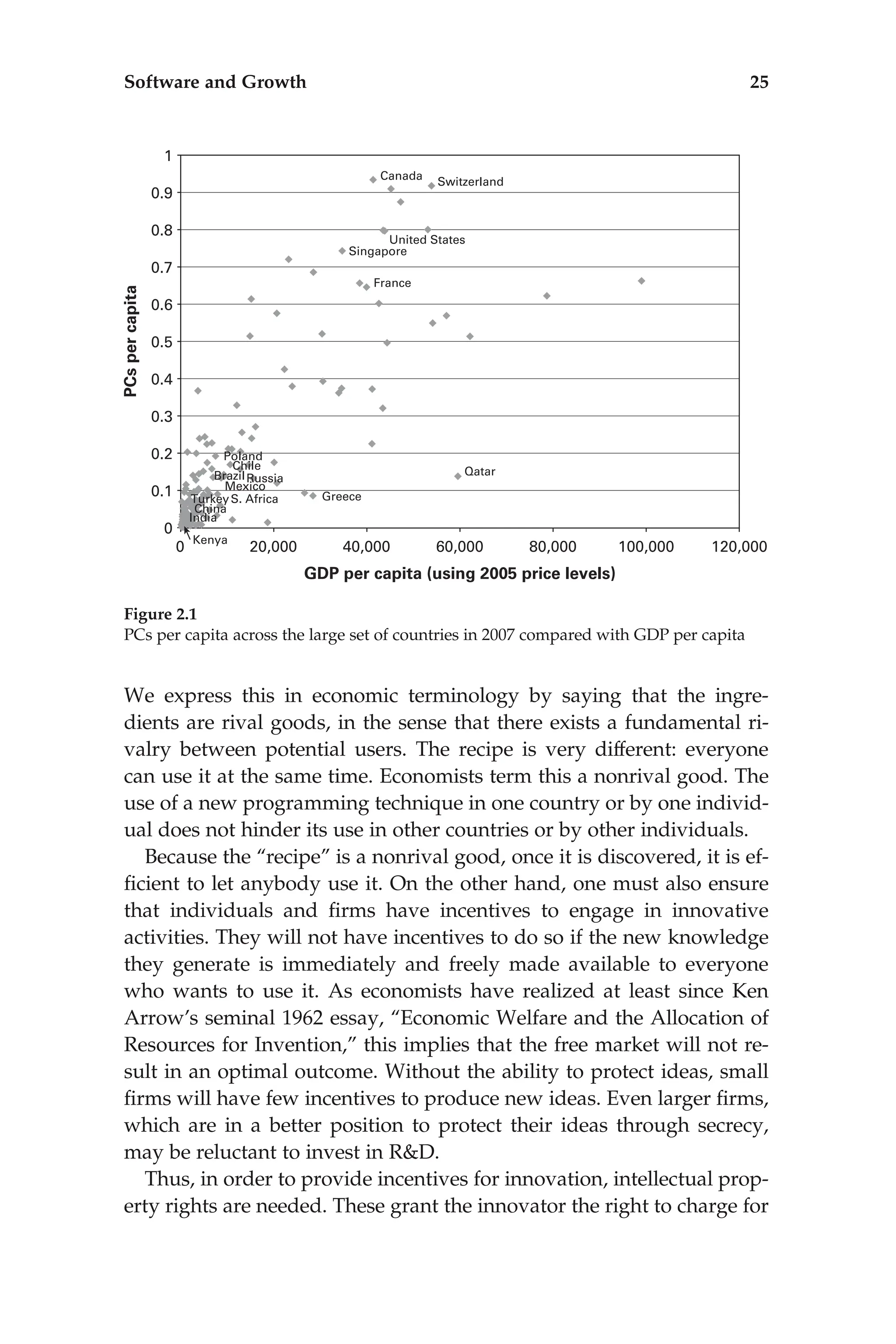
An example of physical capital would be personal computers, and fig-
ure 2.1 shows how the quantity of this ingredient varies with the
development of countries. The recipe is the country’s technology, that
is, all the different techniques used to produce products and services.
For a given set of ingredients, a better technology leads to higher GDP.
There is a fundamental difference between the recipe and the ingre-
dients. The use of one of the ingredients by an economic agent pre-
vents anyone else from using it. For instance, the use of a computer or
an Internet connection by one firm implies that no other firm can use it.
24 Chapter 2
We express this in economic terminology by saying that the ingre-
dients are rival goods, in the sense that there exists a fundamental ri-
valry between potential users. The recipe is very different: everyone
can use it at the same time. Economists term this a nonrival good. The
use of a new programming technique in one country or by one individ-
ual does not hinder its use in other countries or by other individuals.
Because the ‘‘recipe’’ is a nonrival good, once it is discovered, it is ef-
ficient to let anybody use it. On the other hand, one must also ensure
that individuals and firms have incentives to engage in innovative
activities. They will not have incentives to do so if the new knowledge
they generate is immediately and freely made available to everyone
who wants to use it. As economists have realized at least since Ken
Arrow’s seminal 1962 essay, ‘‘Economic Welfare and the Allocation of
Resources for Invention,’’ this implies that the free market will not re-
sult in an optimal outcome. Without the ability to protect ideas, small
firms will have few incentives to produce new ideas. Even larger firms,
which are in a better position to protect their ideas through secrecy,
may be reluctant to invest in R&D.
Thus, in order to provide incentives for innovation, intellectual prop-
erty rights are needed. These grant the innovator the right to charge for
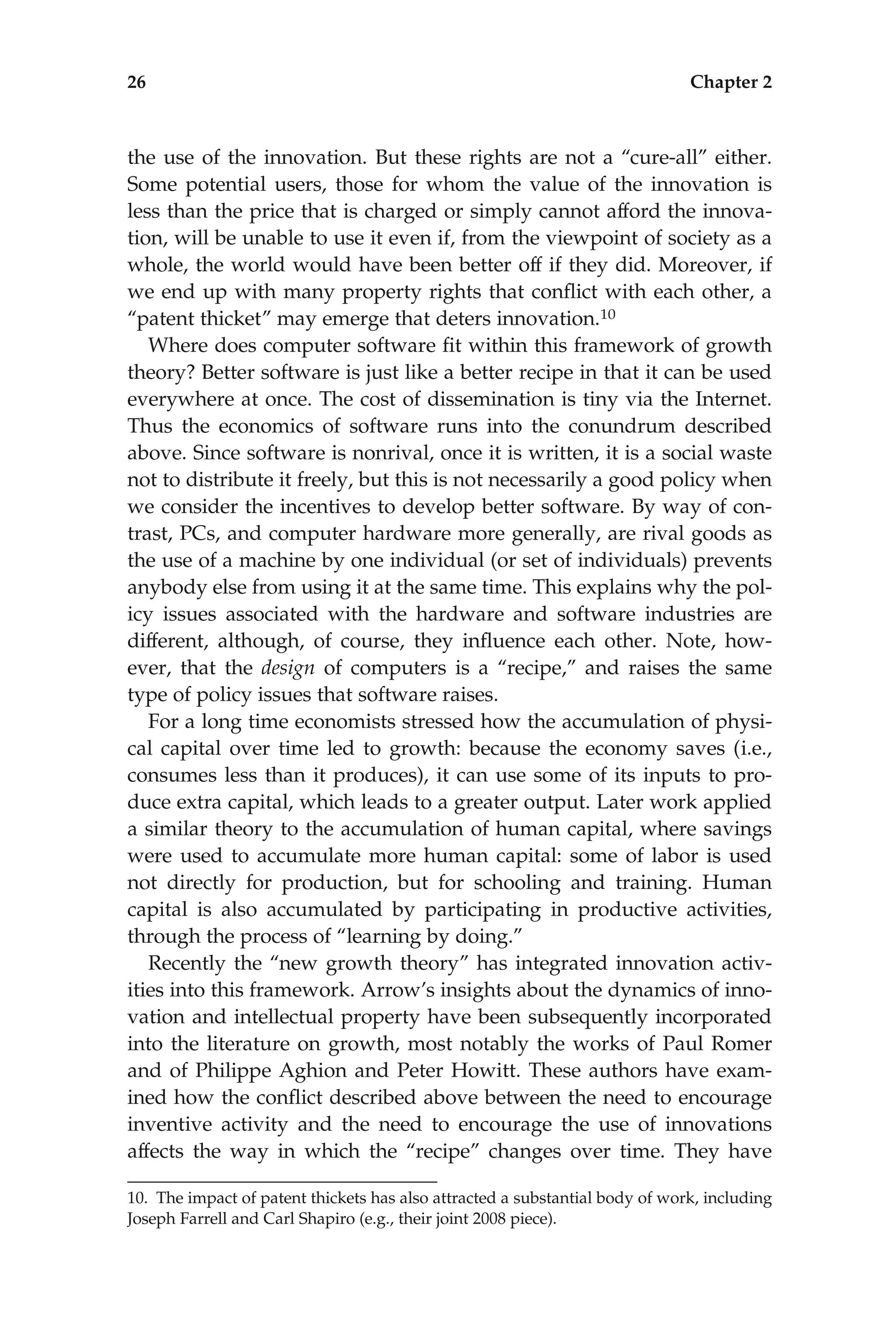
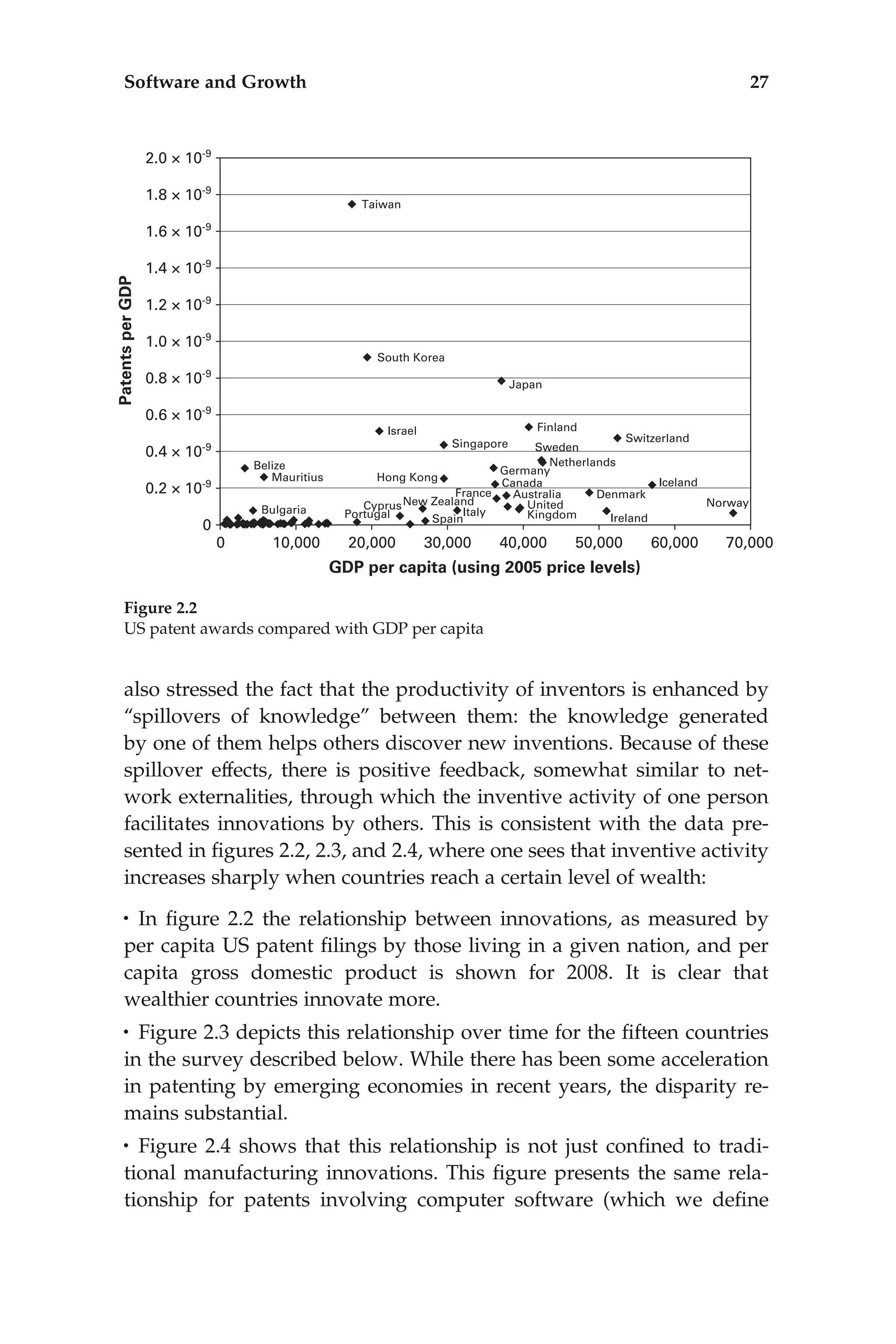
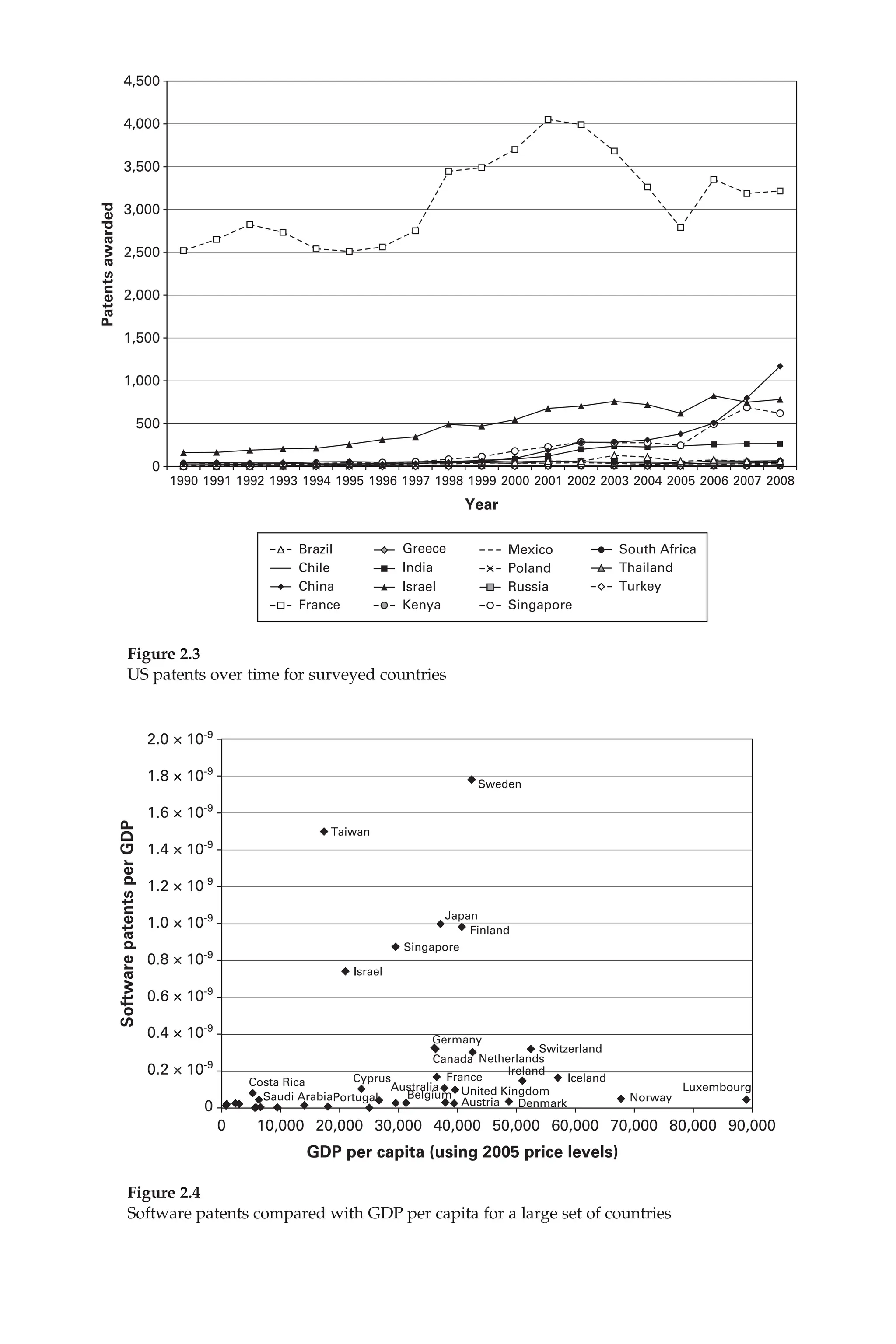
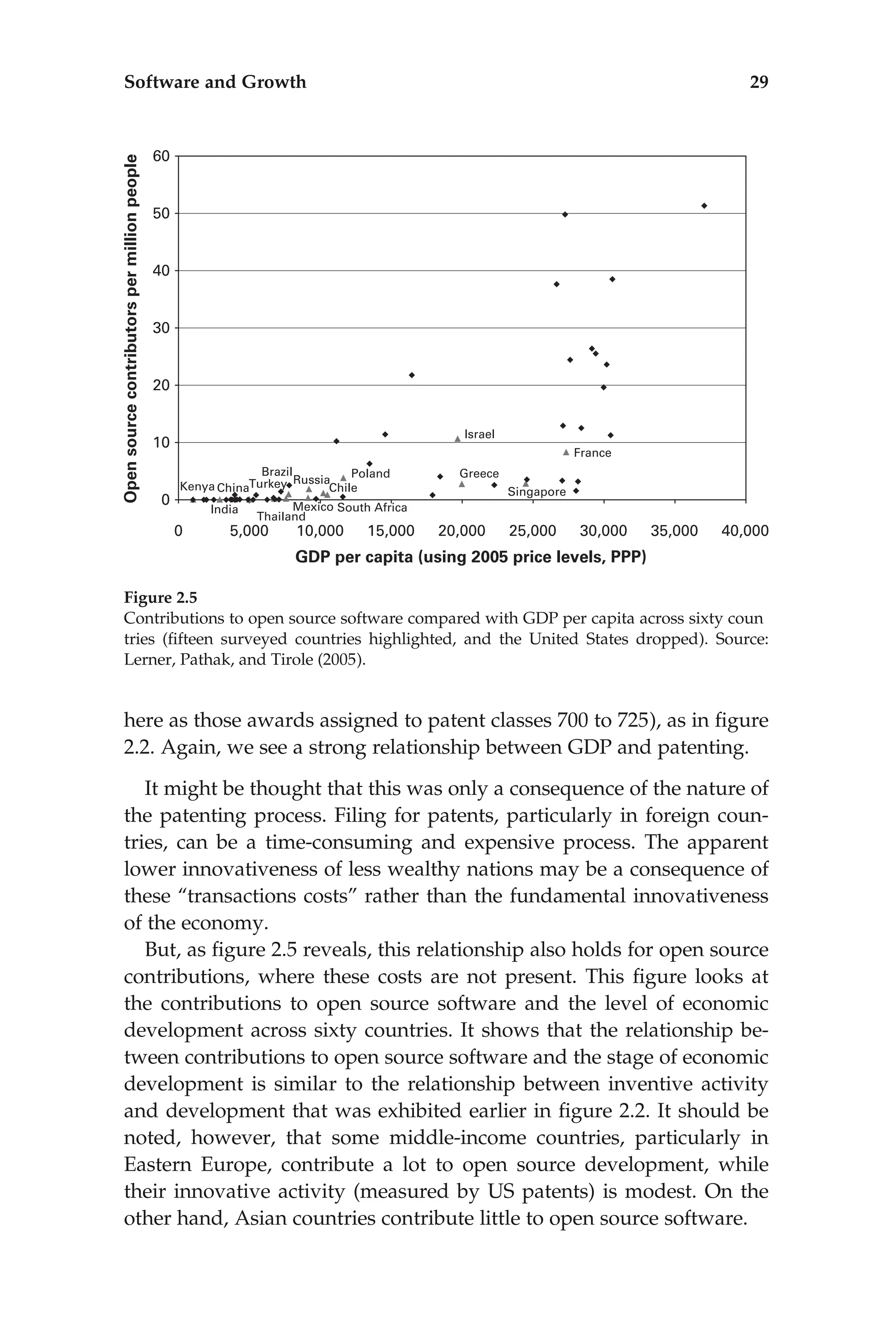
Figure 2.1
PCs per capita across the large set of countries in 2007 compared with GDP per capita
Software and Growth 25
the use of the innovation. But these rights are not a ‘‘cure-all’’ either.
Some potential users, those for whom the value of the innovation is
less than the price that is charged or simply cannot afford the innova-
tion, will be unable to use it even if, from the viewpoint of society as a
whole, the world would have been better off if they did. Moreover, if
we end up with many property rights that conflict with each other, a
‘‘patent thicket’’ may emerge that deters innovation.10
Where does computer software fit within this framework of growth
theory? Better software is just like a better recipe in that it can be used
everywhere at once. The cost of dissemination is tiny via the Internet.
Thus the economics of software runs into the conundrum described
above. Since software is nonrival, once it is written, it is a social waste
not to distribute it freely, but this is not necessarily a good policy when
we consider the incentives to develop better software. By way of con-
trast, PCs, and computer hardware more generally, are rival goods as
the use of a machine by one individual (or set of individuals) prevents
anybody else from using it at the same time. This explains why the pol-
icy issues associated with the hardware and software industries are
different, although, of course, they influence each other. Note, how-
ever, that the design of computers is a ‘‘recipe,’’ and raises the same
type of policy issues that software raises.
For a long time economists stressed how the accumulation of physi-
cal capital over time led to growth: because the economy saves (i.e.,
consumes less than it produces), it can use some of its inputs to pro-
duce extra capital, which leads to a greater output. Later work applied
a similar theory to the accumulation of human capital, where savings
were used to accumulate more human capital: some of labor is used
not directly for production, but for schooling and training. Human
capital is also accumulated by participating in productive activities,
through the process of ‘‘learning by doing.’’
Recently the ‘‘new growth theory’’ has integrated innovation activ-
ities into this framework. Arrow’s insights about the dynamics of inno-
vation and intellectual property have been subsequently incorporated
into the literature on growth, most notably the works of Paul Romer
and of Philippe Aghion and Peter Howitt. These authors have exam-
ined how the conflict described above between the need to encourage
inventive activity and the need to encourage the use of innovations
affects the way in which the ‘‘recipe’’ changes over time. They have
10. The impact of patent thickets has also attracted a substantial body of work, including
Joseph Farrell and Carl Shapiro (e.g., their joint 2008 piece).
26 Chapter 2
also stressed the fact that the productivity of inventors is enhanced by
‘‘spillovers of knowledge’’ between them: the knowledge generated
by one of them helps others discover new inventions. Because of these
spillover effects, there is positive feedback, somewhat similar to net-
work externalities, through which the inventive activity of one person
facilitates innovations by others. This is consistent with the data pre-
sented in figures 2.2, 2.3, and 2.4, where one sees that inventive activity
increases sharply when countries reach a certain level of wealth:
• In figure 2.2 the relationship between innovations, as measured by
per capita US patent filings by those living in a given nation, and per
capita gross domestic product is shown for 2008. It is clear that
wealthier countries innovate more.
• Figure 2.3 depicts this relationship over time for the fifteen countries
in the survey described below. While there has been some acceleration
in patenting by emerging economies in recent years, the disparity re-
mains substantial.
• Figure 2.4 shows that this relationship is not just confined to tradi-
tional manufacturing innovations. This figure presents the same rela-
tionship for patents involving computer software (which we define
Figure 2.2
US patent awards compared with GDP per capita
Software and Growth 27
Figure 2.3
US patents over time for surveyed countries
Figure 2.4
Software patents compared with GDP per capita for a large set of countries
here as those awards assigned to patent classes 700 to 725), as in figure
2.2. Again, we see a strong relationship between GDP and patenting.
It might be thought that this was only a consequence of the nature of
the patenting process. Filing for patents, particularly in foreign coun-
tries, can be a time-consuming and expensive process. The apparent
lower innovativeness of less wealthy nations may be a consequence of
these ‘‘transactions costs’’ rather than the fundamental innovativeness
of the economy.
But, as figure 2.5 reveals, this relationship also holds for open source
contributions, where these costs are not present. This figure looks at
the contributions to open source software and the level of economic
development across sixty countries. It shows that the relationship be-
tween contributions to open source software and the stage of economic
development is similar to the relationship between inventive activity
and development that was exhibited earlier in figure 2.2. It should be
noted, however, that some middle-income countries, particularly in
Eastern Europe, contribute a lot to open source development, while
their innovative activity (measured by US patents) is modest. On the
other hand, Asian countries contribute little to open source software.
Figure 2.5
Contributions to open source software compared with GDP per capita across sixty coun
tries (fifteen surveyed countries highlighted, and the United States dropped). Source:
Lerner, Pathak, and Tirole (2005).
Software and Growth 29
The picture is somewhat different, however, when it comes to the
diffusion of innovations. Often the differences across countries are far
less dramatic when we compare the speed with which they adopt new
ideas than when we compare the development of these ideas in the
first place.
Of course, when a new innovation becomes available, it is not sud-
denly adopted by every agent in the economy for a number of reasons.
First, at the beginning the new innovation will be expensive, and it
may pay for buyers to wait. Second, knowledge is needed in order
to make use of the technology (this is the spillover effect discussed
above), and there are costs in adopting the invention (which are closely
related to the switching costs discussed earlier). As a consequence new
technologies spread progressively across the economies, as can be seen
in figures 2.6 and 2.7. These figures also show that, as one would ex-
pect, poorer countries embrace new technologies (in these cases per-
Figure 2.6
Internet use per capita, 1990 to 2007
30 Chapter 2
sonal computers and the Internet, but many others exhibit a similar
story) more slowly than richer countries.
At the same time these figures show that these technologies (and
many others) are being adopted quite rapidly in a number of develop-
ing and emerging economies. For example, figure 2.6 reveals that Inter-
net use in Mexico lags the United States by only a few years (whereas
Mexico’s GDP per capita has historically lagged the corresponding
level in the United States by many decades). Even more extreme, the
usage of cellular telephones in many developing countries far outstrips
that of the United States.11 The rapid adoption of some innovations in
developing countries makes it important to think about the policies
that they need to adopt with respect to these new technologies.
11. http:/
/www.nationmaster.com/graph/med tel mob cel percap telephones mobile
cellular (accessed August 5, 2009).
Figure 2.7
Personal computer use per capita, 1990 to 2006
Software and Growth 31
The same patterns can be seen in the adoption of open source soft-
ware. The survey of users, conducted as part of the research for this
book and discussed in detail below, provides very useful data on the
use of software by firms in the fifteen countries. We summarize some
of the findings in this chapter, though we dig deeper into the survey in
the chapters that follow. These findings enable us to evaluate the ex-
tent of use of different forms of software, and by implication to assess
the relative strengths of the different types of software as reflected in
market demand. More detailed information, as well as a description of
the survey methodology, is available later in the book and in the on-
line materials.
Table 2.1 shows the responses to the survey question, ‘‘Does the cor-
poration or agency you work for use any of the following types of soft-
ware?’’ in the fifteen countries in which the survey was conducted. A
high percentage of respondents report using proprietary software, but
there are strong variations across countries and these are not simply
related to stage of economic development. In all countries very few
respondents use only open source software; the highest percentages of
Table 2.1
Open source and proprietary software usage across small set of countries (percent of
respondents using)
Only proprietary Only open source
Aggregate 67.3 5.9
Country
Brazil 51.0 12.9
Chile 73.5 1.9
China 79.2 6.9
France 66.0 8.8
Greece 72.3 0.0
India 62.7 2.5
Israel 79.6 3.2
Kenya 47.7 12.3
Mexico 65.4 8.3
Poland 67.5 6.4
Russia 46.1 12.8
South Africa 80.0 1.9
Singapore 87.7 1.9
Thailand 74.2 9.0
Turkey 56.1 0.0
32 Chapter 2
firms using only open source software are found in Brazil (12.9 per-
cent), Kenya (12.3 percent), and Russia (12.8 percent). In addition,
open source software is widely used in conjunction with proprietary
software in Brazil, India, and Turkey.
Another tabulation, which suggests a similar conclusion, looks at the
utilization of open source software in products. As we have men-
tioned, open source software is frequently embedded in products such
as personal digital assistants, smart phones, and cars. The proportion
of firms embedding open source software in high-tech manufacturing
products varies widely across countries and is not strongly related to
the stage of economic development. As table 2.2 shows, more firms
embed some open source software in high-tech products in Brazil and
Kenya, followed by France and Thailand. However, there is more of a
tendency for firms to specialize in embedding open source software in
Israel and Singapore: open source software accounts for more than 75
percent of all embedded software in 40 percent of firms in Israel and
50 percent in Singapore. By contrast, in Brazil and Kenya only 14.3
Table 2.2
Open source and proprietary software usage across small set of countries (percent of
respondents)
With open source
embedded software out
of all embedded software
in following intervals
With revenues from
embedded open source
software in following
intervals
Embedding
open source
in high tech
manufac
turing 525 25 75 475 525 25 75 475
Brazil 70.0 28.6 57.1 14.3 64.3 21.4 14.3
Chile 12.9 75.0 25.0 0.0 100.0 0.0 0.0
China 26.6 25.0 50.0 25.0 50.0 25.0 25.0
France 42.8 58.3 33.3 8.3 33.3 41.7 0.0
Greece 14.3 33.3 33.3 33.3 66.7 33.3 0.0
India 35.1 30.8 61.5 7.7 38.5 53.8 7.7
Israel 13.8 40.0 20.0 40.0 40.0 20.0 40.0
Kenya 60.7 0.0 91.2 8.3 8.3 83.3 8.3
Mexico 25.9 42.8 42.9 14.3 42.9 57.1 0.0
Poland 17.8 0.0 75.0 25.0 25.0 75.0 0.0
Russia 39.1 55.5 44.4 0.0 55.5 33.3 11.1
South Africa 6.9 0.0 100.0 0.0 0.0 100.0 0.0
Singapore 9.1 50.0 0.0 50.0 50.0 0.0 50.0
Thailand 45.9 5.8 88.2 5.8 0.0 94.1 5.9
Turkey 16.6 100.0 0.0 0.0 100.0 0.0 0.0
Software and Growth 33
percent and 8.3 percent of firms, respectively, use open source for 75
percent or more of their embedded software. The main exceptions in
our sample are France, and to a lesser extent Israel, Mexico, Russia,
and Singapore. For 53.8 percent of these firms, revenues from products
with open source software are between 25 and 75 percent of the total
revenues from all products with embedded software.
These depictions might reassure us that technology can be quickly
adopted across countries. But, as we noted above, there is an important
distinction to be made between the adoption of new technologies and
the development of innovative new ideas.
Final Thoughts
This chapter has had an ambitious mandate: before we turn to the spe-
cifics of open source software, it is helpful to understand what econo-
mists have had to say about software more generally. But as we have
seen from this chapter, reflecting the complex nature of software, there
is a large and somewhat disjointed literature about this industry.
Several conclusions emerge from this discussion:
• Software’s reach extends far beyond the software industry. Much of
the innovation in software sprang from firms in other industries that
have embodied software into products and processes.
• Information technology, of which software is a crucial element, really
matters. Studies on both the economy-wide and firm-level show that
the adoption of advanced computer-related technologies has a sub-
stantial impact on both productivity and how production is organized.
• Software use (at least as evidenced by available evidence on diffusion
of Internet and computers) and software production (measured both
by evidence on software patenting by countries in the United States
and by open source contributions) both vary with the level of develop-
ment, but this link appears much stronger for production side. It may
be that the barriers to being truly innovative in this realm are consider-
ably greater than incorporating new programs into existing businesses.
34 Chapter 2
3 The History of Open Source
As we discussed in the first chapter, open source software has experi-
enced enormous growth in recent years. This might lead to the conclu-
sion that the ideas behind open source are very new.
Reality is more complex. Software development has a tradition of
sharing and cooperation. Many of the principles behind open source
have been established for many decades. But in recent years both the
scale and formalization of development have expanded dramatically
with the spread of the Internet. In this chapter we will review the his-
tory of the development of open source. As we proceed, we’ll highlight
the key institutional features that make this activity so distinct and
important and the research that has attempted to understand these
patterns. To help organize things, we’ll highlight that open source has
gone through three eras.
The First Era
Many of the key aspects of computer operating systems and the Inter-
net were developed in academic settings such as Berkeley and MIT
during the 1960s and 1970s, as well as in central corporate research
facilities. Even the corporate research laboratories resembled academic
institutions in many respects: it was commonplace to allow researchers
a great deal of autonomy to pursue topics wherever their intellectual
curiosity led them, even though there was only a tenuous relationship
with the products or services that the corporation offered. (Famous
examples include Bell Labs and Xerox’s Palo Alto Research Center).
Reflecting this spirit of academic freedom, in these years, the sharing
by programmers in different organizations of basic operating code of
computer programs was commonplace.
Here we need to make a brief technical digression. Software can be
transmitted in either source code or object code. Source code is the code
written by programmers that uses languages such as Basic, C, and
Java. Object code is the sequence of 0s and 1s that directly communi-
cates with the computer; and hence it is often called binary code. Object
code is difficult for programmers to interpret or modify. Most commer-
cial software vendors today provide users only with object or binary
code; when the source code is made available to other firms by com-
mercial developers, it is typically licensed under very restrictive condi-
tions. In the first era, sharing of the source code was commonplace.
Consider, for instance, the pioneering computer program FOR-
TRAN, which was developed in the late 1950s by IBM researchers
with some help from volunteer outside labor. The software allowed
writing computer programs in a dramatically easier way than earlier
efforts, which had relied on manipulation of ‘‘assembly language’’ that
had been the standard earlier approach. Moreover it opened the door
to allowing the same program to run on computers of different makes.
Despite this strategic value, IBM did not prevent competitors from
employing FORTRAN. Indeed IBM disseminated the critical informa-
tion needed to run FORTRAN to its competitors. In part, this reflected
the difficulty of protecting the software (copyright protection was not
yet available for software). But it also reflected the fact that software
was not perceived as having market value and the prevailing ethos re-
garding sharing software.1
Many of the cooperative development efforts in the 1970s focused on
the development of an operating system that could run on multiple
computer platforms. The most successful examples, such as Unix and
the C language used for developing Unix applications, were originally
developed at AT&T’s Bell Laboratories. The software was then in-
stalled across institutions, and kept on being transferred freely or for a
nominal charge. Many of the sites where the software was installed
made further innovations that were in turn shared with others. The
process of sharing code was greatly accelerated with the diffusion of
Usenet, a computer network begun in 1979 to link together the Unix
programming community. As the number of sites grew rapidly (e.g.,
from 3 in 1979 to 400 in 1982), the ability of programmers in university
and corporate settings to rapidly share technologies was considerably
enhanced.
1. This account is based on Campbell Kelly and Garcia Swartz (2008) and Schwarz and
Takhteyev (2008).
36 Chapter 3
These cooperative software development projects were undertaken
on a highly informal basis. Typically no effort to delineate property
rights or to restrict reuse of the software was made. This informality
proved to be problematic in the early 1980s when AT&T began enforc-
ing its (purported) intellectual property rights related to Unix, which
had been widely shared across (and contributed to by) the research
community.
Unfortunately, we know relatively little about this period, since the
projects did not really leave a trail that can be analyzed. The events of
the second two periods, however, have been much more scrutinized.
The Second Era
In response to these threats of litigation, the first efforts to formalize the
ground rules behind the cooperative software development process
emerged. This ushered in the second era of cooperative software devel-
opment. The critical institution during this period was the Free Soft-
ware Foundation, begun by Richard Stallman of the MIT Artificial
Intelligence Laboratory in 1983. The foundation sought to develop and
disseminate a wide variety of software without cost.
One important innovation introduced by the Free Software Founda-
tion was a formal licensing procedure that aimed to preclude the asser-
tion of intellectual property rights concerning cooperatively developed
software (as many believed that AT&T had done in the case of Unix).
In exchange for being able to modify and distribute the GNU software
(as it was known), software developers had to agree to make the
source code freely available (or at a nominal cost).
As part of the General Public License (GPL, also known as ‘‘copyleft-
ing’’), the user had to also agree not to impose licensing restrictions on
others. Furthermore all enhancements to the code—and even code that
intermingled the cooperatively developed software with that devel-
oped separately—had to be licensed on the same terms. It is these con-
tractual terms that distinguish open source software from shareware
(where the binary files but not the underlying source code are made
freely available, possibly for a trial period only) and public-domain
software (where no restrictions are placed on subsequent users of the
source code).
It should be noted, however, that some projects, such as the Berkeley
Software Distribution (BSD) effort, did take alternative approaches
during the 1980s. The BSD license also allows anyone to freely copy
The History of Open Software 37
Random documents with unrelated
content Scribd suggests to you:
Credits: Story, Lenore Coffee; scenario and direction, Edward J.
Le Saint.
© C. B. C. Film Sales Corp.; 10Apr23; LP18856.
TEMPTATION. 1930. 7 reels, sd.
Credits: Producer, Harry Cohn; director, E. Mason Hopper; story,
adaptation, continuity, and dialogue, Leonard Praskins; film
editor, Dave Berg.
© Columbia Pictures Corp.; 2Jun30; LP1342.
TEMPTATION AND THE GIRL. © 1917.
© Melies Mfg. Co.; title, descr. & 70 prints, 2Jan17; LU9891.
TEMPTATION AND THE MAN. Red Feather. 1916. 5 reels.
Credits: Catherine Carr; producer, Robert F. Hill.
© Universal Film Mfg. Co., Inc.; 24Jun16; LP8582.
THE TEMPTATION OF ADAM. 1916. 3 reels.
Credits: Director, Al. Green.
© Selig Polyscope Co. (Louis V. Jefferson, author); 28Oct16;
LP9423.
THE TEMPTING OF JUSTICE. © 1914.
© Eclectic Film Co. (F. Wolff, author); title, descr. & 45 prints,
19Jun14; LU2883.
THE TEMPTRESS. Cosmopolitan. 1926. 9 reels. From the novel by
Vicente Blasco Ibanez.
Credits: Director, Fred Niblo; scenario, Dorothy Farnum; titles,
Marian Ainslee; film editor, Lloyd Nosler.
© Metro-Goldwyn-Mayer Corp.; 18Oct26; LP23282.
TEN BABY FINGERS. 1934. 2 reels.
Credits: Director, Jules White; story, Charles Saxton, Roland
Asher; screenplay, John Grey.
© Columbia Pictures Corp.; 6Feb34; LP4472.
THE TEN CENT LADY. SEE Like Wildfire.
TEN CENTS A DANCE. 1931. 8 reels, sd. Based on the song by
Lorenz Hart and Richard Rodgers.
Credits: Producer, Harry Cohn; director, Lionel Barrymore; story
and dialogue, Jo Swerling; continuity, Dorothy Howell; film
editor, Arth Huffsmith.
© Columbia Pictures Corp.; 9Feb31; LP1966.
THE TEN COMMANDMENTS. 1923. 2 reels.
Credits: Story, Jeanie Macpherson.
© Famous Players-Lasky Corp.; 13Feb23; LP18659.
THE TEN COMMANDMENTS. Paramount. 1923. 14 reels, b&w,
color sequences.
Credits: Director, Cecil B. De Mille; story, Jeanie MacPherson.
© Famous Players-Lasky Corp.; 21Dec23; LP19766.
THE TEN COMMANDMENTS. SEE Forgotten Commandments.
THE TEN DOLLAR RAISE. Released by Associated Producers, Inc.
1921. 6 reels. From the Saturday Evening Post story by Peter B.
Kyne.
Credits: Director, Edward Sloman; screen version, A. S. Le Vino.
© J. L. Frothingham; 7Jun21; LP16653.
$10 RAISE. 1935. 6,482 ft., sd.
Credits: Director, George Marshall; story, Peter B. Kyne;
screenplay, Henry Johnson, Louis Breslow; additional dialogue,
Lamar Trotti; music director, Samuel Kaylin.
© Fox Film Corp.; 5Apr35; LP5451.
TEN DOLLARS OR TEN DAYS. © 1923.
© Pathe Exchange, Inc. (Mack Sennett, author); title, descr. &
30 prints, 24Dec23; LU19751.
TEN DOLLARS OR TEN DAYS. 1932. 1 reel, sd.
Credits: Director, Aubrey Scotto; story, H. O. Kusell.
© Paramount Publix Corp.; 21Jul32; LP3159.
A TEN-KARAT HERO. © 1912.
Credits: Screenplay, Edward Acker.
© Biograph Co. (Edward Acker, author); title, descr. & 51 prints,
30Oct12; LU64.
A TEN MINUTE EGG. © 1924.
© Pathe Exchange, Inc. (Hal E. Roach, author); title, descr. & 20
prints, 31Jul24; LU20445.
TEN MINUTES. SEE Robert T. Haines in Ten Minutes.
TEN MINUTES IN INDIA WITH HOMER CROY. 1915. Split reel.
© Universal Film Mfg. Co., Inc.; 8Apr15; MP307.
TEN MODERN COMMANDMENTS. Presented by Adolph Zukor and
Jesse L. Lasky. 1927. 6,497 ft.
Credits: Director, Dorothy Arzner; story, Jack Lait; screenplay,
Doris Anderson, Paul Gangelin; continuity, Ethel Doherty.
© Paramount Famous Lasky Corp.; 2Jul27; LP24148.
TEN NIGHTS IN A BARROOM. © 1913.
© Photo Drama Co. (Lee Beggs, author); title, descr. & 84 prints,
22Nov13; LU1809.
TEN NIGHTS IN A BARROOM. 1921. 9 reels. From the novel by T.
S. Arthur and the play by William W. Pratt.
Credits: Director, Oscar Apfel.
© Blazed Trail Productions, Inc.; 23Sep21; LP16984.
TEN NIGHTS IN A BARROOM. 1930. 10 reels.
Credits: Producer, Willis Kent; director, William O'Connor.
© Willis Kent; 5Sep30; LP1592.
TEN NIGHTS IN A TEA ROOM. (Star Comedy) 1919. 1 reel.
Credits: Written and directed by Lyons and Moran.
© Universal Film Mfg. Co., Inc.; 15Nov19; LP14433.
TEN NIGHTS WITHOUT A BARROOM. (Sunshine Comedy) 1920. 2
reels.
Credits: Supervision, Hampton Del Ruth; director, Edward F.
Cline.
© William Fox (Fox Film Corp., author); 18Jul20; LP15386.
TEN SCARS MAKE A MAN. © 1924. © Pathe Exchange, Inc. (Philip
Barry, author).
Credits: Story, Philip Barry.
1. Two Girls and a Man. © title, descr. & 40 prints, 25Sep24;
LU20609.
TEN SCARS MAKE A MAN. 1924. 2 reels each. © Pathe Exchange,
Inc.
Credits: Story, Philip Barry.
1. Two Girls and a Man. © 24Nov24; LP20790.
2. Cowboy Chivalry. © 24Nov24; LP20791.
3. Westward Bound. © 24Nov24; LP20792.
4. The Cattle Raid. © 24Nov24; LP20793.
5. Through the Hills. © 1Dec24; LP20814.
6. Midnight Marauders. © 1Dec24; LP20815.
7. Unmasked. © 1Dec24; LP20816.
8. Liquid Gold. © 1Dec24; LP20817.
9. The Valley of the Legend. © 9Dec24; LP20858.
10. The End of the Quest. © 18Dec24; LP20930.
TEN SECONDS. Presented by Century Comedies. 1922. 2 reels.
Credits: Story and direction by Fred Hibbard.
© Century Film Corp., Inc.; 31May22; LP17935.
THE TEN THOUSAND DOLLAR TOE. © 1913.
Credits: Producer, Hardee Kirkland.
© Selig Polyscope Co. (Gilson Willets, author); title, descr. & 19
prints, 13Aug13; LU1093.
TEN YEARS OLD. © 1927.
© Pathe Exchange, Inc. (Hal E. Roach, author); title, descr. & 36
prints, 14Feb27; LU23667.
THE TENANTS OF MARBLE CANYON. (Robert C. Bruce Scenic
Novelties) Presented by E. W. Hammons. 1927. 1 reel.
© Edco Producing Unit, Inc.; 10Aug27; MP4202.
TENDER FEET. (Walter Hiers Comedies) Educational. 1925. 2 reels.
Credits: Raymond Ross; director, Archie Mayo.
© Christie Film Co., Inc.; 26May25; LP21493.
THE TENDER-HEARTED BOY. © 1913.
© Biograph Co. (Lionel Barrymore, author); title, descr. & 152
prints, 18Jan13; LU285.
A TENDER HEARTED CROOK. © 1913.
© Biograph Co. (I. P. Dodge, author); title, descr. & 82 prints,
29Sep13; LU1318.
THE TENDER HOUR. Presented by John McCormick. 1927. 8 reels.
Credits: Carey Wilson; producer and director, George
Fitzmaurice; scenario, Winifred Dunn.
© First National Pictures, Inc.; 21Apr27; LP23880.
THE TENDERFOOT. 1917. 5 reels.
Credits: Director, William Duncan; story, Alfred Henry Lewis.
© Vitagraph Co. of America; 30Nov17; LP11775.
THE TENDERFOOT. © 1919.
© William Steiner (Marcel Ferdinanz Perez, author); title, descr.
& 81 prints, 16Jan19; LU13275.
THE TENDERFOOT. 1932. 8 reels, sd. Based on the story by
Richard Carle and the play "The Butler and Egg Man" by George
S. Kaufman.
Credits: Director, Ray Enright; adaptation, Earl Baldwin, Monty
Banks, Arthur Caesar.
© First National Pictures, Inc.; 7Jun32; LP3079.
THE TENDERFOOT. SEE A Roaring Adventure.
TENDERFOOT COURAGE. Mustang. 1927. 2 reels.
Credits: Director, William Wyler; story, F. V. Lautzenhiser.
© Universal Pictures Corp.; 7Feb27; LP23652.
A TENDERFOOT HERO. 1928. 2 reels.
Credits: Director, Walter Fabian; story, Basil Dickey.
© Universal Pictures Corp.; 17Sep28; LP25630.
TENDERFOOT LUCK. 1922. 2 reels.
Credits: Written and directed by John Pilcher Smith, Mort
Peebles.
© Vitagraph Co. of America; 10Sep22; LP18209.
A TENDERFOOT TERROR. 1929. 2 reels.
Credits: Director, Walter Fabian; story, Neville Reay; continuity,
George Plympton.
© Universal Pictures Corp.; 14Aug29; LP603.
THE TENDERFOOT'S MONEY. © 1913.
© Biograph Co. (Mr. Taylor, author); title, descr. & 122 prints,
29Apr13; LU660.
THE TENDERFOOT'S TRIUMPH. 1915. 1 reel.
Credits: Producer, Tom Mix; scenario, Cornelius Shea.
© Selig Polyscope Co. (Cornelius Shea, author); 29Oct15;
LP6878.
TENDERLOIN. 1928. 9 reels.
Credits: Director, Michael Curtiz; story, Melville Crosman;
adaptation, Edward T. Lowe, Jr.
© Warner Bros. Pictures, Inc.; 22Mar28; LP25089.
A TENEMENT TANGLE. SEE Ryan and Lee in A Tenement Tangle.
TENNESSEE'S PARDNER. © 1916. From the play by Scott Marble.
© Jesse L. Lasky Feature Play Co., Inc. (Marion Fairfax, author);
title, descr. & 16 prints, 24Jan16; LU7489.
TENNESSEE'S PARDNER. SEE The Flaming Forties.
TENNIS IN SLOW MOTION. © 1926.
© Pathe Exchange, Inc. (Chas. P. Watson, author); title, descr. &
20 prints, 29Sep26; MU3588.
TENNIS TACTICS. (A Pete Smith Specialty) 1937. 958 ft., sd.
Credits: Director, Davis Miller.
© Metro-Goldwyn-Mayer Corp.; 11May37; MP7468.
TENNIS TECHNIQUE. (Sport Champions) 1931. 1 reel, sd.
Credits: Eric Hatch; director, Ray McCarey.
© Metro-Goldwyn-Mayer Distributing Corp.; 29Jul31; MP2701.
TENNIS TOPNOTCHERS. (Grantland Rice Sportlight) The Van
Beuren Corp. 1931. 1 reel.
© RKO Pathe Distributing Corp.; 5Apr31; MP2458.
THE TENNIS WIZARD. 1926. 2 reels. Based on a Van Bibber story
by Richard Harding Davis.
Credits: Supervision, George E. Marshall; director, Orville Dull;
adaptation, Edward P. Moran, Henry Johnson.
© William Fox (Fox Film Corp., author); 7Nov26; LP23297.
THE TENOR. Gold Seal. 1915. 3 reels.
Credits: Producer, Leon Kent; story, Hobart Henley, Leon Kent;
scenario, F. McGrew Willis.
© Universal Film Mfg. Co., Inc.; 14Sep15; LP6369.
TENSE MOMENTS. (News World of Sports) 1935. 1 reel, sd.
Credits: Narrative, Jack Kofoed; described by Ford Bond.
© Columbia Pictures Corp.; 9Sep35; MP5848.
TENTH AVENUE. 1928. 7 reels. From the stage play by John
McGowan and Lloyd Griscom.
Credits: Producer and director, William C. De Mille; screenplay,
Douglas Z. Doty; film editor, Adelaide Cannon.
© Pathe Exchange, Inc.; 11Jul28; LP25442.
TENTH AVENUE KID. 1938. 7 reels, sd.
Credits: Associate producer, Harry Grey; director, Bernard
Vorhaus; original story, Gordon Kahn, Adele Buffington;
screenplay, Gordon Kahn; film editor, William Morgan.
© Republic Pictures Corp.; 22Aug38; LP8351.
THE TENTH CASE. Presented by William A. Brady. © 1917.
Credits: Director, George Kelson; story, Budd [pseud. of Robert
Hull].
© World Film Corp. (Robert Hull, author); title & descr., 6Dec17;
244 prints, 7Dec17; LU11781.
THE TENTH COMMANDMENT. 1923. 1 reel.
Credits: Anne Bauchens, Alfred Hustwick.
© Famous Players-Lasky Corp.; 16Dec23; LP19837.
THE TENTH MAN. Alliance. 1937. 7 reels, sd. From the play by W.
Somerset Maugham.
Credits: Director, Brian Desmond Hurst; adaptation, Marjorie
Deans, Dudley Leslie; editor, J. Corbett; music director, Harry
Acres.
© Gaumont British Picture Corp. of America (Gaumont British
Picture Corp., Ltd., author); 15Aug37; LP7405.
Xth OLYMPIAD. SEE Champions of the Xth Olympiad, Aquatic
Events.
Xth OLYMPIAD, LOS ANGELES, CALIFORNIA, JULY 30th-AUG. 14,
1932. 1932. 4 reels.
© Los Angeles Amateur Cine Club; 1Dec32; MP3769.
Xth OLYMPIAD TRACK EVENTS, JULY 31 THRU AUGUST 7, 1932.
1932. 2 reels.
© Electrical Research Products, Inc.; 13Aug32; MP3542.
THE TENTH WOMAN. 1924. 6 reels.
Credits: Director, James Flood; story, Harriet T. Comstock.
© Warner Bros. Pictures, Inc.; 10Sep24; LP20563.
TENTING OUT. (Bull's Eye Comedy) 1925. 1 reel.
Credits: Director, Richard Smith.
© Universal Pictures Corp.; 9Mar25; LP21237.
THE TENTS OF ALLAH. © 1923.
© Associated Exhibitors, Inc. (Charles A. Logue, author); title,
descr. & 140 prints, 17Feb23; LU18687.
TERMITES. 1930. 1 reel.
© Eastman Teaching Films, Inc. (George W. Hoke, author);
20Mar30; MP1841.
TERMITES OF 1938. 1937. 2 reels, sd.
Credits: Director, Del Lord; story and screenplay, Elwood Ullman.
© Columbia Pictures Corp. of California, Ltd.; 27Dec37; LP7683.
TERRAPLANE TAKES THE LEAD. 1937. For Hudson Production.
Filmstrip, sd.
© AudiVision, Inc.; 29Mar37; MP7338.
TERRE INHUMAINE. SEE This Mad World.
THE TERRIBLE LESSON. © 1914.
© Biograph Co.; title, descr. & 64 prints, 20Aug14; LU3223.
THE TERRIBLE ONE. 1915. 3,000 ft.
© Lubin Mfg. Co. (Paul Powell, author); 12Apr15; LP5025.
THE TERRIBLE PEOPLE. 1928. 2 reels, each. From the story by
Edgar Wallace. © Pathe Exchange, Inc.
Credits: Director, Spencer Gordon Bennet; screen version,
George Arthur Gray.
1. The Penalty. © 8Jul28; LP25441.
2. Disaster. © 7Jul28; LP25459.
3. The Claws of Death. © 24Jul28; LP25495.
4. Hidden Enemies. © 27Jul28; LP25496.
5. The Disastrous Rescue. © 31Jul28; LP25504.
6. The House of Peril. © 14Aug28; LP25531.
7. In the Enemy's Hands. © 16Aug28; LP25535.
8. The Dread Professor. © 3Sep28; LP25607.
9. The Death Trap. © 6Sep28; LP25608.
10. The Capture. © 17Sep28; LP25624.
EL TERRIBLE TOREADOR. (Walter Disney Cartoon) 1930. 1 reel.
© Columbia Pictures Corp.; 7Feb30; MP1167.
A TERRIBLE TRAGEDY. © 1915.
© Mica Film Corp. (Lloyd Lack, author); title, descr. & 23 prints,
5Mar15; LU4605.
A TERRIBLE TRAGEDY. 1916. 1/2 reel.
Credits: Director, Jerold T. Hevener.
© Lubin Mfg. Co. (C. Doty Hobart, author); 1Jul16; LP8616.
THE TERRIBLE TROUBADOUR. (Pooch the Pup Cartoon) Snappy.
1933. 1 reel.
Credits: Animated and directed by Walter Lantz and William
Nolan.
© Universal Pictures Corp.; 8Feb33; MP3815.
THE TERRIBLE TRUNK. 1915. Split reel.
Credits: J. Edward Hungerford; director, James W. Castle.
© Thomas A. Edison, Inc.; 12Jan15; LP4180.
THE TERRIBLE TRUTH. Rex. 1915. 1 reel.
Credits: Harvey Gates; scenario and production, Lynn Reynolds.
© Universal Film Mfg. Co., Inc.; 17Dec15; LP7243.
THE TERRIBLE TURK. Nestor. 1916. 1 reel.
Credits: Director, Louis William Chaudet; story, Harry Wulze.
© Universal Film Mfg. Co., Inc.; 16Aug16; LP8950.
LA TERRIBULA. SEE Lost Souls.
TERRITORIAL EXPANSION OF THE UNITED STATES FROM 1783-
1853. 1938. 2 reels, sd.
Credits: Script, Richard Montague; narration, John S. Martin.
© International Geographic Pictures; 24Jul38; MP8575.
TERRITORIAL MILITIA. SEE Milizia Territoriale.
TERROR. © 1915. 2 reels.
© Eclair Film Co., Inc.; title, descr. & 58 prints, 25Jan15;
LU4278.
THE TERROR. Red Feather. 1917. 5 reels.
Credits: Director, Raymond Wells; story, Raymond Wells, Fred
Myton.
© Universal Film Mfg. Co., Inc.; 31Jan17; LP10098.
THE TERROR. 1920. 5 reels.
Credits: Story, Tom Mix; scenario and direction, Jacques Jaccard.
© William Fox (Fox Film Corp., author); 16May20; LP15134.
THE TERROR. (Blue Streak Western) 1926. 5 reels.
Credits: Director, Clifford S. Smith; story and scenario, Richard E.
Schauer.
© Universal Pictures Corp.; 12May26; LP22724.
THE TERROR. 1928. 9 reels, sd. From the play by Edgar Wallace.
Credits: Director, Roy Del Ruth; scenario, Harvey Gates.
© Warner Bros Pictures, Inc.; 22Aug28; LP25563.
TERROR. © 1930.
Credits: Written and directed by Frank J. Buehlman.
© Frank J. Buehlman; title, descr. & 24 prints, 21Jul30; LU1433.
THE TERROR. SEE Return of the Terror.
TERROR ABOARD. 1933. 7 reels, sd.
Credits: Director, Paul Sloane; story, Robert Presnell; screenplay,
Harvey Thew, Manuel Seff.
© Paramount Productions, Inc.; 13Apr33; LP3801.
TERROR ISLAND. 1920. 7 reels.
Credits: Director, James Cruze; story, Arthur B. Reeve, John W.
Grey; scenario, Walter Woods.
© Famous Players-Lasky Corp.; 13Mar20; LP14920.
TERROR MOUNTAIN. 1928. 5 reels.
Credits: Director, Louis King; original story, Wyndham Gittens;
continuity, Frank Howard Clark.
© F. B. O. Productions, Inc.; 14Aug28; LP25529.
THE TERROR OF BAR X. 1927. 5 reels. From the story "Stan Willis,
Cowboy" by George M. Johnson.
Credits: Director, Scott Pembroke; continuity, George M. Merrick.
© R-C Pictures Corp.; 16Feb27; LP23672.
THE TERROR OF THE AIR. © 1914.
© Hepworth American Film Corp. (Hepworth Mfg. Co., author);
title, descr. & 52 prints, 10Aug14; LU3169.
THE TERROR OF THE RANGE. © 1919.
© Pathe Exchange, Inc. (Lucien Hubbard, author).
1. Prowlers of Night. © title, descr. & 34 prints, 23Jan19;
LU13301.
2. The Hidden Chart. © title, descr. & 36 prints, 23Jan19;
LU13302.
3. The Chasm of Fear. © title, descr. & 36 prints, 23Jan19;
LU13303.
4. The Midnight Raid. © title, descr. & 51 prints, 23Jan19;
LU13304.
5. A Threat from the Past. © title, descr. & 31 prints, 23Jan19;
LU13305.
6. Tangled Tales. © title, descr. & 26 prints, 23Jan19; LU13306.
7. Run to Earth. © title, descr. & 38 prints, 23Jan19; LU13307.
THE TERROR OF TINY TOWN. 1938. 7 reels.
Credits: Director, Sam Newfield; original screenplay, Fred Myton.
© Principal Productions, Inc.; 19Jul38; LP8278.
TERROR TRAIL. Universal Special. 1921. 2 reels each. © Universal
Film Mfg. Co., Inc.
Credits: Producer, Edward Kull; story and scenario, Edward Kull,
John W. Grey, George H. Plympton.
1. The Mystery Girl. © 8Jul21; LP16752.
2. False Clues. © 16Jul21; LP16770.
3. The Mine of Menace. © 21Jul21; LP16795.
4. The Door of Doom. © 29Jul21; LP16824.
5. The Bridge of Disaster. © 3Aug21; LP16843.
6. The Ship of Surprise. © 12Aug21; LP16857.
7. The Palace of Fear. © 19Aug21; LP16881.
8. The Peril of the Palace. © 24Aug21; LP16902.
9. The Desert of Despair. © 2Sep21; LP16932.
10. Sands of Fate. © 9Sep21; LP16956.
11. The Menace of the Sea. © 16Sep21; LP16970.
12. The Isle of Eternity. © 23Sep21; LP17013.
13. The Forest of Fear. © 28Sep21; LP17027.
14. The Lure of the Jungle. © 7Oct21; LP17071.
15. The Jaws of Death. © 15Oct21; LP17102.
16. The Storm of Despair. © 22Oct21; LP17125.
17. The Arm of the Law. © 27Oct21; LP17146.
18. The Final Reckoning. © 5Nov21; LP17169.
TERROR TRAIL. 1933. 6 reels. Based on "Riders of Terror Trail" by
Grant Taylor.
Credits: Director, Armand Schaefer; screenplay, Jack
Cunningham.
© Universal Pictures Corp.; 24Jan33; LP3599.
THE TERRORS OF A TURKISH BATH. 1916. 2 reels.
© L-Ko Motion Picture Kompany; 17Oct16; LP9345.
THE TERRORS OF WAR. Big U. 1917. 2 reels.
© Universal Film Mfg. Co., Inc.; 23Mar17; LP10439.
TERRY AND JERRY. SEE Field and Johnston in Terry and Jerry.
TERRY OF THE TIMES. 1930. 2 reels each. From the story by Hal
Hodes. © Universal Pictures Corp.
Credits: Director, Henry MacRae.
1. The Mystic Mendicants. © 17Jul30; LP1425
2. The Fatal 30! © 17Jul30; LP1426.
3. Death's Highway. © 17Jul30; LP1427.
4. Eyes of Evil. © 18Aug30; LP1495.
5. Prowlers of the Night. © 21Aug30; LP1514.
6. The Stolen Bride. © 29Aug30; LP1523.
7. A Doorway of Death. © 9Sep30; LP1550.
8. A Trail of Trickery. © 12Sep30; LP1566.
9. Caught in the Net. © 18Sep30; LP1579.
10. A Race for Love. © 26Sep30; MP1946.
TERRY'S TEA PARTY. 1916. 1 reel.
Credits: Director, Lawrence Semon.
© Vitagraph Co. of America (Graham Baker, author); 6Apr16;
LP8059.
TESHA. SEE A Woman in the Night.
TESS OF THE D'URBERVILLES. 1924. 8 reels. From the novel by
Thomas Hardy.
Credits: Scenario, Dorothy Farnum.
© Metro-Goldwyn Pictures Corp.; 27Aug24; LP20527.
TESS OF THE HILLS. 1915. 1 reel.
© Biograph Co.; 20Feb15; LP4502.
TESS OF THE STORM COUNTRY. 1922. 10 reels. From the novel by
Grace Miller White.
© Mary Pickford; 1Dec22; LP18587.
TESS OF THE STORM COUNTRY. 1932. 8 reels. From the novel by
Grace Miller White and the dramatization by Rupert Hughes.
Credits: Director, Alfred Santell; screenplay, S. N. Behrman,
Sonya Levien.
© Fox Film Corp.; 12Nov32; LP3418.
TESSIE. 1925. 7 reels. From the story "Tessie and the Little Shop"
by Sewell Ford.
Credits: Director, Dallas M. Fitzgerald.
© Arrow Pictures Corp.; 23Sep25; LP21842.
TESSIE AND THE LITTLE SHOP. SEE Tessie.
THE TEST. 1913. 2 reels.
Credits: Director, Captain Lambart.
© The Vitagraph Co. of America (John Kemble, author);
16Aug13; LP1237.
THE TEST. Released through General Film Co. 1914. 1 reel.
Credits: Director, Thomas Santschi.
© Selig Polyscope Co. (James Oliver Curwood, author);
28Nov14; LP3856.
THE TEST. 1915. 3,000 ft.
Credits: Lee Arthur; director, James W. Castle.
© Thomas A. Edison, Inc.; 22May15; LP5381.
THE TEST. © 1916.
© Pathe Exchange, Inc. (Astra Film Corp., author); title, descr. &
131 prints, 14Oct16; LU9318.
THE TEST OF A MAN. Bison. 1915. 2 reels.
Credits: Producer, Henry McRae; scenario, Hugh Weir.
© Universal Film Mfg. Co., Inc.; 18Jun15; LP5611.
THE TEST OF CHIVALRY. 1916. 3 reels.
Credits: Director, William Robert Daly.
© Selig Polyscope Co. (Elizabeth R. Carpenter, author); 6May16;
LP8241.
THE TEST OF DONALD NORTON. 1926. 8 reels. Adapted from the
novel by Robert E. Pinkerton.
Credits: Director, B. Reaves Eason.
© Chadwick Pictures Corp.; 26Mar26; LP22534.
THE TEST OF HONOR. Paramount. Presented by Adolph Zukor.
1919. 5 reels. Founded on the story "The Malefactor" by E.
Phillips Oppenheim.
Credits: Director, John S. Robertson; scenario, Eve Unsell.
© Famous Players-Lasky Corp.; 27Mar19; LP13545.
THE TEST OF LOYALTY. © 1918.
© Michael Hoffman; title, descr. & 60 prints, 21Jun18; LU12616.
THE TEST OF SINCERITY. 1915. 1 reel.
© Biograph Co.; 8Apr15; LP4962.
THE TEST OF WOMANHOOD. © 1917.
Credits: Adaptation, C. Lang Cobb, Jr.
© J. R. Miles & E. S. Manheimer (C. Lang Cobb, author); title,
descr. & 66 prints, 17Apr17; LU10609.
TEST PILOT. Presented by Metro-Goldwyn-Mayer. 1938. 12 reels,
sd., b&w.
Credits: Producer, Louis D. Lighton; director, Victor Fleming;
original story, Frank Wead; screenplay, Vincent Lawrence,
Waldemar Young; film editor, Tom Held; music score, Franz
Waxman.
© Loew's, Inc.; 15Apr38; LP7971.
TEST SCENES OF COLOR SLIDE-FILM. Reels 1 and 2. © 1928.
Filmstrip, color, 35 mm.
© Daniel Francis Tattenham; title, descr. & 2 prints, 16Aug28;
MU5256.
TEST SCENES OF COLOR SLIDE-FILM. Reel 2. © 1928. Filmstrip,
color, 16 mm.
© Daniel Francis Tattenham; title, descr. & 2 prints, 16Aug28;
MU5257.
TESTED BY FIRE. © 1914.
© Selig Polyscope Co. (Lanier Bartlett, author); title, descr. & 42
prints, 19Feb14; LU2175.
TESTIMONY. 1921. 6 reels.
Credits: Alice and Claude Asken.
© Stoll Film Corp. of America; 13Mar21; LP16288.
THE TESTING BLOCK. 1920. 6 reels.
Credits: William S. Hart; director, Lambert Hillyer.
© William S. Hart Co. (William S. Hart, author); 8Nov20;
LP15797.
THE TESTING OF MILDRED VANE. 1918. 5 reels.
Credits: Director, Wilfred Lucas; story, Charles T. Dazey;
scenario, George D. Baker.
© Metro Pictures Corp.; 7Dec18; LP13137.
TETCHED IN THE HEAD. (Barney Google) (Scrappy) Released by
Columbia Pictures Corp. 1935. 1 reel, sd., color. From the King
Feature comic page by Billy de Beck.
Credits: Producer, Charles Mintz; story, Sid Marcus; animation,
Art Davis; music, Joe de Nat.
© Screen Gems, Inc.; 5Nov35; MP5956.
A TÊTE-A-TÊTE IN SONGS. SEE Burke and Durkin in A Tête-a-tête
in Songs.
TEX. SEE Texas Trail.
TEX MCCLEOD IN A ROPE AND A STORY. 1928. 1 reel, sd.
© The Vitaphone Corp.; 18Oct28; MP5443.
TEX OF THE TIMBERLANDS. (Young Buffalo Series, no. 1) © 1920.
© Pathe Exchange, Inc. (William Addison Lathrop, author); title,
descr. & 40 prints, 28Aug20; LU15467.
TEX RIDES WITH THE BOY SCOUTS. 1937. 7 reels, sd.
Credits: Supervision, Lindsley Parsons; director, Ray Taylor; story,
Lindsley Parsons, Edmond Kelso; screenplay, Edmond Kelso; film
editor, Frederick Bain; music director, Frank Sanucci.
© Grand National Films, Inc.; 1Nov37; LP7591.
THE TEXAN. 1920. 5 reels. From the story by James B. Hendryx.
Credits: Director, Lynn F. Reynolds; scenario, Lynn F. Reynolds,
Julius Furthman.
© William Fox (Fox Film Corp., author); 31Oct20; LP15749.
THE TEXAN. 1930. 7,142 ft., sd. From the story "The Double-Dyed
Deceiver" by O. Henry [pseud. of William Sydney Porter].
Credits: Director, John Cromwell; screenplay, Daniel N. Rubin;
adaptation, Oliver H. P. Garrett; film editor, Verna Willis.
© Paramount Publix Corp.; 10May30; LP1293.
THE TEXANS. Presented by Adolph Zukor. 1938. 10 reels, sd.
Credits: Producer, Lucien Hubbard; director, James Hogan; story,
Emerson Hough; screenplay, Bertrand Millhauser, Paul Sloane,
William Wister Haines.
© Paramount Pictures, Inc.; 12Aug38; LP8203.
THE TEXAS BAD MAN. 1932. 7 reels.
Credits: Director, Edward Laemmle; story and screenplay, Jack
Cunningham.
© Universal Pictures Corp.; 18Jun32; LP3097.
THE TEXAS BEARCAT. Presented by Jesse Goldburg. Released by F.
B. O. 1925. 5 reels.
Credits: Written and directed by Reaves Eason; story, F. J.
Rhetore; continuity, George H. Plympton.
© R-C Pictures Corp.; 31May25; LP21554.
TEXAS BUDDIES. 1932. 6 reels.
Credits: Direction, story, and adaptation, Robert N. Bradbury.
© World Wide Pictures, Inc.; 28Aug32; LP3500.
TEXAS CATTLE. © 1917.
© Lincoln & Parker Co., Inc.; title, descr. & 4 prints, 18Oct17;
MU1074.
TEXAS CENTENNIAL HIGHLIGHTS. 1936. 1 reel, sd.
Credits: Director, Frank Morang; narration, Roy Cowan.
© Jamieson Film Co. (Hugh V. Jamieson, author); 20Jun36;
MP6909.
TEXAS CYCLONE. 1932. 6 reels.
Credits: Director, D. Ross Lederman; story, William Colt
MacDonald; adaptation and dialogue, Randall Faye; film editor,
Otto Meyer.
© Columbia Pictures Corp.; 15Feb32; LP2861.
TEXAS GUN FIGHTER. 1932. 7 reels, sd.
Credits: Director, Phil Rosen; story and continuity, Ben Cohen;
film editor, Jerry Webb.
© Quadruple Film Corp., Ltd.; 27Feb32; LP3123.
THE TEXAS KID. 1920. 2 reels.
Credits: Direction and scenario, Reaves Eason; story, Henry
Murray.
© Universal Film Mfg. Co., Inc.; 2Apr20; LP14976.
THE TEXAS RANGER. 1931. 6 reels, sd.
Credits: Director, Ross Lederman; story and dialogue, Forrest
Sheldon; film editor, Gene Milford.
© Columbia Pictures Corp.; 16Apr31; LP2149.
A TEXAS RANGER. SEE Pure Grit.
TEXAS RANGERS. The Jam Handy Organization. © 1936. Sd.,
b&w, 35 mm.
© Chevrolet Motor Co.; title & descr., 21Mar36; 163 prints,
23Mar36; LU6264.
THE TEXAS RANGERS. Presented by Adolph Zukor. 1936. 11 reels,
sd. Based upon data furnished from the book by Walter Prescott
Webb.
Credits: Director, King Vidor; story, King Vidor, Elizabeth Hill;
screenplay, Louis Stevens.
© Paramount Pictures, Inc.; 28Aug36; LP6567.
THE TEXAS SPHINX. Bison. 1917. 2 reels.
Credits: Director, Fred C Kelsey; story, T. Shelley Sutton;
scenario, George Hively.
© Universal Film Mfg. Co., Inc.; 31Aug17; LP11334.
THE TEXAS SPHINX. 1922. 2 reels.
Credits: Director, Fred C. Kelsey; story, T. Shelly Sutton; scenario,
George Hively.
© Universal Pictures Corp.; 23Nov22; LP18432.
TEXAS STAMPEDE. 1939. 6 reels, sd.
Credits: Director, Sam Nelson; original screenplay, Charles
Francis Royal.
© Columbia Pictures Corp. of California, Ltd.; 6Feb39; LP8608.
A TEXAS STEER. Red Seal. 1915. 5 reels.
Credits: Director, Giles R. Warren.
© Selig Polyscope Co. (Chas. Hoyt, author); 10Jul15; LP5779.
A TEXAS STEER. Presented by Sam E. Rork. 1927. 8 reels. From
the play by Charles H. Hoyt.
Credits: Produced and directed by Richard Wallace; screenplay,
Bernard McConville.
© First National Pictures, Inc.; 28Nov27; LP24702.
THE TEXAS STREAK. Jewel. 1926. 7 reels.
Credits: Story and direction, Lynn Reynolds.
© Universal Pictures Corp.; 13Sep26; LP23115.
TEXAS TERROR. Lone Star. 1935. 6 reels.
Credits: Producer, Paul Malvern; story and direction, R. N.
Bradbury.
© Monogram Pictures Corp.; 8Feb35; LP5367.
THE TEXAS TORNADO. 1928. 5 reels.
Credits: Story and direction, Frank Howard Clark.
© F. B. O. Productions, Inc.; 1Feb28; LP24935.
TEXAS TRAIL. Presented by Adolph Zukor. 1937. 6 reels, sd. Based
on the story "Tex" by Clarence Edward Mulford.
Credits: Producer, Harry Sherman; director, Dave Selman;
screenplay, Jack O'Donnell; additional dialogue, Harrison Jacobs.
© Paramount Pictures, Inc.; 26Nov37; LP7637.
THAÏS. 1917. 6 reels. From the novel by Anatole France.
Credits: Director, Frank Crane; picturized by Edfrid Bingham.
© Goldwyn Pictures Corp.; 18Dec17; LP11847.
THANK YOU. 1925. 7 reels, b&w, tinted sequences. From the play
by Winchell Smith and Tom Cushing.
Credits: Director, John Ford; scenario, Frances Marion.
© William Fox (Fox Film Corp., author); 23Aug25; LP21783.
THANK YOU, DOCTOR. 1930. 1 reel.
© The Vitaphone Corp.; 9Jun30; MP1606.
THANK YOU, JEEVES! 1936. 6 reels, sd. Based on the novel by P.
G. Wodehouse.
Credits: Director, Arthur Greville Collins; screenplay, Joseph
Hoffman, Stephen Gross; music director, Samuel Kaylin.
© Twentieth Century-Fox Film Corp.; 2Oct36; LP6664.
THANK YOU, MR. MOTO. 1937. 6,100 ft., sd. Based on a story by
John P. Marquand.
Credits: Director, Norman Foster; screenplay, Willis Cooper,
Norman Foster; music director, Samuel Kaylin.
© Twentieth Century-Fox Film Corp.; 24Dec37; LP7960.
THANKS A MILLION. 1935. 7,906 ft., sd.
Credits: Director, Roy Del Ruth; screenplay, Nunnally Johnson;
music director, Arthur Lange.
© Twentieth Century-Fox Film Corp.; 15Nov35; LP6081.
THANKS AGAIN. (Mr. Average Man Comedies) 1931. 2 reels, sd.,
b&w.
Credits: Supervision, Lew Lipton; story, adaptation and direction,
Harry Sweet; film editor, Fred Maguire.
© RKO Pathe Distributing Corp.; 5Oct31; LP2533.
THANKS FOR EVERYTHING. 1938. 6,604 ft., sd.
Credits: Director, William A. Seiter; story, Gilbert Wright;
screenplay, Harry Tugend; adaptation, Curtis Kenyon, Art Arthur;
music director, Louis Silvers.
© Twentieth Century-Fox Film Corp.; 23Dec38; LP8783.
THANKS FOR THE BOAT RIDE. (Stern Brothers Comedy) (What
Happened to Jane) 1926. 2 reels.
Credits: Director, Charles Lamont; story, Roy Evans.
© Universal Pictures Corp.; 8Jul26; LP22894.
THANKS FOR THE BUGGY RIDE. Universal-Jewel. 1927. 6 reels.
Credits: Director, William A. Seiter; story and continuity, Beatrice
Van.
© Universal Pictures Corp.; 29Nov27; LP24716.
THANKS FOR THE LOBSTER. 1914. 1 reel.
Credits: Director, Wally Van [pseud. of Wally Van Nostrand].
© Vitagraph Co. of America (Roy L. McCardell, author); 14Oct14;
LP3535.
THANKS FOR THE MEMORY. 1938. 1 reel, sd.
Credits: Director, Dave Fleischer; animation, Roland Crandall.
© Paramount Pictures, Inc.; 25Mar38; MP8282.
THANKS FOR THE MEMORY. Presented by Adolph Zukor. 1938. 8
reels, sd. Based on a play by Albert Hackett and Frances
Goodrich.
Credits: Director, George Archainbaud; screenplay, Lynn Starling;
film editor, Alma Macrorie.
© Paramount Pictures, Inc.; 18Nov38; LP8435.
THANKS, MR. CUPID. Presented by E. W. Hammons. 1936. 2 reels,
sd.
Credits: Producer, Al Christie; story, music, and lyrics, Charlie
Williams, Marcy Klauber.
© Educational Productions, Inc.; 24Jan36; LP6084.
THANKSGIVING DAY. 1928. 1 reel, sd.
© Vitaphone Corp.; 18Aug28; MP5266.
THARON OF LOST VALLEY. SEE The Crimson Challenge.
THAT BOY FROM THE EAST. © 1913.
© Société Française des Film et Cinématographes Éclair; title,
descr. & 36 prints, 7Feb13; LU347.
THAT BOY FROM THE POORHOUSE. © 1914.
© Biograph Co.; title, descr. & 75 prints, 8Jul14; LU2983.
THAT BRUTE. 1915. Split reel.
Credits: Producer, J. A. Murphy.
© Lubin Mfg. Co. (Epes W. Sargent, author); 14Sep15; LP6382.
THAT CERTAIN AGE. 1938. 11 reels, sd.
Credits: Producer, Joe Pasternak; director, Edward Ludwig;
original story, F. Hugh Herbert; screenplay, Bruce Manning,
Charles Hackett, Billy Wilder; film editor, Brunton Burton.
© Universal Pictures Co., Inc.; 13Oct38; LP8342.
THAT CERTAIN THING. 1928. 7 reels.
Credits: Producer, Harry Cohn; director, Frank R. Capra; story
and adaptation, Elmer Harris; film editor, Arthur Roberts.
© Columbia Pictures Corp.; 2Feb28; LP24942.
THAT CERTAIN WOMAN. First National. 1937. 10 reels, sd.
Credits: Written and directed by Edmund Goulding; music, Max
Steiner.
© Warner Bros. Pictures, Inc.; 26Jul37; LP7398.
THAT DAWGONE DOG. 1917. 2 reels.
Credits: Director, Richard Smith.
© L-Ko Motion Picture Kompany; 24Jan17; LP10065.
THAT DEVIL BATEESE. 1918. 5 reels.
Credits: Director, William Wolbert; story and scenario, Bess
Meredith.
© Bluebird Photoplays, Inc.; 24Aug18; LP12776.
THAT DEVIL QUEMADO. Released by F. B. O. 1925. 5 reels.
Credits: Director, Del Andrews; story, Marvin Wilhite.
© R-C Pictures Corp.; 5Apr25; LP21556.
THAT FRENCH LADY. 1924. 6 reels. Adapted from the play by
William J. Hurlburt.
Credits: Director, Edmund Mortimer; scenario, Charles Kenyon.
© William Fox (Fox Film Corp., author); 6Aug24; LP20473.
THAT GIRL FROM PARIS. 1936. 12 reels, sd. Suggested by a story
by J. Carey Wonderly.
Credits: Producer, Pandro S. Berman; director, Leigh Jason; story,
Jane Murfin; screenplay, P. J. Wolfson, Dorothy Yost; adaptation,
Joseph A. Fields; editor, William Morgan; music director,
Nathaniel Shilkret.
© RKO Radio Pictures, Inc.; 31Dec36; LP6867.
THAT GIRL MONTANA. © 1920. From story by Marah Ellis Ryan.
© Pathe Exchange, Inc. (Geo. H. Plympton, author); title, descr.
& 100 prints, 22Dec20; LU15951.
THAT GOES DOUBLE. 1933. 2 reels, sd.
Credits: Director, Joseph Henabery; story, Burnet Hershey, A.
Dorian Otvos.
© The Vitaphone Corp.; 3Aug33; LP4049.
THAT HEAVENLY COOK. 1915. 1 reel.
Credits: J. E. Hungerford.
© Thomas A. Edison, Inc.; 17Feb15; LP4490.
THAT I MAY LIVE. 1937. 6,300 ft., sd.
Credits: Director, Allan Dwan; screenplay, Ben Markson, William
Conselman; music director, Samuel Kaylin.
© Twentieth Century-Fox Film Corp.; 30Apr37; LP7202.
THAT INFERIOR FEELING. Presented by Metro-Goldwyn-Mayer.
1939. 837 ft., sd., b&w.
Credits: Director, Basil Wrangell; film editor, Albert Akst.
© Loew's, Inc.; 14Dec39; LP9302.
THAT LITTLE BAND OF GOLD. 1915.
Credits: Producer, Mack Sennett.
© The Keystone Film Co. (Mack Sennett, author); 13Mar15;
LP4745.
THAT LITTLE BIT OF HEAVEN. (Around the World with Burton
Holmes) 1930. 1 reel, sd.
Credits: Narrator, Burton Holmes.
© Metro-Goldwyn-Mayer Distributing Corp.; 29Dec30; MP2166.
THAT MAIL ORDER SUIT. © 1913. Split reel.
© Selig Polyscope Co. (J. Edward Hungerford, author); title,
descr. & 17 prints, 7Apr13; LU577.
THAT MAKES US EVEN. SEE The Main Event.
THAT MAN JACK! Presented by Jesse Goldburg Productions.
Released by F. B. O. 1925. 5 reels.
Credits: Director, William J. Craft; story, George Paul Bauer;
continuity, Adele S. Buffington.
© R-C Pictures Corp.; 18Aug25; LP21727.
THAT MAN SAMSON. 1937. 2 reels, sd.
Credits: Producer, Lee Marcus; direction and screenplay, Leslie
Goodwins; story, George Randol; film editor, Edward Mann;
music director, Hall Johnson.
© RKO Radio Pictures, Inc.; 25May37; LP7177.
THAT MAN'S HERE AGAIN. First National. 1937. 6 reels.
Credits: Director, Louis King; story, Ida A. R. Wylie; screenplay,
Lillie Hayward.
© Warner Bros. Pictures, Inc.; 10Mar37; LP7041.
Welcome to our website – the perfect destination for book lovers and
knowledge seekers. We believe that every book holds a new world,
offering opportunities for learning, discovery, and personal growth.
That’s why we are dedicated to bringing you a diverse collection of
books, ranging from classic literature and specialized publications to
self-development guides and children's books.
More than just a book-buying platform, we strive to be a bridge
connecting you with timeless cultural and intellectual values. With an
elegant, user-friendly interface and a smart search system, you can
quickly find the books that best suit your interests. Additionally,
our special promotions and home delivery services help you save time
and fully enjoy the joy of reading.
Join us on a journey of knowledge exploration, passion nurturing, and
personal growth every day!
ebookbell.com

The Comingled Code Open Source And Economic Development Joshua Lerner Mark Schankerman

  • 1.
    The Comingled CodeOpen Source And Economic Development Joshua Lerner Mark Schankerman download https://ebookbell.com/product/the-comingled-code-open-source-and- economic-development-joshua-lerner-mark-schankerman-55696714 Explore and download more ebooks at ebookbell.com

  • 2.
    Here are somerecommended products that we believe you will be interested in. You can click the link to download. Exploring Latin Piano Southamerican Cuban And Spanish Rhythms For The Intermediate Pianist Papcom John Crawford De Cominges https://ebookbell.com/product/exploring-latin-piano-southamerican- cuban-and-spanish-rhythms-for-the-intermediate-pianist-papcom-john- crawford-de-cominges-57784180 The Union Haggadah Home Service For The Passover Central Conference Of American Rabbis Rabbis https://ebookbell.com/product/the-union-haggadah-home-service-for-the- passover-central-conference-of-american-rabbis-rabbis-33546358 The Roman Republic Of Letters Scholarship Philosophy And Politics In The Age Of Cicero And Caesar Catherine Volk https://ebookbell.com/product/the-roman-republic-of-letters- scholarship-philosophy-and-politics-in-the-age-of-cicero-and-caesar- catherine-volk-44860132 The Ninth Month James Patterson https://ebookbell.com/product/the-ninth-month-james-patterson-44862442
  • 3.
    The History WrittenOn The Classical Greek Body Robin Osborne https://ebookbell.com/product/the-history-written-on-the-classical- greek-body-robin-osborne-44863234 How To Tell If Your Cat Is Plotting To Kill You The Oatmeal Matthew Inman https://ebookbell.com/product/how-to-tell-if-your-cat-is-plotting-to- kill-you-the-oatmeal-matthew-inman-44863758 My Dog The Paradox A Lovable Discourse About Mans Best Friend The Oatmeal https://ebookbell.com/product/my-dog-the-paradox-a-lovable-discourse- about-mans-best-friend-the-oatmeal-44863950 The Book Of Primal Signs The High Magic Of Symbols 2nd Edition Nigel Pennick https://ebookbell.com/product/the-book-of-primal-signs-the-high-magic- of-symbols-2nd-edition-nigel-pennick-44863972 The True History Of Tea Victor H Mair Erling Hoh https://ebookbell.com/product/the-true-history-of-tea-victor-h-mair- erling-hoh-44864088
  • 5.
    JOSH LERNER ANDMARK SCHANKERMAN Open Source and Economic Development
  • 6.
  • 8.
    The Comingled Code OpenSource and Economic Development Josh Lerner and Mark Schankerman The MIT Press Cambridge, Massachusetts London, England
  • 9.
    ( 2010 MassachusettsInstitute of Technology All rights reserved. No part of this book may be reproduced in any form by any elec tronic or mechanical means (including photocopying, recording, or information storage and retrieval) without permission in writing from the publisher. For information about special quantity discounts, please email special sales@mitpress .mit.edu This book was set in Palatino on 3B2 by Asco Typesetters, Hong Kong. Printed and bound in the United States of America. Library of Congress Cataloging in Publication Data Lerner, Joshua. The comingled code : open source and economic development / Josh Lerner and Mark Schankerman. p. cm. Includes bibliographical references and index. ISBN 978 0 262 01463 2 (hardcover : alk. paper) 1. Open source software. 2. Computer software Development. I. Schankerman, Mark. II. Title. QA76.76.S46L46 2010 005.3 dc22 2010001730 10 9 8 7 6 5 4 3 2 1
  • 10.
    To Carol andRalph To my mother Etta and my father Paul (Z"L), with love
  • 12.
    Contents Preface and Acknowledgmentsix 1 Introduction 1 2 Software and Growth 15 3 The History of Open Source 35 4 The Supply Side: Comingling Open Source and Proprietary Software 61 5 The Demand Side: Assessing Trade-offs and Making Choices 103 6 Assessing Government Policies toward Software (with Jacques Crémer) 157 7 The Takeaways 207 Glossary 215 References 225 Index 231
  • 14.
    Preface and Acknowledgments Manya book has a tangled story behind it, and this one has a particu- larly long and twisted one. As a result there are a lot of people to thank. This project has sought to understand the role of open source in eco- nomic development using several approaches. Given the early stage of open source software’s development and the inherent difficulty of measuring these activities, only through taking multiple approaches can we do justice to this complex phenomenon. The first approach was a careful review of the economic principles to shed light on the open source phenomenon and its implications for economic development. We prepared an analytical framework that highlighted how economics could guide us in understanding these complex issues. To do so, we drew on a diverse array of bodies of liter- ature, including work on growth, the nature of innovation, and the lit- erature on incentives and innovation in open source. When economic principles point in different directions—as they sometime do—we highlighted the open questions. The analytic framework underlies the work, and broadly informs how we approach the conceptualization of the demand and the supply sides in open source, as well as how we address the key policy questions. The second approach was the preparation of a series of case studies of the open source phenomenon. We sought to understand the com- plexity of the role of open source in half a dozen nations in various stages of development. Rather than focus on the entire canvas of activ- ities in each nation, we looked at different issues raised by specific sit- uations in a number of emerging economies. Each study was based on interviews with Harvard Business School’s case writers and secondary sources. The cases we studied were:1 1. A variety of supplemental material not included in the book is posted on line at http:/ /mitpress.mit.edu/comingledcode.
  • 15.
    • In Brazil,a project called HackerTeen seeks to combine educating young programmers with the development of new software. • In China, the CEO of a mobile telephone software company must de- cide whether to use Linux or commercial alternatives as the basis for his system. • In France, a chief information officer must choose whether to recom- mend the Ministry of Finance will run on open source or proprietary software. • In Singapore, the government considers whether to support a re- search initiative to promote research in open source. • In South Africa, a vendor of software and services must decide how much effort to devote to developing expertise in open source. • In Thailand, the government considers whether to promote a ‘‘Peo- ple’s PC,’’ which would combine a low-cost hardware platform with open source software. By focusing on a wide variety of actors in a diverse array of situations, we gained a rich picture of open source activity and its implications for development. The third and final aspect of the project involved a large-scale survey of software users and developers in fifteen countries. (The developer survey alone had nearly 2,000 respondents.) The nations included many of the same ones on which we wrote cases, as well as other developing and industrialized countries, including Chile, Greece, India, Israel, Kenya, Mexico, Poland, Russia, and Turkey. We high- lighted in the questionnaire not just questions about the utilization of open source software, but also about the respondents’ attitudes and perspectives on the costs and benefits of this software. We further looked separately at developers and users of different types (for users, different sizes of companies, government agencies, and ownership; for developers, different sizes, ownership, software activities, etc.). After we had conceptualized the project, we realized that the ex- pense was so great that it was unlikely that we could fund it using our own resources: both the surveys and case studies proved to be ex- tremely costly to implement. We discovered that Microsoft was inter- ested in funding academic work into open source, with the goal of promoting a less ideological discussion of the pros and cons of soft- ware choices and public policy toward this sector, as well as providing x Preface and Acknowledgments
  • 16.
    the empirical evidencethat could contribute to a more balanced and evidence-based formulation of public policy. We accepted their fund- ing under stringent terms that ensured that the effort was characterized by intellectual independence and analytical rigor. This work, and the conversations it engendered, led to the idea of developing this book. As always, the process of converting research into (at least what we hope is) readable prose proved to be a far more daunting task than we had initially envisioned. First of all, we are very grateful for the contributions of Jacques Crémer of the University of Toulouse. In addition to being the co- author of chapter 6, Jacques was crucially involved in many discus- sions that led to the development and elaboration of the main themes and ideas of the book. His was an important contribution to the volume. Next, our thanks must go to our long-suffering MIT Press acquiring editor, Jane Macdonald, for her patience with us. We also would like to thank David Evans, Anne Layne-Farrar, and Daniel Schwartz of LECG for their initial encouragement and help with the project, espe- cially in the development of the survey questionnaires. Jacques Lawar- ree was the project’s champion at Microsoft. We also benefited from considerable financial support from Harvard Business School’s Divi- sion of Research. Mark Schankerman also thanks the British Academy and the Muzzy Chair in Entrepreneurship at the University of Arizona for their financial support of this research. Sam Kortum of the University of Chicago was a member of the orig- inal project team and contributed a number of ideas. Brian DeLacey, Kerry Herman, and David Kiron played key roles in developing the case studies. Ivan Maryanchuk and Liat Oren provided excellent re- search assistance on the empirical analysis found in chapters 4, 5, and 6, and Kathy Han and Gabriel Fotsing provided invaluable research support on other aspects of the book. Maurie SuDock helped with the manuscript preparation and cleanup. While we are grateful for all the support, it is important to note that the ideas and recommendations represent our own opinions only. As we discuss at more length in the introduction, there remains a considerable divide between the economics and open source commun- ities. It is our hope that this book helps bridge this gap, by discussing the economic issues around open source in an accessible but tangible way based on systematic empirical evidence. We particularly hope Preface and Acknowledgments xi
  • 17.
    that this approachleads to a less shrill (or less acrimonious) interaction between these communities, and a more informed, evidence-based public policy toward this sector. Josh Lerner and Mark Schankerman Boston and London October 2009 xii Preface and Acknowledgments
  • 18.
    1 Introduction Open sourcesoftware involves developers at many different locations and organizations sharing code to develop and refine computer pro- grams that are then distributed at no or low direct cost. Over the past fifteen years open source software has experienced explosive growth around the world. The importance of open source software today can be illustrated by considering a few examples: • The market for server software, which is used by the computers that make Web pages available to users through the Internet, has been dominated by the open source Apache project since the inception of systematic tracking by Netcraft in 1995. As of July 2009 more than half of servers employed Apache or other open source products, rather than commercial alternatives from Microsoft, Oracle, or other firms.1 • While definitive numbers are very hard to come by, a variety of sur- vey evidence suggests that the open source operating system called Linux has rapidly outstripped Microsoft’s Windows program as the operating system most frequently embedded into products ranging from mobile phones to video recording devices.2 • Open source software is dominant in a number of other areas as well; for example, PERL and PHP are the dominant scripting languages (programming languages designed specifically for instructing one computer how to communicate with others). • Even corporations that have traditionally resisted open source, and the stringent General Public License (GPL) in particular, have seem- ingly changed their approach. Most visibly Microsoft, whose executives 1. http:/ /news.netcraft.com/archives/web server survey.html (accessed August 23, 2009). 2. http:/ /www.linuxfordevices.com/c/a/Linux For Devices Articles/Snapshot of the embedded Linux market April 2007/ (accessed August 23, 2009).
  • 19.
    once branded theGPL as ‘‘fundamentally undermin[ing] the indepen- dent commercial software sector,’’3 released two substantial blocks of code under this license in July 2009.4 • Open source software is not a phenomenon that is confined to rich countries. For better or for worse, the Brazilian and many other devel- oping nation governments are promoting the use of open source soft- ware as an alternative to proprietary products. Significant numbers of contributors to open source software, in proportion to the population, can be found in countries with per capita income as low as $10,000. Open source software may be poised for rapid growth in the future. The number of projects has exploded: the website SourceForge.net, which provides free services to open source software developers, has grown from a handful of projects in 2000 to well over two hundred thousand open source projects today.5 Many of the projects seem to have room to expand: for instance, the operating system Linux has opportunities in the market for desktop operating systems; in 2009, only one percent of the Web queries tracked by Net Applications came from machines running Linux, although that share was gradually ris- ing.6 More generally, the economic downturn appears to have acceler- ated corporate interest in and adoption of open source solutions: for instance, IDC recently revised its projected growth in revenue from open source products through 2013 upward, to an annual rate of 22.4 percent.7 The growth of open source software is attracting considerable at- tention from the public sector as well. Government commissions and agencies have proposed—and in some cases implemented—a variety of measures to encourage open source developers, including R&D sup- port, encouragement for open source adoption, explicit preferences in government procurement, and even mandates regarding software 3. http:/ /www.microsoft.com/presspass/exec/craig/05 03sharedSource.mspx (accessed August 23, 2009). 4. http:/ /www.microsoft.com/presspass/features/2009/Jul09/07 20LinuxQA.mspx?rss fdn=Toppercent20Stories (accessed August 23, 2009). It should be noted that Microsoft’s motivations for this step were hotly questioned and debated (e.g., http:/ /blog.seattlepi .com/microsoft/archives/174828.asp; accessed August 23, 2009). 5. http:/ /sourceforge.net/apps/trac/sourceforge/wiki/Whatpercent20ispercent20Source Forge.net? (accessed August 25, 2009). 6. http:/ /marketshare.hitslink.com/report.aspx?qprid=8 (accessed August 23, 2009). 7. http:/ /finance.yahoo.com/news/Open Source Software Market bw 400190557.html?x =0&.v=1 (accessed August 23, 2009). 2 Chapter 1
  • 20.
    choices. In 2008the Center for Strategic and International Studies iden- tified 275 open source public policy initiatives, 182 of which have been favorably enacted.8 For instance, since 2003, Singapore has offered tax breaks to companies using GNU/Linux operating systems rather than proprietary ones in order to encourage the development of the local software sector. Many European governments have enacted policies to encourage the use and purchase of open source software for govern- ment use. Governments have even mandated the development of localized open source projects, as has occurred in China. But while the efforts are concentrated in Europe and Asia, the interest in open source is truly global. Brazil, Mexico, and South Africa are just a handful of developing na- tions that have launched significant open source initiatives. In part the appeal of these programs is that they are typically available for free, or at a much lower direct cost than comparable proprietary products. But these nations also argue that a wide variety of economic develop- ment benefits can follow from the development of a vibrant open source community, including the development of local industries, an improved foreign trade balance, and a reduction in intellectual prop- erty piracy. Policy discussions around open source, though, have frequently been characterized by more heat than light. While the question at the heart of the debate—what is the impact of open source on consumers, firms, and economic growth more generally—is an economic one, the discussion is frequently framed in nearly theological tones. Advocates of open source passionately assert its benefits, while critics denigrate its role. Missing from the debate has been rigorous economic analysis and systematic microeconomic evidence, which might help sort out these competing claims. This paucity of rigorous analysis in part reflects the strong emotions that the subject engenders. But it also reflects the difficulty of conclu- sively answering these questions empirically. Open source software usage is difficult to track, and the economic impacts of software utiliza- tion hard to trace definitively. Moreover there is always the chicken- and-egg problem: Did the use of a certain type of software promote the growth of a software industry in a given country, or did the rapid growth of a nation lead to it turning to a given set of software? 8. http:/ /csis.org/files/media/csis/pubs/0807218 government opensource policies.pdf (accessed August 23, 2009). All citations to these programs are provided in chapter 6. Introduction 3
  • 21.
    About This Book Thisbook seeks to address these challenging issues. Building on a series of analyses, we hope to improve our understanding of how open source and proprietary software interact and the policy issues that this raises. In particular, we try to provide an economic perspec- tive on a debate that has been largely conducted on other terms, and a new large-scale database that can support more informed discussion. The prior paragraph, of course, suggests a question: Why should economists have anything to say about software at all? It is true that we have spent many a happy hour programming regressions in Stata and trying to make tables come out just right in LaTeX. But we cer- tainly do not pretend to be expert programmers, nor have we ever organized an open source project or corporate software initiative. Rather, the answer to this question lies elsewhere. The question might well be reasonable if the book’s focus was on the nature of open source and/or proprietary programs. But our focus in this book is dif- ferent. In particular, we will be concentrating on understanding the broader impact of open source software. And once we move beyond the programs themselves, and to how they interact with the rest of the world, an economic perspective can be indispensable. Among the questions we will examine are these four: • How does software differ from other technologies when it comes to promoting economic development? • What are the motivations that drive individuals and firms to contrib- ute to open source projects? • How do firms using and developing software view the trade-offs be- tween proprietary and open source projects? • What policies can governments adapt to ensure that open source ef- fectively competes with proprietary software and contributes to eco- nomic growth, and which steps run the danger of backfiring? It is our belief that in each of these arenas, an economic perspective adds essential value in shedding light on these questions. In particular, we highlight several crucial insights that the applica- tion of an economic framework to the world of open source suggests: • Traditional economic frameworks that prescribe that the market will solve the optimal allocation of activity do not apply very well to the software industry. 4 Chapter 1
  • 22.
    • Open sourceand proprietary software share many common ele- ments, as well as differences, that economic analyses can illustrate. • Based on studies completed to date, it is hard to draw unambiguous conclusions as to the superiority of open source versus proprietary software. • There is not a strong foundation for the claim that the government should favor open source or proprietary software when purchasing for its own purposes. • While governments in developing countries may have strong ratio- nales for encouraging the development of a software industry in general, the desirability of encouraging open source is more circum- scribed, and economic analysis help identify the conditions under which such support may be justified. Ultimately, it is our hope that this book stimulates more conversa- tions between the open source and economics communities. Each side, it seems, has much that can be learned from the other. Despite (per- haps because of) the extensive research that we have undertaken in this area, we are keenly aware of the limitations that economists have faced when studying the open source realm and the way in which a keener understanding of the technical and social aspects of open source communities could be valuable. At the same time we strongly believe, and hope to have shown in this book, that many of the concep- tual and methodological tools in the economics ‘‘tool kit’’ can be valu- able additions to many in the programming community interested in more rigorous, systematic studies of this important sector of the economy. A Road Map to the Book To give a sense of where we are going with the book, we will provide a brief overview of chapters 2 through 7. An Initial Look at Software and Growth The second chapter has an ambitious mandate. To help set the stage for an understanding of open source software, we begin by explaining why software is important from an economic perspective. Traditionally economists studying economic growth focused on how physical capital accumulates over time. As the economy grows and people take some of their earnings and invest it in extra machines Introduction 5
  • 23.
    and facilities, thereis greater output and hence economic growth. Later theories applied a similar principle to the accumulation of ‘‘human capital,’’ where savings are used to accumulate more knowledge: some of labor time is used not directly for production but for schooling and training. In recent years, however, there has been a dramatic change in the economists’ perspective, growing out of the realization that we had ‘‘Hamlet without the prince.’’ The ‘‘new growth theory’’ puts techno- logical innovation at the center of the growth process: the ways that inputs (e.g., people and machines) are translated into outputs, both products and services. The special thing about an innovation is that it can be shared: everyone can use it at the same time (whereas a worker or a machine cannot be everywhere at once). Unlike a physical piece of equipment, the use of a recipe for a better mosquito repellant in one country or by one individual does not hinder its use in other countries or by other individuals. Economists call this the nonrivalry property of information. But one must also ensure that individuals and firms have incentives to invent better recipes. They might not have incentives to do so if the new knowledge they generate is immediately and freely made available to everyone who wants to use it. Where does computer software, and open source software in partic- ular, fit within this framework of growth theory? In many respects it is like other technologies: it allows people to produce more with the same amount of materials. Indeed software’s reach extends far beyond the software industry. Much of the innovation in software sprang from firms in other industries that have embodied software into products and processes. The same conundrum described in the new growth theory is present in traditional proprietary software. On the one hand, since a software program, once developed, can be distributed very cheaply via the Internet, it is socially wasteful for some firms and countries to use infe- rior software. And indeed software use (at least as evidenced by avail- able evidence on diffusion of Internet and computers) and software production (measured using software patenting in the United States and by open source contributions) both vary with the level of develop- ment: many national information technology industries appear stuck at a lower level of development (these disparities appear to be much greater on the production side). On the other hand, as before, we need to worry about the incentives to develop better software. Where does open source software fit within this framework? If the open source model of software development could deliver state-of- 6 Chapter 1
  • 24.
    the-art and easy-to-useproducts for all applications, it would solve the conundrum of the new growth theory as it applies to software. On the one hand, it would make the best recipes available everywhere at essentially zero cost, hence taking full advantage of the nonrivalry property. On the other hand, the incentive problem would be solved by the fact that programmers (either as individuals or as firms) contrib- ute voluntarily to the software development. This analysis suggests why open source is potentially so revolutionary, and the critical impor- tance in understanding its economic development impact. Lessons from History To understand open source software, it is useful to understand where it has come from. In chapter 3 we explore the origins and evolution of this sector. We highlight how there have been three distinct eras of open source development: • During the 1960s and 1970s many of the key features of computer operating systems and the Internet were developed in academic set- tings such as Berkeley and MIT, as well as in central corporate research facilities where researchers had a great deal of autonomy, such as Bell Labs and Xerox’s Palo Alto Research Center. The sharing by pro- grammers in different organizations of the source code for computer operating systems and for widely used transmission protocols was commonplace. These cooperative software development projects were undertaken on a highly informal basis. • In response to the threats of litigation engendered by this lack of clear rules, efforts to formalize the ground rules behind the cooperative soft- ware development process emerged. These efforts ushered in the second era. The critical institution during this period was the Free Soft- ware Foundation, begun by Richard Stallman of the MIT Artificial In- telligence Laboratory in 1983. The foundation sought to develop and disseminate a wide variety of software at no cost. The Free Software Foundation introduced a formal licensing procedure, called a General Public License, for a computer operating system called GNU. This pro- cedure ensured that all derivatives of the program would also be dis- seminated at low or no cost. • The widespread diffusion of Internet access in the early 1990s led to the third era that saw a dramatic acceleration of open source activity. Because it became easier for developers at very distant physical loca- tions to collaborate on the development of projects at low cost, the vol- ume of contributions and diversity of contributors expanded sharply, Introduction 7
  • 25.
    and numerous newopen source projects emerged. Other innovations in recent years have been the proliferation of alternative approaches to licensing cooperatively developed software and (not unrelatedly) the emergence of corporate contributors. The history of open source software detailed in this chapter also anticipates many of the themes that will emerge later in the book. In particular, as we review the institutional features during and research insights about the evolution of open source, five critical themes have emerged. These are: • The pace of change in the open source community. The industry today is very different from that even a few years ago, whether we examine the number and mixture, the actors involved, and the pro- cesses followed within the groups. • The way in which the seemingly esoteric issues of open source licenses, with their detailed delineation of rights and responsibilities of the key parties, profoundly affect the nature of these projects. • The increasingly important role of corporations and corporate con- tributors. While press accounts frequently highlight the image of open source programs being driven by graduate students and moonlighting computer administrators, for-profit firms have played an important and growing role in open source development. Frequently these activ- ities are done alongside the development of proprietary software. • The extent to which users of open source programs are concerned about the costs of moving across programs and from one version of a program to another. These worries often are important drivers of users’ willingness to adopt open source programs. • The increasingly important role of the public sector in influencing both the development and adoption of open source software, whether through subsidies, procurement decisions, or other means. Who Develops Open Source Software? In chapter 4 we return to the hypothesis we highlighted in the second chapter: that the great appeal, and potential importance, of open source lies in the fact that it might represent a solution to the funda- mental challenge to promoting innovation. In particular, open source software might be able to solve the tension between the need to pro- vide firms and individuals with the incentive to innovate and the de- sirability of encouraging widespread use of cutting-edge technologies. 8 Chapter 1
  • 26.
    By making thesoftware available to anyone at essentially zero cost, open source projects ensure that cutting-edge projects will be widely diffused. And the incentive problem may not be there, as the voluntary contributors are rewarded in other ways. On top of that, spillovers of knowledge would be enhanced by the fact that the source code is avail- able for many to build upon. We examine this hypothesis in this chapter by looking closely at the development and marketing of software by firms. This investiga- tion is made possible by the new and unique survey of software com- panies we conducted, covering nearly two thousand firms in fifteen countries. Three key insights are highlighted in the chapter. Most surpris- ingly, firms extensively blend the development of open source and proprietary product, rather than specializing in one or the other. It is commonplace to see the same firm developing both open source and proprietary programs, or else making the same program available under both a traditional proprietary and open source licenses. We ob- serve this comingling of open source and proprietary software devel- opment by firms in all of the countries we survey. In all likelihood this mixing by software firms suggests that there are substantial cost syner- gies, whether in product development or marketing, between open source and proprietary software. Software companies diversify between open source and proprietary software in other dimensions as well. For instance, companies will fre- quently combine support services with product development: clearly, the insights from product development can translate into its installa- tion. We find that larger firms are far more likely diversify along these lines than smaller ones, presumably because they can exploit cost syn- ergies more readily without sacrificing economies of scale. While as the two previous points suggest, open source and pro- prietary software are similar in many respects and are extensively comingled, they differ substantially when it comes to exports. While software firms of all kinds are likely to export products, firms that con- centrate on the development of proprietary software are both more likely to export and are more intensive exporters than their open source-focused peers. This pattern may well change over time, but for now appears to be quite robust. This empirical evidence suggests that the initial hypothesis for- mulated in chapter 2 was too optimistic. The same fundamental ten- sion that is at the heart of innovation policy—how to encourage the Introduction 9
  • 27.
    development of newknowledge without sacrificing the social gains that can occur from the widespread diffusion of cutting-edge technologies —also characterizes the software industry. And given the extensive similarity between, and cohabitation of, open source and proprietary software, these challenges are likely to apply to open source as well as proprietary software. Sad to say, open source software offers no free lunch, no easy way to solve the innovation paradox. Who Uses Open Source Software? We then turn in chapter 5 to understanding who uses open source soft- ware and how they make the decision between open code and propri- etary software. Once again, we undertake a unique survey, covering more than two thousand users in fifteen countries. The data provides many new insights into the structure of demand for software, and in particular how it relates to a number of user characteristics and to their perceptions of the various costs involved in adopting software. The analysis suggests four main insights: • Open source and proprietary software present users with differing costs. Not surprisingly, proprietary software presents users with a con- siderably higher upfront cost. However, the other costs associated with adopting any piece of software—the costs of switching (learning), interoperability (compatibility of different programs), and support services—are greater for users of open source software. These patterns are observed across a wide variety of countries, from the most to the least developed. • Software users vary substantially. This variation is seen not just in the users’ software needs, but also in how they evaluate costs. As a result of these different preferences and requirements, two users could make very different choices between open source and proprietary software. • Mixing is commonplace. Across countries and all types of users, open source and proprietary software are frequently comingled. Mixing is more frequently practiced in settings where economic principles would suggest it should be, such as the greater prevalence among cost- constrained (small) firms. Thus in many respects the insights regarding the survey of users and developers are quite complementary. Despite the substantial differ- ences between the two families of software, open source and propri- etary code do not live in two totally different worlds. Rather, there are 10 Chapter 1
  • 28.
    extensive interactions. Thesame firms that market proprietary code are also likely to contribute to or sell open source code as product. Users are likely to be employing both open and proprietary software. Our detailed survey data on software development and usage have allowed us to document the extensive cohabitation between the open source and proprietary software worlds. The Policy Challenge As the discussion of the two prior chapters suggest, policy makers face a substantial challenge when it comes to setting policies for encourag- ing software development and diffusion. On the one hand, software has the potential to impact economic growth in a positive and substan- tial manner. And open source has properties that are likely to be par- ticularly attractive, as we have discussed. But as our survey has highlighted, many software developer firms sell proprietary software while contributing to open source develop- ment, and software users extensively mix and match the two types of software. The problem is not an either/or one—to choose between one form of software and the other—but rather to develop a policy frame- work that ensures that developers and users mix in an efficient man- ner, and one that contributes to innovation in both forms of software. How can a government develop a framework that facilitates the com- petitive interactions between open source and proprietary software in a manner that boosts efficiency and innovation? In the sixth chapter we turn to the question of how public policy can address this question. We use economic reasoning to evaluate the key arguments for why the government should support open source software. We complement this analysis with our data from the fifteen- nation survey, which provides evidence on what kinds of regulatory and incentives schemes are available to users and developers. We argue that government’s role in procurement is fundamentally different from a corporate buyer. Because of the relative size and visi- bility of government purchases in many economies, the public sector can play a leadership role with its purchases that many others may not. Moreover the government must consider what is good for the economy as a whole (what economists call social welfare), rather than simply minimizing its own costs. These observations do not mean that the government should in every case design its procurement policies to play a leadership role: the proper decision depends very much on the Introduction 11
  • 29.
    specific context, andwe identify leading cases where this may be war- ranted. When such a role is not needed, the purchasing decision should be based on an evaluation of the total cost of ownership, similar to that which a corporate buyer would make. When it comes to regulation, we argue that governments should en- courage vigorous competition between open and proprietary software. This does not mean, it should be noted, a hands off, or laissez faire, approach. Rather, it means, first and foremost, taking the necessary steps to ensure that commercial firms do not abuse the networks they may have developed to disadvantage open source. Encouraging truly open standards, to allow the most competition possible between forms of software, is also important. Yet ensuring that private firms have real economic incentives to innovate is also critical. This conclusion is borne out in our survey of users and developers, which found a strongly voiced preference for a regulatory regime that allows them complete freedom to choose between open source and proprietary software, rather than one that either requires or favors one or the other. Regarding the plethora of other policies relating to encouraging software development, whether open source or proprietary, clear economic prescriptions are few and far between. The strongest case can be built for the government playing a lead role in providing infor- mation to consumers about the features of different types of soft- ware, as well as demonstration projects of various types. While one cannot make definitive statements on the basis of existing economic analysis, the case for direct subsidies for open source appears to be weaker. There are, of course, many other policy choices that will need to be addressed when shaping an information technology policy. Govern- ments need to decide whether to finance local information technology firms (or their financiers), whether to subsidize users of advanced tech- nologies, how much to invest in education of information technology professionals, and how to design an intellectual property regime that is appropriate for software, which does not fit neatly into traditional categories. Especially in developing countries, governments need to do all this with limited human and financial resources. On all these issues, much more research is needed to assist decision makers with the diffi- cult choices they have to make. We hope that some of the energy that has, in recent years, been directed at the rather polarized debate be- tween open source and proprietary software will be redirected more constructively toward these issues. 12 Chapter 1
  • 30.
    Lessons We end inchapter 7 with a series of recommendations for the various key audiences, drawn from the discussions and analyses in the book. For government officials, we emphasize four lessons: 1. The danger of making choices: given the trade-offs between differ- ent technologies, and the frequent miscues that public efforts to ‘‘pick winners’’ have encountered, it is far better to let competition take its course than mandate a solution. 2. The many reasons for encouraging competition between open and proprietary software: as we highlight throughout the book, there are many trade-offs that mean that different users in different situations could come to diametrically opposed answers when choosing between software types. Recommending that governments should encourage competition, however, is not the same thing as arguing that they should not be involved in regulating the software industry. 3. The need for a different calculus when governments make decisions about software procurement as opposed to private entities: when fund- ing the development of software, whether for their own use or as a more general R&D effort, government officials should use similar crite- ria as corporate users—but also take into account the likely benefits to society of adopting a leadership position. 4. Shared standards—technologies that facilitate communication with and from the users of public services, as well as with their suppliers— are essential, and they can be implemented both in proprietary and open source software. We also highlight six implications for corporate managers: 1. There is no ‘‘right’’ answer in the choice between open source and proprietary software: different firms will make different choices, re- flecting their circumstances. 2. Think carefully when making this choice: the ‘‘received wisdom’’ re- garding the costs and benefits to corporations can be misleading here. 3. The appropriate mixture between open and proprietary software will vary with the firms’ circumstances: for instance, firm size and mar- ket segment can lead to very different choices. 4. The local circumstances also matter: the choice between open and proprietary software will vary with the stage of development of the nation in which the firm is based. Introduction 13
  • 31.
    5. Consumers havevery different needs when it comes to software products: this suggests the desirability of offering both proprietary and open products. 6. Mixing between both classes of software, both among users and developers: mixing is the general rule across many different classes of firms operating in a wide variety of nations. Finally, we end with a few suggestions for the research community, in the hopes of encouraging more work which combines economic frameworks with an understanding of the open source phenomenon: 1. Beware of simply ‘‘transporting’’ economic frameworks from else- where into the software arena, particularly when it comes to open source. 2. Much more research is needed to assist policy makers with the diffi- cult choices they have to make with promoting the development of in- formation technology sector, and open source in particular. 3. Researchers into the open source phenomenon must focus more on the dynamics of choices within software-producing and using firms— too much of the focus has been on the individual developer, rather than the complex setting in which firms operate. 4. The experience with ‘‘technology sharing’’ that the open source and proprietary software industries have grappled with over the past few decades has important implications for other industries. It is our hope that the analysis in our book will have accomplished two things. First, we have tried to show the power of intellectual cross-fertilization—the way that economic ideas can be useful in shed- ding light on these important technological questions. Second, we have tried to be candid in highlighting how much we do not know about eco- nomic development and open source, and the substantial opportunities that await researchers who will explore these issues in the years to come. 14 Chapter 1
  • 32.
    2 Software andGrowth For the last twenty years information technologies in general, and soft- ware in particular, have played an important role in the growth of modern economies as a source of innovation. The choice of policies that affect the software industry—of which open source is a critical component—must consider the sector’s consequences both for innova- tion and growth. In this chapter we survey briefly the ways in which innovation is fostered in software, and its consequences for growth. This is, to be sure, a large topic but an important one that sets the stage for the mate- rial specifically on open source software that follows. While we will discuss many papers that look at a variety of topics, of necessity two conclusions stand out most sharply: 1. Software is widely embedded in manufacturing (and nonmanufac- turing) industries, both as a process and product. Rather than being isolated in an industry of its own, it is used by—and impacts—a wide variety of sectors. 2. Software use and software production both vary with the level of development across nations, but this link appears much stronger for the production side. This may reflect the more specialized skills associ- ated with being at the frontier in the development of new software code. Defining Software Over the past decade economists have increasingly recognized that the economic laws governing software are somewhat different from those for the economy as a whole. This section will quickly review the key reasons why.
  • 33.
    It may behelpful to begin with a few definitions. Wikepedia1 defines software as follows: ‘‘Computer software (or simply software) refers to one or more computer programs and data held in the storage of a com- puter for some purpose. Program software performs the function of the program it implements, either by directly providing instructions to the computer hardware or by serving as input to another piece of software.’’ From the viewpoint of computer scientists, software can be divided into two big classes: system software and application software. All other subclasses belong to these two classes. System software helps run the computer hardware and computer system. It includes oper- ating systems, device drivers, programming tools, servers, window- ing systems, utilities, and more. Application software allows a user to accomplish one or more specific tasks. Typical applications in- clude office suites, business software, educational software, databases, and computer games. These distinctions focus on software as it is delivered to the user, and forget an important class, ‘‘user-written software . . . [which] tailors systems to meet the users’ specific needs. User software includes spreadsheet templates, word processor macros, scientific simulations, graphics, and animation scripts. Even email fil- ters are a kind of user software. Users create this software themselves and often overlook how important it is.’’2 These definitions are mostly applicable to software designed to work on general purpose computers, as opposed to embedded systems, which are ‘‘special purpose computer system[s], which [are] com- pletely encapsulated by the device [they] control.’’ Embedded systems are extremely important and are integrated in much of modern ma- chinery from cars to machine tools, but in the discussion that follows we will focus on software designed for general purpose computers, al- though much of our discussion should carry over. One thing is clear about the production of software: it is not just done by software firms. For instance, a tabulation by Bessen and Hunt 1. http:/ /en.wikipedia.org/wiki/Software (accessed April 10, 2009). Wikipedia is a ‘‘free content’’ encyclopaedia. Free content is the equivalent of open source for functional work, art work or any other type of creative content. 2. According to the US Census Bureau (http:/ /www.census.gov/prod/ec02/ec0251i06 .pdf) in 2002, US software publishers had sales of $40 billion for ‘‘system software’’ and $47 billion for application software. The rest of their revenues were mainly composed of consulting services, custom development and support services (for a total of $13 billion). Chapter 4 (on the supply of software) provides more detailed micro level survey evi dence on the mix of software activities across countries. 16 Chapter 2
  • 34.
    looked at whomade software patent filings, using keywords to iden- tify these patents. They found that of the software patent applications filed between 1994 and 1997, which had issued by 1999, traditional software publishers (e.g., Adobe or Microsoft) accounted for only 5 percent of the awards. Even when one added in firms that primarily undertook software consulting and IBM (which is often classified as a computer hardware firm), software firms only accounted for 13 per- cent of the software patents. Much of the patenting was taking place elsewhere, particularly within manufacturing firms that used software in some manner. In short, software innovation was everywhere, and today it is taking place in a variety in products and processes in a wide variety of industries.3 To this functional classification of software, one can add a classifica- tion according to usage (which we will refer to later in the book as the ‘‘demand side’’): • Software can do tasks for one individual (or group of individuals) using the computer. A word processor, for instance, provides tools to write; a scientific computation program helps the user solve a research problem. Traditionally the software was resident on the user’s com- puter; in recent years software based on the Internet (e.g., Google Apps) have become commonplace. • Software can also transform the computer into a communication tool, from email to accessing the web to collaboration software. Of course, most software programs have both features. For instance, a word pro- cessor can be primarily used as a writing tool but must also produce files that can be read by other computers or can be the basis for collab- oration between different persons working on the same document. Like all engineering, software engineering—the creation of software —involves many tasks. First, a customer need that can be solved by a program must be identified. After planning the program and selecting the tools, the source code of the program is written in a programming language. The source code is a human-readable description of the instructions given to the computer. This source code is then translated into a machine-readable ‘‘executable’’ code, which, for all practical pur- poses, cannot be read by human beings. This translation is conducted 3. Of course, there have been some very dubious patent awards issued in the software field. But even if we were able to somehow narrow the analysis to ‘‘important’’ patents, it is likely that the same pattern would hold. Software and Growth 17
  • 35.
    by computer programscalled compilers. The program must be tested, documentation must be written, and it must be delivered to the users for whom it is intended. Although the preceding description is very linear, in practice the de- velopment of a computer program cycles through the different stages. For instance, a preliminary idea will give rise to a ‘‘quick and dirty’’ preliminary implementation, which will be tested by some potential users before being rewritten and polished. This process continues through the successive versions of the software. Teams are responsible for the production of large programs. Some of their members are responsible for writing the code, whereas others will test it, manage the interaction with potential clients, or work on the compilation of the program. As we will see, all types of software re- quire these different tasks, but the difference in the mode of licensing allows some open source projects to organize their teams or contribu- tions in ways that are different from the ways in which teams of con- tributors to proprietary software are organized. Computer programs do not function alone, but communicate with each other. The behavior of programs is often modified by other pro- grams. For instance, word processors such as Microsoft Word or OOo Writer4 can be used ‘‘straight out of the box,’’ but they have also been designed so that other functionalities can be added through APIs, defined by Wikipedia as: ‘‘An application programming interface (API) is a set of definitions of the ways one piece of computer software com- municates with another.’’5 These functionalities can be added by an end user, by the support services in the organization where she is working, custom designed by outside firms, or purchased as added software. For sophisticated users, in particular large firms and govern- ment agencies, the ease with which diverse functionalities can be implemented (which is dependent on the quality of the APIs) is an im- portant element of choice, and designers of new programs need to make sure that these added functionalities can be easily implemented. Some Economics of Software The characteristics of software as a product, and the way in which it is developed, give the economics of the software industry certain features 4. OOo Writer is the Word Processor of Open Office, the leading open source office suite. 5. http:/ /en.wikipedia.org/wiki/API (accessed April 20, 2009). 18 Chapter 2
  • 36.
    that influence ouranalysis. We summarize them in this section. Many of these features are shared with other information technologies.6 Many analysts and policy makers, in particular competition author- ities, have been worried that large fixed costs and the presence of net- work externalities make the software industry susceptible to ‘‘tipping,’’ where one firm captures most of the market. As is common in information industries, the production of software involves a large ‘‘fixed’’ cost that is independent of the number of users, as writing a program is expensive. But subsequent distribution to consumers is cheap. This implies that direct competition between two similar programs will generally be unstable: each of the two sellers would find it profitable to sell at lower than average cost in order to at- tract more customers, but this would imply that they would be unable to earn reasonable profits. This ‘‘all or nothing’’ aspect is compounded by the presence of net- work externalities: a user will generally prefer to use software already used by many other users. This is true for a number of reasons: sup- port and technical help are easier to find, complementary software is more accessible, and so on. The modern literature has stressed the fact that these benefits often are even more complex. One description is that there are ‘‘double-sided externalities’’: a user of the good prefers to use a product for which there are many other users, including those whose needs are somewhat different. For instance, a firm will choose an oper- ating system in part because of the presence of a large number of developers who write for this platform, and a developer will choose to develop for an operating system because there are many users of this operating system, and hence many potential clients for his products. In the software industry as a whole, network externalities also exist between users of different programs when these programs are used as communication tools. For instance, there are network externalities between users of different email clients because they can communicate with each other. There are network externalities between firms who use programs compatible with the XML standard, as they can more easily build applications that enable them to exchange data. This implies that the use of the standard becomes more valuable when there are more other users. It is also worth noting that there are indirect externalities between software developers who work on the same 6. For a general and accessible discussion of the economics of information technologies, see Carl Shapiro and Hal Varian (1998). For an academic discussion of the use of Linux in the public sector, see Shapiro and Varian (2004). Software and Growth 19
  • 37.
    platform. For instance,if a ‘‘killer application’’ is developed for an operating system, the number of users will increase and the sales of other programs written for this platform will also increase. Although both large fixed costs and network externalities would seem to make software markets prone to concentration, there are forces that favor competition. Modern software provides a combination of many different functionalities. For instance, a program such as Lotus Notes defines itself as providing an integration7 of ‘‘email, calendars, journals, to do lists, directories, and other applications,’’ ‘‘Integrated Lotus Instant Messaging functionality,’’ ‘‘follow-up function, quick rules, and visual indicators to show users when they’ve forwarded or replied to email messages,’’ and ‘‘industry-leading calendaring and scheduling.’’ By providing different mixes or ‘‘bundles’’ of functional- ities, firms can distinguish their products from others, and if the requirements of potential purchasers are sufficiently diverse, they will be able to serve different portions of the market and reduce the in- tensity of post-entry competition. For a given number of firms this increases the profits of firms. In turn this increase in profits will induce more firms to invest the costs of developing new variants of programs and will increase competition at the design stage. Not only do consumers attach different relative values to different features and favor different bundles, they also are willing to pay differ- ent amounts for these features and for different quality. This is why software companies often propose different versions of the same pro- gram at different prices. For instance, in April 2009, Adobe was selling Adobe Acrobat Pro for $449 and Adobe Acrobat standard for $299. Sometimes it is different programs from different companies that oc- cupy these distinct ‘‘niches’’ in the market. For instance, in statistical software SAS8 is recognized superior in its capacity to handle large data sets, but is somewhat user unfriendly, whereas Stata9 has a more user-friendly interface but is more limited when data sets become very large. Neither can be said to be better than the other in an abso- lute sense, and even if the price were exactly the same, different users would make different choices between the two of them. These features also are crucial in explaining why users mix software types and soft- ware firms differ in their business focus (type of software niche), an issue we will revisit when we turn to the survey results. 7. All the citations that follow in this paragraph are from http:/ /www.lotus.com/lotus/ offering1.nsf/wdocs/ibmlotusnotesvsmicrosoftoutlook (accessed April 1, 2009). 8. www.sas.com (accessed April 23, 2009). 9. www.stata.com (accessed April 23, 2009). 20 Chapter 2
  • 38.
    The software industryis also characterized by important switching costs. These take two forms. First, there are physical limitations. For in- stance, much of the user software developed for one application might not be transferable to other programs. These switching costs are even larger when different pieces of software are complementary and need to be changed simultaneously. Second, there are the soft costs associ- ated with human learning: users can find it both difficult and costly to change the program they are using for a specific task because the cost of learning might be quite high. The way in which the program is designed can strongly affect both interoperability of hardware and software, and switching costs on the part of users (learning). Our sur- vey, which we will discuss in subsequent chapters, provides lots of in- formation about how users see the importance of these costs. The presence of switching costs and network externalities create the danger of ‘‘lock-in,’’ where consumers are reluctant to switch to a new software program. Suppliers can, at least in the short run, exploit this reluctance through higher prices. At the same time competitors will also realize that customers will be locked in if they adopt the competi- tor’s own program, and hence these firms have strong incentives to displace the incumbent firm. This will put competitive pressure on the incumbent firm, which will not be able to take advantage ‘‘excessively’’ of its position. There will be ‘‘competition for the market,’’ which will limit the advantages held by the incumbent firm. This intuition is captured in a formal model by Chen, Doraszelski, and Harrington (2009). These authors show that in a simple setting, where two firms have roughly the same size market shares, they choose to make their products compatible. Even if one firm gains ad- vantage and tries to dominate the market with a proprietary standard, the smaller firm may adjust its prices and product features to retain compatibility. Thus, even in a market with strong network effects, it need not be the case that one firm emerges as the dominant one. Of course, all of these elements are affected by the fact that programs or parts of programs are easily copied, and the problems of the use and protection of intellectual property have been central to the develop- ment of the software industry. This is a vast, complicated, and contro- versial topic that we will discuss some aspects of later in this book. Information Technology, Productivity, and Growth Before turning to the specific question of how software affects innova- tion, and the consequences for the economy, we should look at the Software and Growth 21
  • 39.
    implications of theadoption of information technology in general. This area has attracted numerous studies by leading researchers, so of ne- cessity we need to provide only a high-level summary. For much of the past three decades, the relationship between infor- mation technology and productivity seemed paradoxical. US spending on information technology boomed during the 1970s, 1980s, and early 1990s, yet the economy seemed stuck in a pattern of low productivity growth. ‘‘You can see the computer age everywhere but in the produc- tivity statistics,’’ joked Robert Solow (1987, p. 36). But after 1995 the rate of productivity growth surged, averaging 2.8 percent from 1996 to 2000. This was widely attributed to the impact of information technol- ogy spending. But this view came into question again when the rate of productivity growth slowed after 2004, even as spending on informa- tion technology remained strong. Economists have sought to understand the relationship between information technology spending and productivity in several ways. The first has been more ‘‘macro,’’ economy-wide studies, which try to decompose the sources of productivity growth. Many of these decom- position analyses—perhaps the most influential of which was by Jor- genson and Stiroh (2000)—showed that the accumulated information technology spending seems to be associated with an accelerating growth rate. Not only has the investment in information technology boomed, but these technologies have become far more efficient: there has been rapid technological progress in the many computer-related sectors, as exemplified by Moore’s law; that is, the proposition the number of transistors that can be placed inexpensively on an inte- grated circuit doubles approximately every two years, with the associ- ated increase in quality and fall in price. These authors have argued that information technology has indeed had a major impact on overall productivity economy-wide. These changes were not immediate—firms needed to invest in many skills before they could take advantage of the new technologies. Nor were the effects constant: the huge boom–bust cycle associated with the late 1990s boom in ‘‘.com’’ and telecommunications introduced many dis- ruptions. But overall, the picture from the literature is a positive one. It is not so much that information technology is fundamentally different from other forms of innovation in spurring growth, these authors sug- gest: the primary difference is that the rate of progress in computer- related technologies has been so fast that it has had a huge economic impact. (Jorgenson, Ho, and Stiroh 2008.) 22 Chapter 2
  • 40.
    Other academics havetaken a different tack, and instead sought to undertake micro-level analyses of how information technology affects individual firms and industries. Authors have taken different ap- proaches to this question: • Bartel, Ichniowski, and Shaw (2007) study the effects of new informa- tion technology on manufacturing by examining plants with a com- mon production technology in a narrowly defined industry—valve manufacturing. Using detailed survey data, they look at the impact of the adoption of new technology, such as computerized machine tools, on product innovation, production process improvements, employee skills, and work organization. They show that the change was far more than a shift from one type of manufacturing technology to another: the falling cost of information technologies produced productivity gains, especially faster machine setup times, which favored the production of customized products instead of commodities. • Bresnahan, Brynjolfsson, and Hitt (2002) look across a variety of industries at how labor practices and firm organization vary with information technology use. Their analysis suggests there is a rela- tionship between computer-related spending and workforce skills. Information technology use is correlated with more decentralized decision-making and greater use of teams. Moreover those firms that have more trained personnel and more flexible organization structures are most likely to invest in information technology. • Bloom and co-authors (2009) argue that the impact of information technology on organizational hierarchies is more complex. In particu- lar, if the primary goal of management structures is to acquire and transmit knowledge and information, then information technologies can enable workers to acquire more knowledge and become empow- ered. If instead technologies replace workers’ knowledge with direc- tions from their managers, they can lead to centralization. The authors find that technologies such as CAD/CAM increase production work- ers’ autonomy and control, while communication technologies such as data networks decrease them. In short, there is today a compelling amount of information suggesting that information technology has transformed the economy in impor- tant ways. A natural follow-on question, given the focus of this book, is how much is attributable to software specifically? This is a challeng- ing ‘‘chicken-or-egg’’ type question: without the hardware to run on, it Software and Growth 23
  • 41.
    is clear thesoftware would not have had much of an impact, and vice versa! Nonetheless, we can make several observations about software, innovation and growth. Software, Innovation, and Growth The software industry has been extremely innovative over the last thirty years, and programmers have been required to adapt to a very fast-changing environment (to illustrate this point, it is sufficient to mention the seismic shift created by the development of the Internet). Despite these changes the development of software is cumulative, with products evolving over many generations. For instance, Linux has developed into its current version over nearly two decades, start- ing from a UNIX base through the Minix operating system. A program such as Microsoft Word has a twenty-five-year history. These develop- ments are both internal to the programs, whose code is developed and in which new functionality is implemented, and external, as they can incorporate code from other sources or allow collaboration with new ‘‘add-on’’ programs. To understand the concept of innovation better, it is useful to think of an economy as composed of two elements, a set of ingredients and a recipe by which these ingredients are combined to produce goods and services. The total value of these goods and services is the gross domestic product (or GDP), and the growth and innovation processes increase GDP as the economy acquires more ingredients and uses better recipes. The ingredients, or inputs, are labor (number of workers), human capital (the skills of the workers, acquired through education or on the job), and physical capital (quantity and quality of buildings and ma- chinery). A one percent increase in all the ingredients leads to a one per- cent increase in GDP (what economists call ‘‘constant returns to scale’’). An example of physical capital would be personal computers, and fig- ure 2.1 shows how the quantity of this ingredient varies with the development of countries. The recipe is the country’s technology, that is, all the different techniques used to produce products and services. For a given set of ingredients, a better technology leads to higher GDP. There is a fundamental difference between the recipe and the ingre- dients. The use of one of the ingredients by an economic agent pre- vents anyone else from using it. For instance, the use of a computer or an Internet connection by one firm implies that no other firm can use it. 24 Chapter 2
  • 42.
    We express thisin economic terminology by saying that the ingre- dients are rival goods, in the sense that there exists a fundamental ri- valry between potential users. The recipe is very different: everyone can use it at the same time. Economists term this a nonrival good. The use of a new programming technique in one country or by one individ- ual does not hinder its use in other countries or by other individuals. Because the ‘‘recipe’’ is a nonrival good, once it is discovered, it is ef- ficient to let anybody use it. On the other hand, one must also ensure that individuals and firms have incentives to engage in innovative activities. They will not have incentives to do so if the new knowledge they generate is immediately and freely made available to everyone who wants to use it. As economists have realized at least since Ken Arrow’s seminal 1962 essay, ‘‘Economic Welfare and the Allocation of Resources for Invention,’’ this implies that the free market will not re- sult in an optimal outcome. Without the ability to protect ideas, small firms will have few incentives to produce new ideas. Even larger firms, which are in a better position to protect their ideas through secrecy, may be reluctant to invest in R&D. Thus, in order to provide incentives for innovation, intellectual prop- erty rights are needed. These grant the innovator the right to charge for Figure 2.1 PCs per capita across the large set of countries in 2007 compared with GDP per capita Software and Growth 25
  • 43.
    the use ofthe innovation. But these rights are not a ‘‘cure-all’’ either. Some potential users, those for whom the value of the innovation is less than the price that is charged or simply cannot afford the innova- tion, will be unable to use it even if, from the viewpoint of society as a whole, the world would have been better off if they did. Moreover, if we end up with many property rights that conflict with each other, a ‘‘patent thicket’’ may emerge that deters innovation.10 Where does computer software fit within this framework of growth theory? Better software is just like a better recipe in that it can be used everywhere at once. The cost of dissemination is tiny via the Internet. Thus the economics of software runs into the conundrum described above. Since software is nonrival, once it is written, it is a social waste not to distribute it freely, but this is not necessarily a good policy when we consider the incentives to develop better software. By way of con- trast, PCs, and computer hardware more generally, are rival goods as the use of a machine by one individual (or set of individuals) prevents anybody else from using it at the same time. This explains why the pol- icy issues associated with the hardware and software industries are different, although, of course, they influence each other. Note, how- ever, that the design of computers is a ‘‘recipe,’’ and raises the same type of policy issues that software raises. For a long time economists stressed how the accumulation of physi- cal capital over time led to growth: because the economy saves (i.e., consumes less than it produces), it can use some of its inputs to pro- duce extra capital, which leads to a greater output. Later work applied a similar theory to the accumulation of human capital, where savings were used to accumulate more human capital: some of labor is used not directly for production, but for schooling and training. Human capital is also accumulated by participating in productive activities, through the process of ‘‘learning by doing.’’ Recently the ‘‘new growth theory’’ has integrated innovation activ- ities into this framework. Arrow’s insights about the dynamics of inno- vation and intellectual property have been subsequently incorporated into the literature on growth, most notably the works of Paul Romer and of Philippe Aghion and Peter Howitt. These authors have exam- ined how the conflict described above between the need to encourage inventive activity and the need to encourage the use of innovations affects the way in which the ‘‘recipe’’ changes over time. They have 10. The impact of patent thickets has also attracted a substantial body of work, including Joseph Farrell and Carl Shapiro (e.g., their joint 2008 piece). 26 Chapter 2
  • 44.
    also stressed thefact that the productivity of inventors is enhanced by ‘‘spillovers of knowledge’’ between them: the knowledge generated by one of them helps others discover new inventions. Because of these spillover effects, there is positive feedback, somewhat similar to net- work externalities, through which the inventive activity of one person facilitates innovations by others. This is consistent with the data pre- sented in figures 2.2, 2.3, and 2.4, where one sees that inventive activity increases sharply when countries reach a certain level of wealth: • In figure 2.2 the relationship between innovations, as measured by per capita US patent filings by those living in a given nation, and per capita gross domestic product is shown for 2008. It is clear that wealthier countries innovate more. • Figure 2.3 depicts this relationship over time for the fifteen countries in the survey described below. While there has been some acceleration in patenting by emerging economies in recent years, the disparity re- mains substantial. • Figure 2.4 shows that this relationship is not just confined to tradi- tional manufacturing innovations. This figure presents the same rela- tionship for patents involving computer software (which we define Figure 2.2 US patent awards compared with GDP per capita Software and Growth 27
  • 45.
    Figure 2.3 US patentsover time for surveyed countries Figure 2.4 Software patents compared with GDP per capita for a large set of countries
  • 46.
    here as thoseawards assigned to patent classes 700 to 725), as in figure 2.2. Again, we see a strong relationship between GDP and patenting. It might be thought that this was only a consequence of the nature of the patenting process. Filing for patents, particularly in foreign coun- tries, can be a time-consuming and expensive process. The apparent lower innovativeness of less wealthy nations may be a consequence of these ‘‘transactions costs’’ rather than the fundamental innovativeness of the economy. But, as figure 2.5 reveals, this relationship also holds for open source contributions, where these costs are not present. This figure looks at the contributions to open source software and the level of economic development across sixty countries. It shows that the relationship be- tween contributions to open source software and the stage of economic development is similar to the relationship between inventive activity and development that was exhibited earlier in figure 2.2. It should be noted, however, that some middle-income countries, particularly in Eastern Europe, contribute a lot to open source development, while their innovative activity (measured by US patents) is modest. On the other hand, Asian countries contribute little to open source software. Figure 2.5 Contributions to open source software compared with GDP per capita across sixty coun tries (fifteen surveyed countries highlighted, and the United States dropped). Source: Lerner, Pathak, and Tirole (2005). Software and Growth 29
  • 47.
    The picture issomewhat different, however, when it comes to the diffusion of innovations. Often the differences across countries are far less dramatic when we compare the speed with which they adopt new ideas than when we compare the development of these ideas in the first place. Of course, when a new innovation becomes available, it is not sud- denly adopted by every agent in the economy for a number of reasons. First, at the beginning the new innovation will be expensive, and it may pay for buyers to wait. Second, knowledge is needed in order to make use of the technology (this is the spillover effect discussed above), and there are costs in adopting the invention (which are closely related to the switching costs discussed earlier). As a consequence new technologies spread progressively across the economies, as can be seen in figures 2.6 and 2.7. These figures also show that, as one would ex- pect, poorer countries embrace new technologies (in these cases per- Figure 2.6 Internet use per capita, 1990 to 2007 30 Chapter 2
  • 48.
    sonal computers andthe Internet, but many others exhibit a similar story) more slowly than richer countries. At the same time these figures show that these technologies (and many others) are being adopted quite rapidly in a number of develop- ing and emerging economies. For example, figure 2.6 reveals that Inter- net use in Mexico lags the United States by only a few years (whereas Mexico’s GDP per capita has historically lagged the corresponding level in the United States by many decades). Even more extreme, the usage of cellular telephones in many developing countries far outstrips that of the United States.11 The rapid adoption of some innovations in developing countries makes it important to think about the policies that they need to adopt with respect to these new technologies. 11. http:/ /www.nationmaster.com/graph/med tel mob cel percap telephones mobile cellular (accessed August 5, 2009). Figure 2.7 Personal computer use per capita, 1990 to 2006 Software and Growth 31
  • 49.
    The same patternscan be seen in the adoption of open source soft- ware. The survey of users, conducted as part of the research for this book and discussed in detail below, provides very useful data on the use of software by firms in the fifteen countries. We summarize some of the findings in this chapter, though we dig deeper into the survey in the chapters that follow. These findings enable us to evaluate the ex- tent of use of different forms of software, and by implication to assess the relative strengths of the different types of software as reflected in market demand. More detailed information, as well as a description of the survey methodology, is available later in the book and in the on- line materials. Table 2.1 shows the responses to the survey question, ‘‘Does the cor- poration or agency you work for use any of the following types of soft- ware?’’ in the fifteen countries in which the survey was conducted. A high percentage of respondents report using proprietary software, but there are strong variations across countries and these are not simply related to stage of economic development. In all countries very few respondents use only open source software; the highest percentages of Table 2.1 Open source and proprietary software usage across small set of countries (percent of respondents using) Only proprietary Only open source Aggregate 67.3 5.9 Country Brazil 51.0 12.9 Chile 73.5 1.9 China 79.2 6.9 France 66.0 8.8 Greece 72.3 0.0 India 62.7 2.5 Israel 79.6 3.2 Kenya 47.7 12.3 Mexico 65.4 8.3 Poland 67.5 6.4 Russia 46.1 12.8 South Africa 80.0 1.9 Singapore 87.7 1.9 Thailand 74.2 9.0 Turkey 56.1 0.0 32 Chapter 2
  • 50.
    firms using onlyopen source software are found in Brazil (12.9 per- cent), Kenya (12.3 percent), and Russia (12.8 percent). In addition, open source software is widely used in conjunction with proprietary software in Brazil, India, and Turkey. Another tabulation, which suggests a similar conclusion, looks at the utilization of open source software in products. As we have men- tioned, open source software is frequently embedded in products such as personal digital assistants, smart phones, and cars. The proportion of firms embedding open source software in high-tech manufacturing products varies widely across countries and is not strongly related to the stage of economic development. As table 2.2 shows, more firms embed some open source software in high-tech products in Brazil and Kenya, followed by France and Thailand. However, there is more of a tendency for firms to specialize in embedding open source software in Israel and Singapore: open source software accounts for more than 75 percent of all embedded software in 40 percent of firms in Israel and 50 percent in Singapore. By contrast, in Brazil and Kenya only 14.3 Table 2.2 Open source and proprietary software usage across small set of countries (percent of respondents) With open source embedded software out of all embedded software in following intervals With revenues from embedded open source software in following intervals Embedding open source in high tech manufac turing 525 25 75 475 525 25 75 475 Brazil 70.0 28.6 57.1 14.3 64.3 21.4 14.3 Chile 12.9 75.0 25.0 0.0 100.0 0.0 0.0 China 26.6 25.0 50.0 25.0 50.0 25.0 25.0 France 42.8 58.3 33.3 8.3 33.3 41.7 0.0 Greece 14.3 33.3 33.3 33.3 66.7 33.3 0.0 India 35.1 30.8 61.5 7.7 38.5 53.8 7.7 Israel 13.8 40.0 20.0 40.0 40.0 20.0 40.0 Kenya 60.7 0.0 91.2 8.3 8.3 83.3 8.3 Mexico 25.9 42.8 42.9 14.3 42.9 57.1 0.0 Poland 17.8 0.0 75.0 25.0 25.0 75.0 0.0 Russia 39.1 55.5 44.4 0.0 55.5 33.3 11.1 South Africa 6.9 0.0 100.0 0.0 0.0 100.0 0.0 Singapore 9.1 50.0 0.0 50.0 50.0 0.0 50.0 Thailand 45.9 5.8 88.2 5.8 0.0 94.1 5.9 Turkey 16.6 100.0 0.0 0.0 100.0 0.0 0.0 Software and Growth 33
  • 51.
    percent and 8.3percent of firms, respectively, use open source for 75 percent or more of their embedded software. The main exceptions in our sample are France, and to a lesser extent Israel, Mexico, Russia, and Singapore. For 53.8 percent of these firms, revenues from products with open source software are between 25 and 75 percent of the total revenues from all products with embedded software. These depictions might reassure us that technology can be quickly adopted across countries. But, as we noted above, there is an important distinction to be made between the adoption of new technologies and the development of innovative new ideas. Final Thoughts This chapter has had an ambitious mandate: before we turn to the spe- cifics of open source software, it is helpful to understand what econo- mists have had to say about software more generally. But as we have seen from this chapter, reflecting the complex nature of software, there is a large and somewhat disjointed literature about this industry. Several conclusions emerge from this discussion: • Software’s reach extends far beyond the software industry. Much of the innovation in software sprang from firms in other industries that have embodied software into products and processes. • Information technology, of which software is a crucial element, really matters. Studies on both the economy-wide and firm-level show that the adoption of advanced computer-related technologies has a sub- stantial impact on both productivity and how production is organized. • Software use (at least as evidenced by available evidence on diffusion of Internet and computers) and software production (measured both by evidence on software patenting by countries in the United States and by open source contributions) both vary with the level of develop- ment, but this link appears much stronger for production side. It may be that the barriers to being truly innovative in this realm are consider- ably greater than incorporating new programs into existing businesses. 34 Chapter 2
  • 52.
    3 The Historyof Open Source As we discussed in the first chapter, open source software has experi- enced enormous growth in recent years. This might lead to the conclu- sion that the ideas behind open source are very new. Reality is more complex. Software development has a tradition of sharing and cooperation. Many of the principles behind open source have been established for many decades. But in recent years both the scale and formalization of development have expanded dramatically with the spread of the Internet. In this chapter we will review the his- tory of the development of open source. As we proceed, we’ll highlight the key institutional features that make this activity so distinct and important and the research that has attempted to understand these patterns. To help organize things, we’ll highlight that open source has gone through three eras. The First Era Many of the key aspects of computer operating systems and the Inter- net were developed in academic settings such as Berkeley and MIT during the 1960s and 1970s, as well as in central corporate research facilities. Even the corporate research laboratories resembled academic institutions in many respects: it was commonplace to allow researchers a great deal of autonomy to pursue topics wherever their intellectual curiosity led them, even though there was only a tenuous relationship with the products or services that the corporation offered. (Famous examples include Bell Labs and Xerox’s Palo Alto Research Center). Reflecting this spirit of academic freedom, in these years, the sharing by programmers in different organizations of basic operating code of computer programs was commonplace.
  • 53.
    Here we needto make a brief technical digression. Software can be transmitted in either source code or object code. Source code is the code written by programmers that uses languages such as Basic, C, and Java. Object code is the sequence of 0s and 1s that directly communi- cates with the computer; and hence it is often called binary code. Object code is difficult for programmers to interpret or modify. Most commer- cial software vendors today provide users only with object or binary code; when the source code is made available to other firms by com- mercial developers, it is typically licensed under very restrictive condi- tions. In the first era, sharing of the source code was commonplace. Consider, for instance, the pioneering computer program FOR- TRAN, which was developed in the late 1950s by IBM researchers with some help from volunteer outside labor. The software allowed writing computer programs in a dramatically easier way than earlier efforts, which had relied on manipulation of ‘‘assembly language’’ that had been the standard earlier approach. Moreover it opened the door to allowing the same program to run on computers of different makes. Despite this strategic value, IBM did not prevent competitors from employing FORTRAN. Indeed IBM disseminated the critical informa- tion needed to run FORTRAN to its competitors. In part, this reflected the difficulty of protecting the software (copyright protection was not yet available for software). But it also reflected the fact that software was not perceived as having market value and the prevailing ethos re- garding sharing software.1 Many of the cooperative development efforts in the 1970s focused on the development of an operating system that could run on multiple computer platforms. The most successful examples, such as Unix and the C language used for developing Unix applications, were originally developed at AT&T’s Bell Laboratories. The software was then in- stalled across institutions, and kept on being transferred freely or for a nominal charge. Many of the sites where the software was installed made further innovations that were in turn shared with others. The process of sharing code was greatly accelerated with the diffusion of Usenet, a computer network begun in 1979 to link together the Unix programming community. As the number of sites grew rapidly (e.g., from 3 in 1979 to 400 in 1982), the ability of programmers in university and corporate settings to rapidly share technologies was considerably enhanced. 1. This account is based on Campbell Kelly and Garcia Swartz (2008) and Schwarz and Takhteyev (2008). 36 Chapter 3
  • 54.
    These cooperative softwaredevelopment projects were undertaken on a highly informal basis. Typically no effort to delineate property rights or to restrict reuse of the software was made. This informality proved to be problematic in the early 1980s when AT&T began enforc- ing its (purported) intellectual property rights related to Unix, which had been widely shared across (and contributed to by) the research community. Unfortunately, we know relatively little about this period, since the projects did not really leave a trail that can be analyzed. The events of the second two periods, however, have been much more scrutinized. The Second Era In response to these threats of litigation, the first efforts to formalize the ground rules behind the cooperative software development process emerged. This ushered in the second era of cooperative software devel- opment. The critical institution during this period was the Free Soft- ware Foundation, begun by Richard Stallman of the MIT Artificial Intelligence Laboratory in 1983. The foundation sought to develop and disseminate a wide variety of software without cost. One important innovation introduced by the Free Software Founda- tion was a formal licensing procedure that aimed to preclude the asser- tion of intellectual property rights concerning cooperatively developed software (as many believed that AT&T had done in the case of Unix). In exchange for being able to modify and distribute the GNU software (as it was known), software developers had to agree to make the source code freely available (or at a nominal cost). As part of the General Public License (GPL, also known as ‘‘copyleft- ing’’), the user had to also agree not to impose licensing restrictions on others. Furthermore all enhancements to the code—and even code that intermingled the cooperatively developed software with that devel- oped separately—had to be licensed on the same terms. It is these con- tractual terms that distinguish open source software from shareware (where the binary files but not the underlying source code are made freely available, possibly for a trial period only) and public-domain software (where no restrictions are placed on subsequent users of the source code). It should be noted, however, that some projects, such as the Berkeley Software Distribution (BSD) effort, did take alternative approaches during the 1980s. The BSD license also allows anyone to freely copy The History of Open Software 37
  • 55.
    Random documents withunrelated content Scribd suggests to you:
  • 56.
    Credits: Story, LenoreCoffee; scenario and direction, Edward J. Le Saint. © C. B. C. Film Sales Corp.; 10Apr23; LP18856. TEMPTATION. 1930. 7 reels, sd. Credits: Producer, Harry Cohn; director, E. Mason Hopper; story, adaptation, continuity, and dialogue, Leonard Praskins; film editor, Dave Berg. © Columbia Pictures Corp.; 2Jun30; LP1342. TEMPTATION AND THE GIRL. © 1917. © Melies Mfg. Co.; title, descr. & 70 prints, 2Jan17; LU9891. TEMPTATION AND THE MAN. Red Feather. 1916. 5 reels. Credits: Catherine Carr; producer, Robert F. Hill. © Universal Film Mfg. Co., Inc.; 24Jun16; LP8582. THE TEMPTATION OF ADAM. 1916. 3 reels. Credits: Director, Al. Green. © Selig Polyscope Co. (Louis V. Jefferson, author); 28Oct16; LP9423. THE TEMPTING OF JUSTICE. © 1914. © Eclectic Film Co. (F. Wolff, author); title, descr. & 45 prints, 19Jun14; LU2883. THE TEMPTRESS. Cosmopolitan. 1926. 9 reels. From the novel by Vicente Blasco Ibanez. Credits: Director, Fred Niblo; scenario, Dorothy Farnum; titles, Marian Ainslee; film editor, Lloyd Nosler. © Metro-Goldwyn-Mayer Corp.; 18Oct26; LP23282. TEN BABY FINGERS. 1934. 2 reels. Credits: Director, Jules White; story, Charles Saxton, Roland Asher; screenplay, John Grey.
  • 57.
    © Columbia PicturesCorp.; 6Feb34; LP4472. THE TEN CENT LADY. SEE Like Wildfire. TEN CENTS A DANCE. 1931. 8 reels, sd. Based on the song by Lorenz Hart and Richard Rodgers. Credits: Producer, Harry Cohn; director, Lionel Barrymore; story and dialogue, Jo Swerling; continuity, Dorothy Howell; film editor, Arth Huffsmith. © Columbia Pictures Corp.; 9Feb31; LP1966. THE TEN COMMANDMENTS. 1923. 2 reels. Credits: Story, Jeanie Macpherson. © Famous Players-Lasky Corp.; 13Feb23; LP18659. THE TEN COMMANDMENTS. Paramount. 1923. 14 reels, b&w, color sequences. Credits: Director, Cecil B. De Mille; story, Jeanie MacPherson. © Famous Players-Lasky Corp.; 21Dec23; LP19766. THE TEN COMMANDMENTS. SEE Forgotten Commandments. THE TEN DOLLAR RAISE. Released by Associated Producers, Inc. 1921. 6 reels. From the Saturday Evening Post story by Peter B. Kyne. Credits: Director, Edward Sloman; screen version, A. S. Le Vino. © J. L. Frothingham; 7Jun21; LP16653. $10 RAISE. 1935. 6,482 ft., sd. Credits: Director, George Marshall; story, Peter B. Kyne; screenplay, Henry Johnson, Louis Breslow; additional dialogue, Lamar Trotti; music director, Samuel Kaylin. © Fox Film Corp.; 5Apr35; LP5451. TEN DOLLARS OR TEN DAYS. © 1923.
  • 58.
    © Pathe Exchange,Inc. (Mack Sennett, author); title, descr. & 30 prints, 24Dec23; LU19751. TEN DOLLARS OR TEN DAYS. 1932. 1 reel, sd. Credits: Director, Aubrey Scotto; story, H. O. Kusell. © Paramount Publix Corp.; 21Jul32; LP3159. A TEN-KARAT HERO. © 1912. Credits: Screenplay, Edward Acker. © Biograph Co. (Edward Acker, author); title, descr. & 51 prints, 30Oct12; LU64. A TEN MINUTE EGG. © 1924. © Pathe Exchange, Inc. (Hal E. Roach, author); title, descr. & 20 prints, 31Jul24; LU20445. TEN MINUTES. SEE Robert T. Haines in Ten Minutes. TEN MINUTES IN INDIA WITH HOMER CROY. 1915. Split reel. © Universal Film Mfg. Co., Inc.; 8Apr15; MP307. TEN MODERN COMMANDMENTS. Presented by Adolph Zukor and Jesse L. Lasky. 1927. 6,497 ft. Credits: Director, Dorothy Arzner; story, Jack Lait; screenplay, Doris Anderson, Paul Gangelin; continuity, Ethel Doherty. © Paramount Famous Lasky Corp.; 2Jul27; LP24148. TEN NIGHTS IN A BARROOM. © 1913. © Photo Drama Co. (Lee Beggs, author); title, descr. & 84 prints, 22Nov13; LU1809. TEN NIGHTS IN A BARROOM. 1921. 9 reels. From the novel by T. S. Arthur and the play by William W. Pratt. Credits: Director, Oscar Apfel. © Blazed Trail Productions, Inc.; 23Sep21; LP16984.
  • 59.
    TEN NIGHTS INA BARROOM. 1930. 10 reels. Credits: Producer, Willis Kent; director, William O'Connor. © Willis Kent; 5Sep30; LP1592. TEN NIGHTS IN A TEA ROOM. (Star Comedy) 1919. 1 reel. Credits: Written and directed by Lyons and Moran. © Universal Film Mfg. Co., Inc.; 15Nov19; LP14433. TEN NIGHTS WITHOUT A BARROOM. (Sunshine Comedy) 1920. 2 reels. Credits: Supervision, Hampton Del Ruth; director, Edward F. Cline. © William Fox (Fox Film Corp., author); 18Jul20; LP15386. TEN SCARS MAKE A MAN. © 1924. © Pathe Exchange, Inc. (Philip Barry, author). Credits: Story, Philip Barry. 1. Two Girls and a Man. © title, descr. & 40 prints, 25Sep24; LU20609. TEN SCARS MAKE A MAN. 1924. 2 reels each. © Pathe Exchange, Inc. Credits: Story, Philip Barry. 1. Two Girls and a Man. © 24Nov24; LP20790. 2. Cowboy Chivalry. © 24Nov24; LP20791. 3. Westward Bound. © 24Nov24; LP20792. 4. The Cattle Raid. © 24Nov24; LP20793. 5. Through the Hills. © 1Dec24; LP20814. 6. Midnight Marauders. © 1Dec24; LP20815. 7. Unmasked. © 1Dec24; LP20816. 8. Liquid Gold. © 1Dec24; LP20817.
  • 60.
    9. The Valleyof the Legend. © 9Dec24; LP20858. 10. The End of the Quest. © 18Dec24; LP20930. TEN SECONDS. Presented by Century Comedies. 1922. 2 reels. Credits: Story and direction by Fred Hibbard. © Century Film Corp., Inc.; 31May22; LP17935. THE TEN THOUSAND DOLLAR TOE. © 1913. Credits: Producer, Hardee Kirkland. © Selig Polyscope Co. (Gilson Willets, author); title, descr. & 19 prints, 13Aug13; LU1093. TEN YEARS OLD. © 1927. © Pathe Exchange, Inc. (Hal E. Roach, author); title, descr. & 36 prints, 14Feb27; LU23667. THE TENANTS OF MARBLE CANYON. (Robert C. Bruce Scenic Novelties) Presented by E. W. Hammons. 1927. 1 reel. © Edco Producing Unit, Inc.; 10Aug27; MP4202. TENDER FEET. (Walter Hiers Comedies) Educational. 1925. 2 reels. Credits: Raymond Ross; director, Archie Mayo. © Christie Film Co., Inc.; 26May25; LP21493. THE TENDER-HEARTED BOY. © 1913. © Biograph Co. (Lionel Barrymore, author); title, descr. & 152 prints, 18Jan13; LU285. A TENDER HEARTED CROOK. © 1913. © Biograph Co. (I. P. Dodge, author); title, descr. & 82 prints, 29Sep13; LU1318. THE TENDER HOUR. Presented by John McCormick. 1927. 8 reels. Credits: Carey Wilson; producer and director, George Fitzmaurice; scenario, Winifred Dunn.
  • 61.
    © First NationalPictures, Inc.; 21Apr27; LP23880. THE TENDERFOOT. 1917. 5 reels. Credits: Director, William Duncan; story, Alfred Henry Lewis. © Vitagraph Co. of America; 30Nov17; LP11775. THE TENDERFOOT. © 1919. © William Steiner (Marcel Ferdinanz Perez, author); title, descr. & 81 prints, 16Jan19; LU13275. THE TENDERFOOT. 1932. 8 reels, sd. Based on the story by Richard Carle and the play "The Butler and Egg Man" by George S. Kaufman. Credits: Director, Ray Enright; adaptation, Earl Baldwin, Monty Banks, Arthur Caesar. © First National Pictures, Inc.; 7Jun32; LP3079. THE TENDERFOOT. SEE A Roaring Adventure. TENDERFOOT COURAGE. Mustang. 1927. 2 reels. Credits: Director, William Wyler; story, F. V. Lautzenhiser. © Universal Pictures Corp.; 7Feb27; LP23652. A TENDERFOOT HERO. 1928. 2 reels. Credits: Director, Walter Fabian; story, Basil Dickey. © Universal Pictures Corp.; 17Sep28; LP25630. TENDERFOOT LUCK. 1922. 2 reels. Credits: Written and directed by John Pilcher Smith, Mort Peebles. © Vitagraph Co. of America; 10Sep22; LP18209. A TENDERFOOT TERROR. 1929. 2 reels. Credits: Director, Walter Fabian; story, Neville Reay; continuity, George Plympton.
  • 62.
    © Universal PicturesCorp.; 14Aug29; LP603. THE TENDERFOOT'S MONEY. © 1913. © Biograph Co. (Mr. Taylor, author); title, descr. & 122 prints, 29Apr13; LU660. THE TENDERFOOT'S TRIUMPH. 1915. 1 reel. Credits: Producer, Tom Mix; scenario, Cornelius Shea. © Selig Polyscope Co. (Cornelius Shea, author); 29Oct15; LP6878. TENDERLOIN. 1928. 9 reels. Credits: Director, Michael Curtiz; story, Melville Crosman; adaptation, Edward T. Lowe, Jr. © Warner Bros. Pictures, Inc.; 22Mar28; LP25089. A TENEMENT TANGLE. SEE Ryan and Lee in A Tenement Tangle. TENNESSEE'S PARDNER. © 1916. From the play by Scott Marble. © Jesse L. Lasky Feature Play Co., Inc. (Marion Fairfax, author); title, descr. & 16 prints, 24Jan16; LU7489. TENNESSEE'S PARDNER. SEE The Flaming Forties. TENNIS IN SLOW MOTION. © 1926. © Pathe Exchange, Inc. (Chas. P. Watson, author); title, descr. & 20 prints, 29Sep26; MU3588. TENNIS TACTICS. (A Pete Smith Specialty) 1937. 958 ft., sd. Credits: Director, Davis Miller. © Metro-Goldwyn-Mayer Corp.; 11May37; MP7468. TENNIS TECHNIQUE. (Sport Champions) 1931. 1 reel, sd. Credits: Eric Hatch; director, Ray McCarey. © Metro-Goldwyn-Mayer Distributing Corp.; 29Jul31; MP2701.
  • 63.
    TENNIS TOPNOTCHERS. (GrantlandRice Sportlight) The Van Beuren Corp. 1931. 1 reel. © RKO Pathe Distributing Corp.; 5Apr31; MP2458. THE TENNIS WIZARD. 1926. 2 reels. Based on a Van Bibber story by Richard Harding Davis. Credits: Supervision, George E. Marshall; director, Orville Dull; adaptation, Edward P. Moran, Henry Johnson. © William Fox (Fox Film Corp., author); 7Nov26; LP23297. THE TENOR. Gold Seal. 1915. 3 reels. Credits: Producer, Leon Kent; story, Hobart Henley, Leon Kent; scenario, F. McGrew Willis. © Universal Film Mfg. Co., Inc.; 14Sep15; LP6369. TENSE MOMENTS. (News World of Sports) 1935. 1 reel, sd. Credits: Narrative, Jack Kofoed; described by Ford Bond. © Columbia Pictures Corp.; 9Sep35; MP5848. TENTH AVENUE. 1928. 7 reels. From the stage play by John McGowan and Lloyd Griscom. Credits: Producer and director, William C. De Mille; screenplay, Douglas Z. Doty; film editor, Adelaide Cannon. © Pathe Exchange, Inc.; 11Jul28; LP25442. TENTH AVENUE KID. 1938. 7 reels, sd. Credits: Associate producer, Harry Grey; director, Bernard Vorhaus; original story, Gordon Kahn, Adele Buffington; screenplay, Gordon Kahn; film editor, William Morgan. © Republic Pictures Corp.; 22Aug38; LP8351. THE TENTH CASE. Presented by William A. Brady. © 1917. Credits: Director, George Kelson; story, Budd [pseud. of Robert Hull].
  • 64.
    © World FilmCorp. (Robert Hull, author); title & descr., 6Dec17; 244 prints, 7Dec17; LU11781. THE TENTH COMMANDMENT. 1923. 1 reel. Credits: Anne Bauchens, Alfred Hustwick. © Famous Players-Lasky Corp.; 16Dec23; LP19837. THE TENTH MAN. Alliance. 1937. 7 reels, sd. From the play by W. Somerset Maugham. Credits: Director, Brian Desmond Hurst; adaptation, Marjorie Deans, Dudley Leslie; editor, J. Corbett; music director, Harry Acres. © Gaumont British Picture Corp. of America (Gaumont British Picture Corp., Ltd., author); 15Aug37; LP7405. Xth OLYMPIAD. SEE Champions of the Xth Olympiad, Aquatic Events. Xth OLYMPIAD, LOS ANGELES, CALIFORNIA, JULY 30th-AUG. 14, 1932. 1932. 4 reels. © Los Angeles Amateur Cine Club; 1Dec32; MP3769. Xth OLYMPIAD TRACK EVENTS, JULY 31 THRU AUGUST 7, 1932. 1932. 2 reels. © Electrical Research Products, Inc.; 13Aug32; MP3542. THE TENTH WOMAN. 1924. 6 reels. Credits: Director, James Flood; story, Harriet T. Comstock. © Warner Bros. Pictures, Inc.; 10Sep24; LP20563. TENTING OUT. (Bull's Eye Comedy) 1925. 1 reel. Credits: Director, Richard Smith. © Universal Pictures Corp.; 9Mar25; LP21237. THE TENTS OF ALLAH. © 1923.
  • 65.
    © Associated Exhibitors,Inc. (Charles A. Logue, author); title, descr. & 140 prints, 17Feb23; LU18687. TERMITES. 1930. 1 reel. © Eastman Teaching Films, Inc. (George W. Hoke, author); 20Mar30; MP1841. TERMITES OF 1938. 1937. 2 reels, sd. Credits: Director, Del Lord; story and screenplay, Elwood Ullman. © Columbia Pictures Corp. of California, Ltd.; 27Dec37; LP7683. TERRAPLANE TAKES THE LEAD. 1937. For Hudson Production. Filmstrip, sd. © AudiVision, Inc.; 29Mar37; MP7338. TERRE INHUMAINE. SEE This Mad World. THE TERRIBLE LESSON. © 1914. © Biograph Co.; title, descr. & 64 prints, 20Aug14; LU3223. THE TERRIBLE ONE. 1915. 3,000 ft. © Lubin Mfg. Co. (Paul Powell, author); 12Apr15; LP5025. THE TERRIBLE PEOPLE. 1928. 2 reels, each. From the story by Edgar Wallace. © Pathe Exchange, Inc. Credits: Director, Spencer Gordon Bennet; screen version, George Arthur Gray. 1. The Penalty. © 8Jul28; LP25441. 2. Disaster. © 7Jul28; LP25459. 3. The Claws of Death. © 24Jul28; LP25495. 4. Hidden Enemies. © 27Jul28; LP25496. 5. The Disastrous Rescue. © 31Jul28; LP25504. 6. The House of Peril. © 14Aug28; LP25531. 7. In the Enemy's Hands. © 16Aug28; LP25535.
  • 66.
    8. The DreadProfessor. © 3Sep28; LP25607. 9. The Death Trap. © 6Sep28; LP25608. 10. The Capture. © 17Sep28; LP25624. EL TERRIBLE TOREADOR. (Walter Disney Cartoon) 1930. 1 reel. © Columbia Pictures Corp.; 7Feb30; MP1167. A TERRIBLE TRAGEDY. © 1915. © Mica Film Corp. (Lloyd Lack, author); title, descr. & 23 prints, 5Mar15; LU4605. A TERRIBLE TRAGEDY. 1916. 1/2 reel. Credits: Director, Jerold T. Hevener. © Lubin Mfg. Co. (C. Doty Hobart, author); 1Jul16; LP8616. THE TERRIBLE TROUBADOUR. (Pooch the Pup Cartoon) Snappy. 1933. 1 reel. Credits: Animated and directed by Walter Lantz and William Nolan. © Universal Pictures Corp.; 8Feb33; MP3815. THE TERRIBLE TRUNK. 1915. Split reel. Credits: J. Edward Hungerford; director, James W. Castle. © Thomas A. Edison, Inc.; 12Jan15; LP4180. THE TERRIBLE TRUTH. Rex. 1915. 1 reel. Credits: Harvey Gates; scenario and production, Lynn Reynolds. © Universal Film Mfg. Co., Inc.; 17Dec15; LP7243. THE TERRIBLE TURK. Nestor. 1916. 1 reel. Credits: Director, Louis William Chaudet; story, Harry Wulze. © Universal Film Mfg. Co., Inc.; 16Aug16; LP8950. LA TERRIBULA. SEE Lost Souls.
  • 67.
    TERRITORIAL EXPANSION OFTHE UNITED STATES FROM 1783- 1853. 1938. 2 reels, sd. Credits: Script, Richard Montague; narration, John S. Martin. © International Geographic Pictures; 24Jul38; MP8575. TERRITORIAL MILITIA. SEE Milizia Territoriale. TERROR. © 1915. 2 reels. © Eclair Film Co., Inc.; title, descr. & 58 prints, 25Jan15; LU4278. THE TERROR. Red Feather. 1917. 5 reels. Credits: Director, Raymond Wells; story, Raymond Wells, Fred Myton. © Universal Film Mfg. Co., Inc.; 31Jan17; LP10098. THE TERROR. 1920. 5 reels. Credits: Story, Tom Mix; scenario and direction, Jacques Jaccard. © William Fox (Fox Film Corp., author); 16May20; LP15134. THE TERROR. (Blue Streak Western) 1926. 5 reels. Credits: Director, Clifford S. Smith; story and scenario, Richard E. Schauer. © Universal Pictures Corp.; 12May26; LP22724. THE TERROR. 1928. 9 reels, sd. From the play by Edgar Wallace. Credits: Director, Roy Del Ruth; scenario, Harvey Gates. © Warner Bros Pictures, Inc.; 22Aug28; LP25563. TERROR. © 1930. Credits: Written and directed by Frank J. Buehlman. © Frank J. Buehlman; title, descr. & 24 prints, 21Jul30; LU1433. THE TERROR. SEE Return of the Terror.
  • 68.
    TERROR ABOARD. 1933.7 reels, sd. Credits: Director, Paul Sloane; story, Robert Presnell; screenplay, Harvey Thew, Manuel Seff. © Paramount Productions, Inc.; 13Apr33; LP3801. TERROR ISLAND. 1920. 7 reels. Credits: Director, James Cruze; story, Arthur B. Reeve, John W. Grey; scenario, Walter Woods. © Famous Players-Lasky Corp.; 13Mar20; LP14920. TERROR MOUNTAIN. 1928. 5 reels. Credits: Director, Louis King; original story, Wyndham Gittens; continuity, Frank Howard Clark. © F. B. O. Productions, Inc.; 14Aug28; LP25529. THE TERROR OF BAR X. 1927. 5 reels. From the story "Stan Willis, Cowboy" by George M. Johnson. Credits: Director, Scott Pembroke; continuity, George M. Merrick. © R-C Pictures Corp.; 16Feb27; LP23672. THE TERROR OF THE AIR. © 1914. © Hepworth American Film Corp. (Hepworth Mfg. Co., author); title, descr. & 52 prints, 10Aug14; LU3169. THE TERROR OF THE RANGE. © 1919. © Pathe Exchange, Inc. (Lucien Hubbard, author). 1. Prowlers of Night. © title, descr. & 34 prints, 23Jan19; LU13301. 2. The Hidden Chart. © title, descr. & 36 prints, 23Jan19; LU13302. 3. The Chasm of Fear. © title, descr. & 36 prints, 23Jan19; LU13303.
  • 69.
    4. The MidnightRaid. © title, descr. & 51 prints, 23Jan19; LU13304. 5. A Threat from the Past. © title, descr. & 31 prints, 23Jan19; LU13305. 6. Tangled Tales. © title, descr. & 26 prints, 23Jan19; LU13306. 7. Run to Earth. © title, descr. & 38 prints, 23Jan19; LU13307. THE TERROR OF TINY TOWN. 1938. 7 reels. Credits: Director, Sam Newfield; original screenplay, Fred Myton. © Principal Productions, Inc.; 19Jul38; LP8278. TERROR TRAIL. Universal Special. 1921. 2 reels each. © Universal Film Mfg. Co., Inc. Credits: Producer, Edward Kull; story and scenario, Edward Kull, John W. Grey, George H. Plympton. 1. The Mystery Girl. © 8Jul21; LP16752. 2. False Clues. © 16Jul21; LP16770. 3. The Mine of Menace. © 21Jul21; LP16795. 4. The Door of Doom. © 29Jul21; LP16824. 5. The Bridge of Disaster. © 3Aug21; LP16843. 6. The Ship of Surprise. © 12Aug21; LP16857. 7. The Palace of Fear. © 19Aug21; LP16881. 8. The Peril of the Palace. © 24Aug21; LP16902. 9. The Desert of Despair. © 2Sep21; LP16932. 10. Sands of Fate. © 9Sep21; LP16956. 11. The Menace of the Sea. © 16Sep21; LP16970. 12. The Isle of Eternity. © 23Sep21; LP17013. 13. The Forest of Fear. © 28Sep21; LP17027.
  • 70.
    14. The Lureof the Jungle. © 7Oct21; LP17071. 15. The Jaws of Death. © 15Oct21; LP17102. 16. The Storm of Despair. © 22Oct21; LP17125. 17. The Arm of the Law. © 27Oct21; LP17146. 18. The Final Reckoning. © 5Nov21; LP17169. TERROR TRAIL. 1933. 6 reels. Based on "Riders of Terror Trail" by Grant Taylor. Credits: Director, Armand Schaefer; screenplay, Jack Cunningham. © Universal Pictures Corp.; 24Jan33; LP3599. THE TERRORS OF A TURKISH BATH. 1916. 2 reels. © L-Ko Motion Picture Kompany; 17Oct16; LP9345. THE TERRORS OF WAR. Big U. 1917. 2 reels. © Universal Film Mfg. Co., Inc.; 23Mar17; LP10439. TERRY AND JERRY. SEE Field and Johnston in Terry and Jerry. TERRY OF THE TIMES. 1930. 2 reels each. From the story by Hal Hodes. © Universal Pictures Corp. Credits: Director, Henry MacRae. 1. The Mystic Mendicants. © 17Jul30; LP1425 2. The Fatal 30! © 17Jul30; LP1426. 3. Death's Highway. © 17Jul30; LP1427. 4. Eyes of Evil. © 18Aug30; LP1495. 5. Prowlers of the Night. © 21Aug30; LP1514. 6. The Stolen Bride. © 29Aug30; LP1523. 7. A Doorway of Death. © 9Sep30; LP1550. 8. A Trail of Trickery. © 12Sep30; LP1566.
  • 71.
    9. Caught inthe Net. © 18Sep30; LP1579. 10. A Race for Love. © 26Sep30; MP1946. TERRY'S TEA PARTY. 1916. 1 reel. Credits: Director, Lawrence Semon. © Vitagraph Co. of America (Graham Baker, author); 6Apr16; LP8059. TESHA. SEE A Woman in the Night. TESS OF THE D'URBERVILLES. 1924. 8 reels. From the novel by Thomas Hardy. Credits: Scenario, Dorothy Farnum. © Metro-Goldwyn Pictures Corp.; 27Aug24; LP20527. TESS OF THE HILLS. 1915. 1 reel. © Biograph Co.; 20Feb15; LP4502. TESS OF THE STORM COUNTRY. 1922. 10 reels. From the novel by Grace Miller White. © Mary Pickford; 1Dec22; LP18587. TESS OF THE STORM COUNTRY. 1932. 8 reels. From the novel by Grace Miller White and the dramatization by Rupert Hughes. Credits: Director, Alfred Santell; screenplay, S. N. Behrman, Sonya Levien. © Fox Film Corp.; 12Nov32; LP3418. TESSIE. 1925. 7 reels. From the story "Tessie and the Little Shop" by Sewell Ford. Credits: Director, Dallas M. Fitzgerald. © Arrow Pictures Corp.; 23Sep25; LP21842. TESSIE AND THE LITTLE SHOP. SEE Tessie. THE TEST. 1913. 2 reels.
  • 72.
    Credits: Director, CaptainLambart. © The Vitagraph Co. of America (John Kemble, author); 16Aug13; LP1237. THE TEST. Released through General Film Co. 1914. 1 reel. Credits: Director, Thomas Santschi. © Selig Polyscope Co. (James Oliver Curwood, author); 28Nov14; LP3856. THE TEST. 1915. 3,000 ft. Credits: Lee Arthur; director, James W. Castle. © Thomas A. Edison, Inc.; 22May15; LP5381. THE TEST. © 1916. © Pathe Exchange, Inc. (Astra Film Corp., author); title, descr. & 131 prints, 14Oct16; LU9318. THE TEST OF A MAN. Bison. 1915. 2 reels. Credits: Producer, Henry McRae; scenario, Hugh Weir. © Universal Film Mfg. Co., Inc.; 18Jun15; LP5611. THE TEST OF CHIVALRY. 1916. 3 reels. Credits: Director, William Robert Daly. © Selig Polyscope Co. (Elizabeth R. Carpenter, author); 6May16; LP8241. THE TEST OF DONALD NORTON. 1926. 8 reels. Adapted from the novel by Robert E. Pinkerton. Credits: Director, B. Reaves Eason. © Chadwick Pictures Corp.; 26Mar26; LP22534. THE TEST OF HONOR. Paramount. Presented by Adolph Zukor. 1919. 5 reels. Founded on the story "The Malefactor" by E. Phillips Oppenheim.
  • 73.
    Credits: Director, JohnS. Robertson; scenario, Eve Unsell. © Famous Players-Lasky Corp.; 27Mar19; LP13545. THE TEST OF LOYALTY. © 1918. © Michael Hoffman; title, descr. & 60 prints, 21Jun18; LU12616. THE TEST OF SINCERITY. 1915. 1 reel. © Biograph Co.; 8Apr15; LP4962. THE TEST OF WOMANHOOD. © 1917. Credits: Adaptation, C. Lang Cobb, Jr. © J. R. Miles & E. S. Manheimer (C. Lang Cobb, author); title, descr. & 66 prints, 17Apr17; LU10609. TEST PILOT. Presented by Metro-Goldwyn-Mayer. 1938. 12 reels, sd., b&w. Credits: Producer, Louis D. Lighton; director, Victor Fleming; original story, Frank Wead; screenplay, Vincent Lawrence, Waldemar Young; film editor, Tom Held; music score, Franz Waxman. © Loew's, Inc.; 15Apr38; LP7971. TEST SCENES OF COLOR SLIDE-FILM. Reels 1 and 2. © 1928. Filmstrip, color, 35 mm. © Daniel Francis Tattenham; title, descr. & 2 prints, 16Aug28; MU5256. TEST SCENES OF COLOR SLIDE-FILM. Reel 2. © 1928. Filmstrip, color, 16 mm. © Daniel Francis Tattenham; title, descr. & 2 prints, 16Aug28; MU5257. TESTED BY FIRE. © 1914. © Selig Polyscope Co. (Lanier Bartlett, author); title, descr. & 42 prints, 19Feb14; LU2175.
  • 74.
    TESTIMONY. 1921. 6reels. Credits: Alice and Claude Asken. © Stoll Film Corp. of America; 13Mar21; LP16288. THE TESTING BLOCK. 1920. 6 reels. Credits: William S. Hart; director, Lambert Hillyer. © William S. Hart Co. (William S. Hart, author); 8Nov20; LP15797. THE TESTING OF MILDRED VANE. 1918. 5 reels. Credits: Director, Wilfred Lucas; story, Charles T. Dazey; scenario, George D. Baker. © Metro Pictures Corp.; 7Dec18; LP13137. TETCHED IN THE HEAD. (Barney Google) (Scrappy) Released by Columbia Pictures Corp. 1935. 1 reel, sd., color. From the King Feature comic page by Billy de Beck. Credits: Producer, Charles Mintz; story, Sid Marcus; animation, Art Davis; music, Joe de Nat. © Screen Gems, Inc.; 5Nov35; MP5956. A TÊTE-A-TÊTE IN SONGS. SEE Burke and Durkin in A Tête-a-tête in Songs. TEX. SEE Texas Trail. TEX MCCLEOD IN A ROPE AND A STORY. 1928. 1 reel, sd. © The Vitaphone Corp.; 18Oct28; MP5443. TEX OF THE TIMBERLANDS. (Young Buffalo Series, no. 1) © 1920. © Pathe Exchange, Inc. (William Addison Lathrop, author); title, descr. & 40 prints, 28Aug20; LU15467. TEX RIDES WITH THE BOY SCOUTS. 1937. 7 reels, sd. Credits: Supervision, Lindsley Parsons; director, Ray Taylor; story, Lindsley Parsons, Edmond Kelso; screenplay, Edmond Kelso; film
  • 75.
    editor, Frederick Bain;music director, Frank Sanucci. © Grand National Films, Inc.; 1Nov37; LP7591. THE TEXAN. 1920. 5 reels. From the story by James B. Hendryx. Credits: Director, Lynn F. Reynolds; scenario, Lynn F. Reynolds, Julius Furthman. © William Fox (Fox Film Corp., author); 31Oct20; LP15749. THE TEXAN. 1930. 7,142 ft., sd. From the story "The Double-Dyed Deceiver" by O. Henry [pseud. of William Sydney Porter]. Credits: Director, John Cromwell; screenplay, Daniel N. Rubin; adaptation, Oliver H. P. Garrett; film editor, Verna Willis. © Paramount Publix Corp.; 10May30; LP1293. THE TEXANS. Presented by Adolph Zukor. 1938. 10 reels, sd. Credits: Producer, Lucien Hubbard; director, James Hogan; story, Emerson Hough; screenplay, Bertrand Millhauser, Paul Sloane, William Wister Haines. © Paramount Pictures, Inc.; 12Aug38; LP8203. THE TEXAS BAD MAN. 1932. 7 reels. Credits: Director, Edward Laemmle; story and screenplay, Jack Cunningham. © Universal Pictures Corp.; 18Jun32; LP3097. THE TEXAS BEARCAT. Presented by Jesse Goldburg. Released by F. B. O. 1925. 5 reels. Credits: Written and directed by Reaves Eason; story, F. J. Rhetore; continuity, George H. Plympton. © R-C Pictures Corp.; 31May25; LP21554. TEXAS BUDDIES. 1932. 6 reels. Credits: Direction, story, and adaptation, Robert N. Bradbury. © World Wide Pictures, Inc.; 28Aug32; LP3500.
  • 76.
    TEXAS CATTLE. ©1917. © Lincoln & Parker Co., Inc.; title, descr. & 4 prints, 18Oct17; MU1074. TEXAS CENTENNIAL HIGHLIGHTS. 1936. 1 reel, sd. Credits: Director, Frank Morang; narration, Roy Cowan. © Jamieson Film Co. (Hugh V. Jamieson, author); 20Jun36; MP6909. TEXAS CYCLONE. 1932. 6 reels. Credits: Director, D. Ross Lederman; story, William Colt MacDonald; adaptation and dialogue, Randall Faye; film editor, Otto Meyer. © Columbia Pictures Corp.; 15Feb32; LP2861. TEXAS GUN FIGHTER. 1932. 7 reels, sd. Credits: Director, Phil Rosen; story and continuity, Ben Cohen; film editor, Jerry Webb. © Quadruple Film Corp., Ltd.; 27Feb32; LP3123. THE TEXAS KID. 1920. 2 reels. Credits: Direction and scenario, Reaves Eason; story, Henry Murray. © Universal Film Mfg. Co., Inc.; 2Apr20; LP14976. THE TEXAS RANGER. 1931. 6 reels, sd. Credits: Director, Ross Lederman; story and dialogue, Forrest Sheldon; film editor, Gene Milford. © Columbia Pictures Corp.; 16Apr31; LP2149. A TEXAS RANGER. SEE Pure Grit. TEXAS RANGERS. The Jam Handy Organization. © 1936. Sd., b&w, 35 mm.
  • 77.
    © Chevrolet MotorCo.; title & descr., 21Mar36; 163 prints, 23Mar36; LU6264. THE TEXAS RANGERS. Presented by Adolph Zukor. 1936. 11 reels, sd. Based upon data furnished from the book by Walter Prescott Webb. Credits: Director, King Vidor; story, King Vidor, Elizabeth Hill; screenplay, Louis Stevens. © Paramount Pictures, Inc.; 28Aug36; LP6567. THE TEXAS SPHINX. Bison. 1917. 2 reels. Credits: Director, Fred C Kelsey; story, T. Shelley Sutton; scenario, George Hively. © Universal Film Mfg. Co., Inc.; 31Aug17; LP11334. THE TEXAS SPHINX. 1922. 2 reels. Credits: Director, Fred C. Kelsey; story, T. Shelly Sutton; scenario, George Hively. © Universal Pictures Corp.; 23Nov22; LP18432. TEXAS STAMPEDE. 1939. 6 reels, sd. Credits: Director, Sam Nelson; original screenplay, Charles Francis Royal. © Columbia Pictures Corp. of California, Ltd.; 6Feb39; LP8608. A TEXAS STEER. Red Seal. 1915. 5 reels. Credits: Director, Giles R. Warren. © Selig Polyscope Co. (Chas. Hoyt, author); 10Jul15; LP5779. A TEXAS STEER. Presented by Sam E. Rork. 1927. 8 reels. From the play by Charles H. Hoyt. Credits: Produced and directed by Richard Wallace; screenplay, Bernard McConville. © First National Pictures, Inc.; 28Nov27; LP24702.
  • 78.
    THE TEXAS STREAK.Jewel. 1926. 7 reels. Credits: Story and direction, Lynn Reynolds. © Universal Pictures Corp.; 13Sep26; LP23115. TEXAS TERROR. Lone Star. 1935. 6 reels. Credits: Producer, Paul Malvern; story and direction, R. N. Bradbury. © Monogram Pictures Corp.; 8Feb35; LP5367. THE TEXAS TORNADO. 1928. 5 reels. Credits: Story and direction, Frank Howard Clark. © F. B. O. Productions, Inc.; 1Feb28; LP24935. TEXAS TRAIL. Presented by Adolph Zukor. 1937. 6 reels, sd. Based on the story "Tex" by Clarence Edward Mulford. Credits: Producer, Harry Sherman; director, Dave Selman; screenplay, Jack O'Donnell; additional dialogue, Harrison Jacobs. © Paramount Pictures, Inc.; 26Nov37; LP7637. THAÏS. 1917. 6 reels. From the novel by Anatole France. Credits: Director, Frank Crane; picturized by Edfrid Bingham. © Goldwyn Pictures Corp.; 18Dec17; LP11847. THANK YOU. 1925. 7 reels, b&w, tinted sequences. From the play by Winchell Smith and Tom Cushing. Credits: Director, John Ford; scenario, Frances Marion. © William Fox (Fox Film Corp., author); 23Aug25; LP21783. THANK YOU, DOCTOR. 1930. 1 reel. © The Vitaphone Corp.; 9Jun30; MP1606. THANK YOU, JEEVES! 1936. 6 reels, sd. Based on the novel by P. G. Wodehouse.
  • 79.
    Credits: Director, ArthurGreville Collins; screenplay, Joseph Hoffman, Stephen Gross; music director, Samuel Kaylin. © Twentieth Century-Fox Film Corp.; 2Oct36; LP6664. THANK YOU, MR. MOTO. 1937. 6,100 ft., sd. Based on a story by John P. Marquand. Credits: Director, Norman Foster; screenplay, Willis Cooper, Norman Foster; music director, Samuel Kaylin. © Twentieth Century-Fox Film Corp.; 24Dec37; LP7960. THANKS A MILLION. 1935. 7,906 ft., sd. Credits: Director, Roy Del Ruth; screenplay, Nunnally Johnson; music director, Arthur Lange. © Twentieth Century-Fox Film Corp.; 15Nov35; LP6081. THANKS AGAIN. (Mr. Average Man Comedies) 1931. 2 reels, sd., b&w. Credits: Supervision, Lew Lipton; story, adaptation and direction, Harry Sweet; film editor, Fred Maguire. © RKO Pathe Distributing Corp.; 5Oct31; LP2533. THANKS FOR EVERYTHING. 1938. 6,604 ft., sd. Credits: Director, William A. Seiter; story, Gilbert Wright; screenplay, Harry Tugend; adaptation, Curtis Kenyon, Art Arthur; music director, Louis Silvers. © Twentieth Century-Fox Film Corp.; 23Dec38; LP8783. THANKS FOR THE BOAT RIDE. (Stern Brothers Comedy) (What Happened to Jane) 1926. 2 reels. Credits: Director, Charles Lamont; story, Roy Evans. © Universal Pictures Corp.; 8Jul26; LP22894. THANKS FOR THE BUGGY RIDE. Universal-Jewel. 1927. 6 reels.
  • 80.
    Credits: Director, WilliamA. Seiter; story and continuity, Beatrice Van. © Universal Pictures Corp.; 29Nov27; LP24716. THANKS FOR THE LOBSTER. 1914. 1 reel. Credits: Director, Wally Van [pseud. of Wally Van Nostrand]. © Vitagraph Co. of America (Roy L. McCardell, author); 14Oct14; LP3535. THANKS FOR THE MEMORY. 1938. 1 reel, sd. Credits: Director, Dave Fleischer; animation, Roland Crandall. © Paramount Pictures, Inc.; 25Mar38; MP8282. THANKS FOR THE MEMORY. Presented by Adolph Zukor. 1938. 8 reels, sd. Based on a play by Albert Hackett and Frances Goodrich. Credits: Director, George Archainbaud; screenplay, Lynn Starling; film editor, Alma Macrorie. © Paramount Pictures, Inc.; 18Nov38; LP8435. THANKS, MR. CUPID. Presented by E. W. Hammons. 1936. 2 reels, sd. Credits: Producer, Al Christie; story, music, and lyrics, Charlie Williams, Marcy Klauber. © Educational Productions, Inc.; 24Jan36; LP6084. THANKSGIVING DAY. 1928. 1 reel, sd. © Vitaphone Corp.; 18Aug28; MP5266. THARON OF LOST VALLEY. SEE The Crimson Challenge. THAT BOY FROM THE EAST. © 1913. © Société Française des Film et Cinématographes Éclair; title, descr. & 36 prints, 7Feb13; LU347. THAT BOY FROM THE POORHOUSE. © 1914.
  • 81.
    © Biograph Co.;title, descr. & 75 prints, 8Jul14; LU2983. THAT BRUTE. 1915. Split reel. Credits: Producer, J. A. Murphy. © Lubin Mfg. Co. (Epes W. Sargent, author); 14Sep15; LP6382. THAT CERTAIN AGE. 1938. 11 reels, sd. Credits: Producer, Joe Pasternak; director, Edward Ludwig; original story, F. Hugh Herbert; screenplay, Bruce Manning, Charles Hackett, Billy Wilder; film editor, Brunton Burton. © Universal Pictures Co., Inc.; 13Oct38; LP8342. THAT CERTAIN THING. 1928. 7 reels. Credits: Producer, Harry Cohn; director, Frank R. Capra; story and adaptation, Elmer Harris; film editor, Arthur Roberts. © Columbia Pictures Corp.; 2Feb28; LP24942. THAT CERTAIN WOMAN. First National. 1937. 10 reels, sd. Credits: Written and directed by Edmund Goulding; music, Max Steiner. © Warner Bros. Pictures, Inc.; 26Jul37; LP7398. THAT DAWGONE DOG. 1917. 2 reels. Credits: Director, Richard Smith. © L-Ko Motion Picture Kompany; 24Jan17; LP10065. THAT DEVIL BATEESE. 1918. 5 reels. Credits: Director, William Wolbert; story and scenario, Bess Meredith. © Bluebird Photoplays, Inc.; 24Aug18; LP12776. THAT DEVIL QUEMADO. Released by F. B. O. 1925. 5 reels. Credits: Director, Del Andrews; story, Marvin Wilhite. © R-C Pictures Corp.; 5Apr25; LP21556.
  • 82.
    THAT FRENCH LADY.1924. 6 reels. Adapted from the play by William J. Hurlburt. Credits: Director, Edmund Mortimer; scenario, Charles Kenyon. © William Fox (Fox Film Corp., author); 6Aug24; LP20473. THAT GIRL FROM PARIS. 1936. 12 reels, sd. Suggested by a story by J. Carey Wonderly. Credits: Producer, Pandro S. Berman; director, Leigh Jason; story, Jane Murfin; screenplay, P. J. Wolfson, Dorothy Yost; adaptation, Joseph A. Fields; editor, William Morgan; music director, Nathaniel Shilkret. © RKO Radio Pictures, Inc.; 31Dec36; LP6867. THAT GIRL MONTANA. © 1920. From story by Marah Ellis Ryan. © Pathe Exchange, Inc. (Geo. H. Plympton, author); title, descr. & 100 prints, 22Dec20; LU15951. THAT GOES DOUBLE. 1933. 2 reels, sd. Credits: Director, Joseph Henabery; story, Burnet Hershey, A. Dorian Otvos. © The Vitaphone Corp.; 3Aug33; LP4049. THAT HEAVENLY COOK. 1915. 1 reel. Credits: J. E. Hungerford. © Thomas A. Edison, Inc.; 17Feb15; LP4490. THAT I MAY LIVE. 1937. 6,300 ft., sd. Credits: Director, Allan Dwan; screenplay, Ben Markson, William Conselman; music director, Samuel Kaylin. © Twentieth Century-Fox Film Corp.; 30Apr37; LP7202. THAT INFERIOR FEELING. Presented by Metro-Goldwyn-Mayer. 1939. 837 ft., sd., b&w. Credits: Director, Basil Wrangell; film editor, Albert Akst.
  • 83.
    © Loew's, Inc.;14Dec39; LP9302. THAT LITTLE BAND OF GOLD. 1915. Credits: Producer, Mack Sennett. © The Keystone Film Co. (Mack Sennett, author); 13Mar15; LP4745. THAT LITTLE BIT OF HEAVEN. (Around the World with Burton Holmes) 1930. 1 reel, sd. Credits: Narrator, Burton Holmes. © Metro-Goldwyn-Mayer Distributing Corp.; 29Dec30; MP2166. THAT MAIL ORDER SUIT. © 1913. Split reel. © Selig Polyscope Co. (J. Edward Hungerford, author); title, descr. & 17 prints, 7Apr13; LU577. THAT MAKES US EVEN. SEE The Main Event. THAT MAN JACK! Presented by Jesse Goldburg Productions. Released by F. B. O. 1925. 5 reels. Credits: Director, William J. Craft; story, George Paul Bauer; continuity, Adele S. Buffington. © R-C Pictures Corp.; 18Aug25; LP21727. THAT MAN SAMSON. 1937. 2 reels, sd. Credits: Producer, Lee Marcus; direction and screenplay, Leslie Goodwins; story, George Randol; film editor, Edward Mann; music director, Hall Johnson. © RKO Radio Pictures, Inc.; 25May37; LP7177. THAT MAN'S HERE AGAIN. First National. 1937. 6 reels. Credits: Director, Louis King; story, Ida A. R. Wylie; screenplay, Lillie Hayward. © Warner Bros. Pictures, Inc.; 10Mar37; LP7041.
  • 84.
    Welcome to ourwebsite – the perfect destination for book lovers and knowledge seekers. We believe that every book holds a new world, offering opportunities for learning, discovery, and personal growth. That’s why we are dedicated to bringing you a diverse collection of books, ranging from classic literature and specialized publications to self-development guides and children's books. More than just a book-buying platform, we strive to be a bridge connecting you with timeless cultural and intellectual values. With an elegant, user-friendly interface and a smart search system, you can quickly find the books that best suit your interests. Additionally, our special promotions and home delivery services help you save time and fully enjoy the joy of reading. Join us on a journey of knowledge exploration, passion nurturing, and personal growth every day! ebookbell.com