The apollo tyres ltd
History
Apollo Tyres was incepted in 1975 with its first plant commissioned
in Perambra, Kerala. It is a high–performance company and the
leading Indian tyre manufacturer. Headquartered in Gurgaon, a
corporate–hub in the National Capital Region of India, Apollo is a
young, ambitious and dynamic organization, which takes pride in its
unique identity. Registered as a company in 1976, Apollo is built
around the core principles of creating stakeholder value through
reliability in its products and dependability in its relationships.
Apollo strength and market dynamism steps from its early years of
strife in establishing itself as a tyre manufacturer within the closed
Indian economy. Over two decades, Apollo worked on a portfolio of
products, tuned to customer needs and an array of innovative
marketing initiatives to establish itself as a leader in its home
market.
2.The industry to which the company belongs and the main
Revenue producing activities of the company
Apollo Tyres Ltd is the world's 17th biggest tyre manufacturer, with
annual consolidated revenues of Rs 121.5 billion (US$2.5 billion) in
2011. It was founded in 1976. Its first plant was commissioned in
Perambra, Thrissur, Kerala. The company now has four
manufacturing units, one in South Africa, two in Zimbabwe and 1 in
Netherlands.It has a network of over 4,000 dealerships in India, of
which over 2,500 are exclusive outlets.It gets 62.6% of its revenues
from India, 27.9% from Europe and 9.5% from Africa.
3. The Fundamental Accounting Assumptions on the basis of
which the financial statements are prepared (whether or not GAAP
are followed)
The financial statements of the Company have been prepared and
presented in accordance with the generally accepted accounting
principles in India (Indian GAAP) under the historical cost
convention on an accrual basis. The Company has prepared these
financial statements to comply in all material respects with the
accounting standards notified under the Companies (Accounting
Standards)
Inventory
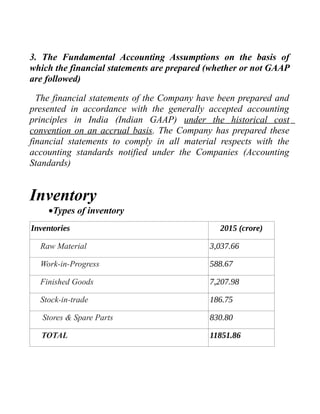
•Types of inventory
Inventories 2015 (crore)
Raw Material 3,037.66
Work-in-Progress 588.67
Finished Goods 7,207.98
Stock-in-trade 186.75
Stores & Spare Parts 830.80
TOTAL 11851.86
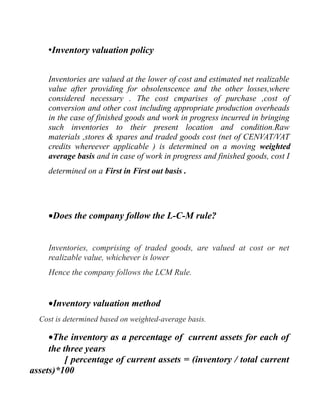
•Inventory valuation policy
Inventories are valued at the lower of cost and estimated net realizable
value after providing for obsolenscence and the other losses,where
considered necessary . The cost cmparises of purchase ,cost of
conversion and other cost including appropriate production overheads
in the case of finished goods and work in progress incurred in bringing
such inventories to their present location and condition.Raw
materials ,stores & spares and traded goods cost (net of CENVAT/VAT
credits whereever applicable ) is determined on a moving weighted
average basis and in case of work in progress and finished goods, cost I
determined on a First in First out basis .
•Does the company follow the L-C-M rule?
Inventories, comprising of traded goods, are valued at cost or net
realizable value, whichever is lower
Hence the company follows the LCM Rule.
•Inventory valuation method
Cost is determined based on weighted-average basis.
•The inventory as a percentage of current assets for each of
the three years
[ percentage of current assets = (inventory / total current
assets)*100
YEAR INVENTORY (crore) TOTAL CURRENT
ASSETS (crore)
Inventory as %age of
current assets
2013 20310.75 36861.65 55.09
2014 20664.24 41718.03 49.53
2015 17782.06 37084.08 47.95
•The absolute and percentage change in inventory value from
1st
year to 2nd
and from 2nd
year to 3rd
year in absolute
Absolute change
[current year inventory – previous year inventory]
Year Current year
inventory
(crore)
Previous year
inventory
(crore)
Absolute change
(crore)
2015 - 2014 17782.06 20664.24 -2882.18
2014 - 2013 20664.24 20310.75 353.49
Percentage change
[(absolute change / previous year inventory)*100]
Year Absolute
Change (crore)
Previous year
inventory
(crore)
Percentage
change (%)
2015 - 2014 -2882.18 20664.24 -13.94
2014 - 2013 353.49 20310.75 1.74
6. The absolute and percentage change in current assets from 1st
year to 2nd
and from 2nd
year to 3rd
year
Absolute change
[current year's current asset – previous year's current asset]
Year Current Year's
current asset
(crore)
Previous Year's
current asset
(crore)
Absolute
Change (crore)
2015 - 2014 37084.08 41718.03 -4633.95
2014 - 2013 41718.03 36861.65 4856.38
Percentage change
[(absolute change / previous year current asset)*100]
Year Absolute
Change (crore)
Previous Year's
current asset
(crore)
Percentage
change (%)
2015 - 2014 -4633.95 41718.03 -11.10
2014 - 2013 4856.38 36861.65 13.17
7. Working capital (net current assets ) in each of the 3 years and
the percentage change in working capital from 1st
year to 2nd
and
from 2nd
year to 3rd
year (Note: Working capital = Current Assets –
Current Liabilities)
WORKING CAPITAL
[Total Current Assets – Total Current Liabilities]
Year Total of Current
Assets (crore)
Total of Current
Liabilities
(crore)
Working Capital
(crore)
2013 36861.65 28709.79 8151.86
2014 41718.03 30778.49 10939.54
2015 37084.08 25847.08 11237
Percentage change
(current year – previous year)/previous year *100
Year Current year
working
Previous Year
Working Capital
Percentage
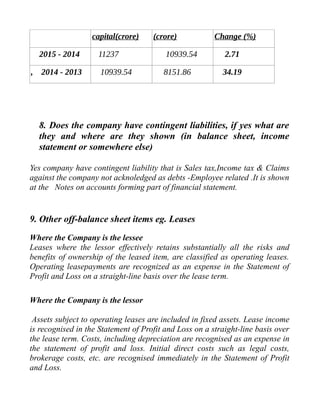
capital(crore) (crore) Change (%)
2015 - 2014 11237 10939.54 2.71
, 2014 - 2013 10939.54 8151.86 34.19
8. Does the company have contingent liabilities, if yes what are
they and where are they shown (in balance sheet, income
statement or somewhere else)
Yes company have contingent liability that is Sales tax,Income tax & Claims
against the company not acknoledged as debts -Employee related .It is shown
at the Notes on accounts forming part of financial statement.
9. Other off-balance sheet items eg. Leases
Where the Company is the lessee
Leases where the lessor effectively retains substantially all the risks and
benefits of ownership of the leased item, are classified as operating leases.
Operating leasepayments are recognized as an expense in the Statement of
Profit and Loss on a straight-line basis over the lease term.
Where the Company is the lessor
Assets subject to operating leases are included in fixed assets. Lease income
is recognised in the Statement of Profit and Loss on a straight-line basis over
the lease term. Costs, including depreciation are recognised as an expense in
the statement of profit and loss. Initial direct costs such as legal costs,
brokerage costs, etc. are recognised immediately in the Statement of Profit
and Loss.
10. Events occurring after the balance sheet date
No events occurring after balancesheet
11. Revenue trends
•The absolute change and percentage change in revenue from 1st year
to 2nd and from 2nd year to 3rd year
Absolute change
[Current Year Net Revenue – Previous Year Net Revenue]
Year Current Year
Net Revenue
Previous Year
Net Revenue
Absolute
Change
2015 - 2014 127,257 133,103 -5846
2014 - 2013 133,103 127,950 5153
Percentage change:
[(Absolute Change / Previous Year Net Revenue)*100]
Year Absolute
Change
Previous Year
Net Revenue
Percentage
Change (%)
2015 - 2014 -5846 133103 -4.39
2014 - 2013 5153 127950 4.02
Profit after tax
Absolute change
[Current Year Net Revenue – Previous Year Net Revenue
Year Current Year Net
Revenue
Previous Year Net
Revenue
Absolute Change
2015 - 2014 9,776 10,051 -275
2014 - 2013 10,051 6130 3921
Percentage change:
[(Absolute Change / Previous Year Net Revenue)*100]
Year Absolute
Change
Previous Year
Net Revenue
Percentage
Change (%)
2015 - 2014 -275 10051 -2.73
2014 - 2013 3921 6130 63.96
EPS
Absolute change
[Current Year Net Revenue – Previous Year Net Revenue]
Year Current Year
Net Revenue
Previous Year
Net Revenue
Absolute
Change
2015 - 2014 6,450.81 4426.19 2024.62
2014 - 2013 4426.19 4002.14 424.05
Percentage change:
[(Absolute Change / Previous Year Net Revenue)*100]
Year Absolute
Change
Previous Year
Net Revenue
Percentage
Change (%)
2015 - 2014 2024.62 4426.19 45.74
2014 - 2013 424.05 4002.14 10.59
•Gross Profit Margin (Gross Profit ÷ Net Sales)
Year Gross Profit Net Sales Gross Profit
Margin
2015 14,133.17 12726 1.11
2014 12787.14 13310 0.96
•Operating Profit Margin (Operating Profit ÷ Net Sales)
Year Operating Profit Net Sales Operating Profit
Margin
2015 19,844 127,257 0.155
2014 19,734 133,103 0.148
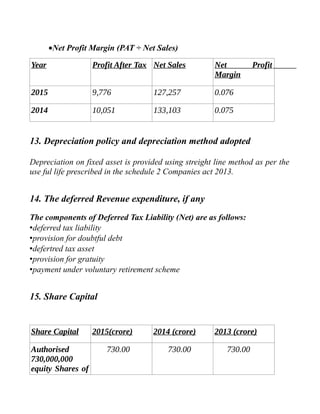
•Net Profit Margin (PAT ÷ Net Sales)
Year Profit After Tax Net Sales Net Profit
Margin
2015 9,776 127,257 0.076
2014 10,051 133,103 0.075
13. Depreciation policy and depreciation method adopted
Depreciation on fixed asset is provided using streight line method as per the
use ful life prescribed in the schedule 2 Companies act 2013.
14. The deferred Revenue expenditure, if any
The components of Deferred Tax Liability (Net) are as follows:
•deferred tax liability
•provision for doubtful debt
•defertred tax asset
•provision for gratuity
•payment under voluntary retirement scheme
15. Share Capital
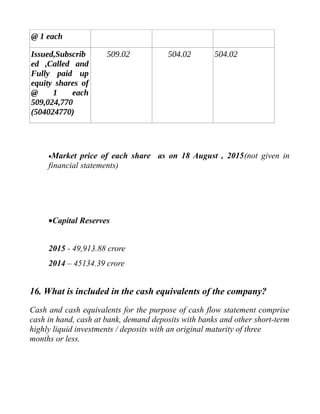
Share Capital 2015(crore) 2014 (crore) 2013 (crore)
Authorised
730,000,000
equity Shares of
730.00 730.00 730.00
@ 1 each
Issued,Subscrib
ed ,Called and
Fully paid up
equity shares of
@ 1 each
509,024,770
(504024770)
509.02 504.02 504.02
•Market price of each share as on 18 August , 2015(not given in
financial statements)
•Capital Reserves
2015 - 49,913.88 crore
2014 – 45134.39 crore
16. What is included in the cash equivalents of the company?
Cash and cash equivalents for the purpose of cash flow statement comprise
cash in hand, cash at bank, demand deposits with banks and other short-term
highly liquid investments / deposits with an original maturity of three
months or less.
ASSIGNMENT
MANAGERIAL ACCOUNTING
ANNUAL REPORTS
APOLLO TYRES LTD
SUBMITTED BY
AJAY PANDEY
ROLL NO -23/081
SECTION-C

The apollo tyres ltd

  • 1.
    The apollo tyresltd History Apollo Tyres was incepted in 1975 with its first plant commissioned in Perambra, Kerala. It is a high–performance company and the leading Indian tyre manufacturer. Headquartered in Gurgaon, a corporate–hub in the National Capital Region of India, Apollo is a young, ambitious and dynamic organization, which takes pride in its unique identity. Registered as a company in 1976, Apollo is built around the core principles of creating stakeholder value through reliability in its products and dependability in its relationships. Apollo strength and market dynamism steps from its early years of strife in establishing itself as a tyre manufacturer within the closed Indian economy. Over two decades, Apollo worked on a portfolio of products, tuned to customer needs and an array of innovative marketing initiatives to establish itself as a leader in its home market. 2.The industry to which the company belongs and the main Revenue producing activities of the company Apollo Tyres Ltd is the world's 17th biggest tyre manufacturer, with annual consolidated revenues of Rs 121.5 billion (US$2.5 billion) in 2011. It was founded in 1976. Its first plant was commissioned in Perambra, Thrissur, Kerala. The company now has four manufacturing units, one in South Africa, two in Zimbabwe and 1 in Netherlands.It has a network of over 4,000 dealerships in India, of which over 2,500 are exclusive outlets.It gets 62.6% of its revenues from India, 27.9% from Europe and 9.5% from Africa.
  • 2.
    3. The FundamentalAccounting Assumptions on the basis of which the financial statements are prepared (whether or not GAAP are followed) The financial statements of the Company have been prepared and presented in accordance with the generally accepted accounting principles in India (Indian GAAP) under the historical cost convention on an accrual basis. The Company has prepared these financial statements to comply in all material respects with the accounting standards notified under the Companies (Accounting Standards) Inventory •Types of inventory Inventories 2015 (crore) Raw Material 3,037.66 Work-in-Progress 588.67 Finished Goods 7,207.98 Stock-in-trade 186.75 Stores & Spare Parts 830.80 TOTAL 11851.86
  • 3.
    •Inventory valuation policy Inventoriesare valued at the lower of cost and estimated net realizable value after providing for obsolenscence and the other losses,where considered necessary . The cost cmparises of purchase ,cost of conversion and other cost including appropriate production overheads in the case of finished goods and work in progress incurred in bringing such inventories to their present location and condition.Raw materials ,stores & spares and traded goods cost (net of CENVAT/VAT credits whereever applicable ) is determined on a moving weighted average basis and in case of work in progress and finished goods, cost I determined on a First in First out basis . •Does the company follow the L-C-M rule? Inventories, comprising of traded goods, are valued at cost or net realizable value, whichever is lower Hence the company follows the LCM Rule. •Inventory valuation method Cost is determined based on weighted-average basis. •The inventory as a percentage of current assets for each of the three years [ percentage of current assets = (inventory / total current assets)*100
  • 4.
    YEAR INVENTORY (crore)TOTAL CURRENT ASSETS (crore) Inventory as %age of current assets 2013 20310.75 36861.65 55.09 2014 20664.24 41718.03 49.53 2015 17782.06 37084.08 47.95 •The absolute and percentage change in inventory value from 1st year to 2nd and from 2nd year to 3rd year in absolute Absolute change [current year inventory – previous year inventory] Year Current year inventory (crore) Previous year inventory (crore) Absolute change (crore) 2015 - 2014 17782.06 20664.24 -2882.18 2014 - 2013 20664.24 20310.75 353.49 Percentage change [(absolute change / previous year inventory)*100] Year Absolute Change (crore) Previous year inventory (crore) Percentage change (%) 2015 - 2014 -2882.18 20664.24 -13.94 2014 - 2013 353.49 20310.75 1.74
  • 5.
    6. The absoluteand percentage change in current assets from 1st year to 2nd and from 2nd year to 3rd year Absolute change [current year's current asset – previous year's current asset] Year Current Year's current asset (crore) Previous Year's current asset (crore) Absolute Change (crore) 2015 - 2014 37084.08 41718.03 -4633.95 2014 - 2013 41718.03 36861.65 4856.38 Percentage change [(absolute change / previous year current asset)*100] Year Absolute Change (crore) Previous Year's current asset (crore) Percentage change (%)
  • 6.
    2015 - 2014-4633.95 41718.03 -11.10 2014 - 2013 4856.38 36861.65 13.17 7. Working capital (net current assets ) in each of the 3 years and the percentage change in working capital from 1st year to 2nd and from 2nd year to 3rd year (Note: Working capital = Current Assets – Current Liabilities) WORKING CAPITAL [Total Current Assets – Total Current Liabilities] Year Total of Current Assets (crore) Total of Current Liabilities (crore) Working Capital (crore) 2013 36861.65 28709.79 8151.86 2014 41718.03 30778.49 10939.54 2015 37084.08 25847.08 11237 Percentage change (current year – previous year)/previous year *100 Year Current year working Previous Year Working Capital Percentage
  • 7.
    capital(crore) (crore) Change(%) 2015 - 2014 11237 10939.54 2.71 , 2014 - 2013 10939.54 8151.86 34.19 8. Does the company have contingent liabilities, if yes what are they and where are they shown (in balance sheet, income statement or somewhere else) Yes company have contingent liability that is Sales tax,Income tax & Claims against the company not acknoledged as debts -Employee related .It is shown at the Notes on accounts forming part of financial statement. 9. Other off-balance sheet items eg. Leases Where the Company is the lessee Leases where the lessor effectively retains substantially all the risks and benefits of ownership of the leased item, are classified as operating leases. Operating leasepayments are recognized as an expense in the Statement of Profit and Loss on a straight-line basis over the lease term. Where the Company is the lessor Assets subject to operating leases are included in fixed assets. Lease income is recognised in the Statement of Profit and Loss on a straight-line basis over the lease term. Costs, including depreciation are recognised as an expense in the statement of profit and loss. Initial direct costs such as legal costs, brokerage costs, etc. are recognised immediately in the Statement of Profit and Loss.
  • 8.
    10. Events occurringafter the balance sheet date No events occurring after balancesheet 11. Revenue trends •The absolute change and percentage change in revenue from 1st year to 2nd and from 2nd year to 3rd year Absolute change [Current Year Net Revenue – Previous Year Net Revenue] Year Current Year Net Revenue Previous Year Net Revenue Absolute Change 2015 - 2014 127,257 133,103 -5846 2014 - 2013 133,103 127,950 5153 Percentage change: [(Absolute Change / Previous Year Net Revenue)*100] Year Absolute Change Previous Year Net Revenue Percentage Change (%) 2015 - 2014 -5846 133103 -4.39 2014 - 2013 5153 127950 4.02 Profit after tax
  • 9.
    Absolute change [Current YearNet Revenue – Previous Year Net Revenue Year Current Year Net Revenue Previous Year Net Revenue Absolute Change 2015 - 2014 9,776 10,051 -275 2014 - 2013 10,051 6130 3921 Percentage change: [(Absolute Change / Previous Year Net Revenue)*100] Year Absolute Change Previous Year Net Revenue Percentage Change (%) 2015 - 2014 -275 10051 -2.73 2014 - 2013 3921 6130 63.96 EPS Absolute change [Current Year Net Revenue – Previous Year Net Revenue] Year Current Year Net Revenue Previous Year Net Revenue Absolute Change 2015 - 2014 6,450.81 4426.19 2024.62 2014 - 2013 4426.19 4002.14 424.05
  • 10.
    Percentage change: [(Absolute Change/ Previous Year Net Revenue)*100] Year Absolute Change Previous Year Net Revenue Percentage Change (%) 2015 - 2014 2024.62 4426.19 45.74 2014 - 2013 424.05 4002.14 10.59 •Gross Profit Margin (Gross Profit ÷ Net Sales) Year Gross Profit Net Sales Gross Profit Margin 2015 14,133.17 12726 1.11 2014 12787.14 13310 0.96 •Operating Profit Margin (Operating Profit ÷ Net Sales) Year Operating Profit Net Sales Operating Profit Margin 2015 19,844 127,257 0.155 2014 19,734 133,103 0.148
  • 11.
    •Net Profit Margin(PAT ÷ Net Sales) Year Profit After Tax Net Sales Net Profit Margin 2015 9,776 127,257 0.076 2014 10,051 133,103 0.075 13. Depreciation policy and depreciation method adopted Depreciation on fixed asset is provided using streight line method as per the use ful life prescribed in the schedule 2 Companies act 2013. 14. The deferred Revenue expenditure, if any The components of Deferred Tax Liability (Net) are as follows: •deferred tax liability •provision for doubtful debt •defertred tax asset •provision for gratuity •payment under voluntary retirement scheme 15. Share Capital Share Capital 2015(crore) 2014 (crore) 2013 (crore) Authorised 730,000,000 equity Shares of 730.00 730.00 730.00
  • 12.
    @ 1 each Issued,Subscrib ed,Called and Fully paid up equity shares of @ 1 each 509,024,770 (504024770) 509.02 504.02 504.02 •Market price of each share as on 18 August , 2015(not given in financial statements) •Capital Reserves 2015 - 49,913.88 crore 2014 – 45134.39 crore 16. What is included in the cash equivalents of the company? Cash and cash equivalents for the purpose of cash flow statement comprise cash in hand, cash at bank, demand deposits with banks and other short-term highly liquid investments / deposits with an original maturity of three months or less.
  • 13.
  • 14.
    APOLLO TYRES LTD SUBMITTEDBY AJAY PANDEY ROLL NO -23/081 SECTION-C