
Copyright © 2014 Oracle and/or its affiliates. All rights reserved. |
Oracle PL/SQL Performance Features
The Amazing and Elegant
PL/SQL Function Result Cache
Steven Feuerstein
Oracle Developer Advocate for PL/SQL
Oracle Corporation
Email: steven.feuerstein@oracle.com
Twitter: @sfonplsql
Blog: stevenfeuersteinonplsql.blogspot.com
YouTube: Practically Perfect PL/SQL
Copyright © 2014 Oracle and/or its affiliates. All rights reserved. |
Resources for Oracle Database Developers
• Official home of PL/SQL - oracle.com/plsql
• SQL-PL/SQL discussion forum on OTN
https://community.oracle.com/community/database/developer-tools/sql_and_pl_sql
• PL/SQL and EBR blog by Bryn Llewellyn - https://blogs.oracle.com/plsql-and-ebr
• Oracle Learning Library - oracle.com/oll
• Weekly PL/SQL and SQL quizzes, and more - plsqlchallenge.oracle.com
• Ask Tom - asktom.oracle.com – 'nuff said
• LiveSQL - livesql.oracle.com – script repository and 12/7 12c database
• oracle-developer.net - great content from Adrian Billington
• oracle-base.com - great content from Tim Hall
Copyright © 2014 Oracle and/or its affiliates. All rights reserved. |
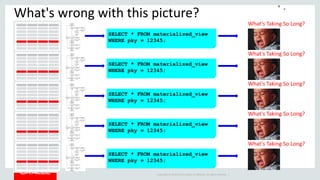
What's wrong with this picture?
• .
SELECT * FROM materialized_view
WHERE pky = 12345;
What's Taking So Long?
SELECT * FROM materialized_view
WHERE pky = 12345;
What's Taking So Long?
SELECT * FROM materialized_view
WHERE pky = 12345;
What's Taking So Long?
SELECT * FROM materialized_view
WHERE pky = 12345;
What's Taking So Long?
SELECT * FROM materialized_view
WHERE pky = 12345;
What's Taking So Long?
Copyright © 2014 Oracle and/or its affiliates. All rights reserved. |
Data Caching Options in PL/SQL
• Caching is a time-honored technique for improving performance.
• Store data that doesn’t change for some period of time in a location that
can be accessed more quickly than the source.
• The SGA is an enormous, complex cache for the entire database instance.
• But there are other caches we can leverage in our PL/SQL code.
– Deterministic functions
– PGA caching using package-level variables
– The function result cache: the most powerful and widely applicable technique
All referenced code available in my demo.zip file from the
PL/SQL Learning Library: oracle.com/oll/plsql.
Copyright © 2014 Oracle and/or its affiliates. All rights reserved. |
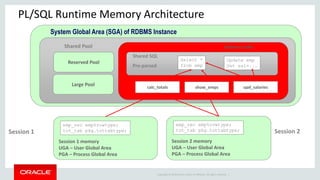
System Global Area (SGA) of RDBMS Instance
PL/SQL Runtime Memory Architecture
Shared Pool
Large Pool
Reserved Pool
show_empscalc_totals upd_salaries
Select *
from emp
Shared SQL
Pre-parsed
Update emp
Set sal=...
Library cache
Session 1 memory
UGA – User Global Area
PGA – Process Global Area
emp_rec emp%rowtype;
tot_tab pkg.tottabtype;
Session 2 memory
UGA – User Global Area
PGA – Process Global Area
emp_rec emp%rowtype;
tot_tab pkg.tottabtype;Session 1 Session 2
Copyright © 2014 Oracle and/or its affiliates. All rights reserved. |
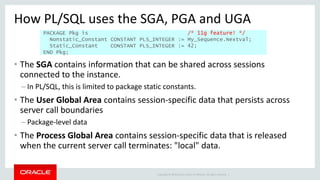
How PL/SQL uses the SGA, PGA and UGA
• The SGA contains information that can be shared across sessions
connected to the instance.
– In PL/SQL, this is limited to package static constants.
• The User Global Area contains session-specific data that persists across
server call boundaries
– Package-level data
• The Process Global Area contains session-specific data that is released
when the current server call terminates: "local" data.
PACKAGE Pkg is /* 11g feature! */
Nonstatic_Constant CONSTANT PLS_INTEGER := My_Sequence.Nextval;
Static_Constant CONSTANT PLS_INTEGER := 42;
END Pkg;
Copyright © 2014 Oracle and/or its affiliates. All rights reserved. |
Data Caching Options
• Functions declared as DETERMINISTIC
• PGA caching
– Used most effectively with collections
– Accessing PGA memory generally more efficient than SGA, especially if executing SQL.
• Oracle Database 11g Function Result Cache
– The best caching technique and the most important new feature in 11g for PL/SQL
developers.
Copyright © 2014 Oracle and/or its affiliates. All rights reserved. |
DETERMINSTIC Functions
• A function is deterministic if the value it returns is determined completely
by its inputs (IN arguments).
– In other words, no side effects.
• Add the DETERMINISTIC keyword to your function to enable
optimizations:
– Function-based indexes
– Cache results in scope of a query
• Don’t lie!
– Oracle will not (at compile time) reject your use of the keyword, even if it isn’t true.
deterministic.sql
deterministic_in_plsql.sql
Copyright © 2014 Oracle and/or its affiliates. All rights reserved. |
PGA-Based Caching
• When you declare variables at the package level, their state persists in your
session.
– A PGA-based cache, specific to each session.
• And if you declare a collection at the package level, you can cache multiple
rows of data.
– Very useful for static datasets like materialized views.
• Not a reliable technique for Web-based (usually stateless) applications
Copyright © 2014 Oracle and/or its affiliates. All rights reserved. |
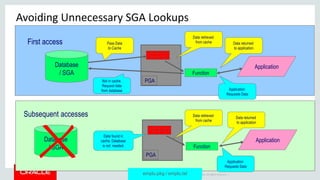
Avoiding Unnecessary SGA Lookups
First access
PGA
Function
Database
/ SGA
Not in cache;
Request data
from database
Pass Data
to Cache
Application
Application
Requests Data
Data retrieved
from cache Data returned
to application
Function
PGA
Subsequent accesses
Application
Application
Requests Data
Data returned
to application
Data retrieved
from cache
Database
/ SGA
Data found in
cache. Database
is not needed.
emplu.pkg / emplu.tst
Copyright © 2014 Oracle and/or its affiliates. All rights reserved. |
PGA Caching: Things to keep in mind
• Must use package-level data so that it persists.
– Memory is consumed by the PGA and so is multiplied for all users of the application.
– Not a reliable technique for stateless application (Internet)
• Very difficult to share cache across sessions in the same instance.
– One possibility involves DBMS_PIPE.
• Very difficult to update the cache once the data source is changed.
– Especially by/from, other sessions. Possible to use DBMS_ALERT.
• Useful under specific scenarios....
– Small, static dataset or a single or small number of batch processes
syscache.pkg
Copyright © 2014 Oracle and/or its affiliates. All rights reserved. |
The Function Result Cache
• Introduced in Oracle Database 11g, the Function Result Cache is
definitely the caching mechanism of choice for PL/SQL developers.
• This cache is stored in the SGA ; shared across sessions; purged of dirty
data automatically
• You can and should use it to retrieve data from any table that is queried
more frequently than updated.
– Static datasets like materialized views
– Same rows fetched multiple times (parameter values serve as unique index into
cache)
• Enterprise Edition only.
Copyright © 2014 Oracle and/or its affiliates. All rights reserved. |
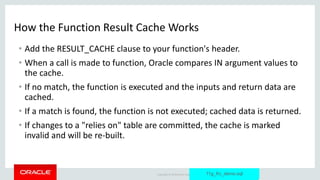
How the Function Result Cache Works
• Add the RESULT_CACHE clause to your function's header.
• When a call is made to function, Oracle compares IN argument values to
the cache.
• If no match, the function is executed and the inputs and return data are
cached.
• If a match is found, the function is not executed; cached data is returned.
• If changes to a "relies on" table are committed, the cache is marked
invalid and will be re-built.
11g_frc_demo.sql
Copyright © 2014 Oracle and/or its affiliates. All rights reserved. |
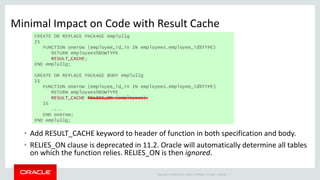
Minimal Impact on Code with Result Cache
• Add RESULT_CACHE keyword to header of function in both specification and body.
• RELIES_ON clause is deprecated in 11.2. Oracle will automatically determine all tables
on which the function relies. RELIES_ON is then ignored.
CREATE OR REPLACE PACKAGE emplu11g
IS
FUNCTION onerow (employee_id_in IN employees.employee_id%TYPE)
RETURN employees%ROWTYPE
RESULT_CACHE;
END emplu11g;
CREATE OR REPLACE PACKAGE BODY emplu11g
IS
FUNCTION onerow (employee_id_in IN employees.employee_id%TYPE)
RETURN employees%ROWTYPE
RESULT_CACHE RELIES_ON (employees)
IS
....
END onerow;
END emplu11g;
Copyright © 2014 Oracle and/or its affiliates. All rights reserved. |
Performance Impact of Result Cache
• The result cache is stored in the SGA.
• So we should expect it be slower than a PGA-based cache.
• But accessing result cache data does not require going through the SQL
engine.
• So it should be much faster than executing a query.
– Even if the statement is parsed and the data blocks are already in the SGA.
• Let's find out!
11g_emplu*.*
Copyright © 2014 Oracle and/or its affiliates. All rights reserved. |
Result Cache – Things to Keep in Mind - 1
• If you have uncommitted changes in your session, dependent caches are
ignored.
– The cache will not override your own changed data.
• Caching is not performed for complex types: records with CLOBs,
collections, etc.
– But Oracle is optimistic!
• The cache is not related to SQL statements in your function.
– It only keeps track of the input values and the RETURN clause data.
11g_frc_demo.sql
Copyright © 2014 Oracle and/or its affiliates. All rights reserved. |
Result Cache – Things to Keep in Mind - 2
• You cannot use the result cache with invoker rights program units until 12.1.
– Bypass execution of function body, Oracle cannot resolve references to objects - the
whole point of IR.
• Functions with session-specific dependencies must be "result-cached" with
great care.
– Virtual private database configurations
– References to SYSDATE, reliance on NLS_DATE_FORMAT, time zone changes
– Application contexts (calls to SYS_CONTEXT)
• Solution: move all dependencies into parameter list.
11g_frc_vpd.sql
11g_frc_vpd2.sql
Copyright © 2014 Oracle and/or its affiliates. All rights reserved. |
Managing the Result Cache
• Oracle offers a number of ways to manage the result cache and tune it to
your specific application needs:
• RESULT_CACHE_MAX_SIZE initialization parameter
– If the cache is too small, then the LRU algorithm negates the point of the cache.
• DBMS_RESULT_CACHE management package
• v$RESULT_CACHE_* performance views
show_frc_dependencies.sp
Copyright © 2014 Oracle and/or its affiliates. All rights reserved. |
Fine Grained Dependencies in 11.2
• Oracle keeps track of table dependencies on a per-result level.
– Each result cached could have a different set of dependencies.
• A change to a table could invalidate just a subset of the results in the
cache.
– It's not all or nothing - when your function's different logic paths could "hit" different
tables.
11g_frc_dependencies.sql
11g_frc_dependencies2.sql
Copyright © 2014 Oracle and/or its affiliates. All rights reserved. |
Make It Easy on Yourself
• I hope you will agree that the result cache is a great feature.
• But how easy will it be for you to apply it?
• If you write/duplicate queries throughout your code, upgrading will be
expensive and slow.
• If you hide your queries behind functions, you have a single point of
definition, and you can upgrade "instantly."
11g_frc_encapsulation.sql
Copyright © 2014 Oracle and/or its affiliates. All rights reserved. |
Conclusions - Caching
• Oracle offers several different ways you can build upon its own caching.
• DETERMINISTIC for functions in SQL
– Mostly useful for organizing code more effectively
• PGA caching
– Very fast, but of limited use
• Function result cache
– Simplest and most widely applicable technique
– Get ready for it now by hiding queries inside functions.
Copyright © 2014 Oracle and/or its affiliates. All rights reserved. | Oracle Confidential – Internal/Restricted/Highly Restricted 22
The Amazing and Elegant PL/SQL Function Result Cache

The Amazing and Elegant PL/SQL Function Result Cache

  • 1.
    Copyright © 2014Oracle and/or its affiliates. All rights reserved. | Oracle PL/SQL Performance Features The Amazing and Elegant PL/SQL Function Result Cache Steven Feuerstein Oracle Developer Advocate for PL/SQL Oracle Corporation Email: steven.feuerstein@oracle.com Twitter: @sfonplsql Blog: stevenfeuersteinonplsql.blogspot.com YouTube: Practically Perfect PL/SQL
  • 2.
    Copyright © 2014Oracle and/or its affiliates. All rights reserved. | Resources for Oracle Database Developers • Official home of PL/SQL - oracle.com/plsql • SQL-PL/SQL discussion forum on OTN https://community.oracle.com/community/database/developer-tools/sql_and_pl_sql • PL/SQL and EBR blog by Bryn Llewellyn - https://blogs.oracle.com/plsql-and-ebr • Oracle Learning Library - oracle.com/oll • Weekly PL/SQL and SQL quizzes, and more - plsqlchallenge.oracle.com • Ask Tom - asktom.oracle.com – 'nuff said • LiveSQL - livesql.oracle.com – script repository and 12/7 12c database • oracle-developer.net - great content from Adrian Billington • oracle-base.com - great content from Tim Hall
  • 3.
    Copyright © 2014Oracle and/or its affiliates. All rights reserved. | What's wrong with this picture? • . SELECT * FROM materialized_view WHERE pky = 12345; What's Taking So Long? SELECT * FROM materialized_view WHERE pky = 12345; What's Taking So Long? SELECT * FROM materialized_view WHERE pky = 12345; What's Taking So Long? SELECT * FROM materialized_view WHERE pky = 12345; What's Taking So Long? SELECT * FROM materialized_view WHERE pky = 12345; What's Taking So Long?
  • 4.
    Copyright © 2014Oracle and/or its affiliates. All rights reserved. | Data Caching Options in PL/SQL • Caching is a time-honored technique for improving performance. • Store data that doesn’t change for some period of time in a location that can be accessed more quickly than the source. • The SGA is an enormous, complex cache for the entire database instance. • But there are other caches we can leverage in our PL/SQL code. – Deterministic functions – PGA caching using package-level variables – The function result cache: the most powerful and widely applicable technique All referenced code available in my demo.zip file from the PL/SQL Learning Library: oracle.com/oll/plsql.
  • 5.
    Copyright © 2014Oracle and/or its affiliates. All rights reserved. | System Global Area (SGA) of RDBMS Instance PL/SQL Runtime Memory Architecture Shared Pool Large Pool Reserved Pool show_empscalc_totals upd_salaries Select * from emp Shared SQL Pre-parsed Update emp Set sal=... Library cache Session 1 memory UGA – User Global Area PGA – Process Global Area emp_rec emp%rowtype; tot_tab pkg.tottabtype; Session 2 memory UGA – User Global Area PGA – Process Global Area emp_rec emp%rowtype; tot_tab pkg.tottabtype;Session 1 Session 2
  • 6.
    Copyright © 2014Oracle and/or its affiliates. All rights reserved. | How PL/SQL uses the SGA, PGA and UGA • The SGA contains information that can be shared across sessions connected to the instance. – In PL/SQL, this is limited to package static constants. • The User Global Area contains session-specific data that persists across server call boundaries – Package-level data • The Process Global Area contains session-specific data that is released when the current server call terminates: "local" data. PACKAGE Pkg is /* 11g feature! */ Nonstatic_Constant CONSTANT PLS_INTEGER := My_Sequence.Nextval; Static_Constant CONSTANT PLS_INTEGER := 42; END Pkg;
  • 7.
    Copyright © 2014Oracle and/or its affiliates. All rights reserved. | Data Caching Options • Functions declared as DETERMINISTIC • PGA caching – Used most effectively with collections – Accessing PGA memory generally more efficient than SGA, especially if executing SQL. • Oracle Database 11g Function Result Cache – The best caching technique and the most important new feature in 11g for PL/SQL developers.
  • 8.
    Copyright © 2014Oracle and/or its affiliates. All rights reserved. | DETERMINSTIC Functions • A function is deterministic if the value it returns is determined completely by its inputs (IN arguments). – In other words, no side effects. • Add the DETERMINISTIC keyword to your function to enable optimizations: – Function-based indexes – Cache results in scope of a query • Don’t lie! – Oracle will not (at compile time) reject your use of the keyword, even if it isn’t true. deterministic.sql deterministic_in_plsql.sql
  • 9.
    Copyright © 2014Oracle and/or its affiliates. All rights reserved. | PGA-Based Caching • When you declare variables at the package level, their state persists in your session. – A PGA-based cache, specific to each session. • And if you declare a collection at the package level, you can cache multiple rows of data. – Very useful for static datasets like materialized views. • Not a reliable technique for Web-based (usually stateless) applications
  • 10.
    Copyright © 2014Oracle and/or its affiliates. All rights reserved. | Avoiding Unnecessary SGA Lookups First access PGA Function Database / SGA Not in cache; Request data from database Pass Data to Cache Application Application Requests Data Data retrieved from cache Data returned to application Function PGA Subsequent accesses Application Application Requests Data Data returned to application Data retrieved from cache Database / SGA Data found in cache. Database is not needed. emplu.pkg / emplu.tst
  • 11.
    Copyright © 2014Oracle and/or its affiliates. All rights reserved. | PGA Caching: Things to keep in mind • Must use package-level data so that it persists. – Memory is consumed by the PGA and so is multiplied for all users of the application. – Not a reliable technique for stateless application (Internet) • Very difficult to share cache across sessions in the same instance. – One possibility involves DBMS_PIPE. • Very difficult to update the cache once the data source is changed. – Especially by/from, other sessions. Possible to use DBMS_ALERT. • Useful under specific scenarios.... – Small, static dataset or a single or small number of batch processes syscache.pkg
  • 12.
    Copyright © 2014Oracle and/or its affiliates. All rights reserved. | The Function Result Cache • Introduced in Oracle Database 11g, the Function Result Cache is definitely the caching mechanism of choice for PL/SQL developers. • This cache is stored in the SGA ; shared across sessions; purged of dirty data automatically • You can and should use it to retrieve data from any table that is queried more frequently than updated. – Static datasets like materialized views – Same rows fetched multiple times (parameter values serve as unique index into cache) • Enterprise Edition only.
  • 13.
    Copyright © 2014Oracle and/or its affiliates. All rights reserved. | How the Function Result Cache Works • Add the RESULT_CACHE clause to your function's header. • When a call is made to function, Oracle compares IN argument values to the cache. • If no match, the function is executed and the inputs and return data are cached. • If a match is found, the function is not executed; cached data is returned. • If changes to a "relies on" table are committed, the cache is marked invalid and will be re-built. 11g_frc_demo.sql
  • 14.
    Copyright © 2014Oracle and/or its affiliates. All rights reserved. | Minimal Impact on Code with Result Cache • Add RESULT_CACHE keyword to header of function in both specification and body. • RELIES_ON clause is deprecated in 11.2. Oracle will automatically determine all tables on which the function relies. RELIES_ON is then ignored. CREATE OR REPLACE PACKAGE emplu11g IS FUNCTION onerow (employee_id_in IN employees.employee_id%TYPE) RETURN employees%ROWTYPE RESULT_CACHE; END emplu11g; CREATE OR REPLACE PACKAGE BODY emplu11g IS FUNCTION onerow (employee_id_in IN employees.employee_id%TYPE) RETURN employees%ROWTYPE RESULT_CACHE RELIES_ON (employees) IS .... END onerow; END emplu11g;
  • 15.
    Copyright © 2014Oracle and/or its affiliates. All rights reserved. | Performance Impact of Result Cache • The result cache is stored in the SGA. • So we should expect it be slower than a PGA-based cache. • But accessing result cache data does not require going through the SQL engine. • So it should be much faster than executing a query. – Even if the statement is parsed and the data blocks are already in the SGA. • Let's find out! 11g_emplu*.*
  • 16.
    Copyright © 2014Oracle and/or its affiliates. All rights reserved. | Result Cache – Things to Keep in Mind - 1 • If you have uncommitted changes in your session, dependent caches are ignored. – The cache will not override your own changed data. • Caching is not performed for complex types: records with CLOBs, collections, etc. – But Oracle is optimistic! • The cache is not related to SQL statements in your function. – It only keeps track of the input values and the RETURN clause data. 11g_frc_demo.sql
  • 17.
    Copyright © 2014Oracle and/or its affiliates. All rights reserved. | Result Cache – Things to Keep in Mind - 2 • You cannot use the result cache with invoker rights program units until 12.1. – Bypass execution of function body, Oracle cannot resolve references to objects - the whole point of IR. • Functions with session-specific dependencies must be "result-cached" with great care. – Virtual private database configurations – References to SYSDATE, reliance on NLS_DATE_FORMAT, time zone changes – Application contexts (calls to SYS_CONTEXT) • Solution: move all dependencies into parameter list. 11g_frc_vpd.sql 11g_frc_vpd2.sql
  • 18.
    Copyright © 2014Oracle and/or its affiliates. All rights reserved. | Managing the Result Cache • Oracle offers a number of ways to manage the result cache and tune it to your specific application needs: • RESULT_CACHE_MAX_SIZE initialization parameter – If the cache is too small, then the LRU algorithm negates the point of the cache. • DBMS_RESULT_CACHE management package • v$RESULT_CACHE_* performance views show_frc_dependencies.sp
  • 19.
    Copyright © 2014Oracle and/or its affiliates. All rights reserved. | Fine Grained Dependencies in 11.2 • Oracle keeps track of table dependencies on a per-result level. – Each result cached could have a different set of dependencies. • A change to a table could invalidate just a subset of the results in the cache. – It's not all or nothing - when your function's different logic paths could "hit" different tables. 11g_frc_dependencies.sql 11g_frc_dependencies2.sql
  • 20.
    Copyright © 2014Oracle and/or its affiliates. All rights reserved. | Make It Easy on Yourself • I hope you will agree that the result cache is a great feature. • But how easy will it be for you to apply it? • If you write/duplicate queries throughout your code, upgrading will be expensive and slow. • If you hide your queries behind functions, you have a single point of definition, and you can upgrade "instantly." 11g_frc_encapsulation.sql
  • 21.
    Copyright © 2014Oracle and/or its affiliates. All rights reserved. | Conclusions - Caching • Oracle offers several different ways you can build upon its own caching. • DETERMINISTIC for functions in SQL – Mostly useful for organizing code more effectively • PGA caching – Very fast, but of limited use • Function result cache – Simplest and most widely applicable technique – Get ready for it now by hiding queries inside functions.
  • 22.
    Copyright © 2014Oracle and/or its affiliates. All rights reserved. | Oracle Confidential – Internal/Restricted/Highly Restricted 22