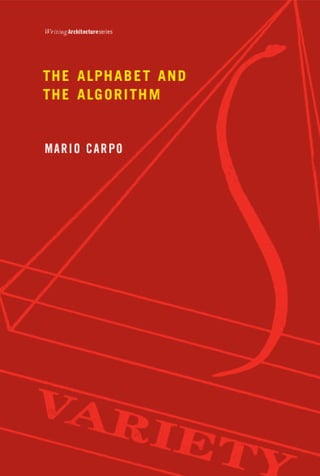
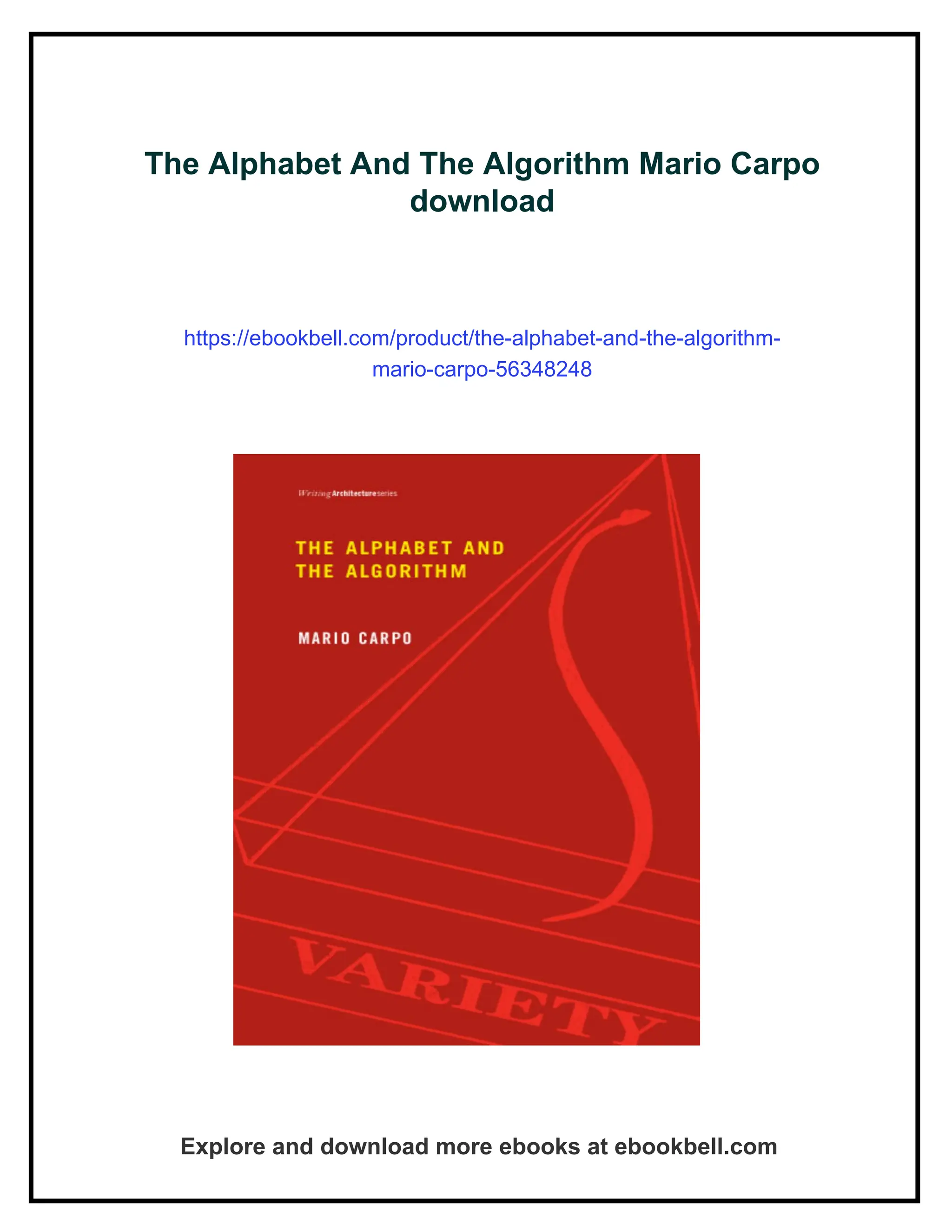
The Alphabet And The Algorithm Mario Carpo
download
https://ebookbell.com/product/the-alphabet-and-the-algorithm-
mario-carpo-56348248
Explore and download more ebooks at ebookbell.com
Here are some recommended products that we believe you will be
interested in. You can click the link to download.
Tibetan Calligraphy How To Write The Alphabet And More Sanje Elliott
https://ebookbell.com/product/tibetan-calligraphy-how-to-write-the-
alphabet-and-more-sanje-elliott-4649752
The Letter And The Cosmos How The Alphabet Has Shaped The Western View
Of The World 1st Edition Laurence De Looze
https://ebookbell.com/product/the-letter-and-the-cosmos-how-the-
alphabet-has-shaped-the-western-view-of-the-world-1st-edition-
laurence-de-looze-5899472
The Letter And The Cosmos How The Alphabet Has Shaped The Western View
Of The World Laurence De Looze
https://ebookbell.com/product/the-letter-and-the-cosmos-how-the-
alphabet-has-shaped-the-western-view-of-the-world-laurence-de-
looze-7390268
Icons Of The Alphabet Letter Names Phonetic Notation And The Phonology
And Orthography Of English 2024th Edition Reese M Heitner
https://ebookbell.com/product/icons-of-the-alphabet-letter-names-
phonetic-notation-and-the-phonology-and-orthography-of-english-2024th-
edition-reese-m-heitner-59891178
Knit The Alphabet Quick And Easy Alphabet Knitting Patterns Garland
https://ebookbell.com/product/knit-the-alphabet-quick-and-easy-
alphabet-knitting-patterns-garland-11392572
Sequoyah And The Invention Of The Cherokee Alphabet April R Summitt
https://ebookbell.com/product/sequoyah-and-the-invention-of-the-
cherokee-alphabet-april-r-summitt-47140294
Reading Writing Thai A Workbook For Selfstudy A Beginners Guide To The
Thai Alphabet And Pronunciation Jintana Rattanakhemakorn
https://ebookbell.com/product/reading-writing-thai-a-workbook-for-
selfstudy-a-beginners-guide-to-the-thai-alphabet-and-pronunciation-
jintana-rattanakhemakorn-47085500
The History Of The Nko Alphabet And Its Role In Mande Transnational
Identity Words As Weapons Dianne White Oyler
https://ebookbell.com/product/the-history-of-the-nko-alphabet-and-its-
role-in-mande-transnational-identity-words-as-weapons-dianne-white-
oyler-44755358
Fundamentals Of The Persian Alphabet Letters And Sounds Shahla Adel
https://ebookbell.com/product/fundamentals-of-the-persian-alphabet-
letters-and-sounds-shahla-adel-48711216
The Alphabet and the
Algorithm
Writing Architecture series
A project of the Anyone Corporation; Cynthia Davidson, editor
Earth Moves: The Furnishing of Territories
Bernard Cache, 1995
Architecture as Metaphor: Language, Number, Money
Kojin Karatani, 1995
Differences: Topographies of Contemporary Architecture
Ignasi de Solà-Morales, 1996
Constructions
John Rajchman, 1997
Such Places as Memory
John Hejduk, 1998
Welcome to The Hotel Architecture
Roger Connah, 1998
Fire and Memory: On Architecture and Energy
Luis Fernández-Galiano, 2000
A Landscape of Events
Paul Virilio, 2000
Architecture from the Outside: Essays on Virtual and Real Space
Elizabeth Grosz, 2001
Public Intimacy: Architecture and the Visul Arts
Giuliana Bruno, 2007
Strange Details
Michael Cadwell, 2007
Histories of the Immediate Present: Inventing Architectural Modernism
Anthony Vidler, 2008
Drawing for Architecture
Leon Krier, 2009
Architecture’s Desire: Reading the Late Avant-Garde
K. Michael Hays, 2010
The Possibility of an Absolute Architecture
Pier Vittorio Aureli, 2011
The Alphabet and the Algorithm
Mario Carp0, 2o11
The MIT Press
Cambridge, Massachusetts
London, England
The Alphabet and the
Algorithm
Mario Carpo
© 2011 Massachusetts Institute of Technology
All rights reserved. No part of this book may be reproduced in
any form by any electronic or mechanical means (including
photocopying, recording, or information storage and retrieval)
without permission in writing from the publisher.
MIT Press books may be purchased at special quantity discounts
for business or sales promotional use. For information,
please email special_sales@mitpress.mit.edu or write to
Special Sales Department, The MIT Press, 55 Hayward Street,
Cambridge, MA 02142.
This book was set in Filosofia and Trade Gothic by The MIT
Press. Printed and bound in the United States of America.
Library of Congress Cataloging-in-Publication Data
Carpo, Mario.
The alphabet and the algorithm / Mario Carpo.
p. cm. — (Writing architecture)
Includes bibliographical references and index.
ISBN 978-0-262-51580-1 (pbk. : alk. paper) 1. Architectural
design. 2. Architectural design—Technological innovations.
3. Repetition (Aesthetics) 4. Design and technology. I. Title.
NA2750.C375 2011
720.1—dc22
2010031062
10â•… 9â•… 8â•… 7â•… 6â•… 5â•… 4â•… 3â•… 2â•… 1
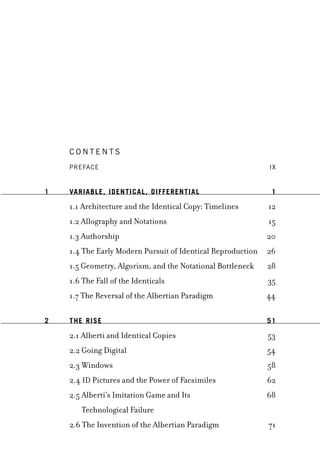
C o n t e n t s
Preface╆ iX
1 Variable, Identical, Differential╆ 1
1.1 Architecture and the Identical Copy: Timelines╆ 12
1.2 Allography and Notations╆ 15
1.3 Authorship╆ 20
1.4 The Early Modern Pursuit of Identical Reproduction╆ 26
1.5 Geometry, Algorism, and the Notational Bottleneck╆ 28
1.6 The Fall of the Identicals╆ 35
1.7 The Reversal of the Albertian Paradigm╆ 44
2 The Rise╆ 51
2.1 Alberti and Identical Copies╆ 53
2.2 Going Digital╆ 54
2.3 Windows╆ 58
2.4 ID Pictures and the Power of Facsimiles╆ 62
2.5 Alberti’s Imitation Game and Its ╆ 68
Technological Failure╆
2.6 The Invention of the Albertian Paradigm╆ 71
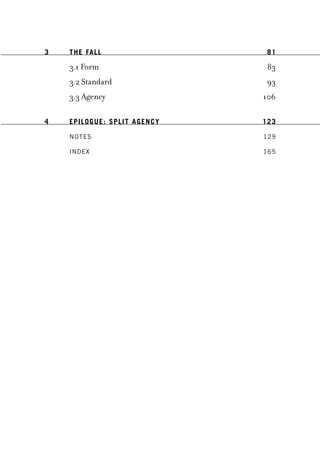
3 The Fall╆ 81
3.1 Form╆ 83
3.2 Standard╆ 93
3.3 Agency╆ 106
4	Epilogue: Split Agency╆ 123
Notes╆ 129
Index╆ 165
Not long ago, in the nineties, no one doubted that a “digital
revolution” was in the making—in architecture as in all aspects
of life, science, and art. Today (early 2010) the very expression
“digital revolution” has fallen into disuse, if not into disrepute;
it sounds passé and archaic, at best the reminder of an age gone
by. Yet digital technologies, now ubiquitous, have already signifi-
cantly changed the way architecture is designed and made. They
are changing how architecture is taught in schools, practiced,
managed, even regulated. Etymologically, as well as politically,
the notion of a revolution implies that something is or has been
turned upside down. It may be too soon to tell if the digital is a
revolution in architecture, but it is not too soon to ask what may
be upended if it is. If the digital is a “paradigm shift,” which para-
digm is shifting? If architecture has seen a “digital turn,” what
course has turned?
This work will trace the rise of some aspects of modernity that
have marked the history of Western architecture. They all relate
to one key practice of modernity: the making of identical cop-
ies—of nature, art, objects, and media objects of all sorts. From
the beginning of the Early Modern Age, and until very recently,
the cultural demand and the technical supply of identical copies
rose in sync. Identical copies inspired a new visual culture, and
prompted new social and legal practices aimed at the protec-
tion of the original and its owner or creator. At the same time,
new cultural technologies and new machines emerged and were
developed to produce and mass-produce identical replications:
from printed images and text set with moveable type to the
P r e fa c e
x	 Preface
industrialassemblyline,fromperspectivalimagestophotography
to the Xerox machine.
Two instances of identicality were crucial to the shaping of
architectural modernity. The first was Leon Battista Alberti’s
invention of architectural design. In Alberti’s theory, a building
is the identical copy of the architect’s design; with Alberti’s
separation in principle between design and making came the
modern definition of the architect as an author, in the human-
istic sense of the term. After Alberti’s cultural revolution, the
second wave of identical copies in architecture came with the
industrial revolution, and the mass production of identical
copies from mechanical master models, matrixes, imprints, or
molds. Industrial standardization generates economies of scale—
so long as all items in a series are the same.
The modern power of the identical came to an end with the
riseofdigitaltechnologies.Allthatisdigitalisvariable,anddigital
variability goes counter to all the postulates of identicality that
have informed the history of Western cultural technologies for
the last five centuries. In architecture this means the end of nota-
tional limitations, of industrial standardization, and, more gen-
erally, of the Albertian and authorial way of building by design.
This book recounts the rise and fall of the paradigm of identi-
cality, and shows that digital and premechanical variability have
many points in common. It discusses the rise of new forms of
postindustrial digital craftsmanship by showing their relation to
hand-making and to the cultures and technologies of variations
that existed before the humanistic and modern rise of machine-
made, identical copies. The first part of the book is a synopsis of
the general argument; the second focuses on the mechanical rise
and the digital fall of identical copies. A bit of repetition is inevi-
table, but the argument is simple—symmetrical, in a sense—with
a beginning, climax, and end.
P r efa c e	 xi
This chronicle situates today’s computational tools in archi-
tecture within the ambit of a centuries-old tradition, with all
of its twists and turns, of which the digital represents the most
recent. Technologies change rapidly—“new” technologies in
particular. To predict, and even interpret, new developments in
cultural technologies on the basis of their recent history is risky,
as one needs to extrapolate from a curve that is too short and
buildonevidencethathasnotbeensiftedbytime.Amoredistant
vantage point entails a loss of detail, but may reveal the outlines
of more general trends. I shall endeavor to highlight some of
these trends, and accordingly offer some conclusions—almost a
morality, as in old tales.
In addition to the many friends, colleagues, and publishers that
are mentioned in the book, special thanks are due to Megan
Spriggs, who edited earlier drafts of most chapters, to Cynthia
Davidson, who turned those chapters into a book, and to Peter
Eisenman, who found a title for it.
1
OntheeveningofSunday,August15,1971, U.S.PresidentRichard
Nixon announced in a televised speech1
a series of drastic eco-
nomic measures, including the suspension of a fixed conversion
rate between the dollar and gold. The end of the gold standard,
which had been reinstated by the Bretton Woods Agreement in
1944, had momentous economic consequences.2
Its cultural fall-
out was equally epochal. Only a few years later, the founding
fathersofpostmodernismsawin“theagonyofstrongreferentials”3
one of the symptoms of the postmodern condition, and Nixon’s
abolition of the dollar’s gold parity should certainly rank among
the most prominent harbingers of many postmodern “fragmen-
tations of master narratives”4
to follow. From what is known
of him, chances are that Nixon (who died in 1994) was never
fully aware of his inspirational hold on Deleuze and Guattari’s
rhizomatic theories of mutability.5
But from the point of view of
historians of images, the end of the dollar-gold standard should
also be noted for tolling the knell of one of the most amazing and
miraculous powers that images ever held in the history of the
West—one that art historians have often neglected.
Britishbankinghistorymayillustratetherelationshipofpaper
currencyandpreciousmetaloveralongerperiodoftimethanthe
history of the dollar would allow. From 1704, when banknotes
weredeclarednegotiableinEnglandandWales,until—withminor
interruptions—1931, when the Bank of England in fact defaulted,
Variable, Identical, Differential
2
any banknote issued by the Bank of England could be converted
into gold or sterling silver at a fixed rate: paper stood for metal
and one could be exchanged for the other at the same rate at any
time. After Bretton Woods the British pound was pegged to the
American dollar, and the dollar to gold, which, if one reads this
story in British history books (and in Ian Fleming’s Goldfinger),6
means that the pound was once again on a gold standard, and if
onereadsitinAmericanbooksmeansthattheBritishpoundwas
pegged to the dollar. Either way, the statement that still appears
insmallprintonBritishbanknotes—“Ipromisetopaythebearer
ondemandthesumof”£10,forexample—before1971meantthat
the bearer would be paid on demand an amount of metal con-
ventionally equivalent to ten pounds of sterling silver; as of 1971
and to this day, the same phrase means, somewhat tautologically,
that the Bank of England may replace that banknote, on demand,
with another one.7
The almost magic power of transmutation whereby paper
could be turned into gold was canceled, apparently forever, on
that eventful late summer night in 1971. For centuries before
Nixon’s intervention that alchemical quality of legal tender was
guaranteedbythesolvencyofanissuinginstitution,butbestowed
upon paper by the act of printing. For that miraculous power of
images did not pertain to just any icon, but only to very particular
ones: those that are identically reproduced, and are visually rec-
ognizable as such. Identicality and its instant visual recognition
are what used to turn paper into gold; and identicality still makes
legal tender work the way it does. A banknote that is not visually
identical to all others in the same mass-produced series (with
the exception of its unique serial number) may be fake or worth-
less.Andaswehaveseenplentyofidenticalbanknotes,untilvery
recently we were expected to be able to tell at first sight when
one is different, or looks strange, and reject it. Before the age of
Variab l e , I denti c a l , D ifferentia l 3
banknotes, the same pattern of visual identification applied to
coins and seals, whose value and identification depended on the
sheer indexicality of a mechanical imprint, and on the cultural
and technical assumption that all valid copies could and would
be reproduced identically.
These instances of “indexical” sameness—a quintessential
feature of the mechanical age, and of mechanical reproducibil-
ity itself—are in direct contrast with other paradigms of vision
that both preceded and followed the age of mechanical copies.
To keep to monetary examples, the variability of artisanal hand-
making survives today in personal checks, where the authority
of the bank is attested to by the part of the check that is printed,
but the validity of the check is triggered only by the manuscript
signature of the payer. Like all things handmade, a signature is
a visually variable sign, hence all signatures made by the same
person are more or less different; yet they must also be more or
less similar, otherwise they could not be identified. The pattern
of recognition here is based not on sameness, but on similar-
ity. Similarity and resemblance, however, are complex cognitive
notions, as proven by the history of mimesis in the classical tra-
dition, both in the visual arts and in the arts of discourse. Even
today’s most advanced optical readers cannot yet identify nor
authenticate personal signatures, and not surprisingly, personal
checks are neither universal nor standard means of payment
(unless the bearer can be identified by other means, or is known
in person, and trusted).
In the world of hand-making that preceded the machine-
made environment, imitation and visual similarity were the
norm,replicationandvisualidenticalityweretheexception.And
inthedigitalworld that is now rapidly overtakingthemechanical
world, visual identicality is quickly becoming irrelevant. Credit
cards may well be in the shape of a golden rectangle (or a fair ap-
4
proximation thereof: it is not known whether this happened by
chance or by design), and still bear logos, trademarks, and some
archaicmachine-readablecharactersinrelief—areminderofthe
time when they were invented in the late fifties. But today the
validity of a credit card depends almost exclusively on a unique
string of sixteen digits that identifies it, regardless of its format,
color, or the material of which the card is made.8
Indeed, for
online transactions the physical existence of the card is neither
required nor verifiable. The first way to confirm the validity of
a credit card is to run a check on the sixteen-digit sequence of
its number using a simple algorithm, known as Luhn’s formula,
whichinmostcases(statistically,ninetimesoutoften)isenough
to detect irregularities. No one would try to judge the creditwor-
thiness of a credit card by looking at it, in the way one would pe-
ruse a banknote or inspect its watermark. Visual identification is
now out of the game. In this instance, exactly transmissible but
invisible algorithms have already replaced all visual and physical
traces of authenticity.
Albeit anecdotal, these monetary examples illustrate three
paradigms of visual identification, essentially related to three
different ways of making things. The signature, the banknote,
and the credit card: when objects are handmade, as a signature
is, variability in the processes of production generates differ-
ences and similarities between copies, and identification is
based on visual resemblance; when objects are machine-made,
as a banknote is, mass-produced, exactly repeatable mechani-
cal imprints generate standardized products, and identification
is based on visual identicality; when objects are digitally made,
as are the latest machine-readable or chip-based credit cards,
identification is based on the recognition of hidden patterns, on
computational algorithms, or on other nonvisual features. This
loss of visuality, which is inherent in the mode of use of the latest
Variab l e , I denti c a l , D ifferentia l 5
generation of credit cards, may in turn be a prelude to the even-
tualdisappearanceofthephysicalobjectitself:creditcardsarein
most cases already obsolete, as many of their functions may soon
be taken over by cell phones, for example.
The list of objects of daily use that have been phased out by
digital technologies is already a long one: digital consumer appli-
ances tend to merge on a single, often generic technical platform
a variety of functions that, until recently, used to be performed
by a panoply of different manual, mechanical, or even electronic
devices (from address books to alarm clocks to video players).
Industrial designers and critics have taken due notice, as is
shown by the ongoing debate on the disappearance of the object
(or at least of some objects).9
However, alongside and unrelated
to this seemingly inevitable wave of product obsolescence—or
perhaps, more appropriately, product evanescence—digital tools
are also key in the design and production of a growing range of
technical objects, old and new alike—from marble sculptures to
silicon chips. And the technical logic of digital design and pro-
duction differs from the traditional modes of manufacturing and
machinofacturing in some key aspects.
A mechanical machine (for example, a press) makes objects.
A digital machine (for example, a computer) makes, in the first
instance, a sequence of numbers—a digital file. This file must at
some later point in time be converted into an object (or a media
object) by other machines, applications, or interfaces, which
may also in turn be digitally controlled. But their control may be
in someone else’s hands; and the process of instantiation (the
conversion of the digital script into a physical object) may then
be severed in space and time from the making and the makers
of the original file. As a consequence, the author of the original
scriptmaynot be the only author of the end product,andmaynot
determine all the final features of it.
6
To go back to image theory, a comparison may help to make
the point. Each print of a picture in the same print run looks the
same. All mass-produced series include minor accidental vari-
ances, but by and large, all buyers of the same postcard (printed,
for example, in one thousand copies) will buy the same picture.
On the contrary, a digital postcard, e-mailed from a computer to
an electronic mailing list of one thousand recipients, is sent as a
sequence of numbers that will become a picture again only upon
delivery—when it appears on one thousand different computer
screens, or is printed out by as many different printers. The digi-
tal file is the same for all. But each eventuation of that file (in this
instance, its conversion into a picture) is likely to differ from the
others, either by chance (some recipients may have different ma-
chinesandapplications),orbydesign(somerecipientsmayhave
customized their machines or may deliberately alter the picture
for viewing or printing). Some of this customizable variability
certainly existed in the good old days of radio and television, and
even of mechanically recorded music. But the degree of variabil-
ity (and indeed, interactivity) that is inherent in the transmis-
sion and manipulation of digital signals is incomparably higher.
We may well send the same digital postcard to all our friends. Yet
there is no way to anticipate what each of them will actually see
on the screen of his or her computer or cell phone (and even less,
what they will see if they decide to print that picture on paper—or
on any other material of their choice, for that matter).
The loss of visual significance that is so striking in the in-
stance of the credit card may simply be the terminal phase of the
general regime of visual variability—or sensorial variability if we
include other senses beyond sight—that characterizes all digital
environments. Variability is also a diacritical mark of all things
handmade, but artisanal and digital variability differ in another
essential feature. Handmade objects can be made on demand,
Random documents with unrelated
content Scribd suggests to you:
*** END OF THE PROJECT GUTENBERG EBOOK A GALLANT OF
LORRAINE; VOL. 1 OF 2 ***
Updated editions will replace the previous one—the old editions will
be renamed.
Creating the works from print editions not protected by U.S.
copyright law means that no one owns a United States copyright in
these works, so the Foundation (and you!) can copy and distribute it
in the United States without permission and without paying
copyright royalties. Special rules, set forth in the General Terms of
Use part of this license, apply to copying and distributing Project
Gutenberg™ electronic works to protect the PROJECT GUTENBERG™
concept and trademark. Project Gutenberg is a registered trademark,
and may not be used if you charge for an eBook, except by following
the terms of the trademark license, including paying royalties for use
of the Project Gutenberg trademark. If you do not charge anything
for copies of this eBook, complying with the trademark license is
very easy. You may use this eBook for nearly any purpose such as
creation of derivative works, reports, performances and research.
Project Gutenberg eBooks may be modified and printed and given
away—you may do practically ANYTHING in the United States with
eBooks not protected by U.S. copyright law. Redistribution is subject
to the trademark license, especially commercial redistribution.
START: FULL LICENSE
THE FULL PROJECT GUTENBERG LICENSE
PLEASE READ THIS BEFORE YOU DISTRIBUTE OR USE THIS WORK
To protect the Project Gutenberg™ mission of promoting the free
distribution of electronic works, by using or distributing this work (or
any other work associated in any way with the phrase “Project
Gutenberg”), you agree to comply with all the terms of the Full
Project Gutenberg™ License available with this file or online at
www.gutenberg.org/license.
Section 1. General Terms of Use and
Redistributing Project Gutenberg™
electronic works
1.A. By reading or using any part of this Project Gutenberg™
electronic work, you indicate that you have read, understand, agree
to and accept all the terms of this license and intellectual property
(trademark/copyright) agreement. If you do not agree to abide by all
the terms of this agreement, you must cease using and return or
destroy all copies of Project Gutenberg™ electronic works in your
possession. If you paid a fee for obtaining a copy of or access to a
Project Gutenberg™ electronic work and you do not agree to be
bound by the terms of this agreement, you may obtain a refund
from the person or entity to whom you paid the fee as set forth in
paragraph 1.E.8.
1.B. “Project Gutenberg” is a registered trademark. It may only be
used on or associated in any way with an electronic work by people
who agree to be bound by the terms of this agreement. There are a
few things that you can do with most Project Gutenberg™ electronic
works even without complying with the full terms of this agreement.
See paragraph 1.C below. There are a lot of things you can do with
Project Gutenberg™ electronic works if you follow the terms of this
agreement and help preserve free future access to Project
Gutenberg™ electronic works. See paragraph 1.E below.
1.C. The Project Gutenberg Literary Archive Foundation (“the
Foundation” or PGLAF), owns a compilation copyright in the
collection of Project Gutenberg™ electronic works. Nearly all the
individual works in the collection are in the public domain in the
United States. If an individual work is unprotected by copyright law
in the United States and you are located in the United States, we do
not claim a right to prevent you from copying, distributing,
performing, displaying or creating derivative works based on the
work as long as all references to Project Gutenberg are removed. Of
course, we hope that you will support the Project Gutenberg™
mission of promoting free access to electronic works by freely
sharing Project Gutenberg™ works in compliance with the terms of
this agreement for keeping the Project Gutenberg™ name associated
with the work. You can easily comply with the terms of this
agreement by keeping this work in the same format with its attached
full Project Gutenberg™ License when you share it without charge
with others.
1.D. The copyright laws of the place where you are located also
govern what you can do with this work. Copyright laws in most
countries are in a constant state of change. If you are outside the
United States, check the laws of your country in addition to the
terms of this agreement before downloading, copying, displaying,
performing, distributing or creating derivative works based on this
work or any other Project Gutenberg™ work. The Foundation makes
no representations concerning the copyright status of any work in
any country other than the United States.
1.E. Unless you have removed all references to Project Gutenberg:
1.E.1. The following sentence, with active links to, or other
immediate access to, the full Project Gutenberg™ License must
appear prominently whenever any copy of a Project Gutenberg™
work (any work on which the phrase “Project Gutenberg” appears,
or with which the phrase “Project Gutenberg” is associated) is
accessed, displayed, performed, viewed, copied or distributed:
This eBook is for the use of anyone anywhere in the United
States and most other parts of the world at no cost and with
almost no restrictions whatsoever. You may copy it, give it away
or re-use it under the terms of the Project Gutenberg License
included with this eBook or online at www.gutenberg.org. If you
are not located in the United States, you will have to check the
laws of the country where you are located before using this
eBook.
1.E.2. If an individual Project Gutenberg™ electronic work is derived
from texts not protected by U.S. copyright law (does not contain a
notice indicating that it is posted with permission of the copyright
holder), the work can be copied and distributed to anyone in the
United States without paying any fees or charges. If you are
redistributing or providing access to a work with the phrase “Project
Gutenberg” associated with or appearing on the work, you must
comply either with the requirements of paragraphs 1.E.1 through
1.E.7 or obtain permission for the use of the work and the Project
Gutenberg™ trademark as set forth in paragraphs 1.E.8 or 1.E.9.
1.E.3. If an individual Project Gutenberg™ electronic work is posted
with the permission of the copyright holder, your use and distribution
must comply with both paragraphs 1.E.1 through 1.E.7 and any
additional terms imposed by the copyright holder. Additional terms
will be linked to the Project Gutenberg™ License for all works posted
with the permission of the copyright holder found at the beginning
of this work.
1.E.4. Do not unlink or detach or remove the full Project
Gutenberg™ License terms from this work, or any files containing a
part of this work or any other work associated with Project
Gutenberg™.
1.E.5. Do not copy, display, perform, distribute or redistribute this
electronic work, or any part of this electronic work, without
prominently displaying the sentence set forth in paragraph 1.E.1
with active links or immediate access to the full terms of the Project
Gutenberg™ License.
1.E.6. You may convert to and distribute this work in any binary,
compressed, marked up, nonproprietary or proprietary form,
including any word processing or hypertext form. However, if you
provide access to or distribute copies of a Project Gutenberg™ work
in a format other than “Plain Vanilla ASCII” or other format used in
the official version posted on the official Project Gutenberg™ website
(www.gutenberg.org), you must, at no additional cost, fee or
expense to the user, provide a copy, a means of exporting a copy, or
a means of obtaining a copy upon request, of the work in its original
“Plain Vanilla ASCII” or other form. Any alternate format must
include the full Project Gutenberg™ License as specified in
paragraph 1.E.1.
1.E.7. Do not charge a fee for access to, viewing, displaying,
performing, copying or distributing any Project Gutenberg™ works
unless you comply with paragraph 1.E.8 or 1.E.9.
1.E.8. You may charge a reasonable fee for copies of or providing
access to or distributing Project Gutenberg™ electronic works
provided that:
• You pay a royalty fee of 20% of the gross profits you derive
from the use of Project Gutenberg™ works calculated using the
method you already use to calculate your applicable taxes. The
fee is owed to the owner of the Project Gutenberg™ trademark,
but he has agreed to donate royalties under this paragraph to
the Project Gutenberg Literary Archive Foundation. Royalty
payments must be paid within 60 days following each date on
which you prepare (or are legally required to prepare) your
periodic tax returns. Royalty payments should be clearly marked
as such and sent to the Project Gutenberg Literary Archive
Foundation at the address specified in Section 4, “Information
about donations to the Project Gutenberg Literary Archive
Foundation.”
• You provide a full refund of any money paid by a user who
notifies you in writing (or by e-mail) within 30 days of receipt
that s/he does not agree to the terms of the full Project
Gutenberg™ License. You must require such a user to return or
destroy all copies of the works possessed in a physical medium
and discontinue all use of and all access to other copies of
Project Gutenberg™ works.
• You provide, in accordance with paragraph 1.F.3, a full refund of
any money paid for a work or a replacement copy, if a defect in
the electronic work is discovered and reported to you within 90
days of receipt of the work.
• You comply with all other terms of this agreement for free
distribution of Project Gutenberg™ works.
1.E.9. If you wish to charge a fee or distribute a Project Gutenberg™
electronic work or group of works on different terms than are set
forth in this agreement, you must obtain permission in writing from
the Project Gutenberg Literary Archive Foundation, the manager of
the Project Gutenberg™ trademark. Contact the Foundation as set
forth in Section 3 below.
1.F.
1.F.1. Project Gutenberg volunteers and employees expend
considerable effort to identify, do copyright research on, transcribe
and proofread works not protected by U.S. copyright law in creating
the Project Gutenberg™ collection. Despite these efforts, Project
Gutenberg™ electronic works, and the medium on which they may
be stored, may contain “Defects,” such as, but not limited to,
incomplete, inaccurate or corrupt data, transcription errors, a
copyright or other intellectual property infringement, a defective or
damaged disk or other medium, a computer virus, or computer
codes that damage or cannot be read by your equipment.
1.F.2. LIMITED WARRANTY, DISCLAIMER OF DAMAGES - Except for
the “Right of Replacement or Refund” described in paragraph 1.F.3,
the Project Gutenberg Literary Archive Foundation, the owner of the
Project Gutenberg™ trademark, and any other party distributing a
Project Gutenberg™ electronic work under this agreement, disclaim
all liability to you for damages, costs and expenses, including legal
fees. YOU AGREE THAT YOU HAVE NO REMEDIES FOR
NEGLIGENCE, STRICT LIABILITY, BREACH OF WARRANTY OR
BREACH OF CONTRACT EXCEPT THOSE PROVIDED IN PARAGRAPH
1.F.3. YOU AGREE THAT THE FOUNDATION, THE TRADEMARK
OWNER, AND ANY DISTRIBUTOR UNDER THIS AGREEMENT WILL
NOT BE LIABLE TO YOU FOR ACTUAL, DIRECT, INDIRECT,
CONSEQUENTIAL, PUNITIVE OR INCIDENTAL DAMAGES EVEN IF
YOU GIVE NOTICE OF THE POSSIBILITY OF SUCH DAMAGE.
1.F.3. LIMITED RIGHT OF REPLACEMENT OR REFUND - If you
discover a defect in this electronic work within 90 days of receiving
it, you can receive a refund of the money (if any) you paid for it by
sending a written explanation to the person you received the work
from. If you received the work on a physical medium, you must
return the medium with your written explanation. The person or
entity that provided you with the defective work may elect to provide
a replacement copy in lieu of a refund. If you received the work
electronically, the person or entity providing it to you may choose to
give you a second opportunity to receive the work electronically in
lieu of a refund. If the second copy is also defective, you may
demand a refund in writing without further opportunities to fix the
problem.
1.F.4. Except for the limited right of replacement or refund set forth
in paragraph 1.F.3, this work is provided to you ‘AS-IS’, WITH NO
OTHER WARRANTIES OF ANY KIND, EXPRESS OR IMPLIED,
INCLUDING BUT NOT LIMITED TO WARRANTIES OF
MERCHANTABILITY OR FITNESS FOR ANY PURPOSE.
1.F.5. Some states do not allow disclaimers of certain implied
warranties or the exclusion or limitation of certain types of damages.
If any disclaimer or limitation set forth in this agreement violates the
law of the state applicable to this agreement, the agreement shall be
interpreted to make the maximum disclaimer or limitation permitted
by the applicable state law. The invalidity or unenforceability of any
provision of this agreement shall not void the remaining provisions.
1.F.6. INDEMNITY - You agree to indemnify and hold the Foundation,
the trademark owner, any agent or employee of the Foundation,
anyone providing copies of Project Gutenberg™ electronic works in
accordance with this agreement, and any volunteers associated with
the production, promotion and distribution of Project Gutenberg™
electronic works, harmless from all liability, costs and expenses,
including legal fees, that arise directly or indirectly from any of the
following which you do or cause to occur: (a) distribution of this or
any Project Gutenberg™ work, (b) alteration, modification, or
additions or deletions to any Project Gutenberg™ work, and (c) any
Defect you cause.
Section 2. Information about the Mission
of Project Gutenberg™
Project Gutenberg™ is synonymous with the free distribution of
electronic works in formats readable by the widest variety of
computers including obsolete, old, middle-aged and new computers.
It exists because of the efforts of hundreds of volunteers and
donations from people in all walks of life.
Volunteers and financial support to provide volunteers with the
assistance they need are critical to reaching Project Gutenberg™’s
goals and ensuring that the Project Gutenberg™ collection will
remain freely available for generations to come. In 2001, the Project
Gutenberg Literary Archive Foundation was created to provide a
secure and permanent future for Project Gutenberg™ and future
generations. To learn more about the Project Gutenberg Literary
Archive Foundation and how your efforts and donations can help,
see Sections 3 and 4 and the Foundation information page at
www.gutenberg.org.
Section 3. Information about the Project
Gutenberg Literary Archive Foundation
The Project Gutenberg Literary Archive Foundation is a non-profit
501(c)(3) educational corporation organized under the laws of the
state of Mississippi and granted tax exempt status by the Internal
Revenue Service. The Foundation’s EIN or federal tax identification
number is 64-6221541. Contributions to the Project Gutenberg
Literary Archive Foundation are tax deductible to the full extent
permitted by U.S. federal laws and your state’s laws.
The Foundation’s business office is located at 809 North 1500 West,
Salt Lake City, UT 84116, (801) 596-1887. Email contact links and up
to date contact information can be found at the Foundation’s website
and official page at www.gutenberg.org/contact
Section 4. Information about Donations to
the Project Gutenberg Literary Archive
Foundation
Project Gutenberg™ depends upon and cannot survive without
widespread public support and donations to carry out its mission of
increasing the number of public domain and licensed works that can
be freely distributed in machine-readable form accessible by the
widest array of equipment including outdated equipment. Many
small donations ($1 to $5,000) are particularly important to
maintaining tax exempt status with the IRS.
The Foundation is committed to complying with the laws regulating
charities and charitable donations in all 50 states of the United
States. Compliance requirements are not uniform and it takes a
considerable effort, much paperwork and many fees to meet and
keep up with these requirements. We do not solicit donations in
locations where we have not received written confirmation of
compliance. To SEND DONATIONS or determine the status of
compliance for any particular state visit www.gutenberg.org/donate.
While we cannot and do not solicit contributions from states where
we have not met the solicitation requirements, we know of no
prohibition against accepting unsolicited donations from donors in
such states who approach us with offers to donate.
International donations are gratefully accepted, but we cannot make
any statements concerning tax treatment of donations received from
outside the United States. U.S. laws alone swamp our small staff.
Please check the Project Gutenberg web pages for current donation
methods and addresses. Donations are accepted in a number of
other ways including checks, online payments and credit card
donations. To donate, please visit: www.gutenberg.org/donate.
Section 5. General Information About
Project Gutenberg™ electronic works
Professor Michael S. Hart was the originator of the Project
Gutenberg™ concept of a library of electronic works that could be
freely shared with anyone. For forty years, he produced and
distributed Project Gutenberg™ eBooks with only a loose network of
volunteer support.
Project Gutenberg™ eBooks are often created from several printed
editions, all of which are confirmed as not protected by copyright in
the U.S. unless a copyright notice is included. Thus, we do not
necessarily keep eBooks in compliance with any particular paper
edition.
Most people start at our website which has the main PG search
facility: www.gutenberg.org.
This website includes information about Project Gutenberg™,
including how to make donations to the Project Gutenberg Literary
Archive Foundation, how to help produce our new eBooks, and how
to subscribe to our email newsletter to hear about new eBooks.
back
back
back
back
Welcome to our website – the perfect destination for book lovers and
knowledge seekers. We believe that every book holds a new world,
offering opportunities for learning, discovery, and personal growth.
That’s why we are dedicated to bringing you a diverse collection of
books, ranging from classic literature and specialized publications to
self-development guides and children's books.
More than just a book-buying platform, we strive to be a bridge
connecting you with timeless cultural and intellectual values. With an
elegant, user-friendly interface and a smart search system, you can
quickly find the books that best suit your interests. Additionally,
our special promotions and home delivery services help you save time
and fully enjoy the joy of reading.
Join us on a journey of knowledge exploration, passion nurturing, and
personal growth every day!
ebookbell.com

The Alphabet And The Algorithm Mario Carpo

  • 1.
    The Alphabet AndThe Algorithm Mario Carpo download https://ebookbell.com/product/the-alphabet-and-the-algorithm- mario-carpo-56348248 Explore and download more ebooks at ebookbell.com
  • 2.
    Here are somerecommended products that we believe you will be interested in. You can click the link to download. Tibetan Calligraphy How To Write The Alphabet And More Sanje Elliott https://ebookbell.com/product/tibetan-calligraphy-how-to-write-the- alphabet-and-more-sanje-elliott-4649752 The Letter And The Cosmos How The Alphabet Has Shaped The Western View Of The World 1st Edition Laurence De Looze https://ebookbell.com/product/the-letter-and-the-cosmos-how-the- alphabet-has-shaped-the-western-view-of-the-world-1st-edition- laurence-de-looze-5899472 The Letter And The Cosmos How The Alphabet Has Shaped The Western View Of The World Laurence De Looze https://ebookbell.com/product/the-letter-and-the-cosmos-how-the- alphabet-has-shaped-the-western-view-of-the-world-laurence-de- looze-7390268 Icons Of The Alphabet Letter Names Phonetic Notation And The Phonology And Orthography Of English 2024th Edition Reese M Heitner https://ebookbell.com/product/icons-of-the-alphabet-letter-names- phonetic-notation-and-the-phonology-and-orthography-of-english-2024th- edition-reese-m-heitner-59891178
  • 3.
    Knit The AlphabetQuick And Easy Alphabet Knitting Patterns Garland https://ebookbell.com/product/knit-the-alphabet-quick-and-easy- alphabet-knitting-patterns-garland-11392572 Sequoyah And The Invention Of The Cherokee Alphabet April R Summitt https://ebookbell.com/product/sequoyah-and-the-invention-of-the- cherokee-alphabet-april-r-summitt-47140294 Reading Writing Thai A Workbook For Selfstudy A Beginners Guide To The Thai Alphabet And Pronunciation Jintana Rattanakhemakorn https://ebookbell.com/product/reading-writing-thai-a-workbook-for- selfstudy-a-beginners-guide-to-the-thai-alphabet-and-pronunciation- jintana-rattanakhemakorn-47085500 The History Of The Nko Alphabet And Its Role In Mande Transnational Identity Words As Weapons Dianne White Oyler https://ebookbell.com/product/the-history-of-the-nko-alphabet-and-its- role-in-mande-transnational-identity-words-as-weapons-dianne-white- oyler-44755358 Fundamentals Of The Persian Alphabet Letters And Sounds Shahla Adel https://ebookbell.com/product/fundamentals-of-the-persian-alphabet- letters-and-sounds-shahla-adel-48711216
  • 6.
    The Alphabet andthe Algorithm
  • 7.
    Writing Architecture series Aproject of the Anyone Corporation; Cynthia Davidson, editor Earth Moves: The Furnishing of Territories Bernard Cache, 1995 Architecture as Metaphor: Language, Number, Money Kojin Karatani, 1995 Differences: Topographies of Contemporary Architecture Ignasi de Solà-Morales, 1996 Constructions John Rajchman, 1997 Such Places as Memory John Hejduk, 1998 Welcome to The Hotel Architecture Roger Connah, 1998 Fire and Memory: On Architecture and Energy Luis Fernández-Galiano, 2000 A Landscape of Events Paul Virilio, 2000 Architecture from the Outside: Essays on Virtual and Real Space Elizabeth Grosz, 2001 Public Intimacy: Architecture and the Visul Arts Giuliana Bruno, 2007 Strange Details Michael Cadwell, 2007 Histories of the Immediate Present: Inventing Architectural Modernism Anthony Vidler, 2008 Drawing for Architecture Leon Krier, 2009 Architecture’s Desire: Reading the Late Avant-Garde K. Michael Hays, 2010 The Possibility of an Absolute Architecture Pier Vittorio Aureli, 2011 The Alphabet and the Algorithm Mario Carp0, 2o11

  • 8.
    The MIT Press Cambridge,Massachusetts London, England The Alphabet and the Algorithm Mario Carpo
  • 9.
    © 2011 MassachusettsInstitute of Technology All rights reserved. No part of this book may be reproduced in any form by any electronic or mechanical means (including photocopying, recording, or information storage and retrieval) without permission in writing from the publisher. MIT Press books may be purchased at special quantity discounts for business or sales promotional use. For information, please email special_sales@mitpress.mit.edu or write to Special Sales Department, The MIT Press, 55 Hayward Street, Cambridge, MA 02142. This book was set in Filosofia and Trade Gothic by The MIT Press. Printed and bound in the United States of America. Library of Congress Cataloging-in-Publication Data Carpo, Mario. The alphabet and the algorithm / Mario Carpo. p. cm. — (Writing architecture) Includes bibliographical references and index. ISBN 978-0-262-51580-1 (pbk. : alk. paper) 1. Architectural design. 2. Architectural design—Technological innovations. 3. Repetition (Aesthetics) 4. Design and technology. I. Title. NA2750.C375 2011 720.1—dc22 2010031062 10â•… 9â•… 8â•… 7â•… 6â•… 5â•… 4â•… 3â•… 2â•… 1
  • 10.
    C o nt e n t s Preface╆ iX 1 Variable, Identical, Differential╆ 1 1.1 Architecture and the Identical Copy: Timelines╆ 12 1.2 Allography and Notations╆ 15 1.3 Authorship╆ 20 1.4 The Early Modern Pursuit of Identical Reproduction╆ 26 1.5 Geometry, Algorism, and the Notational Bottleneck╆ 28 1.6 The Fall of the Identicals╆ 35 1.7 The Reversal of the Albertian Paradigm╆ 44 2 The Rise╆ 51 2.1 Alberti and Identical Copies╆ 53 2.2 Going Digital╆ 54 2.3 Windows╆ 58 2.4 ID Pictures and the Power of Facsimiles╆ 62 2.5 Alberti’s Imitation Game and Its ╆ 68 Technological Failure╆ 2.6 The Invention of the Albertian Paradigm╆ 71
  • 12.
    3 The Fall╆81 3.1 Form╆ 83 3.2 Standard╆ 93 3.3 Agency╆ 106 4 Epilogue: Split Agency╆ 123 Notes╆ 129 Index╆ 165
  • 14.
    Not long ago,in the nineties, no one doubted that a “digital revolution” was in the making—in architecture as in all aspects of life, science, and art. Today (early 2010) the very expression “digital revolution” has fallen into disuse, if not into disrepute; it sounds passé and archaic, at best the reminder of an age gone by. Yet digital technologies, now ubiquitous, have already signifi- cantly changed the way architecture is designed and made. They are changing how architecture is taught in schools, practiced, managed, even regulated. Etymologically, as well as politically, the notion of a revolution implies that something is or has been turned upside down. It may be too soon to tell if the digital is a revolution in architecture, but it is not too soon to ask what may be upended if it is. If the digital is a “paradigm shift,” which para- digm is shifting? If architecture has seen a “digital turn,” what course has turned? This work will trace the rise of some aspects of modernity that have marked the history of Western architecture. They all relate to one key practice of modernity: the making of identical cop- ies—of nature, art, objects, and media objects of all sorts. From the beginning of the Early Modern Age, and until very recently, the cultural demand and the technical supply of identical copies rose in sync. Identical copies inspired a new visual culture, and prompted new social and legal practices aimed at the protec- tion of the original and its owner or creator. At the same time, new cultural technologies and new machines emerged and were developed to produce and mass-produce identical replications: from printed images and text set with moveable type to the P r e fa c e
  • 15.
    x Preface industrialassemblyline,fromperspectivalimagestophotography to theXerox machine. Two instances of identicality were crucial to the shaping of architectural modernity. The first was Leon Battista Alberti’s invention of architectural design. In Alberti’s theory, a building is the identical copy of the architect’s design; with Alberti’s separation in principle between design and making came the modern definition of the architect as an author, in the human- istic sense of the term. After Alberti’s cultural revolution, the second wave of identical copies in architecture came with the industrial revolution, and the mass production of identical copies from mechanical master models, matrixes, imprints, or molds. Industrial standardization generates economies of scale— so long as all items in a series are the same. The modern power of the identical came to an end with the riseofdigitaltechnologies.Allthatisdigitalisvariable,anddigital variability goes counter to all the postulates of identicality that have informed the history of Western cultural technologies for the last five centuries. In architecture this means the end of nota- tional limitations, of industrial standardization, and, more gen- erally, of the Albertian and authorial way of building by design. This book recounts the rise and fall of the paradigm of identi- cality, and shows that digital and premechanical variability have many points in common. It discusses the rise of new forms of postindustrial digital craftsmanship by showing their relation to hand-making and to the cultures and technologies of variations that existed before the humanistic and modern rise of machine- made, identical copies. The first part of the book is a synopsis of the general argument; the second focuses on the mechanical rise and the digital fall of identical copies. A bit of repetition is inevi- table, but the argument is simple—symmetrical, in a sense—with a beginning, climax, and end.
  • 16.
    P r efac e xi This chronicle situates today’s computational tools in archi- tecture within the ambit of a centuries-old tradition, with all of its twists and turns, of which the digital represents the most recent. Technologies change rapidly—“new” technologies in particular. To predict, and even interpret, new developments in cultural technologies on the basis of their recent history is risky, as one needs to extrapolate from a curve that is too short and buildonevidencethathasnotbeensiftedbytime.Amoredistant vantage point entails a loss of detail, but may reveal the outlines of more general trends. I shall endeavor to highlight some of these trends, and accordingly offer some conclusions—almost a morality, as in old tales. In addition to the many friends, colleagues, and publishers that are mentioned in the book, special thanks are due to Megan Spriggs, who edited earlier drafts of most chapters, to Cynthia Davidson, who turned those chapters into a book, and to Peter Eisenman, who found a title for it.
  • 17.
  • 18.
    OntheeveningofSunday,August15,1971, U.S.PresidentRichard Nixon announcedin a televised speech1 a series of drastic eco- nomic measures, including the suspension of a fixed conversion rate between the dollar and gold. The end of the gold standard, which had been reinstated by the Bretton Woods Agreement in 1944, had momentous economic consequences.2 Its cultural fall- out was equally epochal. Only a few years later, the founding fathersofpostmodernismsawin“theagonyofstrongreferentials”3 one of the symptoms of the postmodern condition, and Nixon’s abolition of the dollar’s gold parity should certainly rank among the most prominent harbingers of many postmodern “fragmen- tations of master narratives”4 to follow. From what is known of him, chances are that Nixon (who died in 1994) was never fully aware of his inspirational hold on Deleuze and Guattari’s rhizomatic theories of mutability.5 But from the point of view of historians of images, the end of the dollar-gold standard should also be noted for tolling the knell of one of the most amazing and miraculous powers that images ever held in the history of the West—one that art historians have often neglected. Britishbankinghistorymayillustratetherelationshipofpaper currencyandpreciousmetaloveralongerperiodoftimethanthe history of the dollar would allow. From 1704, when banknotes weredeclarednegotiableinEnglandandWales,until—withminor interruptions—1931, when the Bank of England in fact defaulted, Variable, Identical, Differential
  • 19.
    2 any banknote issuedby the Bank of England could be converted into gold or sterling silver at a fixed rate: paper stood for metal and one could be exchanged for the other at the same rate at any time. After Bretton Woods the British pound was pegged to the American dollar, and the dollar to gold, which, if one reads this story in British history books (and in Ian Fleming’s Goldfinger),6 means that the pound was once again on a gold standard, and if onereadsitinAmericanbooksmeansthattheBritishpoundwas pegged to the dollar. Either way, the statement that still appears insmallprintonBritishbanknotes—“Ipromisetopaythebearer ondemandthesumof”£10,forexample—before1971meantthat the bearer would be paid on demand an amount of metal con- ventionally equivalent to ten pounds of sterling silver; as of 1971 and to this day, the same phrase means, somewhat tautologically, that the Bank of England may replace that banknote, on demand, with another one.7 The almost magic power of transmutation whereby paper could be turned into gold was canceled, apparently forever, on that eventful late summer night in 1971. For centuries before Nixon’s intervention that alchemical quality of legal tender was guaranteedbythesolvencyofanissuinginstitution,butbestowed upon paper by the act of printing. For that miraculous power of images did not pertain to just any icon, but only to very particular ones: those that are identically reproduced, and are visually rec- ognizable as such. Identicality and its instant visual recognition are what used to turn paper into gold; and identicality still makes legal tender work the way it does. A banknote that is not visually identical to all others in the same mass-produced series (with the exception of its unique serial number) may be fake or worth- less.Andaswehaveseenplentyofidenticalbanknotes,untilvery recently we were expected to be able to tell at first sight when one is different, or looks strange, and reject it. Before the age of
  • 20.
    Variab l e, I denti c a l , D ifferentia l 3 banknotes, the same pattern of visual identification applied to coins and seals, whose value and identification depended on the sheer indexicality of a mechanical imprint, and on the cultural and technical assumption that all valid copies could and would be reproduced identically. These instances of “indexical” sameness—a quintessential feature of the mechanical age, and of mechanical reproducibil- ity itself—are in direct contrast with other paradigms of vision that both preceded and followed the age of mechanical copies. To keep to monetary examples, the variability of artisanal hand- making survives today in personal checks, where the authority of the bank is attested to by the part of the check that is printed, but the validity of the check is triggered only by the manuscript signature of the payer. Like all things handmade, a signature is a visually variable sign, hence all signatures made by the same person are more or less different; yet they must also be more or less similar, otherwise they could not be identified. The pattern of recognition here is based not on sameness, but on similar- ity. Similarity and resemblance, however, are complex cognitive notions, as proven by the history of mimesis in the classical tra- dition, both in the visual arts and in the arts of discourse. Even today’s most advanced optical readers cannot yet identify nor authenticate personal signatures, and not surprisingly, personal checks are neither universal nor standard means of payment (unless the bearer can be identified by other means, or is known in person, and trusted). In the world of hand-making that preceded the machine- made environment, imitation and visual similarity were the norm,replicationandvisualidenticalityweretheexception.And inthedigitalworld that is now rapidly overtakingthemechanical world, visual identicality is quickly becoming irrelevant. Credit cards may well be in the shape of a golden rectangle (or a fair ap-
  • 21.
    4 proximation thereof: itis not known whether this happened by chance or by design), and still bear logos, trademarks, and some archaicmachine-readablecharactersinrelief—areminderofthe time when they were invented in the late fifties. But today the validity of a credit card depends almost exclusively on a unique string of sixteen digits that identifies it, regardless of its format, color, or the material of which the card is made.8 Indeed, for online transactions the physical existence of the card is neither required nor verifiable. The first way to confirm the validity of a credit card is to run a check on the sixteen-digit sequence of its number using a simple algorithm, known as Luhn’s formula, whichinmostcases(statistically,ninetimesoutoften)isenough to detect irregularities. No one would try to judge the creditwor- thiness of a credit card by looking at it, in the way one would pe- ruse a banknote or inspect its watermark. Visual identification is now out of the game. In this instance, exactly transmissible but invisible algorithms have already replaced all visual and physical traces of authenticity. Albeit anecdotal, these monetary examples illustrate three paradigms of visual identification, essentially related to three different ways of making things. The signature, the banknote, and the credit card: when objects are handmade, as a signature is, variability in the processes of production generates differ- ences and similarities between copies, and identification is based on visual resemblance; when objects are machine-made, as a banknote is, mass-produced, exactly repeatable mechani- cal imprints generate standardized products, and identification is based on visual identicality; when objects are digitally made, as are the latest machine-readable or chip-based credit cards, identification is based on the recognition of hidden patterns, on computational algorithms, or on other nonvisual features. This loss of visuality, which is inherent in the mode of use of the latest
  • 22.
    Variab l e, I denti c a l , D ifferentia l 5 generation of credit cards, may in turn be a prelude to the even- tualdisappearanceofthephysicalobjectitself:creditcardsarein most cases already obsolete, as many of their functions may soon be taken over by cell phones, for example. The list of objects of daily use that have been phased out by digital technologies is already a long one: digital consumer appli- ances tend to merge on a single, often generic technical platform a variety of functions that, until recently, used to be performed by a panoply of different manual, mechanical, or even electronic devices (from address books to alarm clocks to video players). Industrial designers and critics have taken due notice, as is shown by the ongoing debate on the disappearance of the object (or at least of some objects).9 However, alongside and unrelated to this seemingly inevitable wave of product obsolescence—or perhaps, more appropriately, product evanescence—digital tools are also key in the design and production of a growing range of technical objects, old and new alike—from marble sculptures to silicon chips. And the technical logic of digital design and pro- duction differs from the traditional modes of manufacturing and machinofacturing in some key aspects. A mechanical machine (for example, a press) makes objects. A digital machine (for example, a computer) makes, in the first instance, a sequence of numbers—a digital file. This file must at some later point in time be converted into an object (or a media object) by other machines, applications, or interfaces, which may also in turn be digitally controlled. But their control may be in someone else’s hands; and the process of instantiation (the conversion of the digital script into a physical object) may then be severed in space and time from the making and the makers of the original file. As a consequence, the author of the original scriptmaynot be the only author of the end product,andmaynot determine all the final features of it.
  • 23.
    6 To go backto image theory, a comparison may help to make the point. Each print of a picture in the same print run looks the same. All mass-produced series include minor accidental vari- ances, but by and large, all buyers of the same postcard (printed, for example, in one thousand copies) will buy the same picture. On the contrary, a digital postcard, e-mailed from a computer to an electronic mailing list of one thousand recipients, is sent as a sequence of numbers that will become a picture again only upon delivery—when it appears on one thousand different computer screens, or is printed out by as many different printers. The digi- tal file is the same for all. But each eventuation of that file (in this instance, its conversion into a picture) is likely to differ from the others, either by chance (some recipients may have different ma- chinesandapplications),orbydesign(somerecipientsmayhave customized their machines or may deliberately alter the picture for viewing or printing). Some of this customizable variability certainly existed in the good old days of radio and television, and even of mechanically recorded music. But the degree of variabil- ity (and indeed, interactivity) that is inherent in the transmis- sion and manipulation of digital signals is incomparably higher. We may well send the same digital postcard to all our friends. Yet there is no way to anticipate what each of them will actually see on the screen of his or her computer or cell phone (and even less, what they will see if they decide to print that picture on paper—or on any other material of their choice, for that matter). The loss of visual significance that is so striking in the in- stance of the credit card may simply be the terminal phase of the general regime of visual variability—or sensorial variability if we include other senses beyond sight—that characterizes all digital environments. Variability is also a diacritical mark of all things handmade, but artisanal and digital variability differ in another essential feature. Handmade objects can be made on demand,
  • 24.
    Random documents withunrelated content Scribd suggests to you:
  • 25.
    *** END OFTHE PROJECT GUTENBERG EBOOK A GALLANT OF LORRAINE; VOL. 1 OF 2 *** Updated editions will replace the previous one—the old editions will be renamed. Creating the works from print editions not protected by U.S. copyright law means that no one owns a United States copyright in these works, so the Foundation (and you!) can copy and distribute it in the United States without permission and without paying copyright royalties. Special rules, set forth in the General Terms of Use part of this license, apply to copying and distributing Project Gutenberg™ electronic works to protect the PROJECT GUTENBERG™ concept and trademark. Project Gutenberg is a registered trademark, and may not be used if you charge for an eBook, except by following the terms of the trademark license, including paying royalties for use of the Project Gutenberg trademark. If you do not charge anything for copies of this eBook, complying with the trademark license is very easy. You may use this eBook for nearly any purpose such as creation of derivative works, reports, performances and research. Project Gutenberg eBooks may be modified and printed and given away—you may do practically ANYTHING in the United States with eBooks not protected by U.S. copyright law. Redistribution is subject to the trademark license, especially commercial redistribution. START: FULL LICENSE
  • 26.
    THE FULL PROJECTGUTENBERG LICENSE
  • 27.
    PLEASE READ THISBEFORE YOU DISTRIBUTE OR USE THIS WORK To protect the Project Gutenberg™ mission of promoting the free distribution of electronic works, by using or distributing this work (or any other work associated in any way with the phrase “Project Gutenberg”), you agree to comply with all the terms of the Full Project Gutenberg™ License available with this file or online at www.gutenberg.org/license. Section 1. General Terms of Use and Redistributing Project Gutenberg™ electronic works 1.A. By reading or using any part of this Project Gutenberg™ electronic work, you indicate that you have read, understand, agree to and accept all the terms of this license and intellectual property (trademark/copyright) agreement. If you do not agree to abide by all the terms of this agreement, you must cease using and return or destroy all copies of Project Gutenberg™ electronic works in your possession. If you paid a fee for obtaining a copy of or access to a Project Gutenberg™ electronic work and you do not agree to be bound by the terms of this agreement, you may obtain a refund from the person or entity to whom you paid the fee as set forth in paragraph 1.E.8. 1.B. “Project Gutenberg” is a registered trademark. It may only be used on or associated in any way with an electronic work by people who agree to be bound by the terms of this agreement. There are a few things that you can do with most Project Gutenberg™ electronic works even without complying with the full terms of this agreement. See paragraph 1.C below. There are a lot of things you can do with Project Gutenberg™ electronic works if you follow the terms of this agreement and help preserve free future access to Project Gutenberg™ electronic works. See paragraph 1.E below.
  • 28.
    1.C. The ProjectGutenberg Literary Archive Foundation (“the Foundation” or PGLAF), owns a compilation copyright in the collection of Project Gutenberg™ electronic works. Nearly all the individual works in the collection are in the public domain in the United States. If an individual work is unprotected by copyright law in the United States and you are located in the United States, we do not claim a right to prevent you from copying, distributing, performing, displaying or creating derivative works based on the work as long as all references to Project Gutenberg are removed. Of course, we hope that you will support the Project Gutenberg™ mission of promoting free access to electronic works by freely sharing Project Gutenberg™ works in compliance with the terms of this agreement for keeping the Project Gutenberg™ name associated with the work. You can easily comply with the terms of this agreement by keeping this work in the same format with its attached full Project Gutenberg™ License when you share it without charge with others. 1.D. The copyright laws of the place where you are located also govern what you can do with this work. Copyright laws in most countries are in a constant state of change. If you are outside the United States, check the laws of your country in addition to the terms of this agreement before downloading, copying, displaying, performing, distributing or creating derivative works based on this work or any other Project Gutenberg™ work. The Foundation makes no representations concerning the copyright status of any work in any country other than the United States. 1.E. Unless you have removed all references to Project Gutenberg: 1.E.1. The following sentence, with active links to, or other immediate access to, the full Project Gutenberg™ License must appear prominently whenever any copy of a Project Gutenberg™ work (any work on which the phrase “Project Gutenberg” appears, or with which the phrase “Project Gutenberg” is associated) is accessed, displayed, performed, viewed, copied or distributed:
  • 29.
    This eBook isfor the use of anyone anywhere in the United States and most other parts of the world at no cost and with almost no restrictions whatsoever. You may copy it, give it away or re-use it under the terms of the Project Gutenberg License included with this eBook or online at www.gutenberg.org. If you are not located in the United States, you will have to check the laws of the country where you are located before using this eBook. 1.E.2. If an individual Project Gutenberg™ electronic work is derived from texts not protected by U.S. copyright law (does not contain a notice indicating that it is posted with permission of the copyright holder), the work can be copied and distributed to anyone in the United States without paying any fees or charges. If you are redistributing or providing access to a work with the phrase “Project Gutenberg” associated with or appearing on the work, you must comply either with the requirements of paragraphs 1.E.1 through 1.E.7 or obtain permission for the use of the work and the Project Gutenberg™ trademark as set forth in paragraphs 1.E.8 or 1.E.9. 1.E.3. If an individual Project Gutenberg™ electronic work is posted with the permission of the copyright holder, your use and distribution must comply with both paragraphs 1.E.1 through 1.E.7 and any additional terms imposed by the copyright holder. Additional terms will be linked to the Project Gutenberg™ License for all works posted with the permission of the copyright holder found at the beginning of this work. 1.E.4. Do not unlink or detach or remove the full Project Gutenberg™ License terms from this work, or any files containing a part of this work or any other work associated with Project Gutenberg™. 1.E.5. Do not copy, display, perform, distribute or redistribute this electronic work, or any part of this electronic work, without prominently displaying the sentence set forth in paragraph 1.E.1
  • 30.
    with active linksor immediate access to the full terms of the Project Gutenberg™ License. 1.E.6. You may convert to and distribute this work in any binary, compressed, marked up, nonproprietary or proprietary form, including any word processing or hypertext form. However, if you provide access to or distribute copies of a Project Gutenberg™ work in a format other than “Plain Vanilla ASCII” or other format used in the official version posted on the official Project Gutenberg™ website (www.gutenberg.org), you must, at no additional cost, fee or expense to the user, provide a copy, a means of exporting a copy, or a means of obtaining a copy upon request, of the work in its original “Plain Vanilla ASCII” or other form. Any alternate format must include the full Project Gutenberg™ License as specified in paragraph 1.E.1. 1.E.7. Do not charge a fee for access to, viewing, displaying, performing, copying or distributing any Project Gutenberg™ works unless you comply with paragraph 1.E.8 or 1.E.9. 1.E.8. You may charge a reasonable fee for copies of or providing access to or distributing Project Gutenberg™ electronic works provided that: • You pay a royalty fee of 20% of the gross profits you derive from the use of Project Gutenberg™ works calculated using the method you already use to calculate your applicable taxes. The fee is owed to the owner of the Project Gutenberg™ trademark, but he has agreed to donate royalties under this paragraph to the Project Gutenberg Literary Archive Foundation. Royalty payments must be paid within 60 days following each date on which you prepare (or are legally required to prepare) your periodic tax returns. Royalty payments should be clearly marked as such and sent to the Project Gutenberg Literary Archive Foundation at the address specified in Section 4, “Information
  • 31.
    about donations tothe Project Gutenberg Literary Archive Foundation.” • You provide a full refund of any money paid by a user who notifies you in writing (or by e-mail) within 30 days of receipt that s/he does not agree to the terms of the full Project Gutenberg™ License. You must require such a user to return or destroy all copies of the works possessed in a physical medium and discontinue all use of and all access to other copies of Project Gutenberg™ works. • You provide, in accordance with paragraph 1.F.3, a full refund of any money paid for a work or a replacement copy, if a defect in the electronic work is discovered and reported to you within 90 days of receipt of the work. • You comply with all other terms of this agreement for free distribution of Project Gutenberg™ works. 1.E.9. If you wish to charge a fee or distribute a Project Gutenberg™ electronic work or group of works on different terms than are set forth in this agreement, you must obtain permission in writing from the Project Gutenberg Literary Archive Foundation, the manager of the Project Gutenberg™ trademark. Contact the Foundation as set forth in Section 3 below. 1.F. 1.F.1. Project Gutenberg volunteers and employees expend considerable effort to identify, do copyright research on, transcribe and proofread works not protected by U.S. copyright law in creating the Project Gutenberg™ collection. Despite these efforts, Project Gutenberg™ electronic works, and the medium on which they may be stored, may contain “Defects,” such as, but not limited to, incomplete, inaccurate or corrupt data, transcription errors, a copyright or other intellectual property infringement, a defective or
  • 32.
    damaged disk orother medium, a computer virus, or computer codes that damage or cannot be read by your equipment. 1.F.2. LIMITED WARRANTY, DISCLAIMER OF DAMAGES - Except for the “Right of Replacement or Refund” described in paragraph 1.F.3, the Project Gutenberg Literary Archive Foundation, the owner of the Project Gutenberg™ trademark, and any other party distributing a Project Gutenberg™ electronic work under this agreement, disclaim all liability to you for damages, costs and expenses, including legal fees. YOU AGREE THAT YOU HAVE NO REMEDIES FOR NEGLIGENCE, STRICT LIABILITY, BREACH OF WARRANTY OR BREACH OF CONTRACT EXCEPT THOSE PROVIDED IN PARAGRAPH 1.F.3. YOU AGREE THAT THE FOUNDATION, THE TRADEMARK OWNER, AND ANY DISTRIBUTOR UNDER THIS AGREEMENT WILL NOT BE LIABLE TO YOU FOR ACTUAL, DIRECT, INDIRECT, CONSEQUENTIAL, PUNITIVE OR INCIDENTAL DAMAGES EVEN IF YOU GIVE NOTICE OF THE POSSIBILITY OF SUCH DAMAGE. 1.F.3. LIMITED RIGHT OF REPLACEMENT OR REFUND - If you discover a defect in this electronic work within 90 days of receiving it, you can receive a refund of the money (if any) you paid for it by sending a written explanation to the person you received the work from. If you received the work on a physical medium, you must return the medium with your written explanation. The person or entity that provided you with the defective work may elect to provide a replacement copy in lieu of a refund. If you received the work electronically, the person or entity providing it to you may choose to give you a second opportunity to receive the work electronically in lieu of a refund. If the second copy is also defective, you may demand a refund in writing without further opportunities to fix the problem. 1.F.4. Except for the limited right of replacement or refund set forth in paragraph 1.F.3, this work is provided to you ‘AS-IS’, WITH NO OTHER WARRANTIES OF ANY KIND, EXPRESS OR IMPLIED,
  • 33.
    INCLUDING BUT NOTLIMITED TO WARRANTIES OF MERCHANTABILITY OR FITNESS FOR ANY PURPOSE. 1.F.5. Some states do not allow disclaimers of certain implied warranties or the exclusion or limitation of certain types of damages. If any disclaimer or limitation set forth in this agreement violates the law of the state applicable to this agreement, the agreement shall be interpreted to make the maximum disclaimer or limitation permitted by the applicable state law. The invalidity or unenforceability of any provision of this agreement shall not void the remaining provisions. 1.F.6. INDEMNITY - You agree to indemnify and hold the Foundation, the trademark owner, any agent or employee of the Foundation, anyone providing copies of Project Gutenberg™ electronic works in accordance with this agreement, and any volunteers associated with the production, promotion and distribution of Project Gutenberg™ electronic works, harmless from all liability, costs and expenses, including legal fees, that arise directly or indirectly from any of the following which you do or cause to occur: (a) distribution of this or any Project Gutenberg™ work, (b) alteration, modification, or additions or deletions to any Project Gutenberg™ work, and (c) any Defect you cause. Section 2. Information about the Mission of Project Gutenberg™ Project Gutenberg™ is synonymous with the free distribution of electronic works in formats readable by the widest variety of computers including obsolete, old, middle-aged and new computers. It exists because of the efforts of hundreds of volunteers and donations from people in all walks of life. Volunteers and financial support to provide volunteers with the assistance they need are critical to reaching Project Gutenberg™’s goals and ensuring that the Project Gutenberg™ collection will
  • 34.
    remain freely availablefor generations to come. In 2001, the Project Gutenberg Literary Archive Foundation was created to provide a secure and permanent future for Project Gutenberg™ and future generations. To learn more about the Project Gutenberg Literary Archive Foundation and how your efforts and donations can help, see Sections 3 and 4 and the Foundation information page at www.gutenberg.org. Section 3. Information about the Project Gutenberg Literary Archive Foundation The Project Gutenberg Literary Archive Foundation is a non-profit 501(c)(3) educational corporation organized under the laws of the state of Mississippi and granted tax exempt status by the Internal Revenue Service. The Foundation’s EIN or federal tax identification number is 64-6221541. Contributions to the Project Gutenberg Literary Archive Foundation are tax deductible to the full extent permitted by U.S. federal laws and your state’s laws. The Foundation’s business office is located at 809 North 1500 West, Salt Lake City, UT 84116, (801) 596-1887. Email contact links and up to date contact information can be found at the Foundation’s website and official page at www.gutenberg.org/contact Section 4. Information about Donations to the Project Gutenberg Literary Archive Foundation Project Gutenberg™ depends upon and cannot survive without widespread public support and donations to carry out its mission of increasing the number of public domain and licensed works that can be freely distributed in machine-readable form accessible by the widest array of equipment including outdated equipment. Many
  • 35.
    small donations ($1to $5,000) are particularly important to maintaining tax exempt status with the IRS. The Foundation is committed to complying with the laws regulating charities and charitable donations in all 50 states of the United States. Compliance requirements are not uniform and it takes a considerable effort, much paperwork and many fees to meet and keep up with these requirements. We do not solicit donations in locations where we have not received written confirmation of compliance. To SEND DONATIONS or determine the status of compliance for any particular state visit www.gutenberg.org/donate. While we cannot and do not solicit contributions from states where we have not met the solicitation requirements, we know of no prohibition against accepting unsolicited donations from donors in such states who approach us with offers to donate. International donations are gratefully accepted, but we cannot make any statements concerning tax treatment of donations received from outside the United States. U.S. laws alone swamp our small staff. Please check the Project Gutenberg web pages for current donation methods and addresses. Donations are accepted in a number of other ways including checks, online payments and credit card donations. To donate, please visit: www.gutenberg.org/donate. Section 5. General Information About Project Gutenberg™ electronic works Professor Michael S. Hart was the originator of the Project Gutenberg™ concept of a library of electronic works that could be freely shared with anyone. For forty years, he produced and distributed Project Gutenberg™ eBooks with only a loose network of volunteer support.
  • 36.
    Project Gutenberg™ eBooksare often created from several printed editions, all of which are confirmed as not protected by copyright in the U.S. unless a copyright notice is included. Thus, we do not necessarily keep eBooks in compliance with any particular paper edition. Most people start at our website which has the main PG search facility: www.gutenberg.org. This website includes information about Project Gutenberg™, including how to make donations to the Project Gutenberg Literary Archive Foundation, how to help produce our new eBooks, and how to subscribe to our email newsletter to hear about new eBooks.
  • 38.
  • 40.
  • 41.
  • 43.
  • 45.
    Welcome to ourwebsite – the perfect destination for book lovers and knowledge seekers. We believe that every book holds a new world, offering opportunities for learning, discovery, and personal growth. That’s why we are dedicated to bringing you a diverse collection of books, ranging from classic literature and specialized publications to self-development guides and children's books. More than just a book-buying platform, we strive to be a bridge connecting you with timeless cultural and intellectual values. With an elegant, user-friendly interface and a smart search system, you can quickly find the books that best suit your interests. Additionally, our special promotions and home delivery services help you save time and fully enjoy the joy of reading. Join us on a journey of knowledge exploration, passion nurturing, and personal growth every day! ebookbell.com