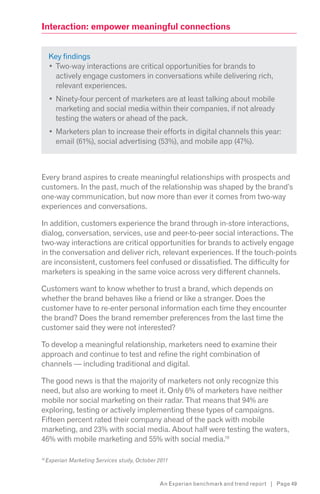
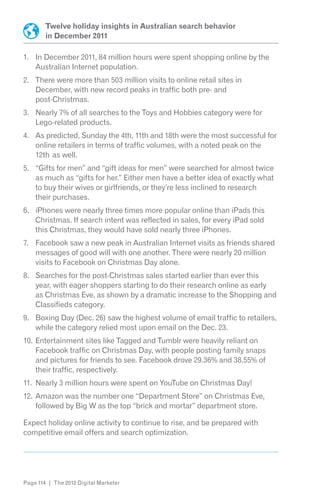
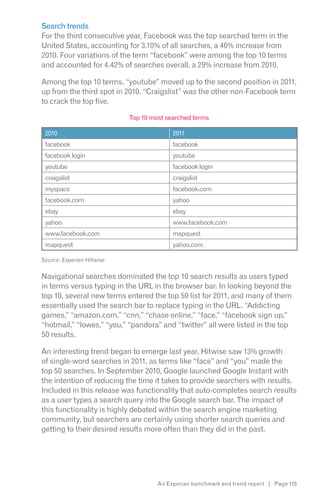
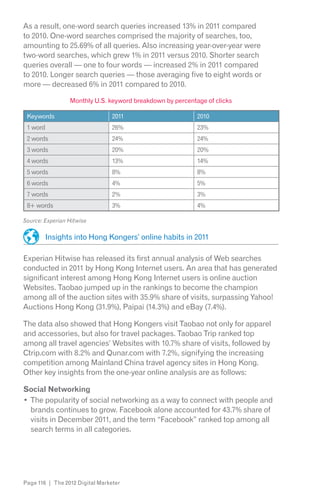
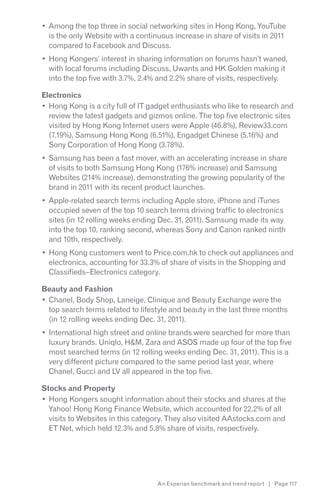
The 2012 Digital Marketer:
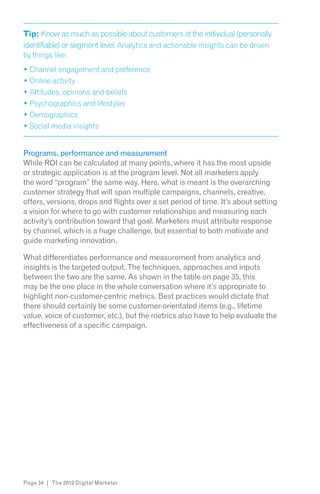
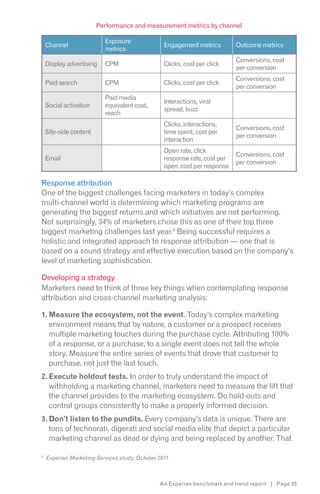
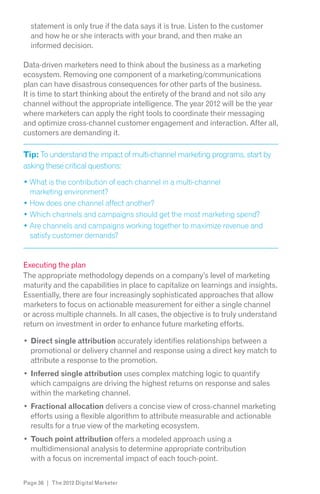
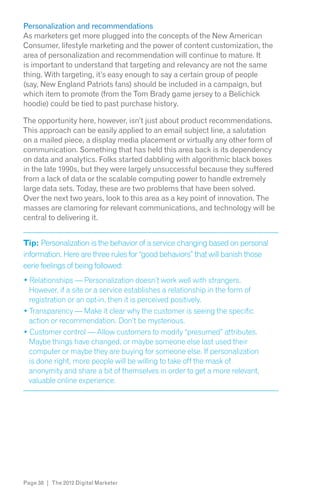
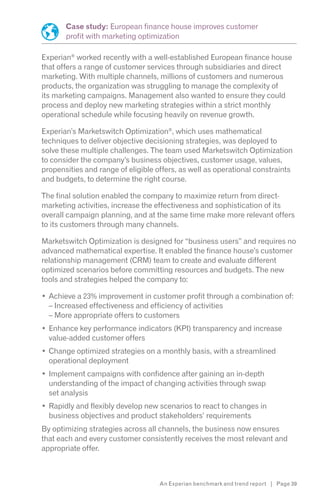
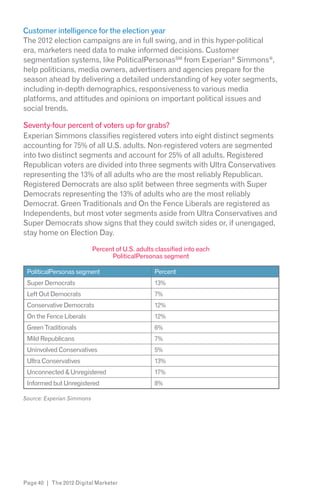
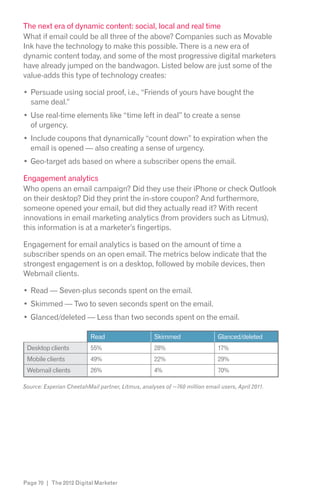
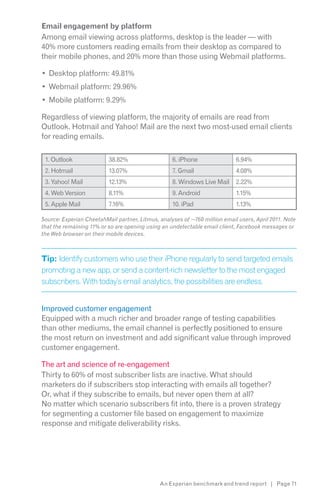
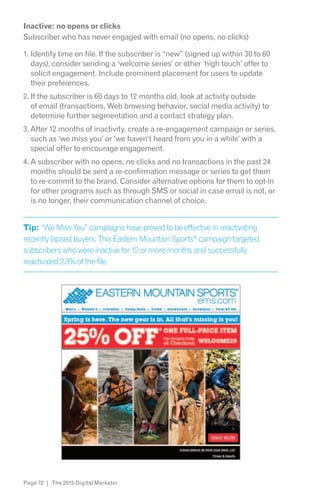
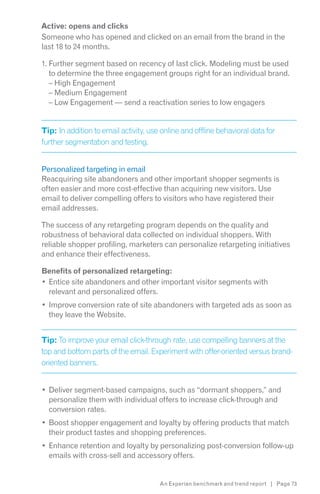
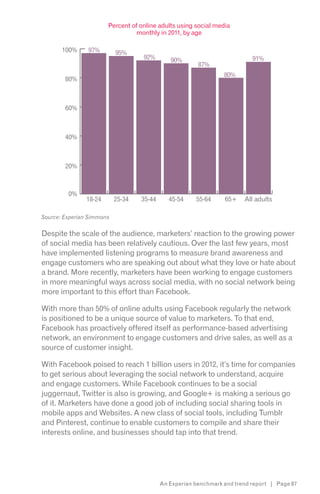
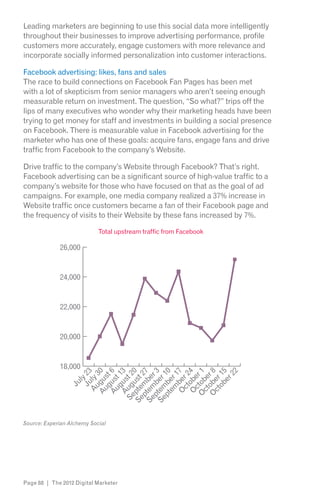
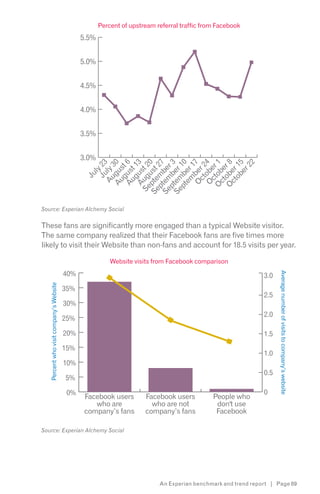
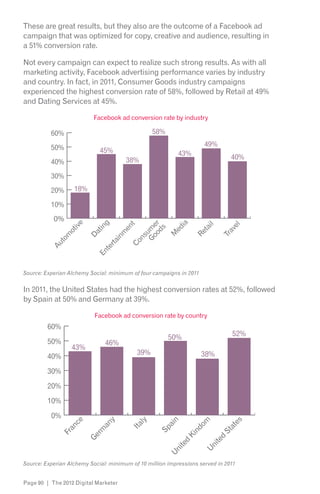
Benchmark and Trend Report

Empowering meaningful connections with your customers
Foreword
As I sit down to write this foreword, I survey my desktop; both computer and physical.
I receive information from my laptop via email, the Web, search, Twitter feeds, Facebook and
LinkedIn. On my desk, I have an iPhone® and an iPad® both delivering the same information
via text, personal email and a variety of apps. Finally, I have a stack of physical mail: catalogs,
conference flyers and research reports. While I (and most of you reading this report) might be
on one end of the spectrum in the variety of ways we receive information, consider the vast
permutations and combinations facing our customers and how they process all of the data
available in today’s world.

Faced with the complexity of marketing in a digital world, it becomes easy to obsess over
the latest technology to track and analyze the effectiveness of an ever-increasing number of
channels. With all the data available to us, have we lost sight of our real objective? Behind all
of our charts, metrics and algorithms are individuals, each with their own specific preferences
in consuming marketing messages. How do we most effectively connect with our most
valuable asset, our customer?

In this year’s 2012 Digital Marketer report, we have a fresh perspective. While we have the
same great data to share with you about email, search, social, mobile and cross-channel
usage, we believe your analysis should start not with a technology or a channel, but with a
new obsession, a deeper understanding of your customers and how they live and consume
information in this digital world.

Whether you’re reading this report digitally on your laptop or tablet, or perusing a printed
copy which now resides on your physical desktop, we’re excited to share the data that we
have available at Experian Marketing Services to fuel your customer obsession.


Bill Tancer


General Manager, Global Research
Experian Marketing Services
Experian Marketing Services helps leading organizations empower
meaningful connections with their customers through data and
insight, digital marketing and data management.
Table of contents
Introduction: customer obsession ...................................................................... 1
Customer obsession ..............................................................................................................1
Following the customer across channels .........................................................................3
Creating a customer engagement framework.................................................................4
Innovating along the Marketing Sophistication CurveSM ..............................................6
Understanding the marketing technology ecosystem ..................................................8

Data: meet the New American Consumer .......................................................11
Flavors of data .......................................................................................................................11
Identify and address key problems with data ................................................................12
Insightful data around a New American Consumer ....................................................12
     American Royalty: the top 1% ....................................................................................19

Integration: break down the silos ...................................................................... 21
Correctly capturing data for integration ......................................................................... 22
Maintaining clean email addresses ................................................................................ 25
Collecting data through mobile devices ........................................................................ 26
Understanding the customer............................................................................................ 27
Cross-channel identity resolution.................................................................................... 29
     Blue Collar Comfort: increased economic confidence ........................................ 30

Intelligence: innovation through insight .......................................................... 33
Analytics and insights ........................................................................................................ 33
Programs, performance and measurement ................................................................. 34
Response attribution .......................................................................................................... 35
Campaign management .................................................................................................... 37
Personalization and recommendations ......................................................................... 38
Customer intelligence for the election year................................................................... 40

Interaction: empower meaningful connections ............................................. 49
Email: a marketer’s foundation ................................................................ ................... 53
     Biggest email marketing trends from 2011 .............................................................. 53
Using email segmentation to reach the New American Consumer........................ 57
What email marketers should focus on in 2012 ............................................................ 58
   Connect ............................................................................................................................ 58
   Engage ............................................................................................................................... 63
   Empower ............................................................................................................................75
The future state of email .................................................................................................... 77
Social: essential to the marketing playbook ............................................................. 79
The state of social media ....................................................................................................79
Demographic shift in social media users ...................................................................... 80
More time online, more variety in social media sites ...................................................81
Brands and social media sites ......................................................................................... 82
Pinteresting trend in social media................................................................................... 84
Social media marketing goes mainstream ................................................................... 86
Facebook advertising: likes, fans and sales .................................................................. 88
Facebook data, the source of what’s next in customer insight and
   user experience................................................................................................................ 92
Planning for social data integration: it’s not as scary as it sounds.......................... 93
Mobile: usage on the rise.............................................................................................. 95
The mobile Internet revolution — and opportunities for brands .............................. 95
A mobile nation .................................................................................................................... 95
Mobile activities on the go: a lot more than talking..................................................... 96
M-commerce: mobile phones are quickly becoming an indispensable
   shopping tool.................................................................................................................... 99
      Rolling the Dice: blend of optimism and pessimism .........................................101
     Insights on mobile activities from around the world .......................................... 102
     Mobile Internet users are more connected and more receptive
     toward advertising ...................................................................................................... 103
Digital advertising, search, etc .................................................................................. 105
Display advertising: turbo charge it with customer data ......................................... 105
Multi-channel marketers: introducing addressable advertising ............................ 105
Harnessing big data.......................................................................................................... 107
Measuring digital campaigns ..........................................................................................110
Continuing to evolve in digital advertising....................................................................111
          Search insights from the 2011 holiday season ................................................112
Search trends ......................................................................................................................115
     Insights into Hong Kongers’ online habits in 2011 ...............................................116
      Hispanic Harmony: bilingual and hopeful ............................................................118
Increasing conversion by improving site usability......................................................119
Using product relevancy to increasing conversions ................................................. 122
     Six easy ways to learn why Web visitors aren’t buying .......................................125
Conclusion ........................................................................................................... 128
Subsections of the report
This report contains five different subsections within its content. Know how
to identify them with this key:


         Holiday data sections are identified with the present icon and
         provide information to help prepare for the 2012 holiday season.


         Segment Profiles are identified with the person icon and take
         a deep dive into a customer segment.


         The International Insight sections are identified with the globe
         icon and include data from around the world.


Case studies are results based on experience: these sections will be
portrayed with this purple treatment.


Tips: quick guidelines to help marketers better plan their strategies.
Tips will be presented with this treatment.


Sidebars: added learnings to keep you marketing forward. These sections will
be displayed between the double gray bars.
INTRODUCTION
                     Customer obsession
INTRODUCTION
Customer obsession
Introduction: customer obsession


  Key findings
    Forty-six percent of marketers chose multi-channel coordination as
    one of their biggest marketing challenges of the last 12-18 months.
    Always optimize the customer experience by listening, analyzing,
    planning and speaking.
    Cross-channel marketing requires an integrated approach across
    company silos and disparate systems.
    Never forget that the customer is at the center of the
    marketing universe.


Customer obsession
There has been a paradigm shift in the way consumers and brands interact.
Customers have more choices in terms of what they buy, from whom and
how often, while brands have more ways to connect and stay connected
than ever before. The most successful marketers understand this new
reality and have adjusted their communication strategies over the last few
years to keep pace.

Fortunately, we’re well past bifurcating the customer and instead, taking
a more holistic view of the marketing ecosystem and our customers.
By putting greater emphasis on identifying the purchase drivers of our
customers along with their channel preferences, marketers have become
increasingly adept at reaching customers across channels with integrated
messages and highly personalized communications. We believe that this
type of marketing has become table stakes, and those brands that ascend
to the top will be, quite simply, customer obsessed. Savvy marketers will
listen carefully to what their customers say — what they like, what they
don’t like and especially what they tell others. They will empower their
customers to become active brand advocates and enable them to spread
the word about the brand far and wide by giving them what they want every
time they interact.

These smart companies will also let customer data help guide their
marketing decisions. Myriad information about individual customers
is literally at the marketer’s fingertips for analysis and action.
Understanding and linking all of this data to inform campaign strategy
will become an increasingly critical task for marketers who are
determined to be customer obsessed.


                                    An Experian benchmark and trend report | Page 1
Customers’ lives are ever changing. Sometimes in predictable ways such as
marriage, having children or retirement, and sometimes in less predictable
ways such as divorce, job promotions, religious views or shifting priorities.
Anticipating and understanding these milestones and unknown changes in
our customers’ lives is the key to staying not only top of mind but important
to them.

The 2012 Digital Marketer: Benchmark and Trend Report looks at many
critical marketing concepts, strategies and tactics, while taking a deep
dive into data insights and the integration of communication channels like
email, social, mobile, display advertising, search, direct mail and more.
Most importantly, we focus on the customer, the center of the marketer’s
universe, the object of their obsession and the key to marketing and
financial success.

Matt Seeley


Business Leader Group President
Experian Marketing Services


Page 2 | The 2012 Digital Marketer
As marketing complexity continues to increase, the simplest way to manage
progress is to focus on the customer. What will improve the customer
experience and journey? How can marketers better serve the needs of
customers? A customer-centric approach makes it imperative to strengthen
two disciplines above all else:

    Customer insights — understand both the “persona” and the person
    Relationships — consistent, coordinated, sustained interactions
    and engagement

In this report you’ll notice the absence of “consumer” and instead see a
consistent reference to “customer.” If customers are deserving of more
meaningful and relevant interactions then so it is… every consumer is a
potential or existing customer. As such, customers want brands to listen
to them, understand them better and know them. Paying closer attention
to their behaviors, providing platforms for angst or advocacy — feedback
loops and social expression, and appreciating the certainty of change will
all go a long way in strengthening the ever important and highly coveted
gesture of loyalty and advocacy.

Following the customer across channels
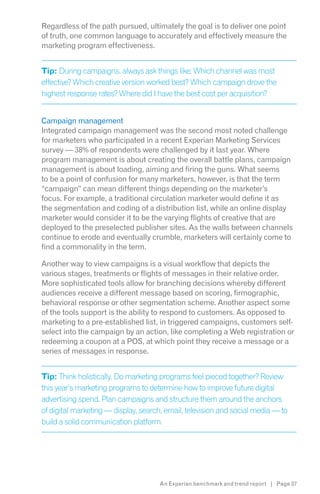
Media consumption is fragmented, so marketers must chase customers
across multiple channels, utilizing campaigns that are increasingly
difficult to integrate. It’s no wonder that integrated campaign management
was one of the top three biggest challenges for 38% of marketers.1
Investing in platforms to aggregate audiences helps, but there is no
simple or comprehensive way to reach across traditional, digital, mobile
and social channels.

In addition to being harder to engage, today’s customers are more
demanding of their brands. They expect brands to listen; interact; behave
well; and, most critically, be relevant. “Don’t waste my time” is the
customer’s mantra because they are busier than ever, have more choices
than ever and get bombarded with more messages than they can possibly
make sense of.

A typical path in the customer’s journey helps illustrate the challenges
of cross-channel, or multiple touch-point marketing. Effective marketing
strategies must connect many dots in order to lift sales. Each stage of the
customer’s path to purchase requires a different tactic to plan, manage
and execute.


1
    Experian Marketing Services study, October 2011


                                                An Experian benchmark and trend report | Page 3
Imagine a customer is interested in guitars and related musical equipment
but is unaware that a particular brand offers a new kind of tuning device.
How would this prospective buyer and brand connect? How would they
find each other? The customer may search online for other products in the
category or browse content on related topics. Moreover, it’s likely that the
customer would be discussing music with friends on a social network or
sharing a video.

What if that customer then searches online, reads reviews and becomes
not only a satisfied user, but also a delighted customer? How should the
brand turn this enthusiasm into advocacy — and turn this single transaction
into five more? A variety of new techniques and technologies is required to
address this cross-channel, digital path to purchase.

Creating a customer engagement framework
Relationships are built over time through a series of customer engagements
and experiences. If the experiences are mostly positive, the relationship
grows stronger, and vice versa. To engage effectively with customers across
channels and over time, brands must carefully plan how to advance a
customer through each stage of his or her life cycle. There is a consistent,
repeatable approach all marketers can employ to optimize the customer
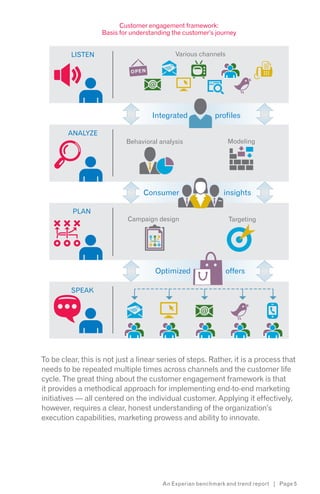
experience: the customer engagement framework. We view this as a four-
step methodology that flows like this:

1. Listen — Recognize customers and their interactions across an ever-
   expanding range of traditional, digital, mobile and social channels
2. Analyze — Develop new insights about customer behavior and
   preferences using advanced tools and methods.
3. Plan — Leverage best practices and strategies for managing campaigns
   and marketing programs.
4. Speak — Deliver personalized interactions using state-of-the-art tools for
   coordinated, cross-channel experiences.


Page 4 | The 2012 Digital Marketer
Customer engagement framework:
                   Basis for understanding the customer’s journey


         LISTEN                             Various channels


                                    Integrated            profiles

        ANALYZE
                            Behavioral analysis                Modeling


                                 Consumer                    insights

          PLAN
                            Campaign design                    Targeting


                                     Optimized                 offers

         SPEAK


To be clear, this is not just a linear series of steps. Rather, it is a process that
needs to be repeated multiple times across channels and the customer life
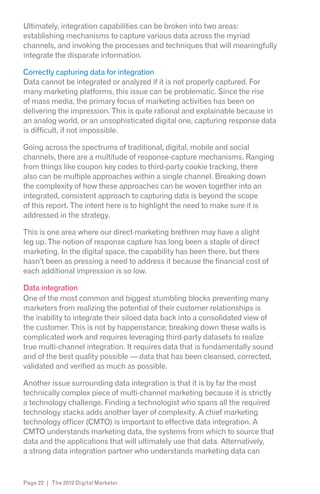
cycle. The great thing about the customer engagement framework is that
it provides a methodical approach for implementing end-to-end marketing
initiatives — all centered on the individual customer. Applying it effectively,
however, requires a clear, honest understanding of the organization’s
execution capabilities, marketing prowess and ability to innovate.


                                        An Experian benchmark and trend report | Page 5
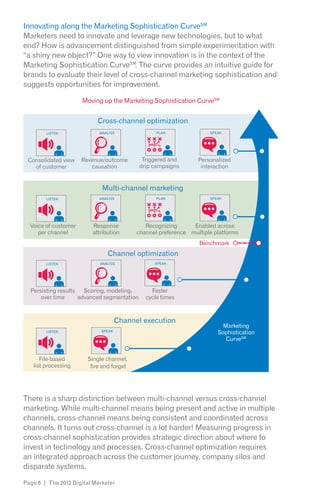
Innovating along the Marketing Sophistication CurveSM
Marketers need to innovate and leverage new technologies, but to what
end? How is advancement distinguished from simple experimentation with
“a shiny new object?” One way to view innovation is in the context of the
Marketing Sophistication CurveSM. The curve provides an intuitive guide for
brands to evaluate their level of cross-channel marketing sophistication and
suggests opportunities for improvement.

                      Moving up the Marketing Sophistication CurveSM


                            Cross-channel optimization
        LISTEN              ANALYZE               PLAN               SPEAK


 Consolidated view    Revenue/outcome        Triggered and       Personalized
   of customer           causation          drip campaigns        interaction


                             Multi-channel marketing
        LISTEN              ANALYZE               PLAN               SPEAK


  Voice of customer       Response            Recognizing      Enabled across
     per channel          attribution      channel preference multiple platforms
                                                                 Benchmark
                                Channel optimization
        LISTEN              ANALYZE              SPEAK


  Persisting results Scoring, modeling,         Faster
      over time     advanced segmentation     cycle times


                                     Channel execution
                                                                          Marketing
        LISTEN               SPEAK
                                                                        Sophistication
                                                                           CurveSM


      File-based        Single channel,
   list processing       fire and forget


There is a sharp distinction between multi-channel versus cross-channel
marketing. While multi-channel means being present and active in multiple
channels, cross-channel means being consistent and coordinated across
channels. It turns out cross-channel is a lot harder! Measuring progress in
cross-channel sophistication provides strategic direction about where to
invest in technology and processes. Cross-channel optimization requires
an integrated approach across the customer journey, company silos and
disparate systems.

Page 6 | The 2012 Digital Marketer
The need for cross-channel optimization is evident in the declining
performance of traditional media and marketing methods. According to
Forrester: Media consumption is increasingly fragmented. Most consumers
are no longer exposed to marketing messages in a vacuum; they often
interact with multiple media simultaneously. In this progressively complex
environment, marketers need to understand precisely how efficiently their
various marketing channel budgets are reaching their customers.2

Moreover, marketers are being held accountable for return on investment
(ROI) on marketing spend. They need to recalibrate their systems of
measurement to know what’s working and what’s not in this complex, multi-
channel mix. The attribution of response by channel and across channels
is a huge challenge, yet measurement is essential to both motivating and
guiding innovation.

Learning where a company falls on this continuum is the first step. Once
there is an understanding of the current level of marketing sophistication,
an actionable roadmap can be developed to enable optimization, drive
innovation and track progress. Specific initiatives can be undertaken to
develop or enhance the people, process and technology that compose the
marketing technology ecosystem.


2

    September 21, 2011


                                    An Experian benchmark and trend report | Page 7
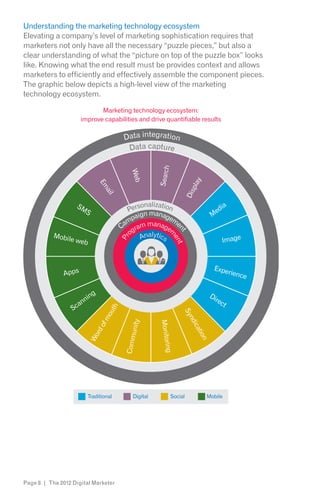
Understanding the marketing technology ecosystem
Elevating a company’s level of marketing sophistication requires that
marketers not only have all the necessary “puzzle pieces,” but also a
clear understanding of what the “picture on top of the puzzle box” looks
like. Knowing what the end result must be provides context and allows
marketers to efficiently and effectively assemble the component pieces.
The graphic below depicts a high-level view of the marketing
technology ecosystem.

                             Marketing technology ecosystem:
                      improve capabilities and drive quantifiable results

                                         Data integration
                                          Data capture
                                                       Search
                                             Web


                                                                           y
                             Em


                                                                        pla
                               ail


                                                                     Dis

                   SM                         sonalization                            ia
                     S                    Per                                       ed
                                             aign managem                          M
                                          mp               e
                                        Ca ram managem
                                           og nalytic
                                                                nt nt


           Mobil                               A       s
                e web                                                                   Image
                                        Pr


                                                                   e


                                                                                    Expe
               Apps                                                                     rienc
                                                                                             e

                         g                                                         Di
                      nin                                                            rec
                    an                                                                  t
                  Sc
                                  uth


                                                                     Sy
                                mo


                                                                       nd
                                             unity


                                                       Monitor
                             of


                                                                         ica
                          rd


                                                                            tio
                        Wo


                                         Comm


                                                                               n
                                                              ing


                        Traditional          Digital            Social         Mobile


Page 8 | The 2012 Digital Marketer
The customer is at the center of the marketing universe — the emergence
of the New American Consumer makes this fact truer than ever. Marketers
must establish mechanisms and capabilities to capture and integrate all
cross-channel data available on the customer. This linked and enriched data
drives analytics that complete the 360-degree view of the customer, and it
provides insight allowing marketers to devise strategic marketing programs
and individually relevant campaigns. Targeted, highly personalized
interactions then can be delivered within the context of appropriate
marketing channels across traditional, digital, mobile and social media.

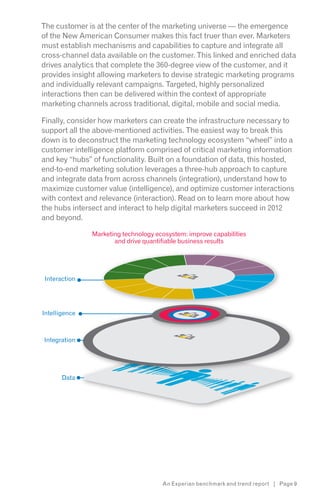
Finally, consider how marketers can create the infrastructure necessary to
support all the above-mentioned activities. The easiest way to break this
down is to deconstruct the marketing technology ecosystem “wheel” into a
customer intelligence platform comprised of critical marketing information
and key “hubs” of functionality. Built on a foundation of data, this hosted,
end-to-end marketing solution leverages a three-hub approach to capture
and integrate data from across channels (integration), understand how to
maximize customer value (intelligence), and optimize customer interactions
with context and relevance (interaction). Read on to learn more about how
the hubs intersect and interact to help digital marketers succeed in 2012
and beyond.

               Marketing technology ecosystem: improve capabilities
                      and drive quantifiable business results


Interaction


Intelligence


Integration


       Data


                                      An Experian benchmark and trend report | Page 9
DATA
Meet the New American Consumer


                                 Meet the New American Consumer
                                                                  DATA
Data: meet the New American Consumer


  Key findings
    Marketing-relevant data still falls into three primary categories:
    customer information, compiled enhancement data and third-
   party resources.
    The dynamic of the American household continues to morph and a
    “New American Consumer” is taking shape.
    Twenty-eight percent of marketers noted that creating effective
    targeting profiles was one of their biggest marketing challenges
    last year.
    An increasing percentage of college graduates are returning home to
    live with their parents.
    Households that contain adults and children from multiple
    generations are a mega-trend.
    A study by the National Center for Health Statistics (NCHS) found
    that in 2006, one out of 12 first births were to women age 35 and older.
    Wealthier adults are favoring an urban lifestyle.


A rich foundation of data is essential to empowering meaningful customer
connections. Customer information is critical to nurturing relationships
and driving relevant, coordinated multi-channel campaigns. If there isn’t an
integrated, multidimensional view of the customer that is accessible from
multiple downstream systems, it will be a struggle to expand relationships.

Flavors of data
Despite the rapidly expanding number of information sources and
channels — especially from a digital perspective — marketing-relevant data
still falls into three primary categories:

  Customer information — point of sale, customer service, Website, email,
  call center, survey research, preferences, social media, etc.
  Compiled enhancement data — life events, demographics, lifestyle,
  online, transactions, market research, business, automotive, etc.
  Third-party resources — partners, lists, syndicated sources, research,
  segmentation, suppressions, etc.


                                    An Experian benchmark and trend report | Page 11
Identify and address key problems with data
Actionable customer insights depend on data. The rapid growth of new
media and digital channels provides a wealth of previously untapped
information assets. Customers leave digital footprints all over the Web,
and there are vast stores of both online and offline customer data available
to marketers. Yet, even as data remains a marketer’s greatest strength, it
also can be the biggest weakness. Key challenges with data fall into five
basic areas:

     Fragmentation — This is the classic silo problem: speaking through
     independent channels (e.g., email, print, display, mail, etc.), transacting
     through others (e.g., POS, Website, call center, etc.) and being unable to
     pull it all together.
     Hygiene — Data is often partial, duplicated, incorrect or outdated.
     Maintaining actionability requires regular care and feeding.
     Scale — The impact of digital ubiquity is just beginning to be felt. The
     exponential explosion in available data means what had been difficult
     problems to solve in the past are crippling to many current-state
     marketing technologies.

     Personally identifiable information (PII) — The customer’s sensitive,
     private or confidential data must be safeguarded against fraudulent
     use. It also must be used in appropriate and permissible ways. Traditional
     marketing tools need to be upgraded to ensure PII is protected by design.

     Speed — Tackling the above four issues in a time frame relevant to
     decision making is another large challenge. Today, insight often must be
     applicable to addressing questions in page load-type times.

Insightful data around a New American Consumer
American life has changed incredibly, both economically and
technologically, over the last five years. These changes have had a profound
effect on trends and factors that shape household formation. America
has experienced a recession and staggering unemployment challenges.
The digital revolution has presented a sea of change in the way customers
communicate and interact on every level. All of these pressures have
dramatically impacted how customers prioritize their choices and buying
decisions, while also altering their overall lifestyles. As the dynamic of the
American household continues to morph, a “New American Consumer”
is taking shape. This is good news and bad news for marketers, who are
increasingly challenged with understanding, attracting and engaging with
their changing target audiences. In fact, 28% of marketers cited effective
targeting profiles as one of their biggest marketing challenges.3


3
    Experian Marketing Services study, October 2011.


Page 12 | The 2012 Digital Marketer
Using a lifestyle segmentation system, like Mosaic® USA Consumer
Lifestyle Segmentation, marketers can key into new customer dynamics
and anticipate the behavior, attitudes and preferences of their customers in
order to reach them in the most effective channels with the best messages.

Here are examples of recent demographic shifts and sociological trends
that have given rise to four very unique market segments.

Baby Boomer population adapts to accommodate boomerang children
Every year, a new wave of college graduates is poised to enter the
work force. However, these days, before launching what they hope are
meaningful careers, a large percentage might be knocking on the front door
of their parents’ homes looking for a place to live. Welcome to the land of
Boomers and Boomerangs: a 21st century family segment containing Baby
Boomers who moved into their homes more than 15 years ago and watched
their children grow up and leave the nest, only to have them return. What
they thought was going to be converted into a home office or an exercise
room is once again a messy bedroom.

Compared to U.S. households overall, Boomers and Boomerangs are more
than four times more likely to contain young adults living with their parents.
However, not all of these young adults are necessarily recent college
graduates. Many have previously started out on their own but are now
seeking the sanctuary of living with mom and dad while attempting to gain
the traction necessary for making ends meet.

What impact does this trend have on boomer-aged parents who have been
making preparations to begin a new phase of life, possibly dependent-free,
as empty nesters? Here are some key findings that will help marketers
connect and communicate with this growing market segment:

  The vast majority (85%) of the Boomers and Boomerang parents are
  between the ages of 51 and 65.
  These are very busy households. They are 3.3 times more likely than
  U.S. households overall to have five or more people living at home. The
  increased demand of maintaining a larger household puts added strain
  on the family finances.
  Boomers and Boomerangs have reached their peak earning years and
  have an average household income that is slightly less than $100,000.
  They tend to be price-sensitive shoppers who buy economy cars and off-
  the-rack clothes from discount retail stores.
  Boomers and Boomerangs are voracious media consumers. They
  like to read newspapers, especially poring over the sports and
  entertainment sections.


                                    An Experian benchmark and trend report | Page 13
They are very well-educated and are 1.7 times more likely to have earned
  a graduate-level degree compared to the general population.
  They are very likely to be employed in professional, technical or sales-
  related occupations.
  More than half of these householders have lived in their homes for
  15 or more years. Many may be considering home renovation or
  remodeling projects to better accommodate their adult-age children.
  There are solid credit ratings among Boomers and Boomerangs,
  making them an attractive target for automotive, home-equity and
  education loans.

The wide age gap of members found in Boomer and Boomerang
households translates into divergent Internet activities. They go online for
banking, retrieving financial information and travel planning, as well as to
search for jobs, for instant messaging and for gaming. Popular Websites for
this segment include an astonishing variety, such as CNN, ESPN, Facebook,
WebMD and Craigslist. Both age groups appreciate the convenience of
shopping online. With their varied backgrounds, members of this segment
access the Internet at home, school and work through wireless and mobile
devices. Still, there are some age-specific activities evident in Boomers
and Boomerangs: while the parents are still shy about surfing the Internet
through their cell phones, there’s no such reticence among the younger
people in the household.

Multigenerational households throw marketers a curve
Americans are again embracing the concept of multigenerational family
living. Whether it’s the outcome of a failing economy or other economic
and sociological factors, households that contain adults and children from
multiple generations are a mega-trend.

The demographic developments are undeniable. An expanding elderly
population has begun moving in with their adult children with greater
frequency. At the same time, these adult children could be parents of young
adults themselves who, for a variety of reasons, have decided to move back
home. In both cases, younger children under age 18 also might be present
in the home.

One example of this marketplace trend is the emergence of the segment
called Sports Utility Families. These are predominately upscale, middle-
aged couples with school-aged children living in outer-lying suburbs.
However, there’s a twist to what initially might be described as the
prototypical all-American family. These households have a greater
likelihood to include an aging senior or a young adult as part of the
family mix.


Page 14 | The 2012 Digital Marketer
Other defining characteristics of Sports Utility Families include
the following:

  About 59% of Sports Utility Families have four or more persons living in
  the household.
  They are extremely family centered. Fully 80% of Sports Utility Families
  have children under age 18. They have a high incidence of children across
  all age ranges and are 4.1 times more likely than U.S. householders
  overall to be caring for teenage children.
  They are financially stable, likely to contain two income earners and have
  an average household income close to $105,000.
  Although they earn upscale incomes, they do not feel financially
  secure; they worry about the future and wish money were less important
  in their lives.
  About 52% have lived in their homes between eight to 19 years.
  With their suburban communities located not too far from parks,
  these families are more likely to enjoy outdoor activities such as hiking,
  swimming, hunting, fishing and camping.
  They make a high percentage of online and catalog purchases in outdoor,
  home office, pets, toys, travel and home décor categories.
  Politically, they’re conservative and much more likely than the general
  population to support conservative social causes.
  They have a high incidence of Full-Sized Pickup, Minivan or Sports Utility
  Vehicle ownership.

Marketing to Sports Utility Families and other types of multigenerational
households can be complicated. In many cases, there is no single primary
decision maker in the home. Purchase decisions are likely to be shared and
influenced by multiple family members. Marketers need to carefully craft
their communications when an elderly parent, a young adult or other minors
are all sharing the same living space. For example, a household that might
initially look like a traditional family with preschool children can easily be
overlooked when targeting seniors with a healthcare-related offer. Knowing
that this “traditional family” also contains an aged parent dramatically
changes the picture.

Sports Utility Families are above-average users of the Internet. They
go online for a wide range of uses, whether it’s hunting for a better job,
planning a trip, auctioning off an old chair or listening to an Internet-only
radio station. They are frequent online shoppers who patronize Websites
that feature classified ads for cars, fitness equipment, house and garden
supplies and toys. While the younger generation in the house enjoys going
to children’s lifestyle sites, the adults head to sports sites dedicated to


                                    An Experian benchmark and trend report | Page 15
fishing and fantasy leagues. They also buy gaming software and video
controllers at high rates. iTunes is a frequently used application.

Married couples delay having children
What the U.S. Census Bureau characterizes as a “delayer boom,” more
college-educated women are holding off on having children until they
reach their 30s. In fact, a study by the National Center for Health Statistics
(NCHS) found that in 2006, one out of 12 first births were to women age 35
years and over. This compares to one out of 100 in 1970, representing an
eightfold increase in the share of firstborn children to women age 35 years
and over. The average age of U.S. women giving birth for the first time rose
by 3.6 years during this period. With a sluggish economy and challenging
job market giving women and couples even more fodder for postponing
the added expense of raising a child, the “delayer boom” shows no signs of
abating. Joining this segment of the population, weighing the pros and cons
of having a first child and deciding when to expand their family, are Fast
Track Couples.

Fast Track Couples consist of young couples and families already on
the road to upward mobility. Although 90% are under the age of 35, most
are married, work at good jobs and own their homes. About one-third of
Fast Track Couples have already started families, and others might look to
start one soon. Other key characteristics that describe this segment include
the following:

  Nearly all have at least some college education, which has helped them
  obtain decent-paying jobs in sales, white-collar professions and
  technology. More than half of these households have dual workers in the
  labor force.
  These young couples live comfortably in homes valued close to the
  national average, though they have yet to sink deep roots. Most have lived
  at the same address for fewer than three years.
  Fast Track Couples are informed customers, not impulse shoppers.
  They’re acutely aware of demands on their budgets, and they want to
  make sure they get good value for any purchase.
  Fast Track Couples are focused on their careers. A significant number are
  entrepreneurial and dream about starting their own business.
  They are mostly novices when it comes to financial investments and
  have not saved much money nor invested in many stocks, mutual funds
  or bonds. A high percentage have 401(k) accounts, and those with young
  children have started 529 College Savings Plans. Their balances, however,
  are still relatively modest.
  Many members are comfortable with debt. They’re still paying off student
  loans and have added auto loans and first mortgages to their liabilities.


Page 16 | The 2012 Digital Marketer
Fast Track Couples lead socially active lifestyles. They enjoy going to
  bars, movies, comedy clubs and rock concerts.
  They prefer their vacations to be filled with heart-pounding sports,
  including skiing, scuba diving, water skiing and backpacking.
  Self-described early adopters, they like filling their homes with the latest
  customer electronics and technology.

The best channel to reach Fast Track Couples is the Internet. They are
highly receptive to digital advertising via online search and sponsored
links. Few segments spend more time in cyberspace. They are enthusiastic
Internet users, going online to simplify their lives. They use the Internet to
manage their financial affairs, make travel arrangements and check out
new job, car and home listings. They also use the Internet as their chief
form of entertainment, downloading music, listening to Internet-only radio
stations, watching videos and sharing digital photographs. In addition,
they’re comfortable telecommuting and shopping online. Having grown up
with communication on demand, they don’t care how they get their Internet
access. They bounce seamlessly between cell phone, laptop and wireless
connections. Although they dislike email ads, they do respond to sponsored
Websites and links — especially when doing product comparisons. They
like shopping for games and software to improve their online experience.
In a list of popular Websites, it’s difficult to find any that they don’t visit,
including Facebook, YouTube, Wikipedia, Best Buy and eBay.

Urban lifestyles gain renewed favor by wealthier adults
Over the past several decades, a large percentage of America’s most
wealthy households moved from the inner sanctum of the cities to the
outlying suburbs. Think McMansions, Hummers and other forms of
suburban extravagance that reflect the steady migration of the “well-to-do”
to the outer reaches of metropolitan areas. However, the tide has changed
somewhat. Meet the new Jet Set Urbanites. These are in-town sophisticates
who are an affluent mix of singles and childless couples pursuing high-rise
living and fashionable lifestyles in urban neighborhoods. This segment
represents a subpopulation of aging Baby Boomers looking for the perks
that can be found in a city landscape.

Some key differentiating features of Jet Set Urbanites compared to the
U.S. population overall include the following:

  Jet Set Urbanites are 9.2 times more likely to have household incomes of


  $250,000 or more.
  With their impressive educations — nearly half of household heads have
  a graduate degree — these professionals earn good salaries in business,

  science, education and the hospitality industry.


                                     An Experian benchmark and trend report | Page 17
They are twice as likely to own stocks, mutual funds and money
  market accounts.
  Philanthropic and progressive, they support a range of nonprofit groups
  and are generous with their money, especially for charities involved with
  health issues, the environment, the arts and public broadcasting.
  They have a high propensity to attend concerts, live theater and dance
  performances and visit museums.
  They describe themselves as risk-takers who like to sample new products
  and fashion, experimenting with different styles and exotic cuisines.
  Maintaining an active and healthy lifestyle is very important. They
  enthusiastically pursue many fitness activities, including tennis, aerobics,
  running, yoga and working out on cardio machines.
  They are 1.9 times more likely to say they will “spend whatever I have to,
  to make myself look younger.”
  Their leisure interests include taking cruise ship vacations and
  traveling abroad.

Jet Set Urbanites are active online users. They go online to bank, make
travel plans and manage their investment portfolios, and they regularly
telecommute to their offices. Most of their media interests have been
transferred to the Internet, and that’s helped them get out from underneath
the piles of newspapers and magazines that used to accumulate in their
apartments; they now go online to read newspapers and magazines, read
movie reviews and monitor weather reports. For entertainment, they like to
download music, listen to Internet radio stations and join chat forums. Their
favorite Websites include Facebook, Wikipedia and Netflix. Though they like
to shop online, they’re only moderately receptive to email and display ads.


Page 18 | The 2012 Digital Marketer
American Royalty: the top 1%

As the name suggests, American Royalty are those Americans who are at
the top of the affluence pyramid. In fact, less than 1% of all U.S. adults are
identified as being American Royalty. They are financially confident, tech-
savvy and influential. They have the means to travel the world armed with
the latest gadgetry, of course, to make their lives easier, more connected
and more comfortable. Their love of gadgetry has translated into a need
for the latest news and rumors from websites like Boy Genius Report,
MacRumors and Fortune’s technology blogs. Not surprisingly, American
Royalty also enjoy consuming news on their mobile phones, visiting the
mobile Websites of The Washington Post, US Weekly, BBC and San
Francisco Gate. American Royalty is active and involved in their community
as members of many civic, cultural and religious groups. The Internet has
proved to be a highly effective and popular way for this group of connected
individuals to communicate and socialize with their communities and to
stay involved.

As community-oriented as these individuals are, they spend plenty of time
on the road. Eighty-four percent of American Royalty members have a valid
passport, and almost three-quarters have traveled abroad in the last three
years. In the last year alone, 88% traveled stateside, with a majority making
travel reservations online. When it comes to travel Websites, American
Royalty can be found perusing the JetSet Report and trendy boutique hotels
in New York City such as the Hudson Hotel, Hotel Gansevoort and Gramercy
Park Hotel. Organized travel with a luxurious spin like cruises from Crystal
Cruises and Regent Seven Sea; and expeditions from Kensington Tours,
Abercrombie & Kent and National Geographic Expeditions are also popular
with these customers.

With all that travel, it’s no wonder American Royalty members are more
than twice as likely as the average American to say that while away from
home, it’s important to have Internet access. That also explains why they
are 41% more likely than average to surf the Web on their mobile phone and
74% more likely to email from their phone.

Whether on the road or at home, the Internet plays an important role in
the lives of American Royalty. These individuals are 50% more likely than
average to say that the Internet is their primary source of entertainment
and just over a third say the Internet is the primary source of entertainment
for their entire family. American Royalty spends so much time online that
half of this group says that they’re spending less time reading newspapers,
magazines and watching television as a result. A third even say they’re
losing sleep because of the Internet.


                                    An Experian benchmark and trend report | Page 19
What are they doing online? You name it, they’re probably doing it. Online
shopping is an activity they are particularly fond of — and why not?
American Royalty is extremely comfortable financially. As a group, they are
confident spenders for whom the economic downturn has had little impact.
In fact, nearly half of adults in this segment say their household spends
$40,000 or more annually on purely discretionary items and services. These
shoppers have a penchant for the finer things in life and can be found
browsing luxury retail Websites like Barneys, Saks Fifth Avenue, Neiman
Marcus and Gilt.com. Style is also key to this segment, as evidenced by their
likelihood to visit Net-a-Porter.com, Shopbop and Lululemon.

Social networking is a popular pastime for many people online, and
American Royalty are no exception. However, they have a higher propensity
to visit niche and specialty networks like “foodie” communities including
Chowhound, Foodbuzz and Serious Eats, as well as travel-focused Flyer
Talk and Cruise Critic Message Boards. They can be found on Twitter and
LinkedIn but are more likely to be sharing photos on Instagram.
s*


Page 20 | The 2012 Digital Marketer
INTEGRATION
Break down the silos


                       Break down the silos
                                              INTEGRATION
Integration: break down the silos


     Key findings
       Customers want a personalized, relevant experience, and
       successful interactions hinge on the ability to integrate within and
       across channels.
       Forty-two percent of marketers reported that their organization’s
       teams collaborate on all marketing programs.
       Fifty-nine percent of companies are collecting mobile contact data.
       Ninety-two percent of businesses feel their contact data is inaccurate
       in some way.


The digital explosion of new media choices has led to fundamental changes
in the way marketers must operate. Media fragmentation means mass
media buying is no longer sufficient. The multitude of competing marketing
initiatives drives the need to prove a return on investment like never before.
Customers demand a dialogue across a variety of channels and devices.
Customers want a personalized, relevant experience, and successful
interactions hinge on the ability to integrate within and across channels.

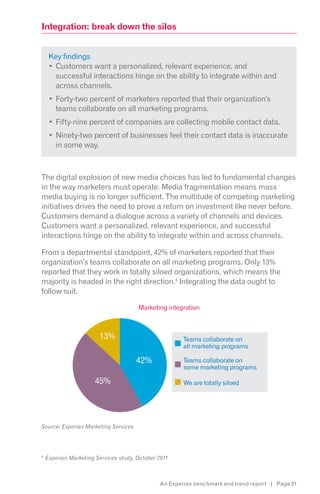
From a departmental standpoint, 42% of marketers reported that their
organization’s teams collaborate on all marketing programs. Only 13%
reported that they work in totally siloed organizations, which means the
majority is headed in the right direction.4 Integrating the data ought to
follow suit.

                                       Marketing integration


                        13%                            Teams collaborate on
                                                       all marketing programs

                                      42%              Teams collaborate on
                                                       some marketing programs

                      45%                              We are totally siloed


Source: Experian Marketing Services


4
    Experian Marketing Services study, October 2011


                                               An Experian benchmark and trend report | Page 21
Ultimately, integration capabilities can be broken into two areas:
establishing mechanisms to capture various data across the myriad
channels, and invoking the processes and techniques that will meaningfully
integrate the disparate information.

Correctly capturing data for integration
Data cannot be integrated or analyzed if it is not properly captured. For
many marketing platforms, this issue can be problematic. Since the rise
of mass media, the primary focus of marketing activities has been on
delivering the impression. This is quite rational and explainable because in
an analog world, or an unsophisticated digital one, capturing response data
is difficult, if not impossible.

Going across the spectrums of traditional, digital, mobile and social
channels, there are a multitude of response-capture mechanisms. Ranging
from things like coupon key codes to third-party cookie tracking, there
also can be multiple approaches within a single channel. Breaking down
the complexity of how these approaches can be woven together into an
integrated, consistent approach to capturing data is beyond the scope
of this report. The intent here is to highlight the need to make sure it is
addressed in the strategy.

This is one area where our direct-marketing brethren may have a slight
leg up. The notion of response capture has long been a staple of direct
marketing. In the digital space, the capability has been there, but there
hasn’t been as pressing a need to address it because the financial cost of
each additional impression is so low.

Data integration
One of the most common and biggest stumbling blocks preventing many
marketers from realizing the potential of their customer relationships is
the inability to integrate their siloed data back into a consolidated view of
the customer. This is not by happenstance; breaking down these walls is
complicated work and requires leveraging third-party datasets to realize
true multi-channel integration. It requires data that is fundamentally sound
and of the best quality possible — data that has been cleansed, corrected,
validated and verified as much as possible.

Another issue surrounding data integration is that it is by far the most
technically complex piece of multi-channel marketing because it is strictly
a technology challenge. Finding a technologist who spans all the required
technology stacks adds another layer of complexity. A chief marketing
technology officer (CMTO) is important to effective data integration. A
CMTO understands marketing data, the systems from which to source that
data and the applications that will ultimately use that data. Alternatively,
a strong data integration partner who understands marketing data can


Page 22 | The 2012 Digital Marketer
provide the same value. Ultimately, the big picture is to utilize available
linkage techniques to bring together disparate channel information in order
to create and deliver addressable audiences.

Data hygiene
For most businesses, the quest for high-quality customer data is never-
ending. The simple reason is that customer data is not stable. In fact, it is
highly volatile. Even something as straightforward as a person’s name can
have multiple different, valid combinations of first and last names used for
a single person, all in one file. Different names and addresses or multiple
email addresses for the same person can easily corrupt anywhere from
5 percent to 25% of the records in a single database.

The only way to validate a name — aka a customer — is to know
whether there is some type of verified reason for that name to be paired
with the contact information to which it is tied. Using a highly verified set
of external data resources to vet a customer file can provide meaningful
business measurements for data quality by supplying transactional
evidence that a customer interacted using that contact information at a
specific point in time.

Data-driven data quality management not only corrects, updates and
validates data, but more importantly, it also creates the opportunity for a
powerful impression on the customer.


s

After spending millions of dollars on customer data integration (CDI), many
companies still find themselves lacking the integrated customer intelligence
needed to drive customer-centric differentiation. No matter how technically
advanced their system is, low data quality continues to undermine business
results, necessary customer data remains unavailable, and the time required to
enhance systems makes it difficult to keep up with changing business needs.
High-impact data naturally degrades without even touching it:

    Each year in the United States, 2.4 million people die and 4 million
    are born.5
    Annually 2.1 million couples marry and 1.1 million divorce. About
    15% have married more than once. The average divorce happens about
    8 years into marriage; the average time between marriages is 4 years.6
    17% of Americans change addresses annually. 45 million people move
    each year. Approximately one out of every six families moves each year.7


5
    CDC/National Center for Health Statistics, 2011
6
    U.S. Census Bureau, 2011
7
    United States Postal Service , 2012


                                                An Experian benchmark and trend report | Page 23
More than one-half (56%) of legal permanent residents in the United
    States in 2010 obtained permanent residence in 2000 or later.8

Advances in digital marketing are forcing companies to become more
customer-centric. Today’s technology innovation cycles are so rapid that the
time frame from innovation to imitation is very short, making it difficult for
products to sustain a competitive advantage. Furthermore, the Internet is
eroding the once stalwart advantages of traditional distribution channels.
While the importance of good products is not disappearing, the simple truth is
that the opportunity for sustaining competitive advantage now lies in the ability
to deliver a superior customer experience.


Make the most of in-store visits: a customer has many choices when
deciding how to shop and make purchases. Are you poised to gather
customer information? Are recent privacy rulings — such as the one in
California limiting the collection of in-store information — causing you to
abandon your retail data capture strategy? Consider the following to take full
advantage of customer interactions:
  Improve the in-store customer experience by making it clear to customers
  that requests for ZIP Code™ or email are entirely optional and not required
  for the credit card transaction.
    Utilize store trade area capturing options to adhere to privacy concerns
    and legal rulings.
    Choose a provider partner who can support use of your own customer
    data as a first priority in addition to their own supplemental data.
    Encourage store employees to adopt capture programs by improving their
    understanding of the benefits and by rewarding top performers.
    Initiate energetic and engaging loyalty programs that foster and
    maintain interest.
    Engage store customers with interactive messaging and intelligent quick
    response (QR) codes to socialize and cultivate your brand.
    Include store capture data as part of your campaign
    measurement strategy.

There continues to be significant increases in the volume of data our clients
provide for retail capture services, underscoring the importance retail purchase
activity plays in a comprehensive cross-channel strategy. Take full advantage of
capturing in-store intelligence, measure the impact of your communications on
retail performance and realize its importance in overall marketing success.
s


8
    Department of Homeland Security, Office of Immigration Statistics, 2011


Page 24 | The 2012 Digital Marketer
Maintaining clean email addresses
Successful delivery of an email to a specific customer is just as important
as the message being sent. Unfortunately, deliverability rates for campaigns
are often considered less important than the content itself. Marketers
should take steps to improve deliverability rates, which in turn will increase
overall conversion rates.

This all starts with improving the quality of an email database. There are
simple steps that marketers can take to cleanse email addresses.

  Remove bounced emails — Obviously, it doesn’t make sense to send an
  email to the same inaccurate address over and over again. Removing
  known invalid emails from a list will not only reduce bounce rates, but it
  will also have an impact on the company’s reputation with the Internet
  Service Providers (ISPs). Each email domain earns a reputation with the
  major ISPs, like Gmail™ and Hotmail. Emails sent from that domain
  receive placement in a customer’s inbox based on the positive or negative
  nature of the sender’s reputation. If too many emails bounce, then an ISP
  may consider the sender a spammer and place emails in the spam or junk
  inbox, or even prevent delivery of the communication. Keeping the
  bounce rate low can improve or maintain a sender’s reputation.
  Cleanse email addresses — Most bounced emails are the result of
  syntax errors, like misspellings or typographical errors. Software tools
  can identify and correct invalid characters and change incorrectly typed
  domain names. These “cleans” can be done on a weekly or monthly
  basis, depending on email volume.
  Educate staff — It is important to train staff members on the importance
  of an accurate email address. If staff members understand where
  information is used and how inaccurate data affects the organization as
  a whole, they may be more careful when collecting data in the future and
  reduce the number of careless errors made during data entry.

By removing inaccurate information, cleansing existing addresses and
training staff, marketers can increase the number of usable email addresses
in their existing database. Ultimately, more delivered emails means more
opens and clicks, and of course, better marketing results.


                                    An Experian benchmark and trend report | Page 25
Collecting data through mobile devices
Mobile communications are becoming more important to marketers
as smartphone usage continues to expand. In fact, according to a
recent Experian QAS study, 59% of organizations are collecting mobile
contact data.

In addition, the amount of information being collected through mobile
devices is on the rise, with financial institutions allowing customers to
open accounts through online self-service portals and retailers selling
products through mobile ecommerce sites. With so much data
accumulating, organizations need to ensure that accurate information is
collected not only to fulfill requests, but also to market to customers for
up-sell and cross-sell purposes.

Organizations should review the pieces of contact information that
customers or prospects can input through mobile applications and put
verification in place to prevent inaccurate data from entering a database
through the mobile channel.

There are several different methods for verification. First, point-of-capture
tools can be leveraged online to validate contact details while an individual
is still engaged. This validation will interact directly with the customer to
ensure that all details are standardized and validated while they are using
the application. The benefit of this type of tool is that information, such as
a missing apartment number or street directional, can be corrected and
gathered from the customer in real time.

However, some organizations may not want to add that level of verification
to a new mobile application. An alternative is that information can be
placed in a holding area and run through a back-office cleansing tool before
it is entered into the main database. This will allow contact data to be
standardized and verified, and if information is inaccurate, it can be flagged
and corrected at the time of the next transaction.

As mobile applications become more important to the marketing mix,
organizations need to be even more mindful of the need to collect accurate
data from mobile devices rather than flooding their database with poor,
unusable data.


Page 26 | The 2012 Digital Marketer
Understanding the customer
The success of any marketing campaign depends on a good understanding
of the person receiving the message. With the digitization of marketing and
selling channels, organizations need to understand their customer faster
than ever and be able to make relevant offers in real time.

That process of “clienteling,” or using data about an individual customer’s
buying habits, history and preferences during interactions, is complicated
to be sure. But one thing is certain: its effectiveness all starts with basic
contact information.

Contact information is the basis for any profiling strategy. In fact, according
to a recent Experian QAS survey, 42% of companies maintain accurate data
to capitalize on market opportunities through customer profiling.

However, contact data is woefully inaccurate for most businesses.
According to the same study, 92% of businesses feel their contact data
is inaccurate in some way. In addition, 66% of respondents who have
customer loyalty programs believe their programs were negatively affected
in the last year due to inaccurate data.

To ensure that marketers can make relevant offers and engage in
clienteling, they need to first focus on the capture of accurate contact data.
Verification can be put in place at the point of entry for mailing address,
phone number and email. This ensures not only that companies can fulfill
orders, but also that marketers can make personalized, relevant offers in
the future. In addition, marketers can then use contact data to append
demographic information to make more informed decisions or relevant
real-time offers to the customer.

Case study: Casual Male Retail Group establishes interactive, front-end
address validation

Casual Male Retail Group was collecting customer contact data at the point
of sale (POS), but inaccurate addresses led to high returned mail costs,
poor marketing results and an inability to create a complete view of each
individual customer.

Because Casual Male had tried several different tactics for gathering
address information, including back-end processing and reverse telephone
append services, the retailer was convinced that interactive, front-end
address validation was the best option.

Casual Male now verifies addresses as they are entered at all stores. The
retailer attributes significant improvement in marketing returns, with year
one savings of $115,000 related to returned mail costs, and a more accurate
database to the use of QAS Pro.


                                    An Experian benchmark and trend report | Page 27
Case study: Growing Up in New Zealand enhances
         database accuracy

“Growing Up in New Zealand” is a longitudinal study involving 7,000
children throughout their first 21 years of life. It is crucial that researchers
can keep in touch with the subjects of the research throughout the course
of the project to ensure that the results are as accurate as possible. A
key part of this exercise lies in having up-to-date postal records of all
participants to ensure all communications are effective.

Experian® QAS® conducted an analysis of all of Growing Up in New
Zealand’s data records and calculated that there were 409 partial and
unmatched addresses in the database. This meant that 409 children
were contacted incorrectly five times per year at a cost of $1.50 per
attempt. With each child’s worth currently valued at $1,600, the 409
undeliverable addresses presented Growing Up in New Zealand with a
potential loss of $654,400.

Growing Up in New Zealand decided to deploy two Experian QAS solutions:
QAS Batch and QAS Pro. QAS Batch is an interactive data cleansing tool that
enabled Growing Up in New Zealand to clean and validate all of the address
records in its existing database against the New Zealand Post Postal Address
File (PAF). QAS Pro was used to validate addresses in real time, ensuring all
information entered into the database is clean and accurate.

Growing Up in New Zealand has been able to significantly improve the way
its contact data is managed, accurately communicating with participants
at each stage of the study. Above and beyond ensuring the accuracy of
communication with study participants using QAS Batch, Growing Up in
New Zealand has also been able to enrich its data and use the address data
of participants to map out the local amenities in each of the areas where
participants live.


     “With the QAS Batch and Pro solutions, we have the confidence
     that we can maintain an up-to-date database with correct details of
     every child. The software has given us not only the peace of mind
     that each communication and family we visit is correct, but also
     that every penny we spend on the project is being invested wisely,
     rather than wasted on incorrect mailing and home visits. With the
     additional information that we have been able to generate from the
     software, it has paid for itself dozens of times over.”
            – Peter Tricker, Data Systems Manager, Growing Up in New Zealand


Page 28 | The 2012 Digital Marketer
Cross-channel identity resolution
Linkage is a critical part of data integration for marketers. While many
marketers can find this concept difficult to grasp, the sage advice is to
try to “keep it simple.” While technically speaking, linkage can get quite
complex, there is no magic to it, and ultimately building linkages across
traditional, digital, mobile and social channels becomes a brute force
operation. What is required is a master data universe that spans the entirety
of possible audience interactions. It’s inefficient and slightly unrealistic for
an independent company, regardless of size, to try and tackle this without a
partner who specializes in building these types of repositories.

Depending on the ultimate objective, there also are varying levels of identity
resolution that can be utilized:

Cross-channel matching — the ability to match and link records utilizing
multiple data points. Depending on which data points are available, the
approach is to match and link on a single or combination of elements to
identify the interacting universe/audience of records. This capability is
an integral part of effective response attribution and digital advertising
audience creation and reconciliation.

Common data points include:

  Traditional name and terrestrial address information
  Linkage technology
  Email address
  Phone number
  Client-specific keys such as account number or source information
  Other key or ID information

Referential linkage — the practice of assigning a customer a unique key
that is truly persistent over time and across applications. The ID is assigned
through referential matching, which retains all historical variations by
which a customer has ever identified himself or herself. In Experian’s case,
our repository covers 30 years of rolling history for 240 million U.S. adult
customers, with an average of 10 years per customer. Such referential
linkage allows recognition and association of variations of customer
information to identify complicated matches with a unique, persistent
character string. This methodology is a core feature of a comprehensive
customer data integration strategy.


                                     An Experian benchmark and trend report | Page 29
Traditional name and address matching — using full name and terrestrial
address to identify duplicate universes. This can be done at the individual,
household (surname), address or business level. Flexible options allow
for adjusting how aggressive the match should be. This type of service is
commonly used to identify duplication in direct-marketing campaigns.

Match key — creating a key-based representation of each record. It can be
as simple as parsing the name and terrestrial address elements to create
an alpha-numeric key or a more complex hash key that combines elements
of multiple layers of identity into one string of elements for matching. This
service is commonly used for identifying overlap between two distinct
data files or as an additional match in combination with another identity
resolution service.


        Blue Collar Comfort: increased economic confidence

Blue Collar Comfort Americans are generally middle aged and upper middle
class. They live a comfortable life and are often identified as being “fiscally
fit” and “confident spenders.” Like most Americans, the recession has had
an effect on them, but they now feel that the U.S. economy is rebounding
and will be better off in the next year than it is now. This confidence has
trickled down into their own sense of financial well-being, with many Blue
Collar Comfort Americans reporting that they plan on increasing their
spending on household essentials “a little more” in the next month. If their
expectations are correct, they might also have some money left over to buy
that latest gadget they’ve had their eye on.

Gadgetry and electronics, in general, are a weakness for Blue Collar
Comfort, with members of this group scoring 49% higher than the average
American for saying, “I love to buy new gadgets and appliances.” In the
technology department, more than one-third of this group is classified
as “wizards” who can’t imagine life without the latest electronics or live
without the Internet. This mindset also applies to social networks, where
Blue Collar Comfort is already using recently launched social networks like
Google+ and GetGlue.

While traditional media, like television, magazines and radio, are still a
central part of this group’s entertainment, the Internet has had a noticeable
impact on the way Blue Collar Comfort gathers information and shops.
Fully 63% of these Americans say, “The Internet has changed the way I get
information about products and services,” compared with 54% of all U.S.
adults who say the same. While online, Blue Collar Comfort Americans
are more likely than average to conduct research, gather information for
a shopping trip, play games and bank. When it comes to researching
purchases, Blue Collar Comfort Americans love a bargain and often consult


Page 30 | The 2012 Digital Marketer
comparison-shopping tools and reward Websites like Dealnews, Upromise
SwagBucks, FatWallet and DailySteals. They also often can be found on
online gaming Websites such as MindJolt, PrimaryGames and Pogo’s
Casino Games. Banking Websites for Sovereign Bank, TD Bank, Key Bank
and PNC were also popular destinations. The Internet has become so
critical to this group that many now say that having access to the Internet
while on the go is important, which helps to explain why this segment of
customers is 22% more likely than the average American to have a cell
phone plan that includes unlimited data.

Blue Collar Comfort is a relatively local bunch when it comes to travel.
True, they travel domestically about as often as the next person, but they
are less likely to travel abroad. When they do take a trip, it’s usually for a
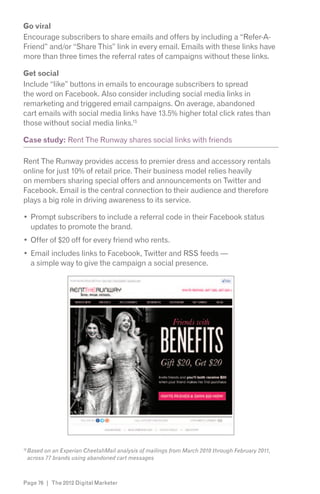
vacation, and they are more likely than average to travel by car (even when
traveling outside the United States). On a typical trip, activities like going to
the beach, outdoor activities and gambling are especially popular among
the Blue Collar Comfort set. The travel Websites that they visit often include
casinos and amusement parks like Mohegan Sun in Montville, Connecticut;
MotorCity in Detroit, Michigan; and Cedar Point in Sandusky, Ohio; as well
as destinations like Las Vegas, the Gulf Coast and the Grand Canyon.

Politically, three-quarters of this all-American group are registered to vote,
and they are more likely than average to hold middle-of-the-road views. Blue
Collar Comfort is slightly more likely to be registered as an Independent,
but even more likely to be a registered Democrat, which makes sense given
that they are more likely than average to belong to a union.
s*


                                     An Experian benchmark and trend report | Page 31
INTELLIGENCE
Innovation through insight


                             Innovation through insight
                                                          INTELLIGENCE
Intelligence: innovation through insight


  Key findings
    Measure the entire series of events that drove the customer to
    purchase, not just the last touch.
    Response attribution was one of the biggest challenges for 34% of
    marketers last year. Even more marketers, 38%, were challenged by
    integrated campaign management.
    Available data and scalable computing power to handle extremely
    large data sets will be an area for innovation over the next two years.
    In this election year it appears that 74% of voters are up for grabs.


Analytics and insights
Though a master customer database delivers a single view of the customer,
the database itself does not solve any marketing needs such as better
audience segmentation or more targeted messaging. These optimization
problems require insights derived through analytics. Marketers often
get started by simply gaining greater visibility and access to aggregate
customer data through static reporting, dynamic dashboards and tools that
allow “what if” analysis on the fly.

As marketers’ sophistication increases, they can implement increasingly
advanced analytic tools based on statistical models like:

  Multi-channel response models — Leverage past campaign responders
  in model development to predict likelihood to respond by channel.
  Enables appropriate allocation of mail/email circulation to cut costs and
  boosts campaign response and revenue 20-40%.
  Product affinity models — Next-best-product models predict the best
  product to offer. Replenishment models rank the likelihood to replenish
  consumable products.
  Delta models — Predict the incremental effect of a marketing
  promotion and identify target audiences who are likely to respond only
  when promoted to.

All three types of tools can be integrated to drive increased response,
reduce promotional markdowns and enhance customer engagement.


                                    An Experian benchmark and trend report | Page 33
Tip: Know as much as possible about customers at the individual (personally
identifiable) or segment level. Analytics and actionable insights can be driven
by things like:


Programs, performance and measurement
While ROI can be calculated at many points, where it has the most upside
or strategic application is at the program level. Not all marketers apply
the word “program” the same way. Here, what is meant is the overarching
customer strategy that will span multiple campaigns, channels, creative,
offers, versions, drops and flights over a set period of time. It’s about setting
a vision for where to go with customer relationships and measuring each
activity’s contribution toward that goal. Marketers must attribute response
by channel, which is a huge challenge, but essential to both motivate and
guide marketing innovation.

What differentiates performance and measurement from analytics and
insights is the targeted output. The techniques, approaches and inputs
between the two are the same. As shown in the table on page 35, this
may be the one place in the whole conversation where it’s appropriate to
highlight non-customer-centric metrics. Best practices would dictate that
there should certainly be some customer-orientated items (e.g., lifetime
value, voice of customer, etc.), but the metrics also have to help evaluate the
effectiveness of a specific campaign.


Page 34 | The 2012 Digital Marketer
Performance and measurement metrics by channel

                          Exposure
    Channel                                      Engagement metrics        Outcome metrics
                          metrics
                                                                           Conversions, cost
    Display advertising   CPM                    Clicks, cost per click
                                                                           per conversion
                                                                           Conversions, cost
    Paid search           CPM                    Clicks, cost per click
                                                                           per conversion
                          Paid media
                                                 Interactions, viral
    Social activation     equivalent cost,
                                                 spread, buzz
                          reach
                                                 Clicks, interactions,
                                                                           Conversions, cost
    Site-side content                            time spent, cost per
                                                                           per conversion
                                                 interaction
                                                 Open rate, click
                                                                           Conversions, cost
    Email                                        response rate, cost per
                                                                           per conversion
                                                 open, cost per response

Response attribution
One of the biggest challenges facing marketers in today’s complex
multi-channel world is determining which marketing programs are
generating the biggest returns and which initiatives are not performing.
Not surprisingly, 34% of marketers chose this as one of their top three
biggest marketing challenges last year.9 Being successful requires a
holistic and integrated approach to response attribution — one that is
based on a sound strategy and effective execution based on the company’s
level of marketing sophistication.

Developing a strategy
Marketers need to think of three key things when contemplating response
attribution and cross-channel marketing analysis:

1. Measure the ecosystem, not the event. Today’s complex marketing
   environment means that by nature, a customer or a prospect receives
   multiple marketing touches during the purchase cycle. Attributing 100%
   of a response, or a purchase, to a single event does not tell the whole
   story. Measure the entire series of events that drove that customer to
   purchase, not just the last touch.
2. Execute holdout tests. In order to truly understand the impact of
   withholding a marketing channel, marketers need to measure the lift that
   the channel provides to the marketing ecosystem. Do hold-outs and
   control groups consistently to make a properly informed decision.
3. Don’t listen to the pundits. Every company’s data is unique. There are
   tons of technorati, digerati and social media elite that depict a particular
   marketing channel as dead or dying and being replaced by another. That

9
    Experian Marketing Services study, October 2011


                                               An Experian benchmark and trend report | Page 35
statement is only true if the data says it is true. Listen to the customer
  and how he or she interacts with your brand, and then make an
  informed decision.

Data-driven marketers need to think about the business as a marketing
ecosystem. Removing one component of a marketing/communications
plan can have disastrous consequences for other parts of the business.
It is time to start thinking about the entirety of the brand and not silo any
channel without the appropriate intelligence. The year 2012 will be the year
where marketers can apply the right tools to coordinate their messaging
and optimize cross-channel customer engagement and interaction. After all,
customers are demanding it.

Tip: To understand the impact of multi-channel marketing programs, start by
asking these critical questions:

  What is the contribution of each channel in a multi-channel
  marketing environment?


  satisfy customer demands?


Executing the plan
The appropriate methodology depends on a company’s level of marketing
maturity and the capabilities in place to capitalize on learnings and insights.
Essentially, there are four increasingly sophisticated approaches that allow
marketers to focus on actionable measurement for either a single channel
or across multiple channels. In all cases, the objective is to truly understand
return on investment in order to enhance future marketing efforts.

  Direct single attribution accurately identifies relationships between a
  promotional or delivery channel and response using a direct key match to
  attribute a response to the promotion.
  Inferred single attribution uses complex matching logic to quantify
  which campaigns are driving the highest returns on response and sales
  within the marketing channel.
  Fractional allocation delivers a concise view of cross-channel marketing
  efforts using a flexible algorithm to attribute measurable and actionable
  results for a true view of the marketing ecosystem.
  Touch point attribution offers a modeled approach using a
  multidimensional analysis to determine appropriate contribution
  with a focus on incremental impact of each touch-point.


Page 36 | The 2012 Digital Marketer
Regardless of the path pursued, ultimately the goal is to deliver one point
of truth, one common language to accurately and effectively measure the
marketing program effectiveness.


Tip: During campaigns, always ask things like: Which channel was most
effective? Which creative version worked best? Which campaign drove the
highest response rates? Where did I have the best cost per acquisition?


Campaign management
Integrated campaign management was the second most noted challenge
for marketers who participated in a recent Experian Marketing Services
survey — 38% of respondents were challenged by it last year. Where
program management is about creating the overall battle plans, campaign
management is about loading, aiming and firing the guns. What seems
to be a point of confusion for many marketers, however, is that the term
“campaign” can mean different things depending on the marketer’s
focus. For example, a traditional circulation marketer would define it as
the segmentation and coding of a distribution list, while an online display
marketer would consider it to be the varying flights of creative that are
deployed to the preselected publisher sites. As the walls between channels
continue to erode and eventually crumble, marketers will certainly come to
find a commonality in the term.

Another way to view campaigns is a visual workflow that depicts the
various stages, treatments or flights of messages in their relative order.
More sophisticated tools allow for branching decisions whereby different
audiences receive a different message based on scoring, firmographic,
behavioral response or other segmentation scheme. Another aspect some
of the tools support is the ability to respond to customers. As opposed to
marketing to a pre-established list, in triggered campaigns, customers self-
select into the campaign by an action, like completing a Web registration or
redeeming a coupon at a POS, at which point they receive a message or a
series of messages in response.


Tip: Think holistically. Do marketing programs feel pieced together? Review
this year’s marketing programs to determine how to improve future digital
advertising spend. Plan campaigns and structure them around the anchors
of digital marketing — display, search, email, television and social media — to
build a solid communication platform.


                                     An Experian benchmark and trend report | Page 37
Personalization and recommendations
As marketers get more plugged into the concepts of the New American
Consumer, lifestyle marketing and the power of content customization, the
area of personalization and recommendation will continue to mature. It
is important to understand that targeting and relevancy are not the same
thing. With targeting, it’s easy enough to say a certain group of people
(say, New England Patriots fans) should be included in a campaign, but
which item to promote (from the Tom Brady game jersey to a Belichick
hoodie) could be tied to past purchase history.

The opportunity here, however, isn’t just about product recommendations.
This approach can be easily applied to an email subject line, a salutation
on a mailed piece, a display media placement or virtually any other form of
communication. Something that has held this area back is its dependency
on data and analytics. Folks started dabbling with algorithmic black boxes
in the late 1990s, but they were largely unsuccessful because they suffered
from a lack of data or the scalable computing power to handle extremely
large data sets. Today, these are two problems that have been solved.
Over the next two years, look to this area as a key point of innovation. The
masses are clamoring for relevant communications, and technology will be
central to delivering it.


Tip: Personalization is the behavior of a service changing based on personal
information. Here are three rules for “good behaviors” that will banish those
eerie feelings of being followed:
  Relationships — Personalization doesn’t work well with strangers.
  However, if a site or a service establishes a relationship in the form of
  registration or an opt-in, then it is perceived positively.
  Transparency — Make it clear why the customer is seeing the specific
  action or recommendation. Don’t be mysterious.

  Maybe things have changed, or maybe someone else last used their
  computer or maybe they are buying for someone else. If personalization
  is done right, more people will be willing to take off the mask of
  anonymity and share a bit of themselves in order to get a more relevant,
  valuable online experience.


Page 38 | The 2012 Digital Marketer
Case study: European finance house improves customer
       profit with marketing optimization

Experian® worked recently with a well-established European finance house
that offers a range of customer services through subsidiaries and direct
marketing. With multiple channels, millions of customers and numerous
products, the organization was struggling to manage the complexity of
its marketing campaigns. Management also wanted to ensure they could
process and deploy new marketing strategies within a strict monthly
operational schedule while focusing heavily on revenue growth.

Experian’s Marketswitch Optimization®, which uses mathematical
techniques to deliver objective decisioning strategies, was deployed to
solve these multiple challenges. The team used Marketswitch Optimization
to consider the company’s business objectives, customer usage, values,
propensities and range of eligible offers, as well as operational constraints
and budgets, to determine the right course.

The final solution enabled the company to maximize return from direct-
marketing activities, increase the effectiveness and sophistication of its
overall campaign planning, and at the same time make more relevant offers
to its customers through many channels.

Marketswitch Optimization is designed for “business users” and requires no
advanced mathematical expertise. It enabled the finance house’s customer
relationship management (CRM) team to create and evaluate different
optimized scenarios before committing resources and budgets. The new
tools and strategies helped the company to:

  Achieve a 23% improvement in customer profit through a combination of:
  – Increased effectiveness and efficiency of activities
  – More appropriate offers to customers
  Enhance key performance indicators (KPI) transparency and increase
  value-added customer offers
  Change optimized strategies on a monthly basis, with a streamlined
  operational deployment
  Implement campaigns with confidence after gaining an in-depth
  understanding of the impact of changing activities through swap
  set analysis
  Rapidly and flexibly develop new scenarios to react to changes in
  business objectives and product stakeholders’ requirements
By optimizing strategies across all channels, the business now ensures
that each and every customer consistently receives the most relevant and
appropriate offer.


                                    An Experian benchmark and trend report | Page 39
Customer intelligence for the election year
The 2012 election campaigns are in full swing, and in this hyper-political
era, marketers need data to make informed decisions. Customer
segmentation systems, like PoliticalPersonasSM from Experian® Simmons®,
help politicians, media owners, advertisers and agencies prepare for the
season ahead by delivering a detailed understanding of key voter segments,
including in-depth demographics, responsiveness to various media
platforms, and attitudes and opinions on important political issues and
social trends.

Seventy-four percent of voters up for grabs?
Experian Simmons classifies registered voters into eight distinct segments
accounting for 75% of all U.S. adults. Non-registered voters are segmented
into two distinct segments and account for 25% of all adults. Registered
Republican voters are divided into three segments with Ultra Conservatives
representing the 13% of all adults who are the most reliably Republican.
Registered Democrats are also split between three segments with Super
Democrats representing the 13% of adults who are the most reliably
Democrat. Green Traditionals and On the Fence Liberals are registered as
Independents, but most voter segments aside from Ultra Conservatives and
Super Democrats show signs that they could switch sides or, if unengaged,
stay home on Election Day.

                           Percent of U.S. adults classified into each
                                 PoliticalPersonas segment

 PoliticalPersonas segment                       Percent
 Super Democrats                                 13%
 Left Out Democrats                              7%
 Conservative Democrats                          12%
 On the Fence Liberals                           12%
 Green Traditionals                              6%
 Mild Republicans                                7%
 Uninvolved Conservatives                        5%
 Ultra Conservatives                             13%
 Unconnected & Unregistered                      17%
 Informed but Unregistered                       8%

Source: Experian Simmons


Page 40 | The 2012 Digital Marketer
Understanding the mindset of the American voter
Political customer segmentations provide marketers with the ability to
understand who the voting population is in a very precise manner. The
segments go beyond merely identifying voters as Republican, Democrat
or Independent, but rather look at the subsets of each of these groups. The
profiles below include an understanding of the hot-button issues for the
voting public, nonpolitical motivations and brands used at above-average
rates by the segment, providing a more complete understanding of their
lifestyle to enable better targeted communication and messaging.

                             PoliticalPersonas segment profiles

 Super Democrats — 17% of registered voters; 40% of registered Democrats
 Demographics                                     Political outlook
 Even male female
 Above average White and Black                    Somewhat or very liberal, Super Democrats
                                                  have far left leaning positions on a variety
 College graduate or more                         of topics, including the environment,
 Employed                                         healthcare, international, education and
 Average age: 46                                  the economy. They also hold very liberal
                                                  positions on social issues such as abortion
 Average HHI: $98,000                             and legalization of drugs.
 Percent with kids in home: 34%
 Over-indexing brands by PoliticalPersonas segment
 Drink Pellegrino-brand sparkling water (Index: 208)
 Shop at Trader Joe’s supermarket (194)
 Stay at Courtyard by Marriott hotels (180)
 Use Amazon Kindle eBook (179)
 Own a Mac (Apple)-brand computer (178)
Source: Experian Simmons


                                              An Experian benchmark and trend report | Page 41
Left Out Democrats — 9% of registered voters; 22% of registered Democrats
 Demographics                                   Political outlook
 Even male female
                                                Left Out Democrats consider themselves
 Above average White, Black and Hispanic        “middle of the road” to “very liberal.” They
 Some college                                   are not very engaged or opinionated on
                                                the majority of political and social issues
 Not married/Employed
                                                and have a jaded view towards things like
 Average age: 44                                education, economy and healthcare. While
 Average HHI: $69,000                           this group skews Hispanic, they prefer
                                                communication in English.
 Percent with kids in home: 41%
 Over-indexing brands by PoliticalPersonas segment
 Eat Hungry Jack-brand frozen waffles (203)
 Shop at Finish Line store (182)
 Eat Perdue-brand frozen fried chicken (174)
 Use Children’s Tylenol Cold remedy (173)
 Own Sony PSP video game system (154)
Source: Experian Simmons


 Conservative Democrats — 16% of registered voters; 38% of registered Democrats
 Demographics                                   Political outlook
 Female skew
                                                These well-informed adults are likely to be
 Above average White, Black and Hispanic        “middle of the road” or somewhat liberal.
 Some college                                   Conservative Democrats have liberal views
                                                towards immigration and the environment,
 Many are retired and not married
                                                but stray from traditional Democrat party
 Average age: 54                                lines on issues such as abortion. They are
 Average HHI: $60,000                           more pro-life. Religion plays an important
                                                role in their lives.
 Percent with kids in home: 30%
 Over-indexing brands by PoliticalPersonas segment
 Take Centrum Women’s-brand vitamins (193)
 Drink Crush-brand regular carbonated beverage (159)
 Use Gillette Daisy-brand disposable razors (157)
 Eat Heinz-brand gravy and sauce mixes (149)
 Wear Lee-brand jeans (142)
Source: Experian Simmons


Page 42 | The 2012 Digital Marketer
Uninvolved Conservatives — 6% of registered voters; 18% of registered Republicans
 Demographics                                    Political outlook
 Male skew
 Largely White with Asian skew                   Uninvolved Conservatives are not
 Some college                                    particularly engaged in their communities or
                                                 key political topics such as the environment,
 Employed
                                                 education or healthcare. They do espouse
 Average age: 44                                 right-leaning attitudes when it comes to
 Average HHI: $92,000                            international issues and finances though.

 Percent with kids in home: 42%
 Over-indexing brands by PoliticalPersonas segment
 Own Stihl-brand garden equipment (208)
 Own Rigid-brand workshop equipment (203)
 Own JVC-brand camcorder (160)
 Own a Blackberry-brand mobile phone (151)
 Eat Bagel Bites-brand frozen snacks (151)
Source: Experian Simmons


 Mild Republicans — 1% of registered voters; 3% of registered Republicans
 Demographics                                    Political outlook
 Male skew
 Largely White                                   Consider themselves somewhat
                                                 conservative. On the fence when it comes
 College graduate or more                        to issues like healthcare, the environment
 Employed                                        and religion. More conservative on social
 Average age: 47                                 security, international and education, but
                                                 more liberal towards abortion rights and the
 Average HHI: $110,000                           legalization of marijuana.
 Percent with kids in home: 35%
 Over-indexing brands by PoliticalPersonas segment
 Send money via PayPal (Index: 237)
 Eat Stagg-brand chili (212)
 Have U.S.A.A. auto insurance policy (205)
 Use Philips Sonicare toothbrush (195)
 Eat Tillamook-brand natural cheese (194)
Source: Experian Simmons


                                             An Experian benchmark and trend report | Page 43
Ultra Conservatives — 17% of registered voters; 52% of registered Republicans
 Demographics                                  Political outlook
 Female skew
                                               Ultra Conservatives are well-informed,
 Largely White                                 community-minded voters with strong
 College graduate or more                      opinions and views that reflect their
                                               conservative outlook. They have traditional
 Many are retired
                                               to conservative views on key issues of
 Average age: 53                               employment, immigration, healthcare
 Average HHI: $83,000                          and the environment, and even more
                                               conservative on social issues.
 Percent with kids in home: 35%
 Over-indexing brands by PoliticalPersonas segment
 Drive Buick-make automobile (175)
 Have a mutual fund with Fidelity Investments (155)
 Shop at Michaels stores (153)
 Eat Marzetti’s-brand salad dressing (151)
 Shop at Hallmark stores (149)
Source: Experian Simmons


 On The Fence Liberals — 16% of registered voters; 65% of registered Independents
 Demographics                                  Political outlook
 Male skew
                                               On the Fence Liberals have a “middle-of-
 Largely White                                 the-road” to liberal outlook. While they
 College graduate or more                      don’t have very strong feelings on most key
                                               political issues, they do have left-leaning
 Employed
                                               attitudes on issues such as abortion.
 Average age: 43                               They are on the fence when it comes to
 Average HHI: $89,000                          healthcare, the economy, education and
                                               international.
 Percent with kids in home: 40%
 Over-indexing brands by PoliticalPersonas segment
 Eat Cabot-brand natural cheese (Index: 171)
 Drive a Jeep-make vehicle (159)
 Shop at Citgo Quick Mart convenience store (157)
 Use Tidy Cat-brand kitty litter (149)
 Eat Ben & Jerry’s-brand ice cream (148)
Source: Experian Simmons


Page 44 | The 2012 Digital Marketer
Green Traditionalists — 8% of registered voters; 35% of registered Independents
 Demographics                                   Political outlook
 Even male female
 Largely White                                  Green Traditionals lean to the political right.
                                                Their attitudes towards abortion, social
 College graduate or more                       security, healthcare and religions all skew
 Above average unemployed and retired           conservative. The environment is a key issue
 Average age: 49                                for this group as they are active participants
                                                in recycling programs and are concerned
 Average HHI: $79,000                           about pollution.
 Percent with kids in home: 36%
 Over-indexing brands by PoliticalPersonas segment
 Eat Polaner All Fruit-brand jam (163)
 Shop at Jo-Ann fabric and craft stores (161)
 Shop at Pier 1 Imports (154)
 Stay at Holiday Inn Express hotels (154)
 Own TomTom-brand GPS (151)
Source: Experian Simmons


 Unconnected and Unregistered — 69% of unregistered voters
 Demographics                                   Political outlook
 Male skew
                                                Being as unconnected as they are, this
 Diverse, above average Hispanic                segment has no identifiable political slant.
 High school or less                            In fact, they have no strong feelings towards
                                                the environment, healthcare or social
 Employed or students
                                                security, though they do lean left on issues
 Average age: 40                                like abortion and marijuana legalization.
 Average HHI: $70,000                           They skew more Hispanic than any
                                                segment.
 Percent with kids in home: 36%
 Over-indexing brands by PoliticalPersonas segment
 Drink Rockstar-brand energy drinks (Index: 196)
 Use Axe-brand deodorant (158)
 Smoke Marlboro-brand cigarettes (151)
 Own Xbox video console (148)
 Eat Goya-brand packaged or canned foods (125)
Source: Experian Simmons


                                            An Experian benchmark and trend report | Page 45
informed but Unregistered — 31% of unregistered voters
 Demographics                                     Political outlook
 Female skew
                                                  While not registered to vote, this segment’s
 Diverse, above average Hispanic                  members have very strong opinions
 Some college                                     that tend to lean more conservative,
                                                  especially when it comes to abortion and
 Unemployed or homemaker
                                                  legalization of marijuana. Well-informed
 Average age: 46                                  and aware of the issues, they are engaged
 Average HHI: $61,000                             in their communities and strive for a better
                                                  environment.
 Percent with kids in home: 46%
 Over-indexing brands by PoliticalPersonas segment
 Eat Goya-brand packaged or canned foods (217)
 Wear Puma-brand sneakers (205)
 Use Aveeno-brand bar soap (182)
 Use S.O.S.-brand oven cleaning pads (173)
 Eat Frito-Lay-brand snack dip (129)
Source: Experian Simmons


Reach core constituents and swing voters via their favorite
television programs
An analysis of nearly 1,000 television programs* reveals those with the
highest concentrations of viewers from the left, the right and the middle of
the political spectrum for optimal targeting.

                   Top 10 indexing television programs by political outlook

                                       Outlook: Conservative
 Rank          Program                                                   Index
 1             Hallmark Channel: Hallmark Movie                          120
 2             Discovery: Swamp Loggers                                  119
 3             TV Land: The Andy Griffith Show                           118
 4             History: Swamp People                                     117
 5             Syndication: Cops                                         115
 6             Discovery: Man vs. Wild                                   113
 7             Syndication: Wheel of Fortune                             113
 8             CBS: Blue Bloods                                          112
 9             CBS: The Mentalist                                        112
 10            History: Ice Road Truckers                                111

Source: Experian Simmons

* Analysis included cable, network and syndicated programs. Rankings exclude news and
  music programs.


Page 46 | The 2012 Digital Marketer
Outlook: Liberal
 Rank         Program                                                  Index
 1            Comedy Central: The Daily Show                           212
 2            Comedy Central: The Colbert Report                       201
 3            Fox: Glee                                                164
 4            E!: The Soup                                             155
 5            ABC: Modern Family                                       153
 6            NBC: The Office                                          147
 7            CBS: Late Show with David Letterman                      142
 8            Comedy Central: Tosh.O                                   142
 9            NBC: Saturday Night Live                                 141
 10           Travel Channel: Anthony Bourdain: No Reservations        141

Source: Experian Simmons


                                Outlook: Middle of the road
 Rank         Program                                                  Index
 1            In Syndication: Family Guy                               126
 2            Fox: Family Guy                                          120
 3            In Syndication: Two & a Half Men                         119
 4            TLC: Cake Boss                                           117
 5            Syndication: How I Met Your Mother                       115
 6            HGTV: My First Place                                     115
 7            Adult Swim: King of the Hill                             114
 8            HGTV: Holmes on Homes                                    114
 9            A&E: Dog the Bounty Hunter                               114
 10           Spike: 1,000 Ways to Die                                 114

Source: Experian Simmons


                                             An Experian benchmark and trend report | Page 47
Social media reaches many voter segments, but not all
The skyrocketing growth of social media sites like Facebook and
Twitter over the span of just a few election cycles has had political
marketers scrambling to find the best way to harness the power of the
medium to win votes. Super Democrats and their Republican counterpart
Ultra Conservatives are both engaged in social media at above-average
rates, making them ideal targets — and amplifiers — of campaign talking
points. Swing voter segments, like Conservative Democrats and Mild
Republicans, are less universally involved with social media, highlighting
the need to understand specific ways that these segments connect and
engage with social.


                   Likelihood of PoliticalPersonas segments to engage in/
                             espouse select activities/attitudes*

                                               Agree: “I pay       Agree: “Social
                                               attention to        sharing sites      Read/
                      Twitter    Facebook
                                               ratings/reviews     are a way          write
                      last 30    last 30
                                               posted on           for me to tell     blogs last
                      days       days
                                               social sharing      people about       30 days
                                               sites”              products I like”
 Super Democrats
 Left Out
 Democrats
 Conservative
 Democrats
 On the Fence
 Liberals
 Green
 Traditionalists
 Mild Republicans
 Uninvolved
 Conservatives
 Ultra
 Conservatives
 Unconnected and
 Unregistered
 Informed but
 Unregistered

Source: Experian Simmons

*A check mark indicates the voter segment is more likely than the average American adult to engage
 in the behavior or agree with the indicated statement


Page 48 | The 2012 Digital Marketer
INTERACTION
Empower meaningful connections


                                 Empower meaningful connections
                                                                  INTERACTION
Interaction: empower meaningful connections


      Key findings
        Two-way interactions are critical opportunities for brands to
        actively engage customers in conversations while delivering rich,
        relevant experiences.
        Ninety-four percent of marketers are at least talking about mobile
        marketing and social media within their companies, if not already
        testing the waters or ahead of the pack.
        Marketers plan to increase their efforts in digital channels this year:
        email (61%), social advertising (53%), and mobile app (47%).


Every brand aspires to create meaningful relationships with prospects and
customers. In the past, much of the relationship was shaped by the brand’s
one-way communication, but now more than ever it comes from two-way
experiences and conversations.

In addition, customers experience the brand through in-store interactions,
dialog, conversation, services, use and peer-to-peer social interactions. The
two-way interactions are critical opportunities for brands to actively engage
in the conversation and deliver rich, relevant experiences. If the touch-points
are inconsistent, customers feel confused or dissatisfied. The difficulty for
marketers is speaking in the same voice across very different channels.

Customers want to know whether to trust a brand, which depends on
whether the brand behaves like a friend or like a stranger. Does the
customer have to re-enter personal information each time they encounter
the brand? Does the brand remember preferences from the last time the
customer said they were not interested?

To develop a meaningful relationship, marketers need to examine their
approach and continue to test and refine the right combination of
channels — including traditional and digital.

The good news is that the majority of marketers not only recognize this
need, but also are working to meet it. Only 6% of marketers have neither
mobile nor social marketing on their radar. That means that 94% are
exploring, testing or actively implementing these types of campaigns.
Fifteen percent rated their company ahead of the pack with mobile
marketing, and 23% with social media. About half were testing the waters,
46% with mobile marketing and 55% with social media.10

10
     Experian Marketing Services study, October 2011


                                                An Experian benchmark and trend report | Page 49
Adoption of mobile and social media marketing

          60%
                                            55%

          50%
                                      46%

          40%

                                                  31%
          30%
                        23%                              24%

          20%
                  15%                                          14%        15%

          10%                 8%                                     7%          8%
                                                                                      6%

            0%                                           ou to


                                                                             ra on
                                       at g
                     ck f
                   pa o


                                      w in
                                            s


                                                              t


                                                                                 r
                                                       ab ing
                 e d


                                                                            e t
                                                           ti


                                                                               da
                                         er
                                     e st


                                                                          th No
               th hea


                                   th Te


                                                     lk rt
                                                   ta Sta
                 A


                              Mobile marketing          Social media      Both


Source: Experian Marketing Services


Further, 61% of marketers reported that they will pilot or increase their email
efforts this year, as well as 53% and 47% who will pilot or increase social
advertising and mobile app efforts respectively. It’s the perfect time for
these marketers to set up successful programs that will connect with their
customers in a meaningful way.


Page 50 | The 2012 Digital Marketer
Digital marketing tactics marketers plan
                                      to pilot or increase in 2012
                70%
                                                                            61%

                56%                                                  53%
                                                              47%

                42%                                    40%
                                                37%


                28%                25%   26%


                14%
                         9%


                 0%
                          g


                                                          g

                                                        ng


                                                          g


                                                          g


                                                          p

                                                         ng


                                                                               l
                                                                            ai
                        in


                                                      tin


                                                       in


                                                      tin


                                                      ap
                                                     si


                                                      si

                                                                           Em
                    am


                                                    et
                                                  ke


                                                  ke
                                                 rti


                                                  rti
                                                 ile
                                                rg
                                               ar


                                               ar
                    g


                                               ve


                                               ve
                                              ob
                                              ta
                 al


                         m


                                             m
                                            ad


                                            ad
                                            M
                                            y
               ci


                        xt


                                          la


                                         ch
                                  y


                                         al
             So


                                       sp
                      te


                                la


                                      ar


                                      ci
                              sp


                                    di
                    S


                                   se


                                   So
                 SM


                             di


                                 al


                                id
                              or
                         ile


                             Pa
                                  vi
                        ob

                               ha
                    m

                              Be


Source: Experian Marketing Services


s

Commitment to customer interaction management remains strong.
An overwhelming 82% of CI professionals prioritize customer experience
improvements and plan to expand the technology suite accordingly.
As a result, more than 20% of respondents plan to invest in technologies
that will help them improve and optimize customer interaction like customer
experience management, contact optimization and inbound interaction
management tools.


s


                                               An Experian benchmark and trend report | Page 51
EMAIL
EMAIL
A digital marketer’s foundation
Email: a marketer’s foundation


  Key findings
    “Peak Week,” the Tuesday before Thanksgiving Day through Cyber
    Monday, revealed increased email transactional activity, proving
    productive for many marketers.
    Dollar ($) offers were the most popular last holiday season (seen in
    29% of subject lines, sneaking past last year’s leader of percent (%)
    off campaigns (seen in 28% of subject lines).
    Fifty-two percent of organizations say email address is the most
    utilized piece of contact data.
    For brands that have email acquisition at the POS, 15 to 25% of their
    subscriber list is captured in-store.
    Subscribers respond well to words that make them feel special.
    Including the word “exclusive” in the subject line boosts unique open
    rates by 14% in promotional mailings.
    Revenue per email averages two times higher for ‘Friends and
    Family’ campaigns.


      Biggest email marketing trends from 2011

Although email has been a staple in digital marketers’ toolkits for some
time now, 2011 was the year that people really took notice of its value within
the digital ecosystem. After all, email is the center for all other channels and
devices, connecting the lines of communication between customers and
brands, and the social, mobile and Web outlets through which they interact.
As a result, it continues to grow in usage and effectiveness, while driving
more revenue and engagement for the brands that use it effectively.


                                     An Experian benchmark and trend report | Page 53
2010 to 2011 YOY volume graph

              35%
                                                   30.3%
              30%
                                      25.4%
              25%
                        22.5%
              20%

              15%                                              12.9%
              10%

                5%

                0%
                          Q1           Q2           Q3          Q4

2011 holiday snapshot
Email marketers were extremely active all year. Overall email volume went
up each quarter, and in the holiday season rose 13%.

The 2011 holiday season had many marketers focusing on the critical week
leading up to Black Friday and Cyber Monday — “Peak Week.” Extending
marketing activities to encompass more days during Peak Week has proved
productive for many marketers, as the Tuesday before Thanksgiving Day
through Cyber Monday revealed increased email transactional activity.


Page 54 | The 2012 Digital Marketer
Peak week YOY volume was up 30%
                                 and transactions rose 20%

        80%

        70%
                                  61%
        60%

        50%                                                At three days from send

        40%                                             37%
              32%                    32% 31%
                                                     29%                           30%
        30%                                                               26%
                                                              25%            23%
                 22%
                                                                                     20%
        20%            16%                                        15%

        10%                  9%
                                                5%
         0%
                        ng


                                                               to eek
                          y


                         ay


                                                                     y
                        ay


                                                                   ay
                       ay
                      da


                                                                  da


                                                                   l
                     id
                      vi


                     rd


                                                                 ta
                                                                nd
                    sd


                                                                W
                   es


                                                               on
                   gi


                   Fr


                  tu
                 ne


                                                              Su
                Tu


                ks


                                                             ak
                                                              M
               Sa
                k
              ed


             ac
            an


                                                           Pe
                                                                  r
                                                                be
           W


           Bl
          Th


                                                              Cy


                                  Volume sent        Total transactions


Other trends from the 2011 holiday season include the following:

  Dollar ($) offers were the most popular in the 2011 holiday season (seen
  in 29% of subject lines), sneaking past the 2010 leader of percent-off
  campaigns (seen in 28% of subject lines).
  Personalization in subject lines increased (31% overall), particularly in the
  last half of the season.
  Deeper discounts were offered through email more frequently. The
  percentage of campaigns offering 50% off was up 30% compared with
  the same time period in 2010, and campaigns offering 10% and
  20% off decreased.
  Three times as many campaigns had the word “Facebook” in the subject
  line compared to 2010.
  Flash sales continued to increase in popularity, with 31% more campaigns
  in 2011 versus the year before.


Tip: If your goal is purely engagement, or re-engagement, shorter flash sales
can be more effective.


                                            An Experian benchmark and trend report | Page 55
Mailings on weekends made up 17% of the volume and provided 22% of
     the transactions and 21% of total revenue. This was similar to 2010.
     Looking at the top 25 keywords in email subject lines (see table below),
     discounts and offers in general were more popular in the 2011 holiday
     season than in the previous year.

                          Top 25 words used in email subject lines

                     Percent of       YOY %                      Percent of      YOY %
        Word                                         Word
                     subject lines    change                     subject lines   change
 1      you/your     18.7%            3.4%      14   today       4.3%            16.1%

 2      off          16.6%            5.2%      15   holiday     4.1%            -11.8%
 3      get          16.6%            5.2%      16   gift        4.1%            -2.4%
 4      % off        11.3%            18.1%     17   more        3.8%            -10.7%
 5      new          10.0%            0.0%      18   ends        3.1%            12.0%
 6      free         9.6%             -4.4%     19   last        3.0%            7.9%
 7      $            9.2%             -3.1%     20   offer       2.8%            -20.0%
 8      save         8.6%             -6.8%     21   20%         2.8%            -6.5%
 9      our          7.9%             -7.5%     22   50%         2.7%            30.6%
 10     ship         7.0%             -3.7%     23   exclusive   2.4%            -11.9%
 11     free shipping 4.9%            2.2%      24   order       2.2%            9.7%
 12     only         4.8%             -3.1%     25   30%         2.1%            NEW
 13     now          4.5%             3.8%


The prevalence of discounts and offers is evidenced through the year-over-
year growth (18%) on the use of “% off” in subject lines. The use of “50% off”
saw the biggest year-over-year growth, with a 30% increase. New to the top
25 subject line list in 2011 was “30%,” replacing the word “hot” from the 2010
holiday season. In addition, 16 of the top 25 subject lines included words
that relate to offers or urged action by the subscriber, such as “today,”
“only” and “now.”

Experian CheetahMail
also mailed in the 2010 holiday season. All metrics are based on results three
days from send.


Page 56 | The 2012 Digital Marketer
Using email segmentation to reach the New American Consumer
The New American Consumer lives, behaves, communicates and interacts
with brands, and the emails brands send them, much differently and
discerningly than ever before.

What does this mean for email marketers in 2012? There needs to be a focus
on relevancy and engagement. To do this, analytics and structured testing
are the key to enabling a focus on segmentation — deep, strategic and well-
planned segmentation.

The great news for email marketers is that with time comes data. The
challenge at hand is figuring out what to do with this data, particularly from
a segmentation standpoint. In 2012, there are four major ways to approach
making the most of the data to communicate with customers based on their
unique wants and needs:

  Email behaviors — Has this person opened my emails in the last 60
  days? If so, for how long? And on what device? Which communications
  are most engaging, and how do I maintain this engagement?
  Transactions — On what day of week does my company experience the
  highest email transaction rates? Have any offline/in-store transactions
  been made as a result of my email marketing? Which types of offers/
  messages drive the most transactions?
  Web analytics — How many times has someone clicked on my emails
  before they actually purchased? Are there items left in their shopping
  carts about which I should remind them? Have they browsed but not
  purchased and can I re-engage them? Which types of emails drive higher
  click-throughs and engagement on my site?
  Social media information — What brands does this customer “like” on
  Facebook? Have they mentioned my company, or any of our products, on
  Twitter recently? What did they say? Which customers exert more social
  influence, and can I leverage them to promote my brand?


Tip: Marketers should include and consider customer behavior across all
digital platforms, from Web to mobile, when identifying audience segments and
crafting the content of their campaigns.


                                    An Experian benchmark and trend report | Page 57
What email marketers should focus on in 2012
As technology advances at a rapid pace and customers adapt, marketers
have so much to keep in mind. Considering that marketers are focused
more on cross-channel engagement, we have concentrated on highlighting
key benchmarks, trends and tips surrounding the three key areas:
connecting, engaging and empowering customers.

CONNECT
Making that initial connection through email first requires the acquisition
of customer information. Fortunately for marketers, there is a plethora of
ways to do this. In a 2011 study by Experian QAS, 60% of respondents stated
they use some form of email verification, and 52% of organizations say
email address is the most utilized piece of contact data.11 Top connecting
strategies for 2012 include:

Point of sale (POS) email acquisition
Online
  Allowing opt-in during the online checkout process is a popular
  acquisition tactic among retailers looking to increase subscriber list sizes.
     Including email sign-up on the company’s Facebook page can help amass
     a wealth of subscribers.


Tip: To mitigate deliverability and reputation challenges, Experian CheetahMail

will be opted into marketing communications and a confirmed opt-in message
should also be triggered in real time.


In-store email acquisition
  For brands that have email acquisition at the POS, 15 to 25% of their
  subscriber list is captured in-store. Marketers should consider all of the
  following tactics when acquiring email addresses in stores:
     – Mobile QR codes displayed on store signage — QR (quick response)
       codes can be a great tool directing users to a mobile-optimized
       acquisition form for grabbing new email subscribers on the go.
     – Text to subscribe/SMS program — Regular SMS campaigns allow
       customers to sign up to receive text alerts by phone. In addition to
       using QR codes, linking the first SMS communication back to a Web-
       based form for email collection can work wonders for acquisition. SMS
       subscribers can text in an email address as an additional method of
       capture as well.

11


Page 58 | The 2012 Digital Marketer
– iPad — Online forms optimized for iPads are a simple, innovative and
    attention-grabbing tactic for collecting email addresses.
  – Store receipts — Paper receipts are increasingly being used to provide
    instructions for email sign-up, as well as for completing surveys that
    collect email addresses. In the past year, many marketers have moved
    to skip paper altogether and offer customers email receipts that are
    immediately triggered following a transaction.
  – In-store kiosks — Similar to iPad forms, kiosks are fun and engaging
    tools for allowing customers to enter their information without even
    having to interact with a store associate.


Tip: If using kiosks, cash wrap terminals or iPads to collect email addresses,
consider incorporating real-time address validation or shortcut keys (such as
“@yahoo.com”) to minimize user entry error and ultimately mitigate
undeliverable addresses.


Bad email addresses (not syntactically correct, such as “@xyz.co” or
“yvettexyz.com”) account for more than 70% of undeliverable emails. In
2012, make it a top priority to collect as many real and interested subscriber
emails as you can, as accurately as you can, for better deliverability and as a
result, an extended marketing reach.


Tip:
welcome email minutes later, or at a minimum, a confirmation opt-in email that
same day. Thank and remind the subscriber of where they opted in, and request
that the subscriber confirm their subscription by taking a specific action in the
confirmation email.


                                     An Experian benchmark and trend report | Page 59
Case study: Kenneth Cole uses iPad forms for subscriber
acquisition on the go

Experian CheetahMail and Kenneth Cole, a leading multi-channel retailer
of fashion, footwear and handbags, launched an iPad form with the goal of
collecting more email subscribers at an upcoming event.


  CheetahMail set up an online form for the Kenneth Cole booth at the
  Lucky Shops Event.
  Foot traffic was asked to enter a drawing via an iPad to win a shopping
  spree at a Kenneth Cole store.
  Entries were also signed up to receive Kenneth Cole email.
  Eighty-seven percent of people who entered the sweeps signed up for
  email and 34% made purchases after the event.


Page 60 | The 2012 Digital Marketer
Increasing email reach via data overlay
Acquiring an email address is just a small, yet vital, step in making the
connection with new customers. Using data overlays, such as lifestyle
segmentation systems, on top of those email addresses can better ensure
that your message sticks. Here’s how:

  Profile the customer — Use segmentation systems, such as
  Experian’s Mosaic® USA Consumer Lifestyle Segmentation codes, to
  learn about the socioeconomic attributes, lifestyle characteristics and
  attitudes of your customers.
  Set goals — Identify the codes to acquire (top customers, engaged
  clients, brand ambassadors, people who share, those who opted in
  through the Facebook page, etc.).
  Think outside the inbox — Learn the Websites that customers visit
  to establish partnerships and implement co-marketing arrangements or
  tactics to drive Website traffic.
  Test — Use the segments to test email messaging, creative design and
  subject lines based on audience segments.


Tip: Focus on gathering more data through online polls and email creative that
have clear calls to action.


Optimizing subject lines
To make a connection through email, marketers must ensure their subject
lines are timely, compelling and relevant. Testing has shown that shorter
subject lines perform better, as they tend to stand apart visually from the
longer lines and are therefore more enticing to read.


                                    An Experian benchmark and trend report | Page 61
Promotional mailings: unique open rates by industry and
                                   subject line length


                                                                 16.7%
                                                             15.0%
         All industry                                      14.3%
                                                             15.1%

                                                             15.0%
 Business products                                          14.7%
      and services                                         14.2%
                                                                            20.1%

                                                 10.2%
                                                 10.2%
          Catalogers                           9.5%
                                               9.4%

                                                                   17.8%
Consumer products                                              16.0%
     and services                                           14.6%
                                                                16.2%

                                                             15.0%
         Media and                                        14.0%
      entertainment                                        14.1%
                                                           14.2%

                                                              15.9%
       Multi-channel                                     14.1%
             retailers                                  13.0%
                                                        13.2%

                                                                    17.1%
                                                                 15.9%
          Publishers                                             15.7%
                                                                 15.4%

                                                                                                 28.9%
                                                                     18.0%
                Travel                                                     20.8%
                                                                         19.6%

                         0          5         10           15           20            25         30
                                                   Unique open rates

                             <26 characters   26–50 characters     51–75 characters    76+ characters


On average, subject lines of fewer than 26 characters have the highest
unique open rates for all industries except Business Products and Services
for promotional emails.


Page 62 | The 2012 Digital Marketer
Tip: Consider implementing a structured subject line test plan to determine the
best way to speak to subscribers, understand what they are looking for, improve
open rates and subsequently improve the number of clicks and transactions
generated through email.


Keywords and phrases
Subscribers respond well to words that make them feel special. Including
the word “exclusive” in the subject line boosts unique open rates by
14% in promotional mailings (15.9% unique open rate with “exclusive”
and 14% without).

The phrases “top 10” or “top 5” are also popular. For example, “Top 10 looks
for fall” would garner more opens than “Open this email for ways to look
great this fall season.” People are also intrigued by subject lines that offer
a quiz-like challenge, such as “Do you know the top 5 vacation spots?” or
“The top 5 vacation spots are…” Subject lines with “top 10” or “top 5” have
unique open rates that are 13% higher than promotional mailings without
those phrases (16.1% with “top” and 14.3% without).

Experian CheetahMail analyzed the length and content of subject lines mailed

all industries.

ENGAGE
More than 80% of email marketers send the same content to all subscribers.
In 2012, marketers will try to change this — and segment more —
continuing to strive to reach the highest levels of customer engagement and
interaction. Once a connection with a customer is made, there are a number
of proven strategies for nurturing the relationship, driving conversions and
fostering conversations:

Email can play an important role in optimizing customer loyalty
Many loyalty-focused campaigns span the entire customer life cycle, from
the initial entry to program renewal notifications and reminder messages.
They also tend to perform better than standard promotional mailings in
terms of customer response and revenue.

Emails targeted to current loyalty program members have 40% higher open
rates; 22% higher click rates; and transaction rates and revenue per email
that are 29% and 11% higher.


                                    An Experian benchmark and trend report | Page 63
Loyalty mailings generate higher transaction
                                           rates and revenue per email

                     0.10%                                                                             $0.19
                                        0.09%

                     0.08%
                                                    $0.18                  0.07%                       $0.18
  Transaction rate


                     0.06%
                                                             $0.17
                                                                                                       $0.17
                     0.04%

                                                                                                       $0.16
                     0.02%


                     0.00%                                                                             $0.15
                                      Loyalty                      Non-loyalty
                                                               promotional mailings

                                                    Revenue per email


Different types of loyalty emails perform well
Listed below are nine mailing types that collectively provide a platform for
achieving high loyalty program results.

                             Loyalty mailings provide opportunities for outstanding
                                    transaction rates and revenue per email

1.6%                                                                                                      $8.00
                                                      1.4%                     Transaction rate
1.4%                                                                                                      $7.00
                                                                                Revenue per email

1.2%                                                                                                      $6.00

1.0%                                                 $6.81                                                $5.00
                                                                                    0.9%
                                            0.8%                                   $3.86
0.8%                                                          0.7%                                        $4.00
                                                                                                0.6%
0.6%                                                                                                      $3.00
                                    0.5%
                                                                        0.4%
0.4%                                                                                                      $2.00
                                    $1.26                    $1.82
                                            $1.60                       $1.62
0.2%                                                                                                      $1.00
                     0.1%   0.1%                                                             $0.80
                     $0.17 $0.11
0.0%                                                                                                      $0.00
                                        s


                                       ts


                                                                                  ey


                                                                                             e
                                in on


                                       al


                                         l
       io ty


                                 ri d


                                      ve
                                    ew


                                                                                           m
                                      r


                             ar war


                                    en
         ns


                                     w


                         St val
     ot yal


                                                                                 rv
                                   de
                             m ti


                                  -le


                                                                                           co
                                 ne
                          re p
                                  N


                                                                            Su
                               em
   om Lo


                               m


                              Re


                               us


                                                                                        el
                             Re
                            de


                                                                                       W
                            at


                            at
                         Re


                         St
 pr


Page 64 | The 2012 Digital Marketer
Redemption reminders
With average revenue per email of $1.26, redemption reminders are clearly
worthwhile ways to remind members to redeem their miles or points, keep
them informed of other offers and note other program benefits. Delta nicely
highlights the benefits of redemption and includes partner offers as part of
this email.


Tip: Account management emails do not need to be limited to text.
Including HTML offers in mailing types such as statements, renewals and
status changes can provide effective ways to increase brand awareness and
generate transactions.


Surveys
Loyalty members can be great resources for obtaining valuable customer
feedback on products and services, as well as opinions on new products
or proposed events. Surveys are second only to reward arrival mailings in
performance, with double the open rate, three times the click rate and nine
times the transaction rate of promotional loyalty mailings.


                                   An Experian benchmark and trend report | Page 65
Video in email
In 2014, video could account for more than 50% of all Internet traffic.12
Given the predicted channel growth and customer adoption, expect to
see much more video in email throughout the next year. After all, video
is an effective tool to help drive Website traffic, sell products and engage
email subscribers. Listed below are trends and tips for video in email from
Experian CheetahMail and partner in the video space, Liveclicker.

     Having the word “video” in the subject line drove open rates 7% to 13%
     higher when measured in A/B splits across the Liveclicker client base.
     Of the marketers sharing data with Liveclicker, video in email drove an
     average of 21% higher conversion rate (CVR) and 24% higher average
     order value (AOV) when measured against using only a static image in
     the email linked to a video on a campaign landing page.
     When A/B testing video in email versus static images, it is important
     to assess performance post-click, as click-through data on video within
     email messages is not technically recoverable.


Tip: Some great opportunities to create video content include customer
testimonials at trade shows, on-location events and even meetings with
co-workers.


Email optimization for mobile
Fifty-two percent of customers access email via their smartphones. Given
that this number is growing rapidly, and that most customers are no longer
willing to tolerate emails that do not display properly on mobile devices,
designing emails to be “smarter” for mobile can go a long way.

Audience
Some email analytics tools, like CheetahMobile, can help provide a report
summarizing mobile audience by device. This report can help marketers
begin to strategize on how to target and cater to these users.

Design
When designing for mobile, the most important factor to keep in mind is
how the standard email will view once it’s been reduced by half. Consider
the following mobile best practices:

     Simplify navigation and increase text size to boost the usability of the
     email on a mobile device.


12


Page 66 | The 2012 Digital Marketer
Use a single-column layout for easy scrolling.
     Be aware of size and positioning of all calls to action.

Device
Media Query (MQ) is one option to optimize emails for most modern mobile
operating systems. MQ is a cascading style sheet (CSS) code that outlines
specific parameters to either resize or hide certain areas of the email.
Designing with MQ in mind will enable use of one single template that is
optimized when viewed within mobile email applications as well as the Web
version viewed on a mobile device or tablet.


Tip: As an additional option for clients with existing mobile capabilities,
CheetahMobile can assist in launching location-based SMS programs to
provide additional targeting for loyalty programs, as well as more relevant offers
to subscribers.


Customer stories in email
Marketers know how powerful customer testimonials can be. More than
ever, customers are seeking out user reviews, ratings and social media
commentary to validate their actions. Consider incorporating the following
in email campaigns:

Social media posts
Use fan commentary from the Facebook page in the copy of emails to
support descriptions of products and services.

Ratings and reviews
Use these emails to continue a dialogue with customers and engage new
visitors. “Ratings and Reviews” mailings have two times the total open rates
and 39% higher click rates than promotional mailings.

Furthermore, “Ratings and Reviews” emails that dynamically show the
products to be reviewed have 13% higher click rates and double the
transaction rates and revenue per email when compared to not displaying
the content dynamically.13


13


                                        An Experian benchmark and trend report | Page 67
Including dynamic content can double the transaction
                                 rates and revenue per email
                               $0.29
            0.40%                                                          $.35

            0.35%                                                          $.30
            0.30%
                                                                           $.25
            0.25%
                                                                           $.20
                                                         $0.15
            0.20%              0.4%
                                                                           $.15
            0.15%
                                                                           $.10
            0.10%                                         0.2%

            0.05%                                                          $.05

            0.00%                                                          $.00
                      With dynamic products       No dynamic products

                           Transaction rates         Revenue per email


Market research
Use fan commentary and testimonials from surveys, polls or focus groups
within the message copy.


Tip: Personalize email content by using subscribers’ Facebook user names,
frequency of use, gender, hometown, etc.


Page 68 | The 2012 Digital Marketer
Case study: Horchow asks questions and “shares” the answers

Asking for preferences or feedback allows companies to tailor product
development and other company decisions for current and true customer
needs. Experian CheetahMail and Horchow are a perfect example of this
strategy, using social media feedback in email and creating a campaign
built around the all-powerful tactic every marketer aims to create:
word-of-mouth.

  Subject line: Facebook favorites: Our fans speak out
  Customer comments from Facebook are included in the email template
  Encourages email and social media interaction
  Twenty-six percent lift in open rate


Tip: Are your customers “fans” of your competitors? Leverage this knowledge
and insight to refine messaging in email or send a special promotion/offer to
this subset of customers.


                                    An Experian benchmark and trend report | Page 69
The next era of dynamic content: social, local and real time
What if email could be all three of the above? Companies such as Movable
Ink have the technology to make this possible. There is a new era of
dynamic content today, and some of the most progressive digital marketers
have already jumped on the bandwagon. Listed below are just some of the
value-adds this type of technology creates:

  Persuade using social proof, i.e., “Friends of yours have bought the
  same deal.”
  Use real-time elements like “time left in deal” to create a sense
  of urgency.
  Include coupons that dynamically “count down” to expiration when the
  email is opened — also creating a sense of urgency.
  Geo-target ads based on where a subscriber opens the email.

Engagement analytics
Who opens an email campaign? Did they use their iPhone or check Outlook
on their desktop? Did they print the in-store coupon? And furthermore,
someone opened your email, but did they actually read it? With recent
innovations in email marketing analytics (from providers such as Litmus),
this information is at a marketer’s fingertips.

Engagement for email analytics is based on the amount of time a
subscriber spends on an open email. The metrics below indicate that the
strongest engagement is on a desktop, followed by mobile devices, then
Webmail clients.

  Read — Seven-plus seconds spent on the email.
  Skimmed — Two to seven seconds spent on the email.
  Glanced/deleted — Less than two seconds spent on the email.

                          Read                     Skimmed                  Glanced/deleted
 Desktop clients          55%                      28%                      17%
 Mobile clients           49%                      22%                      29%
 Webmail clients          26%                      4%                       70%

Source: Experian CheetahMail partner, Litmus, analyses of ~760 million email users, April 2011.


Page 70 | The 2012 Digital Marketer
Email engagement by platform
Among email viewing across platforms, desktop is the leader — with
40% more customers reading emails from their desktop as compared to
their mobile phones, and 20% more than those using Webmail platforms.

  Desktop platform: 49.81%
  Webmail platform: 29.96%
  Mobile platform: 9.29%

Regardless of viewing platform, the majority of emails are read from
Outlook. Hotmail and Yahoo! Mail are the next two most-used email clients
for reading emails.

 1. Outlook               38.82%                   6. iPhone                6.94%
 2. Hotmail               13.07%                   7. Gmail                 4.08%
 3. Yahoo! Mail           12.13%                   8. Windows Live Mail     2.22%
 4. Web Version           8.11%                    9. Android               1.15%
 5. Apple Mail            7.16%                    10. iPad                 1.13%

Source: Experian CheetahMail partner, Litmus, analyses of ~760 million email users, April 2011. Note
that the remaining 11% or so are opening using an undetectable email client, Facebook messages or


Tip: Identify customers who use their iPhone regularly to send targeted emails
promoting a new app, or send a content-rich newsletter to the most engaged
subscribers. With today’s email analytics, the possibilities are endless.


Improved customer engagement
Equipped with a much richer and broader range of testing capabilities
than other mediums, the email channel is perfectly positioned to ensure
the most return on investment and add significant value through improved
customer engagement.

The art and science of re-engagement
Thirty to 60% of most subscriber lists are inactive. What should
marketers do if subscribers stop interacting with emails all together?
Or, what if they subscribe to emails, but never open them at all?
No matter which scenario subscribers fit into, there is a proven strategy
for segmenting a customer file based on engagement to maximize
response and mitigate deliverability risks.


                                              An Experian benchmark and trend report | Page 71
Inactive: no opens or clicks
Subscriber who has never engaged with email (no opens, no clicks)

1. Identify time on file. If the subscriber is “new” (signed up within 30 to 60
   days), consider sending a ‘welcome series’ or other ‘high touch’ offer to
   solicit engagement. Include prominent placement for users to update
   their preferences.
2. If the subscriber is 60 days to 12 months old, look at activity outside
   of email (transactions, Web browsing behavior, social media activity) to
   determine further segmentation and a contact strategy plan.
3. After 12 months of inactivity, create a re-engagement campaign or series,
   such as ‘we miss you’ or ‘we haven’t heard from you in a while’ with a
   special offer to encourage engagement.
4. A subscriber with no opens, no clicks and no transactions in the past 24
   months should be sent a re-confirmation message or series to get them
   to re-commit to the brand. Consider alternative options for them to opt-in
   for other programs such as through SMS or social in case email is not, or
   is no longer, their communication channel of choice.


Tip: “We Miss You” campaigns have proved to be effective in reactivating
recently lapsed buyers. This Eastern Mountain Sports® campaign targeted
subscribers who were inactive for 12 or more months and successfully
reactivated 2.3% of the file.


Page 72 | The 2012 Digital Marketer
Active: opens and clicks
Someone who has opened and clicked on an email from the brand in the
last 18 to 24 months.

1. Further segment based on recency of last click. Modeling must be used
   to determine the three engagement groups right for an individual brand.
   – High Engagement
   – Medium Engagement
   – Low Engagement — send a reactivation series to low engagers


Tip: In addition to email activity, use online and offline behavioral data for
further segmentation and testing.


Personalized targeting in email
Reacquiring site abandoners and other important shopper segments is
often easier and more cost-effective than acquiring new visitors. Use
email to deliver compelling offers to visitors who have registered their
email addresses.

The success of any retargeting program depends on the quality and
robustness of behavioral data collected on individual shoppers. With
reliable shopper profiling, marketers can personalize retargeting initiatives
and enhance their effectiveness.

Benefits of personalized retargeting:
 Entice site abandoners and other important visitor segments with
 relevant and personalized offers.
  Improve conversion rate of site abandoners with targeted ads as soon as
  they leave the Website.


Tip: To improve your email click-through rate, use compelling banners at the
top and bottom parts of the email. Experiment with offer-oriented versus brand-
oriented banners.


  Deliver segment-based campaigns, such as “dormant shoppers,” and
  personalize them with individual offers to increase click-through and
  conversion rates.
  Boost shopper engagement and loyalty by offering products that match
  their product tastes and shopping preferences.
  Enhance retention and loyalty by personalizing post-conversion follow-up
  emails with cross-sell and accessory offers.


                                       An Experian benchmark and trend report | Page 73
Tip: Tailor email alerts with product recommendations that match the product
tastes and shopping preferences of individual shoppers. Do not use one-
size-fits-all emails. Personalizing email alerts can greatly enhance shoppers’
engagement and loyalty.


Email recommendations are most effective when they are highly
visible, personalized for the individual shopper and contextualized to
the email message.

Contextualizing recommendations helps increase relevancy by tying
recommendations to the products or categories showcased in the email.
Contextualizing transactional emails helps increase both cross-sell and
customers’ lifetime value.


Personalized targeting in email content provided by Experian CheetahMail partner MyBuys.

visit www.mybuys.com.


Page 74 | The 2012 Digital Marketer
EMPOWER
The connection with subscribers has been made, and they have engaged
with messages that are relevant to them, but are they empowered with
emails that they share and talk about — emails that promote relationship
growth and deep customer loyalty? By giving customers the tools to be
brand advocates, they can organically expand the reach and impact of
marketing messages. Empowerment is the pinnacle of email marketing
success, and for any digital marketer, there are a number of ways to reach
this state.

Enable sharing
Empowering customers with emails they can share with their friends,
families and social networks has never been easier — and the payoff can be
immense. Some of the latest trends and tactics include:

Be friendly
Make subscribers feel special by including them in “Friends and Family”
campaigns. These campaigns have higher opens, clicks and transactions,
and double the referral rate, in comparison to other promotional campaigns
from the same brands. In addition, revenue per email averages two to three
times higher for “Friends and Family” campaigns.14

                        Revenue per email is much higher for “Friends and
                             Family” campaigns with the same offer

            $0.50        $0.47


            $0.40
                                                            $0.36

            $0.30

                                                                               $0.20
            $0.20
                                           $0.16

            $0.10


              $0.0
                     Friends-and-          Bulk          Friends-and-         Bulk
                         family         promotions           family        promotions
                       20% offer         20% offer         30% offer        30% offer


14
     Based on an Experian CheetahMail analysis of 79 brands sending Friends and Family emails from


                                                An Experian benchmark and trend report | Page 75
Go viral
Encourage subscribers to share emails and offers by including a “Refer-A-
Friend” and/or “Share This” link in every email. Emails with these links have
more than three times the referral rates of campaigns without these links.

Get social
Include “like” buttons in emails to encourage subscribers to spread
the word on Facebook. Also consider including social media links in
remarketing and triggered email campaigns. On average, abandoned
cart emails with social media links have 13.5% higher total click rates than
those without social media links.15

Case study: Rent The Runway shares social links with friends

Rent The Runway provides access to premier dress and accessory rentals
online for just 10% of retail price. Their business model relies heavily
on members sharing special offers and announcements on Twitter and
Facebook. Email is the central connection to their audience and therefore
plays a big role in driving awareness to its service.

      Prompt subscribers to include a referral code in their Facebook status
      updates to promote the brand.
      Offer of $20 off for every friend who rents.
      Email includes links to Facebook, Twitter and RSS feeds —
      a simple way to give the campaign a social presence.


15
     Based on an Experian CheetahMail analysis of mailings from March 2010 through February 2011,
     across 77 brands using abandoned cart messages


Page 76 | The 2012 Digital Marketer
Empower social brand advocates
Advocates of a brand, especially those that are active on social networks,
should be empowered to spread the message. Here’s how:

1. Find — Identify brand advocates on social media.
2. Contact — Reach out to advocates and build a focus group. This
   group’s feedback can be used for making smarter direct-marketing
   communication decisions in the future.
3. Refresh — Regularly refresh the social clusters to monitor the evolution
   of your brand advocates’ profiles, and hold focus groups to receive the
   most current feedback and trends.
The future state of email
With more time being spent on social networks, as well as the proliferation
of smartphones and tablets, companies are challenged more than ever
with marketing the right product at the right time across all channels and
devices. The lines are blurring and as such, email will continue to evolve
and leverage the synergies it has today with mobile, social and Web to send
more relevant and dynamic messaging based on customer behavior and
stated preferences. Email is, and will remain, the mission-critical instrument
in a marketer’s toolkit.


                                    An Experian benchmark and trend report | Page 77
SOCIAL
Essential to the marketing playbook


                                      SOCIAL
Social: essential to the marketing playbook


  Key findings
    Pinterest is the third most popular U.S. social networking site behind
    Facebook and Twitter, with traffic up nearly 50% in February 2012
    compared to January 2012.
    Consumer Goods industry Facebook ad campaigns experienced the
    highest conversion rate of 58%, followed by Retail at 49% and Dating
    Services at 45% in 2011.
    Ninety-one percent of today’s online adults use social
    media regularly.


The state of social media
Social networking continues to reign as the top online activity and captured
nearly 15% of all U.S. Internet visits in December 2011. As the top-ranked
Website in terms of visits, Facebook captured the highest share of visits
overall — 10% or one in ten of all U.S. Internet visits. Facebook also captures
one in five of every page views, with visitors spending an average of 20
minutes on the site.

Twitter and LinkedIn also contribute to social activity, with December 2011
growth of 45% and 98%, respectively, versus December 2010. Google+
continues to grow as well, with more than 800% growth in total visits in
December versus August 2011. But Pinterest is the one to watch for retailers
in particular. Look for more on the hottest social media start-up since
Facebook and You Tube later in this section.

Social network site visitors most often visit entertainment sites, other social
networks, search, shopping Websites and email services immediately
following a visit to a social networking site. This movement shows the
opportunity for marketers to leverage cross-channel marketing to ensure a
presence wherever their ideal customer segments are spending time online.


                                    An Experian benchmark and trend report | Page 79
Downstream industries visited after Social Networking
                       and Forums — month of December 2011

 Industries                                  Share of Traffic
 Entertainment                               20.95%
 Social Networking and Forums                18.57%
 Search Engines                              14.04%
 Shopping and Classifieds                    8.43%
 Email Services                              5.82%
 News and Media                              5.29%
 Portal Frontpages                           4.29%
 Reference                                   2.05%
 Banks and Financial Institutions            1.86%
 Software                                    1.76%

Demographic shift in social media users
By examining the representation of Mosaic® USA Consumer Lifestyle
Segmentation groups in our Computers and Internet — Social Networking
category, we can see that use of social networking sites across the U.S.
population has become nearly ubiquitous, with representation indices
(the likelihood that a segment visits the social media category versus all
categories) ranging from 91 to 120.

The Families in Motion group represents the highest index for visits to
social media. This group is characterized as younger families, living in quiet
neighborhoods, budget-minded, but most surprisingly, moderate digital
users. The fact that a luddite group such as Families in Motion is the highest
indexing group for social networking indicates that on the product life-cycle
curve, social media is well into mainstream adoption.


Page 80 | The 2012 Digital Marketer
Mosaic® USA Consumer Lifestyle      Visits share Social
                                                                 Representation
 Segmentation group                  Networking and Forums
 M — Families in Motion              4.76%                       120
 N — Pastoral Pride                  6.23%                       112
 P — Cultural Connections            5.28%                       109
 I — Family Union                    6.36%                       105
 F — Promising Families              4.71%                       102
 S — Struggling Societies            3.77%                       102
 D — Suburban Style                  6.82%                       102
 B — Flourishing Families            6.50%                       101
 H — Middle-class Melting Pot        5.33%                       101
 R — Aspirational Fusion             1.78%                       100
 K — Significant Singles             4.34%                       99
 G — Young, City Solos               1.70%                       97
 L — Blue Sky Boomers                5.32%                       96
 C — Booming with Confidence         7.15%                       96
 J — Autumn Years                    5.91%                       96
 A — Power Elite                     5.84%                       95
 O — Singles and Starters            6.66%                       95
 Q — Golden Year Guardians           6.35%                       91
 E — Thriving Boomers                5.21%                       91

More time online, more variety in social media sites
The Mosaic® USA Consumer Lifestyle Segmentation groups with the
highest propensity to spend an hour or more in a given week engaged in
online activities include Couples with Clout, Kids and Cabernet, Jet Set
Urbanites, American Royalty and Families Matter Most. When online,
these highly active users spread their time across a wide variety of social
media sites.

The level of involvement with different types of social media sites varies
depending on the demographic, socioeconomic and lifestyle characteristics
of an online household. For instance, Couples with Clout (middle-age,
childless couples living in affluent metro markets) have a high propensity to
visit professional networking sites but are much less inclined to visit online
forums and message boards. Jet Set Urbanites, an affluent mix of singles
and couples living high-rise, fashionable lives in urban neighborhoods, are
also heavily engaged with professional networking sites.


                                    An Experian benchmark and trend report | Page 81
Urban Edge, a segment characterized as young, up-and-coming singles
living big-city lifestyles, has a 31% greater likelihood to visit social
networking sites compared to the overall online population. Digital
Dependents, representing a mix of Generation X and Y singles leading
digital-driven and urban-oriented lifestyles, are also heavily dependent on
social networking.

Video-sharing Websites tend to have greater appeal among online
households with lower and midlevel incomes. This includes such segments
as Small Town Shallow Pockets (older, down-scale singles and empty-
nesters living in modest exurban small towns) and Humble Beginnings
(multiethnic singles and single-parent households with midscale incomes
in city apartments).

Photo-sharing Websites tend to be most popular among online family
households with children. This includes Cul de Sac Diversity (ethnically
diverse, middle-aged families settled in new suburban neighborhoods),
Sports Utility Families (upscale, middle-aged couples with school-age
children living active, family lifestyles in outlying suburbs) and Family
Fun-tastic (upscale, middle-aged families with older children pursuing busy,
kid-centered lives in satellite cities).

Among those who are online at least an hour or more in a week, segments
less inclined to be engaged in social media largely contain older adults
living in rural areas. This includes Town Elders, Settled and Sensible and
Unspoiled Splendor.

Brands and social media sites
Research from Experian shows that different types of social media index
higher for certain brands.

People who use social media in general are more likely than the
average online adult to:
  Fly Virgin Atlantic airlines (index: 110)
  Drive a Saab (109)
  Eat at Au Bon Pain (109), Chevy’s (108) and Chipotle (107)
  Snack on Terra chips (109) and Combos (107)
  Shop at Payless Shoe Source (106) and Victoria’s Secret (104)
  Own an iPhone (106)
  Play Nintendo DS (106) and Playstation 2 (106)
  Visit Starbucks (106)
  Buy Suave (105), Johnson’s (105) and Skintimate (105) brands


Page 82 | The 2012 Digital Marketer
Those who visit professional networking sites are more likely to:
 Fly United Airlines (181)
  Shop at Whole Foods (173)
  Stay at Hilton brand hotels (164)
  Ship packages overnight via UPS (163)
  Rent cars through Hertz (160)
  Eat at The Cheesecake Factory (158)
  Own an iPhone (155)
  Send money via PayPal (154)
  Shop at Nordstrom (151)

Customers who visit photo-sharing Websites are more likely than
average to:
  Shop at Forever 21 (140)
  Use Burt’s Bees lip care products (134)
  Shop at Whole Foods (133)
  Buy Huggies brand diapers (133)
  Shop at Babies “R” Us (129)
  Shop at Payless Shoe Source (128)
  Shop at Hobby Lobby stores (127)


People who visit video sharing Websites are more likely than the
average online adult to:
  Use AT&T Yahoo! (134)
  Drink Capri Sun (125)
  Wear Puma brand sneakers (124)
  Eat at Long John Silver’s (121)
  Eat Starburst candies (120)
  Use Downy Sheets fabric softeners (118)
  Eat Blue Bell brand ice cream (118)
  Shop at Family Dollar Store (118)

Marketers who deeply understand their targets — right down to what
shampoo they use on their head to the shoes they wear on their feet — can
create incredibly targeted campaigns that ensure better engagement and,
ultimately, more sales.


                                      An Experian benchmark and trend report | Page 83
Pinteresting trend in social media
The social media space continues to evolve. Pinterest, a site launched in
March 2010 that describes itself as an online pin board to organize and
share things you love, recently emerged as one of the top 10 Websites within
the Hitwise Social Networking and Forums category, Pinterest is now the
third most popular U.S. social networking site behind Facebook and Twitter,
with traffic up nearly 50% in February 2012 compared to January 2012.
Six-month trend numbers speak volumes: the invitation-only site received
nearly 21.5 million total visits during the week ending Jan. 28, 2012, almost
30 times the number of total visits versus just six months prior (week ending
July 30, 2011).

                                                      Pinterest share of total visits to all categories
                                         25,000,000


                                         20,000,000
        Total visits to all categories


                                         15,000,000


                                         10,000,000


                                          5,000,000


                                                 0
                                                  11 5/11


                                                    /1 1
                                                   1/ /11
                                                  1/ 12
                                                  5/ /11
                                                  6/ /11
                                                   7/ 11

                                                  8/ /11
                                                   9/ 11

                                                 10 4/11

                                                 11 5/11


                                                          2
                                                  4/ /11


                                                  7/ 11


                                                  9/ 11


                                                 12 6/1


                                                        /1
                                                      7/
                                                        /


                                                        /


                                                       7
                                                      2/


                                                      3/
                                                    30
                                                    21
                                                    11


                                                    23
                                                    13


                                                    28
                                                      9


                                                    /1

                                                    /2
                                                    2


                                                     /
                                                   4/


Pinterest content has something for everyone, but the site is dominated by
images featuring home décor, crafts, fashion and food. Not surprisingly,
visitors to the site in the 12 rolling weeks ending Jan. 28, 2012, skewed
female (60%) and between the ages of 25 and 44 (55%). Pinterest and the
Social Networking and Forums category both receive their highest share of
visits from California and Texas. However, the Social Networking category
as a whole over-indexes on share of visits from Northeastern states while
Pinterest over-indexes on visits from the states in the Midwest, Northwest
and Southeast. This data indicates that Pinterest visitors have a different
profile versus their counterparts visiting other social networking sites such
as Facebook and YouTube.


Page 84 | The 2012 Digital Marketer
Top states for Pinterest.com versus Social Networking
                        and Forums, 12 weeks ending Jan. 28, 2012

      5%


           4.1%
      4%
                     3.4%
                            3.2%
      3%                                2.9%
                                                  2.6%
                                                         2.5%
                                                                2.2%
      2%      1.9%

                                 1.5%                                  1.5%
                                           1.2%
                        1.1%                                1.1%
                                                     1.0%          .09%
      1%
                                                                           .06%0.6%
                                                                                      0.5%
                                                                                  .03%     .02%
      0%
              i

                     h

                                a

                                a

                               as


                                                                      a

                                                                     as


                                                                      a

                                                                      a

                                                                      a
            ur


                             am

                             om


                                                                     w


                                                                    sk

                                                                    ot

                                                                    ot
                   ta


                             ns


                                                                  ns
          so


                                                                  Io


                                                                ak

                                                                ak
                  U


                                                                 ra
                           ab

                          ah

                         Ka


                                                               ka
        is


                                                              eb


                                                               D

                                                               D
       M


                        Al

                        kl


                                                             Ar


                                                             h

                                                            th
                                                             N
                       O


                                                           ut

                                                          or
                                                         So


                               Pinterest                 N
                                                   Social Networking and Forums


In fact, nineteen of all states where Pinterest visitors over-index against
the online population also over-index for the Hobbies and Crafts category,
which is expected given the abundance of crafts content on the Website.
When comparing the Mosaic® USA Consumer Lifestyle Segmentation
groups that visit both Pinterest and Hobbies and Crafts Websites during
the 12 weeks ending Jan. 28, 2012, the data shows that Boomers and
Boomerangs are the group most likely to visit, particularly the Pinterest
Website (comprising more than 10% of visits). This group of customers
is characterized as Baby Boomers and young adults who are heavy Web
users and spend time on house and garden, sports and fitness, and family-
oriented Websites. This information is useful to companies that wish to
target their content to be “pinned” by Pinterest users.


                                                  An Experian benchmark and trend report | Page 85
Mosaic® Consumer Lifestyle Segmentation group —
                                                        Hobbies and Crafts versus Pinterest,
                                                            12 weeks ending Jan. 28, 2012

                                    4.50%


                                    4.00%               Q64–Town Elders


                                            J34–Aging in Place  F23–Families Matter Most        C14–Boomers and Boomerangs
Visits share — Hobbies and Crafts


                                    3.50%                             C11–Aging of Aquarius
                                             E21–Unspoiled Splendor
                                                                 D15–Sport Utility Families
                                    3.00%                                                   B08–Babies and Bliss
                                                       L43–Homemade Happiness
                                                                        I30–Stockcars and State Parks
                                    3.50%
                                                                              M45–Diapers and Debit Cards


                                    2.50%                            M44–Red White and Bluegrass
                                                                                     F22–Fast Track Couples
                                                                 H28–Everyday Moderates
                                    2.00%
                                                                      N46–True Grit Americans

                                    1.50%                         A02–Platinum Prosperity


                                    1.00%


                                    0.00%
                                               1.00%     2.00%      3.00%    4.00%    5.00%     6.00%   7.00%   8.00% 9.00%
                                                                      Visits share — Pinterest.com


  The category of fashion conscious sites — which includes Pinterest — has
  experienced traffic increases of more than 2300% year-over-year.

  The popularity of Pinterest is a result of the next phase of the behavior
  we’ve seen online over the last few years. Users are increasingly more
  comfortable with recommendations from friends or other users when
  they come through social personalization. As communities become less
  about friends and more about common interests, retail brands in particular
  need to take note if they want to make more meaningful connections with
  their customers.

  Social media marketing goes mainstream
  With 91% of today’s online adults using social media regularly, the scale
  and breadth of the social audience, which crosses every demographic
  group, is so large that targeting it must be considered a key element of
  the marketing playbook.


  Page 86 | The 2012 Digital Marketer
Percent of online adults using social media
                                 monthly in 2011, by age

       100%     97%        95%
                                   92%        90%                          91%
                                                        87%
                                                                 80%
        80%


        60%


        40%


        20%


         0%
               18-24       25-34   35-44      45-54    55-64     65+    All adults

Source: Experian Simmons


Despite the scale of the audience, marketers’ reaction to the growing power
of social media has been relatively cautious. Over the last few years, most
have implemented listening programs to measure brand awareness and
engage customers who are speaking out about what they love or hate about
a brand. More recently, marketers have been working to engage customers
in more meaningful ways across social media, with no social network being
more important to this effort than Facebook.

With more than 50% of online adults using Facebook regularly the network
is positioned to be a unique source of value to marketers. To that end,
Facebook has proactively offered itself as performance-based advertising
network, an environment to engage customers and drive sales, as well as a
source of customer insight.

With Facebook poised to reach 1 billion users in 2012, it’s time for companies
to get serious about leveraging the social network to understand, acquire
and engage customers. While Facebook continues to be a social
juggernaut, Twitter is also is growing, and Google+ is making a serious go
of it. Marketers have done a good job of including social sharing tools in
mobile apps and Websites. A new class of social tools, including Tumblr
and Pinterest, continue to enable customers to compile and share their
interests online, and businesses should tap into that trend.


                                           An Experian benchmark and trend report | Page 87
Leading marketers are beginning to use this social data more intelligently
throughout their businesses to improve advertising performance, profile
customers more accurately, engage customers with more relevance and
incorporate socially informed personalization into customer interactions.

Facebook advertising: likes, fans and sales
The race to build connections on Facebook Fan Pages has been met
with a lot of skepticism from senior managers who aren’t seeing enough
measurable return on investment. The question, “So what?” trips off the
lips of many executives who wonder why their marketing heads have been
trying to get money for staff and investments in building a social presence
on Facebook. There is measurable value in Facebook advertising for the
marketer who has one of these goals: acquire fans, engage fans and drive
traffic from Facebook to the company’s Website.

Drive traffic to the company’s Website through Facebook? That’s right.
Facebook advertising can be a significant source of high-value traffic to a
company’s website for those who have focused on that as the goal of ad
campaigns. For example, one media company realized a 37% increase in
Website traffic once customers became a fan of their Facebook page and
the frequency of visits to their Website by these fans increased by 7%.

                            Total upstream traffic from Facebook

             26,000


             24,000


             22,000


             20,000


             18,000
                       Ju 23
                    Au gu 0
                       gu st 6

                    Au us 3
                        u 0
                   pt mb 27
                   p b r3
                   pt b 10
                    O ber 7
                    O obe 4
                   O tob r 1
                   O obe r 8
                       ob 15
                            22
                            3

                       g t1
                  Se g t 2


                            1
                      ct 2
                 Se em e


                     ct e
                         ly
                     Au ly


                 Se pte st

                 Se tem er
                     em er


                     ct r
                         er
                    Au s
                       Ju


                      c


Source: Experian Alchemy Social


Page 88 | The 2012 Digital Marketer
Percent of upstream referral traffic from Facebook
                                               5.5%


                                               5.0%


                                               4.5%


                                               4.0%


                                               3.5%


                                               3.0%
                                                     Ju 23
                                                  Au gu 0
                                                     gu st 6

                                                  Au us 3
                                                      u 0
                                                 pt mb 27
                                                 p b r3
                                                 pt b 10
                                                  O ber 7
                                                  O obe 4
                                                 O tob r 1
                                                 O obe r 8
                                                     ob 15
                                                          22
                                                          3

                                                     g t1
                                                Se g t 2


                                                          1
                                                    ct 2
                                               Se em e


                                                   ct e
                                                       ly
                                                   Au ly


                                               Se pte st

                                               Se tem er
                                                   em er


                                                   ct r
                                                       er
                                                  Au s
                                                     Ju


Source: Experian Alchemy Social                     c
These fans are significantly more engaged than a typical Website visitor.
The same company realized that their Facebook fans are five times more
likely to visit their Website than non-fans and account for 18.5 visits per year.

                                                          Website visits from Facebook comparison
                                         40%
                                                                                                                     Average number of visits to company’s website
                                                                                                               3.0
   Percent who visit company’s Website


                                         35%
                                                                                                               2.5
                                         30%
                                                                                                               2.0
                                         25%

                                         20%                                                                   1.5
                                         15%
                                                                                                               1.0
                                         10%
                                                                                                               0.5
                                         5%

                                          0%                                                                   0
                                                Facebook users        Facebook users          People who
                                                   who are              who are not            don't use
                                                company’s fans        company’s fans           Facebook

Source: Experian Alchemy Social


                                                                           An Experian benchmark and trend report | Page 89
These are great results, but they also are the outcome of a Facebook ad
campaign that was optimized for copy, creative and audience, resulting in
a 51% conversion rate.

Not every campaign can expect to realize such strong results. As with all
marketing activity, Facebook advertising performance varies by industry
and country. In fact, in 2011, Consumer Goods industry campaigns
experienced the highest conversion rate of 58%, followed by Retail at 49%
and Dating Services at 45%.

                          Facebook ad conversion rate by industry

          60%                                    58%

          50%                                                        49%
                             45%                           43%
                                       38%                                     40%
          40%
          30%
          20%      18%

          10%
           0%
                   e


                                       g


                                                          ia
                                  od r
                                       t


                                                                     il


                                                                               el
                              Go me
                 iv


                                    en
                                    in


                                                        ed


                                                                   ta
                                     s


                                                                             av
               ot


                                  at


                                 m


                                                                 Re
                                  u


                                                       M


                                                                           Tr
              m


                                D


                               ns
                               in
            to


                            rta


                            Co
          Au


                          te
                        En


Source: Experian Alchemy Social: minimum of four campaigns in 2011


In 2011, the United States had the highest conversion rates at 52%, followed
by Spain at 50% and Germany at 39%.

                           Facebook ad conversion rate by country
         60%
                                                       50%                     52%
         50%                   46%
                  43%
                                           39%                       38%
         40%
         30%
         20%
         10%
          0%
                  ce


                              y


                                           ly


                                                       n


                                                                 om


                                                                               es
                            an


                                                     ai
                                        Ita


                                                                             at
                an


                                                   Sp


                                                               nd
                          rm


                                                                           St
              Fr


                                                             Ki
                        Ge


                                                                          d
                                                                        te
                                                            d
                                                          te


                                                                      ni
                                                        ni


                                                                     U
                                                       U


Source: Experian Alchemy Social: minimum of 10 million impressions served in 2011


Page 90 | The 2012 Digital Marketer
Case study: The Guardian drives Website traffic with a social reader
engagement application

As noted in The Guardian PDA, The Digital Content Blog, Nov. 30, 2011, The
Guardian’s Facebook app, launched in September 2011, has been installed
by more than 4 million users and has driven up daily page impressions by
almost 1 million, according to figures released by the company.

A statement from Guardian News & Media said the app is generating
almost 1 million extra page impressions per day. For October,
guardian.co.uk recorded 3.2 million daily browsers, up by 12.23%, according
to the latest ABC Internet audience figures. It is also reaching a young
audience: Data shows that 56.7% of the app’s users are 24 or under, and
16.7% are 17 and under.


                                  An Experian benchmark and trend report | Page 91
Facebook data, the source of what’s next in customer insight and
user experience
Marketers have been using social data in the form of ratings, reviews and
check-ins for some time. While that data helps enhance the on-site user
experience, most of the insights are locked away in the platforms of the
vendors who provide those services. What’s unique about Facebook is
the vast amount of customer data in the network that can be accessed
by marketers, if they choose to ask for it, using one of a number of social
plug-ins. The now ubiquitous Facebook like button for sharing and the more
valuable Facebook Connect single sign-on plug-in offer marketers a source
of rich customer data.

The key to accessing this customer data on Facebook is the request
for permission opt-in authorization process of Facebook Connect. This
Facebook Connect button can be placed on a Facebook Fan Page, in an
application or on a Website, and establishes permission to access some or
all of the data that is associated with a Facebook user’s account.


Page 92 | The 2012 Digital Marketer
The types of data that can be accessed once authorization is given
falls into three categories:
1. Basic information
    Users’ demographics — age, gender, current location, hometown
    location, email address
    User interests — full list of pages they like on Facebook

2. Relationship information

    User profile — education history, work history including current and
    past employers
    Friends — how many friends a user has, their ages, mix by male/female
    Friends’ profiles — the most popular employers, levels of education
    amongst the users’ friends

3. Activity information

    User influence and Facebook activity — how active the user is on
    Facebook, how many times they post to their wall, how many
    comments and likes they typically get when they post to Facebook,
    the percentage of their friends who regularly interact with them

Planning for social data integration: it’s not as scary as it sounds
The trouble most marketers and their information technology (IT) partners
have with social data is its sheer volume. We’re talking big data the likes of
which most organizations have limited ability to manage. The key questions
that marketers should be asking themselves are: what do I want to do with
this data to achieve my goals, and what data do I need?

In marketing, the value of customer data only emerges after it is applied
to profile, target and engage customers. Data from the social media world
isn’t any different; it just needs to be applied at the right level based on the
objectives of the marketer.

If, for example, a marketer wants to run an integrated campaign that
includes Facebook ads, banner ads and Website landing pages, they
would want to know if they could target their audience with consistent
messages across platforms. They might perform a similar analysis to the
one illustrated below to know if their Facebook fans are the same types of
customers who visit their Website. The graph on page 94 illustrates how,
using Experian Mosaic® USA Consumer Lifestyle Segmentation, a company
validated that their Facebook fans have the same profile as their
Website visitors.


                                     An Experian benchmark and trend report | Page 93
After validating the consistency of the audience, targeting these customers
only requires that the marketer add the segment code to their database.
Once they have that profile code, the profile characteristics can be used to
define the addressable audience on Facebook and display ad networks.


                                       A–Power Elite
            O–Singles and Starters              250%      B–Flourishing Families
                                                200%
          N–Pastoral Pride                                       C–Booming with Confidence
                                                150%

                                                100%
M–Families in Motion                                                  D–Suburban Style
                                                50%


L–Blue Sky Boomers                                                     E–Thriving Boomers


  K–Significant Singles                                            F–Promising Families

               J–Autumn Years                                 G–Young, City Solos

                            I–Family Union        H–Middle-class Melting Pot


        Facebook visitors       Company’s Facebook fans       Company’s homepage visitors


What’s next
Social media is still very new to marketers, and the value of social
data remains largely untapped. The first 10 years of social media were
characterized by audience building and learning how customers would
engage with these new tools. The next decade of social media will be
characterized by marketers harnessing social data to create ever more
meaningful and personalized customer experiences. In 2012, marketers will
make significant strides in this direction.


Page 94 | The 2012 Digital Marketer
MOBILE
Usage on the rise


                    MOBILE
Mobile: usage on the rise


  Key findings
    Today, cell phone ownership in the U.S. stands at 92%, up from
   73% in 2007.
    80 million Americans ages 12 and older have a cell phone that can
    send and receive emails.
    Fifty-two percent of adults who can browse the web on their phone
    do so.
    Seventeen percent of all cell phone owners today, and 28% of
    smartphone owners, watch video on their phone in a typical month.
    At least 41 million Americans now use their cell phones for shopping-
    related activities.


The mobile Internet revolution — and opportunities for brands
The latest estimates suggest that there are now more than 5 billion mobile
phone connections worldwide, with industry analysts predicting 6 billion
connections by the middle of 2012. This rapid growth means that the
shift from desktop computing to mobile devices is already happening.
With 5 billion phones, there are more than three times as many phones in
existence as personal computers.

This is truly a global phenomenon. In many developing economies, as
a result of divergent incomes and limited infrastructure, it is likely that
widespread use of personal computers and landline telephones will be
bypassed altogether, in favor of a move straight to mobile. With 5 billion
phones, there are more than three times as many phones in existence as
personal computers.

A mobile nation
Fully 232 million Americans ages 6 and older count themselves among
the ranks of mobile Americans today, up from 178,000 in 2007. According
to Experian Simmons, cell phone ownership among adults in this country
currently stands at 92%, up from 73% in 2007. The vast majority of teens,
too, have joined the mobile revolution, with 76% of those ages 12 to 17
carrying a portable phone, up from 62% in 2007. Even grammar school-aged
children are getting into the act, with a reported 25% of kids ages 6 to 11
owning a cell phone today. Among adults under the age of 45, the idea of
not owning a cell phone is virtually unheard of, with 94% of adults ages 18
to 44 reporting personally owning a cell phone. While cell ownership among
adults ages 65 and older is the lowest of any adult segment, it is the fastest
growing, having increased a relative 51% between 2007 and 2011.


                                    An Experian benchmark and trend report | Page 95
Despite the rise in youth owning cell phones, 89% of all mobile phone
owners in the United States are adults, a rate relatively unchanged
since 2007.

                    Percent of Americans who own a cell phone, by age

                                                                                       83%
  65+                                                                        77%
                                                           55%
                                                                                             91%
55–64                                                                                  85%
                                                                           73%
                                                                                            93%
45–54                                                                                    88%
                                                                            77%
                                                                                               95%
35–44                                                                                        91%
                                                                                 80%
                                                                                               94%
25–34                                                                                        92%
                                                                                 78%
                                                                                               94%
22–24                                                                                        90%
                                                                           74%
                                                                                               95%
18–21                                                                                        92%
                                                                             77%
                                                                                       85%
15–17                                                                         78%
                                                                           74%
                                                                     68%
12–14                                                              65%
                                                     49%
                               25%
6–11*                       21%

      0%              20%                   40%            60%               80%                100%

                                     2001         2009      2007


 Source: Experian Simmons


Mobile activities on the go: a lot more than talking
According to Experian Simmons, 80 million Americans ages 12 and older
have a cell phone that can send and receive emails. This includes 35% of
all adult cell phone owners and 44% of all teen cell phone owners. During
a typical month, 39.4 million Americans (36.9 million adults and 2.5 million
teens) say they email from their phone. In addition, use of mobile email has
grown considerably in the past several years. In 2011, just over half of mobile
adults who had an email-enabled phone said they used the feature in the
last month, up from 30% who reported using that feature in 2009. Teens, too,
are increasingly sending emails from their phone, but perhaps limited by
parental restrictions on data use, or a preference for sending texts, teens lag
behind adults in the mobile email department. Today, 31% of teens with an
email-enabled phone report using this feature in the last 30 days, up from
23% who used the email function in 2009.


Page 96 | The 2012 Digital Marketer
Mobile email users

      60%                                       57%
                                                                  55%
                                       53%52%
                                   51%       51%
      50%             47%                                                     48%
                              43%                            43%                       42%
      40% 39%                                                                                       37%
                         34%                                            33%
      30%
                26%
                                                                                    24%
      20%

                                                                                             11%
      10%


       0%
                4


                        7


                                 1


                                            4


                                                      4


                                                                4


                                                                           4


                                                                                     4


                                                                                               +
              –1


                      –1


                               –2


                                          –2


                                                    –3


                                                              –4


                                                                         –5


                                                                                   –6


                                                                                             65
            12


                    15


                             18


                                        22


                                                  25


                                                            35


                                                                       45


                                                                                 55
                      Percent of cell phone owners with email-enabled phone
                      Percent of email-enabled phone owners who have used feature in last 30 days


Source: Experian Simmons


Customers are not only tapping into their email contacts from their phones,
but also surfing the entire Internet. Experian Simmons reports today that
72.4 million American teens and adults have a mobile phone that allows
them to browse the web. Furthermore, 37.1 million Americans use this
feature during a typical month. In fact, 52% of adults who can browse the
web on their phone do, up from just 29% who did so in 2009. Adults ages
22 to 34 are the most likely to have a phone with this feature built in and are
also the most likely to use it. Ownership of a phone with a built-in browser
drops sharply among adults age 45 and older, but usage of a mobile
browser among those who have an enabled phone remains at or above
33% for all age groups.


                                                 An Experian benchmark and trend report | Page 97
Mobile Web browser
      80%


      60%                                      59%       59%
                                     54%                           56%
                                           49%      49%
               44%45%                                                        45%
                     41%                                       40%
      40% 37%                                                                          38%
             35%                                                                                  33%
                                                                         29%

      20%                                                                          18%

                                                                                              7%

        0%


                                                                                               +
                 4


                         7


                                   1


                                             4


                                                       4


                                                                 4


                                                                            4


                                                                                      4
               –1


                       –1


                                 –2


                                           –2


                                                     –3


                                                               –4


                                                                          –5


                                                                                    –6

                                                                                             65
             12


                     15


                               18


                                         22


                                                   25


                                                             35


                                                                        45


                                                                                  55
                Percent of cell phone owners with mobile Web browsers
                Percent of mobile Web browser-enabled phone owners who have used feature in last 30 days


As smartphones replace feature phones in the pockets and purses of
Americans, features that have nothing to do with making a phone call
become increasingly commonplace. For instance, Experian Simmons
reports that 79% of smartphone owners today say they take pictures with
their cell phones at some point during a given month. Forty-two percent
have even taken videos with their phones. A majority of smartphone owners
now also access the Internet from their phone, giving them access to the
World Wide Web — not to mention a digital billboard on which to post all
the pictures and videos they’re taking. What’s the next big thing in mobile?
Video. In fact, 17% of all cell phone owners today and 28% of smartphone
owners watch video (either streamed directly to their phone or downloaded/
uploaded to the phone) in a typical month.


Page 98 | The 2012 Digital Marketer
Mobile activities done in last 30 days*
      90%
              79%
      80%
                    72%
      70%

      60%

      50%                  45%
      40%
                                 31%   32%
      30%
                                             23%    23%
      20%                                                 15%     16%
                                                                        10%
      10%
                                                                                4% 3%
       0%
              ot ok


                                                                  g


                                                                              ch deo
                        m ed


                                      nd d


                                        ap ed


                                                                in
                                    le ine
                os


                                                                                at
            ph To


                          es


                                         ar


                                          p
                      ga lay


                                    an ad


                                                              nk


                                                                               Vi
                                  ca nta


                                       o


                                                            Ba
                        P


                                     nl
                                   ai


                                  ow
                                  M


                                 D


                              Smartphone owners     Cell phone owners (any)


Source: Experian Simmons


M-commerce: mobile phones are quickly becoming an indispensable
shopping tool
Customers better learn to shop with one hand because the other is
increasingly likely to be holding a cell phone. According to the latest data
from Experian Simmons, at least 41 million Americans now use their cell
phones for shopping-related activities. The most common mobile shopping
activity is sending a text message to a business or an organization to get
more information. Fully 16% of all cell phone owners and 23% of smartphone
owners now engage in this activity during a typical month. Along that same
vein, 14% of all cell phone owners and 20% of smartphone owners research
products and compare prices from their phone at least once a month. Seven
percent of mobile phone owners say they scan barcodes with their phones.
Meanwhile, 6% of mobile adults (11% of smartphone owners) have actually
shopped directly from their phones. The most common items customers
want to buy via their cell phones are electronics/games/toys; tickets to
movies/events; and travel services.


                                             An Experian benchmark and trend report | Page 99
Mobile shopping activities done last 30 days*
            25%
                                                                               23%

                                                               20%
            20%

                                                                       16%
            15%                                          14%

                           11%               11%
            10%
                                       7%
                    6%
             5%


             0%
                    Shopped         Scanned          Researched    Sent text
                                   barcodes/          products/  to a business
                                  optical codes       compared or organization
                                                        prices  for information
                              Cell phone owners (any)      Smartphone owners

Source: Experian Simmons


                         Products/services interested in purchasing
                           from cell phone (all cell phone owners)
    30%
           27%

    25%
                  22%

    20%
                           17%
                                 16%
    15%                                     14%    14%
                                                          13%
                                                                 12%    12%
                                                                                11%
    10%                                                                               9%


     5%


     0%
           ct tio le
      ov T es s/


     re el s nts o


                         s
                  ug s/


                        er
      ac A ns /

          ac rie l/


                       od


            Ch nd s/


                tri re/
                      m
                 io s
      av ve t


             io n
      Au onaitab
                am ic


       m o re

               dr cal
              at ce


               u d


                     th
                      s


                      s


                     es
    Tr s/e ets


              eu s


                    Fo


                   ite


             ile a
             /g n


             lf n
     ar ess pa


                   O
           to al c
            rv vi
          ys tro


          ua bo
                  ti


            d ar
         ie ick


                n
  Ph c p
        se er


      ut s/
       to lec


            on
   m ock


         rs
          E


     Pe
     St
   m


Source: Experian Simmons


Page 100 | The 2012 Digital Marketer
Rolling the Dice: blend of optimism and pessimism

With an average household income that is 25% lower than that of the
average American, members of Rolling the Dice are especially feeling the
pinch of the economic recession and are less likely than average to feel
financially secure. Four-in-10 adults classified as Rolling the Dice (40%) think
that the U.S. economy at large will be worse off in the next year, versus
32% of all adults who feel this way. When it comes to their personal financial
outlook, it’s a coin-toss — or a roll of the dice. Interestingly, this segment as
a whole is simultaneously more pessimistic and more optimistic than the
average American about their personal economic future. Specifically,
27% of Rolling the Dice members say they will be worse off financially a year
from now and 36% say they will be better off. Among all U.S. adults, only
17% say they will be worse off and 32% say they will be better off. Whichever
way the winds blow, the majority of Rolling the Dice members have a good
feeling that in the next year, things will at least be different.

With their limited budget, it’s no surprise that this group shops most
retailers at below-average rates. Interestingly though, Rolling the Dice
scores well for online shopping, with 29% reporting having made a purchase
online within the last 30 days, compared with 22% of all U.S. adults. The
propensity for online shopping can be explained by their quest to find lower
prices — Rolling the Dice shoppers visit nearly every Website with “coupon”
or “deal” in the URL.

Rolling the Dice Americans are more likely to part with their money when
products tout green or environmentally friendly claims. In fact, 76% of
Rolling the Dice say they are more likely to buy a product from a company
that is environmentally friendly, versus just 55% of all American adults who
say the same. Further, this group is 51% more likely than average to believe
that eco-friendly products are actually higher quality than those that are
not. Online, this propensity has translated into finding this segment on
environmental Websites like Care2, an online community for healthy and
green living, and the Daily News from National Geographic.

While traditional media still plays a major role in the lives of Rolling the
Dice, they admit that the Internet and cell phones are starting to change
their routines. Many members of this segment say they are spending less
time watching television and reading magazines and newspapers because
of the Internet. In fact, 48% of adults in this segment say, “The Internet has
changed the way I spend my free time,” versus 41% of all adults who feel
this way. The Internet and cell phones have especially impacted the social
world of Rolling the Dice, by providing them with the ability to connect
and share with friends and even meet new people. Connecting with others
through electronic devices is so common for this group now that 39% say


                                    An Experian benchmark and trend report | Page 101
that texting is just as meaningful as an actual conversation. Just 27% of
all U.S. adults feel this way. Rolling the Dice can be found using online
instant messenger services like Tinychat and Meebo to chat with family and
friends. They also enjoy communicating on a variety of specialty forums
and social networks like Duck Hunters Refuge Forums, United Kennel Club
Message Boards, Television Without Pity and the Quilting Board.


        Insights on mobile activities from around the world

Given that the mobile phone is a very different kind of device from the
desktop computer, the way they are used also will be quite different. Unlike
computers, mobile phones are portable, personal, always connected and
always on.

We can begin to predict the shape of the future by studying mobile use
in the most sophisticated and networked markets. While use of mobile-
based Internet is seeing rapid growth globally, data from Global TGI,
an international network of market and media research companies,
including Experian Simmons, show that Japan is still far ahead of the
rest of the world.

                       Internet access: at home versus on the phone
         100%

          90%
                                         81%
          80%
                       74%       72%               70%
          70%
                 64%
          60% 59%                                           58%       56%
                                                                               49%
          50%

          40%

          30%              25%
                                   22%
                                            19%
          20%                                        16%        16%      15%
          10%                                                                        5% 6% 5%
           0%
                        n


                       in


                                 ce


                                         y

                                                   SA


                                                             ia


                                                                      a


                                                                                 n


                                                                                          a
                                       an


                                                                    in


                                                                                        di
                     pa


                                                                               ai
                                                           ss
                    ita


                               an


                                                  U


                                                                                      In
                                                                  Ch


                                                                             Sp
                                     rm
                  Ja


                                                         Ru
                  Br


                             Fr

                                   Ge
               at
             Ge


                               Internet at home          Internet on phone


Page 102 | The 2012 Digital Marketer
For marketers, one of the main advantages of using mobile as a
communication channel is portable Web access and the resulting ability
to deliver content and offers to customers on the move. Looking at the way
in which Japanese customers use the Internet via their mobile phones, the
opportunity is clear. More than a quarter of mobile Internet users in Japan
use their cell phones to obtain coupons, and 15% use them for competitions
and promotions. Thirty-seven percent of the handsets owned by Japanese
customers are GPS-enabled, suggesting great potential for marketers to
leverage location-based messaging.

                  Top ranking online activities in Japan: mobile Internet
                          users versus desktop Internet users

 Mobile Internet users                         Desktop Internet users
 1.    Email                          97%      1.    Email                         77%
 2.    Downloading ringtones          28%      2.    Online shopping               33%
 3.    Coupons                        28%      3.    Auctions                      25%
 4.    Gaming                         26%      4.    Downloading software          21%
 5.    Downloading music              26%      5.    Booking tickets               18%
 6.    Competitions                   15%      6.    Free streaming                18%
 7.    Magazine subscriptions         13%      7.    Emagazine subscriptions       17%
       Members only
 8.                                   11%      8.    Downloading music             15%
       community sites
 9.    Auctions                       9%       9.    Competitions                  15%
 10.   Online shopping                8%       10.   Online banking                13%


Mobile Internet users are more connected and more receptive
toward advertising
Mobile Internet users also tend to spend longer than average online. In
South Korea, where 97% of the population owns at least one mobile device,
almost half of mobile Internet users typically spend more than two hours
online each day, compared with a quarter of Internet users in general.
Additionally, mobile Internet users in South Korea see the Internet as
central to the way they live. They are highly likely to say: “The Internet is an
important part of my life” and “I make friends through the Internet.”

As the use of smartphones develops, mobile is clearly a fast-growing
opportunity for marketers. However, a significant challenge is to determine
where this platform fits within an integrated communications strategy.
Encouragingly, mobile Internet users are more likely than average to react
positively toward all kinds of advertising.


                                        An Experian benchmark and trend report | Page 103
Data from Global TGI show the mobile Web users in Western Europe are
more likely than their average countrymen to notice both advertising and
product placement in traditional channels such as television and radio.
Likewise, in the United States, mobile Internet users are more likely to
notice outdoor advertising such as billboards and ads on public transport.

So with the right strategy in place, it certainly should be possible for
mobile communications to comfortably coexist with and complement other
media channels.

                   Mobile Internet users in Western Europe are receptive
                              towards all kinds of advertising
    200%

                                             169%
            163%                                 164%
    160%        155%156%                                          155%
                                                                           145%
                            135%                      141%                        141%
                                         131%
                                                                      125%
    120%


    80%


    40%


     0%
               I'm tempted to               I often notice          I often notice
                buy products                products and           ads on the radio
            I've seen advertised         brands that appear
                                           in TV programs
                                               and films

                         Great Britain      France      Germany       Spain


z


Page 104 | The 2012 Digital Marketer
DISPLAY ADVERTISING,
SEARCH, ETC.


                       DISPLAY ADVERTISING,
                           SEARCH, ETC.
Display advertising, search, etc.


  Key findings
    Cyber Monday overtook Black Friday as busiest shopping day
    of the year.
    For the third consecutive year, Facebook was the top searched term
    in the US, accounting for 3.10% of all searches.
    Last year there was a 13% growth of single-word searches, as terms
    like ‘face’ and ‘you’ made the top 50 searches.


Display advertising: turbo charge it with customer data
2011 was a whirlwind year for digital marketers. The pace of technological
advancements in business and customer circles alike has transformed
how marketers connect with the New American Consumer. Embracing a
multi-channel marketing strategy is no longer what marketers strive for —
it’s a baseline requirement for success. At the heart of this multi-channel
viewpoint is the profusion of data.

The increasing popularity of data management platforms (DMPs) and
their corresponding technologies has opened up a whole new world for
advertisers. Data management technology has advanced to the point
where advertisers can easily and securely link their customer relationship
management (CRM) database with third-party databases to make these
mega-databases actionable in digital environments and to create a
360-degree view of their customers.

Most marketers have built customer personas before, but now we’re
incorporating an entirely new dimension into a customer’s profile. Today’s
New American Consumer cannot be defined just by which television shows
they watch or what department stores they shop in. Today’s customers have
new habits that require marketers to take a fresh perspective — one that is
reflective of both online and offline inputs.

Multi-channel marketers: introducing addressable advertising
It is impossible for a marketer to ignore technology’s ever-growing role in
the customer’s life. Mobile apps and tablets are just two examples of how
emerging digital tools can create fundamentally new marketing channels.
Luckily, on the technology side, audience targeting has evolved in tandem
so advertisers can better connect with customers in this increasingly
fragmented digital world.

We’ve all heard about the data revolution transforming marketing as we
know it. Advertisers frequently ask how they should adjust their marketing


                                  An Experian benchmark and trend report | Page 105
tactics given better customer intelligence and new targeting opportunities.
They’re wondering how they can leverage data sets to improve ROI or to
synchronize their customer segmentation across multiple channels so that
they can reach the New American Consumer.

The answer to those questions lies in part with some tried-and-true
practices. Over the years, direct marketers have gotten better at ensuring
their mailings go to an exact postal address with a precise marketing
message for that household. Unfortunately marketers using online display
ads to reach broad segments of customers couldn’t guarantee that their
message reached an intended audience with nearly the same precision.

Now, with the advent of data-driven online display advertising, multi-
channel marketers can convey the same tailored offline message through
any digital channel, whether online, television, mobile, tablet or social. This
discipline is often referred to as “addressable advertising.”

Addressable advertising campaigns run by Experian Marketing Services
have demonstrated that data-driven display ads yield uplift not just in
Internet sales channels, but also in mail-order and retail channels. This is
of significant interest because it demonstrates the positive multi-channel
effect of display ads and the ability to tie online exposure to offline sales.

It may sound a little complicated, but running an addressable
advertising campaign is not daunting, particularly when working with
an experienced provider.

There are four basic steps to creating an addressable campaign:

1. The advertiser selects the criteria for its target audience, whether it’s
   traditional demographics or psychographics, or perhaps overlaid with
   more relevant attributes derived from its own customer file.
2. A trusted marketing services provider matches the target audience
   attributes to their digital addressable audience database in a privacy
   compliant, de-identified manner.
3. Customized display ads are shown to target audience recipients via
   various digital channels.
4. The marketing services provider generates multi-channel attribution
   metrics to quantify the campaign lift.

It’s as simple as taking the basic principles of direct marketing and
applying them online. Seek addressable advertising platforms that rely
on the proven principles of direct marketing in order to ensure the flexible
implementation of integrated marketing programs, as well as to harness
strong measurement capabilities. These new advertising platforms should


Page 106 | The 2012 Digital Marketer
be coupled with advanced media-delivery technologies to help reach
customers online, on television and on mobile devices in an efficient and
privacy-centric manner.


Data-driven advertising for acquisition
Also called “direct match,” data-driven acquisition is where the advertiser
uses its CRM file to define the target audience. Should the advertiser lack a
comprehensive user base, they can specify a set of attributes that define their
ideal customer. The provider can then apply sophisticated algorithms and
models to create segments of audiences that resemble their ideal customers.

This strategy enables advertisers to reach only their predefined audience —
even without a customer file. A recent Experian Marketing Services success
story involves an auto manufacturer that needed to quickly increase sales
of a particular vehicle. A custom auto propensity model was selected so
that customers who had a higher likelihood to purchase cars were shown
the ad. Results indicated that the auto manufacturer generated incremental

average gross margin. That’s why data-driven advertising is so exciting —

traditional advertising.


More and more advertisers are implementing campaigns that use advanced
technology to fuse data and media. For the first time, it is possible to target
the high-quality customer segments that marketers could previously only
reach in the offline world. Finally, a 360-degree view of the customer is
easily available across the newest digital channels.

Harnessing big data
The term “big data” has been used a lot in online marketing recently. What
does this mean and why is it so important?

Within the last several years, technology has progressed to the point
where addressable display campaigns that once took months to design
and thousands of dollars to set up now can be executed within a few short
weeks. In fact, metrics such as site analytics, email open rates, click-
throughs, survey data, etc., now can be processed by data management
platforms within nanoseconds. Technological advancements in data-driven
advertising ultimately provide marketers with the tools to not just collect
these disparate pieces of data, but also to compile them in meaningful ways
so that effective campaigns can be executed based on those insights.


                                    An Experian benchmark and trend report | Page 107
Where do offline data sources impact this insight creation? As noted,
direct mail has been using offline data sources for decades. However,
with diminishing returns on costly direct-mail pieces and the increase of
customers’ time spent engaging with digital devices, advertisers know they
can benefit from the precision of addressable targeting in online channels.
This is precisely why data-driven digital advertising has experienced a boom
in the last few years.

At its core, data-driven digital advertising involves migrating offline data
into the online world and segmenting that data through lifestyle profiles,
demographics and behaviors. The trick is applying these schemas to a
company’s target audience online.

Whereas direct marketing reaches targets through a terrestrial address
(123 Main St.), online targeting reaches its audiences through the use of
digital identifiers, such as cookies. Over the past few years, the online
industry has worked hard to develop new uses for cookies by enabling de-
identified offline data to be appended to online identifiers while providing
users with even more robust transparent notices about how these attributes
will be used for advertising purposes and choices to control it. Through the
use of cookies and sophisticated offline modeling, addressable advertising
providers can now leverage the same types of offline data in the online
world in a privacy-centric manner.

There is so much data to be collected and analyzed in the digital world that
without a dedicated platform designed to manage it, companies are left
with siloed data representing meaningless statistics. In other words, the
online world can be broken down so minutely into various customer touch-
points that it can be quite overwhelming for the average marketer to make
sense of it.

Some touch-points that contribute to the concept of “big data” include:

  Number of pages visited on a Website
  Length of time visited
  Banner ad click-through rate
  Past purchase behavior
  Average purchase size
  Price sensitivity of customer
  Social interactions
  Search terms


Page 108 | The 2012 Digital Marketer
How does an advertiser create a single view of the customer when data
is pouring in from every angle? Start with the tried-and-true rule: truly
understand who the target customer is, then decide which data elements
should be analyzed to better understand them.

So how do we translate all of this disparate data into one unified view? Once
again, it is technology that saves the day. As noted, DMPs have blossomed
in recent years due to their ability to consolidate, segment and output data
in packages that are actionable and consumable for marketers.

 Data inputs                                                                                 Live channels

                                                                                                CMS/site
    Site                         Data management platform                                   optimization tool
  analytics

                                        Data intake                                               Email
                                                                                                campaign
   Email
  database
                                     Data normalization     Linkages to relevant channels        Display
                                                                                                programs
                    User interface


   Search                              Segmentation                                             Search
    data                                and scoring                                         management tool


                                     Tag management                                               Video
   Display
 (ad server)

                                                                                                 Mobile
                                     Analytics/insights

   Offline
   (CRM)
                                                                                            Addressable TV


DMPs have become a necessity for advertisers since they provide a method
for combining data and creating meaningful segments. They enable the
advertiser to understand the online customer in terms of their lifestyle,
psychographic and demographic attributes. DMPs help marketers integrate
the individually meaningless data points, and combine, normalize and
bucket them into actionable units that correlate with marketing channels.
The output provides the marketer with the ability to push meaningful
segments into digital channels.


                                             An Experian benchmark and trend report | Page 109
For companies new to this marketing technique, we advise starting small.
Nail the fundamentals of utilizing data in online audience targeting before
adding more sophisticated techniques to further segment audiences and
effectively manage this “big data.”

By working with a DMP, marketers can leverage the data management
expertise and maintain focus on designing the right creative for that
particular audience segment. Big data is here to stay — embrace it.

Measuring digital campaigns
We’ve covered two critical elements of a successful marketing program:
multi-channel integration and using data to portray a singular view of
the customer. The remaining bucket is perhaps the most critical of them
all: measurement.

Marketers must justify spend. To do that effectively, they have to know
which channels performed most successfully, both individually and when
integrated with others. However, successful marketers know that this is not
a simple task because they need to know what metrics are relevant and
what tactics ultimately drive revenue.

Not surprisingly, effective measurement in digital advertising utilizes many
of the same techniques used in direct marketing. The ultimate litmus
test for a campaign is how marketing spend ties to revenue. This kind of
discovery — called response analysis — provides the marketer with a
complete story of how the input (marketing spend) affects sales across all
active channels.

Here is an example of how response analysis is conducted:

  The provider structures the ad campaign with a “control group” and a
  “test group”
  The test group receives the addressable ads while the control group
  receives generic ads
  After the campaign concludes, the provider reviews offline and online
  sales and links it to the client’s CRM database
  After complex analysis, the provider ties how marketing spend per
  channel affects revenue

What measurement provides to the savvy marketer is a crisp picture of how
each input affects revenue. This kind of analysis helps marketers make
sound decisions when determining what combination of marketing tactics
to deploy on their next big ad spend.


Page 110 | The 2012 Digital Marketer
Ultimately, digital metrics need to map to the final objective (revenue) to
warrant continued marketing investment. Marketers often look at the last
step in the funnel and attribute search engine marketing (SEM) with the
entire conversion. However, customers don’t make decisions independently;
they use a variety of tools to come to their final purchase decision. Accurate
attribution analysis tracks the origin of the campaign and the subsequent
steps, from display ad, landing page and emails to keywords. Also called
full-funnel attribution, it is of critical importance because current techniques
rely too heavily on SEM and may ignore the role that other vehicles play.

Conversion tracking shows that many people don’t click on display ads,
but display ads influence ultimate purchase behavior. By taking a holistic
view of the overall marketing campaign and looking at visits, impressions,
clicks, conversions and other metrics, marketers can see how each touch-
point affects the goal of the campaign. Upon closer analysis, marketers can
determine how much impact each channel has on the campaign. Through
analyzing email, display, social, natural search and direct navigation,
marketers can view the adjusted cost per action per channel. This is not
an easy task as it requires an algorithm that assigns partial credit to each
channel and allocates the appropriate percentage per conversion.

Today’s marketer knows from day one that every marketing campaign
they run, in any medium discussed, requires some sort of measurement.
These metrics not only help justify marketing spend, but also help optimize
media spend so that poor performers are starved for cash and winners
receive a greater percentage of the marketing budget. So when trying the
next hot thing in digital marketing, don’t forget to incorporate the proper
measurement techniques to check its effectiveness.

Continuing to evolve in digital advertising
The data explosion remains a boon and a challenge to digital marketers.
The emergence of new digital touch points has yielded a vast array of
new metrics to consider when evaluating programs. Evolving technology
platforms — such as demand side platforms (DSPs) and DMPs — are
equipping marketers with better means of being able to harness not only
online behavioral data, but sophisticated offline data elements and models
as well. The result is a mechanism to evaluate campaigns more holistically
and with a view toward funnel attribution. By providing the customer with
messages across their real-life digital touch-points (mobile, television,
display and email), the integrated marketing campaign helps marketers
deliver a cohesive and targeted communication stream that engages
today’s customer.


                                    An Experian benchmark and trend report | Page 111
Search insights from the 2011 holiday season

Before covering current trends in search, it is important to recap the holiday
2011 search season to be better prepared for the year ahead.

Cyber Monday becomes the new Black (Friday)
The growth of ecommerce over the past several years has included the
emergence of Black Friday as one of the busiest shopping days of the year.
Experian Hitwise has tracked online site visits over the last eight years. Each
year, two days have consistently captured the title of busiest shopping days
of the year : Thanksgiving and the day after Thanksgiving (Black Friday).
This all changed in 2011.

On Monday, Nov. 28, 2011, for the first time, Cyber Monday claimed the
prize as the busiest shopping day of the year, growing from 138 million
visits to 177 million visits to the Retail 500 index, a 29% growth comparing
2010 to 2011.

                            Daily visits to top 500 retail Websites
       200%
       180%
       160%
       140%
       120%
       100%
         80%
         60%
         40%
         20%
          0%
              /5
             /1


          11 9
          11 3
          11 7
          11 1


          12 5
          12 9
          12 3
          12 7
               1
          11 5
               9
             /3

          12 7
          12 1
             /
            /1
            /1
            /2


            /1
            /2
            /2
            /3
            /2
            /2


             /
            /1
            /1
           11
           11


           11


           12
           12


                                          2010        2011


Cyber Monday’s surge in popularity is most likely due to the number of
deals offered by retailers. According to the Shop.org official Cyber Monday
Website, more than 700 retailers are offering deals, which have now been
extended to year-round Cyber Monday–style deals.


Page 112 | The 2012 Digital Marketer
Top 10 searches* containing “Cyber Monday”

 Rank       Search terms                             Search volume
 1          cyber monday deals                       18.31%
 2          cyber Monday                             7.71%
 3          cyber monday 2011                        5.42%
 4          walmart cyber monday 2011                4.78%
 5          cyber monday ads                         4.70%
 6          cyber monday deals 2011                  2.85%
 7          best buy cyber monday 2011               2.51%
 8          amazon cyber monday deals                2.48%
 9          wal mart cyber Monday                    2.43%
 10         target cyber monday deals 2011           1.84%
*Four weeks ending Dec. 3, 2011


Walmart, Best Buy, Amazon and Target all had brand association with
Cyber Monday, as evidenced by search term variations including “Cyber
Monday” for the four weeks ending Dec. 3, 2011. In contrast, the top search
terms containing “Black Friday” show Walmart dominating, with Best Buy
as the only other brand appearing in the top 10.

                           Top 10 searches containing “Black Friday”

 Rank       Search terms                            Search volume
 1          black friday 2011                       7.29%
 2          black friday                            3.65%
 3          black friday 2011 walmart               3.26%
 4          walmart black friday ad                 3.06%
 5          black friday ads                        2.88%
 6          black friday ads 2011                   2.40%
 7          walmart black friday 2011               2.35%
 8          walmart black friday                    2.02%
 9          black friday 2011 deals                 1.97%
 10         best buy black friday                   1.70%

*Four weeks ending Dec. 3, 2011

To take advantage of this trend, marketers should strongly consider tying
their holiday promotions to Cyber Monday and Black Friday in 2012.


                                           An Experian benchmark and trend report | Page 113
Twelve holiday insights in Australian search behavior
        in December 2011

1. In December 2011, 84 million hours were spent shopping online by the
   Australian Internet population.
2. There were more than 503 million visits to online retail sites in
   December, with new record peaks in traffic both pre- and
   post-Christmas.
3. Nearly 7% of all searches to the Toys and Hobbies category were for
   Lego-related products.
4. As predicted, Sunday the 4th, 11th and 18th were the most successful for
   online retailers in terms of traffic volumes, with a noted peak on the
   12th as well.
5. “Gifts for men” and “gift ideas for men” were searched for almost twice
   as much as “gifts for her.” Either men have a better idea of exactly what
   to buy their wives or girlfriends, or they’re less inclined to research
   their purchases.
6. iPhones were nearly three times more popular online than iPads this
   Christmas. If search intent was reflected in sales, for every iPad sold
   this Christmas, they would have sold nearly three iPhones.
7. Facebook saw a new peak in Australian Internet visits as friends shared
   messages of good will with one another. There were nearly 20 million
   visits to Facebook on Christmas Day alone.
8. Searches for the post-Christmas sales started earlier than ever this
   year, with eager shoppers starting to do their research online as early
   as Christmas Eve, as shown by a dramatic increase to the Shopping and
   Classifieds category.
9. Boxing Day (Dec. 26) saw the highest volume of email traffic to retailers,
   while the category relied most upon email on the Dec. 23.
10. Entertainment sites like Tagged and Tumblr were heavily reliant on
    Facebook traffic on Christmas Day, with people posting family snaps
    and pictures for friends to see. Facebook drove 29.36% and 38.55% of
    their traffic, respectively.
11. Nearly 3 million hours were spent on YouTube on Christmas Day!
12. Amazon was the number one “Department Store” on Christmas Eve,
    followed by Big W as the top “brick and mortar” department store.

Expect holiday online activity to continue to rise, and be prepared with
competitive email offers and search optimization.

z


Page 114 | The 2012 Digital Marketer
Search trends
For the third consecutive year, Facebook was the top searched term in the
United States, accounting for 3.10% of all searches, a 46% increase from
2010. Four variations of the term “facebook” were among the top 10 terms
and accounted for 4.42% of searches overall, a 29% increase from 2010.

Among the top 10 terms, “youtube” moved up to the second position in 2011,
up from the third spot in 2010. “Craigslist” was the other non-Facebook term
to crack the top five.

                           Top 10 most searched terms

 2010                                    2011
 facebook                                facebook
 facebook login                          youtube
 youtube                                 facebook login
 craigslist                              craigslist
 myspace                                 facebook.com
 facebook.com                            yahoo
 ebay                                    ebay
 yahoo                                   www.facebook.com
 www.facebook.com                        mapquest
 mapquest                                yahoo.com

Source: Experian Hitwise


Navigational searches dominated the top 10 search results as users typed
in terms versus typing in the URL in the browser bar. In looking beyond the
top 10, several new terms entered the top 50 list for 2011, and many of them
essentially used the search bar to replace typing in the URL. “Addicting
games,” “amazon.com,” “cnn,” “chase online,” “face,” “facebook sign up,”
“hotmail,” “lowes,” “you,” “pandora” and “twitter” all were listed in the top
50 results.

An interesting trend began to emerge last year, Hitwise saw 13% growth
of single-word searches in 2011, as terms like “face” and “you” made the
top 50 searches. In September 2010, Google launched Google Instant with
the intention of reducing the time it takes to provide searchers with results.
Included in this release was functionality that auto-completes search results
as a user types a search query into the Google search bar. The impact of
this functionality is highly debated within the search engine marketing
community, but searchers are certainly using shorter search queries and
getting to their desired results more often than they did in the past.


                                    An Experian benchmark and trend report | Page 115
As a result, one-word search queries increased 13% in 2011 compared
to 2010. One-word searches comprised the majority of searches, too,
amounting to 25.69% of all queries. Also increasing year-over-year were
two-word searches, which grew 1% in 2011 versus 2010. Shorter search
queries overall — one to four words — increased 2% in 2011 compared
to 2010. Longer search queries — those averaging five to eight words or
more — decreased 6% in 2011 compared to 2010.

                 Monthly U.S. keyword breakdown by percentage of clicks

 Keywords                        2011                      2010
 1 word                          26%                       23%
 2 words                         24%                       24%
 3 words                         20%                       20%
 4 words                         13%                       14%
 5 words                         8%                        8%
 6 words                         4%                        5%
 7 words                         2%                        3%
 8+ words                        3%                        4%

Source: Experian Hitwise


        Insights into Hong Kongers’ online habits in 2011

Experian Hitwise has released its first annual analysis of Web searches
conducted in 2011 by Hong Kong Internet users. An area that has generated
significant interest among Hong Kong Internet users is online auction
Websites. Taobao jumped up in the rankings to become the champion
among all of the auction sites with 35.9% share of visits, surpassing Yahoo!
Auctions Hong Kong (31.9%), Paipai (14.3%) and eBay (7.4%).

The data also showed that Hong Kongers visit Taobao not only for apparel
and accessories, but also for travel packages. Taobao Trip ranked top
among all travel agencies’ Websites with 10.7% share of visits, followed by
Ctrip.com with 8.2% and Qunar.com with 7.2%, signifying the increasing
competition among Mainland China travel agency sites in Hong Kong.
Other key insights from the one-year online analysis are as follows:

Social Networking
 The popularity of social networking as a way to connect with people and
 brands continues to grow. Facebook alone accounted for 43.7% share of
 visits in December 2011, and the term “Facebook” ranked top among all
 search terms in all categories.


Page 116 | The 2012 Digital Marketer
Among the top three in social networking sites in Hong Kong, YouTube
  is the only Website with a continuous increase in share of visits in 2011
  compared to Facebook and Discuss.
  Hong Kongers’ interest in sharing information on forums hasn’t waned,
  with local forums including Discuss, Uwants and HK Golden making it
  into the top five with 3.7%, 2.4% and 2.2% share of visits, respectively.

Electronics
  Hong Kong is a city full of IT gadget enthusiasts who like to research and
  review the latest gadgets and gizmos online. The top five electronic sites
  visited by Hong Kong Internet users were Apple (46.8%), Review33.com
  (7.19%), Samsung Hong Kong (6.51%), Engadget Chinese (5.16%) and
  Sony Corporation of Hong Kong (3.78%).
  Samsung has been a fast mover, with an accelerating increase in share
  of visits to both Samsung Hong Kong (176% increase) and Samsung
  Websites (214% increase), demonstrating the growing popularity of the
  brand in 2011 with its recent product launches.
  Apple-related search terms including Apple store, iPhone and iTunes
  occupied seven of the top 10 search terms driving traffic to electronics
  sites (in 12 rolling weeks ending Dec. 31, 2011). Samsung made its way
  into the top 10, ranking second, whereas Sony and Canon ranked ninth
  and 10th, respectively.
  Hong Kong customers went to Price.com.hk to check out appliances and
  electronics, accounting for 33.3% of share of visits in the Shopping and
  Classifieds–Electronics category.

Beauty and Fashion
 Chanel, Body Shop, Laneige, Clinique and Beauty Exchange were the
 top search terms related to lifestyle and beauty in the last three months
 (in 12 rolling weeks ending Dec. 31, 2011).
  International high street and online brands were searched for more than
  luxury brands. Uniqlo, H&M, Zara and ASOS made up four of the top five
  most searched terms (in 12 rolling weeks ending Dec. 31, 2011). This is a
  very different picture compared to the same period last year, where
  Chanel, Gucci and LV all appeared in the top five.

Stocks and Property
  Hong Kongers sought information about their stocks and shares at the
  Yahoo! Hong Kong Finance Website, which accounted for 22.2% of all
  visits to Websites in this category. They also visited AAstocks.com and
  ET Net, which held 12.3% and 5.8% share of visits, respectively.


                                   An Experian benchmark and trend report | Page 117
Centadata.com retained the top spot as the main source of property
    information, with 19.2% share of visits. However, its share of visits has
    declined by 2.5% from 2010.
z


        Hispanic Harmony: bilingual and hopeful

This young, diverse, middle-class segment is one that is increasingly
representative of modern-day American families. Nearly two-thirds of
Hispanic Harmony members (71%) are younger than age 45, yet despite
their relative youth, 61% are married and more than half have kids.
Additionally, as the name of the segment suggests, 78% are of Hispanic or
Latino origin.

Given their familial ties abroad, it’s understandable that Hispanic Harmony
would be more likely than the average American to travel abroad, though
when they do it’s often for personal reasons, not including vacation. In the
past three years, 46% of Hispanic Harmony members have made at least
one trip outside of the United States and 13% have made at least three
trips abroad. Of those who traveled, 63% went to Mexico or the Caribbean
and 18% traveled to a country in Central or South America. Given those
destinations, it’s no surprise that their mode of transportation abroad is
almost as likely to be by car as it is by plane: In fact, 44% of those who
traveled abroad say they drove and 55% say they flew.

Hispanic Harmony is, generally, a less digitally connected group of
customers. For them, online activities are more likely to include getting
movie showtimes, reading up on the latest video game news, listening to
music and looking at cars. The Internet also provides an important link to
loved ones. Hispanic Harmony members are more likely than the average
American to visit chat forums, use instant messaging and look at online
photo albums. Mobile activities reflect similar preferences, with this group
keeping in touch through mobile IM and unlimited texting and international
calling plans. They are also more likely to listen to music on their phones,
download ringtones and record videos.

Financially optimistic, Hispanic Harmony is more likely than the average
American adult to say that in the next 12 months, they will be better off. This
rosy outlook translates to an increased likelihood to be planning purchases
of both big- and medium-ticket items in the next 30 days. With purchases
looming, advertisers have a good chance to influence Hispanic Harmony
customers. In fact, this group is very open to advertising across media, with
many saying they find advertising interesting, informative and influential in
deciding what to buy.


Page 118 | The 2012 Digital Marketer
Advertisers trying to connect with this group should take measures
to include messaging in both English and Spanish. Given that 83% of
Hispanics in this segment speak at least some Spanish and 55% being
Spanish-dominant, it’s understandable why four-in-10 members of
Hispanic Harmony would say, “Spanish language advertising is important
to me because it’s the best source of information for making purchase
decisions.” The preference for content in Spanish is also evident by the
Websites visited, including Spanish language portals (e.g., Telemundo and
Univision, Sports (e.g., ESPN Deportes), and reference Websites like Yahoo!
Respuestas (Spanish-language version of Yahoo! Answers) and Spanish
Wikipedia. Retailers with Spanish-language Websites like Victoria’s Secret,
MetroPCS and Best Buy were popular with Hispanic Harmony as well.

While naturally Spanish-language news Websites are a common destination
for Hispanic Harmony, there is also a propensity to visit mainstream news
sources online, including MSNBC, Good Morning America on Yahoo!,
CBSNews.com and Slate.
z


Increasing conversion by improving site usability
Site usability is a gauge of how simple it is for users to navigate and
consume the content of a Website. Although there are many factors that
can contribute to a site’s usability, one thing is sure: the easier the site is to
use, the more users will convert.

In a recent survey from Experian PriceGrabber, a comparison-shopping
Website, users gauged the difficulty of finding what they were looking for.
The results were clear. Not surprisingly, the easier users perceived the site
to be, the more likely they were to convert. In fact, users who found the
site very easy to use were converting 200% higher than users who found it
difficult to use.


                                      An Experian benchmark and trend report | Page 119
Site usability’s impact on conversion
                                   200%


                                   160%
         Lift in conversion rate


                                   120%


                                   80%


                                   40%


                                    0%
                                          Difficult   Not easy       Fair        Easy    Very easy
                                             How easy was it to find what you were looking for?


As nebulous as site usability may sound, it boils down to making sure
each page of a Website has a distinct goal that can be easily understood
with a glance. This may sound simple, but in practice, it is a cross-functional
effort that involves various skill sets including design, content and
customer understanding.

PriceGrabber has built an internal A/B testing system, which allows it
to present users with two controlled experiences. There are providers
available — both paid and free — for implementing similar systems
including Omniture Test & Target or Google Website Optimizer. Using
a testing system enables PriceGrabber to test how various designs and
content combinations impact conversions and customer satisfaction.

Design
How information is organized on a page is a very critical decision that
can drastically improve a site’s usability. It is important to be aware of
where on the page a user tends to look for and find information. Generally,
critical information is best served on the left side of the page or closer
to the top. Using the A/B Testing system, PriceGrabber has found that
moving conversion signals in these directions can lead to improvements
in conversion rates from 5-10%. This is a natural result of years of all users
reading from left to right, but it’s also due to the way different pages are
displayed on different screen sizes.


Page 120 | The 2012 Digital Marketer
Google provides a free tool to help preview how much of a site is
visible depending on the size of a browser. Simply go to
http://browsersize.googlelabs.com and type in the address of the site you
want to test to find how much may not be visible on various screen sizes:


Content placement is merely part of one of four basic elements of design
that can be tested to improve site usability. Designs can be tweaked by
tinkering with:

1. Layout — The placement and size of all the basic elements on the page.
2. Fonts — The design of the text.
3. Color — The color scheme of foregrounds, backgrounds and other
   elements on the page.
4. Navigation — The elements that link parts of the site together.

Content
Although the layout of the page is very important to site usability, what’s
shown is an important signal that defines both what can be done on a
page and how it can be done. Through testing, PriceGrabber found that a
strategically placed call to action such as a button next to a price gives the
user a clue that clicking this button will begin a buying process. Connecting
cues such as these will improve the conversion rate.

It is also very important to note the delicate balance that should be taken
when it comes to advertisements on a site. Not only does the additional real
estate either push primary content down or over, but it is also becoming a
bigger signal to customers, and search engines, that too many ads reflects


                                     An Experian benchmark and trend report | Page 121
a low-quality site. It is best practice for advertisement placements to be
A/B-tested to calculate what impact they might have on conversion metrics
and determine a break-even sale price.

Customer satisfaction
It is very important to understand what users think about any changes.
Including a qualitative feedback loop, such as introducing a test case that
appears with a survey request, will help gauge whether users think changes
are helpful or not. Although using the testing system provides quantitative
proof that conversion rates are improving, depending on the definition of a
conversion, customer satisfaction may actually end up suffering.

A standard across various industries is the Net Promoter Score. This
metric is like a customer satisfaction metric and covers a user’s loyalty to
a Website. It can be computed by asking users to rate the likelihood for
recommending a site. The proportion of users who are highly likely are
subtracted from the users who are not. Measuring how this metric changes
across tests will help provide insight into the long-term impact of rolling out
the changes being tested.

Using product relevancy to increasing conversions
One of the biggest factors in a good user experience is the relevancy of
product results. Data has shown a strong positive correlation between
product relevancy and conversion.

This correlation is evident when looking at search behavior. As defined
below, there are multiple ways customers can search for a product,
resulting in different levels of relevancy.

Different ways to navigate the site
1. Browse — When customers search for products using the navigation
   menus, category buttons, etc. This excludes any keyword searches or use
   of filters. This behavior yields more general product results.
2. Keyword search — When customers search for products by typing a
   keyword. This behavior yields more specific product results.
3. Browse and filter — When customers search for products using product
   filters (excludes keyword searches). This yields more specific results
   based on customer preferences.
4. Keyword search and filter — When customers search for products using
   a keyword search and product filters. This yields the most targeted
   product results.


Page 122 | The 2012 Digital Marketer
As seen below, targeted searches converted significantly better.

                                         Conversion*
         2.5%
                                                                          2.2%

         2.0%

                                                        1.5%
         1.5%

                                       1.1%
                      1.0%
         1.0%


         0.5%


         0.0%
                    se


                                                                         fil h
                                   ar rd


                                                       fil e


                                                                       d arc
                                                     d ws
                  ow


                                                            r


                                                                              r
                                 se wo
                                      ch


                                                          te


                                                                            te
                                                                    an se
                                                   an Bro
                Br


                                    y
                                 Ke


                                                                       d
                                                                     or
                                                                  yw
                                                                Ke

*Conversion is indexed using browse conversions.


Conversion increased exponentially as users performed actions that yielded
more targeted product results. Compared to browse behavior, customers
who performed a keyword search and filtered converted 120% better. By
understanding user behavior, PriceGrabber has been able to leverage these
learnings as an opportunity to increase conversion through design changes
and site enhancements.

Websites that are successful understand customers and cater to their
needs. PriceGrabber has leveraged their usability findings to guide
design changes that encourage the user and provide a targeted,
optimized experience.


                                           An Experian benchmark and trend report | Page 123
In a recent redesign, PriceGrabber has made keyword searches a
focal point by increasing the visibility of the search box and minimizing
the navigation tabs. The goal was to encourage users to browse less
and perform keyword searches to provide them with a more targeted
experience, and increase conversion. In addition to design, it is important to
provide users with site features such as filters that signal functionality and
improve targeted product exposure. Ultimately, PriceGrabber encouraged a
targeted experience that improved site usability.


Page 124 | The 2012 Digital Marketer
Six easy ways to learn why Web visitors aren’t buying

Usually the main barrier to a high-converting Website is that most
marketers are out of touch with their visitors’ experience on their Websites
and don’t understand why they are not converting.

This oversight leads their sites to perform like leaky sieves — draining
advertising budgets, losing market share to competitors and driving up
CPAs. Once marketers know why visitors don’t buy, they can take measures
to plug the gaps and open the proverbial conversion floodgates. Here are six
methods to help lift conversion rates.

1. Collect feedback from Website visitors
Feedback from Website visitors can be an invaluable resource. Try a tool
that has active prompts for feedback as it detects visitors leaving the site.

Once feedback is being gathered, it’s a good idea to export it into Excel,
categorize it and tag the severity of the issues in terms of how likely it is
to stop people from buying. This provides a hotbed of issues to fix
conversion rate.

2. Interview sales or customer-facing staff
A quick 30-minute meeting with the top people from sales or customer
service is a great way to get feedback. Here are some useful questions:

  What are the key benefits that motivate people to buy the product?
  What are the top objections when selling the product to people?
  How do you overcome the objections?
  What are the top questions people ask when buying the product?
  Are there any commonalities between the customers who buy?
  What would a better homepage for this product/company look like?

Marry this feedback with the Website’s sales process, and use it as a guide
to plug any gaps prospects are falling through.


                                     An Experian benchmark and trend report | Page 125
3. Split-testing ideas
Marketers who are not split-testing ideas could be making a huge mistake.
Our sources indicate that roughly two in three ideas designed to lift
conversion rates actually fail to do so. Therefore, if ideas are implemented
blindly, it could be hurting your conversion rate more than helping it.

                             Test success rates in the industry

      Microsoft               Amazon               App Sumo       Qual Pro


                                        Lift    No lift


Split-testing can be very easy to implement. Start testing in Google
AdWords or using a split-testing tool on landing pages.

As an added bonus to implementing working ideas, marketers learn what
matters, and how much it matters, to customers. In time, tests — especially
with a bunch of failures — will help hone intuition and learn what works
with customers.

4. Listening in on prospects’ calls
Some companies provide the ability to listen in on calls. This is a great way
to follow actual prospects through the sales process as they voice their
questions and objections. Experiencing a sale close can help marketers
learn firsthand the importance of certain nuances in the process.

5. Conduct quick and dirty usability testing
Another huge eye opener is usability testing. Crafting scenarios and tasks
is very easy to do. Simply set a scenario (e.g., “Imagine you’re looking to
buy a widget for your friend’s birthday”) and have multiple testers complete
specific tasks (e.g., “Find a blue widget you like,” “Proceed to purchase
that widget,” etc.). Respondents will start testing the site and voicing their
journey throughout the Website. Watch playbacks of the sessions, and note
the issues and categorize them to know which issues are most common.


Page 126 | The 2012 Digital Marketer
6. Map the sales funnel
While this process tends to answer the question of “how much,” it is still
important for honing in on the “why.”

The best thing about sales funnels is that they show where people are
dropping off on your site. For example, if there is significant leakage at the
“sign in/register” step of checkout, consider testing a guest checkout or
asking for registration at the end of the process.


                                    An Experian benchmark and trend report | Page 127
Conclusion
While new technologies may come and go, the one thing that doesn’t
change in the world of marketing is that the customer is always central to
our mission. As we have presented in this year’s Digital Marketer report,
there are multiple layers of data and information that marketers have at their
disposal to communicate more effectively to the end customer.

Perhaps this wealth of data is the cause for sometimes losing focus when
it comes to marketing strategies. Simply remembering that at the end of
every tweet, status update, Web page, email or catalog is an individual with
specific preferences for consuming and processing information to make a
buying decision is the key to success.

Complexity arises in the fact that we live in a very heterogeneous world,
where social technology provides end customers with a near endless
combination of ways to consume information about products and services.

Building a successful marketing framework, revolves around four key steps:

1. Listen — By utilizing both internal data as well as third party data
   sources, there is a plethora of information available to help understand
   specific, evolving customer preferences.
2. Analyze — With the customer-centric vision in mind, segment your base
   to understand how channel preferences differ by individual.
3. Plan — Use this understanding along with marketing best practices to
   build coordinated campaigns and strategy.
4. Speak — Interact with your customer by customizing your strategy
   specifically to channel preferences, leveraging state-of-the-art tools to
   provide a seamless cross-channel experience.

It’s easy to obsess over the latest social media craze or technology, but in
doing so it also becomes easy to lose site of the end-goal: making a lasting,
meaningful connection with customers. By utilizing the steps above, the
information contained in this report, as well as your own data, you have the
foundation necessary to fuel your customer obsession.


z

Marketers’ ultimate focus remains the same — wooing customers. The
fundamentals are the same: targeting customers with relevant content is

resolution is essential; and delivering the right message to the right person at
the right time is key.
z


Page 128 | The 2012 Digital Marketer
Experian Marketing Services
955 American Lane
Schaumburg, IL 60173
1 888 404 6911
experian.com/marketingservices


                                 experian.com/marketingforward


                                 Experian and the Experian marks used herein are service marks or
                                 registered trademarks of Experian Information Solutions, Inc.

                                 Other product and company names mentioned herein are the
                                 property of their respective owners.

                                 Experian is a nonexclusive full-service provider licensee of the
                                 United States Postal Service® The following trademarks are owned
                                                               .
                                 by the United States Postal Service®: ZIP Code™ The price for
                                                                                  .
                                 Experian’s services is not established, controlled or approved by the
                                 United States Postal Service.

The 2012 Digital Marketer

  • 1.
    The 2012 DigitalMarketer: Benchmark and Trend Report Empowering meaningful connections with your customers
  • 2.
    Foreword As I sitdown to write this foreword, I survey my desktop; both computer and physical. I receive information from my laptop via email, the Web, search, Twitter feeds, Facebook and LinkedIn. On my desk, I have an iPhone® and an iPad® both delivering the same information via text, personal email and a variety of apps. Finally, I have a stack of physical mail: catalogs, conference flyers and research reports. While I (and most of you reading this report) might be on one end of the spectrum in the variety of ways we receive information, consider the vast permutations and combinations facing our customers and how they process all of the data available in today’s world. Faced with the complexity of marketing in a digital world, it becomes easy to obsess over the latest technology to track and analyze the effectiveness of an ever-increasing number of channels. With all the data available to us, have we lost sight of our real objective? Behind all of our charts, metrics and algorithms are individuals, each with their own specific preferences in consuming marketing messages. How do we most effectively connect with our most valuable asset, our customer? In this year’s 2012 Digital Marketer report, we have a fresh perspective. While we have the same great data to share with you about email, search, social, mobile and cross-channel usage, we believe your analysis should start not with a technology or a channel, but with a new obsession, a deeper understanding of your customers and how they live and consume information in this digital world. Whether you’re reading this report digitally on your laptop or tablet, or perusing a printed copy which now resides on your physical desktop, we’re excited to share the data that we have available at Experian Marketing Services to fuel your customer obsession. Bill Tancer General Manager, Global Research Experian Marketing Services
  • 3.
    Experian Marketing Serviceshelps leading organizations empower meaningful connections with their customers through data and insight, digital marketing and data management.
  • 4.
    Table of contents Introduction:customer obsession ...................................................................... 1 Customer obsession ..............................................................................................................1 Following the customer across channels .........................................................................3 Creating a customer engagement framework.................................................................4 Innovating along the Marketing Sophistication CurveSM ..............................................6 Understanding the marketing technology ecosystem ..................................................8 Data: meet the New American Consumer .......................................................11 Flavors of data .......................................................................................................................11 Identify and address key problems with data ................................................................12 Insightful data around a New American Consumer ....................................................12 American Royalty: the top 1% ....................................................................................19 Integration: break down the silos ...................................................................... 21 Correctly capturing data for integration ......................................................................... 22 Maintaining clean email addresses ................................................................................ 25 Collecting data through mobile devices ........................................................................ 26 Understanding the customer............................................................................................ 27 Cross-channel identity resolution.................................................................................... 29 Blue Collar Comfort: increased economic confidence ........................................ 30 Intelligence: innovation through insight .......................................................... 33 Analytics and insights ........................................................................................................ 33 Programs, performance and measurement ................................................................. 34 Response attribution .......................................................................................................... 35 Campaign management .................................................................................................... 37 Personalization and recommendations ......................................................................... 38 Customer intelligence for the election year................................................................... 40 Interaction: empower meaningful connections ............................................. 49 Email: a marketer’s foundation ................................................................ ................... 53 Biggest email marketing trends from 2011 .............................................................. 53 Using email segmentation to reach the New American Consumer........................ 57 What email marketers should focus on in 2012 ............................................................ 58 Connect ............................................................................................................................ 58 Engage ............................................................................................................................... 63 Empower ............................................................................................................................75 The future state of email .................................................................................................... 77
  • 5.
    Social: essential tothe marketing playbook ............................................................. 79 The state of social media ....................................................................................................79 Demographic shift in social media users ...................................................................... 80 More time online, more variety in social media sites ...................................................81 Brands and social media sites ......................................................................................... 82 Pinteresting trend in social media................................................................................... 84 Social media marketing goes mainstream ................................................................... 86 Facebook advertising: likes, fans and sales .................................................................. 88 Facebook data, the source of what’s next in customer insight and user experience................................................................................................................ 92 Planning for social data integration: it’s not as scary as it sounds.......................... 93 Mobile: usage on the rise.............................................................................................. 95 The mobile Internet revolution — and opportunities for brands .............................. 95 A mobile nation .................................................................................................................... 95 Mobile activities on the go: a lot more than talking..................................................... 96 M-commerce: mobile phones are quickly becoming an indispensable shopping tool.................................................................................................................... 99 Rolling the Dice: blend of optimism and pessimism .........................................101 Insights on mobile activities from around the world .......................................... 102 Mobile Internet users are more connected and more receptive toward advertising ...................................................................................................... 103 Digital advertising, search, etc .................................................................................. 105 Display advertising: turbo charge it with customer data ......................................... 105 Multi-channel marketers: introducing addressable advertising ............................ 105 Harnessing big data.......................................................................................................... 107 Measuring digital campaigns ..........................................................................................110 Continuing to evolve in digital advertising....................................................................111 Search insights from the 2011 holiday season ................................................112 Search trends ......................................................................................................................115 Insights into Hong Kongers’ online habits in 2011 ...............................................116 Hispanic Harmony: bilingual and hopeful ............................................................118 Increasing conversion by improving site usability......................................................119 Using product relevancy to increasing conversions ................................................. 122 Six easy ways to learn why Web visitors aren’t buying .......................................125 Conclusion ........................................................................................................... 128
  • 6.
    Subsections of thereport This report contains five different subsections within its content. Know how to identify them with this key: Holiday data sections are identified with the present icon and provide information to help prepare for the 2012 holiday season. Segment Profiles are identified with the person icon and take a deep dive into a customer segment. The International Insight sections are identified with the globe icon and include data from around the world. Case studies are results based on experience: these sections will be portrayed with this purple treatment. Tips: quick guidelines to help marketers better plan their strategies. Tips will be presented with this treatment. Sidebars: added learnings to keep you marketing forward. These sections will be displayed between the double gray bars.
  • 7.
    INTRODUCTION Customer obsession INTRODUCTION Customer obsession
  • 9.
    Introduction: customer obsession Key findings Forty-six percent of marketers chose multi-channel coordination as one of their biggest marketing challenges of the last 12-18 months. Always optimize the customer experience by listening, analyzing, planning and speaking. Cross-channel marketing requires an integrated approach across company silos and disparate systems. Never forget that the customer is at the center of the marketing universe. Customer obsession There has been a paradigm shift in the way consumers and brands interact. Customers have more choices in terms of what they buy, from whom and how often, while brands have more ways to connect and stay connected than ever before. The most successful marketers understand this new reality and have adjusted their communication strategies over the last few years to keep pace. Fortunately, we’re well past bifurcating the customer and instead, taking a more holistic view of the marketing ecosystem and our customers. By putting greater emphasis on identifying the purchase drivers of our customers along with their channel preferences, marketers have become increasingly adept at reaching customers across channels with integrated messages and highly personalized communications. We believe that this type of marketing has become table stakes, and those brands that ascend to the top will be, quite simply, customer obsessed. Savvy marketers will listen carefully to what their customers say — what they like, what they don’t like and especially what they tell others. They will empower their customers to become active brand advocates and enable them to spread the word about the brand far and wide by giving them what they want every time they interact. These smart companies will also let customer data help guide their marketing decisions. Myriad information about individual customers is literally at the marketer’s fingertips for analysis and action. Understanding and linking all of this data to inform campaign strategy will become an increasingly critical task for marketers who are determined to be customer obsessed. An Experian benchmark and trend report | Page 1
  • 10.
    Customers’ lives areever changing. Sometimes in predictable ways such as marriage, having children or retirement, and sometimes in less predictable ways such as divorce, job promotions, religious views or shifting priorities. Anticipating and understanding these milestones and unknown changes in our customers’ lives is the key to staying not only top of mind but important to them. The 2012 Digital Marketer: Benchmark and Trend Report looks at many critical marketing concepts, strategies and tactics, while taking a deep dive into data insights and the integration of communication channels like email, social, mobile, display advertising, search, direct mail and more. Most importantly, we focus on the customer, the center of the marketer’s universe, the object of their obsession and the key to marketing and financial success. Matt Seeley Business Leader Group President Experian Marketing Services Page 2 | The 2012 Digital Marketer
  • 11.
    As marketing complexitycontinues to increase, the simplest way to manage progress is to focus on the customer. What will improve the customer experience and journey? How can marketers better serve the needs of customers? A customer-centric approach makes it imperative to strengthen two disciplines above all else: Customer insights — understand both the “persona” and the person Relationships — consistent, coordinated, sustained interactions and engagement In this report you’ll notice the absence of “consumer” and instead see a consistent reference to “customer.” If customers are deserving of more meaningful and relevant interactions then so it is… every consumer is a potential or existing customer. As such, customers want brands to listen to them, understand them better and know them. Paying closer attention to their behaviors, providing platforms for angst or advocacy — feedback loops and social expression, and appreciating the certainty of change will all go a long way in strengthening the ever important and highly coveted gesture of loyalty and advocacy. Following the customer across channels Media consumption is fragmented, so marketers must chase customers across multiple channels, utilizing campaigns that are increasingly difficult to integrate. It’s no wonder that integrated campaign management was one of the top three biggest challenges for 38% of marketers.1 Investing in platforms to aggregate audiences helps, but there is no simple or comprehensive way to reach across traditional, digital, mobile and social channels. In addition to being harder to engage, today’s customers are more demanding of their brands. They expect brands to listen; interact; behave well; and, most critically, be relevant. “Don’t waste my time” is the customer’s mantra because they are busier than ever, have more choices than ever and get bombarded with more messages than they can possibly make sense of. A typical path in the customer’s journey helps illustrate the challenges of cross-channel, or multiple touch-point marketing. Effective marketing strategies must connect many dots in order to lift sales. Each stage of the customer’s path to purchase requires a different tactic to plan, manage and execute. 1 Experian Marketing Services study, October 2011 An Experian benchmark and trend report | Page 3
  • 12.
    Imagine a customeris interested in guitars and related musical equipment but is unaware that a particular brand offers a new kind of tuning device. How would this prospective buyer and brand connect? How would they find each other? The customer may search online for other products in the category or browse content on related topics. Moreover, it’s likely that the customer would be discussing music with friends on a social network or sharing a video. What if that customer then searches online, reads reviews and becomes not only a satisfied user, but also a delighted customer? How should the brand turn this enthusiasm into advocacy — and turn this single transaction into five more? A variety of new techniques and technologies is required to address this cross-channel, digital path to purchase. Creating a customer engagement framework Relationships are built over time through a series of customer engagements and experiences. If the experiences are mostly positive, the relationship grows stronger, and vice versa. To engage effectively with customers across channels and over time, brands must carefully plan how to advance a customer through each stage of his or her life cycle. There is a consistent, repeatable approach all marketers can employ to optimize the customer experience: the customer engagement framework. We view this as a four- step methodology that flows like this: 1. Listen — Recognize customers and their interactions across an ever- expanding range of traditional, digital, mobile and social channels 2. Analyze — Develop new insights about customer behavior and preferences using advanced tools and methods. 3. Plan — Leverage best practices and strategies for managing campaigns and marketing programs. 4. Speak — Deliver personalized interactions using state-of-the-art tools for coordinated, cross-channel experiences. Page 4 | The 2012 Digital Marketer
  • 13.
    Customer engagement framework: Basis for understanding the customer’s journey LISTEN Various channels Integrated profiles ANALYZE Behavioral analysis Modeling Consumer insights PLAN Campaign design Targeting Optimized offers SPEAK To be clear, this is not just a linear series of steps. Rather, it is a process that needs to be repeated multiple times across channels and the customer life cycle. The great thing about the customer engagement framework is that it provides a methodical approach for implementing end-to-end marketing initiatives — all centered on the individual customer. Applying it effectively, however, requires a clear, honest understanding of the organization’s execution capabilities, marketing prowess and ability to innovate. An Experian benchmark and trend report | Page 5
  • 14.
    Innovating along theMarketing Sophistication CurveSM Marketers need to innovate and leverage new technologies, but to what end? How is advancement distinguished from simple experimentation with “a shiny new object?” One way to view innovation is in the context of the Marketing Sophistication CurveSM. The curve provides an intuitive guide for brands to evaluate their level of cross-channel marketing sophistication and suggests opportunities for improvement. Moving up the Marketing Sophistication CurveSM Cross-channel optimization LISTEN ANALYZE PLAN SPEAK Consolidated view Revenue/outcome Triggered and Personalized of customer causation drip campaigns interaction Multi-channel marketing LISTEN ANALYZE PLAN SPEAK Voice of customer Response Recognizing Enabled across per channel attribution channel preference multiple platforms Benchmark Channel optimization LISTEN ANALYZE SPEAK Persisting results Scoring, modeling, Faster over time advanced segmentation cycle times Channel execution Marketing LISTEN SPEAK Sophistication CurveSM File-based Single channel, list processing fire and forget There is a sharp distinction between multi-channel versus cross-channel marketing. While multi-channel means being present and active in multiple channels, cross-channel means being consistent and coordinated across channels. It turns out cross-channel is a lot harder! Measuring progress in cross-channel sophistication provides strategic direction about where to invest in technology and processes. Cross-channel optimization requires an integrated approach across the customer journey, company silos and disparate systems. Page 6 | The 2012 Digital Marketer
  • 15.
    The need forcross-channel optimization is evident in the declining performance of traditional media and marketing methods. According to Forrester: Media consumption is increasingly fragmented. Most consumers are no longer exposed to marketing messages in a vacuum; they often interact with multiple media simultaneously. In this progressively complex environment, marketers need to understand precisely how efficiently their various marketing channel budgets are reaching their customers.2 Moreover, marketers are being held accountable for return on investment (ROI) on marketing spend. They need to recalibrate their systems of measurement to know what’s working and what’s not in this complex, multi- channel mix. The attribution of response by channel and across channels is a huge challenge, yet measurement is essential to both motivating and guiding innovation. Learning where a company falls on this continuum is the first step. Once there is an understanding of the current level of marketing sophistication, an actionable roadmap can be developed to enable optimization, drive innovation and track progress. Specific initiatives can be undertaken to develop or enhance the people, process and technology that compose the marketing technology ecosystem. 2 September 21, 2011 An Experian benchmark and trend report | Page 7
  • 16.
    Understanding the marketingtechnology ecosystem Elevating a company’s level of marketing sophistication requires that marketers not only have all the necessary “puzzle pieces,” but also a clear understanding of what the “picture on top of the puzzle box” looks like. Knowing what the end result must be provides context and allows marketers to efficiently and effectively assemble the component pieces. The graphic below depicts a high-level view of the marketing technology ecosystem. Marketing technology ecosystem: improve capabilities and drive quantifiable results Data integration Data capture Search Web y Em pla ail Dis SM sonalization ia S Per ed aign managem M mp e Ca ram managem og nalytic nt nt Mobil A s e web Image Pr e Expe Apps rienc e g Di nin rec an t Sc uth Sy mo nd unity Monitor of ica rd tio Wo Comm n ing Traditional Digital Social Mobile Page 8 | The 2012 Digital Marketer
  • 17.
    The customer isat the center of the marketing universe — the emergence of the New American Consumer makes this fact truer than ever. Marketers must establish mechanisms and capabilities to capture and integrate all cross-channel data available on the customer. This linked and enriched data drives analytics that complete the 360-degree view of the customer, and it provides insight allowing marketers to devise strategic marketing programs and individually relevant campaigns. Targeted, highly personalized interactions then can be delivered within the context of appropriate marketing channels across traditional, digital, mobile and social media. Finally, consider how marketers can create the infrastructure necessary to support all the above-mentioned activities. The easiest way to break this down is to deconstruct the marketing technology ecosystem “wheel” into a customer intelligence platform comprised of critical marketing information and key “hubs” of functionality. Built on a foundation of data, this hosted, end-to-end marketing solution leverages a three-hub approach to capture and integrate data from across channels (integration), understand how to maximize customer value (intelligence), and optimize customer interactions with context and relevance (interaction). Read on to learn more about how the hubs intersect and interact to help digital marketers succeed in 2012 and beyond. Marketing technology ecosystem: improve capabilities and drive quantifiable business results Interaction Intelligence Integration Data An Experian benchmark and trend report | Page 9
  • 19.
    DATA Meet the NewAmerican Consumer Meet the New American Consumer DATA
  • 21.
    Data: meet theNew American Consumer Key findings Marketing-relevant data still falls into three primary categories: customer information, compiled enhancement data and third- party resources. The dynamic of the American household continues to morph and a “New American Consumer” is taking shape. Twenty-eight percent of marketers noted that creating effective targeting profiles was one of their biggest marketing challenges last year. An increasing percentage of college graduates are returning home to live with their parents. Households that contain adults and children from multiple generations are a mega-trend. A study by the National Center for Health Statistics (NCHS) found that in 2006, one out of 12 first births were to women age 35 and older. Wealthier adults are favoring an urban lifestyle. A rich foundation of data is essential to empowering meaningful customer connections. Customer information is critical to nurturing relationships and driving relevant, coordinated multi-channel campaigns. If there isn’t an integrated, multidimensional view of the customer that is accessible from multiple downstream systems, it will be a struggle to expand relationships. Flavors of data Despite the rapidly expanding number of information sources and channels — especially from a digital perspective — marketing-relevant data still falls into three primary categories: Customer information — point of sale, customer service, Website, email, call center, survey research, preferences, social media, etc. Compiled enhancement data — life events, demographics, lifestyle, online, transactions, market research, business, automotive, etc. Third-party resources — partners, lists, syndicated sources, research, segmentation, suppressions, etc. An Experian benchmark and trend report | Page 11
  • 22.
    Identify and addresskey problems with data Actionable customer insights depend on data. The rapid growth of new media and digital channels provides a wealth of previously untapped information assets. Customers leave digital footprints all over the Web, and there are vast stores of both online and offline customer data available to marketers. Yet, even as data remains a marketer’s greatest strength, it also can be the biggest weakness. Key challenges with data fall into five basic areas: Fragmentation — This is the classic silo problem: speaking through independent channels (e.g., email, print, display, mail, etc.), transacting through others (e.g., POS, Website, call center, etc.) and being unable to pull it all together. Hygiene — Data is often partial, duplicated, incorrect or outdated. Maintaining actionability requires regular care and feeding. Scale — The impact of digital ubiquity is just beginning to be felt. The exponential explosion in available data means what had been difficult problems to solve in the past are crippling to many current-state marketing technologies. Personally identifiable information (PII) — The customer’s sensitive, private or confidential data must be safeguarded against fraudulent use. It also must be used in appropriate and permissible ways. Traditional marketing tools need to be upgraded to ensure PII is protected by design. Speed — Tackling the above four issues in a time frame relevant to decision making is another large challenge. Today, insight often must be applicable to addressing questions in page load-type times. Insightful data around a New American Consumer American life has changed incredibly, both economically and technologically, over the last five years. These changes have had a profound effect on trends and factors that shape household formation. America has experienced a recession and staggering unemployment challenges. The digital revolution has presented a sea of change in the way customers communicate and interact on every level. All of these pressures have dramatically impacted how customers prioritize their choices and buying decisions, while also altering their overall lifestyles. As the dynamic of the American household continues to morph, a “New American Consumer” is taking shape. This is good news and bad news for marketers, who are increasingly challenged with understanding, attracting and engaging with their changing target audiences. In fact, 28% of marketers cited effective targeting profiles as one of their biggest marketing challenges.3 3 Experian Marketing Services study, October 2011. Page 12 | The 2012 Digital Marketer
  • 23.
    Using a lifestylesegmentation system, like Mosaic® USA Consumer Lifestyle Segmentation, marketers can key into new customer dynamics and anticipate the behavior, attitudes and preferences of their customers in order to reach them in the most effective channels with the best messages. Here are examples of recent demographic shifts and sociological trends that have given rise to four very unique market segments. Baby Boomer population adapts to accommodate boomerang children Every year, a new wave of college graduates is poised to enter the work force. However, these days, before launching what they hope are meaningful careers, a large percentage might be knocking on the front door of their parents’ homes looking for a place to live. Welcome to the land of Boomers and Boomerangs: a 21st century family segment containing Baby Boomers who moved into their homes more than 15 years ago and watched their children grow up and leave the nest, only to have them return. What they thought was going to be converted into a home office or an exercise room is once again a messy bedroom. Compared to U.S. households overall, Boomers and Boomerangs are more than four times more likely to contain young adults living with their parents. However, not all of these young adults are necessarily recent college graduates. Many have previously started out on their own but are now seeking the sanctuary of living with mom and dad while attempting to gain the traction necessary for making ends meet. What impact does this trend have on boomer-aged parents who have been making preparations to begin a new phase of life, possibly dependent-free, as empty nesters? Here are some key findings that will help marketers connect and communicate with this growing market segment: The vast majority (85%) of the Boomers and Boomerang parents are between the ages of 51 and 65. These are very busy households. They are 3.3 times more likely than U.S. households overall to have five or more people living at home. The increased demand of maintaining a larger household puts added strain on the family finances. Boomers and Boomerangs have reached their peak earning years and have an average household income that is slightly less than $100,000. They tend to be price-sensitive shoppers who buy economy cars and off- the-rack clothes from discount retail stores. Boomers and Boomerangs are voracious media consumers. They like to read newspapers, especially poring over the sports and entertainment sections. An Experian benchmark and trend report | Page 13
  • 24.
    They are verywell-educated and are 1.7 times more likely to have earned a graduate-level degree compared to the general population. They are very likely to be employed in professional, technical or sales- related occupations. More than half of these householders have lived in their homes for 15 or more years. Many may be considering home renovation or remodeling projects to better accommodate their adult-age children. There are solid credit ratings among Boomers and Boomerangs, making them an attractive target for automotive, home-equity and education loans. The wide age gap of members found in Boomer and Boomerang households translates into divergent Internet activities. They go online for banking, retrieving financial information and travel planning, as well as to search for jobs, for instant messaging and for gaming. Popular Websites for this segment include an astonishing variety, such as CNN, ESPN, Facebook, WebMD and Craigslist. Both age groups appreciate the convenience of shopping online. With their varied backgrounds, members of this segment access the Internet at home, school and work through wireless and mobile devices. Still, there are some age-specific activities evident in Boomers and Boomerangs: while the parents are still shy about surfing the Internet through their cell phones, there’s no such reticence among the younger people in the household. Multigenerational households throw marketers a curve Americans are again embracing the concept of multigenerational family living. Whether it’s the outcome of a failing economy or other economic and sociological factors, households that contain adults and children from multiple generations are a mega-trend. The demographic developments are undeniable. An expanding elderly population has begun moving in with their adult children with greater frequency. At the same time, these adult children could be parents of young adults themselves who, for a variety of reasons, have decided to move back home. In both cases, younger children under age 18 also might be present in the home. One example of this marketplace trend is the emergence of the segment called Sports Utility Families. These are predominately upscale, middle- aged couples with school-aged children living in outer-lying suburbs. However, there’s a twist to what initially might be described as the prototypical all-American family. These households have a greater likelihood to include an aging senior or a young adult as part of the family mix. Page 14 | The 2012 Digital Marketer
  • 25.
    Other defining characteristicsof Sports Utility Families include the following: About 59% of Sports Utility Families have four or more persons living in the household. They are extremely family centered. Fully 80% of Sports Utility Families have children under age 18. They have a high incidence of children across all age ranges and are 4.1 times more likely than U.S. householders overall to be caring for teenage children. They are financially stable, likely to contain two income earners and have an average household income close to $105,000. Although they earn upscale incomes, they do not feel financially secure; they worry about the future and wish money were less important in their lives. About 52% have lived in their homes between eight to 19 years. With their suburban communities located not too far from parks, these families are more likely to enjoy outdoor activities such as hiking, swimming, hunting, fishing and camping. They make a high percentage of online and catalog purchases in outdoor, home office, pets, toys, travel and home décor categories. Politically, they’re conservative and much more likely than the general population to support conservative social causes. They have a high incidence of Full-Sized Pickup, Minivan or Sports Utility Vehicle ownership. Marketing to Sports Utility Families and other types of multigenerational households can be complicated. In many cases, there is no single primary decision maker in the home. Purchase decisions are likely to be shared and influenced by multiple family members. Marketers need to carefully craft their communications when an elderly parent, a young adult or other minors are all sharing the same living space. For example, a household that might initially look like a traditional family with preschool children can easily be overlooked when targeting seniors with a healthcare-related offer. Knowing that this “traditional family” also contains an aged parent dramatically changes the picture. Sports Utility Families are above-average users of the Internet. They go online for a wide range of uses, whether it’s hunting for a better job, planning a trip, auctioning off an old chair or listening to an Internet-only radio station. They are frequent online shoppers who patronize Websites that feature classified ads for cars, fitness equipment, house and garden supplies and toys. While the younger generation in the house enjoys going to children’s lifestyle sites, the adults head to sports sites dedicated to An Experian benchmark and trend report | Page 15
  • 26.
    fishing and fantasyleagues. They also buy gaming software and video controllers at high rates. iTunes is a frequently used application. Married couples delay having children What the U.S. Census Bureau characterizes as a “delayer boom,” more college-educated women are holding off on having children until they reach their 30s. In fact, a study by the National Center for Health Statistics (NCHS) found that in 2006, one out of 12 first births were to women age 35 years and over. This compares to one out of 100 in 1970, representing an eightfold increase in the share of firstborn children to women age 35 years and over. The average age of U.S. women giving birth for the first time rose by 3.6 years during this period. With a sluggish economy and challenging job market giving women and couples even more fodder for postponing the added expense of raising a child, the “delayer boom” shows no signs of abating. Joining this segment of the population, weighing the pros and cons of having a first child and deciding when to expand their family, are Fast Track Couples. Fast Track Couples consist of young couples and families already on the road to upward mobility. Although 90% are under the age of 35, most are married, work at good jobs and own their homes. About one-third of Fast Track Couples have already started families, and others might look to start one soon. Other key characteristics that describe this segment include the following: Nearly all have at least some college education, which has helped them obtain decent-paying jobs in sales, white-collar professions and technology. More than half of these households have dual workers in the labor force. These young couples live comfortably in homes valued close to the national average, though they have yet to sink deep roots. Most have lived at the same address for fewer than three years. Fast Track Couples are informed customers, not impulse shoppers. They’re acutely aware of demands on their budgets, and they want to make sure they get good value for any purchase. Fast Track Couples are focused on their careers. A significant number are entrepreneurial and dream about starting their own business. They are mostly novices when it comes to financial investments and have not saved much money nor invested in many stocks, mutual funds or bonds. A high percentage have 401(k) accounts, and those with young children have started 529 College Savings Plans. Their balances, however, are still relatively modest. Many members are comfortable with debt. They’re still paying off student loans and have added auto loans and first mortgages to their liabilities. Page 16 | The 2012 Digital Marketer
  • 27.
    Fast Track Coupleslead socially active lifestyles. They enjoy going to bars, movies, comedy clubs and rock concerts. They prefer their vacations to be filled with heart-pounding sports, including skiing, scuba diving, water skiing and backpacking. Self-described early adopters, they like filling their homes with the latest customer electronics and technology. The best channel to reach Fast Track Couples is the Internet. They are highly receptive to digital advertising via online search and sponsored links. Few segments spend more time in cyberspace. They are enthusiastic Internet users, going online to simplify their lives. They use the Internet to manage their financial affairs, make travel arrangements and check out new job, car and home listings. They also use the Internet as their chief form of entertainment, downloading music, listening to Internet-only radio stations, watching videos and sharing digital photographs. In addition, they’re comfortable telecommuting and shopping online. Having grown up with communication on demand, they don’t care how they get their Internet access. They bounce seamlessly between cell phone, laptop and wireless connections. Although they dislike email ads, they do respond to sponsored Websites and links — especially when doing product comparisons. They like shopping for games and software to improve their online experience. In a list of popular Websites, it’s difficult to find any that they don’t visit, including Facebook, YouTube, Wikipedia, Best Buy and eBay. Urban lifestyles gain renewed favor by wealthier adults Over the past several decades, a large percentage of America’s most wealthy households moved from the inner sanctum of the cities to the outlying suburbs. Think McMansions, Hummers and other forms of suburban extravagance that reflect the steady migration of the “well-to-do” to the outer reaches of metropolitan areas. However, the tide has changed somewhat. Meet the new Jet Set Urbanites. These are in-town sophisticates who are an affluent mix of singles and childless couples pursuing high-rise living and fashionable lifestyles in urban neighborhoods. This segment represents a subpopulation of aging Baby Boomers looking for the perks that can be found in a city landscape. Some key differentiating features of Jet Set Urbanites compared to the U.S. population overall include the following: Jet Set Urbanites are 9.2 times more likely to have household incomes of $250,000 or more. With their impressive educations — nearly half of household heads have a graduate degree — these professionals earn good salaries in business, science, education and the hospitality industry. An Experian benchmark and trend report | Page 17
  • 28.
    They are twiceas likely to own stocks, mutual funds and money market accounts. Philanthropic and progressive, they support a range of nonprofit groups and are generous with their money, especially for charities involved with health issues, the environment, the arts and public broadcasting. They have a high propensity to attend concerts, live theater and dance performances and visit museums. They describe themselves as risk-takers who like to sample new products and fashion, experimenting with different styles and exotic cuisines. Maintaining an active and healthy lifestyle is very important. They enthusiastically pursue many fitness activities, including tennis, aerobics, running, yoga and working out on cardio machines. They are 1.9 times more likely to say they will “spend whatever I have to, to make myself look younger.” Their leisure interests include taking cruise ship vacations and traveling abroad. Jet Set Urbanites are active online users. They go online to bank, make travel plans and manage their investment portfolios, and they regularly telecommute to their offices. Most of their media interests have been transferred to the Internet, and that’s helped them get out from underneath the piles of newspapers and magazines that used to accumulate in their apartments; they now go online to read newspapers and magazines, read movie reviews and monitor weather reports. For entertainment, they like to download music, listen to Internet radio stations and join chat forums. Their favorite Websites include Facebook, Wikipedia and Netflix. Though they like to shop online, they’re only moderately receptive to email and display ads. Page 18 | The 2012 Digital Marketer
  • 29.
    American Royalty: thetop 1% As the name suggests, American Royalty are those Americans who are at the top of the affluence pyramid. In fact, less than 1% of all U.S. adults are identified as being American Royalty. They are financially confident, tech- savvy and influential. They have the means to travel the world armed with the latest gadgetry, of course, to make their lives easier, more connected and more comfortable. Their love of gadgetry has translated into a need for the latest news and rumors from websites like Boy Genius Report, MacRumors and Fortune’s technology blogs. Not surprisingly, American Royalty also enjoy consuming news on their mobile phones, visiting the mobile Websites of The Washington Post, US Weekly, BBC and San Francisco Gate. American Royalty is active and involved in their community as members of many civic, cultural and religious groups. The Internet has proved to be a highly effective and popular way for this group of connected individuals to communicate and socialize with their communities and to stay involved. As community-oriented as these individuals are, they spend plenty of time on the road. Eighty-four percent of American Royalty members have a valid passport, and almost three-quarters have traveled abroad in the last three years. In the last year alone, 88% traveled stateside, with a majority making travel reservations online. When it comes to travel Websites, American Royalty can be found perusing the JetSet Report and trendy boutique hotels in New York City such as the Hudson Hotel, Hotel Gansevoort and Gramercy Park Hotel. Organized travel with a luxurious spin like cruises from Crystal Cruises and Regent Seven Sea; and expeditions from Kensington Tours, Abercrombie & Kent and National Geographic Expeditions are also popular with these customers. With all that travel, it’s no wonder American Royalty members are more than twice as likely as the average American to say that while away from home, it’s important to have Internet access. That also explains why they are 41% more likely than average to surf the Web on their mobile phone and 74% more likely to email from their phone. Whether on the road or at home, the Internet plays an important role in the lives of American Royalty. These individuals are 50% more likely than average to say that the Internet is their primary source of entertainment and just over a third say the Internet is the primary source of entertainment for their entire family. American Royalty spends so much time online that half of this group says that they’re spending less time reading newspapers, magazines and watching television as a result. A third even say they’re losing sleep because of the Internet. An Experian benchmark and trend report | Page 19
  • 30.
    What are theydoing online? You name it, they’re probably doing it. Online shopping is an activity they are particularly fond of — and why not? American Royalty is extremely comfortable financially. As a group, they are confident spenders for whom the economic downturn has had little impact. In fact, nearly half of adults in this segment say their household spends $40,000 or more annually on purely discretionary items and services. These shoppers have a penchant for the finer things in life and can be found browsing luxury retail Websites like Barneys, Saks Fifth Avenue, Neiman Marcus and Gilt.com. Style is also key to this segment, as evidenced by their likelihood to visit Net-a-Porter.com, Shopbop and Lululemon. Social networking is a popular pastime for many people online, and American Royalty are no exception. However, they have a higher propensity to visit niche and specialty networks like “foodie” communities including Chowhound, Foodbuzz and Serious Eats, as well as travel-focused Flyer Talk and Cruise Critic Message Boards. They can be found on Twitter and LinkedIn but are more likely to be sharing photos on Instagram. s* Page 20 | The 2012 Digital Marketer
  • 31.
    INTEGRATION Break down thesilos Break down the silos INTEGRATION
  • 33.
    Integration: break downthe silos Key findings Customers want a personalized, relevant experience, and successful interactions hinge on the ability to integrate within and across channels. Forty-two percent of marketers reported that their organization’s teams collaborate on all marketing programs. Fifty-nine percent of companies are collecting mobile contact data. Ninety-two percent of businesses feel their contact data is inaccurate in some way. The digital explosion of new media choices has led to fundamental changes in the way marketers must operate. Media fragmentation means mass media buying is no longer sufficient. The multitude of competing marketing initiatives drives the need to prove a return on investment like never before. Customers demand a dialogue across a variety of channels and devices. Customers want a personalized, relevant experience, and successful interactions hinge on the ability to integrate within and across channels. From a departmental standpoint, 42% of marketers reported that their organization’s teams collaborate on all marketing programs. Only 13% reported that they work in totally siloed organizations, which means the majority is headed in the right direction.4 Integrating the data ought to follow suit. Marketing integration 13% Teams collaborate on all marketing programs 42% Teams collaborate on some marketing programs 45% We are totally siloed Source: Experian Marketing Services 4 Experian Marketing Services study, October 2011 An Experian benchmark and trend report | Page 21
  • 34.
    Ultimately, integration capabilitiescan be broken into two areas: establishing mechanisms to capture various data across the myriad channels, and invoking the processes and techniques that will meaningfully integrate the disparate information. Correctly capturing data for integration Data cannot be integrated or analyzed if it is not properly captured. For many marketing platforms, this issue can be problematic. Since the rise of mass media, the primary focus of marketing activities has been on delivering the impression. This is quite rational and explainable because in an analog world, or an unsophisticated digital one, capturing response data is difficult, if not impossible. Going across the spectrums of traditional, digital, mobile and social channels, there are a multitude of response-capture mechanisms. Ranging from things like coupon key codes to third-party cookie tracking, there also can be multiple approaches within a single channel. Breaking down the complexity of how these approaches can be woven together into an integrated, consistent approach to capturing data is beyond the scope of this report. The intent here is to highlight the need to make sure it is addressed in the strategy. This is one area where our direct-marketing brethren may have a slight leg up. The notion of response capture has long been a staple of direct marketing. In the digital space, the capability has been there, but there hasn’t been as pressing a need to address it because the financial cost of each additional impression is so low. Data integration One of the most common and biggest stumbling blocks preventing many marketers from realizing the potential of their customer relationships is the inability to integrate their siloed data back into a consolidated view of the customer. This is not by happenstance; breaking down these walls is complicated work and requires leveraging third-party datasets to realize true multi-channel integration. It requires data that is fundamentally sound and of the best quality possible — data that has been cleansed, corrected, validated and verified as much as possible. Another issue surrounding data integration is that it is by far the most technically complex piece of multi-channel marketing because it is strictly a technology challenge. Finding a technologist who spans all the required technology stacks adds another layer of complexity. A chief marketing technology officer (CMTO) is important to effective data integration. A CMTO understands marketing data, the systems from which to source that data and the applications that will ultimately use that data. Alternatively, a strong data integration partner who understands marketing data can Page 22 | The 2012 Digital Marketer
  • 35.
    provide the samevalue. Ultimately, the big picture is to utilize available linkage techniques to bring together disparate channel information in order to create and deliver addressable audiences. Data hygiene For most businesses, the quest for high-quality customer data is never- ending. The simple reason is that customer data is not stable. In fact, it is highly volatile. Even something as straightforward as a person’s name can have multiple different, valid combinations of first and last names used for a single person, all in one file. Different names and addresses or multiple email addresses for the same person can easily corrupt anywhere from 5 percent to 25% of the records in a single database. The only way to validate a name — aka a customer — is to know whether there is some type of verified reason for that name to be paired with the contact information to which it is tied. Using a highly verified set of external data resources to vet a customer file can provide meaningful business measurements for data quality by supplying transactional evidence that a customer interacted using that contact information at a specific point in time. Data-driven data quality management not only corrects, updates and validates data, but more importantly, it also creates the opportunity for a powerful impression on the customer. s After spending millions of dollars on customer data integration (CDI), many companies still find themselves lacking the integrated customer intelligence needed to drive customer-centric differentiation. No matter how technically advanced their system is, low data quality continues to undermine business results, necessary customer data remains unavailable, and the time required to enhance systems makes it difficult to keep up with changing business needs. High-impact data naturally degrades without even touching it: Each year in the United States, 2.4 million people die and 4 million are born.5 Annually 2.1 million couples marry and 1.1 million divorce. About 15% have married more than once. The average divorce happens about 8 years into marriage; the average time between marriages is 4 years.6 17% of Americans change addresses annually. 45 million people move each year. Approximately one out of every six families moves each year.7 5 CDC/National Center for Health Statistics, 2011 6 U.S. Census Bureau, 2011 7 United States Postal Service , 2012 An Experian benchmark and trend report | Page 23
  • 36.
    More than one-half(56%) of legal permanent residents in the United States in 2010 obtained permanent residence in 2000 or later.8 Advances in digital marketing are forcing companies to become more customer-centric. Today’s technology innovation cycles are so rapid that the time frame from innovation to imitation is very short, making it difficult for products to sustain a competitive advantage. Furthermore, the Internet is eroding the once stalwart advantages of traditional distribution channels. While the importance of good products is not disappearing, the simple truth is that the opportunity for sustaining competitive advantage now lies in the ability to deliver a superior customer experience. Make the most of in-store visits: a customer has many choices when deciding how to shop and make purchases. Are you poised to gather customer information? Are recent privacy rulings — such as the one in California limiting the collection of in-store information — causing you to abandon your retail data capture strategy? Consider the following to take full advantage of customer interactions: Improve the in-store customer experience by making it clear to customers that requests for ZIP Code™ or email are entirely optional and not required for the credit card transaction. Utilize store trade area capturing options to adhere to privacy concerns and legal rulings. Choose a provider partner who can support use of your own customer data as a first priority in addition to their own supplemental data. Encourage store employees to adopt capture programs by improving their understanding of the benefits and by rewarding top performers. Initiate energetic and engaging loyalty programs that foster and maintain interest. Engage store customers with interactive messaging and intelligent quick response (QR) codes to socialize and cultivate your brand. Include store capture data as part of your campaign measurement strategy. There continues to be significant increases in the volume of data our clients provide for retail capture services, underscoring the importance retail purchase activity plays in a comprehensive cross-channel strategy. Take full advantage of capturing in-store intelligence, measure the impact of your communications on retail performance and realize its importance in overall marketing success. s 8 Department of Homeland Security, Office of Immigration Statistics, 2011 Page 24 | The 2012 Digital Marketer
  • 37.
    Maintaining clean emailaddresses Successful delivery of an email to a specific customer is just as important as the message being sent. Unfortunately, deliverability rates for campaigns are often considered less important than the content itself. Marketers should take steps to improve deliverability rates, which in turn will increase overall conversion rates. This all starts with improving the quality of an email database. There are simple steps that marketers can take to cleanse email addresses. Remove bounced emails — Obviously, it doesn’t make sense to send an email to the same inaccurate address over and over again. Removing known invalid emails from a list will not only reduce bounce rates, but it will also have an impact on the company’s reputation with the Internet Service Providers (ISPs). Each email domain earns a reputation with the major ISPs, like Gmail™ and Hotmail. Emails sent from that domain receive placement in a customer’s inbox based on the positive or negative nature of the sender’s reputation. If too many emails bounce, then an ISP may consider the sender a spammer and place emails in the spam or junk inbox, or even prevent delivery of the communication. Keeping the bounce rate low can improve or maintain a sender’s reputation. Cleanse email addresses — Most bounced emails are the result of syntax errors, like misspellings or typographical errors. Software tools can identify and correct invalid characters and change incorrectly typed domain names. These “cleans” can be done on a weekly or monthly basis, depending on email volume. Educate staff — It is important to train staff members on the importance of an accurate email address. If staff members understand where information is used and how inaccurate data affects the organization as a whole, they may be more careful when collecting data in the future and reduce the number of careless errors made during data entry. By removing inaccurate information, cleansing existing addresses and training staff, marketers can increase the number of usable email addresses in their existing database. Ultimately, more delivered emails means more opens and clicks, and of course, better marketing results. An Experian benchmark and trend report | Page 25
  • 38.
    Collecting data throughmobile devices Mobile communications are becoming more important to marketers as smartphone usage continues to expand. In fact, according to a recent Experian QAS study, 59% of organizations are collecting mobile contact data. In addition, the amount of information being collected through mobile devices is on the rise, with financial institutions allowing customers to open accounts through online self-service portals and retailers selling products through mobile ecommerce sites. With so much data accumulating, organizations need to ensure that accurate information is collected not only to fulfill requests, but also to market to customers for up-sell and cross-sell purposes. Organizations should review the pieces of contact information that customers or prospects can input through mobile applications and put verification in place to prevent inaccurate data from entering a database through the mobile channel. There are several different methods for verification. First, point-of-capture tools can be leveraged online to validate contact details while an individual is still engaged. This validation will interact directly with the customer to ensure that all details are standardized and validated while they are using the application. The benefit of this type of tool is that information, such as a missing apartment number or street directional, can be corrected and gathered from the customer in real time. However, some organizations may not want to add that level of verification to a new mobile application. An alternative is that information can be placed in a holding area and run through a back-office cleansing tool before it is entered into the main database. This will allow contact data to be standardized and verified, and if information is inaccurate, it can be flagged and corrected at the time of the next transaction. As mobile applications become more important to the marketing mix, organizations need to be even more mindful of the need to collect accurate data from mobile devices rather than flooding their database with poor, unusable data. Page 26 | The 2012 Digital Marketer
  • 39.
    Understanding the customer Thesuccess of any marketing campaign depends on a good understanding of the person receiving the message. With the digitization of marketing and selling channels, organizations need to understand their customer faster than ever and be able to make relevant offers in real time. That process of “clienteling,” or using data about an individual customer’s buying habits, history and preferences during interactions, is complicated to be sure. But one thing is certain: its effectiveness all starts with basic contact information. Contact information is the basis for any profiling strategy. In fact, according to a recent Experian QAS survey, 42% of companies maintain accurate data to capitalize on market opportunities through customer profiling. However, contact data is woefully inaccurate for most businesses. According to the same study, 92% of businesses feel their contact data is inaccurate in some way. In addition, 66% of respondents who have customer loyalty programs believe their programs were negatively affected in the last year due to inaccurate data. To ensure that marketers can make relevant offers and engage in clienteling, they need to first focus on the capture of accurate contact data. Verification can be put in place at the point of entry for mailing address, phone number and email. This ensures not only that companies can fulfill orders, but also that marketers can make personalized, relevant offers in the future. In addition, marketers can then use contact data to append demographic information to make more informed decisions or relevant real-time offers to the customer. Case study: Casual Male Retail Group establishes interactive, front-end address validation Casual Male Retail Group was collecting customer contact data at the point of sale (POS), but inaccurate addresses led to high returned mail costs, poor marketing results and an inability to create a complete view of each individual customer. Because Casual Male had tried several different tactics for gathering address information, including back-end processing and reverse telephone append services, the retailer was convinced that interactive, front-end address validation was the best option. Casual Male now verifies addresses as they are entered at all stores. The retailer attributes significant improvement in marketing returns, with year one savings of $115,000 related to returned mail costs, and a more accurate database to the use of QAS Pro. An Experian benchmark and trend report | Page 27
  • 40.
    Case study: GrowingUp in New Zealand enhances database accuracy “Growing Up in New Zealand” is a longitudinal study involving 7,000 children throughout their first 21 years of life. It is crucial that researchers can keep in touch with the subjects of the research throughout the course of the project to ensure that the results are as accurate as possible. A key part of this exercise lies in having up-to-date postal records of all participants to ensure all communications are effective. Experian® QAS® conducted an analysis of all of Growing Up in New Zealand’s data records and calculated that there were 409 partial and unmatched addresses in the database. This meant that 409 children were contacted incorrectly five times per year at a cost of $1.50 per attempt. With each child’s worth currently valued at $1,600, the 409 undeliverable addresses presented Growing Up in New Zealand with a potential loss of $654,400. Growing Up in New Zealand decided to deploy two Experian QAS solutions: QAS Batch and QAS Pro. QAS Batch is an interactive data cleansing tool that enabled Growing Up in New Zealand to clean and validate all of the address records in its existing database against the New Zealand Post Postal Address File (PAF). QAS Pro was used to validate addresses in real time, ensuring all information entered into the database is clean and accurate. Growing Up in New Zealand has been able to significantly improve the way its contact data is managed, accurately communicating with participants at each stage of the study. Above and beyond ensuring the accuracy of communication with study participants using QAS Batch, Growing Up in New Zealand has also been able to enrich its data and use the address data of participants to map out the local amenities in each of the areas where participants live. “With the QAS Batch and Pro solutions, we have the confidence that we can maintain an up-to-date database with correct details of every child. The software has given us not only the peace of mind that each communication and family we visit is correct, but also that every penny we spend on the project is being invested wisely, rather than wasted on incorrect mailing and home visits. With the additional information that we have been able to generate from the software, it has paid for itself dozens of times over.” – Peter Tricker, Data Systems Manager, Growing Up in New Zealand Page 28 | The 2012 Digital Marketer
  • 41.
    Cross-channel identity resolution Linkageis a critical part of data integration for marketers. While many marketers can find this concept difficult to grasp, the sage advice is to try to “keep it simple.” While technically speaking, linkage can get quite complex, there is no magic to it, and ultimately building linkages across traditional, digital, mobile and social channels becomes a brute force operation. What is required is a master data universe that spans the entirety of possible audience interactions. It’s inefficient and slightly unrealistic for an independent company, regardless of size, to try and tackle this without a partner who specializes in building these types of repositories. Depending on the ultimate objective, there also are varying levels of identity resolution that can be utilized: Cross-channel matching — the ability to match and link records utilizing multiple data points. Depending on which data points are available, the approach is to match and link on a single or combination of elements to identify the interacting universe/audience of records. This capability is an integral part of effective response attribution and digital advertising audience creation and reconciliation. Common data points include: Traditional name and terrestrial address information Linkage technology Email address Phone number Client-specific keys such as account number or source information Other key or ID information Referential linkage — the practice of assigning a customer a unique key that is truly persistent over time and across applications. The ID is assigned through referential matching, which retains all historical variations by which a customer has ever identified himself or herself. In Experian’s case, our repository covers 30 years of rolling history for 240 million U.S. adult customers, with an average of 10 years per customer. Such referential linkage allows recognition and association of variations of customer information to identify complicated matches with a unique, persistent character string. This methodology is a core feature of a comprehensive customer data integration strategy. An Experian benchmark and trend report | Page 29
  • 42.
    Traditional name andaddress matching — using full name and terrestrial address to identify duplicate universes. This can be done at the individual, household (surname), address or business level. Flexible options allow for adjusting how aggressive the match should be. This type of service is commonly used to identify duplication in direct-marketing campaigns. Match key — creating a key-based representation of each record. It can be as simple as parsing the name and terrestrial address elements to create an alpha-numeric key or a more complex hash key that combines elements of multiple layers of identity into one string of elements for matching. This service is commonly used for identifying overlap between two distinct data files or as an additional match in combination with another identity resolution service. Blue Collar Comfort: increased economic confidence Blue Collar Comfort Americans are generally middle aged and upper middle class. They live a comfortable life and are often identified as being “fiscally fit” and “confident spenders.” Like most Americans, the recession has had an effect on them, but they now feel that the U.S. economy is rebounding and will be better off in the next year than it is now. This confidence has trickled down into their own sense of financial well-being, with many Blue Collar Comfort Americans reporting that they plan on increasing their spending on household essentials “a little more” in the next month. If their expectations are correct, they might also have some money left over to buy that latest gadget they’ve had their eye on. Gadgetry and electronics, in general, are a weakness for Blue Collar Comfort, with members of this group scoring 49% higher than the average American for saying, “I love to buy new gadgets and appliances.” In the technology department, more than one-third of this group is classified as “wizards” who can’t imagine life without the latest electronics or live without the Internet. This mindset also applies to social networks, where Blue Collar Comfort is already using recently launched social networks like Google+ and GetGlue. While traditional media, like television, magazines and radio, are still a central part of this group’s entertainment, the Internet has had a noticeable impact on the way Blue Collar Comfort gathers information and shops. Fully 63% of these Americans say, “The Internet has changed the way I get information about products and services,” compared with 54% of all U.S. adults who say the same. While online, Blue Collar Comfort Americans are more likely than average to conduct research, gather information for a shopping trip, play games and bank. When it comes to researching purchases, Blue Collar Comfort Americans love a bargain and often consult Page 30 | The 2012 Digital Marketer
  • 43.
    comparison-shopping tools andreward Websites like Dealnews, Upromise SwagBucks, FatWallet and DailySteals. They also often can be found on online gaming Websites such as MindJolt, PrimaryGames and Pogo’s Casino Games. Banking Websites for Sovereign Bank, TD Bank, Key Bank and PNC were also popular destinations. The Internet has become so critical to this group that many now say that having access to the Internet while on the go is important, which helps to explain why this segment of customers is 22% more likely than the average American to have a cell phone plan that includes unlimited data. Blue Collar Comfort is a relatively local bunch when it comes to travel. True, they travel domestically about as often as the next person, but they are less likely to travel abroad. When they do take a trip, it’s usually for a vacation, and they are more likely than average to travel by car (even when traveling outside the United States). On a typical trip, activities like going to the beach, outdoor activities and gambling are especially popular among the Blue Collar Comfort set. The travel Websites that they visit often include casinos and amusement parks like Mohegan Sun in Montville, Connecticut; MotorCity in Detroit, Michigan; and Cedar Point in Sandusky, Ohio; as well as destinations like Las Vegas, the Gulf Coast and the Grand Canyon. Politically, three-quarters of this all-American group are registered to vote, and they are more likely than average to hold middle-of-the-road views. Blue Collar Comfort is slightly more likely to be registered as an Independent, but even more likely to be a registered Democrat, which makes sense given that they are more likely than average to belong to a union. s* An Experian benchmark and trend report | Page 31
  • 45.
    INTELLIGENCE Innovation through insight Innovation through insight INTELLIGENCE
  • 47.
    Intelligence: innovation throughinsight Key findings Measure the entire series of events that drove the customer to purchase, not just the last touch. Response attribution was one of the biggest challenges for 34% of marketers last year. Even more marketers, 38%, were challenged by integrated campaign management. Available data and scalable computing power to handle extremely large data sets will be an area for innovation over the next two years. In this election year it appears that 74% of voters are up for grabs. Analytics and insights Though a master customer database delivers a single view of the customer, the database itself does not solve any marketing needs such as better audience segmentation or more targeted messaging. These optimization problems require insights derived through analytics. Marketers often get started by simply gaining greater visibility and access to aggregate customer data through static reporting, dynamic dashboards and tools that allow “what if” analysis on the fly. As marketers’ sophistication increases, they can implement increasingly advanced analytic tools based on statistical models like: Multi-channel response models — Leverage past campaign responders in model development to predict likelihood to respond by channel. Enables appropriate allocation of mail/email circulation to cut costs and boosts campaign response and revenue 20-40%. Product affinity models — Next-best-product models predict the best product to offer. Replenishment models rank the likelihood to replenish consumable products. Delta models — Predict the incremental effect of a marketing promotion and identify target audiences who are likely to respond only when promoted to. All three types of tools can be integrated to drive increased response, reduce promotional markdowns and enhance customer engagement. An Experian benchmark and trend report | Page 33
  • 48.
    Tip: Know asmuch as possible about customers at the individual (personally identifiable) or segment level. Analytics and actionable insights can be driven by things like: Programs, performance and measurement While ROI can be calculated at many points, where it has the most upside or strategic application is at the program level. Not all marketers apply the word “program” the same way. Here, what is meant is the overarching customer strategy that will span multiple campaigns, channels, creative, offers, versions, drops and flights over a set period of time. It’s about setting a vision for where to go with customer relationships and measuring each activity’s contribution toward that goal. Marketers must attribute response by channel, which is a huge challenge, but essential to both motivate and guide marketing innovation. What differentiates performance and measurement from analytics and insights is the targeted output. The techniques, approaches and inputs between the two are the same. As shown in the table on page 35, this may be the one place in the whole conversation where it’s appropriate to highlight non-customer-centric metrics. Best practices would dictate that there should certainly be some customer-orientated items (e.g., lifetime value, voice of customer, etc.), but the metrics also have to help evaluate the effectiveness of a specific campaign. Page 34 | The 2012 Digital Marketer
  • 49.
    Performance and measurementmetrics by channel Exposure Channel Engagement metrics Outcome metrics metrics Conversions, cost Display advertising CPM Clicks, cost per click per conversion Conversions, cost Paid search CPM Clicks, cost per click per conversion Paid media Interactions, viral Social activation equivalent cost, spread, buzz reach Clicks, interactions, Conversions, cost Site-side content time spent, cost per per conversion interaction Open rate, click Conversions, cost Email response rate, cost per per conversion open, cost per response Response attribution One of the biggest challenges facing marketers in today’s complex multi-channel world is determining which marketing programs are generating the biggest returns and which initiatives are not performing. Not surprisingly, 34% of marketers chose this as one of their top three biggest marketing challenges last year.9 Being successful requires a holistic and integrated approach to response attribution — one that is based on a sound strategy and effective execution based on the company’s level of marketing sophistication. Developing a strategy Marketers need to think of three key things when contemplating response attribution and cross-channel marketing analysis: 1. Measure the ecosystem, not the event. Today’s complex marketing environment means that by nature, a customer or a prospect receives multiple marketing touches during the purchase cycle. Attributing 100% of a response, or a purchase, to a single event does not tell the whole story. Measure the entire series of events that drove that customer to purchase, not just the last touch. 2. Execute holdout tests. In order to truly understand the impact of withholding a marketing channel, marketers need to measure the lift that the channel provides to the marketing ecosystem. Do hold-outs and control groups consistently to make a properly informed decision. 3. Don’t listen to the pundits. Every company’s data is unique. There are tons of technorati, digerati and social media elite that depict a particular marketing channel as dead or dying and being replaced by another. That 9 Experian Marketing Services study, October 2011 An Experian benchmark and trend report | Page 35
  • 50.
    statement is onlytrue if the data says it is true. Listen to the customer and how he or she interacts with your brand, and then make an informed decision. Data-driven marketers need to think about the business as a marketing ecosystem. Removing one component of a marketing/communications plan can have disastrous consequences for other parts of the business. It is time to start thinking about the entirety of the brand and not silo any channel without the appropriate intelligence. The year 2012 will be the year where marketers can apply the right tools to coordinate their messaging and optimize cross-channel customer engagement and interaction. After all, customers are demanding it. Tip: To understand the impact of multi-channel marketing programs, start by asking these critical questions: What is the contribution of each channel in a multi-channel marketing environment? satisfy customer demands? Executing the plan The appropriate methodology depends on a company’s level of marketing maturity and the capabilities in place to capitalize on learnings and insights. Essentially, there are four increasingly sophisticated approaches that allow marketers to focus on actionable measurement for either a single channel or across multiple channels. In all cases, the objective is to truly understand return on investment in order to enhance future marketing efforts. Direct single attribution accurately identifies relationships between a promotional or delivery channel and response using a direct key match to attribute a response to the promotion. Inferred single attribution uses complex matching logic to quantify which campaigns are driving the highest returns on response and sales within the marketing channel. Fractional allocation delivers a concise view of cross-channel marketing efforts using a flexible algorithm to attribute measurable and actionable results for a true view of the marketing ecosystem. Touch point attribution offers a modeled approach using a multidimensional analysis to determine appropriate contribution with a focus on incremental impact of each touch-point. Page 36 | The 2012 Digital Marketer
  • 51.
    Regardless of thepath pursued, ultimately the goal is to deliver one point of truth, one common language to accurately and effectively measure the marketing program effectiveness. Tip: During campaigns, always ask things like: Which channel was most effective? Which creative version worked best? Which campaign drove the highest response rates? Where did I have the best cost per acquisition? Campaign management Integrated campaign management was the second most noted challenge for marketers who participated in a recent Experian Marketing Services survey — 38% of respondents were challenged by it last year. Where program management is about creating the overall battle plans, campaign management is about loading, aiming and firing the guns. What seems to be a point of confusion for many marketers, however, is that the term “campaign” can mean different things depending on the marketer’s focus. For example, a traditional circulation marketer would define it as the segmentation and coding of a distribution list, while an online display marketer would consider it to be the varying flights of creative that are deployed to the preselected publisher sites. As the walls between channels continue to erode and eventually crumble, marketers will certainly come to find a commonality in the term. Another way to view campaigns is a visual workflow that depicts the various stages, treatments or flights of messages in their relative order. More sophisticated tools allow for branching decisions whereby different audiences receive a different message based on scoring, firmographic, behavioral response or other segmentation scheme. Another aspect some of the tools support is the ability to respond to customers. As opposed to marketing to a pre-established list, in triggered campaigns, customers self- select into the campaign by an action, like completing a Web registration or redeeming a coupon at a POS, at which point they receive a message or a series of messages in response. Tip: Think holistically. Do marketing programs feel pieced together? Review this year’s marketing programs to determine how to improve future digital advertising spend. Plan campaigns and structure them around the anchors of digital marketing — display, search, email, television and social media — to build a solid communication platform. An Experian benchmark and trend report | Page 37
  • 52.
    Personalization and recommendations Asmarketers get more plugged into the concepts of the New American Consumer, lifestyle marketing and the power of content customization, the area of personalization and recommendation will continue to mature. It is important to understand that targeting and relevancy are not the same thing. With targeting, it’s easy enough to say a certain group of people (say, New England Patriots fans) should be included in a campaign, but which item to promote (from the Tom Brady game jersey to a Belichick hoodie) could be tied to past purchase history. The opportunity here, however, isn’t just about product recommendations. This approach can be easily applied to an email subject line, a salutation on a mailed piece, a display media placement or virtually any other form of communication. Something that has held this area back is its dependency on data and analytics. Folks started dabbling with algorithmic black boxes in the late 1990s, but they were largely unsuccessful because they suffered from a lack of data or the scalable computing power to handle extremely large data sets. Today, these are two problems that have been solved. Over the next two years, look to this area as a key point of innovation. The masses are clamoring for relevant communications, and technology will be central to delivering it. Tip: Personalization is the behavior of a service changing based on personal information. Here are three rules for “good behaviors” that will banish those eerie feelings of being followed: Relationships — Personalization doesn’t work well with strangers. However, if a site or a service establishes a relationship in the form of registration or an opt-in, then it is perceived positively. Transparency — Make it clear why the customer is seeing the specific action or recommendation. Don’t be mysterious. Maybe things have changed, or maybe someone else last used their computer or maybe they are buying for someone else. If personalization is done right, more people will be willing to take off the mask of anonymity and share a bit of themselves in order to get a more relevant, valuable online experience. Page 38 | The 2012 Digital Marketer
  • 53.
    Case study: Europeanfinance house improves customer profit with marketing optimization Experian® worked recently with a well-established European finance house that offers a range of customer services through subsidiaries and direct marketing. With multiple channels, millions of customers and numerous products, the organization was struggling to manage the complexity of its marketing campaigns. Management also wanted to ensure they could process and deploy new marketing strategies within a strict monthly operational schedule while focusing heavily on revenue growth. Experian’s Marketswitch Optimization®, which uses mathematical techniques to deliver objective decisioning strategies, was deployed to solve these multiple challenges. The team used Marketswitch Optimization to consider the company’s business objectives, customer usage, values, propensities and range of eligible offers, as well as operational constraints and budgets, to determine the right course. The final solution enabled the company to maximize return from direct- marketing activities, increase the effectiveness and sophistication of its overall campaign planning, and at the same time make more relevant offers to its customers through many channels. Marketswitch Optimization is designed for “business users” and requires no advanced mathematical expertise. It enabled the finance house’s customer relationship management (CRM) team to create and evaluate different optimized scenarios before committing resources and budgets. The new tools and strategies helped the company to: Achieve a 23% improvement in customer profit through a combination of: – Increased effectiveness and efficiency of activities – More appropriate offers to customers Enhance key performance indicators (KPI) transparency and increase value-added customer offers Change optimized strategies on a monthly basis, with a streamlined operational deployment Implement campaigns with confidence after gaining an in-depth understanding of the impact of changing activities through swap set analysis Rapidly and flexibly develop new scenarios to react to changes in business objectives and product stakeholders’ requirements By optimizing strategies across all channels, the business now ensures that each and every customer consistently receives the most relevant and appropriate offer. An Experian benchmark and trend report | Page 39
  • 54.
    Customer intelligence forthe election year The 2012 election campaigns are in full swing, and in this hyper-political era, marketers need data to make informed decisions. Customer segmentation systems, like PoliticalPersonasSM from Experian® Simmons®, help politicians, media owners, advertisers and agencies prepare for the season ahead by delivering a detailed understanding of key voter segments, including in-depth demographics, responsiveness to various media platforms, and attitudes and opinions on important political issues and social trends. Seventy-four percent of voters up for grabs? Experian Simmons classifies registered voters into eight distinct segments accounting for 75% of all U.S. adults. Non-registered voters are segmented into two distinct segments and account for 25% of all adults. Registered Republican voters are divided into three segments with Ultra Conservatives representing the 13% of all adults who are the most reliably Republican. Registered Democrats are also split between three segments with Super Democrats representing the 13% of adults who are the most reliably Democrat. Green Traditionals and On the Fence Liberals are registered as Independents, but most voter segments aside from Ultra Conservatives and Super Democrats show signs that they could switch sides or, if unengaged, stay home on Election Day. Percent of U.S. adults classified into each PoliticalPersonas segment PoliticalPersonas segment Percent Super Democrats 13% Left Out Democrats 7% Conservative Democrats 12% On the Fence Liberals 12% Green Traditionals 6% Mild Republicans 7% Uninvolved Conservatives 5% Ultra Conservatives 13% Unconnected & Unregistered 17% Informed but Unregistered 8% Source: Experian Simmons Page 40 | The 2012 Digital Marketer
  • 55.
    Understanding the mindsetof the American voter Political customer segmentations provide marketers with the ability to understand who the voting population is in a very precise manner. The segments go beyond merely identifying voters as Republican, Democrat or Independent, but rather look at the subsets of each of these groups. The profiles below include an understanding of the hot-button issues for the voting public, nonpolitical motivations and brands used at above-average rates by the segment, providing a more complete understanding of their lifestyle to enable better targeted communication and messaging. PoliticalPersonas segment profiles Super Democrats — 17% of registered voters; 40% of registered Democrats Demographics Political outlook Even male female Above average White and Black Somewhat or very liberal, Super Democrats have far left leaning positions on a variety College graduate or more of topics, including the environment, Employed healthcare, international, education and Average age: 46 the economy. They also hold very liberal positions on social issues such as abortion Average HHI: $98,000 and legalization of drugs. Percent with kids in home: 34% Over-indexing brands by PoliticalPersonas segment Drink Pellegrino-brand sparkling water (Index: 208) Shop at Trader Joe’s supermarket (194) Stay at Courtyard by Marriott hotels (180) Use Amazon Kindle eBook (179) Own a Mac (Apple)-brand computer (178) Source: Experian Simmons An Experian benchmark and trend report | Page 41
  • 56.
    Left Out Democrats— 9% of registered voters; 22% of registered Democrats Demographics Political outlook Even male female Left Out Democrats consider themselves Above average White, Black and Hispanic “middle of the road” to “very liberal.” They Some college are not very engaged or opinionated on the majority of political and social issues Not married/Employed and have a jaded view towards things like Average age: 44 education, economy and healthcare. While Average HHI: $69,000 this group skews Hispanic, they prefer communication in English. Percent with kids in home: 41% Over-indexing brands by PoliticalPersonas segment Eat Hungry Jack-brand frozen waffles (203) Shop at Finish Line store (182) Eat Perdue-brand frozen fried chicken (174) Use Children’s Tylenol Cold remedy (173) Own Sony PSP video game system (154) Source: Experian Simmons Conservative Democrats — 16% of registered voters; 38% of registered Democrats Demographics Political outlook Female skew These well-informed adults are likely to be Above average White, Black and Hispanic “middle of the road” or somewhat liberal. Some college Conservative Democrats have liberal views towards immigration and the environment, Many are retired and not married but stray from traditional Democrat party Average age: 54 lines on issues such as abortion. They are Average HHI: $60,000 more pro-life. Religion plays an important role in their lives. Percent with kids in home: 30% Over-indexing brands by PoliticalPersonas segment Take Centrum Women’s-brand vitamins (193) Drink Crush-brand regular carbonated beverage (159) Use Gillette Daisy-brand disposable razors (157) Eat Heinz-brand gravy and sauce mixes (149) Wear Lee-brand jeans (142) Source: Experian Simmons Page 42 | The 2012 Digital Marketer
  • 57.
    Uninvolved Conservatives —6% of registered voters; 18% of registered Republicans Demographics Political outlook Male skew Largely White with Asian skew Uninvolved Conservatives are not Some college particularly engaged in their communities or key political topics such as the environment, Employed education or healthcare. They do espouse Average age: 44 right-leaning attitudes when it comes to Average HHI: $92,000 international issues and finances though. Percent with kids in home: 42% Over-indexing brands by PoliticalPersonas segment Own Stihl-brand garden equipment (208) Own Rigid-brand workshop equipment (203) Own JVC-brand camcorder (160) Own a Blackberry-brand mobile phone (151) Eat Bagel Bites-brand frozen snacks (151) Source: Experian Simmons Mild Republicans — 1% of registered voters; 3% of registered Republicans Demographics Political outlook Male skew Largely White Consider themselves somewhat conservative. On the fence when it comes College graduate or more to issues like healthcare, the environment Employed and religion. More conservative on social Average age: 47 security, international and education, but more liberal towards abortion rights and the Average HHI: $110,000 legalization of marijuana. Percent with kids in home: 35% Over-indexing brands by PoliticalPersonas segment Send money via PayPal (Index: 237) Eat Stagg-brand chili (212) Have U.S.A.A. auto insurance policy (205) Use Philips Sonicare toothbrush (195) Eat Tillamook-brand natural cheese (194) Source: Experian Simmons An Experian benchmark and trend report | Page 43
  • 58.
    Ultra Conservatives —17% of registered voters; 52% of registered Republicans Demographics Political outlook Female skew Ultra Conservatives are well-informed, Largely White community-minded voters with strong College graduate or more opinions and views that reflect their conservative outlook. They have traditional Many are retired to conservative views on key issues of Average age: 53 employment, immigration, healthcare Average HHI: $83,000 and the environment, and even more conservative on social issues. Percent with kids in home: 35% Over-indexing brands by PoliticalPersonas segment Drive Buick-make automobile (175) Have a mutual fund with Fidelity Investments (155) Shop at Michaels stores (153) Eat Marzetti’s-brand salad dressing (151) Shop at Hallmark stores (149) Source: Experian Simmons On The Fence Liberals — 16% of registered voters; 65% of registered Independents Demographics Political outlook Male skew On the Fence Liberals have a “middle-of- Largely White the-road” to liberal outlook. While they College graduate or more don’t have very strong feelings on most key political issues, they do have left-leaning Employed attitudes on issues such as abortion. Average age: 43 They are on the fence when it comes to Average HHI: $89,000 healthcare, the economy, education and international. Percent with kids in home: 40% Over-indexing brands by PoliticalPersonas segment Eat Cabot-brand natural cheese (Index: 171) Drive a Jeep-make vehicle (159) Shop at Citgo Quick Mart convenience store (157) Use Tidy Cat-brand kitty litter (149) Eat Ben & Jerry’s-brand ice cream (148) Source: Experian Simmons Page 44 | The 2012 Digital Marketer
  • 59.
    Green Traditionalists —8% of registered voters; 35% of registered Independents Demographics Political outlook Even male female Largely White Green Traditionals lean to the political right. Their attitudes towards abortion, social College graduate or more security, healthcare and religions all skew Above average unemployed and retired conservative. The environment is a key issue Average age: 49 for this group as they are active participants in recycling programs and are concerned Average HHI: $79,000 about pollution. Percent with kids in home: 36% Over-indexing brands by PoliticalPersonas segment Eat Polaner All Fruit-brand jam (163) Shop at Jo-Ann fabric and craft stores (161) Shop at Pier 1 Imports (154) Stay at Holiday Inn Express hotels (154) Own TomTom-brand GPS (151) Source: Experian Simmons Unconnected and Unregistered — 69% of unregistered voters Demographics Political outlook Male skew Being as unconnected as they are, this Diverse, above average Hispanic segment has no identifiable political slant. High school or less In fact, they have no strong feelings towards the environment, healthcare or social Employed or students security, though they do lean left on issues Average age: 40 like abortion and marijuana legalization. Average HHI: $70,000 They skew more Hispanic than any segment. Percent with kids in home: 36% Over-indexing brands by PoliticalPersonas segment Drink Rockstar-brand energy drinks (Index: 196) Use Axe-brand deodorant (158) Smoke Marlboro-brand cigarettes (151) Own Xbox video console (148) Eat Goya-brand packaged or canned foods (125) Source: Experian Simmons An Experian benchmark and trend report | Page 45
  • 60.
    informed but Unregistered— 31% of unregistered voters Demographics Political outlook Female skew While not registered to vote, this segment’s Diverse, above average Hispanic members have very strong opinions Some college that tend to lean more conservative, especially when it comes to abortion and Unemployed or homemaker legalization of marijuana. Well-informed Average age: 46 and aware of the issues, they are engaged Average HHI: $61,000 in their communities and strive for a better environment. Percent with kids in home: 46% Over-indexing brands by PoliticalPersonas segment Eat Goya-brand packaged or canned foods (217) Wear Puma-brand sneakers (205) Use Aveeno-brand bar soap (182) Use S.O.S.-brand oven cleaning pads (173) Eat Frito-Lay-brand snack dip (129) Source: Experian Simmons Reach core constituents and swing voters via their favorite television programs An analysis of nearly 1,000 television programs* reveals those with the highest concentrations of viewers from the left, the right and the middle of the political spectrum for optimal targeting. Top 10 indexing television programs by political outlook Outlook: Conservative Rank Program Index 1 Hallmark Channel: Hallmark Movie 120 2 Discovery: Swamp Loggers 119 3 TV Land: The Andy Griffith Show 118 4 History: Swamp People 117 5 Syndication: Cops 115 6 Discovery: Man vs. Wild 113 7 Syndication: Wheel of Fortune 113 8 CBS: Blue Bloods 112 9 CBS: The Mentalist 112 10 History: Ice Road Truckers 111 Source: Experian Simmons * Analysis included cable, network and syndicated programs. Rankings exclude news and music programs. Page 46 | The 2012 Digital Marketer
  • 61.
    Outlook: Liberal Rank Program Index 1 Comedy Central: The Daily Show 212 2 Comedy Central: The Colbert Report 201 3 Fox: Glee 164 4 E!: The Soup 155 5 ABC: Modern Family 153 6 NBC: The Office 147 7 CBS: Late Show with David Letterman 142 8 Comedy Central: Tosh.O 142 9 NBC: Saturday Night Live 141 10 Travel Channel: Anthony Bourdain: No Reservations 141 Source: Experian Simmons Outlook: Middle of the road Rank Program Index 1 In Syndication: Family Guy 126 2 Fox: Family Guy 120 3 In Syndication: Two & a Half Men 119 4 TLC: Cake Boss 117 5 Syndication: How I Met Your Mother 115 6 HGTV: My First Place 115 7 Adult Swim: King of the Hill 114 8 HGTV: Holmes on Homes 114 9 A&E: Dog the Bounty Hunter 114 10 Spike: 1,000 Ways to Die 114 Source: Experian Simmons An Experian benchmark and trend report | Page 47
  • 62.
    Social media reachesmany voter segments, but not all The skyrocketing growth of social media sites like Facebook and Twitter over the span of just a few election cycles has had political marketers scrambling to find the best way to harness the power of the medium to win votes. Super Democrats and their Republican counterpart Ultra Conservatives are both engaged in social media at above-average rates, making them ideal targets — and amplifiers — of campaign talking points. Swing voter segments, like Conservative Democrats and Mild Republicans, are less universally involved with social media, highlighting the need to understand specific ways that these segments connect and engage with social. Likelihood of PoliticalPersonas segments to engage in/ espouse select activities/attitudes* Agree: “I pay Agree: “Social attention to sharing sites Read/ Twitter Facebook ratings/reviews are a way write last 30 last 30 posted on for me to tell blogs last days days social sharing people about 30 days sites” products I like” Super Democrats Left Out Democrats Conservative Democrats On the Fence Liberals Green Traditionalists Mild Republicans Uninvolved Conservatives Ultra Conservatives Unconnected and Unregistered Informed but Unregistered Source: Experian Simmons *A check mark indicates the voter segment is more likely than the average American adult to engage in the behavior or agree with the indicated statement Page 48 | The 2012 Digital Marketer
  • 63.
    INTERACTION Empower meaningful connections Empower meaningful connections INTERACTION
  • 65.
    Interaction: empower meaningfulconnections Key findings Two-way interactions are critical opportunities for brands to actively engage customers in conversations while delivering rich, relevant experiences. Ninety-four percent of marketers are at least talking about mobile marketing and social media within their companies, if not already testing the waters or ahead of the pack. Marketers plan to increase their efforts in digital channels this year: email (61%), social advertising (53%), and mobile app (47%). Every brand aspires to create meaningful relationships with prospects and customers. In the past, much of the relationship was shaped by the brand’s one-way communication, but now more than ever it comes from two-way experiences and conversations. In addition, customers experience the brand through in-store interactions, dialog, conversation, services, use and peer-to-peer social interactions. The two-way interactions are critical opportunities for brands to actively engage in the conversation and deliver rich, relevant experiences. If the touch-points are inconsistent, customers feel confused or dissatisfied. The difficulty for marketers is speaking in the same voice across very different channels. Customers want to know whether to trust a brand, which depends on whether the brand behaves like a friend or like a stranger. Does the customer have to re-enter personal information each time they encounter the brand? Does the brand remember preferences from the last time the customer said they were not interested? To develop a meaningful relationship, marketers need to examine their approach and continue to test and refine the right combination of channels — including traditional and digital. The good news is that the majority of marketers not only recognize this need, but also are working to meet it. Only 6% of marketers have neither mobile nor social marketing on their radar. That means that 94% are exploring, testing or actively implementing these types of campaigns. Fifteen percent rated their company ahead of the pack with mobile marketing, and 23% with social media. About half were testing the waters, 46% with mobile marketing and 55% with social media.10 10 Experian Marketing Services study, October 2011 An Experian benchmark and trend report | Page 49
  • 66.
    Adoption of mobileand social media marketing 60% 55% 50% 46% 40% 31% 30% 23% 24% 20% 15% 14% 15% 10% 8% 7% 8% 6% 0% ou to ra on at g ck f pa o w in s t r ab ing e d e t ti da er e st th No th hea th Te lk rt ta Sta A Mobile marketing Social media Both Source: Experian Marketing Services Further, 61% of marketers reported that they will pilot or increase their email efforts this year, as well as 53% and 47% who will pilot or increase social advertising and mobile app efforts respectively. It’s the perfect time for these marketers to set up successful programs that will connect with their customers in a meaningful way. Page 50 | The 2012 Digital Marketer
  • 67.
    Digital marketing tacticsmarketers plan to pilot or increase in 2012 70% 61% 56% 53% 47% 42% 40% 37% 28% 25% 26% 14% 9% 0% g g ng g g p ng l ai in tin in tin ap si si Em am et ke ke rti rti ile rg ar ar g ve ve ob ta al m m ad ad M y ci xt la ch y al So sp te la ar ci sp di S se So SM di al id or ile Pa vi ob ha m Be Source: Experian Marketing Services s Commitment to customer interaction management remains strong. An overwhelming 82% of CI professionals prioritize customer experience improvements and plan to expand the technology suite accordingly. As a result, more than 20% of respondents plan to invest in technologies that will help them improve and optimize customer interaction like customer experience management, contact optimization and inbound interaction management tools. s An Experian benchmark and trend report | Page 51
  • 69.
  • 71.
    Email: a marketer’sfoundation Key findings “Peak Week,” the Tuesday before Thanksgiving Day through Cyber Monday, revealed increased email transactional activity, proving productive for many marketers. Dollar ($) offers were the most popular last holiday season (seen in 29% of subject lines, sneaking past last year’s leader of percent (%) off campaigns (seen in 28% of subject lines). Fifty-two percent of organizations say email address is the most utilized piece of contact data. For brands that have email acquisition at the POS, 15 to 25% of their subscriber list is captured in-store. Subscribers respond well to words that make them feel special. Including the word “exclusive” in the subject line boosts unique open rates by 14% in promotional mailings. Revenue per email averages two times higher for ‘Friends and Family’ campaigns. Biggest email marketing trends from 2011 Although email has been a staple in digital marketers’ toolkits for some time now, 2011 was the year that people really took notice of its value within the digital ecosystem. After all, email is the center for all other channels and devices, connecting the lines of communication between customers and brands, and the social, mobile and Web outlets through which they interact. As a result, it continues to grow in usage and effectiveness, while driving more revenue and engagement for the brands that use it effectively. An Experian benchmark and trend report | Page 53
  • 72.
    2010 to 2011YOY volume graph 35% 30.3% 30% 25.4% 25% 22.5% 20% 15% 12.9% 10% 5% 0% Q1 Q2 Q3 Q4 2011 holiday snapshot Email marketers were extremely active all year. Overall email volume went up each quarter, and in the holiday season rose 13%. The 2011 holiday season had many marketers focusing on the critical week leading up to Black Friday and Cyber Monday — “Peak Week.” Extending marketing activities to encompass more days during Peak Week has proved productive for many marketers, as the Tuesday before Thanksgiving Day through Cyber Monday revealed increased email transactional activity. Page 54 | The 2012 Digital Marketer
  • 73.
    Peak week YOYvolume was up 30% and transactions rose 20% 80% 70% 61% 60% 50% At three days from send 40% 37% 32% 32% 31% 29% 30% 30% 26% 25% 23% 22% 20% 20% 16% 15% 10% 9% 5% 0% ng to eek y ay y ay ay ay da da l id vi rd ta nd sd W es on gi Fr tu ne Su Tu ks ak M Sa k ed ac an Pe r be W Bl Th Cy Volume sent Total transactions Other trends from the 2011 holiday season include the following: Dollar ($) offers were the most popular in the 2011 holiday season (seen in 29% of subject lines), sneaking past the 2010 leader of percent-off campaigns (seen in 28% of subject lines). Personalization in subject lines increased (31% overall), particularly in the last half of the season. Deeper discounts were offered through email more frequently. The percentage of campaigns offering 50% off was up 30% compared with the same time period in 2010, and campaigns offering 10% and 20% off decreased. Three times as many campaigns had the word “Facebook” in the subject line compared to 2010. Flash sales continued to increase in popularity, with 31% more campaigns in 2011 versus the year before. Tip: If your goal is purely engagement, or re-engagement, shorter flash sales can be more effective. An Experian benchmark and trend report | Page 55
  • 74.
    Mailings on weekendsmade up 17% of the volume and provided 22% of the transactions and 21% of total revenue. This was similar to 2010. Looking at the top 25 keywords in email subject lines (see table below), discounts and offers in general were more popular in the 2011 holiday season than in the previous year. Top 25 words used in email subject lines Percent of YOY % Percent of YOY % Word Word subject lines change subject lines change 1 you/your 18.7% 3.4% 14 today 4.3% 16.1% 2 off 16.6% 5.2% 15 holiday 4.1% -11.8% 3 get 16.6% 5.2% 16 gift 4.1% -2.4% 4 % off 11.3% 18.1% 17 more 3.8% -10.7% 5 new 10.0% 0.0% 18 ends 3.1% 12.0% 6 free 9.6% -4.4% 19 last 3.0% 7.9% 7 $ 9.2% -3.1% 20 offer 2.8% -20.0% 8 save 8.6% -6.8% 21 20% 2.8% -6.5% 9 our 7.9% -7.5% 22 50% 2.7% 30.6% 10 ship 7.0% -3.7% 23 exclusive 2.4% -11.9% 11 free shipping 4.9% 2.2% 24 order 2.2% 9.7% 12 only 4.8% -3.1% 25 30% 2.1% NEW 13 now 4.5% 3.8% The prevalence of discounts and offers is evidenced through the year-over- year growth (18%) on the use of “% off” in subject lines. The use of “50% off” saw the biggest year-over-year growth, with a 30% increase. New to the top 25 subject line list in 2011 was “30%,” replacing the word “hot” from the 2010 holiday season. In addition, 16 of the top 25 subject lines included words that relate to offers or urged action by the subscriber, such as “today,” “only” and “now.” Experian CheetahMail also mailed in the 2010 holiday season. All metrics are based on results three days from send. Page 56 | The 2012 Digital Marketer
  • 75.
    Using email segmentationto reach the New American Consumer The New American Consumer lives, behaves, communicates and interacts with brands, and the emails brands send them, much differently and discerningly than ever before. What does this mean for email marketers in 2012? There needs to be a focus on relevancy and engagement. To do this, analytics and structured testing are the key to enabling a focus on segmentation — deep, strategic and well- planned segmentation. The great news for email marketers is that with time comes data. The challenge at hand is figuring out what to do with this data, particularly from a segmentation standpoint. In 2012, there are four major ways to approach making the most of the data to communicate with customers based on their unique wants and needs: Email behaviors — Has this person opened my emails in the last 60 days? If so, for how long? And on what device? Which communications are most engaging, and how do I maintain this engagement? Transactions — On what day of week does my company experience the highest email transaction rates? Have any offline/in-store transactions been made as a result of my email marketing? Which types of offers/ messages drive the most transactions? Web analytics — How many times has someone clicked on my emails before they actually purchased? Are there items left in their shopping carts about which I should remind them? Have they browsed but not purchased and can I re-engage them? Which types of emails drive higher click-throughs and engagement on my site? Social media information — What brands does this customer “like” on Facebook? Have they mentioned my company, or any of our products, on Twitter recently? What did they say? Which customers exert more social influence, and can I leverage them to promote my brand? Tip: Marketers should include and consider customer behavior across all digital platforms, from Web to mobile, when identifying audience segments and crafting the content of their campaigns. An Experian benchmark and trend report | Page 57
  • 76.
    What email marketersshould focus on in 2012 As technology advances at a rapid pace and customers adapt, marketers have so much to keep in mind. Considering that marketers are focused more on cross-channel engagement, we have concentrated on highlighting key benchmarks, trends and tips surrounding the three key areas: connecting, engaging and empowering customers. CONNECT Making that initial connection through email first requires the acquisition of customer information. Fortunately for marketers, there is a plethora of ways to do this. In a 2011 study by Experian QAS, 60% of respondents stated they use some form of email verification, and 52% of organizations say email address is the most utilized piece of contact data.11 Top connecting strategies for 2012 include: Point of sale (POS) email acquisition Online Allowing opt-in during the online checkout process is a popular acquisition tactic among retailers looking to increase subscriber list sizes. Including email sign-up on the company’s Facebook page can help amass a wealth of subscribers. Tip: To mitigate deliverability and reputation challenges, Experian CheetahMail will be opted into marketing communications and a confirmed opt-in message should also be triggered in real time. In-store email acquisition For brands that have email acquisition at the POS, 15 to 25% of their subscriber list is captured in-store. Marketers should consider all of the following tactics when acquiring email addresses in stores: – Mobile QR codes displayed on store signage — QR (quick response) codes can be a great tool directing users to a mobile-optimized acquisition form for grabbing new email subscribers on the go. – Text to subscribe/SMS program — Regular SMS campaigns allow customers to sign up to receive text alerts by phone. In addition to using QR codes, linking the first SMS communication back to a Web- based form for email collection can work wonders for acquisition. SMS subscribers can text in an email address as an additional method of capture as well. 11 Page 58 | The 2012 Digital Marketer
  • 77.
    – iPad —Online forms optimized for iPads are a simple, innovative and attention-grabbing tactic for collecting email addresses. – Store receipts — Paper receipts are increasingly being used to provide instructions for email sign-up, as well as for completing surveys that collect email addresses. In the past year, many marketers have moved to skip paper altogether and offer customers email receipts that are immediately triggered following a transaction. – In-store kiosks — Similar to iPad forms, kiosks are fun and engaging tools for allowing customers to enter their information without even having to interact with a store associate. Tip: If using kiosks, cash wrap terminals or iPads to collect email addresses, consider incorporating real-time address validation or shortcut keys (such as “@yahoo.com”) to minimize user entry error and ultimately mitigate undeliverable addresses. Bad email addresses (not syntactically correct, such as “@xyz.co” or “yvettexyz.com”) account for more than 70% of undeliverable emails. In 2012, make it a top priority to collect as many real and interested subscriber emails as you can, as accurately as you can, for better deliverability and as a result, an extended marketing reach. Tip: welcome email minutes later, or at a minimum, a confirmation opt-in email that same day. Thank and remind the subscriber of where they opted in, and request that the subscriber confirm their subscription by taking a specific action in the confirmation email. An Experian benchmark and trend report | Page 59
  • 78.
    Case study: KennethCole uses iPad forms for subscriber acquisition on the go Experian CheetahMail and Kenneth Cole, a leading multi-channel retailer of fashion, footwear and handbags, launched an iPad form with the goal of collecting more email subscribers at an upcoming event. CheetahMail set up an online form for the Kenneth Cole booth at the Lucky Shops Event. Foot traffic was asked to enter a drawing via an iPad to win a shopping spree at a Kenneth Cole store. Entries were also signed up to receive Kenneth Cole email. Eighty-seven percent of people who entered the sweeps signed up for email and 34% made purchases after the event. Page 60 | The 2012 Digital Marketer
  • 79.
    Increasing email reachvia data overlay Acquiring an email address is just a small, yet vital, step in making the connection with new customers. Using data overlays, such as lifestyle segmentation systems, on top of those email addresses can better ensure that your message sticks. Here’s how: Profile the customer — Use segmentation systems, such as Experian’s Mosaic® USA Consumer Lifestyle Segmentation codes, to learn about the socioeconomic attributes, lifestyle characteristics and attitudes of your customers. Set goals — Identify the codes to acquire (top customers, engaged clients, brand ambassadors, people who share, those who opted in through the Facebook page, etc.). Think outside the inbox — Learn the Websites that customers visit to establish partnerships and implement co-marketing arrangements or tactics to drive Website traffic. Test — Use the segments to test email messaging, creative design and subject lines based on audience segments. Tip: Focus on gathering more data through online polls and email creative that have clear calls to action. Optimizing subject lines To make a connection through email, marketers must ensure their subject lines are timely, compelling and relevant. Testing has shown that shorter subject lines perform better, as they tend to stand apart visually from the longer lines and are therefore more enticing to read. An Experian benchmark and trend report | Page 61
  • 80.
    Promotional mailings: uniqueopen rates by industry and subject line length 16.7% 15.0% All industry 14.3% 15.1% 15.0% Business products 14.7% and services 14.2% 20.1% 10.2% 10.2% Catalogers 9.5% 9.4% 17.8% Consumer products 16.0% and services 14.6% 16.2% 15.0% Media and 14.0% entertainment 14.1% 14.2% 15.9% Multi-channel 14.1% retailers 13.0% 13.2% 17.1% 15.9% Publishers 15.7% 15.4% 28.9% 18.0% Travel 20.8% 19.6% 0 5 10 15 20 25 30 Unique open rates <26 characters 26–50 characters 51–75 characters 76+ characters On average, subject lines of fewer than 26 characters have the highest unique open rates for all industries except Business Products and Services for promotional emails. Page 62 | The 2012 Digital Marketer
  • 81.
    Tip: Consider implementinga structured subject line test plan to determine the best way to speak to subscribers, understand what they are looking for, improve open rates and subsequently improve the number of clicks and transactions generated through email. Keywords and phrases Subscribers respond well to words that make them feel special. Including the word “exclusive” in the subject line boosts unique open rates by 14% in promotional mailings (15.9% unique open rate with “exclusive” and 14% without). The phrases “top 10” or “top 5” are also popular. For example, “Top 10 looks for fall” would garner more opens than “Open this email for ways to look great this fall season.” People are also intrigued by subject lines that offer a quiz-like challenge, such as “Do you know the top 5 vacation spots?” or “The top 5 vacation spots are…” Subject lines with “top 10” or “top 5” have unique open rates that are 13% higher than promotional mailings without those phrases (16.1% with “top” and 14.3% without). Experian CheetahMail analyzed the length and content of subject lines mailed all industries. ENGAGE More than 80% of email marketers send the same content to all subscribers. In 2012, marketers will try to change this — and segment more — continuing to strive to reach the highest levels of customer engagement and interaction. Once a connection with a customer is made, there are a number of proven strategies for nurturing the relationship, driving conversions and fostering conversations: Email can play an important role in optimizing customer loyalty Many loyalty-focused campaigns span the entire customer life cycle, from the initial entry to program renewal notifications and reminder messages. They also tend to perform better than standard promotional mailings in terms of customer response and revenue. Emails targeted to current loyalty program members have 40% higher open rates; 22% higher click rates; and transaction rates and revenue per email that are 29% and 11% higher. An Experian benchmark and trend report | Page 63
  • 82.
    Loyalty mailings generatehigher transaction rates and revenue per email 0.10% $0.19 0.09% 0.08% $0.18 0.07% $0.18 Transaction rate 0.06% $0.17 $0.17 0.04% $0.16 0.02% 0.00% $0.15 Loyalty Non-loyalty promotional mailings Revenue per email Different types of loyalty emails perform well Listed below are nine mailing types that collectively provide a platform for achieving high loyalty program results. Loyalty mailings provide opportunities for outstanding transaction rates and revenue per email 1.6% $8.00 1.4% Transaction rate 1.4% $7.00 Revenue per email 1.2% $6.00 1.0% $6.81 $5.00 0.9% 0.8% $3.86 0.8% 0.7% $4.00 0.6% 0.6% $3.00 0.5% 0.4% 0.4% $2.00 $1.26 $1.82 $1.60 $1.62 0.2% $1.00 0.1% 0.1% $0.80 $0.17 $0.11 0.0% $0.00 s ts ey e in on al l io ty ri d ve ew m r ar war en ns w St val ot yal rv de m ti -le co ne re p N Su em om Lo m Re us el Re de W at at Re St pr Page 64 | The 2012 Digital Marketer
  • 83.
    Redemption reminders With averagerevenue per email of $1.26, redemption reminders are clearly worthwhile ways to remind members to redeem their miles or points, keep them informed of other offers and note other program benefits. Delta nicely highlights the benefits of redemption and includes partner offers as part of this email. Tip: Account management emails do not need to be limited to text. Including HTML offers in mailing types such as statements, renewals and status changes can provide effective ways to increase brand awareness and generate transactions. Surveys Loyalty members can be great resources for obtaining valuable customer feedback on products and services, as well as opinions on new products or proposed events. Surveys are second only to reward arrival mailings in performance, with double the open rate, three times the click rate and nine times the transaction rate of promotional loyalty mailings. An Experian benchmark and trend report | Page 65
  • 84.
    Video in email In2014, video could account for more than 50% of all Internet traffic.12 Given the predicted channel growth and customer adoption, expect to see much more video in email throughout the next year. After all, video is an effective tool to help drive Website traffic, sell products and engage email subscribers. Listed below are trends and tips for video in email from Experian CheetahMail and partner in the video space, Liveclicker. Having the word “video” in the subject line drove open rates 7% to 13% higher when measured in A/B splits across the Liveclicker client base. Of the marketers sharing data with Liveclicker, video in email drove an average of 21% higher conversion rate (CVR) and 24% higher average order value (AOV) when measured against using only a static image in the email linked to a video on a campaign landing page. When A/B testing video in email versus static images, it is important to assess performance post-click, as click-through data on video within email messages is not technically recoverable. Tip: Some great opportunities to create video content include customer testimonials at trade shows, on-location events and even meetings with co-workers. Email optimization for mobile Fifty-two percent of customers access email via their smartphones. Given that this number is growing rapidly, and that most customers are no longer willing to tolerate emails that do not display properly on mobile devices, designing emails to be “smarter” for mobile can go a long way. Audience Some email analytics tools, like CheetahMobile, can help provide a report summarizing mobile audience by device. This report can help marketers begin to strategize on how to target and cater to these users. Design When designing for mobile, the most important factor to keep in mind is how the standard email will view once it’s been reduced by half. Consider the following mobile best practices: Simplify navigation and increase text size to boost the usability of the email on a mobile device. 12 Page 66 | The 2012 Digital Marketer
  • 85.
    Use a single-columnlayout for easy scrolling. Be aware of size and positioning of all calls to action. Device Media Query (MQ) is one option to optimize emails for most modern mobile operating systems. MQ is a cascading style sheet (CSS) code that outlines specific parameters to either resize or hide certain areas of the email. Designing with MQ in mind will enable use of one single template that is optimized when viewed within mobile email applications as well as the Web version viewed on a mobile device or tablet. Tip: As an additional option for clients with existing mobile capabilities, CheetahMobile can assist in launching location-based SMS programs to provide additional targeting for loyalty programs, as well as more relevant offers to subscribers. Customer stories in email Marketers know how powerful customer testimonials can be. More than ever, customers are seeking out user reviews, ratings and social media commentary to validate their actions. Consider incorporating the following in email campaigns: Social media posts Use fan commentary from the Facebook page in the copy of emails to support descriptions of products and services. Ratings and reviews Use these emails to continue a dialogue with customers and engage new visitors. “Ratings and Reviews” mailings have two times the total open rates and 39% higher click rates than promotional mailings. Furthermore, “Ratings and Reviews” emails that dynamically show the products to be reviewed have 13% higher click rates and double the transaction rates and revenue per email when compared to not displaying the content dynamically.13 13 An Experian benchmark and trend report | Page 67
  • 86.
    Including dynamic contentcan double the transaction rates and revenue per email $0.29 0.40% $.35 0.35% $.30 0.30% $.25 0.25% $.20 $0.15 0.20% 0.4% $.15 0.15% $.10 0.10% 0.2% 0.05% $.05 0.00% $.00 With dynamic products No dynamic products Transaction rates Revenue per email Market research Use fan commentary and testimonials from surveys, polls or focus groups within the message copy. Tip: Personalize email content by using subscribers’ Facebook user names, frequency of use, gender, hometown, etc. Page 68 | The 2012 Digital Marketer
  • 87.
    Case study: Horchowasks questions and “shares” the answers Asking for preferences or feedback allows companies to tailor product development and other company decisions for current and true customer needs. Experian CheetahMail and Horchow are a perfect example of this strategy, using social media feedback in email and creating a campaign built around the all-powerful tactic every marketer aims to create: word-of-mouth. Subject line: Facebook favorites: Our fans speak out Customer comments from Facebook are included in the email template Encourages email and social media interaction Twenty-six percent lift in open rate Tip: Are your customers “fans” of your competitors? Leverage this knowledge and insight to refine messaging in email or send a special promotion/offer to this subset of customers. An Experian benchmark and trend report | Page 69
  • 88.
    The next eraof dynamic content: social, local and real time What if email could be all three of the above? Companies such as Movable Ink have the technology to make this possible. There is a new era of dynamic content today, and some of the most progressive digital marketers have already jumped on the bandwagon. Listed below are just some of the value-adds this type of technology creates: Persuade using social proof, i.e., “Friends of yours have bought the same deal.” Use real-time elements like “time left in deal” to create a sense of urgency. Include coupons that dynamically “count down” to expiration when the email is opened — also creating a sense of urgency. Geo-target ads based on where a subscriber opens the email. Engagement analytics Who opens an email campaign? Did they use their iPhone or check Outlook on their desktop? Did they print the in-store coupon? And furthermore, someone opened your email, but did they actually read it? With recent innovations in email marketing analytics (from providers such as Litmus), this information is at a marketer’s fingertips. Engagement for email analytics is based on the amount of time a subscriber spends on an open email. The metrics below indicate that the strongest engagement is on a desktop, followed by mobile devices, then Webmail clients. Read — Seven-plus seconds spent on the email. Skimmed — Two to seven seconds spent on the email. Glanced/deleted — Less than two seconds spent on the email. Read Skimmed Glanced/deleted Desktop clients 55% 28% 17% Mobile clients 49% 22% 29% Webmail clients 26% 4% 70% Source: Experian CheetahMail partner, Litmus, analyses of ~760 million email users, April 2011. Page 70 | The 2012 Digital Marketer
  • 89.
    Email engagement byplatform Among email viewing across platforms, desktop is the leader — with 40% more customers reading emails from their desktop as compared to their mobile phones, and 20% more than those using Webmail platforms. Desktop platform: 49.81% Webmail platform: 29.96% Mobile platform: 9.29% Regardless of viewing platform, the majority of emails are read from Outlook. Hotmail and Yahoo! Mail are the next two most-used email clients for reading emails. 1. Outlook 38.82% 6. iPhone 6.94% 2. Hotmail 13.07% 7. Gmail 4.08% 3. Yahoo! Mail 12.13% 8. Windows Live Mail 2.22% 4. Web Version 8.11% 9. Android 1.15% 5. Apple Mail 7.16% 10. iPad 1.13% Source: Experian CheetahMail partner, Litmus, analyses of ~760 million email users, April 2011. Note that the remaining 11% or so are opening using an undetectable email client, Facebook messages or Tip: Identify customers who use their iPhone regularly to send targeted emails promoting a new app, or send a content-rich newsletter to the most engaged subscribers. With today’s email analytics, the possibilities are endless. Improved customer engagement Equipped with a much richer and broader range of testing capabilities than other mediums, the email channel is perfectly positioned to ensure the most return on investment and add significant value through improved customer engagement. The art and science of re-engagement Thirty to 60% of most subscriber lists are inactive. What should marketers do if subscribers stop interacting with emails all together? Or, what if they subscribe to emails, but never open them at all? No matter which scenario subscribers fit into, there is a proven strategy for segmenting a customer file based on engagement to maximize response and mitigate deliverability risks. An Experian benchmark and trend report | Page 71
  • 90.
    Inactive: no opensor clicks Subscriber who has never engaged with email (no opens, no clicks) 1. Identify time on file. If the subscriber is “new” (signed up within 30 to 60 days), consider sending a ‘welcome series’ or other ‘high touch’ offer to solicit engagement. Include prominent placement for users to update their preferences. 2. If the subscriber is 60 days to 12 months old, look at activity outside of email (transactions, Web browsing behavior, social media activity) to determine further segmentation and a contact strategy plan. 3. After 12 months of inactivity, create a re-engagement campaign or series, such as ‘we miss you’ or ‘we haven’t heard from you in a while’ with a special offer to encourage engagement. 4. A subscriber with no opens, no clicks and no transactions in the past 24 months should be sent a re-confirmation message or series to get them to re-commit to the brand. Consider alternative options for them to opt-in for other programs such as through SMS or social in case email is not, or is no longer, their communication channel of choice. Tip: “We Miss You” campaigns have proved to be effective in reactivating recently lapsed buyers. This Eastern Mountain Sports® campaign targeted subscribers who were inactive for 12 or more months and successfully reactivated 2.3% of the file. Page 72 | The 2012 Digital Marketer
  • 91.
    Active: opens andclicks Someone who has opened and clicked on an email from the brand in the last 18 to 24 months. 1. Further segment based on recency of last click. Modeling must be used to determine the three engagement groups right for an individual brand. – High Engagement – Medium Engagement – Low Engagement — send a reactivation series to low engagers Tip: In addition to email activity, use online and offline behavioral data for further segmentation and testing. Personalized targeting in email Reacquiring site abandoners and other important shopper segments is often easier and more cost-effective than acquiring new visitors. Use email to deliver compelling offers to visitors who have registered their email addresses. The success of any retargeting program depends on the quality and robustness of behavioral data collected on individual shoppers. With reliable shopper profiling, marketers can personalize retargeting initiatives and enhance their effectiveness. Benefits of personalized retargeting: Entice site abandoners and other important visitor segments with relevant and personalized offers. Improve conversion rate of site abandoners with targeted ads as soon as they leave the Website. Tip: To improve your email click-through rate, use compelling banners at the top and bottom parts of the email. Experiment with offer-oriented versus brand- oriented banners. Deliver segment-based campaigns, such as “dormant shoppers,” and personalize them with individual offers to increase click-through and conversion rates. Boost shopper engagement and loyalty by offering products that match their product tastes and shopping preferences. Enhance retention and loyalty by personalizing post-conversion follow-up emails with cross-sell and accessory offers. An Experian benchmark and trend report | Page 73
  • 92.
    Tip: Tailor emailalerts with product recommendations that match the product tastes and shopping preferences of individual shoppers. Do not use one- size-fits-all emails. Personalizing email alerts can greatly enhance shoppers’ engagement and loyalty. Email recommendations are most effective when they are highly visible, personalized for the individual shopper and contextualized to the email message. Contextualizing recommendations helps increase relevancy by tying recommendations to the products or categories showcased in the email. Contextualizing transactional emails helps increase both cross-sell and customers’ lifetime value. Personalized targeting in email content provided by Experian CheetahMail partner MyBuys. visit www.mybuys.com. Page 74 | The 2012 Digital Marketer
  • 93.
    EMPOWER The connection withsubscribers has been made, and they have engaged with messages that are relevant to them, but are they empowered with emails that they share and talk about — emails that promote relationship growth and deep customer loyalty? By giving customers the tools to be brand advocates, they can organically expand the reach and impact of marketing messages. Empowerment is the pinnacle of email marketing success, and for any digital marketer, there are a number of ways to reach this state. Enable sharing Empowering customers with emails they can share with their friends, families and social networks has never been easier — and the payoff can be immense. Some of the latest trends and tactics include: Be friendly Make subscribers feel special by including them in “Friends and Family” campaigns. These campaigns have higher opens, clicks and transactions, and double the referral rate, in comparison to other promotional campaigns from the same brands. In addition, revenue per email averages two to three times higher for “Friends and Family” campaigns.14 Revenue per email is much higher for “Friends and Family” campaigns with the same offer $0.50 $0.47 $0.40 $0.36 $0.30 $0.20 $0.20 $0.16 $0.10 $0.0 Friends-and- Bulk Friends-and- Bulk family promotions family promotions 20% offer 20% offer 30% offer 30% offer 14 Based on an Experian CheetahMail analysis of 79 brands sending Friends and Family emails from An Experian benchmark and trend report | Page 75
  • 94.
    Go viral Encourage subscribersto share emails and offers by including a “Refer-A- Friend” and/or “Share This” link in every email. Emails with these links have more than three times the referral rates of campaigns without these links. Get social Include “like” buttons in emails to encourage subscribers to spread the word on Facebook. Also consider including social media links in remarketing and triggered email campaigns. On average, abandoned cart emails with social media links have 13.5% higher total click rates than those without social media links.15 Case study: Rent The Runway shares social links with friends Rent The Runway provides access to premier dress and accessory rentals online for just 10% of retail price. Their business model relies heavily on members sharing special offers and announcements on Twitter and Facebook. Email is the central connection to their audience and therefore plays a big role in driving awareness to its service. Prompt subscribers to include a referral code in their Facebook status updates to promote the brand. Offer of $20 off for every friend who rents. Email includes links to Facebook, Twitter and RSS feeds — a simple way to give the campaign a social presence. 15 Based on an Experian CheetahMail analysis of mailings from March 2010 through February 2011, across 77 brands using abandoned cart messages Page 76 | The 2012 Digital Marketer
  • 95.
    Empower social brandadvocates Advocates of a brand, especially those that are active on social networks, should be empowered to spread the message. Here’s how: 1. Find — Identify brand advocates on social media. 2. Contact — Reach out to advocates and build a focus group. This group’s feedback can be used for making smarter direct-marketing communication decisions in the future. 3. Refresh — Regularly refresh the social clusters to monitor the evolution of your brand advocates’ profiles, and hold focus groups to receive the most current feedback and trends. The future state of email With more time being spent on social networks, as well as the proliferation of smartphones and tablets, companies are challenged more than ever with marketing the right product at the right time across all channels and devices. The lines are blurring and as such, email will continue to evolve and leverage the synergies it has today with mobile, social and Web to send more relevant and dynamic messaging based on customer behavior and stated preferences. Email is, and will remain, the mission-critical instrument in a marketer’s toolkit. An Experian benchmark and trend report | Page 77
  • 97.
    SOCIAL Essential to themarketing playbook SOCIAL
  • 99.
    Social: essential tothe marketing playbook Key findings Pinterest is the third most popular U.S. social networking site behind Facebook and Twitter, with traffic up nearly 50% in February 2012 compared to January 2012. Consumer Goods industry Facebook ad campaigns experienced the highest conversion rate of 58%, followed by Retail at 49% and Dating Services at 45% in 2011. Ninety-one percent of today’s online adults use social media regularly. The state of social media Social networking continues to reign as the top online activity and captured nearly 15% of all U.S. Internet visits in December 2011. As the top-ranked Website in terms of visits, Facebook captured the highest share of visits overall — 10% or one in ten of all U.S. Internet visits. Facebook also captures one in five of every page views, with visitors spending an average of 20 minutes on the site. Twitter and LinkedIn also contribute to social activity, with December 2011 growth of 45% and 98%, respectively, versus December 2010. Google+ continues to grow as well, with more than 800% growth in total visits in December versus August 2011. But Pinterest is the one to watch for retailers in particular. Look for more on the hottest social media start-up since Facebook and You Tube later in this section. Social network site visitors most often visit entertainment sites, other social networks, search, shopping Websites and email services immediately following a visit to a social networking site. This movement shows the opportunity for marketers to leverage cross-channel marketing to ensure a presence wherever their ideal customer segments are spending time online. An Experian benchmark and trend report | Page 79
  • 100.
    Downstream industries visitedafter Social Networking and Forums — month of December 2011 Industries Share of Traffic Entertainment 20.95% Social Networking and Forums 18.57% Search Engines 14.04% Shopping and Classifieds 8.43% Email Services 5.82% News and Media 5.29% Portal Frontpages 4.29% Reference 2.05% Banks and Financial Institutions 1.86% Software 1.76% Demographic shift in social media users By examining the representation of Mosaic® USA Consumer Lifestyle Segmentation groups in our Computers and Internet — Social Networking category, we can see that use of social networking sites across the U.S. population has become nearly ubiquitous, with representation indices (the likelihood that a segment visits the social media category versus all categories) ranging from 91 to 120. The Families in Motion group represents the highest index for visits to social media. This group is characterized as younger families, living in quiet neighborhoods, budget-minded, but most surprisingly, moderate digital users. The fact that a luddite group such as Families in Motion is the highest indexing group for social networking indicates that on the product life-cycle curve, social media is well into mainstream adoption. Page 80 | The 2012 Digital Marketer
  • 101.
    Mosaic® USA ConsumerLifestyle Visits share Social Representation Segmentation group Networking and Forums M — Families in Motion 4.76% 120 N — Pastoral Pride 6.23% 112 P — Cultural Connections 5.28% 109 I — Family Union 6.36% 105 F — Promising Families 4.71% 102 S — Struggling Societies 3.77% 102 D — Suburban Style 6.82% 102 B — Flourishing Families 6.50% 101 H — Middle-class Melting Pot 5.33% 101 R — Aspirational Fusion 1.78% 100 K — Significant Singles 4.34% 99 G — Young, City Solos 1.70% 97 L — Blue Sky Boomers 5.32% 96 C — Booming with Confidence 7.15% 96 J — Autumn Years 5.91% 96 A — Power Elite 5.84% 95 O — Singles and Starters 6.66% 95 Q — Golden Year Guardians 6.35% 91 E — Thriving Boomers 5.21% 91 More time online, more variety in social media sites The Mosaic® USA Consumer Lifestyle Segmentation groups with the highest propensity to spend an hour or more in a given week engaged in online activities include Couples with Clout, Kids and Cabernet, Jet Set Urbanites, American Royalty and Families Matter Most. When online, these highly active users spread their time across a wide variety of social media sites. The level of involvement with different types of social media sites varies depending on the demographic, socioeconomic and lifestyle characteristics of an online household. For instance, Couples with Clout (middle-age, childless couples living in affluent metro markets) have a high propensity to visit professional networking sites but are much less inclined to visit online forums and message boards. Jet Set Urbanites, an affluent mix of singles and couples living high-rise, fashionable lives in urban neighborhoods, are also heavily engaged with professional networking sites. An Experian benchmark and trend report | Page 81
  • 102.
    Urban Edge, asegment characterized as young, up-and-coming singles living big-city lifestyles, has a 31% greater likelihood to visit social networking sites compared to the overall online population. Digital Dependents, representing a mix of Generation X and Y singles leading digital-driven and urban-oriented lifestyles, are also heavily dependent on social networking. Video-sharing Websites tend to have greater appeal among online households with lower and midlevel incomes. This includes such segments as Small Town Shallow Pockets (older, down-scale singles and empty- nesters living in modest exurban small towns) and Humble Beginnings (multiethnic singles and single-parent households with midscale incomes in city apartments). Photo-sharing Websites tend to be most popular among online family households with children. This includes Cul de Sac Diversity (ethnically diverse, middle-aged families settled in new suburban neighborhoods), Sports Utility Families (upscale, middle-aged couples with school-age children living active, family lifestyles in outlying suburbs) and Family Fun-tastic (upscale, middle-aged families with older children pursuing busy, kid-centered lives in satellite cities). Among those who are online at least an hour or more in a week, segments less inclined to be engaged in social media largely contain older adults living in rural areas. This includes Town Elders, Settled and Sensible and Unspoiled Splendor. Brands and social media sites Research from Experian shows that different types of social media index higher for certain brands. People who use social media in general are more likely than the average online adult to: Fly Virgin Atlantic airlines (index: 110) Drive a Saab (109) Eat at Au Bon Pain (109), Chevy’s (108) and Chipotle (107) Snack on Terra chips (109) and Combos (107) Shop at Payless Shoe Source (106) and Victoria’s Secret (104) Own an iPhone (106) Play Nintendo DS (106) and Playstation 2 (106) Visit Starbucks (106) Buy Suave (105), Johnson’s (105) and Skintimate (105) brands Page 82 | The 2012 Digital Marketer
  • 103.
    Those who visitprofessional networking sites are more likely to: Fly United Airlines (181) Shop at Whole Foods (173) Stay at Hilton brand hotels (164) Ship packages overnight via UPS (163) Rent cars through Hertz (160) Eat at The Cheesecake Factory (158) Own an iPhone (155) Send money via PayPal (154) Shop at Nordstrom (151) Customers who visit photo-sharing Websites are more likely than average to: Shop at Forever 21 (140) Use Burt’s Bees lip care products (134) Shop at Whole Foods (133) Buy Huggies brand diapers (133) Shop at Babies “R” Us (129) Shop at Payless Shoe Source (128) Shop at Hobby Lobby stores (127) People who visit video sharing Websites are more likely than the average online adult to: Use AT&T Yahoo! (134) Drink Capri Sun (125) Wear Puma brand sneakers (124) Eat at Long John Silver’s (121) Eat Starburst candies (120) Use Downy Sheets fabric softeners (118) Eat Blue Bell brand ice cream (118) Shop at Family Dollar Store (118) Marketers who deeply understand their targets — right down to what shampoo they use on their head to the shoes they wear on their feet — can create incredibly targeted campaigns that ensure better engagement and, ultimately, more sales. An Experian benchmark and trend report | Page 83
  • 104.
    Pinteresting trend insocial media The social media space continues to evolve. Pinterest, a site launched in March 2010 that describes itself as an online pin board to organize and share things you love, recently emerged as one of the top 10 Websites within the Hitwise Social Networking and Forums category, Pinterest is now the third most popular U.S. social networking site behind Facebook and Twitter, with traffic up nearly 50% in February 2012 compared to January 2012. Six-month trend numbers speak volumes: the invitation-only site received nearly 21.5 million total visits during the week ending Jan. 28, 2012, almost 30 times the number of total visits versus just six months prior (week ending July 30, 2011). Pinterest share of total visits to all categories 25,000,000 20,000,000 Total visits to all categories 15,000,000 10,000,000 5,000,000 0 11 5/11 /1 1 1/ /11 1/ 12 5/ /11 6/ /11 7/ 11 8/ /11 9/ 11 10 4/11 11 5/11 2 4/ /11 7/ 11 9/ 11 12 6/1 /1 7/ / / 7 2/ 3/ 30 21 11 23 13 28 9 /1 /2 2 / 4/ Pinterest content has something for everyone, but the site is dominated by images featuring home décor, crafts, fashion and food. Not surprisingly, visitors to the site in the 12 rolling weeks ending Jan. 28, 2012, skewed female (60%) and between the ages of 25 and 44 (55%). Pinterest and the Social Networking and Forums category both receive their highest share of visits from California and Texas. However, the Social Networking category as a whole over-indexes on share of visits from Northeastern states while Pinterest over-indexes on visits from the states in the Midwest, Northwest and Southeast. This data indicates that Pinterest visitors have a different profile versus their counterparts visiting other social networking sites such as Facebook and YouTube. Page 84 | The 2012 Digital Marketer
  • 105.
    Top states forPinterest.com versus Social Networking and Forums, 12 weeks ending Jan. 28, 2012 5% 4.1% 4% 3.4% 3.2% 3% 2.9% 2.6% 2.5% 2.2% 2% 1.9% 1.5% 1.5% 1.2% 1.1% 1.1% 1.0% .09% 1% .06%0.6% 0.5% .03% .02% 0% i h a a as a as a a a ur am om w sk ot ot ta ns ns so Io ak ak U ra ab ah Ka ka is eb D D M Al kl Ar h th N O ut or So Pinterest N Social Networking and Forums In fact, nineteen of all states where Pinterest visitors over-index against the online population also over-index for the Hobbies and Crafts category, which is expected given the abundance of crafts content on the Website. When comparing the Mosaic® USA Consumer Lifestyle Segmentation groups that visit both Pinterest and Hobbies and Crafts Websites during the 12 weeks ending Jan. 28, 2012, the data shows that Boomers and Boomerangs are the group most likely to visit, particularly the Pinterest Website (comprising more than 10% of visits). This group of customers is characterized as Baby Boomers and young adults who are heavy Web users and spend time on house and garden, sports and fitness, and family- oriented Websites. This information is useful to companies that wish to target their content to be “pinned” by Pinterest users. An Experian benchmark and trend report | Page 85
  • 106.
    Mosaic® Consumer LifestyleSegmentation group — Hobbies and Crafts versus Pinterest, 12 weeks ending Jan. 28, 2012 4.50% 4.00% Q64–Town Elders J34–Aging in Place F23–Families Matter Most C14–Boomers and Boomerangs Visits share — Hobbies and Crafts 3.50% C11–Aging of Aquarius E21–Unspoiled Splendor D15–Sport Utility Families 3.00% B08–Babies and Bliss L43–Homemade Happiness I30–Stockcars and State Parks 3.50% M45–Diapers and Debit Cards 2.50% M44–Red White and Bluegrass F22–Fast Track Couples H28–Everyday Moderates 2.00% N46–True Grit Americans 1.50% A02–Platinum Prosperity 1.00% 0.00% 1.00% 2.00% 3.00% 4.00% 5.00% 6.00% 7.00% 8.00% 9.00% Visits share — Pinterest.com The category of fashion conscious sites — which includes Pinterest — has experienced traffic increases of more than 2300% year-over-year. The popularity of Pinterest is a result of the next phase of the behavior we’ve seen online over the last few years. Users are increasingly more comfortable with recommendations from friends or other users when they come through social personalization. As communities become less about friends and more about common interests, retail brands in particular need to take note if they want to make more meaningful connections with their customers. Social media marketing goes mainstream With 91% of today’s online adults using social media regularly, the scale and breadth of the social audience, which crosses every demographic group, is so large that targeting it must be considered a key element of the marketing playbook. Page 86 | The 2012 Digital Marketer
  • 107.
    Percent of onlineadults using social media monthly in 2011, by age 100% 97% 95% 92% 90% 91% 87% 80% 80% 60% 40% 20% 0% 18-24 25-34 35-44 45-54 55-64 65+ All adults Source: Experian Simmons Despite the scale of the audience, marketers’ reaction to the growing power of social media has been relatively cautious. Over the last few years, most have implemented listening programs to measure brand awareness and engage customers who are speaking out about what they love or hate about a brand. More recently, marketers have been working to engage customers in more meaningful ways across social media, with no social network being more important to this effort than Facebook. With more than 50% of online adults using Facebook regularly the network is positioned to be a unique source of value to marketers. To that end, Facebook has proactively offered itself as performance-based advertising network, an environment to engage customers and drive sales, as well as a source of customer insight. With Facebook poised to reach 1 billion users in 2012, it’s time for companies to get serious about leveraging the social network to understand, acquire and engage customers. While Facebook continues to be a social juggernaut, Twitter is also is growing, and Google+ is making a serious go of it. Marketers have done a good job of including social sharing tools in mobile apps and Websites. A new class of social tools, including Tumblr and Pinterest, continue to enable customers to compile and share their interests online, and businesses should tap into that trend. An Experian benchmark and trend report | Page 87
  • 108.
    Leading marketers arebeginning to use this social data more intelligently throughout their businesses to improve advertising performance, profile customers more accurately, engage customers with more relevance and incorporate socially informed personalization into customer interactions. Facebook advertising: likes, fans and sales The race to build connections on Facebook Fan Pages has been met with a lot of skepticism from senior managers who aren’t seeing enough measurable return on investment. The question, “So what?” trips off the lips of many executives who wonder why their marketing heads have been trying to get money for staff and investments in building a social presence on Facebook. There is measurable value in Facebook advertising for the marketer who has one of these goals: acquire fans, engage fans and drive traffic from Facebook to the company’s Website. Drive traffic to the company’s Website through Facebook? That’s right. Facebook advertising can be a significant source of high-value traffic to a company’s website for those who have focused on that as the goal of ad campaigns. For example, one media company realized a 37% increase in Website traffic once customers became a fan of their Facebook page and the frequency of visits to their Website by these fans increased by 7%. Total upstream traffic from Facebook 26,000 24,000 22,000 20,000 18,000 Ju 23 Au gu 0 gu st 6 Au us 3 u 0 pt mb 27 p b r3 pt b 10 O ber 7 O obe 4 O tob r 1 O obe r 8 ob 15 22 3 g t1 Se g t 2 1 ct 2 Se em e ct e ly Au ly Se pte st Se tem er em er ct r er Au s Ju c Source: Experian Alchemy Social Page 88 | The 2012 Digital Marketer
  • 109.
    Percent of upstreamreferral traffic from Facebook 5.5% 5.0% 4.5% 4.0% 3.5% 3.0% Ju 23 Au gu 0 gu st 6 Au us 3 u 0 pt mb 27 p b r3 pt b 10 O ber 7 O obe 4 O tob r 1 O obe r 8 ob 15 22 3 g t1 Se g t 2 1 ct 2 Se em e ct e ly Au ly Se pte st Se tem er em er ct r er Au s Ju Source: Experian Alchemy Social c These fans are significantly more engaged than a typical Website visitor. The same company realized that their Facebook fans are five times more likely to visit their Website than non-fans and account for 18.5 visits per year. Website visits from Facebook comparison 40% Average number of visits to company’s website 3.0 Percent who visit company’s Website 35% 2.5 30% 2.0 25% 20% 1.5 15% 1.0 10% 0.5 5% 0% 0 Facebook users Facebook users People who who are who are not don't use company’s fans company’s fans Facebook Source: Experian Alchemy Social An Experian benchmark and trend report | Page 89
  • 110.
    These are greatresults, but they also are the outcome of a Facebook ad campaign that was optimized for copy, creative and audience, resulting in a 51% conversion rate. Not every campaign can expect to realize such strong results. As with all marketing activity, Facebook advertising performance varies by industry and country. In fact, in 2011, Consumer Goods industry campaigns experienced the highest conversion rate of 58%, followed by Retail at 49% and Dating Services at 45%. Facebook ad conversion rate by industry 60% 58% 50% 49% 45% 43% 38% 40% 40% 30% 20% 18% 10% 0% e g ia od r t il el Go me iv en in ed ta s av ot at m Re u M Tr m D ns in to rta Co Au te En Source: Experian Alchemy Social: minimum of four campaigns in 2011 In 2011, the United States had the highest conversion rates at 52%, followed by Spain at 50% and Germany at 39%. Facebook ad conversion rate by country 60% 50% 52% 50% 46% 43% 39% 38% 40% 30% 20% 10% 0% ce y ly n om es an ai Ita at an Sp nd rm St Fr Ki Ge d te d te ni ni U U Source: Experian Alchemy Social: minimum of 10 million impressions served in 2011 Page 90 | The 2012 Digital Marketer
  • 111.
    Case study: TheGuardian drives Website traffic with a social reader engagement application As noted in The Guardian PDA, The Digital Content Blog, Nov. 30, 2011, The Guardian’s Facebook app, launched in September 2011, has been installed by more than 4 million users and has driven up daily page impressions by almost 1 million, according to figures released by the company. A statement from Guardian News & Media said the app is generating almost 1 million extra page impressions per day. For October, guardian.co.uk recorded 3.2 million daily browsers, up by 12.23%, according to the latest ABC Internet audience figures. It is also reaching a young audience: Data shows that 56.7% of the app’s users are 24 or under, and 16.7% are 17 and under. An Experian benchmark and trend report | Page 91
  • 112.
    Facebook data, thesource of what’s next in customer insight and user experience Marketers have been using social data in the form of ratings, reviews and check-ins for some time. While that data helps enhance the on-site user experience, most of the insights are locked away in the platforms of the vendors who provide those services. What’s unique about Facebook is the vast amount of customer data in the network that can be accessed by marketers, if they choose to ask for it, using one of a number of social plug-ins. The now ubiquitous Facebook like button for sharing and the more valuable Facebook Connect single sign-on plug-in offer marketers a source of rich customer data. The key to accessing this customer data on Facebook is the request for permission opt-in authorization process of Facebook Connect. This Facebook Connect button can be placed on a Facebook Fan Page, in an application or on a Website, and establishes permission to access some or all of the data that is associated with a Facebook user’s account. Page 92 | The 2012 Digital Marketer
  • 113.
    The types ofdata that can be accessed once authorization is given falls into three categories: 1. Basic information Users’ demographics — age, gender, current location, hometown location, email address User interests — full list of pages they like on Facebook 2. Relationship information User profile — education history, work history including current and past employers Friends — how many friends a user has, their ages, mix by male/female Friends’ profiles — the most popular employers, levels of education amongst the users’ friends 3. Activity information User influence and Facebook activity — how active the user is on Facebook, how many times they post to their wall, how many comments and likes they typically get when they post to Facebook, the percentage of their friends who regularly interact with them Planning for social data integration: it’s not as scary as it sounds The trouble most marketers and their information technology (IT) partners have with social data is its sheer volume. We’re talking big data the likes of which most organizations have limited ability to manage. The key questions that marketers should be asking themselves are: what do I want to do with this data to achieve my goals, and what data do I need? In marketing, the value of customer data only emerges after it is applied to profile, target and engage customers. Data from the social media world isn’t any different; it just needs to be applied at the right level based on the objectives of the marketer. If, for example, a marketer wants to run an integrated campaign that includes Facebook ads, banner ads and Website landing pages, they would want to know if they could target their audience with consistent messages across platforms. They might perform a similar analysis to the one illustrated below to know if their Facebook fans are the same types of customers who visit their Website. The graph on page 94 illustrates how, using Experian Mosaic® USA Consumer Lifestyle Segmentation, a company validated that their Facebook fans have the same profile as their Website visitors. An Experian benchmark and trend report | Page 93
  • 114.
    After validating theconsistency of the audience, targeting these customers only requires that the marketer add the segment code to their database. Once they have that profile code, the profile characteristics can be used to define the addressable audience on Facebook and display ad networks. A–Power Elite O–Singles and Starters 250% B–Flourishing Families 200% N–Pastoral Pride C–Booming with Confidence 150% 100% M–Families in Motion D–Suburban Style 50% L–Blue Sky Boomers E–Thriving Boomers K–Significant Singles F–Promising Families J–Autumn Years G–Young, City Solos I–Family Union H–Middle-class Melting Pot Facebook visitors Company’s Facebook fans Company’s homepage visitors What’s next Social media is still very new to marketers, and the value of social data remains largely untapped. The first 10 years of social media were characterized by audience building and learning how customers would engage with these new tools. The next decade of social media will be characterized by marketers harnessing social data to create ever more meaningful and personalized customer experiences. In 2012, marketers will make significant strides in this direction. Page 94 | The 2012 Digital Marketer
  • 115.
  • 117.
    Mobile: usage onthe rise Key findings Today, cell phone ownership in the U.S. stands at 92%, up from 73% in 2007. 80 million Americans ages 12 and older have a cell phone that can send and receive emails. Fifty-two percent of adults who can browse the web on their phone do so. Seventeen percent of all cell phone owners today, and 28% of smartphone owners, watch video on their phone in a typical month. At least 41 million Americans now use their cell phones for shopping- related activities. The mobile Internet revolution — and opportunities for brands The latest estimates suggest that there are now more than 5 billion mobile phone connections worldwide, with industry analysts predicting 6 billion connections by the middle of 2012. This rapid growth means that the shift from desktop computing to mobile devices is already happening. With 5 billion phones, there are more than three times as many phones in existence as personal computers. This is truly a global phenomenon. In many developing economies, as a result of divergent incomes and limited infrastructure, it is likely that widespread use of personal computers and landline telephones will be bypassed altogether, in favor of a move straight to mobile. With 5 billion phones, there are more than three times as many phones in existence as personal computers. A mobile nation Fully 232 million Americans ages 6 and older count themselves among the ranks of mobile Americans today, up from 178,000 in 2007. According to Experian Simmons, cell phone ownership among adults in this country currently stands at 92%, up from 73% in 2007. The vast majority of teens, too, have joined the mobile revolution, with 76% of those ages 12 to 17 carrying a portable phone, up from 62% in 2007. Even grammar school-aged children are getting into the act, with a reported 25% of kids ages 6 to 11 owning a cell phone today. Among adults under the age of 45, the idea of not owning a cell phone is virtually unheard of, with 94% of adults ages 18 to 44 reporting personally owning a cell phone. While cell ownership among adults ages 65 and older is the lowest of any adult segment, it is the fastest growing, having increased a relative 51% between 2007 and 2011. An Experian benchmark and trend report | Page 95
  • 118.
    Despite the risein youth owning cell phones, 89% of all mobile phone owners in the United States are adults, a rate relatively unchanged since 2007. Percent of Americans who own a cell phone, by age 83% 65+ 77% 55% 91% 55–64 85% 73% 93% 45–54 88% 77% 95% 35–44 91% 80% 94% 25–34 92% 78% 94% 22–24 90% 74% 95% 18–21 92% 77% 85% 15–17 78% 74% 68% 12–14 65% 49% 25% 6–11* 21% 0% 20% 40% 60% 80% 100% 2001 2009 2007 Source: Experian Simmons Mobile activities on the go: a lot more than talking According to Experian Simmons, 80 million Americans ages 12 and older have a cell phone that can send and receive emails. This includes 35% of all adult cell phone owners and 44% of all teen cell phone owners. During a typical month, 39.4 million Americans (36.9 million adults and 2.5 million teens) say they email from their phone. In addition, use of mobile email has grown considerably in the past several years. In 2011, just over half of mobile adults who had an email-enabled phone said they used the feature in the last month, up from 30% who reported using that feature in 2009. Teens, too, are increasingly sending emails from their phone, but perhaps limited by parental restrictions on data use, or a preference for sending texts, teens lag behind adults in the mobile email department. Today, 31% of teens with an email-enabled phone report using this feature in the last 30 days, up from 23% who used the email function in 2009. Page 96 | The 2012 Digital Marketer
  • 119.
    Mobile email users 60% 57% 55% 53%52% 51% 51% 50% 47% 48% 43% 43% 42% 40% 39% 37% 34% 33% 30% 26% 24% 20% 11% 10% 0% 4 7 1 4 4 4 4 4 + –1 –1 –2 –2 –3 –4 –5 –6 65 12 15 18 22 25 35 45 55 Percent of cell phone owners with email-enabled phone Percent of email-enabled phone owners who have used feature in last 30 days Source: Experian Simmons Customers are not only tapping into their email contacts from their phones, but also surfing the entire Internet. Experian Simmons reports today that 72.4 million American teens and adults have a mobile phone that allows them to browse the web. Furthermore, 37.1 million Americans use this feature during a typical month. In fact, 52% of adults who can browse the web on their phone do, up from just 29% who did so in 2009. Adults ages 22 to 34 are the most likely to have a phone with this feature built in and are also the most likely to use it. Ownership of a phone with a built-in browser drops sharply among adults age 45 and older, but usage of a mobile browser among those who have an enabled phone remains at or above 33% for all age groups. An Experian benchmark and trend report | Page 97
  • 120.
    Mobile Web browser 80% 60% 59% 59% 54% 56% 49% 49% 44%45% 45% 41% 40% 40% 37% 38% 35% 33% 29% 20% 18% 7% 0% + 4 7 1 4 4 4 4 4 –1 –1 –2 –2 –3 –4 –5 –6 65 12 15 18 22 25 35 45 55 Percent of cell phone owners with mobile Web browsers Percent of mobile Web browser-enabled phone owners who have used feature in last 30 days As smartphones replace feature phones in the pockets and purses of Americans, features that have nothing to do with making a phone call become increasingly commonplace. For instance, Experian Simmons reports that 79% of smartphone owners today say they take pictures with their cell phones at some point during a given month. Forty-two percent have even taken videos with their phones. A majority of smartphone owners now also access the Internet from their phone, giving them access to the World Wide Web — not to mention a digital billboard on which to post all the pictures and videos they’re taking. What’s the next big thing in mobile? Video. In fact, 17% of all cell phone owners today and 28% of smartphone owners watch video (either streamed directly to their phone or downloaded/ uploaded to the phone) in a typical month. Page 98 | The 2012 Digital Marketer
  • 121.
    Mobile activities donein last 30 days* 90% 79% 80% 72% 70% 60% 50% 45% 40% 31% 32% 30% 23% 23% 20% 15% 16% 10% 10% 4% 3% 0% ot ok g ch deo m ed nd d ap ed in le ine os at ph To es ar p ga lay an ad nk Vi ca nta o Ba P nl ai ow M D Smartphone owners Cell phone owners (any) Source: Experian Simmons M-commerce: mobile phones are quickly becoming an indispensable shopping tool Customers better learn to shop with one hand because the other is increasingly likely to be holding a cell phone. According to the latest data from Experian Simmons, at least 41 million Americans now use their cell phones for shopping-related activities. The most common mobile shopping activity is sending a text message to a business or an organization to get more information. Fully 16% of all cell phone owners and 23% of smartphone owners now engage in this activity during a typical month. Along that same vein, 14% of all cell phone owners and 20% of smartphone owners research products and compare prices from their phone at least once a month. Seven percent of mobile phone owners say they scan barcodes with their phones. Meanwhile, 6% of mobile adults (11% of smartphone owners) have actually shopped directly from their phones. The most common items customers want to buy via their cell phones are electronics/games/toys; tickets to movies/events; and travel services. An Experian benchmark and trend report | Page 99
  • 122.
    Mobile shopping activitiesdone last 30 days* 25% 23% 20% 20% 16% 15% 14% 11% 11% 10% 7% 6% 5% 0% Shopped Scanned Researched Sent text barcodes/ products/ to a business optical codes compared or organization prices for information Cell phone owners (any) Smartphone owners Source: Experian Simmons Products/services interested in purchasing from cell phone (all cell phone owners) 30% 27% 25% 22% 20% 17% 16% 15% 14% 14% 13% 12% 12% 11% 10% 9% 5% 0% ct tio le ov T es s/ re el s nts o s ug s/ er ac A ns / ac rie l/ od Ch nd s/ tri re/ m io s av ve t io n Au onaitab am ic m o re dr cal at ce u d th s s es Tr s/e ets eu s Fo ite ile a /g n lf n ar ess pa O to al c rv vi ys tro ua bo ti d ar ie ick n Ph c p se er ut s/ to lec on m ock rs E Pe St m Source: Experian Simmons Page 100 | The 2012 Digital Marketer
  • 123.
    Rolling the Dice:blend of optimism and pessimism With an average household income that is 25% lower than that of the average American, members of Rolling the Dice are especially feeling the pinch of the economic recession and are less likely than average to feel financially secure. Four-in-10 adults classified as Rolling the Dice (40%) think that the U.S. economy at large will be worse off in the next year, versus 32% of all adults who feel this way. When it comes to their personal financial outlook, it’s a coin-toss — or a roll of the dice. Interestingly, this segment as a whole is simultaneously more pessimistic and more optimistic than the average American about their personal economic future. Specifically, 27% of Rolling the Dice members say they will be worse off financially a year from now and 36% say they will be better off. Among all U.S. adults, only 17% say they will be worse off and 32% say they will be better off. Whichever way the winds blow, the majority of Rolling the Dice members have a good feeling that in the next year, things will at least be different. With their limited budget, it’s no surprise that this group shops most retailers at below-average rates. Interestingly though, Rolling the Dice scores well for online shopping, with 29% reporting having made a purchase online within the last 30 days, compared with 22% of all U.S. adults. The propensity for online shopping can be explained by their quest to find lower prices — Rolling the Dice shoppers visit nearly every Website with “coupon” or “deal” in the URL. Rolling the Dice Americans are more likely to part with their money when products tout green or environmentally friendly claims. In fact, 76% of Rolling the Dice say they are more likely to buy a product from a company that is environmentally friendly, versus just 55% of all American adults who say the same. Further, this group is 51% more likely than average to believe that eco-friendly products are actually higher quality than those that are not. Online, this propensity has translated into finding this segment on environmental Websites like Care2, an online community for healthy and green living, and the Daily News from National Geographic. While traditional media still plays a major role in the lives of Rolling the Dice, they admit that the Internet and cell phones are starting to change their routines. Many members of this segment say they are spending less time watching television and reading magazines and newspapers because of the Internet. In fact, 48% of adults in this segment say, “The Internet has changed the way I spend my free time,” versus 41% of all adults who feel this way. The Internet and cell phones have especially impacted the social world of Rolling the Dice, by providing them with the ability to connect and share with friends and even meet new people. Connecting with others through electronic devices is so common for this group now that 39% say An Experian benchmark and trend report | Page 101
  • 124.
    that texting isjust as meaningful as an actual conversation. Just 27% of all U.S. adults feel this way. Rolling the Dice can be found using online instant messenger services like Tinychat and Meebo to chat with family and friends. They also enjoy communicating on a variety of specialty forums and social networks like Duck Hunters Refuge Forums, United Kennel Club Message Boards, Television Without Pity and the Quilting Board. Insights on mobile activities from around the world Given that the mobile phone is a very different kind of device from the desktop computer, the way they are used also will be quite different. Unlike computers, mobile phones are portable, personal, always connected and always on. We can begin to predict the shape of the future by studying mobile use in the most sophisticated and networked markets. While use of mobile- based Internet is seeing rapid growth globally, data from Global TGI, an international network of market and media research companies, including Experian Simmons, show that Japan is still far ahead of the rest of the world. Internet access: at home versus on the phone 100% 90% 81% 80% 74% 72% 70% 70% 64% 60% 59% 58% 56% 49% 50% 40% 30% 25% 22% 19% 20% 16% 16% 15% 10% 5% 6% 5% 0% n in ce y SA ia a n a an in di pa ai ss ita an U In Ch Sp rm Ja Ru Br Fr Ge at Ge Internet at home Internet on phone Page 102 | The 2012 Digital Marketer
  • 125.
    For marketers, oneof the main advantages of using mobile as a communication channel is portable Web access and the resulting ability to deliver content and offers to customers on the move. Looking at the way in which Japanese customers use the Internet via their mobile phones, the opportunity is clear. More than a quarter of mobile Internet users in Japan use their cell phones to obtain coupons, and 15% use them for competitions and promotions. Thirty-seven percent of the handsets owned by Japanese customers are GPS-enabled, suggesting great potential for marketers to leverage location-based messaging. Top ranking online activities in Japan: mobile Internet users versus desktop Internet users Mobile Internet users Desktop Internet users 1. Email 97% 1. Email 77% 2. Downloading ringtones 28% 2. Online shopping 33% 3. Coupons 28% 3. Auctions 25% 4. Gaming 26% 4. Downloading software 21% 5. Downloading music 26% 5. Booking tickets 18% 6. Competitions 15% 6. Free streaming 18% 7. Magazine subscriptions 13% 7. Emagazine subscriptions 17% Members only 8. 11% 8. Downloading music 15% community sites 9. Auctions 9% 9. Competitions 15% 10. Online shopping 8% 10. Online banking 13% Mobile Internet users are more connected and more receptive toward advertising Mobile Internet users also tend to spend longer than average online. In South Korea, where 97% of the population owns at least one mobile device, almost half of mobile Internet users typically spend more than two hours online each day, compared with a quarter of Internet users in general. Additionally, mobile Internet users in South Korea see the Internet as central to the way they live. They are highly likely to say: “The Internet is an important part of my life” and “I make friends through the Internet.” As the use of smartphones develops, mobile is clearly a fast-growing opportunity for marketers. However, a significant challenge is to determine where this platform fits within an integrated communications strategy. Encouragingly, mobile Internet users are more likely than average to react positively toward all kinds of advertising. An Experian benchmark and trend report | Page 103
  • 126.
    Data from GlobalTGI show the mobile Web users in Western Europe are more likely than their average countrymen to notice both advertising and product placement in traditional channels such as television and radio. Likewise, in the United States, mobile Internet users are more likely to notice outdoor advertising such as billboards and ads on public transport. So with the right strategy in place, it certainly should be possible for mobile communications to comfortably coexist with and complement other media channels. Mobile Internet users in Western Europe are receptive towards all kinds of advertising 200% 169% 163% 164% 160% 155%156% 155% 145% 135% 141% 141% 131% 125% 120% 80% 40% 0% I'm tempted to I often notice I often notice buy products products and ads on the radio I've seen advertised brands that appear in TV programs and films Great Britain France Germany Spain z Page 104 | The 2012 Digital Marketer
  • 127.
    DISPLAY ADVERTISING, SEARCH, ETC. DISPLAY ADVERTISING, SEARCH, ETC.
  • 129.
    Display advertising, search,etc. Key findings Cyber Monday overtook Black Friday as busiest shopping day of the year. For the third consecutive year, Facebook was the top searched term in the US, accounting for 3.10% of all searches. Last year there was a 13% growth of single-word searches, as terms like ‘face’ and ‘you’ made the top 50 searches. Display advertising: turbo charge it with customer data 2011 was a whirlwind year for digital marketers. The pace of technological advancements in business and customer circles alike has transformed how marketers connect with the New American Consumer. Embracing a multi-channel marketing strategy is no longer what marketers strive for — it’s a baseline requirement for success. At the heart of this multi-channel viewpoint is the profusion of data. The increasing popularity of data management platforms (DMPs) and their corresponding technologies has opened up a whole new world for advertisers. Data management technology has advanced to the point where advertisers can easily and securely link their customer relationship management (CRM) database with third-party databases to make these mega-databases actionable in digital environments and to create a 360-degree view of their customers. Most marketers have built customer personas before, but now we’re incorporating an entirely new dimension into a customer’s profile. Today’s New American Consumer cannot be defined just by which television shows they watch or what department stores they shop in. Today’s customers have new habits that require marketers to take a fresh perspective — one that is reflective of both online and offline inputs. Multi-channel marketers: introducing addressable advertising It is impossible for a marketer to ignore technology’s ever-growing role in the customer’s life. Mobile apps and tablets are just two examples of how emerging digital tools can create fundamentally new marketing channels. Luckily, on the technology side, audience targeting has evolved in tandem so advertisers can better connect with customers in this increasingly fragmented digital world. We’ve all heard about the data revolution transforming marketing as we know it. Advertisers frequently ask how they should adjust their marketing An Experian benchmark and trend report | Page 105
  • 130.
    tactics given bettercustomer intelligence and new targeting opportunities. They’re wondering how they can leverage data sets to improve ROI or to synchronize their customer segmentation across multiple channels so that they can reach the New American Consumer. The answer to those questions lies in part with some tried-and-true practices. Over the years, direct marketers have gotten better at ensuring their mailings go to an exact postal address with a precise marketing message for that household. Unfortunately marketers using online display ads to reach broad segments of customers couldn’t guarantee that their message reached an intended audience with nearly the same precision. Now, with the advent of data-driven online display advertising, multi- channel marketers can convey the same tailored offline message through any digital channel, whether online, television, mobile, tablet or social. This discipline is often referred to as “addressable advertising.” Addressable advertising campaigns run by Experian Marketing Services have demonstrated that data-driven display ads yield uplift not just in Internet sales channels, but also in mail-order and retail channels. This is of significant interest because it demonstrates the positive multi-channel effect of display ads and the ability to tie online exposure to offline sales. It may sound a little complicated, but running an addressable advertising campaign is not daunting, particularly when working with an experienced provider. There are four basic steps to creating an addressable campaign: 1. The advertiser selects the criteria for its target audience, whether it’s traditional demographics or psychographics, or perhaps overlaid with more relevant attributes derived from its own customer file. 2. A trusted marketing services provider matches the target audience attributes to their digital addressable audience database in a privacy compliant, de-identified manner. 3. Customized display ads are shown to target audience recipients via various digital channels. 4. The marketing services provider generates multi-channel attribution metrics to quantify the campaign lift. It’s as simple as taking the basic principles of direct marketing and applying them online. Seek addressable advertising platforms that rely on the proven principles of direct marketing in order to ensure the flexible implementation of integrated marketing programs, as well as to harness strong measurement capabilities. These new advertising platforms should Page 106 | The 2012 Digital Marketer
  • 131.
    be coupled withadvanced media-delivery technologies to help reach customers online, on television and on mobile devices in an efficient and privacy-centric manner. Data-driven advertising for acquisition Also called “direct match,” data-driven acquisition is where the advertiser uses its CRM file to define the target audience. Should the advertiser lack a comprehensive user base, they can specify a set of attributes that define their ideal customer. The provider can then apply sophisticated algorithms and models to create segments of audiences that resemble their ideal customers. This strategy enables advertisers to reach only their predefined audience — even without a customer file. A recent Experian Marketing Services success story involves an auto manufacturer that needed to quickly increase sales of a particular vehicle. A custom auto propensity model was selected so that customers who had a higher likelihood to purchase cars were shown the ad. Results indicated that the auto manufacturer generated incremental average gross margin. That’s why data-driven advertising is so exciting — traditional advertising. More and more advertisers are implementing campaigns that use advanced technology to fuse data and media. For the first time, it is possible to target the high-quality customer segments that marketers could previously only reach in the offline world. Finally, a 360-degree view of the customer is easily available across the newest digital channels. Harnessing big data The term “big data” has been used a lot in online marketing recently. What does this mean and why is it so important? Within the last several years, technology has progressed to the point where addressable display campaigns that once took months to design and thousands of dollars to set up now can be executed within a few short weeks. In fact, metrics such as site analytics, email open rates, click- throughs, survey data, etc., now can be processed by data management platforms within nanoseconds. Technological advancements in data-driven advertising ultimately provide marketers with the tools to not just collect these disparate pieces of data, but also to compile them in meaningful ways so that effective campaigns can be executed based on those insights. An Experian benchmark and trend report | Page 107
  • 132.
    Where do offlinedata sources impact this insight creation? As noted, direct mail has been using offline data sources for decades. However, with diminishing returns on costly direct-mail pieces and the increase of customers’ time spent engaging with digital devices, advertisers know they can benefit from the precision of addressable targeting in online channels. This is precisely why data-driven digital advertising has experienced a boom in the last few years. At its core, data-driven digital advertising involves migrating offline data into the online world and segmenting that data through lifestyle profiles, demographics and behaviors. The trick is applying these schemas to a company’s target audience online. Whereas direct marketing reaches targets through a terrestrial address (123 Main St.), online targeting reaches its audiences through the use of digital identifiers, such as cookies. Over the past few years, the online industry has worked hard to develop new uses for cookies by enabling de- identified offline data to be appended to online identifiers while providing users with even more robust transparent notices about how these attributes will be used for advertising purposes and choices to control it. Through the use of cookies and sophisticated offline modeling, addressable advertising providers can now leverage the same types of offline data in the online world in a privacy-centric manner. There is so much data to be collected and analyzed in the digital world that without a dedicated platform designed to manage it, companies are left with siloed data representing meaningless statistics. In other words, the online world can be broken down so minutely into various customer touch- points that it can be quite overwhelming for the average marketer to make sense of it. Some touch-points that contribute to the concept of “big data” include: Number of pages visited on a Website Length of time visited Banner ad click-through rate Past purchase behavior Average purchase size Price sensitivity of customer Social interactions Search terms Page 108 | The 2012 Digital Marketer
  • 133.
    How does anadvertiser create a single view of the customer when data is pouring in from every angle? Start with the tried-and-true rule: truly understand who the target customer is, then decide which data elements should be analyzed to better understand them. So how do we translate all of this disparate data into one unified view? Once again, it is technology that saves the day. As noted, DMPs have blossomed in recent years due to their ability to consolidate, segment and output data in packages that are actionable and consumable for marketers. Data inputs Live channels CMS/site Site Data management platform optimization tool analytics Data intake Email campaign Email database Data normalization Linkages to relevant channels Display programs User interface Search Segmentation Search data and scoring management tool Tag management Video Display (ad server) Mobile Analytics/insights Offline (CRM) Addressable TV DMPs have become a necessity for advertisers since they provide a method for combining data and creating meaningful segments. They enable the advertiser to understand the online customer in terms of their lifestyle, psychographic and demographic attributes. DMPs help marketers integrate the individually meaningless data points, and combine, normalize and bucket them into actionable units that correlate with marketing channels. The output provides the marketer with the ability to push meaningful segments into digital channels. An Experian benchmark and trend report | Page 109
  • 134.
    For companies newto this marketing technique, we advise starting small. Nail the fundamentals of utilizing data in online audience targeting before adding more sophisticated techniques to further segment audiences and effectively manage this “big data.” By working with a DMP, marketers can leverage the data management expertise and maintain focus on designing the right creative for that particular audience segment. Big data is here to stay — embrace it. Measuring digital campaigns We’ve covered two critical elements of a successful marketing program: multi-channel integration and using data to portray a singular view of the customer. The remaining bucket is perhaps the most critical of them all: measurement. Marketers must justify spend. To do that effectively, they have to know which channels performed most successfully, both individually and when integrated with others. However, successful marketers know that this is not a simple task because they need to know what metrics are relevant and what tactics ultimately drive revenue. Not surprisingly, effective measurement in digital advertising utilizes many of the same techniques used in direct marketing. The ultimate litmus test for a campaign is how marketing spend ties to revenue. This kind of discovery — called response analysis — provides the marketer with a complete story of how the input (marketing spend) affects sales across all active channels. Here is an example of how response analysis is conducted: The provider structures the ad campaign with a “control group” and a “test group” The test group receives the addressable ads while the control group receives generic ads After the campaign concludes, the provider reviews offline and online sales and links it to the client’s CRM database After complex analysis, the provider ties how marketing spend per channel affects revenue What measurement provides to the savvy marketer is a crisp picture of how each input affects revenue. This kind of analysis helps marketers make sound decisions when determining what combination of marketing tactics to deploy on their next big ad spend. Page 110 | The 2012 Digital Marketer
  • 135.
    Ultimately, digital metricsneed to map to the final objective (revenue) to warrant continued marketing investment. Marketers often look at the last step in the funnel and attribute search engine marketing (SEM) with the entire conversion. However, customers don’t make decisions independently; they use a variety of tools to come to their final purchase decision. Accurate attribution analysis tracks the origin of the campaign and the subsequent steps, from display ad, landing page and emails to keywords. Also called full-funnel attribution, it is of critical importance because current techniques rely too heavily on SEM and may ignore the role that other vehicles play. Conversion tracking shows that many people don’t click on display ads, but display ads influence ultimate purchase behavior. By taking a holistic view of the overall marketing campaign and looking at visits, impressions, clicks, conversions and other metrics, marketers can see how each touch- point affects the goal of the campaign. Upon closer analysis, marketers can determine how much impact each channel has on the campaign. Through analyzing email, display, social, natural search and direct navigation, marketers can view the adjusted cost per action per channel. This is not an easy task as it requires an algorithm that assigns partial credit to each channel and allocates the appropriate percentage per conversion. Today’s marketer knows from day one that every marketing campaign they run, in any medium discussed, requires some sort of measurement. These metrics not only help justify marketing spend, but also help optimize media spend so that poor performers are starved for cash and winners receive a greater percentage of the marketing budget. So when trying the next hot thing in digital marketing, don’t forget to incorporate the proper measurement techniques to check its effectiveness. Continuing to evolve in digital advertising The data explosion remains a boon and a challenge to digital marketers. The emergence of new digital touch points has yielded a vast array of new metrics to consider when evaluating programs. Evolving technology platforms — such as demand side platforms (DSPs) and DMPs — are equipping marketers with better means of being able to harness not only online behavioral data, but sophisticated offline data elements and models as well. The result is a mechanism to evaluate campaigns more holistically and with a view toward funnel attribution. By providing the customer with messages across their real-life digital touch-points (mobile, television, display and email), the integrated marketing campaign helps marketers deliver a cohesive and targeted communication stream that engages today’s customer. An Experian benchmark and trend report | Page 111
  • 136.
    Search insights fromthe 2011 holiday season Before covering current trends in search, it is important to recap the holiday 2011 search season to be better prepared for the year ahead. Cyber Monday becomes the new Black (Friday) The growth of ecommerce over the past several years has included the emergence of Black Friday as one of the busiest shopping days of the year. Experian Hitwise has tracked online site visits over the last eight years. Each year, two days have consistently captured the title of busiest shopping days of the year : Thanksgiving and the day after Thanksgiving (Black Friday). This all changed in 2011. On Monday, Nov. 28, 2011, for the first time, Cyber Monday claimed the prize as the busiest shopping day of the year, growing from 138 million visits to 177 million visits to the Retail 500 index, a 29% growth comparing 2010 to 2011. Daily visits to top 500 retail Websites 200% 180% 160% 140% 120% 100% 80% 60% 40% 20% 0% /5 /1 11 9 11 3 11 7 11 1 12 5 12 9 12 3 12 7 1 11 5 9 /3 12 7 12 1 / /1 /1 /2 /1 /2 /2 /3 /2 /2 / /1 /1 11 11 11 12 12 2010 2011 Cyber Monday’s surge in popularity is most likely due to the number of deals offered by retailers. According to the Shop.org official Cyber Monday Website, more than 700 retailers are offering deals, which have now been extended to year-round Cyber Monday–style deals. Page 112 | The 2012 Digital Marketer
  • 137.
    Top 10 searches*containing “Cyber Monday” Rank Search terms Search volume 1 cyber monday deals 18.31% 2 cyber Monday 7.71% 3 cyber monday 2011 5.42% 4 walmart cyber monday 2011 4.78% 5 cyber monday ads 4.70% 6 cyber monday deals 2011 2.85% 7 best buy cyber monday 2011 2.51% 8 amazon cyber monday deals 2.48% 9 wal mart cyber Monday 2.43% 10 target cyber monday deals 2011 1.84% *Four weeks ending Dec. 3, 2011 Walmart, Best Buy, Amazon and Target all had brand association with Cyber Monday, as evidenced by search term variations including “Cyber Monday” for the four weeks ending Dec. 3, 2011. In contrast, the top search terms containing “Black Friday” show Walmart dominating, with Best Buy as the only other brand appearing in the top 10. Top 10 searches containing “Black Friday” Rank Search terms Search volume 1 black friday 2011 7.29% 2 black friday 3.65% 3 black friday 2011 walmart 3.26% 4 walmart black friday ad 3.06% 5 black friday ads 2.88% 6 black friday ads 2011 2.40% 7 walmart black friday 2011 2.35% 8 walmart black friday 2.02% 9 black friday 2011 deals 1.97% 10 best buy black friday 1.70% *Four weeks ending Dec. 3, 2011 To take advantage of this trend, marketers should strongly consider tying their holiday promotions to Cyber Monday and Black Friday in 2012. An Experian benchmark and trend report | Page 113
  • 138.
    Twelve holiday insightsin Australian search behavior in December 2011 1. In December 2011, 84 million hours were spent shopping online by the Australian Internet population. 2. There were more than 503 million visits to online retail sites in December, with new record peaks in traffic both pre- and post-Christmas. 3. Nearly 7% of all searches to the Toys and Hobbies category were for Lego-related products. 4. As predicted, Sunday the 4th, 11th and 18th were the most successful for online retailers in terms of traffic volumes, with a noted peak on the 12th as well. 5. “Gifts for men” and “gift ideas for men” were searched for almost twice as much as “gifts for her.” Either men have a better idea of exactly what to buy their wives or girlfriends, or they’re less inclined to research their purchases. 6. iPhones were nearly three times more popular online than iPads this Christmas. If search intent was reflected in sales, for every iPad sold this Christmas, they would have sold nearly three iPhones. 7. Facebook saw a new peak in Australian Internet visits as friends shared messages of good will with one another. There were nearly 20 million visits to Facebook on Christmas Day alone. 8. Searches for the post-Christmas sales started earlier than ever this year, with eager shoppers starting to do their research online as early as Christmas Eve, as shown by a dramatic increase to the Shopping and Classifieds category. 9. Boxing Day (Dec. 26) saw the highest volume of email traffic to retailers, while the category relied most upon email on the Dec. 23. 10. Entertainment sites like Tagged and Tumblr were heavily reliant on Facebook traffic on Christmas Day, with people posting family snaps and pictures for friends to see. Facebook drove 29.36% and 38.55% of their traffic, respectively. 11. Nearly 3 million hours were spent on YouTube on Christmas Day! 12. Amazon was the number one “Department Store” on Christmas Eve, followed by Big W as the top “brick and mortar” department store. Expect holiday online activity to continue to rise, and be prepared with competitive email offers and search optimization. z Page 114 | The 2012 Digital Marketer
  • 139.
    Search trends For thethird consecutive year, Facebook was the top searched term in the United States, accounting for 3.10% of all searches, a 46% increase from 2010. Four variations of the term “facebook” were among the top 10 terms and accounted for 4.42% of searches overall, a 29% increase from 2010. Among the top 10 terms, “youtube” moved up to the second position in 2011, up from the third spot in 2010. “Craigslist” was the other non-Facebook term to crack the top five. Top 10 most searched terms 2010 2011 facebook facebook facebook login youtube youtube facebook login craigslist craigslist myspace facebook.com facebook.com yahoo ebay ebay yahoo www.facebook.com www.facebook.com mapquest mapquest yahoo.com Source: Experian Hitwise Navigational searches dominated the top 10 search results as users typed in terms versus typing in the URL in the browser bar. In looking beyond the top 10, several new terms entered the top 50 list for 2011, and many of them essentially used the search bar to replace typing in the URL. “Addicting games,” “amazon.com,” “cnn,” “chase online,” “face,” “facebook sign up,” “hotmail,” “lowes,” “you,” “pandora” and “twitter” all were listed in the top 50 results. An interesting trend began to emerge last year, Hitwise saw 13% growth of single-word searches in 2011, as terms like “face” and “you” made the top 50 searches. In September 2010, Google launched Google Instant with the intention of reducing the time it takes to provide searchers with results. Included in this release was functionality that auto-completes search results as a user types a search query into the Google search bar. The impact of this functionality is highly debated within the search engine marketing community, but searchers are certainly using shorter search queries and getting to their desired results more often than they did in the past. An Experian benchmark and trend report | Page 115
  • 140.
    As a result,one-word search queries increased 13% in 2011 compared to 2010. One-word searches comprised the majority of searches, too, amounting to 25.69% of all queries. Also increasing year-over-year were two-word searches, which grew 1% in 2011 versus 2010. Shorter search queries overall — one to four words — increased 2% in 2011 compared to 2010. Longer search queries — those averaging five to eight words or more — decreased 6% in 2011 compared to 2010. Monthly U.S. keyword breakdown by percentage of clicks Keywords 2011 2010 1 word 26% 23% 2 words 24% 24% 3 words 20% 20% 4 words 13% 14% 5 words 8% 8% 6 words 4% 5% 7 words 2% 3% 8+ words 3% 4% Source: Experian Hitwise Insights into Hong Kongers’ online habits in 2011 Experian Hitwise has released its first annual analysis of Web searches conducted in 2011 by Hong Kong Internet users. An area that has generated significant interest among Hong Kong Internet users is online auction Websites. Taobao jumped up in the rankings to become the champion among all of the auction sites with 35.9% share of visits, surpassing Yahoo! Auctions Hong Kong (31.9%), Paipai (14.3%) and eBay (7.4%). The data also showed that Hong Kongers visit Taobao not only for apparel and accessories, but also for travel packages. Taobao Trip ranked top among all travel agencies’ Websites with 10.7% share of visits, followed by Ctrip.com with 8.2% and Qunar.com with 7.2%, signifying the increasing competition among Mainland China travel agency sites in Hong Kong. Other key insights from the one-year online analysis are as follows: Social Networking The popularity of social networking as a way to connect with people and brands continues to grow. Facebook alone accounted for 43.7% share of visits in December 2011, and the term “Facebook” ranked top among all search terms in all categories. Page 116 | The 2012 Digital Marketer
  • 141.
    Among the topthree in social networking sites in Hong Kong, YouTube is the only Website with a continuous increase in share of visits in 2011 compared to Facebook and Discuss. Hong Kongers’ interest in sharing information on forums hasn’t waned, with local forums including Discuss, Uwants and HK Golden making it into the top five with 3.7%, 2.4% and 2.2% share of visits, respectively. Electronics Hong Kong is a city full of IT gadget enthusiasts who like to research and review the latest gadgets and gizmos online. The top five electronic sites visited by Hong Kong Internet users were Apple (46.8%), Review33.com (7.19%), Samsung Hong Kong (6.51%), Engadget Chinese (5.16%) and Sony Corporation of Hong Kong (3.78%). Samsung has been a fast mover, with an accelerating increase in share of visits to both Samsung Hong Kong (176% increase) and Samsung Websites (214% increase), demonstrating the growing popularity of the brand in 2011 with its recent product launches. Apple-related search terms including Apple store, iPhone and iTunes occupied seven of the top 10 search terms driving traffic to electronics sites (in 12 rolling weeks ending Dec. 31, 2011). Samsung made its way into the top 10, ranking second, whereas Sony and Canon ranked ninth and 10th, respectively. Hong Kong customers went to Price.com.hk to check out appliances and electronics, accounting for 33.3% of share of visits in the Shopping and Classifieds–Electronics category. Beauty and Fashion Chanel, Body Shop, Laneige, Clinique and Beauty Exchange were the top search terms related to lifestyle and beauty in the last three months (in 12 rolling weeks ending Dec. 31, 2011). International high street and online brands were searched for more than luxury brands. Uniqlo, H&M, Zara and ASOS made up four of the top five most searched terms (in 12 rolling weeks ending Dec. 31, 2011). This is a very different picture compared to the same period last year, where Chanel, Gucci and LV all appeared in the top five. Stocks and Property Hong Kongers sought information about their stocks and shares at the Yahoo! Hong Kong Finance Website, which accounted for 22.2% of all visits to Websites in this category. They also visited AAstocks.com and ET Net, which held 12.3% and 5.8% share of visits, respectively. An Experian benchmark and trend report | Page 117
  • 142.
    Centadata.com retained thetop spot as the main source of property information, with 19.2% share of visits. However, its share of visits has declined by 2.5% from 2010. z Hispanic Harmony: bilingual and hopeful This young, diverse, middle-class segment is one that is increasingly representative of modern-day American families. Nearly two-thirds of Hispanic Harmony members (71%) are younger than age 45, yet despite their relative youth, 61% are married and more than half have kids. Additionally, as the name of the segment suggests, 78% are of Hispanic or Latino origin. Given their familial ties abroad, it’s understandable that Hispanic Harmony would be more likely than the average American to travel abroad, though when they do it’s often for personal reasons, not including vacation. In the past three years, 46% of Hispanic Harmony members have made at least one trip outside of the United States and 13% have made at least three trips abroad. Of those who traveled, 63% went to Mexico or the Caribbean and 18% traveled to a country in Central or South America. Given those destinations, it’s no surprise that their mode of transportation abroad is almost as likely to be by car as it is by plane: In fact, 44% of those who traveled abroad say they drove and 55% say they flew. Hispanic Harmony is, generally, a less digitally connected group of customers. For them, online activities are more likely to include getting movie showtimes, reading up on the latest video game news, listening to music and looking at cars. The Internet also provides an important link to loved ones. Hispanic Harmony members are more likely than the average American to visit chat forums, use instant messaging and look at online photo albums. Mobile activities reflect similar preferences, with this group keeping in touch through mobile IM and unlimited texting and international calling plans. They are also more likely to listen to music on their phones, download ringtones and record videos. Financially optimistic, Hispanic Harmony is more likely than the average American adult to say that in the next 12 months, they will be better off. This rosy outlook translates to an increased likelihood to be planning purchases of both big- and medium-ticket items in the next 30 days. With purchases looming, advertisers have a good chance to influence Hispanic Harmony customers. In fact, this group is very open to advertising across media, with many saying they find advertising interesting, informative and influential in deciding what to buy. Page 118 | The 2012 Digital Marketer
  • 143.
    Advertisers trying toconnect with this group should take measures to include messaging in both English and Spanish. Given that 83% of Hispanics in this segment speak at least some Spanish and 55% being Spanish-dominant, it’s understandable why four-in-10 members of Hispanic Harmony would say, “Spanish language advertising is important to me because it’s the best source of information for making purchase decisions.” The preference for content in Spanish is also evident by the Websites visited, including Spanish language portals (e.g., Telemundo and Univision, Sports (e.g., ESPN Deportes), and reference Websites like Yahoo! Respuestas (Spanish-language version of Yahoo! Answers) and Spanish Wikipedia. Retailers with Spanish-language Websites like Victoria’s Secret, MetroPCS and Best Buy were popular with Hispanic Harmony as well. While naturally Spanish-language news Websites are a common destination for Hispanic Harmony, there is also a propensity to visit mainstream news sources online, including MSNBC, Good Morning America on Yahoo!, CBSNews.com and Slate. z Increasing conversion by improving site usability Site usability is a gauge of how simple it is for users to navigate and consume the content of a Website. Although there are many factors that can contribute to a site’s usability, one thing is sure: the easier the site is to use, the more users will convert. In a recent survey from Experian PriceGrabber, a comparison-shopping Website, users gauged the difficulty of finding what they were looking for. The results were clear. Not surprisingly, the easier users perceived the site to be, the more likely they were to convert. In fact, users who found the site very easy to use were converting 200% higher than users who found it difficult to use. An Experian benchmark and trend report | Page 119
  • 144.
    Site usability’s impacton conversion 200% 160% Lift in conversion rate 120% 80% 40% 0% Difficult Not easy Fair Easy Very easy How easy was it to find what you were looking for? As nebulous as site usability may sound, it boils down to making sure each page of a Website has a distinct goal that can be easily understood with a glance. This may sound simple, but in practice, it is a cross-functional effort that involves various skill sets including design, content and customer understanding. PriceGrabber has built an internal A/B testing system, which allows it to present users with two controlled experiences. There are providers available — both paid and free — for implementing similar systems including Omniture Test & Target or Google Website Optimizer. Using a testing system enables PriceGrabber to test how various designs and content combinations impact conversions and customer satisfaction. Design How information is organized on a page is a very critical decision that can drastically improve a site’s usability. It is important to be aware of where on the page a user tends to look for and find information. Generally, critical information is best served on the left side of the page or closer to the top. Using the A/B Testing system, PriceGrabber has found that moving conversion signals in these directions can lead to improvements in conversion rates from 5-10%. This is a natural result of years of all users reading from left to right, but it’s also due to the way different pages are displayed on different screen sizes. Page 120 | The 2012 Digital Marketer
  • 145.
    Google provides afree tool to help preview how much of a site is visible depending on the size of a browser. Simply go to http://browsersize.googlelabs.com and type in the address of the site you want to test to find how much may not be visible on various screen sizes: Content placement is merely part of one of four basic elements of design that can be tested to improve site usability. Designs can be tweaked by tinkering with: 1. Layout — The placement and size of all the basic elements on the page. 2. Fonts — The design of the text. 3. Color — The color scheme of foregrounds, backgrounds and other elements on the page. 4. Navigation — The elements that link parts of the site together. Content Although the layout of the page is very important to site usability, what’s shown is an important signal that defines both what can be done on a page and how it can be done. Through testing, PriceGrabber found that a strategically placed call to action such as a button next to a price gives the user a clue that clicking this button will begin a buying process. Connecting cues such as these will improve the conversion rate. It is also very important to note the delicate balance that should be taken when it comes to advertisements on a site. Not only does the additional real estate either push primary content down or over, but it is also becoming a bigger signal to customers, and search engines, that too many ads reflects An Experian benchmark and trend report | Page 121
  • 146.
    a low-quality site.It is best practice for advertisement placements to be A/B-tested to calculate what impact they might have on conversion metrics and determine a break-even sale price. Customer satisfaction It is very important to understand what users think about any changes. Including a qualitative feedback loop, such as introducing a test case that appears with a survey request, will help gauge whether users think changes are helpful or not. Although using the testing system provides quantitative proof that conversion rates are improving, depending on the definition of a conversion, customer satisfaction may actually end up suffering. A standard across various industries is the Net Promoter Score. This metric is like a customer satisfaction metric and covers a user’s loyalty to a Website. It can be computed by asking users to rate the likelihood for recommending a site. The proportion of users who are highly likely are subtracted from the users who are not. Measuring how this metric changes across tests will help provide insight into the long-term impact of rolling out the changes being tested. Using product relevancy to increasing conversions One of the biggest factors in a good user experience is the relevancy of product results. Data has shown a strong positive correlation between product relevancy and conversion. This correlation is evident when looking at search behavior. As defined below, there are multiple ways customers can search for a product, resulting in different levels of relevancy. Different ways to navigate the site 1. Browse — When customers search for products using the navigation menus, category buttons, etc. This excludes any keyword searches or use of filters. This behavior yields more general product results. 2. Keyword search — When customers search for products by typing a keyword. This behavior yields more specific product results. 3. Browse and filter — When customers search for products using product filters (excludes keyword searches). This yields more specific results based on customer preferences. 4. Keyword search and filter — When customers search for products using a keyword search and product filters. This yields the most targeted product results. Page 122 | The 2012 Digital Marketer
  • 147.
    As seen below,targeted searches converted significantly better. Conversion* 2.5% 2.2% 2.0% 1.5% 1.5% 1.1% 1.0% 1.0% 0.5% 0.0% se fil h ar rd fil e d arc d ws ow r r se wo ch te te an se an Bro Br y Ke d or yw Ke *Conversion is indexed using browse conversions. Conversion increased exponentially as users performed actions that yielded more targeted product results. Compared to browse behavior, customers who performed a keyword search and filtered converted 120% better. By understanding user behavior, PriceGrabber has been able to leverage these learnings as an opportunity to increase conversion through design changes and site enhancements. Websites that are successful understand customers and cater to their needs. PriceGrabber has leveraged their usability findings to guide design changes that encourage the user and provide a targeted, optimized experience. An Experian benchmark and trend report | Page 123
  • 148.
    In a recentredesign, PriceGrabber has made keyword searches a focal point by increasing the visibility of the search box and minimizing the navigation tabs. The goal was to encourage users to browse less and perform keyword searches to provide them with a more targeted experience, and increase conversion. In addition to design, it is important to provide users with site features such as filters that signal functionality and improve targeted product exposure. Ultimately, PriceGrabber encouraged a targeted experience that improved site usability. Page 124 | The 2012 Digital Marketer
  • 149.
    Six easy waysto learn why Web visitors aren’t buying Usually the main barrier to a high-converting Website is that most marketers are out of touch with their visitors’ experience on their Websites and don’t understand why they are not converting. This oversight leads their sites to perform like leaky sieves — draining advertising budgets, losing market share to competitors and driving up CPAs. Once marketers know why visitors don’t buy, they can take measures to plug the gaps and open the proverbial conversion floodgates. Here are six methods to help lift conversion rates. 1. Collect feedback from Website visitors Feedback from Website visitors can be an invaluable resource. Try a tool that has active prompts for feedback as it detects visitors leaving the site. Once feedback is being gathered, it’s a good idea to export it into Excel, categorize it and tag the severity of the issues in terms of how likely it is to stop people from buying. This provides a hotbed of issues to fix conversion rate. 2. Interview sales or customer-facing staff A quick 30-minute meeting with the top people from sales or customer service is a great way to get feedback. Here are some useful questions: What are the key benefits that motivate people to buy the product? What are the top objections when selling the product to people? How do you overcome the objections? What are the top questions people ask when buying the product? Are there any commonalities between the customers who buy? What would a better homepage for this product/company look like? Marry this feedback with the Website’s sales process, and use it as a guide to plug any gaps prospects are falling through. An Experian benchmark and trend report | Page 125
  • 150.
    3. Split-testing ideas Marketerswho are not split-testing ideas could be making a huge mistake. Our sources indicate that roughly two in three ideas designed to lift conversion rates actually fail to do so. Therefore, if ideas are implemented blindly, it could be hurting your conversion rate more than helping it. Test success rates in the industry Microsoft Amazon App Sumo Qual Pro Lift No lift Split-testing can be very easy to implement. Start testing in Google AdWords or using a split-testing tool on landing pages. As an added bonus to implementing working ideas, marketers learn what matters, and how much it matters, to customers. In time, tests — especially with a bunch of failures — will help hone intuition and learn what works with customers. 4. Listening in on prospects’ calls Some companies provide the ability to listen in on calls. This is a great way to follow actual prospects through the sales process as they voice their questions and objections. Experiencing a sale close can help marketers learn firsthand the importance of certain nuances in the process. 5. Conduct quick and dirty usability testing Another huge eye opener is usability testing. Crafting scenarios and tasks is very easy to do. Simply set a scenario (e.g., “Imagine you’re looking to buy a widget for your friend’s birthday”) and have multiple testers complete specific tasks (e.g., “Find a blue widget you like,” “Proceed to purchase that widget,” etc.). Respondents will start testing the site and voicing their journey throughout the Website. Watch playbacks of the sessions, and note the issues and categorize them to know which issues are most common. Page 126 | The 2012 Digital Marketer
  • 151.
    6. Map thesales funnel While this process tends to answer the question of “how much,” it is still important for honing in on the “why.” The best thing about sales funnels is that they show where people are dropping off on your site. For example, if there is significant leakage at the “sign in/register” step of checkout, consider testing a guest checkout or asking for registration at the end of the process. An Experian benchmark and trend report | Page 127
  • 152.
    Conclusion While new technologiesmay come and go, the one thing that doesn’t change in the world of marketing is that the customer is always central to our mission. As we have presented in this year’s Digital Marketer report, there are multiple layers of data and information that marketers have at their disposal to communicate more effectively to the end customer. Perhaps this wealth of data is the cause for sometimes losing focus when it comes to marketing strategies. Simply remembering that at the end of every tweet, status update, Web page, email or catalog is an individual with specific preferences for consuming and processing information to make a buying decision is the key to success. Complexity arises in the fact that we live in a very heterogeneous world, where social technology provides end customers with a near endless combination of ways to consume information about products and services. Building a successful marketing framework, revolves around four key steps: 1. Listen — By utilizing both internal data as well as third party data sources, there is a plethora of information available to help understand specific, evolving customer preferences. 2. Analyze — With the customer-centric vision in mind, segment your base to understand how channel preferences differ by individual. 3. Plan — Use this understanding along with marketing best practices to build coordinated campaigns and strategy. 4. Speak — Interact with your customer by customizing your strategy specifically to channel preferences, leveraging state-of-the-art tools to provide a seamless cross-channel experience. It’s easy to obsess over the latest social media craze or technology, but in doing so it also becomes easy to lose site of the end-goal: making a lasting, meaningful connection with customers. By utilizing the steps above, the information contained in this report, as well as your own data, you have the foundation necessary to fuel your customer obsession. z Marketers’ ultimate focus remains the same — wooing customers. The fundamentals are the same: targeting customers with relevant content is resolution is essential; and delivering the right message to the right person at the right time is key. z Page 128 | The 2012 Digital Marketer
  • 154.
    Experian Marketing Services 955American Lane Schaumburg, IL 60173 1 888 404 6911 experian.com/marketingservices experian.com/marketingforward Experian and the Experian marks used herein are service marks or registered trademarks of Experian Information Solutions, Inc. Other product and company names mentioned herein are the property of their respective owners. Experian is a nonexclusive full-service provider licensee of the United States Postal Service® The following trademarks are owned . by the United States Postal Service®: ZIP Code™ The price for . Experian’s services is not established, controlled or approved by the United States Postal Service.