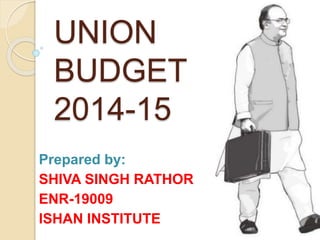
UNION
BUDGET
2014-15
Prepared by:
SHIVA SINGH RATHOR
ENR-19009
ISHAN INSTITUTE
 On May 16, the BJP came to power
with 282 seats, the most won by a
single party in 30 years. It was a
sweeping mandate for change, jobs,
growth.
 Does the Budget reflect those
aspirations?
The Three Goals
 Presenting the first Budget of BJP
government, Finance Minister Arun
Jaitley stuck to the troika – of
‘restoring the pace of growth’,
‘containing inflation’ and
‘concentrating on fiscal consolidation’.
Focus on Fiscal
Consolidation
 NDA government’s maiden Budget
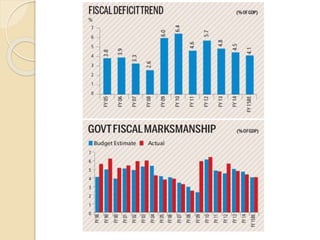
retains the ambitious target of 4.1% of
the GDP for fiscal deficit in FY15.
 Fiscal deficit would be brought down
to 3.6% in FY16 and 3% by FY17.
 Revenue deficit will be lowered to
2.9% by FY15.
 The Budget depends heavily on
raising revenues by bringing up the
tax to GDP ratio to 10.6 per cent in
FY14 from 10.1% in FY13.
 Finance Minister says: “We cannot
spend beyond our means.”
Growth
 GDP growth in 2014/15 estimated at
5.4-5.9 percent year-on-year.
 Aims for sustained growth of 7-8
percent in the next 3-4 years.
 Nominal GDP growth in 2014/15
expected to be 13.4 percent year-on-
year.
 Must usher in policies for higher
growth, lower inflation.
Taxation
 High level committee to decide on cases
of retrospective amendments.
 Investment allowance threshold revised
to ₹25 crore from ₹100 crore at the rate
of 15% to boost manufacturing; to be
applicable upto March 31, 2007.
 Investment-linked deduction for two new
sectors – slurry pipelines for iron ore
transportation, and semiconductor wafer
fabrication manufacturing.
 Tax holiday for 10 years extended to
power undertakings that begin
generation, distribution and
transmission by March 31, 2017.
 DTC to be reviewed.
 60 Aayakar Seva Kendras to be
opened during 2014-15.
 Color picture tubes to be exempt from
basic customs duty.
 Excise duty on footwear reduced from
12% to 6%.
 Imposes 10 percent customs duty on
some telecom products.
 Introduces uniform customs duty on all
types of coals.
 Raises export tax on bauxite to 20
percent from 10 percent.
 The government has set a direct tax
collection target of ₹7,58,421 crore for
2014-15.
Personal Finance
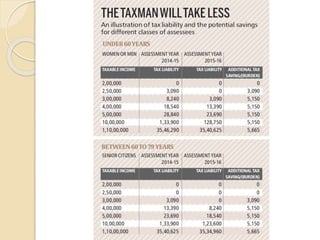
 Announcement to raise the exemption
limit for individuals from ₹2 lakh to
₹2.5 lakh and also for senior citizens
from ₹2.5 lakh to ₹3 lakh.
 Announcement to raise the deduction
limit under Section 80C from ₹1 lakh
currently to ₹1.5 lakh.
 Investment ceiling in the tax-free PPF
scheme has been raised to ₹1.5 lakh
from ₹1 lakh.
Transport
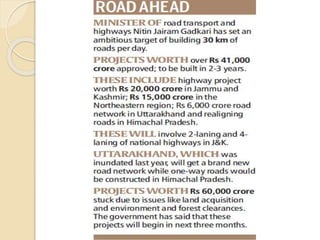
 “It is time to reaffirm our commitment
to a better and more energetic
PMGSY under the dynamic leadership
of Prime Minister Narendra Modi. I
propose to provide a sum of ₹14,389
crore.”
- Arun Jaitley, Finance Minister
Employment/Education
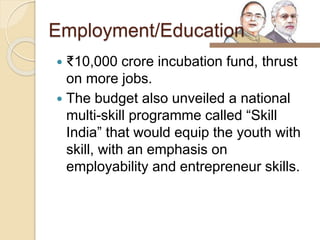
 ₹10,000 crore incubation fund, thrust
on more jobs.
 The budget also unveiled a national
multi-skill programme called “Skill
India” that would equip the youth with
skill, with an emphasis on
employability and entrepreneur skills.
 “India today needs a boost for job
creation. Our manufacturing sector in
particular needs a push for job
creation.”
- Arun Jaitley, Finance Minister
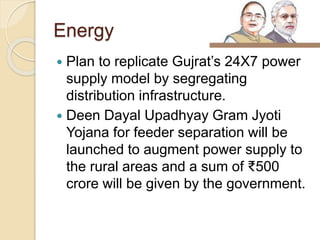
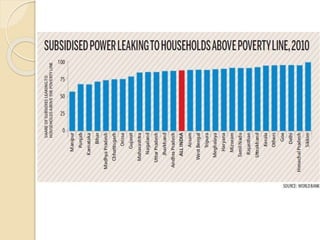
Energy
 Plan to replicate Gujrat’s 24X7 power
supply model by segregating
distribution infrastructure.
 Deen Dayal Upadhyay Gram Jyoti
Yojana for feeder separation will be
launched to augment power supply to
the rural areas and a sum of ₹500
crore will be given by the government.
Manufacturing
 Defence, Insurance, Construction get
major FDI boost.
 FDI in Defence and Insurance sector
raised to 49%.
 The government is looking at Defence
production as a key player in its
strategy to revive manufacturing.
 In line with BJP manifesto to build
smart cities, FDI norms in the
construction sector have been lowered
by half to $5 million and the minimum
built-up area has been reduced to
20,000 square meters from the
existing 50,000 square meters.
Social Sector
 Two years on, free drug scheme takes
center-stage in health plan.
 12 more government medical colleges
will be set up and dental facilities will
be provided at all hospitals.
 All six new AIIMs – in Jodhpur,
Bhopal, Patna, Rishikesh,
Bhubaneshwar and Raipur have
become functional.
 Four more AIIMs-like institutions in
Andhra Pradesh, West Bengal,
Vidarbha and Poorvanchal.
 Health sector gets ₹30,645 crore;
Jaitley promises “health for all”, gives
fillip to rural healthcare.
 Department of Health Research gets
₹726 crore.
 Department of AIDS control gets
₹1,785 crore.
 Five new IITs and five more IIMs.
 12% increase in overall allocation for
education.
 Increased from ₹74,621 crore to
₹83,771 crore.
Agriculture/Defence
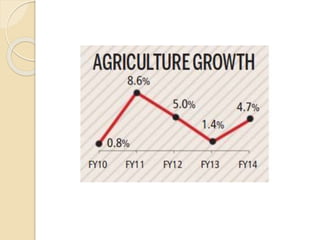
 Announcement for setting up of two
centers of excellence in agricultural
research (Assam and Jharkhand), two
agricultural universities (Andhra
Pradesh and Rajasthan), two
horticulture universities (Telangana
and Haryana) and a dedicated “Kisan
TV” for farmers.
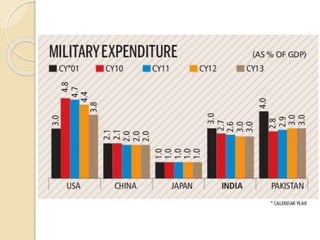
 ₹5,000 crore extra for Defence, but
mostly for R&D.
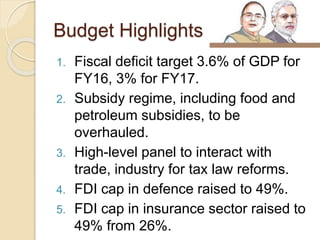
Budget Highlights
1. Fiscal deficit target 3.6% of GDP for
FY16, 3% for FY17.
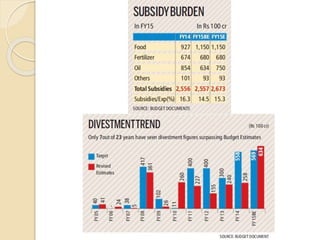
2. Subsidy regime, including food and
petroleum subsidies, to be
overhauled.
3. High-level panel to interact with
trade, industry for tax law reforms.
4. FDI cap in defence raised to 49%.
5. FDI cap in insurance sector raised to
49% from 26%.
6. ₹7,060 crore allotted for developing
‘100 Smart Cities’.
7. For ‘Smart Cities’, built-up area cut
from 50,000 sq mts to 20,000 sq mts.
8. Manufacturing units allowed to sell
products through retail.
9. Electronic Travel Authorisation at 9
airports.
10. Skill India, a skill programme to
improve employability of youths, to
be launched.
11. ₹1,000 crore Pradhan Mantri Krishi
Sinchayee Yojana — to improve
access to irrigation — introduced.
12. Every household to have total
sanitation by 2019 — the 150th birth
anniversary of Mahatma Gandhi —
through Swachh Bharat Abhiyan.
13. Shyama Prasad Mukherji Rurban
Mission to provide urban amenities in
rural areas; through PPP model.
14. ₹200 crore for Sardar Patel’s Statue
of Unity in Gujarat.
15. ₹500 cr Deen Dayal Upadhyaya
Gram Jyoti Yojana for rural electricity.
16. Institutes for Universal Inclusive
Design and Mental Health
Rehabilitation to be set up.
17. Centre for Disability Sports to be set
up.
18. 15 new Braille presses coming, 10
existing presses to be modernised.
19. Currency notes to be printed with
Braille-like signs.
20. ₹150 crore for safety of women in
large cities.
21. ₹14,389 crore for Pradhan Mantri
Gram Sadak Yojana.
22. MGNREGA to continue, emphasis on
asset creation.
23. ₹8,000 crore for rural housing.
24. ‘Neeranchal’ watershed initiative.
25. ₹3,600 crore for National Rural
Drinking Water Programme.
26. Health for All: Free Drug Service and
Free Diagnosis Service.
27. ₹28,635 crore for Sarva Shiksha
Abhiyan.
28. ₹4,966 crore for Rashtriya
Madhyamik Shiksha Abhiyan.
29. ₹500 crore for Pandit Madan Mohan
Malviya New Teachers’ Training
Programme.
30. ₹100 crore for setting up virtual
classrooms, online courses.
31. ₹500 crore for ‘Digital India’ initiative
covering villages.
32. A comprehensive strategy to tackle
malnutrition with timelines, targets.
33. A programme for skill upgrade for
minorities in ancestral arts.
34. ₹100 crore to modernise madarsas.
35. ₹100 crore for scheme to provide
every farmer a soil health card.
36. ₹56 crore to set up 100 Mobile Soil
Testing Laboratories.
37. Focus on technology-driven second
green revolution.
38. Push for the Amritsar-Kolkata
industrial master plan.
39. A Trade Facilitation Centre and
Crafts Museum to promote handloom
products of Varanasi.
40. ₹4,200 cr Jal Marg Vikas project on
Ganga to connect Allahabad to
Haldia.
41. 8,500 km of National Higways.
42. ₹500 cr for Ultra Mega Solar Power
Projects in Rajasthan, Gujarat, Tamil
Nadu, and Ladakh.
43. ₹400 cr for solar power driven agri-
pump sets and water pumping
stations.
44. ₹100 crore to develop 1 MW Solar
Parks near canals.
45. ₹100 crore for war memorial and
museum in Delhi.
46. ₹500 crore to develop five tourist
circuits with themes.
47. Sarnath-Gaya-Varanasi Buddhist
circuit with world-class tourist
amenities.
48. ₹2,037 crore for Integrated Ganga
Conservation Mission called
“Namami Gange”.
49. ₹100 crore for Ghat devlopment and
beautification of river front at
Kedarnath, Haridwar, Kanpur,
Varanasi, Allahabad, Patna and
Delhi.
50. Special attention for 5 institutions
engaged in nanotechnology, material
science & biomedical device
technology.
51. To transform Delhi’s International
Centre for Genetic and
52. Space missions including
experimental flight of GSLV Mk-III,
commercial launch of PSLV and two
navigational satellites.
53. ₹1,000 crore for rail connectivity in
Northeast.
54. ₹200 cr for power and ₹500 cr for
water reforms to make Delhi a world
class city.
55. 10-year tax holiday for power
generation, distribution firms.
56. No customs duty on LCD and LED
57. Colour picture tubes exempted from
basic customs duty.
58. Exemption from 4 % special
additional duty on components for
PCs.
59. Excise duty increased on cigarettes.
60. Excise duty hiked on gutkha,
tobacco.
What did they say
“My predecessor has set up a very
difficult task of reducing fiscal deficit to
4.1 per cent of the GDP. Difficult, as it
may appear, I have decided to accept
this target as a challenge.”
- Arun Jaitley, Finance Minister
“The Budget shows that the government
is willing to listen and then state that
they will act in due course.”
- K V Kamath, Non-Executive Director at ICICI Bank
“It is not over ambitious, it is realistic. It
is poor-friendly, farmer-friendly, youth-
friendly, women-friendly and senior-
citizen friendly.”
- Rajnath Singh, Home Minister
“This Budget is positive but largely
directional and aspirational. I was
expecting bolder reforms for boosting
investor sentiments.”
-Kiran Mazumdar-Shaw, Chairperson and MD of
Biocon
“This is a Budget that focuses on
speed, scale and skill. Speed in
pushing for time-bound decisions,
scale in the emphasis on improvement
and of infrastructure.”
- Puneet Chaddha, CEO, HSBC Global Asset Management
India
“Infrastructure funding had become a
bad word for banks. Banks were not
willing to fund. With this move, an out
of the box thinking will enable long
term lending for infrastructure sector.”
-Deepak Parekh, Chairman, HDFC
“They have forgotten everything after
getting votes of people. It seems Bihar
is not on radar of the BJP-led NDA
government.”
- Nitish Kumar, JD(U) leader
“The Budget is visionless, missionless,
and actionless from the angle of
common people. It is not going to
stimulate growth and development of
poor people.”
- Mamata Banerjee, CM, West Bengal
“The Budget turned out to be a dud.
What kind of reforms will the
government bring in ₹200 crore?
Instead, it should give people subsidy
on electricity and make water free.”
- Arvind Kejriwal, AAP national convener
“Any change, even a change for the
better, is always accompanied by
drawbacks and discomforts. Our
dilemma is that we hate change and
love it at the same time.”
- Arun Jaitley, Finance Minister
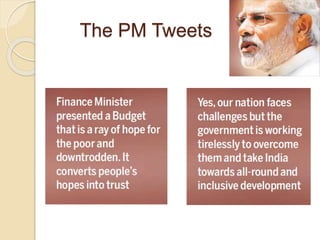
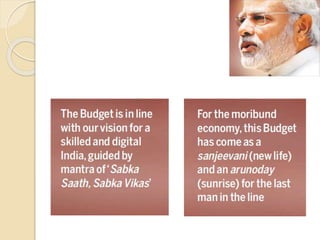
The PM Tweets
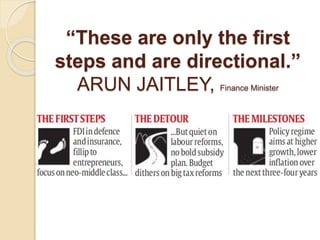
“These are only the first
steps and are directional.”
ARUN JAITLEY, Finance Minister
THANK YOU.

Thakur shiva singh

  • 1.
    UNION BUDGET 2014-15 Prepared by: SHIVA SINGHRATHOR ENR-19009 ISHAN INSTITUTE
  • 2.
     On May16, the BJP came to power with 282 seats, the most won by a single party in 30 years. It was a sweeping mandate for change, jobs, growth.  Does the Budget reflect those aspirations?
  • 3.
    The Three Goals Presenting the first Budget of BJP government, Finance Minister Arun Jaitley stuck to the troika – of ‘restoring the pace of growth’, ‘containing inflation’ and ‘concentrating on fiscal consolidation’.
  • 4.
    Focus on Fiscal Consolidation NDA government’s maiden Budget retains the ambitious target of 4.1% of the GDP for fiscal deficit in FY15.  Fiscal deficit would be brought down to 3.6% in FY16 and 3% by FY17.  Revenue deficit will be lowered to 2.9% by FY15.
  • 5.
     The Budgetdepends heavily on raising revenues by bringing up the tax to GDP ratio to 10.6 per cent in FY14 from 10.1% in FY13.  Finance Minister says: “We cannot spend beyond our means.”
  • 8.
    Growth  GDP growthin 2014/15 estimated at 5.4-5.9 percent year-on-year.  Aims for sustained growth of 7-8 percent in the next 3-4 years.  Nominal GDP growth in 2014/15 expected to be 13.4 percent year-on- year.  Must usher in policies for higher growth, lower inflation.
  • 9.
    Taxation  High levelcommittee to decide on cases of retrospective amendments.  Investment allowance threshold revised to ₹25 crore from ₹100 crore at the rate of 15% to boost manufacturing; to be applicable upto March 31, 2007.  Investment-linked deduction for two new sectors – slurry pipelines for iron ore transportation, and semiconductor wafer fabrication manufacturing.
  • 10.
     Tax holidayfor 10 years extended to power undertakings that begin generation, distribution and transmission by March 31, 2017.  DTC to be reviewed.  60 Aayakar Seva Kendras to be opened during 2014-15.  Color picture tubes to be exempt from basic customs duty.  Excise duty on footwear reduced from 12% to 6%.
  • 11.
     Imposes 10percent customs duty on some telecom products.  Introduces uniform customs duty on all types of coals.  Raises export tax on bauxite to 20 percent from 10 percent.  The government has set a direct tax collection target of ₹7,58,421 crore for 2014-15.
  • 12.
    Personal Finance  Announcementto raise the exemption limit for individuals from ₹2 lakh to ₹2.5 lakh and also for senior citizens from ₹2.5 lakh to ₹3 lakh.  Announcement to raise the deduction limit under Section 80C from ₹1 lakh currently to ₹1.5 lakh.  Investment ceiling in the tax-free PPF scheme has been raised to ₹1.5 lakh from ₹1 lakh.
  • 15.
    Transport  “It istime to reaffirm our commitment to a better and more energetic PMGSY under the dynamic leadership of Prime Minister Narendra Modi. I propose to provide a sum of ₹14,389 crore.” - Arun Jaitley, Finance Minister
  • 19.
    Employment/Education  ₹10,000 croreincubation fund, thrust on more jobs.  The budget also unveiled a national multi-skill programme called “Skill India” that would equip the youth with skill, with an emphasis on employability and entrepreneur skills.
  • 22.
     “India todayneeds a boost for job creation. Our manufacturing sector in particular needs a push for job creation.” - Arun Jaitley, Finance Minister
  • 23.
    Energy  Plan toreplicate Gujrat’s 24X7 power supply model by segregating distribution infrastructure.  Deen Dayal Upadhyay Gram Jyoti Yojana for feeder separation will be launched to augment power supply to the rural areas and a sum of ₹500 crore will be given by the government.
  • 26.
    Manufacturing  Defence, Insurance,Construction get major FDI boost.  FDI in Defence and Insurance sector raised to 49%.  The government is looking at Defence production as a key player in its strategy to revive manufacturing.
  • 27.
     In linewith BJP manifesto to build smart cities, FDI norms in the construction sector have been lowered by half to $5 million and the minimum built-up area has been reduced to 20,000 square meters from the existing 50,000 square meters.
  • 30.
    Social Sector  Twoyears on, free drug scheme takes center-stage in health plan.  12 more government medical colleges will be set up and dental facilities will be provided at all hospitals.  All six new AIIMs – in Jodhpur, Bhopal, Patna, Rishikesh, Bhubaneshwar and Raipur have become functional.
  • 31.
     Four moreAIIMs-like institutions in Andhra Pradesh, West Bengal, Vidarbha and Poorvanchal.  Health sector gets ₹30,645 crore; Jaitley promises “health for all”, gives fillip to rural healthcare.  Department of Health Research gets ₹726 crore.  Department of AIDS control gets ₹1,785 crore.
  • 32.
     Five newIITs and five more IIMs.  12% increase in overall allocation for education.  Increased from ₹74,621 crore to ₹83,771 crore.
  • 33.
    Agriculture/Defence  Announcement forsetting up of two centers of excellence in agricultural research (Assam and Jharkhand), two agricultural universities (Andhra Pradesh and Rajasthan), two horticulture universities (Telangana and Haryana) and a dedicated “Kisan TV” for farmers.  ₹5,000 crore extra for Defence, but mostly for R&D.
  • 36.
    Budget Highlights 1. Fiscaldeficit target 3.6% of GDP for FY16, 3% for FY17. 2. Subsidy regime, including food and petroleum subsidies, to be overhauled. 3. High-level panel to interact with trade, industry for tax law reforms. 4. FDI cap in defence raised to 49%. 5. FDI cap in insurance sector raised to 49% from 26%.
  • 37.
    6. ₹7,060 croreallotted for developing ‘100 Smart Cities’. 7. For ‘Smart Cities’, built-up area cut from 50,000 sq mts to 20,000 sq mts. 8. Manufacturing units allowed to sell products through retail. 9. Electronic Travel Authorisation at 9 airports. 10. Skill India, a skill programme to improve employability of youths, to be launched.
  • 38.
    11. ₹1,000 crorePradhan Mantri Krishi Sinchayee Yojana — to improve access to irrigation — introduced. 12. Every household to have total sanitation by 2019 — the 150th birth anniversary of Mahatma Gandhi — through Swachh Bharat Abhiyan. 13. Shyama Prasad Mukherji Rurban Mission to provide urban amenities in rural areas; through PPP model. 14. ₹200 crore for Sardar Patel’s Statue of Unity in Gujarat.
  • 39.
    15. ₹500 crDeen Dayal Upadhyaya Gram Jyoti Yojana for rural electricity. 16. Institutes for Universal Inclusive Design and Mental Health Rehabilitation to be set up. 17. Centre for Disability Sports to be set up. 18. 15 new Braille presses coming, 10 existing presses to be modernised. 19. Currency notes to be printed with Braille-like signs.
  • 40.
    20. ₹150 crorefor safety of women in large cities. 21. ₹14,389 crore for Pradhan Mantri Gram Sadak Yojana. 22. MGNREGA to continue, emphasis on asset creation. 23. ₹8,000 crore for rural housing. 24. ‘Neeranchal’ watershed initiative. 25. ₹3,600 crore for National Rural Drinking Water Programme. 26. Health for All: Free Drug Service and Free Diagnosis Service.
  • 41.
    27. ₹28,635 crorefor Sarva Shiksha Abhiyan. 28. ₹4,966 crore for Rashtriya Madhyamik Shiksha Abhiyan. 29. ₹500 crore for Pandit Madan Mohan Malviya New Teachers’ Training Programme. 30. ₹100 crore for setting up virtual classrooms, online courses. 31. ₹500 crore for ‘Digital India’ initiative covering villages.
  • 42.
    32. A comprehensivestrategy to tackle malnutrition with timelines, targets. 33. A programme for skill upgrade for minorities in ancestral arts. 34. ₹100 crore to modernise madarsas. 35. ₹100 crore for scheme to provide every farmer a soil health card. 36. ₹56 crore to set up 100 Mobile Soil Testing Laboratories. 37. Focus on technology-driven second green revolution.
  • 43.
    38. Push forthe Amritsar-Kolkata industrial master plan. 39. A Trade Facilitation Centre and Crafts Museum to promote handloom products of Varanasi. 40. ₹4,200 cr Jal Marg Vikas project on Ganga to connect Allahabad to Haldia. 41. 8,500 km of National Higways. 42. ₹500 cr for Ultra Mega Solar Power Projects in Rajasthan, Gujarat, Tamil Nadu, and Ladakh.
  • 44.
    43. ₹400 crfor solar power driven agri- pump sets and water pumping stations. 44. ₹100 crore to develop 1 MW Solar Parks near canals. 45. ₹100 crore for war memorial and museum in Delhi. 46. ₹500 crore to develop five tourist circuits with themes. 47. Sarnath-Gaya-Varanasi Buddhist circuit with world-class tourist amenities.
  • 45.
    48. ₹2,037 crorefor Integrated Ganga Conservation Mission called “Namami Gange”. 49. ₹100 crore for Ghat devlopment and beautification of river front at Kedarnath, Haridwar, Kanpur, Varanasi, Allahabad, Patna and Delhi. 50. Special attention for 5 institutions engaged in nanotechnology, material science & biomedical device technology. 51. To transform Delhi’s International Centre for Genetic and
  • 46.
    52. Space missionsincluding experimental flight of GSLV Mk-III, commercial launch of PSLV and two navigational satellites. 53. ₹1,000 crore for rail connectivity in Northeast. 54. ₹200 cr for power and ₹500 cr for water reforms to make Delhi a world class city. 55. 10-year tax holiday for power generation, distribution firms. 56. No customs duty on LCD and LED
  • 47.
    57. Colour picturetubes exempted from basic customs duty. 58. Exemption from 4 % special additional duty on components for PCs. 59. Excise duty increased on cigarettes. 60. Excise duty hiked on gutkha, tobacco.
  • 48.
    What did theysay “My predecessor has set up a very difficult task of reducing fiscal deficit to 4.1 per cent of the GDP. Difficult, as it may appear, I have decided to accept this target as a challenge.” - Arun Jaitley, Finance Minister
  • 49.
    “The Budget showsthat the government is willing to listen and then state that they will act in due course.” - K V Kamath, Non-Executive Director at ICICI Bank
  • 50.
    “It is notover ambitious, it is realistic. It is poor-friendly, farmer-friendly, youth- friendly, women-friendly and senior- citizen friendly.” - Rajnath Singh, Home Minister
  • 51.
    “This Budget ispositive but largely directional and aspirational. I was expecting bolder reforms for boosting investor sentiments.” -Kiran Mazumdar-Shaw, Chairperson and MD of Biocon
  • 52.
    “This is aBudget that focuses on speed, scale and skill. Speed in pushing for time-bound decisions, scale in the emphasis on improvement and of infrastructure.” - Puneet Chaddha, CEO, HSBC Global Asset Management India
  • 53.
    “Infrastructure funding hadbecome a bad word for banks. Banks were not willing to fund. With this move, an out of the box thinking will enable long term lending for infrastructure sector.” -Deepak Parekh, Chairman, HDFC
  • 54.
    “They have forgotteneverything after getting votes of people. It seems Bihar is not on radar of the BJP-led NDA government.” - Nitish Kumar, JD(U) leader
  • 55.
    “The Budget isvisionless, missionless, and actionless from the angle of common people. It is not going to stimulate growth and development of poor people.” - Mamata Banerjee, CM, West Bengal
  • 56.
    “The Budget turnedout to be a dud. What kind of reforms will the government bring in ₹200 crore? Instead, it should give people subsidy on electricity and make water free.” - Arvind Kejriwal, AAP national convener
  • 57.
    “Any change, evena change for the better, is always accompanied by drawbacks and discomforts. Our dilemma is that we hate change and love it at the same time.” - Arun Jaitley, Finance Minister
  • 58.
  • 60.
    “These are onlythe first steps and are directional.” ARUN JAITLEY, Finance Minister
  • 61.