www.codethink.co.uk
Testing and Open Source in
automotive: beyond
automation and frameworks
Event: ALS 2017
Schedule:June 1st 2017
License: CC BY-SA
© Codethink Ltd
Agustín Benito Bethencourt
Principal Consultant - FOSS
Codethink Ltd
Who are Codethink?
● Provide software engineering & consultancy services.
● Expert in Linux and Open Source software.
● Focus on automotive industry and embedded devices.
● UK Headquarters, serving clients in EU, US and Asia.
● Independent and unbiased.
● Membership: AGL (2015), OIN (2010), CIP (founder
member), GENIVI (2012)...
Why Codethink?
Open Source company.
+
Automotive experience.
+
Passionate about building &
delivering complex Linux systems.
The speaker: @toscalix
● Principal Consultant - FOSS at Codethink Ltd
● Experienced working in the open and managing
development & delivery of complex Linux based systems.
● Contributor in several FOSS communities (LTSP, KDE,
openSUSE…).
● More about myself at http://www.toscalix.com
Talking points
1. From back to front.
2. Responsiveness vs. coverage.
3. Treat test(ing) like code(ing).
4. Apply Open Source “quality pillars”.
5. Takeaways.
1. From back to front
● Testing at deployment and validation stages (post
integration) first.
● Acceptance / system testing first.
● Killing elephants with a nail is hard. Users first, then
developers.
2. Responsiveness vs coverage
● Shorten feedback loops first, then increase test
coverage.
● Bill Gates’ second rule of any technology applied to
business (testing), is very often true.
● Focus on trust first: transparency.
3. Treat test(ing) like cod(ing)
● Good code takes time and knowledge, so good tests.
● Good code is self readable, so good tests.
● Good code will eventually die, so good tests.
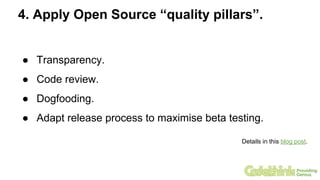
4. Apply Open Source “quality pillars”.
● Transparency.
● Code review.
● Dogfooding.
● Adapt release process to maximise beta testing.
Details in this blog post.
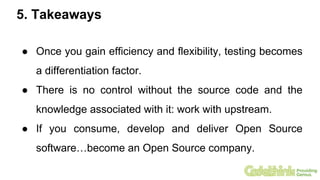
5. Takeaways
● Once you gain efficiency and flexibility, testing becomes
a differentiation factor.
● There is no control without the source code and the
knowledge associated with it: work with upstream.
● If you consume, develop and deliver Open Source
software…become an Open Source company.
Thanks.
Questions?
www.codethink.co.uk

Testing and open source in automotive beyond automation and frameworks

  • 1.
  • 2.
    Testing and OpenSource in automotive: beyond automation and frameworks Event: ALS 2017 Schedule:June 1st 2017 License: CC BY-SA © Codethink Ltd Agustín Benito Bethencourt Principal Consultant - FOSS Codethink Ltd
  • 3.
    Who are Codethink? ●Provide software engineering & consultancy services. ● Expert in Linux and Open Source software. ● Focus on automotive industry and embedded devices. ● UK Headquarters, serving clients in EU, US and Asia. ● Independent and unbiased. ● Membership: AGL (2015), OIN (2010), CIP (founder member), GENIVI (2012)...
  • 4.
    Why Codethink? Open Sourcecompany. + Automotive experience. + Passionate about building & delivering complex Linux systems.
  • 5.
    The speaker: @toscalix ●Principal Consultant - FOSS at Codethink Ltd ● Experienced working in the open and managing development & delivery of complex Linux based systems. ● Contributor in several FOSS communities (LTSP, KDE, openSUSE…). ● More about myself at http://www.toscalix.com
  • 6.
    Talking points 1. Fromback to front. 2. Responsiveness vs. coverage. 3. Treat test(ing) like code(ing). 4. Apply Open Source “quality pillars”. 5. Takeaways.
  • 7.
    1. From backto front ● Testing at deployment and validation stages (post integration) first. ● Acceptance / system testing first. ● Killing elephants with a nail is hard. Users first, then developers.
  • 8.
    2. Responsiveness vscoverage ● Shorten feedback loops first, then increase test coverage. ● Bill Gates’ second rule of any technology applied to business (testing), is very often true. ● Focus on trust first: transparency.
  • 9.
    3. Treat test(ing)like cod(ing) ● Good code takes time and knowledge, so good tests. ● Good code is self readable, so good tests. ● Good code will eventually die, so good tests.
  • 10.
    4. Apply OpenSource “quality pillars”. ● Transparency. ● Code review. ● Dogfooding. ● Adapt release process to maximise beta testing. Details in this blog post.
  • 11.
    5. Takeaways ● Onceyou gain efficiency and flexibility, testing becomes a differentiation factor. ● There is no control without the source code and the knowledge associated with it: work with upstream. ● If you consume, develop and deliver Open Source software…become an Open Source company.
  • 12.
  • 13.