Test Execution
Automating Test Execution
• Designing test cases and test suites is creative
– Like any design activity: A demanding intellectual
activity, requiring human judgment
• Executing test cases should be automatic
– Design once, execute many times
• Test automation separates the creative human
process from the mechanical process of test
execution
Generation: From Test Case
Specifications to Test Cases
• Test design often yields test case
specifications, rather than concrete data
– Ex: “a large positive number”, not 420023
– Ex: “a sorted sequence, length > 2”, not “Alpha,
Beta, Chi, Omega”
• Other details for execution may be omitted
• Generation creates executable test cases from
test case specifications
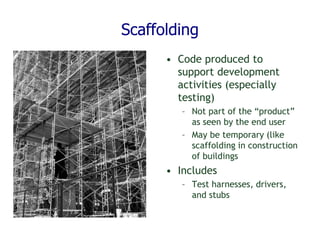
Scaffolding
• Code produced to
support development
activities (especially
testing)
– Not part of the “product”
as seen by the end user
– May be temporary (like
scaffolding in construction
of buildings
• Includes
– Test harnesses, drivers,
and stubs
Scaffolding ...
• Test driver
– A “main” program for running a test
• May be produced before a “real” main program
• Provides more control than the “real” main program
– To driver program under test through test cases
• Test stubs
– Substitute for called functions/methods/objects
• Test harness
– Substitutes for other parts of the deployed
environment
• Ex: Software simulation of a hardware device
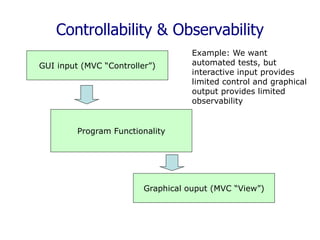
Controllability & Observability
GUI input (MVC “Controller”)
Program Functionality
Graphical ouput (MVC “View”)
Example: We want
automated tests, but
interactive input provides
limited control and graphical
output provides limited
observability
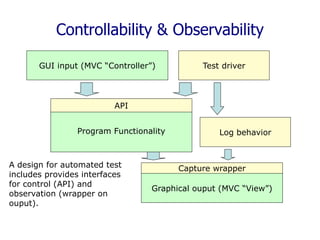
Controllability & Observability
GUI input (MVC “Controller”)
Program Functionality
Graphical ouput (MVC “View”)
API
Test driver
Capture wrapper
Log behavior
A design for automated test
includes provides interfaces
for control (API) and
observation (wrapper on
ouput).
Generic or Specific?
• The simplest form of scaffolding is a driver
program that runs a single, specific test case.
• How general should scaffolding be?
– We could build a driver and stubs for each test case
– ... or at least factor out some common code of the
driver and test management (e.g., JUnit)
– ... or further factor out some common support code,
to drive a large number of test cases from data
– ... or further, generate the data automatically from
a more abstract model (e.g., network traffic model)
• A question of costs and re-use
– Just as for other kinds of software
Oracles
• Did this test case succeed, or fail?
– No use running 10,000 test cases automatically if the
results must be checked by hand!
• Software that applies a pass/fail criterion to a
program execution is called a test oracle,
often shortened to oracle.
• In addition to rapidly classifying a large
number of test case executions, automated test
oracles make it possible to classify behaviours
that exceed human
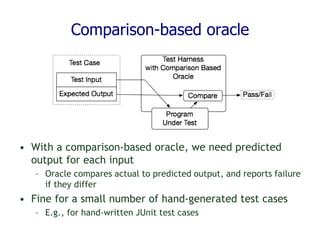
Comparison-based oracle
• With a comparison-based oracle, we need predicted
output for each input
– Oracle compares actual to predicted output, and reports failure
if they differ
• Fine for a small number of hand-generated test cases
– E.g., for hand-written JUnit test cases
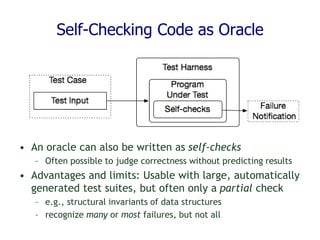
Self-Checking Code as Oracle
• An oracle can also be written as self-checks
– Often possible to judge correctness without predicting results
• Advantages and limits: Usable with large, automatically
generated test suites, but often only a partial check
– e.g., structural invariants of data structures
– recognize many or most failures, but not all
Capture and Replay
• Sometimes there is no alternative to human
input and observation
– Even if we separate testing program functionality
from GUI, some testing of the GUI is required
• We can at least cut repetition of human testing
• Capture a manually run test case, replay it
automatically
– with a comparison-based test oracle: behavior same
as previously accepted behavior
• reusable only until a program change invalidates it
• lifetime depends on abstraction level of input and output
Summary
• Goal: Separate creative task of test design from
mechanical task of test execution
– Enable generation and execution of large test suites
– Re-execute test suites frequently (e.g., nightly or
after each program change)
• Scaffolding: Code to support development and
testing
– Test drivers, stubs, harness, including oracles
– Ranging from individual, hand-written test case
drivers to automatic generation and testing of large
test suites
– Capture/replay where human interaction is required

TEST EXECUTION.ppt

  • 1.
  • 2.
    Automating Test Execution •Designing test cases and test suites is creative – Like any design activity: A demanding intellectual activity, requiring human judgment • Executing test cases should be automatic – Design once, execute many times • Test automation separates the creative human process from the mechanical process of test execution
  • 3.
    Generation: From TestCase Specifications to Test Cases • Test design often yields test case specifications, rather than concrete data – Ex: “a large positive number”, not 420023 – Ex: “a sorted sequence, length > 2”, not “Alpha, Beta, Chi, Omega” • Other details for execution may be omitted • Generation creates executable test cases from test case specifications
  • 4.
    Scaffolding • Code producedto support development activities (especially testing) – Not part of the “product” as seen by the end user – May be temporary (like scaffolding in construction of buildings • Includes – Test harnesses, drivers, and stubs
  • 5.
    Scaffolding ... • Testdriver – A “main” program for running a test • May be produced before a “real” main program • Provides more control than the “real” main program – To driver program under test through test cases • Test stubs – Substitute for called functions/methods/objects • Test harness – Substitutes for other parts of the deployed environment • Ex: Software simulation of a hardware device
  • 6.
    Controllability & Observability GUIinput (MVC “Controller”) Program Functionality Graphical ouput (MVC “View”) Example: We want automated tests, but interactive input provides limited control and graphical output provides limited observability
  • 7.
    Controllability & Observability GUIinput (MVC “Controller”) Program Functionality Graphical ouput (MVC “View”) API Test driver Capture wrapper Log behavior A design for automated test includes provides interfaces for control (API) and observation (wrapper on ouput).
  • 8.
    Generic or Specific? •The simplest form of scaffolding is a driver program that runs a single, specific test case. • How general should scaffolding be? – We could build a driver and stubs for each test case – ... or at least factor out some common code of the driver and test management (e.g., JUnit) – ... or further factor out some common support code, to drive a large number of test cases from data – ... or further, generate the data automatically from a more abstract model (e.g., network traffic model) • A question of costs and re-use – Just as for other kinds of software
  • 9.
    Oracles • Did thistest case succeed, or fail? – No use running 10,000 test cases automatically if the results must be checked by hand! • Software that applies a pass/fail criterion to a program execution is called a test oracle, often shortened to oracle. • In addition to rapidly classifying a large number of test case executions, automated test oracles make it possible to classify behaviours that exceed human
  • 10.
    Comparison-based oracle • Witha comparison-based oracle, we need predicted output for each input – Oracle compares actual to predicted output, and reports failure if they differ • Fine for a small number of hand-generated test cases – E.g., for hand-written JUnit test cases
  • 11.
    Self-Checking Code asOracle • An oracle can also be written as self-checks – Often possible to judge correctness without predicting results • Advantages and limits: Usable with large, automatically generated test suites, but often only a partial check – e.g., structural invariants of data structures – recognize many or most failures, but not all
  • 12.
    Capture and Replay •Sometimes there is no alternative to human input and observation – Even if we separate testing program functionality from GUI, some testing of the GUI is required • We can at least cut repetition of human testing • Capture a manually run test case, replay it automatically – with a comparison-based test oracle: behavior same as previously accepted behavior • reusable only until a program change invalidates it • lifetime depends on abstraction level of input and output
  • 13.
    Summary • Goal: Separatecreative task of test design from mechanical task of test execution – Enable generation and execution of large test suites – Re-execute test suites frequently (e.g., nightly or after each program change) • Scaffolding: Code to support development and testing – Test drivers, stubs, harness, including oracles – Ranging from individual, hand-written test case drivers to automatic generation and testing of large test suites – Capture/replay where human interaction is required