Test Bank for Social Science: An Introduction to
the Study of Society, 14th Edition: Elgin F.
Hunt download
http://testbankbell.com/product/test-bank-for-social-science-an-
introduction-to-the-study-of-society-14th-edition-elgin-f-hunt/
TestBankBell.com: Your Ultimate Source for Test Banks and Academic Resources
TestBankBell.com is a leading online platform offering instant access to a wide
variety of test banks and academic resources. Whether you're a student, educator, or
professional, we provide the tools and materials you need to excel in your studies and
career. Our website features test banks for textbooks across multiple disciplines,
offering comprehensive solutions to enhance your learning experience.
Keywords:
test bank, academic resources, study guides, test preparation, testbankbell, download test
bank, textbook solutions
Contact Information:
Visit us at: https://testbankbell.com - For inquiries, email us:
testbankbell.com@gmail.com
Important Links:
Download Test Banks: https://testbankbell.com/
Copyright © 2025 TestBankBell. All Rights Reserved.
Instant digital products (PDF, ePub, MOBI) ready for you
Download now and discover formats that fit your needs...
Start reading on any device today!
Social Science An Introduction to the Study of Society
15th Edition Hunt Colander Test Bank
https://testbankbell.com/product/social-science-an-introduction-to-
the-study-of-society-15th-edition-hunt-colander-test-bank/
testbankbell.com
Test Bank for Empowerment Series An Introduction to the
Profession of Social Work, 5th Edition
https://testbankbell.com/product/test-bank-for-empowerment-series-an-
introduction-to-the-profession-of-social-work-5th-edition/
testbankbell.com
Solution Manual for Empowerment Series An Introduction to
the Profession of Social Work, 5th Edition
https://testbankbell.com/product/solution-manual-for-empowerment-
series-an-introduction-to-the-profession-of-social-work-5th-edition/
testbankbell.com
Introduction to Physical Science 14th Edition Shipman
Solutions Manual
https://testbankbell.com/product/introduction-to-physical-
science-14th-edition-shipman-solutions-manual/
testbankbell.com
Aging and the Life Course An Introduction to Social
Gerontology 7th Edition Quadagno Test Bank
https://testbankbell.com/product/aging-and-the-life-course-an-
introduction-to-social-gerontology-7th-edition-quadagno-test-bank/
testbankbell.com
Solution Manual for Political science an introduction 14th
Global Edition by Roskin
https://testbankbell.com/product/solution-manual-for-political-
science-an-introduction-14th-global-edition-by-roskin/
testbankbell.com
Test Bank for An Introduction to Physical Science, 13th
Edition : Shipman
https://testbankbell.com/product/test-bank-for-an-introduction-to-
physical-science-13th-edition-shipman/
testbankbell.com
Test Bank for Criminalistics: An Introduction to Forensic
Science 12th Edition
https://testbankbell.com/product/test-bank-for-criminalistics-an-
introduction-to-forensic-science-12th-edition/
testbankbell.com
Test Bank for Society in Focus An Introduction to
Sociology, 7th Edition: Thompson
https://testbankbell.com/product/test-bank-for-society-in-focus-an-
introduction-to-sociology-7th-edition-thompson/
testbankbell.com
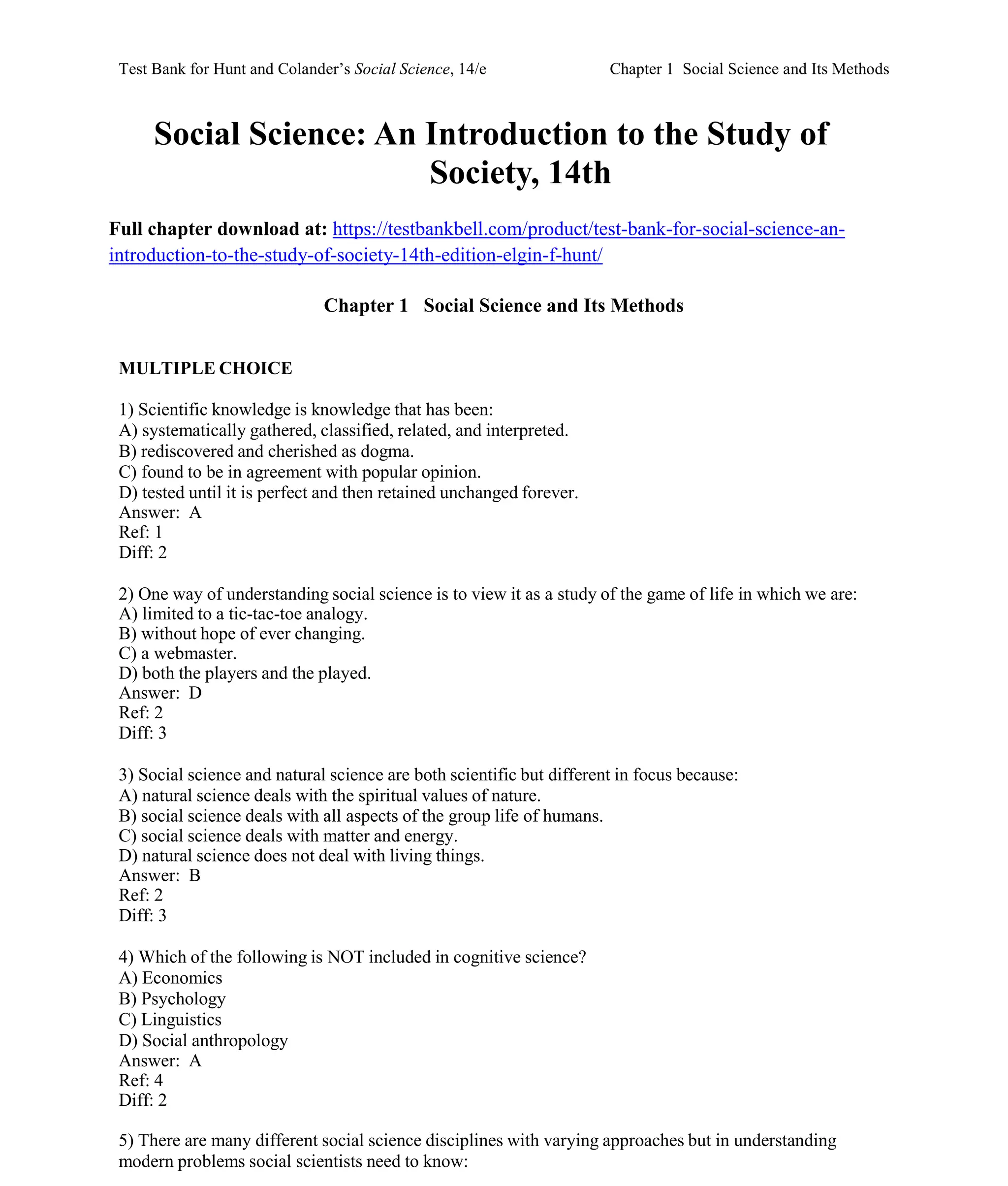
Test Bank for Hunt and Colander’s Social Science, 14/e Chapter 1 Social Science and Its Methods
Social Science: An Introduction to the Study of
Society, 14th
Full chapter download at: https://testbankbell.com/product/test-bank-for-social-science-an-
introduction-to-the-study-of-society-14th-edition-elgin-f-hunt/
Chapter 1 Social Science and Its Methods
MULTIPLE CHOICE
1) Scientific knowledge is knowledge that has been:
A) systematically gathered, classified, related, and interpreted.
B) rediscovered and cherished as dogma.
C) found to be in agreement with popular opinion.
D) tested until it is perfect and then retained unchanged forever.
Answer: A
Ref: 1
Diff: 2
2) One way of understanding social science is to view it as a study of the game of life in which we are:
A) limited to a tic-tac-toe analogy.
B) without hope of ever changing.
C) a webmaster.
D) both the players and the played.
Answer: D
Ref: 2
Diff: 3
3) Social science and natural science are both scientific but different in focus because:
A) natural science deals with the spiritual values of nature.
B) social science deals with all aspects of the group life of humans.
C) social science deals with matter and energy.
D) natural science does not deal with living things.
Answer: B
Ref: 2
Diff: 3
4) Which of the following is NOT included in cognitive science?
A) Economics
B) Psychology
C) Linguistics
D) Social anthropology
Answer: A
Ref: 4
Diff: 2
5) There are many different social science disciplines with varying approaches but in understanding
modern problems social scientists need to know:
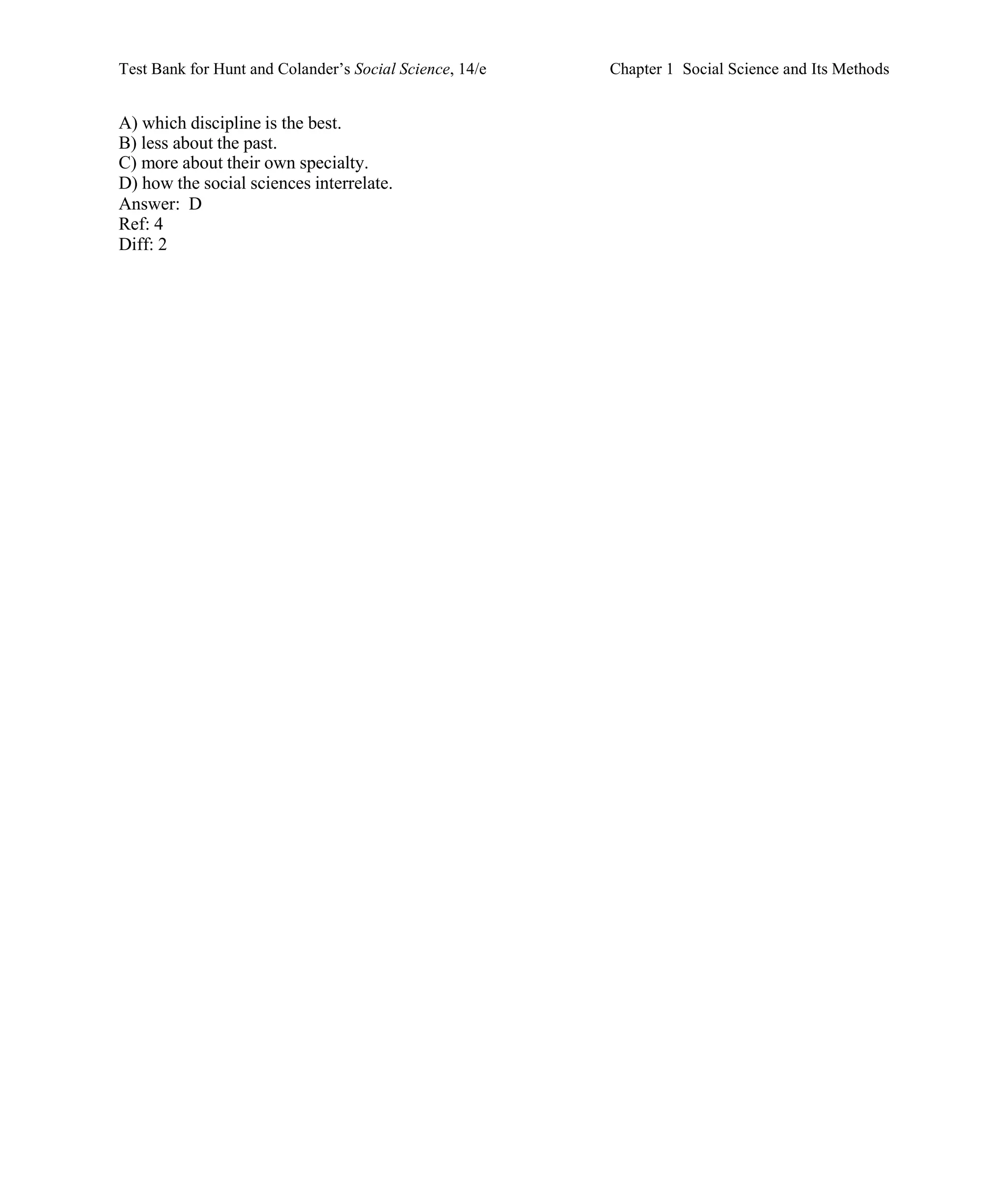
Test Bank for Hunt and Colander’s Social Science, 14/e Chapter 1 Social Science and Its Methods
A) which discipline is the best.
B) less about the past.
C) more about their own specialty.
D) how the social sciences interrelate.
Answer: D
Ref: 4
Diff: 2
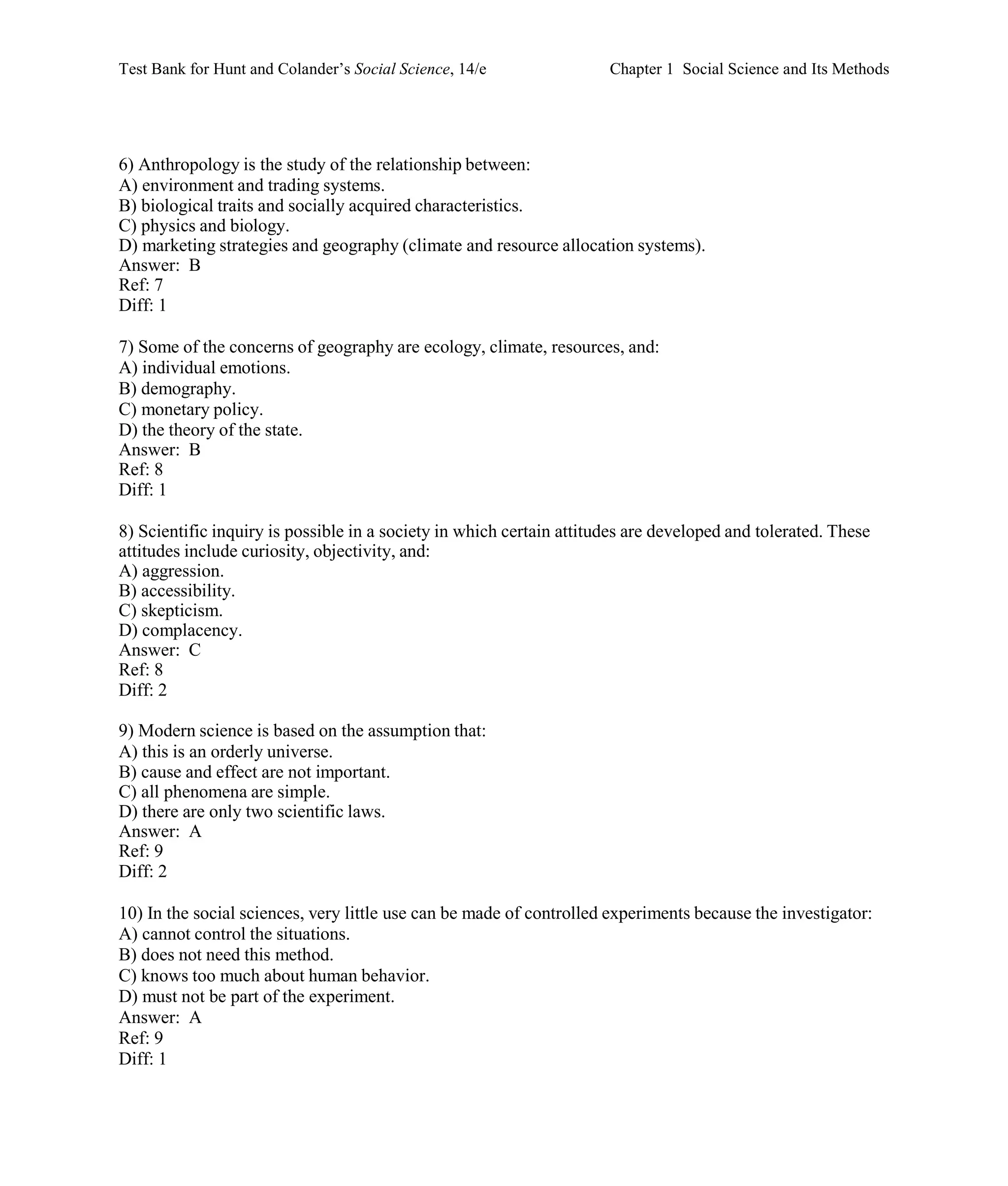
Test Bank for Hunt and Colander’s Social Science, 14/e Chapter 1 Social Science and Its Methods
6) Anthropology is the study of the relationship between:
A) environment and trading systems.
B) biological traits and socially acquired characteristics.
C) physics and biology.
D) marketing strategies and geography (climate and resource allocation systems).
Answer: B
Ref: 7
Diff: 1
7) Some of the concerns of geography are ecology, climate, resources, and:
A) individual emotions.
B) demography.
C) monetary policy.
D) the theory of the state.
Answer: B
Ref: 8
Diff: 1
8) Scientific inquiry is possible in a society in which certain attitudes are developed and tolerated. These
attitudes include curiosity, objectivity, and:
A) aggression.
B) accessibility.
C) skepticism.
D) complacency.
Answer: C
Ref: 8
Diff: 2
9) Modern science is based on the assumption that:
A) this is an orderly universe.
B) cause and effect are not important.
C) all phenomena are simple.
D) there are only two scientific laws.
Answer: A
Ref: 9
Diff: 2
10) In the social sciences, very little use can be made of controlled experiments because the investigator:
A) cannot control the situations.
B) does not need this method.
C) knows too much about human behavior.
D) must not be part of the experiment.
Answer: A
Ref: 9
Diff: 1
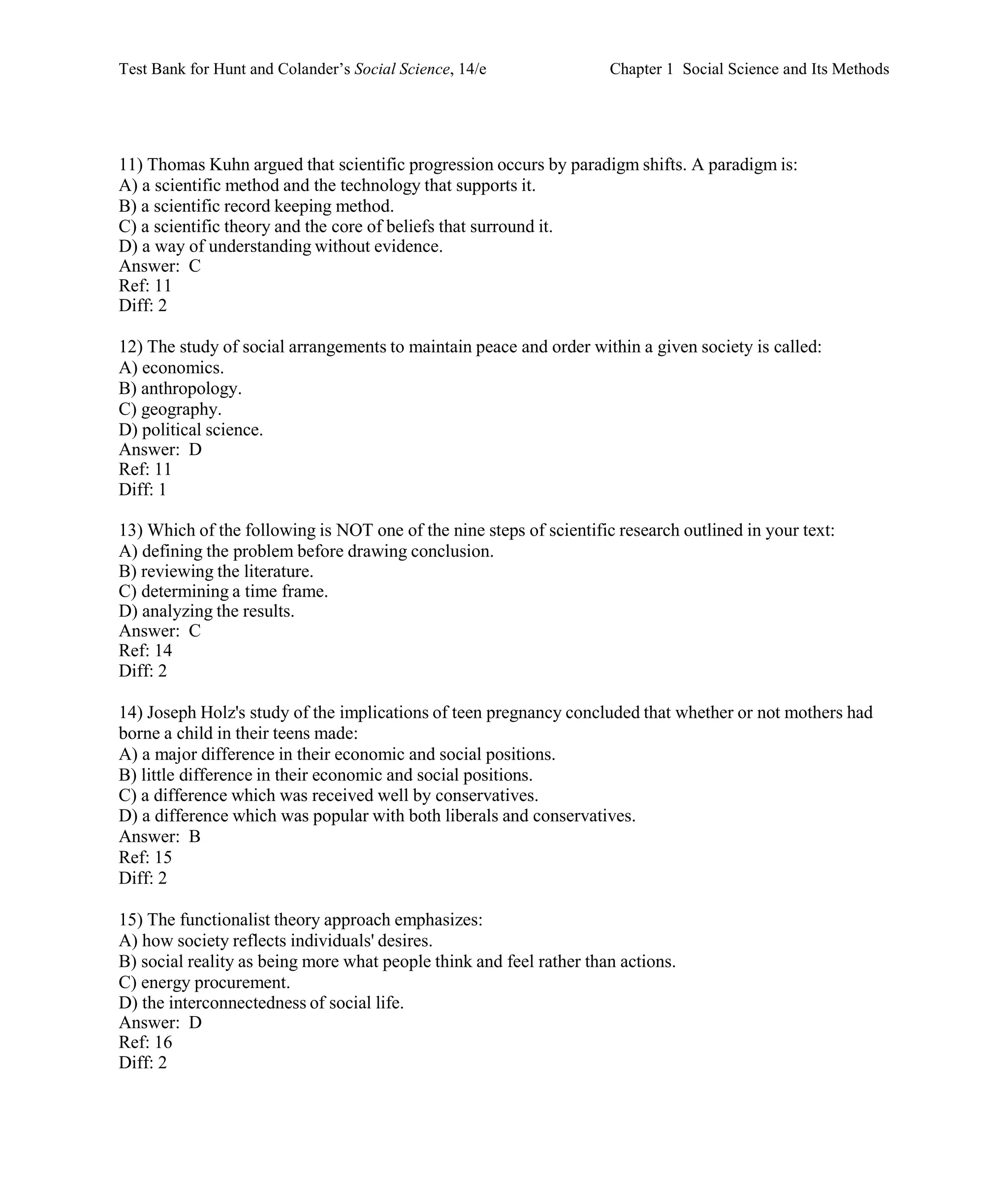
Test Bank for Hunt and Colander’s Social Science, 14/e Chapter 1 Social Science and Its Methods
11) Thomas Kuhn argued that scientific progression occurs by paradigm shifts. A paradigm is:
A) a scientific method and the technology that supports it.
B) a scientific record keeping method.
C) a scientific theory and the core of beliefs that surround it.
D) a way of understanding without evidence.
Answer: C
Ref: 11
Diff: 2
12) The study of social arrangements to maintain peace and order within a given society is called:
A) economics.
B) anthropology.
C) geography.
D) political science.
Answer: D
Ref: 11
Diff: 1
13) Which of the following is NOT one of the nine steps of scientific research outlined in your text:
A) defining the problem before drawing conclusion.
B) reviewing the literature.
C) determining a time frame.
D) analyzing the results.
Answer: C
Ref: 14
Diff: 2
14) Joseph Holz's study of the implications of teen pregnancy concluded that whether or not mothers had
borne a child in their teens made:
A) a major difference in their economic and social positions.
B) little difference in their economic and social positions.
C) a difference which was received well by conservatives.
D) a difference which was popular with both liberals and conservatives.
Answer: B
Ref: 15
Diff: 2
15) The functionalist theory approach emphasizes:
A) how society reflects individuals' desires.
B) social reality as being more what people think and feel rather than actions.
C) energy procurement.
D) the interconnectedness of social life.
Answer: D
Ref: 16
Diff: 2
Test Bank for Hunt and Colander’s Social Science, 14/e Chapter 1 Social Science and Its Methods
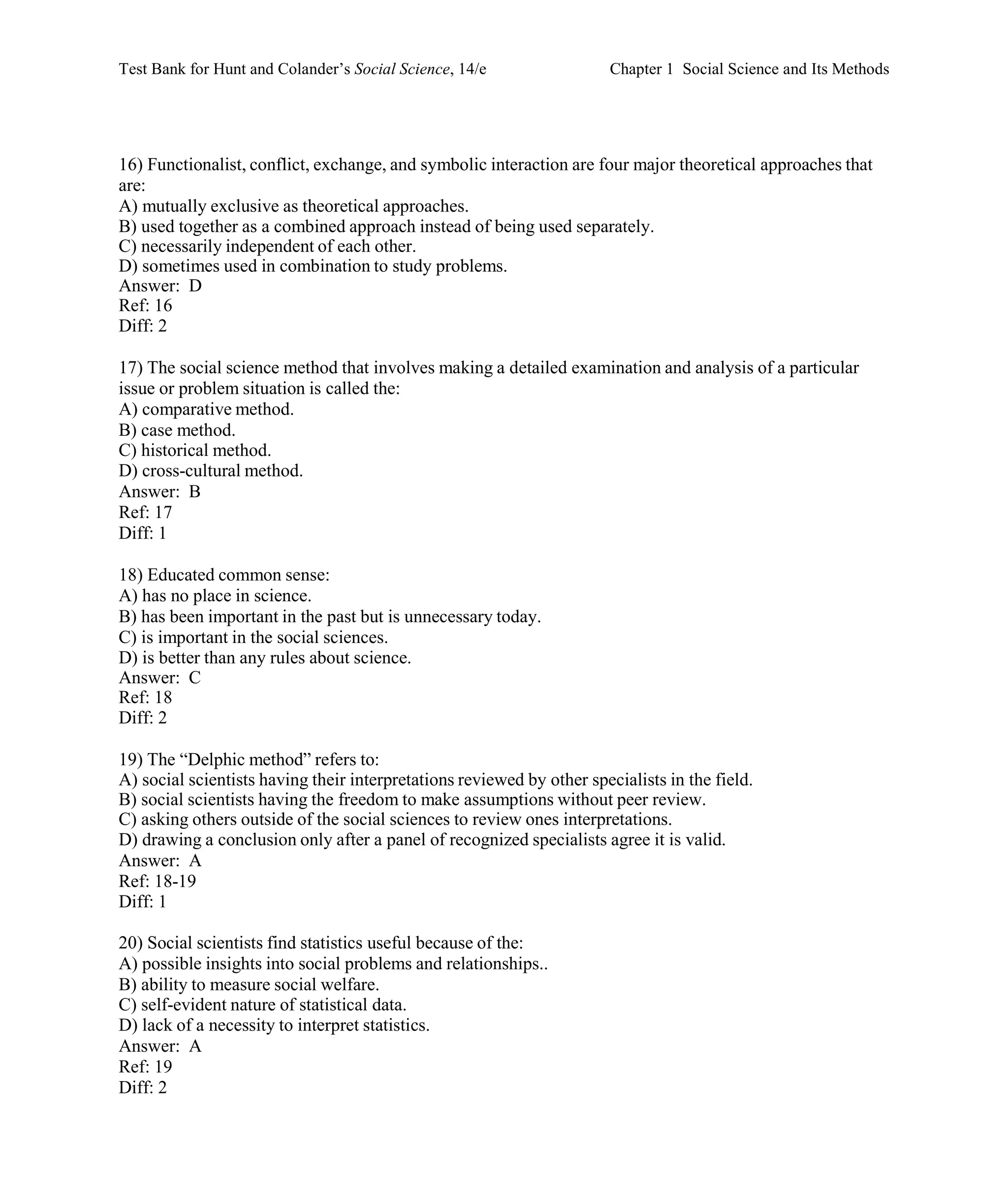
16) Functionalist, conflict, exchange, and symbolic interaction are four major theoretical approaches that
are:
A) mutually exclusive as theoretical approaches.
B) used together as a combined approach instead of being used separately.
C) necessarily independent of each other.
D) sometimes used in combination to study problems.
Answer: D
Ref: 16
Diff: 2
17) The social science method that involves making a detailed examination and analysis of a particular
issue or problem situation is called the:
A) comparative method.
B) case method.
C) historical method.
D) cross-cultural method.
Answer: B
Ref: 17
Diff: 1
18) Educated common sense:
A) has no place in science.
B) has been important in the past but is unnecessary today.
C) is important in the social sciences.
D) is better than any rules about science.
Answer: C
Ref: 18
Diff: 2
19) The “Delphic method” refers to:
A) social scientists having their interpretations reviewed by other specialists in the field.
B) social scientists having the freedom to make assumptions without peer review.
C) asking others outside of the social sciences to review ones interpretations.
D) drawing a conclusion only after a panel of recognized specialists agree it is valid.
Answer: A
Ref: 18-19
Diff: 1
20) Social scientists find statistics useful because of the:
A) possible insights into social problems and relationships..
B) ability to measure social welfare.
C) self-evident nature of statistical data.
D) lack of a necessity to interpret statistics.
Answer: A
Ref: 19
Diff: 2
Test Bank for Hunt and Colander’s Social Science, 14/e Chapter 1 Social Science and Its Methods
Ref: 27
Diff: 2
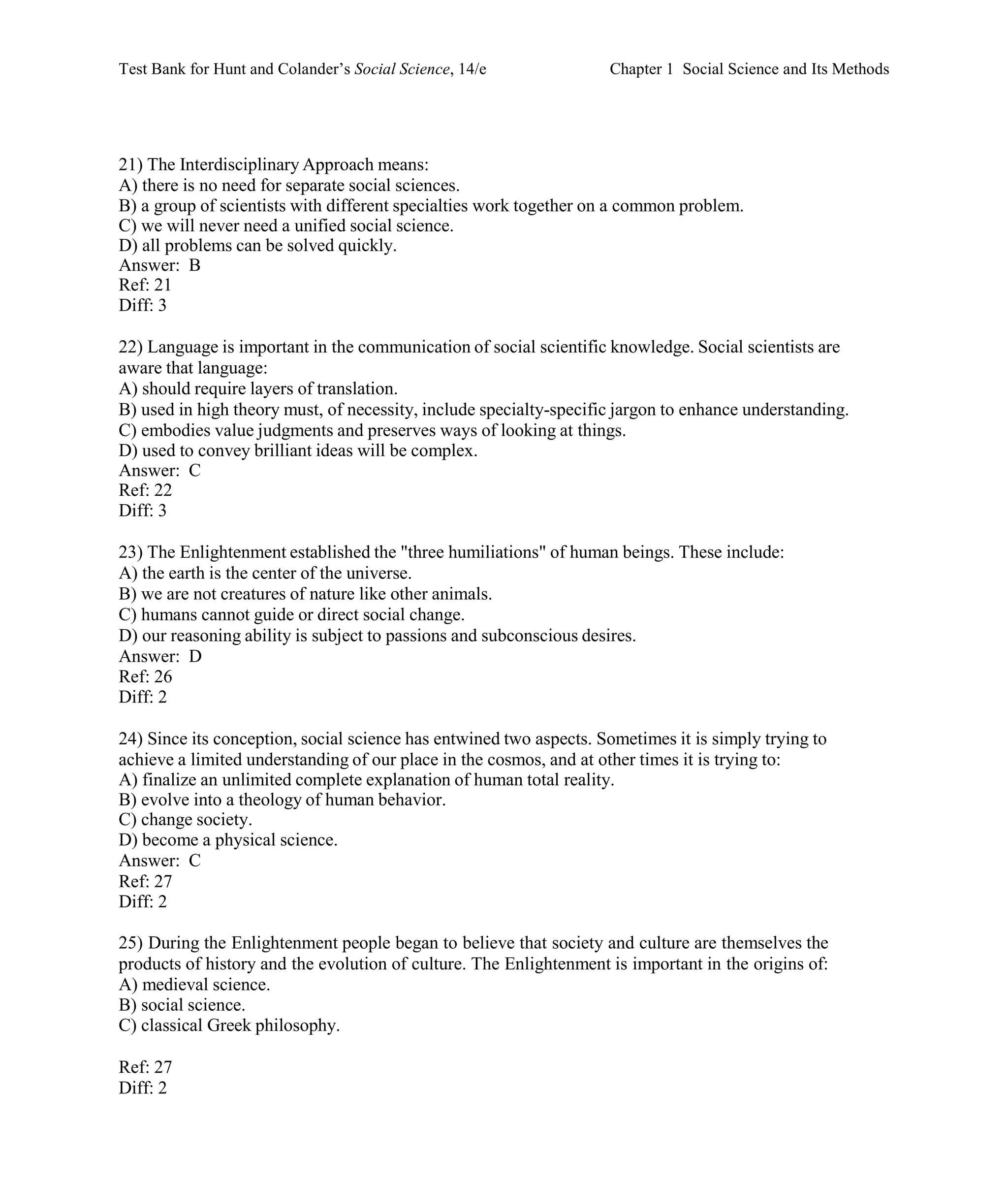
21) The Interdisciplinary Approach means:
A) there is no need for separate social sciences.
B) a group of scientists with different specialties work together on a common problem.
C) we will never need a unified social science.
D) all problems can be solved quickly.
Answer: B
Ref: 21
Diff: 3
22) Language is important in the communication of social scientific knowledge. Social scientists are
aware that language:
A) should require layers of translation.
B) used in high theory must, of necessity, include specialty-specific jargon to enhance understanding.
C) embodies value judgments and preserves ways of looking at things.
D) used to convey brilliant ideas will be complex.
Answer: C
Ref: 22
Diff: 3
23) The Enlightenment established the "three humiliations" of human beings. These include:
A) the earth is the center of the universe.
B) we are not creatures of nature like other animals.
C) humans cannot guide or direct social change.
D) our reasoning ability is subject to passions and subconscious desires.
Answer: D
Ref: 26
Diff: 2
24) Since its conception, social science has entwined two aspects. Sometimes it is simply trying to
achieve a limited understanding of our place in the cosmos, and at other times it is trying to:
A) finalize an unlimited complete explanation of human total reality.
B) evolve into a theology of human behavior.
C) change society.
D) become a physical science.
Answer: C
Ref: 27
Diff: 2
25) During the Enlightenment people began to believe that society and culture are themselves the
products of history and the evolution of culture. The Enlightenment is important in the origins of:
A) medieval science.
B) social science.
C) classical Greek philosophy.
Test Bank for Hunt and Colander’s Social Science, 14/e Chapter 1 Social Science and Its Methods
Ref: 27
Diff: 2
D) the idea that civilization did not improve.
Answer: B
Test Bank for Hunt and Colander’s Social Science, 14/e Chapter 1 Social Science and Its Methods
TRUE/FALSE
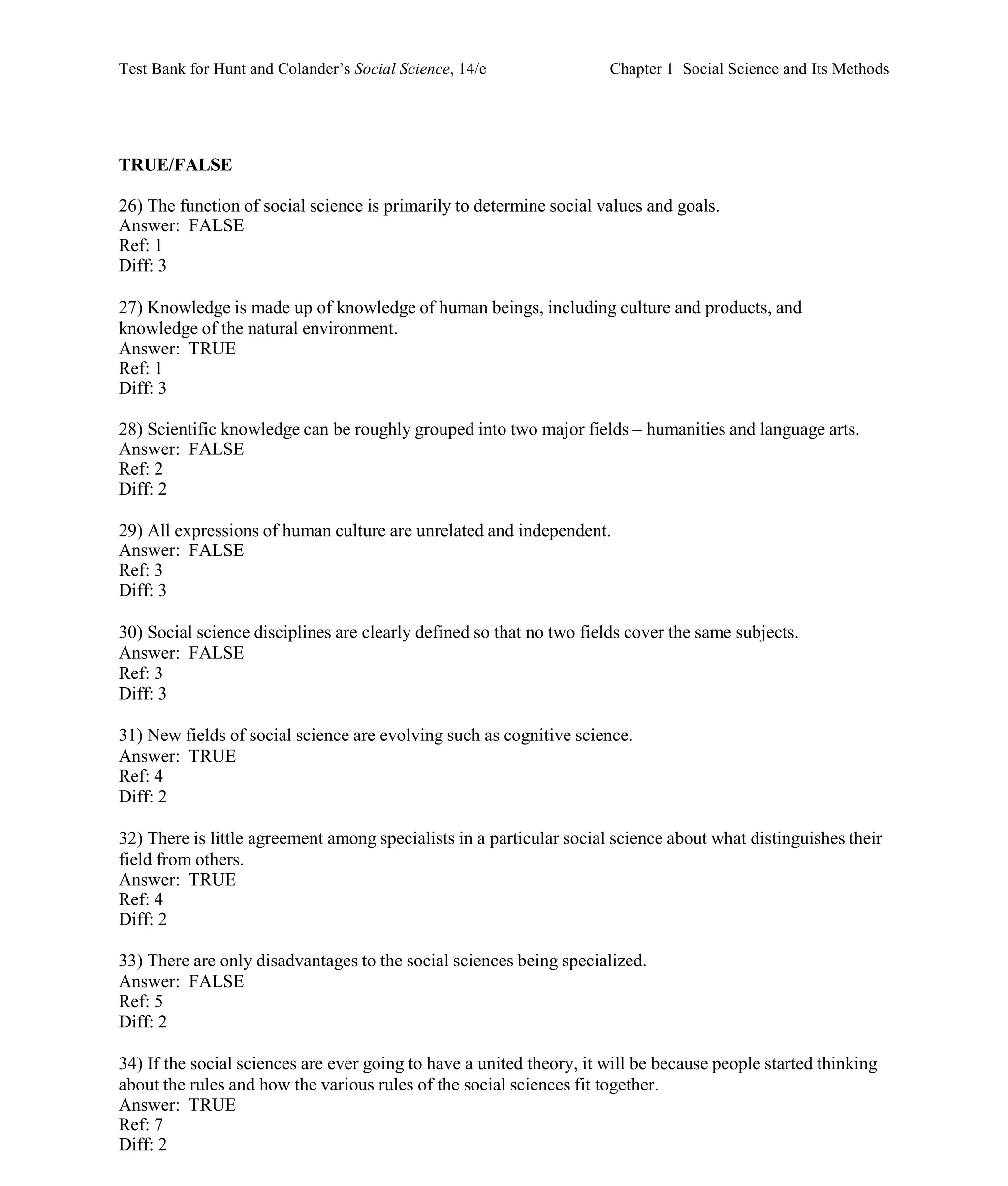
26) The function of social science is primarily to determine social values and goals.
Answer: FALSE
Ref: 1
Diff: 3
27) Knowledge is made up of knowledge of human beings, including culture and products, and
knowledge of the natural environment.
Answer: TRUE
Ref: 1
Diff: 3
28) Scientific knowledge can be roughly grouped into two major fields – humanities and language arts.
Answer: FALSE
Ref: 2
Diff: 2
29) All expressions of human culture are unrelated and independent.
Answer: FALSE
Ref: 3
Diff: 3
30) Social science disciplines are clearly defined so that no two fields cover the same subjects.
Answer: FALSE
Ref: 3
Diff: 3
31) New fields of social science are evolving such as cognitive science.
Answer: TRUE
Ref: 4
Diff: 2
32) There is little agreement among specialists in a particular social science about what distinguishes their
field from others.
Answer: TRUE
Ref: 4
Diff: 2
33) There are only disadvantages to the social sciences being specialized.
Answer: FALSE
Ref: 5
Diff: 2
34) If the social sciences are ever going to have a united theory, it will be because people started thinking
about the rules and how the various rules of the social sciences fit together.
Answer: TRUE
Ref: 7
Diff: 2
Test Bank for Hunt and Colander’s Social Science, 14/e Chapter 1 Social Science and Its Methods
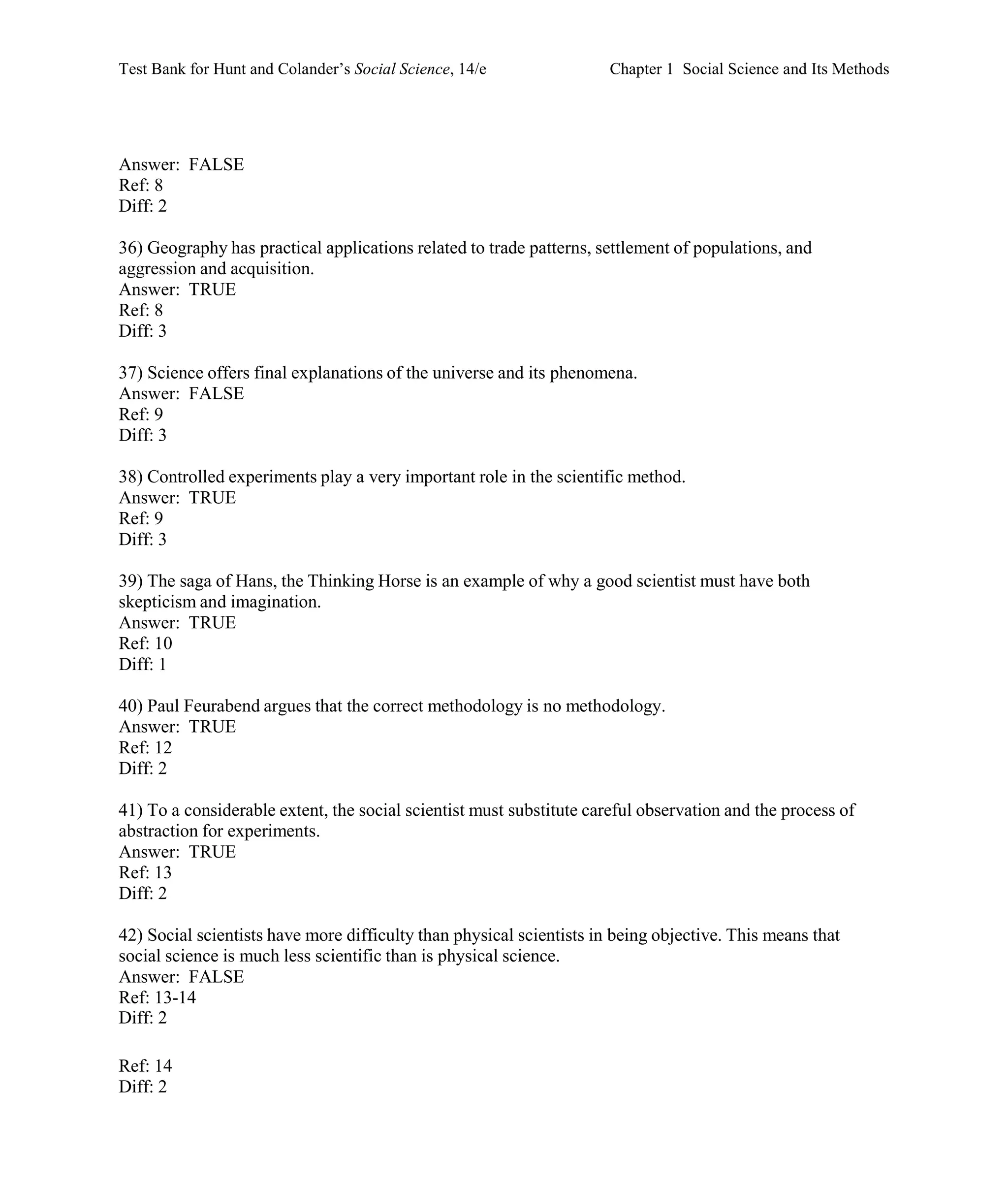
35) Sociology is the study of the ways in which men and women make a living.
Test Bank for Hunt and Colander’s Social Science, 14/e Chapter 1 Social Science and Its Methods
Ref: 14
Diff: 2
Answer: FALSE
Ref: 8
Diff: 2
36) Geography has practical applications related to trade patterns, settlement of populations, and
aggression and acquisition.
Answer: TRUE
Ref: 8
Diff: 3
37) Science offers final explanations of the universe and its phenomena.
Answer: FALSE
Ref: 9
Diff: 3
38) Controlled experiments play a very important role in the scientific method.
Answer: TRUE
Ref: 9
Diff: 3
39) The saga of Hans, the Thinking Horse is an example of why a good scientist must have both
skepticism and imagination.
Answer: TRUE
Ref: 10
Diff: 1
40) Paul Feurabend argues that the correct methodology is no methodology.
Answer: TRUE
Ref: 12
Diff: 2
41) To a considerable extent, the social scientist must substitute careful observation and the process of
abstraction for experiments.
Answer: TRUE
Ref: 13
Diff: 2
42) Social scientists have more difficulty than physical scientists in being objective. This means that
social science is much less scientific than is physical science.
Answer: FALSE
Ref: 13-14
Diff: 2
Test Bank for Hunt and Colander’s Social Science, 14/e Chapter 1 Social Science and Its Methods
Ref: 14
Diff: 2
43) The scientific method is a set of beliefs all scientists use in the same way.
Answer: FALSE
Test Bank for Hunt and Colander’s Social Science, 14/e Chapter 1 Social Science and Its Methods
44) The line between what is social science and what is natural science is fixed.
Answer: FALSE
Ref: 15
Diff: 1
45) Social scientists basically use the same approaches and methods and discourage different disciplinary
approaches.
Answer: FALSE
Ref: 16
Diff: 3
46) Today, the attempt to find patterns of social evolution that can be applied to all societies has been
largely abandoned.
Answer: TRUE
Ref: 17
Diff: 1
47) The processing speeds of computers double every two months according to Moore's Law.
Answer: FALSE
Ref: 18
Diff: 2
48) Social scientists can have a great impact on policies by helping people to understand the issues.
Answer: TRUE
Ref: 21
Diff: 2
49) One of the great problems in a democracy is getting the majority of people to reach substantial
agreement on the major policies that should be followed to create a better society.
Answer: TRUE
Ref: 21
Diff: 1
50) The function of social science is not primarily to determine social objectives but instead to discover
how our objectives can be achieved.
Answer: TRUE
Ref: 22
Diff: 1
SHORT ANSWER ESSAYS
51) What is the importance of knowing the interrelationships among social science disciplines?
Ref: 3-5
Suggested Answer: It is important to know the interrelationships among social science disciplines
because of the complexity of expressions of human culture. If you look at an aspect of human life from
the perspective of only one discipline you are likely to miss things. In other words, to understand
psychology sometimes you have to understand sociology and vice versa.
Test Bank for Hunt and Colander’s Social Science, 14/e
52) Outline the nine steps of scientific research presented in your text as research methods of social
science. What is the purpose of these methods?
Ref: 13-15
Suggested Answer:
• Observe
• Define the problem
• Review the literature
• Observe some more
• Develop a theoretical framework and formulate a hypothesis
• Choose a research design
• Collect the necessary data
• Analyze the results
• Draw conclusions
The purpose of the scientific method is to systematically answer questions. The scientific
method allows researchers to match objective findings with observations.
53) What is the difference between common sense and educated common sense? Why is the distinction
important in science?
Ref: 18
Suggested Answer: Unlike common sense, educated common sense is rational thought based on
observation and the best information available. Educated common sense attempts to match data with
theories. This kind of distinction is important to science in that it led to the development of the scientific
method.
54) What is the distinction between correlation and causation? Give a hypothetical example that might
occur in social research to demonstrate each.
Ref: 19
Suggested Answer: Whereas causation implies that changes in one variable bring about change in
another variable, correlation simply refers to the simultaneous movement of two variables. For example,
the height and weight of adults are correlated, meaning that they are related. If a person is tall, he or she
usually weighs more; however height does not cause a person’s weight.
55) Albert Einstein said that, "Theories should be as simple as possible, but not more so." Why and how
is this important in understanding social science methods and the whole purpose of social science?
Ref: 22
Suggested Answer: If a theory is complicated and difficult to understand it will be a harder
explanation of the world to test. Complicated theories also obscure the purpose of social science, which is
to understand and clarify social issues and social problems. If social scientists use simple theories that are
easier to test and explain, they are better able to meet the goals relative to the field of social science.
Other documents randomly have
different content
woman, being undoubtedly of the better class, had gravitated
naturally toward our reporter. Thus at once was established, without
premeditation, a conflict of interests in the eyes of the policeman.
He represented the Law, which is invariably more suspicious than
sympathetic. Opposing him were two strangers who might be in
collusion. Hunting in couples, one of either sex, was a common trick
of the criminal classes, with which every policeman is familiar. The
officer with whom we are dealing was not of an analytic turn; he
jumped rather at conclusions than motives; therefore, he
pronounced the verdict first and examined the evidence afterward,
or left it to others to examine. All that he was honestly concerned in
was the performance of his duty.
"'Did you not hear her say,' said our reporter, 'that she was alone,
and no baby with her?'
"'I heard something of the sort,' replied the policeman, candidly,
believing it is another matter. 'I believe in my own ears. Are you a
confederate of hers?'
"Our reporter laughed, and his laugh strengthened the
policeman's suspicions and excited his ire.
"'Perhaps you will both deny,' he said, 'that something was thrown
into the river.'
"'I certainly heard a splash,' said our reporter, and he looked at
the woman for confirmation, but she said nothing.
"'We'll fish it up, whatever it is,' said the policeman. 'If it isn't a
baby--which I say it is, as I heard it cry--it's stolen property. Pretty
nigh as bad.' So saying, he blew his whistle.
"The sound terrified the woman; she clung to our reporter.
"'What need is there to summon assistance?' asked our reporter.
"'I know what I'm up to,' replied the policeman. 'I'll trouble you to
come to the police station.
"'I intend to do so. Are you going to charge this lady?'
"A grateful sob escaped the woman, produced by the reference to
her as a lady no less than by the considerate tone in which it was
made.
"'If you're particularly anxious to know,' said the policeman, 'I am
going to charge you both.'
"Much amused, our reporter asked, 'What do you charge her
with?'
"'First, with drowning her baby; next, with attempting to commit
suicide.' He paused in the middle of the sentence to blow his whistle
again.
"'And what is your charge against me?'
"'Aiding and abetting. Come,' he said to the woman, putting his
hand under her chin and attempting to raise her face to the light, 'let
me have a look at you. A hundred to one I've seen you before.'
"He was so rough that the woman cried out.
"'Be very careful,' said our reporter, in a warning tone. 'If you use
violence it will go against you.'
"'It will go against you,' retorted the policeman, who was losing
his discretion.
"'That is to be seen,' said our reporter, gravely, 'when we reach
the police-station. Meanwhile, you are acting outside your right in
compelling this lady to look you in the face.'
"'Very well,' said the policeman, surlily, beginning to be shaken by
the temperate conduct of our reporter, 'I hear assistance coming; I'll
wait.'
"The measured tread of another policeman was heard in the near
distance. Our reporter stood still, perfectly calm and self-possessed.
"The woman, now sobbing bitterly, drew her handkerchief from
her pocket, and a piece of paper, which she undesignedly and
unwittingly drew forth with it, fluttered to the ground. Only the
sharp eyes of our reporter saw it, and he stooped and picked it up.
He glanced at it without attracting the attention of the policeman,
and what he saw both greatly astonished him and influenced his
future course with respect to the woman. He felt instinctively that he
held in his hand a thread, however slight and slender, in the Mystery
of Monsieur Felix.
"Our readers will remember that in certain editions of the Evening
Moon we inserted an advertisement referring to the death of M.
Felix, but lest the precise terms of that advertisement should be
forgotten by them we reprint it here, to refresh their memory. The
advertisement ran as follows:
"'The Strange Death of M. Felix, in Gerard Street, Soho. Persons
who had private or other interviews with M. Felix between the hours
of eight in the morning and twelve at night on the 16th of January,
or who are in possession of information which will throw light upon
the circumstances surrounding his death, are urgently requested to
call at the office of the Evening Moon, at any time after the
appearance of this advertisement. Liberal rewards will be paid to all
who give such information, and the best legal assistance is offered
by the proprietors of this journal, entirely at their own expense, to
all, who may desire it and who are in any way interested in M. Felix's
death.'
"Up to the present time the advertisement had been productive of
no result of any value. A great many persons had called at our office
respecting it, but they knew nothing that was likely to be of
assistance to us; their aim was to obtain money without giving an
equivalent for it. That the step we took, however, was not useless
was proved by what our reporter now held in his hand. It was the
advertisement, cut carefully from our journal, pasted upon a sheet of
note-paper, and framed, as it were, in clear lines of red ink. Surely it
was not without reason that the woman had been thus painstaking
with this extract. Surely there must be some connecting link
between her and M. Felix, whose death and subsequent
disappearance were still enveloped in mystery. Thus thought our
reporter the moment his eyes fell upon the advertisement.
"The approach of the second policeman afforded him an
opportunity of speaking to her concerning it. While the two
policemen were talking, the second asking for information, the first
giving it, he exchanged a few words with the woman.
"'You have dropped something,' he said.
"She put her hand hastily in her pocket and discovered her loss.
"'I have it,' said our reporter.
"'It is only a piece of paper,' said the woman; 'give it back to me.'
"'You had better let me keep it,' he said. 'You will be charged and
searched at the police-station----'
"She interrupted him, saying, in a pitiful voice, 'Will they not let
me go--oh will they not let me go?'
"'They will not,' replied our reporter, 'and they are not to be
blamed. They are merely doing their duty. You have acted in a way
which throws suspicion upon you----'
"'I have done nothing wrong,' she said, interrupting him again;
and that she regarded him as being well disposed toward her was
proved by her speaking in a low tone, notwithstanding her anguish
of mind, 'indeed, indeed I have not!'
"'I believe you; they will not. I will not ask you what you have
done; if you confide in me it must be of your own free will; but you
may truly believe that I am desirous and willing to be your friend,
your sincere and earnest friend. Something more; I may be able to
assist you in a manner you little dream of. The paper you have
dropped is an advertisement from the Evening Moon, referring to the
death of M. Felix.' She shivered at the name, raised her eyes, and
dropped them again. This gave him an opportunity of observing that
they were of a peculiar and beautiful tinge of blue, and the soft
pathetic light they shed touched him deeply. 'Be patient a moment,'
he continued; 'I must have a little private talk with you before we
get to the police station, and I think I can manage it.' He had seen
and recognized the face of the second policeman, who now, as he
came forward, greeted him respectfully. 'Your comrade here,' said
our reporter, jocosely, 'believes that I am engaged in some unlawful
conspiracy. You know who I am. Set his mind at rest.'
"It happened fortunately that this second policeman and our
reporter were old acquaintances, and had spent many an hour
together in the still watches of the night. A few words whispered in
the ear of the first policeman settled his doubts.
"'I beg your pardon, sir,' he said, apologetically, 'but mistakes will
happen in the best regulated families.' A remark which denoted that
the worthy and zealous officer was not deficient in a sense of humor.
"'A mistake has happened here,' said our reporter. 'I presume that
you do not now intend to charge me with aiding and abetting.'
"'Not a bit of it, sir. It was only my joke.'
"'You have a queer way of airing your jokes, but I cannot
reasonably complain; you had grounds for suspicion. And now about
this lady.'
"'Don't ask me to neglect my duty, sir. I must take her to the
station.'
"'She denies that she has done anything wrong.'
"'They all do that, sir.'
"'Do you persist in your charges against her?'
"'Well, sir, about the baby I won't be sure now; it's as likely as not
I was mistaken in thinking I heard it scream; but we'll try to prove
the rights of the thing. I don't give way, sir, in my belief that she
attempted to commit suicide.'
"'I am a properly qualified solicitor,' said our reporter, 'and I shall
appear for her, and shall also offer myself as an eye-witness of the
affair. I shall support her in her statement that she had no intention
of committing suicide.'
"'I can't help that, sir,' said the policeman, with respectful
pertinacity, 'I can only report what I saw, and I must do my duty.
She nearly fell into the river; I hope you won't deny that, sir.'
"'I will not deny it. You are speaking now quite fairly and
temperately, and I hope to bring you round to my view.'
"'To let her off, sir?'
"'Yes.'
"'I can't do it, sir.'
"'But listen to reason. She accidentally lost her balance----'
"'And,' interposed the policeman, 'would have fallen in had it not
been for us.'
"'That does not establish a charge of an attempt at suicide.'
"'It must be looked into, sir,' said the policeman, stiffly.
"'It seems to me,' said the second policeman, 'that it all depends
upon what it was she threw into the river.'
"Without asking permission our reporter stepped aside with the
woman, and spoke privately to her. She had listened to the
conversation in an agonized state of mind, turning her eyes
alternately to her accuser and her defender with the air of one who
was being hunted down. Helpless, despairing innocence was
depicted in her face, and the favorable impression she had produced
upon our reporter was strengthened. Had she not in his belief been
connected in a manner yet to be explained with the Mystery of M.
Felix he would have been inclined to champion her cause, and
because of this belief he would have ranked himself on her side even
if he had supposed that the charges brought against her were true.
Without a shade of doubt she was a lady; her attire, although it bore
no indications of worldly prosperity, her manners, her speech,
unmistakably proclaimed the fact. She was apparently a little over
forty years of age, and there were traces of long-endured suffering
on her features. In her youth she must have possessed remarkable
beauty, which even now could not fail in attracting attention; her
figure was slight and graceful, her movements gentle and refined.
These signs rendered her appearance at such an hour and under
such circumstances sufficiently perplexing, but our reporter was
satisfied to trust to the future for a satisfactory explanation of what
at present, to a vulgar mind, was full of suspicion.
"In stating that he was a properly qualified solicitor our reporter
stated a simple fact. He had served articles in a solicitor's office, and
had abandoned that profession for one which possessed greater
attractions for him.
"It occurred to him to test her, and he addressed her in French.
She replied to him in the same language, but with an accent which
put his to the blush. We shall, however, give what passed between
them in our native tongue, for the sake of perfect clearness, and in
the interests of those of our readers who may not be familiar with
any other language than their own.
"'You have not deceived me?' he asked.
"'Indeed, indeed, I have not,' she replied, earnestly. 'I have
spoken the truth. You will not desert me?'
"'I will not. You may count upon me as a sincere friend; but you
must confide in me implicitly. I will serve you honestly and faithfully.
You have met with misfortunes?'
"'Great misfortunes. I am a most unhappy woman!'
"'Have you any other friends in London in whom you would
confide in preference to me? If you have and will give me their
names and addresses, I will bring them to you.'
"'I have no other friend in this city in whom I can confide.'
"'Not one who can assist you?'
"'Not one.'
"'Are you quite unknown here?'
"'Yes.'
"'But surely you are not entirely alone?'
"She made an effort to speak, but words failed her; she raised her
imploring eyes to his face.
"'Strive to master your agitation,' he continued, 'and bend your
mind upon the position in which you stand. You heard what the
policeman said?'
"'Yes.'
"'Will you tell them what it was you threw into the river?'
"'I cannot tell them. It might injure--it might ruin me.'
"'Was it property of your own?'
"'It was.'
"'To which no person but yourself has a claim?'
"'It was my own; no person but myself has a claim to it.'
"'The loss or recovery of which would injure no one?'
"'No one but myself.'
"'Now, consider. You will be taken to the police station and
charged.'
"'But they will let me go until to-morrow?'
"'They will not. If I, a stranger to you, offered bail, it would not be
accepted. You will be locked up till the morning.'
"'My God!' cried the woman. 'What will become of her--oh, what
will become of her?'
"'Of her? Then you are not entirely alone in this city?'
"'I have a daughter,' she said, in a low, despairing tone. 'She will
be distracted if I do not return to her to-night.'
"'As I have explained to you, that is out of the question. If you are
not unwilling, I will go to her and explain matters.'
"'No, no!' cried the woman. 'She must not know the truth! What
have I done that this misfortune should fall upon me?'
"'I feel deeply for you. If I knew how I could inspire you with
confidence in me I should be glad. Look at me and say whether you
cannot trust implicitly in me.'
"They gazed at each other in silence for many moments. The
policemen, standing apart, did not interrupt them, and as they spoke
in French, could not have understood if they had heard what was
passing. The woman put out her hand timidly.
"'I will trust you,' she said. 'It may be that the good Lord has sent
me a friend when I most needed one. By the memory of all that is
dearest to you, do not betray me!'
"'I swear solemnly that I will not.'
"The pressure of her hand seemed to instil faith in her. All the
earnestness of her soul was expressed in the words she now spoke.
"'I give into your charge what is infinitely more precious than life--
my honor, and my dear daughter's happiness. May Heaven so deal
by you as you deal by me!'
"'I am content,' said our reporter.
"At this juncture the first policeman thought he had allowed
sufficient time for a decision.
"'Time presses, sir,' he said.
"'Then we had better go to the station,' said our reporter, 'if you
persist in your ridiculous charge.'
"'There is nothing else for me to do, sir,' said the policeman.
"'You have no objection to my walking by the side of this lady,
keeping yourself out of hearing. I wish to receive instructions from
her.'
"'Give me your word, sir, that there will be no attempt at escape.'
"'There shall not be.'
"'It's all right,' said the second policeman, 'you may take the
gentleman's word for a good deal more than that. You won't want
me.'
"He left them, and our reporter and the woman, preceded by the
policeman, who occasionally looked over his shoulder to see that
they were following him, walked to the Bow Street Police Station."
CHAPTER XVI.
AT THE BOW STREET POLICE STATION.
"'We have but little time for uninterrupted conversation,' said our
reporter, still speaking in French, 'and must make the best of it. At
the station we shall not be private, as we are now. An explanation is
due from me first. I am, as you have heard, a properly qualified
solicitor, and can therefore defend you legally, although at present I
see little to defend. But the fact that I am your authorized legal
adviser should strengthen your confidence in me, for whatever
information of a secret nature I receive from you I am bound
professionally to respect. You see, therefore, that your interests are
safe in my hands.'
"'I am truly grateful to you,' said the woman.
"'Intended for the Law,' continued our reporter, 'I do not follow it
as a profession. I am a journalist, engaged upon the Evening Moon.
You start. The fact of my being so engaged should still further
increase your confidence in me. Now, perhaps, you can understand
why I am so much interested in the advertisement cut from our
paper which you carry about with you. May I accept it that you have
read what has been published in the Evening Moon concerning the
death and strange disappearance of M. Felix?'
"'I have read all that has appeared in the paper,' said the woman,
who was paying the closest attention to what he was saying,
"'Thank you for the frank admission. To my hands has been
entrusted the task of clearing up this strange affair, and of bringing it
forward to the full light of day. That is only a portion of my mission.
I have taken it upon myself to so sift the matter to the bottom, that,
if any innocent person has been wronged, his innocence shall be
made clear, and also to punish the guilty. Where there is mystery
there is generally crime, and where there is crime the presumption is
that innocent beings have been brought to sorrow. Whether right Or
wrong, I have the firmest conviction that there is some story of
wrong-doing underlying this mystery, and if I am right--which time
and good fortune can alone establish--this wrong-doing must have
inflicted suffering upon innocent persons. In opening my mind to
you upon these issues I may be, in your estimation, speaking at
random of details of which you are ignorant, and indeed of details
which exist only in my imagination, and have no foundation in fact;
but I take the chance of that, believing that no harm can be done by
a perfectly open confession of the motives which are urging me on
in the elucidation of a mystery which has caused, and still is causing,
a great deal of excitement. You will now understand why the
discovery surprised me that you should have taken the trouble to so
carefully preserve the advertisement which slipped from your pocket.
It would scarcely have been done by one whom it did not in some
way concern, and it remains to you to enlighten me upon this point.
Let me assure you that the advertisement was inserted in good faith,
and that its terms will be scrupulously observed. Legal assistance is
offered, and will be given, and money will be spent if any good
purpose can be served by it. That is all I have time to say in
explanation of the interest, to you in all probability the singular
interest, I have taken in our meeting to-night. The whole of this
evening I have been engaged in following up a clew connected with
the disappearance of the body of M. Felix, of which, as you read the
Evening Moon, you are doubtless aware.'
"'Yes,' said the woman, 'I have read of it.'
"'I am on the track, and I venture to affirm that I shall eventually
succeed in my purpose. I have already more than one ally. May I
hope that I have gained another?'
"'I do not know,' said the woman, and though they were walking
now through unlighted spaces and he could not see her face, our
reporter divined from her broken tones that she was crying. 'I
cannot say. All is dark before me; there is not a star in the future to
light me on my way.'
"'Do not give up hope,' said our reporter. 'I am by your side to
help you. You and your daughter, two women, alone in London as I
understand, without a friend, can do very little, but an earnest,
willing man, who has influence and means to back him up, may do
much.'
"In his sincere sympathy our reporter pressed the woman's arm,
and she uttered an exclamation of pain.
"Have I hurt you?' he asked, hurriedly.
"'My arm has been injured,' replied the woman, biting her lip so
that she should not repeat the cry; 'it has been cut to the bone.'
"'I am very sorry. Is it your left arm?'
"'Yes.'
"'Was it recently done?--but I beg your pardon for questioning
you so closely.'
"'You have the right to question me. It was done a few days ago.'
"'You are unfortunate in more ways than one.'
"'Truly, truly,' sighed the woman. 'Your voice, your words are kind,
but I can think of nothing but my dear child. She is waiting for me,
expecting me, listening for my footsteps on the stairs. If I could
escape--if I could get away unseen!'
"'You must not dream of it; you would plunge yourself into deeper
trouble; and my word is pledged.'
"'Yes, yes, I forgot; I am ungrateful.'
"'I will do all I can for you at the Police Station; if it is possible,
you shall in a few minutes go to your daughter; but I must not
disguise from you the chances are very small.'
"'But you will try--you will try?'
"'Yes, I will try; I will stand bail for you; I can do no more just
now.'
"'You have done much, more than I can repay. If they are cruel
enough to detain me, how long shall I have to wait?'
"'Till to-morrow morning. You will be brought up before a
magistrate.'
"'It is a terrible disgrace, a terrible, terrible disgrace! But they
cannot punish me if I have done nothing wrong?'
"'No, they cannot punish you unless they can prove something
against you which will render you liable.'
"'Can they upon suspicion?'
"'Upon mere suspicion, no.'
"'When I appear before the magistrate, will you be there?'
"'You may rely upon me. I shall be there to represent you legally,
as I am willing now to assist you privately. We are near the station.
Have you nothing more to say to me?'
"'Did you tell me that I should be searched at the station, or is it
only my fear?'
"'It is almost certain you will be searched.'
"'They must find nothing upon me; they must not know who I
am, or my daughter's happiness is wrecked.'
"Hastily and stealthily she extracted from her pocket a key, a
purse and a handkerchief, and slipped them into his hands. As
hastily and stealthily he slipped them into his own pocket. The
policeman had not observed the proceeding.
"'Will you not require you handkerchief?' asked our reporter.
"'I must do without it. My initials are worked upon it, and it might
lead to my identification. They must not, they must not know!'
"This remark would have seriously disturbed our reporter if he
had not made up his mind to believe thoroughly, for the time being,
everything the woman told him, and to leave it to the future to
decide whether she was or was not deceiving him.
"'Should I be detained,' said the woman, 'you will go to my
daughter and assure her I am in no danger?'
"'I will go with pleasure.'
"'You will not wait till morning? You will go at once?'
"'I will go straight from the station.'
"'Heaven reward you! Believe a suffering, much-wronged woman,
sir, your confidence is not misplaced.'
"They had not time to exchange another word; they were at the
station door.
"The Inspector was within, taking the night charges, and our
reporter saw with satisfaction that it was an officer with whom he
was acquainted.
"'Good-evening, Mr. Jealous,' he said.
"Inspector Jealous looked up. 'Hallo,' he said, 'what brings you
here?'
"'I come on behalf of this lady,' replied our reporter, 'against
whom a policeman on duty on the Thames Embankment has a
groundless charge to make.'
"The Inspector's eyes wandered from our reporter to the lady.
The policeman came forward and laid his charge in a temperate
manner. Inspector Jealous listened in silence.
"'I thought at first,' said the policeman, 'that it was a child she
had thrown into the river, but the gentleman here thinks the other
way, and he is as likely to be right as I am. Of her attempt at suicide
I am certain.'
"'That is a distinct charge,' said Inspector Jealous, dipping his pen
in the ink. 'The bundle, whatever it is, can, I dare say, be recovered.'
He called a constable, and gave him some whispered instructions;
after which the man left the office. 'You can join him presently on
the Embankment. Do you know the woman?' Pinned to formula,
Inspector Jealous ignored our reporter's reference to her as a lady.
"'Look up,' said our reporter to the woman; 'you have nothing to
be ashamed of.'
"Thus assured and comforted the woman raised her face, so that
everyone in the office could see it clearly. Tears were hanging on her
eyelids, and there was a piteous expression upon the trembling
mouth.
"'I don't know her,' said the policeman, honestly.
"The constables in the office craned their necks, then shook their
heads.
"'She's no better than she ought to be! She's no better than I am!
I'm as good as her any day of the week! Go to blazes, the lot of yer!'
"The interruption came from a tipsy woman sitting on a bench.
Inspector Jealous made a slight motion with his head, and the tipsy
creature was taken away. Then Inspector Jealous turned to our
reporter.
"'I have nothing to say against the constable making the charge,'
said our reporter; 'he has performed his duty conscientiously, only
he is mistaken. I was an eyewitness of the affair, and I say that
there was nothing thrown in the river that the lady had not a right to
throw into it--the property being her own--and that she did not
attempt to commit suicide. Under these circumstances I trust you
will not subject her to the indignity of being locked up. She will
appear in the morning; I will be her recognizance.'
"Inspector Jealous nodded his head, and began to dissect.
"'What was in the bundle?' he asked of our reporter.
"'I have told you,' replied our reporter, feeling himself immediately
at a disadvantage; 'her own property.'
"'What was its nature?'
"Manifestly this was a question which our reporter could not
answer.
"'You must excuse my asking,' said the Inspector, 'how you come
to know it was her property?'
"'She told me as much.'
"This time, instead of nodding his head, Inspector Jealous shook
it.
"'I am afraid I cannot accept that. What is her name?'
"Another question which our reporter could not answer.
"'Where does she live?' pursued the logical and inexorable
Inspector.
"Our reporter felt the ground slipping from under him. These two
or three simple questions were like sledge-hammer blows, and he
was staggered.
"'Surely,' he said, lamely parrying, 'you do not question my
honesty in the matter?'
"'Not for a moment,' said Inspector Jealous, with perfect good
temper, 'but you must see yourself how it stands. Here is a direct
charge made----'
"'And denied,' interposed our reporter.
"'Exactly,' assented Inspector Jealous; 'but it is usual, you know,
to deny such charges, and the authority to decide which side is right
is not vested in me. There is not only the charge of attempted
suicide, but there is that bundle that was thrown into the river. I am
very sorry, but----'
"He did not finish the sentence, but there was no
misunderstanding his meaning.
"'You must submit,' said our reporter to the woman, and then
turned to Inspector Jealous. 'I may have a few private words with
her, I suppose, out of hearing of the officers present?'
"'Certainly,' replied Inspector Jealous, 'after I have entered the
charge; and although I shall be compelled to detain her here, I
promise to make her as comfortable as possible for the night.'
"'Thank you,' said our reporter; 'I was about to ask you to do so.'
"Only one charge was entered in the book, that of attempted
suicide, the constable's suspicions as to the bundle the woman threw
into the river being deemed of too vague a nature to frame an
accusation upon.
"'Your name?' asked the Inspector of the woman.
"At this question she was seized with a sudden trembling; her
white face grew whiter; her hands wandered feebly, aimlessly
around, and had it not been for the support afforded her by our
reporter, who held her up, she might have fallen insensible to the
ground.
"'Do not give way,' he whispered, 'think of your daughter.'"
CHAPTER XVII.
THE SLEEPING BEAUTY.
"These words strengthened her, and she drew herself up.
"'Your name?' again asked Inspector Jealous.
"'Mrs. Weston,' she replied, with a certain hesitation, and a
sudden color in her face.
"'Christian name?'
"'Mary,' said the woman, with a similar exhibition of unreadiness
and confusion.
"'Mary Weston,' said Inspector Jealous. The equivocal signs were
not lost upon him, but he made no comment. 'Married?'
"'I decline to answer.'
"Inspector Jealous merely nodded, and entered her reply in the
book.
"'Where do you live?'
"'I will not tell you. You cannot compel me.' No defiance was
expressed in her tone; it was imploring and appealing.
"'No,' said Inspector Jealous, 'we cannot compel you.'
"Then she was taken away to be searched, the report being that
she had no property of any kind upon her person; 'not even a
handkerchief,' was the remark.
"'That is all,' said Inspector Jealous to our reporter. 'She will be
brought up to-morrow morning. If you are going to appear for her,
eleven o'clock will be early enough.'
"With his consent our reporter then took the woman aside.
"'Tell me now what I can do for you,' he asked.
"'You will find my address on a card in my purse,' she replied. 'It
is a long distance, two or three miles, think----'
"'I don't mind that.'
"'You need not knock or ring at the street door; the key I gave
you will open it. But the passage will be dark when you enter it.'
"'I have matches with me. I shall find my way all right.'
"'Our rooms are on the first floor. My daughter will be awake. Do
not alarm her by knocking loudly on the door.'
"'I will tap very gently. Go on.'
"'I do not know what you will say to her at first. A stranger--and
at this late hour of the night----'
"'Do not agitate yourself. I will use my best skill and all my
kindness to assure her that I come as a friend.'
"'I am sure you will, I am sure you will,' said the woman, taking
his hand and kissing it. 'Heaven has been good to me to send me
such a friend!'
"'Look at it in that light. What shall I say to your daughter after
her first surprise is over? Do you not think you had better give me a
few lines to her?'
"'Can I write them here?'
"'I think so; I will ask the Inspector.'
"He had no difficulty in obtaining permission, and was supplied
with a sheet of note-paper and an envelope. Then the woman
wrote:
quot;'My Darling Child,--The gentleman who brings this is a
friend, a true friend, and I send this note by his hand to allay your
fears at my absence. I cannot explain now why I do not come home
to-night, but I will do so to-morrow when I return. Do not expect me
till the afternoon, and do not be in the least alarmed about me. All is
well, and there is hope in the future. God bless you, my darling.
With fondest love,
;"'Your Devoted Mother.'"
"She gave the note to our reporter to read, and then put it in the
envelope. On the envelope she wrote simply the name, 'Constance.'
"'She will be certain to question me,' said our reporter.
"'You have only to tell her that I desired you to say nothing, and
that I wished to have the pleasure myself of communicating good
news to her upon my return to-morrow. That will satisfy her. She
loves me, has faith in me. Good news! Alas, alas!'
"'Keep up your courage. They will treat you kindly here for my
sake, and you will see me in the morning. The few hours will soon
pass.'
"'It will seem an eternity.'
"Feeling that it would be useless to prolong the interview, and
anxious to go upon his errand, our reporter bade her good-night
with a friendly pressure of the hand, commended her to the care of
the kind Inspector, and left the station. He walked a little way into
the Strand before he stopped to look at the card in the woman's
purse; had he done so in Bow Street, a policeman might have seen
him and reported the action, as he had just left the police station. By
the light of a street lamp he read the address, 21 Forston Street,
Kentish Town. There was no name on the card, but as there was no
other writing in the purse he knew that this must be the address to
which he was to go. He hailed a cab, and bade the man drive
quickly.
"His compulsory examination of the purse had led to a knowledge
of its contents--a small key and two pounds four shillings in gold and
silver, in addition to the card. He thought himself justified in looking
at the handkerchief which the woman had given him. It was of fine
cambric, and in one corner were the initials E. B. According to the
woman's statement, these were the initials of her name which she
wished to keep from the eyes of the policeman, so that they might
not lead to her identification. Then the name she gave to Inspector
Jealous was false; she was not Mary Weston.
"This discovery would have damped the ardor of a less
sympathetic and enthusiastic man than our reporter, and would have
instilled in him a feeling of distrust. But our reporter is made of
exceptional stuff, and the discrepancy did not weaken his faith in
her. She had been frank with him; she had told him that she desired
to keep her name from the knowledge of the police; the hesitation
with which she had given the false name in the police station proved
that she was not an adept in duplicity; and in addition, his brief
association with her had inspired him with so much pity and
confidence that it would have needed stronger evidence to shake
him. The longer he thought of her, the firmer was his conviction that
she was a lady of gentle culture, who had by some strange means
been thrown into a cruel position, in which she had suffered some
deep wrong. This in itself might not have been powerful enough to
induce him to champion her cause, but what wooed and fixed him
irresistibly was the strong impression that there existed between her
and M. Felix a link which, found, would lead to the clearing up of the
mystery.
"As the cab drew up at 21 Forston Street, Kentish Town, our
reporter looked at his watch. It was two o'clock." Paying the cabman
and dismissing him, our reporter paused a moment to consider his
position and its surroundings.
"The street was very quiet; not a soul was visible. The houses in
it struck the mean between rich and poor; some were two, some
were three stories in height, and the rents (our reporter is a judge in
such matters) would vary between forty and sixty pounds a year.
This was sufficiently respectable, and he was pleased that his errand
had not landed him in a poorer locality.
"But two o'clock in the morning. A strange hour to present himself
for the first time, and under such suspicious circumstances, to a
young lady waiting in anxious suspense for the return of her mother.
It must be done, however, and the sooner done the better. He took
out the latch key, opened the street door, closed it behind him, and
stood in the dark passage. He did not wait now; he knew that he
must go straight on with his task. Therefore he lit a match, and by
the aid of its light made his way to the first floor landing. There were
two doors, one a side door which he supposed led to the smaller
room, the other a larger door facing him, through the crevices in
which he saw the gleam of a lamp or candle. He knocked gently, and
waited, holding in his hand the purse, the latch key, the
handkerchief, and the letter which the woman had given him.
"Expedition now did not rest with him; it rested with the occupant
of the chamber to which he desired admittance. But his gentle
tapping, repeated again and again, met with no response. What
should he do? To continue tapping, or to knock aloud, would arouse
other inmates, and would subject him to an awkward examination.
There was nothing for it but to try the handle. It turned in his hand,
and the door was open.
"Still he paused upon the threshold, and said in his softest tones,
'Miss Constance! Miss Constance!' He received no reply, but heard a
gentle breathing. Boldly he entered the room, and pushed the door
behind him, but did not quite close it.
"There was a lamp alight on the table, and before it a book, the
pages of which were divided and held apart by a miniature in a gold
frame. Leaning back in a chair, one arm hanging listlessly down, the
other resting on the table, the fingers just touching the miniature,
was a young girl, the beauty of whose face was positively startling.
Rather dark than fair, with features cut in the Greek mould, and long
eyelashes veiling the sleeping eyes, with lips slightly parted, the
picture was one upon which an artist would have loved to dwell. Her
loosened hair, which was of a rich brown, hung upon her shoulders,
but did not hide the exquisitely shaped ears; her hands were small
and white, and the foot in a worked slipper which peeped beneath
her dress was as beautifully formed. In silence our reporter gazed
and admired.
"Truly puzzled was he how to act in a dilemma so bewildering. It
was a contingency for which he had not mentally provided. Here he
stood, a stranger, at two o'clock in the morning, in the presence of a
young and lovely girl whose eyes had never rested on his face. What
on earth was he to do?
"Her age could not have been more than seventeen or eighteen,
and her likeness to the woman he had left in the Bow Street Police
Station, left no room to doubt that she was her daughter, the
Constance he had come to see. He coughed, and shuffled his feet,
and shifted a chair, but these movements did not arouse the
sleeping beauty. She slept calmly on, her bosom gently rising and
falling as she breathed.
"He ventured to approach close to the table. The book the young
girl had been reading was Scott's 'Ivanhoe,' and the miniature lying
on the page was that of a young man, presumably of the better
class. There was something singular in the aspect of this young
man's eyes; they were open, but there was a vacant expression in
them which, upon examining them more closely, led our reporter to
suppose that the possessor was blind.
"As his movements were ineffective in arousing the young girl to
consciousness, our reporter, without any distinct idea as to how he
should proceed with his task, laid the purse, the key, and the
handkerchief on the table close to the girl's hand. He retained the
letter.
"Every moment that passed increased the awkwardness of his
position, and he now ventured to touch the sleeper's arm. She
moved slightly in her chair, and shifted the hand that rested upon
the table so that it reached the miniature. Her fingers closed upon it.
"Again our reporter touched her arm, and in a low tone he called
her by her name. The arm that had been hanging down was raised,
and clasped his hand. 'Mamma!' she murmured, and she held his
fingers with a tender clasp.
"'Really,' thought our reporter, 'this is growing more and more
perplexing.' Presently, to his relief, her fingers relaxed, and he drew
his released hand away. By this time he felt that bolder measures
were necessary. Retreating to the door he overturned a chair, and
hastily stepped into the passage. The ruse was successful; the
young girl started to her feet, and called out Mamma! Is that you?'
"The answer she received was a tap at the door. Timidly she
approached and opened it, but flew back into the room at the
appearance of a stranger.
"'Do not be alarmed,' said our reporter, standing on the threshold;
'I come as a messenger from your mother.'
"'As a messenger from my mother!' she stammered, gazing at him
from a safe distance in evident distress, 'I do not understand you,
sir. Do not come nearer to me, or I shall call for assistance.'
"'I assure you there is no occasion,' said our reporter. 'I will not
move a step into the room without your permission. Let me assure
you that I feel my presence here as awkward as you must yourself;
but I come, as I have said, from your mother, who has given me a
letter for you. I am her friend, and she would be annoyed if you
called unnecessarily for assistance. I sincerely apologize for my
intrusion, but there was no help for it. Strange as is my appearance
here, I come only in your mother's interests and yours.'
"'Indeed it is strange,' said the young girl, 'and I cannot help
feeling alarmed and distressed.'
"'It is natural you should,' said our reporter, speaking, as he had
spoken all through in his most respectful tone, as a gentleman would
speak to a lady; 'but read your mother's letter. See--I throw it as
close to you as I can, and if you wish me to enter after you have
read it, I will do so; not otherwise, upon my honor as a gentleman.'
"He threw the letter into the room, but it did not quite reach her.
With timid steps, keeping her eyes fixed upon our reporter, the
young girl reached the letter, and quickly retreated to the position
she deemed safe, from which she read what her mother had written.
"'You may enter, sir,' she said, 'but do not close the door.'
"'I will leave it open,' said our reporter, and entered the room, but
kept a little apart from the young girl, whom we will now call by her
proper name, Constance.
"'I have been waiting up for my mother's return, sir,' she said,
'and I cannot even now understand her absence. Where did you
leave her?'
"I may not answer your questions,' replied our reporter. 'It is at
her own request I do not do so. She desired me to say that she
wishes to communicate the good news to you herself when she
returns to-morrow. You see my lips are sealed, and I cannot, as a
gentleman, violate the confidence your mother reposed in me.'
"'You have nothing more to say, sir, and will leave me now, I
hope.' Then she murmured softly, 'Good news? Oh, if I dared to
hope it!'
"'I will leave you this instant,' said our reporter, and was about to
do so when Constance's eyes fell upon the purse, and the key, and
the handkerchief which he had deposited on the table.
"'A moment, sir, I beg,' she said. 'How came these here? They are
my mother's.'
"'Yes, she gave them to me,' said our reporter, with pardonable
duplicity, 'to hand them to you, in order that you might be satisfied I
came from her, and that I am here only as a messenger.'
"'Yes, I understand that, sir, but how came they here?'
"'I must speak frankly,' said our reporter, smiling. 'After admitting
myself into the house by means of the latchkey, I came upstairs and
knocked at your door, but could not make myself heard. As I did not
wish to arouse other people in the house I took the liberty of trying
whether the door was locked. It was not, and I entered. Seeing you
asleep I endeavored by some slight sounds to awake you, but did
not succeed. Then I placed the articles on the table, and overturning
this chair, retreated from the room, to lessen any alarm you might
feel at my appearance. It is the truth, believe me.'
"'I do believe you, sir, and I thank you for your consideration, but
it's all very strange and distressing to me.'
"'It would be stranger were it not. And now, having fulfilled my
mission, I will take my leave.'
"'Only one more question, sir,' said Constance, imploringly. 'My
mother is in no danger?'
"'She is not. You will see her to-morrow, and I hope myself to see
you again, so that I may be justified in your eyes.'
"'You are justified already, sir, and I beg you to pardon me for my
doubts. I must wait till the morning. My mother will come, will she
not, in the morning?'
"'Does she not say in her letter that it will not be till the
afternoon?'
"'Oh, yes, I forgot, but I am confused and troubled. Will you see
her before then?'
"'Yes, I have an appointment with her.'
"'Where, sir?'
"'I must not tell you. Remember the injunction your mother laid
upon me. I have no alternative but to respect it.'
"'You are right, sir. Pardon me.' She held out her hand, and our
reporter advanced to take it; but she withdrew it before he touched
it. Even now her doubts and fears were not dispelled. 'Good-night,
sir.'
"'Good-night,' said our reporter, and turned to go.
"But now it was his turn to linger. Something, in the room which
he had not before observed attracted him. It was a simple article
enough, a red silk handkerchief which might be worn around the
neck.
"'Good-night, sir,' repeated Constance.
"'Good-night,' he said. 'Excuse me.'
"Then he left the room. As he descended the stairs he heard the
key turned in the door of Constance's room.
"He did not call a cab when he reached the street; he had subject
for thought, and like most men he could reflect with greater freedom
and ease when his limbs were in motion.
"A red silk handkerchief--merely that. Why should it have made so
strong an impression upon him? The explanation might be far-
fetched, but since he had pledged himself to the elucidation of the
mystery of M. Felix, he had become microscopical in his observation
of trifles which might by some remote possibility have a bearing
upon it. On the night of the death of M. Felix a man was seen
escaping from the house in Gerard Street in which M. Felix lived; and
this man wore round his neck a red scarf. It was this coincidence
which now occupied his thoughts. The possession of a red silk scarf
was common enough; thousands of persons in London could
produce such an article, and shop windows abounded with them;
but this particular scarf, in connection with the exciting incidents of
the night, and in its indirect relation to the advertisement from the
Evening Moon, which Constance's mother had preserved with such
care, suddenly assumed immense importance in the eyes of our
reporter. His thoughts wandered to the scene on the Thames
Embankment, and he felt himself becoming morbidly anxious to
know what it was that Constance's mother had thrown into the river.
That it had some connection with the mystery upon which he was
engaged he had not the least doubt. Would its discovery, by
throwing direct suspicion upon Constance's mother, assist or retard
the progress of his mission? To-morrow would show, and he must
await the event with patience. One reflection afforded him infinite
satisfaction; his hand, and his alone, of all the millions of persons
who had no absolute direct interest in it, was on the pulse of the
mystery, and every step he took strengthened him in his resolution
to run it to earth without the aid of the officials of Scotland Yard."
CHAPTER XVIII.
HOW THE CHARGE WAS DISPOSED OF.
"On the following morning, at half-past ten, our reporter
presented himself at the Bow Street Police Court, and was allowed a
private interview with Constance's mother, whom we must for the
present designate by the name she had assumed, Mrs. Weston. She
looked worn and pale, but beneath these traces of physical fatigue
our reporter observed in her an undefinable expression of moral
strength which surprised him. He had yet to learn, as our readers
have, that this woman's delicate frame was ennobled by those lofty
attributes of endurance and fortitude and moral power which in
human history have helped to make both heroes and martyrs.
"'You have passed a bad night,' said our reporter,
commiseratingly.
"'In one sense I have,' said Mrs. Weston, 'but hope and prayer
have sustained me, and the Inspector has been very kind to me. Tell
me of my daughter.'
"He briefly related the particulars of his interview with Constance,
but made no mention of the red silk scarf. She thanked him with
great sweetness for the trouble he had taken, and said that she had
been wonderfully comforted by the belief that she had providentially
met with so true a friend.
"'Time will prove,' said our reporter, 'that you are not deceived in
your belief, but the manifestation of this proof will depend greatly
upon yourself. To speak more precisely, in your hands appears to me
to rest the power of accelerating events and of setting wrong things
right. I am speaking partly in the dark, from a kind of spiritual
intuition as it were, but when I strike a trail I have something of the
bloodhound in me; innocence will find in me a firm champion, guilt I
will pursue till I track it to its threshold.'
"The words were grandiloquent, it is true, but it was scarcely
possible to doubt their sincerity.
"'In resolving to confide thoroughly in you,' said Mrs. Weston,
gazing earnestly at him, 'I am risking more than you can possibly
imagine. I am like a shipwrecked woman to whom a prospect of
deliverance has suddenly appeared. I ask for no professions; I will
trust you.'
"'You will live to thank the chance which has thrown us together,'
said our reporter. 'I do not hesitate to say that you have aroused in
me a strange interest; I devote myself to your cause heartily, in the
conviction that I am championing the cause of right and innocence.'
"Tears sprang in her eyes. 'Shall I be released today?'
"'I am confident of it. I want to say a word to the Inspector.'
"To Inspector Jealous, who was standing near, he expressed his
thanks for the kindness he had shown Mrs. Weston.
"'Well, you see,' said the inspector, in the first place it was enough
that she is a friend of yours; in the second place, it was enough that
she is a lady. I can read signs; she does not belong to the classes
we are in the habit of dealing with.'
"'She does not,' said our reporter. 'The whole affair is a mistake,
excusable enough on the part of the policeman, but regrettable
because of the distress it has caused an innocent lady. I shall make
no complaint against the policeman, on the score of over-
officiousness; he was within his rights, and on abstract grounds is
perhaps to be commended for his mistaken zeal.'
"It was a wise and prudent speech, and the Inspector, already
kindly disposed, conveyed it, before the case was called on, to the
ears of the policeman who had made the charge. Assured that no
attempt would be made by our reporter to bring him into disrepute,
he toned down his evidence considerably, and himself assisted in the
dismissal of the case, the brief particulars of which we extract from
our police columns:
"Groundless Charge.--Mary Weston, a woman of respectable
appearance, was charged with attempting to commit suicide.
Constable 382 C said that he was on duty on the Thames
Embankment last night, about twelve o'clock, when he saw the
woman standing on the stone parapet close to Cleopatra's Needle.
Drawing near to her he heard a splash in the water, and the woman
was falling forward when he seized her and pulled her away. A
gentleman in court laid hold of the woman at the same time, and
assisted him in preventing her from carrying out her purpose. The
gentleman referred to, Mr. Robert Agnold, one of the reporters upon
the Evening Moon, and also a properly qualified solicitor, said he
appeared for the accused, who distinctly denied that she had any
intention of committing suicide. He was himself a witness of the
occurrence, and was convinced that the constable, who had behaved
very well throughout the affair, had acted under a mistaken
impression. The magistrate asked the constable what caused the
splash? The constable replied something the accused threw into the
river. The magistrate: 'Did you see what it was?' The constable: 'No.'
Mr. Agnold: 'I should state that the accused admits throwing
something into the river, and that in the act of doing so she
overbalanced herself and so aroused the constable's suspicions.
Whatever it was that she threw away, it was her own property and
presumably valueless, and, although her action was open to an
eccentric construction, it could go no farther than that. She had a
perfect right to do what she pleased with what belonged to her.' The
constable said that search had been made for it, but it had not been
found. The woman went quietly to the station, but refused to give
her address. She was not known to the police, and there was no

Test Bank for Social Science: An Introduction to the Study of Society, 14th Edition: Elgin F. Hunt

  • 1.
    Test Bank forSocial Science: An Introduction to the Study of Society, 14th Edition: Elgin F. Hunt download http://testbankbell.com/product/test-bank-for-social-science-an- introduction-to-the-study-of-society-14th-edition-elgin-f-hunt/

  • 2.
    TestBankBell.com: Your UltimateSource for Test Banks and Academic Resources TestBankBell.com is a leading online platform offering instant access to a wide variety of test banks and academic resources. Whether you're a student, educator, or professional, we provide the tools and materials you need to excel in your studies and career. Our website features test banks for textbooks across multiple disciplines, offering comprehensive solutions to enhance your learning experience. Keywords: test bank, academic resources, study guides, test preparation, testbankbell, download test bank, textbook solutions Contact Information: Visit us at: https://testbankbell.com - For inquiries, email us: testbankbell.com@gmail.com Important Links: Download Test Banks: https://testbankbell.com/ Copyright © 2025 TestBankBell. All Rights Reserved.
  • 3.
    Instant digital products(PDF, ePub, MOBI) ready for you Download now and discover formats that fit your needs... Start reading on any device today! Social Science An Introduction to the Study of Society 15th Edition Hunt Colander Test Bank https://testbankbell.com/product/social-science-an-introduction-to- the-study-of-society-15th-edition-hunt-colander-test-bank/ testbankbell.com Test Bank for Empowerment Series An Introduction to the Profession of Social Work, 5th Edition https://testbankbell.com/product/test-bank-for-empowerment-series-an- introduction-to-the-profession-of-social-work-5th-edition/ testbankbell.com Solution Manual for Empowerment Series An Introduction to the Profession of Social Work, 5th Edition https://testbankbell.com/product/solution-manual-for-empowerment- series-an-introduction-to-the-profession-of-social-work-5th-edition/ testbankbell.com Introduction to Physical Science 14th Edition Shipman Solutions Manual https://testbankbell.com/product/introduction-to-physical- science-14th-edition-shipman-solutions-manual/ testbankbell.com
  • 4.
    Aging and theLife Course An Introduction to Social Gerontology 7th Edition Quadagno Test Bank https://testbankbell.com/product/aging-and-the-life-course-an- introduction-to-social-gerontology-7th-edition-quadagno-test-bank/ testbankbell.com Solution Manual for Political science an introduction 14th Global Edition by Roskin https://testbankbell.com/product/solution-manual-for-political- science-an-introduction-14th-global-edition-by-roskin/ testbankbell.com Test Bank for An Introduction to Physical Science, 13th Edition : Shipman https://testbankbell.com/product/test-bank-for-an-introduction-to- physical-science-13th-edition-shipman/ testbankbell.com Test Bank for Criminalistics: An Introduction to Forensic Science 12th Edition https://testbankbell.com/product/test-bank-for-criminalistics-an- introduction-to-forensic-science-12th-edition/ testbankbell.com Test Bank for Society in Focus An Introduction to Sociology, 7th Edition: Thompson https://testbankbell.com/product/test-bank-for-society-in-focus-an- introduction-to-sociology-7th-edition-thompson/ testbankbell.com
  • 6.
    Test Bank forHunt and Colander’s Social Science, 14/e Chapter 1 Social Science and Its Methods Social Science: An Introduction to the Study of Society, 14th Full chapter download at: https://testbankbell.com/product/test-bank-for-social-science-an- introduction-to-the-study-of-society-14th-edition-elgin-f-hunt/ Chapter 1 Social Science and Its Methods MULTIPLE CHOICE 1) Scientific knowledge is knowledge that has been: A) systematically gathered, classified, related, and interpreted. B) rediscovered and cherished as dogma. C) found to be in agreement with popular opinion. D) tested until it is perfect and then retained unchanged forever. Answer: A Ref: 1 Diff: 2 2) One way of understanding social science is to view it as a study of the game of life in which we are: A) limited to a tic-tac-toe analogy. B) without hope of ever changing. C) a webmaster. D) both the players and the played. Answer: D Ref: 2 Diff: 3 3) Social science and natural science are both scientific but different in focus because: A) natural science deals with the spiritual values of nature. B) social science deals with all aspects of the group life of humans. C) social science deals with matter and energy. D) natural science does not deal with living things. Answer: B Ref: 2 Diff: 3 4) Which of the following is NOT included in cognitive science? A) Economics B) Psychology C) Linguistics D) Social anthropology Answer: A Ref: 4 Diff: 2 5) There are many different social science disciplines with varying approaches but in understanding modern problems social scientists need to know:
  • 7.
    Test Bank forHunt and Colander’s Social Science, 14/e Chapter 1 Social Science and Its Methods A) which discipline is the best. B) less about the past. C) more about their own specialty. D) how the social sciences interrelate. Answer: D Ref: 4 Diff: 2
  • 8.
    Test Bank forHunt and Colander’s Social Science, 14/e Chapter 1 Social Science and Its Methods 6) Anthropology is the study of the relationship between: A) environment and trading systems. B) biological traits and socially acquired characteristics. C) physics and biology. D) marketing strategies and geography (climate and resource allocation systems). Answer: B Ref: 7 Diff: 1 7) Some of the concerns of geography are ecology, climate, resources, and: A) individual emotions. B) demography. C) monetary policy. D) the theory of the state. Answer: B Ref: 8 Diff: 1 8) Scientific inquiry is possible in a society in which certain attitudes are developed and tolerated. These attitudes include curiosity, objectivity, and: A) aggression. B) accessibility. C) skepticism. D) complacency. Answer: C Ref: 8 Diff: 2 9) Modern science is based on the assumption that: A) this is an orderly universe. B) cause and effect are not important. C) all phenomena are simple. D) there are only two scientific laws. Answer: A Ref: 9 Diff: 2 10) In the social sciences, very little use can be made of controlled experiments because the investigator: A) cannot control the situations. B) does not need this method. C) knows too much about human behavior. D) must not be part of the experiment. Answer: A Ref: 9 Diff: 1
  • 9.
    Test Bank forHunt and Colander’s Social Science, 14/e Chapter 1 Social Science and Its Methods 11) Thomas Kuhn argued that scientific progression occurs by paradigm shifts. A paradigm is: A) a scientific method and the technology that supports it. B) a scientific record keeping method. C) a scientific theory and the core of beliefs that surround it. D) a way of understanding without evidence. Answer: C Ref: 11 Diff: 2 12) The study of social arrangements to maintain peace and order within a given society is called: A) economics. B) anthropology. C) geography. D) political science. Answer: D Ref: 11 Diff: 1 13) Which of the following is NOT one of the nine steps of scientific research outlined in your text: A) defining the problem before drawing conclusion. B) reviewing the literature. C) determining a time frame. D) analyzing the results. Answer: C Ref: 14 Diff: 2 14) Joseph Holz's study of the implications of teen pregnancy concluded that whether or not mothers had borne a child in their teens made: A) a major difference in their economic and social positions. B) little difference in their economic and social positions. C) a difference which was received well by conservatives. D) a difference which was popular with both liberals and conservatives. Answer: B Ref: 15 Diff: 2 15) The functionalist theory approach emphasizes: A) how society reflects individuals' desires. B) social reality as being more what people think and feel rather than actions. C) energy procurement. D) the interconnectedness of social life. Answer: D Ref: 16 Diff: 2
  • 10.
    Test Bank forHunt and Colander’s Social Science, 14/e Chapter 1 Social Science and Its Methods 16) Functionalist, conflict, exchange, and symbolic interaction are four major theoretical approaches that are: A) mutually exclusive as theoretical approaches. B) used together as a combined approach instead of being used separately. C) necessarily independent of each other. D) sometimes used in combination to study problems. Answer: D Ref: 16 Diff: 2 17) The social science method that involves making a detailed examination and analysis of a particular issue or problem situation is called the: A) comparative method. B) case method. C) historical method. D) cross-cultural method. Answer: B Ref: 17 Diff: 1 18) Educated common sense: A) has no place in science. B) has been important in the past but is unnecessary today. C) is important in the social sciences. D) is better than any rules about science. Answer: C Ref: 18 Diff: 2 19) The “Delphic method” refers to: A) social scientists having their interpretations reviewed by other specialists in the field. B) social scientists having the freedom to make assumptions without peer review. C) asking others outside of the social sciences to review ones interpretations. D) drawing a conclusion only after a panel of recognized specialists agree it is valid. Answer: A Ref: 18-19 Diff: 1 20) Social scientists find statistics useful because of the: A) possible insights into social problems and relationships.. B) ability to measure social welfare. C) self-evident nature of statistical data. D) lack of a necessity to interpret statistics. Answer: A Ref: 19 Diff: 2
  • 11.
    Test Bank forHunt and Colander’s Social Science, 14/e Chapter 1 Social Science and Its Methods Ref: 27 Diff: 2 21) The Interdisciplinary Approach means: A) there is no need for separate social sciences. B) a group of scientists with different specialties work together on a common problem. C) we will never need a unified social science. D) all problems can be solved quickly. Answer: B Ref: 21 Diff: 3 22) Language is important in the communication of social scientific knowledge. Social scientists are aware that language: A) should require layers of translation. B) used in high theory must, of necessity, include specialty-specific jargon to enhance understanding. C) embodies value judgments and preserves ways of looking at things. D) used to convey brilliant ideas will be complex. Answer: C Ref: 22 Diff: 3 23) The Enlightenment established the "three humiliations" of human beings. These include: A) the earth is the center of the universe. B) we are not creatures of nature like other animals. C) humans cannot guide or direct social change. D) our reasoning ability is subject to passions and subconscious desires. Answer: D Ref: 26 Diff: 2 24) Since its conception, social science has entwined two aspects. Sometimes it is simply trying to achieve a limited understanding of our place in the cosmos, and at other times it is trying to: A) finalize an unlimited complete explanation of human total reality. B) evolve into a theology of human behavior. C) change society. D) become a physical science. Answer: C Ref: 27 Diff: 2 25) During the Enlightenment people began to believe that society and culture are themselves the products of history and the evolution of culture. The Enlightenment is important in the origins of: A) medieval science. B) social science. C) classical Greek philosophy.
  • 12.
    Test Bank forHunt and Colander’s Social Science, 14/e Chapter 1 Social Science and Its Methods Ref: 27 Diff: 2 D) the idea that civilization did not improve. Answer: B
  • 13.
    Test Bank forHunt and Colander’s Social Science, 14/e Chapter 1 Social Science and Its Methods TRUE/FALSE 26) The function of social science is primarily to determine social values and goals. Answer: FALSE Ref: 1 Diff: 3 27) Knowledge is made up of knowledge of human beings, including culture and products, and knowledge of the natural environment. Answer: TRUE Ref: 1 Diff: 3 28) Scientific knowledge can be roughly grouped into two major fields – humanities and language arts. Answer: FALSE Ref: 2 Diff: 2 29) All expressions of human culture are unrelated and independent. Answer: FALSE Ref: 3 Diff: 3 30) Social science disciplines are clearly defined so that no two fields cover the same subjects. Answer: FALSE Ref: 3 Diff: 3 31) New fields of social science are evolving such as cognitive science. Answer: TRUE Ref: 4 Diff: 2 32) There is little agreement among specialists in a particular social science about what distinguishes their field from others. Answer: TRUE Ref: 4 Diff: 2 33) There are only disadvantages to the social sciences being specialized. Answer: FALSE Ref: 5 Diff: 2 34) If the social sciences are ever going to have a united theory, it will be because people started thinking about the rules and how the various rules of the social sciences fit together. Answer: TRUE Ref: 7 Diff: 2
  • 14.
    Test Bank forHunt and Colander’s Social Science, 14/e Chapter 1 Social Science and Its Methods 35) Sociology is the study of the ways in which men and women make a living.
  • 15.
    Test Bank forHunt and Colander’s Social Science, 14/e Chapter 1 Social Science and Its Methods Ref: 14 Diff: 2 Answer: FALSE Ref: 8 Diff: 2 36) Geography has practical applications related to trade patterns, settlement of populations, and aggression and acquisition. Answer: TRUE Ref: 8 Diff: 3 37) Science offers final explanations of the universe and its phenomena. Answer: FALSE Ref: 9 Diff: 3 38) Controlled experiments play a very important role in the scientific method. Answer: TRUE Ref: 9 Diff: 3 39) The saga of Hans, the Thinking Horse is an example of why a good scientist must have both skepticism and imagination. Answer: TRUE Ref: 10 Diff: 1 40) Paul Feurabend argues that the correct methodology is no methodology. Answer: TRUE Ref: 12 Diff: 2 41) To a considerable extent, the social scientist must substitute careful observation and the process of abstraction for experiments. Answer: TRUE Ref: 13 Diff: 2 42) Social scientists have more difficulty than physical scientists in being objective. This means that social science is much less scientific than is physical science. Answer: FALSE Ref: 13-14 Diff: 2
  • 16.
    Test Bank forHunt and Colander’s Social Science, 14/e Chapter 1 Social Science and Its Methods Ref: 14 Diff: 2 43) The scientific method is a set of beliefs all scientists use in the same way. Answer: FALSE
  • 17.
    Test Bank forHunt and Colander’s Social Science, 14/e Chapter 1 Social Science and Its Methods 44) The line between what is social science and what is natural science is fixed. Answer: FALSE Ref: 15 Diff: 1 45) Social scientists basically use the same approaches and methods and discourage different disciplinary approaches. Answer: FALSE Ref: 16 Diff: 3 46) Today, the attempt to find patterns of social evolution that can be applied to all societies has been largely abandoned. Answer: TRUE Ref: 17 Diff: 1 47) The processing speeds of computers double every two months according to Moore's Law. Answer: FALSE Ref: 18 Diff: 2 48) Social scientists can have a great impact on policies by helping people to understand the issues. Answer: TRUE Ref: 21 Diff: 2 49) One of the great problems in a democracy is getting the majority of people to reach substantial agreement on the major policies that should be followed to create a better society. Answer: TRUE Ref: 21 Diff: 1 50) The function of social science is not primarily to determine social objectives but instead to discover how our objectives can be achieved. Answer: TRUE Ref: 22 Diff: 1 SHORT ANSWER ESSAYS 51) What is the importance of knowing the interrelationships among social science disciplines? Ref: 3-5 Suggested Answer: It is important to know the interrelationships among social science disciplines because of the complexity of expressions of human culture. If you look at an aspect of human life from the perspective of only one discipline you are likely to miss things. In other words, to understand psychology sometimes you have to understand sociology and vice versa.
  • 18.
    Test Bank forHunt and Colander’s Social Science, 14/e 52) Outline the nine steps of scientific research presented in your text as research methods of social science. What is the purpose of these methods? Ref: 13-15 Suggested Answer: • Observe • Define the problem • Review the literature • Observe some more • Develop a theoretical framework and formulate a hypothesis • Choose a research design • Collect the necessary data • Analyze the results • Draw conclusions The purpose of the scientific method is to systematically answer questions. The scientific method allows researchers to match objective findings with observations. 53) What is the difference between common sense and educated common sense? Why is the distinction important in science? Ref: 18 Suggested Answer: Unlike common sense, educated common sense is rational thought based on observation and the best information available. Educated common sense attempts to match data with theories. This kind of distinction is important to science in that it led to the development of the scientific method. 54) What is the distinction between correlation and causation? Give a hypothetical example that might occur in social research to demonstrate each. Ref: 19 Suggested Answer: Whereas causation implies that changes in one variable bring about change in another variable, correlation simply refers to the simultaneous movement of two variables. For example, the height and weight of adults are correlated, meaning that they are related. If a person is tall, he or she usually weighs more; however height does not cause a person’s weight. 55) Albert Einstein said that, "Theories should be as simple as possible, but not more so." Why and how is this important in understanding social science methods and the whole purpose of social science? Ref: 22 Suggested Answer: If a theory is complicated and difficult to understand it will be a harder explanation of the world to test. Complicated theories also obscure the purpose of social science, which is to understand and clarify social issues and social problems. If social scientists use simple theories that are easier to test and explain, they are better able to meet the goals relative to the field of social science.
  • 19.
    Other documents randomlyhave different content
  • 20.
    woman, being undoubtedlyof the better class, had gravitated naturally toward our reporter. Thus at once was established, without premeditation, a conflict of interests in the eyes of the policeman. He represented the Law, which is invariably more suspicious than sympathetic. Opposing him were two strangers who might be in collusion. Hunting in couples, one of either sex, was a common trick of the criminal classes, with which every policeman is familiar. The officer with whom we are dealing was not of an analytic turn; he jumped rather at conclusions than motives; therefore, he pronounced the verdict first and examined the evidence afterward, or left it to others to examine. All that he was honestly concerned in was the performance of his duty. "'Did you not hear her say,' said our reporter, 'that she was alone, and no baby with her?' "'I heard something of the sort,' replied the policeman, candidly, believing it is another matter. 'I believe in my own ears. Are you a confederate of hers?' "Our reporter laughed, and his laugh strengthened the policeman's suspicions and excited his ire. "'Perhaps you will both deny,' he said, 'that something was thrown into the river.' "'I certainly heard a splash,' said our reporter, and he looked at the woman for confirmation, but she said nothing. "'We'll fish it up, whatever it is,' said the policeman. 'If it isn't a baby--which I say it is, as I heard it cry--it's stolen property. Pretty nigh as bad.' So saying, he blew his whistle. "The sound terrified the woman; she clung to our reporter. "'What need is there to summon assistance?' asked our reporter.
  • 21.
    "'I know whatI'm up to,' replied the policeman. 'I'll trouble you to come to the police station. "'I intend to do so. Are you going to charge this lady?' "A grateful sob escaped the woman, produced by the reference to her as a lady no less than by the considerate tone in which it was made. "'If you're particularly anxious to know,' said the policeman, 'I am going to charge you both.' "Much amused, our reporter asked, 'What do you charge her with?' "'First, with drowning her baby; next, with attempting to commit suicide.' He paused in the middle of the sentence to blow his whistle again. "'And what is your charge against me?' "'Aiding and abetting. Come,' he said to the woman, putting his hand under her chin and attempting to raise her face to the light, 'let me have a look at you. A hundred to one I've seen you before.' "He was so rough that the woman cried out. "'Be very careful,' said our reporter, in a warning tone. 'If you use violence it will go against you.' "'It will go against you,' retorted the policeman, who was losing his discretion. "'That is to be seen,' said our reporter, gravely, 'when we reach the police-station. Meanwhile, you are acting outside your right in compelling this lady to look you in the face.'
  • 22.
    "'Very well,' saidthe policeman, surlily, beginning to be shaken by the temperate conduct of our reporter, 'I hear assistance coming; I'll wait.' "The measured tread of another policeman was heard in the near distance. Our reporter stood still, perfectly calm and self-possessed. "The woman, now sobbing bitterly, drew her handkerchief from her pocket, and a piece of paper, which she undesignedly and unwittingly drew forth with it, fluttered to the ground. Only the sharp eyes of our reporter saw it, and he stooped and picked it up. He glanced at it without attracting the attention of the policeman, and what he saw both greatly astonished him and influenced his future course with respect to the woman. He felt instinctively that he held in his hand a thread, however slight and slender, in the Mystery of Monsieur Felix. "Our readers will remember that in certain editions of the Evening Moon we inserted an advertisement referring to the death of M. Felix, but lest the precise terms of that advertisement should be forgotten by them we reprint it here, to refresh their memory. The advertisement ran as follows: "'The Strange Death of M. Felix, in Gerard Street, Soho. Persons who had private or other interviews with M. Felix between the hours of eight in the morning and twelve at night on the 16th of January, or who are in possession of information which will throw light upon the circumstances surrounding his death, are urgently requested to call at the office of the Evening Moon, at any time after the appearance of this advertisement. Liberal rewards will be paid to all who give such information, and the best legal assistance is offered by the proprietors of this journal, entirely at their own expense, to all, who may desire it and who are in any way interested in M. Felix's death.'
  • 23.
    "Up to thepresent time the advertisement had been productive of no result of any value. A great many persons had called at our office respecting it, but they knew nothing that was likely to be of assistance to us; their aim was to obtain money without giving an equivalent for it. That the step we took, however, was not useless was proved by what our reporter now held in his hand. It was the advertisement, cut carefully from our journal, pasted upon a sheet of note-paper, and framed, as it were, in clear lines of red ink. Surely it was not without reason that the woman had been thus painstaking with this extract. Surely there must be some connecting link between her and M. Felix, whose death and subsequent disappearance were still enveloped in mystery. Thus thought our reporter the moment his eyes fell upon the advertisement. "The approach of the second policeman afforded him an opportunity of speaking to her concerning it. While the two policemen were talking, the second asking for information, the first giving it, he exchanged a few words with the woman. "'You have dropped something,' he said. "She put her hand hastily in her pocket and discovered her loss. "'I have it,' said our reporter. "'It is only a piece of paper,' said the woman; 'give it back to me.' "'You had better let me keep it,' he said. 'You will be charged and searched at the police-station----' "She interrupted him, saying, in a pitiful voice, 'Will they not let me go--oh will they not let me go?' "'They will not,' replied our reporter, 'and they are not to be blamed. They are merely doing their duty. You have acted in a way which throws suspicion upon you----'
  • 24.
    "'I have donenothing wrong,' she said, interrupting him again; and that she regarded him as being well disposed toward her was proved by her speaking in a low tone, notwithstanding her anguish of mind, 'indeed, indeed I have not!' "'I believe you; they will not. I will not ask you what you have done; if you confide in me it must be of your own free will; but you may truly believe that I am desirous and willing to be your friend, your sincere and earnest friend. Something more; I may be able to assist you in a manner you little dream of. The paper you have dropped is an advertisement from the Evening Moon, referring to the death of M. Felix.' She shivered at the name, raised her eyes, and dropped them again. This gave him an opportunity of observing that they were of a peculiar and beautiful tinge of blue, and the soft pathetic light they shed touched him deeply. 'Be patient a moment,' he continued; 'I must have a little private talk with you before we get to the police station, and I think I can manage it.' He had seen and recognized the face of the second policeman, who now, as he came forward, greeted him respectfully. 'Your comrade here,' said our reporter, jocosely, 'believes that I am engaged in some unlawful conspiracy. You know who I am. Set his mind at rest.' "It happened fortunately that this second policeman and our reporter were old acquaintances, and had spent many an hour together in the still watches of the night. A few words whispered in the ear of the first policeman settled his doubts. "'I beg your pardon, sir,' he said, apologetically, 'but mistakes will happen in the best regulated families.' A remark which denoted that the worthy and zealous officer was not deficient in a sense of humor. "'A mistake has happened here,' said our reporter. 'I presume that you do not now intend to charge me with aiding and abetting.' "'Not a bit of it, sir. It was only my joke.'
  • 25.
    "'You have aqueer way of airing your jokes, but I cannot reasonably complain; you had grounds for suspicion. And now about this lady.' "'Don't ask me to neglect my duty, sir. I must take her to the station.' "'She denies that she has done anything wrong.' "'They all do that, sir.' "'Do you persist in your charges against her?' "'Well, sir, about the baby I won't be sure now; it's as likely as not I was mistaken in thinking I heard it scream; but we'll try to prove the rights of the thing. I don't give way, sir, in my belief that she attempted to commit suicide.' "'I am a properly qualified solicitor,' said our reporter, 'and I shall appear for her, and shall also offer myself as an eye-witness of the affair. I shall support her in her statement that she had no intention of committing suicide.' "'I can't help that, sir,' said the policeman, with respectful pertinacity, 'I can only report what I saw, and I must do my duty. She nearly fell into the river; I hope you won't deny that, sir.' "'I will not deny it. You are speaking now quite fairly and temperately, and I hope to bring you round to my view.' "'To let her off, sir?' "'Yes.' "'I can't do it, sir.' "'But listen to reason. She accidentally lost her balance----'
  • 26.
    "'And,' interposed thepoliceman, 'would have fallen in had it not been for us.' "'That does not establish a charge of an attempt at suicide.' "'It must be looked into, sir,' said the policeman, stiffly. "'It seems to me,' said the second policeman, 'that it all depends upon what it was she threw into the river.' "Without asking permission our reporter stepped aside with the woman, and spoke privately to her. She had listened to the conversation in an agonized state of mind, turning her eyes alternately to her accuser and her defender with the air of one who was being hunted down. Helpless, despairing innocence was depicted in her face, and the favorable impression she had produced upon our reporter was strengthened. Had she not in his belief been connected in a manner yet to be explained with the Mystery of M. Felix he would have been inclined to champion her cause, and because of this belief he would have ranked himself on her side even if he had supposed that the charges brought against her were true. Without a shade of doubt she was a lady; her attire, although it bore no indications of worldly prosperity, her manners, her speech, unmistakably proclaimed the fact. She was apparently a little over forty years of age, and there were traces of long-endured suffering on her features. In her youth she must have possessed remarkable beauty, which even now could not fail in attracting attention; her figure was slight and graceful, her movements gentle and refined. These signs rendered her appearance at such an hour and under such circumstances sufficiently perplexing, but our reporter was satisfied to trust to the future for a satisfactory explanation of what at present, to a vulgar mind, was full of suspicion. "In stating that he was a properly qualified solicitor our reporter stated a simple fact. He had served articles in a solicitor's office, and
  • 27.
    had abandoned thatprofession for one which possessed greater attractions for him. "It occurred to him to test her, and he addressed her in French. She replied to him in the same language, but with an accent which put his to the blush. We shall, however, give what passed between them in our native tongue, for the sake of perfect clearness, and in the interests of those of our readers who may not be familiar with any other language than their own. "'You have not deceived me?' he asked. "'Indeed, indeed, I have not,' she replied, earnestly. 'I have spoken the truth. You will not desert me?' "'I will not. You may count upon me as a sincere friend; but you must confide in me implicitly. I will serve you honestly and faithfully. You have met with misfortunes?' "'Great misfortunes. I am a most unhappy woman!' "'Have you any other friends in London in whom you would confide in preference to me? If you have and will give me their names and addresses, I will bring them to you.' "'I have no other friend in this city in whom I can confide.' "'Not one who can assist you?' "'Not one.' "'Are you quite unknown here?' "'Yes.' "'But surely you are not entirely alone?'
  • 28.
    "She made aneffort to speak, but words failed her; she raised her imploring eyes to his face. "'Strive to master your agitation,' he continued, 'and bend your mind upon the position in which you stand. You heard what the policeman said?' "'Yes.' "'Will you tell them what it was you threw into the river?' "'I cannot tell them. It might injure--it might ruin me.' "'Was it property of your own?' "'It was.' "'To which no person but yourself has a claim?' "'It was my own; no person but myself has a claim to it.' "'The loss or recovery of which would injure no one?' "'No one but myself.' "'Now, consider. You will be taken to the police station and charged.' "'But they will let me go until to-morrow?' "'They will not. If I, a stranger to you, offered bail, it would not be accepted. You will be locked up till the morning.' "'My God!' cried the woman. 'What will become of her--oh, what will become of her?' "'Of her? Then you are not entirely alone in this city?'
  • 29.
    "'I have adaughter,' she said, in a low, despairing tone. 'She will be distracted if I do not return to her to-night.' "'As I have explained to you, that is out of the question. If you are not unwilling, I will go to her and explain matters.' "'No, no!' cried the woman. 'She must not know the truth! What have I done that this misfortune should fall upon me?' "'I feel deeply for you. If I knew how I could inspire you with confidence in me I should be glad. Look at me and say whether you cannot trust implicitly in me.' "They gazed at each other in silence for many moments. The policemen, standing apart, did not interrupt them, and as they spoke in French, could not have understood if they had heard what was passing. The woman put out her hand timidly. "'I will trust you,' she said. 'It may be that the good Lord has sent me a friend when I most needed one. By the memory of all that is dearest to you, do not betray me!' "'I swear solemnly that I will not.' "The pressure of her hand seemed to instil faith in her. All the earnestness of her soul was expressed in the words she now spoke. "'I give into your charge what is infinitely more precious than life-- my honor, and my dear daughter's happiness. May Heaven so deal by you as you deal by me!' "'I am content,' said our reporter. "At this juncture the first policeman thought he had allowed sufficient time for a decision. "'Time presses, sir,' he said.
  • 30.
    "'Then we hadbetter go to the station,' said our reporter, 'if you persist in your ridiculous charge.' "'There is nothing else for me to do, sir,' said the policeman. "'You have no objection to my walking by the side of this lady, keeping yourself out of hearing. I wish to receive instructions from her.' "'Give me your word, sir, that there will be no attempt at escape.' "'There shall not be.' "'It's all right,' said the second policeman, 'you may take the gentleman's word for a good deal more than that. You won't want me.' "He left them, and our reporter and the woman, preceded by the policeman, who occasionally looked over his shoulder to see that they were following him, walked to the Bow Street Police Station."
  • 31.
    CHAPTER XVI. AT THEBOW STREET POLICE STATION. "'We have but little time for uninterrupted conversation,' said our reporter, still speaking in French, 'and must make the best of it. At the station we shall not be private, as we are now. An explanation is due from me first. I am, as you have heard, a properly qualified solicitor, and can therefore defend you legally, although at present I see little to defend. But the fact that I am your authorized legal adviser should strengthen your confidence in me, for whatever information of a secret nature I receive from you I am bound professionally to respect. You see, therefore, that your interests are safe in my hands.' "'I am truly grateful to you,' said the woman. "'Intended for the Law,' continued our reporter, 'I do not follow it as a profession. I am a journalist, engaged upon the Evening Moon. You start. The fact of my being so engaged should still further increase your confidence in me. Now, perhaps, you can understand why I am so much interested in the advertisement cut from our paper which you carry about with you. May I accept it that you have read what has been published in the Evening Moon concerning the death and strange disappearance of M. Felix?' "'I have read all that has appeared in the paper,' said the woman, who was paying the closest attention to what he was saying,
  • 32.
    "'Thank you forthe frank admission. To my hands has been entrusted the task of clearing up this strange affair, and of bringing it forward to the full light of day. That is only a portion of my mission. I have taken it upon myself to so sift the matter to the bottom, that, if any innocent person has been wronged, his innocence shall be made clear, and also to punish the guilty. Where there is mystery there is generally crime, and where there is crime the presumption is that innocent beings have been brought to sorrow. Whether right Or wrong, I have the firmest conviction that there is some story of wrong-doing underlying this mystery, and if I am right--which time and good fortune can alone establish--this wrong-doing must have inflicted suffering upon innocent persons. In opening my mind to you upon these issues I may be, in your estimation, speaking at random of details of which you are ignorant, and indeed of details which exist only in my imagination, and have no foundation in fact; but I take the chance of that, believing that no harm can be done by a perfectly open confession of the motives which are urging me on in the elucidation of a mystery which has caused, and still is causing, a great deal of excitement. You will now understand why the discovery surprised me that you should have taken the trouble to so carefully preserve the advertisement which slipped from your pocket. It would scarcely have been done by one whom it did not in some way concern, and it remains to you to enlighten me upon this point. Let me assure you that the advertisement was inserted in good faith, and that its terms will be scrupulously observed. Legal assistance is offered, and will be given, and money will be spent if any good purpose can be served by it. That is all I have time to say in explanation of the interest, to you in all probability the singular interest, I have taken in our meeting to-night. The whole of this evening I have been engaged in following up a clew connected with the disappearance of the body of M. Felix, of which, as you read the Evening Moon, you are doubtless aware.' "'Yes,' said the woman, 'I have read of it.'
  • 33.
    "'I am onthe track, and I venture to affirm that I shall eventually succeed in my purpose. I have already more than one ally. May I hope that I have gained another?' "'I do not know,' said the woman, and though they were walking now through unlighted spaces and he could not see her face, our reporter divined from her broken tones that she was crying. 'I cannot say. All is dark before me; there is not a star in the future to light me on my way.' "'Do not give up hope,' said our reporter. 'I am by your side to help you. You and your daughter, two women, alone in London as I understand, without a friend, can do very little, but an earnest, willing man, who has influence and means to back him up, may do much.' "In his sincere sympathy our reporter pressed the woman's arm, and she uttered an exclamation of pain. "Have I hurt you?' he asked, hurriedly. "'My arm has been injured,' replied the woman, biting her lip so that she should not repeat the cry; 'it has been cut to the bone.' "'I am very sorry. Is it your left arm?' "'Yes.' "'Was it recently done?--but I beg your pardon for questioning you so closely.' "'You have the right to question me. It was done a few days ago.' "'You are unfortunate in more ways than one.' "'Truly, truly,' sighed the woman. 'Your voice, your words are kind, but I can think of nothing but my dear child. She is waiting for me,
  • 34.
    expecting me, listeningfor my footsteps on the stairs. If I could escape--if I could get away unseen!' "'You must not dream of it; you would plunge yourself into deeper trouble; and my word is pledged.' "'Yes, yes, I forgot; I am ungrateful.' "'I will do all I can for you at the Police Station; if it is possible, you shall in a few minutes go to your daughter; but I must not disguise from you the chances are very small.' "'But you will try--you will try?' "'Yes, I will try; I will stand bail for you; I can do no more just now.' "'You have done much, more than I can repay. If they are cruel enough to detain me, how long shall I have to wait?' "'Till to-morrow morning. You will be brought up before a magistrate.' "'It is a terrible disgrace, a terrible, terrible disgrace! But they cannot punish me if I have done nothing wrong?' "'No, they cannot punish you unless they can prove something against you which will render you liable.' "'Can they upon suspicion?' "'Upon mere suspicion, no.' "'When I appear before the magistrate, will you be there?' "'You may rely upon me. I shall be there to represent you legally, as I am willing now to assist you privately. We are near the station. Have you nothing more to say to me?'
  • 35.
    "'Did you tellme that I should be searched at the station, or is it only my fear?' "'It is almost certain you will be searched.' "'They must find nothing upon me; they must not know who I am, or my daughter's happiness is wrecked.' "Hastily and stealthily she extracted from her pocket a key, a purse and a handkerchief, and slipped them into his hands. As hastily and stealthily he slipped them into his own pocket. The policeman had not observed the proceeding. "'Will you not require you handkerchief?' asked our reporter. "'I must do without it. My initials are worked upon it, and it might lead to my identification. They must not, they must not know!' "This remark would have seriously disturbed our reporter if he had not made up his mind to believe thoroughly, for the time being, everything the woman told him, and to leave it to the future to decide whether she was or was not deceiving him. "'Should I be detained,' said the woman, 'you will go to my daughter and assure her I am in no danger?' "'I will go with pleasure.' "'You will not wait till morning? You will go at once?' "'I will go straight from the station.' "'Heaven reward you! Believe a suffering, much-wronged woman, sir, your confidence is not misplaced.' "They had not time to exchange another word; they were at the station door.
  • 36.
    "The Inspector waswithin, taking the night charges, and our reporter saw with satisfaction that it was an officer with whom he was acquainted. "'Good-evening, Mr. Jealous,' he said. "Inspector Jealous looked up. 'Hallo,' he said, 'what brings you here?' "'I come on behalf of this lady,' replied our reporter, 'against whom a policeman on duty on the Thames Embankment has a groundless charge to make.' "The Inspector's eyes wandered from our reporter to the lady. The policeman came forward and laid his charge in a temperate manner. Inspector Jealous listened in silence. "'I thought at first,' said the policeman, 'that it was a child she had thrown into the river, but the gentleman here thinks the other way, and he is as likely to be right as I am. Of her attempt at suicide I am certain.' "'That is a distinct charge,' said Inspector Jealous, dipping his pen in the ink. 'The bundle, whatever it is, can, I dare say, be recovered.' He called a constable, and gave him some whispered instructions; after which the man left the office. 'You can join him presently on the Embankment. Do you know the woman?' Pinned to formula, Inspector Jealous ignored our reporter's reference to her as a lady. "'Look up,' said our reporter to the woman; 'you have nothing to be ashamed of.' "Thus assured and comforted the woman raised her face, so that everyone in the office could see it clearly. Tears were hanging on her eyelids, and there was a piteous expression upon the trembling mouth.
  • 37.
    "'I don't knowher,' said the policeman, honestly. "The constables in the office craned their necks, then shook their heads. "'She's no better than she ought to be! She's no better than I am! I'm as good as her any day of the week! Go to blazes, the lot of yer!' "The interruption came from a tipsy woman sitting on a bench. Inspector Jealous made a slight motion with his head, and the tipsy creature was taken away. Then Inspector Jealous turned to our reporter. "'I have nothing to say against the constable making the charge,' said our reporter; 'he has performed his duty conscientiously, only he is mistaken. I was an eyewitness of the affair, and I say that there was nothing thrown in the river that the lady had not a right to throw into it--the property being her own--and that she did not attempt to commit suicide. Under these circumstances I trust you will not subject her to the indignity of being locked up. She will appear in the morning; I will be her recognizance.' "Inspector Jealous nodded his head, and began to dissect. "'What was in the bundle?' he asked of our reporter. "'I have told you,' replied our reporter, feeling himself immediately at a disadvantage; 'her own property.' "'What was its nature?' "Manifestly this was a question which our reporter could not answer. "'You must excuse my asking,' said the Inspector, 'how you come to know it was her property?'
  • 38.
    "'She told meas much.' "This time, instead of nodding his head, Inspector Jealous shook it. "'I am afraid I cannot accept that. What is her name?' "Another question which our reporter could not answer. "'Where does she live?' pursued the logical and inexorable Inspector. "Our reporter felt the ground slipping from under him. These two or three simple questions were like sledge-hammer blows, and he was staggered. "'Surely,' he said, lamely parrying, 'you do not question my honesty in the matter?' "'Not for a moment,' said Inspector Jealous, with perfect good temper, 'but you must see yourself how it stands. Here is a direct charge made----' "'And denied,' interposed our reporter. "'Exactly,' assented Inspector Jealous; 'but it is usual, you know, to deny such charges, and the authority to decide which side is right is not vested in me. There is not only the charge of attempted suicide, but there is that bundle that was thrown into the river. I am very sorry, but----' "He did not finish the sentence, but there was no misunderstanding his meaning. "'You must submit,' said our reporter to the woman, and then turned to Inspector Jealous. 'I may have a few private words with her, I suppose, out of hearing of the officers present?'
  • 39.
    "'Certainly,' replied InspectorJealous, 'after I have entered the charge; and although I shall be compelled to detain her here, I promise to make her as comfortable as possible for the night.' "'Thank you,' said our reporter; 'I was about to ask you to do so.' "Only one charge was entered in the book, that of attempted suicide, the constable's suspicions as to the bundle the woman threw into the river being deemed of too vague a nature to frame an accusation upon. "'Your name?' asked the Inspector of the woman. "At this question she was seized with a sudden trembling; her white face grew whiter; her hands wandered feebly, aimlessly around, and had it not been for the support afforded her by our reporter, who held her up, she might have fallen insensible to the ground. "'Do not give way,' he whispered, 'think of your daughter.'" CHAPTER XVII. THE SLEEPING BEAUTY. "These words strengthened her, and she drew herself up. "'Your name?' again asked Inspector Jealous.
  • 40.
    "'Mrs. Weston,' shereplied, with a certain hesitation, and a sudden color in her face. "'Christian name?' "'Mary,' said the woman, with a similar exhibition of unreadiness and confusion. "'Mary Weston,' said Inspector Jealous. The equivocal signs were not lost upon him, but he made no comment. 'Married?' "'I decline to answer.' "Inspector Jealous merely nodded, and entered her reply in the book. "'Where do you live?' "'I will not tell you. You cannot compel me.' No defiance was expressed in her tone; it was imploring and appealing. "'No,' said Inspector Jealous, 'we cannot compel you.' "Then she was taken away to be searched, the report being that she had no property of any kind upon her person; 'not even a handkerchief,' was the remark. "'That is all,' said Inspector Jealous to our reporter. 'She will be brought up to-morrow morning. If you are going to appear for her, eleven o'clock will be early enough.' "With his consent our reporter then took the woman aside. "'Tell me now what I can do for you,' he asked. "'You will find my address on a card in my purse,' she replied. 'It is a long distance, two or three miles, think----'
  • 41.
    "'I don't mindthat.' "'You need not knock or ring at the street door; the key I gave you will open it. But the passage will be dark when you enter it.' "'I have matches with me. I shall find my way all right.' "'Our rooms are on the first floor. My daughter will be awake. Do not alarm her by knocking loudly on the door.' "'I will tap very gently. Go on.' "'I do not know what you will say to her at first. A stranger--and at this late hour of the night----' "'Do not agitate yourself. I will use my best skill and all my kindness to assure her that I come as a friend.' "'I am sure you will, I am sure you will,' said the woman, taking his hand and kissing it. 'Heaven has been good to me to send me such a friend!' "'Look at it in that light. What shall I say to your daughter after her first surprise is over? Do you not think you had better give me a few lines to her?' "'Can I write them here?' "'I think so; I will ask the Inspector.' "He had no difficulty in obtaining permission, and was supplied with a sheet of note-paper and an envelope. Then the woman wrote:
  • 42.
    quot;'My Darling Child,--Thegentleman who brings this is a friend, a true friend, and I send this note by his hand to allay your fears at my absence. I cannot explain now why I do not come home to-night, but I will do so to-morrow when I return. Do not expect me till the afternoon, and do not be in the least alarmed about me. All is well, and there is hope in the future. God bless you, my darling. With fondest love, ;"'Your Devoted Mother.'" "She gave the note to our reporter to read, and then put it in the envelope. On the envelope she wrote simply the name, 'Constance.' "'She will be certain to question me,' said our reporter. "'You have only to tell her that I desired you to say nothing, and that I wished to have the pleasure myself of communicating good news to her upon my return to-morrow. That will satisfy her. She loves me, has faith in me. Good news! Alas, alas!' "'Keep up your courage. They will treat you kindly here for my sake, and you will see me in the morning. The few hours will soon pass.' "'It will seem an eternity.' "Feeling that it would be useless to prolong the interview, and anxious to go upon his errand, our reporter bade her good-night with a friendly pressure of the hand, commended her to the care of the kind Inspector, and left the station. He walked a little way into the Strand before he stopped to look at the card in the woman's purse; had he done so in Bow Street, a policeman might have seen him and reported the action, as he had just left the police station. By the light of a street lamp he read the address, 21 Forston Street, Kentish Town. There was no name on the card, but as there was no
  • 43.
    other writing inthe purse he knew that this must be the address to which he was to go. He hailed a cab, and bade the man drive quickly. "His compulsory examination of the purse had led to a knowledge of its contents--a small key and two pounds four shillings in gold and silver, in addition to the card. He thought himself justified in looking at the handkerchief which the woman had given him. It was of fine cambric, and in one corner were the initials E. B. According to the woman's statement, these were the initials of her name which she wished to keep from the eyes of the policeman, so that they might not lead to her identification. Then the name she gave to Inspector Jealous was false; she was not Mary Weston. "This discovery would have damped the ardor of a less sympathetic and enthusiastic man than our reporter, and would have instilled in him a feeling of distrust. But our reporter is made of exceptional stuff, and the discrepancy did not weaken his faith in her. She had been frank with him; she had told him that she desired to keep her name from the knowledge of the police; the hesitation with which she had given the false name in the police station proved that she was not an adept in duplicity; and in addition, his brief association with her had inspired him with so much pity and confidence that it would have needed stronger evidence to shake him. The longer he thought of her, the firmer was his conviction that she was a lady of gentle culture, who had by some strange means been thrown into a cruel position, in which she had suffered some deep wrong. This in itself might not have been powerful enough to induce him to champion her cause, but what wooed and fixed him irresistibly was the strong impression that there existed between her and M. Felix a link which, found, would lead to the clearing up of the mystery. "As the cab drew up at 21 Forston Street, Kentish Town, our reporter looked at his watch. It was two o'clock." Paying the cabman
  • 44.
    and dismissing him,our reporter paused a moment to consider his position and its surroundings. "The street was very quiet; not a soul was visible. The houses in it struck the mean between rich and poor; some were two, some were three stories in height, and the rents (our reporter is a judge in such matters) would vary between forty and sixty pounds a year. This was sufficiently respectable, and he was pleased that his errand had not landed him in a poorer locality. "But two o'clock in the morning. A strange hour to present himself for the first time, and under such suspicious circumstances, to a young lady waiting in anxious suspense for the return of her mother. It must be done, however, and the sooner done the better. He took out the latch key, opened the street door, closed it behind him, and stood in the dark passage. He did not wait now; he knew that he must go straight on with his task. Therefore he lit a match, and by the aid of its light made his way to the first floor landing. There were two doors, one a side door which he supposed led to the smaller room, the other a larger door facing him, through the crevices in which he saw the gleam of a lamp or candle. He knocked gently, and waited, holding in his hand the purse, the latch key, the handkerchief, and the letter which the woman had given him. "Expedition now did not rest with him; it rested with the occupant of the chamber to which he desired admittance. But his gentle tapping, repeated again and again, met with no response. What should he do? To continue tapping, or to knock aloud, would arouse other inmates, and would subject him to an awkward examination. There was nothing for it but to try the handle. It turned in his hand, and the door was open. "Still he paused upon the threshold, and said in his softest tones, 'Miss Constance! Miss Constance!' He received no reply, but heard a gentle breathing. Boldly he entered the room, and pushed the door behind him, but did not quite close it.
  • 45.
    "There was alamp alight on the table, and before it a book, the pages of which were divided and held apart by a miniature in a gold frame. Leaning back in a chair, one arm hanging listlessly down, the other resting on the table, the fingers just touching the miniature, was a young girl, the beauty of whose face was positively startling. Rather dark than fair, with features cut in the Greek mould, and long eyelashes veiling the sleeping eyes, with lips slightly parted, the picture was one upon which an artist would have loved to dwell. Her loosened hair, which was of a rich brown, hung upon her shoulders, but did not hide the exquisitely shaped ears; her hands were small and white, and the foot in a worked slipper which peeped beneath her dress was as beautifully formed. In silence our reporter gazed and admired. "Truly puzzled was he how to act in a dilemma so bewildering. It was a contingency for which he had not mentally provided. Here he stood, a stranger, at two o'clock in the morning, in the presence of a young and lovely girl whose eyes had never rested on his face. What on earth was he to do? "Her age could not have been more than seventeen or eighteen, and her likeness to the woman he had left in the Bow Street Police Station, left no room to doubt that she was her daughter, the Constance he had come to see. He coughed, and shuffled his feet, and shifted a chair, but these movements did not arouse the sleeping beauty. She slept calmly on, her bosom gently rising and falling as she breathed. "He ventured to approach close to the table. The book the young girl had been reading was Scott's 'Ivanhoe,' and the miniature lying on the page was that of a young man, presumably of the better class. There was something singular in the aspect of this young man's eyes; they were open, but there was a vacant expression in them which, upon examining them more closely, led our reporter to suppose that the possessor was blind.
  • 46.
    "As his movementswere ineffective in arousing the young girl to consciousness, our reporter, without any distinct idea as to how he should proceed with his task, laid the purse, the key, and the handkerchief on the table close to the girl's hand. He retained the letter. "Every moment that passed increased the awkwardness of his position, and he now ventured to touch the sleeper's arm. She moved slightly in her chair, and shifted the hand that rested upon the table so that it reached the miniature. Her fingers closed upon it. "Again our reporter touched her arm, and in a low tone he called her by her name. The arm that had been hanging down was raised, and clasped his hand. 'Mamma!' she murmured, and she held his fingers with a tender clasp. "'Really,' thought our reporter, 'this is growing more and more perplexing.' Presently, to his relief, her fingers relaxed, and he drew his released hand away. By this time he felt that bolder measures were necessary. Retreating to the door he overturned a chair, and hastily stepped into the passage. The ruse was successful; the young girl started to her feet, and called out Mamma! Is that you?' "The answer she received was a tap at the door. Timidly she approached and opened it, but flew back into the room at the appearance of a stranger. "'Do not be alarmed,' said our reporter, standing on the threshold; 'I come as a messenger from your mother.' "'As a messenger from my mother!' she stammered, gazing at him from a safe distance in evident distress, 'I do not understand you, sir. Do not come nearer to me, or I shall call for assistance.' "'I assure you there is no occasion,' said our reporter. 'I will not move a step into the room without your permission. Let me assure you that I feel my presence here as awkward as you must yourself;
  • 47.
    but I come,as I have said, from your mother, who has given me a letter for you. I am her friend, and she would be annoyed if you called unnecessarily for assistance. I sincerely apologize for my intrusion, but there was no help for it. Strange as is my appearance here, I come only in your mother's interests and yours.' "'Indeed it is strange,' said the young girl, 'and I cannot help feeling alarmed and distressed.' "'It is natural you should,' said our reporter, speaking, as he had spoken all through in his most respectful tone, as a gentleman would speak to a lady; 'but read your mother's letter. See--I throw it as close to you as I can, and if you wish me to enter after you have read it, I will do so; not otherwise, upon my honor as a gentleman.' "He threw the letter into the room, but it did not quite reach her. With timid steps, keeping her eyes fixed upon our reporter, the young girl reached the letter, and quickly retreated to the position she deemed safe, from which she read what her mother had written. "'You may enter, sir,' she said, 'but do not close the door.' "'I will leave it open,' said our reporter, and entered the room, but kept a little apart from the young girl, whom we will now call by her proper name, Constance. "'I have been waiting up for my mother's return, sir,' she said, 'and I cannot even now understand her absence. Where did you leave her?' "I may not answer your questions,' replied our reporter. 'It is at her own request I do not do so. She desired me to say that she wishes to communicate the good news to you herself when she returns to-morrow. You see my lips are sealed, and I cannot, as a gentleman, violate the confidence your mother reposed in me.'
  • 48.
    "'You have nothingmore to say, sir, and will leave me now, I hope.' Then she murmured softly, 'Good news? Oh, if I dared to hope it!' "'I will leave you this instant,' said our reporter, and was about to do so when Constance's eyes fell upon the purse, and the key, and the handkerchief which he had deposited on the table. "'A moment, sir, I beg,' she said. 'How came these here? They are my mother's.' "'Yes, she gave them to me,' said our reporter, with pardonable duplicity, 'to hand them to you, in order that you might be satisfied I came from her, and that I am here only as a messenger.' "'Yes, I understand that, sir, but how came they here?' "'I must speak frankly,' said our reporter, smiling. 'After admitting myself into the house by means of the latchkey, I came upstairs and knocked at your door, but could not make myself heard. As I did not wish to arouse other people in the house I took the liberty of trying whether the door was locked. It was not, and I entered. Seeing you asleep I endeavored by some slight sounds to awake you, but did not succeed. Then I placed the articles on the table, and overturning this chair, retreated from the room, to lessen any alarm you might feel at my appearance. It is the truth, believe me.' "'I do believe you, sir, and I thank you for your consideration, but it's all very strange and distressing to me.' "'It would be stranger were it not. And now, having fulfilled my mission, I will take my leave.' "'Only one more question, sir,' said Constance, imploringly. 'My mother is in no danger?'
  • 49.
    "'She is not.You will see her to-morrow, and I hope myself to see you again, so that I may be justified in your eyes.' "'You are justified already, sir, and I beg you to pardon me for my doubts. I must wait till the morning. My mother will come, will she not, in the morning?' "'Does she not say in her letter that it will not be till the afternoon?' "'Oh, yes, I forgot, but I am confused and troubled. Will you see her before then?' "'Yes, I have an appointment with her.' "'Where, sir?' "'I must not tell you. Remember the injunction your mother laid upon me. I have no alternative but to respect it.' "'You are right, sir. Pardon me.' She held out her hand, and our reporter advanced to take it; but she withdrew it before he touched it. Even now her doubts and fears were not dispelled. 'Good-night, sir.' "'Good-night,' said our reporter, and turned to go. "But now it was his turn to linger. Something, in the room which he had not before observed attracted him. It was a simple article enough, a red silk handkerchief which might be worn around the neck. "'Good-night, sir,' repeated Constance. "'Good-night,' he said. 'Excuse me.' "Then he left the room. As he descended the stairs he heard the key turned in the door of Constance's room.
  • 50.
    "He did notcall a cab when he reached the street; he had subject for thought, and like most men he could reflect with greater freedom and ease when his limbs were in motion. "A red silk handkerchief--merely that. Why should it have made so strong an impression upon him? The explanation might be far- fetched, but since he had pledged himself to the elucidation of the mystery of M. Felix, he had become microscopical in his observation of trifles which might by some remote possibility have a bearing upon it. On the night of the death of M. Felix a man was seen escaping from the house in Gerard Street in which M. Felix lived; and this man wore round his neck a red scarf. It was this coincidence which now occupied his thoughts. The possession of a red silk scarf was common enough; thousands of persons in London could produce such an article, and shop windows abounded with them; but this particular scarf, in connection with the exciting incidents of the night, and in its indirect relation to the advertisement from the Evening Moon, which Constance's mother had preserved with such care, suddenly assumed immense importance in the eyes of our reporter. His thoughts wandered to the scene on the Thames Embankment, and he felt himself becoming morbidly anxious to know what it was that Constance's mother had thrown into the river. That it had some connection with the mystery upon which he was engaged he had not the least doubt. Would its discovery, by throwing direct suspicion upon Constance's mother, assist or retard the progress of his mission? To-morrow would show, and he must await the event with patience. One reflection afforded him infinite satisfaction; his hand, and his alone, of all the millions of persons who had no absolute direct interest in it, was on the pulse of the mystery, and every step he took strengthened him in his resolution to run it to earth without the aid of the officials of Scotland Yard."
  • 51.
    CHAPTER XVIII. HOW THECHARGE WAS DISPOSED OF. "On the following morning, at half-past ten, our reporter presented himself at the Bow Street Police Court, and was allowed a private interview with Constance's mother, whom we must for the present designate by the name she had assumed, Mrs. Weston. She looked worn and pale, but beneath these traces of physical fatigue our reporter observed in her an undefinable expression of moral strength which surprised him. He had yet to learn, as our readers have, that this woman's delicate frame was ennobled by those lofty attributes of endurance and fortitude and moral power which in human history have helped to make both heroes and martyrs. "'You have passed a bad night,' said our reporter, commiseratingly. "'In one sense I have,' said Mrs. Weston, 'but hope and prayer have sustained me, and the Inspector has been very kind to me. Tell me of my daughter.' "He briefly related the particulars of his interview with Constance, but made no mention of the red silk scarf. She thanked him with great sweetness for the trouble he had taken, and said that she had been wonderfully comforted by the belief that she had providentially met with so true a friend. "'Time will prove,' said our reporter, 'that you are not deceived in your belief, but the manifestation of this proof will depend greatly upon yourself. To speak more precisely, in your hands appears to me to rest the power of accelerating events and of setting wrong things right. I am speaking partly in the dark, from a kind of spiritual intuition as it were, but when I strike a trail I have something of the
  • 52.
    bloodhound in me;innocence will find in me a firm champion, guilt I will pursue till I track it to its threshold.' "The words were grandiloquent, it is true, but it was scarcely possible to doubt their sincerity. "'In resolving to confide thoroughly in you,' said Mrs. Weston, gazing earnestly at him, 'I am risking more than you can possibly imagine. I am like a shipwrecked woman to whom a prospect of deliverance has suddenly appeared. I ask for no professions; I will trust you.' "'You will live to thank the chance which has thrown us together,' said our reporter. 'I do not hesitate to say that you have aroused in me a strange interest; I devote myself to your cause heartily, in the conviction that I am championing the cause of right and innocence.' "Tears sprang in her eyes. 'Shall I be released today?' "'I am confident of it. I want to say a word to the Inspector.' "To Inspector Jealous, who was standing near, he expressed his thanks for the kindness he had shown Mrs. Weston. "'Well, you see,' said the inspector, in the first place it was enough that she is a friend of yours; in the second place, it was enough that she is a lady. I can read signs; she does not belong to the classes we are in the habit of dealing with.' "'She does not,' said our reporter. 'The whole affair is a mistake, excusable enough on the part of the policeman, but regrettable because of the distress it has caused an innocent lady. I shall make no complaint against the policeman, on the score of over- officiousness; he was within his rights, and on abstract grounds is perhaps to be commended for his mistaken zeal.'
  • 53.
    "It was awise and prudent speech, and the Inspector, already kindly disposed, conveyed it, before the case was called on, to the ears of the policeman who had made the charge. Assured that no attempt would be made by our reporter to bring him into disrepute, he toned down his evidence considerably, and himself assisted in the dismissal of the case, the brief particulars of which we extract from our police columns: "Groundless Charge.--Mary Weston, a woman of respectable appearance, was charged with attempting to commit suicide. Constable 382 C said that he was on duty on the Thames Embankment last night, about twelve o'clock, when he saw the woman standing on the stone parapet close to Cleopatra's Needle. Drawing near to her he heard a splash in the water, and the woman was falling forward when he seized her and pulled her away. A gentleman in court laid hold of the woman at the same time, and assisted him in preventing her from carrying out her purpose. The gentleman referred to, Mr. Robert Agnold, one of the reporters upon the Evening Moon, and also a properly qualified solicitor, said he appeared for the accused, who distinctly denied that she had any intention of committing suicide. He was himself a witness of the occurrence, and was convinced that the constable, who had behaved very well throughout the affair, had acted under a mistaken impression. The magistrate asked the constable what caused the splash? The constable replied something the accused threw into the river. The magistrate: 'Did you see what it was?' The constable: 'No.' Mr. Agnold: 'I should state that the accused admits throwing something into the river, and that in the act of doing so she overbalanced herself and so aroused the constable's suspicions. Whatever it was that she threw away, it was her own property and presumably valueless, and, although her action was open to an eccentric construction, it could go no farther than that. She had a perfect right to do what she pleased with what belonged to her.' The constable said that search had been made for it, but it had not been found. The woman went quietly to the station, but refused to give her address. She was not known to the police, and there was no