Test Bank for Learning and Memory, 4th Edition : Terry
Test Bank for Learning and Memory, 4th Edition : Terry
Test Bank for Learning and Memory, 4th Edition : Terry
Test Bank for Learning and Memory, 4th Edition : Terry
Test Bank for Learning and Memory, 4th Edition : Terry
1.
Test Bank forLearning and Memory, 4th Edition :
Terry download pdf
http://testbankbell.com/product/test-bank-for-learning-and-memory-4th-
edition-terry/
Visit testbankbell.com today to download the complete set of
test banks or solution manuals!
2.
Here are somerecommended products for you. Click the link to
download, or explore more at testbankbell.com
Test Bank for Learning and Memory From Brain to Behahior
2nd Edition Gluck
http://testbankbell.com/product/test-bank-for-learning-and-memory-
from-brain-to-behahior-2nd-edition-gluck/
Human Memory 2nd Radvansky Test Bank
http://testbankbell.com/product/human-memory-2nd-radvansky-test-bank/
Test Bank for Introduction to Learning and Behavior, 4th
Edition : Powell
http://testbankbell.com/product/test-bank-for-introduction-to-
learning-and-behavior-4th-edition-powell/
Test Bank for Phonetics Workbook for Students A: Building
a Foundation for Transcription : 0132825589
http://testbankbell.com/product/test-bank-for-phonetics-workbook-for-
students-a-building-a-foundation-for-transcription-0132825589/
3.
Test Bank forDynamic Business Law: The Essentials 2nd
Edition Nancy Kubasek, M. Neil Browne, Daniel Herron,
Lucien Dhooge, Linda Barkacs
http://testbankbell.com/product/test-bank-for-dynamic-business-law-
the-essentials-2nd-edition-nancy-kubasek-m-neil-browne-daniel-herron-
lucien-dhooge-linda-barkacs/
Solution Manual for Industrial Automated Systems
Instrumentation and Motion Control, 1st Edition
http://testbankbell.com/product/solution-manual-for-industrial-
automated-systems-instrumentation-and-motion-control-1st-edition/
Test Bank for Sports Medicine Essentials Core Concepts in
Athletic Training & Fitness Instruction, 3rd Edition
http://testbankbell.com/product/test-bank-for-sports-medicine-
essentials-core-concepts-in-athletic-training-fitness-instruction-3rd-
edition/
Principles of Microeconomics Mankiw 6th Edition Test Bank
http://testbankbell.com/product/principles-of-microeconomics-
mankiw-6th-edition-test-bank/
ATI RN Proctored Comprehensive Predictor 2016 Form A
http://testbankbell.com/product/ati-rn-proctored-comprehensive-
predictor-2016-form-a/
4.
Test Bank forDeviance, Conformity, and Social Control in
Canada 5th Edition
http://testbankbell.com/product/test-bank-for-deviance-conformity-and-
social-control-in-canada-5th-edition/
5.
Chapter 1:
Introduction
Test Bankfor Learning and Memory, 4th Edition
: Terry
full chapter at: https://testbankbell.com/product/test-bank-for-
learning-and-memory-4th-edition-terry/
ENHANCED
OUTLINE
I. INTRODUCTORY PARAGRAPHS
A. Many facts and principles about learning and memory processes have been
developed since the formal start of psychology in 1879.
B. These facts and principles have been developed at the same time that everyday
individuals have accumulated “common-sense” based notions about the nature of
learning and memory.
C. This book will attempt to merge the “common-sense” notions with the science of
learning and memory. Some examples:
1. Spaced vs. Massed practice
2. Forgetting and Hypermnesia
3. Feedback and Performance
4. Do subliminal learning tapes actually work?
II. THE ORIGINS OF THE STUDY OF LEARNING
A. The philosophical movements of Empiricism and Rationalism in the 1600s-1700s,
and the start of Evolutionary theory in the 1800s fostered a scientific interest in
learning.
B. The field of Epistemology, in general, studies how knowledge is acquired.
6.
1. Is learningdue to nature (biological forces) or nurture (experienced-based
elements)?
2. Descartes argued that some sources of knowledge can be innate, put into
us by God.
3. John Locke and the Empiricists argued that all knowledge is derived from
experience.
7.
a. Empiricism wasbased on the premise that different laws of
Association were responsible for how knowledge was acquired.
b. The law of Contiguity suggests that events occurring together in
time are associated.
c. The law of Frequency argued that events that are repeatedly
contiguous are associated.
d. The law of Similarity suggests that ideas that resemble one another
come to be associated.
e. The law of Contrast argues that ideas that are dissimilar become
associated together.
f. All of these laws function by way of “mental chemistry,” which
involves reflecting on existing ideas to produce a novel thought.
C. Darwin’s “The Origin of Species,” published in 1859, described how organisms
evolved over the course of generations.
1. A critical notion in Darwin’s work was how the process of adaptation
allowed a species to evolve.
2. The connection of evolution to learning is that the capacity to learn
evolved as an adaptive specialization.
a. Psychologists interpreted Darwin’s work in the context of allowing
an individual to learn, and adapt, during the course of one’s
lifetime.
D. Contemporary influences arising from early philosophical and biological ideas
include biological preparedness for learning, which has been illustrated in the
contexts of language acquisition and other specialized learning systems (such as
phobia learning).
III. THE DEFINITION OF LEARNING
A. Learning is defined as a relatively permanent change in behavior, or behavioral
repertoire, that occurs as a result of experience.
1. The changes in behavior may or may not be observable.
2. The types of behaviors that may be taken as evidence of learning include
overt behavior of organisms, physiological responses, and verbal reports.
8.
3. The changesin behavior may also not be readily noticed, as an experience
may simply result in the potential for behavioral change, contingent upon
proper environmental conditions.
B. Some behaviors that may seem as if they are due to learning are typically
excluded from the formal definition of learning.
1. Care must be taken when behavioral changes are attributed to either
biology or the environment; these factors tend to interact, making strict
divisions between them difficult to see.
2. Such exclusions include changes in behavior due to physical, neural, and
cognitive maturation.
3. Other exclusions refer to temporary fluctuations in behavior, including
changes in arousal, fatigue, or motivation.
IV. THE LEARNING / PERFORMANCE DISTINCTION
A. Behavioral measures are sometimes inaccurate because the fail to show the
difference between what subjects know and what they do: this is the Learning /
Performance distinction.
B. The classic example of the Learning / Performance distinction is Tolman and
Honzick’s (1930) latent learning experiment.
1. In their experiment, Tolman and Honzick studied maze running ability in
rats who were either a) never reinforced for running through a maze, b)
always reinforced for running through a maze, or c) reinforced for maze
running after going through a period where they were not reinforced.
2. Results revealed that learning ability was slow/nonexistent for rats who
were not receiving any reinforcement, but once reinforcement was
provided, rats who were previously not reinforced ran through the maze at
a rate that was equal to, or faster than, those animals who always received
reinforcement.
3. This “hidden” learning ability, revealed only when necessary, is what
latent learning is.
C. Stereotype threat also illustrates how performance does not always correlate with
underlying knowledge.
1. Presenting individuals with a certain negative stereotype may induce that
individual to give in to the implied suggestion (e.g., informing an elderly
9.
person that olderpeople tend to be forgetful may result in that person
being more forgetful than normal).
V. THE RELATIONSHIP BETWEEN THE TERMS “LEARNING” AND “MEMORY”
A. The terms “learning” and “memory” have , over the years, referred to different
processes.
B. The term “Learning” has be used in reference to:
1. Conditioning and reinforcement tasks
2. Non-human animal subjects
3. Skills requiring repeated trials for acquisition
4. The unconscious conditioning of specific behaviors
C. The term “Memory” has been used in reference to:
1. Verbal recall tasks
2. Studies of human subjects
3. Material presented for study just once
4. The conscious recollection of previous experiences
D. A more specific approach to learning and memory would be to say that
“Learning” refers to the acquisition of knowledge, whereas “Memory” deals with
retaining and recalling the acquired knowledge.
1. Learning tends to be illustrated by learning curves.
a. Negatively accelerated curves show high amount of learning
during the early portion of a training period, followed by relatively
little improvement in later training episodes.
b. “S” shaped curves show little learning at first, followed by the
standard negative acceleration curve.
c. Power curves illustrate learning as occurring in a constant manner
across trials, with straight lines, not curves, representing the
progress of a learning period.
2. Memory tends to be illustrated by forgetting curves.
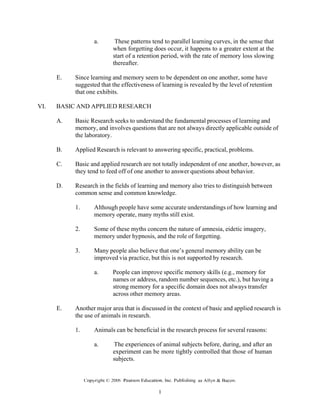
10.
a. These patternstend to parallel learning curves, in the sense that
when forgetting does occur, it happens to a greater extent at the
start of a retention period, with the rate of memory loss slowing
thereafter.
E. Since learning and memory seem to be dependent on one another, some have
suggested that the effectiveness of learning is revealed by the level of retention
that one exhibits.
VI. BASIC AND APPLIED RESEARCH
A. Basic Research seeks to understand the fundamental processes of learning and
memory, and involves questions that are not always directly applicable outside of
the laboratory.
B. Applied Research is relevant to answering specific, practical, problems.
C. Basic and applied research are not totally independent of one another, however, as
they tend to feed off of one another to answer questions about behavior.
D. Research in the fields of learning and memory also tries to distinguish between
common sense and common knowledge.
1. Although people have some accurate understandings of how learning and
memory operate, many myths still exist.
2. Some of these myths concern the nature of amnesia, eidetic imagery,
memory under hypnosis, and the role of forgetting.
3. Many people also believe that one’s general memory ability can be
improved via practice, but this is not supported by research.
a. People can improve specific memory skills (e.g., memory for
names or address, random number sequences, etc.), but having a
strong memory for a specific domain does not always transfer
across other memory areas.
E. Another major area that is discussed in the context of basic and applied research is
the use of animals in research.
1. Animals can be beneficial in the research process for several reasons:
a. The experiences of animal subjects before, during, and after an
experiment can be more tightly controlled that those of human
subjects.
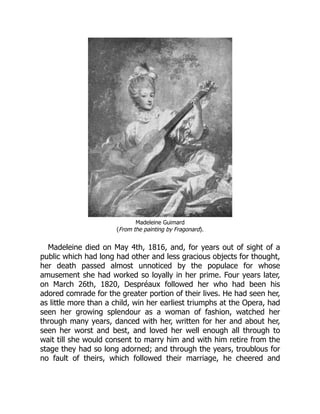
Madeleine Guimard
(From thepainting by Fragonard).
Madeleine died on May 4th, 1816, and, for years out of sight of a
public which had long had other and less gracious objects for thought,
her death passed almost unnoticed by the populace for whose
amusement she had worked so loyally in her prime. Four years later,
on March 26th, 1820, Despréaux followed her who had been his
adored comrade for the greater portion of their lives. He had seen her,
as little more than a child, win her earliest triumphs at the Opera, had
seen her growing splendour as a woman of fashion, watched her
through many years, danced with her, written for her and about her,
seen her worst and best, and loved her well enough all through to
wait till she would consent to marry him and with him retire from the
stage they had so long adorned; and through the years, troublous for
no fault of theirs, which followed their marriage, he cheered and
13.
consoled her forall she had relinquished, for the public worship all
foregone, and for the neglect of the rising generation.
He it was who, though their means can hardly have permitted it,
instituted the little déjeuners and supper-parties of kindred spirits,
where songs were written and ballads sung in praise of love and wine
and “la Gloire”—the one cry of the French Romanticists; all, one may
well think, to cheer his beloved whose charm and goodness, poet
himself, he never ceased to sing.
All this could not have been had not Guimard, with all her faults
had more reserves of goodness than her earlier circumstances can
have given opportunity for developing. Guimard had been grand;
Guimard had been gay; but through it all Guimard must have been
good in heart, full of sympathy and courage and generous charities of
mind and soul; and Despréaux, gentle, wise, humorous, idealistic,
honest, must have found her so, to speak and write of her as he
always did, with ardour and a kind of boyish awe, even after she had
passed away. No note of discord marred their married years, and
when Guimard came to make her exit from the stage of life, silently,
with nothing but ghostly memories of applause, her comrade, well we
may be sure, waited only with impatience for his cue to follow her.
GUIMARD SPEAKS
(Ætat. 70)
14.
“Yes, ye maylaugh at Mère Guimard,
Laugh well, my girls, while laugh ye may!
But none of ye will fare as far
As I, who long have had my day.
Time was when Paris all did pray
Because I broke my arm! And yet
Who now recalls my queen-like sway
O’er those whom Death did not forget?
“Time on my visage many a scar
Hath graven deep. No longer gay
My voice, that once could make or mar
The Minister who failed to pay
Just tribute to my charms. Decay
My once slim, rounded limbs doth fret;
And scarce my feet could tread their way
O’er those whom Death did not forget.
“Yet ere I dance to where they are,
Take heed, my girls, the words I say!
I had a power none might bar,
A court that rivalled the array
Of aught Versailles could best display,
For at my Court Versailles was met!
And still I triumph, old and grey,
O’er those whom Death did not forget.
ENVOI
“‘Squelette des Grâces’ they called me!
Yea, and now? Sans-graces! A mere ‘Squelette!’
But grace I had, and have, to-day
O’er those whom Death did not forget.”
15.
T
CHAPTER XXII
DESPRÉAUX, POETAND—HUSBAND OF GUIMARD
here can be nothing more irksome to a man than to be known
merely as the husband of his more famous wife.
In speaking, however, of Despréaux as “husband of Guimard,” it is
not my intention to cast any slight on an estimable and, in his own
time, well-known personality; but I do so merely that the reader will
thereby be able to “place” her genial and accomplished husband, M.
Despréaux to whom reference has already been made. He was born
in 1748, five years after Mlle. Guimard, and was the son of a musician
at the Paris Opera, where he himself was entered as a
supernumerary-dancer in 1764. He made rapid progress in the art of
his choice and won increasing reputation until, unhappily a wound in
the foot completely closed his career as a “star,” and being a man of
much theatrical experience and general culture, he then became a
maître de ballet and also gave dancing lessons. In 1789 he married
Madeleine Guimard, whom he had long worshipped, and the two
retired, as we know, at the opening of the Revolution to a cosy nest
on the heights of Montmartre. So high, indeed, were they and so
steep was the roadway approaching their dwelling, that the patrols
refrained from troubling them, and save for financial losses, and
rumours of revolution and distant guns, the couple remained
untroubled by the red and raging Anarchy in the city stretched at their
feet.
Edmond de Goncourt makes out—on what authority I cannot
fathom—that Despréaux was born in 1758, and not 1748, thus
making him out to be fifteen years the junior of Guimard when they
married in 1789. As on other points he writes with such accuracy and
copious wealth of detail one might suppose him to be correct, but
seeing that Despréaux was undoubtedly entered a supernumerary-
dancer in the Opera in 1764, and could hardly have been so at the
age of six, one can only infer a slip of the pen, and that Goncourt
16.
really meant 1748,which would make the young male dancer’s age
the likelier one of sixteen on appearing at Opera as a super, although
he would, of course, have been training earlier.
The question of age, however, is comparatively small. The thing
that matters for us is that Despréaux, following modestly in the
footsteps of his far greater predecessor Boileau-Despréaux (not an
ancestor, by the way) had cultivated a taste for poetry, and during his
retirement at Montmartre, divided his time between amusing his wife
and friends with cutting silhouettes—at which he was an expert—and
singing songs and parodies which he wrote himself.
It seems an odd thing, does it not? that a man should be thus
amusing himself and his friends—should be sufficiently undistracted to
do so—while the greatest revolution then known to history should be
in progress. But what could he do? He was a dancer, a singer, an
artist; and could have had little weight had he meddled in the risky
game of politics. As it was, perhaps, he chose the saner course, and
when most were losing their heads he kept his own, and, as Richard
Cœur de Lion had when in prison, wiled away the hours in song.
His poems were collected and published in two volumes under the
title: “Mes Passe-Temps: Chansons, suivies de l’Art de la Danse,
poème en quatre chants, calqué sur l’Art Poétique de Boileau
Despréaux.” They were “adorned” with engravings after the design of
Moreau Junior, and the music of the songs appears at the end of the
second volume.
The work was published after the Revolution fever had subsided, in
1806, and perhaps the very strangest comment on the Revolution is
implied in Despréaux’s preface, which calmly opens with the following:
“In 1794 I suggested to a number of friends that we should meet
once or twice a month to dine together, under the condition that
politics should never be mentioned, and that each should bring a song
composed upon a given word. My proposition was taken up; we
decided that the words should be drawn by lot, after being submitted
to the judgment of the gathering, in order to eliminate subjects which
might only present needless difficulties.”
17.
And so theyear 1794, being one of the worst of all those red years
of Revolution, this little centre went placidly through it, dining and
wining and rhyming, as if there were nothing worse than a sham fight
raging round the distant horizon. It positively makes one wonder if
there was a French Revolution after all. But no, there evidently was,
for our author had a nice little library, and in the following year, owing
to monetary losses occasioned by the general débâcle, had to sell
many of his beloved volumes. Of course he made song about it—“Ma
Bibliothèque, ou Le Cauchemar”—in which he pictures the spectre of
want asking him what he will do, and urging him to sell his books for
food. “Que feras-tu, Despréaux?” the nightmare questions:
“Ni bois ni vin dans ta cave
De chandelle pas un bout:
Faussement on fait le brave
Lorsque l’on manque de tout!
Une tartine de beurre
Vaut plus que jadis un bœuf
Dans un mois, à pareille heure
Quel sera le prix d’un œuf?
Par décade mille livres
Ne peuvent payer ton pain
Mon ami, mange tes livres
Pour ne pas mourir de faim.”
The spectre points out that the prospect of having to do so is no mere
dream and urges him to sell “tous tes auteurs fameux,” pointing out
that he could live on the “divine” Homer for at least a day or two,
while on the “pensif” Rousseau he could exist a long time. He could
count on his precious Virgil for the rent, while the translation “de
Delille” should yield his old gardener’s wages. Among the many works
mentioned in indiscriminate order are Plutarch, La Fontaine, Don
Quichotte, Anacreon, Newton, Milton, Cicero, Horace, Juvenal,
Boccaccio, Erasmus, Montesquieu, Boileau, Corneille, Voltaire, Racine,
Favart, Molière, Plato, Dorat, Seneca, and a set of the British Drama!
18.
It should benoted, by the way, that Despréaux had some
knowledge of English and had paid occasional visits to London with
his wife, who was rather a favourite of the then Duchess of
Devonshire, and in one of his poems he gives an amusingly bitter
“Tableau de Londres,” in which he complains of—
“Cette atmosphère de cendre
Qui ne cesse de descendre,”
speaks of the lower classes as “insolent” and chaffs the English taste
for beer and the eternal “roast-biff” (sic); while as to the English
Sunday, the stanza must really be given in full:
“Deux cents dimanches anglais,
N’en valent pas un français,
Ce jour, si joyeux en France,
Est le jour de pénitence;
Et lorsqu’un Anglais se pend
Se pend, se pend,
C’est un dimanche qu’il prend;
A Paris, le dimanche on danse.
Vive la France!”
Our poet’s range of subject was remarkable—high philosophy,
discussed with smiling raillery; curious life-contrasts, like that of his
wife being a popular dancer and his sister a nun; charades, dialogues,
charming and pathetic little word-pictures like “La Neige,” a “Bacchic”
song on “The End of the World,” and so forth, nothing seemed to
come amiss that could be turned into song. Throughout his varied
work there runs a consistent strain of Gallic gaiety—itself a form of
bravery; and if his Muse has not the hard, biting intensity of a Villon,
nor the lofty rhetoric of a Victor Hugo, it manages to keep a middle
course of sanity and pleasantry with invariable success and an
infallible though limited appeal.
Among his many ingenious poems are two of special interest to
stage-folk of all time, one “Le Langage des Mains,” Chanson
Pantomime, the other “Le Langage des Yeux”; both of which require
19.
to be illustratedby the actor who sings them and emphasise the need
of facial and manual expression. As he truly says:
“Le comédien ou l’orateur,
Sans mains, serait un corps sans âme.”
In one of the poems appears the phrase, “La Walse (sic) aux mille
tours,” while among the notes at the end of the volume is a definition
which may be translated as follows: Walse—a Swiss dance the music
of which is in 3-4 time; but it has only the value of two steps. It is
done by a couple pirouetting while circling round the salon. It has
nothing in it of complexity; it is the art in its infancy. When its rhythm
is in 2 time it is called “sauteuse.” The word “sauteuse” suggests the
ordinary polka in 2-4 time, in the customary manner, for any dance
described as “sauteuse” means one in which the feet are raised from
the ground, or in which leaping is indulged in, not when the feet glide
on the ground, as in the modern waltz. The old volta, from which the
modern waltz is derived, was, it will be remembered, a leaping dance.
The greater part of the second volume is mainly devoted to his
lengthy paraphrase of the great Boileau’s “L’Art Poétique,” under the
title of “L’Art de la Danse,” which is full of sound instruction to dancers
and interesting criticism of his contemporaries.
20.
W
CHAPTER XXIII
A CENTURY’SCLOSE
e have lingered somewhat over these sketches of the eighteenth
century; let us hasten over that century’s close, for was it not
steeped in blood?
“Revolution,” did they not call the madness which seized France?
Heralded by fair promises of universal brotherhood, what did all the
fine talk of her “intellectuals” and “philosophs” end in? A state of
anarchy, national madness; in which no man’s life was safe, and no
woman’s honour.
War is horrible enough between nations. What, then, is universal
war between individuals, “men, brother men?”
Strange, is it not, that while the dying century was performing its
dance of death, theatres should be open; operas, comedies, and
ballets be performed.
Before Guimard and her literary husband had begun to find their
fortunes affected by the advent of the popular madness called
Revolution, there were few theatres in Paris. Indeed, there were only
five of any importance giving daily performances in 1775 and of these
the Opera was of course the leading house as of old—the work of
Gluck, Grétry, Piccinni and Sacchini holding the bill in Opera, for a
period of some thirty years onward, the work of ballet composition
being mainly in the hands of Noverre and the brothers Maximillian and
Pierre Gardel.
It was from the end of that year, too, when Noverre’s “Médée et
Jason” was produced that the novelty of ballet-pantomime, having
come to replace the earlier opera-ballet, now became generally known
simply as ballet.
In 1781 the Paris Opera was the scene of a tremendous
conflagration, in which, owing to the presence of mind of Dauberval,
21.
one of theleading dancers, in quickly lowering the curtain, during a
performance of the ballet, the audience were able to escape, but
several of the dancers were burnt, and Guimard herself, discovered
cowering in one of the boxes clad only in her underwear, was rescued
by one of the stage hands. The famous house was ruined, and the
company removed to a provisional house erected by the architect
Lenoir by the Porte St. Martin.
Ten years later, in 1791, a Royal decree establishing the freedom of
the drama did away with the former paucity of Paris in regard to
places of amusement, and in that year alone eighteen new theatres
were added to those already in existence, and old ones sometimes
changed their names.
The Opera was known as L’Académie Royale de Musique. Then the
King having displeased his people and fled to Varennes, it became
simply the Opera. Then the King having pleased his subjects they
graciously permitted a return to L’Académie Royale. Then, a month
later, in October, 1791, it became the Opera-National; and later the
Théâtre des Arts, all of which changes foreshadowed in a way the
advent of blind Revolution; and the next change of title to Théâtre de
la République et des arts; which yet was not its final title. Meanwhile,
what of the dancers?
Guimard had left the stage in 1790. Two years later the leaders of
the ballet were Mlle. Miller (later to become Madame Pierre de
Gardel), Mlle. Saulnier, Mlle. Roze, Madame Pérignon, Mlle. Chevigny.
Pierre Gardel, born in 1758 at Nancy, had been maître de ballet at
the Opera from 1787, and had produced “Télémaque,” “Psyché,” and
other ballets out of which he made a fortune. “Psyché” alone was
given nearly a thousand times! In most of them Madame Gardel
appeared and with remarkable success. At fifty, as at twenty, she was
still admired. She was an excellent mime, a graceful dancer in all
styles, seemed in each new rôle to surpass herself, and Noverre,
describing her feet, said “they glittered like diamonds.”
Then there were the brothers Malter, the one known as “the bird,”
the other as “the Devil,” because he usually played the rôles of
22.
demons.
Madame Pérignon, whosucceeded Madame Dauberval (née Mlle.
Theodore), was a dancer of talent, but was considerably surpassed by
Mlle. Chevigny of whom an eyewitness of her dancing remarked:
“Quelle verve! quelle gaîté dans le comique! dans les rôles sérieux,
quelle chaleur! quel pathétique! Tout le feu d’une véritable actrice
brillait dans ses beaux yeux.”
Then there were Miles. Allard, Peslin, Coulon, Clotilde, Beaupré,
Brancher, Chameroy; Gosselin, who was, despite embonpoint, so
supple as to win the nickname “the Boneless”; Fanny Bias, and
Bigottini; and M. Laborie, who in 1790 had “created” the title-rôle in
“Zephyre;” Messieurs Lany, Dauberval; Deshayes, a marvel of soaring
agility; Henry, whose mobile figure recalled “le grand Dupré”; Didelot,
Duport; Auguste Vestris, with whom we have already dealt; and
Lepicq, known as the Apollo of the Dance.
Throughout the Revolution the theatres had been open, and had
been full. The people had gone mad with lust of blood and lust of
power; but the dancers continued to maintain their aplomb in difficult
poses, and pick their steps, more carefully amid the lit and flowered
splendours of the theatre, than statesmen could theirs upon the
blood-stained slippery mire of current “politics.”
France might hold its fantastic State ballet, the Fête of the
Supreme, indeed might go stark mad, and all Law and Order and
Reason be overthrown, but one man, the greatest world-man known
to history, was gathering strength to bring order out of chaos, to
remake a nation and a nation’s laws; to set the world a-wondering if
he should master it.
Strangest of all, perhaps, that he, the great Napoleon, should have
found time to flirt with a ballet-dancer—the famous Bigottini, of whom
the Countess Nesselrode in her letters said that the effect she
produced with her dancing and miming was so moving as to make
even the most hardened man weep.
But she seemed rather to have amused Napoleon, more especially
when, having told the President of the Legislative Chamber, Fontanes,
23.
to send hera present, she received a collection of French classics;
and on being asked later by Napoleon—unaware of the nature of the
gift—if she was content with Fontanes’ choice, she exclaimed that she
was not entirely.
“How so?” asked Napoleon.
Bigottini’s reply must be given in the original.
“Il m’a payée en livres; j’aurais mieux aimé en francs.”
In spite of the library, Mlle. Bigottini became a millionaire—in francs.
T
CHAPTER XXIV
THE EARLYNINETEENTH CENTURY
hough it had not died during the Revolutionary period, either in Paris
or London, the art of Ballet, from the death of Louis XV was really
of little artistic interest, and was to remain so until the famous ’Forties
of last century.
The dancers were mostly mechanical; the ballets uninspired; the
mounting meretricious; and it was not till the ’forties of last century
that a new and all-surpassing danseuse, Marie Taglioni, came to
infuse a new spirit into the art and found a tradition that holds to-day.
In London Ballet was in almost the same state as in Paris, but not
quite, possibly because having been always imported at its best, it
had had less opportunity of becoming hide-bound by tradition at its
worst, as in the case of an old-established continental school. For the
continued production of soundly artistic ballet the existence of a good
school is a necessity, a school founded and sustained on right
principles. But in its continued existence there is inevitably danger of
ultimate stultification from the “setting” of the very tradition it has
created, unless there is a perpetual infusion of new ideas.
In Paris the new idea was not then encouraged, if it came counter
to the traditional technique of which the Vestris, father and son, were
the supreme exponents.
In London there was more freedom, because there was less of
tradition; and while we had to wait until the mid-’forties for the
productions which were to the Londoners of the early Victorian period
what the Russian ballet has been to Londoners in recent years, there
was some fairly sound work being done here from 1795 to 1840.
I have, among my books, a volume of libretti of ballets composed
by Didelot and produced at the King’s Theatre, Haymarket, from 1796
to 1800. It contains “Sappho and Phaon,” grand ballet érotique, en
quatre actes; “L’Amour Vengé,” ballet épisodique, en deux actes, dans
26.
le genre anacréontique;“Flore et Zephire,” ballet-divertissement, in
one act; “The Happy Shipwreck, or The Scotch Witches,” a dramatic
ballet in three acts; “Acis and Galatea,” a pastoral ballet in one act;
and “Laura et Lenza, or The Troubadour,” a grand ballet in two acts,
“performed for the first time for the benefit of Madame Hilligsberg,”
who played Laura.
“Laura and Lenza,” is of particular interest to us to-day, for among
the performers, in addition to M. Didelot, who played the troubadour
hero, Lenza, was a M. Deshayes—a capable dancer and producer of
ballet in London and Paris—and a Mr. d’Egville, bearer of a name
which is well-known in both cities at the present day.
“Flora et Zephire,” was the most popular, and was frequently
revived even as late as the ’thirties, when Marie Taglioni made her
début in it at King’s Theatre, for Laporte’s benefit, on June 3rd, 1830.
Both in Paris and London, however, during the first two decades of
the nineteenth century Ballet was comparatively undistinguished and
it was not really until the ’thirties that it began to assume new
interest. True, there were in Paris, some remarkable exponents of
advanced technique as regards dancing, but in the glamour of
technical achievement the greater idea of the art of Ballet was
somewhat obscured.
At the Paris Opera the dieux de la danse were MM. Albert Paul and
Ferdinand, all of whom visited London from time to time and the
second of whom was known as l’aérien, a descriptive nickname
emphasised by the quaint criticism of a contemporary who wrote:
“Paul used to spring and bound upwards, and was continually in the
clouds; his foot scarcely touched the earth or rather the stage; he
darted up from the ground and came down perpendicularly, after
travelling a quarter of an hour in the air!”
M. Paul, by the way, later became a celebrated dancing-master at
Brighton, in good Queen Victoria’s early days.
Then, too, there was Paul’s sister who became Madame Montessu,
hardly less celebrated than her brilliant brother. Then, too, Mlle.
Brocard, who so won Queen Victoria’s girlish admiration that some of
27.
her dolls weredressed to represent the pretty dancer in character.
Brocard, however, was more remarkable for her beauty than for her
dancing.
Another famous artist of the period was M. Coulon, to whose
careful tuition the graceful, and élégante Pauline Duvernay owed
much of her success, as did also the sisters Noblet—Lise and
Alexandrine, the latter of whom forsook the dance to become an
actress.
Of Lise Noblet a contemporary chronicler wrote in 1821: “Encore un
phénix! Une danseuse qui ne fait jamais de faux pas, qui préfère le
cercle d’amis à la foule des amants, qui vient au théâtre à pied, et qui
retourne de même!” In 1828, she created, with immense success, the
rôle of Fenella, in La Muette de Portici, and was described as “le
dernier produit de l’école française aux poses géométriques et aux
écarts à angle droit”; the same critic drawing an interesting
comparison between the old school and the rising new one, in adding:
“Déjà, Marie Taglioni s’avancait sur la pointe du pied—blanche vapeur
baignée de mousselines transparentes—poétique, nébuleuse,
immatérielle comme ces fées dont parle Walter Scott, qui errent la
nuit près des fontaines et portent en guise de ceinture un collier de
perles de rosée!... Lise Noblet se résolut non sans combat—à prouver
qu’il y a au monde quelque chose de plus agréable qu’une femme qui
tourne sur l’ongle de l’orteil avec une jambe parallèle à l’horizon, dans
l’attitude d’un compas farée. Elle céda, à Fanny Elssler, ‘Fenella’ de La
Muette qu’elle avait créée, et lui prit en échange—‘El Jales de Jérès.’
‘Las Boleros de Cadiz’ ‘La Madrileña,’ et toutes sortes d’autres
cachuchas et fandangos. Grâce à ces concessions, Mdlle. Noblet resta
jusqu’en 1840, attachée à l’ Opéra.”
These references to contrast of styles, to Scott, and to Spanish
dances are particularly interesting as illuminating the change which
was coming over the Ballet about 1820-1830. Mere technique as the
chief aim of Ballet was beginning to fail. It had become too academic
and needed the infusion of a new spirit of grace and freedom. It came
in a sudden craze for national dances, particularly Slav and Spanish,
and in the craze for Scott and all his works, which undoubtedly
28.
became an influenceon Opera and Ballet, as they did on the forces
which led to the growth of the great Romantic movement, of which
Hugo was to be hailed as leader and of which the effects passing on
through the Art and Literature of the ’fifties, ’sixties, and ’seventies,
can still perhaps be traced to-day.
Much of the popularity of the Spanish and Slav dances during the
early part of the nineteenth century was due to their frequent
performance by Pauline Duvernay, Pauline Leroux and the Elsslers.
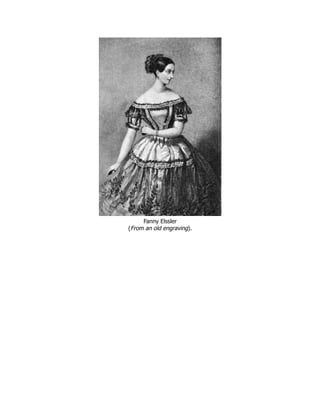
There were two Elsslers, sisters, the elder of whom, Thérèse, was
born in 1808, and Fanny in 1810, both at Vienna.
Thérèse was less brilliant a dancer than her sister—whom she
“mothered” always—but had a charming personality. She eventually
gave up the stage to marry, morganatically, Prince Adalbert of Prussia,
and was afterwards ennobled.
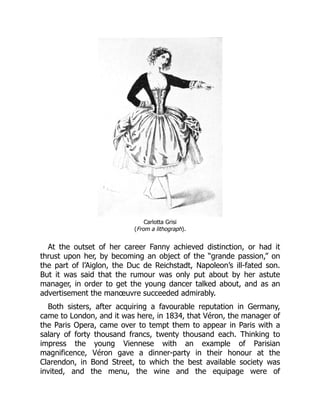
Carlotta Grisi
(From alithograph).
At the outset of her career Fanny achieved distinction, or had it
thrust upon her, by becoming an object of the “grande passion,” on
the part of l’Aiglon, the Duc de Reichstadt, Napoleon’s ill-fated son.
But it was said that the rumour was only put about by her astute
manager, in order to get the young dancer talked about, and as an
advertisement the manœuvre succeeded admirably.
Both sisters, after acquiring a favourable reputation in Germany,
came to London, and it was here, in 1834, that Véron, the manager of
the Paris Opera, came over to tempt them to appear in Paris with a
salary of forty thousand francs, twenty thousand each. Thinking to
impress the young Viennese with an example of Parisian
magnificence, Véron gave a dinner-party in their honour at the
Clarendon, in Bond Street, to which the best available society was
invited, and the menu, the wine and the equipage were of
31.
unparalleled quality. Atdessert an attendant brought a silver salver
piled high with costly presents for the ladies of the company—pearls,
rubies, diamonds, superbly set—a miniature Golconda. But somehow
it all fell a trifle flat. The Elssler girls, true to their simple German
training, drank only water with their dinner, and with dessert merely
accepted, the one a hatpin, and the other a little handbag; and they
would not agree to sign their contract until the day of Véron’s
departure!
Both in Paris and London the sisters were triumphantly successful,
and when in 1841 they toured through America they met with a
reception that was sensational. It was “roses, roses all the way”; and
in some of the towns triumphal arches were erected. At Philadelphia
their horses were unharnessed and their carriage drawn by the
admiring populace, headed by the Mayor!
Fanny was an especial favourite, and when the sisters left New
Orleans, some niggers, who were hoisting freight from the hold of an
adjacent steamboat—and niggers are notoriously apt at catching up
topical subjects—thus chanted, as the vessel bearing the dancers left
the wharf:
“Fanny, is you going up de ribber?
Grog time o’ day.
When all dese here’s got Elssler fever?
Oh, hoist away!
De Lor’ knows what we’ll do widout you,
Grog time o’ day.
De toe an’ heel won’t dance widout you.
Oh, hoist away!
Day say you dances like a fedder,
Grog time o’ day.
Wid t’ree t’ousand dollars all togedder.
Oh, hoist away!”
Fanny Elssler was at her best in the ballet of “Le Diable Boiteux,”
the plot of which is founded on Le Sage’s famous romance. An
enthusiastic contemporary described her in the following quaint
terms: “La Fanny is tall, beautifully formed, with limbs that strongly
32.
resemble the huntingDiana, combining strength with the most
delicate and graceful style. Her small and classically shaped head is
placed on her shoulders in a singularly elegant manner; the pure
fairness of her skin requires no artificial whiteness; while her eyes
beam with a species of playful malice, well-suited to the half-ironical
expression at times visible in the corners of her finely curved lips. Her
rich, glossy hair, of bright chestnut hue, is usually braided over a
forehead formed to wear, with equal grace and dignity, the diadem of
a queen, or the floral wreath of a nymph; and though strictly feminine
in her appearance, none can so well or so advantageously assume the
costume of the opposite sex.”
As a dancer she excelled in all spirited dances, such as the
Fandango, and the Mazurka, while in the Cachucha and the
Cracovienne, she stirred her audience to a frenzy of admiration.
Thérèse Elssler retired from the stage in 1850. Fanny, a year later,
married a rich banker, withdrew, and died in 1884.
33.
T
CHAPTER XXV
CARLO BLASIS
heDance and Ballet had made progress during the past two
centuries and had reached the point when, unable to attain to
greater perfection of technique, it needed some fresh artistic
inspiration. Italy, however, had long been degenerate as regards the
Dance, her whole artistic ambition having expressed itself in Opera
and an unrivalled excellence in vocal technique. So that towards the
end of the eighteenth century and for half the nineteenth, her singers
were unmatched throughout the world.
The introduction of French dancers and the production of some of
the ballets of French composers turned the attention of the lovers of
bel Canto to the possibilities of the sister art. Noverre had produced
some of his ballets at Milan, and his methods and artistic taste
gradually spread through Italy, his influence being further extended
by several of his Italian pupils, such as Rossi and Angiolini.
It was not, however, until Carlo Blasis came to preside over the
Imperial Academy of Dancing and Pantomime at Milan, 1837, that the
Italian ballet began to assume any importance, and the Milan
Academy, becoming recognised as the first in Europe, came in turn to
influence Paris, London and other capitals of the world. Indeed, it is
hardly too much to say that probably every opera house which has
been established a century owes something directly or indirectly to
the genius of Carlo Blasis, who in his enthusiasm for, and appreciation
of, the Dance and Ballet, and in his ability to write thereon was
another Noverre, but with an even wider range of talent and
scholarship.
In the history of art there can be few records of such amazing
power of assimilation, combined with a high standard of achievement.
We have but to glance at a list of his works, to realise this. While the
theory and practice of dancing were his leading theme, one to which
34.
he returned againand again, few things failed to stimulate his interest
and his pen.
“Observations sur le Chant et sur l’Expression de la Musique
Dramatique” were a series of essays contributed to a London paper.
He wrote considerably on the art of Pantomime. He contributed
biographies of Garrick and of Fuseli to a Milan periodical; and another
of Pergolesi to a German paper. A dissertation on “Italian Dramatic
Music in France,” was another of his subjects. He left in manuscript
works on François Premier; on Lucan and his poem of Pharsalia; on
Alexander the Great; on the Influence of the Italian Genius upon the
World; on the then Modern Greek Dances; on “La Grande Epoque de
Louis XV en France, en Italie, et en Angleterre”; a “Lexicon of
Universal Erudition”; while perhaps the greatest of his works—
according to contemporary criticism—was “L’Uomo Fisico, Intellettuale
e Morale,” a book of some thousand pages.
His education had been of a kind that should incline him to take, as
Bacon did, “all knowledge,” for his province. Madrolle, the famous
French publicist of his period, described Blasis as “a man of the most
comprehensive mind that he had ever known,” and further declared
him “a universal genius.” Indeed, though he achieved fame as a
maître de ballet, he seems really to have been a sort of super-maître
of all the arts.
He was born at Naples on November 4th, 1803, the son of
Francesco Blasis and Vincenza Coluzzi Zurla Blasis, both, it is said, of
noble descent. The family claimed an ancestry reaching back beyond
the reigns of Tiberius and Augustus, when there were patricians
known as the Blasii. Machiavelli mentions the same family, and
various monuments in Italy and Sicily bear the name of De Blasis.
When Carlo was two years old, his father, who had forsaken the
ancestral profession of the sea for literature and music, took his family
from Naples to Marseilles, where the De was dropped, for political
reasons, and the name became simply Blasis. Having studied the
tastes and tendencies of his children somewhat carefully Francesco
determined to give his son Carlo a thorough grounding in the classics
35.
and the finearts. His daughter Teresa was taught singing and the
pianoforte; and his younger daughter Virginia, who was born at
Marseilles, was destined to Opera. It must be set to the credit of the
fond father’s discernment and influence that each of his children
achieved distinction in their own sphere and day.
The education of Carlo, we are told in a contemporary biography,
“was at once literary and artistic and theatrical.” He showed such
enthusiasm and ability in his studies that it was said that he might
easily have become a painter, a composer of music, or a dancer and
ballet-master. He finally chose the last as his profession owing to the
fact that it offered more lucrative prospects as well as combining all
the varied opportunities for artistic expression which his young soul
craved. In other directions, however, his general education was not
neglected, and the subjects he studied all came to be employed in the
profession he had chosen, rendering him valuable assistance in
dancing, pantomime and the composition of ballets. In later life when
asked how he came to get through such masses of work as he did he
used to declare: “Le temps ne manque jamais à qui sait l’employer,”
and to add Tissot’s saying: “Dormons, dormons, très peu; vivons
toute notre vie, et pendant trois semaines que nous avons à vivre, ne
dormons pas, ne soyons pas morts, pendant quinze jours.” Indeed, he
lived every minute of his incessantly active life, and in his later years
seldom worked less than fifteen hours a day.
As a lad he studied music, in all its branches, with his father.
Drawing, painting, modelling, architecture, geometry, mathematics,
anatomy, literature and dancing he studied with some of the best
available masters of his period, at Marseilles, Rome, Florence,
Bordeaux, Bologna and Pavia; and when he came to practise his
profession as ballet-master and composer, he was able not only to
evolve the plot of the ballet, and explain every situation, teach every
step and gesture and expression, but to furnish designs for the
costumes, scenery, and mechanical effects.
He was avid of learning, and absorbed something of value from all
with whom he came in contact. He haunted the artists’ studios and
made a special point of visiting all he could in any town in which he
36.
happened to stay,Thorwaldsen, Longhi and Canova being among the
more prominent of the sculptors and artists whom he came to know.
He became a connoisseur and collector of paintings, sculpture
carvings, cameos, jewellery, old instruments; had a remarkable library,
not only of books in Greek, Latin, Italian, French, English, German
and Spanish, but an interesting collection of music, from Palestrina to
his own time, his library and gallery being valued at somewhere about
ten thousand pounds.
He started his professional career and travels at the age of twelve,
when he appeared as a dancer in the leading theatre at Marseilles,
then at Aix, Avignon, Lyons, Toulouse; finally settling with his family
for some time at Bordeaux, where he had a very successful début and
where—under the able direction of Dauberval, of whom we have
already heard—most of the best dancers in France appeared
preparatory to an engagement in Paris.
Blasis then received an invitation to the capital, where his début
was so extraordinarily successful that he was promptly placed in the
front rank, and for a time studied under the famous Gardel, who
thought so highly of him that he selected for him as partner in several
ballets, Mlle. Gosselin, one of the leading dancers at the Opera,
followed by Mlle. Legallois, a dancer of the classic school.
On account of intrigues and cabals—which are not, alas, unusual in
the theatrical profession, or in any other perhaps—Blasis left the
Opera and was next engaged at Milan, first going on a successful tour,
during which he composed various ballets, notably “Iphigénie en
Aulide,” “La Vestale,” “Fernando Cortez,” “Castor and Pollux,” “Don
Juan” and “Les Mystères d’Isis.”
His appearance at La Scala, Milan, was triumphant, and he
remained there for fourteen seasons, as dancer and ballet-composer.
Then followed a successful Italian tour. Painters, sculptors and
engravers as well as various poets celebrated his progress, and one
Venetian painter, having seen him dancing some pas de deux with his
famous partner Virginia Leon, in which they entwined and enveloped
themselves in rose-coloured veils—presumably very much as Mordkin
37.
and Pavlova didin the “L’Automne Bacchanale,” made sketches of the
various graceful groupings and afterwards introduced them into the
decorations of an apartment in the house of a rich Venetian
nobleman.
There can be no doubt that the appeal of Blasis’ work to artists was
greatly due not merely to his technical excellence as a dancer but to
the fact that—steeped as he was in the study of music, sculpture and
painting—his work was a living expression of a classic art-spirit. Again
and again in his writings he emphasises the necessity the young
dancer is under of studying not only music, but drawing, painting and
sculpture. In one interesting passage, especially, he remarks: “It is in
the best productions of painting and sculpture that the dancer may
study with profit how to display his figure with taste and elegance.
They are a fountain of beauties, to which all those should repair who
wish to distinguish themselves for the correctness and purity of their
performances. In the Bacchanalian groups which I have composed, I
have successfully introduced various attitudes, arabesques and
groupings, the original idea of which was suggested to me, during my
journey to Naples and through Magna Grecia, on viewing the
paintings, bronzes and sculptures rescued from the ruins of
Herculaneum.”
The publication at Milan, of his first work, in French, A Theoretical,
Practical and Elementary Treatise on the Art of Dancing, brought
Blasis into prominent notice throughout the Continent and in London,
owing to press notices and demands for translations of a work that
was unrivalled of its kind and is valuable to-day.
In 1826 Blasis came to London, where, at the King’s Theatre,
Haymarket, he was triumphantly received as dancer, actor and ballet-
composer. He remained here for some time, and in 1829-1830
published his still more important work, in English, namely, The Code
of Terpsichore in which the whole subject of dancing is dealt with
exhaustively. The book was “embellished” with numerous line-
engravings, accompanied by music, composed by his sisters, Virginia
and Teresa Blasis, and was dedicated to Virginia, then Prima Donna of
the Italian Opera at Paris. The work was an instant success and did
38.
much to furtherthe aim which Blasis had in all his writings, namely,
the raising of the art of the Dance and Ballet nearer to a level with the
other imitative arts.
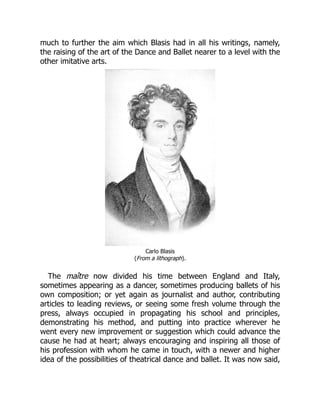
Carlo Blasis
(From a lithograph).
The maître now divided his time between England and Italy,
sometimes appearing as a dancer, sometimes producing ballets of his
own composition; or yet again as journalist and author, contributing
articles to leading reviews, or seeing some fresh volume through the
press, always occupied in propagating his school and principles,
demonstrating his method, and putting into practice wherever he
went every new improvement or suggestion which could advance the
cause he had at heart; always encouraging and inspiring all those of
his profession with whom he came in touch, with a newer and higher
idea of the possibilities of theatrical dance and ballet. It was now said,
39.
indeed, that “allwho followed the same profession became either his
disciples or imitators.”
His triumphs as a dancer, however, were unhappily cut short during
an engagement at the San Carlo, Naples, by an accident which
occurred during rehearsal, some unaccountable injury to the left leg,
for which every remedy was tried without avail. Though he was not
unable henceforth to perform the simpler and more natural
movements he found himself handicapped by a certain stiffness that
made anything like a cabriole or entrechat impossible, and wisely
decided to retire rather than diminish the fame he had already
acquired as a dancer. Hereafter it was as a composer of ballets and as
a widely informed writer on the arts that he elected to occupy himself,
and in Italy, France and England—notably at Drury Lane—his
productions both on the stage and in the Press, won him increasing
recognition and respect.
In 1837 Blasis was appointed by the Italian Government Director of
the Imperial Academy of Dancing and Pantomime at Milan, where the
reforms he introduced and the new artistic ideal he created shortly
raised it to the position of the leading Academy of the world.
By the end of the eighteenth century dancing and ballet at the Paris
Opera, had grown, as we have seen, a stiff, formal, dull affair. Carlo
Blasis’ rule at the Milan Academy, which put new life into the art, had
a tremendous influence throughout the Continent, so much so indeed
that Russia, Austria, France, and even England all to-day owe
something to the traditions of style and efficiency his genius laid down
at that time.
The system of training he instituted then is still much the same in
present-day opera-houses, from which most of the famous dancers
are drawn. Pupils entered the Milan Academy at an early age. No one
was admitted before the age of eight years, nor after twelve, if a girl,
or fourteen, if a boy. They were to be medically examined, and be
proved to have a robust constitution and to be in good health. They
had to be children of respectable parents; and, when admitted, were
to remain in the school, devoted to its service and to the service of
40.
Welcome to ourwebsite – the perfect destination for book lovers and
knowledge seekers. We believe that every book holds a new world,
offering opportunities for learning, discovery, and personal growth.
That’s why we are dedicated to bringing you a diverse collection of
books, ranging from classic literature and specialized publications to
self-development guides and children's books.
More than just a book-buying platform, we strive to be a bridge
connecting you with timeless cultural and intellectual values. With an
elegant, user-friendly interface and a smart search system, you can
quickly find the books that best suit your interests. Additionally,
our special promotions and home delivery services help you save time
and fully enjoy the joy of reading.
Join us on a journey of knowledge exploration, passion nurturing, and
personal growth every day!
testbankbell.com