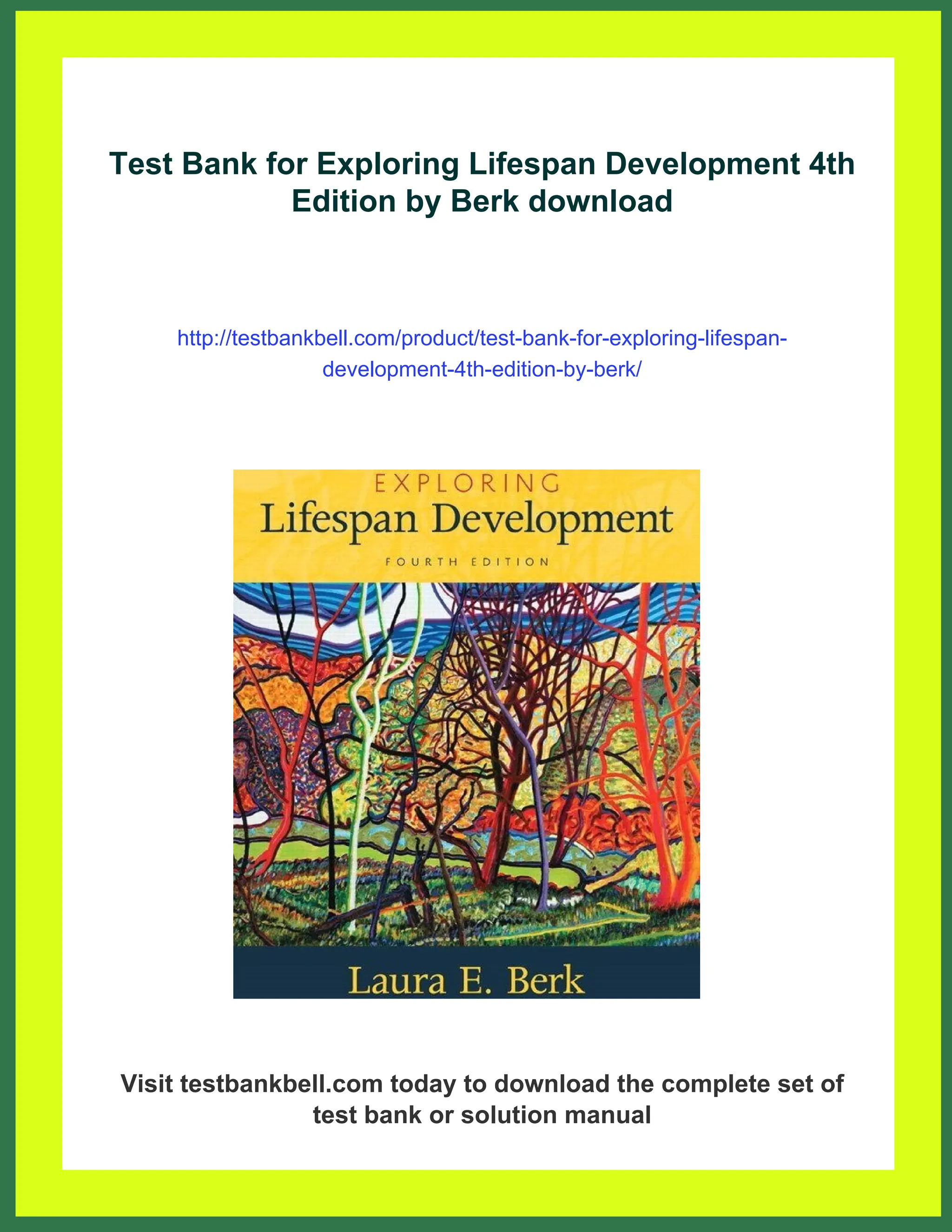
Test Bank for Exploring Lifespan Development 4th
Edition by Berk download
http://testbankbell.com/product/test-bank-for-exploring-lifespan-
development-4th-edition-by-berk/
Visit testbankbell.com today to download the complete set of
test bank or solution manual
Here are some recommended products for you. Click the link to
download, or explore more at testbankbell.com
Test Bank for Exploring Lifespan Development, 2nd Edition:
Berk
http://testbankbell.com/product/test-bank-for-exploring-lifespan-
development-2nd-edition-berk/
Development Through the Lifespan 7th Edition Berk Test
Bank
http://testbankbell.com/product/development-through-the-lifespan-7th-
edition-berk-test-bank/
Development Through the Lifespan Berk 6th Edition Test
Bank
http://testbankbell.com/product/development-through-the-lifespan-
berk-6th-edition-test-bank/
Solution Manual for Shelly Cashman Series Collection,
Microsoft Office 365 & Office 2019 1st Edition Sandra
Cable
http://testbankbell.com/product/solution-manual-for-shelly-cashman-
series-collection-microsoft-office-365-office-2019-1st-edition-sandra-
cable/
Test bank for Stress Health and Well-Being: Thriving in
the 21st Century 1st Edition by Harrington
http://testbankbell.com/product/test-bank-for-stress-health-and-well-
being-thriving-in-the-21st-century-1st-edition-by-harrington/
Legal Environment of Business A Managerial Approach Theory
to Practice 3rd Edition Melvin Solutions Manual
http://testbankbell.com/product/legal-environment-of-business-a-
managerial-approach-theory-to-practice-3rd-edition-melvin-solutions-
manual/
Maternal-Child Nursing McKinney 4th Edition Test Bank
http://testbankbell.com/product/maternal-child-nursing-mckinney-4th-
edition-test-bank/
Test Bank for Understanding the American Promise 7th
COMBINED by Roark
http://testbankbell.com/product/test-bank-for-understanding-the-
american-promise-7th-combined-by-roark/
Test Bank for Microeconomics Fifth Edition
http://testbankbell.com/product/test-bank-for-microeconomics-fifth-
edition/
Test Bank for ECGs Made Easy, 4th Edition: Barbara J.
Aehlert
http://testbankbell.com/product/test-bank-for-ecgs-made-easy-4th-
edition-barbara-j-aehlert/
Copyright © 2018 Laura E. Berk. All Rights Reserved. 1
Test Bank for Exploring Lifespan Development 4th
Edition by Berk
FULL CHAPTER AT:
HTTPS://TESTBANKBELL.COM/PRODUCT/TEST-BANK-FOR-
EXPLORING-LIFESPAN-DEVELOPMENT-4TH-EDITION-BY-BERK/
CHAPTER 1
HISTORY, THEORY, AND RESEARCH STRATEGIES
MULTIPLE CHOICE
1. Dr. Langley’s work is devoted to understanding constancy and change throughout the lifespan. Dr.
Langley’s field of study is __________.
A) genetics
B) clinical psychology
C) adolescent development
D) developmental science
Answer: D
Page Ref: 3
Skill Level: Apply
Objective: 1.1 What is developmental science, and what factors stimulated expansion of the field?
Topic: A Scientific, Applied, and Interdisciplinary Field
Difficulty Level: Moderate
2. Although great diversity characterizes the interests and concerns of investigators who study
development, they share a single goal: to identify __________.
A) genetic factors that contribute to longevity
B) environmental factors that contribute to disease and illness
C) those factors that lead to abnormal development in children and adolescents
D) those factors that influence consistencies and transformations in people from conception to death
Answer: D
Page Ref: 3
Skill Level: Understand
Objective: 1.1 What is developmental science, and what factors stimulated expansion of the field?
Topic: A Scientific, Applied, and Interdisciplinary Field
Difficulty Level: Moderate
3. Developmental science is __________ because it has grown through the combined efforts of people
from many fields of study.
A) interdisciplinary
B) empirical
C) applied
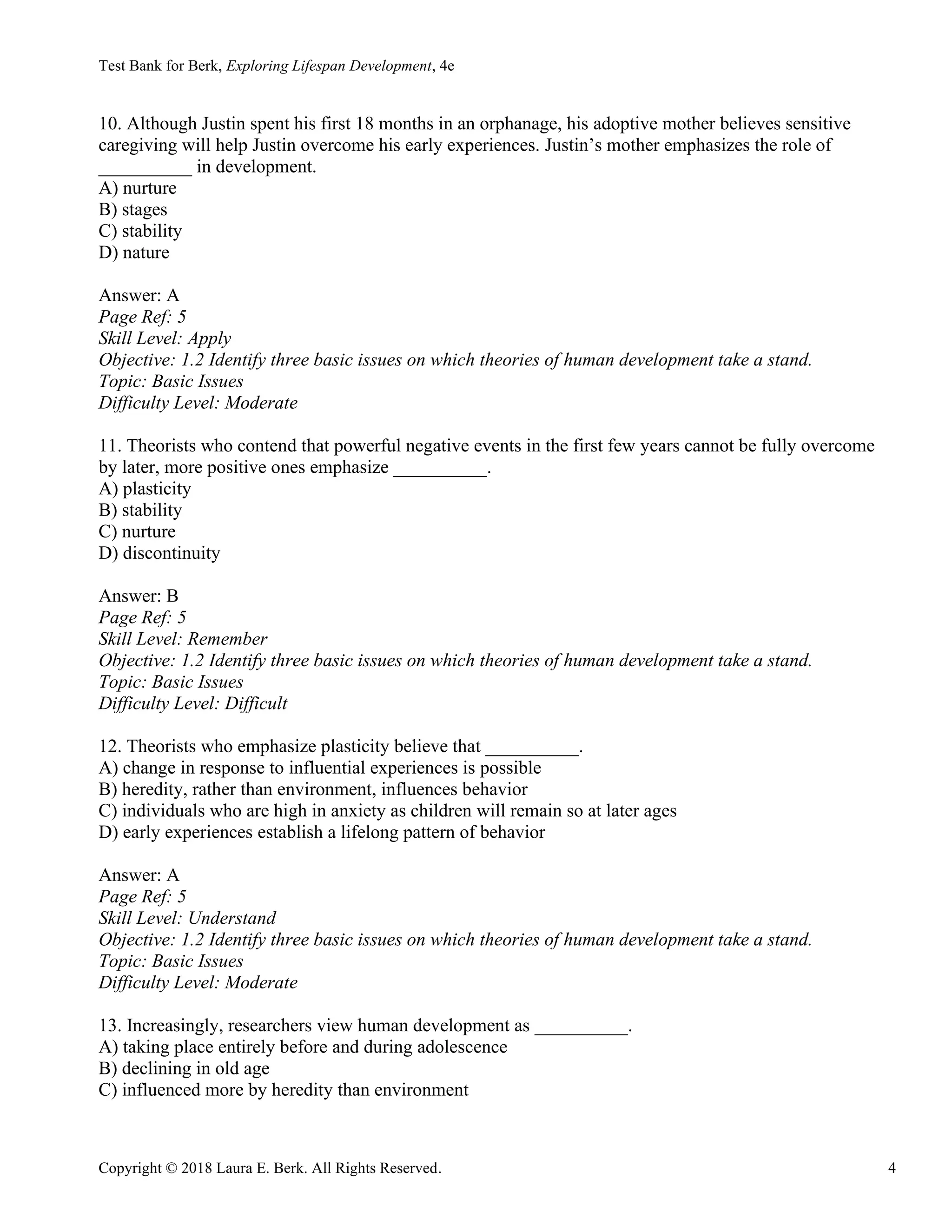
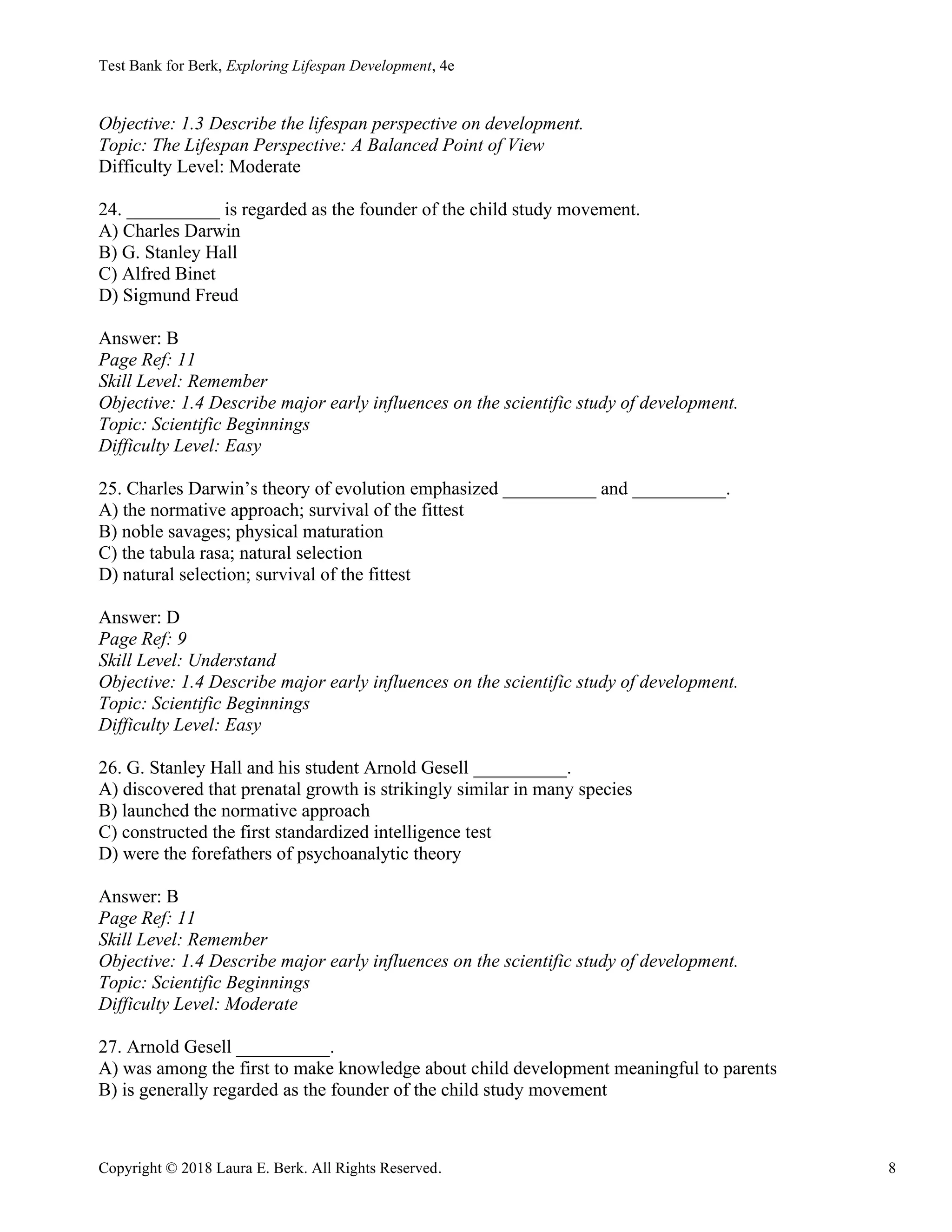
Test Bank for Berk, Exploring Lifespan Development, 4e
Copyright © 2018 Laura E. Berk. All Rights Reserved. 2
D) theoretical
Answer: A
Page Ref: 3
Skill Level: Remember
Objective: 1.1 What is developmental science, and what factors stimulated expansion of the field?
Topic: A Scientific, Applied, and Interdisciplinary Field
Difficulty Level: Easy
4. A theory of development __________.
A) illustrates the ultimate truth about human behavior
B) describes, explains, and predicts behavior
C) explains all aspects of human growth
D) does not require scientific verification
Answer: B
Page Ref: 3
Skill Level: Understand
Objective: 1.2 Identify three basic issues on which theories of human development take a stand.
Topic: Basic Issues
Difficulty Level: Moderate
5. According to the __________ view of development, the difference between the immature and mature
being is simply one of amount or complexity.
A) nature
B) discontinuous
C) nurture
D) continuous
Answer: D
Page Ref: 4
Skill Level: Remember
Objective: 1.2 Identify three basic issues on which theories of human development take a stand.
Topic: Basic Issues
Difficulty Level: Moderate
6. The discontinuous view of development holds that __________.
A) infants and preschoolers respond to the world in much the same way adults do
B) growth is the process of gradually augmenting the skills that were present from the beginning
C) infants and children have unique ways of thinking, feeling, and behaving
D) development is a smooth process limited only by a lack of information and precision
Answer: C
Page Ref: 4
Skill Level: Understand
Objective: 1.2 Identify three basic issues on which theories of human development take a stand.
Test Bank for Berk, Exploring Lifespan Development, 4e
Copyright © 2018 Laura E. Berk. All Rights Reserved. 3
Topic: Basic Issues
Difficulty Level: Difficult
7. Dr. Kostel believes that development takes place in stages. This belief is consistent with the
__________ perspective.
A) nurture
B) continuous
C) discontinuous
D) nature
Answer: C
Page Ref: 4
Skill Level: Apply
Objective: 1.2 Identify three basic issues on which theories of human development take a stand.
Topic: Basic Issues
Difficulty Level: Moderate
8. New evidence increasingly emphasizes that __________.
A) there is very little cultural diversity in human development
B) environmental, but not personal, contexts shape development
C) development occurs in a neat, orderly sequence of stages unaffected by distinct contexts
D) people not only are affected by but also contribute to the contexts in which they develop
Answer: D
Page Ref: 4
Skill Level: Understand
Objective: 1.2 Identify three basic issues on which theories of human development take a stand.
Topic: Basic Issues
Difficulty Level: Difficult
9. Tammy’s father is an exceptional gymnast. When Tammy was just a toddler, her father believed that
Tammy already showed great promise as a gymnast. Tammy’s father probably believes that athletic
ability is mostly determined by __________.
A) nurture
B) stages
C) nature
D) early experiences
Answer: C
Page Ref: 5
Skill Level: Apply
Objective: 1.2 Identify three basic issues on which theories of human development take a stand.
Topic: Basic Issues
Difficulty Level: Moderate
Test Bank for Berk, Exploring Lifespan Development, 4e
Copyright © 2018 Laura E. Berk. All Rights Reserved. 4
10. Although Justin spent his first 18 months in an orphanage, his adoptive mother believes sensitive
caregiving will help Justin overcome his early experiences. Justin’s mother emphasizes the role of
__________ in development.
A) nurture
B) stages
C) stability
D) nature
Answer: A
Page Ref: 5
Skill Level: Apply
Objective: 1.2 Identify three basic issues on which theories of human development take a stand.
Topic: Basic Issues
Difficulty Level: Moderate
11. Theorists who contend that powerful negative events in the first few years cannot be fully overcome
by later, more positive ones emphasize __________.
A) plasticity
B) stability
C) nurture
D) discontinuity
Answer: B
Page Ref: 5
Skill Level: Remember
Objective: 1.2 Identify three basic issues on which theories of human development take a stand.
Topic: Basic Issues
Difficulty Level: Difficult
12. Theorists who emphasize plasticity believe that __________.
A) change in response to influential experiences is possible
B) heredity, rather than environment, influences behavior
C) individuals who are high in anxiety as children will remain so at later ages
D) early experiences establish a lifelong pattern of behavior
Answer: A
Page Ref: 5
Skill Level: Understand
Objective: 1.2 Identify three basic issues on which theories of human development take a stand.
Topic: Basic Issues
Difficulty Level: Moderate
13. Increasingly, researchers view human development as __________.
A) taking place entirely before and during adolescence
B) declining in old age
C) influenced more by heredity than environment
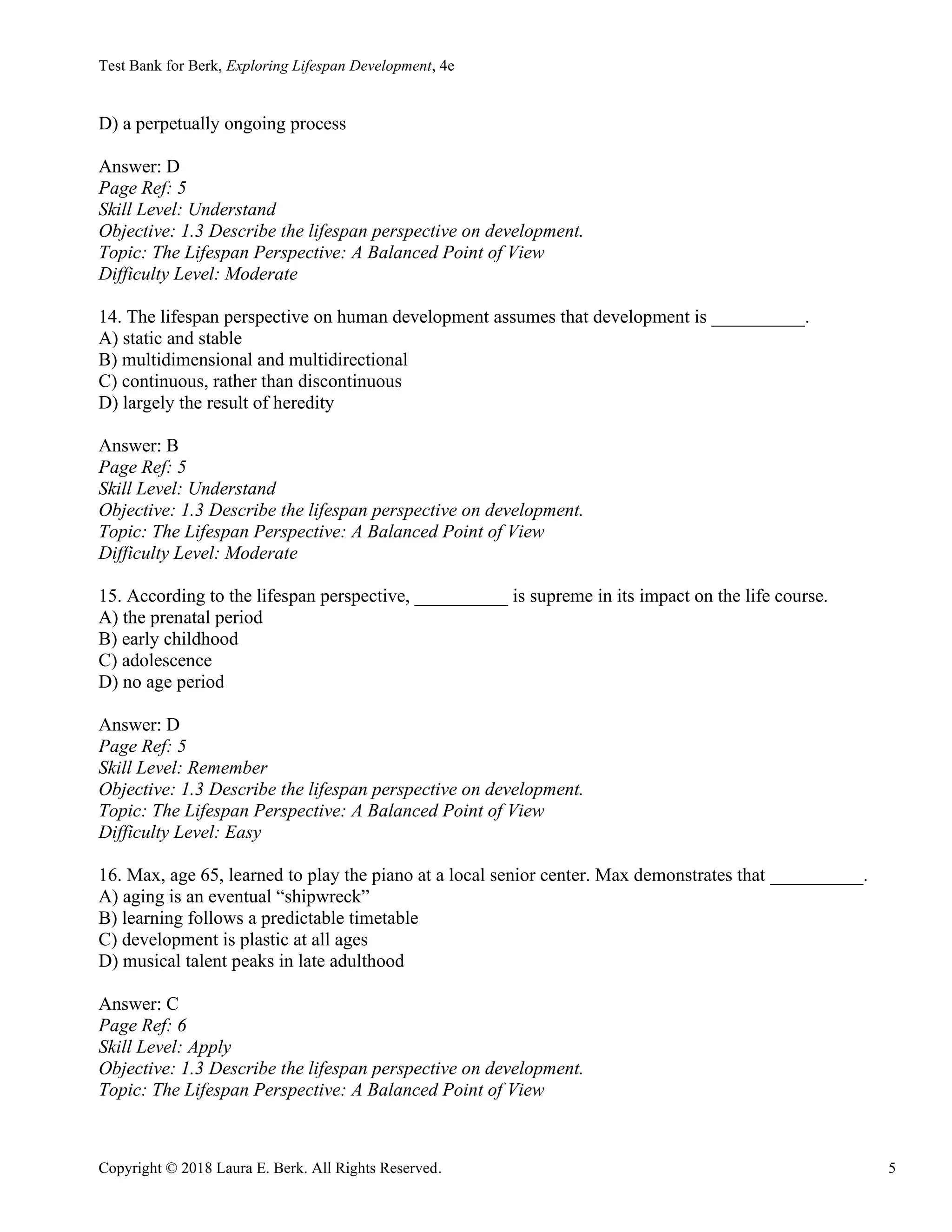
Test Bank for Berk, Exploring Lifespan Development, 4e
Copyright © 2018 Laura E. Berk. All Rights Reserved. 5
D) a perpetually ongoing process
Answer: D
Page Ref: 5
Skill Level: Understand
Objective: 1.3 Describe the lifespan perspective on development.
Topic: The Lifespan Perspective: A Balanced Point of View
Difficulty Level: Moderate
14. The lifespan perspective on human development assumes that development is __________.
A) static and stable
B) multidimensional and multidirectional
C) continuous, rather than discontinuous
D) largely the result of heredity
Answer: B
Page Ref: 5
Skill Level: Understand
Objective: 1.3 Describe the lifespan perspective on development.
Topic: The Lifespan Perspective: A Balanced Point of View
Difficulty Level: Moderate
15. According to the lifespan perspective, __________ is supreme in its impact on the life course.
A) the prenatal period
B) early childhood
C) adolescence
D) no age period
Answer: D
Page Ref: 5
Skill Level: Remember
Objective: 1.3 Describe the lifespan perspective on development.
Topic: The Lifespan Perspective: A Balanced Point of View
Difficulty Level: Easy
16. Max, age 65, learned to play the piano at a local senior center. Max demonstrates that __________.
A) aging is an eventual “shipwreck”
B) learning follows a predictable timetable
C) development is plastic at all ages
D) musical talent peaks in late adulthood
Answer: C
Page Ref: 6
Skill Level: Apply
Objective: 1.3 Describe the lifespan perspective on development.
Topic: The Lifespan Perspective: A Balanced Point of View
Test Bank for Berk, Exploring Lifespan Development, 4e
Copyright © 2018 Laura E. Berk. All Rights Reserved. 6
Difficulty Level: Moderate
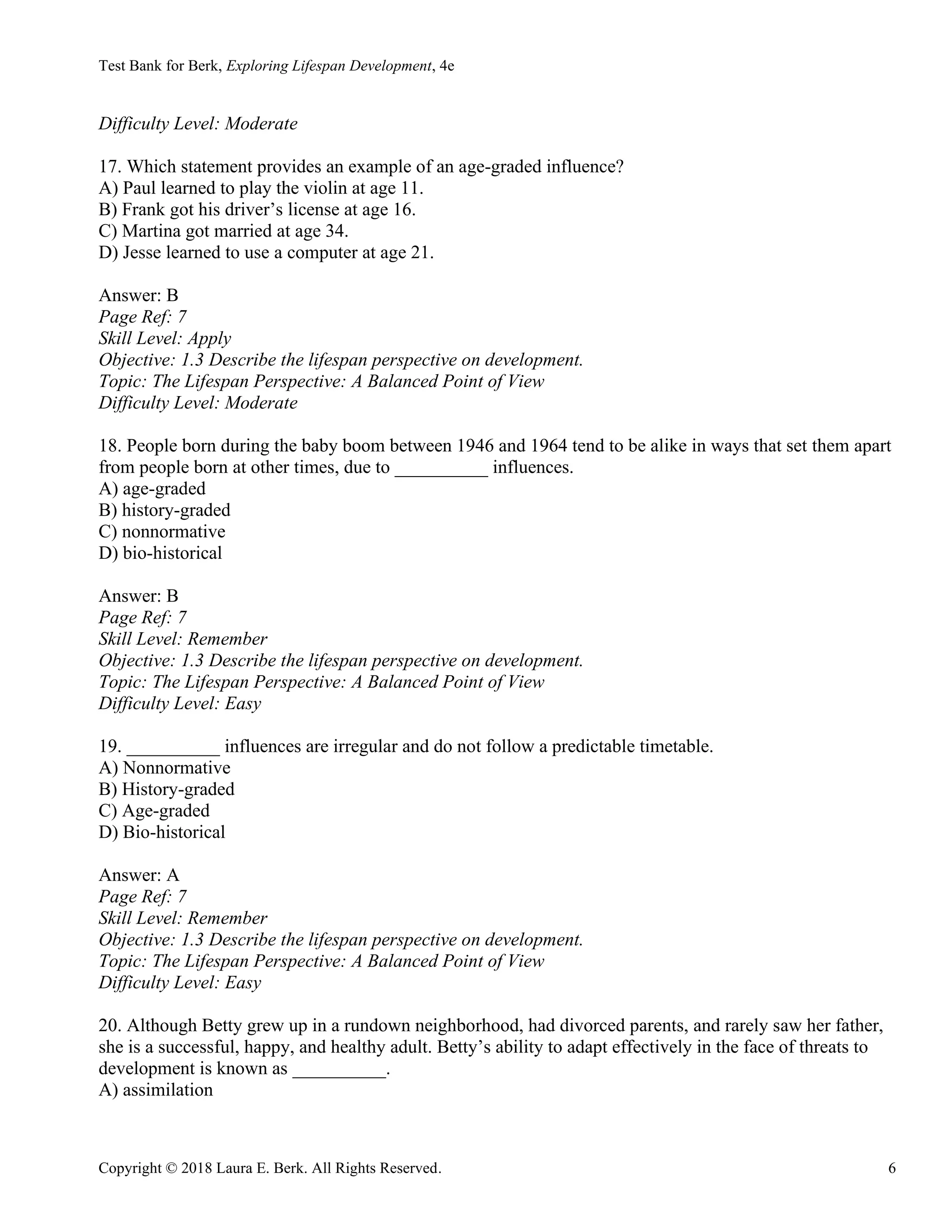
17. Which statement provides an example of an age-graded influence?
A) Paul learned to play the violin at age 11.
B) Frank got his driver’s license at age 16.
C) Martina got married at age 34.
D) Jesse learned to use a computer at age 21.
Answer: B
Page Ref: 7
Skill Level: Apply
Objective: 1.3 Describe the lifespan perspective on development.
Topic: The Lifespan Perspective: A Balanced Point of View
Difficulty Level: Moderate
18. People born during the baby boom between 1946 and 1964 tend to be alike in ways that set them apart
from people born at other times, due to __________ influences.
A) age-graded
B) history-graded
C) nonnormative
D) bio-historical
Answer: B
Page Ref: 7
Skill Level: Remember
Objective: 1.3 Describe the lifespan perspective on development.
Topic: The Lifespan Perspective: A Balanced Point of View
Difficulty Level: Easy
19. __________ influences are irregular and do not follow a predictable timetable.
A) Nonnormative
B) History-graded
C) Age-graded
D) Bio-historical
Answer: A
Page Ref: 7
Skill Level: Remember
Objective: 1.3 Describe the lifespan perspective on development.
Topic: The Lifespan Perspective: A Balanced Point of View
Difficulty Level: Easy
20. Although Betty grew up in a rundown neighborhood, had divorced parents, and rarely saw her father,
she is a successful, happy, and healthy adult. Betty’s ability to adapt effectively in the face of threats to
development is known as __________.
A) assimilation
Test Bank for Berk, Exploring Lifespan Development, 4e
Copyright © 2018 Laura E. Berk. All Rights Reserved. 7
B) resilience
C) age-graded development
D) multidimensional development
Answer: B
Page Ref: 8 Box: BIOLOGY AND ENVIRONMENT: Resilience
Skill Level: Apply
Objective: 1.3 Describe the lifespan perspective on development.
Topic: The Lifespan Perspective: A Balanced Point of View
Difficulty Level: Easy
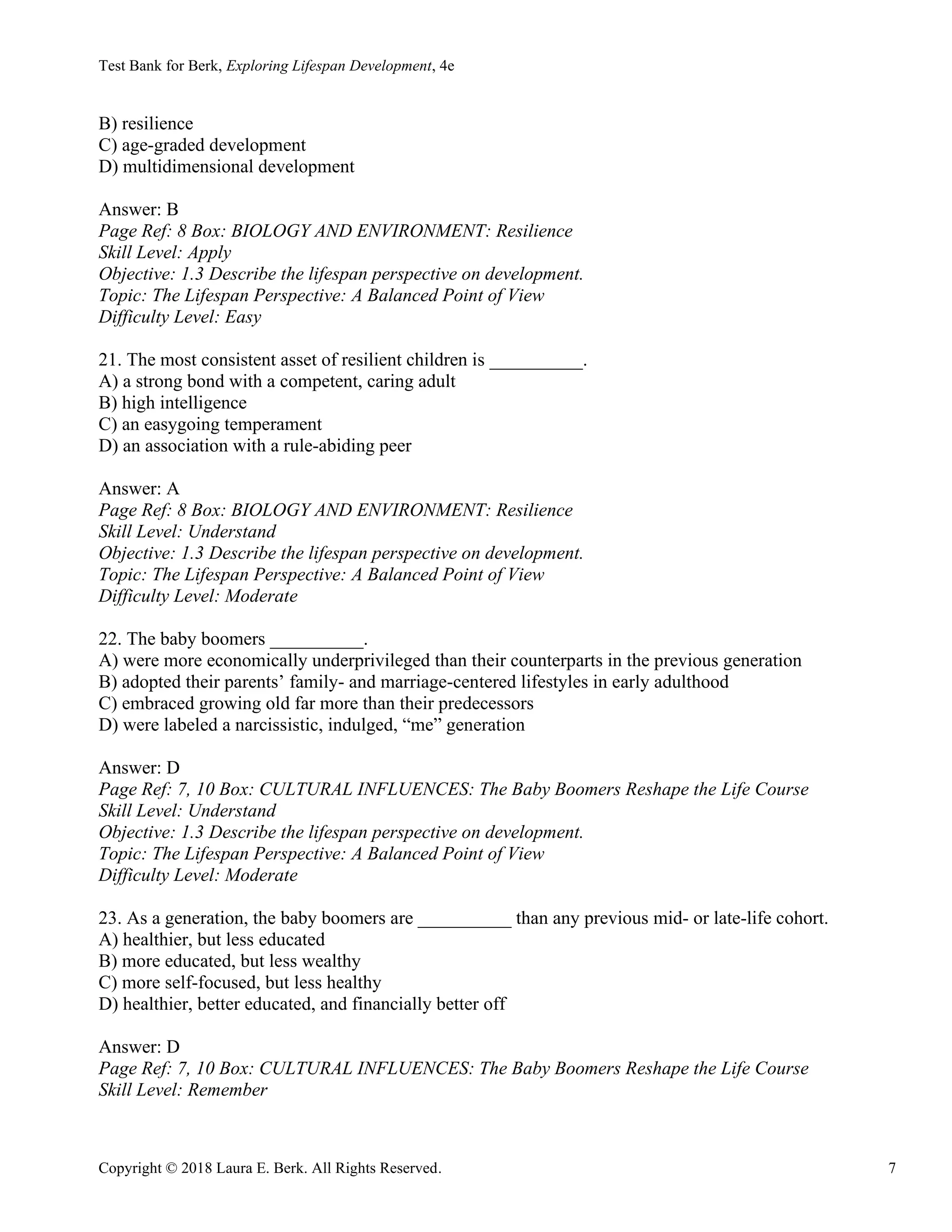
21. The most consistent asset of resilient children is __________.
A) a strong bond with a competent, caring adult
B) high intelligence
C) an easygoing temperament
D) an association with a rule-abiding peer
Answer: A
Page Ref: 8 Box: BIOLOGY AND ENVIRONMENT: Resilience
Skill Level: Understand
Objective: 1.3 Describe the lifespan perspective on development.
Topic: The Lifespan Perspective: A Balanced Point of View
Difficulty Level: Moderate
22. The baby boomers __________.
A) were more economically underprivileged than their counterparts in the previous generation
B) adopted their parents’ family- and marriage-centered lifestyles in early adulthood
C) embraced growing old far more than their predecessors
D) were labeled a narcissistic, indulged, “me” generation
Answer: D
Page Ref: 7, 10 Box: CULTURAL INFLUENCES: The Baby Boomers Reshape the Life Course
Skill Level: Understand
Objective: 1.3 Describe the lifespan perspective on development.
Topic: The Lifespan Perspective: A Balanced Point of View
Difficulty Level: Moderate
23. As a generation, the baby boomers are __________ than any previous mid- or late-life cohort.
A) healthier, but less educated
B) more educated, but less wealthy
C) more self-focused, but less healthy
D) healthier, better educated, and financially better off
Answer: D
Page Ref: 7, 10 Box: CULTURAL INFLUENCES: The Baby Boomers Reshape the Life Course
Skill Level: Remember
Test Bank for Berk, Exploring Lifespan Development, 4e
Copyright © 2018 Laura E. Berk. All Rights Reserved. 8
Objective: 1.3 Describe the lifespan perspective on development.
Topic: The Lifespan Perspective: A Balanced Point of View
Difficulty Level: Moderate
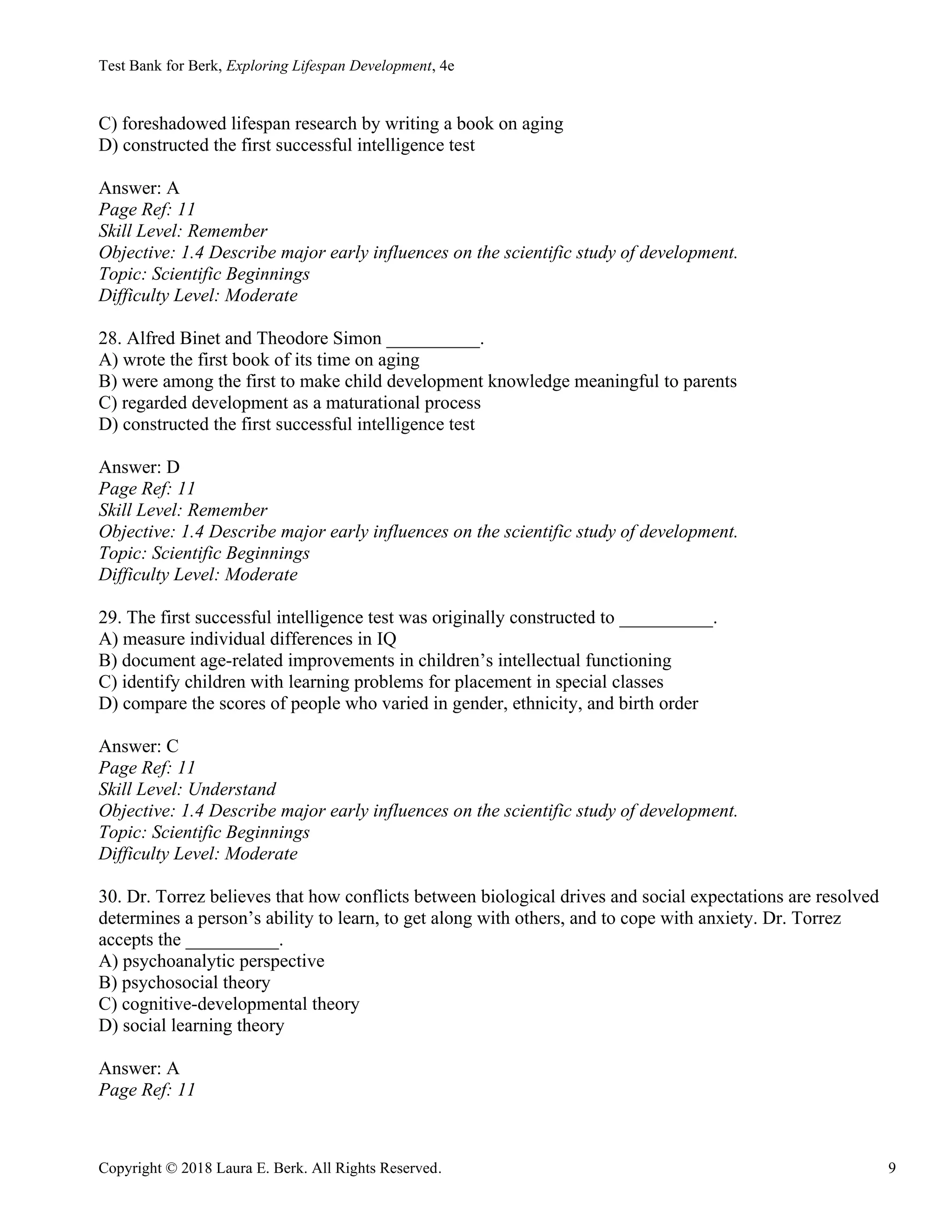
24. __________ is regarded as the founder of the child study movement.
A) Charles Darwin
B) G. Stanley Hall
C) Alfred Binet
D) Sigmund Freud
Answer: B
Page Ref: 11
Skill Level: Remember
Objective: 1.4 Describe major early influences on the scientific study of development.
Topic: Scientific Beginnings
Difficulty Level: Easy
25. Charles Darwin’s theory of evolution emphasized __________ and __________.
A) the normative approach; survival of the fittest
B) noble savages; physical maturation
C) the tabula rasa; natural selection
D) natural selection; survival of the fittest
Answer: D
Page Ref: 9
Skill Level: Understand
Objective: 1.4 Describe major early influences on the scientific study of development.
Topic: Scientific Beginnings
Difficulty Level: Easy
26. G. Stanley Hall and his student Arnold Gesell __________.
A) discovered that prenatal growth is strikingly similar in many species
B) launched the normative approach
C) constructed the first standardized intelligence test
D) were the forefathers of psychoanalytic theory
Answer: B
Page Ref: 11
Skill Level: Remember
Objective: 1.4 Describe major early influences on the scientific study of development.
Topic: Scientific Beginnings
Difficulty Level: Moderate
27. Arnold Gesell __________.
A) was among the first to make knowledge about child development meaningful to parents
B) is generally regarded as the founder of the child study movement
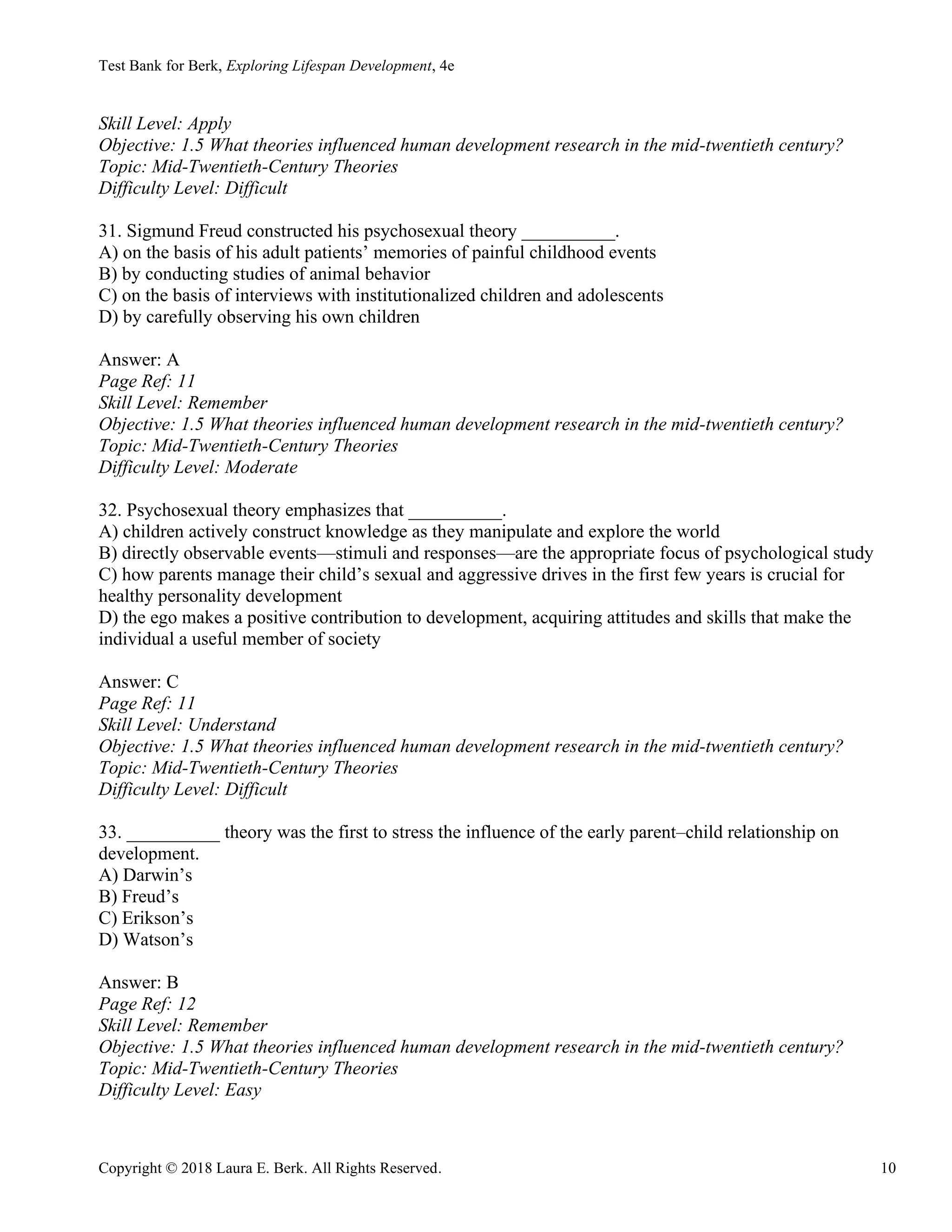
Test Bank for Berk, Exploring Lifespan Development, 4e
Copyright © 2018 Laura E. Berk. All Rights Reserved. 9
C) foreshadowed lifespan research by writing a book on aging
D) constructed the first successful intelligence test
Answer: A
Page Ref: 11
Skill Level: Remember
Objective: 1.4 Describe major early influences on the scientific study of development.
Topic: Scientific Beginnings
Difficulty Level: Moderate
28. Alfred Binet and Theodore Simon __________.
A) wrote the first book of its time on aging
B) were among the first to make child development knowledge meaningful to parents
C) regarded development as a maturational process
D) constructed the first successful intelligence test
Answer: D
Page Ref: 11
Skill Level: Remember
Objective: 1.4 Describe major early influences on the scientific study of development.
Topic: Scientific Beginnings
Difficulty Level: Moderate
29. The first successful intelligence test was originally constructed to __________.
A) measure individual differences in IQ
B) document age-related improvements in children’s intellectual functioning
C) identify children with learning problems for placement in special classes
D) compare the scores of people who varied in gender, ethnicity, and birth order
Answer: C
Page Ref: 11
Skill Level: Understand
Objective: 1.4 Describe major early influences on the scientific study of development.
Topic: Scientific Beginnings
Difficulty Level: Moderate
30. Dr. Torrez believes that how conflicts between biological drives and social expectations are resolved
determines a person’s ability to learn, to get along with others, and to cope with anxiety. Dr. Torrez
accepts the __________.
A) psychoanalytic perspective
B) psychosocial theory
C) cognitive-developmental theory
D) social learning theory
Answer: A
Page Ref: 11
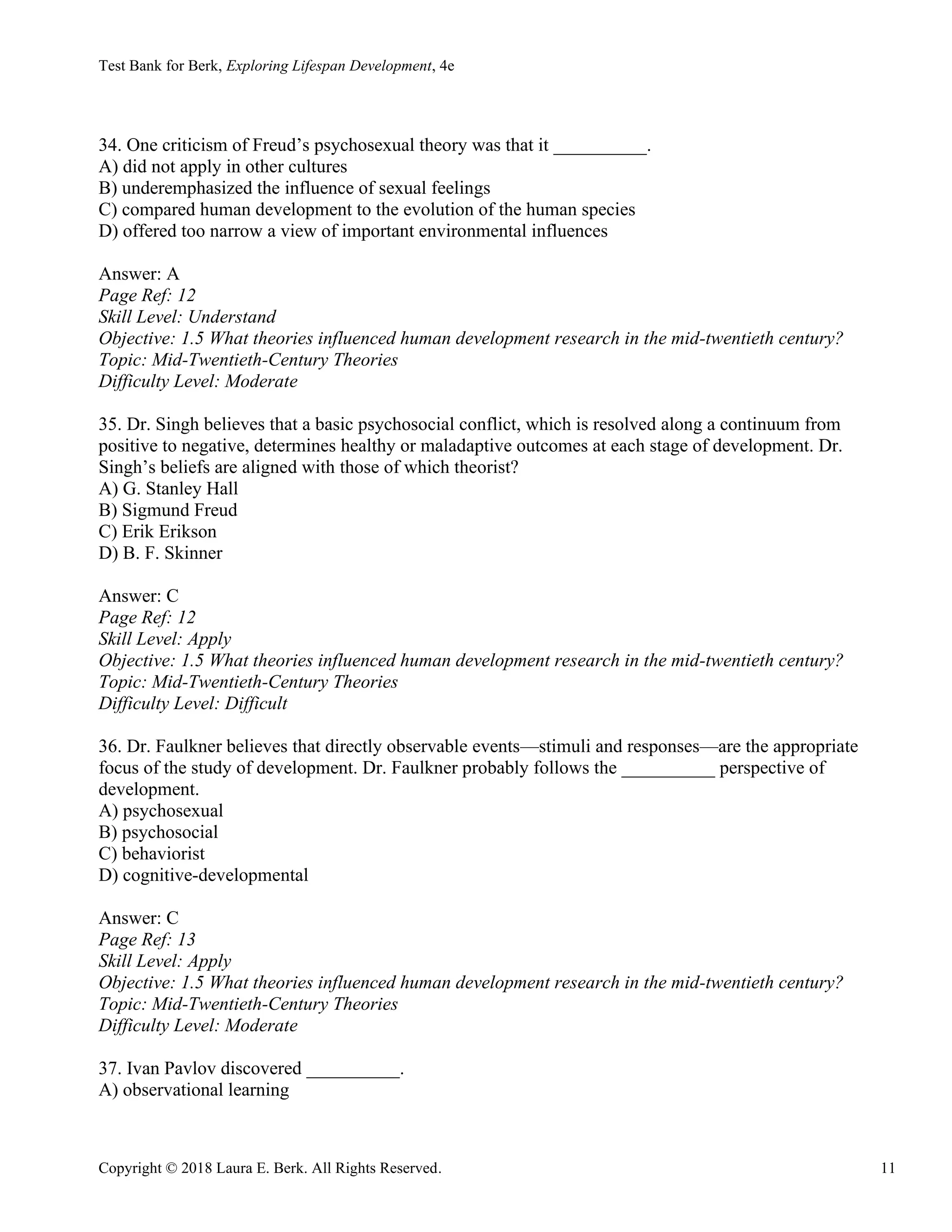
Test Bank for Berk, Exploring Lifespan Development, 4e
Copyright © 2018 Laura E. Berk. All Rights Reserved. 10
Skill Level: Apply
Objective: 1.5 What theories influenced human development research in the mid-twentieth century?
Topic: Mid-Twentieth-Century Theories
Difficulty Level: Difficult
31. Sigmund Freud constructed his psychosexual theory __________.
A) on the basis of his adult patients’ memories of painful childhood events
B) by conducting studies of animal behavior
C) on the basis of interviews with institutionalized children and adolescents
D) by carefully observing his own children
Answer: A
Page Ref: 11
Skill Level: Remember
Objective: 1.5 What theories influenced human development research in the mid-twentieth century?
Topic: Mid-Twentieth-Century Theories
Difficulty Level: Moderate
32. Psychosexual theory emphasizes that __________.
A) children actively construct knowledge as they manipulate and explore the world
B) directly observable events—stimuli and responses—are the appropriate focus of psychological study
C) how parents manage their child’s sexual and aggressive drives in the first few years is crucial for
healthy personality development
D) the ego makes a positive contribution to development, acquiring attitudes and skills that make the
individual a useful member of society
Answer: C
Page Ref: 11
Skill Level: Understand
Objective: 1.5 What theories influenced human development research in the mid-twentieth century?
Topic: Mid-Twentieth-Century Theories
Difficulty Level: Difficult
33. __________ theory was the first to stress the influence of the early parent‒child relationship on
development.
A) Darwin’s
B) Freud’s
C) Erikson’s
D) Watson’s
Answer: B
Page Ref: 12
Skill Level: Remember
Objective: 1.5 What theories influenced human development research in the mid-twentieth century?
Topic: Mid-Twentieth-Century Theories
Difficulty Level: Easy
Test Bank for Berk, Exploring Lifespan Development, 4e
Copyright © 2018 Laura E. Berk. All Rights Reserved. 11
34. One criticism of Freud’s psychosexual theory was that it __________.
A) did not apply in other cultures
B) underemphasized the influence of sexual feelings
C) compared human development to the evolution of the human species
D) offered too narrow a view of important environmental influences
Answer: A
Page Ref: 12
Skill Level: Understand
Objective: 1.5 What theories influenced human development research in the mid-twentieth century?
Topic: Mid-Twentieth-Century Theories
Difficulty Level: Moderate
35. Dr. Singh believes that a basic psychosocial conflict, which is resolved along a continuum from
positive to negative, determines healthy or maladaptive outcomes at each stage of development. Dr.
Singh’s beliefs are aligned with those of which theorist?
A) G. Stanley Hall
B) Sigmund Freud
C) Erik Erikson
D) B. F. Skinner
Answer: C
Page Ref: 12
Skill Level: Apply
Objective: 1.5 What theories influenced human development research in the mid-twentieth century?
Topic: Mid-Twentieth-Century Theories
Difficulty Level: Difficult
36. Dr. Faulkner believes that directly observable events—stimuli and responses—are the appropriate
focus of the study of development. Dr. Faulkner probably follows the __________ perspective of
development.
A) psychosexual
B) psychosocial
C) behaviorist
D) cognitive-developmental
Answer: C
Page Ref: 13
Skill Level: Apply
Objective: 1.5 What theories influenced human development research in the mid-twentieth century?
Topic: Mid-Twentieth-Century Theories
Difficulty Level: Moderate
37. Ivan Pavlov discovered __________.
A) observational learning
Test Bank for Berk, Exploring Lifespan Development, 4e
Copyright © 2018 Laura E. Berk. All Rights Reserved. 12
B) classical conditioning
C) the ego’s positive contributions to development
D) the clinical method
Answer: B
Page Ref: 13
Skill Level: Remember
Objective: 1.5 What theories influenced human development research in the mid-twentieth century?
Topic: Mid-Twentieth-Century Theories
Difficulty Level: Easy
38. In a historic experiment with 11-month-old Albert, John Watson demonstrated that __________.
A) children cannot be conditioned to fear a formerly neutral stimulus
B) infants as young as a few months old will repeat a behavior to obtain a desirable reward
C) children can be conditioned to fear a formerly neutral stimulus
D) children have an innate, inborn fear of rats
Answer: C
Page Ref: 13
Skill Level: Understand
Objective: 1.5 What theories influenced human development research in the mid-twentieth century?
Topic: Mid-Twentieth-Century Theories
Difficulty Level: Moderate
39. According to operant conditioning theory, __________.
A) the frequency of a behavior can be increased through punishment, such as disapproval
B) normal development must be understood in relation to each culture’s life situation
C) the id develops as parents insist that children conform to the values of society
D) the frequency of a behavior can be increased by following it with a wide variety of reinforcers
Answer: D
Page Ref: 13
Skill Level: Understand
Objective: 1.5 What theories influenced human development research in the mid-twentieth century?
Topic: Mid-Twentieth-Century Theories
Difficulty Level: Moderate
40. Baby Gabriella claps her hands after her mother does. Gabriella is displaying __________.
A) reinforcement
B) classical conditioning
C) observational learning
D) adaptation
Answer: C
Page Ref: 13
Skill Level: Apply
Exploring the Variety of Random
Documents with Different Content
THE LION-HOUSE
ALWAYS the heavy air,
The dreadful cage, the low
Murmur of voices, where
Some Force goes to and fro
In an immense despair!
As through a haunted brain—
With tireless footfalls
The Obsession moves again,
Trying the floor, the walls,
Forever, but in vain.
In vain, proud Force! A might,
Shrewder than yours, did spin
Around your rage that bright
Prison of steel, wherein
You pace for my delight.
And O, my heart, what Doom,
What warier Will has wrought
The cage, within whose room
Paces your burning thought,
For the delight of Whom?
Transcriber’s Note:
The first illustration is the cover; the last illustration is
the publisher’s logo.
*** END OF THE PROJECT GUTENBERG EBOOK THE BLACK
PANTHER: A BOOK OF POEMS ***
Updated editions will replace the previous one—the old editions
will be renamed.
Creating the works from print editions not protected by U.S.
copyright law means that no one owns a United States
copyright in these works, so the Foundation (and you!) can copy
and distribute it in the United States without permission and
without paying copyright royalties. Special rules, set forth in the
General Terms of Use part of this license, apply to copying and
distributing Project Gutenberg™ electronic works to protect the
PROJECT GUTENBERG™ concept and trademark. Project
Gutenberg is a registered trademark, and may not be used if
you charge for an eBook, except by following the terms of the
trademark license, including paying royalties for use of the
Project Gutenberg trademark. If you do not charge anything for
copies of this eBook, complying with the trademark license is
very easy. You may use this eBook for nearly any purpose such
as creation of derivative works, reports, performances and
research. Project Gutenberg eBooks may be modified and
printed and given away—you may do practically ANYTHING in
the United States with eBooks not protected by U.S. copyright
law. Redistribution is subject to the trademark license, especially
commercial redistribution.
START: FULL LICENSE
THE FULL PROJECT GUTENBERG LICENSE
PLEASE READ THIS BEFORE YOU DISTRIBUTE OR USE THIS WORK
To protect the Project Gutenberg™ mission of promoting the
free distribution of electronic works, by using or distributing this
work (or any other work associated in any way with the phrase
“Project Gutenberg”), you agree to comply with all the terms of
the Full Project Gutenberg™ License available with this file or
online at www.gutenberg.org/license.
Section 1. General Terms of Use and
Redistributing Project Gutenberg™
electronic works
1.A. By reading or using any part of this Project Gutenberg™
electronic work, you indicate that you have read, understand,
agree to and accept all the terms of this license and intellectual
property (trademark/copyright) agreement. If you do not agree
to abide by all the terms of this agreement, you must cease
using and return or destroy all copies of Project Gutenberg™
electronic works in your possession. If you paid a fee for
obtaining a copy of or access to a Project Gutenberg™
electronic work and you do not agree to be bound by the terms
of this agreement, you may obtain a refund from the person or
entity to whom you paid the fee as set forth in paragraph 1.E.8.
1.B. “Project Gutenberg” is a registered trademark. It may only
be used on or associated in any way with an electronic work by
people who agree to be bound by the terms of this agreement.
There are a few things that you can do with most Project
Gutenberg™ electronic works even without complying with the
full terms of this agreement. See paragraph 1.C below. There
are a lot of things you can do with Project Gutenberg™
electronic works if you follow the terms of this agreement and
help preserve free future access to Project Gutenberg™
electronic works. See paragraph 1.E below.
1.C. The Project Gutenberg Literary Archive Foundation (“the
Foundation” or PGLAF), owns a compilation copyright in the
collection of Project Gutenberg™ electronic works. Nearly all the
individual works in the collection are in the public domain in the
United States. If an individual work is unprotected by copyright
law in the United States and you are located in the United
States, we do not claim a right to prevent you from copying,
distributing, performing, displaying or creating derivative works
based on the work as long as all references to Project
Gutenberg are removed. Of course, we hope that you will
support the Project Gutenberg™ mission of promoting free
access to electronic works by freely sharing Project Gutenberg™
works in compliance with the terms of this agreement for
keeping the Project Gutenberg™ name associated with the
work. You can easily comply with the terms of this agreement
by keeping this work in the same format with its attached full
Project Gutenberg™ License when you share it without charge
with others.
1.D. The copyright laws of the place where you are located also
govern what you can do with this work. Copyright laws in most
countries are in a constant state of change. If you are outside
the United States, check the laws of your country in addition to
the terms of this agreement before downloading, copying,
displaying, performing, distributing or creating derivative works
based on this work or any other Project Gutenberg™ work. The
Foundation makes no representations concerning the copyright
status of any work in any country other than the United States.
1.E. Unless you have removed all references to Project
Gutenberg:
1.E.1. The following sentence, with active links to, or other
immediate access to, the full Project Gutenberg™ License must
appear prominently whenever any copy of a Project
Gutenberg™ work (any work on which the phrase “Project
Gutenberg” appears, or with which the phrase “Project
Gutenberg” is associated) is accessed, displayed, performed,
viewed, copied or distributed:
This eBook is for the use of anyone anywhere in the United
States and most other parts of the world at no cost and
with almost no restrictions whatsoever. You may copy it,
give it away or re-use it under the terms of the Project
Gutenberg License included with this eBook or online at
www.gutenberg.org. If you are not located in the United
States, you will have to check the laws of the country
where you are located before using this eBook.
1.E.2. If an individual Project Gutenberg™ electronic work is
derived from texts not protected by U.S. copyright law (does not
contain a notice indicating that it is posted with permission of
the copyright holder), the work can be copied and distributed to
anyone in the United States without paying any fees or charges.
If you are redistributing or providing access to a work with the
phrase “Project Gutenberg” associated with or appearing on the
work, you must comply either with the requirements of
paragraphs 1.E.1 through 1.E.7 or obtain permission for the use
of the work and the Project Gutenberg™ trademark as set forth
in paragraphs 1.E.8 or 1.E.9.
1.E.3. If an individual Project Gutenberg™ electronic work is
posted with the permission of the copyright holder, your use and
distribution must comply with both paragraphs 1.E.1 through
1.E.7 and any additional terms imposed by the copyright holder.
Additional terms will be linked to the Project Gutenberg™
License for all works posted with the permission of the copyright
holder found at the beginning of this work.
1.E.4. Do not unlink or detach or remove the full Project
Gutenberg™ License terms from this work, or any files
containing a part of this work or any other work associated with
Project Gutenberg™.
1.E.5. Do not copy, display, perform, distribute or redistribute
this electronic work, or any part of this electronic work, without
prominently displaying the sentence set forth in paragraph 1.E.1
with active links or immediate access to the full terms of the
Project Gutenberg™ License.
1.E.6. You may convert to and distribute this work in any binary,
compressed, marked up, nonproprietary or proprietary form,
including any word processing or hypertext form. However, if
you provide access to or distribute copies of a Project
Gutenberg™ work in a format other than “Plain Vanilla ASCII” or
other format used in the official version posted on the official
Project Gutenberg™ website (www.gutenberg.org), you must,
at no additional cost, fee or expense to the user, provide a copy,
a means of exporting a copy, or a means of obtaining a copy
upon request, of the work in its original “Plain Vanilla ASCII” or
other form. Any alternate format must include the full Project
Gutenberg™ License as specified in paragraph 1.E.1.
1.E.7. Do not charge a fee for access to, viewing, displaying,
performing, copying or distributing any Project Gutenberg™
works unless you comply with paragraph 1.E.8 or 1.E.9.
1.E.8. You may charge a reasonable fee for copies of or
providing access to or distributing Project Gutenberg™
electronic works provided that:
• You pay a royalty fee of 20% of the gross profits you derive
from the use of Project Gutenberg™ works calculated using the
method you already use to calculate your applicable taxes. The
fee is owed to the owner of the Project Gutenberg™ trademark,
but he has agreed to donate royalties under this paragraph to
the Project Gutenberg Literary Archive Foundation. Royalty
payments must be paid within 60 days following each date on
which you prepare (or are legally required to prepare) your
periodic tax returns. Royalty payments should be clearly marked
as such and sent to the Project Gutenberg Literary Archive
Foundation at the address specified in Section 4, “Information
about donations to the Project Gutenberg Literary Archive
Foundation.”
• You provide a full refund of any money paid by a user who
notifies you in writing (or by e-mail) within 30 days of receipt
that s/he does not agree to the terms of the full Project
Gutenberg™ License. You must require such a user to return or
destroy all copies of the works possessed in a physical medium
and discontinue all use of and all access to other copies of
Project Gutenberg™ works.
• You provide, in accordance with paragraph 1.F.3, a full refund of
any money paid for a work or a replacement copy, if a defect in
the electronic work is discovered and reported to you within 90
days of receipt of the work.
• You comply with all other terms of this agreement for free
distribution of Project Gutenberg™ works.
1.E.9. If you wish to charge a fee or distribute a Project
Gutenberg™ electronic work or group of works on different
terms than are set forth in this agreement, you must obtain
permission in writing from the Project Gutenberg Literary
Archive Foundation, the manager of the Project Gutenberg™
trademark. Contact the Foundation as set forth in Section 3
below.
1.F.
1.F.1. Project Gutenberg volunteers and employees expend
considerable effort to identify, do copyright research on,
transcribe and proofread works not protected by U.S. copyright
law in creating the Project Gutenberg™ collection. Despite these
efforts, Project Gutenberg™ electronic works, and the medium
on which they may be stored, may contain “Defects,” such as,
but not limited to, incomplete, inaccurate or corrupt data,
transcription errors, a copyright or other intellectual property
infringement, a defective or damaged disk or other medium, a
computer virus, or computer codes that damage or cannot be
read by your equipment.
1.F.2. LIMITED WARRANTY, DISCLAIMER OF DAMAGES - Except
for the “Right of Replacement or Refund” described in
paragraph 1.F.3, the Project Gutenberg Literary Archive
Foundation, the owner of the Project Gutenberg™ trademark,
and any other party distributing a Project Gutenberg™ electronic
work under this agreement, disclaim all liability to you for
damages, costs and expenses, including legal fees. YOU AGREE
THAT YOU HAVE NO REMEDIES FOR NEGLIGENCE, STRICT
LIABILITY, BREACH OF WARRANTY OR BREACH OF CONTRACT
EXCEPT THOSE PROVIDED IN PARAGRAPH 1.F.3. YOU AGREE
THAT THE FOUNDATION, THE TRADEMARK OWNER, AND ANY
DISTRIBUTOR UNDER THIS AGREEMENT WILL NOT BE LIABLE
TO YOU FOR ACTUAL, DIRECT, INDIRECT, CONSEQUENTIAL,
PUNITIVE OR INCIDENTAL DAMAGES EVEN IF YOU GIVE
NOTICE OF THE POSSIBILITY OF SUCH DAMAGE.
1.F.3. LIMITED RIGHT OF REPLACEMENT OR REFUND - If you
discover a defect in this electronic work within 90 days of
receiving it, you can receive a refund of the money (if any) you
paid for it by sending a written explanation to the person you
received the work from. If you received the work on a physical
medium, you must return the medium with your written
explanation. The person or entity that provided you with the
defective work may elect to provide a replacement copy in lieu
of a refund. If you received the work electronically, the person
or entity providing it to you may choose to give you a second
opportunity to receive the work electronically in lieu of a refund.
If the second copy is also defective, you may demand a refund
in writing without further opportunities to fix the problem.
1.F.4. Except for the limited right of replacement or refund set
forth in paragraph 1.F.3, this work is provided to you ‘AS-IS’,
WITH NO OTHER WARRANTIES OF ANY KIND, EXPRESS OR
IMPLIED, INCLUDING BUT NOT LIMITED TO WARRANTIES OF
MERCHANTABILITY OR FITNESS FOR ANY PURPOSE.
1.F.5. Some states do not allow disclaimers of certain implied
warranties or the exclusion or limitation of certain types of
damages. If any disclaimer or limitation set forth in this
agreement violates the law of the state applicable to this
agreement, the agreement shall be interpreted to make the
maximum disclaimer or limitation permitted by the applicable
state law. The invalidity or unenforceability of any provision of
this agreement shall not void the remaining provisions.
1.F.6. INDEMNITY - You agree to indemnify and hold the
Foundation, the trademark owner, any agent or employee of the
Foundation, anyone providing copies of Project Gutenberg™
electronic works in accordance with this agreement, and any
volunteers associated with the production, promotion and
distribution of Project Gutenberg™ electronic works, harmless
from all liability, costs and expenses, including legal fees, that
arise directly or indirectly from any of the following which you
do or cause to occur: (a) distribution of this or any Project
Gutenberg™ work, (b) alteration, modification, or additions or
deletions to any Project Gutenberg™ work, and (c) any Defect
you cause.
Section 2. Information about the Mission
of Project Gutenberg™
Project Gutenberg™ is synonymous with the free distribution of
electronic works in formats readable by the widest variety of
computers including obsolete, old, middle-aged and new
computers. It exists because of the efforts of hundreds of
volunteers and donations from people in all walks of life.
Volunteers and financial support to provide volunteers with the
assistance they need are critical to reaching Project
Gutenberg™’s goals and ensuring that the Project Gutenberg™
collection will remain freely available for generations to come. In
2001, the Project Gutenberg Literary Archive Foundation was
created to provide a secure and permanent future for Project
Gutenberg™ and future generations. To learn more about the
Project Gutenberg Literary Archive Foundation and how your
efforts and donations can help, see Sections 3 and 4 and the
Foundation information page at www.gutenberg.org.
Section 3. Information about the Project
Gutenberg Literary Archive Foundation
The Project Gutenberg Literary Archive Foundation is a non-
profit 501(c)(3) educational corporation organized under the
laws of the state of Mississippi and granted tax exempt status
by the Internal Revenue Service. The Foundation’s EIN or
federal tax identification number is 64-6221541. Contributions
to the Project Gutenberg Literary Archive Foundation are tax
deductible to the full extent permitted by U.S. federal laws and
your state’s laws.
The Foundation’s business office is located at 809 North 1500
West, Salt Lake City, UT 84116, (801) 596-1887. Email contact
links and up to date contact information can be found at the
Foundation’s website and official page at
www.gutenberg.org/contact
Section 4. Information about Donations to
the Project Gutenberg Literary Archive
Foundation
Project Gutenberg™ depends upon and cannot survive without
widespread public support and donations to carry out its mission
of increasing the number of public domain and licensed works
that can be freely distributed in machine-readable form
accessible by the widest array of equipment including outdated
equipment. Many small donations ($1 to $5,000) are particularly
important to maintaining tax exempt status with the IRS.
The Foundation is committed to complying with the laws
regulating charities and charitable donations in all 50 states of
the United States. Compliance requirements are not uniform
and it takes a considerable effort, much paperwork and many
fees to meet and keep up with these requirements. We do not
solicit donations in locations where we have not received written
confirmation of compliance. To SEND DONATIONS or determine
the status of compliance for any particular state visit
www.gutenberg.org/donate.
While we cannot and do not solicit contributions from states
where we have not met the solicitation requirements, we know
of no prohibition against accepting unsolicited donations from
donors in such states who approach us with offers to donate.
International donations are gratefully accepted, but we cannot
make any statements concerning tax treatment of donations
received from outside the United States. U.S. laws alone swamp
our small staff.
Please check the Project Gutenberg web pages for current
donation methods and addresses. Donations are accepted in a
number of other ways including checks, online payments and
credit card donations. To donate, please visit:
www.gutenberg.org/donate.
Section 5. General Information About
Project Gutenberg™ electronic works
Professor Michael S. Hart was the originator of the Project
Gutenberg™ concept of a library of electronic works that could
be freely shared with anyone. For forty years, he produced and
distributed Project Gutenberg™ eBooks with only a loose
network of volunteer support.
Project Gutenberg™ eBooks are often created from several
printed editions, all of which are confirmed as not protected by
copyright in the U.S. unless a copyright notice is included. Thus,
we do not necessarily keep eBooks in compliance with any
particular paper edition.
Most people start at our website which has the main PG search
facility: www.gutenberg.org.
This website includes information about Project Gutenberg™,
including how to make donations to the Project Gutenberg
Literary Archive Foundation, how to help produce our new
eBooks, and how to subscribe to our email newsletter to hear
about new eBooks.
Welcome to our website – the perfect destination for book lovers and
knowledge seekers. We believe that every book holds a new world,
offering opportunities for learning, discovery, and personal growth.
That’s why we are dedicated to bringing you a diverse collection of
books, ranging from classic literature and specialized publications to
self-development guides and children's books.
More than just a book-buying platform, we strive to be a bridge
connecting you with timeless cultural and intellectual values. With an
elegant, user-friendly interface and a smart search system, you can
quickly find the books that best suit your interests. Additionally,
our special promotions and home delivery services help you save time
and fully enjoy the joy of reading.
Join us on a journey of knowledge exploration, passion nurturing, and
personal growth every day!
testbankbell.com
Test Bank for Exploring Lifespan Development 4th Edition by Berk

  • 1.
    Test Bank forExploring Lifespan Development 4th Edition by Berk download http://testbankbell.com/product/test-bank-for-exploring-lifespan- development-4th-edition-by-berk/ Visit testbankbell.com today to download the complete set of test bank or solution manual
  • 2.
    Here are somerecommended products for you. Click the link to download, or explore more at testbankbell.com Test Bank for Exploring Lifespan Development, 2nd Edition: Berk http://testbankbell.com/product/test-bank-for-exploring-lifespan- development-2nd-edition-berk/ Development Through the Lifespan 7th Edition Berk Test Bank http://testbankbell.com/product/development-through-the-lifespan-7th- edition-berk-test-bank/ Development Through the Lifespan Berk 6th Edition Test Bank http://testbankbell.com/product/development-through-the-lifespan- berk-6th-edition-test-bank/ Solution Manual for Shelly Cashman Series Collection, Microsoft Office 365 & Office 2019 1st Edition Sandra Cable http://testbankbell.com/product/solution-manual-for-shelly-cashman- series-collection-microsoft-office-365-office-2019-1st-edition-sandra- cable/
  • 3.
    Test bank forStress Health and Well-Being: Thriving in the 21st Century 1st Edition by Harrington http://testbankbell.com/product/test-bank-for-stress-health-and-well- being-thriving-in-the-21st-century-1st-edition-by-harrington/ Legal Environment of Business A Managerial Approach Theory to Practice 3rd Edition Melvin Solutions Manual http://testbankbell.com/product/legal-environment-of-business-a- managerial-approach-theory-to-practice-3rd-edition-melvin-solutions- manual/ Maternal-Child Nursing McKinney 4th Edition Test Bank http://testbankbell.com/product/maternal-child-nursing-mckinney-4th- edition-test-bank/ Test Bank for Understanding the American Promise 7th COMBINED by Roark http://testbankbell.com/product/test-bank-for-understanding-the- american-promise-7th-combined-by-roark/ Test Bank for Microeconomics Fifth Edition http://testbankbell.com/product/test-bank-for-microeconomics-fifth- edition/
  • 4.
    Test Bank forECGs Made Easy, 4th Edition: Barbara J. Aehlert http://testbankbell.com/product/test-bank-for-ecgs-made-easy-4th- edition-barbara-j-aehlert/
  • 5.
    Copyright © 2018Laura E. Berk. All Rights Reserved. 1 Test Bank for Exploring Lifespan Development 4th Edition by Berk FULL CHAPTER AT: HTTPS://TESTBANKBELL.COM/PRODUCT/TEST-BANK-FOR- EXPLORING-LIFESPAN-DEVELOPMENT-4TH-EDITION-BY-BERK/ CHAPTER 1 HISTORY, THEORY, AND RESEARCH STRATEGIES MULTIPLE CHOICE 1. Dr. Langley’s work is devoted to understanding constancy and change throughout the lifespan. Dr. Langley’s field of study is __________. A) genetics B) clinical psychology C) adolescent development D) developmental science Answer: D Page Ref: 3 Skill Level: Apply Objective: 1.1 What is developmental science, and what factors stimulated expansion of the field? Topic: A Scientific, Applied, and Interdisciplinary Field Difficulty Level: Moderate 2. Although great diversity characterizes the interests and concerns of investigators who study development, they share a single goal: to identify __________. A) genetic factors that contribute to longevity B) environmental factors that contribute to disease and illness C) those factors that lead to abnormal development in children and adolescents D) those factors that influence consistencies and transformations in people from conception to death Answer: D Page Ref: 3 Skill Level: Understand Objective: 1.1 What is developmental science, and what factors stimulated expansion of the field? Topic: A Scientific, Applied, and Interdisciplinary Field Difficulty Level: Moderate 3. Developmental science is __________ because it has grown through the combined efforts of people from many fields of study. A) interdisciplinary B) empirical C) applied
  • 6.
    Test Bank forBerk, Exploring Lifespan Development, 4e Copyright © 2018 Laura E. Berk. All Rights Reserved. 2 D) theoretical Answer: A Page Ref: 3 Skill Level: Remember Objective: 1.1 What is developmental science, and what factors stimulated expansion of the field? Topic: A Scientific, Applied, and Interdisciplinary Field Difficulty Level: Easy 4. A theory of development __________. A) illustrates the ultimate truth about human behavior B) describes, explains, and predicts behavior C) explains all aspects of human growth D) does not require scientific verification Answer: B Page Ref: 3 Skill Level: Understand Objective: 1.2 Identify three basic issues on which theories of human development take a stand. Topic: Basic Issues Difficulty Level: Moderate 5. According to the __________ view of development, the difference between the immature and mature being is simply one of amount or complexity. A) nature B) discontinuous C) nurture D) continuous Answer: D Page Ref: 4 Skill Level: Remember Objective: 1.2 Identify three basic issues on which theories of human development take a stand. Topic: Basic Issues Difficulty Level: Moderate 6. The discontinuous view of development holds that __________. A) infants and preschoolers respond to the world in much the same way adults do B) growth is the process of gradually augmenting the skills that were present from the beginning C) infants and children have unique ways of thinking, feeling, and behaving D) development is a smooth process limited only by a lack of information and precision Answer: C Page Ref: 4 Skill Level: Understand Objective: 1.2 Identify three basic issues on which theories of human development take a stand.
  • 7.
    Test Bank forBerk, Exploring Lifespan Development, 4e Copyright © 2018 Laura E. Berk. All Rights Reserved. 3 Topic: Basic Issues Difficulty Level: Difficult 7. Dr. Kostel believes that development takes place in stages. This belief is consistent with the __________ perspective. A) nurture B) continuous C) discontinuous D) nature Answer: C Page Ref: 4 Skill Level: Apply Objective: 1.2 Identify three basic issues on which theories of human development take a stand. Topic: Basic Issues Difficulty Level: Moderate 8. New evidence increasingly emphasizes that __________. A) there is very little cultural diversity in human development B) environmental, but not personal, contexts shape development C) development occurs in a neat, orderly sequence of stages unaffected by distinct contexts D) people not only are affected by but also contribute to the contexts in which they develop Answer: D Page Ref: 4 Skill Level: Understand Objective: 1.2 Identify three basic issues on which theories of human development take a stand. Topic: Basic Issues Difficulty Level: Difficult 9. Tammy’s father is an exceptional gymnast. When Tammy was just a toddler, her father believed that Tammy already showed great promise as a gymnast. Tammy’s father probably believes that athletic ability is mostly determined by __________. A) nurture B) stages C) nature D) early experiences Answer: C Page Ref: 5 Skill Level: Apply Objective: 1.2 Identify three basic issues on which theories of human development take a stand. Topic: Basic Issues Difficulty Level: Moderate
  • 8.
    Test Bank forBerk, Exploring Lifespan Development, 4e Copyright © 2018 Laura E. Berk. All Rights Reserved. 4 10. Although Justin spent his first 18 months in an orphanage, his adoptive mother believes sensitive caregiving will help Justin overcome his early experiences. Justin’s mother emphasizes the role of __________ in development. A) nurture B) stages C) stability D) nature Answer: A Page Ref: 5 Skill Level: Apply Objective: 1.2 Identify three basic issues on which theories of human development take a stand. Topic: Basic Issues Difficulty Level: Moderate 11. Theorists who contend that powerful negative events in the first few years cannot be fully overcome by later, more positive ones emphasize __________. A) plasticity B) stability C) nurture D) discontinuity Answer: B Page Ref: 5 Skill Level: Remember Objective: 1.2 Identify three basic issues on which theories of human development take a stand. Topic: Basic Issues Difficulty Level: Difficult 12. Theorists who emphasize plasticity believe that __________. A) change in response to influential experiences is possible B) heredity, rather than environment, influences behavior C) individuals who are high in anxiety as children will remain so at later ages D) early experiences establish a lifelong pattern of behavior Answer: A Page Ref: 5 Skill Level: Understand Objective: 1.2 Identify three basic issues on which theories of human development take a stand. Topic: Basic Issues Difficulty Level: Moderate 13. Increasingly, researchers view human development as __________. A) taking place entirely before and during adolescence B) declining in old age C) influenced more by heredity than environment
  • 9.
    Test Bank forBerk, Exploring Lifespan Development, 4e Copyright © 2018 Laura E. Berk. All Rights Reserved. 5 D) a perpetually ongoing process Answer: D Page Ref: 5 Skill Level: Understand Objective: 1.3 Describe the lifespan perspective on development. Topic: The Lifespan Perspective: A Balanced Point of View Difficulty Level: Moderate 14. The lifespan perspective on human development assumes that development is __________. A) static and stable B) multidimensional and multidirectional C) continuous, rather than discontinuous D) largely the result of heredity Answer: B Page Ref: 5 Skill Level: Understand Objective: 1.3 Describe the lifespan perspective on development. Topic: The Lifespan Perspective: A Balanced Point of View Difficulty Level: Moderate 15. According to the lifespan perspective, __________ is supreme in its impact on the life course. A) the prenatal period B) early childhood C) adolescence D) no age period Answer: D Page Ref: 5 Skill Level: Remember Objective: 1.3 Describe the lifespan perspective on development. Topic: The Lifespan Perspective: A Balanced Point of View Difficulty Level: Easy 16. Max, age 65, learned to play the piano at a local senior center. Max demonstrates that __________. A) aging is an eventual “shipwreck” B) learning follows a predictable timetable C) development is plastic at all ages D) musical talent peaks in late adulthood Answer: C Page Ref: 6 Skill Level: Apply Objective: 1.3 Describe the lifespan perspective on development. Topic: The Lifespan Perspective: A Balanced Point of View
  • 10.
    Test Bank forBerk, Exploring Lifespan Development, 4e Copyright © 2018 Laura E. Berk. All Rights Reserved. 6 Difficulty Level: Moderate 17. Which statement provides an example of an age-graded influence? A) Paul learned to play the violin at age 11. B) Frank got his driver’s license at age 16. C) Martina got married at age 34. D) Jesse learned to use a computer at age 21. Answer: B Page Ref: 7 Skill Level: Apply Objective: 1.3 Describe the lifespan perspective on development. Topic: The Lifespan Perspective: A Balanced Point of View Difficulty Level: Moderate 18. People born during the baby boom between 1946 and 1964 tend to be alike in ways that set them apart from people born at other times, due to __________ influences. A) age-graded B) history-graded C) nonnormative D) bio-historical Answer: B Page Ref: 7 Skill Level: Remember Objective: 1.3 Describe the lifespan perspective on development. Topic: The Lifespan Perspective: A Balanced Point of View Difficulty Level: Easy 19. __________ influences are irregular and do not follow a predictable timetable. A) Nonnormative B) History-graded C) Age-graded D) Bio-historical Answer: A Page Ref: 7 Skill Level: Remember Objective: 1.3 Describe the lifespan perspective on development. Topic: The Lifespan Perspective: A Balanced Point of View Difficulty Level: Easy 20. Although Betty grew up in a rundown neighborhood, had divorced parents, and rarely saw her father, she is a successful, happy, and healthy adult. Betty’s ability to adapt effectively in the face of threats to development is known as __________. A) assimilation
  • 11.
    Test Bank forBerk, Exploring Lifespan Development, 4e Copyright © 2018 Laura E. Berk. All Rights Reserved. 7 B) resilience C) age-graded development D) multidimensional development Answer: B Page Ref: 8 Box: BIOLOGY AND ENVIRONMENT: Resilience Skill Level: Apply Objective: 1.3 Describe the lifespan perspective on development. Topic: The Lifespan Perspective: A Balanced Point of View Difficulty Level: Easy 21. The most consistent asset of resilient children is __________. A) a strong bond with a competent, caring adult B) high intelligence C) an easygoing temperament D) an association with a rule-abiding peer Answer: A Page Ref: 8 Box: BIOLOGY AND ENVIRONMENT: Resilience Skill Level: Understand Objective: 1.3 Describe the lifespan perspective on development. Topic: The Lifespan Perspective: A Balanced Point of View Difficulty Level: Moderate 22. The baby boomers __________. A) were more economically underprivileged than their counterparts in the previous generation B) adopted their parents’ family- and marriage-centered lifestyles in early adulthood C) embraced growing old far more than their predecessors D) were labeled a narcissistic, indulged, “me” generation Answer: D Page Ref: 7, 10 Box: CULTURAL INFLUENCES: The Baby Boomers Reshape the Life Course Skill Level: Understand Objective: 1.3 Describe the lifespan perspective on development. Topic: The Lifespan Perspective: A Balanced Point of View Difficulty Level: Moderate 23. As a generation, the baby boomers are __________ than any previous mid- or late-life cohort. A) healthier, but less educated B) more educated, but less wealthy C) more self-focused, but less healthy D) healthier, better educated, and financially better off Answer: D Page Ref: 7, 10 Box: CULTURAL INFLUENCES: The Baby Boomers Reshape the Life Course Skill Level: Remember
  • 12.
    Test Bank forBerk, Exploring Lifespan Development, 4e Copyright © 2018 Laura E. Berk. All Rights Reserved. 8 Objective: 1.3 Describe the lifespan perspective on development. Topic: The Lifespan Perspective: A Balanced Point of View Difficulty Level: Moderate 24. __________ is regarded as the founder of the child study movement. A) Charles Darwin B) G. Stanley Hall C) Alfred Binet D) Sigmund Freud Answer: B Page Ref: 11 Skill Level: Remember Objective: 1.4 Describe major early influences on the scientific study of development. Topic: Scientific Beginnings Difficulty Level: Easy 25. Charles Darwin’s theory of evolution emphasized __________ and __________. A) the normative approach; survival of the fittest B) noble savages; physical maturation C) the tabula rasa; natural selection D) natural selection; survival of the fittest Answer: D Page Ref: 9 Skill Level: Understand Objective: 1.4 Describe major early influences on the scientific study of development. Topic: Scientific Beginnings Difficulty Level: Easy 26. G. Stanley Hall and his student Arnold Gesell __________. A) discovered that prenatal growth is strikingly similar in many species B) launched the normative approach C) constructed the first standardized intelligence test D) were the forefathers of psychoanalytic theory Answer: B Page Ref: 11 Skill Level: Remember Objective: 1.4 Describe major early influences on the scientific study of development. Topic: Scientific Beginnings Difficulty Level: Moderate 27. Arnold Gesell __________. A) was among the first to make knowledge about child development meaningful to parents B) is generally regarded as the founder of the child study movement
  • 13.
    Test Bank forBerk, Exploring Lifespan Development, 4e Copyright © 2018 Laura E. Berk. All Rights Reserved. 9 C) foreshadowed lifespan research by writing a book on aging D) constructed the first successful intelligence test Answer: A Page Ref: 11 Skill Level: Remember Objective: 1.4 Describe major early influences on the scientific study of development. Topic: Scientific Beginnings Difficulty Level: Moderate 28. Alfred Binet and Theodore Simon __________. A) wrote the first book of its time on aging B) were among the first to make child development knowledge meaningful to parents C) regarded development as a maturational process D) constructed the first successful intelligence test Answer: D Page Ref: 11 Skill Level: Remember Objective: 1.4 Describe major early influences on the scientific study of development. Topic: Scientific Beginnings Difficulty Level: Moderate 29. The first successful intelligence test was originally constructed to __________. A) measure individual differences in IQ B) document age-related improvements in children’s intellectual functioning C) identify children with learning problems for placement in special classes D) compare the scores of people who varied in gender, ethnicity, and birth order Answer: C Page Ref: 11 Skill Level: Understand Objective: 1.4 Describe major early influences on the scientific study of development. Topic: Scientific Beginnings Difficulty Level: Moderate 30. Dr. Torrez believes that how conflicts between biological drives and social expectations are resolved determines a person’s ability to learn, to get along with others, and to cope with anxiety. Dr. Torrez accepts the __________. A) psychoanalytic perspective B) psychosocial theory C) cognitive-developmental theory D) social learning theory Answer: A Page Ref: 11
  • 14.
    Test Bank forBerk, Exploring Lifespan Development, 4e Copyright © 2018 Laura E. Berk. All Rights Reserved. 10 Skill Level: Apply Objective: 1.5 What theories influenced human development research in the mid-twentieth century? Topic: Mid-Twentieth-Century Theories Difficulty Level: Difficult 31. Sigmund Freud constructed his psychosexual theory __________. A) on the basis of his adult patients’ memories of painful childhood events B) by conducting studies of animal behavior C) on the basis of interviews with institutionalized children and adolescents D) by carefully observing his own children Answer: A Page Ref: 11 Skill Level: Remember Objective: 1.5 What theories influenced human development research in the mid-twentieth century? Topic: Mid-Twentieth-Century Theories Difficulty Level: Moderate 32. Psychosexual theory emphasizes that __________. A) children actively construct knowledge as they manipulate and explore the world B) directly observable events—stimuli and responses—are the appropriate focus of psychological study C) how parents manage their child’s sexual and aggressive drives in the first few years is crucial for healthy personality development D) the ego makes a positive contribution to development, acquiring attitudes and skills that make the individual a useful member of society Answer: C Page Ref: 11 Skill Level: Understand Objective: 1.5 What theories influenced human development research in the mid-twentieth century? Topic: Mid-Twentieth-Century Theories Difficulty Level: Difficult 33. __________ theory was the first to stress the influence of the early parent‒child relationship on development. A) Darwin’s B) Freud’s C) Erikson’s D) Watson’s Answer: B Page Ref: 12 Skill Level: Remember Objective: 1.5 What theories influenced human development research in the mid-twentieth century? Topic: Mid-Twentieth-Century Theories Difficulty Level: Easy
  • 15.
    Test Bank forBerk, Exploring Lifespan Development, 4e Copyright © 2018 Laura E. Berk. All Rights Reserved. 11 34. One criticism of Freud’s psychosexual theory was that it __________. A) did not apply in other cultures B) underemphasized the influence of sexual feelings C) compared human development to the evolution of the human species D) offered too narrow a view of important environmental influences Answer: A Page Ref: 12 Skill Level: Understand Objective: 1.5 What theories influenced human development research in the mid-twentieth century? Topic: Mid-Twentieth-Century Theories Difficulty Level: Moderate 35. Dr. Singh believes that a basic psychosocial conflict, which is resolved along a continuum from positive to negative, determines healthy or maladaptive outcomes at each stage of development. Dr. Singh’s beliefs are aligned with those of which theorist? A) G. Stanley Hall B) Sigmund Freud C) Erik Erikson D) B. F. Skinner Answer: C Page Ref: 12 Skill Level: Apply Objective: 1.5 What theories influenced human development research in the mid-twentieth century? Topic: Mid-Twentieth-Century Theories Difficulty Level: Difficult 36. Dr. Faulkner believes that directly observable events—stimuli and responses—are the appropriate focus of the study of development. Dr. Faulkner probably follows the __________ perspective of development. A) psychosexual B) psychosocial C) behaviorist D) cognitive-developmental Answer: C Page Ref: 13 Skill Level: Apply Objective: 1.5 What theories influenced human development research in the mid-twentieth century? Topic: Mid-Twentieth-Century Theories Difficulty Level: Moderate 37. Ivan Pavlov discovered __________. A) observational learning
  • 16.
    Test Bank forBerk, Exploring Lifespan Development, 4e Copyright © 2018 Laura E. Berk. All Rights Reserved. 12 B) classical conditioning C) the ego’s positive contributions to development D) the clinical method Answer: B Page Ref: 13 Skill Level: Remember Objective: 1.5 What theories influenced human development research in the mid-twentieth century? Topic: Mid-Twentieth-Century Theories Difficulty Level: Easy 38. In a historic experiment with 11-month-old Albert, John Watson demonstrated that __________. A) children cannot be conditioned to fear a formerly neutral stimulus B) infants as young as a few months old will repeat a behavior to obtain a desirable reward C) children can be conditioned to fear a formerly neutral stimulus D) children have an innate, inborn fear of rats Answer: C Page Ref: 13 Skill Level: Understand Objective: 1.5 What theories influenced human development research in the mid-twentieth century? Topic: Mid-Twentieth-Century Theories Difficulty Level: Moderate 39. According to operant conditioning theory, __________. A) the frequency of a behavior can be increased through punishment, such as disapproval B) normal development must be understood in relation to each culture’s life situation C) the id develops as parents insist that children conform to the values of society D) the frequency of a behavior can be increased by following it with a wide variety of reinforcers Answer: D Page Ref: 13 Skill Level: Understand Objective: 1.5 What theories influenced human development research in the mid-twentieth century? Topic: Mid-Twentieth-Century Theories Difficulty Level: Moderate 40. Baby Gabriella claps her hands after her mother does. Gabriella is displaying __________. A) reinforcement B) classical conditioning C) observational learning D) adaptation Answer: C Page Ref: 13 Skill Level: Apply
  • 17.
    Exploring the Varietyof Random Documents with Different Content
  • 19.
    THE LION-HOUSE ALWAYS theheavy air, The dreadful cage, the low Murmur of voices, where Some Force goes to and fro In an immense despair! As through a haunted brain— With tireless footfalls The Obsession moves again, Trying the floor, the walls, Forever, but in vain. In vain, proud Force! A might, Shrewder than yours, did spin Around your rage that bright Prison of steel, wherein You pace for my delight. And O, my heart, what Doom, What warier Will has wrought The cage, within whose room Paces your burning thought, For the delight of Whom?
  • 21.
    Transcriber’s Note: The firstillustration is the cover; the last illustration is the publisher’s logo.
  • 22.
    *** END OFTHE PROJECT GUTENBERG EBOOK THE BLACK PANTHER: A BOOK OF POEMS *** Updated editions will replace the previous one—the old editions will be renamed. Creating the works from print editions not protected by U.S. copyright law means that no one owns a United States copyright in these works, so the Foundation (and you!) can copy and distribute it in the United States without permission and without paying copyright royalties. Special rules, set forth in the General Terms of Use part of this license, apply to copying and distributing Project Gutenberg™ electronic works to protect the PROJECT GUTENBERG™ concept and trademark. Project Gutenberg is a registered trademark, and may not be used if you charge for an eBook, except by following the terms of the trademark license, including paying royalties for use of the Project Gutenberg trademark. If you do not charge anything for copies of this eBook, complying with the trademark license is very easy. You may use this eBook for nearly any purpose such as creation of derivative works, reports, performances and research. Project Gutenberg eBooks may be modified and printed and given away—you may do practically ANYTHING in the United States with eBooks not protected by U.S. copyright law. Redistribution is subject to the trademark license, especially commercial redistribution. START: FULL LICENSE
  • 23.
    THE FULL PROJECTGUTENBERG LICENSE
  • 24.
    PLEASE READ THISBEFORE YOU DISTRIBUTE OR USE THIS WORK To protect the Project Gutenberg™ mission of promoting the free distribution of electronic works, by using or distributing this work (or any other work associated in any way with the phrase “Project Gutenberg”), you agree to comply with all the terms of the Full Project Gutenberg™ License available with this file or online at www.gutenberg.org/license. Section 1. General Terms of Use and Redistributing Project Gutenberg™ electronic works 1.A. By reading or using any part of this Project Gutenberg™ electronic work, you indicate that you have read, understand, agree to and accept all the terms of this license and intellectual property (trademark/copyright) agreement. If you do not agree to abide by all the terms of this agreement, you must cease using and return or destroy all copies of Project Gutenberg™ electronic works in your possession. If you paid a fee for obtaining a copy of or access to a Project Gutenberg™ electronic work and you do not agree to be bound by the terms of this agreement, you may obtain a refund from the person or entity to whom you paid the fee as set forth in paragraph 1.E.8. 1.B. “Project Gutenberg” is a registered trademark. It may only be used on or associated in any way with an electronic work by people who agree to be bound by the terms of this agreement. There are a few things that you can do with most Project Gutenberg™ electronic works even without complying with the full terms of this agreement. See paragraph 1.C below. There are a lot of things you can do with Project Gutenberg™ electronic works if you follow the terms of this agreement and help preserve free future access to Project Gutenberg™ electronic works. See paragraph 1.E below.
  • 25.
    1.C. The ProjectGutenberg Literary Archive Foundation (“the Foundation” or PGLAF), owns a compilation copyright in the collection of Project Gutenberg™ electronic works. Nearly all the individual works in the collection are in the public domain in the United States. If an individual work is unprotected by copyright law in the United States and you are located in the United States, we do not claim a right to prevent you from copying, distributing, performing, displaying or creating derivative works based on the work as long as all references to Project Gutenberg are removed. Of course, we hope that you will support the Project Gutenberg™ mission of promoting free access to electronic works by freely sharing Project Gutenberg™ works in compliance with the terms of this agreement for keeping the Project Gutenberg™ name associated with the work. You can easily comply with the terms of this agreement by keeping this work in the same format with its attached full Project Gutenberg™ License when you share it without charge with others. 1.D. The copyright laws of the place where you are located also govern what you can do with this work. Copyright laws in most countries are in a constant state of change. If you are outside the United States, check the laws of your country in addition to the terms of this agreement before downloading, copying, displaying, performing, distributing or creating derivative works based on this work or any other Project Gutenberg™ work. The Foundation makes no representations concerning the copyright status of any work in any country other than the United States. 1.E. Unless you have removed all references to Project Gutenberg: 1.E.1. The following sentence, with active links to, or other immediate access to, the full Project Gutenberg™ License must appear prominently whenever any copy of a Project Gutenberg™ work (any work on which the phrase “Project
  • 26.
    Gutenberg” appears, orwith which the phrase “Project Gutenberg” is associated) is accessed, displayed, performed, viewed, copied or distributed: This eBook is for the use of anyone anywhere in the United States and most other parts of the world at no cost and with almost no restrictions whatsoever. You may copy it, give it away or re-use it under the terms of the Project Gutenberg License included with this eBook or online at www.gutenberg.org. If you are not located in the United States, you will have to check the laws of the country where you are located before using this eBook. 1.E.2. If an individual Project Gutenberg™ electronic work is derived from texts not protected by U.S. copyright law (does not contain a notice indicating that it is posted with permission of the copyright holder), the work can be copied and distributed to anyone in the United States without paying any fees or charges. If you are redistributing or providing access to a work with the phrase “Project Gutenberg” associated with or appearing on the work, you must comply either with the requirements of paragraphs 1.E.1 through 1.E.7 or obtain permission for the use of the work and the Project Gutenberg™ trademark as set forth in paragraphs 1.E.8 or 1.E.9. 1.E.3. If an individual Project Gutenberg™ electronic work is posted with the permission of the copyright holder, your use and distribution must comply with both paragraphs 1.E.1 through 1.E.7 and any additional terms imposed by the copyright holder. Additional terms will be linked to the Project Gutenberg™ License for all works posted with the permission of the copyright holder found at the beginning of this work. 1.E.4. Do not unlink or detach or remove the full Project Gutenberg™ License terms from this work, or any files
  • 27.
    containing a partof this work or any other work associated with Project Gutenberg™. 1.E.5. Do not copy, display, perform, distribute or redistribute this electronic work, or any part of this electronic work, without prominently displaying the sentence set forth in paragraph 1.E.1 with active links or immediate access to the full terms of the Project Gutenberg™ License. 1.E.6. You may convert to and distribute this work in any binary, compressed, marked up, nonproprietary or proprietary form, including any word processing or hypertext form. However, if you provide access to or distribute copies of a Project Gutenberg™ work in a format other than “Plain Vanilla ASCII” or other format used in the official version posted on the official Project Gutenberg™ website (www.gutenberg.org), you must, at no additional cost, fee or expense to the user, provide a copy, a means of exporting a copy, or a means of obtaining a copy upon request, of the work in its original “Plain Vanilla ASCII” or other form. Any alternate format must include the full Project Gutenberg™ License as specified in paragraph 1.E.1. 1.E.7. Do not charge a fee for access to, viewing, displaying, performing, copying or distributing any Project Gutenberg™ works unless you comply with paragraph 1.E.8 or 1.E.9. 1.E.8. You may charge a reasonable fee for copies of or providing access to or distributing Project Gutenberg™ electronic works provided that: • You pay a royalty fee of 20% of the gross profits you derive from the use of Project Gutenberg™ works calculated using the method you already use to calculate your applicable taxes. The fee is owed to the owner of the Project Gutenberg™ trademark, but he has agreed to donate royalties under this paragraph to the Project Gutenberg Literary Archive Foundation. Royalty
  • 28.
    payments must bepaid within 60 days following each date on which you prepare (or are legally required to prepare) your periodic tax returns. Royalty payments should be clearly marked as such and sent to the Project Gutenberg Literary Archive Foundation at the address specified in Section 4, “Information about donations to the Project Gutenberg Literary Archive Foundation.” • You provide a full refund of any money paid by a user who notifies you in writing (or by e-mail) within 30 days of receipt that s/he does not agree to the terms of the full Project Gutenberg™ License. You must require such a user to return or destroy all copies of the works possessed in a physical medium and discontinue all use of and all access to other copies of Project Gutenberg™ works. • You provide, in accordance with paragraph 1.F.3, a full refund of any money paid for a work or a replacement copy, if a defect in the electronic work is discovered and reported to you within 90 days of receipt of the work. • You comply with all other terms of this agreement for free distribution of Project Gutenberg™ works. 1.E.9. If you wish to charge a fee or distribute a Project Gutenberg™ electronic work or group of works on different terms than are set forth in this agreement, you must obtain permission in writing from the Project Gutenberg Literary Archive Foundation, the manager of the Project Gutenberg™ trademark. Contact the Foundation as set forth in Section 3 below. 1.F. 1.F.1. Project Gutenberg volunteers and employees expend considerable effort to identify, do copyright research on, transcribe and proofread works not protected by U.S. copyright
  • 29.
    law in creatingthe Project Gutenberg™ collection. Despite these efforts, Project Gutenberg™ electronic works, and the medium on which they may be stored, may contain “Defects,” such as, but not limited to, incomplete, inaccurate or corrupt data, transcription errors, a copyright or other intellectual property infringement, a defective or damaged disk or other medium, a computer virus, or computer codes that damage or cannot be read by your equipment. 1.F.2. LIMITED WARRANTY, DISCLAIMER OF DAMAGES - Except for the “Right of Replacement or Refund” described in paragraph 1.F.3, the Project Gutenberg Literary Archive Foundation, the owner of the Project Gutenberg™ trademark, and any other party distributing a Project Gutenberg™ electronic work under this agreement, disclaim all liability to you for damages, costs and expenses, including legal fees. YOU AGREE THAT YOU HAVE NO REMEDIES FOR NEGLIGENCE, STRICT LIABILITY, BREACH OF WARRANTY OR BREACH OF CONTRACT EXCEPT THOSE PROVIDED IN PARAGRAPH 1.F.3. YOU AGREE THAT THE FOUNDATION, THE TRADEMARK OWNER, AND ANY DISTRIBUTOR UNDER THIS AGREEMENT WILL NOT BE LIABLE TO YOU FOR ACTUAL, DIRECT, INDIRECT, CONSEQUENTIAL, PUNITIVE OR INCIDENTAL DAMAGES EVEN IF YOU GIVE NOTICE OF THE POSSIBILITY OF SUCH DAMAGE. 1.F.3. LIMITED RIGHT OF REPLACEMENT OR REFUND - If you discover a defect in this electronic work within 90 days of receiving it, you can receive a refund of the money (if any) you paid for it by sending a written explanation to the person you received the work from. If you received the work on a physical medium, you must return the medium with your written explanation. The person or entity that provided you with the defective work may elect to provide a replacement copy in lieu of a refund. If you received the work electronically, the person or entity providing it to you may choose to give you a second opportunity to receive the work electronically in lieu of a refund.
  • 30.
    If the secondcopy is also defective, you may demand a refund in writing without further opportunities to fix the problem. 1.F.4. Except for the limited right of replacement or refund set forth in paragraph 1.F.3, this work is provided to you ‘AS-IS’, WITH NO OTHER WARRANTIES OF ANY KIND, EXPRESS OR IMPLIED, INCLUDING BUT NOT LIMITED TO WARRANTIES OF MERCHANTABILITY OR FITNESS FOR ANY PURPOSE. 1.F.5. Some states do not allow disclaimers of certain implied warranties or the exclusion or limitation of certain types of damages. If any disclaimer or limitation set forth in this agreement violates the law of the state applicable to this agreement, the agreement shall be interpreted to make the maximum disclaimer or limitation permitted by the applicable state law. The invalidity or unenforceability of any provision of this agreement shall not void the remaining provisions. 1.F.6. INDEMNITY - You agree to indemnify and hold the Foundation, the trademark owner, any agent or employee of the Foundation, anyone providing copies of Project Gutenberg™ electronic works in accordance with this agreement, and any volunteers associated with the production, promotion and distribution of Project Gutenberg™ electronic works, harmless from all liability, costs and expenses, including legal fees, that arise directly or indirectly from any of the following which you do or cause to occur: (a) distribution of this or any Project Gutenberg™ work, (b) alteration, modification, or additions or deletions to any Project Gutenberg™ work, and (c) any Defect you cause. Section 2. Information about the Mission of Project Gutenberg™
  • 31.
    Project Gutenberg™ issynonymous with the free distribution of electronic works in formats readable by the widest variety of computers including obsolete, old, middle-aged and new computers. It exists because of the efforts of hundreds of volunteers and donations from people in all walks of life. Volunteers and financial support to provide volunteers with the assistance they need are critical to reaching Project Gutenberg™’s goals and ensuring that the Project Gutenberg™ collection will remain freely available for generations to come. In 2001, the Project Gutenberg Literary Archive Foundation was created to provide a secure and permanent future for Project Gutenberg™ and future generations. To learn more about the Project Gutenberg Literary Archive Foundation and how your efforts and donations can help, see Sections 3 and 4 and the Foundation information page at www.gutenberg.org. Section 3. Information about the Project Gutenberg Literary Archive Foundation The Project Gutenberg Literary Archive Foundation is a non- profit 501(c)(3) educational corporation organized under the laws of the state of Mississippi and granted tax exempt status by the Internal Revenue Service. The Foundation’s EIN or federal tax identification number is 64-6221541. Contributions to the Project Gutenberg Literary Archive Foundation are tax deductible to the full extent permitted by U.S. federal laws and your state’s laws. The Foundation’s business office is located at 809 North 1500 West, Salt Lake City, UT 84116, (801) 596-1887. Email contact links and up to date contact information can be found at the Foundation’s website and official page at www.gutenberg.org/contact
  • 32.
    Section 4. Informationabout Donations to the Project Gutenberg Literary Archive Foundation Project Gutenberg™ depends upon and cannot survive without widespread public support and donations to carry out its mission of increasing the number of public domain and licensed works that can be freely distributed in machine-readable form accessible by the widest array of equipment including outdated equipment. Many small donations ($1 to $5,000) are particularly important to maintaining tax exempt status with the IRS. The Foundation is committed to complying with the laws regulating charities and charitable donations in all 50 states of the United States. Compliance requirements are not uniform and it takes a considerable effort, much paperwork and many fees to meet and keep up with these requirements. We do not solicit donations in locations where we have not received written confirmation of compliance. To SEND DONATIONS or determine the status of compliance for any particular state visit www.gutenberg.org/donate. While we cannot and do not solicit contributions from states where we have not met the solicitation requirements, we know of no prohibition against accepting unsolicited donations from donors in such states who approach us with offers to donate. International donations are gratefully accepted, but we cannot make any statements concerning tax treatment of donations received from outside the United States. U.S. laws alone swamp our small staff. Please check the Project Gutenberg web pages for current donation methods and addresses. Donations are accepted in a number of other ways including checks, online payments and
  • 33.
    credit card donations.To donate, please visit: www.gutenberg.org/donate. Section 5. General Information About Project Gutenberg™ electronic works Professor Michael S. Hart was the originator of the Project Gutenberg™ concept of a library of electronic works that could be freely shared with anyone. For forty years, he produced and distributed Project Gutenberg™ eBooks with only a loose network of volunteer support. Project Gutenberg™ eBooks are often created from several printed editions, all of which are confirmed as not protected by copyright in the U.S. unless a copyright notice is included. Thus, we do not necessarily keep eBooks in compliance with any particular paper edition. Most people start at our website which has the main PG search facility: www.gutenberg.org. This website includes information about Project Gutenberg™, including how to make donations to the Project Gutenberg Literary Archive Foundation, how to help produce our new eBooks, and how to subscribe to our email newsletter to hear about new eBooks.
  • 34.
    Welcome to ourwebsite – the perfect destination for book lovers and knowledge seekers. We believe that every book holds a new world, offering opportunities for learning, discovery, and personal growth. That’s why we are dedicated to bringing you a diverse collection of books, ranging from classic literature and specialized publications to self-development guides and children's books. More than just a book-buying platform, we strive to be a bridge connecting you with timeless cultural and intellectual values. With an elegant, user-friendly interface and a smart search system, you can quickly find the books that best suit your interests. Additionally, our special promotions and home delivery services help you save time and fully enjoy the joy of reading. Join us on a journey of knowledge exploration, passion nurturing, and personal growth every day! testbankbell.com