Test Bank for Chemistry: An Atoms-Focused Approach (Second Edition) Second Edition
Test Bank for Chemistry: An Atoms-Focused Approach (Second Edition) Second Edition
Test Bank for Chemistry: An Atoms-Focused Approach (Second Edition) Second Edition
Test Bank for Chemistry: An Atoms-Focused Approach (Second Edition) Second Edition
Test Bank for Chemistry: An Atoms-Focused Approach (Second Edition) Second Edition
1.
Test Bank forChemistry: An Atoms-Focused
Approach (Second Edition) Second Edition
download
http://testbankbell.com/product/test-bank-for-chemistry-an-atoms-
focused-approach-second-edition-second-edition/
Explore and download more test bank or solution manual
at testbankbell.com
2.
We believe theseproducts will be a great fit for you. Click
the link to download now, or visit testbankbell.com
to discover even more!
Solution Manual for Chemistry: An Atoms-Focused Approach
(Second Edition) Second Edition
http://testbankbell.com/product/solution-manual-for-chemistry-an-
atoms-focused-approach-second-edition-second-edition/
Chemistry An Atoms First Approach 2nd Edition Zumdahl Test
Bank
http://testbankbell.com/product/chemistry-an-atoms-first-approach-2nd-
edition-zumdahl-test-bank/
Test Bank for Chemistry An Atoms-Focused Approach, 3rd
Edition, Thomas R Gilbert, Rein V Kirss, Stacey Lowery
Bretz Natalie Foster
http://testbankbell.com/product/test-bank-for-chemistry-an-atoms-
focused-approach-3rd-edition-thomas-r-gilbert-rein-v-kirss-stacey-
lowery-bretz-natalie-foster/
POWER Learning Strategies for Success in College and Life
7th Edition Feldman Test Bank
http://testbankbell.com/product/power-learning-strategies-for-success-
in-college-and-life-7th-edition-feldman-test-bank/
3.
Solution Manual forEngineering Economics Financial
Decision Making for Engineers 5th Edition by Fraser
http://testbankbell.com/product/solution-manual-for-engineering-
economics-financial-decision-making-for-engineers-5th-edition-by-
fraser/
Physics of Continuous Matter Exotic and Everyday Phenomena
in the Macroscopic World 2nd Lautrup Solution Manual
http://testbankbell.com/product/physics-of-continuous-matter-exotic-
and-everyday-phenomena-in-the-macroscopic-world-2nd-lautrup-solution-
manual/
Test Bank for Principles of Microeconomics 7th Edition N.
Gregory Mankiw
http://testbankbell.com/product/test-bank-for-principles-of-
microeconomics-7th-edition-n-gregory-mankiw/
Solution Manual for Canadian PR for the Real World Maryse
Cardin, Kylie McMullan
http://testbankbell.com/product/solution-manual-for-canadian-pr-for-
the-real-world-maryse-cardin-kylie-mcmullan/
Test Bank for Julien’s Primer of Drug Action Thirteenth
Edition
http://testbankbell.com/product/test-bank-for-juliens-primer-of-drug-
action-thirteenth-edition/
4.
Test Bank forContemporary Project Management 4th Edition
http://testbankbell.com/product/test-bank-for-contemporary-project-
management-4th-edition/
5.
Chemistry:
An Atoms-Focused Approach
Fullchapter download at: https://testbankbell.com/product/test-bank-for-
chemistry-an-atoms-focused-approach-second-edition-second-edition/
6.
TesT Bank
Chemistry:
An Atoms-Focused
Approach
seCondedition
Thomas R. Gilbert, Rein V. Kirss, Natalie Foster
Daniel Autrey
FAyetteville stAte University
Scott Reid
mArqUette University
Bn W • W • NortoN & CompaNy • NeW york •
LoNdoN
5
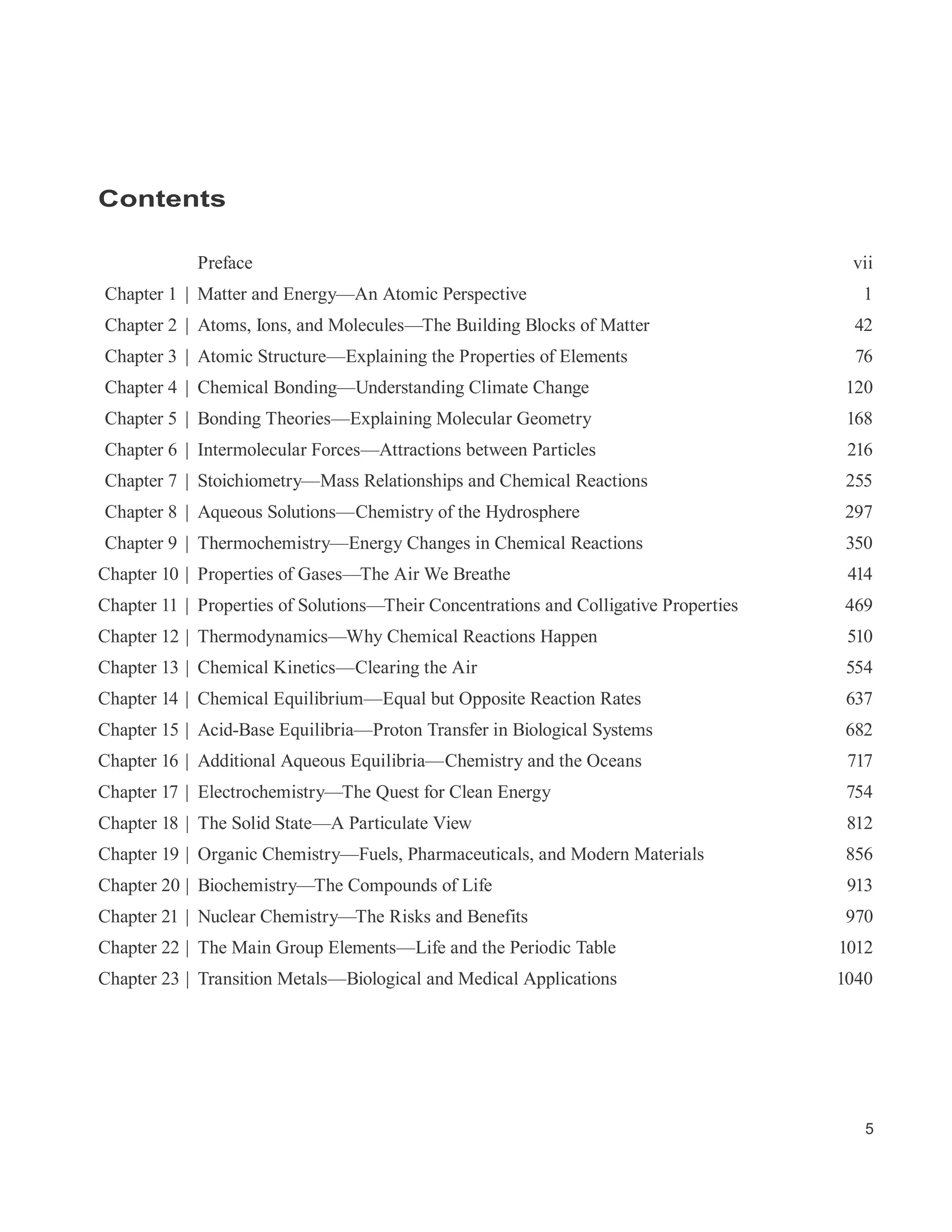
Contents
Preface vii
Chapter 1| Matter and Energy—An Atomic Perspective 1
Chapter 2 | Atoms, Ions, and Molecules—The Building Blocks of Matter 42
Chapter 3 | Atomic Structure—Explaining the Properties of Elements 76
Chapter 4 | Chemical Bonding—Understanding Climate Change 120
Chapter 5 | Bonding Theories—Explaining Molecular Geometry 168
Chapter 6 | Intermolecular Forces—Attractions between Particles 216
Chapter 7 | Stoichiometry—Mass Relationships and Chemical Reactions 255
Chapter 8 | Aqueous Solutions—Chemistry of the Hydrosphere 297
Chapter 9 | Thermochemistry—Energy Changes in Chemical Reactions 350
Chapter 10 | Properties of Gases—The Air We Breathe 414
Chapter 11 | Properties of Solutions—Their Concentrations and Colligative Properties 469
Chapter 12 | Thermodynamics—Why Chemical Reactions Happen 510
Chapter 13 | Chemical Kinetics—Clearing the Air 554
Chapter 14 | Chemical Equilibrium—Equal but Opposite Reaction Rates 637
Chapter 15 | Acid-Base Equilibria—Proton Transfer in Biological Systems 682
Chapter 16 | Additional Aqueous Equilibria—Chemistry and the Oceans 717
Chapter 17 | Electrochemistry—The Quest for Clean Energy 754
Chapter 18 | The Solid State—A Particulate View 812
Chapter 19 | Organic Chemistry—Fuels, Pharmaceuticals, and Modern Materials 856
Chapter 20 | Biochemistry—The Compounds of Life 913
Chapter 21 | Nuclear Chemistry—The Risks and Benefits 970
Chapter 22 | The Main Group Elements—Life and the Periodic Table 1012
Chapter 23 | Transition Metals—Biological and Medical Applications 1040
10.
7
prefaCe
how Does iTwork?
the test Bank author listed the learning objectives from
each chapter believed to be the most important for students
to learn. the author then developed questions designed to
test students’ knowledge of a particular learning objective.
By asking students questions that vary in both type and level
of difficulty, instructors can gather different types of evi-
dence, which will allow them to more effectively assess how
well students understand specific concepts.
six QuesTion Types:
1. remembering questions—test declarative knowledge,
including textbook definitions and relationships between
two or more pieces of information. Can students recall or
remember the information in the same form it was learned?
2. Understanding questions—pose problems in a context
different from the one in which the material was learned,
requiring students to draw from their declarative and/or
procedural understanding of important concepts. Can
students explain ideas or concepts?
3. applying questions—ask students to draw from their
prior experience and use critical-thinking skills to take
part in qualitative reasoning about the real world. Can
students use learned information in another task or
situation?
4. analyzing questions—test students’ ability to break down
information and see how different elements relate to each
other and to the whole. Can students distinguish among
the different parts?
5. evaluating questions—ask students to assess information
as a whole and frame their own argument. Can students
justify a stand or decision?
6. Creating questions—pose questions or objectives that
prompt students to put elements they have learned together
into a coherent whole to generate new ideas. Can students
create a new product or point of view based on data?
Three DiffiCulTy levels:
1. easy questions—require a basic understanding of the
concepts, definitions, and examples.
2. moderate questions—direct students to use critical-
thinking skills, to demonstrate an understanding of core
concepts independent of specific textbook examples, and
to connect concepts across chapters.
3. difficult questions—ask students to synthesize textbook
concepts with their own experience, making analytical
inferences about biological topics and more.
each question measures and explicitly links to a specific com-
petency and is written with clear, concise, and grammatically
correct language that suits the difficulty level of the specific
competency being assessed. to ensure the validity of the
questions, no extraneous, ambiguous, or confusing material
is included, and no slang expressions are used. In developing
the questions, every effort has been made to eliminate bias
(e.g., race, gender, cultural, ethnic, regional, handicap, age) to
require specific knowledge of material studied, not of gen-
eral knowledge or experience. this ensures accessibility and
validity.
key To The QuesTion MeTa-DaTa
each question in the test Bank is tagged with five pieces of
information designed to help instructors create the most ideal
mix of questions for a quiz or exam. these tags are:
11.
viii | Preface
ANS:this is the correct answer for each question. or, in the
case of some short-answer questions, a possible cor-
rect answer to the given question.
DIF: this is the difficulty assigned to the problem. problems
have been classified as easy, medium, or difficult.
REF: this is the section in the textbook from which a ques-
tion is drawn.
OBJ: this is the learning objective that the question is
designed to test.
MSC: this is the knowledge type (see above) the question
is designed to test.
12.
1 • Chapter1
1 • Chapter 1
Chapter 1: Matter and energy— an atomic perspective
Learning ObjeCtives
Describe what is meant by the term scientific theory and
distinguish it from natural philosophy.
Distinguish between elements and compounds.
Describe the scientific method and define a law, a theory,
and a hypothesis.
Describe the law of definite proportions.
Describe the law of constant composition.
Describe the law of multiple proportions.
Write chemical formulas from the ratios of the elements
in a compound.
Describe and apply the COAST method.
Distinguish between pure substances and mixtures.
Define matter and mass.
Describe and give examples of extensive and intensive
properties.
Describe and give examples of chemical and physical
properties.
Use density in calculations.
Distinguish between molecules and ions.
Distinguish between physical and chemical changes.
Distinguish between homogeneous and heterogeneous
mixtures.
Describe the methods that can be used to separate the
components of a mixture: distillation, filtration, and
chromatography.
Distinguish between the states of matter: solid, liquid,
and gas.
Describe how temperature affects the properties of
matter.
Describe the processes of sublimation, melting, vaporiza-
tion, condensation, freezing, and deposition.
Define energy, work, and heat.
Distinguish between potential and kinetic energy.
State the law of conservation of energy.
Recognize and interpret the different ways of representing
molecules (diatomic, molecular formula, structural for-
mula, condensed structural formula, ball-and-stick,
space-filling).
Describe ionic compounds and identify an empirical
formula.
Describe SI and US measurements.
Distinguish between exact and uncertain values.
Distinguish between precision and accuracy.
Apply the rules for significant figures (weak-link
principle).
Use the unit-factor method to convert measurements.
Distinguish between and convert Fahrenheit, Celsius, and
Kelvin temperatures.
Describe the function of a control sample.
For a data set, calculate the mean, standard deviation,
and confidence interval.
Use Grubb’s test to determine if a data point is an outlier.
13.
2 • Chapter1
2 • Chapter 1
MULTIPLE CHOICE
1. Which step is NOT a part of the scientific method?
a. Form a testable hypothesis.
b. Make observations.
c. Conduct reproducible experiments.
d. Identify different factors that affect results.
e. Stop experimentation once the desired results are achieved.
ANS: E DIF: Easy REF: 1.1
OBJ: Describe the scientific method and define a law, a theory, and a hypothesis.
MSC: Remembering
2. For a hypothesis to be considered a valid scientific theory, it must
a. summarize experimental data without trying to predict future results.
b. be impossible to prove wrong by experiment.
c. explain widely observed phenomena based on extensive testing.
d. never be modified or expanded.
e. be voted on by the scientific community and accepted by all.
ANS: C DIF: Easy REF: 1.1
OBJ: Describe the scientific method and define a law, a theory, and a hypothesis.
MSC: Understanding
3. According to the law of definite proportions,
a. atoms forming a given compound react in variable proportions depending on conditions.
b. different samples of the same compound contain the same proportions of the same
elements.
c. all compounds containing the same types of atoms have identical properties.
d. all compounds containing the same types of atoms have relative masses that are
whole-number multiples.
e. only one type of molecule can be produced when two elements combine.
ANS: B DIF: Easy REF: 1.1
OBJ: Describe the law of definite proportions. MSC: Understanding
4. The law of definite proportions states that
a. compounds such as NO and NO2 have identical chemical properties.
b. compounds such as NO and NO2 must have masses that are whole-number multiples of
each other.
c. nitrogen and oxygen can combine to form a variety of compounds, such as NO or NO2.
d. the elements forming a given compound always react in the same proportions.
e. only one compound can be produced when two elements combine.
ANS: D DIF: Easy REF: 1.1
OBJ: Describe the law of definite proportions. MSC: Understanding
14.
3 • Chapter1
3 • Chapter 1
5. Which one of the following is a hypothesis?
a. Energy is required to vaporize a liquid.
b. The composition of a pure substance is fixed and definite.
c. Hydrogen gas and oxygen gas can react to form water.
d. A Car’s battery must be dead because the car won’t start.
e. Matter is composed of atoms.
ANS: D DIF: Moderate REF: 1.1
OBJ: Describe the scientific method and define a law, a theory, and a hypothesis.
MSC: Applying
6. Which of the following illustrates the law of multiple proportions?
a. The mass ratio of O to N in NO2 is twice that in NO.
b. NO2 always contains one nitrogen atom and two oxygen atoms.
c. The mass of NO2 is a small whole-number multiple of the mass of NO.
d. NO and NO2 have similar chemical and physical properties.
e. NO2 and N2O4 are the same compound.
ANS: A DIF: Moderate REF: 1.1
OBJ: Describe the law of multiple proportions. MSC: Understanding
7. Which of the following does NOT illustrate the law of multiple proportions?
a. The N-to-O mass ratio in NO is 0.875, whereas that in N2O is 1.75.
b. C2H2 has a 12:1 C-to-H mass ratio, while C2H6 has a 4:1 C-to-H mass ratio.
c. The ratio of O:C by mass in CO2 is twice that of CO.
d. If a sample of H2O contains 16 g of oxygen, a sample of H2O2 with the same number of
molecules would contain 32 g of oxygen.
e. H2S and H2O contain the same mass of hydrogen.
ANS: E DIF: Difficult REF: 1.1
OBJ: Describe the law of multiple proportions. MSC: Applying
8. Which of the following statements is NOT true?
a. The relative numbers of each type of atom in a given compound do not vary.
b. A compound always contains the same mass percentages of its constituent elements.
c. A large sample and a small sample of a given compound contain the same number of
each type of atom.
d. A large sample and a small sample of a given compound contain the same types of atoms
combined in the same proportions.
e. A large sample and a small sample of a compound share the same chemical formula.
ANS: C DIF: Difficult REF: 1.1
OBJ: Describe the law of constant composition. MSC: Analyzing
4 • Chapter1
4 • Chapter 1
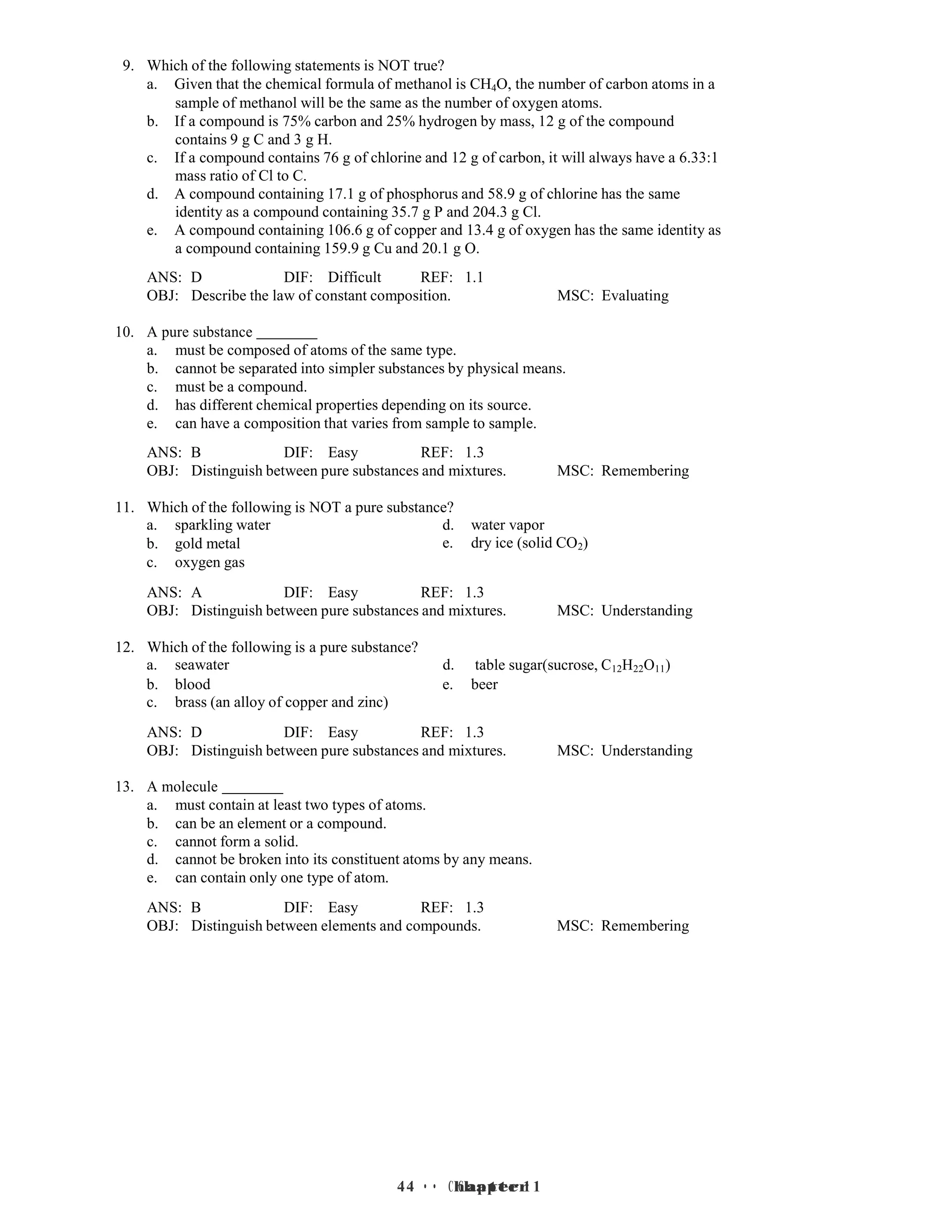
9. Which of the following statements is NOT true?
a. Given that the chemical formula of methanol is CH4O, the number of carbon atoms in a
sample of methanol will be the same as the number of oxygen atoms.
b. If a compound is 75% carbon and 25% hydrogen by mass, 12 g of the compound
contains 9 g C and 3 g H.
c. If a compound contains 76 g of chlorine and 12 g of carbon, it will always have a 6.33:1
mass ratio of Cl to C.
d. A compound containing 17.1 g of phosphorus and 58.9 g of chlorine has the same
identity as a compound containing 35.7 g P and 204.3 g Cl.
e. A compound containing 106.6 g of copper and 13.4 g of oxygen has the same identity as
a compound containing 159.9 g Cu and 20.1 g O.
ANS: D DIF: Difficult REF: 1.1
OBJ: Describe the law of constant composition. MSC: Evaluating
10. A pure substance
a. must be composed of atoms of the same type.
b. cannot be separated into simpler substances by physical means.
c. must be a compound.
d. has different chemical properties depending on its source.
e. can have a composition that varies from sample to sample.
ANS: B DIF: Easy REF: 1.3
OBJ: Distinguish between pure substances and mixtures. MSC: Remembering
11. Which of the following is NOT a pure substance?
a. sparkling water d. water vapor
b.
c.
gold metal
oxygen gas
e. dry ice (solid CO2)
ANS: A DIF: Easy REF: 1.3
OBJ: Distinguish between pure substances and mixtures. MSC: Understanding
12. Which of the following is a pure substance?
a. seawater d. table sugar(sucrose, C12H22O11)
b.
c.
blood
brass (an alloy of copper and zinc)
e. beer
ANS: D DIF: Easy REF: 1.3
OBJ: Distinguish between pure substances and mixtures. MSC: Understanding
13. A molecule
a. must contain at least two types of atoms.
b. can be an element or a compound.
c. cannot form a solid.
d. cannot be broken into its constituent atoms by any means.
e. can contain only one type of atom.
ANS: B DIF: Easy REF: 1.3
OBJ: Distinguish between elements and compounds. MSC: Remembering
17.
5 • Chapter1
5 • Chapter 1
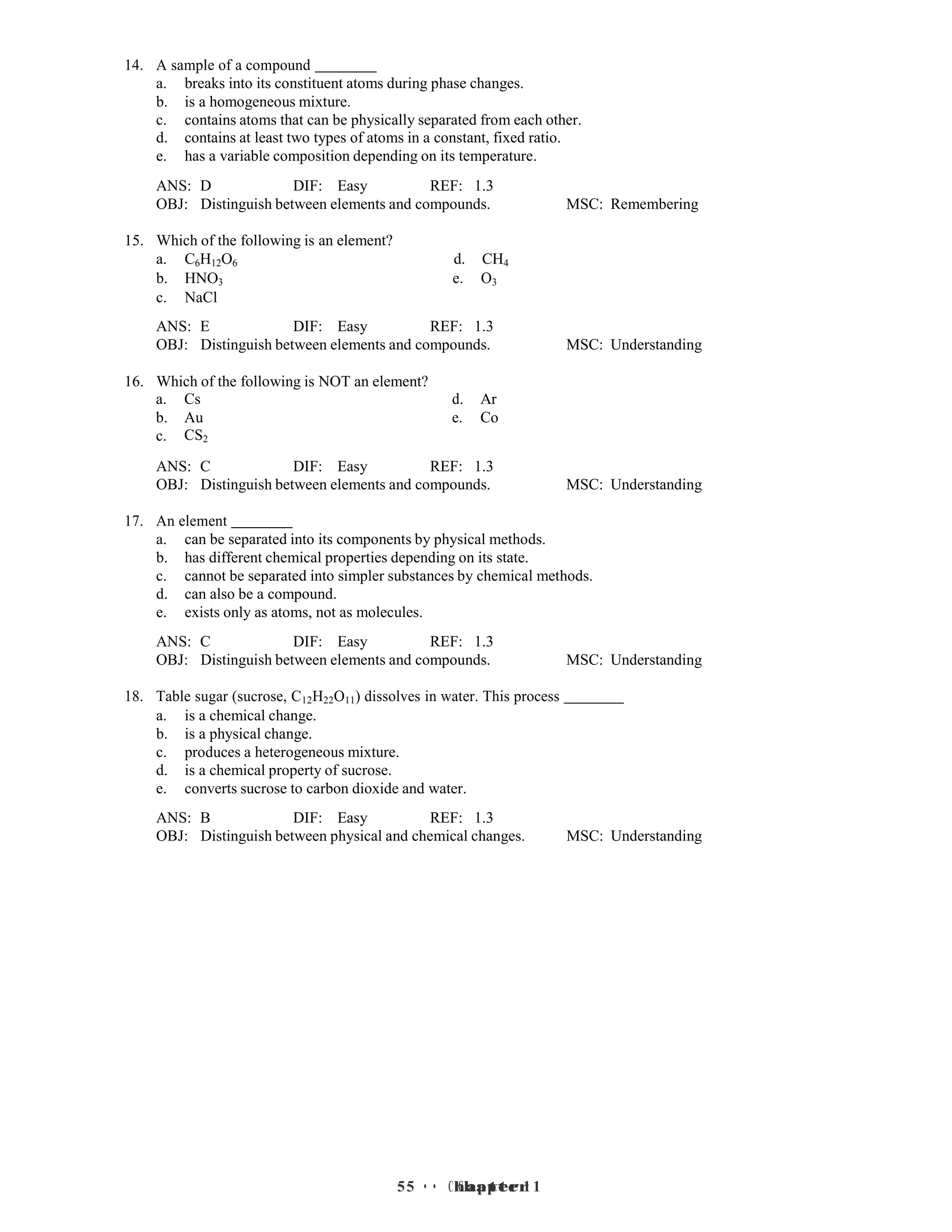
14. A sample of a compound
a. breaks into its constituent atoms during phase changes.
b. is a homogeneous mixture.
c. contains atoms that can be physically separated from each other.
d. contains at least two types of atoms in a constant, fixed ratio.
e. has a variable composition depending on its temperature.
ANS: D DIF: Easy REF: 1.3
OBJ: Distinguish between elements and compounds. MSC: Remembering
15. Which of the following is an element?
a. C6H12O6 d. CH4
b. HNO3 e. O3
c. NaCl
ANS: E DIF: Easy REF: 1.3
OBJ: Distinguish between elements and compounds. MSC: Understanding
16. Which of the following is NOT an element?
a. Cs d. Ar
b. Au e. Co
c. CS2
ANS: C DIF: Easy REF: 1.3
OBJ: Distinguish between elements and compounds. MSC: Understanding
17. An element
a. can be separated into its components by physical methods.
b. has different chemical properties depending on its state.
c. cannot be separated into simpler substances by chemical methods.
d. can also be a compound.
e. exists only as atoms, not as molecules.
ANS: C DIF: Easy REF: 1.3
OBJ: Distinguish between elements and compounds. MSC: Understanding
18. Table sugar (sucrose, C12H22O11) dissolves in water. This process
a. is a chemical change.
b. is a physical change.
c. produces a heterogeneous mixture.
d. is a chemical property of sucrose.
e. converts sucrose to carbon dioxide and water.
ANS: B DIF: Easy REF: 1.3
OBJ: Distinguish between physical and chemical changes. MSC: Understanding
18.
6 • Chapter1
6 • Chapter 1
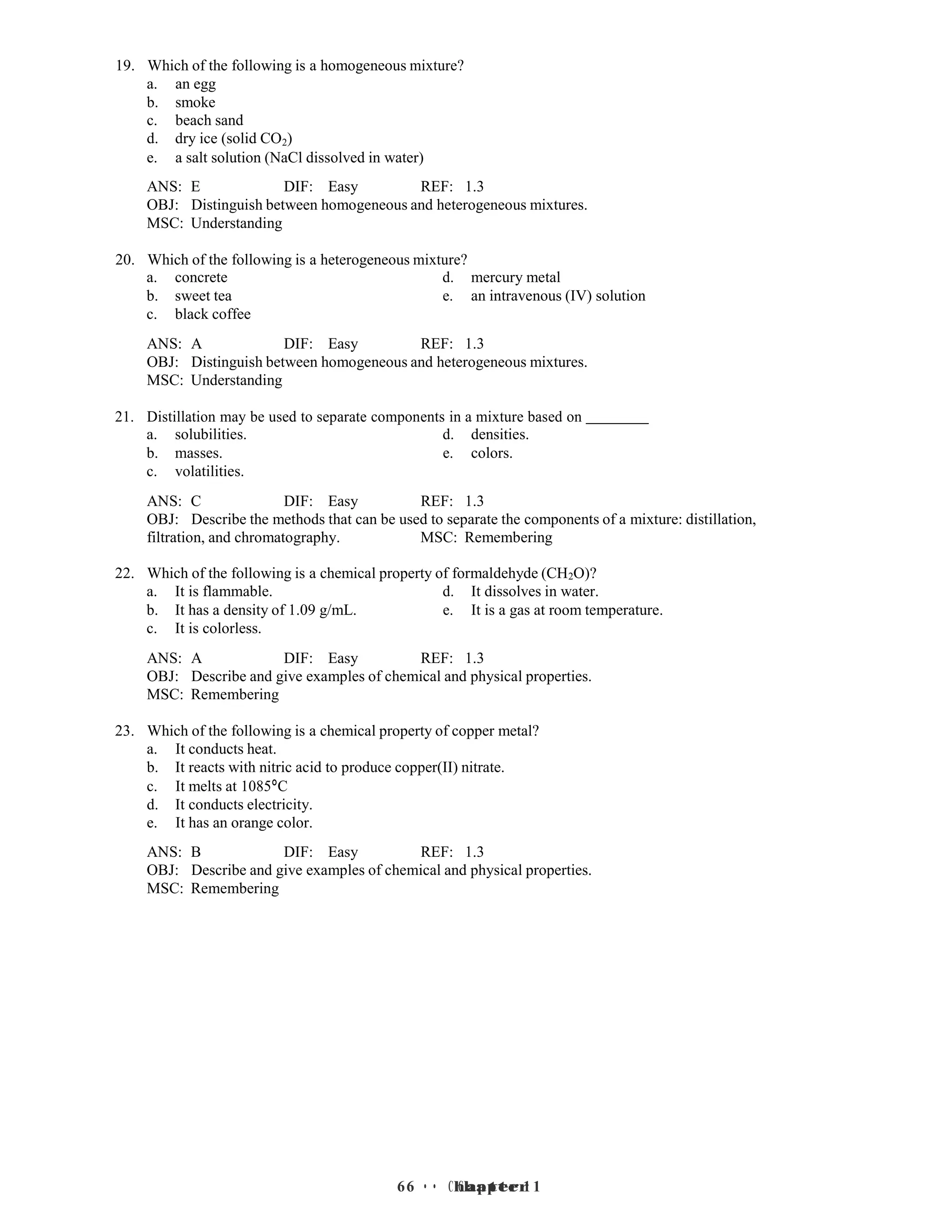
19. Which of the following is a homogeneous mixture?
a. an egg
b. smoke
c. beach sand
d. dry ice (solid CO2)
e. a salt solution (NaCl dissolved in water)
ANS: E DIF: Easy REF: 1.3
OBJ: Distinguish between homogeneous and heterogeneous mixtures.
MSC: Understanding
20. Which of the following is a heterogeneous mixture?
a. concrete d. mercury metal
b. sweet tea e. an intravenous (IV) solution
c. black coffee
ANS: A DIF: Easy REF: 1.3
OBJ: Distinguish between homogeneous and heterogeneous mixtures.
MSC: Understanding
21. Distillation may be used to separate components in a mixture based on
a. solubilities. d. densities.
b. masses. e. colors.
c. volatilities.
ANS: C DIF: Easy REF: 1.3
OBJ: Describe the methods that can be used to separate the components of a mixture: distillation,
filtration, and chromatography. MSC: Remembering
22. Which of the following is a chemical property of formaldehyde (CH2O)?
a. It is flammable. d. It dissolves in water.
b. It has a density of 1.09 g/mL. e. It is a gas at room temperature.
c. It is colorless.
ANS: A DIF: Easy REF: 1.3
OBJ: Describe and give examples of chemical and physical properties.
MSC: Remembering
23. Which of the following is a chemical property of copper metal?
a. It conducts heat.
b. It reacts with nitric acid to produce copper(II) nitrate.
c. It melts at 1085°C
d. It conducts electricity.
e. It has an orange color.
ANS: B DIF: Easy REF: 1.3
OBJ: Describe and give examples of chemical and physical properties.
MSC: Remembering
19.
7 • Chapter1
7 • Chapter 1
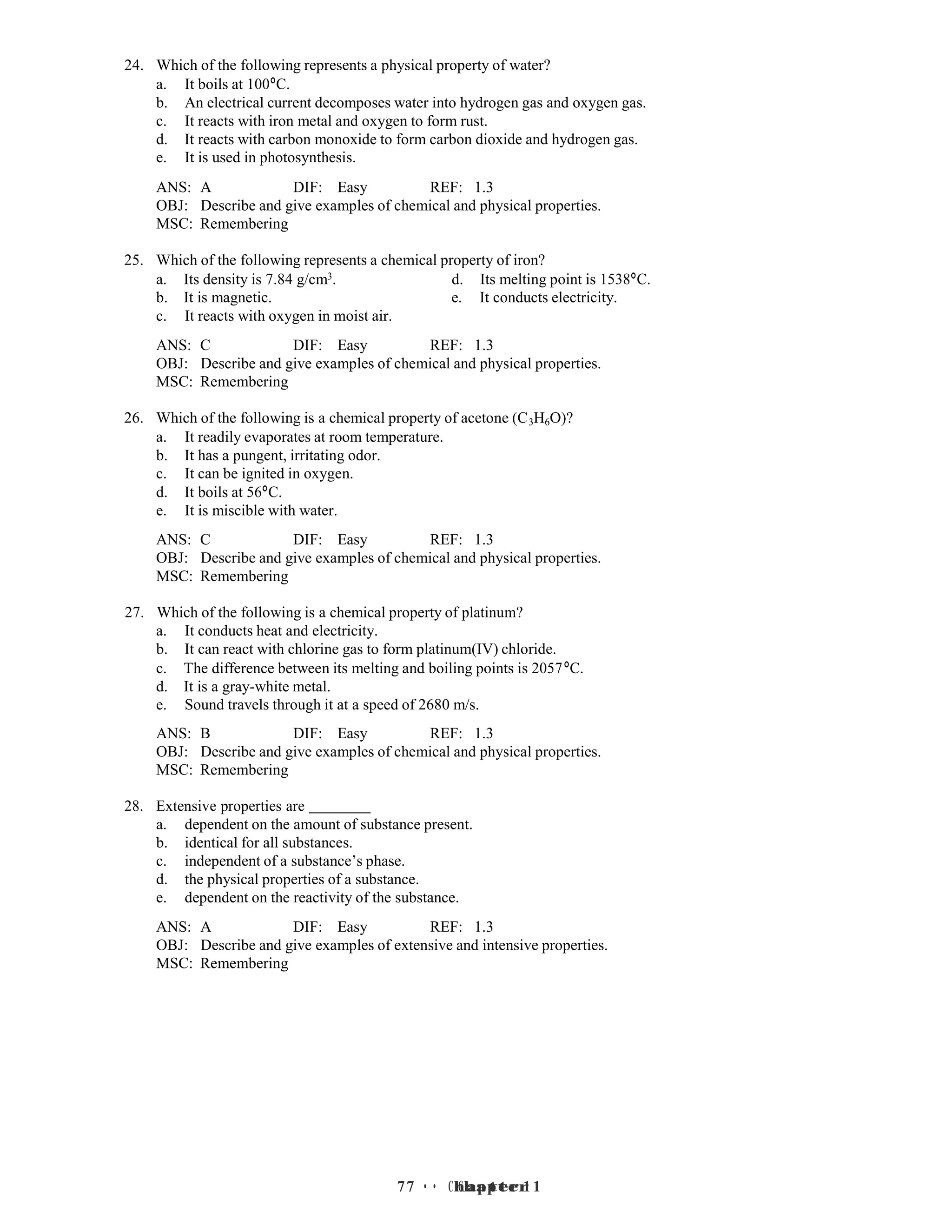
24. Which of the following represents a physical property of water?
a. It boils at 100°C.
b. An electrical current decomposes water into hydrogen gas and oxygen gas.
c. It reacts with iron metal and oxygen to form rust.
d. It reacts with carbon monoxide to form carbon dioxide and hydrogen gas.
e. It is used in photosynthesis.
ANS: A DIF: Easy REF: 1.3
OBJ: Describe and give examples of chemical and physical properties.
MSC: Remembering
25. Which of the following represents a chemical property of iron?
a. Its density is 7.84 g/cm3. d. Its melting point is 1538°C.
b. It is magnetic. e. It conducts electricity.
c. It reacts with oxygen in moist air.
ANS: C DIF: Easy REF: 1.3
OBJ: Describe and give examples of chemical and physical properties.
MSC: Remembering
26. Which of the following is a chemical property of acetone (C3H6O)?
a. It readily evaporates at room temperature.
b. It has a pungent, irritating odor.
c. It can be ignited in oxygen.
d. It boils at 56°C.
e. It is miscible with water.
ANS: C DIF: Easy REF: 1.3
OBJ: Describe and give examples of chemical and physical properties.
MSC: Remembering
27. Which of the following is a chemical property of platinum?
a. It conducts heat and electricity.
b. It can react with chlorine gas to form platinum(IV) chloride.
c. The difference between its melting and boiling points is 2057°C.
d. It is a gray-white metal.
e. Sound travels through it at a speed of 2680 m/s.
ANS: B DIF: Easy REF: 1.3
OBJ: Describe and give examples of chemical and physical properties.
MSC: Remembering
28. Extensive properties are
a. dependent on the amount of substance present.
b. identical for all substances.
c. independent of a substance’s phase.
d. the physical properties of a substance.
e. dependent on the reactivity of the substance.
ANS: A DIF: Easy REF: 1.3
OBJ: Describe and give examples of extensive and intensive properties.
MSC: Remembering
20.
8 • Chapter1
8 • Chapter 1
29. Which one of the following represents a physical change?
a. Milk turns sour. d. An egg begins to smell very bad.
b. Rust forms on iron nails. e. Sugar melts and forms a syrupy liquid.
c. Sugar ferments to form ethanol.
ANS: E DIF: Easy REF: 1.3
OBJ: Distinguish between physical and chemical changes. MSC: Understanding
30. Which one of the following represents a chemical change?
a. Mercury(II) oxide is heated up and forms mercury metal and oxygen gas.
b. Rubbing alcohol evaporates.
c. Iodine vapor deposits on a surface.
d. Iron metal is separated from sand using a magnet.
e. Rock salt is pulverized.
ANS: A DIF: Easy REF: 1.3
OBJ: Distinguish between physical and chemical changes. MSC: Understanding
31. Which one of the following is NOT an intensive physical property of a pure liquid?
a. boiling point d. density
b. conductivity e. color
c. mass
ANS: C DIF: Moderate REF: 1.3
OBJ: Describe and give examples of extensive and intensive properties.
MSC: Remembering
32. Which statement is true regarding ammonia, NH3?
a. It can also be correctly represented as N2H6.
b. It cannot be decomposed into simpler substances by any means.
c. Its decomposition produces three volumes of hydrogen for every one volume of nitrogen.
d. It can be separated into nitrogen and hydrogen atoms using distillation.
e. It is not a stable molecule and does not exist at room temperature.
ANS: C DIF: Moderate REF: 1.3
OBJ: Distinguish between elements and compounds. MSC: Understanding
33. When copper metal is dropped into nitric acid, a blue solution containing copper(II) ions is produced
along with brown nitrogen monoxide gas. Which of the following is an example of a chemical
property?
a. copper’s red-orange appearance
b. nitrogen monoxide’s irritating odor
c. the blue color of aqueous copper(II) ions
d. the viscosity of nitric acid at room temperature
e. nitric acid’s ability to react with copper metal
ANS: E DIF: Moderate REF: 1.3
OBJ: Describe and give examples of chemical and physical properties.
MSC: Analyzing
21.
9 • Chapter1
9 • Chapter 1
34. If you had equal masses of each of the following substances, which would occupy the greatest
volume?
a. ice (d = 0.917 g/mL) d. cocoa butter (d = 0.910 g/mL)
b. water (d = 0.997 g/mL) e. aluminum (d = 2.70 g/mL)
c. beeswax (d = 0.960 g/mL)
ANS: D DIF: Moderate REF: 1.3 OBJ: Use density in calculations.
MSC: Analyzing
35. The densities of glycerol and of mercury are 1.26 g/mL and 13.5 g/mL, respectively. What volume of
glycerol has the same mass as 25.0 mL of mercury?
a. 268 mL d. 1.47 mL
b. 426 mL e. 338 mL
c. 2.33 mL
ANS: A DIF: Moderate REF: 1.3 OBJ: Use density in calculations.
MSC: Applying
36. Based on values for the volume per gram of the given materials, which of the following would NOT
float in water (density = 0.997 g/cm3)?
Substance g/cm3
Balsa wood 0.120
Cork 0.240
Charcoal (from oak) 0.571
Human fat 0.943
Ethylene glycol 1.11
a. balsa wood d. human fat
b. cork e. ethylene glycol
c. charcoal
ANS: E DIF: Moderate REF: 1.3 OBJ: Use density in calculations.
MSC: Applying
37. Calcite has a chemical formula of CaCO3, and 1.0 g occupies approximately 0.369 cm3. Pyrite (FeS2)
is 1.8 times denser than calcite. What is the density of FeS2?
a. 2.7 g/cm3 d. 2.2 g/cm3
b. 0.66 g/cm3 e. 1.5 g/cm3
c. 4.9 g/cm3
ANS: C DIF: Moderate REF: 1.3 OBJ: Use density in calculations.
MSC: Applying
22.
10 • Chapter1
10 • Chapter 1
38. Which of the following can be separated by filtration?
a. rust particles in water d. salt dissolved in water
b. air dispersed in whipped cream e. nitrogen from air
c. alcohol dissolved in water
ANS: A DIF: Moderate REF: 1.3
OBJ: Describe the methods that can be used to separate the components of a mixture: distillation,
filtration, and chromatography. MSC: Understanding
39. Which process would be a practical and effective way to separate beta-carotene, an orange pigment,
from hexane liquid?
a. filtration d. scanning tunneling microscopy
b. chromatography e. sublimation
c. combustion
ANS: B DIF: Moderate REF: 1.3
OBJ: Describe the methods that can be used to separate the components of a mixture: distillation,
filtration, and chromatography. MSC: Applying
40. Acetone and water mix to form a homogeneous solution. Acetone has a boiling point of 56°C. Which
of the following would be a suitable method for separating acetone from water?
a. filtration d. scanning tunneling microscopy
b. combustion e. sublimation
c. distillation
ANS: C DIF: Moderate REF: 1.3
OBJ: Describe the methods that can be used to separate the components of a mixture: distillation,
filtration, and chromatography. MSC: Applying
41. Which of the following is an intensive property of chlorine?
a. It has mass.
b. It boils at −34°C.
c. Chlorine gas expands to fill a balloon.
d. The reaction of chlorine with hydrogen releases a given amount of energy.
e. Chlorine gas in a container exerts a given pressure at a given temperature.
ANS: B DIF: Moderate REF: 1.3
OBJ: Describe and give examples of extensive and intensive properties.
MSC: Analyzing
42. Which represents an extensive property of hydrogen?
a. Hydrogen gas is odorless and colorless.
b. A hydrogen gas molecule is composed of two hydrogen atoms.
c. Hydrogen gas is flammable.
d. Hydrogen releases a given amount of energy when it reacts with oxygen.
e. Hydrogen gas under normal conditions is nonmetallic.
ANS: D DIF: Moderate REF: 1.3
OBJ: Describe and give examples of extensive and intensive properties.
MSC: Analyzing
23.
11 • Chapter1
11 • Chapter 1
43. The densities of cork, lead, and water are 0.240 g/cm3, 11.34 g/cm3, and 0.997 g/cm3 at 25°C,
respectively. If 20.0 g of lead are placed inside an 85.0 cm3 piece of cork, what is the overall density,
and will it float on water?
a. 0.466 g/cm3; Yes, it will float. d. 4.25 g/cm3; No, it will not float.
b. 0.235 g/cm3; Yes, it will float. e. 2.15 g/cm3; No, it will not float.
c. 0.211 g/cm3; Yes, it will float.
ANS: A DIF: Difficult REF: 1.3 OBJ: Use density in calculations.
MSC: Applying
44. Soft solder is a blended alloy of tin (7.31 g/cm3) and lead (11.34 g/cm3) that is used in plumbing and
electronics. It is 63.5% tin by mass. What is the density of the alloy?
a. 9.87 g/cm3 d. 8.79 g/cm3
b. 8.27 g/cm3 e. 9.33 g/cm3
c. 7.83 g/cm3
ANS: D DIF: Difficult REF: 1.3 OBJ: Use density in calculations.
MSC: Evaluating
45. Gold (19.3 g/cm3) and copper (8.96 g/cm3) can be blended to form an alloy called rose gold. Suppose
a rose-gold bar has a mass of 117 g and a volume of 7.00 cm3. Calculate the mass percentage of gold
in the bar.
a. 46.4% d. 75.0%
b. 53.6% e. 86.6%
c. 38.7%
ANS: D DIF: Difficult REF: 1.3 OBJ: Use density in calculations.
MSC: Evaluating
46. Which statement correctly describes the properties of gaseous helium (He)?
a. The gas is not highly compressible even though the atoms do not occupy the entire
volume of the container.
b. The gas is highly compressible because there is a lot of empty space between the atoms.
c. The atoms are moving rapidly about the container, giving the gas its definite shape.
d. The gas has a definite volume and shape because the atoms are not moving about the
container.
e. A gas takes the shape of the container, but its total volume cannot change.
ANS: B DIF: Easy REF: 1.4
OBJ: Distinguish between the states of matter: solid, liquid, and gas.
MSC: Remembering
24.
12 • Chapter1
12 • Chapter 1
47. Solid carbon dioxide (CO2) can undergo sublimation to form gaseous CO2. Which of the following
statements is true?
a. In the solid phase, CO2 molecules easily slip past each other, and there are areas of
randomly ordered molecules.
b. In the gas phase, CO2 molecules are strongly attracted to each other.
c. The motion of the CO2 molecules in the solid phase is much more restricted than in the
gas phase.
d. CO2 molecules in the solid phase are easily compressed to smaller volumes.
e. The CO2 molecules decompose to form carbon and oxygen when they enter the gas
phase.
ANS: C DIF: Easy REF: 1.4
OBJ: Distinguish between the states of matter: solid, liquid, and gas.
MSC: Understanding
48. Which statement describing the properties of the different phases of a sample of matter is true?
a. The particles in both the gas and liquid phases are highly ordered and in close proximity
to one another.
b. The particles in the liquid phase are highly compressible because they can slip past one
another.
c. The particles in both the solid and liquid phases are free to assume any shape, and their
nearest neighbors change over time.
d. The solid phase is rigid, even though its constituent particles may vibrate a little
depending on their temperature.
e. Localized areas of order can form in the gas phase because the particles experience
significant attractions to one another.
ANS: D DIF: Easy REF: 1.4
OBJ: Distinguish between the states of matter: solid, liquid, and gas.
MSC: Remembering
49. Equal amounts of water undergo the following changes. Which of the following would involve the
largest change in energy?
a. Ice is melted to form liquid water at 0°C.
b. Ice at −25°C is heated to 0°C.
c. Water is heated from 25°C to 50°C.
d. Steam at 100°C is cooled and condensed to form liquid water at 85°C.
e. Water at 0°C is heated and vaporized to form steam at 120°C.
ANS: E DIF: Moderate REF: 1.4
OBJ: Describe how temperature affects the properties of matter.
MSC: Analyzing
50. Equal amounts of a pure substance undergo the following changes. Which process would you predict
releases the greatest amount of energy?
a. deposition (gas → solid) d. condensation (gas → liquid)
b. vaporization (liquid → gas) e. melting (solid → liquid)
c. freezing (liquid → solid)
ANS: A DIF: Moderate REF: 1.4
OBJ: Describe the processes of sublimation, melting, vaporization, condensation, freezing, and
deposition. MSC: Analyzing
25.
13 • Chapter1
13 • Chapter 1
51. Which of the following is an example of potential energy?
a. water running down a hill
b. chemical bonds in table sugar (sucrose)
c. electrons flowing through a wire
d. a crowd moving a barricade
e. molecules moving randomly in a liquid
ANS: B DIF: Easy REF: 1.5
OBJ: Distinguish between potential and kinetic energy. MSC: Understanding
52. Equal amounts of water are present under the following conditions. In which case do the water
molecules have the highest kinetic energy?
a. as ice at −10°C d. in the gas phase at 150°C
b. as steam at 100°C e. in the solid phase at 0°C
c. in the liquid phase at 80°C
ANS: D DIF: Easy REF: 1.5
OBJ: Distinguish between potential and kinetic energy. MSC: Understanding
53. If the speed of an object triples, its kinetic energy
a. increases by a factor of 3. d. decreases by a factor of 9.
b. increases by a factor of 9. e. is unaffected.
c. decreases by a factor of 3.
ANS: B DIF: Easy REF: 1.5
OBJ: Distinguish between potential and kinetic energy. MSC: Applying
54. Which of the following statements about energy, work, and heat is NOT true?
a. Adding heat to a sample of matter increases the average kinetic energy of its constituent
particles.
b. Thermal energy is the portion of the energy of an object that increases as temperature
increases.
c. When an object does work, part of the energy it expends is destroyed as it converts to
heat.
d. The energy available from some chemical reactions can be used to do work and/or
produce heat.
e. Heat involves the transfer of energy from a hotter object to a cooler one.
ANS: C DIF: Moderate REF: 1.5
OBJ: Define energy, work, and heat. MSC: Analyzing
55. Consider electrons traveling through a copper (Cu) wire at a speed of 0.024 cm/s. What is true about
the energy of their motion?
a. It is primarily kinetic.
b. It is primarily potential.
c. It would be unaffected if the speed of the electrons increased.
d. It is strongly affected by gravity.
e. It cannot be used to do work.
ANS: A DIF: Moderate REF: 1.5
OBJ: Distinguish between potential and kinetic energy. MSC: Applying
14 • Chapter1
14 • Chapter 1
56. Work is defined as the exertion of force through a distance. Which of the following is NOT an
example of work?
a. Molecules in the air push against the blades of a windmill.
b. Blood is pumped through the circulatory system.
c. Electrons flow against the resistance present in a copper wire.
d. Thermal energy (heat) is transferred from a hot stove to the surrounding air.
e. A student lifts a book off of the floor.
ANS: D DIF: Moderate REF: 1.5
OBJ: Distinguish between potential and kinetic energy. MSC: Analyzing
57. Which has the highest kinetic energy, assuming all follow the equation KE = ½ mu2, where m is the
mass and u is the velocity?
a. a one-ton (910 kg) truck traveling at 65 miles per hour (29 m/s)
b. an electron with a mass of 9.11 × 10⁻²⁷ kg traveling at 2.97 × 10⁸ m/s (99% of the speed
of light)
c. an oxygen molecule with a mass of 5.31 × 10⁻²⁶ kg traveling at 394 m/s (roughly its
speed at room temperature)
d. Usain Bolt, who has a mass of approximately 94 kg, running at 10 m/s (22.4 miles per
hour)
e. an oil tanker with a mass of 3 × 10⁷ kg traveling at 9 m/s (20 miles per hour)
ANS: E DIF: Moderate REF: 1.5
OBJ: Distinguish between potential and kinetic energy. MSC: Analyzing
58. At what velocity would a proton be traveling if it had the same kinetic energy as an electron traveling
at 10.0% of the speed of light?
KE = ½ mu2, where m is the mass and u is the velocity; proton mass = 1.673 × 10⁻²⁷ kg;
electron mass = 9.109 × 10⁻³¹ kg; speed of light = 2.998 × 10⁸ m/s.
a. 4.89 × 10¹¹ m/s d. 7.00 × 10⁵ m/s
b. 2.45 × 10¹¹ m/s e. 3.50 × 10⁵ m/s
c. 4.95 × 10⁵ m/s
ANS: D DIF: Difficult REF: 1.5
OBJ: Distinguish between potential and kinetic energy. MSC: Evaluating
59. The electrostatic potential energy (Eel) between a pair of charged particles is proportional to their
charges, Q1 and Q2, and inversely proportional to the distance between the centers of the ions, d.
Oppositely charged particles attract each other, while like particles repel. Which statement is true?
Q1 × Q2
Eel
∝
d
a. As the distance between particles with like charges increases, the potential energy
decreases.
b. If d is doubled and Q1 is doubled, the potential energy doubles.
c. As the distance between particles with opposite charges increases, the potential energy
decreases.
d. If the magnitude of the charges increases, the potential energy decreases.
e. If both Q1 and Q2 have a value of −1, the potential energy is negative.
ANS: A DIF: Difficult REF: 1.5
OBJ: Distinguish between potential and kinetic energy. MSC: Evaluating
28.
15 • Chapter1
15 • Chapter 1
60. The chemical formula of dimethyl ether can be represented in different ways. When its formula is
written as C2H6O,
a. the arrangement of the atoms in the molecule is evident.
b. only the number and type of atoms of each element are given.
c. its structural formula can be deduced.
d. it shows that no other molecules can have that formula.
e. it lists only one of many possible elemental compositions for dimethyl ether.
ANS: B DIF: Easy REF: 1.6
OBJ: Recognize and interpret the different ways of representing molecules (diatomic, molecular
formula, structural formula, condensed structural formula, ball-and-stick, space-filling).
MSC: Remembering
61. What type of chemical formula is shown for diethyl ether?
a. molecular d. ball-and-stick
b. structural e. space-filling
c. condensed structural
ANS: B DIF: Easy REF: 1.6
OBJ: Recognize and interpret the different ways of representing molecules (diatomic, molecular
formula, structural formula, condensed structural formula, ball-and-stick, space-filling).
MSC: Remembering
62. The space-filling model of a molecule
a. clearly shows bond angles.
b. gives little idea of how atoms are arranged.
c. is best suited for very large molecules.
d. gives an indication of three-dimensional shape.
e. spreads atoms out so they are easy to view.
ANS: D DIF: Easy REF: 1.6
OBJ: Recognize and interpret the different ways of representing molecules (diatomic, molecular
formula, structural formula, condensed structural formula, ball-and-stick, space-filling).
MSC: Remembering
29.
16 • Chapter1
16 • Chapter 1
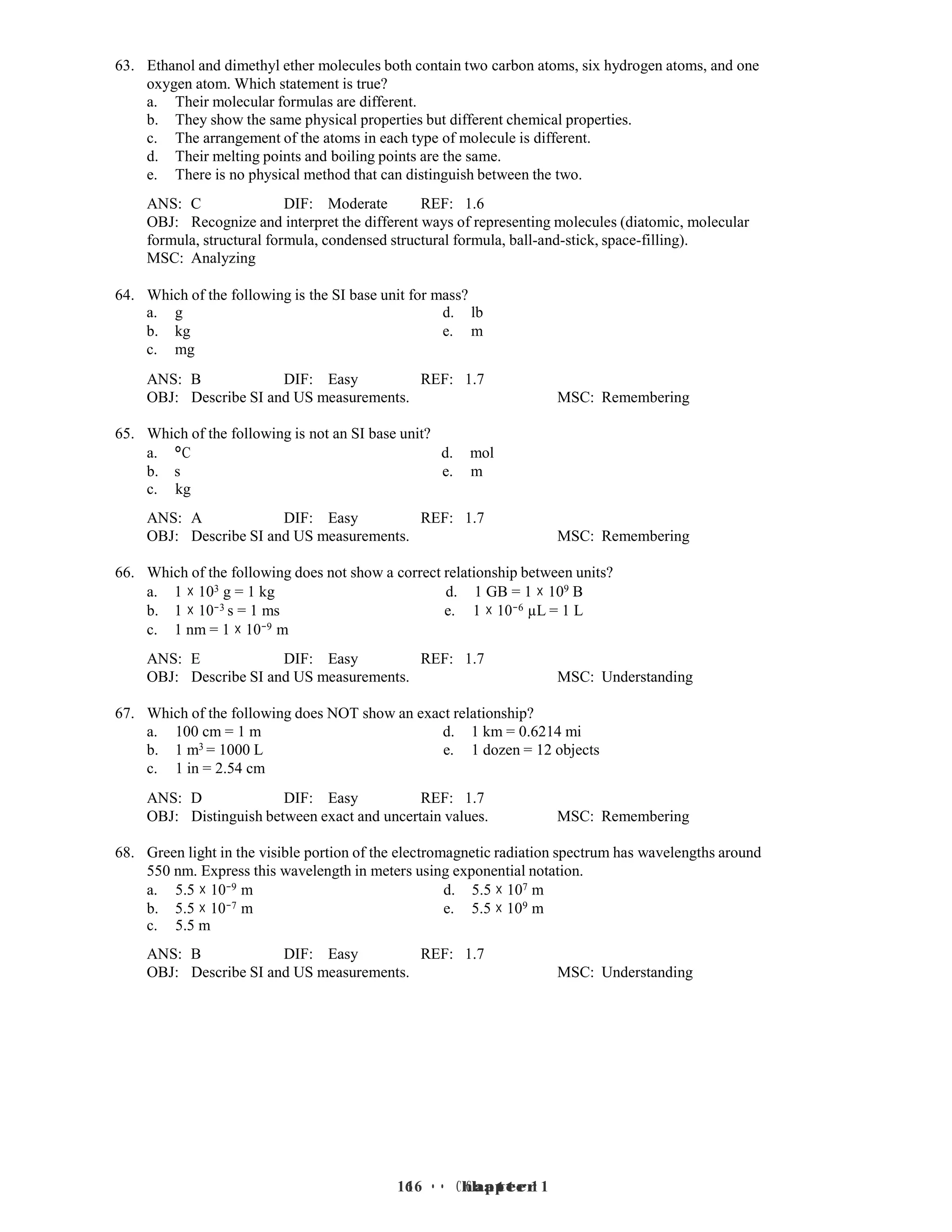
63. Ethanol and dimethyl ether molecules both contain two carbon atoms, six hydrogen atoms, and one
oxygen atom. Which statement is true?
a. Their molecular formulas are different.
b. They show the same physical properties but different chemical properties.
c. The arrangement of the atoms in each type of molecule is different.
d. Their melting points and boiling points are the same.
e. There is no physical method that can distinguish between the two.
ANS: C DIF: Moderate REF: 1.6
OBJ: Recognize and interpret the different ways of representing molecules (diatomic, molecular
formula, structural formula, condensed structural formula, ball-and-stick, space-filling).
MSC: Analyzing
64. Which of the following is the SI base unit for mass?
a. g d. lb
b. kg e. m
c. mg
ANS: B DIF: Easy REF: 1.7
OBJ: Describe SI and US measurements. MSC: Remembering
65. Which of the following is not an SI base unit?
a. °C d. mol
b. s e. m
c. kg
ANS: A DIF: Easy REF: 1.7
OBJ: Describe SI and US measurements. MSC: Remembering
66. Which of the following does not show a correct relationship between units?
a. 1 × 10³ g = 1 kg d. 1 GB = 1 × 10⁹ B
b. 1 × 10⁻³ s = 1 ms e. 1 × 10⁻⁶ µL = 1 L
c. 1 nm = 1 × 10⁻⁹ m
ANS: E DIF: Easy REF: 1.7
OBJ: Describe SI and US measurements. MSC: Understanding
67. Which of the following does NOT show an exact relationship?
a. 100 cm = 1 m d. 1 km = 0.6214 mi
b. 1 m3 = 1000 L e. 1 dozen = 12 objects
c. 1 in = 2.54 cm
ANS: D DIF: Easy REF: 1.7
OBJ: Distinguish between exact and uncertain values. MSC: Remembering
68. Green light in the visible portion of the electromagnetic radiation spectrum has wavelengths around
550 nm. Express this wavelength in meters using exponential notation.
a. 5.5 × 10⁻⁹ m d. 5.5 × 10⁷ m
b. 5.5 × 10⁻⁷ m e. 5.5 × 10⁹ m
c. 5.5 m
ANS: B DIF: Easy REF: 1.7
OBJ: Describe SI and US measurements. MSC: Understanding
30.
17 • Chapter1
17 • Chapter 1
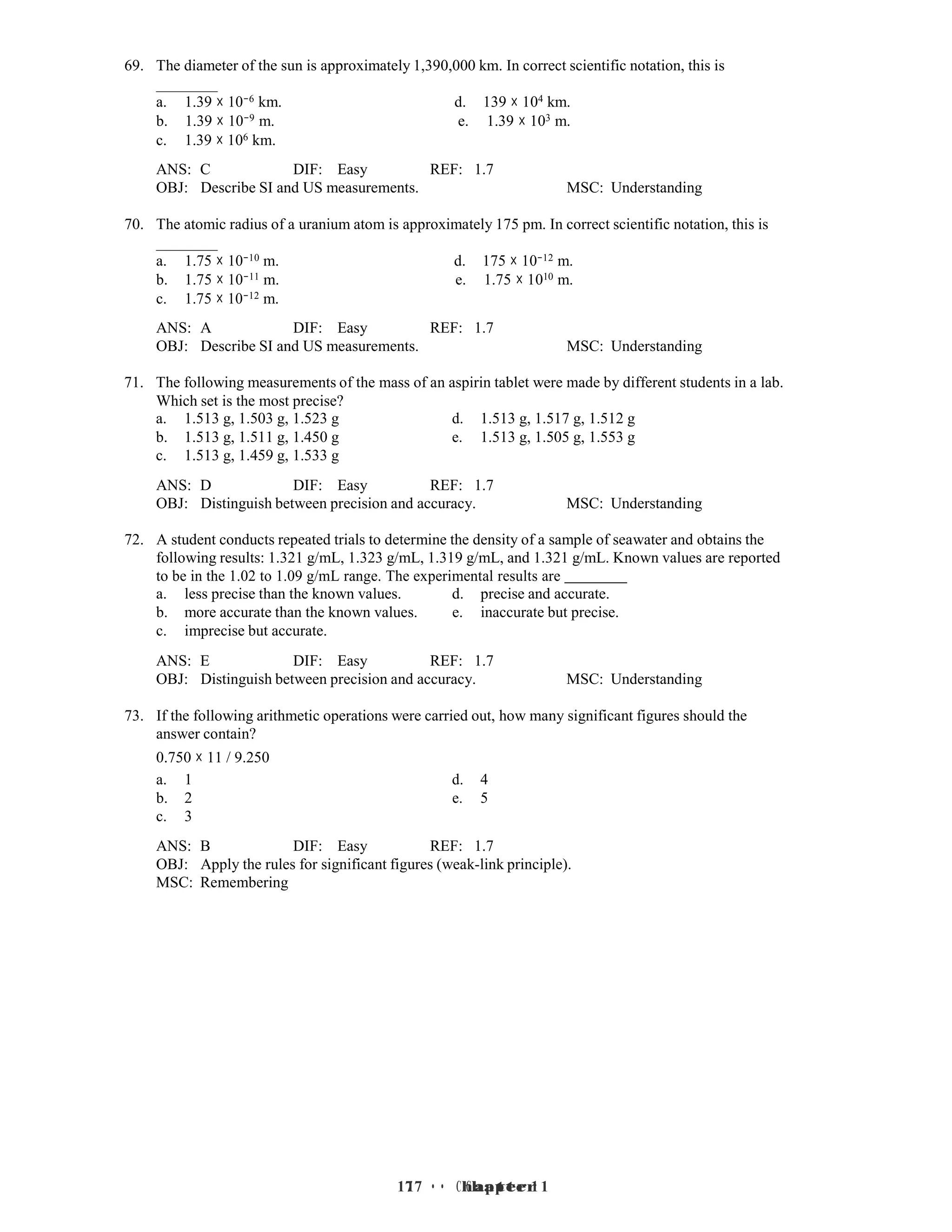
69. The diameter of the sun is approximately 1,390,000 km. In correct scientific notation, this is
a. 1.39 × 10⁻⁶ km. d. 139 × 104 km.
b. 1.39 × 10⁻⁹ m. e. 1.39 × 10³ m.
c. 1.39 × 10⁶ km.
ANS: C DIF: Easy REF: 1.7
OBJ: Describe SI and US measurements. MSC: Understanding
70. The atomic radius of a uranium atom is approximately 175 pm. In correct scientific notation, this is
a. 1.75 × 10⁻¹⁰ m. d. 175 × 10−12 m.
b. 1.75 × 10⁻¹¹ m. e. 1.75 × 10¹⁰ m.
c. 1.75 × 10⁻¹² m.
ANS: A DIF: Easy REF: 1.7
OBJ: Describe SI and US measurements. MSC: Understanding
71. The following measurements of the mass of an aspirin tablet were made by different students in a lab.
Which set is the most precise?
a. 1.513 g, 1.503 g, 1.523 g d. 1.513 g, 1.517 g, 1.512 g
b. 1.513 g, 1.511 g, 1.450 g e. 1.513 g, 1.505 g, 1.553 g
c. 1.513 g, 1.459 g, 1.533 g
ANS: D DIF: Easy REF: 1.7
OBJ: Distinguish between precision and accuracy. MSC: Understanding
72. A student conducts repeated trials to determine the density of a sample of seawater and obtains the
following results: 1.321 g/mL, 1.323 g/mL, 1.319 g/mL, and 1.321 g/mL. Known values are reported
to be in the 1.02 to 1.09 g/mL range. The experimental results are
a. less precise than the known values. d. precise and accurate.
b. more accurate than the known values. e. inaccurate but precise.
c. imprecise but accurate.
ANS: E DIF: Easy REF: 1.7
OBJ: Distinguish between precision and accuracy. MSC: Understanding
73. If the following arithmetic operations were carried out, how many significant figures should the
answer contain?
0.750 × 11 / 9.250
a. 1 d. 4
b. 2 e. 5
c. 3
ANS: B DIF: Easy REF: 1.7
OBJ: Apply the rules for significant figures (weak-link principle).
MSC: Remembering
31.
18 • Chapter1
18 • Chapter 1
74. What value should be reported as the volume of a strip of aluminum foil measuring
15.37 cm × 42.5 cm × 0.0010 cm?
a. 0.65322 cm3 d. 0.65 cm3
b. 0.6532 cm3 e. 0.7 cm3
c. 0.653 cm3
ANS: D DIF: Easy REF: 1.7
OBJ: Apply the rules for significant figures (weak-link principle).
MSC: Remembering
75. A metal object weighing 43.905 g has a volume of 6.0 cm3. What is the density of the metal?
a. 7.3175 g/cm3 d. 7.3 g/cm3
b. 7.318 g/cm3 e. 7 g/cm3
c. 7.32 g/cm3
ANS: D DIF: Easy REF: 1.7
OBJ: Apply the rules for significant figures (weak-link principle).
MSC: Understanding
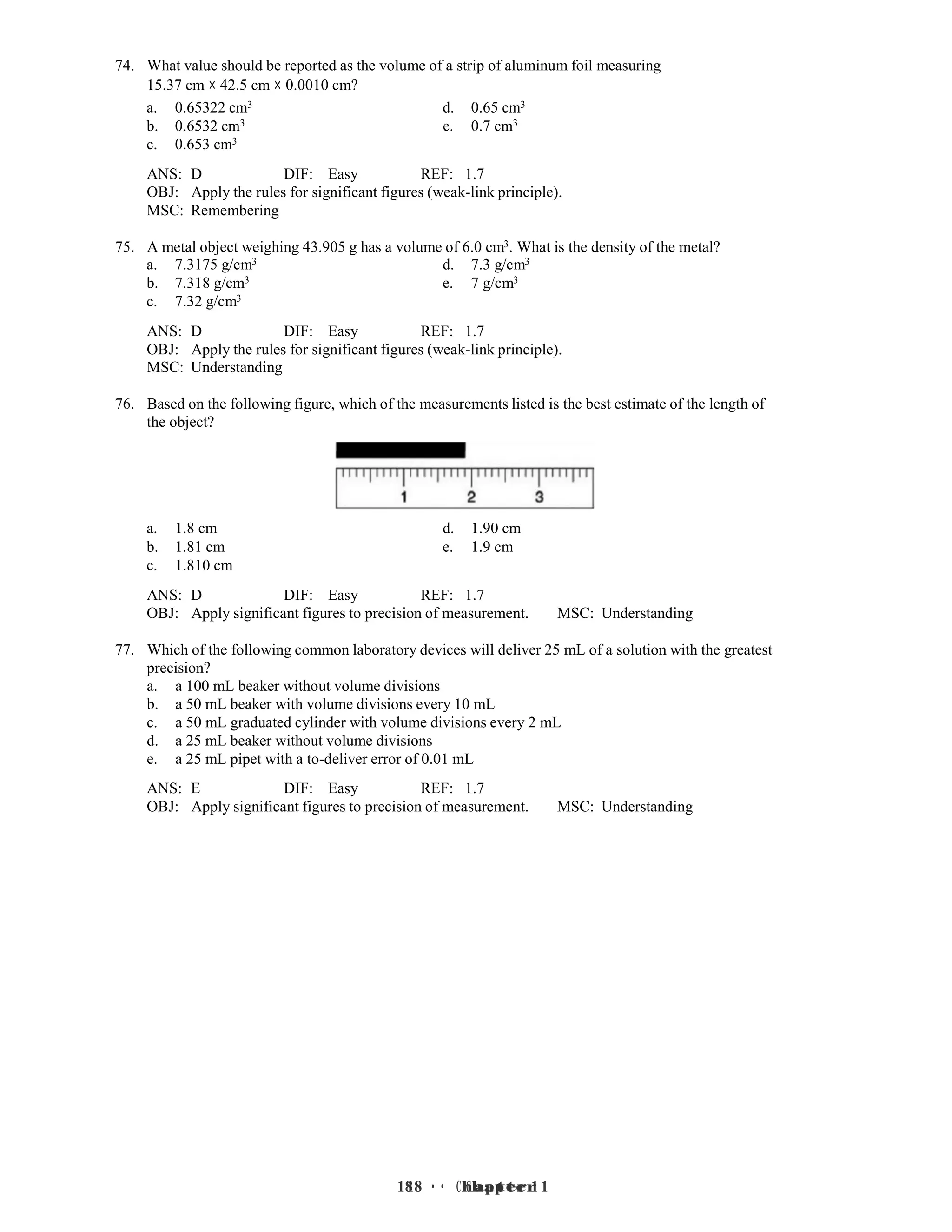
76. Based on the following figure, which of the measurements listed is the best estimate of the length of
the object?
a. 1.8 cm d. 1.90 cm
b. 1.81 cm e. 1.9 cm
c. 1.810 cm
ANS: D DIF: Easy REF: 1.7
OBJ: Apply significant figures to precision of measurement. MSC: Understanding
77. Which of the following common laboratory devices will deliver 25 mL of a solution with the greatest
precision?
a. a 100 mL beaker without volume divisions
b. a 50 mL beaker with volume divisions every 10 mL
c. a 50 mL graduated cylinder with volume divisions every 2 mL
d. a 25 mL beaker without volume divisions
e. a 25 mL pipet with a to-deliver error of 0.01 mL
ANS: E DIF: Easy REF: 1.7
OBJ: Apply significant figures to precision of measurement. MSC: Understanding
32.
19 • Chapter1
19 • Chapter 1
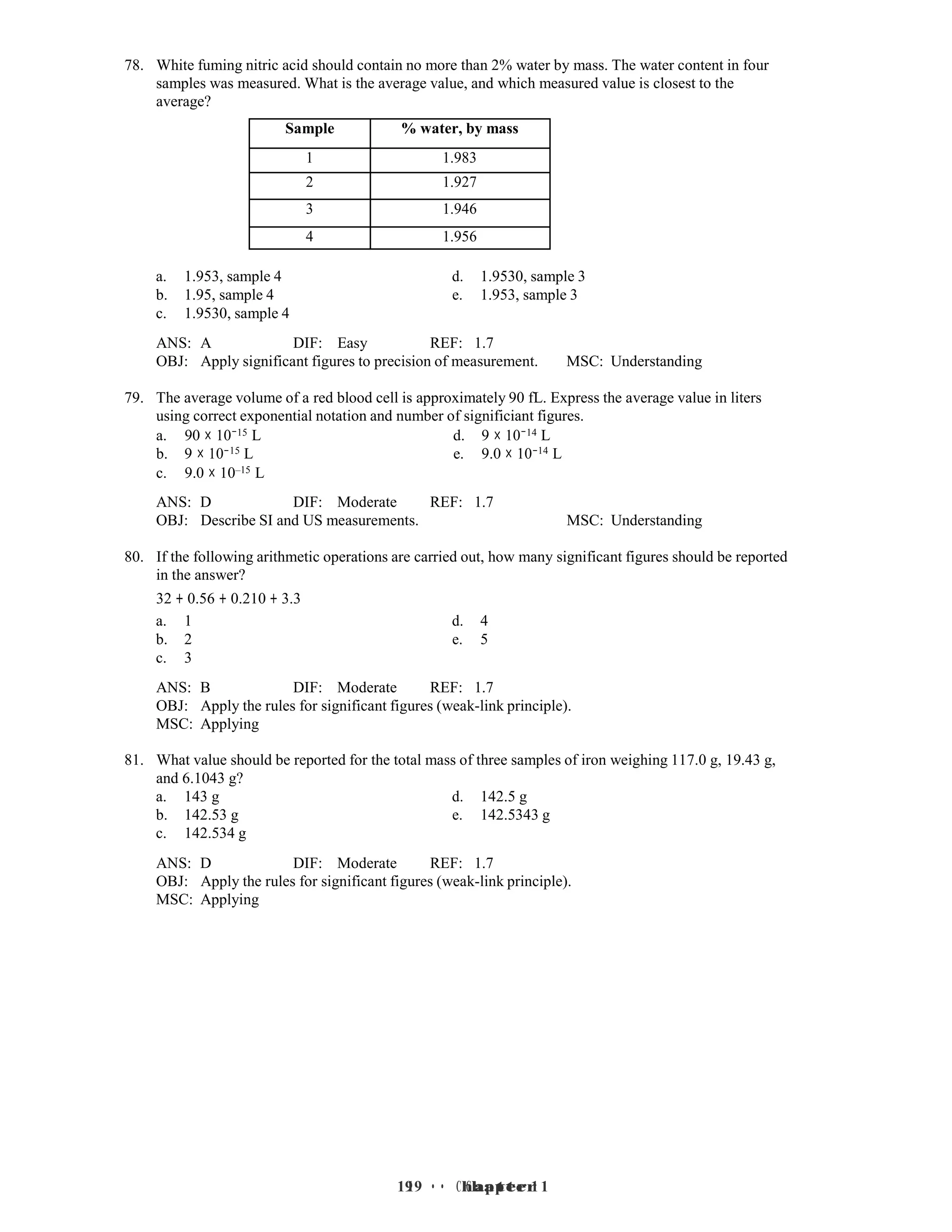
78. White fuming nitric acid should contain no more than 2% water by mass. The water content in four
samples was measured. What is the average value, and which measured value is closest to the
average?
Sample % water, by mass
1 1.983
2 1.927
3 1.946
4 1.956
a. 1.953, sample 4 d. 1.9530, sample 3
b. 1.95, sample 4 e. 1.953, sample 3
c. 1.9530, sample 4
ANS: A DIF: Easy REF: 1.7
OBJ: Apply significant figures to precision of measurement. MSC: Understanding
79. The average volume of a red blood cell is approximately 90 fL. Express the average value in liters
using correct exponential notation and number of significiant figures.
a. 90 × 10−15
L d. 9 × 10⁻¹⁴
L
b. 9 × 10⁻¹⁵ L e. 9.0 × 10⁻¹⁴ L
c. 9.0 × 10⁻¹⁵ L
ANS: D DIF: Moderate REF: 1.7
OBJ: Describe SI and US measurements. MSC: Understanding
80. If the following arithmetic operations are carried out, how many significant figures should be reported
in the answer?
32 + 0.56 + 0.210 + 3.3
a. 1 d. 4
b. 2 e. 5
c. 3
ANS: B DIF: Moderate REF: 1.7
OBJ: Apply the rules for significant figures (weak-link principle).
MSC: Applying
81. What value should be reported for the total mass of three samples of iron weighing 117.0 g, 19.43 g,
and 6.1043 g?
a. 143 g d. 142.5 g
b. 142.53 g e. 142.5343 g
c. 142.534 g
ANS: D DIF: Moderate REF: 1.7
OBJ: Apply the rules for significant figures (weak-link principle).
MSC: Applying
33.
20 • Chapter1
20 • Chapter 1
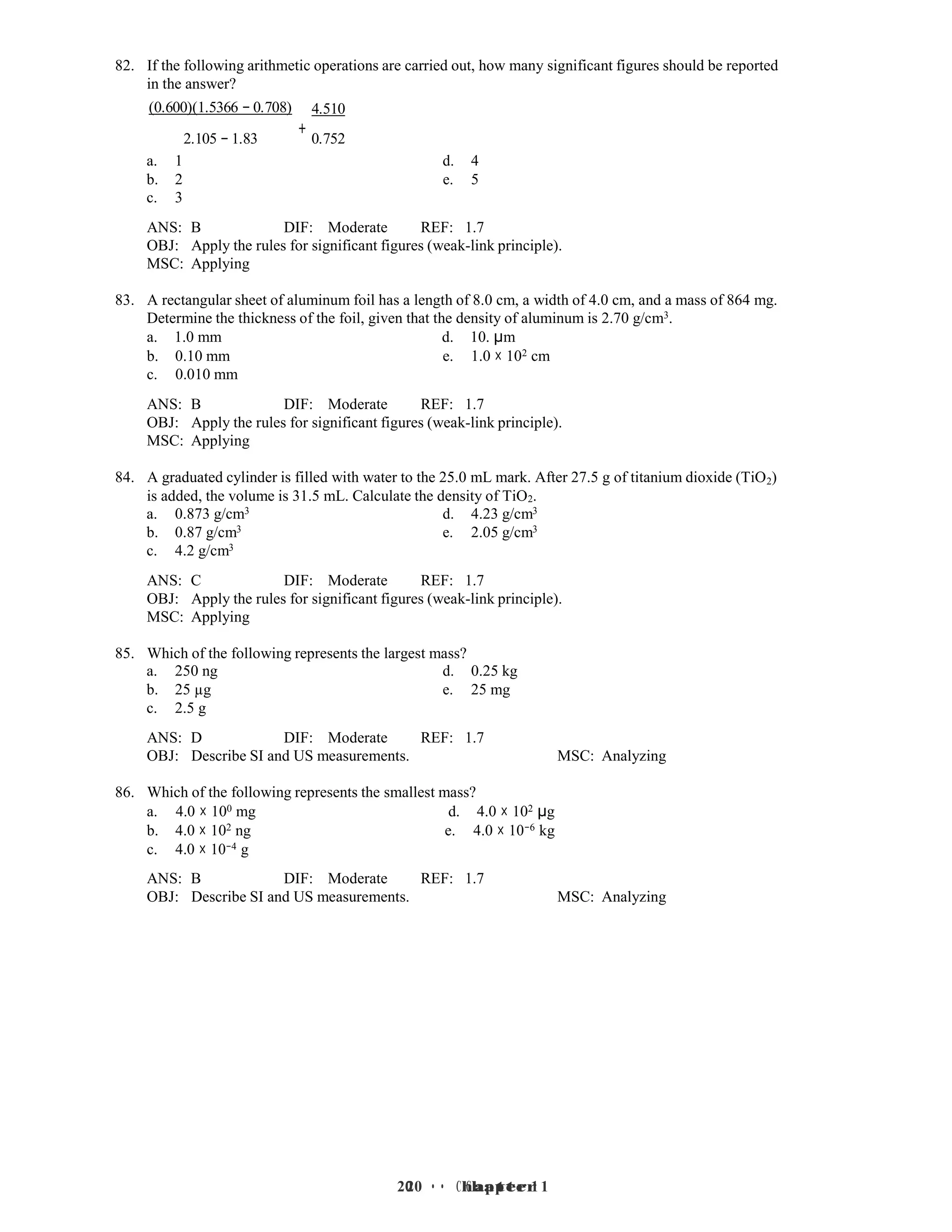
82. If the following arithmetic operations are carried out, how many significant figures should be reported
in the answer?
(0.600)(1.5366 − 0.708) 4.510
2.105 − 1.83
+
0.752
a. 1 d. 4
b. 2 e. 5
c. 3
ANS: B DIF: Moderate REF: 1.7
OBJ: Apply the rules for significant figures (weak-link principle).
MSC: Applying
83. A rectangular sheet of aluminum foil has a length of 8.0 cm, a width of 4.0 cm, and a mass of 864 mg.
Determine the thickness of the foil, given that the density of aluminum is 2.70 g/cm3.
a. 1.0 mm d. 10. µm
b. 0.10 mm e. 1.0 × 102 cm
c. 0.010 mm
ANS: B DIF: Moderate REF: 1.7
OBJ: Apply the rules for significant figures (weak-link principle).
MSC: Applying
84. A graduated cylinder is filled with water to the 25.0 mL mark. After 27.5 g of titanium dioxide (TiO2)
is added, the volume is 31.5 mL. Calculate the density of TiO2.
a. 0.873 g/cm3 d. 4.23 g/cm3
b. 0.87 g/cm3 e. 2.05 g/cm3
c. 4.2 g/cm3
ANS: C DIF: Moderate REF: 1.7
OBJ: Apply the rules for significant figures (weak-link principle).
MSC: Applying
85. Which of the following represents the largest mass?
a. 250 ng d. 0.25 kg
b. 25 µg e. 25 mg
c. 2.5 g
ANS: D DIF: Moderate REF: 1.7
OBJ: Describe SI and US measurements. MSC: Analyzing
86. Which of the following represents the smallest mass?
a. 4.0 × 100 mg d. 4.0 × 10² µg
b. 4.0 × 10² ng e. 4.0 × 10⁻⁶ kg
c. 4.0 × 10⁻⁴ g
ANS: B DIF: Moderate REF: 1.7
OBJ: Describe SI and US measurements. MSC: Analyzing
34.
21 • Chapter1
21 • Chapter 1
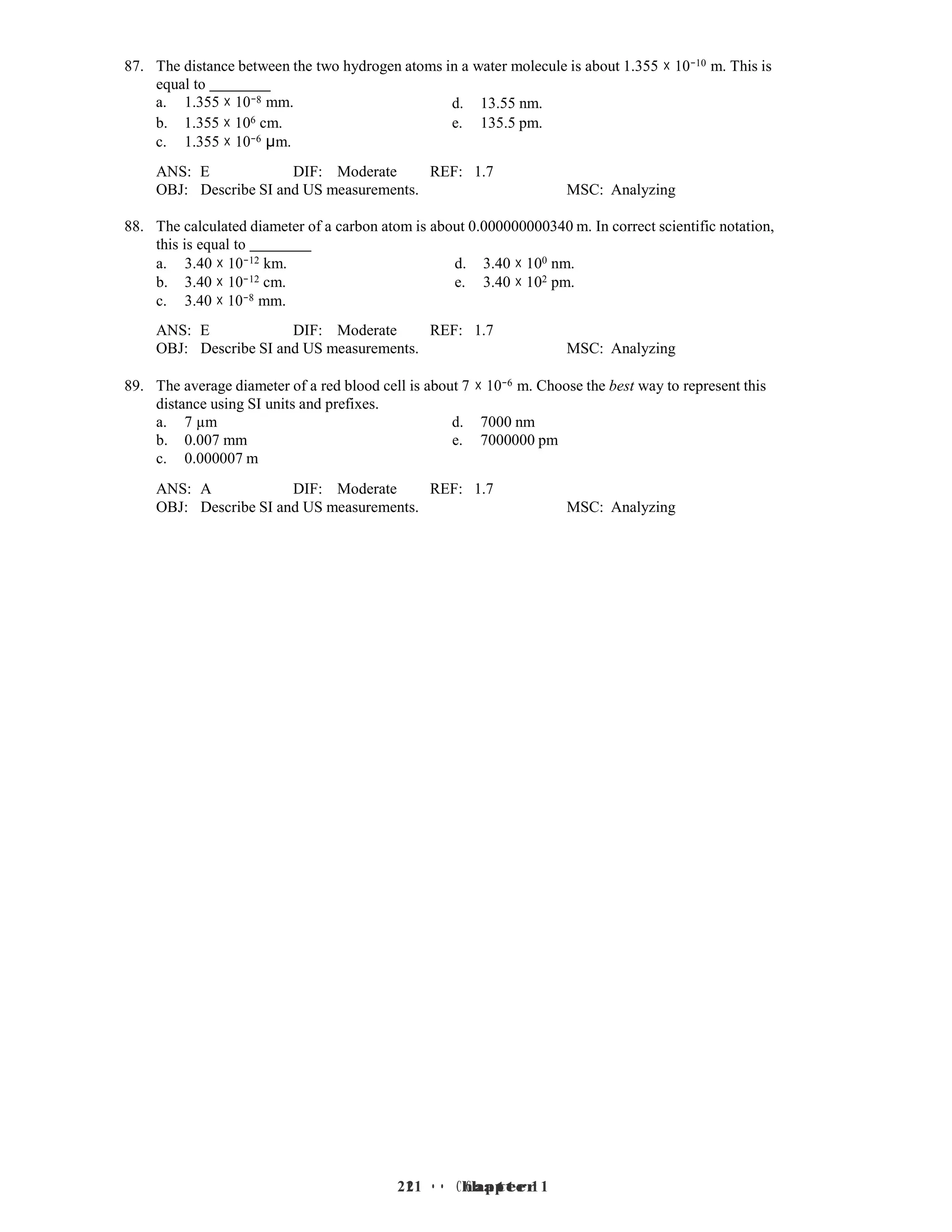
87. The distance between the two hydrogen atoms in a water molecule is about 1.355 × 10⁻¹⁰ m. This is
equal to
a. 1.355 × 10⁻⁸ mm. d. 13.55 nm.
b. 1.355 × 106 cm.
c. 1.355 × 10⁻⁶ µm.
e. 135.5 pm.
ANS: E DIF: Moderate REF: 1.7
OBJ: Describe SI and US measurements. MSC: Analyzing
88. The calculated diameter of a carbon atom is about 0.000000000340 m. In correct scientific notation,
this is equal to
a. 3.40 × 10⁻¹² km. d. 3.40 × 100 nm.
b. 3.40 × 10⁻¹² cm. e. 3.40 × 10² pm.
c. 3.40 × 10⁻⁸ mm.
ANS: E DIF: Moderate REF: 1.7
OBJ: Describe SI and US measurements. MSC: Analyzing
89. The average diameter of a red blood cell is about 7 × 10⁻⁶ m. Choose the best way to represent this
distance using SI units and prefixes.
a. 7 µm d. 7000 nm
b. 0.007 mm e. 7000000 pm
c. 0.000007 m
ANS: A DIF: Moderate REF: 1.7
OBJ: Describe SI and US measurements. MSC: Analyzing
35.
22 • Chapter1
22 • Chapter 1
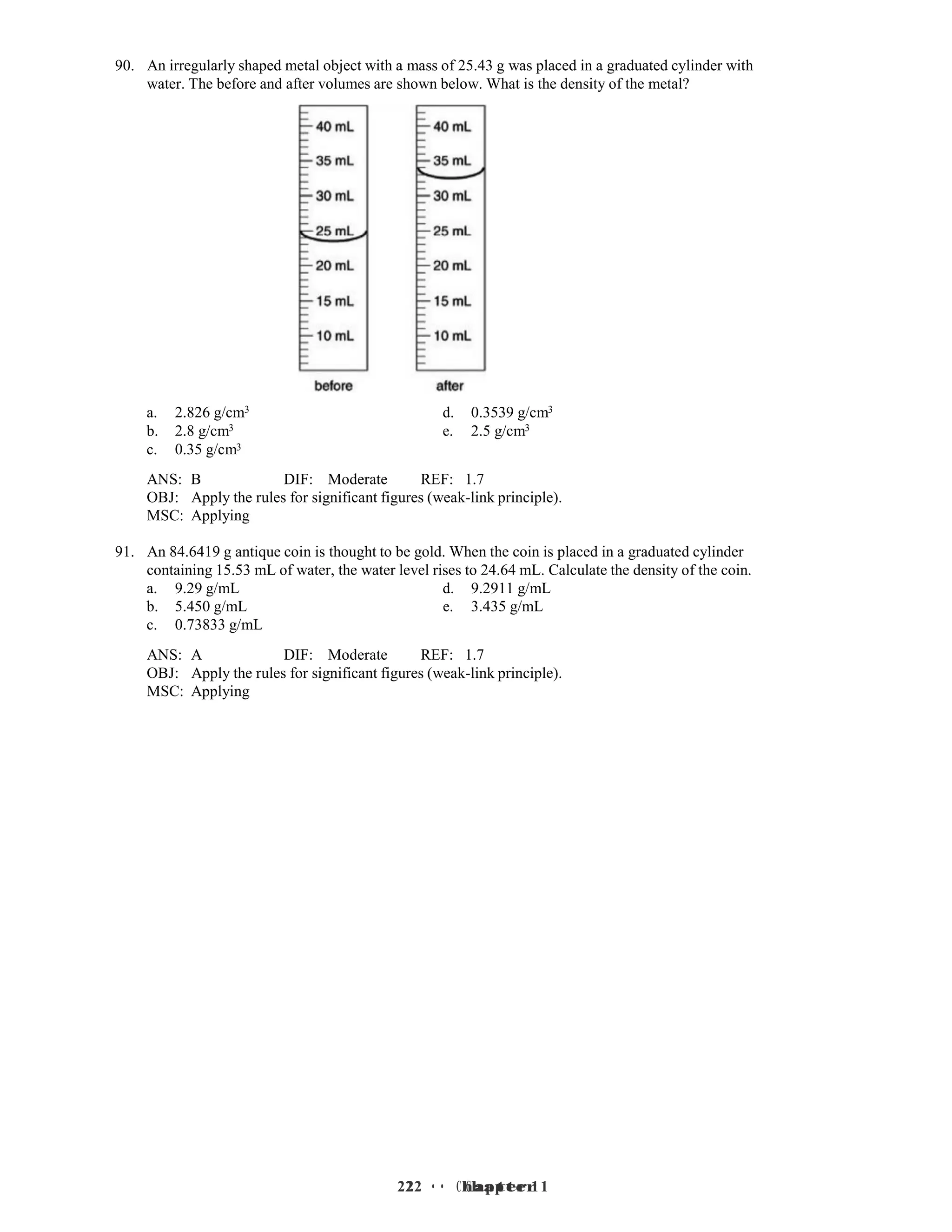
90. An irregularly shaped metal object with a mass of 25.43 g was placed in a graduated cylinder with
water. The before and after volumes are shown below. What is the density of the metal?
a. 2.826 g/cm3 d. 0.3539 g/cm3
b. 2.8 g/cm3 e. 2.5 g/cm3
c. 0.35 g/cm3
ANS: B DIF: Moderate REF: 1.7
OBJ: Apply the rules for significant figures (weak-link principle).
MSC: Applying
91. An 84.6419 g antique coin is thought to be gold. When the coin is placed in a graduated cylinder
containing 15.53 mL of water, the water level rises to 24.64 mL. Calculate the density of the coin.
a. 9.29 g/mL d. 9.2911 g/mL
b. 5.450 g/mL e. 3.435 g/mL
c. 0.73833 g/mL
ANS: A DIF: Moderate REF: 1.7
OBJ: Apply the rules for significant figures (weak-link principle).
MSC: Applying
36.
23 • Chapter1
23 • Chapter 1
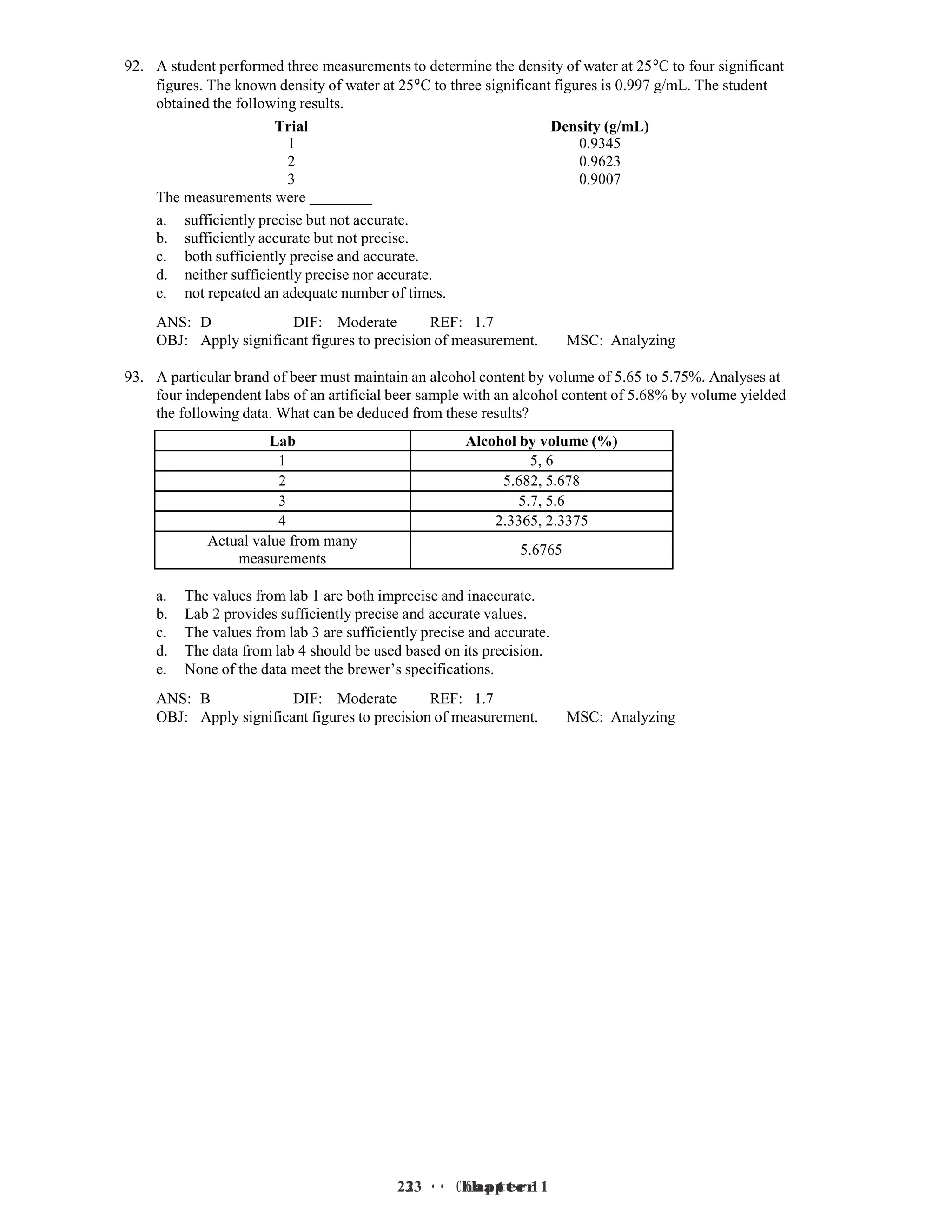
92. A student performed three measurements to determine the density of water at 25°C to four significant
figures. The known density of water at 25°C to three significant figures is 0.997 g/mL. The student
obtained the following results.
Trial Density (g/mL)
1 0.9345
2 0.9623
3 0.9007
The measurements were
a. sufficiently precise but not accurate.
b. sufficiently accurate but not precise.
c. both sufficiently precise and accurate.
d. neither sufficiently precise nor accurate.
e. not repeated an adequate number of times.
ANS: D DIF: Moderate REF: 1.7
OBJ: Apply significant figures to precision of measurement. MSC: Analyzing
93. A particular brand of beer must maintain an alcohol content by volume of 5.65 to 5.75%. Analyses at
four independent labs of an artificial beer sample with an alcohol content of 5.68% by volume yielded
the following data. What can be deduced from these results?
Lab Alcohol by volume (%)
1 5, 6
2 5.682, 5.678
3 5.7, 5.6
4 2.3365, 2.3375
Actual value from many
measurements
5.6765
a. The values from lab 1 are both imprecise and inaccurate.
b. Lab 2 provides sufficiently precise and accurate values.
c. The values from lab 3 are sufficiently precise and accurate.
d. The data from lab 4 should be used based on its precision.
e. None of the data meet the brewer’s specifications.
ANS: B DIF: Moderate REF: 1.7
OBJ: Apply significant figures to precision of measurement. MSC: Analyzing
CHAPTER XVII.
Laura Arden'splans for the summer were not by any means
settled, but she was anxious to leave Rome soon, both because
travelling in the heat would be bad for little Herbert, and because
she wished to quit the rather expensive apartment in which she had
continued to live after her husband's death. A far smaller and less
pretentious dwelling would be amply sufficient for her next winter,
and in the meantime she intended to go to some quiet town either
in Switzerland or by the seaside, and to keep as much alone as
possible. Her mother might be willing to spend a month or two with
her, and Laura would be very glad of her company, but there was no
one else whose society she desired. She could, of course, go to
England and stay at her brother-in-law's house in solemn and
solitary state, but she feared the long journey for her child, and she
cared little for the sort of existence she must lead in the magnificent
country-seat, in the absence of the Lulworths themselves. It would
be pleasant to lead a very simple and quiet life somewhere out of
the world, and as far as possible from the scene of all her sufferings.
If Adele and Francesco had not appeared while Ghisleri was making
his first visit, she would probably have asked his advice. He had
been almost everywhere, and being himself fond of solitude, would
in all likelihood have told her of some beautiful and secluded spot
where she could live in the way she desired. But in the presence of
her step-sister she had not cared to speak on the subject.
After they had left her she thought a long time of Ghisleri and his
story, and, for the first time in her life, she wished she might see
him again before long. He had shown her a side of himself which
she had neither seen nor guessed at before, and she began to
understand, dimly at first and then more clearly, the strong liking her
husband had always shown for him. He was capable of deep and
earnest beliefs and of high and generous impulses, in spite of his
contempt for himself and of the irregular life he led. His present
existence, so far as she knew anything of it, she condemned as
40.
unworthy. She wasnot, however, a woman so easily shocked at the
spectacle of evil in the lives of others as might have been expected.
There was a great deal of sound good sense in the composition of
her character, and she had seen enough of the world to have learnt
that perfection is a word used to define what is a little better than
the average. What she had disliked in Ghisleri from her first
acquaintance with him was not connected with his reputation, of
which, at that time, she had known very little. Besides, though
people called him fast and wild and more or less heartless, he was
liked, on the whole, as much as any unmarried man in society. He
was known to be honourable, courageous, and very discreet, and
the latter quality almost invariably brings its reward in the end. That
he should have been entangled in more than one love affair was
only what was to be expected of such a man, at two or three and
thirty years of age, and no one really considered him any the worse
on that account, while the great majority of women thought him
vastly more interesting for that very reason. Laura was not, perhaps,
so entirely different from the rest of her sex as Ghisleri was fond of
believing. Her education had not been that of young Roman girls, it
is true, and the singular circumstances of her short married life had
not developed her character in the same direction as theirs generally
was by matrimony. But in real womanliness she was as much a
woman as any of them, liable to the same influences and to the
same class of enthusiasms. Because she had loved and married
Herbert Arden, it did not follow that she could not and did not
admire all that was brave and generous and strong, independently of
moral weakness and faults.
Arden himself, indeed, though he had excited her pity by his
physical defects, had commanded her respect by the manly courage
he showed under all his sufferings. She had been able to forget his
deformity in the superior gifts of intelligence and heart which had
unquestionably been his, and, after all, she had loved him most
because she had felt that but for an accident he would have been
pre-eminently a manly man. Cripple as he was, she had always
41.
known that shecould rely on him, and her instinct had always told
her that he could protect her.
But she had never trusted Ghisleri. He had the misfortune to show
his worst side to most people, and he had shown it to her. She had
seen more than once that he was ready to undertake and carry out
almost anything for his friend's sake, and she had been honestly
grateful to him for all he had done. But she had not been able, until
now, to shake off that feeling of distrust and timid dislike she had
always felt in his presence. She had, indeed, succeeded tolerably
well in hiding it from him, but it had always made her cold in
conversation and somewhat formal in manner, and he, being
outwardly a rather formal and cold man had, so to say, put himself
in harmony with her key. For the first time in their acquaintance, and
under pressure of what he considered necessity, he had suddenly
unbent, and had told her the principal story of his life with a
frankness and simplicity that had charmed her. From that hour she
judged him differently. After that first visit, he went often to see her,
and on each occasion he felt drawn more closely to her than before.
"You are very much changed," he said to her one day. "Do you
mind my saying it?"
"Not in the least," Laura answered, with a smile. "But in what way
am I different?"
"In one great thing, I think. You used to be very imposingly calm
with me. You never seemed quite willing to speak freely about
anything. Now, it is almost always you who make me talk by making
me feel that you will talk yourself. That is not very clearly put, is it? I
do not know whether you ever disliked me—if you did, you never
showed it. But I really begin to think that you almost like me. Is
there any truth in that?"
"Yes—a great deal." She smiled again. "More truth than you guess
—for I do not mind saying it since it is all over. I did not like you,
and I used to try and hide it. But I like you now, and I am quite
willing that you should know it."
42.
"That is goodof you—good as everything you do is. But I would
really like to know why you have changed your mind. May I?"
"Because I have found out that you are not what I took you for."
"Most discoveries of that kind are disappointments," observed
Ghisleri, with a dry laugh.
"That is just the sort of remark I used to dislike you for," said
Laura. "The world is not all bad, and you know it. Yet out of ten
observations you make, nine, at least, would lead one to believe that
you think it is."
"Excepting yourself, we are all as bad as we can be. What is the
use of denying it?"
"We are not all bad, and I do not choose to be made an exception
of. I am just like other people, or I should be if I were placed as they
are. I not only am sure that you are not a bad man, but I am quite
convinced that in some ways you are a very good one."
"What an odd mistake!"
"Why do you persistently try to make yourself out worse than you
are, and to show your worst side to the world?"
"I suppose that is the side most apparent to myself," answered
Ghisleri. "I cannot help seeing it."
"Because you are not Launcelot, you take yourself for Cæsar
Borgia—"
"That would be flattering myself too much. Borgia was by far the
more intelligent of the two. Say Thersites."
"I know nothing about Thersites."
"Then say Judas. There seems to be very little difference of
opinion as to that personage's moral obliquity," Ghisleri laughed.
"Very well," said Laura, gravely. "I suppose you have no doubt,
then, that Judas would have acted as you did in your affair with Don
43.
Gianforte. He would,of course, have submitted to insult rather than
break a promise, and would have allowed—"
"Will you please stop, Lady Herbert?" Ghisleri fixed his blue eyes
on her.
"No, I will not," answered Laura, with decision. "What I like about
you is precisely what you try the most to hide, and I mean to see it
and to make you see it, if possible. You would be much happier if
you could. I suppose that if the majority of people could hear us
talking now, they would think our conversation utterly absurd. They
would say that you were posing, in order to make yourself
interesting, and that I was enough attracted by you to be deceived
by the comedy. Is not that the way the world would look at it?"
"Probably," assented Ghisleri. "Perhaps I am really posing. I do not
pretend to know."
"I am willing to believe that you are not, if you will let me, and I
would much rather. In the first place, you are, at all events, not any
worse than most men one knows. That is evident enough from your
actions. Secondly,—you see I am arguing the case like a lawyer,—if
you had not a high ideal of what you wish to be, you would not have
such a poor opinion of what you are. Is that clear?"
"If there were no right, there could not possibly be any wrong. But
black would be black, even if you could only compare it with blue,
green, and yellow, instead of with white."
"I am not talking of chromolithographs," said Laura. "What I say is
simple enough. If you did not wish to be good, and know what good
means, and if you had not a certain amount of goodness in you, you
would not think yourself so bad. And you are unhappy, as you have
told me before now, because you think all your motives are
insincere, or vain, or defective in some way. I suppose you wish to
be happy, and if you do, you must learn to find some satisfaction in
having done your best. I have said precisely what I mean, and you
must not pretend to misunderstand me."
44.
"Think yourself good,and you will be happy," observed Ghisleri.
"That is the modern form of the proverb."
"Of course it is, and the better reason you really have for thinking
yourself good, the more real and lasting your happiness will be."
Ghisleri laughed to himself, and at himself, as he went away, for
being so much impressed as he was by what Laura said. But he
could not deny that the impression had been made and remained for
some time after he had left her. There was a healthy common-sense
about her mind which was beginning to act upon the tortuous and
often morbid complications of his own. She seemed to know the
straight paths and the short cuts to simple goodness, and never to
have guessed at the labyrinthine ways by which he seemed to
himself to be always trying to escape from the bugbear sent to
pursue him by the demon of self-mistrust. He laughed at himself, for
he realised how utterly impossible it would always be for him to
think as she did, or to look upon the world as she saw it. There had
been a time when he had thought more plainly, when a woman had
exerted a strong influence over him, and when a few good things
and a few bad ones had made up the sum of his life. But she was
dead, and he had changed. Worse than that, he had fallen. As he sat
in his room and glanced from time to time at the only likeness he
had of Bianca Corleone, he thought of Beatrice's reproach to Dante
in the thirty-first canto of the "Purgatory":
"And yet, because thou'rt shamed of me in all
Thy sin, and that in later days to come
Thou mayst be brave, hearing the Siren's voice
Sow deep the seed of tears and hear me speak.
So shalt thou know how thou should'st have been moved
By my dead body in ways opposite.
Nor art nor nature had the power to tempt thee
With such delight as that fair body could
In which I lived—which now is scattered earth—
And if the highest joy was lost to thee
By my young death, what mortal living thing
Should have had strength to drag thee down with it?"
45.
As he repeatedthe last words he started for they reminded him
with painful force of Gianforte Campodonico's insulting speech, and
he detested himself for even allowing the thought to cross his mind
—for allowing himself to repeat Beatrice's words up to that point. It
was he who had dragged down Maddalena dell' Armi to his level, not
she who had made him sink to hers. And yet Campodonico had said
almost the same thing as Beatrice, and certainly without knowing it.
In his heart he knew that Bianca might have reproached him so, but
then, deeper still, he knew that the reproach, from her lips, would
have fallen on himself alone, and would never have been meant for
Maddalena.
Ghisleri fell to thinking over his own life and the lives of others, in
one of those black moods which sometimes seized him and in which
he believed in no one's motives, from his own upward. In the course
of his lonely and bitter meditations, he came across an idea which at
first seemed wild and improbable enough, but which, little by little,
took shape as he concentrated his attention upon it, and at last
chased every other memory away. He was not naturally an over-
suspicious man, but when his suspicions were once roused he was
apt to go far in pursuit of the truth, if the matter interested him. He
rose and got a book from the shelves which lined one side of the
wall, and began to turn over the pages rapidly, until he stopped at
the place he was looking for. He read three or four pages very
carefully twice over and returned the volume to its place. Then he
sat down to think, and did not move for another quarter of an hour.
At the end of that time he called his servant, a quiet, hard-working
fellow from the Abbruzzi, who rejoiced in the name of Bonifazio.
"Do you happen to know," he asked, "if there was much scarlet
fever in the city last winter? I have always wondered how poor Lord
Herbert caught it."
Bonifazio had known Lord Herbert for years, just as Donald had
known Ghisleri, for the two friends had often made short journeys
together, taking their servants with them. The Italian thought a long
time before he gave an answer.
46.
"No, Signore. Ido not remember hearing that there were many
cases. But then, I am not in the way of knowing. It may have been."
"You are a very discreet man, Bonifazio," said Ghisleri. "Lord
Herbert fell ill on the day after he had dined in Casa Savelli. Do you
think you could find out for me whether any one of the servants had
the scarlet fever at that time?"
"Perhaps, signore. I will try. I know Giuseppe, the butler, who is a
very good person, but who is not fond of talking. When there is such
an illness they either send the servants to the hospital, in the Roman
houses, or else they put them in an attic and try not to let any one
know. For the rest, I will do what I can. You say well, Signore, for it
is possible that the blessed soul of the Milord caught the fever at the
dinner in Casa Savelli."
"That is what I think," said Ghisleri. And he thought a good deal
more also, which he did not communicate to his man.
Bonifazio, as his master said, was discreet. He was also very
patient and very uncommunicative, as the men of the Abbruzzi often
are. They make the best servants when they can be got, for, in
addition to the good qualities most of them possess in a greater or
less degree, they are almost always physically very strong men,
though rarely above middle height, and often extremely pale.
Ghisleri knew that so soon as Bonifazio had anything to tell, he
would tell it without further question or reminder.
Several days passed, during which Ghisleri, who gained strength
rapidly, began to resume his former mode of life, went to the club,
saw his friends, and made a few visits. He went more than once to
Maddalena's house and stayed some time with her when he found
her alone. Little by little he fancied that her look was changing and
growing more indifferent. He was glad of it. He wished that he might
be to her exactly what she was to him. That, indeed, could never be,
but he wished it were possible. He knew that when she ceased to
love him altogether, she could never feel friendly devotion, gratitude,
or respect for him, and he felt all three for her in a far greater
47.
degree than shecould imagine. On the whole, during that time their
relations were peaceable, and altogether undisturbed by the
frequent differences that had so often nearly estranged them from
one another in earlier days. There was, of course, an air of
constraint about their meetings, more evident in Maddalena's
manner than in Ghisleri's, and the latter hardly hoped that this could
ever quite wear off and leave at last a sincere and true friendship
behind it. That was, indeed, the best that could be hoped for either
of them, and he had no right to expect the best, nor anything
approaching to it.
One evening as he was dressing for dinner, Bonifazio gave him the
news he desired. It had not been easy to extract any communication
on the subject from old Giuseppe, the Savelli's butler, but such as he
had at last given was clear, concise, and to the point. There had
been a case of scarlet fever in the house. Donna Adele's maid had
taken it, and was just convalescent at the time when the Ardens
dined with Adele and her husband. The woman's name was Lucia,
and on falling ill she had been at once removed to a distant room in
the upper part of the palace. The case had been rather a severe
one, Giuseppe believed, and it was only within the last few weeks
that Lucia seemed to have regained her strength. She was at
present at Gerano with her mistress, but had written to the wife of
the Savelli's porter saying that she had been dismissed, and was to
leave at the end of the month, and asking for assistance in finding a
new place. Ghisleri was satisfied for the present. It was quite clear
that Arden must have caught the fever that killed him so suddenly in
Casa Savelli. Whether Donna Adele had in any way communicated
the contagion was another matter, and not easily decided. Her
inexplicable nervousness, beginning about the time that Arden died,
might be accounted for on the ground that she was aware of having
been the unintentional cause of his illness, and felt that by a little
precaution she might have averted the catastrophe. The idea was
constantly present in Ghisleri's mind, but it lacked detail and
clearness, and constituted at most a rather strong suspicion. Of
course it was quite possible, and, considering Adele's character,
48.
more than likely,that she had never been near the maid during her
illness. If she had never had the scarlet fever herself, it was quite
certain. But that was a point easily settled, and was a very important
one.
On the following day, Ghisleri called at the Palazzo Braccio. The
Princess received him, as she always did, without any signs of
satisfaction, but without marked coldness. To her he was always
"that wild Ghisleri," and she thoroughly disapproved of him, wishing
that he would not visit her daughter so often. He was quite aware of
the feeling she entertained towards him, and was always especially
careful in his conversation with her. In spite of her long residence in
Rome, as a Roman, and among Romans, she had remained
altogether English in nature. Laura, English on both sides by her
birth, had far less of prejudice than her mother, and was altogether
more of a cosmopolitan in every way. On the present occasion,
Ghisleri led the conversation so as to speak of her. He began by
asking the Princess where she herself meant to spend the summer,
and whether she intended to be with her daughter.
"I hope to be with her a great part of the time," she answered. "I
do not like to think of her as travelling about the world alone.
Indeed, I do not at all approve of her living without a companion, as
she insists upon doing. She is far too young, and people are far too
ready to talk about her."
"She has such wonderful dignity," answered Ghisleri, "that she
could do with impunity what most women could not do at all.
Besides, her mourning protects her for the present, and her child.
She is looking wonderfully well—do you not think so?"
"Yes. When one thinks of all she has suffered, it is amazing. But
she was always strong."
"I should suppose so. Any one else would have caught the scarlet
fever."
"As for that," said the Princess, unsuspiciously, "people rarely have
it twice."
49.
"She has hadit, then."
"Oh, yes. Both the girls had it at the same time, when they were
little things. Let me see—Laura must have been six years old then.
They had it rather badly, and I remember being terribly anxious
about them."
"I see," answered Ghisleri, carelessly. "That accounts for it. But to
go back to what we were speaking of, I wonder that Lady Herbert
does not spend the summer with you at Gerano, if you go there as
usual."
"I do not think she will consent to that," said the Princess, rather
coldly. "She says she prefers the north for the baby. It is quite true
that it is often very hot at Gerano."
"Donna Adele was good enough to ask me to go out and spend a
day or two while she is there. It must be very pleasant just now, in
the spring weather."
"Why do you not go?" asked the Princess, with more warmth, for
she preferred that Ghisleri should be where he could not see Laura
every day, as she believed he now did. "You would be doing them
both a kindness. Poor Adele was obliged to go to the country against
her will—she is in such a terribly nervous state. I really do not know
what to make of it."
"What news have you of her?" inquired Ghisleri, in a tone of polite
solicitude. "Is she at all better?"
"She was better after the first few days. Then it appears that she
had a fright—I do not quite understand how it was from what
Francesco wrote to my husband—but it seems to have been one of
those odd accidents—optical illusions, I suppose—which sometimes
terrify people."
"How very unfortunate! What did she fancy she saw?"
"It was absurd, of course!" answered the Princess, who had no
special reason for being reticent on the subject. "It seems that there
was a blue cloak of hers hanging somewhere in her dressing-room,
50.
—at a window,I believe,—and she went in suddenly very early in
the morning before it was quite broad daylight, and took the cloak
for a man. In fact she thought it was poor dear Arden. You know he
always used to wear blue serge clothes. Francesco saw it himself
afterwards and says that it was extraordinarily like. But I cannot
understand how any one in their senses could be deceived in that
way. Adele is dreadfully overwrought and imaginative. She has
danced too much this winter, I suppose."
When Ghisleri went away he was almost quite persuaded that
Adele was conscious of having communicated the fever to Arden. Of
course, it might all be mere coincidence, but to him the evidence
seemed strong. He wrote a note to Adele, asking whether he might
avail himself of her invitation, and spend a day at Gerano. Her
answer came by return of post, begging him to come at once, and to
stay as long as possible. The handwriting was so illegible that he had
some difficulty in reading it. To judge from that, at least, Adele was
no better.
Before leaving Rome, he thought it best to inform Laura of his
intended visit. He had never spoken of her step-sister in a way to
make her suppose that he disliked her, but Laura knew very well
what part he had played at the time when Adele was spreading
slanderous reports, for her mother had repeated the story precisely
as the Prince had told it to her. Ghisleri, of course, was not aware of
this, for Arden had not mentioned the matter to him, unless his
reference to the enemies he and Laura had in Rome, during the last
conversation he had with his friend, could be taken as implying that
Ghisleri knew as much as he himself. But in any case, he was sure
that Laura would be surprised at his going to Gerano, even for a day,
and it was better to warn her beforehand, and if possible give her
some reasonable explanation of his conduct. He chose to refer his
visit at once to motives of curiosity, together with a natural desire to
breathe the purer air of the country, now that he was able to make
the short journey without fatigue or danger.
51.
"I have neverbeen to Gerano," he added. "It is said to be a
wonderful place—one of the finest mediæval castles in this part of
the world. I really wish to see it—they say the air is good—and since
Donna Adele is so kind as to ask me, I shall go."
"You would see it better if you went when my mother and step-
father are there. He would show you everything and give you all
sorts of historical details which Adele has forgotten and which
Francesco never knew."
"No doubt, but there is one objection," answered Ghisleri. "They
have never asked me. I am not a favourite with the Princess. I am
sure you know that."
"She thinks you are very wild," said Laura, with a smile. "She
disapproves of you on moral grounds—not at all in the way I used to
—and still do, sometimes," she added, incautiously.
"Still?"
"Oh, it is very foolish! Do not talk about it. When are you going
out?"
Laura had undeniably felt a sudden return of her old distrust in
him, when she had heard of the visit. It was natural enough that she
should, considering what she knew. She suspected some new and
tortuous development of his character, and would have instinctively
drawn back from the intimacy she felt was growing up between him
and herself, had she not by experience found out that she might be
quite wrong about him after all. She tried, at the present juncture, to
shake off the sensation which was now far more distasteful to her
than it had formerly been, in proportion as she had fancied that she
understood him better. But she could not altogether succeed. It was
too strange, in her opinion, that he should willingly be Adele's guest,
and put himself under even a slight obligation to her. It showed, she
thought, how individual views could differ in regard to friendship.
She was even rather surprised to find that she was asking herself
whether, if Gianforte and Christina Campodonico possessed a
habitable castle and invited her to stop with them, she would accept,
52.
considering that Gianfortehad almost killed her husband's best
friend. She unhesitatingly decided that she would not, and resented
Ghisleri's willingness to receive hospitality from one who, as he well
knew, had foully slandered both Arden and herself. Her doubts were
certainly justifiable to a certain extent. But there was no immediate
probability that they would be cleared away for the present. Ghisleri
understood her perfectly, and wondered whether he were not risking
too much in endangering a friendship so precious to him for the sake
of following out a suspicion which might, in the end, prove to have
been altogether without foundation. On the other hand, his natural
obstinacy of purpose when once called into play was such as not to
leave the smallest hesitation in his mind between doing what he had
determined to do, or not doing it, when he had once made up his
mind, irrespective of consequences. Having lost sight of the virtue of
constancy, he clung to a vicious obstinacy as a substitute.
53.
CHAPTER XVIII.
When Adelehad read Padre Bonaventura's letter twice over and
had realised its meaning, she behaved like a person stunned by an
actual blow. She sank into the nearest chair, utterly overcome. She
had barely the presence of mind to tear up the sheet of paper into
minute shreds, which she gathered all in one hand, until she could
find strength to scatter them out of the window. The position was a
terrible one indeed, and for a long time she was unable to think
connectedly about it, or of anything else. But for the two nights of
sound sleep she had got by taking the chloral, she must inevitably
have broken down. As it was, her strong constitution had asserted
itself so soon as she had been able to rest, and she was better able
to meet this new and real trouble than she had been to face the
imaginary horror of Herbert Arden's presence in her dressing-room.
But even so, half an hour elapsed before she was able to rise from
her seat. She tossed the scraps of paper out of the window and
watched them as the wind chased them in all directions, upwards
and downwards, upon the castle wall. Then, all at once, she began
to think, and her brain seemed to act with an accuracy and
directness it had never had before.
Either the letter had been opened in the house or at the post-
office. It could not have been opened in Rome, or at least, the
probabilities were enormously against such an hypothesis. It was
scarcely more like that the man at the Gerano post-office should
have ventured to tamper with a sealed envelope coming from the
castle, and for which he had given a receipt before taking charge of
it. He could not have the smallest interest in reading Donna Adele's
correspondence, and he had everything to lose if he were caught.
He would certainly not have supposed that she or her husband,
having but lately left the city, were sending back a sum of money in
notes large enough to make it worth his while to incur such a risk. In
other words, the theft had been committed in the house, and no one
but Lucia could have been the thief. Lucia had been summarily
54.
dismissed; Lucia wasthe only servant in the establishment who had
serious cause for discontent; Lucia had guessed from the address
that the letter contained something at least of the nature of a
confession, and had resolved to hold her mistress in her power.
Moreover, it was possible—barely possible—that Lucia knew
something else. In any case, she had read every word Adele had
written with her own hand, and Adele knew very well why the
woman had not returned the sheets to the envelope after mastering
their contents. She was utterly, hopelessly, and entirely in Lucia's
power. The maid would go from her to a new situation, and
wherever she might be would always be able to control Donna
Adele's life by merely threatening to betray what she knew to the
person or persons concerned.
Adele felt that her courage was almost failing her in this extremity,
at a time when she needed more than she had ever possessed. And
yet it was necessary to act promptly, for the maid might even now
be engaging herself with some one else. Come what might, she
must never leave Casa Savelli, if it cost Adele all the money she
could beg of her husband or borrow of her father to keep the
woman with her. First of all, however, she must regain some sort of
composure, lest Lucia should suspect that the post had brought her
news of the loss of the document. She looked at herself in the glass
and scrutinised every feature attentively. She was very pale, but
otherwise was looking better than two days earlier. Any kind of
stimulant, as she knew, sent the blood to her face in a few minutes,
and she saw that what she needed was a little colour. A teaspoonful
of Benedictine cordial, of which she had a small flask in her
dressing-case, was enough to produce the desired effect. The doctor
had formerly recommended her to take it before going to sleep, but
she did not like such things, and the flask was almost full. She saw
in the mirror that the result was perfectly satisfactory, and when she
at last met her husband he remarked that her appearance was very
much improved.
"I feel so much better!" she exclaimed, knowing that she was
speaking the first words of a comedy which would in all probability
55.
have to beplayed during the rest of her life. "I always said that if
they would only give me something to make me sleep I should get
well at once."
She walked again on that day, and by an almost superhuman
effort kept up appearances until bedtime, even succeeding in eating
a moderately abundant dinner. That night she told Lucia that, on the
whole, she would prefer to keep her, that she had always been more
than satisfied with her services, and that if she had suddenly felt an
aversion to her, it was the result of the extreme nervousness she
had suffered of late. Now that she could sleep, she realised how
unkind she had been. Lucia humbly thanked her, and said that she
hoped to live and die in the service of the most excellent Casa
Savelli. Thereupon Adele thanked her too, said very sweetly that she
was a good girl and would some day be rewarded by finding a good
husband, and ended by giving her five francs. She reflected that to
give her more might look like the beginning of a course of bribery,
and that to give nothing might be construed as proceeding from the
fear of seeming to bribe.
The second day could not be harder than the first, she said to
herself, as she swallowed her chloral and laid her head upon the
pillow, to be read to sleep by the nurse. She slept, indeed, that
night, but not so well as before, and she awoke twice, each time
with a start, and with the impression that Lucia was reciting the
contents of the lost letter to Laura Arden and a whole roomful of the
latter's friends.
Under the circumstances, she behaved with a courage and
determination admirable in themselves. Few women could have
borne the constant strain upon the faculties at all, still fewer after
such illness as she had suffered. But she was really very strong,
though everything which affected her feelings and thoughts reacted
upon her physical nature as such things never can in less nervously
organised constitutions. She bore the excruciating anxiety about the
lost confession better than the shadowy fear of the supernatural
which still haunted her in the hours of the night. On the third day
56.
she begged herhusband to increase the dose of chloral by a very
small quantity, saying that if only she could sleep well for a whole
week she would then be so much better as to be able to give it up
altogether. Savelli hesitated, and at last consented. Since she had
seemed so much more quiet he dreaded a return of her former
state, for he was a man who loved his ease and hated everything
which disturbed it.
The doctor had particularly cautioned him to keep the chloral put
away in a safe place, warning Francesco that the majority of persons
who took it soon began to feel a craving for it in larger quantities,
which must be checked to avoid the risk of considerable damage to
the health in the event of its becoming a habit. It was, after all, only
a palliative, he said, and could never be expected to work a cure on
the nerves except as an indirect means to a good result. Francesco
kept the bottle in his dressing-bag, which remained in his own room
and was fitted with a patent lock. He yielded to Adele's request on
the first occasion, and she went with him as he took the glass back
to strengthen the dose. "Why do you keep it locked up?" she said.
"Do you suppose I would go and take it without consulting you?"
"The doctor told me to be careful of it," he answered. "The
servants might try a dose of it out of curiosity." He took what he
considered necessary and locked the bag again, returning the key to
his pocket.
Two or three days passed in this way. Adele began to feel that she
longed for the night and the soothing influence of the chloral, as she
had formerly longed for daylight to end the misery of the dark hours.
The days were now made almost intolerable for her by the certainty
that her maid knew her secret, and by the necessity for treating the
woman with consideration. Yet she could do nothing, and she knew
that she never could do anything to lessen her own anxiety, as long
as she lived. She was much alone, too, during the day. She walked
or drove with her husband during two or three hours in the
afternoon, but the rest of the time hung idly on her hands. It is true
that his society was not very congenial, and under ordinary
57.
conditions she wouldrather have been left alone than have been
obliged to talk with him. At present, however, she thought less when
she was with him, and that was a gain not to be despised. She had
quite forgotten that she had asked Ghisleri to come out and spend a
day or two, when his note came, reminding her of the invitation, and
asking if he still might accept it. Francesco liked him, as most men
did, and was glad that any one should appear to vary the monotony
of the dull country life with a little city talk. He bade her write to
Pietro to come and stay as long as he pleased, if she herself cared to
have him. She concealed her satisfaction well enough to make
Francesco suppose that she wished the guest to come for his sake
rather than her own.
Ghisleri started early, taking his servant with him, and reached
Gerano in time for the midday breakfast. Francesco Savelli received
him with considerable enthusiasm, and Adele's habitually rather
forced smile became more natural. Both felt in different ways that
the presence of a third person was a relief, and would have been
delighted to receive a far less agreeable man than their present
guest. They overwhelmed him with questions about Rome and their
friends.
"Of course you have seen everybody and heard everything, now
that you are so much better," said Adele, as they sat down to
breakfast in the vaulted dining-room. "You must tell us everything
you know. We are buried alive out here, and only know a little of
what happens through the papers. How are they all? Have you seen
Laura again, and how is the baby? My step-mother writes that she is
going to spend the summer with them in some place or places
unknown. I never thought of her as a grandmother when my own
children were born—of course she is not my mother, but it used to
seem just the same. What is Bompierre doing? And Maria
Boccapaduli? I am dying to hear all about it."
Ghisleri laughed at the multitude of questions which followed each
other almost without a breathing-space between them.
58.
"Donna Maria wouldhave sent you her love if she had known that
I was coming to Gerano," he answered. "As for Bompierre, he is an
inscrutable mixture of devotion and fickleness. He attaches himself
to the new without detaching himself from the old. He worships both
the earthly and the Olympian Venus. He is a good fellow, little
Bompierre, and I like him, but it is impossible for any man to adore
women at the rate of six at a time. I begin to think that he must be
a very deep character."
"That is the last thing I should say of him," observed Savelli, who
was deficient in the sense of humour.
"How literal you are, Francesco," laughed his wife. "And yourself,
Ghisleri—tell us about yourself. Are you quite well again? You still
look dreadfully thin, but you look better than when I saw you last.
What does your doctor say?"
"He says that if I do not happen to catch cold, or have a choking
fit, or a cough, or any of fifty things he names, and if I do not
chance to get shot in the same place again, in the course of a year
or two I may be as good a man as ever. It appears that I have a
good constitution. I always supposed so, because I never had
anything the matter with me, so far as I knew."
"No one will ever forgive Gianforte!" exclaimed Adele. "If you had
died, he would have had to go away for ever. Everybody says he was
utterly in the wrong."
"The matter is settled," said Ghisleri, "and I do not think either of
us need have anything to say about the other's conduct in the affair.
I suppose you have heard that the ministry has fallen," he
continued, turning to Savelli. "Yesterday afternoon—the old story, of
course—finance."
"For Heaven's sake do not begin to talk politics at this hour,"
protested Adele. "To-night, when I am asleep, you can smoke all the
cigars in the house, and reconstitute a dozen ministries if you like. I
want to hear all about my friends. You have not told me half enough
yet."
59.
Welcome to ourwebsite – the perfect destination for book lovers and
knowledge seekers. We believe that every book holds a new world,
offering opportunities for learning, discovery, and personal growth.
That’s why we are dedicated to bringing you a diverse collection of
books, ranging from classic literature and specialized publications to
self-development guides and children's books.
More than just a book-buying platform, we strive to be a bridge
connecting you with timeless cultural and intellectual values. With an
elegant, user-friendly interface and a smart search system, you can
quickly find the books that best suit your interests. Additionally,
our special promotions and home delivery services help you save time
and fully enjoy the joy of reading.
Join us on a journey of knowledge exploration, passion nurturing, and
personal growth every day!
testbankbell.com