15th March 2018
Temporary Operations Training Module 2
Temporary Operation Inducted – Track and TPS areas (Traction Power Supply) Module 2
Aim of this module is have an understanding of:
• Track Safety whilst Tram and RRV are moving,
• Behaviours to adopt in an energized environment,
• Personal protection in an energized environment.
2
Temporary Operations Training Module 2
3
Temporary Operations Training Module 2
• Temporary Operation Inducted – Energized rooms and buildings Module 1
− This module provides electrical awareness and is mandatory module for all persons working in Temporary
Operations areas In addition this module allows entry into energized rooms and buildings in accordance with
the electrical habilitation training accreditation level
− It also permits working around energized systems and cables accordance with the electrical habilitation
training accreditation level
− Persons who have attended any 3rd
Party Apave electrical training modules and passed the examination are
exempt from the electrical awareness part of the session
• Temporary Operation Inducted – Track and TPS areas (Traction Power Supply) Module 2
− This module is mandatory to work on or in the vicinity of energized traction power supply (TPS) areas and
track areas with Tram/RRV movements and Track Machine movements during T&C tests in zones controlled
by the Temporary Operation entity (non CRO).
− Applicable to Tunnel, At Grade, Depot and Viaduct areas under TO Rules,
− Applicable to all APS, OCS and ROCS energized systems on the project.
APS - Aesthetic Power Supply OCS – Overhead Catenary System ROCS - Rigid Overhead Catenary System
4
Temporary Operations Training Modules
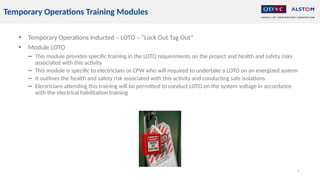
• Temporary Operations Inducted – LOTO – “Lock Out Tag Out”
• Module LOTO
− This module provides specific training in the LOTO requirements on the project and health and safety risks
associated with this activity
− This module is specific to electricians or CPW who will required to undertake a LOTO on an energized system
− It outlines the health and safety risk associated with this activity and conducting safe isolations
− Electricians attending this training will be permitted to conduct LOTO on the system voltage in accordance
with the electrical habilitation training
5
Temporary Operations Training Modules
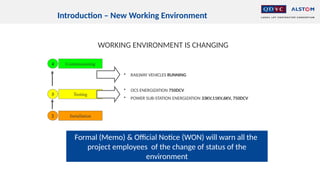
Introduction – New Working Environment
Installation
2
Testing
3
• OCS ENERGIZATION 750DCV
• POWER SUB-STATION ENERGIZATION 33KV,11KV,6KV, 750DCV
4 Commissioning
• RAILWAY VEHICLES RUNNING
WORKING ENVIRONMENT IS CHANGING
Formal (Memo) & Official Notice (WON) will warn all the
project employees of the change of status of the
environment
• When traction is energized in an area a new set of rules regarding Operation & Safety will be applied.
Quick summary of new set of rules :
• Any activity no matter the entity or the type of activity will be under the control of the Manager of
Temporary Operations (MOTO) by means of Work Permit (TOWP) and the use of Isolation
Certificate when required.
• Access to any of these areas will be strictly controlled and specific access conditions will be granted
after training.
• Any disrespect of the new set of rules will be liable to disciplinary action
7
Temporary Operations Training Module 2
Rules & procedures for works after the OCS energization

Working in or near an energised environment commands specific training; they are tailored
to the work to be undertaken. These trainings are a mandatory requirement.

A dedicated training describing the OCS hazards reminds you the permanent dangers and actions
to carry out before working within the OCS area.

Without written PTW and an electrical accreditation, the CPW and his team /(PSE) does not
go near nor touch an equipment which might be potentially energized.

In confined space the energized installations are clearly labelled thus defining the risk areas.

Isolation certificate issued by the PSE (LOTO) guaranties the de-energization during the whole
intervention.

The technician (CPW) always presumes that the equipment is energized.

Even though a work permit has been issued and the technician has it in hand, he/she still Checks
the Absence of Energy before starting work (as per LOTO).
Running Railway Vehicles :
• Somebody walking hit by a railway vehicle
• A vehicle (crane, bus, truck) along the track hits a railway vehicle or being hit by it
Live OCS :
• Somebody touches the OCS (from a scaffolding, ladder, top of train, …)
• Somebody touches the OCS with an object (rule, measuring tape, rope, …)
• Somebody touches the OCS while carrying long articles such as pipes or ladder
• Somebody touches the OCS while washing, painting, repairing or carrying out
work on Tramways or Rail Road Vehicle’s
• A crane touches the OCS
• A wire close to a live OCS is energized by induction (magnetic field)
• Whilst working on a roof close to OCS somebody touches the OCS
Moving blades on the turnout
• Ankle or hand being caught between the running rail and the blade
9
Introduction – New Risks
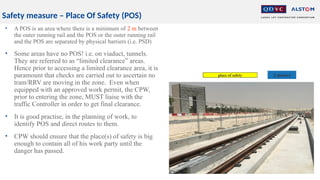
Safety measure – Place Of Safety (POS)
• A POS is an area where there is a minimum of 2 m between
the outer running rail and the POS or the outer running rail
and the POS are separated by physical barriers (i.e. PSD)
• Some areas have no POS! i.e. on viaduct, tunnels.
They are referred to as “limited clearance” areas.
Hence prior to accessing a limited clearance area, it is
paramount that checks are carried out to ascertain no
tram/RRV are moving in the zone. Even when
equipped with an approved work permit, the CPW,
prior to entering the zone, MUST liaise with the
traffic Controller in order to get final clearance.
• It is good practise, in the planning of work, to
identify POS and direct routes to them.
• CPW should ensure that the place(s) of safety is big
enough to contain all of his work party until the
danger has passed.
place of safety 2 meters
11
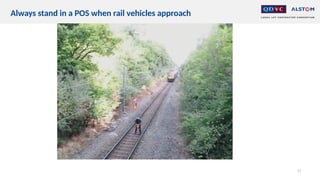
Always stand in a POS when rail vehicles approach
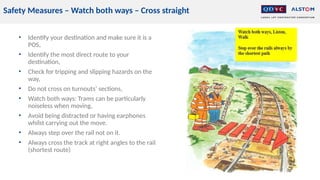
Safety Measures – Watch both ways – Cross straight
• Identify your destination and make sure it is a
POS,
• Identify the most direct route to your
destination,
• Check for tripping and slipping hazards on the
way,
• Do not cross on turnouts’ sections,
• Watch both ways: Trams can be particularly
noiseless when moving,
• Avoid being distracted or having earphones
whilst carrying out the move.
• Always step over the rail not on it.
• Always cross the track at right angles to the rail
(shortest route)
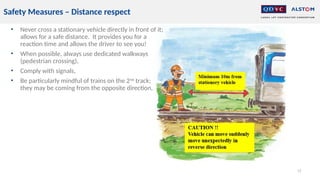
• Never cross a stationary vehicle directly in front of it;
allows for a safe distance. It provides you for a
reaction time and allows the driver to see you!
• When possible, always use dedicated walkways
(pedestrian crossing),
• Comply with signals,
• Be particularly mindful of trains on the 2nd
track;
they may be coming from the opposite direction,
13
Safety Measures – Distance respect
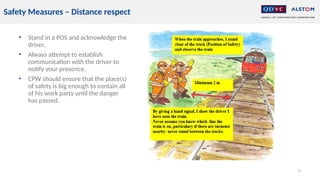
• Stand in a POS and acknowledge the
driver,
• Always attempt to establish
communication with the driver to
notify your presence.
• CPW should ensure that the place(s)
of safety is big enough to contain all
of his work party until the danger
has passed.
14
Safety Measures – Distance respect
When the Tram approaches:
• Stand in a place of safety,
• Always be two meters clear,
• By giving a hand signal I am showing
the Tram Driver I am clear,
• Do not use mobile phones or
electronic devices when on the track
15
Safety Measures – Distance respect
16
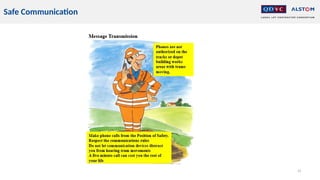
Safe Communication
17
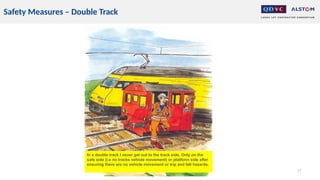
Safety Measures – Double Track
In a double track I never get out to the track side, Only on the
safe side (i.e no tracks vehicle movement) or platform side after
ensuring there are no vehicle movement or trip and fall hazards.
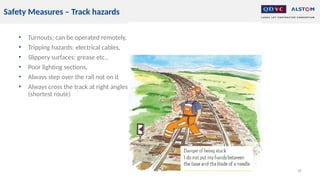
• Turnouts; can be operated remotely,
• Tripping hazards: electrical cables,
• Slippery surfaces: grease etc.,
• Poor lighting sections,
• Always step over the rail not on it
• Always cross the track at right angles to the rail
(shortest route)
18
Safety Measures – Track hazards
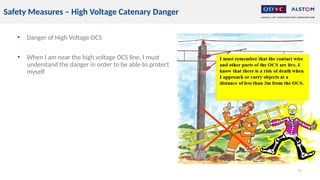
• Danger of High Voltage OCS
• When I am near the high voltage OCS line, I must
understand the danger in order to be able to protect
myself
19
Safety Measures – High Voltage Catenary Danger
Working In Electrical Environment
Once an area status has changed, you must:
• Assume all electrical circuits are live 24 hours a day,
• Report broken, ineffective or damaged electrical equipment instantly,
• Ensure that no-one comes into contact with such equipment until it is
repaired,
• Ensure that access to switchboard and electrical installations are clear –
emergency means of discharging power has to be kept clear of any
obstructions.
Never work until you get permission & “Permit to work” from the Temporary
Operations Department
Track Layout – Vertical view
Hazards Under the Energized OCS
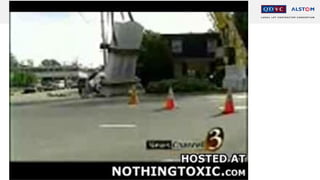
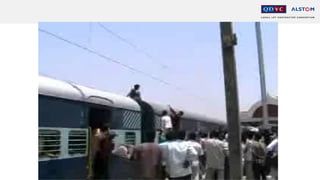
People are killed and injured each year by
accidental contact with overhead electrical
lines. Most of these accidents occurs when
cranes, excavators, tipper trucks, crane
mounted lorries, mobile extendable
machinery, scaffolding, ladders, concrete
delivery trucks etc. come close to or touch live
overhead lines.
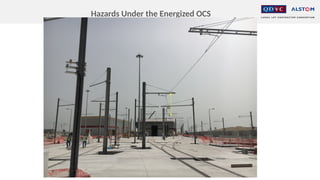
Hazards Under the Energized OCS
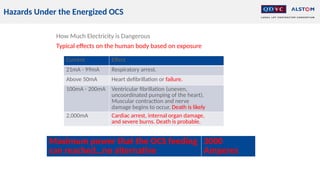
How Much Electricity is Dangerous
Typical effects on the human body based on exposure
Current Effect
21mA - 99mA Respiratory arrest.
Above 50mA Heart defibrillation or failure.
100mA - 200mA Ventricular fibrillation (uneven,
uncoordinated pumping of the heart).
Muscular contraction and nerve
damage begins to occur. Death is likely
2,000mA Cardiac arrest, internal organ damage,
and severe burns. Death is probable.
Maximum power that the OCS feeding
can reached…no alternative
3000
Amperes
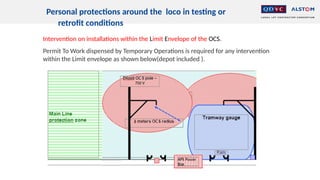
Intervention on installations within the Limit Envelope of the OCS.
Personal protections around the loco in testing or
retrofit conditions .
Permit To Work dispensed by Temporary Operations is required for any intervention
within the Limit envelope as shown below(depot included ).
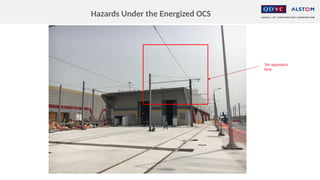
Hazards Under the Energized OCS
3m approach
limit
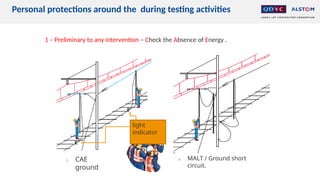
1 – Preliminary to any intervention – Check the Absence of Energy .
1. CAE
ground
Personal protections around the during testing activities
2. MALT / Ground short
circuit.
light
indicator
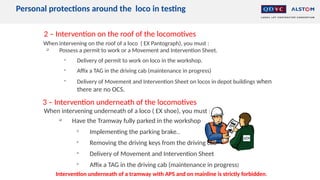
2 – Intervention on the roof of the locomotives
Personal protections around the loco in testing
When intervening on the roof of a loco ( EX Pantograph), you must :

Possess a permit to work or a Movement and Intervention Sheet.

Delivery of permit to work on loco in the workshop.

Affix a TAG in the driving cab (maintenance in progress)

Delivery of Movement and Intervention Sheet on locos in depot buildings when
there are no OCS.
3 – Intervention underneath of the locomotives
Intervention underneath of a tramway with APS and on mainline is strictly forbidden.
When intervening underneath of a loco ( EX shoe), you must :

Have the Tramway fully parked in the workshop

Implementing the parking brake..

Removing the driving keys from the driving cab

Delivery of Movement and Intervention Sheet

Affix a TAG in the driving cab (maintenance in progress)
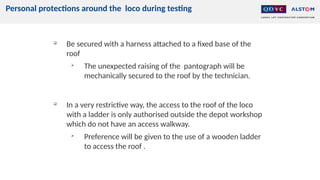
Personal protections around the loco during testing

Be secured with a harness attached to a fixed base of the
roof

The unexpected raising of the pantograph will be
mechanically secured to the roof by the technician.

In a very restrictive way, the access to the roof of the loco
with a ladder is only authorised outside the depot workshop
which do not have an access walkway.

Preference will be given to the use of a wooden ladder
to access the roof .
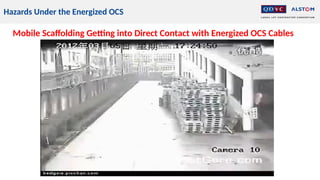
Hazards Under the Energized OCS
Mobile Scaffolding Getting into Direct Contact with Energized OCS Cables
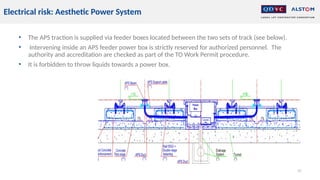
• The APS traction is supplied via feeder boxes located between the two sets of track (see below).
• Intervening inside an APS feeder power box is strictly reserved for authorized personnel. The
authority and accreditation are checked as part of the TO Work Permit procedure.
• It is forbidden to throw liquids towards a power box.
32
Electrical risk: Aesthetic Power System
EMERGENCY CALL
• All EMERGENCY messages & communications must be
given and received in ENGLISH .
• ALWAYS MAKE SURE THAT YOUR EMERGENCY
MESSAGE IS UNDERSTOOD!
• Communication starts with “THIS IS AN EMERGENCY
CALL”
• Communicate the “3 W”:
• Where the incident / accident is?
• What has exactly happened?
• Who are you?
• 30359901, 999 FLOR procedure to be adhered to
EMERGENCY CALL
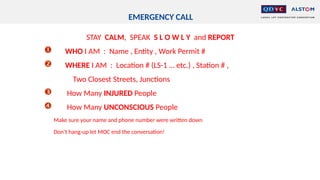
STAY CALM, SPEAK S L O W L Y and REPORT
 WHO I AM : Name , Entity , Work Permit #
 WHERE I AM : Location # (LS-1 … etc.) , Station # ,
Two Closest Streets, Junctions
 How Many INJURED People
 How Many UNCONSCIOUS People
Make sure your name and phone number were written down
Don’t hang-up let MOC end the conversation!
EMERGENCY CALL
• IN CASE OF ACCIDENT THE CPW SHALL
− PROTECT HIMSELF AND HIS TEAM
− CALL THE TEMPORARY OPERATION MANAGER ON CALL
(MOC) on 3035 9901
EMERGENCY CALL
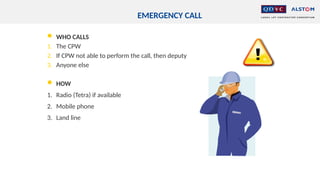
 WHO CALLS
1. The CPW
2. If CPW not able to perform the call, then deputy
3. Anyone else
 HOW
1. Radio (Tetra) if available
2. Mobile phone
3. Land line
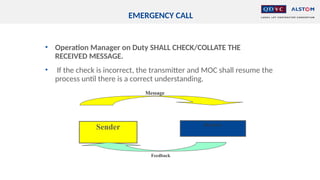
• Operation Manager on Duty SHALL CHECK/COLLATE THE
RECEIVED MESSAGE.
• If the check is incorrect, the transmitter and MOC shall resume the
process until there is a correct understanding.
EMERGENCY CALL
Message
Sender Receiver
Feedback
PIC – EMERGENCY REMINDER
• IF YOU ARE IN THE SUBSTATION, WORKSHOP or ANY OTHER
FACILITY IN THE DEPOT.
−ACTIVATE THE NEAREST EMERGENCY CUT OFF BUTTON IF
WITHIN IMMEDIATE EYE SIGHT
−Note : this should be part of the safety assessment you are
doing when preparing your Work Permit
- If you pushed the ECO you must inform the Temporary
operations (Traffic controller, PCE,MOTO).
CPW – EMERGENCY REMINDER
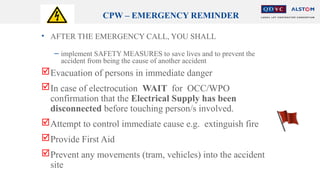
• AFTER THE EMERGENCY CALL, YOU SHALL
− implement SAFETY MEASURES to save lives and to prevent the
accident from being the cause of another accident
Evacuation of persons in immediate danger
In case of electrocution WAIT for OCC/WPO
confirmation that the Electrical Supply has been
disconnected before touching person/s involved.
Attempt to control immediate cause e.g. extinguish fire
Provide First Aid
Prevent any movements (tram, vehicles) into the accident
site
40
Blue Light Stations (BLS)
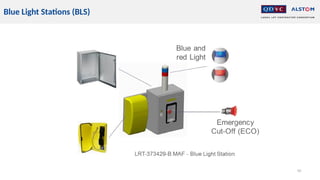
• BLS emergency cut-off buttons (ECOs) and emergency telephones are located in the following
locations:
− Each end of platform in underground stations,
− Tunnel emergency egress stairs (shafts),
− Tunnel Portals,
− OMF: Depot Access, Workshop Access, Stabling and Test Track,
− Traction Power Substations (TPS).
• When the ECO in the BLS is activated, the Traction Circuit Breakers (TCBs) of the related traction
section (plus the 2 sections either side) is tripped.
• The re-energisation of an activated BLS is undertaken locally.
• Re-energisation shall be made by the PSE of the party that push the button only after clearance of
the risk and in coordination/with approval of MOTO/Traffic controller.
41
Blue Light Stations (BLS)
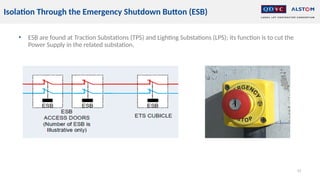
• ESB are found at Traction Substations (TPS) and Lighting Substations (LPS); its function is to cut the
Power Supply in the related substation,
42
Isolation Through the Emergency Shutdown Button (ESB)
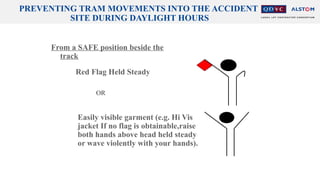
PREVENTING TRAM MOVEMENTS INTO THE ACCIDENT
SITE DURING DAYLIGHT HOURS
From a SAFE position beside the
track
Red Flag Held Steady
Easily visible garment (e.g. Hi Vis
jacket If no flag is obtainable,raise
both hands above head held steady
or wave violently with your hands).
OR
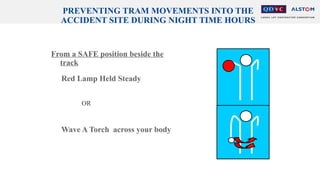
PREVENTING TRAM MOVEMENTS INTO THE
ACCIDENT SITE DURING NIGHT TIME HOURS
From a SAFE position beside the
track
Red Lamp Held Steady
OR
Wave A Torch across your body
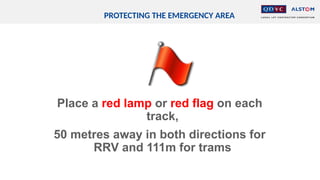
PROTECTING THE EMERGENCY AREA
Place a red lamp or red flag on each
track,
50 metres away in both directions for
RRV and 111m for trams
MAINTAINING THE EMERGENCY PROTECTION
• Stay with the red flag or lamp.
• Ensure someone else is at the other end of the
protected area.
• Stay there until relieved or told by Traffic
controller/MOTO on Duty that your protection is
no longer necessary.
• Make sure the area is correctly demarcated
2. Hazards Under the Energized OCS
Critical Activities Inside the Depot with the
existence of live OCS:
• Working at Height
• Lifting Operation too closed from the OCS area
• People crossing the track with long tools and equipment's.
• Using MEWP’s.
• Use of systems involving jet pressure of liquid.

The CPW always ensure him/her and the team involved is protected in addition to the protections
already put in place by the Work Permit Office.

CPW does the collective protection apart from the protective system put in place by work
permit office( EX: He provides the sign boards lamps stop boards etc.)

Must be in possession of the IC

Always carries out a last VAT check

The CPW and his technicians does not carry out any task which is not within his/her PTW Description:
answering to an urgent intervention request from his/her supervisor only engages his/her responsibility .

The PSE makes sure he is fully informed and takes into consideration the current information
given to him by his CPW concerning the electrical modifications carried out in his/her absence.

At the beginning of his shift, the technician asks his/her supervisor about the latest
instructions which have been put in place (Procedure – sign off sheet ).

The CPW and crew secures the access and protects himself/herself in order to restore the Power.

During energization the CPW and crew restricts access to the feeding area and goes to the
emergency tripping system ready to answer any emergency
3. Rules & Procedures For Works Inside The Depot/Energized
Rooms After the OCS Energization
Before any intervention in an energized environment -
even temporary – it is mandatory:
1 – CPW to consult and inform the PSE/Power Isolation Team for any intervention however
minor.
2 – CPW can obtained the single permit only for the specific activity.
3 – PSE to secure the intervention with earthing and the LOTO
LOTO = Lock Out / Tag Out
4 – CPW has to ensure his presence throughout the activity.
5 – CPW have to have a signed approved written PTW which can be checked at any time
(Permit To Work with electrical LOTO = Lock Out / Tag Out )
5 – CPW has to ensure the clearance of the specific area e.g. his team, tools and equipment
should be moved before signing the power Isolation/Resumption form(coordination with
his PSE), WPO can put power back without delay.
6 – CPW should brief his team about the OCS section boundaries that has been switched
off.
Roles and Responsibilities
7 – Power isolation team has to ensure standard procedure of
isolation.
8 – HSE department / personnel to ensure the Manager of
Temporary Operations (MOTO) is aware of the presence of work
permit prior to issue any work permit (Lifting Operation, Permit
to Dig & Working at height) near OCS. Awareness is made
through declaration on the TOWP request
9 – Senior Management/Site Management should evaluate the
effectiveness of administrative controls to improvise system.
Hazards Under the Energized OCS
Ladder Getting Into Contact With the Live HVC
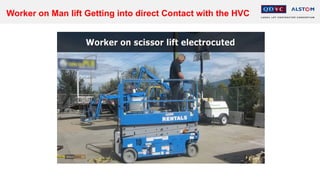
Worker on Man lift Getting into direct Contact with the HVC
53
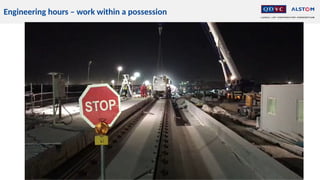
Engineering hours – work within a possession
• Engineering Hours are in contrast to T&C Hours. Switching from one to the other occurs after a Line Opening / Line
Closure procedure.
• On OCS areas, traction current is discharged during Eng. Hours; nevertheless, NEVER assume this, checks must be
carried out. Specifically, the CPW is responsible for:
− Collecting the work permit,
− Dispensing the safety briefing to his team including nearest means of communication and escape routes,
− Carrying out a VAT test,
− Visually checking that the site is secured; earthing rods in place, protection signage, barriers etc.,
− When applicable, mechanically locking the switching device with his own lock,
− Checking with the Temporary Operation department that the area is safe prior to commencing the work,
• Pay particular attention to Voltage Indicator Lights and safety signages,
• On APS sections, traction would remain permanently ON.
54
Engineering Hours Working
• Prior to entering a Tunnel to execute a work permit, the CPW must ascertain beyond any doubt that
Engineering Hours have indeed started.
• He does so by obtaining verbal confirmation from the Traffic Controller / MOTO 10/15mins before
commencing work.
• Once this is done, the CPW and his team proceed to a pre-arranged place of safety near to the tunnel
entrance and meet the TAC.
• The TAC retains all TO inducted cards; they would be returned once the work is completed and all have
cleared the track,
• At the end of the work, the CPW must ring back the Traffic Controller / MOTO to inform of the
clearance before returning personally the permit signed to the WPO for closure.
55
Engineering Hours Working
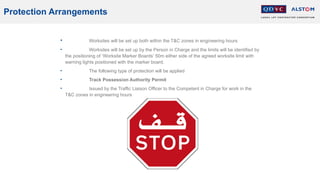
Protection Arrangements
• Worksites will be set up both within the T&C zones in engineering hours
• Worksites will be set up by the Person in Charge and the limits will be identified by
the positioning of ‘Worksite Marker Boards’ 50m either side of the agreed worksite limit with
warning lights positioned with the marker board.
• The following type of protection will be applied
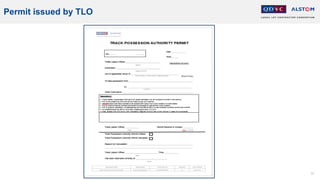
• Track Possession Authority Permit
• Issued by the Traffic Liaison Officer to the Competent in Charge for work in the
T&C zones in engineering hours
Personal Safety Reminder
• Medical fitness
− You must be medically fit to work on the railway
− If you are unable to work you must inform your supervisor (PIC)
• Drugs & Alcohol
− You must not be under the influence of either drugs or alcohol whilst working on the railway
− You can be tested at any time – a positive reading will result in your immediate removal from the project
− If you are taking prescribed medication ensure you inform your supervisor as this may impair you ability to work
• Fatigue
− Fatigue generally occurs when you don’t get enough sleep but it may be affected by other issues such as working
conditions, age, diet, fitness, shift work etc.
− If you are affected by fatigue your mental and physical performance will be diminished.
− The only way to overcome fatigue is to have good quality sleep (min 8 hrs is recommended). However drinking plenty
of water and taking regular breaks may help reduce the effects.
− In general you will not be required to work more than 10 hours per day and you will have at least one rest day after
13 days.
• No lone working when working on the railway.
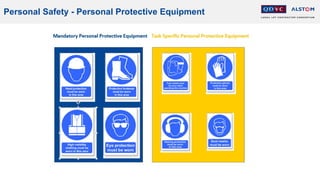
Personal Safety - Personal Protective Equipment
Summary
Rail site are dangerous places to work if you do not follow the
Rules and your personal safety will be at risk.
Never access the track without authorization……your life depends
on it!
If arrangements are not put in place to protect your safety you
should STOP and report it immediately.
Be safe – Act safe – and…….
See your family the next day
Any Questions?
Thank you
15th March 2018
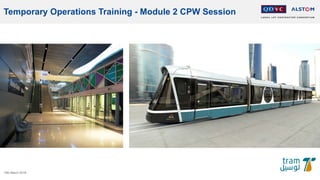
Temporary Operations Training - Module 2 CPW Session
63
Introduction – Scope and Resposibilities
• The Competent Person in Charge of Works (CPW) is the lead person from Contractor (partner/partner’s
subcontractor) with sufficient experience and competent to carry out an allocated task. The CPW is the
responsible person nominated by his organization to act as his delegate to receive the TOWP and then to carry
out pre-requisite safety briefings with the frontline workers. The CPW has to ensure that all works are safely and
diligently carried out in accordance with TOWPP requirements, scope and associated safe working procedures.
• A CPW implements 1 TOWP at a time on a single site. He must stay with his work group at all times during the
execution of the approved work.
64
The aim of this module is to provide additional instruction in your responsibilities as a competent
person in charge of work (CPW)
Prior to this module you shall have attended the T/O Induction training and Module 02.
By undertaking the Competent person In charge of works(CPW) role you are responsible for the safety
of yourself and the your workers.
Failure to undertake your duties correctly may result in severe injury to yourself, the workers under
your responsibility and may also result in derailment or damage to any track machines in your
worksite.
Introduction – Scope and Resposibilities
65
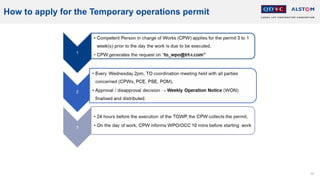
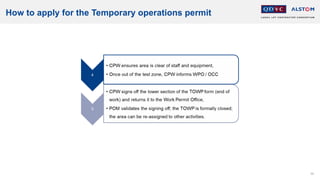
How to apply for the Temporary operations permit
66
How to apply for the Temporary operations permit
67
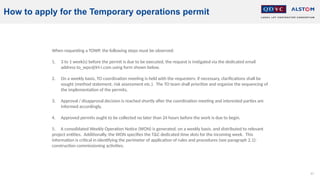
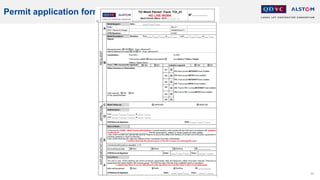
When requesting a TOWP, the following steps must be observed:
1. 3 to 1 week(s) before the permit is due to be executed, the request is instigated via the dedicated email
address to_wpo@lrt-i.com using form shown below.
2. On a weekly basis, TO coordination meeting is held with the requesters: if necessary, clarifications shall be
sought (method statement, risk assessment etc.). The TO team shall prioritize and organize the sequencing of
the implementation of the permits,
3. Approval / disapproval decision is reached shortly after the coordination meeting and interested parties are
informed accordingly,
4. Approved permits ought to be collected no later than 24 hours before the work is due to begin.
5. A consolidated Weekly Operation Notice (WON) is generated, on a weekly basis, and distributed to relevant
project entities. Additionally, the WON specifies the T&C dedicated time slots for the incoming week. This
information is critical in identifying the perimeter of application of rules and procedures (see paragraph 2.1):
construction commissioning activities.
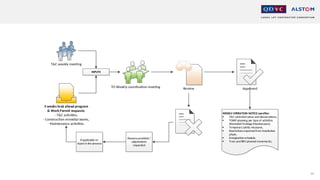
How to apply for the Temporary operations permit
68
Approved
Review
TO Weekly coordination meeting
WEEKLY OPERATION NOTICE specifies:
 T&C controled zones and demarcations,
 TOWP planning per typeof activities
(Remedial/Testings/Maintenance),
 Temporary safety measures,
 Restrictions exported from installation
phase,
 Energisation schedule,
 Tram and RRV planned movements,
3 weeks look ahead program
& Work Permit requests:
- T&C activities,
- Construction remedial works,
- Maintenance activities.
T&C weekly meeting
INPUTS
Reasons provided /
adjustments
requested
Ifapplicable re-
inject in the process
69
Permit application form
70
Permit issued by TLO
71
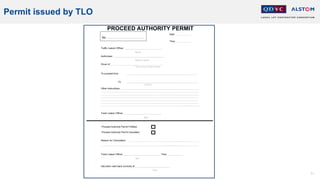
Permit issued by TLO
PROCEED AUTHORITY PERMIT
Date ____________
Time ____________
Traffic Liaison Officer _____________________________
Name
Authorises: ___________________________ __
Name of driver
Driver of ____________ __________________
Track Plant, Plate Number
To proceed from ____________ __________
To ________ ________________
Location
Other Instructions __________________________ __________________
__________________________________________________________________________
__________________________________________________________________________
__________________________________________________________________________
__________________________________________________________________________
__________________________________________________________________________
____________________________________________________________ ____
Track Liaison Officer _____________________________
Sign
Proceed Authority Permit Fulfilled
Proceed Authority Permit Cancelled
Reason for Cancelation __________________________________ _______
______________________________________________ ________________
Track Liaison Officer ____________________________ Time ____________
Sign
Has been read back correctly at ____ __
Time
No ………………………………….
72
How to fill the form
Safety reminder
A TOWP duly signed by both parties is the unique document authorizing works or static / dynamic tests to be
performed during T&C.
Completing the TO Work Permit, form TOI_01
Part A and B are the REQUEST section of the form. They are completed by the CPW when the work request is
filed in 3 to 1 week(s) before the work is due to be performed. The CPW specifies:
•His full details include mobile number,
•Description of the work to be carried out and the intended duration of the works. A risk assessment and/or a
method statement shall be supplied for safety sensitive works.
•Exact perimeter of the work: KP, room, track, line designation,
•Whether the work involves RRV or Tram movements,
•Whether isolation is required,
•The type of work intended as categorized on the form: P1 to P6,
•Whether the work involves the use of tools and if so, specify which ones.
73
How to fill the form
Part C and D are the APPROVAL part of the form. It is completed by the POM following the weekly coordination meeting and after final
review. On this section, the POM:
•States his decision on the permit: approved or rejected,
•Specifies the duration of the validity of the permit,
•Dates and signs.
Part E and F are the IMPLEMENTATION section of the form. Both sub-sections are filed in by the CPW.
•Part E is completed and signed when the CPW collect the permit latest 24 hours before execution.
•Part F is filled in and signed off at the end of the work. The CPW certifies that the area of work is clear of materials and all staffs have
vacated the zone and are in safety.
A TOWP short of essential details will not be validated and will be relegated to a new cycle of the process (request, coordination
assessment, prioritization etc.). It is therefore essential that TOWP forms are comprehensively filled in with accurate details in order for the
validator to reach an informed, safe decision. Additional information may be sought (method statement, risk analysis etc.).
74
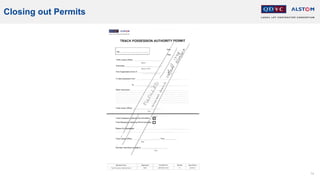
Closing out Permits
75
How T&C works
T&C HOURS RULES
T&C hours in this context refers to hours during which traction power is ON and/or trams are running on the Test Zone. These
hours are determined as per the T&C activities schedules incremented of 1 hour either side in order to carry out indispensable
safety checks.
T&C hours are under the management and coordination of the Manager Of Temporary Operations.
Operations time slots allocation
For safety reasons, during T&C, operations are organized in two distinct time slots:
T&C hours: during which T&C dynamic activities are planned: tram/RRV would be running and the traction power would be ON.
Engineering hours: these are hours outside the T&C dynamic activities. No tram / RRV movements would take place and OCS
power would be switched off. During engineering hours, construction remedial works would be undertaken.
76
Accessing the track areas or areas under T/O
Track access
• During T&C, access to the track is controlled by the Temporary Operations entity of IMAC. Access to the track in a test zone is organized
according to the following principles:
• No access is granted in track areas where Tram / RRV movement is planned for the whole duration of the testing activities,
• Access to the track for the purpose of construction remedial works and maintenance is granted exclusively during Engineering hours;
outside dynamic SIT activities time slots (added with a buffer time either side),
• On areas where trams movements are planned, with the exception of an RRV on a tram recovery mission, no other RRV movements
would be allowed at the same time,
• Outside periods of Tram / RRV movements, traction supplied by OCS is powered off. On the other hand, the APS supplied areas would
remain continuously energized.
The track is a risky environment: access to it is granted through a carefully planned process by which the area is secured by the Temporary
Operations team. However, even in the absence of moving vehicles (tram or RRV), the track remains a dangerous environment. Hazards are:
• Tripping hazards (cables etc.),
• Slipping surfaces (grease etc),
• Sharp objects, tools,
• Turnouts: they can be remotely operated at any time.
77
Some important points to remember
Braking distance
Basis on the hypothesis contained on the document quoted in reference as N°16 (RS brake calculation note), the emergency braking
distance under most constraining conditions has been estimated at 111 m for a tram running at 60km/h (just over 3 times a tram
length, 33m).
78
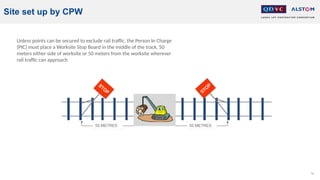
Site set up by CPW
Unless points can be secured to exclude rail traffic, the Person In Charge
(PIC) must place a Worksite Stop Board in the middle of the track, 50
meters either side of worksite or 50 meters from the worksite wherever
rail traffic can approach
79
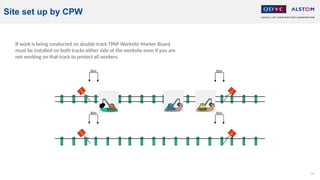
Site set up by CPW
If work is being conducted on double track TPAP Worksite Marker Board
must be installed on both tracks either side of the worksite even if you are
not working on that track to protect all workers.
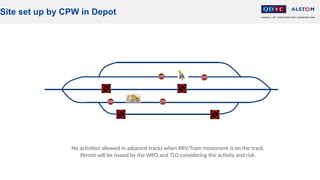
Site set up by CPW in Depot
No activities allowed in adjacent tracks when RRV/Tram movement is on the track.
Permit will be issued by the WPO and TLO considering the activity and risk.
81
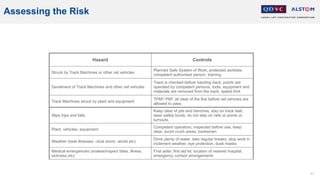
Assessing the Risk
Hazard Controls
Struck by Track Machines or other rail vehicles
Planned Safe System of Work, protected worksite,
competent authorised person, training,
Derailment of Track Machines and other rail vehicles
Track is checked before handing back, points are
operated by competent persons, tools, equipment and
materials are removed from the track, speed limit
Track Machines struck by plant and equipment
TPAP, PAP, all clear of the line before rail vehicles are
allowed to pass
Slips trips and falls
Keep clear of pits and trenches, stay on track slab,
wear safety boots, do not step on rails or points or
turnouts.
Plant, vehicles, equipment
Competent operators, inspected before use, keep
clear, avoid crush areas, banksmen
Weather (heat illnesses –dust storm, winds etc)
Drink plenty of water, take regular breaks, stop work in
inclement weather, eye protection, dusk masks
Medical emergencies (snakes/inspect bites, illness,
sickness etc)
First aider, first aid kit, location of nearest hospital,
emergency contact arrangements
82
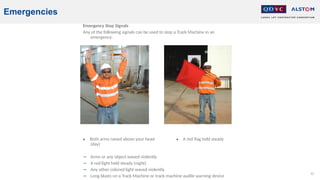
Emergencies
Emergency Stop Signals
Any of the following signals can be used to stop a Track Machine in an
emergency:
• Both arms raised above your head • A red flag held steady
(day)
− Arms or any object waved violently
− A red light held steady (night)
− Any other colored light waved violently
− Long blasts on a Track Machine or track machine audile warning device

Temporary Operations Training Module V3 SS.pptx

  • 1.
    15th March 2018 TemporaryOperations Training Module 2
  • 2.
    Temporary Operation Inducted– Track and TPS areas (Traction Power Supply) Module 2 Aim of this module is have an understanding of: • Track Safety whilst Tram and RRV are moving, • Behaviours to adopt in an energized environment, • Personal protection in an energized environment. 2 Temporary Operations Training Module 2
  • 3.
  • 4.
    • Temporary OperationInducted – Energized rooms and buildings Module 1 − This module provides electrical awareness and is mandatory module for all persons working in Temporary Operations areas In addition this module allows entry into energized rooms and buildings in accordance with the electrical habilitation training accreditation level − It also permits working around energized systems and cables accordance with the electrical habilitation training accreditation level − Persons who have attended any 3rd Party Apave electrical training modules and passed the examination are exempt from the electrical awareness part of the session • Temporary Operation Inducted – Track and TPS areas (Traction Power Supply) Module 2 − This module is mandatory to work on or in the vicinity of energized traction power supply (TPS) areas and track areas with Tram/RRV movements and Track Machine movements during T&C tests in zones controlled by the Temporary Operation entity (non CRO). − Applicable to Tunnel, At Grade, Depot and Viaduct areas under TO Rules, − Applicable to all APS, OCS and ROCS energized systems on the project. APS - Aesthetic Power Supply OCS – Overhead Catenary System ROCS - Rigid Overhead Catenary System 4 Temporary Operations Training Modules
  • 5.
    • Temporary OperationsInducted – LOTO – “Lock Out Tag Out” • Module LOTO − This module provides specific training in the LOTO requirements on the project and health and safety risks associated with this activity − This module is specific to electricians or CPW who will required to undertake a LOTO on an energized system − It outlines the health and safety risk associated with this activity and conducting safe isolations − Electricians attending this training will be permitted to conduct LOTO on the system voltage in accordance with the electrical habilitation training 5 Temporary Operations Training Modules
  • 6.
    Introduction – NewWorking Environment Installation 2 Testing 3 • OCS ENERGIZATION 750DCV • POWER SUB-STATION ENERGIZATION 33KV,11KV,6KV, 750DCV 4 Commissioning • RAILWAY VEHICLES RUNNING WORKING ENVIRONMENT IS CHANGING Formal (Memo) & Official Notice (WON) will warn all the project employees of the change of status of the environment
  • 7.
    • When tractionis energized in an area a new set of rules regarding Operation & Safety will be applied. Quick summary of new set of rules : • Any activity no matter the entity or the type of activity will be under the control of the Manager of Temporary Operations (MOTO) by means of Work Permit (TOWP) and the use of Isolation Certificate when required. • Access to any of these areas will be strictly controlled and specific access conditions will be granted after training. • Any disrespect of the new set of rules will be liable to disciplinary action 7 Temporary Operations Training Module 2
  • 8.
    Rules & proceduresfor works after the OCS energization  Working in or near an energised environment commands specific training; they are tailored to the work to be undertaken. These trainings are a mandatory requirement.  A dedicated training describing the OCS hazards reminds you the permanent dangers and actions to carry out before working within the OCS area.  Without written PTW and an electrical accreditation, the CPW and his team /(PSE) does not go near nor touch an equipment which might be potentially energized.  In confined space the energized installations are clearly labelled thus defining the risk areas.  Isolation certificate issued by the PSE (LOTO) guaranties the de-energization during the whole intervention.  The technician (CPW) always presumes that the equipment is energized.  Even though a work permit has been issued and the technician has it in hand, he/she still Checks the Absence of Energy before starting work (as per LOTO).
  • 9.
    Running Railway Vehicles: • Somebody walking hit by a railway vehicle • A vehicle (crane, bus, truck) along the track hits a railway vehicle or being hit by it Live OCS : • Somebody touches the OCS (from a scaffolding, ladder, top of train, …) • Somebody touches the OCS with an object (rule, measuring tape, rope, …) • Somebody touches the OCS while carrying long articles such as pipes or ladder • Somebody touches the OCS while washing, painting, repairing or carrying out work on Tramways or Rail Road Vehicle’s • A crane touches the OCS • A wire close to a live OCS is energized by induction (magnetic field) • Whilst working on a roof close to OCS somebody touches the OCS Moving blades on the turnout • Ankle or hand being caught between the running rail and the blade 9 Introduction – New Risks
  • 10.
    Safety measure –Place Of Safety (POS) • A POS is an area where there is a minimum of 2 m between the outer running rail and the POS or the outer running rail and the POS are separated by physical barriers (i.e. PSD) • Some areas have no POS! i.e. on viaduct, tunnels. They are referred to as “limited clearance” areas. Hence prior to accessing a limited clearance area, it is paramount that checks are carried out to ascertain no tram/RRV are moving in the zone. Even when equipped with an approved work permit, the CPW, prior to entering the zone, MUST liaise with the traffic Controller in order to get final clearance. • It is good practise, in the planning of work, to identify POS and direct routes to them. • CPW should ensure that the place(s) of safety is big enough to contain all of his work party until the danger has passed. place of safety 2 meters
  • 11.
    11 Always stand ina POS when rail vehicles approach
  • 12.
    Safety Measures –Watch both ways – Cross straight • Identify your destination and make sure it is a POS, • Identify the most direct route to your destination, • Check for tripping and slipping hazards on the way, • Do not cross on turnouts’ sections, • Watch both ways: Trams can be particularly noiseless when moving, • Avoid being distracted or having earphones whilst carrying out the move. • Always step over the rail not on it. • Always cross the track at right angles to the rail (shortest route)
  • 13.
    • Never crossa stationary vehicle directly in front of it; allows for a safe distance. It provides you for a reaction time and allows the driver to see you! • When possible, always use dedicated walkways (pedestrian crossing), • Comply with signals, • Be particularly mindful of trains on the 2nd track; they may be coming from the opposite direction, 13 Safety Measures – Distance respect
  • 14.
    • Stand ina POS and acknowledge the driver, • Always attempt to establish communication with the driver to notify your presence. • CPW should ensure that the place(s) of safety is big enough to contain all of his work party until the danger has passed. 14 Safety Measures – Distance respect
  • 15.
    When the Tramapproaches: • Stand in a place of safety, • Always be two meters clear, • By giving a hand signal I am showing the Tram Driver I am clear, • Do not use mobile phones or electronic devices when on the track 15 Safety Measures – Distance respect
  • 16.
  • 17.
    17 Safety Measures –Double Track In a double track I never get out to the track side, Only on the safe side (i.e no tracks vehicle movement) or platform side after ensuring there are no vehicle movement or trip and fall hazards.
  • 18.
    • Turnouts; canbe operated remotely, • Tripping hazards: electrical cables, • Slippery surfaces: grease etc., • Poor lighting sections, • Always step over the rail not on it • Always cross the track at right angles to the rail (shortest route) 18 Safety Measures – Track hazards
  • 19.
    • Danger ofHigh Voltage OCS • When I am near the high voltage OCS line, I must understand the danger in order to be able to protect myself 19 Safety Measures – High Voltage Catenary Danger
  • 20.
    Working In ElectricalEnvironment Once an area status has changed, you must: • Assume all electrical circuits are live 24 hours a day, • Report broken, ineffective or damaged electrical equipment instantly, • Ensure that no-one comes into contact with such equipment until it is repaired, • Ensure that access to switchboard and electrical installations are clear – emergency means of discharging power has to be kept clear of any obstructions. Never work until you get permission & “Permit to work” from the Temporary Operations Department
  • 21.
    Track Layout –Vertical view
  • 22.
    Hazards Under theEnergized OCS People are killed and injured each year by accidental contact with overhead electrical lines. Most of these accidents occurs when cranes, excavators, tipper trucks, crane mounted lorries, mobile extendable machinery, scaffolding, ladders, concrete delivery trucks etc. come close to or touch live overhead lines.
  • 24.
    Hazards Under theEnergized OCS How Much Electricity is Dangerous Typical effects on the human body based on exposure Current Effect 21mA - 99mA Respiratory arrest. Above 50mA Heart defibrillation or failure. 100mA - 200mA Ventricular fibrillation (uneven, uncoordinated pumping of the heart). Muscular contraction and nerve damage begins to occur. Death is likely 2,000mA Cardiac arrest, internal organ damage, and severe burns. Death is probable. Maximum power that the OCS feeding can reached…no alternative 3000 Amperes
  • 25.
    Intervention on installationswithin the Limit Envelope of the OCS. Personal protections around the loco in testing or retrofit conditions . Permit To Work dispensed by Temporary Operations is required for any intervention within the Limit envelope as shown below(depot included ).
  • 26.
    Hazards Under theEnergized OCS
  • 27.
    Hazards Under theEnergized OCS 3m approach limit
  • 28.
    1 – Preliminaryto any intervention – Check the Absence of Energy . 1. CAE ground Personal protections around the during testing activities 2. MALT / Ground short circuit. light indicator
  • 29.
    2 – Interventionon the roof of the locomotives Personal protections around the loco in testing When intervening on the roof of a loco ( EX Pantograph), you must :  Possess a permit to work or a Movement and Intervention Sheet.  Delivery of permit to work on loco in the workshop.  Affix a TAG in the driving cab (maintenance in progress)  Delivery of Movement and Intervention Sheet on locos in depot buildings when there are no OCS. 3 – Intervention underneath of the locomotives Intervention underneath of a tramway with APS and on mainline is strictly forbidden. When intervening underneath of a loco ( EX shoe), you must :  Have the Tramway fully parked in the workshop  Implementing the parking brake..  Removing the driving keys from the driving cab  Delivery of Movement and Intervention Sheet  Affix a TAG in the driving cab (maintenance in progress)
  • 30.
    Personal protections aroundthe loco during testing  Be secured with a harness attached to a fixed base of the roof  The unexpected raising of the pantograph will be mechanically secured to the roof by the technician.  In a very restrictive way, the access to the roof of the loco with a ladder is only authorised outside the depot workshop which do not have an access walkway.  Preference will be given to the use of a wooden ladder to access the roof .
  • 31.
    Hazards Under theEnergized OCS Mobile Scaffolding Getting into Direct Contact with Energized OCS Cables
  • 32.
    • The APStraction is supplied via feeder boxes located between the two sets of track (see below). • Intervening inside an APS feeder power box is strictly reserved for authorized personnel. The authority and accreditation are checked as part of the TO Work Permit procedure. • It is forbidden to throw liquids towards a power box. 32 Electrical risk: Aesthetic Power System
  • 33.
    EMERGENCY CALL • AllEMERGENCY messages & communications must be given and received in ENGLISH . • ALWAYS MAKE SURE THAT YOUR EMERGENCY MESSAGE IS UNDERSTOOD! • Communication starts with “THIS IS AN EMERGENCY CALL” • Communicate the “3 W”: • Where the incident / accident is? • What has exactly happened? • Who are you? • 30359901, 999 FLOR procedure to be adhered to
  • 34.
    EMERGENCY CALL STAY CALM,SPEAK S L O W L Y and REPORT  WHO I AM : Name , Entity , Work Permit #  WHERE I AM : Location # (LS-1 … etc.) , Station # , Two Closest Streets, Junctions  How Many INJURED People  How Many UNCONSCIOUS People Make sure your name and phone number were written down Don’t hang-up let MOC end the conversation!
  • 35.
    EMERGENCY CALL • INCASE OF ACCIDENT THE CPW SHALL − PROTECT HIMSELF AND HIS TEAM − CALL THE TEMPORARY OPERATION MANAGER ON CALL (MOC) on 3035 9901
  • 36.
    EMERGENCY CALL  WHOCALLS 1. The CPW 2. If CPW not able to perform the call, then deputy 3. Anyone else  HOW 1. Radio (Tetra) if available 2. Mobile phone 3. Land line
  • 37.
    • Operation Manageron Duty SHALL CHECK/COLLATE THE RECEIVED MESSAGE. • If the check is incorrect, the transmitter and MOC shall resume the process until there is a correct understanding. EMERGENCY CALL Message Sender Receiver Feedback
  • 38.
    PIC – EMERGENCYREMINDER • IF YOU ARE IN THE SUBSTATION, WORKSHOP or ANY OTHER FACILITY IN THE DEPOT. −ACTIVATE THE NEAREST EMERGENCY CUT OFF BUTTON IF WITHIN IMMEDIATE EYE SIGHT −Note : this should be part of the safety assessment you are doing when preparing your Work Permit - If you pushed the ECO you must inform the Temporary operations (Traffic controller, PCE,MOTO).
  • 39.
    CPW – EMERGENCYREMINDER • AFTER THE EMERGENCY CALL, YOU SHALL − implement SAFETY MEASURES to save lives and to prevent the accident from being the cause of another accident Evacuation of persons in immediate danger In case of electrocution WAIT for OCC/WPO confirmation that the Electrical Supply has been disconnected before touching person/s involved. Attempt to control immediate cause e.g. extinguish fire Provide First Aid Prevent any movements (tram, vehicles) into the accident site
  • 40.
  • 41.
    • BLS emergencycut-off buttons (ECOs) and emergency telephones are located in the following locations: − Each end of platform in underground stations, − Tunnel emergency egress stairs (shafts), − Tunnel Portals, − OMF: Depot Access, Workshop Access, Stabling and Test Track, − Traction Power Substations (TPS). • When the ECO in the BLS is activated, the Traction Circuit Breakers (TCBs) of the related traction section (plus the 2 sections either side) is tripped. • The re-energisation of an activated BLS is undertaken locally. • Re-energisation shall be made by the PSE of the party that push the button only after clearance of the risk and in coordination/with approval of MOTO/Traffic controller. 41 Blue Light Stations (BLS)
  • 42.
    • ESB arefound at Traction Substations (TPS) and Lighting Substations (LPS); its function is to cut the Power Supply in the related substation, 42 Isolation Through the Emergency Shutdown Button (ESB)
  • 43.
    PREVENTING TRAM MOVEMENTSINTO THE ACCIDENT SITE DURING DAYLIGHT HOURS From a SAFE position beside the track Red Flag Held Steady Easily visible garment (e.g. Hi Vis jacket If no flag is obtainable,raise both hands above head held steady or wave violently with your hands). OR
  • 44.
    PREVENTING TRAM MOVEMENTSINTO THE ACCIDENT SITE DURING NIGHT TIME HOURS From a SAFE position beside the track Red Lamp Held Steady OR Wave A Torch across your body
  • 45.
    PROTECTING THE EMERGENCYAREA Place a red lamp or red flag on each track, 50 metres away in both directions for RRV and 111m for trams
  • 46.
    MAINTAINING THE EMERGENCYPROTECTION • Stay with the red flag or lamp. • Ensure someone else is at the other end of the protected area. • Stay there until relieved or told by Traffic controller/MOTO on Duty that your protection is no longer necessary. • Make sure the area is correctly demarcated
  • 47.
    2. Hazards Underthe Energized OCS Critical Activities Inside the Depot with the existence of live OCS: • Working at Height • Lifting Operation too closed from the OCS area • People crossing the track with long tools and equipment's. • Using MEWP’s. • Use of systems involving jet pressure of liquid.
  • 48.
     The CPW alwaysensure him/her and the team involved is protected in addition to the protections already put in place by the Work Permit Office.  CPW does the collective protection apart from the protective system put in place by work permit office( EX: He provides the sign boards lamps stop boards etc.)  Must be in possession of the IC  Always carries out a last VAT check  The CPW and his technicians does not carry out any task which is not within his/her PTW Description: answering to an urgent intervention request from his/her supervisor only engages his/her responsibility .  The PSE makes sure he is fully informed and takes into consideration the current information given to him by his CPW concerning the electrical modifications carried out in his/her absence.  At the beginning of his shift, the technician asks his/her supervisor about the latest instructions which have been put in place (Procedure – sign off sheet ).  The CPW and crew secures the access and protects himself/herself in order to restore the Power.  During energization the CPW and crew restricts access to the feeding area and goes to the emergency tripping system ready to answer any emergency 3. Rules & Procedures For Works Inside The Depot/Energized Rooms After the OCS Energization
  • 49.
    Before any interventionin an energized environment - even temporary – it is mandatory: 1 – CPW to consult and inform the PSE/Power Isolation Team for any intervention however minor. 2 – CPW can obtained the single permit only for the specific activity. 3 – PSE to secure the intervention with earthing and the LOTO LOTO = Lock Out / Tag Out 4 – CPW has to ensure his presence throughout the activity. 5 – CPW have to have a signed approved written PTW which can be checked at any time (Permit To Work with electrical LOTO = Lock Out / Tag Out ) 5 – CPW has to ensure the clearance of the specific area e.g. his team, tools and equipment should be moved before signing the power Isolation/Resumption form(coordination with his PSE), WPO can put power back without delay. 6 – CPW should brief his team about the OCS section boundaries that has been switched off. Roles and Responsibilities
  • 50.
    Roles and Responsibilities 7– Power isolation team has to ensure standard procedure of isolation. 8 – HSE department / personnel to ensure the Manager of Temporary Operations (MOTO) is aware of the presence of work permit prior to issue any work permit (Lifting Operation, Permit to Dig & Working at height) near OCS. Awareness is made through declaration on the TOWP request 9 – Senior Management/Site Management should evaluate the effectiveness of administrative controls to improvise system.
  • 51.
    Hazards Under theEnergized OCS Ladder Getting Into Contact With the Live HVC
  • 52.
    Worker on Manlift Getting into direct Contact with the HVC
  • 53.
    53 Engineering hours –work within a possession
  • 54.
    • Engineering Hoursare in contrast to T&C Hours. Switching from one to the other occurs after a Line Opening / Line Closure procedure. • On OCS areas, traction current is discharged during Eng. Hours; nevertheless, NEVER assume this, checks must be carried out. Specifically, the CPW is responsible for: − Collecting the work permit, − Dispensing the safety briefing to his team including nearest means of communication and escape routes, − Carrying out a VAT test, − Visually checking that the site is secured; earthing rods in place, protection signage, barriers etc., − When applicable, mechanically locking the switching device with his own lock, − Checking with the Temporary Operation department that the area is safe prior to commencing the work, • Pay particular attention to Voltage Indicator Lights and safety signages, • On APS sections, traction would remain permanently ON. 54 Engineering Hours Working
  • 55.
    • Prior toentering a Tunnel to execute a work permit, the CPW must ascertain beyond any doubt that Engineering Hours have indeed started. • He does so by obtaining verbal confirmation from the Traffic Controller / MOTO 10/15mins before commencing work. • Once this is done, the CPW and his team proceed to a pre-arranged place of safety near to the tunnel entrance and meet the TAC. • The TAC retains all TO inducted cards; they would be returned once the work is completed and all have cleared the track, • At the end of the work, the CPW must ring back the Traffic Controller / MOTO to inform of the clearance before returning personally the permit signed to the WPO for closure. 55 Engineering Hours Working
  • 56.
    Protection Arrangements • Worksiteswill be set up both within the T&C zones in engineering hours • Worksites will be set up by the Person in Charge and the limits will be identified by the positioning of ‘Worksite Marker Boards’ 50m either side of the agreed worksite limit with warning lights positioned with the marker board. • The following type of protection will be applied • Track Possession Authority Permit • Issued by the Traffic Liaison Officer to the Competent in Charge for work in the T&C zones in engineering hours
  • 57.
    Personal Safety Reminder •Medical fitness − You must be medically fit to work on the railway − If you are unable to work you must inform your supervisor (PIC) • Drugs & Alcohol − You must not be under the influence of either drugs or alcohol whilst working on the railway − You can be tested at any time – a positive reading will result in your immediate removal from the project − If you are taking prescribed medication ensure you inform your supervisor as this may impair you ability to work • Fatigue − Fatigue generally occurs when you don’t get enough sleep but it may be affected by other issues such as working conditions, age, diet, fitness, shift work etc. − If you are affected by fatigue your mental and physical performance will be diminished. − The only way to overcome fatigue is to have good quality sleep (min 8 hrs is recommended). However drinking plenty of water and taking regular breaks may help reduce the effects. − In general you will not be required to work more than 10 hours per day and you will have at least one rest day after 13 days. • No lone working when working on the railway.
  • 58.
    Personal Safety -Personal Protective Equipment
  • 59.
    Summary Rail site aredangerous places to work if you do not follow the Rules and your personal safety will be at risk. Never access the track without authorization……your life depends on it! If arrangements are not put in place to protect your safety you should STOP and report it immediately. Be safe – Act safe – and……. See your family the next day
  • 60.
  • 61.
  • 62.
    15th March 2018 TemporaryOperations Training - Module 2 CPW Session
  • 63.
    63 Introduction – Scopeand Resposibilities • The Competent Person in Charge of Works (CPW) is the lead person from Contractor (partner/partner’s subcontractor) with sufficient experience and competent to carry out an allocated task. The CPW is the responsible person nominated by his organization to act as his delegate to receive the TOWP and then to carry out pre-requisite safety briefings with the frontline workers. The CPW has to ensure that all works are safely and diligently carried out in accordance with TOWPP requirements, scope and associated safe working procedures. • A CPW implements 1 TOWP at a time on a single site. He must stay with his work group at all times during the execution of the approved work.
  • 64.
    64 The aim ofthis module is to provide additional instruction in your responsibilities as a competent person in charge of work (CPW) Prior to this module you shall have attended the T/O Induction training and Module 02. By undertaking the Competent person In charge of works(CPW) role you are responsible for the safety of yourself and the your workers. Failure to undertake your duties correctly may result in severe injury to yourself, the workers under your responsibility and may also result in derailment or damage to any track machines in your worksite. Introduction – Scope and Resposibilities
  • 65.
    65 How to applyfor the Temporary operations permit
  • 66.
    66 How to applyfor the Temporary operations permit
  • 67.
    67 When requesting aTOWP, the following steps must be observed: 1. 3 to 1 week(s) before the permit is due to be executed, the request is instigated via the dedicated email address to_wpo@lrt-i.com using form shown below. 2. On a weekly basis, TO coordination meeting is held with the requesters: if necessary, clarifications shall be sought (method statement, risk assessment etc.). The TO team shall prioritize and organize the sequencing of the implementation of the permits, 3. Approval / disapproval decision is reached shortly after the coordination meeting and interested parties are informed accordingly, 4. Approved permits ought to be collected no later than 24 hours before the work is due to begin. 5. A consolidated Weekly Operation Notice (WON) is generated, on a weekly basis, and distributed to relevant project entities. Additionally, the WON specifies the T&C dedicated time slots for the incoming week. This information is critical in identifying the perimeter of application of rules and procedures (see paragraph 2.1): construction commissioning activities. How to apply for the Temporary operations permit
  • 68.
    68 Approved Review TO Weekly coordinationmeeting WEEKLY OPERATION NOTICE specifies:  T&C controled zones and demarcations,  TOWP planning per typeof activities (Remedial/Testings/Maintenance),  Temporary safety measures,  Restrictions exported from installation phase,  Energisation schedule,  Tram and RRV planned movements, 3 weeks look ahead program & Work Permit requests: - T&C activities, - Construction remedial works, - Maintenance activities. T&C weekly meeting INPUTS Reasons provided / adjustments requested Ifapplicable re- inject in the process
  • 69.
  • 70.
  • 71.
    71 Permit issued byTLO PROCEED AUTHORITY PERMIT Date ____________ Time ____________ Traffic Liaison Officer _____________________________ Name Authorises: ___________________________ __ Name of driver Driver of ____________ __________________ Track Plant, Plate Number To proceed from ____________ __________ To ________ ________________ Location Other Instructions __________________________ __________________ __________________________________________________________________________ __________________________________________________________________________ __________________________________________________________________________ __________________________________________________________________________ __________________________________________________________________________ ____________________________________________________________ ____ Track Liaison Officer _____________________________ Sign Proceed Authority Permit Fulfilled Proceed Authority Permit Cancelled Reason for Cancelation __________________________________ _______ ______________________________________________ ________________ Track Liaison Officer ____________________________ Time ____________ Sign Has been read back correctly at ____ __ Time No ………………………………….
  • 72.
    72 How to fillthe form Safety reminder A TOWP duly signed by both parties is the unique document authorizing works or static / dynamic tests to be performed during T&C. Completing the TO Work Permit, form TOI_01 Part A and B are the REQUEST section of the form. They are completed by the CPW when the work request is filed in 3 to 1 week(s) before the work is due to be performed. The CPW specifies: •His full details include mobile number, •Description of the work to be carried out and the intended duration of the works. A risk assessment and/or a method statement shall be supplied for safety sensitive works. •Exact perimeter of the work: KP, room, track, line designation, •Whether the work involves RRV or Tram movements, •Whether isolation is required, •The type of work intended as categorized on the form: P1 to P6, •Whether the work involves the use of tools and if so, specify which ones.
  • 73.
    73 How to fillthe form Part C and D are the APPROVAL part of the form. It is completed by the POM following the weekly coordination meeting and after final review. On this section, the POM: •States his decision on the permit: approved or rejected, •Specifies the duration of the validity of the permit, •Dates and signs. Part E and F are the IMPLEMENTATION section of the form. Both sub-sections are filed in by the CPW. •Part E is completed and signed when the CPW collect the permit latest 24 hours before execution. •Part F is filled in and signed off at the end of the work. The CPW certifies that the area of work is clear of materials and all staffs have vacated the zone and are in safety. A TOWP short of essential details will not be validated and will be relegated to a new cycle of the process (request, coordination assessment, prioritization etc.). It is therefore essential that TOWP forms are comprehensively filled in with accurate details in order for the validator to reach an informed, safe decision. Additional information may be sought (method statement, risk analysis etc.).
  • 74.
  • 75.
    75 How T&C works T&CHOURS RULES T&C hours in this context refers to hours during which traction power is ON and/or trams are running on the Test Zone. These hours are determined as per the T&C activities schedules incremented of 1 hour either side in order to carry out indispensable safety checks. T&C hours are under the management and coordination of the Manager Of Temporary Operations. Operations time slots allocation For safety reasons, during T&C, operations are organized in two distinct time slots: T&C hours: during which T&C dynamic activities are planned: tram/RRV would be running and the traction power would be ON. Engineering hours: these are hours outside the T&C dynamic activities. No tram / RRV movements would take place and OCS power would be switched off. During engineering hours, construction remedial works would be undertaken.
  • 76.
    76 Accessing the trackareas or areas under T/O Track access • During T&C, access to the track is controlled by the Temporary Operations entity of IMAC. Access to the track in a test zone is organized according to the following principles: • No access is granted in track areas where Tram / RRV movement is planned for the whole duration of the testing activities, • Access to the track for the purpose of construction remedial works and maintenance is granted exclusively during Engineering hours; outside dynamic SIT activities time slots (added with a buffer time either side), • On areas where trams movements are planned, with the exception of an RRV on a tram recovery mission, no other RRV movements would be allowed at the same time, • Outside periods of Tram / RRV movements, traction supplied by OCS is powered off. On the other hand, the APS supplied areas would remain continuously energized. The track is a risky environment: access to it is granted through a carefully planned process by which the area is secured by the Temporary Operations team. However, even in the absence of moving vehicles (tram or RRV), the track remains a dangerous environment. Hazards are: • Tripping hazards (cables etc.), • Slipping surfaces (grease etc), • Sharp objects, tools, • Turnouts: they can be remotely operated at any time.
  • 77.
    77 Some important pointsto remember Braking distance Basis on the hypothesis contained on the document quoted in reference as N°16 (RS brake calculation note), the emergency braking distance under most constraining conditions has been estimated at 111 m for a tram running at 60km/h (just over 3 times a tram length, 33m).
  • 78.
    78 Site set upby CPW Unless points can be secured to exclude rail traffic, the Person In Charge (PIC) must place a Worksite Stop Board in the middle of the track, 50 meters either side of worksite or 50 meters from the worksite wherever rail traffic can approach
  • 79.
    79 Site set upby CPW If work is being conducted on double track TPAP Worksite Marker Board must be installed on both tracks either side of the worksite even if you are not working on that track to protect all workers.
  • 80.
    Site set upby CPW in Depot No activities allowed in adjacent tracks when RRV/Tram movement is on the track. Permit will be issued by the WPO and TLO considering the activity and risk.
  • 81.
    81 Assessing the Risk HazardControls Struck by Track Machines or other rail vehicles Planned Safe System of Work, protected worksite, competent authorised person, training, Derailment of Track Machines and other rail vehicles Track is checked before handing back, points are operated by competent persons, tools, equipment and materials are removed from the track, speed limit Track Machines struck by plant and equipment TPAP, PAP, all clear of the line before rail vehicles are allowed to pass Slips trips and falls Keep clear of pits and trenches, stay on track slab, wear safety boots, do not step on rails or points or turnouts. Plant, vehicles, equipment Competent operators, inspected before use, keep clear, avoid crush areas, banksmen Weather (heat illnesses –dust storm, winds etc) Drink plenty of water, take regular breaks, stop work in inclement weather, eye protection, dusk masks Medical emergencies (snakes/inspect bites, illness, sickness etc) First aider, first aid kit, location of nearest hospital, emergency contact arrangements
  • 82.
    82 Emergencies Emergency Stop Signals Anyof the following signals can be used to stop a Track Machine in an emergency: • Both arms raised above your head • A red flag held steady (day) − Arms or any object waved violently − A red light held steady (night) − Any other colored light waved violently − Long blasts on a Track Machine or track machine audile warning device