Sentence Structure of Technical Writing 
Nicole Kelley 
Program in Writing and Humanistic Studies @ MIT 
2.671, Fall 2006 
Lecture materials derived from The Craft of Scientific Writing©Michael Alley 
and “The Science of Scientific Writing”by Gopenand Swan
“The fundamental purpose of scientific discourse is not the mere presentation of information and thought but rather its actual communication. It does not matter how pleased an author might be to have converted all the right data into sentences and paragraphs; it matters only whether a large majority of the reading audience accurately perceives what the author had in mind.” 
--George Gopen and Judith Swan 
The Science of Scientific Writing
3 
Good Tech Writers Practice 
•Planning 
•Clarity 
•Brevity 
•Simplicity 
•Word Choice 
•Active Voice 
•Committing to Writing as a ProcessWritingRevisingPlanning/ Rethinking
4 
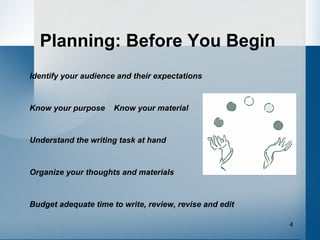
Planning: Before You Begin 
Identify your audience and their expectations 
Know your purpose Know your material 
Understand the writing taskat handOrganize your thoughts and materialsBudget adequate time to write, review, revise and edit
5 
Clarity: Avoid Jargon 
•Jargon: a vocabulary particular to a place of work (abbreviations, slang) 
•Audience familiaritywith the topic determines appropriate use of jargon 
Ex. 1:For the first year, the links with SDPC and the HAC were not connected, and all required OCS input data were artificially loaded. Thus CATCH22 and MERWIN were not available. 
Ex. 2:Because some of the links in the computer system were not connected the first year, we could not run all the software codes.
6 
Clarity: Define the Unfamiliar 
•If you must abbreviate, define the term in its first occurrence, and put abbreviations in parentheses 
Ex: Edgartown Great Pond (EGP) is a vital body of water. Unfortunately, due to an unpredictable influx of saltwater, the delicate ecosystem is in danger of destabilizing. 
•Italicize first occurrenceof unfamiliar terms and define them right away 
Ex: Retinais a light-sensitive tissue, found at the back of the eye, that converts light impulses to nerve impulses.
7 
Brevity: Use Words Efficiently 
•Never use two words when one word will do. 
Ex. 1: The relationship between the nature of salt water to fresh water in the Edgartown Great Pond that fluctuates often is extremely important to everyone including scientists, residents, and environmentalists on Martha’s Vineyard. 
Ex. 2: The fluctuating salinity of EGP concerns many environmentalists, scientists, and residents.
8 
Brevity: Less Is More 
•Pare your language down to the essential messageyou want to get across to your readers: 
Ex: Earthquakes can occur at predictable intervals along a given fault segment. Depending on the length and slip in each mainshock, the exact interval can vary by a factor of two. The southern segment of the San Andreas fault has an interval of 145 years, plus or minus a few decades.
9 
Brevity: Most Important First 
•Placekey information in the main clause 
Ex. 1: Despite winning the game, the Patriots made several errors in the first half. 
Ex. 2: Despite making several errors in the first half, the Patriots won the game. 
Ex. 3: The Patriots won the game, despite making several errors in the first half.
10 
Brevity: Remove Redundancy 
•Combine overlapping sentenceswhen possible 
Ex. 1: Water quality in Hawk River declined in March. This decline occurred because of the heavy rainfall that month. All the extra water overloaded Tomlin county’s water treatment plant. 
Ex. 2: Water quality in Hawk River declined in March because heavy rainfalls overloaded Tomlin County water treatment plant.
11 
Simplicity: Use Details Wisely 
•Specific details are desirable, but be careful to balance detail with audience needs for clarity—significance is more important. 
Ex. 1: The average house in the area has a radon level of 0.4 picocuries per litre. 
Ex. 2: The average house in the area has a radon level of 0.4 picocuries per litre, which is considered low by the EPA [Lafavore, 1987]. Levels between 20 and 200 picocuries per liter are considered high, and levels above 200 picocuries per liter are considered dangerous. For reference, the average radon level in outdoor air is about 0.2 picocuries per litre.
12 
Simplicity: Use Details Wisely 
•Many engineers want to provide as much specific detail as possible, but this can come at the expense of readers understandingand their main point 
Ex. 1: The number of particular hydrocarbon combinations in our study is enormous. For example, the number of possible C20H42 is 366,319 and the number of C40H82 is 62,491,178,805,831. 
Ex. 2: The number of hydrocarbon combinations in our study is enormous. For example, the number of possible C40H82 is over 60 trillion.
13 
Language: Needless Complexity 
Category 
Example 
Substitute 
nouns 
utilization 
functionality 
use 
feature 
verbs 
facilitate 
finalize 
cause 
end 
adjectives 
aforementioned 
individualized 
mentioned 
individual 
adverbs 
firstly, secondly, 
heretofore 
first, second 
previous
14 
Language: Abstraction 
•Avoid too many abstract nouns 
Ex. 1: The existing nature of Mount St. Helens’volcanic ash spewagewas handled through the applied use of computer modeling capabilities. 
Ex. 2: With Cray computers, we modeled how much ash spewed from Mount St. Helens.
15 
Language: Needless Words 
(already) existing 
never (before) 
at(the) present (time) 
none(at all) 
(basic) fundamentals 
now(at this time) 
(completely) eliminate 
period(of time) 
(continue to) remain 
(private) industry 
currently(being) 
(separate) entities 
(currently) underway 
start(out) 
(empty) space 
write(out) 
had done(previously) 
(still) persists 
introduced(a new) 
mix(together)
16 
Language: Ambiguity 
•Choose words whose meanings are clear 
Ex. 1: T cells, rather than B cells, appeared as the lymphocytes migrated to the thymus gland. 
Ex. 2: T cells, rather than B cells, appeared because the lymphocytes migrated to the thymus gland.
17 
Language: Ambiguity 
•Order the wordsin your sentences carefully 
Ex. 1: In low water temperatures and high toxicity levels of oil, we tested how well the microorganisms survived. 
Ex. 2: We tested how well the microorganisms survived in low water temperatures and high toxicity levels of oil.
18 
Language: Ambiguity 
•Do not overuse pronouns—particularly “it”and “this”—because it is often difficult to identify the antecedent 
Ex: Because the receiver presented the radiometer with a high-flux environment, it was mounted in a silver-plated stainless steel container. 
Because the receiverpresented theradiometer with a high-flux environment, it was mounted in a silver-plated stainless steel container.
19 
Language: Weak vs. Strong 
•Avoid too many “to be”verbs 
“is”“was”“were”“has been”“have been” 
•Avoid excess words, which slow comprehension of the main point 
made arrangements for 
arranged 
made the decision 
decided 
made the measurement of 
measured 
performed the development of 
developed 
is working as expected 
works as expected
20 
Active Voice: Strong Verbs 
•Technical writers want to communicate as efficiently as possible, and active voice is more straightforwardand is stronger than passive voice 
Ex 1: The feedthrough was composed of a sapphire optical fiber, which was pressed against the pyrotechnic that was used to confine the charge. 
Ex 2: The feedthrough contained a sapphire optical fiber, which pressed against the pyrotechnic that contained the charge.
21 
Active Voice: Natural Sound 
•When in doubt, read passages out loudto determine the natural sound* 
Ex 1: A new process for eliminating nitrogen oxides from diesel exhaust engines is presented. Flow tube experiments to test this process are discussed. A chemical reaction scheme to account for this process is proposed. 
Ex 2: We present a new process for eliminating nitrogen oxides from the exhaust of diesel engines. To test this process, we performed experiments in flow tubes. To explain this process, we developed a scheme of chemical reactions. 
*always defer to your professor, your journal, or your company style guide for use of “I”and “we”in technical papers
22 
Writing Is a Process•Good writing doesn’t happen overnight; it requires planning, drafting, rereading, revising, and editing. •Learning and improvement requires self-review, peer- review, subject-matter expert feedback, and practice. •There are no shortcuts; practice makes perfect! First DraftRevisedDraftFinal Draft
23 
To summarize 
•Plan your project beforeyou begin drafting. 
•Understand basic qualities of good technical writing; use the examples presented to guide you in your writing and revising process. 
•Good writing is a habit that takes time to develop; practice makes perfect.
24 
Questions? 
•MIT Writing Center http://web.mit.edu/writing/ 
•CI Instructor, Nicole Kelley, Mary Caulfield, 
Lydia Volaitis, Thalia Rubio 
StataCenter 32-083 x33039 
Make an appt., email, or call directly 
nkelley@mit.edu, lydiav@mit.edu, trubio@mit.edu, mcaulf@mit.edu 
(email preferred)

Technical writing

  • 1.
    Sentence Structure ofTechnical Writing Nicole Kelley Program in Writing and Humanistic Studies @ MIT 2.671, Fall 2006 Lecture materials derived from The Craft of Scientific Writing©Michael Alley and “The Science of Scientific Writing”by Gopenand Swan
  • 2.
    “The fundamental purposeof scientific discourse is not the mere presentation of information and thought but rather its actual communication. It does not matter how pleased an author might be to have converted all the right data into sentences and paragraphs; it matters only whether a large majority of the reading audience accurately perceives what the author had in mind.” --George Gopen and Judith Swan The Science of Scientific Writing
  • 3.
    3 Good TechWriters Practice •Planning •Clarity •Brevity •Simplicity •Word Choice •Active Voice •Committing to Writing as a ProcessWritingRevisingPlanning/ Rethinking
  • 4.
    4 Planning: BeforeYou Begin Identify your audience and their expectations Know your purpose Know your material Understand the writing taskat handOrganize your thoughts and materialsBudget adequate time to write, review, revise and edit
  • 5.
    5 Clarity: AvoidJargon •Jargon: a vocabulary particular to a place of work (abbreviations, slang) •Audience familiaritywith the topic determines appropriate use of jargon Ex. 1:For the first year, the links with SDPC and the HAC were not connected, and all required OCS input data were artificially loaded. Thus CATCH22 and MERWIN were not available. Ex. 2:Because some of the links in the computer system were not connected the first year, we could not run all the software codes.
  • 6.
    6 Clarity: Definethe Unfamiliar •If you must abbreviate, define the term in its first occurrence, and put abbreviations in parentheses Ex: Edgartown Great Pond (EGP) is a vital body of water. Unfortunately, due to an unpredictable influx of saltwater, the delicate ecosystem is in danger of destabilizing. •Italicize first occurrenceof unfamiliar terms and define them right away Ex: Retinais a light-sensitive tissue, found at the back of the eye, that converts light impulses to nerve impulses.
  • 7.
    7 Brevity: UseWords Efficiently •Never use two words when one word will do. Ex. 1: The relationship between the nature of salt water to fresh water in the Edgartown Great Pond that fluctuates often is extremely important to everyone including scientists, residents, and environmentalists on Martha’s Vineyard. Ex. 2: The fluctuating salinity of EGP concerns many environmentalists, scientists, and residents.
  • 8.
    8 Brevity: LessIs More •Pare your language down to the essential messageyou want to get across to your readers: Ex: Earthquakes can occur at predictable intervals along a given fault segment. Depending on the length and slip in each mainshock, the exact interval can vary by a factor of two. The southern segment of the San Andreas fault has an interval of 145 years, plus or minus a few decades.
  • 9.
    9 Brevity: MostImportant First •Placekey information in the main clause Ex. 1: Despite winning the game, the Patriots made several errors in the first half. Ex. 2: Despite making several errors in the first half, the Patriots won the game. Ex. 3: The Patriots won the game, despite making several errors in the first half.
  • 10.
    10 Brevity: RemoveRedundancy •Combine overlapping sentenceswhen possible Ex. 1: Water quality in Hawk River declined in March. This decline occurred because of the heavy rainfall that month. All the extra water overloaded Tomlin county’s water treatment plant. Ex. 2: Water quality in Hawk River declined in March because heavy rainfalls overloaded Tomlin County water treatment plant.
  • 11.
    11 Simplicity: UseDetails Wisely •Specific details are desirable, but be careful to balance detail with audience needs for clarity—significance is more important. Ex. 1: The average house in the area has a radon level of 0.4 picocuries per litre. Ex. 2: The average house in the area has a radon level of 0.4 picocuries per litre, which is considered low by the EPA [Lafavore, 1987]. Levels between 20 and 200 picocuries per liter are considered high, and levels above 200 picocuries per liter are considered dangerous. For reference, the average radon level in outdoor air is about 0.2 picocuries per litre.
  • 12.
    12 Simplicity: UseDetails Wisely •Many engineers want to provide as much specific detail as possible, but this can come at the expense of readers understandingand their main point Ex. 1: The number of particular hydrocarbon combinations in our study is enormous. For example, the number of possible C20H42 is 366,319 and the number of C40H82 is 62,491,178,805,831. Ex. 2: The number of hydrocarbon combinations in our study is enormous. For example, the number of possible C40H82 is over 60 trillion.
  • 13.
    13 Language: NeedlessComplexity Category Example Substitute nouns utilization functionality use feature verbs facilitate finalize cause end adjectives aforementioned individualized mentioned individual adverbs firstly, secondly, heretofore first, second previous
  • 14.
    14 Language: Abstraction •Avoid too many abstract nouns Ex. 1: The existing nature of Mount St. Helens’volcanic ash spewagewas handled through the applied use of computer modeling capabilities. Ex. 2: With Cray computers, we modeled how much ash spewed from Mount St. Helens.
  • 15.
    15 Language: NeedlessWords (already) existing never (before) at(the) present (time) none(at all) (basic) fundamentals now(at this time) (completely) eliminate period(of time) (continue to) remain (private) industry currently(being) (separate) entities (currently) underway start(out) (empty) space write(out) had done(previously) (still) persists introduced(a new) mix(together)
  • 16.
    16 Language: Ambiguity •Choose words whose meanings are clear Ex. 1: T cells, rather than B cells, appeared as the lymphocytes migrated to the thymus gland. Ex. 2: T cells, rather than B cells, appeared because the lymphocytes migrated to the thymus gland.
  • 17.
    17 Language: Ambiguity •Order the wordsin your sentences carefully Ex. 1: In low water temperatures and high toxicity levels of oil, we tested how well the microorganisms survived. Ex. 2: We tested how well the microorganisms survived in low water temperatures and high toxicity levels of oil.
  • 18.
    18 Language: Ambiguity •Do not overuse pronouns—particularly “it”and “this”—because it is often difficult to identify the antecedent Ex: Because the receiver presented the radiometer with a high-flux environment, it was mounted in a silver-plated stainless steel container. Because the receiverpresented theradiometer with a high-flux environment, it was mounted in a silver-plated stainless steel container.
  • 19.
    19 Language: Weakvs. Strong •Avoid too many “to be”verbs “is”“was”“were”“has been”“have been” •Avoid excess words, which slow comprehension of the main point made arrangements for arranged made the decision decided made the measurement of measured performed the development of developed is working as expected works as expected
  • 20.
    20 Active Voice:Strong Verbs •Technical writers want to communicate as efficiently as possible, and active voice is more straightforwardand is stronger than passive voice Ex 1: The feedthrough was composed of a sapphire optical fiber, which was pressed against the pyrotechnic that was used to confine the charge. Ex 2: The feedthrough contained a sapphire optical fiber, which pressed against the pyrotechnic that contained the charge.
  • 21.
    21 Active Voice:Natural Sound •When in doubt, read passages out loudto determine the natural sound* Ex 1: A new process for eliminating nitrogen oxides from diesel exhaust engines is presented. Flow tube experiments to test this process are discussed. A chemical reaction scheme to account for this process is proposed. Ex 2: We present a new process for eliminating nitrogen oxides from the exhaust of diesel engines. To test this process, we performed experiments in flow tubes. To explain this process, we developed a scheme of chemical reactions. *always defer to your professor, your journal, or your company style guide for use of “I”and “we”in technical papers
  • 22.
    22 Writing Isa Process•Good writing doesn’t happen overnight; it requires planning, drafting, rereading, revising, and editing. •Learning and improvement requires self-review, peer- review, subject-matter expert feedback, and practice. •There are no shortcuts; practice makes perfect! First DraftRevisedDraftFinal Draft
  • 23.
    23 To summarize •Plan your project beforeyou begin drafting. •Understand basic qualities of good technical writing; use the examples presented to guide you in your writing and revising process. •Good writing is a habit that takes time to develop; practice makes perfect.
  • 24.
    24 Questions? •MITWriting Center http://web.mit.edu/writing/ •CI Instructor, Nicole Kelley, Mary Caulfield, Lydia Volaitis, Thalia Rubio StataCenter 32-083 x33039 Make an appt., email, or call directly nkelley@mit.edu, lydiav@mit.edu, trubio@mit.edu, mcaulf@mit.edu (email preferred)