PORTFOLIO
TECHNICAL
Lukman Alhakim Wahid
MEng, Mechanical (Hons)
Page 1 of 88
Table of Contents
Project Engineering .............................................................................................................2 – 30
1. Twistlock Pin Evaluation .................................................................................................3 – 11
2. Centralized Powerpack Room......................................................................................... 12 – 15
3. Powerpack Refurbishment Project .................................................................................. 16 – 19
4. Automatic Lashing Platform (ALP) ................................................................................ 20 – 26
5. Mitsubishi Heavy Industry (MHI) – Stacking Guide .............................................................. 27
6. Evaluation & Qualification of a New Hydraulic Vendor................................................... 28 – 29
7. Recommendations ................................................................................................................ 30
R&D and Improvement Studies......................................................................................... 31 – 41
1. TBU Fixture Refurbishment ........................................................................................... 32 – 35
2. Multi Test Fixture.......................................................................................................... 36 – 40
3. Recommendations ................................................................................................................ 41
Aftersales Support ..............................................................................................................42 - 65
Northport .......................................................................................................................... 43 – 55
1. A10 – 45VO Pump Flowrate Evaluation ......................................................................... 44 – 45
2. TTDS Sensors Protection Design.................................................................................... 46 – 47
3. Main Pump Leaking (Product Care Case)........................................................................ 48 – 49
4. Twistlock Pins NDT ............................................................................................................. 50
5. Twin-Box Plunging Issue (Product Care Case)................................................................ 51 – 52
6. Oil Contamination Analysis (Northport)................................................................................. 53
7. Northport Hydraulic Field Test....................................................................................... 54 – 55
Port of Singapore Authority .............................................................................................. 56 – 66
1. OHF Support Platform Design........................................................................................ 57 – 58
2. OSR Bolt Loosening Issue ............................................................................................. 59 – 60
3. Landed & Hold Landing Pin Design ............................................................................... 61 – 63
4. Twistlock Auto Rotatation Issue............................................................................................ 64
5. Twistlock Pins Micro-Cracks ................................................................................................ 65
Page 2 of 88
Mechanical Test................................................................................................................. 66 – 84
1. Evaluation of New Flipper Design for Rotterdam World Gateway Spreader ............................. 68
2. Corrosion Evaluation for Rotterdam World Gateway
(RWG) Spreader – Post Commissioning................................................................................. 69
3. Evaluation of Photovoltaic Sensors Under Harsh Environmental
Conditions – ALP Component Testing............................................................................ 70 – 71
4. Design & Fabrication of RWG Mechanical Test Jig
& Conceptual Verification of Spreader Unit ........................................................................... 72
5. Corrosion Evaluation of Metric Precision Steel Pipes
for Vendor Comparative Assessment .............................................................................. 73 – 74
6. Evaluation of Anti-Rust Compound for Product
Comparative Assessment – Dinitrol & Techtyl ....................................................................... 75
7. Evaluation of Oil Level & Temperature Indicator for Vendor
Comparative Assessment – IFM & Hemomatik ...................................................................... 76
8. Evaluation of Oil Heater for Vendor Comparative Assessment EVT & AVAK........................ 77
9. Evaluation of Hydraulic Hoses & Clamps for Suitable Pairing Selection .................................. 78
10. Performance Evaluation of Non-Metallic Dampers – A Comparative Assessment..................... 79
11. Evaluation of Sheave Wheels for Vendor Comparative Assessment ......................................... 80
12. Provision of Functional Test for Guide Block & Twistlock Arm
for Vendor Comparative Assessment ..................................................................................... 81
13. Provision of Functional Test for Hydraulic Leakage Verification on Hose Assemblies .............. 82
14. Provision of Functional Test for Hydraulic Leakage Verification
on RWG Valves & Manifold Blocks...................................................................................... 83
15. Recommendations ................................................................................................................ 84
Marine Spreader Design.................................................................................................... 85 – 88
1. Project Description............................................................................................................... 86
2. Project List – Local & International ....................................................................................... 87
3. Recommendations ................................................................................................................ 88
Page 3 of 88
Project Engineering
Apr 2013 – Present
“Bridges the boundaries between Engineering
& Project Management”
Page 4 of 88
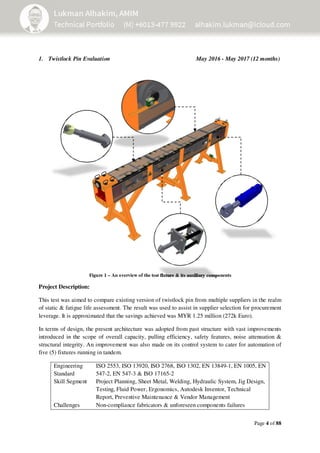
1. Twistlock Pin Evaluation May 2016 - May 2017 (12 months)
Figure 1 – An overview of the test fixture & its auxiliary components
Project Description:
This test was aimed to compare existing version of twistlock pin from multiple suppliers in the realm
of static & fatigue life assessment. The result was used to assist in supplier selection for procurement
leverage. It is approximated that the savings achieved was MYR 1.25 million (272k Euro).
In terms of design, the present architecture was adopted from past structure with vast improvements
introduced in the scope of overall capacity, pulling efficiency, safety features, noise attenuation &
structural integrity. An improvement was also made on its control system to cater for automation of
five (5) fixtures running in tandem.
Engineering
Standard
Skill Segment
ISO 2553, ISO 13920, ISO 2768, ISO 1302, EN 13849-1, EN 1005, EN
547-2, EN 547-3 & ISO 17165-2
Project Planning, Sheet Metal, Welding, Hydraulic System, Jig Design,
Testing, Fluid Power, Ergonomics, Autodesk Inventor, Technical
Report, Preventive Maintenance & Vendor Management
Challenges Non-compliance fabricators & unforeseen components failures
Page 5 of 88
Scope of work:
1. Project Planning
Detail Scheduling & Tracking
Figure 2 - Project planning using Microsoft Excel 20101
o The schedule encompassed planning remainder of fixture design improvements as
well as test execution in clear detail. This includes time & resource allocation, as well
as scheduling of task2
.
o Provision of procedures, methodology and resource management were brought up
during technical meetings for multi-disciplinary discussion prior to commencement of
any activities.
o Updates to stakeholder3
were done on a bi-weekly basis whereby status updates were
delivered and any time deviations from initial baseline were justified.
o The challenges faced during project tracking were the uncertainties in third party
fabrication lead time & performing fixture rework. As countermeasures, continuous
follow-ups were done to reduce schedule backlash.
1
At this juncture, implementation of Microsoft Project 2013 was still in trial mode.
2
Design improvements & redesign, fabrication stage, incoming inspection, rework process, fixture commissioning, static &
fatigue test with continuous monitoring.
3
The entire project was funded by Bromma Global Sourcing.
Page 6 of 88
2. Design
Improvements
Upgrades were introduced to address past issues as well as to comply with internal safety
requirements.
o Safety
Focused on implementation of physical counter measures e.g. protection windows,
proximity sensors to avoid over pulling and LED indicator to create visual awareness
on operational status. Temperature and level sensor4
was also introduced onto the
hydraulic power unit (HPU).
o Ergonomics
Design modifications made with ergonomic due diligence. Introduced Oilon glide
plates to avoid metal-to-metal contact; reduced the noise attenuation by 43%.
o Economics
Selection of in-stock raw materials has led to shorter lead time and reducing in-direct
cost from MOQ requirements. Further savings were generated via opting for design
decisions with reduced machining process. This is also accompanied by basic surface
protection selection with in-house operational condition5
in mind.
4
Utilized to provide automatic cut-off upon reaching the preset level & temperature values
5
Indicating less stringent surface protection requirement
Figure 3 – Overview on sub-components improvements
Page 7 of 88
o Structural Integrity
With frequent buckling failures on the spacer tubes, its design was improved with
27% increase in wall thickness and 47% increase in strength via using 355 material.
Additionally spherical disc thickness was increased by 50% with removal of surplus
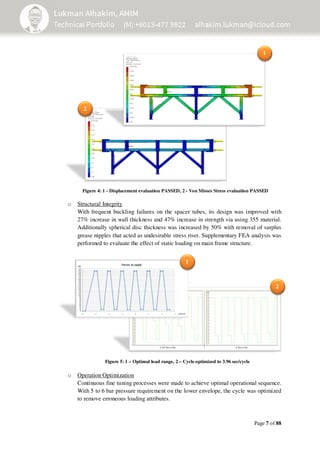
grease nipples that acted as undesirable stress riser. Supplementary FEA analysis was
performed to evaluate the effect of static loading on main frame structure.
o Operation Optimization
Continuous fine tuning processes were made to achieve optimal operational sequence.
With 5 to 6 bar pressure requirement on the lower envelope, the cycle was optimized
to remove erroneous loading attributes.
Figure 5: 1 – Optimal load range, 2 – Cycle optimized to 3.96 sec/cycle
1
2
1
2
Figure 4: 1 - Displacement evaluation PASSED, 2 - Von Misses Stress evaluation PASSED
Page 8 of 88
Detail Engineering (DE)
Engineering Drawings
Provision of detail technical drawings6
preparation for external fabricators. The ranges of
drawings produced for are general assembly (GA) and individual components drawings7
,
hydraulic schematics as well as preparation of bill of materials (BOM).
Fabrication Process
A combination of planned & impromptu visits to fabricator’s site as part of follow-up
routine in tracking the actual progress. Furthermore dimensional & welding quality
inspections were performed as part of visit agenda.
6
Compliance to EN 15056, ISO 2553, ISO 13920, ISO 2768, & ISO 1302.
7
A collaborative effort with Mr. Liang Swee Keat.
Figure 6 - Samples of engineering drawings & 3D modelling produced
Figure 7 - Inspection and documentation at fabrication site
Page 9 of 88
3. Testing
In-house Fatigue Test
Commissioning
Figure 8 - Indicating multi-positions on the fixture; 1 to 6
With multi-disciplinary involvements, the commissioning process was divided into
hydraulic/mechanical & software sub-sections. Loading verification was performed by
means comparing actual pressure vs. load-cell8
reading. An exceptional mechanical
efficiency was achieved with only 2.3% of load variance from one end to the other.
Working Instructions
Compilation of concise working instructions covering assembly sequence, greasing
instructions, software interface layout & data acquisition procedures.
8
A load cell is a transducer that is used to create an electrical signal whose magnitude is directly proportional to the force
being measured.
Figure 9: 1 - Actual vs. theoretical force calculation, 2 - Working instruction
21
Page 10 of 88
Results & Statistics
Each failure was documented in photo-visual format. Failure events were tabulated &
interpreted into graphical representation. After six month of test pursuance, failure trends9
were established.
9
In the scope of failure locations & cycle counts prior to breakdown with respect to each suppliers samples.
Figure 10: 1 - Statistical overview of fatigue life cycle vs. suppliers,
2 – Tabulated data for Test Fixture #1 (TF1), 3 & 4 - Failure distribution
1
4
2
3
Page 11 of 88
External Static Test
This static evaluation is part of a collaborative effort with higher education entities, in this
particular case KTH Royal Institute of Technology, Stockholm. In brief, testing was
performed in KTH’s laboratory’s machine10
where 15 units of twistlocks were tested for
which 3 specimens from 5 different suppliers were evaluated.
Achievements:
✔Aided top management to select the top two suppliers with high merits
✔Cost savings via less stringent tolerance on sub-component dimensioning
✔Successfully reduced operation noise by 43% via the use of non-metallic glide plates
10
MTS 10 MN equipped with a digital controller.
Figure 11: 1 - Force vs. displacement graph sample, 2 - Fixture setup at KTH,
3 - Test samples after tensile test
3
2
1
Page 12 of 88
2. Centralized Powerpack Room April – Oct 2016 (6 months)
Project Description:
Since the inception of Test Centre Department, a continuous trend of increased in demand for
hydraulic related testing were seen from one year to the next. The present resource management is
based on multiple mobile powerpack11
units located where physical test were conducted. Without
sacrificing current resource mobility, this project was aimed to centralize 80% of all hydraulic
resource into a singular & well ventilated room for the following benefits:
✔ Improving resource capacity by 200% (from 4 to 8)
✔ Reduce in work area contamination from oil spillage
✔ Higher degree of control over noise level emission
✔ Reducing work fatigue via improved ergonomics
✔ Reducing man-hours during test commissioning
✔ Centralizing parameter control & monitoring
✔ Introducing component standardization
Engineering
Standard
Skill Segment
ISO 2553, ISO 13920, ISO 2768, ISO 1302, EN 13849-1, EN 1005, EN
547-2, EN 547-3 & ISO 17165-2
Technical Proposal, Project Planning, Hydraulic System, Fluid Power,
Ergonomics, AutoCAD 2D & Vendor Negotiations
Challenges Budgetary constraints
11
A powerpack or more commonly known as hydraulic power unit (HPU) is the main driving component of hydraulic
system. Consisting mainly of a motor, a reservoir & a hydraulic pump, it can generate hydraulic fluid power to drive
majority of hydraulic ram.
Figure 12 - Overview of the floor plan
Page 13 of 88
Scope of work:
1. Project Planning
Detail Scheduling
Figure 13 - Project planning using Microsoft Excel 2010
o The schedule embodied planning of preliminary design, procurement, detail design &
discussion with hydraulic vendors and civil contractors.
o Provisions of scope of work, methodology and resource management were brought
up during interval meetings for multi-department discussion prior to commencement
of any activities. Additionally, progress updates were delivered to Project
Engineering Department (PE) on a monthly basis.
2. Design
Basic Engineering Design (BED)
Site Survey & Documentation
Conducted civil site survey in Test Centre Facility to extract critical information such as
location of structural beams, fixture positions & power socket points. This was done
before commencing to the preliminary hydraulic piping design and floor plan layout.
Figure 14 – Site survey photos
Page 14 of 88
Conceptual Design Proposal
Feasibility studies and engineering concepts were proposed in the scope of:
o Power Fluid Power Distribution
Metric precision seamless steel tubes12
were selected for the main distribution lines.
Tubes to be located within channels made below floor level & covered with gratings.
o Safety
Focused on implementation of physical counter measures e.g. emergency stop button
on each pressure stations & LED indicator as visual awareness of operational status.
Temperature & level sensor13
was also introduced onto the hydraulic power unit
(HPU). Additionally, ball valves were proposed to be located in between pressure
stations & main distribution lines for swift emergency isolation.
o Cost Reduction
Selection of hydraulic components with due diligence. This is achieved by avoiding
over specifications & costly packages. Working hand in hand with sourcing
department in out-sourcing expensive & over specified components.
12
With high merit given on negligible pressure loss due to non-elastic flexing during pressure transmission. Additionally
advantage was seen via easy for preventive maintenance & visual check for possible leak points.
13
Utilized to provide automatic cut-off upon reaching the preset level & temperature values.
Figure 15 – Preliminary design for budgetary proposal
Page 15 of 88
Detail Engineering (DE)
Engineering Drawings
Preparation of detail 2D drawings for third party contractors as reference use during
quotation & technical discussion stages.
Outcome:
Due to new management direction, civil works & hydraulic installation were postponed to a later date.
Figure 16: 1 – Close-up view of the room, 2 – Sub component with descriptions,
3 – Clamp stacking sequence within floor gutter
1
32
Page 16 of 88
3. Powerpack Refurbishment Project March– June 2016 (3 months)
Project Description:
With half of the test conducted in Test Centre using HPU as mean as power resource, the need of
optimizing their performance via reliability maintenance is paramount. The absence of well
documented maintenance scheme was by far the biggest obstacle for this project as some assets were
already in-service for more than 7 years.
Skill Segment
Project Planning, , Hydraulic System, Hydraulic Jig Design,
Testing, Fluid Power & Preventive Maintenance
Challenges Improper service documentation, asset were occupied with
dedicated test & long lead time on replacement components14
14
Related to imported filtration products that have 6 to 8 weeks in delivery lead time.
Figure 17 - Depicting HPU within Test Centre facility
Page 17 of 88
Scope of work:
1. Project Planning
Detail Scheduling
Figure 18 - Project planning using Microsoft Excel 2010
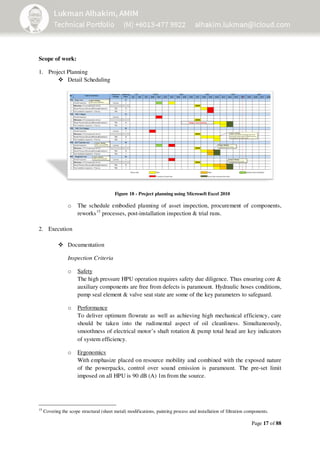
o The schedule embodied planning of asset inspection, procurement of components,
reworks15
processes, post-installation inspection & trial runs.
2. Execution
Documentation
Inspection Criteria
o Safety
The high pressure HPU operation requires safety due diligence. Thus ensuring core &
auxiliary components are free from defects is paramount. Hydraulic hoses conditions,
pump seal element & valve seat state are some of the key parameters to safeguard.
o Performance
To deliver optimum flowrate as well as achieving high mechanical efficiency, care
should be taken into the rudimental aspect of oil cleanliness. Simultaneously,
smoothness of electrical motor’s shaft rotation & pump total head are key indicators
of system efficiency.
o Ergonomics
With emphasize placed on resource mobility and combined with the exposed nature
of the powerpacks, control over sound emission is paramount. The pre-set limit
imposed on all HPU is 90 dB (A) 1m from the source.
15
Covering the scope structural (sheet metal) modifications, painting process and installation of filtration components.
Page 18 of 88
Assessment Templates
The templates are specifically created to provide a structured & presentable platform to
evaluate & monitor the concerned parameters listed in the previous section.
Inspection
In reference to the template created twenty-two (22) criterions was set as default
examination checklist. A total of seven (7) HPUs were successfully scrutinized.
1
2
Figure 19 – Evaluation templates to facilitate information management & tracking
Figure 20: 1 - Inspection on hydraulic hoses & electrical enclosure, 2 – Oil contamination reading
Page 19 of 88
Routine Maintenance
Component Replacement & Rework
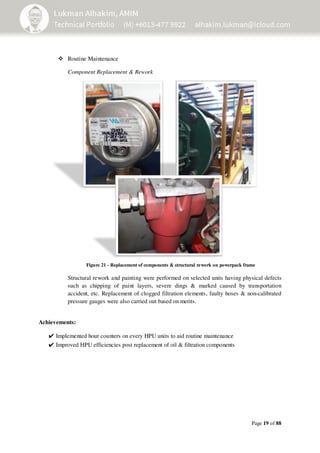
Structural rework and painting were performed on selected units having physical defects
such as chipping of paint layers, severe dings & marked caused by transportation
accident, etc. Replacement of clogged filtration elements, faulty hoses & non-calibrated
pressure gauges were also carried out based on merits.
Achievements:
✔Implemented hour counters on every HPU units to aid routine maintenance
✔Improved HPU efficiencies post replacement of oil & filtration components
Figure 21 - Replacement of components & structural rework on powerpack frame
Page 20 of 88
4. Automatic Lashing Platform (ALP) Apr 2013 - Mar 2015 (24 months)
Project Description:
ALP (red machine on the ground) is the solution for automated handling of twistlocks16
within
shipping terminals. Located under gantry cranes, this device is aimed to increases operational
efficiency by reducing the load/unload cycle time. It also promotes safer operation by eliminating
human labour.
It is self-sufficient via means of converting & storing potential energy from the weight of containers
into pressurised hydraulic & pneumatic power. Stored within linear actuators & accumulators the
energy will then be gradually released to serve its fundamental & auxiliary functions.
Engineering
Standard
Skill Segment
EN 15056, ISO 2553, ISO 13920, ISO 2768, ISO 1302, EN 13849-1,
EN 13681, EN 1005, EN 547-2, EN 547-3, , ISO 17165-2, 2006/42/EC,
1997/23/EC, ASME B16.5 & ASME B31.3 & NACE
Project Planning, Sheet Metal, Welding, Hydraulic System, Hydraulic
Fluid Power, Ergonomics, Process Piping, European Directives (CE),
Corrosion Study, AutoCAD 2D17
, Autodesk Inventor 3D18
, Jig Design,
Testing, Technical Report, & Vendor Management
Challenges Language barrier & work-flow culture
Lesson Learnt Fluidity of information between testing & design team will propel
progress & boost productivity
16
A twistlock and corner casting together form a standardised rotating connector for securing shipping containers.
17
Generally utilized for hydraulic schematic & P&ID designs.
18
Structural design & finite element analysis (FEA) of the overall machine as well as its critical sub-components (i.e. load
bearing sections, pick – points segments). In addition the dynamic characteristic of non-metallic components such as rubber
dampers and hydraulic fluid actuators were being simulated via internal solver within Autodesk Inventor software.
Page 21 of 88
Scope of work:
4. Design
Basic Engineering Design (BED)
Site Survey& Prototype Documentation
o Design data acquisition – The 1st
generation prototype unit created in Böel, Germany
were being scrutinised for details of piping routes, component allocation &
fundamental system understanding19
.
o Subsequent visits were utilized for design verification & endorsement of previous
engineering solutions as well as creating new design entry of past impromptu fixes.
o Each documentation period were segregated into three (3) different phases;
• Initial – Documentation of present technology on the existing prototype unit.
• Intermediate – Reflection of previous way forward; discussion on technical
solution costing & alternative way forward.
• Final – Product development planning for future deliveries; mechanical/
hydraulic design & testing. Components localization for procurement
leverage.
Fundamental Pipe Modelling
19
Only apply to the first site visit where product owner described in detail regarding ALP’s fundamental working principal
in detail in the scope of mechanical, hydraulics, electrical & control system.
Figure 22 - Fundamental pipe routing, 2 – A pipe sub-drawing with dimensions
21
Page 22 of 88
Fundamental Pipe Modelling (continued)
o Drafting of 3D pipe routing as outline for detail design stage. Sections of interest
were trolley, bottom frame & upper frame.
o Preliminary optimization in the scope of component reduction as well as introduction
of continuous pipe design which promotes higher flow efficiency.
o Improvements updates on hydraulic P&ID that covers the energy, lifting, trolley &
manipulator system; in-sync with product development planning.
Conceptual Design Proposal
o Feasibility studies and engineering concepts were put into action to address on-going
issues & future optimization in the scope of:
o Safety
Focusing on design of safety signs depicting potential hazardous
complication as well as implementation of physical counter measures e.g.
anti-slip floorings.
o Ergonomics
Design modification that advocate ergonomic considerations as stipulated in
ISO 13861, EN 614-1 & 2 as well as CEN guide 414. Personnel access
into/out from machine, lighting intensity & duration of working in abnormal
posture were some of the design examples with ergonomics due diligence.
o Certification
As European terminals will be amongst the potential clients to market this
machine, compliance to the European Directive is paramount. Fundamental
requirements as per stipulated in 97/23/EC & 2006/42/EC were implemented
especially in the scope of machinery process, safety & pressure equipment.
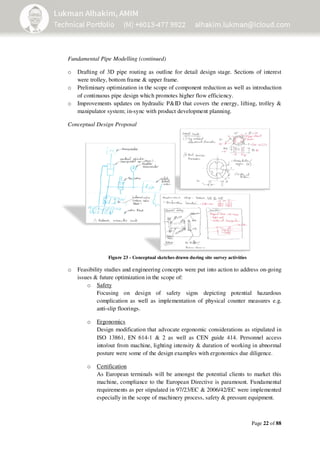
Figure 23 - Conceptual sketches drawn during site survey activities
Page 23 of 88
o Cost Reduction
Selection & approval of engineering components with due diligence. This is
achieved via practicing accurate material & steel profile selection; avoiding
over specifications. Working hand in hand with procurement in outsourcing
components with premium price tag & long lead time.
o Function Optimization
Improvements were segregated into multiple-phases; the initial stage tackles
fundamental issues via brainstorming conceptual ideas across multi-
disciplinary division. Locus of development is the energy system where
boosting the hydraulic efficiency is paramount in achieving a self-sufficient
setup.
Detail Engineering (DE)
Engineering Drawings
Provision of preparing detail engineering drawings20
for in-house fabrication process &
production reference during assembly stage. The following are the type of drawings
produced for this project:
o Component drawings o Hydraulic Schematics
o General Assembly (GA) o Hydraulic P&ID
o Bill of Materials (BOM) o Pipe Assemblies
20
Compliance to EN 15056, ISO 2553, ISO 13920, ISO 2768, & ISO 1302.
1
2
3
4
Figure 24: 1& 2 - Pipe assemblies modelling, 3 - Hydraulic P&ID, 4 – A sample of pipe drawing
Page 24 of 88
Operation Manual
ALP operation manual was compiled in a continuous and chronological manner from
detail design until testing phase. In the scope of mechanical & piping, information related
to hydraulic functionality, detail description of sub-system and components were
allocated into respective chapters. Supplementary visual aids were provided in the form
of commercialized perspective drawings.
5. Trainer
Conducted an introductory Product Data Management (PDM)21
training to the ALP technical
team in Böel, Germany on October 2013. Supplemental coaching was also provided on the
Autodesk Inventor 3D; the project primary designing tool.
21
Autodesk Vault 2013 was the PDM system at that time.
Figure 25 - Visual aids for manual compilation; samples depicting various greasing points
Page 25 of 88
6. Testing
In-house testing
Test & conceptual verification of new engineering designs was awarded to local
engineering team in Malaysia. Provision of test procedures, methodology and resource
management were brought up during technical meetings for multi-disciplinary discussion
prior to commencement of any test activities.
Scope of work includes:
o Project Planning – Time scheduling & resource management (human & capital)
o BED – Basic fixture design that able to deliver comparative results from actual
operating conditions. Working closely with sourcing, vendors & fabricators to
achieve fixture design that are reliable, cost efficient and specifications
compliance
o Execution – Initial setup, performing test and data acquisition
o Documentation – Technical report compilation leading to relevant
recommendation on the tested system/components
Figure 26: 1 - Sensor evaluation setup, 2 - Assessment on manipulator lifting cylinder
2
1
Page 26 of 88
Field Test
Engaged in multiple field-test activities in Southampton & Hamburg shipping terminals.
Primary task involves hydraulic data acquisition, fault findings & documentation. These
discoveries will then be analysed and added into the project development punch-list.
Achievements:
✔ Laid groundwork on the 3D piping layout for ALP production unit
✔ Achieved 15% (RM 195,000+) cost22
reduction from continuous collaborative effort
with sourcing team in the field of:
Localization of hydraulic pipes & auxiliary connectors
Breaking down costly packages into individual components
Component harmonisation - Control valves & retaining clamps
✔ Post PDM training session, respective trainees (engineers) were able to independently
monitor design updates remotely; boosting team productivity
22
In reference to direct cost derived from mechanical components i.e. pipes, hydraulic hoses, actuators and auxiliary valves.
Page 27 of 88
5. Provision of Detail Engineering of Hydraulic Schematics Feb – Mar 2014 (1 month)
for Mitsubishi Heavy Industries (MHI) – Stacking Guide
Project Description:
Spearheaded hydraulic design integration between client’s function requirements and the standard
yard spreader; enabling value adding features of side stacking & supplementary pump-failure
prevention. A time critical collaborative project with immense business potential for repeat orders.
Engineering Std.
Skill Segment
EN 15056, ISO 2553, ISO 13920, ISO 2768 & ISO 1302
Hydraulic System, AutoCAD 2D, Autodesk Inventor 3D
Challenges Client’s reference drawings released in stages
Lesson Learnt Communication ought to be made to end-user directly
without an intermediate entity (commercial personnel)
Scope of work:
1. BED & DE
Integration proposal according to production’s common components23
Conceptual and cross reference study based on client’s hydraulic P&ID
Detail design which consist of general assembly (GA), hydraulic P&ID & preparation of
bill of material (BOM)
2. Procurement
Outsourcing & localization of special valves for cost reduction purposes
Achievements:
The project was successfully offered to client two (2) weeks prior to due date with an additional 13%
cost savings via cost reduction activities.
23
Consist of hydraulic control valves, connecting lines & instrumentation components.
Page 28 of 88
6. Evaluation & Qualification of a New Hydraulic Vendor (6 months)
Project Description:
Due to the new management policy24
the existing vendor for hydraulic services were advised to end
their term-contract. The scope of evaluation for the new replacement shall cover the following
province:
1. Internal processes & system evaluation
2. Product features & product process assessment
Engineering
Standard
Skill Segment
DIN 3015, ISO 17165-1, ISO 6606, ISO 14993 & ISO 10289
Vendor Qualification, Hydraulic Fluid Power, NDT & Technical Report
Challenges A dynamic & thorough assessment program
Scope of work:
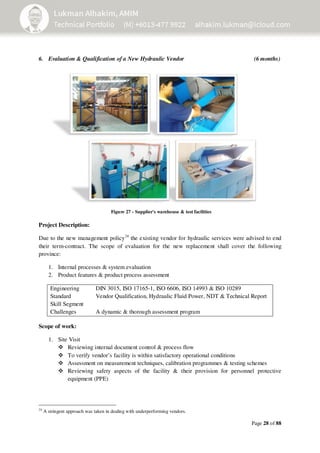
1. Site Visit
Reviewing internal document control & process flow
To verify vendor’s facility is within satisfactory operational conditions
Assessment on measurement techniques, calibration programmes & testing schemes
Reviewing safety aspects of the facility & their provision for personnel protective
equipment (PPE)
24
A stringent approach was taken in dealing with underperforming vendors.
Figure 27 - Supplier's warehouse & test facilities
Page 29 of 88
2. Testing
Evaluation of component25
covering the following scope:
o Labelling – ISO 17165-1
o Material specification – DIN 3015
o Performance – ISO 6606, ISO 14993 & ISO 10289
o Dimensions – Physical dimension vs. technical drawings
3. Documentation
Site visit evaluation report – An independent review
Technical report to include rejection/approval of individual component tested
Outcome:
Approval of the new supplier with due diligence. On-going monitoring & evaluation especially in the
realm of dimensional control (DIN 3015 clamps) as well as hoses labelling (ISO 17165‐1)
25
Consisting of hydraulic hose assemblies, DIN 3015 rated clamps & auxiliary supplied loose connectors.
Page 30 of 88
Recommendations:
Page 31 of 88
R&D and Improvement Studies
Feb 2016 – Present
“Improving existing products & procedures
in line with business direction”
Page 32 of 88
1. TBU Fixture Refurbishment February – April 2016 (2 months)
Figure 28 - Fixture outlook whereby the blue parts depicting refurbishment areas
Project Description:
Fatigue testing is an integral part in both mechanical & structural evaluation. For this particular
project, improvement was made on the beam structures which act as mechanical barricade; disabling
tested sample from extending upwards upon force exertion.
Additionally improvements were also implemented on the hydraulic flow distribution; ensuring a
balance distribution of fluid power & flow rate to all four (4) active cylinders during operation.
Engineering
Standard
Skill Segment
ISO 2553, ISO 13920, ISO 2768, ISO 1302, EN 13849-1, EN 1005, EN
547-2, EN 547-3 & ISO 17165-2
Project Planning, Hydraulic System & Fixture Design
Challenges Improvement design to withstand a minimum of 2 million loading cycles
Page 33 of 88
Scope of work:
1. Project Planning
Detail Scheduling
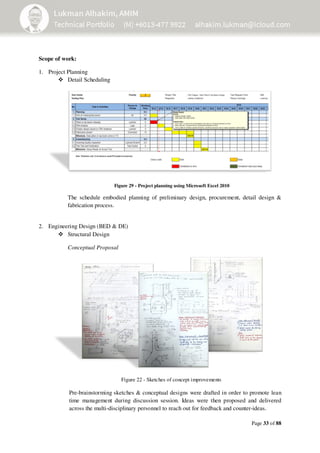
Figure 29 - Project planning using Microsoft Excel 2010
The schedule embodied planning of preliminary design, procurement, detail design &
fabrication process.
2. Engineering Design (BED & DE)
Structural Design
Conceptual Proposal
Pre-brainstorming sketches & conceptual designs were drafted in order to promote lean
time management during discussion session. Ideas were then proposed and delivered
across the multi-disciplinary personnel to reach out for feedback and counter-ideas.
Figure 22 - Sketches of concept improvements
Page 34 of 88
Finite Element Analysis (FEA)
With collaborative effort with Bromma’s structural engineers, both static & fatigue
characteristic of the design were analyzed using ANSYS software. Sheet metal
thicknesses were optimized with stress relief features introduced; enabling the structure
to reach the targeted fatigue lifespan of 2 million cycles.
Detail Design
Technical drawings were prepared in accordance to both internal & external fabrication
standards and manufacturing capabilities. This is to ensure any shortage in resources will
not affect the initial schedule committed via delegation of task in between these two
entities.
Figure 30 - (LEFT) Fatigue evaluation; PASSED, (RIGHT) Static evaluation; PASSED
Figure 31 – Technical drawings for fabrication use
Page 35 of 88
Hydraulic Schematics
Fundamental Principles
o Flow Distribution
With focus on having all four cylinders pushing pre-determined force in sync,
mechanical flow-dividers were used to distribute & channel equal volume of
hydraulic fluid into these cylinders. In addition precise control of flow is easier to
attain by using a dedicated proportional control valve (PRV) on each cylinders.
o Pressure Retention
Considering the endurance nature of the test conducted, maintaining the operating
pressure regardless of temperature fluctuation is critical to ensure a consistent
load spectrum output. To accomplish this aim, multiple pressure sensors were
integrated into the system to gain feedback signal in the form of pressure data.
Detail Layout & BOM
3. Procurement & Vendor Management
Localization of raw materials for cost reduction process – Refraining from profiled steel
Proactively working with external fabricators to ensure design tolerance were achieved
4. Commissioning
Mechanical & hydraulic commissioning on the upgraded fixture
Data acquisition with Hydac HMG 3010 data logger – pressure, temperature & flow rate
Achievements:
✔Accomplished constant holding pressure throughout every test cycle
✔Achieved 100% accuracy in planning i.e. no deviation from initial schedule
Figure 32 - (LEFT) Hydraulic diagram, (RIGHT) Hydraulic assembly
Page 36 of 88
2. Multi Test Fixture May – August 2016 (3 months)
Project Description:
The primary drive for this project was to invent a modular test bench capable in catering various
mechanical26
tests. With recent development of quality issues onsite, this fixture shall address present
quality affairs, vendor verification process and also future product implementations. In terms of
technical objective, the end result shall be a fixture optimized for fatigue & endurance testing. In
summary this fixture is capable to cater for these tests:
Guide block fatigue test
Landing pin fatigue test
Twistlock functional test
Engineering
Standard
Skill Segment
ISO 2553, ISO 13920, ISO 2768, ISO 1302, EN 13849-1, EN 1005,
EN 547-2, EN 547-3 & ISO 17165-2
Project Planning, Hydraulic System & Fixture Design
Challenges Improvement design to withstand a minimum of 2 million cycles,
Cost & time constraint in achieving precision a large steel structure.
26
Pertaining fatigue, wear & tear assessment and functional evaluation.
Page 37 of 88
Scope of work:
1. Project Planning
Detail Scheduling
Figure 33 - Project planning using Microsoft Project 2010
o The schedule embodied planning of fixture design, procurement, detail design,
fabrication process, testing and report compilation.
2. Design
Basic Engineering Design (BED)
Conceptual Study
Figure 34 - Conceptual sketches depicting rudimental working principles
Page 38 of 88
Working Principles
o Landing pin test:
o Guide block test: o Twist lock functional test:
Page 39 of 88
Design Iteration
o Structural Design
First conceptual build was using 80% welding as means of joining each structural
member together. This was later revised to bolts fixations; doubling its fatigue
endurance as a result.
o Protective Coatings
The conventional three layer painting system was also replaced by a more robust hot
dipped galvanization. This also enables additional environmental27
test on landing
pins to be added onto the list of plausible test.
Detail Engineering Design (DE)
Detail Design
Due to the complexity of the fixture, detail assembly instruction as well as bolt inspection
routine was encapsulated within top level mechanical assembly drawing. Safety due
diligence was also emphasized to promote safe working conditions to direct users.
27
Pertaining indoor salt spray testing.
Figure 35 - Examples of detail drawings produced for assembly
Page 40 of 88
3. Procurement & Vendor Management
Localization of raw materials for cost reduction process – Refraining from profiled steel
Proactively working with external fabricators to ensure design tolerance was achieved
Component harmonization with spreader elements – Hydraulic actuators & hoses
4. Commissioning
Mechanical assembly & hydraulic fixture commissioning
Achievements:
✔ Introduced hot-dipped galvanized as protective coating which is 50% more cost effective with
twice the lifespan of a conventional three coating painting system.
Page 41 of 88
Recommendations:
Page 42 of 88
Aftersales Support
Feb 2016 – Present
“Providing reliable & value adding
technical support directly to client”
Page 43 of 88
Focus Clientele:
Northport, Malaysia
Northport is one of the largest multi-purpose ports of its kind in
the national ports system offering dedicated facilities and
services to handle wide variety of cargoes ranging from
containers to cars, break bulk cargoes as well as capacity to
handle liquid and dry bulk cargoes of all types and shipment
sizes.
Its facilities are located at two locations - in Northport, South
point for conventional cargo handling and in Northport where the
state-of-the-art container handling facilities are located.
Recommendation:
Page 44 of 88
1. A10 – 45VO Pump Flowrate Evaluation December 2016
Background:
Client has requested Bromma to verify their present pump deliverables & rating after the equipment
(spreader) has been in service for two (2) years. Flowrate, pressure & temperature are the parameters
of concern. Evaluations were conducted on all spreader motions.
Skill Segment Spreader Hydraulic System & Diagnostics
Challenges Temperature deviation due to weathering influence
Scope of work:
1. Solution Planning
Figure 36 - Test setup for pump diagnostics
Page 45 of 88
2. Field Analysis
Setup
Results & Interpretation
Figure 238 - Data extracted from HYDAC Logger
Highest flow rate (49.6 ݈‫)݉݌‬ recorded was during the early stage of twin expansion at
44⁰C. This was within the maximum rated flow rate of 56 ݈‫݉݌‬ for any given A10-45VO
pump with 7.5kW motor. In conclusion the pump was in good working condition &
able to cater for all spreader operational requirements.
Achievement:
✔Client were satisfied with the prompt nature of the analysis and due to the positive results, they
has refrained from purchasing surplus backup pumps from other vendors
Figure 37 - Diagnostic equipment setup on a heavyweight spreader
Page 46 of 88
2. TTDS Sensors Protection Design November 2016
Background:
In general a ship to shore spreaders is mainly navigated by in-cabin operator. With the absent of
automation process, human oversights & mishandling are inevitable. For this particular case, the
geometric design & location of the TTDS28
sensors has made it more prone to impact during hoisting
down sequence onto containers.
Skill Segment Mechanical Design, Root Cause Analysis
Challenges Risk of falling object & space constraints
Scope of work:
1. Site Survey
Frequent impacts have jeopardized the integrity of sensors mounted within the bracket. With
component replacement cost being the main drive, the alternative solution must be able to
safeguard these “delicate” sensors. Additionally it should promote easy replacement; adding
value by reducing client’s maintenance time.
28
TTDS acronym stands for “Twin Twenty Detection System” for which a set of photo-voltaic sensors detect the presence
of 20 foot containers in twin lifting mode sequence.
Figure 39 - Bended sensor mounting base from impact impairment
Page 47 of 88
2. Detail Design (DE)
The detail proposal encapsulates a “plug & play” concept whereby the entire enclosure could be
unmounted and replaced easily; making hot work & gouging process obsolete. Moreover the risk
of falling hazard can be eliminated by ensuring the module is attached to spreader’s main frame
via welded heavy-duty chains.
3. Replacement Proposal
Cost of parts fabrication absorbed by Bromma – One trial sample
Trail test on one STS45 with 3 months duration before replacing on all affected units
Hot works i.e. gouging & welding of old module executed by client’s resources
Achievements:
✔Delivered indirect cost savings to client via preserving photovoltaic sensors from damage
✔Increase spare-part sale from future replacement of the “plug & play” module
Figure 40 - Assembly design with BOM & welding instructions
Page 48 of 88
3. Main Pump Leaking (Product Care Case) Sept–Nov 2016 (2 months)
Background:
A quality issue was raised whereby heavyweight spreaders in Northport were experiencing pump
leakage. The root cause of the damage was initially suspected from pump seal damage.
Skill Segment Spreader Hydraulic System, Root Cause Analysis & Testing
Challenges Root cause analysis on spreader with a tight operation schedule
Scope of work:
1. Field Analysis
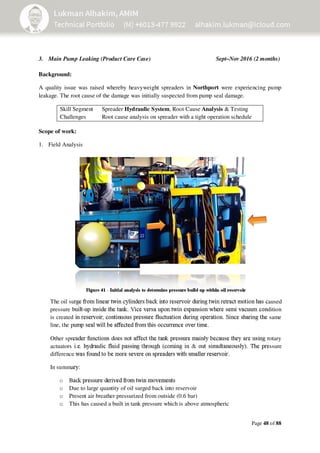
Figure 41 - Initial analysis to determine pressure build up within oil reservoir
The oil surge from linear twin cylinders back into reservoir during twin retract motion has caused
pressure built-up inside the tank. Vice versa upon twin expansion where semi vacuum condition
is created in reservoir; continuous pressure fluctuation during operation. Since sharing the same
line, the pump seal will be affected from this occurrence over time.
Other spreader functions does not affect the tank pressure mainly because they are using rotary
actuators i.e. hydraulic fluid passing through (coming in & out simultaneously). The pressure
difference was found to be more severe on spreaders with smaller reservoir.
In summary:
o Back pressure derived from twin movements
o Due to large quantity of oil surged back into reservoir
o Present air breather pressurized from outside (0.6 bar)
o This has caused a built in tank pressure which is above atmospheric
Page 49 of 88
2. Testing
Solution Planning
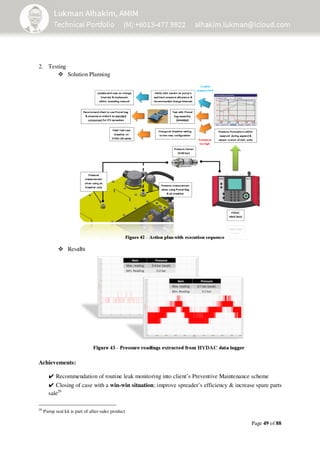
Figure 42 - Action plan with execution sequence
Results
Achievements:
✔Recommendation of routine leak monitoring into client’s Preventive Maintenance scheme
✔Closing of case with a win-win situation; improve spreader’s efficiency & increase spare parts
sale29
29
Pump seal kit is part of after-sales product
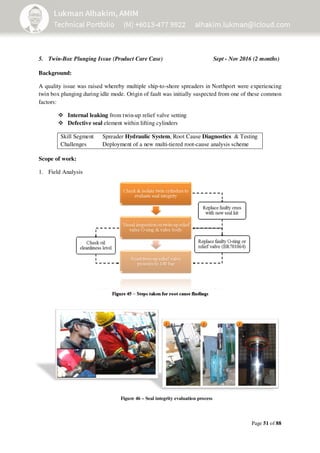
Figure 43 - Pressure readings extracted from HYDAC data logger
Page 50 of 88
4. Twistlock Pins NDT September 2016
Background:
Following up to recent twistlock micro crack issues on PSA’s STS45LW spreader, an investigation
was initiated on a Northport STS45LW spreader for comparative evaluation purposes. The analysis
was performed on two (2) twistlock pins. At that juncture the cycle counts was premature.
Skill Segment Spreader Mechanical System & NDT Evaluation
Challenges NDT analysis under a tight spreader operation schedule
Scope of work:
1. NDT Analysis
Provision of performing dye-penetrant inspection on selected samples by following the normal
six steps technique. Removal of twistlock assembly from spreader was done by client’s resource.
2. Findings & Interpretation
Micro-lines found adjacent to twistlock neck area were portraying early sign of fatigue wear.
These visible lines were continuous localized wear& plastic deformation that took place on each
lift cycle, for which has been misinterpreted as hairline cracks.
Achievements:
✔ Recommended a twistlock NDT inspection interval scheme on on quarterly basis from its
expected lifespan30
✔ Value adding information that educates client in the scope of fatigue-induced wear & tear on
load bearing components
30
Bromma’s operation manual recommends a twistlock replacement upon reaching 200,000 cycles or past reaching the two
years’ service life (whichever comes first).
Figure 44 – Visual overview of the tested samples
Page 51 of 88
5. Twin-Box Plunging Issue (Product Care Case) Sept - Nov 2016 (2 months)
Background:
A quality issue was raised whereby multiple ship-to-shore spreaders in Northport were experiencing
twin box plunging during idle mode. Origin of fault was initially suspected from one of these common
factors:
Internal leaking from twin-up relief valve setting
Defective seal element within lifting cylinders
Skill Segment Spreader Hydraulic System, Root Cause Diagnostics & Testing
Challenges Deployment of a new multi-tiered root-cause analysis scheme
Scope of work:
1. Field Analysis
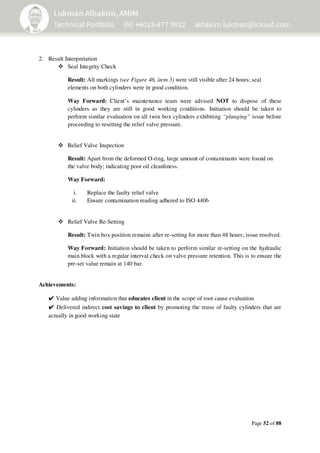
Figure 45 – Steps taken for root cause findings
Figure 46 – Seal integrity evaluation process
Page 52 of 88
2. Result Interpretation
Seal Integrity Check
Result: All markings (see Figure 46, item 3) were still visible after 24 hours; seal
elements on both cylinders were in good condition.
Way Forward: Client’s maintenance team were advised NOT to dispose of these
cylinders as they are still in good working conditions. Initiation should be taken to
perform similar evaluation on all twin box cylinders exhibiting “plunging” issue before
proceeding to resetting the relief valve pressure.
Relief Valve Inspection
Result: Apart from the deformed O-ring, large amount of contaminants were found on
the valve body; indicating poor oil cleanliness.
Way Forward:
i. Replace the faulty relief valve
ii. Ensure contamination reading adhered to ISO 4406
Relief Valve Re-Setting
Result: Twin box position remains after re-setting for more than 48 hours; issue resolved.
Way Forward: Initiation should be taken to perform similar re-setting on the hydraulic
main block with a regular interval check on valve pressure retention. This is to ensure the
pre-set value remain at 140 bar.
Achievements:
✔Value adding information that educates client in the scope of root cause evaluation
✔ Delivered indirect cost savings to client by promoting the reuse of faulty cylinders that are
actually in good working state
Page 53 of 88
6. Oil Contamination Analysis (Northport) September 2016
Background:
Past visit in July 2016 has shown majority of the twin separating spreaders has been experiencing
leakage issues. Upon further scrutiny it was found that substandard contamination control was
deployed which led to undesirable seal damage; increasing cost of maintaining hydraulic assets.
Standard
Skill Segment
ISO 4406
Spreader Hydraulic System & Contamination Evaluation
Scope of work:
1. Contamination Test
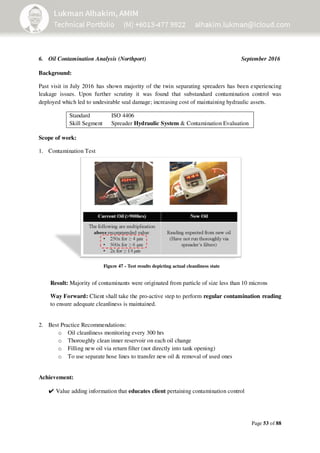
Result: Majority of contaminants were originated from particle of size less than 10 microns
Way Forward: Client shall take the pro-active step to perform regular contamination reading
to ensure adequate cleanliness is maintained.
2. Best Practice Recommendations:
o Oil cleanliness monitoring every 300 hrs
o Thoroughly clean inner reservoir on each oil change
o Filling new oil via return filter (not directly into tank opening)
o To use separate hose lines to transfer new oil & removal of used ones
Achievement:
✔Value adding information that educates client pertaining contamination control
Figure 47 - Test results depicting actual cleanliness state
Page 54 of 88
7. Northport Hydraulic Field Test July 2016
Background:
The catalyst for this exclusive collaboration was to gain actual operational data for benchmarking of
hydraulic parameters on spreader equipment. Focus was made on the response & characteristic of
hydraulic actuated flippers during impact. Data retrieved were used to leverage equipment efficiency
in developing next generation spreaders.
Skill Segment Spreader Hydraulic System & Testing
Challenges Unexpected sensors failures during testing
Scope of work:
1. Field Analysis
Planning
Setup
Figure 49 - Diagnostic equipment setup on test spreader
Figure 48 – Flow chart for the overall setup
Page 55 of 88
Results & Interpretation
Figure 50 - Extracted pressure readings from HMG3010 logger
Legends:
Blue Land Side Right – Down Signal, Flipper with check valve
Red Land Side Left – Down Signal, Flipper without check valve
Green Pump Pressure – Before Pressure Filter
Result Description:
At moment of impact, flipper with check valve exhibited highest peak pressure of 122
bars. This is an approximation of 22% increase from standard operating pressure31
(Arrow 1).
Nonetheless the average pressure surged by 9% from standard operating pressure (Arrow
2) during flipper impact. Pump pressure also shows a slight increase at the moment of
impact.
Achievement:
✔ Executed the 1st
hydraulic field test in benchmarking hydraulic parameters for spreader
equipment
31
Standard operating pressure corresponds to 100 bar
Page 56 of 88
Focus Clientele:
Port of Singapore Authority, Singapore
PSA is a pioneer in handling of transhipment
business in a mega scale. The whole region,
comprising, Southeast Asia and beyond, formed
PSA’s transhipment hinterland. PSA help to
manage distribution of containers to the regional
ports with greater speed, reliability and
efficiency.
Page 57 of 88
1. OHF Support Platform Design Jan – Feb 2017 (1 month)
Background:
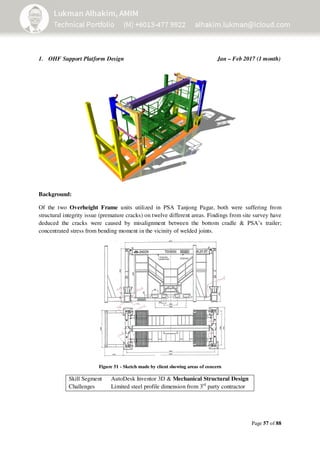
Of the two Overheight Frame units utilized in PSA Tanjong Pagar, both were suffering from
structural integrity issue (premature cracks) on twelve different areas. Findings from site survey have
deduced the cracks were caused by misalignment between the bottom cradle & PSA’s trailer;
concentrated stress from bending moment in the vicinity of welded joints.
Figure 51 - Sketch made by client showing areas of concern
Skill Segment AutoDesk Inventor 3D & Mechanical Structural Design
Challenges Limited steel profile dimension from 3rd
party contractor
Page 58 of 88
Scope of work:
Detail Design & Proposal
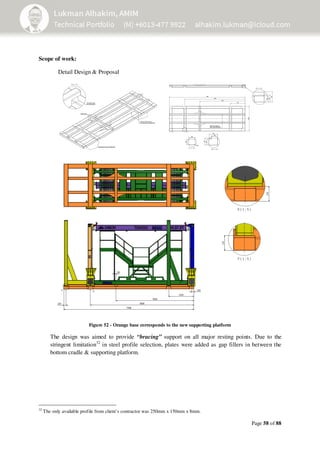
Figure 52 - Orange base corresponds to the new supporting platform
The design was aimed to provide “bracing” support on all major resting points. Due to the
stringent limitation32
in steel profile selection, plates were added as gap fillers in between the
bottom cradle & supporting platform.
32
The only available profile from client’s contractor was 250mm x 150mm x 8mm.
Page 59 of 88
2. OSR Bolt Loosening Issue June – Aug 2016 (2 months)
Background:
To date two (2) overheight frame33
units are being utilized in PSA Tanjung Pagar Port. Reliability &
safety issue arose when retaining bolts (located in the vicinity of joining members) becomes loosen
during transportation to & fro parking area and quay crane locations. As countermeasure port
personnel have to re-torque all loosened bolts prior to hooking up the equipment onto spreader.
Skill Segment AutoDesk Inventor 3D, Spreader Mechanical System & Documentation
Challenges Project duration & strength analysis of the new solution
Scope of work:
1. Site Survey
Figure 53 - Arrow showing one of many failure locations
The first survey indicated that majority of the bolts were experiencing loosening due to rotation
of the nut elements. Although spring washers were used, the “spring back action” was
inadequate to compensate the constant vibration introduced during equipment transportation.
2. Solution Proposal
Figure 54 - Figure above showing crown nut, cotter pin & slotted bolt
33
This structure is attached under any parent spreader with ISO standard base measure and equipped with matching lifting
lugs. The cargo is lifted by the twistlocks of the spreader, the overheight frame twistlocks act as “extended legs” to the
spreader.
Page 60 of 88
To overcome nut rotation, locking mechanism from twistlock pin assembly concept was adopted.
A crown nut secured by a cotter pin was chosen as this combination able to hold firm its
position with minimum mechanical slip. In addition, Nord Lock washers were also proposed to
make use of its proprietary anti-rotation wedge-lock technology.
3. Computer Aided Simulation
Multiple simulations were made to ensure the proposal is absent from clearance issue with the
existing structure & ergonomic to install.
Achievement:
✔Client were satisfied with the prompt nature of the analysis & solution proposal
Figure 55 - Bolt length evaluation on various structure locations
Page 61 of 88
3. Landed & Hold Landing Pin Design May – July 2016 (2 months)
Background:
Figure 56 - Picture depicting a ship to shore spreader lifting a hatch cover
Apart from the standard container’s corner casting, PSA is also utilizing their STS45LW34
to hoist
vessel’s hatch covers with casting thickness down to 15mm. With the typical spreader fitted with
landing pins catering for sensing 25 ≤ t ≤ 28.5mm thickness rage, signal35
loss has becoming a daily
norm; reducing crane optimum capacity.
As remedial approach, the consensus way forward is to install customized landed & hold pins with
extended protrusion on all twistlock locations. Additionally soft spring replacement was also proposed
to ease maintenance routine; value adding to client’s process.
Design Considerations
Must be able to detect multiple corner casting thickness without loss of signal
Thickness variance to cater for: (28.5 < t <15) mm; ∴ ∆t = 13.5mm range
NO hot work involvements
Skill Segment AutoDesk Inventor 3D, Spreader Mechanical System & Testing
Challenges Detail scrutiny on corner casting thickness range of vast types of vessels
34
A lightweight version of ship to shore spreader by Bromma.
35
Corresponded to the holding signal.
Page 62 of 88
Scope of work:
1. Problem Analysis
Design Optimization
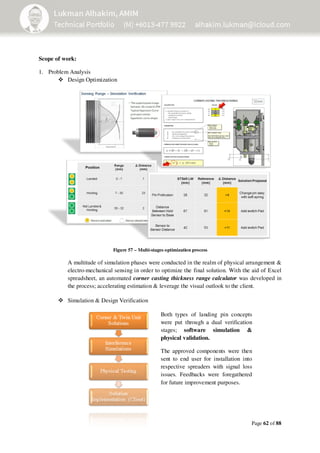
A multitude of simulation phases were conducted in the realm of physical arrangement &
electro-mechanical sensing in order to optimize the final solution. With the aid of Excel
spreadsheet, an automated corner casting thickness range calculator was developed in
the process; accelerating estimation & leverage the visual outlook to the client.
Simulation & Design Verification
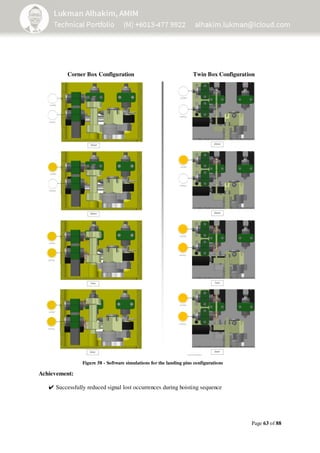
Figure 57 – Multi-stages optimization process
Both types of landing pin concepts
were put through a dual verification
stages; software simulation &
physical validation.
The approved components were then
sent to end user for installation into
respective spreaders with signal loss
issues. Feedbacks were foregathered
for future improvement purposes.
Page 63 of 88
Achievement:
✔Successfully reduced signal lost occurrences during hoisting sequence
Corner Box Configuration Twin Box Configuration
Figure 58 - Software simulations for the landing pins configurations
Page 64 of 88
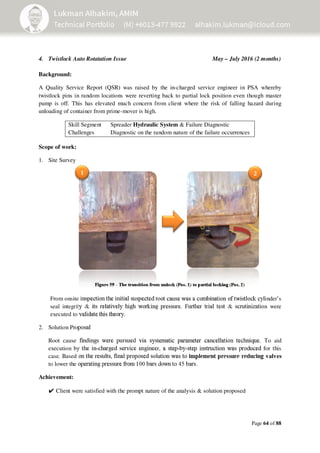
Figure 59 - The transition from unlock (Pos. 1) to partial locking (Pos. 2)
4. Twistlock Auto Rotatation Issue May – July 2016 (2 months)
Background:
A Quality Service Report (QSR) was raised by the in-charged service engineer in PSA whereby
twistlock pins in random locations were reverting back to partial lock position even though master
pump is off. This has elevated much concern from client where the risk of falling hazard during
unloading of container from prime-mover is high.
Skill Segment Spreader Hydraulic System & Failure Diagnostic
Challenges Diagnostic on the random nature of the failure occurrences
Scope of work:
1. Site Survey
From onsite inspection the initial suspected root cause was a combination of twistlock cylinder’s
seal integrity & its relatively high working pressure. Further trial test & scrutinization were
executed to validate this theory.
2. Solution Proposal
Root cause findings were pursued via systematic parameter cancellation technique. To aid
execution by the in-charged service engineer, a step-by-step instruction was produced for this
case. Based on the results, final proposed solution was to implement pressure reducing valves
to lower the operating pressure from 100 bars down to 45 bars.
Achievement:
✔Client were satisfied with the prompt nature of the analysis & solution proposed
21
Page 65 of 88
5. Twistlock Pins Micro-Cracks September 2016
Background:
PSA reported a complaint on four twistlock pin units, where cracks were found with premature cycle
count. A twistlock was then selected in random for a destructive testing and full Non-Destructive
Testing (NDT) by certified service providers.
Skill Segment Material Analysis, Root Cause Analysis & NDT Evaluation
Challenges To execute Failure Analysis on sample without comprehensive
operational history
Scope of work:
1. NDT Analysis
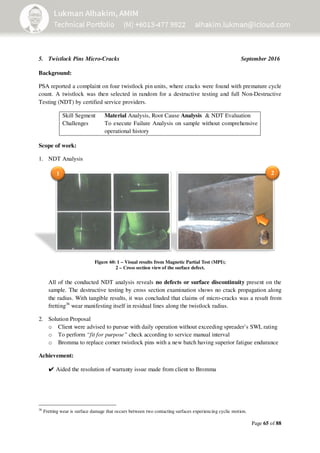
Figure 60: 1 – Visual results from Magnetic Partial Test (MPI);
2 – Cross section view of the surface defect.
All of the conducted NDT analysis reveals no defects or surface discontinuity present on the
sample. The destructive testing by cross section examination shows no crack propagation along
the radius. With tangible results, it was concluded that claims of micro-cracks was a result from
fretting36
wear manifesting itself in residual lines along the twistlock radius.
2. Solution Proposal
o Client were advised to pursue with daily operation without exceeding spreader’s SWL rating
o To perform “fit for purpose” check according to service manual interval
o Bromma to replace corner twistlock pins with a new batch having superior fatigue endurance
Achievement:
✔Aided the resolution of warranty issue made from client to Bromma
36
Fretting wear is surface damage that occurs between two contacting surfaces experiencing cyclic motion.
1 2
Page 66 of 88
Mechanical Testing
Jan 2012 – Aug 2013
“Determination of mechanical properties and
behaviour of materials, structures and machines”
Page 67 of 88
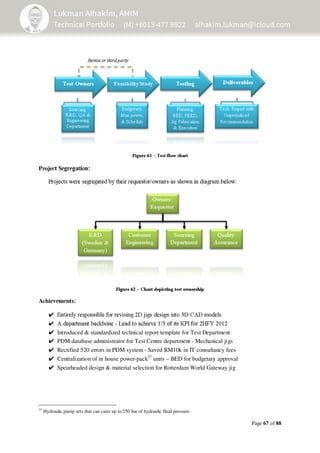
Figure 61 – Test flow chart
Project Segregation:
Projects were segregated by their requestor/owners as shown in diagram below:
Figure 62 – Chart depicting test ownership
Achievements:
✔ Entirely responsible for revising 2D jigs design into 3D CAD models
✔ A department backbone - Lead to achieve 1/3 of its KPI for 2HFY 2012
✔ Introduced & standardized technical report template for Test Department
✔ PDM database administrator for Test Centre department - Mechanical jigs
✔ Rectified 520 errors in PDM system - Saved RM10k in IT consultancy fees
✔ Centralization of in house power-pack37
units – BED for budgetary approval
✔ Spearheaded design & material selection for Rotterdam World Gateway jig
37
Hydraulic pump sets that can cater up to 250 bar of hydraulic fluid pressure.
Page 68 of 88
1. Evaluation of New Flipper Design for Rotterdam World
Gateway Spreader (3 months)
Project Description:
Mechanical flipper is an essential part of a crane spreader. It provides guidance to align the spreader’s
twistlocks onto container’s corner castings during pickup sequence. For this particular project, a
hybrid design was developed; normal practice of vertical open/close motion was replaced with a
horizontal swing motion. Parameters related to the design efficiency were tested before commencing
to mass production phase.
Engineering
Standard
Skill Segment
EN 15056, ISO 2553, ISO 13920, ISO 2768, ISO 1302, EN 1005, EN 547-2,
EN 547-3, ISO 4406, ISO 17165-2
Project Planning, Hydraulic System, Jig Design, Testing & Technical Report
Challenges Noble jig design & resource limitations
Scope of work:
1. BED
Conceptual study & planning of Mechanical Test to allow the following parameters to be
evaluated:
o Locking motion fluidity – To achieve a seamless angular opening & closing by
understanding the relation between location of linear actuator with respect to the
flipper and its structural frame
o Hydraulic hose sizing – To control the of opening & closing swing speed within
the working time-frame. Introduction of reducing connectors to promote hose
size standardization; a procurement leverage activities
o Impact assessment – Noise & vibration data analysis due metal to metal contact
during operation
2. Procurement Support
Working closely with vendors and sourcing team to achieve a test setup that is technically
verified, reliable & cost effective
3. Testing & Documentation
Initial fixture setup & component assembly
Data acquisition with the aid of noise & vibration logger
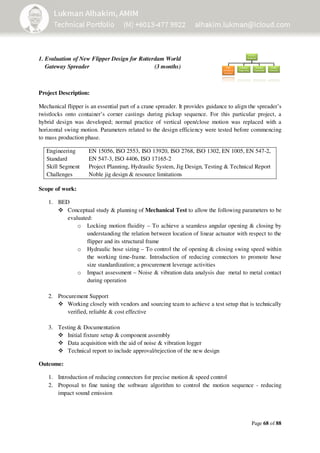
Technical report to include approval/rejection of the new design
Outcome:
1. Introduction of reducing connectors for precise motion & speed control
2. Proposal to fine tuning the software algorithm to control the motion sequence - reducing
impact sound emission
Page 69 of 88
2. Corrosion Evaluation for Rotterdam World Gateway Spreader
- Post Commissioning (4 months)
Project Description:
A Quality Service Report (QSR) related to corrosion of a spreader occurring in Port of Rotterdam,
Netherland was issued by the in-charged service engineer. This has raised concerned from top
management since it was taken placed in one of the busiest terminal in Europe; global reputation was
as stake. Considering past spreaders were in good working condition with acceptable corrosion
allowance, this project investigated the root cause of this anomaly.
Areas which were severely affected by corrosion:
1. Retainer plate for load bearing shaft
2. Hydraulic linear actuator – piston unit
3. Exposed components prone to regular use – e.g. ladder steps & walkways
Engineering Std.
Skill Segment
ISO 9227, ISO 14993, ISO 2081, ISO 10289 & NACE
Project Planning, Corrosion Study, Testing & Technical Report
Challenges Reference were limited to photos taken by service personnel
Scope of work:
1. BED
Conceptual study, planning & execution of Environmental Test to allow the following
parameters to be evaluated:
o Corrosion resistance – Evaluation of respective components under in-house salt
spray test in accordance with ISO 14993
o Mounting orientation & location – Comparative evaluation on corrosion rate
o External factors – Environmental acidity & abrasive wind borne particles
2. Testing & Documentation
Physical & visual inspection of coating performance as per dictated in ISO 10289
Technical report to recommend mitigation counter measures to curb rust propagation
Outcome:
1. Introduction of anti-rust coating on unpainted steel structure & hydraulic connectors
2. Other components with low dimensional tolerance to be coated with hot dipped galvanization
3. Based on the spreader’s service condition38
a higher electroplated coating thickness were
suggested - from 12 to 25 micron
38
Corresponding to outdoor service class in severe corrosive conditions e.g. marine or industrial (ISO 2081).
Page 70 of 88
3. Evaluation of Photovoltaic Sensors Under Harsh Environmental
Conditions – ALP Component Testing (3 months)
Project Description:
One of the fundamental functions of the ALP machine is its ability to detect the presence/absence of
twistlock via special tool39
. A photovoltaic sensor is cardinal to accomplish this function. However
due to the exposed nature of a marine working condition40
, common issues such as intermittent loss of
sensor signal will need to be addressed for continuity of machinery operation.
The aim is to verify the presence of any of the following failure modes:
1. Signal loss – Under pre-defined conditions with variation in temperature, illumination state &
reflector surface conditions
2. Alignment w.r.t reflector - Due to sensor’s finite field of sensing
Engineering Std.
Skill Segment
EN 15056, ISO 2553, ISO 13920, ISO 2768 & ISO 1302
Sheet Metal, Testing, AutoCAD 2D, Autodesk Inventor 3D &
Technical Report
Challenges Simulating harsh marine conditions within in-house test facility
39
A patented tool that serve the function of locking/unlocking of twistlock to & from container’s corner casting. It is
operated by means of rotary hydraulic actuators.
40
Typical weathering conditions such as heavy rainfall, snowing & ice flakes. Other external contributing factors for
instance accumulation of dirt & oil from prolonged operation period.
1 2
3 4
Figure 63: 1&2 - Test fixture to evaluate environmental conditions, 3 - Fixture for alignment assessment,
4 - The actual sensor used on the prototype unit
Page 71 of 88
Scope of work:
1. BED
Conceptual study, planning & execution of Mechanical Test to allow the following
parameters to be evaluated:
o Different weathering elements
o Distance limitation w.r.t its reflector (twistlock)
o Fitness-for-purpose evaluation on the weather enclosure design
o Sensor orientation & angular tilt of the sensor w.r.t its reflector (twistlock)
Working closely with German counterparts to achieve a test setup that is capable of
reproducing the actual operating conditions
2. Testing
Initial fixture setup & component assembly
Scheduled planning for test technician to run & exquisite relevant test data
3. Documentation
Technical report to include approval/rejection of the tested sensor & its enclosure
Outcome:
1. Recommendation on sensor’s optimum operating range & angular tilt
2. Verification of the present weather protection enclosure – A cost effective solution with ease
of visual monitoring, maintenance access & impervious to majority of the tested elements
Page 72 of 88
4. Design & Fabrication of RWG Mechanical Test Jig & Conceptual
Verification of Spreader Unit (4 months)
Project Description:
A new and anticipated spreader line equipped with angular tilting features were to be tested within
Malaysia production facility. This project focuses on:
1. The design of its testing fixture
2. Conceptual verification test of the new angular tilting features
Engineering
Standard
Skill Segment
EN 15056, ISO 2553, ISO 13920, ISO 2768, ISO 1302, EN 1005,
EN 547-2, EN 547-3, ISO 4406, ISO 17165-2
Project planning, Sheet Metal, Welding, Hydraulic Fluid Power,
FEA, Autodesk Inventor 3D & Technical Report Writing
Challenges Cost & time constraint & achieving precision a large steel structure
Scope of work:
1. BED & DE
Project planning from basic engineering phase to delivery into production facility
Raw materials & fabrication costing, resource allocation, logistics & assembly procedures
Conceptual design of the test fixture in reference to test parameters & structural limitation
Detail design which consist of general assembly (GA) & components drawings,
preparation of bill of material (BOM) for fabricators
2. Procurement & Vendor Management
Localization of raw materials for cost reduction process – Refraining from profiled steel
Proactively working with external fabricators to ensure design tolerance were achieved
3. Testing
Planning & execution of Mechanical & Hydraulic Tests on the spreader unit
Collaboration with QC Department for initial fixture setup, assembly & commissioning
Data acquisition with Hydac HMG 3010 data logger – pressure, temperature & flow rate
4. Documentation
Compilation of technical manual, standard operating procedures & maintenance41
scheme
Technical report to include approval/rejection of individual features
Achievements:
✔ Received recognition from local QC & R&D Sweden post-test fixture commissioning due to its
low setup cost and on-time project delivery
41
Focusing on areas prone to abrasion where greasing procedures & intervals were proposed.
Page 73 of 88
5. Corrosion Evaluation of Metric Precision Steel Pipes
for Vendor Comparative Assessment (3 months)
Project Description:
Several hydraulic piping within a prototype machine has been discovered to portray internal
rusting characteristic. Further root‐cause study has exposed an oversight by the supplier
whereby these inner piping were unprotected via oil‐flushing before shipment. Exposure to
high salinity and humid conditions during sea‐freight has degraded their inner surfaces where
passivation protection was not applied.
The sole aim for this test is to get a progressive overview of pipe samples from two (2)
different vendors & their response to salty42
environment.
Engineering Std.
Skill Segment
ISO 9227, ISO 14993, ISO 2081, ISO 10289 & NACE
Project Planning, Corrosion Study, Testing & Technical Report
Challenges Reproducing marine environment within an in-house test facility
Scope of work:
1. BED
Conceptual study, planning & execution of Environmental Test to allow the following
parameters to be evaluated:
o Corrosion resistance – In-house salt spray test in accordance with ISO 14993
o Mounting orientation & location – Comparative evaluation on corrosion rate
42
The salt solution used is with 50g/l ±5g/l composition as stipulated in ISO14993 (solution preparation ONLY).
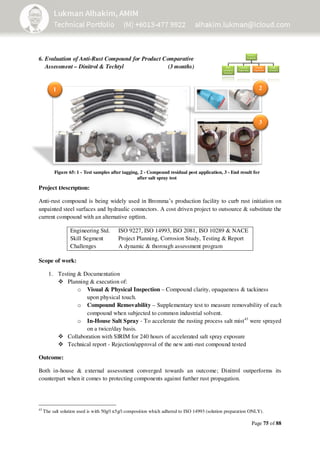
Figure 64: 1 - Dimensional verification, 2&3 - Comparison on corrosion outlook between two
suppliers, 4 - Salt spray test setup
2
3
4
1
Page 74 of 88
2. Testing & Documentation
Initial sample tagging & test fixture erection
Physical & visual inspection of coating performance as per dictated in ISO 10289
Supplementary assessment – Visual aesthetics, deburring quality & dimensional
verification
3. Documentation
Technical report to recommend mitigation counter measures to curb future rust initiation
Outcome:
1. Comparative assessment had provided firm evidence in which a complete coating (inner &
outer) prevail with lower oxidation characteristics (rust distribution & class rating).
2. To avoid reoccurring predicament only a complete coating should be used on piping of
hydraulic distribution lines.
Page 75 of 88
6. Evaluation of Anti-Rust Compound for Product Comparative
Assessment – Dinitrol & Techtyl (3 months)
_
Project Description:
Anti‐rust compound is being widely used in Bromma’s production facility to curb rust initiation on
unpainted steel surfaces and hydraulic connectors. A cost driven project to outsource & substitute the
current compound with an alternative option.
Engineering Std.
Skill Segment
ISO 9227, ISO 14993, ISO 2081, ISO 10289 & NACE
Project Planning, Corrosion Study, Testing & Report
Challenges A dynamic & thorough assessment program
Scope of work:
1. Testing & Documentation
Planning & execution of:
o Visual & Physical Inspection – Compound clarity, opaqueness & tackiness
upon physical touch.
o Compound Removability – Supplementary test to measure removability of each
compound when subjected to common industrial solvent.
o In-House Salt Spray - To accelerate the rusting process salt mist43
were sprayed
on a twice/day basis.
Collaboration with SIRIM for 240 hours of accelerated salt spray exposure
Technical report - Rejection/approval of the new anti-rust compound tested
Outcome:
Both in-house & external assessment converged towards an outcome; Dinitrol outperforms its
counterpart when it comes to protecting components against further rust propagation.
43
The salt solution used is with 50g/l ±5g/l composition which adhered to ISO 14993 (solution preparation ONLY).
1 2
3
Figure 65: 1 - Test samples after tagging, 2 - Compound residual post application, 3 - End result for
after salt spray test
Page 76 of 88
7. Evaluation of Oil Level & Temperature Indicator for Vendor
Comparative Assessment – IFM & Hemomatik (2 months)
_
Project Description:
LT8022 is an electronic level and temperature sensor from IFM supplier. In this test its performance
characteristics were tested against the pre-existing Hemomatik brand. Temperature range, liquid level
reading and drop test were performed in-house. Supplementary vibration & shock response
certification was delegated to SIRIM.
Engineering Std.
Skill Segment
EN 60068-2-27-Ea & EN 600068-2-6-Fc
Autodesk Inventor 3D & Technical Report
Challenges Overall comparative assessment
Scope of work:
1. Testing & Documentation
Planning & execution of:
o Simulation Test – Subjection to 3D simulation & physical predictive
experimentation to understand constraint, fitting tolerance & micro-interference
with other components
o Functional Test – Comparison on reading precision & accuracy
o Drop Test - To match realistic spreader operating condition during container
loading/unloading
Collaboration with SIRIM for the following verification:
o Sinusoidal Vibration - EN 600068-2-6-Fc
o Shock Response - EN 60068-2-27-Ea
Technical report to include approval/rejection of tested components
Outcome:
Rejection of the new product as it fell short in majority of the critical merits.
1
1
Figure 66: 1 - 3D simulation showing micro-interference, 2 - Performance evaluation post external
SIRIM test
Page 77 of 88
8. Evaluation of Oil Heater for Vendor Comparative
Assessment - EVT & AVAK (1 month)
_
Project Description:
In brief an immersion heater is used as a direct contact heating method within oil reservoir. AVAK-
11357 is an immersion heater from AVAK whereby its performance characteristics was tested against
pre-existing EVT brand.
Skill Segment Autodesk Inventor 3D, NDT & Technical Report
Challenges Overall comparative assessment
Scope of work:
1. Testing
Planning & execution of:
o Simulation Test – Subjection to 3D simulation & physical predictive
experimentation to understand constraint, fitting tolerance & micro-interference
with other components
2. Documentation
Technical report - Approval/rejection of the new component
Outcome:
Rejection of the new heater due dimensional non-compliance with spreader’s reservoir design.
1
3
2
4
Figure 67: 1&2 - 3D simulation depicting possible interference, 3 - One to one visual comparisons,
4 - Dimensional checking process
Page 78 of 88
9. Evaluation of Hydraulic Hoses & Clamps for Suitable
Pairing Selection (2 months)
_
Project Description:
In general a clamp kit is used to ensure a tight hold on the hydraulic hose as well as providing
mechanical mating between hose and the spreader's body. It is also used to absorb shock and vibration
caused by fluid surges within pipes, tubes and hoses in both mobile and stationary applications.
Engineering Std.
Skill Segment
DIN 3015
Dimensional Measurement & Technical Report
Challenges Resource planning for testing on spreader
Scope of work:
1. Testing
Planning & execution of:
o Physical Fitting & Mounting – To observe mating characteristics of each clamp
against their respective hoses on the spreader
o Functional Test – Mating characteristics when hoses were pressurized under
operating pressure
2. Documentation
Technical report - Approval/rejection of each hose-clamp combinations
Outcome:
Recommendation to revise of a number of hose-clamp pairs due to unsatisfactory clamping attribute.
1
2
3
Figure 68: 1 – The elementary constituents of a DIN 3015 clamp, 2 - Range of clamps to
be tested, 3 – Fitting test onto a production spreader
Page 79 of 88
10. Performance Evaluation of Non-Metallic Dampers
- A Comparative Assessment (18 months)
Project Description:
Bromma’s Spreaders are equipped with landing buffer located between the main frame and
the telescopic beam unit (TBU). It served as shock absorbers to dampen excessive collision
during operation.
Internal guideline dictates for any landing buffer test, the passing upper limit shall be 75,000
cyclic loads under 12T pressure. The sample shall NOT have any resin detachment nor do
any major disfigurements that will affect its dampening function.
Skill Segment Project Planning, Fatigue Testing & Technical Report
Challenges Prolonged test duration, continuous assessment, fixture
prone to fatigue failure
Scope of work:
1. Testing
Conceptual study, planning & execution of Fatigue Test
The scope of evaluation shall cover the following province:
o Fatigue life evaluation under continuous cyclic loading
o Static & dynamic understanding of the material under lubricated conditions
Physical & visual inspection of rubber & resin performance
2. Documentation
Technical report - Approval/rejection of each batch samples
Outcome:
All samples were showing a wide performance variation but share similar resin detachment modes.
Only natural rubber buffer samples exceeded the required approval threshold of 75,000 cycles.
1
2
3
Figure 69: 1 – A buffer sample with applied grease, 2 - Hydraulic press fixture,
3 – A failure mode showing resin detachment
Page 80 of 88
11. Evaluation of Sheave Wheels for Vendor
Comparative Assessment (1 month)
Project Description:
In essence a sheave wheel works in the same principle as a mechanical pulley. In spreader
operation it is utilized to regulate wire ropes that hold a spreader to its respective crane. For
this test, four sheave wheel units from a new supplier will be evaluated against the pre-
existing brand; an indirect process for procurement leverage.
Engineering Std.
Skill Segment
ISO 5817 & ISO 6520-1
CMM, Welding Defects, Fatigue Test & Technical Report
Challenges Non Destructive Test (NDT) limited to visual assessment
Scope of work:
1. Testing & Documentation
Planning & execution of:
o Functional test – Collaboration with SIRIM to utilize their equipped facility
o Dimensional Verification – Via a coordinate measurement machine
o Visual comparison – Detection of welding imperfection (ISO 6520-1)
Technical report - Approval/rejection of the tested components
Outcome:
Rejection of new samples due to unsatisfactory dimensional tolerance & fabrication deformities.
1
2
3
Figure 70: 1 - Relative location of sheave wheel w.r.t spreader & crane,
2 – A draft sketch depicting fatigue test concept, 3 – Test samples
Page 81 of 88
12. Provision of Functional Test for Guide Block & Twistlock Arm
for Vendor Comparative Assessment (1/2 months)
Project Description:
A request for a functional test on a number of guide blocks & twistlock arms was issued by IQC
department. The goals of this test are:
1. Detection of visible defects characterize by the typical deformities44
2. Verifying welding joins are absence from defects that could shorten life cycles
3. Retrieving relevant dimensions from samples via coordinate measurement machine (CMM) &
cross‐checking with respective component drawings
Engineering Std.
Skill Segment
ISO 5817 & ISO 6520-1
CMM, Welding Defects, Fatigue Test & Technical Report
Challenges Non Destructive Test (NDT) limited to visual assessment
Scope of work:
1. Testing
Planning & execution of:
o Functional Test – in house test fitness for purpose
o Field Test – On selected samples under actual operating conditions
o Dimensional verification – With the aid of a coordinate measurement machine
Visual comparison & detection of welding imperfection according to ISO 6520-1
2. Documentation
Technical report - Approval/rejection of the tested components
Outcome:
Rejection of new samples due to unsatisfactory welding characteristics; imperfection in:
1. Incorrect weld toe – Imperfection ISO 6520-1 (505)
2. Excessive asymmetry – Imperfection ISO 6520-1 (512)
3. Insufficient throat thickness - Imperfection ISO 6520-1 (5213)
44
Corresponding to scratches, dings and unusual marks on the metal surface.
Page 82 of 88
13. Provision of Functional Test for Hydraulic Leakage
Verification on Hose Assemblies- (1/2 months)
Project Description:
A request for a functional test on hydraulic hoses foreseen to be faulty was issued by IQC department.
Test aims are as follows:
1. Detection of visible defects on hoses characterize by the typical deformities such as stretched
marks, abrasion on rubber & dings inside metal connectors
2. Verifying hoses are in usable state via pressurizing to their allowable rated pressure
Engineering Std.
Skill Segment
ISO 6606, ISO 13184 (Pressure Decay Technique -
EN 1779) & ISO 17165-2 (Appendix A.1)
Hydraulic Fluid Power & Technical Report Writing
Challenges Resource limitation45
Scope of work:
1. Testing
Resource coordination & initial assembly setup
Planning & execution of Pressure Decay Test – According to EN 1779
2. Documentation
Technical report - Approval/rejection of the tested samples
Outcome:
Approval of samples for production use due to satisfactory pressure retention.
45
At the time of this test, all usable hydraulic pump sets were occupied with dedicated test. An alternative way forward was
to scavenge & repair a faulty pump from an obsolete spreader unit.
Page 83 of 88
14. Provision of Functional Test for Hydraulic Leakage Verification
on RWG Valves & Manifold Blocks (1/2 months)
Project Description:
A request for a functional test on valves & manifold blocks foreseen to be faulty was issued by IQC
department. The aim of this test was to verify the components are in usable state via pressurizing to
their allowable rated pressure.
Engineering Std.
Skill Segment
ISO 13184 (Pressure Decay Technique - EN 1779)
Hydraulic Fluid Power & Technical Report
Challenges Root cause analysis & failure mode detection
Scope of work:
1. Testing
Resource coordination & initial assembly setup
Planning & execution of Pressure Decay Test – According to EN 1779
2. Documentation
Technical report - Approval/rejection of tested samples
Outcome:
Approval of samples for production use due to satisfactory pressure retention.
Page 84 of 88
Recommendations:
Page 85 of 88
Marine Spreader Design
Aug 2010 – July 2012
“Devising mechanical machinery designs,
for shipping terminal needs”
Page 86 of 88
Project Description:
A spreader (red machine in above picture) is a device used for lifting containers and unitized cargo. It
is commonly used for containers that have a locking mechanism at each corner castings. It can be
used on a container crane & a straddle carrier within shipping terminals.
Engineering
Standard
Skill Segment
EN 15056, ISO 2553, ISO 13920, ISO 2768, ISO 1302, DIN
3015, ISO 17165-2, ISO 4406
Sheet Metal Design, Welding, Hydraulic Fluid Power, Project
Management, AutoCAD 2D, Autodesk Inventor 3D
Challenges Multiple project coordination, impromptu amendments by clients
Scope of work:
1. BED & DE
Conceptual and cross reference study based on client’s hydraulic P&ID, headblock46
dimensions, critical component request & painting specifications
Detail design which leading to preparation of
o General assembly (GA) drawings – Specifying painting requirements, safety
decals & critical parameter notations to aid quality control checking
o Hydraulic schematics – Depicting location of pump, flow dividers, control valves
and other auxiliary components which are fundamental to a spreader operation
o Bill of material (BOM) – For procurement & planning during initial stage of
design. A production check-list during assembly of the spreader unit
2. Procurement Support
Providing technical steer to sourcing in terms of special components with long lead time
– mechanical & hydraulic items
3. Documentation
Operational manuals co-ordination between technical writer and sales-force
46
A load bearing mechanical device that act as an intermediate in pairing both quay crane & spreader
Page 87 of 88
Project List:
1. Local - Malaysia
ZPMC - Westport, Malaysia – Twin ship to shore
2. International
Barbados Port Inc. : Single ship to shore spreader
APM Terminal, Mexico : Twin electric-yard spreader
DP World - Caucedo, Spain : Single ship to shore spreader
Suez Canal Container Terminal, Egypt : Twin yard spreader
ZPMC - Lazaro Cardenas, Mexico : Twin electric-yard spreader
PSA - Sical Terminal, India - In charge of designing hydraulic system
ZPMC - WWI, India : Twin electric-yard spreader with new hoisting section
Terminal de Contentores de Leixoes , Portugal: Twin ship to shore spreader
Konecranes - Nutep, Russia : Single yard spreader with cold climate structure
ZPMC - Nansha II, China : Twin ship to shore spreader with new hoisting section
ZPMC - TESCA, Columbia : Twin electric-yard spreader with new hoisting section
Gazal Logistics - Umm Qasr, Iraq : Single yard spreader with new hoisting section
Port of New Orleans, USA : Twin ship to shore spreader with new hoisting section design
Kocks Krane GmbH - ITC Terminal, Vietnam : Single yard spreader with impact
protection
Libherr - Petrolesport, Russia : Single ship to shore spreader with ergonomic ladder
design
SANNY Group Co. - TCDD Izmir Turkey Twin electric-yard spreader with new hoisting
section
Mitsui - Exolgan, Argentina : Twin electric-yard spreader with ergonomic access holes &
handrail
Konecranes - Port of Klaipeda, Lithuania : Twin electric-yard spreader with cold climate
structure
Achievements:
✔ Laid groundwork of the 1st hydraulic-headblock order - hydraulic schematics
✔ Design-revamped an existing sensor technology into 2nd generation spreaders
Page 88 of 88
Recommendations:

Technical Portfolio_2010 to 2017

  • 1.
  • 2.
    Page 1 of88 Table of Contents Project Engineering .............................................................................................................2 – 30 1. Twistlock Pin Evaluation .................................................................................................3 – 11 2. Centralized Powerpack Room......................................................................................... 12 – 15 3. Powerpack Refurbishment Project .................................................................................. 16 – 19 4. Automatic Lashing Platform (ALP) ................................................................................ 20 – 26 5. Mitsubishi Heavy Industry (MHI) – Stacking Guide .............................................................. 27 6. Evaluation & Qualification of a New Hydraulic Vendor................................................... 28 – 29 7. Recommendations ................................................................................................................ 30 R&D and Improvement Studies......................................................................................... 31 – 41 1. TBU Fixture Refurbishment ........................................................................................... 32 – 35 2. Multi Test Fixture.......................................................................................................... 36 – 40 3. Recommendations ................................................................................................................ 41 Aftersales Support ..............................................................................................................42 - 65 Northport .......................................................................................................................... 43 – 55 1. A10 – 45VO Pump Flowrate Evaluation ......................................................................... 44 – 45 2. TTDS Sensors Protection Design.................................................................................... 46 – 47 3. Main Pump Leaking (Product Care Case)........................................................................ 48 – 49 4. Twistlock Pins NDT ............................................................................................................. 50 5. Twin-Box Plunging Issue (Product Care Case)................................................................ 51 – 52 6. Oil Contamination Analysis (Northport)................................................................................. 53 7. Northport Hydraulic Field Test....................................................................................... 54 – 55 Port of Singapore Authority .............................................................................................. 56 – 66 1. OHF Support Platform Design........................................................................................ 57 – 58 2. OSR Bolt Loosening Issue ............................................................................................. 59 – 60 3. Landed & Hold Landing Pin Design ............................................................................... 61 – 63 4. Twistlock Auto Rotatation Issue............................................................................................ 64 5. Twistlock Pins Micro-Cracks ................................................................................................ 65
  • 3.
    Page 2 of88 Mechanical Test................................................................................................................. 66 – 84 1. Evaluation of New Flipper Design for Rotterdam World Gateway Spreader ............................. 68 2. Corrosion Evaluation for Rotterdam World Gateway (RWG) Spreader – Post Commissioning................................................................................. 69 3. Evaluation of Photovoltaic Sensors Under Harsh Environmental Conditions – ALP Component Testing............................................................................ 70 – 71 4. Design & Fabrication of RWG Mechanical Test Jig & Conceptual Verification of Spreader Unit ........................................................................... 72 5. Corrosion Evaluation of Metric Precision Steel Pipes for Vendor Comparative Assessment .............................................................................. 73 – 74 6. Evaluation of Anti-Rust Compound for Product Comparative Assessment – Dinitrol & Techtyl ....................................................................... 75 7. Evaluation of Oil Level & Temperature Indicator for Vendor Comparative Assessment – IFM & Hemomatik ...................................................................... 76 8. Evaluation of Oil Heater for Vendor Comparative Assessment EVT & AVAK........................ 77 9. Evaluation of Hydraulic Hoses & Clamps for Suitable Pairing Selection .................................. 78 10. Performance Evaluation of Non-Metallic Dampers – A Comparative Assessment..................... 79 11. Evaluation of Sheave Wheels for Vendor Comparative Assessment ......................................... 80 12. Provision of Functional Test for Guide Block & Twistlock Arm for Vendor Comparative Assessment ..................................................................................... 81 13. Provision of Functional Test for Hydraulic Leakage Verification on Hose Assemblies .............. 82 14. Provision of Functional Test for Hydraulic Leakage Verification on RWG Valves & Manifold Blocks...................................................................................... 83 15. Recommendations ................................................................................................................ 84 Marine Spreader Design.................................................................................................... 85 – 88 1. Project Description............................................................................................................... 86 2. Project List – Local & International ....................................................................................... 87 3. Recommendations ................................................................................................................ 88
  • 4.
    Page 3 of88 Project Engineering Apr 2013 – Present “Bridges the boundaries between Engineering & Project Management”
  • 5.
    Page 4 of88 1. Twistlock Pin Evaluation May 2016 - May 2017 (12 months) Figure 1 – An overview of the test fixture & its auxiliary components Project Description: This test was aimed to compare existing version of twistlock pin from multiple suppliers in the realm of static & fatigue life assessment. The result was used to assist in supplier selection for procurement leverage. It is approximated that the savings achieved was MYR 1.25 million (272k Euro). In terms of design, the present architecture was adopted from past structure with vast improvements introduced in the scope of overall capacity, pulling efficiency, safety features, noise attenuation & structural integrity. An improvement was also made on its control system to cater for automation of five (5) fixtures running in tandem. Engineering Standard Skill Segment ISO 2553, ISO 13920, ISO 2768, ISO 1302, EN 13849-1, EN 1005, EN 547-2, EN 547-3 & ISO 17165-2 Project Planning, Sheet Metal, Welding, Hydraulic System, Jig Design, Testing, Fluid Power, Ergonomics, Autodesk Inventor, Technical Report, Preventive Maintenance & Vendor Management Challenges Non-compliance fabricators & unforeseen components failures
  • 6.
    Page 5 of88 Scope of work: 1. Project Planning Detail Scheduling & Tracking Figure 2 - Project planning using Microsoft Excel 20101 o The schedule encompassed planning remainder of fixture design improvements as well as test execution in clear detail. This includes time & resource allocation, as well as scheduling of task2 . o Provision of procedures, methodology and resource management were brought up during technical meetings for multi-disciplinary discussion prior to commencement of any activities. o Updates to stakeholder3 were done on a bi-weekly basis whereby status updates were delivered and any time deviations from initial baseline were justified. o The challenges faced during project tracking were the uncertainties in third party fabrication lead time & performing fixture rework. As countermeasures, continuous follow-ups were done to reduce schedule backlash. 1 At this juncture, implementation of Microsoft Project 2013 was still in trial mode. 2 Design improvements & redesign, fabrication stage, incoming inspection, rework process, fixture commissioning, static & fatigue test with continuous monitoring. 3 The entire project was funded by Bromma Global Sourcing.
  • 7.
    Page 6 of88 2. Design Improvements Upgrades were introduced to address past issues as well as to comply with internal safety requirements. o Safety Focused on implementation of physical counter measures e.g. protection windows, proximity sensors to avoid over pulling and LED indicator to create visual awareness on operational status. Temperature and level sensor4 was also introduced onto the hydraulic power unit (HPU). o Ergonomics Design modifications made with ergonomic due diligence. Introduced Oilon glide plates to avoid metal-to-metal contact; reduced the noise attenuation by 43%. o Economics Selection of in-stock raw materials has led to shorter lead time and reducing in-direct cost from MOQ requirements. Further savings were generated via opting for design decisions with reduced machining process. This is also accompanied by basic surface protection selection with in-house operational condition5 in mind. 4 Utilized to provide automatic cut-off upon reaching the preset level & temperature values 5 Indicating less stringent surface protection requirement Figure 3 – Overview on sub-components improvements
  • 8.
    Page 7 of88 o Structural Integrity With frequent buckling failures on the spacer tubes, its design was improved with 27% increase in wall thickness and 47% increase in strength via using 355 material. Additionally spherical disc thickness was increased by 50% with removal of surplus grease nipples that acted as undesirable stress riser. Supplementary FEA analysis was performed to evaluate the effect of static loading on main frame structure. o Operation Optimization Continuous fine tuning processes were made to achieve optimal operational sequence. With 5 to 6 bar pressure requirement on the lower envelope, the cycle was optimized to remove erroneous loading attributes. Figure 5: 1 – Optimal load range, 2 – Cycle optimized to 3.96 sec/cycle 1 2 1 2 Figure 4: 1 - Displacement evaluation PASSED, 2 - Von Misses Stress evaluation PASSED
  • 9.
    Page 8 of88 Detail Engineering (DE) Engineering Drawings Provision of detail technical drawings6 preparation for external fabricators. The ranges of drawings produced for are general assembly (GA) and individual components drawings7 , hydraulic schematics as well as preparation of bill of materials (BOM). Fabrication Process A combination of planned & impromptu visits to fabricator’s site as part of follow-up routine in tracking the actual progress. Furthermore dimensional & welding quality inspections were performed as part of visit agenda. 6 Compliance to EN 15056, ISO 2553, ISO 13920, ISO 2768, & ISO 1302. 7 A collaborative effort with Mr. Liang Swee Keat. Figure 6 - Samples of engineering drawings & 3D modelling produced Figure 7 - Inspection and documentation at fabrication site
  • 10.
    Page 9 of88 3. Testing In-house Fatigue Test Commissioning Figure 8 - Indicating multi-positions on the fixture; 1 to 6 With multi-disciplinary involvements, the commissioning process was divided into hydraulic/mechanical & software sub-sections. Loading verification was performed by means comparing actual pressure vs. load-cell8 reading. An exceptional mechanical efficiency was achieved with only 2.3% of load variance from one end to the other. Working Instructions Compilation of concise working instructions covering assembly sequence, greasing instructions, software interface layout & data acquisition procedures. 8 A load cell is a transducer that is used to create an electrical signal whose magnitude is directly proportional to the force being measured. Figure 9: 1 - Actual vs. theoretical force calculation, 2 - Working instruction 21
  • 11.
    Page 10 of88 Results & Statistics Each failure was documented in photo-visual format. Failure events were tabulated & interpreted into graphical representation. After six month of test pursuance, failure trends9 were established. 9 In the scope of failure locations & cycle counts prior to breakdown with respect to each suppliers samples. Figure 10: 1 - Statistical overview of fatigue life cycle vs. suppliers, 2 – Tabulated data for Test Fixture #1 (TF1), 3 & 4 - Failure distribution 1 4 2 3
  • 12.
    Page 11 of88 External Static Test This static evaluation is part of a collaborative effort with higher education entities, in this particular case KTH Royal Institute of Technology, Stockholm. In brief, testing was performed in KTH’s laboratory’s machine10 where 15 units of twistlocks were tested for which 3 specimens from 5 different suppliers were evaluated. Achievements: ✔Aided top management to select the top two suppliers with high merits ✔Cost savings via less stringent tolerance on sub-component dimensioning ✔Successfully reduced operation noise by 43% via the use of non-metallic glide plates 10 MTS 10 MN equipped with a digital controller. Figure 11: 1 - Force vs. displacement graph sample, 2 - Fixture setup at KTH, 3 - Test samples after tensile test 3 2 1
  • 13.
    Page 12 of88 2. Centralized Powerpack Room April – Oct 2016 (6 months) Project Description: Since the inception of Test Centre Department, a continuous trend of increased in demand for hydraulic related testing were seen from one year to the next. The present resource management is based on multiple mobile powerpack11 units located where physical test were conducted. Without sacrificing current resource mobility, this project was aimed to centralize 80% of all hydraulic resource into a singular & well ventilated room for the following benefits: ✔ Improving resource capacity by 200% (from 4 to 8) ✔ Reduce in work area contamination from oil spillage ✔ Higher degree of control over noise level emission ✔ Reducing work fatigue via improved ergonomics ✔ Reducing man-hours during test commissioning ✔ Centralizing parameter control & monitoring ✔ Introducing component standardization Engineering Standard Skill Segment ISO 2553, ISO 13920, ISO 2768, ISO 1302, EN 13849-1, EN 1005, EN 547-2, EN 547-3 & ISO 17165-2 Technical Proposal, Project Planning, Hydraulic System, Fluid Power, Ergonomics, AutoCAD 2D & Vendor Negotiations Challenges Budgetary constraints 11 A powerpack or more commonly known as hydraulic power unit (HPU) is the main driving component of hydraulic system. Consisting mainly of a motor, a reservoir & a hydraulic pump, it can generate hydraulic fluid power to drive majority of hydraulic ram. Figure 12 - Overview of the floor plan
  • 14.
    Page 13 of88 Scope of work: 1. Project Planning Detail Scheduling Figure 13 - Project planning using Microsoft Excel 2010 o The schedule embodied planning of preliminary design, procurement, detail design & discussion with hydraulic vendors and civil contractors. o Provisions of scope of work, methodology and resource management were brought up during interval meetings for multi-department discussion prior to commencement of any activities. Additionally, progress updates were delivered to Project Engineering Department (PE) on a monthly basis. 2. Design Basic Engineering Design (BED) Site Survey & Documentation Conducted civil site survey in Test Centre Facility to extract critical information such as location of structural beams, fixture positions & power socket points. This was done before commencing to the preliminary hydraulic piping design and floor plan layout. Figure 14 – Site survey photos
  • 15.
    Page 14 of88 Conceptual Design Proposal Feasibility studies and engineering concepts were proposed in the scope of: o Power Fluid Power Distribution Metric precision seamless steel tubes12 were selected for the main distribution lines. Tubes to be located within channels made below floor level & covered with gratings. o Safety Focused on implementation of physical counter measures e.g. emergency stop button on each pressure stations & LED indicator as visual awareness of operational status. Temperature & level sensor13 was also introduced onto the hydraulic power unit (HPU). Additionally, ball valves were proposed to be located in between pressure stations & main distribution lines for swift emergency isolation. o Cost Reduction Selection of hydraulic components with due diligence. This is achieved by avoiding over specifications & costly packages. Working hand in hand with sourcing department in out-sourcing expensive & over specified components. 12 With high merit given on negligible pressure loss due to non-elastic flexing during pressure transmission. Additionally advantage was seen via easy for preventive maintenance & visual check for possible leak points. 13 Utilized to provide automatic cut-off upon reaching the preset level & temperature values. Figure 15 – Preliminary design for budgetary proposal
  • 16.
    Page 15 of88 Detail Engineering (DE) Engineering Drawings Preparation of detail 2D drawings for third party contractors as reference use during quotation & technical discussion stages. Outcome: Due to new management direction, civil works & hydraulic installation were postponed to a later date. Figure 16: 1 – Close-up view of the room, 2 – Sub component with descriptions, 3 – Clamp stacking sequence within floor gutter 1 32
  • 17.
    Page 16 of88 3. Powerpack Refurbishment Project March– June 2016 (3 months) Project Description: With half of the test conducted in Test Centre using HPU as mean as power resource, the need of optimizing their performance via reliability maintenance is paramount. The absence of well documented maintenance scheme was by far the biggest obstacle for this project as some assets were already in-service for more than 7 years. Skill Segment Project Planning, , Hydraulic System, Hydraulic Jig Design, Testing, Fluid Power & Preventive Maintenance Challenges Improper service documentation, asset were occupied with dedicated test & long lead time on replacement components14 14 Related to imported filtration products that have 6 to 8 weeks in delivery lead time. Figure 17 - Depicting HPU within Test Centre facility
  • 18.
    Page 17 of88 Scope of work: 1. Project Planning Detail Scheduling Figure 18 - Project planning using Microsoft Excel 2010 o The schedule embodied planning of asset inspection, procurement of components, reworks15 processes, post-installation inspection & trial runs. 2. Execution Documentation Inspection Criteria o Safety The high pressure HPU operation requires safety due diligence. Thus ensuring core & auxiliary components are free from defects is paramount. Hydraulic hoses conditions, pump seal element & valve seat state are some of the key parameters to safeguard. o Performance To deliver optimum flowrate as well as achieving high mechanical efficiency, care should be taken into the rudimental aspect of oil cleanliness. Simultaneously, smoothness of electrical motor’s shaft rotation & pump total head are key indicators of system efficiency. o Ergonomics With emphasize placed on resource mobility and combined with the exposed nature of the powerpacks, control over sound emission is paramount. The pre-set limit imposed on all HPU is 90 dB (A) 1m from the source. 15 Covering the scope structural (sheet metal) modifications, painting process and installation of filtration components.
  • 19.
    Page 18 of88 Assessment Templates The templates are specifically created to provide a structured & presentable platform to evaluate & monitor the concerned parameters listed in the previous section. Inspection In reference to the template created twenty-two (22) criterions was set as default examination checklist. A total of seven (7) HPUs were successfully scrutinized. 1 2 Figure 19 – Evaluation templates to facilitate information management & tracking Figure 20: 1 - Inspection on hydraulic hoses & electrical enclosure, 2 – Oil contamination reading
  • 20.
    Page 19 of88 Routine Maintenance Component Replacement & Rework Structural rework and painting were performed on selected units having physical defects such as chipping of paint layers, severe dings & marked caused by transportation accident, etc. Replacement of clogged filtration elements, faulty hoses & non-calibrated pressure gauges were also carried out based on merits. Achievements: ✔Implemented hour counters on every HPU units to aid routine maintenance ✔Improved HPU efficiencies post replacement of oil & filtration components Figure 21 - Replacement of components & structural rework on powerpack frame
  • 21.
    Page 20 of88 4. Automatic Lashing Platform (ALP) Apr 2013 - Mar 2015 (24 months) Project Description: ALP (red machine on the ground) is the solution for automated handling of twistlocks16 within shipping terminals. Located under gantry cranes, this device is aimed to increases operational efficiency by reducing the load/unload cycle time. It also promotes safer operation by eliminating human labour. It is self-sufficient via means of converting & storing potential energy from the weight of containers into pressurised hydraulic & pneumatic power. Stored within linear actuators & accumulators the energy will then be gradually released to serve its fundamental & auxiliary functions. Engineering Standard Skill Segment EN 15056, ISO 2553, ISO 13920, ISO 2768, ISO 1302, EN 13849-1, EN 13681, EN 1005, EN 547-2, EN 547-3, , ISO 17165-2, 2006/42/EC, 1997/23/EC, ASME B16.5 & ASME B31.3 & NACE Project Planning, Sheet Metal, Welding, Hydraulic System, Hydraulic Fluid Power, Ergonomics, Process Piping, European Directives (CE), Corrosion Study, AutoCAD 2D17 , Autodesk Inventor 3D18 , Jig Design, Testing, Technical Report, & Vendor Management Challenges Language barrier & work-flow culture Lesson Learnt Fluidity of information between testing & design team will propel progress & boost productivity 16 A twistlock and corner casting together form a standardised rotating connector for securing shipping containers. 17 Generally utilized for hydraulic schematic & P&ID designs. 18 Structural design & finite element analysis (FEA) of the overall machine as well as its critical sub-components (i.e. load bearing sections, pick – points segments). In addition the dynamic characteristic of non-metallic components such as rubber dampers and hydraulic fluid actuators were being simulated via internal solver within Autodesk Inventor software.
  • 22.
    Page 21 of88 Scope of work: 4. Design Basic Engineering Design (BED) Site Survey& Prototype Documentation o Design data acquisition – The 1st generation prototype unit created in Böel, Germany were being scrutinised for details of piping routes, component allocation & fundamental system understanding19 . o Subsequent visits were utilized for design verification & endorsement of previous engineering solutions as well as creating new design entry of past impromptu fixes. o Each documentation period were segregated into three (3) different phases; • Initial – Documentation of present technology on the existing prototype unit. • Intermediate – Reflection of previous way forward; discussion on technical solution costing & alternative way forward. • Final – Product development planning for future deliveries; mechanical/ hydraulic design & testing. Components localization for procurement leverage. Fundamental Pipe Modelling 19 Only apply to the first site visit where product owner described in detail regarding ALP’s fundamental working principal in detail in the scope of mechanical, hydraulics, electrical & control system. Figure 22 - Fundamental pipe routing, 2 – A pipe sub-drawing with dimensions 21
  • 23.
    Page 22 of88 Fundamental Pipe Modelling (continued) o Drafting of 3D pipe routing as outline for detail design stage. Sections of interest were trolley, bottom frame & upper frame. o Preliminary optimization in the scope of component reduction as well as introduction of continuous pipe design which promotes higher flow efficiency. o Improvements updates on hydraulic P&ID that covers the energy, lifting, trolley & manipulator system; in-sync with product development planning. Conceptual Design Proposal o Feasibility studies and engineering concepts were put into action to address on-going issues & future optimization in the scope of: o Safety Focusing on design of safety signs depicting potential hazardous complication as well as implementation of physical counter measures e.g. anti-slip floorings. o Ergonomics Design modification that advocate ergonomic considerations as stipulated in ISO 13861, EN 614-1 & 2 as well as CEN guide 414. Personnel access into/out from machine, lighting intensity & duration of working in abnormal posture were some of the design examples with ergonomics due diligence. o Certification As European terminals will be amongst the potential clients to market this machine, compliance to the European Directive is paramount. Fundamental requirements as per stipulated in 97/23/EC & 2006/42/EC were implemented especially in the scope of machinery process, safety & pressure equipment. Figure 23 - Conceptual sketches drawn during site survey activities
  • 24.
    Page 23 of88 o Cost Reduction Selection & approval of engineering components with due diligence. This is achieved via practicing accurate material & steel profile selection; avoiding over specifications. Working hand in hand with procurement in outsourcing components with premium price tag & long lead time. o Function Optimization Improvements were segregated into multiple-phases; the initial stage tackles fundamental issues via brainstorming conceptual ideas across multi- disciplinary division. Locus of development is the energy system where boosting the hydraulic efficiency is paramount in achieving a self-sufficient setup. Detail Engineering (DE) Engineering Drawings Provision of preparing detail engineering drawings20 for in-house fabrication process & production reference during assembly stage. The following are the type of drawings produced for this project: o Component drawings o Hydraulic Schematics o General Assembly (GA) o Hydraulic P&ID o Bill of Materials (BOM) o Pipe Assemblies 20 Compliance to EN 15056, ISO 2553, ISO 13920, ISO 2768, & ISO 1302. 1 2 3 4 Figure 24: 1& 2 - Pipe assemblies modelling, 3 - Hydraulic P&ID, 4 – A sample of pipe drawing
  • 25.
    Page 24 of88 Operation Manual ALP operation manual was compiled in a continuous and chronological manner from detail design until testing phase. In the scope of mechanical & piping, information related to hydraulic functionality, detail description of sub-system and components were allocated into respective chapters. Supplementary visual aids were provided in the form of commercialized perspective drawings. 5. Trainer Conducted an introductory Product Data Management (PDM)21 training to the ALP technical team in Böel, Germany on October 2013. Supplemental coaching was also provided on the Autodesk Inventor 3D; the project primary designing tool. 21 Autodesk Vault 2013 was the PDM system at that time. Figure 25 - Visual aids for manual compilation; samples depicting various greasing points
  • 26.
    Page 25 of88 6. Testing In-house testing Test & conceptual verification of new engineering designs was awarded to local engineering team in Malaysia. Provision of test procedures, methodology and resource management were brought up during technical meetings for multi-disciplinary discussion prior to commencement of any test activities. Scope of work includes: o Project Planning – Time scheduling & resource management (human & capital) o BED – Basic fixture design that able to deliver comparative results from actual operating conditions. Working closely with sourcing, vendors & fabricators to achieve fixture design that are reliable, cost efficient and specifications compliance o Execution – Initial setup, performing test and data acquisition o Documentation – Technical report compilation leading to relevant recommendation on the tested system/components Figure 26: 1 - Sensor evaluation setup, 2 - Assessment on manipulator lifting cylinder 2 1
  • 27.
    Page 26 of88 Field Test Engaged in multiple field-test activities in Southampton & Hamburg shipping terminals. Primary task involves hydraulic data acquisition, fault findings & documentation. These discoveries will then be analysed and added into the project development punch-list. Achievements: ✔ Laid groundwork on the 3D piping layout for ALP production unit ✔ Achieved 15% (RM 195,000+) cost22 reduction from continuous collaborative effort with sourcing team in the field of: Localization of hydraulic pipes & auxiliary connectors Breaking down costly packages into individual components Component harmonisation - Control valves & retaining clamps ✔ Post PDM training session, respective trainees (engineers) were able to independently monitor design updates remotely; boosting team productivity 22 In reference to direct cost derived from mechanical components i.e. pipes, hydraulic hoses, actuators and auxiliary valves.
  • 28.
    Page 27 of88 5. Provision of Detail Engineering of Hydraulic Schematics Feb – Mar 2014 (1 month) for Mitsubishi Heavy Industries (MHI) – Stacking Guide Project Description: Spearheaded hydraulic design integration between client’s function requirements and the standard yard spreader; enabling value adding features of side stacking & supplementary pump-failure prevention. A time critical collaborative project with immense business potential for repeat orders. Engineering Std. Skill Segment EN 15056, ISO 2553, ISO 13920, ISO 2768 & ISO 1302 Hydraulic System, AutoCAD 2D, Autodesk Inventor 3D Challenges Client’s reference drawings released in stages Lesson Learnt Communication ought to be made to end-user directly without an intermediate entity (commercial personnel) Scope of work: 1. BED & DE Integration proposal according to production’s common components23 Conceptual and cross reference study based on client’s hydraulic P&ID Detail design which consist of general assembly (GA), hydraulic P&ID & preparation of bill of material (BOM) 2. Procurement Outsourcing & localization of special valves for cost reduction purposes Achievements: The project was successfully offered to client two (2) weeks prior to due date with an additional 13% cost savings via cost reduction activities. 23 Consist of hydraulic control valves, connecting lines & instrumentation components.
  • 29.
    Page 28 of88 6. Evaluation & Qualification of a New Hydraulic Vendor (6 months) Project Description: Due to the new management policy24 the existing vendor for hydraulic services were advised to end their term-contract. The scope of evaluation for the new replacement shall cover the following province: 1. Internal processes & system evaluation 2. Product features & product process assessment Engineering Standard Skill Segment DIN 3015, ISO 17165-1, ISO 6606, ISO 14993 & ISO 10289 Vendor Qualification, Hydraulic Fluid Power, NDT & Technical Report Challenges A dynamic & thorough assessment program Scope of work: 1. Site Visit Reviewing internal document control & process flow To verify vendor’s facility is within satisfactory operational conditions Assessment on measurement techniques, calibration programmes & testing schemes Reviewing safety aspects of the facility & their provision for personnel protective equipment (PPE) 24 A stringent approach was taken in dealing with underperforming vendors. Figure 27 - Supplier's warehouse & test facilities
  • 30.
    Page 29 of88 2. Testing Evaluation of component25 covering the following scope: o Labelling – ISO 17165-1 o Material specification – DIN 3015 o Performance – ISO 6606, ISO 14993 & ISO 10289 o Dimensions – Physical dimension vs. technical drawings 3. Documentation Site visit evaluation report – An independent review Technical report to include rejection/approval of individual component tested Outcome: Approval of the new supplier with due diligence. On-going monitoring & evaluation especially in the realm of dimensional control (DIN 3015 clamps) as well as hoses labelling (ISO 17165‐1) 25 Consisting of hydraulic hose assemblies, DIN 3015 rated clamps & auxiliary supplied loose connectors.
  • 31.
    Page 30 of88 Recommendations:
  • 32.
    Page 31 of88 R&D and Improvement Studies Feb 2016 – Present “Improving existing products & procedures in line with business direction”
  • 33.
    Page 32 of88 1. TBU Fixture Refurbishment February – April 2016 (2 months) Figure 28 - Fixture outlook whereby the blue parts depicting refurbishment areas Project Description: Fatigue testing is an integral part in both mechanical & structural evaluation. For this particular project, improvement was made on the beam structures which act as mechanical barricade; disabling tested sample from extending upwards upon force exertion. Additionally improvements were also implemented on the hydraulic flow distribution; ensuring a balance distribution of fluid power & flow rate to all four (4) active cylinders during operation. Engineering Standard Skill Segment ISO 2553, ISO 13920, ISO 2768, ISO 1302, EN 13849-1, EN 1005, EN 547-2, EN 547-3 & ISO 17165-2 Project Planning, Hydraulic System & Fixture Design Challenges Improvement design to withstand a minimum of 2 million loading cycles
  • 34.
    Page 33 of88 Scope of work: 1. Project Planning Detail Scheduling Figure 29 - Project planning using Microsoft Excel 2010 The schedule embodied planning of preliminary design, procurement, detail design & fabrication process. 2. Engineering Design (BED & DE) Structural Design Conceptual Proposal Pre-brainstorming sketches & conceptual designs were drafted in order to promote lean time management during discussion session. Ideas were then proposed and delivered across the multi-disciplinary personnel to reach out for feedback and counter-ideas. Figure 22 - Sketches of concept improvements
  • 35.
    Page 34 of88 Finite Element Analysis (FEA) With collaborative effort with Bromma’s structural engineers, both static & fatigue characteristic of the design were analyzed using ANSYS software. Sheet metal thicknesses were optimized with stress relief features introduced; enabling the structure to reach the targeted fatigue lifespan of 2 million cycles. Detail Design Technical drawings were prepared in accordance to both internal & external fabrication standards and manufacturing capabilities. This is to ensure any shortage in resources will not affect the initial schedule committed via delegation of task in between these two entities. Figure 30 - (LEFT) Fatigue evaluation; PASSED, (RIGHT) Static evaluation; PASSED Figure 31 – Technical drawings for fabrication use
  • 36.
    Page 35 of88 Hydraulic Schematics Fundamental Principles o Flow Distribution With focus on having all four cylinders pushing pre-determined force in sync, mechanical flow-dividers were used to distribute & channel equal volume of hydraulic fluid into these cylinders. In addition precise control of flow is easier to attain by using a dedicated proportional control valve (PRV) on each cylinders. o Pressure Retention Considering the endurance nature of the test conducted, maintaining the operating pressure regardless of temperature fluctuation is critical to ensure a consistent load spectrum output. To accomplish this aim, multiple pressure sensors were integrated into the system to gain feedback signal in the form of pressure data. Detail Layout & BOM 3. Procurement & Vendor Management Localization of raw materials for cost reduction process – Refraining from profiled steel Proactively working with external fabricators to ensure design tolerance were achieved 4. Commissioning Mechanical & hydraulic commissioning on the upgraded fixture Data acquisition with Hydac HMG 3010 data logger – pressure, temperature & flow rate Achievements: ✔Accomplished constant holding pressure throughout every test cycle ✔Achieved 100% accuracy in planning i.e. no deviation from initial schedule Figure 32 - (LEFT) Hydraulic diagram, (RIGHT) Hydraulic assembly
  • 37.
    Page 36 of88 2. Multi Test Fixture May – August 2016 (3 months) Project Description: The primary drive for this project was to invent a modular test bench capable in catering various mechanical26 tests. With recent development of quality issues onsite, this fixture shall address present quality affairs, vendor verification process and also future product implementations. In terms of technical objective, the end result shall be a fixture optimized for fatigue & endurance testing. In summary this fixture is capable to cater for these tests: Guide block fatigue test Landing pin fatigue test Twistlock functional test Engineering Standard Skill Segment ISO 2553, ISO 13920, ISO 2768, ISO 1302, EN 13849-1, EN 1005, EN 547-2, EN 547-3 & ISO 17165-2 Project Planning, Hydraulic System & Fixture Design Challenges Improvement design to withstand a minimum of 2 million cycles, Cost & time constraint in achieving precision a large steel structure. 26 Pertaining fatigue, wear & tear assessment and functional evaluation.
  • 38.
    Page 37 of88 Scope of work: 1. Project Planning Detail Scheduling Figure 33 - Project planning using Microsoft Project 2010 o The schedule embodied planning of fixture design, procurement, detail design, fabrication process, testing and report compilation. 2. Design Basic Engineering Design (BED) Conceptual Study Figure 34 - Conceptual sketches depicting rudimental working principles
  • 39.
    Page 38 of88 Working Principles o Landing pin test: o Guide block test: o Twist lock functional test:
  • 40.
    Page 39 of88 Design Iteration o Structural Design First conceptual build was using 80% welding as means of joining each structural member together. This was later revised to bolts fixations; doubling its fatigue endurance as a result. o Protective Coatings The conventional three layer painting system was also replaced by a more robust hot dipped galvanization. This also enables additional environmental27 test on landing pins to be added onto the list of plausible test. Detail Engineering Design (DE) Detail Design Due to the complexity of the fixture, detail assembly instruction as well as bolt inspection routine was encapsulated within top level mechanical assembly drawing. Safety due diligence was also emphasized to promote safe working conditions to direct users. 27 Pertaining indoor salt spray testing. Figure 35 - Examples of detail drawings produced for assembly
  • 41.
    Page 40 of88 3. Procurement & Vendor Management Localization of raw materials for cost reduction process – Refraining from profiled steel Proactively working with external fabricators to ensure design tolerance was achieved Component harmonization with spreader elements – Hydraulic actuators & hoses 4. Commissioning Mechanical assembly & hydraulic fixture commissioning Achievements: ✔ Introduced hot-dipped galvanized as protective coating which is 50% more cost effective with twice the lifespan of a conventional three coating painting system.
  • 42.
    Page 41 of88 Recommendations:
  • 43.
    Page 42 of88 Aftersales Support Feb 2016 – Present “Providing reliable & value adding technical support directly to client”
  • 44.
    Page 43 of88 Focus Clientele: Northport, Malaysia Northport is one of the largest multi-purpose ports of its kind in the national ports system offering dedicated facilities and services to handle wide variety of cargoes ranging from containers to cars, break bulk cargoes as well as capacity to handle liquid and dry bulk cargoes of all types and shipment sizes. Its facilities are located at two locations - in Northport, South point for conventional cargo handling and in Northport where the state-of-the-art container handling facilities are located. Recommendation:
  • 45.
    Page 44 of88 1. A10 – 45VO Pump Flowrate Evaluation December 2016 Background: Client has requested Bromma to verify their present pump deliverables & rating after the equipment (spreader) has been in service for two (2) years. Flowrate, pressure & temperature are the parameters of concern. Evaluations were conducted on all spreader motions. Skill Segment Spreader Hydraulic System & Diagnostics Challenges Temperature deviation due to weathering influence Scope of work: 1. Solution Planning Figure 36 - Test setup for pump diagnostics
  • 46.
    Page 45 of88 2. Field Analysis Setup Results & Interpretation Figure 238 - Data extracted from HYDAC Logger Highest flow rate (49.6 ݈‫)݉݌‬ recorded was during the early stage of twin expansion at 44⁰C. This was within the maximum rated flow rate of 56 ݈‫݉݌‬ for any given A10-45VO pump with 7.5kW motor. In conclusion the pump was in good working condition & able to cater for all spreader operational requirements. Achievement: ✔Client were satisfied with the prompt nature of the analysis and due to the positive results, they has refrained from purchasing surplus backup pumps from other vendors Figure 37 - Diagnostic equipment setup on a heavyweight spreader
  • 47.
    Page 46 of88 2. TTDS Sensors Protection Design November 2016 Background: In general a ship to shore spreaders is mainly navigated by in-cabin operator. With the absent of automation process, human oversights & mishandling are inevitable. For this particular case, the geometric design & location of the TTDS28 sensors has made it more prone to impact during hoisting down sequence onto containers. Skill Segment Mechanical Design, Root Cause Analysis Challenges Risk of falling object & space constraints Scope of work: 1. Site Survey Frequent impacts have jeopardized the integrity of sensors mounted within the bracket. With component replacement cost being the main drive, the alternative solution must be able to safeguard these “delicate” sensors. Additionally it should promote easy replacement; adding value by reducing client’s maintenance time. 28 TTDS acronym stands for “Twin Twenty Detection System” for which a set of photo-voltaic sensors detect the presence of 20 foot containers in twin lifting mode sequence. Figure 39 - Bended sensor mounting base from impact impairment
  • 48.
    Page 47 of88 2. Detail Design (DE) The detail proposal encapsulates a “plug & play” concept whereby the entire enclosure could be unmounted and replaced easily; making hot work & gouging process obsolete. Moreover the risk of falling hazard can be eliminated by ensuring the module is attached to spreader’s main frame via welded heavy-duty chains. 3. Replacement Proposal Cost of parts fabrication absorbed by Bromma – One trial sample Trail test on one STS45 with 3 months duration before replacing on all affected units Hot works i.e. gouging & welding of old module executed by client’s resources Achievements: ✔Delivered indirect cost savings to client via preserving photovoltaic sensors from damage ✔Increase spare-part sale from future replacement of the “plug & play” module Figure 40 - Assembly design with BOM & welding instructions
  • 49.
    Page 48 of88 3. Main Pump Leaking (Product Care Case) Sept–Nov 2016 (2 months) Background: A quality issue was raised whereby heavyweight spreaders in Northport were experiencing pump leakage. The root cause of the damage was initially suspected from pump seal damage. Skill Segment Spreader Hydraulic System, Root Cause Analysis & Testing Challenges Root cause analysis on spreader with a tight operation schedule Scope of work: 1. Field Analysis Figure 41 - Initial analysis to determine pressure build up within oil reservoir The oil surge from linear twin cylinders back into reservoir during twin retract motion has caused pressure built-up inside the tank. Vice versa upon twin expansion where semi vacuum condition is created in reservoir; continuous pressure fluctuation during operation. Since sharing the same line, the pump seal will be affected from this occurrence over time. Other spreader functions does not affect the tank pressure mainly because they are using rotary actuators i.e. hydraulic fluid passing through (coming in & out simultaneously). The pressure difference was found to be more severe on spreaders with smaller reservoir. In summary: o Back pressure derived from twin movements o Due to large quantity of oil surged back into reservoir o Present air breather pressurized from outside (0.6 bar) o This has caused a built in tank pressure which is above atmospheric
  • 50.
    Page 49 of88 2. Testing Solution Planning Figure 42 - Action plan with execution sequence Results Achievements: ✔Recommendation of routine leak monitoring into client’s Preventive Maintenance scheme ✔Closing of case with a win-win situation; improve spreader’s efficiency & increase spare parts sale29 29 Pump seal kit is part of after-sales product Figure 43 - Pressure readings extracted from HYDAC data logger
  • 51.
    Page 50 of88 4. Twistlock Pins NDT September 2016 Background: Following up to recent twistlock micro crack issues on PSA’s STS45LW spreader, an investigation was initiated on a Northport STS45LW spreader for comparative evaluation purposes. The analysis was performed on two (2) twistlock pins. At that juncture the cycle counts was premature. Skill Segment Spreader Mechanical System & NDT Evaluation Challenges NDT analysis under a tight spreader operation schedule Scope of work: 1. NDT Analysis Provision of performing dye-penetrant inspection on selected samples by following the normal six steps technique. Removal of twistlock assembly from spreader was done by client’s resource. 2. Findings & Interpretation Micro-lines found adjacent to twistlock neck area were portraying early sign of fatigue wear. These visible lines were continuous localized wear& plastic deformation that took place on each lift cycle, for which has been misinterpreted as hairline cracks. Achievements: ✔ Recommended a twistlock NDT inspection interval scheme on on quarterly basis from its expected lifespan30 ✔ Value adding information that educates client in the scope of fatigue-induced wear & tear on load bearing components 30 Bromma’s operation manual recommends a twistlock replacement upon reaching 200,000 cycles or past reaching the two years’ service life (whichever comes first). Figure 44 – Visual overview of the tested samples
  • 52.
    Page 51 of88 5. Twin-Box Plunging Issue (Product Care Case) Sept - Nov 2016 (2 months) Background: A quality issue was raised whereby multiple ship-to-shore spreaders in Northport were experiencing twin box plunging during idle mode. Origin of fault was initially suspected from one of these common factors: Internal leaking from twin-up relief valve setting Defective seal element within lifting cylinders Skill Segment Spreader Hydraulic System, Root Cause Diagnostics & Testing Challenges Deployment of a new multi-tiered root-cause analysis scheme Scope of work: 1. Field Analysis Figure 45 – Steps taken for root cause findings Figure 46 – Seal integrity evaluation process
  • 53.
    Page 52 of88 2. Result Interpretation Seal Integrity Check Result: All markings (see Figure 46, item 3) were still visible after 24 hours; seal elements on both cylinders were in good condition. Way Forward: Client’s maintenance team were advised NOT to dispose of these cylinders as they are still in good working conditions. Initiation should be taken to perform similar evaluation on all twin box cylinders exhibiting “plunging” issue before proceeding to resetting the relief valve pressure. Relief Valve Inspection Result: Apart from the deformed O-ring, large amount of contaminants were found on the valve body; indicating poor oil cleanliness. Way Forward: i. Replace the faulty relief valve ii. Ensure contamination reading adhered to ISO 4406 Relief Valve Re-Setting Result: Twin box position remains after re-setting for more than 48 hours; issue resolved. Way Forward: Initiation should be taken to perform similar re-setting on the hydraulic main block with a regular interval check on valve pressure retention. This is to ensure the pre-set value remain at 140 bar. Achievements: ✔Value adding information that educates client in the scope of root cause evaluation ✔ Delivered indirect cost savings to client by promoting the reuse of faulty cylinders that are actually in good working state
  • 54.
    Page 53 of88 6. Oil Contamination Analysis (Northport) September 2016 Background: Past visit in July 2016 has shown majority of the twin separating spreaders has been experiencing leakage issues. Upon further scrutiny it was found that substandard contamination control was deployed which led to undesirable seal damage; increasing cost of maintaining hydraulic assets. Standard Skill Segment ISO 4406 Spreader Hydraulic System & Contamination Evaluation Scope of work: 1. Contamination Test Result: Majority of contaminants were originated from particle of size less than 10 microns Way Forward: Client shall take the pro-active step to perform regular contamination reading to ensure adequate cleanliness is maintained. 2. Best Practice Recommendations: o Oil cleanliness monitoring every 300 hrs o Thoroughly clean inner reservoir on each oil change o Filling new oil via return filter (not directly into tank opening) o To use separate hose lines to transfer new oil & removal of used ones Achievement: ✔Value adding information that educates client pertaining contamination control Figure 47 - Test results depicting actual cleanliness state
  • 55.
    Page 54 of88 7. Northport Hydraulic Field Test July 2016 Background: The catalyst for this exclusive collaboration was to gain actual operational data for benchmarking of hydraulic parameters on spreader equipment. Focus was made on the response & characteristic of hydraulic actuated flippers during impact. Data retrieved were used to leverage equipment efficiency in developing next generation spreaders. Skill Segment Spreader Hydraulic System & Testing Challenges Unexpected sensors failures during testing Scope of work: 1. Field Analysis Planning Setup Figure 49 - Diagnostic equipment setup on test spreader Figure 48 – Flow chart for the overall setup
  • 56.
    Page 55 of88 Results & Interpretation Figure 50 - Extracted pressure readings from HMG3010 logger Legends: Blue Land Side Right – Down Signal, Flipper with check valve Red Land Side Left – Down Signal, Flipper without check valve Green Pump Pressure – Before Pressure Filter Result Description: At moment of impact, flipper with check valve exhibited highest peak pressure of 122 bars. This is an approximation of 22% increase from standard operating pressure31 (Arrow 1). Nonetheless the average pressure surged by 9% from standard operating pressure (Arrow 2) during flipper impact. Pump pressure also shows a slight increase at the moment of impact. Achievement: ✔ Executed the 1st hydraulic field test in benchmarking hydraulic parameters for spreader equipment 31 Standard operating pressure corresponds to 100 bar
  • 57.
    Page 56 of88 Focus Clientele: Port of Singapore Authority, Singapore PSA is a pioneer in handling of transhipment business in a mega scale. The whole region, comprising, Southeast Asia and beyond, formed PSA’s transhipment hinterland. PSA help to manage distribution of containers to the regional ports with greater speed, reliability and efficiency.
  • 58.
    Page 57 of88 1. OHF Support Platform Design Jan – Feb 2017 (1 month) Background: Of the two Overheight Frame units utilized in PSA Tanjong Pagar, both were suffering from structural integrity issue (premature cracks) on twelve different areas. Findings from site survey have deduced the cracks were caused by misalignment between the bottom cradle & PSA’s trailer; concentrated stress from bending moment in the vicinity of welded joints. Figure 51 - Sketch made by client showing areas of concern Skill Segment AutoDesk Inventor 3D & Mechanical Structural Design Challenges Limited steel profile dimension from 3rd party contractor
  • 59.
    Page 58 of88 Scope of work: Detail Design & Proposal Figure 52 - Orange base corresponds to the new supporting platform The design was aimed to provide “bracing” support on all major resting points. Due to the stringent limitation32 in steel profile selection, plates were added as gap fillers in between the bottom cradle & supporting platform. 32 The only available profile from client’s contractor was 250mm x 150mm x 8mm.
  • 60.
    Page 59 of88 2. OSR Bolt Loosening Issue June – Aug 2016 (2 months) Background: To date two (2) overheight frame33 units are being utilized in PSA Tanjung Pagar Port. Reliability & safety issue arose when retaining bolts (located in the vicinity of joining members) becomes loosen during transportation to & fro parking area and quay crane locations. As countermeasure port personnel have to re-torque all loosened bolts prior to hooking up the equipment onto spreader. Skill Segment AutoDesk Inventor 3D, Spreader Mechanical System & Documentation Challenges Project duration & strength analysis of the new solution Scope of work: 1. Site Survey Figure 53 - Arrow showing one of many failure locations The first survey indicated that majority of the bolts were experiencing loosening due to rotation of the nut elements. Although spring washers were used, the “spring back action” was inadequate to compensate the constant vibration introduced during equipment transportation. 2. Solution Proposal Figure 54 - Figure above showing crown nut, cotter pin & slotted bolt 33 This structure is attached under any parent spreader with ISO standard base measure and equipped with matching lifting lugs. The cargo is lifted by the twistlocks of the spreader, the overheight frame twistlocks act as “extended legs” to the spreader.
  • 61.
    Page 60 of88 To overcome nut rotation, locking mechanism from twistlock pin assembly concept was adopted. A crown nut secured by a cotter pin was chosen as this combination able to hold firm its position with minimum mechanical slip. In addition, Nord Lock washers were also proposed to make use of its proprietary anti-rotation wedge-lock technology. 3. Computer Aided Simulation Multiple simulations were made to ensure the proposal is absent from clearance issue with the existing structure & ergonomic to install. Achievement: ✔Client were satisfied with the prompt nature of the analysis & solution proposal Figure 55 - Bolt length evaluation on various structure locations
  • 62.
    Page 61 of88 3. Landed & Hold Landing Pin Design May – July 2016 (2 months) Background: Figure 56 - Picture depicting a ship to shore spreader lifting a hatch cover Apart from the standard container’s corner casting, PSA is also utilizing their STS45LW34 to hoist vessel’s hatch covers with casting thickness down to 15mm. With the typical spreader fitted with landing pins catering for sensing 25 ≤ t ≤ 28.5mm thickness rage, signal35 loss has becoming a daily norm; reducing crane optimum capacity. As remedial approach, the consensus way forward is to install customized landed & hold pins with extended protrusion on all twistlock locations. Additionally soft spring replacement was also proposed to ease maintenance routine; value adding to client’s process. Design Considerations Must be able to detect multiple corner casting thickness without loss of signal Thickness variance to cater for: (28.5 < t <15) mm; ∴ ∆t = 13.5mm range NO hot work involvements Skill Segment AutoDesk Inventor 3D, Spreader Mechanical System & Testing Challenges Detail scrutiny on corner casting thickness range of vast types of vessels 34 A lightweight version of ship to shore spreader by Bromma. 35 Corresponded to the holding signal.
  • 63.
    Page 62 of88 Scope of work: 1. Problem Analysis Design Optimization A multitude of simulation phases were conducted in the realm of physical arrangement & electro-mechanical sensing in order to optimize the final solution. With the aid of Excel spreadsheet, an automated corner casting thickness range calculator was developed in the process; accelerating estimation & leverage the visual outlook to the client. Simulation & Design Verification Figure 57 – Multi-stages optimization process Both types of landing pin concepts were put through a dual verification stages; software simulation & physical validation. The approved components were then sent to end user for installation into respective spreaders with signal loss issues. Feedbacks were foregathered for future improvement purposes.
  • 64.
    Page 63 of88 Achievement: ✔Successfully reduced signal lost occurrences during hoisting sequence Corner Box Configuration Twin Box Configuration Figure 58 - Software simulations for the landing pins configurations
  • 65.
    Page 64 of88 Figure 59 - The transition from unlock (Pos. 1) to partial locking (Pos. 2) 4. Twistlock Auto Rotatation Issue May – July 2016 (2 months) Background: A Quality Service Report (QSR) was raised by the in-charged service engineer in PSA whereby twistlock pins in random locations were reverting back to partial lock position even though master pump is off. This has elevated much concern from client where the risk of falling hazard during unloading of container from prime-mover is high. Skill Segment Spreader Hydraulic System & Failure Diagnostic Challenges Diagnostic on the random nature of the failure occurrences Scope of work: 1. Site Survey From onsite inspection the initial suspected root cause was a combination of twistlock cylinder’s seal integrity & its relatively high working pressure. Further trial test & scrutinization were executed to validate this theory. 2. Solution Proposal Root cause findings were pursued via systematic parameter cancellation technique. To aid execution by the in-charged service engineer, a step-by-step instruction was produced for this case. Based on the results, final proposed solution was to implement pressure reducing valves to lower the operating pressure from 100 bars down to 45 bars. Achievement: ✔Client were satisfied with the prompt nature of the analysis & solution proposed 21
  • 66.
    Page 65 of88 5. Twistlock Pins Micro-Cracks September 2016 Background: PSA reported a complaint on four twistlock pin units, where cracks were found with premature cycle count. A twistlock was then selected in random for a destructive testing and full Non-Destructive Testing (NDT) by certified service providers. Skill Segment Material Analysis, Root Cause Analysis & NDT Evaluation Challenges To execute Failure Analysis on sample without comprehensive operational history Scope of work: 1. NDT Analysis Figure 60: 1 – Visual results from Magnetic Partial Test (MPI); 2 – Cross section view of the surface defect. All of the conducted NDT analysis reveals no defects or surface discontinuity present on the sample. The destructive testing by cross section examination shows no crack propagation along the radius. With tangible results, it was concluded that claims of micro-cracks was a result from fretting36 wear manifesting itself in residual lines along the twistlock radius. 2. Solution Proposal o Client were advised to pursue with daily operation without exceeding spreader’s SWL rating o To perform “fit for purpose” check according to service manual interval o Bromma to replace corner twistlock pins with a new batch having superior fatigue endurance Achievement: ✔Aided the resolution of warranty issue made from client to Bromma 36 Fretting wear is surface damage that occurs between two contacting surfaces experiencing cyclic motion. 1 2
  • 67.
    Page 66 of88 Mechanical Testing Jan 2012 – Aug 2013 “Determination of mechanical properties and behaviour of materials, structures and machines”
  • 68.
    Page 67 of88 Figure 61 – Test flow chart Project Segregation: Projects were segregated by their requestor/owners as shown in diagram below: Figure 62 – Chart depicting test ownership Achievements: ✔ Entirely responsible for revising 2D jigs design into 3D CAD models ✔ A department backbone - Lead to achieve 1/3 of its KPI for 2HFY 2012 ✔ Introduced & standardized technical report template for Test Department ✔ PDM database administrator for Test Centre department - Mechanical jigs ✔ Rectified 520 errors in PDM system - Saved RM10k in IT consultancy fees ✔ Centralization of in house power-pack37 units – BED for budgetary approval ✔ Spearheaded design & material selection for Rotterdam World Gateway jig 37 Hydraulic pump sets that can cater up to 250 bar of hydraulic fluid pressure.
  • 69.
    Page 68 of88 1. Evaluation of New Flipper Design for Rotterdam World Gateway Spreader (3 months) Project Description: Mechanical flipper is an essential part of a crane spreader. It provides guidance to align the spreader’s twistlocks onto container’s corner castings during pickup sequence. For this particular project, a hybrid design was developed; normal practice of vertical open/close motion was replaced with a horizontal swing motion. Parameters related to the design efficiency were tested before commencing to mass production phase. Engineering Standard Skill Segment EN 15056, ISO 2553, ISO 13920, ISO 2768, ISO 1302, EN 1005, EN 547-2, EN 547-3, ISO 4406, ISO 17165-2 Project Planning, Hydraulic System, Jig Design, Testing & Technical Report Challenges Noble jig design & resource limitations Scope of work: 1. BED Conceptual study & planning of Mechanical Test to allow the following parameters to be evaluated: o Locking motion fluidity – To achieve a seamless angular opening & closing by understanding the relation between location of linear actuator with respect to the flipper and its structural frame o Hydraulic hose sizing – To control the of opening & closing swing speed within the working time-frame. Introduction of reducing connectors to promote hose size standardization; a procurement leverage activities o Impact assessment – Noise & vibration data analysis due metal to metal contact during operation 2. Procurement Support Working closely with vendors and sourcing team to achieve a test setup that is technically verified, reliable & cost effective 3. Testing & Documentation Initial fixture setup & component assembly Data acquisition with the aid of noise & vibration logger Technical report to include approval/rejection of the new design Outcome: 1. Introduction of reducing connectors for precise motion & speed control 2. Proposal to fine tuning the software algorithm to control the motion sequence - reducing impact sound emission
  • 70.
    Page 69 of88 2. Corrosion Evaluation for Rotterdam World Gateway Spreader - Post Commissioning (4 months) Project Description: A Quality Service Report (QSR) related to corrosion of a spreader occurring in Port of Rotterdam, Netherland was issued by the in-charged service engineer. This has raised concerned from top management since it was taken placed in one of the busiest terminal in Europe; global reputation was as stake. Considering past spreaders were in good working condition with acceptable corrosion allowance, this project investigated the root cause of this anomaly. Areas which were severely affected by corrosion: 1. Retainer plate for load bearing shaft 2. Hydraulic linear actuator – piston unit 3. Exposed components prone to regular use – e.g. ladder steps & walkways Engineering Std. Skill Segment ISO 9227, ISO 14993, ISO 2081, ISO 10289 & NACE Project Planning, Corrosion Study, Testing & Technical Report Challenges Reference were limited to photos taken by service personnel Scope of work: 1. BED Conceptual study, planning & execution of Environmental Test to allow the following parameters to be evaluated: o Corrosion resistance – Evaluation of respective components under in-house salt spray test in accordance with ISO 14993 o Mounting orientation & location – Comparative evaluation on corrosion rate o External factors – Environmental acidity & abrasive wind borne particles 2. Testing & Documentation Physical & visual inspection of coating performance as per dictated in ISO 10289 Technical report to recommend mitigation counter measures to curb rust propagation Outcome: 1. Introduction of anti-rust coating on unpainted steel structure & hydraulic connectors 2. Other components with low dimensional tolerance to be coated with hot dipped galvanization 3. Based on the spreader’s service condition38 a higher electroplated coating thickness were suggested - from 12 to 25 micron 38 Corresponding to outdoor service class in severe corrosive conditions e.g. marine or industrial (ISO 2081).
  • 71.
    Page 70 of88 3. Evaluation of Photovoltaic Sensors Under Harsh Environmental Conditions – ALP Component Testing (3 months) Project Description: One of the fundamental functions of the ALP machine is its ability to detect the presence/absence of twistlock via special tool39 . A photovoltaic sensor is cardinal to accomplish this function. However due to the exposed nature of a marine working condition40 , common issues such as intermittent loss of sensor signal will need to be addressed for continuity of machinery operation. The aim is to verify the presence of any of the following failure modes: 1. Signal loss – Under pre-defined conditions with variation in temperature, illumination state & reflector surface conditions 2. Alignment w.r.t reflector - Due to sensor’s finite field of sensing Engineering Std. Skill Segment EN 15056, ISO 2553, ISO 13920, ISO 2768 & ISO 1302 Sheet Metal, Testing, AutoCAD 2D, Autodesk Inventor 3D & Technical Report Challenges Simulating harsh marine conditions within in-house test facility 39 A patented tool that serve the function of locking/unlocking of twistlock to & from container’s corner casting. It is operated by means of rotary hydraulic actuators. 40 Typical weathering conditions such as heavy rainfall, snowing & ice flakes. Other external contributing factors for instance accumulation of dirt & oil from prolonged operation period. 1 2 3 4 Figure 63: 1&2 - Test fixture to evaluate environmental conditions, 3 - Fixture for alignment assessment, 4 - The actual sensor used on the prototype unit
  • 72.
    Page 71 of88 Scope of work: 1. BED Conceptual study, planning & execution of Mechanical Test to allow the following parameters to be evaluated: o Different weathering elements o Distance limitation w.r.t its reflector (twistlock) o Fitness-for-purpose evaluation on the weather enclosure design o Sensor orientation & angular tilt of the sensor w.r.t its reflector (twistlock) Working closely with German counterparts to achieve a test setup that is capable of reproducing the actual operating conditions 2. Testing Initial fixture setup & component assembly Scheduled planning for test technician to run & exquisite relevant test data 3. Documentation Technical report to include approval/rejection of the tested sensor & its enclosure Outcome: 1. Recommendation on sensor’s optimum operating range & angular tilt 2. Verification of the present weather protection enclosure – A cost effective solution with ease of visual monitoring, maintenance access & impervious to majority of the tested elements
  • 73.
    Page 72 of88 4. Design & Fabrication of RWG Mechanical Test Jig & Conceptual Verification of Spreader Unit (4 months) Project Description: A new and anticipated spreader line equipped with angular tilting features were to be tested within Malaysia production facility. This project focuses on: 1. The design of its testing fixture 2. Conceptual verification test of the new angular tilting features Engineering Standard Skill Segment EN 15056, ISO 2553, ISO 13920, ISO 2768, ISO 1302, EN 1005, EN 547-2, EN 547-3, ISO 4406, ISO 17165-2 Project planning, Sheet Metal, Welding, Hydraulic Fluid Power, FEA, Autodesk Inventor 3D & Technical Report Writing Challenges Cost & time constraint & achieving precision a large steel structure Scope of work: 1. BED & DE Project planning from basic engineering phase to delivery into production facility Raw materials & fabrication costing, resource allocation, logistics & assembly procedures Conceptual design of the test fixture in reference to test parameters & structural limitation Detail design which consist of general assembly (GA) & components drawings, preparation of bill of material (BOM) for fabricators 2. Procurement & Vendor Management Localization of raw materials for cost reduction process – Refraining from profiled steel Proactively working with external fabricators to ensure design tolerance were achieved 3. Testing Planning & execution of Mechanical & Hydraulic Tests on the spreader unit Collaboration with QC Department for initial fixture setup, assembly & commissioning Data acquisition with Hydac HMG 3010 data logger – pressure, temperature & flow rate 4. Documentation Compilation of technical manual, standard operating procedures & maintenance41 scheme Technical report to include approval/rejection of individual features Achievements: ✔ Received recognition from local QC & R&D Sweden post-test fixture commissioning due to its low setup cost and on-time project delivery 41 Focusing on areas prone to abrasion where greasing procedures & intervals were proposed.
  • 74.
    Page 73 of88 5. Corrosion Evaluation of Metric Precision Steel Pipes for Vendor Comparative Assessment (3 months) Project Description: Several hydraulic piping within a prototype machine has been discovered to portray internal rusting characteristic. Further root‐cause study has exposed an oversight by the supplier whereby these inner piping were unprotected via oil‐flushing before shipment. Exposure to high salinity and humid conditions during sea‐freight has degraded their inner surfaces where passivation protection was not applied. The sole aim for this test is to get a progressive overview of pipe samples from two (2) different vendors & their response to salty42 environment. Engineering Std. Skill Segment ISO 9227, ISO 14993, ISO 2081, ISO 10289 & NACE Project Planning, Corrosion Study, Testing & Technical Report Challenges Reproducing marine environment within an in-house test facility Scope of work: 1. BED Conceptual study, planning & execution of Environmental Test to allow the following parameters to be evaluated: o Corrosion resistance – In-house salt spray test in accordance with ISO 14993 o Mounting orientation & location – Comparative evaluation on corrosion rate 42 The salt solution used is with 50g/l ±5g/l composition as stipulated in ISO14993 (solution preparation ONLY). Figure 64: 1 - Dimensional verification, 2&3 - Comparison on corrosion outlook between two suppliers, 4 - Salt spray test setup 2 3 4 1
  • 75.
    Page 74 of88 2. Testing & Documentation Initial sample tagging & test fixture erection Physical & visual inspection of coating performance as per dictated in ISO 10289 Supplementary assessment – Visual aesthetics, deburring quality & dimensional verification 3. Documentation Technical report to recommend mitigation counter measures to curb future rust initiation Outcome: 1. Comparative assessment had provided firm evidence in which a complete coating (inner & outer) prevail with lower oxidation characteristics (rust distribution & class rating). 2. To avoid reoccurring predicament only a complete coating should be used on piping of hydraulic distribution lines.
  • 76.
    Page 75 of88 6. Evaluation of Anti-Rust Compound for Product Comparative Assessment – Dinitrol & Techtyl (3 months) _ Project Description: Anti‐rust compound is being widely used in Bromma’s production facility to curb rust initiation on unpainted steel surfaces and hydraulic connectors. A cost driven project to outsource & substitute the current compound with an alternative option. Engineering Std. Skill Segment ISO 9227, ISO 14993, ISO 2081, ISO 10289 & NACE Project Planning, Corrosion Study, Testing & Report Challenges A dynamic & thorough assessment program Scope of work: 1. Testing & Documentation Planning & execution of: o Visual & Physical Inspection – Compound clarity, opaqueness & tackiness upon physical touch. o Compound Removability – Supplementary test to measure removability of each compound when subjected to common industrial solvent. o In-House Salt Spray - To accelerate the rusting process salt mist43 were sprayed on a twice/day basis. Collaboration with SIRIM for 240 hours of accelerated salt spray exposure Technical report - Rejection/approval of the new anti-rust compound tested Outcome: Both in-house & external assessment converged towards an outcome; Dinitrol outperforms its counterpart when it comes to protecting components against further rust propagation. 43 The salt solution used is with 50g/l ±5g/l composition which adhered to ISO 14993 (solution preparation ONLY). 1 2 3 Figure 65: 1 - Test samples after tagging, 2 - Compound residual post application, 3 - End result for after salt spray test
  • 77.
    Page 76 of88 7. Evaluation of Oil Level & Temperature Indicator for Vendor Comparative Assessment – IFM & Hemomatik (2 months) _ Project Description: LT8022 is an electronic level and temperature sensor from IFM supplier. In this test its performance characteristics were tested against the pre-existing Hemomatik brand. Temperature range, liquid level reading and drop test were performed in-house. Supplementary vibration & shock response certification was delegated to SIRIM. Engineering Std. Skill Segment EN 60068-2-27-Ea & EN 600068-2-6-Fc Autodesk Inventor 3D & Technical Report Challenges Overall comparative assessment Scope of work: 1. Testing & Documentation Planning & execution of: o Simulation Test – Subjection to 3D simulation & physical predictive experimentation to understand constraint, fitting tolerance & micro-interference with other components o Functional Test – Comparison on reading precision & accuracy o Drop Test - To match realistic spreader operating condition during container loading/unloading Collaboration with SIRIM for the following verification: o Sinusoidal Vibration - EN 600068-2-6-Fc o Shock Response - EN 60068-2-27-Ea Technical report to include approval/rejection of tested components Outcome: Rejection of the new product as it fell short in majority of the critical merits. 1 1 Figure 66: 1 - 3D simulation showing micro-interference, 2 - Performance evaluation post external SIRIM test
  • 78.
    Page 77 of88 8. Evaluation of Oil Heater for Vendor Comparative Assessment - EVT & AVAK (1 month) _ Project Description: In brief an immersion heater is used as a direct contact heating method within oil reservoir. AVAK- 11357 is an immersion heater from AVAK whereby its performance characteristics was tested against pre-existing EVT brand. Skill Segment Autodesk Inventor 3D, NDT & Technical Report Challenges Overall comparative assessment Scope of work: 1. Testing Planning & execution of: o Simulation Test – Subjection to 3D simulation & physical predictive experimentation to understand constraint, fitting tolerance & micro-interference with other components 2. Documentation Technical report - Approval/rejection of the new component Outcome: Rejection of the new heater due dimensional non-compliance with spreader’s reservoir design. 1 3 2 4 Figure 67: 1&2 - 3D simulation depicting possible interference, 3 - One to one visual comparisons, 4 - Dimensional checking process
  • 79.
    Page 78 of88 9. Evaluation of Hydraulic Hoses & Clamps for Suitable Pairing Selection (2 months) _ Project Description: In general a clamp kit is used to ensure a tight hold on the hydraulic hose as well as providing mechanical mating between hose and the spreader's body. It is also used to absorb shock and vibration caused by fluid surges within pipes, tubes and hoses in both mobile and stationary applications. Engineering Std. Skill Segment DIN 3015 Dimensional Measurement & Technical Report Challenges Resource planning for testing on spreader Scope of work: 1. Testing Planning & execution of: o Physical Fitting & Mounting – To observe mating characteristics of each clamp against their respective hoses on the spreader o Functional Test – Mating characteristics when hoses were pressurized under operating pressure 2. Documentation Technical report - Approval/rejection of each hose-clamp combinations Outcome: Recommendation to revise of a number of hose-clamp pairs due to unsatisfactory clamping attribute. 1 2 3 Figure 68: 1 – The elementary constituents of a DIN 3015 clamp, 2 - Range of clamps to be tested, 3 – Fitting test onto a production spreader
  • 80.
    Page 79 of88 10. Performance Evaluation of Non-Metallic Dampers - A Comparative Assessment (18 months) Project Description: Bromma’s Spreaders are equipped with landing buffer located between the main frame and the telescopic beam unit (TBU). It served as shock absorbers to dampen excessive collision during operation. Internal guideline dictates for any landing buffer test, the passing upper limit shall be 75,000 cyclic loads under 12T pressure. The sample shall NOT have any resin detachment nor do any major disfigurements that will affect its dampening function. Skill Segment Project Planning, Fatigue Testing & Technical Report Challenges Prolonged test duration, continuous assessment, fixture prone to fatigue failure Scope of work: 1. Testing Conceptual study, planning & execution of Fatigue Test The scope of evaluation shall cover the following province: o Fatigue life evaluation under continuous cyclic loading o Static & dynamic understanding of the material under lubricated conditions Physical & visual inspection of rubber & resin performance 2. Documentation Technical report - Approval/rejection of each batch samples Outcome: All samples were showing a wide performance variation but share similar resin detachment modes. Only natural rubber buffer samples exceeded the required approval threshold of 75,000 cycles. 1 2 3 Figure 69: 1 – A buffer sample with applied grease, 2 - Hydraulic press fixture, 3 – A failure mode showing resin detachment
  • 81.
    Page 80 of88 11. Evaluation of Sheave Wheels for Vendor Comparative Assessment (1 month) Project Description: In essence a sheave wheel works in the same principle as a mechanical pulley. In spreader operation it is utilized to regulate wire ropes that hold a spreader to its respective crane. For this test, four sheave wheel units from a new supplier will be evaluated against the pre- existing brand; an indirect process for procurement leverage. Engineering Std. Skill Segment ISO 5817 & ISO 6520-1 CMM, Welding Defects, Fatigue Test & Technical Report Challenges Non Destructive Test (NDT) limited to visual assessment Scope of work: 1. Testing & Documentation Planning & execution of: o Functional test – Collaboration with SIRIM to utilize their equipped facility o Dimensional Verification – Via a coordinate measurement machine o Visual comparison – Detection of welding imperfection (ISO 6520-1) Technical report - Approval/rejection of the tested components Outcome: Rejection of new samples due to unsatisfactory dimensional tolerance & fabrication deformities. 1 2 3 Figure 70: 1 - Relative location of sheave wheel w.r.t spreader & crane, 2 – A draft sketch depicting fatigue test concept, 3 – Test samples
  • 82.
    Page 81 of88 12. Provision of Functional Test for Guide Block & Twistlock Arm for Vendor Comparative Assessment (1/2 months) Project Description: A request for a functional test on a number of guide blocks & twistlock arms was issued by IQC department. The goals of this test are: 1. Detection of visible defects characterize by the typical deformities44 2. Verifying welding joins are absence from defects that could shorten life cycles 3. Retrieving relevant dimensions from samples via coordinate measurement machine (CMM) & cross‐checking with respective component drawings Engineering Std. Skill Segment ISO 5817 & ISO 6520-1 CMM, Welding Defects, Fatigue Test & Technical Report Challenges Non Destructive Test (NDT) limited to visual assessment Scope of work: 1. Testing Planning & execution of: o Functional Test – in house test fitness for purpose o Field Test – On selected samples under actual operating conditions o Dimensional verification – With the aid of a coordinate measurement machine Visual comparison & detection of welding imperfection according to ISO 6520-1 2. Documentation Technical report - Approval/rejection of the tested components Outcome: Rejection of new samples due to unsatisfactory welding characteristics; imperfection in: 1. Incorrect weld toe – Imperfection ISO 6520-1 (505) 2. Excessive asymmetry – Imperfection ISO 6520-1 (512) 3. Insufficient throat thickness - Imperfection ISO 6520-1 (5213) 44 Corresponding to scratches, dings and unusual marks on the metal surface.
  • 83.
    Page 82 of88 13. Provision of Functional Test for Hydraulic Leakage Verification on Hose Assemblies- (1/2 months) Project Description: A request for a functional test on hydraulic hoses foreseen to be faulty was issued by IQC department. Test aims are as follows: 1. Detection of visible defects on hoses characterize by the typical deformities such as stretched marks, abrasion on rubber & dings inside metal connectors 2. Verifying hoses are in usable state via pressurizing to their allowable rated pressure Engineering Std. Skill Segment ISO 6606, ISO 13184 (Pressure Decay Technique - EN 1779) & ISO 17165-2 (Appendix A.1) Hydraulic Fluid Power & Technical Report Writing Challenges Resource limitation45 Scope of work: 1. Testing Resource coordination & initial assembly setup Planning & execution of Pressure Decay Test – According to EN 1779 2. Documentation Technical report - Approval/rejection of the tested samples Outcome: Approval of samples for production use due to satisfactory pressure retention. 45 At the time of this test, all usable hydraulic pump sets were occupied with dedicated test. An alternative way forward was to scavenge & repair a faulty pump from an obsolete spreader unit.
  • 84.
    Page 83 of88 14. Provision of Functional Test for Hydraulic Leakage Verification on RWG Valves & Manifold Blocks (1/2 months) Project Description: A request for a functional test on valves & manifold blocks foreseen to be faulty was issued by IQC department. The aim of this test was to verify the components are in usable state via pressurizing to their allowable rated pressure. Engineering Std. Skill Segment ISO 13184 (Pressure Decay Technique - EN 1779) Hydraulic Fluid Power & Technical Report Challenges Root cause analysis & failure mode detection Scope of work: 1. Testing Resource coordination & initial assembly setup Planning & execution of Pressure Decay Test – According to EN 1779 2. Documentation Technical report - Approval/rejection of tested samples Outcome: Approval of samples for production use due to satisfactory pressure retention.
  • 85.
    Page 84 of88 Recommendations:
  • 86.
    Page 85 of88 Marine Spreader Design Aug 2010 – July 2012 “Devising mechanical machinery designs, for shipping terminal needs”
  • 87.
    Page 86 of88 Project Description: A spreader (red machine in above picture) is a device used for lifting containers and unitized cargo. It is commonly used for containers that have a locking mechanism at each corner castings. It can be used on a container crane & a straddle carrier within shipping terminals. Engineering Standard Skill Segment EN 15056, ISO 2553, ISO 13920, ISO 2768, ISO 1302, DIN 3015, ISO 17165-2, ISO 4406 Sheet Metal Design, Welding, Hydraulic Fluid Power, Project Management, AutoCAD 2D, Autodesk Inventor 3D Challenges Multiple project coordination, impromptu amendments by clients Scope of work: 1. BED & DE Conceptual and cross reference study based on client’s hydraulic P&ID, headblock46 dimensions, critical component request & painting specifications Detail design which leading to preparation of o General assembly (GA) drawings – Specifying painting requirements, safety decals & critical parameter notations to aid quality control checking o Hydraulic schematics – Depicting location of pump, flow dividers, control valves and other auxiliary components which are fundamental to a spreader operation o Bill of material (BOM) – For procurement & planning during initial stage of design. A production check-list during assembly of the spreader unit 2. Procurement Support Providing technical steer to sourcing in terms of special components with long lead time – mechanical & hydraulic items 3. Documentation Operational manuals co-ordination between technical writer and sales-force 46 A load bearing mechanical device that act as an intermediate in pairing both quay crane & spreader
  • 88.
    Page 87 of88 Project List: 1. Local - Malaysia ZPMC - Westport, Malaysia – Twin ship to shore 2. International Barbados Port Inc. : Single ship to shore spreader APM Terminal, Mexico : Twin electric-yard spreader DP World - Caucedo, Spain : Single ship to shore spreader Suez Canal Container Terminal, Egypt : Twin yard spreader ZPMC - Lazaro Cardenas, Mexico : Twin electric-yard spreader PSA - Sical Terminal, India - In charge of designing hydraulic system ZPMC - WWI, India : Twin electric-yard spreader with new hoisting section Terminal de Contentores de Leixoes , Portugal: Twin ship to shore spreader Konecranes - Nutep, Russia : Single yard spreader with cold climate structure ZPMC - Nansha II, China : Twin ship to shore spreader with new hoisting section ZPMC - TESCA, Columbia : Twin electric-yard spreader with new hoisting section Gazal Logistics - Umm Qasr, Iraq : Single yard spreader with new hoisting section Port of New Orleans, USA : Twin ship to shore spreader with new hoisting section design Kocks Krane GmbH - ITC Terminal, Vietnam : Single yard spreader with impact protection Libherr - Petrolesport, Russia : Single ship to shore spreader with ergonomic ladder design SANNY Group Co. - TCDD Izmir Turkey Twin electric-yard spreader with new hoisting section Mitsui - Exolgan, Argentina : Twin electric-yard spreader with ergonomic access holes & handrail Konecranes - Port of Klaipeda, Lithuania : Twin electric-yard spreader with cold climate structure Achievements: ✔ Laid groundwork of the 1st hydraulic-headblock order - hydraulic schematics ✔ Design-revamped an existing sensor technology into 2nd generation spreaders
  • 89.
    Page 88 of88 Recommendations: