Using technical debt as an asset
Giving the market what it wants now without losing your pants later
Jesper Lindholt, Livatek – jlin@livatek.com
Introduction
Technical debt
• What is it and where is it from?
• How to avoid it
• Fixing it when you got it
• Using it as an asset (!)
source: www.defenselink.mil
Doing the right thing
Business
point-of-view
Doing the thing right
Tech
point-of-view
• What the market wants
• What we promised our users
• What we promised our investors
• What will bring fantastic value to our clients
• Right architecture
• Test coverage
• Modular
• Documentation
Where do things go wrong?
Too much
ambition
• Features
• Product
roll-outs
• Dead-lines
without
enough
resources
• Time
• Budget
• Skills
• Tools
leads to
technical
debt
• Corners cut
• Low quality
work
"Wet shorts" by philosophygeek
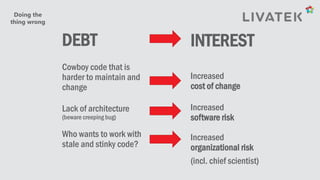
Increased
cost of change
Increased
software risk
Who wants to work with
stale and stinky code?
Increased
organizational risk
(incl. chief scientist)
Cowboy code that is
harder to maintain and
change
Lack of architecture
(beware creeping bug)
DEBT INTEREST %
Doing the
thing wrong
Technical debt => Cost of change
Cost of change
Time
Simple,
test-driven
designs
Rapid coding
without testing
Avoiding technical debt
Simple!
Do the Thing Right!
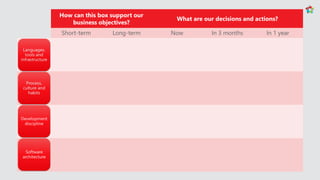
Levers and handles
Languages,
tools and
infrastructure
Process,
culture and
habits
Development
discipline
Software
architecture
Levers and handles
Languages,
tools and
infrastructure
Process,
culture and
habits
Development
discipline
Software
architecture
• Choosing right language
• Shared infrastructure
• Style checking tools
• Code conventions
• Demand unit-test coverage
• Strong definition of “Done”
• Service Oriented
Architecture
• Modularity
• Agree to having a process
• Team operating agreement
• Learning culture
• Test-driven development
BUT - you always do have a choice
Let your
customers down
Work harder Be deliberate
Focus your limited
resources in a way
that best prepares
you for the future
Work longer hours
Forget test coverage
Throw it all out the
window
Reduce internal quality
Reduce accountability
Say “no”
Be Deliberate
QUESTION TO SELF
Are we going to
be around longer
than short-term? YES
FUNDAMENTAL
Later – you will grow
- your product
- your team
That means that you will….
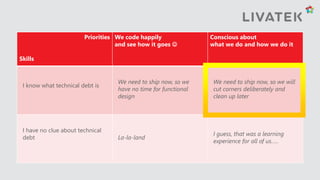
• decide on purpose where to cut
corners
• document corners cut in your task
management system
• use systems to support
communications and limit confusion
NOT, that you will
• have no time for architecture
• ignore the iron triangle of (function,
time, cost) and accept unrealistic
dead lines
We have it…..
Dealing with it
Dealing with technical debt
• Replace the whole thing –
debt repayment
• Incremental refactoring –
paying back in installments
• Live with it, pay the interest
And bear the opportunity cost
Gregory F. Maxwell <gmaxwell@gmail.com>
Technical Debt
As an asset
The exception to prove the rule
Cost of change
Time
Simple,
test-driven
designs
Rapid coding
without testing
INTERESTING!
Can we achieve this??
Cost of change
Time
Hacking it
• Throw all some rules out the window
• Do it in bursts – and then clean up
• Obvious advantage
• Leap forward for product functionality
• Less-obvious advantages
• Team bonding
• Team gets to find its limits Pay-back time!
Forget it, and you’ll be paying interest
- and interest of interest
Debt
My own pitch
Livatek
Team manager
Technical debt - summary
• Main source: when busy doing the right thing (needed in market) =>
not enough time/money to do the thing right
• Problems: cowboy code, lack of architecture, no test coverage
• Issues: cost of maintenance, cost of change, creeping bugs,
software risk, organizational risk
• Avoid with: modular SOA architecture, shared values in team,
unit-test coverage, test-driven development
• Accept it: only deliberately and when documenting
• Do not just: work harder and longer – but focus
• You have it: start all over, refactor module by module, or live with it
• As asset: code wildly for a week – and clean up for a week
Contact
Livatek GmbH
Hamburg
Germany
+49 40 60946277
de@livatek.com
Livatek A/S
Aarhus
Denmark
+45 7734 3090
dk@livatek.com
Jesper Lindholt, CEO
jlin@livatek.com
+380 50 410 8070
+45 3024 8500
@jlindholt / @livatek
linkedin.com/in/jesperlindholt

Technical debt as asset

  • 1.
    Using technical debtas an asset Giving the market what it wants now without losing your pants later Jesper Lindholt, Livatek – jlin@livatek.com
  • 2.
  • 3.
    Technical debt • Whatis it and where is it from? • How to avoid it • Fixing it when you got it • Using it as an asset (!) source: www.defenselink.mil
  • 4.
    Doing the rightthing Business point-of-view Doing the thing right Tech point-of-view • What the market wants • What we promised our users • What we promised our investors • What will bring fantastic value to our clients • Right architecture • Test coverage • Modular • Documentation
  • 5.
    Where do thingsgo wrong? Too much ambition • Features • Product roll-outs • Dead-lines without enough resources • Time • Budget • Skills • Tools leads to technical debt • Corners cut • Low quality work "Wet shorts" by philosophygeek
  • 6.
    Increased cost of change Increased softwarerisk Who wants to work with stale and stinky code? Increased organizational risk (incl. chief scientist) Cowboy code that is harder to maintain and change Lack of architecture (beware creeping bug) DEBT INTEREST % Doing the thing wrong
  • 7.
    Technical debt =>Cost of change Cost of change Time Simple, test-driven designs Rapid coding without testing
  • 8.
  • 9.
    Levers and handles Languages, toolsand infrastructure Process, culture and habits Development discipline Software architecture
  • 10.
    Levers and handles Languages, toolsand infrastructure Process, culture and habits Development discipline Software architecture • Choosing right language • Shared infrastructure • Style checking tools • Code conventions • Demand unit-test coverage • Strong definition of “Done” • Service Oriented Architecture • Modularity • Agree to having a process • Team operating agreement • Learning culture • Test-driven development
  • 12.
    BUT - youalways do have a choice Let your customers down Work harder Be deliberate Focus your limited resources in a way that best prepares you for the future Work longer hours Forget test coverage Throw it all out the window Reduce internal quality Reduce accountability Say “no”
  • 13.
  • 14.
    QUESTION TO SELF Arewe going to be around longer than short-term? YES
  • 15.
    FUNDAMENTAL Later – youwill grow - your product - your team
  • 16.
    That means thatyou will…. • decide on purpose where to cut corners • document corners cut in your task management system • use systems to support communications and limit confusion NOT, that you will • have no time for architecture • ignore the iron triangle of (function, time, cost) and accept unrealistic dead lines
  • 17.
  • 18.
    Dealing with technicaldebt • Replace the whole thing – debt repayment • Incremental refactoring – paying back in installments • Live with it, pay the interest And bear the opportunity cost Gregory F. Maxwell <gmaxwell@gmail.com>
  • 19.
  • 20.
    The exception toprove the rule Cost of change Time Simple, test-driven designs Rapid coding without testing INTERESTING!
  • 21.
    Can we achievethis?? Cost of change Time
  • 22.
    Hacking it • Throwall some rules out the window • Do it in bursts – and then clean up • Obvious advantage • Leap forward for product functionality • Less-obvious advantages • Team bonding • Team gets to find its limits Pay-back time! Forget it, and you’ll be paying interest - and interest of interest Debt
  • 23.
  • 24.
    Technical debt -summary • Main source: when busy doing the right thing (needed in market) => not enough time/money to do the thing right • Problems: cowboy code, lack of architecture, no test coverage • Issues: cost of maintenance, cost of change, creeping bugs, software risk, organizational risk • Avoid with: modular SOA architecture, shared values in team, unit-test coverage, test-driven development • Accept it: only deliberately and when documenting • Do not just: work harder and longer – but focus • You have it: start all over, refactor module by module, or live with it • As asset: code wildly for a week – and clean up for a week
  • 25.
    Contact Livatek GmbH Hamburg Germany +49 4060946277 de@livatek.com Livatek A/S Aarhus Denmark +45 7734 3090 dk@livatek.com Jesper Lindholt, CEO jlin@livatek.com +380 50 410 8070 +45 3024 8500 @jlindholt / @livatek linkedin.com/in/jesperlindholt

Editor's Notes

  • #3 I am Jesper – founder of Livatek We are a Danish company in Ukraine We help our clients in Western Europe tap into a Ukrainian talent pool for software development. We don’t do outsourcing but facilitate distributed teams with higher flexibility and lower costs. Over the years, my team and I have delivered around ½ million development hours.
  • #4 What are the symptoms? Where does it come from?
  • #5 The road to hell is paved with good intentions. Technical debt exists because of wishes to do the right thing. Why do we want to do the right thing – because it IS the right thing to do. Doing the thing right is something different. And there is sometimes a conflict.
  • #9 But that takes: money, resources, time, skills – whatever it is that we do not have enough of
  • #11 Looking at the big picture, the overheads of implementing each of these are not great. Developer objections are often of the running next to the bicycle type. We are so busy that we don’t have time to get on the bicycle.
  • #16 Keep in the back of your head that you are going to scale your product and your team