TECH SONIC CLEANING SYSTEM HELPS
CONOCOPHILLIPS NEUTRALIZE AND CLEAN VALVES
INTRODUCTION
ConocoPhillips is one of the largest refiners in the United States. Its Ponca City, Oklahoma refiner
, with a crude oil processing capacity of 187,000 per day, processes a mixture of light, medium
and heavy crude oil to produce a full range of products, including gasoline, diesel fuel, jet fuel,
LPG and anode–grade petroleum coke. Its facilities include fluid catalytic cracking, delayed
coking and hydrodesulphurization units.
The refinery includes a hydrofluoric (HF) alkalization unit, with hundreds of hydrofluoric acid
service valves that require periodic cleaning to remove iron fluoride and nickel fluoride scale,
depending on the base metal, as well as rebuilds.
Typically, the control, gate, check and plug valves are removed by ConocoPhillips personnel.
They loosen joints and bonnets, and plug valves, open chambers and remove liners from the
valves so liquid neutralizing chemistry can penetrate areas where residual acid may be trapped.
Since hydrofluoric acid is a highly corrosive liquid and contact poison, valve removal and
handling require workers to wear Personal Protective Equipment and use air supplies.
The valve units are then placed in a vat containing a soda ash neutralizing agent for 10–12 hours.
This process neutralizes the pH in preparation for scale removal by sandblasting, cleaning and
rebuilding by an offsite service provider.
Explained Matt Shultz, ConocoPhillips Turnaround Execution Lead, “The pH neutralizing
process leaves the scale on the valves so there is still a lot of clean-up to do. The neutralizing
bath just makes the units safer to handle.”
TECH SONIC OFFERS A MORE EFFICIENT APPROACH
In 2011, Shultz became aware of an alternative approach to the HF unit cleaning and repair operation,
being Tech Sonic Services. This new approach had the potential to save time while increasing safety.
The Tech Sonic cleaning process would neutralize and more effectively clean the valves in one step
before they were sent for servicing.
Explained Russ Philion, Director of Channel Development for Tech Sonic Services,
“The sound waves resonant in the Tech Sonic process create cavitation bubbles that attach to the
surface metals and eventual implode under intense pressure microscopically. These implosions create
massive energy which will dislodge the fouling from the surface material without affecting the
metallurgy in any way.
Coupling this energy with our custom–designed chemistry formulations, the heavy scale fouling on
the surfaces of the valves are re- moved from every major and minor surface area. The ultrasonic
activity accelerates the chemistry attributes that will break away the built-up scale deposits and
foulants, which then fall to the bottom, leaving the part in a like – new state.”
Shultz liked the concept and agreed to give the process a try:
“The fluoride scale was really tight and hard, so I was skeptical that we’d be able to clean it
ultrasonically with the standard cleaning chemistry. “
“At the same time, I felt that the set–up, the equipment and the process of the ultrasonic cleaning
had a lot of value for cleaning fluoride scale if we could get the chemistry right and dis-bond the
scale from the metal,”
Tech Sonic was brought in to test the cleaning technique on some sample pipe sections, valves and
return bends from a small bundle. The chosen chemistry was an organic acid solution that was
effective in both neutralizing and cleaning the hydrofluoric acid buildup.
They found that units could be neutralized and thoroughly cleaned in 30 minutes to 2 hours (with
30-45 minutes being typical), instead of the 10-12 hours for just neutralizing under the previous
process.
FULL–SCALE TURNAROUND
Following the successful tests, Shultz decided to use the Tech Sonic cleaning method during a
turnaround in September of 2011.
The Tech Sonic vessel used was an 8 foot by 4-foot design. The project started about 1 ½ weeks into
the 45–day shutdown when the HF service valves were being removed and prepared for servicing.
ConocoPhillips workers went through the same unit removal procedures as in the past. They
chemically purged the entire Alky unit in place and then removed the valves to be processed for
rebuild.
Valves were still broken down to expose all parts to chemical solution and remove the soft goods but,
instead of neutralizing the units in a soda bath for shipment to an off-site servicer for cleaning and
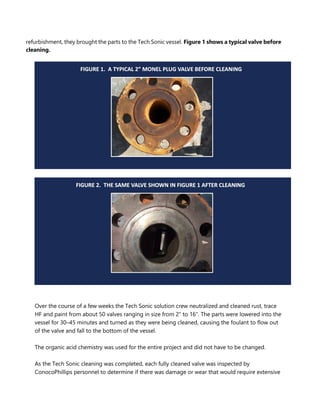
refurbishment, they brought the parts to the Tech Sonic vessel. Figure 1 shows a typical valve before
cleaning.
Over the course of a few weeks the Tech Sonic solution crew neutralized and cleaned rust, trace
HF and paint from about 50 valves ranging in size from 2” to 16”. The parts were lowered into the
vessel for 30–45 minutes and turned as they were being cleaned, causing the foulant to flow out
of the valve and fall to the bottom of the vessel.
The organic acid chemistry was used for the entire project and did not have to be changed.
As the Tech Sonic cleaning was completed, each fully cleaned valve was inspected by
ConocoPhillips personnel to determine if there was damage or wear that would require extensive
repairs or replacement. No replacements were necessary, so the units were then sent to a third–
party servicer for rebuild. The new approach saved about 1 ½ days in the overall cleaning and
rebuilding process.
BENEFITS
Tech Sonic cleaning removes scale more effectively than manual cleaning and more closely
restores the parts to original specifications. It considerably reduces rebuild time because
technicians are presented with clean surfaces.
According to Shultz, Tech Sonic delivered benefits to ConocoPhillips across several categories:
SAFETY:
“The biggest benefit is safety. You’re not hauling something that’s unsafe with a low pH over the
road and you’re not sending anything that’s HF–contaminated to a shop where somebody could
get burned by residual scale.”
TURNAROUND TIME:
“We were able to quickly get the valves turned around, with little cleaning required and less
repair time at the shop.”
VISUAL INSPECTIONS:
“The cleaning allowed us to get a good look at the valve after the scale was removed and prior
to the part leaving for the valve shop. If we had a problem, we would’ve known early that we had
to replace a valve body or purchase longer lead–time parts.”
CONCLUSION
The Tech Sonic process and technology worked well. Concluded Shultz, “I was really impressed
with how well it cleaned the fluoride scale.”
However, he would make at least one change. “I’ll use the process again, but up front I’ll let
my valve shop know that the valves will actually already be cleaned, which will reduce time in
the shop and produce cost savings.”
Clean As New - Offsite Cleaning Facilities
1303 Thompson Park Drive
Baytown, Texas 77521 USA
T: +1.832.271.2666
E: info@cleanasnew.com
U: https://cleanasnew.com

ConocoPhillips & Techonic Cleaning System

  • 2.
    TECH SONIC CLEANINGSYSTEM HELPS CONOCOPHILLIPS NEUTRALIZE AND CLEAN VALVES INTRODUCTION ConocoPhillips is one of the largest refiners in the United States. Its Ponca City, Oklahoma refiner , with a crude oil processing capacity of 187,000 per day, processes a mixture of light, medium and heavy crude oil to produce a full range of products, including gasoline, diesel fuel, jet fuel, LPG and anode–grade petroleum coke. Its facilities include fluid catalytic cracking, delayed coking and hydrodesulphurization units. The refinery includes a hydrofluoric (HF) alkalization unit, with hundreds of hydrofluoric acid service valves that require periodic cleaning to remove iron fluoride and nickel fluoride scale, depending on the base metal, as well as rebuilds. Typically, the control, gate, check and plug valves are removed by ConocoPhillips personnel. They loosen joints and bonnets, and plug valves, open chambers and remove liners from the valves so liquid neutralizing chemistry can penetrate areas where residual acid may be trapped. Since hydrofluoric acid is a highly corrosive liquid and contact poison, valve removal and handling require workers to wear Personal Protective Equipment and use air supplies. The valve units are then placed in a vat containing a soda ash neutralizing agent for 10–12 hours. This process neutralizes the pH in preparation for scale removal by sandblasting, cleaning and rebuilding by an offsite service provider. Explained Matt Shultz, ConocoPhillips Turnaround Execution Lead, “The pH neutralizing process leaves the scale on the valves so there is still a lot of clean-up to do. The neutralizing bath just makes the units safer to handle.” TECH SONIC OFFERS A MORE EFFICIENT APPROACH In 2011, Shultz became aware of an alternative approach to the HF unit cleaning and repair operation, being Tech Sonic Services. This new approach had the potential to save time while increasing safety. The Tech Sonic cleaning process would neutralize and more effectively clean the valves in one step before they were sent for servicing.
  • 3.
    Explained Russ Philion,Director of Channel Development for Tech Sonic Services, “The sound waves resonant in the Tech Sonic process create cavitation bubbles that attach to the surface metals and eventual implode under intense pressure microscopically. These implosions create massive energy which will dislodge the fouling from the surface material without affecting the metallurgy in any way. Coupling this energy with our custom–designed chemistry formulations, the heavy scale fouling on the surfaces of the valves are re- moved from every major and minor surface area. The ultrasonic activity accelerates the chemistry attributes that will break away the built-up scale deposits and foulants, which then fall to the bottom, leaving the part in a like – new state.” Shultz liked the concept and agreed to give the process a try: “The fluoride scale was really tight and hard, so I was skeptical that we’d be able to clean it ultrasonically with the standard cleaning chemistry. “ “At the same time, I felt that the set–up, the equipment and the process of the ultrasonic cleaning had a lot of value for cleaning fluoride scale if we could get the chemistry right and dis-bond the scale from the metal,” Tech Sonic was brought in to test the cleaning technique on some sample pipe sections, valves and return bends from a small bundle. The chosen chemistry was an organic acid solution that was effective in both neutralizing and cleaning the hydrofluoric acid buildup. They found that units could be neutralized and thoroughly cleaned in 30 minutes to 2 hours (with 30-45 minutes being typical), instead of the 10-12 hours for just neutralizing under the previous process. FULL–SCALE TURNAROUND Following the successful tests, Shultz decided to use the Tech Sonic cleaning method during a turnaround in September of 2011. The Tech Sonic vessel used was an 8 foot by 4-foot design. The project started about 1 ½ weeks into the 45–day shutdown when the HF service valves were being removed and prepared for servicing. ConocoPhillips workers went through the same unit removal procedures as in the past. They chemically purged the entire Alky unit in place and then removed the valves to be processed for rebuild. Valves were still broken down to expose all parts to chemical solution and remove the soft goods but, instead of neutralizing the units in a soda bath for shipment to an off-site servicer for cleaning and
  • 4.
    refurbishment, they broughtthe parts to the Tech Sonic vessel. Figure 1 shows a typical valve before cleaning. Over the course of a few weeks the Tech Sonic solution crew neutralized and cleaned rust, trace HF and paint from about 50 valves ranging in size from 2” to 16”. The parts were lowered into the vessel for 30–45 minutes and turned as they were being cleaned, causing the foulant to flow out of the valve and fall to the bottom of the vessel. The organic acid chemistry was used for the entire project and did not have to be changed. As the Tech Sonic cleaning was completed, each fully cleaned valve was inspected by ConocoPhillips personnel to determine if there was damage or wear that would require extensive
  • 5.
    repairs or replacement.No replacements were necessary, so the units were then sent to a third– party servicer for rebuild. The new approach saved about 1 ½ days in the overall cleaning and rebuilding process. BENEFITS Tech Sonic cleaning removes scale more effectively than manual cleaning and more closely restores the parts to original specifications. It considerably reduces rebuild time because technicians are presented with clean surfaces. According to Shultz, Tech Sonic delivered benefits to ConocoPhillips across several categories: SAFETY: “The biggest benefit is safety. You’re not hauling something that’s unsafe with a low pH over the road and you’re not sending anything that’s HF–contaminated to a shop where somebody could get burned by residual scale.” TURNAROUND TIME: “We were able to quickly get the valves turned around, with little cleaning required and less repair time at the shop.” VISUAL INSPECTIONS: “The cleaning allowed us to get a good look at the valve after the scale was removed and prior to the part leaving for the valve shop. If we had a problem, we would’ve known early that we had to replace a valve body or purchase longer lead–time parts.”
  • 6.
    CONCLUSION The Tech Sonicprocess and technology worked well. Concluded Shultz, “I was really impressed with how well it cleaned the fluoride scale.” However, he would make at least one change. “I’ll use the process again, but up front I’ll let my valve shop know that the valves will actually already be cleaned, which will reduce time in the shop and produce cost savings.” Clean As New - Offsite Cleaning Facilities 1303 Thompson Park Drive Baytown, Texas 77521 USA T: +1.832.271.2666 E: info@cleanasnew.com U: https://cleanasnew.com