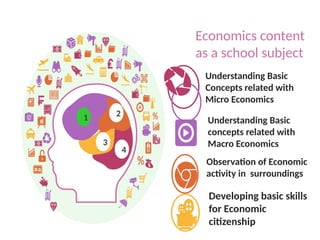
1
4
2
3
Understanding Basic
Concepts relatedwith
Micro Economics
Understanding Basic
concepts related with
Macro Economics
Observation of Economic
activity in surroundings
Developing basic skills
for Economic
citizenship
Economics content
as a school subject
8.
Economics is notseparate subject until higher
secondary stage . It is a part of social studies
which include 4 chapters in 9th
class.
This chapter consists introduction of
some basic terms like production, land,
labor, agriculture etc.
A Story of Palampur
What is FoodSecurity?,
Why Food Security?
Who are food insecure Food
Security inIndia,
What is BufferStock?
What is the Public Distribution
System?,
Current Status of Public
Distribution system
Food security in India
Activities by men and women,
Quality of population,
employment
People as Resource
Poverty as seen by Social
Scientists, Poverty
Estimates,Vulnerable Groups,inter
state disparities,Global Poverty
scenario Causes ofPoverty,Anti-
povertymeasures,The Challenges
Ahead
Poverty as a Challenge
Content of
Economics in
secondary level
school curriculum
9.
Similarly, in class10 th also It is a part of
social studies which include 4 chapters in
What Development Promises - Different
people different goals, Income and other
goals
National Development, How to compare
different countries or states? Income and
other criteria ,Public Facilities
Sustainability of development
DEVELOPMENT
Production across countries
Interlinking production across
countries
Foreign Trade and integration of
markets
What is globalization?
Factors that have enabled
Globalization
World Trade Organization
Impact of Globalization on India
The Struggle for a fair Globalization
GLOBALISATION AND THE
INDIAN ECONOMY:
Money as a medium of exchange
Modern forms of money
Loan activities of Banks
Two different credit situations
Terms of credit
Formal sector credit in India
Self Help Groups for the Poor
MONEY AND CREDIT:
Sectors of Economic ActivitiesComparing the
three sectors
–Primary, Secondary and Tertiary Sectors in
India
Division of sectors as organized and
unorganized
–Sectors in terms of ownership: Public and
Private Sectors
SECTORS OF THE INDIAN ECONOMY:
Content of Economics
in secondary level
school curriculum
10.
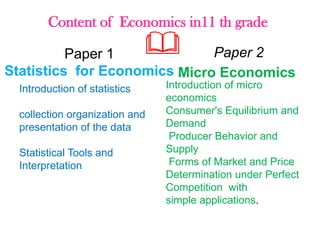
Content of Economicsin11 th grade
Paper 1
Statistics for Economics
Introduction of statistics
collection organization and
presentation of the data
Statistical Tools and
Interpretation
Paper 2
Micro Economics
Introduction of micro
economics
Consumer's Equilibrium and
Demand
Producer Behavior and
Supply
Forms of Market and Price
Determination under Perfect
Competition with
simple applications.
11.
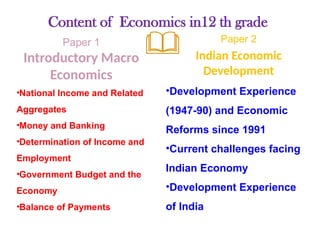
Content of Economicsin12 th grade
Paper 1
Introductory Macro
Economics
•National Income and Related
Aggregates
•Money and Banking
•Determination of Income and
Employment
•Government Budget and the
Economy
•Balance of Payments
Paper 2
Indian Economic
Development
•Development Experience
(1947-90) and Economic
Reforms since 1991
•Current challenges facing
Indian Economy
•Development Experience
of India
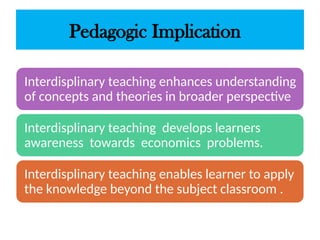
Pedagogic Implication
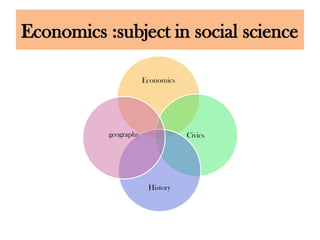
Interdisplinary teachingenhances understanding
of concepts and theories in broader perspective
Interdisplinary teaching develops learners
awareness towards economics problems.
Interdisplinary teaching enables learner to apply
the knowledge beyond the subject classroom .