Teaching Civic Engagement 1st Edition Forrest Clingerman Reid B Locklin
1.
Teaching Civic Engagement1st Edition Forrest
Clingerman Reid B Locklin download
https://ebookbell.com/product/teaching-civic-engagement-1st-
edition-forrest-clingerman-reid-b-locklin-5296738
Explore and download more ebooks at ebookbell.com
2.
Here are somerecommended products that we believe you will be
interested in. You can click the link to download.
Statistics For Empowerment And Social Engagement Teaching Civic
Statistics To Develop Informed Citizens Jim Ridgway
https://ebookbell.com/product/statistics-for-empowerment-and-social-
engagement-teaching-civic-statistics-to-develop-informed-citizens-jim-
ridgway-49416652
Young Citizens Of The World Teaching Elementary Social Studies Through
Civic Engagement Marilynn Boylebaise
https://ebookbell.com/product/young-citizens-of-the-world-teaching-
elementary-social-studies-through-civic-engagement-marilynn-
boylebaise-5130654
Seven Democratic Virtues Of Liberal Education A Studentinspired Agenda
For Teaching Civic Virtue In European Universities Teun J Dekker
https://ebookbell.com/product/seven-democratic-virtues-of-liberal-
education-a-studentinspired-agenda-for-teaching-civic-virtue-in-
european-universities-teun-j-dekker-48122324
Civic Pedagogies In Higher Education Teaching For Democracy In Europe
Canada And The Usa Jason Laker
https://ebookbell.com/product/civic-pedagogies-in-higher-education-
teaching-for-democracy-in-europe-canada-and-the-usa-jason-
laker-5378262
3.
Reimagining The TeachingOf European History Promoting Civic Education
And Historical Consciousness Cosme Jess Gmez Carrasco
https://ebookbell.com/product/reimagining-the-teaching-of-european-
history-promoting-civic-education-and-historical-consciousness-cosme-
jess-gmez-carrasco-49469938
For The Civic Good The Liberal Case For Teaching Religion In The
Public Schools Coll
https://ebookbell.com/product/for-the-civic-good-the-liberal-case-for-
teaching-religion-in-the-public-schools-coll-10984414
Teaching Representations Of The Spanish Civil War Nol Maureen Valis
https://ebookbell.com/product/teaching-representations-of-the-spanish-
civil-war-nol-maureen-valis-43614530
Civil Society And Social Responsibility In Higher Education
International Perspectives On Curriculum And Teaching Development 1st
Edition Enakshi Sengupta Patrick Blessinger Craig Mahoney
https://ebookbell.com/product/civil-society-and-social-responsibility-
in-higher-education-international-perspectives-on-curriculum-and-
teaching-development-1st-edition-enakshi-sengupta-patrick-blessinger-
craig-mahoney-51680024
Education Civics And Citizenship In Egypt Towards More Inclusive
Curricular Representations And Teaching Ehaab D Abdou
https://ebookbell.com/product/education-civics-and-citizenship-in-
egypt-towards-more-inclusive-curricular-representations-and-teaching-
ehaab-d-abdou-56886814
TEACHING LÉVI-STRAUSS
Edited byHans H. Penner
TEACHING ISLAM
Edited by Brannon M. Wheeler
TEACHING FREUD
Edited by Diane Jonte-Pace
TEACHING DURKHEIM
Edited by Terry F. Godlove, Jr.
TEACHING AFRICAN AMERICAN
RELIGIONS
Edited by Carolyn M. Jones and Theodore
Louis Trost
TEACHING RELIGION AND HEALING
Edited by Linda L. Barnes and Inés
Talamantez
TEACHING NEW RELIGIOUS
MOVEMENTS
Edited by David G. Bromley
TEACHING RITUAL
Edited by Catherine Bell
TEACHING CONFUCIANISM
Edited by Jeffrey L. Richey
TEACHING THE DAODE JING
Edited by Gary Delaney DeAngelis
and Warren G. Frisina
TEACHING RELIGION AND FILM
Edited by Gregory J. Watkins
TEACHING DEATH AND DYING
Edited by Christopher M. Moreman
TEACHING UNDERGRADUATE
RESEARCH IN RELIGIOUS
STUDIES
Edited by Bernadette McNary-Zak
and Rebecca Todd Peters
TEACHING JUNG
Edited by Kelly Bulkeley and Clodagh
Weldon
TEACHING MYSTICISM
Edited by William B. Parsons
TEACHING RELIGION AND
VIOLENCE
Edited by Brian K. Pennington
TEACHING THE I CHING
(BOOK OF CHANGES)
Geoffrey Redmond and Tze-ki Hon
TEACHING CIVIC ENGAGEMENT
Edited by Forrest Clingerman
and Reid B. Locklin
TEACHING RELIGIOUS STUDIES
SERIES EDITOR
Karen Y. Jackson-Weaver, Princeton University
A Publication Series of
The American Academy of Religion
and
Oxford University Press
Contents
Acknowledgments vii
Contributors ix
Introduction: A Model for Teaching Civic Engagement, in the Religion
Classroom and Beyond xiii
SECTION I: What Are the Dimensions of Teaching Civic Engagement
in the Religious Studies or Theology Classroom?
1.
Discourse, Democracy, and the Many Faces of Civic Engagement: Four
Guiding Objectives for the University Classroom—reid b. locklin,
with ellen posman 3
2.
Sacred Sites and Staging Grounds: The Four Guiding Objectives
of Civic Engagement in the Religion Classroom—ellen posman,
with reid b. locklin 23
SECTION II: What Practical Strategies and Questions Emerge from Teaching
Civic Engagement in Religious Studies and Theology?
3.
Teaching for Civic Engagement: Insights from a Two-Year Workshop
—melissa c. stewart 47
4.
Giving and Receiving Hospitality during Community Engagement
Courses—marianne delaporte 61
5. Civic Engagement in the Heart of the City—rebekka king 74
11.
vi Contents
6.
EngagingMedia and Messages in the Religion Classroom
—hans wiersma 88
7.
Service and Community-Based Learning: A Pedagogy for Civic
Engagement and Critical Thinking—philip wingeier-rayo 109
8.
Religious Diversity, Civic Engagement, and Community-Engaged
Pedagogy: Forging Bonds of Solidarity through Interfaith Dialogue
—nicholas rademacher 125
9.
Stopping the Zombie Apocalypse: Ascetic Withdrawal as a Tool
for Learning Civic Engagement—elizabeth w. corrie 143
SECTION III: What Are the Theoretical Issues and Challenges
in Teaching Civic Engagement in Religious Studies and Theology?
10.
Thinking about the “Civic” in Civic Engagement and Its Deployment
in the Religion Classroom—carolyn m. jones medine 163
11.
More than Global Citizenship: How Religious Studies Expands
Participation in Global Communities—karen derris
and erin runions 184
12.
Political Involvement, the Advocacy of Process, and the Religion
Classroom—swasti bhattacharyya and forrest
clingerman 205
13.
Religious Studies, Theology, and Pedagogies of Civic Engagement
—thomas pearson 224
14. Dreams of Democracy—tina pippin 245
Bibliography 267
Index 291
12.
Acknowledgments
this book isthe result of several years of collaboration, which began when most
of the contributors met each other in Crawsfordville, Indiana, at the Wabash
Center for Teaching and Learning in Theology and Religion. For many of the
chapter authors—and certainly for the editors—the Wabash Center served as
a formative place for reflection on teaching. A debt of gratitude is owed to the
Wabash Center staff, especially Tom Pearson, Paul Myhre, Rita Arthur, Patricia
Overpeck, and the Center Director, Dena Pence. We learned a great deal from the
workshop coordinators Carolyn Medine, Tina Pippen, Joe Favazza, and Charlie
Hallisey. We also owe a great deal to our fellow workshop participants Jeff Brack-
ett, Clark Chilson, Melanie Harris, and Helen Rhee.
This project has also benefited from the work of several others who have been
instrumental in a variety of ways, including Caitriona Brennan, Verna Ehret,
Ella Johnson, Kevin O’Brien, and Jenna Sunkenberg. We offer special thanks to
Kathleen Baril of the Heterick Memorial Library at Ohio Northern University for
her help on the bibliography of this book. We also wish to thank Karen Jackson-
Weaver of Princeton University and Cynthia Read of Oxford University Press,
who worked with us as editors to get these ideas into print.
14.
Contributors
Swasti Bhattacharyya—is Professorof Philosophy and Religion at Buena Vista
University. She earned her A.S. in nursing and B.A. in religion from Loma Linda
University; an M.A. from Fuller Theological Seminary; another M.A. in Judaism
and Christianity in Antiquity from the University of Virginia; and a Ph.D. in Re-
ligion and Social Ethics from the University of Southern California. She has been
on the Committee on Teaching and Learning of the American Academy of Re-
ligion and is a board member for the Peace and Justice Studies Association. She
is the author of Magical Progeny, Modern Technology (SUNY, 2006), along with
other articles and presentations on ethics, religion, and pedagogy. Her current
project is exploring the living legacy of Vinoba Bhave (disciple, friend, confidant,
and spiritual successor to Mahatma Gandhi).
Forrest Clingerman—is Associate Professor of Philosophy and Religion at Ohio
Northern University. His scholarship investigates the intersection between theol-
ogy, philosophical hermeneutics, and environmental thought. He is co-editor of
Interpreting Nature: The Emerging Field of Environmental Hermeneutics (Fordham
University Press, 2013) and Placing Nature on the Borders of Religion, Philosophy,
and Ethics (Ashgate, 2011). He is also author of a number of articles and essays on
environmental thought and the idea of place. His recent scholarship has focused
on climate change, geoengineering, and religion.
Elizabeth W. Corrie—is Associate Professor in the Practice of Youth Education
and Peacebuilding and Director of the Youth Theological Initiative at Candler
School of Theology, Emory University, in Atlanta, Georgia. She received her B.A.
in Religion from the College of William Mary in 1993, her M.Div. from Can-
dler School of Theology in 1996, and her Ph.D. in Historical Studies from the
Graduate Division of Religion at Emory University. Her research interests in-
clude practical theology and youth ministry, transformative pedagogy, theories
of nonviolence, and conflict transformation.
15.
x Contributors
Marianne Delaporte—isProfessor and Chair of the philosophy and religious
studies department at Notre Dame de Namur University in Belmont, Califor-
nia. She received her Ph.D. at Princeton Seminary in Medieval Church history
with a dissertation on the abbot Hilduin of St. Denis and his vita of Saint Denis,
the headless holy man. She is the co-author of “Hell as a Residual Category”
in Companion to Sociology of Religion (Blackwell Publishers, 2001), as well as of
many other published articles. Her current research focuses on the connection
between motherhood and spirituality. She began her work on this subject by con-
centrating on the fourteenth century and Birgitta of Sweden’s mystical experi-
ences. Since then she has focused her attention on the LaLeche League and The
Farm commune in Tennessee.
Karen Derris—is Professor of Religious Studies and the Virginia C. Hunsaker
Distinguished Teaching Chair of the College of Arts and Sciences at the Univer-
sity of Redlands in Redlands, California. Her research and publications primarily
consider the intersections of literature, ethics, and history in Buddhist traditions.
She is co-editor with Damcho Diana Finnegan of a book by His Holiness the 17th
Karmapa, The Heart Is Noble: Changing the World from the Inside Out (Shambala,
2012) that developed from an international studies course she led in Dharamsala,
India, where her students spent three weeks in conversation with the Karmapa.
Rebekka King—is an Assistant Professor of Religious Studies in the Depart-
ment of Philosophy at Middle Tennessee State University. She is a cultural an-
thropologist and teaches courses on Christianity, ethnographic practices, and
method and theories in the study of religion.
Reid B. Locklin—holds a joint appointment in Christianity and Culture at Saint
Michael’s College and the Department for the Study of Religion, University of
Toronto. A graduate of Boston University and Boston College, he is the author of
Spiritual But Not Religious? (Liturgical Press, 2005), Liturgy of Liberation (Peeters,
2011), and other works in comparative theology, Hindu-Christian studies, and
spirituality.
Carolyn M. Jones Medine—is Professor in the Department of Religion and the
Institute for African American Studies at the University of Georgia. She is the
General Sandy Beaver Teaching Professor for 2014–2017. Dr. Medine writes
about African American religion and literature, particularly that of Southern
black women and on theoretical issues. Her most recent work, co-written with
John Randolph LeBlanc, is Ancient and Modern Religion and Politics: Negotiating
Transitive Spaces and Hybrid Identities (Palgrave Macmillan 2012). In 2013 she
received the American Academy of Religion’s Award for Excellence in Teaching.
16.
Contributors xi
Thomas Pearson—isthe Associate Director of the Wabash Center for Teaching
and Learning in Theology and Religion in Crawfordsville, Indiana. He has pub-
lished on cross-cultural religious conversion in the central highlands of South-
east Asia during the Vietnam War.
Tina Pippin—is the Wallace M. Alston Chair of Bible and Religion at Agnes Scott
College, a liberal arts college for wymyn, in Decatur, Georgia. As an activist edu-
cator she teaches in the areas of biblical studies, ethics and social justice, gender
and wymyn’s studies, and human rights. Publications include Death and Desire:
The Rhetoric of Gender in the Apocalypse of John (Westminster/John Knox, 1992)
and Apocalyptic Bodies: The Biblical End of the World in Text and Image (Routledge,
1999). She was also a member of the collaborative writing group The Bible and
Culture Collective (The Postmodern Bible, Yale University Press, 1995) and a co-
editor (with David Jobling and Ron Schleifer) of The Postmodern Bible Reader
(Blackwell, Spring 2001). She is the editor, with Cheryl Kirk-Duggan, of Mother
Goose, Mother Jones, Mommie Dearest: Biblical Mothers and Their Children (Semeia
Studies, 2010). For the past fifteen years Professor Pippin has been involved,
along with students at Agnes Scott, in a mentoring relationship with “at-promise”
young women and teen moms at Decatur High School. As part of her involve-
ment in the Agnes Scott Living Wage Campaign, Tina facilitates and teaches in
the ESOL program for college staff. In 2000, she was the first recipient of the
American Academy of Religion’s Award for Excellence in Teaching.
Ellen Posman—is Associate Professor of Religion at Baldwin Wallace University in
Berea, Ohio. She holds degrees in religious studies from Stanford University, Har-
vard University, and the University of California, Santa Barbara. Her expertise lies
in the area of comparative religion, with specializations in Buddhism and Judaism.
Nicholas Rademacher—is Associate Professor of Religious Studies and Coor-
dinator of the Social Justice Minor at Cabrini College in Radnor, Pennsylvania.
Community collaboration and interfaith dialogue are central to his teaching and
scholarship. Dr. Rademacher has long been involved in the practice and scholar-
ship of teaching and learning. He is co-founder and faculty fellow in the Voices
of Justice Living and Learning Community, and he has published collaboratively
and individually in the area of community-based learning. More broadly, his
scholarship focuses on the intersection of faith and justice, with special attention
on the lived tradition of Catholic social thought and practice across the twentieth
century.
Erin Runions—is Associate Professor at Pomona College (in Claremont, Califor-
nia) in Religious Studies and Gender Studies, and Chair of the Department of
17.
xii Contributors
Religious Studies.She is a specialist in the Hebrew Bible, which she reads from
the perspective of cultural studies and gender and sexuality studies. Her most
recent book is The Babylon Complex: Theopolitical Fantasies of War, Sex, and Sov-
ereignty (Fordham University Press, 2014). She has also been involved in social
justice movements for many years. She currently helps facilitate a writing work-
shop inside a women’s prison in Chino, California.
Melissa C. Stewart—is Professor of Religion at Adrian College, where she
teaches courses in Judaism, Christianity, Islam, ethics, and women’s studies.
She holds a Ph.D. from Vanderbilt University. She is the director of Adrian Col-
lege’s Center for Effective Teaching in Adrian, Michigan, and she most recently
published “Mary, the Mother of God: Ecumenical Bridge or Barrier?” in Theology
Today (January 2011).
Hans Wiersma—is Associate Professor of Religion at Augsburg College in Min-
neapolis, Minnesota. He is a fellow at Augsburg’s Center for Teaching and Learn-
ing (2011–2014). He was awarded a Wabash Center for Teaching and Learning
fellowship (2006–2007) and has written for the journal Teaching Theology Reli-
gion. He has contributed to the development and content of a wide range of books
and learning resources, including The Lutheran Handbook (2005), Crazy Talk: A
Not-So-Stuffy Dictionary of Theological Terms (2008), Crazy Book: A Not-So-Stuffy
Dictionary of Biblical Terms (2009), The Westminster Handbook to Theologies of the
Reformation (2010), and the digital edition of Introduction to The History of Chris-
tianity: First Century to Present Day (2014).
Philip Wingeier-Rayo—is Associate Professor of Mission, Evangelism, and
Methodist Studies at Austin Theological Seminary in Austin, Texas. Previously
he was Professor of Religion at Pfeiffer University in North Carolina, where
he taught for eleven years. He has also served as adjunct professor at Garrett-
Evangelical Theological Seminary and Wesley Theological Seminary, and has
lived and taught at seminaries in Cuba and Mexico. He has published numerous
articles and two books: Cuba Methodism: The Untold Story of Survival and Revival,
2nd edition (Atlanta, GA: Dolphins and Orchids, 2006) and Where Are the Poor?
An Ethnographic Study of a Base Christian Community and a Pentecostal Church in
Mexico (Pickwick Publications, 2011).
18.
Introduction
a model forteaching civic engagement,
in the religion classroom and beyond
Forrest Clingerman and Reid B. Locklin
shortly after the 2014 U.S. midterm elections, Drew Stelljes posted a Huffing-
ton Post blog entitled, “US Colleges and Universities Earn a Poor Grade for Civic
Engagement.”1
In his blog, Stelljes notes the high levels of discouragement and
distrust in the post-election landscape, along with an apparent decline in the core
civic virtues of civility, reasoned deliberation, and a commitment to the common
good. Though universities have in many cases invested in centers dedicated to
addressing this concern, he argues, they tend to focus on facilitating student vol-
unteer opportunities rather than the harder, riskier work of fostering these par-
ticular virtues, so necessary for democratic citizenship. He concludes:
The history of higher education in the first part of the 21st century is
partially written and for the most part, it does not read well for civic en-
gagement. It is largely deplete of the democratic virtues our nation is
so desperate to recapture. Imagine if a college was so bold as to remain
wholly dedicated to its civic mission—to really prepare students to be ded-
icated civic leaders, equipped with skill set to engage in thoughtful dia-
logue across differences, with compromise the shared goal and solutions
the standard. How could higher education be most thoughtful about get-
ting closer to this aim for the benefit of the next generation of engaged
citizens and public servants?2
Stelljes’ criticism might be regarded as at least slightly self-serving: He is, after all,
Director of the Office of Community Engagement at the College of William and
Mary—presumably among those centers whose scarce funding he deplores. Nev-
ertheless, he joins a chorus that has been sounding at least since the publication
19.
xiv Introduction
of RobertD. Putnam’s 1995 article “Bowling Alone” and subsequent book of the
same name.3
In these works, Putnam and his collaborators noted a sharp decline
in “social capital” in the late twentieth century, as North Americans withdrew
from active community connections at all levels, from the family dinner table to
the political party convention. This and other alarms from a range of social theo-
rists led to what is frequently termed the “civic engagement movement” in higher
education, as organizations like Campus Compact, the Association of American
Colleges and Universities, and those many centers of community engagement
celebrated and criticized by Stelljes set out to renew the civic mission of the uni-
versity.4
Reflecting on such trends in his encyclopedic manifesto Multiversities,
Ideas, and Democracy, the Canadian economist George Fallis differentiated two
aspects of a robust democratic mission for the contemporary “multiversity”: (1) a
“social contract for research” that fosters innovation and supports intellectuals
willing and able to contribute their expertise to questions of public interest; and
(2) a broad, liberal arts curriculum that cultivates “civic wisdom” on the part of
the undergraduate students that represent the university’s largest and most con-
sequential constituency.5
What significance do such a movement and mission have for religious studies
and theology? At one level, civic engagement and religion reveal a natural connec-
tion: As Putnam and William E. Campbell argue in their 2010 work American
Grace, religious belonging of almost any variety reveals a strong, positive corre-
lation with most aspects of civic engagement, including volunteerism, political
activism, and contributions to both religious and secular social initiatives.6
The
study of religious studies and theology would thus seem, by virtue of its subject
matter, to imply some level of engagement with issues of social and political con-
cern. Insofar as such study may presume or encourage any religious belonging
on the part of its teachers or students, it may also implicate them more directly
in the connections that, according to Putnam and Campbell, nourish a robust,
healthy civic sphere.
But such a presumption is, at best, highly problematic for teachers of reli-
gious studies and even theology. The contemporary study of religion in North
America and Europe is often built on a distinction between religious belong-
ing, on the one hand, and the critical analysis of religious practices, institutions,
and intellectual traditions, on the other. Though many scholars might stop short
of raising this distinction to the level of a sine qua non or ideological absolute,
most accept it to one degree or another in practice. This has been important for
the definition of the field of religious studies in the last few decades, as seen in
how scholars challenge traditional Western theological concepts of “religion” in
favor of new modes of study. Therefore, we can perhaps narrow the questions at
the heart of this volume: What is the civic relevance of the academic study of re-
ligion, considered on its own terms and in its increased diversity? What unique
20.
Introduction xv
contributions doesreligious studies offer the public sphere, especially when seen
as separate from the work of religious communities who concentrate on religious
belonging? How might the disciplines dedicated to such study offer a distinctive
shape and response to the civic mission of the contemporary university?
These became the guiding questions of a faculty workshop on Pedagogies for
Civic Engagement, conducted under the auspices of the Wabash Center for Teach-
ing and Learning in Theology and Religion in 2008–2009 and directed by Clark
Chilson, Forrest Clingerman, Reid Locklin, and Erin Runions. The workshop
brought together nineteen faculty members from the United States and Canada,
from a diverse range of disciplines in religious studies and theology, to develop
a shared framework and particular classroom strategies to foster and assess our
students’ capacity for effective civic engagement. The present volume consists
of selected insights generated in the course of this workshop, supplemented by
further research and reflection on the part of workshop participants—along with
several additional essays, solicited by the editors as the book began to take its
present shape.
The workshop itself is described in some detail in chapter 3, so we will not
discuss it in detail here. Instead, we wish to highlight the distinctive, heuristic
framework for assessing civic engagement as it emerged from the workshop con-
versations. That is, as the group reviewed relevant literature and reflected on our
own teaching, participants together identified four core capacities central to civic
engagement and, thus, to the project of teaching for such engagement in the re-
ligion classroom. These are:
1. the capacity to engage in sustained, complex modes of deliberation and
discussion;
2. the capacity to understand the dynamics of social location and diverse social
frameworks, including the imbrication of such frameworks in networks of
power and privilege;
3. the capacity not merely to foster empathetic connections across boundaries of
social, economic, and/or religious difference but to identify such connections
as a source of moral obligation; and
4. the capacity to act, motivated by careful deliberation, a consciousness of social
location, and empathetic connections across boundaries of difference.
These four capacities of intellectual complexity, social framing or location, em-
pathetic accountability, and motivated action obviously include the development
of particular skill sets, but they are better understood as dynamic, recursive, and
mutually reinforcing habits of thought, disposition, and practice. They can, more-
over, be very briefly captured in the short formula Complexity-Location-Empathy-
Action, or CLEA. From this point forward, we refer to this as the CLEA model.
21.
xvi Introduction
The CLEAmodel provides the foundation for the chapters of this book, as well
as a lens through which to understand the coherence of the diverse perspectives
presented by these authors. Elaborating this model is the task of the first section
of this book. In the first two chapters, Reid B. Locklin and Ellen Posman offer an
introduction and rationale for the CLEA model of teaching for civic engagement,
as it may relate to the teaching of religious studies and theology. Chapter 1 makes
a case for the model itself by drawing insights from the civic engagement move-
ment together with selected theorists of cognitive development and liberatory
education. On the one hand, Locklin and Posman note, advocates of liberal edu-
cation tend to emphasize the civic importance of education, but they frequently
do so entirely in terms of an intellectual complexity oriented toward participation
in democratic processes, public discourse, and the adjudication of constitutional
rights. Liberatory educators, on the other hand, critique any artificial separation
of academic methods of deliberation and discourse from the political context(s)
in which such methods are necessarily implicated. They call both for a deeper
understanding of civic participation in terms of social justice, activism, and soli-
darity and for a deeper practice of critical thinking that includes the negotiation
of power in the classroom and in the wider world. The CLEA model is proposed
in this chapter as a way to widen the understanding of civic engagement beyond
its equation with critical thinking and deliberative discourse, and, following lib-
eratory theorists such as Paulo Freire and bell hooks, to suggest how practices of
social framing, empathy, and even direct action may deepen rather than detract
from traditional emphases on intellectual complexity as a primary civic virtue.
Posman extends this discussion in chapter 2 by applying the CLEA model to
the wide variety of disciplines, contexts, and practices that constitute the “reli-
gion classroom”—including, in this case, primarily undergraduate classrooms
in religious studies and theology. The religion classroom does not offer a unique
context for the cultivation of intellectual complexity, the navigation of social dif-
ference, empathetic accountability, or motivated action. Such capacities can be
cultivated across a liberal arts curriculum. Religion, however, does offer distinct
challenges and opportunities. Chief among these is the intrinsic, ambiguous
attraction of its subject matter, insofar as religious traditions represent volatile
sources of meaning, value, motivation, passion, and concern for many persons
in our societies, including many if not most students. But religion also stands
out for its interdisciplinary character and diverse methods of instruction, many
of which conduce well to one or more of the objectives comprehended by the
CLEA model. Myth and ritual, cultural studies, political analysis, literature and
film, community-based learning, moral philosophy—all of these and more find
a natural home in the religion classroom, and all of them have deep implications
for fostering these core civic capacities. The final section of the chapter addresses
the question of assessment, exploring methods to evaluate such capacities as
22.
Introduction xvii
empathetic accountabilityor participation in direct, motivated action through
structured reflection as well as the virtue of articulating civic goals that may be
encouraged “sub rosa,” around the edges of a course, rather than becoming an
object of direct assessment.
The first two chapters deal with the question of civic engagement and the
CLEA model almost entirely in the abstract. The seven chapters that follow turn
instead to specific classroom strategies as both exempla and opportunities for
self-reflection, and thereby form the second section of this book. In chapter 3,
Melissa Stewart offers an overview and analysis of the various projects under-
taken by members of the workshop group during our two-year grant project.
In so doing, she explores the possible correlation between particular kinds of
class assignments—reflective writing, textual and media analysis, field trips,
community-based projects, and other forms of experiential learning—with par-
ticular capacities of the CLEA model. It might seem that core capacities of com-
plexity and social location should correlate more closely to in-class exercises,
while empathetic accountability and motivated action require experience outside
the classroom; yet, in practice, the instructor cannot assume any such neat cor-
relations. This has consequences not only for the teaching of civic engagement
but also for how we imagine the religion classroom itself. “Due to the interrela-
tionships among the skills needed to teach civic engagement,” Stewart concludes,
“the binary definitions of ‘in’ and ‘out’ of the classroom break down.”7
The key,
then, is to teach with multiple methods, attentive to the ways that they may over-
lap and inform one another in unexpected and potentially fruitful ways.
One way of approaching this task is to think not in terms of one-to-one corre-
spondence but in terms of central and peripheral objectives: identifying one core
capacity as the starting point and central lens while also attending to its integral
relations with other such capacities. Thus, the following three chapters might
each be characterized as exploring empathy, relationship, and imagination as
a distinctive, and clarifying, points of entry for the civic project. In chapter 4,
Marianne Delaporte examines the interpersonal patterns of hospitality, reciproc-
ity, and relationship in local, community-based learning activities. In chapter 5,
Rebekka King extends her view more widely to include students’ imaginative con-
ceptions of a whole urban environment—in this case, the city of Toronto—and the
ways that such conceptions may be fruitfully de-familiarized from the perspective
of those who live on the margins of power. In chapter 6, Hans Wiersma reaches
still further afield, exploring the potential and perils of the virtual “global village”
constructed as new media sources provide students with immediate, experiential
access to the Vatican, temple complexes in Angkor Wat, or a protest in Cairo’s
Tahrir Square—all without leaving the comfort of the university classroom.
For our present purposes, it is important to note how Delaporte’s, King’s, and
Wiersma’s respective appeals to imagination and empathy are crafted to open
23.
xviii Introduction
space forcultivating other core capacities. King, for example, describes her “Re-
ligion in the City” course as an exercise in theoretic imagination, informed by
the Epic of Gilgamesh, the fiction of Michael Ondaatje, postcolonial theory, and a
guided tour of “homeless Toronto.” Yet, in and through such an expansion of their
imagined environment, students learn to re-frame and re-locate themselves and
their positions of power within this environment. Both King and Delaporte also
note occasions in which students go on to take political action, deeply informed
by their experiences in class. Wiersma, for his part, draws a straight line from
the imaginative engagement of new media to motivated action: Not only does
training in media equip student activists with new tools, but teaching with such
media can also be construed as the self-conscious construction of—in the idiom
of Marshall McLuhan—a “counter-environment,” an act of subversive resistance
to a “media-infused cultural environment that misunderstands and misrepre-
sents a variety of religious/spiritual subjects.”8
And all three chapters emphasize
the heuristic value of their respective imaginative projects to strengthen intellec-
tual habits and practices of critical reflection, analysis, and evaluation. For King,
the integration of field work and personal engagement with traditional sources
functions to complicate easy binaries of teacher and learner and thus to reconfig-
ure learning itself as a complex, ongoing “reflexive process.”
The following two chapters shift the central focus from empathy to action,
describing community-based learning as a privileged locus for taking up the civic
project in the religion classroom. As noted at the start of this introduction, many
assume classroom civic engagement projects consist of volunteerism; in turn,
community-based learning is often the “face” of civic engagement on campuses.
But these two chapters challenge the too-easy reduction of civic engagement and
community-based learning, instead contextualizing action in a broader model
of civic engagement. In chapter 7, Philip Wingeier-Rayo offers an introduction
to community-based learning at both local and international levels as both a
practice of civic engagement and an opportunity for critical self-reflection. In
chapter 8, Nicholas Rademacher details a partnership between Cabrini College
and two community partners forged over multiple years in relation to courses in
social justice and Catholic Social Teaching. For Wingeier-Rayo, a service trip to
Cuba becomes an occasion for students not only to discover the economic impact
of the U.S. embargo but also to explore the effects of a trade deal like NAFTA
in their own, North Carolina backyard. In his teaching, service opens into au-
thentic civic engagement when students widen their view beyond the construc-
tion of a school, church, or community center to systemic, political analysis.
Rademacher—
similar to Delaporte—focuses instead on reciprocity and hospi-
tality, bringing students to a homeless shelter and intentional community and
bringing members of those communities to the classroom to foster interfaith di-
alogue and solidarity. In both cases, the pedagogical strategies presume that civic
24.
Introduction xix
engagement involveshabit formation as much as discursive knowledge of polit-
ical processes and systems of power; hence, immersion in such action—even in
the limited space of an international service trip or a fifteen-week semester—can
provide an effective entrée into the civic project.
In the chapter that concludes this section of the volume, Elizabeth W. Corrie
effects a startling reversal, commending the cultivation of good practices of civic
engagement not by action but by deliberate, strategic in-action: what she calls the
Ascetic Withdrawal Project. Positioning consumer culture and preoccupations
with the “private self” as a primary threat to the civic commons, Corrie leads her
students in a fasting exercise. On the one hand, she notes, the countercultural
significance of voluntary withdrawal from fast food, cable news, or impulse shop-
ping, in and of itself, is well-attested by the surprised and sometimes hostile
reactions students receive from families and friends. On the other, the broader
civic potential of the project emerges most fully when this six-week practice is
combined with research into a related social issue and subsequent application
in a final project. Corrie’s exercise—offered in a seminary context and oriented
toward youth ministry leaders—also helpfully blurs the line between the study of
religion and religious belonging, with which we began this introduction. Though
the Ascetic Withdrawal Project clearly incorporates a number of capacities of the
CLEA model, the language Corrie prefers is theological, including the tropes of
sin, repentance, justification, and a strong connection to the Christian liturgi-
cal season of Lent. Whereas Rademacher asks students to identify their diverse,
personal expressions of “faith” in generic terms borrowed from James W. Fowler
and King leads students to identify their own, distinctive experience of the city
of Toronto as preparation for their shared study, Corrie presumes a specific reli-
gious formation on the part of her students. Yet, all three strategies suggest that
teaching for civic engagement ideally takes its start from students’ own experi-
ence, formation, and values as an intrinsic aspect of the classroom and the civic
sphere itself.
In the third section of the volume, contributors raise their view from specific
classroom strategies and the particular capacities of the CLEA model to address
several more general, theoretical questions that arise when civic engagement and
civic goals are specifically identified as learning objectives in the religion class-
room. Most important, perhaps, is our understanding of the “civic” itself. Taking
up this question in chapter 10, Carolyn M. Jones Medine briefly traces the recent
history of the civic engagement movement, contrasting the citizenship model in
the influential U.S. high school textbook Magruder’s American Government with
the more decentralized, organic “cellular model” proposed by the anthropologist
Arjun Appadurai. Appadurai’s work suggests that voting patterns and political
participation may not offer a full picture of our students’ engagement: perhaps,
Medine suggests, current generations of undergraduate and graduate students
25.
xx Introduction
are not“disengaged” but “differently engaged.”9
In light of this analysis, Medine
proposes a special role for teaching civic engagement in the religious studies
classroom, one that focuses less on those practices of citizenship engagement
fostered in political science or history departments and more on the cultivation
of trust, genuine encounter, and the “interpretive capacity” to de-exoticize the
cultural, racialized, and religious other and to engage a globalized community in
the telling and receiving of our shared stories.
The complex, contested notion of global citizenship invoked in passing by
Medine moves to the center of inquiry in the following chapter, by Karen Derris
and Erin Runions. In chapter 11, Derris and Runions interrogate the notion of
mobility by drawing on three experiences: a three-week, intensive conversation
with a significant Tibetan Buddhist leader, the 17th Karmapa, in India; a collab-
orative writing workshop in a local women’s prison; and religious and political
mobilization around the firing of seventeen undocumented, immigrant workers
on the campus of Pomona College. Drawing on Foucault, Derris and Runions
suggest “biopolitics” as a framework to interrogate and analyze the freedom of
mobility as embedded in wider, systemic structures of power. The religious stud-
ies classroom offers a distinctively fruitful site for such interrogation not only
because students are often asked to travel literally or imaginatively to temples
and churches outside their ordinary experience, but also because of the particu-
lar topoi of study in the discipline, including the relation of ontologies and ethics,
cultural criticism, intercultural competence, and attentiveness to the myriad
ways that ideals become embedded in structures of power. These tools offer
the possibility of a necessary self-critique and a re-positioning of the rhetoric of
global citizenship as only one form of engagement with the freedom of mobil-
ity and global community—and one that is, like religious traditions themselves,
deeply implicated in patterns of power and domination.
If Derris and Runions suggest that an apparently neutral phenomenon may
emerge in the religious studies classroom as part and product of contested polit-
ical processes, the argument of chapter 12, by Swasti Bhattacharyya and Forrest
Clingerman, explores the potential of making explicitly political processes part
of the religious studies curriculum. Bhattacharyya and Clingerman propose that
there is—or should be—a place for political advocacy in the religion classroom,
but only insofar as it takes the form of “advocacy of process,” rather than advocacy
for a particular party or political cause. This argument depends in part on broad
definitions of its key terms, such that “politics” encompasses any activity that
contributes to the shared, public life of a community, and “advocacy” implicates
students in the relatively straightforward project of “taking a side in a debate and
arguing for it.”10
For Bhattacharyya and Clingerman, the theology or religious
studies instructor serves both as advocate for a particular, reasoned approach
to political processes and as a facilitator for students to try on such advocacy
26.
Introduction xxi
in thecontrived but still political environment of the classroom. This can take
many forms—the authors describe exercises in guerilla theater and letters to
elected officials—but necessarily implicates such instructors in concerns about
indoctrination, classroom incivility, and assessment. An appropriate response
to such concerns, Bhattacharyya and Clingerman contend, is to become more
self-conscious, careful, and reasoned in one’s advocacy for informed political in-
volvement, rather than to send politics into an artificial and ultimately self-decep-
tive exile from the college or university classroom.
Though the chapters in this final section of the volume take up various meta-
issues related to teaching for civic engagement, rather than specific classroom
strategies, their proposals can nevertheless be seen as bringing out one or an-
other element of the CLEA model proposed in this volume. Medine proposes
an understanding of the civic sphere more firmly rooted in empathy and imag-
ination than political processes; Derris and Runions’ analysis of mobility car-
ries clear implications for students’ emerging understandings of their own social
locations and dynamics of privilege; Clingerman and Bhattacharyya advocate
for the integration of political action into classroom instruction; and all of them
relate such practices to the foundational practice of knowledge-production and
critical thought. In general—following the majority of our contributors—they
also situate these practices in a putatively generic “religious studies” or “religion”
classroom. In one of two summative chapters of the volume, Thomas Pearson
asks what difference, if any, one can discern between the distinctive approaches
of theology and religious studies, respectively, in the civic project. Reviewing
the preceding essays, Pearson differentiates multiple orders of normativity,
from first-order (students encounter and analyze normative judgments in their
sources) to fourth-order (students are encouraged or obliged to assume a norma-
tive judgment prescribed in the class) and eventually even fifth-order (learning
directly from an authoritative religious other in the context of a course).
Some degree of normativity, Pearson notes, is implied in any pedagogy of
civic engagement, and this, in turn, would seem to make it more amenable to
the theology than to the religious studies classroom. Yet, empirically, he locates
the highest levels of normativity in both the more theological contributions of
Corrie and Delaporte and the materialist and neo-Marxist analyses of Derris and
Runions. He places most of the other contributors, regardless of discipline, some-
where between first- and fourth-order normativity, encouraging students to form
some type of normative commitment without necessarily prescribing the content
of such commitments for them. But this, he concludes, may ultimately be an
unsafe position: given the suspicion of both theology and religious studies in
the contemporary academy, perhaps scholars in our disciplines are well advised
to defer the civic project to other, more well-established disciplines. When we
have all become more comfortable with normativity in the academic project, in
27.
xxii Introduction
multiple disciplines,then the distinctive commitments that characterize religion
classrooms of various types will no longer leave us vulnerable to critique.
The contributors to this volume endeavor to explore how the student ex-
perience in the religion classroom—be it in an undergraduate or seminary
setting—might help foster the intellectual complexity, sensitivity to social loca-
tion, empathetic accountability, and motivated action necessary for effective civic
engagement. It must be noted, however, that if such initiatives succeed only in
preparing such students for their own engagement in the public sphere, the uni-
versity may well have fallen short of its civic purpose. In a 2010 piece entitled,
“Still Bowling Alone?” Thomas H. Sander and Robert D. Putnam updated Put-
nam’s earlier analysis and noted that, though there was an upsurge of civic en-
gagement following 9/11 on the part of high school seniors from middle-class
backgrounds, less advantaged populations withdrew still further.11
Notwith-
standing the general disaffection noted by Stelljes, with which we began this in-
troduction, college students and recent graduates nevertheless show significantly
higher levels of engagement than their generational peers.12
To concentrate only
on this population’s capacity for engagement risks further entrenchment of their
privilege, relative to other, more marginalized members of our societies.
Tina Pippin takes up this and related questions in her concluding chapter, en-
titled “Dreams of Democracy.” Surveying a range of civic engagement initiatives
in higher education, from the foundational work of John Dewey to the Imagining
America initiative, founded in 1999, Pippin asks whether an authentic pedagogy
of civic engagement implies a systemic change in the structure of the university,
its funding sources, and the professional and activist roles of its professoriate.
Echoing Paulo Freire’s refusal to allow his dialogical method to be reduced to
a teaching technique rather than a strategy for social change, Pippin calls for a
practice of civic engagement that places universities, their hierarchies of staff
and faculty, and the communities they ideally serve together as co-participants
in the construction of a shared, reciprocal “knowledge of living experience.”13
Though she introduces her chapter with reference to the CLEA model proposed
in this volume, her argument also implies a critique. Insofar as instructors in
the religion classroom aim to foster particular civic capacities on the parts of our
students, we may be overlooking the need to transform the face of higher educa-
tion itself.
Taking Pippin’s critique to heart, however, we still find a hopeful alternative
to Stelljes’ dire diagnosis. Throughout this volume, there is a desire to illustrate
how those of us who “profess” religious studies have a responsibility to contribute
to civil society in meaningful ways. Indeed, collectively these chapters show that
it is imperative to connect higher education with a vibrant society. This impulse
toward civil responsibility in religious studies and theology classrooms returns
us to the question of belonging and commitment. The contributing authors seek
28.
Introduction xxiii
to shownew ways of engaging civil society, belying the stereotype that college
educators live in the ivory tower and promote the idiosyncratic and arcane. Teach-
ers and students may or may not belong to the particular religious traditions we
study. Nevertheless, we all belong to civil society—in the midst of its complexity,
from their own locatedness, empowered by personal, empathetic connections,
and sustained by informed action. Perhaps it is time that we began teaching
like it.
Notes
1. Drew Stelljes, “US Colleges and Universities Earn a Poor Grade for Civic En-
gagement,” Huff Post Education, November 10, 2014, accessed December 5,
2014, http://www.huffingtonpost.com/drew-stelljes/us-civic-engagement_b_
6,127,608.html.
2. Ibid.
3. Robert D. Putnam, “Bowling Alone: America’s Declining Social Capital,” Jour-
nal of Democracy 6 (January 1995): 65–78; Robert D. Putnam, Bowling Alone:
The Collapse and Revival of American Community (New York: Simon and Schus-
ter, 2000).
4. See Barbara Jacoby, “Civic Engagement in Today’s Higher Education: An Over-
view,” in Civic Engagement in Higher Education: Concepts and Practices, by Bar-
bara Jacoby and Associates (San Francisco: Jossey-Bass, 2009), 5–30; and, with
a more critical perspective on the movement, Ben Berger, Attention Deficit
Democracy (Princeton and Oxford: Princeton University Press, 2011), 24–51.
5. George Fallis, Multiversities, Ideas, and Democracy (Toronto, Buffalo and
London: University of Toronto Press, 2007), 355–76, 381–87. See also George
Fallis, Rethinking Higher Education: Participation, Research and Differentiation
(Montreal and Kingston: McGill-Queen’s University Press, 2013), esp. 144–51;
and George Fallis, “Reclaiming the Civic University,” Academic Matters (June
2014): 3–6.
6. Robert D. Putnam and David E. Campbell, with the assistance of Shaylyn
Romney Garrett, American Grace: How Religion Divides and Unites Us (New
York: Simon Schuster, 2010), 443–92. The notable exception to these civic
virtues is tolerance for the public expression and advocacy of opposing views,
where persons affiliated with either progressive or conservative religious tradi-
tions reveal themselves as less committed to freedom of expression than their
more secular peers.
7. Melissa Stewart, this volume, 59.
8. Hans Wiersma, this volume, 90.
9. Carolyn Medine, this volume, 169.
10. Bhattacharyya and Clingerman, this volume, 209.
29.
xxiv Introduction
11. ThomasH. Sander and Robert D. Putnam, “Still Bowling Alone? The Post-9/11
Split,” Journal of Democracy 21.1 (2010): 9–16. See also Berger, Attention Deficit
Democracy, 166–70.
12. Mark Hugo Lopez and Abby Kiesa, “What We Know about Civic Engagement
among College Students,” in Jacoby et al., Civic Engagement in Higher Educa-
tion, 31–48.
13. Pippin, this volume, 257.
section i
What Arethe Dimensions of Teaching Civic
Engagement in the Religious Studies
or Theology Classroom?
34.
1
Discourse, Democracy, andthe Many
Faces of Civic Engagement
four guiding objectives for the university
classroom
Reid B. Locklin with Ellen Posman
in her book The Clash Within, the University of Chicago law professor and phi-
losopher Martha Nussbaum documents a tragic collapse of civic and political
culture: the 2002 anti-Muslim religious pogrom in the Indian state of Gujarat.1
Following an incident in Godhra, in which a train filled with Hindu pilgrims
burst into flames after a confrontation with local Muslims, highly politicized
members of the Hindu majority destroyed businesses, dispossessed Muslim
families from their homes, and put approximately two thousand Indian citizens
to death. Muslim women paid a particularly high price in the violence, as they
were often systematically raped and tortured, and children ripped from their
wombs, before being killed.
Many details of the Gujarat pogroms remain in dispute to this day, and Nuss-
baum readily concedes that the causes were complex, reaching back from the rise
of the Hindu nationalist Bharatiya Janata Party government in the 1990s to the
politics of Partition at Indian Independence (1947) and, beyond that, to the iden-
tity politics of the British colonial government. But one of the primary problems,
in her analysis, lay in the particular character of the Indian educational system,
particularly its emphasis upon rote methods and technical expertise. Drawing
inspiration from Visva-Bharati, the experimental university pioneered by Rabi-
ndranath Tagore (1861–1941), Nussbaum champions independent inquiry and
self-critical reflection as the first, foundational plank of a broadly liberal curric-
ulum that empowers its students to test political claims, to value evidence and
argument, to recognize the common humanity of all persons across boundar-
ies of national, ethnic, or religious difference, and to enter imaginatively into
other experiences and other lives.2
Such intellectual and imaginative capacities,
35.
4 dimensions ofteaching civic engagement
she claims, represent a sine qua non for democracy in pluralistic societies like
India and the United States. Indeed, in a more recent critique of American public
education, Nussbaum has generalized this insight as a basic axiom: “cultivated
capacities for critical thinking and reflection are crucial in keeping democracies
alive and awake.”3
Nussbaum is not alone in highlighting critical reasoning and free inquiry as
the primary civic capacities fostered by a university education. So too the former
president of Cornell University, Frank H. T. Rhodes, identifies “the cherished
values of the university” as “integrity, excellence, community, openness, respect,
civility, freedom, responsibility, impartiality and tolerance, all exercised within
an autonomous community of learning.” “[W]ithout respect for these values,” he
argues, “there can be no university worthy of the name. Without them, there can
be no true democracy.”4
In this chapter, we attempt to examine and to critique such claims, which
tend to equate teaching for civic engagement with a fairly traditional view of the
university, the liberal arts, and the value of critical thinking. Key to our argument
is an observation that the “civic” in civic engagement does not represent a stable,
but a malleable, interpretive category. Insofar as participation in democratic so-
ciety is constructed primarily in terms of deliberative discourse, academic skills
of weighing evidence, advancing arguments, and fostering more elaborate modes
of reasoning, along with such core values as civility, autonomy, and openness to
rival points of view, naturally take a central position. But civic engagement in
its fullest sense also implicates teacher and student in questions of motivation,
relationship, and value—above all, a cultivated valuing for the civic sphere. And
this, in turn, recommends a wider range of academic objectives for those scholar-
teachers who wish to teach for civic engagement in the religion—or any liberal
arts—classroom. Far from detracting from a more traditional focus on critical
thinking, we suggest, such a broader range of academic objectives corresponds to
a broader and deeper understanding of such critical thinking itself.
Our argument proceeds in four stages. In the first section of this chapter, we
attempt briefly to delimit what educators may typically intend by such terms as
“free, reasoned inquiry” or “critical thinking and reflection,” for the most part fol-
lowing the theories of intellectual development advanced by William Perry, Jack
Mezirow, and the Women’s Ways of Knowing (WWK) collaborative. After this, we
offer an initial, heuristic definition of civic engagement and trace its close rela-
tionship with intellectual complexity. We then widen the inquiry to include the
more political approaches of bell hooks, Paulo Freire, and other critical theorists
who, while granting and indeed insisting upon the value of intellectual complex-
ity, also valorize principles of conscientization, inclusivity, and embodied praxis.
Considering both sets of theories together, in the final section of the chapter, we
suggest that teaching for civic engagement requires reflection on not one but at
36.
Discourse, Democracy, andCivic Engagement 5
least four heuristic capacities: (1) intellectual complexity; (2) critical awareness of
social location and diverse frames of reference; (3) empathetic accountability; and
(4) motivated action. This fourfold model of teaching civic engagement will serve
to frame and in some cases to shape the chapters that follow (we refer to this as
the CLEA model). Though it may be unreasonable to expect that any individual
assignment could realistically aim for all of these objectives in any particular
classroom setting, instructors do well to reflect on them as different aspects or
dimensions of a single, integrated approach to student development, attentive to
the complex, multifaceted reality of civic participation itself.
In this chapter, we speak of civic engagement and higher education entirely
in the abstract; in the chapter that follows, we both extend and narrow our view
to address the distinctive shape such teaching takes in the religion classroom.
Intellectual Complexity and Critical Thinking:
Setting Some Limits
There are very few academics in the humanities and social sciences who do not
value critical thinking as a central academic objective in their courses. Individ-
ual definitions of this term, however, can and often do vary widely.5
In her 2008
survey of introductory college and university religion courses, for example, Bar-
bara E. Walvoord characterizes critical thinking both in terms of the habits and
dispositions of the “ideal critical thinker” and in terms of specific, assessable
skills of interpretation, comparison, analysis, and evaluation.6
In the religious
studies classroom, she suggests, critical thinking consists of specific “intellec-
tual tasks,” including:
• analysis of the cultural, historical, economic, sociological, political, ideologi-
cal, linguistic, literary, symbolic, and other aspects of religious beliefs, texts,
and practices;
• use of evidence and reason to reach conclusions and to formulate and critique
arguments;
• use of multiple perspectives to understand an issue; and
• the achievement of interpretive distance from [students’] own autobiographies
and communities.
Accompanying these tasks, moreover, are specific “attitudes, dispositions and
habits of mind” such as a willingness to challenge personal beliefs and assump-
tions, recognition of the value of positions other than one’s own, a complex,
dynamic view of truth-claims and the ongoing development of persons and tra-
ditions, rejection of stereotypes, and intellectual autonomy.7
To the extent that
37.
6 dimensions ofteaching civic engagement
teachers specify such intellectual skills or personal dispositions in their course
objectives, or students report them in their evaluations, such courses can be de-
scribed as fostering “critical thinking.”
From one point of view, then, critical thinking may be reduced to particular
tasks and habits of mind that can be identified, modeled, and assessed. Yet, from
another, more developmental perspective, such tasks and habits themselves can
also be situated within broader patterns of psycho-social maturation. Thus, the
educational theorist William G. Perry, Jr., advanced a complex scheme of pro-
gressive development that turns on two major transitions. First, students ide-
ally shift from the dualist, authority-based patterns of thought, characteristic of
adolescence, to what Perry terms “Multiplicity,” in which “everyone has a right
to his own opinion; none can be called wrong.” Again ideally, this development
leads to a subsequent, no less significant shift from pure Multiplicity to a more
context-sensitive, disciplined “Relativism” which includes, at its furthest extent,
a willingness to form self-reflective, provisional commitments.8
More recently,
Jack Mezirow has advocated a broader, recursive “transformation theory” that
tracks intellectual development in a particular field of inquiry from its origin in a
“disorienting dilemma,” through a process of critical examination, experimenta-
tion, and imaginative “reframing,” and finally to its culmination in a new, “more
dependable frame of reference . . . that is more inclusive, differentiating, per-
meable (open to other viewpoints), critically reflective of assumptions, emotion-
ally capable of change, and integrative of experience.”9
Both theories emphasize
students’ developing capacities for negotiating intellectual conflicts and making
reasonable, revisable judgments.
Both Perry and Mezirow locate the development of such capacities in what
Mezirow calls “reflective discourse,” namely, “that specialized use of dialogue
devoted to searching for a common understanding and assessment of the justi-
fication of an interpretation or belief. This involves assessing reasons advanced
by weighing the supporting evidence and arguments and by examining alter-
native perspectives.”10
Emphasis falls squarely on the methods, modes, and
discursive processes by which differences can be adjudicated, provisional judg-
ments affirmed, and alternative perspectives acknowledged. Critical thinking
is, from this perspective, both cultivated and assessed by means of deliberative
discourse.
In concrete practice, of course, students will arrive in the classroom at var-
ious levels of readiness for this kind of reflective, dialectical discourse. Even
more pressingly, as argued by members of the WWK collaborative, upholding
such specialized discourse as a uniform ideal may also risk masking power in-
equalities among students and ignoring the distinctive experience and learning
styles of female students in particular.11
In their landmark study Women’s Ways of
Knowing, the collaborative drew on interviews with 130 adult women to offer an
38.
Discourse, Democracy, andCivic Engagement 7
alternative sequence of five cognitive positions, beginning with the experience of
being “Silenced” and culminating in a position of critical, self-consciously “Con-
structed Knowledge.” These positions loosely cohere with Perry’s scheme while
also challenging many of his fundamental, arguably masculinist assumptions.
Notably, the collaborative advanced the more passive but no less dichotomous
mode of “Received Knowledge” in place of Perry’s “Dualist” position, as well as a
position of “Subjective Knowledge,” rooted in personal experience and attention
to one’s “inner voice,” in place of a more generalized “Multiplicity.”12
In these
cases and many others, recognition of both the strong correspondence to Perry’s
scheme and distinctive differences from it is intended to help teachers meet the
needs of a wider range of students without abandoning the desire “to challenge
and stimulate them to develop more elaborate approaches to the construction of
knowledge.”13
Absolutely central to this task, moreover, is the development of what the col-
laborative nicely clarifies as “Procedural Knowledge,” defined as the understand-
ing that “ideas can be communicated, analyzed, developed, and tested by making
good use of procedures.”14
Here, it is worth noting, the WWK collaborative dif-
ferentiates not between Perry’s “Relativism” and their “Procedural Knowing” as
such, but between the kinds of procedures emphasized in each scheme: “Sepa-
rate Knowing” in one case and “Connected Knowing” in the other. To illustrate
the difference, they draw on Peter Elbow’s distinction between the “doubting
game” and the “believing game.”15
The members of the WWK collaborative, like
Peter Elbow, readily concede that both forms of reasoning may be necessary for
full cognitive development, and they assert that, though there may be gender-
related tendencies, “Separate and connected knowing are not gender-specific.”16
Yet, they also observe that it is invariably the pattern of Separate Knowing that is
upheld as the primary ideal of sound reason in the theories of Perry and Mezirow,
as well as in the broader academy.17
With this corrective in mind, one can nevertheless affirm the cultivation of
intellectual complexity and what the WWK collaborative calls “more elaborate
approaches” to knowledge-creation18
as a relatively stable ideal of university in-
struction. Such an ideal is not strictly reducible to particular procedures of anal-
ysis, evaluation, and synthesis; yet, it is only through practice in the use of such
procedures that students come to what these theorists consider more mature, in-
tegrative, and empowering perspectives on learning itself. The strong presump-
tion seems to be that, once achieved, such intellectual maturity may in many
cases transfer from the classroom to the wider world, from the specific subject-
centered inquiry of a particular academic discipline to the acquisition of know-
ledge and formation of commitments beyond the university or college campus.
One of the goals of this chapter is to re-examine, to nuance, and to some extent to
challenge this presumption.
39.
8 dimensions ofteaching civic engagement
Intellectual Complexity and Civic Engagement
Do such “more elaborate” modes of reasoning reliably transfer from the classroom
to the civic sphere? Does intellectual complexity necessarily make students into
better citizens of their local communities, their nations, and their global society?
Complicating our responses to these questions is the fact that there is, if
anything, less consensus on comprehensive definitions for “civic engagement”
or “good citizenship” than on critical thinking and intellectual complexity.19
One
of the leaders in the civic engagement movement in higher education, Barbara
Jacoby, notes that definitions of such engagement usually include, from most
to least frequent, “community service,” “political participation,” and political
“activism or advocacy.”20
She cites with approval the very broad definition ad-
vanced by the Coalition for Civic Engagement and Leadership at the University
of Maryland:
Civic engagement is defined as “acting upon a heightened sense of re-
sponsibility to one’s communities. This includes a wide range of activities,
including developing civic sensitivity, participation in building civil soci-
ety, and benefiting the common good. Civic engagement encompasses the
notions of global citizenship and interdependence. Through civic engage-
ment, individuals—as citizens of their communities, their nations, and
the world—are empowered as agents of positive social change for a more
democratic world.”21
This definition of civic engagement is deliberately broad, attempting to compre-
hend a variety of activities under a single umbrella. A problem arises, however,
due to the fact that what is actually valued as responsible participation and “posi-
tive social change” may take different shapes, depending upon prior conceptions
of democratic citizenship. In part for this reason, Ben Berger has suggested that
the term “civic engagement” be dropped entirely, in favor of more specific, de-
limitable categories of “political engagement,” “social engagement,” and “moral
engagement.” Though all three may be necessary to keep democracy, in Nuss-
baum’s language, “awake and alive,” they are properly distinguished one from
the other.22
Richard M. Battistoni draws a different set of distinctions. Instead of differ-
entiating “the social” from “the political,” he notes five distinct yet overlapping
models of “the civic” current in literature from the social sciences: “Constitu-
tional Citizenship,” focused on individual rights, voting, and political processes;
“Communitarianism,” focused on community values, shared responsibilities,
and the common good; “Participatory Democracy,” focused on active participa-
tion of all citizens in public deliberation and collective action; “Public Work,”
40.
Discourse, Democracy, andCivic Engagement 9
focused on collaboration among citizens on a variety of initiatives in the public
sphere; and “Social Capital,” focused on membership in voluntary organizations
and civil society.23
To this list Battistoni adds a number of perspectives borrowed
from other disciplines, such as “Civic Professionalism,” “Engaged Scholarship,”
“Social Justice,” and “Connected Knowing” or cultivation of an “Ethic of Care.”24
In the present volume, several authors reflect on the political, social, and ethical
dimensions of civic engagement, as well as a number of the perspectives high-
lighted by Battistoni, well illustrating just how complicated teaching for civic en-
gagement can become.
The fluidity and variety of these definitions alerts us to the fact that, though
one can hardly doubt that any model of good citizenship would exclude intellec-
tual complexity as an academic and civic virtue, it assumes its most central role in
relation to those conceptions of citizenship that place strong value on deliberation
and argument, such as “Constitutional Citizenship” and “Participatory Democ-
racy.” Jack Mezirow, as just one quite striking example, speaks in the idiom of
individual rights, public discourse, and participatory democratic structures when
he emphasizes the civic importance of critical thinking. Transformation theory
aims primarily to help adult learners “gain greater control over our lives as so-
cially responsible, clear-thinking decision makers,” and Mezirow draws a direct
parallel between “reflective discourse” and what sociologist Robert Bellah calls
“democratic habits of the heart.”25
He goes on:
Transformation Theory suggests that transformative learning inherently
creates understandings for participatory democracy by developing capaci-
ties of critical reflection on taken-for-granted assumptions that support
contested points of view and participation in discourse that reduces frac-
tional threats of rights and pluralism, conflict, and the use of power, and
foster autonomy, self-development, and self-governance—the values that
rights and freedoms presumably are designed to protect.26
The line from reflective discourse to responsible civic engagement is, for Mezirow,
a relatively straight one, precisely because both require substantively identical
skills, understandings, and dispositions. Such a contention is further substan-
tiated by Laurent A. Parks Daloz, who uses the example of Nelson Mandela to
illustrate how a “rich ecology of mentors, colleagues, adversaries, events, and crit-
ical discourse” offers resources for the formation of critical, race-transcending
frames of reference and, with it, a commitment to public engagement and the
common good.27
This also resonates well with the position of Martha Nussbaum, with
whom we began this chapter. Like Mezirow, Nussbaum defines civic life and
democratic participation in terms of individual citizens navigating “reasonable
41.
10 dimensions ofteaching civic engagement
disagreement” among various secular and religious perspectives, informing
themselves on important social issues, voting or engaging in public deliberation
as elected or appointed public servants, and “making choices that have a major
impact on the lives of people who differ from themselves.”28
Such participation,
in turn, requires a cultivated capacity for argument, evaluation, and debate, sensi-
tive to multiple perspectives and diverse constituencies and highly differentiated
in its commitment to the interests of the local community, the nation, and the
world29
—all skills closely related to intellectual complexity, as described in the
previous section.
Here it may be important, however, to recall that the full account of intel-
lectual development articulated by Perry, Mezirow, and the WWK collaborative
includes not merely the acquisition of cognitive skills but also the active forma-
tion and articulation of personal commitments. This is of key importance for
tracing a line from such complexity to actual civic engagement. As Jacoby puts
the matter, “Knowledge and skills are acknowledged to be necessary but not suf-
ficient. Values, motivation, and commitment are also required.”30
Values represent not merely a desired result of the kind of critical thinking
that leads to civic engagement; they can, in many cases, function as the bridge
from one to the other. Thus, in one widely cited 1982 article, Richard L. Morrill
recommends that the critical inquiry that characterizes the best classroom in-
struction include explicit attention to the “sea of values” on which democracy
rests: “participation, responsibility, respect for self and others, equality, freedom,
justice, tolerance, and trust.”31
Inveighing against a liberal model of seeking
“knowledge for its own sake” and the dichotomy between thinking, feeling, and
action such a model can be read to imply, Morrill envisions an education for dem-
ocratic citizenship that pushes beyond fostering knowledge of particular political
structures or analysis of particular social issues to address students as whole
persons, as “unified, responsible agents of their own choices and actions.”32
Im-
portantly, such an education does not proceed by one or another form of indoctri-
nation.33
For Morrill, education proceeds by means of a deepened and broadened
discourse, one that includes open-ended processes of analysis, self-reflection,
assessment, revision, and rigorous debate and justification on topics related to
these democratic values. In order for critical reflection to open into effective civic
participation, in other words, it is crucially important that such reflection include
a no less critical inquiry into the “primary springs of human self-evaluation, mo-
tivation, and action”: our values.34
Liberatory Education and Civic Engagement
Richard L. Morrill’s proposal raises an interesting conundrum. While he, like
Mezirow and Nussbaum, acknowledges the formative role of reflective discourse
42.
Discourse, Democracy, andCivic Engagement 11
in fostering both intellectual complexity and the civic participation ideally
formed by it, his emphasis on values also acknowledges the limitations of dis-
course, as such, to stimulate public action. As noted earlier, Richard Battistoni
suggests that there is not one, but multiple models of citizenship employed in the
social sciences and other disciplines—and only some of these, such as “Constitu-
tional Citizenship” and “Participatory Democracy,” place strong emphasis upon
procedural skills of discourse and deliberation. Others, such as “Communitar-
ian,” “Social Capital,” or “Ethic of Care” models, place a much stronger emphasis
on social connections and voluntary participation.35
Still other models, such as
“Social Justice,” tend to refigure citizenship in terms of activism and social cri-
tique.36
Thus, no less fervent an advocate of classroom discussion as Stephen D.
Brookfield questions any facile equation between reflective discourse and per-
sonal transformation, unless critical reflection includes something like “ideology
critique” in the tradition of the Frankfurt School.37
“For something to count as an
example of critical learning, critical analysis, or critical reflection,” he writes, “I
believe the person involved must engage in some sort of power analysis. . . . They
must also try to identify assumptions they hold dear that are actually destroying
their sense of well-being and serving the interests of others: that is, hegemonic
assumptions.”38
Ideally, on Brookfield’s reading, such critical reflection opens
naturally into, and in some sense requires, transformative political action in the
public sphere.39
Brookfield’s argument here accords well with the various models of liberatory
education advanced by Paulo Freire, bell hooks, and other contemporary critical
theorists. Freire is perhaps best known for his critique of the “banking model” of
education, focused on lecture and the delivery of course content, in favor of more
participatory, broadly “liberative” dialogue focused on the posing of problems
for shared reflection.40
In this sense, his theory affirms many of the principles
and practices of reflective discourse, already discussed. Yet, for Freire and his
interpreters, simply focusing on discussion as a method of education tends to
occlude the radical, political role of dialogic methods to illumine and thus to cri-
tique structures of domination and oppression in the wider society.41
In a public
conversation with Ira Shor in the mid-1980s, Freire underlined the continuity
between the classroom and the wider world:
Through your search to convince the learners, your own testimony about
freedom, your certainty for the transformation of society, indirectly you
must underline that the roots of the problem are far beyond the classroom
in society and in the world. Precisely because of that, the context for trans-
formation is not only the classroom but extends outside of it. The students
and teachers will be undertaking a transformation that includes a context
outside the classroom, if the process is a liberating one.42
43.
12 dimensions ofteaching civic engagement
The relation works both ways, of course. For Freire, one of the reasons that ques-
tions of politics and social equity must be addressed in the university classroom is
that this classroom is an intrinsically political space, shaped by market structures
and supported by power elites as a means of perpetuating a hegemonic order.43
Few theorists have adapted this insight of Freire more creatively and thor-
oughly in the North American context than the African American feminist
bell hooks.44
For hooks, a truly engaged pedagogy requires continual attention
to questions of difference and power, particularly the entrenched inequities of
gender, race, and social class. As the members of the WWK collaborative ob-
served, conventional models of teaching and theorizing intellectual development
have tended to favor masculinist patterns and assumptions. Along similar lines,
hooks and other theorists have noted the myriad ways that race and class func-
tion to inhibit the democratic potential of classroom spaces.45
With this in mind,
scholars in religion and other disciplines have developed a number of methods
to help instructors and students alike acknowledge their social locations, address
questions of privilege, and work for social transformation.46
For hooks herself,
such a process involves both a negative process of critique—the “decolonization
of our minds”—and a positive process of community building—the “practice of
beloved community.”47
Because structures of sexism, racism, and class oppres-
sion are perpetuated through habitual, learned behaviors on the part of both op-
pressor and oppressed, so also must these structures be opposed not merely by
intellectual analysis but also by an activist commitment that begins in the class-
room and extends into the wider world.48
Such an embodied, holistic pedagogy
for equality, diversity, and community represents the only “democratic educa-
tion” worthy of the name, because equality is the primary value that differentiates
authentic democracy from oligarchy.49
At first blush, the more activist orientations of Freire, hooks, and other theo-
rists may seem to diminish the value of intellectual complexity, reflective dis-
course, and objectivity as primary ends of university education—displaced, it
may seem, by more explicitly political or ideological objectives.50
Most critical
theorists would insist that this is not the case. First of all, for Freire and hooks,
liberatory education represents not a diminishment of critical thought but its
fullest expression. For Freire, the quest for liberation begins and flourishes on
the basis of natural curiosity, an innate, unrestricted desire to know the world
and to realize its full potential as a realm of creativity.51
For her part, bell hooks
advances engaged pedagogy as a distinctive form of training in critical think-
ing, in “radical openness” to multiple perspectives, and in discernment, analysis,
and evaluation.52
Other theorists have noted that activist and community-based
methods of teaching and learning can function to strengthen rather than weaken
traditional measures of critical thought and scholarly productivity, while also
broadening the scope of their inquiry.53
44.
Discourse, Democracy, andCivic Engagement 13
What these theorists question, perhaps, is not critical thinking as such, but
the implicit separation between such thinking and political context implied
when such thinking is rendered exclusively in terms of cognitive skills and intel-
lectual procedures, as well as the pretense of neutrality in the learning process.
“To make reality opaque is not neutral,” writes Freire. “To make reality lucid,
illuminated, is also not neutral. In order for us to do that, we have to occupy the
space of the schools with liberating politics.”54
In the political space of the class-
room, the liberatory teacher directly engages students in a form of civic prac-
tice oriented to critique and resistance against one or more hegemonic orders.
The outcome of such an education, of course, is radically open, dependent upon
the subjectivities of the students and instructor who engage together in it. In-
structors cannot dictate students’ politics, precisely because this would violate
the very freedom that stands at the center of the educational project; instead,
they aim to provide such students with concrete experiences of freedom, cri-
tique, and authentic
community—embodied, habituating experiences that will,
at least ideally, not only structure but also motivate their engagement in a wider,
civic sphere.55
Teaching for Civic Engagement: Four Guiding Objectives
Thus far, we have drawn a soft contrast between two different approaches to the
civic function of university education. In the first, drawing on the developmen-
tal theories of William Perry, Jack Mezirow, and the WWK collaborative, the
primary civic capacities fostered in the university classroom find their home in
critical discourse, in the weighing of evidence, and in the formation of provi-
sional commitments, attentive to the multiplicity of perspectives on any particu-
lar question. In the second, exemplified in the critical pedagogies of Paulo Freire
and bell hooks, the classroom is reconfigured as an intrinsically political space,
and critical thinking is extended to include a liberative dialectic of dialogue, re-
flection, and embodied action. Though there is ample shared ground among
these approaches, they also bring to light diverse—in some cases conflicting—
conceptualizations of higher education and the civic sphere itself. If civic en-
gagement consists primarily of participation in constitutional processes and
democratic structures, then Mezirow’s ideal of “reflective discourse” would seem
to fit the bill. But is democracy really reducible to reasoned discourse? As Richard
Morrill states succinctly, “Democratic literacy is a literacy of doing, not simply
of knowing. Knowledge is a necessary but not sufficient condition of democratic
responsibility.”56
For Morrill himself, as we have seen, such attention to “doing”
implicates the university instructor in the analysis and clarification of values; for
Freire, hooks, and other activist theorists, it necessarily involves practice in the
“doing” of civic engagement itself.
45.
14 dimensions ofteaching civic engagement
In 2008 and 2009, a group of nineteen religious studies and theology faculty
gathered in a series of workshops to ask the question, “What is effective civic en-
gagement? How do we teach for civic engagement in our classrooms?”57
Early on,
we resolved to adopt an intentionally wide view on the question, with the intention
of incorporating insights from both traditional and liberative perspectives on the
educational project. We were not, of course, the first to make such an attempt. In
the vision of the “active citizen” advanced by the Council of Europe or the “Civic
Learning Spiral” developed by the Civic Engagement Working Group of the As-
sociation of American Colleges and Universities, for example, the achievement
of intellectual complexity and the clarification of values and commitments rep-
resent a necessary but not sufficient objective for civic education; such personal,
cognitive development must be matched by habituating practices of intercultural
awareness, empathy and respect developed through lived relationships with
others, and direct civic action.58
While appreciative of such models, our group
resisted settling on a single, normative vision of the ideal citizen. Instead, we set
out to articulate a loose framework of core capacities, which could be adapted in
a wide variety of ways and which would facilitate conversation and collaboration
without presuming a settled consensus.
With this goal in mind the workshop group settled on four broad, guiding
objectives for educators who wish to educate for civic engagement in the uni-
versity classroom: (1) intellectual complexity; (2) frames of reference and social
location; (3) empathetic accountability; and (4) motivated action.59
For conve-
nience, these core civic capacities may be reduced to the formula Complexity-
Location-Empathy-Action, or CLEA. In our view, the objectives represented in
the CLEA model are cumulative and recursive: Each builds on the other in a
mutual and holistic movement, rather than in a strictly linear order. It seems
unlikely that any single class, much less any single assignment, could attend
equally to all four of them. We suggest that educators are likely to focus on one
or two, while remaining attentive to connections with other values and to the
task of civic engagement as a whole. We describe each of these guiding objec-
tives in turn.
1. Intellectual complexity (C) entails the cultivation of powers of analysis, rea-
soning, and ever “more elaborate approaches” to knowledge-construction, as
detailed by the WWK collaborative and other theorists treated in this chap-
ter. Such complexity, we recognize, represents an intrinsic good in the civic
sphere, conducing to critical discernment in the use of news sources, the ca-
pacity for reasoned debate, and the acknowledgment of alternative perspec-
tives. It serves as a foundation for the three subsequent objectives; it also draws
strength from them, insofar as the acknowledgment of multiple frames of ref-
erence, experiences of empathetic accountability, and reflection on motivated
46.
Discourse, Democracy, andCivic Engagement 15
action tend to complicate existing views and, thus, provide fodder for greater
complexity and more elaborate cognitive procedures.
2. Frames of reference and social location (L) represent two sides of a similar cog-
nitive skill in navigating multiplicity in the abstract and the concrete, the per-
sonal and the embodied. As Mezirow in particular has noted, truly critical
thought entails the ability not merely to acknowledge multiple perspectives
on any particular position but to move flexibly between different, sometimes
conflicting clusters of assumptions that ground these perspectives. Feminist,
Womanist, and other critical pedagogies of gender, race, and class deepen
this cognitive awareness to include reflection on one’s own social location,
including the phenomenon of privilege, and clear recognition of the dynam-
ics of difference, power, and positionality in social life and in the academy.
Such awareness of and comfort with difference can function to deepen intel-
lectual complexity and to create opportunities for empathetic accountability
across boundaries of difference; it can also, particularly when acknowledg-
ment of difference includes reflection on inequity and structures of oppres-
sion, ground motivated action in the classroom and in the wider civic sphere.
3. Empathetic accountability (E) comprehends both the ability to enter imagina-
tively into other life worlds and cultural frameworks and, ideally, the actual
practice of forming relationships and cultivating an ethic of care with persons
different from oneself. At one level, this objective entails an education in di-
versity and multiculturalism. As Nussbaum writes:
An adequate education for living in a pluralistic democracy must be
multicultural, by which I mean one that acquaints students with some
fundamentals about the history and cultures of the many different
groups with whom they share laws and institutions. These should in-
clude religious, ethnic, economic, social, and gender-based groups.
Language learning, history, economics, and political science all play a
role in facilitating this understanding—in different ways at different
levels.60
Nussbaum presumes, and many scholar-teachers would likely affirm, that
multicultural education represents a genuine encounter with difference. Yet,
effective civic engagement becomes more likely when empathy moves beyond
the purely notional, when students are empowered to cross boundaries of dif-
ference and form relationships with actual persons of diverse religions, lan-
guages, and ethnicities—to practice what hooks refers to, following Martin
Luther King, Jr., as “beloved community.”61
Such empathy presumes a candid
acknowledgment of difference and an imaginative ability to navigate multiple
perspectives in constructing one’s own point of view—and thus builds upon
47.
16 dimensions ofteaching civic engagement
the previous two objectives.62
At the same time, experiences of relationship
and community across boundaries of difference can serve as the impulse to
recognize the realities of social location, to confront privilege, and to construct
more complex capacities for reasoning and discourse. Involvement in the lives
of others can also suggest possibilities for service, advocacy, and other forms
of motivated action in the public sphere.63
4. Motivated action (A) is, in many ways, the desired result of all of the previous
objectives, insofar as they fit under the rubric of “teaching for civic engage-
ment.” But, too often, a gap remains between notional command of political
issues or intellectual acknowledgment of social privilege and taking con-
crete action to address them. One way to address this gap, advocated by K.
Edward Spiezo, is to provide students with the “basic knowledge, requisite
skills and hence the confidence to participate politically” through contact with
political activists, interactions with student- and citizen-based interest groups,
and community placements.64
Other pedagogies oriented toward motivated
action include service-learning, guerilla theater, documentary filmmaking,
and “letter to the editor” writing assignments. Such strategies presume that
effective civic engagement is not just a matter of intellect but also a conse-
quence of habituating practice. Students learn civic engagement by engaging
directly in the civic sphere; at the same time, such engagement can, partic-
ularly if matched with reflective work, also function to foster greater intel-
lectual complexity, to deepen awareness of diverse frames of reference and
positionalities, and to cultivate both imaginative and actual bonds of empa-
thetic accountability.
We began this chapter on teaching for civic engagement with an event that
could be interpreted as its failure: the 2002 Gujarat pogrom. More recently, be-
tween April 7 and May 12, 2014, the Bharatiya Janata Party of former Gujarat
Chief Minister Narendra Modi won a sweeping victory in the Indian federal elec-
tions, taking 282 of 543 seats in the lower house of parliament, the Lok Sabha.
On the one hand, this was a very significant achievement of civic participation,
with a 66 percent voter turnout across the country—the highest in Indian elec-
toral history.65
The same event could also, however, be read by some critics in the
Indian and international media as a kind of failure of civic intelligence, particu-
larly in light of Modi’s record in Gujarat.66
This appears to be the view of Martha
Nussbaum herself, who during the campaign period publicly criticized Modi for
fear-mongering and challenged widespread appeals to Gujarat as a miracle of ec-
onomic development under his leadership.67
Yet, the very fact that Nussbaum was
able to articulate such concerns in Indian venues such as The Hindu Centre for
Politics and Public Policy highlighted another element of the event and of Indian
public culture more broadly: namely, the intense coverage of the campaign by
48.
Discourse, Democracy, andCivic Engagement 17
a vibrant, engaged, and highly critical national media.68
The election, finally,
highlighted many divisions in India’s pluralistic society, extending well beyond
Hindu and Muslim to include the complexities of caste and class and Modi’s own
humble origins as a street tea-seller.
Our purpose here is not to pass judgment on Indian federal elections but
simply to note the sheer complexity of assessing the event as an achievement of
civic engagement. Ben Berger suggests that “engagement” can be coded relatively
simply as “attention” and “activity”—political attention and activity, social atten-
tion and activity, moral attention and activity.69
In practice, such attention and
activity are worked out across a complex tapestry of identities, relationships, and
judgments of fact and value. Teaching for civic engagement cannot adequately
address this complexity by simply fostering critical reflection and deliberative
discourse in the classroom, though these are essential. Ideally, it aims to deepen
such critical thinking by addressing questions of identity and motivation directly
and encouraging the formation of empathy, imagination, relationships across dif-
ference, and the lived habits of thought and action conducive to effective engage-
ment in the political and social orders. The four guiding objectives detailed under
the rubric of CLEA—Complexity, Location, Empathy, and Action—
represent one
attempt to capture this complex tapestry for the purposes of classroom instruc-
tion, as well as for the ongoing formation of teacher and student alike.
Notes
1. Martha Craven Nussbaum, The Clash Within: Democracy, Religious Violence,
and India’s Future (Cambridge, MA: Belknap Press of Harvard University
Press, 2007).
2. Ibid., 82–94, 290–96.
3. Martha Nussbaum, Not for Profit: Why Democracy Needs the Humanities (Prince-
ton and Oxford: Princeton University Press, 2010), 10.
4. Frank H. T. Rhodes, “Universities and the Democratic Spirit,” in Higher Educa-
tion and Democratic Culture: Citizenship, Human Rights and Civic Responsibility,
ed. Josef Huber and Ira Harkavy (Council of Europe higher education series
No. 8) (Strasbourg: Council of Europe Publishing, 2007), 45.
5. The following section depends in part on the fuller discussion offered in Reid
B. Locklin, “Teaching with Complicating Views: Beyond the Survey, Behind
Pro and Con,” Teaching Theology and Religion 16.3 (July 2013): 205–208.
6. Barbara E. Walvoord, Teaching and Learning in College Introductory Religion
Courses (Malden, MA: Blackwell Publishing, 2008), 19–20.
7. Ibid., 34–35.
8. William G. Perry, Jr., “Cognitive and Ethical Growth: The Making of Mean-
ing,” in The Modern American College: Responding to the New Realities of Diverse
49.
18 dimensions ofteaching civic engagement
Students and a Changing Society, by Arthur W. Chickering et al. (San Francisco:
Jossey-Bass, 1981), 78–80, 94–96.
9. Jack Mezirow, “Learning to Think Like an Adult: Core Concepts of Transforma-
tion Theory,” in Learning as Transformation: Critical Perspectives on a Theory in
Progress, by Jack Mezirow and Associates (San Francisco: Jossey-Bass, 2000),
esp. 19–20. See also his earlier work, Transformative Dimensions of Adult Learn-
ing (San Francisco: Jossey-Bass, 1991).
10. Mezirow, “Learning to Think Like an Adult,” 10–11.
11. See Mary Field Belenky, Blythe McVicker Clinchy, Nancy Rule Goldberger, and
Jill Mattuck Tarule, Women’s Ways of Knowing: The Development of Self, Voice,
and Mind, 2nd ed. (New York: Basic Books, 1997), and, with specific reference
to Mezirow’s theory of transformative learning, Mary Field Belenky and Ann
V. Stanton, “Inequality, Development, and Connected Knowing,” in Learning as
Transformation, by Jack Mezirow and Associates, 71–102.
12. Belenky et al., Women’s Ways of Knowing, 43–45, 62–68.
13. Belenky and Stanton, “ Inequality, Development, and Connected Knowing,” 93.
14. Ibid., 86.
15. See especially Peter Elbow, “The Doubting Game and the Believing Game—An
Analysis of the Intellectual Enterprise,” in Writing Without Teachers (London,
Oxford, and New York: Oxford University Press, 1973), 147–91, as well as the
further elaboration and discussion of these ideas in Wayne C. Booth, “Blind
Skepticism Versus a Rhetoric of Assent,” College English 67.4 (March 2005):
378–88; Peter Elbow, “Bringing the Rhetoric of Assent and the Believing Game
Together—And Into the Classroom,” College English 67.4 (March 2005): 388–
99; and Peter Elbow, “The Believing Game,” in Nurturing the Peacemakers in
Our Students: A Guide to Writing and Speaking Out about Issues of War and Peace,
ed. Chris Weber (Portsmouth, NH: Heinemann, 2006), 16–25.
16. Belenky et al., Women’s Ways of Knowing, 102.
17. See Ibid., 103–12; Belenky and Stanton, “Inequality, Development, and Con-
nected Knowing,” 90–91.
18. Belenky and Stanton, “Inequality, Development, and Connected Knowing,” 93.
19. See Steven Lawry, Daniel Laurison, and Jonathan VanAntwerpen, Liberal Edu-
cation and Civic Engagement: A Project of the Ford Foundation’s Knowledge, Cre-
ativity and Freedom Program, with a New Prologue Assessing Developments in the
Field Since 2006 by Steven Lawry. The Ford Foundation, May 2009,http://www.
fordfoundation.org/pdfs/library/liberal_education_and_civic_engagement.
pdf, 22–31 (accessed September 8, 2012). Ben Berger traces the popularity of
the term to its use in Robert Putnam et al.’s 1993 study Making Democracy
Work. Reviewing mentions of the term in newspapers and scholarly literature,
he notes an explosive rise from the 1990s, when it was scarcely ever mentioned,
to 400 and 100 mentions, respectively, at the turn of the century, and then to
nearly 2,000 and 400 mentions in 2009. See his Attention Deficit Democracy:
50.
Discourse, Democracy, andCivic Engagement 19
The Paradox of Civic Engagement (Princeton and Oxford: Princeton University
Press, 2011), 30–35.
20. Barbara Jacoby, “Civic Engagement in Today’s Higher Education,” in Civic En-
gagement in Higher Education: Concepts and Practices, by Barbara Jacoby and
Associates (San Francisco: Jossey-Bass, 2009), 8–9.
21. Ibid., 9.
22. Berger, Attention Deficit Democracy, 2–5.
23. Richard M. Battistoni, Civic Engagement across the Curriculum: A Resource Book
for Service-Learning Faculty in All Disciplines (Providence, RI: Campus Compact,
2002), 13–17.
24. Ibid., 19–26.
25. Mezirow, “Thinking Like an Adult,” 8, 14. This is also a claim developed per-
suasively by Stephen D. Brookfield and Stephen Preskill, Discussion as a Way
of Teaching: Tools and Techniques for Democratic Classrooms, 2nd ed. (San Fran-
cisco: Jossey-Bass, 2005), esp. 263–76.
26. Mezirow, “Thinking Like an Adult,” 28.
27. Laurent A. Parks Daloz, “Transformative Learning for the Common Good,” in
Learning as Transformation by Jack Mezirow and Associates (see n. 9), 103–23,
quotation at 109.
28. Nussbaum, Not for Profit (see n. 3), 9.
29. Ibid., 25–26.
30. Jacoby, “Civic Engagement,” 7.
31. Richard L. Morrill, “Educating for Democratic Values.” Liberal Education 68.4
(1982): 368.
32. Ibid., 367.
33. In chapter 12 of the present volume, Swasti Bhattacharyya and Forrest Cling-
erman reflect further on how an advocacy for democratic process avoids
indoctrination.
34. Morrill, “Educating for Democratic Values,” 371.
35. Battistoni, Civic Engagement (see n. 23), 14, 16, 24–25. Peter Levine also dis-
tinguishes between two fundamental kinds of political activity: (1) political di-
alogue and contestation aimed at shaping public policy, and (2) what he terms
“open-ended” political activity that often takes the form of direct participation.
See his “Civic Renewal in America,” Philosophy and Public Policy Quarterly
26.1–2 (Winter/Spring 2006): 2–12.
36. Battistoni, Civic Engagement, 22–24. See also Kathleen Skubikowski, Catherine
Wright, and Roman Graf, eds., Social Justice Education: Inviting Faculty to Trans-
form Their Institutions (Sterling, VA: Stylus, 2009).
37. Stephen D. Brookfield,“Transformative Learning as Ideology Critique,” in
Learning as Transformation by Jack Mezirow and Associates (see n. 9), 125–48.
38. Ibid., 126.
39. See Ibid., 143–46.
51.
20 dimensions ofteaching civic engagement
40. See especially Paulo Freire’s seminal work Pedagogy of the Oppressed, 30th anni-
versary ed. (New York: Continuum, 2000), chs. 2–3.
41. Ira Shor and Paulo Freire, A Pedagogy for Liberation: Dialogues on Transforming
Education (South Hadley, MA: Bergin Garvey Publishers, 1987), 39–50.
42. Ibid., 33.
43. Ibid., 35–38; Ira Shor, “Educating the Educators: A Freirean Approach to the
Crisis in Teacher Education,” in Freire for the Classroom: A Sourcebook for Libera-
tory Teaching, ed. Ira Shor (Portsmouth, NH: Boynton/Cook Publishers, 1987),
7–32; and Henry A. Giroux, “Neoliberalism, Corporate Culture, and the Prom-
ise of Higher Education: The University as a Democratic Public Sphere,” Har-
vard Educational Review 72.4 (Winter 2002): 427–63.
44. See especially her trilogy of works dedicated to engaged pedagogy: bell hooks,
Teaching to Transgress: Education as the Practice of Freedom (New York and
London: Routledge, 1994); bell hooks, Teaching Community: A Pedagogy of Hope
(New York and London: Routledge, 2003); and bell hooks, Teaching Critical
Thinking (New York and London: Routledge, 2010).
45. E.g., hooks, Teaching to Transgress, 177–89; hooks, Teaching Community, 25–40;
hooks, Teaching Critical Thinking, 169–76; Aída Hurtado, “Strategic Suspen-
sions: Feminists of Color Theorize the Production of Knowledge,” in Knowledge,
Difference, and Power: Essays Inspired by Women’s Ways of Knowing, ed. Nancy
Rule Goldberger, Jill Mattuck Tarule, Blythe McVicker Clinchy, and Mary Field
Belenky (New York: Basic Books, 1996), 372–91; and Peggy McIntosh, “White
Privilege: Unpacking the Invisible Knapsack,” Independent School 49.2 (Winter
1990): 31–35.
46. See Jack A. Hill, Melanie Harris, and Hjamil A. Martínez-Vázquez, “Fighting
the Elephant in the Room: Ethical Reflections on White Privilege and Other
Systems of Advantage in the Teaching of Religion,” Teaching Theology and Re-
ligion 12.1 (January 2009): 3–23; Katie Geneva Cannon, “Metalogues and Dia-
logues: Teaching the Womanist Idea,” in Katie’s Canon: Womanism and the Soul
of the Black Community (New York: Continuum, 1995), 136–43; Lee Anne Bell,
“Learning through Story Types about Race and Racism,” in Social Justice Educa-
tion, ed. Kathleen Skubikowski et al. (see n. 36), 26–41; Beverly Daniel Tatum,
“Talking about Race, Learning about Racism: The Application of Racial Iden-
tity Development Theory in the Classroom,” Harvard Educational Review 62.1
(Spring 1992): 1–24; and Vicki L. Reitenauer, Christine M. Cress, and Janet
Bennett, “Creating Cultural Connections: Navigating Difference, Investigating
Power, Unpacking Privilege,” in Learning through Serving: A Student Guidebook
for Service-Learning Across the Disciplines, ed. Christine M. Cress, Peter J. Col-
lier, and Vicki L. Reitenauer (Sterling, VA: Stylus, 2005), 67–79.
47. hooks, Teaching Community 35–36.
48. Ibid., 39–40.
52.
Discourse, Democracy, andCivic Engagement 21
49. See Ibid., 41–49, and hooks, Teaching Critical Thinking, 13–18.
50. For an argument of this sort, see Stanley Fish, Save the World on Your Own Time
(Oxford and New York: Oxford University Press, 2008).
51. A beautiful expression of the connection Freire draws between curiosity and po-
litical commitment can be found in a video interview from the end of his career:
Paulo Freire, “Paulo Freire—An Incredible Conversation,” YouTube, December
30, 2009, http://www.youtube.com/watch?v=aFWjnkFypFAfeature=related
(accessed September 8, 2012).
52. hooks, Teaching Critical Thinking, 7–11.
53. See, e.g., Barry Checkoway, “Renewing the Civic Mission of the American
Research University,” The Journal of Higher Education 72.2 (Mar/April 2001):
133–37; Dan W. Butin, “The Limits of Service-Learning in Higher Education,”
Review of Higher Education 29.4 (Summer 2006): 490–93.
54. Friere and Shor, A Pedagogy for Liberation (see n. 41), 36–37.
55. A particularly strong statement of the inextricably located and value-laden char-
acter of civic engagement education can be found in Eric Hartman, “No Values,
No Democracy: The Essential Partisanship of a Civic Engagement Movement,”
Michigan Journal of Community Service 19.2 (Spring 2013): 58–71.
56. Morrill, “Educating for Democratic Values” (see n. 31), 365.
57. This project is described in greater detail by Melissa Stewart in chapter 3 of this
volume.
58. See Rolf Gollob, Peter Krapf, and Wiltrud Weidinger, eds. Educating for Democ-
racy: Background Materials on Democratic Citizenship and Human Rights Educa-
tion for Teachers (Strasbourg: Council of Europe Publishing, 2010), esp. 25–27;
and Caryn McTighe Musil, “Educating Students for Personal and Social Re-
sponsibility: The Civic Learning Spiral,” in Civic Engagement in Higher Educa-
tion by Barbara Jacoby and Associates (see n. 20), 49–68.
59. We would like to thank Joseph Favazza for helping us articulate these four ob-
jectives in discussion with participants in a “Teaching for Civic Engagement”
grant project in November 2008.
60.Nussbaum, Not for Profit (see n. 3), 91.
61. hooks, Teaching Community (see n. 44), 35–36.
62. See Nussbaum, Not for Profit, 72.
63. On this point, see especially Nicholas A. Bowman, “Promoting Participation
in a Diverse Democracy: A Meta-Analysis of College Diversity Experiences and
Civic Engagement,” Review of Educational Research 81.1 (March 2011): 29–68.
64. K. Edward Spiezo, “Pedagogy and Political (Dis)Engagement,” Liberal Educa-
tion 88.4 (Fall 2002): 18–19. See also the full account of the Participating in
Democracy Project at Cedar Crest College, for which Spiezo served as executive
director, in Elizabeth Meade and Suzanne Weaver, eds., Toolkit for Teaching in a
Democratic Academy (Allentown, PA: Cedar Crest College, 2004).
53.
22 dimensions ofteaching civic engagement
65. Bharti Jain, “Highest-Ever Voter Turnout Recorded in 2014 Polls, Govern-
ment Spending Doubled since 2009,” Times of India, May 13, 2014, http://
timesofindia.indiatimes.com/news/Highest-ever-voter-turnout-recorded-in-
2014-polls-govt-spending-doubled-since-2009/articleshow/35033135.cms (ac-
cessed 5 July 2014).
66.Though Modi himself was cleared in April 2012 of direct culpability in the riots
and pograms by a Special Investigation Team constituted by the Supreme Court
of India, many critics continued to raise questions about how his leadership
may have contributed to the crisis.
67. See, e.g., N.P. Ullekh, “Narendra Modi’s Campaigns Play on Fears of the
Muslim Minority: Martha Nussbaum,” The Economic Times, December 15, 2013,
http://articles.economictimes.indiatimes.com/2013–12-15/news/45191832_1_
tagore-national-role-martha-c-nussbaum (accessed July 5, 2014); and Martha
Nussbaum, “Development Is More than Growth,” The Hindu Centre for Poli-
tics and Public Policy, May 8, 2014, http://www.thehinducentre.com/verdict/
commentary/article5985379.ece (accessed July 5, 2014).
68. Nussbaum had earlier highlighted the national press as one of the very positive
forces for democracy and pluralism in India, even with respect to the Gujurat
pograms. See her Clash Within (see n. 1), 30–31, 47–48, and passim.
69.Berger, Attention Deficit Democracy (see n. 19), 4–5. As noted briefly earlier,
Berger distinguishes the political, the social, and the moral as a way to clarify
what he regards as a highly problematic lumping of all three together as “the
civic.”
54.
2
Sacred Sites andStaging Grounds
the four guiding objectives of civic
engagement in the religion classroom
Ellen Posman with Reid B. Locklin
most readers of this volume will know what it is like on the first day of a reli-
gion class1
: students are nervous. Some are nervous because they feel they are at a
disadvantage, having been raised outside any particular religious commitments.
These same students may in turn be nervous because they are concerned they will
be preached to and encouraged to practice a religion. Others who have faith com-
mitments are often equally nervous due to the rumors that religious studies—or
even theology—classes are antagonistic to faith and challenge it; some students
are cautioned by family members or faith-based organizations not to take such
classes. In the case of theology or ethics courses in confessional contexts, many
of these fears may be even more pronounced. Some students arrive at class with
relativistic worldviews and are loath to take definite positions, whether on belief
or morality, about anything; and again other students with deeply held faith com-
mitments may be afraid of having that faith challenged. Finally, whether in a sec-
ular religious studies class or a theology course, students may be afraid to share
deeply held questions or convictions out of fear of what other students may think.
All these factors pose unique challenges in terms of pedagogical choices in
religion classes, but they also provide unique opportunities, not only for teaching
content but also for developing such civic capacities as discursive reason, empa-
thy, and the clarification of values. To analyze a piece of literature or a political
position can certainly engender critical thinking and allow one to glimpse a dif-
ferent worldview. But when the view being examined is the core of one’s own
beliefs and values, or one that contradicts those beliefs and values, this allows for
a deeper level of inquiry and engagement. Questions of value, relationship, and
motivation are never far from the surface in the religion classroom, in a way that
renders its approaches at least distinctive, if not unique, among liberal arts disci-
plines. As stated in the 2007 American Academy of Religion/Teagle White Paper
Johnson twenty-five yearsbefore to the Edinburgh Review in
correction of Croker. Matthew Arnold, who edited six selected Lives
of the poets, regarded it as one of Macaulay’s happiest and ripest
efforts. It was written out of friendship for Adam Black, and
“payment was not so much as mentioned.” The big reviews,
especially the quarterlies, have always been the natural home of
Johnsonian study. Sir Walter Scott, Croker, Hayward, Macaulay,
Thomas Carlyle (whose famous Fraser article was reprinted in 1853)
and Whitwell Elwin have done as much as anybody perhaps to
sustain the zest for Johnsonian studies. Macaulay’s prediction that
the interest in the man would supersede that in his “Works” seemed
and seems likely enough to justify itself; but his theory that the man
alone mattered and that a portrait painted by the hand of an
inspired idiot was a true measure of the man has not worn better
than the common run of literary propositions. Johnson’s prose is not
extensively read. But the same is true of nearly all the great prose
masters of the 18th century. As in the case of all great men,
Johnson has suffered a good deal at the hands of his imitators and
admirers. His prose, though not nearly so uniformly monotonous or
polysyllabic as the parodists would have us believe, was at one time
greatly overpraised. From the “Life of Savage” to the “Life of Pope”
it developed a great deal, and in the main improved. To the last he
sacrificed expression rather too much to style, and he was perhaps
over conscious of the balanced epithet. But he contributed both
dignity and dialectical force to the prose movement of his period.
The best edition of his works is still the Oxford edition of 1825 in 9
vols. At the present day, however, his periodical writings are
neglected, and all that can be said to excite interest are, first the
Lives of the Poets (best edition by Birkbeck Hill and H. S. Scott, 3
vols., 1905), and then the Letters, the Prayers and Meditations, and
the Poems, to which may doubtfully be added the once idolized
Rasselas. The Poems and Rasselas have been reprinted times
57.
without number. Theothers have been re-edited with scrupulous
care for the Oxford University Press by the pious diligence of that
most enthusiastic of all Johnsonians, Dr Birkbeck Hill. But the
tendency at the present day is undoubtedly to prize Johnson’s
personality and sayings more than any of his works. These are
preserved to us in a body of biographical writing, the efficiency of
which is unequalled in the whole range of literature. The chief
constituents are Johnson’s own Letters and Account of his Life from
his Birth to his Eleventh Year (1805), a fragment saved from papers
burned in 1784 and not seen by Boswell; the life by his old but not
very sympathetic friend and club-fellow, Sir John Hawkins (1787);
Mrs Thrale-Piozzi’s Anecdotes (1785) and Letters; the Diary and
Letters of Fanny Burney (D’Arblay) (1841); the shorter Lives of
Arthur Murphy, T. Tyers, c.; far above all, of course, the unique Life
by James Boswell, first published in 1791, and subsequently
encrusted with vast masses of Johnsoniana in the successive
editions of Malone, Croker, Napier, Fitzgerald, Mowbray Morris
(Globe), Birrell, Ingpen (copiously illustrated) and Dr Birkbeck Hill
(the most exhaustive).
The sayings and Johnsoniana have been reprinted in very many
and various forms. Valuable work has been done in Johnsonian
genealogy and topography by Aleyn Lyell Reade in his Johnsonian
Gleanings, c., and in the Memorials of Old Staffordshire (ed. W.
Beresford). The most excellent short Lives are those by F. Grant
(Eng. Writers) and Sir Leslie Stephen (Eng. Men of Letters).
Professor W. Raleigh’s essay (Stephen Lecture), Lord Rosebery’s
estimate (1909), and Sir Leslie Stephen’s article in the Dictionary of
National Biography, with bibliography and list of portraits, should be
consulted. Johnson’s “Club” (“The Club”) still exists, and has
contained ever since his time a large proportion of the public
celebrities of its day. A “Johnson Club,” which has included many
Johnson scholars and has published papers, was founded in 1885.
58.
Lichfield has takenan active part in the commemoration of Johnson
since 1887, when Johnson’s birthplace was secured as a municipal
museum, and Lichfield was the chief scene of the Bicentenary
Celebrations of September 1909 (fully described in A. M. Broadley’s
Dr Johnson and Mrs Thrale, 1909), containing, together with new
materials and portraits, an essay dealing with Macaulay’s treatment
of the Johnson-Thrale episodes by T. Seccombe). Statues both of
Johnson and Boswell are in the market-place at Lichfield. A statue
was erected in St Paul’s in 1825, and there are commemorative
tablets in Lichfield Cathedral, St Nicholas (Brighton), Uttoxeter, St
Clement Danes (London), Gwaynynog and elsewhere. (T. Se.)
1 This famous dictum of Macaulay, though endorsed by Lord Rosebery, has
been energetically rebutted by Professor W. Raleigh and others, who recognize
both sagacity and scholarship in Johnson’s Preface and Notes. Johnson’s wide
grasp of the discourse and knowledge of human nature enable him in a
hundred entangled passages to go straight to the dramatist’s meaning.—(T.
Se.)
JOHNSON, SIR THOMAS (1664-1729), English merchant, was
born in Liverpool in November 1664. He succeeded his father in 1689 as
bailiff and in 1695 as mayor. From 1701 to 1723 he represented
Liverpool in parliament, and he was knighted by Queen Anne in 1708. He
effected the separation of Liverpool from the parish of Walton-on-the-
Hill; from the Crown he obtained the grant to the corporation of the site
of the old castle where he planned the town market; while the
construction of the first floating dock (1708) and the building of St
59.
Peter’s and StGeorge’s churches were due in great measure to his
efforts. He was interested in the tobacco trade; in 1715 he conveyed 130
Jacobite prisoners to the American plantations. In 1723, having lost in
speculation the fortune which he had inherited from his father, he went
himself to Virginia as collector of customs on the Rappahannock river. He
died in Jamaica in 1729. A Liverpool street is named Sir Thomas
Buildings after him.
JOHNSON, THOMAS, English 18th-century wood-carver and
furniture designer. Of excellent repute as a craftsman and an artist in
wood, his original conceptions and his adaptations of other men’s ideas
were remarkable for their extreme flamboyance, and for the merciless
manner in which he overloaded them with thin and meretricious
ornament. Perhaps his most inept design is that for a table in which a
duck or goose is displacing water that falls upon a mandarin, seated,
with his head on one side, upon the rail below. No local school of Italian
rococo ever produced more extravagant absurdities. His clocks bore
scythes and hour-glasses and flashing sunbeams, together with whirls
and convolutions and floriated adornments without end. On the other
hand, he occasionally produced a mirror frame or a mantelpiece which
was simple and dignified. The art of artistic plagiarism has never been so
well understood or so dexterously practised as by the 18th-century
designers of English furniture, and Johnson appears to have so far
exceeded his contemporaries that he must be called a barefaced thief.
The three leading “motives” of the time—Chinese, Gothic and Louis
Quatorze—were mixed up in his work in the most amazing manner; and
60.
he was exceedinglyfond of introducing human figures, animals, birds
and fishes in highly incongruous places. He appears to have defended
his enormities on the ground that “all men vary in opinion, and a fault in
the eye of one may be a beauty in that of another; ’tis a duty incumbent
on an author to endeavour at pleasing every taste.” Johnson, who was in
business at the “Golden Boy” in Grafton Street, Westminster, published a
folio volume of Designs for Picture Frames, Candelabra, Ceilings, c.
(1758); and One Hundred and Fifty New Designs (1761).
JOHNSON, SIR WILLIAM (1715-1774), British soldier and
American pioneer, was born in Smithtown, County Meath, Ireland, in
1715, the son of Christopher Johnson, a country gentleman. As a boy he
was educated for a commercial career, but in 1738 he removed to
America for the purpose of managing a tract of land in the Mohawk
Valley, New York, belonging to his uncle, Admiral Sir Peter Warren (1703-
1752). He established himself on the south bank of the Mohawk river,
about 25 m. W. of Schenectady. Before 1743 he removed to the north
side of the river. The new settlement prospered from the start, and a
valuable trade was built up with the Indians, over whom Johnson
exercised an immense influence. The Mohawks adopted him and elected
him a sachem. In 1744 he was appointed by Governor George Clinton (d.
1761) superintendent of the affairs of the Six Nations (Iroquois). In 1746
he was made commissary of the province for Indian affairs, and was
influential in enlisting and equipping the Six Nations for participation in
the warfare with French Canada, two years later (1748) being placed in
command of a line of outposts on the New York frontier. The peace of
61.
Aix-la-Chapelle put astop to offensive operations, which he had begun.
In May 1750 by royal appointment he became a member for life of the
governor’s council, and in the same year he resigned the post of
superintendent of Indian affairs. In 1754 he was one of the New York
delegates to the inter-colonial convention at Albany, N.Y. In 1755 General
Edward Braddock, the commander of the British forces in America,
commissioned him major-general, in which capacity he directed the
expedition against Crown Point, and in September defeated the French
and Indians under Baron Ludwig A. Dieskau (1701-1767) at the battle of
Lake George, where he himself was wounded. For this success he
received the thanks of parliament, and was created a baronet
(November 1755). From July 1756 until his death he was “sole
superintendent of the Six Nations and other Northern Indians.” He took
part in General James Abercrombie’s disastrous campaign against
Ticonderoga (1758), and in 1759 he was second in command in General
John Prideaux’s expedition against Fort Niagara, succeeding to the chief
command on that officer’s death, and capturing the fort. In 1760 he was
with General Jeffrey Amherst (1717-1797) at the capture of Montreal. As
a reward for his services the king granted him a tract of 100,000 acres of
land north of the Mohawk river. It was due to his influence that the
Iroquois refused to join Pontiac in his conspiracy, and he was
instrumental in arranging the treaty of Fort Stanwix in 1768. After the
war Sir William retired to his estates, where, on the site of the present
Johnstown, he built his residence, Johnson Hall, and lived in all the style
of an English baron. He devoted himself to colonizing his extensive
lands, and is said to have been the first to introduce sheep and blood
horses into the province. He died at Johnstown, N.Y., on the 11th of July
1774. In 1739 Johnson had married Catherine Wisenberg, by whom he
had three children. After her death he had various mistresses, including
a niece of the Indian chief Hendrick, and Molly Brant, a sister of the
famous chief Joseph Brant.
62.
His son, SirJohn Johnson (1742-1830), who was knighted in 1765 and
succeeded to the baronetcy on his father’s death, took part in the French
and Indian War and in the border warfare during the War of
Independence, organizing a loyalist regiment known as the “Queen’s
Royal Greens,” which he led at the battle of Oriskany and in the raids
(1778 and 1780) on Cherry Valley and in the Mohawk Valley. He was also
one of the officers of the force defeated by General John Sullivan in the
engagement at Newtown (Elmira), N.Y., on the 29th of August 1779. He
was made brigadier-general of provincial troops in 1782. His estates had
been confiscated, and after the war he lived in Canada, where he held
from 1791 until his death the office of superintendent-general of Indian
affairs for British North America. He received £45,000 from the British
government for his losses.
Sir William’s nephew, Guy Johnson (1740-1788), succeeded his uncle as
superintendent of Indian affairs in 1774, and served in the French and
Indian War and, on the British side, in the War of Independence.
See W. L. Stone, Life of Sir William Johnson (2 vols., 1865); W. E.
Griffis, Sir William Johnson and the Six Nations (1891) in “Makers of
America” series; Augustus C. Buell, Sir William Johnson (1903) in
“Historic Lives Series”; and J. Watts De Peyster, “The Life of Sir John
Johnson, Bart.,” in The Orderly Book of Sir John Johnson during the
Oriskany Campaign, 1776-1777, annotated by William L. Stone
(1882).
63.
JOHNSTON, ALBERT SIDNEY(1803-1862), American
Confederate general in the Civil War, was born at Washington, Mason
county, Kentucky, on the 3rd of February 1803. He graduated from West
Point in 1826, and served for eight years in the U.S. infantry as a
company officer, adjutant, and staff officer. In 1834 he resigned his
commission, emigrated in 1836 to Texas, then a republic, and joined its
army as a private. His rise was very rapid, and before long he was
serving as commander-in-chief in preference to General Felix Huston,
with whom he fought a duel. From 1838 to 1840 he was Texan secretary
for war, and in 1839 he led a successful expedition against the Cherokee
Indians. From 1840 to the outbreak of the Mexican War he lived in
retirement on his farm, but in 1846 he led a regiment of Texan
volunteers in the field, and at Monterey, as a staff officer, he had three
horses shot under him. In 1849 he returned to the United States army as
major and paymaster, and in 1855 became colonel of the 2nd U.S.
Cavalry (afterwards 5th), in which his lieut.-colonel was Robert E. Lee,
and his majors were Hardee and Thomas. In 1857 he commanded the
expedition sent against the Mormons, and performed his difficult and
dangerous mission so successfully that the objects of the expedition
were attained without bloodshed. He was rewarded with the brevet of
brigadier-general. At the outbreak of the Civil War in 1861 Johnston,
then in command of the Pacific department, resigned his commission
and made his way to Richmond, where Pres. Jefferson Davis, whom he
had known at West Point, at once made him a full general in the
Confederate army and assigned him to command the department of
Kentucky. Here he had to guard a long and weak line from the
Mississippi to the Alleghany Mountains, which was dangerously advanced
on account of the political necessity of covering friendly country. The first
serious advance of the Federals forced him back at once, and he was
freely criticized and denounced for what, in ignorance of the facts, the
Southern press and people regarded as a weak and irresolute defence.
Johnston himself, who had entered upon the Civil War with the
64.
reputation of beingthe foremost soldier on either side, bore with
fortitude the reproaches of his countrymen, and Davis loyally supported
his old friend. Johnston then marched to join Beauregard at Corinth,
Miss., and with the united forces took the offensive against Grant’s army
at Pittsburg Landing. The battle of Shiloh (q.v.) took place on the 6th
and 7th of April, 1862. The Federals were completely surprised, and
Johnston was in the full tide of success when he fell mortally wounded.
He died a few minutes afterwards. President Davis said, in his message
to the Confederate Congress, “Without doing injustice to the living, it
may safely be said that our loss is irreparable,” and the subsequent
history of the war in the west went far to prove the truth of his eulogy.
His son, William Preston Johnston (1831-1899), who served on the staff
of General Johnston and subsequently on that of President Davis, was a
distinguished professor and president of Tulane University. His chief work
is the Life of General Albert Sidney Johnston (1878), a most valuable and
exhaustive biography.
JOHNSTON, ALEXANDER (1849-1889), American historian,
was born in Brooklyn, New York, on the 29th of April 1849. He studied at
the Polytechnic institute of Brooklyn, graduated at Rutgers College in
1870, and was admitted to the bar in 1875 in New Brunswick, New
Jersey, where he taught in the Rutgers College grammar school from
1876 to 1879. He was principal of the Latin school of Norwalk,
Connecticut, in 1879-1883, and was professor of jurisprudence and
political economy in the College of New Jersey (Princeton University)
65.
from 1884 untilhis death in Princeton, N.J., on the 21st of July 1889. He
wrote A History of American Politics (1881); The Genesis of a New
England State—Connecticut (1883), in “Johns Hopkins University
Studies”; A History of the United States for Schools (1886); Connecticut
(1887) in the “American Commonwealths Series”; the article on the
history of the United States for the 9th edition of the Encyclopaedia
Britannica, reprinted as The United Stales: Its History and Constitution
(1887); a chapter on the history of American political parties in the
seventh volume of Winsor’s Narrative and Critical History of America, and
many articles on the history of American politics in Lalor’s Cyclopaedia of
Political Science, Political Economy, and Political History of the United
States (1881-1884). These last articles, which like his other writings
represent much original research and are excellent examples of
Johnston’s rare talent for terse narrative and keen analysis and
interpretation of facts, were republished in two volumes entitled
American Political History 1763-1876 (1905-1906), edited by Professor J.
A. Woodburn.
JOHNSTON, ALEXANDER KEITH (1804-1871), Scottish
geographer, was born at Kirkhill near Edinburgh on the 28th of
December 1804. After an education at the high school and the university
of Edinburgh he was apprenticed to an engraver; and in 1826 joined his
brother (afterwards Sir William Johnston, lord provost of Edinburgh) in a
printing and engraving business, the well-known cartographical firm of
W. and A. K. Johnston. His interest in geography had early developed,
and his first important work was the National Atlas of general geography,
66.
which gained forhim in 1843 the appointment of Geographer-Royal for
Scotland. Johnston was the first to bring the study of physical geography
into competent notice in England. His attention had been called to the
subject by Humboldt; and after years of labour he published his
magnificent Physical Atlas in 1848, followed by a second and enlarged
edition in 1856. This, by means of maps with descriptive letterpress,
illustrates the geology, hydrography, meteorology, botany, zoology, and
ethnology of the globe. The rest of Johnston’s life was devoted to
geography, his later years to its educational aspects especially. His
services were recognized by the leading scientific societies of Europe and
America. He died at Ben Rhydding, Yorkshire, on the 9th of July 1871.
Johnston published a Dictionary of Geography in 1850, with many later
editions; The Royal Atlas of Modern Geography, begun in 1855; an atlas
of military geography to accompany Alison’s History of Europe in 1848
seq.; and a variety of other atlases and maps for educational or scientific
purposes. His son of the same name (1844-1879) was also the author of
various geographical works and papers; in 1873-1875 he was
geographer to a commission for the survey of Paraguay; and he died in
Africa while leading the Royal Geographical Society’s expedition to Lake
Nyasa.
JOHNSTON, ARTHUR (1587-1641), Scottish physician and
writer of Latin verse, was the son of an Aberdeenshire laird Johnston of
Johnston and Caskieben, and on his mother’s side a grandson of the
seventh Lord Forbes. It is probable that he began his university studies
at one, or both, of the colleges at Aberdeen, but in 1608 he proceeded
67.
to Italy andgraduated M.D. at Padua in 1610. Thereafter he resided at
Sedan, in the company of the exiled Andrew Melville (q.v.), and in 1619
was in practice in Paris. He appears to have returned to England about
the time of James I.’s death and to have been in Aberdeen about 1628.
He met Laud in Edinburgh at the time of Charles I.’s Scottish coronation
(1633) and was encouraged by him in his literary efforts, partly, it is said,
for the undoing of Buchanan’s reputation as a Latin poet. He was
appointed rector of King’s College, Aberdeen, in June 1637. Four years
later he died at Oxford, on his way to London, whither Laud had invited
him.
Johnston left more than ten works, all in Latin. On two of these,
published in the same year, his reputation entirely rests: (a) his
version of the Psalms (Psalmorum Davidis paraphrasis poetica et
canticorum evangelicorum, Aberdeen, 1637), and (b) his anthology
of contemporary Latin verse by Scottish poets (Deliciae poetarum
scotorum hujus aevi illustrium, Amsterdam, 1637). He had published
in 1633 a volume entitled Cantici Salomonis paraphrasis poetica,
which, dedicated to Charles I., had brought him to the notice of
Laud. The full version of the Psalms was the result of Laud’s
encouragement. The book was for some time a strong rival of
Buchanan’s work, though its good Latinity was not superior to that
of the latter. The Deliciae, in two small thick volumes of 699 and 575
pages, was a patriotic effort in imitation of the various volumes
(under a similar title) which had been popular on the Continent
during the second decade of the century. The volumes are dedicated
by Johnston to John Scot of Scotstarvet, at whose expense the
collected works were published after Johnston’s death, at
Middelburg (1642). Selections from his own poems occupy pages
439-647 of the first volume, divided into three sections, Parerga,
Epigrammata and Musae Aulicae. He published a volume of
epigrams at Aberdeen in 1632. In these pieces he shows himself at
his best. His sacred poems, which had appeared in the Opera
68.
(1642), were reprintedby Lauder in his Poetarum Scotorum musae
sacrae (1739). The earliest lives are by Lauder (u.s.) and Benson (in
Psalmi Davidici, 1741). Ruddiman’s Vindication of Mr George
Buchanan’s Paraphrase (1745) began a pamphlet controversy
regarding the merits of the rival poets.
JOHNSTON, SIR HENRY HAMILTON (1858- ), British
administrator and explorer, was born on the 12th of June 1858 at
Kennington, London, and educated at Stockwell grammar school and
King’s College, London. He was a student for four years in the painting
schools of the Royal Academy. At the age of eighteen he began a series
of travels in Europe and North Africa, chiefly as a student of painting,
architecture and languages. In 1879-1880 he visited the then little
known interior of Tunisia. He had also a strong bent towards zoology and
comparative anatomy, and carried on work of this description at the
Royal College of Surgeons, of whose Hunterian Collection he afterwards
became one of the trustees. In 1882 he joined the earl of Mayo in an
expedition to the southern part of Angola, a district then much traversed
by Transvaal Boers. In 1883 Johnston visited H. M. Stanley on the
Congo, and was enabled by that explorer to visit the river above Stanley
Pool at a time when it was scarcely known to other Europeans than
Stanley and De Brazza. These journeys attracted the attention of the
Royal Geographical Society and the British Association, and the last-
named in concert with the Royal Society conferred on Johnston the
leadership of the scientific expedition to Mount Kilimanjaro which started
from Zanzibar in April 1884. Johnston’s work in this region was also
69.
under the directionof Sir John Kirk, British consul at Zanzibar. While in
the Kilimanjaro district Johnston concluded treaties with the chiefs of
Moshi and Taveta (Taveita). These treaties or concessions were
transferred to the merchants who founded the British East Africa
Company, and in the final agreement with Germany Taveta fell to Great
Britain. In October 1885 Johnston was appointed British vice-consul in
Cameroon and in the Niger delta, and he became in 1887 acting consul
for that region. A British protectorate over the Niger delta had been
notified in June 1885, and between the date of his appointment and
1888, together with the consul E. H. Hewett, Johnston laid the
foundations of the British administration in that part of the delta not
reserved for the Royal Niger Company. His action in removing the
turbulent chief Ja-ja (an ex-slave who had risen to considerable power in
the palm-oil trade) occasioned considerable criticism but was approved
by the Foreign Office. It led to the complete pacification of a region long
disturbed by trade disputes. During these three years of residence in the
Gulf of Guinea Johnston ascended the Cameroon Mountain, and made
large collections of the flora and fauna of Cameroon for the British
Museum.
In the spring of 1889 he was sent to Lisbon to negotiate an
arrangement for the delimitation of the British and Portuguese spheres
of influence in South-East Africa, but the scheme drawn up, though very
like the later arrangement of those regions, was not given effect to at
the time. On his return from Lisbon he was despatched to Mozambique
as consul for Portuguese East Africa, and was further charged with a
mission to Lake Nyasa to pacify that region, then in a disturbed state
owing to the attacks of slave-trading Arabs on the stations of the African
Lakes Trading Company—an unofficial war, in which Captain (afterwards
Colonel Sir Frederick) Lugard and Mr (afterwards Sir Alfred) Sharpe
distinguished themselves. Owing to the unexpected arrival on the scene
of Major Serpa Pinto, Johnston was compelled to declare a British
protectorate over the Nyasa region, being assisted in this work by John
70.
Buchanan (vice-consul), SirAlfred Sharpe, Alfred Swann and others. A
truce was arranged with the Arabs on Lake Nyasa, and within twelve
months the British flag, by agreement with the natives, had been hoisted
over a very large region which extended north of Lake Tanganyika to the
vicinity of Uganda, to Katanga in the Congo Free State, the Shiré
Highlands and the central Zambezi. Johnston’s scheme, in fact, was that
known as the “Cape-to-Cairo,” a phrase which he had brought into use in
an article in The Times in August 1888. According to his arrangement
there would have been an all-British route from Alexandria to Cape
Town. But by the Anglo-German agreement of the 1st of July 1890 the
British sphere north of Tanganyika was abandoned to Germany, and the
Cape-to-Cairo route broken by a wedge of German territory. Johnston
returned to British Central Africa as commissioner and consul-general in
1891, and retained that post till 1896, in which year he was made a
K.C.B. His health having suffered much from African fever, he was
transferred to Tunis as consul-general (1897). In the autumn of 1899 Sir
Harry Johnston was despatched to Uganda as special commissioner to
reorganize the administration of that protectorate after the suppression
of the mutiny of the Sudanese soldiers and the long war with Unyoro.
His two years’ work in Uganda and a portion of what is now British East
Africa were rewarded at the close of 1901 by a G.C.M.G. In the spring of
the following year he retired from the consular service. After 1904 he
interested himself greatly in the affairs of the Liberian republic, and
negotiated various arrangements with that negro state by which order
was brought into its finances, the frontier with France was delimited, and
the development of the interior by means of roads was commenced. In
1903 he was defeated as Liberal candidate for parliament at a by-
election at Rochester. He met with no better success at West Marylebone
at the general election of 1906.
For his services to zoology he was awarded the gold medal of the
Zoological Society in 1902, and in the same year was made an honorary
doctor of science at Cambridge. He received the gold medal of the Royal
71.
Geographical and theRoyal Scottish Geographical societies, and other
medals for his artistic work from South Kensington and the Society of
Arts. His pictures, chiefly dealing with African subjects, were frequently
exhibited at the Royal Academy. He was the author of numerous books
on Africa, including British Central Africa (1897); The Colonization of
Africa (1899); The Uganda Protectorate (1902); Liberia (1906); George
Grenfell and the Congo (1908). During his travels in the north-eastern
part of the Congo Free State in 1900 he was instrumental in discovering
and naming the okapi, a mammal nearly allied to the giraffe. His name
has been connected with many other discoveries in the African fauna
and flora.
JOHNSTON, JOSEPH EGGLESTON (1807-1891), American
Confederate general in the Civil War, was born near Farmville, Prince
Edward county, Virginia, on the 3rd of February 1807. His father, Peter
Johnston (1763-1841), a Virginian of Scottish descent, served in the War
of Independence, and afterwards became a distinguished jurist; his
mother was a niece of Patrick Henry. He graduated at West Point, in the
same class with Robert E. Lee, and was made brevet second lieutenant,
4th Artillery, in 1829. He served in the Black Hawk and Seminole wars,
and left the army in 1837 to become a civil engineer, but a year
afterwards he was reappointed to the army as first lieutenant,
Topographical Engineers, and breveted captain for his conduct in the
Seminole war. During the Mexican war he was twice severely wounded in
a reconnaissance at Cerro Gordo, 1847, was engaged in the siege of
Vera Cruz, the battles of Contreras, Churubusco, and Molino del Rey, the
72.
storming of Chapultepec,and the assault on the city of Mexico, and
received three brevets for gallant and meritorious service. From 1853 to
1855 he was employed on Western river improvements, and in 1855 he
became lieut.-colonel of the 1st U.S. Cavalry. In 1860 he was made
quartermaster-general, with the rank of brigadier-general. In April 1861
he resigned from the United States army and entered the Confederate
service. He was commissioned major-general of volunteers in the Army
of Virginia, and assisted in organizing the volunteers. He was later
appointed a general officer of the Confederacy, and assigned to the
command of the Army of the Shenandoah, being opposed by the Federal
army under Patterson. When McDowell advanced upon the Confederate
forces under Beauregard at Manassas, Johnston moved from the
Shenandoah Valley with great rapidity to Beauregard’s assistance. As
senior officer he took command on the field, and at Bull Run (Manassas)
(q.v.) won the first important Confederate victory. In August 1861 he
was made one of the five full generals of the Confederacy, remaining in
command of the main army in Virginia. He commanded in the battle of
Fair Oaks (May 31, 1862), and was so severely wounded as to be
incapacitated for several months. In March 1863, still troubled by his
wound, he was assigned to the command of the south-west, and in May
was ordered to take immediate command of all the Confederate forces in
Mississippi, then threatened by Grant’s movement on Vicksburg. When
Pemberton’s army was besieged in Vicksburg by Grant, Johnston used
every effort to relieve it, but his force was inadequate. Later in 1863,
when the battle of Chattanooga brought the Federals to the borders of
Georgia, Johnston was assigned to command the Army of Tennessee at
Dalton, and in the early days of May 1864 the combined armies of the
North under Sherman advanced against his lines. For the main outlines
of the famous campaign between Sherman and Johnston see American
Civil War (§ 29). From the 9th of May to the 17th of July there were
skirmishes, actions and combats almost daily. The great numerical
superiority of the Federals enabled Sherman to press back the
73.
Confederates without apitched battle, but the severity of the skirmishing
may be judged from the casualties of the two armies (Sherman’s about
26,000 men, Johnston’s over 10,000), and the obstinate steadiness of
Johnston by the fact that his opponent hardly progressed more than one
mile a day. But a Fabian policy is never acceptable to an eager people,
and when Johnston had been driven back to Atlanta he was superseded
by Hood with orders to fight a battle. The wisdom of Johnston’s plan was
soon abundantly clear, and the Confederate cause was already lost when
Lee reinstated him on the 23rd of February 1865. With a handful of men
he opposed Sherman’s march through the Carolinas, and at Bentonville,
N.C., fought and almost won a most gallant and skilful battle against
heavy odds. But the Union troops steadily advanced, growing in strength
as they went, and a few days after Lee’s surrender at Appomattox
Johnston advised President Davis that it was in his opinion wrong and
useless to continue the conflict, and he was authorized to make terms
with Sherman. The terms entered into between these generals, on the
18th of April, having been rejected by the United States government,
another agreement was signed on the 26th of April, the new terms being
similar to those of the surrender of Lee. After the close of the war
Johnston engaged in civil pursuits. In 1874 he published a Narrative of
Military Operations during the Civil War. In 1877 he was elected to
represent the Richmond district of Virginia in Congress. In 1887 he was
appointed by President Cleveland U.S. commissioner of railroads.
Johnston was married in early life to Louisa (d. 1886), daughter of Louis
M’Lane. He died at Washington, D.C., on the 21st of March 1891, leaving
no children.
It was not the good fortune of Johnston to acquire the prestige which
so much assisted Lee and Jackson, nor indeed did he possess the power
of enforcing his will on others in the same degree, but his methods were
exact, his strategy calm and balanced, and, if he showed himself less
daring than his comrades, he was unsurpassed in steadiness. The duel of
Sherman and Johnston is almost as personal a contest between two
74.
great captains aswere the campaigns of Turenne and Montecucculi. To
Montecucculi, indeed, both in his military character and in the incidents
of his career, Joseph Johnston bears a striking resemblance.
See Hughes, General Johnston, in “Great Commanders Series”
(1893).
JOHNSTONE, a police burgh of Renfrewshire, Scotland, on the
Black Cart, 11 m. W. of Glasgow by the Glasgow South-Western
railway. Pop. (1901), 10,503. The leading industries include flax-spinning,
cotton manufactures (with the introduction of which in 1781 the
prosperity of the town began), paper-making, shoe-lace making, iron
and brass foundries and engineering works. There are also coal mines
and oil works in the vicinity. Elderslie, 1 m. E., is the reputed birthplace
of Sir William Wallace, but it is doubtful if “Wallace’s Yew,” though of
great age, and “Wallace’s Oak,” a fine old tree that perished in a storm in
1856, and the small castellated building (traditionally his house) which
preceded the present mansion in the west end of the village, existed in
his day.
75.
JOHNSTOWN, a cityand the county-seat of Fulton county, New
York, U.S.A., on Cayadutta Creek, about 4 m. N. of the Mohawk river and
about 48 m. N.W. of Albany. Pop. (1890), 7768; (1900), 10,130 (1653
foreign-born); (1905, state census), 9765; (1910) 10,447. It is served by
the Fonda, Johnstown Gloversville railroad, and by an electric line to
Schenectady. The city has a Federal building, a Y.M.C.A. building, a city
hall, and a Carnegie library (1902). The most interesting building is
Johnson Hall, a fine old baronial mansion, built by Sir William Johnson in
1762 and his home until his death; his grave is just outside the present
St John’s episcopal church. Originally the hall was flanked by two stone
forts, one of which is still standing. In 1907 the hall was bought by the
state and was placed in the custody of the Johnstown Historical Society,
which maintains a museum here. In the hall Johnson established in 1766
a Masonic lodge, one of the oldest in the United States. Other buildings
of historical interest are the Drumm House and the Fulton county court
house, built by Sir William Johnson in 1763 and 1772 respectively, and
the gaol (1772), at first used for all New York west of Schenectady
county, and during the War of Independence as a civil and a military
prison. The court house is said to be the oldest in the United States.
Three miles south of the city is the Butler House, built in 1742 by Colonel
John Butler (d. 1794), a prominent Tory leader during the War of
Independence. A free school, said to have been the first in New York
state, was established at Johnstown by Sir William Johnson in 1764. The
city is (after Gloversville, 3 m. distant) the principal glove-making centre
in the United States, the product being valued at $2,581,274 in 1905 and
being 14.6% of the total value of this industry in the United States. The
manufacture of gloves in commercial quantities was introduced into the
United States and Johnstown in 1809 by Talmadge Edwards, who was
buried there in the colonial cemetery. The value of the total factory
product in 1905 was $4,543,272 (a decrease of 11.3% since 1900).
Johnstown was settled about 1760 by a colony of Scots brought to
America by Sir William Johnson, within whose extensive grant it was
76.
situated, and inwhose honour, in 1771, it was named. A number of
important conferences between the colonial authorities and the Iroquois
Indians were held here, and on the 28th of October 1781, during the
War of Independence, Colonel Marinus Willett (1740-1830) defeated
here a force of British and Indians, whose leader, Walter Butler, a son of
Colonel John Butler, and, with him, a participant in the Wyoming
massacres, was mortally wounded near West Canada creek during the
pursuit. Johnstown was incorporated as a village in 1808, and was
chartered as a city in 1895.
JOHNSTOWN, a city of Cambria county, Pennsylvania, U.S.A., at
the confluence of the Conemaugh river and Stony creek, about 75 m. E.
by S. of Pittsburg. Pop. (1890), 21,805; (1900), 35,936, of whom 7318
were foreign-born, 2017 being Hungarians, 1663 Germans, and 923
Austrians; (1910 census) 55,482. It is served by the Pennsylvania and
the Baltimore Ohio railways. The city lies about 1170 ft. above the sea,
on level ground extending for some distance along the river, and nearly
enclosed by high and precipitous hills. Among the public buildings and
institutions are the Cambria free library (containing about 14,000
volumes in 1908), the city hall, a fine high school, and the Conemaugh
Valley memorial hospital. Roxbury Park, about 3 m. from the city, is
reached by electric lines. Coal, iron ore, fire clay and limestone abound
in the vicinity, and the city has large plants for the manufacture of iron
and steel. The total value of the factory product in 1905 was
$28,891,806, an increase of 35.2% since 1900. A settlement was
established here in 1791 by Joseph Jahns, in whose honour it was
77.
named, and theplace was soon laid out as a town, but it was not
incorporated as a city until 1889, the year of the disastrous Johnstown
flood. In 1852 a dam (700 ft. long and 100 ft. high), intended to provide
a storage reservoir for the Pennsylvania canal, had been built across the
South Fork, a branch of the Conemaugh river, 12 m. above the city, but
the Pennsylvania canal was subsequently abandoned, and in 1888 the
dam was bought and repaired by the South Fork hunting and fishing
club, and Conemaugh lake was formed. On the 31st of May 1889, during
a heavy rainfall, the dam gave way and a mass of water 20 ft. or more in
height at its head swept over Johnstown at a speed of about 20 m. an
hour, almost completely destroying the city. The Pennsylvania railroad
bridge withstood the strain, and against it the flood piled up a mass of
wreckage many feet in height and several acres in area. On or in this
confused mass many of the inhabitants were saved from drowning, only
to be burned alive when it caught fire. Seven other towns and villages in
the valley were also swept away, and the total loss of lives was 2000 or
more. A relief fund of nearly $3,000,000 was raised, and the city was
quickly rebuilt.
JOHOR (Johore is the local official, but incorrect spelling), an
independent Malayan state at the southern end of the peninsula,
stretching from 2° 40′ S. to Cape Romania (Ramūnya), the most
southerly point on the mainland of Asia, and including all the small
islands adjacent to the coast which lie to the south of parallel 2° 40′ S. It
is bounded N. by the protected native state of Pahang, N.W. by the Negri
Sembilan and the territory of Malacca, S. by the strait which divides
78.
Singapore island fromthe mainland, E. by the China Sea, and W. by the
Straits of Malacca. The province of Mūar was placed under the
administration of Johor by the British government as a temporary
measure in 1877, and was still a portion of the sultan’s dominions in
1910. The coast-line measures about 250 m. The greatest length from
N.W. to S.E. is 165 m., the greatest breadth from E. to W. 100 m. The
area is estimated at about 9000 sq. m. The principal rivers are the Mūar,
the most important waterway in the south of the peninsula; the Johor,
up which river the old capital of the state was situated; the Endau, which
marks the boundary with Pahang; and the Bātu Pāhat and Sĕdĕli, of
comparative unimportance. Johor is less mountainous than any other
state in the peninsula. The highest peak is Gūnong Lēdang, called Mt
Ophir by Europeans, which measures some 4000 ft. in height. Like the
rest of the peninsula, Johor is covered from end to end by one vast
spread of forest, only broken here and there by clearings and
settlements of insignificant area. The capital is Johor Bharu (pop. about
20,000), situated at the nearest point on the mainland to the island of
Singapore. The fine palace built by the sultan Abubakar is the principal
feature of the town. It is a kind of Oriental Monte Carlo, and is much
resorted to from Singapore. The capital of the province of Mūar is
Bandar Maharani, named after the wife of the sultan before he had
assumed his final title. The climate of Johor is healthy and equable for a
country situated so near to the equator; it is cooler than that of
Singapore. The shade temperature varies from 98.5° F. to 68.2° F. The
rainfall averages 97.28 in. per annum. No exact figures can be obtained
as to the population of Johor, but the best estimates place it at about
200,000, of whom 150,000 are Chinese, 35,000 Malays, 15,000
Javanese. We are thus presented with the curious spectacle of a country
under Malay rule in which the Chinese outnumber the people of the land
by more than four to one. It is not possible to obtain any exact data on
the subject of the revenue and expenditure of the state. The revenue,
however, is probably about 750,000 dollars, and the expenditure under
79.
public service iscomparatively small. The revenue is chiefly derived from
the revenue farms for opium, spirits, gambling, c., and from duty on
pepper and gambier exported by the Chinese. The cultivation of these
products forms the principal industry. Areca-nuts and copra are also
exported in some quantities, more especially from Mūar. There is little
mineral wealth of proved value.
History.—It is claimed that the Mahommedan empire of Johor was
founded by the sultan of Malacca after his expulsion from his kingdom by
the Portuguese in 1511. It is certain that Johor took an active part, only
second to that of Achin, in the protracted war between the Portuguese
and the Dutch for the possession of Malacca. Later we find Johor ruled
by an officer of the sultan of Riouw (Rīau), bearing the title of
Tumĕnggong, and owing feudal allegiance to his master in common with
the Bĕndahāra of Pahang. In 1812, however, this officer seems to have
thrown off the control of Riouw, and to have assumed the title of sultan,
for one of his descendants, Sultan Husain, ceded the island of Singapore
to the East India Company in 1819. In 1855 the then sultan, Ali, was
deposed, and his principal chief, the Tumĕnggong, was given the
supreme rule by the British. His son Tumĕnggong Abubakar proved to be
a man of exceptional intelligence. He made numerous visits to Europe,
took considerable interest in the government and development of his
country, and was given by Queen Victoria the title of maharaja in 1879.
On one of his visits to England he was made the defendant in a suit for
breach of promise of marriage, but the plaintiff was non-suited, since it
was decided that no action lay against a foreign sovereign in the English
law courts. In 1885 he entered into a new agreement with the British
government, and was allowed to assume the title of sultan of the state
and territory of Johor. He was succeeded in 1895 by his son Sultan
Ibrahīm. The government of Johor has been comparatively so free from
abuses under its native rulers that it has never been found necessary to
place it under the residential system in force in the other native states of
the peninsula which are under British control, and on several occasions
80.
Abubakar used hisinfluence with good effect on the side of law and
order. The close proximity of Johor to Singapore has constantly subjected
the rulers of the former state to the influence of European public
opinion. None the less, the Malay is by nature but ill fitted for the
drudgery which is necessary if proper attention is to be paid to the dull
details whereby government is rendered good and efficient. Abubakar’s
principal adviser, the Dāto ’Mĕntri, was a worthy servant of his able
master. Subsequently, however, the reins of government came chiefly
into the hands of a set of young men who lacked either experience or
the serious devotion to dull duties which is the distinguishing mark of the
English civil service. Mūar, in imitation of the British system, is ruled by a
rāja of the house of Johor, who bears the title of resident.
(H. Cl.)
JOIGNY, a town of central France, capital of an arrondissement in
the department of Yonne, 18 m. N.N.W. of Auxerre by the Paris-Lyon-
Méditerranée railway. Pop. (1906), 4888. It is situated on the flank of the
hill known as the Côte St Jacques on the right bank of the Yonne. Its
streets are steep and narrow, and old houses with carved wooden
façades are numerous. The church of St Jean (16th century), which once
stood within the enceinte of the old castle, contains a representation
(15th century) of the Holy Sepulchre in white marble. Other interesting
buildings are the church of St André (12th, 16th and 17th centuries), of
which the best feature is the Renaissance portal with its fine bas-reliefs;
and the church of St Thibault (16th century), in which the stone crown
suspended from the choir vaulting is chiefly noticeable. The Porte du
Bois, a gateway with two massive flanking towers, is a relic of the 10th
81.
century castle; thereis also a castle of the 16th and 17th centuries, in
part demolished. The hôtel de ville (18th century) shelters the library;
the law-court contains the sepulchral chapel of the Ferrands (16th
century). The town is the seat of a sub-prefect and has tribunals of first
instance and of commerce, and a communal college for boys. It is
industrially unimportant, but the wine of the Côte St Jacques is much
esteemed.
Joigny (Joviniacum) was probably of Roman origin. In the 10th century
it became the seat of a countship dependent on that of Champagne,
which after passing through several hands came in the 18th century into
the possession of the family of Villeroi. A fragment of a ladder preserved
in the church of St André commemorates the successful resistance
offered by the town to the English in 1429.
JOINDER, in English law, a term used in several connexions.
Joinder of causes of action is the uniting in the same action several
causes of action. Save in actions for the recovery of land and in actions
by a trustee in bankruptcy a plaintiff may without leave join in one
action, not several actions, but several “causes of action.” Claims by or
against husband and wife may be joined with claims by or against either
of them separately. Claims by or against an executor or administrator as
such may be joined with claims by or against him personally, provided
such claims are alleged to arise with reference to the estate of which the
plaintiff or defendant sues or is sued as executor or administrator. Claims
82.
by plaintiffs jointlymay be joined with claims by them or any of them
separately against the same defendant.
Joinder in pleading is the joining by the parties on the point of matter
issuing out of the allegations and pleas of the plaintiff and the defendant
in a cause and the putting the cause upon trial.
Joinder of parties.—Where parties may jointly, severally or in the
alternative bring separate actions in respect of or arising out of the same
transaction or series of transactions they may, by Order XVI. of the rules
of the supreme court, be joined in one action as plaintiffs.
JOINERY, one of the useful arts which contribute to the comfort
and convenience of man. As the arts of joinery and carpentry are often
followed by the same individual, it appears natural to conclude that the
same principles are common to both, but a closer examination leads to a
different conclusion. The art of carpentry is directed almost wholly to the
support of weight or pressure, and therefore its principles must be
sought in the mechanical sciences. In a building it includes all the rough
timber work necessary for support, division or connexion, and its proper
object is to give firmness and stability. The art of joinery has for its
object the addition in a building of all the fixed woodwork necessary for
convenience or ornament. The joiner’s works are in many cases of a
complicated nature, and often require to be executed in an expensive
material, therefore joinery requires much skill in that part of geometrical
science which treats of the projection and description of lines, surfaces
and solids, as well as an intimate knowledge of the structure and nature
83.
of wood. Aman may be a good carpenter without being a joiner at all,
but he cannot be a joiner without being competent, at least, to supervise
all the operations required in carpentry. The rough labour of the
carpenter renders him in some degree unfit to produce that accurate and
neat workmanship which is expected from a modern joiner, but it is no
less true that the habit of neatness and the great precision of the joiner
make him a much slower workman than the man practised in works of
carpentry. In carpentry framing owes its strength mainly to the form and
position of its parts, but in joinery the strength of a frame depends to a
larger extent upon the strength of the joinings. The importance of fitting
the joints together as accurately as possible is therefore obvious. It is
very desirable that a joiner shall be a quick workman, but it is still more
so that he shall be a good one, and that he should join his materials with
firmness and accuracy. It is also of the greatest importance that the
work when thus put together shall be constructed of such sound and dry
materials, and on such principles, that the whole shall bear the various
changes of temperature and of moisture and dryness, so that the least
possible shrinkage or swelling shall take place; but provision must be
made so that, if swelling or shrinking does occur, no damage shall be
done to the work.
In early times every part was rude, and jointed in the most artless
manner. The first dawnings of the art of modern joinery appear in the
thrones, stalls, pulpits and screens of early Gothic cathedrals and
churches, but even in these it is indebted to the carver for everything
that is worthy of regard. With the revival of classic art, however, great
changes took place in every sort of construction. Forms began to be
introduced in architecture which could not be executed at a moderate
expense without the aid of new principles, and these principles were
discovered and published by practical joiners. These authors, with their
scanty geometrical knowledge, had but confused notions of these
principles, and accordingly their descriptions are often obscure, and
sometimes erroneous. The framed wainscot of small panels gave way to
84.
the large bolectionmoulded panelling. Doors which were formerly
heavily framed and hung on massive posts or in jambs of cut stone,
were now framed in light panels and hung in moulded dressings of
wood. The scarcity of oak timber, and the expense of working it,
subsequently led to the importation of fir timber from northern Europe,
and this gradually superseded all other material save for special work.
Tools and Materials.—The joiner operates with saws, planes, chisels,
gouges, hatchet, adze, gimlets and other boring instruments (aided and
directed by chalked lines), gauges, squares, hammers, wallets, floor
cramps and a great many other tools. His operations consist principally
of sawing and planing in all their varieties, and of setting out and making
joints of all kinds. There is likewise a great range of other operations—
such as paring, gluing up, wedging, pinning, fixing, fitting and hanging—
and many which depend on nailing and screwing, such as laying floors,
boarding ceilings, wainscoting walls, bracketing, cradling, firring, and the
like. In addition to the wood on which the joiner works, he requires also
glue, white lead, nails, brads, screws and hinges, and accessorily he
applies bolts, locks, bars and other fastenings, together with pulleys,
lines, weights, holdfasts, wall hooks, c. The joiner’s work for a house is
for the most part prepared at the shop, where there should be
convenience for doing everything in the best and readiest manner, so
that little remains when the carcase is ready and the floors laid but to fit,
fix and hang. The sashes, frames, doors, shutters, linings and soffits are
all framed and put together, i.e. wedged up and cleaned off at the shop;
the flooring is planed and prepared with rebated or grooved edges ready
for laying, and the moulded work—the picture and dado rails,
architraves, skirtings and panelling—is all got out at the shop. On a new
building the joiner fits up a temporary workshop with benches, sawing
stools and a stove for his glue pot. Here he adjusts the work for fitting
up and makes any small portions that may still be required.
85.
The preparation ofjoinery entirely by hand is now the exception—a
fact due to the ever-increasing use of machines, which have remarkably
shortened the time required to execute the ordinary operations. Various
machines rapidly and perfectly execute planing and surfacing, mortising
and moulding, leaving the craftsman merely to fit and glue up. Large
quantities of machine-made flooring, window-frames and doors are now
imported into England from Canada and the continent of Europe. The
timber is grown near the place of manufacture, and this, coupled with
the fact that labour at a low rate of wages is easily obtainable on the
Continent, enables the cost of production to be kept very low.
The structure and properties of wood should be thoroughly
understood by every joiner. The man who has made the nature of timber
his study has always a decided advantage over those who have
neglected this. Timber shrinks considerably in the width, but not
appreciably in the length. Owing to this shrinkage certain joints and
details, hereinafter described and illustrated, are in common use for the
purpose of counteracting the bad effect this movement would otherwise
have upon all joinery work.
The kinds of wood commonly employed in joinery are the different
species of North European and North American pine, oak, teak and
mahogany (see Timber). The greater part of English joiners’ work is
executed in the northern pine exported from the Baltic countries.
Hence the joiner obtains the planks, deals, battens and strips from
which he shapes his work. The timber reaches the workman from
the sawmills in a size convenient for the use he intends,
considerable time and labour being saved in this way.
A log of timber sawn to a square section is termed a balk. In
section it may range from 1 to 1½ ft. square. Planks are formed by
sawing the balk into sections from 11 to 18 in. wide and 3 to 6 in.
thick, and the term deal is applied to sawn stuff 9 in. wide and 2 to
4½ in. thick. Battens are boards running not more than 3 in. thick
86.
Fig. 1.
and 4to 7 in. wide. A strip is not thicker than 1½ in., the width
being about 4 in.
Joints.—Side joints (fig. 1) are
used for joining boards together
edge to edge, and are widely
employed in flooring. In the square
joint the edges of the boards are
carefully shot, the two edges to be
joined brought together with glue
applied hot, and the boards tightly
clamped and left to dry, when the
surface is cleaned off with the
smoothing plane. A joint in general
use for joining up boards for
fascias, panels, linings, window-
boards, and other work of a like
nature is formed in a similar
manner to the above, but with a cross-grained tongue inserted,
thereby greatly strengthening the work at an otherwise naturally
weak point. This is termed a cross-tongued and glued joint. The
dowelled joint is a square glued joint strengthened with hard wood
or iron dowels inserted in the edge of each board to a depth of
about ¾ in. and placed about 18 in. apart. The matched joint is
shown in two forms, beaded and jointed. Matched boarding is
frequently used as a less expensive substitute for panelled framing.
Although of course in appearance it cannot compare with the latter,
it has a somewhat ornamental appearance, and the moulded joints
allow shrinkage to take place without detriment to the appearance
of the work. The rebated joint is used in the meeting styles of
casements and folding doors, and it is useful in excluding draughts
and preventing observation through the joint.
87.
Fig. 2.
Of theangle joints (fig. 2) in
common use by the joiner the
following are the most important.
The mitre is shown in the drawing,
and is so well known as to need
little description. Although simple,
it needs a practised and accurate
hand for its proper execution. The
common mitre is essentially weak
unless reinforced with blocks glued
into the angle at the back of it, and
is therefore often strengthened
with a feather of wood or iron.
Other variations of the mitre are
the mitre and butt, used where the
pieces connected are of unequal
thickness; the mitre and rebate,
with a square section which
facilitates nailing or screwing; the mitre rebate and feather, similar
to the latter, with a feather giving additional strength to the joint;
and the mitre groove and tongue, having a tongue worked on the
material itself in place of the feather of the last-named joint. The
last two methods are used in the best work, and, carefully worked
and glued, with the assistance of angle blocks glued at the back,
obviate the necessity of face screws or nails. The keyed mitre
consists of a simple mitre joint, which after being glued up has a
number of pairs of saw cuts made across the angle, into which are
fitted and glued thin triangular slips of hard wood, or as an
alternative, pieces of brass or other metal. Other forms of angle
joints are based on the rebate with a bead worked on in such a
position as to hide any bad effects caused by the joint opening by
88.
Welcome to ourwebsite – the perfect destination for book lovers and
knowledge seekers. We believe that every book holds a new world,
offering opportunities for learning, discovery, and personal growth.
That’s why we are dedicated to bringing you a diverse collection of
books, ranging from classic literature and specialized publications to
self-development guides and children's books.
More than just a book-buying platform, we strive to be a bridge
connecting you with timeless cultural and intellectual values. With an
elegant, user-friendly interface and a smart search system, you can
quickly find the books that best suit your interests. Additionally,
our special promotions and home delivery services help you save time
and fully enjoy the joy of reading.
Join us on a journey of knowledge exploration, passion nurturing, and
personal growth every day!
ebookbell.com




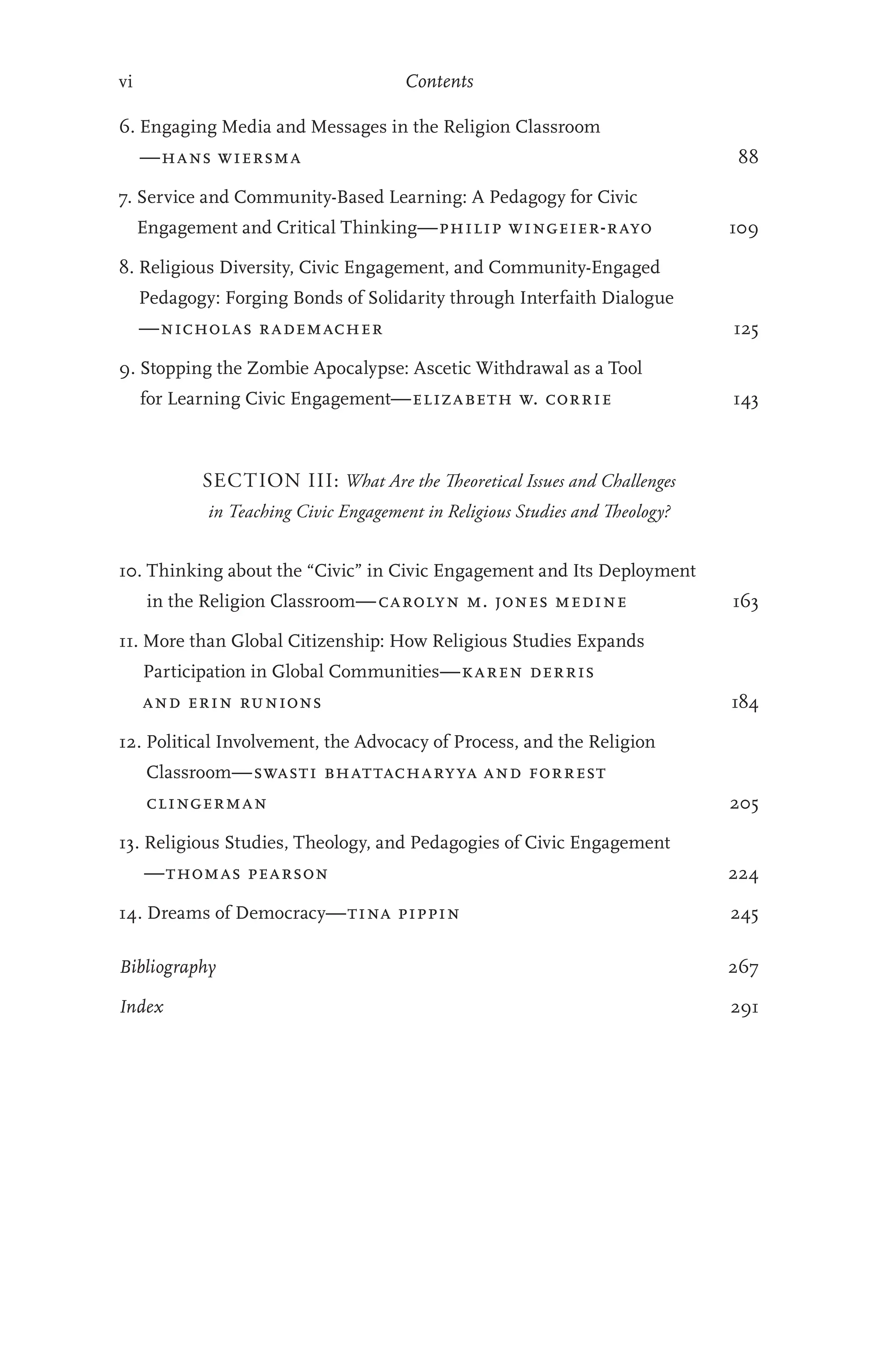


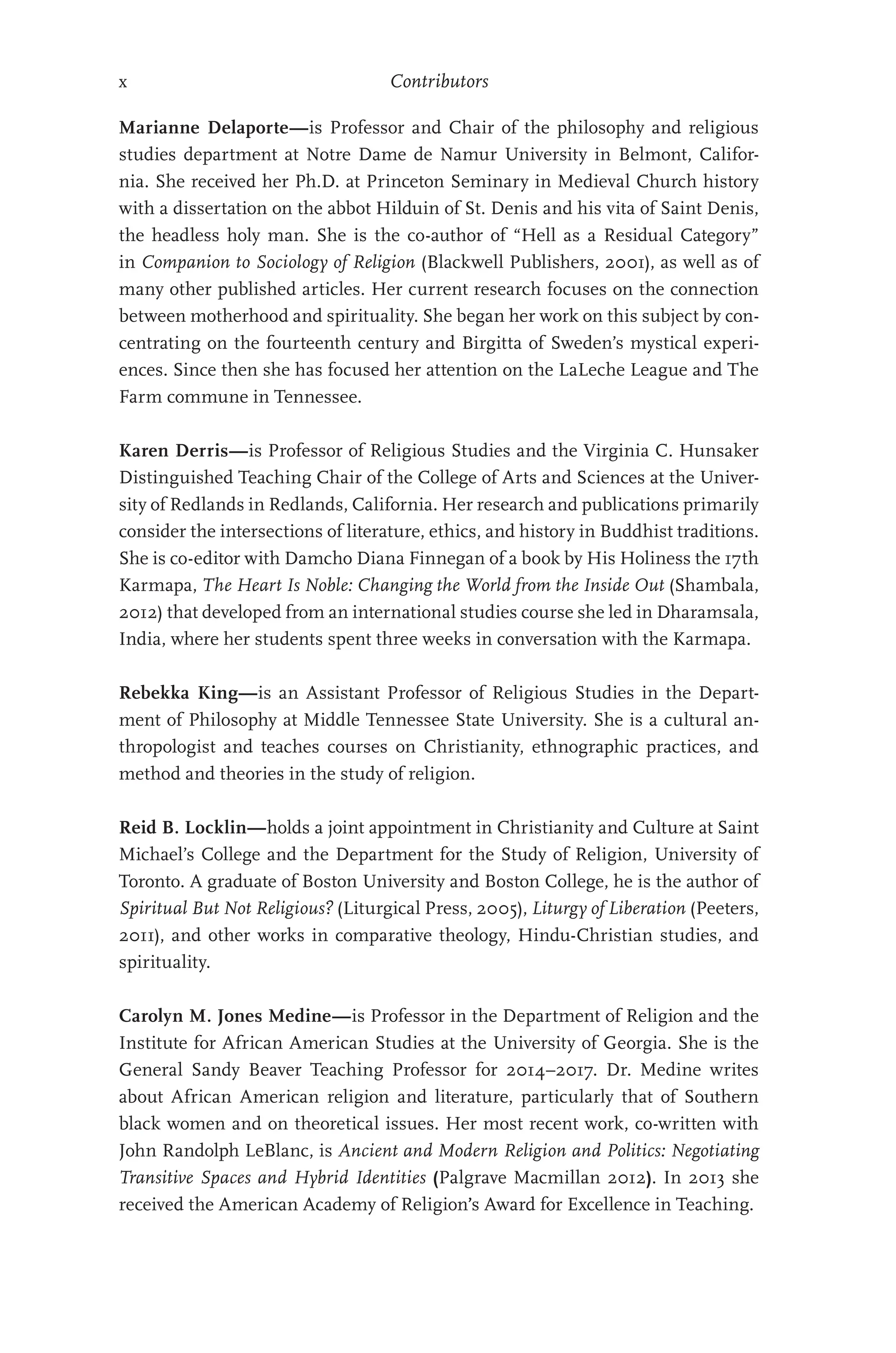
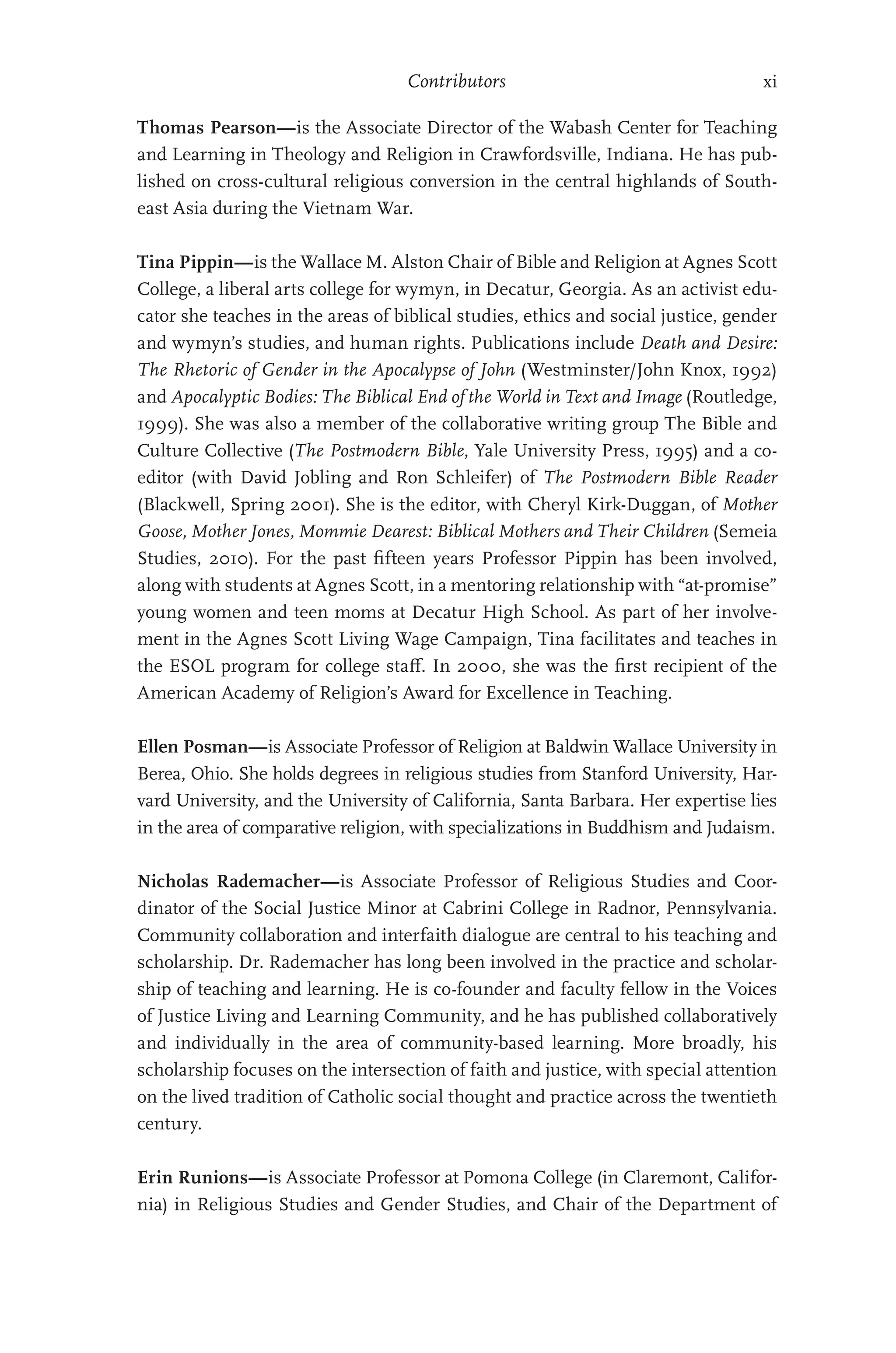
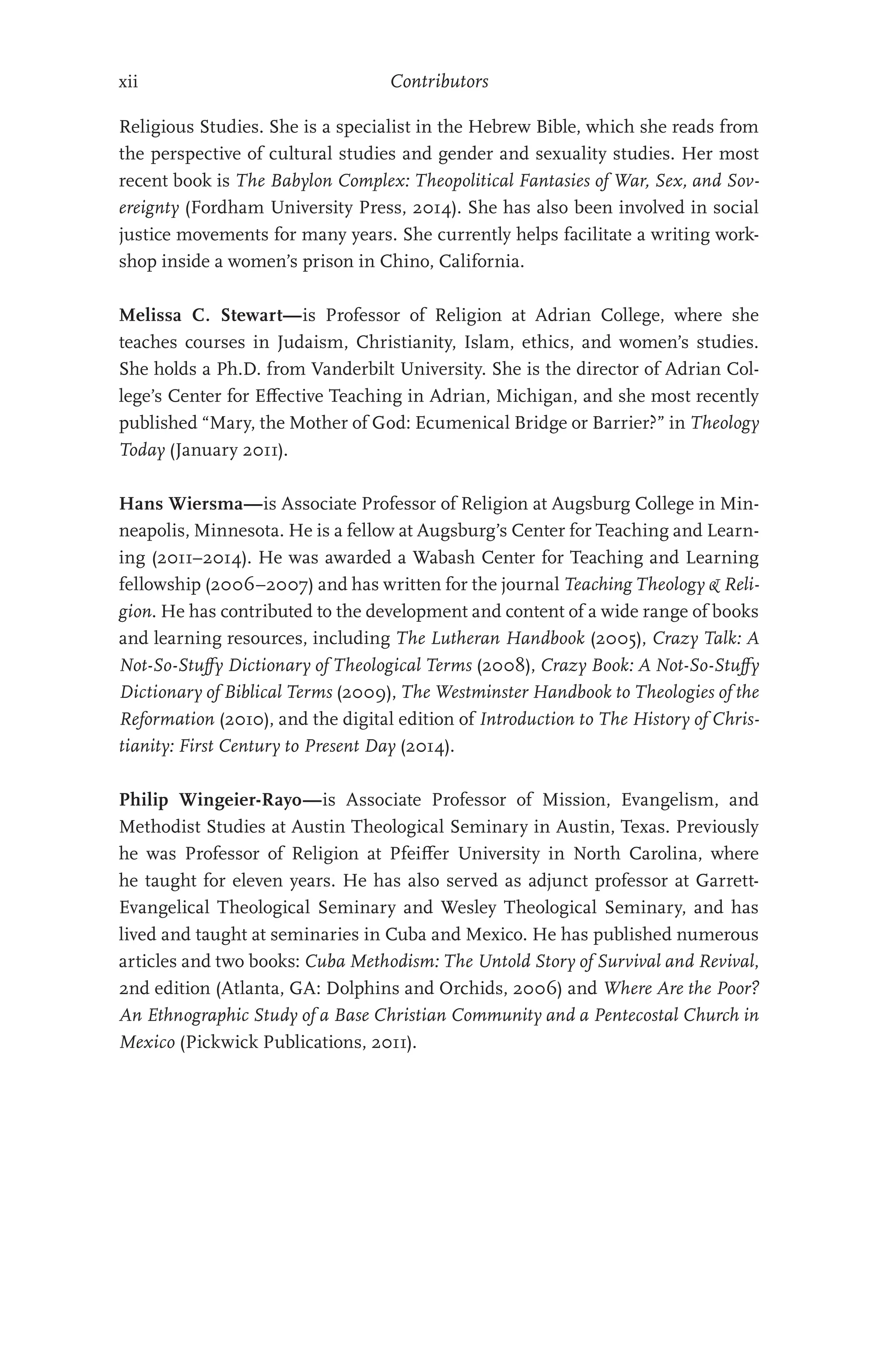










![4 dimensions of teaching civic engagement
she claims, represent a sine qua non for democracy in pluralistic societies like
India and the United States. Indeed, in a more recent critique of American public
education, Nussbaum has generalized this insight as a basic axiom: “cultivated
capacities for critical thinking and reflection are crucial in keeping democracies
alive and awake.”3
Nussbaum is not alone in highlighting critical reasoning and free inquiry as
the primary civic capacities fostered by a university education. So too the former
president of Cornell University, Frank H. T. Rhodes, identifies “the cherished
values of the university” as “integrity, excellence, community, openness, respect,
civility, freedom, responsibility, impartiality and tolerance, all exercised within
an autonomous community of learning.” “[W]ithout respect for these values,” he
argues, “there can be no university worthy of the name. Without them, there can
be no true democracy.”4
In this chapter, we attempt to examine and to critique such claims, which
tend to equate teaching for civic engagement with a fairly traditional view of the
university, the liberal arts, and the value of critical thinking. Key to our argument
is an observation that the “civic” in civic engagement does not represent a stable,
but a malleable, interpretive category. Insofar as participation in democratic so-
ciety is constructed primarily in terms of deliberative discourse, academic skills
of weighing evidence, advancing arguments, and fostering more elaborate modes
of reasoning, along with such core values as civility, autonomy, and openness to
rival points of view, naturally take a central position. But civic engagement in
its fullest sense also implicates teacher and student in questions of motivation,
relationship, and value—above all, a cultivated valuing for the civic sphere. And
this, in turn, recommends a wider range of academic objectives for those scholar-
teachers who wish to teach for civic engagement in the religion—or any liberal
arts—classroom. Far from detracting from a more traditional focus on critical
thinking, we suggest, such a broader range of academic objectives corresponds to
a broader and deeper understanding of such critical thinking itself.
Our argument proceeds in four stages. In the first section of this chapter, we
attempt briefly to delimit what educators may typically intend by such terms as
“free, reasoned inquiry” or “critical thinking and reflection,” for the most part fol-
lowing the theories of intellectual development advanced by William Perry, Jack
Mezirow, and the Women’s Ways of Knowing (WWK) collaborative. After this, we
offer an initial, heuristic definition of civic engagement and trace its close rela-
tionship with intellectual complexity. We then widen the inquiry to include the
more political approaches of bell hooks, Paulo Freire, and other critical theorists
who, while granting and indeed insisting upon the value of intellectual complex-
ity, also valorize principles of conscientization, inclusivity, and embodied praxis.
Considering both sets of theories together, in the final section of the chapter, we
suggest that teaching for civic engagement requires reflection on not one but at](https://image.slidesharecdn.com/2648369-250526154831-01f55587/75/Teaching-Civic-Engagement-1st-Edition-Forrest-Clingerman-Reid-B-Locklin-35-2048.jpg)
![Discourse, Democracy, and Civic Engagement 5
least four heuristic capacities: (1) intellectual complexity; (2) critical awareness of
social location and diverse frames of reference; (3) empathetic accountability; and
(4) motivated action. This fourfold model of teaching civic engagement will serve
to frame and in some cases to shape the chapters that follow (we refer to this as
the CLEA model). Though it may be unreasonable to expect that any individual
assignment could realistically aim for all of these objectives in any particular
classroom setting, instructors do well to reflect on them as different aspects or
dimensions of a single, integrated approach to student development, attentive to
the complex, multifaceted reality of civic participation itself.
In this chapter, we speak of civic engagement and higher education entirely
in the abstract; in the chapter that follows, we both extend and narrow our view
to address the distinctive shape such teaching takes in the religion classroom.
Intellectual Complexity and Critical Thinking:
Setting Some Limits
There are very few academics in the humanities and social sciences who do not
value critical thinking as a central academic objective in their courses. Individ-
ual definitions of this term, however, can and often do vary widely.5
In her 2008
survey of introductory college and university religion courses, for example, Bar-
bara E. Walvoord characterizes critical thinking both in terms of the habits and
dispositions of the “ideal critical thinker” and in terms of specific, assessable
skills of interpretation, comparison, analysis, and evaluation.6
In the religious
studies classroom, she suggests, critical thinking consists of specific “intellec-
tual tasks,” including:
• analysis of the cultural, historical, economic, sociological, political, ideologi-
cal, linguistic, literary, symbolic, and other aspects of religious beliefs, texts,
and practices;
• use of evidence and reason to reach conclusions and to formulate and critique
arguments;
• use of multiple perspectives to understand an issue; and
• the achievement of interpretive distance from [students’] own autobiographies
and communities.
Accompanying these tasks, moreover, are specific “attitudes, dispositions and
habits of mind” such as a willingness to challenge personal beliefs and assump-
tions, recognition of the value of positions other than one’s own, a complex,
dynamic view of truth-claims and the ongoing development of persons and tra-
ditions, rejection of stereotypes, and intellectual autonomy.7
To the extent that](https://image.slidesharecdn.com/2648369-250526154831-01f55587/75/Teaching-Civic-Engagement-1st-Edition-Forrest-Clingerman-Reid-B-Locklin-36-2048.jpg)