Report to the North Carolina
General Assembly
2018-2019 State of the Teaching Profession in
North Carolina
General Statute § 115C-12(22)
Date Due: February 15, 2020
DPI Chronological Schedule, 2019-2020
STATE BOARD OF EDUCATION
STATE BOARD OF EDUCATION VISION: Every public school student in North Carolina will be empowered to accept academic
challenges, prepared to pursue their chosen path after graduating high school, and encouraged
to become lifelong learners with the capacity to engage in a globally-collaborative society.
STATE BOARD OF EDUCATION MISSION: The mission of the North Carolina State Board of Education is to
use its constitutional authority to guard and maintain the right of a sound, basic education for every child in
North Carolina Public Schools.
ERIC DAVIS
Chair: Charlotte – At-Large
ALAN DUNCAN
Vice Chair: Greensboro – Piedmont-Triad Region
DAN FOREST
Lieutenant Governor: Raleigh – Ex Officio
DALE FOLWELL
State Treasurer: Raleigh – Ex Officio
MARK JOHNSON
Secretary to the Board: Raleigh
JILL CAMNITZ
Greenville – Northeast Region
REGINALD KENAN
Rose Hill – Southeast Region
AMY WHITE
Garner – North Central Region
OLIVIA OXENDINE
Lumberton – Sandhills Region
JAMES FORD
Charlotte – Southwest Region
TODD CHASTEEN
Blowing Rock – Northwest Region
DONNA TIPTON-ROGERS
Brasstown – Western Region
J WENDELL HALL
Ahoskie – At-Large
J.B. BUXTON
Raleigh – At-Large
NC DEPARTMENT OF PUBLIC INSTRUCTION
Mark Johnson, State Superintendent :: 301 N. Wilmington Street :: Raleigh, North Carolina 27601-2825
In compliance with federal law, the NC Department of Public Instruction administers all state-operated educational programs, employment activities
and admissions without discrimination because of race, religion, national or ethnic origin, color, age, military service, disability, or gender, except
where exemption is appropriate and allowed by law.
Inquiries or complaints regarding discrimination issues should be directed to:
Joe Maimone, Chief of Staff
6307 Mail Service Center, Raleigh, NC 27699-6307 / Phone: (919) 807-3431 / Fax: (919) 807-3445
Visit us on the Web: www.ncpublicschools.org 0819
TABLE OF CONTENTS
Overview of the Annual Report
Data Collection Procedures
Selected Findings
Charts and Tables
Table 1: State Attrition Rates by Teacher Category ........................................... 8
Table 2: State Attrition Reasons by Categories ................................................ 10
Chart 1: Teachers Leaving Employment by Yrs of Experience.......................... 11
Table 3: EVAAS and Teacher Attrition............................................................... 12
Chart 2: EVAAS and Teacher Attrition............................................................... 13
Chart 3: EVAAS Growth Categories by Attrition ............................................... 14
Table 5: Contribution to State Attrition Rateby Region................................... 15
Table 6: Five Highest and Lowest LEAs in StateAttrition Rates....................... 16
Table 7: Five Highest and Lowest Mobility Ratesfor LEAs ............................... 17
Table 8: Five Highest and Lowest LEA Attrition Rates...................................... 19
Table 9: Five Highest and Lowest LEARecoupment Rates ............................... 20
Table 10: Attrition, Mobility, and Recoupment Rates forLow Performing....... 22
Table 11: State-Wide Total Vacancies for Subjects by School Type ................. 23
Table 12: LEAs with the Highest Teacher Vacancy Ratesin NC........................ 23
Appendices
Appendix A: Self-Reported Reasons for Leaving .............................................. 25
Appendix B: State Attrition Percentages by Reasons Categoriesfor LEAs ....... 27
Appendix C: State Attrition, Mobility, and Recoupment Ratesfor LEAs ........... 31
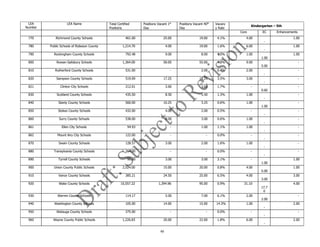
Appendix D: Teacher Vacancy Data for LEAs .................................................... 35
4
2018-2019
Annual Report on the State of the Teaching Profession in North Carolina
Overview of the Annual Report
GS §115C-12(22) requires the State Board of Education to include specific data in its annual report on the
teaching profession.
Attrition data within this report are summarized in multiple ways: by individual local education agencies
(LEA) and by the new State Board of Education (SBE) Districts. Improvements were made to this report
last year based on feedback from the NC Department of Public Instruction and the State Board of Education.
The five summary categories were realigned to better represent the reasons teachers have self-reported
their change in employment. Additionally, the North Carolina Department of Public Instruction (NCDPI) has
eliminated the use of the term “Turnover” from this report and will use, and define, the terms “attrition”
and “mobility” to describe changes in teacher employment status. For the purposes of this report, the
following definitions apply:
Attrition: a reduction in the number of employees that occurs when employees leave an employing unit.
Attrition can be measured at the state or LEA level.
Mobility: the relocation of an employee from one LEA/charter school to another within the state of North
Carolina. For the purposes of this report, mobility only exists at the state level; employee mobility across
LEAs/charter schools is considered to be attrition for the employing unit from which the employee departs.
Given the change in how NCDPI is defining employment trends in this report, results from reports after the
2015-2016 school year cannot be compared to prior year reports in a meaningful way. Differences in
employment trends between the 2015-2016 and later reports and reports from prior years are not
comparable and should not be attributed to any programs or policies implemented in prior years.
Data Collection Procedures
Every Local Education Agency (LEA) reports teacher turnover to the state yearly. These data are used in
calculations to satisfy state legislation as well as the NC School Report Card (SRC). Calculations are based
on a snapshot of employment for classroom teachers employed in the LEA as reflected in the DPI payroll
database. Classroom Teachers are determined by Purpose Codes beginning with 51, 52, or 53 and Object
Codes 121, 123, 124, or 128. Purpose and Object Codes are part of the payroll budget code. To
determine attrition, the teacher’s Unique Identifier (UID) is queried against all employee budget codes in
the previous year’s payroll data file. If a teacher’s UID is not found to be employed in the state in March
of the current year as they were in March of the previous, the teacher is classified as attrition at the state
level. If a teacher’s UID is found to be employed in the state in March of the current year but in a
different LEA from the prior year, that teacher is classified as attrition at the LEA level, but mobility at the
state level. Teachers who remain in the same LEA but move from an instructional to non-instructional
role within the measurement period do not contribute to the attrition or mobility rate at the state or local
level.
The Financial and Business Services Division at the Department of Public Instruction provides each LEA a
list of individuals employed as teachers within the March date range, and they are asked to provide
summary data on the reasons teachers leave the profession. These reasons are self-reported by teachers
to LEA personnel during exit interviews, surveys, and/or factual information from their human resources
database.
Charter school data are not reflected in this report except where teachers in an LEA in March 2018 moved
to a charter school in March 2019 (identified as mobility in state-level reporting). Charter schools do not
report attrition data to the State as teachers employed by NC charters are at-will employees and only
50% of their staffs are required to hold teacher licenses, according to GS §115C-218.90(a)(1).
5
This report does not include teachers who moved from one school to another school within the LEA or
teachers who are on approved leave; they continue as active and current employees. This report does
not include information regarding local vacancies or any statewide salary/cost analysis.
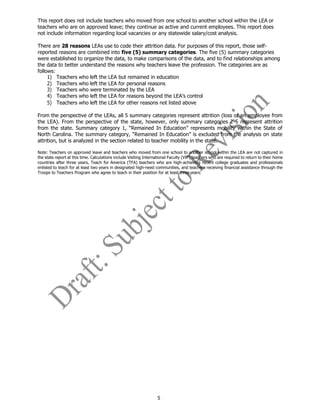
There are 28 reasons LEAs use to code their attrition data. For purposes of this report, those self-
reported reasons are combined into five (5) summary categories. The five (5) summary categories
were established to organize the data, to make comparisons of the data, and to find relationships among
the data to better understand the reasons why teachers leave the profession. The categories are as
follows:
1) Teachers who left the LEA but remained in education
2) Teachers who left the LEA for personal reasons
3) Teachers who were terminated by the LEA
4) Teachers who left the LEA for reasons beyond the LEA’s control
5) Teachers who left the LEA for other reasons not listed above
From the perspective of the LEAs, all 5 summary categories represent attrition (loss of an employee from
the LEA). From the perspective of the state, however, only summary categories 2-5 represent attrition
from the state. Summary category 1, “Remained In Education” represents mobility within the State of
North Carolina. The summary category, “Remained In Education” is excluded from the analysis on state
attrition, but is analyzed in the section related to teacher mobility in the state.
Note: Teachers on approved leave and teachers who moved from one school to another school within the LEA are not captured in
the state report at this time. Calculations include Visiting International Faculty (VIF) teachers who are required to return to their home
countries after three years, Teach for America (TFA) teachers who are high-achieving recent college graduates and professionals
enlisted to teach for at least two years in designated high-need communities, and teachers receiving financial assistance through the
Troops to Teachers Program who agree to teach in their position for at least threeyears.
6
State of the Teaching Profession in North Carolina
Key Findings
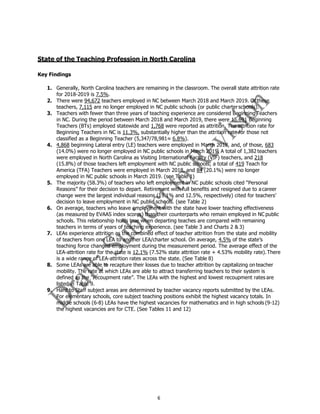
1. Generally, North Carolina teachers are remaining in the classroom. The overall state attrition rate
for 2018-2019 is 7.5%.
2. There were 94,672 teachers employed in NC between March 2018 and March 2019. Of these
teachers, 7,115 are no longer employed in NC public schools (or public charterschools).
3. Teachers with fewer than three years of teaching experience are considered Beginning Teachers
in NC. During the period between March 2018 and March 2019, there were 15,691 Beginning
Teachers (BTs) employed statewide and 1,768 were reported as attrition. The attrition rate for
Beginning Teachers in NC is 11.3%, substantially higher than the attrition rate for those not
classified as a Beginning Teacher (5,347/78,981≈ 6.8%).
4. 4,868 beginning Lateral entry (LE) teachers were employed in March 2018, and, of those, 683
(14.0%) were no longer employed in NC public schools in March 2019. A total of 1,382 teachers
were employed in North Carolina as Visiting International Faculty (VIF) teachers, and 218
(15.8%) of those teachers left employment with NC public schools; a total of 419 Teach for
America (TFA) Teachers were employed in March 2018, and 84 (20.1%) were no longer
employed in NC public schools in March 2019. (see Table 1)
5. The majority (58.3%) of teachers who left employment in NC public schools cited “Personal
Reasons” for their decision to depart. Retirement with full benefits and resigned due to acareer
change were the largest individual reasons (19.1% and 12.5%, respectively) cited for teachers’
decision to leave employment in NC public schools. (see Table 2)
6. On average, teachers who leave employment with the state have lower teaching effectiveness
(as measured by EVAAS index scores) than their counterparts who remain employed in NC public
schools. This relationship holds true when departing teaches are compared with remaining
teachers in terms of years of teaching experience. (see Table 3 and Charts 2 & 3)
7. LEAs experience attrition as the combined effect of teacher attrition from the state and mobility
of teachers from one LEA to another LEA/charter school. On average, 4.5% of the state’s
teaching force changed employment during the measurement period. The average effect of the
LEA-attrition rate for the state is 12.1% (7.52% state attrition rate + 4.53% mobility rate).There
is a wide range of LEA-attrition rates across the state. (See Table 8)
8. Some LEAs are able to recapture their losses due to teacher attrition by capitalizing on teacher
mobility. The rate at which LEAs are able to attract transferring teachers to their system is
defined as the “recoupment rate”. The LEAs with the highest and lowest recoupment rates are
listed in Table 9.
9. Hard to Staff subject areas are determined by teacher vacancy reports submitted by the LEAs.
For elementary schools, core subject teaching positions exhibit the highest vacancy totals. In
middle schools (6-8) LEAs have the highest vacancies for mathematics and in high schools (9-12)
the highest vacancies are for CTE. (See Tables 11 and 12)
7
State Attrition Rates for NC Teachers
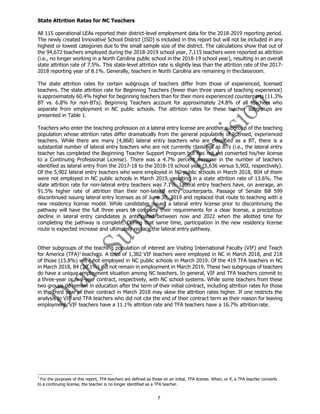
All 115 operational LEAs reported their district-level employment data for the 2018-2019 reporting period.
The newly created Innovative School District (ISD) is included in this report but will not be included in any
highest or lowest categories due to the small sample size of the district. The calculations show that out of
the 94,672 teachers employed during the 2018-2019 school year, 7,115 teachers were reported as attrition
(i.e., no longer working in a North Carolina public school in the 2018-19 school year), resulting in an overall
state attrition rate of 7.5%. This state-level attrition rate is slightly less than the attrition rate of the 2017-
2018 reporting year of 8.1%. Generally, teachers in North Carolina are remaining in theclassroom.
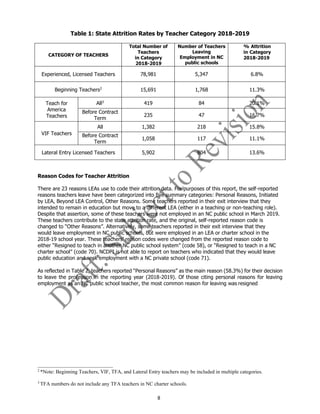
The state attrition rates for certain subgroups of teachers differ from those of experienced, licensed
teachers. The state attrition rate for Beginning Teachers (fewer than three years of teaching experience)
is approximately 60.4% higher for beginning teachers than for their more experienced counterparts (11.3%
BT vs. 6.8% for non-BTs). Beginning Teachers account for approximately 24.8% of all teachers who
separate from employment in NC public schools. The attrition rates for these teacher subgroups are
presented in Table 1.
Teachers who enter the teaching profession on a lateral entry license are another subgroup of the teaching
population whose attrition rates differ dramatically from the general population of licensed, experienced
teachers. While there are many (4,868) lateral entry teachers who are classified as a BT, there is a
substantial number of lateral entry teachers who are not currently classified as BTs (i.e., the lateral entry
teacher has completed the Beginning Teacher Support Program but has not yet converted his/her license
to a Continuing Professional License). There was a 4.7% percent increase in the number of teachers
identified as lateral entry from the 2017-18 to the 2018-19 school year (5,636 versus 5,902, respectively).
Of the 5,902 lateral entry teachers who were employed in NC public schools in March 2018, 804 of them
were not employed in NC public schools in March 2019, resulting in a state attrition rate of 13.6%. The
state attrition rate for non-lateral entry teachers was 7.1%. Lateral entry teachers have, on average, an
91.5% higher rate of attrition than their non-lateral entry counterparts. Passage of Senate Bill 599
discontinued issuing lateral entry licenses as of June 30, 2019 and replaced that route to teaching with a
new residency license model. While candidates issued a lateral entry license prior to discontinuing the
pathway will have the full three years to complete their requirements for a clear license, a precipitous
decline in lateral entry candidates is anticipated between now and 2022 when the allotted time for
completing the pathway is complete. During that same time, participation in the new residency license
route is expected increase and ultimately replace the lateral entry pathway.
Other subgroups of the teaching population of interest are Visiting International Faculty (VIF) and Teach
for America (TFA)1
teachers. A total of 1,382 VIF teachers were employed in NC in March 2018, and 218
of those (15.8%) were not employed in NC public schools in March 2019. Of the 419 TFA teachers in NC
in March 2018, 84 (20.1%) did not remain in employment in March 2019. These two subgroups of teachers
do have a unique employment situation among NC teachers. In general, VIF and TFA teachers commit to
a three-year or two-year contract, respectively, with NC school systems. While some teachers from these
two groups do remain in education after the term of their initial contract, including attrition rates for those
in the third year of their contract in March 2018 may skew the attrition rates higher. If one restricts the
analysis to VIF and TFA teachers who did not cite the end of their contract term as their reason for leaving
employment, VIF teachers have a 11.1% attrition rate and TFA teachers have a 16.7% attritionrate.
1
For the purposes of this report, TFA teachers are defined as those on an initial, TFA license. When, or if, a TFA teacher converts
to a continuing license, the teacher is no longer identified as a TFA teacher.
8
Table 1: State Attrition Rates by Teacher Category 2018-2019
CATEGORY OF TEACHERS
Total Number of
Teachers
in Category
2018-2019
Number of Teachers
Leaving
Employment in NC
public schools
% Attrition
in Category
2018-2019
Experienced, Licensed Teachers 78,981 5,347 6.8%
Beginning Teachers2
15,691 1,768 11.3%
Teach for
America
Teachers
All3
419 84 20.1%
Before Contract
Term
235 47 16.7%
VIF Teachers
All 1,382 218 15.8%
Before Contract
Term
1,058 117 11.1%
Lateral Entry Licensed Teachers 5,902 804 13.6%
Reason Codes for Teacher Attrition
There are 23 reasons LEAs use to code their attrition data. For purposes of this report, the self-reported
reasons teachers leave have been categorized into five summary categories: Personal Reasons, Initiated
by LEA, Beyond LEA Control, Other Reasons. Some teachers reported in their exit interview that they
intended to remain in education but move to a different LEA (either in a teaching or non-teaching role).
Despite that assertion, some of these teachers were not employed in an NC public school in March 2019.
These teachers contribute to the state attrition rate, and the original, self-reported reason code is
changed to “Other Reasons”. Alternatively, some teachers reported in their exit interview that they
would leave employment in NC public schools, but were employed in an LEA or charter school in the
2018-19 school year. These teachers’ reason codes were changed from the reported reason code to
either “Resigned to teach in another NC public school system” (code 58), or “Resigned to teach in a NC
charter school” (code 70). NCDPI is not able to report on teachers who indicated that they would leave
public education and seek employment with a NC private school (code 71).
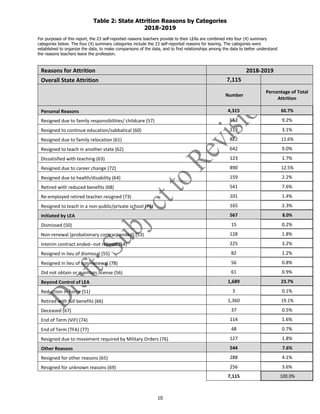
As reflected in Table 2, teachers reported “Personal Reasons” as the main reason (58.3%) for their decision
to leave the profession in the reporting year (2018-2019). Of those citing personal reasons for leaving
employment as an NC public school teacher, the most common reason for leaving was resigned
2
*Note: Beginning Teachers, VIF, TFA, and Lateral Entry teachers may be included in multiple categories.
3
TFA numbers do not include any TFA teachers in NC charter schools.
9
to change careers (21.4% of teachers leaving for Personal Reasons). The number of teachers resigning
due to retirement with full benefits has decreased slighlty from the 2017-2018 reporting year. Of the
7,115 teachers who left employment with NC public schools in the 2018-19 reporting year, 1,360, or
19.1%, left due to retiring with full benefits. Approximately one-fifth (21.5%), or 1,651 teachers, of the
state’s teaching force left employment with NC public schools due to retirement with full benefits in the
2017-2018 reporting year. The retirement with full benefits category experienced a 17.6% percentage
point difference from the prior reporting year. Retirement with full benefits represents the largest,
individual reason for leaving employment with NC public schools from March 2018 to March 2019.
While the state may not be able to develop policy to address some of the reasons teachers supplied under
the Personal Reasons category (e.g., health issues, family relocation, etc.), there are two reasons that
might have root causes that could be addressed through policy. Nearly one in eleven teachers (9.0%) who
left employment with NC public schools indicated that they intended to teach in another state.
The second, policy-relevant reason that teachers gave for leaving NC public schools was a desire to pursue
a different career. Teachers who expressed a desire to pursue another career account for 12.5% of the
state’s overall attrition. Slightly less than half the teachers (49.8%) who cited this reason for leaving
employment in the state’s public schools were in the first five years of teaching.
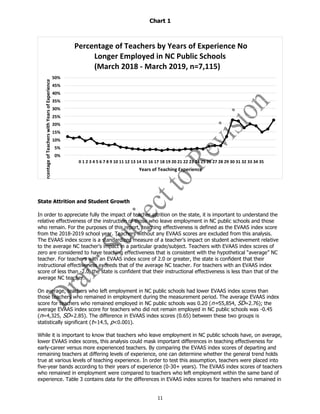
The data displayed in Chart 1 show the attrition rates for teacher by years of experience. From the chart,
one can see that attrition rates in the first five years of teaching are much higher than those of mid-career
teachers (except for those teachers at 27 years and above when retirement becomes more financially
viable). This attrition among early-career teachers could be attributable to differences in how younger
generations view careers – younger professionals may be more fluid in how they approach their professional
lives than earlier generations.
The state did target early-career teachers for salary increases in 2015. The fact that these teachers leave
the teaching profession at higher rates than their more experienced counterparts is well documented, and
increasing the salaries of early-career teachers could very well stem the high rates of attrition from the
profession. It would be prudent, however, for the state to monitor the effect of this salary increase on
early-career teachers’ decisions to remain employed in NC public schools. If attrition rates among this group
of teachers do not respond to the increased salary, the state could benefit from probing deeper into these
teachers’ motivations for pursuing their teaching careers in other states or leaving the profession altogether.
A complete list of reason codes for attrition from the state can be found in Appendix A. The percentage of
reason codes cited by departing teachers by LEA can be found in Appendix B.
10
Table 2: State Attrition Reasons by Categories
2018-2019
For purposes of this report, the 23 self-reported reasons teachers provide to their LEAs are combined into four (4) summary
categories below. The four (4) summary categories include the 23 self-reported reasons for leaving. The categories were
established to organize the data, to make comparisons of the data, and to find relationships among the data to better understand
the reasons teachers leave the profession.
Reasons for Attrition 2018-2019
Overall State Attrition 7,115
Number
Percentage of Total
Attrition
Personal Reasons 4,315 60.7%
Resigned due to family responsibilities/ childcare (57) 653 9.2%
Resigned to continue education/sabbatical (60) 219 3.1%
Resigned due to family relocation (61) 822 11.6%
Resigned to teach in another state (62) 642 9.0%
Dissatisfied with teaching (63) 123 1.7%
Resigned due to career change (72) 890 12.5%
Resigned due to health/disability (64) 159 2.2%
Retired with reduced benefits (68) 541 7.6%
Re-employed retired teacher resigned (73) 101 1.4%
Resigned to teach in a non-public/private school (71) 165 2.3%
Initiated by LEA 567 8.0%
Dismissed (50) 15 0.2%
Non-renewal (probationary contract ended) (53) 128 1.8%
Interim contract ended--not rehired (54) 225 3.2%
Resigned in lieu of dismissal (55) 82 1.2%
Resigned in lieu of non-renewal (78) 56 0.8%
Did not obtain or maintain license (56) 61 0.9%
Beyond Control of LEA 1,689 23.7%
Reduction in Force (51) 3 0.1%
Retired with full benefits (66) 1,360 19.1%
Deceased (67) 37 0.5%
End of Term (VIF) (74) 114 1.6%
End of Term (TFA) (77) 48 0.7%
Resigned due to movement required by Military Orders (76) 127 1.8%
Other Reasons 544 7.6%
Resigned for other reasons (65) 288 4.1%
Resigned for unknown reasons (69) 256 3.6%
7,115 100.0%
11
Percentage of Teachers by Years of Experience No
Longer Employed in NC Public Schools
(March 2018 - March 2019, n=7,115)
50%
45%
40%
35%
30%
25%
20%
15%
10%
5%
0%
0 1 2 3 4 5 6 7 8 9 10 11 12 13 14 15 16 17 18 19 20 21 22 23 24 25 26 27 28 29 30 31 32 33 34 35
Years of Teaching Experience
Chart 1
State Attrition and Student Growth
In order to appreciate fully the impact of teacher attrition on the state, it is important to understand the
relative effectiveness of the instruction of those who leave employment in NC public schools and those
who remain. For the purposes of this report, teaching effectiveness is defined as the EVAAS index score
from the 2018-2019 school year. Teachers without any EVAAS scores are excluded from this analysis.
The EVAAS index score is a standardized measure of a teacher’s impact on student achievement relative
to the average NC teacher’s impact in a particular grade/subject. Teachers with EVAAS index scores of
zero are considered to have teaching effectiveness that is consistent with the hypothetical “average” NC
teacher. For teachers with an EVAAS index score of 2.0 or greater, the state is confident that their
instructional effectiveness exceeds that of the average NC teacher. For teachers with an EVAAS index
score of less than -2.0, the state is confident that their instructional effectiveness is less than that of the
average NC teacher.
On average, teachers who left employment in NC public schools had lower EVAAS index scores than
those teachers who remained in employment during the measurement period. The average EVAAS index
score for teachers who remained employed in NC public schools was 0.20 (n=55,854, SD=2.76); the
average EVAAS index score for teachers who did not remain employed in NC public schools was -0.45
(n=4,325, SD=2.85). The difference in EVAAS index scores (0.65) between these two groups is
statistically significant (t=14.5, p<0.001).
While it is important to know that teachers who leave employment in NC public schools have, on average,
lower EVAAS index scores, this analysis could mask important differences in teaching effectiveness for
early-career versus more experienced teachers. By comparing the EVAAS index scores of departing and
remaining teachers at differing levels of experience, one can determine whether the general trend holds
true at various levels of teaching experience. In order to test this assumption, teachers were placed into
five-year bands according to their years of experience (0-30+ years). The EVAAS index scores of teachers
who remained in employment were compared to teachers who left employment within the same band of
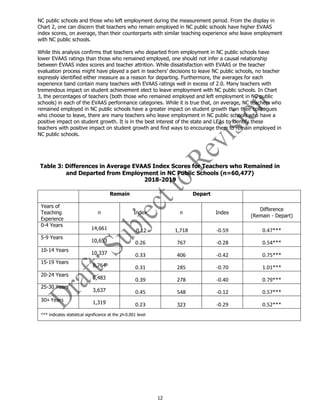
experience. Table 3 contains data for the differences in EVAAS index scores for teachers who remained in
rcentageofTeacherswithYearsofExperience
12
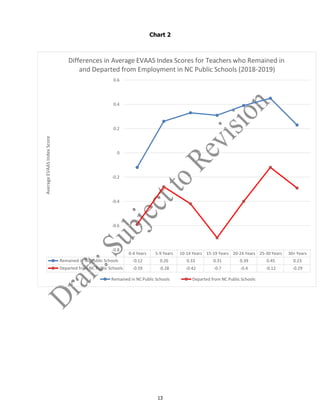
NC public schools and those who left employment during the measurement period. From the display in
Chart 2, one can discern that teachers who remain employed in NC public schools have higher EVAAS
index scores, on average, than their counterparts with similar teaching experience who leave employment
with NC public schools.
While this analysis confirms that teachers who departed from employment in NC public schools have
lower EVAAS ratings than those who remained employed, one should not infer a causal relationship
between EVAAS index scores and teacher attrition. While dissatisfaction with EVAAS or the teacher
evaluation process might have played a part in teachers’ decisions to leave NC public schools, no teacher
expressly identified either measure as a reason for departing. Furthermore, the averages for each
experience band contain many teachers with EVAAS ratings well in excess of 2.0. Many teachers with
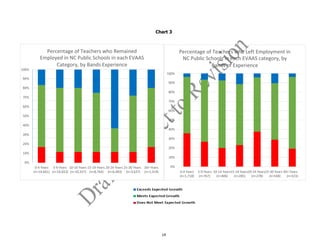
tremendous impact on student achievement elect to leave employment with NC public schools. In Chart
3, the percentages of teachers (both those who remained employed and left employment in NC public
schools) in each of the EVAAS performance categories. While it is true that, on average, NC teachers who
remained employed in NC public schools have a greater impact on student growth than their colleagues
who choose to leave, there are many teachers who leave employment in NC public schools who have a
positive impact on student growth. It is in the best interest of the state and LEAs to identify these
teachers with positive impact on student growth and find ways to encourage them to remain employed in
NC public schools.
Table 3: Differences in Average EVAAS Index Scores for Teachers who Remained in
and Departed from Employment in NC Public Schools (n=60,477)
2018-2019
Remain Depart
Years of
Teaching
Experience
n Index n Index
Difference
(Remain - Depart)
0-4 Years
14,661 -0.12 1,718 -0.59 0.47***
5-9 Years
10,653 0.26 767 -0.28 0.54***
10-14 Years
10,337 0.33 406 -0.42 0.75***
15-19 Years
8,764 0.31 285 -0.70 1.01***
20-24 Years
6,483 0.39 278 -0.40 0.79***
25-30 Years
3,637 0.45 548 -0.12 0.57***
30+ Years 1,319 0.23 323 -0.29 0.52***
*** indicates statistical significance at the p<0.001 level
13
Chart 2
Differences in Average EVAAS Index Scores for Teachers who Remained in
and Departed from Employment in NC Public Schools (2018-2019)
0.6
0.4
0.2
0
-0.2
-0.4
-0.6
-0.8
Remained in NC Public Schools Departed from NC Public Schools
AverageEVAASIndexScore
0-4 Years 5-9 Years 10-14 Years 15-19 Years 20-24 Years 25-30 Years 30+ Years
Remained in NC Public Schools -0.12 0.26 0.33 0.31 0.39 0.45 0.23
Departed from NC Public Schools -0.59 -0.28 -0.42 -0.7 -0.4 -0.12 -0.29
14
100%
90%
80%
70%
60%
50%
40%
30%
20%
10%
0%
Percentage of Teachers who Remained
Employed in NC Public Schools in each EVAAS
Category, by Bands Experience
Percentage of Teachers who Left Employment in
NC Public Schools in each EVAAS category, by
Bands of Experience
Chart 3
0-4 Years 5-9 Years 10-14 Years15-19 Years20-24 Years25-30 Years 30+ Years
(n=1,718) (n=767) (n=406) (n=285) (n=278) (n=548) (n=323)
100%
90%
80%
70%
60%
50%
40%
30%
20%
10%
0%0-4 Years 5-9 Years 10-14 Years 15-19 Years 20-24 Years 25-30 Years 30+Years
(n=14,661) (n=10,653) (n=10,337) (n=8,764) (n=6,483) (n=3,637) (n=1,319)
15
State Attrition by Region and LEA
The overall state attrition rate is a function of teachers leaving employment in NC public schools from the
local employing agencies (LEAs). Certain LEAs may be more vulnerable to teacher attrition for a variety of
reasons (e.g., proximity to neighboring states, proximity to or distance from a major urban center,
employment opportunities outside of the education sector, etc.). These and other factors may create a
differential effect on teacher attrition from NC public schools. In Table 5, the data show the contribution
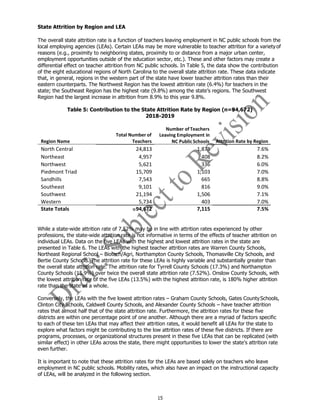
of the eight educational regions of North Carolina to the overall state attrition rate. These data indicate
that, in general, regions in the western part of the state have lower teacher attrition rates than their
eastern counterparts. The Northwest Region has the lowest attrition rate (6.4%) for teachers in the
state; the Southeast Region has the highest rate (9.8%) among the state’s regions. The Southwest
Region had the largest increase in attrition from 8.9% to this year 9.8%.
Table 5: Contribution to the State Attrition Rate by Region (n=94,672)
2018-2019
Region Name
Total Number of
Teachers
Number ofTeachers
Leaving Employment in
NC Public Schools Attrition Rate by Region
North Central 24,813 1,878 7.6%
Northeast 4,957 408 8.2%
Northwest 5,621 336 6.0%
Piedmont Triad 15,709 1,103 7.0%
Sandhills 7,543 665 8.8%
Southeast 9,101 816 9.0%
Southwest 21,194 1,506 7.1%
Western 5,734 403 7.0%
State Totals 94,672 7,115 7.5%
While a state-wide attrition rate of 7.52% may be in line with attrition rates experienced by other
professions, the state-wide attrition rate is not informative in terms of the effects of teacher attrition on
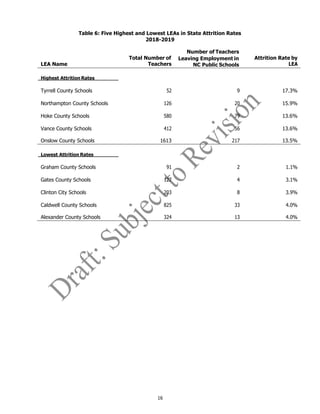
individual LEAs. Data on the five LEAs with the highest and lowest attrition rates in the state are
presented in Table 6. The LEAs with the highest teacher attrition rates are Warren County Schools,
Northeast Regional School – Biotech/Agri, Northampton County Schools, Thomasville City Schools, and
Bertie County Schools. The attrition rate for these LEAs is highly variable and substantially greater than
the overall state attrition rate. The attrition rate for Tyrrell County Schools (17.3%) and Northampton
County Schools (15.9%) over twice the overall state attrition rate (7.52%). Onslow County Schools, with
the lowest attrition rate of the five LEAs (13.5%) with the highest attrition rate, is 180% higher attrition
rate than the state as a whole.
Conversely, the LEAs with the five lowest attrition rates – Graham County Schools, Gates CountySchools,
Clinton City Schools, Caldwell County Schools, and Alexander County Schools – have teacher attrition
rates that almost half that of the state attrition rate. Furthermore, the attrition rates for these five
districts are within one percentage point of one another. Although there are a myriad of factors specific
to each of these ten LEAs that may affect their attrition rates, it would benefit all LEAs for the state to
explore what factors might be contributing to the low attrition rates of these five districts. If there are
programs, processes, or organizational structures present in these five LEAs that can be replicated (with
similar effect) in other LEAs across the state, there might opportunities to lower the state’s attrition rate
even further.
It is important to note that these attrition rates for the LEAs are based solely on teachers who leave
employment in NC public schools. Mobility rates, which also have an impact on the instructional capacity
of LEAs, will be analyzed in the following section.
16
Table 6: Five Highest and Lowest LEAs in State Attrition Rates
2018-2019
LEA Name
Total Number of
Teachers
Number of Teachers
Leaving Employment in
NC Public Schools
Attrition Rate by
LEA
Highest Attrition Rates
Tyrrell County Schools 52 9 17.3%
Northampton County Schools 126 20 15.9%
Hoke County Schools 580 79 13.6%
Vance County Schools 412 56 13.6%
Onslow County Schools 1613 217 13.5%
Lowest Attrition Rates
Graham County Schools 91 2 1.1%
Gates County Schools 127 4 3.1%
Clinton City Schools 203 8 3.9%
Caldwell County Schools 825 33 4.0%
Alexander County Schools 324 13 4.0%
17
Teacher Mobility
Up to this point, this report has focused on teachers who have left the teaching profession in North
Carolina public schools. The 115 LEAs across the state must not only contend with the impact of teachers
leaving state employment, but also the loss of teachers due to teachers changing employment from one
LEA to another LEA or charter school. During the measurement period from March 2018 to March 2019,
on average, 4.53% (4,290 teachers) of North Carolina’s teaching force changed employment from one
LEA to another LEA or NC public charter school. The combined effect of teacher attrition from public
school employment and the mobility of teachers across LEAs results in the LEA attrition rate4
. Thissection
of the report will focus on how LEAs differ in terms of their mobility and overall attrition rates and
whether there are informative trends in how teachers move from one LEA to another.
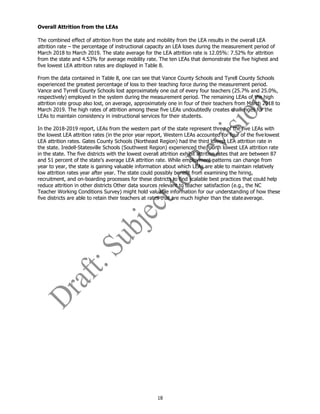
In Table 7, the five LEAs with the highest overall mobility rates and the five LEAs with the lowest overall
mobility rates are displayed. Thomasville City Schools reported the highest percentage of teachers
moving to another LEA or charter school during the measurement period. Thomasville City Schools’
percentage of 15.5%% is over three times the state average mobility rate of 4.6%. Similar to the
attrition rates, the mobility rates of these five districts are large (relative to the average) and very
consistent in their magnitude (range of 3.4 percentage points).
The six districts with the lowest mobility rates in the state have mobility rates that range from 0.9%
(Alleghany County Schools) to 1.2% (Macon County Schools and Camden County Schools). At the high
end, these districts experience mobility rates that are about a fifth (19.7%) of the state mobility average.
As suggested earlier in this report, it may be beneficial for the state to examine districts with low mobility
rates more closely to determine what policy-relevant factors may be contributing to these unusually low
rates.
Table 7: Five Highest and Lowest LEA Mobility Rates
2018-2019
LEA Name
Total Number of
Teachers
Number of Teachers
Leaving LEA LEA Mobility Rate
Highest Mobility Rates
Thomasville City Schools 166 24 14.5%
Elizabeth City-Pasquotank
Public Schools
355 50 14.1%
Washington County Schools 102 14 13.7%
Newton Conover City Schools 195 24 12.3%
Vance County Schools 412 50 12.1%
Lowest Mobility Rates
Alleghany County Schools 114 1 0.9%
Macon County Schools 325 3 0.9%
Dare County Schools 396 4 1.0%
Clay County Schools 95 6 1.0%
Graham County Schools 91 1 1.1%
4
Teachers who reported that they were leaving employment with NC public schools but appeared in payroll records in the 2017-18
school year were not included in state-level attrition rates. If these teachers appeared in the payroll records of a different
LEA/charter school after March 2018, they factor into the original LEA’s mobility rate. If the teacher appeared in the payroll records
of the same LEA in March 2017 (regardless of role), they do not factor in the LEA’s mobility rate.
18
Overall Attrition from the LEAs
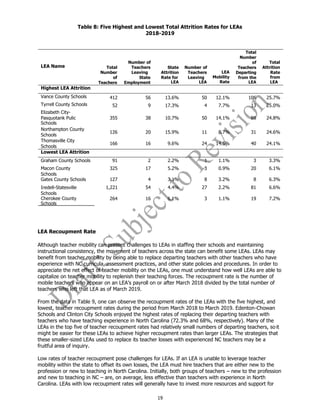
The combined effect of attrition from the state and mobility from the LEA results in the overall LEA
attrition rate – the percentage of instructional capacity an LEA loses during the measurement period of
March 2018 to March 2019. The state average for the LEA attrition rate is 12.05%: 7.52% for attrition
from the state and 4.53% for average mobility rate. The ten LEAs that demonstrate the five highest and
five lowest LEA attrition rates are displayed in Table 8.
From the data contained in Table 8, one can see that Vance County Schools and Tyrell County Schools
experienced the greatest percentage of loss to their teaching force during the measurement period.
Vance and Tyrrell County Schools lost approximately one out of every four teachers (25.7% and 25.0%,
respectively) employed in the system during the measurement period. The remaining LEAs of the high
attrition rate group also lost, on average, approximately one in four of their teachers from March 2018 to
March 2019. The high rates of attrition among these five LEAs undoubtedly creates challenges for the
LEAs to maintain consistency in instructional services for their students.
In the 2018-2019 report, LEAs from the western part of the state represent three of the five LEAs with
the lowest LEA attrition rates (in the prior year report, Western LEAs accounted for four of the five lowest
LEA attrition rates. Gates County Schools (Northeast Region) had the third lowest LEA attrition rate in
the state. Iredell-Statesville Schools (Southwest Region) experienced the fourth lowest LEA attrition rate
in the state. The five districts with the lowest overall attrition exhibit attrition rates that are between 87
and 51 percent of the state’s average LEA attrition rate. While employment patterns can change from
year to year, the state is gaining valuable information about which LEAs are able to maintain relatively
low attrition rates year after year. The state could possibly benefit from examining the hiring,
recruitment, and on-boarding processes for these districts to find scalable best practices that could help
reduce attrition in other districts Other data sources relevant to teacher satisfaction (e.g., the NC
Teacher Working Conditions Survey) might hold valuable information for our understanding of how these
five districts are able to retain their teachers at rates that are much higher than the stateaverage.
19
Table 8: Five Highest and Lowest Total Attrition Rates for LEAs
2018-2019
LEA Name Total
Number
of
Teachers
Number of
Teachers
Leaving
State
Employment
State
Attrition
Rate for
LEA
Number of
Teachers
Leaving
LEA
Total
Number
of
Teachers
Departing
from the
LEA
Total
Attrition
Rate
from
LEA
LEA
Mobility
Rate
Highest LEA Attrition
Vance County Schools 412 56 13.6% 50 12.1% 106 25.7%
Tyrrell County Schools 52 9 17.3% 4 7.7% 13 25.0%
Elizabeth City-
Pasquotank Pulic
Schools
355 38 10.7% 50 14.1% 88 24.8%
Northampton County
Schools
126 20 15.9% 11 8.7% 31 24.6%
Thomasville City
Schools
166 16 9.6% 24 14.5% 40 24.1%
Lowest LEA Attrition
Graham County Schools 91 2 2.2% 1 1.1% 3 3.3%
Macon County
Schools
325 17 5.2% 3 0.9% 20 6.1%
Gates County Schools 127 4 3.1% 8 3.2% 8 6.3%
Iredell-Statesville
Schools
1,221 54 4.4% 27 2.2% 81 6.6%
Cherokee County
Schools
264 16 6.1% 3 1.1% 19 7.2%
LEA Recoupment Rate
Although teacher mobility can present challenges to LEAs in staffing their schools and maintaining
instructional consistency, the movement of teachers across the state can benefit some LEAs. LEAs may
benefit from teacher mobility by being able to replace departing teachers with other teachers who have
experience with NC curricula, assessment practices, and other state policies and procedures. In order to
appreciate the net effect of teacher mobility on the LEAs, one must understand how well LEAs are able to
capitalize on teacher mobility to replenish their teaching forces. The recoupment rate is the number of
mobile teachers who appear on an LEA’s payroll on or after March 2018 divided by the total number of
teachers who left that LEA as of March 2019.
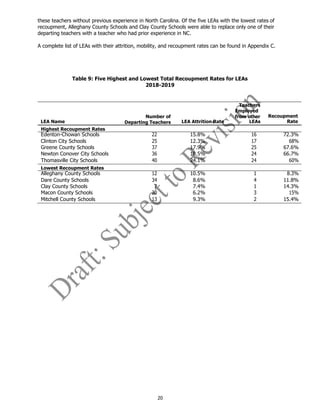
From the data in Table 9, one can observe the recoupment rates of the LEAs with the five highest, and
lowest, teacher recoupment rates during the period from March 2018 to March 2019. Edenton-Chowan
Schools and Clinton City Schools enjoyed the highest rates of replacing their departing teachers with
teachers who have teaching experience in North Carolina (72.3% and 68%, respectively). Many of the
LEAs in the top five of teacher recoupment rates had relatively small numbers of departing teachers, so it
might be easier for these LEAs to achieve higher recoupment rates than larger LEAs. The strategies that
these smaller-sized LEAs used to replace its teacher losses with experienced NC teachers may be a
fruitful area of inquiry.
Low rates of teacher recoupment pose challenges for LEAs. If an LEA is unable to leverage teacher
mobility within the state to offset its own losses, the LEA must hire teachers that are either new to the
profession or new to teaching in North Carolina. Initially, both groups of teachers – new to the profession
and new to teaching in NC – are, on average, less effective than teachers with experience in North
Carolina. LEAs with low recoupment rates will generally have to invest more resources and support for
20
these teachers without previous experience in North Carolina. Of the five LEAs with the lowest rates of
recoupment, Alleghany County Schools and Clay County Schools were able to replace only one of their
departing teachers with a teacher who had prior experience in NC.
A complete list of LEAs with their attrition, mobility, and recoupment rates can be found in Appendix C.
Table 9: Five Highest and Lowest Total Recoupment Rates for LEAs
2018-2019
LEA Name
Number of
Departing Teachers LEA Attrition Rate
Teachers
Employed
from other
LEAs
Recoupment
Rate
Highest Recoupment Rates
Edenton-Chowan Schools 22 15.8% 16 72.3%
Clinton City Schools 25 12.3% 17 68%
Greene County Schools 37 17.9% 25 67.6%
Newton Conover City Schools 36 18.5% 24 66.7%
Thomasville City Schools 40 24.1% 24 60%
Lowest Recoupment Rates
Alleghany County Schools 12 10.5% 1 8.3%
Dare County Schools 34 8.6% 4 11.8%
Clay County Schools 7 7.4% 1 14.3%
Macon County Schools 20 6.2% 3 15%
Mitchell County Schools 13 9.3% 2 15.4%
21
LEA Attrition Data for Low-Performing Districts
One of the requirements of this report is to examine the rates of attrition and mobility for the LEAs that
were identified as low performing in the 2018-2019 school year. There were eight LEAs identified as low
performing in the 2018-2019 school year: Weldon City Schools, Northampton County Schools, Scotland
County Schools, Tyrrell County Schools, Martin County Schools, Edgecombe County Schools, Robeson
County Schools, and Nash-Rocky Mount Schools. The attrition, mobility, and recoupment rates for these
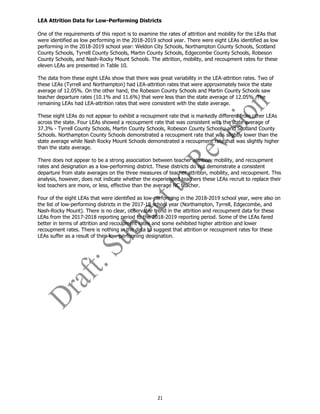
eleven LEAs are presented in Table 10.
The data from these eight LEAs show that there was great variability in the LEA-attrition rates. Two of
these LEAs (Tyrrell and Northampton) had LEA-attrition rates that were approximately twice the state
average of 12.05%. On the other hand, the Robeson County Schools and Martin County Schools saw
teacher departure rates (10.1% and 11.6%) that were less than the state average of 12.05%. The
remaining LEAs had LEA-attrition rates that were consistent with the state average.
These eight LEAs do not appear to exhibit a recoupment rate that is markedly different from other LEAs
across the state. Four LEAs showed a recoupment rate that was consistent with the state average of
37.3% - Tyrrell County Schools, Martin County Schools, Robeson County Schools, and Scotland County
Schools. Northampton County Schools demonstrated a recoupment rate that was slightly lower than the
state average while Nash Rocky Mount Schools demonstrated a recoupment rate that was slightly higher
than the state average.
There does not appear to be a strong association between teacher attrition, mobility, and recoupment
rates and designation as a low-performing district. These districts do not demonstrate a consistent
departure from state averages on the three measures of teacher attrition, mobility, and recoupment. This
analysis, however, does not indicate whether the experienced teachers these LEAs recruit to replace their
lost teachers are more, or less, effective than the average NC teacher.
Four of the eight LEAs that were identified as low-performing in the 2018-2019 school year, were also on
the list of low-performing districts in the 2017-18 school year (Northampton, Tyrrell, Edgecombe, and
Nash-Rocky Mount). There is no clear, observable trend in the attrition and recoupment data for these
LEAs from the 2017-2018 reporting period to the 2018-2019 reporting period. Some of the LEAs fared
better in terms of attrition and recoupment rates and some exhibited higher attrition and lower
recoupment rates. There is nothing in the data to suggest that attrition or recoupment rates for these
LEAs suffer as a result of their low-performing designation.
22
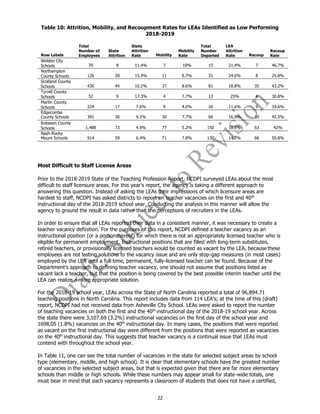
Table 10: Attrition, Mobility, and Recoupment Rates for LEAs Identified as Low Performing
2018-2019
Row Labels
Total
Number of
Employees
State
Attrition
State
Attrition
Rate Mobility
Mobility
Rate
Total
Number
Departed
LEA
Attrition
Rate Recoup
Recoup
Rate
Weldon City
Schools 70 8 11.4% 7 10% 15 21.4% 7 46.7%
Northampton
County Schools 126 20 15.9% 11 8.7% 31 24.6% 8 25.8%
Scotland County
Schools 430 44 10.2% 37 8.6% 81 18.8% 35 43.2%
Tyrrell County
Schools 52 9 17.3% 4 7.7% 13 25% 4 30.8%
Martin County
Schools 224 17 7.6% 9 4.0% 26 11.6% 9 34.6%
Edgecombe
County Schools 391 36 9.2% 30 7.7% 66 16.9% 30 45.5%
Robeson County
Schools 1,488 73 4.9% 77 5.2% 150 10.1% 63 42%
Nash-Rocky
Mount Schools 914 59 6.4% 71 7.8% 130 14.2% 66 50.8%
Most Difficult to Staff License Areas
Prior to the 2018-2019 State of the Teaching Profession Report, NCDPI surveyed LEAs about the most
difficult to staff licensure areas. For this year’s report, the agency is taking a different approach to
answering this question. Instead of asking the LEAs their impressions of which licensure areas are
hardest to staff, NCDPI has asked districts to report on teacher vacancies on the first and 40th
instructional day of the 2018-2019 school year. Conducting the analysis in this manner will allow the
agency to ground the result in data rather than the perceptions of recruiters in the LEAs.
In order to ensure that all LEAs reported their data in a consistent manner, it was necessary to create a
teacher vacancy definition. For the purposes of this report, NCDPI defined a teacher vacancy as an
instructional position (or a portionthereof) for which there is not an appropriately licensed teacher who is
eligible for permanent employment. Instructional positions that are filled with long-term substitutes,
retired teachers, or provisionally licensed teachers would be counted as vacant by the LEA, because these
employees are not lasting solutions to the vacancy issue and are only stop-gap measures (in most cases)
employed by the LEA until a full-time, permanent, fully-licensed teacher can be found. Because of the
Department’s approach to defining teacher vacancy, one should not assume that positions listed as
vacant lack a teacher, but that the position is being covered by the best possible interim teacher until the
LEA can realize a more appropriate solution.
For the 2018-19 school year, LEAs across the State of North Carolina reported a total of 96,894.71
teaching positions in North Carolina. This report includes data from 114 LEA’s; at the time of this (draft)
report, NCDPI had not received data from Asheville City School. LEAs were asked to report the number
of teaching vacancies on both the first and the 40th
instructional day of the 2018-19 school year. Across
the state there were 3,107.69 (3.2%) instructional vacancies on the first day of the school year and
1698.05 (1.8%) vacancies on the 40th
instructional day. In many cases, the positions that were reported
as vacant on the first instructional day were different from the positions that were reported as vacancies
on the 40th
instructional day. This suggests that teacher vacancy is a continual issue that LEAs must
contend with throughout the school year.
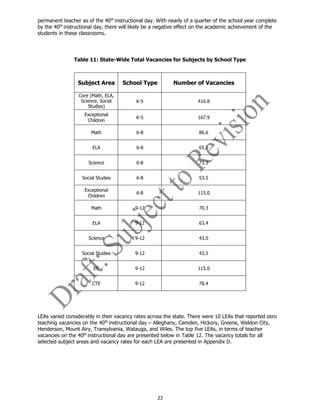
In Table 11, one can see the total number of vacancies in the state for selected subject areas by school
type (elementary, middle, and high school). It is clear that elementary schools have the greatest number
of vacancies in the selected subject areas, but that is expected given that there are far more elementary
schools than middle or high schools. While these numbers may appear small for state-wide totals, one
must bear in mind that each vacancy represents a classroom of students that does not have a certified,
23
permanent teacher as of the 40th
instructional day. With nearly of a quarter of the school year complete
by the 40th
instructional day, there will likely be a negative effect on the academic achievement of the
students in these classrooms.
Table 11: State-Wide Total Vacancies for Subjects by School Type
Subject Area School Type Number of Vacancies
Core (Math, ELA,
Science, Social
Studies)
K-5 416.8
Exceptional
Children
K-5 167.9
Math 6-8 86.6
ELA 6-8 65.0
Science 6-8 73.3
Social Studies 6-8 53.5
Exceptional
Children
6-8 115.0
Math 9-12 70.3
ELA 9-12 63.4
Science 9-12 43.0
Social Studies 9-12 43.5
EC 9-12 115.0
CTE 9-12 78.4
LEAs varied considerably in their vacancy rates across the state. There were 10 LEAs that reported zero
teaching vacancies on the 40th
instructional day – Alleghany, Camden, Hickory, Greene, Weldon City,
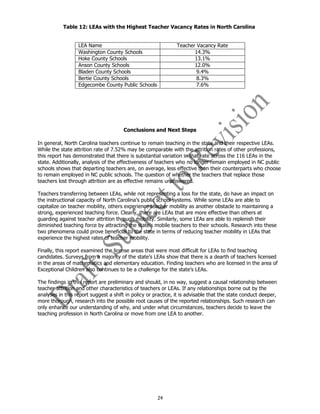
Henderson, Mount Airy, Transylvania, Watauga, and Wiles. The top five LEAs, in terms of teacher
vacancies on the 40th
instructional day are presented below in Table 12. The vacancy totals for all
selected subject areas and vacancy rates for each LEA are presented in Appendix D.
24
Table 12: LEAs with the Highest Teacher Vacancy Rates in North Carolina
LEA Name Teacher Vacancy Rate
Washington County Schools 14.3%
Hoke County Schools 13.1%
Anson County Schools 12.0%
Bladen County Schools 9.4%
Bertie County Schools 8.3%
Edgecombe County Public Schools 7.6%
Conclusions and Next Steps
In general, North Carolina teachers continue to remain teaching in the state and their respective LEAs.
While the state attrition rate of 7.52% may be comparable with the attrition rates of other professions,
this report has demonstrated that there is substantial variation in that rate across the 116 LEAs in the
state. Additionally, analysis of the effectiveness of teachers who no longer remain employed in NC public
schools shows that departing teachers are, on average, less effective than their counterparts who choose
to remain employed in NC public schools. The question of whether the teachers that replace those
teachers lost through attrition are as effective remains unanswered.
Teachers transferring between LEAs, while not representing a loss for the state, do have an impact on
the instructional capacity of North Carolina’s public school systems. While some LEAs are able to
capitalize on teacher mobility, others experience teacher mobility as another obstacle to maintaining a
strong, experienced teaching force. Clearly, there are LEAs that are more effective than others at
guarding against teacher attrition through mobility. Similarly, some LEAs are able to replenish their
diminished teaching force by attracting the state’s mobile teachers to their schools. Research into these
two phenomena could prove beneficial to the state in terms of reducing teacher mobility in LEAs that
experience the highest rates of teacher mobility.
Finally, this report examined the license areas that were most difficult for LEAs to find teaching
candidates. Surveys from a majority of the state’s LEAs show that there is a dearth of teachers licensed
in the areas of mathematics and elementary education. Finding teachers who are licensed in the area of
Exceptional Children also continues to be a challenge for the state’s LEAs.
The findings in this report are preliminary and should, in no way, suggest a causal relationship between
teacher attrition and other characteristics of teachers or LEAs. If any relationships borne out by the
analyses in this report suggest a shift in policy or practice, it is advisable that the state conduct deeper,
more thorough, research into the possible root causes of the reported relationships. Such research can
only enhance our understanding of why, and under what circumstances, teachers decide to leave the
teaching profession in North Carolina or move from one LEA to another.
25
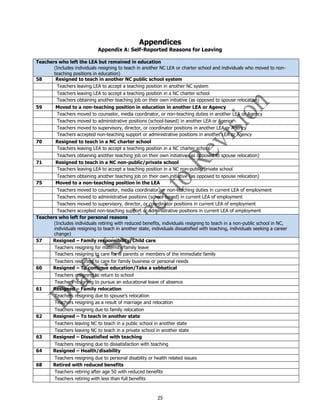
Appendices
Appendix A: Self-Reported Reasons for Leaving
Teachers who left the LEA but remained in education
(Includes individuals resigning to teach in another NC LEA or charter school and individuals who moved to non-
teaching positions in education)
58 Resigned to teach in another NC public school system
Teachers leaving LEA to accept a teaching position in another NC system
Teachers leaving LEA to accept a teaching position in a NC charter school
Teachers obtaining another teaching job on their own initiative (as opposed to spouse relocation)
59 Moved to a non-teaching position in education in another LEA or Agency
Teachers moved to counselor, media coordinator, or non-teaching duties in another LEA or Agency
Teachers moved to administrative positions (school-based) in another LEA or Agency
Teachers moved to supervisory, director, or coordinator positions in another LEA or Agency
Teachers accepted non-teaching support or administrative positions in another LEA or Agency
70 Resigned to teach in a NC charter school
Teachers leaving LEA to accept a teaching position in a NC charter school
Teachers obtaining another teaching job on their own initiative (as opposed to spouse relocation)
71 Resigned to teach in a NC non-public/private school
Teachers leaving LEA to accept a teaching position in a NC non-public/private school
Teachers obtaining another teaching job on their own initiative (as opposed to spouse relocation)
75 Moved to a non-teaching position in the LEA
Teachers moved to counselor, media coordinator, or non-teaching duties in current LEA of employment
Teachers moved to administrative positions (school-based) in current LEA of employment
Teachers moved to supervisory, director, or coordinator positions in current LEA of employment
Teachers accepted non-teaching support or administrative positions in current LEA of employment
Teachers who left for personal reasons
(Includes individuals retiring with reduced benefits, individuals resigning to teach in a non-public school in NC,
individuals resigning to teach in another state, individuals dissatisfied with teaching, individuals seeking a career
change)
57 Resigned – Family responsibility/Child care
Teachers resigning for maternity/family leave
Teachers resigning to care for ill parents or members of the immediate family
Teachers resigning to care for family business or personal needs
60 Resigned – To continue education/Take a sabbatical
Teachers resigning to return to school
Teachers resigning to pursue an educational leave of absence
61 Resigned – Family relocation
Teachers resigning due to spouse’s relocation
Teachers resigning as a result of marriage and relocation
Teachers resigning due to family relocation
62 Resigned – To teach in another state
Teachers leaving NC to teach in a public school in another state
Teachers leaving NC to teach in a private school in another state
63 Resigned – Dissatisfied with teaching
Teachers resigning due to dissatisfaction with teaching
64 Resigned – Health/disability
Teachers resigning due to personal disability or health related issues
68 Retired with reduced benefits
Teachers retiring after age 50 with reduced benefits
Teachers retiring with less than full benefits
26
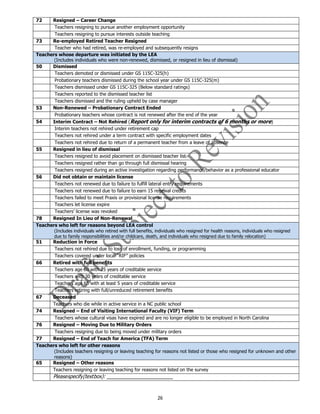
72 Resigned – Career Change
Teachers resigning to pursue another employment opportunity
Teachers resigning to pursue interests outside teaching
73 Re-employed Retired Teacher Resigned
Teacher who had retired, was re-employed and subsequently resigns
Teachers whose departure was initiated by the LEA
(Includes individuals who were non-renewed, dismissed, or resigned in lieu of dismissal)
50 Dismissed
Teachers demoted or dismissed under GS 115C-325(h)
Probationary teachers dismissed during the school year under GS 115C-325(m)
Teachers dismissed under GS 115C-325 (Below standard ratings)
Teachers reported to the dismissed teacher list
Teachers dismissed and the ruling upheld by case manager
53 Non-Renewed – Probationary Contract Ended
Probationary teachers whose contract is not renewed after the end of the year
54 Interim Contract – Not Rehired (Report only for interim contracts of 6 months or more)
Interim teachers not rehired under retirement cap
Teachers not rehired under a term contract with specific employment dates
Teachers not rehired due to return of a permanent teacher from a leave of absence
55 Resigned in lieu of dismissal
Teachers resigned to avoid placement on dismissed teacher list
Teachers resigned rather than go through full dismissal hearing
Teachers resigned during an active investigation regarding performance/behavior as a professional educator
56 Did not obtain or maintain license
Teachers not renewed due to failure to fulfill lateral entry requirements
Teachers not renewed due to failure to earn 15 renewal credits
Teachers failed to meet Praxis or provisional license requirements
Teachers let license expire
Teachers’ license was revoked
78 Resigned In Lieu of Non-Renewal
Teachers who left for reasons beyond LEA control
(Includes individuals who retired with full benefits, individuals who resigned for health reasons, individuals who resigned
due to family responsibilities and/or childcare, death, and individuals who resigned due to family relocation)
51 Reduction in Force
Teachers not rehired due to loss of enrollment, funding, or programming
Teachers covered under local “RIF” policies
66 Retired with full benefits
Teachers age 60 with 25 years of creditable service
Teachers with 30 years of creditable service
Teachers age 65 with at least 5 years of creditable service
Teachers retiring with full/unreduced retirement benefits
67 Deceased
Teachers who die while in active service in a NC public school
74 Resigned – End of Visiting International Faculty (VIF) Term
Teachers whose cultural visas have expired and are no longer eligible to be employed in North Carolina
76 Resigned – Moving Due to Military Orders
Teachers resigning due to being moved under military orders
77 Resigned – End of Teach for America (TFA) Term
Teachers who left for other reasons
(Includes teachers resigning or leaving teaching for reasons not listed or those who resigned for unknown and other
reasons)
65 Resigned – Other reasons
Teachers resigning or leaving teaching for reasons not listed on the survey
Pleasespecify(textbox):
27
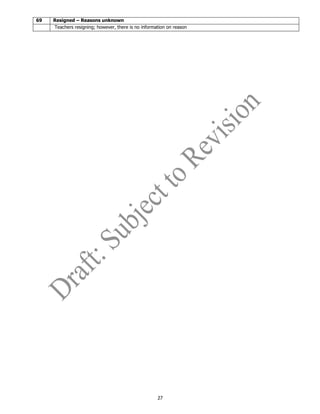
69 Resigned – Reasons unknown
Teachers resigning; however, there is no information on reason
28
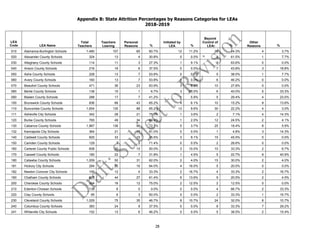
Appendix B: State Attrition Percentages by Reasons Categories for LEAs
2018-2019
LEA
Code LEA Name
Total
Teachers
Teachers
Leaving
Personal
Reasons %
Initiated by
LEA %
Beyond
Control of
LEA %
Other
Reasons %
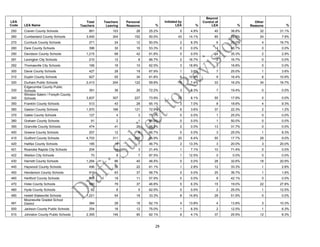
010 Alamance-Burlington Schools 1,480 107 65 60.7% 12 11.2% 26 24.3% 4 3.7%
020 Alexander County Schools 324 13 4 30.8% 0 0.0% 8 61.5% 1 7.7%
030 Alleghany County Schools 114 11 3 27.3% 1 9.1% 7 63.6% 0 0.0%
040 Anson County Schools 216 16 6 37.5% 0 0.0% 7 43.8% 3 18.8%
050 Ashe County Schools 228 13 7 53.8% 0 0.0% 5 38.5% 1 7.7%
060 Avery County Schools 160 13 7 53.8% 0 0.0% 6 46.2% 0 0.0%
070 Beaufort County Schools 471 36 23 63.9% 3 8.3% 10 27.8% 0 0.0%
080 Bertie County Schools 138 15 1 6.7% 3 20.0% 6 40.0% 5 33.3%
090 Bladen County Schools 288 17 7 41.2% 1 5.9% 5 29.4% 4 23.5%
100 Brunswick County Schools 836 66 43 65.2% 4 6.1% 10 15.2% 9 13.6%
110 Buncombe County Schools 1,654 135 88 65.2% 13 9.6% 30 22.2% 4 3.0%
111 Asheville City Schools 342 28 21 75.0% 1 3.6% 2 7.1% 4 14.3%
120 Burke County Schools 765 49 34 69.4% 1 2.0% 12 24.5% 2 4.1%
130 Cabarrus County Schools 1,967 136 98 72.1% 5 3.7% 25 18.4% 8 5.9%
132 Kannapolis City Schools 364 21 17 81.0% 0 0.0% 1 4.8% 3 14.3%
140 Caldwell County Schools 825 33 15 45.5% 3 9.1% 15 45.5% 0 0.0%
150 Camden County Schools 129 7 5 71.4% 0 0.0% 2 28.6% 0 0.0%
160 Carteret County Public Schools 608 30 15 50.0% 3 10.0% 10 33.3% 2 6.7%
170 Caswell County Schools 180 22 7 31.8% 1 4.5% 5 22.7% 9 40.9%
180 Catawba County Schools 1,009 50 31 62.0% 2 4.0% 15 30.0% 2 4.0%
181 Hickory City Schools 284 25 16 64.0% 4 16.0% 5 20.0% 0 0.0%
182 Newton Conover City Schools 195 12 4 33.3% 2 16.7% 4 33.3% 2 16.7%
190 Chatham County Schools 625 44 27 61.4% 6 13.6% 9 20.5% 2 4.5%
200 Cherokee County Schools 264 16 12 75.0% 2 12.5% 2 12.5% 0 0.0%
210 Edenton-Chowan Schools 139 6 0 0.0% 0 0.0% 4 66.7% 2 33.3%
220 Clay County Schools 95 6 3 50.0% 0 0.0% 2 33.3% 1 16.7%
230 Cleveland County Schools 1,029 75 35 46.7% 8 10.7% 24 32.0% 8 10.7%
240 Columbus County Schools 383 24 9 37.5% 0 0.0% 8 33.3% 7 29.2%
241 Whiteville City Schools 152 13 6 46.2% 0 0.0% 5 38.5% 2 15.4%
29
LEA
Code LEA Name
Total
Teachers
Teachers
Leaving
Personal
Reasons %
Initiated by
LEA %
Beyond
Control of
LEA %
Other
Reasons %
250 Craven County Schools 891 103 26 25.2% 5 4.9% 40 38.8% 32 31.1%
260 Cumberland County Schools 3,400 304 152 50.0% 43 14.1% 85 28.0% 24 7.9%
270 Currituck County Schools 271 24 12 50.0% 2 8.3% 6 25.0% 4 16.7%
280 Dare County Schools 396 30 16 53.3% 0 0.0% 14 46.7% 0 0.0%
290 Davidson County Schools 1,215 68 42 61.8% 0 0.0% 24 35.3% 2 2.9%
291 Lexington City Schools 210 12 8 66.7% 2 16.7% 2 16.7% 0 0.0%
292 Thomasville City Schools 166 16 10 62.5% 3 18.8% 3 18.8% 0 0.0%
300 Davie County Schools 427 28 19 67.9% 1 3.6% 7 25.0% 1 3.6%
310 Duplin County Schools 627 55 34 61.8% 6 10.9% 9 16.4% 6 10.9%
320 Durham Public Schools 2,413 204 122 59.8% 15 7.4% 33 16.2% 34 16.7%
330
Edgecombe County Public
Schools 391 36 26 72.2% 3 8.3% 7 19.4% 0 0.0%
340
Winston Salem / Forsyth County
Schools 3,837 307 227 73.9% 25 8.1% 55 17.9% 0 0.0%
350 Franklin County Schools 513 43 28 65.1% 3 7.0% 8 18.6% 4 9.3%
360 Gaston County Schools 1,970 166 121 72.9% 6 3.6% 37 22.3% 2 1.2%
370 Gates County Schools 127 4 3 75.0% 0 0.0% 1 25.0% 0 0.0%
380 Graham County Schools 91 2 1 50.0% 0 0.0% 1 50.0% 0 0.0%
390 Granville County Schools 474 41 28 68.3% 0 0.0% 13 31.7% 0 0.0%
400 Greene County Schools 207 12 8 66.7% 0 0.0% 3 25.0% 1 8.3%
410 Guilford County Schools 4,703 311 208 66.9% 20 6.4% 55 17.7% 28 9.0%
420 Halifax County Schools 185 15 7 46.7% 2 13.3% 3 20.0% 3 20.0%
421 Roanoke Rapids City Schools 204 14 3 21.4% 1 7.1% 10 71.4% 0 0.0%
422 Weldon City Schools 70 8 7 87.5% 1 12.5% 0 0.0% 0 0.0%
430 Harnett County Schools 1,294 86 40 46.5% 0 0.0% 28 32.6% 18 20.9%
440 Haywood County Schools 496 36 22 61.1% 1 2.8% 12 33.3% 1 2.8%
450 Henderson County Schools 910 63 37 58.7% 0 0.0% 25 39.7% 1 1.6%
460 Hertford County Schools 195 19 11 57.9% 0 0.0% 8 42.1% 0 0.0%
470 Hoke County Schools 580 79 37 46.8% 5 6.3% 15 19.0% 22 27.8%
480 Hyde County Schools 62 8 5 62.5% 0 0.0% 2 25.0% 1 12.5%
490 Iredell-Statesville Schools 1,221 54 18 33.3% 8 14.8% 28 51.9% 0 0.0%
491
Mooresville Graded School
District 384 29 18 62.1% 4 13.8% 4 13.8% 3 10.3%
500 Jackson County Public Schools 254 16 12 75.0% 1 6.3% 2 12.5% 1 6.3%
510 Johnston County Public Schools 2,355 145 90 62.1% 6 4.1% 37 25.5% 12 8.3%
30
LEA
Code LEA Name
Total
Teachers
Teachers
Leaving
Personal
Reasons %
Initiated by
LEA %
Beyond
Control of
LEA %
Other
Reasons %
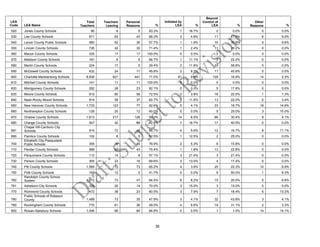
520 Jones County Schools 90 6 5 83.3% 1 16.7% 0 0.0% 0 0.0%
530 Lee County Schools 671 63 43 68.3% 3 4.8% 11 17.5% 6 9.5%
540 Lenoir County Public Schools 560 52 30 57.7% 1 1.9% 16 30.8% 5 9.6%
550 Lincoln County Schools 726 42 30 71.4% 1 2.4% 11 26.2% 0 0.0%
560 Macon County Schools 325 17 17 100.0% 0 0.0% 0 0.0% 0 0.0%
570 Madison County Schools 181 9 6 66.7% 1 11.1% 2 22.2% 0 0.0%
580 Martin County Schools 224 17 5 29.4% 2 11.8% 10 58.8% 0 0.0%
590 McDowell County Schools 432 24 11 45.8% 2 8.3% 11 45.8% 0 0.0%
600 Charlotte-Mecklenburg Schools 8,936 621 441 71.0% 61 9.8% 105 16.9% 14 2.3%
610 Mitchell County Schools 141 11 11 100.0% 0 0.0% 0 0.0% 0 0.0%
620 Montgomery County Schools 282 28 23 82.1% 0 0.0% 5 17.9% 0 0.0%
630 Moore County Schools 812 80 58 72.5% 3 3.8% 18 22.5% 1 1.3%
640 Nash-Rocky Mount Schools 914 59 37 62.7% 7 11.9% 13 22.0% 2 3.4%
650 New Hanover County Schools 1,733 123 77 62.6% 5 4.1% 23 18.7% 18 14.6%
660 Northampton County Schools 126 20 12 60.0% 0 0.0% 5 25.0% 3 15.0%
670 Onslow County Schools 1,613 217 128 59.0% 14 6.5% 66 30.4% 9 4.1%
680 Orange County Schools 547 42 18 42.9% 7 16.7% 17 40.5% 0 0.0%
681
Chapel Hill-Carrboro City
Schools 914 72 48 66.7% 4 5.6% 12 16.7% 8 11.1%
690 Pamlico County Schools 102 8 5 62.5% 1 12.5% 2 25.0% 0 0.0%
700
Elizabeth City-Pasquotank
Public Schools 355 38 30 78.9% 2 5.3% 6 15.8% 0 0.0%
710 Pender County Schools 589 57 43 75.4% 1 1.8% 13 22.8% 0 0.0%
720 Perquimans County Schools 112 14 8 57.1% 3 21.4% 3 21.4% 0 0.0%
730 Person County Schools 305 23 16 69.6% 3 13.0% 4 17.4% 0 0.0%
740 Pitt County Schools 1,585 112 73 65.2% 4 3.6% 25 22.3% 10 8.9%
750 Polk County Schools 183 12 5 41.7% 0 0.0% 6 50.0% 1 8.3%
760
Randolph County School
System 1,072 73 47 64.4% 6 8.2% 15 20.5% 5 6.8%
761 Asheboro City Schools 325 20 14 70.0% 3 15.0% 3 15.0% 0 0.0%
770 Richmond County Schools 472 38 23 60.5% 3 7.9% 7 18.4% 5 13.2%
780
Public Schools of Robeson
County 1,488 73 35 47.9% 3 4.1% 32 43.8% 3 4.1%
790 Rockingham County Schools 770 61 36 59.0% 4 6.6% 19 31.1% 2 3.3%
800 Rowan-Salisbury Schools 1,306 99 84 84.8% 0 0.0% 1 1.0% 14 14.1%
31
LEA
Code LEA Name
Total
Teachers
Teachers
Leaving
Personal
Reasons %
Initiated by
LEA %
Beyond
Control of
LEA %
Other
Reasons %
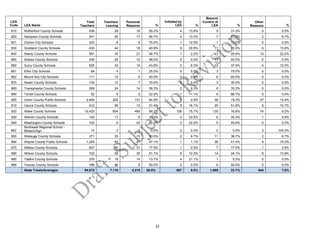
810 Rutherford County Schools 536 29 16 55.2% 4 13.8% 9 31.0% 0 0.0%
820 Sampson County Schools 541 30 17 56.7% 4 13.3% 7 23.3% 2 6.7%
821 Clinton City Schools 203 8 6 75.0% 1 12.5% 1 12.5% 0 0.0%
830 Scotland County Schools 430 44 18 40.9% 9 20.5% 11 25.0% 6 13.6%
840 Stanly County Schools 581 45 21 46.7% 1 2.2% 13 28.9% 10 22.2%
850 Stokes County Schools 435 25 12 48.0% 0 0.0% 13 52.0% 0 0.0%
860 Surry County Schools 525 32 14 43.8% 2 6.3% 12 37.5% 4 12.5%
861 Elkin City Schools 84 4 1 25.0% 0 0.0% 3 75.0% 0 0.0%
862 Mount Airy City Schools 111 10 4 40.0% 0 0.0% 6 60.0% 0 0.0%
870 Swain County Schools 134 10 7 70.0% 0 0.0% 3 30.0% 0 0.0%
880 Transylvania County Schools 269 24 14 58.3% 2 8.3% 8 33.3% 0 0.0%
890 Tyrrell County Schools 52 9 2 22.2% 1 11.1% 6 66.7% 0 0.0%
900 Union County Public Schools 2,494 202 131 64.9% 5 2.5% 39 19.3% 27 13.4%
910 Vance County Schools 412 56 12 21.4% 9 16.1% 29 51.8% 6 10.7%
920 Wake County Schools 10,420 804 469 58.3% 126 15.7% 135 16.8% 74 9.2%
930 Warren County Schools 145 17 6 35.3% 4 23.5% 6 35.3% 1 5.9%
940 Washington County Schools 102 9 2 22.2% 2 22.2% 5 55.6% 0 0.0%
94Z
Northeast Regional School -
Biotech/Agri 14 3 0 0.0% 0 0.0% 0 0.0% 3 100.0%
950 Watauga County Schools 371 30 15 50.0% 2 6.7% 11 36.7% 2 6.7%
960 Wayne County Public Schools 1,245 87 41 47.1% 1 1.1% 36 41.4% 9 10.3%
970 Wilkes County Schools 607 40 31 77.5% 1 2.5% 7 17.5% 1 2.5%
980 Wilson County Schools 722 58 30 51.7% 6 10.3% 14 24.1% 8 13.8%
990 Yadkin County Schools 379 19 14 73.7% 4 21.1% 1 5.3% 0 0.0%
995 Yancey County Schools 166 12 6 50.0% 0 0.0% 6 50.0% 0 0.0%
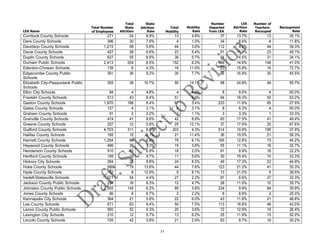
State Totals/Averages 94,672 7,115 4,315 60.6% 567 8.0% 1,689 23.7% 544 7.6%
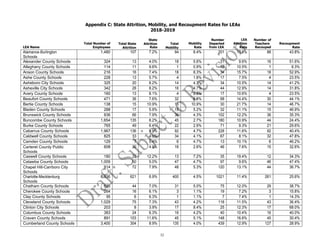
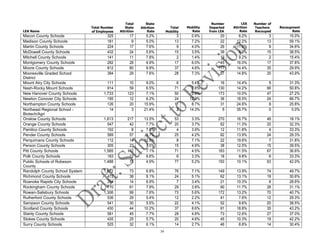
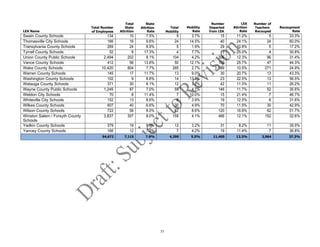
Appendix C: State Attrition, Mobility, and Recoupment Rates for LEAs
2018-2019
LEA Name
Total Number of
Employees
Total State
Attrition
State
Attrition
Rate
Total
Mobility
Mobility
Rate
Number
Departed
from LEA
LEA
Attrition
Rate
Number of
Teachers
Recouped
Recoupment
Rate
Alamance-Burlington
Schools
1,480 107 7.2% 94 6.4% 201 13.6% 88 43.8%
Alexander County Schools 324 13 4.0% 18 5.6% 31 9.6% 16 51.6%
Alleghany County Schools 114 11 9.6% 1 0.9% 12 10.5% 1 8.3%
Anson County Schools 216 16 7.4% 18 8.3% 34 15.7% 18 52.9%
Ashe County Schools 228 13 5.7% 4 1.8% 17 7.5% 4 23.5%
Asheboro City Schools 325 20 6.2% 14 4.3% 34 10.5% 14 41.2%
Asheville City Schools 342 28 8.2% 16 4.7% 44 12.9% 14 31.8%
Avery County Schools 160 13 8.1% 4 2.5% 17 10.6% 4 23.5%
Beaufort County Schools 471 36 7.6% 32 6.8% 68 14.4% 30 44.1%
Bertie County Schools 138 15 10.9% 15 10.9% 30 21.7% 14 46.7%
Bladen County Schools 288 17 5.9% 15 5.2% 32 11.1% 15 46.9%
Brunswick County Schools 836 66 7.9% 36 4.3% 102 12.2% 36 35.3%
Buncombe County Schools 1,654 135 8.2% 45 2.7% 180 10.9% 44 24.4%
Burke County Schools 765 49 6.4% 22 2.9% 71 9.3% 21 29.6%
Cabarrus County Schools 1,967 136 6.9% 92 4.7% 228 11.6% 92 40.4%
Caldwell County Schools 825 33 4.0% 34 4.1% 67 8.1% 32 47.8%
Camden County Schools 129 7 5.4% 6 4.7% 13 10.1% 6 46.2%
Carteret County Public
Schools
608 30 4.9% 16 2.6% 46 7.6% 15 32.6%
Caswell County Schools 180 22 12.2% 13 7.2% 35 19.4% 12 34.3%
Catawba County Schools 1,009 50 5.0% 47 4.7% 97 9.6% 46 47.4%
Chapel Hill-Carrboro City
Schools
914 72 7.9% 48 5.3% 120 13.1% 44 36.7%
Charlotte-Mecklenburg
Schools
8,936 621 6.9% 400 4.5% 1021 11.4% 261 25.6%
Chatham County Schools 625 44 7.0% 31 5.0% 75 12.0% 29 38.7%
Cherokee County Schools 264 16 6.1% 3 1.1% 19 7.2% 3 15.8%
Clay County Schools 95 6 6.3% 1 1.1% 7 7.4% 1 14.3%
Cleveland County Schools 1,029 75 7.3% 43 4.2% 118 11.5% 43 36.4%
Clinton City Schools 203 8 3.9% 17 8.4% 25 12.3% 17 68.0%
Columbus County Schools 383 24 6.3% 16 4.2% 40 10.4% 16 40.0%
Craven County Schools 891 103 11.6% 45 5.1% 148 16.6% 45 30.4%
Cumberland County Schools 3,400 304 8.9% 135 4.0% 439 12.9% 127 28.9%
32
33
LEA Name
Total Number
of Employees
Total
State
Attrition
State
Attrition
Rate
Total
Mobility
Mobility
Rate
Number
Departed
from LEA
LEA
Attrition
Rate
Number of
Teachers
Recouped
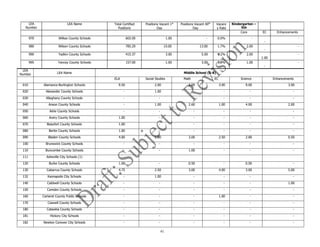
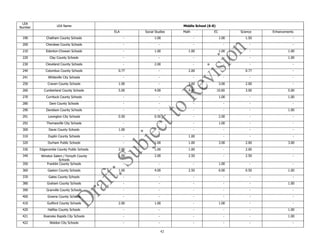
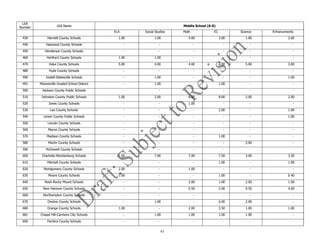
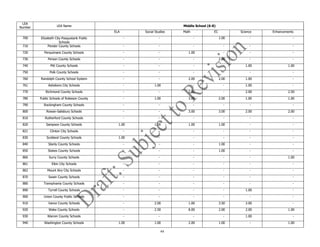
Recoupment
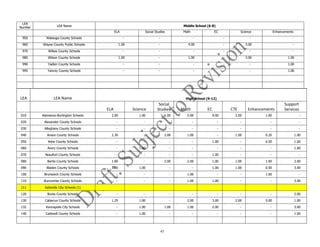
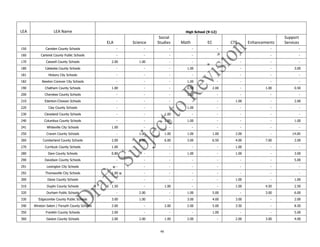
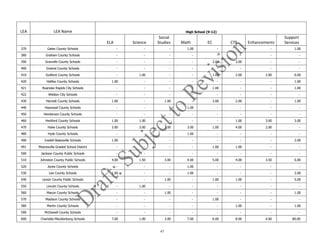
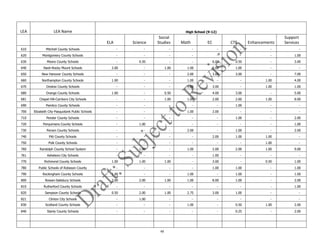
Rate
Currituck County Schools 271 24 8.9% 13 4.8% 37 13.7% 13 35.1%
Dare County Schools 396 30 7.6% 4 1.0% 34 8.6% 4 11.8%
Davidson County Schools 1,215 68 5.6% 44 3.6% 112 9.2% 44 39.3%
Davie County Schools 427 28 6.6% 23 5.4% 51 11.9% 23 45.1%
Duplin County Schools 627 55 8.8% 36 5.7% 91 14.5% 31 34.1%
Durham Public Schools 2,413 204 8.5% 152 6.3% 356 14.8% 146 41.0%
Edenton-Chowan Schools 139 6 4.3% 16 11.5% 22 15.8% 16 72.7%
Edgecombe County Public
Schools
391 36 9.2% 30 7.7% 66 16.9% 30 45.5%
Elizabeth City-Pasquotank Public
Schools
355 38 10.7% 50 14.1% 88 24.8% 49 55.7%
Elkin City Schools 84 4 4.8% 4 4.8% 8 9.5% 4 50.0%
Franklin County Schools 513 43 8.4% 51 9.9% 94 18.3% 50 53.2%
Gaston County Schools 1,970 166 8.4% 67 3.4% 233 11.8% 65 27.9%
Gates County Schools 127 4 3.1% 4 3.1% 8 6.3% 4 50.0%
Graham County Schools 91 2 2.2% 1 1.1% 3 3.3% 1 33.3%
Granville County Schools 474 41 8.6% 42 8.9% 83 17.5% 41 49.4%
Greene County Schools 207 12 5.8% 25 12.1% 37 17.9% 25 67.6%
Guilford County Schools 4,703 311 6.6% 203 4.3% 514 10.9% 195 37.9%
Halifax County Schools 185 15 8.1% 21 11.4% 36 19.5% 21 58.3%
Harnett County Schools 1,294 86 6.6% 79 6.1% 165 12.8% 73 44.2%
Haywood County Schools 496 36 7.3% 19 3.8% 55 11.1% 18 32.7%
Henderson County Schools 910 63 6.9% 18 2.0% 81 8.9% 18 22.2%
Hertford County Schools 195 19 9.7% 11 5.6% 30 15.4% 10 33.3%
Hickory City Schools 284 25 8.8% 24 8.5% 49 17.3% 22 44.9%
Hoke County Schools 580 79 13.6% 44 7.6% 123 21.2% 41 33.3%
Hyde County Schools 62 8 12.9% 5 8.1% 13 21.0% 5 38.5%
Iredell-Statesville Schools 1,221 54 4.4% 27 2.2% 81 6.6% 27 33.3%
Jackson County Public Schools 254 16 6.3% 12 4.7% 28 11.0% 10 35.7%
Johnston County Public Schools 2,355 145 6.2% 89 3.8% 234 9.9% 84 35.9%
Jones County Schools 90 6 6.7% 2 2.2% 8 8.9% 2 25.0%
Kannapolis City Schools 364 21 5.8% 22 6.0% 43 11.8% 21 48.8%
Lee County Schools 671 63 9.4% 50 7.5% 113 16.8% 48 42.5%
Lenoir County Public Schools 560 52 9.3% 20 3.6% 72 12.9% 19 26.4%
Lexington City Schools 210 12 5.7% 13 6.2% 25 11.9% 13 52.0%
Lincoln County Schools 726 42 5.8% 21 2.9% 63 8.7% 19 30.2%
34
LEA Name
Total Number
of Employees
Total
State
Attrition
State
Attrition
Rate
Total
Mobility
Mobility
Rate
Number
Departed
from LEA
LEA
Attrition
Rate
Number of
Teachers
Recouped
Recoupment
Rate
Macon County Schools 325 17 5.2% 3 0.9% 20 6.2% 3 15.0%
Madison County Schools 181 9 5.0% 13 7.2% 22 12.2% 13 59.1%
Martin County Schools 224 17 7.6% 9 4.0% 26 11.6% 9 34.6%
McDowell County Schools 432 24 5.6% 15 3.5% 39 9.0% 15 38.5%
Mitchell County Schools 141 11 7.8% 2 1.4% 13 9.2% 2 15.4%
Montgomery County Schools 282 28 9.9% 17 6.0% 45 16.0% 17 37.8%
Moore County Schools 812 80 9.9% 37 4.6% 117 14.4% 35 29.9%
Mooresville Graded School
District
384 29 7.6% 28 7.3% 57 14.8% 25 43.9%
Mount Airy City Schools 111 10 9.0% 6 5.4% 16 14.4% 5 31.3%
Nash-Rocky Mount Schools 914 59 6.5% 71 7.8% 130 14.2% 66 50.8%
New Hanover County Schools 1,733 123 7.1% 50 2.9% 173 10.0% 47 27.2%
Newton Conover City Schools 195 12 6.2% 24 12.3% 36 18.5% 24 66.7%
Northampton County Schools 126 20 15.9% 11 8.7% 31 24.6% 8 25.8%
Northeast Regional School -
Biotech/Agri
14 3 21.4% 2 14.3% 5 35.7% 0 0.0%
Onslow County Schools 1,613 217 13.5% 53 3.3% 270 16.7% 49 18.1%
Orange County Schools 547 42 7.7% 20 3.7% 62 11.3% 20 32.3%
Pamlico County Schools 102 8 7.8% 4 3.9% 12 11.8% 4 33.3%
Pender County Schools 589 57 9.7% 25 4.2% 82 13.9% 24 29.3%
Perquimans County Schools 112 14 12.5% 8 7.1% 22 19.6% 7 31.8%
Person County Schools 305 23 7.5% 15 4.9% 38 12.5% 15 39.5%
Pitt County Schools 1,585 112 7.1% 71 4.5% 183 11.5% 67 36.6%
Polk County Schools 183 12 6.6% 6 3.3% 18 9.8% 6 33.3%
Public Schools of Robeson
County
1,488 73 4.9% 77 5.2% 150 10.1% 63 42.0%
Randolph County School System 1,072 73 6.8% 76 7.1% 149 13.9% 74 49.7%
Richmond County Schools 472 38 8.1% 24 5.1% 62 13.1% 19 30.6%
Roanoke Rapids City Schools 204 14 6.9% 7 3.4% 21 10.3% 6 28.6%
Rockingham County Schools 770 61 7.9% 29 3.8% 90 11.7% 28 31.1%
Rowan-Salisbury Schools 1,306 99 7.6% 73 5.6% 172 13.2% 70 40.7%
Rutherford County Schools 536 29 5.4% 12 2.2% 41 7.6% 12 29.3%
Sampson County Schools 541 30 5.5% 22 4.1% 52 9.6% 20 38.5%
Scotland County Schools 430 44 10.2% 37 8.6% 81 18.8% 35 43.2%
Stanly County Schools 581 45 7.7% 28 4.8% 73 12.6% 27 37.0%
Stokes County Schools 435 25 5.7% 20 4.6% 45 10.3% 19 42.2%
Surry County Schools 525 32 6.1% 14 2.7% 46 8.8% 14 30.4%
35
LEA Name
Total Number
of Employees
Total
State
Attrition
State
Attrition
Rate
Total
Mobility
Mobility
Rate
Number
Departed
from LEA
LEA
Attrition
Rate
Number of
Teachers
Recouped
Recoupment
Rate
Swain County Schools 134 10 7.5% 5 3.7% 15 11.2% 5 33.3%
Thomasville City Schools 166 16 9.6% 24 14.5% 40 24.1% 24 60.0%
Transylvania County Schools 269 24 8.9% 5 1.9% 29 10.8% 5 17.2%
Tyrrell County Schools 52 9 17.3% 4 7.7% 13 25.0% 4 30.8%
Union County Public Schools 2,494 202 8.1% 104 4.2% 306 12.3% 96 31.4%
Vance County Schools 412 56 13.6% 50 12.1% 106 25.7% 47 44.3%
Wake County Schools 10,420 804 7.7% 285 2.7% 1,089 10.5% 271 24.9%
Warren County Schools 145 17 11.7% 13 9.0% 30 20.7% 13 43.3%
Washington County Schools 102 9 8.8% 14 13.7% 23 22.5% 13 56.5%
Watauga County Schools 371 30 8.1% 12 3.2% 42 11.3% 11 26.2%
Wayne County Public Schools 1,245 87 7.0% 59 4.7% 146 11.7% 52 35.6%
Weldon City Schools 70 8 11.4% 7 10.0% 15 21.4% 7 46.7%
Whiteville City Schools 152 13 8.6% 6 3.9% 19 12.5% 6 31.6%
Wilkes County Schools 607 40 6.6% 30 4.9% 70 11.5% 30 42.9%
Wilson County Schools 722 58 8.0% 62 8.6% 120 16.6% 62 51.7%
Winston Salem / Forsyth County
Schools
3,837 307 8.0% 159 4.1% 466 12.1% 152 32.6%
Yadkin County Schools 379 19 5.0% 12 3.2% 31 8.2% 11 35.5%
Yancey County Schools 166 12 7.2% 7 4.2% 19 11.4% 7 36.8%
94,672 7,115 7.8% 4,290 5.5% 11,405 13.3% 3,964 37.3%
36
Appendix D : Teacher Vacancy Data for LEAs
2018-2019
LEA
Number
LEA Name Total Certified
Positions
Positions Vacant 1st
Day
Positions Vacant 40th
Day
Vacancy
Rate
Kindergarten – 5th
Core EC Enhancements
010 Alamance-Burlington Schools 1,493.50 67.00 75.50 5.1% 13.00 7.00 1.00
020 Alexander County Schools 312.00 5.00 5.00 1.6% 1.00 1.00 -
030 Alleghany County Schools 121.00 2.00 - 0.0% - - -
040 Anson County Schools 260.34 31.29 31.29 12.0% 5.73 - 0.73
050 Ashe County Schools 222.00 1.50 1.50 0.7% - - -
060 Avery County Schools 136.25 - 2.00 1.5% - - -
070 Beaufort County Schools 446.00 8.50 5.00 1.1% - 2.00 -
080 Bertie County Schools 157.00 13.00 13.00 8.3% 1.00 2.00 -
090 Bladen County Schools 287.00 32.00 27.00 9.4% 4.00 1.00 1.50
100 Brunswick County Schools 840.00 1.00 2.00 0.2% - - -
110 Buncombe County Schools 2,026.68 7.00 7.00 0.3% 4.00 - -
111 Asheville City Schools (1)
120 Burke County Schools 696.00 5.00 10.50 1.5% 8.00 0.50 -
130 Cabarrus County Schools 1,588.50 27.75 50.00 3.1% 11.00 0.50 2.00
132 Kannapolis City Schools 368.00 7.00 7.00 1.9% 1.00 - -
140 Caldwell County Schools 779.60 8.00 3.00 0.4% 1.00 - -
150 Camden County Schools 131.00 - - 0.0% - - -
160 Carteret County Public Schools 597.54 7.00 3.00 0.5% 1.00 1.00 -
170 Caswell County Schools 199.00 12.00 7.00 3.5% 3.00 - 1.00
180 Catawba County Schools 892.40 17.00 6.00 0.7% 3.00 2.00 -
181 Hickory City Schools 287.00 7.00 - 0.0% - - -
37
LEA
Number
LEA Name Total Certified
Positions
Positions Vacant 1st
Day
Positions Vacant 40th
Day
Vacancy
Rate
Kindergarten – 5th
Core EC Enhancements
182 Newton Conover City Schools 203.00 3.00 3.00 1.5% 1.00 1.00 -
190 Chatham County Schools 725.60 31.50 18.50 2.5% 4.00 5.00 -
200 Cherokee County Schools 257.50 1.00 1.00 0.4% - - -
210 Edenton-Chowan Schools 142.06 10.00 5.00 3.5% - - -
220 Clay County Schools 107.00 2.00 2.00 1.9% - - -
230 Cleveland County Schools 947.60 5.00 3.00 0.3% - - -
240 Columbus County Schools 367.07 14.95 8.31 2.3% 0.77 0.50 -
241 Whiteville City Schools 154.66 2.00 2.00 1.3% - - -
250 Craven County Schools 821.00 36.50 40.50 4.9% 7.00 9.50 2.00
260 Cumberland County Schools 3,384.00 131.00 127.50 3.8% 39.00 17.00 3.00
270 Currituck County Schools 317.00 11.00 11.00 3.5% 3.00 3.00 -
280 Dare County Schools 434.07 4.00 4.00 0.9% 0.20 - 1.00
290 Davidson County Schools 1,415.85 31.50 4.00 0.3% 2.00 1.00 -
291 Lexington City Schools 204.00 3.00 6.00 2.9% 1.00 1.00 -
292 Thomasville City Schools 170.50 4.00 2.00 1.2% - - -
300 Davie County Schools 400.00 2.00 3.00 0.8% 1.00 - -
310 Duplin County Schools 594.80 12.00 10.00 1.7% - - 1.00
320 Durham Public Schools 2,539.43 41.20 47.50 1.9% 14.00 4.00 1.50
330 Edgecombe County Public Schools 406.00 24.00 32.00 7.9% 10.00 - -
340 Winston Salem / Forsyth County Schools 4,161.00 67.44 38.50 0.9% 7.00 5.00 2.00
350 Franklin County Schools 585.60 16.00 9.00 1.5% 1.00 3.00 -
360 Gaston County Schools 1,945.00 77.50 58.00 3.0% 15.00 5.00 4.00
38
LEA
Number
LEA Name Total Certified
Positions
Positions Vacant 1st
Day
Positions Vacant 40th
Day
Vacancy
Rate
Kindergarten – 5th
Core EC Enhancements
370 Gates County Schools 145.00 5.00 2.00 1.4% - 1.00 -
380 Graham County Schools 105.00 2.00 2.00 1.9% 1.00 - -
390 Granville County Schools 461.50 6.00 8.00 1.7% 1.00 - 2.00
400 Greene County Schools 201.80 2.00 - 0.0% - - -
410 Guilford County Schools 5,184.00 - 19.00 0.4% 7.00 2.00 -
420 Halifax County Schools 177.30 4.00 7.00 3.9% 3.00 - -
421 Roanoke Rapids City Schools 185.00 2.00 2.00 1.1% - - -
422 Weldon City Schools 79.00 - - 0.0% - - -
430 Harnett County Schools 1,265.25 29.00 25.00 2.0% 3.00 - 2.00
440 Haywood County Schools 505.00 10.00 3.00 0.6% 1.00 - -
450 Henderson County Schools 1,076.00 3.00 - 0.0% - - -
460 Hertford County Schools 151.00 32.00 10.00 6.6% 2.00 - -
470 Hoke County Schools 611.50 80.00 80.00 13.1% 25.00 7.00 -
480 Hyde County Schools 60.00 5.00 1.00 1.7% - - -
490 Iredell-Statesville Schools 1,266.00 4.00 8.00 0.6% 3.00 1.00 -
491 Mooresville Graded School District 391.35 4.00 4.00 1.0% - - -
500 Jackson County Public Schools 254.00 1.00 1.00 0.4% 1.00 - -
510 Johnston County Public Schools 2,494.50 99.00 72.50 2.9% 11.00 7.00 4.00
520 Jones County Schools 83.00 4.00 3.00 3.6% - - -
530 Lee County Schools 810.00 20.00 15.00 1.9% 7.00 2.00 -
540 Lenoir County Public Schools 558.00 15.00 7.00 1.3% 1.00 - -
550 Lincoln County Schools 744.00 6.00 4.00 0.5% 1.00 1.00 -
39
LEA
Number
LEA Name Total Certified
Positions
Positions Vacant 1st
Day
Positions Vacant 40th
Day
Vacancy
Rate
Kindergarten – 5th
Core EC Enhancements
560 Macon County Schools 329.00 4.00 3.00 0.9% -
2.00
-
570 Madison County Schools 171.00 1.00 2.00 1.2% -
-
-
580 Martin County Schools 224.62 1.00 3.00 1.3% -
-
-
590 McDowell County Schools 428.67 6.00 1.00 0.2% -
1.00
-
600 Charlotte-Mecklenburg Schools 9,697.00 66.50 138.45 1.4% 38.45
14.00
2.50
610 Mitchell County Schools 139.00 2.00 2.00 1.4% -
-
-
620 Montgomery County Schools 288.00 11.00 10.00 3.5% 3.00
3.00
-
630 Moore County Schools 843.35 20.00 14.50 1.7% 1.00
1.50
2.60
640 Nash-Rocky Mount Schools 982.41 31.00 42.00 4.3% 25.00
-
2.00
650 New Hanover County Schools 1,726.90 16.00 31.00 1.8% 5.00
4.00
1.00
660 Northampton County Schools 113.01 4.00 3.00 2.7% -
-
-
670 Onslow County Schools 1,653.00 14.00 19.00 1.1% 2.00
2.00
1.00
680 Orange County Schools 534.50 24.50 28.00 5.2% 6.50
1.00
1.00
681 Chapel Hill-Carrboro City Schools 959.23 44.00 24.20 2.5% 3.00
2.00
4.50
690 Pamlico County Schools 111.00 2.00 3.00 2.7% 1.00
1.00
-
700 Elizabeth City-Pasquotank Public Schools 367.07 19.00 13.00 3.5% 4.00
2.00
2.00
710 Pender County Schools 588.00 17.00 6.00 1.0% 1.00
3.00
-
720 Perquimans County Schools 127.00 4.00 5.00 3.9% 2.00
-
1.00
730 Person County Schools 301.58 12.00 9.00 3.0% 3.00
-
-
740 Pitt County Schools 1,648.00 9.00 6.00 0.4% -
-
-
750 Polk County Schools 179.00 1.00 1.00 0.6% -
-
-
760 Randolph County School System 1,176.25 27.00 26.00 2.2% 9.00
1.00
-
761 Asheboro City Schools 363.00 2.00 3.00 0.8% -
-
-
40
LEA
Number
LEA Name Total Certified
Positions
Positions Vacant 1st
Day
Positions Vacant 40th
Day
Vacanc
y Rate
Kindergarten – 5th
Core EC Enhancements
770 Richmond County Schools 461.00 25.00 19.00 4.1% 4.00
-
1.00
780 Public Schools of Robeson County 1,214.70 4.00 19.00 1.6% 6.00
-
1.00
790 Rockingham County Schools 792.48 9.00 8.00 1.0% 1.00
1.00
1.00
800 Rowan-Salisbury Schools 1,364.00 58.00 55.00 4.0% 9.00
5.00
-
810 Rutherford County Schools 531.00 - 2.00 0.4% 2.00
-
-
820 Sampson County Schools 519.09 17.25 18.25 3.5% 3.00
-
-
821 Clinton City Schools 212.01 3.60 3.60 1.7% -
0.60
-
830 Scotland County Schools 435.50 8.50 5.50 1.3% 1.00
-
-
840 Stanly County Schools 560.00 10.25 3.25 0.6% 1.00
1.00
-
850 Stokes County Schools 432.00 4.00 2.00 0.5% -
-
-
860 Surry County Schools 538.00 8.00 3.00 0.6% 1.00
-
-
861 Elkin City Schools 94.93 - 1.00 1.1% 1.00
-
-
862 Mount Airy City Schools 122.00 - - 0.0% -
-
-
870 Swain County Schools 128.57 3.00 2.00 1.6% 1.00
-
-
880 Transylvania County Schools 264.00 - - 0.0% -
-
-
890 Tyrrell County Schools 96.00 3.00 3.00 3.1% -
1.00
1.00
900 Union County Public Schools 2,524.00 15.00 20.00 0.8% 4.00
5.00
1.00
910 Vance County Schools 385.21 24.50 25.00 6.5% 4.00
3.00
3.00
920 Wake County Schools 10,557.22 1,394.96 95.00 0.9% 31.10
17.7
0
4.00
930 Warren County Schools 114.17 5.00 7.00 6.1% 2.00
2.00
-
940 Washington County Schools 105.00 14.00 15.00 14.3% 1.00
-
2.00
950 Watauga County Schools 375.00 - - 0.0% -
-
-
960 Wayne County Public Schools 1,226.83 20.00 22.00 1.8% 6.00
-
2.00
41
LEA
Number
LEA Name Total Certified
Positions
Positions Vacant 1st
Day
Positions Vacant 40th
Day
Vacanc
y Rate
Kindergarten –
5th
Core EC Enhancements
970 Wilkes County Schools 602.00 1.00 - 0.0% -
-
-
980 Wilson County Schools 785.29 15.00 13.00 1.7% 2.00
-
-
990 Yadkin County Schools 415.37 3.00 5.00 1.2% 2.00
1.00
-
995 Yancey County Schools 157.00 1.00 3.00 1.9% 1.00
-
-
LEA
Number LEA Name Middle School (6-8)
ELA Social Studies Math EC Science Enhancements
010 Alamance-Burlington Schools 9.50 2.00 2.00 3.00 9.00 3.00
020 Alexander County Schools - 1.00 - - - -
030 Alleghany County Schools - - - - - -
040 Anson County Schools - 1.00 2.60 1.00 4.00 2.00
050 Ashe County Schools - - - - - -
060 Avery County Schools 1.00 - - - - -
070 Beaufort County Schools 1.00 - - - - -
080 Bertie County Schools 1.00 - - - - -
090 Bladen County Schools 4.00 1.00 3.00 2.50 2.00 0.50
100 Brunswick County Schools - - - - - -
110 Buncombe County Schools - - 1.00 - - -
111 Asheville City Schools (1)
120 Burke County Schools 1.00 - 0.50 - 0.50 -
130 Cabarrus County Schools 4.75 2.50 3.00 4.00 3.00 5.00
132 Kannapolis City Schools - 1.00 - - - -
140 Caldwell County Schools - - - - - 1.00
150 Camden County Schools - - - - - -
160 Carteret County Public Schools - - - 1.00 - -
170 Caswell County Schools - - - - - -
180 Catawba County Schools - - - - - -
181 Hickory City Schools - - - - - -
182 Newton Conover City Schools - - - - - -
42
LEA
Number LEA Name Middle School (6-8)
ELA Social Studies Math EC Science Enhancements
190 Chatham County Schools - 1.00 - 1.00 1.50 -
200 Cherokee County Schools - - - - - -
210 Edenton-Chowan Schools - 1.00 1.00 1.00 - 1.00
220 Clay County Schools - - - - - 1.00
230 Cleveland County Schools - 2.00 - - - -
240 Columbus County Schools 0.77 - 2.00 - 0.77 -
241 Whiteville City Schools - - - - - -
250 Craven County Schools 1.00 - 3.00 3.00 2.00 -
260 Cumberland County Schools 5.00 4.00 4.00 10.00 3.00 5.00
270 Currituck County Schools - - - 1.00 - 1.00
280 Dare County Schools - - - - - -
290 Davidson County Schools - - - - - 1.00
291 Lexington City Schools 0.50 0.50 - 2.00 - -
292 Thomasville City Schools - - - 1.00 - -
300 Davie County Schools 1.00 - - - - -
310 Duplin County Schools - - 1.00 - - -
320 Durham Public Schools - 1.00 1.00 3.00 2.00 3.00
330 Edgecombe County Public Schools 2.00 1.00 1.00 - 2.00 -
340 Winston Salem / Forsyth County
Schools
1.00 2.00 2.50 - 2.50 -
350 Franklin County Schools - - - 1.00 - -
360 Gaston County Schools 1.00 4.00 2.50 6.00 0.50 1.00
370 Gates County Schools - - - - - -
380 Graham County Schools - - - - - 1.00
390 Granville County Schools - - - - - -
400 Greene County Schools - - - - - -
410 Guilford County Schools 2.00 1.00 - 1.00 - -
420 Halifax County Schools - - - - - 1.00
421 Roanoke Rapids City Schools - - - - - 1.00
422 Weldon City Schools - - - - - -
43
LEA
Number LEA Name Middle School (6-8)
ELA Social Studies Math EC Science Enhancements
430 Harnett County Schools 1.00 1.00 4.00 3.00 1.00 2.00
440 Haywood County Schools - - - - - -
450 Henderson County Schools - - - - - -
460 Hertford County Schools 1.00 1.00 - - - -
470 Hoke County Schools 5.00 4.00 4.00 6.00 5.00 3.00
480 Hyde County Schools - - - - - -
490 Iredell-Statesville Schools - 1.00 - - - 1.00
491 Mooresville Graded School District - 1.00 - 1.00 - -
500 Jackson County Public Schools - - - - - -
510 Johnston County Public Schools 1.00 2.00 6.00 8.00 2.00 2.00
520 Jones County Schools - - 1.00 - - -
530 Lee County Schools - - - 2.00 - 1.00
540 Lenoir County Public Schools - - - - - 1.00
550 Lincoln County Schools - - - - - -
560 Macon County Schools - - - - - -
570 Madison County Schools - - - 1.00 - -
580 Martin County Schools - - - - 2.00 -
590 McDowell County Schools - - - - - -
600 Charlotte-Mecklenburg Schools 11.50 7.00 7.00 7.50 3.00 3.50
610 Mitchell County Schools - - - 1.00 - 1.00
620 Montgomery County Schools 2.00 - 1.00 - - -
630 Moore County Schools 1.00 - - 1.00 - 0.40
640 Nash-Rocky Mount Schools - - 2.00 1.00 2.00 1.00
650 New Hanover County Schools - - 0.50 2.00 0.50 4.00
660 Northampton County Schools - - - - - -
670 Onslow County Schools - 1.00 - 6.00 2.00 -
680 Orange County Schools 1.00 - 2.00 3.50 1.00 1.00
681 Chapel Hill-Carrboro City Schools - 1.00 1.00 1.00 1.00 -
690 Pamlico County Schools - - - - - -
44
LEA
Number LEA Name Middle School (6-8)
ELA Social Studies Math EC Science Enhancements
700 Elizabeth City-Pasquotank Public
Schools
- - - 1.00 - -
710 Pender County Schools - - - - - -
720 Perquimans County Schools - - 1.00 - - -
730 Person County Schools - - - 2.00 - -
740 Pitt County Schools - - - - 1.00 1.00
750 Polk County Schools - - - - - -
760 Randolph County School System - - 2.00 2.00 1.00 -
761 Asheboro City Schools - 1.00 - - 1.00 -
770 Richmond County Schools - - 2.00 - 2.00 2.50
780 Public Schools of Robeson County - 1.00 3.00 2.00 1.00 1.00
790 Rockingham County Schools - - - - - -
800 Rowan-Salisbury Schools - - 3.00 3.00 2.00 2.00
810 Rutherford County Schools - - - - - -
820 Sampson County Schools 1.00 1.00 1.00 1.00 - -
821 Clinton City Schools - - - - - -
830 Scotland County Schools 1.00 - - - - -
840 Stanly County Schools - - - 1.00 - -
850 Stokes County Schools - - - 1.00 - -
860 Surry County Schools - - - - - 1.00
861 Elkin City Schools - - - - - -
862 Mount Airy City Schools - - - - - -
870 Swain County Schools - - - - - -
880 Transylvania County Schools - - - - - -
890 Tyrrell County Schools - - - - 1.00 -
900 Union County Public Schools - - - - - -
910 Vance County Schools - 2.00 1.00 3.50 3.00 -
920 Wake County Schools - 2.50 8.00 2.00 2.00 1.00
930 Warren County Schools - - - - 1.00 -
940 Washington County Schools 1.00 1.00 2.00 1.00 - 1.00
45
LEA
Number LEA Name Middle School (6-8)
ELA Social Studies Math EC Science Enhancements
950 Watauga County Schools - - - - - -
960 Wayne County Public Schools 1.00 - 4.00 - 3.00 -
970 Wilkes County Schools - - - - - -
980 Wilson County Schools 1.00 - 1.00 - 3.00 1.00
990 Yadkin County Schools - - - - - 1.00
995 Yancey County Schools - - - - - 1.00
LEA LEA Name High School (9-12)
ELA Science
Social
Studies Math EC CTE Enhancements
Support
Services
010 Alamance-Burlington Schools 2.00 1.00 1.00 5.00 9.00 2.00 1.00 -
020 Alexander County Schools - - - - - - - -
030 Alleghany County Schools - - - - - - - -
040 Anson County Schools 2.30 - 2.00 1.00 - 1.00 0.20 1.00
050 Ashe County Schools - - - - 1.00 - 0.50 1.00
060 Avery County Schools - 1.00 - - - - - 1.00
070 Beaufort County Schools - - - - 1.00 - - -
080 Bertie County Schools 1.00 - 2.00 2.00 1.00 1.00 1.00 2.00
090 Bladen County Schools 1.00 1.00 - - 1.00 1.00 0.50 3.00
100 Brunswick County Schools - - - 1.00 - - 1.00 -
110 Buncombe County Schools - - - 1.00 1.00 - - 3.00
111 Asheville City Schools (1)
120 Burke County Schools - - - - - - - 2.00
130 Cabarrus County Schools 1.25 1.00 - 2.00 3.00 2.00 5.00 1.00
132 Kannapolis City Schools - 1.00 1.00 1.00 2.00 - - 3.00
140 Caldwell County Schools - 1.00 - - - - - 1.00
46
LEA LEA Name High School (9-12)
ELA Science
Social
Studies Math EC CTE Enhancements
Support
Services
150 Camden County Schools - - - - - - - -
160 Carteret County Public Schools - - - - - - - -
170 Caswell County Schools 2.00 1.00 - - - - - -
180 Catawba County Schools - - - 1.00 - - - 3.00
181 Hickory City Schools - - - - - - - -
182 Newton Conover City Schools - - - 1.00 - - - -
190 Chatham County Schools 1.00 - - 0.50 2.00 - 1.00 0.50
200 Cherokee County Schools - - - 1.00 - - - -
210 Edenton-Chowan Schools - - - - - 1.00 - 2.00
220 Clay County Schools - - - 1.00 - - - -
230 Cleveland County Schools - - 1.00 - - - - -
240 Columbus County Schools - - 1.00 1.00 - - - 1.00
241 Whiteville City Schools 1.00 - - - - - - -
250 Craven County Schools - 1.00 1.00 1.00 1.00 2.00 - 14.00
260 Cumberland County Schools 2.00 6.00 6.00 3.00 6.50 4.00 7.00 2.00
270 Currituck County Schools 1.00 - - - - 1.00 - -
280 Dare County Schools 0.80 - - 1.00 - 1.00 - 3.00
290 Davidson County Schools - - - - - - - 5.00
291 Lexington City Schools - - - - - - - -
292 Thomasville City Schools 1.00 - - - - - - -
300 Davie County Schools - - - - - 1.00 - 1.00
310 Duplin County Schools 1.50 - 1.00 - - 1.00 4.50 2.50
320 Durham Public Schools - 2.00 - 1.00 5.00 - 3.00 6.00
330 Edgecombe County Public Schools 3.00 1.00 - 3.00 4.00 3.00 - 2.00
340 Winston Salem / Forsyth County Schools 2.00 - 2.00 2.00 5.00 3.50 - 8.50
350 Franklin County Schools 2.00 - - - 1.00 - - 5.00
360 Gaston County Schools 2.00 2.00 1.00 2.00 - 2.00 3.00 4.00
47
LEA LEA Name High School (9-12)
ELA Science
Social
Studies Math EC CTE Enhancements
Support
Services
370 Gates County Schools - - - 1.00 - - - 1.00
380 Graham County Schools - - - - - - - -
390 Granville County Schools - - - - 2.00 3.00 - -
400 Greene County Schools - - - - - - - -
410 Guilford County Schools - 1.00 - - 1.00 2.00 2.00 6.00
420 Halifax County Schools 1.00 - - - - - - 1.00
421 Roanoke Rapids City Schools - - - - 1.00 - - 1.00
422 Weldon City Schools - - - - - - - -
430 Harnett County Schools 1.00 - 1.00 - 3.00 2.00 - 1.00
440 Haywood County Schools - - - 1.00 - - - -
450 Henderson County Schools - - - - - - - -
460 Hertford County Schools 1.00 1.00 - - - 1.00 3.00 3.00
470 Hoke County Schools 3.00 3.00 3.00 3.00 1.00 4.00 2.00 -
480 Hyde County Schools - - - 1.00 - - - -
490 Iredell-Statesville Schools 1.00 - - - - - - 2.00
491 Mooresville Graded School District - - - - 1.00 1.00 - -
500 Jackson County Public Schools - - - - - - - -
510 Johnston County Public Schools 4.00 1.50 3.00 4.00 5.00 4.00 3.50 6.00
520 Jones County Schools - - - 1.00 - - - -
530 Lee County Schools 1.00 - - 1.00 - - - 2.00
540 Lenoir County Public Schools - - 1.00 - 1.00 1.00 - 5.00
550 Lincoln County Schools - 1.00 - - - - - -
560 Macon County Schools - - 1.00 - - - - 1.00
570 Madison County Schools - - - - 1.00 - - -
580 Martin County Schools - - - - - 1.00 - 1.00
590 McDowell County Schools - - - - - - - -
600 Charlotte-Mecklenburg Schools 7.00 1.00 3.00 7.00 6.00 8.00 4.00 80.00
48
LEA LEA Name High School (9-12)
ELA Science
Social
Studies Math EC CTE Enhancements
Support
Services
610 Mitchell County Schools - - - - - - - -
620 Montgomery County Schools - - - - - - - 1.00
630 Moore County Schools - 0.50 - - 6.00 0.50 - 3.00
640 Nash-Rocky Mount Schools 2.00 - 1.00 1.00 2.00 1.00 - -
650 New Hanover County Schools - - - 2.00 3.00 3.00 - 7.00
660 Northampton County Schools 1.00 - - 1.00 - - 1.00 4.00
670 Onslow County Schools - - - 1.00 3.00 - 1.00 1.00
680 Orange County Schools 1.00 - 0.50 - 4.00 3.00 - 5.00
681 Chapel Hill-Carrboro City Schools - - 1.00 1.00 2.00 2.60 1.00 8.00
690 Pamlico County Schools - - - - - 1.00 - -
700 Elizabeth City-Pasquotank Public Schools - - - 1.00 2.00 - - -
710 Pender County Schools - - - - - 1.00 - 2.00
720 Perquimans County Schools - 1.00 - - - - - 1.00
730 Person County Schools - - - 2.00 - 1.00 - 2.00
740 Pitt County Schools - - - - 2.00 1.00 1.00 -
750 Polk County Schools - - - - - - 1.00 -
760 Randolph County School System - 1.00 - 1.00 2.00 2.00 1.00 9.00
761 Asheboro City Schools - - - - 1.00 - - -
770 Richmond County Schools 1.00 1.00 1.00 - 3.00 - 0.50 1.00
780 Public Schools of Robeson County - - - - 1.00 1.00 - 1.00
790 Rockingham County Schools 1.00 - - 1.00 - 1.00 - 1.00
800 Rowan-Salisbury Schools 2.00 2.00 1.00 1.00 8.00 1.00 - 2.00
810 Rutherford County Schools - - - - - - - 1.00
820 Sampson County Schools 0.50 2.00 1.00 2.75 3.00 1.00 - -
821 Clinton City Schools - 1.00 - - - - - -
830 Scotland County Schools - - - 1.00 - 0.50 1.00 2.00
840 Stanly County Schools - - - - - 0.25 - 2.00
49
LEA LEA Name High School (9-12)
ELA Science
Social
Studies Math EC CTE Enhancements
Support
Services
850 Stokes County Schools - - - 1.00 - - - -
860 Surry County Schools - - - - - - - -
861 Elkin City Schools - - - - - - - -
862 Mount Airy City Schools - - - - - - - -
870 Swain County Schools 1.00 - - - - - - 1.00
880 Transylvania County Schools - - - - - - - -
890 Tyrrell County Schools - - - - - - - 1.00
900 Union County Public Schools 2.00 3.00 1.00 - - - - 2.00
910 Vance County Schools - - 2.00 - 1.50 - 1.00 1.00
920 Wake County Schools - 1.00 2.00 2.00 3.00 2.00 1.00 10.10
930 Warren County Schools - 1.00 - - - 1.00 - -
940 Washington County Schools 2.00 1.00 - 1.00 - - 1.00 -
950 Watauga County Schools - - - - - - - -
960 Wayne County Public Schools - 1.00 2.00 - 1.00 1.00 - -
970 Wilkes County Schools - - - - - - - 2.00
980 Wilson County Schools 3.00 - - - 1.00 - - 1.00
990 Yadkin County Schools - - - - 1.00 - - 1.00
995 Yancey County Schools 1.00 - - - - - - -

Teacher attrition report

  • 1.
    Report to theNorth Carolina General Assembly 2018-2019 State of the Teaching Profession in North Carolina General Statute § 115C-12(22) Date Due: February 15, 2020 DPI Chronological Schedule, 2019-2020
  • 2.
    STATE BOARD OFEDUCATION STATE BOARD OF EDUCATION VISION: Every public school student in North Carolina will be empowered to accept academic challenges, prepared to pursue their chosen path after graduating high school, and encouraged to become lifelong learners with the capacity to engage in a globally-collaborative society. STATE BOARD OF EDUCATION MISSION: The mission of the North Carolina State Board of Education is to use its constitutional authority to guard and maintain the right of a sound, basic education for every child in North Carolina Public Schools. ERIC DAVIS Chair: Charlotte – At-Large ALAN DUNCAN Vice Chair: Greensboro – Piedmont-Triad Region DAN FOREST Lieutenant Governor: Raleigh – Ex Officio DALE FOLWELL State Treasurer: Raleigh – Ex Officio MARK JOHNSON Secretary to the Board: Raleigh JILL CAMNITZ Greenville – Northeast Region REGINALD KENAN Rose Hill – Southeast Region AMY WHITE Garner – North Central Region OLIVIA OXENDINE Lumberton – Sandhills Region JAMES FORD Charlotte – Southwest Region TODD CHASTEEN Blowing Rock – Northwest Region DONNA TIPTON-ROGERS Brasstown – Western Region J WENDELL HALL Ahoskie – At-Large J.B. BUXTON Raleigh – At-Large NC DEPARTMENT OF PUBLIC INSTRUCTION Mark Johnson, State Superintendent :: 301 N. Wilmington Street :: Raleigh, North Carolina 27601-2825 In compliance with federal law, the NC Department of Public Instruction administers all state-operated educational programs, employment activities and admissions without discrimination because of race, religion, national or ethnic origin, color, age, military service, disability, or gender, except where exemption is appropriate and allowed by law. Inquiries or complaints regarding discrimination issues should be directed to: Joe Maimone, Chief of Staff 6307 Mail Service Center, Raleigh, NC 27699-6307 / Phone: (919) 807-3431 / Fax: (919) 807-3445 Visit us on the Web: www.ncpublicschools.org 0819
  • 3.
    TABLE OF CONTENTS Overviewof the Annual Report Data Collection Procedures Selected Findings Charts and Tables Table 1: State Attrition Rates by Teacher Category ........................................... 8 Table 2: State Attrition Reasons by Categories ................................................ 10 Chart 1: Teachers Leaving Employment by Yrs of Experience.......................... 11 Table 3: EVAAS and Teacher Attrition............................................................... 12 Chart 2: EVAAS and Teacher Attrition............................................................... 13 Chart 3: EVAAS Growth Categories by Attrition ............................................... 14 Table 5: Contribution to State Attrition Rateby Region................................... 15 Table 6: Five Highest and Lowest LEAs in StateAttrition Rates....................... 16 Table 7: Five Highest and Lowest Mobility Ratesfor LEAs ............................... 17 Table 8: Five Highest and Lowest LEA Attrition Rates...................................... 19 Table 9: Five Highest and Lowest LEARecoupment Rates ............................... 20 Table 10: Attrition, Mobility, and Recoupment Rates forLow Performing....... 22 Table 11: State-Wide Total Vacancies for Subjects by School Type ................. 23 Table 12: LEAs with the Highest Teacher Vacancy Ratesin NC........................ 23 Appendices Appendix A: Self-Reported Reasons for Leaving .............................................. 25 Appendix B: State Attrition Percentages by Reasons Categoriesfor LEAs ....... 27 Appendix C: State Attrition, Mobility, and Recoupment Ratesfor LEAs ........... 31 Appendix D: Teacher Vacancy Data for LEAs .................................................... 35
  • 4.
    4 2018-2019 Annual Report onthe State of the Teaching Profession in North Carolina Overview of the Annual Report GS §115C-12(22) requires the State Board of Education to include specific data in its annual report on the teaching profession. Attrition data within this report are summarized in multiple ways: by individual local education agencies (LEA) and by the new State Board of Education (SBE) Districts. Improvements were made to this report last year based on feedback from the NC Department of Public Instruction and the State Board of Education. The five summary categories were realigned to better represent the reasons teachers have self-reported their change in employment. Additionally, the North Carolina Department of Public Instruction (NCDPI) has eliminated the use of the term “Turnover” from this report and will use, and define, the terms “attrition” and “mobility” to describe changes in teacher employment status. For the purposes of this report, the following definitions apply: Attrition: a reduction in the number of employees that occurs when employees leave an employing unit. Attrition can be measured at the state or LEA level. Mobility: the relocation of an employee from one LEA/charter school to another within the state of North Carolina. For the purposes of this report, mobility only exists at the state level; employee mobility across LEAs/charter schools is considered to be attrition for the employing unit from which the employee departs. Given the change in how NCDPI is defining employment trends in this report, results from reports after the 2015-2016 school year cannot be compared to prior year reports in a meaningful way. Differences in employment trends between the 2015-2016 and later reports and reports from prior years are not comparable and should not be attributed to any programs or policies implemented in prior years. Data Collection Procedures Every Local Education Agency (LEA) reports teacher turnover to the state yearly. These data are used in calculations to satisfy state legislation as well as the NC School Report Card (SRC). Calculations are based on a snapshot of employment for classroom teachers employed in the LEA as reflected in the DPI payroll database. Classroom Teachers are determined by Purpose Codes beginning with 51, 52, or 53 and Object Codes 121, 123, 124, or 128. Purpose and Object Codes are part of the payroll budget code. To determine attrition, the teacher’s Unique Identifier (UID) is queried against all employee budget codes in the previous year’s payroll data file. If a teacher’s UID is not found to be employed in the state in March of the current year as they were in March of the previous, the teacher is classified as attrition at the state level. If a teacher’s UID is found to be employed in the state in March of the current year but in a different LEA from the prior year, that teacher is classified as attrition at the LEA level, but mobility at the state level. Teachers who remain in the same LEA but move from an instructional to non-instructional role within the measurement period do not contribute to the attrition or mobility rate at the state or local level. The Financial and Business Services Division at the Department of Public Instruction provides each LEA a list of individuals employed as teachers within the March date range, and they are asked to provide summary data on the reasons teachers leave the profession. These reasons are self-reported by teachers to LEA personnel during exit interviews, surveys, and/or factual information from their human resources database. Charter school data are not reflected in this report except where teachers in an LEA in March 2018 moved to a charter school in March 2019 (identified as mobility in state-level reporting). Charter schools do not report attrition data to the State as teachers employed by NC charters are at-will employees and only 50% of their staffs are required to hold teacher licenses, according to GS §115C-218.90(a)(1).
  • 5.
    5 This report doesnot include teachers who moved from one school to another school within the LEA or teachers who are on approved leave; they continue as active and current employees. This report does not include information regarding local vacancies or any statewide salary/cost analysis. There are 28 reasons LEAs use to code their attrition data. For purposes of this report, those self- reported reasons are combined into five (5) summary categories. The five (5) summary categories were established to organize the data, to make comparisons of the data, and to find relationships among the data to better understand the reasons why teachers leave the profession. The categories are as follows: 1) Teachers who left the LEA but remained in education 2) Teachers who left the LEA for personal reasons 3) Teachers who were terminated by the LEA 4) Teachers who left the LEA for reasons beyond the LEA’s control 5) Teachers who left the LEA for other reasons not listed above From the perspective of the LEAs, all 5 summary categories represent attrition (loss of an employee from the LEA). From the perspective of the state, however, only summary categories 2-5 represent attrition from the state. Summary category 1, “Remained In Education” represents mobility within the State of North Carolina. The summary category, “Remained In Education” is excluded from the analysis on state attrition, but is analyzed in the section related to teacher mobility in the state. Note: Teachers on approved leave and teachers who moved from one school to another school within the LEA are not captured in the state report at this time. Calculations include Visiting International Faculty (VIF) teachers who are required to return to their home countries after three years, Teach for America (TFA) teachers who are high-achieving recent college graduates and professionals enlisted to teach for at least two years in designated high-need communities, and teachers receiving financial assistance through the Troops to Teachers Program who agree to teach in their position for at least threeyears.
  • 6.
    6 State of theTeaching Profession in North Carolina Key Findings 1. Generally, North Carolina teachers are remaining in the classroom. The overall state attrition rate for 2018-2019 is 7.5%. 2. There were 94,672 teachers employed in NC between March 2018 and March 2019. Of these teachers, 7,115 are no longer employed in NC public schools (or public charterschools). 3. Teachers with fewer than three years of teaching experience are considered Beginning Teachers in NC. During the period between March 2018 and March 2019, there were 15,691 Beginning Teachers (BTs) employed statewide and 1,768 were reported as attrition. The attrition rate for Beginning Teachers in NC is 11.3%, substantially higher than the attrition rate for those not classified as a Beginning Teacher (5,347/78,981≈ 6.8%). 4. 4,868 beginning Lateral entry (LE) teachers were employed in March 2018, and, of those, 683 (14.0%) were no longer employed in NC public schools in March 2019. A total of 1,382 teachers were employed in North Carolina as Visiting International Faculty (VIF) teachers, and 218 (15.8%) of those teachers left employment with NC public schools; a total of 419 Teach for America (TFA) Teachers were employed in March 2018, and 84 (20.1%) were no longer employed in NC public schools in March 2019. (see Table 1) 5. The majority (58.3%) of teachers who left employment in NC public schools cited “Personal Reasons” for their decision to depart. Retirement with full benefits and resigned due to acareer change were the largest individual reasons (19.1% and 12.5%, respectively) cited for teachers’ decision to leave employment in NC public schools. (see Table 2) 6. On average, teachers who leave employment with the state have lower teaching effectiveness (as measured by EVAAS index scores) than their counterparts who remain employed in NC public schools. This relationship holds true when departing teaches are compared with remaining teachers in terms of years of teaching experience. (see Table 3 and Charts 2 & 3) 7. LEAs experience attrition as the combined effect of teacher attrition from the state and mobility of teachers from one LEA to another LEA/charter school. On average, 4.5% of the state’s teaching force changed employment during the measurement period. The average effect of the LEA-attrition rate for the state is 12.1% (7.52% state attrition rate + 4.53% mobility rate).There is a wide range of LEA-attrition rates across the state. (See Table 8) 8. Some LEAs are able to recapture their losses due to teacher attrition by capitalizing on teacher mobility. The rate at which LEAs are able to attract transferring teachers to their system is defined as the “recoupment rate”. The LEAs with the highest and lowest recoupment rates are listed in Table 9. 9. Hard to Staff subject areas are determined by teacher vacancy reports submitted by the LEAs. For elementary schools, core subject teaching positions exhibit the highest vacancy totals. In middle schools (6-8) LEAs have the highest vacancies for mathematics and in high schools (9-12) the highest vacancies are for CTE. (See Tables 11 and 12)
  • 7.
    7 State Attrition Ratesfor NC Teachers All 115 operational LEAs reported their district-level employment data for the 2018-2019 reporting period. The newly created Innovative School District (ISD) is included in this report but will not be included in any highest or lowest categories due to the small sample size of the district. The calculations show that out of the 94,672 teachers employed during the 2018-2019 school year, 7,115 teachers were reported as attrition (i.e., no longer working in a North Carolina public school in the 2018-19 school year), resulting in an overall state attrition rate of 7.5%. This state-level attrition rate is slightly less than the attrition rate of the 2017- 2018 reporting year of 8.1%. Generally, teachers in North Carolina are remaining in theclassroom. The state attrition rates for certain subgroups of teachers differ from those of experienced, licensed teachers. The state attrition rate for Beginning Teachers (fewer than three years of teaching experience) is approximately 60.4% higher for beginning teachers than for their more experienced counterparts (11.3% BT vs. 6.8% for non-BTs). Beginning Teachers account for approximately 24.8% of all teachers who separate from employment in NC public schools. The attrition rates for these teacher subgroups are presented in Table 1. Teachers who enter the teaching profession on a lateral entry license are another subgroup of the teaching population whose attrition rates differ dramatically from the general population of licensed, experienced teachers. While there are many (4,868) lateral entry teachers who are classified as a BT, there is a substantial number of lateral entry teachers who are not currently classified as BTs (i.e., the lateral entry teacher has completed the Beginning Teacher Support Program but has not yet converted his/her license to a Continuing Professional License). There was a 4.7% percent increase in the number of teachers identified as lateral entry from the 2017-18 to the 2018-19 school year (5,636 versus 5,902, respectively). Of the 5,902 lateral entry teachers who were employed in NC public schools in March 2018, 804 of them were not employed in NC public schools in March 2019, resulting in a state attrition rate of 13.6%. The state attrition rate for non-lateral entry teachers was 7.1%. Lateral entry teachers have, on average, an 91.5% higher rate of attrition than their non-lateral entry counterparts. Passage of Senate Bill 599 discontinued issuing lateral entry licenses as of June 30, 2019 and replaced that route to teaching with a new residency license model. While candidates issued a lateral entry license prior to discontinuing the pathway will have the full three years to complete their requirements for a clear license, a precipitous decline in lateral entry candidates is anticipated between now and 2022 when the allotted time for completing the pathway is complete. During that same time, participation in the new residency license route is expected increase and ultimately replace the lateral entry pathway. Other subgroups of the teaching population of interest are Visiting International Faculty (VIF) and Teach for America (TFA)1 teachers. A total of 1,382 VIF teachers were employed in NC in March 2018, and 218 of those (15.8%) were not employed in NC public schools in March 2019. Of the 419 TFA teachers in NC in March 2018, 84 (20.1%) did not remain in employment in March 2019. These two subgroups of teachers do have a unique employment situation among NC teachers. In general, VIF and TFA teachers commit to a three-year or two-year contract, respectively, with NC school systems. While some teachers from these two groups do remain in education after the term of their initial contract, including attrition rates for those in the third year of their contract in March 2018 may skew the attrition rates higher. If one restricts the analysis to VIF and TFA teachers who did not cite the end of their contract term as their reason for leaving employment, VIF teachers have a 11.1% attrition rate and TFA teachers have a 16.7% attritionrate. 1 For the purposes of this report, TFA teachers are defined as those on an initial, TFA license. When, or if, a TFA teacher converts to a continuing license, the teacher is no longer identified as a TFA teacher.
  • 8.
    8 Table 1: StateAttrition Rates by Teacher Category 2018-2019 CATEGORY OF TEACHERS Total Number of Teachers in Category 2018-2019 Number of Teachers Leaving Employment in NC public schools % Attrition in Category 2018-2019 Experienced, Licensed Teachers 78,981 5,347 6.8% Beginning Teachers2 15,691 1,768 11.3% Teach for America Teachers All3 419 84 20.1% Before Contract Term 235 47 16.7% VIF Teachers All 1,382 218 15.8% Before Contract Term 1,058 117 11.1% Lateral Entry Licensed Teachers 5,902 804 13.6% Reason Codes for Teacher Attrition There are 23 reasons LEAs use to code their attrition data. For purposes of this report, the self-reported reasons teachers leave have been categorized into five summary categories: Personal Reasons, Initiated by LEA, Beyond LEA Control, Other Reasons. Some teachers reported in their exit interview that they intended to remain in education but move to a different LEA (either in a teaching or non-teaching role). Despite that assertion, some of these teachers were not employed in an NC public school in March 2019. These teachers contribute to the state attrition rate, and the original, self-reported reason code is changed to “Other Reasons”. Alternatively, some teachers reported in their exit interview that they would leave employment in NC public schools, but were employed in an LEA or charter school in the 2018-19 school year. These teachers’ reason codes were changed from the reported reason code to either “Resigned to teach in another NC public school system” (code 58), or “Resigned to teach in a NC charter school” (code 70). NCDPI is not able to report on teachers who indicated that they would leave public education and seek employment with a NC private school (code 71). As reflected in Table 2, teachers reported “Personal Reasons” as the main reason (58.3%) for their decision to leave the profession in the reporting year (2018-2019). Of those citing personal reasons for leaving employment as an NC public school teacher, the most common reason for leaving was resigned 2 *Note: Beginning Teachers, VIF, TFA, and Lateral Entry teachers may be included in multiple categories. 3 TFA numbers do not include any TFA teachers in NC charter schools.
  • 9.
    9 to change careers(21.4% of teachers leaving for Personal Reasons). The number of teachers resigning due to retirement with full benefits has decreased slighlty from the 2017-2018 reporting year. Of the 7,115 teachers who left employment with NC public schools in the 2018-19 reporting year, 1,360, or 19.1%, left due to retiring with full benefits. Approximately one-fifth (21.5%), or 1,651 teachers, of the state’s teaching force left employment with NC public schools due to retirement with full benefits in the 2017-2018 reporting year. The retirement with full benefits category experienced a 17.6% percentage point difference from the prior reporting year. Retirement with full benefits represents the largest, individual reason for leaving employment with NC public schools from March 2018 to March 2019. While the state may not be able to develop policy to address some of the reasons teachers supplied under the Personal Reasons category (e.g., health issues, family relocation, etc.), there are two reasons that might have root causes that could be addressed through policy. Nearly one in eleven teachers (9.0%) who left employment with NC public schools indicated that they intended to teach in another state. The second, policy-relevant reason that teachers gave for leaving NC public schools was a desire to pursue a different career. Teachers who expressed a desire to pursue another career account for 12.5% of the state’s overall attrition. Slightly less than half the teachers (49.8%) who cited this reason for leaving employment in the state’s public schools were in the first five years of teaching. The data displayed in Chart 1 show the attrition rates for teacher by years of experience. From the chart, one can see that attrition rates in the first five years of teaching are much higher than those of mid-career teachers (except for those teachers at 27 years and above when retirement becomes more financially viable). This attrition among early-career teachers could be attributable to differences in how younger generations view careers – younger professionals may be more fluid in how they approach their professional lives than earlier generations. The state did target early-career teachers for salary increases in 2015. The fact that these teachers leave the teaching profession at higher rates than their more experienced counterparts is well documented, and increasing the salaries of early-career teachers could very well stem the high rates of attrition from the profession. It would be prudent, however, for the state to monitor the effect of this salary increase on early-career teachers’ decisions to remain employed in NC public schools. If attrition rates among this group of teachers do not respond to the increased salary, the state could benefit from probing deeper into these teachers’ motivations for pursuing their teaching careers in other states or leaving the profession altogether. A complete list of reason codes for attrition from the state can be found in Appendix A. The percentage of reason codes cited by departing teachers by LEA can be found in Appendix B.
  • 10.
    10 Table 2: StateAttrition Reasons by Categories 2018-2019 For purposes of this report, the 23 self-reported reasons teachers provide to their LEAs are combined into four (4) summary categories below. The four (4) summary categories include the 23 self-reported reasons for leaving. The categories were established to organize the data, to make comparisons of the data, and to find relationships among the data to better understand the reasons teachers leave the profession. Reasons for Attrition 2018-2019 Overall State Attrition 7,115 Number Percentage of Total Attrition Personal Reasons 4,315 60.7% Resigned due to family responsibilities/ childcare (57) 653 9.2% Resigned to continue education/sabbatical (60) 219 3.1% Resigned due to family relocation (61) 822 11.6% Resigned to teach in another state (62) 642 9.0% Dissatisfied with teaching (63) 123 1.7% Resigned due to career change (72) 890 12.5% Resigned due to health/disability (64) 159 2.2% Retired with reduced benefits (68) 541 7.6% Re-employed retired teacher resigned (73) 101 1.4% Resigned to teach in a non-public/private school (71) 165 2.3% Initiated by LEA 567 8.0% Dismissed (50) 15 0.2% Non-renewal (probationary contract ended) (53) 128 1.8% Interim contract ended--not rehired (54) 225 3.2% Resigned in lieu of dismissal (55) 82 1.2% Resigned in lieu of non-renewal (78) 56 0.8% Did not obtain or maintain license (56) 61 0.9% Beyond Control of LEA 1,689 23.7% Reduction in Force (51) 3 0.1% Retired with full benefits (66) 1,360 19.1% Deceased (67) 37 0.5% End of Term (VIF) (74) 114 1.6% End of Term (TFA) (77) 48 0.7% Resigned due to movement required by Military Orders (76) 127 1.8% Other Reasons 544 7.6% Resigned for other reasons (65) 288 4.1% Resigned for unknown reasons (69) 256 3.6% 7,115 100.0%
  • 11.
    11 Percentage of Teachersby Years of Experience No Longer Employed in NC Public Schools (March 2018 - March 2019, n=7,115) 50% 45% 40% 35% 30% 25% 20% 15% 10% 5% 0% 0 1 2 3 4 5 6 7 8 9 10 11 12 13 14 15 16 17 18 19 20 21 22 23 24 25 26 27 28 29 30 31 32 33 34 35 Years of Teaching Experience Chart 1 State Attrition and Student Growth In order to appreciate fully the impact of teacher attrition on the state, it is important to understand the relative effectiveness of the instruction of those who leave employment in NC public schools and those who remain. For the purposes of this report, teaching effectiveness is defined as the EVAAS index score from the 2018-2019 school year. Teachers without any EVAAS scores are excluded from this analysis. The EVAAS index score is a standardized measure of a teacher’s impact on student achievement relative to the average NC teacher’s impact in a particular grade/subject. Teachers with EVAAS index scores of zero are considered to have teaching effectiveness that is consistent with the hypothetical “average” NC teacher. For teachers with an EVAAS index score of 2.0 or greater, the state is confident that their instructional effectiveness exceeds that of the average NC teacher. For teachers with an EVAAS index score of less than -2.0, the state is confident that their instructional effectiveness is less than that of the average NC teacher. On average, teachers who left employment in NC public schools had lower EVAAS index scores than those teachers who remained in employment during the measurement period. The average EVAAS index score for teachers who remained employed in NC public schools was 0.20 (n=55,854, SD=2.76); the average EVAAS index score for teachers who did not remain employed in NC public schools was -0.45 (n=4,325, SD=2.85). The difference in EVAAS index scores (0.65) between these two groups is statistically significant (t=14.5, p<0.001). While it is important to know that teachers who leave employment in NC public schools have, on average, lower EVAAS index scores, this analysis could mask important differences in teaching effectiveness for early-career versus more experienced teachers. By comparing the EVAAS index scores of departing and remaining teachers at differing levels of experience, one can determine whether the general trend holds true at various levels of teaching experience. In order to test this assumption, teachers were placed into five-year bands according to their years of experience (0-30+ years). The EVAAS index scores of teachers who remained in employment were compared to teachers who left employment within the same band of experience. Table 3 contains data for the differences in EVAAS index scores for teachers who remained in rcentageofTeacherswithYearsofExperience
  • 12.
    12 NC public schoolsand those who left employment during the measurement period. From the display in Chart 2, one can discern that teachers who remain employed in NC public schools have higher EVAAS index scores, on average, than their counterparts with similar teaching experience who leave employment with NC public schools. While this analysis confirms that teachers who departed from employment in NC public schools have lower EVAAS ratings than those who remained employed, one should not infer a causal relationship between EVAAS index scores and teacher attrition. While dissatisfaction with EVAAS or the teacher evaluation process might have played a part in teachers’ decisions to leave NC public schools, no teacher expressly identified either measure as a reason for departing. Furthermore, the averages for each experience band contain many teachers with EVAAS ratings well in excess of 2.0. Many teachers with tremendous impact on student achievement elect to leave employment with NC public schools. In Chart 3, the percentages of teachers (both those who remained employed and left employment in NC public schools) in each of the EVAAS performance categories. While it is true that, on average, NC teachers who remained employed in NC public schools have a greater impact on student growth than their colleagues who choose to leave, there are many teachers who leave employment in NC public schools who have a positive impact on student growth. It is in the best interest of the state and LEAs to identify these teachers with positive impact on student growth and find ways to encourage them to remain employed in NC public schools. Table 3: Differences in Average EVAAS Index Scores for Teachers who Remained in and Departed from Employment in NC Public Schools (n=60,477) 2018-2019 Remain Depart Years of Teaching Experience n Index n Index Difference (Remain - Depart) 0-4 Years 14,661 -0.12 1,718 -0.59 0.47*** 5-9 Years 10,653 0.26 767 -0.28 0.54*** 10-14 Years 10,337 0.33 406 -0.42 0.75*** 15-19 Years 8,764 0.31 285 -0.70 1.01*** 20-24 Years 6,483 0.39 278 -0.40 0.79*** 25-30 Years 3,637 0.45 548 -0.12 0.57*** 30+ Years 1,319 0.23 323 -0.29 0.52*** *** indicates statistical significance at the p<0.001 level
  • 13.
    13 Chart 2 Differences inAverage EVAAS Index Scores for Teachers who Remained in and Departed from Employment in NC Public Schools (2018-2019) 0.6 0.4 0.2 0 -0.2 -0.4 -0.6 -0.8 Remained in NC Public Schools Departed from NC Public Schools AverageEVAASIndexScore 0-4 Years 5-9 Years 10-14 Years 15-19 Years 20-24 Years 25-30 Years 30+ Years Remained in NC Public Schools -0.12 0.26 0.33 0.31 0.39 0.45 0.23 Departed from NC Public Schools -0.59 -0.28 -0.42 -0.7 -0.4 -0.12 -0.29
  • 14.
    14 100% 90% 80% 70% 60% 50% 40% 30% 20% 10% 0% Percentage of Teacherswho Remained Employed in NC Public Schools in each EVAAS Category, by Bands Experience Percentage of Teachers who Left Employment in NC Public Schools in each EVAAS category, by Bands of Experience Chart 3 0-4 Years 5-9 Years 10-14 Years15-19 Years20-24 Years25-30 Years 30+ Years (n=1,718) (n=767) (n=406) (n=285) (n=278) (n=548) (n=323) 100% 90% 80% 70% 60% 50% 40% 30% 20% 10% 0%0-4 Years 5-9 Years 10-14 Years 15-19 Years 20-24 Years 25-30 Years 30+Years (n=14,661) (n=10,653) (n=10,337) (n=8,764) (n=6,483) (n=3,637) (n=1,319)
  • 15.
    15 State Attrition byRegion and LEA The overall state attrition rate is a function of teachers leaving employment in NC public schools from the local employing agencies (LEAs). Certain LEAs may be more vulnerable to teacher attrition for a variety of reasons (e.g., proximity to neighboring states, proximity to or distance from a major urban center, employment opportunities outside of the education sector, etc.). These and other factors may create a differential effect on teacher attrition from NC public schools. In Table 5, the data show the contribution of the eight educational regions of North Carolina to the overall state attrition rate. These data indicate that, in general, regions in the western part of the state have lower teacher attrition rates than their eastern counterparts. The Northwest Region has the lowest attrition rate (6.4%) for teachers in the state; the Southeast Region has the highest rate (9.8%) among the state’s regions. The Southwest Region had the largest increase in attrition from 8.9% to this year 9.8%. Table 5: Contribution to the State Attrition Rate by Region (n=94,672) 2018-2019 Region Name Total Number of Teachers Number ofTeachers Leaving Employment in NC Public Schools Attrition Rate by Region North Central 24,813 1,878 7.6% Northeast 4,957 408 8.2% Northwest 5,621 336 6.0% Piedmont Triad 15,709 1,103 7.0% Sandhills 7,543 665 8.8% Southeast 9,101 816 9.0% Southwest 21,194 1,506 7.1% Western 5,734 403 7.0% State Totals 94,672 7,115 7.5% While a state-wide attrition rate of 7.52% may be in line with attrition rates experienced by other professions, the state-wide attrition rate is not informative in terms of the effects of teacher attrition on individual LEAs. Data on the five LEAs with the highest and lowest attrition rates in the state are presented in Table 6. The LEAs with the highest teacher attrition rates are Warren County Schools, Northeast Regional School – Biotech/Agri, Northampton County Schools, Thomasville City Schools, and Bertie County Schools. The attrition rate for these LEAs is highly variable and substantially greater than the overall state attrition rate. The attrition rate for Tyrrell County Schools (17.3%) and Northampton County Schools (15.9%) over twice the overall state attrition rate (7.52%). Onslow County Schools, with the lowest attrition rate of the five LEAs (13.5%) with the highest attrition rate, is 180% higher attrition rate than the state as a whole. Conversely, the LEAs with the five lowest attrition rates – Graham County Schools, Gates CountySchools, Clinton City Schools, Caldwell County Schools, and Alexander County Schools – have teacher attrition rates that almost half that of the state attrition rate. Furthermore, the attrition rates for these five districts are within one percentage point of one another. Although there are a myriad of factors specific to each of these ten LEAs that may affect their attrition rates, it would benefit all LEAs for the state to explore what factors might be contributing to the low attrition rates of these five districts. If there are programs, processes, or organizational structures present in these five LEAs that can be replicated (with similar effect) in other LEAs across the state, there might opportunities to lower the state’s attrition rate even further. It is important to note that these attrition rates for the LEAs are based solely on teachers who leave employment in NC public schools. Mobility rates, which also have an impact on the instructional capacity of LEAs, will be analyzed in the following section.
  • 16.
    16 Table 6: FiveHighest and Lowest LEAs in State Attrition Rates 2018-2019 LEA Name Total Number of Teachers Number of Teachers Leaving Employment in NC Public Schools Attrition Rate by LEA Highest Attrition Rates Tyrrell County Schools 52 9 17.3% Northampton County Schools 126 20 15.9% Hoke County Schools 580 79 13.6% Vance County Schools 412 56 13.6% Onslow County Schools 1613 217 13.5% Lowest Attrition Rates Graham County Schools 91 2 1.1% Gates County Schools 127 4 3.1% Clinton City Schools 203 8 3.9% Caldwell County Schools 825 33 4.0% Alexander County Schools 324 13 4.0%
  • 17.
    17 Teacher Mobility Up tothis point, this report has focused on teachers who have left the teaching profession in North Carolina public schools. The 115 LEAs across the state must not only contend with the impact of teachers leaving state employment, but also the loss of teachers due to teachers changing employment from one LEA to another LEA or charter school. During the measurement period from March 2018 to March 2019, on average, 4.53% (4,290 teachers) of North Carolina’s teaching force changed employment from one LEA to another LEA or NC public charter school. The combined effect of teacher attrition from public school employment and the mobility of teachers across LEAs results in the LEA attrition rate4 . Thissection of the report will focus on how LEAs differ in terms of their mobility and overall attrition rates and whether there are informative trends in how teachers move from one LEA to another. In Table 7, the five LEAs with the highest overall mobility rates and the five LEAs with the lowest overall mobility rates are displayed. Thomasville City Schools reported the highest percentage of teachers moving to another LEA or charter school during the measurement period. Thomasville City Schools’ percentage of 15.5%% is over three times the state average mobility rate of 4.6%. Similar to the attrition rates, the mobility rates of these five districts are large (relative to the average) and very consistent in their magnitude (range of 3.4 percentage points). The six districts with the lowest mobility rates in the state have mobility rates that range from 0.9% (Alleghany County Schools) to 1.2% (Macon County Schools and Camden County Schools). At the high end, these districts experience mobility rates that are about a fifth (19.7%) of the state mobility average. As suggested earlier in this report, it may be beneficial for the state to examine districts with low mobility rates more closely to determine what policy-relevant factors may be contributing to these unusually low rates. Table 7: Five Highest and Lowest LEA Mobility Rates 2018-2019 LEA Name Total Number of Teachers Number of Teachers Leaving LEA LEA Mobility Rate Highest Mobility Rates Thomasville City Schools 166 24 14.5% Elizabeth City-Pasquotank Public Schools 355 50 14.1% Washington County Schools 102 14 13.7% Newton Conover City Schools 195 24 12.3% Vance County Schools 412 50 12.1% Lowest Mobility Rates Alleghany County Schools 114 1 0.9% Macon County Schools 325 3 0.9% Dare County Schools 396 4 1.0% Clay County Schools 95 6 1.0% Graham County Schools 91 1 1.1% 4 Teachers who reported that they were leaving employment with NC public schools but appeared in payroll records in the 2017-18 school year were not included in state-level attrition rates. If these teachers appeared in the payroll records of a different LEA/charter school after March 2018, they factor into the original LEA’s mobility rate. If the teacher appeared in the payroll records of the same LEA in March 2017 (regardless of role), they do not factor in the LEA’s mobility rate.
  • 18.
    18 Overall Attrition fromthe LEAs The combined effect of attrition from the state and mobility from the LEA results in the overall LEA attrition rate – the percentage of instructional capacity an LEA loses during the measurement period of March 2018 to March 2019. The state average for the LEA attrition rate is 12.05%: 7.52% for attrition from the state and 4.53% for average mobility rate. The ten LEAs that demonstrate the five highest and five lowest LEA attrition rates are displayed in Table 8. From the data contained in Table 8, one can see that Vance County Schools and Tyrell County Schools experienced the greatest percentage of loss to their teaching force during the measurement period. Vance and Tyrrell County Schools lost approximately one out of every four teachers (25.7% and 25.0%, respectively) employed in the system during the measurement period. The remaining LEAs of the high attrition rate group also lost, on average, approximately one in four of their teachers from March 2018 to March 2019. The high rates of attrition among these five LEAs undoubtedly creates challenges for the LEAs to maintain consistency in instructional services for their students. In the 2018-2019 report, LEAs from the western part of the state represent three of the five LEAs with the lowest LEA attrition rates (in the prior year report, Western LEAs accounted for four of the five lowest LEA attrition rates. Gates County Schools (Northeast Region) had the third lowest LEA attrition rate in the state. Iredell-Statesville Schools (Southwest Region) experienced the fourth lowest LEA attrition rate in the state. The five districts with the lowest overall attrition exhibit attrition rates that are between 87 and 51 percent of the state’s average LEA attrition rate. While employment patterns can change from year to year, the state is gaining valuable information about which LEAs are able to maintain relatively low attrition rates year after year. The state could possibly benefit from examining the hiring, recruitment, and on-boarding processes for these districts to find scalable best practices that could help reduce attrition in other districts Other data sources relevant to teacher satisfaction (e.g., the NC Teacher Working Conditions Survey) might hold valuable information for our understanding of how these five districts are able to retain their teachers at rates that are much higher than the stateaverage.
  • 19.
    19 Table 8: FiveHighest and Lowest Total Attrition Rates for LEAs 2018-2019 LEA Name Total Number of Teachers Number of Teachers Leaving State Employment State Attrition Rate for LEA Number of Teachers Leaving LEA Total Number of Teachers Departing from the LEA Total Attrition Rate from LEA LEA Mobility Rate Highest LEA Attrition Vance County Schools 412 56 13.6% 50 12.1% 106 25.7% Tyrrell County Schools 52 9 17.3% 4 7.7% 13 25.0% Elizabeth City- Pasquotank Pulic Schools 355 38 10.7% 50 14.1% 88 24.8% Northampton County Schools 126 20 15.9% 11 8.7% 31 24.6% Thomasville City Schools 166 16 9.6% 24 14.5% 40 24.1% Lowest LEA Attrition Graham County Schools 91 2 2.2% 1 1.1% 3 3.3% Macon County Schools 325 17 5.2% 3 0.9% 20 6.1% Gates County Schools 127 4 3.1% 8 3.2% 8 6.3% Iredell-Statesville Schools 1,221 54 4.4% 27 2.2% 81 6.6% Cherokee County Schools 264 16 6.1% 3 1.1% 19 7.2% LEA Recoupment Rate Although teacher mobility can present challenges to LEAs in staffing their schools and maintaining instructional consistency, the movement of teachers across the state can benefit some LEAs. LEAs may benefit from teacher mobility by being able to replace departing teachers with other teachers who have experience with NC curricula, assessment practices, and other state policies and procedures. In order to appreciate the net effect of teacher mobility on the LEAs, one must understand how well LEAs are able to capitalize on teacher mobility to replenish their teaching forces. The recoupment rate is the number of mobile teachers who appear on an LEA’s payroll on or after March 2018 divided by the total number of teachers who left that LEA as of March 2019. From the data in Table 9, one can observe the recoupment rates of the LEAs with the five highest, and lowest, teacher recoupment rates during the period from March 2018 to March 2019. Edenton-Chowan Schools and Clinton City Schools enjoyed the highest rates of replacing their departing teachers with teachers who have teaching experience in North Carolina (72.3% and 68%, respectively). Many of the LEAs in the top five of teacher recoupment rates had relatively small numbers of departing teachers, so it might be easier for these LEAs to achieve higher recoupment rates than larger LEAs. The strategies that these smaller-sized LEAs used to replace its teacher losses with experienced NC teachers may be a fruitful area of inquiry. Low rates of teacher recoupment pose challenges for LEAs. If an LEA is unable to leverage teacher mobility within the state to offset its own losses, the LEA must hire teachers that are either new to the profession or new to teaching in North Carolina. Initially, both groups of teachers – new to the profession and new to teaching in NC – are, on average, less effective than teachers with experience in North Carolina. LEAs with low recoupment rates will generally have to invest more resources and support for
  • 20.
    20 these teachers withoutprevious experience in North Carolina. Of the five LEAs with the lowest rates of recoupment, Alleghany County Schools and Clay County Schools were able to replace only one of their departing teachers with a teacher who had prior experience in NC. A complete list of LEAs with their attrition, mobility, and recoupment rates can be found in Appendix C. Table 9: Five Highest and Lowest Total Recoupment Rates for LEAs 2018-2019 LEA Name Number of Departing Teachers LEA Attrition Rate Teachers Employed from other LEAs Recoupment Rate Highest Recoupment Rates Edenton-Chowan Schools 22 15.8% 16 72.3% Clinton City Schools 25 12.3% 17 68% Greene County Schools 37 17.9% 25 67.6% Newton Conover City Schools 36 18.5% 24 66.7% Thomasville City Schools 40 24.1% 24 60% Lowest Recoupment Rates Alleghany County Schools 12 10.5% 1 8.3% Dare County Schools 34 8.6% 4 11.8% Clay County Schools 7 7.4% 1 14.3% Macon County Schools 20 6.2% 3 15% Mitchell County Schools 13 9.3% 2 15.4%
  • 21.
    21 LEA Attrition Datafor Low-Performing Districts One of the requirements of this report is to examine the rates of attrition and mobility for the LEAs that were identified as low performing in the 2018-2019 school year. There were eight LEAs identified as low performing in the 2018-2019 school year: Weldon City Schools, Northampton County Schools, Scotland County Schools, Tyrrell County Schools, Martin County Schools, Edgecombe County Schools, Robeson County Schools, and Nash-Rocky Mount Schools. The attrition, mobility, and recoupment rates for these eleven LEAs are presented in Table 10. The data from these eight LEAs show that there was great variability in the LEA-attrition rates. Two of these LEAs (Tyrrell and Northampton) had LEA-attrition rates that were approximately twice the state average of 12.05%. On the other hand, the Robeson County Schools and Martin County Schools saw teacher departure rates (10.1% and 11.6%) that were less than the state average of 12.05%. The remaining LEAs had LEA-attrition rates that were consistent with the state average. These eight LEAs do not appear to exhibit a recoupment rate that is markedly different from other LEAs across the state. Four LEAs showed a recoupment rate that was consistent with the state average of 37.3% - Tyrrell County Schools, Martin County Schools, Robeson County Schools, and Scotland County Schools. Northampton County Schools demonstrated a recoupment rate that was slightly lower than the state average while Nash Rocky Mount Schools demonstrated a recoupment rate that was slightly higher than the state average. There does not appear to be a strong association between teacher attrition, mobility, and recoupment rates and designation as a low-performing district. These districts do not demonstrate a consistent departure from state averages on the three measures of teacher attrition, mobility, and recoupment. This analysis, however, does not indicate whether the experienced teachers these LEAs recruit to replace their lost teachers are more, or less, effective than the average NC teacher. Four of the eight LEAs that were identified as low-performing in the 2018-2019 school year, were also on the list of low-performing districts in the 2017-18 school year (Northampton, Tyrrell, Edgecombe, and Nash-Rocky Mount). There is no clear, observable trend in the attrition and recoupment data for these LEAs from the 2017-2018 reporting period to the 2018-2019 reporting period. Some of the LEAs fared better in terms of attrition and recoupment rates and some exhibited higher attrition and lower recoupment rates. There is nothing in the data to suggest that attrition or recoupment rates for these LEAs suffer as a result of their low-performing designation.
  • 22.
    22 Table 10: Attrition,Mobility, and Recoupment Rates for LEAs Identified as Low Performing 2018-2019 Row Labels Total Number of Employees State Attrition State Attrition Rate Mobility Mobility Rate Total Number Departed LEA Attrition Rate Recoup Recoup Rate Weldon City Schools 70 8 11.4% 7 10% 15 21.4% 7 46.7% Northampton County Schools 126 20 15.9% 11 8.7% 31 24.6% 8 25.8% Scotland County Schools 430 44 10.2% 37 8.6% 81 18.8% 35 43.2% Tyrrell County Schools 52 9 17.3% 4 7.7% 13 25% 4 30.8% Martin County Schools 224 17 7.6% 9 4.0% 26 11.6% 9 34.6% Edgecombe County Schools 391 36 9.2% 30 7.7% 66 16.9% 30 45.5% Robeson County Schools 1,488 73 4.9% 77 5.2% 150 10.1% 63 42% Nash-Rocky Mount Schools 914 59 6.4% 71 7.8% 130 14.2% 66 50.8% Most Difficult to Staff License Areas Prior to the 2018-2019 State of the Teaching Profession Report, NCDPI surveyed LEAs about the most difficult to staff licensure areas. For this year’s report, the agency is taking a different approach to answering this question. Instead of asking the LEAs their impressions of which licensure areas are hardest to staff, NCDPI has asked districts to report on teacher vacancies on the first and 40th instructional day of the 2018-2019 school year. Conducting the analysis in this manner will allow the agency to ground the result in data rather than the perceptions of recruiters in the LEAs. In order to ensure that all LEAs reported their data in a consistent manner, it was necessary to create a teacher vacancy definition. For the purposes of this report, NCDPI defined a teacher vacancy as an instructional position (or a portionthereof) for which there is not an appropriately licensed teacher who is eligible for permanent employment. Instructional positions that are filled with long-term substitutes, retired teachers, or provisionally licensed teachers would be counted as vacant by the LEA, because these employees are not lasting solutions to the vacancy issue and are only stop-gap measures (in most cases) employed by the LEA until a full-time, permanent, fully-licensed teacher can be found. Because of the Department’s approach to defining teacher vacancy, one should not assume that positions listed as vacant lack a teacher, but that the position is being covered by the best possible interim teacher until the LEA can realize a more appropriate solution. For the 2018-19 school year, LEAs across the State of North Carolina reported a total of 96,894.71 teaching positions in North Carolina. This report includes data from 114 LEA’s; at the time of this (draft) report, NCDPI had not received data from Asheville City School. LEAs were asked to report the number of teaching vacancies on both the first and the 40th instructional day of the 2018-19 school year. Across the state there were 3,107.69 (3.2%) instructional vacancies on the first day of the school year and 1698.05 (1.8%) vacancies on the 40th instructional day. In many cases, the positions that were reported as vacant on the first instructional day were different from the positions that were reported as vacancies on the 40th instructional day. This suggests that teacher vacancy is a continual issue that LEAs must contend with throughout the school year. In Table 11, one can see the total number of vacancies in the state for selected subject areas by school type (elementary, middle, and high school). It is clear that elementary schools have the greatest number of vacancies in the selected subject areas, but that is expected given that there are far more elementary schools than middle or high schools. While these numbers may appear small for state-wide totals, one must bear in mind that each vacancy represents a classroom of students that does not have a certified,
  • 23.
    23 permanent teacher asof the 40th instructional day. With nearly of a quarter of the school year complete by the 40th instructional day, there will likely be a negative effect on the academic achievement of the students in these classrooms. Table 11: State-Wide Total Vacancies for Subjects by School Type Subject Area School Type Number of Vacancies Core (Math, ELA, Science, Social Studies) K-5 416.8 Exceptional Children K-5 167.9 Math 6-8 86.6 ELA 6-8 65.0 Science 6-8 73.3 Social Studies 6-8 53.5 Exceptional Children 6-8 115.0 Math 9-12 70.3 ELA 9-12 63.4 Science 9-12 43.0 Social Studies 9-12 43.5 EC 9-12 115.0 CTE 9-12 78.4 LEAs varied considerably in their vacancy rates across the state. There were 10 LEAs that reported zero teaching vacancies on the 40th instructional day – Alleghany, Camden, Hickory, Greene, Weldon City, Henderson, Mount Airy, Transylvania, Watauga, and Wiles. The top five LEAs, in terms of teacher vacancies on the 40th instructional day are presented below in Table 12. The vacancy totals for all selected subject areas and vacancy rates for each LEA are presented in Appendix D.
  • 24.
    24 Table 12: LEAswith the Highest Teacher Vacancy Rates in North Carolina LEA Name Teacher Vacancy Rate Washington County Schools 14.3% Hoke County Schools 13.1% Anson County Schools 12.0% Bladen County Schools 9.4% Bertie County Schools 8.3% Edgecombe County Public Schools 7.6% Conclusions and Next Steps In general, North Carolina teachers continue to remain teaching in the state and their respective LEAs. While the state attrition rate of 7.52% may be comparable with the attrition rates of other professions, this report has demonstrated that there is substantial variation in that rate across the 116 LEAs in the state. Additionally, analysis of the effectiveness of teachers who no longer remain employed in NC public schools shows that departing teachers are, on average, less effective than their counterparts who choose to remain employed in NC public schools. The question of whether the teachers that replace those teachers lost through attrition are as effective remains unanswered. Teachers transferring between LEAs, while not representing a loss for the state, do have an impact on the instructional capacity of North Carolina’s public school systems. While some LEAs are able to capitalize on teacher mobility, others experience teacher mobility as another obstacle to maintaining a strong, experienced teaching force. Clearly, there are LEAs that are more effective than others at guarding against teacher attrition through mobility. Similarly, some LEAs are able to replenish their diminished teaching force by attracting the state’s mobile teachers to their schools. Research into these two phenomena could prove beneficial to the state in terms of reducing teacher mobility in LEAs that experience the highest rates of teacher mobility. Finally, this report examined the license areas that were most difficult for LEAs to find teaching candidates. Surveys from a majority of the state’s LEAs show that there is a dearth of teachers licensed in the areas of mathematics and elementary education. Finding teachers who are licensed in the area of Exceptional Children also continues to be a challenge for the state’s LEAs. The findings in this report are preliminary and should, in no way, suggest a causal relationship between teacher attrition and other characteristics of teachers or LEAs. If any relationships borne out by the analyses in this report suggest a shift in policy or practice, it is advisable that the state conduct deeper, more thorough, research into the possible root causes of the reported relationships. Such research can only enhance our understanding of why, and under what circumstances, teachers decide to leave the teaching profession in North Carolina or move from one LEA to another.
  • 25.
    25 Appendices Appendix A: Self-ReportedReasons for Leaving Teachers who left the LEA but remained in education (Includes individuals resigning to teach in another NC LEA or charter school and individuals who moved to non- teaching positions in education) 58 Resigned to teach in another NC public school system Teachers leaving LEA to accept a teaching position in another NC system Teachers leaving LEA to accept a teaching position in a NC charter school Teachers obtaining another teaching job on their own initiative (as opposed to spouse relocation) 59 Moved to a non-teaching position in education in another LEA or Agency Teachers moved to counselor, media coordinator, or non-teaching duties in another LEA or Agency Teachers moved to administrative positions (school-based) in another LEA or Agency Teachers moved to supervisory, director, or coordinator positions in another LEA or Agency Teachers accepted non-teaching support or administrative positions in another LEA or Agency 70 Resigned to teach in a NC charter school Teachers leaving LEA to accept a teaching position in a NC charter school Teachers obtaining another teaching job on their own initiative (as opposed to spouse relocation) 71 Resigned to teach in a NC non-public/private school Teachers leaving LEA to accept a teaching position in a NC non-public/private school Teachers obtaining another teaching job on their own initiative (as opposed to spouse relocation) 75 Moved to a non-teaching position in the LEA Teachers moved to counselor, media coordinator, or non-teaching duties in current LEA of employment Teachers moved to administrative positions (school-based) in current LEA of employment Teachers moved to supervisory, director, or coordinator positions in current LEA of employment Teachers accepted non-teaching support or administrative positions in current LEA of employment Teachers who left for personal reasons (Includes individuals retiring with reduced benefits, individuals resigning to teach in a non-public school in NC, individuals resigning to teach in another state, individuals dissatisfied with teaching, individuals seeking a career change) 57 Resigned – Family responsibility/Child care Teachers resigning for maternity/family leave Teachers resigning to care for ill parents or members of the immediate family Teachers resigning to care for family business or personal needs 60 Resigned – To continue education/Take a sabbatical Teachers resigning to return to school Teachers resigning to pursue an educational leave of absence 61 Resigned – Family relocation Teachers resigning due to spouse’s relocation Teachers resigning as a result of marriage and relocation Teachers resigning due to family relocation 62 Resigned – To teach in another state Teachers leaving NC to teach in a public school in another state Teachers leaving NC to teach in a private school in another state 63 Resigned – Dissatisfied with teaching Teachers resigning due to dissatisfaction with teaching 64 Resigned – Health/disability Teachers resigning due to personal disability or health related issues 68 Retired with reduced benefits Teachers retiring after age 50 with reduced benefits Teachers retiring with less than full benefits
  • 26.
    26 72 Resigned –Career Change Teachers resigning to pursue another employment opportunity Teachers resigning to pursue interests outside teaching 73 Re-employed Retired Teacher Resigned Teacher who had retired, was re-employed and subsequently resigns Teachers whose departure was initiated by the LEA (Includes individuals who were non-renewed, dismissed, or resigned in lieu of dismissal) 50 Dismissed Teachers demoted or dismissed under GS 115C-325(h) Probationary teachers dismissed during the school year under GS 115C-325(m) Teachers dismissed under GS 115C-325 (Below standard ratings) Teachers reported to the dismissed teacher list Teachers dismissed and the ruling upheld by case manager 53 Non-Renewed – Probationary Contract Ended Probationary teachers whose contract is not renewed after the end of the year 54 Interim Contract – Not Rehired (Report only for interim contracts of 6 months or more) Interim teachers not rehired under retirement cap Teachers not rehired under a term contract with specific employment dates Teachers not rehired due to return of a permanent teacher from a leave of absence 55 Resigned in lieu of dismissal Teachers resigned to avoid placement on dismissed teacher list Teachers resigned rather than go through full dismissal hearing Teachers resigned during an active investigation regarding performance/behavior as a professional educator 56 Did not obtain or maintain license Teachers not renewed due to failure to fulfill lateral entry requirements Teachers not renewed due to failure to earn 15 renewal credits Teachers failed to meet Praxis or provisional license requirements Teachers let license expire Teachers’ license was revoked 78 Resigned In Lieu of Non-Renewal Teachers who left for reasons beyond LEA control (Includes individuals who retired with full benefits, individuals who resigned for health reasons, individuals who resigned due to family responsibilities and/or childcare, death, and individuals who resigned due to family relocation) 51 Reduction in Force Teachers not rehired due to loss of enrollment, funding, or programming Teachers covered under local “RIF” policies 66 Retired with full benefits Teachers age 60 with 25 years of creditable service Teachers with 30 years of creditable service Teachers age 65 with at least 5 years of creditable service Teachers retiring with full/unreduced retirement benefits 67 Deceased Teachers who die while in active service in a NC public school 74 Resigned – End of Visiting International Faculty (VIF) Term Teachers whose cultural visas have expired and are no longer eligible to be employed in North Carolina 76 Resigned – Moving Due to Military Orders Teachers resigning due to being moved under military orders 77 Resigned – End of Teach for America (TFA) Term Teachers who left for other reasons (Includes teachers resigning or leaving teaching for reasons not listed or those who resigned for unknown and other reasons) 65 Resigned – Other reasons Teachers resigning or leaving teaching for reasons not listed on the survey Pleasespecify(textbox):
  • 27.
    27 69 Resigned –Reasons unknown Teachers resigning; however, there is no information on reason
  • 28.
    28 Appendix B: StateAttrition Percentages by Reasons Categories for LEAs 2018-2019 LEA Code LEA Name Total Teachers Teachers Leaving Personal Reasons % Initiated by LEA % Beyond Control of LEA % Other Reasons % 010 Alamance-Burlington Schools 1,480 107 65 60.7% 12 11.2% 26 24.3% 4 3.7% 020 Alexander County Schools 324 13 4 30.8% 0 0.0% 8 61.5% 1 7.7% 030 Alleghany County Schools 114 11 3 27.3% 1 9.1% 7 63.6% 0 0.0% 040 Anson County Schools 216 16 6 37.5% 0 0.0% 7 43.8% 3 18.8% 050 Ashe County Schools 228 13 7 53.8% 0 0.0% 5 38.5% 1 7.7% 060 Avery County Schools 160 13 7 53.8% 0 0.0% 6 46.2% 0 0.0% 070 Beaufort County Schools 471 36 23 63.9% 3 8.3% 10 27.8% 0 0.0% 080 Bertie County Schools 138 15 1 6.7% 3 20.0% 6 40.0% 5 33.3% 090 Bladen County Schools 288 17 7 41.2% 1 5.9% 5 29.4% 4 23.5% 100 Brunswick County Schools 836 66 43 65.2% 4 6.1% 10 15.2% 9 13.6% 110 Buncombe County Schools 1,654 135 88 65.2% 13 9.6% 30 22.2% 4 3.0% 111 Asheville City Schools 342 28 21 75.0% 1 3.6% 2 7.1% 4 14.3% 120 Burke County Schools 765 49 34 69.4% 1 2.0% 12 24.5% 2 4.1% 130 Cabarrus County Schools 1,967 136 98 72.1% 5 3.7% 25 18.4% 8 5.9% 132 Kannapolis City Schools 364 21 17 81.0% 0 0.0% 1 4.8% 3 14.3% 140 Caldwell County Schools 825 33 15 45.5% 3 9.1% 15 45.5% 0 0.0% 150 Camden County Schools 129 7 5 71.4% 0 0.0% 2 28.6% 0 0.0% 160 Carteret County Public Schools 608 30 15 50.0% 3 10.0% 10 33.3% 2 6.7% 170 Caswell County Schools 180 22 7 31.8% 1 4.5% 5 22.7% 9 40.9% 180 Catawba County Schools 1,009 50 31 62.0% 2 4.0% 15 30.0% 2 4.0% 181 Hickory City Schools 284 25 16 64.0% 4 16.0% 5 20.0% 0 0.0% 182 Newton Conover City Schools 195 12 4 33.3% 2 16.7% 4 33.3% 2 16.7% 190 Chatham County Schools 625 44 27 61.4% 6 13.6% 9 20.5% 2 4.5% 200 Cherokee County Schools 264 16 12 75.0% 2 12.5% 2 12.5% 0 0.0% 210 Edenton-Chowan Schools 139 6 0 0.0% 0 0.0% 4 66.7% 2 33.3% 220 Clay County Schools 95 6 3 50.0% 0 0.0% 2 33.3% 1 16.7% 230 Cleveland County Schools 1,029 75 35 46.7% 8 10.7% 24 32.0% 8 10.7% 240 Columbus County Schools 383 24 9 37.5% 0 0.0% 8 33.3% 7 29.2% 241 Whiteville City Schools 152 13 6 46.2% 0 0.0% 5 38.5% 2 15.4%
  • 29.
    29 LEA Code LEA Name Total Teachers Teachers Leaving Personal Reasons% Initiated by LEA % Beyond Control of LEA % Other Reasons % 250 Craven County Schools 891 103 26 25.2% 5 4.9% 40 38.8% 32 31.1% 260 Cumberland County Schools 3,400 304 152 50.0% 43 14.1% 85 28.0% 24 7.9% 270 Currituck County Schools 271 24 12 50.0% 2 8.3% 6 25.0% 4 16.7% 280 Dare County Schools 396 30 16 53.3% 0 0.0% 14 46.7% 0 0.0% 290 Davidson County Schools 1,215 68 42 61.8% 0 0.0% 24 35.3% 2 2.9% 291 Lexington City Schools 210 12 8 66.7% 2 16.7% 2 16.7% 0 0.0% 292 Thomasville City Schools 166 16 10 62.5% 3 18.8% 3 18.8% 0 0.0% 300 Davie County Schools 427 28 19 67.9% 1 3.6% 7 25.0% 1 3.6% 310 Duplin County Schools 627 55 34 61.8% 6 10.9% 9 16.4% 6 10.9% 320 Durham Public Schools 2,413 204 122 59.8% 15 7.4% 33 16.2% 34 16.7% 330 Edgecombe County Public Schools 391 36 26 72.2% 3 8.3% 7 19.4% 0 0.0% 340 Winston Salem / Forsyth County Schools 3,837 307 227 73.9% 25 8.1% 55 17.9% 0 0.0% 350 Franklin County Schools 513 43 28 65.1% 3 7.0% 8 18.6% 4 9.3% 360 Gaston County Schools 1,970 166 121 72.9% 6 3.6% 37 22.3% 2 1.2% 370 Gates County Schools 127 4 3 75.0% 0 0.0% 1 25.0% 0 0.0% 380 Graham County Schools 91 2 1 50.0% 0 0.0% 1 50.0% 0 0.0% 390 Granville County Schools 474 41 28 68.3% 0 0.0% 13 31.7% 0 0.0% 400 Greene County Schools 207 12 8 66.7% 0 0.0% 3 25.0% 1 8.3% 410 Guilford County Schools 4,703 311 208 66.9% 20 6.4% 55 17.7% 28 9.0% 420 Halifax County Schools 185 15 7 46.7% 2 13.3% 3 20.0% 3 20.0% 421 Roanoke Rapids City Schools 204 14 3 21.4% 1 7.1% 10 71.4% 0 0.0% 422 Weldon City Schools 70 8 7 87.5% 1 12.5% 0 0.0% 0 0.0% 430 Harnett County Schools 1,294 86 40 46.5% 0 0.0% 28 32.6% 18 20.9% 440 Haywood County Schools 496 36 22 61.1% 1 2.8% 12 33.3% 1 2.8% 450 Henderson County Schools 910 63 37 58.7% 0 0.0% 25 39.7% 1 1.6% 460 Hertford County Schools 195 19 11 57.9% 0 0.0% 8 42.1% 0 0.0% 470 Hoke County Schools 580 79 37 46.8% 5 6.3% 15 19.0% 22 27.8% 480 Hyde County Schools 62 8 5 62.5% 0 0.0% 2 25.0% 1 12.5% 490 Iredell-Statesville Schools 1,221 54 18 33.3% 8 14.8% 28 51.9% 0 0.0% 491 Mooresville Graded School District 384 29 18 62.1% 4 13.8% 4 13.8% 3 10.3% 500 Jackson County Public Schools 254 16 12 75.0% 1 6.3% 2 12.5% 1 6.3% 510 Johnston County Public Schools 2,355 145 90 62.1% 6 4.1% 37 25.5% 12 8.3%
  • 30.
    30 LEA Code LEA Name Total Teachers Teachers Leaving Personal Reasons% Initiated by LEA % Beyond Control of LEA % Other Reasons % 520 Jones County Schools 90 6 5 83.3% 1 16.7% 0 0.0% 0 0.0% 530 Lee County Schools 671 63 43 68.3% 3 4.8% 11 17.5% 6 9.5% 540 Lenoir County Public Schools 560 52 30 57.7% 1 1.9% 16 30.8% 5 9.6% 550 Lincoln County Schools 726 42 30 71.4% 1 2.4% 11 26.2% 0 0.0% 560 Macon County Schools 325 17 17 100.0% 0 0.0% 0 0.0% 0 0.0% 570 Madison County Schools 181 9 6 66.7% 1 11.1% 2 22.2% 0 0.0% 580 Martin County Schools 224 17 5 29.4% 2 11.8% 10 58.8% 0 0.0% 590 McDowell County Schools 432 24 11 45.8% 2 8.3% 11 45.8% 0 0.0% 600 Charlotte-Mecklenburg Schools 8,936 621 441 71.0% 61 9.8% 105 16.9% 14 2.3% 610 Mitchell County Schools 141 11 11 100.0% 0 0.0% 0 0.0% 0 0.0% 620 Montgomery County Schools 282 28 23 82.1% 0 0.0% 5 17.9% 0 0.0% 630 Moore County Schools 812 80 58 72.5% 3 3.8% 18 22.5% 1 1.3% 640 Nash-Rocky Mount Schools 914 59 37 62.7% 7 11.9% 13 22.0% 2 3.4% 650 New Hanover County Schools 1,733 123 77 62.6% 5 4.1% 23 18.7% 18 14.6% 660 Northampton County Schools 126 20 12 60.0% 0 0.0% 5 25.0% 3 15.0% 670 Onslow County Schools 1,613 217 128 59.0% 14 6.5% 66 30.4% 9 4.1% 680 Orange County Schools 547 42 18 42.9% 7 16.7% 17 40.5% 0 0.0% 681 Chapel Hill-Carrboro City Schools 914 72 48 66.7% 4 5.6% 12 16.7% 8 11.1% 690 Pamlico County Schools 102 8 5 62.5% 1 12.5% 2 25.0% 0 0.0% 700 Elizabeth City-Pasquotank Public Schools 355 38 30 78.9% 2 5.3% 6 15.8% 0 0.0% 710 Pender County Schools 589 57 43 75.4% 1 1.8% 13 22.8% 0 0.0% 720 Perquimans County Schools 112 14 8 57.1% 3 21.4% 3 21.4% 0 0.0% 730 Person County Schools 305 23 16 69.6% 3 13.0% 4 17.4% 0 0.0% 740 Pitt County Schools 1,585 112 73 65.2% 4 3.6% 25 22.3% 10 8.9% 750 Polk County Schools 183 12 5 41.7% 0 0.0% 6 50.0% 1 8.3% 760 Randolph County School System 1,072 73 47 64.4% 6 8.2% 15 20.5% 5 6.8% 761 Asheboro City Schools 325 20 14 70.0% 3 15.0% 3 15.0% 0 0.0% 770 Richmond County Schools 472 38 23 60.5% 3 7.9% 7 18.4% 5 13.2% 780 Public Schools of Robeson County 1,488 73 35 47.9% 3 4.1% 32 43.8% 3 4.1% 790 Rockingham County Schools 770 61 36 59.0% 4 6.6% 19 31.1% 2 3.3% 800 Rowan-Salisbury Schools 1,306 99 84 84.8% 0 0.0% 1 1.0% 14 14.1%
  • 31.
    31 LEA Code LEA Name Total Teachers Teachers Leaving Personal Reasons% Initiated by LEA % Beyond Control of LEA % Other Reasons % 810 Rutherford County Schools 536 29 16 55.2% 4 13.8% 9 31.0% 0 0.0% 820 Sampson County Schools 541 30 17 56.7% 4 13.3% 7 23.3% 2 6.7% 821 Clinton City Schools 203 8 6 75.0% 1 12.5% 1 12.5% 0 0.0% 830 Scotland County Schools 430 44 18 40.9% 9 20.5% 11 25.0% 6 13.6% 840 Stanly County Schools 581 45 21 46.7% 1 2.2% 13 28.9% 10 22.2% 850 Stokes County Schools 435 25 12 48.0% 0 0.0% 13 52.0% 0 0.0% 860 Surry County Schools 525 32 14 43.8% 2 6.3% 12 37.5% 4 12.5% 861 Elkin City Schools 84 4 1 25.0% 0 0.0% 3 75.0% 0 0.0% 862 Mount Airy City Schools 111 10 4 40.0% 0 0.0% 6 60.0% 0 0.0% 870 Swain County Schools 134 10 7 70.0% 0 0.0% 3 30.0% 0 0.0% 880 Transylvania County Schools 269 24 14 58.3% 2 8.3% 8 33.3% 0 0.0% 890 Tyrrell County Schools 52 9 2 22.2% 1 11.1% 6 66.7% 0 0.0% 900 Union County Public Schools 2,494 202 131 64.9% 5 2.5% 39 19.3% 27 13.4% 910 Vance County Schools 412 56 12 21.4% 9 16.1% 29 51.8% 6 10.7% 920 Wake County Schools 10,420 804 469 58.3% 126 15.7% 135 16.8% 74 9.2% 930 Warren County Schools 145 17 6 35.3% 4 23.5% 6 35.3% 1 5.9% 940 Washington County Schools 102 9 2 22.2% 2 22.2% 5 55.6% 0 0.0% 94Z Northeast Regional School - Biotech/Agri 14 3 0 0.0% 0 0.0% 0 0.0% 3 100.0% 950 Watauga County Schools 371 30 15 50.0% 2 6.7% 11 36.7% 2 6.7% 960 Wayne County Public Schools 1,245 87 41 47.1% 1 1.1% 36 41.4% 9 10.3% 970 Wilkes County Schools 607 40 31 77.5% 1 2.5% 7 17.5% 1 2.5% 980 Wilson County Schools 722 58 30 51.7% 6 10.3% 14 24.1% 8 13.8% 990 Yadkin County Schools 379 19 14 73.7% 4 21.1% 1 5.3% 0 0.0% 995 Yancey County Schools 166 12 6 50.0% 0 0.0% 6 50.0% 0 0.0% State Totals/Averages 94,672 7,115 4,315 60.6% 567 8.0% 1,689 23.7% 544 7.6%
  • 32.
    Appendix C: StateAttrition, Mobility, and Recoupment Rates for LEAs 2018-2019 LEA Name Total Number of Employees Total State Attrition State Attrition Rate Total Mobility Mobility Rate Number Departed from LEA LEA Attrition Rate Number of Teachers Recouped Recoupment Rate Alamance-Burlington Schools 1,480 107 7.2% 94 6.4% 201 13.6% 88 43.8% Alexander County Schools 324 13 4.0% 18 5.6% 31 9.6% 16 51.6% Alleghany County Schools 114 11 9.6% 1 0.9% 12 10.5% 1 8.3% Anson County Schools 216 16 7.4% 18 8.3% 34 15.7% 18 52.9% Ashe County Schools 228 13 5.7% 4 1.8% 17 7.5% 4 23.5% Asheboro City Schools 325 20 6.2% 14 4.3% 34 10.5% 14 41.2% Asheville City Schools 342 28 8.2% 16 4.7% 44 12.9% 14 31.8% Avery County Schools 160 13 8.1% 4 2.5% 17 10.6% 4 23.5% Beaufort County Schools 471 36 7.6% 32 6.8% 68 14.4% 30 44.1% Bertie County Schools 138 15 10.9% 15 10.9% 30 21.7% 14 46.7% Bladen County Schools 288 17 5.9% 15 5.2% 32 11.1% 15 46.9% Brunswick County Schools 836 66 7.9% 36 4.3% 102 12.2% 36 35.3% Buncombe County Schools 1,654 135 8.2% 45 2.7% 180 10.9% 44 24.4% Burke County Schools 765 49 6.4% 22 2.9% 71 9.3% 21 29.6% Cabarrus County Schools 1,967 136 6.9% 92 4.7% 228 11.6% 92 40.4% Caldwell County Schools 825 33 4.0% 34 4.1% 67 8.1% 32 47.8% Camden County Schools 129 7 5.4% 6 4.7% 13 10.1% 6 46.2% Carteret County Public Schools 608 30 4.9% 16 2.6% 46 7.6% 15 32.6% Caswell County Schools 180 22 12.2% 13 7.2% 35 19.4% 12 34.3% Catawba County Schools 1,009 50 5.0% 47 4.7% 97 9.6% 46 47.4% Chapel Hill-Carrboro City Schools 914 72 7.9% 48 5.3% 120 13.1% 44 36.7% Charlotte-Mecklenburg Schools 8,936 621 6.9% 400 4.5% 1021 11.4% 261 25.6% Chatham County Schools 625 44 7.0% 31 5.0% 75 12.0% 29 38.7% Cherokee County Schools 264 16 6.1% 3 1.1% 19 7.2% 3 15.8% Clay County Schools 95 6 6.3% 1 1.1% 7 7.4% 1 14.3% Cleveland County Schools 1,029 75 7.3% 43 4.2% 118 11.5% 43 36.4% Clinton City Schools 203 8 3.9% 17 8.4% 25 12.3% 17 68.0% Columbus County Schools 383 24 6.3% 16 4.2% 40 10.4% 16 40.0% Craven County Schools 891 103 11.6% 45 5.1% 148 16.6% 45 30.4% Cumberland County Schools 3,400 304 8.9% 135 4.0% 439 12.9% 127 28.9% 32
  • 33.
    33 LEA Name Total Number ofEmployees Total State Attrition State Attrition Rate Total Mobility Mobility Rate Number Departed from LEA LEA Attrition Rate Number of Teachers Recouped Recoupment Rate Currituck County Schools 271 24 8.9% 13 4.8% 37 13.7% 13 35.1% Dare County Schools 396 30 7.6% 4 1.0% 34 8.6% 4 11.8% Davidson County Schools 1,215 68 5.6% 44 3.6% 112 9.2% 44 39.3% Davie County Schools 427 28 6.6% 23 5.4% 51 11.9% 23 45.1% Duplin County Schools 627 55 8.8% 36 5.7% 91 14.5% 31 34.1% Durham Public Schools 2,413 204 8.5% 152 6.3% 356 14.8% 146 41.0% Edenton-Chowan Schools 139 6 4.3% 16 11.5% 22 15.8% 16 72.7% Edgecombe County Public Schools 391 36 9.2% 30 7.7% 66 16.9% 30 45.5% Elizabeth City-Pasquotank Public Schools 355 38 10.7% 50 14.1% 88 24.8% 49 55.7% Elkin City Schools 84 4 4.8% 4 4.8% 8 9.5% 4 50.0% Franklin County Schools 513 43 8.4% 51 9.9% 94 18.3% 50 53.2% Gaston County Schools 1,970 166 8.4% 67 3.4% 233 11.8% 65 27.9% Gates County Schools 127 4 3.1% 4 3.1% 8 6.3% 4 50.0% Graham County Schools 91 2 2.2% 1 1.1% 3 3.3% 1 33.3% Granville County Schools 474 41 8.6% 42 8.9% 83 17.5% 41 49.4% Greene County Schools 207 12 5.8% 25 12.1% 37 17.9% 25 67.6% Guilford County Schools 4,703 311 6.6% 203 4.3% 514 10.9% 195 37.9% Halifax County Schools 185 15 8.1% 21 11.4% 36 19.5% 21 58.3% Harnett County Schools 1,294 86 6.6% 79 6.1% 165 12.8% 73 44.2% Haywood County Schools 496 36 7.3% 19 3.8% 55 11.1% 18 32.7% Henderson County Schools 910 63 6.9% 18 2.0% 81 8.9% 18 22.2% Hertford County Schools 195 19 9.7% 11 5.6% 30 15.4% 10 33.3% Hickory City Schools 284 25 8.8% 24 8.5% 49 17.3% 22 44.9% Hoke County Schools 580 79 13.6% 44 7.6% 123 21.2% 41 33.3% Hyde County Schools 62 8 12.9% 5 8.1% 13 21.0% 5 38.5% Iredell-Statesville Schools 1,221 54 4.4% 27 2.2% 81 6.6% 27 33.3% Jackson County Public Schools 254 16 6.3% 12 4.7% 28 11.0% 10 35.7% Johnston County Public Schools 2,355 145 6.2% 89 3.8% 234 9.9% 84 35.9% Jones County Schools 90 6 6.7% 2 2.2% 8 8.9% 2 25.0% Kannapolis City Schools 364 21 5.8% 22 6.0% 43 11.8% 21 48.8% Lee County Schools 671 63 9.4% 50 7.5% 113 16.8% 48 42.5% Lenoir County Public Schools 560 52 9.3% 20 3.6% 72 12.9% 19 26.4% Lexington City Schools 210 12 5.7% 13 6.2% 25 11.9% 13 52.0% Lincoln County Schools 726 42 5.8% 21 2.9% 63 8.7% 19 30.2%
  • 34.
    34 LEA Name Total Number ofEmployees Total State Attrition State Attrition Rate Total Mobility Mobility Rate Number Departed from LEA LEA Attrition Rate Number of Teachers Recouped Recoupment Rate Macon County Schools 325 17 5.2% 3 0.9% 20 6.2% 3 15.0% Madison County Schools 181 9 5.0% 13 7.2% 22 12.2% 13 59.1% Martin County Schools 224 17 7.6% 9 4.0% 26 11.6% 9 34.6% McDowell County Schools 432 24 5.6% 15 3.5% 39 9.0% 15 38.5% Mitchell County Schools 141 11 7.8% 2 1.4% 13 9.2% 2 15.4% Montgomery County Schools 282 28 9.9% 17 6.0% 45 16.0% 17 37.8% Moore County Schools 812 80 9.9% 37 4.6% 117 14.4% 35 29.9% Mooresville Graded School District 384 29 7.6% 28 7.3% 57 14.8% 25 43.9% Mount Airy City Schools 111 10 9.0% 6 5.4% 16 14.4% 5 31.3% Nash-Rocky Mount Schools 914 59 6.5% 71 7.8% 130 14.2% 66 50.8% New Hanover County Schools 1,733 123 7.1% 50 2.9% 173 10.0% 47 27.2% Newton Conover City Schools 195 12 6.2% 24 12.3% 36 18.5% 24 66.7% Northampton County Schools 126 20 15.9% 11 8.7% 31 24.6% 8 25.8% Northeast Regional School - Biotech/Agri 14 3 21.4% 2 14.3% 5 35.7% 0 0.0% Onslow County Schools 1,613 217 13.5% 53 3.3% 270 16.7% 49 18.1% Orange County Schools 547 42 7.7% 20 3.7% 62 11.3% 20 32.3% Pamlico County Schools 102 8 7.8% 4 3.9% 12 11.8% 4 33.3% Pender County Schools 589 57 9.7% 25 4.2% 82 13.9% 24 29.3% Perquimans County Schools 112 14 12.5% 8 7.1% 22 19.6% 7 31.8% Person County Schools 305 23 7.5% 15 4.9% 38 12.5% 15 39.5% Pitt County Schools 1,585 112 7.1% 71 4.5% 183 11.5% 67 36.6% Polk County Schools 183 12 6.6% 6 3.3% 18 9.8% 6 33.3% Public Schools of Robeson County 1,488 73 4.9% 77 5.2% 150 10.1% 63 42.0% Randolph County School System 1,072 73 6.8% 76 7.1% 149 13.9% 74 49.7% Richmond County Schools 472 38 8.1% 24 5.1% 62 13.1% 19 30.6% Roanoke Rapids City Schools 204 14 6.9% 7 3.4% 21 10.3% 6 28.6% Rockingham County Schools 770 61 7.9% 29 3.8% 90 11.7% 28 31.1% Rowan-Salisbury Schools 1,306 99 7.6% 73 5.6% 172 13.2% 70 40.7% Rutherford County Schools 536 29 5.4% 12 2.2% 41 7.6% 12 29.3% Sampson County Schools 541 30 5.5% 22 4.1% 52 9.6% 20 38.5% Scotland County Schools 430 44 10.2% 37 8.6% 81 18.8% 35 43.2% Stanly County Schools 581 45 7.7% 28 4.8% 73 12.6% 27 37.0% Stokes County Schools 435 25 5.7% 20 4.6% 45 10.3% 19 42.2% Surry County Schools 525 32 6.1% 14 2.7% 46 8.8% 14 30.4%
  • 35.
    35 LEA Name Total Number ofEmployees Total State Attrition State Attrition Rate Total Mobility Mobility Rate Number Departed from LEA LEA Attrition Rate Number of Teachers Recouped Recoupment Rate Swain County Schools 134 10 7.5% 5 3.7% 15 11.2% 5 33.3% Thomasville City Schools 166 16 9.6% 24 14.5% 40 24.1% 24 60.0% Transylvania County Schools 269 24 8.9% 5 1.9% 29 10.8% 5 17.2% Tyrrell County Schools 52 9 17.3% 4 7.7% 13 25.0% 4 30.8% Union County Public Schools 2,494 202 8.1% 104 4.2% 306 12.3% 96 31.4% Vance County Schools 412 56 13.6% 50 12.1% 106 25.7% 47 44.3% Wake County Schools 10,420 804 7.7% 285 2.7% 1,089 10.5% 271 24.9% Warren County Schools 145 17 11.7% 13 9.0% 30 20.7% 13 43.3% Washington County Schools 102 9 8.8% 14 13.7% 23 22.5% 13 56.5% Watauga County Schools 371 30 8.1% 12 3.2% 42 11.3% 11 26.2% Wayne County Public Schools 1,245 87 7.0% 59 4.7% 146 11.7% 52 35.6% Weldon City Schools 70 8 11.4% 7 10.0% 15 21.4% 7 46.7% Whiteville City Schools 152 13 8.6% 6 3.9% 19 12.5% 6 31.6% Wilkes County Schools 607 40 6.6% 30 4.9% 70 11.5% 30 42.9% Wilson County Schools 722 58 8.0% 62 8.6% 120 16.6% 62 51.7% Winston Salem / Forsyth County Schools 3,837 307 8.0% 159 4.1% 466 12.1% 152 32.6% Yadkin County Schools 379 19 5.0% 12 3.2% 31 8.2% 11 35.5% Yancey County Schools 166 12 7.2% 7 4.2% 19 11.4% 7 36.8% 94,672 7,115 7.8% 4,290 5.5% 11,405 13.3% 3,964 37.3%
  • 36.
    36 Appendix D :Teacher Vacancy Data for LEAs 2018-2019 LEA Number LEA Name Total Certified Positions Positions Vacant 1st Day Positions Vacant 40th Day Vacancy Rate Kindergarten – 5th Core EC Enhancements 010 Alamance-Burlington Schools 1,493.50 67.00 75.50 5.1% 13.00 7.00 1.00 020 Alexander County Schools 312.00 5.00 5.00 1.6% 1.00 1.00 - 030 Alleghany County Schools 121.00 2.00 - 0.0% - - - 040 Anson County Schools 260.34 31.29 31.29 12.0% 5.73 - 0.73 050 Ashe County Schools 222.00 1.50 1.50 0.7% - - - 060 Avery County Schools 136.25 - 2.00 1.5% - - - 070 Beaufort County Schools 446.00 8.50 5.00 1.1% - 2.00 - 080 Bertie County Schools 157.00 13.00 13.00 8.3% 1.00 2.00 - 090 Bladen County Schools 287.00 32.00 27.00 9.4% 4.00 1.00 1.50 100 Brunswick County Schools 840.00 1.00 2.00 0.2% - - - 110 Buncombe County Schools 2,026.68 7.00 7.00 0.3% 4.00 - - 111 Asheville City Schools (1) 120 Burke County Schools 696.00 5.00 10.50 1.5% 8.00 0.50 - 130 Cabarrus County Schools 1,588.50 27.75 50.00 3.1% 11.00 0.50 2.00 132 Kannapolis City Schools 368.00 7.00 7.00 1.9% 1.00 - - 140 Caldwell County Schools 779.60 8.00 3.00 0.4% 1.00 - - 150 Camden County Schools 131.00 - - 0.0% - - - 160 Carteret County Public Schools 597.54 7.00 3.00 0.5% 1.00 1.00 - 170 Caswell County Schools 199.00 12.00 7.00 3.5% 3.00 - 1.00 180 Catawba County Schools 892.40 17.00 6.00 0.7% 3.00 2.00 - 181 Hickory City Schools 287.00 7.00 - 0.0% - - -
  • 37.
    37 LEA Number LEA Name TotalCertified Positions Positions Vacant 1st Day Positions Vacant 40th Day Vacancy Rate Kindergarten – 5th Core EC Enhancements 182 Newton Conover City Schools 203.00 3.00 3.00 1.5% 1.00 1.00 - 190 Chatham County Schools 725.60 31.50 18.50 2.5% 4.00 5.00 - 200 Cherokee County Schools 257.50 1.00 1.00 0.4% - - - 210 Edenton-Chowan Schools 142.06 10.00 5.00 3.5% - - - 220 Clay County Schools 107.00 2.00 2.00 1.9% - - - 230 Cleveland County Schools 947.60 5.00 3.00 0.3% - - - 240 Columbus County Schools 367.07 14.95 8.31 2.3% 0.77 0.50 - 241 Whiteville City Schools 154.66 2.00 2.00 1.3% - - - 250 Craven County Schools 821.00 36.50 40.50 4.9% 7.00 9.50 2.00 260 Cumberland County Schools 3,384.00 131.00 127.50 3.8% 39.00 17.00 3.00 270 Currituck County Schools 317.00 11.00 11.00 3.5% 3.00 3.00 - 280 Dare County Schools 434.07 4.00 4.00 0.9% 0.20 - 1.00 290 Davidson County Schools 1,415.85 31.50 4.00 0.3% 2.00 1.00 - 291 Lexington City Schools 204.00 3.00 6.00 2.9% 1.00 1.00 - 292 Thomasville City Schools 170.50 4.00 2.00 1.2% - - - 300 Davie County Schools 400.00 2.00 3.00 0.8% 1.00 - - 310 Duplin County Schools 594.80 12.00 10.00 1.7% - - 1.00 320 Durham Public Schools 2,539.43 41.20 47.50 1.9% 14.00 4.00 1.50 330 Edgecombe County Public Schools 406.00 24.00 32.00 7.9% 10.00 - - 340 Winston Salem / Forsyth County Schools 4,161.00 67.44 38.50 0.9% 7.00 5.00 2.00 350 Franklin County Schools 585.60 16.00 9.00 1.5% 1.00 3.00 - 360 Gaston County Schools 1,945.00 77.50 58.00 3.0% 15.00 5.00 4.00
  • 38.
    38 LEA Number LEA Name TotalCertified Positions Positions Vacant 1st Day Positions Vacant 40th Day Vacancy Rate Kindergarten – 5th Core EC Enhancements 370 Gates County Schools 145.00 5.00 2.00 1.4% - 1.00 - 380 Graham County Schools 105.00 2.00 2.00 1.9% 1.00 - - 390 Granville County Schools 461.50 6.00 8.00 1.7% 1.00 - 2.00 400 Greene County Schools 201.80 2.00 - 0.0% - - - 410 Guilford County Schools 5,184.00 - 19.00 0.4% 7.00 2.00 - 420 Halifax County Schools 177.30 4.00 7.00 3.9% 3.00 - - 421 Roanoke Rapids City Schools 185.00 2.00 2.00 1.1% - - - 422 Weldon City Schools 79.00 - - 0.0% - - - 430 Harnett County Schools 1,265.25 29.00 25.00 2.0% 3.00 - 2.00 440 Haywood County Schools 505.00 10.00 3.00 0.6% 1.00 - - 450 Henderson County Schools 1,076.00 3.00 - 0.0% - - - 460 Hertford County Schools 151.00 32.00 10.00 6.6% 2.00 - - 470 Hoke County Schools 611.50 80.00 80.00 13.1% 25.00 7.00 - 480 Hyde County Schools 60.00 5.00 1.00 1.7% - - - 490 Iredell-Statesville Schools 1,266.00 4.00 8.00 0.6% 3.00 1.00 - 491 Mooresville Graded School District 391.35 4.00 4.00 1.0% - - - 500 Jackson County Public Schools 254.00 1.00 1.00 0.4% 1.00 - - 510 Johnston County Public Schools 2,494.50 99.00 72.50 2.9% 11.00 7.00 4.00 520 Jones County Schools 83.00 4.00 3.00 3.6% - - - 530 Lee County Schools 810.00 20.00 15.00 1.9% 7.00 2.00 - 540 Lenoir County Public Schools 558.00 15.00 7.00 1.3% 1.00 - - 550 Lincoln County Schools 744.00 6.00 4.00 0.5% 1.00 1.00 -
  • 39.
    39 LEA Number LEA Name TotalCertified Positions Positions Vacant 1st Day Positions Vacant 40th Day Vacancy Rate Kindergarten – 5th Core EC Enhancements 560 Macon County Schools 329.00 4.00 3.00 0.9% - 2.00 - 570 Madison County Schools 171.00 1.00 2.00 1.2% - - - 580 Martin County Schools 224.62 1.00 3.00 1.3% - - - 590 McDowell County Schools 428.67 6.00 1.00 0.2% - 1.00 - 600 Charlotte-Mecklenburg Schools 9,697.00 66.50 138.45 1.4% 38.45 14.00 2.50 610 Mitchell County Schools 139.00 2.00 2.00 1.4% - - - 620 Montgomery County Schools 288.00 11.00 10.00 3.5% 3.00 3.00 - 630 Moore County Schools 843.35 20.00 14.50 1.7% 1.00 1.50 2.60 640 Nash-Rocky Mount Schools 982.41 31.00 42.00 4.3% 25.00 - 2.00 650 New Hanover County Schools 1,726.90 16.00 31.00 1.8% 5.00 4.00 1.00 660 Northampton County Schools 113.01 4.00 3.00 2.7% - - - 670 Onslow County Schools 1,653.00 14.00 19.00 1.1% 2.00 2.00 1.00 680 Orange County Schools 534.50 24.50 28.00 5.2% 6.50 1.00 1.00 681 Chapel Hill-Carrboro City Schools 959.23 44.00 24.20 2.5% 3.00 2.00 4.50 690 Pamlico County Schools 111.00 2.00 3.00 2.7% 1.00 1.00 - 700 Elizabeth City-Pasquotank Public Schools 367.07 19.00 13.00 3.5% 4.00 2.00 2.00 710 Pender County Schools 588.00 17.00 6.00 1.0% 1.00 3.00 - 720 Perquimans County Schools 127.00 4.00 5.00 3.9% 2.00 - 1.00 730 Person County Schools 301.58 12.00 9.00 3.0% 3.00 - - 740 Pitt County Schools 1,648.00 9.00 6.00 0.4% - - - 750 Polk County Schools 179.00 1.00 1.00 0.6% - - - 760 Randolph County School System 1,176.25 27.00 26.00 2.2% 9.00 1.00 - 761 Asheboro City Schools 363.00 2.00 3.00 0.8% - - -
  • 40.
    40 LEA Number LEA Name TotalCertified Positions Positions Vacant 1st Day Positions Vacant 40th Day Vacanc y Rate Kindergarten – 5th Core EC Enhancements 770 Richmond County Schools 461.00 25.00 19.00 4.1% 4.00 - 1.00 780 Public Schools of Robeson County 1,214.70 4.00 19.00 1.6% 6.00 - 1.00 790 Rockingham County Schools 792.48 9.00 8.00 1.0% 1.00 1.00 1.00 800 Rowan-Salisbury Schools 1,364.00 58.00 55.00 4.0% 9.00 5.00 - 810 Rutherford County Schools 531.00 - 2.00 0.4% 2.00 - - 820 Sampson County Schools 519.09 17.25 18.25 3.5% 3.00 - - 821 Clinton City Schools 212.01 3.60 3.60 1.7% - 0.60 - 830 Scotland County Schools 435.50 8.50 5.50 1.3% 1.00 - - 840 Stanly County Schools 560.00 10.25 3.25 0.6% 1.00 1.00 - 850 Stokes County Schools 432.00 4.00 2.00 0.5% - - - 860 Surry County Schools 538.00 8.00 3.00 0.6% 1.00 - - 861 Elkin City Schools 94.93 - 1.00 1.1% 1.00 - - 862 Mount Airy City Schools 122.00 - - 0.0% - - - 870 Swain County Schools 128.57 3.00 2.00 1.6% 1.00 - - 880 Transylvania County Schools 264.00 - - 0.0% - - - 890 Tyrrell County Schools 96.00 3.00 3.00 3.1% - 1.00 1.00 900 Union County Public Schools 2,524.00 15.00 20.00 0.8% 4.00 5.00 1.00 910 Vance County Schools 385.21 24.50 25.00 6.5% 4.00 3.00 3.00 920 Wake County Schools 10,557.22 1,394.96 95.00 0.9% 31.10 17.7 0 4.00 930 Warren County Schools 114.17 5.00 7.00 6.1% 2.00 2.00 - 940 Washington County Schools 105.00 14.00 15.00 14.3% 1.00 - 2.00 950 Watauga County Schools 375.00 - - 0.0% - - - 960 Wayne County Public Schools 1,226.83 20.00 22.00 1.8% 6.00 - 2.00
  • 41.
    41 LEA Number LEA Name TotalCertified Positions Positions Vacant 1st Day Positions Vacant 40th Day Vacanc y Rate Kindergarten – 5th Core EC Enhancements 970 Wilkes County Schools 602.00 1.00 - 0.0% - - - 980 Wilson County Schools 785.29 15.00 13.00 1.7% 2.00 - - 990 Yadkin County Schools 415.37 3.00 5.00 1.2% 2.00 1.00 - 995 Yancey County Schools 157.00 1.00 3.00 1.9% 1.00 - - LEA Number LEA Name Middle School (6-8) ELA Social Studies Math EC Science Enhancements 010 Alamance-Burlington Schools 9.50 2.00 2.00 3.00 9.00 3.00 020 Alexander County Schools - 1.00 - - - - 030 Alleghany County Schools - - - - - - 040 Anson County Schools - 1.00 2.60 1.00 4.00 2.00 050 Ashe County Schools - - - - - - 060 Avery County Schools 1.00 - - - - - 070 Beaufort County Schools 1.00 - - - - - 080 Bertie County Schools 1.00 - - - - - 090 Bladen County Schools 4.00 1.00 3.00 2.50 2.00 0.50 100 Brunswick County Schools - - - - - - 110 Buncombe County Schools - - 1.00 - - - 111 Asheville City Schools (1) 120 Burke County Schools 1.00 - 0.50 - 0.50 - 130 Cabarrus County Schools 4.75 2.50 3.00 4.00 3.00 5.00 132 Kannapolis City Schools - 1.00 - - - - 140 Caldwell County Schools - - - - - 1.00 150 Camden County Schools - - - - - - 160 Carteret County Public Schools - - - 1.00 - - 170 Caswell County Schools - - - - - - 180 Catawba County Schools - - - - - - 181 Hickory City Schools - - - - - - 182 Newton Conover City Schools - - - - - -
  • 42.
    42 LEA Number LEA NameMiddle School (6-8) ELA Social Studies Math EC Science Enhancements 190 Chatham County Schools - 1.00 - 1.00 1.50 - 200 Cherokee County Schools - - - - - - 210 Edenton-Chowan Schools - 1.00 1.00 1.00 - 1.00 220 Clay County Schools - - - - - 1.00 230 Cleveland County Schools - 2.00 - - - - 240 Columbus County Schools 0.77 - 2.00 - 0.77 - 241 Whiteville City Schools - - - - - - 250 Craven County Schools 1.00 - 3.00 3.00 2.00 - 260 Cumberland County Schools 5.00 4.00 4.00 10.00 3.00 5.00 270 Currituck County Schools - - - 1.00 - 1.00 280 Dare County Schools - - - - - - 290 Davidson County Schools - - - - - 1.00 291 Lexington City Schools 0.50 0.50 - 2.00 - - 292 Thomasville City Schools - - - 1.00 - - 300 Davie County Schools 1.00 - - - - - 310 Duplin County Schools - - 1.00 - - - 320 Durham Public Schools - 1.00 1.00 3.00 2.00 3.00 330 Edgecombe County Public Schools 2.00 1.00 1.00 - 2.00 - 340 Winston Salem / Forsyth County Schools 1.00 2.00 2.50 - 2.50 - 350 Franklin County Schools - - - 1.00 - - 360 Gaston County Schools 1.00 4.00 2.50 6.00 0.50 1.00 370 Gates County Schools - - - - - - 380 Graham County Schools - - - - - 1.00 390 Granville County Schools - - - - - - 400 Greene County Schools - - - - - - 410 Guilford County Schools 2.00 1.00 - 1.00 - - 420 Halifax County Schools - - - - - 1.00 421 Roanoke Rapids City Schools - - - - - 1.00 422 Weldon City Schools - - - - - -
  • 43.
    43 LEA Number LEA NameMiddle School (6-8) ELA Social Studies Math EC Science Enhancements 430 Harnett County Schools 1.00 1.00 4.00 3.00 1.00 2.00 440 Haywood County Schools - - - - - - 450 Henderson County Schools - - - - - - 460 Hertford County Schools 1.00 1.00 - - - - 470 Hoke County Schools 5.00 4.00 4.00 6.00 5.00 3.00 480 Hyde County Schools - - - - - - 490 Iredell-Statesville Schools - 1.00 - - - 1.00 491 Mooresville Graded School District - 1.00 - 1.00 - - 500 Jackson County Public Schools - - - - - - 510 Johnston County Public Schools 1.00 2.00 6.00 8.00 2.00 2.00 520 Jones County Schools - - 1.00 - - - 530 Lee County Schools - - - 2.00 - 1.00 540 Lenoir County Public Schools - - - - - 1.00 550 Lincoln County Schools - - - - - - 560 Macon County Schools - - - - - - 570 Madison County Schools - - - 1.00 - - 580 Martin County Schools - - - - 2.00 - 590 McDowell County Schools - - - - - - 600 Charlotte-Mecklenburg Schools 11.50 7.00 7.00 7.50 3.00 3.50 610 Mitchell County Schools - - - 1.00 - 1.00 620 Montgomery County Schools 2.00 - 1.00 - - - 630 Moore County Schools 1.00 - - 1.00 - 0.40 640 Nash-Rocky Mount Schools - - 2.00 1.00 2.00 1.00 650 New Hanover County Schools - - 0.50 2.00 0.50 4.00 660 Northampton County Schools - - - - - - 670 Onslow County Schools - 1.00 - 6.00 2.00 - 680 Orange County Schools 1.00 - 2.00 3.50 1.00 1.00 681 Chapel Hill-Carrboro City Schools - 1.00 1.00 1.00 1.00 - 690 Pamlico County Schools - - - - - -
  • 44.
    44 LEA Number LEA NameMiddle School (6-8) ELA Social Studies Math EC Science Enhancements 700 Elizabeth City-Pasquotank Public Schools - - - 1.00 - - 710 Pender County Schools - - - - - - 720 Perquimans County Schools - - 1.00 - - - 730 Person County Schools - - - 2.00 - - 740 Pitt County Schools - - - - 1.00 1.00 750 Polk County Schools - - - - - - 760 Randolph County School System - - 2.00 2.00 1.00 - 761 Asheboro City Schools - 1.00 - - 1.00 - 770 Richmond County Schools - - 2.00 - 2.00 2.50 780 Public Schools of Robeson County - 1.00 3.00 2.00 1.00 1.00 790 Rockingham County Schools - - - - - - 800 Rowan-Salisbury Schools - - 3.00 3.00 2.00 2.00 810 Rutherford County Schools - - - - - - 820 Sampson County Schools 1.00 1.00 1.00 1.00 - - 821 Clinton City Schools - - - - - - 830 Scotland County Schools 1.00 - - - - - 840 Stanly County Schools - - - 1.00 - - 850 Stokes County Schools - - - 1.00 - - 860 Surry County Schools - - - - - 1.00 861 Elkin City Schools - - - - - - 862 Mount Airy City Schools - - - - - - 870 Swain County Schools - - - - - - 880 Transylvania County Schools - - - - - - 890 Tyrrell County Schools - - - - 1.00 - 900 Union County Public Schools - - - - - - 910 Vance County Schools - 2.00 1.00 3.50 3.00 - 920 Wake County Schools - 2.50 8.00 2.00 2.00 1.00 930 Warren County Schools - - - - 1.00 - 940 Washington County Schools 1.00 1.00 2.00 1.00 - 1.00
  • 45.
    45 LEA Number LEA NameMiddle School (6-8) ELA Social Studies Math EC Science Enhancements 950 Watauga County Schools - - - - - - 960 Wayne County Public Schools 1.00 - 4.00 - 3.00 - 970 Wilkes County Schools - - - - - - 980 Wilson County Schools 1.00 - 1.00 - 3.00 1.00 990 Yadkin County Schools - - - - - 1.00 995 Yancey County Schools - - - - - 1.00 LEA LEA Name High School (9-12) ELA Science Social Studies Math EC CTE Enhancements Support Services 010 Alamance-Burlington Schools 2.00 1.00 1.00 5.00 9.00 2.00 1.00 - 020 Alexander County Schools - - - - - - - - 030 Alleghany County Schools - - - - - - - - 040 Anson County Schools 2.30 - 2.00 1.00 - 1.00 0.20 1.00 050 Ashe County Schools - - - - 1.00 - 0.50 1.00 060 Avery County Schools - 1.00 - - - - - 1.00 070 Beaufort County Schools - - - - 1.00 - - - 080 Bertie County Schools 1.00 - 2.00 2.00 1.00 1.00 1.00 2.00 090 Bladen County Schools 1.00 1.00 - - 1.00 1.00 0.50 3.00 100 Brunswick County Schools - - - 1.00 - - 1.00 - 110 Buncombe County Schools - - - 1.00 1.00 - - 3.00 111 Asheville City Schools (1) 120 Burke County Schools - - - - - - - 2.00 130 Cabarrus County Schools 1.25 1.00 - 2.00 3.00 2.00 5.00 1.00 132 Kannapolis City Schools - 1.00 1.00 1.00 2.00 - - 3.00 140 Caldwell County Schools - 1.00 - - - - - 1.00
  • 46.
    46 LEA LEA NameHigh School (9-12) ELA Science Social Studies Math EC CTE Enhancements Support Services 150 Camden County Schools - - - - - - - - 160 Carteret County Public Schools - - - - - - - - 170 Caswell County Schools 2.00 1.00 - - - - - - 180 Catawba County Schools - - - 1.00 - - - 3.00 181 Hickory City Schools - - - - - - - - 182 Newton Conover City Schools - - - 1.00 - - - - 190 Chatham County Schools 1.00 - - 0.50 2.00 - 1.00 0.50 200 Cherokee County Schools - - - 1.00 - - - - 210 Edenton-Chowan Schools - - - - - 1.00 - 2.00 220 Clay County Schools - - - 1.00 - - - - 230 Cleveland County Schools - - 1.00 - - - - - 240 Columbus County Schools - - 1.00 1.00 - - - 1.00 241 Whiteville City Schools 1.00 - - - - - - - 250 Craven County Schools - 1.00 1.00 1.00 1.00 2.00 - 14.00 260 Cumberland County Schools 2.00 6.00 6.00 3.00 6.50 4.00 7.00 2.00 270 Currituck County Schools 1.00 - - - - 1.00 - - 280 Dare County Schools 0.80 - - 1.00 - 1.00 - 3.00 290 Davidson County Schools - - - - - - - 5.00 291 Lexington City Schools - - - - - - - - 292 Thomasville City Schools 1.00 - - - - - - - 300 Davie County Schools - - - - - 1.00 - 1.00 310 Duplin County Schools 1.50 - 1.00 - - 1.00 4.50 2.50 320 Durham Public Schools - 2.00 - 1.00 5.00 - 3.00 6.00 330 Edgecombe County Public Schools 3.00 1.00 - 3.00 4.00 3.00 - 2.00 340 Winston Salem / Forsyth County Schools 2.00 - 2.00 2.00 5.00 3.50 - 8.50 350 Franklin County Schools 2.00 - - - 1.00 - - 5.00 360 Gaston County Schools 2.00 2.00 1.00 2.00 - 2.00 3.00 4.00
  • 47.
    47 LEA LEA NameHigh School (9-12) ELA Science Social Studies Math EC CTE Enhancements Support Services 370 Gates County Schools - - - 1.00 - - - 1.00 380 Graham County Schools - - - - - - - - 390 Granville County Schools - - - - 2.00 3.00 - - 400 Greene County Schools - - - - - - - - 410 Guilford County Schools - 1.00 - - 1.00 2.00 2.00 6.00 420 Halifax County Schools 1.00 - - - - - - 1.00 421 Roanoke Rapids City Schools - - - - 1.00 - - 1.00 422 Weldon City Schools - - - - - - - - 430 Harnett County Schools 1.00 - 1.00 - 3.00 2.00 - 1.00 440 Haywood County Schools - - - 1.00 - - - - 450 Henderson County Schools - - - - - - - - 460 Hertford County Schools 1.00 1.00 - - - 1.00 3.00 3.00 470 Hoke County Schools 3.00 3.00 3.00 3.00 1.00 4.00 2.00 - 480 Hyde County Schools - - - 1.00 - - - - 490 Iredell-Statesville Schools 1.00 - - - - - - 2.00 491 Mooresville Graded School District - - - - 1.00 1.00 - - 500 Jackson County Public Schools - - - - - - - - 510 Johnston County Public Schools 4.00 1.50 3.00 4.00 5.00 4.00 3.50 6.00 520 Jones County Schools - - - 1.00 - - - - 530 Lee County Schools 1.00 - - 1.00 - - - 2.00 540 Lenoir County Public Schools - - 1.00 - 1.00 1.00 - 5.00 550 Lincoln County Schools - 1.00 - - - - - - 560 Macon County Schools - - 1.00 - - - - 1.00 570 Madison County Schools - - - - 1.00 - - - 580 Martin County Schools - - - - - 1.00 - 1.00 590 McDowell County Schools - - - - - - - - 600 Charlotte-Mecklenburg Schools 7.00 1.00 3.00 7.00 6.00 8.00 4.00 80.00
  • 48.
    48 LEA LEA NameHigh School (9-12) ELA Science Social Studies Math EC CTE Enhancements Support Services 610 Mitchell County Schools - - - - - - - - 620 Montgomery County Schools - - - - - - - 1.00 630 Moore County Schools - 0.50 - - 6.00 0.50 - 3.00 640 Nash-Rocky Mount Schools 2.00 - 1.00 1.00 2.00 1.00 - - 650 New Hanover County Schools - - - 2.00 3.00 3.00 - 7.00 660 Northampton County Schools 1.00 - - 1.00 - - 1.00 4.00 670 Onslow County Schools - - - 1.00 3.00 - 1.00 1.00 680 Orange County Schools 1.00 - 0.50 - 4.00 3.00 - 5.00 681 Chapel Hill-Carrboro City Schools - - 1.00 1.00 2.00 2.60 1.00 8.00 690 Pamlico County Schools - - - - - 1.00 - - 700 Elizabeth City-Pasquotank Public Schools - - - 1.00 2.00 - - - 710 Pender County Schools - - - - - 1.00 - 2.00 720 Perquimans County Schools - 1.00 - - - - - 1.00 730 Person County Schools - - - 2.00 - 1.00 - 2.00 740 Pitt County Schools - - - - 2.00 1.00 1.00 - 750 Polk County Schools - - - - - - 1.00 - 760 Randolph County School System - 1.00 - 1.00 2.00 2.00 1.00 9.00 761 Asheboro City Schools - - - - 1.00 - - - 770 Richmond County Schools 1.00 1.00 1.00 - 3.00 - 0.50 1.00 780 Public Schools of Robeson County - - - - 1.00 1.00 - 1.00 790 Rockingham County Schools 1.00 - - 1.00 - 1.00 - 1.00 800 Rowan-Salisbury Schools 2.00 2.00 1.00 1.00 8.00 1.00 - 2.00 810 Rutherford County Schools - - - - - - - 1.00 820 Sampson County Schools 0.50 2.00 1.00 2.75 3.00 1.00 - - 821 Clinton City Schools - 1.00 - - - - - - 830 Scotland County Schools - - - 1.00 - 0.50 1.00 2.00 840 Stanly County Schools - - - - - 0.25 - 2.00
  • 49.
    49 LEA LEA NameHigh School (9-12) ELA Science Social Studies Math EC CTE Enhancements Support Services 850 Stokes County Schools - - - 1.00 - - - - 860 Surry County Schools - - - - - - - - 861 Elkin City Schools - - - - - - - - 862 Mount Airy City Schools - - - - - - - - 870 Swain County Schools 1.00 - - - - - - 1.00 880 Transylvania County Schools - - - - - - - - 890 Tyrrell County Schools - - - - - - - 1.00 900 Union County Public Schools 2.00 3.00 1.00 - - - - 2.00 910 Vance County Schools - - 2.00 - 1.50 - 1.00 1.00 920 Wake County Schools - 1.00 2.00 2.00 3.00 2.00 1.00 10.10 930 Warren County Schools - 1.00 - - - 1.00 - - 940 Washington County Schools 2.00 1.00 - 1.00 - - 1.00 - 950 Watauga County Schools - - - - - - - - 960 Wayne County Public Schools - 1.00 2.00 - 1.00 1.00 - - 970 Wilkes County Schools - - - - - - - 2.00 980 Wilson County Schools 3.00 - - - 1.00 - - 1.00 990 Yadkin County Schools - - - - 1.00 - - 1.00 995 Yancey County Schools 1.00 - - - - - - -