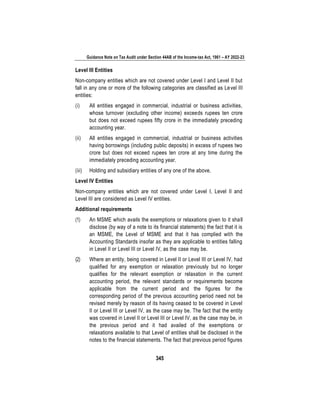
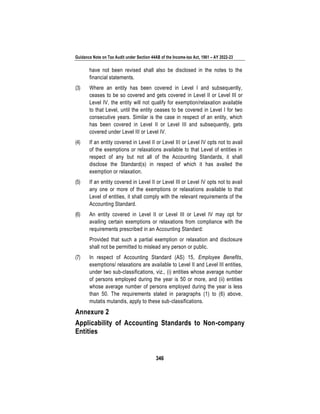
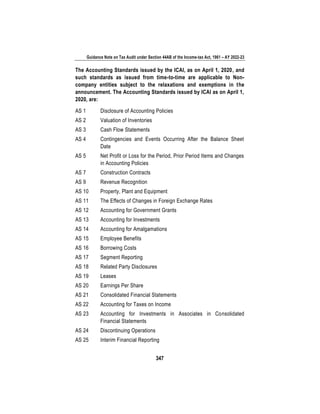
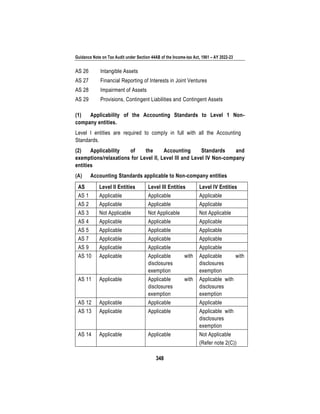
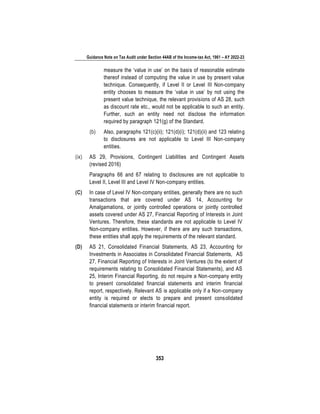
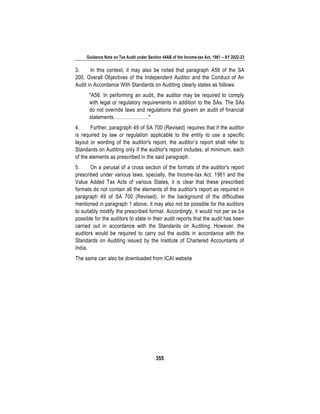
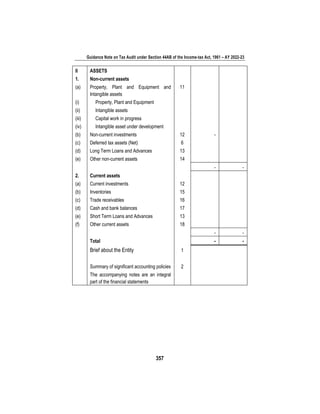
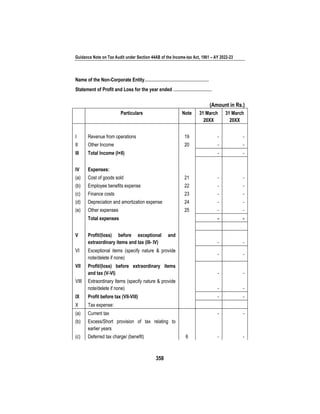
Guidance Note on Tax Audit under
Section 44AB of the Income-tax Act, 1961
AY 2022-23
(Effective for the AY 2022-23 and subject to
amendments made by law, judiciary or
administration, for the subsequent
assessment years)
Direct Taxes Committee
The Institute of Chartered Accountants of India
(Set up by an Act of Parliament)
New Delhi
© The Institute of Chartered Accountants of India
All rights reserved. No part of this publication may be reproduced, stored in a
retrieval system, or transmitted, in any form, or by any means, electronic
mechanical, photocopying, recording, or otherwise, without prior permission,
in writing, from the publisher.
First Edition : 1985
Second Edition : 1989
Third Edition : 1998
Fourth Edition : 1999
Fifth Edition : 2005
Reprinted : 2012
Sixth Edition : 2013
Reprint, July : 2013
Seventh Edition : 2014
Eighth Edition : 2022
Committee/Department : Direct Taxes Committee
Email : dtc@icai.in
Website : www.icai.org
Price : Rs. 500/-
ISBN No. : 978-81-87080-65-7
Published by : The Publication Department on behalf of the
Institute of Chartered Accountants of India,
ICAI Bhawan, Post Box No. 7100, Indraprastha
Marg, New Delhi - 110 002.
Foreword to Eighth Edition
The Direct Taxes Committee (DTC) of the Institute of Chartered Accountants
of India (ICAI) is one of the important Committees of the ICAI which is
engaged in the matters related to direct taxes and makes representations to
the Government, Central Board of Direct Taxes and at other appropriate
forums from time to time on various legislative amendments and issues
concerning direct taxes. One of the main activities of the Committee is to
disseminate knowledge and honing skills of the membership in the area of
direct taxation.
From time-to-time the Direct Taxes Committee has issued the updated
version of the “Guidance Note on Tax Audit under Section 44AB of the
Income-tax Act, 1961” after incorporating the changes/ amendments in
applicable laws for information and support of the Members. The Format of
tax audit reports have changed significantly since the last revision of the
publication in year 2014, which broaden the responsibility of the Chartered
Accountants while discharging their professional duties in this respect. I am
pleased to note that the DTC has released the Eighth edition of Guidance
Note to guide the members in discharging their obligations in a timely and
effective manner.
I compliment CA. Chandrashekhar Vasant Chitale, Chairman, CA. (Dr.) Raj
Chawla, Vice Chairman, and all other members of the Direct Taxes
Committee for updating and revising this Guidance Note in a timely manner
for the benefit of members.
I am confident that this publication will be a useful resource for the members
and other concerned stakeholders.
Date: 14.08.2022 CA. (Dr.) Debashish Mitra
President, ICAI
Preface to Eighth Edition
Tax Audit is applicable since the year 1984. The provision of Section 44AB
requires providing inputs useful for completing assessment of income. Audit
Report in Form No. 3CA / 3CB and particulars in Form No. 3CD is required
to be issued after examination of financial statements and the related record.
Most of the chartered accountants in practice are conducting Tax Audit and
those in service are instrumental in compilation of details therefor.
Section 44AB of the Income-tax Act contains provisions pertaining to the tax
audit under the Income Tax Audit. A tax audit is an examination of a
taxpayer’s books of account and other relevant record. The examination is
conducted to ensure that during the tax audit, the person responsible for
issuing the tax audit report is expected to verify the financial statements
based on which income computation is based are true and fair and
particulars furnished in form No. 3CD are true and correct. A tax audit is a
measure which is initiated to curb incorrect tax practices. Tax audit is
allowed to be carried out only by the practicing-chartered accountants.
This, being onerous responsibility, there was a need for offering guidance on
conduct of audit and issuing of tax audit report. To address this requirement
the Direct Taxes Committee of the ICAI issued “Guidance Note on Tax Audit
u/s 44AB of the Income-tax Act, 1961”. This is a flagship publication of the
DTC. The Guidance Note provides guidance to members for conduct of tax
audit, making of report and related matters. This publication was last revised
in the year 2014. Thereafter, in the year 2018, a publication titled
‘Implementation Guide w.r.t. Notification No. 33/2018 dated 20.07.2018
effective from 20.08.2018’ was released by the DTC of ICAI.
There have been substantial changes in provisions of law and clauses
included in the particulars to be furnished in the Form No. 3CD since the last
publication.
The DTC recognising this fact decided to bring out this Eighth edition of the
Guidance Note. It has been decided to update and incorporate all the
changes in the desired clauses which has been taken place in the tax laws,
notifications, circulars etc. after due deliberations amongst eminent experts
and suggestions received from various stakeholders.
I am extremely thankful to CA. (Dr.) Debashish Mitra, President and CA.
Aniket Sunil Talati, Vice President of the Institute of Chartered Accountants
of India who have been the guiding force behind the integration and revision
of the Guidance Note.
In order to revise this important Guidance Note, the Committee formed
various study groups all over India under the convenorship of various Central
Council Members. I express my sincere thanks to the Convenors and
members of various study groups and also wish to place on record my
sincere appreciation to all the members who spared their valuable time for
providing valuable inputs based upon which the revised draft of the Guidance
Note has been prepared. I express my sincere thanks to CA (Dr) Raj Chawla,
Vice-Chairman, DTC, and to all Direct Taxes Committee Members, Council
Members of ICAI, Co-opted Members and Special invitees, without their
contribution the same would not have been accomplished.
Last but not the least; I appreciate the efforts of all the team members of
Direct Taxes Committee for their technical and administrative assistance in
bringing out this Eighth edition of the Guidance Note.
I am sure that this edition would guide our members as the earlier edition
and would be of great assistance to our members.
Date: 14.08.2022 CA. Chandrashekhar V Chitale
Chairman, Direct Taxes Committee
Foreword to the First Edition
The introduction of the provisions regarding compulsory audit of accounts for
tax purposes under Section 44AB of the Income Tax Act, 1961, signified a
very healthy development in our tax laws. It fulfils a long felt need and seeks
to rectify a weakness which was diagnosed long ago. The requirements of
the provisions place a tremendous responsibility on the members of our
profession in carrying out the audit and in furnishing the audit report setting
forth the prescribed particulars.
I have no doubt that our profession would rise to the occasion, acquit itself
well in discharging this responsibility and justify the confidence reposed by
the Government in our profession.
I would like to compliment the Taxation Committee in bringing out this timely
publication. I am sure this guide would be of help to our members and
ensure their full contribution to the achievement of the objectives of this
provision.
14-2-1985 A.C. Chakrabortti
New Delhi President
Preface to the First Edition
Section 44AB has been introduced in the Income-tax Act, 1961, by the
Finance Act, 1984. This section provides for audit of accounts of assessees
having total sales, turnover or gross receipts exceeding the specified limits of
Rs.40 lakhs for business and Rs.10 lakhs for profession. New Rule 6G,
inserted in the Income-tax Rules, prescribes the Forms of Audit report for the
above purpose. The requirements for the above audit will apply to accounts
relating to previous year relevant to assessment year 1985-86 and
subsequent years.
Audit of accounts in the corporate sector has been made compulsory by
legislation over a period of years. Realising the importance of audit, in recent
years, this requirement is being extended to non-corporate sector also.
The Income-tax Act already provides for audit of accounts of Public
Charitable Trusts and non-corporate assessee establishing new industrial
undertakings. Section 142(2A) gave wide powers to the tax authorities to get
the accounts in certain specified circumstances audited by a chartered
accountant. The new provision introduced by section 44AB has considerably
widened the scope of audit.
The Taxation Committee of the Institute has published (i) Guide for Audit of
Public Trusts under section 12A(b) and (ii) Guide to Special Audit under
section 142(2A). A monograph on compulsory maintenance of accounts has
also been published and the same has been updated.
Considering the fact that the scope of audit under the tax laws has
considerably widened after the introduction of section 44AB, the Taxation
Committee has prepared this Guidance Note on Tax Audit for the use of our
members. In this guidance note an attempt has been made to explain the
scope of Tax Audit requirements. It has been emphasised that in any audit
assignment the general principles of audit have to be followed. The members
accepting these assignments will have to use their professional skill and
expertise while expressing their opinion on the financial statements and
other particulars required to be stated.
I am happy that with the active co-operation of the members of the Taxation
Committee, it has been possible to finalise this Guidance Note soon after the
final publication of the audit report forms by CBDT. In particular, I must
express my gratitude to Shri P.N. Shah, our past President, Sarvashri N.K.
Poddar, M.G. Patel and A.H. Dalal, members of the Taxation Committee and
the Secretary of the Committee for the efforts put in by them in the
finalisation of the guidance note. I am confident that this guidance note will
be of great assistance to our members in industry or in public practice.
13th February, 1985 G. Narayanaswamy
Chairman
Taxation Committee
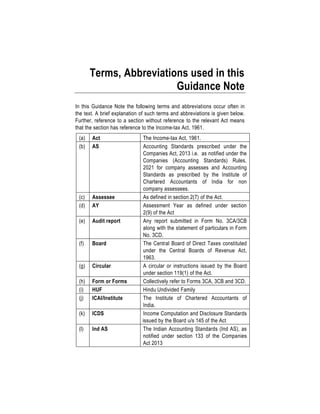
Terms, Abbreviations used in this
Guidance Note
In this Guidance Note the following terms and abbreviations occur often in
the text. A brief explanation of such terms and abbreviations is given below.
Further, reference to a section without reference to the relevant Act means
that the section has reference to the Income-tax Act, 1961.
(a) Act The Income-tax Act, 1961.
(b) AS Accounting Standards prescribed under the
Companies Act, 2013 i.e. as notified under the
Companies (Accounting Standards) Rules,
2021 for company assesses and Accounting
Standards as prescribed by the Institute of
Chartered Accountants of India for non
company assessees.
(c) Assessee As defined in section 2(7) of the Act.
(d) AY Assessment Year as defined under section
2(9) of the Act
(e) Audit report Any report submitted in Form No. 3CA/3CB
along with the statement of particulars in Form
No. 3CD.
(f) Board The Central Board of Direct Taxes constituted
under the Central Boards of Revenue Act,
1963.
(g) Circular A circular or instructions issued by the Board
under section 119(1) of the Act.
(h) Form or Forms Collectively refer to Forms 3CA, 3CB and 3CD.
(i) HUF Hindu Undivided Family
(j) ICAI/Institute The Institute of Chartered Accountants of
India.
(k) ICDS Income Computation and Disclosure Standards
issued by the Board u/s 145 of the Act
(l) Ind AS The Indian Accounting Standards (Ind AS), as
notified under section 133 of the Companies
Act 2013
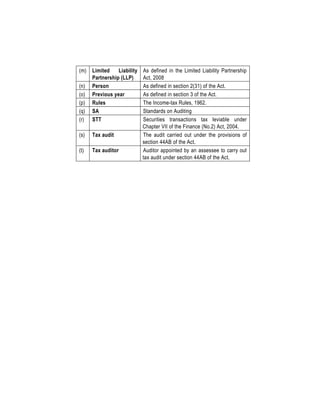
(m) Limited Liability
Partnership (LLP)
As defined in the Limited Liability Partnership
Act, 2008
(n) Person As defined in section 2(31) of the Act.
(o) Previous year As defined in section 3 of the Act.
(p) Rules The Income-tax Rules, 1962.
(q) SA Standards on Auditing
(r) STT Securities transactions tax leviable under
Chapter VII of the Finance (No.2) Act, 2004.
(s) Tax audit The audit carried out under the provisions of
section 44AB of the Act.
(t) Tax auditor Auditor appointed by an assessee to carry out
tax audit under section 44AB of the Act.
Contents
Foreword to the Eighth Edition
Preface to the Eighth Edition
Foreword to the First Edition
Preface to the First Edition
Terms, Abbreviations used in this Guidance Note
1. Introduction 1
2. Background 2
3. Provisions of section 44AB 5
4. ‘Profession’ and ‘business’ explained 10
5. Sales, turnover, gross receipts 11
6. Liability to tax audit - special cases 22
7. Specified date and tax audit 24
8. Penalty 24
9. Tax auditor 25
10. Form of Financial Statements 39
11. Accounting Standards 39
12. Accounts and Income-tax law 42
13. Audit procedures 43
14. Professional misconduct 49
15. Audit report 49
16. Issuing Audit Report 54
17. Form No. 3CA 54
18. Form No. 3CB 58
19. Form No. 3CD 60
20. Particulars to be furnished in Form No. 3CD
[clauses 1-8a]
62
21. Particulars of Members/Partners [clause 9] 66
22. Nature of business or profession [Clause 10] 67
23. Books of account and relevant documents [Clause 11] 69
24. Presumptive Income [clause 12] 73
25. Method of Accounting [clause 13] 77
26. Valuation of Closing Stock [clause 14] 83
27. Conversion of asset into stock-in-trade [clause 15] 88
28. Items of Income not credited [clause 16] 91
29. Valuation of property [Clause 17] 97
30. Particulars of Depreciation [clause 18] 100
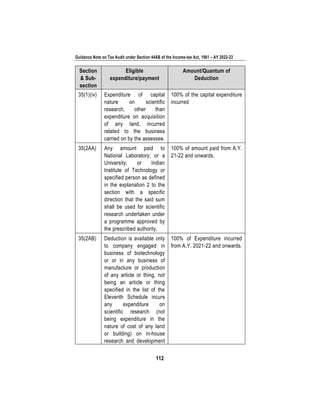
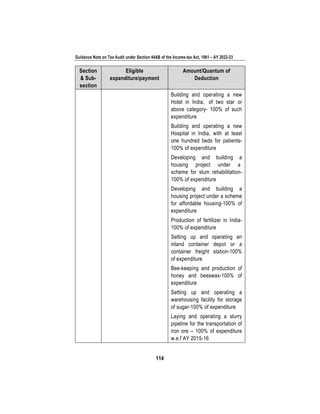
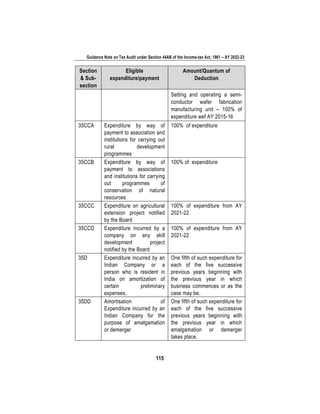
31. Amounts admissible under section 32AC - 35E
[clause 19]
107
32. Bonus, Commission, PF recoveries, etc. [clause 20] 116
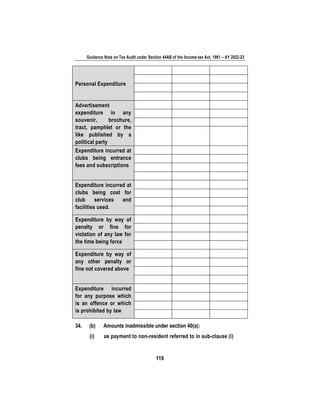
33. Amount debited to Profit & Loss Account being in the
nature of capital, personal and advertisement expenditure
[clause 21(a)]
123
34. Amounts inadmissible u/s 40(a) [clause 21(b)] 130
35. Interest, salary, bonus, etc. to partners [clause 21(c)] 137
36. Amounts inadmissible u/s 40A(3) [clause 21(d)] 139
37. Amounts inadmissible u/s 40A(7) [clause 21(e)] 144
38. Amounts inadmissible u/s 40A(9) [clause 21(f)] 144
39. Contingent liabilities [clause 21(g)] 144
40. Amount inadmissible in term of section 14A [clause 21(h)] 146
41. Amount inadmissible under proviso to section 36(1)(iii)
[clause 21(i)]
150
42. Amount inadmissible u/s 23 of MSME Act, 2006
[clause 22]
151
43. Payments to specified persons under section 40A(2)(b)
[clause 23]
154
44. Deemed profits under section
32AC/32AD/33AB/33ABA/33AC [clause 24]
156
45. Profits chargeable under section 41 [clause 25] 158
46. Payments under section 43B [clause 26] 161
47. Central Value Added Tax credits [clause 27(a)] 167
48. Prior period expenditure [clause 27(b)] 168
49. Property received under section 56(2)(viia) [Clause 28] 170
50. Consideration for issue of shares under section
56(2)(viib) [Clause 29]
171
51. Amount includible under section 56(2)(ix) [Clause 29A] 173
52. Amount includible under section 56(2)(x) [Clause 29B] 176
53. Hundi loans [clause 30] 180
54. Primary adjustment to transfer price under section
92CE(1) [clause 30A]
181
55. Expenditure incurred exceeding limit under section
94B(1) [clause 30B]
187
56. Impermissible avoidance arrangement (GAAR) under
section 96 [clause 30C]
191
57. Loans/Deposits accepted [clause 31(a)/(b)] 197
58. Particulars of receipt/payment in an amount exceeding
the limit specified in section 269ST [clause
31((ba)/(bb)/(bc)/(bd))]
204
59. Loans/Deposits repaid – payee details [clause 31(c)] 214
60. Loans/Deposits repayment received – payer details
[clause 31((d)]
217
61. Loans/Deposits repayment received – payer details
[clause 31(e)]
218
62. Brought forward loss/depreciation [clause 32(a)] 220
63. Change in shareholding [clause 32(b)] 221
64. Speculation Loss [Clause 32(c)] 224
65. Loss incurred under section 73A [Clause 32(d)] 227
66. Deemed Speculation business [Clause 32(e)] 228
67. Deductions under Chapter VIA or Chapter III [clause 33] 229
68. Deduction or collection of tax – Chapter XVII-B or
XVII-BB [clause 34(a)]
234
69. Furnishing of tax deducted or collected statement
[Clause 34(b)]
237
70. Interest under section 201(1A) or 206C(7) [Clause 34(c)] 238
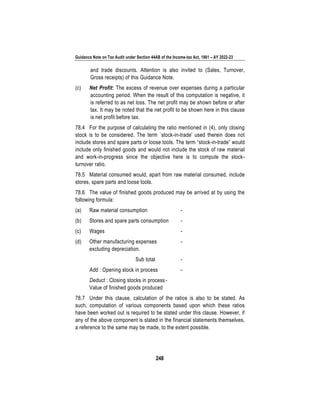
71. Quantitative details of a trading concern [clause 35(a)] 240
72. Quantitative details of a manufacturing concern [clause
35(b)]
240
73. Tax on distributed profits [clause 36] - Omitted 241
74. Receipt of dividend under section 2(22)(e) [clause 36A] 241
75. Cost Audit Report [clause 37] 245
76. Excise Audit Report [clause 38] 246
77. Service tax Audit [Clause 39] 246
78. Details of goods traded, manufactured or services
rendered [Clause 40]
247
79. Details of demand and refund [Clause 41] 249
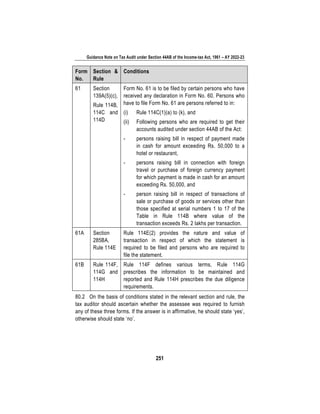
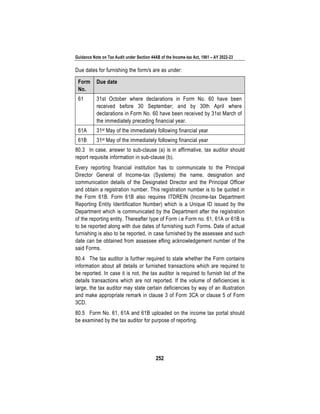
80. Information pertaining to Form No. 61/61A/61B
[Clause 42]
250
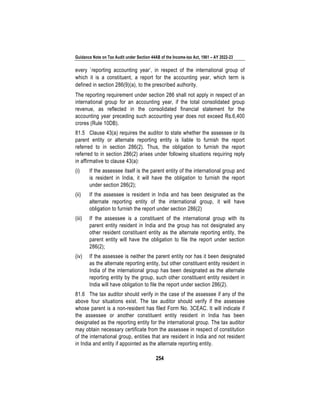
81. Details of report under section 286(2) [Clause 43] 253
82. Goods and Services Tax (GST) compliance [Clause 44] 255
83. Signature 260
84. Furnishing of Tax Audit Report 260
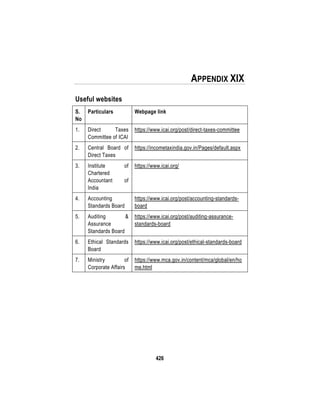
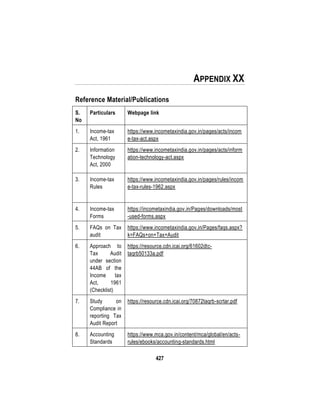
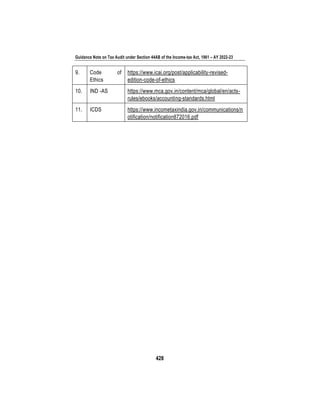
85. Useful websites and Reference Material/Publications 262
APPENDICES
I. Form No. 3CA, 3CB and 3CD 265
II. Clarification regarding authority attached to the
documents Issued by the Institute
292
III Various certificates/reports by an Accountant (Para 2.2) 293
IV Circular No. 452 dated 17.3.1986 (Para 5.12) 306
V Circular No. 4/2007, dated 15th June, 2007 (Para 5.15) 310
VI Mandatory Communication - Relevant Extracts from the
Code of Ethics (Para 9.8)
314
VII Council Guidelines No.1-CA(7)/02/2008, dated 8th
August,2008 (Para 9.8)
322
VIII Form of tax audit particulars to be furnished by members/
firm (Para 9.34)
334
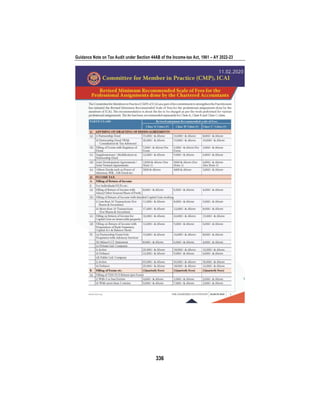
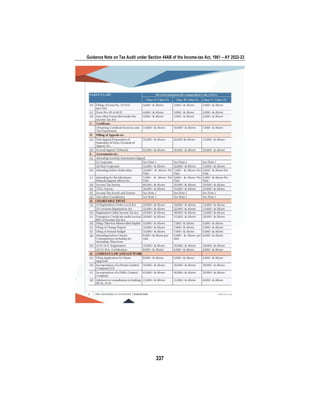
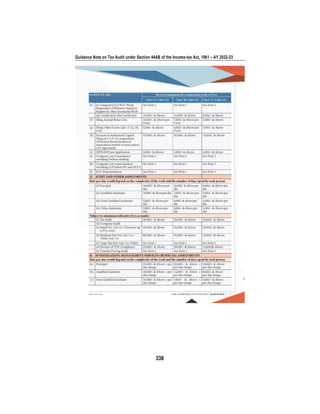
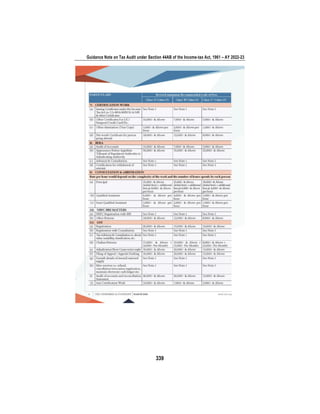
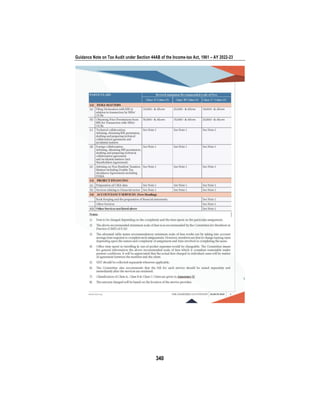
IX Revised minimum recommended scale of fees chargeable
for the professional assignment done by Chartered
Accountants (Para 9.35)
335
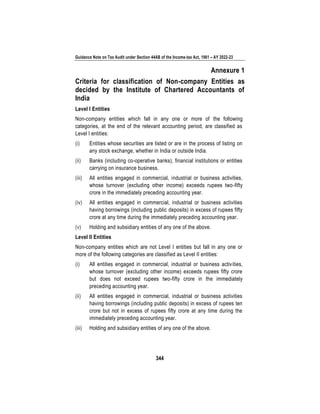
X Criteria for classification of non-corporate entities as
decided by the Institute of Chartered Accountants of India
& Criteria for classification of companies under the
Companies (Accounting Standards) Rules, 2006 (Para
11.3)
342
XI Applicability of SA 700, Forming an Opinion (Para 13.12) 354
XII Illustrative Formats for the preparation of financial
statements of Non-Corporate Entities (Para 15.9)
356
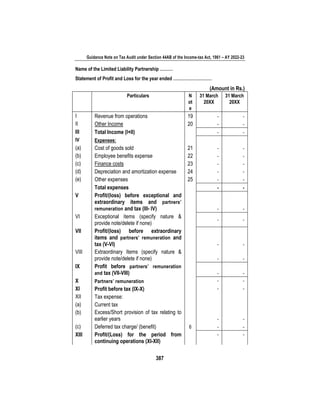
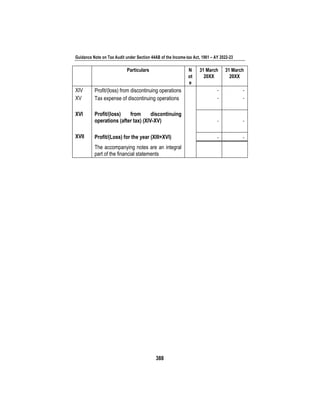
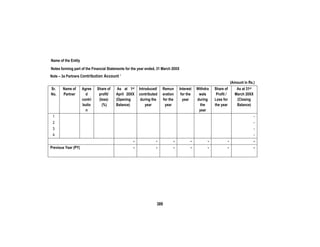
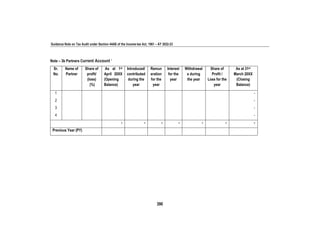
XIII Illustrative Formats for the preparation of financial
statements of LLP (Para 15.9)
385
XIV Circular No. 561, dated 22nd May, 1990 (Para 15.13) 413
XV Circular No. 739, dated 25-3-1996 (Para 21.1) 415
XVI The relevant extracts of the Micro, Small and Medium
Enterprises Development Act, 2006 (Para 42.10)
417
XVII Circular No. 208, dated 15th November, 1976 & Circular
No. 221, dated 6-6-1977 (Para 53.1)
419
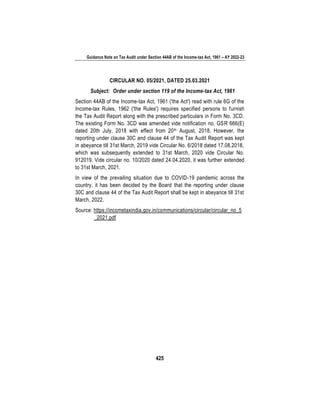
XVIII Circulars keeping reporting on Clause 30C and Clause 44
in abeyance till 31.03.2022
423
XIX Useful websites 426
XX Reference Material/Publications 427
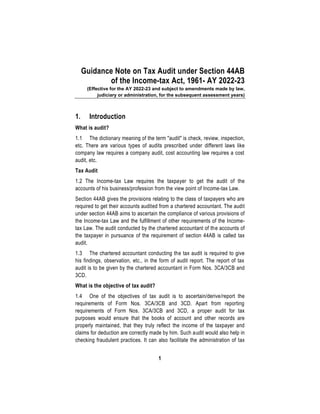
1
Guidance Note on Tax Audit under Section 44AB
of the Income-tax Act, 1961- AY 2022-23
(Effective for the AY 2022-23 and subject to amendments made by law,
judiciary or administration, for the subsequent assessment years)
1. Introduction
What is audit?
1.1 The dictionary meaning of the term "audit" is check, review, inspection,
etc. There are various types of audits prescribed under different laws like
company law requires a company audit, cost accounting law requires a cost
audit, etc.
Tax Audit
1.2 The Income-tax Law requires the taxpayer to get the audit of the
accounts of his business/profession from the view point of Income-tax Law.
Section 44AB gives the provisions relating to the class of taxpayers who are
required to get their accounts audited from a chartered accountant. The audit
under section 44AB aims to ascertain the compliance of various provisions of
the Income-tax Law and the fulfillment of other requirements of the Income-
tax Law. The audit conducted by the chartered accountant of the accounts of
the taxpayer in pursuance of the requirement of section 44AB is called tax
audit.
1.3 The chartered accountant conducting the tax audit is required to give
his findings, observation, etc., in the form of audit report. The report of tax
audit is to be given by the chartered accountant in Form Nos. 3CA/3CB and
3CD.
What is the objective of tax audit?
1.4 One of the objectives of tax audit is to ascertain/derive/report the
requirements of Form Nos. 3CA/3CB and 3CD. Apart from reporting
requirements of Form Nos. 3CA/3CB and 3CD, a proper audit for tax
purposes would ensure that the books of account and other records are
properly maintained, that they truly reflect the income of the taxpayer and
claims for deduction are correctly made by him. Such audit would also help in
checking fraudulent practices. It can also facilitate the administration of tax
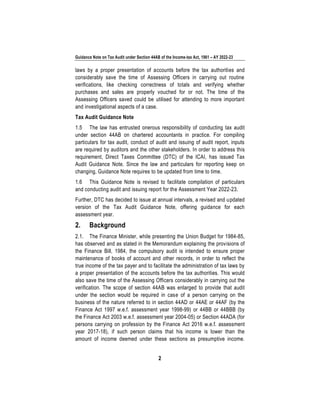
Guidance Note on Tax Audit under Section 44AB of the Income-tax Act, 1961 – AY 2022-23
2
laws by a proper presentation of accounts before the tax authorities and
considerably save the time of Assessing Officers in carrying out routine
verifications, like checking correctness of totals and verifying whether
purchases and sales are properly vouched for or not. The time of the
Assessing Officers saved could be utilised for attending to more important
and investigational aspects of a case.
Tax Audit Guidance Note
1.5 The law has entrusted onerous responsibility of conducting tax audit
under section 44AB on chartered accountants in practice. For compiling
particulars for tax audit, conduct of audit and issuing of audit report, inputs
are required by auditors and the other stakeholders. In order to address this
requirement, Direct Taxes Committee (DTC) of the ICAI, has issued Tax
Audit Guidance Note. Since the law and particulars for reporting keep on
changing, Guidance Note requires to be updated from time to time.
1.6 This Guidance Note is revised to facilitate compilation of particulars
and conducting audit and issuing report for the Assessment Year 2022-23.
Further, DTC has decided to issue at annual intervals, a revised and updated
version of the Tax Audit Guidance Note, offering guidance for each
assessment year.
2. Background
2.1. The Finance Minister, while presenting the Union Budget for 1984-85,
has observed and as stated in the Memorandum explaining the provisions of
the Finance Bill, 1984, the compulsory audit is intended to ensure proper
maintenance of books of account and other records, in order to reflect the
true income of the tax payer and to facilitate the administration of tax laws by
a proper presentation of the accounts before the tax authorities. This would
also save the time of the Assessing Officers considerably in carrying out the
verification. The scope of section 44AB was enlarged to provide that audit
under the section would be required in case of a person carrying on the
business of the nature referred to in section 44AD or 44AE or 44AF (by the
Finance Act 1997 w.e.f. assessment year 1998-99) or 44BB or 44BBB (by
the Finance Act 2003 w.e.f. assessment year 2004-05) or Section 44ADA (for
persons carrying on profession by the Finance Act 2016 w.e.f. assessment
year 2017-18), if such person claims that his income is lower than the
amount of income deemed under these sections as presumptive income.
Guidance Note on Tax Audit under Section 44AB of the Income-tax Act, 1961 – AY 2022-23
3
Thereafter, Finance (No.2) Act, 2009 (w.e.f. AY 2011-12) enlarged the scope
of section 44AD to encompass within its ambit the assessees covered by the
provision of erstwhile section 44AF and hence, section 44AF has been
omitted. While section 44AF dealt with assessees carrying on retail trade, the
amended section 44AD covers all assessees carrying on eligible business
except professionals as referred to in section 44AA(1), a person earning
income in the nature of commission or brokerage, a person carrying on any
agency business.
2.2. Besides tax audit, certain other sections in the Income-tax Act, 1961
also require audit/certifications by a chartered accountant. A table appearing
in the Appendix III provides information about such audits and reports.
2.3. The first edition of this Guidance Note was published in the year 1985
immediately after the introduction of tax audit provision to help members in
discharging their responsibility in an efficient manner. In order to incorporate
changes made by the amendments to the Finance Act, as well as judicial
pronouncements, circulars etc., the said Guidance Note has been revised in
the years 1989, 1998, 1999, 2005, 2013 and 2014. Further, a publication
titled ‘Implementation Guide w.r.t. Notification No. 33/2018 dated 20.07.2018
effective from 20.08.2018’ was also issued in the year 2018 (now
incorporated and merged in this revised edition). The sequence of certain
significant events is as follows:
(a) The Government had substituted revised Rule 6G and Forms 3CA,
3CB and 3CD in the Official Gazette on June 4, 1999, vide Notification
No 10950/F.No. 153/74/98/TPL and omitted Forms No.3CC and 3CE.
(b) These forms have been subsequently revised vide CBDT’s Notification
No. 280/2004 dated 16th November 2004.
(c) Significant changes in the Form No.3CD were made in the year 2006
through a Notification No. 208/2006 dated 10th August, 2006 which
notified the Income tax (Ninth Amendment) Rules, 2006.
(d) Significant changes in the Form No.3CD were again made in the year
2014 through the Notification No. 33/2014 dated 25.07.2014 which
notified the Income-tax (7th Amendment) Rules, 2014.
(e) Further changes were made to Form 3CD by inserting sub-clauses
(d),(e) and (f) in Clause 13 to incorporate changes relating to ICDS.
The insertion was made w.e.f. 01.04.2017 by Notification No. 88/2016
Guidance Note on Tax Audit under Section 44AB of the Income-tax Act, 1961 – AY 2022-23
4
dated 29.09.2016 which notified the Income Tax (23rd Amendment)
Rules, 2016.
(f) Clause 31 of Form No. 3CD was substituted vide Notification No.
58/2017 dated 3rd July 2017 further corrected by corrigendum
Notification No. 60/2017 dated 6th July 2017.
(g) Significant changes in the Form No.3CD were again made in the year
2018 through the Notification No. 33/2018 dated 20.07.2018 which
notified the Income-tax (8th Amendment) Rules, 2018.
(h) Certain amendments were made in Form No. 3CD by Notification No.
82/2020 dated 01.10.2020. However, the said Notification was
substituted by Notification No. 28/2021 dated 01.04.2021.
(i) Certain amendments were made in Form 3CD in clauses 8A, 17, 18,
32 and 36 through Notification No. 28/2021 dated 01.04.2021 which
notified the Income-tax (eighth Amendment) Rules, 2021.
(j) The Income-tax (8th Amendment) Rules, 2018 w.e.f. 20.08.2018, inter
alia, inserted Clause 30C and 44 in Form No. 3CD. Circular No.
05/2021 dated 25.03.2021 has kept clause no. 30C and 44 in
abeyance till 31.03.2022.
2.4. Form No. 3CD is quite comprehensive and covers generally all the
items included in Form No. 6B prescribed for reporting under section 142(2A)
and hence this Guidance Note would meet almost all the reporting
requirements of audit under section 142(2A) also. However, if under section
142(2A), the Assessing Officer requires specific information, the same has to
be given separately along with Form No. 6B.
2.5. The audit of accounts was introduced by section 11 of the Finance Act,
1984, which inserted a new section 44AB with effect from 1st April, 1985
[Assessment Year 1985-86]. This audit is popularly known as tax audit. This
section makes it obligatory for a person carrying on business to get his
accounts audited by a chartered accountant, and to furnish by the ‘specified
date’, the report in the prescribed form of such audit, if the total sales,
turnover or gross receipts in business in the relevant previous year exceed or
exceeds the prescribed limit. For a professional, the provisions of tax audit
become applicable, if his gross receipts in profession exceed the prescribed
limit in the relevant previous year.
Guidance Note on Tax Audit under Section 44AB of the Income-tax Act, 1961 – AY 2022-23
5
2.6. The vires of section 44AB has been upheld by Hon'ble Supreme Court
in T.D. Venkata Rao v. Union of India [1999] 237 ITR 315 (SC). The Apex
Court has made the following significant observations:
"Chartered Accountants, by reason of their training have special
aptitude in the matter of audits. It is reasonable that they, who
form a class by themselves, should be required to audit the
accounts of businesses whose income (sic: turnover) exceeds
Rs.40 lakhs* and professionals whose income (sic: gross
receipts) exceeds Rs.10 lakhs* in any given year. There is no
material on record and indeed in our view, there cannot be that
an income-tax practitioner has the same expertise as chartered
accountants in the matter of accounts. For the same reasons the
challenge under article 19 must fail, and it must be pointed out
that these income-tax practitioners are still entitled to be
authorised representatives of assessees.”
*(those were the then existing limit)
3. Provisions of section 44AB
3.1. Section 44AB reads as under:
“Audit of accounts of certain persons carrying on business or
profession”.
44AB. Every person, --
(a) carrying on business shall, if his total sales, turnover or gross
receipts, as the case may be, in business exceed or exceeds
one crore rupees in any previous year;
Provided that in the case of a person whose—
(a) aggregate of all amounts received including amount
received for sales, turnover or gross receipts during the
previous year, in cash, does not exceed five per cent of
the said amount; and
(b) aggregate of all payments made including amount
incurred for expenditure, in cash, during the previous year
does not exceed five per cent of the said payment:
this clause shall have effect as if for the words "one crore
rupees", the words "ten crore rupees" had been substituted;
Guidance Note on Tax Audit under Section 44AB of the Income-tax Act, 1961 – AY 2022-23
6
Provided further that for the purposes of this clause, the
payment or receipt, as the case may be, by a cheque drawn on
a bank or by a bank draft, which is not account payee, shall be
deemed to be the payment or receipt, as the case may be, in
cash; or
(b) carrying on profession shall, if his gross receipts in profession
exceed fifty lakh rupees in any previous year; or
(c) carrying on the business shall, if the profits and gains from the
business are deemed to be the profits and gains of such person
under section 44AE or section 44BB or section 44BBB, as the
case may be, and he has claimed his income to be lower than
the profits or gains so deemed to be the profits and gains of his
business, as the case may be, in any previous year; or
(d) carrying on the profession shall, if the profits and gains from the
profession are deemed to be the profits and gains of such
person under section 44ADA and he has claimed such income
to be lower than the profits and gains so deemed to be the
profits and gains of his profession and his income exceeds the
maximum amount which is not chargeable to income-tax in any
previous year; or
(e) carrying on the business shall, if the provisions of sub-section
(4) of section 44AD are applicable in his case and his income
exceeds the maximum amount which is not chargeable to
income-tax in any previous year,
get his accounts of such previous year audited by an accountant
before the specified date and furnish by that date the report of such
audit in the prescribed form duly signed and verified by such
accountant and setting forth such particulars as may be prescribed :
Provided that this section shall not apply to the person, who declares
profits and gains for the previous year in accordance with the
provisions of sub-section (1) of section 44AD and his total sales,
turnover or gross receipts, as the case may be, in business does not
exceed two crore rupees in such previous year:
Provided further that this section shall not apply to the person, who
derives income of the nature referred to in section 44B or section
Guidance Note on Tax Audit under Section 44AB of the Income-tax Act, 1961 – AY 2022-23
7
44BBA, on and from the 1st day of April, 1985 or, as the case may be,
the date on which the relevant section came into force, whichever is
later.
Provided also that in a case where such person is required by or
under any other law to get his accounts audited, it shall be sufficient
compliance with the provisions of this section if such person gets the
accounts of such business or profession audited under such law
before the specified date and furnishes by that date the report of the
audit as required under such other law and a further report by an
accountant in the form prescribed under this section.
Explanation - For the purposes of this section, -
(i) "accountant" shall have the same meaning as in the
Explanation below sub-section (2) of section 288;
(ii) "specified date", in relation to the accounts of the assessee of
the previous year relevant to an assessment year, means date
one month prior to the due date for furnishing the return of
income under sub-section (1) of section 139
3.2. The Explanation below section 288(2) defines “accountant”. Please
refer Para 9 below for elucidation.
3.3. The above section stipulates that every person carrying on business or
profession is required to get his accounts audited by a chartered accountant
before the "specified date" and furnish by that date the report of such audit,
in the following circumstances:
(i) carrying on business shall, if his total sales, turnover or gross receipts,
as the case may be, in business exceed or exceeds one crore rupees
in any previous year:
Provided that in the case of a person whose—
(a) aggregate of all amounts received including amount received for
sales, turnover or gross receipts during the previous year, in
cash, does not exceed five per cent of the said amount; and
(b) aggregate of all payments made including amount incurred for
expenditure, in cash, during the previous year does not exceed
five per cent of the said payment,
Guidance Note on Tax Audit under Section 44AB of the Income-tax Act, 1961 – AY 2022-23
8
this clause shall have effect as if for the words "one crore rupees", the
words “ten crore rupees" had been substituted;
Provided further that for the purposes of this clause, the payment or
receipt, as the case may be, by a cheque drawn on a bank or by a
bank draft, which is not account payee, shall be deemed to be the
payment or receipt, as the case may be, in cash; (Section 44AB(a)) or
(ii) carrying on profession shall, if his gross receipts in profession exceed
fifty lakh rupees in any previous year; (Section 44AB(b)) or
(iii) carrying on the business shall, if the profits and gains from the
business are deemed to be the profits and gains of such person under
section 44AE or section 44BB or section 44BBB, as the case may be,
and he has claimed his income to be lower than the profits or gains so
deemed to be the profits and gains of his business, as the case may
be, in any previous year; (Section 44AB(c)) or
(iv) carrying on the profession shall, if the profits and gains from the
profession are deemed to be the profits and gains of such person
under section 44ADA and he has claimed such income to be lower
than the profits and gains so deemed to be the profits and gains of his
profession and his income exceeds the maximum amount which is not
chargeable to income-tax in any previous year; (Section 44AB(d)) or
(v) carrying on the business shall, if the provisions of sub-section (4) of
section 44AD are applicable in his case and his income exceeds the
maximum amount which is not chargeable to income-tax in any
previous year (Section 44AB(e)).
However, in the following circumstances, audit under section 44AB is not
applicable:
(a) This section shall not apply to the person, who declares profits and
gains for the previous year in accordance with the provisions of sub-
section (1) of section 44AD and his total sales, turnover or gross
receipts, as the case may be, in business does not exceed two crore
rupees in such previous year. (First proviso to section 44AB)
(b) This section shall not apply to the person, who derives income of the
nature referred to in section 44B or section 44BBA, on and from the
1st day of April, 1985 or, as the case may be, the date on which the
relevant section came into force, whichever is later (Second proviso to
section 44AB).
Guidance Note on Tax Audit under Section 44AB of the Income-tax Act, 1961 – AY 2022-23
9
Further, third proviso to section 44AB provides that in a case where such
person is required by or under any other law to get his accounts audited , it
shall be sufficient compliance with the provisions of this section if such
person gets the accounts of such business or profession audited under such
law before the specified date and furnishes by that date the report of the
audit as required under such other law and a further report by an accountant
in the form prescribed under this section.
3.4. In case where the tax audit is applicable, the assessee is required to
get his accounts audited and furnish report as prescribed under Rule 6G.
The said Rule 6G provides as follows:
(1) The report of audit of the accounts of a person required to be
furnished under section 44AB shall —
(a) in the case of a person who carries on business or profession
and who is required by or under any other law to get his
accounts audited, be in Form No. 3CA;
(b) in the case of a person who carries on business or profession,
but not being a person referred to in clause (a), be in Form No.
3CB.
(2) The particulars which are required to be furnished under section 44AB
shall be in Form No. 3CD.
3.5. In case of Company/LLP assessee, they should select third proviso to
section 44AB as the applicable section for tax audit instead of section
44AB(a) while filling up clause 8 of Form 3CD since their accounts are
audited under any other law. Similar precaution needs to be exercised in
case of co-operative societies/trusts assessee etc. where audit is applicable
under respective laws.
3.6. A question may arise in the case of an assessee who is eligible to
claim deductions under various sections like sections 80-IA, 80-IB or 80-IC
etc., as to whether it will be necessary for him to get separate audit
reports/certificates under these sections in addition to an audit report under
section 44AB. The requirement of section 44AB is a general requirement
covering the overall position of the accounts of the assessee. This applies to
the complete set of accounts of the assessee for the relevant previous year
covering the results of all the units owned by the assessee whether situated
at one place or at different places. Therefore, when the turnover of all the
Guidance Note on Tax Audit under Section 44AB of the Income-tax Act, 1961 – AY 2022-23
10
units put together exceed the prescribed limits, the assessee will have to get
the audit report under section 44AB in the prescribed form and separate
audit reports in the forms prescribed for different purposes like sections 80-
IA, 80-IB or 80-IC etc. will also have to be obtained by the assessee to meet
the specific requirements of the relevant sections.
4. ‘Profession’ and ‘business’ explained
4.1 The term "business" is defined in section 2(13) of the Act, as under:
"Business" includes any trade, commerce, or manufacture or any
adventure or concern in the nature of trade, commerce or
manufacture.
The word `business' is one of wide import and it means activity carried
on continuously and systematically by a person by the application of
his labour or skill with a view to earning an income. The expression
"business" does not necessarily mean trade or manufacture only -
Barendra Prasad Ray v ITO [1981] 129 ITR 295 (SC).
4.2 Section 2(36) of the Act defines profession to include vocation.
Profession is a word of wide import and includes "vocation" which is only a
way of living. – Additional CIT v. Ram Kripal Tripathi [1980] 125 ITR 408
(All).
4.3 Whether a particular activity can be classified as ‘business' or
‘profession’ will depend on the facts and circumstances of each case. The
expression "profession" involves the idea of an occupation requiring purely
intellectual skill or manual skill controlled by the intellectual skill of the
operator, as distinguished from an operation which is substantially the
production or sale or arrangement for the production or sale of commodities.
- CIT Vs. Manmohan Das (Deceased) [1966] 59 ITR 699 (SC), CIT v. Ram
Kripal Tripathi [1980] 125 ITR 408 (All).
4.4 The following have been listed out as professions in section 44AA of
the Act:
(i) legal, (ii) medical, (iii) engineering or (iv) architectural profession or
(v) the profession of accountancy or (vi) technical consultancy or (vii)
interior decoration.
Further under Rule 6F and other professions notified thereunder
(Notifications No. 1620 SO-18(E) dated 12.1.77, No. 9102SO 2675 dated
Guidance Note on Tax Audit under Section 44AB of the Income-tax Act, 1961 – AY 2022-23
11
25.09.1992 and No.116 SO 385(E), dated 4.5.2001), the following can also
be considered as a profession:
(i) Authorised Representative,
(ii) Company Secretary,
(iii) Film Artists/Actors, Cameraman, Director including an assistant
director; a music director, including an assistant music director, an art
director, including an assistant art director; a dance director, including
an assistant dance director; Singer, Story-writer, a screen-play writer,
a dialogue writer; editor, lyricist and dress designer,
(iv) Information Technology. Attention is invited to Notification
No. 890(E)/2000 dated 26-9-2000.
4.5 The following activities have been held to be business:
(i) Advertising agent
(ii) Clearing, forwarding and shipping agents - CIT v. Jeevanlal Lalloobhai
& Co. [1994] 206 ITR 548 (Bom).
(iii) Couriers
(iv) Insurance agent
(v) Nursing home
(vi) Stock and share broking and dealing in shares and securities - CIT
v. Lallubhai Nagardas & Sons [1993] 204 ITR 93 (Bom)
(vii) Travel agent.
5. Sales, turnover, gross receipts
5.1 It will be noted that the provision relating to tax audit under section
44AB applies to every person carrying on business, if his total sales, turnover
or gross receipts in business exceed the prescribed limit (Rs.1 crore or Rs 10
crore in specified cases) and to a person carrying on a profession, if his
gross receipts from profession exceed the prescribed limit (Rs. 50 lakhs) in
previous year 2021-22. However, the terms "sales", "turnover" or "gross
receipts" are not defined in the Act, and therefore the meaning of the
aforesaid terms has to be considered for the applicability of the section.
Guidance Note on Tax Audit under Section 44AB of the Income-tax Act, 1961 – AY 2022-23
12
5.2 The Central Sales Tax Act, 1956 defines “Turnover” as follows:
“turnover” used in relation to any dealer liable to tax under this Act
means the aggregate of the sale prices received and receivable by him
in respect of sales of any goods in the course of inter-State trade or
commerce made during any prescribed period and determined in
accordance with the provisions of the Act and rules made there under.
Further, section 8A(1) of the said Act provides that in determining turnover,
deduction of sales tax should be made from the aggregate of sales price.
The Central Goods and Services Act, defines ‘Turnover’ as under:
Section 2(112)
‘turnover in State’ or ‘turnover in Union territory’ means the aggregate
value of all taxable supplies (excluding the value of inward
supplies on which tax is payable by a person on reverse charge
basis) and exempt supplies made within a State or Union territory by
a taxable person, exports of goods or services or both and inter-
State supplies of goods or services or both made from the State or
Union territory by the said taxable person but excludes central tax,
State tax, Union territory tax, integrated tax and cess.
5.3 The term "Turnover" has been defined under Section 2(91) of the
Companies Act, 2013 as follows:
"2(91) turnover means gross amount of revenue recognised in the
profit and loss account from the sale, supply, or distribution of goods
or on account of services rendered, or both, by a company during a
financial year;"
5.4 In the “Guidance Note on Terms Used in Financial Statements”
published by the Institute, the expression “Sales Turnover” (Item 15.01) has
been defined as under:
“The aggregate amount for which sales are effected or services
rendered by an enterprise. The term `gross turnover’ and `net turnover’
(or `gross sales’ and `net sales’) are sometimes used to distinguish the
sales aggregate before and after deduction of returns and trade
discounts”.
Guidance Note on Tax Audit under Section 44AB of the Income-tax Act, 1961 – AY 2022-23
13
5.5 The Guide to Company Audit issued by the Institute in the year 1980,
while discussing “sales”, stated as follows:
“Total turnover, that is, the aggregate amount for which sales are
effected by the company, giving the amount of sales in respect of each
class of goods dealt with by the company and indicating the quantities
of such sales for each class separately.
Note (i) The term ‘turnover’ would mean the total sales after deducting
therefrom goods returned, price adjustments, trade discount and
cancellation of bills for the period of audit, if any. Adjustments which
do not relate to turnover should not be made e.g. writing off bad debts,
royalty etc. Where excise duty is included in turnover, the
corresponding amount should be distinctly shown as a debit item in the
profit and loss account.”
5.6 The “Statement on the Amendments to Schedule VI to the Companies
Act, 1956” issued by the Institute (Page 14, 1976 edition) (replaced with
Guidance Note on Revised Schedule VI of the Companies Act, 1956) while
discussing the disclosure requirements relating to `turnover’ stated as
follows:-
“As regards the value of turnover, a question which may arise is with
reference to various extra and ancillary charges. The invoices may
involve various extra and ancillary charges such as those relating to
packing, freight, forwarding, interest, commission, etc. It is suggested
that ordinarily the value of turnover should be disclosed exclusive of
such ancillary and extra charges, except in those cases where
because of the accounting system followed by the company, separate
demarcation of such charges is not possible from the accounts or
where the company’s billing procedure involves a composite charge
inclusive of various services rather than a separate charge for each
service.
In the case of invoices containing composite charges, it would not
ordinarily be proper to attempt a demarcation of ancillary charges on a
proportionate or estimated basis. For example, if a company makes a
composite charge to its customer, inclusive of freight and despatch,
the charge so made should accordingly be treated as part of the
turnover for purpose of this section. It would not be proper to reduce
the value of the turnover with reference to the approximate value of
Guidance Note on Tax Audit under Section 44AB of the Income-tax Act, 1961 – AY 2022-23
14
the service relating to freight and despatch. On the other hand, if the
company makes a separate charge for freight and despatch and for
other similar services, it would be quite proper to ignore such charges
when computing the value of the turnover to be disclosed in the Profit
and Loss Account. In other words, the disclosure may well be
determined by reference to the company’s invoicing and accounting
policy and may thereby vary from company to company. For reasons
of consistency as far as possible, a company should adhere to the
same basic policy from year to year and if there is any change in the
policy the effect of that change may need to be disclosed if it is
material, so that a comparison of the turnover figures from year to
year does not become misleading.”
5.7 The Statement on the Companies (Auditors' Report) Order, 2003
issued by the Institute in April 2004, while discussing the term ‘turnover’ in
paragraph 23 states `as follows:
The term, "turnover", has not been defined by the Order. Part II of Schedule
VI to the Act, however, defines the term "turnover" as the aggregate amount
for which sales are effected by the company. It may be noted that the "sales
effected" would include sale of goods as well as services rendered by the
company. In an agency relationship, turnover is the amount of commission
earned by the agent and not the aggregate amount for which sales are
effected or services are rendered. The term "turnover" is a commercial term
and it should be construed in accordance with the method of accounting
regularly employed by the company.
5.8 Although, Schedule III of the Companies Act, 2013 has replaced the
Revised Schedule VI of the Companies Act, 1956 in the year 2014, guidance
given herein above with respect to meaning of the term “turnover” is still
relevant.
5.9 The term ‘turnover’ for the purposes of this clause may be interpreted
to mean the aggregate amount for which sales are effected or services
rendered by an enterprise. If GST or any other tax is included in the sale
price, no adjustment in respect thereof should be made for considering the
quantum of turnover. Trade discounts can be deducted from sales but not the
commission allowed to third parties. If, however, GST or any other indirect
tax recovered are credited separately to GST or other tax account (being
separate accounts) and payments to the authority are debited in the same
Guidance Note on Tax Audit under Section 44AB of the Income-tax Act, 1961 – AY 2022-23
15
account, they would not be included in the turnover. However, sales of scrap
shown separately under the heading ‘miscellaneous income’ will have to be
included in turnover.
5.10 Considering that the words "Sales", "Turnover" and "Gross receipts"
are commercial terms, they should be construed in accordance with the
method of accounting regularly employed by the assessee. Section 145(1)
provides that income chargeable under the head "Profits and gains of
business or profession" or "Income from other sources" should be computed
in accordance with either cash or mercantile system of accounting regularly
employed by the assessee. The method of accounting followed by the
assessee is also relevant for the determination of sales, turnover or gross
receipts in the light of the above discussion.
5.11 Applying the above generally accepted accounting principles, a few
typical cases may be considered:
(i) Discount allowed in the sales invoice will reduce the sale price and,
therefore, the same can be deducted from the turnover.
(ii) Cash discount otherwise than that allowed in a cash memo/sales
invoice is in the nature of a financing charge and is not related to
turnover. The same should not be deducted from the figure of
turnover.
(iii) Turnover discount is normally allowed to a customer if the sales made
to him exceed a particular quantity. This being dependent on the
turnover, as per trade practice, it is in the nature of trade discount and
should be deducted from the figure of turnover even if the same is
allowed at periodical intervals by separate credit notes.
(iv) Special rebate allowed to a customer can be deducted from the sales
if it is in the nature of trade discount. If it is in the nature of
commission on sales, the same cannot be deducted from the figure of
turnover.
(v) Price of goods returned should be deducted from the figure of turnover
even if the returns are from the sales made in the earlier year/s.
(vi) Sale proceeds of fixed assets would not form part of turnover since
these are not held for resale.
(vii) Sale proceeds of property held as investment property will not form
part of turnover.
Guidance Note on Tax Audit under Section 44AB of the Income-tax Act, 1961 – AY 2022-23
16
(viii) Sale proceeds of any shares, securities, debentures, etc., held as
investment will not form part of turnover. However, if the shares,
securities, debentures etc., are held as stock-in-trade, the sale
proceeds thereof will form part of turnover.
5.12 (a) A question may also arise as to whether the sales by a
commission agent or by a person on consignment basis forms part of the
turnover of the commission agent and/or consignee as the case may be. In
such cases, it will be necessary to find out, whether the property in the goods
or all significant risks, reward of ownership of goods belongs to the
commission agent or the consignee immediately before the transfer by him to
third person. If the property in the goods or all significant risks and rewards
of ownership of goods continue to belong to the principal, the relevant sale
price shall not form part of the sales/turnover of the commission agent and/or
the consignee as the case may be. If, however, the property in the goods,
significant risks and reward of ownership belongs to the commission agent
and/or the consignee, as the case may be, the sale price received/receivable
by him shall form part of his sales/turnover.
(b) In this context, it would be useful to refer to the CBDT Circular No.452
dated 17th March, 1986, where the Board has clarified the question of
applicability of section 44AB in the cases of Commission Agents, Arhatias,
etc. The Circular is published in Appendix IV.
5.13 Share brokers, on purchasing securities on behalf of their customers,
do not get them transferred in their names but deliver them to the customers
who get them transferred in their names. The same is true in case of sales
also. The share broker holds the delivery merely on behalf of his customer.
The property in goods does not get transferred to the share brokers. Only
brokerage which is being accounted for in the books of account of share
brokers should be taken into account for considering the limits for the
purpose of section 44AB. However, in case of transactions entered into by
share broker on his personal account, the sale value should also be taken
into account for considering the limit for the purpose of section 44AB. The
case of a sub-broker is not different from that of a share broker.
5.14 The turnover or gross receipts in respect of transactions in shares,
securities and derivatives may be determined in the following manner:
(a) Speculative transaction: A speculative transaction means a
transaction in which a contract for the purchase or sale of any
Guidance Note on Tax Audit under Section 44AB of the Income-tax Act, 1961 – AY 2022-23
17
commodity, including stocks and shares, is periodically or ultimately
settled otherwise than by the actual delivery or transfer of the
commodity or scrips. Thus, in a speculative transaction, the contract
for sale or purchase which is entered into is not completed by giving or
receiving delivery so as to result in the sale as per value of contract
note. The contract is settled otherwise and squared up by paying out
the difference which may be positive or negative. As such, in such
transaction the difference amount is 'turnover'. In the case of an
assessee undertaking speculative transactions there can be both
positive and negative differences arising by settlement of various such
contracts during the year. Each transaction resulting into whether a
positive or negative difference is an independent transaction. Further,
amount paid on account of negative difference paid is not related to
the amount received on account of positive difference. In such
transactions though the contract notes are issued for full value of the
purchased or sold asset, the entries in the books of account are made
only for the differences. Accordingly, the aggregate of both positive
and negative differences is to be considered as the turnover of such
transactions for determining the liability to audit vide section 44AB.
(b) Derivatives, futures and options: Such transactions are completed
without actual delivery of shares or securities or commodities etc.
These are squared up by receipts/payments of differences. The
contract notes are issued for the full value of the underlined shares or
securities or commodities etc. purchased or sold but entries in the
books of account are made only for the differences. The transactions
may be squared up any time on or before the striking date. The buyer
of the option pays the premia. The turnover in such types of
transactions is to be determined as follows:
(i) The total of favourable and unfavourable differences shall be
taken as turnover.
(ii) Premium received on sale of options is also to be included in
turnover. However, where the premium received is included for
determining net profit for transactions, the same should not be
separately included.
(iii) In respect of any reverse trades entered, the difference thereon,
should also form part of the turnover.
Guidance Note on Tax Audit under Section 44AB of the Income-tax Act, 1961 – AY 2022-23
18
(c) Delivery based transactions: Where the transaction for the purchase
or sale of any commodity including stocks and shares is delivery
based whether intended or by default, the total value of the sales is to
be considered as turnover.
5.15 (a) Further, an issue may arise whether such transactions of purchase
or sale of stocks and shares undertaken by the assessee are in the course of
business or as investment. The answer to this issue will depend on the facts
and circumstances of each case taking into consideration the nature of the
transaction, frequency and volume of transactions etc. For this, attention is
invited to the following judgments where this issue has been considered.
(i) CIT v. P.K.N. and Co Ltd (1966) 60 ITR 65 (SC)
(ii) Saroj Kumar Mazumdar v. CIT (1959) 37 ITR 242 (SC)
(iii) CIT v. Sutlej Cotton Mills Supply Agency Ltd. (1975) 100 ITR 706 (SC)
(iv) G. Venkataswami Naidu & Co. v. CIT (1959) 351TR 594 (SC)
Further, CBDT Circular No.4/2007 dated 15.06.2007, Circular No. 6/2016
dated 29.02.2016 and Letter F.No. 225/12/2016/ITA.II dated 02.05.2016-
Appendix V may also be referred to.
(b) In case such transactions are for the purposes of investment and
income/loss arising therefrom is to be computed under the head 'Capital
Gains', then the value of such transaction is not to be included in sales or
turnover for deciding the applicability of audit under section 44AB. However,
in case such transactions are in the course of business, then the total of such
sales is to be included in the sale, turnover or gross receipts as the case may
be, of the assessee for determining the applicability of audit under section
44AB.
5.16 The term "gross receipts" is also not defined in the Act. It will include
all receipts whether in cash or in kind arising from carrying on of the business
which will normally be assessable as business income under the Act. Broadly
speaking, the following items of income and/or receipts would be covered by
the term "gross receipts in business":
(i) Cash assistance (by whatever name called) received or receivable by
any person against exports under any scheme of the Government of
India;
Guidance Note on Tax Audit under Section 44AB of the Income-tax Act, 1961 – AY 2022-23
19
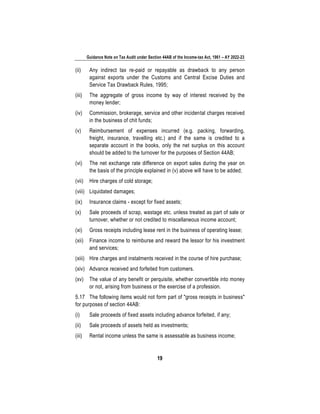
(ii) Any indirect tax re-paid or repayable as drawback to any person
against exports under the Customs and Central Excise Duties and
Service Tax Drawback Rules, 1995;
(iii) The aggregate of gross income by way of interest received by the
money lender;
(iv) Commission, brokerage, service and other incidental charges received
in the business of chit funds;
(v) Reimbursement of expenses incurred (e.g. packing, forwarding,
freight, insurance, travelling etc.) and if the same is credited to a
separate account in the books, only the net surplus on this account
should be added to the turnover for the purposes of Section 44AB;
(vi) The net exchange rate difference on export sales during the year on
the basis of the principle explained in (v) above will have to be added;
(vii) Hire charges of cold storage;
(viii) Liquidated damages;
(ix) Insurance claims - except for fixed assets;
(x) Sale proceeds of scrap, wastage etc. unless treated as part of sale or
turnover, whether or not credited to miscellaneous income account;
(xi) Gross receipts including lease rent in the business of operating lease;
(xii) Finance income to reimburse and reward the lessor for his investment
and services;
(xiii) Hire charges and instalments received in the course of hire purchase;
(xiv) Advance received and forfeited from customers.
(xv) The value of any benefit or perquisite, whether convertible into money
or not, arising from business or the exercise of a profession.
5.17 The following items would not form part of "gross receipts in business"
for purposes of section 44AB:
(i) Sale proceeds of fixed assets including advance forfeited, if any;
(ii) Sale proceeds of assets held as investments;
(iii) Rental income unless the same is assessable as business income;
Guidance Note on Tax Audit under Section 44AB of the Income-tax Act, 1961 – AY 2022-23
20
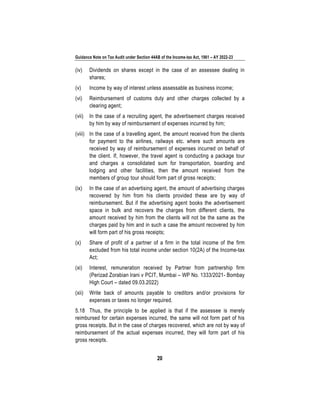
(iv) Dividends on shares except in the case of an assessee dealing in
shares;
(v) Income by way of interest unless assessable as business income;
(vi) Reimbursement of customs duty and other charges collected by a
clearing agent;
(vii) In the case of a recruiting agent, the advertisement charges received
by him by way of reimbursement of expenses incurred by him;
(viii) In the case of a travelling agent, the amount received from the clients
for payment to the airlines, railways etc. where such amounts are
received by way of reimbursement of expenses incurred on behalf of
the client. If, however, the travel agent is conducting a package tour
and charges a consolidated sum for transportation, boarding and
lodging and other facilities, then the amount received from the
members of group tour should form part of gross receipts;
(ix) In the case of an advertising agent, the amount of advertising charges
recovered by him from his clients provided these are by way of
reimbursement. But if the advertising agent books the advertisement
space in bulk and recovers the charges from different clients, the
amount received by him from the clients will not be the same as the
charges paid by him and in such a case the amount recovered by him
will form part of his gross receipts;
(x) Share of profit of a partner of a firm in the total income of the firm
excluded from his total income under section 10(2A) of the Income-tax
Act;
(xi) Interest, remuneration received by Partner from partnership firm
(Perizad Zorabian Irani v PCIT, Mumbai – WP No. 1333/2021- Bombay
High Court – dated 09.03.2022)
(xii) Write back of amounts payable to creditors and/or provisions for
expenses or taxes no longer required.
5.18 Thus, the principle to be applied is that if the assessee is merely
reimbursed for certain expenses incurred, the same will not form part of his
gross receipts. But in the case of charges recovered, which are not by way of
reimbursement of the actual expenses incurred, they will form part of his
gross receipts.
Guidance Note on Tax Audit under Section 44AB of the Income-tax Act, 1961 – AY 2022-23
21
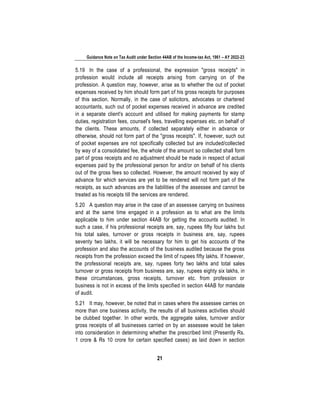
5.19 In the case of a professional, the expression "gross receipts" in
profession would include all receipts arising from carrying on of the
profession. A question may, however, arise as to whether the out of pocket
expenses received by him should form part of his gross receipts for purposes
of this section. Normally, in the case of solicitors, advocates or chartered
accountants, such out of pocket expenses received in advance are credited
in a separate client's account and utilised for making payments for stamp
duties, registration fees, counsel's fees, travelling expenses etc. on behalf of
the clients. These amounts, if collected separately either in advance or
otherwise, should not form part of the "gross receipts". If, however, such out
of pocket expenses are not specifically collected but are included/collected
by way of a consolidated fee, the whole of the amount so collected shall form
part of gross receipts and no adjustment should be made in respect of actual
expenses paid by the professional person for and/or on behalf of his clients
out of the gross fees so collected. However, the amount received by way of
advance for which services are yet to be rendered will not form part of the
receipts, as such advances are the liabilities of the assessee and cannot be
treated as his receipts till the services are rendered.
5.20 A question may arise in the case of an assessee carrying on business
and at the same time engaged in a profession as to what are the limits
applicable to him under section 44AB for getting the accounts audited. In
such a case, if his professional receipts are, say, rupees fifty four lakhs but
his total sales, turnover or gross receipts in business are, say, rupees
seventy two lakhs, it will be necessary for him to get his accounts of the
profession and also the accounts of the business audited because the gross
receipts from the profession exceed the limit of rupees fifty lakhs. If however,
the professional receipts are, say, rupees forty two lakhs and total sales
turnover or gross receipts from business are, say, rupees eighty six lakhs, in
these circumstances, gross receipts, turnover etc. from profession or
business is not in excess of the limits specified in section 44AB for mandate
of audit.
5.21 It may, however, be noted that in cases where the assessee carries on
more than one business activity, the results of all business activities should
be clubbed together. In other words, the aggregate sales, turnover and/or
gross receipts of all businesses carried on by an assessee would be taken
into consideration in determining whether the prescribed limit (Presently Rs.
1 crore & Rs 10 crore for certain specified cases) as laid down in section
Guidance Note on Tax Audit under Section 44AB of the Income-tax Act, 1961 – AY 2022-23
22
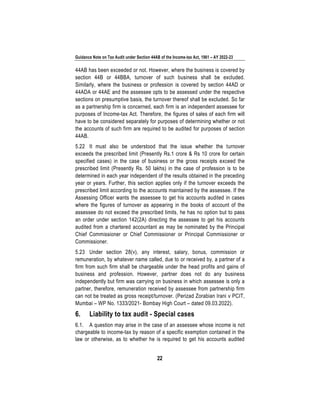
44AB has been exceeded or not. However, where the business is covered by
section 44B or 44BBA, turnover of such business shall be excluded.
Similarly, where the business or profession is covered by section 44AD or
44ADA or 44AE and the assessee opts to be assessed under the respective
sections on presumptive basis, the turnover thereof shall be excluded. So far
as a partnership firm is concerned, each firm is an independent assessee for
purposes of Income-tax Act. Therefore, the figures of sales of each firm will
have to be considered separately for purposes of determining whether or not
the accounts of such firm are required to be audited for purposes of section
44AB.
5.22 It must also be understood that the issue whether the turnover
exceeds the prescribed limit (Presently Rs.1 crore & Rs 10 crore for certain
specified cases) in the case of business or the gross receipts exceed the
prescribed limit (Presently Rs. 50 lakhs) in the case of profession is to be
determined in each year independent of the results obtained in the preceding
year or years. Further, this section applies only if the turnover exceeds the
prescribed limit according to the accounts maintained by the assessee. If the
Assessing Officer wants the assessee to get his accounts audited in cases
where the figures of turnover as appearing in the books of account of the
assessee do not exceed the prescribed limits, he has no option but to pass
an order under section 142(2A) directing the assessee to get his accounts
audited from a chartered accountant as may be nominated by the Principal
Chief Commissioner or Chief Commissioner or Principal Commissioner or
Commissioner.
5.23 Under section 28(v), any interest, salary, bonus, commission or
remuneration, by whatever name called, due to or received by, a partner of a
firm from such firm shall be chargeable under the head profits and gains of
business and profession. However, partner does not do any business
independently but firm was carrying on business in which assessee is only a
partner, therefore, remuneration received by assessee from partnership firm
can not be treated as gross receipt/turnover. (Perizad Zorabian Irani v PCIT,
Mumbai – WP No. 1333/2021- Bombay High Court – dated 09.03.2022).
6. Liability to tax audit - Special cases
6.1. A question may arise in the case of an assessee whose income is not
chargeable to income-tax by reason of a specific exemption contained in the
law or otherwise, as to whether he is required to get his accounts audited
Guidance Note on Tax Audit under Section 44AB of the Income-tax Act, 1961 – AY 2022-23
23
and to furnish such report under section 44AB. Such cases may cover those
assessees who are wholly outside the purview of income-tax law as well as
those whose income is otherwise exempt under the Act. It is felt that neither
section 44AB nor any other provisions of the Act stipulate exemption from the
compulsory tax audit to any person whose income is exempt from tax. This
section makes it mandatory for every person carrying on any business or
profession to get his accounts audited where conditions laid down in the
section are satisfied and to furnish the report of such audit in the prescribed
form. A trust/association/institution carrying on business may enjoy
exemptions as the case may be under sections 10(21) or 10(23A) or 10(23B)
or section 10(23BB) or section 10(23C) or section 11. A co-operative society
carrying on business may enjoy deduction under section 80P. Such
institutions/associations of persons will have to get their accounts audited
and to furnish such audit report for purposes of section 44AB if their turnover
in business exceeds the prescribed limit (Presently Rs. 1 crore and Rs 10
crore in certain specified cases). But an agriculturist, who does not have any
income under the head "Profits and gains of business or profession"
chargeable to tax under the Act, need not get his accounts audited for
purposes of section 44AB even though his total sales of agricultural products
may exceed the prescribed limit)
6.2. It may be appreciated that the object of audit under section 44AB is
only to assist the Assessing Officer in computing the total income of an
assessee in accordance with different provisions of the Act. Therefore, even
if the income of a person is below the taxable limit laid down in the relevant
Finance Act of a particular year, he will have to get his accounts audited and
to furnish such report under section 44AB, if any condition prescribed under
section 44AB requires to get the accounts audited under that section. These
conditions have been stated earlier in this Guidance Note above.
6.3. The case of non-residents may be considered separately. Section
44AB does not make any distinction between a resident or non-resident.
Therefore, a non-resident assessee is also required to get his accounts
audited and to furnish such report under section 44AB if his
turnover/sales/gross receipts exceed the prescribed limits. This audit,
however, would be confined only to the Indian operations carried out by the
non-resident assessee since he is chargeable to income-tax in India only in
respect of income accruing or arising or received in India.
Guidance Note on Tax Audit under Section 44AB of the Income-tax Act, 1961 – AY 2022-23
24
7. Specified date and tax audit
7.1. The tax audit report is required to be uploaded using digital signature
of the tax auditor. In other words, as per the prevailing practice, furnishing of
the tax audit report involves following steps:
(a) The tax auditor is required to upload Form No. 3CA/CB and Particulars
in Form No. 3CD in JSON/xml format using his digital signature. These
forms should be accompanied by the audited financial statements.
(b) The assessee need to login and approve these Forms from his worklist
on e-fling website.
7.2. A question may arise whether a tax auditor appointed under section
44AB can be held responsible if he does not complete the audit and if the tax
audit report is not uploaded before the specified date. Answer to this
question will depend on the facts and circumstances of the case. Normally, it
is the professional duty of the chartered accountant to ensure that the audit
accepted by him is completed before the due date. If there is any
unreasonable delay on his part, he is answerable to the Institute if a
complaint is made by the client. However, if the delay in the completion of
audit is attributable to his client, the tax auditor cannot be held responsible. It
is, therefore, necessary that no chartered accountant should accept audit
assignments which he cannot complete within the prescribed time frame. In
this regard, reference may also be made to paragraph 12 of this Guidance
Note.
8. Penalty
8.1 In order to ensure proper compliance with section 44AB, section 271B
has been enacted which reads as under:-
"Failure to get accounts audited
271B. If any person fails to get his accounts audited in respect of any
previous year or years relevant to an assessment year or furnish a
report of such audit as required under section 44AB, the Assessing
Officer may direct that such person shall pay, by way of penalty, a sum
equal to one-half per cent of the total sales, turnover or gross receipts,
as the case may be, in business, or of the gross receipts in profession,
in such previous year or years or a sum of one hundred fifty thousand
rupees, whichever is less."
Guidance Note on Tax Audit under Section 44AB of the Income-tax Act, 1961 – AY 2022-23
25
8.2 As such, the failure of a person, to get his accounts audited in respect
of any previous year or furnish a copy of such report as required under
section 44AB may attract a penalty equal to 0.5% of the total sales, turnover
or gross receipts, or Rs.1.5 lakh whichever is less. However, in view of the
specific provisions contained in section 273B, no penalty is imposable under
section 271B on the assessee for the above failure if he proves that there
was reasonable cause for the said failure. The onus of proving reasonable
cause is on the assessee.
8.3 Some of the instances where Tribunals/Courts have accepted as
"reasonable cause" are as follows:
(a) Resignation of the tax auditor and consequent delay;
(b) Bona fide interpretation of the term `turnover' based on expert advice;
(c) Death or physical inability of the partner in charge of the accounts;
(d) Labour problems such as strike, lock out for a long period, etc.;
(e) Loss of accounts because of fire, theft, etc. beyond the control of the
assessee;
(f) Non-availability of accounts on account of seizure;
(g) Natural calamities, commotion, etc.
(i) Resignation of the accountant and his consequent non-cooperation.
(j) Official E filing portal (of the Income-tax department) failure
9. Tax auditor
9.1 The tax audit is to be carried out by an “accountant”. The term
"accountant" has been defined in sub-clause (i) of Explanation to section
44AB as under:
“For the purposes of this section, -
(i) "accountant" shall have the same meaning as in the Explanation
below sub-section (2) of section 288;".
The above-mentioned Explanation reads as under:
“In this section, "accountant" means a chartered accountant as defined
in clause (b) of sub-section (1) of section 2 of the Chartered
Accountants Act, 1949 (38 of 1949) who holds a valid certificate of
practice under sub-section (1) of section 6 of that Act, but does not
Guidance Note on Tax Audit under Section 44AB of the Income-tax Act, 1961 – AY 2022-23
26
include [except for the purposes of representing the assessee under
sub-section (1)]—
(a) in case of an assessee, being a company, the person who is not
eligible for appointment as an auditor of the said company in
accordance with the provisions of sub-section (3) of section 141
of the Companies Act, 2013 (18 of 2013); or
(b) in any other case,—
(i) the assessee himself or in case of the assessee, being a
firm or association of persons or Hindu undivided family,
any partner of the firm, or member of the association or
the family;
(ii) in case of the assessee, being a trust or institution, any
person referred to in clauses (a), (b), (c) and (cc) of sub-
section (3) of section 13;
(iii) in case of any person other than persons referred to in
sub-clauses (i) and (ii), the person who is competent to
verify the return under section 139 in accordance with the
provisions ofsection 140;
(iv) any relative of any of the persons referred to in sub-
clauses (i), (ii) and (iii);
(v) an officer or employee of the assessee;
(vi) an individual who is a partner, or who is in the
employment, of an officer or employee of the assessee;
(vii) an individual who, or his relative or partner—
(I) is holding any security of, or interest in, the
assessee:
Provided that the relative may hold security or
interest in the assessee of the face value not
exceeding one hundred thousand rupees;
(II) is indebted to the assessee:
Provided that the relative may be indebted to the
assessee for an amount not exceeding one hundred
thousand rupees;
Guidance Note on Tax Audit under Section 44AB of the Income-tax Act, 1961 – AY 2022-23
27
(III) has given a guarantee or provided any security in
connection with the indebtedness of any third
person to the assessee:
Provided that the relative may give guarantee or provide
any security in connection with the indebtedness of any
third person to the assessee for an amount not exceeding
one hundred thousand rupees;
(viii) a person who, whether directly or indirectly, has business
relationship with the assessee of such nature as may be
prescribed;
(ix) a person who has been convicted by a court of an offence
involving fraud and a period of ten years has not elapsed
from the date of such conviction.
For the purposes of aforesaid provisions, "relative" in relation to an
individual, means—
(a) spouse of the individual;
(b) brother or sister of the individual;
(c) brother or sister of the spouse of the individual;
(d) any lineal ascendant or descendant of the individual;
(e) any lineal ascendant or descendant of the spouse of the
individual;
(f) spouse of a person referred to in clause (b), clause (c),
clause (d) or clause (e);
(g) any lineal descendant of a brother or sister of either the
individual or the spouse of the individual.
Rule 51A is also relevant to understand the meaning of ‘business
relationship’ which reads as under:
Nature of business relationship.
51A. For the purposes of sub-clause (viii) of Explanation below sub-
section (2) of section 288, the term "business relationship" shall be
construed as any transaction entered into for a commercial purpose,
other than,
Guidance Note on Tax Audit under Section 44AB of the Income-tax Act, 1961 – AY 2022-23
28
(i) commercial transactions which are in the nature of professional
services permitted to be rendered by an auditor or audit firm
under the Act and the Chartered Accountants Act, 1949 (38 of
1949) and the rules or the regulations made under those Acts;
(ii) commercial transactions which are in the ordinary course of
business of the company at arm's length price - like sale of
products or services to the auditor, as customer, in the ordinary
course of business, by companies engaged in the business of
telecommunications, airlines, hospitals, hotels and such other
similar businesses.
Thus, wide ranging changes have been brought in the definition of
‘accountant’ with restrictions on carrying out the audit /certification as
required under the Income-tax Act, 1961 by chartered accountant having
relationship with the auditee as specified in the aforesaid Explanation. One
needs to be therefore more cautious while accepting the tax audit
assignment and ensure that he/she does not fall into the prohibited
categories given in Explanation to Section 288(2) read with Rule 51A.
9.2 The third proviso to section 44AB lays down that where the accounts
of an assessee are required to be audited by or under any other law, it shall
be sufficient compliance with the provisions of this section, if such person
gets the accounts of such business or profession audited under such other
law before the specified date and furnishes by that date the report by an
‘accountant’ as required under section 44AB. It may be noted that after
amendment by the Finance Act, 2001, tax audit can be carried out by an
accountant only. Accordingly, in case of any assessee like a co-operative
society where the accounts under the relevant law have been audited by a
person other than a chartered accountant, the tax audit will have to be
conducted by the ‘accountant’ as defined under section 44AB.
9.3 Though the section refers to the accounts being audited by an
accountant which means a chartered accountant as defined above, the audit
can also be done by a firm of chartered accountants. This has been a
recognised practice under the Act. In such a case, it would be necessary to
state the name of the partner who has signed the audit report on behalf of
the firm. The member signing the report as a partner of a firm or in his
individual capacity should give his membership number while registering
himself in the e-filing portal.
Guidance Note on Tax Audit under Section 44AB of the Income-tax Act, 1961 – AY 2022-23
29
9.4 Section 44AB stipulates that only Chartered Accountants should
perform the tax audit. This section does not stipulate that only the statutory
auditor appointed under the Companies Act or other similar Statute should
perform the tax audit. As such the tax audit can be conducted either by the
statutory auditor or by any other chartered accountant in full time practice.
9.5 It may be noted that the Council at its 242nd meeting has passed a
resolution effective from 1st April 2005, that any member in part-time practice
(namely, holding a certificate of practice and also engaging himself in any
other business and/or occupation) is not entitled to perform attest functions
including tax audit.
9.6 A question may arise in the case of a public sector company or any
other company where the statutory auditor has not been appointed by the
authorities concerned as to whether the tax auditor appointed under section
44AB can complete his audit without waiting for statutory audit report on the
accounts audited by the statutory auditors. It may be noted that Form No.
3CA requires the tax auditor to enclose a copy of the audit report conducted
by the statutory auditor or the auditor of the financial statements as the case
may be. Where a statutory auditor has not been appointed by the authorities
concerned or where the report of the statutory auditor is not available for
whatever reasons, it will be possible for the tax auditor to give his report in
Form No. 3CB and to certify the relevant particulars in Form No.3CD. This is
particularly important in those cases where the assessee concerned has
suffered losses in the relevant accounting year or in the cases where
deduction or exemption under a particular section is dependent on filing the
return in time given under section 139(1). It may, however, be noted that the
tax auditor in such cases will have to conduct the financial audit as well in
order to enable him to certify whether or not the accounts reported upon by
him give a true and fair view of the state of affairs of the assessee whose
accounts are audited by him under section 44AB.
9.7 Tax audit under section 44AB being a recurring audit assignment, for
expressing professional opinion on the financial statements and the
particulars, the member accepting the assignment should communicate with
the member who had done tax audit in the earlier year as provided in the
Chartered Accountants Act. When making the enquiry from the retiring
auditor, the member accepting the assignment should find out whether there
is any professional or other reasons why he should not accept the
appointment. The professional reasons for not accepting the appointment
include:
Guidance Note on Tax Audit under Section 44AB of the Income-tax Act, 1961 – AY 2022-23
30
 Non-compliance of the provisions of sections 139 and 140 of the
Companies Act 2013 as mentioned in Code of Ethics issued by
ICAI under Clause (9) of Part I of First Schedule to Chartered
Accountants Act, 1949.
 Non-payment of undisputed audit fees by auditees other than in
case of sick units for carrying out the statutory audit under the
Companies Act, 2013 or various other statutes.
 Issuance of qualified report
9.8 In the case of a person whose accounts of the business or profession
have been audited under any other law (i.e. a company, a co-operative
society, etc. which is required to get the accounts audited under a Statute) it
is not necessary to communicate with the statutory auditor if he had not done
tax audit in the earlier year. Attention of the members is invited to the
detailed discussion in the publication of ICAI, "Code of Ethics" – Appendix
VI. Further, attention of members is invited to the Chapter- VII “Appointment
of an Auditor in case of non-payment of undisputed fees” of the Council
Guidelines No.1-CA(7)/02/2008, dated 8th August, 2008- Appendix VII.
9.9 Some of the issues which are commonly raised in regard to different
aspects of tax audit vis-à-vis the liability/ obligations of the tax auditor are
considered hereunder.
9.10 The liability of the tax auditor in respect of tax audit will be the same
as in any other audit assignment. It may be noted that when any question
relating to the audit conducted by a tax auditor arises, he is answerable to
the Council of the Institute under the Chartered Accountants Act. In all
matters concerning tax audit, ICAI’s disciplinary jurisdiction will prevail.
9.11 In case the assessee is found guilty of having concealed the
particulars of his income it would not ipso facto mean that the tax auditor is
also responsible. If the Assessing Officer comes to the conclusion that the
tax auditor was grossly negligent in the performance of his duties, he can
refer the matter to the ICAI so that appropriate action can be taken against
the tax auditor under the Chartered Accountants Act.
9.12 The Assessing Officer or any other authority who is authorised to issue
summons and to call for evidence or documents, can call upon the tax
auditor who has audited the accounts to give any evidence or produce
documents. For this purpose notice under section 131 can be issued by the
Guidance Note on Tax Audit under Section 44AB of the Income-tax Act, 1961 – AY 2022-23
31
Assessing Officer or other tax authority mentioned in the said section. Also
Section 271J of the Income-tax Act,1961 dealing with Penalty for furnishing
incorrect information in reports or certificates which has been inserted by
Finance Act, 2017 w.e.f. 1/4/2017 states that where the Assessing Officer or
the Commissioner (Appeals), in the course of any proceedings under the
Income Tax Act,1961, finds that an accountant has furnished incorrect
information in any report or certificate furnished under any provision of
Income Tax Act or the rules made thereunder, the Assessing Officer or the
Commissioner (Appeals) may direct that such accountant, shall pay, by way
of penalty, a sum of ten thousand rupees for each such report or certificate.
Thus, the said provision should also be kept in mind while certifying the
above forms.
9.13 If the actual work relating to examination of books and records is done
by a qualified assistant in a firm of chartered accountants and the partner of
the firm signing the audit report has relied upon this work, action, if any,
professional negligence can be initiated against the member who has signed
the report and in such an event, it would be open for the member concerned
to prove that he has taken due care and diligence in the performance of his
duties and is not aware of any reason to believe that he should not have so
relied.
9.14 If the qualified assistant (whether or not holding the certificate of
practice) is found to be grossly negligent in the performance of his duties, the
Council of the Institute can take disciplinary action against him.
9.15 A tax auditor can accept the assignment of tax representation. The
provisions of Volume-I of Code of Ethics should be referred in this regard.
9.16 Under the Code of Ethics, no tax auditor shall charge or offer to
charge, accept or offer to accept, professional fees by way of percentage of
profits or which are contingent upon findings, or results of such employment,
except as permitted under any regulation made under the Chartered
Accountants Act. In this connection, reference is invited to Clause (10) of
Part I of the First Schedule to the Chartered Accountants Act and the
commentary on the subject at page 83 of the Code of Ethics (Volume II -
2020 Edition). Certain exceptions are made in Regulation 192. As per
Regulation 192 (b), in the case of an auditor of a co-operative society, the
fees may be based on a percentage of the paid up capital or the working
capital or the gross or net income or profits.
Guidance Note on Tax Audit under Section 44AB of the Income-tax Act, 1961 – AY 2022-23
32
9.17 Since the figures in Form No. 3CD are duly verified by a chartered
accountant, they should normally be accepted by tax authorities. If, however,
there is a specific reason for differing from the view taken by tax auditor, the
Assessing Officer may compute the income of the assessee by adopting
different figures.
9.18 The opinion expressed by the tax auditor is not binding on the
assessee. If the tax auditor has qualified his report and expressed an opinion
on a particular item, the assessee may take a different view while preparing
his return of income. In such cases, it is advisable for the assessee to state
his viewpoint and support the same by any judicial pronouncements on which
he wants to rely.
In terms of Council Guidelines No.1 CA(&)/02/2008, dated 8th August,2008 –
Appendix VII, in Chapter-X “Appointment of an auditor when he is indebted
to a concern” a chartered accountant should not accept the tax audit of a
person to whom he is indebted for more than rupees one lakh. A member of
the Institute shall be deemed to be guilty of professional misconduct if he
accepts appointment as an auditor of a concern while he is indebted to the
concern or has given any guarantee or provided any security in connection
with the indebtedness of any third person to the concern, for limits fixed in
the statute and in other cases for amount exceeding rupees one lakh.
However, Explanation to Section 288(2) does not provide for any such
threshold and hence irrespective of the quantum of indebtedness, a
chartered accountant should not accept the assignment of tax audit as the
same is prohibited by the said Explanation to Section 288(2).
9.19 The relaxation provided in the said Explanation is only with respect to
the relatives of the individual and not for the individual so appointed as tax
auditor. This must be carefully noted by the member before accepting the
assignment of tax audit.
A member of the Institute in practice or a partner of a firm in practice or a
firm, or a relative of such member or partner shall not accept appointment as
auditor of a concern while indebted to the concern or given any guarantee or
provided any security in connection with the indebtedness of any third person
to the concern, for limits fixed in the statute and in other cases for amount
exceeding Rs. 1,00,000/-
9.20 The Council has issued a Guideline No.1-CA(7)/02/2008, dated 8th
August, 2008 given in Appendix VII wherein Chapter- IX “Appointment as
Guidance Note on Tax Audit under Section 44AB of the Income-tax Act, 1961 – AY 2022-23
33
Statutory auditor” states that a member of the Institute in practice shall be
deemed to be guilty of professional misconduct, if he accepts the
appointment as statutory auditor of Public Sector Undertaking/ Government
Company /Listed Company and other Public Company having turnover of Rs.
50 crores or more in a year and accepts any other work or assignment or
service in regard to the same undertaking/company on a remuneration which
in total exceeds the fee payable for carrying out the statutory audit of the
same undertaking/company.
9.21 The above restrictions shall apply in respect of fees for other work or
service or assignment payable to the statutory auditors and their associate
concerns put together.
9.22 As per the said Guideline, the term “other work(s)” or “service(s)” or
“assignment(s)” shall include Management Consultancy and all other
professional services permitted by the Council pursuant to Section 2(2)(iv) of
the Chartered Accountants Act, 1949 but shall not include: -
(i) audit under any other statute;
(ii) certification work required to be done by the statutory auditors; and
(iii) any representation before an authority.
9.23 Since the obligation for tax audit has been specified in section 44AB of
the Income-tax Act, 1961, it will be considered as an audit under any other
statute for the purpose of this Guideline and thus the above restriction shall
not apply in respect of tax audit fees.
9.24 The tax auditor should obtain from the assessee a letter of
appointment for conducting the audit as mentioned in section 44AB. It is
advisable that such an appointment letter should be signed by the person
competent to sign the return of income in terms of the provisions of section
140 of the Act. It would also be useful if the letter affirms that no other
auditor was appointed to conduct the tax audit for the year for which the
appointment is being made. The letter may also give the name and address
of the tax auditor for the previous year, wherever relevant. This would give
the necessary information to the incoming tax auditor to enable him to
communicate with the previous auditor. The letter of appointment should also
specify the remuneration of the tax auditor. SA-210, Agreeing the Terms of
Audit Engagement issued by the ICAI requires the auditor to agree with the
terms of audit engagement with management or those charged with
Guidance Note on Tax Audit under Section 44AB of the Income-tax Act, 1961 – AY 2022-23
34
governance as appropriate. The agreed terms would need to be recorded in
an audit engagement letter or other suitable form of written agreement and
shall include (a) The objective and scope of the audit of the financial
statements; It should be specifically mentioned that the scope of audit is
restricted to the provisions contained in section 44AB of the Income-tax
Act,1961 and the Income-tax Rules, 1962. (b) The responsibilities of the
auditor; (c) The responsibilities of management; (d) Identification of the
applicable financial reporting framework for the preparation of the financial
statements; and (e) Reference to the expected form and content of any
reports to be issued by the auditor as per the provisions of Income-tax Act,
1961 and Income-tax Rules, 1962 along with a statement that there may be
circumstances in which a report may differ from its expected form and
content. In the interest of both client and auditor, the auditor should send an
engagement letter, preferably before the commencement of the engagement,
to help avoid any misunderstandings with respect to the engagement. The
engagement letter documents and confirms the auditor’s acceptance of the
appointment, the objective and scope of the audit and the extent of the
auditor’s responsibilities to the client. However, it may be noted that
wherever an audit is to be conducted under a Statute, acknowledgement of
the letter of the auditor by the client is considered to be sufficient compliance
of SA-210. The tax auditor should get the statement of particulars, as
required in the annexure to the audit report, authenticated by the assessee
before he does the same.
9.25 The tax auditor is required to upload the tax audit report directly in the
e-filing portal.
9.26 The appointment of the auditor for tax audit in the case of a company
need not be made at the general meeting of the members. It can be made by
the Board of Directors or even by any officer, if so authorised by the Board in
this behalf. The appointment in the case of a firm or a proprietary concern
can be made by a partner or the proprietor or a person authorised by the
assessee. It is possible for the assessee to appoint two or more chartered
accountants as joint auditors for carrying out the tax audit, in which case, the
audit report will have to be signed by all the chartered accountants. In case
of disagreement, they can give their reports separately. In this regard,
attention is invited to Para 12 of the SA 299 (Revised), Responsibility of Joint
Auditors issued by ICAI reproduced below:
Guidance Note on Tax Audit under Section 44AB of the Income-tax Act, 1961 – AY 2022-23
35
"Normally, the joint auditors are able to arrive at an agreed report.
However, where the joint auditors are in disagreement with regard to
any matters to be covered by the report, each one of them should
express his own opinion through a separate report. A joint auditor is
not bound by the views of the majority of the joint auditors regarding
matters to be covered in the report and should express his opinion in a
separate report in case of a disagreement."
The responsibility of joint tax auditors will be the same as in the case of other
audits e.g. audit under the Companies Act. For details relating to such
responsibility, in the case of joint tax audit, reference may be made to SA
299, Responsibility of Joint Auditors.
9.27 A chartered accountant who is responsible for writing or maintenance
of the books of account of the assessee should not audit such accounts. This
principle will apply to the partner of such a member as well as to the firm in
which he is a partner. In view of this, a chartered accountant who is
responsible for writing or maintenance of the books of account or his partner
or the firm in which he is a partner should not accept tax audit assignment
under section 44AB in the case of such an assessee.
9.28 The audit of accounts of a professional firm of chartered accountants,
under section 44AB cannot be conducted by any partner or employee of such
firm.
9.29 A chartered accountant/firm of chartered accountants, who is
appointed as tax consultant of the assessee, can conduct tax audit under
section 44AB. But an internal auditor of the assessee cannot conduct tax
audit if he is an employee of the assessee. The Council of ICAI in its 281st
meeting held from 3rd to 5th October, 2008 decided that an internal auditor
of an assessee, whether working with the organisation or independently
practicing chartered accountant or a firm of chartered accountants, cannot be
appointed as his tax auditor. The decision was made effective from 12-12-
2008.
9.30 A question may arise whether an assessee can remove a tax auditor
appointed under section 44AB. The answer depends upon the facts and
circumstances of the case. It is, however, possible for the management to
remove a tax auditor where there are valid grounds for such removal. This
may arise where the tax auditor has delayed the submission of audit report
under section 44AB for an unreasonable period and if it is found that there is
no possibility of getting the audit report uploaded before the specified date.
Guidance Note on Tax Audit under Section 44AB of the Income-tax Act, 1961 – AY 2022-23
36
In such cases, the management may be justified in removing the tax auditor.
However, the tax auditor cannot be removed on the ground that he has given
an adverse audit report or the assessee has an apprehension that the tax
auditor is likely to give an adverse audit report. If there is any unjustified
removal of tax auditors, the Ethical Standards Board constituted by the
Institute can intervene in such cases. No other chartered accountant should
accept the audit assignment if the removal of his predecessor is not on valid
grounds.
9.31 Before accepting a tax audit, the chartered accountant should take into
consideration the ceiling on tax audit assignments fixed under the Chapter
VI-Tax Audit assignments under Section 44AB of the Income-tax Act, 1961 of
the Council Guidelines No.1-CA(7)/02/2008, dated 8th August, 2008 as
amended by a decision of the Council taken in its 331st meeting held from
10.02.2014 to 12.02.2014 and its 333rd meeting held from 14.05.2014 to
16.05.2014- Appendix VII. In this regard, members may also refer to ‘FAQ
ON TAX AUDIT ASSIGNMENTS’ hosted at ICAI website
(https://www.icai.org/post.html?post_id=10656) and relevant excerpt
reproduced for reference: If there are 10 partners in a firm of Chartered
Accountants in practice, then all the partners of the firm can collectively sign
600 tax audit reports. This maximum limit of 600 tax audit assignments may
be distributed between the partners in any manner whatsoever. For instance,
1 partner can individually sign 600 tax audit reports in case remaining 9
partners are not signing any tax audit report.
9.32 In view of the said Guidelines a member of the Institute in practice,
shall be deemed to be guilty of professional misconduct if, he accepts more
than 60 tax audit assignments relating to an assessment year or such other
limit as may be prescribed by ICAI from time to time under section 44AB,
whether in respect of a person whose accounts have been audited under any
other law or a person who carries on business or profession but who is not
required by or under any other law to get his accounts audited.
9.33 (a) As per the Council Guidelines No.1-CA(7)/02/2008, dated 8th
August, 2008 (as amended from time to time), audit of books of account of
persons carrying on businesses/professions covered by sections 44AD,
44ADA and 44AE, is not included in the aforesaid limit. The auditor is
advised to maintain the details of the audits conducted by virtue of the
provisions of section 44AD, 44ADA and 44AE separately in the format
mentioned in Para below.
Guidance Note on Tax Audit under Section 44AB of the Income-tax Act, 1961 – AY 2022-23
37
(b) Furthermore, a clarification was issued for reckoning the “specified
number of tax audit assignments” conducted under section 44AB of the
Income-tax Act, 1961, the text of the clarification is reproduced below:
“Various statutes prevailing in India like DVAT, 2004 requires the
assessee to furnish an audit report in a form duly signed and verified
by such particulars as may be prescribed under section 44AB of the
Income-tax Act, 1961 i.e. Form 3CB/3CD. This had lead to the doubts
as to whether such audits would be included in the ceiling of
“specified number of tax audit assignments”.
Considering the same, the Council at its 311th meeting held on 8th and
9th November, 2011 clarified that audit prescribed under any statute
which requires the audit report in the form as prescribed under section
44AB of the Income-tax Act, shall not be considered for the purpose of
reckoning the specified number of tax audit assignments if the
turnover of the auditee is below the turnover limit specified in section
44AB of the Income-tax Act, 1961. For instance audit under section
44AD, audit under DVAT, 2004 (for turnover between 40 to 60 Lakhs)
etc. will not be considered for inclusion in the present limit of 60*
audits”
*w.e.f 1.04.2014
9.34 In case the member is a partner of a firm of chartered accountants in
practice, the ceiling of 60 tax audit assignments shall be computed with
reference to each of the partner in the said firm. Where any partner of the
firm of chartered accountants in practice is also a partner of any other firm or
firms of chartered accountants in practice, the ceiling limit of 60 shall apply
with reference to all the firms together in relation to such partner. Similarly,
where any partner accepts one or more tax audit assignments in his
individual capacity, the total number of such assignments under section
44AB which may be accepted by him whether directly in his individual
capacity or as partner of the firm of chartered accountants in practice shall
not exceed 60 tax audit assignments. If two members or firms of chartered
accountants are appointed as joint tax auditors, then the assignment will
have to be included in the case of both the members or firms separately. It
has, however, been clarified that the audit of the head office and branch
offices concerned shall be regarded as one tax audit assignment. Similarly,
the audit of one or more branches of the same concern by one chartered
Guidance Note on Tax Audit under Section 44AB of the Income-tax Act, 1961 – AY 2022-23
38
accountant in practice shall be construed as only one tax audit assignment.
In computing the specified number of tax audit assignments each year's audit
would be taken as a separate assignment. Every chartered accountant in
practice shall maintain a record of the tax audit assignments accepted by him
in each financial year in the format prescribed by the Council. This format is
reproduced in Appendix VIII.
9.35 The Institute has recommended fees for professional services on the
basis of time devoted by a chartered accountant and his assistants. The fees
for tax audit assignment can be charged by a chartered accountant on the
basis of the work involved in the assignment. It may be appreciated that no
uniform fees can be recommended on the basis of turnover because an
assessee having turnover of Rs.1 crore in a trading activity may have less
transactions as compared to an assessee having the same turnover in a
manufacturing activity. Similarly, the transactions in a wholesale business will
be less than the transactions in a retail business. The revised minimum
recommended scale of fees recommended by the Committee for Members in
Practice as on date is given in Appendix IX.
9.36 The chartered accountants should charge reasonable fees depending
upon the responsibility involved under the revised forms and taking into
consideration the work involved in tax audit assignment which has increased
considerably consequent to the revision of the forms. It is necessary that
members of the profession should also maintain reasonable standards of
professional fees.
9.37 As mentioned in Paragraph above, the audit of the head office and
branch offices of an assessee shall be regarded as one tax audit
assignment. However, tax audit of any branch is conducted, it shall be
considered as one separate tax audit for considering limit.
9.38 It may also be noted that a chartered accountant is required to
generate and mention UDIN (Unique Documentation Identification Number)
on each attestation/audit report issued by him. This requirement is
mandatorily effective from 02.08.2019. Further, effective 27.04.2020, the
CBDT has made quoting of UDIN mandatory for uploading any
certification/audit report on income tax e-filing portal. The UDIN so
mentioned for the audit reports/certificates by the Chartered Accountants in
the e-filing portal is being validated online with the ICAI with system-level
integration. This verification of UDIN will help in weeding out fake or incorrect
Guidance Note on Tax Audit under Section 44AB of the Income-tax Act, 1961 – AY 2022-23
39
tax audit reports not duly authenticated with the ICAI. The verification of
UDIN is in line with the ongoing initiatives of the Income Tax Department
(ITD) for integrating with other government agencies and bodies. If a
Chartered Accountant is unable to generate UDIN before submission of audit
report/certificate, the income tax e-filing portal permits such submission.
However, the said Chartered Accountant has to generate and update the
UDIN within 60 calendar days from the date of form submission in the income
tax e-filing portal. If the UDIN for any audit report/certificate is not updated
within the 60 days provided for the same, the department will treat such audit
report/certificate as invalid submission.
10. Form of Financial Statements
10.1 In case of certain category of assesses eg company, society,
charitable trusts etc. respective law governing the assessee prescribe form in
which financial statements should be prepared and presented. In such a
case, relevant provisions of law should be complied with for preparation and
presentation of the financial statements. It should be noted that the
responsibility for maintenance of books and records and that for preparation
of financial statements is that of the assessee.
10.2 In case of certain assesses, law does not prescribe any specific format
or requirements for preparation and presentation of financial statements. In
such a case, the Accounting Standards Board of ICAI has issued guidelines
for Form and related preparation and presentation guidelines. These are
contained in ICAI Publication titled ‘Technical Guide on Financial Statements
of Non-Corporate Entities’. Tax auditors may consider inviting attention of
assesses towards guidelines appearing in the said publication.
11. Accounting Standards
11.1 Recognizing the need to harmonize the diverse accounting policies
and practices in use in India and keeping in view the International
developments in the field of accounting, the Council of the ICAI has issued
Accounting Standards.
11.2 The legal recognition to the Accounting Standards formulated by the
ICAI was granted in October 1998 with insertion of Section 211(3A), (3B),
and (3C) in the Companies Act, 1956. The Companies Act, 2013 has
replaced Companies Act, 1956. Section 211(3C) of the erstwhile Companies
Act had provided that Accounting Standards issued by the ICAI may be
Guidance Note on Tax Audit under Section 44AB of the Income-tax Act, 1961 – AY 2022-23
40
prescribed by the Central Government in consultation with the National
Advisory Committee on Accounting Standards (NACAS). As per the proviso
to the section, till the notification of the Accounting Standards by the
Government, the Accounting Standards issued by the ICAI were required to
be followed by companies. In the year 2006, Accounting Standards 1 to 7
and 9 to 29 were notified by the Ministry of Corporate Affairs, Government of
India, under the Companies (Accounting Standards) Rules, 2006 vide its
notification dated December 7, 2006 in the Gazette of India. These were
made effective in respect of accounting periods commencing on or after the
publication of these Accounting Standards (i.e., December 7, 2006). As per
the Companies (Accounting Standards) Rules, 2006, Companies are
classified into two categories, i.e., Small and Medium Companies (SMCs)
and Non-SMCs. Under the Companies Act, 2013, Section 129 provides for
compliance to Accounting Standards. In accordance with section 133, the
Central Government prescribes the standards of accounting as
recommended by the ICAI in consultation with and after examination of the
recommendations made by the National Financial Reporting Authority. It was
prescribed that the standards of accounting as specified under the
Companies Act, 1956, shall be deemed to be the Accounting Standards until
Accounting Standards are specified by the Central Government under
section 133 of the Companies Act 2013. Accordingly, Accounting Standards
notified under Companies (Accounting Standards) Rules, 2006 would
continued to be followed under the Companies Act 2013. In 2021, AS Rules
2006 were mirrored under the Companies Act 2013 and notified as
Companies (Accounting Standards) Rules, 2021 applicable in respect of
accounting periods commencing on or after April 01, 2021. Another set of
Accounting Standards, i.e., Indian Accounting Standards (Ind AS) that are
converged with globally accepted International Financial Reporting
Standards have been notified under Companies (Indian Accounting
Standards) Rules 2015 and already been implemented as per the Roadmap
issued by the MCA by all the listed companies and Non-banking financial
companies (NBFCs) and unlisted companies and NBFCs with net worth of
INR 250 crores or more.
11.3 ICAI also issues Accounting Standards for non-company entities which
are harmonised with Accounting Standards Rules notified by the Ministry of
Corporate Affairs. The ICAI also announced the scheme for applicability of
accounting standards issued by ICAI to non-companies entities. The criteria
for classification of non-company entities as decided by ICAI and companies
Guidance Note on Tax Audit under Section 44AB of the Income-tax Act, 1961 – AY 2022-23
41
under the Companies (Accounting Standards) Rules, 2021 is given in
Appendix X.
11.4 The Accounting Standards, issued by ICAIare for use in the
presentation of general purpose financial statements which are issued to the
public by such commercial, industrial or business enterprises as may be
specified by the Institute from time to time and subject to the attest function
of its members. The term `General Purpose Financial Statements' includes
balance sheet, statement of profit and loss, a cash flow statement (wherever
applicable) and other statements and explanatory notes which form part
thereof, issued for the use of various stakeholders, Governments and their
agencies and the public at large.
11.5 Information about the Accounting Standards can be seen from the
publications of the Institute. Important publications in the matter are:
(a) Compendium of Accounting Standards – ‘Accounting Standards as on
February 1, 2022’
(b) Release of Indian Accounting Standards: An Overview (Revised 2021)
(c) Quick Referencer on Indian Accounting Standards
It may be noted that certain exemptions/relaxations from the applicability of
Accounting Standards have been given to Micro, Small and Medium Sized
Non-company Entities (MSMEs) Accordingly, the Council in its 400th
meeting, held on 18-19 March, 2021 has decided upon the following scheme
which has come into effect in respect of accounting periods commencing on
or after 1.4.2020:
(1) For the purpose of applicability of Accounting Standards, enterprises
are classified into four categories, viz., Level I, Level II, Level III and
Level IV. Level II and Level III enterprises are considered as SMEs.
(2) Level I entities are large size entities, Level II entities are medium size
entities, Level III entities are small size entities and Level IV entities
are micro entities.
(3) Level IV, Level III and Level II entities are referred to as Micro, Small
and Medium size entities (MSMEs). The criteria for classification of
Non-company entities into different levels are given in Annexure 1 to
the Scheme. The terms ‘Small and Medium Enterprise’ and ‘SME’
used in Accounting Standards are to be read as ‘Micro, Small and
Medium size entity’ and ‘MSME’ respectively.
Guidance Note on Tax Audit under Section 44AB of the Income-tax Act, 1961 – AY 2022-23
42
(4) Level I entities are required to comply in full with all the Accounting
Standards.
(5) Certain exemptions/relaxations have been provided to Level II, Level
III and Level IV Non-company entities. Applicability of Accounting
Standards and exemptions/relaxations to such entities are given in
Annexure 2 to the scheme.
(6) As can be made out from the scheme no relaxation has been given to
Level II Level III and Level IV enterprises in respect of recognition and
measurement principles. Relaxations are provided with regard to
disclosure requirements. Accordingly, Level II, Level III and Level IV
enterprises are fully exempted from certain accounting standards
which primarily lay down disclosure requirements. In respect of certain
other accounting standards, which lay down recognition, measurement
and disclosure requirements, relaxations from certain disclosure
requirements are given. The exemptions/relaxations are decided to be
provided by modifying the applicability portion of the relevant
accounting standards
11.6 AS also apply in respect of financial statements audited under section
44AB of the Income-tax Act, 1961. Accordingly, members should examine
compliance with the mandatory Accounting Standards when conducting such
audit.
12. Accounts and Income-tax law
12.1 Accounts are basis for ascertainment of income. The Income-tax Act,
1961 has made prescription for maintenance of accounts. Section 145 of the
Act deals with provisions relating to method of accounting for ascertainment
of income. The section 145 deals with method of accounting and is
reproduced below:
"145. (1) Income chargeable under the head "Profits and gains of
business or profession" or "Income from other sources" shall, subject
to the provisions of sub-section (2), be computed in accordance with
either cash or mercantile system of accounting regularly employed by
the assessee.
(2) The Central Government may notify in the Official Gazette from
time to time income computation and disclosure standards to be
followed by any class of assessees or in respect of any class of
income.
Guidance Note on Tax Audit under Section 44AB of the Income-tax Act, 1961 – AY 2022-23
43
(3) Where the Assessing Officer is not satisfied about the correctness
or completeness of the accounts of the assessee, or where the method
of accounting provided in sub-section (1) has not been regularly
followed by the assessee, or income has not been computed in
accordance with the standards notified under sub-section (2), the
Assessing Officer may make an assessment in the manner provided in
section 144."
12.2 Income Computation and Disclosure Standards (ICDSs): In exercise of
powers contained in sub-section (2) of section 145 of the Act, the Central
Government has issued ‘Income Computation and Disclosure Standards’.
ICDS are applicable for computation of income under the head ‘profits and
gains from business and profession’ or ‘income from other sources’. There
are 10 ICDSs issued till date.
12.3 ICDSs are applicable only for computation of income under the above
two referred heads of income. ICDS are not applicable for maintenance of
the books of accounts.
12.4 ICDSs have been elucidated in publication titled ‘Technical Guide on
Income Computation and Disclosure Standards’ of the Direct Taxes
Committee of the Institute.
13. Audit Procedures
13.1 In the case of an audit, the tax auditor is required to express his
opinion as to whether the financial statements give a true and fair view of the
state of affairs of the assessee in the case of the balance sheet and in the
case of the profit and loss account/ income and expenditure account, of the
profit/loss or income/expenditure. As regards the statement of particulars to
be annexed to the audit report, he is required to give his opinion as to
whether the particulars are true and correct. In giving his report, the tax
auditor will have to use his professional skill and expertise and apply such
audit tests as the circumstances of the case may require, considering the
contents of the audit report. He will have to conduct the audit by applying the
generally accepted auditing procedures which are applicable for any other
audit. He should use his professional judgment to apply the technique of
audit sampling in accordance with the principles enunciated in SA 530
(Revised) “Audit Sampling” depending on the nature and volume of
transactions, the materiality involved and the internal control procedures
followed by the assessee. He would also be well advised to refer to the other
Guidance Note on Tax Audit under Section 44AB of the Income-tax Act, 1961 – AY 2022-23
44
Standards on Auditing (SAs) as may be relevant, issued by ICAI, as well as
the "Guidance Note on Audit Reports and Certificates for Special Purposes".
If the statutory auditor of a person is also appointed to undertake tax audit, it
is advisable to carry out both the audits concurrently.
13.2 Section 143 of the Companies Act 2013 gives certain powers to the
auditors to call for the books of account, information, documents,
explanations, etc. and to have access to all books and records. No such
powers are given to the tax auditor appointed under section 44AB. Attention
is invited to SA 210, Agreeing the Terms of Audit Engagements. The
Standard requires an auditor to establish whether the pre-conditions for an
audit are present so as to accept or continue an audit engagement. As per
para 6(b) (iii) the auditor is required to obtain agreement of management that
it acknowledges and understands its responsibilities to provide the auditor
with (a) access to all information of which the management is aware that is
relevant to the preparation of the financial statements such as records,
documentation and other matters, (b) additional information that the auditor
may request the management for the purpose of the audit and (c)
unrestricted access to persons within the entity from whom the auditor
determines it necessary to obtain audit evidence. Moreover, since the
appointment of the tax auditor is made by assessee, it will be in the interest
of the assessee to furnish all the information and explanations and produce
books of account and records required by the tax auditor. If, however, after
agreeing to the terms of the engagement, the assessee subsequently refuses
to produce any particular record or to give any specific information or
explanation in relation to the reporting requirement under section 44AB, the
tax auditor should see the impact thereof from the perspective of
“management integrity” vis-a-vis overall assessment of risk of misstatements
in accordance with under SA 315, Identifying and Assessing the risks of
material misstatement through understanding the entity and its environment
and consequently on his/her opinion for reporting in clause (3) of Form
No.3CA or Clause (5) of Form No. 3CB as the case may be.
13.3 The audit report given under section 44AB is to assist the income-tax
department to assess the correct income of the assessee. In order that the
tax auditor may be in a position to explain any question which may arise later
on, it is necessary that he should keep necessary working papers about the
evidence on which he has relied upon while conducting the audit and also
maintain all his necessary working papers. Such working papers should
include his notes on the following, amongst other matters:
Guidance Note on Tax Audit under Section 44AB of the Income-tax Act, 1961 – AY 2022-23
45
(a) work done while conducting the audit and by whom;
(b) explanations and information given to him during the course of the
audit and by whom;
(c) decision on the various points taken;
(d) the judicial pronouncements relied upon by him while making the audit
report; and
(e) certificates issued by the client/management letters.
13.4 The requirements of documentation are applicable in respect of tax
audit conducted by chartered accountants. For this purpose, attention is also
invited to SA 230, Audit Documentation, which provides that the tax auditor
should prepare documentation that provides a sufficient and appropriate
record of the basis for the auditor’s report and evidence that the audit was
planned and performed in accordance with SA’s and applicable legal and
regulatory requirements.
13.5 Tax audit report in Form 3CD requires reporting on certain items like
payments to persons covered under section 40A(2)(b), ICDS etc. for which
full information may not be available in accounts. In respect of percentage of
work in progress, good, doubtful or bad debts, MSME enterprises appearing
as creditors etc. will also require inputs from the management. Tax auditor
may raise certain issues for soliciting views of those charged with
Governance. Therefore, tax auditor should consider SA 580 – Written
Representation and consider obtaining representation from management in
appropriate circumstances and at appropriate time i.e. before
commencement of audit or after conclusion of audit process.
13.6 If the accounts of the business or profession of a person have been
audited under any other law by the statutory auditor(s), it is not necessary for
the tax auditor appointed under section 44AB to conduct the audit once again
in the matter of expression of "true and fair view" of the state of affairs of the
entity and of its profit/loss for the period covered by the audit. However, the
said section envisages the certification of the particulars in the prescribed
form on which the tax auditor has to express his opinion as to whether these
are `true and correct'. In other words, where an audit has already been
conducted and the opinion of the auditor has been expressed on the
accounts, it would not be necessary to repeat the entire exercise to express
similar opinion all over again. The tax auditor has only to annex a copy of the
Guidance Note on Tax Audit under Section 44AB of the Income-tax Act, 1961 – AY 2022-23
46
audited accounts and the auditor's report and other documents forming part
of these accounts to his report and verify the particulars in the prescribed
form for expressing his opinion as to whether these are true and correct.
13.7 Just in case of the conduct of a statutory audit for the purpose of
expression of the auditor's opinion as to whether the financial statements
depict a ‘true and fair’ view, the statutory auditor applies audit sampling, in
case of tax audits also the tax auditor may apply audit sampling techniques
as prescribed in SA 530, Audit Sampling on the information provided by the
assessee to obtain sufficient appropriate audit evidence to be able to draw
reasonable conclusions on which to base the audit opinion. The extent of
check undertaken would have to be indicated by the tax auditor in his
working papers and audit notes. The tax auditor would be well advised to so
design his tax audit programme as would reveal the extent of checking and
to ensure adequate documentation in support of the information being
certified.
13.8 Where the assessee has been subjected to an internal audit and the
tax auditor decides to use the work of the internal auditor for the purpose of
the tax audit under section 44AB, the latter’s procedures would be guided by
the principles laid down in Standard on Auditing (SA) 610 (Revised), Using
the Work of Internal Auditors.
13.9 Audit procedures applicable to a person whose accounts of the
business or profession have been audited under any other law will apply as
well to a person who carries on business or profession but who is not
required by or under any other law to get his accounts audited. In order to
express his opinion on the accounts of a person belonging to the latter
category, the tax auditor should apply the same tests and checks as he
would have applied in the conduct of audit of the former category. In case the
relevant vouchers for the expenditure and payments made by a non-
corporate entity are not available, it will be necessary for the tax auditor to
call for any other evidence in support of such expenditure and payments. The
entity should be advised to maintain vouchers/records in evidence of
transactions to avoid a qualification/observation* in the matter by the tax
auditors. The qualification in respect of this matter would, in the normal
course, be necessary in case the vouchers or other evidence required to be
maintained are not produced in evidence of the income/expenditure or
assets/liabilities. The entity should be encouraged to maintain office
vouchers with the recipient's signatures for the amounts reimbursed on
Guidance Note on Tax Audit under Section 44AB of the Income-tax Act, 1961 – AY 2022-23
47
account of expenditure like local conveyance etc., for which other supporting
evidence is not possible to obtain. It would also be advisable to give
appropriate notes on accounts in the case of a person who carries on
business or profession but who is not required by or under any other law to
get his accounts audited. These may include disclosure regarding method of
accounting and practices consistently and regularly followed, and whether a
change in such matters or practice has been made during the year,
notwithstanding the fact that such disclosures are required to be made in
Form No. 3CD.
Attention of the members is invited to the principles laid out in SA 705
(Revised), Modifications to the Opinion in the Independent Auditor’s Report.
13.10 The ICAI had pursuant to the issuance of the Revised SA 700,
Forming an Opinion and Reporting on Financial Statements, prescribed a
revised format of the auditor’s report on financial statements, which has been
made effective in respect of audits of financial statements for periods
beginning on or after 1st April 2018. Since Form No. 3CA and Form No. 3CB
are required to be filed online in a preset form and the same are not in line
with the requirements of SA 700, there is no specifically allocated field for
providing information relating to the respective responsibilities of the
assessee and the tax auditor as required in terms of the principles laid out in
SA 700. However, having regard to the importance of these respective
responsibility paragraphs from the perspective of the readers of the tax audit
report, it is suggested that these respective responsibility paragraphs can be
provided in the space provided for giving observations, etc., under clause (3)
of Form No. 3CA or Clause (5) of Form No. 3CB as the case may be.
13.11 The illustrative Assessee’s responsibility paragraph and Tax Auditor’s
responsibility paragraphs in respect of Form No. 3CB are given hereunder.
The same may be suitably reworded to meet the situation envisaged in Form
No. 3CA.
“Assessee’s Responsibility for the Financial Statements and the
Statement of Particulars in Form 3CD
1. The assessee is responsible for the preparation of the aforesaid
financial statements that give a true and fair view of the financial
position and financial performance (if applicable) in accordance with
the applicable Accounting Standards issued by the Institute of
Guidance Note on Tax Audit under Section 44AB of the Income-tax Act, 1961 – AY 2022-23
48
Chartered Accountants of India1. This responsibility includes the
design, implementation and maintenance of internal control relevant to
the preparation and presentation of the financial statements that give a
true and fair view and are free from material misstatement, whether
due to fraud or error.
2. The assessee is also responsible for the preparation of the statement
of particulars required to be furnished under section 44AB of the
Income-tax Act, 1961 annexed herewith in Form No. 3CD read with
Rule 6G(1)(b) of Income-tax Rules, 1962 that give true and correct
particulars as per the provisions of the Income-tax Act, 1961 read with
Rules, Notifications, Circulars etc that are to be included in the
Statement.
Tax Auditor’s Responsibility
3. My/ Our responsibility is to express an opinion on these financial
statements based on my/our audit. I/We have conducted this audit in
accordance with the Standards on Auditing issued by the Institute of
Chartered Accountants of India. Those Standards require that we
comply with ethical requirements and plan and perform the audit to
obtain reasonable assurance about whether the financial statements
are free from material misstatement.
4. An audit involves performing procedures to obtain audit evidence
about the amounts and disclosures in the financial statements. The
procedures selected depend on the auditor’s judgment, including the
assessment of the risks of material misstatement of the financial
statements, whether due to fraud or error. In making those risk
assessments, the auditor considers internal control relevant to the
preparation and fair presentation of the financial statements in order to
design audit procedures that are appropriate in the circumstances but
not for the purposes of expressing an opinion on the effectiveness of
the entity’s internal control. An audit also includes evaluating the
appropriateness of accounting policies used and the reasonableness
1 (in case of the assessee being a Company, the reference would be to the Accounting
Standards referred to in sub-section (3C) of section 211 of the Companies Act, 1956/
section 133 of the Companies Act, 2013)
Guidance Note on Tax Audit under Section 44AB of the Income-tax Act, 1961 – AY 2022-23
49
of the accounting estimates made by management, as well as
evaluating the overall presentation of the financial statements.
5. I/We believe that the audit evidence I/we have obtained is sufficient
and appropriate to provide a basis for my/our audit opinion.
6. I/We are also responsible for verifying the statement of particulars
required to be furnished under section 44AB of the Income-tax Act,
1961 annexed herewith in Form No. 3CD read with Rule 6G(1)(b) of
Income-tax Rules, 1962. I/ We have conducted my/our verification of
the statement in accordance with Guidance Note on Tax Audit under
section 44AB of the Income-tax Act, 1961, issued by the Institute of
Chartered Accountants of India.”
13.12 In this regard, attention of the members is also invited to the
Announcement regarding “Applicability of SA 700, forming an opinion and
reporting on financial statements, to formats of auditor's reports prescribed
under various laws and/ or regulations” (01.04.2018), issued by ICAI, given in
Appendix XI.
14. Professional misconduct
14.1 It may be noted that when any question relating to professional
misconduct in connection with tax audit arises, the tax auditor would be liable
under the Chartered Accountants Act and the ICAI's disciplinary jurisdiction
will prevail in this regard. ICAI has constituted the Taxation Audits Quality
Review Board (TAQRB) with a sole aim to review any report prescribed
under the Income-tax Act, 1961 and Rules framed thereunder and any report
prescribed under the Indirect Tax Laws including GST Law which are
certified by a Chartered Accountant with a view to determine, to the extent
possible, compliance with the reporting requirements prescribed under the
respective Acts and related Rules and pronouncements, guidance notes
issued, if any, by ICAI in respect of the same. TAQRB, when finds any error
or mistake or limitation in tax audit report, appropriate action, including
referring case for disciplinary proceedings, is initiated.
15. Audit Report
15.1 Section 44AB requires the tax auditor to submit the audit report in the
prescribed form and setting forth the prescribed particulars. Sub-rule (1) of
Rule 6G provides that the report of audit of accounts of a person required to
be furnished under section 44AB shall -
Guidance Note on Tax Audit under Section 44AB of the Income-tax Act, 1961 – AY 2022-23
50
(a) in the case of a person who carries on business or profession and who
is required by or under any other law to get his accounts audited, be in
Form No. 3CA;
(b) in the case of a person who carries on business or profession, but not
being a person referred to in clause (a), in Form No. 3CB.
15.2 Sub-rule (2) of Rule 6G further provides that the particulars which are
required to be furnished under section 44AB shall be in Form No. 3CD.
15.3 It may be noted that the audit report in Form No. 3CB is in two parts.
The first part requires the tax auditor to give his opinion as to whether or not
the accounts audited by him give a true and fair view:
(i) in the case of the balance sheet, of the state of affairs as at the last
date of the accounting year.
(ii) in the case of the profit and loss account, of the profit or loss of the
assessee for the relevant accounting year.
15.4 The second part of the report states that the statement of particulars
required to be furnished under section 44AB is annexed to the audit report in
Form No. 3CD. The tax auditor is required to give his opinion whether the
prescribed particulars furnished by the assessee are true and correct, subject
to observations and qualifications, if any.
15.5 In paragraph 3 of Form No. 3CB, the auditor has to report that the
financial statements audited by him give a `true and fair' view. With regard to
the term “true and fair view”, the auditor is advised to consider the
Framework for Preparation and Presentation of Financial Statements as also
paragraph 12, 13, 14 and 27 of SA 700 (Revised), Forming an opinion and
reporting on Financial Statements. Attention of the members is drawn to Para
5 of SA 200, Overall Objectives of the Independent Auditor reproduced
below:
“5. As the basis for the auditor’s opinion, SAs require the auditor to
obtain reasonable assurance about whether the financial statements
as a whole are free from material misstatement, whether due to fraud
or error. Reasonable assurance is a high level of assurance. It is
obtained when the auditor has obtained sufficient appropriate audit
evidence to reduce audit risk (i.e., the risk that the auditor expresses
an inappropriate opinion when the financial statements are materially
Guidance Note on Tax Audit under Section 44AB of the Income-tax Act, 1961 – AY 2022-23
51
misstated) to an acceptably low level. However, reasonable assurance
is not an absolute level of assurance, because there are inherent
limitations of an audit which result in most of the audit evidence on
which the auditor draws conclusions and bases the auditor’s opinion
being persuasive rather than conclusive.”
15.6 The requirement in paragraph 3 of Form No. 3CA and paragraph 5 of
Form No. 3CB relating to particulars in Form No. 3CD is that the auditor
should report that these particulars in Form No. 3CD are "true and correct".
The terminology "true and fair" is widely understood though not defined even
under the Companies Act, 2013. On the other hand, the words "true and
correct" lay emphasis on factual accuracy of the information. In this context,
reference is invited to AS-1 relating to disclosure of accounting policies.
These standards recognise that the major considerations governing the
selection and application of accounting policies are (i) prudence, (ii)
substance over form and (iii) materiality. Therefore, while giving particulars in
Form No. 3CD, these aspects should be kept in view. In particular,
considering the nature of particulars to be given in Form No. 3CD, the aspect
of materiality should be considered. In other words, particulars should be
given in the respect of material items and the auditors should assess factual
correctness relating to these particulars. Attention of the members, in this
context is, however, also drawn to Para 51 of “Framework for Assurance
Engagements” reproduced below:
“51. “Reasonable assurance” is less than absolute assurance.
Reducing assurance engagement risk to zero is very rarely attainable
or cost beneficial as a result of factors such as the following:
➢ The use of selective testing.
➢ The inherent limitations of internal control.
➢ The fact that much of the evidence available to the practitioner is
persuasive rather than conclusive.
➢ The use of judgment in gathering and evaluating evidence and
forming conclusions based on that evidence.
➢ In some cases, the characteristics of the subject matter when
evaluated or measured against the identified criteria.”
15.7 In the case of a person whose accounts of the business or profession
have been audited under any other law, it is not required for the tax auditor
Guidance Note on Tax Audit under Section 44AB of the Income-tax Act, 1961 – AY 2022-23
52
appointed under section 44AB to give his opinion, as to whether or not the
accounts give a true and fair view as indicated herein above. It would only be
necessary for him to annex a copy of the audited accounts as well as a copy
of the audit report given by the statutory auditor with his report in Form No.
3CA along with Form No. 3CD.
15.8 In the case of a person who carries on business and also renders
professional services but who is not required by or under any other law to get
his accounts audited, report should be given in Form No. 3CB. The statement
of particulars should be given in Form No. 3CD.
15.9 In the case of a person who carries on business or profession but who
is not required by or under any other law to get his accounts audited, the
expression "proper books of account" should mean, the books of original
entry and other books of account required to be maintained to record all the
transactions of the assessee in the same manner, as in the case of a person
whose accounts of the business or profession have been audited under any
other law. Although, books of account have not yet been prescribed for a
person who carries on business or profession (except under Section 44AA
for certain categories of profession), the tax auditor should examine whether
such books are maintained by the assessee to provide the information and
the basis required to prepare the balance sheet and the profit and loss
account correctly in the formats recommended in Appendix XII & XII of this
Guidance Note.
15.10 In case, the accounts of a person who carries on business or
profession are being audited for the first time, the tax auditor should ensure
compliance with SA 510 (Revised), Initial Audit Engagements-Opening
Balance.
15.11 In certain cases, members are called upon to report on the accounts
reopened and revised by the board of directors. The accounts of a company
once adopted at its annual general meeting should not normally be re-
opened and revised. The Institute and the Ministry of Corporate Affairs have
affirmed this position. In case of revision, the audit report should be given in
the manner as required by the Institute in SA-560 (Revised), Subsequent
Events. The Ministry of Corporate Affairs had also clarified that accounts can
be revised to comply with technical requirements. It may be pointed out that
report under section 44AB should not normally be revised. However,
sometimes a member may be required to revise his tax audit report on
grounds such as:
Guidance Note on Tax Audit under Section 44AB of the Income-tax Act, 1961 – AY 2022-23
53
(i) revision of accounts of a company after its adoption in annual general
meeting.
(ii) change of law e.g. retrospective amendment.
(iii) change in interpretation, e.g. CBDT Circular, judgements, etc.
15.12 In case where a member is called upon to report on the revised
accounts, then he must mention in the revised report that the said report is a
revised report and a reference should be made to the earlier report also. In
the revised report, reasons for revising the report should also be mentioned.
15.13 Under Sub-rule (3) in Rule 6G, the auditor is expressly allowed to
revise the Audit Report in Form 3CB/3CD in certain circumstances. Sub-Rule
(3) reads as under:
(3) The report of audit furnished under this rule may be revised by the
person by getting revised report of audit from an accountant, duly
signed and verified by such accountant, and furnish it before the end
of the relevant assessment year for which the report pertains, if there
is payment by such person after furnishing of report under sub-rule (1)
and (2) which necessitates recalculation of disallowance under section
40 or section 43B.
Thus a scenario may arise that after issuing the audit report, but before the
due date for filing the return u/s 139(1), the assessee may make payment of
tax deducted at source or of tax, duty, cess, fee or other payments referred
to in Section 43B deduction of which is allowed only on actual payment
basis.
However, it is not mandatory to revise tax audit report in the circumstances
mentioned in Rule 6G(3). If the tax audit report is revised, while revising tax
audit report, prescriptions in ‘Guidance Note on Revision of the Audit Report’
should be considered.
In the case of companies having their accounting year which is different from
the financial year, accounts of the financial year are required to be prepared
and audited. The audit report shall be in Form No. 3CB. The above position
has also been clarified by the CBDT in its Circular No. 561 dated 22.5.1990.
The Circular is reproduced in Appendix XIV.
Guidance Note on Tax Audit under Section 44AB of the Income-tax Act, 1961 – AY 2022-23
54
16. Issuing Audit Report
16.1 Tax Auditor should obtain a hard copy or soft copy of the financial
statements for the previous year under audit duly signed by the signatories
eligible to sign the financial statements on behalf of the assessee. For
example, a proprietor in case of a proprietary concern, working partner or
partners for the Firm, Managing Director and other directors for a company
as prescribed under the Companies Act, 2013 etc.
16.2 Where the accounts are audited under any other law for the time being
in force, usually accounts contain signature of auditors for the purpose of
identification of financial statements upon which report has been issued.
16.3 If the accounts are not audited under any other law for the time being
in force, it is recommended that the tax auditor should sign such financial
statements for the purpose of identification.
16.4 A tax audit report should be issued by the tax auditor in Form No. 3CA
or 3CB as may be applicable alongwith particulars in Form No. 3CD. These
should be in hard copy physically signed or soft copy digitally signed by the
tax auditor. All the three forms, at the end require signature and stamp/seal
of the signatory.
16.5 Tax audit report is required to be submitted electronically on the
income-tax e filing portal. It requires the auditor to upload Form No. 3CA or
3CB and Form No. 3CD. The same are required to be digitally signed. UDIN
is required to be updated. This is the prescribed procedure for filing of tax
audit report.
17. Form No. 3CA
17.1 This form is to be used in a case where the accounts of the business
or profession of a person have been audited under any other law like
Companies Act or Limited Liability Partnership Act. Particulars of address
and PAN or Aadhaar Number wherever applicable is required to be given in
report. The first part of the report refers to the fact that the statutory audit of
the assessee was conducted by a chartered accountant or any other auditor
in pursuance of the provisions of the relevant Act, and the copy of the audit
report along with the audited profit and loss account and balance sheet and
the documents declared by the relevant Act to be part of or annexed to the
profit and loss account and balance sheet, are annexed to the report in Form
No. 3CA. In a case where the tax auditor carrying out the audit under section
Guidance Note on Tax Audit under Section 44AB of the Income-tax Act, 1961 – AY 2022-23
55
44AB is different from the statutory auditor, a reference should be made to
the name of such statutory auditor. In case the statutory auditor is carrying
out the audit under section 44AB, the fact that he has carried out the
statutory audit under the relevant Act should be stated. Attention of the
members in this context is invited to SA 600 Using the work of Another
Auditor.
17.2 The next paragraph states that the statement of particulars required to
be furnished under section 44AB is annexed with the particulars in Form No.
3CD. The tax auditor has to further state that, in his opinion and to the best
of his information and according to examination of books of account including
other relevant documents and explanations given to him, the particulars
given in the said Form No.3CD and the annexure thereto are true and correct
subject to the observations/qualifications, if any.
17.3 The auditor is required to examine not only the books of accounts but
also other relevant documents directly related to transactions relevant to
clauses in Form No. 3CD like copy of bank statements, various agreements/
contracts, challans for payment of government dues, TDS returns, GST
returns or any other relevant document. Tax auditor can place reliance on
electronic record provided its authenticity is confirmed.
17.4 Attention is also drawn to the definition of ‘document’ as per section
2(22AA) of the Act which is as under:
"document" includes an electronic record as defined in clause (t) of
sub-section (1) of section 2 of the Information Technology Act, 2000
(21 of 2000).
Section 2(1)(t) of the Information Technology Act, 2000 as referred above is
reproduced below:
"electronic record" means data, record or data generated, image or
sound stored, received or sent in an electronic form or micro film or
computer generated micro fiche.
The definition of term “document” is an inclusive definition and includes
within its ambit documents other than those considered as electronic record
as per section 2(1)(t) of the Information Technology Act, 2000. The above
definition can also be relied when reporting under clause 11(c) of Form No.
3CD discussed later in this Guidance Note.
Guidance Note on Tax Audit under Section 44AB of the Income-tax Act, 1961 – AY 2022-23
56
17.5 Where any of the requirements in this form is answered in negative or
with qualification, the report shall state the reasons thereof. The tax auditor
should state this qualification in the audit report so that the same becomes a
comprehensive report and the user of the audited statement of particulars
can realize the impact of such qualifications.
17.6 It is possible that in the case of a person whose accounts of the
business or profession have been audited under any other law, which has
branches at various places, the branch accounts might have been audited by
branch auditors under the statute. If the audit under section 44AB is also
carried out by the same branch auditors or other chartered accountants, they
should submit the report in Form No. 3CA to the management or the principal
tax auditor appointed for the head office under Section 44AB. Attention in
this regard is drawn to SA 600, Using the Work of Another Auditor which
discusses the procedures in this regard as well as the principal tax auditor's
responsibility in relation to his use of the work of the branch auditor. The
principal tax auditor should submit his consolidated report on the registered
office/head office and branch accounts and report in his tax audit report as
his observation in paragraph 3 of Form No. 3CA as under:
"I/We have taken into consideration the audit report and the audited
statements of accounts, and particulars received from the auditors,
duly appointed under the relevant Act, of the branches not audited by
me/us".
17.7 It is recommended that the auditor should also refer to reporting
requirements as per SA 700 as discussed in Para above. Further, the Tax
Auditor in Para 3 of Form 3CA should give his observations/comments/
adverse remarks/disclaimers found during their audit on any of the clauses of
Form 3CD, wherever required. In Form 3CD, while reporting under any
clause, tax auditor may be of the view that any elucidation, qualification,
disclaimer, etc. is required to be stated. These aspects may also be stated in
the said paragraph. All these aspects should also refer number of clause to
which it relates.
17.8 Item No. 4 of the notes to Form No. 3CA requires that the person, who
signs this audit report, shall indicate reference of his membership
No./certificate of practice number/authority under which he is entitled to sign
this report. No separate certificate of practice number is allotted by ICAI. As
such, where a chartered accountant acts as a tax auditor he should give his
Guidance Note on Tax Audit under Section 44AB of the Income-tax Act, 1961 – AY 2022-23
57
membership number with ICAI while registering himself in the e-filing portal.
In case, the e-filing utility of Form No. 3CA requires the mention of the Firm
Registration number and the name of the firm on whose behalf the member
has conducted audit, the same should invariably be provided by the tax
auditor. The tax auditor should also mention the Unique Document
Identification Number (UDIN) for issuing the audit report, if available at the
time of signing.
17.9 An assessee may have one or more branches outside India. The
accounts of such branches are normally audited by the professional
accountants overseas. The results of such branches are also incorporated in
the consolidated accounts prepared in this country. In the case of foreign
branches, the relevant information in respect of such branches as is required
by Form No. 3CD, may be obtained by the tax auditor in India from the
assessee who should obtain the same from the overseas auditor who had
audited the accounts of such foreign branches. The tax auditor in India while
certifying the information in Form No. 3CD may rely upon the information
obtained by him from the overseas auditor and while submitting his
consolidated report in Form No.3CD, he should specifically point out the
following in his audit report in paragraph 3 of Form No.3CA as his
observation:-
“I/We have taken into consideration the audit report and the audited
statements of accounts, and particulars received from the auditors,
appointed under the relevant law, of the overseas branches not
audited by me/us”.
If the assessee is unable to obtain relevant information in respect of the
overseas branches duly certified by the overseas auditor, the relevant facts
should be suitably disclosed and reported upon.
17.10 Where the tax auditor is unable to obtain the required information in
respect of branches situated in India or outside India then the fact should be
suitably disclosed along with its impact on the Auditor’s opinion on the
particulars furnished in Form No.3CD, as an observation in para (3) of Form
No, 3CA. Reference is drawn to SA 705 (Revised), Modifications to the
opinion in the Independent Auditor’s report.
Guidance Note on Tax Audit under Section 44AB of the Income-tax Act, 1961 – AY 2022-23
58
18. Form No. 3CB
18.1 In the case of a person who carries on business or profession but who
is not required by or under any other law to get his accounts audited, the
audit report has to be given in Form No. 3CB. Form No. 3CB consists of five
paragraphs.
18.2 The tax auditor has to state whether he has examined the balance
sheet as on a particular relevant date and the profit and loss account/income
and expenditure account for that period. Further, such a balance sheet and
the profit and loss account must be attached with the audit report.
18.3 The tax auditor has to certify that the balance sheet and the profit and
loss account/income and expenditure account are in agreement with the
books of account maintained at the head office and branches. Also, he has to
mention the total number of branches.
18.4 He has to report his observations, comments, discrepancies or
inconsistencies, if any. Subject to the above observations, comments,
discrepancies, inconsistencies he has to state whether:
(a) he has obtained all the information and explanations which, to the best
of his knowledge and belief, were necessary for the purposes of the
audit;
(b) in his opinion proper books of account have been kept by the head
office and branches of the assessee so far as appears from his
examination of the books;
(c) in his opinion and to the best of his information and according to the
explanations given to him the said accounts, read with notes thereon,
if any, give a true and fair view;
(i) in the case of the balance sheet of the state of the affairs of the
assessee as at 31st March, ______ and
(ii) in the case of the profit and loss account/income and
expenditure account of the profit/loss or surplus/deficit of the
assessee for the year ended on that date.
18.5 Under clause (a) of paragraph 3 of Form No.3CB, the tax auditor has
to report his “observations/comments/ discrepancies/inconsistencies,” if any.
The expression “Subject to above” appearing in clause (b) makes it clear that
such observations/comments/ discrepancies/ inconsistencies which are of
Guidance Note on Tax Audit under Section 44AB of the Income-tax Act, 1961 – AY 2022-23
59
qualificatory nature relate to necessary information and explanations for the
purposes of the audit or the keeping of proper books of accounts or the true
and fair view of the financial statements, respectively to be reported on in
paragraphs (A), (B) and (C) under clause (b) of paragraph 3. While reporting
on clause (a) of paragraph 3 of Form No. 3CB the tax auditor besides
mandatory requirements of SA 700 should report observations/comments/
discrepancies/ inconsistencies which are of qualificatory nature which affect
his reporting about obtaining all the information and explanations which were
necessary for the purposes of the audit, about the keeping of proper books of
account by the head office and branches of the assessee and about the true
and fair view of the financial statements. Further, only such observations/
comments/discrepancies/inconsistencies which are of a qualificatory nature
should be mentioned under clause (a). In Form 3CD, while reporting under
any clause, tax auditor may be of the view that any elucidation, qualification,
disclaimer, etc. is required to be stated. These aspects may also be stated in
the said paragraph. All these aspects should also refer number of clause to
which it relates. In case the tax auditor has no observations/comments/
discrepancies/inconsistencies to report which are of qualificatory nature,
“NIL” should be reported in this part of paragraph 3. The tax auditor may then
give his report as required by sub-paragraphs (A), (B), and (C) of paragraph
3. The tax auditor should comply with the Standards of Auditing (SA) issued
by the ICAI while giving his opinion on the financial statements in para 3 of
Form 3CB.
18.6 Paragraph 4 of Form No.3CB provides that the prescribed particulars
are furnished in Form No. 3CD annexed to the report. Paragraph 5 of Form
No. 3CB requires the auditor to report whether in his opinion and to the best
of his information and according to the explanations given to him, the
particulars given in Form No.3CD are true and correct subject to
observations/qualifications, if any. The auditor may have a difference of
opinion with regard to the particulars furnished by the assessee and he has
to bring these differences under various clauses in Form No. 3CD.
18.7 Further, the Tax Auditor in Para 5 of Form 3CB should give his
observations/comments/adverse remarks/disclaimers found during their audit
on any of the clauses of Form 3CD, wherever required. The tax auditor
should also refer to reporting requirements as per SA 700 as discussed in
Para above.
Guidance Note on Tax Audit under Section 44AB of the Income-tax Act, 1961 – AY 2022-23
60
18.8 If a person who carries on business or profession but who is not
required by or under any other law to get his accounts audited, has branches
and separate accounts are maintained at the branches, the assessee can
request the tax auditor appointed under section 44AB to audit the head office
and branch accounts. In the alternative, the assessee can appoint separate
tax auditors for branches. The branch tax auditor in such a case will have to
give an audit report in Form No. 3CB to the management or the tax auditor
appointed for the audit of head office accounts. The tax auditor appointed for
the audit of head office can rely on the report of branch tax auditors subject
to such checks and verifications as he may choose to make and shall submit
his consolidated report on the head office and branch accounts. He should
make suitable reference to the audit conducted by separate branch tax
auditors in the same manner as stated in para 14.6 above. The tax auditor
should also mention the Unique Document Identification Number (UDIN) for
issuing the audit report, if available at the time of signing the report.
18.9 In case of amalgamation, merger, demerger of companies;
courts/authorities approve it from a date specified in the application/petition.
At times, there is lapse of number of years between the date of
merger/demerger and the date of order. Return of income of earlier period of
the merged/demerged entities is required to be furnished. Financial
Statement of the merged/demerged entities are not required to be audited
under the Companies Act, 2013 or any other law for the time being in force.
Therefore, in such cases Form No. 3CB should be issued, certifying the
Financial Statements.
18.10 If the tax auditor is called upon to give his report only in respect of one
or more businesses carried on by the assessee and the books of accounts of
the other businesses are not produced as the same are not required to be
audited under the Act, the tax auditor should mention the fact that audit has
not been conducted of those businesses whose books of account had not
been produced. However, if the financial statements include, inter alia, the
results of such business for which books of account have not been produced,
the auditor should qualify his report in Form No. 3CB.
19. Form No. 3CD
19.1 The statement of particulars given in Form No. 3CD as annexure to
the audit report contains a number of clauses. The tax auditor has to report
whether the particulars are true and correct. This Form is a statement of
Guidance Note on Tax Audit under Section 44AB of the Income-tax Act, 1961 – AY 2022-23
61
particulars required to be furnished under section 44AB. The same is to be
annexed to the reports in Forms No. 3CA and 3CB in respect of a person
who carries on business or profession and whose accounts have been
audited under any other law and in respect of person who carries on
business or profession but who is not required by or under any other law to
get his accounts audited respectively.
19.2 As stated earlier, the tax auditor should obtain from the assessee, the
statement of particulars in Form No. 3CD duly authenticated by him. It would
be advisable for the assessee to take into consideration the following general
principles while preparing the statement of particulars:
(a) He can rely upon the judicial pronouncements while taking any
particular view about inclusion or exclusion of any items in the
particulars to be furnished under any of the clauses specified in Form
No. 3CD.
(b) If there is a conflict of judicial opinion on any particular issue, he may
refer to the view which has been followed while giving the particulars
under any specified clause.
(c) The AS, Ind AS, Guidance Notes, SA issued by the Institute from time
to time should be followed.
19.3 While furnishing the particulars in Form No.3CD it would be advisable
for the tax auditor to consider the following:
(a) If a particular item of income/expenditure is covered in more than one
of the specified clauses in the statement of particulars, care should be
taken to make a suitable cross reference to such items at the
appropriate places.
(b) If there is any difference in the opinion of the tax auditor and that of
the assessee in respect of any information furnished in Form No. 3CD
by the assessee, the tax auditor may consider stating both the view
points and also the relevant information related to matter in order to
enable the tax authority to take a decision in the matter.
(c) If any particular clause in Form No.3CD is not applicable, he should
state that the same is not applicable.
(d) In computing the allowance or disallowance, he should keep in view
the law applicable in the relevant year, even though the form of audit
Guidance Note on Tax Audit under Section 44AB of the Income-tax Act, 1961 – AY 2022-23
62
report may not have been amended to bring it in conformity with the
amended law.
(e) In case the assessee has furnished prescribed particulars in part or
piecemeal or relevant form is incomplete or the assessee does not
give the information against all or any of the clauses, the auditor
should not withhold the audit report. In such a case, he should qualify
his report in para 3 of Form 3CA or para 5 of Form 3CB as applicable
on matters in respect of which information is not furnished or if
furnished, are inadequate/insufficient.
(f) The information in Form No. 3CD should be based on the books of
accounts, records, documents, information and explanations made
available to the tax auditor for his examination.
(g) In case the auditor relies on a judicial pronouncement, he may mention
the fact as his observations in para (3) of Form No. 3CA or para (5)
provided in Form No. 3CB, as the case may be.
(h) Where in respect of any particular aspect, reporting is required at more
than one clause, in that case, information may be furnished at any one
of the clause and reference may be given at other clause.
20. Particulars to be furnished in Form No. 3CD.
PART – A
1. Name of the assessee : _______________________
2. Address : _______________________
3. Permanent Account Number or
Aadhaar Number : _______________________
4. Whether the assessee is liable to pay indirect tax like excise duty,
service tax, sales tax, goods and service tax, customs duty, etc. If
yes, please furnish the registration number or GST number or any
other identification number allotted for the same
: _______________________
5. Status : _______________________
6. Previous year : from ________ to ________
7. Assessment year : _______________________
Guidance Note on Tax Audit under Section 44AB of the Income-tax Act, 1961 – AY 2022-23
63
8. Indicate the relevant clause of section 44AB under which the
audit has been conducted
8a. Whether the assessee has opted for taxation under section
115BA/115BAA/115BAB/115BAC/115BAD?
: _______________________
[Clauses 1 to 8a]
The requirements of clauses 1 to 8a of Part-A are discussed as follows:
20.1 Under clause 1 the name of the assessee whose accounts are being
audited under section 44AB should be given as specified in PAN and in case
there is a different Trade name, the same should be reported. However, if the
tax audit is in respect of a branch, name of such branch should be mentioned
along with the name of the assessee. In case of change in the name of the
assessee, if the change has taken place during the financial year, name at
the end of the financial year should be stated. However, if the change in
name has taken place after the close of the financial year but before signing
of tax audit report, name as at the year ending date should be mentioned. In
either case, fact of name change should be suitably clarified.
20.2 The address to be mentioned under clause 2 should be the same as
has been communicated by the assessee to the Income-tax Department as
on the date of signing of the audit report. If the tax audit is in respect of a
branch or a unit, the address of the branch or the unit should be given. In the
case of a company, the address of the registered office should be stated. In
the case of a new assessee, the address should be that of the principal place
of business. The auditor should verify the relevant details of the assessee
from the available income tax records or from the profile of the assessee on
Income Tax portal.
20.3 Under clause 3 the permanent account number (PAN) allotted to the
assessee should be indicated. Clause further asks to mention Aadhaar
number (in case of Individuals) as an alternative. It may be noted that in the
e-filing format, PAN is a mandatory field and Aadhaar is an optional field.
20.4 Under clause 4, the auditor is required to examine from appropriate
evidence the registration number or any other identification number, if any,
allotted, in case the assessee is liable to pay indirect taxes like customs
duty, excise duty, VAT, sales tax, goods and services tax, etc. Moreover, for
any indirect tax, if multiple registration numbers are available, all such
Guidance Note on Tax Audit under Section 44AB of the Income-tax Act, 1961 – AY 2022-23
64
registration numbers should be examined by the tax auditor. Therefore, the
question of whether the assessee is liable to pay any of the aforesaid indirect
taxes should be considered. needs to be answered.
20.5 Part A of Form No. 3CD generally requires the auditor to give the
factual details of the assessee. Thus, the auditor is primarily required to
furnish the details of registration numbers as provided to him by the
assessee. The reporting is however, to be done in the manner or format
specified by the e-filing utility in this context.
20.6 The term “Indirect taxes” is neither defined in the Income-tax Act, 1961
nor under any other law. The levy of different types of indirect taxes on
various transactions may differ from State to State. Thus, it is recommended
that the auditor should obtain from the assessee the list of indirect taxes
applicable to him. Once the auditor obtains this management representation,
he is required to obtain a copy of the registration certificate clearly
mentioning the registration number under that relevant law. For example,
GSTIN, State Excise, State VAT etc. The assessee may have multiple
registrations for various manufacturing units, service units, branches,
godowns etc. under the same law. In such circumstances also, a copy of all
registration certificates is to be obtained from the assessee for appropriate
disclosure under this clause. Where the indirect tax law does not require any
registration, appropriate identification number may be reported in this clause.
For example, in Customs Act, 1962, since there is no registration number, a
copy of Export Import Code (IEC) may be obtained and information be
accordingly furnished.
20.7 The information may be obtained and maintained in the following
format:
Sr.
No
Relevant
Indirect tax Law
which requires
registration
Place of Business/
profession/service unit for
which registration is in place/
or has been applied for
Registration/
Identificatio
n number
1 2 3 4
20.8 The auditor has to keep in mind the provisions of Standard on Auditing
580 “Written Representation”. In case the auditor prima facie is of the opinion
that any indirect taxes laws is applicable on the business or profession of the
assessee but the assessee is not registered under the said law, he should
report the same appropriately.
Guidance Note on Tax Audit under Section 44AB of the Income-tax Act, 1961 – AY 2022-23
65
20.9 Under clause 5, the status of the assessee is to be mentioned. This
refers to the different classes of assessees included in the definition of
“person” in section 2(31) of the Act, namely, individual, Hindu undivided
family, company, firm, an association of persons or a body of individuals
whether incorporated or not, a local authority or artificial juridical person.
20.10 Under clause 6, the period of the previous year has to be stated. Since
the previous year under the Act now uniformly begins on 1st April and ends
on 31st March, the relevant previous year should be mentioned. In case of
amalgamations, demergers, reconstitution, new business, closure of existing
business etc. the date of beginning/ ending of the previous year may be
different, the auditor may accordingly, mention the relevant date of beginning
and ending of the previous year in this clause. Hence, the tax auditor has to
apply his professional judgement depending on the facts and circumstances
of the same.
20.11 Under clause 7, the assessment year relevant to the previous year for
which the accounts are being audited should be mentioned.
20.12 Under clause 8 the auditor is required to mention the relevant clause
of section 44AB under which the audit has been conducted. In case the
assessee is carrying on business and his total sales, turnover or gross
receipts as the case may be, exceeds one crore in the relevant previous
year, the auditor is required to mention clause (a) under this head.
If the assessee is carrying on profession and his gross receipts exceed fifty
lakh rupees in the relevant previous year, the auditor is required to mention
clause (b) under this head. Likewise, if the audit under section 44AB is being
conducted by virtue of provisions of section 44AE, 44BB and 44BBB, the
auditor is required to mention clause (c). For audit being conducted by virtue
of provisions of section 44ADA, clause (d) is to be mentioned under this
head. Where a person is required by or under any other law to get his
accounts audited, say a company, a society etc. then audit under section
44AB is conducted under proviso to section 44AB and not under clause (a) or
(b) of that section.
20.13 Assessee is required to pay income-tax at the rates specified in the
annual Finance Act. However, Section 115BA, 115BAA, 115BAB, 115BAC
and 115BAD provide option to the assessee to pay tax at special rates and
forego certain deductions, etc. The assessee can opt to pay tax under the
rates prescribed in the Finance Act or the one made available by any of the
Guidance Note on Tax Audit under Section 44AB of the Income-tax Act, 1961 – AY 2022-23
66
aforesaid sections. The tax auditor has to mention whether the assessee has
opted for taxation under any of the aforesaid sections and in case answer is
yes, then he has to select the appropriate section. Further, the Tax auditor is
advised to examine the previous year Income Tax return to verify the option
which has been exercised by the assessee. Since the option once which has
been exercised for any previous year, it cannot be subsequently withdrawn
for the same or any other previous year. However, as the assessee has to
file the return, he may opt for different alternative rates than reported by the
auditor. Hence the auditor should mention the selection or the choice of the
assessee as on the date of signing of the Report.
For the purpose of reporting under clause 8a, the tax auditor should verify
whether the relevant form being 10-IB, 10-IC, 10-ID, 10-IE and 10-
IFfurnished under section 115BA, 115BAA, 115BAB, 115BAC and 115BAD
respectively for availing new tax regime is already filed by the assessee. In
case, the assessee has not filed the relevant form, written representation
from the assessee should be obtained whether he will be availing the new
regime or otherwise and based on written representation, the reporting under
this clause should be made. Where reporting is made solely on the basis of
assessee’s representation, the fact should be stated in paragraph (3) of Form
3CA or paragraph (5) of Form 3CB.
21. (a) If firm or Association of Persons, indicate names of
partners/members and their profit sharing ratios.
(b) If there is any change in the partners or members or in their
profit sharing ratio since the last date of the preceding year,
the particulars of such change
[Clause 9(a) and (b)]
21.1 Where the assessee is a firm or association of persons (AOP) or body
of individuals, the names of partners of the firm or members of the
association of persons or body of individuals and their profit sharing ratios
(%) have to be stated. In case where the partner of a firm or the member of
AOP/ BOI acts in a representative capacity, the name of the beneficial
partner/member should be stated. Thus, the details of partners or members
during the entire previous year will have to be furnished. The term “profit
sharing ratios” would include loss-sharing ratio also since loss is nothing but
negative profits. This would not cover any specific ratio or understanding in
relation to payment of remuneration or interest to partners or members. In
Guidance Note on Tax Audit under Section 44AB of the Income-tax Act, 1961 – AY 2022-23
67
this connection, reference may be made to Circular No.739 dated 25.3.1996
issued by the Board reproduced in Appendix XV.
21.2 If there is any change in the partners of the firm or members of the
association of persons/ body of individuals or their profit or loss sharing ratio
since the last date of the preceding year, the particulars of such change must
be stated. All the changes occurring during the entire previous year must be
stated.
21.3 The particulars in this clause should be verified from the instrument or
agreement or any other document evidencing partnership or association of
persons including any supplementary documents or other documents
effecting such changes. For this purpose, the tax auditor may also verify:
(i) in case of registered firms (including Indian LLPs), whether the
relevant documents have been filed with the concerned authorities,
(ii) whether notice of changes, if required, has been given to the registrar
of firms, and
(iii) any minutes or any other understanding recording any changes in the
partners/members or their profit sharing ratios.
21.4 The tax auditor should obtain certified copies of the deeds,
documents, understanding, notice of changes etc. including certified copies
of the acknowledgment, if any, evidencing filing of documents with the
concerned authorities, if registered.
21.5 In certain cases of association of persons or body of individuals, it may
be possible that the shares of the members are not precisely ascertainable
during the previous year resulting in a situation whereby the shares of the
members are indeterminate or unknown. In such circumstances, the relevant
fact should be stated.
21.6 As per section 2(23) of the Income-tax Act, 1961 the term “Firm” shall
have the meaning assigned to it in the Indian Partnership Act, 1932, and
shall include a Limited Liability partnership firm as defined in Limited Liability
Partnership Act, 2008.
22. (a) Nature of business or profession (if more than one
business or profession is carried on during the previous
year, nature of every business or profession)
Guidance Note on Tax Audit under Section 44AB of the Income-tax Act, 1961 – AY 2022-23
68
(b) If there is any change in the nature of business or
profession, the particulars of such change.
[Clause 10 (a) and (b)]
22.1 In regard to the nature of business, the principal line of each business
is to be determined and stated in this clause, i.e. the sector in which the
business or profession falls such as manufacturing, trading, commission
agent, builder, contractor, professionals, service sector, financial service
sector or entertainment industry. In case a person belongs to service sector,
the nature of each type of service should be broadly stated. Thereafter, the
auditor is required to mention the sub-sector pertaining to the sector
selected.
22.2 Information has to be furnished in respect of each business. The code
to be mentioned against the nature of business pertains to the main area of
business activity.
22.3 Any material change in the nature of business should be precisely set
out. The change will include change from manufacturer to trader as well as
change in the principal line of business. For example, an assessee switching
over from wholesale business to retail business or an assessee switching
over from manufacturing his own commodities to manufacturing goods on job
basis for others. Likewise, any addition to or other than temporary
discontinuance of, a particular line of business may also amount to change
requiring reporting. However, temporary suspension of the business may not
amount to change and therefore need not be reported.
22.4 A review of business report or the minutes of meetings would enable
the tax auditor to note the changes, if any. Based thereon, he may make
necessary enquiries and seek information and determine whether any
change has occurred or not. If need be, the tax auditor should get a
declaration from the assessee regarding change in the nature of business, if
any.
22.5 In the case of business reorganization/ reconstruction if there is a
similar line of activity, no reference needs to be made. However, if a new line
of activity emerges because of business reorganization/ reconstruction, the
same may be stated. In the case of restructuring, if any line of activity is
being hived off, the same may also be reported.
22.6 The auditor should keep in mind the above guidance while furnishing
information under this clause in the format provided for in the e-filing utility.
Guidance Note on Tax Audit under Section 44AB of the Income-tax Act, 1961 – AY 2022-23
69
23. (a) Whether books of account are prescribed under section
44AA, if yes, list of books so prescribed.
(b) List of books of account maintained and the address at
which the books of account are kept.
(In case books of account are maintained in a computer
system, mention the books of account generated by such
computer system. If the books of accounts are not kept at
one location, please furnish the addresses of locations
along with the details of books of accounts maintained at
each location.)
(c) List of books of account and nature of relevant documents
examined.
[Clause 11 (a) to (c)]
23.1 Clause 12(A) of section 2 defines books of accounts as "books or
books of account" includes ledgers, day-books, cash books, account-books
and other books, whether kept in the written form or in electronic form or in
digital form or as print-outs of data stored in such electronic form or in digital
form or in a floppy, disc, tape or any other form of electro-magnetic data
storage device.
23.2 The list of books of accounts prescribed, maintained and examined
has to be stated under this clause. There may be difference between the
three lists. For example, books of accounts may have been prescribed but all
the prescribed books might not have been maintained or the entire books of
accounts maintained might not have been produced for examination. The tax
auditor should exercise his professional judgment in order to arrive at the
conclusion whether such a situation warrants any disclosure or qualifications
while forming his opinion on the matters covered by reporting requirements in
Form No. 3CB.
23.3 The CBDT under Rule 6F has prescribed the books of account and
other documents to be kept and maintained by a person carrying on certain
professions specified in sub-section (1) of section 44AA. As such, every
person carrying on legal, medical, engineering or architectural profession or
the profession of accountancy or technical consultancy or interior decoration
or authorised representative or film artist and whose total gross receipts
exceed one lakh fifty thousand rupees in all the three years immediately
preceding the previous year, or where the profession has been newly set up
Guidance Note on Tax Audit under Section 44AB of the Income-tax Act, 1961 – AY 2022-23
70
in the previous year, his total gross receipts in the profession for that year
are likely to exceed the said amount, is required to maintain the following
books of account:
1. Cash book.
2. Journal, if the accounts are maintained according to the mercantile
system of accounting.
3. Ledger.
Apart from the aforesaid books of account, a person carrying on medical
profession is required to keep the following:
(a) daily case register in Form No.3C showing data, patient's name,
nature of professional services rendered, fees received and date of
receipt; and
(b) an inventory under broad heads, as on the first and the last days of the
previous year, of the stock of drugs, medicines and other consumable
accessories used for the purpose of his profession.
23.4 In the case of a person for whom the books of account have been
prescribed under rule 6F, the list of books so prescribed have to be stated
under clause 11(a). It may be noted that the daily case register and the
inventory under broad heads do not constitute books of account and hence
the same need not be mentioned under clause 11(a). Sometimes an
assessee may carry on multiple activities. Books of account might have been
prescribed for one of the activities. In that case, mention may be made of the
activity for which books have been prescribed.
23.5 The tax auditor should obtain from the assessee a complete list of
books of account and other documents maintained by him (both financial and
non-financial records) and make appropriate marks of identification to ensure
the identification of the books and records produced before him for audit. The
list of books of account maintained by the assessee should be given under
clause 11(b).
23.6 Section 44AA(2) provides that persons carrying on business or
profession, other than those specified in sub-section (1), shall keep and
maintain such books of account and other documents as may enable the
Assessing Officer to compute his total income in accordance with the
provisions of the Income-tax Act, if his income from business or profession
Guidance Note on Tax Audit under Section 44AB of the Income-tax Act, 1961 – AY 2022-23
71
exceeds the monetary limits prescribed under section 44AA(2) or his total
sales, turnover or gross receipts in business or profession exceed the
monetary limits prescribed under section 44AA(2) in any one of the three
years immediately preceding the previous year. The tax auditor will,
therefore, have to verify that the assessee has maintained such books of
accounts and documents as may enable the Assessing Officer to compute
the total income of the assessee in accordance with the provisions of the Act.
It may be noted that though the Central Board of Direct Taxes has been
empowered under sub-section (3) of section 44AA to prescribe books of
account to be maintained under sub-section (2), so far no books of accounts
have been prescribed.
23.7 For a person whose accounts of the business or profession have been
audited under any other law, the requirement for maintenance of books of
account is contained in the relevant statutes. In the case of other assessees,
normal books of account to be maintained will be cash book/bank book,
sales/purchase journal or register and ledger. Assessees engaged in
trading/manufacturing activities should also maintain quantitative details of
principal items of stores, raw materials and finished goods. While giving his
report in Form No. 3CB about maintenance of proper books of account, the
tax auditor should ensure that they are maintained in accordance with the
above requirements. In case where stock records are not properly
maintained by the assessee due to the nature, level, volume and variety of
items/ transactions, the tax auditor will have to consider the concept of
materiality and practicality while giving particulars in Form No. 3CD.
23.8 (a) As per section 2(12A) of the Income-tax Act, 1961, “books or books
of account” includes ledgers, day-books, cash books, account-books and
other books, whether kept in the written form or as print-outs of data stored in
a floppy, disc, tape or any other form of electro-magnetic data storage
device. As to the requirement regarding the mentioning of the books of
accounts generated by the computer system, the tax auditor should obtain a
list of books of account which are generated by the computer system. The list
given by the assessee can be verified from the printout of such books
obtained from the assessee. Only such books of account and other records
which properly come within the scope of the expression “proper books of
account” should be mentioned.
(b) It may be noted that section 4 of the Information Technology Act, 2000
states that “Where any law provides that information or any other matter shall
Guidance Note on Tax Audit under Section 44AB of the Income-tax Act, 1961 – AY 2022-23
72
be in writing or in the typewritten or printed form, then, notwithstanding
anything contained in such law, such requirement shall be deemed to have
been satisfied if such information or matter is-
(i) rendered or made available in an electronic form; and
(ii) accessible so as to be usable for a subsequent reference.”
23.9 The address at which the books so maintained are kept is also
required to be mentioned under clause (b). In case the books of accounts
are kept at more than one location then the auditor is required to mention the
details of address of each such location along with the detail of books of
account maintained thereof. The auditor is advised to obtain from the
assessee a list in the following format and accordingly report the same in
clause 11(b). In case of a company assessee auditor should also verify as to
whether any forms are filed under the Companies Act for maintenance of
books of accounts at a place other than the registered office:
Sr
No.
Principal place of maintenance of
books of accounts
Details of books
maintained
1 2 3
23.10 In case, where books of account are maintained and generated
through computer system, the auditor should obtain from the assessee the
details of address of the place where the server is located or the principal
place of business/Head office or registered office by whatever name called
and mention the same accordingly in clause 11(b). Where the books of
account are stored on cloud or online, IP address (unique) of the same may
be reported. The auditor should also specify which books of account have
been maintained in computer system and which of the records have been
maintained in hard copy form.
23.11 Books of account examined would constitute the books of original
entry and the other books of account. In addition to the list of books of
accounts examined, the auditor is required to mention the nature of relevant
documents examined also. Since the assessee is required to maintain
evidence such as bills, vouchers, receipts, debit note, credit note, inventory
register, agreements, orders etc., the auditor generally examines these
documents while conducting audit. The underlying documents would differ
from assessee to assessee depending on the nature of activity carried on by
the assessee. Reference to such supporting evidence/ relevant documents is
also required to be made under this clause.
Guidance Note on Tax Audit under Section 44AB of the Income-tax Act, 1961 – AY 2022-23
73
23.12 Whereas sub-clause 11(b) requires furnishing list of books of account
maintained by the assessee and address of the place where books of
account are kept, whereas sub-clause (c) requires tax auditor to state a list of
books of account that has been examined and the nature of relevant
documents he has examined.
24. Whether the profit and loss account includes any profits and
gains assessable on presumptive basis, if yes, indicate the
amount and the relevant sections (44AD, 44AE, 44AF, 44B, 44BB,
44BBA, 44BBB Chapter XII-G, First Schedule or any other relevant
section).
[Clause 12]
24.1 Where the profits and gains of the business are assessable to tax
under presumptive basis under any of the sections mentioned below, the
amount of such profits and gains credited/debited to the profit and loss
account should be indicated under this clause:
S. No. Section Business covered
1 44AD Eligible business
2 44AE Transport business
3 44B Shipping business of a non-resident
4 44BB Providing service or facilities in connection with,
or supplying plant and machinery on hire used,
or to be used, in the prospecting for, or
extraction or production of, mineral oils
5 44BBA Operation of aircraft by non-resident
6 44BBB Civil construction etc. in certain turnkey power
project by non-residents
7 Chapter XII-G Special provisions relating to Shipping
Companies (Section 115V to 115VT)
8 First Schedule Insurance Business
Guidance Note on Tax Audit under Section 44AB of the Income-tax Act, 1961 – AY 2022-23
74
S. No. Section Business covered
9 Any other
relevant section
This refers to the sections not listed above
under which income may be assessable on
presumptive basis like section 44D and section
115A(1)(b) and will include any other section
that may be enacted in future for presumptive
taxation
Express mention of section 44ADA is not made in Form No. 3CD. However,
there is a residuary clause requiring reporting under ‘any other relevant
section’. Therefore, profits and gains assessable under section 44ADA
should also be reported under this clause.
If the profit and loss account does not include profit assessable on
presumptive basis, then, there is no requirement to furnish the particulars
under this clause.
24.2 The amount to be mentioned under this clause means the amount
included in the profit and loss account. The tax auditor is not required to
indicate as to whether such amount corresponds to the amount assessable
under the relevant section relating to presumptive taxation. As such, the
reporting requirement gets satisfied if the amount as per profit and loss
account is reported.
24.3 The tax auditor may come across three different situations as follows:
(a) Where the assessee, maintaining regular books of account has more
than one business which include business of the nature assessable on
presumptive basis under any of the said sections and the profit and
loss account prepared from such books of account, inter alia, includes
the income of the business assessable under the scheme of
presumptive taxation.
(b) Where the assessee has more than one business including some
business(es) falling under any of the aforesaid sections but maintains
separate sets of accounts for each such business and opts for getting
the accounts of all such businesses audited under section 44AB.
(c) Where the assessee, having regular books of account for his main
business, has some additional business of the nature described in any
of the aforesaid sections and no books of account whatsoever is
maintained for such additional business but the net income is credited
to the main profit & loss account of the assessee.
Guidance Note on Tax Audit under Section 44AB of the Income-tax Act, 1961 – AY 2022-23
75
24.4 Under each of the aforesaid three situations, the tax auditor may
proceed as follows:
(a) This situation may give rise to the problem of apportionment of
common expenditure in order to check the correct amount of profit
credited to profit and loss account and assessable on a presumptive
basis. In such a situation, the endeavour of the tax auditor should be
to arrive at a fair and reasonable estimate of such expenditure on the
basis of evidence in possession of the assessee or by asking the
assessee to prepare such estimate which should be checked by him.
It is also necessary to mention the basis of apportionment of common
expenditure. However, if the tax auditor is not satisfied with the
reasonableness of such apportionment, he should indicate such fact
under this clause by a suitable note.
(b) In this case, since a separate set of accounts are maintained for
respective businesses, the tax auditor should check the amount of
profit to be disclosed from such books.
(c) Here, the tax auditor is unable to satisfy himself about the correctness
of the net income from the presumptive business credited to the profit
and loss account. He should, therefore, state the amount of income as
appearing in the profit and loss account, with a suitable note
expressing his inability to verify the said figure. In the absence of
books of account, the tax auditor would be unable to form an opinion
about the true and fair view of the profit and loss account or balance
sheet of the assessee and therefore, it would become necessary for
him to appropriately qualify his report in Form No. 3CB.
24.5 In the case of an assessee not opting presumptive taxation, the
provisions of section 44AB(c) requires such an assessee to get his accounts
audited irrespective of the fact that his turnover has not exceeded the
prescribed limit. There may be another circumstance where an assessee has
mixed nature of business amenable to taxation on presumptive basis and
under normal provisions of law – turnover of which does not exceed the
prescribed limit. In such a case, the tax auditor auditing the books of account
etc. relating to business covered by the provisions relating to presumptive
taxation should sufficiently indicate in his report that his audit report in Form
No. 3CB and particulars in Form No. 3 CD only relate to the business
covered by the provisions relating to presumptive taxation and his audit
Guidance Note on Tax Audit under Section 44AB of the Income-tax Act, 1961 – AY 2022-23
76
report does not relate to business assessable under the normal provisions of
the Act.
24.6 Even where the assessee opts for presumptive taxation, the tax
auditor should consider to impress upon the assessee that it would be
advisable to maintain some basic records to support the turnover/gross
receipts declared for presumptive taxation.
24.7 Where the profit and loss account includes any profits and gains
assessable by virtue of provisions of section 44AE, the auditor should obtain
and verify the following information from the assessee:
Sr
No.
Nature of
vehicle
No. of
Vehicles
Month of
acquisition in
case of
vehicle
purchased
during the
relevant
previous year
Presumptive
income per
month
Number
of months
Owned
during the
previous
year (Part
of the
month
to be
rounded
off)
Nature of
Vehicle/Gross
Vehicle
weight
Presumptive
income for
the previous
year
1 2 3 4 5 6 7
The above information will enable him to determine whether profits and gains
from business are assessable under section 44AE of the Act.
24.8 In respect of provisions relating to Chapter XII-G, the auditor should
obtain and verify the following information from the assessee being a
qualifying shipping company:
Sr
No.
Name
of the
Ship
Net
tonnage
capacity
as per
DGS
certificate
Net
tonnage
capacity
rounded
off to
nearest
100
Tonnage
income
per day
No of days
operated
during the
previous
year as per
DGS
Certificate
Tonnage
income
per year
1 2 3 4 5 6 7
24.9 The auditor should keep in mind the above guidance while furnishing
information under this clause in the format provided in the e-filing utility.
Guidance Note on Tax Audit under Section 44AB of the Income-tax Act, 1961 – AY 2022-23
77
25. (a) Method of accounting employed in the previous year.
(b) Whether there had been any change in the method of
accounting employed vis-a-vis the method employed in the
immediately preceding previous year.
(c) If answer to (b) above is in the affirmative, give details of
such change, and the effect thereof on the profit or loss.
Serial
number
Particulars Increase in
profit (Rs.)
Decrease in
profit (Rs.)
(d) Whether any adjustment is required to be made to the
profits or loss for complying with the provisions of income
computation and disclosure standards notified under
section 145(2).
(e) If answer to (d) above is in the affirmative, give details of
such adjustments:
Increase
in profit
(Rs.)
Decreas
e in
profit
(Rs.)
Net
Effect
(Rs.)
ICDS I Accounting
Policies
ICDS II Valuation of
Inventories
ICDS III Construction
Contracts
ICDS IV Revenue
Recognition
ICDS V Tangible Fixed
Assets
ICDS VI Changes in
Foreign Exchange
Rates
ICDS VII Governments
Grants
Guidance Note on Tax Audit under Section 44AB of the Income-tax Act, 1961 – AY 2022-23
78
ICDS VIII Securities
ICDS IX Borrowing Costs
ICDS X Provisions,
Contingent
Liabilities and
Contingent Assets
Total
(f) Disclosure as per ICDS:
(i) ICDS I-Accounting Policies
(ii) ICDS II-Valuation of Inventories
(iii) ICDS III-Construction Contracts
(iv) ICDS IV-Revenue Recognition
(v) ICDS V-Tangible Fixed Assets
(vi) ICDS VII-Governments Grants
(vii) ICDS IX Borrowing Costs
(viii) ICDS X-Provisions, Contingent
Liabilities and Contingent Assets".
[Clause 13 (a) to (f)]
25.1 Section 145 provides that the income chargeable under the head
“Profits and gains of business or profession” or “Income from other sources”
must be computed in accordance with either cash or mercantile system of
accounting regularly employed by the assessee. Effective from 01.04.2015, it
has been provided that the Central Government may notify in the Official
Gazette from time to time the income computation and disclosure standards
to be followed by any class of assessees or in respect of any class of
income. The hybrid system of accounting viz. mixture of cash and mercantile
is not permitted. However, the assessee may adopt cash system of
accounting for one business and mercantile system of accounting for other
business. Once the choice of method of accounting is decided, the assessee
must follow consistently the method of accounting employed. If he employs
different methods for different businesses regularly and consistently, the
profits would have to be computed in accordance with the respective
methods, provided the result is a proper determination of profits. As regards
Guidance Note on Tax Audit under Section 44AB of the Income-tax Act, 1961 – AY 2022-23
79
the accrual system of accounting, the Institute has published a “Guidance
Note on Accrual Basis of Accounting” which may be referred to.
25.2 It may be noted that in view of Section 128 of the Companies Act,
2013, every company is required to keep books of account on accrual basis.
In other words, a company governed by the Companies Act, 1956 cannot
follow cash system of accounting. The provisions of the Companies Act,
2013 are, however, not applicable to entities other than companies.
25.3 Under sub-clause (b), whether there has been any change in the
method of accounting employed vis-à-vis the method employed in the
immediately preceding previous year is to be stated. As already noted, an
assessee can follow either cash or mercantile system of accounting.
25.4 If there is any change, the effect thereof i.e. increase or decrease in
profits has to be stated under this clause. So far as the question of effect of
such change on the profit or loss is concerned, the concept of materiality is
the basic governing factor. If it is not possible to quantify the effect of the
change in the method of accounting, appropriate disclosure should be made
under this clause.
25.5 A change in an accounting policy will not amount to a change in the
method of accounting and hence such change in the accounting policy need
not be mentioned under sub-clause (b). It may be noted that a change in the
method of valuation of stock will amount only to a change in an accounting
policy and hence such a change need not be mentioned under sub-clause
13(b) but should be mentioned in the financial statements.
25.6 The tax auditor should apply reasonable checks to the earlier year’s
accounts to ascertain whether there is any change in the method of
accounting as compared to that of the year under audit, after obtaining a
written confirmation from the assessee as to the method of accounting
followed.
In case there is any change in the method of accounting employed vis-à-vis
the method employed in the immediately preceding previous year, the details
of the same along with the impact on the profit for the year need to be
mentioned in clause 13(c) of Form no. 3CD.
25.7 Clause (d) requires the tax auditor to assist and state whether any
adjustment is required to be made to profits or loss for complying with the
provisions of income computation and disclosure standards (ICDS) notified
Guidance Note on Tax Audit under Section 44AB of the Income-tax Act, 1961 – AY 2022-23
80
under section 145(2). Such adjustments are required to be stated separately
in respect of each ICDS.
25.8 In exercise of the powers conferred by sub-section (2) of section 145
of the Income-tax Act, 1961, the Central Government notified the Income
Computation and Disclosure Standards ( “ICDS”) to be followed by all
assessees following the mercantile system of accounting, for the purposes
of computation of income chargeable to income-tax under the head “Profits
and gains of business or profession” or “Income from other sources”.
25.9 ICDS do not apply to assessees following cash method of Accounting.
So far, 10 ICDS have been issued by the Government. Each of the
ICDS, in preamble, states that ‘this Income Computation and
Disclosure Standard is applicable for computation of income
chargeable under the head “Profits and gains of business or
profession” or “Income from other sources” and not for the purpose of
maintenance of books of accounts’. Thus, prescription of ICDSs is not
applicable for maintenance of books of account even under mercantile
system of accounting.
— As the provisions of ICDS are applicable for computation of
income under the regular provisions of the Act, the provisions of
ICDS shall not apply for computation of book profit under
section 115JB of the Act. However, as AMT under section 115
JC of the Act is computed on adjusted total income derived by
making specified adjustment to total income computed under
regular provisions of the Act, the provisions of ICDS will apply
for computation of AMT.
— The general provisions of ICDS shall apply to all persons (e.g.,
Banks, Non-banking financial institutions, Insurance companies,
Power sector etc.) unless there are sector specific provisions
contained in the ICDS or the Act.
— The provisions of ICDS shall also be applicable for computation
of income on gross basis (e.g. interest, royalty, fees for
technical services under section 115A of the Act) for arriving at
the amount chargeable to tax.
Guidance Note on Tax Audit under Section 44AB of the Income-tax Act, 1961 – AY 2022-23
81
The CBDT has issued ten ICDS as follows:
(a) ICDS I relating to Accounting Policies - This ICDS deals with
application of significant accounting assumptions and policies in
computation of income for the purposes of the Act. Financial
statements of an assessee reflect his state of financial affairs. They
form the base for computation of taxable income under the Act.
(b) ICDS II relating to Valuation of Inventories - The concept of inventory
as well as the term `inventory’ as defined in para 2(1) of this ICDS
contemplates business. Although sub-clause (iii) of clause (a) of the
para 2(1) dealing with materials and supplies to be consumed in the
production process or in rendering of services does not specifically
refer to business, even in that sub-clause the existence of business is
contemplated.
(c) ICDS III relating to Construction Contracts - A construction contract is
a contract negotiated for the construction of an asset or a combination
of assets. A construction contract, by nature entails time and
resources. In cases where the activity continues for more than a year,
the question is whether the contractor is to be taxed in the year in
which the work is completed or proportionately over all the years?
(d) ICDS IV relating to Revenue Recognition - This Income Computation
and Disclosure Standard is based on Accounting Standard 9–Revenue
Recognition. While some of the principles contained in AS 9 have
been adopted in this ICDS, there are also certain significant
differences between the ICDS and AS 9.
(e) ICDS V relating to Tangible Fixed Assets - This ICDS covers assets
being land, building, machinery, plant or furniture held with the
intention of being used for the purpose of producing or providing
goods or services and not held for sale in the normal course of
business.
(f) ICDS VI relating to Effects of Changes in Foreign Exchange Rates -
This ICDS corresponds to Accounting Standard (AS) 11 – The Effects
of Changes in Foreign Exchange Rates of the Companies (Accounting
Standards) Rules, 2006 and Indian Accounting Standard (Ind AS) 21 –
The Effects of changes in foreign exchange rates, prescribed under
section 133 of the Companies Act, 2013 as notified under the
Companies (Indian Accounting Standards) Rules, 2015.
Guidance Note on Tax Audit under Section 44AB of the Income-tax Act, 1961 – AY 2022-23
82
(g) ICDS VII relating to Government Grants - This ICDS deals with the
meaning, scope, forms, point of taxation and disclosure aspects of
government grants. Although the Finance Act, 2015 expanded the
definition of ‘income’ to include all kinds of government grants save
asset specific grants, there are many aspects such as the year of
taxation or capitalization, refund mechanism, point of recognizing
grants, treatment of grants in relation to group of assets etc., the
guidance for which is available in this ICDS.
(h) ICDS VIII relating to Securities - ICDS VIII is divided into two parts.
Part A deals with securities held as stock-in-trade by taxpayers but
does not apply to securities held by taxpayers engaged in the business
of insurance, securities held by mutual funds, venture capital funds.
Securities held by banks and public financial institutions are also
excluded from the purview of Part A. Specific provisions have been
incorporated in Part B of this ICDS for scheduled banks and public
financial institutions.
(i) ICDS IX relating to Borrowing Costs - This ICDS would need to be
considered for the purposes of section 36(1)(iii) of the Act regarding
deduction of interest paid in respect of capital borrowed for the
purposes of the business or profession, and explanation 8 to section
43(1) of the Act, regarding interest which cannot be capitalised. It will
also apply for the purposes of clause (iii) of section 57 of the Act, for
deductibility of interest under the head “Income from Other Sources”.
(j) ICDS X relating to Provisions, Contingent Liabilities & Contingent
Assets - This ICDS specifically excludes provisions, contingent
liabilities and contingent assets resulting from financial instruments,
executory contracts and insurance business from contracts with
policyholders. It also excludes such transactions from financial
instruments, irrespective of whether the financial instruments are held
as investments or as stock-in-trade.
25.10 The Central Board of Direct Taxes has issued certain clarifications on
ICDS through Circular No. 10/2017 dated 23rd March, 2017.
25.11 For the purpose of replying clause (d), the tax auditor should obtain
draft computation of total income and disclosures required under ICDS.
Based on information and books of account, the tax auditor should consider
whether any adjustment is required to be made to the profit or loss and if the
answer is in affirmative, to state ‘yes’ otherwise to state ‘no’.
Guidance Note on Tax Audit under Section 44AB of the Income-tax Act, 1961 – AY 2022-23
83
While reporting, auditor has to consider draft of income computation provided
by the assessee, this fact should be mentioned in Audit report in paragraph 3
of Form No. 3CA and paragraph 5 of Form No. 3CB.
25.12 In case answer to clause 13(d) is affirmative, i.e. in case an
adjustment is required for complying with ICDS, tax auditor has to give
details of such adjustments in clause 13(e) i.e., amount of increase or
decrease in profit relating to each ICDS and total.
Tax auditor may refer technical guide on ICDS issued by the Institute of
Chartered Accountants of India in July, 2017. In working paper file ICDS
checklist should be prepared and maintained alongwith computation working
for any increase/decrease in income as per ICDS. Also, last year tax audit
report should be reviewed to ascertain any effect in current year.
25.13 If answer to ‘d’ above is in affirmative, the tax auditor is required to
quantify the amount of adjustment against each ICDS in clause ‘e’. For the
purpose, the table is prescribed in the clause.
25.14 Clause (f) requires disclosure of significant income computation and
disclosure policies adopted by a person for computation of income
chargeable under the head ‘profits and gains from Business or Profession’ or
‘income from other sources’. In this clause, if information furnished is based
on income computation furnished by the assessee, appropriate disclosure of
this fact should be mentioned in Form No. 3CA or 3CB as the case may be.
26. (a) Method of valuation of closing stock employed in the
previous year.
(b) Details of deviation, if any, from the method of valuation
prescribed under section 145A, and the effect thereof on
the profit or loss, please furnish:
Serial
number
Particulars Increase in
profit (Rs.)
Decrease in
profit (Rs.)
[Clause 14 (a) and (b)]
26.1 The method of valuation of closing stock is to be stated under this
clause. AS-2 “Valuation of Inventories” issued by ICAI/MCA requires
disclosure of significant accounting policies. Similarly, Ind AS 2 inventories
issued by MCA also requires the similar treatment. Accordingly, a reference
Guidance Note on Tax Audit under Section 44AB of the Income-tax Act, 1961 – AY 2022-23
84
may be invited to the same or the method of valuation may be again
described in Form No. 3CD.
26.2 The method of valuation followed by the assessee having regard to the
articles or goods dealt in or manufactured by the assessee, should be clearly
indicated. Some examples are given below:
(i) raw material at cost or net realisable value whichever is lower,
(ii) finished goods at cost or net realizable value whichever is lower.
(iii) Work in Progress- at cost or net realizable value whichever is lower
(iv) Consumables- at cost
(v) Stock in trade being Goods held for Sale at cost or net realizable value
whichever is lower
(vi) Loose Tools - at cost or net realizable value whichever is lower
In each case where reference is to 'cost’, Accounting Standards require
statement as to how cost is determined.
26.3 In sub-clause (a) of clause 14 of Form No. 3CD, the reference is made
to "closing stock". The expression "stock-in-trade" means finished goods and
raw materials. Since sub-clause (b) refers to section 145A where the term
"inventory" is used, the term "closing stock" will include all items of
inventories. AS-2 and Ind AS-2 define the term "inventories" to include
finished goods, raw materials, work-in-progress, materials, maintenance
supplies, consumables and loose tools. Therefore, method of valuation of all
items of inventories will have to be given under sub-clause (a).
26.4 The tax auditor should study the procedure followed by the assessee
in taking the inventory of closing stock at the end of the year and the
valuation thereof. He should obtain the inventory of closing stock, indicating
the basis of valuation thereof, for reporting on the method of valuation of
closing stock under this clause.
26.5 The method of stock valuation must be consistently followed from year
to year and the method followed must be brought out clearly. The tax auditor
should examine the basis adopted for ascertaining the cost and this basis
should be consistently followed. It is necessary to ensure that the method
followed for valuation of stock results in disclosure of correct profit and gains.
The Supreme Court in case of CIT v. British Paints Ltd. [1991] 188 ITR 44
Guidance Note on Tax Audit under Section 44AB of the Income-tax Act, 1961 – AY 2022-23
85
(SC) has held that the method of valuation of stock at actual cost of raw
materials and not taking into account overhead charges was not the correct
method of valuation even though the said method has been consistently
followed. As per AS-2 - Valuation of inventories (Revised), historical cost of
manufactured inventories can be arrived at on the basis of absorption costing
alone and the allocation of fixed costs of inventories should be based on the
normal level of production only. It is further provided that overheads should
be included as part of the inventory cost only to the extent that they clearly
relate to putting the inventories in their present location and condition.
26.6 It is not necessary to indicate any change in the method of valuation of
closing stock under this clause. However, as stated earlier in paragraph
above, any such change in the method of valuation of closing stock would
amount to change in an accounting policy and needs to be disclosed in the
financial statements as required by AS-1/Ind AS-1.
26.7 The details of deviation, if any, from the method of valuation
prescribed under section 145A, and the effect thereof on the profit or loss
have to be stated under clause 14(b). Section 145A has been amended to
give effect to ICDS. Section 145A covers not only goods but services &
securities also.
26.8 Section 145A provides that the valuation of purchase and sale of
goods and inventory for the purpose of computation of income from business
or profession shall be made on the basis of the method of accounting
regularly employed by the assessee but this shall be subject to certain
adjustments. Therefore, it is not necessary to change the method of valuation
of purchase, sale and inventory regularly employed in the books of account.
The adjustments provided in this section can be made while computing the
income for the purpose of preparing the return of income. These adjustments
are prescribed for valuation of inventory, inventory of unlisted/not regularly
quoted securities and listed & quoted securities and should be as per
provisions of ICDSs notified under section 145(2). ICDS II relating to
valuation of inventories prescribe cost of inventory shall consist of purchase
price including duties and taxes, freight inwards and other expenditure
directly attributable to the acquisition. Trade discounts, rebates and other
similar items shall be deducted in determining the costs of purchase. ICDS
VIII relating to securities in respect of assessees other than Scheduled
Banks or Public Financial Institutions (PFI) formed under Central or State Act
or so declared under the Companies Act 1956/2013 provides that where
Guidance Note on Tax Audit under Section 44AB of the Income-tax Act, 1961 – AY 2022-23
86
unpaid interest has accrued before the acquisition of an interest-bearing
security and is included in the price paid for the security, the subsequent
receipt of interest is allocated between pre-acquisition and post-acquisition
periods; the pre-acquisition portion of the interest is deducted from the actual
cost. In respect of above referred Banks and PFI, measurement shall be in
accordance with Guidelines issued by the Reserve Bank of India.
26.9 It may be stated that the ITC is a procedure whereby manufacturer can
utilise credit for input duty against duty payable on final products. Duty credit
taken on input is of the nature of set off available against the GST payable
on the final products.
I. Duty paid on inputs may be debited to a separate account, e.g. ITC
credit receivable account. As and when the ITC is actually utilised
against payment of GST on final products appropriate accounting
entries will be required to adjust the GST paid out of "ITC receivable
account" to the account maintained for payment/provision for GST on
final product. In this case, the purchase cost of the inputs would be net
of input duty. Therefore, the inputs consumed and the inventory of
inputs would be valued on the basis of purchase cost net of input duty.
This method is hereinafter referred to as “exclusive method”.
II. In the second alternative, the cost of inputs may be recorded at the
total amount paid to the supplier inclusive of input duty. To the extent
the ITC is utilised for payment of GST on final products, the amount
could be credited to a separate account, i.e. ITC availed account. Out
of the ITC availed account, the amount of ITC credit availed in respect
of consumption of inputs would be reduced from the total cost of inputs
consumed. This method is hereinafter referred to as “inclusive
method”.
The effect of section 145A is to reflect the figures on “inclusive method”.
26.10 It may be pointed out that the "inclusive method" is not permitted by
AS-2/ INDAS-2 which is made mandatory from accounting year beginning on
or after 01.04.1999. In view of the above, the adjustments under section
145A will have to be made in all cases where 'exclusive method' is followed.
26.11 In this connection, it is worthwhile to note that the Memorandum
explaining the provisions of section 145A inserted by the Finance (No.2) Bill,
1998 states as follows:
Guidance Note on Tax Audit under Section 44AB of the Income-tax Act, 1961 – AY 2022-23
87
“Computation of value of inventory.
The issue relating to whether the value of closing stock of the inputs,
work-in-progress and finished goods must necessarily include the
element for which MODVAT* credit is available has been the matter of
considerable litigation.
In order to ensure that the value of opening and closing stock (bold for
emphasis) reflect the correct value, it is proposed to insert a new
section to clarify that while computing the value of the inventory as per
the method of accounting regularly employed by the assessee, the
same shall include the amount of any tax, duty, cess or fees paid or
liability incurred for the same under any law in force.
The proposed amendment which is clarificatory in nature shall take
effect retrospectively from the 1st day of April, 1986 and will
accordingly apply in relation to assessment year 1986-87 and
subsequent years.
[Clause 45]”
26.12 It may be noted that while making the adjustments stated in
paragraphs above, the tax auditor should ensure that if any deduction is
claimed for any tax, duty, cess or fee on the items covered by these two
paragraphs by way of debit in the profit and loss account, either in the earlier
year or in the year under report, adjustment for the same should be made in
such a manner that no double deduction is claimed for the same expenditure.
Similarly, adjustment should be made for any item of income to ensure that
the same item is not treated as income twice.
26.13 A dealer may purchase certain common inputs which can be used for
manufacturing goods which are declared tax free as well as taxable goods. In
such case, the dealer should estimate inputs expected to be used for making
tax free goods and for making taxable goods. The dealer should recognize
GST credit only in respect of those inputs which are used for making taxable
goods and no GST credit should be recognized in respect of inputs used for
making tax free goods. Similar accounting treatment should be given in the
case of stock transfer/ consignment sale of goods out of the State where
GST credit is available only to the extent of a certain portion of input tax paid.
26.14 GST is collected from the customers on behalf of the GST authorities
and, therefore, its collection from the customers is not an economic benefit
Guidance Note on Tax Audit under Section 44AB of the Income-tax Act, 1961 – AY 2022-23
88
for the enterprise. It does not result in any increase in the equity of the
enterprise. Accordingly, it should not be recognized as an income of the
enterprise. Similarly, the payment of GST should not be treated as an
expense in the financial statements of the enterprise. Therefore, it should be
credited to an appropriate account, say. ‘GST Payable Account’. In case the
GST has not been charged separately but has made a composite charge, it
should segregate the portion of sales which is attributable to tax and should
credit the same to ‘GST Payable Account’ at periodic intervals. The amount
of GST payable adjusted against the GST Credit Receivable (Capital Goods)
Account and amounts paid in cash will be debited to this account. The credit
balance in GST Payable Account at the year-end should be shown on the
‘Liabilities’ side of the balance sheet under the head ‘Current Liabilities’.
26.15 Section 145A of the Income-tax Act provides that the valuation of
purchase and sales of goods and inventory for the purpose of computation of
income from business or profession shall be made on the basis of method of
accounting regularly employed by the assessee but this shall be subject to
certain adjustments. Therefore, it is not necessary to change the method of
valuation of purchase, sale and inventory regularly employed in the books of
account. The adjustment provided for in this section should be made while
computing the income for the purpose of preparing the return of income.
Therefore, the recommended method for accounting of GST will not result in
non-compliance of section 145A of the Income-tax Act.
26.16 The adjustments envisaged by section 145A will not have any impact
on the trading account of the assessee. In other words both under exclusive
method of accounting and inclusive method of accounting, the gross profit in
the trading account will remain the same.
27. Give the following particulars of the capital asset converted into
stock-in-trade:
(a) Description of capital asset;
(b) Date of acquisition;
(c) Cost of acquisition;
(d) Amount at which the asset is converted into stock-in-trade.
[Clause 15]
27.1 For furnishing the particulars required by clause 15, the provisions of
section 2(47), 45(2), 47(iv), (v) and 47A have to be kept in mind.
Guidance Note on Tax Audit under Section 44AB of the Income-tax Act, 1961 – AY 2022-23
89
27.2 The conversion by the owner of an asset into or treatment of such
asset as stock-in-trade of a business carried on by him is treated as a
‘transfer’ within the meaning of section 2(47). Under section 45(2), such a
conversion or treatment of capital asset into stock-in-trade will be deemed to
be a transfer of the previous year in which the asset is so converted or
treated as stock-in-trade. However, the capital gains arising from such a
transfer will become chargeable in the previous year in which such converted
asset is sold or otherwise transferred. In the case of long-term capital asset,
indexation of cost of acquisition and cost of improvement, if any, will be with
respect to the previous year in which such conversion took place. The fair
market value of the asset, as on the date of such conversion or treatment as
stock-in trade, shall be deemed to be the full value of the consideration of the
asset. The excess of the sale price over the fair market value as on the date
of conversion would be treated as business income and taxed under the
head ‘profits and gains of business or profession’. The capital gains being
the difference between the cost of acquisition and the fair market value on
the date of the conversion or treatment as stock-in-trade will be chargeable
to tax in the year in which the asset is sold.
27.3 The particulars to be stated under clause 15 should be furnished with
respect to the previous year in which the asset has been converted into
stock-in-trade. The clause does not require details regarding the taxability of
capital gains or business income arising from such deemed transfer.
27.4 Under clause (a), description of the capital asset is required to be
mentioned, for example, shares, security, land, building, plant, machinery
etc.
27.5 Under Clause (b) the date of acquisition is to be reported. For
ascertaining the correct date, the tax auditor will have to refer the accounts
of the financial year in which such capital asset is acquired. The date
assumes importance for the purpose of determining whether the asset is
long-term or short-term in nature.
27.6 Under clause (c) the cost of acquisition is required to be reported.
Here the cost of acquisition as per the books of account is to be mentioned.
In case of depreciable assets, the carrying cost appearing in the books will
be the written down value. But the value to be reported will be the original
cost of acquisition. Even in case of an asset acquired prior to the 1st day of
April, 2001; the value to be reported will be the original cost of acquisition.
Guidance Note on Tax Audit under Section 44AB of the Income-tax Act, 1961 – AY 2022-23
90
The assessee may exercise the option of considering the fair market value of
the asset as on 1st April, 2001 for assets acquired prior to that date for the
purpose of computation of capital gains as provided under section 55(2)(b)(i)
read with proviso thereto. Further, in case of block of assets, a particular
asset loses its identity and therefore to report the original cost of acquisition
may not be possible in all cases. In case of corporate entities where the
requirements of CARO are applicable, the cost may be available from the
fixed asset register. However, in case of companies where CARO is not
applicable and other partnership concerns, the reporting requirements as to
the original cost of acquisition may not be practically possible.
27.7 Under clause (d), the amount recorded in the books of account at
which the asset is converted into stock-in-trade should be stated. Such an
amount may not be the fair market value as on the date of conversion or
treatment as stock-in-trade. If a value other than carrying cost is recorded
then the auditor has to examine the basis of arriving at such a value. The
valuation of stock-in-trade is to be examined with reference to AS-2 –
Valuation of Inventories or Ind AS-2 – Inventories, as applicable. Non-
compliance with AS-2/IND AS-2 is to be suitably qualified in the main audit
report.
27.8 It is desirable that necessary accounting entry is passed in the books
of account at the time of conversion of the asset into or treatment of the
same as stock-in-trade.
27.9 In case of corporate assessee, any resolution passed in this behalf
can substantiate the fact of conversion of capital asset into stock in trade. In
the case of assessees like a proprietorship concern, prior to the conversion
of the asset into stock-in-trade, the details regarding the date of acquisition
and cost of acquisition may not be recorded in the books of account. It is also
possible that the year in which the capital asset is acquired, the accounts of
the assessee may not have been subjected to audit. Also, an assessee can
acquire a capital asset through various modes such as discussed under
section 49 of the Act. Under such circumstances, the auditor may have to
verify the cost and the date of acquisition. The following broad principles
need to be kept in mind.
27.10 While verifying the cost of acquisition of an item of property, plant and
equipment, the auditor should bear in mind the principles enunciated in
Accounting Standard (AS) 10, Property, Plant and Equipment/Ind AS 16 -
Guidance Note on Tax Audit under Section 44AB of the Income-tax Act, 1961 – AY 2022-23
91
Property, Plant and Equipment. As per paragraph 17 of the said Accounting
Standard, the cost of Property, Plant and Equipment comprises of its
purchase price and any attributable cost of bringing the asset to its working
condition for its intended use. Thus, in case of capital assets purchased by
the assessee, it would relatively be easy for the auditor to verify the cost of
acquisition, the evidence being provided by the supporting purchase invoices
from the supplier, entries appearing in the bank statements in respect of
payment to the supplier, entries appearing in the cash book/ bank statement
for payment of cartage installment etc. In case of self-constructed capital
assets, the cost would comprise those costs that relate directly to the specific
capital asset and those that are attributable to the construction activity in
general and can be allocated to the specific asset. the cost of the asset
acquired is either the fair market value or the net book value of the asset
given up, whichever is more clearly evident, adjusted for any balancing
payment or receipt of cash or other consideration. In case the capital asset is
recorded at the net book value of the asset, the fixed asset register would
provide the prime evidence of the value. If, however the capital asset so
acquired is recorded at the market value the auditor would need to examine
the basis for arriving at the fair market value, for example, the valuer’s report,
market quotes (in case of listed securities). Where the valuer is the tax
auditor’s internal/ external, the tax auditor should have regard to the
principles laid down in SA 620, Using the Work of An Auditor’s Expert. In any
case the auditor would also need to look into how the assessee has decided
the value at which the asset is recorded in the books of account is more
clearly evident than the other value. In case of a capital asset acquired by
way of inheritance, the auditor may find it difficult to verify the cost of
acquisition to the original owner. In case there does not exist any
documentary evidence as to the cost of acquisition of the asset to the original
owner, say the sale/purchase agreement the auditor may need to rely upon
the reports of the experts such as valuers. In addition to the above, the
auditor should also refer to the guidance contained in the Guidance Note on
Audit of Property, Plant and Equipment issued by the Institute.
28. Amounts not credited to the profit and loss account, being,-
(a) the items falling within the scope of section 28;
(b) the proforma credits, drawbacks, refund of duty of customs
or excise or service tax, or refund of sales tax or value
Guidance Note on Tax Audit under Section 44AB of the Income-tax Act, 1961 – AY 2022-23
92
added tax, where such credits, drawbacks or refunds are
admitted as due by the authorities concerned;
(c) escalation claims accepted during the previous year;
(d) any other item of income;
(e) capital receipt, if any.
[Clause 16 (a) to (e)]
28.1 Under this clause various amounts falling within the scope of section
28 which are not credited to the profit and loss account are to be stated. The
information under sub-clauses (a), (d) and (e) of clause (16) is to be given
with reference to the entries in the books of account and records made
available to the tax auditor for the purpose of tax audit under section 44AB.
Sub-clauses 16 (b), (c) & (d) require information in respect of items which
may also be covered under section 28 and as such will also fall in clause 16
(a). However, those items which are reported in clauses 16(b), (c) and (d)
need not be reported in clause 16 (a). The tax auditor may obtain a
management representation in writing from the assessee in respect of all
items falling under this clause.
28.2 Section 28 refers to:
(i) the profits and gains of any business or profession,
(ii) any compensation received on termination of employment,
agency etc.
(iii) income derived by a trade, professional or similar association
from specific services performed for its members,
(iiia) profits on sale of a licence granted under the Imports Control
Order, 1955,
(iiib) cash assistance against exports,
(iiic) customs duty or excise repaid or repayable as drawback against
exports,
(iiid) profit on the transfer of DEPB Scheme being the Duty
Remission Scheme,
(iiie) profit on the transfer of DFRC being the Duty Remission
Scheme,
Guidance Note on Tax Audit under Section 44AB of the Income-tax Act, 1961 – AY 2022-23
93
(iv) the value of any benefit or perquisite arising from business or
the exercise of a profession,
(v) any interest, salary, bonus, commission or remuneration, by
whatever name called, received by a partner of the firm from
such firm,
(va) any sum, whether received for (a) not carrying out any activity in
relation to any business or professions (b) not sharing any know
how, patent, copyright, trade mark, licence, franchise or any
other business or commercial right of similar nature or
information or technique likely to assist in the manufacture or
processing of goods or provision for services,
(vi) any sum received under a Keyman insurance policy including
the sum allocated by way of bonus on such policy,
(via) the fair market value of inventory as on the date on which it is
converted into, or treated as, a capital asset,
(vii) any sum received on account of any capital assets (other than
land or goodwill or financial instrument) being demolished,
destroyed, discarded or transferred if the whole of the
expenditure on such capital assets has been allowed under
Section 35AD.
28.3 As per Explanation 2, where speculative transactions constitute a
business, such speculation business is deemed to be distinct and separate
business from any other business.
28.4 The details of the following claims, if admitted as due by the
concerned authorities but not credited to the profit and loss account, are to
be stated under sub-clause (b).
(i) Pro forma credits
(ii) Drawback
(iii) Refund of duty of customs
(iv) Refund of excise duty
(v) Refund of service tax
(vi) Refund of sales tax or value added tax
Guidance Note on Tax Audit under Section 44AB of the Income-tax Act, 1961 – AY 2022-23
94
(vii) Refund of Goods and Services Tax
(viii) Others
In respect of items falling under sub-clause (b), the tax auditor should
examine all relevant correspondence, records, assessee’s particulars on
portal of the departments and evidence in order to determine whether any
particular refund/claim has been admitted as due and accepted during the
relevant financial year.
28.5 There may be practical difficulties in verifying the information in regard
to such refunds and credits. It may, therefore, be necessary for the tax
auditor to scrutinise the relevant files or subsequent records relating to such
refunds while verifying the particulars and also obtain an appropriate
management representation.
28.6 The words ‘admitted by the concerned authorities’ would mean
‘admitted by the authorities within the relevant previous year’.
28.7 The system of accounting followed in respect of these particular items
may also be brought out in appropriate cases. If the assessee is following
cash basis of accounting, it should be clearly brought out, since the
admittance of claims during the relevant previous year without actual receipt
has no significance in cases where cash method of accounting is followed.
Credits/claims which have been admitted as due after the relevant previous
year need not be reported here.
Where such amounts have not been credited in the profit and loss account
but netted against the relevant expenditure/income heads, such fact should
be clearly brought out.
28.8 Under sub-clause (c), the escalation claims accepted during the
previous year but not credited to the profit and loss account are to be stated.
The escalation claims accepted during the year would normally mean
“accepted during the relevant previous year”. If such amount has not been
credited to the profit and loss account, the fact should be brought out. The
system of accounting followed in respect of this particular item may also be
brought out in appropriate cases. If the assessee is following cash basis of
accounting with reference to this item, it should be clearly brought out since
acceptance of claims during the relevant previous year without actual receipt
has no significance in cases where cash method of accounting is followed.
Guidance Note on Tax Audit under Section 44AB of the Income-tax Act, 1961 – AY 2022-23
95
28.9 Escalation claims would normally arise pursuant to a contract
(including contracts entered into in earlier years), if so permitted by the
contract. Only those claims to which the other party has signified
unconditional acceptance could constitute accepted claims. Mere making of
claims by the assessee or claims under negotiations or claims which are sub-
judice [CIT v. Hindustan Housing & Land Development Trust Ltd. [1986] 161
ITR 524 (SC)] cannot constitute claims accepted. The Auditor should take a
professional judgment about acceptance of claim based on facts and
circumstances of each case.
28.10 Sub-clause (d) covers any other items which the tax auditor considers
as an income of the assessee based on his verification of records and other
documents and information gathered, but which has not been credited to the
profit and loss account. In giving the details under sub-clauses (c) and (d),
due regard should be given to AS-9 - Revenue Recognition/ Ind AS 18
Revenue, as applicable.
28.11 It may be noted that under clause (x) of section 2(24) of the Act; any
sum received by the assessee from his employees as contributions to any
provident fund or superannuation fund or any fund set up under the
provisions of the Employees' State Insurance Act, 1948, or any other fund for
the welfare of such employees, is considered as income. Further, as per
section 36(1)(va), any such contribution is allowed as a deduction if the sum
is credited by the assessee to the employees account in the relevant fund/s
on or before the due date as defined under Explanation 1 to section
36(1)(va). Therefore, if any such contribution is not paid on or before the due
date under the respective Act, then it becomes income of the assessee.
Similar information is also furnished in clause 20(b), therefore cross
referencing may be required.
28.12 In case of dealer in immovable property, being land or building or both,
if such property is transferred at a price lower than value adopted or
assessable for payment of stamp duty, the difference if exceeds 110% of
consideration, is considered as income under provisions of section 43CA of
the Act. Of course, if stamp duty value exceeds fair market value, then
calculation is made with reference to FMV.
28.13 Information as stated in paras 28.11 or 28.12 etc is required to be
furnished under clause 16(d). Therefore, there should be cross referencing in
these clauses.
Guidance Note on Tax Audit under Section 44AB of the Income-tax Act, 1961 – AY 2022-23
96
28.14 The tax auditor should scrutinise all the items including casual and
nonrecurring items appearing in the books of account, particularly the credit
items, and ensure himself whether any such credit which is in the nature of
income has been credited to the profit and loss account or not.
28.15 Under sub-clause (e), capital receipt, if any which are of income
nature, which has not been credited to the profit and loss account has to be
stated. The tax auditor should use his professional expertise and judgement
in determining whether the receipt is capital or revenue. The tax auditor may
record various judicial pronouncements on which he has relied in his working
papers.
28.16 The following is an illustrative list of capital receipts which, if not
credited to the profit and loss account, are to be stated under this sub-
clause.
(a) Capital subsidy received in the form of Government grants which are
in the nature of promoters’ contribution i.e., they are given with
reference to the total investment of the undertaking or by way of
contribution to its total capital outlay. e.g. Capital Investment Subsidy
Scheme.
(b) Compensation for surrendering certain rights.
(c) Profit on sale of fixed assets/investments to the extent not credited to
the profit and loss account.
(d) Receipt of non-refundable deposits or forfeiture of any deposits not
credited to P&L. Government grant in relation to a specific fixed asset
where such grant is shown as a deduction from the gross value of the
asset by the concern in arriving at its book value.
28.17 Equity, Loans and borrowings are not required to be stated under this
sub-clause. Government grant in relation to a specific fixed asset where such
grant is shown as a deduction from the gross value of the asset by the
concern in arriving at its book value.
28.18 If during the course of audit, auditor finds that certain income (e.g.
income referred to in section 41(1)) are not credited to profit and loss
account, the particulars of the same along with the amount is required to be
reported under this clause.
Guidance Note on Tax Audit under Section 44AB of the Income-tax Act, 1961 – AY 2022-23
97
29. Where any land or building or both is transferred during the
previous year for a consideration less than value adopted or
assessed or assessable by any authority of a State Government
referred to in section 43CA or 50C, please furnish:
Details of
property
Consideration
received or
accrued
Value
adopted or
assessed or
assessable
Whether provisions of
second proviso to
sub-section (1) of
section 43CA or fourth
proviso to clause (x)
of sub-section (2) of
section 56 applicable?
[Yes/No]
(Clause 17)
29.1 Section 43CA is applicable where the assessee has transferred an
asset (other than a capital asset) being land or building or both and the value
of such an asset is less than the value adopted or assessed or assessable
by any State Government authority for the purpose of payment of stamp duty.
In such a case for purpose of computing profit & gains from such transfer,
the value so adopted or assessed or assessable shall be deemed to be the
full value of consideration. However, if the value so adopted or assessed or
assessable does not exceed 110% of the consideration received or accruing
as a result of the transfer, then the consideration received or accruing as a
result of the transfer would be deemed to be the full value of consideration. It
appears that reference to fourth proviso to section 56(2)(x) may not be
relevant here in the fourth column of the table as in clause 17.
29.2 If the assessee transfers an asset being residential unit wherein such
transfer is by way of first time allotment of residential unit to any person,
wherein the consideration received or accruing as a result of transfer does
not exceed two crore rupees and such transfer takes place during the period
beginning from 12th November 2020 and ending on 30th June 2021, then, if
the value so adopted or assessed or assessable does not exceed 120% of
the consideration received or accruing as a result of the transfer, then the
consideration received or accruing as a result of the transfer would be
deemed to be the full value of consideration.
Guidance Note on Tax Audit under Section 44AB of the Income-tax Act, 1961 – AY 2022-23
98
29.3 Section 50C is applicable where the assessee has transferred a
capital asset being land or building or both and the value of such an asset is
less than the value adopted or assessed or assessable by any State
Government authority for the purpose of payment of stamp duty. In such a
case, for purpose of section 48, the value so adopted or assessed or
assessable by stamp duty authority shall be deemed to be the full value of
consideration. However, if the value so adopted or assessed or assessable
does not exceed 110% of the consideration received or accruing as a result
of the transfer, then the consideration received or accruing as a result of the
transfer would be deemed to be the full value of consideration.
29.4 Where any land or building or both is transferred during the previous
year for a consideration less than value adopted or assessed or assessable
by any authority of a State Government referred to in section 43CA or 50C,
the auditor is required to furnish the following details:
(a) Details of property
(b) Consideration received or accrued
(c) Value adopted or assessed or assessable
29.5 In the column requiring the details of property, the auditor has to
furnish the details about the nature of property i.e. whether the property
transferred by him is land or a building along with the address of such
property. If the assessee has transferred more than one property, the detail
of all such properties is required to be mentioned. The auditor should obtain
a list of all properties transferred by the assessee during the previous year.
He may also verify the same from the statement of profit and loss or balance
sheet, as the case may be. Attention is invited to the meaning of the term
“transfer” as defined in section 2(47) of the Act.
29.6 Under the heading “consideration received or accrued”, the auditor has
to furnish the amount of consideration received or accrued, during the
relevant previous year of audit, in respect of land/building transferred during
the year as disclosed in the books of account of the assessee.
29.7 For reporting the value adopted or assessed or assessable, the auditor
should obtain from the assessee relevant information with regard to sale of
Land or Building or both during the previous year. . In case the property is
not registered, the auditor may verify relevant documents from relevant
authorities or obtain third party expert like lawyer, solicitor representation to
Guidance Note on Tax Audit under Section 44AB of the Income-tax Act, 1961 – AY 2022-23
99
satisfy the compliance of section 43CA/ section 50C of the Act. In
exceptional cases where the auditor is not able to obtain relevant documents,
he may state the same through an observation in his report 3CA/CB.
29.8 Auditor would have to apply professional judgment as to what
constitutes land or building for eg whether leasehold right / development
rights / TDR / FSI etc. would fall under this provisions or not, would require to
be evaluated based on facts & circumstances of transactions.
29.9 Auditor is also required to answer whether provisions of second
proviso to sub-section (1) of section 43CA or fourth proviso to clause (x) of
sub-section (2) of section 56 applicable. The answer is to be provided as
either ‘yes’ or ‘no’.
Second proviso to sub-section (1) of section 43CA provides that in case of
transfer of an asset, being a residential unit, the provisions of this proviso
shall have the effect as if for the words "one hundred and ten per cent", the
words "one hundred and twenty per cent" had been substituted, if the
following conditions are satisfied, namely:—
(i) the transfer of such residential unit takes place during the period
beginning from the 12th day of November, 2020 and ending on the
30th day of June, 2021;
(ii) such transfer is by way of first time allotment of the residential unit to
any person; and
(iii) the consideration received or accruing as a result of such transfer
does not exceed two crore rupees.
29.10 It should be noted that these provisos are applicable for transactions
that have occurred during the period from 12.11.2020 to 30.06.2021 and for
transfer by way of first time allotment of residential unit where consideration
for transfer does not exceed Rs 2 crore. Where all the aforesaid 3 conditions
are satisfied, then only auditor should answer in the affirmative.
29.11 An Auditor should also note that due to insertion of the 2nd proviso to
sub-section 1 of section 43CA which is explained in para 26.2 above, there
would be additional requirement for reporting in column 4 of the table,
whether the assessee is covered by these proviso’s or not. The auditor
should make sure to say “YES” only if all the conditions as prescribed under
the said proviso are satisfied.
Guidance Note on Tax Audit under Section 44AB of the Income-tax Act, 1961 – AY 2022-23
100
29.12 If the value adopted for stamp duty exceeds the fair market value, then
calculation of difference between transaction value and fair market value is
considered for the purpose of ascertaining income under section 43CA or
section 50C, as the case may be. However, information to this effect is not
asked in the clause. Therefore, reporting should be made notwithstanding
this provision.
30. Particulars of depreciation allowable as per the Income-tax Act,
1961 in respect of each asset or block of assets, as the case may
be, in the following form:-
(a) Description of asset/block of assets.
(b) Rate of depreciation.
(c) Actual cost or written down value, as the case may be.
(ca) Adjustment made to the written down value under section
115BAC/115BAD (for assessment year 2021-2022 only)
.............
(cb) Adjustment made to written down value of Intangible asset
due to excluding value of goodwill of a business or
profession..........
(cc) Adjusted written down value.
(d) Additions/deductions during the year with dates; in the case of
any addition of an asset, date put to use; including adjustments
on account of –
(i) Central Value Added Tax credits claimed and allowed under
the Central Excise Rules, 1944, in respect of assets
acquired on or after 1st March, 1994,
(ii) change in rate of exchange of currency, and
(iii) subsidy or grant or reimbursement, by whatever name
called.
(e) Depreciation allowable.
(f) Written down value at the end of the year.
[Clause 18 (a) to (f)]
30.1 Having regard to the nature of requirements prescribed, it may be
necessary for the tax auditor to examine:
Guidance Note on Tax Audit under Section 44AB of the Income-tax Act, 1961 – AY 2022-23
101
(a) Classification of the asset
(b) Classification thereof to a block
(c) The working of actual cost or written down value
(d) The date of acquisition and the date on which it is put to use
(e) The applicable rate of depreciation
(f) The additions / deductions and dates thereof
(g) Adjustments required – specified as well as on account of sale, etc.
30.2 The word “allowable” implies that depreciation should be permissible
as a deduction, as per the provisions of the Act and the Rules. This would
require exercise of judgement having regard to the facts and circumstances
of the case, developments in law from time to time, etc.
30.3 For the purpose of determining the rate of depreciation, the tax auditor
has to examine the classification of the assets into various blocks. For
example, a particular asset may be classified as plant or machinery from the
viewpoint of one class of assessees, yet it may not be plant or machinery
from the viewpoint of another class of assessees. The purpose for which the
asset is used is also very material in this regard. Hence, the tax auditor
should ensure that the classification as made by the assessee is in
consonance with legal principles. In this connection, he should traverse
through judicial pronouncements as well as through the past assessment
history of the assessee, and upon an analysis thereof, if he comes to the
conclusion that the matter is not free from doubt or controversy, he has to
indicate the fact in his report by way of suitable qualification. It may also be
necessary to rely upon technical data for determining the proper
classification of the block. Since the tax auditor is not a technical expert, he
has to obtain suitable certificate from concerned experts.
30.4 Once the classification has been ascertained and checked properly,
the rates applicable as per the Income-tax Rules, 1962 follow as a natural
corollary. The tax auditor must have due regard to the Income-tax Rules,
1962, relevant clarifications from the Department and judicial decisions.
30.5 Under sub-clauses (a) to (b), information in respect of description of
assets, block of assets under which the concerned asset is classifiable and
the rate of depreciation are to be stated. This will include information about
the existing assets. In respect of the existing assets, the computation of
Guidance Note on Tax Audit under Section 44AB of the Income-tax Act, 1961 – AY 2022-23
102
depreciation would involve stating the opening written down value of the
block of assets which should be taken from the relevant income-tax records.
The auditor should ensure the opening block of assets matches with the
Income Tax Return filed for the immediately preceding previous year. The tax
auditor will be conducting the audit in the current year only. As such the tax
auditor can rely upon the classification of assets and written down value
stated in the income tax records available with the assessee. The tax auditor
should mention the fact that he has relied upon the income tax records of the
assessee in respect of the information regarding the classification of assets
and written down value of the existing assets.
30.6 If there is any dispute with regard to the classification of an asset in a
particular block or the rate of depreciation applied, the tax auditor must give
his working with suitable reasons. Further, there may be disputes in the
earlier years between the assessee and the Department regarding
classification, rate of depreciation etc. in respect of which the tax auditor
should give suitable disclosure depending upon the facts and circumstances
of the case. Alternatively, where the tax auditor adopts a system of
classification different from the one adopted by the assessee, suitable
disclosure should be made regarding the effect thereof.
30.7 It will, therefore, be advisable to put a suitable note, at appropriate
place in Form No. 3CA or 3CB with regard to those items in respect of which
disputes for the earlier years are not resolved up to the date of giving the
audit report and it should be clarified that the amount of depreciation
allowable may change as a result of any decision which may be received
after the audit report is given. This note can be in the following manner:
“NOTE: Certain disputes about
(a) the rate of depreciation on ________
(b) determination of WDV of block of assets relating to ___________ and
(c) ownership of ____________ have arisen in the assessment years
___________ for which assessments are pending/appeals are
pending. The figures of WDV and/or rate of depreciation mentioned in
the above statement may require modification when these disputes are
resolved. Therefore, the amount of depreciation allowable as stated in
the above statement will have to be accordingly modified.”
Guidance Note on Tax Audit under Section 44AB of the Income-tax Act, 1961 – AY 2022-23
103
30.8 For the purpose of determination of actual cost, the tax auditor has to
be guided by the relevant legal provisions. Since determination of actual cost
has got accounting implications, he can rely on the relevant Accounting
Standards and Guidance Notes. Depreciation is also allowable on intangible
assets like know-how, patents, copyrights, trademarks, licenses, franchises
or any other business or commercial rights of similar nature. There may be
intangible assets like know-how, patents, copyrights, trade marks, licences,
franchises or any other business or commercial rights of similar nature for
which the assessee might have incurred costs. From 01.04.2021, intangible
asset being goodwill does not qualify for depreciation. The tax auditor should
examine this and the basis on which the cost of such intangible assets has
been arrived at.
30.9 The additions/deductions during the year have to be reported, with
dates. The tax auditor is advised to get the details of each asset or block of
asset added during the year or disposed of during the year with the dates of
acquisition/disposal. Where any addition was made, the date on which the
asset was put to use is to be reported. In respect of deductions, the sale
value of the assets disposed of along with dates should be mentioned. The
provisions of Section 36(1)(iii) and Explanation 8 to section 43(1) of the Act,
should be kept in mind for capitalization of interest to the cost of assets. The
tax auditor should check the working regarding the calculation of
depreciation allowable under the Act. To ascertain when the asset has been
put to use, the tax auditor could call for basic records like production
records/installation details/excise records/service tax records/ goods and
service tax records/records relating to power connection for operating the
machine, title deeds or building completion certificate etc. in case of
immovable assets and any other relevant evidence. In the absence of any
specific documentation with regard to the effective date from which the asset
is put to use, he could get a representation letter from the management, in
respect of the assets acquired. He should examine whether the
apportionment of depreciation in cases like succession, amalgamation,
demerger etc. has been properly made. The auditor should reconcile the
additions made in books of account matches with that of additions made for
computation of depreciation for Income Tax purpose.
30.10 Section 43(1) of the Act defines actual cost as under:
“Actual Cost” means the actual cost of the assets to the assessee,
reduced by that portion of the cost thereof, if any, as has been met
directly or indirectly by any other person or authority.
Guidance Note on Tax Audit under Section 44AB of the Income-tax Act, 1961 – AY 2022-23
104
Second proviso to section 43(1) provides that any expenditure for acquisition
of any asset etc. exceeding Rs 10,000 otherwise than account payee
cheque/draft drawn on a bank or use of electronic clearing system, then such
expenditure shall be ignored for determining actual cost. Further section
43(1) has explanation from 1 to 13 which provides for different situations for
the purpose of calculating the actual cost.
Section 43(2) defines the word “Paid” and Section 43(3) defines the word
“Plant”.
Section 2(11) defines “Block of assets” and section 43(6) read with
explanations 1 to 7 defines “Written Down Value”.
30.11 The tax auditor should also verify that the amount of GST input credit
deducted from cost of capital goods tallies with the credit availed on this
account.
30.12 The second adjustment relates to the change in the rate of exchange
of currency. Section 43A provides as follows:
(i) where an assessee has acquired any asset in any previous year from
a country outside India for the purposes of his business or profession
and,
(ii) in consequence of a change in the rate of the exchange during any
previous year after the acquisition of such asset,
(iii) there is an increase or reduction in the liability of the assessee as
expressed in Indian currency (as compared to the liability existing at
the time of acquisition of the asset) at the time of making the payment
towards the whole or part of the cost of the asset or towards
repayment of the whole or a part of the monies borrowed by him from
any person,
(iv) directly, or indirectly in any foreign currency specifically for the
purpose of acquiring the asset along with the interest, if any,
(v) the increase or reduction in the liability during the previous year which
is taken into account at the time of making the payment,
(vi) irrespective of the method of accounting followed by the assessee, is
to be added to, or as the case may be, deducted from the cost of the
asset as defined in clause (1) of section 43.
Guidance Note on Tax Audit under Section 44AB of the Income-tax Act, 1961 – AY 2022-23
105
30.13 In other words the extent of addition or reduction will be limited to the
exchange difference actually paid during the previous year. The tax auditor is
required to verify that the adjustments in the cost of fixed assets on account
of changes in the rate of exchange of currency in the schedule of fixed
assets prepared for computation of depreciation as per Income-tax Rules are
in accordance with the provisions of section 43A and information about such
adjustment is provided under sub-clause (ii) of clause 18(d). The Tax Auditor
may also prepare a reconciliation statement for his own records for any
different treatment followed for the purpose of books of accounts as per
applicable accounting treatment under Accounting Standards. The auditor
should also refer the explanations to section 43A.
30.14 The third adjustment relates to the subsidy or grant or reimbursement,
by whatever name called. Explanation 10 to section 43(1) provides that
where a portion of the cost of an asset acquired by the assessee has been
met directly or indirectly by the Central Government or a State Government
or any authority established under any law or by any other person, in the
form of a subsidy or grant or reimbursement (by whatever name called),
then, so much of the cost as is relatable to such subsidy or grant or
reimbursement shall not be included in the actual cost of the asset to the
assessee. As per the proviso to the above Explanation, where such subsidy
or grant or reimbursement is of such nature that it cannot be directly relatable
to the asset acquired, such of the amount which bears to the total subsidy or
reimbursement or grant the same proportion as such asset bears to all the
assets in respect of or with reference to which the subsidy or grant or
reimbursement is so received, shall not be included in the actual cost of the
asset to the assessee. Subsidy coming within the scope of Explanation 10 to
section 43(1) in respect of asset acquired in any earlier year(s) and received
during the year has to be deducted from the written down value of such
assets in the year of receipt.
Intangible assets being goodwill of a business or profession does not qualify
for depreciation from 01.04.2021 i.e. AY 2021-22 (The Finance Act 2021).
Goodwill was eligible for depreciation till AY 2020-21. Therefore, if in a block
of assets being intangible assets includes goodwill, WDV attributable to
intangible asset being goodwill needs to be excluded from the WDV of such a
block of assets. For the purpose of ascertaining such WDV for exclusion;
cost of acquisition, improvement and rate of depreciation should be
considered for making calculation and the amount of depreciation and WDV
should be worked out. This amount should be stated under sub clause (cb).
Guidance Note on Tax Audit under Section 44AB of the Income-tax Act, 1961 – AY 2022-23
106
For the purpose of working of depreciation, WDV as per sub-clause (c) above
as reduced by amounts reported in sub-clause (ca) and (cb) should be
considered. This amount is required to be reported in sub-clause (cc).
30.15 Finally, the amount of depreciation allowable and the WDV at the year
end have to be stated. Wherever a claim for depreciation involves any
reliance on any judgement or opinion or other contentions (as to its
classification, rate applicable, cost, date on which put to use etc.), it may be
advisable for tax auditor to disclose full particulars thereof and the basis on
which the depreciation allowable has been determined and vouched by him.
30.16 Explanation 5 inserted below sub-section (1) of section 32, to the
effect that the provisions of section 32(1) regarding allowing of depreciation
shall apply whether or not the assessee has claimed the deduction in respect
of depreciation in computing his total income. Thus, the claim for
depreciation is now mandatory and the written down value of each asset
every year has to be reduced by the amount of depreciation allowable under
the Income-tax Rules and the details required under the relevant sub-clauses
need to be stated.
30.17 Section 32(1)(iia) provide for additional depreciation to a concern
engaged in the business of manufacturing or production of an article or thing
or installation of a new machinery on fulfillment of the prescribed conditions
like specified percentage of increase in installed capacity. Additional
depreciation shall be allowable in respect of new machinery or plant installed
on or after 31st day of March, 2005, which is
(i) engaged in the business of manufacture or production of any article or
thing or
(ii) In the business of generation or generation or distribution of power
except those machinery or plant which before installation by the assessee
was used by any other person, machinery or plant installed in office premises
or residential accommodation, office appliances, road transport vehicles and
that machinery or plant the actual cost of which is allowed in computing the
income. Where assessee is opting for payment of income-tax under section
115BA, 115BAA, 115BAB, 115BAC or 115BAD, claim for depreciation under
section 32(1)(iia) cannot be made The tax auditor will need to verify the claim
of additional depreciation under this clause as well. Tax auditor has to
examine whether the assessee has opted for payment of income tax under
section 115BA, 115BAA, 115BAB, 115BAC or 115BAD and he may refer to
clause 8a in this regard.
Guidance Note on Tax Audit under Section 44AB of the Income-tax Act, 1961 – AY 2022-23
107
30.18 Wherever, the full deduction of the cost of capital goods is allowed
(e.g. expenditure on Scientific Research u/s. 35) the auditor should verify
that the cost of such asset is not included in the block of assets for the
purpose of depreciation. The Auditor should also ensure that the Income
Computation and Disclosure Standard (ICDS) V relating to tangible fixed
assets is duly considered for working out the amounts.
30.19 The tax auditor has to keep in mind the above guidance while
furnishing details in respect of this clause in the format provided in the e-
filing utility.
30.20 Attention is invited to sub-section (2) of section 32 which provides that
where, in the assessment of the assessee, full effect cannot be given to any
allowance under section 32(1) in any previous year, the allowance or the part
of the allowance to which effect has not been given, as the case may be,
shall be added to the amount of the allowance for depreciation for the
following previous year and deemed to be part of that allowance, or if there is
no such allowance for that previous year, be deemed to be the allowance for
that previous year, and so on for the succeeding previous years. Clause 32
deals with unabsorbed depreciation. Therefore, this information is not
expected in reporting under this clause.
31. Amounts admissible under sections
Section Amount
debited
to profit
and
loss
account
Amounts admissible as per the provisions of
the Income-tax Act, 1961 and also fulfills the
conditions. If any specified under the relevant
provisions of Income-tax Act, 1961 or Income-
tax Rules, 1962 or any other guidelines,
circular, etc., issued in this behalf.
32AC
32AD
33AB
33ABA
35(1)(i)
35(1)(ii)
35(1)(iia)
Guidance Note on Tax Audit under Section 44AB of the Income-tax Act, 1961 – AY 2022-23
108
35(1)(iii)
35(1)(iv)
35(2AA)
35(2AB)
35ABB
35AC
35AD
35CCA
35CCB
35CCC
35CCD
35D
35DD
35DDA
35E
[Clause 19]
31.1 The assessee can claim deduction under the sections 32AC, 32AD,
33AB, 33ABA, 35, 35ABB, 35AC, 35AD,35CCA, 35CCB, 35CCC, 35CCD,
35D, 35DD, 35DDA and 35E subject to the terms and conditions mentioned
in these Sections. Where assessee has opted to pay income-tax under
provisions of section 115BA, 115BAA, 115BAB, 115BAC or 115BAD; the
assessee is not entitled to claim deductions under certain sections like
section 32AD, 33AB, 33ABA etc.
31.2 In case the assessee has obtained a separate Audit Report for
claiming deductions under any of these sections, he must make a reference
to that report while giving the details under this clause.
31.3 The Tax Auditor should indicate the amount debited to the Profit &
Loss Account and the amount actually admissible in accordance with the
applicable provisions of law.
31.4 The amount not debited to the Profit & Loss Account but admissible
under any of the Sections mentioned in the clause have to be stated. For
example sections33AB and 33ABA allow deduction in respect of amount
Guidance Note on Tax Audit under Section 44AB of the Income-tax Act, 1961 – AY 2022-23
109
deposited in designated account for specified purposes which, as per
accounting principles, are not to be debited to the Profit & Loss Account. In
this connection, the Tax Auditor has to work out, on the basis of the
conditions prescribed in the concerned Section, the amount admissible there
under and report the same.
31.5 An assessee may be eligible for deduction under one or more sub-
sections of section 35. In such case, the Tax Auditor should state the
deduction allowable under each sub-section separately under applicable
part, i.e. the amount deductible in respect of the amount debited in Profit &
Loss Account and the amount not debited to the Profit & Loss Account.
31.6 The Tax Auditor should also ensure the eligibility of the expenditure/
payment for deduction and compliance of the conditions prescribed in the
sub-section including approval from the relevant/prescribed authority,
notification issued by the Central Government, any other guideline circular
etc issued in this behalf. Tax auditor should also refer Rule 6 of Income-tax
Rules, 1962.
31.7 In case the auditor relies on a judicial pronouncement, he may mention
the fact in his observations para provided in Form No.3CA or Form No.3CB,
as the case may be.
31.8 The following Table summarizes Sub-section-wise eligibility,
requirement of compliance of the conditions and the amount of deductions
required to be mentioned under this clause (The summary is only illustrative
and Tax Auditor is advised to refer actual provision of the Act):
Table showing deductions applicable from A.Y. 2022-23 onwards (as per
law prevailing on 1-4-2022)
Section
& Sub-
section
Eligible
expenditure/payment
Amount/Quantum of
Deduction
32AC Investment in New Plant &
Machinery
15% of the actual cost of
qualifying new asset acquired
and installed after 31.03.2013
but before 01.04.2015
32AD Investment in new plant or
machinery in notified
backward areas in certain
States
15% of the actual cost of
qualifying new asset acquired
and installed from 01.04.2015
and before 01.04.2020
Guidance Note on Tax Audit under Section 44AB of the Income-tax Act, 1961 – AY 2022-23
110
Section
& Sub-
section
Eligible
expenditure/payment
Amount/Quantum of
Deduction
33AB Amount deposited in
Tea/Coffee/Rubber
Development Account
Deduction is allowed for the
least of the following:
(a) Sum equal to the amount or
the aggregate of the amounts
so deposited.(b) Sum equal to
40% of the profits of such
business.
33ABA Where an amount is being
deposited by an assessee
in a scheme approved by
the Government of India in
the Ministry of Petroleum
and Natural Gas for the
purpose of prospecting or
extraction etc. of petroleum
or natural gas.
Deduction is allowed for the
least of the following:
(a) Sum equal to the amount or
the aggregate of the amounts
so deposited.
(b) Sum equal to 20% of the
profits of such business
35(1)(i) Any Expenditure other than
Capital Expenditure
incurred by the assessee
for scientific research
related to its own business.
100% of the expenditure
35(1)(ii) Amount paid to Research
association which has as
its object the undertaking
of scientific research
Or
amount paid to a
University, college or other
institutions to be used for
scientific research.
Provided that, such
association, university,
college or other institution
100% of amount
paid/contributed from A.Y.
2021-22 and onwards
100% of amount
paid/contributed till A.Y 2021-
22.
Guidance Note on Tax Audit under Section 44AB of the Income-tax Act, 1961 – AY 2022-23
111
Section
& Sub-
section
Eligible
expenditure/payment
Amount/Quantum of
Deduction
is approved and is
specified as such, by
notification in the official
gazette, by Central Govt.
35(1)(iia) Amount paid to a Company
which is registered in India,
having its main object of
carrying out of scientific
research and development
and is approved by the
jurisdictional Chief
Commissioner of Income
Tax in the prescribed
manner.
100% of amount paid from A.Y.
2018-19
35(1)(iii) Amount paid to a research
association which has as
its main object the
undertaking of research in
social science or statistical
research
Or
Amount paid to a
university, college or other
institutions to be used for
research in social science
or statistical research.
Provided that, such
association, university,
college or other institution
is approved and is
specified as such, by
notification in the official
gazette, by Central Govt.
100% of amount paid from AY
2018-19.
Guidance Note on Tax Audit under Section 44AB of the Income-tax Act, 1961 – AY 2022-23
112
Section
& Sub-
section
Eligible
expenditure/payment
Amount/Quantum of
Deduction
35(1)(iv) Expenditure of capital
nature on scientific
research, other than
expenditure on acquisition
of any land, incurred
related to the business
carried on by the assessee.
100% of the capital expenditure
incurred
35(2AA) Any amount paid to
National Laboratory; or a
University; or Indian
Institute of Technology or
specified person as defined
in the explanation 2 to the
section with a specific
direction that the said sum
shall be used for scientific
research undertaken under
a programme approved by
the prescribed authority.
100% of amount paid from A.Y.
21-22 and onwards.
35(2AB) Deduction is available only
to company engaged in
business of biotechnology
or or in any business of
manufacture or production
of any article or thing, not
being an article or thing
specified in the list of the
Eleventh Schedule incurs
any expenditure on
scientific research (not
being expenditure in the
nature of cost of any land
or building) on in-house
research and development
100% of Expenditure incurred
from A.Y. 2021-22 and onwards.
Guidance Note on Tax Audit under Section 44AB of the Income-tax Act, 1961 – AY 2022-23
113
Section
& Sub-
section
Eligible
expenditure/payment
Amount/Quantum of
Deduction
facility as approved by the
prescribed authority
35ABB Any expenditure, being in
the nature of capital
expenditure incurred for
acquiring any right to
operate telecommunication
services [either before the
commencement of the
business to operate
telecommunication services
or thereafter at any time
during any previous year]
Deduction equal to the
appropriate fraction of the
amount of such expenditure.
Where “appropriate fraction”
means the fraction the
numerator of which is one and
the denominator of which is the
total number of the relevant
previous years;
35AC Expenditure by way of
payment of any sum to a
public sector company or a
local authority or to an
association or institution
approved by the National
Committee for carrying out
any eligible project or
scheme
100% of such expenditure
(No deduction available after AY
2018-19)
35AD Deduction in respect of any
expenditure of capital
nature incurred wholly &
exclusively for any
specified business.
Setting up and Operating cold
chain facility-100% of
expenditure
Setting up and Operating
warehousing facility for storage
of Agriculture produce-100% of
expenditure
Laying and operating a cross
country natural gas pipeline
network for distribution-100% of
expenditure
Guidance Note on Tax Audit under Section 44AB of the Income-tax Act, 1961 – AY 2022-23
114
Section
& Sub-
section
Eligible
expenditure/payment
Amount/Quantum of
Deduction
Building and operating a new
Hotel in India, of two star or
above category- 100% of such
expenditure
Building and operating a new
Hospital in India, with at least
one hundred beds for patients-
100% of expenditure
Developing and building a
housing project under a
scheme for slum rehabilitation-
100% of expenditure
Developing and building a
housing project under a scheme
for affordable housing-100% of
expenditure
Production of fertilizer in India-
100% of expenditure
Setting up and operating an
inland container depot or a
container freight station-100%
of expenditure
Bee-keeping and production of
honey and beeswax-100% of
expenditure
Setting up and operating a
warehousing facility for storage
of sugar-100% of expenditure
Laying and operating a slurry
pipeline for the transportation of
iron ore – 100% of expenditure
w.e.f AY 2015-16
Guidance Note on Tax Audit under Section 44AB of the Income-tax Act, 1961 – AY 2022-23
115
Section
& Sub-
section
Eligible
expenditure/payment
Amount/Quantum of
Deduction
Setting and operating a semi-
conductor wafer fabrication
manufacturing unit – 100% of
expenditure wef AY 2015-16
35CCA Expenditure by way of
payment to association and
institutions for carrying out
rural development
programmes
100% of expenditure
35CCB Expenditure by way of
payment to associations
and institutions for carrying
out programmes of
conservation of natural
resources
100% of expenditure
35CCC Expenditure on agricultural
extension project notified
by the Board
100% of expenditure from AY
2021-22
35CCD Expenditure incurred by a
company on any skill
development project
notified by the Board
100% of expenditure from AY
2021-22
35D Expenditure incurred by an
Indian Company or a
person who is resident in
India on amortization of
certain preliminary
expenses.
One fifth of such expenditure for
each of the five successive
previous years beginning with
the previous year in which
business commences or as the
case may be.
35DD Amortisation of
Expenditure incurred by an
Indian Company for the
purpose of amalgamation
or demerger
One fifth of such expenditure for
each of the five successive
previous years beginning with
the previous year in which
amalgamation or demerger
takes place.
Guidance Note on Tax Audit under Section 44AB of the Income-tax Act, 1961 – AY 2022-23
116
Section
& Sub-
section
Eligible
expenditure/payment
Amount/Quantum of
Deduction
35DDA Expenditure incurred by
way of payment of any sum
to an employee in
connection with his
voluntary retirement, in
accordance with any
scheme or scheme of
voluntary retirement.
One-fifth of the amount so paid
shall be deducted in computing
the profits and gains of the
business for that previous year,
and the balance shall be
deducted in equal installments
for each of the four immediately
succeeding previous years.
35E Deduction for expenditure
on prospecting or
extraction or production of
certain minerals.
One tenth of amount of such
expenditure for each of ten
successive previous years.
Members are advised to refer the Income-tax Act, 1961 for any change in the
provisions of Act at the time of signing the audit report.
31.9 Where under any section an assessee is eligible for deduction under
one or more of the sub-sections of the said section, the Tax Auditor should
certify the amount of deduction available under each sub-section separately
in the applicable part, i.e. the amount deductible in respect of the amount
debited to Profit & Loss Account and the amount not debited to the Profit &
Loss Account.
32. (a) Any sum paid to an employee as bonus or commission for
services rendered, where such sum was otherwise payable
to him as profits or dividend. [Section 36(1)(ii)].
(b) Details of contributions received from employees for
various funds as referred to in section 36(1)(va):
Serial
number
Nature
of
fund
Sum
received
from
employees
Due
date for
payment
The
actual
amount
paid
The actual
date of
payment
to the
concerned
authorities
[Clause 20 (a) and (b)]
Guidance Note on Tax Audit under Section 44AB of the Income-tax Act, 1961 – AY 2022-23
117
32.1 Section 36(1)(ii) provides for deduction of any sum paid to an
employee as bonus or commission for services rendered where such sum
would not have been payable to him as profit or dividend, if it had not been
paid as bonus or commission. In other words, if bonus or commission is in
the nature of profit or dividend, it may not be normally allowable as a
deduction unless such payment is wholly and exclusively made to the
employee. [Shahzada Nand & Sons v. CIT [1977)] 108 ITR 358 (SC).
32.2 Under Clause 20(b), the requirement is only in respect of the
disclosure of the amount and the tax auditor is not expected to express his
opinion about its allowability or otherwise. The tax auditor should verify the
employment/ contract details of the employees so as to ascertain the nature
of payments.
32.3 Section 36(1)(va) of the Act permits deduction of any sum received by
the assessee from any of his employees to which the provisions of section
2(24)(x) are applicable, if it is credited by the assessee to the account of the
employees in the relevant statutory fund on or before the due date.
32.4 Section 2(24)(x) includes within the scope of income any sum received
by the assessee from his employees as contributions to any provident fund
or superannuation fund or ESI Fund or any other Fund for employees’
welfare (hereafter referred to as “Welfare Fund”).
The Finance Act 2021 by Explanation 5 to section 43B has clarified that the
provisions of section 43B are not applicable to a sum received by the
assessee from any of his employees to which the provisions of section
2(24)(x) applies.
32.5 As per the explanation provided in section 36(1)(va), “due date” means
the date by which the assessee is required as an employer to credit an
employee’s contribution to the employee’s account in the relevant fund under
any Act., rule, order or notification issued there under or under any standing
order, award, contract of service or otherwise, i.e., the date by which it is
required to be credited as per the provisions of the applicable law etc. In
respect of such sum, if any extension is granted by respective authorities, it
shall be considered. This can be taken into consideration for determining the
due date of payment.
32.6 The tax auditor should get a list of various contributions recovered
from the employees which come within the scope of this clause and the date
on which it is deposited. He should also verify the documents relating to
Guidance Note on Tax Audit under Section 44AB of the Income-tax Act, 1961 – AY 2022-23
118
provident funds and other welfare funds. He should verify the agreement
under which employees have to make contributions to provident fund and
other welfare funds. The ledger account of contributions from employees
should be reviewed; the due dates of payments and the actual dates of
payment should be verified with the evidence available. In view of the
voluminous nature of the information, the tax auditor can apply test checks
and compliance tests to satisfy himself that the system of recovery and
remittance is proper. Under this clause, details regarding the nature of fund,
details of the amount deducted, due date for payment, actual amount paid
and actual date of payment to the concerned authorities in respect of
provident fund, ESI fund or other staff welfare fund have to be stated.
32.7 The tax auditor should maintain the following information in his
working papers for the purpose of reporting in the following format:
(a)
Description Amount
1 2
(b)
Serial
number
Nature
of
fund
Sum
received
from
employees
Due
date for
payment
The
actual
amount
paid
The actual
date of
payment
to the
concerned
authorities
1 2 3 4 5 6
33. (a) Please furnish the details of amounts debited to the profit and
loss account, being in the nature of Capital, personal,
advertisement expenditure etc.
[Clause 21(a)]
Nature Serial
number
Particulars Amount in
Rs.
Capital Expenditure
Guidance Note on Tax Audit under Section 44AB of the Income-tax Act, 1961 – AY 2022-23
119
Personal Expenditure
Advertisement
expenditure in any
souvenir, brochure,
tract, pamphlet or the
like published by a
political party
Expenditure incurred at
clubs being entrance
fees and subscriptions
Expenditure incurred at
clubs being cost for
club services and
facilities used.
Expenditure by way of
penalty or fine for
violation of any law for
the time being force
Expenditure by way of
any other penalty or
fine not covered above
Expenditure incurred
for any purpose which
is an offence or which
is prohibited by law
34. (b) Amounts inadmissible under section 40(a):
(i) as payment to non-resident referred to in sub-clause (i)
Guidance Note on Tax Audit under Section 44AB of the Income-tax Act, 1961 – AY 2022-23
120
(A) Details of payment on which tax is not deducted:
(I) date of payment
(II) amount of payment
(III) nature of payment
(IV) name and address of the payee
(B) Details of payment on which tax has been deducted
but has not been paid during the previous year or in
the subsequent year before the expiry of time
prescribed under section 200(1)
(I) date of payment
(II) amount of payment
(III) nature of payment
(IV) name and address of the payee
(V) amount of tax deducted
(ii) as payment referred to in sub-clause (ia)
(A) Details of payment on which tax is not deducted:
(I) Date of payment
(II) Amount of payment
(III) Nature of payment
(IV) Name and address of the payee
(B) Details of payment on which tax has been deducted
but has not been paid on or before the due date
specified in sub-section (1) of section 139.
(I) Date of payment
(II) Amount of payment
(III) Nature of payment
(IV) Name and address of the payer*
(V) Amount of tax deducted
(VI) Amount out of (V) deposited, if any
Guidance Note on Tax Audit under Section 44AB of the Income-tax Act, 1961 – AY 2022-23
121
(iii) Under sub-clause (ic) [wherever applicable]
(iv) Under sub-clause (iia)
(v) Under sub-clause (iib)
(vi) Under sub-clause (iii)
(A) Date of payment
(B) Amount of payment
(C) Name and address of the payee
(vii) Under sub-clause (iv)
(viii) Under sub-clause (v)
* should be read as “payee” for proper reporting
[Clause 21(b)]
35. (c) Amounts debited to profit and loss account being, interest,
salary, bonus, commission or remuneration inadmissible
under section 40(b)/40(ba) and computation thereof;
[Clause 21(c)]
36. (d) Disallowance/deemed income under section 40A(3):
(A) On the basis of the examination of books of account
and other relevant documents/evidence, whether the
expenditure covered under section 40A(3) read with
rule 6DD were made by account payee cheque drawn
on a bank or account payee bank draft. If not, please
furnish the details:
Serial
number
Date of
payment
Nature of
payment
Amount Name and
Permanent
Account
Number or
Aadhaar
Number of
the payee, if
available
Guidance Note on Tax Audit under Section 44AB of the Income-tax Act, 1961 – AY 2022-23
122
(B) On the basis of the examination of books of account
and other relevant documents/evidence, whether the
payment referred to in section 40A(3A) read with rule
6DD were made by account payee cheque drawn on a
bank or account payee bank draft If not, please
furnish the details of amount deemed to be the profits
and gains of business or profession under section
40A(3A);
Serial
number
Date of
payment
Nature of
payment
Amount Name and
Permanent
Account
Number or
Aadhaar
Number of
the payee, if
available
[Clause 21(d)]
37. (e) provision for payment of gratuity not allowable under
section 40A(7);
[Clause 21(e)]
38. (f) any sum paid by the assessee as an employer not allowable
under section 40A(9);
[Clause 21(f)]
39. (g) particulars of any liability of a contingent nature;
[Clause 21(g)]
40. (h) amount of deduction inadmissible in terms of section 14A
in respect of the expenditure incurred in relation to income
which does not form part of the total income
[Clause 21(h)]
41. (i) amount inadmissible under the proviso to section 36(1)(iii)
[Clause 21(i)]
Guidance Note on Tax Audit under Section 44AB of the Income-tax Act, 1961 – AY 2022-23
123
33. Clause 21
This clause requires the tax auditor to state the amount of expenditure
incurred by the assessee in respect of various items listed above. These
expenses may be allowable or may not be allowable or may be allowable
subject to certain limits. It is important to note that the amount of expenditure
in respect of each of the items is required to be stated. Accordingly, tax
auditor will have to obtain the information and make necessary enquiries in
that behalf. It will necessitate verification of books of account and other
relevant documents, basis of classification, groups under which such
expenses have been debited, and so on.
33.1 Clause 21(a) - Expenditure in the nature of capital, personal,
advertisement expenditure etc.
Expenditure of Capital nature:
Capital expenditure is not allowable in computing business income unless
specifically provided in any sections of the Act. The word “capital
expenditure” is not defined in the Act and no conclusive test or rules can be
laid down to determine whether a particular expenditure is capital or revenue
in the nature. Different tests have been applied by the courts in different
cases depending upon the facts and circumstances of each case and the
case law on the subject, as evolved over a period of years, gives guidance
for determining the nature of expenditure.
33.2 Some tests which, however, are generally applied to determine
whether a particular item of expenditure is of capital nature, are set out
hereunder:
(i) Whether it brings into existence an asset or advantage of enduring
benefit. The question whether a particular benefit is of an enduring or
permanent nature will depend upon the facts and circumstances of
each case, the concept of permanency being relative.
(ii) Whether it is referable to fixed capital or fixed assets in contrast to
circulating capital or current assets.
(iii) Whether it relates to the basic framework of the assessee’s business.
(iv) Whether it is an expenditure to acquire an intangible asset.
Guidance Note on Tax Audit under Section 44AB of the Income-tax Act, 1961 – AY 2022-23
124
33.3 The above factors are not exhaustive and the tax auditor is required to
verify the expenditure based on facts of the case after considering the
applicable provisions of the Act.
33.4 The nature of receipt in the hands of the recipient is not a determining
factor to decide the nature of payment in the hands of payer. If the amount is
in the nature of capital receipt in the hands of the payee, it does not
necessarily imply that it is a capital expenditure for the payer and vice versa.
The case of the payer has to be considered independently based on the facts
concerning him.
33.5 Under the Act, capital expenditure of certain types e.g., on scientific
research referred to in section 35, is deductible in computing the income.
Ordinarily the capital expenditure should not be debited to profit and loss
account. The tax auditor needs to keep in mind that the accounting standards
also apply in respect of financial statements audited under section 44AB of
the Act. Therefore, besides disclosing the amount of such capital expenditure
debited to profit and loss account under this clause, the tax auditor should
give suitable disclosure/ qualifications in para 3(a) of Form No. 3CB,
depending on the facts of the case.
33.6 The details of capital expenditure, if any, debited to the profit and loss
account should be maintained in a classified manner stating the amount
under various heads separately. Since part of this capital expenditure may be
allowable as deduction in the computation of total income, it is advisable to
maintain particulars regarding the nature of expenditure, the amount of
expenditure incurred, and the relevant provision under which the expenditure
is admissible. Preliminary expenses incurred by the assessee which is
capital expenditure is debited to profit and loss account and therefore should
be reported. However, the total amount of capital expenditure debited to the
profit and loss account is to be reported under this clause in the e-filing
portal.
Expenditure of personal nature:
33.7 Personal expenses debited to the profit and loss account are to be
specified under this sub-clause as they are not deductible in the computation
of total income under section 37. It may be noted that the word “personal” is
confined to and attached with the “assessee” and not necessarily to and with
persons other than the assessee.
Guidance Note on Tax Audit under Section 44AB of the Income-tax Act, 1961 – AY 2022-23
125
33.8 Section 143(1)(e) of the Companies Act 2013 specifically requires the
auditor to inquire whether personal expenses have been charged to revenue
account. In the case of a person whose accounts of the business or
profession have been audited under any other law, the tax auditor will have
to report in respect of personal expenses debited in the profit and loss
account. In the case of a person who carries on business or profession but
who is not required by or under any other law to get his accounts audited, the
tax auditor will have to verify the personal expenses if debited in the
expenses account while conducting the audit and verify the amount of
expenses mentioned under this clause.
33.9 The tax auditor is advised to maintain the following details as part of
his working papers for the purpose of reporting in the format provided in the
e-filing utility:
Sl. No. Nature and
particulars
of
expenditure
Account
head under
which
debited
Amount of
expenditure
Remarks
1 2 3 4 5
Expenditure on advertisement in any souvenir, brochure, tract,
pamphlet or the like, published by a political party:
33.10 Section 37(2B) provides that no allowance shall be made in respect of
expenditure incurred by an assessee on advertisement in any souvenir,
brochure, tract, pamphlet or the like published by a political party. Therefore,
the expenditure of this nature should be segregated and reported under this
clause.
33.11 The tax auditor may come across advertising expenditure incurred on
advertising in a souvenir, brochure, tract, pamphlet or journal published by a
trade union or a labour union formed by a political party. The trade union or
labour union though promoted or formed by a political party may have a
distinct legal entity. In that event, expenditure incurred by the assessee by
way of advertisement given in the souvenir, brochure, tract, pamphlet or
journal published by the trade union or the labour union is not required to be
indicated against clause 21(a) in Form No. 3CD. If the trade union or labour
union formed by the political party does not have a separate and distinct
Guidance Note on Tax Audit under Section 44AB of the Income-tax Act, 1961 – AY 2022-23
126
legal entity, then the expenditure incurred on such an advertisement will
have to be indicated against this clause.
33.12 The auditor may also keep in mind the provisions of section 80GGB
and 80GGC which allow deduction in respect of contribution made by
corporate and non-corporate assessees respectively to political parties and
electoral trust, as required to be reported by him in clause 33 of Form no.
3CD.
Expenditure incurred at clubs being cost for club services and facilities
used, entrance fees and subscriptions:
33.13 The amount of payments made to clubs by the assessee during the
year being cost for club services and facilities used should be indicated
under this clause. The payments may be for entrance fees as well as
membership subscription and for catering and other services by the club,
both in respect of directors and other employees in case of companies and
for partners or proprietors in other cases. The fact whether such expenses
are incurred in the course of business or whether they are of personal nature
should be ascertained. If they are personal in nature, they are to be shown
separately under Clause 21(a) referred to earlier.
33.14 Details of payments made to clubs are also required by tax authorities
for the purpose of determining whether any portion of club expenses could
be treated as perquisite in the hands of the person concerned. All payments
made to credit card agencies should be carefully scrutinised. Credit card
agency is nothing but credit/collecting agency. In order to determine whether
the payments have been made to a club, one has to look into the substantive
activity of the institution concerned.
33.15 This clause requires reporting of particulars and the amount of such
expenses incurred in the respective fields. However, the following particulars
may be maintained as working papers by the auditor for the purpose of
reporting in the format provided in the e-filing utility:
Guidance Note on Tax Audit under Section 44AB of the Income-tax Act, 1961 – AY 2022-23
127
Sr.
No.
Name of
the Club
Nature of Amount paid
Entrance/a
dmission
Fees
Subscription
expenses
Cost of
Club
Services
and
facilities
used
Remarks
(1) (2) (3) (4) (5) (6)
Expenditure by way of penalty or fine for violation of any law for the
time being in force; Expenditure by way of penalty or fine not covered
above; Expenditure incurred for any other purpose which is an offence
or is prohibited by law:
33.16 This clause requires separate reporting of penalty or fine for violation
of any law for the time being in force, and any other penalty or fine. The tax
auditor should obtain in writing from the assessee the details of all payments
by way of penalty or fine for violation of any laws have been made and paid
or incurred during the relevant previous year and how such amounts have
been dealt with in the books of accounts produced for audit. It has been
stated in Explanation 3 to section 37 that the expression "expenditure
incurred by an assessee for any purpose which is an offence or which is
prohibited by law" under Explanation 1, shall include and shall be deemed to
have always included the expenditure incurred by an assessee,—
(i) for any purpose which is an offence under, or which is prohibited by,
any law for the time being in force, in India or outside India; or
(ii) to provide any benefit or perquisite, in whatever form, to a person,
whether or not carrying on a business or exercising a profession, and
acceptance of such benefit or perquisite by such person is in violation
of any law or rule or regulation or guideline, as the case may be, for
the time being in force, governing the conduct of such person; or
(iii) to compound an offence under any law for the time being in force, in
India or outside India.
33.17 The tax auditor may not be an expert to decide the nature of payment
as to whether it is prohibited by law or not and may not be aware of the
intricacies of all the laws of the land. He can rely on the expert opinion. It
Guidance Note on Tax Audit under Section 44AB of the Income-tax Act, 1961 – AY 2022-23
128
must be borne in mind that the tax auditor while reporting under this clause is
not required to express any opinion as to the allowability or otherwise of the
amount of penalty or fine for violation of law. He is only required to give the
details of such items as have been charged in the books of accounts. This
clause covers only penalty or fine for violation of law and not the payment for
contractual breach or liquidator damages. The tax auditor should keep in
mind the difference between the amount prohibited by law and the amount
paid which is compensatory in nature under the relevant statue. Supreme
Court in Mahalakshmi Sugar Mills Co. Ltd. vs CIT (123 ITR 429) and CIT vs
Hyderabad Allwyn Metal Works Ltd (172 ITR 113 SC) wherein it was held
that when an amount paid by assessee could be regarded as compensatory
(reparatory) in character then it would be allowable u/s 37(1) and if it were
penal in nature it was not allowable. While stating the particulars under this
clause, the tax auditor should also take into consideration the concept of
materiality.
33.18 In order to ascertain the facts whether the sum debited in the profit
and loss account is by way of penalty or fine for any violation of law, the tax
auditor will have to refer to the relevant law under which the amount has
been paid or incurred and ascertain whether such amount is in the nature of
penalty or fine. He should also ascertain all the facts by having recourse to
the order of the jurisdictional authority which has levied the penalty or fine.
Even if the assessee is contesting against such order before higher
authorities, the same will not be relevant and the mere point for ascertaining
is whether such sum is debited to the profit and loss account and if yes, the
same has to be disclosed.
33.19 The courts have laid down that any penalty or fine for violation of law
is not admissible as expenditure. It is in this context the requirement
stipulated by clause 21(a) is to be answered.
33.20 The following Explanation to section 37(1) of the Act has been inserted
by Finance Act (No.2) Act, 1998 with effect from assessment year 1962-63.
"For the removal of doubts, it is hereby declared that any expenditure
incurred by an assessee for any purpose which is offence or which is
prohibited by law shall not be deemed to have been incurred for the
purpose of business or profession and no deduction or allowance shall
be made in respect of such expenditure".
Guidance Note on Tax Audit under Section 44AB of the Income-tax Act, 1961 – AY 2022-23
129
33.21 Under this sub-clause, any expenditure incurred by an assessee for
any purpose which is an offence or which is prohibited by law is to be stated.
33.22 Any expenditure in consequence of violation of law like penalty or fine
levied for evading provisions of the Act, FEMA, Excise and Customs law etc.,
cannot be claimed as deduction under the Act. A penalty imposed for
violation of any law during the course of trade cannot be described as a
commercial loss. Even if the need for making payments has arisen out of
trading operations, the payments are not wholly and exclusively for the
purpose of the trade. Violation of law is not a normal incidence of business.
This principle was laid down by Hon'ble Supreme Court in case of CIT v.
Maddi Venkataratnam & Co. (P) Ltd [1998] 96 Taxman 643 and in the case
of Hazi Aziz Shekoor Bros v. CIT [1961] 41 ITR 350. In both the cases it was
held that one can carry business or his trade without violating the law.
33.23 In Prakash Cotton Mills (P) Ltd. v CIT [1993] 201 ITR 684 (SC) it has
been held that whenever any statutory impost paid by an assessee by way of
damages or penalty or interest is claimed as an allowable expenditure under
section 37(1) of the Act, the assessing authority is required to examine the
scheme of the provisions of the relevant statute providing for payment of
such impost notwithstanding the nomenclature of the impost as given by the
statute, to find whether it is compensatory or penal in nature.
33.24 The authority has to allow deduction under section 37(1) wherever
such examination reveals the concerned impost to be purely compensatory in
nature. Wherever such impost is found to be of a composite nature, that is,
partly of compensatory nature and partly of penal nature, the authority would
have to bifurcate the two components of the impost and give deduction of
that component which is compensatory in nature and refuse to give
deduction of that component which is penal in nature. The above principle
was reiterated in the case of Swadeshi Cotton Mills (1998) 233 ITR 199.
33.25 Further, in CIT v Ahmedabad Cotton Mfg. Co. Ltd. [1993] 205 ITR
163(SC), the Supreme Court held that what needs to be done by an
Assessing Authority under the Act, in examining the claim of an assessee
that the payment made by such assessee was a deductible expenditure
under section 37 although called a penalty, is to see whether the law or
scheme under which the amount was paid, required such payment to be
made, as penalty or as something akin to penalty, that is, imposed by way of
punishment for breach for infraction of the law or the statutory scheme. If the
Guidance Note on Tax Audit under Section 44AB of the Income-tax Act, 1961 – AY 2022-23
130
amount so paid is found to be not a penalty or something akin to penalty due
to the fact that the amount paid by the assessee was in exercise of the
option conferred upon him under the levy, law or scheme concerned, then
one has to regard such payment as business expenditure of the assessee,
allowable under section 37 as incidental to business laid out and expended
wholly and exclusively for the purposes of the business.
33.26 In case of Malwa Vanaspati & Chemical Co. v. CIT [1997] 225 ITR
383(SC), it was held that where the assessee is required to pay an amount
comprising both the elements of compensation and penalty, the
compensation is allowable as business expenditure, but not the penalty.
33.27 Further, the CBDT clarified this position vide Circular 722 dated
23.12.1998 whose operative part reads as follows: Section 37 of the Income-
tax Act is amended to provide that any expenditure incurred by an assessee
for any purpose which is an offence or which is prohibited by law shall not be
deemed to have been incurred for the purposes of business or profession
and no deduction or allowance shall be made in respect of such expenditure.
This amendment will result in disallowance of the claims made by certain
assessees in respect of payments on account of protection money, extortion,
hafta, bribes etc. as business expenditure. It is well decided that unlawful
expenditure is not an allowable deduction in computation of income. This
amendment will take effect retrospectively from 1st April, 1962 and will,
accordingly, apply in relation to the assessment year 1962-63 and
subsequent years.
33.28 Where the penalty or fine is in the nature of penalty or fine only, the
entire amount thereof will have to be stated. As discussed above, with
reference to certain penalty/penal interest courts have held that it is partially
compensatory payment and partially in the nature of penalty. In such a case,
on the basis of appropriate criteria, the amount charged will have to be
bifurcated and only the amount relating to penalty may be stated.
34. Clause 21(b) - amounts inadmissible under section
40(a)
34.1 This clause is substantially expanded to furnish detailed information
for deduction and deposit of TDS. Section 40(a) specifies certain amounts
which shall not be deducted in computing the income chargeable under the
head “Profits and gains of business or profession”. The relevant provisions
for A.Y. 2022-23 are as under:
Guidance Note on Tax Audit under Section 44AB of the Income-tax Act, 1961 – AY 2022-23
131
(i) Non-Resident Payments: Any interest, royalty, fees for technical
services or other sum chargeable under the Income-tax Act which is
payable outside India or in India to a non-resident or a foreign
company on which tax is deductible at source under Chapter XVII-B
and such tax has not been deducted or after deduction has not been
paid during the previous year or in the subsequent year before the
expiry of the time prescribed under sub section (1) of section 200.
Provided that where in respect of any such sum, tax has been
deducted in any subsequent year or, has been deducted in the
previous year but paid in any subsequent year after the expiry of the
time prescribed under sub-section (1) of section 200, such sum shall
be allowed as a deduction in computing the income of the previous
year in which such tax has been paid.
Finance Act, 2014 has amended section 40(a)(i) to provide that if the
tax deducted is paid during the previous year or in the subsequent
year before the expiry of time prescribed for filling the tax return u/s.
139(1), the same shall be allowed as deduction in the previous year in
which the tax is deducted.
(ii) Resident Payments: 30% of any sum is disallowed where sum is
payable to a resident on which tax is deductible at source under
chapter XVII-B and such tax has not been deducted or after deduction
has not been paid on or before the due date specified in section
139(1).
As per first proviso to Section 40(a)(ia), where tax is deducted in any
subsequent year, or has been deducted during the previous year but
paid after the due date specified in section 139(1), disallowed
component of the expenditure is allowable as a deduction in the year
in which such tax has been paid. Further, under the second proviso
to section 40(a)(ia) read with Section 201 provides that where an
assessee fails to deduct the whole or any part of the tax in accordance
with the provisions of Chapter XVII-B on any such sum but is not
deemed to be an assessee in default under the first proviso to sub-
section (1) of section 201, then, for the purpose of clause(ia) of section
40(a), it shall be deemed that the assessee has deducted and paid the
tax on such sum on the date of furnishing of return of income by the
payee referred to in the said proviso.
Guidance Note on Tax Audit under Section 44AB of the Income-tax Act, 1961 – AY 2022-23
132
(iii) Any sum paid on account of wealth tax.
(iv) Under a sub-clause (iib) in section 40(a), any amount paid by way of a
Royalty, License Fees, Service Fees, Privilege Fees, Service Charges
or any other fees or charge by whatever name called, which is levied
exclusively on or which is appropriated directly or indirectly from a
State Government undertaking by the State Government shall not be
allowed as a deduction from the income under the head “ profit and
gains from business or profession”.
(v) Any payment which is chargeable under the head “salaries”, if it is
payable outside India or to a non-resident and if the tax has not been
paid thereon nor deducted therefrom under Chapter XVII-B.
(vi) Any payment to a provident or other fund established for the benefit of
employees of the assessee, unless the assessee has made effective
arrangement to secure that tax shall be deducted at source from any
payment made from the fund which are chargeable to tax under the
head “Salaries”.
(vii) Any tax actually paid by an employer referred to in clause (10CC) of
section 10.
34.2 The provisions of section 40(a)(ia) disallow only 30% of any sum
payable to a resident on which tax is deductible at source under Chapter
XVII-B and such tax has not been deducted or after deduction has not been
paid on or before the due date specified under section 139(1). The first
proviso to section 40(a)(ia) has also been amended to provide that where
any sum on which tax has been deducted in any subsequent year or has
been deducted during the previous year but paid after the due date specified
in sub-section (1) of section 139, thirty percent of such sum shall be allowed
as a deduction in computing the income of the previous year in which such
tax has been paid.
34.3 In respect of item (i) and (vi) above, the tax auditor should obtain in
writing from the assessee the details of all payments debited to the profit and
loss account. Where an actual remittance overseas has been made by the
assessee during the relevant previous year without deducting any tax at
source, the tax auditor may rely upon the legal opinion and/or certificates
from chartered accountants based upon which remittances have been made
without deduction of tax at source. The tax auditor may refer SA 620, Using
the work of an auditor’s expert issued by ICAI for reliance on certificates /
Guidance Note on Tax Audit under Section 44AB of the Income-tax Act, 1961 – AY 2022-23
133
legal opinion. In this connection the tax auditor is advised to refer the
applicable Double Taxation Avoidance Agreement (DTAA). Where no
remittances have been made during the relevant year, the tax auditor may
examine the relevant provisions vis-à-vis the agreement or correspondence
in pursuant to which the liability is provided by the assessee in his books of
account in order to determine whether any amount so provided is at all
chargeable to tax under the Act. The tax auditor may use his professional
judgement in these matters based upon decided cases and he may rely upon
a legal opinion obtained by the assessee where no tax is required to be
deducted in respect of the amount so provided. In case he disagrees with the
stand taken by the assessee, he should give both the views in his report.
34.4 Under clause 21(b)(i)(A), the auditor is required to report payments to
non residents on which tax is required to be deducted but not deducted in
respect of interest, royalty, fees for technical services and other such
chargeable amount under the Income tax Act. The Auditor is advised to give
details under this clause for each individual payee.
34.5 Similarly under clause 21(b)(i)(B), the auditor is required to report
payments on which tax is deducted but is not deposited within the time
prescribed during the previous year or in subsequent year. Such details are
also required to be given for each individual payee prescribed under Section
40(a)(i).
34.6 Under this sub-clause the tax auditor is required to report the details of
payment on which tax is not deducted at source and also the details of
payment on which tax has been deducted but not paid during the previous
year or in the subsequent year before the expiry of time prescribed under
section 200(1)/139(1). The tax auditor should maintain the following data in
his working papers for the purpose of reporting under this sub-clause:
(a) Details of payment on which tax was not deducted:
Sr.
No
Date of
payment
Amount of
payment
Nature of
payment
Name
and
address
of the
payee
PAN of
the
payee, if
available
1 2 3 4 5 6
Guidance Note on Tax Audit under Section 44AB of the Income-tax Act, 1961 – AY 2022-23
134
(b) Details of payment on which tax has been deducted but has not been
paid during the previous year or in the subsequent year before the
expiry of time prescribed under section 200(1)/139(1):
Sr.
No.
Date of
payment
Amount
of
payment
Nature
of
payment
Name
and
address
of the
payee
PAN of
the
payee, if
available
Amount
of tax
deducted
1 2 3 4 5 6 7
34.7 Under section 40(a)(ia), any payment of the expenses, specified
therein on which tax is deductible under Chapter XVIIB and such tax has not
been deducted or after deduction has not been paid on or before the date of
filing of return specified under section 139(1), 30% of the expenditure is not
eligible for deduction while computing income chargeable under the head
“profits and gains of business or profession”. Accordingly, such amount will
be inadmissible and will be required to be disclosed under this clause. For
this purpose the tax auditor will be required to examine whether the
provisions relating to tax deduction at source have been complied with in
respect of payments specified under the clause. For this purpose the tax
auditor may examine the books of accounts and tax deduction returns
pertaining to these payments.
34.8 Where the auditee claims deduction under the second proviso to sub-
section (ia) it is deemed that he has deducted and paid the tax and hence
such sum on which tax is so deemed to be deducted and paid is not
inadmissible, the tax auditor should verify compliance with the requirements
of section 201. He should also obtain and keep in his record a copy of
certificate in Form 26A as required by section 201 read with section 40(a)(ia).
34.9 Under clause 21(b)(ii)(A), auditor is required to report any payments to
residents on which tax is required to be deducted but not deducted under
Chapter XVII-B of the Income-tax Act. The auditor is advised to give details
under this clause for each individual payee.
34.10 Similarly under clause 21(b)(ii)(B), auditor is required to report
payments on which tax is deducted but is not deposited within the time
prescribed during the previous year or in subsequent year. Such details are
also required to be given for each individual payee prescribed under section
40(a)(ia).
Guidance Note on Tax Audit under Section 44AB of the Income-tax Act, 1961 – AY 2022-23
135
34.11 Tax auditor should also verify that the particulars given under this
clause do not differ from the particulars given under clause 34 of Form no.
3CD to the extent applicable. Under this sub-clause, the tax auditor is
required to report the details of payment on which tax is not deducted at
source and also the details of payment on which tax has been deducted but
not paid on or before the due date specified in section 139(1). The tax
auditor should maintain the following data in his working papers for the
purpose of reporting under this sub-clause:
(a) Details of payment on which tax was not deducted:
Sr.
No
Date of
payment
Amount of
payment
Nature of
payment
Name
and
address
of the
payee
PAN of
the
payee, if
available
1 2 3 4 5 6
(b) Details of payment on which tax has been deducted but has not been
paid on or before the due date specified under section 139(1):
Sr.
No.
Date of
payment
Amount
of
payment
Nature of
payment
Name
and
address
of the
payee
PAN of
the payee,
if
available
Amount of
tax
deducted
Amount
out of (5)
deposited
, if any
1 2 3 4 5 6 7 8
34.12 The amount of Wealth Tax paid is not allowed as a deduction u/s.
40(a)(iia) and thus is required to be reported under clause 21(b)(iv).
34.13 Sub clause 40(a)(iib) provides that (a) any amount paid by way of a
royalty, license fees, service fees, privilege fees, service charge or any other
fees or charge by whatever name called, which is levied exclusively on; or (b)
which is appropriated, directly or indirectly from, a State Government
undertaking by the State Government is inadmissible expenditure. The
explanation to this sub clause (iib) also defines a State Government
undertaking. The Tax auditor should verify any such payment made by State
Government undertaking to the State Government and should report under
clause 21(b)(v).
Guidance Note on Tax Audit under Section 44AB of the Income-tax Act, 1961 – AY 2022-23
136
34.14 The amount of salary which is paid outside India or to a non-resident
in respect of which tax has not been deducted but which is required to be
deducted under the applicable provisions of the Income Tax Act or tax has
not been paid after deduction, the same is not allowed as a deduction u/s.
40(a)(iii) and the same is required to be reported under clause 21(b)(vi). This
information is required to be given for each individual payee. The tax auditor
should also furnish the date of payment along with the name and address of
the payee. The tax auditor should maintain the following information in his
working papers for the purpose of reporting in the format provided in the e-
filing utility:
Sr No. Date of
payment
Amount
of
payment
Name of
payee
PAN of
the
payee, if
available
Address
1 2 3 4 5 6
34.15 Section 40(a)(iv) provides that any payment to a provident or other
fund established for the benefit of employees of the assessee shall be
disallowed, unless the assessee has made effective arrangements to secure
that tax shall be deducted at source from any payments made from the fund
which are chargeable to tax under the head “Salaries”. The auditor is also
required to report the same under item (vii) of this sub-clause.
34.16 Any tax paid by an employer on non-monetary perquisites is exempt in
the hands of the employee as per section 10(10CC). Further, as per section
40(a)(v) the tax paid by the employer on non-monetary perquisites provided
to employees shall not be deductible in computing profits and gains from
business or profession. The tax auditor is required to report the amount of
such tax paid by the employer, in case it is debited to the profit and loss
account under clause 21(b)(viii).
34.17 In case where the assessee submits that any sum debited to profit and
loss account is not inadmissible under the provisions of sub-section (a) of
section 40, the tax auditor may exercise his judgement in the light of the
applicable laws and report accordingly about the compliance of this
provision. The tax auditor may rely upon the judicial pronouncements while
taking any particular view. In case of difference of opinion between the tax
auditor and the assessee, the tax auditor should state both the view points.
In case of voluminous nature of the information, the tax auditor can apply
Guidance Note on Tax Audit under Section 44AB of the Income-tax Act, 1961 – AY 2022-23
137
materiality principles, tests checks and compliance tests for verifying the
information required to be provided under this clause.
35. Clause 21(c)- Amount debited to profit and loss
account being, interest, salary, bonus, commission
or remuneration inadmissible under section
40(b)/40(ba) and computation thereof;
35.1 The tax auditor is required to state the inadmissible amount under
section 40(b)/40(ba) and such information is also required to be given in
respect of interest/ remuneration paid to a member of an Association of
persons (AOP)/Body of individuals (BOI). By Finance Act (No.2) 2009, w.e.f.
1.4.2010, the term firm includes LLP (as registered under the provisions of
LLP Act, 2008) The word "inadmissible" implies that the tax auditor will have
to examine the facts, apply the conditions for allowance or disallowance and
accordingly determine the prima facie inadmissibility of the deduction and
also quantify the same.
35.2 Salary, bonus, commission or remuneration or interest are not
admissible, unless the following conditions are satisfied:
(a) Remuneration is paid to working partner(s).
(b) Remuneration or interest is authorised by the partnership deed and is
in accordance with the partnership deed.
(c) Remuneration or interest does not pertain to a period prior to the date
of partnership deed.
35.3 The inadmissible remuneration, salary, bonus or commission under
section 40(b) has to be determined on the basis of the provisions of sub--
clause (v) thereof read with the limits laid down therein. Such limits are laid
down as a percentage of book profits. Explanation 3 to section 40(b)
provides that “book profits” means the net profit, as shown in the profit and
loss account for the relevant previous year, computed in the manner laid
down in Chapter IV-D as increased by the aggregate amount of the
remuneration paid or payable to all the partners of the firm if such amount
has been deducted while computing the net profit. The inadmissible amount
of salary, bonus, commission or remuneration is to be worked out after
deducting interest allowable to partners as per the provisions of section
40(b). According to Explanation 4, “working partner” means an individual who
Guidance Note on Tax Audit under Section 44AB of the Income-tax Act, 1961 – AY 2022-23
138
is actively engaged in conducting the affairs of the business or profession of
the firm of which he is a partner. It is advisable for the auditor to obtain from
the assessee a detailed working of the inadmissible remuneration, salary,
bonus or commission under section 40(b). He has to verify the computation
from the instrument or agreement or any other document evidencing
partnership including any supplementary documents or other documents
effecting changes which would affect the computation of the inadmissible
amounts under section 40(b).
35.4 Under section 40(b)(iv), any payment of interest to any partner which
is authorised by, and is in accordance with, the terms of the partnership deed
and relates to any period falling after the date of such partnership deed in so
far as such amount exceeds the amount calculated at the rate specified
under the Income-tax Act from time to time will not be admissible as a
deduction.
35.5 Section 40(ba) lays down that any interest or remuneration paid by an
AOP to its member shall not be allowed as a deduction to the AOP. It may
also be noted that in computing such disallowance:
(a) where interest is paid by AOP / BOI to a member who has also paid
interest to AOP/ BOI, only net amount of interest, if any, shall be
disallowed;
(b) where a member is in a representative capacity, the disallowance of
net interest paid by AOP/BOI shall be the amount of net interest
received by the member in a representative capacity or by the person
who is so represented by the member;
(c) where a person who is a member in his individual capacity receives
the interest for the benefit of or on behalf of any other person, then,
interest so paid by AOP/ BOI shall not be disallowed;
35.6 In order to determine the amounts inadmissible under section 40(b),
the tax auditor should obtain the computation of total income from the
assessee.
35.7 In working out the inadmissible amount the tax auditor must have due
regard to the Circular No.739 dated 25.3.1996 issued by the Board
reproduced in Appendix XV.
Guidance Note on Tax Audit under Section 44AB of the Income-tax Act, 1961 – AY 2022-23
139
35.8 The tax auditor should maintain the information in the following format
as a part of his working papers and report appropriately in the format
provided in the e-filing utility:
Sr.
No
.
Nature of
payments
made to
partner/me
mber
Section
40(b)/
40 (ba)
Amount
debited to
profit and
loss
account
Amount
admissi
ble u/s
40(b)/
40(ba)
Amount
inadmissible
u/s 40(b)/
40(ba)
[difference
between (c)
and (d)
Remarks,
if any
(a) (b) (c) (d) (e) (f) (g)
35.9 The tax auditor may note that the information required to be reported
is the amount of inadmissible expenditure as per section 40(b) or 40(ba) and
not the total amount debited to profit and loss account.
36. Clause 21(d) – Disallowance/deemed income under
section 40A(3):
(A) On the basis of the examination of books of account and other
relevant documents/evidence, whether the expenditure covered under
section 40A(3) read with rule 6DD were made by account payee cheque
drawn on a bank or account payee bank draft. If not, please furnish the
details:
Serial
Number
Date of
Payment
Nature of
Payment
Amount Name and
Permanent
Account Number
of the payee, if
available
(B) On the basis of the examination of books of account and other
relevant documents/evidence, whether the payment referred to in
section 40A(3A) read with rule 6DD were made by account payee
cheque drawn on a bank or account payee bank draft If not, please
furnish the details of amount deemed to be the profits and gains of
business or profession under section 40A(3A);
Guidance Note on Tax Audit under Section 44AB of the Income-tax Act, 1961 – AY 2022-23
140
Serial
Number
Date of
Payment
Nature of
Payment
Amount Name and
Permanent
Account Number
of the payee, if
available
[Clause 21(d)]
36.1 (a) As per the provisions of the sub-section (3) of section 40A
where the assessee incurs any expenditure in respect of which
a payment or aggregate of payments made to a person in a day,
otherwise than by an account payee cheque drawn on a bank or
account payee bank draft or use of electronic clearing system
through a bank account or through such other electronic mode
as may be prescribed, exceeding rupees ten thousand, no
deduction would be allowed in respect of such expenditure. In
case of payment made for plying, hiring or leasing of goods
carriage, limit is Rs.35,000/- instead of Rs. 10,000/-.
(b) Further, as per the provisions of section 40A(3A) where any
allowance has been made in the assessment for any year in
respect of any liability incurred by the assessee for any
expenditure and subsequently during any previous year the
assessee makes payment in respect thereof, otherwise than an
account payee cheque drawn on a bank or account payee bank
draft or use of electronic clearing system through a bank
account or through such other electronic mode as may be
prescribed exceeding Rs. 10,000, the payment so made shall be
deemed to be the profits and gains of business or profession
and accordingly chargeable to income tax with respect to that
previous year. In case of payment made for plying, hiring or
leasing of goods carriage, limit is Rs.35,000/- in place of Rs.
10,000/-.
(c) Further, no disallowance would be made if the payment or
aggregate of payments, exceeding Rs. 10,000 (Rs. 35000 in
case of plying, hiring or leasing of goods carriage) is made to a
person in a day otherwise than by an account payee cheque
drawn on a bank or account payee bank draft or use of
Guidance Note on Tax Audit under Section 44AB of the Income-tax Act, 1961 – AY 2022-23
141
electronic clearing system through a bank account or through
such other electronic mode as may be prescribed in respect of
cases and circumstances prescribed under Rule 6DD having
regard to the nature and extent of banking facilities available,
considerations of business expediency and other relevant
factors.
Rule 6DD provides that the disallowance/ addition under section
40A, subsection (3) and (3A) shall not be made in certain cases
or circumstances. In very brief, these are enumerated below:
─ Payment to specified entities engaged in banking and
insurance activities,
─ Payment to Government when required to be made in legal
tender,
─ Payments through banking channels with use of bill of
exchange, book adjustment, transfers,
─ Payments to specified growers, cultivators etc.,
─ Payment to cottage industry,
─ Payment in village not served by a bank to resident of such
place,
─ Payments of specified terminal benefits to employees up to
Rs. 50,000/-,
─ Payment to agent who is required to make payment in cash,
─ Payment by authorised dealer for purchase of foreign
currency etc.,
Auditors are advised to consider Rule 6DD and relative circulars
for complete details of above. Auditors will also need to verify
that the conditions laid down for the mitigating circumstances
are strictly complied with.
(d) Other electronic modes of payment refer to in section 40A(3)
and section 40A(3A) have been prescribed in rule 6ABBA.
For the purpose of sub-sections (3) and (3A), the Electronic
modes are prescribed by Rule 6ABBA and such modes include:
Guidance Note on Tax Audit under Section 44AB of the Income-tax Act, 1961 – AY 2022-23
142
(a) Credit Card;
(b) Debit Card;
(c) Net Banking;
(d) IMPS (Immediate Payment Service);
(e) UPI (Unified Payment Interface);
(f) RTGS (Real Time Gross Settlement);
(g) NEFT (National Electronic Funds Transfer); and
(h) BHIM (Bharat Interface for Money) Aadhar Pay;
36.2 For the purpose of furnishing the above particulars, the tax auditor
should obtain a list of all cash payments in respect of expenditure exceeding
Rs. 10,000 (Rs.35000/- in case of plying, hiring or leasing goods carriages
w.e.f. 1.10.2009) made by the assessee during the relevant year which
should include the list of payments exempted in terms of Rule 6DD with
reasons. This list should be verified by the tax auditor with the books of
account in order to ascertain whether the conditions for specific exemption
granted under clauses (a) to (l) of Rule 6DD are satisfied. Details of
payments which do not satisfy the above conditions should be stated under
this clause. Certain audit tools are available to find out such payments
expeditiously and accurately. These tools may be employed in case data is
voluminous.
36.3 Practically, it may not be possible to verify each payment, reflected in
the bank statement, as to whether the payment has been made through
account payee cheque, demand draft or use of electronic clearing system
through a bank account or through such other electronic mode as may be
prescribed, pay order or not, it is thus desirable that the tax auditor should
obtain suitable certificate from the assessee to the effect that the payments
for expenditure referred to in section 40A(3) and section 40A(3A) were made
by account payee cheque drawn on a bank or account payee bank draft or
use of electronic clearing system through a bank account or through such
other electronic mode as may be prescribed, as the case may be. Where the
reporting has been done on the basis of the certificate of the assessee, the
fact shall be reported as an observation in clause (3) of Form No. 3CA and
clause (5) of Form No.3CB, as the case may be. The tax auditor, in his report
Guidance Note on Tax Audit under Section 44AB of the Income-tax Act, 1961 – AY 2022-23
143
may make comment as suggested below while reporting under sub-clauses
31(bb) and 31(bd):
“It is not possible for me/us to verify whether the receipts/payments
have been accepted/made otherwise than by an account payee
cheque or an account payee bank draft, as necessary evidence is not
in the position of the assessee”.
36.4 The tax auditor should maintain the following particulars in his audit
working papers file for the purpose of reporting in the format provided in the
e-filing utility:
Sl.
No.
Nature and
particulars
of
expenditure
Date of
payment
Payment or
aggregate
payments
made to a
person in a
day,
otherwise
than by an
account
payee
cheque
drawn on a
bank or
account
payee bank
draft
Total
amount of
expenditure
Name and
Permanent
Account
number of
the payee,
if
available
Remarks
1 2 3 4 5 6 7
36.5 Wherever possible individual items of inadmissible expenses may be
given. However, where, in view of the large volume of transactions it is not
possible to give individual items of inadmissible amounts, the tax auditor may
furnish such details under broad heads of accounts.
36.6 Items of expenditure in respect of which specific exemption has been
given under Clauses (a) to (l) of Rule 6DD are not required to be stated
under this clause.
Guidance Note on Tax Audit under Section 44AB of the Income-tax Act, 1961 – AY 2022-23
144
37. Clause 21(e) - provision for payment of gratuity not
allowable under section 40A(7);
37.1 As per section 40A(7), the deduction shall be allowed in relation to any
provision made by the assessee for the purpose of payment of a sum by way
of any contribution towards an approved gratuity fund, or for the purpose of
payment of any gratuity, that has become payable during the previous year.
37.2 The tax auditor should call for the order of the Commissioner of
Income-tax granting approval to the gratuity fund, verify the date from which
it is effective and also verify whether the provision has been made as
provided in the trust deed.
37.3 In case the provision made for payment of gratuity is not allowable
under section 40A(7), the same is to be stated under this sub-clause.
38. Clause 21(f) - any sum paid by the assessee as an
employer not allowable under section 40A(9);
38.1 Under section 40A(9) any payment made by an employer towards the
setting up or formation of or as contribution to any fund, trust, company,
association of persons, body of individuals, society registered under the
Societies Registration Act, 1860, or other institutions (other than
contributions to recognised provident fund or approved superannuation fund
or notified pension scheme or approved gratuity fund) is not allowable. The
tax auditor should furnish the details of payments which are not allowable
under this section.
38.2 It may be noted that section 40A(9) allows deduction of any
contributions made as an employer towards recognized provident fund or
approved superannuation fund or notified pension scheme or approved
gratuity fund or as required by or under any other law for the time being in
force. Thus, any contribution made to Employees’ Welfare Co-op Society will
not be allowed as a deduction in the case of the employer company under
section 40A(9), unless such contribution is required by or under any other
law for the time being in force. Instruction: No. 1799, dated 3-10-1988.
39. Clause 21(g) - particulars of any liability of a
contingent nature:
39.1 The assessee is required to furnish particulars of any liability of a
contingent nature debited to the profit and loss account. The tax auditor may
Guidance Note on Tax Audit under Section 44AB of the Income-tax Act, 1961 – AY 2022-23
145
not be able to immediately ascertain the details of contingent liabilities
debited to the profit and loss account without a detailed scrutiny of various
account heads e.g. outstanding liabilities, provision etc. Accounting policy
followed and disclosed would be helpful in ascertaining and verifying details.
The tax auditor should also verify reporting under CARO and disclosure in
the Notes on accounts. The expenses relating to disputed claims will be
revealed only on the basis of the scrutiny of records relating to contingent
liabilities. The tax auditor may look into particular items of contingent
liabilities of the earlier year in order to determine whether or not any items
has been charged to the profit and loss account of the current year and if so,
whether the liability continues to be contingent in nature. Wherever
necessary, a suitable note should be given by the tax auditor as to the non-
availability of such particulars relating to the contingent liabilities.
39.2 Reference may be made to AS-29, ‘Provisions, Contingent Liabilities
and Contingent Assets’ to determine what should normally be treated as a
contingent liability. Contingent Liability as defined in Income Computation
and Disclosure Standards (ICDS) X means Contingent liability is a possible
obligation (as opposed to ‘present obligation’) existence of which will be
confirmed only on occurrence or non-occurrence of an event beyond the
control of the assessee.
39.3 The tax auditor should maintain the following information in his
working papers for the purpose of reporting in the format provided in the e-
filing utility
Nature of liability Amount Remarks
1 2 3
ICDS X, Para 10 provides that Contingent liability shall not be deductible.
Auditors should note that the Contingent liability shown in Notes to Accounts
is not required to be reported, as the amounts debited to Profit and Loss
account are required to be reported in this sub-clause.
Guidance Note on Tax Audit under Section 44AB of the Income-tax Act, 1961 – AY 2022-23
146
40. Clause 21(h) - Amount of deduction inadmissible in
terms of section 14A in respect of the expenditure
incurred in relation to income which does not form
part of the total income;
40.1 For the purposes of computing the total income under Chapter IV of
the Act, no deduction shall be allowed in respect of expenditure incurred by
the assessee in relation to income which does not form part of the total
income under the Act.
It is clarified that the Section 14A will apply notwithstanding anything to the
contrary contained in this Act and irrespective of the income not forming
part of the total income having not accrued, arisen or received during the
particular previous year.
40.2 As per sub-section (2), the Assessing Officer shall determine the
amount of expenditure incurred in relation to such income, which does not
form part of the total income under the Act. Such determination should be in
accordance with the method as may be prescribed. Such power of the
Assessing Officer can be exercised only when he, having regard to the
accounts of the assessee, is not satisfied with the correctness of the claim of
the assessee.
40.3 Sub-section (3) provides that the provisions of sub-section (2) shall
also apply in relation to a case where an assessee claims that no
expenditure has been incurred by him in relation to income which does not
form part of the total income under this Act.
40.4 The expenditure which is relatable to the income which does not form
part of the total income is not allowed as a deduction in terms of section 14A
of the Act. Such income are dealt with in Chapter III- Incomes Which Do Not
Form Part Of Total Income. Section 10 deals with Incomes not included in
total income. Sections 10A to 10C deals with the special provisions in
respect of the specified undertakings. In general, an assessee may have
besides his business income, income from agriculture which is exempt under
sub-section (1), share of profit in a partnership firm which is exempt under
sub-section (2A) etc. In all such cases, the expenditure relating to the income
which is not included in total income is inadmissible under section 14A. In
case of an investment in a partnership firm, while the interest and the salary
received by the partner are taxable, the share of profit is exempt. The
Guidance Note on Tax Audit under Section 44AB of the Income-tax Act, 1961 – AY 2022-23
147
amount of inadmissible expenditure depends on the facts and circumstances
of each case. The disallowance relates to expenditure incurred in relation to
income which does not form part of the total income. Hence, the
disallowance does not apply to income which is forming part of gross total
income and thereafter deductions under Chapter VIA are claimed.
40.5 Rule 8D lays down the method for determining the amount of
expenditure in relation to income not includible in total income. Sub-rule (1)
of Rule 8D provides that having regard to the accounts of the assessee of a
previous year, if the Assessing Officer is not satisfied with the correctness of
the claim of expenditure made by the assessee or with the claim made by the
assessee that no expenditure has been incurred, in relation to income which
does not form part of the total income under the Act for such previous year,
he shall determine the amount of such inadmissible expenditure in
accordance with the method of computation laid down in sub-rule (2) of Rule
8D.
40.6 Sub-rule (2) of Rule 8D provides for the method of computation of the
expenditure in relation to income not forming part of the total income. The
disallowance shall be the aggregate of the following:
(i) the amount of expenditure directly relating to income which does not
form part of total income; and
(ii) an amount equal to 1% of the annual average of the monthly averages
of the opening and closing balances of the value of investment,
income from which does not or shall not form part of total income
provided that the amount referred to in clause (i) and clause (ii) shall not
exceed the total expenditure claimed by the assessee.
40.7 The method prescribed under sub-rule (2) of Rule 8D is applicable
when the Assessing Officer is not satisfied with the correctness of the claim
of expenditure made by the assessee or with the claim made by the
assessee that no expenditure has been incurred. Normally this situation
would arise at the time of assessment i.e. after the tax audit has been
completed and the return has been filed. Therefore, at the time of tax audit
the tax auditor will have to verify the amount of inadmissible expenditure as
determined by the assessee. The method under sub-rule (2) of Rule 8D is to
be adopted by the Assessing Officer when he is not satisfied with the amount
as determined by the assessee. Rule 8D does not mandate that the
assessee should necessarily compute the disallowance as per the method
Guidance Note on Tax Audit under Section 44AB of the Income-tax Act, 1961 – AY 2022-23
148
prescribed under sub rule (2). Therefore, the assessee may or may not adopt
the same considering facts and circumstances of his case.
40.8 It is primarily the responsibility of the assessee to furnish the details of
amount of deduction inadmissible in terms of section 14A i.e. in respect of
the expenditure incurred in relation to income, which does not form part of
the total income. The tax auditor shall examine the details of amount of
inadmissible expenditure as furnished by the assessee. While carrying out
such examination the tax auditor is entitled to rely on the management
representation. However, Standard on Auditing (SA) 580, Written
representations may be referred to.
40.9 The tax auditor will verify the amount of inadmissible expenditure as
estimated by the assessee with reference to established principles of
allocation of expenditure based on logical parameters like proportion of
exempt and taxable income recorded, turnover, man hours spent to earn the
relevant income etc. For allocation of interest between taxable and non-
taxable income, the quantum of investment, the period and the rate of
interest are generally the relevant factors to be considered. This requires
proper estimates to be made by the assessee. The tax auditor is required to
audit such estimates. Attention is invited to Standard on Auditing - 540 “Audit
of Accounting Estimates”.
40.10 An assessee may claim that no expenditure has been incurred by him
in relation to income which does not form part of the total income under the
Act. Even in such a case the provisions of section 14A will apply.
Accordingly, the tax auditor is required to verify such contention of the
assessee.
40.11 It is explained that notwithstanding anything to the contrary contained
in this Act, the provisions of section 14A shall apply and shall be deemed to
have always applied in a case where the income, not forming part of the total
income under this Act, has not accrued or arisen or has not been received
during the previous year relevant to an assessment year and the expenditure
has been incurred during the said previous year in relation to such income
not forming part of the total income.
40.12 As stated before the method prescribed under sub-rule (2) of Rule 8D
is to be adopted by the Assessing Officer when he is not satisfied with the
correctness of claim made by the assessee. The calculation of the
inadmissible expenditure has been prescribed by sub-rule (2) as follows:
Guidance Note on Tax Audit under Section 44AB of the Income-tax Act, 1961 – AY 2022-23
149
(i) the amount of expenditure directly relating to income which does not
form part of total income; and
(ii) an amount equal to one per cent of the annual average of the monthly
averages of the opening and closing balances of the value of
investment, income from which does not or shall not form part of total
income:
Provided that the amount referred to in clause (i) and clause (ii) shall not
exceed the total expenditure claimed by the assessee.
40.13 The broad principles enunciated in para 16.3 may be kept in mind
while verifying the amount of inadmissible expenditure. After verifying the
amount of inadmissible expenditure, if the tax auditor:
(a) is in agreement with the assessee, he should report the amount with
suitable disclosures of material assumptions, if any.
(b) is not in agreement with the assessee with regard to the amount of
expenditure determined, he may give:
A qualified opinion:
A qualified opinion can be given when the auditor is of the opinion that
the effect of any disagreement with the assessee is not so material
and pervasive as to require an adverse opinion or limitation on scope
is not so material and pervasive as to require a disclaimer of opinion.
An adverse opinion:
The auditor in rare circumstances may come across a situation where
the impact of his disagreement about the computation of such
inadmissible expenditure is so material and pervasive that it affects the
overall opinion. In such a case the tax auditor may give an adverse
opinion.
The disclaimer of opinion:
When the assessee has neither provided the basis nor the supporting
documents, for the claim of such inadmissible expenditure, then due to
limitation on the scope of auditors work, the auditor can give
disclaimer of opinion.
Guidance Note on Tax Audit under Section 44AB of the Income-tax Act, 1961 – AY 2022-23
150
41. Clause 21(i)- amount inadmissible under the proviso
to section 36(1)(iii).
41.1 The provisions of section 36(1)(iii) provide that the amount of the
interest paid in respect of capital borrowed for the purposes of the business
or profession would be allowed as a deduction in computing the income
referred to in section 28 of the Act.
41.2 The proviso thereunder provides that any amount of the interest paid,
in respect of capital borrowed for acquisition of an asset (whether capitalized
in the books or account or not) for any period beginning from the date on
which the capital was borrowed for acquisition of the asset till the date on
which such asset was put to use, shall not be allowed as a deduction.
Definition of interest prescribed under section 2(28A) which means interest
payable in any manner in respect of any moneys borrowed or debt incurred
(including a deposit, claim or other similar right or obligation) and includes
any service fee or other charge in respect of the moneys borrowed or debt
incurred or in respect of any credit facility which has not been utilized.
41.3 The tax auditor is also advised to verify the treatment given for such
asset under other provision of the Act like Chapter VI A deductions or under
other statutes.
41.4 The requirements of sub-clause (i) are applicable in respect of capital
borrowed for acquisition of an asset. The assessee has to furnish the details
of amount inadmissible under the proviso to section 36(1)(iii). The tax auditor
has to verify the correctness of the particulars furnished by the assessee with
the documentary evidence.
41.5 The Tax Auditor while determining the admissible/inadmissible amount
under section 36(1)(iii) should also keep in mind the requirements of ICDS
IX relating to Borrowing Cost.
41.6 The Explanation to this proviso provides that recurring subscription
paid periodically by shareholders or subscribers in Mutual Benefit Society
which fulfill such conditions as may be prescribed, shall be deemed to be
capital borrowed within the meaning of section 36(1)(iii).This Explanation
becomes applicable only where the computation of the income of such
mutual benefit society is to be made under section 28 read with section 44A.
Guidance Note on Tax Audit under Section 44AB of the Income-tax Act, 1961 – AY 2022-23
151
42. Amount of Interest inadmissible under section 23 of
the Micro, Small and Medium Enterprises
Development Act, 2006
[Clause 22]
42.1 The tax auditor is required to state the amount of interest inadmissible
under section 23 of the Micro, Small and Medium Enterprises Development
Act, 2006. The Micro, Small and Medium Enterprises Development Act, 2006
(MSMED Act) is an Act to provide for facilitating the promotion and
development and enhancing the competitiveness of micro, small and medium
enterprises and for matters connected therewith or incidental thereto.
42.2 Section 23 of the MSMED Act lays down that an interest payable or
paid by the buyer, under or in accordance with the provisions of this Act,
shall not for the purposes of the computation of income under the Income-tax
Act,1961 be allowed as a deduction.
42.3 The inadmissible interest has to be determined on the basis of the
provisions of the MSMED Act. Section 16 of the MSMED Act provides for the
date from which and the rate at which the interest is payable. Accordingly,
where a buyer fails to make payment of the amount to the supplier, as
required under section 15, the buyer shall, notwithstanding anything
contained in any agreement between the buyer and the supplier or any law
for the time being in force, be liable to pay compound interest with monthly
rests to the supplier on that amount from the appointed date or, as the case
may be, from the date immediately following the date agreed upon, at three
times of the bank rate notified by the Reserve Bank.
42.4 Section 15 of the MSMED Act, requires the buyer to make payment on
or before the date agreed upon in writing, or where there is no agreement in
this behalf, before the appointed day. It also provides that the period agreed
upon in writing shall not exceed forty five days from the day of acceptance or
the day of deemed acceptance.
42.5 Section 22 of the MSMED Act provides that where any buyer is
required to get his annual accounts audited under any law for the time being
in force, such buyer shall furnish the following additional information in his
annual statement of accounts, namely:-
Guidance Note on Tax Audit under Section 44AB of the Income-tax Act, 1961 – AY 2022-23
152
(i) The principal amount and interest due thereon (to be shown
separately) remaining unpaid to any supplier as at the end of each
accounting year;
(ii) The amount of interest paid by the buyer in terms of Section 16, along
with the amount of payment made to supplier beyond the appointed
date during each accounting year;
(iii) The amount of interest due and payable for the delay in making
payment (which have been paid but beyond the appointed day during
the year) but without adding the interest specified under this Act;
(iv) The amount of interest accrued and remaining unpaid at the end of
each accounting year; and
(v) The amount of further interest remaining due and payable even in the
succeeding years, until such date when the interest dues as above are
actually paid to the small enterprise, for the purpose of disallowance
as a deductible expenditure under section 23.
42.6 Where the tax auditor is issuing his report in Form No.3CB, he should
verify that the financial statements audited by him contain the information as
prescribed under section 22 of the MSMED Act. If no disclosure is made by
the auditee in the financial statements he should give an appropriate
qualification in Form No.3CB, in addition to the reporting requirement in
clause 22 of Form No. 3CD.
42.7 The tax auditor while reporting in respect of clause 22 should take the
following steps:
(a) The auditor should seek information regarding status of the enterprise
i.e. whether the same is covered under the Micro, Small and Medium
Enterprises Development Act, 2006. Where the information is available
and has been disclosed the same should be reported as such in Form
No. 3CD. Where the information is not available the auditor should
also mention the same in the Form No.3CD.
(b) Since Section 22 of the Micro, Small and Medium Enterprises
Development Act, 2006 requires disclosure of information, the tax
auditor should cross check the disclosure made in the financial
statements.
Guidance Note on Tax Audit under Section 44AB of the Income-tax Act, 1961 – AY 2022-23
153
(c) Obtain a full list of suppliers of the assessee which fall within the
purview of the definition of “Supplier” under section 2(n) of the Micro,
Small and Medium Enterprises Development Act, 2006. It is the
responsibility of the auditee to classify and identify those suppliers
who are covered by this Act.
(d) Review the list so obtained.
(e) Verify from the books of account whether any interest payable or paid
to the buyer in terms of section 16 of the MSMED Act has been
debited or provided for in the books of account.
(f) Verify the interest payable or paid as mentioned above on test check
basis.
(g) Verify the additional information provided by the auditee relating to
interest under section 16 in his financial statement.
(h) If on test check basis, the auditor is satisfied, then the amount so
debited to the profit and loss account should be reported under clause
22.
42.8 Where the tax auditor, upon due verification, finds that the auditee has
neither provided for nor paid any interest payable under the MSMED Act,
then no amount is inadmissible under section 23 of MSMED Act. In such a
case, appropriate reporting should be made against this clause in the format
provided in the e-filing utility. However, auditor should consider impact of
such non-recognition of interest on true and fair view of profit or loss and the
liability.
42.9 A question may come up, as to what would be disallowance, in case
the auditee is liable to pay any interest under MSMED Act, but he has not
provided the interest in his accounts. In such a case, there can be no
disallowance, as he has not claimed the same in his accounts. But whenever
he pays and claim such interest, the same will be disallowable in year of
payment. In case the auditee has adopted mercantile system of accounting,
the non-provision may affect true and fair view and the auditor should give
suitable qualification.
42.10 The relevant extracts of the MSMED Act are given in Appendix XVI.
Guidance Note on Tax Audit under Section 44AB of the Income-tax Act, 1961 – AY 2022-23
154
43. Particulars of payments made to persons specified
under section 40A(2)(b).
[Clause 23]
43.1 Section 40A (2)(b) covers the following persons:
(i) where the assessee is an individual - any relative of the assessee;
(ii) where the assessee is a company, firm, association of persons or
Hindu un-divided family- any director of the company, partner of the
firm, or member of the association or family, or any relative of such
director, partner or member;
(iii) any individual who has a substantial interest in the business or
profession of the assessee, or any relative of such individual;
(iv) a company, firm, association of persons or Hindu undivided family
having a substantial interest in the business or profession of the
assessee or any director, partner or member of such company, firm,
association or family, or any relative of such director, partner or
member or any other company carrying on business or profession in
which the first mentioned company has substantial interest;
(v) a company, firm, association of persons or Hindu undivided family of
which a director, partner or member, as the case may be, has a
substantial interest in the business or profession of the assessee; or
any director, partner or member of such company, firm, association or
family or any relative of such director, partner or member;
(vi) any person who carries on a business or profession,—
(A) where the assessee being an individual, or any relative of such
assessee, has a substantial interest in the business or
profession of that person; or
(B) where the assessee being a company, firm, association of
persons or Hindu undivided family, or any director of such
company, partner of such firm or member of the association or
family, or any relative of such director, partner or member, has a
substantial interest in the business or profession of that person.
43.2 The section enjoins on the Assessing Officer the power to fix the
quantum of disallowance. Under this clause, the particulars of payments
Guidance Note on Tax Audit under Section 44AB of the Income-tax Act, 1961 – AY 2022-23
155
stated to be made to persons covered under section 40A(2)(b) should be
examined. The following steps may be taken by the tax auditor in this
connection:
(a) Obtain full list of specified persons as contemplated in this section.
Information furnished by the assessee about specified persons should
be cross verified from other data available with the assessee eg
members register, list of directors, register of concerns in which
directors are interested in case of companies or list of members,
directors, trustees in case of cooperative societies, trusts etc.
(b) Obtain details of payments made to the specified persons.
(c) Scrutinise all items of payments to the above persons.
(d) It may be difficult to locate all such payments and it may also involve a
time consuming effort. It is, however, possible to localise the area of
enquiry by ascertaining the following:
(i) Call for all contracts or agreements entered into by the
assessee and list out the contracts or agreements entered into
with the specified persons and segregate the items of payments
made to them under these agreements.
(ii) In case of payments for purchases and expenses on credit
basis, the appropriate ledger accounts can be scrutinised to
identify the dealings with the specified persons.
(iii) In case of cash purchases and expenses, the purchase or
expense account should be scrutinised. It may be difficult to
identify such payments in each and every case where the
volume of transactions is rather huge and voluminous.
Therefore, it may be necessary to restrict the scrutiny only to
such payments in excess of certain monetary limits depending
upon the size of the concern and the volume of business of the
assessee.
(iv) In case of a large company, it may not be possible to verify the
list of all persons covered by this section and, therefore, the
information supplied by the assessee can be relied upon. In this
context, a reference may be made to Circular No.143 dated
20.8.1974, issued by the Board, in which it is clarified that an
tax auditor can rely upon the list of persons covered under
Guidance Note on Tax Audit under Section 44AB of the Income-tax Act, 1961 – AY 2022-23
156
Section 13(3) as given by the managing trustee of a Public
Trust. (Refer Appendix `B’ of “A Guide to Audit of Public Trusts
under the Income-tax Act” published by the Institute). Where the
tax auditor relies upon the information in this regard furnished to
him by the assessee it would be advisable to make an
appropriate disclosure.
43.3 The tax auditor should consider maintaining the following information
in his working papers for the purpose of reporting in the format provided in
the e-filing utility:
Name of
the related
party
PAN of
related
person
Relation Date Payment
made
(Amount)
1 2 3 4 5
44. Amounts deemed to be profits and gains under
section 32AC or 32AD or 33AB or 33ABA or 33AC.
[Clause 24]
44.1 Section 32AC allowed deduction @ 15% in respect of Investment in
new Plant & Machinery to a company who is engaged in the business of
manufacture or production of any article or thing, etc. and who acquires and
installs new asset after the 31st day of March,2013 but before the 1st day of
April,2015 and the aggregate actual cost of such new assets exceeds one
hundred crore rupees. The auditor is required to report the deemed income
chargeable as profits and gains of business under the circumstances
specified in sub sections (2) of section 32AC. Only because section 32AC(2)
provides for chargeability of deemed income under the head “profit and gains
from business or profession” in addition to taxability of capital gains, the
auditor is not required to report any capital gains/losses arising on transfer
on the said asset. The tax auditor will be required to verify the compliance to
the conditions of the provisions of section 32AC and report the deemed
income accordingly.
Section 32AD allowed deduction for investment in new plant or machinery in
notified backward areas in States of Andhra Pradesh or Bihar or Telangana
or West Bengal in case an assessee, sets up an undertaking or enterprise for
manufacture or production of any article or thing, on or after 01.04.2015 and
acquires and installs any new asset for the purposes of the said undertaking
Guidance Note on Tax Audit under Section 44AB of the Income-tax Act, 1961 – AY 2022-23
157
or enterprise during the period beginning on 01.04.2015 and ending before
01.04.2020 in the notified backward area. Deduction allowed was of a sum
equal to 15% of the actual cost of such new asset for the assessment year
relevant to the previous year in which such new asset is installed. The
auditor is required to report the deemed income chargeable as profits and
gains of business under the circumstances specified in sub-section (2) of
section 32AD.
44.2 Section 33AB allowed deduction in respect of Tea Development
Account, Coffee Development Account and Rubber Development Account.
The auditor is required to report the deemed income chargeable as profits
and gains of business under the circumstances specified in sub sections [4],
[5], [7] and [8] of section 33AB.
44.3 Section 33ABA allowed deduction in respect of Site Restoration Fund.
The auditor is required to report the deemed income chargeable as profits
and gains of business under the circumstances specified in sub sections [5],
[7] and [8] of section 33ABA. Where deduction has been claimed with respect
to interest credited in Special Account or the Site Restoration Account,
utilization of withdrawal thereof for purposes other than those specified shall
be deemed to be income from business.
44.4 Likewise, section 33AC allowed deduction in respect of reserve
created out of the profit of the assessee engaged in shipping business to be
utilized in accordance with the provision of sub section (2) of section 33AC.
The tax auditor is required to report the deemed income chargeable as
profits and gains of business under the circumstances specified in sub-
sections (3) and (4) of section 33AC for the amount of reserves created on or
before 31st March, 2004.
Clause 24 requires disclosure of amounts deemed to be profits and gains
under section 32AC, or 32AD, or 33AB, or 33ABA or 33AC.
44.5 The tax auditor should consider maintaining the following information
in his working papers for the purpose of reporting in the format provided in
the e-filing utility:
Section Description Amount Remarks
1 2 3 4
Remarks column can mention reference of the transaction/s resulting into
income.
Guidance Note on Tax Audit under Section 44AB of the Income-tax Act, 1961 – AY 2022-23
158
45. Any amount of profit chargeable to tax under
section 41 and computation thereof.
[Clause 25]
45.1 (i) Section 41(1) provides that where any allowance or deduction has
been made in the assessment for any year in respect of loss, expenditure or
trading liability incurred by the assessee and subsequently during any
previous year the assessee obtains any amount, whether in cash or in any
other manner whatsoever, in respect of such loss or expenditure or some
benefits in respect of trading liability by way of remission or cessation
thereof, the amount obtained by him or the value of benefit accruing to him is
chargeable to tax as business income. In respect of loss, expenditure or
trading liability incurred by the assessee, if no allowance or deduction has
been made, then provisions of section 41 are inapplicable.
(ii) Where the assessee who has suffered loss or has incurred expenditure
for which deduction has been allowed or by whom the trading liability has
been incurred is succeeded in his business either because of amalgamation
of companies or demerger or on account of the constitution of new firm or the
business if continued by some other person when the assessee ceases to
carry on the business, then the successor in the business will be chargeable
to tax on any amount received in respect of such loss, expenditure or trading
liability.
(iii) Explanation (1) to section 41(1) provides that the expression “loss or
expenditure or some benefit in respect of any such trading liability by way of
remission or cession thereof” shall include the remission or cession of any
liability by a unilateral act of the assessee or successor in the business by
way of writing off such liability in his accounts.
(iv) Liability of assessee does not cease merely because liability has
become barred by limitation. Liability ceases when it has become barred by
limitation and the assessee has unequivocally expressed its intention not to
honour the liability, when demanded. This is a question of fact whether or not
assessee has expressed unequivocally his intentions {CIT Vs Chase Bright
Steel Ltd 177 ITR 128 (BOM)}. When a liability is shown outstanding for more
than 4 years, in case of an assessee company, this amounted to
acknowledging the debt in favour of creditors for the purposes of section 18
of the Limitation Act, 1963. The assessee’s liability to the creditors thus
subsisted and did not cease nor was it remitted by the creditors. The liability
Guidance Note on Tax Audit under Section 44AB of the Income-tax Act, 1961 – AY 2022-23
159
was enforceable in the court of Law .The amount was not assessable under
section 41(1).This was so held by Delhi High Court in the case of CIT V/s
Shri Vardhman Overseas Ltd(2012) 343 ITR 408(Del). [SLP has been
dismissed by the Supreme Court against this decision.]
45.2 Section 41(2) provides for chargeability to income-tax as income of the
business of the previous year in which the moneys payable for the building,
machinery, plant or furniture of an undertaking engaged in generation or
generation and distribution of power is sold, discarded, demolished or
destroyed. Such undertakings are allowed depreciation on such percentage
on the actual cost as are prescribed. The depreciation rate are prescribed
vide Rule 5(1A) in Appendix IA. Depreciation is to be calculated on Straight
Line Method (SLM) on individual asset and not on block of assets, under
clause (i) of sub-section (1) of section 32. Where the moneys payable in
respect of such building, machinery, plant or furniture, as the case may be,
together with the amount of scrap value, if any, exceeds the written down
value, so much of the excess as does not exceed the difference between the
actual cost and the written down value shall be chargeable to income-tax as
income of the business of the previous year in which the moneys payable for
the building, machinery, plant or furniture become due. Where the moneys
payable in respect of the building, machinery, plant or furniture become due
in a previous year in which the business, for the purpose of which the
building, machinery, plant or furniture was being used, is no longer in
existence, the above provision shall apply as if the business is in existence in
that previous year. To ascertain capital gain, if any, provisions of section 50A
are relevant. On debt becoming time barred, the liability of the assessee
does not cease. Section 41(1) is not attracted in such a case (Liquidator,
Mysore Agencies (P.) Ltd v CIT [1978] 114 ITR 853 (Kar.).
45.3 Section 41(3) provides that where any capital asset used in scientific
research is sold without having been used for other purposes and the sale
proceeds together with the amount of deduction allowed under section 35
exceeds the amount of capital expenditure, such surplus or the amount of
deduction allowed, whichever is less, is chargeable to tax as business
income in the year in which the sale took place. This is irrespective of
whether the business of the assessee is in existence or not during the
previous year in which the capital asset is sold.
45.4 It may be noted that section 41(3) is applicable only if an asset is sold
without having been used for other purposes. In other words, if an asset
Guidance Note on Tax Audit under Section 44AB of the Income-tax Act, 1961 – AY 2022-23
160
which is initially purchased for the purpose of scientific research is utilised for
business purposes on completion of scientific research and later on is sold or
transferred, then section 41(3) is not applicable but in such case section 50
would apply.
45.5 Section 41(4) provides where any bad debt has been allowed as
deduction under section 36(1) (vii) and the amount subsequently recovered
on such debt is greater than the difference between the debt and the
deduction so allowed, the excess realisation is chargeable to tax as business
income of the year in which debt is recovered. For this purpose, it is
immaterial whether the business of the assessee is in existence or not during
the previous year in which recovery is made.
45.6 Section 41(4A) provides that if any amount is withdrawn from the
special reserve created under section 36(1)(viii), then it will be chargeable to
tax in the year in which the amount is withdrawn, regardless of the fact
whether the business is in existence in that year or not.
45.7 Section 41(5) provides that where the business or profession referred
to in section 41 is no longer in existence and there is income chargeable to
tax under sub-section (1), sub-section (3), sub-section (4) or sub-section (4A)
in respect of that business or profession, any loss, not being a loss sustained
in speculation business which arose in that business or profession during the
previous year in which it ceased to exist and which could not be set off
against any other income of that previous year shall, so far as may be, be set
off against the income chargeable to tax under the sub-sections aforesaid.
This is irrespective of the number of years that may have elapsed from the
year in which the loss has been suffered. In case of Mahindra and Mahindra
93 taxmann.com 32 (SC), it was held that “To sum up, we are not inclined to
interfere with the judgment and order passed by the High court in view of the
following reasons: Advertisement (a) Section 28(iv) of the IT Act does not
apply on the present case since the receipts of Rs 57,74,064/- are in the
nature of cash or money. (b) Section 41(1) of the IT Act does not apply since
waiver of loan does not amount to cessation of trading liability. It is a matter
of record that the Respondent has not claimed any deduction under Section
36 (1) (iii) of the IT Act qua the payment of interest in any previous year.”
There are decisions where interest on loan was not claimed as expense in
such case waiver of such loan is treated as capital receipt.
Guidance Note on Tax Audit under Section 44AB of the Income-tax Act, 1961 – AY 2022-23
161
45.8 The tax auditor should obtain a list containing all the amounts
chargeable under section 41 with the accompanying evidence,
correspondence, etc. He should in all relevant cases examine the past
records to satisfy himself about the correctness of the information provided
by the assessee. The tax auditor has to state the profit chargeable to tax
under this section. This information has to be given irrespective of the fact
whether the relevant amount has been credited to the profit and loss account
or not. The computation of the profit chargeable under this clause is also to
be stated.
The tax auditor should check whether amounts which have been written back
in respect of trading liability by way of remission or cessation thereof or
otherwise, is credited to Profit & Loss account. If any such liability credited to
profit and loss account is already offered to tax in any prior period, the same
shall not, once again, be considered as income in the year in which it is so
credited.
45.9 The tax auditor should maintain the following in his working papers for
the purpose of furnishing details required in the format provided in the e-filing
utility:
Sr. No. Name of
person
Amount of
income
Section Description
of
transaction
Computation
if any
1 2 3 4 5 6
46. In respect of any sum referred to in clause (a), (b), (c), (d), (e), (f)
or (g) of section 43B, the liability for which:-
(A) pre-existed on the first day of the previous year but was not
allowed in the assessment of any preceding previous year
and was
(a) paid during the previous year;
(b) not paid during the previous year;
(B) was incurred in the previous year and was
(a) paid on or before the due date for furnishing the
return of income of the previous year under section
139(1);
Guidance Note on Tax Audit under Section 44AB of the Income-tax Act, 1961 – AY 2022-23
162
(b) not paid on or before the aforesaid date.
(State whether sales tax, customs duty, excise duty or any other
indirect tax, levy, cess, impost etc. is passed through the profit
and loss account.)
[Clause 26]
46.1 In the case of an assessee maintaining its accounts on the mercantile
system, the tax auditor should verify the aforesaid particulars of section 43B
from the books of account for the year under audit as well as from the books
of account, vouchers and documents of the immediately succeeding
assessment year as well as return of income for the earlier assessment
years so that the information about the aforesaid payments made in the
subsequent year can be furnished.
46.2 Section 43B provides that notwithstanding anything contained in any
other provisions of the Act, the following amounts shall be allowed as
deduction in computing the business income of an assessee in the previous
year in which such amounts are actually paid:
(a) any tax, (GST, sales tax, value added tax, service tax, excise duty,
municipal/property tax, etc.), duty, cess or fee, by whatever name
called, payable by the assessee under any law for the time being in
force.
(b) any sum payable as an employer by way of contribution to any
provident fund or superannuation fund or gratuity fund or any other
fund for the welfare of employees.
(c) any bonus or commission payable by the assessee to its employees
for services rendered, where such sum would not have been payable
to him as profits or dividend, if it had not been paid as bonus or
commission.
(d) interest on any loan or borrowing from any public financial institution, a
state financial corporation or a state industrial investment corporation
payable in accordance with the terms and conditions of the agreement
governing such loan or borrowing.
(e) any sum payable by the assessee as interest on any loan or advances
from a scheduled bank or a co-operative bank other than a primary
agricultural credit society or a primary co-operative agricultural and
Guidance Note on Tax Audit under Section 44AB of the Income-tax Act, 1961 – AY 2022-23
163
rural development bank in accordance with the terms and conditions of
the agreement governing such loan or advances.
(f) any sum payable by the assessee as an employer in lieu of any leave
at the credit of his employee.
(g) any sum payable by the assessee to the Indian Railways for the use of
railway assets.
46.3 Section 43B is applicable in respect of expenditure for which a
deduction is otherwise allowable under the Act. Therefore, where any
expenditure is reported under any other clause indicating that deduction is
otherwise not allowable, there is no need of reporting such expenditure under
this clause.
46.4 Provisions of section 43B are also applicable to interest on any loan or
borrowing from a deposit taking non-banking financial company or
systemically important non-deposit taking non-banking financial company
under clause (da). However, clause 26 does not require reporting in respect
of clause (da) of section 43B. All the payments referred in clause (a) to (g)
above whether pre-existed on the first day of previous year but not allowed in
assessment of any preceding previous years or incurred in the previous year
are to be reckoned. In respect of the liability which pre-existed on the first
day of the previous year is allowable as deduction if paid during the previous
year. This is required to be reported in clause 26(A)(a). In respect of the
liability which is incurred in the previous year is allowable to the extent it is
paid on or before the due date for furnishing the return of the income under
section 139(1). Such items are to be disclosed in clause 26(B)(a).
It should be kindly noted that the liability which pre-existed on the first day of
the previous year but not allowed in assessment of any preceding previous
years is paid after the end of the previous year then the amount will be
allowed as a deduction in the previous year in which it is paid. Proviso
allowing payment till due date of furnishing of return is not applicable to such
a liability. In respect of reporting made under clause (A), amount of pre
existing i.e. previous year should be adopted/verified from previous/
last/immediate year ITR Form.
46.5 The tax auditor, in his tax audit report, should, therefore, clearly
distinguish the liability incurred during the previous year in respect of all the
specified sums referred to in clauses (a) to (g) from the liability that pre-
existed on the first day of the relevant previous year.
Guidance Note on Tax Audit under Section 44AB of the Income-tax Act, 1961 – AY 2022-23
164
46.6 If the assessee is following the cash basis of accounting, sums
referred to in clause (a), (b), (c), (d), (e), (f) and (g) of section 43B which are
debited to the profit and loss account will be allowable as they would have
been actually paid during the year.
46.7 Under the first proviso to section 43B, deduction is available in respect
of any sum which is actually paid by the assessee on or before the due date
applicable in his case for furnishing the return of income under sub-section
(1) of section 139. Since the due date of filing of the return would usually be
subsequent to the signing of the tax audit report the tax auditor would be
able to give information in respect of matters only upto the date of signing of
the tax audit report. The payment made subsequent to that date but before
the date of filing of the return, will still be eligible for deduction under section
43B. Where due date for filing of return of income is extended, payments
made upto the extended due date also qualify for deduction.
46.8 Under section 43B(a), Central sales-tax/VAT/excise duty/GST when
paid is allowed as a deduction. Although under clause (a) of section 43B
items that have been debited to the profit and loss account but not paid
during the previous year, are to be specified, where it is the practice of the
company to maintain a separate central sales-tax/ VAT/excise duty/GST
account and treat the central sales tax/excise duty/VAT/GST collected as a
liability, it would be necessary to show by way of note under this clause, the
amount of central sales tax/excise duty/VAT/GST etc. collected but not paid.
In case, any sum has been paid before the due date of filing the return, the
date and the amount of payment along with the amount paid should also be
disclosed.
46.9 The Finance Act, 2021 added Explanation 5 to Section 43B to clarify
that the provisions of this section shall not apply to a sum received by the
assessee from any of his employees to which the provisions of sub-clause
(x) of clause (24) of section 2 applies. Similar explanation 1 and 2 has been
added to section 36(1)(va).
In view of the above explanations, if there is a delay in payment of these
sums to the concerned authority after the relevant due date specified under
the respective Act, then such sum even though paid at any time beyond the
due date will be disallowable permanently.
46.10 It may be noted that emoluments in the nature of good work reward,
incentives or ex-gratia are not bonus or commission as contemplated under
Guidance Note on Tax Audit under Section 44AB of the Income-tax Act, 1961 – AY 2022-23
165
section 36(1)(ii) but are deductible under section 37 of the Act as held by
Delhi High Court in Shri Ram Pistons and Rings Ltd. 307 ITR 363 and
Autopins (India) Ltd. 192ITR161.
46.11 The Explanations 3C and 3D to section 43B clarify that a deduction of
any sum being interest payable under clause (d) and clause (e) of section
43B shall be allowed, if such interest has been actually paid and any interest
referred to in that clause which has been converted into a loan or advance
shall not be deemed to have been actually paid. Circular No.7/2006 dated
17th July, 2006 observes that the clarificatory Explanations only reiterate the
rationale that conversion of interest into a loan or borrowing or advance does
not amount to “actual payment”. The circular clarifies that the unpaid interest
whenever actually paid to the bank or financial institution will be in the nature
of revenue expenditure deserving deduction in the computation of income.
Therefore, the converted interest, by whatever name called, in the wake of its
conversion into a loan or borrowing or advance, will be eligible for deduction
in the computation of income of the previous year in which the converted
interest is ‘actually paid’. In other words, nomenclature of the sum of
converted interest will make no difference as the sum of converted interest
whenever is actually paid will not represent repayment of the principal. The
circular clarifies that the fundamental principle remains that once an amount
has been determined as interest payable to the banks or financial
institutions, any subsequent change of nomenclature of interest will not affect
its allowability and deduction in terms of section 43B will have to be allowed
on its actual payment. The Assessing Officer would therefore be justified in
seeking a certificate from the assessee to be obtained by the assessee from
the lender bank or financial institution etc. as evidence of “actual payment” of
interest to banks or financial institutions.
46.12 As per clause (f) sum payable by the assessee as an employer in lieu
of any leave at the credit of his employees will be disallowed if not paid
before the due date of filling of the return under section 139 (1).
46.13 The above particulars are required to be given irrespective of the fact
whether they have been debited to profit and loss account or not and such a
fact should be stated under this clause. For example, where GST etc.
collected is accounted for as a Balance Sheet item.
46.14 In some cases the tax auditor may find amounts of the nature referred
to in section 43B being credited to the profit and loss account although the
Guidance Note on Tax Audit under Section 44AB of the Income-tax Act, 1961 – AY 2022-23
166
relevant provisions for such liability had not been allowed as a deduction in
any previous year in view of the specific provisions of section 43B requiring
actual payment as a condition precedent to allowance. The amounts so
credited to the profit and loss account are not chargeable to tax since the
conditions referred to in section 41(1) have not been satisfied. The tax
auditor should identify such items and maintain the same in his working
papers.
Clause (g) refers to any sum payable by the assessee to the Indian Railways
for the use of railway assets. Payments for the use of railway assets would
not include basic rail freight, as such freight is for the service of transport and
not for use of railway assets. The distinction between contracts of
transportation and contracts for user (hire) of assets has been brought out, in
the context of tax deduction at source, by the High Courts and the Tribunal in
the following cases:
CIT v Reliance Engineering Associates (P) Ltd [2012] 209 Taxman 351 (Guj)
CIT v Bharat Electronics Ltd [2015] 230 Taxman 651 (All)
CIT(TDS) v Indian Oil Corporation Ltd. [2018] 92 taxmann.com 281
(Uttarakhand)
46.15 Sums payable for use of railway assets would however include
amounts payable for hire of railway wagons, or for hire of rail sidings, or
lease rent payable for use of railways land or buildings. In case of payments
for use of hoardings/display panels put up on railway premises, whether the
payment is for use of railway assets would depend upon the terms of the
contract and parties to the contract.
46.16 The tax auditor should consider maintaining the following information
in his working papers for the purpose of reporting in the format provided in
the e-filing utility;
S.No. Section Nature of
liability
Amount
1 2 3 4
47. (a) Amount of Central Value Added Tax credits availed of
or utilized during the previous year and its treatment in
the profit and loss account and treatment of
Guidance Note on Tax Audit under Section 44AB of the Income-tax Act, 1961 – AY 2022-23
167
outstanding Central Value Added Tax credits in the
accounts.
48. (b) Particulars of income or expenditure of prior period
credited or debited to the profit and loss account.
[Clause 27 (a) and (b)]
47. Clause 27(a)
47.1 Sub-clause (a) requires the factual reporting about the amount of
CENVAT credits availed of or utilized during the year as well as its treatment
in profit and loss account and treatment of outstanding CENVAT credits in
the accounts. CENVAT credit Rules, 2002 were first introduced in place of
MODVAT credit and thereafter, effective 10 September 2004, CENVAT
Credit Rules, 2004 have now become applicable. CENVAT credit is available
on eligible inputs, input services and capital goods. Such credits are utilized
for the payment of the excise duty and service tax liability. Accordingly the
tax auditor should check relevant statutory records maintained under the
Central Excise Rules,2002 and the records maintained under CENVAT
Credit Rules, 2004 and ascertain therefrom the amount of credit on eligible
inputs, input services and the capital goods and the amount utilized during
the previous year. Records maintained in RG-23, wherever available should
also be verified.
47.2 The tax auditor should verify that there is a proper reconciliation
between balance of CENVAT credit in the accounts and relevant excise and
service tax records. The tax auditor should report the amount of CENVAT
availed and utilized under this sub-clause. In a given case CENVAT availed
may be lesser than the CENVAT credit utilized during the year on account of
opening balance in CENVAT account or vice-versa and as such it would be
advisable, in order to avoid any misleading conclusion and inferences, to
report the opening and closing balances of CENVAT. Further the sub-clause
requires reporting of the credits availed of or utilized during the previous
year, it is desirable to report both the credits availed and the credits utilized.
47.3 In so far as the reporting of accounting treatment of CENVAT credit is
concerned, the clause requires that its treatment in profit and loss account
and the treatment of outstanding CENVAT credit in the account have to be
reported upon.
47.4 Where the assessee follows exclusive method of accounting, the
excise duty paid on purchase of raw material, capital goods and service tax
paid on input services is debited to the CENVAT/ Service Tax Credit
Guidance Note on Tax Audit under Section 44AB of the Income-tax Act, 1961 – AY 2022-23
168
Receivable Account and not as part of the purchase cost of raw material,
capital goods or cost of input services. The credit utilized is debited to the
Excise Duty/ Service Tax Payable A/c and credited to CENVAT/ Service Tax
Credit Receivable Account. Thus, the credit availed and utilized will not have
any impact on the profit and loss account.
47.5 The reporting requirement under clause 14(b) of Form No.3CD is a
requirement distinct and separate from the reporting requirement under this
clause. The tax auditor should verify that information furnished under this
sub-clause is compatible with the information furnished under clause 14(b).
47.6 The tax auditor should consider the above guidance while reporting in
the format provided in the e-filing utility with respect of this clause.
47.7 With regard to reporting of the amount of CENVAT credits availed or
utilized during the previous year and its treatment in the profit and loss
account wherever possible, it is advisable to give the details of the credit
availed and utilized as separate line items.
47.8 With regard to reporting of the treatment of outstanding CENVAT
Credits in the account, it is desirable to mention the opening and the closing
outstanding balances in the CENVAT Credits accounts as separate line
items. The account in which the outstanding amount is appearing should also
be mentioned appropriately.
47.9 The tax auditor should consider maintaining the following information
in his working papers for the purpose of reporting in the format provided in
the e-filing utility:
CENVAT Amount Treatment in Profit
& Loss /Accounts
Opening balance
CENVAT Availed
CENVAT utilized
Closing/outstanding
Balance
48. Clause 27(b)
48.1 It may be noted that information under this clause would be relevant
only in those cases where the assessee follows mercantile system of
Guidance Note on Tax Audit under Section 44AB of the Income-tax Act, 1961 – AY 2022-23
169
accounting. Under cash system of accounting, expenses debited/ income
credited to the profit and loss account would be current year’s
expenses/income even though they may relate to earlier years. The tax
auditor should obtain the particulars of expenditure or income of any earlier
year debited or credited to the profit and loss account of the relevant
previous year when mercantile system of accounting is followed. In the case
of a person whose accounts of the business or profession have been audited
under any other law, the information may be available from annual accounts.
In the case of a person who carries on business or profession but who is not
required by or under any other law to get his accounts audited, however, a
close scrutiny of the ledger in regard to the period for which expenditure or
income is entered in the account books may be necessary.
48.2 It may be noted that there is a difference between expenditure of any
earlier year debited to the profit and loss account and the expenditure
relating to any earlier year, which has crystallised during the relevant year.
Material adjustments necessitated by circumstances which though related to
previous periods but determined in the current period, will not be considered
as prior period items.
48.3 In such cases, though the expenditure may relate to the earlier year, it
can be considered as arising during the year on the basis that the liability
materialised or crystallised during the year and such cases will not be
reported under this clause. Similar consideration will apply in relation to
income also.
48.4 In AS - 5, it has been explained that material charges (expenses) or
credits (income) which arise in the current year as a result of errors or
omissions in the accounts of the earlier years will be considered as prior
period items. In view of this, the statutory auditor would normally take into
consideration all items of prior period income and expenditure while giving
his report on the financial statements. It would, therefore, be advisable for
the tax auditor to ascertain the circumstances under which a particular
expenditure has not been considered as a prior period expenditure. If, on
making the enquiries, he comes to the conclusion that a particular item has
to be treated as prior period expenditure, he should disclose the same
against this sub-clause.
Guidance Note on Tax Audit under Section 44AB of the Income-tax Act, 1961 – AY 2022-23
170
48.5 The tax auditor should consider maintaining the following information
in his working papers file for the purpose of reporting in the format provided
in the e-filing utility:
Sr. No. Type Particulars Amount Prior Period
to which it
relates (Year
in yyyy-yy
format)
1 2 3 4 5
49. Whether during the previous year the assessee has received any
property, being share of a company not being a company in which
the public are substantially interested, without consideration or
for inadequate consideration as referred to in section 56(2)(viia),
if yes, please furnish the details of the same.
[Clause 28]
49.1 Section 56(2)(viia) provides that where a firm or a company not being
a company in which the public are substantially interested, receives, in any
previous year from any person/s on or after 01.06.2010 but before
01.04.2017 any property being shares of a company (not being a company in
which the public is substantially interested,
(i) without consideration, the aggregate fair value of which exceeds
rupees fifty thousand, the whole of the aggregate fair market value of
such property
(ii) for a consideration which is less than the aggregate fair market value
of the property by an amount exceeding fifty thousand rupees, the
aggregate fair market value of such property as exceeds such
consideration
shall be chargeable to income-tax under the head “Income from other
sources”. Thus, section 56(2)(viia) is not applicable for AY 2022-23.
Guidance Note on Tax Audit under Section 44AB of the Income-tax Act, 1961 – AY 2022-23
171
50. Whether during the previous year the assessee received any
consideration for issue of shares which exceeds the fair market
value of the shares as referred to in section 56(2)(viib), if yes,
please furnish the details of the same.
[Clause 29]
50.1 Section 56(2)(viib) provides that where a company, not being a
company in which the public are substantially interested, receives, in any
previous year, from any person being a resident, any consideration for issue
of shares that exceeds the face value of such shares, the aggregate
consideration received for such shares as exceeds the fair market value of
the shares shall be chargeable to income-tax under the head “Income from
other sources”.
50.2 The provisions of this clause are not applicable where the
consideration is received
(a) by a venture capital undertaking from a venture capital company or a
venture capital fund or a specified fund.
(b) by a company from a class or classes of persons as may be notified by
the Central Government in this behalf. Please refer Notification No.
13/2019 dated 05.03.2019 issued under this provision.
(c) from a non-resident.
50.3 Proviso to section 56(2)(viib) states that where in terms of provisions
of above referred notification under clause (viib) of section 56(2) is not
applied to a company on account of fulfilment of conditions specified in the
said notification, and such company fails to comply with any of those
conditions, then, any consideration received for issue of share that exceeds
the fair market value of such share shall be deemed to be the income of that
company chargeable to income-tax for the previous year in which such
failure has taken place and, it shall also be deemed that the company has
under reported the said income in consequence of the misreporting referred
to in sub-section (8) and sub-section (9) of section 270A for the said previous
year.
50.4 As per the explanation to section 56(2)(viib), the fair market value shall
be the value as may be determined in accordance with such method as
prescribed under Rule 11UA or as may be substantiated by the company to
the satisfaction of the Assessing Officer, based on the value, on the date of
Guidance Note on Tax Audit under Section 44AB of the Income-tax Act, 1961 – AY 2022-23
172
issue of shares, of its assets, including intangible assets being goodwill,
know-how, patents, copyrights, trademarks, licences, franchises or any other
business or commercial rights of similar nature, whichever is higher.
50.5 Since section 56(2)(viib) is applicable to companies in which public is
not substantially interested, reporting under this clause is to be done only for
such companies. The auditor should obtain from the auditee, a list
containing the details of shares issued, if any, by him to any person being a
resident and verify the same from the books of accounts and other relevant
documents. Attention is invited to the provisions of section 2(18) which
defines the company in which public are substantially interested.
50.6 For reporting under this clause with respect to unquoted equity shares,
the auditor has to consider the provisions of Rule 11UA(2) which provides for
manner of determining the fair market value of unquoted equity shares.
50.7 Where the fair market value of unquoted shares for the purpose of its
issue is determined under:
─ the Discounted Cash Flow Method for issue of equity shares-
valuation report obtained by the assessee from a merchant banker
─ Rule 11UA(2)(a) for issue of equity shares - a valuation report
obtained by the assesee from an accountant or Management
─ Rule 11UA(1)(c)(c) for issue of issue of shares other than equity
shares – valuation report obtained from a merchant banker or an
accountant
─ Explanation (a)(ii) to Section 56(2)(viib) based on the value, on the
date of issue of shares, of its assets, including intangible assets being
goodwill, know-how, patents, copyrights, trademarks, licences,
franchises or any other business or commercial rights of similar nature
– valuation report obtained from an expert. The auditor should obtain a
copy of the valuation report. Here, attention is invited to the Standard
on Auditing-620 (Revised) “Using the work of an Auditor’s expert”.
50.8 The auditor should consider maintaining the following information in
his working paper file:-
Guidance Note on Tax Audit under Section 44AB of the Income-tax Act, 1961 – AY 2022-23
173
Sr
No
Name
and
status
of the
person
to
whom
shares
have
been
issued
PAN of
person, if
available
Whether
the
company
is a
company
in which
public are
substantia
lly
interested
No. of
Shares
issued
Consid
eration
receive
d
Fair Market
value as
per Rule
11UA(1)
(c)/11UA (2)
Face
value
of
shares
issued
Amount
taxable
under
section
56(2)(viib)
(Report the
difference
(f)-(g),
ONLY if (f)
is greater
than (g),
else report
“Not
Applicable”
*)
(a) (b) (c) (d) (e) (f) (g) (h) (i)
* If status of person to whom shares are issued is a non-resident or a venture
capital or specified unit then there is no tax under section 56(2)(viib).
Table [only for shares and securities]
Sr
No
Nature
of
shares
(Quoted
**/
unquote
d
shares
or
securiti
es)
No. of
Shares/sec
urities
received
Considerat
ion paid
Whether
transaction
exempt
under
proviso to
section
56(2)(x)(c)
Fair
Market
value as
per
Rule
11UA
(1)
Amount
taxable
under
section
56(2)(x)
[Only if
(f)>(d) then
(f)-(d) else
”Not
Applicable”]
(a) (b) (c) (d) (e) (f) (g)
** Refer definition of quoted in Rule 11U(d) of the Income Tax Rules, 1962
51. (a) Whether any amount is to be included as income
chargeable under the head ‘income from other sources’ as
referred to in clause (ix) of sub-section (2) of section 56?
(Yes/No)
Guidance Note on Tax Audit under Section 44AB of the Income-tax Act, 1961 – AY 2022-23
174
(b) If yes, please furnish the following details:
(i) Nature of income:
(ii) Amount thereof:
[Clause 29A]
51.1 This clause requires disclosure of whether any amount is chargeable
to tax under section 56(2)(ix), and if so, to furnish prescribed details of such
income.
Section 56(2)(ix) provides for taxability as Income from Other Sources of any
sum of money received as an advance or otherwise in the course of
negotiations for transfer of a capital asset, if such sum is forfeited and the
negotiations do not result in transfer of such capital asset.
51.2 The auditor is not required to report any such forfeited amount if it is in
respect of a personal capital asset, where such asset or the advance or the
forfeiture is not recorded in the books of account relating to the business or
profession.
If an advance has been received and has been outstanding for a
considerable period of time or has become time barred, there is no
requirement to report such amount unless and until it is forfeited by an act of
the assessee.
51.3 Forfeiture of amounts received as advance towards transfer of a
capital asset is required to be reported under this clause. Any advances
received and forfeited towards sale of stock-in-trade would be taxable under
section 28(i) and would not be required to be reported since the amount
would be credited to profit & loss account.
The tax auditor should verify with the auditee as to whether the amount has
been forfeited. If the assessee contends that the amount has not been
forfeited, the tax auditor may look at totality of developments and may obtain
a management representation that even though the contract permits
forfeiture on some conditions and even though such conditions have
occurred but the assessee has not yet forfeited the advance and other sums
received. Without right to forfeit, the amount so forfeited may become income
under sub clause (ix) and the tax auditor should report such forfeiture with
appropriate note.
Guidance Note on Tax Audit under Section 44AB of the Income-tax Act, 1961 – AY 2022-23
175
51.4 Mere unilateral writing back of an advance by credit to the profit and
loss account, asset account or capital account may not by itself amount to an
act of forfeiture by the assessee. Such a write back is however an indication
of a possible act of forfeiture, which needs further verification by the tax
auditor. It is advisable for the tax auditor to disclose all such acts of unilateral
write backs as well, out of abundant precaution, with appropriate note
regarding the stand taken by the assessee.
The Supreme Court, in the case of Bankura Municipality v. Lalji Raja and
Sons AIR 1953 SC 248, 250 has observed:
"According to the dictionary meaning of the word 'forfeiture', the loss or
the deprivation of goods has got to be in consequence of a crime,
offence or breach of engagement or has to be by way of penalty of the
transgression or a punishment for an offence. Unless the loss or
deprivation of the goods is by way of a penalty or punishment for a
crime, offence or breach of engagement, it would not come within the
definition of forfeiture."
51.5 The tax auditor should therefore obtain representation from the
assessee regarding advances received at any point of time towards transfer
of capital assets which have been forfeited during the year. The advances
might have been received during the previous year. For the purpose of this
clause, the previous year in which forfeiture takes place is relevant. He
should also examine whether any amount of such advances has been written
back during the year, and examine the basis of such write back to determine
whether such write back was on account of an act of forfeiture.
The reporting requirement is to state whether any amount is to be included
as income chargeable under the head “Income from Other Sources”. If the
answer to this is yes, then details are required to be furnished as under:
(i) Nature of Income
(ii) Amount thereof
51.6 As regards nature of income, the tax auditor should specify that the
amount is forfeiture of advance received in the course of negotiation of
transfer of capital asset.
Guidance Note on Tax Audit under Section 44AB of the Income-tax Act, 1961 – AY 2022-23
176
52. (a) Whether any amount is to be included as income
chargeable under the head ‘income from other sources’ as
referred to in clause (x) of sub-section (2) of section 56?
(Yes/No)
(b) If yes, please furnish the following details:
(i) Nature of income:
(ii) Amount (in Rs.) thereof:
[Clause 29B]
52.1 Sub-clause (a) requires reporting as to whether any amount is to be
included as income chargeable under the head ‘income from other sources’
as referred to in section 56(2)(x). If the answer is in affirmative, tax auditor
should state ‘yes’, in other cases, he should state ‘no’.
52.2 Section 56(2)(x) provides that the following shall be income
chargeable to income-tax under the head income from other sources, unless
chargeable under any other head, being: Where any person receives in any
previous year, from any person or persons money, immovable property, or
other property and conditions stated in the clause are satisfied, then, it is
treated as income of the recipient. The conditions for any such receipt for
being treated as income are as follows: --
(a) any sum of money, without consideration, the aggregate value of
which exceeds fifty thousand rupees, the whole of the aggregate value
of such sum;
(b) any immovable property,--
(A) without consideration, the stamp duty value of which exceeds
fifty thousand rupees, the stamp duty value of such property;
(B) for a consideration, the stamp duty value of such property as
exceeds such consideration, if the amount of such excess is
more than the higher of the following amounts, namely:--
(i) the amount of fifty thousand rupees; and
(ii) the amount equal to ten per cent. of the consideration:
Provided that where the date of agreement fixing the amount of
consideration for the transfer of immovable property and the date of
Guidance Note on Tax Audit under Section 44AB of the Income-tax Act, 1961 – AY 2022-23
177
registration are not the same, the stamp duty value on the date of
agreement may be taken for the purposes of this sub-clause:
Provided further that the provisions of the first proviso shall apply only
in a case where the amount of consideration referred to therein, or a
part thereof, has been paid by way of an account payee cheque or an
account payee bank draft or by use of electronic clearing system
through a bank account or through such other electronic mode as may
be prescribed, on or before the date of agreement for transfer of such
immovable property:
Provided also that where the stamp duty value of immovable property
is disputed by the assessee on grounds mentioned in sub-section (2)
of section 50C, the Assessing Officer may refer the valuation of such
property to a Valuation Officer, and the provisions of section 50C and
sub-section (15) of section 155 shall, as far as may be, apply in
relation to the stamp duty value of such property for the purpose of this
sub-clause as they apply for valuation of capital asset under those
sections;
Provided also that in case of property being referred to in the second
proviso to sub-section (1) of section 43CA, the provisions of sub-item
(ii) of item (B) shall have effect as if for the words “ten per cent.”, the
words “twenty per cent.” had been substituted for the transactions
between 12.11.2020 to 30.06.2021.
(c) any property, other than immovable property,-
(A) without consideration, the aggregate fair market value of which
exceeds fifty thousand rupees, the whole of the aggregate fair
market value of such property;
(B) for a consideration which is less than the aggregate fair market
value of the property by an amount exceeding fifty thousand
rupees, the aggregate fair market value of such property as
exceeds such consideration:
Provided that this clause shall not apply to any sum of money or any
property received --
(I) from any relative; or
(II) on the occasion of the marriage of the individual; or
Guidance Note on Tax Audit under Section 44AB of the Income-tax Act, 1961 – AY 2022-23
178
(III) under a will or by way of inheritance; or
(IV) in contemplation of death of the payer or donor, as the case
may be; or
(V) from any local authority as defined in the Explanation to clause
(20) of section 10; or
(VI) from any fund or foundation or university or other educational
institution or hospital or other medical institution or any trust or
institution referred to in clause (23C) of section 10; or
(VII) from or by any trust or institution registered under section 12A
or section 12AA or section 12AB; or
(VIII) by any fund or trust or institution or any university or other
educational institution or any hospital or other medical institution
referred to in sub-clause (iv) or sub-clause (v) or sub-clause (vi)
or sub-clause (via) of clause (23C) of section 10; or
(IX) by way of transaction not regarded as transfer under clause (i)
or clause (iv) or clause (v) or clause (vi) or clause (via) or
clause (viaa) or clause (vib) or clause (vic) or clause (vica) or
clause (vicb) or clause (vid) or clause (vii) or clause (viiac) or
clause (viiad) or clause (viiae) or clause (viiaf) of section 47; or
(X) from an individual by a trust created or established solely for the
benefit of relative of the individual.
(XI) from such class of persons and subject to such conditions, as
may be prescribed.
(XII) by an individual, from any person, in respect of any expenditure
actually incurred by him on his medical treatment or treatment
of any member of his family, for any illness related to COVID-19
subject to such conditions, as the Central Government may, by
notification in the Official Gazette, specify in this behalf;
(XIII) by a member of the family of a deceased person --
(A) from the employer of the deceased person; or
(B) from any other person or persons to the extent that such
sum or aggregate of such sums does not exceed ten lakh
rupees,
Guidance Note on Tax Audit under Section 44AB of the Income-tax Act, 1961 – AY 2022-23
179
where the cause of death of such person is illness related to
COVID-19 and the payment is --
(i) received within twelve months from the date of death of
such person; and
(ii) subject to such other conditions, as the Central
Government may, by notification in the Official Gazette,
specify in this behalf.
It is explained that for the purposes of clauses (XII) and (XIII) of
this proviso, “family”, in relation to an individual means
(i) the spouse and children of the individual; and
(ii) the parents, brothers and sisters of the individual or any
of them, wholly or mainly dependent on the individual;
For the purposes of this clause, --
(a) the expressions “assessable”, “fair market value”, “jewellery”, “relative”
and “stamp duty value” shall have the same meanings as respectively
assigned to them in the Explanation to section 56(2)(vii); and
(b) the expression “property” shall have the same meaning as assigned to
it in clause (d) of the Explanation to section 56(2)(vii) and shall include
virtual digital asset.
The term “property” has been defined to include only specific types of assets.
It has been defined to mean the following capital asset of the assessee,
namely:—
(i) immovable property being land or building or both;
(ii) shares and securities;
(iii) jewellery;
(iv) archaeological collections;
(v) drawings;
(vi) paintings;
(vii) sculptures;
(viii) any work of art; or
(ix) bullion
Guidance Note on Tax Audit under Section 44AB of the Income-tax Act, 1961 – AY 2022-23
180
52.3 Receipt of assets, other than these, would not be covered by the
provisions of this section, and would therefore not be required to be reported.
Stock-in-trade, not being a capital asset, is also not covered by this
provision.
52.4 Fair Market Value as per Explanation to section 56(2)(vii) of property
other than immovable property means the value determined in accordance
with method prescribed under Rule 11U and 11UA. Such receipts which are
exempt, can not charged as income under section 56(2)(x) and are therefore
not required to be reported under this clause.
The tax auditor should obtain a representation from the assessee regarding
any such receipts during the year, either received in his business or
profession and recorded in the books of account of such business or
profession. He should also scrutinise the books of account to verify whether
receipt of any such amount or asset has been recorded therein. Based on
such verification, tax auditor has to consider whether the question is to be
answered in affirmative or otherwise.
52.5 In case answer to clause 29B(a) is yes, then tax auditor has to furnish
the following details namely nature of income and amount.
In case of nature of income, tax auditor should state whether the income is
by way of receipt of any sum of money or from acquisition of any immovable
property like land, building etc. or other than immovable property like shares
and securities, jewellery, drawings, paintings etc.
Value of income should be determined as provided in sub-clause (x) of
section 56(2) which has been discussed hereinabove.
53. Details of any amount borrowed on hundi or any
amount due thereon (including interest on the
amount borrowed) repaid, otherwise than through
an account payee cheque. [Section 69D].
[Clause 30]
53.1 Details of the amount borrowed on hundi (including interest on such
amount borrowed) and details of repayment otherwise than by an account
payee cheque, are required to be indicated under this clause. In this context,
a reference may also be made to Circular No.208 dated 15th November,
Guidance Note on Tax Audit under Section 44AB of the Income-tax Act, 1961 – AY 2022-23
181
1976 and Circular No. 221 dated 6th June,1977 issued by Board explaining
the provisions of section 69D - vide Appendix XVII.
53.2 For this purpose, the tax auditor should obtain a complete list of
borrowings and repayments of hundi loans otherwise than by account payee
cheques and verify the same with the books of account.
53.3 There will be practical difficulties in verifying the loan taken or repaid
on hundi by account payee cheque. In such cases, the tax auditor should
verify the borrowing/repayments with reference to such evidence which may
be available and in the absence of conclusive or satisfactory evidence or the
auditor may obtain suitable certificate/ management representation in this
regard. Attention is invited to difference in wordings employed in section 69D
and section 40A(3)/(3A). In later sections, payment through use of electronic
clearing system through a bank account or through such other electronic
mode as may be prescribed is permitted whereas in section 69D, acceptance
and payment through these measures is not mentioned and accordingly not
permitted.
53.4 The tax auditor should consider maintaining the following information
in his working papers for the purpose of reporting against the said clause in
the format provided in the e-filing utility:
Sr.
No.
Name of
the
concerned
person
PAN of
(b), if
available
Address
of (b)
Amount
borrowed
Date of
borrowing
Amount
due
including
interest
Amount
repaid
Date of
repayment
(a) (b) (c) (d) (e) (f) (g) (h) (i)
54. (a) Whether primary adjustment to transfer price, as referred to
in sub-section (1) of section 92CE, has been made during
the previous year? (Yes/No)
(b) If yes, please furnish the following details:-
(i) Under which clause of sub-section (1) of section
92CE primary adjustment is made?
(ii) Amount (in Rs.) of primary adjustment:
(iii) Whether the excess money available with the
associated enterprise is required to be repatriated to
Guidance Note on Tax Audit under Section 44AB of the Income-tax Act, 1961 – AY 2022-23
182
India as per the provisions of sub-section (2) of
section 92CE? (Yes/No)
(iv) If yes, whether the excess money has been
repatriated within the prescribed time (Yes/No)
(v) If no, the amount (in Rs.) of imputed interest income
on such excess money which has not been
repatriated within the prescribed time.
[Clause 30A]
54.1 Clause 30A requires reporting of primary adjustments to the taxable
income and various other details, for the purpose of making secondary
adjustments under section 92CE.
Section 92CE, providing for secondary transfer pricing adjustments, requires
making of a secondary adjustment in certain cases where primary transfer
pricing adjustments have been made. These cases are where primary
transfer pricing adjustment has been:
i. made by the taxpayer of his own accord in his return of income;
ii. made by the assessing officer and accepted by the taxpayer;
iii. determined under an Advance Pricing Agreement entered into by the
assessee under section 92CC;
iv. made as per Safe Harbour Rules framed under section 92CB; or
v. arising as a result of a resolution of an assessment under Mutual
Agreement Procedure under a double taxation avoidance agreement
(DTAA) entered into under section 90 or 90A.
54.2 No secondary adjustment is required if the primary adjustment relates
to assessment year 2016-17, or an earlier assessment year. No secondary
adjustment is required if the amount of primary adjustment made in any
previous year does not exceed Rs. 1 crore.
Due to the primary adjustment, if there is an increase in the total income or a
reduction in the loss of the assessee, the adjustment (difference between the
arm’s length price and the actual transaction price) is regarded as excess
money available with the associated enterprise, and is to be repatriated to
India within the prescribed time. Where the excess money or part thereof is
not repatriated to India within the prescribed time, it is deemed as an
Guidance Note on Tax Audit under Section 44AB of the Income-tax Act, 1961 – AY 2022-23
183
advance to the associated enterprise and interest is to be computed on such
advance in the prescribed manner, as a secondary adjustment.
54.3 Rule 10CB(1) provides for a time limit of 90 days for repatriation of the
excess money or part thereof. This period of 90 days is to be computed from
the following dates, in respect of each type of primary adjustment:
(i) Where primary adjustments are made in the return of income, from the
due date of filing of the return of income under section 139(1);
(ii) Where primary adjustments made by the Assessing Officer have been
accepted by the assessee, from the date of order of the Assessing
Officer or the appellate authority, as the case may be;
(iii) Where an Advance Pricing Agreement has been entered into by the
assessee, before the due date of filing of Income tax Return from the
due date of filing of the return of income under section 139(1);
(iiia) Where an Advance Pricing Agreement has been entered into by the
assessee after the due date of filing of Income tax Return, from the
end of the month in which the Advance Pricing Agreement has been
entered.
(iv) Where the adjustment is as per Safe Harbour Rules, from the due date
of filing of the return of income under section 139(1);
(v) Where the adjustment is on account of an agreement made under the
Mutual Agreement Procedure under a DTAA, from the date of giving
effect by the assessing officer under Rule 44H.
54.4 It may be noted that CBDT has proposed draft rules on 19th June
2018 for modification of existing rule 10CB in case of Advance Pricing
Agreement (APA) and Mutual Agreement Procedure (MAP). As per draft
rules, commencement of 90 days’ time limit for the purpose of secondary
adjustment would be as follows:
In case of APA, from the date on which APA has been entered into by the
assessee
In case of MAP, from the date of giving effect by the Assessing Officer to the
resolution reached under the MAP
54.5 Rule 10CB(2) further provides for the rate of interest on excess money
or part thereof which is not repatriated within the time limit. Where the
Guidance Note on Tax Audit under Section 44AB of the Income-tax Act, 1961 – AY 2022-23
184
international transaction is denominated in Indian rupees, the rate of interest
will be the one-year marginal cost of fund lending rate of State Bank of India
as on 1st April of the relevant previous year, plus 325 basis points (plus
3.25%). Where the international transaction is denominated in foreign
currency, the rate of interest shall be the six-month London Interbank Offered
Rate (LIBOR) as on 30th September of the relevant previous year plus 300
basis points (plus 3%).
54.6 Secondary adjustments are applicable only in respect of transfer
pricing adjustments relating to international transactions, and not in respect
of domestic transfer pricing adjustments.
54.7 Clause 30A requires reporting of whether primary adjustment to
transfer price, as referred to in section 92CE(1), has been made during the
previous year. Thus the tax auditor is required to verify whether any primary
adjustment is ‘made’ in terms of Section 92CE(1) during the previous year
under consideration. The primary adjustment made may not necessarily
relate to previous year under consideration. To illustrate, consider a case
where taxpayer makes a voluntary adjustment in his return of income filed in
November 2019 (pertaining to FY 2018-19). Such primary adjustment is to be
reported in the tax audit report of FY 2019-20 filed on or before November
2020, for the reason that the primary adjustment has taken place in
November 2019 (i.e. during FY 2019-20). In the above example, if the excess
money or part thereof with the AE is not repatriated to India within 90 days
from the due-date of filing of ROI i.e. by 28th February 2020, interest on such
excess money computed as per the prescribed rules will need to be reported
in the tax audit report filed in November 2020.
54.8 It is also necessary that the disclosure under Clause 30A may need to
be done is respect of each and every type of primary adjustment made in the
relevant financial year, irrespective of the previous year to which this
adjustment pertains to. For instance, an assessment order in relation to say,
FY 2017-18 may be passed in during FY 2018-19 wherein AO has made a
primary adjustment and the same has been accepted by the taxpayer.
Similarly, an APA may be signed by the taxpayer in the FY 2018-19, which
may provide for primary adjustment for the four roll back years from FY 2013-
14 to FY 2016-17 as well as for FY 2017-18. All these primary adjustments
may need to be reported in the tax audit report of FY 2018-19.
Guidance Note on Tax Audit under Section 44AB of the Income-tax Act, 1961 – AY 2022-23
185
54.9 For this purpose, the tax auditor should obtain a certificate from the
assessee, as to what transfer pricing adjustments have been made in the
return/(s) of income filed during the previous year, whether any advance
pricing agreement was entered into during the previous year, whether any
transfer pricing adjustment was made/confirmed in an assessment
order/appellate authority order passed during the previous year, or whether
any agreement has been arrived at under a Mutual Agreement Procedure
during the previous year. The tax auditor should also verify tax records to
check whether there is any such occurrence.
54.10 If there is any such occurrence relating to assessment years 2017-18
or later years, and the amount of primary adjustment exceeds Rs. 1 crore,
the tax auditor is required to report the fact that there has been a primary
adjustment made during the previous year. Primary adjustments for earlier
years prior to assessment year 2017-18, or primary adjustments totalling less
than Rs. 1 crore for a previous year, which do not warrant a secondary
adjustment, should also be reported under clause 30A(a)(i).
54.11 The tax auditor then needs to report the relevant clause of section
92CE(1) under which the relevant adjustment falls, and the amount of
adjustment. In this regard, the auditor should also obtain a prior management
representation on the information obtained to be true and accurate, basis
which he should make the disclosure in the tax audit report. Hence the
primary onus should be with the management.
54.12 Under clause 30A(b)(iii), the requirement is to report whether the
excess money available with the associated enterprise is required to be
repatriated to India as per the provisions of section 92CE(2). If the
adjustment relates to an assessment year prior to assessment year 2017-18,
or the primary adjustment is of less than Rs. 1 crore, the excess money is not
required to be repatriated to India, and the answer to this question may be
given as “No”. The answer to this question should be given as “Yes” only if
the adjustment relates to assessment year 2017-18 or later assessment
years, and if the adjustment exceeds Rs. 1 crore.
54.13 In case any such primary adjustment has taken place, which requires
repatriation of the excess money or part thereof, the tax auditor should verify
whether the excess money has been received, and whether it has been
received within the prescribed time. He should report accordingly.
Guidance Note on Tax Audit under Section 44AB of the Income-tax Act, 1961 – AY 2022-23
186
In case the excess money or part thereof has not been repatriated within the
prescribed time, the imputed interest income, which would be the secondary
adjustment, needs to be computed. For this purpose, the tax auditor should
ask the taxpayer to obtain certificates of the relevant SBI/LIBOR interest
rates, and provide the computation of the imputed interest income. The tax
auditor should verify the correctness of such calculation of interest, on the
basis of the certificates regarding the SBI/LIBOR rates plus the incremental
interest, as per rule 10CB.
54.14 There is some ambiguity with respect to the date up to which the
imputed interest income is to be reported – whether interest income imputed
till the end of the previous year is to be reported or whether interest income
imputed up to the date of furnishing of Tax Audit Report is to be reported.
Since the reporting is for the previous year, it is advisable for the tax auditor
to ensure that the amount of interest imputed till the end of the previous year
is furnished. In case the interest up to the date of filing of the tax audit report
is given, it is advisable for the tax auditor to provide a break-up of the
amount of interest imputed till end of the relevant previous year and for the
period post the end of the relevant previous year ending with the date of filing
tax audit report.
It is possible that interest income may be imputed during the relevant
previous year in connection with primary adjustment made during the earlier
previous years.
54.15 It is possible that amount of imputed interest income on the excess
money not repatriated to India may relate to more than one year. Having
regard to Rule 10CB, the interest liability extends till the date of repatriation.
Accordingly, for the relevant year under audit, such liability in respect of
imputed interest may extend not only to the primary adjustment referred to in
clause 30A(a) above but may also relate to primary adjustment made in the
earlier years.
Prima-facie, it appears that reporting of such interest is not required to be
reported under clause 30A(b)(v) since Clause 30A requires reporting only in
relation to primary adjustment made during the relevant previous year.
However, on the other hand, such interest income arising from primary
adjustment made in earlier year is also taxable during the previous year
under consideration and will be included in the return of income of the
concerned previous year. Thus, it may be advisable for the taxpayer to
Guidance Note on Tax Audit under Section 44AB of the Income-tax Act, 1961 – AY 2022-23
187
furnish and tax auditor to verify and report the information pertaining to such
primary adjustments in respect of interest income which is chargeable u/s.
92CE(2).
55. (a) Whether the assessee has incurred expenditure during the
previous year by way of interest or of similar nature
exceeding one crore rupees as referred to in sub-section (1)
of section 94B? (Yes/No)
(b) If yes, please furnish the following details:-
(i) Amount (in Rs.) of expenditure by way of interest or of
similar nature incurred:
(ii) Earnings before interest, tax, depreciation and amortization
(EBITDA) during the previous year (in Rs.):
(iii) Amount (in Rs.) of expenditure by way of interest or of
similar nature as per (i) above which exceeds 30% of
EBITDA as per (ii) above:
(iv) Details of interest expenditure brought forward as per sub-
section (4) of section 94B:
A.Y. Amount (in Rs.)
(v) Details of interest expenditure carried forward as per sub-
section (4) of section 94B:
A.Y. Amount (in Rs.)
[Clause 30B]
55.1 Clause 30B requires reporting for the purposes of examining
allowability of expenditure by way of interest or of similar nature in respect of
debt issued by a non-resident associated enterprise (“AE”) under section
94B, while computing income under the head “Profits and Gains of Business
or Profession”.
Section 94B provides that, where an Indian company or a permanent
establishment of a foreign company in India, incurs any expenditure by way
of interest or of similar nature exceeding Rs. 1 crore which is deductible in
Guidance Note on Tax Audit under Section 44AB of the Income-tax Act, 1961 – AY 2022-23
188
computation of income under the head “Profits & Gains of Business or
Profession” in respect of a debt issued by a non-resident AE, such interest,
to the extent of excess interest, shall not be deductible. Further, if the debt is
issued by a lender who is not associated, but an AE provides either an
implicit or explicit guarantee to such lender, or deposits a corresponding and
matching amount of funds with the lender, such debt is also regarded as
having been issued by an AE.
55.2 The excess interest is to be computed as the lower of:
(i) Total interest paid or payable in excess of 30% of earnings before
interest, taxes, depreciation and amortisation (“EBITDA”) of the
borrower in the previous year; or
(ii) Interest paid or payable to AEs for that previous year.
The excess interest, which is disallowed, is allowed to be carried forward for
a period of 8 assessment years following the year of disallowance, to be
allowed as a deduction against profits and gains of any business in the
subsequent years, to the extent of maximum allowable interest expenditure
under this section.
55.3 The term “debt” is widely defined to mean any loan, financial
instrument, finance lease, financial derivative, or any arrangement that gives
rise to interest, discounts or other finance charges that are deductible in
computation of income chargeable under the head “Profits and Gains of
Business or Profession”.
Section 94B(3) excludes an Indian company or a PE of a foreign company
engaged in the business of banking or insurance from applicability of the
Section. Section 94B(1A) also excludes interest paid in respect of a debt
issued by a lender which is a permanent establishment in India of a non-
resident, being a person engaged in the business of banking.
55.4 Also, if the assessee is not a company or the PE of a foreign company,
the provisions of section 94B do not apply, and details under this clause are
not required to be provided. In such cases, the answer to question (a) may
be given as “No”.
Similarly, the section would apply only where interest (or expenditure of
similar nature) paid or payable to non-resident AE(s) (or in respect of a debt
where an AE – resident or non-resident – has provided an implicit or explicit
guarantee or matching deposit) exceeds Rs. 1 crore during the year. In case
Guidance Note on Tax Audit under Section 44AB of the Income-tax Act, 1961 – AY 2022-23
189
the interest and similar expenditure paid or payable to non-resident AE(s) (or
non-resident lender of such debt) does not exceed Rs. 1 crore, the section is
not applicable. Hence, the answer to question (a) should be given as “No”.
55.5 Expenditure of similar nature should be read in the context of “debt” as
defined in section 94B(5)(ii). “Debt” is defined to mean loan, financial
instrument, finance lease, financial derivative, or any arrangement that gives
rise to interest, discount or finance charges. “Expenditure of similar nature”
for the purposes of this section would therefore include discount or premium
on securities, finance cost component of lease rentals in respect of finance
leases, guarantee commission, commitment fees or any other finance charges.
In computing the limit of Rs. 1 crore, only interest and expenditure of similar
nature which is deductible while computing income under the head “Profits
and Gains of Business or Profession” should be considered, and not interest
deductible under any other head of income or interest which is otherwise not
deductible. Therefore, any interest disallowable under section 14A, under the
proviso to section 36(1)(iii), under section 40A(i) or section 40A(2) should not
be considered as interest for the purposes of section 92B(1). Similarly,
interest disallowed on account of transfer pricing under section 92, should
also not be considered, since such interest is not allowable in computing
income under the head “Profits and Gains of Business or Profession”.
55.6 In such consideration, there are two views as to whether it is the
aggregate of all interest paid or payable to all non-resident AEs which is to
be considered for the limit of Rs. 1 crore, or whether interest paid or payable
to each non-resident AE is to be examined vis-a-vis the limit of Rs. 1 crore.
Based on the view taken by the assessee, appropriate disclosure should be
made in Form No. 3CD.
In case such interest exceeds Rs. 1 crore, details in part (b) of the clause
need to be given. In item (i) of sub-clause (b), details of expenditure incurred
by way of interest or of similar nature need needs to be provided. The
language in the clause creates a doubt whether details that need to be given
are of the total amount of interest and similar expenditure claimed as a
deduction and not just the interest paid to non-resident AE(s). However, in
view of the requirement of clause (a) where a specific question has been
asked only with respect to section 94B(1) the subsequent clauses seem to be
consequential and flowing from clause (a). Section 94B(1) confines itself to
interest paid to Non-resident AE and section 94B(2) can be regarded as
Guidance Note on Tax Audit under Section 44AB of the Income-tax Act, 1961 – AY 2022-23
190
controlled by section 94B(1) since Section 94B(2) operates “for the purposes
of sub-section (1)”. The computation of “excess interest” as per section
94B(2) should be within the boundaries of interest referred to in section
94B(1), which is NR AE interest paid. The language of para 46.3 of CBDT’s
Circular No. 2 of 2018 containing Explanatory Notes to Provisions of Finance
Act, 2017 (dated 15 February 2018) is similar to the format of reporting
prescribed by CBDT in clause 30B of Form No. 3CD. The better view is to
disclose interest paid only to non-resident AE(s). Thus, the tax auditor has to
obtain and report the expenditure incurred by way of interest or of similar
nature paid to its non-resident AE or to the lender to whom the AE has
provided an implicit or explicit guarantee or has deposited a matching
amount of funds, out of the total interest and similar expenditure claimed as
deduction. It should be kept in mind that word ‘paid’ in terms of section 43(2)
means actually paid or incurred according to the method of accounting
employed.
55.7 In item (ii) of sub-clause (b), the amount of EBITDA needs to be
disclosed. Collins English Dictionary defines EBITDA as “the amount of profit
that a person or company receives before interest, taxes, depreciation, and
amortisation have been deducted”. Section 94B(2) uses similar terminology.
While computing the EBITDA, the figures as per the final audited stand-alone
accounts of the company should be considered, and not the figures as
adjusted for the income tax computation after various allowances and
disallowances.
In item (iii) of sub-clause (b), the amount by which the interest incurred as
per item (i) exceeds 30% of EBITDA as per item (ii), needs to be given. In
case the EBITDA is negative, the entire interest and other similar expenditure
incurred as per item (i) need to be given here, without any adjustment for the
negative figure, the negative figure being taken as nil.
55.8 In item (iv) of sub-clause (b), the details of brought forward excess
interest disallowed in earlier years, which has not been allowed as a
deduction, and which is available for deduction during the year under audit
(without considering the limitation during the year under audit), is required to
be given. For this purpose, the tax auditor should verify the computation of
income as per the return of income filed or the relevant earlier years.
In item (v) of sub-clause (b), the details of carried forward excess interest are
to be given. This figure is to be computed after reducing the brought forward
Guidance Note on Tax Audit under Section 44AB of the Income-tax Act, 1961 – AY 2022-23
191
excess interest allowable as a deduction during the year under audit, or
adding the excess interest of the year, as the case may be. The tax auditor
should verify the draft computation of income certified by the management,
or the tax advisor, as the case may be.
56. (a) Whether the assessee has entered into an impermissible
avoidance arrangement, as referred to in section 96, during
the previous year? (Yes/No)
(b) If yes, please specify:-
(i) Nature of the impermissible avoidance arrangement:
(ii) Amount (in Rs.) of tax benefit in the previous year
arising, in aggregate, to all the parties to the
arrangement
[Clause 30C]
56.1 Clause 30C of Form 3CD requires the Tax Auditor to report
“Impermissible Avoidance Arrangements” (as referred to in Section 96)
entered into by the assessee during the previous year and to quantify the tax
benefit arising in the aggregate in the previous year to all the parties to such
arrangement.
56.2 Chapter X-A provides for General Anti Avoidance Rules. This Chapter
deals with impermissible avoidance agreement. The key features of the
GAAR provisions are as follows:
• The provisions of General Ant-Avoidance Rule (GAAR) are contained
in Chapter X-A comprising of section 95 to section 102 and the
procedural provisions relating to mechanism for invocation of GAAR
and passing of the assessment order in consequence thereof are
contained in section 144BA. Rules 10U to 10UF have been prescribed
by the Central Government in respect of GAAR.
• The objective of GAAR is to target abusive transactions entered into
with the main object of avoiding taxes with the use of sophisticated
structures and codify the doctrine of “substance over form” where the
real intention of the parties and effect of transactions and purpose of
an arrangement is taken into account for determining the tax
consequences, irrespective of the legal structure that has been
superimposed to camouflage the real intent and purpose. (Refer
Guidance Note on Tax Audit under Section 44AB of the Income-tax Act, 1961 – AY 2022-23
192
Explanatory Memorandum to Finance Bill 2012 which originally
introduced GAAR.)
• Arrangements entered into prior to 1st April 2017 are excluded from
the application of GAAR provisions.
• The provisions of GAAR are triggered when an arrangement is
declared by the Principal Commissioner or the Commissioner or by an
Approving Panel as an Impermissible Avoidance Arrangement (“IAA”)
in pursuance of provisions of section 144BA.
• An arrangement is to be treated as an IAA, if its main purpose is to
obtain tax benefit and it satisfies any one or more of the four tests
specified in Section 96.
• The four tests specified in Section 96 are:
(i) Arrangement creates rights/ obligations which are not ordinarily
created between persons dealing at arm’s length,
(ii) Arrangement results, directly or indirectly, in misuse or abuse of
the provisions of the Act,
(iii) Arrangement lacks commercial substance or is deemed to lack
commercial substance, by virtue of fiction created by section 97,
or
(iv) Arrangement entered into or is carried out, by means, or in a
manner, which are not ordinarily employed for bonafide
purposes.
56.3 Section 96(2) provides that if the main purpose of a step in or a part of
the arrangement is to obtain a tax benefit, then, unless proven to the contrary
by the assessee, the arrangement shall be presumed to have been entered
into or carried out for the main purpose of obtaining a tax benefit, though the
main purpose of the arrangement may not have been to obtain a tax benefit.
Section 97 elaborately specifies cases where an arrangement is deemed to
lack commercial substance.
56.4 Section 144BA prescribes an elaborate procedure for declaration of
the arrangement as impermissible avoidance arrangement in accordance
with the provisions of Chapter X-A. Accordingly, if the Assessing Officer, at
any stage of the assessment or reassessment proceedings, considers that it
is necessary to declare an arrangement as IAA and to determine the
Guidance Note on Tax Audit under Section 44AB of the Income-tax Act, 1961 – AY 2022-23
193
consequences of such arrangement, he may make reference to the Principal
Commissioner of Income Tax (PCIT) or Commissioner of Income tax (CIT). If
PCIT or CIT, as the case may be, is of the opinion that the provisions of
Chapter X-A are required to be invoked, he has to issue a notice to the
assessee. If the assessee does not furnish any objection to the notice within
the time specified in the notice, the PCIT or the CIT shall issue such
directions as he deems fit in respect of declaration of the arrangement to be
an IAA. In case the assessee objects to the proposed action, the PCIT or the
CIT if after hearing the assessee in the matter is not satisfied with the
explanation of the assessee, shall make a reference to the Approving Panel
for purpose of declaration of the arrangement as an IAA.
56.5 Rule 10UB provides that the Assessing Officer shall, before making a
reference to the PCIT or CIT, issue a notice to the assessee. This notice
shall contain various details including the details of the arrangement to which
the provisions of Chapter X-A are proposed to be applied, the tax benefit
arising under the arrangement, basis for considering that the main purpose of
the arrangement is to obtain tax benefit, basis and reason why the
arrangement satisfies the condition provided in clause (a), (b), (c) or (d) of
section 196(1). Considering this, the primary onus to establish that an
arrangement is an IAA is on the revenue. The Approving Panel is required to
give opportunity to the assessee and the Assessing Officer of hearing before
issuing directions. Thereafter the Approving Panel shall issue such
directions, as it deems fit, in respect of the declaration of the arrangement as
an IAA. Directions issued by the Approving Panel are binding on the taxpayer
and the tax department, and no appeal under the Act will lie against these
directions.
56.6 The Assessing Officer, on receipt of the directions of the PCIT or CIT
or the Approving Panel, as the case may be, shall proceed to complete the
assessment proceedings in accordance with such directions and the
provisions of Chapter X-A. Section 98(1) outlines the consequences in
relation to tax when an arrangement is declared to be an IAA. The
consequences include among others, the denial of tax benefit or a benefit
under a tax treaty. The consequences have to be determined in such manner
as is deemed appropriate in the circumstances of the case.
56.7 Section 99 provides that while determining whether there is a tax
benefit in the arrangement, parties who are connected persons in relation to
each other may be treated as one person, accommodating party in the
Guidance Note on Tax Audit under Section 44AB of the Income-tax Act, 1961 – AY 2022-23
194
arrangement may be disregarded, and accommodating party and any other
party may be treated as one and the same person or an arrangement may be
considered or looked through disregarding any corporate structure. Section
100 provides that provisions of Chapter X-A shall apply in addition to or in
lieu of any other basis for determination of tax liability.
56.8 Section 102 defines various terms used in the Chapter. Under this
section, ‘arrangement’ means any step in, or a part or whole of, any
transaction, operation, scheme, agreement or understanding, whether
enforceable or not, and includes the alienation of any property in such
transaction, operation, scheme, agreement or understanding.
The section also defines the term ‘connected person’ in a wide manner.
56.9 It defines the term ‘tax benefit’ to include reduction or avoidance or
deferral of tax or other amount payable under the Act, increasing refund or
other amount under the Act, reduction or avoidance or deferral of tax or other
amount that would be payable under the Act as a result of a tax treaty. It also
includes increasing refund of tax or other amount under the Act or reduction
of total income or increasing loss in any previous year.
56.10 Under Rule 10U, the GAAR provisions are not applicable in the
following cases:
(i) an arrangement where the tax benefit in the relevant assessment year
does not exceed three crore rupees in aggregate to all the parties to
the arrangement in the relevant assessment year. (In computing such
tax benefit, interest and penalty are not to be considered);
(ii) in case of a foreign institutional investor (FII) who has not availed of
any tax treaty benefits and has invested in securities (listed/ unlisted)
with the prior permission of the competent authority in accordance with
the Securities and Exchange Board of India (Foreign Institutional
Investor) Regulations, 1995 and such other regulations as may be
applicable; and
(iii) person being a Non-resident, in relation to investment made by him by
way of offshore derivative instruments or otherwise in FIIs,
(iv) income accruing or arising to any person from transfer of investments
made prior to 1st April 2017. Rule 10U(2) provides that the GAAR
provisions shall apply in respect of tax benefit obtained from the
Guidance Note on Tax Audit under Section 44AB of the Income-tax Act, 1961 – AY 2022-23
195
arrangement after 1st April 2017, irrespective of when the
arrangement was entered into.
56.11 Section 96 dealing with impermissible avoidance arrangement is
included in Chapter X-A. Section 101 from this Chapter provides that the
provisions of this Chapter shall be applied in accordance with such
guidelines and subject to such conditions, as may be prescribed. Rule 10U of
the Income-tax Rules, 1962 provides certain conditions in this behalf. Sub-
rule (1) Rule 10U provides that the provisions of Chapter X-A shall not apply
to an arrangement where the tax benefit in the relevant assessment year
arising, in aggregate, to all the parties to the arrangement does not exceed a
sum of Rs 3 crore. Therefore, provisions of Chapter X-A, including section 96
are not applicable unless the tax benefit in the relevant assessment year
arising, in aggregate, to all the parties to the arrangement is Rs 3 crores or
more.
56.12 The CBDT vide Circular 7 dated 27th January 2017 has clarified in a
question answer format various issues regarding application of these
provisions. A reference may be made to the same.
56.13 From the discussion above, salient features of the GAAR, it will be
noted that the provisions are complex and before an arrangement can be
considered to be an IAA, various conditions have to be satisfied. While
concluding whether an arrangement is an IAA, it is necessary that tax benefit
arising, in aggregate, to all the parties should be Rs 3 crore or more. The
main purpose of these impermissible avoidance agreement itself is an
opinion and calls for examination of the tax benefits arising to the assessee
and to all the parties to the arrangement. Similarly, all the elements or
conditions specified in section 96(1), satisfaction of which at least one is
required to be fulfilled to make an arrangement an IAA. If one considers the
provisions of section 99, for determining whether there is a tax benefit,
various connected parties may be treated as one and the same person or
any accommodating party may be disregarded or accommodating party and
any other party may be treated as one and the same person or corporate
structure may be disregarded. Apart from the above, the tax benefit is to be
calculated in aggregate taking into account effect on all the parties to the
arrangement. For the reasons, the Act also has laid down elaborate
procedure and authority is entrusted to higher authorities and not to the
Assessing Officer. Where the Tax Auditor has been provided access to the
Guidance Note on Tax Audit under Section 44AB of the Income-tax Act, 1961 – AY 2022-23
196
books of account and records of the other parties to the arrangement, he
may be able to decide on IAA and report accordingly.
56.14 In the light of the above, the Tax Auditor should consider these
aspects while reporting under this clause. Further, Form 3CA, as well as
Form 3CB require the Tax Auditor to certify that the particulars given in Form
3CD are true and correct. If due to want of following elaborate investigation
process not consonant within confines of audit and due to lack of access to
the books of account and other records of other parties to the arrangement, if
the Tax auditor is unable to come to a conclusion which he can certify any
arrangement to be ‘true and correct’, he should make an appropriate
disclaimer in respect of reporting under this clause in Form 3CA or Form
3CB, as the case may be. Tax auditor in his report may comment as
suggested below while reporting under sub-clause (a):
“In the absence of access to the books of account and other records of
various parties to arrangement and want of elaborate investigations beyond
ordinary process of audit involved in determining whether the arrangement is
an impermissible avoidance arrangement, and in determining the tax benefit
in the assessment year relevant to the previous year under audit arising, in
aggregate, to all the parties to the arrangement, we are unable to determine
the view of the assessee regarding its/his entrance into any impermissible
avoidance agreement as contemplated under section 96 of the Act, during
the previous year”.
56.15 In the light of the above discussion, the auditor should examine the
following:
(i) The tax auditor should examine whether the Principal Commissioner or
the Commissioner or the Approving Panel has, in any earlier previous year,
declared any arrangement as IAA. In case, if any arrangement has been
declared to be an IAA in any earlier previous year, the tax auditor should
further examine if any transaction pertaining or in connection with such
declared IAA has taken place during the previous year under the audit. If any
transaction pertaining or in connection with such declared IAA has taken
place during the previous year under the audit, the tax auditor is expected
report this fact. The Tax Auditor should also report tax benefit in the previous
year arising from such transaction to all the parties to the arrangement. If
however, due to the factors mentioned in the earlier paragraphs, if he is
unable to ascertain the tax benefit in the previous year arising, in aggregate,
Guidance Note on Tax Audit under Section 44AB of the Income-tax Act, 1961 – AY 2022-23
197
to all the parties to the arrangement, he should indicate the same in Form
3CA or Form 3CB, as the case may be.
(ii) The Auditor should examine if, in any earlier previous year, whether
any reference has been made for declaring an arrangement as an
impermissible avoidance arrangement, If such references been made, the
auditor should report the fact in form 3CA or form 3CB, as the case may be.
The auditor should further examine if any transaction pertaining or in
connection with such arrangement in respect of reference has been made
has taken place during the previous year under the audit. If any transaction
pertaining or in connection with such arrangement has taken place during the
previous year under the audit, the tax auditor should report this fact. The Tax
Auditor should also report tax benefit in the previous year arising from such
transaction to all the parties to the arrangement. If however, due to the
factors mentioned in the earlier paragraphs he is unable to ascertain the tax
benefit in the previous year arising, in aggregate, to all the parties to the
arrangement, he should indicate the same in Form 3CA or Form 3CB, as the
case may be. Even if tax auditor is able to identify any impermissible
avoidance agreement; amount of tax benefit in aggregate to all the parties in
the arrangement, he will not be able to ascertain the same, as record of all
the other parties to arrangement will not be available to him. Suitable
disclaimer should be stated in such circumstances.
(iii) In either case, where the assessee has given response to any show
cause notice or has preferred an appeal, along with outcome thereof should
be taken into consideration while reporting.
57. (a) Particulars of each loan or deposit in an amount exceeding
the limit specified in section 269SS taken or accepted
during the previous year :
(i) name, address and permanent account number or
Aadhaar Number (if available with the assessee) of
the lender or depositor;
(ii) amount of loan or deposit taken or accepted;
(iii) whether the loan or deposit was squared up during
the previous year;
(iv) maximum amount outstanding in the account at any
time during the previous year;
Guidance Note on Tax Audit under Section 44AB of the Income-tax Act, 1961 – AY 2022-23
198
(v) whether the loan or deposit was taken or accepted by
cheque or bank draft or use of electronic clearing
system through a bank account;
(vi) in case the loan or deposit was taken or accepted by
cheque or bank draft, whether the same was taken or
accepted by an account payee cheque or an account
payee bank draft.
(b) Particulars of each specified sum in an amount exceeding
the limit specified in section 269SS taken or accepted
during the previous year:—
(i) name, address and Permanent Account Number or
Aadhaar Number (if available with the assessee) of
the person from whom specified sum is received;
(ii) amount of specified sum taken or accepted;
(iii) whether the specified sum was taken or accepted by
cheque or bank draft or use of electronic clearing
system through a bank account;
(iv) in case the specified sum was taken or accepted by
cheque or bank draft, whether the same was taken or
accepted by an account payee cheque or an account
payee bank draft.
(Particulars at (a) and (b) need not be given in the
case of a Government company, a banking company
or a corporation established by the Central, State or
Provincial Act.)
[Clause 31 (a), (b)]
Section 269SS
57.1 Section 269SS prescribes the mode of taking or accepting certain
loans or deposits or specified sums. As per this section, no person shall take
or accept from any other person any loan or deposit or specified sums
otherwise than by an account payee cheque or account payee bank draft or
use of electronic clearing system through a bank account or through such
other electronic mode as may be prescribed (hereinafter referred to as
approved banking channels) if,-
Guidance Note on Tax Audit under Section 44AB of the Income-tax Act, 1961 – AY 2022-23
199
(a) the amount of such loan or deposit or specified sum or the aggregate
amount of such loan and deposit and specified sum; or
(b) on the date of taking or accepting such loan or deposit or specified
sum, any loan or deposit or specified sum taken or accepted earlier by
such person from the depositor is remaining unpaid (whether
repayment has fallen due or not), the amount or the aggregate amount
remaining unpaid; or
(c) the amount or the aggregate amount referred to in clause (a) together
with the amount or the aggregate amount referred to in clause (b),
is twenty thousand rupees or more.
The CBDT, vide notification no. 8/2020/F. No. 370142/14/2019-TPL dated
29th January 2020, has prescribed the other electronic modes under Rule
6ABBA with effect from 1st September 2019. Under the said Rule the
following shall be the other electronic modes for the purposes of Section
269SS:
(a) Credit Card;
(b) Debit Card;
(c) Net Banking;
(d) IMPS (Immediate Payment Service);
(e) UPI (Unified Payment Interface);
(f) RTGS (Real Time Gross Settlement);
(g) NEFT (National Electronic Funds Transfer), and
(h) BHIM (Bharat Interface for Money) Aadhar Pay.
57.2 As per the first proviso to section 269SS, the provisions of section
269SS shall not apply to any loan or deposit taken or accepted from, or any
loan or deposit taken or accepted by,-
(a) Government;
(b) any banking company, post office savings bank or co-operative bank;
(c) any corporation established by a Central, State or Provincial Act;
(d) any Government company as defined in section 2(45) of the
Companies Act, 2013;
Guidance Note on Tax Audit under Section 44AB of the Income-tax Act, 1961 – AY 2022-23
200
(e) such other institution, association or body or class of institutions,
associations or bodies which the Central Government may, for reasons
to be recorded in writing, notify in this behalf in the Official Gazette.
57.3 Sub-clause (a) and (b) of clause 31 are relating to section 269SS
wherein sub-clause (a) seeks details of loan or deposit, whereas sub-clause
(b) requires reporting on receipt of 'the specified sum’. Explanation below
clause 31(b) states that particulars at (a) and (b) need not be given in the
case of a Government company, a banking company or a corporation
established by the Central, State or Provincial Act.
Clause 31(a)
57.4 This clause seeks certain particulars of each loan or deposit in an
amount exceeding the limit specified in section 269SS taken or accepted
during the previous year. For the purposes of this section, "loan or deposit"
means loan or deposit of money. (Explanation (iii) to section 269SS)
57.5 While reporting under this clause, the tax auditor may keep in mind the
following typical situations:
(i) Sale proceeds collected by the selling agent will not be considered as
loan or deposit.
(ii) CIT vs. Idhayam Publications Ltd. (2006) 285 ITR 221 (Madras) may
also be referred.
(iii) When there is a mixed account, the transactions relating to loans and
deposits should be segregated from other accounts and the
transactions relating to loans and deposits should be stated under this
clause.
(iv) Advance received against agreement of sale of goods or services is
not a loan or deposit. Transfer of immovable property also specified.
Further, "specified sum" means any sum of money receivable, whether
as advance or otherwise, in relation to transfer of an immovable
property, whether or not the transfer takes place. This clause (31(b))
would be applicable whether kept as immovable property. Booking
advance to be reported.
(v) Opening credit balance of loan taken in earlier years is not specifically
required to be disclosed. However, while giving figures of maximum
amount outstanding at any time during the year or while giving
Guidance Note on Tax Audit under Section 44AB of the Income-tax Act, 1961 – AY 2022-23
201
information about acceptance and repayment of loan/deposit, the
opening balances in the loan accounts will have to be taken into
consideration.
(vi) Even if the loans are taken free of interest, the information will still
have to be given.
(vii) Security deposits against contracts, etc. will be covered by the
definition of ‘deposit’ and therefore, such information will have to be
given. However, the amount retained by the contractee against
performance of contract will not be covered as loans/deposits for
reporting as amount is not received.
(viii) Loans and deposits taken or accepted by means of transfer entries in
the books of account constitute acceptance of deposits or loans
otherwise than by account payee cheques. Hence, such entries have
to be reported under this clause. The entries that relate to transactions
with a supplier and customer on account of purchase or sale of
goods/services will not be treated as loans or deposits accepted.
(ix) Share application money advance supported by appropriate
documentation is neither deposit nor loan and subsequent allotment of
shares or repayment of application money as a part of allotment
process does not alter the character of application money and
provision of Section 269SS/T are not attracted in such a case. Rugmini
Ram Ragav Spinners P. Ltd. 304 ITR 417 Madras High Court and IP
India P. Ltd. 343 ITR 353 and Numero Uno Financial Services P. Ltd.
345 ITR 84 Delhi High Court However, contrary view has been taken in
Bhalotia Engineering Works (P) Ltd. 275 ITR 399.
57.6 Particulars of each loan or deposit falling within the scope of this
section as mentioned above taken or accepted during the previous year have
to be stated under this sub-clause. Reporting is required only where each
loan or deposit in an amount of Rs. 20,000 or more severally or in aggregate
of the three sums, as specified in the section. This sub-clause requires six
specific particulars in respect of each loan or deposit including the
permanent account number or aadhaar number of the lender or depositor, if
available.
57.7 The tax auditor should obtain the above details from the assessee in
respect of each reportable loan or deposit and verify the same from the
records and evidence available with the assessee.
Guidance Note on Tax Audit under Section 44AB of the Income-tax Act, 1961 – AY 2022-23
202
57.8 If the total of all loans/deposits/specified sum either severally or in
aggregate from a person is Rs.20,000/- or more but each individual item is
less than Rs.20,000/-, the information will still be required to be given in
respect of all such entries starting from the entry when the balance reaches
Rs.20,000/- or more and until the balance goes down below Rs.20,000/. As
such the tax auditor should verify all loans/deposits taken or accepted where
balance has reached Rs.20,000 or more during the year for the purpose of
reporting under this clause.
57.9 There will be practical difficulties in verifying the loan or deposit taken
or accepted by account payee cheque or an account payee bank draft. In
such cases, the tax auditor should verify the transactions with reference to
such evidence which may be available. In the absence of satisfactory
evidence, for answering, as to whether bank cheque or bank draft was
‘account payee’, the tax auditors should make a suggested comment in his
report. The suggested comment is as follows:
“It is not possible for me/us to verify whether loans or deposits have
been taken or accepted otherwise than by an account payee cheque
or account payee bank draft, as the necessary evidence is not in the
possession of the assessee”.
57.10 A reference may be made to Circular No. 22 of 2017
(F.No.370142/10/2017–TPL) dated 3rd July 2017. The CBDT, by the circular,
has clarified that ‘in respect of receipt in the nature of repayment of loan by
NBFCs or HFCs, the receipt of one instalment of loan repayment in respect
of a loan shall constitute a ‘single transaction’ as specified in clause (b) of
section 269ST of the Act and all the instalments paid for the loan shall not be
aggregated for the purposes of determining applicability of the provisions of
section 269ST.’
57.11 The auditor should consider maintaining the following information in
his working papers for the purpose of reporting against this clause in the
format provided in the e-filing utility:
Guidance Note on Tax Audit under Section 44AB of the Income-tax Act, 1961 – AY 2022-23
203
Sr.
No.
Name of
the
lender or
depositor
Address
of the
lender or
depositor
PAN/Aadhaar
No. of the
lender or
depositor, if
available
Amount
of loan
or
deposit
taken or
accepted
Whether the
loan/deposit
was squared
up during
the previous
year
Maximum
amount
outstanding
in the
account at
any time
during the
Previous
year
Whether
the loan/
deposit
was taken
or
accepted
otherwise
than by an
account
payee
bank
cheque or
account
payee
bank draft
1 2 3 4 5 6 7 8
Clause 31(b)
57.12 Under this sub-clause particulars of any “specified sum” taken or
accepted in relation to transfer of an immovable property, whether or not the
transfer takes place has been dealt with. Such specified sum may be any
sum of money receivable whether by way of advance or otherwise.
Explanation (iv) to Section 269SS defines "specified sum" as any sum of
money receivable, whether as advance or otherwise, in relation to transfer of
an immovable property, whether or not the transfer takes place.
Reporting of specified sum taken or accepted is required under the
circumstances specified in paragraph above.
57.13 The tax auditor should ascertain whether the assessee has any
immovable property which has been transferred or was proposed to be
transferred during the year and review the relevant agreements, documents
etc in this regard. The auditor should satisfy himself that the proceeds arising
from such transfer, based on the review of documents, has been duly
credited to the bank account by an account payee cheque or account payee
bank draft or use of electronic clearing system through a bank account or
through such other electronic mode as may be prescribed.
Guidance Note on Tax Audit under Section 44AB of the Income-tax Act, 1961 – AY 2022-23
204
57.14 The auditor should consider maintaining the following information in
his working papers for the purpose of reporting against this clause in the
format provided in the e-filing utility:
Sr.
No.
Name of
the lender
or
depositor
Address
of the
lender or
depositor
PAN/
Aadhaar
number
of the
person
from
whom
specified
sum is
received,
if
available
Amount of
specified
sum taken
or
accepted
Whether the
specified sum
was taken or
accepted
otherwise
than by an
account
payee bank
cheque or
account bank
draft or use
of electronic
clearing
system
through a
bank account
In case the
specified
sum was
taken or
accepted by
cheque or
bank draft,
whether the
same was
taken or
accepted by
an account
payee bank
cheque or an
account
payee bank
draft
1 2 3 4 5 6 7
58. (ba) Particulars of each receipt in an amount exceeding the limit
specified in section 269ST, in aggregate from a person in a
day or in respect of a single transaction or in respect of
transactions relating to one event or occasion from a
person, during the previous year, where such receipt is
otherwise than by a cheque or bank draft or use of
electronic clearing system through a bank account:-
(i) Name, address and Permanent Account Number or
Aadhaar Number (if available with the assessee) of
the payer;
(ii) Nature of transaction;
(iii) Amount of receipt (in Rs.);
(iv) Date of receipt;
Guidance Note on Tax Audit under Section 44AB of the Income-tax Act, 1961 – AY 2022-23
205
(bb) Particulars of each receipt in an amount exceeding the limit
specified in section 269ST, in aggregate from a person in a
day or in respect of a single transaction or in respect of
transactions relating to one event or occasion from a
person, received by a cheque or bank draft, not being an
account payee cheque or an account payee bank draft,
during the previous year:—
(i) Name, address and Permanent Account Number or
Aadhaar Number (if available with the assessee) of
the payer;
(ii) Amount of receipt (in Rs.);
(bc) Particulars of each payment made in an amount exceeding
the limit specified in section 269ST, in aggregate to a
person in a day or in respect of a single transaction or in
respect of transactions relating to one event or occasion to
a person, otherwise than by a cheque or bank draft or use
of electronic clearing system through a bank account
during the previous year:-
(i) Name, address and Permanent Account Number or
Aadhaar Number (if available with the assessee) of
the payee;
(ii) Nature of transaction;
(iii) Amount of payment (in Rs.);
(iv) Date of payment;
(bd) Particulars of each payment in an amount exceeding the
limit specified in section 269ST, in aggregate to a person in
a day or in respect of a single transaction or in respect of
transactions relating to one event or occasion to a person,
made by a cheque or bank draft, not being an account
payee cheque or an account payee bank draft, during the
previous year:—
(i) Name, address and Permanent Account Number or
Aadhaar Number (if available with the assessee) of
the payee;
(ii) Amount of payment (in Rs.);
Guidance Note on Tax Audit under Section 44AB of the Income-tax Act, 1961 – AY 2022-23
206
(Particulars at (ba), (bb), (bc) and (bd) need not be given in
the case of receipt by or payment to a Government
company, a banking Company, a post office savings bank, a
cooperative bank or in the case of transactions referred to
in section 269SS or in the case of persons referred to in
Notification No. S.O. 2065(E) dated 3rd July, 2017)
[Clause 31 (ba), (bb), (bc), (bd)]
Section 269ST
58.1 Section 269ST provides that no person shall receive sum of Rs. 2 lakh
or more
a) in aggregate from a person in a day; or
b) in respect of a single transaction; or
c) in respect of transactions relating to one event or occasion from a
person
otherwise than by an account payee cheque or an account payee demand
draft or by use of electronic clearing system through a bank account or
through such other electronic mode as may be prescribed. Contravention of
section 269ST attracts penalty under section 271DA.
58.2 Provisions of section 269ST do not apply to receipt by Government,
any banking company, post office savings bank or a co-operative bank or
transactions of loan or deposit or `specified sum’ referred to in section
269SS. ‘Specified sum’ means any sum of money receivable, whether as an
advance or otherwise, in relation to transfer of an immovable property,
whether not the transfer takes place. (Refer clause (iv) of the Explanation
below section 269SS.)
58.3 It also does not apply to such persons or class of persons or receipts,
which have been notified by the Central Government. The Central
Government has issued two notifications in this respect.
Under Notification No. S.O. 1057(E) [Notification No. 28/2017,
F.No.370142/10/2017-TPL] dated 5th April, 2017, provisions of section 269ST
do not apply to receipt by any person from an entity referred to in sub-clause
(b) of clause (i) of the proviso to section 269ST i.e. any banking company,
post office savings bank and co-operative bank.
Guidance Note on Tax Audit under Section 44AB of the Income-tax Act, 1961 – AY 2022-23
207
58.4 Under Notification No. S.O. 2065(E) [No. 57 /2017,
F.No.370142/10/2017-TPL] dated 3 July 2017, the Central Government has
specified that the provisions of section 269ST shall not apply to the following
receipts:
a) receipt by a business correspondent on behalf of a banking company
or co-operative bank, in accordance with the guidelines issued by the
Reserve Bank of India;
b) receipt by a white label automated teller machine operator from retail
outlet sources on behalf of a banking company or co-operative bank,
in accordance with the authorisation issued by the Reserve Bank of
India under the Payment and Settlement Systems Act, 2007 (51 of
2007);
c) receipt from an agent by an issuer of pre-paid payment instruments, in
accordance with the authorisation issued by the Reserve Bank of India
under the Payment and Settlement Systems Act, 2007 (51 of 2007);
d) receipt by a company or institution issuing credit cards against bills
raised in respect of one or more credit cards;
e) receipt which is not includible in the total income under clause (17A) of
section 10 of the Income-tax Act, 1961.
58.5 The CBDT has vide notification no. 8/2020/F. No. 370142/14/2019-
TPL dated 29th January 2020 prescribed the other electronic modes under
Rule 6ABBA with effect from 1st September 2019.
58.6 The sub-clauses 31(ba), (bb), (bc) and (bd) deal with reporting of
transactions of receipts and payments in excess of the specified limit made
otherwise than by the modes specified in section 269ST.
58.7 Section 269ST does not distinguish between receipt on capital account
and revenue account. Similarly, sub-clauses 31(ba), (bb), (bc) and (bd) do
not distinguish between receipts and payments on capital account and
revenue account. Once the receipt or the payment, as the case may be,
exceeds the limit specified in section 269ST, the particulars of such
transactions will have to be reported under these clauses. The tax auditor
should bear this in mind while examining the books of account and records of
the assessee. The CBDT has issued a Notification No. 56/2021 dated
07.05.2021 specifying that Hospitals, Dispensaries, Nursing Homes, Covid
Care Centres or similar other medical facilities providing Covid treatment to
Guidance Note on Tax Audit under Section 44AB of the Income-tax Act, 1961 – AY 2022-23
208
patients for the purpose of Section 269ST of the Income-tax Act,1961 for
payment received in cash during 01.04.2021 to 31.05.2021, on obtaining the
PAN or AADHAAR of the patient and the payee and the relationship between
the patient and the payee by such Hospitals, Dispensaries, Nursing Homes,
Covid Care Centres or similar other medical facilities.
58.8 Sub-clauses 31(ba), (bb), (bc) and (bd) require particulars to be
furnished of receipts or payments, as the case may be, in an amount
exceeding the limits specified in section 269ST, in aggregate from a person
in a day or in respect of a single transaction or in respect of transactions
relating to one event or occasion from a person. Thus, particulars are
required to be given if receipts or payments, even though individually are
lower than Rs. 2 lakh but in aggregate amount to Rs. 2 lakh or more if such
receipts or payments are to or from one person in a day (whether related to a
single transaction or otherwise) or relate to a single transaction (even if the
receipts or the payments, as the case may be, are on different dates and
individual receipts or payments are less than Rs. 2 lakh) or are in respect of
more than one transaction but relate to a single event or occasion (even if
the receipts or the payments, as the case may be, are on different dates and
individual receipts or payments are less than Rs. 2 lakh).
58.9 Sub-clause 31(ba) and (bb) requires particulars to be furnished in
respect of transactions exceeding Rs 2 lakh where assessee has received
the amount from a person, whereas sub-clause 31(bc) and (bd) requires
information about the transactions exceeding Rs 2 lakh where the payment
has been made by the assessee to a person.
58.10 While it is comparatively simple to work out receipts or payments to or
from a single person in a day, the tax auditor will have to exercise care and
caution while arriving at the particulars of receipts or payments pertaining to
a single transaction or relating to a single event or occasion. The tax auditor
will need to link all receipts or payments, as the case may be, otherwise than
by the modes specified in this section received/made in respect of a single
transaction and verify if the aggregate amount exceeds the limits specified in
section 269ST. Whether the receipts or payments, as the case may be, are
pertaining to a single transaction or different transaction will depend on facts
of the case. A single invoice may relate to multiple transactions and vice-e-
versa, multiple bills may relate to a single transaction. The tax auditor will
have to exercise his judgement to decide whether the receipts/payments is
pertaining to a single transaction.
Guidance Note on Tax Audit under Section 44AB of the Income-tax Act, 1961 – AY 2022-23
209
58.11 Similarly, the tax auditor will have to exercise judgement in deciding
whether receipts/payments though pertaining to more than one transaction,
pertain to a single event or occasion. For example, for a function organised
by a person, assessee contractor may have been given catering contract as
well as contract for flower decoration. In such a case, while the transactions
may be different, the occasion or event would be the same and provisions of
section 269ST will be attracted if the receipts exceeding the limits specified
under section 269ST are by mode other than those specified in the section.
58.12 A reference may be made to Circular No. 22 of 2017
(F.No.370142/10/2017–TPL) dated 3rd July 2017. The CBDT, by the circular,
has clarified that ‘in respect of receipt in the nature of repayment of loan by
NBFCs or HFCs, the receipt of one instalment of loan repayment in respect
of a loan shall constitute a ‘single transaction’ as specified in clause (b) of
section 269ST of the Act and all the instalments paid for the loan shall not be
aggregated for the purposes of determining applicability of the provisions of
section 269ST.’ The same analogy can be applied to instalment of insurance
premium received by insurance companies etc.
58.13 It is possible that the assessee may have purchased goods or services
while simultaneously he may have sold goods or services to the same party
consideration for which exceeds Rs. 2 lakh. In such a case if the amount of
consideration for purchase is set off against the amount receivable for the
sale of goods or services, such set off is not a receipt as contemplated under
section 269ST. If the amount of such set off exceeds Rs. 2 lakh, the tax
auditor may give appropriate note to the effect that such set off not being a
receipt or payment has not been included in the particulars given and the
relevant sub-clause.
58.14 If such receipts or payments are otherwise than by account payee
cheque or an account payee draft or by use of electronic clearing system
through a bank account, then the tax auditor will have to verify the mode of
the receipt or payment, as the case may be. He will have to classify the
receipt or the payment, as the case may be, as under:
(i) otherwise than by the cheque or bank draft or use of electronic
clearing system through a bank account, into receipt or payment;
(ii) by cheque or bank draft not being an account payee cheque or an
account payee bank draft.
Guidance Note on Tax Audit under Section 44AB of the Income-tax Act, 1961 – AY 2022-23
210
While section 269ST deals only with receipts exceeding Rs. 2 lakh or more
otherwise than by the specified modes, sub-clauses 31(ba), (bb), (bc) and
(bd) require details to be furnished of both of receipts and payments.
Clause 31(ba)
58.15 Sub-clause 31(ba) deals with receipts by the assessee of an amount
of Rs 2 lakh or more as stated in section 269ST otherwise than by way of a
cheque or bank draft or use of electronic clearing system through a bank
account. The details required to be furnished are:
(i) Name, address and PAN (if available with the assessee) of the payer;
(ii) Nature of transaction;
(iii) Amount of receipt;
(iv) Date of receipt.
Clause 31(bb)
58.16 Sub-clause 31(bb) deals with receipts by the assessee of an amount
of Rs 2 lakh or more as stated in section 269ST by way of a cheque or bank
draft not being an account payee cheque or account payee bank draft. The
details required to be furnished are:
(i) Name, address and PAN (if available with the assessee) of the payer;
(ii) Amount of receipt.
Clause 31(bc)
58.17 Sub-clause 31(bc) deals with payments made by the assessee of an
amount of Rs 2 lakh or more as stated in section 269ST otherwise than by
way of a cheque or bank draft or use of electronic clearing system through a
bank account. The details required to be furnished are:
(i) Name, address and PAN (if available with the assessee) of the payee;
(ii) Nature of transaction;
(iii) Amount of payment;
(iv) Date of payment.
Guidance Note on Tax Audit under Section 44AB of the Income-tax Act, 1961 – AY 2022-23
211
Clause 31(bd)
58.18 Sub-clause 31(bd) deals with payments made by the assessee of an
amount of Rs 2 lakh or more as stated in section 269ST by way of a cheque
or bank draft not being an account payee cheque or account payee bank
draft. The details required to be furnished are:
(i) Name, address and PAN (if available with the assessee) of the payee;
(ii) Amount of payment.
58.19 In each of the above cases, as discussed earlier, the particulars have
to be given of receipts or payments, as the case may be, in an amount
exceeding the limits specified in section 269ST, in aggregate from a person
in a day or in respect of a single transaction or in respect of transactions
relating to one event or occasion from a person.
58.20 Where the receipts or the payments, as the case may be, pertain to a
single transaction or transactions relating to one event or occasion, such
receipts/payments may be grouped together while reporting. The tax auditor
may also keep in his record date of the receipts and date of the payments
reported under sub-clauses 31(bb) and 31(bd), although not required to be
reported under the said sub-clauses.
58.21 Where payment is made or received by cheque or demand draft there
will be practical difficulties in verifying whether the relevant payment or
receipt is by account payee cheque or account payee draft. In such cases,
the tax auditor should verify the transactions with reference to such evidence
which may be available. In the absence of satisfactory evidence, the
guidance given by the Council of the Institute of Chartered Accountants of
India in similar cases to the tax auditors has been to make a suitable
comment. The tax auditor, in his report may make comment as suggested
below while reporting under sub-clauses 31(bb) and 31(bd):
“It is not possible for me/us to verify whether the receipts/payments
have been accepted/made otherwise than by an account payee
cheque or an account payee bank draft, as necessary evidence is not
in the position of the assessee”.
Guidance Note on Tax Audit under Section 44AB of the Income-tax Act, 1961 – AY 2022-23
212
58.22 The tax auditor should consider maintaining the following information
in his working papers for the purpose of reporting of receipts under the sub-
clauses 31(ba) and (bb):
S.
N.
Name
of the
payer
Address
of the
payer
PAN/
Aadhaar
number of
the payer,
if
available
Nature
of
transact
ion
Date of
receipt
Amount
of
receipt
Mode of receipt Transaction/
Document/
Event
reference
Whether
otherwise
than by
cheque,
bank draft
or use of
electronic
clearing
system
through a
bank
account
Whether
otherwise
than by
account
payee
cheque,
account
payee
bank draft
1 2 3 4 5 6 7 8 9
58.23 The tax auditor should maintain the following information in his
working papers for the purpose of reporting of payments under the sub-
clauses 31(bc) and (bd)
S.
N.
Name
of the
payee
Address
of the
payee
PAN/
Aadhaar
number of
the payee,
if
available
Nature
of
transact
ion
Date of
payment
Amount
of
paymen
t
Mode of payment Transaction/
Document/
Event
reference
Whether
otherwise
than by
cheque,
bank draft
or use of
electronic
clearing
system
through a
bank
account
Whether
otherwise
than by
account
payee
cheque,
account
payee bank
draft
1 2 3 4 5 6 7 8 9
Guidance Note on Tax Audit under Section 44AB of the Income-tax Act, 1961 – AY 2022-23
213
59. (c) Particulars of each repayment of loan or deposit or any
specified advance in an amount exceeding the limit
specified in section 269T made during the previous year:—
(i) name, address and Permanent Account Number or
Aadhaar Number (if available with the assessee) of
the payee;
(ii) amount of the repayment;
(iii) maximum amount outstanding in the account at any
time during the previous year;
(iv) whether the repayment was made by cheque or bank
draft or use of electronic clearing system through a
bank account;
(v) in case the repayment was made by cheque or bank
draft, whether the same was repaid by an account
payee cheque or an account payee bank draft.
[Clause 31 (c)]
(d) Particulars of repayment of loan or deposit or any
specified advance in an amount exceeding the limit
specified in section 269T received otherwise than by a
cheque or bank draft or use of electronic clearing system
through a bank account during the previous year:—
(i) name, address and Permanent Account Number or
Aadhaar Number (if available with the assessee) of
the payer;
(ii) repayment of loan or deposit or any specified
advance received otherwise than by a cheque or
bank draft or use of electronic clearing system
through a bank account during the previous year.
[Clause 31 (d)]
61. (e) Particulars of repayment of loan or deposit or any
specified advance in an amount exceeding the limit
specified in section 269T received by a cheque or bank
draft which is not an account payee cheque or account
payee bank draft during the previous year:—
Guidance Note on Tax Audit under Section 44AB of the Income-tax Act, 1961 – AY 2022-23
214
(i) name, address and Permanent Account Number or
Aadhaar Number (if available with the assessee) of
the payer;
(ii) repayment of loan or deposit or any specified
advance received by a cheque or a bank draft which
is not an account payee cheque or account payee
bank draft during the previous year.
(Particulars at (c), (d) and (e) need not be given in the case of a
repayment of any loan or deposit or any specified advance taken
or accepted from the Government, Government company, banking
company or a corporation established by the Central, State or
Provincial Act)
[Clause 31 (e)]
Section 269T
59.1 Section 269T provides that no branch of a banking company or a co-
operative bank and no other company or co-operative society and no firm or
other person shall repay any loan or deposit made with it or any specified
advance received by it otherwise than by an account payee cheque or
account payee bank draft drawn in the name of the person who has made
the loan or deposit or paid the specified advance, or by use of electronic
clearing system through a bank account or through such other electronic
mode as may be prescribed if—
(a) the amount of the loan or deposit or specified advance together with
the interest, if any, payable thereon, or
(b) the aggregate amount of the loans or deposits held by such person
with the branch of the banking company or co-operative bank or, as
the case may be, the other company or co-operative society or the
firm, or other person either in his own name or jointly with any other
person on the date of such repayment together with the interest, if any,
payable on such loans or deposits, or
(c) the aggregate amount of the specified advances received by such
person either in his own name or jointly with any other person on the
date of such repayment together with the interest, if any, payable on
such specified advances, is twenty thousand rupees or more.
Guidance Note on Tax Audit under Section 44AB of the Income-tax Act, 1961 – AY 2022-23
215
Clause 31(c)
59.2 Sub clause 31(c) seeks information in respect of all the repayments
made by the assessee of loan or deposit or any specified advance in an
amount exceeding the limit specified in section 269T made during the
previous year.
Section 269T is attracted upon repayment of the loan or deposit or specified
advance made by a person, where the aggregate amount of such loans or
deposits held by such person or specified advances received by such person
either in his own name or jointly with any other person on the date of such
repayment together with interest, if any, payable on such loan or deposit or
specified advance is Rs.20,000 or more and is made otherwise than by an
account payee cheque or account payee bank draft drawn in the name of the
person who has made the loan or deposit or paid the specified advance, or
by use of electronic clearing system through a bank account or through such
other electronic mode as may be prescribed.
59.3 The CBDT has vide notification no. 8/2020/F. No. 370142/14/2019-
TPL dated 29th January 2020 prescribed the other electronic modes under
Rule 6ABBA with effect from 1st September 2019.
59.4 Explanation (iii) to Section 269T contains definition of the term “loan or
deposit” for the purposes of section 269T. Accordingly, “loan or deposit”
means any deposit of money which is repayable after notice or repayable
after a period and, in the case of a person other than a company, includes
loan or deposit of any nature. Further, explanation (iv) defines "specified
advance" means any sum of money in the nature of advance, by whatever
name called, in relation to transfer of an immovable property, whether or not
the transfer takes place. As such, all repayments made to any person where
the loan or deposit or specified advance received along with interest payable
thereon is Rs.20,000 or more are to be reported under this sub-clause, even
though the amount of repayment may be less than Rs.20,000. The tax
auditor should verify such repayments and report accordingly.
59.5 The second proviso to section 269T inserted by the Finance Act, 2003
w.e.f. 1.6.2002 excludes repayments of loans taken from Government,
Government company, Banking company, Corporation established by a
Central, State or Provincial Act etc from the scope of the above section and
therefore the tax auditor need not report such repayments in his report.
However, section 269T does not exclude Government companies, banking
Guidance Note on Tax Audit under Section 44AB of the Income-tax Act, 1961 – AY 2022-23
216
companies from the scope of its applicability. As such, details of repayment
are to be shown in the case of these entities also.
59.6 In the case of company assessee, loan or deposit is defined to mean
deposit repayable after notice or loan or deposit repayable after a period.
Therefore, in case of a company loan or deposit repayable on demand will
not be considered for the purpose of this section as loan or deposit.
However, in the case of non-company assessee loan or deposit is defined to
mean loan or deposit of any nature. This distinction will have to be kept in
mind while giving information under this sub-clause.
59.7 Loan or deposits discharged by means of transfer entries in the books
of account constitute repayment of loan or deposits otherwise than by
account payee cheque or account payee bank draft. Hence, such entries
have to be reported under this clause.
The tax auditor has to take into account the technological advancements in
the field of banking and information technology where loans have been
repaid other than through an account payee cheque of bank draft which are
capable of being tracked such as bank transactions made electronically
through the internet or through mail transfer or telegraphic transfer. These
types of payments, though not made by account payee cheques in the
conventional manner, are capable of being tracked. In order to judicially
apply the provisions of section 269T, the tax auditor need not report such
cases under this clause. The Finance (No.2) Act, 2014 has acknowledged
the fact and allowed the “use of electronic clearing system through a bank
account” as a permissible mode for the purposes of section 269T.The entries
that relate to transactions with a supplier and customer on account of
purchase or sale of goods /services will not be treated as loans or deposits
repaid.
59.8 The monetary limit of Rs. 20,000 or more is applicable in respect of a
banking company or a cooperative bank with reference to each branch and in
all other cases assessee as a whole.
The auditor should maintain the following information in his working papers
for the purpose of reporting against this clause in the format provided in the
e-filing utility:
Guidance Note on Tax Audit under Section 44AB of the Income-tax Act, 1961 – AY 2022-23
217
Sr.
No.
Name
of the
payee
Address
of the
payee
PAN or
Aadhaar
Number
of the
payee, if
available
Amount of
the
repayment
Maximum
amount
outstanding
in the
account at
any time
during the
previous
year
Whether
the
repayment
was made
by cheque
or bank
draft or
use of
electronic
clearing
system
through a
bank
account
In case
the
repayment
was made
by cheque
or bank
draft,
whether
the same
was
repaid by
an
account
payee
cheque or
an
account
payee
bank draft
1 2 3 4 5 6 7 8
Clause 31(d)
60.1 Under this sub-clause the tax auditor has to provide details of
repayment received by the assessee from a person in respect of loan or
deposit or specified advance exceeding the limit specified in section 269T
received otherwise than by a cheque or bank draft or use of electronic
clearing system through a bank account during the previous year based on
the examination of books of accounts & other relevant documents.
In the case of a repayment of any loan or deposit or any specified advance
taken or accepted from Government, Government company, banking
company or a corporation established by a Central, State or Provincial Act,
the particulars under this sub-clause need not be given.
60.2 However, section 269T does not exclude loans repaid by Government
companies, banking companies, corporation established by a Central, State
or Provincial Act from the scope of its applicability. As such, details of
repayment made by such entities are to be shown.
It may be noted that the requirement under this sub-clause is applicable for
the repayment of loans or deposits or specified advances together with
interest which are in excess of Rs 20,000/-.
60.3 Practically especially in case the repayments are voluminous, it may
not possible to verify each repayment, reflected in the bank statement, as to
whether the acceptance of deposits or loans or specified advance has been
Guidance Note on Tax Audit under Section 44AB of the Income-tax Act, 1961 – AY 2022-23
218
made through cheque, bank draft or not. It is thus desirable that the tax
auditor should obtain suitable certificate from the assessee to the effect that
the repayments referred to in this sub-clause were originally received by
cheque or bank draft or electronic clearing system through a bank account as
the case may be. Where the reporting has been done on the basis of the
certificate of the assessee, the same shall be reported as an observation in
clause (3) of Form No. 3CA and clause (5) of Form No.3CB, as the case
may be.
The tax auditor has to consider the above guidance while reporting against
this sub-clause in the format provided in the e-filing utility.
Sr.
No.
Name
of the
payer
Address
of the
payer
PAN or Aadhaar
Number of the
payer, if
available
Amount of repayment of loan or deposit or
any specified advance received otherwise
than by a cheque or bank draft or use of
electronic clearing system through a bank
account during the previous year
1 2 3 4 5
Clause 31(e)
61.1 Under this sub-clause the tax auditor has to provide details of
repayment received by the assessee from a person in respect of loan or
deposit or specified advance exceeding the limit specified in section 269T
received by a cheque or bank draft which is not an account payee cheque or
account payee bank draft during the previous year based on the examination
of books of accounts & other relevant documents.
In the case of a repayment of any loan or deposit or any specified advance
taken or accepted from Government, Government company, banking
company or a corporation established by a Central, State or Provincial Act,
the particulars under this sub-clause need not be given.
61.2 However, section 269T does not exclude loans repaid by Government
companies, banking companies, corporation established by a Central, State
or Provincial Act from the scope of its applicability. As such, details of
repayment made by such entities are to be shown.
It may be noted that the requirement under this sub-clause is applicable for
the repayment of loans or deposits or specified advances together with
interest which are in excess of Rs 20,000/-.
Guidance Note on Tax Audit under Section 44AB of the Income-tax Act, 1961 – AY 2022-23
219
61.3 Practically, it may not possible to verify each repayment, reflected in
the bank statement, as to whether the acceptance of deposits or loans or
specified advance has been made through cheque, bank draft which is not
an account payee cheque or account payee bank draft. It is thus desirable
that the tax auditor should obtain suitable certificate from the assessee to the
effect that the repayments referred to in this sub-clause were originally
received by account payee cheque or account payee bank draft as the case
may be. Where the reporting has been done on the basis of the certificate of
the assessee, the same shall be reported as an observation in clause (3) of
Form No. 3CA and clause (5) of Form No.3CB, the tax auditor should make
a suggested comment in his report. The suggested comment is as follows:
“It is not possible for me/us to verify whether loans or deposits or specified
advance repaid have been taken or accepted otherwise than by an account
payee cheque or account payee bank draft or use of electronic clearing
system through a bank account, as the necessary evidence is not in the
possession of the assessee”.
The tax auditor has to consider the above guidance while reporting against
this sub-clause in the format provided in the e-filing utility.
Sr.
No.
Name
of the
payer
Address
of the
payer
PAN or Aadhaar
Number of the
payer, if
available
Amount of repayment of loan or deposit or
any specified advance received by a cheque
or bank draft which is not an account payee
cheque or account payee bank draft during
the previous year
1 2 3 4 5
62. (a) Details of brought forward loss or depreciation allowance,
in the following manner, to the extent available:
Sr.
No.
Assessm
ent year
Nature of
loss /
allowance
(in rupees)
Amount as
returned* (in
rupees)
All losses/
allowances
not allowed
under section
115BAA/
115BAC/
115BAD
Amount as
adjusted by
withdrawal of
additional
depreciation
on account of
opting
for taxation
under
section
115BAC/
x115BAD^
Amount as
assessed
(give
reference to
relevant
order)
Remark
s
(1) (2) (3) (4) (5) (6) (7) (8)
*If the assessed depreciation is less and no appeal pending than take assessed. ^ To
be filled in for assessment year 2021-22 only
Guidance Note on Tax Audit under Section 44AB of the Income-tax Act, 1961 – AY 2022-23
220
63. (b) whether a change in shareholding of the company has
taken place in the previous year due to which the losses
incurred prior to the previous year cannot be allowed to be
carried forward in terms of section 79.
64. (c) whether the assessee has incurred any speculation loss
referred to in section 73 during the previous year, If yes,
please furnish the details of the same.
65. (d) whether the assessee has incurred any loss referred to in
section 73A in respect of any specified business during the
previous year, if yes, please furnish details of the same.
66. (e) In case of a company, please state that whether the
company is deemed to be carrying on a speculation
business as referred in explanation to section 73, if yes,
please furnish the details of speculation loss if any
incurred during the previous year.
[Clause 32(a) to (e)]
62. Clause 32(a)- Details of brought forward loss or
depreciation allowance
62.1 The amount of brought forward loss or depreciation allowance is
required to be quantified as per return and assessment orders read with
appellate orders, if any. Depreciation on goodwill will not be available from
AY 2021-22.
62.2 At times while the particular claim for loss/allowance pertains to a
particular assessment year as per the return of income, the same may relate
to another assessment year as per the assessment order, e.g, Depreciation
claim in respect of assets capitalized at the end of the financial year. In those
cases, once the assessment order is received, the particulars have to be re-
stated with reference to the assessment year to which they relate as per the
assessment order. This should be accompanied by suitable explanation in
the remarks column.
62.3 Brought forward losses may relate to different heads of income such
as property income, profits and gains of business or profession, speculation
business or capital gains. Different provisions are contained in sections 32
and 70 to 79A of the Income-tax Act with regard to loss/depreciation under
different heads. In the remarks column information about the pending
Guidance Note on Tax Audit under Section 44AB of the Income-tax Act, 1961 – AY 2022-23
221
assessment or appellate proceedings or about delay in filing loss returns
should be given. For giving the above information, the auditors should study
the assessment records i.e. income-tax returns filed, assessment orders,
appellate orders, orders giving effect to appellate order and rectification/
revisional orders for the earlier years and ascertain if the figures given in the
above clause are correct. Attention of the members is invited to provisions of
section 80 read with section 139(3) of the Income-tax Act, 1961. Section 80
provides that notwithstanding anything contained in Chapter VI of the Act, no
loss which has not been determined in pursuance of a return filed in
accordance with the provisions of sub-section (3) of section 139 shall be
carried forward and set off under sub-section (1) of section 72 or sub-section
(2) of section 73 or sub-section (2) of section 73A or sub-sections (1) or (3)
of section 74 or sub-section (3) of section 74A. Besides these, the tax auditor
should keep in mind the provisions of section 71B regarding Carry Forward
and Set Off of Loss From House Property, section 73A regarding Carry
Forward and Set Off of Losses by Specified Business and also section 78
regarding Carry Forward and Set Off of Losses in case of Change in
Constitution of Firm or on Succession.
62.4 Any assessment, rectification, revision or appeal proceedings pending
at the time of tax audit have to be disclosed in the remarks column by way of
information. If consequential orders for any revision/appellate order is yet to
be passed, the same can be disclosed along with the impact thereof if
material. In case order of appeal/revision is passed, the same shall be
considered for reporting.
63. Clause 32(b)- Details of change in shareholding, if
any
63.1 Section 79 of the Act provides that, notwithstanding anything
contained in Chapter VI of the Act, in the case of a company, not being a
company in which the public are substantially interested, where a change in
shareholding has taken place in a previous year, then no loss incurred in any
year prior to the previous year shall be carried forward and set off against the
income of the previous year unless on the last day of that previous year and
on the last day of the previous year in which the loss was incurred, the
shares of the company carrying not less than 51% of the voting power were
beneficially held by the same persons.
Guidance Note on Tax Audit under Section 44AB of the Income-tax Act, 1961 – AY 2022-23
222
63.2 The above condition shall not be applicable to eligible startups referred
to in Section 80-IAC, if the shareholders of such company who held shares
carrying voting power on the last date of the year or years in which the loss
was incurred, continue to hold those shares on the last date of such previous
year and such loss has been incurred during he period of seven years
beginning for the year in which such company is incorporated
63.3 The words used in section 79 are ‘beneficial’ ownership of shares and
not ‘registered’ ownership. Here, Delhi High Court judgement in case of Yum
Restaurants (India) Pvt. Ltd. v. ITO 380 ITR 637 needs to be kept in mind
which has a different viewpoint. Also, this section applies when change in
shareholding pattern takes place in a previous year relevant to an
assessment year but not prior to said previous year.
63.4 This provision shall not apply to a change in the shareholding
consequent upon:
(a) the death of a shareholder, or
(b) on account of transfer of shares by way of gifts to any relative of the
shareholder making such gift.
(c) A resolution plan approved under the Insolvency and Bankruptcy
Code, 2016, after affording a reasonable opportunity of being heard to
the jurisdictional Principal Commissioner or Commissioner.
(d) The Tribunal, on an application moved by the Central Government
under section 241 of the Companies Act, 2013 has suspended the
Board of Directors of such company and has appointed new directors
nominated by the Central Government, under section 242 of the said
Act and a change in shareholding of such company, and its subsidiary
and the subsidiary of such subsidiary, has taken place in a previous
year pursuant to a resolution plan approved by the Tribunal under
section 242 of the Companies Act, 2013 after affording a reasonable
opportunity of being heard to the jurisdictional Principal Commissioner
or Commissioner.
(e) to a company to the extent that a change in shareholding has taken
place during previous year on account of relocation referred to in
Explanation to clauses (viiac) & (viiad) of section 47.
(f) to an erstwhile public sector company subject to the condition that the
ultimate holding company of such company, immediately after the
Guidance Note on Tax Audit under Section 44AB of the Income-tax Act, 1961 – AY 2022-23
223
completion of strategic disinvestment, continues to hold 51% voting
power in aggregate, directly or indirectly through its subsidiary or
subsidiaries
63.5 Above clauses (e) & (f) has been introduced by Finance Act, 2022 and
are effective from assessment year commencing from 1st April 2022.
A new sub-section (3) has been also introduced to section 79 by Finance Act
2022, with effect from 1st April 2022. The new sub-section provides that
“Notwithstanding anything contained in sub-section (2), if the condition
specified in above clause (f) of the said subsection is not complied with in
any previous year after the completion of the strategic disinvestment, the
provisions of sub-section (1) shall apply for such previous year and
subsequent years”
63.6 Therefore, the Tax Auditor has to additionally check the compliances
under the above newly inserted clauses and sub-section while reporting.
The Tax Auditor should obtain the details of changes in voting power pattern
year-on-year and verify the reasons for any such changes before determining
the allowability of losses eligible to be carried forward.
Tax Auditor should obtain necessary representation to this effect wherever it
is not feasible to verify or cross-check the shareholding pattern and changes
therein.
63.7 It means in case of any undisclosed income determined in case of an
assessee during any proceedings of search, requisition or survey, then no
adjustment or set off shall be allowed against such undisclosed income. The
set off shall not be available in case of both brought forward losses as well
as the unabsorbed depreciation.
From Assessment Year beginning from 2022-23 onwards, the Tax Auditor,
has to confirm and verify whether any search or survey has been taken place
or undergoing based on the records of assessment proceedings of the
assessee and accordingly shall check if any undisclosed income has been
determined in case of the assessee. The eligibility of brought forward losses
and unabsorbed depreciation against such undisclosed income as computed
by the assessee should be checked and based on that the necessary
adjustments should be made to losses to be carried forward by the assessee.
Guidance Note on Tax Audit under Section 44AB of the Income-tax Act, 1961 – AY 2022-23
224
63.8 The tax auditor should make appropriate disclosure in the “Remarks”
column of the annexure provided for clause 32(a) of Form 3CD.
In case if the website utility of Form 3CD does not have specific column for
such reporting the tax auditor if deem fit can provide a note/qualification in
Form 3CA / Form 3CB, in this regard.
63.9 However, the overriding provisions of section 79 do not affect the set
off of unabsorbed depreciation which is governed by section 32(2). [CIT v
Concord Industries Ltd. (1979) 119 ITR 458 (Mad)], CIT v. Shri Subbulaxmi
Mills Ltd. 249 ITR 795 (SC). Also, unabsorbed capital expenditure on
scientific research and unabsorbed capital expenditure on promoting family
planning amongst the employees is not affected by this provision. Although,
the provisions of section 79 are overriding in case of unabsorbed
depreciation, the tax auditor should check the provisions of sub-section 79A
with effect from Assessment Year 2022-23 onwards as regards to
undisclosed income during the course of survey or search proceedings.
63.10 Sub-clause 32(b) requires a statement whether a change in
shareholding of the company has taken place in the previous year due to
which the losses incurred prior to the previous year cannot be allowed to be
carried forward in terms of section 79. In this regard now with effect from 1st
April 2022 i.e. from Assessment Year 2022-23 onwards the tax auditor
should check the compliance of newly inserted clauses & sub-section as
explained in above paras regarding changes in shareholding and allowability
of losses.
63.11 The comparison of the composition of the shareholding is to be done
with reference to the last day of the current previous year and the last day of
every previous year in which the loss was incurred. The carry forward of the
loss incurred in respect of different previous years is to be determined with
respect to the individual previous years. Such comparison of the
shareholding can be done by referring to the Register of Members.
64. Clause 32(c) – Speculation Loss under section 73 of
the Income Tax Act
64.1 Section 73 of the Act provides for the treatment of losses in
speculation business. Section 73(1) provides that any loss, computed in
respect of a speculation business carried on by the assessee, shall not be
Guidance Note on Tax Audit under Section 44AB of the Income-tax Act, 1961 – AY 2022-23
225
set off except against profits and gains, if any, of another speculation
business.
64.2 Section 73(2) further provides that where for any assessment year any
loss computed in respect of a speculation business has not been wholly set
off under section 73(1), so much of the loss as is not so set off or the whole
loss where the assessee had no income from any other speculation
business, shall, subject to the other provisions of Chapter VI, be carried
forward to the following assessment year, and-
(i) it shall be set off against the profits and gains, if any, of any
speculation business carried on by him assessable for that
assessment year; and
(ii) if the loss cannot be wholly so set off, the amount of loss not so set off
shall be carried forward to the following assessment year and so on.
64.3 Section 73(3) provides that in respect of allowance on account of
depreciation or capital expenditure on scientific research, the provisions of
sub- section (2) of section 72 shall apply in relation to speculation business
as they apply in relation to any other business.
64.4 Furthermore, section 73(4) provides that no loss shall be carried
forward under this section for more than four assessment years immediately
succeeding the assessment year for which the loss was first computed.
64.5 As per Explanation 2 to section 28.—Where speculative transactions
carried on by an assessee are of such a nature as to constitute a business,
the business (hereinafter referred to as "speculation business") shall be
deemed to be distinct and separate from any other business. It is to be seen
whether a single speculative transaction can be termed as speculation
business or not since it is not an organised activity to constitute a ‘business’.
64.6 As per section 43(5) “speculative transaction" means a transaction in
which a contract for the purchase or sale of any commodity, including stocks
and shares, is periodically or ultimately settled otherwise than by the actual
delivery or transfer of the commodity or scrips:
Provided that for the purposes of this clause—
(a) a contract in respect of raw materials or merchandise entered into by a
person in the course of his manufacturing or merchanting business to
guard against loss through future price fluctuations in respect of his
Guidance Note on Tax Audit under Section 44AB of the Income-tax Act, 1961 – AY 2022-23
226
contracts for actual delivery of goods manufactured by him or
merchandise sold by him also known as hedging transactions; or
(b) a contract in respect of stocks and shares entered into by a dealer or
investor therein to guard against loss in his holdings of stocks and
shares through price fluctuations also known as hedging; or
(c) a contract entered into by a member of a forward market or a stock
exchange in the course of any transaction in the nature of jobbing or
arbitrage to guard against loss which may arise in the ordinary course
of his business as such member; or
(d) an eligible transaction in respect of trading in derivatives referred to in
clause (ac) of section 2 of the Securities Contracts (Regulation) Act,
1956 (42 of 1956) carried out in a recognised stock exchange; or
(e) an eligible transaction in respect of trading in commodity derivatives
carried out in a recognised association, which is chargeable to
commodities transaction tax under Chapter VII of the Finance Act,
2013,
shall not be deemed to be a speculative transaction.
64.7 Having regard to the definition of “speculative Business”, the tax
auditor has to verify from the books of account and other relevant documents
as to whether the assessee is carrying on any speculation business. On
verification if the auditor is of the opinion that the auditee is carrying on
speculation business, under this clause, the tax auditor has to furnish the
details regarding speculation loss referred to in section 73, if any incurred by
the assessee during the previous year. Attention is invited to this Guidance
Note. It may be noted that it is not necessary that same speculation business
needs to be continued to set off its loss of earlier year(s) against profit of
same speculation business. It can be ‘any’ speculation business i.e., a
different speculation business.
64.8 The tax auditor should maintain the following information in his
working papers for the purpose of reporting against this clause in the format
provided in the e-filing utility:
Guidance Note on Tax Audit under Section 44AB of the Income-tax Act, 1961 – AY 2022-23
227
S.
No.
Nature
of
loss
Amount
of loss
for the
current
year
Brought
forward
loss of
the
earlier
year(s)
Total loss
to
be carried
forward to
the
subsequent
year
Break- up of
the
speculation
loss in
terms of the
number of
years for
which it has
been
carried
forward
Whether
the
speculation
loss has
been set
off against
any other
income
other than
profit &
loss, if any,
of
speculation
business
1 2 3 4 5 6 7
65. Clause 32(d) – Details of Losses incurred in respect
of a Specified business as referred to under section
73A
65.1 Section 73A provides for provisions relating to carry forward and set
off of losses by specified business. It provides that any loss, computed in
respect of any specified business referred to in section 35AD shall not be set
off except against profits and gains, if any, of any other specified business. It
is not necessary that the nature of specified business in which loss is set off
should be same as that of the specified business in which loss was incurred.
65.2 Section 73A(2) provides that where for any assessment year any loss
computed in respect of the specified business referred to in sub-section (1)
has not been wholly set off under sub-section (1), so much of the loss as is
not so set off or the whole loss where the assessee has no income from any
other specified business, shall, subject to the other provisions of this
Chapter, be carried forward to the following assessment year, and—
(i) it shall be set off against the profits and gains, if any, of any specified
business carried on by him assessable for that assessment year; and
(ii) if the loss cannot be wholly so set off, the amount of loss not so set off
shall be carried forward to the following assessment year and so on.]
Guidance Note on Tax Audit under Section 44AB of the Income-tax Act, 1961 – AY 2022-23
228
65.3 Under clause 32(d), the tax auditor has to verify from the books of
accounts and other relevant documents as to whether the assessee is
carrying on specified business as referred to under section 35AD. In case the
auditor is of the opinion that the assessee is carrying on such specified
business, he has to furnish the details of the loss incurred, if any, in respect
of any specified business during the previous year. In case the assessee
carries on more than one specified businesses and loss has been incurred in
both the business, the details of the loss incurred with respect of each
business is to be specified separately.
65.4 The tax auditor should consider maintaining the following information
in his working papers for the purpose of reporting against this clause in the
format provided in the e-filing utility:
Sr.
No.
Nature of
specified
business
Amount of
loss
incurred, if
any, during
the
previous
year, with
regard to
the
specified
business
mentioned
in (b)
Loss from
specified
business
brought
forward
from the
earlier
year
Amount
of loss
being set
off
against
other
specified
business
Year
of
loss
Amount
of loss
being
carried
forward
to the
next
assessme
nt year
((c) –(d))
Whether
loss set
off
against
any other
income
other
than from
specified
business
as per
sec. 35AD
of the Act
(a) (b) (c) (d) (e) (f) (g) (h)
66. Clause 32(e) – Details of speculation loss, if any,
incurred from deemed Speculation business as
referred to in Explanation to section 73:
66.1 The Explanation to section 73 provides that where any part of the
business of a company ( other than a company whose gross total income
consists mainly of income which is chargeable under the heads" Interest on
securities"', "Income from house property", "Capital gains" and" Income from
other sources" or a company the principal business of which is the business
of trading in shares or banking or the granting of loans and advances)
consists in the purchase and sale of shares of other companies, such
Guidance Note on Tax Audit under Section 44AB of the Income-tax Act, 1961 – AY 2022-23
229
company shall, for the purposes of this section, be deemed to be carrying on
a speculation business to the extent to which the business consists of the
purchase and sale of such shares.
66.2 Under this clause, the tax auditor has to furnish the details regarding
the speculation losses incurred, if any, as referred in explanation to section
73. The auditor may obtain information in the following format from the
assessee and verify the same from the books of account, income tax returns
of earlier years and other relevant documents:
Sr
No
Applicable
section
Nature
of loss
AY of
incurring
loss
Amount
of Loss
Amount
set off
during
current
AY
Amount
to be
carried
forward
1 2 3 4 5 6 7
66.3 The above information so maintained may be used by the tax auditor
for the purpose of reporting against this clause in the format provided in the
e-filing utility. This explanation applies to losses considered as speculation
loss for the purpose of this explanation. Conversely, loss of other business
(other than speculation business under this explanation) can be set off
against profit of said speculation business.
67. Section-wise details of deductions, if any,
admissible under Chapter VIA or Chapter III (Section
10A, Section 10AA).
Section under which deduction is
claimed
Amounts admissible as per the
provision of the Income Tax Act,
1961 and fulfils the conditions, if
any, specified under the relevant
provisions of Income Tax Act,
1961 or Income Tax Rules,1962 or
any other guidelines, circular, etc,
issued in this behalf. .
[Clause 33]
Guidance Note on Tax Audit under Section 44AB of the Income-tax Act, 1961 – AY 2022-23
230
67.1 Chapter VIA of the Act deals with various deductions which have to be
given effect to by way of allowance from gross total Income of the assessee
and they have been categorised under the Act as follows:
A. Deduction in respect of certain payments.
B. Deduction in respect of certain incomes.
C. Other Deductions.
While Chapter III relates to Income which do not form part of total income,
the reporting under this clause is required only with respect to exemptions
that can be claimed under section 10A (Special provisions in respect of
newly established undertakings in free trade Zone etc) and section 10AA
(Special provisions in respect of newly established units in Special Economic
Zones).Attention is also invited to provisions of section 80AC which states
that no deduction under Chapter VIA under the heading "C.—Deductions in
respect of certain incomes" shall be allowed unless return of income is
furnished on or before the due date prescribed under section 139(1).
However, return of income is furnished after tax audit report is furnished.
67.2 As stated earlier, the tax audit report in Form No.3CA/3CB relates to
business or professional activity of the assessee of which the tax auditor is
doing audit under section 44AB. Form No.3CD is an annexure to this Form
giving particulars relating to the business/profession covered by the tax audit
report. Therefore, the requirement under clause 33 relating to the deductions
admissible under Chapter VIA, section 10A and section 10AA will have to be
with reference to the items appearing in the books of account audited by the
tax auditor. If the tax auditor is issuing tax audit report in respect of the
accounts of a specific branch or a specific unit he will have to examine the
particulars relating to deduction admissible under Chapter VIA and
exemption relating to section 10A/10AA, as the case may be, with reference
to the books of account of that branch or that unit which is audited by him.
However, in such circumstances appropriate remarks towards exclusion of
data relating to HO and other branches/units of the assessee, is necessary.
Similarly when the tax auditor is issuing report regarding tax audit of the
head office he will have to take into consideration the tax audit reports of the
branches as well as other units of the assessee which may have been
audited by the other tax auditors. He will have to consider the particulars of
deductions admissible under Chapter VIA and exemption relating to section
10A/10AA, as the case may be with reference to the particulars given by the
Guidance Note on Tax Audit under Section 44AB of the Income-tax Act, 1961 – AY 2022-23
231
tax auditor of other branches/units and also particulars of such deductions
from books of the head office.
67.3 In the case of a sole proprietor being an individual or HUF it may so
happen that the tax auditor is auditing the accounts of the business/
profession and the sole proprietor is having other activities and other sources
of income in respect of which tax audit is not mandatory. In such cases the
particulars of deductions admissible under Chapter VIA will have to be given
with reference to the items appearing in the books of accounts of the
business/profession which is subject to audit under section 44AB.
67.4 The admissibility of the aforesaid deductions/exemptions is dependent
upon various conditions laid down in the section under which deduction/
exemption is admissible. It is, therefore, advised that while working out the
amount of admissible deduction the tax auditor has to ascertain that those
condition stand fulfilled or not. For ascertaining this, the tax auditor has to
obtain all necessary evidence which would enable him to express the opinion
regarding the admissibility of deductions. In order to ascertain the fulfillment
of this condition the tax auditor may have to check all documentary evidence.
Likewise if there is any condition which qualifies the admissibility of the
amount of deduction, the tax auditor has to see and ascertain that those
qualifying conditions are fulfilled on the basis of documentary evidence
available with the assessee. There may be cases where there is difference
between the amount claimed by the assessee and the amount computed out
by the tax auditor. In such cases it is quite possible that the assessee's claim
is based on some judicial pronouncement on the subject. In such cases, it
may be advisable for the tax auditor to report the amount admissible. The
amount claimed and the background behind and the basis of the claim of the
assessee may form part of the working papers. If the claim of the assessee is
well-founded and settled by judicial pronouncement the tax auditor may
accept the claim but he has to record in his working papers that admissible
amount has been reported on the basis of such judicial pronouncement. In
appropriate circumstances such judicial pronouncements etc. should be
mentioned in the report.
67.5 It may be noted that there are certain sections under Chapter VIA like
section 80-IA, 80-IB, 80-IC, 80-JJA etc. where separate audit report or
certificate is required to be issued. Under the said sections, an assessee who
has income from industrial undertaking covered under the above sections
has also to obtain audit report with reference to the accounts of these
Guidance Note on Tax Audit under Section 44AB of the Income-tax Act, 1961 – AY 2022-23
232
undertakings. While giving information with regard to the deduction allowable
under these sections the tax auditor should refer to separate audit reports/
certificates obtained by the assessee. These audit reports/ certificates may
have been given by the tax auditor or by any other auditor. The figures given
in this separate audit reports/certificates should be taken into consideration
while giving information with regard to income covered by these sections.
67.6 Since the details of exemptions admissible under sections 10A and
10AA are also to be reported in the desired format, the said information can
be verified from the certificate issued by the chartered accountant in this
regard. In case, a report under section 10A and 10AA has been issued by
any other chartered accountant, then the same may be taken into
consideration while reporting under this clause. Here attention is invited to
SA-600, Using the work of another auditor.
67.7 Some sections in Chapter VIA such as section 80-G (donations),
Section 80-GGB/80-GGC (contributions to political parties), section 80-JJAA
(wages of new workmen) etc. relate to the expenditure incurred by an
assessee. There are other sections such as section 80-P (income of co-
operative societies), 80-JJA (certain specified business relating treatment of
biodegradable waste) etc. which relate to income of the assessee. In respect
of all these sections, the tax auditor should ascertain whether there is any
expenditure or income covered by the above sections recorded in the books
of accounts audited by him. Information with regard to such expenditure/
income in respect of deduction allowable under Chapter VIA should be given
on the basis of the examination of the books of account and other records
under clause 33.
67.8 Section 115BA, 115BAA, 115BAB, 115BAC and 115BAD provide that
no deductions under Chapter VI-A or Chapter III can be claimed by the
assessee opting for taxation under any of these sections except deductions
mentioned under section 80M and 80JJAA, reply to clause 8a shall be
considered and accordingly admissibility of deductions should be examined.
68. (a) Whether the assessee is required to deduct or collect tax as
per the provisions of Chapter XVII-B or Chapter XVII-BB, if
yes please furnish:
Guidance Note on Tax Audit under Section 44AB of the Income-tax Act, 1961 – AY 2022-23
233
Tax
deduction
and
collection
Account
Number
(TAN)
Section Nature
of
payment
Total
amount
of
payment
or
receipt
of the
nature
specified
in
column
(3)
Total
amount
on which
tax was
required
to be
deducted
or
collected
out of (4)
Total
amount
on which
tax was
deducted
or
collected
at
specified
rate out
of (5)
Amount
of tax
deducted
or
collected
out of (6)
Total
amount
on which
tax was
deducted
or
collected
at less
than
specified
rate out
of (7)*
Amount
of tax
deducted
or
collected
on (8)
Amount of
tax
deducted or
collected
not
deposited
to the credit
of the
Central
Government
out of **(6)
and ***(8)
(1) (2) (3) (4) (5) (6) (7) (8) (9) (10)
*Should be read as (5) for proper reporting
** Should be read as (7) for proper reporting
*** Should be read as (9) for proper reporting
69. (b) whether the assessee is required to furnish the statement
of tax deducted or tax collected. If yes, please furnish the
details:
Tax
deduction
and
collection
Account
Number
(TAN)
Type of
Form
Due date
for
furnishing
Date of
furnishing,
if furnished
Whether the
statement of tax
deducted or
collected contains
information about
all transactions
which are required
to be reported. If
not, please furnish
list of
details/transactions
which are not
reported
Guidance Note on Tax Audit under Section 44AB of the Income-tax Act, 1961 – AY 2022-23
234
70. (c) whether the assessee is liable to pay interest under section
201(1A) or section 206C(7). If yes, please furnish:
Tax deduction and
collection Account
Number (TAN)
Amount of interest
under section
201(1A)/206C(7) is
payable
Amount paid out of
column (2) along with
date of payment.
[Clause 34(a), (b) and (c)]
68. Clause 34(a)
68.1 While reporting under this clause the tax auditor may exercise his
judgement in the light of the applicable laws and report accordingly about the
applicability of the provisions of Chapter XVII-B or XVII-BB with regard to the
auditee. The tax auditor may rely upon the judicial pronouncements while
taking any particular view. While answering the issue of applicability of the
provisions of Chapter XVII-B and/or XVII-BB, a number of debatable issues
may arise before the assessee as well as the tax auditor. Where it is not
possible to say yes/no, the answer to the question may have to be qualified
depending upon the facts and circumstances of each case. Having verified
the applicability of the provisions of Chapter XVII-B and Chapter XVII-BB, the
tax auditor should answer the question as “Yes” and thereafter provide
further details. Where the tax auditor is of the opinion that provisions of
Chapter XVII-B and Chapter XVII-BB are not applicable he should answer
the question as “No”. In case, answer is predominantly based on any judicial
pronouncements, mentioning it in appropriate circumstances may be
considered.
68.2 Once the tax auditor gives his affirmation with regard to applicability of
the provisions of Chapter XVII-B and/ or Chapter XVII-BB, he is required to
furnish further details in Clause 34(a). The auditor should obtain a copy of
the TDS/TCS returns filed by the assessee which shall form the basis of
reporting under this clause, to the extent possible. Further, in view of the
voluminous nature of the transactions, the tax auditor can apply test checks
and compliance tests on the transactions reported in the TDS return by the
assessee for verifying the information required to be provided under this
clause.
Guidance Note on Tax Audit under Section 44AB of the Income-tax Act, 1961 – AY 2022-23
235
Moreover, under section 194Q, the transaction of purchase of goods requires
deduction of tax at source from 01.07.2021 in given circumstances. On this
subject, the CBDT has issued a Circular No. 13/2021 dated 30.06.2021
which may be referred. Under Section 206C(1H), tax is required to be
collected on receipt of amount as consideration for sale of any goods in given
circumstances.
It may not be possible for the tax auditor to decide which expenditure or any
amount thereof results into benefit or perquisite and it is advisable to seek
management representation in this behalf. Reporting any limitation on such
ascertaining amount may also be considered.
It may be noted that while determining the amount to be reported in Clause
34(a), the tax Auditor has to check and verify the payments made by the
assessee and should not only restrict to verification of expenses debited to
Profit & Loss or the TDS/TCS returns filed and provided by the assessee.
eg an advance payment made to any contractor may also be liable for
deduction of tax.
68.3 Column (1) of Clause 34(a) requires reporting of each Tax deduction
and collection Account number with regard to which tax has been deducted
or collected at source.
68.4 Column (2) requires to various sections under which tax is required to
be deducted or collected at source.
68.5 Column (3) requires to furnish the details regarding the nature of
payment.
68.6 Column (4) requires to furnish the details of the total amount of
payment or receipt of the nature specified in column (3). The details in the
said column may be drawn from the books of account and other relevant
documents which include aggregate of payments on which tax is liable to be
deducted as well as not liable to be deducted. Auditor may maintain working
paper giving reconciliation of amount as per books of accounts and amount
on which TDS/TCS is required to be deducted/collected.
68.7 Column (5) casts an onerous responsibility on the auditor, wherein it is
required to furnish the details of total amount on which the tax was required
to be deducted or collected out of the amount mentioned in column (4)
having regard to the nature of payments/ receipts under the relevant sections
of Chapter XVII-B / XVII-BB. Since the reporting under column (4) is required
Guidance Note on Tax Audit under Section 44AB of the Income-tax Act, 1961 – AY 2022-23
236
to be made with regard to the nature of payments made or amount received,
there may be a difference in the amounts reported under column (4) and
column (5). The reasons for difference may be applicability of certificates
issued under section 195/197 or threshold limits provided in specific sections
or difference of opinion with regard to applicability of a particular section and
the like.
68.8 While answering the issue of applicability of the provisions of Chapter
XVII-B and/or XVII-BB, a number of debatable issues may arise before the
assessee as well as the tax auditor. The auditor may have a difference of
opinion with regard to the applicability of the provisions of TDS/TCS on a
particular payment. In such a case, the tax auditor has to bring the difference
of opinion appropriately as an observation in the clause (3) of Form No. 3CA
or clause (5) of Form No.3CB as the case may be.
68.9 It is essential to note that it is the primary responsibility of the
assessee to prepare the information in such a manner that the tax auditor
can verify the compliance as required in the clause. The tax auditor is
required to verify that no items have been omitted in the information
furnished to him and reasonable test checks would reveal whether or not the
information furnished is correct. The extent of check undertaken would have
to be indicated by the tax auditor in his working papers and audit notes. The
tax auditor would be well advised to so design his tax audit programme as
would reveal the extent of checking and to ensure adequate documentation
in support of the information being certified.
68.10 In column (6) the tax auditor is required to furnish the total amount out
of the amount deductible or collectible as mentioned in column (5) at which
the tax was deducted or collected at the specified rate. The auditor has to
consider the rates of deduction as per the law relevant to the previous year.
Further, as per the provisions of sections 195/ 197, certificate can be issued
for no deduction or lower deduction of tax at source. The tax auditor should
refer to the relevant provisions, rules, circulars, notifications and such
certificates obtained from the auditee to verify the cases where tax has been
short deducted at source. In case the payer deducts/recipient collects tax at
source at a rate lower than the specified rate on the basis of certificate
issued under section 195 or 197, the lower rate or nil rate, as the case may
be will be considered as the specified rate for the purpose of reporting under
this clause. In the case of payment to non-residents, the applicable rate of
tax deduction at source is to be read along with the Double Taxation
Guidance Note on Tax Audit under Section 44AB of the Income-tax Act, 1961 – AY 2022-23
237
Avoidance Agreement. Column (7) requires furnishing of total amount of tax
deducted/collected out of the amount furnished in column (6).
68.11 Similarly, column (8) requires the tax auditor to furnish the total
amount out of the amount deductible or collectible as mentioned in column
(5) at which the tax was deducted or collected at the rate less than the
specified rate. The lesser deduction is required to be reported in this clause.
This will include deduction at a lower rate than what is prescribed, application
of wrong section for deduction of tax at source, etc. For example section
194C requires deduction @2% in case payment is made to a person other
than individual or HUF, but the deductor deducts only 1%, the same has to
be reported under this clause. In case there is difference of opinion with
regard to rate of deduction or applicability of a particular section, the auditor
may appropriately report the difference of opinion in the clause (3) of Form
No. 3CA or clause (5) of Form No.3CB as the case may be giving both the
views. Further, column (9) requires furnishing of total amount of tax
deducted/collected out of the amount furnished in column (8). The tax auditor
should also consider applicability of higher rate of TDS/TCS under certain
circumstances like non-furnishing of PAN, non filers of return as provided in
section 206AA/206AB/206CC/206CCA.
68.12 Column (10) requires the auditor to furnish the details of the amount of
tax deducted or collected but not deposited to the credit of the Central
Government. As such the tax auditor should verify the cases where the tax
has been deducted at source but not paid to the credit of the Central
Government till the date of the audit. It may be seen that tax deducted but
deposited late will not be required to be reported in this column (10).
68.13 The details in the column (6), (7), (8), (9) and (10) may be drawn from
the TDS/TCS returns furnished by the assessee to the Department and be
verified from the books of account and other relevant documents.
69. Clause 34(b)
69.1 Under clause 34(b), the tax auditor has to ascertain and report as to
whether the assessee is required to furnish the statement of tax deducted or
tax collected at source within the prescribed time and answer 'yes’ or ‘no’
depending on his examination. If the answer is ‘yes’, the tax auditor shall
provide further details in a table contained in Clause 34(b) only with regard to
the statement required to be furnished by the assessee.
Guidance Note on Tax Audit under Section 44AB of the Income-tax Act, 1961 – AY 2022-23
238
69.2 The information given in clause 34 should be reconciled with the
disallowances reported under section 40(a) in clause 21(b) to the extent
applicable for cross checking appropriateness of reporting under both the
clauses.
69.3 Under sub-clause (b), the scope of the reporting requirements is to
furnish information about the statement of tax deducted at source and tax
collected at source required to be furnished by the assessee.
Under the sub-clause, the tax auditor is required to furnish a list of
details/transactions which are not reported in the statement of tax deducted
at source and statement of tax collected at source. Depending upon
transactions that require tax deduction or collection, tax auditor should
ascertain which statements, the assessee was required to furnish for the
financial year under audit. He should check which statements have been
furnished by the assessee for tax deducted as well as collected. The
reporting requirement is notwithstanding the fact that the assessee has
furnished the statements of tax deducted at source and tax collected at
source or not.
69.4 In first column, TAN should be stated. Based on examination of
transactions requiring tax deduction or collection, a list of type of each form
the assessee was required to furnish should be stated in second column.
Third column shall state due date for furnishing statement listed in the
second column. Fourth column shall state date of furnishing the statement, if
furnished. This information should be filled in on the basis of
acknowledgements for furnishing of statements. Fifth column requires tax
auditor to examine all the statements of tax deducted or collected and report
whether all details/transactions required to be reported are furnished. If there
is any deficiency in contents, the same is required to be reported against the
relevant statement. If the information is voluminous, then the tax auditor
should consider reporting significant deficiencies with appropriate remarks in
paragraph (3) of Form 3CA or paragraph (5) of Form 3CB.
70. Clause 34(c)
70.1 Under this clause, the auditor is required to furnish detailed
information in case the assessee is liable to pay interest under section
201(1A) or section 206C(7) of the Act. Section 201(1A) provides for payment
of interest at a specified rate in case the tax has not been deducted wholly or
partly or after deducting has not been paid to the credit of Central
Guidance Note on Tax Audit under Section 44AB of the Income-tax Act, 1961 – AY 2022-23
239
Government as required by the Act. Similarly, section 206C(7) provides for
payment of interest at a specified rate in case the tax is not collected wholly
or partly or if collected not paid to the credit of the Central Government as
required by the Act. The reporting as to whether the assessee is liable to
pay such interest, should be in consonance with the reporting under clause
34(a) where the details of non-deduction are required to be reported by him.
70.2 Where the assessee is liable to pay interest u/s 201(1A) or 206C(7),
the auditor should verify such amount from the books of account as on 31st
March of the relevant previous year and also from PART G of the statement
generated by the Department in Form No.26AS. In case the the assessee
had disputed the levy or calculation of interest under TRACES, in Form
No.26AS, the auditor may re-calculate the amount of interest under section
201(1A) or section 206C(7) up to the date of audit report for reporting under
this clause and also mention the fact in his observations paragraph provided
in Form No.3CA or Form No.3CB, as the case may be.
70.3 Under mercantile system of accounting, interest if not paid till 31st
March and provision is not made, impact on true and fair view should be
considered.
71. (a) In the case of a trading concern, give quantitative details
of the principal items of goods traded:
(i) Opening stock;
(ii) Purchases during the previous year;
(iii) Sales during the previous year;
(iv) Closing stock;
(v) shortage / excess, if any.
72. (b) In the case of a manufacturing concern, give quantitative
details of the principal items of raw materials, finished
products and by-products :
A. Raw materials:
(i) opening stock;
(ii) purchases during the previous year;
(iii) consumption during the previous year;
Guidance Note on Tax Audit under Section 44AB of the Income-tax Act, 1961 – AY 2022-23
240
(iv) sales during the previous year;
(v) closing stock;
(vi) yield of finished products;
(vii) percentage of yield;
(viii) shortage/excess, if any.
B. Finished products/By-products:
(i) opening stock;
(ii) purchases during the previous year;
(iii) quantity manufactured during the previous
year;
(iv) sales during the previous year;
(v) closing stock;
(vi) shortage/excess, if any.
[Clause 35 (a) and (b)]
71. Clause 35(a)
71.1 The tax auditor should examine whether enterprise is a trading
concern and it is accordingly reported in clause 10(a). If yes, he should
obtain certificates from the assessee in respect of the principal items of
goods traded, the balance of the opening stock, purchases, sales and closing
stock and the extent of shortage/ excess/damage and the reasons thereof.
The entire quantitative information should be examined by the auditor from
the records.
72. Clause 35(b)
72.1 The tax auditor should ascertain whether the enterprise is a
manufacturing concern and accordingly report it in clause 10(a). If yes, this
sub-clause is applicable. The tax auditor should obtain certificate from
assessee in respect of principal items of raw materials, finished goods and
by-products and quantitative information required to be reported in clause
35(b). This information should be given only in respect of those items where
it is practicable to do so, having regard to the records maintained by the
assessee.
Guidance Note on Tax Audit under Section 44AB of the Income-tax Act, 1961 – AY 2022-23
241
72.2 The information about ‘yield’, ‘percentage of yield’, and ‘shortages/
excess’ is also required to be given.
72.3 By-products represent products whose manufacture results
incidentally from the manufacture of the main product or where the waste
arising in the manufacture of main product is further processed to create a
by-product. Where the by product so produced or is continuously generated it
should be treated for the purpose of sale and disposal at par with any other
product produced by the company and similar records should be maintained.
The quantitative details on the above lines are to be given in respect of by-
product also.
72.4 In a large concern, for both the sub-clauses (a) and (b), it may be
difficult for tax auditor to verify each and every item of purchase,
consumption, sales and production. In such cases, he may verify the figures
on a sampling method and satisfy himself as to the correctness of the figures
furnished. This clause requires that quantitative details of “principal items” of
raw materials and finished goods should be given. Therefore, information
about petty items need not be given. What would constitute principal items
will depend on the facts of each case. Normally, items which constitute more
than 10% of the aggregate value of purchases, consumption or turnover as
the case may be, may be classified as principal items.
73. [Clause 36]
Omitted by the Income-tax (Eighth Amendment) Rules, 2021, w.e.f. 1-4-2021
74. (a) Whether the assessee has received any amount in the
nature of dividend as referred to in sub-clause (e) of clause
(22) of section 2? (Yes/No)
(b) If yes, please furnish the following details:-
(i) Amount received (in Rs.):
(ii) Date of receipt:
[Clause 36A]
74.1 Clause 22 of section 2 defines the term ‘dividend’ in an inclusive
manner. Sub-clause (e) deems certain payments to be dividend. Conditions
for attracting the provisions of the sub-clause (e) are as under:
Guidance Note on Tax Audit under Section 44AB of the Income-tax Act, 1961 – AY 2022-23
242
(i) Payment should be by a company in which public are not substantially
interested (referred here as `closely held company’);
(ii) Payment should be by way of advance or loan or the payment by such
company on behalf, or for the benefit, of any specified shareholder;
(iii) Specified shareholder means a person who is the beneficial owner of
shares holding not less than 10% of the voting power. It may be noted
that for considering the 10% of the voting power what is relevant is the
shareholding of the assessee alone and shareholding of his relatives
is not required to be considered;
(iv) Payment by way of advance or loan should be to the shareholder or
any concern in which the shareholder is a member or a partner and in
which he has substantial interest;
(v) The company making the payment should have accumulated profits, at
least to the extent of loan or advance or payment, as the case may be.
The amount of dividend is restricted to the extent to which the
company possesses accumulated profits.
74.2 Sub-clause (e) of clause 2(22) deems such loan or advance or
payment in the aforementioned circumstances to be ‘dividend’ for the person
being a recipient.
The accumulated profits are to be computed up to the date of payment after
considering provisions of Explanation 1, Explanation 2 and Explanation 2A
below section 2 (22). Explanation 3 defines the term ‘concern’ to include a
Hindu undivided family, or a firm or an association of persons or a body of
individuals or a company. A person is deemed to have a substantial interest
in a concern (other than or company) if he is, at any time during the previous
year, beneficially entitled to not less than 20% of the income of such
concern. Section 2(32) defines the term ‘person who has substantial interest
in the company’ to mean a person who is the beneficial owner of shares (not
being shares entitled to fixed rate of dividend) carrying not less than 20% of
the voting power.
74.3 It may be noted that even if the loan or advance is made by the closely
held company to the concern, it is chargeable to tax in the hands of the
shareholder and not in the hands of the concern. In this respect a reference
may be made to the decision of the Supreme Court in the case of CIT v
Madhur Housing & Development Co. (340 ITR 14) confirming decision of
Guidance Note on Tax Audit under Section 44AB of the Income-tax Act, 1961 – AY 2022-23
243
Delhi High Court in the case of CIT v Ankitech (P) Ltd. 340 ITR 14 (Delhi). A
reference may also be made to the decision of the Bombay Court in the case
of CIT v Universal Medicare Pvt. Ltd. 324 ITR 263 (Bom). In order to enable
reporting under this clause, the tax auditor should obtain from the assessee
a certificate containing list of closely held companies in which he is beneficial
owner of shares carrying not less than 10% of the voting power and list of
concerns in which he has substantial interest. The tax auditor should also
obtain a certificate from the assessee giving particulars of any loans or
advances received by any concern in which he has substantial interest from
any closely held company in which he is beneficial owner of shares carrying
not less than 10% voting power. These certificates are necessary since the
tax auditor may not be able to verify the above from the books of account of
the assessee. The tax auditor should include appropriate remarks of his
inability to independently verify the information and reliance on the
certificates obtained from the assessee. These remarks may be included in
clause (3) of Form No. 3CA or clause (5) of Form 3CB, as the case may be.
74.4 The tax auditor should also verify Form 26AS in the case of the
assessee to know if the closely held company has deducted tax at source
from any payment made by it to the assessee or the concern under section
194. This will indicate the view taken by the closely held company making the
payment. The tax auditor may consider the same before coming to a
conclusion.
74.5 So far as any payment by the closely held company made on behalf of
or for the individual benefit of the assessee is concerned, there may not be
any record available for the auditor to verify the same. In such a case auditor
may make appropriate remarks in clause (3) of Form No. 3CA or clause (5)
of Form 3CB, as the case may be. It may be noted that if the closely held
company has made payment on behalf of or for the individual benefit of the
assessee in his capacity, say, as the managing director of the closely held
company and if such payment has been considered as part of the
remuneration, the same payment is not again chargeable to tax under
section 2(22)(e) and is not required to be reported under this clause.
For attracting section 2(22)(e), it is necessary that the assessee receiving a
loan or advance should be a shareholder.
74.6 In the light of the above position, wherever the beneficial shareholder
is not the registered shareholder and the closely held company has given
Guidance Note on Tax Audit under Section 44AB of the Income-tax Act, 1961 – AY 2022-23
244
loan or advance to the beneficial shareholder or to a concern, the tax auditor
should make appropriate remark about the basis of reporting in clause (3) of
Form No. 3CA or clause (5) of Form 3CB, as the case may be.
Under the provisions of section 2(22), dividend does not include any advance
or loan made to a shareholder or the concern by a company in the ordinary
course of its business, where the lending of money is a substantial part of the
business of the company. As mentioned earlier, the dividend taxable under
section 2(22)(e) is restricted to accumulated profits on the date of payment.
Thus, the accumulated profits have to be determined as on the date of the
payment. Further, if at any time earlier any amount has been considered as
income under any of the clauses of section 2(22), the accumulated profits will
have to be reduced by such an amount .
The tax auditor may not be able to determine the accumulated profits such
as on the date of payment of the closely held company making the payment
for various reasons. The tax auditor in such a case may arrive at the
accumulated profits by appropriating the profit for the year on a time basis. In
such a case the auditor should include appropriate remarks in clause (3) of
Form No. 3CA or clause (5) of Form 3CB, as the case may be, about the
methodology adopted by him.
74.7 There may be business transactions between the closely held
company and the concerns in which the assessee has substantial interest.
Trade advances in the nature of commercial transactions would not fall within
the ambit of the provisions of section 2(22)(e) (the Central Board of Direct
Taxes has issued Circular No. 19/2017 (F.No.279IMisc.l140/2015I1TJ) dated
12 June 2017). Considering the circular, business advance or trade
advances from closely held companies to the assessee or concerns in which
the assessee has substantial interest are out of the purview of 2(22)(e) and
need not be reported as dividend under this clause of Form No. 3CD.
The assessee or the concern may maintain two accounts of the closely held
company in its books of account. Amounts received from the closely held
company and the amount receivable from the closely held company may be
accounted in two separate accounts. In such case the tax auditor will have to
consider whether for reporting under this clause only net amount should be
considered.
74.8 The assessee or the concern may have current account of the closely
held company in its books of account. In such a case there could be various
Guidance Note on Tax Audit under Section 44AB of the Income-tax Act, 1961 – AY 2022-23
245
transactions accounted for in such current account. The tax auditor will have
to consider if all the transactions in such a current account are on account of
normal business transactions or the transactions are in the nature of loans or
advances received by the assessee or the concern.
Considering various judicial decisions and the CBDT Circulars, the tax
auditor will have to take a considered view while reporting under this clause.
If reliance has been placed on any judicial decision, a reference of the same
may be given by the tax auditor as observations in clause (3) of Form No.
3CA or clause (5) of Form 3CB, as the case may be.
74.9 Under sub-clause (a) of clause 36A, the tax auditor has to report:
Whether the assessee has received any amount in the nature of dividend as
referred to in sub-clause (e) of clause (22) of section 2. If the answer is in
affirmative, to state ‘Yes’, otherwise ‘No’. If the answer is ‘yes’, the tax
auditor has to report under sub-clause (b) of clause 36A. Under this sub-
clause each such amount received that is considered as dividend under
section 2(22)(e) and the date of receipt thereof should be stated. In respect
of this sub-clause, preserving appropriate working paper is recommended.
75. Whether any cost audit was carried out, if yes, give the details, if
any, of disqualification or disagreement on any matter/item/value/
quantity as may be reported/identified by the cost auditor
[Clause 37]
75.1 The tax auditor should ascertain from the management whether cost
audit was carried out and if yes, a copy of the same should be obtained from
the assessee. Even though the tax auditor is not required to make any
detailed study of such report, he has to take note of the details of
disqualification or disagreement on any matter/item/value/quantity as may be
reported/identified by the cost auditor. The tax auditor need not express any
opinion in a case where such audit has been ordered but the same has not
been carried out.
75.2 In cases where cost audit which might have been ordered is not
completed by the time the tax auditor issues his report, he has to report
appropriately in this report stating that since cost audit is not completed and
the cost audit report is not available with the assessee.
75.3 The tax auditor should examine the time period for which the cost
audit if any has been required to be carried out. Information is required to be
Guidance Note on Tax Audit under Section 44AB of the Income-tax Act, 1961 – AY 2022-23
246
given only in respect of such cost audit report the time period of which falls
within the relevant previous year. In effect the information is required to be
given in respect of that cost audit report which is received upto the date of
tax audit report.
76. Whether any audit was conducted under the Central Excise Act,
1944, if yes, give the details, if any, of disqualification or
disagreement on any matter/item/value/quantity as may be
reported/ identified by the auditor
[Clause 38]
76.1 The tax auditor should ascertain from the management whether any
audit was conducted under the Central Excise Act, 1944 and if such audit
was carried out, obtain a copy of the report. Even though the tax auditor is
not required to make any detailed study of such report, he has to take note of
the details if any, of disqualification or disagreement on any matter/item/
value/quantity as may be reported/identified by the auditor. The tax auditor
need not express any opinion in a case where such audit has been ordered
but the same has not been carried out.
76.2 In cases where excise audit which might have been ordered is not
completed by the time the tax auditor gives his report, he has to report
appropriately in this report stating that since excise audit is not completed
and the excise audit report is not available with the assessee.
76.3 The tax auditor should examine the time period for which the excise
audit, if any, has been required to be carried out. Information is required to
be given only in respect of such excise audit report the time period of which
falls within the relevant previous year. In effect the information is required to
be given in respect of that excise audit report which is received upto the date
of tax audit report.
77. Whether any audit was conducted under section 72A of the
Finance Act, 1994 in relation to valuation of taxable services, if
yes, give the details, if any, of disqualification or disagreement on
any matter/item/value/quantity as may be reported/ identified by
the auditor.
[Clause 39]
77.1 Since service tax is not applicable for AY 2022-23, so no reporting is
to be done under this clause.
Guidance Note on Tax Audit under Section 44AB of the Income-tax Act, 1961 – AY 2022-23
247
78. Details regarding turnover, gross profit, etc., for the previous year
and preceding previous year:
Serial
number
Particulars Previous
year
Preceding
previous year
1. Total turnover of the
assessee
2. Gross profit/turnover
3. Net profit/turnover
4. Stock-in-trade/turnover
5. Material
consumed/finished
goods produced
(The details required to be furnished for principal items of goods traded
or manufactured or services rendered)
[Clause 40]
78.1 These ratios have to be calculated for assessees who are engaged in
manufacturing or trading activities, except ratio No. 5 which need not be
required to be furnished for trading concern. In respect of service provider,
only information at S. No. (1) and (3) need to be furnished.
78.2 While calculating these ratios, the tax auditor should assign a meaning
to the terms used in the above ratios having due regard to the generally
accepted accounting principles. All the ratios mentioned in this clause are to
be calculated in terms of value only.
78.3 The following definitions given by the ICAI in its Guidance Note on the
Terms Used in Financial Statements may be noted.
(a) Gross Profit: The excess of the proceeds of goods sold and services
rendered during a period over their cost, before taking into account
administration, selling, distribution and financing expenses. When the
result of this computation is negative it is referred to as gross loss.
(b) Turnover: The aggregate amount for which sales are effected or
services rendered by an enterprise. The terms gross turnover and net
turnover (or gross sales and net sales) are sometimes used to
distinguish the sales aggregate before and after deduction of returns
Guidance Note on Tax Audit under Section 44AB of the Income-tax Act, 1961 – AY 2022-23
248
and trade discounts. Attention is also invited to (Sales, Turnover,
Gross receipts) of this Guidance Note.
(c) Net Profit: The excess of revenue over expenses during a particular
accounting period. When the result of this computation is negative, it
is referred to as net loss. The net profit may be shown before or after
tax. It may be noted that the net profit to be shown here in this clause
is net profit before tax.
78.4 For the purpose of calculating the ratio mentioned in (4), only closing
stock is to be considered. The term `stock-in-trade' used therein does not
include stores and spare parts or loose tools. The term “stock-in-trade” would
include only finished goods and would not include the stock of raw material
and work-in-progress since the objective here is to compute the stock-
turnover ratio.
78.5 Material consumed would, apart from raw material consumed, include
stores, spare parts and loose tools.
78.6 The value of finished goods produced may be arrived at by using the
following formula:
(a) Raw material consumption -
(b) Stores and spare parts consumption -
(c) Wages -
(d) Other manufacturing expenses -
excluding depreciation.
Sub total -
Add : Opening stock in process -
Deduct : Closing stocks in process-
Value of finished goods produced
78.7 Under this clause, calculation of the ratios is also to be stated. As
such, computation of various components based upon which these ratios
have been worked out is required to be stated under this clause. However, if
any of the above component is stated in the financial statements themselves,
a reference to the same may be made, to the extent possible.
Guidance Note on Tax Audit under Section 44AB of the Income-tax Act, 1961 – AY 2022-23
249
78.8 There should be consistency between the numerator and the
denominator while calculating the above ratios. Any significant deviation
thereof should be pointed out in para 3 of Form 3CA or para 5 of Form 3CB.
78.9 The relevant previous year figures are to be taken from last previous
year audit report or the reinstated figures, to make the ratios comparable with
current year. In case the preceding previous year is not subject to audit,
nothing should be mentioned in the relevant column.
79. Please furnish the details of demand raised or refund issued
during the previous year under any tax laws other than Income
Tax Act, 1961 and Wealth tax Act, 1957 along with details of
relevant proceedings.
[Clause 41]
79.1 The auditee may be assessed under various tax laws other than
Income-tax Act, 1961 and Wealth-tax Act, 1957 resulting into a demand order
or a refund order. The tax auditor should obtain a copy of all the demand/
refund orders issued by the governmental authorities during the previous
year and received by the assessee upto the date of audit under any tax laws
other than Income Tax Act and Wealth Tax Act. Normally, the tax laws such
as Goods and Service Tax (GST), Central Excise Duty, Service Tax,
Customs Duty, Value Added Tax, Central Sales Tax, Professional Tax etc
would be covered as other tax laws. Hence, the cess or duty like Marketing
Cess, Cess on Royalty, Octroi Duty, Entry Tax etc. would not be covered as
other tax laws. However, the auditor should exercise his professional
judgment in determining the applicability to relevant tax laws for reporting
under this clause.
79.2 It may be noted that even though the demand/refund order is issued
during the previous year, it may pertain to a period other than the relevant
previous year. In such cases also, reporting has to be done under this
clause. The tax auditor should verify the books of account and the orders
passed by the respective Department for ascertaining whether any such
demand has been raised or refund order has been issued under any other
tax law and accordingly report the same. It is advisable to cross verify the
demands from online portal of the respective Department. If there is any
adjustment of refund against any demand, the auditor shall also report the
same under this clause. Appropriate representation should be obtained from
the assessee. In case of corporate assessee, the auditor may check the said
Guidance Note on Tax Audit under Section 44AB of the Income-tax Act, 1961 – AY 2022-23
250
details with the disclosures of contingent liabilities in the audited financials,
disclosures in statutory auditor’s report pursuant to CARO, if applicable.
79.3 The tax auditor should maintain the following information in his
working papers for the purpose of reporting against this clause in the format
provided in the e-filing utility.
S.
No.
Financial
Year to
which the
Demand /
refund
relates
Name of the
applicable
Act
Demand/
Refund
Order No.,
if any
Date of
Demand
raised/
refund
issued
Amount of
demand
raised/
refund
issued
Remarks
1 2 3 4 5 6 7
79.4 The tax auditor also requires details of relevant proceedings. This
information should be furnished in remarks column by stating the authority
before which the matter is pending.
80. (a) Whether the assessee is required to furnish statement in
Form No.61 or Form No. 61A or Form No. 61B? (Yes/No)
(b) If yes, please furnish:
S.
No.
Income-tax
Department
Reporting
Entity
Identification
Number
Type
of
Form
Due date
for
furnishing
Date of
furnishing
, if
furnished
Whether the
Form
contains
information
about all
details/
transactions
which are
required to
be reported.
If not,
please
furnish list
of the
details/trans
actions
which are
not
reported.
[Clause 42]
80.1 Sub-clause (a) of clause 42 asks tax auditor to state whether the
assessee is required to furnish Form No. 61, Form No. 61A or Form No. 61B.
The following are provisions requiring the assessee to furnish these forms:
Guidance Note on Tax Audit under Section 44AB of the Income-tax Act, 1961 – AY 2022-23
251
Form
No.
Section &
Rule
Conditions
61 Section
139A(5)(c),
Rule 114B,
114C and
114D
Form No. 61 is to be filed by certain persons who have
received any declaration in Form No. 60. Persons who
have to file Form No. 61 are persons referred to in:
(i) Rule 114C(1)(a) to (k), and
(ii) Following persons who are required to get their
accounts audited under section 44AB of the Act:
- persons raising bill in respect of payment made
in cash for amount exceeding Rs. 50,000 to a
hotel or restaurant,
- persons raising bill in connection with foreign
travel or purchase of foreign currency payment
for which payment is made in cash for an amount
exceeding Rs. 50,000, and
- person raising bill in respect of transactions of
sale or purchase of goods or services other than
those specified at serial numbers 1 to 17 of the
Table in Rule 114B where value of the
transaction exceeds Rs. 2 lakhs per transaction.
61A Section
285BA,
Rule 114E
Rule 114E(2) provides the nature and value of
transaction in respect of which the statement is
required to be filed and persons who are required to
file the statement.
61B Rule 114F,
114G and
114H
Rule 114F defines various terms, Rule 114G
prescribes the information to be maintained and
reported and Rule 114H prescribes the due diligence
requirements.
80.2 On the basis of conditions stated in the relevant section and rule, the
tax auditor should ascertain whether the assessee was required to furnish
any of these three forms. If the answer is in affirmative, he should state ‘yes’,
otherwise should state ‘no’.
Guidance Note on Tax Audit under Section 44AB of the Income-tax Act, 1961 – AY 2022-23
252
Due dates for furnishing the form/s are as under:
Form
No.
Due date
61 31st October where declarations in Form No. 60 have been
received before 30 September; and by 30th April where
declarations in Form No. 60 have been received by 31st March of
the immediately preceding financial year.
61A 31st May of the immediately following financial year
61B 31st May of the immediately following financial year
80.3 In case, answer to sub-clause (a) is in affirmative, tax auditor should
report requisite information in sub-clause (b).
Every reporting financial institution has to communicate to the Principal
Director General of Income-tax (Systems) the name, designation and
communication details of the Designated Director and the Principal Officer
and obtain a registration number. This registration number is to be quoted in
the Form 61B. Form 61B also requires ITDREIN (Income-tax Department
Reporting Entity Identification Number) which is a Unique ID issued by the
Department which is communicated by the Department after the registration
of the reporting entity. Thereafter type of Form i.e Form no. 61, 61A or 61B is
to be reported along with due dates of furnishing such Forms. Date of actual
furnishing is also to be reported, in case furnished by the assessee and such
date can be obtained from assessee efling acknowledgement number of the
said Forms.
80.4 The tax auditor is further required to state whether the Form contains
information about all details or furnished transactions which are required to
be reported. In case it is not, the tax auditor is required to furnish list of the
details transactions which are not reported. If the volume of deficiencies is
large, the tax auditor may state certain deficiencies by way of an illustration
and make appropriate remark in clause 3 of Form 3CA or clause 5 of Form
3CD.
80.5 Form No. 61, 61A and 61B uploaded on the income tax portal should
be examined by the tax auditor for purpose of reporting.
Guidance Note on Tax Audit under Section 44AB of the Income-tax Act, 1961 – AY 2022-23
253
81. (a) Whether the assessee or its parent entity or alternate
reporting entity is liable to furnish the report as referred to
in sub-section (2) of section 286 (Yes/No)
(b) if yes, please furnish the following details:
(i) Whether report has been furnished by the assessee
or its parent entity or an alternate reporting entity
(ii) Name of parent entity
(iii) Name of alternate reporting entity (if applicable)
(iv) Date of furnishing of report
[Clause 43]
81.1 Clause 43 seeks information about applicability to furnish the report as
referred to sub-section (2) of section 286.
Section 286 deals with filing of Country by Country Report by `international
group’.
81.2 Under section 286(1), every constituent entity resident in India if it is a
constituent of an international group and the parent entity of which is not
resident in India, has to notify the prescribed income tax authority in Form
No. 3CEAC whether it is the alternate reporting entity of the international
group; or the details of the parent entity or the alternate reporting entity, if
any, of the international group, and the country or territory of which the said
entities are resident.
81.3 Section 286(9)(g) defines the term ‘international group’ to mean any
group that includes, (i) two more enterprises which are resident of different
countries or territories; or (ii) an enterprise, being a resident of one country or
territory, which carries on any business through a permanent establishment
in other countries or territories.
Alternate Reporting Entity has been defined in clause (c) of section 286(9) to
mean any constituent entity of the international group that has been
designated by such group, in the place of the parent entity, to furnish the
report of the nature referred to in sub-section (2) in the country or territory in
which the said constituent entity is resident on behalf of such group.
81.4 Section 286(2) casts an obligation on the parent entity if it is resident
in India or the alternate reporting entity if it is resident in India to furnish for
Guidance Note on Tax Audit under Section 44AB of the Income-tax Act, 1961 – AY 2022-23
254
every `reporting accounting year’, in respect of the international group of
which it is a constituent, a report for the accounting year, which term is
defined in section 286(9)(a), to the prescribed authority.
The reporting requirement under section 286 shall not apply in respect of an
international group for an accounting year, if the total consolidated group
revenue, as reflected in the consolidated financial statement for the
accounting year preceding such accounting year does not exceed Rs.6,400
crores (Rule 10DB).
81.5 Clause 43(a) requires the auditor to state whether the assessee or its
parent entity or alternate reporting entity is liable to furnish the report
referred to in section 286(2). Thus, the obligation to furnish the report
referred to in section 286(2) arises under following situations requiring reply
in affirmative to clause 43(a):
(i) If the assessee itself is the parent entity of the international group and
is resident in India, it will have the obligation to furnish the report
under section 286(2);
(ii) If the assessee is resident in India and has been designated as the
alternate reporting entity of the international group, it will have
obligation to furnish the report under section 286(2)
(iii) If the assessee is a constituent of the international group with its
parent entity resident in India and the group has not designated any
other resident constituent entity as the alternate reporting entity, the
parent entity will have the obligation to file the report under section
286(2);
(iv) If the assessee is neither the parent entity nor has it been designated
as the alternate reporting entity, but other constituent entity resident in
India of the international group has been designated as the alternate
reporting entity by the group, such other constituent entity resident in
India will have obligation to file the report under section 286(2).
81.6 The tax auditor should verify in the case of the assessee if any of the
above four situations exist. The tax auditor should verify if the assessee
whose parent is a non-resident has filed Form No. 3CEAC. It will indicate if
the assessee or another constituent entity resident in India has been
designated as the reporting entity for the international group. The tax auditor
may obtain necessary certificate from the assessee in respect of constitution
of the international group, entities that are resident in India and not resident
in India and entity if appointed as the alternate reporting entity.
Guidance Note on Tax Audit under Section 44AB of the Income-tax Act, 1961 – AY 2022-23
255
If none of the above four situations described above exists, the reply to
clause 43(a) will be negative.
81.7 If the reply to clause 43(a) is in affirmative, following information has to
be furnished:
(i) Whether report has been furnished by the assessee or its parent entity
or an alternate reporting entity.
(ii) Name of parent entity
(iii) Name of alternate reporting entity (if applicable)
(iv) Date of furnishing of report
If the assessee has filed a report, the tax auditor should verify
acknowledgement for furnishing the same. If the report has been filed either
by the parent of the assessee or another constituent entity of the
international group, the tax auditor should ask for a copy of the report and
acknowledgement for filing the report.
81.8 The term parent entity is defined in section 286(9)(h). The tax auditor
should examine which is the parent entity and report name thereof.
The term alternate reporting entity is defined in section 286(9)(c). The tax
auditor should examine whether any such alternate reporting entity exists
and if yes, name of the alternate reporting entity should be stated.
From acknowledgement for furnishing report as referred to in sub-section (2)
of section 286, date for furnishing of the said report should be stated.
82. Break-up of total expenditure of entities registered or not
registered under GST:
Sl.
No.
Total
amount of
Expenditure
incurred
during the
year
Expenditure in respect of entities registered
under GST
Expenditure
relating to
entities not
registered
under GST
Relating
to goods
or
services
exempt
from GST
Relating
to entities
falling
under
compositi
on
scheme
Relatin
g to
other
register
ed
entities
Total
paymen
t
to
register
ed
entities
1 2 3 4 5 6 7
[Clause 44]
Guidance Note on Tax Audit under Section 44AB of the Income-tax Act, 1961 – AY 2022-23
256
82.1 A question may arise whether the above information is to be given in
respect of each and every head of expenditure or only the total expenditure
is to be given. Here, guidance may be taken from the heading of the table
which starts with the words “Breakup of total expenditure” and hence the total
expenditure including purchases as per the above format may be given. It
appears that head-wise / nature wise expenditure details is not envisaged in
this clause.
82.2 Depreciation under section 32, deduction for bad debts u/s 36(1)(vii)
etc. which are not expenses should not be reported under this clause in any
of the Columns from 3 to 7.
82.3 Schedule III to the CGST Act, 2017 lists out activities or transactions
which are treated neither as a supply of goods nor a supply of services and
thus expenditure incurred in respect of such activities need not be reported
under this clause in any of the columns from 3 to 7. For example, Para (1) of
the Schedule III covers “Services by an employee to the employer in the
course of or in relation to his employment” and thus, remuneration to
employees need not be reported.
82.4 It may be noted that any expenditure that is incurred, wholly and
exclusively for business or profession of the assessee qualifies for the
deduction under the Act. Registration or otherwise of the payee under the
GST Act has no relevance in considering allowability of expenditure.
82.5 The format as per clause 44 of form 3CD requires that the information
is to be given as per the following details:
A. Total amount of expenditure incurred during the year
B. Expenditure in respect of entities registered under GST
C. Expenditure related to entities not registered under GST
82.6 The reporting in respect of B above, i.e. the expenditure in respect of
entities registered under GST is further sub-classified into four categories as
follows:
a) Expenditure relating to goods or services exempt from GST
b) Expenditure relating to entities falling under composition scheme
c) Expenditure relating to other registered entities
d) Total payment to registered entities
Guidance Note on Tax Audit under Section 44AB of the Income-tax Act, 1961 – AY 2022-23
257
82.7 Expenditure relating to goods or service exempt from GST
(Column 3): Here, the value of all inward supply of goods or services which
are exempt from GST is to be given.
Section 2(47) of the Central Goods and Service Tax Act, 2017 (hereinafter
referred to as CGST Act, 2017) defines exempt supply as follows:
“exempt supply means supply of any goods or services or both which
attracts nil rate of tax or which may be wholly exempt from tax under
the Integrated Goods and Services Tax Act, and includes non-taxable
supply;”
To ascertain what are exempt supplies, the following notifications issued
under the CGST Act, 2017 and the Integrated Goods and Services Tax Act,
2017 (hereinafter referred to as IGST Act, 2017) are relevant:
(A) Notification No.1/2017 CT (R), which prescribes rates for intra-State
supply of goods
(B) Notification No.2/2017 CT (R), which prescribes intra-State supply of
goods which are exempt
(C) Notification No.11/2017 CT (R), which prescribes rate for intra-State
supply of services
(D) Notification No.12/2017 CT (R), which prescribes intra-State supply of
services which are exempt
(E) Notification No.1/2017 IT (R), which prescribes rates for inter-State
supply of goods
(F) Notification No.2/2017 IT (R), which prescribes rates for inter-State
supply of goods which are exempt
(G) Notification No.8/2017 IT (R), which prescribes rates for inter-State
supply of services
(H) Notification No.9/2017 IT (R), which prescribes rates for inter-State
supply of services which are exempt
82.8 Further, the definition of exempt supply also includes non-taxable
supply. The term “non-taxable supply” has been defined in section 2(78) of
the CGST Act, 2017 as follows:
Guidance Note on Tax Audit under Section 44AB of the Income-tax Act, 1961 – AY 2022-23
258
“non-taxable supply" means a supply of goods or services or both
which is not leviable to tax under this Act or under the Integrated
Goods and Services Tax Act”
As per the above definition “non-taxable supply” includes supply of goods or
services which are not leviable to tax under the CGST Act, 2017 or under the
IGST Act, 2017.
82.9 As per section 9 of the CGST Act, 2017 / 5 of the IGST Act, 2017, the
following supplies are not leviable to GST:
(i) supply of alcoholic liquor for human consumption
(ii) supply of petroleum crude, high speed diesel oil, motor spirit, natural
gas and aviation turbine fuel
Hence, the above supplies, being not leviable to GST, are exempt supplies.
82.10 Expenditure relating to entities falling under composition scheme
(Column 4): Levy of tax under composition scheme is governed by section
10 of the CGST Act, 2017. While reporting the expenditure under this head,
the following should be considered:
a) A composition dealer cannot charge GST in the invoices.
b) A composition dealer cannot make inter-State supply.
c) A composition dealer can issue only bill of supply and not a tax
invoice.
d) The composition dealer should have mentioned the following words at
the top of the bill of supply issued by them.
82.11 In case of ineligible input tax credits which are blocked under section
17(5) of the CGST Act, 2017 or in case of purchases from persons registered
under composition levy, it is a normal practice of the small and medium
taxpayers not to mention the GSTIN of the said suppliers in their accounting
software. Hence, a suitable remark / reference in this regard by the tax
auditor may be included in the report.
82.12 Expenditure relating to other registered entities is furnished in Column
5. Value of all inward supplies from registered dealers, other than supplies
from composition dealers and exempt supply from registered dealers, are to
be mentioned here.
Guidance Note on Tax Audit under Section 44AB of the Income-tax Act, 1961 – AY 2022-23
259
82.13 The language used in sub-heading of Column 6 is total ‘payment’ to
registered entities. The word ‘payment’ should harmoniously be interpreted
as ‘expenditure’ as the combined heading of columns (3), (4), (5) is
‘Expenditure in respect of entities registered under GST’. Hence, the total
expenditure in respect of registered entities i.e., sum total of values reported
in columns (3), (4) and (5) should be reported in Column 6.
82.14 Expenditure relating to entities not registered under GST (Column
7): The value of inward supply of goods and/or services received from
unregistered persons should be reported here. It should be ensured that the
total of columns 6 and 7, tallies with the amount mentioned in column (2)
except to the extent of expenditure/ allowance mentioned in para 8.2. and
8.3. The auditor may retain the reconciliation prepared by the assessee for
verification.
82.15 In the table under clause 44, the language used is “expenditure in
respect of”. Since, the word used is ‘expenditure’, it is necessary that the
capital expenditure should also be reported in the format prescribed.
Separate reporting of capital expenditure will provide ease in reconciliation.
82.16 This report may be prepared for an entity as a whole or for a branch
thereof, as may be audited and accordingly the information in these columns
may have to be filled up consolidating the expenditure incurred under various
GST registrations.
82.17 In order to verify the details filled in, the tax auditor needs to obtain
from the assessee the required details in the below tabular format (an
illustrative format which may be modified by the Tax auditor according to the
facts and circumstances). The Tax auditor should verify the details furnished
with the underlying document on a test check basis and retain the same as
part of his working papers.
Expenditure
head
Name of
the
entity to
whom
payment
is made
GSTIN of
the entity
Value
debited to
expenditure
account
Value
for
which
input tax
credit is
taken
Total
amount
paid to
the
vendor
Reason
for NIL
GST
General
Remarks,
if any
82.18 An appropriate disclosure should be made by the Tax auditor in Form
3CA/3CB, as the case may be, for the view taken by the assessee in relation
to the meaning of “Total expenditure” and the method of filling up the
Guidance Note on Tax Audit under Section 44AB of the Income-tax Act, 1961 – AY 2022-23
260
appropriate columns. If the assessee is not in a position to give the details as
required in clause 44, an appropriate disclosure/disclaimer may be made by
the auditor in Form 3CA/3CB. Where the assessee has provided reason for
not being able to provide details, the same may be reported, if found
appropriate.
83. Signature and Stamp/Seal of the signatory
83.1 Form 3CD has to be signed by the person competent to sign Form No.
3CA or Form No.3CB as the case may be. He has also to give his full name,
address, membership number, firm registration number, wherever applicable,
place and date. Where audit report is issued in soft copy, the tax auditor to
affix his Digital Signature.
83.2 Tax Auditor should issue such signed copy of tax audit report in Form
No. 3CA or 3CB and particulars in Form No. 3CD to the assessee.
84. Furnishing of Tax Audit Report
84.1 Section 44AB provides that every person, who is required to get his
accounts audited for any previous year by an Accountant before the specified
date should furnish by that date the report of such audit in the prescribed
form duly signed and verified by such accountant setting forth such
particulars as may be prescribed.
84.2 Form No 3CA or Form No 3CB as the case may be and Form No 3CD
are required to be uploaded on the website of the Income tax department and
should be digitally signed by the Auditors. The assessee is required to
accept the tax audit report under his digital signature. The provisions of
Information Technology Act, 2000 assume importance in this regard. It is
important to note that these forms do not state that they have to be signed
digitally or electronically. It is only proviso to Rule 12(2) of Income-tax
Rules,1962 which prescribes that where an assessee is required to furnish a
report of audit specified under Section 44AB, he shall furnish the same
electronically. Thus the primary responsibility of furnishing the report
electronically lies with the assessee. In this regard, Section 5 and 6 of the
Information Technology Act, 2000 gives legal recognition to the electronic or
digital signature. It is also relevant to note that electronic signature is a wider
term defined in section 2(1)(ta) of the Information Technology Act, 2000 and
includes digital signature which is separately defined in Section 2(1)(p) of the
said Act. The forms are required to be uploaded with digital signature. It
Guidance Note on Tax Audit under Section 44AB of the Income-tax Act, 1961 – AY 2022-23
261
should be kept in mind by the Tax Auditor that the time and date of signature
is automatically captured whenever the electronic signature is affixed and
this date should tally with the manual date if any written in the hard copy of
the Form No 3CA, 3CB and 3CD as the case may be.
84.3 As stated earlier, particulars as per Form 3CD as per law i.e. under the
Income-tax Rules, 1962 is different than the one available at the Income tax
department website. Thus, the form available at the website is not as per
provisions of law. The procedure laid down in Rule 12 requires furnishing of
tax audit report by the Assessee on the Income-tax e-filing website. These
forms are required to be uploaded on the website of the Income-tax
Department by the Tax Auditor, which are later on approved by the
assessee.
84.4 There are certain variations in the contents of Form No. 3CD
prescribed under the Rules and available on the web site. Where Tax Audit
Report has been furnished in accordance with the forms available in the
Income-tax Rules, 1962, answers to certain clauses may not be exact
response to the clause as stated in the Schema. However, this variation
cannot be held against the Tax Auditor, as development of schema is not
within his control and there is no specific option to issue the Tax Audit Report
by the auditor as per the notified Form 3CD. Moreover, this fact has been
brought to the notice of the CBDT by the DTC. Thus, where there is variation
in any clause, it would be impossible to respond as per Form prescribed in
the Rules.
84.5 In case of Joint Auditor(s), the present Income-tax filing options do not
provide for modalities of uploading of report by all the joint auditors and in
such a situation, it will be appropriate that the hard copy of the report duly
signed in the manner above is given to the assessee client and a
consolidated report is uploaded by one of the Auditors with a disclosure in
this regard from the Joint Auditor(s).
84.6 At present there is no specific place to mention paragraphs expected
of SA 700, no mechanism to compulsory insert UDIN prior to uploading the
forms on the Income-tax website and thus UDIN should be written in the hard
copy of Form 3CA/3CB and thereafter the copy as stated above should be
given to the auditee.
84.7 It may be noted that the Apex Court in case of Life Insurance
Corporation of India v. CIT (219 ITR 410) has held that the law does not
Guidance Note on Tax Audit under Section 44AB of the Income-tax Act, 1961 – AY 2022-23
262
contemplate or require the performance of an impossible act - lex non cogit
ad impossibilia. Similar view has been taken by the Supreme Court in State
of Rajasthan v. Shamsher Singh [(1985) AIR 1082], State of MP v. Narmada
Bachao Andolan [(2011) 7 SCC 1019] or in tax matter by the Allahabad High
Court in v. Prem Kumar [(2008) 214 CTR All 452].
85. Useful websites and Reference Material/Publications
Some of the useful websites and Reference Material/Publications may be
referred from Appendix XIX and X.
APPENDICES
264
NOTE
 The appendices published hereinafter do not form part of the Statement.
These are intended for the ease of reference to the readers.
 These appendices, among other things, also contain reproduction of
texts of various sections of relevant statutes and notifications issued by
the Government of India. While every effort has been made to avoid
errors or omissions in reproduction, some errors are likely to creep in. It
is, therefore, suggested that to avoid any doubt, the reader should cross-
check all the facts, law and contents of the publication with original
Government publication or notifications.
265
APPENDIX I
FORM NO.3CA
[See rule 6G(1)(a)]
Audit report under section 44AB of the Income-tax Act, 1961,
in a case where the accounts of the business or profession of a person
have been audited under any other law
*I / we report that the statutory audit of M/s. _________________ ( Name
and address of the asseessee with Permanent Account Number or Aadhaar
Number) was conducted by *me / us / M/s.
____________________________________________________ in
pursuance of the provisions of the___________________________Act,
and*I/we annex hereto a copy of *my / our / their audit report dated
_______________________along with a copy of each of :-
(a) the audited *profit and loss account / income and expenditure account
for the period beginning from ----------------------to ending on --------------
---------------.
(b) the audited balance sheet as at, _____; and
(c) documents declared by the said Act to be part of, or annexed to, the
*profit and loss account / income and expenditure account and
balance sheet.
2. The statement of particulars required to be furnished under section
44AB is annexed herewith in Form No. 3CD.
3. In *my / our opinion and to the best of *my / our information and
according to examination of books of account including other relevant
documents and explanations given to *me / us, the particulars given in the
said Form No.3 CD are true and correct subject to the following
observations/qualifications, if any:
a.
b.
c.
…………….................................................
**(Signature and stamp/Seal of the signatory)
Guidance Note on Tax Audit under Section 44AB of the Income-tax Act, 1961 – AY 2022-23
266
Place : ______________ Name of the signatory ………………………
Date : ______________ Full address ………………………………….
Notes :
1. *Delete whichever is not applicable
2. **This report has to be signed by a person eligible to sign the report as
per the provisions of section 44AB of the Income Tax Act, 1961.
3. Where any of the requirements in this Form is answered in the
negative or with qualification, give reasons therefore.
4. The person who signs this audit report shall indicate reference of his
membership number / certificate of practice / authority under which he
is entitled to sign this report.
Guidance Note on Tax Audit under Section 44AB of the Income-tax Act, 1961 – AY 2022-23
267
FORM NO.3CB
[See rule 6G(1)(b)]
Audit report under section 44AB of the Income-tax Act, 1961,
in the case of a person referred to in clause (b) of sub-rule (1) of rule 6G
1. *I / we have examined the balance sheet as on, ____, and the *profit
and loss account / income and expenditure account for the period beginning
from ----------------------to ending on -----------------., attached herewith, of
______________________________( Name ), _______________(Address),
____________(Permanent Account Number).
2. *I / we certify that the balance sheet and the *profit and loss / income
and expenditure account are in agreement with the books of account
maintained at the head office at _____________ and ** ___________
branches.
3.(a) *I / we report the following observations / comments / discrepancies /
inconsistencies; if any:
(b) Subject to above, -
(A) *I / we have obtained all the information and explanations which,
to the best of *my / our knowledge and belief, were necessary for the
purpose of the audit.
(B) In *my / our opinion, proper books of account have been kept by
the head office and branches of the assessee so far as appears
from*my / our examination of the books.
(C) In *my / our opinion and to the best of *my / our information and
according to the explanations given to *me / us, the said accounts,
read with notes thereon, if any, give a true and fair view :-
(i) in the case of the balance sheet, of the state of the affairs of the
assessee as at 31st March, ;and
(ii) in the case of the *profit and loss account / income and
expenditure account of the *profit / loss or *surplus / deficit of
the assessee for the year ended on that date.
4. The statement of particulars required to be furnished under section
44AB is annexed herewith in Form No.3CD.
5. In *my/our opinion and to the best of *my / our information and
according to explanations given to *me / us, the particulars given in the said
Guidance Note on Tax Audit under Section 44AB of the Income-tax Act, 1961 – AY 2022-23
268
Form No.3 CD are true and correct subject to following
observations/qualifications, if any:
a.
b.
c.
…………….................................................
***(Signature and stamp/seal of the signatory)
Place : ______________ Name of the signatory ………………………
Date : ______________ Full address ………………………………….
Notes :
1. *Delete whichever is not applicable.
2. **Mention the total number of branches.
3. ***This report has to be signed by person eligible to sign the report as
per the provisions of section 44AB of the Income Tax Act, 1961.
4. The person, who signs this audit report, shall indicate reference of his
membership number / certificate of practice number / authority under
which he is entitled to sign this report.
Guidance Note on Tax Audit under Section 44AB of the Income-tax Act, 1961 – AY 2022-23
269
FORM NO.3CD
[See rule 6G(2)]
Statement of particulars required to be furnished under
section 44AB of the Income-tax Act, 1961
PART – A
1. Name of the assessee : _______________________
2. Address : _______________________
3. Permanent Account Number or Aadhaar Number :
_______________________
4. Whether the assessee is liable
to pay indirect tax like
excise duty, service tax,
sales tax, goods and services
tax, customs duty, etc. If yes,
please furnish the
registration number or GST
number any other
identification number
allotted for the same
: _______________________
5. Status : _______________________
6. Previous year : from ________ to ________
7. Assessment year : _______________________
8. Indicate the relevant clause
of section 44AB under which
the audit has been Conducted
8a. Whether the assessee has
opted for taxation under section
115BA/115BAA/115BAB/115BA
C/115BAD?
: _______________________
Guidance Note on Tax Audit under Section 44AB of the Income-tax Act, 1961 – AY 2022-23
270
PART - B
9.(a) If firm or association of persons, indicate names of partners/members
and their profit sharing ratios.
(b) If there is any change in the partners or members or in their profit
sharing ratio since the last date of the preceding year, the particulars
of such change
10.(a) Nature of business or profession (if more than one business or
profession is carried on during the previous year, nature of every
business or profession)
(b) If there is any change in the nature of business or profession, the
particulars of such change.
11(a) Whether books of account are prescribed under section 44AA, if yes,
list of books so prescribed.
(b) List of books of account maintained and the address at which the
books of accounts are kept.
(In case books of account are maintained in a computer system,
mention the books of account generated by such computer system. If
the books of accounts are not kept at one location, please furnish the
addresses of locations along with the details of books of accounts
maintained at each location.)
(c) List of books of account and nature of relevant documents examined.
12. Whether the profit and loss account includes any profits and gains
assessable on presumptive basis, if yes, indicate the amount and the
relevant section (44AD, 44AE, 44AF, 44B, 44BB, 44BBA, 44BBB,
Chapter XII-G, First Schedule or any other relevant section.)
13.(a) Method of accounting employed in the previous year
(b) Whether there had been any change in the method of accounting
employed vis-a-vis the method employed in the immediately preceding
previous year.
(c) If answer to (b) above is in the affirmative, give details of such change,
and the effect thereof on the profit or loss.
Serial
number
Particulars Increase in
profit (Rs.)
Decrease in
profit (Rs.)
Guidance Note on Tax Audit under Section 44AB of the Income-tax Act, 1961 – AY 2022-23
271
(d) Whether any adjustment is required to be made to the profits or
loss for complying with the provisions of income computation
and disclosure standards notified under section 145(2).
(e) If answer to (d) above is in the affirmative, give details of such
adjustments:
Increase
in profit
(Rs.)
Decrease
in profit
(Rs.)
Net
Effect
(Rs.)
ICDS I Accounting
Policies
ICDS II Valuation of
Inventories
ICDS III Construction
Contracts
ICDS IV Revenue
Recognition
ICDS V Tangible Fixed
Assets
ICDS VI Changes in
Foreign
Exchange
Rates
ICDS VII Governments
Grants
ICDS VIII Securities
ICDS IX Borrowing
Costs
ICDS X Provisions,
Contingent
Liabilities and
Contingent
Assets
Total
Guidance Note on Tax Audit under Section 44AB of the Income-tax Act, 1961 – AY 2022-23
272
(f) Disclosure as per ICDS:
(i) ICDS I-Accounting Policies
(ii) ICDS II-Valuation of Inventories
(iii) ICDS III-Construction Contracts
(iv) ICDS IV-Revenue Recognition
(v) ICDS V-Tangible Fixed Assets
(vi) ICDS VII-Governments Grants
(vii) ICDS IX Borrowing Costs
(viii) ICDS X-Provisions, Contingent Liabilities
and Contingent Assets".
14.(a) Method of valuation of closing stock employed in the previous year.
(b) In case of deviation from the method of valuation prescribed under
section 145A, and the effect thereof on the profit or loss, please
furnish:
Serial
number
Particulars Increase in
profit (Rs.)
Decrease in profit
(Rs.)
15. Give the following particulars of the capital asset converted into stock-
in trade:
(a) Description of capital asset;
(b) Date of acquisition;
(c) Cost of acquisition;
(d) Amount at which the asset is converted into stock-in-trade.
16. Amounts not credited to the profit and loss account, being, -
(a) the items falling within the scope of section 28;
(b) the proforma credits, drawbacks, refund of duty of customs or
excise or service tax, or refund of sales tax or value added tax
where such credits, drawbacks or refunds are admitted as due
by the authorities concerned;
(c) escalation claims accepted during the previous year;
(d) any other item of income;
Guidance Note on Tax Audit under Section 44AB of the Income-tax Act, 1961 – AY 2022-23
273
(e) capital receipt, if any.
17. Where any land or building or both is transferred during the previous
year for a consideration less than value adopted or assessed or
assessable by any authority of a State Government referred to in
section 43CA or 50C, please furnish:
Details
of
property
Consideration
received or
accrued
Value
adopted or
assessed or
assessable
Whether provisions of
second proviso to sub-
section (1) of section 43CA
or fourth proviso to clause
(x) of sub-section (2) of
section 56
applicable?[Yes/No]
18. Particulars of depreciation allowable as per the Income Tax Act, 1961
in respect of each asset or block of assets, as the case may be, in the
following form :-
(a) Description of asset/block of assets.
(b) Rate of depreciation.
(c) Actual cost of written down value, as the case may be.
(ca) Adjustment made to the written down value under section
115BAC/115BAD(for assessment year 2021-2022 only)
.............
(cb) Adjustment made to written down value of Intangible asset due
to excluding value of goodwill of a business or profession..........
(cc) Adjusted written down value.
(d) Additions/deductions during the year with dates; in the case of
any addition of an asset, date put to use; including adjustments
on account of –
(i) Central Value Added Tax credits claimed and allowed under the
Central Excise Rules, 1944, in respect of assets acquired on or
after 1st March, 1994,
(ii) change in rate of exchange of currency, and
(iii) subsidy or grant or reimbursement, by whatever name called.
Guidance Note on Tax Audit under Section 44AB of the Income-tax Act, 1961 – AY 2022-23
274
(e) Depreciation allowable.
(f) Written down value at the end of the year
19. Amounts admissible under sections:
Section Amount
debited to
profit and loss
account
Amounts admissible as per the
provisions of the Income Tax Act,
1961 and also fulfils the conditions, if
any specified under the the
conditions, if any specified under the
relevant provisions of Income Tax
Act, 1961 or Income Tax Rules,1962
or any other guidelines, circular, etc.,
issued in this behalf.
32AC
32AD
33AB
33ABA
35(1)(i)
35(1)(ii)
35(1)(iia)
35(1)(iii)
35(1)(iv)
35(2AA)
35(2AB)
35ABB
35AC
35AD
35CCA
35CCB
35CCC
35CCD
35D
35DD
35DDA
35E
Guidance Note on Tax Audit under Section 44AB of the Income-tax Act, 1961 – AY 2022-23
275
20.(a) Any sum paid to an employee as bonus or commission for services
rendered, where such sum was otherwise payable to him as profits or
dividend. [Section 36(1)(ii)]
(b) Details of contributions received from employees for various funds as
referred to in section 36(1)(va):
Serial
number
Nature
of
fund
Sum
received
from
employees
Due
date for
payment
The
actual
amount
paid
The actual
date of
payment to
the
concerned
authorities
21.(a) Please furnish the details of amounts debited to the profit and loss
account, being in the nature of capital, personal, advertisement
expenditure etc
Nature Serial
number
Particulars Amount
in Rs.
Capital expenditure
Personal expenditure
Advertisement expenditure in
any souvenir, brochure, tract,
pamphlet or the like published
by a political party
Expenditure incurred at clubs
being entrance fees and
subscriptions
Guidance Note on Tax Audit under Section 44AB of the Income-tax Act, 1961 – AY 2022-23
276
Expenditure incurred at clubs
being cost for club services
and facilities used.
Expenditure by way of penalty
or fine for violation of any law
for the time being force
Expenditure by way of any
other penalty or fine not
covered above
Expenditure incurred for any
purpose which is an offence
or which is prohibited by law
(b) Amounts inadmissible under section 40(a):-
(i) As payment to non-resident referred to in sub-clause (i)
(A) Details of payment on which tax is not deducted:
(I) date of payment
(II) amount of payment
(III) nature of payment
(IV) name and address of the payee
(B) Details of payment on which tax has been deducted but has not
been paid during the previous year or in the subsequent year
before the expiry of time prescribed under section 200(1)
(I) date of payment
(II) amount of payment
(III) nature of payment
(IV) name and address of the payee
(V) amount of tax deducted
Guidance Note on Tax Audit under Section 44AB of the Income-tax Act, 1961 – AY 2022-23
277
(ii) as payment referred to in sub-clause (ia)
(A) Details of payment on which tax is not deducted:
(I) date of payment
(II) amount of payment
(III) nature of payment
(IV) name and address of the payee
(B) Details of payment on which tax has been deducted but has not
been paid on or before the due date specified in sub- section (1)
of section 139.
(I) date of payment
(II) amount of payment
(III) nature of payment
(IV) name and address of the payer
(V) amount of tax deducted
(VI) amount out of (V) deposited, if any
(iii) under sub-clause (ic) [Wherever applicable]
(iv) under sub-clause (iia)
(v) under sub-clause (iib)
(vi) under sub-clause (iii)
(A) date of payment
(B) amount of payment
(C) name and address of the payee
(vii) under sub-clause (iv)
(viiii) under sub-clause (v)
(c) Amounts debited to profit and loss account being, interest, salary,
bonus, commission or remuneration inadmissible under section
40(b)/40(ba) and computation thereof;
(d) Disallowance/deemed income under section 40A(3):
(A) On the basis of the examination of books of account and other
relevant documents/evidence, whether the expenditure covered
under section 40A(3) read with rule 6DD were made by account
payee cheque drawn on a bank or account payee bank draft. If
not, please furnish the details:
Guidance Note on Tax Audit under Section 44AB of the Income-tax Act, 1961 – AY 2022-23
278
Serial
number
Date of
payment
Nature of
payment
Amount Name and
Permanent
Account Number
or Aadhaar
Number of the
payee, if available
(B) On the basis of the examination of books of account and other
relevant documents/evidence, whether the payment referred to
in section 40A(3A) read with rule 6DD were made by account
payee cheque drawn on a bank or account payee bank draft If
not, please furnish the details of amount deemed to be the
profits and gains of business or profession under section
40A(3A);
Serial
number
Date of
payment
Nature of
payment
Amount Name and
Permanent
Account Number
or Aadhaar
Number of the
payee, if available
(e) provision for payment of gratuity not allowable under section 40A(7);
(f) any sum paid by the assessee as an employer not allowable under
section 40A(9);
(g) particulars of any liability of a contingent nature;
(h) amount of deduction inadmissible in terms of section 14A in respect of
the expenditure incurred in relation to income which does not form part
of the total income;
(i) amount inadmissible under the proviso to section 36(1)(iii).
22. Amount of interest inadmissible under section 23 of the Micro, Small
and Medium Enterprises Development Act, 2006.
23. Particulars of payments made to persons specified under section
40A(2)(b).
Guidance Note on Tax Audit under Section 44AB of the Income-tax Act, 1961 – AY 2022-23
279
24. Amounts deemed to be profits and gains under section 32AC or 32AD
or 33AB or 33ABA or 33AC.
25. Any amount of profit chargeable to tax under section 41 and
computation thereof.
26. In respect of any sum referred to in clause (a),(b), (c), (d), (e) , (f) or
(g) of section 43B, the liability for which:-
(A) pre-existed on the first day of the previous year but was not
allowed in the assessment of any preceding previous year and
was
(a) paid during the previous year;
(b) not paid during the previous year;
(B) was incurred in the previous year and was
(a) paid on or before the due date for furnishing the return of
income of the previous year under section 139(1);
(b) not paid on or before the aforesaid date.
(State whether sales tax, customs duty, excise duty or any other
indirect tax, levy, cess, impost, etc., is passed through the profit and
loss account.)
27.(a) Amount of Central Value Added Tax credits availed of or utilised
during the previous year and its treatment in the profit and loss
account and treatment of outstanding Central Value Added Tax credits
in the accounts.
(b) Particulars of income or expenditure of prior period credited or debited
to the profit and loss account.
28. Whether during the previous year the assessee has received any
property, being share of a company not being a company in which the
public are substantially interested, without consideration or for
inadequate consideration as referred to in section 56(2)(viia), if yes,
please furnish the details of the same.
29. Whether during the previous year the assessee received any
consideration for issue of shares which exceeds the fair market value
of the shares as referred to in section 56(2)(viib), if yes, please furnish
the details of the same.
Guidance Note on Tax Audit under Section 44AB of the Income-tax Act, 1961 – AY 2022-23
280
29A. (a) Whether any amount is to be included as income chargeable under
the head 'income from other sources' as referred to in clause (ix) of
sub-section (2) of section 56? (Yes/No)
(b) If yes, please furnish the following details:
(i) Nature of income
(ii) Amount thereof:
29B. (a) Whether any amount is to be included as income chargeable
under the head 'income from other sources' as referred to in
clause (x) of sub-section (2) of section 56? (Yes/No)
(b) If yes, please furnish the following details:
(i) Nature of income :
(ii) Amount (in Rs.) thereof
30. Details of any amount borrowed on hundi or any amount due thereon
(including interest on the amount borrowed) repaid, otherwise than
through an account payee cheque. [Section 69D]
30A. (a) Whether primary adjustment to transfer price, as referred to in sub-
section 1) of section 92CE, has been made during the previous year?
(Yes/No)
(b) If yes, please furnish the following details:—
(i) Under which clause of sub-section (1) of section 92CE primary
adjustment is made?
(ii) Amount (in Rs.) of primary adjustment:
(iii) Whether the excess money available with the associated
enterprise is required to be repatriated to India as per the
provisions of sub-section (2) of section 92CE? (Yes/No)
(iv) If yes, whether the excess money has been repatriated within
the prescribed time (Yes/No)
(v) If no, the amount (in Rs.) of imputed interest income on such
excess money which has not been repatriated within the
prescribed time:
30B. (a) Whether the assessee has incurred expenditure during the
previous year by way of interest or of similar nature exceeding
Guidance Note on Tax Audit under Section 44AB of the Income-tax Act, 1961 – AY 2022-23
281
one crore rupees as referred to in sub-section (1) of section
94B? (Yes/No.)
(b) If yes, please furnish the following details:—
(i) Amount (in Rs.) of expenditure by way of interest or of similar
nature incurred:
(ii) Earnings before interest, tax, depreciation and amortization
(EBITDA) during the previous year (in Rs.):
(iii) Amount (in Rs.) of expenditure by way interest or of similar
nature as per (i) above which exceeds 30% of EBITDA as per
(ii) above :
(iv) Details of interest expenditure brought forward as per sub-
section (4) of section 94B:
A.Y. Amount (in Rs.)
(v) Details of interest expenditure carried forward as per sub-
section (4) of section 94B:
A.Y. Amount (in Rs.)
30C. (a) Whether the assessee has entered into an impermissible
avoidance arrangement, as referred to in section 96, during the
previous year? (Yes/No.)
(b) If yes, please specify:—
(i) Nature of impermissible avoidance arrangement:
(ii) Amount (in Rs.) of tax benefit in the previous year arising,
in aggregate, to all the parties to the arrangement
31. (a) Particulars of each loan or deposit in an amount exceeding the
limit specified in section 269SS taken or accepted during the
previous year:-
(i) name, address and permanent account number or
Aadhaar Number (if available with the assessee) of the
lender or depositor;
(ii) amount of loan or deposit taken or accepted;
Guidance Note on Tax Audit under Section 44AB of the Income-tax Act, 1961 – AY 2022-23
282
(iii) whether the loan or deposit was squared up during the
previous year;
(iv) maximum amount outstanding in the account at any time
during the previous year;
(v) whether the loan or deposit was taken or accepted by
cheque or bank draft or use of electronic clearing system
through a bank account;
(vi) in case the loan or deposit was taken or accepted by
cheque or bank draft, whether the same was taken or
accepted by an account payee cheque or an account
payee bank draft.
(b) Particulars of each specified sum in an amount exceeding the
limit specified in section 269SS taken or accepted during the
previous year:—
(i) name, address and Permanent Account Number or
Aadhaar Number (if available with the assessee) of the
person from whom specified sum is received;
(ii) amount of specified sum taken or accepted;
(iii) whether the specified sum was taken or accepted by
cheque or bank draft or use of electronic clearing system
through a bank account;
(iv) in case the specified sum was taken or accepted by
cheque or bank draft, whether the same was taken or
accepted by an account payee cheque or an account
payee bank draft.
(Particulars at (a) and (b) need not be given in the case of a
Government company, a banking company or a corporation
established by the Central, State or Provincial Act.)
(ba) Particulars of each receipt in an amount exceeding the limit
specified in section 269ST, in aggregate from a person in a day
or in respect of a single transaction or in respect of transactions
relating to one event or occasion from a person, during the
previous year, where such receipt is otherwise than by a
cheque or bank draft or use of electronic clearing system
through a bank account:-
Guidance Note on Tax Audit under Section 44AB of the Income-tax Act, 1961 – AY 2022-23
283
(i) Name, address and Permanent Account Number or
Aadhaar Number (if available with the assessee) of the
payer;
(ii) Nature of transaction;
(iii) Amount of receipt (in Rs.);
(iv) Date of receipt;
(bb) Particulars of each receipt in an amount exceeding the limit
specified in section 269ST, in aggregate from a person in a day
or in respect of a single transaction or in respect of transactions
relating to one event or occasion from a person, received by a
cheque or bank draft, not being an account payee cheque or an
account payee bank draft, during the previous year:—
(i) Name, address and Permanent Account Number or
Aadhaar Number (if available with the assessee) of the
payer;
(ii) Amount of receipt (in Rs.);
(bc) Particulars of each payment made in an amount exceeding the
limit specified in section 269ST, in aggregate to a person in a
day or in respect of a single transaction or in respect of
transactions relating to one event or occasion to a person,
otherwise than by a cheque or bank draft or use of electronic
clearing system through a bank account during the previous
year:-
(i) Name, address and Permanent Account Number or
Aadhaar Number (if available with the assessee) of the
payee;
(ii) Nature of transaction;
(iii) Amount of payment (in Rs.);
(iv) Date of payment;
(bd) Particulars of each payment in an amount exceeding the limit
specified in section 269ST, in aggregate to a person in a day or
in respect of a single transaction or in respect of transactions
relating to one event or occasion to a person, made by a
cheque or bank draft, not being an account payee cheque or an
Guidance Note on Tax Audit under Section 44AB of the Income-tax Act, 1961 – AY 2022-23
284
account payee bank draft, during the previous year:—
(i) Name, address and Permanent Account Number or
Aadhaar Number (if available with the assessee) of the
payee;
(ii) Amount of payment (in Rs.);
(Particulars at (ba), (bb), (bc) and (bd) need not be given in the
case of receipt by or payment to a Government company, a
banking Company, a post office savings bank, a cooperative
bank or in the case of transactions referred to in section 269SS
or in the case of persons referred to in Notification No. S.O.
2065(E) dated 3rd July, 2017)
(c) Particulars of each repayment of loan or deposit or any
specified advance in an amount exceeding the limit specified in
section 269T made during the previous year:—
(i) name, address and Permanent Account Number or
Aadhaar Number (if available with the assessee) of the
payee;
(ii) amount of the repayment;
(iii) maximum amount outstanding in the account at any time
during the previous year;
(iv) whether the repayment was made by cheque or bank
draft or use of electronic clearing system through a bank
account;
(v) in case the repayment was made by cheque or bank
draft, whether the same was repaid by an account payee
cheque or an account payee bank draft.
(d) Particulars of repayment of loan or deposit or any specified
advance in an amount exceeding the limit specified in section
269T received otherwise than by a cheque or bank draft or use
of electronic clearing system through a bank account during the
previous year:—
(i) name, address and Permanent Account Number or
Aadhaar Number (if available with the assessee) of the
payer;
Guidance Note on Tax Audit under Section 44AB of the Income-tax Act, 1961 – AY 2022-23
285
(ii) repayment of loan or deposit or any specified advance
received otherwise than by a cheque or bank draft or use
of electronic clearing system through a bank account
during the previous year.
(e) Particulars of repayment of loan or deposit or any specified
advance in an amount exceeding the limit specified in section
269T received by a cheque or bank draft which is not an
account payee cheque or account payee bank draft during the
previous year:—
(i) name, address and Permanent Account Number or
Aadhaar Number (if available with the assessee) of the
payer;
(ii) repayment of loan or deposit or any specified advance
received by a cheque or a bank draft which is not an
account payee cheque or account payee bank draft
during the previous year.
(Particulars at (c), (d) and (e) need not be given in the case of a
repayment of any loan or deposit or any specified advance taken or
accepted from the Government, Government company, banking
company or a corporation established by the Central, State or
Provincial Act)
32.(a) Details of brought forward loss or depreciation allowance, in the
following manner, to the extent available :
Serial
Number
Asses
sment
Year
Nature
of loss
/allowa
nce (in
rupees)
Amount
as
returne
d* (in
rupees)
All
losses/
Allowance
s not
allowed
under
section
115BAA/1
15BAC/11
5BAD
Amount as
adjusted by
withdrawal
of
additional
depreciatio
n on
account of
opting for
taxation
under
section
115BAC/11
5BAD^
Amounts
as
assessed
(give
reference
to
relevant
order)
Remarks
(1) (2) (3) (4) (5) (6) (7) (8)
Guidance Note on Tax Audit under Section 44AB of the Income-tax Act, 1961 – AY 2022-23
286
*If the assessed depreciation is less and no appeal pending than take
assessed. ^ To be filled in for assessment year 2021-22 only
(b) Whether a change in shareholding of the company has taken place in
the previous year due to which the losses incurred prior to the
previous year cannot be allowed to be carried forward in terms of
section 79.
(c) Whether the assessee has incurred any speculation loss referred to in
section 73 during the previous year, If yes, please furnish the details
of the same.
(d) whether the assessee has incurred any loss referred to in section 73A
in respect of any specified business during the previous year, if yes,
please furnish details of the same.
(e) In case of a company, please state that whether the company is
deemed to be carrying on a speculation business as referred in
explanation to section 73, if yes, please furnish the details of
speculation loss if any incurred during the previous year.
33. Section-wise details of deductions, if any, admissible under Chapter
VIA or Chapter III (Section 10A, Section 10AA).
Section under
which
deduction is
claimed
Amounts admissible as per the provision of the
Income Tax Act, 1961 and fulfils the conditions, if
any, specified under the relevant provisions of
Income Tax Act, 1961 or Income Tax Rules,1962 or
any other guidelines, circular, etc, issued in this
behalf.
Guidance Note on Tax Audit under Section 44AB of the Income-tax Act, 1961 – AY 2022-23
287
34.(a) Whether the assessee is required to deduct or collect tax as per the
provisions of Chapter XVII-B or Chapter XVII-BB, if yes please furnish:
Tax
deduction
and
collection
Account
Number
(TAN)
Sectio
n
Nature of
payment
Total
amount of
payment
or receipt
of the
nature
specified
in column
(3)
Total
amount on
which tax
was
required
to be
deducted
or
collected
out of (4)
Total
amount on
which tax
was
deducted
or
collected
at
specified
rate out of
(5)
Amount
of tax
deducted
or
collected
out of (6)
Total
amount on
which tax
was
deducted
or
collected
at less
than
specified
rate out of
(7)
Amount of
tax
deducted
or
collected
on (8)
Amount of
tax
deducted
or
collected
not
deposited
to the
credit of
the
Central
Governme
nt out of
(6) and (8)
(1) (2) (3) (4) (5) (6) (7) (8) (9) (10)
(b) whether the assessee is required to furnish the statement of tax
deducted or tax collected. If yes, please furnish the details:
Tax
deduction
and
collection
Account
Number
(TAN)
Type
of
Form
Due date
for
furnishing
Date of
furnishing,
if
furnished
Whether the
statement of tax
deducted or
collected contains
information about
all transactions
which are required
to be reported. If
not, please furnish
list of
details/transactions
which are not
reported
(c) whether the assessee is liable to pay interest under section 201(1A) or
section 206C(7). If yes, please furnish:
Guidance Note on Tax Audit under Section 44AB of the Income-tax Act, 1961 – AY 2022-23
288
Tax deduction
and collection
Account Number
(TAN)
Amount of interest
under section
201(1A)/206C(7) is
payable
Amount paid out
of column (2)
along with date of
payment.
35.(a) In the case of a trading concern, give quantitative details of principal
items of goods traded :
(i) Opening Stock;
(ii) purchases during the previous year;
(iii) sales during the previous year;
(iv) closing stock;
(v) shortage/excess, if any
(b) In the case of a manufacturing concern, give quantitative details of the
principal items of raw materials, finished products and by-products :
A. Raw Materials :
(i) opening stock;
(ii) purchases during the previous year;
(iii) consumption during the previous year;
(iv) sales during the previous year;
(v) closing stock;
(vi) yield of finished products;
(vii) percentage of yield;
(viii) shortage/excess, if any.
B. Finished products/by- products :
(i) opening stock;
(ii) purchases during the previous year;
(iii) quantity manufactured during the previous year;
(iv) sales during the previous year;
(v) closing stock;
(vi) shortage/excess, if any.
Guidance Note on Tax Audit under Section 44AB of the Income-tax Act, 1961 – AY 2022-23
289
36. Omitted by the Income-tax (Eighth Amendment) Rules, 2021, w.e.f. 1-
4-2021
36A. (a) Whether the assessee has received any amount in the nature of
dividend as referred to in sub-clause (e) of clause (22) of
section 2? (Yes/No)
(b) If yes, please furnish the following details:-
(i) Amount received (in Rs.):
(ii) Date of receipt:
37. Whether any cost audit was carried out, if yes, give the details, if any,
of disqualification or disagreement on any matter/item/value/quantity
as may be reported/identified by the cost auditor.
38. Whether any audit was conducted under the Central Excise Act, 1944,
if yes, give the details, if any, of disqualification or disagreement on
any matter/item/value/quantity as may be reported/identified by the
auditor.
39. Whether any audit was conducted under section 72A of the Finance
Act,1994 in relation to valuation of taxable services, if yes, give the
details, if any, of disqualification or disagreement on any
matter/item/value/quantity as may be reported/identified by the auditor.
40. Details regarding turnover, gross profit, etc., for the previous year and
preceding previous year:
S.
No
Particulars Previous
year
Preceding
previous
year
1. Total turnover of the assessee
2. Gross profit/turnover
3. Net profit/turnover
4. Stock-in-trade/turnover
5. Material consumed/finished goods
produced
(The details required to be furnished for principal items of goods
traded or manufactured or services rendered)
Guidance Note on Tax Audit under Section 44AB of the Income-tax Act, 1961 – AY 2022-23
290
41. Please furnish the details of demand raised or refund issued during
the previous year under any tax laws other than Income Tax Act, 1961
and Wealth tax Act, 1957 alongwith details of relevant proceedings.
42. (a) Whether the assessee is required to furnish statement in Form
No.61 or Form No. 61A or Form No. 61B? (Yes/No)
(b) If yes, please furnish:
S.
No.
Income-tax
Department
Reporting
Entity
Identification
Number
Type
of
Form
Due date
for
furnishin
g
Date of
furnishin
g, if
furnished
Whether
the Form
contains
information
about all
details/
transaction
s which are
required to
be
reported.
If not,
please
furnish list
of the
details/tran
sactions
which are
not
reported.
43. (a) Whether the assessee or its parent entity or alternate reporting
entity is liable to furnish the report as referred to in sub-section
(2) of section 286 (Yes/No)
(b) if yes, please furnish the following details:
(i) Whether report has been furnished by the assessee or its
parent entity or an alternate reporting entity
(ii) Name of parent entity
(iii) Name of alternate reporting entity (if applicable)
(iv) Date of furnishing of report
Guidance Note on Tax Audit under Section 44AB of the Income-tax Act, 1961 – AY 2022-23
291
44. Break-up of total expenditure of entities registered or not registered
under GST:
Sl.
No.
Total
amount of
Expenditu
re
incurred
during the
year
Expenditure in respect of entities
registered under GST
Expenditur
e relating
to entities
not
registered
under GST
Relatin
g to
goods
or
service
s
exempt
from
GST
Relatin
g to
entities
falling
under
compo
sition
schem
e
Relating
to
other
register
ed
entities
Total
payme
nt
to
regist
ered
entitie
s
1 2 3 4 5 6 7
……………...................................................
*(Signature and stamp/Seal of the signatory)
Place:______________ Name of the signatory ……………………
Date:______________ Full address………………………………
Notes:
1. *This Form has to be signed by the person competent to sign Form
No. 3CA or Form No. 3CB, as the case may be.
292
APPENDIX II
Clarification regarding authority attached to the
documents Issued by the Institute
"Guidance Notes' are primarily designed to provide guidance to members on
matters which may arise in the course of their professional work and on
which they may desire assistance in resolving issues which may pose
difficulty. Guidance Notes are recommendatory in nature. A member should
ordinarily follow recommendations in a guidance note relating to an auditing
matter except where he is satisfied that in the circumstances of the case, it
may not be necessary to do so. Similarly, while discharging his attest
function, a member should examine whether the recommendations in a
guidance note relating to an accounting matter have been followed or not. If
the same have not been followed, the member should consider whether
keeping in view the circumstances of the case, a disclosure in his report is
necessary".
(Volume I.A of the Compendium of Engagement and Quality Control
Standards (9th Edition, 2012), page 3, Para 5)
293
APPENDIX III
[PARA 2.2]
Various certificates/reports by an Accountant
Besides tax audit, certain other sections in the Income-tax Act, 1961 also require audit/certifications by a chartered
accountant as below:
S. No. Particulars of Report/ statement/
Certificates
Applicable Section
of the Income-tax
Act, 1961
Applicable Rule of
Income-tax Rules,
1962
Form No.
1. Assessees carrying on the business of
growing and manufacturing
tea/coffee/rubber claiming deduction
under section 33AB.
33AB(2) 5AC 3AC
2. Assessees carrying on business
consisting of the prospecting for, or
extraction or production of, petroleum
or natural gas or both in India and in
relation to which the Central
Government has entered into an
agreement for the purpose of deposit
33ABA(2) 5AD 3AD
Guidance Note on Tax Audit under Section 44AB of the Income-tax Act, 1961 – AY 2022-23
294
S. No. Particulars of Report/ statement/
Certificates
Applicable Section
of the Income-tax
Act, 1961
Applicable Rule of
Income-tax Rules,
1962
Form No.
in Special Account/ Site Restoration
Account under section 33ABA.
3. Assessees other than companies or
co-operative societies claiming
amortisation of certain preliminary
expenses under section 35D and
assessee being Indian company or a
non-corporate resident claiming
deduction for expenditure on
prospecting etc. for certain minerals
under section 35E.
35D(4) and 35E(6) 6AB 3AE
4. Assessees carrying on business or
profession whose sales, turnover or
gross receipts exceed Rs.1 Crore
(Rs.25 lakhs in the case of profession)
as per the provisions of section 44AB,
and assessees who claim their income
to be lower than the profits or gains
deemed to be the profits and gains of
44AB 6G 3CA/ 3CB/ and 3CD
Guidance Note on Tax Audit under Section 44AB of the Income-tax Act, 1961 – AY 2022-23
295
S. No. Particulars of Report/ statement/
Certificates
Applicable Section
of the Income-tax
Act, 1961
Applicable Rule of
Income-tax Rules,
1962
Form No.
their business under sections 44AD,
44AE, 44BB or 44BBB.
5. Assessee being a non-resident (not
being a company) or a foreign
company receiving income by way of
royalty or fees for technical services
from Government or India concern as
per the provisions of section 44DA.
44DA(2) 6GA 3CE
6. Every assessee who has effected
slump sale in the previous year as per
the provisions of section 50B.
50B(3) 6H 3CEA
7. Every person who has entered into an
‘International transaction or specified
domestic transaction’ as per the
requirement of section 92E of the Act.
92E 10E 3CEB
8. Report from an accountant to be
furnished for purpose of section 9A
regarding fulfilment of certain
9A 10V(13) 3CEJA
Guidance Note on Tax Audit under Section 44AB of the Income-tax Act, 1961 – AY 2022-23
296
S. No. Particulars of Report/ statement/
Certificates
Applicable Section
of the Income-tax
Act, 1961
Applicable Rule of
Income-tax Rules,
1962
Form No.
conditions by an eligible investment
fund
9. Company assessee engaged in the
business of bio-technology or
manufacturing of specified article or
thing incurring expenditure on
scientific research (other than land
and building) on an approved in-house
research and development facility.
35(2AB) 6(7A)(c) 3CLA
10. The transferor of the share of, or
interest in, a company or an entity that
derives its value substantially from
assets located in India to furnish Form
No 3CT providing the basis of the
apportionment in accordance with the
formula and certifying that the income
attributable to assets located in India
has been correctly computed.
9(1)(i) 11UC(2) 3CT
Guidance Note on Tax Audit under Section 44AB of the Income-tax Act, 1961 – AY 2022-23
297
S. No. Particulars of Report/ statement/
Certificates
Applicable Section
of the Income-tax
Act, 1961
Applicable Rule of
Income-tax Rules,
1962
Form No.
11. Certificate of an accountant under
sub-rule (6) of rule 8B
2(48) 8B(6) 5BA
12. Assessees who have been ordered by
the Assessing Officer with the
previous approval of the Principal
Chief Commissioner or Chief
Commissioner or Principal
Commissioner or Commissioner under
section 142(2A) to get their books of
account audited having regard to the
nature and complexity of the accounts,
volume of accounts, doubts about the
correctness of the accounts,
multiplicity of transactions in the
accounts or specialized nature of
business activity of the assessee and
the interests of the revenue.
142(2A) 14A 6B
Guidance Note on Tax Audit under Section 44AB of the Income-tax Act, 1961 – AY 2022-23
298
S. No. Particulars of Report/ statement/
Certificates
Applicable Section
of the Income-tax
Act, 1961
Applicable Rule of
Income-tax Rules,
1962
Form No.
13. Assessee being a trust or institution
claiming deduction u/s 11 & 12 as per
the requirement of section 12A(1)(b).
12A(1)(b) 17B 10B
14. Assessee being any fund or trust or
institution or any university or other
educational institution or any hospital
or other medical institution referred to
in sub-clause (iv) or sub-clause (v) or
sub-clause (vi) or sub-clause (via) of
section 10(23C) claiming exemption
under section 10(23C).
Tenth proviso to
10(23C)(iv)/(v)/(vi)/(vi
a)
16CC 10BB
15. Assessees being electoral trust
receiving voluntary contributions
13B 17CA(12) 10BC
16. Certificate of accountant in respect of
compliance to the provisions of clause
(23FE) of section 10 of the Income-tax
Act, 1961 by the notified Pension
Fund
10(23FE) 2DB 10BBC
Guidance Note on Tax Audit under Section 44AB of the Income-tax Act, 1961 – AY 2022-23
299
S. No. Particulars of Report/ statement/
Certificates
Applicable Section
of the Income-tax
Act, 1961
Applicable Rule of
Income-tax Rules,
1962
Form No.
17. Audit report to be filed by the
Sovereign Wealth Fund claiming
exemption under clause (23FE) of
section 10 of the Income -tax Act,
1961
10(23FE) - -
18. Assessees claiming deduction in
respect of eligible businesses under
sections 80 – IA or 80 – IB (except
Multiplex Theatres/ Convention
Centres/ hospitals in rural areas) and
eligible undertakings/enterprises
claiming deduction under section 80 –
IC.
80-IA (7)/80-IB/ 80-IC
and 80-IE
18BBB(1) 10CCB
19. Assessees claiming deduction under
section 80-ID in respect of the profits
and gains derived from the business
of hotels and convention centres in
specified areas.
80-ID(3)(iv) 18DE(3) 10CCBBA
Guidance Note on Tax Audit under Section 44AB of the Income-tax Act, 1961 – AY 2022-23
300
S. No. Particulars of Report/ statement/
Certificates
Applicable Section
of the Income-tax
Act, 1961
Applicable Rule of
Income-tax Rules,
1962
Form No.
20. Assessees claiming deduction under
section 80-IB (11C) in respect of the
profits and gains from the business of
operating and maintaining a hospital
located anywhere in India other than
the excluded area.
80-IB(11C) 18DDA 10CCBD
21. Assessees claiming deduction under
section 80-IA (6) in respect of profits
and gains of business of housing or
other activities which are an integral
part of a highway project.
80-IA(6) 18BBE(3) 10CCC
22. Assessees, being scheduled banks
owning an offshore banking unit in a
Special Economic Zone and
International financial services centre,
for claiming deduction under Section
80LA in respect of specified incomes.
80LA(3)(i) 19AE 10CCF
Guidance Note on Tax Audit under Section 44AB of the Income-tax Act, 1961 – AY 2022-23
301
S. No. Particulars of Report/ statement/
Certificates
Applicable Section
of the Income-tax
Act, 1961
Applicable Rule of
Income-tax Rules,
1962
Form No.
23. Assessees, being Indian companies,
claiming deduction under section
80JJAA, in respect of employment of
new workmen.
80JJAA(2)(c) 19AB 10DA
24 Certificate to be issued by accountant
under clause (23FF) of section 10 of
the Income-tax Act, 1961
10(23FF) 2DD(3) 10-IJ
25 Verification by an Accountant under
sub-rule (3) of rule 21AJA Verification
10(4D) 21AJA(3) 10-IL
26. Assessee responsible for making the
payment to a non resident
195(6) 37BB(1)(ii)(b) 15CB
27. Assessee who has failed to deduct tax
at source in accordance with the
provisions of the Act, not be deemed
as an assessee in default provided
certain conditions are fulfilled and a
certificate from an accountant to this
effect is furnished in the format
First Proviso to
section 201(1)
31ACB(1) 26A
Guidance Note on Tax Audit under Section 44AB of the Income-tax Act, 1961 – AY 2022-23
302
S. No. Particulars of Report/ statement/
Certificates
Applicable Section
of the Income-tax
Act, 1961
Applicable Rule of
Income-tax Rules,
1962
Form No.
prescribed under section 201(1) of the
Act.
28. Assessee who has failed to collect tax
at source in accordance with the
provisions of the Act, not be deemed
as an assessee in default provided
certain conditions are fulfilled and a
certificate from an accountant to this
effect is furnished in the format
prescribed under section 206C(6A) of
the Act.
First Proviso to
section 206C(6A)
37J(1) 27BA
29. Corporate assessees liable to pay
Minimum Alternate tax under section
115JB of the Act, to furnish a report
from an accountant certifying the
computation of book profits.
115JB(4) 40B 29B
30. Non-corporate assessees liable to pay
Alternate Minimum tax under section
115JC(3) 40BA 29C
Guidance Note on Tax Audit under Section 44AB of the Income-tax Act, 1961 – AY 2022-23
303
S. No. Particulars of Report/ statement/
Certificates
Applicable Section
of the Income-tax
Act, 1961
Applicable Rule of
Income-tax Rules,
1962
Form No.
115JC of the Act, to furnish a report
from an accountant certifying the
computation of adjusted book profits.
31. Assessee being a non-resident having
a liaison office in India prepare and
deliver a statement containing such
particulars as may be prescribed.
285 114DA 49C
32. Manufacturer assessee deriving
Profits and gains from an undertaking
by the export of articles or things or
computer software
10A(5) 16D 56F
33. Corporate assessee being an
amalgamated company to furnish
certificate from the principal officer,
duly verified by an accountant
regarding achievement of the
prescribed level of production and
continuance of such level of
production in subsequent years.
72A(2)(b)(iii) 9C(b) 62
Guidance Note on Tax Audit under Section 44AB of the Income-tax Act, 1961 – AY 2022-23
304
S. No. Particulars of Report/ statement/
Certificates
Applicable Section
of the Income-tax
Act, 1961
Applicable Rule of
Income-tax Rules,
1962
Form No.
34. Assessee being a venture capital
company or a venture capital fund to
furnish a statement giving details of
the nature of income paid or credited
during the previous year and other
relevant details to be verified by an
accountant as per section 115U.
115U(2) 12C(2) 64
35. Assessee being a business trust
distributing income to its unit holders
to furnish a statement giving the
details of the nature of the income
paid during the previous year and
other relevant details to be verified by
an Accountant as per section 115UA.
115UA(4) 12CA(2)(i) 64A
36. Assessee being an investment fund
making payment of income to unit
holder of the said fund to furnish a
statement giving details of the nature
of the income paid or credited during
115UB(7) 12CB(1)(ii) 64D
Guidance Note on Tax Audit under Section 44AB of the Income-tax Act, 1961 – AY 2022-23
305
S. No. Particulars of Report/ statement/
Certificates
Applicable Section
of the Income-tax
Act, 1961
Applicable Rule of
Income-tax Rules,
1962
Form No.
the previous year and such other
relevant details to be verified by an
Accountant as per section 115UB.
37. Assessee being securitisation trust
making payment of income to its
investor to furnish a statement giving
details of the nature of the income
paid or credited during the previous
year and such other relevant details to
be verified by an Accountant as per
section 115TCA.
115TCA(4) 12CC(2)(i) 64E
38. Assessees engaged in the business of
operating qualifying ships having
opted for computation of income from
such business under the tonnage tax
scheme contained in chapter XII G of
the Act to furnish a report under
section 115VW of the Act.
115VW(ii) 11T 66
306
APPENDIX IV
[PARA 5.12]
CIRCULAR NO. 452, DATED 17.3.1986
Subject: Section 44AB of the Income-tax Act, 1961- Clarification
regarding applicability in the cases of Commission
Agents, arahtias etc. (Para 5.12).
1. Section 44AB of the Income-tax Act, 1961, as inserted by the Finance
Act, 1984, casts an obligation on every person carrying on business to
get his accounts audited, if his total sales, turnover or gross receipts,
as the case may be, exceed Rs.40 lakhs (substituted by Rs. 1 crore
by Finance Act, 2012 w.e.f. A.Y. 2013-14) in any previous year
relevant to the assessment year commencing on 1.4.1985 or any
subsequent assessment year.
2. The Board have received representations from various persons, trade
associations, etc., to clarify whether in cases where an agent effects
sales/turnover on behalf of his principal, such sales/turnover have to
be treated as the sales/turnover of the agent for the purpose of
Section 44AB of the Income-tax Act, 1961.
3. The matter was examined in consultation with the Ministry of Law.
There are various trade practices prevalent in the country in regard to
agency business and no uniform pattern is followed by the
commission agents, consignment agents, brokers, kachha arhatias
and pacca arhatias dealing in different commodities in different parts
of the country. The primary necessity in each instance is to ascertain
with precision what are the express terms of the particular contract
under consideration. Each transaction, therefore, requires to be
examined with reference to its terms and conditions and no hard and
fast rule can be laid down as to whether an agent is acting only as an
agent or also as a principal.
4. Board are advised that so far as kachha arhatias are concerned, the
turnover does not include the sales effected on behalf of the principals
and only the gross commission has to be considered for the purpose
of Section 44AB. But the position is different with regard to pacca
Guidance Note on Tax Audit under Section 44AB of the Income-tax Act, 1961 – AY 2022-23
307
arhatia. A pacca arhatia is not, in the proper sense of the word, an
agent or even del credre agent. The relation between him and his
constituent is substantially that between the two principals. On the
basis of various Court pronouncements, following principles of
distinction can be laid down between a kachha arhatia and a pacca
arhatia:
(1) A kachha arhatia acts only as an agent of his constituent and
never acts as a principal. A pacca arhatia, on the other hand, is
entitled to substitute his own goods towards the contract made
for the constituent and buy the constituent's goods on his
personal account and thus he acts as a principal as regards his
constituent.
(2) A kachha arhatia brings a privity of contract between his
constituent and the third party so that each becomes liable to
the other. The pacca arhatia, on the other hand, makes himself
liable upon the contract not only to the third party but also to
his constituent.
(3) Though the kachha arhatia does not communicate the name of
his constituent to the third party, he does communicate the
name of the third party to the constituent. In other words, he is
an agent for an unnamed principal. The pacca arhatia, on the
other hand, does not inform his constituent as to the third party
with whom he has entered into a contract on his behalf.
(4) The remuneration of kachha arhatia consists solely of
commission and he is not interested in the profits and losses
made by his constituent as is not the case with the pacca
arhatia.
(5) The kaccha arhatia, unlike the pacca arhatia does not have any
dominion over the goods.
(6) The kaccha arhatia has no personal interest of his own when
he enters into a transaction and his interest is limited to the
commission agent's charges and certain out of pocket
expenses whereas a pacca arhatia has a personal interest of
his own when he enters into a transaction.
Guidance Note on Tax Audit under Section 44AB of the Income-tax Act, 1961 – AY 2022-23
308
(7) In the event of any loss, the kachha arhatia is entitled to be
indemnified by his principal as is not the case with pacca
arhatia.
5. The above distinction between a kachha arhatia and pacca arhatia
may also be relevant for determining the applicability of Section 44AB
in cases of other type of agents. In the case of agents whose position
is similar to that of kachha arhatia, the turnover is only the
commission and does not include the sales on behalf of the principals.
In the case of agents of the type of pacca arahtia, on the other hand,
the total sales/turnover of the business should be taken into
consideration for determining the applicability of the provisions of
Section 44AB of the Income-tax Act.
Circular No. 452 [F.No.201/3/85-IT(A-II) dated 17th March 1986.
JUDICIAL ANALYSIS
EXPLAINED IN - In Jeyar Consultant & Investment (P.) Ltd. v. Assistant
Commissioner [1993] 46 ITD 71 (Mad.-Trib.), it was observed that it is ex
facie clear from the CBDT Circular No. 452 of 17-3-1986 which came to be
issued in relation to kacha and pacca arhatias, who are an integral part of
the trading sector, that instructions issued by the Board as
respects kacha and pacca arhatias could not be applied to the case of the
assessee who has arranged finances for other for a fee. The assessee may
choose to label the fee as brokerage or even as commission. But the fee or
to use a generic expression ‘receipt’ could not be regarded as turnover
proper.
RELIED ON IN - The above circular was relied on in ITO v. Shantilal Chunilal
& Co. [1993] 45 ITD 581 (Pune - Trib.), with the following observations:
“. . . Further, reference was made by assessee to pages 52 to 54 which
contains Board’s Circular No. 452, dated 17-3-1986 which has been
issued in connection with section 44AB of the Income-tax Act, 1961.
Reliance was placed on para 4 of the said circular according to which
the Board were advised that so far as kachha arahatias were
concerned, the turnover did not include sales effected on behalf of the
principals and only gross commission has to be considered for the
purpose of section 44AB. The submission of the learned counsel for
the assessee was that the case of the assessee is one of kachha
arahatia and not a pucca arahatia and, therefore, only gross
Guidance Note on Tax Audit under Section 44AB of the Income-tax Act, 1961 – AY 2022-23
309
commission has to be considered for the purpose of section 44AB of
the Income-tax Act, 1961. . . The CIT (Appeals) has excluded the adat
receipt as well as interest receipt from the purview of turnover for the
purpose of section 44AB. Relying on the clarifications given by the
Board in its Circular No. 452, dated 17-3-1986, he has categorised the
assessee as kachha arahatia and he has charged expenses incurred
on such business which resulted in gross profit rate of 1.09 per cent.
Therefore, it is very much relevant to clinch the issue whether the
assessee is a kachha arahatia or not. Going by the clarification issued
by the Board in the aforesaid Circular No. 452, dated 17-3-1986 the
case of the assessee fits in with the kachha arahatia vis-a-vis case
of pucca arahatia. . . .” (pp. 585-586).
REFERRED TO IN - Manish Textiles v. ACIT [1991] 38 ITD 365
(Bom.).
310
Appendix V
[PARA 5.15]
Circular No. 4/2007, dated 15th June, 2007
F.No.149/287/2005-TPL
Distinction between shares held as stock-in-trade and shares held as
investment - tests for such a distinction
1. The Income-tax Act, 1961 makes a distinction between a “capital
asset” and a “trading asset”.
2. Capital asset is defined in Section 2(14) of the Act. Long-term capital
assets and gains are dealt with under Section 2(29A) and Section
2(29B). Short-term capital assets and gains are dealt with under
Section 2(42A) and Section 2(42B).
3. Trading asset is dealt with under Section 28 of the Act.
4. The Central Board of Direct Taxes (CBDT) through Instruction
No.1827 dated August 31, 1989 had brought to the notice of the
assessing officers that there is a distinction between shares held as
investment (capital asset) and shares held as stock-in-trade (trading
asset). In the light of a number of judicial decisions pronounced after
the issue of the above instructions, it is proposed to update the above
instructions for the information of assessees as well as for guidance of
the assessing officers.
5. In the case of Commissioner of Income Tax (Central), Calcutta Vs
Associated Industrial Development Company (P) Ltd (82 ITR 586), the
Supreme Court observed that:
“Whether a particular holding of shares is by way of investment
or forms part of the stock-in-trade is a matter which is within the
knowledge of the assessee who holds the shares and it should,
in normal circumstances, be in a position to produce evidence
from its records as to whether it has maintained any distinction
between those shares which are its stock-in-trade and those
which are held by way of investment.”
Guidance Note on Tax Audit under Section 44AB of the Income-tax Act, 1961 – AY 2022-23
311
6. In the case of Commissioner of Income Tax, Bombay Vs H. Holck
Larsen (160 ITR 67), the Supreme Court observed :
“The High Court, in our opinion, made a mistake in observing
whether transactions of sale and purchase of shares were
trading transactions or whether these were in the nature of
investment was a question of law. This was a mixed question of
law and fact.”
7. The principles laid down by the Supreme Court in the above two cases
afford adequate guidance to the assessing officers.
8. The Authority for Advance Rulings (AAR) (288 ITR 641), referring to
the decisions of the Supreme Court in several cases, has culled out
the following principles:
“(i) Where a company purchases and sells shares, it must be
shown that they were held as stock-in-trade and that existence
of the power to purchase and sell shares in the memorandum of
association is not decisive of the nature of transaction;
(ii) the substantial nature of transactions, the manner of
maintaining books of accounts, the magnitude of purchases and
sales and the ratio between purchases and sales and the
holding would furnish a good guide to determine the nature of
transactions;
(iii) ordinarily the purchase and sale of shares with the motive of
earning a profit, would result in the transaction being in the
nature of trade/adventure in the nature of trade; but where the
object of the investment in shares of a company is to derive
income by way of dividend etc. then the profits accruing by
change in such investment (by sale of shares) will yield capital
gain and not revenue receipt”.
9. Dealing with the above three principles, the AAR has observed in the
case of Fidelity group as under:-
“We shall revert to the aforementioned principles. The first
principle requires us to ascertain whether the purchase of
shares by a FII in exercise of the power in the memorandum of
association/trust deed was as stock-in-trade as the mere
existence of the power to purchase and sell shares will not by
Guidance Note on Tax Audit under Section 44AB of the Income-tax Act, 1961 – AY 2022-23
312
itself be decisive of the nature of transaction. We have to verify
as to how the shares were valued/held in the books of account
i.e. whether they were valued as stock-in-trade at the end of the
financial year for the purpose of arriving at business income or
held as investment in capital assets. The second principle
furnishes a guide for determining the nature of transaction by
verifying whether there are substantial transactions, their
magnitude, etc., maintenance of books of account and finding
the ratio between purchases and sales. It will not be out of
place to mention that regulation 18 of the SEBI Regulations
enjoins upon every FII to keep and maintain books of account
containing true and fair accounts relating to remittance of initial
corpus of buying and selling and realizing capital gains on
investments and accounts of remittance to India for investment
in India and realizing capital gains on investment from such
remittances. The third principle suggests that ordinarily
purchases and sales of shares with the motive of realizing profit
would lead to inference of trade/adventure in the nature of
trade; where the object of the investment in shares of
companies is to derive income by way of dividends etc., the
transactions of purchases and sales of shares would yield
capital gains and not business profits.”
10. CBDT also wishes to emphasise that it is possible for a tax payer to
have two portfolios, i.e., an investment portfolio comprising of
securities which are to be treated as capital assets and a trading
portfolio comprising of stock-in-trade which are to be treated as
trading assets. Where an assessee has two portfolios, the assessee
may have income under both heads i.e., capital gains as well as
business income.
11. Assessing officers are advised that the above principles should guide
them in determining whether, in a given case, the shares are held by
the assessee as investment (and therefore giving rise to capital gains)
or as stock-in-trade (and therefore giving rise to business profits). The
assessing officers are further advised that no single principle would be
decisive and the total effect of all the principles should be considered
to determine whether, in a given case, the shares are held by the
assessee as investment or stock-in-trade.
Guidance Note on Tax Audit under Section 44AB of the Income-tax Act, 1961 – AY 2022-23
313
12. These instructions shall supplement the earlier Instruction no. 1827
dated August 31, 1989.
314
APPENDIX VI
[PARA 9.8]
Mandatory Communication - Relevant Extracts of provisions from the
Volume-II of Code of Ethics (Revised 2020)
(12th Edition, Volume-II of Code of Ethics, 2020; Pages 64 to 71)
2.14.1.8 A Chartered Accountant in practice shall be deemed to be guilty of
professional misconduct, if he :-
Clause (8): accepts a position as auditor previously held by another
chartered accountant or a certified auditor who has
been issued certificate under the Restricted Certificate
Rules, 1932 without first communicating with him in
writing;
2.14.1.8 (i) It must be pointed out that professional courtesy alone is not the
major reason for requiring a member to communicate with the
existing accountant who is a member of the Institute or a
certified auditor. The underlying objective is that the member
may have an opportunity to know the reasons for the change in
order to be able to safeguard his own interest, the legitimate
interest of the public and the independence of the existing
accountant. It is not intended, in any way, to prevent or obstruct
the change. When making the enquiry from the retiring auditor,
the one proposed to be appointed or already appointed should
primarily find out whether there are any professional or other
reasons why he should not accept the appointment.
2.14.1.8 (ii) It is important to remember that every client has an inherent
right to choose his accountant; also that he may, subject to
compliance with the statutory requirements in the case of limited
Companies, make a change whenever he chooses, whether or
not the reasons which had impelled him to do so are good and
valid. The change normally occurs where there has been a
change of venue of business and a local accountant is preferred
or where the partner who has been dealing with the clients
affairs retires or dies; or where temperaments clash or the client
Guidance Note on Tax Audit under Section 44AB of the Income-tax Act, 1961 – AY 2022-23
315
has some good reasons to feel dissatisfied. In such
cases, the retiring auditor should always accept the situation
with good grace.
Grounds for non-Acceptance of Audit
2.14.1.8 (iii) The existence of a dispute as regards the fees may be root
cause of an auditor being changed. This would not constitute
valid professional reasons on account of which an audit should
not be accepted by the member to whom it is offered. However,
in the case of an undisputed audit fees for carrying out the
statutory audit under the Companies Act, 2013 or various other
statutes having not been paid, the incoming auditor should not
accept the appointment unless such fees are paid. In respect of
other dues, the incoming auditor should in appropriate
circumstances use his influence in favour of his predecessor to
have the dispute as regards the fees settled. The professional
reasons for not accepting an audit would be:
(a) Non-compliance of the provisions of Sections 139 and
140 of the Companies Act, 2013 as mentioned in Clause
(9) of the Part - I of First Schedule to The Chartered
Accountants Act, 1949 ; and
(b) Non-payment of undisputed Audit Fees by auditees other
than in case of Sick Units for carrying out the Statutory
Audit under the Companies Act, 2013 or various other
statutes; and
(c) Issuance of a qualified report.
2.14.1.8 (iv) In the first two cases, an auditor who accepts the audit would be
guilty of professional misconduct. In this connection, attention of
members is invited to the Council General Guidelines, 2008
appearing in Chapter-4. In the said Guidelines, Council has
explained that the provision for audit fee in accounts signed by
both the auditee and the auditor along with other expenses, if
any, incurred by the auditor in connection with the audit, shall
be considered as “undisputed audit fee” and “sick unit” shall
mean a unit registered for not less than five years, which has at
the end of any financial year accumulated losses equal to or
exceeding its entire net worth.
Guidance Note on Tax Audit under Section 44AB of the Income-tax Act, 1961 – AY 2022-23
316
Recourse in case of Qualified Audit Report
2.14.1.8 (v) In the last case, however, he may accept the audit if he is
satisfied that the attitude of the retiring auditor was not proper
and justified. If, on the other hand, he feels that the retiring
auditor had qualified the report for good and valid reasons, he
should refuse to accept the audit. There is no rule, written or
unwritten, which would prevent an auditor from accepting the
appointment offered to him in these circumstances. However,
before accepting the audit, he should ascertain the full facts of
the case. For nothing will bring the profession to disrepute so
much as the knowledge amongst the public that if an auditor is
found to be “inconvenient” by the client, he could readily be
replaced by another who would not displease the client and this
point cannot be too over-emphasised.
Fees pending due to non-availability of Previous Auditor
2.14.1.8 (vi) Where the Previous Auditor is not available for accepting
payment of undisputed audit fees, and it is not otherwise
possible to transfer the payment to him electronically, the
Incoming Auditor may advise the client to purchase Demand
Draft of the amount equivalent to undisputed Audit Fees of
retiring auditor, and may accept the Audit assignment after
verifying the same. It will be the duty of the Incoming auditor to
ensure the payment of undisputed Audit Fees of the retiring
auditor at the earliest possibility.
Course of action in case of change of Auditorship
2.14.1.8 (vii) What should be the correct procedure to adopt when a
prospective client tells you that he wants to change his auditor
and wants you to take up his work? There being two persons
involved, the Company and the old auditor, the former should be
asked whether the retiring auditor had been informed of the
intention to change. If the answer is in the affirmative, then a
communication should be addressed to the retiring auditor. If,
however, it is learnt that the old auditor has not been informed,
and the client is not willing to make the first move, it would be
necessary to ask him the reason for the proposed change. If
there is no valid reason for a change, it would be healthy
Guidance Note on Tax Audit under Section 44AB of the Income-tax Act, 1961 – AY 2022-23
317
practice not to accept the audit. If he decides to accept the audit
he should address a communication to the retiring auditor.
As stated earlier, the object of the incoming auditor, in
communicating with the retiring auditor is to ascertain from him
whether there are any circumstances which warrant him not to
accept the appointment. For example, whether the previous
auditor has been changed on account of having qualified his
report or he had expressed a wish not to continue on account of
something inherently wrong with the administration of the
business. The retiring auditor may even give out information
regarding the condition of the accounts of the client or the
reason that impelled him to qualify his report. In all these cases
it would be essential for the incoming auditor to carefully
consider the facts before deciding whether or not he should
accept the audit, and should he do so, he must also take into
account the information while discharging his duties and
responsibilities.
Duty of Retiring Auditor
2.14.1.8(viii) On the request of the Incoming Auditor to the retiring auditor for
providing known information regarding any facts or other
information of which, in the opinion of the retiring auditor, the
Incoming auditor needs to be aware before deciding whether to
accept the engagement, the retiring auditor shall provide the
information diligently.
Sometimes, the retiring auditor fails without justifiable cause
except a feeling of hurt because of the change , to respond to
the communication of the Incoming auditor. So that it may not
create a deadlock, the incoming auditor appointed can act, after
waiting for a reasonable time for a reply.
Certificate of Posting not a conclusive proof of communication
2.14.1.8 (ix) The Council has taken the view that a mere posting of a letter
under certificate of posting is not sufficient to establish
communication with the retiring auditor unless there is some
evidence to show that the letter has in fact reached the person
communicated with. A Chartered Accountant who relies solely
upon a letter posted under certificate of posting therefore does
so at his own risk.
Guidance Note on Tax Audit under Section 44AB of the Income-tax Act, 1961 – AY 2022-23
318
The view taken by the Council has been confirmed in a decision
by the Rajasthan High Court in J.S. Bhati vs. The Council of the
Institute of the Chartered Accountants of India and another.
(Pages 72-79 of Vol. V of Disciplinary Cases published by the
Institute - Judgement delivered on 29th August, 1975). The
following observations of the Court are relevant in this context:-
“Mere obtaining a certificate of posting in my opinion does not
fulfill the requirements of clause (8) of Schedule I as the
presumption under Section 114 of the Evidence Act that the
letter in due course reached the addressee cannot replace that
positive degree of proof of the delivery of the letter to the
addressee which the letters of the law in this case require. The
expression ‘in communication with’ when read in the light of the
instructions contained in the booklet ‘Code of Conduct’ cannot
be interpreted in any other manner but to mean that there
should be positive evidence of the fact that the communication
addressed to the outgoing auditor by the incoming auditor
reached his hands. Certificate of posting of a letter cannot, in
the circumstances, be taken as positive evidence of its delivery
to the addressee.”
Positive Evidence of Delivery required
2.14.1.8 (x) Members should therefore communicate with a retiring auditor in
such a manner as to retain in their hands positive evidence of
the delivery of the communication to the addressee. In the
opinion of the Council, the following would in the normal course
provide such evidence:-
(a) Communication by a letter sent through “Registered
Acknowledgement due”, or
(b) By hand against a written acknowledgement, or
(c) Acknowledgement of the communication from retiring
auditor’s vide email address registered with the Institute
or his last known official email address , or
(d) Unique Identification Number (UDIN) generated on UDIN
portal (subject to separate guidelines to be issued by the
Council in this regard)
Guidance Note on Tax Audit under Section 44AB of the Income-tax Act, 1961 – AY 2022-23
319
Premises found Locked
2.14.1.8 (xi) The communication received back by the Incoming Auditor with
“Office found Locked” written on the Acknowledgement Due
shall be deemed as having been delivered to the retiring auditor.
Firm not found at the given Registered address
2.14.1.8 (xii) If the Communication sent by the Incoming auditor is received
back with remarks “No such office exists at this address”, and
the address of communication is the same as registered with the
Institute on the date of dispatch, the letter will be deemed to be
delivered, unless the retiring auditor proves that it was not really
served and that he was not responsible for such non-service.
As a matter of professional courtesy and professional obligation
it is necessary for the new auditor appointed to act jointly with
the earlier auditor and to communicate with such earlier auditor.
Special Audit under Income Tax Act, 1961
2.14.1.8(xiii) It would be a healthy practice if a Tax Auditor appointed for
conducting special audit under the Income Tax Act,1961
communicates with the member who has conducted the
Statutory Audit.
The Council has also laid down the detailed guidelines on the subject
as under:-
Communication required for all kinds of audit
2.14.1.8(xiv) The requirement for communicating with the previous auditor
being a Chartered Accountant in practice would apply to all
types of Audit viz., Statutory Audit, Tax Audit, GST Audit,
Internal Audit, Concurrent Audit or any other kind of audit.
Communication in case of Assignments done by other professionals
2.14.1.8(xv) A Communication is mandatorily required for all types of
Audit/Report where the previous auditor is a Chartered
Accountant. In case of assignments done by other professionals
not being Chartered Accountants, it would also be a healthy
practice to communicate.
Guidance Note on Tax Audit under Section 44AB of the Income-tax Act, 1961 – AY 2022-23
320
Lack of time in acceptance of Government Audits
2.14.1.8(xvi) Although the mandatory requirement of communication with
previous auditor being Chartered Accountant applies, in uniform
manner, to audits of both government and Non-Government
entities, yet in the case of audit of government Companies/
banks or their branches, if the appointment is made well in time
to enable the obligation cast under this clause to be fulfilled,
such obligation must be complied with before accepting the
audit. However, in case the time schedule given for the
assignment is such that there is no time to wait for the reply
from the outgoing auditor, the incoming auditor may give a
conditional acceptance of the appointment and commence the
work which needs to be attended to immediately after he has
sent the communication to the previous auditor in accordance
with this clause. In his acceptance letter, he should make clear
to the client that his acceptance of appointment is subject to
professional objections, if any, from the previous auditors and
that he will decide about his final acceptance after taking into
account the information received from the previous auditor.
Meaning of Terms
2.14.1.8(xvii) Various doubts have been raised by the members about the
terms “audit”, “previous auditor”, “Certificate” and “report”,
normally while interpreting the aforesaid Clause (8). These
terms need to be clarified.
• The definition of “Audit” is given in the Framework for
Assurance Engagements (the Framework) issued by the
Institute which is as under:
“For assurance engagements relating to historical financial
information in particular, such engagements which provide
reasonable assurance are called audits”.
The Framework also describes the objective of reasonable
assurance engagements which is as under:
The objective of a reasonable assurance engagement is a
reduction in assurance engagement risk to an acceptably
low level in the circumstances of the engagement as the
Guidance Note on Tax Audit under Section 44AB of the Income-tax Act, 1961 – AY 2022-23
321
basis for a positive form of expression of the practitioner’s
conclusion.
• The term “previous auditor” means the immediately
preceding auditor who held same or similar assignment
comprising same/similar scope of work. For example, a
Chartered Accountant in practice appointed for an
assignment of physical verification of inventory of raw
materials, spares, stores and finished goods, before
acceptance of appointment, must communicate with the
previous auditor being a Chartered Accountant in practice
who was holding the appointment of physical verification of
inventory of raw materials, stores, finished goods and fixed
assets. The mandatory communication with the previous
auditor being a Chartered Accountant is required even in a
case where the previous auditor happens to be an auditor
for a year other than the immediately preceding year.
“Auditor’s Report” mentioned in SA 700 states the objective of the
Report as forming an opinion on the financial statements based on an
evaluation of the conclusions drawn from the audit evidence obtained.
As explained in the Institute’s publication viz., ‘Guidance Note on
Reports and Certificates for Special Purposes’ (which governs reports
other than those which are issued in audits or reviews) states that the
word ‘certificate’ as described in the laws and regulations or even in
the contracts that an entity might have entered into can normally be
associated with reasonable assurance. A practitioner is expected to
provide either a reasonable assurance (about whether the subject
matter of examination is materially misstated) or a limited assurance
(stating that nothing has come to the practitioner’s attention that
causes the practitioner to believe that the subject matter is materially
misstated). A practitioner is not expected to reduce the engagement
risk to zero. Therefore, whenever a practitioner is required to give a
“certificate” or a “report” for special purpose, the practitioner needs to
undertake a careful evaluation of the scope of the engagement, i.e.,
whether the practitioner would be able to provide reasonable
assurance or limited assurance on the subject matter.
322
APPENDIX VII
[PARA 9.8]
Council Guidelines No.1-CA(7)/02/2008, dated 8th August,2008
GUIDELINES FOR THE MEMBERS OF ICAI
(Issued under the provisions of The Chartered Accountants Act, 1949)
Chapter I
Preliminary
1.0 Short title, commencement, etc.
(a) These Guidelines have been issued by the Council of the Institute of
Chartered Accountants of India under the provisions of The Chartered
Accountants Act, 1949, as amended by The Chartered Accountants
(Amendment) Act 2006, in supersession of the Notifications issued by
the Council under erstwhile Clause (ii) of Part II of the Second
Schedule to the Chartered Accountants Act, 1949.
(b) These Guidelines be called the ‘Council General Guidelines, 2008’.
1.1 Definitions.
1.1.1 For the purpose of these Guidelines:
(a) ‘Act’ means the Chartered Accountants Act, 1949.
(b) “Chartered accountant” means a person who is a
member of the Institute.
(c) “Council” means the Council of the Institute constituted
under section 9 of the Act.
(d) “Institute” means the Institute of Chartered Accountants
of India constituted under the Act.
1.1.2 All other words and expressions used but not defined herein
have the same meaning as assigned to them within the
Chartered Accountants Act, 1949 and the Rules, Regulations
and Guidelines made there under.
Guidance Note on Tax Audit under Section 44AB of the Income-tax Act, 1961 – AY 2022-23
323
1.2 Applicability of the Guidelines
These guidelines shall be applicable to all the Members of the Institute
whether in practice or not wherever the context so requires.
Chapter II
Conduct of a Member being an employee
2.0 A member of the Institute who is an employee shall exercise due
diligence and shall not be grossly negligent in the conduct of his
duties.
Chapter III
Appointment of a Member as Cost auditor
3.0 A member of the Institute shall not accept:
(i) The appointment as Cost auditor of a Company under Section 233B of
the Companies Act, 1956 while he-
(a) is an auditor of the Company appointed under Section 224 of
the Companies Act; or
(b) is an officer or employee of the Company; or
(c) is a partner, of any employee or officer of the Company; or
(d) is a partner or is in the employment of the Company’s auditor
appointed under Section 224 of the Companies Act, 1956; or
(e) is indebted to the Company for an amount exceeding one
thousand rupees, or has given any guarantee or provided any
security in connection with the indebtedness of any third person
to the Company for an amount exceeding one thousand rupees;
OR
(ii) After his appointment as Cost Auditor, he becomes subject to any of
the disabilities stated in items (i) (a) to (e) above and continues to
function as a cost auditor thereafter.
3.1 A member of the Institute in practice shall not accept the appointment
as auditor of a Company under Section 224 of the Companies Act,
1956, while he is an employee of the cost auditor of the Company
appointed under Section 233B of the Companies Act, 1956.
Guidance Note on Tax Audit under Section 44AB of the Income-tax Act, 1961 – AY 2022-23
324
Chapter IV
Opinion on financial statements when there is substantial interest
4.0 A member of the Institute shall not express his opinion on financial
statements of any business or enterprise in which one or more
persons who are his “relatives” within the meaning of Section 6 of the
Companies Act, 1956 have, either by themselves or in conjunction
with such member, a substantial interest in the said business or
enterprise.
Explanation: For this purpose and for the purpose of compliance of
Clause (4) of Part I of the Second Schedule to the Chartered
Accountants Act, 1949, the expression “substantial interest” shall have
the same meaning as is assigned thereto under Appendix (9) to the
Chartered Accountants Regulations, 1988.
Chapter V
Maintenance of books of accounts
5.0 A member of the Institute in practice or the firm of Chartered
Accountants of which he is a partner, shall maintain and keep in
respect of his / its professional practice, proper books of account
including the following:-
(i) a Cash Book;
(ii) a Ledger.
Chapter VI
Tax Audit assignments under Section 44 AB of the Income-tax Act, 1961
6.0 A member of the Institute in practice shall not accept, relating to an
assessment year, more than the “specified number of tax audit
assignments” under Section 44AB of the Income-tax Act, 1961.
Provided that in the case of a firm of Chartered Accountants in
practice, the “specified number of tax audit assignments” shall be
construed as the specified number of tax audit assignments for every
partner of the firm.
Provided further that where any partner of the firm is also a partner of
any other firm or firms of Chartered Accountants in practice, the
number of tax audit assignments which may be taken for all the firms
Guidance Note on Tax Audit under Section 44AB of the Income-tax Act, 1961 – AY 2022-23
325
together in relation to such partner shall not exceed the “specified
number of tax audit assignments” in the aggregate.
Provided further that where any partner of a firm of Chartered
Accountants in practice accepts one or more tax audit assignments in
his individual capacity, the total number of such assignments which
may be accepted by him shall not exceed the “specified number of tax
audit assignments” in the aggregate.
Provided also that the audits conducted under Section 44AD, 44ADA
and 44AE of the Income-tax Act, 1961 shall not be taken into account
for the purpose of reckoning the “specified number of tax audit
assignments”.
6.1 Explanation:
For the above purpose, “the specified number of tax audit
assignments” means -
(a) in the case of a Chartered Accountant in practice or a
proprietary firm of Chartered Accountant, 60 tax audit
assignments, relating to an assessment year, whether in
respect of corporate or non-corporate assesses.
(b) in the case of firm of Chartered Accountants in practice, 60 tax
audit assignments per partner in the firm, relating to an
assessment year, whether in respect of corporate or non-
corporate assesses.
6.1.1 In computing the “specified number of tax audit assignments” each
year’s audit would be taken as a separate assignment.
6.1.2 In computing the “specified number of tax audit assignments”, the
number of such assignments, which he or any partner of his firm has
accepted whether singly or in combination with any other Chartered
Accountant in practice or firm of such Chartered Accountants, shall be
taken into account.
6.1.3 The audit of the head office and branch offices of a concern shall be
regarded as one tax audit assignment.
6.1.4 The audit of one or more branches of the same concern by one
Chartered Accountant in practice shall be construed as only one tax
audit assignment.
Guidance Note on Tax Audit under Section 44AB of the Income-tax Act, 1961 – AY 2022-23
326
6.1.5 A Chartered Accountant being a part time practicing partner of a firm
shall not be taken into account for the purpose of reckoning the tax
audit assignments of the firm.
6.1.6 A Chartered Accountant in practice shall maintain a record of the tax
audit assignments accepted by him relating to each assessment year
in the format as may be prescribed by the Council.
Chapter VII
Relevant Extracts from the Chapter VII “Appointment of
an Auditor in case of non-payment of undisputed fees”
of Council General Guidelines, 2008 of Volume-II of Code
of Ethics (Revised 2020) (Page 154)
7.0 A member of the Institute in practice shall not accept the
appointment as auditor of an entity in case the undisputed audit fee
of another Chartered Accountant for carrying out the statutory audit
under the Companies Act, 2013 or various other statutes has not
been paid:
Provided that in the case of sick unit, the above prohibition of
acceptance shall not apply.
7.1 Explanation 1:
For this purpose, the provision for audit fee in accounts signed by
both - the auditee and the auditor along with other expenses, if any,
incurred by the auditor in connection with the audit, shall be
considered as “undisputed audit fees”
7.2 Explanation 2:
For this purpose, “sick unit” shall mean a unit registered for not less
than five years, which has at the end of any financial year
accumulated losses equal to or exceeding its entire net worth.
Chapter VIII
Specified number of audit assignments
8.0 A member of the Institute in practice shall not hold at any time
appointment of more than the “specified number of audit assignments”
Guidance Note on Tax Audit under Section 44AB of the Income-tax Act, 1961 – AY 2022-23
327
of Companies under Section 224 and/or Section 228 of the Companies
Act, 1956.
Provided that in the case of a firm of Chartered Accountants in
practice, the “specified number of audit assignments” shall be
construed as the specific number of audit assignments for every
partner of the firm.
Provided further that where any partner of the firm of Chartered
Accountants in practice is also a partner of any other firm or firms of
Chartered Accountants in practice, the number of audit assignments
which may be taken for all the firms together in relation to such partner
shall not exceed the “specified number of audit assignments” in the
aggregate.
Provided further where any partner of a firm or firms of Chartered
Accountants in practice accepts one or more audit of Companies in his
individual capacity, or in the name of his proprietary firm, the total
number of such assignments which may be accepted by all firms in
relation to such Chartered Accountant and by him shall not exceed the
“specified number of audit assignments” in the aggregate.
8.1 Explanation:
For the above purpose, the “specified number of audit assignments”
means –
a. in the case of a Chartered Accountant in practice or a
proprietary firm of Chartered Accountant, thirty audit
assignments whether in respect of private Companies or other
Companies.
b. in the case of Chartered Accountants in practice, thirty audit
assignments per partner in the firm, whether in respect of
private Companies or other Companies.
Provided that out of such “specified number of audit assignments, the
number of audit assignments of public Companies each of which has a
paid-up share capital of rupees twenty-five lakhs or more, shall not
exceed ten.
8.2 In computing the “specified number of audit assignments”-
Guidance Note on Tax Audit under Section 44AB of the Income-tax Act, 1961 – AY 2022-23
328
a. the number of audit of such Companies, which he or any partner
of his firm has accepted whether singly or in combination with
any other Chartered Accountant in practice or firm of such
Chartered Accountants, shall be taken into account.
b. the audit of the head office and branch offices of a Company by
one Chartered Accountant or firm of such Chartered
Accountants in practice shall be regarded as one audit
assignment.
c. the audit of one or more branches of the same Company by one
Chartered Accountant in practice or by firm of Chartered
Accountants in practice in which he is a partner shall be
construed as one audit assignment only.
d. the number of partners of a firm on the date of acceptance of
audit assignment shall be taken into account.
8.3 A Chartered Accountant in practice, whether in full-time or part-time
employment elsewhere, shall not be counted for the purpose of
determination of “specified number of audit of Companies” by firms of
Chartered Accountants.
8.4 A Chartered Accountant being a part time practicing partner of a firm
shall not be taken into account for the purpose of reckoning the audit
assignments of the firm.
8.5 A Chartered Accountant in practice as well as firm of Chartered
Accountants in practice shall maintain a record of the audit
assignments accepted by him or by the firm of Chartered Accountants,
or by any of the partners of the firm in his individual name or as a
partner of any other firm, as far as possible, in the following format:
S.
No
Name of
the
Company
Registration
Number
Date of
Appointment
Date of
Acceptance
Date on
which Form
23-B filed
with the
Registrar of
Companies
1 2 3 4 5 6
Guidance Note on Tax Audit under Section 44AB of the Income-tax Act, 1961 – AY 2022-23
329
Chapter IX
Appointment as Statutory auditor
9.0 A member of the Institute in practice shall not accept the appointment
as statutory auditor of Public Sector Undertaking(s)/ Government
Company(ies)/ Listed Company(ies) and other Public Company(ies)
having turnover of Rs. 50 crores or more in a year where he accepts
any other work(s) or assignment(s) or service(s) in regard to the same
Undertaking(s)/ Company(ies) on a remuneration which in total
exceeds the fee payable for carrying out the statutory audit of the
same Undertaking/company.
Provided that in case appointing authority(ies)/regulatory body(ies)
specify(ies) more stringent condition(s)/ restriction(s), the same shall
apply instead of the conditions/ restrictions specified under these
Guidelines.
9.1 The above restrictions shall apply in respect of fees for other work(s)
or service(s) or assignment(s) payable to the statutory auditors and
their associate concern(s) put together.
9.2 For the above purpose,
(i) the term “other work(s)” or “service(s)” or “assignment(s)” shall
include Management Consultancy and all other professional
services permitted by the Council pursuant to Section 2(2)(iv) of
the Chartered Accountants Act, 1949 but shall not include: -
(a) audit under any other statute;
(b) certification work required to be done by the statutory auditors;
and
(c) any representation before an authority;
(ii) the term “associate concern” means any corporate body or
partnership firm which renders the Management Consultancy
and all other professional services permitted by the Council
wherein the proprietor and/or partner(s) of the statutory auditor
firm and/or their “relative(s)” is/are Director/s or partner/s and/or
Guidance Note on Tax Audit under Section 44AB of the Income-tax Act, 1961 – AY 2022-23
330
jointly or severally hold “substantial interest” in the said
corporate body or partnership;
(iii) the terms “relative” and “substantial interest” shall have the
same meaning as are assigned thereto under Appendix (9) to
the Chartered Accountants Regulations, 1988.
9.3 In regard to taking up other work(s) or service(s) or assignment(s) of
the undertaking/company referred to above, it shall be open to such
associate concern or corporate body to render such work(s) or
service(s) or assignment(s) so long as aggregate remuneration for
such other work(s) or service(s) or assignment(s) payable to the
statutory auditor/s together with fees payable to its associate
concern(s) or corporate body(ies) do/does not exceed the aggregate
of fee payable for carrying out the statutory audit.
Chapter X
Appointment of an auditor when he is indebted to a concern
10.0 A member of the Institute in practice or a partner of a firm in practice
or a firm shall not accept appointment as auditor of a concern while
indebted to the concern or given any guarantee or provided any
security in connection with the indebtedness of any third person to the
concern, for limits fixed in the statute and in other cases for amount
exceeding Rs. 10,000/-
Chapter XI
Directions in case of unjustified removal of auditors
11.0 A member of the Institute in practice shall follow the direction given, by
the Council or an appropriate Committee or on behalf of any of them,
to him being the incoming auditor(s) not to accept the appointment as
auditor(s), in the case of unjustified removal of the earlier auditor(s).
Guidance Note on Tax Audit under Section 44AB of the Income-tax Act, 1961 – AY 2022-23
331
Chapter XII
Minimum Audit Fee in respect of Audit
12.0 A member of the Institute in practice shall not, on behalf of the firm of
chartered accountants in which he is a partner, accept or carry out any
audit work involving receipt of audit fees (excluding reimbursement of
expenses, if any) for such work of an amount less than what is
specified hereunder:-
(a) consisting of 5 or more partners but less than 10 partners with
at least one partner holding a certificate of practice for five
years or more; or
(b) consisting of 10 or more partners with at least one partner
holding a certificate of practice for five years or more.
Practising firm
having 5 or more
partners but less
than 10 partners
Practising firm
having 10 or
more partners
(i) In cities with population of
3 million and above.
(as per the last census)
Rs. 6000/-p.a. Rs. 12000/-p.a.
(ii) In cities/towns having
population of less than 3
million.
(as per the last census)
Rs. 3500/-p.a. Rs. 8000/-p.a.
Provided that such restriction shall not apply in respect of the
following: -
(i) audit of accounts of charitable institutions clubs, provident
funds, etc. where the appointment is honorary i.e. without any
fees;.
(ii) statutory audit of branches of banks including regional rural
banks;

Chapter XII – ‘Minimum Audit fee in respect of Audit’ was repealed by the
Council at its 306th meeting held on 7th & 8th June, 2011.
Guidance Note on Tax Audit under Section 44AB of the Income-tax Act, 1961 – AY 2022-23
332
(iii) audit of newly formed concerns relating to two accounting years
from the date of commencement of their operations;
(iv) certification or audit under Income-tax Act or other attestation
work carried out by the Statutory Auditor; and
(v) Sales Tax Audit and VAT Audit.
12.1 Explanation:
For the purpose of these Guidelines, the expression statutory auditor
means and includes a chartered accountant appointed as an auditor
under a Central/State or Provincial Act as well as an auditor appointed
under any agreement.
The Council has clarified that for the above purpose the audit of
Provident Fund Trust, Gratuity Fund etc. carried out by the statutory
auditor are to be considered as separate and distinct audit so that the
above restrictions are applicable to it.
Chapter XIII
Repeal and Saving
13.0 The Notifications as specified in the Schedule hereto, issued under
erstwhile Clause (ii) of Part II of the Second Schedule to the Chartered
Accountants Act, 1949 by the Council from time to time shall stand
repealed from the date herein.
13.1 Notwithstanding such repeal:-
(a) Anything done or any action taken or purported to have been
done or taken, any enquiry or investigation commenced or show
cause notice issued in respect of the said notifications shall be
deemed to have been done or taken under the corresponding
provisions of these guidelines.
(b) Any application made to the Council or Director (Discipline)
under the said Notifications and pending before the Director
(Discipline), Board of Discipline, Disciplinary Committee and the
Council shall be deemed to have been made under the
corresponding provisions of these Guidelines.
Guidance Note on Tax Audit under Section 44AB of the Income-tax Act, 1961 – AY 2022-23
333
SCHEDULE
NOTIFICATIONS ISSUED BY THE COUNCIL UNDER ERSTWHILE
CLAUSE (ii) OF PART II OF THE SECOND SCHEDULE TO THE
CHARTERED ACCOUNTANTS ACT, 1949.
1. No.1- CA(7)/65, dated 6th November, 1965.
2. No.1- CA (37)/70, Published in Part III Section 4 of the Gazette of
India dated 30th May, 1970.
3. No.1- CA (39)/70, Published in Part III Section 4 of the Gazette of
India dated 24th October, 1970.
4. No.1-CA (44)/71, Published in Part III Section 4 of the Gazette of
India dated 20th March, 1971.
5. No.1- CA (153)/86, Published in Part III Section 4 of the Gazette of
India dated 30th August, 1986.
6. No.1- CA (7)/3/88, Published in Part III Section 4 of the Gazette of
India dated 4th February, 1989.
7. No.1- CA (7)/9/89, Published in Part III Section 4 of the Gazette of
India dated 19th August, 1989 (Since quashed by the Supreme
Court vide Order dated 16th May, 2007).
8. No.1- CA (7)/43/99, Published in Part III Section 4 of the Gazette of
India dated 31st July, 1999.
9. No.1- CA (7)/46/99, Published in Part III Section 4 of the Gazette of
India dated 13th November, 1999.
10. No.1- CA (7)/53/2001, Published in Part III Section 4 of the Gazette
of India dated 12th May, 2001.
11. No.1- CA (7)/60/2002, Published in Part III Section 4 of the Gazette
of India dated 23rd March, 2002.
12. No.1- CA (7)/63/2002, Published in Part III Section 4 of the Gazette
of India dated 7th September, 2002.
13. No.1- CA (7)/67/2002, Published in Part III Section 4 of the Gazette
of India dated 19th October, 2002.
14. No.1- CA (7)/75/2004, Published in Part III Section 4 of the Gazette
of India dated 22nd May, 2004.
334
APPENDIX VIII
[PARA 9.34]
FORM OF TAX AUDIT PARTICULARS TO BE FURNISHED BY
MEMBERS/FIRM
Record of Tax Audit Assignments
1. Name of the Member accepting the assignment
2. Membership No.
3. Financial year of audit acceptance
4. Name and Registration No. of the firm/ firms of which the member is a
proprietor or partner.
Sl.No. Name
of the
auditee
Assessmen
t year of
the auditee
Date of
appointmen
t
Date of
acceptanc
e
Name of the
firm on whose
behalf the
member has
accepted the
assignment
Date of
communic
-ation with
the
previous
auditor
(applicabl
e)
1 2 3 4 5 6 7
335
APPENDIX IX
[PARA 9.35]
Revised Minimum recommended scale of fees chargeable for the
professional assignments done by Chartered Accountants - An
announcement hosted by Committee for Members in Practice -Last updated
on 11th February,2020:
Guidance Note on Tax Audit under Section 44AB of the Income-tax Act, 1961 – AY 2022-23
336
Guidance Note on Tax Audit under Section 44AB of the Income-tax Act, 1961 – AY 2022-23
337
Guidance Note on Tax Audit under Section 44AB of the Income-tax Act, 1961 – AY 2022-23
338
Guidance Note on Tax Audit under Section 44AB of the Income-tax Act, 1961 – AY 2022-23
339
Guidance Note on Tax Audit under Section 44AB of the Income-tax Act, 1961 – AY 2022-23
340
Guidance Note on Tax Audit under Section 44AB of the Income-tax Act, 1961 – AY 2022-23
341
https://cmpbenefits.icai.org/wp-content/uploads/2020/02/Details-
download.pdf
342
APPENDIX X
[PARA 11.3]
Announcement
Criteria for classification of Non-company entities for
applicability of Accounting Standards
The Council, at its 400th meeting, held on March 18-19, 2021, considered the
matter relating to applicability of Accounting Standards issued by The
Institute of Chartered Accountants of India (ICAI), to Non-company entities
(Enterprises). The scheme for applicability of Accounting Standards to Non-
company entities shall come into effect in respect of accounting periods
commencing on or after April 1, 2020.
1. For the purpose of applicability of Accounting Standards, Non-company
entities are classified into four categories, viz., Level I, Level II, Level III
and Level IV.
Level I entities are large size entities, Level II entities are medium size
entities, Level III entities are small size entities and Level IV entities are
micro entities. Level IV, Level III and Level II entities are referred to as
Micro, Small and Medium size entities (MSMEs). The criteria for
classification of Non-company entities into different levels are given in
Annexure 1.
The terms ‘Small and Medium Enterprise’ and ‘SME’ used in Accounting
Standards shall be read as ‘Micro, Small and Medium size entity’ and
‘MSME’ respectively.
2. Level I entities are required to comply in full with all the Accounting
Standards.
3. Certain exemptions/relaxations have been provided to Level II, Level III
and Level IV Non-company entities. Applicability of Accounting
Standards and exemptions/relaxations to such entities are given in
Annexure 2.
Guidance Note on Tax Audit under Section 44AB of the Income-tax Act, 1961 – AY 2022-23
343
4. This Announcement supersedes the earlier Announcement of the ICAI
on ‘Harmonisation of various differences between the Accounting
Standards issued by the ICAI and the Accounting Standards
notified by the Central Government’ issued in February 2008, to the
extent it prescribes the criteria for classification of Non-company entities
(Non-corporate entities) and applicability of Accounting Standards to
non-company entities, and the Announcement ‘Revision in the criteria
for classifying Level II non-corporate entities’ issued in January
2013.
5. This Announcement is not relevant for Non-company entities who may
be required to follow Ind AS as per relevant regulatory requirements
applicable to such entities.
6. The changes arising from this Announcement will be incorporated in the
Accounting Standards while publishing the updated Compendium of
Accounting Standards.
Guidance Note on Tax Audit under Section 44AB of the Income-tax Act, 1961 – AY 2022-23
344
Annexure 1
Criteria for classification of Non-company Entities as
decided by the Institute of Chartered Accountants of
India
Level I Entities
Non-company entities which fall in any one or more of the following
categories, at the end of the relevant accounting period, are classified as
Level I entities:
(i) Entities whose securities are listed or are in the process of listing on
any stock exchange, whether in India or outside India.
(ii) Banks (including co-operative banks), financial institutions or entities
carrying on insurance business.
(iii) All entities engaged in commercial, industrial or business activities,
whose turnover (excluding other income) exceeds rupees two-fifty
crore in the immediately preceding accounting year.
(iv) All entities engaged in commercial, industrial or business activities
having borrowings (including public deposits) in excess of rupees fifty
crore at any time during the immediately preceding accounting year.
(v) Holding and subsidiary entities of any one of the above.
Level II Entities
Non-company entities which are not Level I entities but fall in any one or
more of the following categories are classified as Level II entities:
(i) All entities engaged in commercial, industrial or business activities,
whose turnover (excluding other income) exceeds rupees fifty crore
but does not exceed rupees two-fifty crore in the immediately
preceding accounting year.
(ii) All entities engaged in commercial, industrial or business activities
having borrowings (including public deposits) in excess of rupees ten
crore but not in excess of rupees fifty crore at any time during the
immediately preceding accounting year.
(iii) Holding and subsidiary entities of any one of the above.
Guidance Note on Tax Audit under Section 44AB of the Income-tax Act, 1961 – AY 2022-23
345
Level III Entities
Non-company entities which are not covered under Level I and Level II but
fall in any one or more of the following categories are classified as Level III
entities:
(i) All entities engaged in commercial, industrial or business activities,
whose turnover (excluding other income) exceeds rupees ten crore
but does not exceed rupees fifty crore in the immediately preceding
accounting year.
(ii) All entities engaged in commercial, industrial or business activities
having borrowings (including public deposits) in excess of rupees two
crore but does not exceed rupees ten crore at any time during the
immediately preceding accounting year.
(iii) Holding and subsidiary entities of any one of the above.
Level IV Entities
Non-company entities which are not covered under Level I, Level II and
Level III are considered as Level IV entities.
Additional requirements
(1) An MSME which avails the exemptions or relaxations given to it shall
disclose (by way of a note to its financial statements) the fact that it is
an MSME, the Level of MSME and that it has complied with the
Accounting Standards insofar as they are applicable to entities falling
in Level II or Level III or Level IV, as the case may be.
(2) Where an entity, being covered in Level II or Level III or Level IV, had
qualified for any exemption or relaxation previously but no longer
qualifies for the relevant exemption or relaxation in the current
accounting period, the relevant standards or requirements become
applicable from the current period and the figures for the
corresponding period of the previous accounting period need not be
revised merely by reason of its having ceased to be covered in Level
II or Level III or Level IV, as the case may be. The fact that the entity
was covered in Level II or Level III or Level IV, as the case may be, in
the previous period and it had availed of the exemptions or
relaxations available to that Level of entities shall be disclosed in the
notes to the financial statements. The fact that previous period figures
Guidance Note on Tax Audit under Section 44AB of the Income-tax Act, 1961 – AY 2022-23
346
have not been revised shall also be disclosed in the notes to the
financial statements.
(3) Where an entity has been covered in Level I and subsequently,
ceases to be so covered and gets covered in Level II or Level III or
Level IV, the entity will not qualify for exemption/relaxation available
to that Level, until the entity ceases to be covered in Level I for two
consecutive years. Similar is the case in respect of an entity, which
has been covered in Level II or Level III and subsequently, gets
covered under Level III or Level IV.
(4) If an entity covered in Level II or Level III or Level IV opts not to avail
of the exemptions or relaxations available to that Level of entities in
respect of any but not all of the Accounting Standards, it shall
disclose the Standard(s) in respect of which it has availed the
exemption or relaxation.
(5) If an entity covered in Level II or Level III or Level IV opts not to avail
any one or more of the exemptions or relaxations available to that
Level of entities, it shall comply with the relevant requirements of the
Accounting Standard.
(6) An entity covered in Level II or Level III or Level IV may opt for
availing certain exemptions or relaxations from compliance with the
requirements prescribed in an Accounting Standard:
Provided that such a partial exemption or relaxation and disclosure
shall not be permitted to mislead any person or public.
(7) In respect of Accounting Standard (AS) 15, Employee Benefits,
exemptions/ relaxations are available to Level II and Level III entities,
under two sub-classifications, viz., (i) entities whose average number
of persons employed during the year is 50 or more, and (ii) entities
whose average number of persons employed during the year is less
than 50. The requirements stated in paragraphs (1) to (6) above,
mutatis mutandis, apply to these sub-classifications.
Annexure 2
Applicability of Accounting Standards to Non-company
Entities
Guidance Note on Tax Audit under Section 44AB of the Income-tax Act, 1961 – AY 2022-23
347
The Accounting Standards issued by the ICAI, as on April 1, 2020, and
such standards as issued from time-to-time are applicable to Non-
company entities subject to the relaxations and exemptions in the
announcement. The Accounting Standards issued by ICAI as on April 1,
2020, are:
AS 1 Disclosure of Accounting Policies
AS 2 Valuation of Inventories
AS 3 Cash Flow Statements
AS 4 Contingencies and Events Occurring After the Balance Sheet
Date
AS 5 Net Profit or Loss for the Period, Prior Period Items and Changes
in Accounting Policies
AS 7 Construction Contracts
AS 9 Revenue Recognition
AS 10 Property, Plant and Equipment
AS 11 The Effects of Changes in Foreign Exchange Rates
AS 12 Accounting for Government Grants
AS 13 Accounting for Investments
AS 14 Accounting for Amalgamations
AS 15 Employee Benefits
AS 16 Borrowing Costs
AS 17 Segment Reporting
AS 18 Related Party Disclosures
AS 19 Leases
AS 20 Earnings Per Share
AS 21 Consolidated Financial Statements
AS 22 Accounting for Taxes on Income
AS 23 Accounting for Investments in Associates in Consolidated
Financial Statements
AS 24 Discontinuing Operations
AS 25 Interim Financial Reporting
Guidance Note on Tax Audit under Section 44AB of the Income-tax Act, 1961 – AY 2022-23
348
AS 26 Intangible Assets
AS 27 Financial Reporting of Interests in Joint Ventures
AS 28 Impairment of Assets
AS 29 Provisions, Contingent Liabilities and Contingent Assets
(1) Applicability of the Accounting Standards to Level 1 Non-
company entities.
Level I entities are required to comply in full with all the Accounting
Standards.
(2) Applicability of the Accounting Standards and
exemptions/relaxations for Level II, Level III and Level IV Non-company
entities
(A) Accounting Standards applicable to Non-company entities
AS Level II Entities Level III Entities Level IV Entities
AS 1 Applicable Applicable Applicable
AS 2 Applicable Applicable Applicable
AS 3 Not Applicable Not Applicable Not Applicable
AS 4 Applicable Applicable Applicable
AS 5 Applicable Applicable Applicable
AS 7 Applicable Applicable Applicable
AS 9 Applicable Applicable Applicable
AS 10 Applicable Applicable with
disclosures
exemption
Applicable with
disclosures
exemption
AS 11 Applicable Applicable with
disclosures
exemption
Applicable with
disclosures
exemption
AS 12 Applicable Applicable Applicable
AS 13 Applicable Applicable Applicable with
disclosures
exemption
AS 14 Applicable Applicable Not Applicable
(Refer note 2(C))
Guidance Note on Tax Audit under Section 44AB of the Income-tax Act, 1961 – AY 2022-23
349
AS 15 Applicable with
exemptions
Applicable with
exemptions
Applicable with
exemptions
AS 16 Applicable Applicable Applicable
AS 17 Not Applicable Not Applicable Not Applicable
AS 18 Applicable Not Applicable Not Applicable
AS 19 Applicable with
disclosures
exemption
Applicable with
disclosures
exemption
Applicable with
disclosures
exemption
AS 20 Not Applicable Not Applicable Not Applicable
AS 21 Not Applicable
(Refer note 2(D))
Not Applicable
(Refer note 2(D))
Not Applicable
(Refer note 2(D))
AS 22 Applicable Applicable Applicable only for
current tax related
provisions
(Refer note 2(B)(vi))
AS 23 Not Applicable
(Refer note 2(D))
Not Applicable
(Refer note 2(D))
Not Applicable
(Refer note 2(D))
AS 24 Applicable Not Applicable Not Applicable
AS 25 Not Applicable
(Refer note 2(D))
Not Applicable
(Refer note 2(D))
Not Applicable
(Refer note 2(D))
AS 26 Applicable Applicable Applicable with
disclosures
exemption
AS 27 Not Applicable
(Refer notes 2(C)
and 2(D))
Not Applicable
(Refer notes 2(C)
and 2(D))
Not Applicable
(Refer notes 2(C)
and 2(D))
AS 28 Applicable with
disclosures
exemption
Applicable with
disclosures
exemption
Not Applicable
AS 29 Applicable with
disclosures
exemption
Applicable with
disclosures
exemption
Applicable with
disclosures
exemption
Guidance Note on Tax Audit under Section 44AB of the Income-tax Act, 1961 – AY 2022-23
350
(B) Accounting Standards in respect of which
relaxations/exemptions from certain requirements have been
given to Level II, Level III and Level IV Non-company entities:
(i) Accounting Standard (AS) 10, Property, Plant and Equipment’s
Paragraph 87 relating to encouraged disclosures is not applicable to
Level III and Level IV Non-company entities.
(ii) AS 11, The Effects of Changes in Foreign Exchange Rates (revised
2018)
Paragraph 44 relating to encouraged disclosures is not applicable to
Level III and Level IV Non-company entities.
(iii) AS 13, Accounting for Investments
Paragraph 35(f) relating to disclosures is not applicable to Level IV
Non-company entities.
(iv) Accounting Standard (AS) 15, Employee Benefits (revised 2005)
(1) Level II and Level III Non-company entities whose average number of
persons employed during the year is 50 or more are exempted from
the applicability of the following paragraphs:
(a) paragraphs 11 to 16 of the standard to the extent they deal with
recognition and measurement of short-term accumulating
compensated absences which are non-vesting (i.e., short-term
accumulating compensated absences in respect of which
employees are not entitled to cash payment for unused
entitlement on leaving);
(b) paragraphs 46 and 139 of the Standard which deal with
discounting of amounts that fall due more than 12 months after
the balance sheet date;
(c) recognition and measurement principles laid down in
paragraphs 50 to 116 and presentation and disclosure
requirements laid down in paragraphs 117 to 123 of the
Standard in respect of accounting for defined benefit plans.
However, such entities should actuarially determine and provide
for the accrued liability in respect of defined benefit plans by
using the Projected Unit Credit Method and the discount rate
Guidance Note on Tax Audit under Section 44AB of the Income-tax Act, 1961 – AY 2022-23
351
used should be determined by reference to market yields at the
balance sheet date on government bonds as per paragraph 78
of the Standard. Such entities should disclose actuarial
assumptions as per paragraph 120(l) of the Standard; and
(d) recognition and measurement principles laid down in
paragraphs 129 to 131 of the Standard in respect of accounting
for other long-term employee benefits. However, such entities
should actuarially determine and provide for the accrued liability
in respect of other long-term employee benefits by using the
Projected Unit Credit Method and the discount rate used should
be determined by reference to market yields at the balance
sheet date on government bonds as per paragraph 78 of the
Standard.
(2) Level II and Level III Non-company entities whose average number of
persons employed during the year is less than 50 and Level IV Non-
company entities irrespective of number of employees are exempted
from the applicability of the following paragraphs:
(a) paragraphs 11 to 16 of the standard to the extent they deal with
recognition and measurement of short-term accumulating
compensated absences which are non-vesting (i.e., short-term
accumulating compensated absences in respect of which
employees are not entitled to cash payment for unused
entitlement on leaving);
(b) paragraphs 46 and 139 of the Standard which deal with
discounting of amounts that fall due more than 12 months after
the balance sheet date;
(c) recognition and measurement principles laid down in
paragraphs 50 to 116 and presentation and disclosure
requirements laid down in paragraphs 117 to 123 of the
Standard in respect of accounting for defined benefit plans.
However, such entities may calculate and account for the
accrued liability under the defined benefit plans by reference to
some other rational method, e.g., a method based on the
assumption that such benefits are payable to all employees at
the end of the accounting year; and
(d) recognition and measurement principles laid down in
Guidance Note on Tax Audit under Section 44AB of the Income-tax Act, 1961 – AY 2022-23
352
paragraphs 129 to 131 of the Standard in respect of accounting
for other long-term employee benefits. Such entities may
calculate and account for the accrued liability under the other
long-term employee benefits by reference to some other rational
method, e.g., a method based on the assumption that such
benefits are payable to all employees at the end of the
accounting year.
(v) AS 19, Leases
(a) Paragraphs 22 (c),(e) and (f); 25 (a), (b) and (e); 37 (a) and (f);
and 46 (b) and (d) relating to disclosures are not applicable to
Level II Non-company entities.
(b) Paragraphs 22 (c),(e) and (f); 25 (a), (b) and (e); 37 (a), (f) and
(g); and 46 (b), (d) and (e) relating to disclosures are not
applicable to Level III Non-company entities.
(c) Paragraphs 22 (c),(e) and (f); 25 (a), (b) and (e); 37 (a), (f) and
(g); 38; and 46 (b), (d) and (e) relating to disclosures are not
applicable to Level IV Non-company entities.
(vi) AS 22, Accounting for Taxes on Income
(a) Level IV Non-company entities shall apply the requirements of
AS 22, Accounting for Taxes on Income, for Current tax defined
in paragraph 4.4 of AS 22, with recognition as per paragraph 9,
measurement as per paragraph 20 of AS 22, and presentation
and disclosure as per paragraphs 27-28 of AS 22.
(b) Transitional requirements
On the first occasion when a Non-company entity gets classified as
Level IV entity, the accumulated deferred tax asset/liability appearing
in the financial statements of immediate previous accounting period,
shall be adjusted against the opening revenue reserves.
(vii) AS 26, Intangible Assets
Paragraphs 90(d)(iii); 90(d)(iv) and 98 relating to disclosures are not
applicable to Level IV Non-company entities.
(viii) AS 28, Impairment of Assets
(a) Level II and Level III Non-company entities are allowed to
Guidance Note on Tax Audit under Section 44AB of the Income-tax Act, 1961 – AY 2022-23
353
measure the ‘value in use’ on the basis of reasonable estimate
thereof instead of computing the value in use by present value
technique. Consequently, if Level II or Level III Non-company
entity chooses to measure the ‘value in use’ by not using the
present value technique, the relevant provisions of AS 28, such
as discount rate etc., would not be applicable to such an entity.
Further, such an entity need not disclose the information
required by paragraph 121(g) of the Standard.
(b) Also, paragraphs 121(c)(ii); 121(d)(i); 121(d)(ii) and 123 relating
to disclosures are not applicable to Level III Non-company
entities.
(ix) AS 29, Provisions, Contingent Liabilities and Contingent Assets
(revised 2016)
Paragraphs 66 and 67 relating to disclosures are not applicable to
Level II, Level III and Level IV Non-company entities.
(C) In case of Level IV Non-company entities, generally there are no such
transactions that are covered under AS 14, Accounting for
Amalgamations, or jointly controlled operations or jointly controlled
assets covered under AS 27, Financial Reporting of Interests in Joint
Ventures. Therefore, these standards are not applicable to Level IV
Non-company entities. However, if there are any such transactions,
these entities shall apply the requirements of the relevant standard.
(D) AS 21, Consolidated Financial Statements, AS 23, Accounting for
Investments in Associates in Consolidated Financial Statements, AS
27, Financial Reporting of Interests in Joint Ventures (to the extent of
requirements relating to Consolidated Financial Statements), and AS
25, Interim Financial Reporting, do not require a Non-company entity
to present consolidated financial statements and interim financial
report, respectively. Relevant AS is applicable only if a Non-company
entity is required or elects to prepare and present consolidated
financial statements or interim financial report.
354
APPENDIX XI
[PARA 13.12]
APPLICABILITY OF SA 700 (REVISED), FORMING AN OPINION AND
REPORTING ON FINANCIAL STATEMENTS, TO FORMATS OF
AUDITOR'S REPORTS PRESCRIBED UNDER VARIOUS LAWS AND/ OR
REGULATIONS
(Issued in August 2013 and revised in February, 2022. The revised
announcement was considered and approved by the Council of ICAI at its
408th meeting held on 3rd & 4th February, 2022)
1. The Council of ICAI, at its 326th meeting held from 27th to 29th July
2013 considered the issue relating to application of Standard on Auditing
(SA) 700¸ Forming An Opinion And Reporting on Financial Statements to
such cases where the format of the auditor's report is prescribed under the
relevant law or the regulation thereunder and are per se not in line with the
requirements of SA 700. The Council further considered the aforesaid matter
at its 408th meeting held from 3rd to 4th February 2022 in light of SA 700
(Revised), “Forming an Opinion and Reporting on Financial Statements”. The
Council noted that in many cases such prescribed auditor's report were
required to be filed online in a preset form and, hence, it was not possible for
the auditors to make necessary changes in these reports to bring them in
line with the SA 700 (Revised). Similarly, many a times, even where the
auditor's report were to be submitted in a physical form and not filed online,
the concerned regulatory/ government agencies may not accept such audit
reports which contained any changes made by the auditors to the prescribed
formats to bring them in line with SA 700 (Revised).
2. In view of the above, the Council decided that while the matter was
being taken up by the Institute with the relevant regulatory authorities/
Government agencies, etc., to change the prescribed formats for bringing the
same in line with the requirements of SA 700 (Revised), the members may,
in the situations described in paragraph 1 above, submit the auditor's report
in the format/s prescribed under the relevant law or regulation until
announcement of necessary change is made by the appropriate authority. In
such cases the members would not be viewed as having not complied with
the provisions of SA 700 (Revised).
Guidance Note on Tax Audit under Section 44AB of the Income-tax Act, 1961 – AY 2022-23
355
3. In this context, it may also be noted that paragraph A56 of the SA
200, Overall Objectives of the Independent Auditor and the Conduct of An
Audit in Accordance With Standards on Auditing clearly states as follows:
"A56. In performing an audit, the auditor may be required to comply
with legal or regulatory requirements in addition to the SAs. The SAs
do not override laws and regulations that govern an audit of financial
statements…………………."
4. Further, paragraph 49 of SA 700 (Revised) requires that if the auditor
is required by law or regulation applicable to the entity to use a specific
layout or wording of the auditor's report, the auditor’s report shall refer to
Standards on Auditing only if the auditor's report includes, at minimum, each
of the elements as prescribed in the said paragraph.
5. On a perusal of a cross section of the formats of the auditor's report
prescribed under various laws, specially, the Income-tax Act, 1961 and the
Value Added Tax Acts of various States, it is clear that these prescribed
formats do not contain all the elements of the auditor's report as required in
paragraph 49 of SA 700 (Revised). In the background of the difficulties
mentioned in paragraph 1 above, it may also not be possible for the auditors
to suitably modify the prescribed format. Accordingly, it would not per se be
possible for the auditors to state in their audit reports that the audit has been
carried out in accordance with the Standards on Auditing. However, the
auditors would be required to carry out the audits in accordance with the
Standards on Auditing issued by the Institute of Chartered Accountants of
India.
The same can also be downloaded from ICAI website
356
APPENDIX XII
[PARA 15.9]
Illustrative Formats for the preparation of financial
statements of Non-Corporate Entities
Name of the Non-Corporate Entity…………………………
Balance Sheet as at ………………………
(Amount in Rs. XX)
Particulars Note
No
31 March
20XX
31 March
20XX
I EQUITY AND LIABILITIES
1. Owners’ Funds
(a) Owners’ Capital Account 3 - -
(b) Reserves and surplus 4 - -
- -
2. Non-current liabilities
(a) Long-term borrowings 5 - -
(b) Deferred tax liabilities (Net) 6 - -
(c) Other long-term liabilities 7 - -
(d) Long-term provisions 8 - -
- -
3. Current liabilities
(a) Short-term borrowings 5 - -
(b) Trade payables
(i) Total outstanding dues of micro, small
and medium enterprises 9 - -
(ii) Total outstanding dues of creditors
other than micro, small and medium
enterprises 9 - -
(c) Other current liabilities 10 - -
(d) Short-term provisions 8 - -
- -
Total
Guidance Note on Tax Audit under Section 44AB of the Income-tax Act, 1961 – AY 2022-23
357
II ASSETS
1. Non-current assets
(a) Property, Plant and Equipment and
Intangible assets
11
(i) Property, Plant and Equipment
(ii) Intangible assets
(iii) Capital work in progress
(iv) Intangible asset under development
(b) Non-current investments 12 -
(c) Deferred tax assets (Net) 6
(d) Long Term Loans and Advances 13
(e) Other non-current assets 14
- -
2. Current assets
(a) Current investments 12
(b) Inventories 15
(c) Trade receivables 16
(d) Cash and bank balances 17
(e) Short Term Loans and Advances 13
(f) Other current assets 18
- -
Total - -
Brief about the Entity
Summary of significant accounting policies
1
2
The accompanying notes are an integral
part of the financial statements
Guidance Note on Tax Audit under Section 44AB of the Income-tax Act, 1961 – AY 2022-23
358
Name of the Non-Corporate Entity………………………………………
Statement of Profit and Loss for the year ended ………………………
(Amount in Rs.)
Particulars Note 31 March
20XX
31 March
20XX
I Revenue from operations 19 - -
II Other Income 20 - -
III Total Income (I+II) - -
IV Expenses:
(a) Cost of goods sold 21 - -
(b) Employee benefits expense 22 - -
(c) Finance costs 23 - -
(d) Depreciation and amortization expense 24 - -
(e) Other expenses 25 - -
Total expenses - -
V Profit/(loss) before exceptional and
extraordinary items and tax (III- IV) - -
VI Exceptional items (specify nature & provide
note/delete if none)
- -
VII Profit/(loss) before extraordinary items
and tax (V-VI) - -
VIII Extraordinary Items (specify nature & provide
note/delete if none) - -
IX Profit before tax (VII-VIII) - -
X Tax expense:
(a) Current tax - -
(b) Excess/Short provision of tax relating to
earlier years
(c) Deferred tax charge/ (benefit) 6 - -
Guidance Note on Tax Audit under Section 44AB of the Income-tax Act, 1961 – AY 2022-23
359
Particulars Note 31 March
20XX
31 March
20XX
- -
XI Profit/(Loss) for the period from
continuing operations (IX-X)
- -
XII Profit/(loss) from discontinuing operations - -
XIII Tax expense of discontinuing operations - -
XI
V
Profit/(loss) from discontinuing operations
(after tax) (XII-XIII) - -
XV Profit/(Loss) for the year (XI+XIV) - -
The accompanying notes are an integral part
of the financial statements
Guidance Note on Tax Audit under Section 44AB of the Income-tax Act, 1961 – AY 2022-23
360
Name of the Entity
Notes forming part of the Financial Statements for the year ended, 31 March 20XX
Note - 3 Owners’ Capital Account
(Amount in Rs.)
Sr.
No.
Name of
Partner/Pro
prietor/
Owner
Share
of
profit/
(loss)
(%)
As at 1st
April 20XX
(Opening
Balance)
Capital
Introduced/c
ontributed
during the
year
Remuneratio
n for the year
Interest
for the
year
Withdrawals
during the year
Share of
Profit /
Loss for
the year
As at 31st
March 20XX
(Closing
Balance)
1 -
2 -
3 -
4 -
- - - - - - -
Previous Year (PY) - - - - - - -
Guidance Note on Tax Audit under Section 44AB of the Income-tax Act, 1961 – AY 2022-23
361
Name of the Entity
Notes forming part of the Financial Statements for the year ended 31st March ,
20XX
(Amount in Rs.)
4 Reserves and surplus 31 March
20XX
31 March
20XX
(a) Capital Reserve - -
(b) Revaluation Reserve - -
(c) Other Reserve (Please specify) - -
(d) Undistributed surplus (Balance from
statement of profit and loss)
- -
Total
(Amount in Rs.)
Long Term Short Term
5 Borrowings 31 March
20XX
31
March
20XX
31
March
20XX
31
March
20XX
Secured
(a) Term loans
from banks - - - -
from other parties - - - -
(b) Loans repayable on
demand
from banks NA NA - -
from other parties NA NA - -
(c) Deferred payment liabilities - - - -
(d) Loans and advances from
related parties
- - - -
(e) Long term/current
maturities of finance lease
obligation
- - - -
Guidance Note on Tax Audit under Section 44AB of the Income-tax Act, 1961 – AY 2022-23
362
(f) Other loans advances
(specify nature)
- - - -
Total (A) - - - -
Unsecured
(a) Term loans
from banks - - - -
from other parties - - - -
(b) Loans repayable on
demand
from banks NA NA - -
from other parties NA NA - -
(c) Deferred payment liabilities - - - -
(d) Loans and advances from
related parties
- - - -
(e) Long term/current
maturities of finance lease
obligation
- - - -
(f) Other loans advances
(specify nature)
- - - -
Total (B) - - - -
Total (A) + (B) - - - -
Footnote:
(i) Nature of the Security to be specified separately.
(ii) Terms of repayment of terms loans and other loans may be stated.
(iii) Where loans guaranteed by partners/proprietors/owners aggregate of such
amount under each head may be disclosed.
Guidance Note on Tax Audit under Section 44AB of the Income-tax Act, 1961 – AY 2022-23
363
(Amount in Rs.)
6 Deferred tax liabilities/ (asset)
(Net)
31
March
20XX
Charge/
(benefit) for
the year
31
March
20XX
Deferred tax asset
Expenses provided but
allowable in Income Tax on
payment basis.
- - -
Provision for doubtful debts. - - -
Difference between book
depreciation & tax
depreciation.
- - -
Others (please specify) - - -
Gross deferred tax asset (A) - - -
Deferred tax liability
Difference between book
depreciation & tax depreciation.
- - -
Others (please specify) - - -
Gross deferred tax liability (B) - - -
Net deferred tax
liability/(asset) (B-A)
- - -
(Amount in Rs.)
7 Other long -Term liabilities 31March
20XX
31March
20XX
Advance from customers - -
Others (please specify) - -
Total Other long-term liabilities - -
Guidance Note on Tax Audit under Section 44AB of the Income-tax Act, 1961 – AY 2022-23
364
(Amount in Rs.)
8 Provisions Long term Short term
31March
20XX
31March
20XX
31March
20XX
31March
20XX
(a) Provision for
employee benefits
Provision for gratuity - - - -
Provision for leave
Encashment
- - - -
(b) Other provisions
Provision for Income
tax [net of advance
tax of Rs.___
(previous year
Rs.___)
- - - -
Other Provisions
(Please Specify -
eg/- Provision for
warranties /
Provision for Sales
Return)
Other (specify
nature)
-
-
-
-
-
-
-
-
Total Provisions - - - -
Guidance Note on Tax Audit under Section 44AB of the Income-tax Act, 1961 – AY 2022-23
365
(Amount in Rs.)
9 Trade payables 31March
20XX
31March
20XX
(a) Total outstanding dues of micro, small and medium
enterprises
- -
(b) Total outstanding dues of creditors other than
micro, small and medium enterprises
- -
Total Trade payables - -
Disclosure relating to suppliers registered under MSMED Act based on the
information available with the entity Company:
Particulars 31March
20XX
31March
20XX
(a) Amount remaining unpaid to any supplier at the
end of each accounting year:
Principal - -
Interest - -
Total - -
(b) The amount of interest paid by the buyer in
terms of section 16 of the MSMED Act, along with
the amount of the payment made to the supplier
beyond the appointed day during each accounting
year.
- -
(c) The amount of interest due and payable for the
period of delay in making payment (which have
been paid but beyond the appointed day during the
year) but without adding the interest specified under
the MSMED Act.
- -
(d) The amount of interest accrued and remaining
unpaid at the end of each accounting year.
- -
(e) The amount of further interest remaining due
and payable even in the succeeding years, until
such date when the interest dues above are
actually paid to the small enterprise, for the purpose
of disallowance of a deductible expenditure under
section 23 of the MSMED Act.
- -
Guidance Note on Tax Audit under Section 44AB of the Income-tax Act, 1961 – AY 2022-23
366
(Amount in Rs.)
10 Other current liabilities 31 March
20XX
31 March
20XX
(a) Current maturities of finance lease obligations
(Refer note XX)
- -
(b) Interest accrued but not due on borrowings - -
(c) Interest accrued and due on borrowings - -
(d) Income received in advance - -
(e) Unearned revenue - -
(f) Goods and Service tax payable - -
(g) TDS payable - -
(h) Other payables (specify nature) - -
Total Other current liabilities - -
Guidance Note on Tax Audit under Section 44AB of the Income-tax Act, 1961 – AY 2022-23
367
11 Property, Plant and Equipment and Intangible Assets (owned assets)
Particulars /Assets
TANGIBLE ASSETS
Freehold
land
Buildings Plant and
Equipment
Office
equipment
Furniture
& Fixtures
Vehicles Others
(specify
nature)
Total
Gross Block
At 1 April 20X1
Additions
Deductions/Adjustments
At 1 April 20X0
Additions
Deductions/Adjustments
At 31 March 20X2
At 31 March 20X1
Depreciation/Adjustments
At 1 April 20X1
Additions
Deductions/Adjustments
At 1 April 20X0
Additions
Deductions/Adjustments
Guidance Note on Tax Audit under Section 44AB of the Income-tax Act, 1961 – AY 2022-23
368
Particulars /Assets
TANGIBLE ASSETS
Freehold
land
Buildings Plant and
Equipment
Office
equipment
Furniture
& Fixtures
Vehicles Others
(specify
nature)
Total
At 31 March 20X2
At 31 March 20X1
Net Block
At 31 March 20X1
At 31 March 20X2
Guidance Note on Tax Audit under Section 44AB of the Income-tax Act, 1961 – AY 2022-23
369
(Amount in Rs.)
Particulars
/Assets
INTANGIBLE ASSETS
Goodwi
ll
Brands/
trade
marks
Comput
er
Softwar
e
Minin
g
Right
s
Masthead
and
publishing
title
Copyrights
/patents
Recipe/formula
e/model/desig
n prototype
License
and
franchis
e
Others
(specify
nature)
Tot
al
--
Gross Block
At 1 April 20X1
Additions
Deductions/Adjust
ments
At 1 April 20X0
Additions
Deductions/Adjust
ments
At 31 March 20X2
At 31 March 20X1
Amortization/Adjustment
At 1 April 20X1
Additions
Guidance Note on Tax Audit under Section 44AB of the Income-tax Act, 1961 – AY 2022-23
370
Particulars
/Assets
INTANGIBLE ASSETS
Goodwi
ll
Brands/
trade
marks
Comput
er
Softwar
e
Minin
g
Right
s
Masthead
and
publishing
title
Copyrights
/patents
Recipe/formula
e/model/desig
n prototype
License
and
franchis
e
Others
(specify
nature)
Tot
al
--
Deductions/Adjust
ments
At 1 April 20X0
Additions
Deductions/Adjust
ments
At 31 March 20X2
At 31 March 20X1
Net Block
At 31 March 20X1
At 31 March 20X2
Assets under lease to be separately specified under each class of asset.
Guidance Note on Tax Audit under Section 44AB of the Income-tax Act, 1961 – AY 2022-23
371
Capital Work in Progress 31 March
20XX
31 March
20XX
Intangible assets under
development
31 March
20XX
31 March
20XX
Opening Balance Opening Balance
Add: Additions during the year Add: Additions during the year
Less: Capitalized during the year Less: Capitalized during the year
Closing Balance (B) - - Closing Balance (B) - -
Guidance Note on Tax Audit under Section 44AB of the Income-tax Act, 1961 – AY 2022-23
372
(Amount in Rs.)
12 Investments - Non
Current and Current
(valued at historical
cost unless stated
otherwise)
As at 31 March 20XX As at 31 March
20XX
Face
Value
Numbers/
Units/
Shares
Book
Value
Numbers/
Units/
Shares
Book
Value
Trade Investments -
Quoted
(a)
Investments in Other
Entities - -
Less: Provision for
diminution in value of
investments - -
(b) Investments in
partnership firm (Refer
footnote 1) - -
Other Investments
(c) Investments in preference
shares - -
(d) Investments in equity
instruments - -
(e) Investments in
government or trust
securities - -
(f) Investments in
debentures or bonds - -
(g) Investments in mutual
funds - -
(h) Investments Property - -
(i) Other non-current
investments (specify
nature) - -
Guidance Note on Tax Audit under Section 44AB of the Income-tax Act, 1961 – AY 2022-23
373
Total Investments - -
Trade Investments –
Unquoted
(a) Investments in Other
Entities - -
Less: Provision for
diminution in value of
investments - -
(b) Investments in
partnership firm (Refer
footnote 1) - -
Other Investments
(c) Investments in preference
shares - -
(d) Investments in equity
instruments - -
(e) Investments in
government or trust
securities - -
(f) Investments in
debentures or bonds - -
(g) Investments in mutual
funds - -
(h) Other Non-current
investments (specify
nature) - -
(i) Investments property - -
Total Investments - -
Aggregate market value
as at the end of the
year:
Aggregate amount of
quoted investments and
market value thereof. - -
Aggregate amount of Un-
quoted investments. - -
Guidance Note on Tax Audit under Section 44AB of the Income-tax Act, 1961 – AY 2022-23
374
Aggregate Provision for
diminution in value of
investments. - -
Footnote 1: Details of
investment in
partnership firm
31 March 20XX 31 March 20XX
Name of partner with %
share in profits of such
firm
ABC - -
XYZ - -
Mr. A - -
Total capital of the firm
(Amount in Rs.) - -
Current Investments
As at 31 March
20XX
As at 31 March
20XX
Face
Value
Numbers/
Units/
Shares
Book
Value
Numbers/
Units/
Shares
Book
Value
Trade (valued at lower
of cost or market value)
- Quoted
(a) Current maturities of long-
term investments - -
(b) Investments in equity
instruments - -
(c) Investments in preference
shares - -
(d) Investments in
government or trust
securities - -
(e) Investments in
debentures or bonds - -
(f) Investments in mutual
funds - -
(g) Other Short-term
investments (specify
nature) - -
Net current investments - -
Guidance Note on Tax Audit under Section 44AB of the Income-tax Act, 1961 – AY 2022-23
375
Trade (valued at lower
of cost or market value)
– Unquoted
(a) Current maturities of long-
term investments - -
(b) Investments in equity
instruments - -
(c) Investments in preference
shares - -
(d) Investments in
government or trust
securities - -
(e) Investments in
debentures or bonds - -
(f) Investments in mutual
funds - -
(g) Other Short-term
investments (specify
nature) - -
Net current investments - -
Grand Total - -
Aggregate value of
quoted investments and
market value thereof - -
Aggregate value of
quoted investments - -
Aggregate Provision for
diminution in value of
investments - -
Guidance Note on Tax Audit under Section 44AB of the Income-tax Act, 1961 – AY 2022-23
376
(Amount in Rs.)
13A Loans and advances
(Secured)
Long Term Short Term
31 March
20XX
31
March
20XX
31
March
20XX
31
March
20XX
(a) Capital advances
Considered good - - - -
Doubtful - - - -
Less: Provision for doubtful
advances - - - -
(a) - - - -
(b) Loans advances to partners
or relative of partners - - - -
(c) Other loans and advances
(specify nature) - - - -
Prepaid expenses - - - -
Advance tax and tax
deducted at source [Net of
provision for income tax of
Rs. ___ (previous year Rs.
___)] - - - -
CENVAT credit receivable
VAT credit receivable
Service tax credit receivable
GST input credit receivable
Security Deposits
Balance with government
authorities
(b) - - - -
Total (a)+(b) (A) - - - -
Guidance Note on Tax Audit under Section 44AB of the Income-tax Act, 1961 – AY 2022-23
377
B Loans and advances
(Unsecured)
Long Term Short Term
31 March
20XX
31
March
20XX
31
March
20XX
31
March
20XX
(a) Capital advances
Considered good - - - -
Doubtful - - - -
Less: Provision for doubtful
advances - - - -
(a) - - - -
(b) Loans advances to partners
or relative of partners - - - -
(c) Other loans and advances
(specify nature) - - - -
Prepaid expenses - - - -
Advance tax and tax
deducted at source [Net of
provision for income tax of
Rs. ___ (previous year Rs.
___)] - - - -
CENVAT credit receivable
VAT credit receivable
Service tax credit receivable
GST input credit receivable
Security Deposits
Balance with government
authorities
(b) - - - -
Total (a)+(b) (B) - - - -
Total (A + B) - - - -
Guidance Note on Tax Audit under Section 44AB of the Income-tax Act, 1961 – AY 2022-23
378
(Amount in Rs.)
14 Other non-current assets 31 March
20XX
31 March
20XX
(a) Security Deposits - -
(b) Prepaid expenses - -
(c) Others (Specify nature) - -
Total other non-current other assets - -
(Amount in Rs.)
15 Inventories 31 March
20XX
31 March
20XX
(a) Raw materials - -
(b) Work-in-progress - -
(c) Finished goods - -
(d) Stock-in-trade - -
(e) Stores and spares - -
(f) Loose Tools - -
(g) Others (Specify nature) - -
[Goods in Transit to be disclosed under relevant
sub-head of inventories]
Total - -
(Amount in Rs.)
16 Trade receivables 31 March
20XX
31 March
20XX
(a)
Outstanding for a period less than 6 months from
the date they are due for receipt
Secured Considered good - -
(b) Unsecured Considered good - -
(c) Doubtful - -
Less: Provision for doubtful receivables - -
Outstanding for a period exceeding 6 months
from the date they are due for receipt - -
Guidance Note on Tax Audit under Section 44AB of the Income-tax Act, 1961 – AY 2022-23
379
(a) Secured Considered good
(b) Unsecured considered good - -
(c) Doubtful - -
Less: Provision for doubtful receivables - -
Unbilled receivables
Total - -
(Amount in Rs.)
17 Cash and Bank Balances 31 March
20XX
31 March
20XX
A Cash and cash equivalents
(a) On current accounts - -
(b) Cash credit account (Debit balance) - -
(c) Fixed Deposits
Deposits with original maturity of less than
three months - -
(d) Cheques, drafts on hand - -
(e) Cash on hand - -
Total
(I) - -
B Other bank balances
(a) Bank Deposits - -
(i) Earmarked Bank Deposits
(ii)
Deposits with original maturity for more than 3
months but less than 12 months from reporting
date - -
(iii) Margin money or deposits under lien - -
(iv) Others (specify nature) - -
-
Total other bank balances (II) - -
Total Cash and bank balances
(I+II)
- -
- -
Guidance Note on Tax Audit under Section 44AB of the Income-tax Act, 1961 – AY 2022-23
380
(Amount in Rs.)
18 Other current assets
(Specify nature)
31 March
20XX
31 March
20XX
(This is an all-inclusive heading, which
incorporates current assets that do not fit into any
other asset categories)
(a) Interest accrued but not due on deposits - -
(b) Interest accrued and due on deposits - -
Total - -
(Amount in Rs. XX)
19 Revenue from operations 31 March
20XX
31 March
20XX
(a) Sale of products - -
(b) Sale of services - -
(c) Grants or donations received - -
(d) Other operating revenue - -
Revenue from operations (Gross) - -
Less: Excise duty - -
Revenue from operations (Net) - -
(Amount in Rs.)
20 Other income 31 March
20XX
31 March
20XX
(a) Interest income - -
(b) Dividend income - -
(c) Net gain on sale of investments - -
(d) Other non-operating income (Please specify)
Total other income - -
Guidance Note on Tax Audit under Section 44AB of the Income-tax Act, 1961 – AY 2022-23
381
(Amount in Rs.)
21 Cost of goods sold (Delete whatever is not
applicable)
31 March
20XX
31 March
20XX
(A) Cost of raw material consumed
Raw material consumed
(i) Inventory at the beginning of the year - -
(ii) Add: Purchases during the year - -
(iii) Less: Inventory at the end of the year - -
Cost of raw material consumed (I) - -
Packing material consumed (if considered
as part of raw material)
(i) Inventory at the beginning of the year - -
(ii) Add: Purchases during the year - -
(iii) Less: Inventory at the end of the year - -
Cost of packing material consumed
(II)
- -
Other materials (purchased intermediates
and components)
(i) Inventory at the beginning of the year - -
(ii) Add: Purchases during the year - -
(iii) Less: Inventory at the end of the year - -
Cost of other material consumed
(III)
- -
Total raw material consumed (A)
(I+II+III)
- -
B Purchases of stock-in-trade
31 March
20XX
31 March
20XX
(i) … - -
(ii) … - -
(iii) … - -
Total (B) - -
Guidance Note on Tax Audit under Section 44AB of the Income-tax Act, 1961 – AY 2022-23
382
C Changes in inventories of finished goods,
work in progress and stock-in trade
31 March
20XX
31 March
20XX
Inventories at the beginning of the year:
(i) Stock-in-trade - -
(ii) Work in progress - -
(iii) Finished goods - -
(I) - -
Inventories at the end of the year:
(i) Stock-in-trade - -
(ii) Work in progress - -
(iii) Finished goods - -
(II) - -
(Increase)/decrease in inventories of
finished goods, work-in-progress and
stock-in-trade (C) - -
Total (A+B+C) - -
(Amount in Rs.)
22
Employee benefits expense (Including
contract labour)
31 March
20XX
31 March
20XX
(a) Salaries, wages, bonus and other allowances - -
(b) Contribution to provident and other funds - -
(c) Gratuity expenses - -
(d) Staff welfare expenses - -
Total Employee benefits expense - -
Guidance Note on Tax Audit under Section 44AB of the Income-tax Act, 1961 – AY 2022-23
383
(Amount in Rs.)
23
Finance cost 31 March
20XX
31 March
20XX
(a) Interest expense
(i) On bank loan - -
(ii) On assets on finance lease - -
(b) Other borrowing costs - -
(c)
Loss on foreign exchange transactions and
translations considered as finance cost (net)
Total Finance cost - -
(Amount in Rs.)
24 Depreciation and amortization expense
31 March
20XX
31 March
20XX
(a) on tangible assets (Refer note 11)
(b) on intangible assets (Refer note 11)
Total Depreciation and amortization
expense - -
(Amount in Rs.)
25 Other Expenses 31 March
20XX
31 March
20XX
(a) Consumption of stores and spare parts - -
(b) Power and fuel - -
(c) Rent
(d) Repairs and maintenance - Buildings - -
(e) Repairs and maintenance - Machinery - -
(f) Insurance - -
(g) Rent, Rates and taxes, excluding, taxes on
income
- -
Guidance Note on Tax Audit under Section 44AB of the Income-tax Act, 1961 – AY 2022-23
384
(h) Labour charges - -
(i) Travelling expenses - -
(j) Auditor's remuneration (Refer note below) - -
(k) Printing and stationery - -
(l) Communication expenses - -
(m) Legal and professional charges - -
(n) Advertisement and publicity - -
(o) Business promotion expenses - -
(p) Commission - -
(q) Clearing and forwarding charges
(r) Loss on sale of Property, Plant and Equipment - -
(s) Loss on foreign exchange transactions (net) - -
(t) Loss on cancellation of forward contracts - -
(u) Loss on sale of investments (net) - -
(v) Provision for diminution in value of investments - -
(w) Provision for doubtful debts - -
(x) Miscellaneous expenses - -
Total - -
385
APPENDIX XIII
[PARA 15.9]
Illustrative Formats for the preparation of financial
statements of LLP
Name of the Limited Liability Partnership....…
Balance Sheet as at ………………………
(Amount in Rs. XX)
Particulars Note
No
31 March 20XX 31 March
20XX
I EQUITY AND LIABILITIES
1. Partners’ Funds
(a) Partners’ Capital Account
(i) Partners’ contribution 3a - -
(ii) Partners’ Current Account 3b - -
(b) Reserves and surplus 4 - -
- -
2. Non-current liabilities
(a) Long-term borrowings 5 - -
(b) Deferred tax liabilities (Net) 6 - -
(c) Other long-term liabilities 7 - -
(d) Long-term provisions 8 - -
- -
3. Current liabilities
(a) Short-term borrowings 5 - -
(b) Trade payables
(i) Total outstanding dues of
micro, small and medium
enterprises 9 - -
(ii
)
Total outstanding dues of
creditors other than micro,
small and medium
enterprises 9 - -
(c) Other current liabilities 10 - -
(d) Short-term provisions 8 - -
Guidance Note on Tax Audit under Section 44AB of the Income-tax Act, 1961 – AY 2022-23
386
Total - -
II ASSETS
1. Non-current assets
(a) Property, Plant and
Equipment and Intangible
assets
11
(i) Property, Plant and
Equipment - -
(ii
) Intangible assets - -
(iii
) Capital work in progress - -
(iv
)
Intangible asset under
development - -
(b) Non-current investments 12 - -
(c) Deferred tax assets (Net) 6 - -
(d) Long Term Loans and
Advances 13 - -
(e) Other non-current assets 14 - -
- -
2. Current assets
(a) Current investments 12 - -
(b) Inventories 15 - -
(c) Trade receivables 16 - -
(d) Cash and bank balances 17 - -
(e) Short Term Loans and
Advances 13 - -
(f) Other current assets 18 - -
- -
Total - -
Brief about the Entity
Summary of significant
accounting policies
1
2
The accompanying notes are
an integral part of the financial
statements
Guidance Note on Tax Audit under Section 44AB of the Income-tax Act, 1961 – AY 2022-23
387
Name of the Limited Liability Partnership ………
Statement of Profit and Loss for the year ended ………………………
(Amount in Rs.)
Particulars N
ot
e
31 March
20XX
31 March
20XX
I Revenue from operations 19 - -
II Other Income 20 - -
III Total Income (I+II) - -
IV Expenses:
(a) Cost of goods sold 21 - -
(b) Employee benefits expense 22 - -
(c) Finance costs 23 - -
(d) Depreciation and amortization expense 24 - -
(e) Other expenses 25 - -
Total expenses - -
V Profit/(loss) before exceptional and
extraordinary items and partners’
remuneration and tax (III- IV) - -
VI Exceptional items (specify nature &
provide note/delete if none)
- -
VII Profit/(loss) before extraordinary
items and partners’ remuneration and
tax (V-VI) - -
VIII Extraordinary Items (specify nature &
provide note/delete if none) - -
IX Profit before partners’ remuneration
and tax (VII-VIII) - -
X Partners’ remuneration - -
XI Profit before tax (IX-X) - -
XII Tax expense:
(a) Current tax
(b) Excess/Short provision of tax relating to
earlier years - -
(c) Deferred tax charge/ (benefit) 6 - -
XIII Profit/(Loss) for the period from
continuing operations (XI-XII)
- -
Guidance Note on Tax Audit under Section 44AB of the Income-tax Act, 1961 – AY 2022-23
388
Particulars N
ot
e
31 March
20XX
31 March
20XX
XIV Profit/(loss) from discontinuing operations - -
XV Tax expense of discontinuing operations - -
XVI Profit/(loss) from discontinuing
operations (after tax) (XIV-XV) - -
XVII Profit/(Loss) for the year (XIII+XVI) - -
The accompanying notes are an integral
part of the financial statements
389
Name of the Entity
Notes forming part of the Financial Statements for the year ended, 31 March 20XX
Note – 3a Partners Contribution Account ’
(Amount in Rs.)
Sr.
No.
Name of
Partner
Agree
d
contri
butio
n
Share of
profit/
(loss)
(%)
As at 1st
April 20XX
(Opening
Balance)
Introduced/
contributed
during the
year
Remun
eration
for the
year
Interest
for the
year
Withdra
wals
during
the
year
Share of
Profit /
Loss for
the year
As at 31st
March 20XX
(Closing
Balance)
1 -
2 -
3 -
4 -
- - - - - - -
Previous Year (PY) - - - - - - -
Guidance Note on Tax Audit under Section 44AB of the Income-tax Act, 1961 – AY 2022-23
390
Note – 3b Partners Current Account ’
Sr.
No.
Name of
Partner
Share of
profit/
(loss)
(%)
As at 1st
April 20XX
(Opening
Balance)
Introduced/
contributed
during the
year
Remun
eration
for the
year
Interest
for the
year
Withdrawal
s during
the year
Share of
Profit /
Loss for the
year
As at 31st
March 20XX
(Closing
Balance)
1 -
2 -
3 -
4 -
- - - - - - -
Previous Year (PY)
Guidance Note on Tax Audit under Section 44AB of the Income-tax Act, 1961 – AY 2022-23
391
Name of the Entity
Notes forming part of the Financial Statements for the year ended 31st March ,
20XX
(Amount in Rs.)
4 Reserves and surplus 31 March 20XX 31 March
20XX
(a) Capital Reserve - -
(b) Revaluation Reserve - -
(c) Other Reserve (Please specify) - -
(d) Undistributed surplus (Balance from
statement of profit and loss)
- -
Total
(Amount in Rs.)
Long Term Short Term
5 Borrowings 31 March
20XX
31
March
20XX
31
March
20XX
31
March
20XX
Secured
(a) Term loans
from banks - - - -
from other parties - - - -
(b) Loans repayable on
demand
from banks NA NA - -
from other parties NA NA - -
(c) Deferred payment liabilities - - - -
(d) Loans and advances from
related parties
- - - -
(e) Long term/current
maturities of finance lease
- - - -
Guidance Note on Tax Audit under Section 44AB of the Income-tax Act, 1961 – AY 2022-23
392
obligation
(f) Other loans advances
(specify nature)
- - - -
Total (A) - - - -
Unsecured
(a) Term loans
from banks - - - -
from other parties - - - -
(b) Loans repayable on
demand
from banks NA NA - -
from other parties NA NA - -
(c) Deferred payment liabilities - - - -
(d) Loans and advances from
related parties
- - - -
(e) Long term/current
maturities of finance lease
obligation
- - - -
(f) Other loans advances
(specify nature)
- - - -
Total (B) - - - -
Total (A) + (B) - - - -
Footnote:
(i) Nature of the Security to be specified separately.
(ii) Terms of repayment of terms loans and other loans may be stated.
(iii) Where loans guaranteed by partners aggregate of such amount under each head
may be disclosed.
Guidance Note on Tax Audit under Section 44AB of the Income-tax Act, 1961 – AY 2022-23
393
(Amount in Rs.)
6 Deferred tax liabilities/ (asset)
(Net)
31
March
20XX
Charge/
(benefit) for
the year
31
March
20XX
Deferred tax asset
Expenses provided but
allowable in Income Tax on
payment basis.
- - -
Provision for doubtful debts. - - -
Difference between book
depreciation & tax
depreciation.
- - -
Others (please specify) - - -
Gross deferred tax asset (A) - - -
Deferred tax liability
Difference between book
depreciation & tax depreciation.
- - -
Others (please specify) - - -
Gross deferred tax liability (B) - - -
Net deferred tax
liability/(asset) (B-A)
- - -
Guidance Note on Tax Audit under Section 44AB of the Income-tax Act, 1961 – AY 2022-23
394
(Amount in Rs.)
7 Other long -Term liabilities 31March
20XX
31March
20XX
Advance from customers - -
Others (please specify) - -
Total Other long-term liabilities - -
(Amount in Rs.)
8 Provisions Long term Short term
31March
20XX
31March
20XX
31March
20XX
31March
20XX
(a) Provision for
employee benefits
Provision for gratuity - - - -
Provision for leave
Encashment
- - - -
(b) Other provisions
Provision for Income
tax [net of advance
tax of Rs.___
(previous year
Rs.___)
- - - -
Other Provisions
(Please Specify -
eg/- Provision for
warranties /
Provision for Sales
Return)
Other (specify
nature)
-
-
-
-
-
-
-
-
Total Provisions - - - -
Guidance Note on Tax Audit under Section 44AB of the Income-tax Act, 1961 – AY 2022-23
395
(Amount in Rs.)
9 Trade payables 31March
20XX
31March
20XX
(a) Total outstanding dues of micro, small and medium
enterprises
- -
(b) Total outstanding dues of creditors other than
micro, small and medium enterprises
- -
Total Trade payables - -
Disclosure relating to suppliers registered under MSMED Act based on the
information available with the entity Company:
Particulars 31March
20XX
31March
20XX
(a) Amount remaining unpaid to any supplier at the
end of each accounting year:
Principal - -
Interest - -
Total - -
(b) The amount of interest paid by the buyer in
terms of section 16 of the MSMED Act, along with
the amount of the payment made to the supplier
beyond the appointed day during each accounting
year.
- -
(c) The amount of interest due and payable for the
period of delay in making payment (which have
been paid but beyond the appointed day during the
year) but without adding the interest specified under
the MSMED Act.
- -
(d) The amount of interest accrued and remaining
unpaid at the end of each accounting year.
- -
(e) The amount of further interest remaining due
and payable even in the succeeding years, until
such date when the interest dues above are
actually paid to the small enterprise, for the purpose
of disallowance of a deductible expenditure under
section 23 of the MSMED Act.
- -
Guidance Note on Tax Audit under Section 44AB of the Income-tax Act, 1961 – AY 2022-23
396
(Amount in Rs.)
10 Other current liabilities 31 March
20XX
31 March
20XX
(a) Current maturities of finance lease obligations - -
(b) Interest accrued but not due on borrowings - -
(c) Interest accrued and due on borrowings - -
(d) Income received in advance - -
(e) Unearned revenue - -
(f) Goods and Service tax payable - -
(g) TDS payable - -
(h) Other payables (specify nature) - -
Total Other current liabilities - -
Guidance Note on Tax Audit under Section 44AB of the Income-tax Act, 1961 – AY 2022-23
397
11 Property, Plant and Equipment and Intangible Assets (owned assets)
Particulars /Assets
TANGIBLE ASSETS
Freehold
land
Buildings Plant and
Equipment
Office
equipment
Furniture
& Fixtures
Vehicles Others
(specify
nature)
Total
Gross Block
At 1 April 20X1
Additions
Deductions/Adjustments
At 1 April 20X0
Additions
Deductions/Adjustments
At 31 March 20X2
At 31 March 20X1
Depreciation/Adjustments
At 1 April 20X1
Additions
Deductions/Adjustments
At 1 April 20X0
Additions
Deductions/Adjustments
Guidance Note on Tax Audit under Section 44AB of the Income-tax Act, 1961 – AY 2022-23
398
Particulars /Assets
TANGIBLE ASSETS
Freehold
land
Buildings Plant and
Equipment
Office
equipment
Furniture
& Fixtures
Vehicles Others
(specify
nature)
Total
At 31 March 20X2
At 31 March 20X1
Net Block
At 31 March 20X1
At 31 March 20X2
Guidance Note on Tax Audit under Section 44AB of the Income-tax Act, 1961 – AY 2022-23
399
(Amount in Rs.)
Particulars
/Assets
INTANGIBLE ASSETS
Goo
dwill
Brands/tra
de marks
Comput
er
Softwar
e
Minin
g
Right
s
Masthead
and
publishing
title
Copyright
s/patents
Recipe/formula
e/model/design
prototype
License
and
franchi
se
Others
(specify
nature)
T
ot
al
Gross Block
At 1 April 20X1
Additions
Deductions/Adjust
ments
At 1 April 20X0
Additions
Deductions/Adjust
ments
At 31 March 20X2
At 31 March 20X1
Amortization/Adjustment
At 1 April 20X1
Additions
Deductions/Adjust
ments
Guidance Note on Tax Audit under Section 44AB of the Income-tax Act, 1961 – AY 2022-23
400
At 1 April 20X0
Additions
Deductions/Adjust
ments
At 31 March 20X2
At 31 March 20X1
Net Block
At 31 March 20X1
At 31 March 20X2
Assets under lease to be separately specified under each class of asset.
Capital Work in Progress 31 March
20XX
31 March
20XX
Intangible assets under
development
31 March
20XX
31 March
20XX
Opening Balance Opening Balance
Add: Additions during the year Add: Additions during the year
Less: Capitalized during the year Less: Capitalized during the year
Closing Balance (B) - - Closing Balance (B) - -
Guidance Note on Tax Audit under Section 44AB of the Income-tax Act, 1961 – AY 2022-23
401
(Amount in Rs.)
12 Investments - Non Current and
Current
(valued at historical cost unless
stated otherwise)
As at 31 March
20XX
As at 31
March 20XX
Fa
ce
Va
lu
e
Numb
ers/
Units/
Share
s
Bo
ok
Val
ue
Numb
ers/
Units/
Share
s
Bo
ok
Val
ue
Trade Investments -Quoted
(a) Investments in Other Entities - -
Less: Provision for diminution in value
of investments - -
(b) Investments in partnership firm (Refer
footnote 1) - -
Other Investments
(c) Investments in preference shares - -
(d) Investments in equity instruments - -
(e) Investments in government or trust
securities - -
(f) Investments in debentures or bonds - -
(g) Investments in mutual funds - -
(h) Investments Property - -
(i) Other non-current investments
(specify nature) - -
Total Investments - -
Trade Investments – Unquoted
(a) Investments in Other Entities - -
Less: Provision for diminution in value
of investments - -
(b) Investments in partnership firm (Refer
footnote 1) - -
Other Investments
Guidance Note on Tax Audit under Section 44AB of the Income-tax Act, 1961 – AY 2022-23
402
(c) Investments in preference shares - -
(d) Investments in equity instruments - -
(e) Investments in government or trust
securities - -
(f) Investments in debentures or bonds - -
(g) Investments in mutual funds - -
(h) Other Non-current investments
(specify nature) - -
(i) Investments property - -
Total Investments - -
Aggregate market value as at the
end of the year:
Aggregate amount of quoted
investments and market value thereof. - -
Aggregate amount of Un-quoted
investments. - -
Aggregate Provision for diminution in
value of investments. - -
Footnote 1: Details of investment in
partnership firm
31 March 20XX 31 March
20XX
Name of partner with % share in
profits of such firm
ABC - -
XYZ - -
Mr. A - -
Total capital of the firm (Amount in
Rs.) - -
Current Investments
As at 31
March 20XX
As at 31
March 20XX
Fa
ce
Va
lu
e
Num
bers/
Units
/
Shar
es
Boo
k
Valu
e
Numb
ers/
Units/
Share
s
Bo
ok
Val
ue
Trade (valued at lower of cost or
market value) - Quoted
(a) Current maturities of long-term
investments - -
(b) Investments in equity instruments - -
Guidance Note on Tax Audit under Section 44AB of the Income-tax Act, 1961 – AY 2022-23
403
(c) Investments in preference shares - -
(d) Investments in government or trust
securities - -
(e) Investments in debentures or bonds - -
(f) Investments in mutual funds - -
(g) Other Short-term investments (specify
nature) - -
Net current investments - -
Trade (valued at lower of cost or
market value) – Unquoted
(a) Current maturities of long- term
investments - -
(b) Investments in equity instruments - -
(c) Investments in preference shares - -
(d) Investments in government or trust
securities - -
(e) Investments in debentures or bonds - -
(f) Investments in mutual funds - -
(g) Other Short-term investments (specify
nature) - -
Net current investments - -
Grand Total - -
Aggregate value of quoted
investments and market value thereof - -
Aggregate value of quoted
investments - -
Aggregate Provision for diminution in
value of investments - -
(Amount in Rs.)
Guidance Note on Tax Audit under Section 44AB of the Income-tax Act, 1961 – AY 2022-23
404
13
A
Loans and advances (Secured) Long Term Short Term
31
March
20XX
31
March
20XX
31
March
20XX
31
March
20XX
(a) Capital advances
Considered good - - - -
Doubtful - - - -
Less: Provision for doubtful
advances - - - -
(a) - - - -
(b) Loans advances to partners or
relative of partners - - - -
(c) Other loans and advances (specify
nature) - - - -
Prepaid expenses - - - -
Advance tax and tax deducted at
source [Net of provision for income
tax of Rs. ___ (previous year Rs.
___)] - - - -
CENVAT credit receivable
VAT credit receivable
Service tax credit receivable
GST input credit receivable
Security Deposits
Balance with government authorities
(b) - - - -
Total (a)+(b) (A) - - - -
B Loans and advances (Unsecured) Long Term Short Term
31
March
20XX
31
March
20XX
31
March
20XX
31
March
20XX
(a) Capital advances
Considered good - - - -
Guidance Note on Tax Audit under Section 44AB of the Income-tax Act, 1961 – AY 2022-23
405
Doubtful - - - -
Less: Provision for doubtful
advances - - - -
(a) - - - -
(b) Loans advances to partners or
relative of partners - - - -
(c) Other loans and advances (specify
nature) - - - -
Prepaid expenses - - - -
Advance tax and tax deducted at
source [Net of provision for income
tax of Rs. ___ (previous year Rs.
___)] - - - -
CENVAT credit receivable
VAT credit receivable
Service tax credit receivable
GST input credit receivable
Security Deposits
Balance with government authorities
(b) - - - -
Total (a)+(b) (B) - - - -
Total (A + B) - - - -
(Amount in Rs.)
14 Other non-current assets 31 March
20XX
31 March
20XX
(a) Security Deposits - -
(b) Prepaid expenses - -
(c) Others (Specify nature) - -
Total other non-current other assets - -
(Amount in Rs.)
Guidance Note on Tax Audit under Section 44AB of the Income-tax Act, 1961 – AY 2022-23
406
15 Inventories 31 March
20XX
31 March
20XX
(a) Raw materials - -
(b) Work-in-progress - -
(c) Finished goods - -
(d) Stock-in-trade - -
(e) Stores and spares - -
(f) Loose Tools - -
(g) Others (Specify nature) - -
[Goods in Transit to be disclosed under
relevant sub-head of inventories]
Total - -
(Amount in Rs.)
16 Trade receivables 31 March
20XX
31 March
20XX
(a)
Outstanding for a period less than 6 months
from the date they are due for receipt
Secured Considered good - -
(b) Unsecured Considered good - -
(c) Doubtful - -
Less: Provision for doubtful receivables - -
Outstanding for a period exceeding 6 months
from the date they are due for receipt - -
(a) Secured Considered good
(b) Unsecured considered good - -
(c) Doubtful - -
Less: Provision for doubtful receivables - -
Unbilled receivables
Total - -
(Amount in Rs.)
Guidance Note on Tax Audit under Section 44AB of the Income-tax Act, 1961 – AY 2022-23
407
17 Cash and Bank Balances 31 March
20XX
31 March
20XX
A Cash and cash equivalents
(a) On current accounts - -
(b) Cash credit account (Debit balance) - -
(c) Fixed Deposits
Deposits with original maturity of less than
three months - -
(d) Cheques, drafts on hand - -
(e) Cash on hand - -
Total
(I) - -
B Other bank balances
(a) Bank Deposits - -
(i) Earmarked Bank Deposits
(ii)
Deposits with original maturity for more than 3
months but less than 12 months from reporting
date - -
(iii) Margin money or deposits under lien - -
(iv) Others (specify nature) - -
-
Total other bank balances (II) - -
Total Cash and bank balances
(I+II) - -
- -
’
Guidance Note on Tax Audit under Section 44AB of the Income-tax Act, 1961 – AY 2022-23
408
(Amount in Rs.)
18 Other current assets
(Specify nature)
31 March
20XX
31 March
20XX
(This is an all-inclusive heading, which
incorporates current assets that do not fit into
any other asset categories)
(a) Interest accrued but not due on deposits - -
(b) Interest accrued and due on deposits - -
Total - -
(Amount in Rs. XX)
19 Revenue from operations 31 March
20XX
31 March
20XX
(a) Sale of products - -
(b) Sale of services - -
(c) Grants or donations received - -
(d) Other operating revenue - -
Revenue from operations (Gross) - -
Less: Excise duty - -
Revenue from operations (Net) - -
(Amount in Rs.)
20 Other income 31 March
20XX
31 March
20XX
(a) Interest income - -
(b) Dividend income - -
(c) Net gain on sale of investments - -
(d) Other non-operating income (Please specify)
Total other income - -
Guidance Note on Tax Audit under Section 44AB of the Income-tax Act, 1961 – AY 2022-23
409
(Amount in Rs.)
21 Cost of goods sold (Delete whatever is not
applicable)
31 March
20XX
31 March
20XX
(A) Cost of raw material consumed
Raw material consumed
(i) Inventory at the beginning of the year - -
(ii) Add: Purchases during the year - -
(iii) Less: Inventory at the end of the year - -
Cost of raw material consumed (I) - -
Packing material consumed (if considered
as part of raw material)
(i) Inventory at the beginning of the year - -
(ii) Add: Purchases during the year - -
(iii) Less: Inventory at the end of the year - -
Cost of packing material consumed
(II)
- -
Other materials (purchased intermediates
and components)
(i) Inventory at the beginning of the year - -
(ii) Add: Purchases during the year - -
(iii) Less: Inventory at the end of the year - -
Cost of other material consumed
(III)
- -
Total raw material consumed (A)
(I+II+III)
- -
B Purchases of stock-in-trade
31 March
20XX
31 March
20XX
(i) … - -
(ii) … - -
(iii) … - -
Total (B) - -
Guidance Note on Tax Audit under Section 44AB of the Income-tax Act, 1961 – AY 2022-23
410
C Changes in inventories of finished goods,
work in progress and stock-in trade
31 March
20XX
31 March
20XX
Inventories at the beginning of the year:
(i) Stock-in-trade - -
(ii) Work in progress - -
(iii) Finished goods - -
(I) - -
Inventories at the end of the year:
(i) Stock-in-trade - -
(ii) Work in progress - -
(iii) Finished goods - -
(II) - -
(Increase)/decrease in inventories of
finished goods, work-in-progress and
stock-in-trade (C) - -
Total (A+B+C) - -
(Amount in Rs.)
22 Employee benefits expense (Including
contract labour)
31 March
20XX
31 March
20XX
(a) Salaries, wages, bonus and other allowances - -
(b) Contribution to provident and other funds - -
(c) Gratuity expenses - -
(d) Staff welfare expenses - -
Total Employee benefits expense - -
Guidance Note on Tax Audit under Section 44AB of the Income-tax Act, 1961 – AY 2022-23
411
(Amount in Rs.)
23 Finance cost 31 March
20XX
31 March
20XX
(a) Interest expense
(i) On bank loan - -
(ii) On assets on finance lease - -
(b) Other borrowing costs - -
(c)
Loss on foreign exchange transactions and
translations considered as finance cost (net)
Total Finance cost - -
(Amount in Rs.)
24
Depreciation and amortization expense
31 March
20XX
31 March
20XX
(a) on tangible assets (Refer note 11)
(b) on intangible assets (Refer note 11)
Total Depreciation and amortization
expense - -
(Amount in Rs.)
25 Other Expenses 31 March
20XX
31 March
20XX
(a) Consumption of stores and spare parts - -
(b) Power and fuel - -
(c) Rent
(d) Repairs and maintenance - Buildings - -
(e) Repairs and maintenance - Machinery - -
(f) Insurance - -
(g) Rent, Rates and taxes, excluding, taxes on
income
- -
(h) Labour charges - -
(i) Travelling expenses - -
(j) Auditor's remuneration (Refer note below) - -
(k) Printing and stationery - -
(l) Communication expenses - -
(m) Legal and professional charges - -
(n) Advertisement and publicity - -
Guidance Note on Tax Audit under Section 44AB of the Income-tax Act, 1961 – AY 2022-23
412
(o) Business promotion expenses - -
(p) Commission - -
(q) Clearing and forwarding charges
(r) Loss on sale of Property, Plant and Equipment - -
(s) Loss on foreign exchange transactions (net) - -
(t) Loss on cancellation of forward contracts - -
(u) Loss on sale of investments (net) - -
(v) Provision for diminution in value of investments - -
(w) Provision for doubtful debts - -
(x) Miscellaneous expenses - -
Total - -
413
APPENDIX XIV
[PARA 15.13]
Circular No.561, dated 22nd May, 1990
Subject: Tax audit under section 44AB of the Income-tax Act, 1961, in
the case of companies having accounting year other than
financial year - Regarding
1. The Board have received representations regarding difficulties faced
in complying with the provisions of section 44AB of the Income-tax Act, 1961,
in the case of companies which follow an accounting period other than
financial year.
2. Section 3 of the Income-tax Act, inter alia, provides that with effect
from 1st April, 1989, “previous year” for the purposes of that Act means
financial year immediately preceding the assessment year. In spite of the
introduction of a uniform previous year for purposes of income-tax, some
companies may adopt an accounting period other than the financial year, say
the calendar year, under the Companies Act for other purposes.
3. In such cases, a question has arisen as to whether, under section
44AB of the Income-tax Act, the tax auditor can audit and certify the
accounts for the period for which accounts have been maintained under the
Companies Act (i.e., in this case the calendar year) or whether the tax
auditor will have to certify the accounts for the relevant financial year which
is the uniform accounting year for tax purposes.
4. The Board have considered the matter and are of opinion that as the
income of the previous year is chargeable to tax and, for the purposes of
Income-tax Act, the previous year is the financial year, the tax auditor would
have to carry out the audit under section 44AB in respect of the period
covered by the previous year, i.e., the relevant financial year. The proviso to
the aforesaid section 44AB, therefore, covers only the cases where the
accounts are audited under any other law in respect of the financial year.
Where the accounting year is different from the financial year, the proviso to
section 44AB will not apply. Consequently, the tax auditors would have to
Guidance Note on Tax Audit under Section 44AB of the Income-tax Act, 1961 – AY 2022-23
414
carry out the tax audit in respect of the period covered by the relevant
financial year and submit his report in Form 3CB as required in rule 6G(1)(b)
of the Income-tax Rules.
Sd/-
Nishi Nair
Under Secretary to the Government of India.
[F.No.205/4/90-ITA-II]
415
APPENDIX XV
[PARA 21.1]
Circular No.739 dated 25-3-1996
Whether for assessment years subsequent to assessment year 1996-97,
no deduction under section 40(b)(v) will be admissible unless
partnership deed either specifies amount of remuneration payable to
each individual working partner or lays down manner of quantifying
such remuneration
1. The Board have received representations seeking clarification
regarding disallowance of remuneration paid to the working partners as
provided under section 40(b)(v) of the Income-tax Act. In particular, the
representations have referred to two types of clauses which are generally
incorporated in the partnership deeds.
These are:
(i) The partners have agreed that the remuneration to a working partner
will be the amount of remuneration allowable under the provisions of
section 40(b)(v) of the Income-tax Act; and
(ii) The amount of remuneration to working partner will be as may be
mutually agreed upon between partners at the end of the year.
It has been represented that the Assessing Officers are not allowing
deduction on the basis of these and similar clauses in the course of scrutiny
assessments for the reason that they neither specify the amount of
remuneration to each individual nor lay down the manner of quantifying such
remuneration.
2. The Board have considered the representations. Since the amended
provisions of section 40(b) have been introduced only with effect from the
assessment year 1993-94 and these may not have been understood
correctly, the Board are of the view that a liberal approach may be taken for
the initial years. It has been decided that for the assessment years 1993-94
to 1996-97 deduction for remuneration to a working partner may be allowed
on the basis of the clauses of the type mentioned at 1(i) above.
Guidance Note on Tax Audit under Section 44AB of the Income-tax Act, 1961 – AY 2022-23
416
3. In cases where neither the amount has been quantified nor even the
limit of total remuneration has been specified but the same has been left to
be determined by the partners at the end of the accounting period, in such
cases payment of remuneration to partners cannot be allowed as deduction
in the computation of firm’s income.
4. It is clarified that for the assessment years subsequent to the
assessment year 1996-97, no deduction under section 40(b)(v) will be
admissible unless the partnership deed either specifies the amount of
remuneration payable to each individual working partner or lays down the
manner of quantifying such remuneration.
417
APPENDIX XVI
[PARA 42.10]
THE RELEVANT EXTRACTS OF THE MICRO, SMALL AND MEDIUM
ENTERPRISES DEVELOPMENT ACT, 2006
“Appointed day” means the day following immediately after the expiry of the
period of fifteen days from the day of acceptance or the day of deemed
acceptance of any goods or any services by a buyer from a supplier.
“Day of acceptance” means the day of actual delivery of the goods or the
rendering of service or where any objection is made in writing by the buyer
regarding the acceptance of goods or services within 15 days from the day of
delivery of goods or rendering of services, the day on which the objection is
removed by the supplier.
“Day of deemed acceptance” means , where no objection is made in writing
by the buyer regarding acceptance of goods or services within fifteen days
from the day of deliver of the goods or rendering of services, the day of the
actual delivery of goods or the rendering of services.
“Buyer” means who so ever buys any goods or receives any services from
the supplier for a consideration.
“Supplier” means a micro or small enterprise, which has filed a memorandum
with the authority referred to in section 7(1)(a).
“Micro Enterprise” means:
(a) In case of enterprises engaged in the manufacture or production of
goods pertaining to any industry specified in the first schedule to the
Industries(Development and Regulation) Act, 1951 an enterprise,
where the investment in plant and machinery does not exceed twenty
five lakh rupees;
(b) In case of enterprises engaged in providing or rendering services, an
enterprise, where the investment in equipment does not exceed ten
lakh rupees.
“Small enterprise” means:
Guidance Note on Tax Audit under Section 44AB of the Income-tax Act, 1961 – AY 2022-23
418
(a) In case of enterprises engaged in the manufacture or production of
goods pertaining to any industry specified in the first schedule to the
Industries (Development and Regulation) Act, 1951 an enterprise,
where the investment in plant and machinery is more than twenty five
lakh rupees but does not exceed five crore rupees;
(b) In case of enterprises engaged in providing or rendering services, an
enterprise, where the investment in equipment is more than ten lakh
rupees but does not exceed two crore rupees.
“Medium enterprise” means
(a) In case of enterprises engaged in the manufacture or production of
goods pertaining to any industry specified in the first schedule to the
Industries(Development and Regulation) Act, 1951 an enterprise,
where the investment in plant and machinery is more than five crore
rupees but does not exceed ten crore rupees;
(b) In case of enterprises engaged in providing or rendering services, an
enterprise, where the investment in equipment is more than two crore
rupees but does not exceed five crore rupees.
419
APPENDIX XVII
[PARA 53.1]
Circular No. 208, dated 15th November, 1976
F.No. 208/7/76-ITA-II
Section 69D of the Income-tax Act, 1961 - Clarification Regarding
Whether payment on or after April 1, 1977 of amount borrowed on hundi
is to comply with the section regardless of whether hundi was executed
prior to the said date or on or after that date
1. The Taxation Laws (Amendment) Act, 1975, has added a new section
69D in Income-tax Act, 1961, with effect from 1st April, 1977, which provides
that if any amount is borrowed from any person on a hundi or any amount
due on it is repaid to any person, otherwise than through an account-payee
cheque drawn on a bank, the amount so borrowed or repaid shall be
assessed as the income of the tax-payer borrowing or repaying the said
amount, for the previous year in which the amount is borrowed or repaid.
This will also apply to the amount of interest paid on the amount borrowed on
hundies. This provision is applicable only in respect of hundies and does not
cover other types of loans, such as, repayment of loan by employees to
employers, repayment of loan to banks, co-operative societies etc.
2. The term "hundi" has not been defined in the Income-tax Act, 1961. In
common commercial parlance, it denotes an indigenous instrument in
vernacular language which can be used by the holder thereof to collect
money due thereon without using the medium of currency. It may also be
regarded as an indigenous form of a bill of exchange expressed in
vernacular language which has been in use in the mercantile community in
India for the purpose of collecting dues. There are numerous varieties of
hundies, for example Darshani Hundi, Muddati Hundi, Shaha Jogi Hundi,
Jokhmi Hundi, Nam Jog Hundi, Dhani Jog Hundi, Jawabi Hundi and Zickri
chit. The characteristics of hundies differ according to the varieties of the
same. The following characteristics are found in most of the hundies:
1. A hundi is payable to a specified person or order or negotiable without
endorsement by the payee.
Guidance Note on Tax Audit under Section 44AB of the Income-tax Act, 1961 – AY 2022-23
420
2. A holder is entitled to sue on a hundi without an endorsement in his
favour.
3. A hundi accepted by the drawee could be negotiated without
endorsement.
4. If a hundi is lost, the owner could claim a duplicate or triplicate from
the drawer and present it to the drawee for payment. Interest can be
charged where usage is established.
3. This provision will come into force with effect from 1st April, 1977.
Accordingly, any payment on or after 1st April, 1977, in respect of an amount
borrowed on a hundi will have to comply with the requirements of this
provision regardless of whether the hundi was executed prior to the said date
or on or after that date.
Circular No. 221, dated 6-6-1977
[F. No. 208/25/76-IT(A-II)],
Whether provisions of the section are applicable to darshani hundi
transactions
1. Reference is invited to Board’s Circular No. 208 [F. No. 208/7/76-IT(A-
II)], dated 15-11-1976 [printed at Sl. No. 478 ] in which the provisions of
section 69D were explained.
2. A “hundi” in common commercial parlance denotes an indigenous form
of bill of exchange, by and large in vernacular language, which is being used
by the mercantile community in India. The hundis can be broadly classified
as (i) darshani hundis (sight or demand hundis), and (ii) muddati hundis
(usance hundis payable after a stipulated period of time mentioned therein).
Darshani hundis are of different varieties, viz, (i) shahjog hundis, (ii) dhanijog
hundis, (iii) namjog hundis, (iv) dekharanarjog hundis, (v) farmanijog hundis,
and (vi) jokhmi hundis.
3. It has been represented to the Board that a darshani hundi created
solely for the purpose of remittances of funds or financing inland trade or for
operating accounts through indigenous banking channels does not involve
borrowal of amounts and as such does not fall within the scope of section
69D. There are more than two parties in a darshani hundi. Normally four
parties are involved in the case of a darshani hundi, viz, (i) the rakhya (the
holder or purchaser), (ii) the drawer (an indigenous banker or a vyapari), (iii)
Guidance Note on Tax Audit under Section 44AB of the Income-tax Act, 1961 – AY 2022-23
421
the drawee (normally an indigenous banker but can also be a vyapari), and
(iv) the payee. If the payee is also the rakhya, the parties will be three.
Darshani hundi is payable at sight, i.e, immediately on presentation. A
muddati (usance) hundi generally involving two parties, is payable after a
stipulated period of time mentioned in the hundi.
4. The matter has been considered by the Board. We have been advised
that the provisions of section 69D are not applicable to darshani hundi
transactions mentioned hereinafter :
1.(a) A, who is the rakhya obtains on payment from B, the drawer, a
hundi drawn on C, the drawee, in favour of D, the payee.
(b) A, the rakhya having a running account or an overdraft account
with B, obtains from him a hundi drawn on C, the drawee, in
favour of D, the payee.
2.(a) A, a purchaser of goods from B, draws a hundi on C, the
drawee, in favour of B or a third party D for the purpose of
payment of the price of goods purchased or for settling the
account.
(b) For such purposes B can also draw a hundi on A either in his
own favour or in favour of a third party D.
3. A has an account with an indigenous banker C, who has
granted a credit facility to A and handed over a hundi book to
him. A draws amounts through such hundis payable either to
self, or bearer or third party. Such an arrangement arises out of
the credit facility already granted and, therefore, no debtor
creditor relationship has arisen between the parties because of
the drawal of a hundi.
5. Normally, borrowal on hundi arises when a person gets money by
execution of a hundi but in the instances cited above the hundi is given in the
nature of a security and there is no borrowal on such hundis. Thus in cases
of transactions referred to at (1), (2) and (3) of para 4, section 69D is not
applicable. The settlement of account between any of the parties to such a
darshani hundi can, thus, be otherwise than through an account payee
cheque within the meaning of section 69D.
6. This circular covers darshani hundi transactions of the types referred
to at (1), (2) and (3) of para 4 above. However, it could not be said that there
Guidance Note on Tax Audit under Section 44AB of the Income-tax Act, 1961 – AY 2022-23
422
could be no borrowal on darshani hundi. The transactions not of the type
referred to above, on darshani hundis have to be examined with reference to
the facts and circumstances of such cases so as to determine whether or not
there is a borrowal on such hundis.
423
APPENDIX XVIII
Circulars keeping reporting on Clause 30C and Clause 44
in abeyance till 31.03.2022
CIRCULAR NO. 06/2018, DATED 17.08.2018
Subject: Order under section 119 of the Income-tax Act, 1961
Section 44AB of the Income-tax Act, 1961 (‘the Act’) read with rule 6G of the
Income-tax Rules, 1962 (‘the Rules’) requires prescribed persons to furnish
the Tax Audit Report along with the prescribed particulars in Form No. 3CD.
The existing Form No. 3CD was amended vide notification no. GSR 666(E)
dated 20th July, 2018 with effect from 20th August, 2018.
Representations have been received by the Board that the implementation of
reporting requirements under the proposed clause 30C (pertaining to
General Anti-Avoidance Rules (GAAR)) and proposed clause 44 (pertaining
to Goods and Services Tax (GST) compliance) of the Form No. 3CD may be
deferred.
The matter has been examined and it has been decided by the Board that
reporting under the proposed clause 30C and proposed clause 44 of the Tax
Audit Report shall be kept in abeyance till 31st March, 2019. Therefore, for
Tax Audit Reports to be furnished on or after 20th August, 2018 but
before1st April, 2019, the tax auditors will not be required to furnish details
called for under the said clause 30C and clause 44 of the Tax Audit Report.
Source: https://incometaxindia.gov.in/communications/circular/circular6-
2018.pdf
CIRCULAR NO. 09/2019, DATED 14.05.2019
Subject: Order under section 119 of the Income-tax Act, 1961
Section 44AB of the Income-tax Act, 1961 ('the Act') read with rule 6G of the
Income-tax Rules, 1962 ('the Rules') requires specified persons to furnish
the Tax Audit Report along with the prescribed particulars in Form No. 3CD.
The existing Form No. 3CD was amended vide notification no. GSR 666(E)
dated 20th July, 2018 with effect from 20th August, 2018. However, the
Guidance Note on Tax Audit under Section 44AB of the Income-tax Act, 1961 – AY 2022-23
424
reporting under clause 30C and clause 44 of the Tax Audit Report was kept
in abeyance till 31st March, 2019 vide Circular No. 6/2018 dated 17.08.2
018.
Representations were received by the Board that the implementation of
reporting requirements under clause 30C (pertaining to General Anti-
Avoidance Rules (GAAR)) and clause 44 (pertaining to Goods and Services
Tax (GST) compliance) of the Form No. 3CD may be deferred further.
The matter has been examined and it has been decided by the Board that
the reporting under clause 30C and clause 44 of the Tax Audit Report shall
be kept in abeyance till 31st March, 2020.
Source:
https://incometaxindia.gov.in/communications/circular/circular_9_2019.pdf
CIRCULAR NO. 10/2020, DATED 24.04.2020
Subject: Order under section 119 of the Income-tax Act, 1961
Section 44AB of the Income-tax Act, 1961 ('the Act') read with rule 6G of the
Income-tax Rules, 1962 ('the Rules') requires specified persons to furnish
the Tax Audit Report along with the prescribed particulars in Form No. 3CD.
The existing Form No. 3CD was amended vide notification no. GSR 666(E)
dated 20th July, 2018 with effect from 20th August, 2018. However, the
reporting under clause 30C and clause 44 of the Tax Audit Report was kept
in abeyance till 31st March, 2019 vide Circular No. 6/2018 dated 17.08.2018,
which was subsequently extended to 31 .03.2020 vide Circular No. 9/2019.
Several representations were received by the Board with regards to difficulty
in implementation of reporting requirements under clause 30C and clause 44
of the Form No. 3CD of the Income-tax Rules, 1962 in view of the Global
Pandemic due to COVID-19 virus and requested for deferring the
applicability of the above provisions.
The matter has been examined and in view of the prevailing situation due to
COVID19 pandemic across the country, it has been decided by the Board
that the reporting under clause 30C and clause 44 of the Tax Audit Report
shall be kept in abeyance till 31st March, 2021.
Source: https://incometaxindia.gov.in/communications/circular/circular_no_1
0_2020.pdf
Guidance Note on Tax Audit under Section 44AB of the Income-tax Act, 1961 – AY 2022-23
425
CIRCULAR NO. 05/2021, DATED 25.03.2021
Subject: Order under section 119 of the Income-tax Act, 1961
Section 44AB of the Income-tax Act, 1961 ('the Act') read with rule 6G of the
Income-tax Rules, 1962 ('the Rules') requires specified persons to furnish
the Tax Audit Report along with the prescribed particulars in Form No. 3CD.
The existing Form No. 3CD was amended vide notification no. GSR 666(E)
dated 20th July, 2018 with effect from 20th August, 2018. However, the
reporting under clause 30C and clause 44 of the Tax Audit Report was kept
in abeyance till 31st March, 2019 vide Circular No. 6/2018 dated 17.08.2018,
which was subsequently extended to 31st March, 2020 vide Circular No.
912019. Vide circular no. 10/2020 dated 24.04.2020, it was further extended
to 31st March, 2021.
In view of the prevailing situation due to COVID-19 pandemic across the
country, it has been decided by the Board that the reporting under clause
30C and clause 44 of the Tax Audit Report shall be kept in abeyance till 31st
March, 2022.
Source: https://incometaxindia.gov.in/communications/circular/circular_no_5
_2021.pdf
426
APPENDIX XIX
Useful websites
S.
No
Particulars Webpage link
1. Direct Taxes
Committee of ICAI
https://www.icai.org/post/direct-taxes-committee
2. Central Board of
Direct Taxes
https://incometaxindia.gov.in/Pages/default.aspx
3. Institute of
Chartered
Accountant of
India
https://www.icai.org/
4. Accounting
Standards Board
https://www.icai.org/post/accounting-standards-
board
5. Auditing &
Assurance
Standards Board
https://www.icai.org/post/auditing-assurance-
standards-board
6. Ethical Standards
Board
https://www.icai.org/post/ethical-standards-board
7. Ministry of
Corporate Affairs
https://www.mca.gov.in/content/mca/global/en/ho
me.html
427
APPENDIX XX
Reference Material/Publications
S.
No
Particulars Webpage link
1. Income-tax
Act, 1961
https://www.incometaxindia.gov.in/pages/acts/incom
e-tax-act.aspx
2. Information
Technology
Act, 2000
https://www.incometaxindia.gov.in/pages/acts/inform
ation-technology-act.aspx
3. Income-tax
Rules
https://www.incometaxindia.gov.in/pages/rules/incom
e-tax-rules-1962.aspx
4. Income-tax
Forms
https://incometaxindia.gov.in/Pages/downloads/most
-used-forms.aspx
5. FAQs on Tax
audit
https://www.incometaxindia.gov.in/Pages/faqs.aspx?
k=FAQs+on+Tax+Audit
6. Approach to
Tax Audit
under section
44AB of the
Income tax
Act, 1961
(Checklist)
https://resource.cdn.icai.org/61602dtc-
taqrb50133a.pdf
7. Study on
Compliance in
reporting Tax
Audit Report
https://resource.cdn.icai.org/70872taqrb-scrtar.pdf
8. Accounting
Standards
https://www.mca.gov.in/content/mca/global/en/acts-
rules/ebooks/accounting-standards.html
Guidance Note on Tax Audit under Section 44AB of the Income-tax Act, 1961 – AY 2022-23
428
9. Code of
Ethics
https://www.icai.org/post/applicability-revised-
edition-code-of-ethics
10. IND -AS https://www.mca.gov.in/content/mca/global/en/acts-
rules/ebooks/accounting-standards.html
11. ICDS https://www.incometaxindia.gov.in/communications/n
otification/notification872016.pdf
Tax Audit Guidance Note.pdf

Tax Audit Guidance Note.pdf

  • 2.
    Guidance Note onTax Audit under Section 44AB of the Income-tax Act, 1961 AY 2022-23 (Effective for the AY 2022-23 and subject to amendments made by law, judiciary or administration, for the subsequent assessment years) Direct Taxes Committee The Institute of Chartered Accountants of India (Set up by an Act of Parliament) New Delhi
  • 3.
    © The Instituteof Chartered Accountants of India All rights reserved. No part of this publication may be reproduced, stored in a retrieval system, or transmitted, in any form, or by any means, electronic mechanical, photocopying, recording, or otherwise, without prior permission, in writing, from the publisher. First Edition : 1985 Second Edition : 1989 Third Edition : 1998 Fourth Edition : 1999 Fifth Edition : 2005 Reprinted : 2012 Sixth Edition : 2013 Reprint, July : 2013 Seventh Edition : 2014 Eighth Edition : 2022 Committee/Department : Direct Taxes Committee Email : dtc@icai.in Website : www.icai.org Price : Rs. 500/- ISBN No. : 978-81-87080-65-7 Published by : The Publication Department on behalf of the Institute of Chartered Accountants of India, ICAI Bhawan, Post Box No. 7100, Indraprastha Marg, New Delhi - 110 002.
  • 4.
    Foreword to EighthEdition The Direct Taxes Committee (DTC) of the Institute of Chartered Accountants of India (ICAI) is one of the important Committees of the ICAI which is engaged in the matters related to direct taxes and makes representations to the Government, Central Board of Direct Taxes and at other appropriate forums from time to time on various legislative amendments and issues concerning direct taxes. One of the main activities of the Committee is to disseminate knowledge and honing skills of the membership in the area of direct taxation. From time-to-time the Direct Taxes Committee has issued the updated version of the “Guidance Note on Tax Audit under Section 44AB of the Income-tax Act, 1961” after incorporating the changes/ amendments in applicable laws for information and support of the Members. The Format of tax audit reports have changed significantly since the last revision of the publication in year 2014, which broaden the responsibility of the Chartered Accountants while discharging their professional duties in this respect. I am pleased to note that the DTC has released the Eighth edition of Guidance Note to guide the members in discharging their obligations in a timely and effective manner. I compliment CA. Chandrashekhar Vasant Chitale, Chairman, CA. (Dr.) Raj Chawla, Vice Chairman, and all other members of the Direct Taxes Committee for updating and revising this Guidance Note in a timely manner for the benefit of members. I am confident that this publication will be a useful resource for the members and other concerned stakeholders. Date: 14.08.2022 CA. (Dr.) Debashish Mitra President, ICAI
  • 6.
    Preface to EighthEdition Tax Audit is applicable since the year 1984. The provision of Section 44AB requires providing inputs useful for completing assessment of income. Audit Report in Form No. 3CA / 3CB and particulars in Form No. 3CD is required to be issued after examination of financial statements and the related record. Most of the chartered accountants in practice are conducting Tax Audit and those in service are instrumental in compilation of details therefor. Section 44AB of the Income-tax Act contains provisions pertaining to the tax audit under the Income Tax Audit. A tax audit is an examination of a taxpayer’s books of account and other relevant record. The examination is conducted to ensure that during the tax audit, the person responsible for issuing the tax audit report is expected to verify the financial statements based on which income computation is based are true and fair and particulars furnished in form No. 3CD are true and correct. A tax audit is a measure which is initiated to curb incorrect tax practices. Tax audit is allowed to be carried out only by the practicing-chartered accountants. This, being onerous responsibility, there was a need for offering guidance on conduct of audit and issuing of tax audit report. To address this requirement the Direct Taxes Committee of the ICAI issued “Guidance Note on Tax Audit u/s 44AB of the Income-tax Act, 1961”. This is a flagship publication of the DTC. The Guidance Note provides guidance to members for conduct of tax audit, making of report and related matters. This publication was last revised in the year 2014. Thereafter, in the year 2018, a publication titled ‘Implementation Guide w.r.t. Notification No. 33/2018 dated 20.07.2018 effective from 20.08.2018’ was released by the DTC of ICAI. There have been substantial changes in provisions of law and clauses included in the particulars to be furnished in the Form No. 3CD since the last publication. The DTC recognising this fact decided to bring out this Eighth edition of the Guidance Note. It has been decided to update and incorporate all the changes in the desired clauses which has been taken place in the tax laws, notifications, circulars etc. after due deliberations amongst eminent experts and suggestions received from various stakeholders. I am extremely thankful to CA. (Dr.) Debashish Mitra, President and CA. Aniket Sunil Talati, Vice President of the Institute of Chartered Accountants
  • 7.
    of India whohave been the guiding force behind the integration and revision of the Guidance Note. In order to revise this important Guidance Note, the Committee formed various study groups all over India under the convenorship of various Central Council Members. I express my sincere thanks to the Convenors and members of various study groups and also wish to place on record my sincere appreciation to all the members who spared their valuable time for providing valuable inputs based upon which the revised draft of the Guidance Note has been prepared. I express my sincere thanks to CA (Dr) Raj Chawla, Vice-Chairman, DTC, and to all Direct Taxes Committee Members, Council Members of ICAI, Co-opted Members and Special invitees, without their contribution the same would not have been accomplished. Last but not the least; I appreciate the efforts of all the team members of Direct Taxes Committee for their technical and administrative assistance in bringing out this Eighth edition of the Guidance Note. I am sure that this edition would guide our members as the earlier edition and would be of great assistance to our members. Date: 14.08.2022 CA. Chandrashekhar V Chitale Chairman, Direct Taxes Committee
  • 8.
    Foreword to theFirst Edition The introduction of the provisions regarding compulsory audit of accounts for tax purposes under Section 44AB of the Income Tax Act, 1961, signified a very healthy development in our tax laws. It fulfils a long felt need and seeks to rectify a weakness which was diagnosed long ago. The requirements of the provisions place a tremendous responsibility on the members of our profession in carrying out the audit and in furnishing the audit report setting forth the prescribed particulars. I have no doubt that our profession would rise to the occasion, acquit itself well in discharging this responsibility and justify the confidence reposed by the Government in our profession. I would like to compliment the Taxation Committee in bringing out this timely publication. I am sure this guide would be of help to our members and ensure their full contribution to the achievement of the objectives of this provision. 14-2-1985 A.C. Chakrabortti New Delhi President
  • 9.
    Preface to theFirst Edition Section 44AB has been introduced in the Income-tax Act, 1961, by the Finance Act, 1984. This section provides for audit of accounts of assessees having total sales, turnover or gross receipts exceeding the specified limits of Rs.40 lakhs for business and Rs.10 lakhs for profession. New Rule 6G, inserted in the Income-tax Rules, prescribes the Forms of Audit report for the above purpose. The requirements for the above audit will apply to accounts relating to previous year relevant to assessment year 1985-86 and subsequent years. Audit of accounts in the corporate sector has been made compulsory by legislation over a period of years. Realising the importance of audit, in recent years, this requirement is being extended to non-corporate sector also. The Income-tax Act already provides for audit of accounts of Public Charitable Trusts and non-corporate assessee establishing new industrial undertakings. Section 142(2A) gave wide powers to the tax authorities to get the accounts in certain specified circumstances audited by a chartered accountant. The new provision introduced by section 44AB has considerably widened the scope of audit. The Taxation Committee of the Institute has published (i) Guide for Audit of Public Trusts under section 12A(b) and (ii) Guide to Special Audit under section 142(2A). A monograph on compulsory maintenance of accounts has also been published and the same has been updated. Considering the fact that the scope of audit under the tax laws has considerably widened after the introduction of section 44AB, the Taxation Committee has prepared this Guidance Note on Tax Audit for the use of our members. In this guidance note an attempt has been made to explain the scope of Tax Audit requirements. It has been emphasised that in any audit assignment the general principles of audit have to be followed. The members accepting these assignments will have to use their professional skill and expertise while expressing their opinion on the financial statements and other particulars required to be stated. I am happy that with the active co-operation of the members of the Taxation Committee, it has been possible to finalise this Guidance Note soon after the final publication of the audit report forms by CBDT. In particular, I must express my gratitude to Shri P.N. Shah, our past President, Sarvashri N.K.
  • 10.
    Poddar, M.G. Pateland A.H. Dalal, members of the Taxation Committee and the Secretary of the Committee for the efforts put in by them in the finalisation of the guidance note. I am confident that this guidance note will be of great assistance to our members in industry or in public practice. 13th February, 1985 G. Narayanaswamy Chairman Taxation Committee
  • 11.
    Terms, Abbreviations usedin this Guidance Note In this Guidance Note the following terms and abbreviations occur often in the text. A brief explanation of such terms and abbreviations is given below. Further, reference to a section without reference to the relevant Act means that the section has reference to the Income-tax Act, 1961. (a) Act The Income-tax Act, 1961. (b) AS Accounting Standards prescribed under the Companies Act, 2013 i.e. as notified under the Companies (Accounting Standards) Rules, 2021 for company assesses and Accounting Standards as prescribed by the Institute of Chartered Accountants of India for non company assessees. (c) Assessee As defined in section 2(7) of the Act. (d) AY Assessment Year as defined under section 2(9) of the Act (e) Audit report Any report submitted in Form No. 3CA/3CB along with the statement of particulars in Form No. 3CD. (f) Board The Central Board of Direct Taxes constituted under the Central Boards of Revenue Act, 1963. (g) Circular A circular or instructions issued by the Board under section 119(1) of the Act. (h) Form or Forms Collectively refer to Forms 3CA, 3CB and 3CD. (i) HUF Hindu Undivided Family (j) ICAI/Institute The Institute of Chartered Accountants of India. (k) ICDS Income Computation and Disclosure Standards issued by the Board u/s 145 of the Act (l) Ind AS The Indian Accounting Standards (Ind AS), as notified under section 133 of the Companies Act 2013
  • 12.
    (m) Limited Liability Partnership(LLP) As defined in the Limited Liability Partnership Act, 2008 (n) Person As defined in section 2(31) of the Act. (o) Previous year As defined in section 3 of the Act. (p) Rules The Income-tax Rules, 1962. (q) SA Standards on Auditing (r) STT Securities transactions tax leviable under Chapter VII of the Finance (No.2) Act, 2004. (s) Tax audit The audit carried out under the provisions of section 44AB of the Act. (t) Tax auditor Auditor appointed by an assessee to carry out tax audit under section 44AB of the Act.
  • 14.
    Contents Foreword to theEighth Edition Preface to the Eighth Edition Foreword to the First Edition Preface to the First Edition Terms, Abbreviations used in this Guidance Note 1. Introduction 1 2. Background 2 3. Provisions of section 44AB 5 4. ‘Profession’ and ‘business’ explained 10 5. Sales, turnover, gross receipts 11 6. Liability to tax audit - special cases 22 7. Specified date and tax audit 24 8. Penalty 24 9. Tax auditor 25 10. Form of Financial Statements 39 11. Accounting Standards 39 12. Accounts and Income-tax law 42 13. Audit procedures 43 14. Professional misconduct 49 15. Audit report 49 16. Issuing Audit Report 54 17. Form No. 3CA 54 18. Form No. 3CB 58 19. Form No. 3CD 60 20. Particulars to be furnished in Form No. 3CD [clauses 1-8a] 62 21. Particulars of Members/Partners [clause 9] 66 22. Nature of business or profession [Clause 10] 67 23. Books of account and relevant documents [Clause 11] 69 24. Presumptive Income [clause 12] 73 25. Method of Accounting [clause 13] 77
  • 15.
    26. Valuation ofClosing Stock [clause 14] 83 27. Conversion of asset into stock-in-trade [clause 15] 88 28. Items of Income not credited [clause 16] 91 29. Valuation of property [Clause 17] 97 30. Particulars of Depreciation [clause 18] 100 31. Amounts admissible under section 32AC - 35E [clause 19] 107 32. Bonus, Commission, PF recoveries, etc. [clause 20] 116 33. Amount debited to Profit & Loss Account being in the nature of capital, personal and advertisement expenditure [clause 21(a)] 123 34. Amounts inadmissible u/s 40(a) [clause 21(b)] 130 35. Interest, salary, bonus, etc. to partners [clause 21(c)] 137 36. Amounts inadmissible u/s 40A(3) [clause 21(d)] 139 37. Amounts inadmissible u/s 40A(7) [clause 21(e)] 144 38. Amounts inadmissible u/s 40A(9) [clause 21(f)] 144 39. Contingent liabilities [clause 21(g)] 144 40. Amount inadmissible in term of section 14A [clause 21(h)] 146 41. Amount inadmissible under proviso to section 36(1)(iii) [clause 21(i)] 150 42. Amount inadmissible u/s 23 of MSME Act, 2006 [clause 22] 151 43. Payments to specified persons under section 40A(2)(b) [clause 23] 154 44. Deemed profits under section 32AC/32AD/33AB/33ABA/33AC [clause 24] 156 45. Profits chargeable under section 41 [clause 25] 158 46. Payments under section 43B [clause 26] 161 47. Central Value Added Tax credits [clause 27(a)] 167 48. Prior period expenditure [clause 27(b)] 168 49. Property received under section 56(2)(viia) [Clause 28] 170 50. Consideration for issue of shares under section 56(2)(viib) [Clause 29] 171 51. Amount includible under section 56(2)(ix) [Clause 29A] 173
  • 16.
    52. Amount includibleunder section 56(2)(x) [Clause 29B] 176 53. Hundi loans [clause 30] 180 54. Primary adjustment to transfer price under section 92CE(1) [clause 30A] 181 55. Expenditure incurred exceeding limit under section 94B(1) [clause 30B] 187 56. Impermissible avoidance arrangement (GAAR) under section 96 [clause 30C] 191 57. Loans/Deposits accepted [clause 31(a)/(b)] 197 58. Particulars of receipt/payment in an amount exceeding the limit specified in section 269ST [clause 31((ba)/(bb)/(bc)/(bd))] 204 59. Loans/Deposits repaid – payee details [clause 31(c)] 214 60. Loans/Deposits repayment received – payer details [clause 31((d)] 217 61. Loans/Deposits repayment received – payer details [clause 31(e)] 218 62. Brought forward loss/depreciation [clause 32(a)] 220 63. Change in shareholding [clause 32(b)] 221 64. Speculation Loss [Clause 32(c)] 224 65. Loss incurred under section 73A [Clause 32(d)] 227 66. Deemed Speculation business [Clause 32(e)] 228 67. Deductions under Chapter VIA or Chapter III [clause 33] 229 68. Deduction or collection of tax – Chapter XVII-B or XVII-BB [clause 34(a)] 234 69. Furnishing of tax deducted or collected statement [Clause 34(b)] 237 70. Interest under section 201(1A) or 206C(7) [Clause 34(c)] 238 71. Quantitative details of a trading concern [clause 35(a)] 240 72. Quantitative details of a manufacturing concern [clause 35(b)] 240 73. Tax on distributed profits [clause 36] - Omitted 241 74. Receipt of dividend under section 2(22)(e) [clause 36A] 241 75. Cost Audit Report [clause 37] 245 76. Excise Audit Report [clause 38] 246
  • 17.
    77. Service taxAudit [Clause 39] 246 78. Details of goods traded, manufactured or services rendered [Clause 40] 247 79. Details of demand and refund [Clause 41] 249 80. Information pertaining to Form No. 61/61A/61B [Clause 42] 250 81. Details of report under section 286(2) [Clause 43] 253 82. Goods and Services Tax (GST) compliance [Clause 44] 255 83. Signature 260 84. Furnishing of Tax Audit Report 260 85. Useful websites and Reference Material/Publications 262 APPENDICES I. Form No. 3CA, 3CB and 3CD 265 II. Clarification regarding authority attached to the documents Issued by the Institute 292 III Various certificates/reports by an Accountant (Para 2.2) 293 IV Circular No. 452 dated 17.3.1986 (Para 5.12) 306 V Circular No. 4/2007, dated 15th June, 2007 (Para 5.15) 310 VI Mandatory Communication - Relevant Extracts from the Code of Ethics (Para 9.8) 314 VII Council Guidelines No.1-CA(7)/02/2008, dated 8th August,2008 (Para 9.8) 322 VIII Form of tax audit particulars to be furnished by members/ firm (Para 9.34) 334 IX Revised minimum recommended scale of fees chargeable for the professional assignment done by Chartered Accountants (Para 9.35) 335 X Criteria for classification of non-corporate entities as decided by the Institute of Chartered Accountants of India & Criteria for classification of companies under the Companies (Accounting Standards) Rules, 2006 (Para 11.3) 342 XI Applicability of SA 700, Forming an Opinion (Para 13.12) 354 XII Illustrative Formats for the preparation of financial statements of Non-Corporate Entities (Para 15.9) 356
  • 18.
    XIII Illustrative Formatsfor the preparation of financial statements of LLP (Para 15.9) 385 XIV Circular No. 561, dated 22nd May, 1990 (Para 15.13) 413 XV Circular No. 739, dated 25-3-1996 (Para 21.1) 415 XVI The relevant extracts of the Micro, Small and Medium Enterprises Development Act, 2006 (Para 42.10) 417 XVII Circular No. 208, dated 15th November, 1976 & Circular No. 221, dated 6-6-1977 (Para 53.1) 419 XVIII Circulars keeping reporting on Clause 30C and Clause 44 in abeyance till 31.03.2022 423 XIX Useful websites 426 XX Reference Material/Publications 427
  • 20.
    1 Guidance Note onTax Audit under Section 44AB of the Income-tax Act, 1961- AY 2022-23 (Effective for the AY 2022-23 and subject to amendments made by law, judiciary or administration, for the subsequent assessment years) 1. Introduction What is audit? 1.1 The dictionary meaning of the term "audit" is check, review, inspection, etc. There are various types of audits prescribed under different laws like company law requires a company audit, cost accounting law requires a cost audit, etc. Tax Audit 1.2 The Income-tax Law requires the taxpayer to get the audit of the accounts of his business/profession from the view point of Income-tax Law. Section 44AB gives the provisions relating to the class of taxpayers who are required to get their accounts audited from a chartered accountant. The audit under section 44AB aims to ascertain the compliance of various provisions of the Income-tax Law and the fulfillment of other requirements of the Income- tax Law. The audit conducted by the chartered accountant of the accounts of the taxpayer in pursuance of the requirement of section 44AB is called tax audit. 1.3 The chartered accountant conducting the tax audit is required to give his findings, observation, etc., in the form of audit report. The report of tax audit is to be given by the chartered accountant in Form Nos. 3CA/3CB and 3CD. What is the objective of tax audit? 1.4 One of the objectives of tax audit is to ascertain/derive/report the requirements of Form Nos. 3CA/3CB and 3CD. Apart from reporting requirements of Form Nos. 3CA/3CB and 3CD, a proper audit for tax purposes would ensure that the books of account and other records are properly maintained, that they truly reflect the income of the taxpayer and claims for deduction are correctly made by him. Such audit would also help in checking fraudulent practices. It can also facilitate the administration of tax
  • 21.
    Guidance Note onTax Audit under Section 44AB of the Income-tax Act, 1961 – AY 2022-23 2 laws by a proper presentation of accounts before the tax authorities and considerably save the time of Assessing Officers in carrying out routine verifications, like checking correctness of totals and verifying whether purchases and sales are properly vouched for or not. The time of the Assessing Officers saved could be utilised for attending to more important and investigational aspects of a case. Tax Audit Guidance Note 1.5 The law has entrusted onerous responsibility of conducting tax audit under section 44AB on chartered accountants in practice. For compiling particulars for tax audit, conduct of audit and issuing of audit report, inputs are required by auditors and the other stakeholders. In order to address this requirement, Direct Taxes Committee (DTC) of the ICAI, has issued Tax Audit Guidance Note. Since the law and particulars for reporting keep on changing, Guidance Note requires to be updated from time to time. 1.6 This Guidance Note is revised to facilitate compilation of particulars and conducting audit and issuing report for the Assessment Year 2022-23. Further, DTC has decided to issue at annual intervals, a revised and updated version of the Tax Audit Guidance Note, offering guidance for each assessment year. 2. Background 2.1. The Finance Minister, while presenting the Union Budget for 1984-85, has observed and as stated in the Memorandum explaining the provisions of the Finance Bill, 1984, the compulsory audit is intended to ensure proper maintenance of books of account and other records, in order to reflect the true income of the tax payer and to facilitate the administration of tax laws by a proper presentation of the accounts before the tax authorities. This would also save the time of the Assessing Officers considerably in carrying out the verification. The scope of section 44AB was enlarged to provide that audit under the section would be required in case of a person carrying on the business of the nature referred to in section 44AD or 44AE or 44AF (by the Finance Act 1997 w.e.f. assessment year 1998-99) or 44BB or 44BBB (by the Finance Act 2003 w.e.f. assessment year 2004-05) or Section 44ADA (for persons carrying on profession by the Finance Act 2016 w.e.f. assessment year 2017-18), if such person claims that his income is lower than the amount of income deemed under these sections as presumptive income.
  • 22.
    Guidance Note onTax Audit under Section 44AB of the Income-tax Act, 1961 – AY 2022-23 3 Thereafter, Finance (No.2) Act, 2009 (w.e.f. AY 2011-12) enlarged the scope of section 44AD to encompass within its ambit the assessees covered by the provision of erstwhile section 44AF and hence, section 44AF has been omitted. While section 44AF dealt with assessees carrying on retail trade, the amended section 44AD covers all assessees carrying on eligible business except professionals as referred to in section 44AA(1), a person earning income in the nature of commission or brokerage, a person carrying on any agency business. 2.2. Besides tax audit, certain other sections in the Income-tax Act, 1961 also require audit/certifications by a chartered accountant. A table appearing in the Appendix III provides information about such audits and reports. 2.3. The first edition of this Guidance Note was published in the year 1985 immediately after the introduction of tax audit provision to help members in discharging their responsibility in an efficient manner. In order to incorporate changes made by the amendments to the Finance Act, as well as judicial pronouncements, circulars etc., the said Guidance Note has been revised in the years 1989, 1998, 1999, 2005, 2013 and 2014. Further, a publication titled ‘Implementation Guide w.r.t. Notification No. 33/2018 dated 20.07.2018 effective from 20.08.2018’ was also issued in the year 2018 (now incorporated and merged in this revised edition). The sequence of certain significant events is as follows: (a) The Government had substituted revised Rule 6G and Forms 3CA, 3CB and 3CD in the Official Gazette on June 4, 1999, vide Notification No 10950/F.No. 153/74/98/TPL and omitted Forms No.3CC and 3CE. (b) These forms have been subsequently revised vide CBDT’s Notification No. 280/2004 dated 16th November 2004. (c) Significant changes in the Form No.3CD were made in the year 2006 through a Notification No. 208/2006 dated 10th August, 2006 which notified the Income tax (Ninth Amendment) Rules, 2006. (d) Significant changes in the Form No.3CD were again made in the year 2014 through the Notification No. 33/2014 dated 25.07.2014 which notified the Income-tax (7th Amendment) Rules, 2014. (e) Further changes were made to Form 3CD by inserting sub-clauses (d),(e) and (f) in Clause 13 to incorporate changes relating to ICDS. The insertion was made w.e.f. 01.04.2017 by Notification No. 88/2016
  • 23.
    Guidance Note onTax Audit under Section 44AB of the Income-tax Act, 1961 – AY 2022-23 4 dated 29.09.2016 which notified the Income Tax (23rd Amendment) Rules, 2016. (f) Clause 31 of Form No. 3CD was substituted vide Notification No. 58/2017 dated 3rd July 2017 further corrected by corrigendum Notification No. 60/2017 dated 6th July 2017. (g) Significant changes in the Form No.3CD were again made in the year 2018 through the Notification No. 33/2018 dated 20.07.2018 which notified the Income-tax (8th Amendment) Rules, 2018. (h) Certain amendments were made in Form No. 3CD by Notification No. 82/2020 dated 01.10.2020. However, the said Notification was substituted by Notification No. 28/2021 dated 01.04.2021. (i) Certain amendments were made in Form 3CD in clauses 8A, 17, 18, 32 and 36 through Notification No. 28/2021 dated 01.04.2021 which notified the Income-tax (eighth Amendment) Rules, 2021. (j) The Income-tax (8th Amendment) Rules, 2018 w.e.f. 20.08.2018, inter alia, inserted Clause 30C and 44 in Form No. 3CD. Circular No. 05/2021 dated 25.03.2021 has kept clause no. 30C and 44 in abeyance till 31.03.2022. 2.4. Form No. 3CD is quite comprehensive and covers generally all the items included in Form No. 6B prescribed for reporting under section 142(2A) and hence this Guidance Note would meet almost all the reporting requirements of audit under section 142(2A) also. However, if under section 142(2A), the Assessing Officer requires specific information, the same has to be given separately along with Form No. 6B. 2.5. The audit of accounts was introduced by section 11 of the Finance Act, 1984, which inserted a new section 44AB with effect from 1st April, 1985 [Assessment Year 1985-86]. This audit is popularly known as tax audit. This section makes it obligatory for a person carrying on business to get his accounts audited by a chartered accountant, and to furnish by the ‘specified date’, the report in the prescribed form of such audit, if the total sales, turnover or gross receipts in business in the relevant previous year exceed or exceeds the prescribed limit. For a professional, the provisions of tax audit become applicable, if his gross receipts in profession exceed the prescribed limit in the relevant previous year.
  • 24.
    Guidance Note onTax Audit under Section 44AB of the Income-tax Act, 1961 – AY 2022-23 5 2.6. The vires of section 44AB has been upheld by Hon'ble Supreme Court in T.D. Venkata Rao v. Union of India [1999] 237 ITR 315 (SC). The Apex Court has made the following significant observations: "Chartered Accountants, by reason of their training have special aptitude in the matter of audits. It is reasonable that they, who form a class by themselves, should be required to audit the accounts of businesses whose income (sic: turnover) exceeds Rs.40 lakhs* and professionals whose income (sic: gross receipts) exceeds Rs.10 lakhs* in any given year. There is no material on record and indeed in our view, there cannot be that an income-tax practitioner has the same expertise as chartered accountants in the matter of accounts. For the same reasons the challenge under article 19 must fail, and it must be pointed out that these income-tax practitioners are still entitled to be authorised representatives of assessees.” *(those were the then existing limit) 3. Provisions of section 44AB 3.1. Section 44AB reads as under: “Audit of accounts of certain persons carrying on business or profession”. 44AB. Every person, -- (a) carrying on business shall, if his total sales, turnover or gross receipts, as the case may be, in business exceed or exceeds one crore rupees in any previous year; Provided that in the case of a person whose— (a) aggregate of all amounts received including amount received for sales, turnover or gross receipts during the previous year, in cash, does not exceed five per cent of the said amount; and (b) aggregate of all payments made including amount incurred for expenditure, in cash, during the previous year does not exceed five per cent of the said payment: this clause shall have effect as if for the words "one crore rupees", the words "ten crore rupees" had been substituted;
  • 25.
    Guidance Note onTax Audit under Section 44AB of the Income-tax Act, 1961 – AY 2022-23 6 Provided further that for the purposes of this clause, the payment or receipt, as the case may be, by a cheque drawn on a bank or by a bank draft, which is not account payee, shall be deemed to be the payment or receipt, as the case may be, in cash; or (b) carrying on profession shall, if his gross receipts in profession exceed fifty lakh rupees in any previous year; or (c) carrying on the business shall, if the profits and gains from the business are deemed to be the profits and gains of such person under section 44AE or section 44BB or section 44BBB, as the case may be, and he has claimed his income to be lower than the profits or gains so deemed to be the profits and gains of his business, as the case may be, in any previous year; or (d) carrying on the profession shall, if the profits and gains from the profession are deemed to be the profits and gains of such person under section 44ADA and he has claimed such income to be lower than the profits and gains so deemed to be the profits and gains of his profession and his income exceeds the maximum amount which is not chargeable to income-tax in any previous year; or (e) carrying on the business shall, if the provisions of sub-section (4) of section 44AD are applicable in his case and his income exceeds the maximum amount which is not chargeable to income-tax in any previous year, get his accounts of such previous year audited by an accountant before the specified date and furnish by that date the report of such audit in the prescribed form duly signed and verified by such accountant and setting forth such particulars as may be prescribed : Provided that this section shall not apply to the person, who declares profits and gains for the previous year in accordance with the provisions of sub-section (1) of section 44AD and his total sales, turnover or gross receipts, as the case may be, in business does not exceed two crore rupees in such previous year: Provided further that this section shall not apply to the person, who derives income of the nature referred to in section 44B or section
  • 26.
    Guidance Note onTax Audit under Section 44AB of the Income-tax Act, 1961 – AY 2022-23 7 44BBA, on and from the 1st day of April, 1985 or, as the case may be, the date on which the relevant section came into force, whichever is later. Provided also that in a case where such person is required by or under any other law to get his accounts audited, it shall be sufficient compliance with the provisions of this section if such person gets the accounts of such business or profession audited under such law before the specified date and furnishes by that date the report of the audit as required under such other law and a further report by an accountant in the form prescribed under this section. Explanation - For the purposes of this section, - (i) "accountant" shall have the same meaning as in the Explanation below sub-section (2) of section 288; (ii) "specified date", in relation to the accounts of the assessee of the previous year relevant to an assessment year, means date one month prior to the due date for furnishing the return of income under sub-section (1) of section 139 3.2. The Explanation below section 288(2) defines “accountant”. Please refer Para 9 below for elucidation. 3.3. The above section stipulates that every person carrying on business or profession is required to get his accounts audited by a chartered accountant before the "specified date" and furnish by that date the report of such audit, in the following circumstances: (i) carrying on business shall, if his total sales, turnover or gross receipts, as the case may be, in business exceed or exceeds one crore rupees in any previous year: Provided that in the case of a person whose— (a) aggregate of all amounts received including amount received for sales, turnover or gross receipts during the previous year, in cash, does not exceed five per cent of the said amount; and (b) aggregate of all payments made including amount incurred for expenditure, in cash, during the previous year does not exceed five per cent of the said payment,
  • 27.
    Guidance Note onTax Audit under Section 44AB of the Income-tax Act, 1961 – AY 2022-23 8 this clause shall have effect as if for the words "one crore rupees", the words “ten crore rupees" had been substituted; Provided further that for the purposes of this clause, the payment or receipt, as the case may be, by a cheque drawn on a bank or by a bank draft, which is not account payee, shall be deemed to be the payment or receipt, as the case may be, in cash; (Section 44AB(a)) or (ii) carrying on profession shall, if his gross receipts in profession exceed fifty lakh rupees in any previous year; (Section 44AB(b)) or (iii) carrying on the business shall, if the profits and gains from the business are deemed to be the profits and gains of such person under section 44AE or section 44BB or section 44BBB, as the case may be, and he has claimed his income to be lower than the profits or gains so deemed to be the profits and gains of his business, as the case may be, in any previous year; (Section 44AB(c)) or (iv) carrying on the profession shall, if the profits and gains from the profession are deemed to be the profits and gains of such person under section 44ADA and he has claimed such income to be lower than the profits and gains so deemed to be the profits and gains of his profession and his income exceeds the maximum amount which is not chargeable to income-tax in any previous year; (Section 44AB(d)) or (v) carrying on the business shall, if the provisions of sub-section (4) of section 44AD are applicable in his case and his income exceeds the maximum amount which is not chargeable to income-tax in any previous year (Section 44AB(e)). However, in the following circumstances, audit under section 44AB is not applicable: (a) This section shall not apply to the person, who declares profits and gains for the previous year in accordance with the provisions of sub- section (1) of section 44AD and his total sales, turnover or gross receipts, as the case may be, in business does not exceed two crore rupees in such previous year. (First proviso to section 44AB) (b) This section shall not apply to the person, who derives income of the nature referred to in section 44B or section 44BBA, on and from the 1st day of April, 1985 or, as the case may be, the date on which the relevant section came into force, whichever is later (Second proviso to section 44AB).
  • 28.
    Guidance Note onTax Audit under Section 44AB of the Income-tax Act, 1961 – AY 2022-23 9 Further, third proviso to section 44AB provides that in a case where such person is required by or under any other law to get his accounts audited , it shall be sufficient compliance with the provisions of this section if such person gets the accounts of such business or profession audited under such law before the specified date and furnishes by that date the report of the audit as required under such other law and a further report by an accountant in the form prescribed under this section. 3.4. In case where the tax audit is applicable, the assessee is required to get his accounts audited and furnish report as prescribed under Rule 6G. The said Rule 6G provides as follows: (1) The report of audit of the accounts of a person required to be furnished under section 44AB shall — (a) in the case of a person who carries on business or profession and who is required by or under any other law to get his accounts audited, be in Form No. 3CA; (b) in the case of a person who carries on business or profession, but not being a person referred to in clause (a), be in Form No. 3CB. (2) The particulars which are required to be furnished under section 44AB shall be in Form No. 3CD. 3.5. In case of Company/LLP assessee, they should select third proviso to section 44AB as the applicable section for tax audit instead of section 44AB(a) while filling up clause 8 of Form 3CD since their accounts are audited under any other law. Similar precaution needs to be exercised in case of co-operative societies/trusts assessee etc. where audit is applicable under respective laws. 3.6. A question may arise in the case of an assessee who is eligible to claim deductions under various sections like sections 80-IA, 80-IB or 80-IC etc., as to whether it will be necessary for him to get separate audit reports/certificates under these sections in addition to an audit report under section 44AB. The requirement of section 44AB is a general requirement covering the overall position of the accounts of the assessee. This applies to the complete set of accounts of the assessee for the relevant previous year covering the results of all the units owned by the assessee whether situated at one place or at different places. Therefore, when the turnover of all the
  • 29.
    Guidance Note onTax Audit under Section 44AB of the Income-tax Act, 1961 – AY 2022-23 10 units put together exceed the prescribed limits, the assessee will have to get the audit report under section 44AB in the prescribed form and separate audit reports in the forms prescribed for different purposes like sections 80- IA, 80-IB or 80-IC etc. will also have to be obtained by the assessee to meet the specific requirements of the relevant sections. 4. ‘Profession’ and ‘business’ explained 4.1 The term "business" is defined in section 2(13) of the Act, as under: "Business" includes any trade, commerce, or manufacture or any adventure or concern in the nature of trade, commerce or manufacture. The word `business' is one of wide import and it means activity carried on continuously and systematically by a person by the application of his labour or skill with a view to earning an income. The expression "business" does not necessarily mean trade or manufacture only - Barendra Prasad Ray v ITO [1981] 129 ITR 295 (SC). 4.2 Section 2(36) of the Act defines profession to include vocation. Profession is a word of wide import and includes "vocation" which is only a way of living. – Additional CIT v. Ram Kripal Tripathi [1980] 125 ITR 408 (All). 4.3 Whether a particular activity can be classified as ‘business' or ‘profession’ will depend on the facts and circumstances of each case. The expression "profession" involves the idea of an occupation requiring purely intellectual skill or manual skill controlled by the intellectual skill of the operator, as distinguished from an operation which is substantially the production or sale or arrangement for the production or sale of commodities. - CIT Vs. Manmohan Das (Deceased) [1966] 59 ITR 699 (SC), CIT v. Ram Kripal Tripathi [1980] 125 ITR 408 (All). 4.4 The following have been listed out as professions in section 44AA of the Act: (i) legal, (ii) medical, (iii) engineering or (iv) architectural profession or (v) the profession of accountancy or (vi) technical consultancy or (vii) interior decoration. Further under Rule 6F and other professions notified thereunder (Notifications No. 1620 SO-18(E) dated 12.1.77, No. 9102SO 2675 dated
  • 30.
    Guidance Note onTax Audit under Section 44AB of the Income-tax Act, 1961 – AY 2022-23 11 25.09.1992 and No.116 SO 385(E), dated 4.5.2001), the following can also be considered as a profession: (i) Authorised Representative, (ii) Company Secretary, (iii) Film Artists/Actors, Cameraman, Director including an assistant director; a music director, including an assistant music director, an art director, including an assistant art director; a dance director, including an assistant dance director; Singer, Story-writer, a screen-play writer, a dialogue writer; editor, lyricist and dress designer, (iv) Information Technology. Attention is invited to Notification No. 890(E)/2000 dated 26-9-2000. 4.5 The following activities have been held to be business: (i) Advertising agent (ii) Clearing, forwarding and shipping agents - CIT v. Jeevanlal Lalloobhai & Co. [1994] 206 ITR 548 (Bom). (iii) Couriers (iv) Insurance agent (v) Nursing home (vi) Stock and share broking and dealing in shares and securities - CIT v. Lallubhai Nagardas & Sons [1993] 204 ITR 93 (Bom) (vii) Travel agent. 5. Sales, turnover, gross receipts 5.1 It will be noted that the provision relating to tax audit under section 44AB applies to every person carrying on business, if his total sales, turnover or gross receipts in business exceed the prescribed limit (Rs.1 crore or Rs 10 crore in specified cases) and to a person carrying on a profession, if his gross receipts from profession exceed the prescribed limit (Rs. 50 lakhs) in previous year 2021-22. However, the terms "sales", "turnover" or "gross receipts" are not defined in the Act, and therefore the meaning of the aforesaid terms has to be considered for the applicability of the section.
  • 31.
    Guidance Note onTax Audit under Section 44AB of the Income-tax Act, 1961 – AY 2022-23 12 5.2 The Central Sales Tax Act, 1956 defines “Turnover” as follows: “turnover” used in relation to any dealer liable to tax under this Act means the aggregate of the sale prices received and receivable by him in respect of sales of any goods in the course of inter-State trade or commerce made during any prescribed period and determined in accordance with the provisions of the Act and rules made there under. Further, section 8A(1) of the said Act provides that in determining turnover, deduction of sales tax should be made from the aggregate of sales price. The Central Goods and Services Act, defines ‘Turnover’ as under: Section 2(112) ‘turnover in State’ or ‘turnover in Union territory’ means the aggregate value of all taxable supplies (excluding the value of inward supplies on which tax is payable by a person on reverse charge basis) and exempt supplies made within a State or Union territory by a taxable person, exports of goods or services or both and inter- State supplies of goods or services or both made from the State or Union territory by the said taxable person but excludes central tax, State tax, Union territory tax, integrated tax and cess. 5.3 The term "Turnover" has been defined under Section 2(91) of the Companies Act, 2013 as follows: "2(91) turnover means gross amount of revenue recognised in the profit and loss account from the sale, supply, or distribution of goods or on account of services rendered, or both, by a company during a financial year;" 5.4 In the “Guidance Note on Terms Used in Financial Statements” published by the Institute, the expression “Sales Turnover” (Item 15.01) has been defined as under: “The aggregate amount for which sales are effected or services rendered by an enterprise. The term `gross turnover’ and `net turnover’ (or `gross sales’ and `net sales’) are sometimes used to distinguish the sales aggregate before and after deduction of returns and trade discounts”.
  • 32.
    Guidance Note onTax Audit under Section 44AB of the Income-tax Act, 1961 – AY 2022-23 13 5.5 The Guide to Company Audit issued by the Institute in the year 1980, while discussing “sales”, stated as follows: “Total turnover, that is, the aggregate amount for which sales are effected by the company, giving the amount of sales in respect of each class of goods dealt with by the company and indicating the quantities of such sales for each class separately. Note (i) The term ‘turnover’ would mean the total sales after deducting therefrom goods returned, price adjustments, trade discount and cancellation of bills for the period of audit, if any. Adjustments which do not relate to turnover should not be made e.g. writing off bad debts, royalty etc. Where excise duty is included in turnover, the corresponding amount should be distinctly shown as a debit item in the profit and loss account.” 5.6 The “Statement on the Amendments to Schedule VI to the Companies Act, 1956” issued by the Institute (Page 14, 1976 edition) (replaced with Guidance Note on Revised Schedule VI of the Companies Act, 1956) while discussing the disclosure requirements relating to `turnover’ stated as follows:- “As regards the value of turnover, a question which may arise is with reference to various extra and ancillary charges. The invoices may involve various extra and ancillary charges such as those relating to packing, freight, forwarding, interest, commission, etc. It is suggested that ordinarily the value of turnover should be disclosed exclusive of such ancillary and extra charges, except in those cases where because of the accounting system followed by the company, separate demarcation of such charges is not possible from the accounts or where the company’s billing procedure involves a composite charge inclusive of various services rather than a separate charge for each service. In the case of invoices containing composite charges, it would not ordinarily be proper to attempt a demarcation of ancillary charges on a proportionate or estimated basis. For example, if a company makes a composite charge to its customer, inclusive of freight and despatch, the charge so made should accordingly be treated as part of the turnover for purpose of this section. It would not be proper to reduce the value of the turnover with reference to the approximate value of
  • 33.
    Guidance Note onTax Audit under Section 44AB of the Income-tax Act, 1961 – AY 2022-23 14 the service relating to freight and despatch. On the other hand, if the company makes a separate charge for freight and despatch and for other similar services, it would be quite proper to ignore such charges when computing the value of the turnover to be disclosed in the Profit and Loss Account. In other words, the disclosure may well be determined by reference to the company’s invoicing and accounting policy and may thereby vary from company to company. For reasons of consistency as far as possible, a company should adhere to the same basic policy from year to year and if there is any change in the policy the effect of that change may need to be disclosed if it is material, so that a comparison of the turnover figures from year to year does not become misleading.” 5.7 The Statement on the Companies (Auditors' Report) Order, 2003 issued by the Institute in April 2004, while discussing the term ‘turnover’ in paragraph 23 states `as follows: The term, "turnover", has not been defined by the Order. Part II of Schedule VI to the Act, however, defines the term "turnover" as the aggregate amount for which sales are effected by the company. It may be noted that the "sales effected" would include sale of goods as well as services rendered by the company. In an agency relationship, turnover is the amount of commission earned by the agent and not the aggregate amount for which sales are effected or services are rendered. The term "turnover" is a commercial term and it should be construed in accordance with the method of accounting regularly employed by the company. 5.8 Although, Schedule III of the Companies Act, 2013 has replaced the Revised Schedule VI of the Companies Act, 1956 in the year 2014, guidance given herein above with respect to meaning of the term “turnover” is still relevant. 5.9 The term ‘turnover’ for the purposes of this clause may be interpreted to mean the aggregate amount for which sales are effected or services rendered by an enterprise. If GST or any other tax is included in the sale price, no adjustment in respect thereof should be made for considering the quantum of turnover. Trade discounts can be deducted from sales but not the commission allowed to third parties. If, however, GST or any other indirect tax recovered are credited separately to GST or other tax account (being separate accounts) and payments to the authority are debited in the same
  • 34.
    Guidance Note onTax Audit under Section 44AB of the Income-tax Act, 1961 – AY 2022-23 15 account, they would not be included in the turnover. However, sales of scrap shown separately under the heading ‘miscellaneous income’ will have to be included in turnover. 5.10 Considering that the words "Sales", "Turnover" and "Gross receipts" are commercial terms, they should be construed in accordance with the method of accounting regularly employed by the assessee. Section 145(1) provides that income chargeable under the head "Profits and gains of business or profession" or "Income from other sources" should be computed in accordance with either cash or mercantile system of accounting regularly employed by the assessee. The method of accounting followed by the assessee is also relevant for the determination of sales, turnover or gross receipts in the light of the above discussion. 5.11 Applying the above generally accepted accounting principles, a few typical cases may be considered: (i) Discount allowed in the sales invoice will reduce the sale price and, therefore, the same can be deducted from the turnover. (ii) Cash discount otherwise than that allowed in a cash memo/sales invoice is in the nature of a financing charge and is not related to turnover. The same should not be deducted from the figure of turnover. (iii) Turnover discount is normally allowed to a customer if the sales made to him exceed a particular quantity. This being dependent on the turnover, as per trade practice, it is in the nature of trade discount and should be deducted from the figure of turnover even if the same is allowed at periodical intervals by separate credit notes. (iv) Special rebate allowed to a customer can be deducted from the sales if it is in the nature of trade discount. If it is in the nature of commission on sales, the same cannot be deducted from the figure of turnover. (v) Price of goods returned should be deducted from the figure of turnover even if the returns are from the sales made in the earlier year/s. (vi) Sale proceeds of fixed assets would not form part of turnover since these are not held for resale. (vii) Sale proceeds of property held as investment property will not form part of turnover.
  • 35.
    Guidance Note onTax Audit under Section 44AB of the Income-tax Act, 1961 – AY 2022-23 16 (viii) Sale proceeds of any shares, securities, debentures, etc., held as investment will not form part of turnover. However, if the shares, securities, debentures etc., are held as stock-in-trade, the sale proceeds thereof will form part of turnover. 5.12 (a) A question may also arise as to whether the sales by a commission agent or by a person on consignment basis forms part of the turnover of the commission agent and/or consignee as the case may be. In such cases, it will be necessary to find out, whether the property in the goods or all significant risks, reward of ownership of goods belongs to the commission agent or the consignee immediately before the transfer by him to third person. If the property in the goods or all significant risks and rewards of ownership of goods continue to belong to the principal, the relevant sale price shall not form part of the sales/turnover of the commission agent and/or the consignee as the case may be. If, however, the property in the goods, significant risks and reward of ownership belongs to the commission agent and/or the consignee, as the case may be, the sale price received/receivable by him shall form part of his sales/turnover. (b) In this context, it would be useful to refer to the CBDT Circular No.452 dated 17th March, 1986, where the Board has clarified the question of applicability of section 44AB in the cases of Commission Agents, Arhatias, etc. The Circular is published in Appendix IV. 5.13 Share brokers, on purchasing securities on behalf of their customers, do not get them transferred in their names but deliver them to the customers who get them transferred in their names. The same is true in case of sales also. The share broker holds the delivery merely on behalf of his customer. The property in goods does not get transferred to the share brokers. Only brokerage which is being accounted for in the books of account of share brokers should be taken into account for considering the limits for the purpose of section 44AB. However, in case of transactions entered into by share broker on his personal account, the sale value should also be taken into account for considering the limit for the purpose of section 44AB. The case of a sub-broker is not different from that of a share broker. 5.14 The turnover or gross receipts in respect of transactions in shares, securities and derivatives may be determined in the following manner: (a) Speculative transaction: A speculative transaction means a transaction in which a contract for the purchase or sale of any
  • 36.
    Guidance Note onTax Audit under Section 44AB of the Income-tax Act, 1961 – AY 2022-23 17 commodity, including stocks and shares, is periodically or ultimately settled otherwise than by the actual delivery or transfer of the commodity or scrips. Thus, in a speculative transaction, the contract for sale or purchase which is entered into is not completed by giving or receiving delivery so as to result in the sale as per value of contract note. The contract is settled otherwise and squared up by paying out the difference which may be positive or negative. As such, in such transaction the difference amount is 'turnover'. In the case of an assessee undertaking speculative transactions there can be both positive and negative differences arising by settlement of various such contracts during the year. Each transaction resulting into whether a positive or negative difference is an independent transaction. Further, amount paid on account of negative difference paid is not related to the amount received on account of positive difference. In such transactions though the contract notes are issued for full value of the purchased or sold asset, the entries in the books of account are made only for the differences. Accordingly, the aggregate of both positive and negative differences is to be considered as the turnover of such transactions for determining the liability to audit vide section 44AB. (b) Derivatives, futures and options: Such transactions are completed without actual delivery of shares or securities or commodities etc. These are squared up by receipts/payments of differences. The contract notes are issued for the full value of the underlined shares or securities or commodities etc. purchased or sold but entries in the books of account are made only for the differences. The transactions may be squared up any time on or before the striking date. The buyer of the option pays the premia. The turnover in such types of transactions is to be determined as follows: (i) The total of favourable and unfavourable differences shall be taken as turnover. (ii) Premium received on sale of options is also to be included in turnover. However, where the premium received is included for determining net profit for transactions, the same should not be separately included. (iii) In respect of any reverse trades entered, the difference thereon, should also form part of the turnover.
  • 37.
    Guidance Note onTax Audit under Section 44AB of the Income-tax Act, 1961 – AY 2022-23 18 (c) Delivery based transactions: Where the transaction for the purchase or sale of any commodity including stocks and shares is delivery based whether intended or by default, the total value of the sales is to be considered as turnover. 5.15 (a) Further, an issue may arise whether such transactions of purchase or sale of stocks and shares undertaken by the assessee are in the course of business or as investment. The answer to this issue will depend on the facts and circumstances of each case taking into consideration the nature of the transaction, frequency and volume of transactions etc. For this, attention is invited to the following judgments where this issue has been considered. (i) CIT v. P.K.N. and Co Ltd (1966) 60 ITR 65 (SC) (ii) Saroj Kumar Mazumdar v. CIT (1959) 37 ITR 242 (SC) (iii) CIT v. Sutlej Cotton Mills Supply Agency Ltd. (1975) 100 ITR 706 (SC) (iv) G. Venkataswami Naidu & Co. v. CIT (1959) 351TR 594 (SC) Further, CBDT Circular No.4/2007 dated 15.06.2007, Circular No. 6/2016 dated 29.02.2016 and Letter F.No. 225/12/2016/ITA.II dated 02.05.2016- Appendix V may also be referred to. (b) In case such transactions are for the purposes of investment and income/loss arising therefrom is to be computed under the head 'Capital Gains', then the value of such transaction is not to be included in sales or turnover for deciding the applicability of audit under section 44AB. However, in case such transactions are in the course of business, then the total of such sales is to be included in the sale, turnover or gross receipts as the case may be, of the assessee for determining the applicability of audit under section 44AB. 5.16 The term "gross receipts" is also not defined in the Act. It will include all receipts whether in cash or in kind arising from carrying on of the business which will normally be assessable as business income under the Act. Broadly speaking, the following items of income and/or receipts would be covered by the term "gross receipts in business": (i) Cash assistance (by whatever name called) received or receivable by any person against exports under any scheme of the Government of India;
  • 38.
    Guidance Note onTax Audit under Section 44AB of the Income-tax Act, 1961 – AY 2022-23 19 (ii) Any indirect tax re-paid or repayable as drawback to any person against exports under the Customs and Central Excise Duties and Service Tax Drawback Rules, 1995; (iii) The aggregate of gross income by way of interest received by the money lender; (iv) Commission, brokerage, service and other incidental charges received in the business of chit funds; (v) Reimbursement of expenses incurred (e.g. packing, forwarding, freight, insurance, travelling etc.) and if the same is credited to a separate account in the books, only the net surplus on this account should be added to the turnover for the purposes of Section 44AB; (vi) The net exchange rate difference on export sales during the year on the basis of the principle explained in (v) above will have to be added; (vii) Hire charges of cold storage; (viii) Liquidated damages; (ix) Insurance claims - except for fixed assets; (x) Sale proceeds of scrap, wastage etc. unless treated as part of sale or turnover, whether or not credited to miscellaneous income account; (xi) Gross receipts including lease rent in the business of operating lease; (xii) Finance income to reimburse and reward the lessor for his investment and services; (xiii) Hire charges and instalments received in the course of hire purchase; (xiv) Advance received and forfeited from customers. (xv) The value of any benefit or perquisite, whether convertible into money or not, arising from business or the exercise of a profession. 5.17 The following items would not form part of "gross receipts in business" for purposes of section 44AB: (i) Sale proceeds of fixed assets including advance forfeited, if any; (ii) Sale proceeds of assets held as investments; (iii) Rental income unless the same is assessable as business income;
  • 39.
    Guidance Note onTax Audit under Section 44AB of the Income-tax Act, 1961 – AY 2022-23 20 (iv) Dividends on shares except in the case of an assessee dealing in shares; (v) Income by way of interest unless assessable as business income; (vi) Reimbursement of customs duty and other charges collected by a clearing agent; (vii) In the case of a recruiting agent, the advertisement charges received by him by way of reimbursement of expenses incurred by him; (viii) In the case of a travelling agent, the amount received from the clients for payment to the airlines, railways etc. where such amounts are received by way of reimbursement of expenses incurred on behalf of the client. If, however, the travel agent is conducting a package tour and charges a consolidated sum for transportation, boarding and lodging and other facilities, then the amount received from the members of group tour should form part of gross receipts; (ix) In the case of an advertising agent, the amount of advertising charges recovered by him from his clients provided these are by way of reimbursement. But if the advertising agent books the advertisement space in bulk and recovers the charges from different clients, the amount received by him from the clients will not be the same as the charges paid by him and in such a case the amount recovered by him will form part of his gross receipts; (x) Share of profit of a partner of a firm in the total income of the firm excluded from his total income under section 10(2A) of the Income-tax Act; (xi) Interest, remuneration received by Partner from partnership firm (Perizad Zorabian Irani v PCIT, Mumbai – WP No. 1333/2021- Bombay High Court – dated 09.03.2022) (xii) Write back of amounts payable to creditors and/or provisions for expenses or taxes no longer required. 5.18 Thus, the principle to be applied is that if the assessee is merely reimbursed for certain expenses incurred, the same will not form part of his gross receipts. But in the case of charges recovered, which are not by way of reimbursement of the actual expenses incurred, they will form part of his gross receipts.
  • 40.
    Guidance Note onTax Audit under Section 44AB of the Income-tax Act, 1961 – AY 2022-23 21 5.19 In the case of a professional, the expression "gross receipts" in profession would include all receipts arising from carrying on of the profession. A question may, however, arise as to whether the out of pocket expenses received by him should form part of his gross receipts for purposes of this section. Normally, in the case of solicitors, advocates or chartered accountants, such out of pocket expenses received in advance are credited in a separate client's account and utilised for making payments for stamp duties, registration fees, counsel's fees, travelling expenses etc. on behalf of the clients. These amounts, if collected separately either in advance or otherwise, should not form part of the "gross receipts". If, however, such out of pocket expenses are not specifically collected but are included/collected by way of a consolidated fee, the whole of the amount so collected shall form part of gross receipts and no adjustment should be made in respect of actual expenses paid by the professional person for and/or on behalf of his clients out of the gross fees so collected. However, the amount received by way of advance for which services are yet to be rendered will not form part of the receipts, as such advances are the liabilities of the assessee and cannot be treated as his receipts till the services are rendered. 5.20 A question may arise in the case of an assessee carrying on business and at the same time engaged in a profession as to what are the limits applicable to him under section 44AB for getting the accounts audited. In such a case, if his professional receipts are, say, rupees fifty four lakhs but his total sales, turnover or gross receipts in business are, say, rupees seventy two lakhs, it will be necessary for him to get his accounts of the profession and also the accounts of the business audited because the gross receipts from the profession exceed the limit of rupees fifty lakhs. If however, the professional receipts are, say, rupees forty two lakhs and total sales turnover or gross receipts from business are, say, rupees eighty six lakhs, in these circumstances, gross receipts, turnover etc. from profession or business is not in excess of the limits specified in section 44AB for mandate of audit. 5.21 It may, however, be noted that in cases where the assessee carries on more than one business activity, the results of all business activities should be clubbed together. In other words, the aggregate sales, turnover and/or gross receipts of all businesses carried on by an assessee would be taken into consideration in determining whether the prescribed limit (Presently Rs. 1 crore & Rs 10 crore for certain specified cases) as laid down in section
  • 41.
    Guidance Note onTax Audit under Section 44AB of the Income-tax Act, 1961 – AY 2022-23 22 44AB has been exceeded or not. However, where the business is covered by section 44B or 44BBA, turnover of such business shall be excluded. Similarly, where the business or profession is covered by section 44AD or 44ADA or 44AE and the assessee opts to be assessed under the respective sections on presumptive basis, the turnover thereof shall be excluded. So far as a partnership firm is concerned, each firm is an independent assessee for purposes of Income-tax Act. Therefore, the figures of sales of each firm will have to be considered separately for purposes of determining whether or not the accounts of such firm are required to be audited for purposes of section 44AB. 5.22 It must also be understood that the issue whether the turnover exceeds the prescribed limit (Presently Rs.1 crore & Rs 10 crore for certain specified cases) in the case of business or the gross receipts exceed the prescribed limit (Presently Rs. 50 lakhs) in the case of profession is to be determined in each year independent of the results obtained in the preceding year or years. Further, this section applies only if the turnover exceeds the prescribed limit according to the accounts maintained by the assessee. If the Assessing Officer wants the assessee to get his accounts audited in cases where the figures of turnover as appearing in the books of account of the assessee do not exceed the prescribed limits, he has no option but to pass an order under section 142(2A) directing the assessee to get his accounts audited from a chartered accountant as may be nominated by the Principal Chief Commissioner or Chief Commissioner or Principal Commissioner or Commissioner. 5.23 Under section 28(v), any interest, salary, bonus, commission or remuneration, by whatever name called, due to or received by, a partner of a firm from such firm shall be chargeable under the head profits and gains of business and profession. However, partner does not do any business independently but firm was carrying on business in which assessee is only a partner, therefore, remuneration received by assessee from partnership firm can not be treated as gross receipt/turnover. (Perizad Zorabian Irani v PCIT, Mumbai – WP No. 1333/2021- Bombay High Court – dated 09.03.2022). 6. Liability to tax audit - Special cases 6.1. A question may arise in the case of an assessee whose income is not chargeable to income-tax by reason of a specific exemption contained in the law or otherwise, as to whether he is required to get his accounts audited
  • 42.
    Guidance Note onTax Audit under Section 44AB of the Income-tax Act, 1961 – AY 2022-23 23 and to furnish such report under section 44AB. Such cases may cover those assessees who are wholly outside the purview of income-tax law as well as those whose income is otherwise exempt under the Act. It is felt that neither section 44AB nor any other provisions of the Act stipulate exemption from the compulsory tax audit to any person whose income is exempt from tax. This section makes it mandatory for every person carrying on any business or profession to get his accounts audited where conditions laid down in the section are satisfied and to furnish the report of such audit in the prescribed form. A trust/association/institution carrying on business may enjoy exemptions as the case may be under sections 10(21) or 10(23A) or 10(23B) or section 10(23BB) or section 10(23C) or section 11. A co-operative society carrying on business may enjoy deduction under section 80P. Such institutions/associations of persons will have to get their accounts audited and to furnish such audit report for purposes of section 44AB if their turnover in business exceeds the prescribed limit (Presently Rs. 1 crore and Rs 10 crore in certain specified cases). But an agriculturist, who does not have any income under the head "Profits and gains of business or profession" chargeable to tax under the Act, need not get his accounts audited for purposes of section 44AB even though his total sales of agricultural products may exceed the prescribed limit) 6.2. It may be appreciated that the object of audit under section 44AB is only to assist the Assessing Officer in computing the total income of an assessee in accordance with different provisions of the Act. Therefore, even if the income of a person is below the taxable limit laid down in the relevant Finance Act of a particular year, he will have to get his accounts audited and to furnish such report under section 44AB, if any condition prescribed under section 44AB requires to get the accounts audited under that section. These conditions have been stated earlier in this Guidance Note above. 6.3. The case of non-residents may be considered separately. Section 44AB does not make any distinction between a resident or non-resident. Therefore, a non-resident assessee is also required to get his accounts audited and to furnish such report under section 44AB if his turnover/sales/gross receipts exceed the prescribed limits. This audit, however, would be confined only to the Indian operations carried out by the non-resident assessee since he is chargeable to income-tax in India only in respect of income accruing or arising or received in India.
  • 43.
    Guidance Note onTax Audit under Section 44AB of the Income-tax Act, 1961 – AY 2022-23 24 7. Specified date and tax audit 7.1. The tax audit report is required to be uploaded using digital signature of the tax auditor. In other words, as per the prevailing practice, furnishing of the tax audit report involves following steps: (a) The tax auditor is required to upload Form No. 3CA/CB and Particulars in Form No. 3CD in JSON/xml format using his digital signature. These forms should be accompanied by the audited financial statements. (b) The assessee need to login and approve these Forms from his worklist on e-fling website. 7.2. A question may arise whether a tax auditor appointed under section 44AB can be held responsible if he does not complete the audit and if the tax audit report is not uploaded before the specified date. Answer to this question will depend on the facts and circumstances of the case. Normally, it is the professional duty of the chartered accountant to ensure that the audit accepted by him is completed before the due date. If there is any unreasonable delay on his part, he is answerable to the Institute if a complaint is made by the client. However, if the delay in the completion of audit is attributable to his client, the tax auditor cannot be held responsible. It is, therefore, necessary that no chartered accountant should accept audit assignments which he cannot complete within the prescribed time frame. In this regard, reference may also be made to paragraph 12 of this Guidance Note. 8. Penalty 8.1 In order to ensure proper compliance with section 44AB, section 271B has been enacted which reads as under:- "Failure to get accounts audited 271B. If any person fails to get his accounts audited in respect of any previous year or years relevant to an assessment year or furnish a report of such audit as required under section 44AB, the Assessing Officer may direct that such person shall pay, by way of penalty, a sum equal to one-half per cent of the total sales, turnover or gross receipts, as the case may be, in business, or of the gross receipts in profession, in such previous year or years or a sum of one hundred fifty thousand rupees, whichever is less."
  • 44.
    Guidance Note onTax Audit under Section 44AB of the Income-tax Act, 1961 – AY 2022-23 25 8.2 As such, the failure of a person, to get his accounts audited in respect of any previous year or furnish a copy of such report as required under section 44AB may attract a penalty equal to 0.5% of the total sales, turnover or gross receipts, or Rs.1.5 lakh whichever is less. However, in view of the specific provisions contained in section 273B, no penalty is imposable under section 271B on the assessee for the above failure if he proves that there was reasonable cause for the said failure. The onus of proving reasonable cause is on the assessee. 8.3 Some of the instances where Tribunals/Courts have accepted as "reasonable cause" are as follows: (a) Resignation of the tax auditor and consequent delay; (b) Bona fide interpretation of the term `turnover' based on expert advice; (c) Death or physical inability of the partner in charge of the accounts; (d) Labour problems such as strike, lock out for a long period, etc.; (e) Loss of accounts because of fire, theft, etc. beyond the control of the assessee; (f) Non-availability of accounts on account of seizure; (g) Natural calamities, commotion, etc. (i) Resignation of the accountant and his consequent non-cooperation. (j) Official E filing portal (of the Income-tax department) failure 9. Tax auditor 9.1 The tax audit is to be carried out by an “accountant”. The term "accountant" has been defined in sub-clause (i) of Explanation to section 44AB as under: “For the purposes of this section, - (i) "accountant" shall have the same meaning as in the Explanation below sub-section (2) of section 288;". The above-mentioned Explanation reads as under: “In this section, "accountant" means a chartered accountant as defined in clause (b) of sub-section (1) of section 2 of the Chartered Accountants Act, 1949 (38 of 1949) who holds a valid certificate of practice under sub-section (1) of section 6 of that Act, but does not
  • 45.
    Guidance Note onTax Audit under Section 44AB of the Income-tax Act, 1961 – AY 2022-23 26 include [except for the purposes of representing the assessee under sub-section (1)]— (a) in case of an assessee, being a company, the person who is not eligible for appointment as an auditor of the said company in accordance with the provisions of sub-section (3) of section 141 of the Companies Act, 2013 (18 of 2013); or (b) in any other case,— (i) the assessee himself or in case of the assessee, being a firm or association of persons or Hindu undivided family, any partner of the firm, or member of the association or the family; (ii) in case of the assessee, being a trust or institution, any person referred to in clauses (a), (b), (c) and (cc) of sub- section (3) of section 13; (iii) in case of any person other than persons referred to in sub-clauses (i) and (ii), the person who is competent to verify the return under section 139 in accordance with the provisions ofsection 140; (iv) any relative of any of the persons referred to in sub- clauses (i), (ii) and (iii); (v) an officer or employee of the assessee; (vi) an individual who is a partner, or who is in the employment, of an officer or employee of the assessee; (vii) an individual who, or his relative or partner— (I) is holding any security of, or interest in, the assessee: Provided that the relative may hold security or interest in the assessee of the face value not exceeding one hundred thousand rupees; (II) is indebted to the assessee: Provided that the relative may be indebted to the assessee for an amount not exceeding one hundred thousand rupees;
  • 46.
    Guidance Note onTax Audit under Section 44AB of the Income-tax Act, 1961 – AY 2022-23 27 (III) has given a guarantee or provided any security in connection with the indebtedness of any third person to the assessee: Provided that the relative may give guarantee or provide any security in connection with the indebtedness of any third person to the assessee for an amount not exceeding one hundred thousand rupees; (viii) a person who, whether directly or indirectly, has business relationship with the assessee of such nature as may be prescribed; (ix) a person who has been convicted by a court of an offence involving fraud and a period of ten years has not elapsed from the date of such conviction. For the purposes of aforesaid provisions, "relative" in relation to an individual, means— (a) spouse of the individual; (b) brother or sister of the individual; (c) brother or sister of the spouse of the individual; (d) any lineal ascendant or descendant of the individual; (e) any lineal ascendant or descendant of the spouse of the individual; (f) spouse of a person referred to in clause (b), clause (c), clause (d) or clause (e); (g) any lineal descendant of a brother or sister of either the individual or the spouse of the individual. Rule 51A is also relevant to understand the meaning of ‘business relationship’ which reads as under: Nature of business relationship. 51A. For the purposes of sub-clause (viii) of Explanation below sub- section (2) of section 288, the term "business relationship" shall be construed as any transaction entered into for a commercial purpose, other than,
  • 47.
    Guidance Note onTax Audit under Section 44AB of the Income-tax Act, 1961 – AY 2022-23 28 (i) commercial transactions which are in the nature of professional services permitted to be rendered by an auditor or audit firm under the Act and the Chartered Accountants Act, 1949 (38 of 1949) and the rules or the regulations made under those Acts; (ii) commercial transactions which are in the ordinary course of business of the company at arm's length price - like sale of products or services to the auditor, as customer, in the ordinary course of business, by companies engaged in the business of telecommunications, airlines, hospitals, hotels and such other similar businesses. Thus, wide ranging changes have been brought in the definition of ‘accountant’ with restrictions on carrying out the audit /certification as required under the Income-tax Act, 1961 by chartered accountant having relationship with the auditee as specified in the aforesaid Explanation. One needs to be therefore more cautious while accepting the tax audit assignment and ensure that he/she does not fall into the prohibited categories given in Explanation to Section 288(2) read with Rule 51A. 9.2 The third proviso to section 44AB lays down that where the accounts of an assessee are required to be audited by or under any other law, it shall be sufficient compliance with the provisions of this section, if such person gets the accounts of such business or profession audited under such other law before the specified date and furnishes by that date the report by an ‘accountant’ as required under section 44AB. It may be noted that after amendment by the Finance Act, 2001, tax audit can be carried out by an accountant only. Accordingly, in case of any assessee like a co-operative society where the accounts under the relevant law have been audited by a person other than a chartered accountant, the tax audit will have to be conducted by the ‘accountant’ as defined under section 44AB. 9.3 Though the section refers to the accounts being audited by an accountant which means a chartered accountant as defined above, the audit can also be done by a firm of chartered accountants. This has been a recognised practice under the Act. In such a case, it would be necessary to state the name of the partner who has signed the audit report on behalf of the firm. The member signing the report as a partner of a firm or in his individual capacity should give his membership number while registering himself in the e-filing portal.
  • 48.
    Guidance Note onTax Audit under Section 44AB of the Income-tax Act, 1961 – AY 2022-23 29 9.4 Section 44AB stipulates that only Chartered Accountants should perform the tax audit. This section does not stipulate that only the statutory auditor appointed under the Companies Act or other similar Statute should perform the tax audit. As such the tax audit can be conducted either by the statutory auditor or by any other chartered accountant in full time practice. 9.5 It may be noted that the Council at its 242nd meeting has passed a resolution effective from 1st April 2005, that any member in part-time practice (namely, holding a certificate of practice and also engaging himself in any other business and/or occupation) is not entitled to perform attest functions including tax audit. 9.6 A question may arise in the case of a public sector company or any other company where the statutory auditor has not been appointed by the authorities concerned as to whether the tax auditor appointed under section 44AB can complete his audit without waiting for statutory audit report on the accounts audited by the statutory auditors. It may be noted that Form No. 3CA requires the tax auditor to enclose a copy of the audit report conducted by the statutory auditor or the auditor of the financial statements as the case may be. Where a statutory auditor has not been appointed by the authorities concerned or where the report of the statutory auditor is not available for whatever reasons, it will be possible for the tax auditor to give his report in Form No. 3CB and to certify the relevant particulars in Form No.3CD. This is particularly important in those cases where the assessee concerned has suffered losses in the relevant accounting year or in the cases where deduction or exemption under a particular section is dependent on filing the return in time given under section 139(1). It may, however, be noted that the tax auditor in such cases will have to conduct the financial audit as well in order to enable him to certify whether or not the accounts reported upon by him give a true and fair view of the state of affairs of the assessee whose accounts are audited by him under section 44AB. 9.7 Tax audit under section 44AB being a recurring audit assignment, for expressing professional opinion on the financial statements and the particulars, the member accepting the assignment should communicate with the member who had done tax audit in the earlier year as provided in the Chartered Accountants Act. When making the enquiry from the retiring auditor, the member accepting the assignment should find out whether there is any professional or other reasons why he should not accept the appointment. The professional reasons for not accepting the appointment include:
  • 49.
    Guidance Note onTax Audit under Section 44AB of the Income-tax Act, 1961 – AY 2022-23 30  Non-compliance of the provisions of sections 139 and 140 of the Companies Act 2013 as mentioned in Code of Ethics issued by ICAI under Clause (9) of Part I of First Schedule to Chartered Accountants Act, 1949.  Non-payment of undisputed audit fees by auditees other than in case of sick units for carrying out the statutory audit under the Companies Act, 2013 or various other statutes.  Issuance of qualified report 9.8 In the case of a person whose accounts of the business or profession have been audited under any other law (i.e. a company, a co-operative society, etc. which is required to get the accounts audited under a Statute) it is not necessary to communicate with the statutory auditor if he had not done tax audit in the earlier year. Attention of the members is invited to the detailed discussion in the publication of ICAI, "Code of Ethics" – Appendix VI. Further, attention of members is invited to the Chapter- VII “Appointment of an Auditor in case of non-payment of undisputed fees” of the Council Guidelines No.1-CA(7)/02/2008, dated 8th August, 2008- Appendix VII. 9.9 Some of the issues which are commonly raised in regard to different aspects of tax audit vis-à-vis the liability/ obligations of the tax auditor are considered hereunder. 9.10 The liability of the tax auditor in respect of tax audit will be the same as in any other audit assignment. It may be noted that when any question relating to the audit conducted by a tax auditor arises, he is answerable to the Council of the Institute under the Chartered Accountants Act. In all matters concerning tax audit, ICAI’s disciplinary jurisdiction will prevail. 9.11 In case the assessee is found guilty of having concealed the particulars of his income it would not ipso facto mean that the tax auditor is also responsible. If the Assessing Officer comes to the conclusion that the tax auditor was grossly negligent in the performance of his duties, he can refer the matter to the ICAI so that appropriate action can be taken against the tax auditor under the Chartered Accountants Act. 9.12 The Assessing Officer or any other authority who is authorised to issue summons and to call for evidence or documents, can call upon the tax auditor who has audited the accounts to give any evidence or produce documents. For this purpose notice under section 131 can be issued by the
  • 50.
    Guidance Note onTax Audit under Section 44AB of the Income-tax Act, 1961 – AY 2022-23 31 Assessing Officer or other tax authority mentioned in the said section. Also Section 271J of the Income-tax Act,1961 dealing with Penalty for furnishing incorrect information in reports or certificates which has been inserted by Finance Act, 2017 w.e.f. 1/4/2017 states that where the Assessing Officer or the Commissioner (Appeals), in the course of any proceedings under the Income Tax Act,1961, finds that an accountant has furnished incorrect information in any report or certificate furnished under any provision of Income Tax Act or the rules made thereunder, the Assessing Officer or the Commissioner (Appeals) may direct that such accountant, shall pay, by way of penalty, a sum of ten thousand rupees for each such report or certificate. Thus, the said provision should also be kept in mind while certifying the above forms. 9.13 If the actual work relating to examination of books and records is done by a qualified assistant in a firm of chartered accountants and the partner of the firm signing the audit report has relied upon this work, action, if any, professional negligence can be initiated against the member who has signed the report and in such an event, it would be open for the member concerned to prove that he has taken due care and diligence in the performance of his duties and is not aware of any reason to believe that he should not have so relied. 9.14 If the qualified assistant (whether or not holding the certificate of practice) is found to be grossly negligent in the performance of his duties, the Council of the Institute can take disciplinary action against him. 9.15 A tax auditor can accept the assignment of tax representation. The provisions of Volume-I of Code of Ethics should be referred in this regard. 9.16 Under the Code of Ethics, no tax auditor shall charge or offer to charge, accept or offer to accept, professional fees by way of percentage of profits or which are contingent upon findings, or results of such employment, except as permitted under any regulation made under the Chartered Accountants Act. In this connection, reference is invited to Clause (10) of Part I of the First Schedule to the Chartered Accountants Act and the commentary on the subject at page 83 of the Code of Ethics (Volume II - 2020 Edition). Certain exceptions are made in Regulation 192. As per Regulation 192 (b), in the case of an auditor of a co-operative society, the fees may be based on a percentage of the paid up capital or the working capital or the gross or net income or profits.
  • 51.
    Guidance Note onTax Audit under Section 44AB of the Income-tax Act, 1961 – AY 2022-23 32 9.17 Since the figures in Form No. 3CD are duly verified by a chartered accountant, they should normally be accepted by tax authorities. If, however, there is a specific reason for differing from the view taken by tax auditor, the Assessing Officer may compute the income of the assessee by adopting different figures. 9.18 The opinion expressed by the tax auditor is not binding on the assessee. If the tax auditor has qualified his report and expressed an opinion on a particular item, the assessee may take a different view while preparing his return of income. In such cases, it is advisable for the assessee to state his viewpoint and support the same by any judicial pronouncements on which he wants to rely. In terms of Council Guidelines No.1 CA(&)/02/2008, dated 8th August,2008 – Appendix VII, in Chapter-X “Appointment of an auditor when he is indebted to a concern” a chartered accountant should not accept the tax audit of a person to whom he is indebted for more than rupees one lakh. A member of the Institute shall be deemed to be guilty of professional misconduct if he accepts appointment as an auditor of a concern while he is indebted to the concern or has given any guarantee or provided any security in connection with the indebtedness of any third person to the concern, for limits fixed in the statute and in other cases for amount exceeding rupees one lakh. However, Explanation to Section 288(2) does not provide for any such threshold and hence irrespective of the quantum of indebtedness, a chartered accountant should not accept the assignment of tax audit as the same is prohibited by the said Explanation to Section 288(2). 9.19 The relaxation provided in the said Explanation is only with respect to the relatives of the individual and not for the individual so appointed as tax auditor. This must be carefully noted by the member before accepting the assignment of tax audit. A member of the Institute in practice or a partner of a firm in practice or a firm, or a relative of such member or partner shall not accept appointment as auditor of a concern while indebted to the concern or given any guarantee or provided any security in connection with the indebtedness of any third person to the concern, for limits fixed in the statute and in other cases for amount exceeding Rs. 1,00,000/- 9.20 The Council has issued a Guideline No.1-CA(7)/02/2008, dated 8th August, 2008 given in Appendix VII wherein Chapter- IX “Appointment as
  • 52.
    Guidance Note onTax Audit under Section 44AB of the Income-tax Act, 1961 – AY 2022-23 33 Statutory auditor” states that a member of the Institute in practice shall be deemed to be guilty of professional misconduct, if he accepts the appointment as statutory auditor of Public Sector Undertaking/ Government Company /Listed Company and other Public Company having turnover of Rs. 50 crores or more in a year and accepts any other work or assignment or service in regard to the same undertaking/company on a remuneration which in total exceeds the fee payable for carrying out the statutory audit of the same undertaking/company. 9.21 The above restrictions shall apply in respect of fees for other work or service or assignment payable to the statutory auditors and their associate concerns put together. 9.22 As per the said Guideline, the term “other work(s)” or “service(s)” or “assignment(s)” shall include Management Consultancy and all other professional services permitted by the Council pursuant to Section 2(2)(iv) of the Chartered Accountants Act, 1949 but shall not include: - (i) audit under any other statute; (ii) certification work required to be done by the statutory auditors; and (iii) any representation before an authority. 9.23 Since the obligation for tax audit has been specified in section 44AB of the Income-tax Act, 1961, it will be considered as an audit under any other statute for the purpose of this Guideline and thus the above restriction shall not apply in respect of tax audit fees. 9.24 The tax auditor should obtain from the assessee a letter of appointment for conducting the audit as mentioned in section 44AB. It is advisable that such an appointment letter should be signed by the person competent to sign the return of income in terms of the provisions of section 140 of the Act. It would also be useful if the letter affirms that no other auditor was appointed to conduct the tax audit for the year for which the appointment is being made. The letter may also give the name and address of the tax auditor for the previous year, wherever relevant. This would give the necessary information to the incoming tax auditor to enable him to communicate with the previous auditor. The letter of appointment should also specify the remuneration of the tax auditor. SA-210, Agreeing the Terms of Audit Engagement issued by the ICAI requires the auditor to agree with the terms of audit engagement with management or those charged with
  • 53.
    Guidance Note onTax Audit under Section 44AB of the Income-tax Act, 1961 – AY 2022-23 34 governance as appropriate. The agreed terms would need to be recorded in an audit engagement letter or other suitable form of written agreement and shall include (a) The objective and scope of the audit of the financial statements; It should be specifically mentioned that the scope of audit is restricted to the provisions contained in section 44AB of the Income-tax Act,1961 and the Income-tax Rules, 1962. (b) The responsibilities of the auditor; (c) The responsibilities of management; (d) Identification of the applicable financial reporting framework for the preparation of the financial statements; and (e) Reference to the expected form and content of any reports to be issued by the auditor as per the provisions of Income-tax Act, 1961 and Income-tax Rules, 1962 along with a statement that there may be circumstances in which a report may differ from its expected form and content. In the interest of both client and auditor, the auditor should send an engagement letter, preferably before the commencement of the engagement, to help avoid any misunderstandings with respect to the engagement. The engagement letter documents and confirms the auditor’s acceptance of the appointment, the objective and scope of the audit and the extent of the auditor’s responsibilities to the client. However, it may be noted that wherever an audit is to be conducted under a Statute, acknowledgement of the letter of the auditor by the client is considered to be sufficient compliance of SA-210. The tax auditor should get the statement of particulars, as required in the annexure to the audit report, authenticated by the assessee before he does the same. 9.25 The tax auditor is required to upload the tax audit report directly in the e-filing portal. 9.26 The appointment of the auditor for tax audit in the case of a company need not be made at the general meeting of the members. It can be made by the Board of Directors or even by any officer, if so authorised by the Board in this behalf. The appointment in the case of a firm or a proprietary concern can be made by a partner or the proprietor or a person authorised by the assessee. It is possible for the assessee to appoint two or more chartered accountants as joint auditors for carrying out the tax audit, in which case, the audit report will have to be signed by all the chartered accountants. In case of disagreement, they can give their reports separately. In this regard, attention is invited to Para 12 of the SA 299 (Revised), Responsibility of Joint Auditors issued by ICAI reproduced below:
  • 54.
    Guidance Note onTax Audit under Section 44AB of the Income-tax Act, 1961 – AY 2022-23 35 "Normally, the joint auditors are able to arrive at an agreed report. However, where the joint auditors are in disagreement with regard to any matters to be covered by the report, each one of them should express his own opinion through a separate report. A joint auditor is not bound by the views of the majority of the joint auditors regarding matters to be covered in the report and should express his opinion in a separate report in case of a disagreement." The responsibility of joint tax auditors will be the same as in the case of other audits e.g. audit under the Companies Act. For details relating to such responsibility, in the case of joint tax audit, reference may be made to SA 299, Responsibility of Joint Auditors. 9.27 A chartered accountant who is responsible for writing or maintenance of the books of account of the assessee should not audit such accounts. This principle will apply to the partner of such a member as well as to the firm in which he is a partner. In view of this, a chartered accountant who is responsible for writing or maintenance of the books of account or his partner or the firm in which he is a partner should not accept tax audit assignment under section 44AB in the case of such an assessee. 9.28 The audit of accounts of a professional firm of chartered accountants, under section 44AB cannot be conducted by any partner or employee of such firm. 9.29 A chartered accountant/firm of chartered accountants, who is appointed as tax consultant of the assessee, can conduct tax audit under section 44AB. But an internal auditor of the assessee cannot conduct tax audit if he is an employee of the assessee. The Council of ICAI in its 281st meeting held from 3rd to 5th October, 2008 decided that an internal auditor of an assessee, whether working with the organisation or independently practicing chartered accountant or a firm of chartered accountants, cannot be appointed as his tax auditor. The decision was made effective from 12-12- 2008. 9.30 A question may arise whether an assessee can remove a tax auditor appointed under section 44AB. The answer depends upon the facts and circumstances of the case. It is, however, possible for the management to remove a tax auditor where there are valid grounds for such removal. This may arise where the tax auditor has delayed the submission of audit report under section 44AB for an unreasonable period and if it is found that there is no possibility of getting the audit report uploaded before the specified date.
  • 55.
    Guidance Note onTax Audit under Section 44AB of the Income-tax Act, 1961 – AY 2022-23 36 In such cases, the management may be justified in removing the tax auditor. However, the tax auditor cannot be removed on the ground that he has given an adverse audit report or the assessee has an apprehension that the tax auditor is likely to give an adverse audit report. If there is any unjustified removal of tax auditors, the Ethical Standards Board constituted by the Institute can intervene in such cases. No other chartered accountant should accept the audit assignment if the removal of his predecessor is not on valid grounds. 9.31 Before accepting a tax audit, the chartered accountant should take into consideration the ceiling on tax audit assignments fixed under the Chapter VI-Tax Audit assignments under Section 44AB of the Income-tax Act, 1961 of the Council Guidelines No.1-CA(7)/02/2008, dated 8th August, 2008 as amended by a decision of the Council taken in its 331st meeting held from 10.02.2014 to 12.02.2014 and its 333rd meeting held from 14.05.2014 to 16.05.2014- Appendix VII. In this regard, members may also refer to ‘FAQ ON TAX AUDIT ASSIGNMENTS’ hosted at ICAI website (https://www.icai.org/post.html?post_id=10656) and relevant excerpt reproduced for reference: If there are 10 partners in a firm of Chartered Accountants in practice, then all the partners of the firm can collectively sign 600 tax audit reports. This maximum limit of 600 tax audit assignments may be distributed between the partners in any manner whatsoever. For instance, 1 partner can individually sign 600 tax audit reports in case remaining 9 partners are not signing any tax audit report. 9.32 In view of the said Guidelines a member of the Institute in practice, shall be deemed to be guilty of professional misconduct if, he accepts more than 60 tax audit assignments relating to an assessment year or such other limit as may be prescribed by ICAI from time to time under section 44AB, whether in respect of a person whose accounts have been audited under any other law or a person who carries on business or profession but who is not required by or under any other law to get his accounts audited. 9.33 (a) As per the Council Guidelines No.1-CA(7)/02/2008, dated 8th August, 2008 (as amended from time to time), audit of books of account of persons carrying on businesses/professions covered by sections 44AD, 44ADA and 44AE, is not included in the aforesaid limit. The auditor is advised to maintain the details of the audits conducted by virtue of the provisions of section 44AD, 44ADA and 44AE separately in the format mentioned in Para below.
  • 56.
    Guidance Note onTax Audit under Section 44AB of the Income-tax Act, 1961 – AY 2022-23 37 (b) Furthermore, a clarification was issued for reckoning the “specified number of tax audit assignments” conducted under section 44AB of the Income-tax Act, 1961, the text of the clarification is reproduced below: “Various statutes prevailing in India like DVAT, 2004 requires the assessee to furnish an audit report in a form duly signed and verified by such particulars as may be prescribed under section 44AB of the Income-tax Act, 1961 i.e. Form 3CB/3CD. This had lead to the doubts as to whether such audits would be included in the ceiling of “specified number of tax audit assignments”. Considering the same, the Council at its 311th meeting held on 8th and 9th November, 2011 clarified that audit prescribed under any statute which requires the audit report in the form as prescribed under section 44AB of the Income-tax Act, shall not be considered for the purpose of reckoning the specified number of tax audit assignments if the turnover of the auditee is below the turnover limit specified in section 44AB of the Income-tax Act, 1961. For instance audit under section 44AD, audit under DVAT, 2004 (for turnover between 40 to 60 Lakhs) etc. will not be considered for inclusion in the present limit of 60* audits” *w.e.f 1.04.2014 9.34 In case the member is a partner of a firm of chartered accountants in practice, the ceiling of 60 tax audit assignments shall be computed with reference to each of the partner in the said firm. Where any partner of the firm of chartered accountants in practice is also a partner of any other firm or firms of chartered accountants in practice, the ceiling limit of 60 shall apply with reference to all the firms together in relation to such partner. Similarly, where any partner accepts one or more tax audit assignments in his individual capacity, the total number of such assignments under section 44AB which may be accepted by him whether directly in his individual capacity or as partner of the firm of chartered accountants in practice shall not exceed 60 tax audit assignments. If two members or firms of chartered accountants are appointed as joint tax auditors, then the assignment will have to be included in the case of both the members or firms separately. It has, however, been clarified that the audit of the head office and branch offices concerned shall be regarded as one tax audit assignment. Similarly, the audit of one or more branches of the same concern by one chartered
  • 57.
    Guidance Note onTax Audit under Section 44AB of the Income-tax Act, 1961 – AY 2022-23 38 accountant in practice shall be construed as only one tax audit assignment. In computing the specified number of tax audit assignments each year's audit would be taken as a separate assignment. Every chartered accountant in practice shall maintain a record of the tax audit assignments accepted by him in each financial year in the format prescribed by the Council. This format is reproduced in Appendix VIII. 9.35 The Institute has recommended fees for professional services on the basis of time devoted by a chartered accountant and his assistants. The fees for tax audit assignment can be charged by a chartered accountant on the basis of the work involved in the assignment. It may be appreciated that no uniform fees can be recommended on the basis of turnover because an assessee having turnover of Rs.1 crore in a trading activity may have less transactions as compared to an assessee having the same turnover in a manufacturing activity. Similarly, the transactions in a wholesale business will be less than the transactions in a retail business. The revised minimum recommended scale of fees recommended by the Committee for Members in Practice as on date is given in Appendix IX. 9.36 The chartered accountants should charge reasonable fees depending upon the responsibility involved under the revised forms and taking into consideration the work involved in tax audit assignment which has increased considerably consequent to the revision of the forms. It is necessary that members of the profession should also maintain reasonable standards of professional fees. 9.37 As mentioned in Paragraph above, the audit of the head office and branch offices of an assessee shall be regarded as one tax audit assignment. However, tax audit of any branch is conducted, it shall be considered as one separate tax audit for considering limit. 9.38 It may also be noted that a chartered accountant is required to generate and mention UDIN (Unique Documentation Identification Number) on each attestation/audit report issued by him. This requirement is mandatorily effective from 02.08.2019. Further, effective 27.04.2020, the CBDT has made quoting of UDIN mandatory for uploading any certification/audit report on income tax e-filing portal. The UDIN so mentioned for the audit reports/certificates by the Chartered Accountants in the e-filing portal is being validated online with the ICAI with system-level integration. This verification of UDIN will help in weeding out fake or incorrect
  • 58.
    Guidance Note onTax Audit under Section 44AB of the Income-tax Act, 1961 – AY 2022-23 39 tax audit reports not duly authenticated with the ICAI. The verification of UDIN is in line with the ongoing initiatives of the Income Tax Department (ITD) for integrating with other government agencies and bodies. If a Chartered Accountant is unable to generate UDIN before submission of audit report/certificate, the income tax e-filing portal permits such submission. However, the said Chartered Accountant has to generate and update the UDIN within 60 calendar days from the date of form submission in the income tax e-filing portal. If the UDIN for any audit report/certificate is not updated within the 60 days provided for the same, the department will treat such audit report/certificate as invalid submission. 10. Form of Financial Statements 10.1 In case of certain category of assesses eg company, society, charitable trusts etc. respective law governing the assessee prescribe form in which financial statements should be prepared and presented. In such a case, relevant provisions of law should be complied with for preparation and presentation of the financial statements. It should be noted that the responsibility for maintenance of books and records and that for preparation of financial statements is that of the assessee. 10.2 In case of certain assesses, law does not prescribe any specific format or requirements for preparation and presentation of financial statements. In such a case, the Accounting Standards Board of ICAI has issued guidelines for Form and related preparation and presentation guidelines. These are contained in ICAI Publication titled ‘Technical Guide on Financial Statements of Non-Corporate Entities’. Tax auditors may consider inviting attention of assesses towards guidelines appearing in the said publication. 11. Accounting Standards 11.1 Recognizing the need to harmonize the diverse accounting policies and practices in use in India and keeping in view the International developments in the field of accounting, the Council of the ICAI has issued Accounting Standards. 11.2 The legal recognition to the Accounting Standards formulated by the ICAI was granted in October 1998 with insertion of Section 211(3A), (3B), and (3C) in the Companies Act, 1956. The Companies Act, 2013 has replaced Companies Act, 1956. Section 211(3C) of the erstwhile Companies Act had provided that Accounting Standards issued by the ICAI may be
  • 59.
    Guidance Note onTax Audit under Section 44AB of the Income-tax Act, 1961 – AY 2022-23 40 prescribed by the Central Government in consultation with the National Advisory Committee on Accounting Standards (NACAS). As per the proviso to the section, till the notification of the Accounting Standards by the Government, the Accounting Standards issued by the ICAI were required to be followed by companies. In the year 2006, Accounting Standards 1 to 7 and 9 to 29 were notified by the Ministry of Corporate Affairs, Government of India, under the Companies (Accounting Standards) Rules, 2006 vide its notification dated December 7, 2006 in the Gazette of India. These were made effective in respect of accounting periods commencing on or after the publication of these Accounting Standards (i.e., December 7, 2006). As per the Companies (Accounting Standards) Rules, 2006, Companies are classified into two categories, i.e., Small and Medium Companies (SMCs) and Non-SMCs. Under the Companies Act, 2013, Section 129 provides for compliance to Accounting Standards. In accordance with section 133, the Central Government prescribes the standards of accounting as recommended by the ICAI in consultation with and after examination of the recommendations made by the National Financial Reporting Authority. It was prescribed that the standards of accounting as specified under the Companies Act, 1956, shall be deemed to be the Accounting Standards until Accounting Standards are specified by the Central Government under section 133 of the Companies Act 2013. Accordingly, Accounting Standards notified under Companies (Accounting Standards) Rules, 2006 would continued to be followed under the Companies Act 2013. In 2021, AS Rules 2006 were mirrored under the Companies Act 2013 and notified as Companies (Accounting Standards) Rules, 2021 applicable in respect of accounting periods commencing on or after April 01, 2021. Another set of Accounting Standards, i.e., Indian Accounting Standards (Ind AS) that are converged with globally accepted International Financial Reporting Standards have been notified under Companies (Indian Accounting Standards) Rules 2015 and already been implemented as per the Roadmap issued by the MCA by all the listed companies and Non-banking financial companies (NBFCs) and unlisted companies and NBFCs with net worth of INR 250 crores or more. 11.3 ICAI also issues Accounting Standards for non-company entities which are harmonised with Accounting Standards Rules notified by the Ministry of Corporate Affairs. The ICAI also announced the scheme for applicability of accounting standards issued by ICAI to non-companies entities. The criteria for classification of non-company entities as decided by ICAI and companies
  • 60.
    Guidance Note onTax Audit under Section 44AB of the Income-tax Act, 1961 – AY 2022-23 41 under the Companies (Accounting Standards) Rules, 2021 is given in Appendix X. 11.4 The Accounting Standards, issued by ICAIare for use in the presentation of general purpose financial statements which are issued to the public by such commercial, industrial or business enterprises as may be specified by the Institute from time to time and subject to the attest function of its members. The term `General Purpose Financial Statements' includes balance sheet, statement of profit and loss, a cash flow statement (wherever applicable) and other statements and explanatory notes which form part thereof, issued for the use of various stakeholders, Governments and their agencies and the public at large. 11.5 Information about the Accounting Standards can be seen from the publications of the Institute. Important publications in the matter are: (a) Compendium of Accounting Standards – ‘Accounting Standards as on February 1, 2022’ (b) Release of Indian Accounting Standards: An Overview (Revised 2021) (c) Quick Referencer on Indian Accounting Standards It may be noted that certain exemptions/relaxations from the applicability of Accounting Standards have been given to Micro, Small and Medium Sized Non-company Entities (MSMEs) Accordingly, the Council in its 400th meeting, held on 18-19 March, 2021 has decided upon the following scheme which has come into effect in respect of accounting periods commencing on or after 1.4.2020: (1) For the purpose of applicability of Accounting Standards, enterprises are classified into four categories, viz., Level I, Level II, Level III and Level IV. Level II and Level III enterprises are considered as SMEs. (2) Level I entities are large size entities, Level II entities are medium size entities, Level III entities are small size entities and Level IV entities are micro entities. (3) Level IV, Level III and Level II entities are referred to as Micro, Small and Medium size entities (MSMEs). The criteria for classification of Non-company entities into different levels are given in Annexure 1 to the Scheme. The terms ‘Small and Medium Enterprise’ and ‘SME’ used in Accounting Standards are to be read as ‘Micro, Small and Medium size entity’ and ‘MSME’ respectively.
  • 61.
    Guidance Note onTax Audit under Section 44AB of the Income-tax Act, 1961 – AY 2022-23 42 (4) Level I entities are required to comply in full with all the Accounting Standards. (5) Certain exemptions/relaxations have been provided to Level II, Level III and Level IV Non-company entities. Applicability of Accounting Standards and exemptions/relaxations to such entities are given in Annexure 2 to the scheme. (6) As can be made out from the scheme no relaxation has been given to Level II Level III and Level IV enterprises in respect of recognition and measurement principles. Relaxations are provided with regard to disclosure requirements. Accordingly, Level II, Level III and Level IV enterprises are fully exempted from certain accounting standards which primarily lay down disclosure requirements. In respect of certain other accounting standards, which lay down recognition, measurement and disclosure requirements, relaxations from certain disclosure requirements are given. The exemptions/relaxations are decided to be provided by modifying the applicability portion of the relevant accounting standards 11.6 AS also apply in respect of financial statements audited under section 44AB of the Income-tax Act, 1961. Accordingly, members should examine compliance with the mandatory Accounting Standards when conducting such audit. 12. Accounts and Income-tax law 12.1 Accounts are basis for ascertainment of income. The Income-tax Act, 1961 has made prescription for maintenance of accounts. Section 145 of the Act deals with provisions relating to method of accounting for ascertainment of income. The section 145 deals with method of accounting and is reproduced below: "145. (1) Income chargeable under the head "Profits and gains of business or profession" or "Income from other sources" shall, subject to the provisions of sub-section (2), be computed in accordance with either cash or mercantile system of accounting regularly employed by the assessee. (2) The Central Government may notify in the Official Gazette from time to time income computation and disclosure standards to be followed by any class of assessees or in respect of any class of income.
  • 62.
    Guidance Note onTax Audit under Section 44AB of the Income-tax Act, 1961 – AY 2022-23 43 (3) Where the Assessing Officer is not satisfied about the correctness or completeness of the accounts of the assessee, or where the method of accounting provided in sub-section (1) has not been regularly followed by the assessee, or income has not been computed in accordance with the standards notified under sub-section (2), the Assessing Officer may make an assessment in the manner provided in section 144." 12.2 Income Computation and Disclosure Standards (ICDSs): In exercise of powers contained in sub-section (2) of section 145 of the Act, the Central Government has issued ‘Income Computation and Disclosure Standards’. ICDS are applicable for computation of income under the head ‘profits and gains from business and profession’ or ‘income from other sources’. There are 10 ICDSs issued till date. 12.3 ICDSs are applicable only for computation of income under the above two referred heads of income. ICDS are not applicable for maintenance of the books of accounts. 12.4 ICDSs have been elucidated in publication titled ‘Technical Guide on Income Computation and Disclosure Standards’ of the Direct Taxes Committee of the Institute. 13. Audit Procedures 13.1 In the case of an audit, the tax auditor is required to express his opinion as to whether the financial statements give a true and fair view of the state of affairs of the assessee in the case of the balance sheet and in the case of the profit and loss account/ income and expenditure account, of the profit/loss or income/expenditure. As regards the statement of particulars to be annexed to the audit report, he is required to give his opinion as to whether the particulars are true and correct. In giving his report, the tax auditor will have to use his professional skill and expertise and apply such audit tests as the circumstances of the case may require, considering the contents of the audit report. He will have to conduct the audit by applying the generally accepted auditing procedures which are applicable for any other audit. He should use his professional judgment to apply the technique of audit sampling in accordance with the principles enunciated in SA 530 (Revised) “Audit Sampling” depending on the nature and volume of transactions, the materiality involved and the internal control procedures followed by the assessee. He would also be well advised to refer to the other
  • 63.
    Guidance Note onTax Audit under Section 44AB of the Income-tax Act, 1961 – AY 2022-23 44 Standards on Auditing (SAs) as may be relevant, issued by ICAI, as well as the "Guidance Note on Audit Reports and Certificates for Special Purposes". If the statutory auditor of a person is also appointed to undertake tax audit, it is advisable to carry out both the audits concurrently. 13.2 Section 143 of the Companies Act 2013 gives certain powers to the auditors to call for the books of account, information, documents, explanations, etc. and to have access to all books and records. No such powers are given to the tax auditor appointed under section 44AB. Attention is invited to SA 210, Agreeing the Terms of Audit Engagements. The Standard requires an auditor to establish whether the pre-conditions for an audit are present so as to accept or continue an audit engagement. As per para 6(b) (iii) the auditor is required to obtain agreement of management that it acknowledges and understands its responsibilities to provide the auditor with (a) access to all information of which the management is aware that is relevant to the preparation of the financial statements such as records, documentation and other matters, (b) additional information that the auditor may request the management for the purpose of the audit and (c) unrestricted access to persons within the entity from whom the auditor determines it necessary to obtain audit evidence. Moreover, since the appointment of the tax auditor is made by assessee, it will be in the interest of the assessee to furnish all the information and explanations and produce books of account and records required by the tax auditor. If, however, after agreeing to the terms of the engagement, the assessee subsequently refuses to produce any particular record or to give any specific information or explanation in relation to the reporting requirement under section 44AB, the tax auditor should see the impact thereof from the perspective of “management integrity” vis-a-vis overall assessment of risk of misstatements in accordance with under SA 315, Identifying and Assessing the risks of material misstatement through understanding the entity and its environment and consequently on his/her opinion for reporting in clause (3) of Form No.3CA or Clause (5) of Form No. 3CB as the case may be. 13.3 The audit report given under section 44AB is to assist the income-tax department to assess the correct income of the assessee. In order that the tax auditor may be in a position to explain any question which may arise later on, it is necessary that he should keep necessary working papers about the evidence on which he has relied upon while conducting the audit and also maintain all his necessary working papers. Such working papers should include his notes on the following, amongst other matters:
  • 64.
    Guidance Note onTax Audit under Section 44AB of the Income-tax Act, 1961 – AY 2022-23 45 (a) work done while conducting the audit and by whom; (b) explanations and information given to him during the course of the audit and by whom; (c) decision on the various points taken; (d) the judicial pronouncements relied upon by him while making the audit report; and (e) certificates issued by the client/management letters. 13.4 The requirements of documentation are applicable in respect of tax audit conducted by chartered accountants. For this purpose, attention is also invited to SA 230, Audit Documentation, which provides that the tax auditor should prepare documentation that provides a sufficient and appropriate record of the basis for the auditor’s report and evidence that the audit was planned and performed in accordance with SA’s and applicable legal and regulatory requirements. 13.5 Tax audit report in Form 3CD requires reporting on certain items like payments to persons covered under section 40A(2)(b), ICDS etc. for which full information may not be available in accounts. In respect of percentage of work in progress, good, doubtful or bad debts, MSME enterprises appearing as creditors etc. will also require inputs from the management. Tax auditor may raise certain issues for soliciting views of those charged with Governance. Therefore, tax auditor should consider SA 580 – Written Representation and consider obtaining representation from management in appropriate circumstances and at appropriate time i.e. before commencement of audit or after conclusion of audit process. 13.6 If the accounts of the business or profession of a person have been audited under any other law by the statutory auditor(s), it is not necessary for the tax auditor appointed under section 44AB to conduct the audit once again in the matter of expression of "true and fair view" of the state of affairs of the entity and of its profit/loss for the period covered by the audit. However, the said section envisages the certification of the particulars in the prescribed form on which the tax auditor has to express his opinion as to whether these are `true and correct'. In other words, where an audit has already been conducted and the opinion of the auditor has been expressed on the accounts, it would not be necessary to repeat the entire exercise to express similar opinion all over again. The tax auditor has only to annex a copy of the
  • 65.
    Guidance Note onTax Audit under Section 44AB of the Income-tax Act, 1961 – AY 2022-23 46 audited accounts and the auditor's report and other documents forming part of these accounts to his report and verify the particulars in the prescribed form for expressing his opinion as to whether these are true and correct. 13.7 Just in case of the conduct of a statutory audit for the purpose of expression of the auditor's opinion as to whether the financial statements depict a ‘true and fair’ view, the statutory auditor applies audit sampling, in case of tax audits also the tax auditor may apply audit sampling techniques as prescribed in SA 530, Audit Sampling on the information provided by the assessee to obtain sufficient appropriate audit evidence to be able to draw reasonable conclusions on which to base the audit opinion. The extent of check undertaken would have to be indicated by the tax auditor in his working papers and audit notes. The tax auditor would be well advised to so design his tax audit programme as would reveal the extent of checking and to ensure adequate documentation in support of the information being certified. 13.8 Where the assessee has been subjected to an internal audit and the tax auditor decides to use the work of the internal auditor for the purpose of the tax audit under section 44AB, the latter’s procedures would be guided by the principles laid down in Standard on Auditing (SA) 610 (Revised), Using the Work of Internal Auditors. 13.9 Audit procedures applicable to a person whose accounts of the business or profession have been audited under any other law will apply as well to a person who carries on business or profession but who is not required by or under any other law to get his accounts audited. In order to express his opinion on the accounts of a person belonging to the latter category, the tax auditor should apply the same tests and checks as he would have applied in the conduct of audit of the former category. In case the relevant vouchers for the expenditure and payments made by a non- corporate entity are not available, it will be necessary for the tax auditor to call for any other evidence in support of such expenditure and payments. The entity should be advised to maintain vouchers/records in evidence of transactions to avoid a qualification/observation* in the matter by the tax auditors. The qualification in respect of this matter would, in the normal course, be necessary in case the vouchers or other evidence required to be maintained are not produced in evidence of the income/expenditure or assets/liabilities. The entity should be encouraged to maintain office vouchers with the recipient's signatures for the amounts reimbursed on
  • 66.
    Guidance Note onTax Audit under Section 44AB of the Income-tax Act, 1961 – AY 2022-23 47 account of expenditure like local conveyance etc., for which other supporting evidence is not possible to obtain. It would also be advisable to give appropriate notes on accounts in the case of a person who carries on business or profession but who is not required by or under any other law to get his accounts audited. These may include disclosure regarding method of accounting and practices consistently and regularly followed, and whether a change in such matters or practice has been made during the year, notwithstanding the fact that such disclosures are required to be made in Form No. 3CD. Attention of the members is invited to the principles laid out in SA 705 (Revised), Modifications to the Opinion in the Independent Auditor’s Report. 13.10 The ICAI had pursuant to the issuance of the Revised SA 700, Forming an Opinion and Reporting on Financial Statements, prescribed a revised format of the auditor’s report on financial statements, which has been made effective in respect of audits of financial statements for periods beginning on or after 1st April 2018. Since Form No. 3CA and Form No. 3CB are required to be filed online in a preset form and the same are not in line with the requirements of SA 700, there is no specifically allocated field for providing information relating to the respective responsibilities of the assessee and the tax auditor as required in terms of the principles laid out in SA 700. However, having regard to the importance of these respective responsibility paragraphs from the perspective of the readers of the tax audit report, it is suggested that these respective responsibility paragraphs can be provided in the space provided for giving observations, etc., under clause (3) of Form No. 3CA or Clause (5) of Form No. 3CB as the case may be. 13.11 The illustrative Assessee’s responsibility paragraph and Tax Auditor’s responsibility paragraphs in respect of Form No. 3CB are given hereunder. The same may be suitably reworded to meet the situation envisaged in Form No. 3CA. “Assessee’s Responsibility for the Financial Statements and the Statement of Particulars in Form 3CD 1. The assessee is responsible for the preparation of the aforesaid financial statements that give a true and fair view of the financial position and financial performance (if applicable) in accordance with the applicable Accounting Standards issued by the Institute of
  • 67.
    Guidance Note onTax Audit under Section 44AB of the Income-tax Act, 1961 – AY 2022-23 48 Chartered Accountants of India1. This responsibility includes the design, implementation and maintenance of internal control relevant to the preparation and presentation of the financial statements that give a true and fair view and are free from material misstatement, whether due to fraud or error. 2. The assessee is also responsible for the preparation of the statement of particulars required to be furnished under section 44AB of the Income-tax Act, 1961 annexed herewith in Form No. 3CD read with Rule 6G(1)(b) of Income-tax Rules, 1962 that give true and correct particulars as per the provisions of the Income-tax Act, 1961 read with Rules, Notifications, Circulars etc that are to be included in the Statement. Tax Auditor’s Responsibility 3. My/ Our responsibility is to express an opinion on these financial statements based on my/our audit. I/We have conducted this audit in accordance with the Standards on Auditing issued by the Institute of Chartered Accountants of India. Those Standards require that we comply with ethical requirements and plan and perform the audit to obtain reasonable assurance about whether the financial statements are free from material misstatement. 4. An audit involves performing procedures to obtain audit evidence about the amounts and disclosures in the financial statements. The procedures selected depend on the auditor’s judgment, including the assessment of the risks of material misstatement of the financial statements, whether due to fraud or error. In making those risk assessments, the auditor considers internal control relevant to the preparation and fair presentation of the financial statements in order to design audit procedures that are appropriate in the circumstances but not for the purposes of expressing an opinion on the effectiveness of the entity’s internal control. An audit also includes evaluating the appropriateness of accounting policies used and the reasonableness 1 (in case of the assessee being a Company, the reference would be to the Accounting Standards referred to in sub-section (3C) of section 211 of the Companies Act, 1956/ section 133 of the Companies Act, 2013)
  • 68.
    Guidance Note onTax Audit under Section 44AB of the Income-tax Act, 1961 – AY 2022-23 49 of the accounting estimates made by management, as well as evaluating the overall presentation of the financial statements. 5. I/We believe that the audit evidence I/we have obtained is sufficient and appropriate to provide a basis for my/our audit opinion. 6. I/We are also responsible for verifying the statement of particulars required to be furnished under section 44AB of the Income-tax Act, 1961 annexed herewith in Form No. 3CD read with Rule 6G(1)(b) of Income-tax Rules, 1962. I/ We have conducted my/our verification of the statement in accordance with Guidance Note on Tax Audit under section 44AB of the Income-tax Act, 1961, issued by the Institute of Chartered Accountants of India.” 13.12 In this regard, attention of the members is also invited to the Announcement regarding “Applicability of SA 700, forming an opinion and reporting on financial statements, to formats of auditor's reports prescribed under various laws and/ or regulations” (01.04.2018), issued by ICAI, given in Appendix XI. 14. Professional misconduct 14.1 It may be noted that when any question relating to professional misconduct in connection with tax audit arises, the tax auditor would be liable under the Chartered Accountants Act and the ICAI's disciplinary jurisdiction will prevail in this regard. ICAI has constituted the Taxation Audits Quality Review Board (TAQRB) with a sole aim to review any report prescribed under the Income-tax Act, 1961 and Rules framed thereunder and any report prescribed under the Indirect Tax Laws including GST Law which are certified by a Chartered Accountant with a view to determine, to the extent possible, compliance with the reporting requirements prescribed under the respective Acts and related Rules and pronouncements, guidance notes issued, if any, by ICAI in respect of the same. TAQRB, when finds any error or mistake or limitation in tax audit report, appropriate action, including referring case for disciplinary proceedings, is initiated. 15. Audit Report 15.1 Section 44AB requires the tax auditor to submit the audit report in the prescribed form and setting forth the prescribed particulars. Sub-rule (1) of Rule 6G provides that the report of audit of accounts of a person required to be furnished under section 44AB shall -
  • 69.
    Guidance Note onTax Audit under Section 44AB of the Income-tax Act, 1961 – AY 2022-23 50 (a) in the case of a person who carries on business or profession and who is required by or under any other law to get his accounts audited, be in Form No. 3CA; (b) in the case of a person who carries on business or profession, but not being a person referred to in clause (a), in Form No. 3CB. 15.2 Sub-rule (2) of Rule 6G further provides that the particulars which are required to be furnished under section 44AB shall be in Form No. 3CD. 15.3 It may be noted that the audit report in Form No. 3CB is in two parts. The first part requires the tax auditor to give his opinion as to whether or not the accounts audited by him give a true and fair view: (i) in the case of the balance sheet, of the state of affairs as at the last date of the accounting year. (ii) in the case of the profit and loss account, of the profit or loss of the assessee for the relevant accounting year. 15.4 The second part of the report states that the statement of particulars required to be furnished under section 44AB is annexed to the audit report in Form No. 3CD. The tax auditor is required to give his opinion whether the prescribed particulars furnished by the assessee are true and correct, subject to observations and qualifications, if any. 15.5 In paragraph 3 of Form No. 3CB, the auditor has to report that the financial statements audited by him give a `true and fair' view. With regard to the term “true and fair view”, the auditor is advised to consider the Framework for Preparation and Presentation of Financial Statements as also paragraph 12, 13, 14 and 27 of SA 700 (Revised), Forming an opinion and reporting on Financial Statements. Attention of the members is drawn to Para 5 of SA 200, Overall Objectives of the Independent Auditor reproduced below: “5. As the basis for the auditor’s opinion, SAs require the auditor to obtain reasonable assurance about whether the financial statements as a whole are free from material misstatement, whether due to fraud or error. Reasonable assurance is a high level of assurance. It is obtained when the auditor has obtained sufficient appropriate audit evidence to reduce audit risk (i.e., the risk that the auditor expresses an inappropriate opinion when the financial statements are materially
  • 70.
    Guidance Note onTax Audit under Section 44AB of the Income-tax Act, 1961 – AY 2022-23 51 misstated) to an acceptably low level. However, reasonable assurance is not an absolute level of assurance, because there are inherent limitations of an audit which result in most of the audit evidence on which the auditor draws conclusions and bases the auditor’s opinion being persuasive rather than conclusive.” 15.6 The requirement in paragraph 3 of Form No. 3CA and paragraph 5 of Form No. 3CB relating to particulars in Form No. 3CD is that the auditor should report that these particulars in Form No. 3CD are "true and correct". The terminology "true and fair" is widely understood though not defined even under the Companies Act, 2013. On the other hand, the words "true and correct" lay emphasis on factual accuracy of the information. In this context, reference is invited to AS-1 relating to disclosure of accounting policies. These standards recognise that the major considerations governing the selection and application of accounting policies are (i) prudence, (ii) substance over form and (iii) materiality. Therefore, while giving particulars in Form No. 3CD, these aspects should be kept in view. In particular, considering the nature of particulars to be given in Form No. 3CD, the aspect of materiality should be considered. In other words, particulars should be given in the respect of material items and the auditors should assess factual correctness relating to these particulars. Attention of the members, in this context is, however, also drawn to Para 51 of “Framework for Assurance Engagements” reproduced below: “51. “Reasonable assurance” is less than absolute assurance. Reducing assurance engagement risk to zero is very rarely attainable or cost beneficial as a result of factors such as the following: ➢ The use of selective testing. ➢ The inherent limitations of internal control. ➢ The fact that much of the evidence available to the practitioner is persuasive rather than conclusive. ➢ The use of judgment in gathering and evaluating evidence and forming conclusions based on that evidence. ➢ In some cases, the characteristics of the subject matter when evaluated or measured against the identified criteria.” 15.7 In the case of a person whose accounts of the business or profession have been audited under any other law, it is not required for the tax auditor
  • 71.
    Guidance Note onTax Audit under Section 44AB of the Income-tax Act, 1961 – AY 2022-23 52 appointed under section 44AB to give his opinion, as to whether or not the accounts give a true and fair view as indicated herein above. It would only be necessary for him to annex a copy of the audited accounts as well as a copy of the audit report given by the statutory auditor with his report in Form No. 3CA along with Form No. 3CD. 15.8 In the case of a person who carries on business and also renders professional services but who is not required by or under any other law to get his accounts audited, report should be given in Form No. 3CB. The statement of particulars should be given in Form No. 3CD. 15.9 In the case of a person who carries on business or profession but who is not required by or under any other law to get his accounts audited, the expression "proper books of account" should mean, the books of original entry and other books of account required to be maintained to record all the transactions of the assessee in the same manner, as in the case of a person whose accounts of the business or profession have been audited under any other law. Although, books of account have not yet been prescribed for a person who carries on business or profession (except under Section 44AA for certain categories of profession), the tax auditor should examine whether such books are maintained by the assessee to provide the information and the basis required to prepare the balance sheet and the profit and loss account correctly in the formats recommended in Appendix XII & XII of this Guidance Note. 15.10 In case, the accounts of a person who carries on business or profession are being audited for the first time, the tax auditor should ensure compliance with SA 510 (Revised), Initial Audit Engagements-Opening Balance. 15.11 In certain cases, members are called upon to report on the accounts reopened and revised by the board of directors. The accounts of a company once adopted at its annual general meeting should not normally be re- opened and revised. The Institute and the Ministry of Corporate Affairs have affirmed this position. In case of revision, the audit report should be given in the manner as required by the Institute in SA-560 (Revised), Subsequent Events. The Ministry of Corporate Affairs had also clarified that accounts can be revised to comply with technical requirements. It may be pointed out that report under section 44AB should not normally be revised. However, sometimes a member may be required to revise his tax audit report on grounds such as:
  • 72.
    Guidance Note onTax Audit under Section 44AB of the Income-tax Act, 1961 – AY 2022-23 53 (i) revision of accounts of a company after its adoption in annual general meeting. (ii) change of law e.g. retrospective amendment. (iii) change in interpretation, e.g. CBDT Circular, judgements, etc. 15.12 In case where a member is called upon to report on the revised accounts, then he must mention in the revised report that the said report is a revised report and a reference should be made to the earlier report also. In the revised report, reasons for revising the report should also be mentioned. 15.13 Under Sub-rule (3) in Rule 6G, the auditor is expressly allowed to revise the Audit Report in Form 3CB/3CD in certain circumstances. Sub-Rule (3) reads as under: (3) The report of audit furnished under this rule may be revised by the person by getting revised report of audit from an accountant, duly signed and verified by such accountant, and furnish it before the end of the relevant assessment year for which the report pertains, if there is payment by such person after furnishing of report under sub-rule (1) and (2) which necessitates recalculation of disallowance under section 40 or section 43B. Thus a scenario may arise that after issuing the audit report, but before the due date for filing the return u/s 139(1), the assessee may make payment of tax deducted at source or of tax, duty, cess, fee or other payments referred to in Section 43B deduction of which is allowed only on actual payment basis. However, it is not mandatory to revise tax audit report in the circumstances mentioned in Rule 6G(3). If the tax audit report is revised, while revising tax audit report, prescriptions in ‘Guidance Note on Revision of the Audit Report’ should be considered. In the case of companies having their accounting year which is different from the financial year, accounts of the financial year are required to be prepared and audited. The audit report shall be in Form No. 3CB. The above position has also been clarified by the CBDT in its Circular No. 561 dated 22.5.1990. The Circular is reproduced in Appendix XIV.
  • 73.
    Guidance Note onTax Audit under Section 44AB of the Income-tax Act, 1961 – AY 2022-23 54 16. Issuing Audit Report 16.1 Tax Auditor should obtain a hard copy or soft copy of the financial statements for the previous year under audit duly signed by the signatories eligible to sign the financial statements on behalf of the assessee. For example, a proprietor in case of a proprietary concern, working partner or partners for the Firm, Managing Director and other directors for a company as prescribed under the Companies Act, 2013 etc. 16.2 Where the accounts are audited under any other law for the time being in force, usually accounts contain signature of auditors for the purpose of identification of financial statements upon which report has been issued. 16.3 If the accounts are not audited under any other law for the time being in force, it is recommended that the tax auditor should sign such financial statements for the purpose of identification. 16.4 A tax audit report should be issued by the tax auditor in Form No. 3CA or 3CB as may be applicable alongwith particulars in Form No. 3CD. These should be in hard copy physically signed or soft copy digitally signed by the tax auditor. All the three forms, at the end require signature and stamp/seal of the signatory. 16.5 Tax audit report is required to be submitted electronically on the income-tax e filing portal. It requires the auditor to upload Form No. 3CA or 3CB and Form No. 3CD. The same are required to be digitally signed. UDIN is required to be updated. This is the prescribed procedure for filing of tax audit report. 17. Form No. 3CA 17.1 This form is to be used in a case where the accounts of the business or profession of a person have been audited under any other law like Companies Act or Limited Liability Partnership Act. Particulars of address and PAN or Aadhaar Number wherever applicable is required to be given in report. The first part of the report refers to the fact that the statutory audit of the assessee was conducted by a chartered accountant or any other auditor in pursuance of the provisions of the relevant Act, and the copy of the audit report along with the audited profit and loss account and balance sheet and the documents declared by the relevant Act to be part of or annexed to the profit and loss account and balance sheet, are annexed to the report in Form No. 3CA. In a case where the tax auditor carrying out the audit under section
  • 74.
    Guidance Note onTax Audit under Section 44AB of the Income-tax Act, 1961 – AY 2022-23 55 44AB is different from the statutory auditor, a reference should be made to the name of such statutory auditor. In case the statutory auditor is carrying out the audit under section 44AB, the fact that he has carried out the statutory audit under the relevant Act should be stated. Attention of the members in this context is invited to SA 600 Using the work of Another Auditor. 17.2 The next paragraph states that the statement of particulars required to be furnished under section 44AB is annexed with the particulars in Form No. 3CD. The tax auditor has to further state that, in his opinion and to the best of his information and according to examination of books of account including other relevant documents and explanations given to him, the particulars given in the said Form No.3CD and the annexure thereto are true and correct subject to the observations/qualifications, if any. 17.3 The auditor is required to examine not only the books of accounts but also other relevant documents directly related to transactions relevant to clauses in Form No. 3CD like copy of bank statements, various agreements/ contracts, challans for payment of government dues, TDS returns, GST returns or any other relevant document. Tax auditor can place reliance on electronic record provided its authenticity is confirmed. 17.4 Attention is also drawn to the definition of ‘document’ as per section 2(22AA) of the Act which is as under: "document" includes an electronic record as defined in clause (t) of sub-section (1) of section 2 of the Information Technology Act, 2000 (21 of 2000). Section 2(1)(t) of the Information Technology Act, 2000 as referred above is reproduced below: "electronic record" means data, record or data generated, image or sound stored, received or sent in an electronic form or micro film or computer generated micro fiche. The definition of term “document” is an inclusive definition and includes within its ambit documents other than those considered as electronic record as per section 2(1)(t) of the Information Technology Act, 2000. The above definition can also be relied when reporting under clause 11(c) of Form No. 3CD discussed later in this Guidance Note.
  • 75.
    Guidance Note onTax Audit under Section 44AB of the Income-tax Act, 1961 – AY 2022-23 56 17.5 Where any of the requirements in this form is answered in negative or with qualification, the report shall state the reasons thereof. The tax auditor should state this qualification in the audit report so that the same becomes a comprehensive report and the user of the audited statement of particulars can realize the impact of such qualifications. 17.6 It is possible that in the case of a person whose accounts of the business or profession have been audited under any other law, which has branches at various places, the branch accounts might have been audited by branch auditors under the statute. If the audit under section 44AB is also carried out by the same branch auditors or other chartered accountants, they should submit the report in Form No. 3CA to the management or the principal tax auditor appointed for the head office under Section 44AB. Attention in this regard is drawn to SA 600, Using the Work of Another Auditor which discusses the procedures in this regard as well as the principal tax auditor's responsibility in relation to his use of the work of the branch auditor. The principal tax auditor should submit his consolidated report on the registered office/head office and branch accounts and report in his tax audit report as his observation in paragraph 3 of Form No. 3CA as under: "I/We have taken into consideration the audit report and the audited statements of accounts, and particulars received from the auditors, duly appointed under the relevant Act, of the branches not audited by me/us". 17.7 It is recommended that the auditor should also refer to reporting requirements as per SA 700 as discussed in Para above. Further, the Tax Auditor in Para 3 of Form 3CA should give his observations/comments/ adverse remarks/disclaimers found during their audit on any of the clauses of Form 3CD, wherever required. In Form 3CD, while reporting under any clause, tax auditor may be of the view that any elucidation, qualification, disclaimer, etc. is required to be stated. These aspects may also be stated in the said paragraph. All these aspects should also refer number of clause to which it relates. 17.8 Item No. 4 of the notes to Form No. 3CA requires that the person, who signs this audit report, shall indicate reference of his membership No./certificate of practice number/authority under which he is entitled to sign this report. No separate certificate of practice number is allotted by ICAI. As such, where a chartered accountant acts as a tax auditor he should give his
  • 76.
    Guidance Note onTax Audit under Section 44AB of the Income-tax Act, 1961 – AY 2022-23 57 membership number with ICAI while registering himself in the e-filing portal. In case, the e-filing utility of Form No. 3CA requires the mention of the Firm Registration number and the name of the firm on whose behalf the member has conducted audit, the same should invariably be provided by the tax auditor. The tax auditor should also mention the Unique Document Identification Number (UDIN) for issuing the audit report, if available at the time of signing. 17.9 An assessee may have one or more branches outside India. The accounts of such branches are normally audited by the professional accountants overseas. The results of such branches are also incorporated in the consolidated accounts prepared in this country. In the case of foreign branches, the relevant information in respect of such branches as is required by Form No. 3CD, may be obtained by the tax auditor in India from the assessee who should obtain the same from the overseas auditor who had audited the accounts of such foreign branches. The tax auditor in India while certifying the information in Form No. 3CD may rely upon the information obtained by him from the overseas auditor and while submitting his consolidated report in Form No.3CD, he should specifically point out the following in his audit report in paragraph 3 of Form No.3CA as his observation:- “I/We have taken into consideration the audit report and the audited statements of accounts, and particulars received from the auditors, appointed under the relevant law, of the overseas branches not audited by me/us”. If the assessee is unable to obtain relevant information in respect of the overseas branches duly certified by the overseas auditor, the relevant facts should be suitably disclosed and reported upon. 17.10 Where the tax auditor is unable to obtain the required information in respect of branches situated in India or outside India then the fact should be suitably disclosed along with its impact on the Auditor’s opinion on the particulars furnished in Form No.3CD, as an observation in para (3) of Form No, 3CA. Reference is drawn to SA 705 (Revised), Modifications to the opinion in the Independent Auditor’s report.
  • 77.
    Guidance Note onTax Audit under Section 44AB of the Income-tax Act, 1961 – AY 2022-23 58 18. Form No. 3CB 18.1 In the case of a person who carries on business or profession but who is not required by or under any other law to get his accounts audited, the audit report has to be given in Form No. 3CB. Form No. 3CB consists of five paragraphs. 18.2 The tax auditor has to state whether he has examined the balance sheet as on a particular relevant date and the profit and loss account/income and expenditure account for that period. Further, such a balance sheet and the profit and loss account must be attached with the audit report. 18.3 The tax auditor has to certify that the balance sheet and the profit and loss account/income and expenditure account are in agreement with the books of account maintained at the head office and branches. Also, he has to mention the total number of branches. 18.4 He has to report his observations, comments, discrepancies or inconsistencies, if any. Subject to the above observations, comments, discrepancies, inconsistencies he has to state whether: (a) he has obtained all the information and explanations which, to the best of his knowledge and belief, were necessary for the purposes of the audit; (b) in his opinion proper books of account have been kept by the head office and branches of the assessee so far as appears from his examination of the books; (c) in his opinion and to the best of his information and according to the explanations given to him the said accounts, read with notes thereon, if any, give a true and fair view; (i) in the case of the balance sheet of the state of the affairs of the assessee as at 31st March, ______ and (ii) in the case of the profit and loss account/income and expenditure account of the profit/loss or surplus/deficit of the assessee for the year ended on that date. 18.5 Under clause (a) of paragraph 3 of Form No.3CB, the tax auditor has to report his “observations/comments/ discrepancies/inconsistencies,” if any. The expression “Subject to above” appearing in clause (b) makes it clear that such observations/comments/ discrepancies/ inconsistencies which are of
  • 78.
    Guidance Note onTax Audit under Section 44AB of the Income-tax Act, 1961 – AY 2022-23 59 qualificatory nature relate to necessary information and explanations for the purposes of the audit or the keeping of proper books of accounts or the true and fair view of the financial statements, respectively to be reported on in paragraphs (A), (B) and (C) under clause (b) of paragraph 3. While reporting on clause (a) of paragraph 3 of Form No. 3CB the tax auditor besides mandatory requirements of SA 700 should report observations/comments/ discrepancies/ inconsistencies which are of qualificatory nature which affect his reporting about obtaining all the information and explanations which were necessary for the purposes of the audit, about the keeping of proper books of account by the head office and branches of the assessee and about the true and fair view of the financial statements. Further, only such observations/ comments/discrepancies/inconsistencies which are of a qualificatory nature should be mentioned under clause (a). In Form 3CD, while reporting under any clause, tax auditor may be of the view that any elucidation, qualification, disclaimer, etc. is required to be stated. These aspects may also be stated in the said paragraph. All these aspects should also refer number of clause to which it relates. In case the tax auditor has no observations/comments/ discrepancies/inconsistencies to report which are of qualificatory nature, “NIL” should be reported in this part of paragraph 3. The tax auditor may then give his report as required by sub-paragraphs (A), (B), and (C) of paragraph 3. The tax auditor should comply with the Standards of Auditing (SA) issued by the ICAI while giving his opinion on the financial statements in para 3 of Form 3CB. 18.6 Paragraph 4 of Form No.3CB provides that the prescribed particulars are furnished in Form No. 3CD annexed to the report. Paragraph 5 of Form No. 3CB requires the auditor to report whether in his opinion and to the best of his information and according to the explanations given to him, the particulars given in Form No.3CD are true and correct subject to observations/qualifications, if any. The auditor may have a difference of opinion with regard to the particulars furnished by the assessee and he has to bring these differences under various clauses in Form No. 3CD. 18.7 Further, the Tax Auditor in Para 5 of Form 3CB should give his observations/comments/adverse remarks/disclaimers found during their audit on any of the clauses of Form 3CD, wherever required. The tax auditor should also refer to reporting requirements as per SA 700 as discussed in Para above.
  • 79.
    Guidance Note onTax Audit under Section 44AB of the Income-tax Act, 1961 – AY 2022-23 60 18.8 If a person who carries on business or profession but who is not required by or under any other law to get his accounts audited, has branches and separate accounts are maintained at the branches, the assessee can request the tax auditor appointed under section 44AB to audit the head office and branch accounts. In the alternative, the assessee can appoint separate tax auditors for branches. The branch tax auditor in such a case will have to give an audit report in Form No. 3CB to the management or the tax auditor appointed for the audit of head office accounts. The tax auditor appointed for the audit of head office can rely on the report of branch tax auditors subject to such checks and verifications as he may choose to make and shall submit his consolidated report on the head office and branch accounts. He should make suitable reference to the audit conducted by separate branch tax auditors in the same manner as stated in para 14.6 above. The tax auditor should also mention the Unique Document Identification Number (UDIN) for issuing the audit report, if available at the time of signing the report. 18.9 In case of amalgamation, merger, demerger of companies; courts/authorities approve it from a date specified in the application/petition. At times, there is lapse of number of years between the date of merger/demerger and the date of order. Return of income of earlier period of the merged/demerged entities is required to be furnished. Financial Statement of the merged/demerged entities are not required to be audited under the Companies Act, 2013 or any other law for the time being in force. Therefore, in such cases Form No. 3CB should be issued, certifying the Financial Statements. 18.10 If the tax auditor is called upon to give his report only in respect of one or more businesses carried on by the assessee and the books of accounts of the other businesses are not produced as the same are not required to be audited under the Act, the tax auditor should mention the fact that audit has not been conducted of those businesses whose books of account had not been produced. However, if the financial statements include, inter alia, the results of such business for which books of account have not been produced, the auditor should qualify his report in Form No. 3CB. 19. Form No. 3CD 19.1 The statement of particulars given in Form No. 3CD as annexure to the audit report contains a number of clauses. The tax auditor has to report whether the particulars are true and correct. This Form is a statement of
  • 80.
    Guidance Note onTax Audit under Section 44AB of the Income-tax Act, 1961 – AY 2022-23 61 particulars required to be furnished under section 44AB. The same is to be annexed to the reports in Forms No. 3CA and 3CB in respect of a person who carries on business or profession and whose accounts have been audited under any other law and in respect of person who carries on business or profession but who is not required by or under any other law to get his accounts audited respectively. 19.2 As stated earlier, the tax auditor should obtain from the assessee, the statement of particulars in Form No. 3CD duly authenticated by him. It would be advisable for the assessee to take into consideration the following general principles while preparing the statement of particulars: (a) He can rely upon the judicial pronouncements while taking any particular view about inclusion or exclusion of any items in the particulars to be furnished under any of the clauses specified in Form No. 3CD. (b) If there is a conflict of judicial opinion on any particular issue, he may refer to the view which has been followed while giving the particulars under any specified clause. (c) The AS, Ind AS, Guidance Notes, SA issued by the Institute from time to time should be followed. 19.3 While furnishing the particulars in Form No.3CD it would be advisable for the tax auditor to consider the following: (a) If a particular item of income/expenditure is covered in more than one of the specified clauses in the statement of particulars, care should be taken to make a suitable cross reference to such items at the appropriate places. (b) If there is any difference in the opinion of the tax auditor and that of the assessee in respect of any information furnished in Form No. 3CD by the assessee, the tax auditor may consider stating both the view points and also the relevant information related to matter in order to enable the tax authority to take a decision in the matter. (c) If any particular clause in Form No.3CD is not applicable, he should state that the same is not applicable. (d) In computing the allowance or disallowance, he should keep in view the law applicable in the relevant year, even though the form of audit
  • 81.
    Guidance Note onTax Audit under Section 44AB of the Income-tax Act, 1961 – AY 2022-23 62 report may not have been amended to bring it in conformity with the amended law. (e) In case the assessee has furnished prescribed particulars in part or piecemeal or relevant form is incomplete or the assessee does not give the information against all or any of the clauses, the auditor should not withhold the audit report. In such a case, he should qualify his report in para 3 of Form 3CA or para 5 of Form 3CB as applicable on matters in respect of which information is not furnished or if furnished, are inadequate/insufficient. (f) The information in Form No. 3CD should be based on the books of accounts, records, documents, information and explanations made available to the tax auditor for his examination. (g) In case the auditor relies on a judicial pronouncement, he may mention the fact as his observations in para (3) of Form No. 3CA or para (5) provided in Form No. 3CB, as the case may be. (h) Where in respect of any particular aspect, reporting is required at more than one clause, in that case, information may be furnished at any one of the clause and reference may be given at other clause. 20. Particulars to be furnished in Form No. 3CD. PART – A 1. Name of the assessee : _______________________ 2. Address : _______________________ 3. Permanent Account Number or Aadhaar Number : _______________________ 4. Whether the assessee is liable to pay indirect tax like excise duty, service tax, sales tax, goods and service tax, customs duty, etc. If yes, please furnish the registration number or GST number or any other identification number allotted for the same : _______________________ 5. Status : _______________________ 6. Previous year : from ________ to ________ 7. Assessment year : _______________________
  • 82.
    Guidance Note onTax Audit under Section 44AB of the Income-tax Act, 1961 – AY 2022-23 63 8. Indicate the relevant clause of section 44AB under which the audit has been conducted 8a. Whether the assessee has opted for taxation under section 115BA/115BAA/115BAB/115BAC/115BAD? : _______________________ [Clauses 1 to 8a] The requirements of clauses 1 to 8a of Part-A are discussed as follows: 20.1 Under clause 1 the name of the assessee whose accounts are being audited under section 44AB should be given as specified in PAN and in case there is a different Trade name, the same should be reported. However, if the tax audit is in respect of a branch, name of such branch should be mentioned along with the name of the assessee. In case of change in the name of the assessee, if the change has taken place during the financial year, name at the end of the financial year should be stated. However, if the change in name has taken place after the close of the financial year but before signing of tax audit report, name as at the year ending date should be mentioned. In either case, fact of name change should be suitably clarified. 20.2 The address to be mentioned under clause 2 should be the same as has been communicated by the assessee to the Income-tax Department as on the date of signing of the audit report. If the tax audit is in respect of a branch or a unit, the address of the branch or the unit should be given. In the case of a company, the address of the registered office should be stated. In the case of a new assessee, the address should be that of the principal place of business. The auditor should verify the relevant details of the assessee from the available income tax records or from the profile of the assessee on Income Tax portal. 20.3 Under clause 3 the permanent account number (PAN) allotted to the assessee should be indicated. Clause further asks to mention Aadhaar number (in case of Individuals) as an alternative. It may be noted that in the e-filing format, PAN is a mandatory field and Aadhaar is an optional field. 20.4 Under clause 4, the auditor is required to examine from appropriate evidence the registration number or any other identification number, if any, allotted, in case the assessee is liable to pay indirect taxes like customs duty, excise duty, VAT, sales tax, goods and services tax, etc. Moreover, for any indirect tax, if multiple registration numbers are available, all such
  • 83.
    Guidance Note onTax Audit under Section 44AB of the Income-tax Act, 1961 – AY 2022-23 64 registration numbers should be examined by the tax auditor. Therefore, the question of whether the assessee is liable to pay any of the aforesaid indirect taxes should be considered. needs to be answered. 20.5 Part A of Form No. 3CD generally requires the auditor to give the factual details of the assessee. Thus, the auditor is primarily required to furnish the details of registration numbers as provided to him by the assessee. The reporting is however, to be done in the manner or format specified by the e-filing utility in this context. 20.6 The term “Indirect taxes” is neither defined in the Income-tax Act, 1961 nor under any other law. The levy of different types of indirect taxes on various transactions may differ from State to State. Thus, it is recommended that the auditor should obtain from the assessee the list of indirect taxes applicable to him. Once the auditor obtains this management representation, he is required to obtain a copy of the registration certificate clearly mentioning the registration number under that relevant law. For example, GSTIN, State Excise, State VAT etc. The assessee may have multiple registrations for various manufacturing units, service units, branches, godowns etc. under the same law. In such circumstances also, a copy of all registration certificates is to be obtained from the assessee for appropriate disclosure under this clause. Where the indirect tax law does not require any registration, appropriate identification number may be reported in this clause. For example, in Customs Act, 1962, since there is no registration number, a copy of Export Import Code (IEC) may be obtained and information be accordingly furnished. 20.7 The information may be obtained and maintained in the following format: Sr. No Relevant Indirect tax Law which requires registration Place of Business/ profession/service unit for which registration is in place/ or has been applied for Registration/ Identificatio n number 1 2 3 4 20.8 The auditor has to keep in mind the provisions of Standard on Auditing 580 “Written Representation”. In case the auditor prima facie is of the opinion that any indirect taxes laws is applicable on the business or profession of the assessee but the assessee is not registered under the said law, he should report the same appropriately.
  • 84.
    Guidance Note onTax Audit under Section 44AB of the Income-tax Act, 1961 – AY 2022-23 65 20.9 Under clause 5, the status of the assessee is to be mentioned. This refers to the different classes of assessees included in the definition of “person” in section 2(31) of the Act, namely, individual, Hindu undivided family, company, firm, an association of persons or a body of individuals whether incorporated or not, a local authority or artificial juridical person. 20.10 Under clause 6, the period of the previous year has to be stated. Since the previous year under the Act now uniformly begins on 1st April and ends on 31st March, the relevant previous year should be mentioned. In case of amalgamations, demergers, reconstitution, new business, closure of existing business etc. the date of beginning/ ending of the previous year may be different, the auditor may accordingly, mention the relevant date of beginning and ending of the previous year in this clause. Hence, the tax auditor has to apply his professional judgement depending on the facts and circumstances of the same. 20.11 Under clause 7, the assessment year relevant to the previous year for which the accounts are being audited should be mentioned. 20.12 Under clause 8 the auditor is required to mention the relevant clause of section 44AB under which the audit has been conducted. In case the assessee is carrying on business and his total sales, turnover or gross receipts as the case may be, exceeds one crore in the relevant previous year, the auditor is required to mention clause (a) under this head. If the assessee is carrying on profession and his gross receipts exceed fifty lakh rupees in the relevant previous year, the auditor is required to mention clause (b) under this head. Likewise, if the audit under section 44AB is being conducted by virtue of provisions of section 44AE, 44BB and 44BBB, the auditor is required to mention clause (c). For audit being conducted by virtue of provisions of section 44ADA, clause (d) is to be mentioned under this head. Where a person is required by or under any other law to get his accounts audited, say a company, a society etc. then audit under section 44AB is conducted under proviso to section 44AB and not under clause (a) or (b) of that section. 20.13 Assessee is required to pay income-tax at the rates specified in the annual Finance Act. However, Section 115BA, 115BAA, 115BAB, 115BAC and 115BAD provide option to the assessee to pay tax at special rates and forego certain deductions, etc. The assessee can opt to pay tax under the rates prescribed in the Finance Act or the one made available by any of the
  • 85.
    Guidance Note onTax Audit under Section 44AB of the Income-tax Act, 1961 – AY 2022-23 66 aforesaid sections. The tax auditor has to mention whether the assessee has opted for taxation under any of the aforesaid sections and in case answer is yes, then he has to select the appropriate section. Further, the Tax auditor is advised to examine the previous year Income Tax return to verify the option which has been exercised by the assessee. Since the option once which has been exercised for any previous year, it cannot be subsequently withdrawn for the same or any other previous year. However, as the assessee has to file the return, he may opt for different alternative rates than reported by the auditor. Hence the auditor should mention the selection or the choice of the assessee as on the date of signing of the Report. For the purpose of reporting under clause 8a, the tax auditor should verify whether the relevant form being 10-IB, 10-IC, 10-ID, 10-IE and 10- IFfurnished under section 115BA, 115BAA, 115BAB, 115BAC and 115BAD respectively for availing new tax regime is already filed by the assessee. In case, the assessee has not filed the relevant form, written representation from the assessee should be obtained whether he will be availing the new regime or otherwise and based on written representation, the reporting under this clause should be made. Where reporting is made solely on the basis of assessee’s representation, the fact should be stated in paragraph (3) of Form 3CA or paragraph (5) of Form 3CB. 21. (a) If firm or Association of Persons, indicate names of partners/members and their profit sharing ratios. (b) If there is any change in the partners or members or in their profit sharing ratio since the last date of the preceding year, the particulars of such change [Clause 9(a) and (b)] 21.1 Where the assessee is a firm or association of persons (AOP) or body of individuals, the names of partners of the firm or members of the association of persons or body of individuals and their profit sharing ratios (%) have to be stated. In case where the partner of a firm or the member of AOP/ BOI acts in a representative capacity, the name of the beneficial partner/member should be stated. Thus, the details of partners or members during the entire previous year will have to be furnished. The term “profit sharing ratios” would include loss-sharing ratio also since loss is nothing but negative profits. This would not cover any specific ratio or understanding in relation to payment of remuneration or interest to partners or members. In
  • 86.
    Guidance Note onTax Audit under Section 44AB of the Income-tax Act, 1961 – AY 2022-23 67 this connection, reference may be made to Circular No.739 dated 25.3.1996 issued by the Board reproduced in Appendix XV. 21.2 If there is any change in the partners of the firm or members of the association of persons/ body of individuals or their profit or loss sharing ratio since the last date of the preceding year, the particulars of such change must be stated. All the changes occurring during the entire previous year must be stated. 21.3 The particulars in this clause should be verified from the instrument or agreement or any other document evidencing partnership or association of persons including any supplementary documents or other documents effecting such changes. For this purpose, the tax auditor may also verify: (i) in case of registered firms (including Indian LLPs), whether the relevant documents have been filed with the concerned authorities, (ii) whether notice of changes, if required, has been given to the registrar of firms, and (iii) any minutes or any other understanding recording any changes in the partners/members or their profit sharing ratios. 21.4 The tax auditor should obtain certified copies of the deeds, documents, understanding, notice of changes etc. including certified copies of the acknowledgment, if any, evidencing filing of documents with the concerned authorities, if registered. 21.5 In certain cases of association of persons or body of individuals, it may be possible that the shares of the members are not precisely ascertainable during the previous year resulting in a situation whereby the shares of the members are indeterminate or unknown. In such circumstances, the relevant fact should be stated. 21.6 As per section 2(23) of the Income-tax Act, 1961 the term “Firm” shall have the meaning assigned to it in the Indian Partnership Act, 1932, and shall include a Limited Liability partnership firm as defined in Limited Liability Partnership Act, 2008. 22. (a) Nature of business or profession (if more than one business or profession is carried on during the previous year, nature of every business or profession)
  • 87.
    Guidance Note onTax Audit under Section 44AB of the Income-tax Act, 1961 – AY 2022-23 68 (b) If there is any change in the nature of business or profession, the particulars of such change. [Clause 10 (a) and (b)] 22.1 In regard to the nature of business, the principal line of each business is to be determined and stated in this clause, i.e. the sector in which the business or profession falls such as manufacturing, trading, commission agent, builder, contractor, professionals, service sector, financial service sector or entertainment industry. In case a person belongs to service sector, the nature of each type of service should be broadly stated. Thereafter, the auditor is required to mention the sub-sector pertaining to the sector selected. 22.2 Information has to be furnished in respect of each business. The code to be mentioned against the nature of business pertains to the main area of business activity. 22.3 Any material change in the nature of business should be precisely set out. The change will include change from manufacturer to trader as well as change in the principal line of business. For example, an assessee switching over from wholesale business to retail business or an assessee switching over from manufacturing his own commodities to manufacturing goods on job basis for others. Likewise, any addition to or other than temporary discontinuance of, a particular line of business may also amount to change requiring reporting. However, temporary suspension of the business may not amount to change and therefore need not be reported. 22.4 A review of business report or the minutes of meetings would enable the tax auditor to note the changes, if any. Based thereon, he may make necessary enquiries and seek information and determine whether any change has occurred or not. If need be, the tax auditor should get a declaration from the assessee regarding change in the nature of business, if any. 22.5 In the case of business reorganization/ reconstruction if there is a similar line of activity, no reference needs to be made. However, if a new line of activity emerges because of business reorganization/ reconstruction, the same may be stated. In the case of restructuring, if any line of activity is being hived off, the same may also be reported. 22.6 The auditor should keep in mind the above guidance while furnishing information under this clause in the format provided for in the e-filing utility.
  • 88.
    Guidance Note onTax Audit under Section 44AB of the Income-tax Act, 1961 – AY 2022-23 69 23. (a) Whether books of account are prescribed under section 44AA, if yes, list of books so prescribed. (b) List of books of account maintained and the address at which the books of account are kept. (In case books of account are maintained in a computer system, mention the books of account generated by such computer system. If the books of accounts are not kept at one location, please furnish the addresses of locations along with the details of books of accounts maintained at each location.) (c) List of books of account and nature of relevant documents examined. [Clause 11 (a) to (c)] 23.1 Clause 12(A) of section 2 defines books of accounts as "books or books of account" includes ledgers, day-books, cash books, account-books and other books, whether kept in the written form or in electronic form or in digital form or as print-outs of data stored in such electronic form or in digital form or in a floppy, disc, tape or any other form of electro-magnetic data storage device. 23.2 The list of books of accounts prescribed, maintained and examined has to be stated under this clause. There may be difference between the three lists. For example, books of accounts may have been prescribed but all the prescribed books might not have been maintained or the entire books of accounts maintained might not have been produced for examination. The tax auditor should exercise his professional judgment in order to arrive at the conclusion whether such a situation warrants any disclosure or qualifications while forming his opinion on the matters covered by reporting requirements in Form No. 3CB. 23.3 The CBDT under Rule 6F has prescribed the books of account and other documents to be kept and maintained by a person carrying on certain professions specified in sub-section (1) of section 44AA. As such, every person carrying on legal, medical, engineering or architectural profession or the profession of accountancy or technical consultancy or interior decoration or authorised representative or film artist and whose total gross receipts exceed one lakh fifty thousand rupees in all the three years immediately preceding the previous year, or where the profession has been newly set up
  • 89.
    Guidance Note onTax Audit under Section 44AB of the Income-tax Act, 1961 – AY 2022-23 70 in the previous year, his total gross receipts in the profession for that year are likely to exceed the said amount, is required to maintain the following books of account: 1. Cash book. 2. Journal, if the accounts are maintained according to the mercantile system of accounting. 3. Ledger. Apart from the aforesaid books of account, a person carrying on medical profession is required to keep the following: (a) daily case register in Form No.3C showing data, patient's name, nature of professional services rendered, fees received and date of receipt; and (b) an inventory under broad heads, as on the first and the last days of the previous year, of the stock of drugs, medicines and other consumable accessories used for the purpose of his profession. 23.4 In the case of a person for whom the books of account have been prescribed under rule 6F, the list of books so prescribed have to be stated under clause 11(a). It may be noted that the daily case register and the inventory under broad heads do not constitute books of account and hence the same need not be mentioned under clause 11(a). Sometimes an assessee may carry on multiple activities. Books of account might have been prescribed for one of the activities. In that case, mention may be made of the activity for which books have been prescribed. 23.5 The tax auditor should obtain from the assessee a complete list of books of account and other documents maintained by him (both financial and non-financial records) and make appropriate marks of identification to ensure the identification of the books and records produced before him for audit. The list of books of account maintained by the assessee should be given under clause 11(b). 23.6 Section 44AA(2) provides that persons carrying on business or profession, other than those specified in sub-section (1), shall keep and maintain such books of account and other documents as may enable the Assessing Officer to compute his total income in accordance with the provisions of the Income-tax Act, if his income from business or profession
  • 90.
    Guidance Note onTax Audit under Section 44AB of the Income-tax Act, 1961 – AY 2022-23 71 exceeds the monetary limits prescribed under section 44AA(2) or his total sales, turnover or gross receipts in business or profession exceed the monetary limits prescribed under section 44AA(2) in any one of the three years immediately preceding the previous year. The tax auditor will, therefore, have to verify that the assessee has maintained such books of accounts and documents as may enable the Assessing Officer to compute the total income of the assessee in accordance with the provisions of the Act. It may be noted that though the Central Board of Direct Taxes has been empowered under sub-section (3) of section 44AA to prescribe books of account to be maintained under sub-section (2), so far no books of accounts have been prescribed. 23.7 For a person whose accounts of the business or profession have been audited under any other law, the requirement for maintenance of books of account is contained in the relevant statutes. In the case of other assessees, normal books of account to be maintained will be cash book/bank book, sales/purchase journal or register and ledger. Assessees engaged in trading/manufacturing activities should also maintain quantitative details of principal items of stores, raw materials and finished goods. While giving his report in Form No. 3CB about maintenance of proper books of account, the tax auditor should ensure that they are maintained in accordance with the above requirements. In case where stock records are not properly maintained by the assessee due to the nature, level, volume and variety of items/ transactions, the tax auditor will have to consider the concept of materiality and practicality while giving particulars in Form No. 3CD. 23.8 (a) As per section 2(12A) of the Income-tax Act, 1961, “books or books of account” includes ledgers, day-books, cash books, account-books and other books, whether kept in the written form or as print-outs of data stored in a floppy, disc, tape or any other form of electro-magnetic data storage device. As to the requirement regarding the mentioning of the books of accounts generated by the computer system, the tax auditor should obtain a list of books of account which are generated by the computer system. The list given by the assessee can be verified from the printout of such books obtained from the assessee. Only such books of account and other records which properly come within the scope of the expression “proper books of account” should be mentioned. (b) It may be noted that section 4 of the Information Technology Act, 2000 states that “Where any law provides that information or any other matter shall
  • 91.
    Guidance Note onTax Audit under Section 44AB of the Income-tax Act, 1961 – AY 2022-23 72 be in writing or in the typewritten or printed form, then, notwithstanding anything contained in such law, such requirement shall be deemed to have been satisfied if such information or matter is- (i) rendered or made available in an electronic form; and (ii) accessible so as to be usable for a subsequent reference.” 23.9 The address at which the books so maintained are kept is also required to be mentioned under clause (b). In case the books of accounts are kept at more than one location then the auditor is required to mention the details of address of each such location along with the detail of books of account maintained thereof. The auditor is advised to obtain from the assessee a list in the following format and accordingly report the same in clause 11(b). In case of a company assessee auditor should also verify as to whether any forms are filed under the Companies Act for maintenance of books of accounts at a place other than the registered office: Sr No. Principal place of maintenance of books of accounts Details of books maintained 1 2 3 23.10 In case, where books of account are maintained and generated through computer system, the auditor should obtain from the assessee the details of address of the place where the server is located or the principal place of business/Head office or registered office by whatever name called and mention the same accordingly in clause 11(b). Where the books of account are stored on cloud or online, IP address (unique) of the same may be reported. The auditor should also specify which books of account have been maintained in computer system and which of the records have been maintained in hard copy form. 23.11 Books of account examined would constitute the books of original entry and the other books of account. In addition to the list of books of accounts examined, the auditor is required to mention the nature of relevant documents examined also. Since the assessee is required to maintain evidence such as bills, vouchers, receipts, debit note, credit note, inventory register, agreements, orders etc., the auditor generally examines these documents while conducting audit. The underlying documents would differ from assessee to assessee depending on the nature of activity carried on by the assessee. Reference to such supporting evidence/ relevant documents is also required to be made under this clause.
  • 92.
    Guidance Note onTax Audit under Section 44AB of the Income-tax Act, 1961 – AY 2022-23 73 23.12 Whereas sub-clause 11(b) requires furnishing list of books of account maintained by the assessee and address of the place where books of account are kept, whereas sub-clause (c) requires tax auditor to state a list of books of account that has been examined and the nature of relevant documents he has examined. 24. Whether the profit and loss account includes any profits and gains assessable on presumptive basis, if yes, indicate the amount and the relevant sections (44AD, 44AE, 44AF, 44B, 44BB, 44BBA, 44BBB Chapter XII-G, First Schedule or any other relevant section). [Clause 12] 24.1 Where the profits and gains of the business are assessable to tax under presumptive basis under any of the sections mentioned below, the amount of such profits and gains credited/debited to the profit and loss account should be indicated under this clause: S. No. Section Business covered 1 44AD Eligible business 2 44AE Transport business 3 44B Shipping business of a non-resident 4 44BB Providing service or facilities in connection with, or supplying plant and machinery on hire used, or to be used, in the prospecting for, or extraction or production of, mineral oils 5 44BBA Operation of aircraft by non-resident 6 44BBB Civil construction etc. in certain turnkey power project by non-residents 7 Chapter XII-G Special provisions relating to Shipping Companies (Section 115V to 115VT) 8 First Schedule Insurance Business
  • 93.
    Guidance Note onTax Audit under Section 44AB of the Income-tax Act, 1961 – AY 2022-23 74 S. No. Section Business covered 9 Any other relevant section This refers to the sections not listed above under which income may be assessable on presumptive basis like section 44D and section 115A(1)(b) and will include any other section that may be enacted in future for presumptive taxation Express mention of section 44ADA is not made in Form No. 3CD. However, there is a residuary clause requiring reporting under ‘any other relevant section’. Therefore, profits and gains assessable under section 44ADA should also be reported under this clause. If the profit and loss account does not include profit assessable on presumptive basis, then, there is no requirement to furnish the particulars under this clause. 24.2 The amount to be mentioned under this clause means the amount included in the profit and loss account. The tax auditor is not required to indicate as to whether such amount corresponds to the amount assessable under the relevant section relating to presumptive taxation. As such, the reporting requirement gets satisfied if the amount as per profit and loss account is reported. 24.3 The tax auditor may come across three different situations as follows: (a) Where the assessee, maintaining regular books of account has more than one business which include business of the nature assessable on presumptive basis under any of the said sections and the profit and loss account prepared from such books of account, inter alia, includes the income of the business assessable under the scheme of presumptive taxation. (b) Where the assessee has more than one business including some business(es) falling under any of the aforesaid sections but maintains separate sets of accounts for each such business and opts for getting the accounts of all such businesses audited under section 44AB. (c) Where the assessee, having regular books of account for his main business, has some additional business of the nature described in any of the aforesaid sections and no books of account whatsoever is maintained for such additional business but the net income is credited to the main profit & loss account of the assessee.
  • 94.
    Guidance Note onTax Audit under Section 44AB of the Income-tax Act, 1961 – AY 2022-23 75 24.4 Under each of the aforesaid three situations, the tax auditor may proceed as follows: (a) This situation may give rise to the problem of apportionment of common expenditure in order to check the correct amount of profit credited to profit and loss account and assessable on a presumptive basis. In such a situation, the endeavour of the tax auditor should be to arrive at a fair and reasonable estimate of such expenditure on the basis of evidence in possession of the assessee or by asking the assessee to prepare such estimate which should be checked by him. It is also necessary to mention the basis of apportionment of common expenditure. However, if the tax auditor is not satisfied with the reasonableness of such apportionment, he should indicate such fact under this clause by a suitable note. (b) In this case, since a separate set of accounts are maintained for respective businesses, the tax auditor should check the amount of profit to be disclosed from such books. (c) Here, the tax auditor is unable to satisfy himself about the correctness of the net income from the presumptive business credited to the profit and loss account. He should, therefore, state the amount of income as appearing in the profit and loss account, with a suitable note expressing his inability to verify the said figure. In the absence of books of account, the tax auditor would be unable to form an opinion about the true and fair view of the profit and loss account or balance sheet of the assessee and therefore, it would become necessary for him to appropriately qualify his report in Form No. 3CB. 24.5 In the case of an assessee not opting presumptive taxation, the provisions of section 44AB(c) requires such an assessee to get his accounts audited irrespective of the fact that his turnover has not exceeded the prescribed limit. There may be another circumstance where an assessee has mixed nature of business amenable to taxation on presumptive basis and under normal provisions of law – turnover of which does not exceed the prescribed limit. In such a case, the tax auditor auditing the books of account etc. relating to business covered by the provisions relating to presumptive taxation should sufficiently indicate in his report that his audit report in Form No. 3CB and particulars in Form No. 3 CD only relate to the business covered by the provisions relating to presumptive taxation and his audit
  • 95.
    Guidance Note onTax Audit under Section 44AB of the Income-tax Act, 1961 – AY 2022-23 76 report does not relate to business assessable under the normal provisions of the Act. 24.6 Even where the assessee opts for presumptive taxation, the tax auditor should consider to impress upon the assessee that it would be advisable to maintain some basic records to support the turnover/gross receipts declared for presumptive taxation. 24.7 Where the profit and loss account includes any profits and gains assessable by virtue of provisions of section 44AE, the auditor should obtain and verify the following information from the assessee: Sr No. Nature of vehicle No. of Vehicles Month of acquisition in case of vehicle purchased during the relevant previous year Presumptive income per month Number of months Owned during the previous year (Part of the month to be rounded off) Nature of Vehicle/Gross Vehicle weight Presumptive income for the previous year 1 2 3 4 5 6 7 The above information will enable him to determine whether profits and gains from business are assessable under section 44AE of the Act. 24.8 In respect of provisions relating to Chapter XII-G, the auditor should obtain and verify the following information from the assessee being a qualifying shipping company: Sr No. Name of the Ship Net tonnage capacity as per DGS certificate Net tonnage capacity rounded off to nearest 100 Tonnage income per day No of days operated during the previous year as per DGS Certificate Tonnage income per year 1 2 3 4 5 6 7 24.9 The auditor should keep in mind the above guidance while furnishing information under this clause in the format provided in the e-filing utility.
  • 96.
    Guidance Note onTax Audit under Section 44AB of the Income-tax Act, 1961 – AY 2022-23 77 25. (a) Method of accounting employed in the previous year. (b) Whether there had been any change in the method of accounting employed vis-a-vis the method employed in the immediately preceding previous year. (c) If answer to (b) above is in the affirmative, give details of such change, and the effect thereof on the profit or loss. Serial number Particulars Increase in profit (Rs.) Decrease in profit (Rs.) (d) Whether any adjustment is required to be made to the profits or loss for complying with the provisions of income computation and disclosure standards notified under section 145(2). (e) If answer to (d) above is in the affirmative, give details of such adjustments: Increase in profit (Rs.) Decreas e in profit (Rs.) Net Effect (Rs.) ICDS I Accounting Policies ICDS II Valuation of Inventories ICDS III Construction Contracts ICDS IV Revenue Recognition ICDS V Tangible Fixed Assets ICDS VI Changes in Foreign Exchange Rates ICDS VII Governments Grants
  • 97.
    Guidance Note onTax Audit under Section 44AB of the Income-tax Act, 1961 – AY 2022-23 78 ICDS VIII Securities ICDS IX Borrowing Costs ICDS X Provisions, Contingent Liabilities and Contingent Assets Total (f) Disclosure as per ICDS: (i) ICDS I-Accounting Policies (ii) ICDS II-Valuation of Inventories (iii) ICDS III-Construction Contracts (iv) ICDS IV-Revenue Recognition (v) ICDS V-Tangible Fixed Assets (vi) ICDS VII-Governments Grants (vii) ICDS IX Borrowing Costs (viii) ICDS X-Provisions, Contingent Liabilities and Contingent Assets". [Clause 13 (a) to (f)] 25.1 Section 145 provides that the income chargeable under the head “Profits and gains of business or profession” or “Income from other sources” must be computed in accordance with either cash or mercantile system of accounting regularly employed by the assessee. Effective from 01.04.2015, it has been provided that the Central Government may notify in the Official Gazette from time to time the income computation and disclosure standards to be followed by any class of assessees or in respect of any class of income. The hybrid system of accounting viz. mixture of cash and mercantile is not permitted. However, the assessee may adopt cash system of accounting for one business and mercantile system of accounting for other business. Once the choice of method of accounting is decided, the assessee must follow consistently the method of accounting employed. If he employs different methods for different businesses regularly and consistently, the profits would have to be computed in accordance with the respective methods, provided the result is a proper determination of profits. As regards
  • 98.
    Guidance Note onTax Audit under Section 44AB of the Income-tax Act, 1961 – AY 2022-23 79 the accrual system of accounting, the Institute has published a “Guidance Note on Accrual Basis of Accounting” which may be referred to. 25.2 It may be noted that in view of Section 128 of the Companies Act, 2013, every company is required to keep books of account on accrual basis. In other words, a company governed by the Companies Act, 1956 cannot follow cash system of accounting. The provisions of the Companies Act, 2013 are, however, not applicable to entities other than companies. 25.3 Under sub-clause (b), whether there has been any change in the method of accounting employed vis-à-vis the method employed in the immediately preceding previous year is to be stated. As already noted, an assessee can follow either cash or mercantile system of accounting. 25.4 If there is any change, the effect thereof i.e. increase or decrease in profits has to be stated under this clause. So far as the question of effect of such change on the profit or loss is concerned, the concept of materiality is the basic governing factor. If it is not possible to quantify the effect of the change in the method of accounting, appropriate disclosure should be made under this clause. 25.5 A change in an accounting policy will not amount to a change in the method of accounting and hence such change in the accounting policy need not be mentioned under sub-clause (b). It may be noted that a change in the method of valuation of stock will amount only to a change in an accounting policy and hence such a change need not be mentioned under sub-clause 13(b) but should be mentioned in the financial statements. 25.6 The tax auditor should apply reasonable checks to the earlier year’s accounts to ascertain whether there is any change in the method of accounting as compared to that of the year under audit, after obtaining a written confirmation from the assessee as to the method of accounting followed. In case there is any change in the method of accounting employed vis-à-vis the method employed in the immediately preceding previous year, the details of the same along with the impact on the profit for the year need to be mentioned in clause 13(c) of Form no. 3CD. 25.7 Clause (d) requires the tax auditor to assist and state whether any adjustment is required to be made to profits or loss for complying with the provisions of income computation and disclosure standards (ICDS) notified
  • 99.
    Guidance Note onTax Audit under Section 44AB of the Income-tax Act, 1961 – AY 2022-23 80 under section 145(2). Such adjustments are required to be stated separately in respect of each ICDS. 25.8 In exercise of the powers conferred by sub-section (2) of section 145 of the Income-tax Act, 1961, the Central Government notified the Income Computation and Disclosure Standards ( “ICDS”) to be followed by all assessees following the mercantile system of accounting, for the purposes of computation of income chargeable to income-tax under the head “Profits and gains of business or profession” or “Income from other sources”. 25.9 ICDS do not apply to assessees following cash method of Accounting. So far, 10 ICDS have been issued by the Government. Each of the ICDS, in preamble, states that ‘this Income Computation and Disclosure Standard is applicable for computation of income chargeable under the head “Profits and gains of business or profession” or “Income from other sources” and not for the purpose of maintenance of books of accounts’. Thus, prescription of ICDSs is not applicable for maintenance of books of account even under mercantile system of accounting. — As the provisions of ICDS are applicable for computation of income under the regular provisions of the Act, the provisions of ICDS shall not apply for computation of book profit under section 115JB of the Act. However, as AMT under section 115 JC of the Act is computed on adjusted total income derived by making specified adjustment to total income computed under regular provisions of the Act, the provisions of ICDS will apply for computation of AMT. — The general provisions of ICDS shall apply to all persons (e.g., Banks, Non-banking financial institutions, Insurance companies, Power sector etc.) unless there are sector specific provisions contained in the ICDS or the Act. — The provisions of ICDS shall also be applicable for computation of income on gross basis (e.g. interest, royalty, fees for technical services under section 115A of the Act) for arriving at the amount chargeable to tax.
  • 100.
    Guidance Note onTax Audit under Section 44AB of the Income-tax Act, 1961 – AY 2022-23 81 The CBDT has issued ten ICDS as follows: (a) ICDS I relating to Accounting Policies - This ICDS deals with application of significant accounting assumptions and policies in computation of income for the purposes of the Act. Financial statements of an assessee reflect his state of financial affairs. They form the base for computation of taxable income under the Act. (b) ICDS II relating to Valuation of Inventories - The concept of inventory as well as the term `inventory’ as defined in para 2(1) of this ICDS contemplates business. Although sub-clause (iii) of clause (a) of the para 2(1) dealing with materials and supplies to be consumed in the production process or in rendering of services does not specifically refer to business, even in that sub-clause the existence of business is contemplated. (c) ICDS III relating to Construction Contracts - A construction contract is a contract negotiated for the construction of an asset or a combination of assets. A construction contract, by nature entails time and resources. In cases where the activity continues for more than a year, the question is whether the contractor is to be taxed in the year in which the work is completed or proportionately over all the years? (d) ICDS IV relating to Revenue Recognition - This Income Computation and Disclosure Standard is based on Accounting Standard 9–Revenue Recognition. While some of the principles contained in AS 9 have been adopted in this ICDS, there are also certain significant differences between the ICDS and AS 9. (e) ICDS V relating to Tangible Fixed Assets - This ICDS covers assets being land, building, machinery, plant or furniture held with the intention of being used for the purpose of producing or providing goods or services and not held for sale in the normal course of business. (f) ICDS VI relating to Effects of Changes in Foreign Exchange Rates - This ICDS corresponds to Accounting Standard (AS) 11 – The Effects of Changes in Foreign Exchange Rates of the Companies (Accounting Standards) Rules, 2006 and Indian Accounting Standard (Ind AS) 21 – The Effects of changes in foreign exchange rates, prescribed under section 133 of the Companies Act, 2013 as notified under the Companies (Indian Accounting Standards) Rules, 2015.
  • 101.
    Guidance Note onTax Audit under Section 44AB of the Income-tax Act, 1961 – AY 2022-23 82 (g) ICDS VII relating to Government Grants - This ICDS deals with the meaning, scope, forms, point of taxation and disclosure aspects of government grants. Although the Finance Act, 2015 expanded the definition of ‘income’ to include all kinds of government grants save asset specific grants, there are many aspects such as the year of taxation or capitalization, refund mechanism, point of recognizing grants, treatment of grants in relation to group of assets etc., the guidance for which is available in this ICDS. (h) ICDS VIII relating to Securities - ICDS VIII is divided into two parts. Part A deals with securities held as stock-in-trade by taxpayers but does not apply to securities held by taxpayers engaged in the business of insurance, securities held by mutual funds, venture capital funds. Securities held by banks and public financial institutions are also excluded from the purview of Part A. Specific provisions have been incorporated in Part B of this ICDS for scheduled banks and public financial institutions. (i) ICDS IX relating to Borrowing Costs - This ICDS would need to be considered for the purposes of section 36(1)(iii) of the Act regarding deduction of interest paid in respect of capital borrowed for the purposes of the business or profession, and explanation 8 to section 43(1) of the Act, regarding interest which cannot be capitalised. It will also apply for the purposes of clause (iii) of section 57 of the Act, for deductibility of interest under the head “Income from Other Sources”. (j) ICDS X relating to Provisions, Contingent Liabilities & Contingent Assets - This ICDS specifically excludes provisions, contingent liabilities and contingent assets resulting from financial instruments, executory contracts and insurance business from contracts with policyholders. It also excludes such transactions from financial instruments, irrespective of whether the financial instruments are held as investments or as stock-in-trade. 25.10 The Central Board of Direct Taxes has issued certain clarifications on ICDS through Circular No. 10/2017 dated 23rd March, 2017. 25.11 For the purpose of replying clause (d), the tax auditor should obtain draft computation of total income and disclosures required under ICDS. Based on information and books of account, the tax auditor should consider whether any adjustment is required to be made to the profit or loss and if the answer is in affirmative, to state ‘yes’ otherwise to state ‘no’.
  • 102.
    Guidance Note onTax Audit under Section 44AB of the Income-tax Act, 1961 – AY 2022-23 83 While reporting, auditor has to consider draft of income computation provided by the assessee, this fact should be mentioned in Audit report in paragraph 3 of Form No. 3CA and paragraph 5 of Form No. 3CB. 25.12 In case answer to clause 13(d) is affirmative, i.e. in case an adjustment is required for complying with ICDS, tax auditor has to give details of such adjustments in clause 13(e) i.e., amount of increase or decrease in profit relating to each ICDS and total. Tax auditor may refer technical guide on ICDS issued by the Institute of Chartered Accountants of India in July, 2017. In working paper file ICDS checklist should be prepared and maintained alongwith computation working for any increase/decrease in income as per ICDS. Also, last year tax audit report should be reviewed to ascertain any effect in current year. 25.13 If answer to ‘d’ above is in affirmative, the tax auditor is required to quantify the amount of adjustment against each ICDS in clause ‘e’. For the purpose, the table is prescribed in the clause. 25.14 Clause (f) requires disclosure of significant income computation and disclosure policies adopted by a person for computation of income chargeable under the head ‘profits and gains from Business or Profession’ or ‘income from other sources’. In this clause, if information furnished is based on income computation furnished by the assessee, appropriate disclosure of this fact should be mentioned in Form No. 3CA or 3CB as the case may be. 26. (a) Method of valuation of closing stock employed in the previous year. (b) Details of deviation, if any, from the method of valuation prescribed under section 145A, and the effect thereof on the profit or loss, please furnish: Serial number Particulars Increase in profit (Rs.) Decrease in profit (Rs.) [Clause 14 (a) and (b)] 26.1 The method of valuation of closing stock is to be stated under this clause. AS-2 “Valuation of Inventories” issued by ICAI/MCA requires disclosure of significant accounting policies. Similarly, Ind AS 2 inventories issued by MCA also requires the similar treatment. Accordingly, a reference
  • 103.
    Guidance Note onTax Audit under Section 44AB of the Income-tax Act, 1961 – AY 2022-23 84 may be invited to the same or the method of valuation may be again described in Form No. 3CD. 26.2 The method of valuation followed by the assessee having regard to the articles or goods dealt in or manufactured by the assessee, should be clearly indicated. Some examples are given below: (i) raw material at cost or net realisable value whichever is lower, (ii) finished goods at cost or net realizable value whichever is lower. (iii) Work in Progress- at cost or net realizable value whichever is lower (iv) Consumables- at cost (v) Stock in trade being Goods held for Sale at cost or net realizable value whichever is lower (vi) Loose Tools - at cost or net realizable value whichever is lower In each case where reference is to 'cost’, Accounting Standards require statement as to how cost is determined. 26.3 In sub-clause (a) of clause 14 of Form No. 3CD, the reference is made to "closing stock". The expression "stock-in-trade" means finished goods and raw materials. Since sub-clause (b) refers to section 145A where the term "inventory" is used, the term "closing stock" will include all items of inventories. AS-2 and Ind AS-2 define the term "inventories" to include finished goods, raw materials, work-in-progress, materials, maintenance supplies, consumables and loose tools. Therefore, method of valuation of all items of inventories will have to be given under sub-clause (a). 26.4 The tax auditor should study the procedure followed by the assessee in taking the inventory of closing stock at the end of the year and the valuation thereof. He should obtain the inventory of closing stock, indicating the basis of valuation thereof, for reporting on the method of valuation of closing stock under this clause. 26.5 The method of stock valuation must be consistently followed from year to year and the method followed must be brought out clearly. The tax auditor should examine the basis adopted for ascertaining the cost and this basis should be consistently followed. It is necessary to ensure that the method followed for valuation of stock results in disclosure of correct profit and gains. The Supreme Court in case of CIT v. British Paints Ltd. [1991] 188 ITR 44
  • 104.
    Guidance Note onTax Audit under Section 44AB of the Income-tax Act, 1961 – AY 2022-23 85 (SC) has held that the method of valuation of stock at actual cost of raw materials and not taking into account overhead charges was not the correct method of valuation even though the said method has been consistently followed. As per AS-2 - Valuation of inventories (Revised), historical cost of manufactured inventories can be arrived at on the basis of absorption costing alone and the allocation of fixed costs of inventories should be based on the normal level of production only. It is further provided that overheads should be included as part of the inventory cost only to the extent that they clearly relate to putting the inventories in their present location and condition. 26.6 It is not necessary to indicate any change in the method of valuation of closing stock under this clause. However, as stated earlier in paragraph above, any such change in the method of valuation of closing stock would amount to change in an accounting policy and needs to be disclosed in the financial statements as required by AS-1/Ind AS-1. 26.7 The details of deviation, if any, from the method of valuation prescribed under section 145A, and the effect thereof on the profit or loss have to be stated under clause 14(b). Section 145A has been amended to give effect to ICDS. Section 145A covers not only goods but services & securities also. 26.8 Section 145A provides that the valuation of purchase and sale of goods and inventory for the purpose of computation of income from business or profession shall be made on the basis of the method of accounting regularly employed by the assessee but this shall be subject to certain adjustments. Therefore, it is not necessary to change the method of valuation of purchase, sale and inventory regularly employed in the books of account. The adjustments provided in this section can be made while computing the income for the purpose of preparing the return of income. These adjustments are prescribed for valuation of inventory, inventory of unlisted/not regularly quoted securities and listed & quoted securities and should be as per provisions of ICDSs notified under section 145(2). ICDS II relating to valuation of inventories prescribe cost of inventory shall consist of purchase price including duties and taxes, freight inwards and other expenditure directly attributable to the acquisition. Trade discounts, rebates and other similar items shall be deducted in determining the costs of purchase. ICDS VIII relating to securities in respect of assessees other than Scheduled Banks or Public Financial Institutions (PFI) formed under Central or State Act or so declared under the Companies Act 1956/2013 provides that where
  • 105.
    Guidance Note onTax Audit under Section 44AB of the Income-tax Act, 1961 – AY 2022-23 86 unpaid interest has accrued before the acquisition of an interest-bearing security and is included in the price paid for the security, the subsequent receipt of interest is allocated between pre-acquisition and post-acquisition periods; the pre-acquisition portion of the interest is deducted from the actual cost. In respect of above referred Banks and PFI, measurement shall be in accordance with Guidelines issued by the Reserve Bank of India. 26.9 It may be stated that the ITC is a procedure whereby manufacturer can utilise credit for input duty against duty payable on final products. Duty credit taken on input is of the nature of set off available against the GST payable on the final products. I. Duty paid on inputs may be debited to a separate account, e.g. ITC credit receivable account. As and when the ITC is actually utilised against payment of GST on final products appropriate accounting entries will be required to adjust the GST paid out of "ITC receivable account" to the account maintained for payment/provision for GST on final product. In this case, the purchase cost of the inputs would be net of input duty. Therefore, the inputs consumed and the inventory of inputs would be valued on the basis of purchase cost net of input duty. This method is hereinafter referred to as “exclusive method”. II. In the second alternative, the cost of inputs may be recorded at the total amount paid to the supplier inclusive of input duty. To the extent the ITC is utilised for payment of GST on final products, the amount could be credited to a separate account, i.e. ITC availed account. Out of the ITC availed account, the amount of ITC credit availed in respect of consumption of inputs would be reduced from the total cost of inputs consumed. This method is hereinafter referred to as “inclusive method”. The effect of section 145A is to reflect the figures on “inclusive method”. 26.10 It may be pointed out that the "inclusive method" is not permitted by AS-2/ INDAS-2 which is made mandatory from accounting year beginning on or after 01.04.1999. In view of the above, the adjustments under section 145A will have to be made in all cases where 'exclusive method' is followed. 26.11 In this connection, it is worthwhile to note that the Memorandum explaining the provisions of section 145A inserted by the Finance (No.2) Bill, 1998 states as follows:
  • 106.
    Guidance Note onTax Audit under Section 44AB of the Income-tax Act, 1961 – AY 2022-23 87 “Computation of value of inventory. The issue relating to whether the value of closing stock of the inputs, work-in-progress and finished goods must necessarily include the element for which MODVAT* credit is available has been the matter of considerable litigation. In order to ensure that the value of opening and closing stock (bold for emphasis) reflect the correct value, it is proposed to insert a new section to clarify that while computing the value of the inventory as per the method of accounting regularly employed by the assessee, the same shall include the amount of any tax, duty, cess or fees paid or liability incurred for the same under any law in force. The proposed amendment which is clarificatory in nature shall take effect retrospectively from the 1st day of April, 1986 and will accordingly apply in relation to assessment year 1986-87 and subsequent years. [Clause 45]” 26.12 It may be noted that while making the adjustments stated in paragraphs above, the tax auditor should ensure that if any deduction is claimed for any tax, duty, cess or fee on the items covered by these two paragraphs by way of debit in the profit and loss account, either in the earlier year or in the year under report, adjustment for the same should be made in such a manner that no double deduction is claimed for the same expenditure. Similarly, adjustment should be made for any item of income to ensure that the same item is not treated as income twice. 26.13 A dealer may purchase certain common inputs which can be used for manufacturing goods which are declared tax free as well as taxable goods. In such case, the dealer should estimate inputs expected to be used for making tax free goods and for making taxable goods. The dealer should recognize GST credit only in respect of those inputs which are used for making taxable goods and no GST credit should be recognized in respect of inputs used for making tax free goods. Similar accounting treatment should be given in the case of stock transfer/ consignment sale of goods out of the State where GST credit is available only to the extent of a certain portion of input tax paid. 26.14 GST is collected from the customers on behalf of the GST authorities and, therefore, its collection from the customers is not an economic benefit
  • 107.
    Guidance Note onTax Audit under Section 44AB of the Income-tax Act, 1961 – AY 2022-23 88 for the enterprise. It does not result in any increase in the equity of the enterprise. Accordingly, it should not be recognized as an income of the enterprise. Similarly, the payment of GST should not be treated as an expense in the financial statements of the enterprise. Therefore, it should be credited to an appropriate account, say. ‘GST Payable Account’. In case the GST has not been charged separately but has made a composite charge, it should segregate the portion of sales which is attributable to tax and should credit the same to ‘GST Payable Account’ at periodic intervals. The amount of GST payable adjusted against the GST Credit Receivable (Capital Goods) Account and amounts paid in cash will be debited to this account. The credit balance in GST Payable Account at the year-end should be shown on the ‘Liabilities’ side of the balance sheet under the head ‘Current Liabilities’. 26.15 Section 145A of the Income-tax Act provides that the valuation of purchase and sales of goods and inventory for the purpose of computation of income from business or profession shall be made on the basis of method of accounting regularly employed by the assessee but this shall be subject to certain adjustments. Therefore, it is not necessary to change the method of valuation of purchase, sale and inventory regularly employed in the books of account. The adjustment provided for in this section should be made while computing the income for the purpose of preparing the return of income. Therefore, the recommended method for accounting of GST will not result in non-compliance of section 145A of the Income-tax Act. 26.16 The adjustments envisaged by section 145A will not have any impact on the trading account of the assessee. In other words both under exclusive method of accounting and inclusive method of accounting, the gross profit in the trading account will remain the same. 27. Give the following particulars of the capital asset converted into stock-in-trade: (a) Description of capital asset; (b) Date of acquisition; (c) Cost of acquisition; (d) Amount at which the asset is converted into stock-in-trade. [Clause 15] 27.1 For furnishing the particulars required by clause 15, the provisions of section 2(47), 45(2), 47(iv), (v) and 47A have to be kept in mind.
  • 108.
    Guidance Note onTax Audit under Section 44AB of the Income-tax Act, 1961 – AY 2022-23 89 27.2 The conversion by the owner of an asset into or treatment of such asset as stock-in-trade of a business carried on by him is treated as a ‘transfer’ within the meaning of section 2(47). Under section 45(2), such a conversion or treatment of capital asset into stock-in-trade will be deemed to be a transfer of the previous year in which the asset is so converted or treated as stock-in-trade. However, the capital gains arising from such a transfer will become chargeable in the previous year in which such converted asset is sold or otherwise transferred. In the case of long-term capital asset, indexation of cost of acquisition and cost of improvement, if any, will be with respect to the previous year in which such conversion took place. The fair market value of the asset, as on the date of such conversion or treatment as stock-in trade, shall be deemed to be the full value of the consideration of the asset. The excess of the sale price over the fair market value as on the date of conversion would be treated as business income and taxed under the head ‘profits and gains of business or profession’. The capital gains being the difference between the cost of acquisition and the fair market value on the date of the conversion or treatment as stock-in-trade will be chargeable to tax in the year in which the asset is sold. 27.3 The particulars to be stated under clause 15 should be furnished with respect to the previous year in which the asset has been converted into stock-in-trade. The clause does not require details regarding the taxability of capital gains or business income arising from such deemed transfer. 27.4 Under clause (a), description of the capital asset is required to be mentioned, for example, shares, security, land, building, plant, machinery etc. 27.5 Under Clause (b) the date of acquisition is to be reported. For ascertaining the correct date, the tax auditor will have to refer the accounts of the financial year in which such capital asset is acquired. The date assumes importance for the purpose of determining whether the asset is long-term or short-term in nature. 27.6 Under clause (c) the cost of acquisition is required to be reported. Here the cost of acquisition as per the books of account is to be mentioned. In case of depreciable assets, the carrying cost appearing in the books will be the written down value. But the value to be reported will be the original cost of acquisition. Even in case of an asset acquired prior to the 1st day of April, 2001; the value to be reported will be the original cost of acquisition.
  • 109.
    Guidance Note onTax Audit under Section 44AB of the Income-tax Act, 1961 – AY 2022-23 90 The assessee may exercise the option of considering the fair market value of the asset as on 1st April, 2001 for assets acquired prior to that date for the purpose of computation of capital gains as provided under section 55(2)(b)(i) read with proviso thereto. Further, in case of block of assets, a particular asset loses its identity and therefore to report the original cost of acquisition may not be possible in all cases. In case of corporate entities where the requirements of CARO are applicable, the cost may be available from the fixed asset register. However, in case of companies where CARO is not applicable and other partnership concerns, the reporting requirements as to the original cost of acquisition may not be practically possible. 27.7 Under clause (d), the amount recorded in the books of account at which the asset is converted into stock-in-trade should be stated. Such an amount may not be the fair market value as on the date of conversion or treatment as stock-in-trade. If a value other than carrying cost is recorded then the auditor has to examine the basis of arriving at such a value. The valuation of stock-in-trade is to be examined with reference to AS-2 – Valuation of Inventories or Ind AS-2 – Inventories, as applicable. Non- compliance with AS-2/IND AS-2 is to be suitably qualified in the main audit report. 27.8 It is desirable that necessary accounting entry is passed in the books of account at the time of conversion of the asset into or treatment of the same as stock-in-trade. 27.9 In case of corporate assessee, any resolution passed in this behalf can substantiate the fact of conversion of capital asset into stock in trade. In the case of assessees like a proprietorship concern, prior to the conversion of the asset into stock-in-trade, the details regarding the date of acquisition and cost of acquisition may not be recorded in the books of account. It is also possible that the year in which the capital asset is acquired, the accounts of the assessee may not have been subjected to audit. Also, an assessee can acquire a capital asset through various modes such as discussed under section 49 of the Act. Under such circumstances, the auditor may have to verify the cost and the date of acquisition. The following broad principles need to be kept in mind. 27.10 While verifying the cost of acquisition of an item of property, plant and equipment, the auditor should bear in mind the principles enunciated in Accounting Standard (AS) 10, Property, Plant and Equipment/Ind AS 16 -
  • 110.
    Guidance Note onTax Audit under Section 44AB of the Income-tax Act, 1961 – AY 2022-23 91 Property, Plant and Equipment. As per paragraph 17 of the said Accounting Standard, the cost of Property, Plant and Equipment comprises of its purchase price and any attributable cost of bringing the asset to its working condition for its intended use. Thus, in case of capital assets purchased by the assessee, it would relatively be easy for the auditor to verify the cost of acquisition, the evidence being provided by the supporting purchase invoices from the supplier, entries appearing in the bank statements in respect of payment to the supplier, entries appearing in the cash book/ bank statement for payment of cartage installment etc. In case of self-constructed capital assets, the cost would comprise those costs that relate directly to the specific capital asset and those that are attributable to the construction activity in general and can be allocated to the specific asset. the cost of the asset acquired is either the fair market value or the net book value of the asset given up, whichever is more clearly evident, adjusted for any balancing payment or receipt of cash or other consideration. In case the capital asset is recorded at the net book value of the asset, the fixed asset register would provide the prime evidence of the value. If, however the capital asset so acquired is recorded at the market value the auditor would need to examine the basis for arriving at the fair market value, for example, the valuer’s report, market quotes (in case of listed securities). Where the valuer is the tax auditor’s internal/ external, the tax auditor should have regard to the principles laid down in SA 620, Using the Work of An Auditor’s Expert. In any case the auditor would also need to look into how the assessee has decided the value at which the asset is recorded in the books of account is more clearly evident than the other value. In case of a capital asset acquired by way of inheritance, the auditor may find it difficult to verify the cost of acquisition to the original owner. In case there does not exist any documentary evidence as to the cost of acquisition of the asset to the original owner, say the sale/purchase agreement the auditor may need to rely upon the reports of the experts such as valuers. In addition to the above, the auditor should also refer to the guidance contained in the Guidance Note on Audit of Property, Plant and Equipment issued by the Institute. 28. Amounts not credited to the profit and loss account, being,- (a) the items falling within the scope of section 28; (b) the proforma credits, drawbacks, refund of duty of customs or excise or service tax, or refund of sales tax or value
  • 111.
    Guidance Note onTax Audit under Section 44AB of the Income-tax Act, 1961 – AY 2022-23 92 added tax, where such credits, drawbacks or refunds are admitted as due by the authorities concerned; (c) escalation claims accepted during the previous year; (d) any other item of income; (e) capital receipt, if any. [Clause 16 (a) to (e)] 28.1 Under this clause various amounts falling within the scope of section 28 which are not credited to the profit and loss account are to be stated. The information under sub-clauses (a), (d) and (e) of clause (16) is to be given with reference to the entries in the books of account and records made available to the tax auditor for the purpose of tax audit under section 44AB. Sub-clauses 16 (b), (c) & (d) require information in respect of items which may also be covered under section 28 and as such will also fall in clause 16 (a). However, those items which are reported in clauses 16(b), (c) and (d) need not be reported in clause 16 (a). The tax auditor may obtain a management representation in writing from the assessee in respect of all items falling under this clause. 28.2 Section 28 refers to: (i) the profits and gains of any business or profession, (ii) any compensation received on termination of employment, agency etc. (iii) income derived by a trade, professional or similar association from specific services performed for its members, (iiia) profits on sale of a licence granted under the Imports Control Order, 1955, (iiib) cash assistance against exports, (iiic) customs duty or excise repaid or repayable as drawback against exports, (iiid) profit on the transfer of DEPB Scheme being the Duty Remission Scheme, (iiie) profit on the transfer of DFRC being the Duty Remission Scheme,
  • 112.
    Guidance Note onTax Audit under Section 44AB of the Income-tax Act, 1961 – AY 2022-23 93 (iv) the value of any benefit or perquisite arising from business or the exercise of a profession, (v) any interest, salary, bonus, commission or remuneration, by whatever name called, received by a partner of the firm from such firm, (va) any sum, whether received for (a) not carrying out any activity in relation to any business or professions (b) not sharing any know how, patent, copyright, trade mark, licence, franchise or any other business or commercial right of similar nature or information or technique likely to assist in the manufacture or processing of goods or provision for services, (vi) any sum received under a Keyman insurance policy including the sum allocated by way of bonus on such policy, (via) the fair market value of inventory as on the date on which it is converted into, or treated as, a capital asset, (vii) any sum received on account of any capital assets (other than land or goodwill or financial instrument) being demolished, destroyed, discarded or transferred if the whole of the expenditure on such capital assets has been allowed under Section 35AD. 28.3 As per Explanation 2, where speculative transactions constitute a business, such speculation business is deemed to be distinct and separate business from any other business. 28.4 The details of the following claims, if admitted as due by the concerned authorities but not credited to the profit and loss account, are to be stated under sub-clause (b). (i) Pro forma credits (ii) Drawback (iii) Refund of duty of customs (iv) Refund of excise duty (v) Refund of service tax (vi) Refund of sales tax or value added tax
  • 113.
    Guidance Note onTax Audit under Section 44AB of the Income-tax Act, 1961 – AY 2022-23 94 (vii) Refund of Goods and Services Tax (viii) Others In respect of items falling under sub-clause (b), the tax auditor should examine all relevant correspondence, records, assessee’s particulars on portal of the departments and evidence in order to determine whether any particular refund/claim has been admitted as due and accepted during the relevant financial year. 28.5 There may be practical difficulties in verifying the information in regard to such refunds and credits. It may, therefore, be necessary for the tax auditor to scrutinise the relevant files or subsequent records relating to such refunds while verifying the particulars and also obtain an appropriate management representation. 28.6 The words ‘admitted by the concerned authorities’ would mean ‘admitted by the authorities within the relevant previous year’. 28.7 The system of accounting followed in respect of these particular items may also be brought out in appropriate cases. If the assessee is following cash basis of accounting, it should be clearly brought out, since the admittance of claims during the relevant previous year without actual receipt has no significance in cases where cash method of accounting is followed. Credits/claims which have been admitted as due after the relevant previous year need not be reported here. Where such amounts have not been credited in the profit and loss account but netted against the relevant expenditure/income heads, such fact should be clearly brought out. 28.8 Under sub-clause (c), the escalation claims accepted during the previous year but not credited to the profit and loss account are to be stated. The escalation claims accepted during the year would normally mean “accepted during the relevant previous year”. If such amount has not been credited to the profit and loss account, the fact should be brought out. The system of accounting followed in respect of this particular item may also be brought out in appropriate cases. If the assessee is following cash basis of accounting with reference to this item, it should be clearly brought out since acceptance of claims during the relevant previous year without actual receipt has no significance in cases where cash method of accounting is followed.
  • 114.
    Guidance Note onTax Audit under Section 44AB of the Income-tax Act, 1961 – AY 2022-23 95 28.9 Escalation claims would normally arise pursuant to a contract (including contracts entered into in earlier years), if so permitted by the contract. Only those claims to which the other party has signified unconditional acceptance could constitute accepted claims. Mere making of claims by the assessee or claims under negotiations or claims which are sub- judice [CIT v. Hindustan Housing & Land Development Trust Ltd. [1986] 161 ITR 524 (SC)] cannot constitute claims accepted. The Auditor should take a professional judgment about acceptance of claim based on facts and circumstances of each case. 28.10 Sub-clause (d) covers any other items which the tax auditor considers as an income of the assessee based on his verification of records and other documents and information gathered, but which has not been credited to the profit and loss account. In giving the details under sub-clauses (c) and (d), due regard should be given to AS-9 - Revenue Recognition/ Ind AS 18 Revenue, as applicable. 28.11 It may be noted that under clause (x) of section 2(24) of the Act; any sum received by the assessee from his employees as contributions to any provident fund or superannuation fund or any fund set up under the provisions of the Employees' State Insurance Act, 1948, or any other fund for the welfare of such employees, is considered as income. Further, as per section 36(1)(va), any such contribution is allowed as a deduction if the sum is credited by the assessee to the employees account in the relevant fund/s on or before the due date as defined under Explanation 1 to section 36(1)(va). Therefore, if any such contribution is not paid on or before the due date under the respective Act, then it becomes income of the assessee. Similar information is also furnished in clause 20(b), therefore cross referencing may be required. 28.12 In case of dealer in immovable property, being land or building or both, if such property is transferred at a price lower than value adopted or assessable for payment of stamp duty, the difference if exceeds 110% of consideration, is considered as income under provisions of section 43CA of the Act. Of course, if stamp duty value exceeds fair market value, then calculation is made with reference to FMV. 28.13 Information as stated in paras 28.11 or 28.12 etc is required to be furnished under clause 16(d). Therefore, there should be cross referencing in these clauses.
  • 115.
    Guidance Note onTax Audit under Section 44AB of the Income-tax Act, 1961 – AY 2022-23 96 28.14 The tax auditor should scrutinise all the items including casual and nonrecurring items appearing in the books of account, particularly the credit items, and ensure himself whether any such credit which is in the nature of income has been credited to the profit and loss account or not. 28.15 Under sub-clause (e), capital receipt, if any which are of income nature, which has not been credited to the profit and loss account has to be stated. The tax auditor should use his professional expertise and judgement in determining whether the receipt is capital or revenue. The tax auditor may record various judicial pronouncements on which he has relied in his working papers. 28.16 The following is an illustrative list of capital receipts which, if not credited to the profit and loss account, are to be stated under this sub- clause. (a) Capital subsidy received in the form of Government grants which are in the nature of promoters’ contribution i.e., they are given with reference to the total investment of the undertaking or by way of contribution to its total capital outlay. e.g. Capital Investment Subsidy Scheme. (b) Compensation for surrendering certain rights. (c) Profit on sale of fixed assets/investments to the extent not credited to the profit and loss account. (d) Receipt of non-refundable deposits or forfeiture of any deposits not credited to P&L. Government grant in relation to a specific fixed asset where such grant is shown as a deduction from the gross value of the asset by the concern in arriving at its book value. 28.17 Equity, Loans and borrowings are not required to be stated under this sub-clause. Government grant in relation to a specific fixed asset where such grant is shown as a deduction from the gross value of the asset by the concern in arriving at its book value. 28.18 If during the course of audit, auditor finds that certain income (e.g. income referred to in section 41(1)) are not credited to profit and loss account, the particulars of the same along with the amount is required to be reported under this clause.
  • 116.
    Guidance Note onTax Audit under Section 44AB of the Income-tax Act, 1961 – AY 2022-23 97 29. Where any land or building or both is transferred during the previous year for a consideration less than value adopted or assessed or assessable by any authority of a State Government referred to in section 43CA or 50C, please furnish: Details of property Consideration received or accrued Value adopted or assessed or assessable Whether provisions of second proviso to sub-section (1) of section 43CA or fourth proviso to clause (x) of sub-section (2) of section 56 applicable? [Yes/No] (Clause 17) 29.1 Section 43CA is applicable where the assessee has transferred an asset (other than a capital asset) being land or building or both and the value of such an asset is less than the value adopted or assessed or assessable by any State Government authority for the purpose of payment of stamp duty. In such a case for purpose of computing profit & gains from such transfer, the value so adopted or assessed or assessable shall be deemed to be the full value of consideration. However, if the value so adopted or assessed or assessable does not exceed 110% of the consideration received or accruing as a result of the transfer, then the consideration received or accruing as a result of the transfer would be deemed to be the full value of consideration. It appears that reference to fourth proviso to section 56(2)(x) may not be relevant here in the fourth column of the table as in clause 17. 29.2 If the assessee transfers an asset being residential unit wherein such transfer is by way of first time allotment of residential unit to any person, wherein the consideration received or accruing as a result of transfer does not exceed two crore rupees and such transfer takes place during the period beginning from 12th November 2020 and ending on 30th June 2021, then, if the value so adopted or assessed or assessable does not exceed 120% of the consideration received or accruing as a result of the transfer, then the consideration received or accruing as a result of the transfer would be deemed to be the full value of consideration.
  • 117.
    Guidance Note onTax Audit under Section 44AB of the Income-tax Act, 1961 – AY 2022-23 98 29.3 Section 50C is applicable where the assessee has transferred a capital asset being land or building or both and the value of such an asset is less than the value adopted or assessed or assessable by any State Government authority for the purpose of payment of stamp duty. In such a case, for purpose of section 48, the value so adopted or assessed or assessable by stamp duty authority shall be deemed to be the full value of consideration. However, if the value so adopted or assessed or assessable does not exceed 110% of the consideration received or accruing as a result of the transfer, then the consideration received or accruing as a result of the transfer would be deemed to be the full value of consideration. 29.4 Where any land or building or both is transferred during the previous year for a consideration less than value adopted or assessed or assessable by any authority of a State Government referred to in section 43CA or 50C, the auditor is required to furnish the following details: (a) Details of property (b) Consideration received or accrued (c) Value adopted or assessed or assessable 29.5 In the column requiring the details of property, the auditor has to furnish the details about the nature of property i.e. whether the property transferred by him is land or a building along with the address of such property. If the assessee has transferred more than one property, the detail of all such properties is required to be mentioned. The auditor should obtain a list of all properties transferred by the assessee during the previous year. He may also verify the same from the statement of profit and loss or balance sheet, as the case may be. Attention is invited to the meaning of the term “transfer” as defined in section 2(47) of the Act. 29.6 Under the heading “consideration received or accrued”, the auditor has to furnish the amount of consideration received or accrued, during the relevant previous year of audit, in respect of land/building transferred during the year as disclosed in the books of account of the assessee. 29.7 For reporting the value adopted or assessed or assessable, the auditor should obtain from the assessee relevant information with regard to sale of Land or Building or both during the previous year. . In case the property is not registered, the auditor may verify relevant documents from relevant authorities or obtain third party expert like lawyer, solicitor representation to
  • 118.
    Guidance Note onTax Audit under Section 44AB of the Income-tax Act, 1961 – AY 2022-23 99 satisfy the compliance of section 43CA/ section 50C of the Act. In exceptional cases where the auditor is not able to obtain relevant documents, he may state the same through an observation in his report 3CA/CB. 29.8 Auditor would have to apply professional judgment as to what constitutes land or building for eg whether leasehold right / development rights / TDR / FSI etc. would fall under this provisions or not, would require to be evaluated based on facts & circumstances of transactions. 29.9 Auditor is also required to answer whether provisions of second proviso to sub-section (1) of section 43CA or fourth proviso to clause (x) of sub-section (2) of section 56 applicable. The answer is to be provided as either ‘yes’ or ‘no’. Second proviso to sub-section (1) of section 43CA provides that in case of transfer of an asset, being a residential unit, the provisions of this proviso shall have the effect as if for the words "one hundred and ten per cent", the words "one hundred and twenty per cent" had been substituted, if the following conditions are satisfied, namely:— (i) the transfer of such residential unit takes place during the period beginning from the 12th day of November, 2020 and ending on the 30th day of June, 2021; (ii) such transfer is by way of first time allotment of the residential unit to any person; and (iii) the consideration received or accruing as a result of such transfer does not exceed two crore rupees. 29.10 It should be noted that these provisos are applicable for transactions that have occurred during the period from 12.11.2020 to 30.06.2021 and for transfer by way of first time allotment of residential unit where consideration for transfer does not exceed Rs 2 crore. Where all the aforesaid 3 conditions are satisfied, then only auditor should answer in the affirmative. 29.11 An Auditor should also note that due to insertion of the 2nd proviso to sub-section 1 of section 43CA which is explained in para 26.2 above, there would be additional requirement for reporting in column 4 of the table, whether the assessee is covered by these proviso’s or not. The auditor should make sure to say “YES” only if all the conditions as prescribed under the said proviso are satisfied.
  • 119.
    Guidance Note onTax Audit under Section 44AB of the Income-tax Act, 1961 – AY 2022-23 100 29.12 If the value adopted for stamp duty exceeds the fair market value, then calculation of difference between transaction value and fair market value is considered for the purpose of ascertaining income under section 43CA or section 50C, as the case may be. However, information to this effect is not asked in the clause. Therefore, reporting should be made notwithstanding this provision. 30. Particulars of depreciation allowable as per the Income-tax Act, 1961 in respect of each asset or block of assets, as the case may be, in the following form:- (a) Description of asset/block of assets. (b) Rate of depreciation. (c) Actual cost or written down value, as the case may be. (ca) Adjustment made to the written down value under section 115BAC/115BAD (for assessment year 2021-2022 only) ............. (cb) Adjustment made to written down value of Intangible asset due to excluding value of goodwill of a business or profession.......... (cc) Adjusted written down value. (d) Additions/deductions during the year with dates; in the case of any addition of an asset, date put to use; including adjustments on account of – (i) Central Value Added Tax credits claimed and allowed under the Central Excise Rules, 1944, in respect of assets acquired on or after 1st March, 1994, (ii) change in rate of exchange of currency, and (iii) subsidy or grant or reimbursement, by whatever name called. (e) Depreciation allowable. (f) Written down value at the end of the year. [Clause 18 (a) to (f)] 30.1 Having regard to the nature of requirements prescribed, it may be necessary for the tax auditor to examine:
  • 120.
    Guidance Note onTax Audit under Section 44AB of the Income-tax Act, 1961 – AY 2022-23 101 (a) Classification of the asset (b) Classification thereof to a block (c) The working of actual cost or written down value (d) The date of acquisition and the date on which it is put to use (e) The applicable rate of depreciation (f) The additions / deductions and dates thereof (g) Adjustments required – specified as well as on account of sale, etc. 30.2 The word “allowable” implies that depreciation should be permissible as a deduction, as per the provisions of the Act and the Rules. This would require exercise of judgement having regard to the facts and circumstances of the case, developments in law from time to time, etc. 30.3 For the purpose of determining the rate of depreciation, the tax auditor has to examine the classification of the assets into various blocks. For example, a particular asset may be classified as plant or machinery from the viewpoint of one class of assessees, yet it may not be plant or machinery from the viewpoint of another class of assessees. The purpose for which the asset is used is also very material in this regard. Hence, the tax auditor should ensure that the classification as made by the assessee is in consonance with legal principles. In this connection, he should traverse through judicial pronouncements as well as through the past assessment history of the assessee, and upon an analysis thereof, if he comes to the conclusion that the matter is not free from doubt or controversy, he has to indicate the fact in his report by way of suitable qualification. It may also be necessary to rely upon technical data for determining the proper classification of the block. Since the tax auditor is not a technical expert, he has to obtain suitable certificate from concerned experts. 30.4 Once the classification has been ascertained and checked properly, the rates applicable as per the Income-tax Rules, 1962 follow as a natural corollary. The tax auditor must have due regard to the Income-tax Rules, 1962, relevant clarifications from the Department and judicial decisions. 30.5 Under sub-clauses (a) to (b), information in respect of description of assets, block of assets under which the concerned asset is classifiable and the rate of depreciation are to be stated. This will include information about the existing assets. In respect of the existing assets, the computation of
  • 121.
    Guidance Note onTax Audit under Section 44AB of the Income-tax Act, 1961 – AY 2022-23 102 depreciation would involve stating the opening written down value of the block of assets which should be taken from the relevant income-tax records. The auditor should ensure the opening block of assets matches with the Income Tax Return filed for the immediately preceding previous year. The tax auditor will be conducting the audit in the current year only. As such the tax auditor can rely upon the classification of assets and written down value stated in the income tax records available with the assessee. The tax auditor should mention the fact that he has relied upon the income tax records of the assessee in respect of the information regarding the classification of assets and written down value of the existing assets. 30.6 If there is any dispute with regard to the classification of an asset in a particular block or the rate of depreciation applied, the tax auditor must give his working with suitable reasons. Further, there may be disputes in the earlier years between the assessee and the Department regarding classification, rate of depreciation etc. in respect of which the tax auditor should give suitable disclosure depending upon the facts and circumstances of the case. Alternatively, where the tax auditor adopts a system of classification different from the one adopted by the assessee, suitable disclosure should be made regarding the effect thereof. 30.7 It will, therefore, be advisable to put a suitable note, at appropriate place in Form No. 3CA or 3CB with regard to those items in respect of which disputes for the earlier years are not resolved up to the date of giving the audit report and it should be clarified that the amount of depreciation allowable may change as a result of any decision which may be received after the audit report is given. This note can be in the following manner: “NOTE: Certain disputes about (a) the rate of depreciation on ________ (b) determination of WDV of block of assets relating to ___________ and (c) ownership of ____________ have arisen in the assessment years ___________ for which assessments are pending/appeals are pending. The figures of WDV and/or rate of depreciation mentioned in the above statement may require modification when these disputes are resolved. Therefore, the amount of depreciation allowable as stated in the above statement will have to be accordingly modified.”
  • 122.
    Guidance Note onTax Audit under Section 44AB of the Income-tax Act, 1961 – AY 2022-23 103 30.8 For the purpose of determination of actual cost, the tax auditor has to be guided by the relevant legal provisions. Since determination of actual cost has got accounting implications, he can rely on the relevant Accounting Standards and Guidance Notes. Depreciation is also allowable on intangible assets like know-how, patents, copyrights, trademarks, licenses, franchises or any other business or commercial rights of similar nature. There may be intangible assets like know-how, patents, copyrights, trade marks, licences, franchises or any other business or commercial rights of similar nature for which the assessee might have incurred costs. From 01.04.2021, intangible asset being goodwill does not qualify for depreciation. The tax auditor should examine this and the basis on which the cost of such intangible assets has been arrived at. 30.9 The additions/deductions during the year have to be reported, with dates. The tax auditor is advised to get the details of each asset or block of asset added during the year or disposed of during the year with the dates of acquisition/disposal. Where any addition was made, the date on which the asset was put to use is to be reported. In respect of deductions, the sale value of the assets disposed of along with dates should be mentioned. The provisions of Section 36(1)(iii) and Explanation 8 to section 43(1) of the Act, should be kept in mind for capitalization of interest to the cost of assets. The tax auditor should check the working regarding the calculation of depreciation allowable under the Act. To ascertain when the asset has been put to use, the tax auditor could call for basic records like production records/installation details/excise records/service tax records/ goods and service tax records/records relating to power connection for operating the machine, title deeds or building completion certificate etc. in case of immovable assets and any other relevant evidence. In the absence of any specific documentation with regard to the effective date from which the asset is put to use, he could get a representation letter from the management, in respect of the assets acquired. He should examine whether the apportionment of depreciation in cases like succession, amalgamation, demerger etc. has been properly made. The auditor should reconcile the additions made in books of account matches with that of additions made for computation of depreciation for Income Tax purpose. 30.10 Section 43(1) of the Act defines actual cost as under: “Actual Cost” means the actual cost of the assets to the assessee, reduced by that portion of the cost thereof, if any, as has been met directly or indirectly by any other person or authority.
  • 123.
    Guidance Note onTax Audit under Section 44AB of the Income-tax Act, 1961 – AY 2022-23 104 Second proviso to section 43(1) provides that any expenditure for acquisition of any asset etc. exceeding Rs 10,000 otherwise than account payee cheque/draft drawn on a bank or use of electronic clearing system, then such expenditure shall be ignored for determining actual cost. Further section 43(1) has explanation from 1 to 13 which provides for different situations for the purpose of calculating the actual cost. Section 43(2) defines the word “Paid” and Section 43(3) defines the word “Plant”. Section 2(11) defines “Block of assets” and section 43(6) read with explanations 1 to 7 defines “Written Down Value”. 30.11 The tax auditor should also verify that the amount of GST input credit deducted from cost of capital goods tallies with the credit availed on this account. 30.12 The second adjustment relates to the change in the rate of exchange of currency. Section 43A provides as follows: (i) where an assessee has acquired any asset in any previous year from a country outside India for the purposes of his business or profession and, (ii) in consequence of a change in the rate of the exchange during any previous year after the acquisition of such asset, (iii) there is an increase or reduction in the liability of the assessee as expressed in Indian currency (as compared to the liability existing at the time of acquisition of the asset) at the time of making the payment towards the whole or part of the cost of the asset or towards repayment of the whole or a part of the monies borrowed by him from any person, (iv) directly, or indirectly in any foreign currency specifically for the purpose of acquiring the asset along with the interest, if any, (v) the increase or reduction in the liability during the previous year which is taken into account at the time of making the payment, (vi) irrespective of the method of accounting followed by the assessee, is to be added to, or as the case may be, deducted from the cost of the asset as defined in clause (1) of section 43.
  • 124.
    Guidance Note onTax Audit under Section 44AB of the Income-tax Act, 1961 – AY 2022-23 105 30.13 In other words the extent of addition or reduction will be limited to the exchange difference actually paid during the previous year. The tax auditor is required to verify that the adjustments in the cost of fixed assets on account of changes in the rate of exchange of currency in the schedule of fixed assets prepared for computation of depreciation as per Income-tax Rules are in accordance with the provisions of section 43A and information about such adjustment is provided under sub-clause (ii) of clause 18(d). The Tax Auditor may also prepare a reconciliation statement for his own records for any different treatment followed for the purpose of books of accounts as per applicable accounting treatment under Accounting Standards. The auditor should also refer the explanations to section 43A. 30.14 The third adjustment relates to the subsidy or grant or reimbursement, by whatever name called. Explanation 10 to section 43(1) provides that where a portion of the cost of an asset acquired by the assessee has been met directly or indirectly by the Central Government or a State Government or any authority established under any law or by any other person, in the form of a subsidy or grant or reimbursement (by whatever name called), then, so much of the cost as is relatable to such subsidy or grant or reimbursement shall not be included in the actual cost of the asset to the assessee. As per the proviso to the above Explanation, where such subsidy or grant or reimbursement is of such nature that it cannot be directly relatable to the asset acquired, such of the amount which bears to the total subsidy or reimbursement or grant the same proportion as such asset bears to all the assets in respect of or with reference to which the subsidy or grant or reimbursement is so received, shall not be included in the actual cost of the asset to the assessee. Subsidy coming within the scope of Explanation 10 to section 43(1) in respect of asset acquired in any earlier year(s) and received during the year has to be deducted from the written down value of such assets in the year of receipt. Intangible assets being goodwill of a business or profession does not qualify for depreciation from 01.04.2021 i.e. AY 2021-22 (The Finance Act 2021). Goodwill was eligible for depreciation till AY 2020-21. Therefore, if in a block of assets being intangible assets includes goodwill, WDV attributable to intangible asset being goodwill needs to be excluded from the WDV of such a block of assets. For the purpose of ascertaining such WDV for exclusion; cost of acquisition, improvement and rate of depreciation should be considered for making calculation and the amount of depreciation and WDV should be worked out. This amount should be stated under sub clause (cb).
  • 125.
    Guidance Note onTax Audit under Section 44AB of the Income-tax Act, 1961 – AY 2022-23 106 For the purpose of working of depreciation, WDV as per sub-clause (c) above as reduced by amounts reported in sub-clause (ca) and (cb) should be considered. This amount is required to be reported in sub-clause (cc). 30.15 Finally, the amount of depreciation allowable and the WDV at the year end have to be stated. Wherever a claim for depreciation involves any reliance on any judgement or opinion or other contentions (as to its classification, rate applicable, cost, date on which put to use etc.), it may be advisable for tax auditor to disclose full particulars thereof and the basis on which the depreciation allowable has been determined and vouched by him. 30.16 Explanation 5 inserted below sub-section (1) of section 32, to the effect that the provisions of section 32(1) regarding allowing of depreciation shall apply whether or not the assessee has claimed the deduction in respect of depreciation in computing his total income. Thus, the claim for depreciation is now mandatory and the written down value of each asset every year has to be reduced by the amount of depreciation allowable under the Income-tax Rules and the details required under the relevant sub-clauses need to be stated. 30.17 Section 32(1)(iia) provide for additional depreciation to a concern engaged in the business of manufacturing or production of an article or thing or installation of a new machinery on fulfillment of the prescribed conditions like specified percentage of increase in installed capacity. Additional depreciation shall be allowable in respect of new machinery or plant installed on or after 31st day of March, 2005, which is (i) engaged in the business of manufacture or production of any article or thing or (ii) In the business of generation or generation or distribution of power except those machinery or plant which before installation by the assessee was used by any other person, machinery or plant installed in office premises or residential accommodation, office appliances, road transport vehicles and that machinery or plant the actual cost of which is allowed in computing the income. Where assessee is opting for payment of income-tax under section 115BA, 115BAA, 115BAB, 115BAC or 115BAD, claim for depreciation under section 32(1)(iia) cannot be made The tax auditor will need to verify the claim of additional depreciation under this clause as well. Tax auditor has to examine whether the assessee has opted for payment of income tax under section 115BA, 115BAA, 115BAB, 115BAC or 115BAD and he may refer to clause 8a in this regard.
  • 126.
    Guidance Note onTax Audit under Section 44AB of the Income-tax Act, 1961 – AY 2022-23 107 30.18 Wherever, the full deduction of the cost of capital goods is allowed (e.g. expenditure on Scientific Research u/s. 35) the auditor should verify that the cost of such asset is not included in the block of assets for the purpose of depreciation. The Auditor should also ensure that the Income Computation and Disclosure Standard (ICDS) V relating to tangible fixed assets is duly considered for working out the amounts. 30.19 The tax auditor has to keep in mind the above guidance while furnishing details in respect of this clause in the format provided in the e- filing utility. 30.20 Attention is invited to sub-section (2) of section 32 which provides that where, in the assessment of the assessee, full effect cannot be given to any allowance under section 32(1) in any previous year, the allowance or the part of the allowance to which effect has not been given, as the case may be, shall be added to the amount of the allowance for depreciation for the following previous year and deemed to be part of that allowance, or if there is no such allowance for that previous year, be deemed to be the allowance for that previous year, and so on for the succeeding previous years. Clause 32 deals with unabsorbed depreciation. Therefore, this information is not expected in reporting under this clause. 31. Amounts admissible under sections Section Amount debited to profit and loss account Amounts admissible as per the provisions of the Income-tax Act, 1961 and also fulfills the conditions. If any specified under the relevant provisions of Income-tax Act, 1961 or Income- tax Rules, 1962 or any other guidelines, circular, etc., issued in this behalf. 32AC 32AD 33AB 33ABA 35(1)(i) 35(1)(ii) 35(1)(iia)
  • 127.
    Guidance Note onTax Audit under Section 44AB of the Income-tax Act, 1961 – AY 2022-23 108 35(1)(iii) 35(1)(iv) 35(2AA) 35(2AB) 35ABB 35AC 35AD 35CCA 35CCB 35CCC 35CCD 35D 35DD 35DDA 35E [Clause 19] 31.1 The assessee can claim deduction under the sections 32AC, 32AD, 33AB, 33ABA, 35, 35ABB, 35AC, 35AD,35CCA, 35CCB, 35CCC, 35CCD, 35D, 35DD, 35DDA and 35E subject to the terms and conditions mentioned in these Sections. Where assessee has opted to pay income-tax under provisions of section 115BA, 115BAA, 115BAB, 115BAC or 115BAD; the assessee is not entitled to claim deductions under certain sections like section 32AD, 33AB, 33ABA etc. 31.2 In case the assessee has obtained a separate Audit Report for claiming deductions under any of these sections, he must make a reference to that report while giving the details under this clause. 31.3 The Tax Auditor should indicate the amount debited to the Profit & Loss Account and the amount actually admissible in accordance with the applicable provisions of law. 31.4 The amount not debited to the Profit & Loss Account but admissible under any of the Sections mentioned in the clause have to be stated. For example sections33AB and 33ABA allow deduction in respect of amount
  • 128.
    Guidance Note onTax Audit under Section 44AB of the Income-tax Act, 1961 – AY 2022-23 109 deposited in designated account for specified purposes which, as per accounting principles, are not to be debited to the Profit & Loss Account. In this connection, the Tax Auditor has to work out, on the basis of the conditions prescribed in the concerned Section, the amount admissible there under and report the same. 31.5 An assessee may be eligible for deduction under one or more sub- sections of section 35. In such case, the Tax Auditor should state the deduction allowable under each sub-section separately under applicable part, i.e. the amount deductible in respect of the amount debited in Profit & Loss Account and the amount not debited to the Profit & Loss Account. 31.6 The Tax Auditor should also ensure the eligibility of the expenditure/ payment for deduction and compliance of the conditions prescribed in the sub-section including approval from the relevant/prescribed authority, notification issued by the Central Government, any other guideline circular etc issued in this behalf. Tax auditor should also refer Rule 6 of Income-tax Rules, 1962. 31.7 In case the auditor relies on a judicial pronouncement, he may mention the fact in his observations para provided in Form No.3CA or Form No.3CB, as the case may be. 31.8 The following Table summarizes Sub-section-wise eligibility, requirement of compliance of the conditions and the amount of deductions required to be mentioned under this clause (The summary is only illustrative and Tax Auditor is advised to refer actual provision of the Act): Table showing deductions applicable from A.Y. 2022-23 onwards (as per law prevailing on 1-4-2022) Section & Sub- section Eligible expenditure/payment Amount/Quantum of Deduction 32AC Investment in New Plant & Machinery 15% of the actual cost of qualifying new asset acquired and installed after 31.03.2013 but before 01.04.2015 32AD Investment in new plant or machinery in notified backward areas in certain States 15% of the actual cost of qualifying new asset acquired and installed from 01.04.2015 and before 01.04.2020
  • 129.
    Guidance Note onTax Audit under Section 44AB of the Income-tax Act, 1961 – AY 2022-23 110 Section & Sub- section Eligible expenditure/payment Amount/Quantum of Deduction 33AB Amount deposited in Tea/Coffee/Rubber Development Account Deduction is allowed for the least of the following: (a) Sum equal to the amount or the aggregate of the amounts so deposited.(b) Sum equal to 40% of the profits of such business. 33ABA Where an amount is being deposited by an assessee in a scheme approved by the Government of India in the Ministry of Petroleum and Natural Gas for the purpose of prospecting or extraction etc. of petroleum or natural gas. Deduction is allowed for the least of the following: (a) Sum equal to the amount or the aggregate of the amounts so deposited. (b) Sum equal to 20% of the profits of such business 35(1)(i) Any Expenditure other than Capital Expenditure incurred by the assessee for scientific research related to its own business. 100% of the expenditure 35(1)(ii) Amount paid to Research association which has as its object the undertaking of scientific research Or amount paid to a University, college or other institutions to be used for scientific research. Provided that, such association, university, college or other institution 100% of amount paid/contributed from A.Y. 2021-22 and onwards 100% of amount paid/contributed till A.Y 2021- 22.
  • 130.
    Guidance Note onTax Audit under Section 44AB of the Income-tax Act, 1961 – AY 2022-23 111 Section & Sub- section Eligible expenditure/payment Amount/Quantum of Deduction is approved and is specified as such, by notification in the official gazette, by Central Govt. 35(1)(iia) Amount paid to a Company which is registered in India, having its main object of carrying out of scientific research and development and is approved by the jurisdictional Chief Commissioner of Income Tax in the prescribed manner. 100% of amount paid from A.Y. 2018-19 35(1)(iii) Amount paid to a research association which has as its main object the undertaking of research in social science or statistical research Or Amount paid to a university, college or other institutions to be used for research in social science or statistical research. Provided that, such association, university, college or other institution is approved and is specified as such, by notification in the official gazette, by Central Govt. 100% of amount paid from AY 2018-19.
  • 131.
    Guidance Note onTax Audit under Section 44AB of the Income-tax Act, 1961 – AY 2022-23 112 Section & Sub- section Eligible expenditure/payment Amount/Quantum of Deduction 35(1)(iv) Expenditure of capital nature on scientific research, other than expenditure on acquisition of any land, incurred related to the business carried on by the assessee. 100% of the capital expenditure incurred 35(2AA) Any amount paid to National Laboratory; or a University; or Indian Institute of Technology or specified person as defined in the explanation 2 to the section with a specific direction that the said sum shall be used for scientific research undertaken under a programme approved by the prescribed authority. 100% of amount paid from A.Y. 21-22 and onwards. 35(2AB) Deduction is available only to company engaged in business of biotechnology or or in any business of manufacture or production of any article or thing, not being an article or thing specified in the list of the Eleventh Schedule incurs any expenditure on scientific research (not being expenditure in the nature of cost of any land or building) on in-house research and development 100% of Expenditure incurred from A.Y. 2021-22 and onwards.
  • 132.
    Guidance Note onTax Audit under Section 44AB of the Income-tax Act, 1961 – AY 2022-23 113 Section & Sub- section Eligible expenditure/payment Amount/Quantum of Deduction facility as approved by the prescribed authority 35ABB Any expenditure, being in the nature of capital expenditure incurred for acquiring any right to operate telecommunication services [either before the commencement of the business to operate telecommunication services or thereafter at any time during any previous year] Deduction equal to the appropriate fraction of the amount of such expenditure. Where “appropriate fraction” means the fraction the numerator of which is one and the denominator of which is the total number of the relevant previous years; 35AC Expenditure by way of payment of any sum to a public sector company or a local authority or to an association or institution approved by the National Committee for carrying out any eligible project or scheme 100% of such expenditure (No deduction available after AY 2018-19) 35AD Deduction in respect of any expenditure of capital nature incurred wholly & exclusively for any specified business. Setting up and Operating cold chain facility-100% of expenditure Setting up and Operating warehousing facility for storage of Agriculture produce-100% of expenditure Laying and operating a cross country natural gas pipeline network for distribution-100% of expenditure
  • 133.
    Guidance Note onTax Audit under Section 44AB of the Income-tax Act, 1961 – AY 2022-23 114 Section & Sub- section Eligible expenditure/payment Amount/Quantum of Deduction Building and operating a new Hotel in India, of two star or above category- 100% of such expenditure Building and operating a new Hospital in India, with at least one hundred beds for patients- 100% of expenditure Developing and building a housing project under a scheme for slum rehabilitation- 100% of expenditure Developing and building a housing project under a scheme for affordable housing-100% of expenditure Production of fertilizer in India- 100% of expenditure Setting up and operating an inland container depot or a container freight station-100% of expenditure Bee-keeping and production of honey and beeswax-100% of expenditure Setting up and operating a warehousing facility for storage of sugar-100% of expenditure Laying and operating a slurry pipeline for the transportation of iron ore – 100% of expenditure w.e.f AY 2015-16
  • 134.
    Guidance Note onTax Audit under Section 44AB of the Income-tax Act, 1961 – AY 2022-23 115 Section & Sub- section Eligible expenditure/payment Amount/Quantum of Deduction Setting and operating a semi- conductor wafer fabrication manufacturing unit – 100% of expenditure wef AY 2015-16 35CCA Expenditure by way of payment to association and institutions for carrying out rural development programmes 100% of expenditure 35CCB Expenditure by way of payment to associations and institutions for carrying out programmes of conservation of natural resources 100% of expenditure 35CCC Expenditure on agricultural extension project notified by the Board 100% of expenditure from AY 2021-22 35CCD Expenditure incurred by a company on any skill development project notified by the Board 100% of expenditure from AY 2021-22 35D Expenditure incurred by an Indian Company or a person who is resident in India on amortization of certain preliminary expenses. One fifth of such expenditure for each of the five successive previous years beginning with the previous year in which business commences or as the case may be. 35DD Amortisation of Expenditure incurred by an Indian Company for the purpose of amalgamation or demerger One fifth of such expenditure for each of the five successive previous years beginning with the previous year in which amalgamation or demerger takes place.
  • 135.
    Guidance Note onTax Audit under Section 44AB of the Income-tax Act, 1961 – AY 2022-23 116 Section & Sub- section Eligible expenditure/payment Amount/Quantum of Deduction 35DDA Expenditure incurred by way of payment of any sum to an employee in connection with his voluntary retirement, in accordance with any scheme or scheme of voluntary retirement. One-fifth of the amount so paid shall be deducted in computing the profits and gains of the business for that previous year, and the balance shall be deducted in equal installments for each of the four immediately succeeding previous years. 35E Deduction for expenditure on prospecting or extraction or production of certain minerals. One tenth of amount of such expenditure for each of ten successive previous years. Members are advised to refer the Income-tax Act, 1961 for any change in the provisions of Act at the time of signing the audit report. 31.9 Where under any section an assessee is eligible for deduction under one or more of the sub-sections of the said section, the Tax Auditor should certify the amount of deduction available under each sub-section separately in the applicable part, i.e. the amount deductible in respect of the amount debited to Profit & Loss Account and the amount not debited to the Profit & Loss Account. 32. (a) Any sum paid to an employee as bonus or commission for services rendered, where such sum was otherwise payable to him as profits or dividend. [Section 36(1)(ii)]. (b) Details of contributions received from employees for various funds as referred to in section 36(1)(va): Serial number Nature of fund Sum received from employees Due date for payment The actual amount paid The actual date of payment to the concerned authorities [Clause 20 (a) and (b)]
  • 136.
    Guidance Note onTax Audit under Section 44AB of the Income-tax Act, 1961 – AY 2022-23 117 32.1 Section 36(1)(ii) provides for deduction of any sum paid to an employee as bonus or commission for services rendered where such sum would not have been payable to him as profit or dividend, if it had not been paid as bonus or commission. In other words, if bonus or commission is in the nature of profit or dividend, it may not be normally allowable as a deduction unless such payment is wholly and exclusively made to the employee. [Shahzada Nand & Sons v. CIT [1977)] 108 ITR 358 (SC). 32.2 Under Clause 20(b), the requirement is only in respect of the disclosure of the amount and the tax auditor is not expected to express his opinion about its allowability or otherwise. The tax auditor should verify the employment/ contract details of the employees so as to ascertain the nature of payments. 32.3 Section 36(1)(va) of the Act permits deduction of any sum received by the assessee from any of his employees to which the provisions of section 2(24)(x) are applicable, if it is credited by the assessee to the account of the employees in the relevant statutory fund on or before the due date. 32.4 Section 2(24)(x) includes within the scope of income any sum received by the assessee from his employees as contributions to any provident fund or superannuation fund or ESI Fund or any other Fund for employees’ welfare (hereafter referred to as “Welfare Fund”). The Finance Act 2021 by Explanation 5 to section 43B has clarified that the provisions of section 43B are not applicable to a sum received by the assessee from any of his employees to which the provisions of section 2(24)(x) applies. 32.5 As per the explanation provided in section 36(1)(va), “due date” means the date by which the assessee is required as an employer to credit an employee’s contribution to the employee’s account in the relevant fund under any Act., rule, order or notification issued there under or under any standing order, award, contract of service or otherwise, i.e., the date by which it is required to be credited as per the provisions of the applicable law etc. In respect of such sum, if any extension is granted by respective authorities, it shall be considered. This can be taken into consideration for determining the due date of payment. 32.6 The tax auditor should get a list of various contributions recovered from the employees which come within the scope of this clause and the date on which it is deposited. He should also verify the documents relating to
  • 137.
    Guidance Note onTax Audit under Section 44AB of the Income-tax Act, 1961 – AY 2022-23 118 provident funds and other welfare funds. He should verify the agreement under which employees have to make contributions to provident fund and other welfare funds. The ledger account of contributions from employees should be reviewed; the due dates of payments and the actual dates of payment should be verified with the evidence available. In view of the voluminous nature of the information, the tax auditor can apply test checks and compliance tests to satisfy himself that the system of recovery and remittance is proper. Under this clause, details regarding the nature of fund, details of the amount deducted, due date for payment, actual amount paid and actual date of payment to the concerned authorities in respect of provident fund, ESI fund or other staff welfare fund have to be stated. 32.7 The tax auditor should maintain the following information in his working papers for the purpose of reporting in the following format: (a) Description Amount 1 2 (b) Serial number Nature of fund Sum received from employees Due date for payment The actual amount paid The actual date of payment to the concerned authorities 1 2 3 4 5 6 33. (a) Please furnish the details of amounts debited to the profit and loss account, being in the nature of Capital, personal, advertisement expenditure etc. [Clause 21(a)] Nature Serial number Particulars Amount in Rs. Capital Expenditure
  • 138.
    Guidance Note onTax Audit under Section 44AB of the Income-tax Act, 1961 – AY 2022-23 119 Personal Expenditure Advertisement expenditure in any souvenir, brochure, tract, pamphlet or the like published by a political party Expenditure incurred at clubs being entrance fees and subscriptions Expenditure incurred at clubs being cost for club services and facilities used. Expenditure by way of penalty or fine for violation of any law for the time being force Expenditure by way of any other penalty or fine not covered above Expenditure incurred for any purpose which is an offence or which is prohibited by law 34. (b) Amounts inadmissible under section 40(a): (i) as payment to non-resident referred to in sub-clause (i)
  • 139.
    Guidance Note onTax Audit under Section 44AB of the Income-tax Act, 1961 – AY 2022-23 120 (A) Details of payment on which tax is not deducted: (I) date of payment (II) amount of payment (III) nature of payment (IV) name and address of the payee (B) Details of payment on which tax has been deducted but has not been paid during the previous year or in the subsequent year before the expiry of time prescribed under section 200(1) (I) date of payment (II) amount of payment (III) nature of payment (IV) name and address of the payee (V) amount of tax deducted (ii) as payment referred to in sub-clause (ia) (A) Details of payment on which tax is not deducted: (I) Date of payment (II) Amount of payment (III) Nature of payment (IV) Name and address of the payee (B) Details of payment on which tax has been deducted but has not been paid on or before the due date specified in sub-section (1) of section 139. (I) Date of payment (II) Amount of payment (III) Nature of payment (IV) Name and address of the payer* (V) Amount of tax deducted (VI) Amount out of (V) deposited, if any
  • 140.
    Guidance Note onTax Audit under Section 44AB of the Income-tax Act, 1961 – AY 2022-23 121 (iii) Under sub-clause (ic) [wherever applicable] (iv) Under sub-clause (iia) (v) Under sub-clause (iib) (vi) Under sub-clause (iii) (A) Date of payment (B) Amount of payment (C) Name and address of the payee (vii) Under sub-clause (iv) (viii) Under sub-clause (v) * should be read as “payee” for proper reporting [Clause 21(b)] 35. (c) Amounts debited to profit and loss account being, interest, salary, bonus, commission or remuneration inadmissible under section 40(b)/40(ba) and computation thereof; [Clause 21(c)] 36. (d) Disallowance/deemed income under section 40A(3): (A) On the basis of the examination of books of account and other relevant documents/evidence, whether the expenditure covered under section 40A(3) read with rule 6DD were made by account payee cheque drawn on a bank or account payee bank draft. If not, please furnish the details: Serial number Date of payment Nature of payment Amount Name and Permanent Account Number or Aadhaar Number of the payee, if available
  • 141.
    Guidance Note onTax Audit under Section 44AB of the Income-tax Act, 1961 – AY 2022-23 122 (B) On the basis of the examination of books of account and other relevant documents/evidence, whether the payment referred to in section 40A(3A) read with rule 6DD were made by account payee cheque drawn on a bank or account payee bank draft If not, please furnish the details of amount deemed to be the profits and gains of business or profession under section 40A(3A); Serial number Date of payment Nature of payment Amount Name and Permanent Account Number or Aadhaar Number of the payee, if available [Clause 21(d)] 37. (e) provision for payment of gratuity not allowable under section 40A(7); [Clause 21(e)] 38. (f) any sum paid by the assessee as an employer not allowable under section 40A(9); [Clause 21(f)] 39. (g) particulars of any liability of a contingent nature; [Clause 21(g)] 40. (h) amount of deduction inadmissible in terms of section 14A in respect of the expenditure incurred in relation to income which does not form part of the total income [Clause 21(h)] 41. (i) amount inadmissible under the proviso to section 36(1)(iii) [Clause 21(i)]
  • 142.
    Guidance Note onTax Audit under Section 44AB of the Income-tax Act, 1961 – AY 2022-23 123 33. Clause 21 This clause requires the tax auditor to state the amount of expenditure incurred by the assessee in respect of various items listed above. These expenses may be allowable or may not be allowable or may be allowable subject to certain limits. It is important to note that the amount of expenditure in respect of each of the items is required to be stated. Accordingly, tax auditor will have to obtain the information and make necessary enquiries in that behalf. It will necessitate verification of books of account and other relevant documents, basis of classification, groups under which such expenses have been debited, and so on. 33.1 Clause 21(a) - Expenditure in the nature of capital, personal, advertisement expenditure etc. Expenditure of Capital nature: Capital expenditure is not allowable in computing business income unless specifically provided in any sections of the Act. The word “capital expenditure” is not defined in the Act and no conclusive test or rules can be laid down to determine whether a particular expenditure is capital or revenue in the nature. Different tests have been applied by the courts in different cases depending upon the facts and circumstances of each case and the case law on the subject, as evolved over a period of years, gives guidance for determining the nature of expenditure. 33.2 Some tests which, however, are generally applied to determine whether a particular item of expenditure is of capital nature, are set out hereunder: (i) Whether it brings into existence an asset or advantage of enduring benefit. The question whether a particular benefit is of an enduring or permanent nature will depend upon the facts and circumstances of each case, the concept of permanency being relative. (ii) Whether it is referable to fixed capital or fixed assets in contrast to circulating capital or current assets. (iii) Whether it relates to the basic framework of the assessee’s business. (iv) Whether it is an expenditure to acquire an intangible asset.
  • 143.
    Guidance Note onTax Audit under Section 44AB of the Income-tax Act, 1961 – AY 2022-23 124 33.3 The above factors are not exhaustive and the tax auditor is required to verify the expenditure based on facts of the case after considering the applicable provisions of the Act. 33.4 The nature of receipt in the hands of the recipient is not a determining factor to decide the nature of payment in the hands of payer. If the amount is in the nature of capital receipt in the hands of the payee, it does not necessarily imply that it is a capital expenditure for the payer and vice versa. The case of the payer has to be considered independently based on the facts concerning him. 33.5 Under the Act, capital expenditure of certain types e.g., on scientific research referred to in section 35, is deductible in computing the income. Ordinarily the capital expenditure should not be debited to profit and loss account. The tax auditor needs to keep in mind that the accounting standards also apply in respect of financial statements audited under section 44AB of the Act. Therefore, besides disclosing the amount of such capital expenditure debited to profit and loss account under this clause, the tax auditor should give suitable disclosure/ qualifications in para 3(a) of Form No. 3CB, depending on the facts of the case. 33.6 The details of capital expenditure, if any, debited to the profit and loss account should be maintained in a classified manner stating the amount under various heads separately. Since part of this capital expenditure may be allowable as deduction in the computation of total income, it is advisable to maintain particulars regarding the nature of expenditure, the amount of expenditure incurred, and the relevant provision under which the expenditure is admissible. Preliminary expenses incurred by the assessee which is capital expenditure is debited to profit and loss account and therefore should be reported. However, the total amount of capital expenditure debited to the profit and loss account is to be reported under this clause in the e-filing portal. Expenditure of personal nature: 33.7 Personal expenses debited to the profit and loss account are to be specified under this sub-clause as they are not deductible in the computation of total income under section 37. It may be noted that the word “personal” is confined to and attached with the “assessee” and not necessarily to and with persons other than the assessee.
  • 144.
    Guidance Note onTax Audit under Section 44AB of the Income-tax Act, 1961 – AY 2022-23 125 33.8 Section 143(1)(e) of the Companies Act 2013 specifically requires the auditor to inquire whether personal expenses have been charged to revenue account. In the case of a person whose accounts of the business or profession have been audited under any other law, the tax auditor will have to report in respect of personal expenses debited in the profit and loss account. In the case of a person who carries on business or profession but who is not required by or under any other law to get his accounts audited, the tax auditor will have to verify the personal expenses if debited in the expenses account while conducting the audit and verify the amount of expenses mentioned under this clause. 33.9 The tax auditor is advised to maintain the following details as part of his working papers for the purpose of reporting in the format provided in the e-filing utility: Sl. No. Nature and particulars of expenditure Account head under which debited Amount of expenditure Remarks 1 2 3 4 5 Expenditure on advertisement in any souvenir, brochure, tract, pamphlet or the like, published by a political party: 33.10 Section 37(2B) provides that no allowance shall be made in respect of expenditure incurred by an assessee on advertisement in any souvenir, brochure, tract, pamphlet or the like published by a political party. Therefore, the expenditure of this nature should be segregated and reported under this clause. 33.11 The tax auditor may come across advertising expenditure incurred on advertising in a souvenir, brochure, tract, pamphlet or journal published by a trade union or a labour union formed by a political party. The trade union or labour union though promoted or formed by a political party may have a distinct legal entity. In that event, expenditure incurred by the assessee by way of advertisement given in the souvenir, brochure, tract, pamphlet or journal published by the trade union or the labour union is not required to be indicated against clause 21(a) in Form No. 3CD. If the trade union or labour union formed by the political party does not have a separate and distinct
  • 145.
    Guidance Note onTax Audit under Section 44AB of the Income-tax Act, 1961 – AY 2022-23 126 legal entity, then the expenditure incurred on such an advertisement will have to be indicated against this clause. 33.12 The auditor may also keep in mind the provisions of section 80GGB and 80GGC which allow deduction in respect of contribution made by corporate and non-corporate assessees respectively to political parties and electoral trust, as required to be reported by him in clause 33 of Form no. 3CD. Expenditure incurred at clubs being cost for club services and facilities used, entrance fees and subscriptions: 33.13 The amount of payments made to clubs by the assessee during the year being cost for club services and facilities used should be indicated under this clause. The payments may be for entrance fees as well as membership subscription and for catering and other services by the club, both in respect of directors and other employees in case of companies and for partners or proprietors in other cases. The fact whether such expenses are incurred in the course of business or whether they are of personal nature should be ascertained. If they are personal in nature, they are to be shown separately under Clause 21(a) referred to earlier. 33.14 Details of payments made to clubs are also required by tax authorities for the purpose of determining whether any portion of club expenses could be treated as perquisite in the hands of the person concerned. All payments made to credit card agencies should be carefully scrutinised. Credit card agency is nothing but credit/collecting agency. In order to determine whether the payments have been made to a club, one has to look into the substantive activity of the institution concerned. 33.15 This clause requires reporting of particulars and the amount of such expenses incurred in the respective fields. However, the following particulars may be maintained as working papers by the auditor for the purpose of reporting in the format provided in the e-filing utility:
  • 146.
    Guidance Note onTax Audit under Section 44AB of the Income-tax Act, 1961 – AY 2022-23 127 Sr. No. Name of the Club Nature of Amount paid Entrance/a dmission Fees Subscription expenses Cost of Club Services and facilities used Remarks (1) (2) (3) (4) (5) (6) Expenditure by way of penalty or fine for violation of any law for the time being in force; Expenditure by way of penalty or fine not covered above; Expenditure incurred for any other purpose which is an offence or is prohibited by law: 33.16 This clause requires separate reporting of penalty or fine for violation of any law for the time being in force, and any other penalty or fine. The tax auditor should obtain in writing from the assessee the details of all payments by way of penalty or fine for violation of any laws have been made and paid or incurred during the relevant previous year and how such amounts have been dealt with in the books of accounts produced for audit. It has been stated in Explanation 3 to section 37 that the expression "expenditure incurred by an assessee for any purpose which is an offence or which is prohibited by law" under Explanation 1, shall include and shall be deemed to have always included the expenditure incurred by an assessee,— (i) for any purpose which is an offence under, or which is prohibited by, any law for the time being in force, in India or outside India; or (ii) to provide any benefit or perquisite, in whatever form, to a person, whether or not carrying on a business or exercising a profession, and acceptance of such benefit or perquisite by such person is in violation of any law or rule or regulation or guideline, as the case may be, for the time being in force, governing the conduct of such person; or (iii) to compound an offence under any law for the time being in force, in India or outside India. 33.17 The tax auditor may not be an expert to decide the nature of payment as to whether it is prohibited by law or not and may not be aware of the intricacies of all the laws of the land. He can rely on the expert opinion. It
  • 147.
    Guidance Note onTax Audit under Section 44AB of the Income-tax Act, 1961 – AY 2022-23 128 must be borne in mind that the tax auditor while reporting under this clause is not required to express any opinion as to the allowability or otherwise of the amount of penalty or fine for violation of law. He is only required to give the details of such items as have been charged in the books of accounts. This clause covers only penalty or fine for violation of law and not the payment for contractual breach or liquidator damages. The tax auditor should keep in mind the difference between the amount prohibited by law and the amount paid which is compensatory in nature under the relevant statue. Supreme Court in Mahalakshmi Sugar Mills Co. Ltd. vs CIT (123 ITR 429) and CIT vs Hyderabad Allwyn Metal Works Ltd (172 ITR 113 SC) wherein it was held that when an amount paid by assessee could be regarded as compensatory (reparatory) in character then it would be allowable u/s 37(1) and if it were penal in nature it was not allowable. While stating the particulars under this clause, the tax auditor should also take into consideration the concept of materiality. 33.18 In order to ascertain the facts whether the sum debited in the profit and loss account is by way of penalty or fine for any violation of law, the tax auditor will have to refer to the relevant law under which the amount has been paid or incurred and ascertain whether such amount is in the nature of penalty or fine. He should also ascertain all the facts by having recourse to the order of the jurisdictional authority which has levied the penalty or fine. Even if the assessee is contesting against such order before higher authorities, the same will not be relevant and the mere point for ascertaining is whether such sum is debited to the profit and loss account and if yes, the same has to be disclosed. 33.19 The courts have laid down that any penalty or fine for violation of law is not admissible as expenditure. It is in this context the requirement stipulated by clause 21(a) is to be answered. 33.20 The following Explanation to section 37(1) of the Act has been inserted by Finance Act (No.2) Act, 1998 with effect from assessment year 1962-63. "For the removal of doubts, it is hereby declared that any expenditure incurred by an assessee for any purpose which is offence or which is prohibited by law shall not be deemed to have been incurred for the purpose of business or profession and no deduction or allowance shall be made in respect of such expenditure".
  • 148.
    Guidance Note onTax Audit under Section 44AB of the Income-tax Act, 1961 – AY 2022-23 129 33.21 Under this sub-clause, any expenditure incurred by an assessee for any purpose which is an offence or which is prohibited by law is to be stated. 33.22 Any expenditure in consequence of violation of law like penalty or fine levied for evading provisions of the Act, FEMA, Excise and Customs law etc., cannot be claimed as deduction under the Act. A penalty imposed for violation of any law during the course of trade cannot be described as a commercial loss. Even if the need for making payments has arisen out of trading operations, the payments are not wholly and exclusively for the purpose of the trade. Violation of law is not a normal incidence of business. This principle was laid down by Hon'ble Supreme Court in case of CIT v. Maddi Venkataratnam & Co. (P) Ltd [1998] 96 Taxman 643 and in the case of Hazi Aziz Shekoor Bros v. CIT [1961] 41 ITR 350. In both the cases it was held that one can carry business or his trade without violating the law. 33.23 In Prakash Cotton Mills (P) Ltd. v CIT [1993] 201 ITR 684 (SC) it has been held that whenever any statutory impost paid by an assessee by way of damages or penalty or interest is claimed as an allowable expenditure under section 37(1) of the Act, the assessing authority is required to examine the scheme of the provisions of the relevant statute providing for payment of such impost notwithstanding the nomenclature of the impost as given by the statute, to find whether it is compensatory or penal in nature. 33.24 The authority has to allow deduction under section 37(1) wherever such examination reveals the concerned impost to be purely compensatory in nature. Wherever such impost is found to be of a composite nature, that is, partly of compensatory nature and partly of penal nature, the authority would have to bifurcate the two components of the impost and give deduction of that component which is compensatory in nature and refuse to give deduction of that component which is penal in nature. The above principle was reiterated in the case of Swadeshi Cotton Mills (1998) 233 ITR 199. 33.25 Further, in CIT v Ahmedabad Cotton Mfg. Co. Ltd. [1993] 205 ITR 163(SC), the Supreme Court held that what needs to be done by an Assessing Authority under the Act, in examining the claim of an assessee that the payment made by such assessee was a deductible expenditure under section 37 although called a penalty, is to see whether the law or scheme under which the amount was paid, required such payment to be made, as penalty or as something akin to penalty, that is, imposed by way of punishment for breach for infraction of the law or the statutory scheme. If the
  • 149.
    Guidance Note onTax Audit under Section 44AB of the Income-tax Act, 1961 – AY 2022-23 130 amount so paid is found to be not a penalty or something akin to penalty due to the fact that the amount paid by the assessee was in exercise of the option conferred upon him under the levy, law or scheme concerned, then one has to regard such payment as business expenditure of the assessee, allowable under section 37 as incidental to business laid out and expended wholly and exclusively for the purposes of the business. 33.26 In case of Malwa Vanaspati & Chemical Co. v. CIT [1997] 225 ITR 383(SC), it was held that where the assessee is required to pay an amount comprising both the elements of compensation and penalty, the compensation is allowable as business expenditure, but not the penalty. 33.27 Further, the CBDT clarified this position vide Circular 722 dated 23.12.1998 whose operative part reads as follows: Section 37 of the Income- tax Act is amended to provide that any expenditure incurred by an assessee for any purpose which is an offence or which is prohibited by law shall not be deemed to have been incurred for the purposes of business or profession and no deduction or allowance shall be made in respect of such expenditure. This amendment will result in disallowance of the claims made by certain assessees in respect of payments on account of protection money, extortion, hafta, bribes etc. as business expenditure. It is well decided that unlawful expenditure is not an allowable deduction in computation of income. This amendment will take effect retrospectively from 1st April, 1962 and will, accordingly, apply in relation to the assessment year 1962-63 and subsequent years. 33.28 Where the penalty or fine is in the nature of penalty or fine only, the entire amount thereof will have to be stated. As discussed above, with reference to certain penalty/penal interest courts have held that it is partially compensatory payment and partially in the nature of penalty. In such a case, on the basis of appropriate criteria, the amount charged will have to be bifurcated and only the amount relating to penalty may be stated. 34. Clause 21(b) - amounts inadmissible under section 40(a) 34.1 This clause is substantially expanded to furnish detailed information for deduction and deposit of TDS. Section 40(a) specifies certain amounts which shall not be deducted in computing the income chargeable under the head “Profits and gains of business or profession”. The relevant provisions for A.Y. 2022-23 are as under:
  • 150.
    Guidance Note onTax Audit under Section 44AB of the Income-tax Act, 1961 – AY 2022-23 131 (i) Non-Resident Payments: Any interest, royalty, fees for technical services or other sum chargeable under the Income-tax Act which is payable outside India or in India to a non-resident or a foreign company on which tax is deductible at source under Chapter XVII-B and such tax has not been deducted or after deduction has not been paid during the previous year or in the subsequent year before the expiry of the time prescribed under sub section (1) of section 200. Provided that where in respect of any such sum, tax has been deducted in any subsequent year or, has been deducted in the previous year but paid in any subsequent year after the expiry of the time prescribed under sub-section (1) of section 200, such sum shall be allowed as a deduction in computing the income of the previous year in which such tax has been paid. Finance Act, 2014 has amended section 40(a)(i) to provide that if the tax deducted is paid during the previous year or in the subsequent year before the expiry of time prescribed for filling the tax return u/s. 139(1), the same shall be allowed as deduction in the previous year in which the tax is deducted. (ii) Resident Payments: 30% of any sum is disallowed where sum is payable to a resident on which tax is deductible at source under chapter XVII-B and such tax has not been deducted or after deduction has not been paid on or before the due date specified in section 139(1). As per first proviso to Section 40(a)(ia), where tax is deducted in any subsequent year, or has been deducted during the previous year but paid after the due date specified in section 139(1), disallowed component of the expenditure is allowable as a deduction in the year in which such tax has been paid. Further, under the second proviso to section 40(a)(ia) read with Section 201 provides that where an assessee fails to deduct the whole or any part of the tax in accordance with the provisions of Chapter XVII-B on any such sum but is not deemed to be an assessee in default under the first proviso to sub- section (1) of section 201, then, for the purpose of clause(ia) of section 40(a), it shall be deemed that the assessee has deducted and paid the tax on such sum on the date of furnishing of return of income by the payee referred to in the said proviso.
  • 151.
    Guidance Note onTax Audit under Section 44AB of the Income-tax Act, 1961 – AY 2022-23 132 (iii) Any sum paid on account of wealth tax. (iv) Under a sub-clause (iib) in section 40(a), any amount paid by way of a Royalty, License Fees, Service Fees, Privilege Fees, Service Charges or any other fees or charge by whatever name called, which is levied exclusively on or which is appropriated directly or indirectly from a State Government undertaking by the State Government shall not be allowed as a deduction from the income under the head “ profit and gains from business or profession”. (v) Any payment which is chargeable under the head “salaries”, if it is payable outside India or to a non-resident and if the tax has not been paid thereon nor deducted therefrom under Chapter XVII-B. (vi) Any payment to a provident or other fund established for the benefit of employees of the assessee, unless the assessee has made effective arrangement to secure that tax shall be deducted at source from any payment made from the fund which are chargeable to tax under the head “Salaries”. (vii) Any tax actually paid by an employer referred to in clause (10CC) of section 10. 34.2 The provisions of section 40(a)(ia) disallow only 30% of any sum payable to a resident on which tax is deductible at source under Chapter XVII-B and such tax has not been deducted or after deduction has not been paid on or before the due date specified under section 139(1). The first proviso to section 40(a)(ia) has also been amended to provide that where any sum on which tax has been deducted in any subsequent year or has been deducted during the previous year but paid after the due date specified in sub-section (1) of section 139, thirty percent of such sum shall be allowed as a deduction in computing the income of the previous year in which such tax has been paid. 34.3 In respect of item (i) and (vi) above, the tax auditor should obtain in writing from the assessee the details of all payments debited to the profit and loss account. Where an actual remittance overseas has been made by the assessee during the relevant previous year without deducting any tax at source, the tax auditor may rely upon the legal opinion and/or certificates from chartered accountants based upon which remittances have been made without deduction of tax at source. The tax auditor may refer SA 620, Using the work of an auditor’s expert issued by ICAI for reliance on certificates /
  • 152.
    Guidance Note onTax Audit under Section 44AB of the Income-tax Act, 1961 – AY 2022-23 133 legal opinion. In this connection the tax auditor is advised to refer the applicable Double Taxation Avoidance Agreement (DTAA). Where no remittances have been made during the relevant year, the tax auditor may examine the relevant provisions vis-à-vis the agreement or correspondence in pursuant to which the liability is provided by the assessee in his books of account in order to determine whether any amount so provided is at all chargeable to tax under the Act. The tax auditor may use his professional judgement in these matters based upon decided cases and he may rely upon a legal opinion obtained by the assessee where no tax is required to be deducted in respect of the amount so provided. In case he disagrees with the stand taken by the assessee, he should give both the views in his report. 34.4 Under clause 21(b)(i)(A), the auditor is required to report payments to non residents on which tax is required to be deducted but not deducted in respect of interest, royalty, fees for technical services and other such chargeable amount under the Income tax Act. The Auditor is advised to give details under this clause for each individual payee. 34.5 Similarly under clause 21(b)(i)(B), the auditor is required to report payments on which tax is deducted but is not deposited within the time prescribed during the previous year or in subsequent year. Such details are also required to be given for each individual payee prescribed under Section 40(a)(i). 34.6 Under this sub-clause the tax auditor is required to report the details of payment on which tax is not deducted at source and also the details of payment on which tax has been deducted but not paid during the previous year or in the subsequent year before the expiry of time prescribed under section 200(1)/139(1). The tax auditor should maintain the following data in his working papers for the purpose of reporting under this sub-clause: (a) Details of payment on which tax was not deducted: Sr. No Date of payment Amount of payment Nature of payment Name and address of the payee PAN of the payee, if available 1 2 3 4 5 6
  • 153.
    Guidance Note onTax Audit under Section 44AB of the Income-tax Act, 1961 – AY 2022-23 134 (b) Details of payment on which tax has been deducted but has not been paid during the previous year or in the subsequent year before the expiry of time prescribed under section 200(1)/139(1): Sr. No. Date of payment Amount of payment Nature of payment Name and address of the payee PAN of the payee, if available Amount of tax deducted 1 2 3 4 5 6 7 34.7 Under section 40(a)(ia), any payment of the expenses, specified therein on which tax is deductible under Chapter XVIIB and such tax has not been deducted or after deduction has not been paid on or before the date of filing of return specified under section 139(1), 30% of the expenditure is not eligible for deduction while computing income chargeable under the head “profits and gains of business or profession”. Accordingly, such amount will be inadmissible and will be required to be disclosed under this clause. For this purpose the tax auditor will be required to examine whether the provisions relating to tax deduction at source have been complied with in respect of payments specified under the clause. For this purpose the tax auditor may examine the books of accounts and tax deduction returns pertaining to these payments. 34.8 Where the auditee claims deduction under the second proviso to sub- section (ia) it is deemed that he has deducted and paid the tax and hence such sum on which tax is so deemed to be deducted and paid is not inadmissible, the tax auditor should verify compliance with the requirements of section 201. He should also obtain and keep in his record a copy of certificate in Form 26A as required by section 201 read with section 40(a)(ia). 34.9 Under clause 21(b)(ii)(A), auditor is required to report any payments to residents on which tax is required to be deducted but not deducted under Chapter XVII-B of the Income-tax Act. The auditor is advised to give details under this clause for each individual payee. 34.10 Similarly under clause 21(b)(ii)(B), auditor is required to report payments on which tax is deducted but is not deposited within the time prescribed during the previous year or in subsequent year. Such details are also required to be given for each individual payee prescribed under section 40(a)(ia).
  • 154.
    Guidance Note onTax Audit under Section 44AB of the Income-tax Act, 1961 – AY 2022-23 135 34.11 Tax auditor should also verify that the particulars given under this clause do not differ from the particulars given under clause 34 of Form no. 3CD to the extent applicable. Under this sub-clause, the tax auditor is required to report the details of payment on which tax is not deducted at source and also the details of payment on which tax has been deducted but not paid on or before the due date specified in section 139(1). The tax auditor should maintain the following data in his working papers for the purpose of reporting under this sub-clause: (a) Details of payment on which tax was not deducted: Sr. No Date of payment Amount of payment Nature of payment Name and address of the payee PAN of the payee, if available 1 2 3 4 5 6 (b) Details of payment on which tax has been deducted but has not been paid on or before the due date specified under section 139(1): Sr. No. Date of payment Amount of payment Nature of payment Name and address of the payee PAN of the payee, if available Amount of tax deducted Amount out of (5) deposited , if any 1 2 3 4 5 6 7 8 34.12 The amount of Wealth Tax paid is not allowed as a deduction u/s. 40(a)(iia) and thus is required to be reported under clause 21(b)(iv). 34.13 Sub clause 40(a)(iib) provides that (a) any amount paid by way of a royalty, license fees, service fees, privilege fees, service charge or any other fees or charge by whatever name called, which is levied exclusively on; or (b) which is appropriated, directly or indirectly from, a State Government undertaking by the State Government is inadmissible expenditure. The explanation to this sub clause (iib) also defines a State Government undertaking. The Tax auditor should verify any such payment made by State Government undertaking to the State Government and should report under clause 21(b)(v).
  • 155.
    Guidance Note onTax Audit under Section 44AB of the Income-tax Act, 1961 – AY 2022-23 136 34.14 The amount of salary which is paid outside India or to a non-resident in respect of which tax has not been deducted but which is required to be deducted under the applicable provisions of the Income Tax Act or tax has not been paid after deduction, the same is not allowed as a deduction u/s. 40(a)(iii) and the same is required to be reported under clause 21(b)(vi). This information is required to be given for each individual payee. The tax auditor should also furnish the date of payment along with the name and address of the payee. The tax auditor should maintain the following information in his working papers for the purpose of reporting in the format provided in the e- filing utility: Sr No. Date of payment Amount of payment Name of payee PAN of the payee, if available Address 1 2 3 4 5 6 34.15 Section 40(a)(iv) provides that any payment to a provident or other fund established for the benefit of employees of the assessee shall be disallowed, unless the assessee has made effective arrangements to secure that tax shall be deducted at source from any payments made from the fund which are chargeable to tax under the head “Salaries”. The auditor is also required to report the same under item (vii) of this sub-clause. 34.16 Any tax paid by an employer on non-monetary perquisites is exempt in the hands of the employee as per section 10(10CC). Further, as per section 40(a)(v) the tax paid by the employer on non-monetary perquisites provided to employees shall not be deductible in computing profits and gains from business or profession. The tax auditor is required to report the amount of such tax paid by the employer, in case it is debited to the profit and loss account under clause 21(b)(viii). 34.17 In case where the assessee submits that any sum debited to profit and loss account is not inadmissible under the provisions of sub-section (a) of section 40, the tax auditor may exercise his judgement in the light of the applicable laws and report accordingly about the compliance of this provision. The tax auditor may rely upon the judicial pronouncements while taking any particular view. In case of difference of opinion between the tax auditor and the assessee, the tax auditor should state both the view points. In case of voluminous nature of the information, the tax auditor can apply
  • 156.
    Guidance Note onTax Audit under Section 44AB of the Income-tax Act, 1961 – AY 2022-23 137 materiality principles, tests checks and compliance tests for verifying the information required to be provided under this clause. 35. Clause 21(c)- Amount debited to profit and loss account being, interest, salary, bonus, commission or remuneration inadmissible under section 40(b)/40(ba) and computation thereof; 35.1 The tax auditor is required to state the inadmissible amount under section 40(b)/40(ba) and such information is also required to be given in respect of interest/ remuneration paid to a member of an Association of persons (AOP)/Body of individuals (BOI). By Finance Act (No.2) 2009, w.e.f. 1.4.2010, the term firm includes LLP (as registered under the provisions of LLP Act, 2008) The word "inadmissible" implies that the tax auditor will have to examine the facts, apply the conditions for allowance or disallowance and accordingly determine the prima facie inadmissibility of the deduction and also quantify the same. 35.2 Salary, bonus, commission or remuneration or interest are not admissible, unless the following conditions are satisfied: (a) Remuneration is paid to working partner(s). (b) Remuneration or interest is authorised by the partnership deed and is in accordance with the partnership deed. (c) Remuneration or interest does not pertain to a period prior to the date of partnership deed. 35.3 The inadmissible remuneration, salary, bonus or commission under section 40(b) has to be determined on the basis of the provisions of sub-- clause (v) thereof read with the limits laid down therein. Such limits are laid down as a percentage of book profits. Explanation 3 to section 40(b) provides that “book profits” means the net profit, as shown in the profit and loss account for the relevant previous year, computed in the manner laid down in Chapter IV-D as increased by the aggregate amount of the remuneration paid or payable to all the partners of the firm if such amount has been deducted while computing the net profit. The inadmissible amount of salary, bonus, commission or remuneration is to be worked out after deducting interest allowable to partners as per the provisions of section 40(b). According to Explanation 4, “working partner” means an individual who
  • 157.
    Guidance Note onTax Audit under Section 44AB of the Income-tax Act, 1961 – AY 2022-23 138 is actively engaged in conducting the affairs of the business or profession of the firm of which he is a partner. It is advisable for the auditor to obtain from the assessee a detailed working of the inadmissible remuneration, salary, bonus or commission under section 40(b). He has to verify the computation from the instrument or agreement or any other document evidencing partnership including any supplementary documents or other documents effecting changes which would affect the computation of the inadmissible amounts under section 40(b). 35.4 Under section 40(b)(iv), any payment of interest to any partner which is authorised by, and is in accordance with, the terms of the partnership deed and relates to any period falling after the date of such partnership deed in so far as such amount exceeds the amount calculated at the rate specified under the Income-tax Act from time to time will not be admissible as a deduction. 35.5 Section 40(ba) lays down that any interest or remuneration paid by an AOP to its member shall not be allowed as a deduction to the AOP. It may also be noted that in computing such disallowance: (a) where interest is paid by AOP / BOI to a member who has also paid interest to AOP/ BOI, only net amount of interest, if any, shall be disallowed; (b) where a member is in a representative capacity, the disallowance of net interest paid by AOP/BOI shall be the amount of net interest received by the member in a representative capacity or by the person who is so represented by the member; (c) where a person who is a member in his individual capacity receives the interest for the benefit of or on behalf of any other person, then, interest so paid by AOP/ BOI shall not be disallowed; 35.6 In order to determine the amounts inadmissible under section 40(b), the tax auditor should obtain the computation of total income from the assessee. 35.7 In working out the inadmissible amount the tax auditor must have due regard to the Circular No.739 dated 25.3.1996 issued by the Board reproduced in Appendix XV.
  • 158.
    Guidance Note onTax Audit under Section 44AB of the Income-tax Act, 1961 – AY 2022-23 139 35.8 The tax auditor should maintain the information in the following format as a part of his working papers and report appropriately in the format provided in the e-filing utility: Sr. No . Nature of payments made to partner/me mber Section 40(b)/ 40 (ba) Amount debited to profit and loss account Amount admissi ble u/s 40(b)/ 40(ba) Amount inadmissible u/s 40(b)/ 40(ba) [difference between (c) and (d) Remarks, if any (a) (b) (c) (d) (e) (f) (g) 35.9 The tax auditor may note that the information required to be reported is the amount of inadmissible expenditure as per section 40(b) or 40(ba) and not the total amount debited to profit and loss account. 36. Clause 21(d) – Disallowance/deemed income under section 40A(3): (A) On the basis of the examination of books of account and other relevant documents/evidence, whether the expenditure covered under section 40A(3) read with rule 6DD were made by account payee cheque drawn on a bank or account payee bank draft. If not, please furnish the details: Serial Number Date of Payment Nature of Payment Amount Name and Permanent Account Number of the payee, if available (B) On the basis of the examination of books of account and other relevant documents/evidence, whether the payment referred to in section 40A(3A) read with rule 6DD were made by account payee cheque drawn on a bank or account payee bank draft If not, please furnish the details of amount deemed to be the profits and gains of business or profession under section 40A(3A);
  • 159.
    Guidance Note onTax Audit under Section 44AB of the Income-tax Act, 1961 – AY 2022-23 140 Serial Number Date of Payment Nature of Payment Amount Name and Permanent Account Number of the payee, if available [Clause 21(d)] 36.1 (a) As per the provisions of the sub-section (3) of section 40A where the assessee incurs any expenditure in respect of which a payment or aggregate of payments made to a person in a day, otherwise than by an account payee cheque drawn on a bank or account payee bank draft or use of electronic clearing system through a bank account or through such other electronic mode as may be prescribed, exceeding rupees ten thousand, no deduction would be allowed in respect of such expenditure. In case of payment made for plying, hiring or leasing of goods carriage, limit is Rs.35,000/- instead of Rs. 10,000/-. (b) Further, as per the provisions of section 40A(3A) where any allowance has been made in the assessment for any year in respect of any liability incurred by the assessee for any expenditure and subsequently during any previous year the assessee makes payment in respect thereof, otherwise than an account payee cheque drawn on a bank or account payee bank draft or use of electronic clearing system through a bank account or through such other electronic mode as may be prescribed exceeding Rs. 10,000, the payment so made shall be deemed to be the profits and gains of business or profession and accordingly chargeable to income tax with respect to that previous year. In case of payment made for plying, hiring or leasing of goods carriage, limit is Rs.35,000/- in place of Rs. 10,000/-. (c) Further, no disallowance would be made if the payment or aggregate of payments, exceeding Rs. 10,000 (Rs. 35000 in case of plying, hiring or leasing of goods carriage) is made to a person in a day otherwise than by an account payee cheque drawn on a bank or account payee bank draft or use of
  • 160.
    Guidance Note onTax Audit under Section 44AB of the Income-tax Act, 1961 – AY 2022-23 141 electronic clearing system through a bank account or through such other electronic mode as may be prescribed in respect of cases and circumstances prescribed under Rule 6DD having regard to the nature and extent of banking facilities available, considerations of business expediency and other relevant factors. Rule 6DD provides that the disallowance/ addition under section 40A, subsection (3) and (3A) shall not be made in certain cases or circumstances. In very brief, these are enumerated below: ─ Payment to specified entities engaged in banking and insurance activities, ─ Payment to Government when required to be made in legal tender, ─ Payments through banking channels with use of bill of exchange, book adjustment, transfers, ─ Payments to specified growers, cultivators etc., ─ Payment to cottage industry, ─ Payment in village not served by a bank to resident of such place, ─ Payments of specified terminal benefits to employees up to Rs. 50,000/-, ─ Payment to agent who is required to make payment in cash, ─ Payment by authorised dealer for purchase of foreign currency etc., Auditors are advised to consider Rule 6DD and relative circulars for complete details of above. Auditors will also need to verify that the conditions laid down for the mitigating circumstances are strictly complied with. (d) Other electronic modes of payment refer to in section 40A(3) and section 40A(3A) have been prescribed in rule 6ABBA. For the purpose of sub-sections (3) and (3A), the Electronic modes are prescribed by Rule 6ABBA and such modes include:
  • 161.
    Guidance Note onTax Audit under Section 44AB of the Income-tax Act, 1961 – AY 2022-23 142 (a) Credit Card; (b) Debit Card; (c) Net Banking; (d) IMPS (Immediate Payment Service); (e) UPI (Unified Payment Interface); (f) RTGS (Real Time Gross Settlement); (g) NEFT (National Electronic Funds Transfer); and (h) BHIM (Bharat Interface for Money) Aadhar Pay; 36.2 For the purpose of furnishing the above particulars, the tax auditor should obtain a list of all cash payments in respect of expenditure exceeding Rs. 10,000 (Rs.35000/- in case of plying, hiring or leasing goods carriages w.e.f. 1.10.2009) made by the assessee during the relevant year which should include the list of payments exempted in terms of Rule 6DD with reasons. This list should be verified by the tax auditor with the books of account in order to ascertain whether the conditions for specific exemption granted under clauses (a) to (l) of Rule 6DD are satisfied. Details of payments which do not satisfy the above conditions should be stated under this clause. Certain audit tools are available to find out such payments expeditiously and accurately. These tools may be employed in case data is voluminous. 36.3 Practically, it may not be possible to verify each payment, reflected in the bank statement, as to whether the payment has been made through account payee cheque, demand draft or use of electronic clearing system through a bank account or through such other electronic mode as may be prescribed, pay order or not, it is thus desirable that the tax auditor should obtain suitable certificate from the assessee to the effect that the payments for expenditure referred to in section 40A(3) and section 40A(3A) were made by account payee cheque drawn on a bank or account payee bank draft or use of electronic clearing system through a bank account or through such other electronic mode as may be prescribed, as the case may be. Where the reporting has been done on the basis of the certificate of the assessee, the fact shall be reported as an observation in clause (3) of Form No. 3CA and clause (5) of Form No.3CB, as the case may be. The tax auditor, in his report
  • 162.
    Guidance Note onTax Audit under Section 44AB of the Income-tax Act, 1961 – AY 2022-23 143 may make comment as suggested below while reporting under sub-clauses 31(bb) and 31(bd): “It is not possible for me/us to verify whether the receipts/payments have been accepted/made otherwise than by an account payee cheque or an account payee bank draft, as necessary evidence is not in the position of the assessee”. 36.4 The tax auditor should maintain the following particulars in his audit working papers file for the purpose of reporting in the format provided in the e-filing utility: Sl. No. Nature and particulars of expenditure Date of payment Payment or aggregate payments made to a person in a day, otherwise than by an account payee cheque drawn on a bank or account payee bank draft Total amount of expenditure Name and Permanent Account number of the payee, if available Remarks 1 2 3 4 5 6 7 36.5 Wherever possible individual items of inadmissible expenses may be given. However, where, in view of the large volume of transactions it is not possible to give individual items of inadmissible amounts, the tax auditor may furnish such details under broad heads of accounts. 36.6 Items of expenditure in respect of which specific exemption has been given under Clauses (a) to (l) of Rule 6DD are not required to be stated under this clause.
  • 163.
    Guidance Note onTax Audit under Section 44AB of the Income-tax Act, 1961 – AY 2022-23 144 37. Clause 21(e) - provision for payment of gratuity not allowable under section 40A(7); 37.1 As per section 40A(7), the deduction shall be allowed in relation to any provision made by the assessee for the purpose of payment of a sum by way of any contribution towards an approved gratuity fund, or for the purpose of payment of any gratuity, that has become payable during the previous year. 37.2 The tax auditor should call for the order of the Commissioner of Income-tax granting approval to the gratuity fund, verify the date from which it is effective and also verify whether the provision has been made as provided in the trust deed. 37.3 In case the provision made for payment of gratuity is not allowable under section 40A(7), the same is to be stated under this sub-clause. 38. Clause 21(f) - any sum paid by the assessee as an employer not allowable under section 40A(9); 38.1 Under section 40A(9) any payment made by an employer towards the setting up or formation of or as contribution to any fund, trust, company, association of persons, body of individuals, society registered under the Societies Registration Act, 1860, or other institutions (other than contributions to recognised provident fund or approved superannuation fund or notified pension scheme or approved gratuity fund) is not allowable. The tax auditor should furnish the details of payments which are not allowable under this section. 38.2 It may be noted that section 40A(9) allows deduction of any contributions made as an employer towards recognized provident fund or approved superannuation fund or notified pension scheme or approved gratuity fund or as required by or under any other law for the time being in force. Thus, any contribution made to Employees’ Welfare Co-op Society will not be allowed as a deduction in the case of the employer company under section 40A(9), unless such contribution is required by or under any other law for the time being in force. Instruction: No. 1799, dated 3-10-1988. 39. Clause 21(g) - particulars of any liability of a contingent nature: 39.1 The assessee is required to furnish particulars of any liability of a contingent nature debited to the profit and loss account. The tax auditor may
  • 164.
    Guidance Note onTax Audit under Section 44AB of the Income-tax Act, 1961 – AY 2022-23 145 not be able to immediately ascertain the details of contingent liabilities debited to the profit and loss account without a detailed scrutiny of various account heads e.g. outstanding liabilities, provision etc. Accounting policy followed and disclosed would be helpful in ascertaining and verifying details. The tax auditor should also verify reporting under CARO and disclosure in the Notes on accounts. The expenses relating to disputed claims will be revealed only on the basis of the scrutiny of records relating to contingent liabilities. The tax auditor may look into particular items of contingent liabilities of the earlier year in order to determine whether or not any items has been charged to the profit and loss account of the current year and if so, whether the liability continues to be contingent in nature. Wherever necessary, a suitable note should be given by the tax auditor as to the non- availability of such particulars relating to the contingent liabilities. 39.2 Reference may be made to AS-29, ‘Provisions, Contingent Liabilities and Contingent Assets’ to determine what should normally be treated as a contingent liability. Contingent Liability as defined in Income Computation and Disclosure Standards (ICDS) X means Contingent liability is a possible obligation (as opposed to ‘present obligation’) existence of which will be confirmed only on occurrence or non-occurrence of an event beyond the control of the assessee. 39.3 The tax auditor should maintain the following information in his working papers for the purpose of reporting in the format provided in the e- filing utility Nature of liability Amount Remarks 1 2 3 ICDS X, Para 10 provides that Contingent liability shall not be deductible. Auditors should note that the Contingent liability shown in Notes to Accounts is not required to be reported, as the amounts debited to Profit and Loss account are required to be reported in this sub-clause.
  • 165.
    Guidance Note onTax Audit under Section 44AB of the Income-tax Act, 1961 – AY 2022-23 146 40. Clause 21(h) - Amount of deduction inadmissible in terms of section 14A in respect of the expenditure incurred in relation to income which does not form part of the total income; 40.1 For the purposes of computing the total income under Chapter IV of the Act, no deduction shall be allowed in respect of expenditure incurred by the assessee in relation to income which does not form part of the total income under the Act. It is clarified that the Section 14A will apply notwithstanding anything to the contrary contained in this Act and irrespective of the income not forming part of the total income having not accrued, arisen or received during the particular previous year. 40.2 As per sub-section (2), the Assessing Officer shall determine the amount of expenditure incurred in relation to such income, which does not form part of the total income under the Act. Such determination should be in accordance with the method as may be prescribed. Such power of the Assessing Officer can be exercised only when he, having regard to the accounts of the assessee, is not satisfied with the correctness of the claim of the assessee. 40.3 Sub-section (3) provides that the provisions of sub-section (2) shall also apply in relation to a case where an assessee claims that no expenditure has been incurred by him in relation to income which does not form part of the total income under this Act. 40.4 The expenditure which is relatable to the income which does not form part of the total income is not allowed as a deduction in terms of section 14A of the Act. Such income are dealt with in Chapter III- Incomes Which Do Not Form Part Of Total Income. Section 10 deals with Incomes not included in total income. Sections 10A to 10C deals with the special provisions in respect of the specified undertakings. In general, an assessee may have besides his business income, income from agriculture which is exempt under sub-section (1), share of profit in a partnership firm which is exempt under sub-section (2A) etc. In all such cases, the expenditure relating to the income which is not included in total income is inadmissible under section 14A. In case of an investment in a partnership firm, while the interest and the salary received by the partner are taxable, the share of profit is exempt. The
  • 166.
    Guidance Note onTax Audit under Section 44AB of the Income-tax Act, 1961 – AY 2022-23 147 amount of inadmissible expenditure depends on the facts and circumstances of each case. The disallowance relates to expenditure incurred in relation to income which does not form part of the total income. Hence, the disallowance does not apply to income which is forming part of gross total income and thereafter deductions under Chapter VIA are claimed. 40.5 Rule 8D lays down the method for determining the amount of expenditure in relation to income not includible in total income. Sub-rule (1) of Rule 8D provides that having regard to the accounts of the assessee of a previous year, if the Assessing Officer is not satisfied with the correctness of the claim of expenditure made by the assessee or with the claim made by the assessee that no expenditure has been incurred, in relation to income which does not form part of the total income under the Act for such previous year, he shall determine the amount of such inadmissible expenditure in accordance with the method of computation laid down in sub-rule (2) of Rule 8D. 40.6 Sub-rule (2) of Rule 8D provides for the method of computation of the expenditure in relation to income not forming part of the total income. The disallowance shall be the aggregate of the following: (i) the amount of expenditure directly relating to income which does not form part of total income; and (ii) an amount equal to 1% of the annual average of the monthly averages of the opening and closing balances of the value of investment, income from which does not or shall not form part of total income provided that the amount referred to in clause (i) and clause (ii) shall not exceed the total expenditure claimed by the assessee. 40.7 The method prescribed under sub-rule (2) of Rule 8D is applicable when the Assessing Officer is not satisfied with the correctness of the claim of expenditure made by the assessee or with the claim made by the assessee that no expenditure has been incurred. Normally this situation would arise at the time of assessment i.e. after the tax audit has been completed and the return has been filed. Therefore, at the time of tax audit the tax auditor will have to verify the amount of inadmissible expenditure as determined by the assessee. The method under sub-rule (2) of Rule 8D is to be adopted by the Assessing Officer when he is not satisfied with the amount as determined by the assessee. Rule 8D does not mandate that the assessee should necessarily compute the disallowance as per the method
  • 167.
    Guidance Note onTax Audit under Section 44AB of the Income-tax Act, 1961 – AY 2022-23 148 prescribed under sub rule (2). Therefore, the assessee may or may not adopt the same considering facts and circumstances of his case. 40.8 It is primarily the responsibility of the assessee to furnish the details of amount of deduction inadmissible in terms of section 14A i.e. in respect of the expenditure incurred in relation to income, which does not form part of the total income. The tax auditor shall examine the details of amount of inadmissible expenditure as furnished by the assessee. While carrying out such examination the tax auditor is entitled to rely on the management representation. However, Standard on Auditing (SA) 580, Written representations may be referred to. 40.9 The tax auditor will verify the amount of inadmissible expenditure as estimated by the assessee with reference to established principles of allocation of expenditure based on logical parameters like proportion of exempt and taxable income recorded, turnover, man hours spent to earn the relevant income etc. For allocation of interest between taxable and non- taxable income, the quantum of investment, the period and the rate of interest are generally the relevant factors to be considered. This requires proper estimates to be made by the assessee. The tax auditor is required to audit such estimates. Attention is invited to Standard on Auditing - 540 “Audit of Accounting Estimates”. 40.10 An assessee may claim that no expenditure has been incurred by him in relation to income which does not form part of the total income under the Act. Even in such a case the provisions of section 14A will apply. Accordingly, the tax auditor is required to verify such contention of the assessee. 40.11 It is explained that notwithstanding anything to the contrary contained in this Act, the provisions of section 14A shall apply and shall be deemed to have always applied in a case where the income, not forming part of the total income under this Act, has not accrued or arisen or has not been received during the previous year relevant to an assessment year and the expenditure has been incurred during the said previous year in relation to such income not forming part of the total income. 40.12 As stated before the method prescribed under sub-rule (2) of Rule 8D is to be adopted by the Assessing Officer when he is not satisfied with the correctness of claim made by the assessee. The calculation of the inadmissible expenditure has been prescribed by sub-rule (2) as follows:
  • 168.
    Guidance Note onTax Audit under Section 44AB of the Income-tax Act, 1961 – AY 2022-23 149 (i) the amount of expenditure directly relating to income which does not form part of total income; and (ii) an amount equal to one per cent of the annual average of the monthly averages of the opening and closing balances of the value of investment, income from which does not or shall not form part of total income: Provided that the amount referred to in clause (i) and clause (ii) shall not exceed the total expenditure claimed by the assessee. 40.13 The broad principles enunciated in para 16.3 may be kept in mind while verifying the amount of inadmissible expenditure. After verifying the amount of inadmissible expenditure, if the tax auditor: (a) is in agreement with the assessee, he should report the amount with suitable disclosures of material assumptions, if any. (b) is not in agreement with the assessee with regard to the amount of expenditure determined, he may give: A qualified opinion: A qualified opinion can be given when the auditor is of the opinion that the effect of any disagreement with the assessee is not so material and pervasive as to require an adverse opinion or limitation on scope is not so material and pervasive as to require a disclaimer of opinion. An adverse opinion: The auditor in rare circumstances may come across a situation where the impact of his disagreement about the computation of such inadmissible expenditure is so material and pervasive that it affects the overall opinion. In such a case the tax auditor may give an adverse opinion. The disclaimer of opinion: When the assessee has neither provided the basis nor the supporting documents, for the claim of such inadmissible expenditure, then due to limitation on the scope of auditors work, the auditor can give disclaimer of opinion.
  • 169.
    Guidance Note onTax Audit under Section 44AB of the Income-tax Act, 1961 – AY 2022-23 150 41. Clause 21(i)- amount inadmissible under the proviso to section 36(1)(iii). 41.1 The provisions of section 36(1)(iii) provide that the amount of the interest paid in respect of capital borrowed for the purposes of the business or profession would be allowed as a deduction in computing the income referred to in section 28 of the Act. 41.2 The proviso thereunder provides that any amount of the interest paid, in respect of capital borrowed for acquisition of an asset (whether capitalized in the books or account or not) for any period beginning from the date on which the capital was borrowed for acquisition of the asset till the date on which such asset was put to use, shall not be allowed as a deduction. Definition of interest prescribed under section 2(28A) which means interest payable in any manner in respect of any moneys borrowed or debt incurred (including a deposit, claim or other similar right or obligation) and includes any service fee or other charge in respect of the moneys borrowed or debt incurred or in respect of any credit facility which has not been utilized. 41.3 The tax auditor is also advised to verify the treatment given for such asset under other provision of the Act like Chapter VI A deductions or under other statutes. 41.4 The requirements of sub-clause (i) are applicable in respect of capital borrowed for acquisition of an asset. The assessee has to furnish the details of amount inadmissible under the proviso to section 36(1)(iii). The tax auditor has to verify the correctness of the particulars furnished by the assessee with the documentary evidence. 41.5 The Tax Auditor while determining the admissible/inadmissible amount under section 36(1)(iii) should also keep in mind the requirements of ICDS IX relating to Borrowing Cost. 41.6 The Explanation to this proviso provides that recurring subscription paid periodically by shareholders or subscribers in Mutual Benefit Society which fulfill such conditions as may be prescribed, shall be deemed to be capital borrowed within the meaning of section 36(1)(iii).This Explanation becomes applicable only where the computation of the income of such mutual benefit society is to be made under section 28 read with section 44A.
  • 170.
    Guidance Note onTax Audit under Section 44AB of the Income-tax Act, 1961 – AY 2022-23 151 42. Amount of Interest inadmissible under section 23 of the Micro, Small and Medium Enterprises Development Act, 2006 [Clause 22] 42.1 The tax auditor is required to state the amount of interest inadmissible under section 23 of the Micro, Small and Medium Enterprises Development Act, 2006. The Micro, Small and Medium Enterprises Development Act, 2006 (MSMED Act) is an Act to provide for facilitating the promotion and development and enhancing the competitiveness of micro, small and medium enterprises and for matters connected therewith or incidental thereto. 42.2 Section 23 of the MSMED Act lays down that an interest payable or paid by the buyer, under or in accordance with the provisions of this Act, shall not for the purposes of the computation of income under the Income-tax Act,1961 be allowed as a deduction. 42.3 The inadmissible interest has to be determined on the basis of the provisions of the MSMED Act. Section 16 of the MSMED Act provides for the date from which and the rate at which the interest is payable. Accordingly, where a buyer fails to make payment of the amount to the supplier, as required under section 15, the buyer shall, notwithstanding anything contained in any agreement between the buyer and the supplier or any law for the time being in force, be liable to pay compound interest with monthly rests to the supplier on that amount from the appointed date or, as the case may be, from the date immediately following the date agreed upon, at three times of the bank rate notified by the Reserve Bank. 42.4 Section 15 of the MSMED Act, requires the buyer to make payment on or before the date agreed upon in writing, or where there is no agreement in this behalf, before the appointed day. It also provides that the period agreed upon in writing shall not exceed forty five days from the day of acceptance or the day of deemed acceptance. 42.5 Section 22 of the MSMED Act provides that where any buyer is required to get his annual accounts audited under any law for the time being in force, such buyer shall furnish the following additional information in his annual statement of accounts, namely:-
  • 171.
    Guidance Note onTax Audit under Section 44AB of the Income-tax Act, 1961 – AY 2022-23 152 (i) The principal amount and interest due thereon (to be shown separately) remaining unpaid to any supplier as at the end of each accounting year; (ii) The amount of interest paid by the buyer in terms of Section 16, along with the amount of payment made to supplier beyond the appointed date during each accounting year; (iii) The amount of interest due and payable for the delay in making payment (which have been paid but beyond the appointed day during the year) but without adding the interest specified under this Act; (iv) The amount of interest accrued and remaining unpaid at the end of each accounting year; and (v) The amount of further interest remaining due and payable even in the succeeding years, until such date when the interest dues as above are actually paid to the small enterprise, for the purpose of disallowance as a deductible expenditure under section 23. 42.6 Where the tax auditor is issuing his report in Form No.3CB, he should verify that the financial statements audited by him contain the information as prescribed under section 22 of the MSMED Act. If no disclosure is made by the auditee in the financial statements he should give an appropriate qualification in Form No.3CB, in addition to the reporting requirement in clause 22 of Form No. 3CD. 42.7 The tax auditor while reporting in respect of clause 22 should take the following steps: (a) The auditor should seek information regarding status of the enterprise i.e. whether the same is covered under the Micro, Small and Medium Enterprises Development Act, 2006. Where the information is available and has been disclosed the same should be reported as such in Form No. 3CD. Where the information is not available the auditor should also mention the same in the Form No.3CD. (b) Since Section 22 of the Micro, Small and Medium Enterprises Development Act, 2006 requires disclosure of information, the tax auditor should cross check the disclosure made in the financial statements.
  • 172.
    Guidance Note onTax Audit under Section 44AB of the Income-tax Act, 1961 – AY 2022-23 153 (c) Obtain a full list of suppliers of the assessee which fall within the purview of the definition of “Supplier” under section 2(n) of the Micro, Small and Medium Enterprises Development Act, 2006. It is the responsibility of the auditee to classify and identify those suppliers who are covered by this Act. (d) Review the list so obtained. (e) Verify from the books of account whether any interest payable or paid to the buyer in terms of section 16 of the MSMED Act has been debited or provided for in the books of account. (f) Verify the interest payable or paid as mentioned above on test check basis. (g) Verify the additional information provided by the auditee relating to interest under section 16 in his financial statement. (h) If on test check basis, the auditor is satisfied, then the amount so debited to the profit and loss account should be reported under clause 22. 42.8 Where the tax auditor, upon due verification, finds that the auditee has neither provided for nor paid any interest payable under the MSMED Act, then no amount is inadmissible under section 23 of MSMED Act. In such a case, appropriate reporting should be made against this clause in the format provided in the e-filing utility. However, auditor should consider impact of such non-recognition of interest on true and fair view of profit or loss and the liability. 42.9 A question may come up, as to what would be disallowance, in case the auditee is liable to pay any interest under MSMED Act, but he has not provided the interest in his accounts. In such a case, there can be no disallowance, as he has not claimed the same in his accounts. But whenever he pays and claim such interest, the same will be disallowable in year of payment. In case the auditee has adopted mercantile system of accounting, the non-provision may affect true and fair view and the auditor should give suitable qualification. 42.10 The relevant extracts of the MSMED Act are given in Appendix XVI.
  • 173.
    Guidance Note onTax Audit under Section 44AB of the Income-tax Act, 1961 – AY 2022-23 154 43. Particulars of payments made to persons specified under section 40A(2)(b). [Clause 23] 43.1 Section 40A (2)(b) covers the following persons: (i) where the assessee is an individual - any relative of the assessee; (ii) where the assessee is a company, firm, association of persons or Hindu un-divided family- any director of the company, partner of the firm, or member of the association or family, or any relative of such director, partner or member; (iii) any individual who has a substantial interest in the business or profession of the assessee, or any relative of such individual; (iv) a company, firm, association of persons or Hindu undivided family having a substantial interest in the business or profession of the assessee or any director, partner or member of such company, firm, association or family, or any relative of such director, partner or member or any other company carrying on business or profession in which the first mentioned company has substantial interest; (v) a company, firm, association of persons or Hindu undivided family of which a director, partner or member, as the case may be, has a substantial interest in the business or profession of the assessee; or any director, partner or member of such company, firm, association or family or any relative of such director, partner or member; (vi) any person who carries on a business or profession,— (A) where the assessee being an individual, or any relative of such assessee, has a substantial interest in the business or profession of that person; or (B) where the assessee being a company, firm, association of persons or Hindu undivided family, or any director of such company, partner of such firm or member of the association or family, or any relative of such director, partner or member, has a substantial interest in the business or profession of that person. 43.2 The section enjoins on the Assessing Officer the power to fix the quantum of disallowance. Under this clause, the particulars of payments
  • 174.
    Guidance Note onTax Audit under Section 44AB of the Income-tax Act, 1961 – AY 2022-23 155 stated to be made to persons covered under section 40A(2)(b) should be examined. The following steps may be taken by the tax auditor in this connection: (a) Obtain full list of specified persons as contemplated in this section. Information furnished by the assessee about specified persons should be cross verified from other data available with the assessee eg members register, list of directors, register of concerns in which directors are interested in case of companies or list of members, directors, trustees in case of cooperative societies, trusts etc. (b) Obtain details of payments made to the specified persons. (c) Scrutinise all items of payments to the above persons. (d) It may be difficult to locate all such payments and it may also involve a time consuming effort. It is, however, possible to localise the area of enquiry by ascertaining the following: (i) Call for all contracts or agreements entered into by the assessee and list out the contracts or agreements entered into with the specified persons and segregate the items of payments made to them under these agreements. (ii) In case of payments for purchases and expenses on credit basis, the appropriate ledger accounts can be scrutinised to identify the dealings with the specified persons. (iii) In case of cash purchases and expenses, the purchase or expense account should be scrutinised. It may be difficult to identify such payments in each and every case where the volume of transactions is rather huge and voluminous. Therefore, it may be necessary to restrict the scrutiny only to such payments in excess of certain monetary limits depending upon the size of the concern and the volume of business of the assessee. (iv) In case of a large company, it may not be possible to verify the list of all persons covered by this section and, therefore, the information supplied by the assessee can be relied upon. In this context, a reference may be made to Circular No.143 dated 20.8.1974, issued by the Board, in which it is clarified that an tax auditor can rely upon the list of persons covered under
  • 175.
    Guidance Note onTax Audit under Section 44AB of the Income-tax Act, 1961 – AY 2022-23 156 Section 13(3) as given by the managing trustee of a Public Trust. (Refer Appendix `B’ of “A Guide to Audit of Public Trusts under the Income-tax Act” published by the Institute). Where the tax auditor relies upon the information in this regard furnished to him by the assessee it would be advisable to make an appropriate disclosure. 43.3 The tax auditor should consider maintaining the following information in his working papers for the purpose of reporting in the format provided in the e-filing utility: Name of the related party PAN of related person Relation Date Payment made (Amount) 1 2 3 4 5 44. Amounts deemed to be profits and gains under section 32AC or 32AD or 33AB or 33ABA or 33AC. [Clause 24] 44.1 Section 32AC allowed deduction @ 15% in respect of Investment in new Plant & Machinery to a company who is engaged in the business of manufacture or production of any article or thing, etc. and who acquires and installs new asset after the 31st day of March,2013 but before the 1st day of April,2015 and the aggregate actual cost of such new assets exceeds one hundred crore rupees. The auditor is required to report the deemed income chargeable as profits and gains of business under the circumstances specified in sub sections (2) of section 32AC. Only because section 32AC(2) provides for chargeability of deemed income under the head “profit and gains from business or profession” in addition to taxability of capital gains, the auditor is not required to report any capital gains/losses arising on transfer on the said asset. The tax auditor will be required to verify the compliance to the conditions of the provisions of section 32AC and report the deemed income accordingly. Section 32AD allowed deduction for investment in new plant or machinery in notified backward areas in States of Andhra Pradesh or Bihar or Telangana or West Bengal in case an assessee, sets up an undertaking or enterprise for manufacture or production of any article or thing, on or after 01.04.2015 and acquires and installs any new asset for the purposes of the said undertaking
  • 176.
    Guidance Note onTax Audit under Section 44AB of the Income-tax Act, 1961 – AY 2022-23 157 or enterprise during the period beginning on 01.04.2015 and ending before 01.04.2020 in the notified backward area. Deduction allowed was of a sum equal to 15% of the actual cost of such new asset for the assessment year relevant to the previous year in which such new asset is installed. The auditor is required to report the deemed income chargeable as profits and gains of business under the circumstances specified in sub-section (2) of section 32AD. 44.2 Section 33AB allowed deduction in respect of Tea Development Account, Coffee Development Account and Rubber Development Account. The auditor is required to report the deemed income chargeable as profits and gains of business under the circumstances specified in sub sections [4], [5], [7] and [8] of section 33AB. 44.3 Section 33ABA allowed deduction in respect of Site Restoration Fund. The auditor is required to report the deemed income chargeable as profits and gains of business under the circumstances specified in sub sections [5], [7] and [8] of section 33ABA. Where deduction has been claimed with respect to interest credited in Special Account or the Site Restoration Account, utilization of withdrawal thereof for purposes other than those specified shall be deemed to be income from business. 44.4 Likewise, section 33AC allowed deduction in respect of reserve created out of the profit of the assessee engaged in shipping business to be utilized in accordance with the provision of sub section (2) of section 33AC. The tax auditor is required to report the deemed income chargeable as profits and gains of business under the circumstances specified in sub- sections (3) and (4) of section 33AC for the amount of reserves created on or before 31st March, 2004. Clause 24 requires disclosure of amounts deemed to be profits and gains under section 32AC, or 32AD, or 33AB, or 33ABA or 33AC. 44.5 The tax auditor should consider maintaining the following information in his working papers for the purpose of reporting in the format provided in the e-filing utility: Section Description Amount Remarks 1 2 3 4 Remarks column can mention reference of the transaction/s resulting into income.
  • 177.
    Guidance Note onTax Audit under Section 44AB of the Income-tax Act, 1961 – AY 2022-23 158 45. Any amount of profit chargeable to tax under section 41 and computation thereof. [Clause 25] 45.1 (i) Section 41(1) provides that where any allowance or deduction has been made in the assessment for any year in respect of loss, expenditure or trading liability incurred by the assessee and subsequently during any previous year the assessee obtains any amount, whether in cash or in any other manner whatsoever, in respect of such loss or expenditure or some benefits in respect of trading liability by way of remission or cessation thereof, the amount obtained by him or the value of benefit accruing to him is chargeable to tax as business income. In respect of loss, expenditure or trading liability incurred by the assessee, if no allowance or deduction has been made, then provisions of section 41 are inapplicable. (ii) Where the assessee who has suffered loss or has incurred expenditure for which deduction has been allowed or by whom the trading liability has been incurred is succeeded in his business either because of amalgamation of companies or demerger or on account of the constitution of new firm or the business if continued by some other person when the assessee ceases to carry on the business, then the successor in the business will be chargeable to tax on any amount received in respect of such loss, expenditure or trading liability. (iii) Explanation (1) to section 41(1) provides that the expression “loss or expenditure or some benefit in respect of any such trading liability by way of remission or cession thereof” shall include the remission or cession of any liability by a unilateral act of the assessee or successor in the business by way of writing off such liability in his accounts. (iv) Liability of assessee does not cease merely because liability has become barred by limitation. Liability ceases when it has become barred by limitation and the assessee has unequivocally expressed its intention not to honour the liability, when demanded. This is a question of fact whether or not assessee has expressed unequivocally his intentions {CIT Vs Chase Bright Steel Ltd 177 ITR 128 (BOM)}. When a liability is shown outstanding for more than 4 years, in case of an assessee company, this amounted to acknowledging the debt in favour of creditors for the purposes of section 18 of the Limitation Act, 1963. The assessee’s liability to the creditors thus subsisted and did not cease nor was it remitted by the creditors. The liability
  • 178.
    Guidance Note onTax Audit under Section 44AB of the Income-tax Act, 1961 – AY 2022-23 159 was enforceable in the court of Law .The amount was not assessable under section 41(1).This was so held by Delhi High Court in the case of CIT V/s Shri Vardhman Overseas Ltd(2012) 343 ITR 408(Del). [SLP has been dismissed by the Supreme Court against this decision.] 45.2 Section 41(2) provides for chargeability to income-tax as income of the business of the previous year in which the moneys payable for the building, machinery, plant or furniture of an undertaking engaged in generation or generation and distribution of power is sold, discarded, demolished or destroyed. Such undertakings are allowed depreciation on such percentage on the actual cost as are prescribed. The depreciation rate are prescribed vide Rule 5(1A) in Appendix IA. Depreciation is to be calculated on Straight Line Method (SLM) on individual asset and not on block of assets, under clause (i) of sub-section (1) of section 32. Where the moneys payable in respect of such building, machinery, plant or furniture, as the case may be, together with the amount of scrap value, if any, exceeds the written down value, so much of the excess as does not exceed the difference between the actual cost and the written down value shall be chargeable to income-tax as income of the business of the previous year in which the moneys payable for the building, machinery, plant or furniture become due. Where the moneys payable in respect of the building, machinery, plant or furniture become due in a previous year in which the business, for the purpose of which the building, machinery, plant or furniture was being used, is no longer in existence, the above provision shall apply as if the business is in existence in that previous year. To ascertain capital gain, if any, provisions of section 50A are relevant. On debt becoming time barred, the liability of the assessee does not cease. Section 41(1) is not attracted in such a case (Liquidator, Mysore Agencies (P.) Ltd v CIT [1978] 114 ITR 853 (Kar.). 45.3 Section 41(3) provides that where any capital asset used in scientific research is sold without having been used for other purposes and the sale proceeds together with the amount of deduction allowed under section 35 exceeds the amount of capital expenditure, such surplus or the amount of deduction allowed, whichever is less, is chargeable to tax as business income in the year in which the sale took place. This is irrespective of whether the business of the assessee is in existence or not during the previous year in which the capital asset is sold. 45.4 It may be noted that section 41(3) is applicable only if an asset is sold without having been used for other purposes. In other words, if an asset
  • 179.
    Guidance Note onTax Audit under Section 44AB of the Income-tax Act, 1961 – AY 2022-23 160 which is initially purchased for the purpose of scientific research is utilised for business purposes on completion of scientific research and later on is sold or transferred, then section 41(3) is not applicable but in such case section 50 would apply. 45.5 Section 41(4) provides where any bad debt has been allowed as deduction under section 36(1) (vii) and the amount subsequently recovered on such debt is greater than the difference between the debt and the deduction so allowed, the excess realisation is chargeable to tax as business income of the year in which debt is recovered. For this purpose, it is immaterial whether the business of the assessee is in existence or not during the previous year in which recovery is made. 45.6 Section 41(4A) provides that if any amount is withdrawn from the special reserve created under section 36(1)(viii), then it will be chargeable to tax in the year in which the amount is withdrawn, regardless of the fact whether the business is in existence in that year or not. 45.7 Section 41(5) provides that where the business or profession referred to in section 41 is no longer in existence and there is income chargeable to tax under sub-section (1), sub-section (3), sub-section (4) or sub-section (4A) in respect of that business or profession, any loss, not being a loss sustained in speculation business which arose in that business or profession during the previous year in which it ceased to exist and which could not be set off against any other income of that previous year shall, so far as may be, be set off against the income chargeable to tax under the sub-sections aforesaid. This is irrespective of the number of years that may have elapsed from the year in which the loss has been suffered. In case of Mahindra and Mahindra 93 taxmann.com 32 (SC), it was held that “To sum up, we are not inclined to interfere with the judgment and order passed by the High court in view of the following reasons: Advertisement (a) Section 28(iv) of the IT Act does not apply on the present case since the receipts of Rs 57,74,064/- are in the nature of cash or money. (b) Section 41(1) of the IT Act does not apply since waiver of loan does not amount to cessation of trading liability. It is a matter of record that the Respondent has not claimed any deduction under Section 36 (1) (iii) of the IT Act qua the payment of interest in any previous year.” There are decisions where interest on loan was not claimed as expense in such case waiver of such loan is treated as capital receipt.
  • 180.
    Guidance Note onTax Audit under Section 44AB of the Income-tax Act, 1961 – AY 2022-23 161 45.8 The tax auditor should obtain a list containing all the amounts chargeable under section 41 with the accompanying evidence, correspondence, etc. He should in all relevant cases examine the past records to satisfy himself about the correctness of the information provided by the assessee. The tax auditor has to state the profit chargeable to tax under this section. This information has to be given irrespective of the fact whether the relevant amount has been credited to the profit and loss account or not. The computation of the profit chargeable under this clause is also to be stated. The tax auditor should check whether amounts which have been written back in respect of trading liability by way of remission or cessation thereof or otherwise, is credited to Profit & Loss account. If any such liability credited to profit and loss account is already offered to tax in any prior period, the same shall not, once again, be considered as income in the year in which it is so credited. 45.9 The tax auditor should maintain the following in his working papers for the purpose of furnishing details required in the format provided in the e-filing utility: Sr. No. Name of person Amount of income Section Description of transaction Computation if any 1 2 3 4 5 6 46. In respect of any sum referred to in clause (a), (b), (c), (d), (e), (f) or (g) of section 43B, the liability for which:- (A) pre-existed on the first day of the previous year but was not allowed in the assessment of any preceding previous year and was (a) paid during the previous year; (b) not paid during the previous year; (B) was incurred in the previous year and was (a) paid on or before the due date for furnishing the return of income of the previous year under section 139(1);
  • 181.
    Guidance Note onTax Audit under Section 44AB of the Income-tax Act, 1961 – AY 2022-23 162 (b) not paid on or before the aforesaid date. (State whether sales tax, customs duty, excise duty or any other indirect tax, levy, cess, impost etc. is passed through the profit and loss account.) [Clause 26] 46.1 In the case of an assessee maintaining its accounts on the mercantile system, the tax auditor should verify the aforesaid particulars of section 43B from the books of account for the year under audit as well as from the books of account, vouchers and documents of the immediately succeeding assessment year as well as return of income for the earlier assessment years so that the information about the aforesaid payments made in the subsequent year can be furnished. 46.2 Section 43B provides that notwithstanding anything contained in any other provisions of the Act, the following amounts shall be allowed as deduction in computing the business income of an assessee in the previous year in which such amounts are actually paid: (a) any tax, (GST, sales tax, value added tax, service tax, excise duty, municipal/property tax, etc.), duty, cess or fee, by whatever name called, payable by the assessee under any law for the time being in force. (b) any sum payable as an employer by way of contribution to any provident fund or superannuation fund or gratuity fund or any other fund for the welfare of employees. (c) any bonus or commission payable by the assessee to its employees for services rendered, where such sum would not have been payable to him as profits or dividend, if it had not been paid as bonus or commission. (d) interest on any loan or borrowing from any public financial institution, a state financial corporation or a state industrial investment corporation payable in accordance with the terms and conditions of the agreement governing such loan or borrowing. (e) any sum payable by the assessee as interest on any loan or advances from a scheduled bank or a co-operative bank other than a primary agricultural credit society or a primary co-operative agricultural and
  • 182.
    Guidance Note onTax Audit under Section 44AB of the Income-tax Act, 1961 – AY 2022-23 163 rural development bank in accordance with the terms and conditions of the agreement governing such loan or advances. (f) any sum payable by the assessee as an employer in lieu of any leave at the credit of his employee. (g) any sum payable by the assessee to the Indian Railways for the use of railway assets. 46.3 Section 43B is applicable in respect of expenditure for which a deduction is otherwise allowable under the Act. Therefore, where any expenditure is reported under any other clause indicating that deduction is otherwise not allowable, there is no need of reporting such expenditure under this clause. 46.4 Provisions of section 43B are also applicable to interest on any loan or borrowing from a deposit taking non-banking financial company or systemically important non-deposit taking non-banking financial company under clause (da). However, clause 26 does not require reporting in respect of clause (da) of section 43B. All the payments referred in clause (a) to (g) above whether pre-existed on the first day of previous year but not allowed in assessment of any preceding previous years or incurred in the previous year are to be reckoned. In respect of the liability which pre-existed on the first day of the previous year is allowable as deduction if paid during the previous year. This is required to be reported in clause 26(A)(a). In respect of the liability which is incurred in the previous year is allowable to the extent it is paid on or before the due date for furnishing the return of the income under section 139(1). Such items are to be disclosed in clause 26(B)(a). It should be kindly noted that the liability which pre-existed on the first day of the previous year but not allowed in assessment of any preceding previous years is paid after the end of the previous year then the amount will be allowed as a deduction in the previous year in which it is paid. Proviso allowing payment till due date of furnishing of return is not applicable to such a liability. In respect of reporting made under clause (A), amount of pre existing i.e. previous year should be adopted/verified from previous/ last/immediate year ITR Form. 46.5 The tax auditor, in his tax audit report, should, therefore, clearly distinguish the liability incurred during the previous year in respect of all the specified sums referred to in clauses (a) to (g) from the liability that pre- existed on the first day of the relevant previous year.
  • 183.
    Guidance Note onTax Audit under Section 44AB of the Income-tax Act, 1961 – AY 2022-23 164 46.6 If the assessee is following the cash basis of accounting, sums referred to in clause (a), (b), (c), (d), (e), (f) and (g) of section 43B which are debited to the profit and loss account will be allowable as they would have been actually paid during the year. 46.7 Under the first proviso to section 43B, deduction is available in respect of any sum which is actually paid by the assessee on or before the due date applicable in his case for furnishing the return of income under sub-section (1) of section 139. Since the due date of filing of the return would usually be subsequent to the signing of the tax audit report the tax auditor would be able to give information in respect of matters only upto the date of signing of the tax audit report. The payment made subsequent to that date but before the date of filing of the return, will still be eligible for deduction under section 43B. Where due date for filing of return of income is extended, payments made upto the extended due date also qualify for deduction. 46.8 Under section 43B(a), Central sales-tax/VAT/excise duty/GST when paid is allowed as a deduction. Although under clause (a) of section 43B items that have been debited to the profit and loss account but not paid during the previous year, are to be specified, where it is the practice of the company to maintain a separate central sales-tax/ VAT/excise duty/GST account and treat the central sales tax/excise duty/VAT/GST collected as a liability, it would be necessary to show by way of note under this clause, the amount of central sales tax/excise duty/VAT/GST etc. collected but not paid. In case, any sum has been paid before the due date of filing the return, the date and the amount of payment along with the amount paid should also be disclosed. 46.9 The Finance Act, 2021 added Explanation 5 to Section 43B to clarify that the provisions of this section shall not apply to a sum received by the assessee from any of his employees to which the provisions of sub-clause (x) of clause (24) of section 2 applies. Similar explanation 1 and 2 has been added to section 36(1)(va). In view of the above explanations, if there is a delay in payment of these sums to the concerned authority after the relevant due date specified under the respective Act, then such sum even though paid at any time beyond the due date will be disallowable permanently. 46.10 It may be noted that emoluments in the nature of good work reward, incentives or ex-gratia are not bonus or commission as contemplated under
  • 184.
    Guidance Note onTax Audit under Section 44AB of the Income-tax Act, 1961 – AY 2022-23 165 section 36(1)(ii) but are deductible under section 37 of the Act as held by Delhi High Court in Shri Ram Pistons and Rings Ltd. 307 ITR 363 and Autopins (India) Ltd. 192ITR161. 46.11 The Explanations 3C and 3D to section 43B clarify that a deduction of any sum being interest payable under clause (d) and clause (e) of section 43B shall be allowed, if such interest has been actually paid and any interest referred to in that clause which has been converted into a loan or advance shall not be deemed to have been actually paid. Circular No.7/2006 dated 17th July, 2006 observes that the clarificatory Explanations only reiterate the rationale that conversion of interest into a loan or borrowing or advance does not amount to “actual payment”. The circular clarifies that the unpaid interest whenever actually paid to the bank or financial institution will be in the nature of revenue expenditure deserving deduction in the computation of income. Therefore, the converted interest, by whatever name called, in the wake of its conversion into a loan or borrowing or advance, will be eligible for deduction in the computation of income of the previous year in which the converted interest is ‘actually paid’. In other words, nomenclature of the sum of converted interest will make no difference as the sum of converted interest whenever is actually paid will not represent repayment of the principal. The circular clarifies that the fundamental principle remains that once an amount has been determined as interest payable to the banks or financial institutions, any subsequent change of nomenclature of interest will not affect its allowability and deduction in terms of section 43B will have to be allowed on its actual payment. The Assessing Officer would therefore be justified in seeking a certificate from the assessee to be obtained by the assessee from the lender bank or financial institution etc. as evidence of “actual payment” of interest to banks or financial institutions. 46.12 As per clause (f) sum payable by the assessee as an employer in lieu of any leave at the credit of his employees will be disallowed if not paid before the due date of filling of the return under section 139 (1). 46.13 The above particulars are required to be given irrespective of the fact whether they have been debited to profit and loss account or not and such a fact should be stated under this clause. For example, where GST etc. collected is accounted for as a Balance Sheet item. 46.14 In some cases the tax auditor may find amounts of the nature referred to in section 43B being credited to the profit and loss account although the
  • 185.
    Guidance Note onTax Audit under Section 44AB of the Income-tax Act, 1961 – AY 2022-23 166 relevant provisions for such liability had not been allowed as a deduction in any previous year in view of the specific provisions of section 43B requiring actual payment as a condition precedent to allowance. The amounts so credited to the profit and loss account are not chargeable to tax since the conditions referred to in section 41(1) have not been satisfied. The tax auditor should identify such items and maintain the same in his working papers. Clause (g) refers to any sum payable by the assessee to the Indian Railways for the use of railway assets. Payments for the use of railway assets would not include basic rail freight, as such freight is for the service of transport and not for use of railway assets. The distinction between contracts of transportation and contracts for user (hire) of assets has been brought out, in the context of tax deduction at source, by the High Courts and the Tribunal in the following cases: CIT v Reliance Engineering Associates (P) Ltd [2012] 209 Taxman 351 (Guj) CIT v Bharat Electronics Ltd [2015] 230 Taxman 651 (All) CIT(TDS) v Indian Oil Corporation Ltd. [2018] 92 taxmann.com 281 (Uttarakhand) 46.15 Sums payable for use of railway assets would however include amounts payable for hire of railway wagons, or for hire of rail sidings, or lease rent payable for use of railways land or buildings. In case of payments for use of hoardings/display panels put up on railway premises, whether the payment is for use of railway assets would depend upon the terms of the contract and parties to the contract. 46.16 The tax auditor should consider maintaining the following information in his working papers for the purpose of reporting in the format provided in the e-filing utility; S.No. Section Nature of liability Amount 1 2 3 4 47. (a) Amount of Central Value Added Tax credits availed of or utilized during the previous year and its treatment in the profit and loss account and treatment of
  • 186.
    Guidance Note onTax Audit under Section 44AB of the Income-tax Act, 1961 – AY 2022-23 167 outstanding Central Value Added Tax credits in the accounts. 48. (b) Particulars of income or expenditure of prior period credited or debited to the profit and loss account. [Clause 27 (a) and (b)] 47. Clause 27(a) 47.1 Sub-clause (a) requires the factual reporting about the amount of CENVAT credits availed of or utilized during the year as well as its treatment in profit and loss account and treatment of outstanding CENVAT credits in the accounts. CENVAT credit Rules, 2002 were first introduced in place of MODVAT credit and thereafter, effective 10 September 2004, CENVAT Credit Rules, 2004 have now become applicable. CENVAT credit is available on eligible inputs, input services and capital goods. Such credits are utilized for the payment of the excise duty and service tax liability. Accordingly the tax auditor should check relevant statutory records maintained under the Central Excise Rules,2002 and the records maintained under CENVAT Credit Rules, 2004 and ascertain therefrom the amount of credit on eligible inputs, input services and the capital goods and the amount utilized during the previous year. Records maintained in RG-23, wherever available should also be verified. 47.2 The tax auditor should verify that there is a proper reconciliation between balance of CENVAT credit in the accounts and relevant excise and service tax records. The tax auditor should report the amount of CENVAT availed and utilized under this sub-clause. In a given case CENVAT availed may be lesser than the CENVAT credit utilized during the year on account of opening balance in CENVAT account or vice-versa and as such it would be advisable, in order to avoid any misleading conclusion and inferences, to report the opening and closing balances of CENVAT. Further the sub-clause requires reporting of the credits availed of or utilized during the previous year, it is desirable to report both the credits availed and the credits utilized. 47.3 In so far as the reporting of accounting treatment of CENVAT credit is concerned, the clause requires that its treatment in profit and loss account and the treatment of outstanding CENVAT credit in the account have to be reported upon. 47.4 Where the assessee follows exclusive method of accounting, the excise duty paid on purchase of raw material, capital goods and service tax paid on input services is debited to the CENVAT/ Service Tax Credit
  • 187.
    Guidance Note onTax Audit under Section 44AB of the Income-tax Act, 1961 – AY 2022-23 168 Receivable Account and not as part of the purchase cost of raw material, capital goods or cost of input services. The credit utilized is debited to the Excise Duty/ Service Tax Payable A/c and credited to CENVAT/ Service Tax Credit Receivable Account. Thus, the credit availed and utilized will not have any impact on the profit and loss account. 47.5 The reporting requirement under clause 14(b) of Form No.3CD is a requirement distinct and separate from the reporting requirement under this clause. The tax auditor should verify that information furnished under this sub-clause is compatible with the information furnished under clause 14(b). 47.6 The tax auditor should consider the above guidance while reporting in the format provided in the e-filing utility with respect of this clause. 47.7 With regard to reporting of the amount of CENVAT credits availed or utilized during the previous year and its treatment in the profit and loss account wherever possible, it is advisable to give the details of the credit availed and utilized as separate line items. 47.8 With regard to reporting of the treatment of outstanding CENVAT Credits in the account, it is desirable to mention the opening and the closing outstanding balances in the CENVAT Credits accounts as separate line items. The account in which the outstanding amount is appearing should also be mentioned appropriately. 47.9 The tax auditor should consider maintaining the following information in his working papers for the purpose of reporting in the format provided in the e-filing utility: CENVAT Amount Treatment in Profit & Loss /Accounts Opening balance CENVAT Availed CENVAT utilized Closing/outstanding Balance 48. Clause 27(b) 48.1 It may be noted that information under this clause would be relevant only in those cases where the assessee follows mercantile system of
  • 188.
    Guidance Note onTax Audit under Section 44AB of the Income-tax Act, 1961 – AY 2022-23 169 accounting. Under cash system of accounting, expenses debited/ income credited to the profit and loss account would be current year’s expenses/income even though they may relate to earlier years. The tax auditor should obtain the particulars of expenditure or income of any earlier year debited or credited to the profit and loss account of the relevant previous year when mercantile system of accounting is followed. In the case of a person whose accounts of the business or profession have been audited under any other law, the information may be available from annual accounts. In the case of a person who carries on business or profession but who is not required by or under any other law to get his accounts audited, however, a close scrutiny of the ledger in regard to the period for which expenditure or income is entered in the account books may be necessary. 48.2 It may be noted that there is a difference between expenditure of any earlier year debited to the profit and loss account and the expenditure relating to any earlier year, which has crystallised during the relevant year. Material adjustments necessitated by circumstances which though related to previous periods but determined in the current period, will not be considered as prior period items. 48.3 In such cases, though the expenditure may relate to the earlier year, it can be considered as arising during the year on the basis that the liability materialised or crystallised during the year and such cases will not be reported under this clause. Similar consideration will apply in relation to income also. 48.4 In AS - 5, it has been explained that material charges (expenses) or credits (income) which arise in the current year as a result of errors or omissions in the accounts of the earlier years will be considered as prior period items. In view of this, the statutory auditor would normally take into consideration all items of prior period income and expenditure while giving his report on the financial statements. It would, therefore, be advisable for the tax auditor to ascertain the circumstances under which a particular expenditure has not been considered as a prior period expenditure. If, on making the enquiries, he comes to the conclusion that a particular item has to be treated as prior period expenditure, he should disclose the same against this sub-clause.
  • 189.
    Guidance Note onTax Audit under Section 44AB of the Income-tax Act, 1961 – AY 2022-23 170 48.5 The tax auditor should consider maintaining the following information in his working papers file for the purpose of reporting in the format provided in the e-filing utility: Sr. No. Type Particulars Amount Prior Period to which it relates (Year in yyyy-yy format) 1 2 3 4 5 49. Whether during the previous year the assessee has received any property, being share of a company not being a company in which the public are substantially interested, without consideration or for inadequate consideration as referred to in section 56(2)(viia), if yes, please furnish the details of the same. [Clause 28] 49.1 Section 56(2)(viia) provides that where a firm or a company not being a company in which the public are substantially interested, receives, in any previous year from any person/s on or after 01.06.2010 but before 01.04.2017 any property being shares of a company (not being a company in which the public is substantially interested, (i) without consideration, the aggregate fair value of which exceeds rupees fifty thousand, the whole of the aggregate fair market value of such property (ii) for a consideration which is less than the aggregate fair market value of the property by an amount exceeding fifty thousand rupees, the aggregate fair market value of such property as exceeds such consideration shall be chargeable to income-tax under the head “Income from other sources”. Thus, section 56(2)(viia) is not applicable for AY 2022-23.
  • 190.
    Guidance Note onTax Audit under Section 44AB of the Income-tax Act, 1961 – AY 2022-23 171 50. Whether during the previous year the assessee received any consideration for issue of shares which exceeds the fair market value of the shares as referred to in section 56(2)(viib), if yes, please furnish the details of the same. [Clause 29] 50.1 Section 56(2)(viib) provides that where a company, not being a company in which the public are substantially interested, receives, in any previous year, from any person being a resident, any consideration for issue of shares that exceeds the face value of such shares, the aggregate consideration received for such shares as exceeds the fair market value of the shares shall be chargeable to income-tax under the head “Income from other sources”. 50.2 The provisions of this clause are not applicable where the consideration is received (a) by a venture capital undertaking from a venture capital company or a venture capital fund or a specified fund. (b) by a company from a class or classes of persons as may be notified by the Central Government in this behalf. Please refer Notification No. 13/2019 dated 05.03.2019 issued under this provision. (c) from a non-resident. 50.3 Proviso to section 56(2)(viib) states that where in terms of provisions of above referred notification under clause (viib) of section 56(2) is not applied to a company on account of fulfilment of conditions specified in the said notification, and such company fails to comply with any of those conditions, then, any consideration received for issue of share that exceeds the fair market value of such share shall be deemed to be the income of that company chargeable to income-tax for the previous year in which such failure has taken place and, it shall also be deemed that the company has under reported the said income in consequence of the misreporting referred to in sub-section (8) and sub-section (9) of section 270A for the said previous year. 50.4 As per the explanation to section 56(2)(viib), the fair market value shall be the value as may be determined in accordance with such method as prescribed under Rule 11UA or as may be substantiated by the company to the satisfaction of the Assessing Officer, based on the value, on the date of
  • 191.
    Guidance Note onTax Audit under Section 44AB of the Income-tax Act, 1961 – AY 2022-23 172 issue of shares, of its assets, including intangible assets being goodwill, know-how, patents, copyrights, trademarks, licences, franchises or any other business or commercial rights of similar nature, whichever is higher. 50.5 Since section 56(2)(viib) is applicable to companies in which public is not substantially interested, reporting under this clause is to be done only for such companies. The auditor should obtain from the auditee, a list containing the details of shares issued, if any, by him to any person being a resident and verify the same from the books of accounts and other relevant documents. Attention is invited to the provisions of section 2(18) which defines the company in which public are substantially interested. 50.6 For reporting under this clause with respect to unquoted equity shares, the auditor has to consider the provisions of Rule 11UA(2) which provides for manner of determining the fair market value of unquoted equity shares. 50.7 Where the fair market value of unquoted shares for the purpose of its issue is determined under: ─ the Discounted Cash Flow Method for issue of equity shares- valuation report obtained by the assessee from a merchant banker ─ Rule 11UA(2)(a) for issue of equity shares - a valuation report obtained by the assesee from an accountant or Management ─ Rule 11UA(1)(c)(c) for issue of issue of shares other than equity shares – valuation report obtained from a merchant banker or an accountant ─ Explanation (a)(ii) to Section 56(2)(viib) based on the value, on the date of issue of shares, of its assets, including intangible assets being goodwill, know-how, patents, copyrights, trademarks, licences, franchises or any other business or commercial rights of similar nature – valuation report obtained from an expert. The auditor should obtain a copy of the valuation report. Here, attention is invited to the Standard on Auditing-620 (Revised) “Using the work of an Auditor’s expert”. 50.8 The auditor should consider maintaining the following information in his working paper file:-
  • 192.
    Guidance Note onTax Audit under Section 44AB of the Income-tax Act, 1961 – AY 2022-23 173 Sr No Name and status of the person to whom shares have been issued PAN of person, if available Whether the company is a company in which public are substantia lly interested No. of Shares issued Consid eration receive d Fair Market value as per Rule 11UA(1) (c)/11UA (2) Face value of shares issued Amount taxable under section 56(2)(viib) (Report the difference (f)-(g), ONLY if (f) is greater than (g), else report “Not Applicable” *) (a) (b) (c) (d) (e) (f) (g) (h) (i) * If status of person to whom shares are issued is a non-resident or a venture capital or specified unit then there is no tax under section 56(2)(viib). Table [only for shares and securities] Sr No Nature of shares (Quoted **/ unquote d shares or securiti es) No. of Shares/sec urities received Considerat ion paid Whether transaction exempt under proviso to section 56(2)(x)(c) Fair Market value as per Rule 11UA (1) Amount taxable under section 56(2)(x) [Only if (f)>(d) then (f)-(d) else ”Not Applicable”] (a) (b) (c) (d) (e) (f) (g) ** Refer definition of quoted in Rule 11U(d) of the Income Tax Rules, 1962 51. (a) Whether any amount is to be included as income chargeable under the head ‘income from other sources’ as referred to in clause (ix) of sub-section (2) of section 56? (Yes/No)
  • 193.
    Guidance Note onTax Audit under Section 44AB of the Income-tax Act, 1961 – AY 2022-23 174 (b) If yes, please furnish the following details: (i) Nature of income: (ii) Amount thereof: [Clause 29A] 51.1 This clause requires disclosure of whether any amount is chargeable to tax under section 56(2)(ix), and if so, to furnish prescribed details of such income. Section 56(2)(ix) provides for taxability as Income from Other Sources of any sum of money received as an advance or otherwise in the course of negotiations for transfer of a capital asset, if such sum is forfeited and the negotiations do not result in transfer of such capital asset. 51.2 The auditor is not required to report any such forfeited amount if it is in respect of a personal capital asset, where such asset or the advance or the forfeiture is not recorded in the books of account relating to the business or profession. If an advance has been received and has been outstanding for a considerable period of time or has become time barred, there is no requirement to report such amount unless and until it is forfeited by an act of the assessee. 51.3 Forfeiture of amounts received as advance towards transfer of a capital asset is required to be reported under this clause. Any advances received and forfeited towards sale of stock-in-trade would be taxable under section 28(i) and would not be required to be reported since the amount would be credited to profit & loss account. The tax auditor should verify with the auditee as to whether the amount has been forfeited. If the assessee contends that the amount has not been forfeited, the tax auditor may look at totality of developments and may obtain a management representation that even though the contract permits forfeiture on some conditions and even though such conditions have occurred but the assessee has not yet forfeited the advance and other sums received. Without right to forfeit, the amount so forfeited may become income under sub clause (ix) and the tax auditor should report such forfeiture with appropriate note.
  • 194.
    Guidance Note onTax Audit under Section 44AB of the Income-tax Act, 1961 – AY 2022-23 175 51.4 Mere unilateral writing back of an advance by credit to the profit and loss account, asset account or capital account may not by itself amount to an act of forfeiture by the assessee. Such a write back is however an indication of a possible act of forfeiture, which needs further verification by the tax auditor. It is advisable for the tax auditor to disclose all such acts of unilateral write backs as well, out of abundant precaution, with appropriate note regarding the stand taken by the assessee. The Supreme Court, in the case of Bankura Municipality v. Lalji Raja and Sons AIR 1953 SC 248, 250 has observed: "According to the dictionary meaning of the word 'forfeiture', the loss or the deprivation of goods has got to be in consequence of a crime, offence or breach of engagement or has to be by way of penalty of the transgression or a punishment for an offence. Unless the loss or deprivation of the goods is by way of a penalty or punishment for a crime, offence or breach of engagement, it would not come within the definition of forfeiture." 51.5 The tax auditor should therefore obtain representation from the assessee regarding advances received at any point of time towards transfer of capital assets which have been forfeited during the year. The advances might have been received during the previous year. For the purpose of this clause, the previous year in which forfeiture takes place is relevant. He should also examine whether any amount of such advances has been written back during the year, and examine the basis of such write back to determine whether such write back was on account of an act of forfeiture. The reporting requirement is to state whether any amount is to be included as income chargeable under the head “Income from Other Sources”. If the answer to this is yes, then details are required to be furnished as under: (i) Nature of Income (ii) Amount thereof 51.6 As regards nature of income, the tax auditor should specify that the amount is forfeiture of advance received in the course of negotiation of transfer of capital asset.
  • 195.
    Guidance Note onTax Audit under Section 44AB of the Income-tax Act, 1961 – AY 2022-23 176 52. (a) Whether any amount is to be included as income chargeable under the head ‘income from other sources’ as referred to in clause (x) of sub-section (2) of section 56? (Yes/No) (b) If yes, please furnish the following details: (i) Nature of income: (ii) Amount (in Rs.) thereof: [Clause 29B] 52.1 Sub-clause (a) requires reporting as to whether any amount is to be included as income chargeable under the head ‘income from other sources’ as referred to in section 56(2)(x). If the answer is in affirmative, tax auditor should state ‘yes’, in other cases, he should state ‘no’. 52.2 Section 56(2)(x) provides that the following shall be income chargeable to income-tax under the head income from other sources, unless chargeable under any other head, being: Where any person receives in any previous year, from any person or persons money, immovable property, or other property and conditions stated in the clause are satisfied, then, it is treated as income of the recipient. The conditions for any such receipt for being treated as income are as follows: -- (a) any sum of money, without consideration, the aggregate value of which exceeds fifty thousand rupees, the whole of the aggregate value of such sum; (b) any immovable property,-- (A) without consideration, the stamp duty value of which exceeds fifty thousand rupees, the stamp duty value of such property; (B) for a consideration, the stamp duty value of such property as exceeds such consideration, if the amount of such excess is more than the higher of the following amounts, namely:-- (i) the amount of fifty thousand rupees; and (ii) the amount equal to ten per cent. of the consideration: Provided that where the date of agreement fixing the amount of consideration for the transfer of immovable property and the date of
  • 196.
    Guidance Note onTax Audit under Section 44AB of the Income-tax Act, 1961 – AY 2022-23 177 registration are not the same, the stamp duty value on the date of agreement may be taken for the purposes of this sub-clause: Provided further that the provisions of the first proviso shall apply only in a case where the amount of consideration referred to therein, or a part thereof, has been paid by way of an account payee cheque or an account payee bank draft or by use of electronic clearing system through a bank account or through such other electronic mode as may be prescribed, on or before the date of agreement for transfer of such immovable property: Provided also that where the stamp duty value of immovable property is disputed by the assessee on grounds mentioned in sub-section (2) of section 50C, the Assessing Officer may refer the valuation of such property to a Valuation Officer, and the provisions of section 50C and sub-section (15) of section 155 shall, as far as may be, apply in relation to the stamp duty value of such property for the purpose of this sub-clause as they apply for valuation of capital asset under those sections; Provided also that in case of property being referred to in the second proviso to sub-section (1) of section 43CA, the provisions of sub-item (ii) of item (B) shall have effect as if for the words “ten per cent.”, the words “twenty per cent.” had been substituted for the transactions between 12.11.2020 to 30.06.2021. (c) any property, other than immovable property,- (A) without consideration, the aggregate fair market value of which exceeds fifty thousand rupees, the whole of the aggregate fair market value of such property; (B) for a consideration which is less than the aggregate fair market value of the property by an amount exceeding fifty thousand rupees, the aggregate fair market value of such property as exceeds such consideration: Provided that this clause shall not apply to any sum of money or any property received -- (I) from any relative; or (II) on the occasion of the marriage of the individual; or
  • 197.
    Guidance Note onTax Audit under Section 44AB of the Income-tax Act, 1961 – AY 2022-23 178 (III) under a will or by way of inheritance; or (IV) in contemplation of death of the payer or donor, as the case may be; or (V) from any local authority as defined in the Explanation to clause (20) of section 10; or (VI) from any fund or foundation or university or other educational institution or hospital or other medical institution or any trust or institution referred to in clause (23C) of section 10; or (VII) from or by any trust or institution registered under section 12A or section 12AA or section 12AB; or (VIII) by any fund or trust or institution or any university or other educational institution or any hospital or other medical institution referred to in sub-clause (iv) or sub-clause (v) or sub-clause (vi) or sub-clause (via) of clause (23C) of section 10; or (IX) by way of transaction not regarded as transfer under clause (i) or clause (iv) or clause (v) or clause (vi) or clause (via) or clause (viaa) or clause (vib) or clause (vic) or clause (vica) or clause (vicb) or clause (vid) or clause (vii) or clause (viiac) or clause (viiad) or clause (viiae) or clause (viiaf) of section 47; or (X) from an individual by a trust created or established solely for the benefit of relative of the individual. (XI) from such class of persons and subject to such conditions, as may be prescribed. (XII) by an individual, from any person, in respect of any expenditure actually incurred by him on his medical treatment or treatment of any member of his family, for any illness related to COVID-19 subject to such conditions, as the Central Government may, by notification in the Official Gazette, specify in this behalf; (XIII) by a member of the family of a deceased person -- (A) from the employer of the deceased person; or (B) from any other person or persons to the extent that such sum or aggregate of such sums does not exceed ten lakh rupees,
  • 198.
    Guidance Note onTax Audit under Section 44AB of the Income-tax Act, 1961 – AY 2022-23 179 where the cause of death of such person is illness related to COVID-19 and the payment is -- (i) received within twelve months from the date of death of such person; and (ii) subject to such other conditions, as the Central Government may, by notification in the Official Gazette, specify in this behalf. It is explained that for the purposes of clauses (XII) and (XIII) of this proviso, “family”, in relation to an individual means (i) the spouse and children of the individual; and (ii) the parents, brothers and sisters of the individual or any of them, wholly or mainly dependent on the individual; For the purposes of this clause, -- (a) the expressions “assessable”, “fair market value”, “jewellery”, “relative” and “stamp duty value” shall have the same meanings as respectively assigned to them in the Explanation to section 56(2)(vii); and (b) the expression “property” shall have the same meaning as assigned to it in clause (d) of the Explanation to section 56(2)(vii) and shall include virtual digital asset. The term “property” has been defined to include only specific types of assets. It has been defined to mean the following capital asset of the assessee, namely:— (i) immovable property being land or building or both; (ii) shares and securities; (iii) jewellery; (iv) archaeological collections; (v) drawings; (vi) paintings; (vii) sculptures; (viii) any work of art; or (ix) bullion
  • 199.
    Guidance Note onTax Audit under Section 44AB of the Income-tax Act, 1961 – AY 2022-23 180 52.3 Receipt of assets, other than these, would not be covered by the provisions of this section, and would therefore not be required to be reported. Stock-in-trade, not being a capital asset, is also not covered by this provision. 52.4 Fair Market Value as per Explanation to section 56(2)(vii) of property other than immovable property means the value determined in accordance with method prescribed under Rule 11U and 11UA. Such receipts which are exempt, can not charged as income under section 56(2)(x) and are therefore not required to be reported under this clause. The tax auditor should obtain a representation from the assessee regarding any such receipts during the year, either received in his business or profession and recorded in the books of account of such business or profession. He should also scrutinise the books of account to verify whether receipt of any such amount or asset has been recorded therein. Based on such verification, tax auditor has to consider whether the question is to be answered in affirmative or otherwise. 52.5 In case answer to clause 29B(a) is yes, then tax auditor has to furnish the following details namely nature of income and amount. In case of nature of income, tax auditor should state whether the income is by way of receipt of any sum of money or from acquisition of any immovable property like land, building etc. or other than immovable property like shares and securities, jewellery, drawings, paintings etc. Value of income should be determined as provided in sub-clause (x) of section 56(2) which has been discussed hereinabove. 53. Details of any amount borrowed on hundi or any amount due thereon (including interest on the amount borrowed) repaid, otherwise than through an account payee cheque. [Section 69D]. [Clause 30] 53.1 Details of the amount borrowed on hundi (including interest on such amount borrowed) and details of repayment otherwise than by an account payee cheque, are required to be indicated under this clause. In this context, a reference may also be made to Circular No.208 dated 15th November,
  • 200.
    Guidance Note onTax Audit under Section 44AB of the Income-tax Act, 1961 – AY 2022-23 181 1976 and Circular No. 221 dated 6th June,1977 issued by Board explaining the provisions of section 69D - vide Appendix XVII. 53.2 For this purpose, the tax auditor should obtain a complete list of borrowings and repayments of hundi loans otherwise than by account payee cheques and verify the same with the books of account. 53.3 There will be practical difficulties in verifying the loan taken or repaid on hundi by account payee cheque. In such cases, the tax auditor should verify the borrowing/repayments with reference to such evidence which may be available and in the absence of conclusive or satisfactory evidence or the auditor may obtain suitable certificate/ management representation in this regard. Attention is invited to difference in wordings employed in section 69D and section 40A(3)/(3A). In later sections, payment through use of electronic clearing system through a bank account or through such other electronic mode as may be prescribed is permitted whereas in section 69D, acceptance and payment through these measures is not mentioned and accordingly not permitted. 53.4 The tax auditor should consider maintaining the following information in his working papers for the purpose of reporting against the said clause in the format provided in the e-filing utility: Sr. No. Name of the concerned person PAN of (b), if available Address of (b) Amount borrowed Date of borrowing Amount due including interest Amount repaid Date of repayment (a) (b) (c) (d) (e) (f) (g) (h) (i) 54. (a) Whether primary adjustment to transfer price, as referred to in sub-section (1) of section 92CE, has been made during the previous year? (Yes/No) (b) If yes, please furnish the following details:- (i) Under which clause of sub-section (1) of section 92CE primary adjustment is made? (ii) Amount (in Rs.) of primary adjustment: (iii) Whether the excess money available with the associated enterprise is required to be repatriated to
  • 201.
    Guidance Note onTax Audit under Section 44AB of the Income-tax Act, 1961 – AY 2022-23 182 India as per the provisions of sub-section (2) of section 92CE? (Yes/No) (iv) If yes, whether the excess money has been repatriated within the prescribed time (Yes/No) (v) If no, the amount (in Rs.) of imputed interest income on such excess money which has not been repatriated within the prescribed time. [Clause 30A] 54.1 Clause 30A requires reporting of primary adjustments to the taxable income and various other details, for the purpose of making secondary adjustments under section 92CE. Section 92CE, providing for secondary transfer pricing adjustments, requires making of a secondary adjustment in certain cases where primary transfer pricing adjustments have been made. These cases are where primary transfer pricing adjustment has been: i. made by the taxpayer of his own accord in his return of income; ii. made by the assessing officer and accepted by the taxpayer; iii. determined under an Advance Pricing Agreement entered into by the assessee under section 92CC; iv. made as per Safe Harbour Rules framed under section 92CB; or v. arising as a result of a resolution of an assessment under Mutual Agreement Procedure under a double taxation avoidance agreement (DTAA) entered into under section 90 or 90A. 54.2 No secondary adjustment is required if the primary adjustment relates to assessment year 2016-17, or an earlier assessment year. No secondary adjustment is required if the amount of primary adjustment made in any previous year does not exceed Rs. 1 crore. Due to the primary adjustment, if there is an increase in the total income or a reduction in the loss of the assessee, the adjustment (difference between the arm’s length price and the actual transaction price) is regarded as excess money available with the associated enterprise, and is to be repatriated to India within the prescribed time. Where the excess money or part thereof is not repatriated to India within the prescribed time, it is deemed as an
  • 202.
    Guidance Note onTax Audit under Section 44AB of the Income-tax Act, 1961 – AY 2022-23 183 advance to the associated enterprise and interest is to be computed on such advance in the prescribed manner, as a secondary adjustment. 54.3 Rule 10CB(1) provides for a time limit of 90 days for repatriation of the excess money or part thereof. This period of 90 days is to be computed from the following dates, in respect of each type of primary adjustment: (i) Where primary adjustments are made in the return of income, from the due date of filing of the return of income under section 139(1); (ii) Where primary adjustments made by the Assessing Officer have been accepted by the assessee, from the date of order of the Assessing Officer or the appellate authority, as the case may be; (iii) Where an Advance Pricing Agreement has been entered into by the assessee, before the due date of filing of Income tax Return from the due date of filing of the return of income under section 139(1); (iiia) Where an Advance Pricing Agreement has been entered into by the assessee after the due date of filing of Income tax Return, from the end of the month in which the Advance Pricing Agreement has been entered. (iv) Where the adjustment is as per Safe Harbour Rules, from the due date of filing of the return of income under section 139(1); (v) Where the adjustment is on account of an agreement made under the Mutual Agreement Procedure under a DTAA, from the date of giving effect by the assessing officer under Rule 44H. 54.4 It may be noted that CBDT has proposed draft rules on 19th June 2018 for modification of existing rule 10CB in case of Advance Pricing Agreement (APA) and Mutual Agreement Procedure (MAP). As per draft rules, commencement of 90 days’ time limit for the purpose of secondary adjustment would be as follows: In case of APA, from the date on which APA has been entered into by the assessee In case of MAP, from the date of giving effect by the Assessing Officer to the resolution reached under the MAP 54.5 Rule 10CB(2) further provides for the rate of interest on excess money or part thereof which is not repatriated within the time limit. Where the
  • 203.
    Guidance Note onTax Audit under Section 44AB of the Income-tax Act, 1961 – AY 2022-23 184 international transaction is denominated in Indian rupees, the rate of interest will be the one-year marginal cost of fund lending rate of State Bank of India as on 1st April of the relevant previous year, plus 325 basis points (plus 3.25%). Where the international transaction is denominated in foreign currency, the rate of interest shall be the six-month London Interbank Offered Rate (LIBOR) as on 30th September of the relevant previous year plus 300 basis points (plus 3%). 54.6 Secondary adjustments are applicable only in respect of transfer pricing adjustments relating to international transactions, and not in respect of domestic transfer pricing adjustments. 54.7 Clause 30A requires reporting of whether primary adjustment to transfer price, as referred to in section 92CE(1), has been made during the previous year. Thus the tax auditor is required to verify whether any primary adjustment is ‘made’ in terms of Section 92CE(1) during the previous year under consideration. The primary adjustment made may not necessarily relate to previous year under consideration. To illustrate, consider a case where taxpayer makes a voluntary adjustment in his return of income filed in November 2019 (pertaining to FY 2018-19). Such primary adjustment is to be reported in the tax audit report of FY 2019-20 filed on or before November 2020, for the reason that the primary adjustment has taken place in November 2019 (i.e. during FY 2019-20). In the above example, if the excess money or part thereof with the AE is not repatriated to India within 90 days from the due-date of filing of ROI i.e. by 28th February 2020, interest on such excess money computed as per the prescribed rules will need to be reported in the tax audit report filed in November 2020. 54.8 It is also necessary that the disclosure under Clause 30A may need to be done is respect of each and every type of primary adjustment made in the relevant financial year, irrespective of the previous year to which this adjustment pertains to. For instance, an assessment order in relation to say, FY 2017-18 may be passed in during FY 2018-19 wherein AO has made a primary adjustment and the same has been accepted by the taxpayer. Similarly, an APA may be signed by the taxpayer in the FY 2018-19, which may provide for primary adjustment for the four roll back years from FY 2013- 14 to FY 2016-17 as well as for FY 2017-18. All these primary adjustments may need to be reported in the tax audit report of FY 2018-19.
  • 204.
    Guidance Note onTax Audit under Section 44AB of the Income-tax Act, 1961 – AY 2022-23 185 54.9 For this purpose, the tax auditor should obtain a certificate from the assessee, as to what transfer pricing adjustments have been made in the return/(s) of income filed during the previous year, whether any advance pricing agreement was entered into during the previous year, whether any transfer pricing adjustment was made/confirmed in an assessment order/appellate authority order passed during the previous year, or whether any agreement has been arrived at under a Mutual Agreement Procedure during the previous year. The tax auditor should also verify tax records to check whether there is any such occurrence. 54.10 If there is any such occurrence relating to assessment years 2017-18 or later years, and the amount of primary adjustment exceeds Rs. 1 crore, the tax auditor is required to report the fact that there has been a primary adjustment made during the previous year. Primary adjustments for earlier years prior to assessment year 2017-18, or primary adjustments totalling less than Rs. 1 crore for a previous year, which do not warrant a secondary adjustment, should also be reported under clause 30A(a)(i). 54.11 The tax auditor then needs to report the relevant clause of section 92CE(1) under which the relevant adjustment falls, and the amount of adjustment. In this regard, the auditor should also obtain a prior management representation on the information obtained to be true and accurate, basis which he should make the disclosure in the tax audit report. Hence the primary onus should be with the management. 54.12 Under clause 30A(b)(iii), the requirement is to report whether the excess money available with the associated enterprise is required to be repatriated to India as per the provisions of section 92CE(2). If the adjustment relates to an assessment year prior to assessment year 2017-18, or the primary adjustment is of less than Rs. 1 crore, the excess money is not required to be repatriated to India, and the answer to this question may be given as “No”. The answer to this question should be given as “Yes” only if the adjustment relates to assessment year 2017-18 or later assessment years, and if the adjustment exceeds Rs. 1 crore. 54.13 In case any such primary adjustment has taken place, which requires repatriation of the excess money or part thereof, the tax auditor should verify whether the excess money has been received, and whether it has been received within the prescribed time. He should report accordingly.
  • 205.
    Guidance Note onTax Audit under Section 44AB of the Income-tax Act, 1961 – AY 2022-23 186 In case the excess money or part thereof has not been repatriated within the prescribed time, the imputed interest income, which would be the secondary adjustment, needs to be computed. For this purpose, the tax auditor should ask the taxpayer to obtain certificates of the relevant SBI/LIBOR interest rates, and provide the computation of the imputed interest income. The tax auditor should verify the correctness of such calculation of interest, on the basis of the certificates regarding the SBI/LIBOR rates plus the incremental interest, as per rule 10CB. 54.14 There is some ambiguity with respect to the date up to which the imputed interest income is to be reported – whether interest income imputed till the end of the previous year is to be reported or whether interest income imputed up to the date of furnishing of Tax Audit Report is to be reported. Since the reporting is for the previous year, it is advisable for the tax auditor to ensure that the amount of interest imputed till the end of the previous year is furnished. In case the interest up to the date of filing of the tax audit report is given, it is advisable for the tax auditor to provide a break-up of the amount of interest imputed till end of the relevant previous year and for the period post the end of the relevant previous year ending with the date of filing tax audit report. It is possible that interest income may be imputed during the relevant previous year in connection with primary adjustment made during the earlier previous years. 54.15 It is possible that amount of imputed interest income on the excess money not repatriated to India may relate to more than one year. Having regard to Rule 10CB, the interest liability extends till the date of repatriation. Accordingly, for the relevant year under audit, such liability in respect of imputed interest may extend not only to the primary adjustment referred to in clause 30A(a) above but may also relate to primary adjustment made in the earlier years. Prima-facie, it appears that reporting of such interest is not required to be reported under clause 30A(b)(v) since Clause 30A requires reporting only in relation to primary adjustment made during the relevant previous year. However, on the other hand, such interest income arising from primary adjustment made in earlier year is also taxable during the previous year under consideration and will be included in the return of income of the concerned previous year. Thus, it may be advisable for the taxpayer to
  • 206.
    Guidance Note onTax Audit under Section 44AB of the Income-tax Act, 1961 – AY 2022-23 187 furnish and tax auditor to verify and report the information pertaining to such primary adjustments in respect of interest income which is chargeable u/s. 92CE(2). 55. (a) Whether the assessee has incurred expenditure during the previous year by way of interest or of similar nature exceeding one crore rupees as referred to in sub-section (1) of section 94B? (Yes/No) (b) If yes, please furnish the following details:- (i) Amount (in Rs.) of expenditure by way of interest or of similar nature incurred: (ii) Earnings before interest, tax, depreciation and amortization (EBITDA) during the previous year (in Rs.): (iii) Amount (in Rs.) of expenditure by way of interest or of similar nature as per (i) above which exceeds 30% of EBITDA as per (ii) above: (iv) Details of interest expenditure brought forward as per sub- section (4) of section 94B: A.Y. Amount (in Rs.) (v) Details of interest expenditure carried forward as per sub- section (4) of section 94B: A.Y. Amount (in Rs.) [Clause 30B] 55.1 Clause 30B requires reporting for the purposes of examining allowability of expenditure by way of interest or of similar nature in respect of debt issued by a non-resident associated enterprise (“AE”) under section 94B, while computing income under the head “Profits and Gains of Business or Profession”. Section 94B provides that, where an Indian company or a permanent establishment of a foreign company in India, incurs any expenditure by way of interest or of similar nature exceeding Rs. 1 crore which is deductible in
  • 207.
    Guidance Note onTax Audit under Section 44AB of the Income-tax Act, 1961 – AY 2022-23 188 computation of income under the head “Profits & Gains of Business or Profession” in respect of a debt issued by a non-resident AE, such interest, to the extent of excess interest, shall not be deductible. Further, if the debt is issued by a lender who is not associated, but an AE provides either an implicit or explicit guarantee to such lender, or deposits a corresponding and matching amount of funds with the lender, such debt is also regarded as having been issued by an AE. 55.2 The excess interest is to be computed as the lower of: (i) Total interest paid or payable in excess of 30% of earnings before interest, taxes, depreciation and amortisation (“EBITDA”) of the borrower in the previous year; or (ii) Interest paid or payable to AEs for that previous year. The excess interest, which is disallowed, is allowed to be carried forward for a period of 8 assessment years following the year of disallowance, to be allowed as a deduction against profits and gains of any business in the subsequent years, to the extent of maximum allowable interest expenditure under this section. 55.3 The term “debt” is widely defined to mean any loan, financial instrument, finance lease, financial derivative, or any arrangement that gives rise to interest, discounts or other finance charges that are deductible in computation of income chargeable under the head “Profits and Gains of Business or Profession”. Section 94B(3) excludes an Indian company or a PE of a foreign company engaged in the business of banking or insurance from applicability of the Section. Section 94B(1A) also excludes interest paid in respect of a debt issued by a lender which is a permanent establishment in India of a non- resident, being a person engaged in the business of banking. 55.4 Also, if the assessee is not a company or the PE of a foreign company, the provisions of section 94B do not apply, and details under this clause are not required to be provided. In such cases, the answer to question (a) may be given as “No”. Similarly, the section would apply only where interest (or expenditure of similar nature) paid or payable to non-resident AE(s) (or in respect of a debt where an AE – resident or non-resident – has provided an implicit or explicit guarantee or matching deposit) exceeds Rs. 1 crore during the year. In case
  • 208.
    Guidance Note onTax Audit under Section 44AB of the Income-tax Act, 1961 – AY 2022-23 189 the interest and similar expenditure paid or payable to non-resident AE(s) (or non-resident lender of such debt) does not exceed Rs. 1 crore, the section is not applicable. Hence, the answer to question (a) should be given as “No”. 55.5 Expenditure of similar nature should be read in the context of “debt” as defined in section 94B(5)(ii). “Debt” is defined to mean loan, financial instrument, finance lease, financial derivative, or any arrangement that gives rise to interest, discount or finance charges. “Expenditure of similar nature” for the purposes of this section would therefore include discount or premium on securities, finance cost component of lease rentals in respect of finance leases, guarantee commission, commitment fees or any other finance charges. In computing the limit of Rs. 1 crore, only interest and expenditure of similar nature which is deductible while computing income under the head “Profits and Gains of Business or Profession” should be considered, and not interest deductible under any other head of income or interest which is otherwise not deductible. Therefore, any interest disallowable under section 14A, under the proviso to section 36(1)(iii), under section 40A(i) or section 40A(2) should not be considered as interest for the purposes of section 92B(1). Similarly, interest disallowed on account of transfer pricing under section 92, should also not be considered, since such interest is not allowable in computing income under the head “Profits and Gains of Business or Profession”. 55.6 In such consideration, there are two views as to whether it is the aggregate of all interest paid or payable to all non-resident AEs which is to be considered for the limit of Rs. 1 crore, or whether interest paid or payable to each non-resident AE is to be examined vis-a-vis the limit of Rs. 1 crore. Based on the view taken by the assessee, appropriate disclosure should be made in Form No. 3CD. In case such interest exceeds Rs. 1 crore, details in part (b) of the clause need to be given. In item (i) of sub-clause (b), details of expenditure incurred by way of interest or of similar nature need needs to be provided. The language in the clause creates a doubt whether details that need to be given are of the total amount of interest and similar expenditure claimed as a deduction and not just the interest paid to non-resident AE(s). However, in view of the requirement of clause (a) where a specific question has been asked only with respect to section 94B(1) the subsequent clauses seem to be consequential and flowing from clause (a). Section 94B(1) confines itself to interest paid to Non-resident AE and section 94B(2) can be regarded as
  • 209.
    Guidance Note onTax Audit under Section 44AB of the Income-tax Act, 1961 – AY 2022-23 190 controlled by section 94B(1) since Section 94B(2) operates “for the purposes of sub-section (1)”. The computation of “excess interest” as per section 94B(2) should be within the boundaries of interest referred to in section 94B(1), which is NR AE interest paid. The language of para 46.3 of CBDT’s Circular No. 2 of 2018 containing Explanatory Notes to Provisions of Finance Act, 2017 (dated 15 February 2018) is similar to the format of reporting prescribed by CBDT in clause 30B of Form No. 3CD. The better view is to disclose interest paid only to non-resident AE(s). Thus, the tax auditor has to obtain and report the expenditure incurred by way of interest or of similar nature paid to its non-resident AE or to the lender to whom the AE has provided an implicit or explicit guarantee or has deposited a matching amount of funds, out of the total interest and similar expenditure claimed as deduction. It should be kept in mind that word ‘paid’ in terms of section 43(2) means actually paid or incurred according to the method of accounting employed. 55.7 In item (ii) of sub-clause (b), the amount of EBITDA needs to be disclosed. Collins English Dictionary defines EBITDA as “the amount of profit that a person or company receives before interest, taxes, depreciation, and amortisation have been deducted”. Section 94B(2) uses similar terminology. While computing the EBITDA, the figures as per the final audited stand-alone accounts of the company should be considered, and not the figures as adjusted for the income tax computation after various allowances and disallowances. In item (iii) of sub-clause (b), the amount by which the interest incurred as per item (i) exceeds 30% of EBITDA as per item (ii), needs to be given. In case the EBITDA is negative, the entire interest and other similar expenditure incurred as per item (i) need to be given here, without any adjustment for the negative figure, the negative figure being taken as nil. 55.8 In item (iv) of sub-clause (b), the details of brought forward excess interest disallowed in earlier years, which has not been allowed as a deduction, and which is available for deduction during the year under audit (without considering the limitation during the year under audit), is required to be given. For this purpose, the tax auditor should verify the computation of income as per the return of income filed or the relevant earlier years. In item (v) of sub-clause (b), the details of carried forward excess interest are to be given. This figure is to be computed after reducing the brought forward
  • 210.
    Guidance Note onTax Audit under Section 44AB of the Income-tax Act, 1961 – AY 2022-23 191 excess interest allowable as a deduction during the year under audit, or adding the excess interest of the year, as the case may be. The tax auditor should verify the draft computation of income certified by the management, or the tax advisor, as the case may be. 56. (a) Whether the assessee has entered into an impermissible avoidance arrangement, as referred to in section 96, during the previous year? (Yes/No) (b) If yes, please specify:- (i) Nature of the impermissible avoidance arrangement: (ii) Amount (in Rs.) of tax benefit in the previous year arising, in aggregate, to all the parties to the arrangement [Clause 30C] 56.1 Clause 30C of Form 3CD requires the Tax Auditor to report “Impermissible Avoidance Arrangements” (as referred to in Section 96) entered into by the assessee during the previous year and to quantify the tax benefit arising in the aggregate in the previous year to all the parties to such arrangement. 56.2 Chapter X-A provides for General Anti Avoidance Rules. This Chapter deals with impermissible avoidance agreement. The key features of the GAAR provisions are as follows: • The provisions of General Ant-Avoidance Rule (GAAR) are contained in Chapter X-A comprising of section 95 to section 102 and the procedural provisions relating to mechanism for invocation of GAAR and passing of the assessment order in consequence thereof are contained in section 144BA. Rules 10U to 10UF have been prescribed by the Central Government in respect of GAAR. • The objective of GAAR is to target abusive transactions entered into with the main object of avoiding taxes with the use of sophisticated structures and codify the doctrine of “substance over form” where the real intention of the parties and effect of transactions and purpose of an arrangement is taken into account for determining the tax consequences, irrespective of the legal structure that has been superimposed to camouflage the real intent and purpose. (Refer
  • 211.
    Guidance Note onTax Audit under Section 44AB of the Income-tax Act, 1961 – AY 2022-23 192 Explanatory Memorandum to Finance Bill 2012 which originally introduced GAAR.) • Arrangements entered into prior to 1st April 2017 are excluded from the application of GAAR provisions. • The provisions of GAAR are triggered when an arrangement is declared by the Principal Commissioner or the Commissioner or by an Approving Panel as an Impermissible Avoidance Arrangement (“IAA”) in pursuance of provisions of section 144BA. • An arrangement is to be treated as an IAA, if its main purpose is to obtain tax benefit and it satisfies any one or more of the four tests specified in Section 96. • The four tests specified in Section 96 are: (i) Arrangement creates rights/ obligations which are not ordinarily created between persons dealing at arm’s length, (ii) Arrangement results, directly or indirectly, in misuse or abuse of the provisions of the Act, (iii) Arrangement lacks commercial substance or is deemed to lack commercial substance, by virtue of fiction created by section 97, or (iv) Arrangement entered into or is carried out, by means, or in a manner, which are not ordinarily employed for bonafide purposes. 56.3 Section 96(2) provides that if the main purpose of a step in or a part of the arrangement is to obtain a tax benefit, then, unless proven to the contrary by the assessee, the arrangement shall be presumed to have been entered into or carried out for the main purpose of obtaining a tax benefit, though the main purpose of the arrangement may not have been to obtain a tax benefit. Section 97 elaborately specifies cases where an arrangement is deemed to lack commercial substance. 56.4 Section 144BA prescribes an elaborate procedure for declaration of the arrangement as impermissible avoidance arrangement in accordance with the provisions of Chapter X-A. Accordingly, if the Assessing Officer, at any stage of the assessment or reassessment proceedings, considers that it is necessary to declare an arrangement as IAA and to determine the
  • 212.
    Guidance Note onTax Audit under Section 44AB of the Income-tax Act, 1961 – AY 2022-23 193 consequences of such arrangement, he may make reference to the Principal Commissioner of Income Tax (PCIT) or Commissioner of Income tax (CIT). If PCIT or CIT, as the case may be, is of the opinion that the provisions of Chapter X-A are required to be invoked, he has to issue a notice to the assessee. If the assessee does not furnish any objection to the notice within the time specified in the notice, the PCIT or the CIT shall issue such directions as he deems fit in respect of declaration of the arrangement to be an IAA. In case the assessee objects to the proposed action, the PCIT or the CIT if after hearing the assessee in the matter is not satisfied with the explanation of the assessee, shall make a reference to the Approving Panel for purpose of declaration of the arrangement as an IAA. 56.5 Rule 10UB provides that the Assessing Officer shall, before making a reference to the PCIT or CIT, issue a notice to the assessee. This notice shall contain various details including the details of the arrangement to which the provisions of Chapter X-A are proposed to be applied, the tax benefit arising under the arrangement, basis for considering that the main purpose of the arrangement is to obtain tax benefit, basis and reason why the arrangement satisfies the condition provided in clause (a), (b), (c) or (d) of section 196(1). Considering this, the primary onus to establish that an arrangement is an IAA is on the revenue. The Approving Panel is required to give opportunity to the assessee and the Assessing Officer of hearing before issuing directions. Thereafter the Approving Panel shall issue such directions, as it deems fit, in respect of the declaration of the arrangement as an IAA. Directions issued by the Approving Panel are binding on the taxpayer and the tax department, and no appeal under the Act will lie against these directions. 56.6 The Assessing Officer, on receipt of the directions of the PCIT or CIT or the Approving Panel, as the case may be, shall proceed to complete the assessment proceedings in accordance with such directions and the provisions of Chapter X-A. Section 98(1) outlines the consequences in relation to tax when an arrangement is declared to be an IAA. The consequences include among others, the denial of tax benefit or a benefit under a tax treaty. The consequences have to be determined in such manner as is deemed appropriate in the circumstances of the case. 56.7 Section 99 provides that while determining whether there is a tax benefit in the arrangement, parties who are connected persons in relation to each other may be treated as one person, accommodating party in the
  • 213.
    Guidance Note onTax Audit under Section 44AB of the Income-tax Act, 1961 – AY 2022-23 194 arrangement may be disregarded, and accommodating party and any other party may be treated as one and the same person or an arrangement may be considered or looked through disregarding any corporate structure. Section 100 provides that provisions of Chapter X-A shall apply in addition to or in lieu of any other basis for determination of tax liability. 56.8 Section 102 defines various terms used in the Chapter. Under this section, ‘arrangement’ means any step in, or a part or whole of, any transaction, operation, scheme, agreement or understanding, whether enforceable or not, and includes the alienation of any property in such transaction, operation, scheme, agreement or understanding. The section also defines the term ‘connected person’ in a wide manner. 56.9 It defines the term ‘tax benefit’ to include reduction or avoidance or deferral of tax or other amount payable under the Act, increasing refund or other amount under the Act, reduction or avoidance or deferral of tax or other amount that would be payable under the Act as a result of a tax treaty. It also includes increasing refund of tax or other amount under the Act or reduction of total income or increasing loss in any previous year. 56.10 Under Rule 10U, the GAAR provisions are not applicable in the following cases: (i) an arrangement where the tax benefit in the relevant assessment year does not exceed three crore rupees in aggregate to all the parties to the arrangement in the relevant assessment year. (In computing such tax benefit, interest and penalty are not to be considered); (ii) in case of a foreign institutional investor (FII) who has not availed of any tax treaty benefits and has invested in securities (listed/ unlisted) with the prior permission of the competent authority in accordance with the Securities and Exchange Board of India (Foreign Institutional Investor) Regulations, 1995 and such other regulations as may be applicable; and (iii) person being a Non-resident, in relation to investment made by him by way of offshore derivative instruments or otherwise in FIIs, (iv) income accruing or arising to any person from transfer of investments made prior to 1st April 2017. Rule 10U(2) provides that the GAAR provisions shall apply in respect of tax benefit obtained from the
  • 214.
    Guidance Note onTax Audit under Section 44AB of the Income-tax Act, 1961 – AY 2022-23 195 arrangement after 1st April 2017, irrespective of when the arrangement was entered into. 56.11 Section 96 dealing with impermissible avoidance arrangement is included in Chapter X-A. Section 101 from this Chapter provides that the provisions of this Chapter shall be applied in accordance with such guidelines and subject to such conditions, as may be prescribed. Rule 10U of the Income-tax Rules, 1962 provides certain conditions in this behalf. Sub- rule (1) Rule 10U provides that the provisions of Chapter X-A shall not apply to an arrangement where the tax benefit in the relevant assessment year arising, in aggregate, to all the parties to the arrangement does not exceed a sum of Rs 3 crore. Therefore, provisions of Chapter X-A, including section 96 are not applicable unless the tax benefit in the relevant assessment year arising, in aggregate, to all the parties to the arrangement is Rs 3 crores or more. 56.12 The CBDT vide Circular 7 dated 27th January 2017 has clarified in a question answer format various issues regarding application of these provisions. A reference may be made to the same. 56.13 From the discussion above, salient features of the GAAR, it will be noted that the provisions are complex and before an arrangement can be considered to be an IAA, various conditions have to be satisfied. While concluding whether an arrangement is an IAA, it is necessary that tax benefit arising, in aggregate, to all the parties should be Rs 3 crore or more. The main purpose of these impermissible avoidance agreement itself is an opinion and calls for examination of the tax benefits arising to the assessee and to all the parties to the arrangement. Similarly, all the elements or conditions specified in section 96(1), satisfaction of which at least one is required to be fulfilled to make an arrangement an IAA. If one considers the provisions of section 99, for determining whether there is a tax benefit, various connected parties may be treated as one and the same person or any accommodating party may be disregarded or accommodating party and any other party may be treated as one and the same person or corporate structure may be disregarded. Apart from the above, the tax benefit is to be calculated in aggregate taking into account effect on all the parties to the arrangement. For the reasons, the Act also has laid down elaborate procedure and authority is entrusted to higher authorities and not to the Assessing Officer. Where the Tax Auditor has been provided access to the
  • 215.
    Guidance Note onTax Audit under Section 44AB of the Income-tax Act, 1961 – AY 2022-23 196 books of account and records of the other parties to the arrangement, he may be able to decide on IAA and report accordingly. 56.14 In the light of the above, the Tax Auditor should consider these aspects while reporting under this clause. Further, Form 3CA, as well as Form 3CB require the Tax Auditor to certify that the particulars given in Form 3CD are true and correct. If due to want of following elaborate investigation process not consonant within confines of audit and due to lack of access to the books of account and other records of other parties to the arrangement, if the Tax auditor is unable to come to a conclusion which he can certify any arrangement to be ‘true and correct’, he should make an appropriate disclaimer in respect of reporting under this clause in Form 3CA or Form 3CB, as the case may be. Tax auditor in his report may comment as suggested below while reporting under sub-clause (a): “In the absence of access to the books of account and other records of various parties to arrangement and want of elaborate investigations beyond ordinary process of audit involved in determining whether the arrangement is an impermissible avoidance arrangement, and in determining the tax benefit in the assessment year relevant to the previous year under audit arising, in aggregate, to all the parties to the arrangement, we are unable to determine the view of the assessee regarding its/his entrance into any impermissible avoidance agreement as contemplated under section 96 of the Act, during the previous year”. 56.15 In the light of the above discussion, the auditor should examine the following: (i) The tax auditor should examine whether the Principal Commissioner or the Commissioner or the Approving Panel has, in any earlier previous year, declared any arrangement as IAA. In case, if any arrangement has been declared to be an IAA in any earlier previous year, the tax auditor should further examine if any transaction pertaining or in connection with such declared IAA has taken place during the previous year under the audit. If any transaction pertaining or in connection with such declared IAA has taken place during the previous year under the audit, the tax auditor is expected report this fact. The Tax Auditor should also report tax benefit in the previous year arising from such transaction to all the parties to the arrangement. If however, due to the factors mentioned in the earlier paragraphs, if he is unable to ascertain the tax benefit in the previous year arising, in aggregate,
  • 216.
    Guidance Note onTax Audit under Section 44AB of the Income-tax Act, 1961 – AY 2022-23 197 to all the parties to the arrangement, he should indicate the same in Form 3CA or Form 3CB, as the case may be. (ii) The Auditor should examine if, in any earlier previous year, whether any reference has been made for declaring an arrangement as an impermissible avoidance arrangement, If such references been made, the auditor should report the fact in form 3CA or form 3CB, as the case may be. The auditor should further examine if any transaction pertaining or in connection with such arrangement in respect of reference has been made has taken place during the previous year under the audit. If any transaction pertaining or in connection with such arrangement has taken place during the previous year under the audit, the tax auditor should report this fact. The Tax Auditor should also report tax benefit in the previous year arising from such transaction to all the parties to the arrangement. If however, due to the factors mentioned in the earlier paragraphs he is unable to ascertain the tax benefit in the previous year arising, in aggregate, to all the parties to the arrangement, he should indicate the same in Form 3CA or Form 3CB, as the case may be. Even if tax auditor is able to identify any impermissible avoidance agreement; amount of tax benefit in aggregate to all the parties in the arrangement, he will not be able to ascertain the same, as record of all the other parties to arrangement will not be available to him. Suitable disclaimer should be stated in such circumstances. (iii) In either case, where the assessee has given response to any show cause notice or has preferred an appeal, along with outcome thereof should be taken into consideration while reporting. 57. (a) Particulars of each loan or deposit in an amount exceeding the limit specified in section 269SS taken or accepted during the previous year : (i) name, address and permanent account number or Aadhaar Number (if available with the assessee) of the lender or depositor; (ii) amount of loan or deposit taken or accepted; (iii) whether the loan or deposit was squared up during the previous year; (iv) maximum amount outstanding in the account at any time during the previous year;
  • 217.
    Guidance Note onTax Audit under Section 44AB of the Income-tax Act, 1961 – AY 2022-23 198 (v) whether the loan or deposit was taken or accepted by cheque or bank draft or use of electronic clearing system through a bank account; (vi) in case the loan or deposit was taken or accepted by cheque or bank draft, whether the same was taken or accepted by an account payee cheque or an account payee bank draft. (b) Particulars of each specified sum in an amount exceeding the limit specified in section 269SS taken or accepted during the previous year:— (i) name, address and Permanent Account Number or Aadhaar Number (if available with the assessee) of the person from whom specified sum is received; (ii) amount of specified sum taken or accepted; (iii) whether the specified sum was taken or accepted by cheque or bank draft or use of electronic clearing system through a bank account; (iv) in case the specified sum was taken or accepted by cheque or bank draft, whether the same was taken or accepted by an account payee cheque or an account payee bank draft. (Particulars at (a) and (b) need not be given in the case of a Government company, a banking company or a corporation established by the Central, State or Provincial Act.) [Clause 31 (a), (b)] Section 269SS 57.1 Section 269SS prescribes the mode of taking or accepting certain loans or deposits or specified sums. As per this section, no person shall take or accept from any other person any loan or deposit or specified sums otherwise than by an account payee cheque or account payee bank draft or use of electronic clearing system through a bank account or through such other electronic mode as may be prescribed (hereinafter referred to as approved banking channels) if,-
  • 218.
    Guidance Note onTax Audit under Section 44AB of the Income-tax Act, 1961 – AY 2022-23 199 (a) the amount of such loan or deposit or specified sum or the aggregate amount of such loan and deposit and specified sum; or (b) on the date of taking or accepting such loan or deposit or specified sum, any loan or deposit or specified sum taken or accepted earlier by such person from the depositor is remaining unpaid (whether repayment has fallen due or not), the amount or the aggregate amount remaining unpaid; or (c) the amount or the aggregate amount referred to in clause (a) together with the amount or the aggregate amount referred to in clause (b), is twenty thousand rupees or more. The CBDT, vide notification no. 8/2020/F. No. 370142/14/2019-TPL dated 29th January 2020, has prescribed the other electronic modes under Rule 6ABBA with effect from 1st September 2019. Under the said Rule the following shall be the other electronic modes for the purposes of Section 269SS: (a) Credit Card; (b) Debit Card; (c) Net Banking; (d) IMPS (Immediate Payment Service); (e) UPI (Unified Payment Interface); (f) RTGS (Real Time Gross Settlement); (g) NEFT (National Electronic Funds Transfer), and (h) BHIM (Bharat Interface for Money) Aadhar Pay. 57.2 As per the first proviso to section 269SS, the provisions of section 269SS shall not apply to any loan or deposit taken or accepted from, or any loan or deposit taken or accepted by,- (a) Government; (b) any banking company, post office savings bank or co-operative bank; (c) any corporation established by a Central, State or Provincial Act; (d) any Government company as defined in section 2(45) of the Companies Act, 2013;
  • 219.
    Guidance Note onTax Audit under Section 44AB of the Income-tax Act, 1961 – AY 2022-23 200 (e) such other institution, association or body or class of institutions, associations or bodies which the Central Government may, for reasons to be recorded in writing, notify in this behalf in the Official Gazette. 57.3 Sub-clause (a) and (b) of clause 31 are relating to section 269SS wherein sub-clause (a) seeks details of loan or deposit, whereas sub-clause (b) requires reporting on receipt of 'the specified sum’. Explanation below clause 31(b) states that particulars at (a) and (b) need not be given in the case of a Government company, a banking company or a corporation established by the Central, State or Provincial Act. Clause 31(a) 57.4 This clause seeks certain particulars of each loan or deposit in an amount exceeding the limit specified in section 269SS taken or accepted during the previous year. For the purposes of this section, "loan or deposit" means loan or deposit of money. (Explanation (iii) to section 269SS) 57.5 While reporting under this clause, the tax auditor may keep in mind the following typical situations: (i) Sale proceeds collected by the selling agent will not be considered as loan or deposit. (ii) CIT vs. Idhayam Publications Ltd. (2006) 285 ITR 221 (Madras) may also be referred. (iii) When there is a mixed account, the transactions relating to loans and deposits should be segregated from other accounts and the transactions relating to loans and deposits should be stated under this clause. (iv) Advance received against agreement of sale of goods or services is not a loan or deposit. Transfer of immovable property also specified. Further, "specified sum" means any sum of money receivable, whether as advance or otherwise, in relation to transfer of an immovable property, whether or not the transfer takes place. This clause (31(b)) would be applicable whether kept as immovable property. Booking advance to be reported. (v) Opening credit balance of loan taken in earlier years is not specifically required to be disclosed. However, while giving figures of maximum amount outstanding at any time during the year or while giving
  • 220.
    Guidance Note onTax Audit under Section 44AB of the Income-tax Act, 1961 – AY 2022-23 201 information about acceptance and repayment of loan/deposit, the opening balances in the loan accounts will have to be taken into consideration. (vi) Even if the loans are taken free of interest, the information will still have to be given. (vii) Security deposits against contracts, etc. will be covered by the definition of ‘deposit’ and therefore, such information will have to be given. However, the amount retained by the contractee against performance of contract will not be covered as loans/deposits for reporting as amount is not received. (viii) Loans and deposits taken or accepted by means of transfer entries in the books of account constitute acceptance of deposits or loans otherwise than by account payee cheques. Hence, such entries have to be reported under this clause. The entries that relate to transactions with a supplier and customer on account of purchase or sale of goods/services will not be treated as loans or deposits accepted. (ix) Share application money advance supported by appropriate documentation is neither deposit nor loan and subsequent allotment of shares or repayment of application money as a part of allotment process does not alter the character of application money and provision of Section 269SS/T are not attracted in such a case. Rugmini Ram Ragav Spinners P. Ltd. 304 ITR 417 Madras High Court and IP India P. Ltd. 343 ITR 353 and Numero Uno Financial Services P. Ltd. 345 ITR 84 Delhi High Court However, contrary view has been taken in Bhalotia Engineering Works (P) Ltd. 275 ITR 399. 57.6 Particulars of each loan or deposit falling within the scope of this section as mentioned above taken or accepted during the previous year have to be stated under this sub-clause. Reporting is required only where each loan or deposit in an amount of Rs. 20,000 or more severally or in aggregate of the three sums, as specified in the section. This sub-clause requires six specific particulars in respect of each loan or deposit including the permanent account number or aadhaar number of the lender or depositor, if available. 57.7 The tax auditor should obtain the above details from the assessee in respect of each reportable loan or deposit and verify the same from the records and evidence available with the assessee.
  • 221.
    Guidance Note onTax Audit under Section 44AB of the Income-tax Act, 1961 – AY 2022-23 202 57.8 If the total of all loans/deposits/specified sum either severally or in aggregate from a person is Rs.20,000/- or more but each individual item is less than Rs.20,000/-, the information will still be required to be given in respect of all such entries starting from the entry when the balance reaches Rs.20,000/- or more and until the balance goes down below Rs.20,000/. As such the tax auditor should verify all loans/deposits taken or accepted where balance has reached Rs.20,000 or more during the year for the purpose of reporting under this clause. 57.9 There will be practical difficulties in verifying the loan or deposit taken or accepted by account payee cheque or an account payee bank draft. In such cases, the tax auditor should verify the transactions with reference to such evidence which may be available. In the absence of satisfactory evidence, for answering, as to whether bank cheque or bank draft was ‘account payee’, the tax auditors should make a suggested comment in his report. The suggested comment is as follows: “It is not possible for me/us to verify whether loans or deposits have been taken or accepted otherwise than by an account payee cheque or account payee bank draft, as the necessary evidence is not in the possession of the assessee”. 57.10 A reference may be made to Circular No. 22 of 2017 (F.No.370142/10/2017–TPL) dated 3rd July 2017. The CBDT, by the circular, has clarified that ‘in respect of receipt in the nature of repayment of loan by NBFCs or HFCs, the receipt of one instalment of loan repayment in respect of a loan shall constitute a ‘single transaction’ as specified in clause (b) of section 269ST of the Act and all the instalments paid for the loan shall not be aggregated for the purposes of determining applicability of the provisions of section 269ST.’ 57.11 The auditor should consider maintaining the following information in his working papers for the purpose of reporting against this clause in the format provided in the e-filing utility:
  • 222.
    Guidance Note onTax Audit under Section 44AB of the Income-tax Act, 1961 – AY 2022-23 203 Sr. No. Name of the lender or depositor Address of the lender or depositor PAN/Aadhaar No. of the lender or depositor, if available Amount of loan or deposit taken or accepted Whether the loan/deposit was squared up during the previous year Maximum amount outstanding in the account at any time during the Previous year Whether the loan/ deposit was taken or accepted otherwise than by an account payee bank cheque or account payee bank draft 1 2 3 4 5 6 7 8 Clause 31(b) 57.12 Under this sub-clause particulars of any “specified sum” taken or accepted in relation to transfer of an immovable property, whether or not the transfer takes place has been dealt with. Such specified sum may be any sum of money receivable whether by way of advance or otherwise. Explanation (iv) to Section 269SS defines "specified sum" as any sum of money receivable, whether as advance or otherwise, in relation to transfer of an immovable property, whether or not the transfer takes place. Reporting of specified sum taken or accepted is required under the circumstances specified in paragraph above. 57.13 The tax auditor should ascertain whether the assessee has any immovable property which has been transferred or was proposed to be transferred during the year and review the relevant agreements, documents etc in this regard. The auditor should satisfy himself that the proceeds arising from such transfer, based on the review of documents, has been duly credited to the bank account by an account payee cheque or account payee bank draft or use of electronic clearing system through a bank account or through such other electronic mode as may be prescribed.
  • 223.
    Guidance Note onTax Audit under Section 44AB of the Income-tax Act, 1961 – AY 2022-23 204 57.14 The auditor should consider maintaining the following information in his working papers for the purpose of reporting against this clause in the format provided in the e-filing utility: Sr. No. Name of the lender or depositor Address of the lender or depositor PAN/ Aadhaar number of the person from whom specified sum is received, if available Amount of specified sum taken or accepted Whether the specified sum was taken or accepted otherwise than by an account payee bank cheque or account bank draft or use of electronic clearing system through a bank account In case the specified sum was taken or accepted by cheque or bank draft, whether the same was taken or accepted by an account payee bank cheque or an account payee bank draft 1 2 3 4 5 6 7 58. (ba) Particulars of each receipt in an amount exceeding the limit specified in section 269ST, in aggregate from a person in a day or in respect of a single transaction or in respect of transactions relating to one event or occasion from a person, during the previous year, where such receipt is otherwise than by a cheque or bank draft or use of electronic clearing system through a bank account:- (i) Name, address and Permanent Account Number or Aadhaar Number (if available with the assessee) of the payer; (ii) Nature of transaction; (iii) Amount of receipt (in Rs.); (iv) Date of receipt;
  • 224.
    Guidance Note onTax Audit under Section 44AB of the Income-tax Act, 1961 – AY 2022-23 205 (bb) Particulars of each receipt in an amount exceeding the limit specified in section 269ST, in aggregate from a person in a day or in respect of a single transaction or in respect of transactions relating to one event or occasion from a person, received by a cheque or bank draft, not being an account payee cheque or an account payee bank draft, during the previous year:— (i) Name, address and Permanent Account Number or Aadhaar Number (if available with the assessee) of the payer; (ii) Amount of receipt (in Rs.); (bc) Particulars of each payment made in an amount exceeding the limit specified in section 269ST, in aggregate to a person in a day or in respect of a single transaction or in respect of transactions relating to one event or occasion to a person, otherwise than by a cheque or bank draft or use of electronic clearing system through a bank account during the previous year:- (i) Name, address and Permanent Account Number or Aadhaar Number (if available with the assessee) of the payee; (ii) Nature of transaction; (iii) Amount of payment (in Rs.); (iv) Date of payment; (bd) Particulars of each payment in an amount exceeding the limit specified in section 269ST, in aggregate to a person in a day or in respect of a single transaction or in respect of transactions relating to one event or occasion to a person, made by a cheque or bank draft, not being an account payee cheque or an account payee bank draft, during the previous year:— (i) Name, address and Permanent Account Number or Aadhaar Number (if available with the assessee) of the payee; (ii) Amount of payment (in Rs.);
  • 225.
    Guidance Note onTax Audit under Section 44AB of the Income-tax Act, 1961 – AY 2022-23 206 (Particulars at (ba), (bb), (bc) and (bd) need not be given in the case of receipt by or payment to a Government company, a banking Company, a post office savings bank, a cooperative bank or in the case of transactions referred to in section 269SS or in the case of persons referred to in Notification No. S.O. 2065(E) dated 3rd July, 2017) [Clause 31 (ba), (bb), (bc), (bd)] Section 269ST 58.1 Section 269ST provides that no person shall receive sum of Rs. 2 lakh or more a) in aggregate from a person in a day; or b) in respect of a single transaction; or c) in respect of transactions relating to one event or occasion from a person otherwise than by an account payee cheque or an account payee demand draft or by use of electronic clearing system through a bank account or through such other electronic mode as may be prescribed. Contravention of section 269ST attracts penalty under section 271DA. 58.2 Provisions of section 269ST do not apply to receipt by Government, any banking company, post office savings bank or a co-operative bank or transactions of loan or deposit or `specified sum’ referred to in section 269SS. ‘Specified sum’ means any sum of money receivable, whether as an advance or otherwise, in relation to transfer of an immovable property, whether not the transfer takes place. (Refer clause (iv) of the Explanation below section 269SS.) 58.3 It also does not apply to such persons or class of persons or receipts, which have been notified by the Central Government. The Central Government has issued two notifications in this respect. Under Notification No. S.O. 1057(E) [Notification No. 28/2017, F.No.370142/10/2017-TPL] dated 5th April, 2017, provisions of section 269ST do not apply to receipt by any person from an entity referred to in sub-clause (b) of clause (i) of the proviso to section 269ST i.e. any banking company, post office savings bank and co-operative bank.
  • 226.
    Guidance Note onTax Audit under Section 44AB of the Income-tax Act, 1961 – AY 2022-23 207 58.4 Under Notification No. S.O. 2065(E) [No. 57 /2017, F.No.370142/10/2017-TPL] dated 3 July 2017, the Central Government has specified that the provisions of section 269ST shall not apply to the following receipts: a) receipt by a business correspondent on behalf of a banking company or co-operative bank, in accordance with the guidelines issued by the Reserve Bank of India; b) receipt by a white label automated teller machine operator from retail outlet sources on behalf of a banking company or co-operative bank, in accordance with the authorisation issued by the Reserve Bank of India under the Payment and Settlement Systems Act, 2007 (51 of 2007); c) receipt from an agent by an issuer of pre-paid payment instruments, in accordance with the authorisation issued by the Reserve Bank of India under the Payment and Settlement Systems Act, 2007 (51 of 2007); d) receipt by a company or institution issuing credit cards against bills raised in respect of one or more credit cards; e) receipt which is not includible in the total income under clause (17A) of section 10 of the Income-tax Act, 1961. 58.5 The CBDT has vide notification no. 8/2020/F. No. 370142/14/2019- TPL dated 29th January 2020 prescribed the other electronic modes under Rule 6ABBA with effect from 1st September 2019. 58.6 The sub-clauses 31(ba), (bb), (bc) and (bd) deal with reporting of transactions of receipts and payments in excess of the specified limit made otherwise than by the modes specified in section 269ST. 58.7 Section 269ST does not distinguish between receipt on capital account and revenue account. Similarly, sub-clauses 31(ba), (bb), (bc) and (bd) do not distinguish between receipts and payments on capital account and revenue account. Once the receipt or the payment, as the case may be, exceeds the limit specified in section 269ST, the particulars of such transactions will have to be reported under these clauses. The tax auditor should bear this in mind while examining the books of account and records of the assessee. The CBDT has issued a Notification No. 56/2021 dated 07.05.2021 specifying that Hospitals, Dispensaries, Nursing Homes, Covid Care Centres or similar other medical facilities providing Covid treatment to
  • 227.
    Guidance Note onTax Audit under Section 44AB of the Income-tax Act, 1961 – AY 2022-23 208 patients for the purpose of Section 269ST of the Income-tax Act,1961 for payment received in cash during 01.04.2021 to 31.05.2021, on obtaining the PAN or AADHAAR of the patient and the payee and the relationship between the patient and the payee by such Hospitals, Dispensaries, Nursing Homes, Covid Care Centres or similar other medical facilities. 58.8 Sub-clauses 31(ba), (bb), (bc) and (bd) require particulars to be furnished of receipts or payments, as the case may be, in an amount exceeding the limits specified in section 269ST, in aggregate from a person in a day or in respect of a single transaction or in respect of transactions relating to one event or occasion from a person. Thus, particulars are required to be given if receipts or payments, even though individually are lower than Rs. 2 lakh but in aggregate amount to Rs. 2 lakh or more if such receipts or payments are to or from one person in a day (whether related to a single transaction or otherwise) or relate to a single transaction (even if the receipts or the payments, as the case may be, are on different dates and individual receipts or payments are less than Rs. 2 lakh) or are in respect of more than one transaction but relate to a single event or occasion (even if the receipts or the payments, as the case may be, are on different dates and individual receipts or payments are less than Rs. 2 lakh). 58.9 Sub-clause 31(ba) and (bb) requires particulars to be furnished in respect of transactions exceeding Rs 2 lakh where assessee has received the amount from a person, whereas sub-clause 31(bc) and (bd) requires information about the transactions exceeding Rs 2 lakh where the payment has been made by the assessee to a person. 58.10 While it is comparatively simple to work out receipts or payments to or from a single person in a day, the tax auditor will have to exercise care and caution while arriving at the particulars of receipts or payments pertaining to a single transaction or relating to a single event or occasion. The tax auditor will need to link all receipts or payments, as the case may be, otherwise than by the modes specified in this section received/made in respect of a single transaction and verify if the aggregate amount exceeds the limits specified in section 269ST. Whether the receipts or payments, as the case may be, are pertaining to a single transaction or different transaction will depend on facts of the case. A single invoice may relate to multiple transactions and vice-e- versa, multiple bills may relate to a single transaction. The tax auditor will have to exercise his judgement to decide whether the receipts/payments is pertaining to a single transaction.
  • 228.
    Guidance Note onTax Audit under Section 44AB of the Income-tax Act, 1961 – AY 2022-23 209 58.11 Similarly, the tax auditor will have to exercise judgement in deciding whether receipts/payments though pertaining to more than one transaction, pertain to a single event or occasion. For example, for a function organised by a person, assessee contractor may have been given catering contract as well as contract for flower decoration. In such a case, while the transactions may be different, the occasion or event would be the same and provisions of section 269ST will be attracted if the receipts exceeding the limits specified under section 269ST are by mode other than those specified in the section. 58.12 A reference may be made to Circular No. 22 of 2017 (F.No.370142/10/2017–TPL) dated 3rd July 2017. The CBDT, by the circular, has clarified that ‘in respect of receipt in the nature of repayment of loan by NBFCs or HFCs, the receipt of one instalment of loan repayment in respect of a loan shall constitute a ‘single transaction’ as specified in clause (b) of section 269ST of the Act and all the instalments paid for the loan shall not be aggregated for the purposes of determining applicability of the provisions of section 269ST.’ The same analogy can be applied to instalment of insurance premium received by insurance companies etc. 58.13 It is possible that the assessee may have purchased goods or services while simultaneously he may have sold goods or services to the same party consideration for which exceeds Rs. 2 lakh. In such a case if the amount of consideration for purchase is set off against the amount receivable for the sale of goods or services, such set off is not a receipt as contemplated under section 269ST. If the amount of such set off exceeds Rs. 2 lakh, the tax auditor may give appropriate note to the effect that such set off not being a receipt or payment has not been included in the particulars given and the relevant sub-clause. 58.14 If such receipts or payments are otherwise than by account payee cheque or an account payee draft or by use of electronic clearing system through a bank account, then the tax auditor will have to verify the mode of the receipt or payment, as the case may be. He will have to classify the receipt or the payment, as the case may be, as under: (i) otherwise than by the cheque or bank draft or use of electronic clearing system through a bank account, into receipt or payment; (ii) by cheque or bank draft not being an account payee cheque or an account payee bank draft.
  • 229.
    Guidance Note onTax Audit under Section 44AB of the Income-tax Act, 1961 – AY 2022-23 210 While section 269ST deals only with receipts exceeding Rs. 2 lakh or more otherwise than by the specified modes, sub-clauses 31(ba), (bb), (bc) and (bd) require details to be furnished of both of receipts and payments. Clause 31(ba) 58.15 Sub-clause 31(ba) deals with receipts by the assessee of an amount of Rs 2 lakh or more as stated in section 269ST otherwise than by way of a cheque or bank draft or use of electronic clearing system through a bank account. The details required to be furnished are: (i) Name, address and PAN (if available with the assessee) of the payer; (ii) Nature of transaction; (iii) Amount of receipt; (iv) Date of receipt. Clause 31(bb) 58.16 Sub-clause 31(bb) deals with receipts by the assessee of an amount of Rs 2 lakh or more as stated in section 269ST by way of a cheque or bank draft not being an account payee cheque or account payee bank draft. The details required to be furnished are: (i) Name, address and PAN (if available with the assessee) of the payer; (ii) Amount of receipt. Clause 31(bc) 58.17 Sub-clause 31(bc) deals with payments made by the assessee of an amount of Rs 2 lakh or more as stated in section 269ST otherwise than by way of a cheque or bank draft or use of electronic clearing system through a bank account. The details required to be furnished are: (i) Name, address and PAN (if available with the assessee) of the payee; (ii) Nature of transaction; (iii) Amount of payment; (iv) Date of payment.
  • 230.
    Guidance Note onTax Audit under Section 44AB of the Income-tax Act, 1961 – AY 2022-23 211 Clause 31(bd) 58.18 Sub-clause 31(bd) deals with payments made by the assessee of an amount of Rs 2 lakh or more as stated in section 269ST by way of a cheque or bank draft not being an account payee cheque or account payee bank draft. The details required to be furnished are: (i) Name, address and PAN (if available with the assessee) of the payee; (ii) Amount of payment. 58.19 In each of the above cases, as discussed earlier, the particulars have to be given of receipts or payments, as the case may be, in an amount exceeding the limits specified in section 269ST, in aggregate from a person in a day or in respect of a single transaction or in respect of transactions relating to one event or occasion from a person. 58.20 Where the receipts or the payments, as the case may be, pertain to a single transaction or transactions relating to one event or occasion, such receipts/payments may be grouped together while reporting. The tax auditor may also keep in his record date of the receipts and date of the payments reported under sub-clauses 31(bb) and 31(bd), although not required to be reported under the said sub-clauses. 58.21 Where payment is made or received by cheque or demand draft there will be practical difficulties in verifying whether the relevant payment or receipt is by account payee cheque or account payee draft. In such cases, the tax auditor should verify the transactions with reference to such evidence which may be available. In the absence of satisfactory evidence, the guidance given by the Council of the Institute of Chartered Accountants of India in similar cases to the tax auditors has been to make a suitable comment. The tax auditor, in his report may make comment as suggested below while reporting under sub-clauses 31(bb) and 31(bd): “It is not possible for me/us to verify whether the receipts/payments have been accepted/made otherwise than by an account payee cheque or an account payee bank draft, as necessary evidence is not in the position of the assessee”.
  • 231.
    Guidance Note onTax Audit under Section 44AB of the Income-tax Act, 1961 – AY 2022-23 212 58.22 The tax auditor should consider maintaining the following information in his working papers for the purpose of reporting of receipts under the sub- clauses 31(ba) and (bb): S. N. Name of the payer Address of the payer PAN/ Aadhaar number of the payer, if available Nature of transact ion Date of receipt Amount of receipt Mode of receipt Transaction/ Document/ Event reference Whether otherwise than by cheque, bank draft or use of electronic clearing system through a bank account Whether otherwise than by account payee cheque, account payee bank draft 1 2 3 4 5 6 7 8 9 58.23 The tax auditor should maintain the following information in his working papers for the purpose of reporting of payments under the sub- clauses 31(bc) and (bd) S. N. Name of the payee Address of the payee PAN/ Aadhaar number of the payee, if available Nature of transact ion Date of payment Amount of paymen t Mode of payment Transaction/ Document/ Event reference Whether otherwise than by cheque, bank draft or use of electronic clearing system through a bank account Whether otherwise than by account payee cheque, account payee bank draft 1 2 3 4 5 6 7 8 9
  • 232.
    Guidance Note onTax Audit under Section 44AB of the Income-tax Act, 1961 – AY 2022-23 213 59. (c) Particulars of each repayment of loan or deposit or any specified advance in an amount exceeding the limit specified in section 269T made during the previous year:— (i) name, address and Permanent Account Number or Aadhaar Number (if available with the assessee) of the payee; (ii) amount of the repayment; (iii) maximum amount outstanding in the account at any time during the previous year; (iv) whether the repayment was made by cheque or bank draft or use of electronic clearing system through a bank account; (v) in case the repayment was made by cheque or bank draft, whether the same was repaid by an account payee cheque or an account payee bank draft. [Clause 31 (c)] (d) Particulars of repayment of loan or deposit or any specified advance in an amount exceeding the limit specified in section 269T received otherwise than by a cheque or bank draft or use of electronic clearing system through a bank account during the previous year:— (i) name, address and Permanent Account Number or Aadhaar Number (if available with the assessee) of the payer; (ii) repayment of loan or deposit or any specified advance received otherwise than by a cheque or bank draft or use of electronic clearing system through a bank account during the previous year. [Clause 31 (d)] 61. (e) Particulars of repayment of loan or deposit or any specified advance in an amount exceeding the limit specified in section 269T received by a cheque or bank draft which is not an account payee cheque or account payee bank draft during the previous year:—
  • 233.
    Guidance Note onTax Audit under Section 44AB of the Income-tax Act, 1961 – AY 2022-23 214 (i) name, address and Permanent Account Number or Aadhaar Number (if available with the assessee) of the payer; (ii) repayment of loan or deposit or any specified advance received by a cheque or a bank draft which is not an account payee cheque or account payee bank draft during the previous year. (Particulars at (c), (d) and (e) need not be given in the case of a repayment of any loan or deposit or any specified advance taken or accepted from the Government, Government company, banking company or a corporation established by the Central, State or Provincial Act) [Clause 31 (e)] Section 269T 59.1 Section 269T provides that no branch of a banking company or a co- operative bank and no other company or co-operative society and no firm or other person shall repay any loan or deposit made with it or any specified advance received by it otherwise than by an account payee cheque or account payee bank draft drawn in the name of the person who has made the loan or deposit or paid the specified advance, or by use of electronic clearing system through a bank account or through such other electronic mode as may be prescribed if— (a) the amount of the loan or deposit or specified advance together with the interest, if any, payable thereon, or (b) the aggregate amount of the loans or deposits held by such person with the branch of the banking company or co-operative bank or, as the case may be, the other company or co-operative society or the firm, or other person either in his own name or jointly with any other person on the date of such repayment together with the interest, if any, payable on such loans or deposits, or (c) the aggregate amount of the specified advances received by such person either in his own name or jointly with any other person on the date of such repayment together with the interest, if any, payable on such specified advances, is twenty thousand rupees or more.
  • 234.
    Guidance Note onTax Audit under Section 44AB of the Income-tax Act, 1961 – AY 2022-23 215 Clause 31(c) 59.2 Sub clause 31(c) seeks information in respect of all the repayments made by the assessee of loan or deposit or any specified advance in an amount exceeding the limit specified in section 269T made during the previous year. Section 269T is attracted upon repayment of the loan or deposit or specified advance made by a person, where the aggregate amount of such loans or deposits held by such person or specified advances received by such person either in his own name or jointly with any other person on the date of such repayment together with interest, if any, payable on such loan or deposit or specified advance is Rs.20,000 or more and is made otherwise than by an account payee cheque or account payee bank draft drawn in the name of the person who has made the loan or deposit or paid the specified advance, or by use of electronic clearing system through a bank account or through such other electronic mode as may be prescribed. 59.3 The CBDT has vide notification no. 8/2020/F. No. 370142/14/2019- TPL dated 29th January 2020 prescribed the other electronic modes under Rule 6ABBA with effect from 1st September 2019. 59.4 Explanation (iii) to Section 269T contains definition of the term “loan or deposit” for the purposes of section 269T. Accordingly, “loan or deposit” means any deposit of money which is repayable after notice or repayable after a period and, in the case of a person other than a company, includes loan or deposit of any nature. Further, explanation (iv) defines "specified advance" means any sum of money in the nature of advance, by whatever name called, in relation to transfer of an immovable property, whether or not the transfer takes place. As such, all repayments made to any person where the loan or deposit or specified advance received along with interest payable thereon is Rs.20,000 or more are to be reported under this sub-clause, even though the amount of repayment may be less than Rs.20,000. The tax auditor should verify such repayments and report accordingly. 59.5 The second proviso to section 269T inserted by the Finance Act, 2003 w.e.f. 1.6.2002 excludes repayments of loans taken from Government, Government company, Banking company, Corporation established by a Central, State or Provincial Act etc from the scope of the above section and therefore the tax auditor need not report such repayments in his report. However, section 269T does not exclude Government companies, banking
  • 235.
    Guidance Note onTax Audit under Section 44AB of the Income-tax Act, 1961 – AY 2022-23 216 companies from the scope of its applicability. As such, details of repayment are to be shown in the case of these entities also. 59.6 In the case of company assessee, loan or deposit is defined to mean deposit repayable after notice or loan or deposit repayable after a period. Therefore, in case of a company loan or deposit repayable on demand will not be considered for the purpose of this section as loan or deposit. However, in the case of non-company assessee loan or deposit is defined to mean loan or deposit of any nature. This distinction will have to be kept in mind while giving information under this sub-clause. 59.7 Loan or deposits discharged by means of transfer entries in the books of account constitute repayment of loan or deposits otherwise than by account payee cheque or account payee bank draft. Hence, such entries have to be reported under this clause. The tax auditor has to take into account the technological advancements in the field of banking and information technology where loans have been repaid other than through an account payee cheque of bank draft which are capable of being tracked such as bank transactions made electronically through the internet or through mail transfer or telegraphic transfer. These types of payments, though not made by account payee cheques in the conventional manner, are capable of being tracked. In order to judicially apply the provisions of section 269T, the tax auditor need not report such cases under this clause. The Finance (No.2) Act, 2014 has acknowledged the fact and allowed the “use of electronic clearing system through a bank account” as a permissible mode for the purposes of section 269T.The entries that relate to transactions with a supplier and customer on account of purchase or sale of goods /services will not be treated as loans or deposits repaid. 59.8 The monetary limit of Rs. 20,000 or more is applicable in respect of a banking company or a cooperative bank with reference to each branch and in all other cases assessee as a whole. The auditor should maintain the following information in his working papers for the purpose of reporting against this clause in the format provided in the e-filing utility:
  • 236.
    Guidance Note onTax Audit under Section 44AB of the Income-tax Act, 1961 – AY 2022-23 217 Sr. No. Name of the payee Address of the payee PAN or Aadhaar Number of the payee, if available Amount of the repayment Maximum amount outstanding in the account at any time during the previous year Whether the repayment was made by cheque or bank draft or use of electronic clearing system through a bank account In case the repayment was made by cheque or bank draft, whether the same was repaid by an account payee cheque or an account payee bank draft 1 2 3 4 5 6 7 8 Clause 31(d) 60.1 Under this sub-clause the tax auditor has to provide details of repayment received by the assessee from a person in respect of loan or deposit or specified advance exceeding the limit specified in section 269T received otherwise than by a cheque or bank draft or use of electronic clearing system through a bank account during the previous year based on the examination of books of accounts & other relevant documents. In the case of a repayment of any loan or deposit or any specified advance taken or accepted from Government, Government company, banking company or a corporation established by a Central, State or Provincial Act, the particulars under this sub-clause need not be given. 60.2 However, section 269T does not exclude loans repaid by Government companies, banking companies, corporation established by a Central, State or Provincial Act from the scope of its applicability. As such, details of repayment made by such entities are to be shown. It may be noted that the requirement under this sub-clause is applicable for the repayment of loans or deposits or specified advances together with interest which are in excess of Rs 20,000/-. 60.3 Practically especially in case the repayments are voluminous, it may not possible to verify each repayment, reflected in the bank statement, as to whether the acceptance of deposits or loans or specified advance has been
  • 237.
    Guidance Note onTax Audit under Section 44AB of the Income-tax Act, 1961 – AY 2022-23 218 made through cheque, bank draft or not. It is thus desirable that the tax auditor should obtain suitable certificate from the assessee to the effect that the repayments referred to in this sub-clause were originally received by cheque or bank draft or electronic clearing system through a bank account as the case may be. Where the reporting has been done on the basis of the certificate of the assessee, the same shall be reported as an observation in clause (3) of Form No. 3CA and clause (5) of Form No.3CB, as the case may be. The tax auditor has to consider the above guidance while reporting against this sub-clause in the format provided in the e-filing utility. Sr. No. Name of the payer Address of the payer PAN or Aadhaar Number of the payer, if available Amount of repayment of loan or deposit or any specified advance received otherwise than by a cheque or bank draft or use of electronic clearing system through a bank account during the previous year 1 2 3 4 5 Clause 31(e) 61.1 Under this sub-clause the tax auditor has to provide details of repayment received by the assessee from a person in respect of loan or deposit or specified advance exceeding the limit specified in section 269T received by a cheque or bank draft which is not an account payee cheque or account payee bank draft during the previous year based on the examination of books of accounts & other relevant documents. In the case of a repayment of any loan or deposit or any specified advance taken or accepted from Government, Government company, banking company or a corporation established by a Central, State or Provincial Act, the particulars under this sub-clause need not be given. 61.2 However, section 269T does not exclude loans repaid by Government companies, banking companies, corporation established by a Central, State or Provincial Act from the scope of its applicability. As such, details of repayment made by such entities are to be shown. It may be noted that the requirement under this sub-clause is applicable for the repayment of loans or deposits or specified advances together with interest which are in excess of Rs 20,000/-.
  • 238.
    Guidance Note onTax Audit under Section 44AB of the Income-tax Act, 1961 – AY 2022-23 219 61.3 Practically, it may not possible to verify each repayment, reflected in the bank statement, as to whether the acceptance of deposits or loans or specified advance has been made through cheque, bank draft which is not an account payee cheque or account payee bank draft. It is thus desirable that the tax auditor should obtain suitable certificate from the assessee to the effect that the repayments referred to in this sub-clause were originally received by account payee cheque or account payee bank draft as the case may be. Where the reporting has been done on the basis of the certificate of the assessee, the same shall be reported as an observation in clause (3) of Form No. 3CA and clause (5) of Form No.3CB, the tax auditor should make a suggested comment in his report. The suggested comment is as follows: “It is not possible for me/us to verify whether loans or deposits or specified advance repaid have been taken or accepted otherwise than by an account payee cheque or account payee bank draft or use of electronic clearing system through a bank account, as the necessary evidence is not in the possession of the assessee”. The tax auditor has to consider the above guidance while reporting against this sub-clause in the format provided in the e-filing utility. Sr. No. Name of the payer Address of the payer PAN or Aadhaar Number of the payer, if available Amount of repayment of loan or deposit or any specified advance received by a cheque or bank draft which is not an account payee cheque or account payee bank draft during the previous year 1 2 3 4 5 62. (a) Details of brought forward loss or depreciation allowance, in the following manner, to the extent available: Sr. No. Assessm ent year Nature of loss / allowance (in rupees) Amount as returned* (in rupees) All losses/ allowances not allowed under section 115BAA/ 115BAC/ 115BAD Amount as adjusted by withdrawal of additional depreciation on account of opting for taxation under section 115BAC/ x115BAD^ Amount as assessed (give reference to relevant order) Remark s (1) (2) (3) (4) (5) (6) (7) (8) *If the assessed depreciation is less and no appeal pending than take assessed. ^ To be filled in for assessment year 2021-22 only
  • 239.
    Guidance Note onTax Audit under Section 44AB of the Income-tax Act, 1961 – AY 2022-23 220 63. (b) whether a change in shareholding of the company has taken place in the previous year due to which the losses incurred prior to the previous year cannot be allowed to be carried forward in terms of section 79. 64. (c) whether the assessee has incurred any speculation loss referred to in section 73 during the previous year, If yes, please furnish the details of the same. 65. (d) whether the assessee has incurred any loss referred to in section 73A in respect of any specified business during the previous year, if yes, please furnish details of the same. 66. (e) In case of a company, please state that whether the company is deemed to be carrying on a speculation business as referred in explanation to section 73, if yes, please furnish the details of speculation loss if any incurred during the previous year. [Clause 32(a) to (e)] 62. Clause 32(a)- Details of brought forward loss or depreciation allowance 62.1 The amount of brought forward loss or depreciation allowance is required to be quantified as per return and assessment orders read with appellate orders, if any. Depreciation on goodwill will not be available from AY 2021-22. 62.2 At times while the particular claim for loss/allowance pertains to a particular assessment year as per the return of income, the same may relate to another assessment year as per the assessment order, e.g, Depreciation claim in respect of assets capitalized at the end of the financial year. In those cases, once the assessment order is received, the particulars have to be re- stated with reference to the assessment year to which they relate as per the assessment order. This should be accompanied by suitable explanation in the remarks column. 62.3 Brought forward losses may relate to different heads of income such as property income, profits and gains of business or profession, speculation business or capital gains. Different provisions are contained in sections 32 and 70 to 79A of the Income-tax Act with regard to loss/depreciation under different heads. In the remarks column information about the pending
  • 240.
    Guidance Note onTax Audit under Section 44AB of the Income-tax Act, 1961 – AY 2022-23 221 assessment or appellate proceedings or about delay in filing loss returns should be given. For giving the above information, the auditors should study the assessment records i.e. income-tax returns filed, assessment orders, appellate orders, orders giving effect to appellate order and rectification/ revisional orders for the earlier years and ascertain if the figures given in the above clause are correct. Attention of the members is invited to provisions of section 80 read with section 139(3) of the Income-tax Act, 1961. Section 80 provides that notwithstanding anything contained in Chapter VI of the Act, no loss which has not been determined in pursuance of a return filed in accordance with the provisions of sub-section (3) of section 139 shall be carried forward and set off under sub-section (1) of section 72 or sub-section (2) of section 73 or sub-section (2) of section 73A or sub-sections (1) or (3) of section 74 or sub-section (3) of section 74A. Besides these, the tax auditor should keep in mind the provisions of section 71B regarding Carry Forward and Set Off of Loss From House Property, section 73A regarding Carry Forward and Set Off of Losses by Specified Business and also section 78 regarding Carry Forward and Set Off of Losses in case of Change in Constitution of Firm or on Succession. 62.4 Any assessment, rectification, revision or appeal proceedings pending at the time of tax audit have to be disclosed in the remarks column by way of information. If consequential orders for any revision/appellate order is yet to be passed, the same can be disclosed along with the impact thereof if material. In case order of appeal/revision is passed, the same shall be considered for reporting. 63. Clause 32(b)- Details of change in shareholding, if any 63.1 Section 79 of the Act provides that, notwithstanding anything contained in Chapter VI of the Act, in the case of a company, not being a company in which the public are substantially interested, where a change in shareholding has taken place in a previous year, then no loss incurred in any year prior to the previous year shall be carried forward and set off against the income of the previous year unless on the last day of that previous year and on the last day of the previous year in which the loss was incurred, the shares of the company carrying not less than 51% of the voting power were beneficially held by the same persons.
  • 241.
    Guidance Note onTax Audit under Section 44AB of the Income-tax Act, 1961 – AY 2022-23 222 63.2 The above condition shall not be applicable to eligible startups referred to in Section 80-IAC, if the shareholders of such company who held shares carrying voting power on the last date of the year or years in which the loss was incurred, continue to hold those shares on the last date of such previous year and such loss has been incurred during he period of seven years beginning for the year in which such company is incorporated 63.3 The words used in section 79 are ‘beneficial’ ownership of shares and not ‘registered’ ownership. Here, Delhi High Court judgement in case of Yum Restaurants (India) Pvt. Ltd. v. ITO 380 ITR 637 needs to be kept in mind which has a different viewpoint. Also, this section applies when change in shareholding pattern takes place in a previous year relevant to an assessment year but not prior to said previous year. 63.4 This provision shall not apply to a change in the shareholding consequent upon: (a) the death of a shareholder, or (b) on account of transfer of shares by way of gifts to any relative of the shareholder making such gift. (c) A resolution plan approved under the Insolvency and Bankruptcy Code, 2016, after affording a reasonable opportunity of being heard to the jurisdictional Principal Commissioner or Commissioner. (d) The Tribunal, on an application moved by the Central Government under section 241 of the Companies Act, 2013 has suspended the Board of Directors of such company and has appointed new directors nominated by the Central Government, under section 242 of the said Act and a change in shareholding of such company, and its subsidiary and the subsidiary of such subsidiary, has taken place in a previous year pursuant to a resolution plan approved by the Tribunal under section 242 of the Companies Act, 2013 after affording a reasonable opportunity of being heard to the jurisdictional Principal Commissioner or Commissioner. (e) to a company to the extent that a change in shareholding has taken place during previous year on account of relocation referred to in Explanation to clauses (viiac) & (viiad) of section 47. (f) to an erstwhile public sector company subject to the condition that the ultimate holding company of such company, immediately after the
  • 242.
    Guidance Note onTax Audit under Section 44AB of the Income-tax Act, 1961 – AY 2022-23 223 completion of strategic disinvestment, continues to hold 51% voting power in aggregate, directly or indirectly through its subsidiary or subsidiaries 63.5 Above clauses (e) & (f) has been introduced by Finance Act, 2022 and are effective from assessment year commencing from 1st April 2022. A new sub-section (3) has been also introduced to section 79 by Finance Act 2022, with effect from 1st April 2022. The new sub-section provides that “Notwithstanding anything contained in sub-section (2), if the condition specified in above clause (f) of the said subsection is not complied with in any previous year after the completion of the strategic disinvestment, the provisions of sub-section (1) shall apply for such previous year and subsequent years” 63.6 Therefore, the Tax Auditor has to additionally check the compliances under the above newly inserted clauses and sub-section while reporting. The Tax Auditor should obtain the details of changes in voting power pattern year-on-year and verify the reasons for any such changes before determining the allowability of losses eligible to be carried forward. Tax Auditor should obtain necessary representation to this effect wherever it is not feasible to verify or cross-check the shareholding pattern and changes therein. 63.7 It means in case of any undisclosed income determined in case of an assessee during any proceedings of search, requisition or survey, then no adjustment or set off shall be allowed against such undisclosed income. The set off shall not be available in case of both brought forward losses as well as the unabsorbed depreciation. From Assessment Year beginning from 2022-23 onwards, the Tax Auditor, has to confirm and verify whether any search or survey has been taken place or undergoing based on the records of assessment proceedings of the assessee and accordingly shall check if any undisclosed income has been determined in case of the assessee. The eligibility of brought forward losses and unabsorbed depreciation against such undisclosed income as computed by the assessee should be checked and based on that the necessary adjustments should be made to losses to be carried forward by the assessee.
  • 243.
    Guidance Note onTax Audit under Section 44AB of the Income-tax Act, 1961 – AY 2022-23 224 63.8 The tax auditor should make appropriate disclosure in the “Remarks” column of the annexure provided for clause 32(a) of Form 3CD. In case if the website utility of Form 3CD does not have specific column for such reporting the tax auditor if deem fit can provide a note/qualification in Form 3CA / Form 3CB, in this regard. 63.9 However, the overriding provisions of section 79 do not affect the set off of unabsorbed depreciation which is governed by section 32(2). [CIT v Concord Industries Ltd. (1979) 119 ITR 458 (Mad)], CIT v. Shri Subbulaxmi Mills Ltd. 249 ITR 795 (SC). Also, unabsorbed capital expenditure on scientific research and unabsorbed capital expenditure on promoting family planning amongst the employees is not affected by this provision. Although, the provisions of section 79 are overriding in case of unabsorbed depreciation, the tax auditor should check the provisions of sub-section 79A with effect from Assessment Year 2022-23 onwards as regards to undisclosed income during the course of survey or search proceedings. 63.10 Sub-clause 32(b) requires a statement whether a change in shareholding of the company has taken place in the previous year due to which the losses incurred prior to the previous year cannot be allowed to be carried forward in terms of section 79. In this regard now with effect from 1st April 2022 i.e. from Assessment Year 2022-23 onwards the tax auditor should check the compliance of newly inserted clauses & sub-section as explained in above paras regarding changes in shareholding and allowability of losses. 63.11 The comparison of the composition of the shareholding is to be done with reference to the last day of the current previous year and the last day of every previous year in which the loss was incurred. The carry forward of the loss incurred in respect of different previous years is to be determined with respect to the individual previous years. Such comparison of the shareholding can be done by referring to the Register of Members. 64. Clause 32(c) – Speculation Loss under section 73 of the Income Tax Act 64.1 Section 73 of the Act provides for the treatment of losses in speculation business. Section 73(1) provides that any loss, computed in respect of a speculation business carried on by the assessee, shall not be
  • 244.
    Guidance Note onTax Audit under Section 44AB of the Income-tax Act, 1961 – AY 2022-23 225 set off except against profits and gains, if any, of another speculation business. 64.2 Section 73(2) further provides that where for any assessment year any loss computed in respect of a speculation business has not been wholly set off under section 73(1), so much of the loss as is not so set off or the whole loss where the assessee had no income from any other speculation business, shall, subject to the other provisions of Chapter VI, be carried forward to the following assessment year, and- (i) it shall be set off against the profits and gains, if any, of any speculation business carried on by him assessable for that assessment year; and (ii) if the loss cannot be wholly so set off, the amount of loss not so set off shall be carried forward to the following assessment year and so on. 64.3 Section 73(3) provides that in respect of allowance on account of depreciation or capital expenditure on scientific research, the provisions of sub- section (2) of section 72 shall apply in relation to speculation business as they apply in relation to any other business. 64.4 Furthermore, section 73(4) provides that no loss shall be carried forward under this section for more than four assessment years immediately succeeding the assessment year for which the loss was first computed. 64.5 As per Explanation 2 to section 28.—Where speculative transactions carried on by an assessee are of such a nature as to constitute a business, the business (hereinafter referred to as "speculation business") shall be deemed to be distinct and separate from any other business. It is to be seen whether a single speculative transaction can be termed as speculation business or not since it is not an organised activity to constitute a ‘business’. 64.6 As per section 43(5) “speculative transaction" means a transaction in which a contract for the purchase or sale of any commodity, including stocks and shares, is periodically or ultimately settled otherwise than by the actual delivery or transfer of the commodity or scrips: Provided that for the purposes of this clause— (a) a contract in respect of raw materials or merchandise entered into by a person in the course of his manufacturing or merchanting business to guard against loss through future price fluctuations in respect of his
  • 245.
    Guidance Note onTax Audit under Section 44AB of the Income-tax Act, 1961 – AY 2022-23 226 contracts for actual delivery of goods manufactured by him or merchandise sold by him also known as hedging transactions; or (b) a contract in respect of stocks and shares entered into by a dealer or investor therein to guard against loss in his holdings of stocks and shares through price fluctuations also known as hedging; or (c) a contract entered into by a member of a forward market or a stock exchange in the course of any transaction in the nature of jobbing or arbitrage to guard against loss which may arise in the ordinary course of his business as such member; or (d) an eligible transaction in respect of trading in derivatives referred to in clause (ac) of section 2 of the Securities Contracts (Regulation) Act, 1956 (42 of 1956) carried out in a recognised stock exchange; or (e) an eligible transaction in respect of trading in commodity derivatives carried out in a recognised association, which is chargeable to commodities transaction tax under Chapter VII of the Finance Act, 2013, shall not be deemed to be a speculative transaction. 64.7 Having regard to the definition of “speculative Business”, the tax auditor has to verify from the books of account and other relevant documents as to whether the assessee is carrying on any speculation business. On verification if the auditor is of the opinion that the auditee is carrying on speculation business, under this clause, the tax auditor has to furnish the details regarding speculation loss referred to in section 73, if any incurred by the assessee during the previous year. Attention is invited to this Guidance Note. It may be noted that it is not necessary that same speculation business needs to be continued to set off its loss of earlier year(s) against profit of same speculation business. It can be ‘any’ speculation business i.e., a different speculation business. 64.8 The tax auditor should maintain the following information in his working papers for the purpose of reporting against this clause in the format provided in the e-filing utility:
  • 246.
    Guidance Note onTax Audit under Section 44AB of the Income-tax Act, 1961 – AY 2022-23 227 S. No. Nature of loss Amount of loss for the current year Brought forward loss of the earlier year(s) Total loss to be carried forward to the subsequent year Break- up of the speculation loss in terms of the number of years for which it has been carried forward Whether the speculation loss has been set off against any other income other than profit & loss, if any, of speculation business 1 2 3 4 5 6 7 65. Clause 32(d) – Details of Losses incurred in respect of a Specified business as referred to under section 73A 65.1 Section 73A provides for provisions relating to carry forward and set off of losses by specified business. It provides that any loss, computed in respect of any specified business referred to in section 35AD shall not be set off except against profits and gains, if any, of any other specified business. It is not necessary that the nature of specified business in which loss is set off should be same as that of the specified business in which loss was incurred. 65.2 Section 73A(2) provides that where for any assessment year any loss computed in respect of the specified business referred to in sub-section (1) has not been wholly set off under sub-section (1), so much of the loss as is not so set off or the whole loss where the assessee has no income from any other specified business, shall, subject to the other provisions of this Chapter, be carried forward to the following assessment year, and— (i) it shall be set off against the profits and gains, if any, of any specified business carried on by him assessable for that assessment year; and (ii) if the loss cannot be wholly so set off, the amount of loss not so set off shall be carried forward to the following assessment year and so on.]
  • 247.
    Guidance Note onTax Audit under Section 44AB of the Income-tax Act, 1961 – AY 2022-23 228 65.3 Under clause 32(d), the tax auditor has to verify from the books of accounts and other relevant documents as to whether the assessee is carrying on specified business as referred to under section 35AD. In case the auditor is of the opinion that the assessee is carrying on such specified business, he has to furnish the details of the loss incurred, if any, in respect of any specified business during the previous year. In case the assessee carries on more than one specified businesses and loss has been incurred in both the business, the details of the loss incurred with respect of each business is to be specified separately. 65.4 The tax auditor should consider maintaining the following information in his working papers for the purpose of reporting against this clause in the format provided in the e-filing utility: Sr. No. Nature of specified business Amount of loss incurred, if any, during the previous year, with regard to the specified business mentioned in (b) Loss from specified business brought forward from the earlier year Amount of loss being set off against other specified business Year of loss Amount of loss being carried forward to the next assessme nt year ((c) –(d)) Whether loss set off against any other income other than from specified business as per sec. 35AD of the Act (a) (b) (c) (d) (e) (f) (g) (h) 66. Clause 32(e) – Details of speculation loss, if any, incurred from deemed Speculation business as referred to in Explanation to section 73: 66.1 The Explanation to section 73 provides that where any part of the business of a company ( other than a company whose gross total income consists mainly of income which is chargeable under the heads" Interest on securities"', "Income from house property", "Capital gains" and" Income from other sources" or a company the principal business of which is the business of trading in shares or banking or the granting of loans and advances) consists in the purchase and sale of shares of other companies, such
  • 248.
    Guidance Note onTax Audit under Section 44AB of the Income-tax Act, 1961 – AY 2022-23 229 company shall, for the purposes of this section, be deemed to be carrying on a speculation business to the extent to which the business consists of the purchase and sale of such shares. 66.2 Under this clause, the tax auditor has to furnish the details regarding the speculation losses incurred, if any, as referred in explanation to section 73. The auditor may obtain information in the following format from the assessee and verify the same from the books of account, income tax returns of earlier years and other relevant documents: Sr No Applicable section Nature of loss AY of incurring loss Amount of Loss Amount set off during current AY Amount to be carried forward 1 2 3 4 5 6 7 66.3 The above information so maintained may be used by the tax auditor for the purpose of reporting against this clause in the format provided in the e-filing utility. This explanation applies to losses considered as speculation loss for the purpose of this explanation. Conversely, loss of other business (other than speculation business under this explanation) can be set off against profit of said speculation business. 67. Section-wise details of deductions, if any, admissible under Chapter VIA or Chapter III (Section 10A, Section 10AA). Section under which deduction is claimed Amounts admissible as per the provision of the Income Tax Act, 1961 and fulfils the conditions, if any, specified under the relevant provisions of Income Tax Act, 1961 or Income Tax Rules,1962 or any other guidelines, circular, etc, issued in this behalf. . [Clause 33]
  • 249.
    Guidance Note onTax Audit under Section 44AB of the Income-tax Act, 1961 – AY 2022-23 230 67.1 Chapter VIA of the Act deals with various deductions which have to be given effect to by way of allowance from gross total Income of the assessee and they have been categorised under the Act as follows: A. Deduction in respect of certain payments. B. Deduction in respect of certain incomes. C. Other Deductions. While Chapter III relates to Income which do not form part of total income, the reporting under this clause is required only with respect to exemptions that can be claimed under section 10A (Special provisions in respect of newly established undertakings in free trade Zone etc) and section 10AA (Special provisions in respect of newly established units in Special Economic Zones).Attention is also invited to provisions of section 80AC which states that no deduction under Chapter VIA under the heading "C.—Deductions in respect of certain incomes" shall be allowed unless return of income is furnished on or before the due date prescribed under section 139(1). However, return of income is furnished after tax audit report is furnished. 67.2 As stated earlier, the tax audit report in Form No.3CA/3CB relates to business or professional activity of the assessee of which the tax auditor is doing audit under section 44AB. Form No.3CD is an annexure to this Form giving particulars relating to the business/profession covered by the tax audit report. Therefore, the requirement under clause 33 relating to the deductions admissible under Chapter VIA, section 10A and section 10AA will have to be with reference to the items appearing in the books of account audited by the tax auditor. If the tax auditor is issuing tax audit report in respect of the accounts of a specific branch or a specific unit he will have to examine the particulars relating to deduction admissible under Chapter VIA and exemption relating to section 10A/10AA, as the case may be, with reference to the books of account of that branch or that unit which is audited by him. However, in such circumstances appropriate remarks towards exclusion of data relating to HO and other branches/units of the assessee, is necessary. Similarly when the tax auditor is issuing report regarding tax audit of the head office he will have to take into consideration the tax audit reports of the branches as well as other units of the assessee which may have been audited by the other tax auditors. He will have to consider the particulars of deductions admissible under Chapter VIA and exemption relating to section 10A/10AA, as the case may be with reference to the particulars given by the
  • 250.
    Guidance Note onTax Audit under Section 44AB of the Income-tax Act, 1961 – AY 2022-23 231 tax auditor of other branches/units and also particulars of such deductions from books of the head office. 67.3 In the case of a sole proprietor being an individual or HUF it may so happen that the tax auditor is auditing the accounts of the business/ profession and the sole proprietor is having other activities and other sources of income in respect of which tax audit is not mandatory. In such cases the particulars of deductions admissible under Chapter VIA will have to be given with reference to the items appearing in the books of accounts of the business/profession which is subject to audit under section 44AB. 67.4 The admissibility of the aforesaid deductions/exemptions is dependent upon various conditions laid down in the section under which deduction/ exemption is admissible. It is, therefore, advised that while working out the amount of admissible deduction the tax auditor has to ascertain that those condition stand fulfilled or not. For ascertaining this, the tax auditor has to obtain all necessary evidence which would enable him to express the opinion regarding the admissibility of deductions. In order to ascertain the fulfillment of this condition the tax auditor may have to check all documentary evidence. Likewise if there is any condition which qualifies the admissibility of the amount of deduction, the tax auditor has to see and ascertain that those qualifying conditions are fulfilled on the basis of documentary evidence available with the assessee. There may be cases where there is difference between the amount claimed by the assessee and the amount computed out by the tax auditor. In such cases it is quite possible that the assessee's claim is based on some judicial pronouncement on the subject. In such cases, it may be advisable for the tax auditor to report the amount admissible. The amount claimed and the background behind and the basis of the claim of the assessee may form part of the working papers. If the claim of the assessee is well-founded and settled by judicial pronouncement the tax auditor may accept the claim but he has to record in his working papers that admissible amount has been reported on the basis of such judicial pronouncement. In appropriate circumstances such judicial pronouncements etc. should be mentioned in the report. 67.5 It may be noted that there are certain sections under Chapter VIA like section 80-IA, 80-IB, 80-IC, 80-JJA etc. where separate audit report or certificate is required to be issued. Under the said sections, an assessee who has income from industrial undertaking covered under the above sections has also to obtain audit report with reference to the accounts of these
  • 251.
    Guidance Note onTax Audit under Section 44AB of the Income-tax Act, 1961 – AY 2022-23 232 undertakings. While giving information with regard to the deduction allowable under these sections the tax auditor should refer to separate audit reports/ certificates obtained by the assessee. These audit reports/ certificates may have been given by the tax auditor or by any other auditor. The figures given in this separate audit reports/certificates should be taken into consideration while giving information with regard to income covered by these sections. 67.6 Since the details of exemptions admissible under sections 10A and 10AA are also to be reported in the desired format, the said information can be verified from the certificate issued by the chartered accountant in this regard. In case, a report under section 10A and 10AA has been issued by any other chartered accountant, then the same may be taken into consideration while reporting under this clause. Here attention is invited to SA-600, Using the work of another auditor. 67.7 Some sections in Chapter VIA such as section 80-G (donations), Section 80-GGB/80-GGC (contributions to political parties), section 80-JJAA (wages of new workmen) etc. relate to the expenditure incurred by an assessee. There are other sections such as section 80-P (income of co- operative societies), 80-JJA (certain specified business relating treatment of biodegradable waste) etc. which relate to income of the assessee. In respect of all these sections, the tax auditor should ascertain whether there is any expenditure or income covered by the above sections recorded in the books of accounts audited by him. Information with regard to such expenditure/ income in respect of deduction allowable under Chapter VIA should be given on the basis of the examination of the books of account and other records under clause 33. 67.8 Section 115BA, 115BAA, 115BAB, 115BAC and 115BAD provide that no deductions under Chapter VI-A or Chapter III can be claimed by the assessee opting for taxation under any of these sections except deductions mentioned under section 80M and 80JJAA, reply to clause 8a shall be considered and accordingly admissibility of deductions should be examined. 68. (a) Whether the assessee is required to deduct or collect tax as per the provisions of Chapter XVII-B or Chapter XVII-BB, if yes please furnish:
  • 252.
    Guidance Note onTax Audit under Section 44AB of the Income-tax Act, 1961 – AY 2022-23 233 Tax deduction and collection Account Number (TAN) Section Nature of payment Total amount of payment or receipt of the nature specified in column (3) Total amount on which tax was required to be deducted or collected out of (4) Total amount on which tax was deducted or collected at specified rate out of (5) Amount of tax deducted or collected out of (6) Total amount on which tax was deducted or collected at less than specified rate out of (7)* Amount of tax deducted or collected on (8) Amount of tax deducted or collected not deposited to the credit of the Central Government out of **(6) and ***(8) (1) (2) (3) (4) (5) (6) (7) (8) (9) (10) *Should be read as (5) for proper reporting ** Should be read as (7) for proper reporting *** Should be read as (9) for proper reporting 69. (b) whether the assessee is required to furnish the statement of tax deducted or tax collected. If yes, please furnish the details: Tax deduction and collection Account Number (TAN) Type of Form Due date for furnishing Date of furnishing, if furnished Whether the statement of tax deducted or collected contains information about all transactions which are required to be reported. If not, please furnish list of details/transactions which are not reported
  • 253.
    Guidance Note onTax Audit under Section 44AB of the Income-tax Act, 1961 – AY 2022-23 234 70. (c) whether the assessee is liable to pay interest under section 201(1A) or section 206C(7). If yes, please furnish: Tax deduction and collection Account Number (TAN) Amount of interest under section 201(1A)/206C(7) is payable Amount paid out of column (2) along with date of payment. [Clause 34(a), (b) and (c)] 68. Clause 34(a) 68.1 While reporting under this clause the tax auditor may exercise his judgement in the light of the applicable laws and report accordingly about the applicability of the provisions of Chapter XVII-B or XVII-BB with regard to the auditee. The tax auditor may rely upon the judicial pronouncements while taking any particular view. While answering the issue of applicability of the provisions of Chapter XVII-B and/or XVII-BB, a number of debatable issues may arise before the assessee as well as the tax auditor. Where it is not possible to say yes/no, the answer to the question may have to be qualified depending upon the facts and circumstances of each case. Having verified the applicability of the provisions of Chapter XVII-B and Chapter XVII-BB, the tax auditor should answer the question as “Yes” and thereafter provide further details. Where the tax auditor is of the opinion that provisions of Chapter XVII-B and Chapter XVII-BB are not applicable he should answer the question as “No”. In case, answer is predominantly based on any judicial pronouncements, mentioning it in appropriate circumstances may be considered. 68.2 Once the tax auditor gives his affirmation with regard to applicability of the provisions of Chapter XVII-B and/ or Chapter XVII-BB, he is required to furnish further details in Clause 34(a). The auditor should obtain a copy of the TDS/TCS returns filed by the assessee which shall form the basis of reporting under this clause, to the extent possible. Further, in view of the voluminous nature of the transactions, the tax auditor can apply test checks and compliance tests on the transactions reported in the TDS return by the assessee for verifying the information required to be provided under this clause.
  • 254.
    Guidance Note onTax Audit under Section 44AB of the Income-tax Act, 1961 – AY 2022-23 235 Moreover, under section 194Q, the transaction of purchase of goods requires deduction of tax at source from 01.07.2021 in given circumstances. On this subject, the CBDT has issued a Circular No. 13/2021 dated 30.06.2021 which may be referred. Under Section 206C(1H), tax is required to be collected on receipt of amount as consideration for sale of any goods in given circumstances. It may not be possible for the tax auditor to decide which expenditure or any amount thereof results into benefit or perquisite and it is advisable to seek management representation in this behalf. Reporting any limitation on such ascertaining amount may also be considered. It may be noted that while determining the amount to be reported in Clause 34(a), the tax Auditor has to check and verify the payments made by the assessee and should not only restrict to verification of expenses debited to Profit & Loss or the TDS/TCS returns filed and provided by the assessee. eg an advance payment made to any contractor may also be liable for deduction of tax. 68.3 Column (1) of Clause 34(a) requires reporting of each Tax deduction and collection Account number with regard to which tax has been deducted or collected at source. 68.4 Column (2) requires to various sections under which tax is required to be deducted or collected at source. 68.5 Column (3) requires to furnish the details regarding the nature of payment. 68.6 Column (4) requires to furnish the details of the total amount of payment or receipt of the nature specified in column (3). The details in the said column may be drawn from the books of account and other relevant documents which include aggregate of payments on which tax is liable to be deducted as well as not liable to be deducted. Auditor may maintain working paper giving reconciliation of amount as per books of accounts and amount on which TDS/TCS is required to be deducted/collected. 68.7 Column (5) casts an onerous responsibility on the auditor, wherein it is required to furnish the details of total amount on which the tax was required to be deducted or collected out of the amount mentioned in column (4) having regard to the nature of payments/ receipts under the relevant sections of Chapter XVII-B / XVII-BB. Since the reporting under column (4) is required
  • 255.
    Guidance Note onTax Audit under Section 44AB of the Income-tax Act, 1961 – AY 2022-23 236 to be made with regard to the nature of payments made or amount received, there may be a difference in the amounts reported under column (4) and column (5). The reasons for difference may be applicability of certificates issued under section 195/197 or threshold limits provided in specific sections or difference of opinion with regard to applicability of a particular section and the like. 68.8 While answering the issue of applicability of the provisions of Chapter XVII-B and/or XVII-BB, a number of debatable issues may arise before the assessee as well as the tax auditor. The auditor may have a difference of opinion with regard to the applicability of the provisions of TDS/TCS on a particular payment. In such a case, the tax auditor has to bring the difference of opinion appropriately as an observation in the clause (3) of Form No. 3CA or clause (5) of Form No.3CB as the case may be. 68.9 It is essential to note that it is the primary responsibility of the assessee to prepare the information in such a manner that the tax auditor can verify the compliance as required in the clause. The tax auditor is required to verify that no items have been omitted in the information furnished to him and reasonable test checks would reveal whether or not the information furnished is correct. The extent of check undertaken would have to be indicated by the tax auditor in his working papers and audit notes. The tax auditor would be well advised to so design his tax audit programme as would reveal the extent of checking and to ensure adequate documentation in support of the information being certified. 68.10 In column (6) the tax auditor is required to furnish the total amount out of the amount deductible or collectible as mentioned in column (5) at which the tax was deducted or collected at the specified rate. The auditor has to consider the rates of deduction as per the law relevant to the previous year. Further, as per the provisions of sections 195/ 197, certificate can be issued for no deduction or lower deduction of tax at source. The tax auditor should refer to the relevant provisions, rules, circulars, notifications and such certificates obtained from the auditee to verify the cases where tax has been short deducted at source. In case the payer deducts/recipient collects tax at source at a rate lower than the specified rate on the basis of certificate issued under section 195 or 197, the lower rate or nil rate, as the case may be will be considered as the specified rate for the purpose of reporting under this clause. In the case of payment to non-residents, the applicable rate of tax deduction at source is to be read along with the Double Taxation
  • 256.
    Guidance Note onTax Audit under Section 44AB of the Income-tax Act, 1961 – AY 2022-23 237 Avoidance Agreement. Column (7) requires furnishing of total amount of tax deducted/collected out of the amount furnished in column (6). 68.11 Similarly, column (8) requires the tax auditor to furnish the total amount out of the amount deductible or collectible as mentioned in column (5) at which the tax was deducted or collected at the rate less than the specified rate. The lesser deduction is required to be reported in this clause. This will include deduction at a lower rate than what is prescribed, application of wrong section for deduction of tax at source, etc. For example section 194C requires deduction @2% in case payment is made to a person other than individual or HUF, but the deductor deducts only 1%, the same has to be reported under this clause. In case there is difference of opinion with regard to rate of deduction or applicability of a particular section, the auditor may appropriately report the difference of opinion in the clause (3) of Form No. 3CA or clause (5) of Form No.3CB as the case may be giving both the views. Further, column (9) requires furnishing of total amount of tax deducted/collected out of the amount furnished in column (8). The tax auditor should also consider applicability of higher rate of TDS/TCS under certain circumstances like non-furnishing of PAN, non filers of return as provided in section 206AA/206AB/206CC/206CCA. 68.12 Column (10) requires the auditor to furnish the details of the amount of tax deducted or collected but not deposited to the credit of the Central Government. As such the tax auditor should verify the cases where the tax has been deducted at source but not paid to the credit of the Central Government till the date of the audit. It may be seen that tax deducted but deposited late will not be required to be reported in this column (10). 68.13 The details in the column (6), (7), (8), (9) and (10) may be drawn from the TDS/TCS returns furnished by the assessee to the Department and be verified from the books of account and other relevant documents. 69. Clause 34(b) 69.1 Under clause 34(b), the tax auditor has to ascertain and report as to whether the assessee is required to furnish the statement of tax deducted or tax collected at source within the prescribed time and answer 'yes’ or ‘no’ depending on his examination. If the answer is ‘yes’, the tax auditor shall provide further details in a table contained in Clause 34(b) only with regard to the statement required to be furnished by the assessee.
  • 257.
    Guidance Note onTax Audit under Section 44AB of the Income-tax Act, 1961 – AY 2022-23 238 69.2 The information given in clause 34 should be reconciled with the disallowances reported under section 40(a) in clause 21(b) to the extent applicable for cross checking appropriateness of reporting under both the clauses. 69.3 Under sub-clause (b), the scope of the reporting requirements is to furnish information about the statement of tax deducted at source and tax collected at source required to be furnished by the assessee. Under the sub-clause, the tax auditor is required to furnish a list of details/transactions which are not reported in the statement of tax deducted at source and statement of tax collected at source. Depending upon transactions that require tax deduction or collection, tax auditor should ascertain which statements, the assessee was required to furnish for the financial year under audit. He should check which statements have been furnished by the assessee for tax deducted as well as collected. The reporting requirement is notwithstanding the fact that the assessee has furnished the statements of tax deducted at source and tax collected at source or not. 69.4 In first column, TAN should be stated. Based on examination of transactions requiring tax deduction or collection, a list of type of each form the assessee was required to furnish should be stated in second column. Third column shall state due date for furnishing statement listed in the second column. Fourth column shall state date of furnishing the statement, if furnished. This information should be filled in on the basis of acknowledgements for furnishing of statements. Fifth column requires tax auditor to examine all the statements of tax deducted or collected and report whether all details/transactions required to be reported are furnished. If there is any deficiency in contents, the same is required to be reported against the relevant statement. If the information is voluminous, then the tax auditor should consider reporting significant deficiencies with appropriate remarks in paragraph (3) of Form 3CA or paragraph (5) of Form 3CB. 70. Clause 34(c) 70.1 Under this clause, the auditor is required to furnish detailed information in case the assessee is liable to pay interest under section 201(1A) or section 206C(7) of the Act. Section 201(1A) provides for payment of interest at a specified rate in case the tax has not been deducted wholly or partly or after deducting has not been paid to the credit of Central
  • 258.
    Guidance Note onTax Audit under Section 44AB of the Income-tax Act, 1961 – AY 2022-23 239 Government as required by the Act. Similarly, section 206C(7) provides for payment of interest at a specified rate in case the tax is not collected wholly or partly or if collected not paid to the credit of the Central Government as required by the Act. The reporting as to whether the assessee is liable to pay such interest, should be in consonance with the reporting under clause 34(a) where the details of non-deduction are required to be reported by him. 70.2 Where the assessee is liable to pay interest u/s 201(1A) or 206C(7), the auditor should verify such amount from the books of account as on 31st March of the relevant previous year and also from PART G of the statement generated by the Department in Form No.26AS. In case the the assessee had disputed the levy or calculation of interest under TRACES, in Form No.26AS, the auditor may re-calculate the amount of interest under section 201(1A) or section 206C(7) up to the date of audit report for reporting under this clause and also mention the fact in his observations paragraph provided in Form No.3CA or Form No.3CB, as the case may be. 70.3 Under mercantile system of accounting, interest if not paid till 31st March and provision is not made, impact on true and fair view should be considered. 71. (a) In the case of a trading concern, give quantitative details of the principal items of goods traded: (i) Opening stock; (ii) Purchases during the previous year; (iii) Sales during the previous year; (iv) Closing stock; (v) shortage / excess, if any. 72. (b) In the case of a manufacturing concern, give quantitative details of the principal items of raw materials, finished products and by-products : A. Raw materials: (i) opening stock; (ii) purchases during the previous year; (iii) consumption during the previous year;
  • 259.
    Guidance Note onTax Audit under Section 44AB of the Income-tax Act, 1961 – AY 2022-23 240 (iv) sales during the previous year; (v) closing stock; (vi) yield of finished products; (vii) percentage of yield; (viii) shortage/excess, if any. B. Finished products/By-products: (i) opening stock; (ii) purchases during the previous year; (iii) quantity manufactured during the previous year; (iv) sales during the previous year; (v) closing stock; (vi) shortage/excess, if any. [Clause 35 (a) and (b)] 71. Clause 35(a) 71.1 The tax auditor should examine whether enterprise is a trading concern and it is accordingly reported in clause 10(a). If yes, he should obtain certificates from the assessee in respect of the principal items of goods traded, the balance of the opening stock, purchases, sales and closing stock and the extent of shortage/ excess/damage and the reasons thereof. The entire quantitative information should be examined by the auditor from the records. 72. Clause 35(b) 72.1 The tax auditor should ascertain whether the enterprise is a manufacturing concern and accordingly report it in clause 10(a). If yes, this sub-clause is applicable. The tax auditor should obtain certificate from assessee in respect of principal items of raw materials, finished goods and by-products and quantitative information required to be reported in clause 35(b). This information should be given only in respect of those items where it is practicable to do so, having regard to the records maintained by the assessee.
  • 260.
    Guidance Note onTax Audit under Section 44AB of the Income-tax Act, 1961 – AY 2022-23 241 72.2 The information about ‘yield’, ‘percentage of yield’, and ‘shortages/ excess’ is also required to be given. 72.3 By-products represent products whose manufacture results incidentally from the manufacture of the main product or where the waste arising in the manufacture of main product is further processed to create a by-product. Where the by product so produced or is continuously generated it should be treated for the purpose of sale and disposal at par with any other product produced by the company and similar records should be maintained. The quantitative details on the above lines are to be given in respect of by- product also. 72.4 In a large concern, for both the sub-clauses (a) and (b), it may be difficult for tax auditor to verify each and every item of purchase, consumption, sales and production. In such cases, he may verify the figures on a sampling method and satisfy himself as to the correctness of the figures furnished. This clause requires that quantitative details of “principal items” of raw materials and finished goods should be given. Therefore, information about petty items need not be given. What would constitute principal items will depend on the facts of each case. Normally, items which constitute more than 10% of the aggregate value of purchases, consumption or turnover as the case may be, may be classified as principal items. 73. [Clause 36] Omitted by the Income-tax (Eighth Amendment) Rules, 2021, w.e.f. 1-4-2021 74. (a) Whether the assessee has received any amount in the nature of dividend as referred to in sub-clause (e) of clause (22) of section 2? (Yes/No) (b) If yes, please furnish the following details:- (i) Amount received (in Rs.): (ii) Date of receipt: [Clause 36A] 74.1 Clause 22 of section 2 defines the term ‘dividend’ in an inclusive manner. Sub-clause (e) deems certain payments to be dividend. Conditions for attracting the provisions of the sub-clause (e) are as under:
  • 261.
    Guidance Note onTax Audit under Section 44AB of the Income-tax Act, 1961 – AY 2022-23 242 (i) Payment should be by a company in which public are not substantially interested (referred here as `closely held company’); (ii) Payment should be by way of advance or loan or the payment by such company on behalf, or for the benefit, of any specified shareholder; (iii) Specified shareholder means a person who is the beneficial owner of shares holding not less than 10% of the voting power. It may be noted that for considering the 10% of the voting power what is relevant is the shareholding of the assessee alone and shareholding of his relatives is not required to be considered; (iv) Payment by way of advance or loan should be to the shareholder or any concern in which the shareholder is a member or a partner and in which he has substantial interest; (v) The company making the payment should have accumulated profits, at least to the extent of loan or advance or payment, as the case may be. The amount of dividend is restricted to the extent to which the company possesses accumulated profits. 74.2 Sub-clause (e) of clause 2(22) deems such loan or advance or payment in the aforementioned circumstances to be ‘dividend’ for the person being a recipient. The accumulated profits are to be computed up to the date of payment after considering provisions of Explanation 1, Explanation 2 and Explanation 2A below section 2 (22). Explanation 3 defines the term ‘concern’ to include a Hindu undivided family, or a firm or an association of persons or a body of individuals or a company. A person is deemed to have a substantial interest in a concern (other than or company) if he is, at any time during the previous year, beneficially entitled to not less than 20% of the income of such concern. Section 2(32) defines the term ‘person who has substantial interest in the company’ to mean a person who is the beneficial owner of shares (not being shares entitled to fixed rate of dividend) carrying not less than 20% of the voting power. 74.3 It may be noted that even if the loan or advance is made by the closely held company to the concern, it is chargeable to tax in the hands of the shareholder and not in the hands of the concern. In this respect a reference may be made to the decision of the Supreme Court in the case of CIT v Madhur Housing & Development Co. (340 ITR 14) confirming decision of
  • 262.
    Guidance Note onTax Audit under Section 44AB of the Income-tax Act, 1961 – AY 2022-23 243 Delhi High Court in the case of CIT v Ankitech (P) Ltd. 340 ITR 14 (Delhi). A reference may also be made to the decision of the Bombay Court in the case of CIT v Universal Medicare Pvt. Ltd. 324 ITR 263 (Bom). In order to enable reporting under this clause, the tax auditor should obtain from the assessee a certificate containing list of closely held companies in which he is beneficial owner of shares carrying not less than 10% of the voting power and list of concerns in which he has substantial interest. The tax auditor should also obtain a certificate from the assessee giving particulars of any loans or advances received by any concern in which he has substantial interest from any closely held company in which he is beneficial owner of shares carrying not less than 10% voting power. These certificates are necessary since the tax auditor may not be able to verify the above from the books of account of the assessee. The tax auditor should include appropriate remarks of his inability to independently verify the information and reliance on the certificates obtained from the assessee. These remarks may be included in clause (3) of Form No. 3CA or clause (5) of Form 3CB, as the case may be. 74.4 The tax auditor should also verify Form 26AS in the case of the assessee to know if the closely held company has deducted tax at source from any payment made by it to the assessee or the concern under section 194. This will indicate the view taken by the closely held company making the payment. The tax auditor may consider the same before coming to a conclusion. 74.5 So far as any payment by the closely held company made on behalf of or for the individual benefit of the assessee is concerned, there may not be any record available for the auditor to verify the same. In such a case auditor may make appropriate remarks in clause (3) of Form No. 3CA or clause (5) of Form 3CB, as the case may be. It may be noted that if the closely held company has made payment on behalf of or for the individual benefit of the assessee in his capacity, say, as the managing director of the closely held company and if such payment has been considered as part of the remuneration, the same payment is not again chargeable to tax under section 2(22)(e) and is not required to be reported under this clause. For attracting section 2(22)(e), it is necessary that the assessee receiving a loan or advance should be a shareholder. 74.6 In the light of the above position, wherever the beneficial shareholder is not the registered shareholder and the closely held company has given
  • 263.
    Guidance Note onTax Audit under Section 44AB of the Income-tax Act, 1961 – AY 2022-23 244 loan or advance to the beneficial shareholder or to a concern, the tax auditor should make appropriate remark about the basis of reporting in clause (3) of Form No. 3CA or clause (5) of Form 3CB, as the case may be. Under the provisions of section 2(22), dividend does not include any advance or loan made to a shareholder or the concern by a company in the ordinary course of its business, where the lending of money is a substantial part of the business of the company. As mentioned earlier, the dividend taxable under section 2(22)(e) is restricted to accumulated profits on the date of payment. Thus, the accumulated profits have to be determined as on the date of the payment. Further, if at any time earlier any amount has been considered as income under any of the clauses of section 2(22), the accumulated profits will have to be reduced by such an amount . The tax auditor may not be able to determine the accumulated profits such as on the date of payment of the closely held company making the payment for various reasons. The tax auditor in such a case may arrive at the accumulated profits by appropriating the profit for the year on a time basis. In such a case the auditor should include appropriate remarks in clause (3) of Form No. 3CA or clause (5) of Form 3CB, as the case may be, about the methodology adopted by him. 74.7 There may be business transactions between the closely held company and the concerns in which the assessee has substantial interest. Trade advances in the nature of commercial transactions would not fall within the ambit of the provisions of section 2(22)(e) (the Central Board of Direct Taxes has issued Circular No. 19/2017 (F.No.279IMisc.l140/2015I1TJ) dated 12 June 2017). Considering the circular, business advance or trade advances from closely held companies to the assessee or concerns in which the assessee has substantial interest are out of the purview of 2(22)(e) and need not be reported as dividend under this clause of Form No. 3CD. The assessee or the concern may maintain two accounts of the closely held company in its books of account. Amounts received from the closely held company and the amount receivable from the closely held company may be accounted in two separate accounts. In such case the tax auditor will have to consider whether for reporting under this clause only net amount should be considered. 74.8 The assessee or the concern may have current account of the closely held company in its books of account. In such a case there could be various
  • 264.
    Guidance Note onTax Audit under Section 44AB of the Income-tax Act, 1961 – AY 2022-23 245 transactions accounted for in such current account. The tax auditor will have to consider if all the transactions in such a current account are on account of normal business transactions or the transactions are in the nature of loans or advances received by the assessee or the concern. Considering various judicial decisions and the CBDT Circulars, the tax auditor will have to take a considered view while reporting under this clause. If reliance has been placed on any judicial decision, a reference of the same may be given by the tax auditor as observations in clause (3) of Form No. 3CA or clause (5) of Form 3CB, as the case may be. 74.9 Under sub-clause (a) of clause 36A, the tax auditor has to report: Whether the assessee has received any amount in the nature of dividend as referred to in sub-clause (e) of clause (22) of section 2. If the answer is in affirmative, to state ‘Yes’, otherwise ‘No’. If the answer is ‘yes’, the tax auditor has to report under sub-clause (b) of clause 36A. Under this sub- clause each such amount received that is considered as dividend under section 2(22)(e) and the date of receipt thereof should be stated. In respect of this sub-clause, preserving appropriate working paper is recommended. 75. Whether any cost audit was carried out, if yes, give the details, if any, of disqualification or disagreement on any matter/item/value/ quantity as may be reported/identified by the cost auditor [Clause 37] 75.1 The tax auditor should ascertain from the management whether cost audit was carried out and if yes, a copy of the same should be obtained from the assessee. Even though the tax auditor is not required to make any detailed study of such report, he has to take note of the details of disqualification or disagreement on any matter/item/value/quantity as may be reported/identified by the cost auditor. The tax auditor need not express any opinion in a case where such audit has been ordered but the same has not been carried out. 75.2 In cases where cost audit which might have been ordered is not completed by the time the tax auditor issues his report, he has to report appropriately in this report stating that since cost audit is not completed and the cost audit report is not available with the assessee. 75.3 The tax auditor should examine the time period for which the cost audit if any has been required to be carried out. Information is required to be
  • 265.
    Guidance Note onTax Audit under Section 44AB of the Income-tax Act, 1961 – AY 2022-23 246 given only in respect of such cost audit report the time period of which falls within the relevant previous year. In effect the information is required to be given in respect of that cost audit report which is received upto the date of tax audit report. 76. Whether any audit was conducted under the Central Excise Act, 1944, if yes, give the details, if any, of disqualification or disagreement on any matter/item/value/quantity as may be reported/ identified by the auditor [Clause 38] 76.1 The tax auditor should ascertain from the management whether any audit was conducted under the Central Excise Act, 1944 and if such audit was carried out, obtain a copy of the report. Even though the tax auditor is not required to make any detailed study of such report, he has to take note of the details if any, of disqualification or disagreement on any matter/item/ value/quantity as may be reported/identified by the auditor. The tax auditor need not express any opinion in a case where such audit has been ordered but the same has not been carried out. 76.2 In cases where excise audit which might have been ordered is not completed by the time the tax auditor gives his report, he has to report appropriately in this report stating that since excise audit is not completed and the excise audit report is not available with the assessee. 76.3 The tax auditor should examine the time period for which the excise audit, if any, has been required to be carried out. Information is required to be given only in respect of such excise audit report the time period of which falls within the relevant previous year. In effect the information is required to be given in respect of that excise audit report which is received upto the date of tax audit report. 77. Whether any audit was conducted under section 72A of the Finance Act, 1994 in relation to valuation of taxable services, if yes, give the details, if any, of disqualification or disagreement on any matter/item/value/quantity as may be reported/ identified by the auditor. [Clause 39] 77.1 Since service tax is not applicable for AY 2022-23, so no reporting is to be done under this clause.
  • 266.
    Guidance Note onTax Audit under Section 44AB of the Income-tax Act, 1961 – AY 2022-23 247 78. Details regarding turnover, gross profit, etc., for the previous year and preceding previous year: Serial number Particulars Previous year Preceding previous year 1. Total turnover of the assessee 2. Gross profit/turnover 3. Net profit/turnover 4. Stock-in-trade/turnover 5. Material consumed/finished goods produced (The details required to be furnished for principal items of goods traded or manufactured or services rendered) [Clause 40] 78.1 These ratios have to be calculated for assessees who are engaged in manufacturing or trading activities, except ratio No. 5 which need not be required to be furnished for trading concern. In respect of service provider, only information at S. No. (1) and (3) need to be furnished. 78.2 While calculating these ratios, the tax auditor should assign a meaning to the terms used in the above ratios having due regard to the generally accepted accounting principles. All the ratios mentioned in this clause are to be calculated in terms of value only. 78.3 The following definitions given by the ICAI in its Guidance Note on the Terms Used in Financial Statements may be noted. (a) Gross Profit: The excess of the proceeds of goods sold and services rendered during a period over their cost, before taking into account administration, selling, distribution and financing expenses. When the result of this computation is negative it is referred to as gross loss. (b) Turnover: The aggregate amount for which sales are effected or services rendered by an enterprise. The terms gross turnover and net turnover (or gross sales and net sales) are sometimes used to distinguish the sales aggregate before and after deduction of returns
  • 267.
    Guidance Note onTax Audit under Section 44AB of the Income-tax Act, 1961 – AY 2022-23 248 and trade discounts. Attention is also invited to (Sales, Turnover, Gross receipts) of this Guidance Note. (c) Net Profit: The excess of revenue over expenses during a particular accounting period. When the result of this computation is negative, it is referred to as net loss. The net profit may be shown before or after tax. It may be noted that the net profit to be shown here in this clause is net profit before tax. 78.4 For the purpose of calculating the ratio mentioned in (4), only closing stock is to be considered. The term `stock-in-trade' used therein does not include stores and spare parts or loose tools. The term “stock-in-trade” would include only finished goods and would not include the stock of raw material and work-in-progress since the objective here is to compute the stock- turnover ratio. 78.5 Material consumed would, apart from raw material consumed, include stores, spare parts and loose tools. 78.6 The value of finished goods produced may be arrived at by using the following formula: (a) Raw material consumption - (b) Stores and spare parts consumption - (c) Wages - (d) Other manufacturing expenses - excluding depreciation. Sub total - Add : Opening stock in process - Deduct : Closing stocks in process- Value of finished goods produced 78.7 Under this clause, calculation of the ratios is also to be stated. As such, computation of various components based upon which these ratios have been worked out is required to be stated under this clause. However, if any of the above component is stated in the financial statements themselves, a reference to the same may be made, to the extent possible.
  • 268.
    Guidance Note onTax Audit under Section 44AB of the Income-tax Act, 1961 – AY 2022-23 249 78.8 There should be consistency between the numerator and the denominator while calculating the above ratios. Any significant deviation thereof should be pointed out in para 3 of Form 3CA or para 5 of Form 3CB. 78.9 The relevant previous year figures are to be taken from last previous year audit report or the reinstated figures, to make the ratios comparable with current year. In case the preceding previous year is not subject to audit, nothing should be mentioned in the relevant column. 79. Please furnish the details of demand raised or refund issued during the previous year under any tax laws other than Income Tax Act, 1961 and Wealth tax Act, 1957 along with details of relevant proceedings. [Clause 41] 79.1 The auditee may be assessed under various tax laws other than Income-tax Act, 1961 and Wealth-tax Act, 1957 resulting into a demand order or a refund order. The tax auditor should obtain a copy of all the demand/ refund orders issued by the governmental authorities during the previous year and received by the assessee upto the date of audit under any tax laws other than Income Tax Act and Wealth Tax Act. Normally, the tax laws such as Goods and Service Tax (GST), Central Excise Duty, Service Tax, Customs Duty, Value Added Tax, Central Sales Tax, Professional Tax etc would be covered as other tax laws. Hence, the cess or duty like Marketing Cess, Cess on Royalty, Octroi Duty, Entry Tax etc. would not be covered as other tax laws. However, the auditor should exercise his professional judgment in determining the applicability to relevant tax laws for reporting under this clause. 79.2 It may be noted that even though the demand/refund order is issued during the previous year, it may pertain to a period other than the relevant previous year. In such cases also, reporting has to be done under this clause. The tax auditor should verify the books of account and the orders passed by the respective Department for ascertaining whether any such demand has been raised or refund order has been issued under any other tax law and accordingly report the same. It is advisable to cross verify the demands from online portal of the respective Department. If there is any adjustment of refund against any demand, the auditor shall also report the same under this clause. Appropriate representation should be obtained from the assessee. In case of corporate assessee, the auditor may check the said
  • 269.
    Guidance Note onTax Audit under Section 44AB of the Income-tax Act, 1961 – AY 2022-23 250 details with the disclosures of contingent liabilities in the audited financials, disclosures in statutory auditor’s report pursuant to CARO, if applicable. 79.3 The tax auditor should maintain the following information in his working papers for the purpose of reporting against this clause in the format provided in the e-filing utility. S. No. Financial Year to which the Demand / refund relates Name of the applicable Act Demand/ Refund Order No., if any Date of Demand raised/ refund issued Amount of demand raised/ refund issued Remarks 1 2 3 4 5 6 7 79.4 The tax auditor also requires details of relevant proceedings. This information should be furnished in remarks column by stating the authority before which the matter is pending. 80. (a) Whether the assessee is required to furnish statement in Form No.61 or Form No. 61A or Form No. 61B? (Yes/No) (b) If yes, please furnish: S. No. Income-tax Department Reporting Entity Identification Number Type of Form Due date for furnishing Date of furnishing , if furnished Whether the Form contains information about all details/ transactions which are required to be reported. If not, please furnish list of the details/trans actions which are not reported. [Clause 42] 80.1 Sub-clause (a) of clause 42 asks tax auditor to state whether the assessee is required to furnish Form No. 61, Form No. 61A or Form No. 61B. The following are provisions requiring the assessee to furnish these forms:
  • 270.
    Guidance Note onTax Audit under Section 44AB of the Income-tax Act, 1961 – AY 2022-23 251 Form No. Section & Rule Conditions 61 Section 139A(5)(c), Rule 114B, 114C and 114D Form No. 61 is to be filed by certain persons who have received any declaration in Form No. 60. Persons who have to file Form No. 61 are persons referred to in: (i) Rule 114C(1)(a) to (k), and (ii) Following persons who are required to get their accounts audited under section 44AB of the Act: - persons raising bill in respect of payment made in cash for amount exceeding Rs. 50,000 to a hotel or restaurant, - persons raising bill in connection with foreign travel or purchase of foreign currency payment for which payment is made in cash for an amount exceeding Rs. 50,000, and - person raising bill in respect of transactions of sale or purchase of goods or services other than those specified at serial numbers 1 to 17 of the Table in Rule 114B where value of the transaction exceeds Rs. 2 lakhs per transaction. 61A Section 285BA, Rule 114E Rule 114E(2) provides the nature and value of transaction in respect of which the statement is required to be filed and persons who are required to file the statement. 61B Rule 114F, 114G and 114H Rule 114F defines various terms, Rule 114G prescribes the information to be maintained and reported and Rule 114H prescribes the due diligence requirements. 80.2 On the basis of conditions stated in the relevant section and rule, the tax auditor should ascertain whether the assessee was required to furnish any of these three forms. If the answer is in affirmative, he should state ‘yes’, otherwise should state ‘no’.
  • 271.
    Guidance Note onTax Audit under Section 44AB of the Income-tax Act, 1961 – AY 2022-23 252 Due dates for furnishing the form/s are as under: Form No. Due date 61 31st October where declarations in Form No. 60 have been received before 30 September; and by 30th April where declarations in Form No. 60 have been received by 31st March of the immediately preceding financial year. 61A 31st May of the immediately following financial year 61B 31st May of the immediately following financial year 80.3 In case, answer to sub-clause (a) is in affirmative, tax auditor should report requisite information in sub-clause (b). Every reporting financial institution has to communicate to the Principal Director General of Income-tax (Systems) the name, designation and communication details of the Designated Director and the Principal Officer and obtain a registration number. This registration number is to be quoted in the Form 61B. Form 61B also requires ITDREIN (Income-tax Department Reporting Entity Identification Number) which is a Unique ID issued by the Department which is communicated by the Department after the registration of the reporting entity. Thereafter type of Form i.e Form no. 61, 61A or 61B is to be reported along with due dates of furnishing such Forms. Date of actual furnishing is also to be reported, in case furnished by the assessee and such date can be obtained from assessee efling acknowledgement number of the said Forms. 80.4 The tax auditor is further required to state whether the Form contains information about all details or furnished transactions which are required to be reported. In case it is not, the tax auditor is required to furnish list of the details transactions which are not reported. If the volume of deficiencies is large, the tax auditor may state certain deficiencies by way of an illustration and make appropriate remark in clause 3 of Form 3CA or clause 5 of Form 3CD. 80.5 Form No. 61, 61A and 61B uploaded on the income tax portal should be examined by the tax auditor for purpose of reporting.
  • 272.
    Guidance Note onTax Audit under Section 44AB of the Income-tax Act, 1961 – AY 2022-23 253 81. (a) Whether the assessee or its parent entity or alternate reporting entity is liable to furnish the report as referred to in sub-section (2) of section 286 (Yes/No) (b) if yes, please furnish the following details: (i) Whether report has been furnished by the assessee or its parent entity or an alternate reporting entity (ii) Name of parent entity (iii) Name of alternate reporting entity (if applicable) (iv) Date of furnishing of report [Clause 43] 81.1 Clause 43 seeks information about applicability to furnish the report as referred to sub-section (2) of section 286. Section 286 deals with filing of Country by Country Report by `international group’. 81.2 Under section 286(1), every constituent entity resident in India if it is a constituent of an international group and the parent entity of which is not resident in India, has to notify the prescribed income tax authority in Form No. 3CEAC whether it is the alternate reporting entity of the international group; or the details of the parent entity or the alternate reporting entity, if any, of the international group, and the country or territory of which the said entities are resident. 81.3 Section 286(9)(g) defines the term ‘international group’ to mean any group that includes, (i) two more enterprises which are resident of different countries or territories; or (ii) an enterprise, being a resident of one country or territory, which carries on any business through a permanent establishment in other countries or territories. Alternate Reporting Entity has been defined in clause (c) of section 286(9) to mean any constituent entity of the international group that has been designated by such group, in the place of the parent entity, to furnish the report of the nature referred to in sub-section (2) in the country or territory in which the said constituent entity is resident on behalf of such group. 81.4 Section 286(2) casts an obligation on the parent entity if it is resident in India or the alternate reporting entity if it is resident in India to furnish for
  • 273.
    Guidance Note onTax Audit under Section 44AB of the Income-tax Act, 1961 – AY 2022-23 254 every `reporting accounting year’, in respect of the international group of which it is a constituent, a report for the accounting year, which term is defined in section 286(9)(a), to the prescribed authority. The reporting requirement under section 286 shall not apply in respect of an international group for an accounting year, if the total consolidated group revenue, as reflected in the consolidated financial statement for the accounting year preceding such accounting year does not exceed Rs.6,400 crores (Rule 10DB). 81.5 Clause 43(a) requires the auditor to state whether the assessee or its parent entity or alternate reporting entity is liable to furnish the report referred to in section 286(2). Thus, the obligation to furnish the report referred to in section 286(2) arises under following situations requiring reply in affirmative to clause 43(a): (i) If the assessee itself is the parent entity of the international group and is resident in India, it will have the obligation to furnish the report under section 286(2); (ii) If the assessee is resident in India and has been designated as the alternate reporting entity of the international group, it will have obligation to furnish the report under section 286(2) (iii) If the assessee is a constituent of the international group with its parent entity resident in India and the group has not designated any other resident constituent entity as the alternate reporting entity, the parent entity will have the obligation to file the report under section 286(2); (iv) If the assessee is neither the parent entity nor has it been designated as the alternate reporting entity, but other constituent entity resident in India of the international group has been designated as the alternate reporting entity by the group, such other constituent entity resident in India will have obligation to file the report under section 286(2). 81.6 The tax auditor should verify in the case of the assessee if any of the above four situations exist. The tax auditor should verify if the assessee whose parent is a non-resident has filed Form No. 3CEAC. It will indicate if the assessee or another constituent entity resident in India has been designated as the reporting entity for the international group. The tax auditor may obtain necessary certificate from the assessee in respect of constitution of the international group, entities that are resident in India and not resident in India and entity if appointed as the alternate reporting entity.
  • 274.
    Guidance Note onTax Audit under Section 44AB of the Income-tax Act, 1961 – AY 2022-23 255 If none of the above four situations described above exists, the reply to clause 43(a) will be negative. 81.7 If the reply to clause 43(a) is in affirmative, following information has to be furnished: (i) Whether report has been furnished by the assessee or its parent entity or an alternate reporting entity. (ii) Name of parent entity (iii) Name of alternate reporting entity (if applicable) (iv) Date of furnishing of report If the assessee has filed a report, the tax auditor should verify acknowledgement for furnishing the same. If the report has been filed either by the parent of the assessee or another constituent entity of the international group, the tax auditor should ask for a copy of the report and acknowledgement for filing the report. 81.8 The term parent entity is defined in section 286(9)(h). The tax auditor should examine which is the parent entity and report name thereof. The term alternate reporting entity is defined in section 286(9)(c). The tax auditor should examine whether any such alternate reporting entity exists and if yes, name of the alternate reporting entity should be stated. From acknowledgement for furnishing report as referred to in sub-section (2) of section 286, date for furnishing of the said report should be stated. 82. Break-up of total expenditure of entities registered or not registered under GST: Sl. No. Total amount of Expenditure incurred during the year Expenditure in respect of entities registered under GST Expenditure relating to entities not registered under GST Relating to goods or services exempt from GST Relating to entities falling under compositi on scheme Relatin g to other register ed entities Total paymen t to register ed entities 1 2 3 4 5 6 7 [Clause 44]
  • 275.
    Guidance Note onTax Audit under Section 44AB of the Income-tax Act, 1961 – AY 2022-23 256 82.1 A question may arise whether the above information is to be given in respect of each and every head of expenditure or only the total expenditure is to be given. Here, guidance may be taken from the heading of the table which starts with the words “Breakup of total expenditure” and hence the total expenditure including purchases as per the above format may be given. It appears that head-wise / nature wise expenditure details is not envisaged in this clause. 82.2 Depreciation under section 32, deduction for bad debts u/s 36(1)(vii) etc. which are not expenses should not be reported under this clause in any of the Columns from 3 to 7. 82.3 Schedule III to the CGST Act, 2017 lists out activities or transactions which are treated neither as a supply of goods nor a supply of services and thus expenditure incurred in respect of such activities need not be reported under this clause in any of the columns from 3 to 7. For example, Para (1) of the Schedule III covers “Services by an employee to the employer in the course of or in relation to his employment” and thus, remuneration to employees need not be reported. 82.4 It may be noted that any expenditure that is incurred, wholly and exclusively for business or profession of the assessee qualifies for the deduction under the Act. Registration or otherwise of the payee under the GST Act has no relevance in considering allowability of expenditure. 82.5 The format as per clause 44 of form 3CD requires that the information is to be given as per the following details: A. Total amount of expenditure incurred during the year B. Expenditure in respect of entities registered under GST C. Expenditure related to entities not registered under GST 82.6 The reporting in respect of B above, i.e. the expenditure in respect of entities registered under GST is further sub-classified into four categories as follows: a) Expenditure relating to goods or services exempt from GST b) Expenditure relating to entities falling under composition scheme c) Expenditure relating to other registered entities d) Total payment to registered entities
  • 276.
    Guidance Note onTax Audit under Section 44AB of the Income-tax Act, 1961 – AY 2022-23 257 82.7 Expenditure relating to goods or service exempt from GST (Column 3): Here, the value of all inward supply of goods or services which are exempt from GST is to be given. Section 2(47) of the Central Goods and Service Tax Act, 2017 (hereinafter referred to as CGST Act, 2017) defines exempt supply as follows: “exempt supply means supply of any goods or services or both which attracts nil rate of tax or which may be wholly exempt from tax under the Integrated Goods and Services Tax Act, and includes non-taxable supply;” To ascertain what are exempt supplies, the following notifications issued under the CGST Act, 2017 and the Integrated Goods and Services Tax Act, 2017 (hereinafter referred to as IGST Act, 2017) are relevant: (A) Notification No.1/2017 CT (R), which prescribes rates for intra-State supply of goods (B) Notification No.2/2017 CT (R), which prescribes intra-State supply of goods which are exempt (C) Notification No.11/2017 CT (R), which prescribes rate for intra-State supply of services (D) Notification No.12/2017 CT (R), which prescribes intra-State supply of services which are exempt (E) Notification No.1/2017 IT (R), which prescribes rates for inter-State supply of goods (F) Notification No.2/2017 IT (R), which prescribes rates for inter-State supply of goods which are exempt (G) Notification No.8/2017 IT (R), which prescribes rates for inter-State supply of services (H) Notification No.9/2017 IT (R), which prescribes rates for inter-State supply of services which are exempt 82.8 Further, the definition of exempt supply also includes non-taxable supply. The term “non-taxable supply” has been defined in section 2(78) of the CGST Act, 2017 as follows:
  • 277.
    Guidance Note onTax Audit under Section 44AB of the Income-tax Act, 1961 – AY 2022-23 258 “non-taxable supply" means a supply of goods or services or both which is not leviable to tax under this Act or under the Integrated Goods and Services Tax Act” As per the above definition “non-taxable supply” includes supply of goods or services which are not leviable to tax under the CGST Act, 2017 or under the IGST Act, 2017. 82.9 As per section 9 of the CGST Act, 2017 / 5 of the IGST Act, 2017, the following supplies are not leviable to GST: (i) supply of alcoholic liquor for human consumption (ii) supply of petroleum crude, high speed diesel oil, motor spirit, natural gas and aviation turbine fuel Hence, the above supplies, being not leviable to GST, are exempt supplies. 82.10 Expenditure relating to entities falling under composition scheme (Column 4): Levy of tax under composition scheme is governed by section 10 of the CGST Act, 2017. While reporting the expenditure under this head, the following should be considered: a) A composition dealer cannot charge GST in the invoices. b) A composition dealer cannot make inter-State supply. c) A composition dealer can issue only bill of supply and not a tax invoice. d) The composition dealer should have mentioned the following words at the top of the bill of supply issued by them. 82.11 In case of ineligible input tax credits which are blocked under section 17(5) of the CGST Act, 2017 or in case of purchases from persons registered under composition levy, it is a normal practice of the small and medium taxpayers not to mention the GSTIN of the said suppliers in their accounting software. Hence, a suitable remark / reference in this regard by the tax auditor may be included in the report. 82.12 Expenditure relating to other registered entities is furnished in Column 5. Value of all inward supplies from registered dealers, other than supplies from composition dealers and exempt supply from registered dealers, are to be mentioned here.
  • 278.
    Guidance Note onTax Audit under Section 44AB of the Income-tax Act, 1961 – AY 2022-23 259 82.13 The language used in sub-heading of Column 6 is total ‘payment’ to registered entities. The word ‘payment’ should harmoniously be interpreted as ‘expenditure’ as the combined heading of columns (3), (4), (5) is ‘Expenditure in respect of entities registered under GST’. Hence, the total expenditure in respect of registered entities i.e., sum total of values reported in columns (3), (4) and (5) should be reported in Column 6. 82.14 Expenditure relating to entities not registered under GST (Column 7): The value of inward supply of goods and/or services received from unregistered persons should be reported here. It should be ensured that the total of columns 6 and 7, tallies with the amount mentioned in column (2) except to the extent of expenditure/ allowance mentioned in para 8.2. and 8.3. The auditor may retain the reconciliation prepared by the assessee for verification. 82.15 In the table under clause 44, the language used is “expenditure in respect of”. Since, the word used is ‘expenditure’, it is necessary that the capital expenditure should also be reported in the format prescribed. Separate reporting of capital expenditure will provide ease in reconciliation. 82.16 This report may be prepared for an entity as a whole or for a branch thereof, as may be audited and accordingly the information in these columns may have to be filled up consolidating the expenditure incurred under various GST registrations. 82.17 In order to verify the details filled in, the tax auditor needs to obtain from the assessee the required details in the below tabular format (an illustrative format which may be modified by the Tax auditor according to the facts and circumstances). The Tax auditor should verify the details furnished with the underlying document on a test check basis and retain the same as part of his working papers. Expenditure head Name of the entity to whom payment is made GSTIN of the entity Value debited to expenditure account Value for which input tax credit is taken Total amount paid to the vendor Reason for NIL GST General Remarks, if any 82.18 An appropriate disclosure should be made by the Tax auditor in Form 3CA/3CB, as the case may be, for the view taken by the assessee in relation to the meaning of “Total expenditure” and the method of filling up the
  • 279.
    Guidance Note onTax Audit under Section 44AB of the Income-tax Act, 1961 – AY 2022-23 260 appropriate columns. If the assessee is not in a position to give the details as required in clause 44, an appropriate disclosure/disclaimer may be made by the auditor in Form 3CA/3CB. Where the assessee has provided reason for not being able to provide details, the same may be reported, if found appropriate. 83. Signature and Stamp/Seal of the signatory 83.1 Form 3CD has to be signed by the person competent to sign Form No. 3CA or Form No.3CB as the case may be. He has also to give his full name, address, membership number, firm registration number, wherever applicable, place and date. Where audit report is issued in soft copy, the tax auditor to affix his Digital Signature. 83.2 Tax Auditor should issue such signed copy of tax audit report in Form No. 3CA or 3CB and particulars in Form No. 3CD to the assessee. 84. Furnishing of Tax Audit Report 84.1 Section 44AB provides that every person, who is required to get his accounts audited for any previous year by an Accountant before the specified date should furnish by that date the report of such audit in the prescribed form duly signed and verified by such accountant setting forth such particulars as may be prescribed. 84.2 Form No 3CA or Form No 3CB as the case may be and Form No 3CD are required to be uploaded on the website of the Income tax department and should be digitally signed by the Auditors. The assessee is required to accept the tax audit report under his digital signature. The provisions of Information Technology Act, 2000 assume importance in this regard. It is important to note that these forms do not state that they have to be signed digitally or electronically. It is only proviso to Rule 12(2) of Income-tax Rules,1962 which prescribes that where an assessee is required to furnish a report of audit specified under Section 44AB, he shall furnish the same electronically. Thus the primary responsibility of furnishing the report electronically lies with the assessee. In this regard, Section 5 and 6 of the Information Technology Act, 2000 gives legal recognition to the electronic or digital signature. It is also relevant to note that electronic signature is a wider term defined in section 2(1)(ta) of the Information Technology Act, 2000 and includes digital signature which is separately defined in Section 2(1)(p) of the said Act. The forms are required to be uploaded with digital signature. It
  • 280.
    Guidance Note onTax Audit under Section 44AB of the Income-tax Act, 1961 – AY 2022-23 261 should be kept in mind by the Tax Auditor that the time and date of signature is automatically captured whenever the electronic signature is affixed and this date should tally with the manual date if any written in the hard copy of the Form No 3CA, 3CB and 3CD as the case may be. 84.3 As stated earlier, particulars as per Form 3CD as per law i.e. under the Income-tax Rules, 1962 is different than the one available at the Income tax department website. Thus, the form available at the website is not as per provisions of law. The procedure laid down in Rule 12 requires furnishing of tax audit report by the Assessee on the Income-tax e-filing website. These forms are required to be uploaded on the website of the Income-tax Department by the Tax Auditor, which are later on approved by the assessee. 84.4 There are certain variations in the contents of Form No. 3CD prescribed under the Rules and available on the web site. Where Tax Audit Report has been furnished in accordance with the forms available in the Income-tax Rules, 1962, answers to certain clauses may not be exact response to the clause as stated in the Schema. However, this variation cannot be held against the Tax Auditor, as development of schema is not within his control and there is no specific option to issue the Tax Audit Report by the auditor as per the notified Form 3CD. Moreover, this fact has been brought to the notice of the CBDT by the DTC. Thus, where there is variation in any clause, it would be impossible to respond as per Form prescribed in the Rules. 84.5 In case of Joint Auditor(s), the present Income-tax filing options do not provide for modalities of uploading of report by all the joint auditors and in such a situation, it will be appropriate that the hard copy of the report duly signed in the manner above is given to the assessee client and a consolidated report is uploaded by one of the Auditors with a disclosure in this regard from the Joint Auditor(s). 84.6 At present there is no specific place to mention paragraphs expected of SA 700, no mechanism to compulsory insert UDIN prior to uploading the forms on the Income-tax website and thus UDIN should be written in the hard copy of Form 3CA/3CB and thereafter the copy as stated above should be given to the auditee. 84.7 It may be noted that the Apex Court in case of Life Insurance Corporation of India v. CIT (219 ITR 410) has held that the law does not
  • 281.
    Guidance Note onTax Audit under Section 44AB of the Income-tax Act, 1961 – AY 2022-23 262 contemplate or require the performance of an impossible act - lex non cogit ad impossibilia. Similar view has been taken by the Supreme Court in State of Rajasthan v. Shamsher Singh [(1985) AIR 1082], State of MP v. Narmada Bachao Andolan [(2011) 7 SCC 1019] or in tax matter by the Allahabad High Court in v. Prem Kumar [(2008) 214 CTR All 452]. 85. Useful websites and Reference Material/Publications Some of the useful websites and Reference Material/Publications may be referred from Appendix XIX and X.
  • 282.
  • 283.
    264 NOTE  The appendicespublished hereinafter do not form part of the Statement. These are intended for the ease of reference to the readers.  These appendices, among other things, also contain reproduction of texts of various sections of relevant statutes and notifications issued by the Government of India. While every effort has been made to avoid errors or omissions in reproduction, some errors are likely to creep in. It is, therefore, suggested that to avoid any doubt, the reader should cross- check all the facts, law and contents of the publication with original Government publication or notifications.
  • 284.
    265 APPENDIX I FORM NO.3CA [Seerule 6G(1)(a)] Audit report under section 44AB of the Income-tax Act, 1961, in a case where the accounts of the business or profession of a person have been audited under any other law *I / we report that the statutory audit of M/s. _________________ ( Name and address of the asseessee with Permanent Account Number or Aadhaar Number) was conducted by *me / us / M/s. ____________________________________________________ in pursuance of the provisions of the___________________________Act, and*I/we annex hereto a copy of *my / our / their audit report dated _______________________along with a copy of each of :- (a) the audited *profit and loss account / income and expenditure account for the period beginning from ----------------------to ending on -------------- ---------------. (b) the audited balance sheet as at, _____; and (c) documents declared by the said Act to be part of, or annexed to, the *profit and loss account / income and expenditure account and balance sheet. 2. The statement of particulars required to be furnished under section 44AB is annexed herewith in Form No. 3CD. 3. In *my / our opinion and to the best of *my / our information and according to examination of books of account including other relevant documents and explanations given to *me / us, the particulars given in the said Form No.3 CD are true and correct subject to the following observations/qualifications, if any: a. b. c. ……………................................................. **(Signature and stamp/Seal of the signatory)
  • 285.
    Guidance Note onTax Audit under Section 44AB of the Income-tax Act, 1961 – AY 2022-23 266 Place : ______________ Name of the signatory ……………………… Date : ______________ Full address …………………………………. Notes : 1. *Delete whichever is not applicable 2. **This report has to be signed by a person eligible to sign the report as per the provisions of section 44AB of the Income Tax Act, 1961. 3. Where any of the requirements in this Form is answered in the negative or with qualification, give reasons therefore. 4. The person who signs this audit report shall indicate reference of his membership number / certificate of practice / authority under which he is entitled to sign this report.
  • 286.
    Guidance Note onTax Audit under Section 44AB of the Income-tax Act, 1961 – AY 2022-23 267 FORM NO.3CB [See rule 6G(1)(b)] Audit report under section 44AB of the Income-tax Act, 1961, in the case of a person referred to in clause (b) of sub-rule (1) of rule 6G 1. *I / we have examined the balance sheet as on, ____, and the *profit and loss account / income and expenditure account for the period beginning from ----------------------to ending on -----------------., attached herewith, of ______________________________( Name ), _______________(Address), ____________(Permanent Account Number). 2. *I / we certify that the balance sheet and the *profit and loss / income and expenditure account are in agreement with the books of account maintained at the head office at _____________ and ** ___________ branches. 3.(a) *I / we report the following observations / comments / discrepancies / inconsistencies; if any: (b) Subject to above, - (A) *I / we have obtained all the information and explanations which, to the best of *my / our knowledge and belief, were necessary for the purpose of the audit. (B) In *my / our opinion, proper books of account have been kept by the head office and branches of the assessee so far as appears from*my / our examination of the books. (C) In *my / our opinion and to the best of *my / our information and according to the explanations given to *me / us, the said accounts, read with notes thereon, if any, give a true and fair view :- (i) in the case of the balance sheet, of the state of the affairs of the assessee as at 31st March, ;and (ii) in the case of the *profit and loss account / income and expenditure account of the *profit / loss or *surplus / deficit of the assessee for the year ended on that date. 4. The statement of particulars required to be furnished under section 44AB is annexed herewith in Form No.3CD. 5. In *my/our opinion and to the best of *my / our information and according to explanations given to *me / us, the particulars given in the said
  • 287.
    Guidance Note onTax Audit under Section 44AB of the Income-tax Act, 1961 – AY 2022-23 268 Form No.3 CD are true and correct subject to following observations/qualifications, if any: a. b. c. ……………................................................. ***(Signature and stamp/seal of the signatory) Place : ______________ Name of the signatory ……………………… Date : ______________ Full address …………………………………. Notes : 1. *Delete whichever is not applicable. 2. **Mention the total number of branches. 3. ***This report has to be signed by person eligible to sign the report as per the provisions of section 44AB of the Income Tax Act, 1961. 4. The person, who signs this audit report, shall indicate reference of his membership number / certificate of practice number / authority under which he is entitled to sign this report.
  • 288.
    Guidance Note onTax Audit under Section 44AB of the Income-tax Act, 1961 – AY 2022-23 269 FORM NO.3CD [See rule 6G(2)] Statement of particulars required to be furnished under section 44AB of the Income-tax Act, 1961 PART – A 1. Name of the assessee : _______________________ 2. Address : _______________________ 3. Permanent Account Number or Aadhaar Number : _______________________ 4. Whether the assessee is liable to pay indirect tax like excise duty, service tax, sales tax, goods and services tax, customs duty, etc. If yes, please furnish the registration number or GST number any other identification number allotted for the same : _______________________ 5. Status : _______________________ 6. Previous year : from ________ to ________ 7. Assessment year : _______________________ 8. Indicate the relevant clause of section 44AB under which the audit has been Conducted 8a. Whether the assessee has opted for taxation under section 115BA/115BAA/115BAB/115BA C/115BAD? : _______________________
  • 289.
    Guidance Note onTax Audit under Section 44AB of the Income-tax Act, 1961 – AY 2022-23 270 PART - B 9.(a) If firm or association of persons, indicate names of partners/members and their profit sharing ratios. (b) If there is any change in the partners or members or in their profit sharing ratio since the last date of the preceding year, the particulars of such change 10.(a) Nature of business or profession (if more than one business or profession is carried on during the previous year, nature of every business or profession) (b) If there is any change in the nature of business or profession, the particulars of such change. 11(a) Whether books of account are prescribed under section 44AA, if yes, list of books so prescribed. (b) List of books of account maintained and the address at which the books of accounts are kept. (In case books of account are maintained in a computer system, mention the books of account generated by such computer system. If the books of accounts are not kept at one location, please furnish the addresses of locations along with the details of books of accounts maintained at each location.) (c) List of books of account and nature of relevant documents examined. 12. Whether the profit and loss account includes any profits and gains assessable on presumptive basis, if yes, indicate the amount and the relevant section (44AD, 44AE, 44AF, 44B, 44BB, 44BBA, 44BBB, Chapter XII-G, First Schedule or any other relevant section.) 13.(a) Method of accounting employed in the previous year (b) Whether there had been any change in the method of accounting employed vis-a-vis the method employed in the immediately preceding previous year. (c) If answer to (b) above is in the affirmative, give details of such change, and the effect thereof on the profit or loss. Serial number Particulars Increase in profit (Rs.) Decrease in profit (Rs.)
  • 290.
    Guidance Note onTax Audit under Section 44AB of the Income-tax Act, 1961 – AY 2022-23 271 (d) Whether any adjustment is required to be made to the profits or loss for complying with the provisions of income computation and disclosure standards notified under section 145(2). (e) If answer to (d) above is in the affirmative, give details of such adjustments: Increase in profit (Rs.) Decrease in profit (Rs.) Net Effect (Rs.) ICDS I Accounting Policies ICDS II Valuation of Inventories ICDS III Construction Contracts ICDS IV Revenue Recognition ICDS V Tangible Fixed Assets ICDS VI Changes in Foreign Exchange Rates ICDS VII Governments Grants ICDS VIII Securities ICDS IX Borrowing Costs ICDS X Provisions, Contingent Liabilities and Contingent Assets Total
  • 291.
    Guidance Note onTax Audit under Section 44AB of the Income-tax Act, 1961 – AY 2022-23 272 (f) Disclosure as per ICDS: (i) ICDS I-Accounting Policies (ii) ICDS II-Valuation of Inventories (iii) ICDS III-Construction Contracts (iv) ICDS IV-Revenue Recognition (v) ICDS V-Tangible Fixed Assets (vi) ICDS VII-Governments Grants (vii) ICDS IX Borrowing Costs (viii) ICDS X-Provisions, Contingent Liabilities and Contingent Assets". 14.(a) Method of valuation of closing stock employed in the previous year. (b) In case of deviation from the method of valuation prescribed under section 145A, and the effect thereof on the profit or loss, please furnish: Serial number Particulars Increase in profit (Rs.) Decrease in profit (Rs.) 15. Give the following particulars of the capital asset converted into stock- in trade: (a) Description of capital asset; (b) Date of acquisition; (c) Cost of acquisition; (d) Amount at which the asset is converted into stock-in-trade. 16. Amounts not credited to the profit and loss account, being, - (a) the items falling within the scope of section 28; (b) the proforma credits, drawbacks, refund of duty of customs or excise or service tax, or refund of sales tax or value added tax where such credits, drawbacks or refunds are admitted as due by the authorities concerned; (c) escalation claims accepted during the previous year; (d) any other item of income;
  • 292.
    Guidance Note onTax Audit under Section 44AB of the Income-tax Act, 1961 – AY 2022-23 273 (e) capital receipt, if any. 17. Where any land or building or both is transferred during the previous year for a consideration less than value adopted or assessed or assessable by any authority of a State Government referred to in section 43CA or 50C, please furnish: Details of property Consideration received or accrued Value adopted or assessed or assessable Whether provisions of second proviso to sub- section (1) of section 43CA or fourth proviso to clause (x) of sub-section (2) of section 56 applicable?[Yes/No] 18. Particulars of depreciation allowable as per the Income Tax Act, 1961 in respect of each asset or block of assets, as the case may be, in the following form :- (a) Description of asset/block of assets. (b) Rate of depreciation. (c) Actual cost of written down value, as the case may be. (ca) Adjustment made to the written down value under section 115BAC/115BAD(for assessment year 2021-2022 only) ............. (cb) Adjustment made to written down value of Intangible asset due to excluding value of goodwill of a business or profession.......... (cc) Adjusted written down value. (d) Additions/deductions during the year with dates; in the case of any addition of an asset, date put to use; including adjustments on account of – (i) Central Value Added Tax credits claimed and allowed under the Central Excise Rules, 1944, in respect of assets acquired on or after 1st March, 1994, (ii) change in rate of exchange of currency, and (iii) subsidy or grant or reimbursement, by whatever name called.
  • 293.
    Guidance Note onTax Audit under Section 44AB of the Income-tax Act, 1961 – AY 2022-23 274 (e) Depreciation allowable. (f) Written down value at the end of the year 19. Amounts admissible under sections: Section Amount debited to profit and loss account Amounts admissible as per the provisions of the Income Tax Act, 1961 and also fulfils the conditions, if any specified under the the conditions, if any specified under the relevant provisions of Income Tax Act, 1961 or Income Tax Rules,1962 or any other guidelines, circular, etc., issued in this behalf. 32AC 32AD 33AB 33ABA 35(1)(i) 35(1)(ii) 35(1)(iia) 35(1)(iii) 35(1)(iv) 35(2AA) 35(2AB) 35ABB 35AC 35AD 35CCA 35CCB 35CCC 35CCD 35D 35DD 35DDA 35E
  • 294.
    Guidance Note onTax Audit under Section 44AB of the Income-tax Act, 1961 – AY 2022-23 275 20.(a) Any sum paid to an employee as bonus or commission for services rendered, where such sum was otherwise payable to him as profits or dividend. [Section 36(1)(ii)] (b) Details of contributions received from employees for various funds as referred to in section 36(1)(va): Serial number Nature of fund Sum received from employees Due date for payment The actual amount paid The actual date of payment to the concerned authorities 21.(a) Please furnish the details of amounts debited to the profit and loss account, being in the nature of capital, personal, advertisement expenditure etc Nature Serial number Particulars Amount in Rs. Capital expenditure Personal expenditure Advertisement expenditure in any souvenir, brochure, tract, pamphlet or the like published by a political party Expenditure incurred at clubs being entrance fees and subscriptions
  • 295.
    Guidance Note onTax Audit under Section 44AB of the Income-tax Act, 1961 – AY 2022-23 276 Expenditure incurred at clubs being cost for club services and facilities used. Expenditure by way of penalty or fine for violation of any law for the time being force Expenditure by way of any other penalty or fine not covered above Expenditure incurred for any purpose which is an offence or which is prohibited by law (b) Amounts inadmissible under section 40(a):- (i) As payment to non-resident referred to in sub-clause (i) (A) Details of payment on which tax is not deducted: (I) date of payment (II) amount of payment (III) nature of payment (IV) name and address of the payee (B) Details of payment on which tax has been deducted but has not been paid during the previous year or in the subsequent year before the expiry of time prescribed under section 200(1) (I) date of payment (II) amount of payment (III) nature of payment (IV) name and address of the payee (V) amount of tax deducted
  • 296.
    Guidance Note onTax Audit under Section 44AB of the Income-tax Act, 1961 – AY 2022-23 277 (ii) as payment referred to in sub-clause (ia) (A) Details of payment on which tax is not deducted: (I) date of payment (II) amount of payment (III) nature of payment (IV) name and address of the payee (B) Details of payment on which tax has been deducted but has not been paid on or before the due date specified in sub- section (1) of section 139. (I) date of payment (II) amount of payment (III) nature of payment (IV) name and address of the payer (V) amount of tax deducted (VI) amount out of (V) deposited, if any (iii) under sub-clause (ic) [Wherever applicable] (iv) under sub-clause (iia) (v) under sub-clause (iib) (vi) under sub-clause (iii) (A) date of payment (B) amount of payment (C) name and address of the payee (vii) under sub-clause (iv) (viiii) under sub-clause (v) (c) Amounts debited to profit and loss account being, interest, salary, bonus, commission or remuneration inadmissible under section 40(b)/40(ba) and computation thereof; (d) Disallowance/deemed income under section 40A(3): (A) On the basis of the examination of books of account and other relevant documents/evidence, whether the expenditure covered under section 40A(3) read with rule 6DD were made by account payee cheque drawn on a bank or account payee bank draft. If not, please furnish the details:
  • 297.
    Guidance Note onTax Audit under Section 44AB of the Income-tax Act, 1961 – AY 2022-23 278 Serial number Date of payment Nature of payment Amount Name and Permanent Account Number or Aadhaar Number of the payee, if available (B) On the basis of the examination of books of account and other relevant documents/evidence, whether the payment referred to in section 40A(3A) read with rule 6DD were made by account payee cheque drawn on a bank or account payee bank draft If not, please furnish the details of amount deemed to be the profits and gains of business or profession under section 40A(3A); Serial number Date of payment Nature of payment Amount Name and Permanent Account Number or Aadhaar Number of the payee, if available (e) provision for payment of gratuity not allowable under section 40A(7); (f) any sum paid by the assessee as an employer not allowable under section 40A(9); (g) particulars of any liability of a contingent nature; (h) amount of deduction inadmissible in terms of section 14A in respect of the expenditure incurred in relation to income which does not form part of the total income; (i) amount inadmissible under the proviso to section 36(1)(iii). 22. Amount of interest inadmissible under section 23 of the Micro, Small and Medium Enterprises Development Act, 2006. 23. Particulars of payments made to persons specified under section 40A(2)(b).
  • 298.
    Guidance Note onTax Audit under Section 44AB of the Income-tax Act, 1961 – AY 2022-23 279 24. Amounts deemed to be profits and gains under section 32AC or 32AD or 33AB or 33ABA or 33AC. 25. Any amount of profit chargeable to tax under section 41 and computation thereof. 26. In respect of any sum referred to in clause (a),(b), (c), (d), (e) , (f) or (g) of section 43B, the liability for which:- (A) pre-existed on the first day of the previous year but was not allowed in the assessment of any preceding previous year and was (a) paid during the previous year; (b) not paid during the previous year; (B) was incurred in the previous year and was (a) paid on or before the due date for furnishing the return of income of the previous year under section 139(1); (b) not paid on or before the aforesaid date. (State whether sales tax, customs duty, excise duty or any other indirect tax, levy, cess, impost, etc., is passed through the profit and loss account.) 27.(a) Amount of Central Value Added Tax credits availed of or utilised during the previous year and its treatment in the profit and loss account and treatment of outstanding Central Value Added Tax credits in the accounts. (b) Particulars of income or expenditure of prior period credited or debited to the profit and loss account. 28. Whether during the previous year the assessee has received any property, being share of a company not being a company in which the public are substantially interested, without consideration or for inadequate consideration as referred to in section 56(2)(viia), if yes, please furnish the details of the same. 29. Whether during the previous year the assessee received any consideration for issue of shares which exceeds the fair market value of the shares as referred to in section 56(2)(viib), if yes, please furnish the details of the same.
  • 299.
    Guidance Note onTax Audit under Section 44AB of the Income-tax Act, 1961 – AY 2022-23 280 29A. (a) Whether any amount is to be included as income chargeable under the head 'income from other sources' as referred to in clause (ix) of sub-section (2) of section 56? (Yes/No) (b) If yes, please furnish the following details: (i) Nature of income (ii) Amount thereof: 29B. (a) Whether any amount is to be included as income chargeable under the head 'income from other sources' as referred to in clause (x) of sub-section (2) of section 56? (Yes/No) (b) If yes, please furnish the following details: (i) Nature of income : (ii) Amount (in Rs.) thereof 30. Details of any amount borrowed on hundi or any amount due thereon (including interest on the amount borrowed) repaid, otherwise than through an account payee cheque. [Section 69D] 30A. (a) Whether primary adjustment to transfer price, as referred to in sub- section 1) of section 92CE, has been made during the previous year? (Yes/No) (b) If yes, please furnish the following details:— (i) Under which clause of sub-section (1) of section 92CE primary adjustment is made? (ii) Amount (in Rs.) of primary adjustment: (iii) Whether the excess money available with the associated enterprise is required to be repatriated to India as per the provisions of sub-section (2) of section 92CE? (Yes/No) (iv) If yes, whether the excess money has been repatriated within the prescribed time (Yes/No) (v) If no, the amount (in Rs.) of imputed interest income on such excess money which has not been repatriated within the prescribed time: 30B. (a) Whether the assessee has incurred expenditure during the previous year by way of interest or of similar nature exceeding
  • 300.
    Guidance Note onTax Audit under Section 44AB of the Income-tax Act, 1961 – AY 2022-23 281 one crore rupees as referred to in sub-section (1) of section 94B? (Yes/No.) (b) If yes, please furnish the following details:— (i) Amount (in Rs.) of expenditure by way of interest or of similar nature incurred: (ii) Earnings before interest, tax, depreciation and amortization (EBITDA) during the previous year (in Rs.): (iii) Amount (in Rs.) of expenditure by way interest or of similar nature as per (i) above which exceeds 30% of EBITDA as per (ii) above : (iv) Details of interest expenditure brought forward as per sub- section (4) of section 94B: A.Y. Amount (in Rs.) (v) Details of interest expenditure carried forward as per sub- section (4) of section 94B: A.Y. Amount (in Rs.) 30C. (a) Whether the assessee has entered into an impermissible avoidance arrangement, as referred to in section 96, during the previous year? (Yes/No.) (b) If yes, please specify:— (i) Nature of impermissible avoidance arrangement: (ii) Amount (in Rs.) of tax benefit in the previous year arising, in aggregate, to all the parties to the arrangement 31. (a) Particulars of each loan or deposit in an amount exceeding the limit specified in section 269SS taken or accepted during the previous year:- (i) name, address and permanent account number or Aadhaar Number (if available with the assessee) of the lender or depositor; (ii) amount of loan or deposit taken or accepted;
  • 301.
    Guidance Note onTax Audit under Section 44AB of the Income-tax Act, 1961 – AY 2022-23 282 (iii) whether the loan or deposit was squared up during the previous year; (iv) maximum amount outstanding in the account at any time during the previous year; (v) whether the loan or deposit was taken or accepted by cheque or bank draft or use of electronic clearing system through a bank account; (vi) in case the loan or deposit was taken or accepted by cheque or bank draft, whether the same was taken or accepted by an account payee cheque or an account payee bank draft. (b) Particulars of each specified sum in an amount exceeding the limit specified in section 269SS taken or accepted during the previous year:— (i) name, address and Permanent Account Number or Aadhaar Number (if available with the assessee) of the person from whom specified sum is received; (ii) amount of specified sum taken or accepted; (iii) whether the specified sum was taken or accepted by cheque or bank draft or use of electronic clearing system through a bank account; (iv) in case the specified sum was taken or accepted by cheque or bank draft, whether the same was taken or accepted by an account payee cheque or an account payee bank draft. (Particulars at (a) and (b) need not be given in the case of a Government company, a banking company or a corporation established by the Central, State or Provincial Act.) (ba) Particulars of each receipt in an amount exceeding the limit specified in section 269ST, in aggregate from a person in a day or in respect of a single transaction or in respect of transactions relating to one event or occasion from a person, during the previous year, where such receipt is otherwise than by a cheque or bank draft or use of electronic clearing system through a bank account:-
  • 302.
    Guidance Note onTax Audit under Section 44AB of the Income-tax Act, 1961 – AY 2022-23 283 (i) Name, address and Permanent Account Number or Aadhaar Number (if available with the assessee) of the payer; (ii) Nature of transaction; (iii) Amount of receipt (in Rs.); (iv) Date of receipt; (bb) Particulars of each receipt in an amount exceeding the limit specified in section 269ST, in aggregate from a person in a day or in respect of a single transaction or in respect of transactions relating to one event or occasion from a person, received by a cheque or bank draft, not being an account payee cheque or an account payee bank draft, during the previous year:— (i) Name, address and Permanent Account Number or Aadhaar Number (if available with the assessee) of the payer; (ii) Amount of receipt (in Rs.); (bc) Particulars of each payment made in an amount exceeding the limit specified in section 269ST, in aggregate to a person in a day or in respect of a single transaction or in respect of transactions relating to one event or occasion to a person, otherwise than by a cheque or bank draft or use of electronic clearing system through a bank account during the previous year:- (i) Name, address and Permanent Account Number or Aadhaar Number (if available with the assessee) of the payee; (ii) Nature of transaction; (iii) Amount of payment (in Rs.); (iv) Date of payment; (bd) Particulars of each payment in an amount exceeding the limit specified in section 269ST, in aggregate to a person in a day or in respect of a single transaction or in respect of transactions relating to one event or occasion to a person, made by a cheque or bank draft, not being an account payee cheque or an
  • 303.
    Guidance Note onTax Audit under Section 44AB of the Income-tax Act, 1961 – AY 2022-23 284 account payee bank draft, during the previous year:— (i) Name, address and Permanent Account Number or Aadhaar Number (if available with the assessee) of the payee; (ii) Amount of payment (in Rs.); (Particulars at (ba), (bb), (bc) and (bd) need not be given in the case of receipt by or payment to a Government company, a banking Company, a post office savings bank, a cooperative bank or in the case of transactions referred to in section 269SS or in the case of persons referred to in Notification No. S.O. 2065(E) dated 3rd July, 2017) (c) Particulars of each repayment of loan or deposit or any specified advance in an amount exceeding the limit specified in section 269T made during the previous year:— (i) name, address and Permanent Account Number or Aadhaar Number (if available with the assessee) of the payee; (ii) amount of the repayment; (iii) maximum amount outstanding in the account at any time during the previous year; (iv) whether the repayment was made by cheque or bank draft or use of electronic clearing system through a bank account; (v) in case the repayment was made by cheque or bank draft, whether the same was repaid by an account payee cheque or an account payee bank draft. (d) Particulars of repayment of loan or deposit or any specified advance in an amount exceeding the limit specified in section 269T received otherwise than by a cheque or bank draft or use of electronic clearing system through a bank account during the previous year:— (i) name, address and Permanent Account Number or Aadhaar Number (if available with the assessee) of the payer;
  • 304.
    Guidance Note onTax Audit under Section 44AB of the Income-tax Act, 1961 – AY 2022-23 285 (ii) repayment of loan or deposit or any specified advance received otherwise than by a cheque or bank draft or use of electronic clearing system through a bank account during the previous year. (e) Particulars of repayment of loan or deposit or any specified advance in an amount exceeding the limit specified in section 269T received by a cheque or bank draft which is not an account payee cheque or account payee bank draft during the previous year:— (i) name, address and Permanent Account Number or Aadhaar Number (if available with the assessee) of the payer; (ii) repayment of loan or deposit or any specified advance received by a cheque or a bank draft which is not an account payee cheque or account payee bank draft during the previous year. (Particulars at (c), (d) and (e) need not be given in the case of a repayment of any loan or deposit or any specified advance taken or accepted from the Government, Government company, banking company or a corporation established by the Central, State or Provincial Act) 32.(a) Details of brought forward loss or depreciation allowance, in the following manner, to the extent available : Serial Number Asses sment Year Nature of loss /allowa nce (in rupees) Amount as returne d* (in rupees) All losses/ Allowance s not allowed under section 115BAA/1 15BAC/11 5BAD Amount as adjusted by withdrawal of additional depreciatio n on account of opting for taxation under section 115BAC/11 5BAD^ Amounts as assessed (give reference to relevant order) Remarks (1) (2) (3) (4) (5) (6) (7) (8)
  • 305.
    Guidance Note onTax Audit under Section 44AB of the Income-tax Act, 1961 – AY 2022-23 286 *If the assessed depreciation is less and no appeal pending than take assessed. ^ To be filled in for assessment year 2021-22 only (b) Whether a change in shareholding of the company has taken place in the previous year due to which the losses incurred prior to the previous year cannot be allowed to be carried forward in terms of section 79. (c) Whether the assessee has incurred any speculation loss referred to in section 73 during the previous year, If yes, please furnish the details of the same. (d) whether the assessee has incurred any loss referred to in section 73A in respect of any specified business during the previous year, if yes, please furnish details of the same. (e) In case of a company, please state that whether the company is deemed to be carrying on a speculation business as referred in explanation to section 73, if yes, please furnish the details of speculation loss if any incurred during the previous year. 33. Section-wise details of deductions, if any, admissible under Chapter VIA or Chapter III (Section 10A, Section 10AA). Section under which deduction is claimed Amounts admissible as per the provision of the Income Tax Act, 1961 and fulfils the conditions, if any, specified under the relevant provisions of Income Tax Act, 1961 or Income Tax Rules,1962 or any other guidelines, circular, etc, issued in this behalf.
  • 306.
    Guidance Note onTax Audit under Section 44AB of the Income-tax Act, 1961 – AY 2022-23 287 34.(a) Whether the assessee is required to deduct or collect tax as per the provisions of Chapter XVII-B or Chapter XVII-BB, if yes please furnish: Tax deduction and collection Account Number (TAN) Sectio n Nature of payment Total amount of payment or receipt of the nature specified in column (3) Total amount on which tax was required to be deducted or collected out of (4) Total amount on which tax was deducted or collected at specified rate out of (5) Amount of tax deducted or collected out of (6) Total amount on which tax was deducted or collected at less than specified rate out of (7) Amount of tax deducted or collected on (8) Amount of tax deducted or collected not deposited to the credit of the Central Governme nt out of (6) and (8) (1) (2) (3) (4) (5) (6) (7) (8) (9) (10) (b) whether the assessee is required to furnish the statement of tax deducted or tax collected. If yes, please furnish the details: Tax deduction and collection Account Number (TAN) Type of Form Due date for furnishing Date of furnishing, if furnished Whether the statement of tax deducted or collected contains information about all transactions which are required to be reported. If not, please furnish list of details/transactions which are not reported (c) whether the assessee is liable to pay interest under section 201(1A) or section 206C(7). If yes, please furnish:
  • 307.
    Guidance Note onTax Audit under Section 44AB of the Income-tax Act, 1961 – AY 2022-23 288 Tax deduction and collection Account Number (TAN) Amount of interest under section 201(1A)/206C(7) is payable Amount paid out of column (2) along with date of payment. 35.(a) In the case of a trading concern, give quantitative details of principal items of goods traded : (i) Opening Stock; (ii) purchases during the previous year; (iii) sales during the previous year; (iv) closing stock; (v) shortage/excess, if any (b) In the case of a manufacturing concern, give quantitative details of the principal items of raw materials, finished products and by-products : A. Raw Materials : (i) opening stock; (ii) purchases during the previous year; (iii) consumption during the previous year; (iv) sales during the previous year; (v) closing stock; (vi) yield of finished products; (vii) percentage of yield; (viii) shortage/excess, if any. B. Finished products/by- products : (i) opening stock; (ii) purchases during the previous year; (iii) quantity manufactured during the previous year; (iv) sales during the previous year; (v) closing stock; (vi) shortage/excess, if any.
  • 308.
    Guidance Note onTax Audit under Section 44AB of the Income-tax Act, 1961 – AY 2022-23 289 36. Omitted by the Income-tax (Eighth Amendment) Rules, 2021, w.e.f. 1- 4-2021 36A. (a) Whether the assessee has received any amount in the nature of dividend as referred to in sub-clause (e) of clause (22) of section 2? (Yes/No) (b) If yes, please furnish the following details:- (i) Amount received (in Rs.): (ii) Date of receipt: 37. Whether any cost audit was carried out, if yes, give the details, if any, of disqualification or disagreement on any matter/item/value/quantity as may be reported/identified by the cost auditor. 38. Whether any audit was conducted under the Central Excise Act, 1944, if yes, give the details, if any, of disqualification or disagreement on any matter/item/value/quantity as may be reported/identified by the auditor. 39. Whether any audit was conducted under section 72A of the Finance Act,1994 in relation to valuation of taxable services, if yes, give the details, if any, of disqualification or disagreement on any matter/item/value/quantity as may be reported/identified by the auditor. 40. Details regarding turnover, gross profit, etc., for the previous year and preceding previous year: S. No Particulars Previous year Preceding previous year 1. Total turnover of the assessee 2. Gross profit/turnover 3. Net profit/turnover 4. Stock-in-trade/turnover 5. Material consumed/finished goods produced (The details required to be furnished for principal items of goods traded or manufactured or services rendered)
  • 309.
    Guidance Note onTax Audit under Section 44AB of the Income-tax Act, 1961 – AY 2022-23 290 41. Please furnish the details of demand raised or refund issued during the previous year under any tax laws other than Income Tax Act, 1961 and Wealth tax Act, 1957 alongwith details of relevant proceedings. 42. (a) Whether the assessee is required to furnish statement in Form No.61 or Form No. 61A or Form No. 61B? (Yes/No) (b) If yes, please furnish: S. No. Income-tax Department Reporting Entity Identification Number Type of Form Due date for furnishin g Date of furnishin g, if furnished Whether the Form contains information about all details/ transaction s which are required to be reported. If not, please furnish list of the details/tran sactions which are not reported. 43. (a) Whether the assessee or its parent entity or alternate reporting entity is liable to furnish the report as referred to in sub-section (2) of section 286 (Yes/No) (b) if yes, please furnish the following details: (i) Whether report has been furnished by the assessee or its parent entity or an alternate reporting entity (ii) Name of parent entity (iii) Name of alternate reporting entity (if applicable) (iv) Date of furnishing of report
  • 310.
    Guidance Note onTax Audit under Section 44AB of the Income-tax Act, 1961 – AY 2022-23 291 44. Break-up of total expenditure of entities registered or not registered under GST: Sl. No. Total amount of Expenditu re incurred during the year Expenditure in respect of entities registered under GST Expenditur e relating to entities not registered under GST Relatin g to goods or service s exempt from GST Relatin g to entities falling under compo sition schem e Relating to other register ed entities Total payme nt to regist ered entitie s 1 2 3 4 5 6 7 ……………................................................... *(Signature and stamp/Seal of the signatory) Place:______________ Name of the signatory …………………… Date:______________ Full address……………………………… Notes: 1. *This Form has to be signed by the person competent to sign Form No. 3CA or Form No. 3CB, as the case may be.
  • 311.
    292 APPENDIX II Clarification regardingauthority attached to the documents Issued by the Institute "Guidance Notes' are primarily designed to provide guidance to members on matters which may arise in the course of their professional work and on which they may desire assistance in resolving issues which may pose difficulty. Guidance Notes are recommendatory in nature. A member should ordinarily follow recommendations in a guidance note relating to an auditing matter except where he is satisfied that in the circumstances of the case, it may not be necessary to do so. Similarly, while discharging his attest function, a member should examine whether the recommendations in a guidance note relating to an accounting matter have been followed or not. If the same have not been followed, the member should consider whether keeping in view the circumstances of the case, a disclosure in his report is necessary". (Volume I.A of the Compendium of Engagement and Quality Control Standards (9th Edition, 2012), page 3, Para 5)
  • 312.
    293 APPENDIX III [PARA 2.2] Variouscertificates/reports by an Accountant Besides tax audit, certain other sections in the Income-tax Act, 1961 also require audit/certifications by a chartered accountant as below: S. No. Particulars of Report/ statement/ Certificates Applicable Section of the Income-tax Act, 1961 Applicable Rule of Income-tax Rules, 1962 Form No. 1. Assessees carrying on the business of growing and manufacturing tea/coffee/rubber claiming deduction under section 33AB. 33AB(2) 5AC 3AC 2. Assessees carrying on business consisting of the prospecting for, or extraction or production of, petroleum or natural gas or both in India and in relation to which the Central Government has entered into an agreement for the purpose of deposit 33ABA(2) 5AD 3AD
  • 313.
    Guidance Note onTax Audit under Section 44AB of the Income-tax Act, 1961 – AY 2022-23 294 S. No. Particulars of Report/ statement/ Certificates Applicable Section of the Income-tax Act, 1961 Applicable Rule of Income-tax Rules, 1962 Form No. in Special Account/ Site Restoration Account under section 33ABA. 3. Assessees other than companies or co-operative societies claiming amortisation of certain preliminary expenses under section 35D and assessee being Indian company or a non-corporate resident claiming deduction for expenditure on prospecting etc. for certain minerals under section 35E. 35D(4) and 35E(6) 6AB 3AE 4. Assessees carrying on business or profession whose sales, turnover or gross receipts exceed Rs.1 Crore (Rs.25 lakhs in the case of profession) as per the provisions of section 44AB, and assessees who claim their income to be lower than the profits or gains deemed to be the profits and gains of 44AB 6G 3CA/ 3CB/ and 3CD
  • 314.
    Guidance Note onTax Audit under Section 44AB of the Income-tax Act, 1961 – AY 2022-23 295 S. No. Particulars of Report/ statement/ Certificates Applicable Section of the Income-tax Act, 1961 Applicable Rule of Income-tax Rules, 1962 Form No. their business under sections 44AD, 44AE, 44BB or 44BBB. 5. Assessee being a non-resident (not being a company) or a foreign company receiving income by way of royalty or fees for technical services from Government or India concern as per the provisions of section 44DA. 44DA(2) 6GA 3CE 6. Every assessee who has effected slump sale in the previous year as per the provisions of section 50B. 50B(3) 6H 3CEA 7. Every person who has entered into an ‘International transaction or specified domestic transaction’ as per the requirement of section 92E of the Act. 92E 10E 3CEB 8. Report from an accountant to be furnished for purpose of section 9A regarding fulfilment of certain 9A 10V(13) 3CEJA
  • 315.
    Guidance Note onTax Audit under Section 44AB of the Income-tax Act, 1961 – AY 2022-23 296 S. No. Particulars of Report/ statement/ Certificates Applicable Section of the Income-tax Act, 1961 Applicable Rule of Income-tax Rules, 1962 Form No. conditions by an eligible investment fund 9. Company assessee engaged in the business of bio-technology or manufacturing of specified article or thing incurring expenditure on scientific research (other than land and building) on an approved in-house research and development facility. 35(2AB) 6(7A)(c) 3CLA 10. The transferor of the share of, or interest in, a company or an entity that derives its value substantially from assets located in India to furnish Form No 3CT providing the basis of the apportionment in accordance with the formula and certifying that the income attributable to assets located in India has been correctly computed. 9(1)(i) 11UC(2) 3CT
  • 316.
    Guidance Note onTax Audit under Section 44AB of the Income-tax Act, 1961 – AY 2022-23 297 S. No. Particulars of Report/ statement/ Certificates Applicable Section of the Income-tax Act, 1961 Applicable Rule of Income-tax Rules, 1962 Form No. 11. Certificate of an accountant under sub-rule (6) of rule 8B 2(48) 8B(6) 5BA 12. Assessees who have been ordered by the Assessing Officer with the previous approval of the Principal Chief Commissioner or Chief Commissioner or Principal Commissioner or Commissioner under section 142(2A) to get their books of account audited having regard to the nature and complexity of the accounts, volume of accounts, doubts about the correctness of the accounts, multiplicity of transactions in the accounts or specialized nature of business activity of the assessee and the interests of the revenue. 142(2A) 14A 6B
  • 317.
    Guidance Note onTax Audit under Section 44AB of the Income-tax Act, 1961 – AY 2022-23 298 S. No. Particulars of Report/ statement/ Certificates Applicable Section of the Income-tax Act, 1961 Applicable Rule of Income-tax Rules, 1962 Form No. 13. Assessee being a trust or institution claiming deduction u/s 11 & 12 as per the requirement of section 12A(1)(b). 12A(1)(b) 17B 10B 14. Assessee being any fund or trust or institution or any university or other educational institution or any hospital or other medical institution referred to in sub-clause (iv) or sub-clause (v) or sub-clause (vi) or sub-clause (via) of section 10(23C) claiming exemption under section 10(23C). Tenth proviso to 10(23C)(iv)/(v)/(vi)/(vi a) 16CC 10BB 15. Assessees being electoral trust receiving voluntary contributions 13B 17CA(12) 10BC 16. Certificate of accountant in respect of compliance to the provisions of clause (23FE) of section 10 of the Income-tax Act, 1961 by the notified Pension Fund 10(23FE) 2DB 10BBC
  • 318.
    Guidance Note onTax Audit under Section 44AB of the Income-tax Act, 1961 – AY 2022-23 299 S. No. Particulars of Report/ statement/ Certificates Applicable Section of the Income-tax Act, 1961 Applicable Rule of Income-tax Rules, 1962 Form No. 17. Audit report to be filed by the Sovereign Wealth Fund claiming exemption under clause (23FE) of section 10 of the Income -tax Act, 1961 10(23FE) - - 18. Assessees claiming deduction in respect of eligible businesses under sections 80 – IA or 80 – IB (except Multiplex Theatres/ Convention Centres/ hospitals in rural areas) and eligible undertakings/enterprises claiming deduction under section 80 – IC. 80-IA (7)/80-IB/ 80-IC and 80-IE 18BBB(1) 10CCB 19. Assessees claiming deduction under section 80-ID in respect of the profits and gains derived from the business of hotels and convention centres in specified areas. 80-ID(3)(iv) 18DE(3) 10CCBBA
  • 319.
    Guidance Note onTax Audit under Section 44AB of the Income-tax Act, 1961 – AY 2022-23 300 S. No. Particulars of Report/ statement/ Certificates Applicable Section of the Income-tax Act, 1961 Applicable Rule of Income-tax Rules, 1962 Form No. 20. Assessees claiming deduction under section 80-IB (11C) in respect of the profits and gains from the business of operating and maintaining a hospital located anywhere in India other than the excluded area. 80-IB(11C) 18DDA 10CCBD 21. Assessees claiming deduction under section 80-IA (6) in respect of profits and gains of business of housing or other activities which are an integral part of a highway project. 80-IA(6) 18BBE(3) 10CCC 22. Assessees, being scheduled banks owning an offshore banking unit in a Special Economic Zone and International financial services centre, for claiming deduction under Section 80LA in respect of specified incomes. 80LA(3)(i) 19AE 10CCF
  • 320.
    Guidance Note onTax Audit under Section 44AB of the Income-tax Act, 1961 – AY 2022-23 301 S. No. Particulars of Report/ statement/ Certificates Applicable Section of the Income-tax Act, 1961 Applicable Rule of Income-tax Rules, 1962 Form No. 23. Assessees, being Indian companies, claiming deduction under section 80JJAA, in respect of employment of new workmen. 80JJAA(2)(c) 19AB 10DA 24 Certificate to be issued by accountant under clause (23FF) of section 10 of the Income-tax Act, 1961 10(23FF) 2DD(3) 10-IJ 25 Verification by an Accountant under sub-rule (3) of rule 21AJA Verification 10(4D) 21AJA(3) 10-IL 26. Assessee responsible for making the payment to a non resident 195(6) 37BB(1)(ii)(b) 15CB 27. Assessee who has failed to deduct tax at source in accordance with the provisions of the Act, not be deemed as an assessee in default provided certain conditions are fulfilled and a certificate from an accountant to this effect is furnished in the format First Proviso to section 201(1) 31ACB(1) 26A
  • 321.
    Guidance Note onTax Audit under Section 44AB of the Income-tax Act, 1961 – AY 2022-23 302 S. No. Particulars of Report/ statement/ Certificates Applicable Section of the Income-tax Act, 1961 Applicable Rule of Income-tax Rules, 1962 Form No. prescribed under section 201(1) of the Act. 28. Assessee who has failed to collect tax at source in accordance with the provisions of the Act, not be deemed as an assessee in default provided certain conditions are fulfilled and a certificate from an accountant to this effect is furnished in the format prescribed under section 206C(6A) of the Act. First Proviso to section 206C(6A) 37J(1) 27BA 29. Corporate assessees liable to pay Minimum Alternate tax under section 115JB of the Act, to furnish a report from an accountant certifying the computation of book profits. 115JB(4) 40B 29B 30. Non-corporate assessees liable to pay Alternate Minimum tax under section 115JC(3) 40BA 29C
  • 322.
    Guidance Note onTax Audit under Section 44AB of the Income-tax Act, 1961 – AY 2022-23 303 S. No. Particulars of Report/ statement/ Certificates Applicable Section of the Income-tax Act, 1961 Applicable Rule of Income-tax Rules, 1962 Form No. 115JC of the Act, to furnish a report from an accountant certifying the computation of adjusted book profits. 31. Assessee being a non-resident having a liaison office in India prepare and deliver a statement containing such particulars as may be prescribed. 285 114DA 49C 32. Manufacturer assessee deriving Profits and gains from an undertaking by the export of articles or things or computer software 10A(5) 16D 56F 33. Corporate assessee being an amalgamated company to furnish certificate from the principal officer, duly verified by an accountant regarding achievement of the prescribed level of production and continuance of such level of production in subsequent years. 72A(2)(b)(iii) 9C(b) 62
  • 323.
    Guidance Note onTax Audit under Section 44AB of the Income-tax Act, 1961 – AY 2022-23 304 S. No. Particulars of Report/ statement/ Certificates Applicable Section of the Income-tax Act, 1961 Applicable Rule of Income-tax Rules, 1962 Form No. 34. Assessee being a venture capital company or a venture capital fund to furnish a statement giving details of the nature of income paid or credited during the previous year and other relevant details to be verified by an accountant as per section 115U. 115U(2) 12C(2) 64 35. Assessee being a business trust distributing income to its unit holders to furnish a statement giving the details of the nature of the income paid during the previous year and other relevant details to be verified by an Accountant as per section 115UA. 115UA(4) 12CA(2)(i) 64A 36. Assessee being an investment fund making payment of income to unit holder of the said fund to furnish a statement giving details of the nature of the income paid or credited during 115UB(7) 12CB(1)(ii) 64D
  • 324.
    Guidance Note onTax Audit under Section 44AB of the Income-tax Act, 1961 – AY 2022-23 305 S. No. Particulars of Report/ statement/ Certificates Applicable Section of the Income-tax Act, 1961 Applicable Rule of Income-tax Rules, 1962 Form No. the previous year and such other relevant details to be verified by an Accountant as per section 115UB. 37. Assessee being securitisation trust making payment of income to its investor to furnish a statement giving details of the nature of the income paid or credited during the previous year and such other relevant details to be verified by an Accountant as per section 115TCA. 115TCA(4) 12CC(2)(i) 64E 38. Assessees engaged in the business of operating qualifying ships having opted for computation of income from such business under the tonnage tax scheme contained in chapter XII G of the Act to furnish a report under section 115VW of the Act. 115VW(ii) 11T 66
  • 325.
    306 APPENDIX IV [PARA 5.12] CIRCULARNO. 452, DATED 17.3.1986 Subject: Section 44AB of the Income-tax Act, 1961- Clarification regarding applicability in the cases of Commission Agents, arahtias etc. (Para 5.12). 1. Section 44AB of the Income-tax Act, 1961, as inserted by the Finance Act, 1984, casts an obligation on every person carrying on business to get his accounts audited, if his total sales, turnover or gross receipts, as the case may be, exceed Rs.40 lakhs (substituted by Rs. 1 crore by Finance Act, 2012 w.e.f. A.Y. 2013-14) in any previous year relevant to the assessment year commencing on 1.4.1985 or any subsequent assessment year. 2. The Board have received representations from various persons, trade associations, etc., to clarify whether in cases where an agent effects sales/turnover on behalf of his principal, such sales/turnover have to be treated as the sales/turnover of the agent for the purpose of Section 44AB of the Income-tax Act, 1961. 3. The matter was examined in consultation with the Ministry of Law. There are various trade practices prevalent in the country in regard to agency business and no uniform pattern is followed by the commission agents, consignment agents, brokers, kachha arhatias and pacca arhatias dealing in different commodities in different parts of the country. The primary necessity in each instance is to ascertain with precision what are the express terms of the particular contract under consideration. Each transaction, therefore, requires to be examined with reference to its terms and conditions and no hard and fast rule can be laid down as to whether an agent is acting only as an agent or also as a principal. 4. Board are advised that so far as kachha arhatias are concerned, the turnover does not include the sales effected on behalf of the principals and only the gross commission has to be considered for the purpose of Section 44AB. But the position is different with regard to pacca
  • 326.
    Guidance Note onTax Audit under Section 44AB of the Income-tax Act, 1961 – AY 2022-23 307 arhatia. A pacca arhatia is not, in the proper sense of the word, an agent or even del credre agent. The relation between him and his constituent is substantially that between the two principals. On the basis of various Court pronouncements, following principles of distinction can be laid down between a kachha arhatia and a pacca arhatia: (1) A kachha arhatia acts only as an agent of his constituent and never acts as a principal. A pacca arhatia, on the other hand, is entitled to substitute his own goods towards the contract made for the constituent and buy the constituent's goods on his personal account and thus he acts as a principal as regards his constituent. (2) A kachha arhatia brings a privity of contract between his constituent and the third party so that each becomes liable to the other. The pacca arhatia, on the other hand, makes himself liable upon the contract not only to the third party but also to his constituent. (3) Though the kachha arhatia does not communicate the name of his constituent to the third party, he does communicate the name of the third party to the constituent. In other words, he is an agent for an unnamed principal. The pacca arhatia, on the other hand, does not inform his constituent as to the third party with whom he has entered into a contract on his behalf. (4) The remuneration of kachha arhatia consists solely of commission and he is not interested in the profits and losses made by his constituent as is not the case with the pacca arhatia. (5) The kaccha arhatia, unlike the pacca arhatia does not have any dominion over the goods. (6) The kaccha arhatia has no personal interest of his own when he enters into a transaction and his interest is limited to the commission agent's charges and certain out of pocket expenses whereas a pacca arhatia has a personal interest of his own when he enters into a transaction.
  • 327.
    Guidance Note onTax Audit under Section 44AB of the Income-tax Act, 1961 – AY 2022-23 308 (7) In the event of any loss, the kachha arhatia is entitled to be indemnified by his principal as is not the case with pacca arhatia. 5. The above distinction between a kachha arhatia and pacca arhatia may also be relevant for determining the applicability of Section 44AB in cases of other type of agents. In the case of agents whose position is similar to that of kachha arhatia, the turnover is only the commission and does not include the sales on behalf of the principals. In the case of agents of the type of pacca arahtia, on the other hand, the total sales/turnover of the business should be taken into consideration for determining the applicability of the provisions of Section 44AB of the Income-tax Act. Circular No. 452 [F.No.201/3/85-IT(A-II) dated 17th March 1986. JUDICIAL ANALYSIS EXPLAINED IN - In Jeyar Consultant & Investment (P.) Ltd. v. Assistant Commissioner [1993] 46 ITD 71 (Mad.-Trib.), it was observed that it is ex facie clear from the CBDT Circular No. 452 of 17-3-1986 which came to be issued in relation to kacha and pacca arhatias, who are an integral part of the trading sector, that instructions issued by the Board as respects kacha and pacca arhatias could not be applied to the case of the assessee who has arranged finances for other for a fee. The assessee may choose to label the fee as brokerage or even as commission. But the fee or to use a generic expression ‘receipt’ could not be regarded as turnover proper. RELIED ON IN - The above circular was relied on in ITO v. Shantilal Chunilal & Co. [1993] 45 ITD 581 (Pune - Trib.), with the following observations: “. . . Further, reference was made by assessee to pages 52 to 54 which contains Board’s Circular No. 452, dated 17-3-1986 which has been issued in connection with section 44AB of the Income-tax Act, 1961. Reliance was placed on para 4 of the said circular according to which the Board were advised that so far as kachha arahatias were concerned, the turnover did not include sales effected on behalf of the principals and only gross commission has to be considered for the purpose of section 44AB. The submission of the learned counsel for the assessee was that the case of the assessee is one of kachha arahatia and not a pucca arahatia and, therefore, only gross
  • 328.
    Guidance Note onTax Audit under Section 44AB of the Income-tax Act, 1961 – AY 2022-23 309 commission has to be considered for the purpose of section 44AB of the Income-tax Act, 1961. . . The CIT (Appeals) has excluded the adat receipt as well as interest receipt from the purview of turnover for the purpose of section 44AB. Relying on the clarifications given by the Board in its Circular No. 452, dated 17-3-1986, he has categorised the assessee as kachha arahatia and he has charged expenses incurred on such business which resulted in gross profit rate of 1.09 per cent. Therefore, it is very much relevant to clinch the issue whether the assessee is a kachha arahatia or not. Going by the clarification issued by the Board in the aforesaid Circular No. 452, dated 17-3-1986 the case of the assessee fits in with the kachha arahatia vis-a-vis case of pucca arahatia. . . .” (pp. 585-586). REFERRED TO IN - Manish Textiles v. ACIT [1991] 38 ITD 365 (Bom.).
  • 329.
    310 Appendix V [PARA 5.15] CircularNo. 4/2007, dated 15th June, 2007 F.No.149/287/2005-TPL Distinction between shares held as stock-in-trade and shares held as investment - tests for such a distinction 1. The Income-tax Act, 1961 makes a distinction between a “capital asset” and a “trading asset”. 2. Capital asset is defined in Section 2(14) of the Act. Long-term capital assets and gains are dealt with under Section 2(29A) and Section 2(29B). Short-term capital assets and gains are dealt with under Section 2(42A) and Section 2(42B). 3. Trading asset is dealt with under Section 28 of the Act. 4. The Central Board of Direct Taxes (CBDT) through Instruction No.1827 dated August 31, 1989 had brought to the notice of the assessing officers that there is a distinction between shares held as investment (capital asset) and shares held as stock-in-trade (trading asset). In the light of a number of judicial decisions pronounced after the issue of the above instructions, it is proposed to update the above instructions for the information of assessees as well as for guidance of the assessing officers. 5. In the case of Commissioner of Income Tax (Central), Calcutta Vs Associated Industrial Development Company (P) Ltd (82 ITR 586), the Supreme Court observed that: “Whether a particular holding of shares is by way of investment or forms part of the stock-in-trade is a matter which is within the knowledge of the assessee who holds the shares and it should, in normal circumstances, be in a position to produce evidence from its records as to whether it has maintained any distinction between those shares which are its stock-in-trade and those which are held by way of investment.”
  • 330.
    Guidance Note onTax Audit under Section 44AB of the Income-tax Act, 1961 – AY 2022-23 311 6. In the case of Commissioner of Income Tax, Bombay Vs H. Holck Larsen (160 ITR 67), the Supreme Court observed : “The High Court, in our opinion, made a mistake in observing whether transactions of sale and purchase of shares were trading transactions or whether these were in the nature of investment was a question of law. This was a mixed question of law and fact.” 7. The principles laid down by the Supreme Court in the above two cases afford adequate guidance to the assessing officers. 8. The Authority for Advance Rulings (AAR) (288 ITR 641), referring to the decisions of the Supreme Court in several cases, has culled out the following principles: “(i) Where a company purchases and sells shares, it must be shown that they were held as stock-in-trade and that existence of the power to purchase and sell shares in the memorandum of association is not decisive of the nature of transaction; (ii) the substantial nature of transactions, the manner of maintaining books of accounts, the magnitude of purchases and sales and the ratio between purchases and sales and the holding would furnish a good guide to determine the nature of transactions; (iii) ordinarily the purchase and sale of shares with the motive of earning a profit, would result in the transaction being in the nature of trade/adventure in the nature of trade; but where the object of the investment in shares of a company is to derive income by way of dividend etc. then the profits accruing by change in such investment (by sale of shares) will yield capital gain and not revenue receipt”. 9. Dealing with the above three principles, the AAR has observed in the case of Fidelity group as under:- “We shall revert to the aforementioned principles. The first principle requires us to ascertain whether the purchase of shares by a FII in exercise of the power in the memorandum of association/trust deed was as stock-in-trade as the mere existence of the power to purchase and sell shares will not by
  • 331.
    Guidance Note onTax Audit under Section 44AB of the Income-tax Act, 1961 – AY 2022-23 312 itself be decisive of the nature of transaction. We have to verify as to how the shares were valued/held in the books of account i.e. whether they were valued as stock-in-trade at the end of the financial year for the purpose of arriving at business income or held as investment in capital assets. The second principle furnishes a guide for determining the nature of transaction by verifying whether there are substantial transactions, their magnitude, etc., maintenance of books of account and finding the ratio between purchases and sales. It will not be out of place to mention that regulation 18 of the SEBI Regulations enjoins upon every FII to keep and maintain books of account containing true and fair accounts relating to remittance of initial corpus of buying and selling and realizing capital gains on investments and accounts of remittance to India for investment in India and realizing capital gains on investment from such remittances. The third principle suggests that ordinarily purchases and sales of shares with the motive of realizing profit would lead to inference of trade/adventure in the nature of trade; where the object of the investment in shares of companies is to derive income by way of dividends etc., the transactions of purchases and sales of shares would yield capital gains and not business profits.” 10. CBDT also wishes to emphasise that it is possible for a tax payer to have two portfolios, i.e., an investment portfolio comprising of securities which are to be treated as capital assets and a trading portfolio comprising of stock-in-trade which are to be treated as trading assets. Where an assessee has two portfolios, the assessee may have income under both heads i.e., capital gains as well as business income. 11. Assessing officers are advised that the above principles should guide them in determining whether, in a given case, the shares are held by the assessee as investment (and therefore giving rise to capital gains) or as stock-in-trade (and therefore giving rise to business profits). The assessing officers are further advised that no single principle would be decisive and the total effect of all the principles should be considered to determine whether, in a given case, the shares are held by the assessee as investment or stock-in-trade.
  • 332.
    Guidance Note onTax Audit under Section 44AB of the Income-tax Act, 1961 – AY 2022-23 313 12. These instructions shall supplement the earlier Instruction no. 1827 dated August 31, 1989.
  • 333.
    314 APPENDIX VI [PARA 9.8] MandatoryCommunication - Relevant Extracts of provisions from the Volume-II of Code of Ethics (Revised 2020) (12th Edition, Volume-II of Code of Ethics, 2020; Pages 64 to 71) 2.14.1.8 A Chartered Accountant in practice shall be deemed to be guilty of professional misconduct, if he :- Clause (8): accepts a position as auditor previously held by another chartered accountant or a certified auditor who has been issued certificate under the Restricted Certificate Rules, 1932 without first communicating with him in writing; 2.14.1.8 (i) It must be pointed out that professional courtesy alone is not the major reason for requiring a member to communicate with the existing accountant who is a member of the Institute or a certified auditor. The underlying objective is that the member may have an opportunity to know the reasons for the change in order to be able to safeguard his own interest, the legitimate interest of the public and the independence of the existing accountant. It is not intended, in any way, to prevent or obstruct the change. When making the enquiry from the retiring auditor, the one proposed to be appointed or already appointed should primarily find out whether there are any professional or other reasons why he should not accept the appointment. 2.14.1.8 (ii) It is important to remember that every client has an inherent right to choose his accountant; also that he may, subject to compliance with the statutory requirements in the case of limited Companies, make a change whenever he chooses, whether or not the reasons which had impelled him to do so are good and valid. The change normally occurs where there has been a change of venue of business and a local accountant is preferred or where the partner who has been dealing with the clients affairs retires or dies; or where temperaments clash or the client
  • 334.
    Guidance Note onTax Audit under Section 44AB of the Income-tax Act, 1961 – AY 2022-23 315 has some good reasons to feel dissatisfied. In such cases, the retiring auditor should always accept the situation with good grace. Grounds for non-Acceptance of Audit 2.14.1.8 (iii) The existence of a dispute as regards the fees may be root cause of an auditor being changed. This would not constitute valid professional reasons on account of which an audit should not be accepted by the member to whom it is offered. However, in the case of an undisputed audit fees for carrying out the statutory audit under the Companies Act, 2013 or various other statutes having not been paid, the incoming auditor should not accept the appointment unless such fees are paid. In respect of other dues, the incoming auditor should in appropriate circumstances use his influence in favour of his predecessor to have the dispute as regards the fees settled. The professional reasons for not accepting an audit would be: (a) Non-compliance of the provisions of Sections 139 and 140 of the Companies Act, 2013 as mentioned in Clause (9) of the Part - I of First Schedule to The Chartered Accountants Act, 1949 ; and (b) Non-payment of undisputed Audit Fees by auditees other than in case of Sick Units for carrying out the Statutory Audit under the Companies Act, 2013 or various other statutes; and (c) Issuance of a qualified report. 2.14.1.8 (iv) In the first two cases, an auditor who accepts the audit would be guilty of professional misconduct. In this connection, attention of members is invited to the Council General Guidelines, 2008 appearing in Chapter-4. In the said Guidelines, Council has explained that the provision for audit fee in accounts signed by both the auditee and the auditor along with other expenses, if any, incurred by the auditor in connection with the audit, shall be considered as “undisputed audit fee” and “sick unit” shall mean a unit registered for not less than five years, which has at the end of any financial year accumulated losses equal to or exceeding its entire net worth.
  • 335.
    Guidance Note onTax Audit under Section 44AB of the Income-tax Act, 1961 – AY 2022-23 316 Recourse in case of Qualified Audit Report 2.14.1.8 (v) In the last case, however, he may accept the audit if he is satisfied that the attitude of the retiring auditor was not proper and justified. If, on the other hand, he feels that the retiring auditor had qualified the report for good and valid reasons, he should refuse to accept the audit. There is no rule, written or unwritten, which would prevent an auditor from accepting the appointment offered to him in these circumstances. However, before accepting the audit, he should ascertain the full facts of the case. For nothing will bring the profession to disrepute so much as the knowledge amongst the public that if an auditor is found to be “inconvenient” by the client, he could readily be replaced by another who would not displease the client and this point cannot be too over-emphasised. Fees pending due to non-availability of Previous Auditor 2.14.1.8 (vi) Where the Previous Auditor is not available for accepting payment of undisputed audit fees, and it is not otherwise possible to transfer the payment to him electronically, the Incoming Auditor may advise the client to purchase Demand Draft of the amount equivalent to undisputed Audit Fees of retiring auditor, and may accept the Audit assignment after verifying the same. It will be the duty of the Incoming auditor to ensure the payment of undisputed Audit Fees of the retiring auditor at the earliest possibility. Course of action in case of change of Auditorship 2.14.1.8 (vii) What should be the correct procedure to adopt when a prospective client tells you that he wants to change his auditor and wants you to take up his work? There being two persons involved, the Company and the old auditor, the former should be asked whether the retiring auditor had been informed of the intention to change. If the answer is in the affirmative, then a communication should be addressed to the retiring auditor. If, however, it is learnt that the old auditor has not been informed, and the client is not willing to make the first move, it would be necessary to ask him the reason for the proposed change. If there is no valid reason for a change, it would be healthy
  • 336.
    Guidance Note onTax Audit under Section 44AB of the Income-tax Act, 1961 – AY 2022-23 317 practice not to accept the audit. If he decides to accept the audit he should address a communication to the retiring auditor. As stated earlier, the object of the incoming auditor, in communicating with the retiring auditor is to ascertain from him whether there are any circumstances which warrant him not to accept the appointment. For example, whether the previous auditor has been changed on account of having qualified his report or he had expressed a wish not to continue on account of something inherently wrong with the administration of the business. The retiring auditor may even give out information regarding the condition of the accounts of the client or the reason that impelled him to qualify his report. In all these cases it would be essential for the incoming auditor to carefully consider the facts before deciding whether or not he should accept the audit, and should he do so, he must also take into account the information while discharging his duties and responsibilities. Duty of Retiring Auditor 2.14.1.8(viii) On the request of the Incoming Auditor to the retiring auditor for providing known information regarding any facts or other information of which, in the opinion of the retiring auditor, the Incoming auditor needs to be aware before deciding whether to accept the engagement, the retiring auditor shall provide the information diligently. Sometimes, the retiring auditor fails without justifiable cause except a feeling of hurt because of the change , to respond to the communication of the Incoming auditor. So that it may not create a deadlock, the incoming auditor appointed can act, after waiting for a reasonable time for a reply. Certificate of Posting not a conclusive proof of communication 2.14.1.8 (ix) The Council has taken the view that a mere posting of a letter under certificate of posting is not sufficient to establish communication with the retiring auditor unless there is some evidence to show that the letter has in fact reached the person communicated with. A Chartered Accountant who relies solely upon a letter posted under certificate of posting therefore does so at his own risk.
  • 337.
    Guidance Note onTax Audit under Section 44AB of the Income-tax Act, 1961 – AY 2022-23 318 The view taken by the Council has been confirmed in a decision by the Rajasthan High Court in J.S. Bhati vs. The Council of the Institute of the Chartered Accountants of India and another. (Pages 72-79 of Vol. V of Disciplinary Cases published by the Institute - Judgement delivered on 29th August, 1975). The following observations of the Court are relevant in this context:- “Mere obtaining a certificate of posting in my opinion does not fulfill the requirements of clause (8) of Schedule I as the presumption under Section 114 of the Evidence Act that the letter in due course reached the addressee cannot replace that positive degree of proof of the delivery of the letter to the addressee which the letters of the law in this case require. The expression ‘in communication with’ when read in the light of the instructions contained in the booklet ‘Code of Conduct’ cannot be interpreted in any other manner but to mean that there should be positive evidence of the fact that the communication addressed to the outgoing auditor by the incoming auditor reached his hands. Certificate of posting of a letter cannot, in the circumstances, be taken as positive evidence of its delivery to the addressee.” Positive Evidence of Delivery required 2.14.1.8 (x) Members should therefore communicate with a retiring auditor in such a manner as to retain in their hands positive evidence of the delivery of the communication to the addressee. In the opinion of the Council, the following would in the normal course provide such evidence:- (a) Communication by a letter sent through “Registered Acknowledgement due”, or (b) By hand against a written acknowledgement, or (c) Acknowledgement of the communication from retiring auditor’s vide email address registered with the Institute or his last known official email address , or (d) Unique Identification Number (UDIN) generated on UDIN portal (subject to separate guidelines to be issued by the Council in this regard)
  • 338.
    Guidance Note onTax Audit under Section 44AB of the Income-tax Act, 1961 – AY 2022-23 319 Premises found Locked 2.14.1.8 (xi) The communication received back by the Incoming Auditor with “Office found Locked” written on the Acknowledgement Due shall be deemed as having been delivered to the retiring auditor. Firm not found at the given Registered address 2.14.1.8 (xii) If the Communication sent by the Incoming auditor is received back with remarks “No such office exists at this address”, and the address of communication is the same as registered with the Institute on the date of dispatch, the letter will be deemed to be delivered, unless the retiring auditor proves that it was not really served and that he was not responsible for such non-service. As a matter of professional courtesy and professional obligation it is necessary for the new auditor appointed to act jointly with the earlier auditor and to communicate with such earlier auditor. Special Audit under Income Tax Act, 1961 2.14.1.8(xiii) It would be a healthy practice if a Tax Auditor appointed for conducting special audit under the Income Tax Act,1961 communicates with the member who has conducted the Statutory Audit. The Council has also laid down the detailed guidelines on the subject as under:- Communication required for all kinds of audit 2.14.1.8(xiv) The requirement for communicating with the previous auditor being a Chartered Accountant in practice would apply to all types of Audit viz., Statutory Audit, Tax Audit, GST Audit, Internal Audit, Concurrent Audit or any other kind of audit. Communication in case of Assignments done by other professionals 2.14.1.8(xv) A Communication is mandatorily required for all types of Audit/Report where the previous auditor is a Chartered Accountant. In case of assignments done by other professionals not being Chartered Accountants, it would also be a healthy practice to communicate.
  • 339.
    Guidance Note onTax Audit under Section 44AB of the Income-tax Act, 1961 – AY 2022-23 320 Lack of time in acceptance of Government Audits 2.14.1.8(xvi) Although the mandatory requirement of communication with previous auditor being Chartered Accountant applies, in uniform manner, to audits of both government and Non-Government entities, yet in the case of audit of government Companies/ banks or their branches, if the appointment is made well in time to enable the obligation cast under this clause to be fulfilled, such obligation must be complied with before accepting the audit. However, in case the time schedule given for the assignment is such that there is no time to wait for the reply from the outgoing auditor, the incoming auditor may give a conditional acceptance of the appointment and commence the work which needs to be attended to immediately after he has sent the communication to the previous auditor in accordance with this clause. In his acceptance letter, he should make clear to the client that his acceptance of appointment is subject to professional objections, if any, from the previous auditors and that he will decide about his final acceptance after taking into account the information received from the previous auditor. Meaning of Terms 2.14.1.8(xvii) Various doubts have been raised by the members about the terms “audit”, “previous auditor”, “Certificate” and “report”, normally while interpreting the aforesaid Clause (8). These terms need to be clarified. • The definition of “Audit” is given in the Framework for Assurance Engagements (the Framework) issued by the Institute which is as under: “For assurance engagements relating to historical financial information in particular, such engagements which provide reasonable assurance are called audits”. The Framework also describes the objective of reasonable assurance engagements which is as under: The objective of a reasonable assurance engagement is a reduction in assurance engagement risk to an acceptably low level in the circumstances of the engagement as the
  • 340.
    Guidance Note onTax Audit under Section 44AB of the Income-tax Act, 1961 – AY 2022-23 321 basis for a positive form of expression of the practitioner’s conclusion. • The term “previous auditor” means the immediately preceding auditor who held same or similar assignment comprising same/similar scope of work. For example, a Chartered Accountant in practice appointed for an assignment of physical verification of inventory of raw materials, spares, stores and finished goods, before acceptance of appointment, must communicate with the previous auditor being a Chartered Accountant in practice who was holding the appointment of physical verification of inventory of raw materials, stores, finished goods and fixed assets. The mandatory communication with the previous auditor being a Chartered Accountant is required even in a case where the previous auditor happens to be an auditor for a year other than the immediately preceding year. “Auditor’s Report” mentioned in SA 700 states the objective of the Report as forming an opinion on the financial statements based on an evaluation of the conclusions drawn from the audit evidence obtained. As explained in the Institute’s publication viz., ‘Guidance Note on Reports and Certificates for Special Purposes’ (which governs reports other than those which are issued in audits or reviews) states that the word ‘certificate’ as described in the laws and regulations or even in the contracts that an entity might have entered into can normally be associated with reasonable assurance. A practitioner is expected to provide either a reasonable assurance (about whether the subject matter of examination is materially misstated) or a limited assurance (stating that nothing has come to the practitioner’s attention that causes the practitioner to believe that the subject matter is materially misstated). A practitioner is not expected to reduce the engagement risk to zero. Therefore, whenever a practitioner is required to give a “certificate” or a “report” for special purpose, the practitioner needs to undertake a careful evaluation of the scope of the engagement, i.e., whether the practitioner would be able to provide reasonable assurance or limited assurance on the subject matter.
  • 341.
    322 APPENDIX VII [PARA 9.8] CouncilGuidelines No.1-CA(7)/02/2008, dated 8th August,2008 GUIDELINES FOR THE MEMBERS OF ICAI (Issued under the provisions of The Chartered Accountants Act, 1949) Chapter I Preliminary 1.0 Short title, commencement, etc. (a) These Guidelines have been issued by the Council of the Institute of Chartered Accountants of India under the provisions of The Chartered Accountants Act, 1949, as amended by The Chartered Accountants (Amendment) Act 2006, in supersession of the Notifications issued by the Council under erstwhile Clause (ii) of Part II of the Second Schedule to the Chartered Accountants Act, 1949. (b) These Guidelines be called the ‘Council General Guidelines, 2008’. 1.1 Definitions. 1.1.1 For the purpose of these Guidelines: (a) ‘Act’ means the Chartered Accountants Act, 1949. (b) “Chartered accountant” means a person who is a member of the Institute. (c) “Council” means the Council of the Institute constituted under section 9 of the Act. (d) “Institute” means the Institute of Chartered Accountants of India constituted under the Act. 1.1.2 All other words and expressions used but not defined herein have the same meaning as assigned to them within the Chartered Accountants Act, 1949 and the Rules, Regulations and Guidelines made there under.
  • 342.
    Guidance Note onTax Audit under Section 44AB of the Income-tax Act, 1961 – AY 2022-23 323 1.2 Applicability of the Guidelines These guidelines shall be applicable to all the Members of the Institute whether in practice or not wherever the context so requires. Chapter II Conduct of a Member being an employee 2.0 A member of the Institute who is an employee shall exercise due diligence and shall not be grossly negligent in the conduct of his duties. Chapter III Appointment of a Member as Cost auditor 3.0 A member of the Institute shall not accept: (i) The appointment as Cost auditor of a Company under Section 233B of the Companies Act, 1956 while he- (a) is an auditor of the Company appointed under Section 224 of the Companies Act; or (b) is an officer or employee of the Company; or (c) is a partner, of any employee or officer of the Company; or (d) is a partner or is in the employment of the Company’s auditor appointed under Section 224 of the Companies Act, 1956; or (e) is indebted to the Company for an amount exceeding one thousand rupees, or has given any guarantee or provided any security in connection with the indebtedness of any third person to the Company for an amount exceeding one thousand rupees; OR (ii) After his appointment as Cost Auditor, he becomes subject to any of the disabilities stated in items (i) (a) to (e) above and continues to function as a cost auditor thereafter. 3.1 A member of the Institute in practice shall not accept the appointment as auditor of a Company under Section 224 of the Companies Act, 1956, while he is an employee of the cost auditor of the Company appointed under Section 233B of the Companies Act, 1956.
  • 343.
    Guidance Note onTax Audit under Section 44AB of the Income-tax Act, 1961 – AY 2022-23 324 Chapter IV Opinion on financial statements when there is substantial interest 4.0 A member of the Institute shall not express his opinion on financial statements of any business or enterprise in which one or more persons who are his “relatives” within the meaning of Section 6 of the Companies Act, 1956 have, either by themselves or in conjunction with such member, a substantial interest in the said business or enterprise. Explanation: For this purpose and for the purpose of compliance of Clause (4) of Part I of the Second Schedule to the Chartered Accountants Act, 1949, the expression “substantial interest” shall have the same meaning as is assigned thereto under Appendix (9) to the Chartered Accountants Regulations, 1988. Chapter V Maintenance of books of accounts 5.0 A member of the Institute in practice or the firm of Chartered Accountants of which he is a partner, shall maintain and keep in respect of his / its professional practice, proper books of account including the following:- (i) a Cash Book; (ii) a Ledger. Chapter VI Tax Audit assignments under Section 44 AB of the Income-tax Act, 1961 6.0 A member of the Institute in practice shall not accept, relating to an assessment year, more than the “specified number of tax audit assignments” under Section 44AB of the Income-tax Act, 1961. Provided that in the case of a firm of Chartered Accountants in practice, the “specified number of tax audit assignments” shall be construed as the specified number of tax audit assignments for every partner of the firm. Provided further that where any partner of the firm is also a partner of any other firm or firms of Chartered Accountants in practice, the number of tax audit assignments which may be taken for all the firms
  • 344.
    Guidance Note onTax Audit under Section 44AB of the Income-tax Act, 1961 – AY 2022-23 325 together in relation to such partner shall not exceed the “specified number of tax audit assignments” in the aggregate. Provided further that where any partner of a firm of Chartered Accountants in practice accepts one or more tax audit assignments in his individual capacity, the total number of such assignments which may be accepted by him shall not exceed the “specified number of tax audit assignments” in the aggregate. Provided also that the audits conducted under Section 44AD, 44ADA and 44AE of the Income-tax Act, 1961 shall not be taken into account for the purpose of reckoning the “specified number of tax audit assignments”. 6.1 Explanation: For the above purpose, “the specified number of tax audit assignments” means - (a) in the case of a Chartered Accountant in practice or a proprietary firm of Chartered Accountant, 60 tax audit assignments, relating to an assessment year, whether in respect of corporate or non-corporate assesses. (b) in the case of firm of Chartered Accountants in practice, 60 tax audit assignments per partner in the firm, relating to an assessment year, whether in respect of corporate or non- corporate assesses. 6.1.1 In computing the “specified number of tax audit assignments” each year’s audit would be taken as a separate assignment. 6.1.2 In computing the “specified number of tax audit assignments”, the number of such assignments, which he or any partner of his firm has accepted whether singly or in combination with any other Chartered Accountant in practice or firm of such Chartered Accountants, shall be taken into account. 6.1.3 The audit of the head office and branch offices of a concern shall be regarded as one tax audit assignment. 6.1.4 The audit of one or more branches of the same concern by one Chartered Accountant in practice shall be construed as only one tax audit assignment.
  • 345.
    Guidance Note onTax Audit under Section 44AB of the Income-tax Act, 1961 – AY 2022-23 326 6.1.5 A Chartered Accountant being a part time practicing partner of a firm shall not be taken into account for the purpose of reckoning the tax audit assignments of the firm. 6.1.6 A Chartered Accountant in practice shall maintain a record of the tax audit assignments accepted by him relating to each assessment year in the format as may be prescribed by the Council. Chapter VII Relevant Extracts from the Chapter VII “Appointment of an Auditor in case of non-payment of undisputed fees” of Council General Guidelines, 2008 of Volume-II of Code of Ethics (Revised 2020) (Page 154) 7.0 A member of the Institute in practice shall not accept the appointment as auditor of an entity in case the undisputed audit fee of another Chartered Accountant for carrying out the statutory audit under the Companies Act, 2013 or various other statutes has not been paid: Provided that in the case of sick unit, the above prohibition of acceptance shall not apply. 7.1 Explanation 1: For this purpose, the provision for audit fee in accounts signed by both - the auditee and the auditor along with other expenses, if any, incurred by the auditor in connection with the audit, shall be considered as “undisputed audit fees” 7.2 Explanation 2: For this purpose, “sick unit” shall mean a unit registered for not less than five years, which has at the end of any financial year accumulated losses equal to or exceeding its entire net worth. Chapter VIII Specified number of audit assignments 8.0 A member of the Institute in practice shall not hold at any time appointment of more than the “specified number of audit assignments”
  • 346.
    Guidance Note onTax Audit under Section 44AB of the Income-tax Act, 1961 – AY 2022-23 327 of Companies under Section 224 and/or Section 228 of the Companies Act, 1956. Provided that in the case of a firm of Chartered Accountants in practice, the “specified number of audit assignments” shall be construed as the specific number of audit assignments for every partner of the firm. Provided further that where any partner of the firm of Chartered Accountants in practice is also a partner of any other firm or firms of Chartered Accountants in practice, the number of audit assignments which may be taken for all the firms together in relation to such partner shall not exceed the “specified number of audit assignments” in the aggregate. Provided further where any partner of a firm or firms of Chartered Accountants in practice accepts one or more audit of Companies in his individual capacity, or in the name of his proprietary firm, the total number of such assignments which may be accepted by all firms in relation to such Chartered Accountant and by him shall not exceed the “specified number of audit assignments” in the aggregate. 8.1 Explanation: For the above purpose, the “specified number of audit assignments” means – a. in the case of a Chartered Accountant in practice or a proprietary firm of Chartered Accountant, thirty audit assignments whether in respect of private Companies or other Companies. b. in the case of Chartered Accountants in practice, thirty audit assignments per partner in the firm, whether in respect of private Companies or other Companies. Provided that out of such “specified number of audit assignments, the number of audit assignments of public Companies each of which has a paid-up share capital of rupees twenty-five lakhs or more, shall not exceed ten. 8.2 In computing the “specified number of audit assignments”-
  • 347.
    Guidance Note onTax Audit under Section 44AB of the Income-tax Act, 1961 – AY 2022-23 328 a. the number of audit of such Companies, which he or any partner of his firm has accepted whether singly or in combination with any other Chartered Accountant in practice or firm of such Chartered Accountants, shall be taken into account. b. the audit of the head office and branch offices of a Company by one Chartered Accountant or firm of such Chartered Accountants in practice shall be regarded as one audit assignment. c. the audit of one or more branches of the same Company by one Chartered Accountant in practice or by firm of Chartered Accountants in practice in which he is a partner shall be construed as one audit assignment only. d. the number of partners of a firm on the date of acceptance of audit assignment shall be taken into account. 8.3 A Chartered Accountant in practice, whether in full-time or part-time employment elsewhere, shall not be counted for the purpose of determination of “specified number of audit of Companies” by firms of Chartered Accountants. 8.4 A Chartered Accountant being a part time practicing partner of a firm shall not be taken into account for the purpose of reckoning the audit assignments of the firm. 8.5 A Chartered Accountant in practice as well as firm of Chartered Accountants in practice shall maintain a record of the audit assignments accepted by him or by the firm of Chartered Accountants, or by any of the partners of the firm in his individual name or as a partner of any other firm, as far as possible, in the following format: S. No Name of the Company Registration Number Date of Appointment Date of Acceptance Date on which Form 23-B filed with the Registrar of Companies 1 2 3 4 5 6
  • 348.
    Guidance Note onTax Audit under Section 44AB of the Income-tax Act, 1961 – AY 2022-23 329 Chapter IX Appointment as Statutory auditor 9.0 A member of the Institute in practice shall not accept the appointment as statutory auditor of Public Sector Undertaking(s)/ Government Company(ies)/ Listed Company(ies) and other Public Company(ies) having turnover of Rs. 50 crores or more in a year where he accepts any other work(s) or assignment(s) or service(s) in regard to the same Undertaking(s)/ Company(ies) on a remuneration which in total exceeds the fee payable for carrying out the statutory audit of the same Undertaking/company. Provided that in case appointing authority(ies)/regulatory body(ies) specify(ies) more stringent condition(s)/ restriction(s), the same shall apply instead of the conditions/ restrictions specified under these Guidelines. 9.1 The above restrictions shall apply in respect of fees for other work(s) or service(s) or assignment(s) payable to the statutory auditors and their associate concern(s) put together. 9.2 For the above purpose, (i) the term “other work(s)” or “service(s)” or “assignment(s)” shall include Management Consultancy and all other professional services permitted by the Council pursuant to Section 2(2)(iv) of the Chartered Accountants Act, 1949 but shall not include: - (a) audit under any other statute; (b) certification work required to be done by the statutory auditors; and (c) any representation before an authority; (ii) the term “associate concern” means any corporate body or partnership firm which renders the Management Consultancy and all other professional services permitted by the Council wherein the proprietor and/or partner(s) of the statutory auditor firm and/or their “relative(s)” is/are Director/s or partner/s and/or
  • 349.
    Guidance Note onTax Audit under Section 44AB of the Income-tax Act, 1961 – AY 2022-23 330 jointly or severally hold “substantial interest” in the said corporate body or partnership; (iii) the terms “relative” and “substantial interest” shall have the same meaning as are assigned thereto under Appendix (9) to the Chartered Accountants Regulations, 1988. 9.3 In regard to taking up other work(s) or service(s) or assignment(s) of the undertaking/company referred to above, it shall be open to such associate concern or corporate body to render such work(s) or service(s) or assignment(s) so long as aggregate remuneration for such other work(s) or service(s) or assignment(s) payable to the statutory auditor/s together with fees payable to its associate concern(s) or corporate body(ies) do/does not exceed the aggregate of fee payable for carrying out the statutory audit. Chapter X Appointment of an auditor when he is indebted to a concern 10.0 A member of the Institute in practice or a partner of a firm in practice or a firm shall not accept appointment as auditor of a concern while indebted to the concern or given any guarantee or provided any security in connection with the indebtedness of any third person to the concern, for limits fixed in the statute and in other cases for amount exceeding Rs. 10,000/- Chapter XI Directions in case of unjustified removal of auditors 11.0 A member of the Institute in practice shall follow the direction given, by the Council or an appropriate Committee or on behalf of any of them, to him being the incoming auditor(s) not to accept the appointment as auditor(s), in the case of unjustified removal of the earlier auditor(s).
  • 350.
    Guidance Note onTax Audit under Section 44AB of the Income-tax Act, 1961 – AY 2022-23 331 Chapter XII Minimum Audit Fee in respect of Audit 12.0 A member of the Institute in practice shall not, on behalf of the firm of chartered accountants in which he is a partner, accept or carry out any audit work involving receipt of audit fees (excluding reimbursement of expenses, if any) for such work of an amount less than what is specified hereunder:- (a) consisting of 5 or more partners but less than 10 partners with at least one partner holding a certificate of practice for five years or more; or (b) consisting of 10 or more partners with at least one partner holding a certificate of practice for five years or more. Practising firm having 5 or more partners but less than 10 partners Practising firm having 10 or more partners (i) In cities with population of 3 million and above. (as per the last census) Rs. 6000/-p.a. Rs. 12000/-p.a. (ii) In cities/towns having population of less than 3 million. (as per the last census) Rs. 3500/-p.a. Rs. 8000/-p.a. Provided that such restriction shall not apply in respect of the following: - (i) audit of accounts of charitable institutions clubs, provident funds, etc. where the appointment is honorary i.e. without any fees;. (ii) statutory audit of branches of banks including regional rural banks;  Chapter XII – ‘Minimum Audit fee in respect of Audit’ was repealed by the Council at its 306th meeting held on 7th & 8th June, 2011.
  • 351.
    Guidance Note onTax Audit under Section 44AB of the Income-tax Act, 1961 – AY 2022-23 332 (iii) audit of newly formed concerns relating to two accounting years from the date of commencement of their operations; (iv) certification or audit under Income-tax Act or other attestation work carried out by the Statutory Auditor; and (v) Sales Tax Audit and VAT Audit. 12.1 Explanation: For the purpose of these Guidelines, the expression statutory auditor means and includes a chartered accountant appointed as an auditor under a Central/State or Provincial Act as well as an auditor appointed under any agreement. The Council has clarified that for the above purpose the audit of Provident Fund Trust, Gratuity Fund etc. carried out by the statutory auditor are to be considered as separate and distinct audit so that the above restrictions are applicable to it. Chapter XIII Repeal and Saving 13.0 The Notifications as specified in the Schedule hereto, issued under erstwhile Clause (ii) of Part II of the Second Schedule to the Chartered Accountants Act, 1949 by the Council from time to time shall stand repealed from the date herein. 13.1 Notwithstanding such repeal:- (a) Anything done or any action taken or purported to have been done or taken, any enquiry or investigation commenced or show cause notice issued in respect of the said notifications shall be deemed to have been done or taken under the corresponding provisions of these guidelines. (b) Any application made to the Council or Director (Discipline) under the said Notifications and pending before the Director (Discipline), Board of Discipline, Disciplinary Committee and the Council shall be deemed to have been made under the corresponding provisions of these Guidelines.
  • 352.
    Guidance Note onTax Audit under Section 44AB of the Income-tax Act, 1961 – AY 2022-23 333 SCHEDULE NOTIFICATIONS ISSUED BY THE COUNCIL UNDER ERSTWHILE CLAUSE (ii) OF PART II OF THE SECOND SCHEDULE TO THE CHARTERED ACCOUNTANTS ACT, 1949. 1. No.1- CA(7)/65, dated 6th November, 1965. 2. No.1- CA (37)/70, Published in Part III Section 4 of the Gazette of India dated 30th May, 1970. 3. No.1- CA (39)/70, Published in Part III Section 4 of the Gazette of India dated 24th October, 1970. 4. No.1-CA (44)/71, Published in Part III Section 4 of the Gazette of India dated 20th March, 1971. 5. No.1- CA (153)/86, Published in Part III Section 4 of the Gazette of India dated 30th August, 1986. 6. No.1- CA (7)/3/88, Published in Part III Section 4 of the Gazette of India dated 4th February, 1989. 7. No.1- CA (7)/9/89, Published in Part III Section 4 of the Gazette of India dated 19th August, 1989 (Since quashed by the Supreme Court vide Order dated 16th May, 2007). 8. No.1- CA (7)/43/99, Published in Part III Section 4 of the Gazette of India dated 31st July, 1999. 9. No.1- CA (7)/46/99, Published in Part III Section 4 of the Gazette of India dated 13th November, 1999. 10. No.1- CA (7)/53/2001, Published in Part III Section 4 of the Gazette of India dated 12th May, 2001. 11. No.1- CA (7)/60/2002, Published in Part III Section 4 of the Gazette of India dated 23rd March, 2002. 12. No.1- CA (7)/63/2002, Published in Part III Section 4 of the Gazette of India dated 7th September, 2002. 13. No.1- CA (7)/67/2002, Published in Part III Section 4 of the Gazette of India dated 19th October, 2002. 14. No.1- CA (7)/75/2004, Published in Part III Section 4 of the Gazette of India dated 22nd May, 2004.
  • 353.
    334 APPENDIX VIII [PARA 9.34] FORMOF TAX AUDIT PARTICULARS TO BE FURNISHED BY MEMBERS/FIRM Record of Tax Audit Assignments 1. Name of the Member accepting the assignment 2. Membership No. 3. Financial year of audit acceptance 4. Name and Registration No. of the firm/ firms of which the member is a proprietor or partner. Sl.No. Name of the auditee Assessmen t year of the auditee Date of appointmen t Date of acceptanc e Name of the firm on whose behalf the member has accepted the assignment Date of communic -ation with the previous auditor (applicabl e) 1 2 3 4 5 6 7
  • 354.
    335 APPENDIX IX [PARA 9.35] RevisedMinimum recommended scale of fees chargeable for the professional assignments done by Chartered Accountants - An announcement hosted by Committee for Members in Practice -Last updated on 11th February,2020:
  • 355.
    Guidance Note onTax Audit under Section 44AB of the Income-tax Act, 1961 – AY 2022-23 336
  • 356.
    Guidance Note onTax Audit under Section 44AB of the Income-tax Act, 1961 – AY 2022-23 337
  • 357.
    Guidance Note onTax Audit under Section 44AB of the Income-tax Act, 1961 – AY 2022-23 338
  • 358.
    Guidance Note onTax Audit under Section 44AB of the Income-tax Act, 1961 – AY 2022-23 339
  • 359.
    Guidance Note onTax Audit under Section 44AB of the Income-tax Act, 1961 – AY 2022-23 340
  • 360.
    Guidance Note onTax Audit under Section 44AB of the Income-tax Act, 1961 – AY 2022-23 341 https://cmpbenefits.icai.org/wp-content/uploads/2020/02/Details- download.pdf
  • 361.
    342 APPENDIX X [PARA 11.3] Announcement Criteriafor classification of Non-company entities for applicability of Accounting Standards The Council, at its 400th meeting, held on March 18-19, 2021, considered the matter relating to applicability of Accounting Standards issued by The Institute of Chartered Accountants of India (ICAI), to Non-company entities (Enterprises). The scheme for applicability of Accounting Standards to Non- company entities shall come into effect in respect of accounting periods commencing on or after April 1, 2020. 1. For the purpose of applicability of Accounting Standards, Non-company entities are classified into four categories, viz., Level I, Level II, Level III and Level IV. Level I entities are large size entities, Level II entities are medium size entities, Level III entities are small size entities and Level IV entities are micro entities. Level IV, Level III and Level II entities are referred to as Micro, Small and Medium size entities (MSMEs). The criteria for classification of Non-company entities into different levels are given in Annexure 1. The terms ‘Small and Medium Enterprise’ and ‘SME’ used in Accounting Standards shall be read as ‘Micro, Small and Medium size entity’ and ‘MSME’ respectively. 2. Level I entities are required to comply in full with all the Accounting Standards. 3. Certain exemptions/relaxations have been provided to Level II, Level III and Level IV Non-company entities. Applicability of Accounting Standards and exemptions/relaxations to such entities are given in Annexure 2.
  • 362.
    Guidance Note onTax Audit under Section 44AB of the Income-tax Act, 1961 – AY 2022-23 343 4. This Announcement supersedes the earlier Announcement of the ICAI on ‘Harmonisation of various differences between the Accounting Standards issued by the ICAI and the Accounting Standards notified by the Central Government’ issued in February 2008, to the extent it prescribes the criteria for classification of Non-company entities (Non-corporate entities) and applicability of Accounting Standards to non-company entities, and the Announcement ‘Revision in the criteria for classifying Level II non-corporate entities’ issued in January 2013. 5. This Announcement is not relevant for Non-company entities who may be required to follow Ind AS as per relevant regulatory requirements applicable to such entities. 6. The changes arising from this Announcement will be incorporated in the Accounting Standards while publishing the updated Compendium of Accounting Standards.
  • 363.
    Guidance Note onTax Audit under Section 44AB of the Income-tax Act, 1961 – AY 2022-23 344 Annexure 1 Criteria for classification of Non-company Entities as decided by the Institute of Chartered Accountants of India Level I Entities Non-company entities which fall in any one or more of the following categories, at the end of the relevant accounting period, are classified as Level I entities: (i) Entities whose securities are listed or are in the process of listing on any stock exchange, whether in India or outside India. (ii) Banks (including co-operative banks), financial institutions or entities carrying on insurance business. (iii) All entities engaged in commercial, industrial or business activities, whose turnover (excluding other income) exceeds rupees two-fifty crore in the immediately preceding accounting year. (iv) All entities engaged in commercial, industrial or business activities having borrowings (including public deposits) in excess of rupees fifty crore at any time during the immediately preceding accounting year. (v) Holding and subsidiary entities of any one of the above. Level II Entities Non-company entities which are not Level I entities but fall in any one or more of the following categories are classified as Level II entities: (i) All entities engaged in commercial, industrial or business activities, whose turnover (excluding other income) exceeds rupees fifty crore but does not exceed rupees two-fifty crore in the immediately preceding accounting year. (ii) All entities engaged in commercial, industrial or business activities having borrowings (including public deposits) in excess of rupees ten crore but not in excess of rupees fifty crore at any time during the immediately preceding accounting year. (iii) Holding and subsidiary entities of any one of the above.
  • 364.
    Guidance Note onTax Audit under Section 44AB of the Income-tax Act, 1961 – AY 2022-23 345 Level III Entities Non-company entities which are not covered under Level I and Level II but fall in any one or more of the following categories are classified as Level III entities: (i) All entities engaged in commercial, industrial or business activities, whose turnover (excluding other income) exceeds rupees ten crore but does not exceed rupees fifty crore in the immediately preceding accounting year. (ii) All entities engaged in commercial, industrial or business activities having borrowings (including public deposits) in excess of rupees two crore but does not exceed rupees ten crore at any time during the immediately preceding accounting year. (iii) Holding and subsidiary entities of any one of the above. Level IV Entities Non-company entities which are not covered under Level I, Level II and Level III are considered as Level IV entities. Additional requirements (1) An MSME which avails the exemptions or relaxations given to it shall disclose (by way of a note to its financial statements) the fact that it is an MSME, the Level of MSME and that it has complied with the Accounting Standards insofar as they are applicable to entities falling in Level II or Level III or Level IV, as the case may be. (2) Where an entity, being covered in Level II or Level III or Level IV, had qualified for any exemption or relaxation previously but no longer qualifies for the relevant exemption or relaxation in the current accounting period, the relevant standards or requirements become applicable from the current period and the figures for the corresponding period of the previous accounting period need not be revised merely by reason of its having ceased to be covered in Level II or Level III or Level IV, as the case may be. The fact that the entity was covered in Level II or Level III or Level IV, as the case may be, in the previous period and it had availed of the exemptions or relaxations available to that Level of entities shall be disclosed in the notes to the financial statements. The fact that previous period figures
  • 365.
    Guidance Note onTax Audit under Section 44AB of the Income-tax Act, 1961 – AY 2022-23 346 have not been revised shall also be disclosed in the notes to the financial statements. (3) Where an entity has been covered in Level I and subsequently, ceases to be so covered and gets covered in Level II or Level III or Level IV, the entity will not qualify for exemption/relaxation available to that Level, until the entity ceases to be covered in Level I for two consecutive years. Similar is the case in respect of an entity, which has been covered in Level II or Level III and subsequently, gets covered under Level III or Level IV. (4) If an entity covered in Level II or Level III or Level IV opts not to avail of the exemptions or relaxations available to that Level of entities in respect of any but not all of the Accounting Standards, it shall disclose the Standard(s) in respect of which it has availed the exemption or relaxation. (5) If an entity covered in Level II or Level III or Level IV opts not to avail any one or more of the exemptions or relaxations available to that Level of entities, it shall comply with the relevant requirements of the Accounting Standard. (6) An entity covered in Level II or Level III or Level IV may opt for availing certain exemptions or relaxations from compliance with the requirements prescribed in an Accounting Standard: Provided that such a partial exemption or relaxation and disclosure shall not be permitted to mislead any person or public. (7) In respect of Accounting Standard (AS) 15, Employee Benefits, exemptions/ relaxations are available to Level II and Level III entities, under two sub-classifications, viz., (i) entities whose average number of persons employed during the year is 50 or more, and (ii) entities whose average number of persons employed during the year is less than 50. The requirements stated in paragraphs (1) to (6) above, mutatis mutandis, apply to these sub-classifications. Annexure 2 Applicability of Accounting Standards to Non-company Entities
  • 366.
    Guidance Note onTax Audit under Section 44AB of the Income-tax Act, 1961 – AY 2022-23 347 The Accounting Standards issued by the ICAI, as on April 1, 2020, and such standards as issued from time-to-time are applicable to Non- company entities subject to the relaxations and exemptions in the announcement. The Accounting Standards issued by ICAI as on April 1, 2020, are: AS 1 Disclosure of Accounting Policies AS 2 Valuation of Inventories AS 3 Cash Flow Statements AS 4 Contingencies and Events Occurring After the Balance Sheet Date AS 5 Net Profit or Loss for the Period, Prior Period Items and Changes in Accounting Policies AS 7 Construction Contracts AS 9 Revenue Recognition AS 10 Property, Plant and Equipment AS 11 The Effects of Changes in Foreign Exchange Rates AS 12 Accounting for Government Grants AS 13 Accounting for Investments AS 14 Accounting for Amalgamations AS 15 Employee Benefits AS 16 Borrowing Costs AS 17 Segment Reporting AS 18 Related Party Disclosures AS 19 Leases AS 20 Earnings Per Share AS 21 Consolidated Financial Statements AS 22 Accounting for Taxes on Income AS 23 Accounting for Investments in Associates in Consolidated Financial Statements AS 24 Discontinuing Operations AS 25 Interim Financial Reporting
  • 367.
    Guidance Note onTax Audit under Section 44AB of the Income-tax Act, 1961 – AY 2022-23 348 AS 26 Intangible Assets AS 27 Financial Reporting of Interests in Joint Ventures AS 28 Impairment of Assets AS 29 Provisions, Contingent Liabilities and Contingent Assets (1) Applicability of the Accounting Standards to Level 1 Non- company entities. Level I entities are required to comply in full with all the Accounting Standards. (2) Applicability of the Accounting Standards and exemptions/relaxations for Level II, Level III and Level IV Non-company entities (A) Accounting Standards applicable to Non-company entities AS Level II Entities Level III Entities Level IV Entities AS 1 Applicable Applicable Applicable AS 2 Applicable Applicable Applicable AS 3 Not Applicable Not Applicable Not Applicable AS 4 Applicable Applicable Applicable AS 5 Applicable Applicable Applicable AS 7 Applicable Applicable Applicable AS 9 Applicable Applicable Applicable AS 10 Applicable Applicable with disclosures exemption Applicable with disclosures exemption AS 11 Applicable Applicable with disclosures exemption Applicable with disclosures exemption AS 12 Applicable Applicable Applicable AS 13 Applicable Applicable Applicable with disclosures exemption AS 14 Applicable Applicable Not Applicable (Refer note 2(C))
  • 368.
    Guidance Note onTax Audit under Section 44AB of the Income-tax Act, 1961 – AY 2022-23 349 AS 15 Applicable with exemptions Applicable with exemptions Applicable with exemptions AS 16 Applicable Applicable Applicable AS 17 Not Applicable Not Applicable Not Applicable AS 18 Applicable Not Applicable Not Applicable AS 19 Applicable with disclosures exemption Applicable with disclosures exemption Applicable with disclosures exemption AS 20 Not Applicable Not Applicable Not Applicable AS 21 Not Applicable (Refer note 2(D)) Not Applicable (Refer note 2(D)) Not Applicable (Refer note 2(D)) AS 22 Applicable Applicable Applicable only for current tax related provisions (Refer note 2(B)(vi)) AS 23 Not Applicable (Refer note 2(D)) Not Applicable (Refer note 2(D)) Not Applicable (Refer note 2(D)) AS 24 Applicable Not Applicable Not Applicable AS 25 Not Applicable (Refer note 2(D)) Not Applicable (Refer note 2(D)) Not Applicable (Refer note 2(D)) AS 26 Applicable Applicable Applicable with disclosures exemption AS 27 Not Applicable (Refer notes 2(C) and 2(D)) Not Applicable (Refer notes 2(C) and 2(D)) Not Applicable (Refer notes 2(C) and 2(D)) AS 28 Applicable with disclosures exemption Applicable with disclosures exemption Not Applicable AS 29 Applicable with disclosures exemption Applicable with disclosures exemption Applicable with disclosures exemption
  • 369.
    Guidance Note onTax Audit under Section 44AB of the Income-tax Act, 1961 – AY 2022-23 350 (B) Accounting Standards in respect of which relaxations/exemptions from certain requirements have been given to Level II, Level III and Level IV Non-company entities: (i) Accounting Standard (AS) 10, Property, Plant and Equipment’s Paragraph 87 relating to encouraged disclosures is not applicable to Level III and Level IV Non-company entities. (ii) AS 11, The Effects of Changes in Foreign Exchange Rates (revised 2018) Paragraph 44 relating to encouraged disclosures is not applicable to Level III and Level IV Non-company entities. (iii) AS 13, Accounting for Investments Paragraph 35(f) relating to disclosures is not applicable to Level IV Non-company entities. (iv) Accounting Standard (AS) 15, Employee Benefits (revised 2005) (1) Level II and Level III Non-company entities whose average number of persons employed during the year is 50 or more are exempted from the applicability of the following paragraphs: (a) paragraphs 11 to 16 of the standard to the extent they deal with recognition and measurement of short-term accumulating compensated absences which are non-vesting (i.e., short-term accumulating compensated absences in respect of which employees are not entitled to cash payment for unused entitlement on leaving); (b) paragraphs 46 and 139 of the Standard which deal with discounting of amounts that fall due more than 12 months after the balance sheet date; (c) recognition and measurement principles laid down in paragraphs 50 to 116 and presentation and disclosure requirements laid down in paragraphs 117 to 123 of the Standard in respect of accounting for defined benefit plans. However, such entities should actuarially determine and provide for the accrued liability in respect of defined benefit plans by using the Projected Unit Credit Method and the discount rate
  • 370.
    Guidance Note onTax Audit under Section 44AB of the Income-tax Act, 1961 – AY 2022-23 351 used should be determined by reference to market yields at the balance sheet date on government bonds as per paragraph 78 of the Standard. Such entities should disclose actuarial assumptions as per paragraph 120(l) of the Standard; and (d) recognition and measurement principles laid down in paragraphs 129 to 131 of the Standard in respect of accounting for other long-term employee benefits. However, such entities should actuarially determine and provide for the accrued liability in respect of other long-term employee benefits by using the Projected Unit Credit Method and the discount rate used should be determined by reference to market yields at the balance sheet date on government bonds as per paragraph 78 of the Standard. (2) Level II and Level III Non-company entities whose average number of persons employed during the year is less than 50 and Level IV Non- company entities irrespective of number of employees are exempted from the applicability of the following paragraphs: (a) paragraphs 11 to 16 of the standard to the extent they deal with recognition and measurement of short-term accumulating compensated absences which are non-vesting (i.e., short-term accumulating compensated absences in respect of which employees are not entitled to cash payment for unused entitlement on leaving); (b) paragraphs 46 and 139 of the Standard which deal with discounting of amounts that fall due more than 12 months after the balance sheet date; (c) recognition and measurement principles laid down in paragraphs 50 to 116 and presentation and disclosure requirements laid down in paragraphs 117 to 123 of the Standard in respect of accounting for defined benefit plans. However, such entities may calculate and account for the accrued liability under the defined benefit plans by reference to some other rational method, e.g., a method based on the assumption that such benefits are payable to all employees at the end of the accounting year; and (d) recognition and measurement principles laid down in
  • 371.
    Guidance Note onTax Audit under Section 44AB of the Income-tax Act, 1961 – AY 2022-23 352 paragraphs 129 to 131 of the Standard in respect of accounting for other long-term employee benefits. Such entities may calculate and account for the accrued liability under the other long-term employee benefits by reference to some other rational method, e.g., a method based on the assumption that such benefits are payable to all employees at the end of the accounting year. (v) AS 19, Leases (a) Paragraphs 22 (c),(e) and (f); 25 (a), (b) and (e); 37 (a) and (f); and 46 (b) and (d) relating to disclosures are not applicable to Level II Non-company entities. (b) Paragraphs 22 (c),(e) and (f); 25 (a), (b) and (e); 37 (a), (f) and (g); and 46 (b), (d) and (e) relating to disclosures are not applicable to Level III Non-company entities. (c) Paragraphs 22 (c),(e) and (f); 25 (a), (b) and (e); 37 (a), (f) and (g); 38; and 46 (b), (d) and (e) relating to disclosures are not applicable to Level IV Non-company entities. (vi) AS 22, Accounting for Taxes on Income (a) Level IV Non-company entities shall apply the requirements of AS 22, Accounting for Taxes on Income, for Current tax defined in paragraph 4.4 of AS 22, with recognition as per paragraph 9, measurement as per paragraph 20 of AS 22, and presentation and disclosure as per paragraphs 27-28 of AS 22. (b) Transitional requirements On the first occasion when a Non-company entity gets classified as Level IV entity, the accumulated deferred tax asset/liability appearing in the financial statements of immediate previous accounting period, shall be adjusted against the opening revenue reserves. (vii) AS 26, Intangible Assets Paragraphs 90(d)(iii); 90(d)(iv) and 98 relating to disclosures are not applicable to Level IV Non-company entities. (viii) AS 28, Impairment of Assets (a) Level II and Level III Non-company entities are allowed to
  • 372.
    Guidance Note onTax Audit under Section 44AB of the Income-tax Act, 1961 – AY 2022-23 353 measure the ‘value in use’ on the basis of reasonable estimate thereof instead of computing the value in use by present value technique. Consequently, if Level II or Level III Non-company entity chooses to measure the ‘value in use’ by not using the present value technique, the relevant provisions of AS 28, such as discount rate etc., would not be applicable to such an entity. Further, such an entity need not disclose the information required by paragraph 121(g) of the Standard. (b) Also, paragraphs 121(c)(ii); 121(d)(i); 121(d)(ii) and 123 relating to disclosures are not applicable to Level III Non-company entities. (ix) AS 29, Provisions, Contingent Liabilities and Contingent Assets (revised 2016) Paragraphs 66 and 67 relating to disclosures are not applicable to Level II, Level III and Level IV Non-company entities. (C) In case of Level IV Non-company entities, generally there are no such transactions that are covered under AS 14, Accounting for Amalgamations, or jointly controlled operations or jointly controlled assets covered under AS 27, Financial Reporting of Interests in Joint Ventures. Therefore, these standards are not applicable to Level IV Non-company entities. However, if there are any such transactions, these entities shall apply the requirements of the relevant standard. (D) AS 21, Consolidated Financial Statements, AS 23, Accounting for Investments in Associates in Consolidated Financial Statements, AS 27, Financial Reporting of Interests in Joint Ventures (to the extent of requirements relating to Consolidated Financial Statements), and AS 25, Interim Financial Reporting, do not require a Non-company entity to present consolidated financial statements and interim financial report, respectively. Relevant AS is applicable only if a Non-company entity is required or elects to prepare and present consolidated financial statements or interim financial report.
  • 373.
    354 APPENDIX XI [PARA 13.12] APPLICABILITYOF SA 700 (REVISED), FORMING AN OPINION AND REPORTING ON FINANCIAL STATEMENTS, TO FORMATS OF AUDITOR'S REPORTS PRESCRIBED UNDER VARIOUS LAWS AND/ OR REGULATIONS (Issued in August 2013 and revised in February, 2022. The revised announcement was considered and approved by the Council of ICAI at its 408th meeting held on 3rd & 4th February, 2022) 1. The Council of ICAI, at its 326th meeting held from 27th to 29th July 2013 considered the issue relating to application of Standard on Auditing (SA) 700¸ Forming An Opinion And Reporting on Financial Statements to such cases where the format of the auditor's report is prescribed under the relevant law or the regulation thereunder and are per se not in line with the requirements of SA 700. The Council further considered the aforesaid matter at its 408th meeting held from 3rd to 4th February 2022 in light of SA 700 (Revised), “Forming an Opinion and Reporting on Financial Statements”. The Council noted that in many cases such prescribed auditor's report were required to be filed online in a preset form and, hence, it was not possible for the auditors to make necessary changes in these reports to bring them in line with the SA 700 (Revised). Similarly, many a times, even where the auditor's report were to be submitted in a physical form and not filed online, the concerned regulatory/ government agencies may not accept such audit reports which contained any changes made by the auditors to the prescribed formats to bring them in line with SA 700 (Revised). 2. In view of the above, the Council decided that while the matter was being taken up by the Institute with the relevant regulatory authorities/ Government agencies, etc., to change the prescribed formats for bringing the same in line with the requirements of SA 700 (Revised), the members may, in the situations described in paragraph 1 above, submit the auditor's report in the format/s prescribed under the relevant law or regulation until announcement of necessary change is made by the appropriate authority. In such cases the members would not be viewed as having not complied with the provisions of SA 700 (Revised).
  • 374.
    Guidance Note onTax Audit under Section 44AB of the Income-tax Act, 1961 – AY 2022-23 355 3. In this context, it may also be noted that paragraph A56 of the SA 200, Overall Objectives of the Independent Auditor and the Conduct of An Audit in Accordance With Standards on Auditing clearly states as follows: "A56. In performing an audit, the auditor may be required to comply with legal or regulatory requirements in addition to the SAs. The SAs do not override laws and regulations that govern an audit of financial statements…………………." 4. Further, paragraph 49 of SA 700 (Revised) requires that if the auditor is required by law or regulation applicable to the entity to use a specific layout or wording of the auditor's report, the auditor’s report shall refer to Standards on Auditing only if the auditor's report includes, at minimum, each of the elements as prescribed in the said paragraph. 5. On a perusal of a cross section of the formats of the auditor's report prescribed under various laws, specially, the Income-tax Act, 1961 and the Value Added Tax Acts of various States, it is clear that these prescribed formats do not contain all the elements of the auditor's report as required in paragraph 49 of SA 700 (Revised). In the background of the difficulties mentioned in paragraph 1 above, it may also not be possible for the auditors to suitably modify the prescribed format. Accordingly, it would not per se be possible for the auditors to state in their audit reports that the audit has been carried out in accordance with the Standards on Auditing. However, the auditors would be required to carry out the audits in accordance with the Standards on Auditing issued by the Institute of Chartered Accountants of India. The same can also be downloaded from ICAI website
  • 375.
    356 APPENDIX XII [PARA 15.9] IllustrativeFormats for the preparation of financial statements of Non-Corporate Entities Name of the Non-Corporate Entity………………………… Balance Sheet as at ……………………… (Amount in Rs. XX) Particulars Note No 31 March 20XX 31 March 20XX I EQUITY AND LIABILITIES 1. Owners’ Funds (a) Owners’ Capital Account 3 - - (b) Reserves and surplus 4 - - - - 2. Non-current liabilities (a) Long-term borrowings 5 - - (b) Deferred tax liabilities (Net) 6 - - (c) Other long-term liabilities 7 - - (d) Long-term provisions 8 - - - - 3. Current liabilities (a) Short-term borrowings 5 - - (b) Trade payables (i) Total outstanding dues of micro, small and medium enterprises 9 - - (ii) Total outstanding dues of creditors other than micro, small and medium enterprises 9 - - (c) Other current liabilities 10 - - (d) Short-term provisions 8 - - - - Total
  • 376.
    Guidance Note onTax Audit under Section 44AB of the Income-tax Act, 1961 – AY 2022-23 357 II ASSETS 1. Non-current assets (a) Property, Plant and Equipment and Intangible assets 11 (i) Property, Plant and Equipment (ii) Intangible assets (iii) Capital work in progress (iv) Intangible asset under development (b) Non-current investments 12 - (c) Deferred tax assets (Net) 6 (d) Long Term Loans and Advances 13 (e) Other non-current assets 14 - - 2. Current assets (a) Current investments 12 (b) Inventories 15 (c) Trade receivables 16 (d) Cash and bank balances 17 (e) Short Term Loans and Advances 13 (f) Other current assets 18 - - Total - - Brief about the Entity Summary of significant accounting policies 1 2 The accompanying notes are an integral part of the financial statements
  • 377.
    Guidance Note onTax Audit under Section 44AB of the Income-tax Act, 1961 – AY 2022-23 358 Name of the Non-Corporate Entity……………………………………… Statement of Profit and Loss for the year ended ……………………… (Amount in Rs.) Particulars Note 31 March 20XX 31 March 20XX I Revenue from operations 19 - - II Other Income 20 - - III Total Income (I+II) - - IV Expenses: (a) Cost of goods sold 21 - - (b) Employee benefits expense 22 - - (c) Finance costs 23 - - (d) Depreciation and amortization expense 24 - - (e) Other expenses 25 - - Total expenses - - V Profit/(loss) before exceptional and extraordinary items and tax (III- IV) - - VI Exceptional items (specify nature & provide note/delete if none) - - VII Profit/(loss) before extraordinary items and tax (V-VI) - - VIII Extraordinary Items (specify nature & provide note/delete if none) - - IX Profit before tax (VII-VIII) - - X Tax expense: (a) Current tax - - (b) Excess/Short provision of tax relating to earlier years (c) Deferred tax charge/ (benefit) 6 - -
  • 378.
    Guidance Note onTax Audit under Section 44AB of the Income-tax Act, 1961 – AY 2022-23 359 Particulars Note 31 March 20XX 31 March 20XX - - XI Profit/(Loss) for the period from continuing operations (IX-X) - - XII Profit/(loss) from discontinuing operations - - XIII Tax expense of discontinuing operations - - XI V Profit/(loss) from discontinuing operations (after tax) (XII-XIII) - - XV Profit/(Loss) for the year (XI+XIV) - - The accompanying notes are an integral part of the financial statements
  • 379.
    Guidance Note onTax Audit under Section 44AB of the Income-tax Act, 1961 – AY 2022-23 360 Name of the Entity Notes forming part of the Financial Statements for the year ended, 31 March 20XX Note - 3 Owners’ Capital Account (Amount in Rs.) Sr. No. Name of Partner/Pro prietor/ Owner Share of profit/ (loss) (%) As at 1st April 20XX (Opening Balance) Capital Introduced/c ontributed during the year Remuneratio n for the year Interest for the year Withdrawals during the year Share of Profit / Loss for the year As at 31st March 20XX (Closing Balance) 1 - 2 - 3 - 4 - - - - - - - - Previous Year (PY) - - - - - - -
  • 380.
    Guidance Note onTax Audit under Section 44AB of the Income-tax Act, 1961 – AY 2022-23 361 Name of the Entity Notes forming part of the Financial Statements for the year ended 31st March , 20XX (Amount in Rs.) 4 Reserves and surplus 31 March 20XX 31 March 20XX (a) Capital Reserve - - (b) Revaluation Reserve - - (c) Other Reserve (Please specify) - - (d) Undistributed surplus (Balance from statement of profit and loss) - - Total (Amount in Rs.) Long Term Short Term 5 Borrowings 31 March 20XX 31 March 20XX 31 March 20XX 31 March 20XX Secured (a) Term loans from banks - - - - from other parties - - - - (b) Loans repayable on demand from banks NA NA - - from other parties NA NA - - (c) Deferred payment liabilities - - - - (d) Loans and advances from related parties - - - - (e) Long term/current maturities of finance lease obligation - - - -
  • 381.
    Guidance Note onTax Audit under Section 44AB of the Income-tax Act, 1961 – AY 2022-23 362 (f) Other loans advances (specify nature) - - - - Total (A) - - - - Unsecured (a) Term loans from banks - - - - from other parties - - - - (b) Loans repayable on demand from banks NA NA - - from other parties NA NA - - (c) Deferred payment liabilities - - - - (d) Loans and advances from related parties - - - - (e) Long term/current maturities of finance lease obligation - - - - (f) Other loans advances (specify nature) - - - - Total (B) - - - - Total (A) + (B) - - - - Footnote: (i) Nature of the Security to be specified separately. (ii) Terms of repayment of terms loans and other loans may be stated. (iii) Where loans guaranteed by partners/proprietors/owners aggregate of such amount under each head may be disclosed.
  • 382.
    Guidance Note onTax Audit under Section 44AB of the Income-tax Act, 1961 – AY 2022-23 363 (Amount in Rs.) 6 Deferred tax liabilities/ (asset) (Net) 31 March 20XX Charge/ (benefit) for the year 31 March 20XX Deferred tax asset Expenses provided but allowable in Income Tax on payment basis. - - - Provision for doubtful debts. - - - Difference between book depreciation & tax depreciation. - - - Others (please specify) - - - Gross deferred tax asset (A) - - - Deferred tax liability Difference between book depreciation & tax depreciation. - - - Others (please specify) - - - Gross deferred tax liability (B) - - - Net deferred tax liability/(asset) (B-A) - - - (Amount in Rs.) 7 Other long -Term liabilities 31March 20XX 31March 20XX Advance from customers - - Others (please specify) - - Total Other long-term liabilities - -
  • 383.
    Guidance Note onTax Audit under Section 44AB of the Income-tax Act, 1961 – AY 2022-23 364 (Amount in Rs.) 8 Provisions Long term Short term 31March 20XX 31March 20XX 31March 20XX 31March 20XX (a) Provision for employee benefits Provision for gratuity - - - - Provision for leave Encashment - - - - (b) Other provisions Provision for Income tax [net of advance tax of Rs.___ (previous year Rs.___) - - - - Other Provisions (Please Specify - eg/- Provision for warranties / Provision for Sales Return) Other (specify nature) - - - - - - - - Total Provisions - - - -
  • 384.
    Guidance Note onTax Audit under Section 44AB of the Income-tax Act, 1961 – AY 2022-23 365 (Amount in Rs.) 9 Trade payables 31March 20XX 31March 20XX (a) Total outstanding dues of micro, small and medium enterprises - - (b) Total outstanding dues of creditors other than micro, small and medium enterprises - - Total Trade payables - - Disclosure relating to suppliers registered under MSMED Act based on the information available with the entity Company: Particulars 31March 20XX 31March 20XX (a) Amount remaining unpaid to any supplier at the end of each accounting year: Principal - - Interest - - Total - - (b) The amount of interest paid by the buyer in terms of section 16 of the MSMED Act, along with the amount of the payment made to the supplier beyond the appointed day during each accounting year. - - (c) The amount of interest due and payable for the period of delay in making payment (which have been paid but beyond the appointed day during the year) but without adding the interest specified under the MSMED Act. - - (d) The amount of interest accrued and remaining unpaid at the end of each accounting year. - - (e) The amount of further interest remaining due and payable even in the succeeding years, until such date when the interest dues above are actually paid to the small enterprise, for the purpose of disallowance of a deductible expenditure under section 23 of the MSMED Act. - -
  • 385.
    Guidance Note onTax Audit under Section 44AB of the Income-tax Act, 1961 – AY 2022-23 366 (Amount in Rs.) 10 Other current liabilities 31 March 20XX 31 March 20XX (a) Current maturities of finance lease obligations (Refer note XX) - - (b) Interest accrued but not due on borrowings - - (c) Interest accrued and due on borrowings - - (d) Income received in advance - - (e) Unearned revenue - - (f) Goods and Service tax payable - - (g) TDS payable - - (h) Other payables (specify nature) - - Total Other current liabilities - -
  • 386.
    Guidance Note onTax Audit under Section 44AB of the Income-tax Act, 1961 – AY 2022-23 367 11 Property, Plant and Equipment and Intangible Assets (owned assets) Particulars /Assets TANGIBLE ASSETS Freehold land Buildings Plant and Equipment Office equipment Furniture & Fixtures Vehicles Others (specify nature) Total Gross Block At 1 April 20X1 Additions Deductions/Adjustments At 1 April 20X0 Additions Deductions/Adjustments At 31 March 20X2 At 31 March 20X1 Depreciation/Adjustments At 1 April 20X1 Additions Deductions/Adjustments At 1 April 20X0 Additions Deductions/Adjustments
  • 387.
    Guidance Note onTax Audit under Section 44AB of the Income-tax Act, 1961 – AY 2022-23 368 Particulars /Assets TANGIBLE ASSETS Freehold land Buildings Plant and Equipment Office equipment Furniture & Fixtures Vehicles Others (specify nature) Total At 31 March 20X2 At 31 March 20X1 Net Block At 31 March 20X1 At 31 March 20X2
  • 388.
    Guidance Note onTax Audit under Section 44AB of the Income-tax Act, 1961 – AY 2022-23 369 (Amount in Rs.) Particulars /Assets INTANGIBLE ASSETS Goodwi ll Brands/ trade marks Comput er Softwar e Minin g Right s Masthead and publishing title Copyrights /patents Recipe/formula e/model/desig n prototype License and franchis e Others (specify nature) Tot al -- Gross Block At 1 April 20X1 Additions Deductions/Adjust ments At 1 April 20X0 Additions Deductions/Adjust ments At 31 March 20X2 At 31 March 20X1 Amortization/Adjustment At 1 April 20X1 Additions
  • 389.
    Guidance Note onTax Audit under Section 44AB of the Income-tax Act, 1961 – AY 2022-23 370 Particulars /Assets INTANGIBLE ASSETS Goodwi ll Brands/ trade marks Comput er Softwar e Minin g Right s Masthead and publishing title Copyrights /patents Recipe/formula e/model/desig n prototype License and franchis e Others (specify nature) Tot al -- Deductions/Adjust ments At 1 April 20X0 Additions Deductions/Adjust ments At 31 March 20X2 At 31 March 20X1 Net Block At 31 March 20X1 At 31 March 20X2 Assets under lease to be separately specified under each class of asset.
  • 390.
    Guidance Note onTax Audit under Section 44AB of the Income-tax Act, 1961 – AY 2022-23 371 Capital Work in Progress 31 March 20XX 31 March 20XX Intangible assets under development 31 March 20XX 31 March 20XX Opening Balance Opening Balance Add: Additions during the year Add: Additions during the year Less: Capitalized during the year Less: Capitalized during the year Closing Balance (B) - - Closing Balance (B) - -
  • 391.
    Guidance Note onTax Audit under Section 44AB of the Income-tax Act, 1961 – AY 2022-23 372 (Amount in Rs.) 12 Investments - Non Current and Current (valued at historical cost unless stated otherwise) As at 31 March 20XX As at 31 March 20XX Face Value Numbers/ Units/ Shares Book Value Numbers/ Units/ Shares Book Value Trade Investments - Quoted (a) Investments in Other Entities - - Less: Provision for diminution in value of investments - - (b) Investments in partnership firm (Refer footnote 1) - - Other Investments (c) Investments in preference shares - - (d) Investments in equity instruments - - (e) Investments in government or trust securities - - (f) Investments in debentures or bonds - - (g) Investments in mutual funds - - (h) Investments Property - - (i) Other non-current investments (specify nature) - -
  • 392.
    Guidance Note onTax Audit under Section 44AB of the Income-tax Act, 1961 – AY 2022-23 373 Total Investments - - Trade Investments – Unquoted (a) Investments in Other Entities - - Less: Provision for diminution in value of investments - - (b) Investments in partnership firm (Refer footnote 1) - - Other Investments (c) Investments in preference shares - - (d) Investments in equity instruments - - (e) Investments in government or trust securities - - (f) Investments in debentures or bonds - - (g) Investments in mutual funds - - (h) Other Non-current investments (specify nature) - - (i) Investments property - - Total Investments - - Aggregate market value as at the end of the year: Aggregate amount of quoted investments and market value thereof. - - Aggregate amount of Un- quoted investments. - -
  • 393.
    Guidance Note onTax Audit under Section 44AB of the Income-tax Act, 1961 – AY 2022-23 374 Aggregate Provision for diminution in value of investments. - - Footnote 1: Details of investment in partnership firm 31 March 20XX 31 March 20XX Name of partner with % share in profits of such firm ABC - - XYZ - - Mr. A - - Total capital of the firm (Amount in Rs.) - - Current Investments As at 31 March 20XX As at 31 March 20XX Face Value Numbers/ Units/ Shares Book Value Numbers/ Units/ Shares Book Value Trade (valued at lower of cost or market value) - Quoted (a) Current maturities of long- term investments - - (b) Investments in equity instruments - - (c) Investments in preference shares - - (d) Investments in government or trust securities - - (e) Investments in debentures or bonds - - (f) Investments in mutual funds - - (g) Other Short-term investments (specify nature) - - Net current investments - -
  • 394.
    Guidance Note onTax Audit under Section 44AB of the Income-tax Act, 1961 – AY 2022-23 375 Trade (valued at lower of cost or market value) – Unquoted (a) Current maturities of long- term investments - - (b) Investments in equity instruments - - (c) Investments in preference shares - - (d) Investments in government or trust securities - - (e) Investments in debentures or bonds - - (f) Investments in mutual funds - - (g) Other Short-term investments (specify nature) - - Net current investments - - Grand Total - - Aggregate value of quoted investments and market value thereof - - Aggregate value of quoted investments - - Aggregate Provision for diminution in value of investments - -
  • 395.
    Guidance Note onTax Audit under Section 44AB of the Income-tax Act, 1961 – AY 2022-23 376 (Amount in Rs.) 13A Loans and advances (Secured) Long Term Short Term 31 March 20XX 31 March 20XX 31 March 20XX 31 March 20XX (a) Capital advances Considered good - - - - Doubtful - - - - Less: Provision for doubtful advances - - - - (a) - - - - (b) Loans advances to partners or relative of partners - - - - (c) Other loans and advances (specify nature) - - - - Prepaid expenses - - - - Advance tax and tax deducted at source [Net of provision for income tax of Rs. ___ (previous year Rs. ___)] - - - - CENVAT credit receivable VAT credit receivable Service tax credit receivable GST input credit receivable Security Deposits Balance with government authorities (b) - - - - Total (a)+(b) (A) - - - -
  • 396.
    Guidance Note onTax Audit under Section 44AB of the Income-tax Act, 1961 – AY 2022-23 377 B Loans and advances (Unsecured) Long Term Short Term 31 March 20XX 31 March 20XX 31 March 20XX 31 March 20XX (a) Capital advances Considered good - - - - Doubtful - - - - Less: Provision for doubtful advances - - - - (a) - - - - (b) Loans advances to partners or relative of partners - - - - (c) Other loans and advances (specify nature) - - - - Prepaid expenses - - - - Advance tax and tax deducted at source [Net of provision for income tax of Rs. ___ (previous year Rs. ___)] - - - - CENVAT credit receivable VAT credit receivable Service tax credit receivable GST input credit receivable Security Deposits Balance with government authorities (b) - - - - Total (a)+(b) (B) - - - - Total (A + B) - - - -
  • 397.
    Guidance Note onTax Audit under Section 44AB of the Income-tax Act, 1961 – AY 2022-23 378 (Amount in Rs.) 14 Other non-current assets 31 March 20XX 31 March 20XX (a) Security Deposits - - (b) Prepaid expenses - - (c) Others (Specify nature) - - Total other non-current other assets - - (Amount in Rs.) 15 Inventories 31 March 20XX 31 March 20XX (a) Raw materials - - (b) Work-in-progress - - (c) Finished goods - - (d) Stock-in-trade - - (e) Stores and spares - - (f) Loose Tools - - (g) Others (Specify nature) - - [Goods in Transit to be disclosed under relevant sub-head of inventories] Total - - (Amount in Rs.) 16 Trade receivables 31 March 20XX 31 March 20XX (a) Outstanding for a period less than 6 months from the date they are due for receipt Secured Considered good - - (b) Unsecured Considered good - - (c) Doubtful - - Less: Provision for doubtful receivables - - Outstanding for a period exceeding 6 months from the date they are due for receipt - -
  • 398.
    Guidance Note onTax Audit under Section 44AB of the Income-tax Act, 1961 – AY 2022-23 379 (a) Secured Considered good (b) Unsecured considered good - - (c) Doubtful - - Less: Provision for doubtful receivables - - Unbilled receivables Total - - (Amount in Rs.) 17 Cash and Bank Balances 31 March 20XX 31 March 20XX A Cash and cash equivalents (a) On current accounts - - (b) Cash credit account (Debit balance) - - (c) Fixed Deposits Deposits with original maturity of less than three months - - (d) Cheques, drafts on hand - - (e) Cash on hand - - Total (I) - - B Other bank balances (a) Bank Deposits - - (i) Earmarked Bank Deposits (ii) Deposits with original maturity for more than 3 months but less than 12 months from reporting date - - (iii) Margin money or deposits under lien - - (iv) Others (specify nature) - - - Total other bank balances (II) - - Total Cash and bank balances (I+II) - - - -
  • 399.
    Guidance Note onTax Audit under Section 44AB of the Income-tax Act, 1961 – AY 2022-23 380 (Amount in Rs.) 18 Other current assets (Specify nature) 31 March 20XX 31 March 20XX (This is an all-inclusive heading, which incorporates current assets that do not fit into any other asset categories) (a) Interest accrued but not due on deposits - - (b) Interest accrued and due on deposits - - Total - - (Amount in Rs. XX) 19 Revenue from operations 31 March 20XX 31 March 20XX (a) Sale of products - - (b) Sale of services - - (c) Grants or donations received - - (d) Other operating revenue - - Revenue from operations (Gross) - - Less: Excise duty - - Revenue from operations (Net) - - (Amount in Rs.) 20 Other income 31 March 20XX 31 March 20XX (a) Interest income - - (b) Dividend income - - (c) Net gain on sale of investments - - (d) Other non-operating income (Please specify) Total other income - -
  • 400.
    Guidance Note onTax Audit under Section 44AB of the Income-tax Act, 1961 – AY 2022-23 381 (Amount in Rs.) 21 Cost of goods sold (Delete whatever is not applicable) 31 March 20XX 31 March 20XX (A) Cost of raw material consumed Raw material consumed (i) Inventory at the beginning of the year - - (ii) Add: Purchases during the year - - (iii) Less: Inventory at the end of the year - - Cost of raw material consumed (I) - - Packing material consumed (if considered as part of raw material) (i) Inventory at the beginning of the year - - (ii) Add: Purchases during the year - - (iii) Less: Inventory at the end of the year - - Cost of packing material consumed (II) - - Other materials (purchased intermediates and components) (i) Inventory at the beginning of the year - - (ii) Add: Purchases during the year - - (iii) Less: Inventory at the end of the year - - Cost of other material consumed (III) - - Total raw material consumed (A) (I+II+III) - - B Purchases of stock-in-trade 31 March 20XX 31 March 20XX (i) … - - (ii) … - - (iii) … - - Total (B) - -
  • 401.
    Guidance Note onTax Audit under Section 44AB of the Income-tax Act, 1961 – AY 2022-23 382 C Changes in inventories of finished goods, work in progress and stock-in trade 31 March 20XX 31 March 20XX Inventories at the beginning of the year: (i) Stock-in-trade - - (ii) Work in progress - - (iii) Finished goods - - (I) - - Inventories at the end of the year: (i) Stock-in-trade - - (ii) Work in progress - - (iii) Finished goods - - (II) - - (Increase)/decrease in inventories of finished goods, work-in-progress and stock-in-trade (C) - - Total (A+B+C) - - (Amount in Rs.) 22 Employee benefits expense (Including contract labour) 31 March 20XX 31 March 20XX (a) Salaries, wages, bonus and other allowances - - (b) Contribution to provident and other funds - - (c) Gratuity expenses - - (d) Staff welfare expenses - - Total Employee benefits expense - -
  • 402.
    Guidance Note onTax Audit under Section 44AB of the Income-tax Act, 1961 – AY 2022-23 383 (Amount in Rs.) 23 Finance cost 31 March 20XX 31 March 20XX (a) Interest expense (i) On bank loan - - (ii) On assets on finance lease - - (b) Other borrowing costs - - (c) Loss on foreign exchange transactions and translations considered as finance cost (net) Total Finance cost - - (Amount in Rs.) 24 Depreciation and amortization expense 31 March 20XX 31 March 20XX (a) on tangible assets (Refer note 11) (b) on intangible assets (Refer note 11) Total Depreciation and amortization expense - - (Amount in Rs.) 25 Other Expenses 31 March 20XX 31 March 20XX (a) Consumption of stores and spare parts - - (b) Power and fuel - - (c) Rent (d) Repairs and maintenance - Buildings - - (e) Repairs and maintenance - Machinery - - (f) Insurance - - (g) Rent, Rates and taxes, excluding, taxes on income - -
  • 403.
    Guidance Note onTax Audit under Section 44AB of the Income-tax Act, 1961 – AY 2022-23 384 (h) Labour charges - - (i) Travelling expenses - - (j) Auditor's remuneration (Refer note below) - - (k) Printing and stationery - - (l) Communication expenses - - (m) Legal and professional charges - - (n) Advertisement and publicity - - (o) Business promotion expenses - - (p) Commission - - (q) Clearing and forwarding charges (r) Loss on sale of Property, Plant and Equipment - - (s) Loss on foreign exchange transactions (net) - - (t) Loss on cancellation of forward contracts - - (u) Loss on sale of investments (net) - - (v) Provision for diminution in value of investments - - (w) Provision for doubtful debts - - (x) Miscellaneous expenses - - Total - -
  • 404.
    385 APPENDIX XIII [PARA 15.9] IllustrativeFormats for the preparation of financial statements of LLP Name of the Limited Liability Partnership....… Balance Sheet as at ……………………… (Amount in Rs. XX) Particulars Note No 31 March 20XX 31 March 20XX I EQUITY AND LIABILITIES 1. Partners’ Funds (a) Partners’ Capital Account (i) Partners’ contribution 3a - - (ii) Partners’ Current Account 3b - - (b) Reserves and surplus 4 - - - - 2. Non-current liabilities (a) Long-term borrowings 5 - - (b) Deferred tax liabilities (Net) 6 - - (c) Other long-term liabilities 7 - - (d) Long-term provisions 8 - - - - 3. Current liabilities (a) Short-term borrowings 5 - - (b) Trade payables (i) Total outstanding dues of micro, small and medium enterprises 9 - - (ii ) Total outstanding dues of creditors other than micro, small and medium enterprises 9 - - (c) Other current liabilities 10 - - (d) Short-term provisions 8 - -
  • 405.
    Guidance Note onTax Audit under Section 44AB of the Income-tax Act, 1961 – AY 2022-23 386 Total - - II ASSETS 1. Non-current assets (a) Property, Plant and Equipment and Intangible assets 11 (i) Property, Plant and Equipment - - (ii ) Intangible assets - - (iii ) Capital work in progress - - (iv ) Intangible asset under development - - (b) Non-current investments 12 - - (c) Deferred tax assets (Net) 6 - - (d) Long Term Loans and Advances 13 - - (e) Other non-current assets 14 - - - - 2. Current assets (a) Current investments 12 - - (b) Inventories 15 - - (c) Trade receivables 16 - - (d) Cash and bank balances 17 - - (e) Short Term Loans and Advances 13 - - (f) Other current assets 18 - - - - Total - - Brief about the Entity Summary of significant accounting policies 1 2 The accompanying notes are an integral part of the financial statements
  • 406.
    Guidance Note onTax Audit under Section 44AB of the Income-tax Act, 1961 – AY 2022-23 387 Name of the Limited Liability Partnership ……… Statement of Profit and Loss for the year ended ……………………… (Amount in Rs.) Particulars N ot e 31 March 20XX 31 March 20XX I Revenue from operations 19 - - II Other Income 20 - - III Total Income (I+II) - - IV Expenses: (a) Cost of goods sold 21 - - (b) Employee benefits expense 22 - - (c) Finance costs 23 - - (d) Depreciation and amortization expense 24 - - (e) Other expenses 25 - - Total expenses - - V Profit/(loss) before exceptional and extraordinary items and partners’ remuneration and tax (III- IV) - - VI Exceptional items (specify nature & provide note/delete if none) - - VII Profit/(loss) before extraordinary items and partners’ remuneration and tax (V-VI) - - VIII Extraordinary Items (specify nature & provide note/delete if none) - - IX Profit before partners’ remuneration and tax (VII-VIII) - - X Partners’ remuneration - - XI Profit before tax (IX-X) - - XII Tax expense: (a) Current tax (b) Excess/Short provision of tax relating to earlier years - - (c) Deferred tax charge/ (benefit) 6 - - XIII Profit/(Loss) for the period from continuing operations (XI-XII) - -
  • 407.
    Guidance Note onTax Audit under Section 44AB of the Income-tax Act, 1961 – AY 2022-23 388 Particulars N ot e 31 March 20XX 31 March 20XX XIV Profit/(loss) from discontinuing operations - - XV Tax expense of discontinuing operations - - XVI Profit/(loss) from discontinuing operations (after tax) (XIV-XV) - - XVII Profit/(Loss) for the year (XIII+XVI) - - The accompanying notes are an integral part of the financial statements
  • 408.
    389 Name of theEntity Notes forming part of the Financial Statements for the year ended, 31 March 20XX Note – 3a Partners Contribution Account ’ (Amount in Rs.) Sr. No. Name of Partner Agree d contri butio n Share of profit/ (loss) (%) As at 1st April 20XX (Opening Balance) Introduced/ contributed during the year Remun eration for the year Interest for the year Withdra wals during the year Share of Profit / Loss for the year As at 31st March 20XX (Closing Balance) 1 - 2 - 3 - 4 - - - - - - - - Previous Year (PY) - - - - - - -
  • 409.
    Guidance Note onTax Audit under Section 44AB of the Income-tax Act, 1961 – AY 2022-23 390 Note – 3b Partners Current Account ’ Sr. No. Name of Partner Share of profit/ (loss) (%) As at 1st April 20XX (Opening Balance) Introduced/ contributed during the year Remun eration for the year Interest for the year Withdrawal s during the year Share of Profit / Loss for the year As at 31st March 20XX (Closing Balance) 1 - 2 - 3 - 4 - - - - - - - - Previous Year (PY)
  • 410.
    Guidance Note onTax Audit under Section 44AB of the Income-tax Act, 1961 – AY 2022-23 391 Name of the Entity Notes forming part of the Financial Statements for the year ended 31st March , 20XX (Amount in Rs.) 4 Reserves and surplus 31 March 20XX 31 March 20XX (a) Capital Reserve - - (b) Revaluation Reserve - - (c) Other Reserve (Please specify) - - (d) Undistributed surplus (Balance from statement of profit and loss) - - Total (Amount in Rs.) Long Term Short Term 5 Borrowings 31 March 20XX 31 March 20XX 31 March 20XX 31 March 20XX Secured (a) Term loans from banks - - - - from other parties - - - - (b) Loans repayable on demand from banks NA NA - - from other parties NA NA - - (c) Deferred payment liabilities - - - - (d) Loans and advances from related parties - - - - (e) Long term/current maturities of finance lease - - - -
  • 411.
    Guidance Note onTax Audit under Section 44AB of the Income-tax Act, 1961 – AY 2022-23 392 obligation (f) Other loans advances (specify nature) - - - - Total (A) - - - - Unsecured (a) Term loans from banks - - - - from other parties - - - - (b) Loans repayable on demand from banks NA NA - - from other parties NA NA - - (c) Deferred payment liabilities - - - - (d) Loans and advances from related parties - - - - (e) Long term/current maturities of finance lease obligation - - - - (f) Other loans advances (specify nature) - - - - Total (B) - - - - Total (A) + (B) - - - - Footnote: (i) Nature of the Security to be specified separately. (ii) Terms of repayment of terms loans and other loans may be stated. (iii) Where loans guaranteed by partners aggregate of such amount under each head may be disclosed.
  • 412.
    Guidance Note onTax Audit under Section 44AB of the Income-tax Act, 1961 – AY 2022-23 393 (Amount in Rs.) 6 Deferred tax liabilities/ (asset) (Net) 31 March 20XX Charge/ (benefit) for the year 31 March 20XX Deferred tax asset Expenses provided but allowable in Income Tax on payment basis. - - - Provision for doubtful debts. - - - Difference between book depreciation & tax depreciation. - - - Others (please specify) - - - Gross deferred tax asset (A) - - - Deferred tax liability Difference between book depreciation & tax depreciation. - - - Others (please specify) - - - Gross deferred tax liability (B) - - - Net deferred tax liability/(asset) (B-A) - - -
  • 413.
    Guidance Note onTax Audit under Section 44AB of the Income-tax Act, 1961 – AY 2022-23 394 (Amount in Rs.) 7 Other long -Term liabilities 31March 20XX 31March 20XX Advance from customers - - Others (please specify) - - Total Other long-term liabilities - - (Amount in Rs.) 8 Provisions Long term Short term 31March 20XX 31March 20XX 31March 20XX 31March 20XX (a) Provision for employee benefits Provision for gratuity - - - - Provision for leave Encashment - - - - (b) Other provisions Provision for Income tax [net of advance tax of Rs.___ (previous year Rs.___) - - - - Other Provisions (Please Specify - eg/- Provision for warranties / Provision for Sales Return) Other (specify nature) - - - - - - - - Total Provisions - - - -
  • 414.
    Guidance Note onTax Audit under Section 44AB of the Income-tax Act, 1961 – AY 2022-23 395 (Amount in Rs.) 9 Trade payables 31March 20XX 31March 20XX (a) Total outstanding dues of micro, small and medium enterprises - - (b) Total outstanding dues of creditors other than micro, small and medium enterprises - - Total Trade payables - - Disclosure relating to suppliers registered under MSMED Act based on the information available with the entity Company: Particulars 31March 20XX 31March 20XX (a) Amount remaining unpaid to any supplier at the end of each accounting year: Principal - - Interest - - Total - - (b) The amount of interest paid by the buyer in terms of section 16 of the MSMED Act, along with the amount of the payment made to the supplier beyond the appointed day during each accounting year. - - (c) The amount of interest due and payable for the period of delay in making payment (which have been paid but beyond the appointed day during the year) but without adding the interest specified under the MSMED Act. - - (d) The amount of interest accrued and remaining unpaid at the end of each accounting year. - - (e) The amount of further interest remaining due and payable even in the succeeding years, until such date when the interest dues above are actually paid to the small enterprise, for the purpose of disallowance of a deductible expenditure under section 23 of the MSMED Act. - -
  • 415.
    Guidance Note onTax Audit under Section 44AB of the Income-tax Act, 1961 – AY 2022-23 396 (Amount in Rs.) 10 Other current liabilities 31 March 20XX 31 March 20XX (a) Current maturities of finance lease obligations - - (b) Interest accrued but not due on borrowings - - (c) Interest accrued and due on borrowings - - (d) Income received in advance - - (e) Unearned revenue - - (f) Goods and Service tax payable - - (g) TDS payable - - (h) Other payables (specify nature) - - Total Other current liabilities - -
  • 416.
    Guidance Note onTax Audit under Section 44AB of the Income-tax Act, 1961 – AY 2022-23 397 11 Property, Plant and Equipment and Intangible Assets (owned assets) Particulars /Assets TANGIBLE ASSETS Freehold land Buildings Plant and Equipment Office equipment Furniture & Fixtures Vehicles Others (specify nature) Total Gross Block At 1 April 20X1 Additions Deductions/Adjustments At 1 April 20X0 Additions Deductions/Adjustments At 31 March 20X2 At 31 March 20X1 Depreciation/Adjustments At 1 April 20X1 Additions Deductions/Adjustments At 1 April 20X0 Additions Deductions/Adjustments
  • 417.
    Guidance Note onTax Audit under Section 44AB of the Income-tax Act, 1961 – AY 2022-23 398 Particulars /Assets TANGIBLE ASSETS Freehold land Buildings Plant and Equipment Office equipment Furniture & Fixtures Vehicles Others (specify nature) Total At 31 March 20X2 At 31 March 20X1 Net Block At 31 March 20X1 At 31 March 20X2
  • 418.
    Guidance Note onTax Audit under Section 44AB of the Income-tax Act, 1961 – AY 2022-23 399 (Amount in Rs.) Particulars /Assets INTANGIBLE ASSETS Goo dwill Brands/tra de marks Comput er Softwar e Minin g Right s Masthead and publishing title Copyright s/patents Recipe/formula e/model/design prototype License and franchi se Others (specify nature) T ot al Gross Block At 1 April 20X1 Additions Deductions/Adjust ments At 1 April 20X0 Additions Deductions/Adjust ments At 31 March 20X2 At 31 March 20X1 Amortization/Adjustment At 1 April 20X1 Additions Deductions/Adjust ments
  • 419.
    Guidance Note onTax Audit under Section 44AB of the Income-tax Act, 1961 – AY 2022-23 400 At 1 April 20X0 Additions Deductions/Adjust ments At 31 March 20X2 At 31 March 20X1 Net Block At 31 March 20X1 At 31 March 20X2 Assets under lease to be separately specified under each class of asset. Capital Work in Progress 31 March 20XX 31 March 20XX Intangible assets under development 31 March 20XX 31 March 20XX Opening Balance Opening Balance Add: Additions during the year Add: Additions during the year Less: Capitalized during the year Less: Capitalized during the year Closing Balance (B) - - Closing Balance (B) - -
  • 420.
    Guidance Note onTax Audit under Section 44AB of the Income-tax Act, 1961 – AY 2022-23 401 (Amount in Rs.) 12 Investments - Non Current and Current (valued at historical cost unless stated otherwise) As at 31 March 20XX As at 31 March 20XX Fa ce Va lu e Numb ers/ Units/ Share s Bo ok Val ue Numb ers/ Units/ Share s Bo ok Val ue Trade Investments -Quoted (a) Investments in Other Entities - - Less: Provision for diminution in value of investments - - (b) Investments in partnership firm (Refer footnote 1) - - Other Investments (c) Investments in preference shares - - (d) Investments in equity instruments - - (e) Investments in government or trust securities - - (f) Investments in debentures or bonds - - (g) Investments in mutual funds - - (h) Investments Property - - (i) Other non-current investments (specify nature) - - Total Investments - - Trade Investments – Unquoted (a) Investments in Other Entities - - Less: Provision for diminution in value of investments - - (b) Investments in partnership firm (Refer footnote 1) - - Other Investments
  • 421.
    Guidance Note onTax Audit under Section 44AB of the Income-tax Act, 1961 – AY 2022-23 402 (c) Investments in preference shares - - (d) Investments in equity instruments - - (e) Investments in government or trust securities - - (f) Investments in debentures or bonds - - (g) Investments in mutual funds - - (h) Other Non-current investments (specify nature) - - (i) Investments property - - Total Investments - - Aggregate market value as at the end of the year: Aggregate amount of quoted investments and market value thereof. - - Aggregate amount of Un-quoted investments. - - Aggregate Provision for diminution in value of investments. - - Footnote 1: Details of investment in partnership firm 31 March 20XX 31 March 20XX Name of partner with % share in profits of such firm ABC - - XYZ - - Mr. A - - Total capital of the firm (Amount in Rs.) - - Current Investments As at 31 March 20XX As at 31 March 20XX Fa ce Va lu e Num bers/ Units / Shar es Boo k Valu e Numb ers/ Units/ Share s Bo ok Val ue Trade (valued at lower of cost or market value) - Quoted (a) Current maturities of long-term investments - - (b) Investments in equity instruments - -
  • 422.
    Guidance Note onTax Audit under Section 44AB of the Income-tax Act, 1961 – AY 2022-23 403 (c) Investments in preference shares - - (d) Investments in government or trust securities - - (e) Investments in debentures or bonds - - (f) Investments in mutual funds - - (g) Other Short-term investments (specify nature) - - Net current investments - - Trade (valued at lower of cost or market value) – Unquoted (a) Current maturities of long- term investments - - (b) Investments in equity instruments - - (c) Investments in preference shares - - (d) Investments in government or trust securities - - (e) Investments in debentures or bonds - - (f) Investments in mutual funds - - (g) Other Short-term investments (specify nature) - - Net current investments - - Grand Total - - Aggregate value of quoted investments and market value thereof - - Aggregate value of quoted investments - - Aggregate Provision for diminution in value of investments - - (Amount in Rs.)
  • 423.
    Guidance Note onTax Audit under Section 44AB of the Income-tax Act, 1961 – AY 2022-23 404 13 A Loans and advances (Secured) Long Term Short Term 31 March 20XX 31 March 20XX 31 March 20XX 31 March 20XX (a) Capital advances Considered good - - - - Doubtful - - - - Less: Provision for doubtful advances - - - - (a) - - - - (b) Loans advances to partners or relative of partners - - - - (c) Other loans and advances (specify nature) - - - - Prepaid expenses - - - - Advance tax and tax deducted at source [Net of provision for income tax of Rs. ___ (previous year Rs. ___)] - - - - CENVAT credit receivable VAT credit receivable Service tax credit receivable GST input credit receivable Security Deposits Balance with government authorities (b) - - - - Total (a)+(b) (A) - - - - B Loans and advances (Unsecured) Long Term Short Term 31 March 20XX 31 March 20XX 31 March 20XX 31 March 20XX (a) Capital advances Considered good - - - -
  • 424.
    Guidance Note onTax Audit under Section 44AB of the Income-tax Act, 1961 – AY 2022-23 405 Doubtful - - - - Less: Provision for doubtful advances - - - - (a) - - - - (b) Loans advances to partners or relative of partners - - - - (c) Other loans and advances (specify nature) - - - - Prepaid expenses - - - - Advance tax and tax deducted at source [Net of provision for income tax of Rs. ___ (previous year Rs. ___)] - - - - CENVAT credit receivable VAT credit receivable Service tax credit receivable GST input credit receivable Security Deposits Balance with government authorities (b) - - - - Total (a)+(b) (B) - - - - Total (A + B) - - - - (Amount in Rs.) 14 Other non-current assets 31 March 20XX 31 March 20XX (a) Security Deposits - - (b) Prepaid expenses - - (c) Others (Specify nature) - - Total other non-current other assets - - (Amount in Rs.)
  • 425.
    Guidance Note onTax Audit under Section 44AB of the Income-tax Act, 1961 – AY 2022-23 406 15 Inventories 31 March 20XX 31 March 20XX (a) Raw materials - - (b) Work-in-progress - - (c) Finished goods - - (d) Stock-in-trade - - (e) Stores and spares - - (f) Loose Tools - - (g) Others (Specify nature) - - [Goods in Transit to be disclosed under relevant sub-head of inventories] Total - - (Amount in Rs.) 16 Trade receivables 31 March 20XX 31 March 20XX (a) Outstanding for a period less than 6 months from the date they are due for receipt Secured Considered good - - (b) Unsecured Considered good - - (c) Doubtful - - Less: Provision for doubtful receivables - - Outstanding for a period exceeding 6 months from the date they are due for receipt - - (a) Secured Considered good (b) Unsecured considered good - - (c) Doubtful - - Less: Provision for doubtful receivables - - Unbilled receivables Total - - (Amount in Rs.)
  • 426.
    Guidance Note onTax Audit under Section 44AB of the Income-tax Act, 1961 – AY 2022-23 407 17 Cash and Bank Balances 31 March 20XX 31 March 20XX A Cash and cash equivalents (a) On current accounts - - (b) Cash credit account (Debit balance) - - (c) Fixed Deposits Deposits with original maturity of less than three months - - (d) Cheques, drafts on hand - - (e) Cash on hand - - Total (I) - - B Other bank balances (a) Bank Deposits - - (i) Earmarked Bank Deposits (ii) Deposits with original maturity for more than 3 months but less than 12 months from reporting date - - (iii) Margin money or deposits under lien - - (iv) Others (specify nature) - - - Total other bank balances (II) - - Total Cash and bank balances (I+II) - - - - ’
  • 427.
    Guidance Note onTax Audit under Section 44AB of the Income-tax Act, 1961 – AY 2022-23 408 (Amount in Rs.) 18 Other current assets (Specify nature) 31 March 20XX 31 March 20XX (This is an all-inclusive heading, which incorporates current assets that do not fit into any other asset categories) (a) Interest accrued but not due on deposits - - (b) Interest accrued and due on deposits - - Total - - (Amount in Rs. XX) 19 Revenue from operations 31 March 20XX 31 March 20XX (a) Sale of products - - (b) Sale of services - - (c) Grants or donations received - - (d) Other operating revenue - - Revenue from operations (Gross) - - Less: Excise duty - - Revenue from operations (Net) - - (Amount in Rs.) 20 Other income 31 March 20XX 31 March 20XX (a) Interest income - - (b) Dividend income - - (c) Net gain on sale of investments - - (d) Other non-operating income (Please specify) Total other income - -
  • 428.
    Guidance Note onTax Audit under Section 44AB of the Income-tax Act, 1961 – AY 2022-23 409 (Amount in Rs.) 21 Cost of goods sold (Delete whatever is not applicable) 31 March 20XX 31 March 20XX (A) Cost of raw material consumed Raw material consumed (i) Inventory at the beginning of the year - - (ii) Add: Purchases during the year - - (iii) Less: Inventory at the end of the year - - Cost of raw material consumed (I) - - Packing material consumed (if considered as part of raw material) (i) Inventory at the beginning of the year - - (ii) Add: Purchases during the year - - (iii) Less: Inventory at the end of the year - - Cost of packing material consumed (II) - - Other materials (purchased intermediates and components) (i) Inventory at the beginning of the year - - (ii) Add: Purchases during the year - - (iii) Less: Inventory at the end of the year - - Cost of other material consumed (III) - - Total raw material consumed (A) (I+II+III) - - B Purchases of stock-in-trade 31 March 20XX 31 March 20XX (i) … - - (ii) … - - (iii) … - - Total (B) - -
  • 429.
    Guidance Note onTax Audit under Section 44AB of the Income-tax Act, 1961 – AY 2022-23 410 C Changes in inventories of finished goods, work in progress and stock-in trade 31 March 20XX 31 March 20XX Inventories at the beginning of the year: (i) Stock-in-trade - - (ii) Work in progress - - (iii) Finished goods - - (I) - - Inventories at the end of the year: (i) Stock-in-trade - - (ii) Work in progress - - (iii) Finished goods - - (II) - - (Increase)/decrease in inventories of finished goods, work-in-progress and stock-in-trade (C) - - Total (A+B+C) - - (Amount in Rs.) 22 Employee benefits expense (Including contract labour) 31 March 20XX 31 March 20XX (a) Salaries, wages, bonus and other allowances - - (b) Contribution to provident and other funds - - (c) Gratuity expenses - - (d) Staff welfare expenses - - Total Employee benefits expense - -
  • 430.
    Guidance Note onTax Audit under Section 44AB of the Income-tax Act, 1961 – AY 2022-23 411 (Amount in Rs.) 23 Finance cost 31 March 20XX 31 March 20XX (a) Interest expense (i) On bank loan - - (ii) On assets on finance lease - - (b) Other borrowing costs - - (c) Loss on foreign exchange transactions and translations considered as finance cost (net) Total Finance cost - - (Amount in Rs.) 24 Depreciation and amortization expense 31 March 20XX 31 March 20XX (a) on tangible assets (Refer note 11) (b) on intangible assets (Refer note 11) Total Depreciation and amortization expense - - (Amount in Rs.) 25 Other Expenses 31 March 20XX 31 March 20XX (a) Consumption of stores and spare parts - - (b) Power and fuel - - (c) Rent (d) Repairs and maintenance - Buildings - - (e) Repairs and maintenance - Machinery - - (f) Insurance - - (g) Rent, Rates and taxes, excluding, taxes on income - - (h) Labour charges - - (i) Travelling expenses - - (j) Auditor's remuneration (Refer note below) - - (k) Printing and stationery - - (l) Communication expenses - - (m) Legal and professional charges - - (n) Advertisement and publicity - -
  • 431.
    Guidance Note onTax Audit under Section 44AB of the Income-tax Act, 1961 – AY 2022-23 412 (o) Business promotion expenses - - (p) Commission - - (q) Clearing and forwarding charges (r) Loss on sale of Property, Plant and Equipment - - (s) Loss on foreign exchange transactions (net) - - (t) Loss on cancellation of forward contracts - - (u) Loss on sale of investments (net) - - (v) Provision for diminution in value of investments - - (w) Provision for doubtful debts - - (x) Miscellaneous expenses - - Total - -
  • 432.
    413 APPENDIX XIV [PARA 15.13] CircularNo.561, dated 22nd May, 1990 Subject: Tax audit under section 44AB of the Income-tax Act, 1961, in the case of companies having accounting year other than financial year - Regarding 1. The Board have received representations regarding difficulties faced in complying with the provisions of section 44AB of the Income-tax Act, 1961, in the case of companies which follow an accounting period other than financial year. 2. Section 3 of the Income-tax Act, inter alia, provides that with effect from 1st April, 1989, “previous year” for the purposes of that Act means financial year immediately preceding the assessment year. In spite of the introduction of a uniform previous year for purposes of income-tax, some companies may adopt an accounting period other than the financial year, say the calendar year, under the Companies Act for other purposes. 3. In such cases, a question has arisen as to whether, under section 44AB of the Income-tax Act, the tax auditor can audit and certify the accounts for the period for which accounts have been maintained under the Companies Act (i.e., in this case the calendar year) or whether the tax auditor will have to certify the accounts for the relevant financial year which is the uniform accounting year for tax purposes. 4. The Board have considered the matter and are of opinion that as the income of the previous year is chargeable to tax and, for the purposes of Income-tax Act, the previous year is the financial year, the tax auditor would have to carry out the audit under section 44AB in respect of the period covered by the previous year, i.e., the relevant financial year. The proviso to the aforesaid section 44AB, therefore, covers only the cases where the accounts are audited under any other law in respect of the financial year. Where the accounting year is different from the financial year, the proviso to section 44AB will not apply. Consequently, the tax auditors would have to
  • 433.
    Guidance Note onTax Audit under Section 44AB of the Income-tax Act, 1961 – AY 2022-23 414 carry out the tax audit in respect of the period covered by the relevant financial year and submit his report in Form 3CB as required in rule 6G(1)(b) of the Income-tax Rules. Sd/- Nishi Nair Under Secretary to the Government of India. [F.No.205/4/90-ITA-II]
  • 434.
    415 APPENDIX XV [PARA 21.1] CircularNo.739 dated 25-3-1996 Whether for assessment years subsequent to assessment year 1996-97, no deduction under section 40(b)(v) will be admissible unless partnership deed either specifies amount of remuneration payable to each individual working partner or lays down manner of quantifying such remuneration 1. The Board have received representations seeking clarification regarding disallowance of remuneration paid to the working partners as provided under section 40(b)(v) of the Income-tax Act. In particular, the representations have referred to two types of clauses which are generally incorporated in the partnership deeds. These are: (i) The partners have agreed that the remuneration to a working partner will be the amount of remuneration allowable under the provisions of section 40(b)(v) of the Income-tax Act; and (ii) The amount of remuneration to working partner will be as may be mutually agreed upon between partners at the end of the year. It has been represented that the Assessing Officers are not allowing deduction on the basis of these and similar clauses in the course of scrutiny assessments for the reason that they neither specify the amount of remuneration to each individual nor lay down the manner of quantifying such remuneration. 2. The Board have considered the representations. Since the amended provisions of section 40(b) have been introduced only with effect from the assessment year 1993-94 and these may not have been understood correctly, the Board are of the view that a liberal approach may be taken for the initial years. It has been decided that for the assessment years 1993-94 to 1996-97 deduction for remuneration to a working partner may be allowed on the basis of the clauses of the type mentioned at 1(i) above.
  • 435.
    Guidance Note onTax Audit under Section 44AB of the Income-tax Act, 1961 – AY 2022-23 416 3. In cases where neither the amount has been quantified nor even the limit of total remuneration has been specified but the same has been left to be determined by the partners at the end of the accounting period, in such cases payment of remuneration to partners cannot be allowed as deduction in the computation of firm’s income. 4. It is clarified that for the assessment years subsequent to the assessment year 1996-97, no deduction under section 40(b)(v) will be admissible unless the partnership deed either specifies the amount of remuneration payable to each individual working partner or lays down the manner of quantifying such remuneration.
  • 436.
    417 APPENDIX XVI [PARA 42.10] THERELEVANT EXTRACTS OF THE MICRO, SMALL AND MEDIUM ENTERPRISES DEVELOPMENT ACT, 2006 “Appointed day” means the day following immediately after the expiry of the period of fifteen days from the day of acceptance or the day of deemed acceptance of any goods or any services by a buyer from a supplier. “Day of acceptance” means the day of actual delivery of the goods or the rendering of service or where any objection is made in writing by the buyer regarding the acceptance of goods or services within 15 days from the day of delivery of goods or rendering of services, the day on which the objection is removed by the supplier. “Day of deemed acceptance” means , where no objection is made in writing by the buyer regarding acceptance of goods or services within fifteen days from the day of deliver of the goods or rendering of services, the day of the actual delivery of goods or the rendering of services. “Buyer” means who so ever buys any goods or receives any services from the supplier for a consideration. “Supplier” means a micro or small enterprise, which has filed a memorandum with the authority referred to in section 7(1)(a). “Micro Enterprise” means: (a) In case of enterprises engaged in the manufacture or production of goods pertaining to any industry specified in the first schedule to the Industries(Development and Regulation) Act, 1951 an enterprise, where the investment in plant and machinery does not exceed twenty five lakh rupees; (b) In case of enterprises engaged in providing or rendering services, an enterprise, where the investment in equipment does not exceed ten lakh rupees. “Small enterprise” means:
  • 437.
    Guidance Note onTax Audit under Section 44AB of the Income-tax Act, 1961 – AY 2022-23 418 (a) In case of enterprises engaged in the manufacture or production of goods pertaining to any industry specified in the first schedule to the Industries (Development and Regulation) Act, 1951 an enterprise, where the investment in plant and machinery is more than twenty five lakh rupees but does not exceed five crore rupees; (b) In case of enterprises engaged in providing or rendering services, an enterprise, where the investment in equipment is more than ten lakh rupees but does not exceed two crore rupees. “Medium enterprise” means (a) In case of enterprises engaged in the manufacture or production of goods pertaining to any industry specified in the first schedule to the Industries(Development and Regulation) Act, 1951 an enterprise, where the investment in plant and machinery is more than five crore rupees but does not exceed ten crore rupees; (b) In case of enterprises engaged in providing or rendering services, an enterprise, where the investment in equipment is more than two crore rupees but does not exceed five crore rupees.
  • 438.
    419 APPENDIX XVII [PARA 53.1] CircularNo. 208, dated 15th November, 1976 F.No. 208/7/76-ITA-II Section 69D of the Income-tax Act, 1961 - Clarification Regarding Whether payment on or after April 1, 1977 of amount borrowed on hundi is to comply with the section regardless of whether hundi was executed prior to the said date or on or after that date 1. The Taxation Laws (Amendment) Act, 1975, has added a new section 69D in Income-tax Act, 1961, with effect from 1st April, 1977, which provides that if any amount is borrowed from any person on a hundi or any amount due on it is repaid to any person, otherwise than through an account-payee cheque drawn on a bank, the amount so borrowed or repaid shall be assessed as the income of the tax-payer borrowing or repaying the said amount, for the previous year in which the amount is borrowed or repaid. This will also apply to the amount of interest paid on the amount borrowed on hundies. This provision is applicable only in respect of hundies and does not cover other types of loans, such as, repayment of loan by employees to employers, repayment of loan to banks, co-operative societies etc. 2. The term "hundi" has not been defined in the Income-tax Act, 1961. In common commercial parlance, it denotes an indigenous instrument in vernacular language which can be used by the holder thereof to collect money due thereon without using the medium of currency. It may also be regarded as an indigenous form of a bill of exchange expressed in vernacular language which has been in use in the mercantile community in India for the purpose of collecting dues. There are numerous varieties of hundies, for example Darshani Hundi, Muddati Hundi, Shaha Jogi Hundi, Jokhmi Hundi, Nam Jog Hundi, Dhani Jog Hundi, Jawabi Hundi and Zickri chit. The characteristics of hundies differ according to the varieties of the same. The following characteristics are found in most of the hundies: 1. A hundi is payable to a specified person or order or negotiable without endorsement by the payee.
  • 439.
    Guidance Note onTax Audit under Section 44AB of the Income-tax Act, 1961 – AY 2022-23 420 2. A holder is entitled to sue on a hundi without an endorsement in his favour. 3. A hundi accepted by the drawee could be negotiated without endorsement. 4. If a hundi is lost, the owner could claim a duplicate or triplicate from the drawer and present it to the drawee for payment. Interest can be charged where usage is established. 3. This provision will come into force with effect from 1st April, 1977. Accordingly, any payment on or after 1st April, 1977, in respect of an amount borrowed on a hundi will have to comply with the requirements of this provision regardless of whether the hundi was executed prior to the said date or on or after that date. Circular No. 221, dated 6-6-1977 [F. No. 208/25/76-IT(A-II)], Whether provisions of the section are applicable to darshani hundi transactions 1. Reference is invited to Board’s Circular No. 208 [F. No. 208/7/76-IT(A- II)], dated 15-11-1976 [printed at Sl. No. 478 ] in which the provisions of section 69D were explained. 2. A “hundi” in common commercial parlance denotes an indigenous form of bill of exchange, by and large in vernacular language, which is being used by the mercantile community in India. The hundis can be broadly classified as (i) darshani hundis (sight or demand hundis), and (ii) muddati hundis (usance hundis payable after a stipulated period of time mentioned therein). Darshani hundis are of different varieties, viz, (i) shahjog hundis, (ii) dhanijog hundis, (iii) namjog hundis, (iv) dekharanarjog hundis, (v) farmanijog hundis, and (vi) jokhmi hundis. 3. It has been represented to the Board that a darshani hundi created solely for the purpose of remittances of funds or financing inland trade or for operating accounts through indigenous banking channels does not involve borrowal of amounts and as such does not fall within the scope of section 69D. There are more than two parties in a darshani hundi. Normally four parties are involved in the case of a darshani hundi, viz, (i) the rakhya (the holder or purchaser), (ii) the drawer (an indigenous banker or a vyapari), (iii)
  • 440.
    Guidance Note onTax Audit under Section 44AB of the Income-tax Act, 1961 – AY 2022-23 421 the drawee (normally an indigenous banker but can also be a vyapari), and (iv) the payee. If the payee is also the rakhya, the parties will be three. Darshani hundi is payable at sight, i.e, immediately on presentation. A muddati (usance) hundi generally involving two parties, is payable after a stipulated period of time mentioned in the hundi. 4. The matter has been considered by the Board. We have been advised that the provisions of section 69D are not applicable to darshani hundi transactions mentioned hereinafter : 1.(a) A, who is the rakhya obtains on payment from B, the drawer, a hundi drawn on C, the drawee, in favour of D, the payee. (b) A, the rakhya having a running account or an overdraft account with B, obtains from him a hundi drawn on C, the drawee, in favour of D, the payee. 2.(a) A, a purchaser of goods from B, draws a hundi on C, the drawee, in favour of B or a third party D for the purpose of payment of the price of goods purchased or for settling the account. (b) For such purposes B can also draw a hundi on A either in his own favour or in favour of a third party D. 3. A has an account with an indigenous banker C, who has granted a credit facility to A and handed over a hundi book to him. A draws amounts through such hundis payable either to self, or bearer or third party. Such an arrangement arises out of the credit facility already granted and, therefore, no debtor creditor relationship has arisen between the parties because of the drawal of a hundi. 5. Normally, borrowal on hundi arises when a person gets money by execution of a hundi but in the instances cited above the hundi is given in the nature of a security and there is no borrowal on such hundis. Thus in cases of transactions referred to at (1), (2) and (3) of para 4, section 69D is not applicable. The settlement of account between any of the parties to such a darshani hundi can, thus, be otherwise than through an account payee cheque within the meaning of section 69D. 6. This circular covers darshani hundi transactions of the types referred to at (1), (2) and (3) of para 4 above. However, it could not be said that there
  • 441.
    Guidance Note onTax Audit under Section 44AB of the Income-tax Act, 1961 – AY 2022-23 422 could be no borrowal on darshani hundi. The transactions not of the type referred to above, on darshani hundis have to be examined with reference to the facts and circumstances of such cases so as to determine whether or not there is a borrowal on such hundis.
  • 442.
    423 APPENDIX XVIII Circulars keepingreporting on Clause 30C and Clause 44 in abeyance till 31.03.2022 CIRCULAR NO. 06/2018, DATED 17.08.2018 Subject: Order under section 119 of the Income-tax Act, 1961 Section 44AB of the Income-tax Act, 1961 (‘the Act’) read with rule 6G of the Income-tax Rules, 1962 (‘the Rules’) requires prescribed persons to furnish the Tax Audit Report along with the prescribed particulars in Form No. 3CD. The existing Form No. 3CD was amended vide notification no. GSR 666(E) dated 20th July, 2018 with effect from 20th August, 2018. Representations have been received by the Board that the implementation of reporting requirements under the proposed clause 30C (pertaining to General Anti-Avoidance Rules (GAAR)) and proposed clause 44 (pertaining to Goods and Services Tax (GST) compliance) of the Form No. 3CD may be deferred. The matter has been examined and it has been decided by the Board that reporting under the proposed clause 30C and proposed clause 44 of the Tax Audit Report shall be kept in abeyance till 31st March, 2019. Therefore, for Tax Audit Reports to be furnished on or after 20th August, 2018 but before1st April, 2019, the tax auditors will not be required to furnish details called for under the said clause 30C and clause 44 of the Tax Audit Report. Source: https://incometaxindia.gov.in/communications/circular/circular6- 2018.pdf CIRCULAR NO. 09/2019, DATED 14.05.2019 Subject: Order under section 119 of the Income-tax Act, 1961 Section 44AB of the Income-tax Act, 1961 ('the Act') read with rule 6G of the Income-tax Rules, 1962 ('the Rules') requires specified persons to furnish the Tax Audit Report along with the prescribed particulars in Form No. 3CD. The existing Form No. 3CD was amended vide notification no. GSR 666(E) dated 20th July, 2018 with effect from 20th August, 2018. However, the
  • 443.
    Guidance Note onTax Audit under Section 44AB of the Income-tax Act, 1961 – AY 2022-23 424 reporting under clause 30C and clause 44 of the Tax Audit Report was kept in abeyance till 31st March, 2019 vide Circular No. 6/2018 dated 17.08.2 018. Representations were received by the Board that the implementation of reporting requirements under clause 30C (pertaining to General Anti- Avoidance Rules (GAAR)) and clause 44 (pertaining to Goods and Services Tax (GST) compliance) of the Form No. 3CD may be deferred further. The matter has been examined and it has been decided by the Board that the reporting under clause 30C and clause 44 of the Tax Audit Report shall be kept in abeyance till 31st March, 2020. Source: https://incometaxindia.gov.in/communications/circular/circular_9_2019.pdf CIRCULAR NO. 10/2020, DATED 24.04.2020 Subject: Order under section 119 of the Income-tax Act, 1961 Section 44AB of the Income-tax Act, 1961 ('the Act') read with rule 6G of the Income-tax Rules, 1962 ('the Rules') requires specified persons to furnish the Tax Audit Report along with the prescribed particulars in Form No. 3CD. The existing Form No. 3CD was amended vide notification no. GSR 666(E) dated 20th July, 2018 with effect from 20th August, 2018. However, the reporting under clause 30C and clause 44 of the Tax Audit Report was kept in abeyance till 31st March, 2019 vide Circular No. 6/2018 dated 17.08.2018, which was subsequently extended to 31 .03.2020 vide Circular No. 9/2019. Several representations were received by the Board with regards to difficulty in implementation of reporting requirements under clause 30C and clause 44 of the Form No. 3CD of the Income-tax Rules, 1962 in view of the Global Pandemic due to COVID-19 virus and requested for deferring the applicability of the above provisions. The matter has been examined and in view of the prevailing situation due to COVID19 pandemic across the country, it has been decided by the Board that the reporting under clause 30C and clause 44 of the Tax Audit Report shall be kept in abeyance till 31st March, 2021. Source: https://incometaxindia.gov.in/communications/circular/circular_no_1 0_2020.pdf
  • 444.
    Guidance Note onTax Audit under Section 44AB of the Income-tax Act, 1961 – AY 2022-23 425 CIRCULAR NO. 05/2021, DATED 25.03.2021 Subject: Order under section 119 of the Income-tax Act, 1961 Section 44AB of the Income-tax Act, 1961 ('the Act') read with rule 6G of the Income-tax Rules, 1962 ('the Rules') requires specified persons to furnish the Tax Audit Report along with the prescribed particulars in Form No. 3CD. The existing Form No. 3CD was amended vide notification no. GSR 666(E) dated 20th July, 2018 with effect from 20th August, 2018. However, the reporting under clause 30C and clause 44 of the Tax Audit Report was kept in abeyance till 31st March, 2019 vide Circular No. 6/2018 dated 17.08.2018, which was subsequently extended to 31st March, 2020 vide Circular No. 912019. Vide circular no. 10/2020 dated 24.04.2020, it was further extended to 31st March, 2021. In view of the prevailing situation due to COVID-19 pandemic across the country, it has been decided by the Board that the reporting under clause 30C and clause 44 of the Tax Audit Report shall be kept in abeyance till 31st March, 2022. Source: https://incometaxindia.gov.in/communications/circular/circular_no_5 _2021.pdf
  • 445.
    426 APPENDIX XIX Useful websites S. No ParticularsWebpage link 1. Direct Taxes Committee of ICAI https://www.icai.org/post/direct-taxes-committee 2. Central Board of Direct Taxes https://incometaxindia.gov.in/Pages/default.aspx 3. Institute of Chartered Accountant of India https://www.icai.org/ 4. Accounting Standards Board https://www.icai.org/post/accounting-standards- board 5. Auditing & Assurance Standards Board https://www.icai.org/post/auditing-assurance- standards-board 6. Ethical Standards Board https://www.icai.org/post/ethical-standards-board 7. Ministry of Corporate Affairs https://www.mca.gov.in/content/mca/global/en/ho me.html
  • 446.
    427 APPENDIX XX Reference Material/Publications S. No ParticularsWebpage link 1. Income-tax Act, 1961 https://www.incometaxindia.gov.in/pages/acts/incom e-tax-act.aspx 2. Information Technology Act, 2000 https://www.incometaxindia.gov.in/pages/acts/inform ation-technology-act.aspx 3. Income-tax Rules https://www.incometaxindia.gov.in/pages/rules/incom e-tax-rules-1962.aspx 4. Income-tax Forms https://incometaxindia.gov.in/Pages/downloads/most -used-forms.aspx 5. FAQs on Tax audit https://www.incometaxindia.gov.in/Pages/faqs.aspx? k=FAQs+on+Tax+Audit 6. Approach to Tax Audit under section 44AB of the Income tax Act, 1961 (Checklist) https://resource.cdn.icai.org/61602dtc- taqrb50133a.pdf 7. Study on Compliance in reporting Tax Audit Report https://resource.cdn.icai.org/70872taqrb-scrtar.pdf 8. Accounting Standards https://www.mca.gov.in/content/mca/global/en/acts- rules/ebooks/accounting-standards.html
  • 447.
    Guidance Note onTax Audit under Section 44AB of the Income-tax Act, 1961 – AY 2022-23 428 9. Code of Ethics https://www.icai.org/post/applicability-revised- edition-code-of-ethics 10. IND -AS https://www.mca.gov.in/content/mca/global/en/acts- rules/ebooks/accounting-standards.html 11. ICDS https://www.incometaxindia.gov.in/communications/n otification/notification872016.pdf