Task 1
Millie Casemore
Ikea Manual
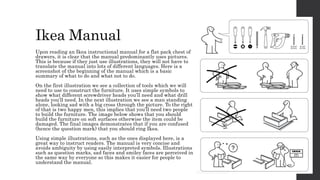
Upon reading an Ikea instructional manual for a flat pack chest of
drawers, it is clear that the manual predominantly uses pictures.
This is because if they just use illustrations, they will not have to
translate the manual into lots of different languages. Here is a
screenshot of the beginning of the manual which is a basic
summary of what to do and what not to do.
On the first illustration we see a collection of tools which we will
need to use to construct the furniture. It uses simple symbols to
show what different screwdriver heads you’ll need and what drill
heads you’ll need. In the next illustration we see a man standing
alone, looking sad with a big cross through the picture. To the right
of that is two happy men, this implies that you’ll need two people
to build the furniture. The image below shows that you should
build the furniture on soft surfaces otherwise the item could be
damaged. The final images demonstrates that if you are confused
(hence the question mark) that you should ring Ikea.
Using simple illustrations, such as the ones displayed here, is a
great way to instruct readers. The manual is very concise and
avoids ambiguity by using easily interpreted symbols. Illustrations
such as question marks, sad faces and smiley faces are perceived in
the same way by everyone so this makes it easier for people to
understand the manual.
University Prospectus
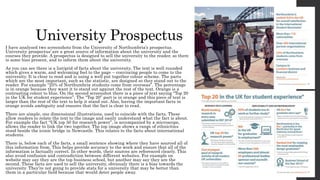
I have analysed two screenshots from the University of Northumbria’s prospectus.
University prospectus’ are a great source of information about the university and the
courses they provide. A prospectus is designed to sell the university to the reader, so there
is some bias present, and to inform them about the university.
As you can see there is a list/grid of facts about the university. The text is well rounded
which gives a warm, and welcoming feel to the page – convincing people to come to the
university. It is clear to read and is using a well put together colour scheme. The parts
which are the most important, such as the statistic, are designed so they stand out to the
reader. For example “25% of Northumbria students come from overseas”. The percentage
is in orange because they want it to stand out against the rest of the text. Orange is a
contrasting colour to blue. On the second screenshot there is a piece of text saying “Top 20
in the UK for student experience”. The “Top 20” part is in orange and this piece of text is
larger than the rest of the text to help it stand out. Also, having the important facts in
orange avoids ambiguity and ensures that the fact is clear to read.
There are simple, one dimensional illustrations, used to coincide with the facts. These
allow readers to relate the text to the image and easily understand what the fact is about.
For example the fact “UK top 50 for research power”, is accompanied by a microscope,
allows the reader to link the two together. The top image shows a range of ethnicities
stood beside the iconic bridge in Newcastle. This relates to the facts about international
students.
There is, below each of the facts, a small sentence showing where they have sourced all of
this information from. This helps provide accuracy to the work and ensure that all of the
information is factually correct. In other words, their sources are referenced clearly. This
also avoid confusion and contradiction between different websites. For example on
website may say they are the top business school, but another may say they are the
second. These facts are used to sell the university, obviously there is a bias towards the
university. They’re not going to provide stats for a university that may be better than
them in a particular field because that would deter people away.
‘How To’Article
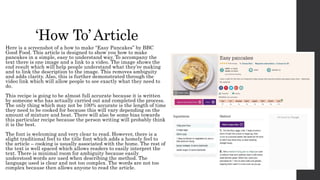
Here is a screenshot of a how to make “Easy Pancakes” by BBC
Good Food. This article is designed to show you how to make
pancakes in a simple, easy to understand way. To accompany the
text there is one image and a link to a video. The image shows the
end result which will help people understand what they’re making
and to link the description to the image. This removes ambiguity
and adds clarity. Also, this is further demonstrated through the
video link which will allow people to see exactly what they need to
do.
This recipe is going to be almost full accurate because it is written
by someone who has actually carried out and completed the process.
The only thing which may not be 100% accurate is the length of time
they need to be cooked for because this will vary depending on the
amount of mixture and heat. There will also be some bias towards
this particular recipe because the person writing will probably think
it is the best.
The font is welcoming and very clear to read. However, there is a
slight traditional feel to the title font which adds a homely feel to
the article – cooking is usually associated with the home. The rest of
the text is well spaced which allows readers to easily interpret the
text. There is minimal room for ambiguity because easily
understood words are used when describing the method. The
language used is clear and not too complex. The words are not too
complex because then allows anyone to read the article.
National Geographic Article
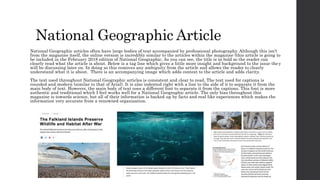
National Geographic articles often have large bodies of text accompanied by professional photography. Although this isn’t
from the magazine itself, the online version is incredibly similar to the articles within the magazine (this article is going to
be included in the February 2018 edition of National Geographic. As you can see, the title is in bold so the reader can
clearly read what the article is about. Below is a tag line which gives a little more insight and background to the issue the y
will be discussing later on. In doing so this removes any ambiguity from the article and allows the reader to clearly
understand what it is about. There is an accompanying image which adds context to the article and adds clarity.
The text used throughout National Geographic articles is consistent and clear to read. The text used for captions is
rounded and modern (similar to that of Arial). It is also indented right with a line to the side of it to separate it from the
main body of text. However, the main body of text uses a different font to separate it from the captions. This font is more
authentic and traditional which I feel works well for a National Geographic article. The only bias throughout this
magazine is towards science, but all of their information is backed up by facts and real like experiences which makes the
information very accurate from a renowned organisation.

Task 1

  • 1.
  • 2.
    Ikea Manual Upon readingan Ikea instructional manual for a flat pack chest of drawers, it is clear that the manual predominantly uses pictures. This is because if they just use illustrations, they will not have to translate the manual into lots of different languages. Here is a screenshot of the beginning of the manual which is a basic summary of what to do and what not to do. On the first illustration we see a collection of tools which we will need to use to construct the furniture. It uses simple symbols to show what different screwdriver heads you’ll need and what drill heads you’ll need. In the next illustration we see a man standing alone, looking sad with a big cross through the picture. To the right of that is two happy men, this implies that you’ll need two people to build the furniture. The image below shows that you should build the furniture on soft surfaces otherwise the item could be damaged. The final images demonstrates that if you are confused (hence the question mark) that you should ring Ikea. Using simple illustrations, such as the ones displayed here, is a great way to instruct readers. The manual is very concise and avoids ambiguity by using easily interpreted symbols. Illustrations such as question marks, sad faces and smiley faces are perceived in the same way by everyone so this makes it easier for people to understand the manual.
  • 3.
    University Prospectus I haveanalysed two screenshots from the University of Northumbria’s prospectus. University prospectus’ are a great source of information about the university and the courses they provide. A prospectus is designed to sell the university to the reader, so there is some bias present, and to inform them about the university. As you can see there is a list/grid of facts about the university. The text is well rounded which gives a warm, and welcoming feel to the page – convincing people to come to the university. It is clear to read and is using a well put together colour scheme. The parts which are the most important, such as the statistic, are designed so they stand out to the reader. For example “25% of Northumbria students come from overseas”. The percentage is in orange because they want it to stand out against the rest of the text. Orange is a contrasting colour to blue. On the second screenshot there is a piece of text saying “Top 20 in the UK for student experience”. The “Top 20” part is in orange and this piece of text is larger than the rest of the text to help it stand out. Also, having the important facts in orange avoids ambiguity and ensures that the fact is clear to read. There are simple, one dimensional illustrations, used to coincide with the facts. These allow readers to relate the text to the image and easily understand what the fact is about. For example the fact “UK top 50 for research power”, is accompanied by a microscope, allows the reader to link the two together. The top image shows a range of ethnicities stood beside the iconic bridge in Newcastle. This relates to the facts about international students. There is, below each of the facts, a small sentence showing where they have sourced all of this information from. This helps provide accuracy to the work and ensure that all of the information is factually correct. In other words, their sources are referenced clearly. This also avoid confusion and contradiction between different websites. For example on website may say they are the top business school, but another may say they are the second. These facts are used to sell the university, obviously there is a bias towards the university. They’re not going to provide stats for a university that may be better than them in a particular field because that would deter people away.
  • 4.
    ‘How To’Article Here isa screenshot of a how to make “Easy Pancakes” by BBC Good Food. This article is designed to show you how to make pancakes in a simple, easy to understand way. To accompany the text there is one image and a link to a video. The image shows the end result which will help people understand what they’re making and to link the description to the image. This removes ambiguity and adds clarity. Also, this is further demonstrated through the video link which will allow people to see exactly what they need to do. This recipe is going to be almost full accurate because it is written by someone who has actually carried out and completed the process. The only thing which may not be 100% accurate is the length of time they need to be cooked for because this will vary depending on the amount of mixture and heat. There will also be some bias towards this particular recipe because the person writing will probably think it is the best. The font is welcoming and very clear to read. However, there is a slight traditional feel to the title font which adds a homely feel to the article – cooking is usually associated with the home. The rest of the text is well spaced which allows readers to easily interpret the text. There is minimal room for ambiguity because easily understood words are used when describing the method. The language used is clear and not too complex. The words are not too complex because then allows anyone to read the article.
  • 5.
    National Geographic Article NationalGeographic articles often have large bodies of text accompanied by professional photography. Although this isn’t from the magazine itself, the online version is incredibly similar to the articles within the magazine (this article is going to be included in the February 2018 edition of National Geographic. As you can see, the title is in bold so the reader can clearly read what the article is about. Below is a tag line which gives a little more insight and background to the issue the y will be discussing later on. In doing so this removes any ambiguity from the article and allows the reader to clearly understand what it is about. There is an accompanying image which adds context to the article and adds clarity. The text used throughout National Geographic articles is consistent and clear to read. The text used for captions is rounded and modern (similar to that of Arial). It is also indented right with a line to the side of it to separate it from the main body of text. However, the main body of text uses a different font to separate it from the captions. This font is more authentic and traditional which I feel works well for a National Geographic article. The only bias throughout this magazine is towards science, but all of their information is backed up by facts and real like experiences which makes the information very accurate from a renowned organisation.