TARO YAMANE’S FORMULA
APRIL NADINE A. YULO
LET US PRAY...
Objectives:
BRIEF OVERVIEW:
 Taro Yamane, the creator of the Yamane
formula, was a Japanese statistician who
made significant contributions to the field
of social science research methodology.
Yamane devised a formula for estimating
or determining sample size in respect to
the population under study, allowing
inferences and conclusions drawn from the
survey to be applied to the complete
population from which the sample was
drawn.
CONTEXT AND BACKGROUND
 The Yamane formula, also known as
Yamane’s sampling formula, was
introduced by Taro Yamane in his book
titled “Statistics: An Introductory Analysis”
published in 1967. Taro Yamane was a
Japanese statistician and economist.
 The formula is a method for determining
the sample size required for a survey to
achieve a desired level of precision when
estimating population parameters.
 The formula gained popularity due to its
simplicity and practicality, making it accessible
to researchers and surveyors. It is often used in
situations where researchers have limited
resources or time and need to collect data from
a subset of a larger population to make
inferences about that population.
 The formula had been widely cited and applied
in various fields of research, particularly in
social sciences and business research, where
survey sampling is a common method for data
collection.
 It provides a straightforward way to calculate
an appropriate sample size to ensure that
survey results are reliable and representative of
the entire population.
 Yamane’s formula remains a useful tool for
researchers, especially for initial sample size
estimations in survey designs.
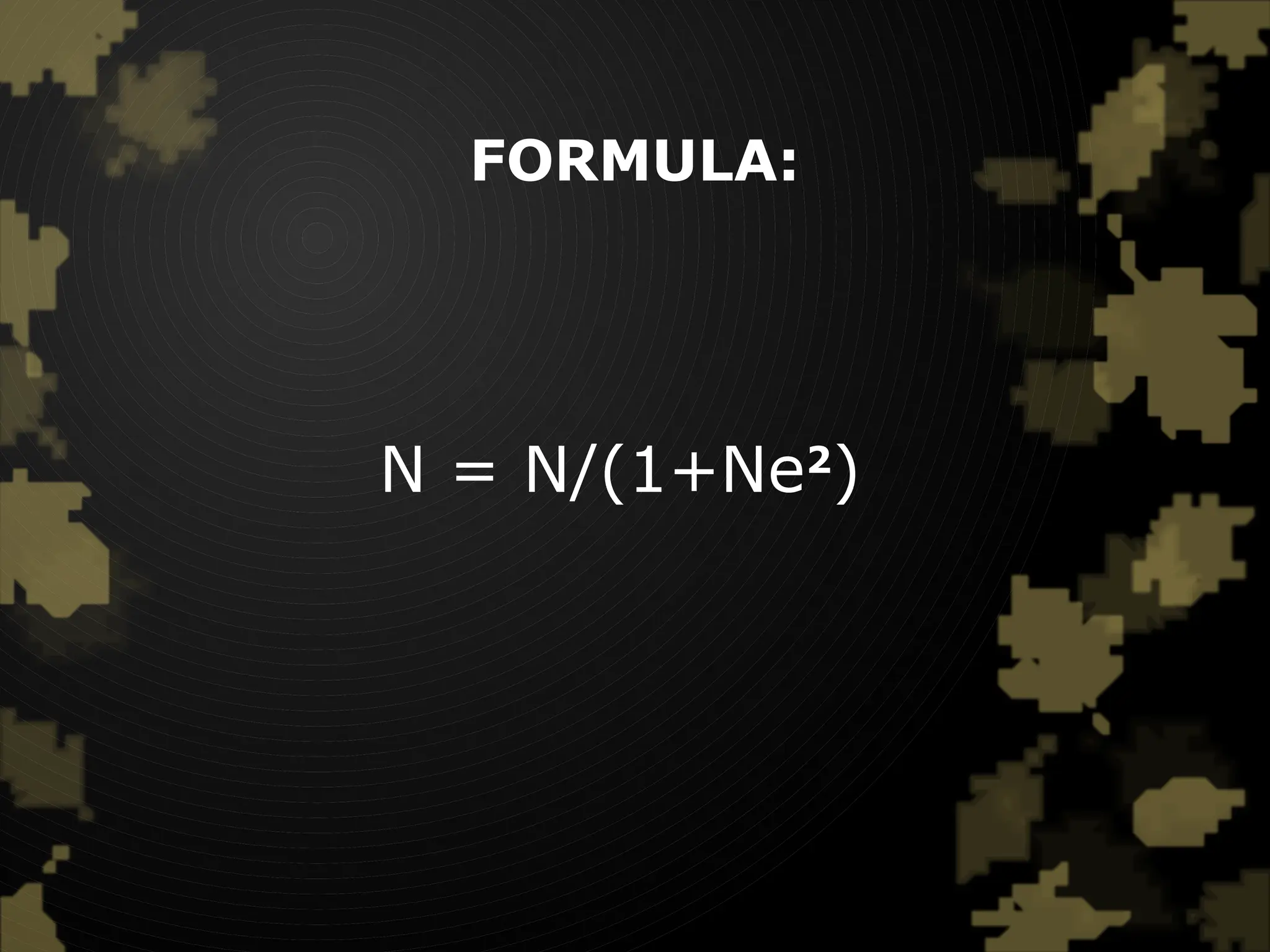
FORMULA:
N = N/(1+Ne2
)
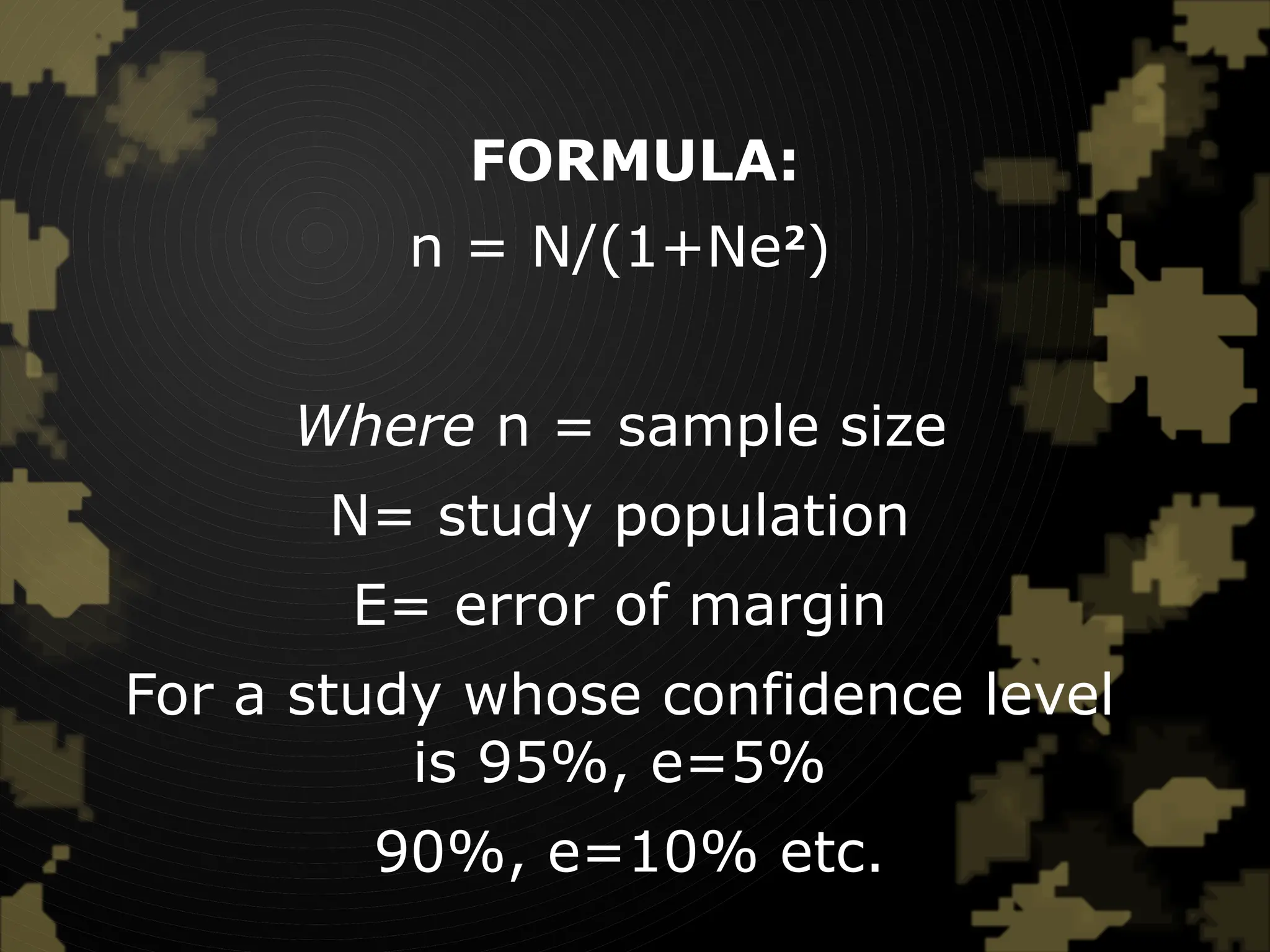
FORMULA:
n = N/(1+Ne2
)
Where n = sample size
N= study population
E= error of margin
For a study whose confidence level
is 95%, e=5%
90%, e=10% etc.
EXAMPLE:
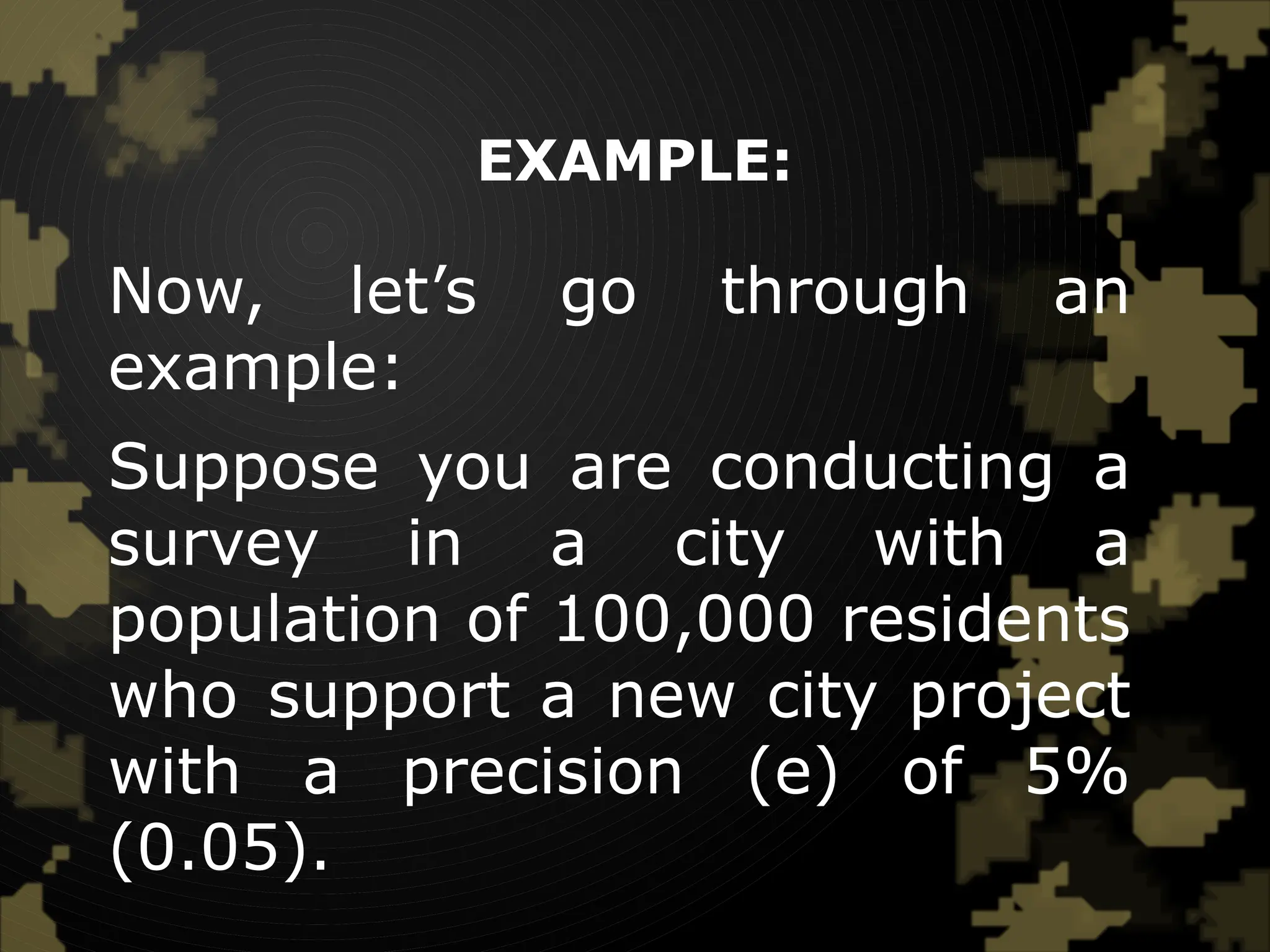
Now, let’s go through an
example:
Suppose you are conducting a
survey in a city with a
population of 100,000 residents
who support a new city project
with a precision (e) of 5%
(0.05).
EXAMPLE:
Now, let’s go through an example:
Suppose we want to evaluate a
program where 1,000 medical
doctors were encouraged to adopt
a new practice; i.e if Confidence
level is 95% and margin of error
+/-5%
COMPUTATION:
n= N/(1+Ne2
)
n=1,000/1+1,000*0.052
n=1,000/2.5
n=400
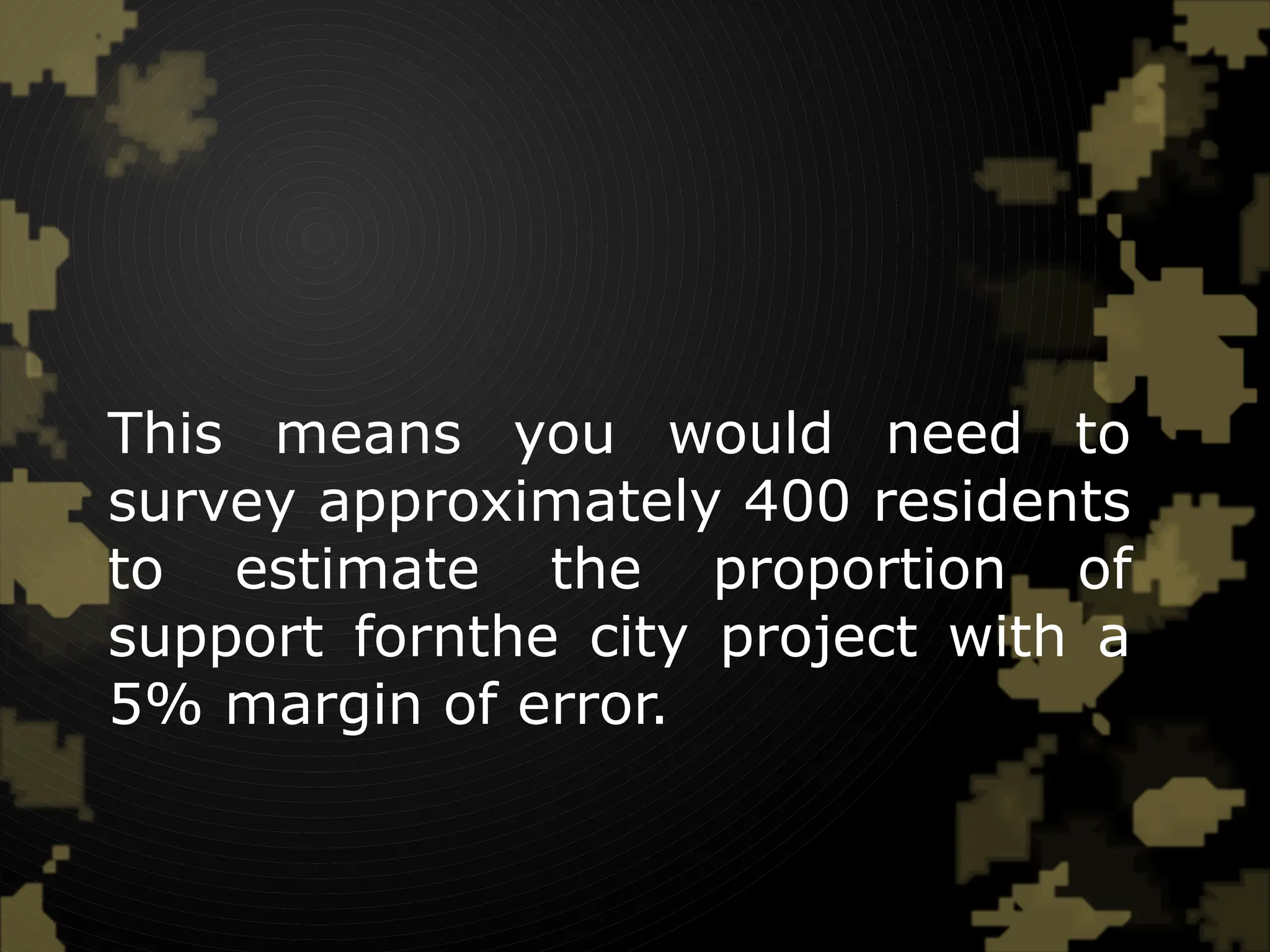
This means you would need to
survey approximately 400 residents
to estimate the proportion of
support fornthe city project with a
5% margin of error.
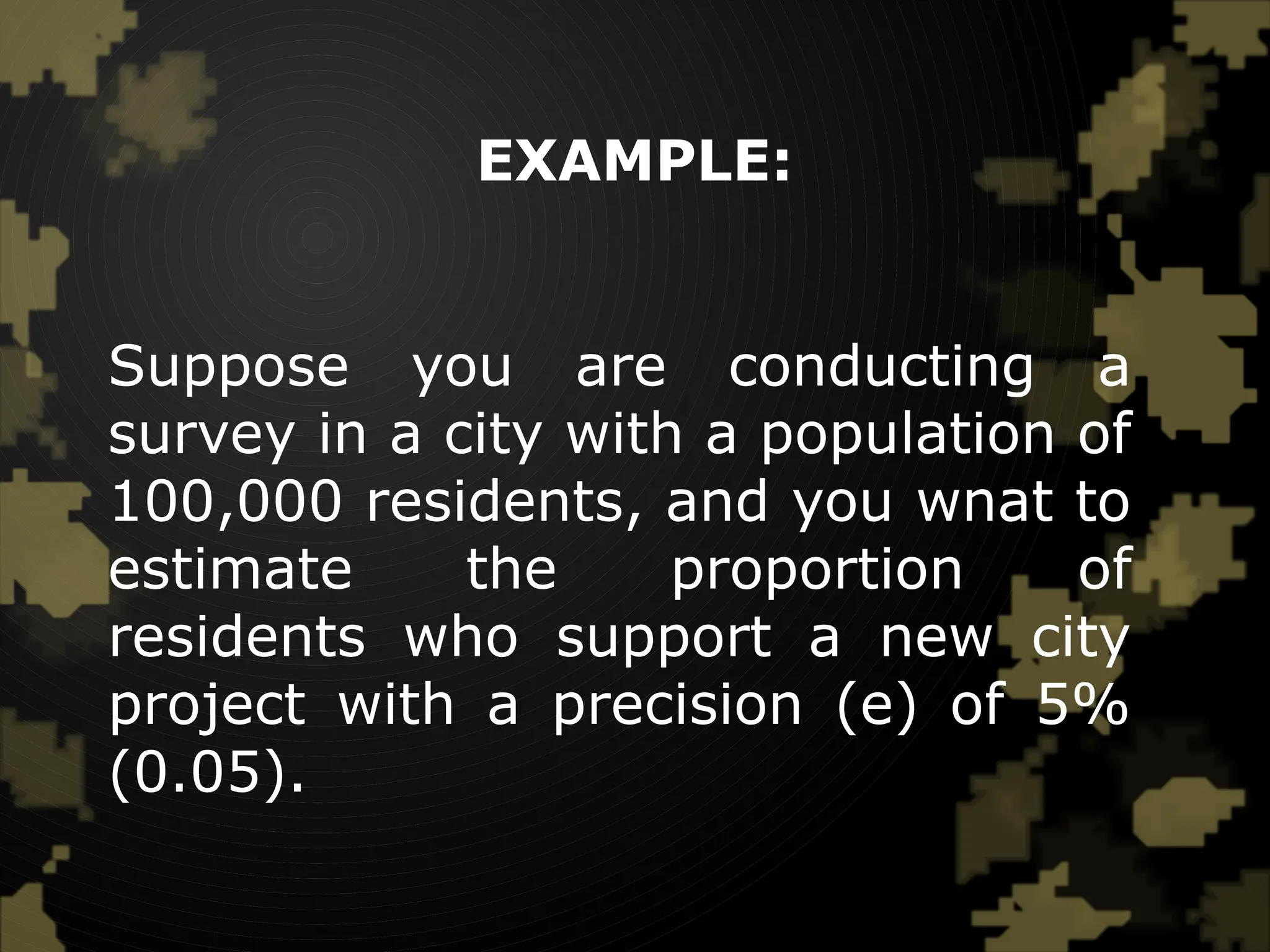
EXAMPLE:
Suppose you are conducting a
survey in a city with a population of
100,000 residents, and you wnat to
estimate the proportion of
residents who support a new city
project with a precision (e) of 5%
(0.05).
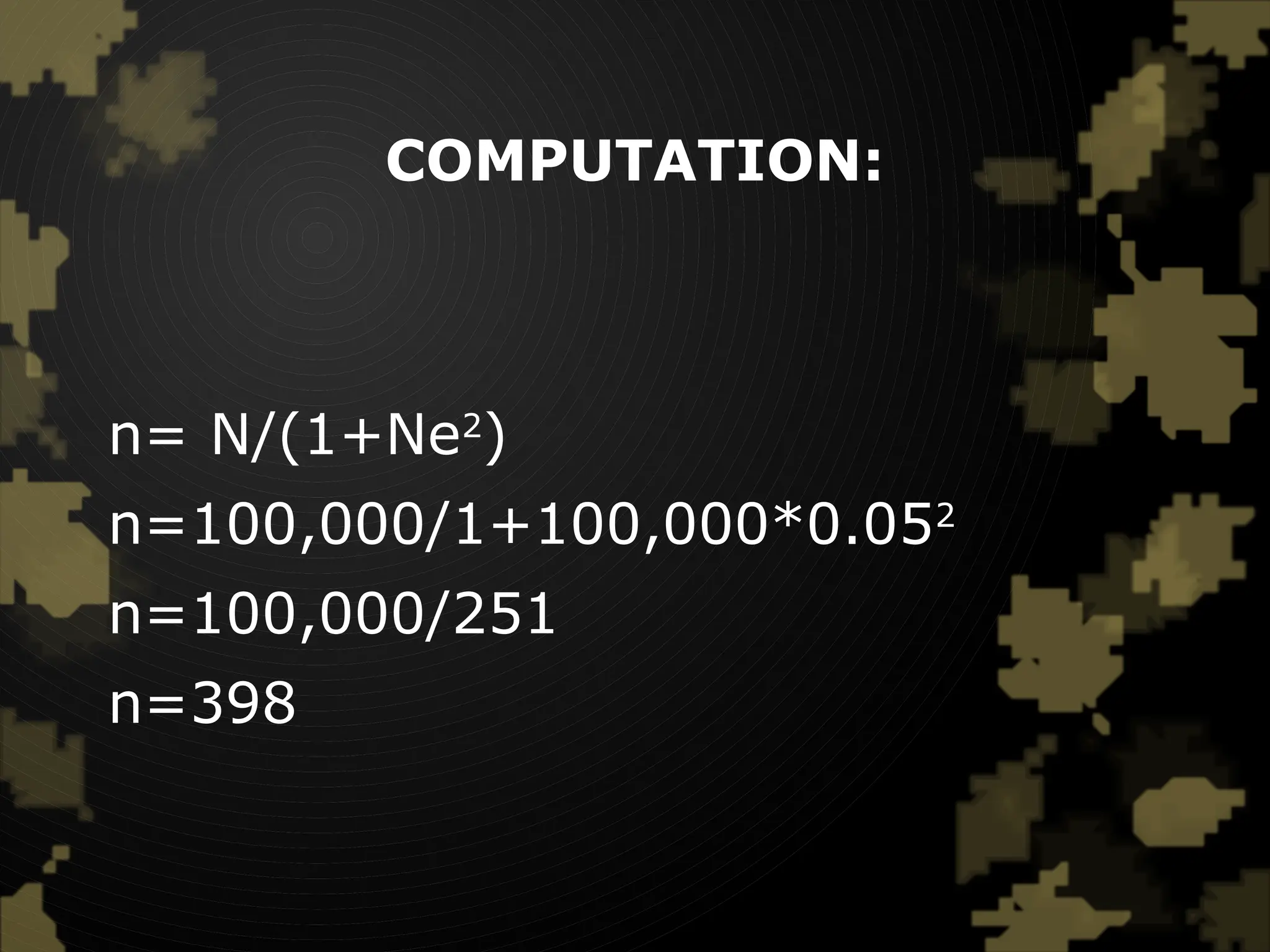
COMPUTATION:
n= N/(1+Ne2
)
n=100,000/1+100,000*0.052
n=100,000/251
n=398
This means you would need to
survey approximately 398 residents
to estimate the proportion of
support fornthe city project with a
5% margin of error.

TARO YAMANE’S FORMULA in Statistics Report.pptx

  • 1.
  • 2.
  • 3.
  • 4.
    BRIEF OVERVIEW:  TaroYamane, the creator of the Yamane formula, was a Japanese statistician who made significant contributions to the field of social science research methodology. Yamane devised a formula for estimating or determining sample size in respect to the population under study, allowing inferences and conclusions drawn from the survey to be applied to the complete population from which the sample was drawn.
  • 5.
    CONTEXT AND BACKGROUND The Yamane formula, also known as Yamane’s sampling formula, was introduced by Taro Yamane in his book titled “Statistics: An Introductory Analysis” published in 1967. Taro Yamane was a Japanese statistician and economist.
  • 6.
     The formulais a method for determining the sample size required for a survey to achieve a desired level of precision when estimating population parameters.
  • 7.
     The formulagained popularity due to its simplicity and practicality, making it accessible to researchers and surveyors. It is often used in situations where researchers have limited resources or time and need to collect data from a subset of a larger population to make inferences about that population.
  • 8.
     The formulahad been widely cited and applied in various fields of research, particularly in social sciences and business research, where survey sampling is a common method for data collection.
  • 9.
     It providesa straightforward way to calculate an appropriate sample size to ensure that survey results are reliable and representative of the entire population.
  • 10.
     Yamane’s formularemains a useful tool for researchers, especially for initial sample size estimations in survey designs.
  • 11.
  • 12.
    FORMULA: n = N/(1+Ne2 ) Wheren = sample size N= study population E= error of margin For a study whose confidence level is 95%, e=5% 90%, e=10% etc.
  • 13.
    EXAMPLE: Now, let’s gothrough an example: Suppose you are conducting a survey in a city with a population of 100,000 residents who support a new city project with a precision (e) of 5% (0.05).
  • 14.
    EXAMPLE: Now, let’s gothrough an example: Suppose we want to evaluate a program where 1,000 medical doctors were encouraged to adopt a new practice; i.e if Confidence level is 95% and margin of error +/-5%
  • 15.
  • 16.
    This means youwould need to survey approximately 400 residents to estimate the proportion of support fornthe city project with a 5% margin of error.
  • 17.
    EXAMPLE: Suppose you areconducting a survey in a city with a population of 100,000 residents, and you wnat to estimate the proportion of residents who support a new city project with a precision (e) of 5% (0.05).
  • 18.
  • 19.
    This means youwould need to survey approximately 398 residents to estimate the proportion of support fornthe city project with a 5% margin of error.