BASICS FOR GEOTECHNICAL
ENGINEERING EXPLORATIONS
CONSIDERING NEEDED LEGAL
        CHANGES


        OLAVI TAMMEMÄE


           Tallinn 2008
THESIS ON POWER ENGINEERING,
ELECTRICAL POWER ENGINEERING, MINING ENGINEERING D32


BASICS FOR GEOTECHNICAL
ENGINEERING EXPLORATIONS
CONSIDERING NEEDED LEGAL
                 CHANGES


                 OLAVI TAMMEMÄE


                         2
TALLINN UNIVERSITY OF TECHNOLOGY
                             Faculty of Power Engineering
                                Department of Mining

Dissertation was accepted for the defence of the degree of Doctor of Philosophy
in Engineering on September 26, 2008
Supervisor:    Professor     Emeritus     Enno       Reinsalu,   Department   of    Mining,
               Tallinn University of Technology
Opponents:     Academician Anto Raukas, Estonian Academy of Sciences
               Professor Kastytis Dundulis, Department of Hydrogeology and Engineering
               Geology, Vilnius University

Defence of the thesis: November 20, 2008 at Tallinn University of Technology,
Ehitajate tee 5, Tallinn, Estonia


Declaration:
Hereby I declare that this doctoral thesis, my original investigation and achievement,
submitted for the doctoral degree at Tallinn University of Technology has not been submitted
for any academic degree or examination.


Olavi Tammemäe


Copyright: Olavi Tammemäe, 2008
ISSN 1406-474X
ISBN 978-9985-59-855-9


                                                 3
ENERGEETIKA. ELEKTROONIKA. MÄENDUS D32


   INSENERGEOLOOGILISTE
UURINGUTE ALUSED ARVESTADES
   VAJALIKKE MUUDATUSI
   VALDKONDA KÄSITLEVAS
          ÕIGUSRUUMIS


                Olavi Tammemäe


                      4
CONTENTS
List of publications ..................................................................................................................... 6
1. Background ........................................................................................................................ 7
2. Introduction ........................................................................................................................ 8
3. Geotechnical Engineering Explorations in the Planning process....................................... 9
4. Geotechnical Engineering Explorations for Constructions .............................................. 14
5. Radon level surveys ......................................................................................................... 17
6. Risk Management in Environmental Geotechnical Engineering Modeling..................... 18
  6.1.    Risk management process ........................................................................................ 18
  6.2.    Risk assessment ........................................................................................................ 19
  6.3.    Risk management ..................................................................................................... 21
  6.4.    Risk Management Principles upon drafting an Environmental Geotechnical
  Engineering Model ............................................................................................................... 22
7. Principles of the Concept of Environmental Geotechnical Engineering Model based on
mutual effect of the processes .................................................................................................. 23
8. Geotechnical inspection and surveillance ........................................................................ 26
9. The utilisation of previous research data.......................................................................... 27
10. Proposed legal changes .................................................................................................... 28
  10.1.      Proposals for the amendments in current legal acts ............................................. 28
  10.2.      Terminology ......................................................................................................... 34
  10.3.      Compliance with European Union legislation ..................................................... 34
  10.4.      The expenses related with implementation of the Act and income gained from
  implementation of the Act .................................................................................................... 35
  10.5.      Lower level legal documents (Implementing provisions) .................................... 35
11. Conclusions ...................................................................................................................... 36
Acknowledgements .................................................................................................................. 37
REFERENCES ......................................................................................................................... 38
ABSTRACT ............................................................................................................................. 40
KOKKUVÕTE ......................................................................................................................... 41
CURRICULUM VITAE .......................................................................................................... 42
APPENDIXES ......................................................................................................................... 44
APPENDIX 1. The drafts of the legal acts............................................................................... 44
  APPENDIX 1.1 The draft amendments to the Earth’s Crust Act, the Environmental
  Register Act, the Building Act and the Planning Act .......................................................... 44
  Appendix 1.2 the draft of Government and Minister’s Regulation: « An Order of
  Engineering Geological Investigations » ............................................................................. 52
APPENDIX 2. Practical examples of sustainable geotechnical engineering explorations and
sustainable designing of foundation. ........................................................................................ 66


                                                                     5
LIST OF PUBLICATIONS

The doctoral thesis consists of a summary and the following papers:

PAPER 1. Tammemäe O., Torn H. 2006. Sustainable environmental geotechnics in the
service of development on the example of North-East Estonia - Sillamäe. Oil Shale. Vol. 23,
No. 2, pp. 177–186.

PAPER 2. Tammemäe O., Torn H. 2008 Risk management in environmental geotechnical
modeling. Geologija. 1(61), pp. 44-48

PAPER 3 Tammemäe O. 2008. Basics for Geotechnical Engineering Explorations considering
needed legal changes. Vol. 25, No.2 Special, pp. 189-196.

Paper 1 and 3 are reprinted by permission from the journal Oil Shale.

Paper 2 is reprinted by permission from the journal Geologija.


                                              6
1. BACKGROUND

Nowadays the legal system of Estonia does not cover essential aspects related to geotechnical
engineering explorations for assessing environmental risks to be considered during planning
processes and to provide designers with reliable geotechnical parameters for sustainable
construction solutions. The absence of appropriate legal regulation does not support
sustainable usage of land and sustainable use of mineral recourses. This thesis deals with an
analysis of legal requirements for geotechnical engineering explorations in planning and
building sectors with concrete suggestions for changes in legal regulations. Radon level
survey and geotechnical inspection related issues have been analysed in the framework of risk
assessment.

In this thesis, I provide an overview of the basis of risk analysis, assessment and management,
accompanying problems and principles of risk management when drafting an environmental
geotechnical engineering model enabling the analysis of an entire territory or developed
region as a whole. The environmental impact will remain within the limits of the criteria
specified with standards acceptable for human health and the environment. An essential part
of the solution of the problem is the engineering geotechnical model based on risk analysis
and the assessment and forecast of mutual effects of the processes.

The utilisation of previous research data and reestablishment of Geotechnical Fund will
enable a much more economical use of the available resources and a more cost effective
management of possible risks.

As a practical example of sustainable geotechnical engineering explorations and sustainable
building of foundation in South Estonian moraine soils, using the materials from my master
thesis “Wedge shape piles in South Estonian moraine soils”, I describe in this thesis ways of
estimating the bearing capacity of wedge shape piles and give recommendations to the
designers for drafting wedge shape pile foundations (Tammemäe 2003; appendix 2).


                                              7
2. INTRODUCTION

All types of planned (or unplanned) changes to the natural or man-made environment are
accompanied by a certain impact, the scope of which depends upon the vulnerability of the
affected environment and the current load on it, as well as on the characteristics of other
changes. The same goes for activities which change soil stress conditions.

In order to estimate and, if possible, prevent/minimise the environmental impact
accompanying human activities, we must be able to predict them in advance.

The Building Act (RT I 2002, 47, 297), above all section 20, deals with geotechnical site
investigations. According to section 1, the objective of the geotechnical and geodetic survey
(hereinafter referred to by a single definition – site investigations) is to obtain the necessary
primary data for site planning, designing of construction projects and construction.

Site planning is prescribed in the Planning Act (RT I 2004, 22, 148).

Risks accompany all human activities, and risk management is nowadays widely used in
financial activities, agriculture, industry, logistics and other branches of economy.

The results of not accounting the risks are increased responsibility for the administrator of the
territory with accompanying insurance payments, unforeseeable pollution charges and often
also damage caused by accidents or unpredictable events. In order to manage risk or any other
process, it should be first identified, formulated, then assessed, and a solution should be found
for risk mitigation. The objective of risk management is control of risks.

An appropriate legal environment should guarantee the preconditions for sustainable use of
resources not only during site investigation period but also during planning and construction
designing process, and consequently during building process as well (appendix1).


                                                8
3. GEOTECHNICAL ENGINEERING EXPLORATIONS IN THE
    PLANNING PROCESS

The requirement for the performance of geotechnical engineering studies for preparation of
plans is totally absent at the moment from the Planning Act (RT I 2004, 22, 148). This may
lead to construction and infrastructure planning on unsuitable plots (Tammemäe 2008).

Pursuant to the Planning Act (RT I 2004, 22, 148), plans fall into four categories: national
spatial plans, county plans, general plans and detailed plans.

The objective of national spatial planning is generalised strategic treatment of the
development of state territory and human settlements, in the course of which there is created,
above all, a spatial basis for the regional development of the state, which means that in the
case of that planning phase the location of constructions is not designated.

The objective of county planning is the generalised treatment of the development of county
territories, the terms for the development of settlements and the designation of locations for
critical infrastructure objects. Regarding this planning, spatial construction is planned more
specifically, among other things general terms of use of land and water are designated;
corridors for roads, railroads, waterways and technical networks, the locations of airports,
harbours and waste storage sites and other technical constructions are designated as well.

The objective of general planning is the designation of policies and conditions for the
development of the territories of local municipalities, cities and the preparation of basis with
the obligation of detailed planning for sites outside cities and rural settlements. At the same
time, during the general planning stage, possible dangers and risks occurring afterwards
during the course of construction and development activity are to be evaluated. Pursuant to
risk assessment, limits or conditions can be assigned to construction sites. Risk analysis
establishes the consequences and effects, and the extent to which the process is manageable.

The objective of risk analysis is to provide an answer to the question of whether the given
environmental risk is acceptable. This can be evaluated using criteria and norms authorised by
legislation, the levels of risk accepted by the public, and limit values established in specific
conditions. A critical part of risk assessment is the observation network and monitoring of


                                                9
processes which, in addition to control of the situation, allow necessary corrections to be
made.

Risk factors are ranked in the course of risk management according to priorities. Methods
have been developed for their removal or mitigation. In order to do so, the necessary resource
for the management of risks must be mapped and designated, on the level at which the
management (agency, city or government level) of one or another risk takes place. In the
absence of resources, the management of risks is not possible.

The objective of detailed plans is the establishment of land use and construction conditions in
cities, rural settlements and other sites and any other cases which require detailed plans.

As for the total land use strategy, it is prescribed in territorial planning – at estimation of
construction or building sites that the accompanying changes in the basement on existing soil
stress conditions and also the frequency of surface water and groundwater regime should be
considered. The availability of sufficient detailed data regarding the geotechnical engineering
of the observable sites, as well as environmental conditions (flooding or the danger of
landslides, etc.) and man-made conditions (for example, mined areas), enables the rational
planning of construction work (including selection of infrastructure trace lines). It is also
needed for the economy and environment, to prevent waste of (natural) resources and to
reduce the maximum risk to peoples’ health and their property.

Unfortunately during the last couple decades not enough attention has been paid to
investigation of earth crust’s bearing capacity in mined areas. There are also problems with
planning buildings and infrastructures on mineral deposits investigated already. Mineral
deposits may be already depleted, are still in the mining phase, or just perspective ones.

The necessary representative limit (including density and depth of investigation net) of the
geological engineering data required for making of planning decisions depends, above all, on
the complexity of geotechnical structure of the planned territories, the occurrence of
geotechnical processes increasing risk (above all the danger of landslides, changes of the
water regime, karst phenomenon, and the emanation of radon) and phenomena resulting from
human activities – for example, possible extensive pollution of soil and groundwater, and the
presence of cultural layer or mined areas (Tammemäe 2008).


                                               10
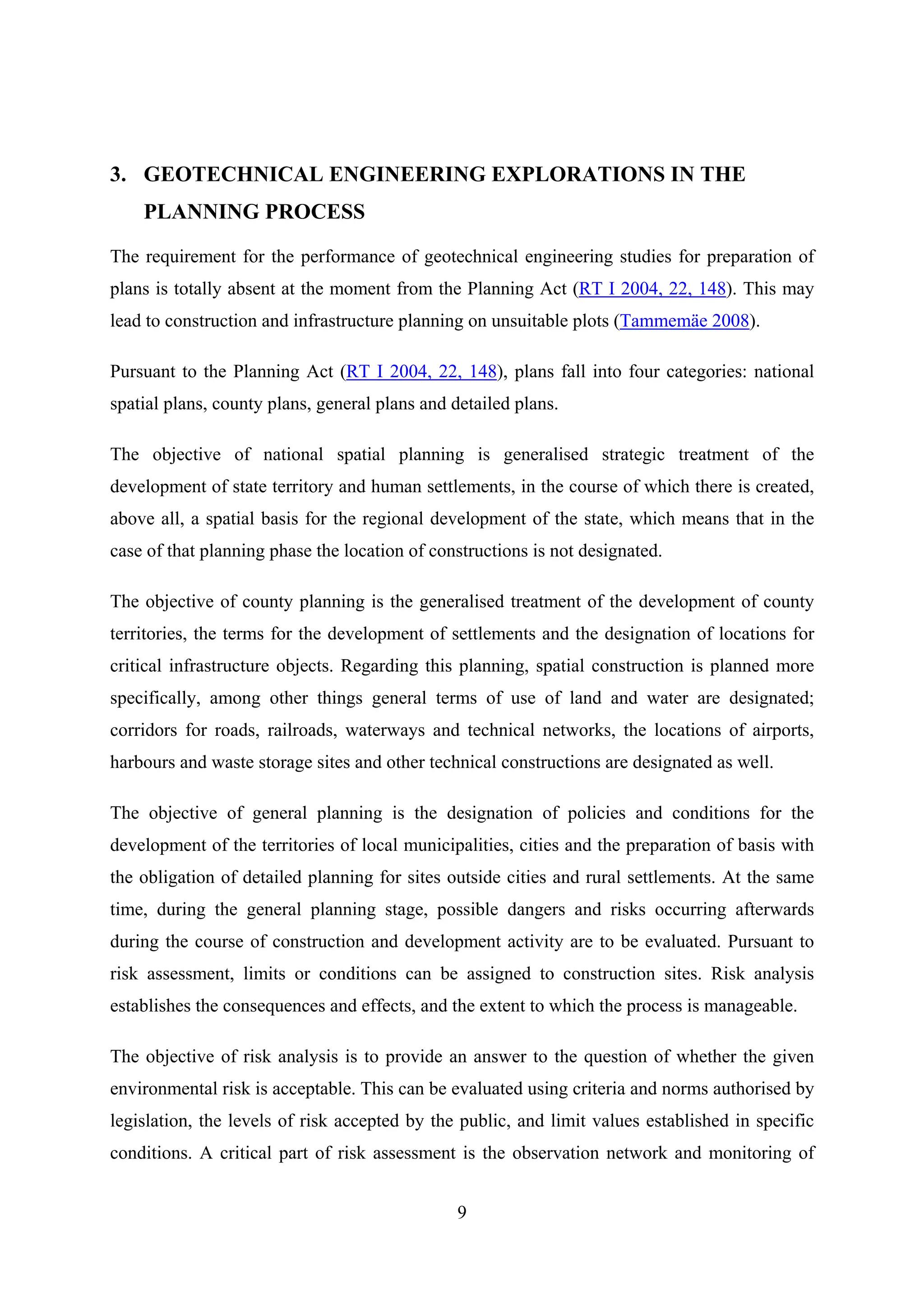
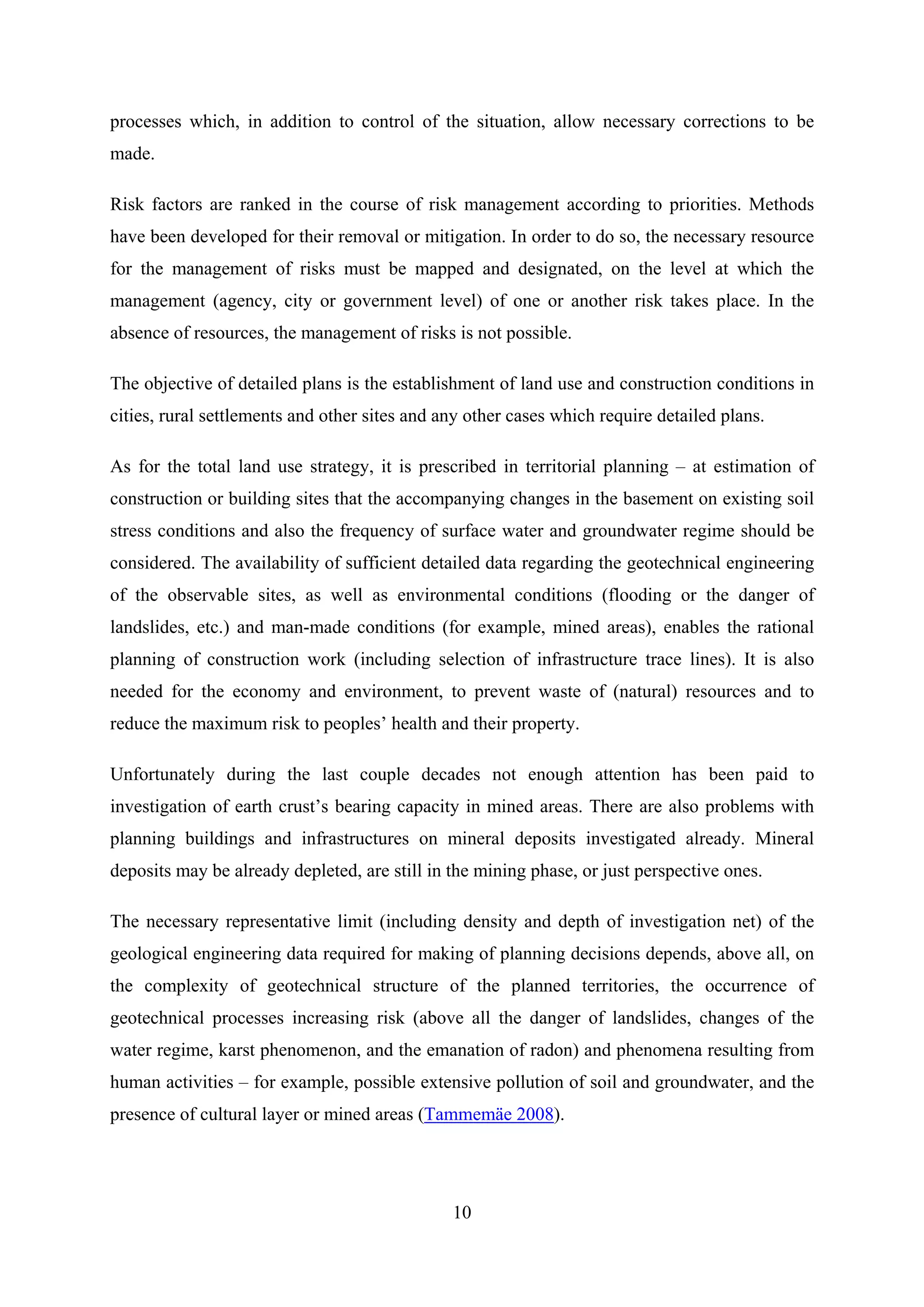
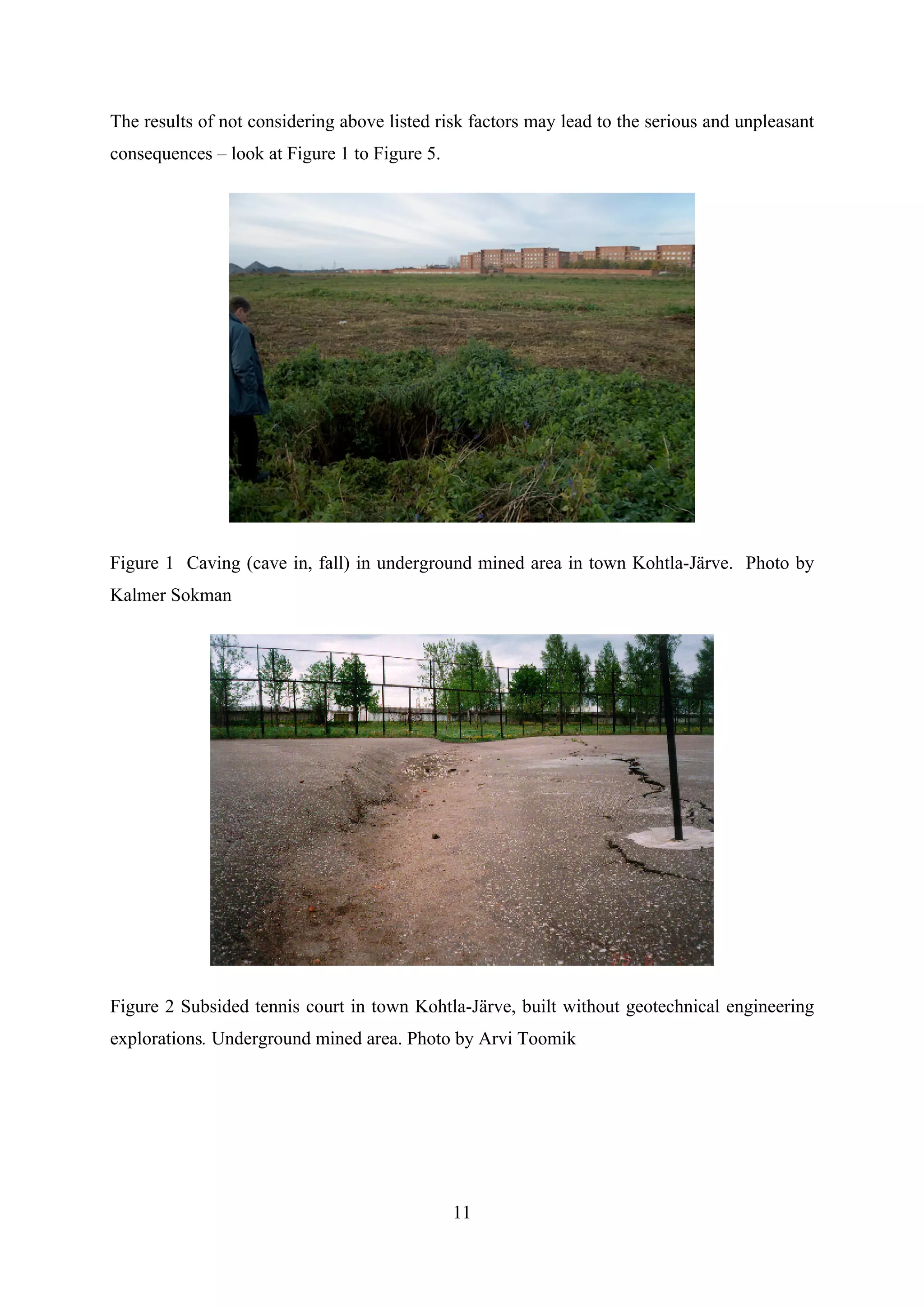
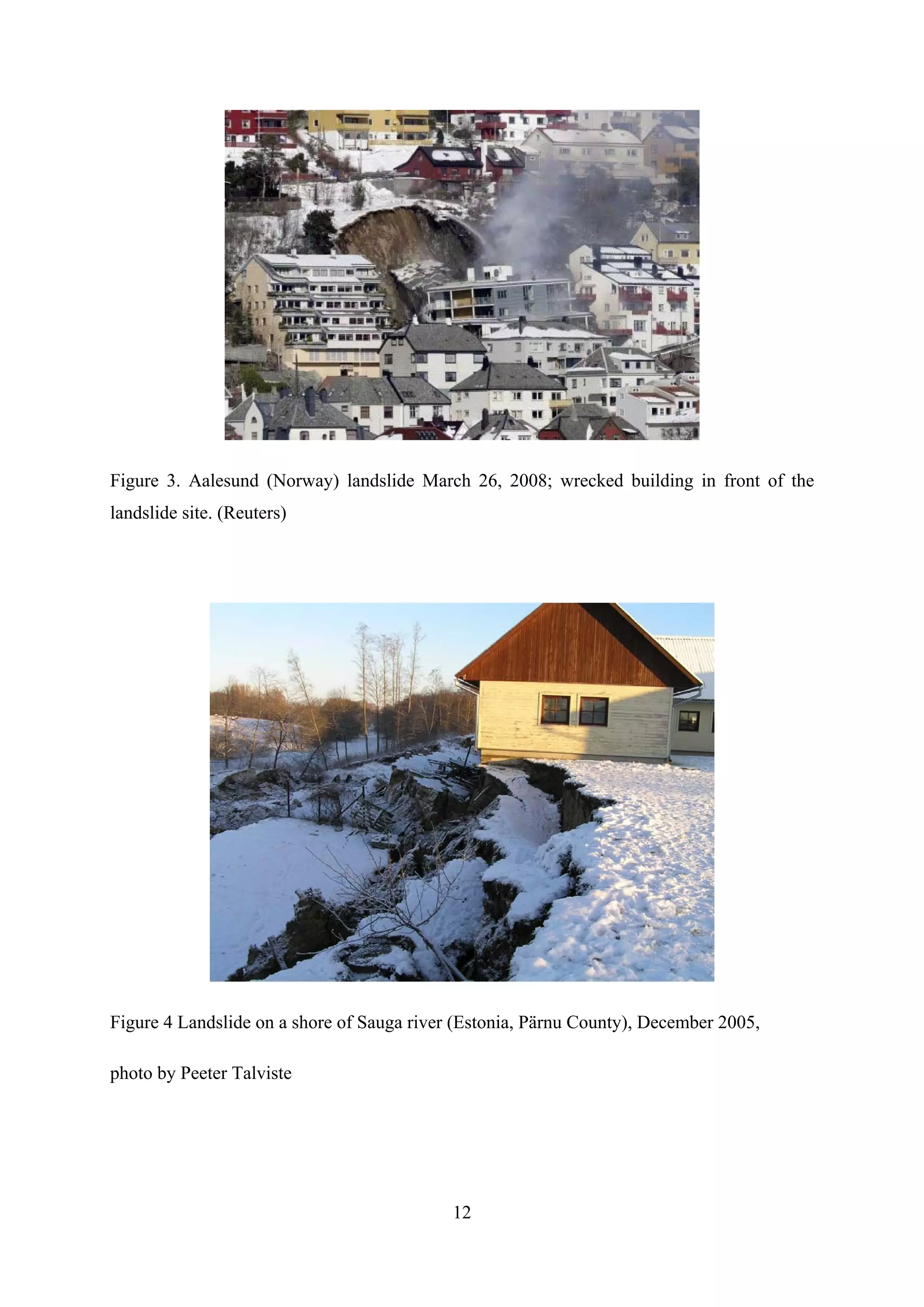
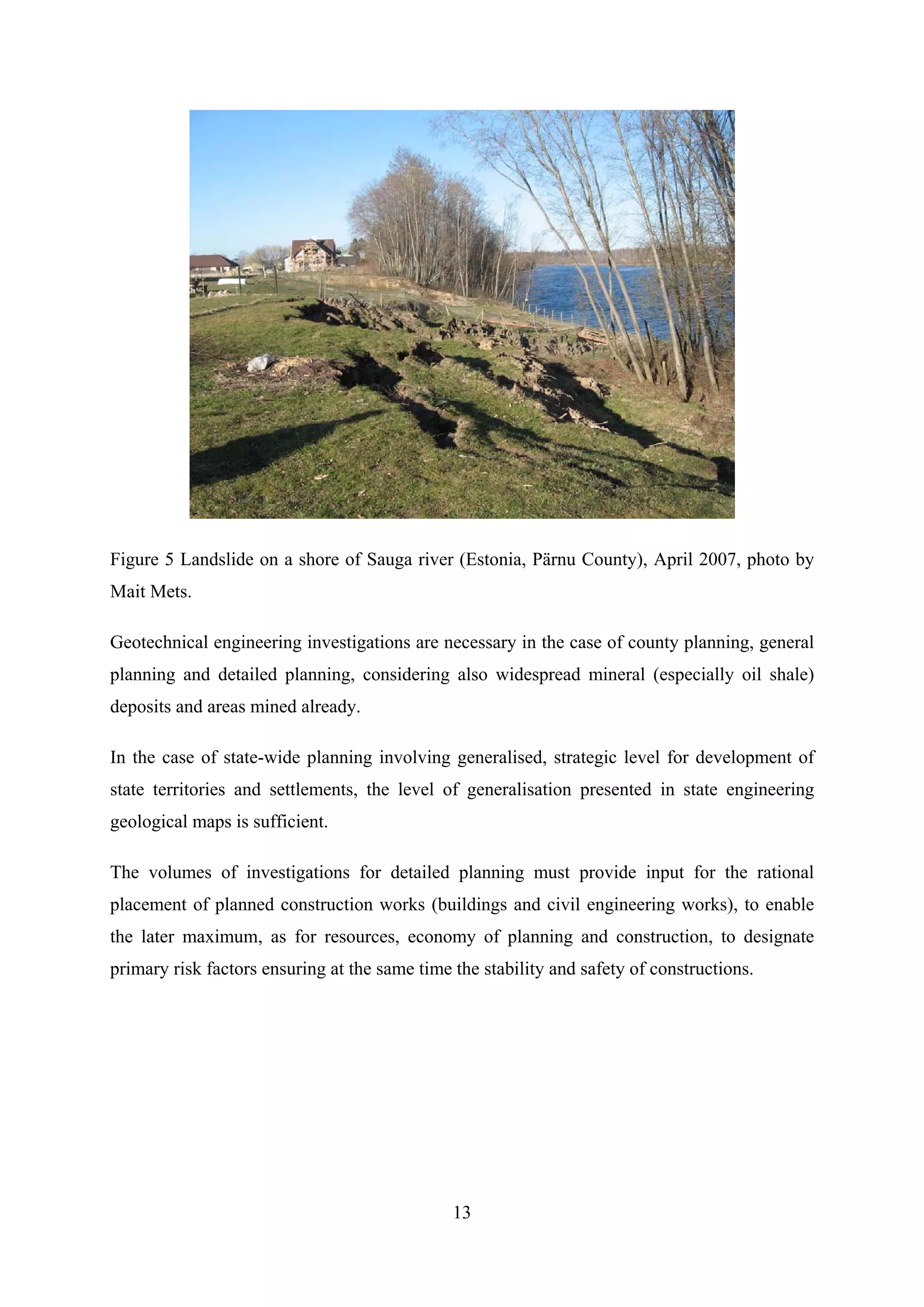
The results of not considering above listed risk factors may lead to the serious and unpleasant
consequences – look at Figure 1 to Figure 5.


Figure 1 Caving (cave in, fall) in underground mined area in town Kohtla-Järve. Photo by
Kalmer Sokman


Figure 2 Subsided tennis court in town Kohtla-Järve, built without geotechnical engineering
explorations. Underground mined area. Photo by Arvi Toomik


                                               11
Figure 3. Aalesund (Norway) landslide March 26, 2008; wrecked building in front of the
landslide site. (Reuters)


Figure 4 Landslide on a shore of Sauga river (Estonia, Pärnu County), December 2005,

photo by Peeter Talviste


                                            12
Figure 5 Landslide on a shore of Sauga river (Estonia, Pärnu County), April 2007, photo by
Mait Mets.

Geotechnical engineering investigations are necessary in the case of county planning, general
planning and detailed planning, considering also widespread mineral (especially oil shale)
deposits and areas mined already.

In the case of state-wide planning involving generalised, strategic level for development of
state territories and settlements, the level of generalisation presented in state engineering
geological maps is sufficient.

The volumes of investigations for detailed planning must provide input for the rational
placement of planned construction works (buildings and civil engineering works), to enable
the later maximum, as for resources, economy of planning and construction, to designate
primary risk factors ensuring at the same time the stability and safety of constructions.


                                               13
4. GEOTECHNICAL ENGINEERING EXPLORATIONS FOR
    CONSTRUCTIONS

Prerequisites for optimal foundation and construction solutions are the availability of primary
data of high quality for design work. Geotechnical engineering data describing the area to be
occupied by construction works are of great importance. Under the current conditions of an
ever increasing deficiency in natural construction materials, it is especially important to find
as many opportunities for the most economic use of natural resources as possible.

According to Building Act section 3(4) (RT I 2002, 47, 297), the structure must not pose a
danger to the lives of its users or other persons, their health, property or the environment.
According to the Chemicals Act (RT I 2002, 47, 297), emanation of dangerous chemicals
from the structure must be prevented. In addition, emanation of noise and radiation harmful to
people, poisoning or pollution of the soil and water, emanation of waste water, smoke, and
poor disposal of solid or liquid residues from the construction works must be prevented.
Humidity may not accumulate in the parts or surfaces of the structure in such a manner that it
poses a threat to the lives, health, or property of the people. The Building Act does not
prescribe a sufficient amount of mechanisms or necessary regulations in order to satisfy such
a requirement.

It is possible to revoke a building permit if the structure being built is hazardous to the lives of
people, their health, property, or to the environment.

Pursuant to section 40, the owner of such a structure must bring the structure into compliance
with the corresponding requirements presented for the building or destroy it by the date
designated in the precept, and according to the method and conditions therein. The described
provision in itself should ensure that the structures not complying with standards are not built.

At the same time, the provision is too general in its contents to allow it to be successfully
implemented in practice.

The regulation in the Building Act (RT I 2002, 47, 297) regarding geotechnical engineering
surveys is unclear. The regulation given in the Building Act does not uniformly designate
whether the performance of site investigations is required before the preparation/construction
work of the building design documentation or not. Also, contents of the term of validity of
                                          14
geotechnical engineering survey works performed is not prescribed – whether works prepared
several years ago can serve as the basis for the construction of specific structures. The
regulation does not foresee the procedure of return and repair of the survey works in the case
of their non-compliance with the performance of laws. Thus, the Building Act regulation
requires supplementation in terms of its conditions, for which the performance of a site
investigation is mandatory and in which designing stage it is to be conducted (Tammemäe
2008).

The procedure for the performance of site investigations lacks specific requirements for the
performance of investigations and the minimum volume of investigation required.

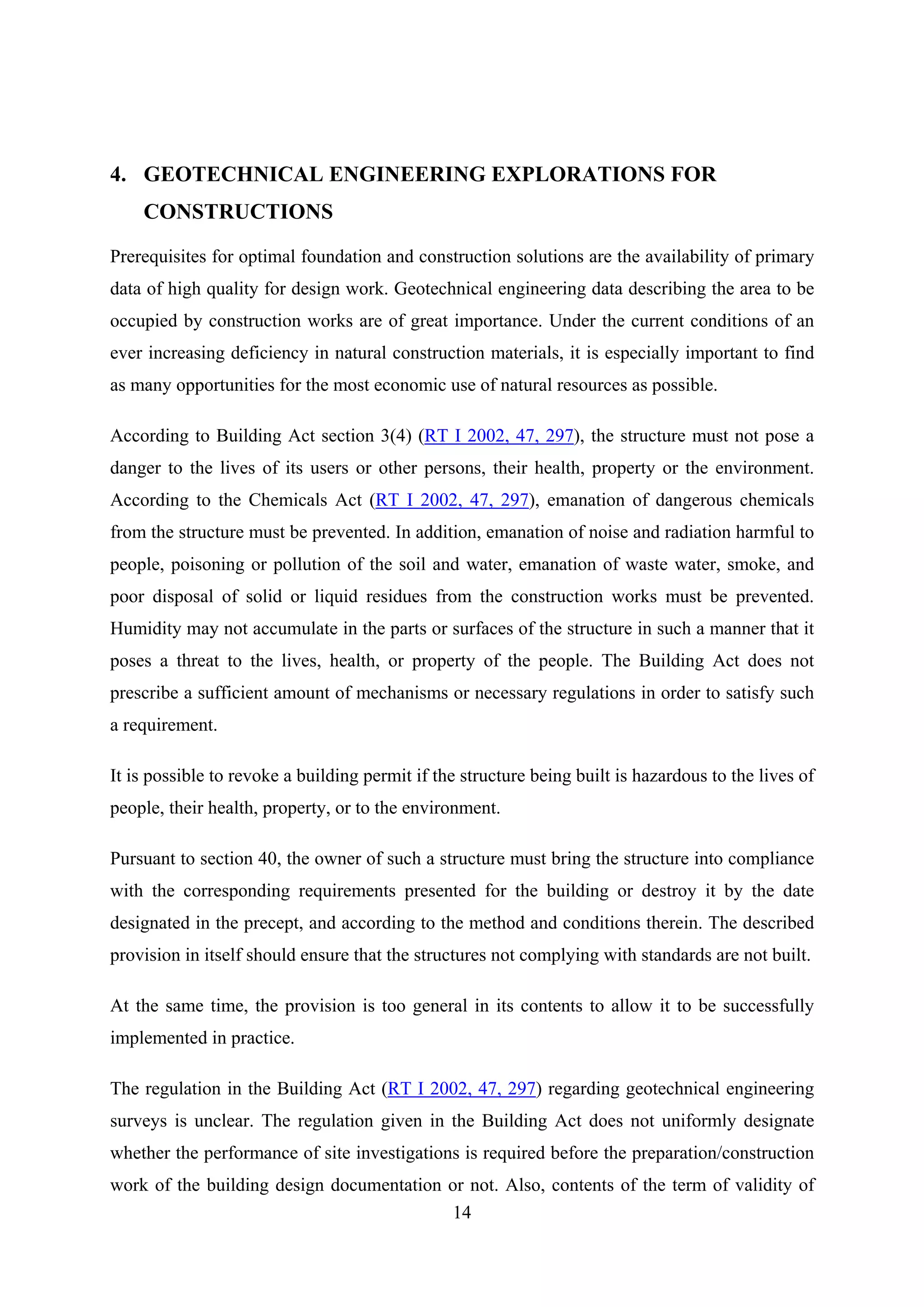
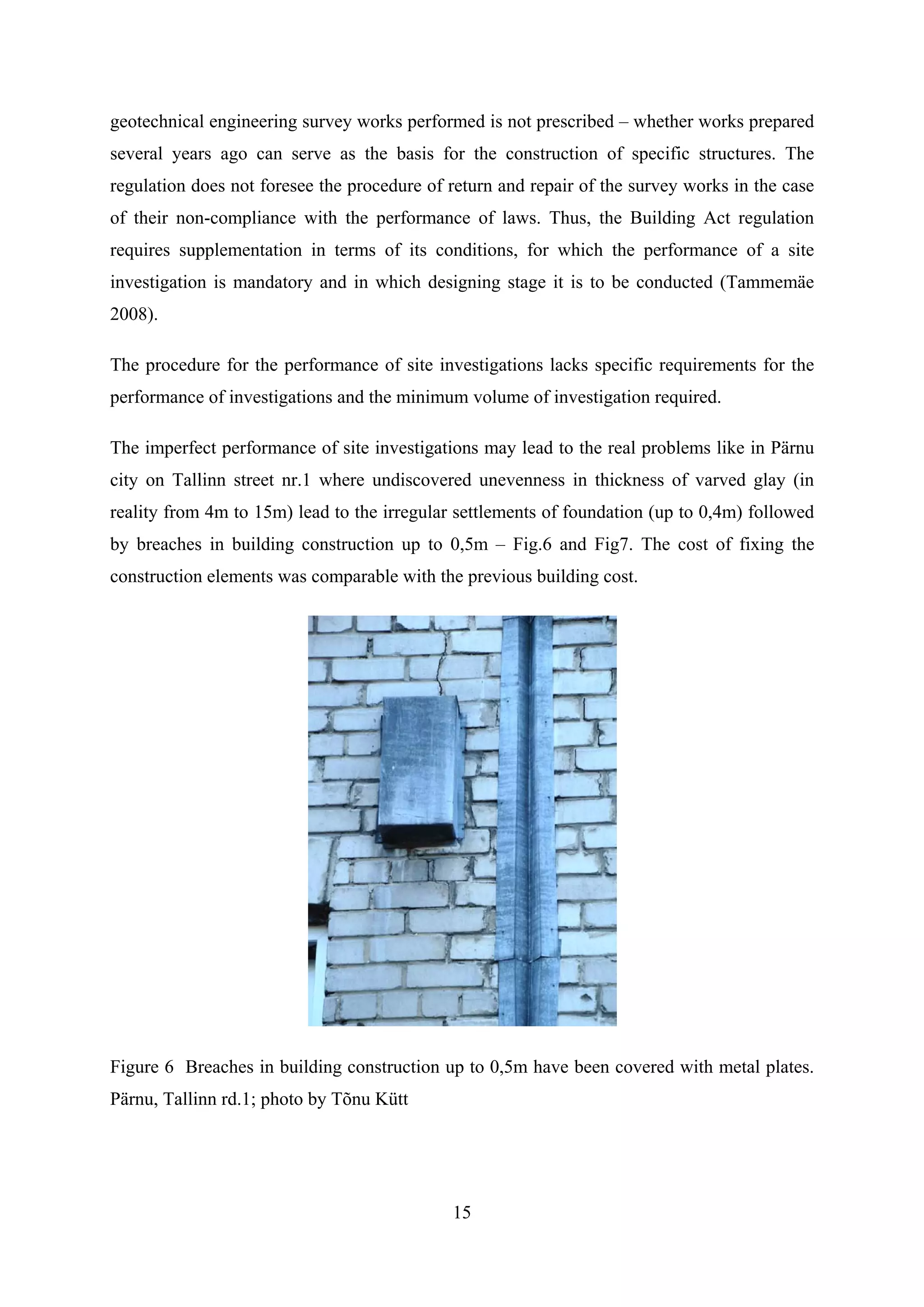
The imperfect performance of site investigations may lead to the real problems like in Pärnu
city on Tallinn street nr.1 where undiscovered unevenness in thickness of varved glay (in
reality from 4m to 15m) lead to the irregular settlements of foundation (up to 0,4m) followed
by breaches in building construction up to 0,5m – Fig.6 and Fig7. The cost of fixing the
construction elements was comparable with the previous building cost.


Figure 6 Breaches in building construction up to 0,5m have been covered with metal plates.
Pärnu, Tallinn rd.1; photo by Tõnu Kütt


                                             15
Figure 7 The building construction was drawn together by steel tensile beams. Pärnu, Tallinn
rd.1; photo by Tõnu Kütt.


The representative limit of the necessary geotechnical engineering data needed to ensure
economic solutions of the project depends on both the complexity of the building and its loads
as well as on the strength of the foundation and variation in soil properties, possible geologic
processes, including underground water regime, the possible emanation of radon, and the
occurrence of mined areas. The output of economic solutions of projects is an economically
effective stable building, constructed environmentally friendly and efficiently, which at the
same time ensures a secure and healthy man-made environment.

All this holds also for structures (railroads and highways, airports, dams, wharfs, garbage
dumps, collectors, and other infrastructure elements).

As the methodology for geotechnical engineering explorations and technical equipment
needed are largely similar to those used for mineral survey and the object of survey is the
same – Mother Earth - it is reasonable to consider the possibility of drafting necessary
amendments to the Earth’s Crust Act instead of amending the Building Act.


                                              16
5. RADON LEVEL SURVEYS

The air in every house contains a certain amount of radon, although the level of radon varies,
depending upon the geological conditions, the construction of the house and the quality of the
structure. Radon levels also change over time. The Radiation Act (RT I 2002, 47, 297) does
not regulate exposure caused by radon in dwellings and mined areas. Pursuant to section 6 (1)
of Minister of the Environment regulation No 45 of 26 May 2005(RTL, 16.06.2005, 65, 934),
“The surveillance of exposed workers and residents, the values of doses, dose factors,
radiation and tissue factors caused by the intake of radionuclides”, the surveillance of radon in
the air of the premises is part of the surveillance series. The frequency of surveillance
measurements in the case of radon and the surveillance of its long-term progeny in drinking
water is at least once per year. Radon surveillance in the air of the premises is at least once
every three years.

The radon risk map has to be taken into consideration during the preparation of the planning
phase. It is also possible through legislation to prescribe a soil classification on the basis of
radon emissions and, basing on that, to prescribe the application of inevitable measures, by
adding the corresponding authorisation standard in the Building Act (RT I 2002, 47, 297). In
the mined areas – especially in the oil shale basin and the phosphorite field (Maardu) where
the Dictyonema argillite has been opened – radon-related risks are considerable.

Since the given survey involves environmental research, the supplementation of the
Environmental Impact Assessment Act and the Environmental Management System Act
(RT I 2002, 47, 297) may be weighed in terms of the assessment of environmental impact.
According to the legislation mentioned, the environmental impact of planned activities may
be evaluated during the preparation of the construction project as well as during the
proceedings for obtaining the building permit. A separate provision could be added to the law,
according to which the specific effects of the environmental impact would be assessed during
the proceedings for obtaining the building design documentation or the building permit. At
the same time, the law does not consider all types of construction work to be activities
characterised by significant environmental impact, which is why all types of construction
activity are not preceded by an environmental impact assessment. The supplementation of the


                                               17
law can be weighed in such a manner that surveys should be conducted separately before the
beginning of environmental impact assessments.

6. RISK MANAGEMENT IN ENVIRONMENTAL GEOTECHNICAL
    ENGINEERING MODELING

6.1. Risk management process

The risk management process as a whole includes analysis of risks, assessment of risks and
treatment of risks:

   1. Risk analysis should determine what risk is.

   2. Risk assessment should find the answer to the question whether the risk is acceptable.

   3. Risk management should set up activities for risk mitigation.

Risk analysis determines the probability of processes, their possible development scenarios
and consequences. It includes determination of undesirable cases, analysis of the probability
of occurrence, and provides an assessment of the consequences and effects and whether the
process is manageable. Sergei Sabanov defended recently in the Tallinn University of
Technology a dissertation on “Risk Assessment Methods in Estonian Oil Shale Mining
Industry” where he describes the risk management process in oil shale underground mining.

Mark Morris et al. (2001) have described why the methods of risk analysis developed for
various branches of industry have not been used, e. g., in the case of dams, what is adequate
for the construction sites as well.

It was concluded that the main reasons were:

   o inadequate data

   o the fact that all dams are unique

   o the complex interactions involved in the behaviour of a dam

   o unrealistic or meaningless results

   o the fact that the risk of dam failure is perceived to be negligible

   o concern about the cost of risk assessment

                                               18
o scepticism

   o problems with terminology (risk, hazard, etc)

   o difficulties in understanding or applying the output from any form of risk assessment

   o lack of knowledge of risk assessment techniques by the dam community

The principal conclusions and recommendations from this stage of the project were that:

   o The application of risk assessment could help to improve reservoir safety in the UK
       and it should therefore be welcomed.

   o A relatively simple and easily understood risk assessment methodology would be: that
       which is cheap to implement would be preferred.

   o Full probabilistic risk assessments using fault trees, etc. was not needed, although a
       simplified approach may be appropriate in some cases.

   o Hazard indexing would be useful in identifying the potential consequences of failure
       and in the classification of reservoirs.

Two radical behaviours or paradigms can be detected: an extreme confidence in dam safety,
because all aspects were considered during the project (a typical specialist position) or
because there is a blind faith in technological power (a typical position of a believer in
absolute engineering efficacy), and a strong suspicion and fear of the uncertain consequences
of a new technological environment or constraint (Betâmio de Almeida, 2001).

The attitude described above is not too rare and many developers have been ignorant while
making their decisions in regard to the further elaboration of their real estate properties.

6.2. Risk assessment

The objective of risk assessment is to provide an answer to the question whether or not the
consequence resulting from realisation of the risk exceeds the tolerance limit of the
environment.

This can be assessed employing criteria and standards required by legislation, risk levels
accepted by the public, and limit values established in specific conditions.

                                                  19
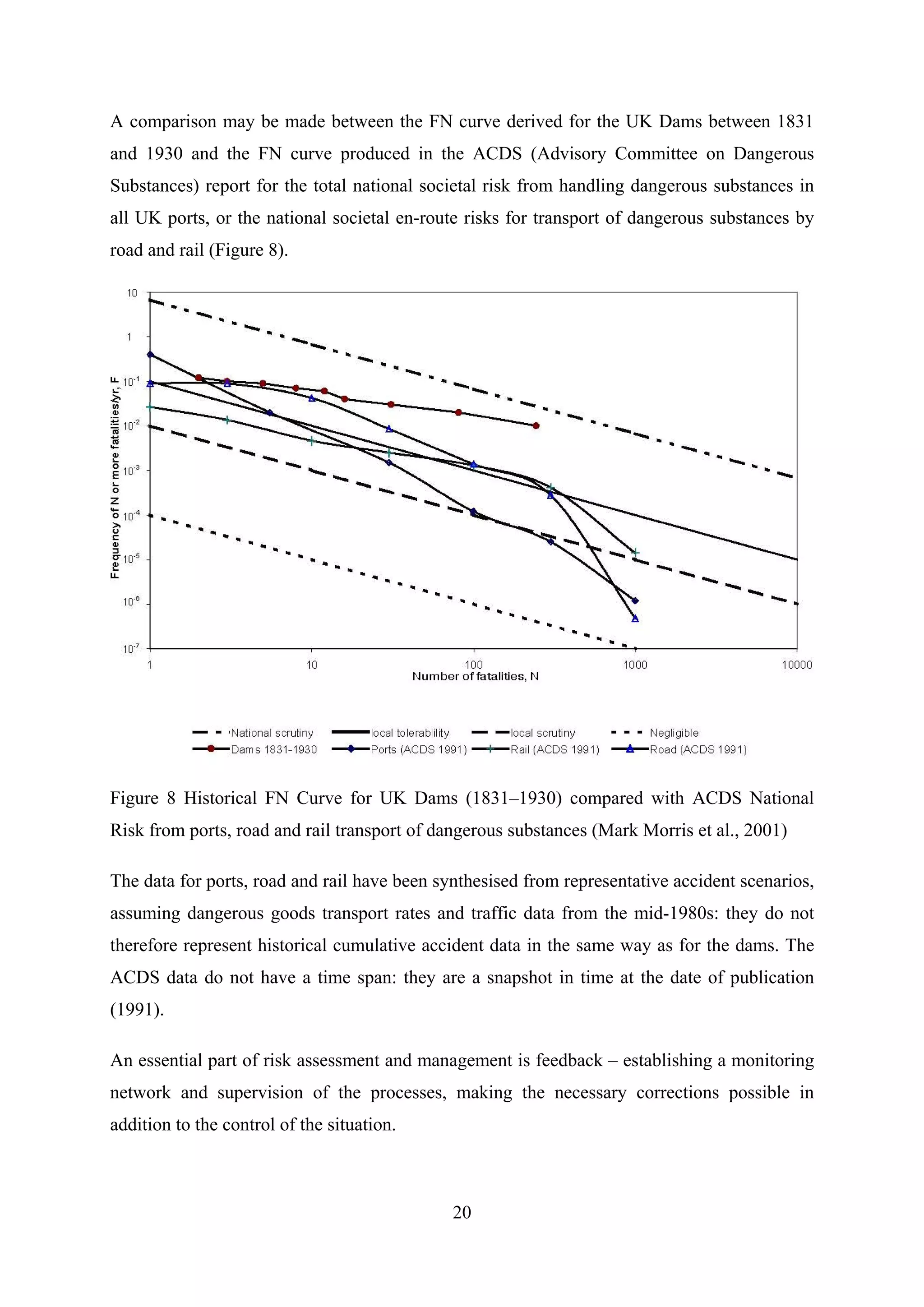
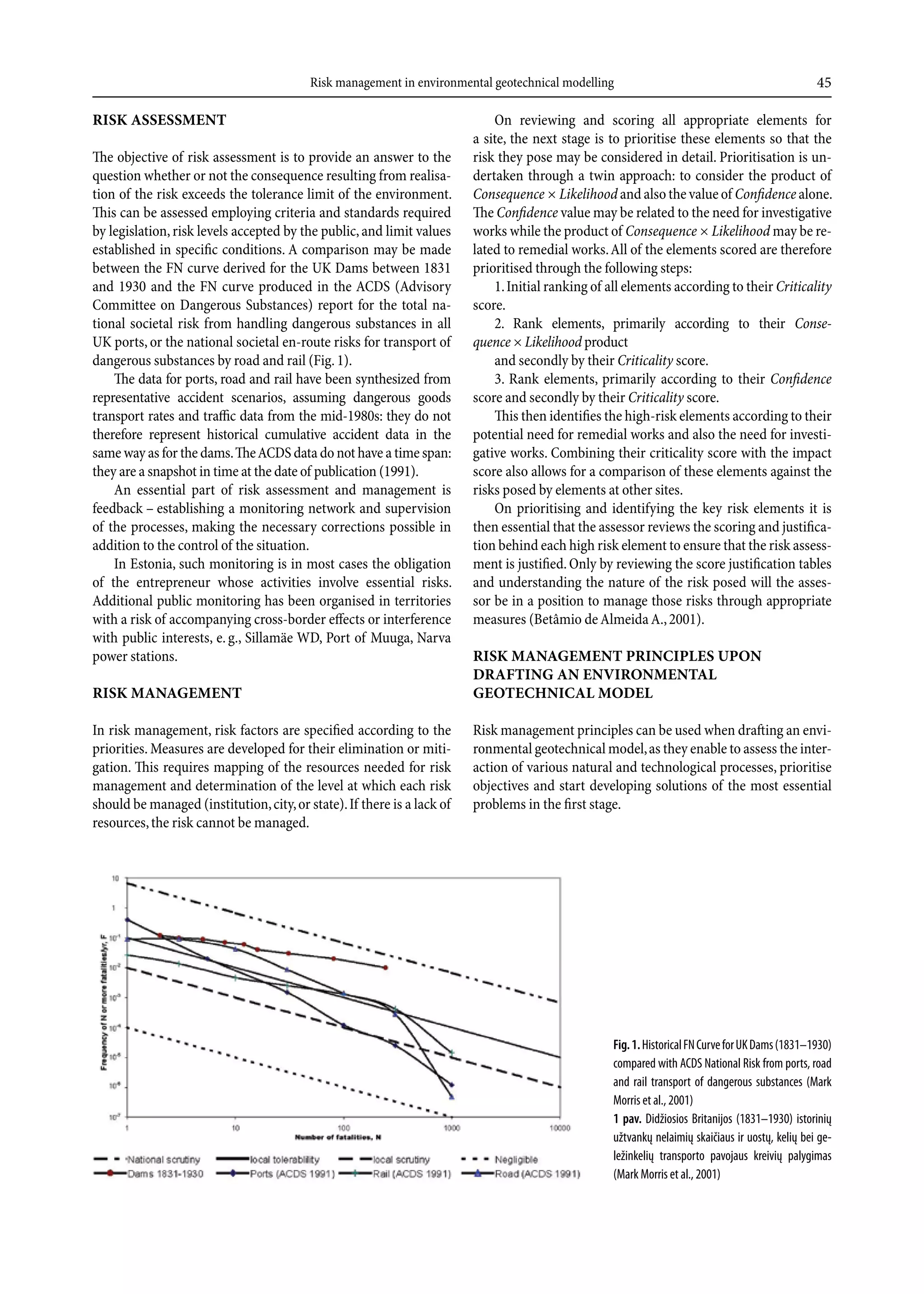
A comparison may be made between the FN curve derived for the UK Dams between 1831
and 1930 and the FN curve produced in the ACDS (Advisory Committee on Dangerous
Substances) report for the total national societal risk from handling dangerous substances in
all UK ports, or the national societal en-route risks for transport of dangerous substances by
road and rail (Figure 8).


Figure 8 Historical FN Curve for UK Dams (1831–1930) compared with ACDS National
Risk from ports, road and rail transport of dangerous substances (Mark Morris et al., 2001)

The data for ports, road and rail have been synthesised from representative accident scenarios,
assuming dangerous goods transport rates and traffic data from the mid-1980s: they do not
therefore represent historical cumulative accident data in the same way as for the dams. The
ACDS data do not have a time span: they are a snapshot in time at the date of publication
(1991).

An essential part of risk assessment and management is feedback – establishing a monitoring
network and supervision of the processes, making the necessary corrections possible in
addition to the control of the situation.


                                              20
In Estonia, such monitoring is in most cases the obligation of the entrepreneur whose
activities involve essential risks.

Additional public monitoring has been organised in territories with a risk of accompanying
cross-border effects or interference with public interests, e. g., Sillamäe Radioactive Waste
Depository, Port of Muuga, Narva power stations.

6.3. Risk management

In risk management, risk factors are specified according to the priorities. Measures are
developed for their elimination or mitigation.

This requires mapping of the resources needed for risk management and determination of the
level at which each risk should be managed (institution, city, or state). If there is a lack of
resources, the risk can not be managed.

On reviewing and scoring all appropriate elements for a site, the next stage is to prioritise
these elements so that the risk they pose may be considered in detail. Prioritisation is
undertaken through a twin approach: to consider the product of Consequence × Likelihood
and also the value of Confidence alone.

The Confidence value may be related to the need for investigative works while the product of
Consequence × Likelihood may be related to remedial works. All of the elements scored are
therefore prioritised through the following steps:

            1. Initial ranking of all elements according to their Criticality score.

            2. Rank elements, primarily according to their Consequence × Likelihood product
                and secondly by their Criticality score.

            3. Rank elements, primarily according to their Confidence score and secondly by
                their Criticality score.

This then identifies the high-risk elements according to their potential need for remedial
works and also the need for investigative works. Combining their criticality score with the
impact score also allows for a comparison of these elements against the risks posed by
elements at other sites.


                                                 21
On prioritising and identifying the key risk elements it is then essential that the assessor
reviews the scoring and justification behind each high risk element to ensure that the risk
assessment is justified. Only by reviewing the score justification tables and understanding the
nature of the risk posed will the assessor be in a position to manage those risks through
appropriate measures (Betâmio de Almeida A., 2001).

In extreme situations the “minimax” strategy has been used where main aim is to identify the
maximum risk and to minimize it.

6.4. Risk Management Principles upon drafting an Environmental Geotechnical
      Engineering Model

Risk management principles can be used when drafting an Environmental Geotechnical
Engineering Model, as they can assess the interaction of various natural and technological
processes, prioritise objectives and start developing solutions of the most essential problems
in the first stage.

Researches and forecasts audited afterwards (Tammemäe, Torn, 2006) confirm that the geo-
ecological and engineering-geological conditions of developed lands are often complicated.
There are many questions that have not yet been solved. The main obstruction to the solution
of these questions is not the lack of fiscal resources, but the lack of the general environmental
geotechnical concept and model. Such concept is lacking, for example, for the planning of
most of cultivated land in the world (Torn, 2003; Tammemäe, Torn, 2006).

The objectives and content of planned research are specified according to the development of
the further use of the land, results of investigations of engineering-geological conditions,
monitoring of processes and risk analysis of the area. The principle of research methodology
shall be treatment of the territory as one geomorphologic entity.


                                               22
7. PRINCIPLES OF THE CONCEPT OF ENVIRONMENTAL
    GEOTECHNICAL ENGINEERING MODEL BASED ON MUTUAL
    EFFECT OF THE PROCESSES

The objective of the concept is first and foremost the formulation of problematic issues from
the standpoint of the technical and further development of the area. It is the model through
which problems and hazards are communicated from one side, while from the other side it
provides solutions for control of risks and use of the area in the future in such a way that the
environmental impact would be acceptable, proceeding from the established standards and
standpoints of the public opinion.

Furthermore, it should guide the developer of the area to find optimal solutions (risk–price–
result) and lead to long-term sustainable decisions.

In reality it means for the developer or investor, a decrease of responsibility, environmental
impact and pollution charges and creation of favourable conditions for bringing potential
investments into the area.

If the objective is environmentally sustainable development of a whole area in a longer
perspective, the starting point should be engineering-geological and environmental
geotechnical conditions of the whole territory and the influencing factors as a whole. It is
important to explicate the change of these conditioned in time, also the tenacity of
constructions and their mutual impact, the human impact and the accompanying risks.
Processes, phenomena and influences should be prioritised. The criteria should be determined
on the bases of risk analyses of the above-mentioned processes and impacts; by managing the
risks, they can be reduced to an acceptable level for both man and nature. It is also important
to acknowledge who will be responsible for managing the risks and to estimate the required
resources. If resources are deficient, the risks cannot be managed.

The aims and content of the planned investigations will be determined in accordance with the
developments in the future use of the area, the monitoring of the geotechnical engineering
processes of the area and the results of risk analyses. The main principle of the research
methodology is the conceptualisation of the area as one geomorphologic whole.


                                               23
Sample table of criteria and rates

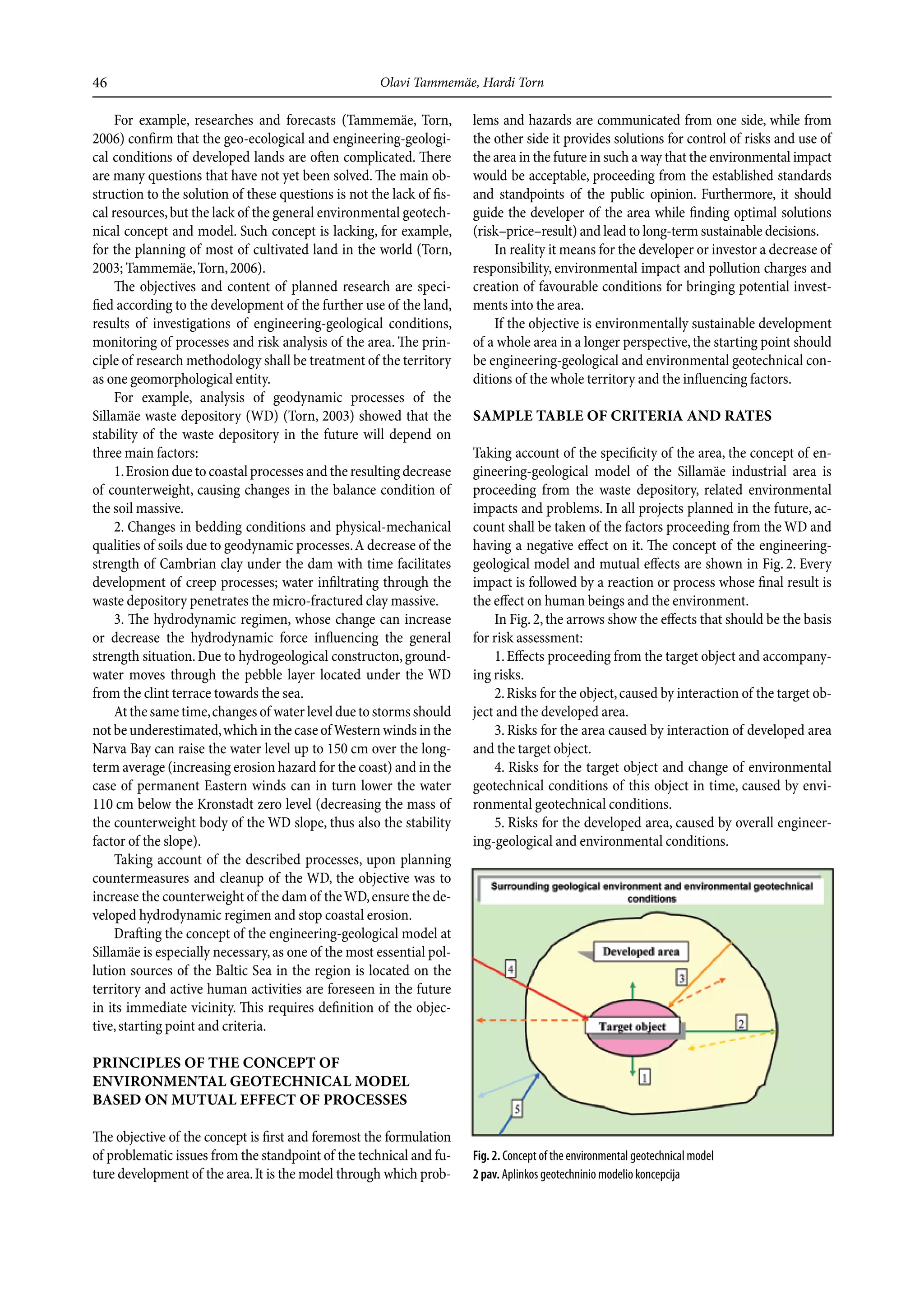
Considering the specificity of the particular developed area, the concept of environmental
geotechnical engineering model consists of the interactions between Target Object (new site
to be developed or already existing site to be investigated), Developed Area (an area where
human activities are in mutual impact with the Target Object) and surrounding environmental
and geotechnical conditions.

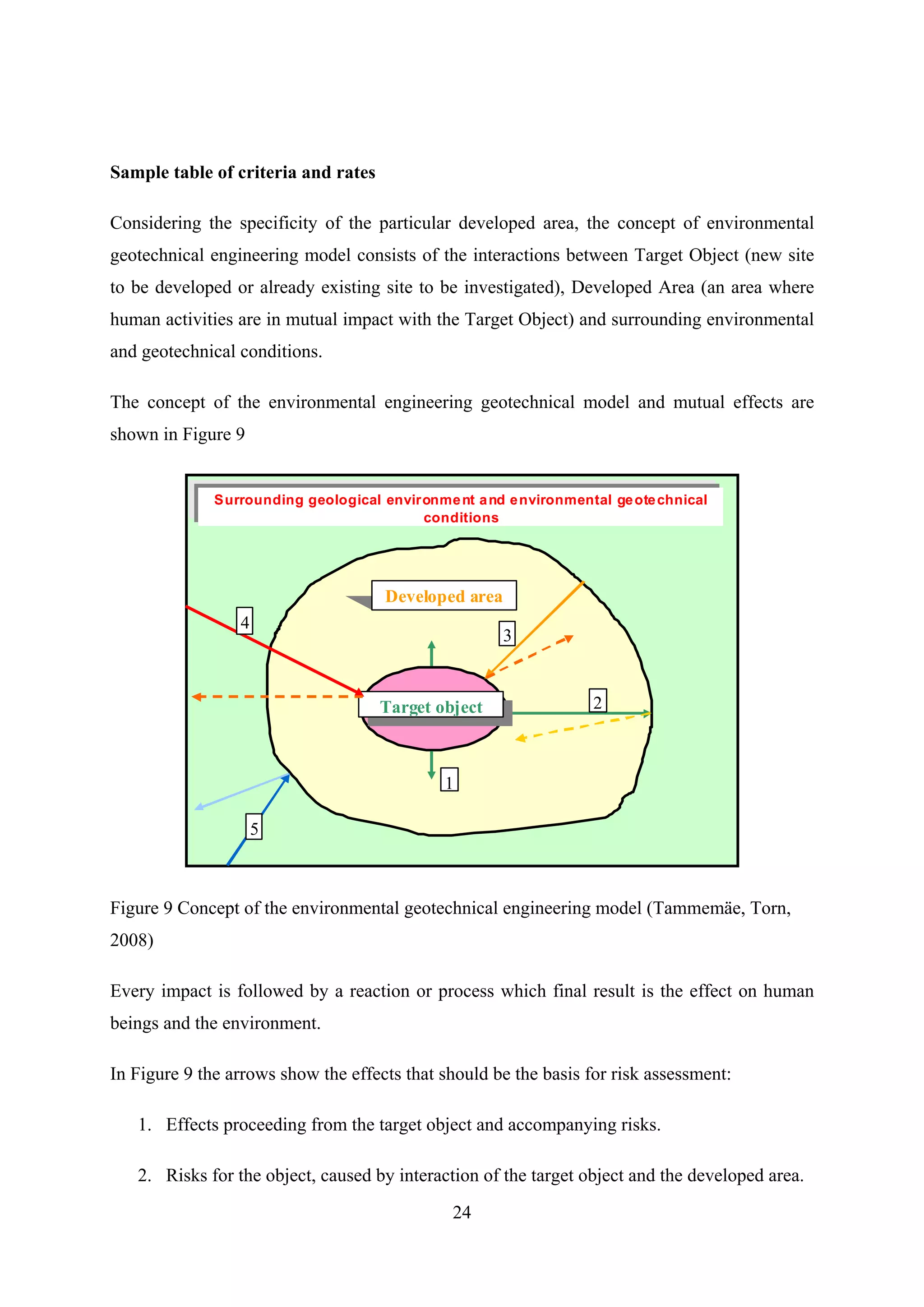
The concept of the environmental engineering geotechnical model and mutual effects are
shown in Figure 9


              Surrounding geological environme nt a nd e nvironmental ge ote chnical
                                          conditions


                                      Developed area
                 4
                                                       3


                                     Target object                 2


                                              1

                     5


Figure 9 Concept of the environmental geotechnical engineering model (Tammemäe, Torn,
2008)

Every impact is followed by a reaction or process which final result is the effect on human
beings and the environment.

In Figure 9 the arrows show the effects that should be the basis for risk assessment:

   1. Effects proceeding from the target object and accompanying risks.

   2. Risks for the object, caused by interaction of the target object and the developed area.
                                               24
3. Risks for the area caused by interaction of developed area and the target object.

   4. Risks for the target object and change of environmental geotechnical conditions of this
          object in time, caused by environmental geotechnical conditions.

   5. Risks for the developed area, caused by overall engineering-geological and
          environmental conditions.

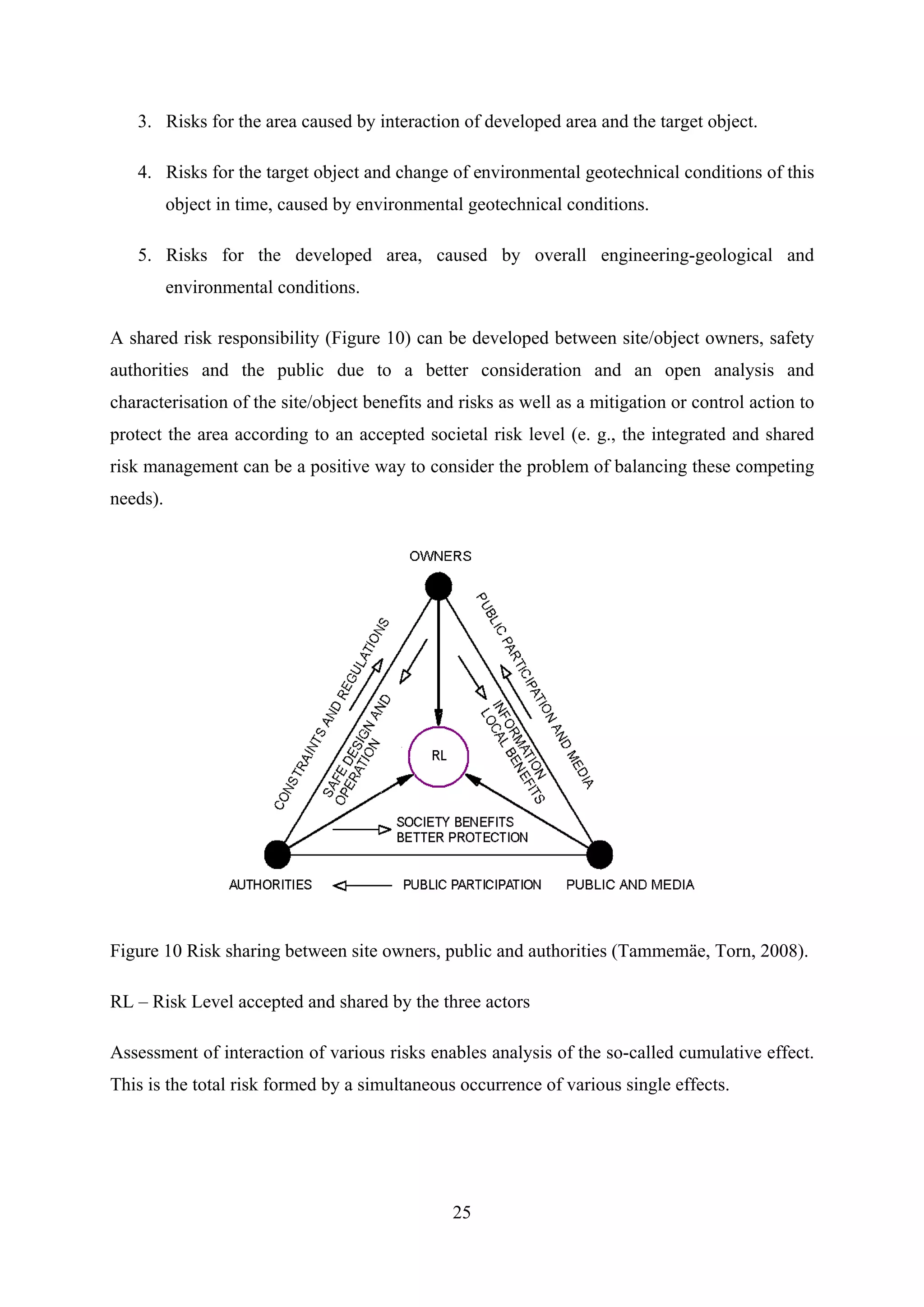
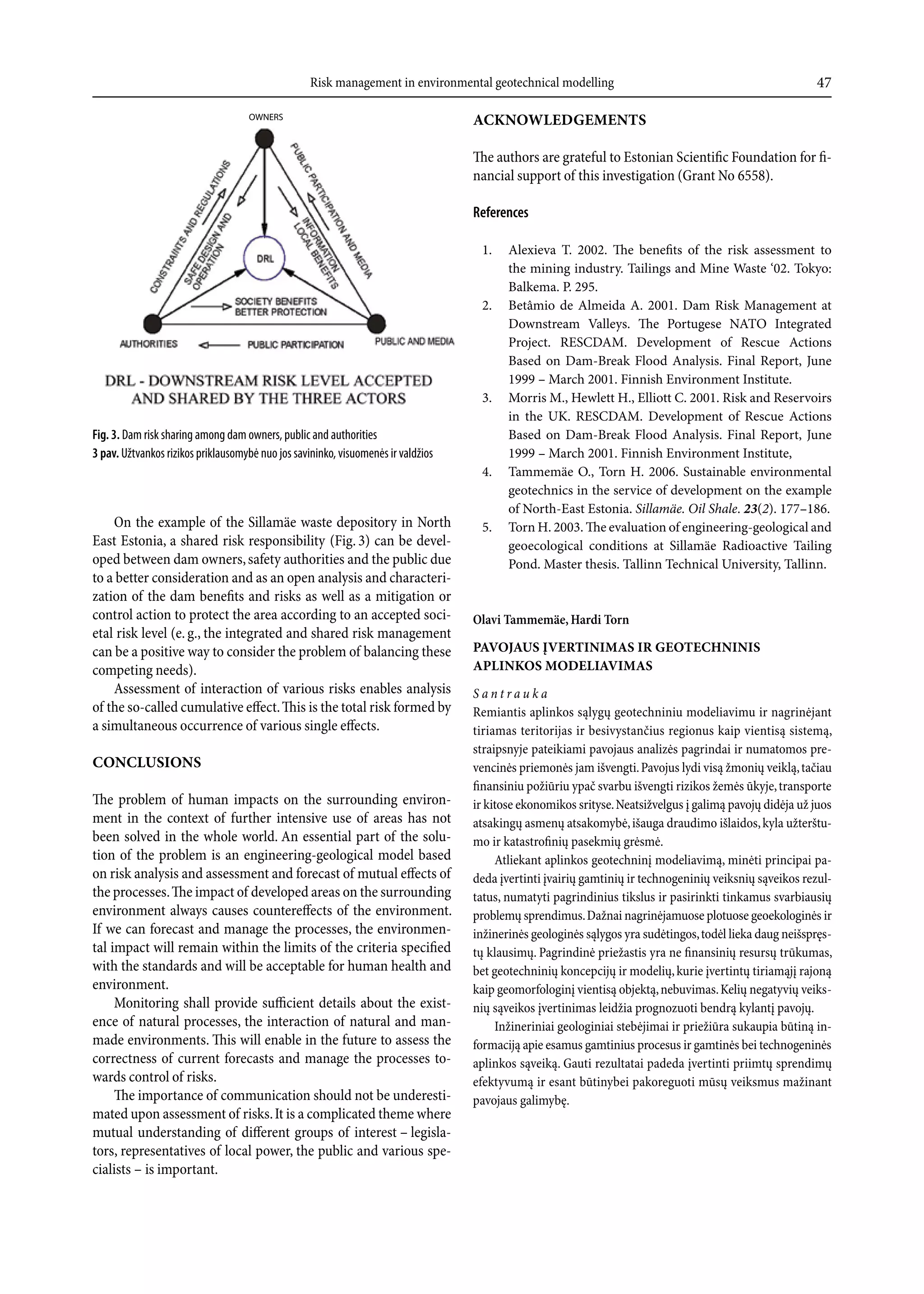
A shared risk responsibility (Figure 10) can be developed between site/object owners, safety
authorities and the public due to a better consideration and an open analysis and
characterisation of the site/object benefits and risks as well as a mitigation or control action to
protect the area according to an accepted societal risk level (e. g., the integrated and shared
risk management can be a positive way to consider the problem of balancing these competing
needs).


Figure 10 Risk sharing between site owners, public and authorities (Tammemäe, Torn, 2008).

RL – Risk Level accepted and shared by the three actors

Assessment of interaction of various risks enables analysis of the so-called cumulative effect.
This is the total risk formed by a simultaneous occurrence of various single effects.


                                                25
8. GEOTECHNICAL INSPECTION AND SURVEILLANCE

While the geotechnical engineering surveys and the primary data produced on the basis of
those surveys are predictive in terms of content, geodetic measurement of structures in the
performance period and afterwards, as well as fixing of changes in building structures,
provides us with feedback on geological engineering surveys and the quality/validity of
engineering calculations and analysis conducted on their basis. The emergence of problems
may cause the need for additional surveys in order to determine the reasons for the variations
in the predicted and actual placements in the structures.

Geotechnical inspection is necessary in the case of both complex/high liability structures and
the occurrence of variable or weak soils and geological processes. The specific geotechnical
problems related to mine areas, considering spoiled areas of oil shale quarries and opened
phosphorite fields, require careful geotechnical inspection as well. Its duration is determined
by the measured rate of weakening of displacements and may, depending upon the foundation
construction and soil properties, last for decades.

Surveillance is critical especially for determining the development of natural processes
(ground water regime, radon level in interior premises, floods, occurrence of slide blocks,
etc.), related reflections on construction affecting the safe use of construction elements,
allowing comparison with the results predicted during geotechnical engineering surveys.
Surveillance must provide a conclusive survey of natural processes taking place, the effects
between the natural and man-made environment, enabling the assessment of the effectiveness
of planned protection measures. This allows, in the future, evaluating the competence of
today’s decisions, and to direct processes in the direction of risk management.

To protect the above-mentioned public interests and to ensure the economical planning and
construction, the need for geotechnical engineering surveys for plans, structures (buildings
and civil engineering works) as well as geotechnical inspection, must be prescribed by laws. It
is possible in sub acts to establish the representative limits to the amount of research,
following the objective of the research, the object and predicted geotechnical engineering
conditions, and to make suggestions for the use of suitable standard documents.


                                               26
9. THE UTILISATION OF PREVIOUS RESEARCH DATA

It is important here to prescribe the “useful life” of research data. If the data describing the
geological structure of a site are of permanent value, the conditions concerning underground
water and pollution may be subject to change in a period of only a few years, based on the
effects of nearby construction works. Here, in turn, changes in the physical-mechanical
properties of the foundation’s soil are possible as well.

The above-mentioned phenomena demonstrate the need to prescribe a provision for the use of
original data and correlations and previous research data in geotechnical engineering surveys.
It is necessary in the case of construction works of a certain level of complexity, and on soils
which may be highly deformed and subject to large variability, to designate a minimum
volume of original research, which ensures sufficient research data will be presentable.

The problem which needs to be solved is the creation of a geotechnical engineering database,
in which at least the following data should be recorded:

   o  the exact location of the research object
   o  types and volumes of research
   o  a short description of the geological conditions
   o  a short description of the hydrological conditions
   o  a short description of geotechnical processes and phenomena
   o  the utilisation of previous research data
   o  the location of the geotechnical engineering research report, and its contact
      information
The above-mentioned database allows, at planning of a new research, to evaluate the
suitability of the previous research data, to plan the research more economically, and to
reduce the impacts on the environment that accompany the research. As an additional value,
the availability of such a database allows investigation of several geotechnical engineering
processes and phenomena over time. Since a research report is generally a property of the
financier of the research, creation of the above-mentioned database should be prescribed by
law, which obliges the owners of reports to preserve it within a reasonable period of time and
after this period of time to hand it over to the Geotechnical Fund.

An alternative to be weighed up is the immediate transfer of the report to the Fund, where it is
made available for public use after passing a designated period of time. In such a case, the
same Fund could also ensure the uniform operation of the database.

                                               27
It would also be necessary to weigh up the possibility to assign the issuing of permits for
geotechnical research, which belongs to the competence of local governments, to the
Geotechnical Fund, which would have the obligation to accord the issuing of permits with
local governments. This would give the Fund a control mechanism for ensuring archiving of
research reports.

Today’s practice (unregulated legal space and lack of control mechanisms) unfortunately does
not ensure uniform issuing of research permits, taking into consideration possible
environmental impact accompanying research (local governments have no obligation to
consult the environmental authority) and the receipt of reports by the Fund.

10. PROPOSED LEGAL CHANGES

In order to ensure the proper legal ground for geotechnical engineering explorations needed
for assessing environmental risks to be considered during planning process and for providing
designers with reliable geotechnical parameters for sustainable construction solutions a group
of experts (Mirjam Vili, Anne-Mari Vene, Rein Raudsep – Ministry of Environment; Merle
Lust, Kristel Kõiv – Estonian Radiation Centre; Enno Reinsalu – Tallinn University of
Technology, Mait Mets, Hardi Torn – GIB Ltd., Indrek Tamm – Maves Ltd.) under my
scientific supervision analysed the current legal environment for geotechnical engineering
explorations and made definite proposals for the amendments in legal acts. Based on these
amendments the drafts of the Earth’s Crust Act, the Environmental Register Act, the Building
Act, the Planning Act (Appendix 1.1) and the Governmental or Minister’s Regulation “An
Order of Engineering Geotechnical Investigations” (Appendix 1.2) were worked out.

10.1. Proposals for the amendments in current legal acts

§1 of the draft will amend the Earth’s Crust Act (ECA) and a part concerning geotechnical
engineering explorations will be added to the Act.

The regulation of geotechnical engineering has been proposed to be added to the Earth’s Crust
Act, as the Act contains a thorough regulation on conducting geological investigations and
site restoration, which to a certain extent can be transferred to geotechnical engineering
explorations (e.g. site restoration). Thus, the Earth’s Crust Act yields a logical framework for
a more thorough regulation of investigations. Additionally, it has been taken into account that


                                              28
the scope of the research covers far better and more systematically the investigation of
environmental conditions (e.g. radon, pollution, water etc.).

Clause 1 complements the objective of the Act (ECA subsection 1 (1) adding the word “safe”.
Therefore, apart from ensuring environmentally friendly and efficient utilization of the earth’s
crust, the purpose of the Act is also to monitor the safety of the earth’s crust’s utilization. The
need for amendments to the regulation of geotechnical engineering explorations is primarily
related to a more sustainable usage of the earth’s crust including natural resources, also more
seriously considering natural conditions when planning, and minimizing the risks to buildings
and people, arising from natural conditions or because of altering these conditions.

Clause 2 will amend the scope of the regulation of the Act.

Clause 3 provides the concept of geotechnical engineering exploration. Thus geotechnical
engineering exploration is an investigation of the earth’s crust’s properties with the purpose of
ensuring the technical safety and environmental safety of buildings and the construction, and
obtaining optimal initial data for plans and construction projects. Compared to the purpose of
site investigations defined in the Building Act (“to obtain primary data necessary for the
planning of areas, for the preparation of building design documentation and for building”), the
given definition is broader, emphasizing the technical safety and environmental safety of
buildings. Geotechnical engineering exploration provides a possibility to assess the influence
of area plans and buildings on the earth’s crust being the base of the construction, and the
possible influence of geotechnical engineering conditions and natural processes on land-
utilization and buildings planned in site planning. An analysis of interaction of human
activities and natural conditions and processes is an essential prerequisite to sustainable
planning, designing and building, ensuring maximum management of the accompanying
environmental and socio-economic risks and expenses.

Geotechnical inspection, which means a comparison and assessment of the data of
geotechnical engineering exploration and the data acquired during construction or during
utilization of the building, has been defined separately. The term has been used already by
specialists in the field. However, up until now a legal definition of the term has been missing,
and this field has not been under legal regulation.

In clause 4, the Act is supplemented with chapter 51 “Geotechnical engineering exploration
and geotechnical inspection”.
                                                29
The Act will be supplemented with seven sections.

Section 581 “The obligation and contents of conducting geotechnical engineering
explorations” –

A clear obligation to carry out a geotechnical engineering exploration on any construction has
been stated. However, the scope of geotechnical engineering studies can, depending on the
planned construction, be very different (subsection 581 (2)). The explorations can, on certain
occasions, be limited to desk studies based on an earlier investigation’s data only. On
reconstruction of the building, a geotechnical engineering investigation must be conducted if
the existing loadings on the earth’s crust or on the existing foundations will be changed
during reconstruction.

The scope of the investigation during a research programme will be established on the
assumption of requirements stated in the regulation.

Section 582 “Permit of geotechnical engineering exploration” –

For the first time, an obligation to have a permit for the investigation has been stipulated in
the Act. The permit will be issued by the Ministry of the Environment, which can delegate the
issue of permits to another state authority under its governance. Here, a possibility to combine
the function of an authorized operator who issues research permits and handles the
geotechnical engineering investigation reports’ register (planned as a part of environmental
register), has been provided, which would enable registration and checking of data directly
and within a short time. The current law does not provide the issue of geotechnical
engineering investigation permits. Nevertheless, some municipalities have required the issue.
The function of issuing a permit has not been assigned to municipalities by law because
performing the function requires rather specific knowledge in the field and therefore would be
troublesome to the municipality. Permit requirement is purposed only if the granter of the
permit is competent to substantially assess the materials submitted and make motivated
decisions accordingly.

Taking into account the interests and opinions of municipalities is guaranteed by approval
obligation (subsection 4).

In subsection 3 a provision delegating authority in order to lay down the requirements for
research programme and technical tasks has been stated. Laying down the requirements is
                                              30
necessary to ensure uniform contents of the mentioned documents, and thereby create an
accessibility of necessary data to the executor and the granter of permit.

The permit is valid for a maximum of two years, which can be extended for two more years.
This gives sufficient time for conducting research.

The basis for refusal and invalidation of the permit are stated in the draft. The permit must be
refused, for example, in case the object of the research is in discrepancy with the current
planning. This means that if the general planning has not planned construction in the given
site, a research permit shall not be issued before amendments to the general planning have
been made. This supports recognition of the legitimacy of the existing planning and a public
process of treatment of possible proposals for amendments to planning before making any
changes in the contents.

Section 583 “Site restoration of the area damaged by geotechnical engineering exploration” –
regulation enforced on the basis of the Earth’s Crust Act subsection 45 (2) is applied.

Section 584 “Requirements for the executor of geotechnical engineering investigation” – the
Building Act is applied.

The report of a geotechnical engineering investigation (§ 584 and § 585) – the owner of a
permit for a geotechnical engineering investigation has to submit the report to the granter of
the permit by the expiration date of the permit at the latest. The granter of the permit can have
the report improved or amended provided it is necessary. Requirements for the report are laid
down by law.

Section 587 “Geotechnical inspection” – the main requirements for conducting geotechnical
inspection are stated in the Act: inspection must be carried out in case of complicated
geotechnical engineering conditions, elaborate buildings, geological processes which are
unsafe to the building and novel foundation solutions, and in case substantial discrepancies
occur between the data stated in the geotechnical engineering research report and the real data
appeared during construction or utilization of the building. An executive specialist must make
decisions concerning inspection according to the “Building Act” or the granter of the
geotechnical engineering investigation permit.

The Act will be amended with sections concerning responsibility and surveillance (§ 721 and
§ 731). On formulation of the section regulating surveillance we have proceeded from the
                                               31
enactments included in the valid Building Act. The executor of state surveillance of
geotechnical engineering investigations is still the Estonian Technical Surveillance Authority;
therefore there will be no substantial changes in the contents and format of surveillance.

Draft § 2 includes amendments that will be made to the Environmental Register Act.

Foundation of a data collection of geotechnical engineering investigations is stated in the
frame of the environmental register. The database would be formed on the basis of the Funds
of Estonian Structural Geology, which currently is in Land Board, where the data of earlier
site investigations has been stored, and where research reports are still submitted. The task of
the database of the Finds of Structural Geology would be providing designers, planners,
builders, scientists and environmental protection specialists with information about site
investigations.

The Environmental Register Act sets a proper legal framework to start data collection, which
enables building a database with minimal legal amendments.

In clause 1 the list of the application of the data enrolled in the environmental register will be
amended.

Clause 2 states that legal consequences of recording data in the environmental register means
that the data not recorded in the register cannot be used in designing buildings. Enactments
supporting this will be added to the Building Act as well.

Clause 3 will supplement the Act’s chapter 2 with division 7 “Recordkeeping of
environmental conditions of geotechnical engineering”.

The following data is included in the register:

   o the name and ID or register code of the performer of the investigation;

   o the time of the investigation;

   o the types and volumes of the investigation;

   o a short description of geological cross-section;

   o appearance and regime of subterranean waters;


                                                  32
o a short description of processes and phenomena of geotechnical engineering;

   o utilization of previous research data;

   o the name, ID or register code and contacts of the owner of the report of the
       geotechnical engineering investigation.

When planning new investigations this enables the possibility of using earlier research data, to
plan explorations resource-sparingly and reduce the environmental impact that accompanies
the investigations. As an extra value the existence of such a database enables the exploration
of developments of various geotechnical engineering processes and phenomena over time.

The data is recorded in the register on the basis of a research report. According to draft § 2
clauses 4 and 5, the report and the required data are submitted to the register by a receiver of
the report (permit granter) within 10 working days of receiving the permit.

The amendment in draft § 2 clause 6 states that reports are kept in the archive of the
Environmental Register. As a research report is generally the property of the donor of the
research, within three years of submission of the geotechnical engineering research report to
the Environmental Register access to the report is permitted only with written permission
from the owner of the report entered into the Environmental Register (clauses 7, 8).

Entering data into the Environmental Register is due by 1 January of the year 2009. This
allows sufficient time to develop adequate technical solutions.

Draft § 3 is to amend the Building Act. The main change is that the engineering geology
aspect of site investigations will be omitted from the Act. Consequently, provisions that
regulated engineering geology or site investigations require amendments.

In clause 6 one substantial change will be made, stipulating the responsibility of the owner of
the construction that monitoring commenced in the course of geotechnical engineering
exploration be continued during the construction and utilization of the object, in case the
building was planned either directly on the coast or during the construction period it is
planned to change the coastline or shoreline, or the coastline or shoreline was changed, until
coast or shore processes do not pose a risk to the building and the environment. The need for
amendments in the regulation appeared in connection with a more thorough regulation of
geotechnical engineering investigations, during which requirements to explorations in the

                                              33
areas where coast or shore processes occur. Coast or shore processes triggered by changes in
the coastline or shoreline during construction can last in nature for years until new balance is
established, and can pose a risk not only to the endurance of the newly-erected building, but
also extensively alter the coastline or shoreline in adjoining ground as well.

In draft § 4 the Planning Act will be amended with section 141 “Considering the results of
geotechnical engineering investigations in drafting a subdivision plat”, by which it is
stipulated that drafting county planning, general planning and detailed planning has to be
based on the results of the geotechnical engineering investigations on the planned area, which
are entered into the Environmental Register.

10.2. Terminology

Instead of engineering geology, I have used in this thesis the term “geotechnical engineering
geology”.

Geotechnical engineering geology assesses the impact of natural and artificial phenomena and
processes on a geological environment, the progress and risk of these processes, using the
results of geotechnical, mining technology, construction geological, general geological and
environmental studies.

A new term is given in the Act – geotechnical inspection: comparison and evaluation of
geotechnical engineering geology research data and data received during construction or
utilization of the building. Also in this case, the term is not new in the field, but it is the first
legal regulation of the subject.


10.3. Compliance with European Union legislation

The European Union does not regulate geotechnical engineering geology investigations at the
level of Union’s statutes. This is a decision of the member states.


                                                 34
10.4. The expenses related with implementation of the Act and income gained from
     implementation of the Act

With passing the law, expenses occur to the state in connection with issuing permits for
geotechnical engineering geology investigations and keeping a register for the investigations’
results. Passing the draft will indirectly help to reduce expenses connected with construction
(including using natural building materials), enabling in the case of more thorough
investigations to design building structures more optimally, which reduces expenses on
materials and decreases environmental and health risks accompanying utilization of buildings.
Taking into account areas not suitable for construction designing guarantees substantial
savings of natural material and reduces or avoids various environmental risks (floods,
landslides, risk of pollution of the ground and ground waters).


10.5. Lower level legal documents (Implementing provisions)

As a result of the amendment of the Act, a regulation of the Government of the
Republic/Ministry of the Environment will be passed. The draft of the regulation is annexed
(Appendix 1.2).


                                              35
11. CONCLUSIONS
1.     The geotechnical engineering model based on risk analysis and assessment with forecast
       of mutual effects of the processes caused by human activities is an effective tool for
       assessing the impact of developed areas on the surrounding environment.

2.     The forecasting and managing of human activities caused mutual processes in the
       environment is a key precondition in keeping the environmental impact within the limits
       of the criteria specified by standards for protection of human health and environment.

3.     Monitoring provides sufficient details about the existence of natural processes, the
       interaction of natural and manmade environments. This is the vital feedback tool that
       enables assessment of the correctness of forecasts made and management of the processes
       towards control of risks.

4.     Communication between key stake holders is of utmost importance in the risk assessment
       process. It is a complicated theme where the mutual understanding of different interest
       groups – legislators, local representatives, the public and various specialists – should be
       achieved.

5.     The appropriate changes in the Earth’s Crust Act, Environmental Register Act, Building
       Act and Planning Act worked out in the framework of this thesis enables the regulation of
       the field of geotechnical engineering explorations in order to guarantee more sustainable
       usage of land and mineral resources and improve the consideration of environmental
       conditions in the planning process.

6.     The proposed legal amendments allow the minimization of risks to constructions and
       human beings occurring from changes in environmental conditions caused by planning
       and building activities.

7.     As a practical example of sustainable geotechnical engineering exploration and
       sustainable designing of foundations, the wedge-shape pile foundation is a sustainable
       alternative to other shallow foundations in South Estonian moraine soils, guaranteeing
       savings in labor and materials up to 50…60%.

7.1.    As an estimated bearing capacity of wedge-shape pile, the author recommends the
        proportionality limit Npr from pile field load tests.

7.2.    The estimated horizontal bearing capacity of wedge-shape pile if horizontal movements
        don’t exceed 10 mm stays at 25…60 kN.

7.3.    Npr is computable using pile driving test results and Gersevanov formula while
        displacement from one blow stays at 1.5…3.0 cm or Gate-Killar formula, while
        settlements from one blow stay at 0.2…2 cm.

7.4.    For estimating Npr from static penetration cone resistance qc and wedge-shape pile
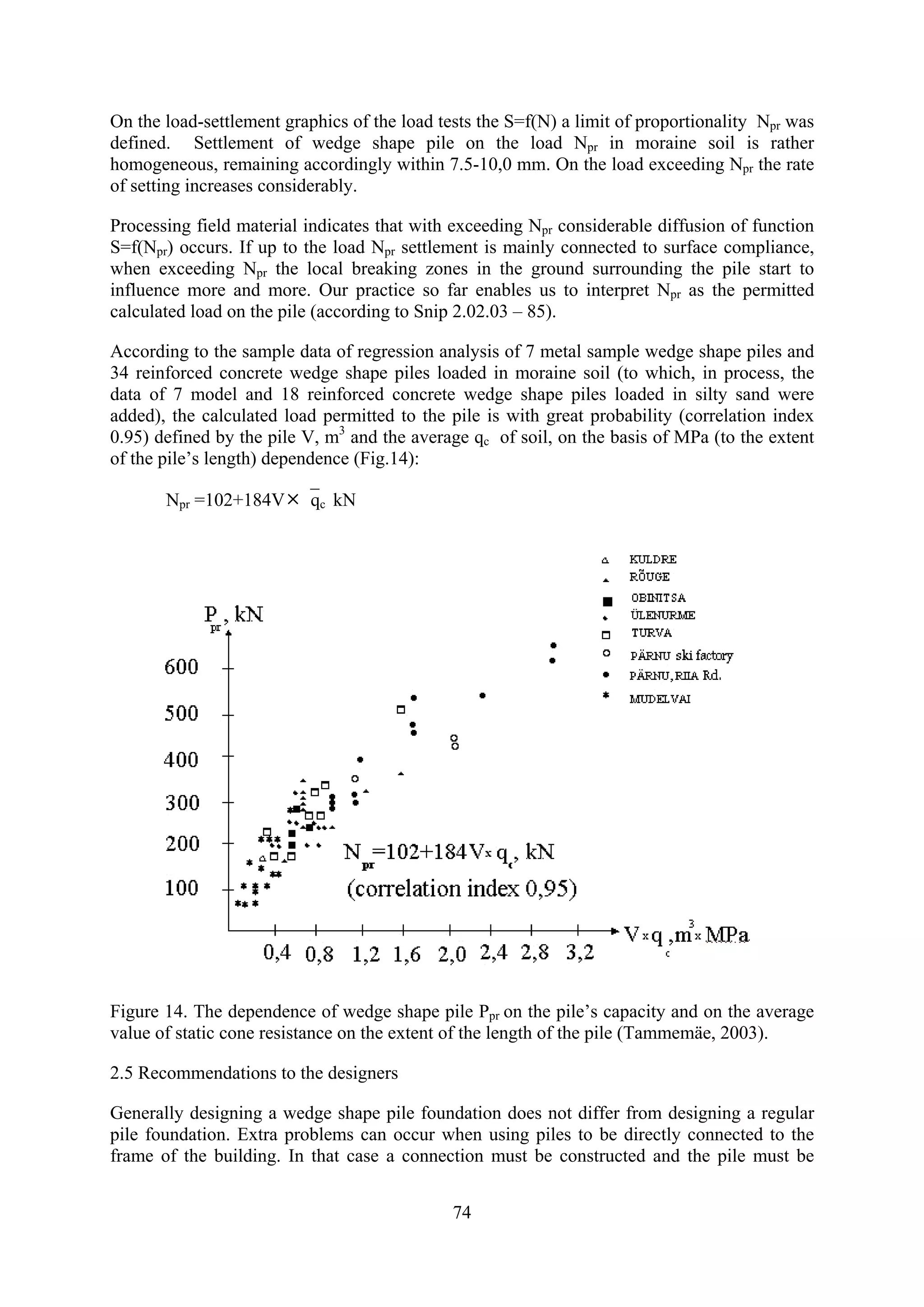
        volume V, the author recommends the relation Npr = f (qc V) – appendix 2.4, Fig 14.


                                                36
7.5.   Taking into account the seasonal variability of mechanical properties of South Estonian
       moraine soils it’s important to consider that the bearing capacity of wedge-shape pile
       depends on soil conditions during the piling period.


ACKNOWLEDGEMENTS
The author thanks his tutor, Emeritus Professor Enno Reinsalu, who has gently but
consistently guided him in writing this thesis.

Many thanks to the consultant of this thesis, Dr. Mait Mets, whose thorough and long-time
experience with research of geotechnical engineering geology was of great support, especially
in making practical conclusions.

Co-operation with Hardi Torn – GIB Ltd. was productive while writing articles together,
especially on the subject of risk assessment and management.

I also thank a creative collective: Mirjam Vili, Anne-Mari Vene, Rein Raudsep –
Ministry of Environment; Merle Lust, Kristel Kõiv – Estonian Radiation Centre;
Enno Reinsalu – Tallinn University of Technology, Mait Mets, Hardi Torn – GIB Ltd.,
Indrek Tamm – Maves Ltd., who under my guidance worked out proposals to change the
legal realm that regulates geotechnical engineering investigations.

I also wish to thank Professor Ingo Valgma and Emeritus Professor Alo Adamson who always
helped with good advice when it was needed.


                                              37
REFERENCES

 1.    Alexieva T. 2002. The benefits of the risk assessment to the mining industry.
       Tailings and Mine Waste ‘02. Tokyo: Balkema. p. 295.
 2.    Бахолдин Б.В., Игонкин И.Т. Исследование несущей способности
       пирамидальных свай. Основания, фундаменты и мехаика грунтов, 1978.
 3.    Betâmio de Almeida A. 2001. Dam Risk Management at Downstream Valleys.
       The Portugese NATO Integrated Project. RESCDAM. Development of Rescue
       Actions Based on Dam-Break Flood Analysis. Final Report, June 1999 – March
       2001. Finnish Environment Institute.
 4.    Building Act. RT I 2002, 47, 297.
       http://wlex.lc.ee/wlex.cgi?do=show&url=https://www.riigiteataja.ee/ert/act.jsp?id
       %3d12807803
 5.    Chemicals Act. RT I 2006, 58, 439.
       http://www.estlex.info/estlex/spetsb/AktDisplay.jsp?id=25778&akt_id=25778
 6.    Coyle M., Lyman C. Load Transfer for Axially Loaded Piles in Clay. Journal of
       the Soil Mechanics and Foundation Division. ASCE. March, 1966. SM4.
 7.    Coyle M., Sulaiman H. Skin Friction for Steel Piles in Sand. Journal of the Soil
       Mechanics and Foundation Division. ASCE. Nov.1976. SM6.
 8.    Environmental Impact Assessment and Environmental Management System Act.
       RT I 2005, 15, 87.
       http://wlex.lc.ee/wlex.cgi?do=show&url=https://www.riigiteataja.ee/ert/act.jsp?id
       %3d12808274
 9.    Гильман Я.Д., Глухов В. С. Исследование клиновидных свай в качестве
       фундаментов зданий распорной системы. Основания, фундаменты и мехаика
       грунтов. Но. 4, 1982
 10.   Mets, M., Smirnov, L., Tammemäe, O., Väli, T. Kiilvaia käitumisest pinnases.
       VIII Geotehnika konverents. Teesid. Tallinn, 1984.
 11.   Mets, M., Smirnov, L., Tammemäe, O., Väli, T. Kiilvaia käitumisest pinnases.
       VIII Geotehnika konverents. Teesid. Tallinn, 1984.
 12.   Mets, M. ,Vaia kandevõime. Ehitusgeoloogia kogumik IV. Tallinn, 1977.
 13.   Morris M., Hewlett H., Elliott C. 2001. Risk and Reservoirs in the UK.
       RESCDAM. Development of Rescue Actions Based on Dam-Break Flood
       Analysis. Final Report, June 1999 – March 2001. Finnish Environment Institute,
       2001.
 14.   Needo, A., Mets, M., Kärk, J., Kuddu, A.-A. Kiilvaivundamendid.
       Ehitusgeoloogia kogumik V. Tallinn, 1991.
 15.   Planning Act. RT I 2004, 22, 148.
       http://www.estlex.info/estlex/spetsb/AktDisplay.jsp?id=51705&akt_id=51705
 16.   Pursuant to Minister of the Environment regulation No 45 of 26 May 2005, “The
       surveillance of exposed workers and residents, the values of doses, dose factors,
       radiation and tissue factors caused by the intake of radionuclides”. RTL,
       16.06.2005, 65, 934.
       http://wlex.lc.ee/wlex.cgi?do=show&url=https://www.riigiteataja.ee/ert/act.jsp?id
       %3d908881
 17.   Radiation Act. RT I 2004, 26, 173.
       http://wlex.lc.ee/wlex.cgi?do=show&url=https://www.riigiteataja.ee/ert/act.jsp?id
       %3d12766544


                                         38
18.   Зоценко, H.П., Baгидов, M.M., Хазин B.Л., Ландарь, A.M. Исследование зоны
      уплотнения грунта у коротких пирамидальных свай по данным
      зондирования. . Основания, фундаменты и мехаика грунтов. 5, 1976.
19.   Tammemäe, O. 2003. Kiilvaiad Lõuna-Eesti moreenpinnases. Magistritöö, TTÜ.
20.   Tammemäe, O. 2008. Basics for Geotechnical Engineering Explorations
      considering needed legal changes. Vol. 25, No.2 Special, pp. 189-196.(Paper 3.)
21.   Tammemäe, O., Arbeiter, R., Listra, E. Liivpinnaste kandevõimest ja vajumi
      prognoosimisest. Ehitusgeoloogia kogumik V, Tallinn, 1991.
22.   Tammemäe, O., Listra, E. Kiilvaia kandevõime uurimine liiv – ja moreenpinnases.
      REI temaatiline töö 3498 x (EGF 22971) Tallinn, 1986.
23.   Tammemäe O., Torn H. 2008 Risk management in environmental geotechnical
      modeling. Geologija. 1(61), pp. 44-48.(Paper 2.)
24.   Tammemäe O., Torn H. 2006. Sustainable environmental geotechnics in the
      service of development on the example of North-East Estonia. Sillamäe. Oil Shale.
      Vol. 23, No. 2, pp. 177–186.(Paper 1.)
25.   Torn H. 2003. The evaluation of engineering-geological and geoecological
      conditions at Sillamäe Radioactive Tailing Pond. Master’s thesis. Tallinn
      Technical University, Tallinn.
26.   Väli, T. Kiilvaia kandevõime Lõuna – Eesti moreenis. Ehitus ja arhitektuur 2,
      1984.
27.   Bяли T., Meтс, M., Taммемяе, O. Oценка несущей способности клиновиднх
      свай. Тезисы Прибалтийско–Белорусской конфиренции по геотехнике.
      Таллинн, 1986.


                                       39
ABSTRACT

Geotechnical engineering explorations give a possibility to assess the impact of subdivision
plats and buildings on the earth’s crust underneath the construction and also the possible
impact of geotechnical engineering conditions and natural processes on the planned land use
and buildings.

The existing legislation concerning the exploration carried out before construction and
planning work has a series of gaps and undefined areas which enable negligence in the
essential research (including also geotechnical engineering) or conducting them inadequately.
In order to fill these gaps, I propose amendments to the Building Act, the Planning Act,
the Environmental Register Act and to partially re-delegate this field into the Earth’s Crust
Act and to change or compile regulations concerning the named investigations.

The purpose of the draft of amending the Earth’s Crust Act, the Environmental Register Act,
the Building Act, and the Planning Act given in this thesis is to regulate the field of
geotechnical engineering explorations to ensure the sustainable use of land and the earth’s
crust including natural building materials and to consider more natural conditions when
making subdivision plats, and also to reduce risk to buildings and human beings resulting
from natural conditions or from changes and to create preconditions for a more sustainable
use of building materials.

The analyses of the mutual impact of processes caused by human activities and natural
conditions and processes is an essential prerequisite to environmentally sustainable planning,
designing and building. This ensures maximum management of the accompanying
environmental and socio-economic risks and costs.

The rate of the required geotechnical engineering data ensuring sustainable project solutions
depends both on complicacy of the building and its loading as well on the building base and
the variability of soil characteristics, possible geological processes including the regime of
subterranean waters and possible radon occurrences. The output of a sustainable project
solution is an economically efficient, environmentally friendly and resource-sparing stable
house, which at the same time ensures a safe and healthy environment for a human being.

Everything above-mentioned applies also to constructions (railroads, highways, airports,
dams, wharfs, garbage damps, collectors and other infrastructure elements).

Thus geotechnical engineering exploration is also the exploration of the earth’s crust
characteristics, which has a purpose of ensuring technical and environmental safety for
buildings and construction work and obtaining optimal initial data for subdivision plats and
construction projects.

As a practical output for sustainable geotechnical engineering explorations, the design and the
foundation, I propose in the thesis a solution of the wedge-shape pile foundation in South
Estonian moraine soils.


                                              40
KOKKUVÕTE

Insenergeoloogilised uuringud annavad võimaluse hinnata planeeringute ja ehitiste mõju
ehitise aluseks olevale maapõuele ning samas ka insenergeoloogiliste tingimuste ja looduslike
protsesside võimalikku mõju planeeringutes kavandatud maakasutusele ning ehitistele.

Kehtival ehitus- ja planeerimistegevusele eelnevaid uuringuid käsitleval seadusandlusel on
rida lünki ja määratlemata alasid, mis avavad võimaluse jätta tegemata mitmeid hädavajalikke
uuringuid (sh. ka insenergeoloogilisi) või teha neid ebapiisavas mahus. Nende lünkade
täitmiseks     teen   rea    ettepanekuid    muudatuste     sisseviimine   Ehitusseadusesse,
Planeerimisseadusesse, Keskkonnaregistri Seadusesse ning selle valdkonna osaliseks
ümberdelegeerimiseks Maapõue Seadusesse ja vastavaid uuringuid käsitlevate määruste
muutmiseks või koostamiseks.

Minu esitatava maapõueseaduse, keskkonnaregistri seaduse, ehitusseaduse ja
planeerimisseaduse muutmise seaduse eelnõu eesmärgiks on reguleerida insenereoloogiliste
uuringute valdkond, tagamaks maa ning maapõue, sh. looduslike ehitusmaterjalide säästlikum
kasutamine ning looduslike tingimuste senisest parem arvestamine planeeringute tegemisel,
samuti vähendamaks looduslikest tingimustest või ka nende muutmisest tulenevaid riske
ehitistele ja inimestele ning luua eeldused ehitusmaterjalide säästlikumaks kasutamiseks.

Inimese poolt kavandatu ning looduslike tingimuste ja protsesside vastastikuse mõju analüüs
on oluliseks eelduseks keskkonda säästvale planeerimisele, projekteerimisele ning
ehitamisele, tagades kaasnevate keskkonna- ning sotsiaalmajanduslike riskide ja kulude
maksimaalse juhtimise.

Säästlike projektlahenduste tagamiseks vajalike insenergeoloogiliste andmete esinduslikkuse
määr sõltub nii hoone keerukusest ja selle koormustest kui ka ehitusaluse tugevusest ja
pinnase omaduste muutlikkusest, võimalikest geoloogilistest protsessidest, sh. maasisese vee
režiimist ning võimalikest radooniilmingutest. Säästliku projektlahenduse väljundiks on
majanduslikult efektiivne, keskkonna-ja ressursisäästlikult ehitatud stabiilne hoone, mis tagab
inimesele turvalise ning tervisliku tehiskeskkonna.

Kõik eelöeldu kehtib ka rajatistele (raud- ja maanteed, lennuväljad, tammid, kaid, prügilad,
kollektorid jm. infrastruktuuri elemendid).

Seega on insenergeoloogiline uuring maapõue omaduste uuring, mille eesmärgiks on ehitiste
ja ehitamise tehnilise ohutuse ja keskkonnaohutuse tagamine ning planeeringutele ja
ehitusprojektidele optimaalse lähteandmetiku saamine.

Praktilise väljundina säästvaks insenergeoloogiliseks uuringuks, projekteerimiseks ning
vundeerimiseks pakun teesides välja kiilvaiade lahenduse Lõuna-Eesti moreenpinnastes.


                                              41
CURRICULUM VITAE
   1. Surname:              TAMMEMÄE
   2. First name:           Olavi
   3. Date of birth:        13. January 1954
   4. Nationality:          Estonian
   5. Marital status:       divorced
   6. Education:
1972-1977         Geology specialising in construction geology and
                  geotechnics – graduate engineer; University of Tartu.
2003              Master degree studies in applied geology, master’s degree
2003 -            in technics; Tallinn University of Technology
                  Doctoral studies in Tallinn University of Technology

7. Languages: (marking scale 1-5)
        Language                  Spoken           Written
 Estonian (mother tongue)           5                5
         English                    5                5
         Russian                    4                4
         Finnish                    3                1

8. Membership of public organizations:
  1) Founding member of Estonian Environmental Experts Association, member of board;
  2) Founding member of Estonian Association for Environmental Management, member of
     board;
  3) Founding member of Geological Society of Estonia, member of council;
  4) Founding member of Estonian Geotechnical Society;
  5) Estonian Youth’s Commercial Chamber (JCI), senator from year 1996;
  6) Founding member of the Estonian Association for the Club of Rome, member of board;
  7) Founding member of Estonian Atlantic Treaty Association;
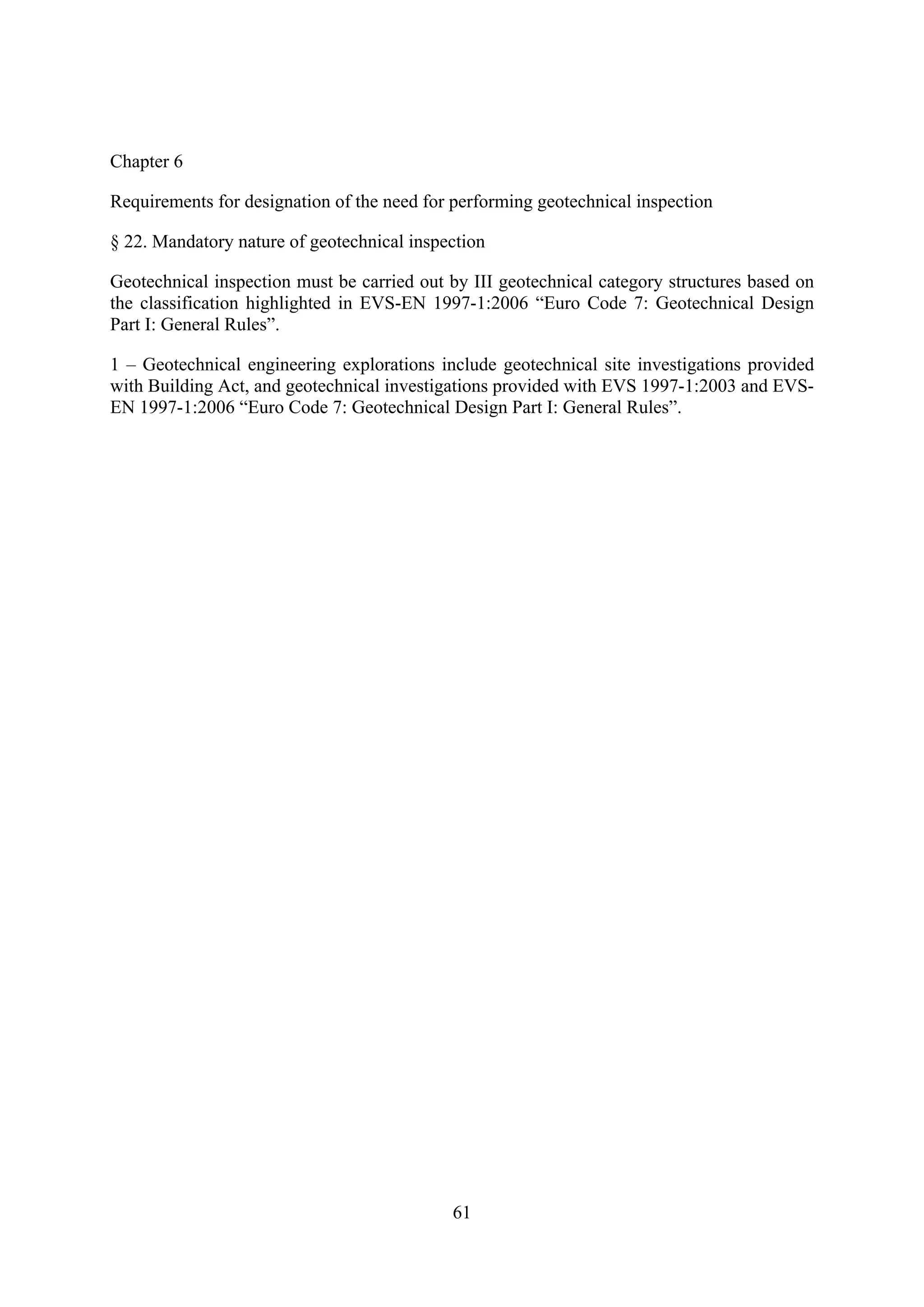
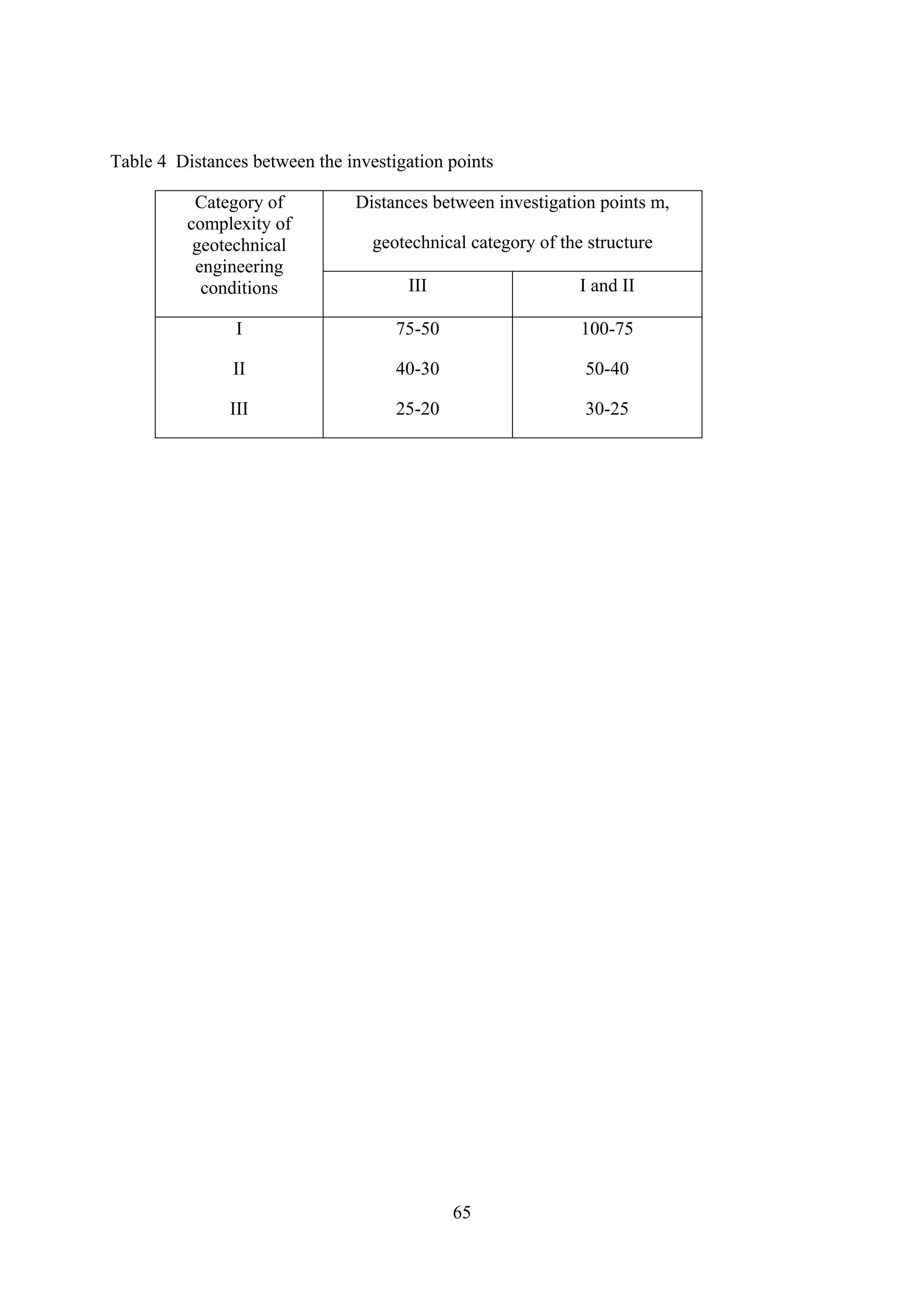
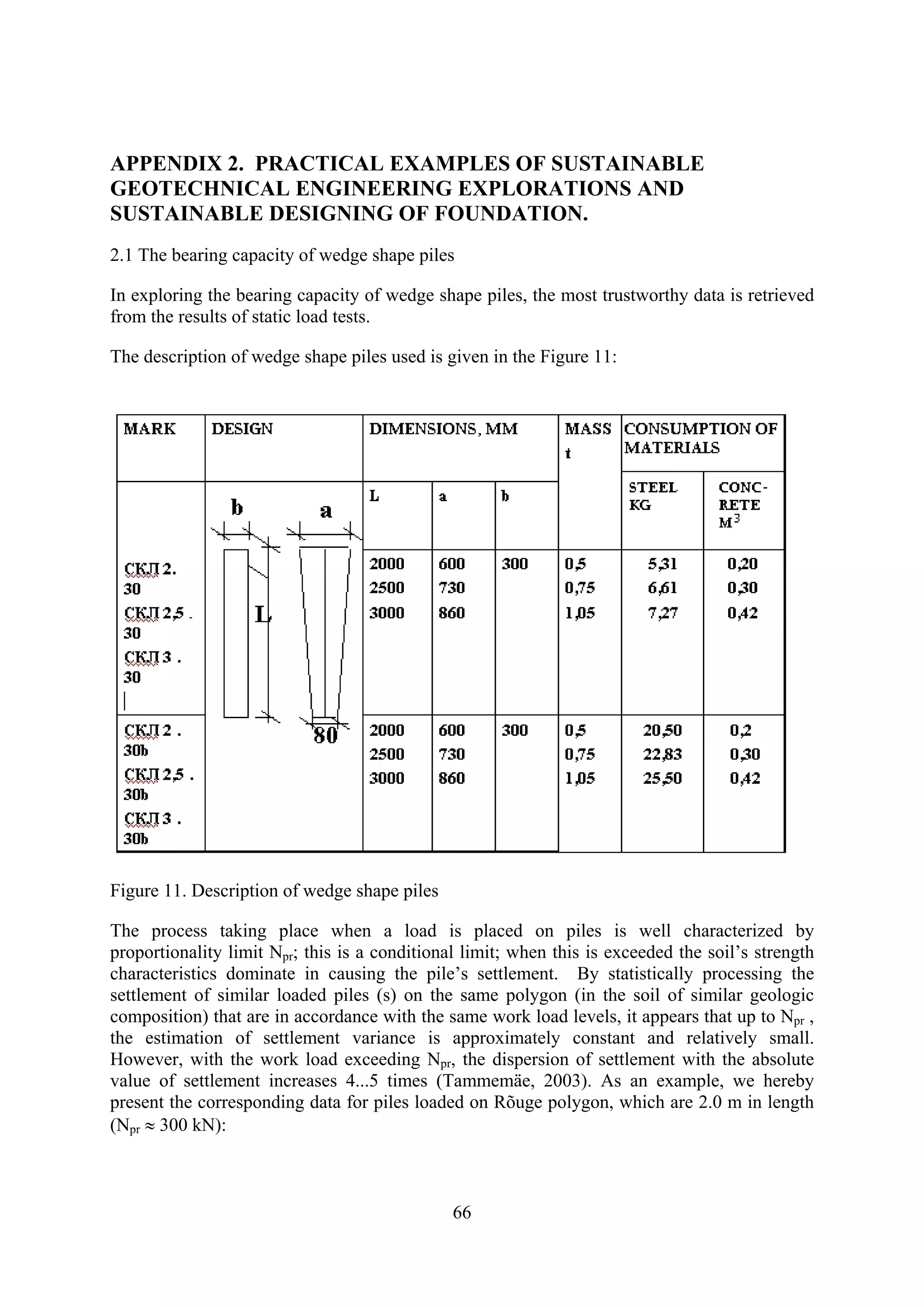
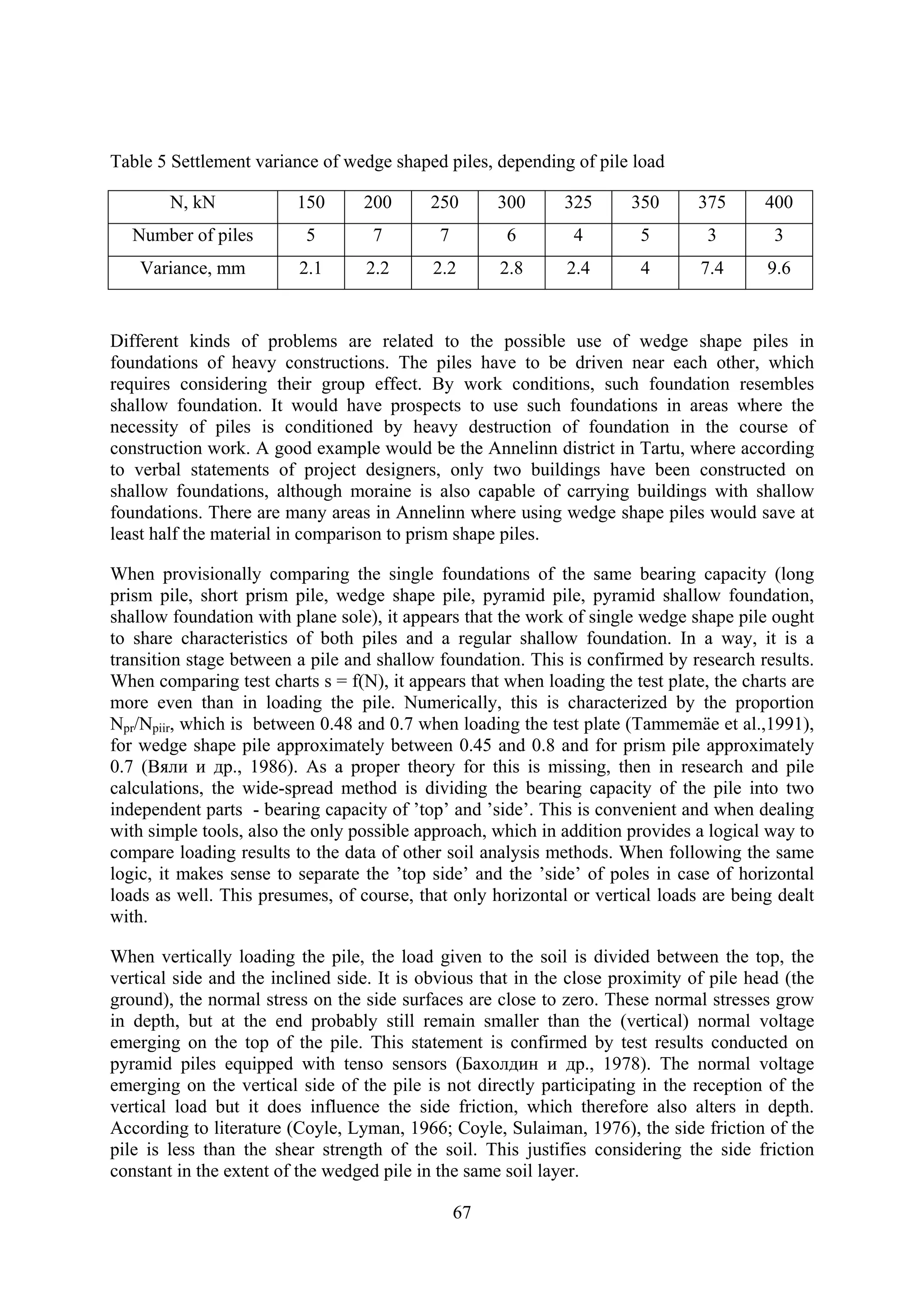
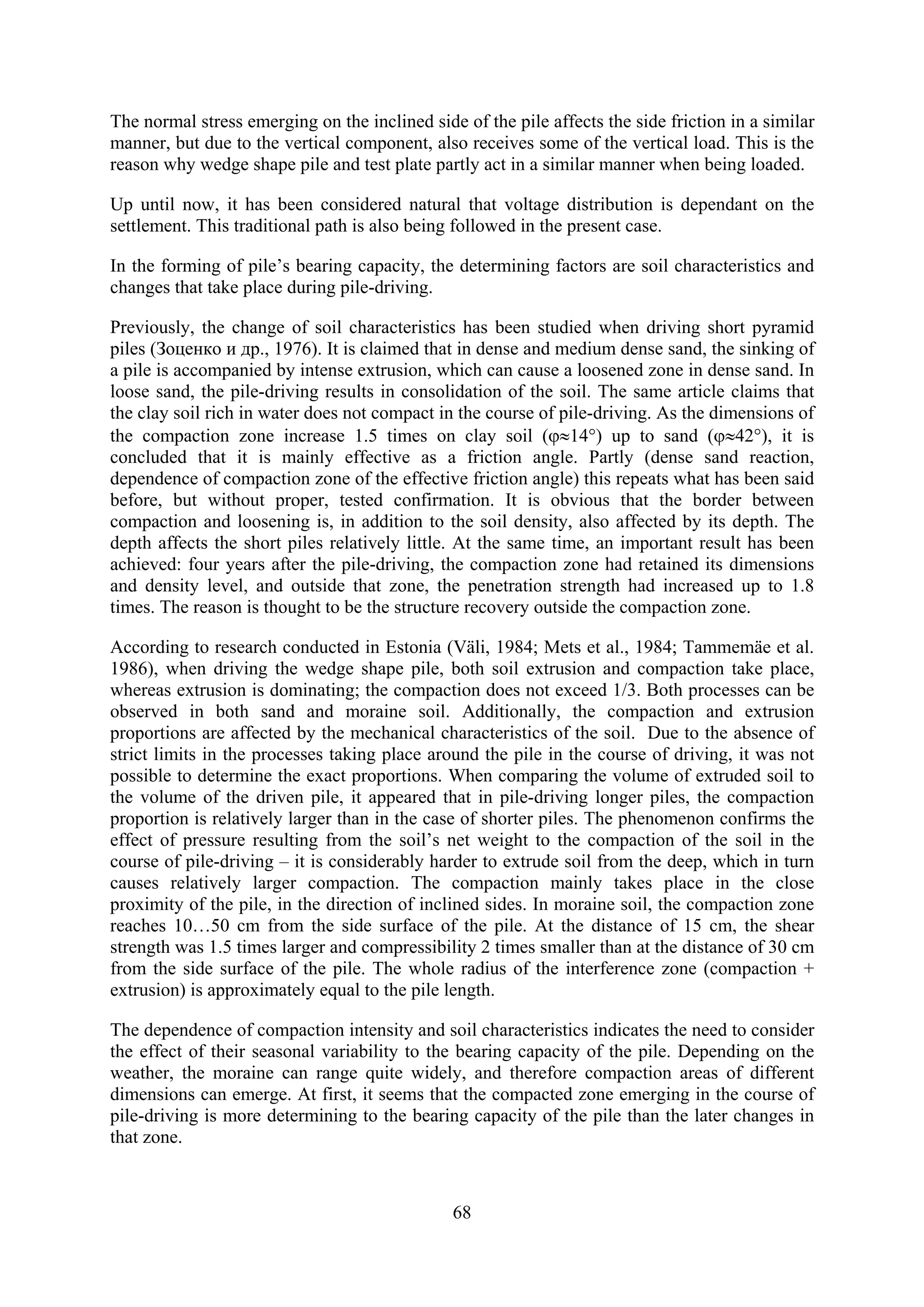
  8) Member of the Estonian Reserve Officers’ Association;
  9) Estonian Defence League Tallinn Unit, member of board.9. Work experience:
  10) April 2007 – present. National Audit Office of Estonia, director general of INTOSAI
     Working Group on Environmental Auditing Secretariat.
  11) January 2004 – April 2007. Ministry of the Environment of Estonia, Deputy Minister.
  12) June 1998 – December 2003. Stockholm Environment Institute Tallinn Centre, director.
  13) January 1997 - June 1998. Ministry of the Environment of Estonia, head of the Nature
     Conservation Department. Managerial duties: development of a new structure
     (integration of former structural units – departments of nature conservation, natural

                                            42
resources and assessment of environmental impact), execution of reforms, initiating
   new trends, team building, improvement of environmental legislation, international
   relations, and enhancement of the network of in-service training in the departments of
   the environment of county councils and in-house training in the ministry in the domain
   of a new structure.
14) May 1991 - December 1996. Ministry of the Environment of Estonia, head of the
   Department of Environmental Expertise. Creating legislative and administrative
   preconditions to introduce and implement assessment of environmental impacts,
   environmental auditing and environmental management systems in Estonia.
15) May 1983 - May 1991. National Institute for Research in Construction, the
   Geotechnical Department, group leader and deputy manager. Foundation exploration of
   capital constructions in Estonia.
16) September 1977 - May 1983. Institute of Engineering Design "EKE Projekt" Tartu
   department, engineer. Construction geology of agricultural buildings and geotechnical
   investigations.


                                         43
APPENDIXES

APPENDIX 1. THE DRAFTS OF THE LEGAL ACTS
APPENDIX 1.1 The draft amendments to the Earth’s Crust Act, the Environmental
Register Act, the Building Act and the Planning Act

§ 1. The following amendments will be made to the Earth’s Crust Act (RT I 2004, 84, 572;
2007, 42, 303):

1) subsection 1 of section 1 will be phrased as follows:

“(1) This Act provides for the procedure for and the principles of exploration, protection and
use of the earth’s crust, with the purpose of ensuring economically efficient, secure and
environmentally sound use of the earth’s crust.”;

2) subsection 2 of section 2 will be supplemented with clause 21 as follows:

“21) geological explorations and geotechnical inspection;”;

3) section 2 will be supplemented with clauses 41 and 42 as follows:

“41) geotechnical engineering investigation is an investigation of the characteristics of the
earth’s crust, with the aim of ensuring the technical and environmental safety of buildings and
construction work and obtaining optimal initial data of the plans and building design
documentation;

42) geotechnical investigation is a comparison and assessment of geotechnical engineering
investigation data and the data obtained during construction work or utilization of a
building;”;

4) the Act will be supplemented with chapter 51 and phrased as follows:

“51. chapter

GEOTECHNICAL           ENGINEERING          INVESTIGATION          AND      GEOTECHNICAL
INSPECTION

§ 581. Application of requirements concerning general geological research and geological
exploration

Regarding the execution of a geotechnical engineering investigation and cleaning the
investigated area, the requirements concerning general geological research and geological
exploration will be applied so much as it has not been stipulated differently in the present Act
or based on the present Act.

§ 582. Obligation and contents of conducting geotechnical engineering investigations

Geotechnical engineering investigations must be conducted thoroughly in appropriate volume
in order to build and on compiling general and detailed planning. On reconstruction
geotechnical engineering investigations must be conducted in case the existing loads or
foundations change.

                                              44
(2) The contents, volume and methodology of a geotechnical engineering investigation will be
specified in the investigation programme according to the environmental conditions,
geological conditions of the section of the earth’s crust under investigation, the phase of the
planning, the character of the planned object or the contents and legal requirements of the
plan.

(3) The requirements to the contents and volume of geotechnical engineering investigations,
including the criteria which determine the representativity of the investigations, and the
requirements to the methodology will be specified by the Minister of the Environment/the
Government of the Republic.

§583. Permit of geotechnical engineering investigation

(1) Geotechnical engineering investigations are permitted on the basis of a permit of
geotechnical engineering investigation. A permit of geotechnical engineering investigation
will be issued by the Ministry of the Environment. The Minister of the Environment can
delegate the issue of permits to another government office under its governance.

(2) Application for a permit of geotechnical engineering investigation includes:

   o data on the applicant of the permit and the performer of geotechnical engineering
     investigations;

   o data on the investigated area;

   o data on the investigation carried out;

   o in case the applicant is not the owner of the immovable, a written consent of the owner
      of the immovable;

   o the programme of geotechnical engineering investigation (hereafter: investigation
      programme);

   o technical task delivered to the performer of the investigations by the client.

(3) The investigation programme must be compiled on the basis of a technical task delivered
to the performer of the investigation by the client. The requirements for an investigation
programme and for a technical task will be specified by the Minister of the Environment/the
Government of the Republic.

(4) The issuer of the permit will send an application for a permit of geotechnical engineering
investigation and the draft of the decision on the application to the local municipality of the
location of the investigation in order to obtain estimation. The local municipality will give its
estimation in writing within one month of receiving the application and the draft.

(5) The following shall be marked on a permit of geotechnical engineering investigation:

   o the name, ID or register code and address of the owner of the permit and the performer
      of the investigation;

   o period of validity of the permit;


                                               45
o the size and location of the area and the section of the earth’s crust necessary for the
      geotechnical engineering investigation (hereafter: the area of geotechnical engineering
      investigation);

   o the character and volume of a geotechnical engineering investigation;

   o requirements to ensure protection of the earth’s crust and reduce harmful impact on the
     health of human beings, property and environment.

(6) A permit of geotechnical engineering investigation will be granted for up to 2 years.

(7) A permit of geotechnical engineering investigation shall be refused in case:

   o the performer of the investigation marked on the application does not comply with the
      requirements;

   o the planned investigation does not enable sufficient data for construction work or
      planning;

   o the permit applicant knowingly submits false data;

   o an investigation is intended in an area where the existing plan does not allow any
     building.

(8) A geotechnical engineering investigation permit shall be annulled in case:

   o false data has been submitted knowingly;

   o the permit owner applies for invalidation of the permit,

   o in the course of a geotechnical engineering investigation substantial environmental
      damage has occurred or public interest has been violated in any other way.

(9) The application form, order of granting and annulment of a geotechnical engineering
investigation permit and deadlines for rules of procedure and the form will be specified by the
Minister of the Environment/the Government of the Republic.

§ 584. Cleaning up the area damaged during the geotechnical engineering investigation

According to the regulation determined in the present Act subsection 45 (2) the owner of a
geotechnical engineering investigation permit is obliged to liquidate excavations and
boreholes made during the investigation.

§585. The requirements for the performer of a geotechnical engineering investigation

The requirements for the performer of a geotechnical engineering investigation have been
stated in the Building Act.

§586. Geotechnical engineering investigation report

(1) The results of a geotechnical engineering investigation shall be drawn up in a report,
which must include all necessary technical data that the methodology of work and scope of
work enable.
                                              46
(2) In the report the undertaker of a geotechnical engineering investigation can make
proposals for further geotechnical engineering work and building design documentation.

(3) In the report the undertaker of a geotechnical engineering investigation must show
possible environmental damage and necessary additional geotechnical engineering work.

(4) Specified requirements for the content and registration of a report of geotechnical
engineering investigation will be determined by the regulation of the Minister of the
Environment/the Government of the Republic.

§587. Submission of the geotechnical engineering investigation report

(1) The permit owner of a geotechnical engineering investigation must submit the report to
the issuer of the permit within 10 days of the final day of the investigation, but not later than
20 days of the investigation permit’s invalidation date.

(2) The issuer of the permit shall check the compliance of the investigation report with the
investigation programme within 10 days of receiving the report.

(3) In case the issuer of the permit finds that the investigation report does not comply with the
investigation programme, he returns the report for necessary amendments. In this case the
deadline stipulated in subsection 2 of this section shall be prolonged for the time it takes to
correct the report. Reasons for returning the report must be given in writing.

§588. Geotechnical inspection

(1) Geotechnical inspection must be conducted in case of complicated geotechnical
engineering conditions, complex or public buildings, geological processes dangerous for the
building and novel foundation solutions, and in case substantial differences occur between the
data in a geotechnical engineering investigation report and the data appearing in the course of
construction work or utilization of the building. Specified requirements for necessity to
conduct geotechnical inspection will be laid down by the Minister of the Environment/the
Government of the Republic.

(2) Execution of geotechnical inspection will be decided by a senior executive or the issuer of
a geotechnical engineering investigation permit.

(3) In the course of geotechnical inspection previously conducted geotechnical engineering
investigations can be repeated or new geotechnical engineering investigations and geodetic
construction investigations can be carried out. Requirements for a geotechnical engineering
investigation shall be applied to geotechnical engineering investigations carried out during
geotechnical inspection so much as it has not been stipulated differently in the present Act or
based on the present Act. Geodetic construction investigations shall proceed from the
Building Act and the requirements based on the Building Act”;

5) the Act will be supplemented with section 721 and phrased as follows:

“§721.   Violation of requirements of a geotechnical engineering investigation and
geotechnical inspection and not submitting a geotechnical engineering investigation report


                                               47
(1) For violation of the requirements of a geotechnical engineering investigation and
geotechnical inspection or not submitting a geotechnical engineering investigation report, a
financial penalty of 150 fine units shall be imposed.

(2) The same Act, if committed by a legal person, is punishable by a fine of up to 25 000
kroons.”;

6) Subsection 2 of section 73 will be phrased as follows:

“(2) The Environmental Inspectorate is the extra-judicial body which conducts proceedings in
matters of misdemeanours provided for in §§ 67-72 of this Act and is the extra-judicial body
which conducts proceedings in matters of misdemeanours provided for in § 72 and 721 of this
Act. The extra-judicial body of the offences stipulated in §-s 67-72 of the present Act is the
Environmental Inspection and the extra-judicial body of the offence stipulated in §-s 72 and
721 is the Estonian Technical Surveillance Authority.”;

7) the Act will be supplemented with section 731 and phrased as follows:

“§731. State supervision

(1) Fulfilling the requirements stipulated in chapter 51 of this Act and legal acts based on it,
state supervision shall be carried out by the Estonian Technical Surveillance Authority.

(2) In the jurisdiction of an official of the Estonian Technical Surveillance Authority is:

   o in order to conduct state supervision, to receive necessary information about
      geotechnical engineering investigations from a government office, local municipality,
      a performer of geotechnical engineering investigations or a client;

   o to become acquainted with a geotechnical engineering investigation’s original
      documents or photocopies and receive duplicates;

   o issue orders according to its jurisdiction.

(3) An official conducting state supervision for the Estonian Technical Surveillance Authority
issues an order to the undertaker, in case a person performing geotechnical engineering
investigations has carried out investigations insufficiently or not in compliance with the
regulations.

(4) An official conducting state surveillance for the Estonian Technical Surveillance
Authority in the named instruction in subsection 3 of this section:

   o points out infringement of law;

   o raises a claim to stop geotechnical engineering investigation partially or completely;

   o is obliged to carry out necessary procedures in order to continue with the geotechnical
      engineering investigation legitimately.

(5) Director General of the Estonian Technical Surveillance Authority and his authorized
official of the Estonian Technical Surveillance Authority have the right to, in case of an
undertaker’s repeated nonexecution of orders, make a decision in which nonexecution will be

                                               48
fixated and which will be the basis of deletion of the undertaker from the register of economic
activities.

(6) In case of nonexecution of the named instruction in subsection 3 of this section, an official
conducting state surveillance can apply coercive measures substitutive enforcement and
penalty payment the form stipulated with the law. Substitutive enforcement’s maximum limit
is 10 000 kroons.”.

§ 2. The following amendments will be made to the Environmental Register Act (RT I 2002,
58, 361; 2006, 58, 439):

1) subsection 2 of section 2 will be supplemented with clause 41 and phrased as follows:

“41) for designing the buildings;”;

2) subsection 1 of section 6 will be phrased as follows:

“(1) Environmental data not entered in the environmental register shall not be used in the
processing of applications for environmental permits or for the registration of environmental
exploitation or upon designing the buildings, preparation of plans and development plans,
unless otherwise provided by law. ”;

3) chapter 2 of the Act will be supplemented with division 7 as follows:

“Division 7 Recordkeeping of environmental conditions of geotechnical engineering

§ 371. Recordkeeping of environmental conditions of geotechnical engineering

Recordkeeping of environmental conditions of geotechnical engineering is held in the
Environmental Register as a list of data of geotechnical engineering investigations.

§ 372. A list of data of geotechnical engineering investigations

(1) A list of data of geotechnical engineering investigations includes information about the
object of investigation, the performer and owner of the investigation, the location of the
investigation and utilization, a depiction of the investigation, and an overview of the most
important conditions of geotechnical engineering. The data shall be entered into the
Environmental Register on the basis of a geotechnical engineering investigation report.

(2) The list of data of geotechnical engineering investigations shall be compiled by locations
of real estates in the Environmental Register where investigations take place.

(3) On a register card of a list of data of geotechnical engineering investigations shall be
entered:

   o the name and ID or register code of the performer of the investigation;

   o the time of the investigation;

   o the types and volumes of the investigation;

   o a short depiction of the geological cross-section;

                                               49
o appearance and regime of subterranean waters;

   o a short depiction of processes and phenomena of geotechnical engineering;

   o utilization of previous research data;

   o the name, ID or register code and contacts of the owner of the report of geotechnical
     engineering investigation.

(4) Appendix to a geotechnical engineering investigation register card is an overview map and
location map.

(5) The date of certification of a geotechnical engineering investigation report and the name
of confirmer shall be entered onto the register card.”;

4) section 38 will be supplemented with clause 7 and phrased as follows:

“7) environmental conditions of geotechnical engineering.”;

5) clause 4 of section 39 will be phrased as follows:

“4) by the date determined in a permit for the conduct of a programme, exploration work or
an inventory prescribed by legislation, or by the date determined in a contract entered into for
the conduct thereof, in case of geotechnical engineering investigation within 10 business days
from receiving a report;”;

6) subsection 1 of section 46 will be supplemented after the word “samples of mineral
resources” with the words “, of geotechnical engineering investigation reports”;

7) to the end of subsection 21 of section 46, the following words will be added: “, unless
provided in subsection 2.”;

8) section 46 will be supplemented with subsection 21 and phrased as follows:

“(21) Within three years of submission of a geotechnical engineering investigation report to
the Environmental Register, access to the report is permitted only with a written permission of
the owner of the report entered into the Environmental Register.”;

9) section 60 will be supplemented with subsection 7 and phrased as follows:

“(7) by 1 January of the year 2009 the data given in § 35 of the present Act will be added to
the Environmental Register.”.

§ 3. The following amendments will be made to the Building Act (RT I 2002, 47, 297; 2007,
24, 128):

1) in subsection 19 (2) the words “geotechnical site investigations or geodetic surveys” will
be replaced with the words “geotechnical engineering investigation and construction geodetic
surveys”;

2) subsection 3 of section 19 will be phrased as follows:


                                               50
“3) Design criteria are the architectural and structural criteria for construction works which
are determined for the construction works by an order of the local government issued within
15 days from the date on which the relevant application is submitted. Design criteria shall be
prepared on the basis of a comprehensive plan if there is such a plan, as well as on the basis of
the results of a geotechnical engineering investigation.”;

3) section 20 will be phrased as follows:

“§ 20. Geodetic surveys

(1) The purpose of geodetic surveys is to obtain primary data necessary for the planning of
areas, for the preparation of building design documentation and for building.

(2) Undertakings engaged in conducting site geodetic surveys are required to submit the
results of the surveys to the local government within 10 days from the date on which the
geodetic surveys are completed. The results of geodetic surveys may be submitted by
electronic means. Upon the conduct of geodetic surveys, the requirements for geodetic
systems within the meaning of the Databases Act shall be taken into consideration.

(3) Local governments shall preserve the results of geodetic surveys for at least 99 years from
the date on which such results are received.

(4) The procedure for the conduct of geodetic surveys shall be established by the Minister of
Economic Affairs and Communications.”;

4) clause 24 (1) 4) will be phrased as follows:

“4) the building design documentation prepared for the erection of construction works, or in
cases provided by the Earth’s Crust Act subsection 582 (1) to reconstruct a building, is not
based on the results of geotechnical engineering explorations or geodetic surveys conducted at
the location of the construction works to be built, or the results of the geotechnical
engineering exploration are not entered into the Environmental Register or”;

5) in the text of the Act, with the exception of § 56, subsections 64 (1), (6) and (7), and § 66,
the word “site investigation” will be replaced with the words “geotechnical engineering
exploration and geodetic survey”;

6) In § 56, clauses 64 (1) 6) and 7) and § 66 the word “site investigation” will be replaced
with the words “geodetic survey”.

§ 4. Planning Act (RT I 2002, 99, 579; 2007, 24, 129) will be supplemented with section 141
and phrased as follows:

“§ 141. Considering the results of geotechnical engineering explorations on compiling plan

Compiling county, comprehensive and detailed planning must be based on the results of
geotechnical engineering explorations of the planned area, which are entered into the
Environmental Register.”


                                               51
Appendix 1.2 the draft of Government or Minister’s Regulation: « An Order of
Engineering Geological Investigations »

Chapter 1

General Provisions

§ 1. Scope of application of Act

This regulation sets out:

    The requirements for geotechnical engineering explorations (hereinafter referred to as:
   explorations) technical task and investigation program.

   o The requirements for the content, volume and methods of the explorations.

   o The requirements for the content and the documentation of the report of the
     explorations.

   o The requirements for designation of the need for performing geotechnical inspection.

§ 2. Goal of explorations

(1) The goal of explorations is to obtain sufficient materials for designing the objects,
considering the rational use and protection of the geological environment, and also to get
necessary data for predicting the change of geotechnical engineering conditions by
establishing the construction works and by their exploitation.

 (2) The exploration must guarantee a many-sided knowledge about the designed construction
area (track segment), including geomorphologic, seismic and hydro-geological conditions,
geological composition, soil characteristics, geological processes and phenomena, and
changing of the conditions of an occupied (built-up) area.

§ 3. General requirements for carrying out explorations

The owner of the permit for the explorations is obliged to coordinate the time and place of the
explorations with the local government, the owner of the immovable, the owner or
administrator of communications and power lines overhead or underground cable lines and
pipelines, as well as with the custodian of natural features and immovable monuments.

(2) The locations of boreholes, excavations and temporary constructions necessary for the
explorations shall be chosen by the approval of the owner of the immovable. Further changes
in the above mentioned sites may be conducted only by the approval of the owner of the
immovable.

§ 4. An obligation to follow Estonian standards

By performing the explorations the Estonian standards must be followed.


                                              52
Chapter 2

Requirements for the technical task and investigation program.

§ 5. Requirements for the technical task

(1) The customer of the exploration shall issue the technical task to the organiser.

(2) The technical task of the exploration must include the following data:

   o The name of the object.

   o A geodetic map.

   o Data considering the planning of the area to be explored.

   o Description of the construction to be designed.

   o Term and procedure of presenting the research to the customer.

   o Contact data of the customer’s representative.

(3) In addition to the data highlighted in subsection 2 the technical task of the explorations
necessary for the design of constructions must include the following data and documents:

   o Data considering the sensitivity of the objects to be designed in respect to their
     heterogeneous sinking, types or variants of foundation, the loads, the depths and
     constructions of the foundations of the buildings and establishments, the locations and
     depths of cellars, semi-cellars, tunnels and other underground establishments;

   o Requirements for the determination of the soil characteristics necessary for conducting
     engineering calculations and assessing the possible change in the geotechnical
     engineering conditions, as the result of the construction and use of the object;

   o The technical task must include the geological map with the locations of the
     constructions to be designed.

(4) In addition to the data mentioned in subsection 2, the technical task of the explorations
necessary for the reconstruction of a structure must include the preliminary project, data
reflecting the research conducted at the time of construction, an overview of the planned
changes and the results of observation.

(5) Technical task must not determine the content and amount of the research.

§ 6. Requirements for the research programme

(1) The conductor of the explorations shall compile the explorations programme on the basis
of the technical task. When changing the technical task, the explorations programme must be
changed correspondingly.

(2) Exploration programme must include the following data:
                                               53
o Data about the object of the explorations (cadastral reference data of the registered
     immovable, the address of the existing or designed structure).

   o A geodetic map.

   o Data considering the valid planning of the area to be explored.

   o Description of the construction to be designed.

   o The goal and the task of the exploration.

   o Data reflecting earlier explorations and an explanation to the use of these data
     according to subsection 6 (1).

   o Data reflecting the amount of field investigations. When field investigations are not
     planned this should be substantiated.

   o Description of natural conditions and an assessment to the degree of their
     explorations.

   o Category of geotechnical engineering conditions according to appendix 1.

   o Length of geotechnical engineering observation and the conditions for the referral to
     the customer of the network of observation.

   o Explanation about the methods of guaranteeing the compliance with occupational
     health and safety, as well as environmental protection requirements.

   o Content reflecting the exploration report.

Chapter 3

The requirements for the content, volume and methods of the explorations;

Division I

General requirements

§ 7. Content of explorations

(1) Generally, the following geotechnical engineering works make up the exploration:

   o Collecting, processing, analysing and using the data of previous years’ research
     materials and geotechnical engineering conditions.

   o Deciphering and aero-visually observing satellite and aero-photos.

   o Route observation.

   o Establishing the excavations.

   o Geo-physical research.


                                            54
o Field investigations of soils.

   o Field- and pile tests.

   o Hydro-geological research.

   o Stationary observations.

   o Laboratory tests of the soils – the soils must be tested following the valid norms and
     standards, the number of tests must enable statistic data processing.

   o Geotechnical inspection.

   o Investigations of the soils of the existing buildings and structures.

   o Analysis of the research data,

   o Assessment of the characteristic or the design values of the soils.

(2) The necessity for the various geotechnical engineering works and the conditions for their
replacement shall be determined in the exploration programme according to the design phase,
complexity of geotechnical engineering conditions, and the class of the designed buildings
and structures following Estonian standard EVS-EN 1997-1:2006 “Euro Code 7:
Geotechnical Design Part I: General Rules”.

(3) Assessing the complexity of geotechnical engineering conditions shall be performed
pursuant to the table in Appendix 1 of this regulation.

(4) The explorations necessary for the pre-project documentation, and for the project, must be
concluded with the highest degree in detail on typical segments, the received data are
recommended to extrapolate for surrounding areas.

§ 8. Using the data of earlier explorations

Using the data of earlier investigations presupposes an analysis of this data, an assessment of
the geotechnical engineering changes that have taken place after performing those earlier
investigations and accordance with the valid legislations and standards. Exploration
programme must include the analysis.

§ 9. Geotechnical engineering observation

(1) Observations considering the development of hazardous geological processes, ground
water etc, started prior to the explorations on the investigated area shall be continued in the
course of the exploration. In case of need, the observation network must be extended to the
neighbouring area, minimised, or the frequency and precision of the measuring and
observation should be changed in agreement with the responsible executor of the observation
programme.

(2) Geotechnical engineering observation assesses:

   o The development of hazardous geological processes (karstic features, landslides,
     collapses, erosion of the banks of reservoirs, rivers and lakes, etc).

                                              55
o The condition of the mined territories,

   o Changes of soil characteristics, including the temperature.

   o Changes in ground water regime.

   o Locations of buildings and structures.

   o Other characteristics important for the stability of a structure.

(3) Concluding the explorations, the observation network must be transferred to the customer,
accompanied with an act, for continuing the observation.

§ 10. Stages of exploration

(1) The stages of exploration are generally preliminary investigation and main investigation,
in case of need also control investigation. The goal and content of exploration stages are
described in Estonian standard EVS-EN 1997-1:2006 “Euro Code 7: Geotechnical Design
Part I: General Rules.”

(2) Preliminary investigations for geotechnical engineering must guarantee necessary and
sufficient data for working out the pre-project documentation. The explorations performed in
order to compile the planning may be restricted to the stage of preliminary investigation.

§ 11. Requirements at the preliminary investigations of the observation points

(1) The average number of investigation points per 1 km² and the average distance between
the investigation points must be determined considering the category of complexity of the
geotechnical engineering conditions and the scale of planning, in accordance with Appendix
2. The distance between the investigation points should be minimised, in case the data
received in the course of explorations do not allow giving grounded technical solutions.

The width of linear structures, the depth of investigation points and the distance between them
must be chosen in accordance with Appendix 3. The depths of the investigation points must
guarantee the assessment of geotechnical engineering conditions in the limits of the structures
to be designed.

(3) In the segments of the areas with a special soil, the investigation points should be passed
in their whole thickness or until a depth where the existence of such soils will not influence
the stability of the buildings and structures to be designed. Special soil in the context of this
regulation is a highly compressible or swelling soil, such as mud, peat, sapropele, soil rich in
organic substance, and the cultural layer.

(6) In the segments of the development of geological processes the investigation points must
be at least 5m deeper than the zone of the active development of the processes.

§ 12. The distances between the investigation points and the number of excavations at main
explorations

(1) The distances between the investigation points must be chosen according to the
complexity of geotechnical engineering conditions highlighted in Appendix 1, and the


                                               56
geotechnical category of the structure based on EVS-EN 1997-1:2006 “Euro Code 7:
Geotechnical Design Part I: General Rules.”

(2) The total number of excavations within the limits of the structures to be designed must be
at least three, including earlier investigations.

Division II

Additional requirements for explorations considering the reconstruction of a structure

§ 13. Need for explorations

To conduct additional explorations for the reconstruction of a structure, in case the present
loads or existing foundations change.

§ 14. Additional geotechnical engineering works

At the explorations performed for reconstructing structures the following geotechnical
engineering works must carried out:

   o Assessment of the constructive changes of geotechnical engineering conditions and
     the structures in the period of their construction and exploitation.

   o Determination of the deformations of the structures and the earth surface, existence
     and condition of drainage and other water protection systems, as well as the
     effectiveness of former environmental protection methods.

Division III

Additional requirements for explorations in the areas of hazardous geological processes.

§ 15. Additional requirements for the explorations in the areas of karst

In the area of karst expression it is necessary to determine in the course of geotechnical
engineering explorations:

   o Geological, hydro-geological and geo-morphological conditions of karst development.

   o The spread of karstic features, their character and intensity, history and development
     pattern.

   o Dividing the area into divisions on the basis of karstic features development level, its
     character and degree of karstisation.

   o The area’s estimated strength in respect to karst settlement and sink.

   o The physical-mechanical peculiarities of soil characteristics and hydro-geological
     conditions connected with karst.

   o The estimated development of the karstic features influenced by natural and
     technogenic factors at the time of the construction and exploitation of the objects;


                                               57
o Geotechnical engineering recommendations for the rational use of the area and
     application of anti-karst preventive measures.

§ 16. Additional requirements for the explorations in excavated areas

(1) An area with open diggings shall be regarded as a special soil or technogenic bulk, where
in case of need research methods for the investigation of slope processes shall be applied.

(2) Sub-surface mining areas shall be divided into firm, stable, sunk and quasistable areas on
the basis of the explorations.

(3) Firm area is a part of an extracting permit area where the winning of the mineral resource
has been or will be unperformed. There are no construction restrictions on a firm area.

(4) Sub-surface mining areas are sunk in case the winning of the mineral resource has resulted
in the sinking of the soil layers by more than 3cm.

(5) Sub-surface mining areas are stable in case it is hold together by units with calculated age
being not restricted by time.

(6) Sub-surface mining areas are quasistable where the units supporting the ceiling and the
ground, partly back-filled and supportive elements did not break in the course of excavations,
but this could happen later at any time. Quasistable is an area that has been handled with
chamber mining, where the mining depth was over 30m, all the sunken slopes, as well as the
whole subsurface mining area near the outcrop of the mineral resource (mining depth less
than 12m).

(7) Construction is allowed in a sunk, stable and quasistable area in respect to “Mining Act”
on the basis of an expertise performed by the person responsible.

(8) All geological engineering explorations of the subsurface mining areas must include
hydro-geologic research and radiation research.

(9) By designing the constructions in mining areas it is not allowed to be restricted only to the
preliminary exploration.

§ 17. Additional requirements for the explorations in case of a hazardous slope processes

(1) In case of hazardous slope processes additionally must be determined:

   o Relief.

   o The development of slopes and their age.

   o Existence of earlier landslide processes and areas.

   o Tectonic failures, the bedding conditions of the soils and required characteristics for
     engineering calculations.

   o Contemporary tectonic and technogenic movements.

   o Surface and groundwater regime.

                                               58
o Peculiarities and intensity of accompanying geological processes (e.g. withering,
     erosion, change of the relief).

   o Positive and negative experiences from applying regulative methods for slope
     processes in the area of the designed object and other areas with similar geotechnical
     engineering conditions.

(2) On the basis of geotechnical engineering explorations it is obligatory to:

Form geotechnical engineering districts for planning III category area on the basis of
geotechnical engineering conditions following Appendix 1, or establishing the infrastructures:

   o Assess the stability of slopes, the results of slope processes and recommendations for
     designing countermeasures.

   o In case of need, based on the results of exploration highlighted in clauses 1-2, compile
     the observation scheme for slope processes.

Division IV

Additional requirements for explorations in the areas of shore- and bank processes

§ 18. The need for the explorations of shore and bank processes.

Shore - and bank processes must be explored in cases where the structure is designed either
directly onto the shore, or the shore or bank line is to be altered.

§ 19. Additional requirements for explorations in the areas of shore- and bank processes

(1) In the course of geotechnical engineering explorations hydro-meteorological and shore
geological investigations must be carried out.

(2) Hydro-meteorological investigations include clarifying the sea level-, wind- and wave
energy regimes, the peculiarities of current and sediments movements in areas of shore and
bank changes.

(3) Shore geological explorations cover integrated expenditure, transit and cumulative areas,
which are developmentally and dynamically dependent on each other.

(4) In the course of preliminary investigation it is necessary to additionally:

   o Analyze topographic maps compiled at different times, plans, aero-photos and other
     information.

   o Assess the main processes shaping shores and banks in integral dynamic systems, and
     their change in time and space.

   o Assess the effectiveness of supportive structures in the area investigated, as well as in
     areas with similar natural conditions.

(5) The observation of shores and banks must be commenced in the preliminary phase and be
continued at the time of explorations executed in order to compile project documentation.

                                                59
Observation of shores must include the areas that are developmentally and dynamically
connected to object’s nearest neighbourhood.

(6) Concluding the explorations, the observation network must be transferred to the customer,
accompanied with a respective act.

Chapter 5

Requirements for the content and the preparation of materials of the explorations;

§ 20. Report form of the explorations

The results of the exploration shall be prepared as a report. The report consists of a text,
textual annexes and graphical appendices.

§ 21. Content of exploration report

(1) Exploration report must contain all the data determined in the course of exploration
programme. Exploration report must include at least the following data:

   o Geological engineering exploration programme and technical task.

   o Definition of the area explored.

   o Investigation coordinates and elevations in valid geodetic system.

   o Description of work methods and volume of investigations.

   o Precise references on the content and volume of the data used in earlier projects.

   o Geological logs of all excavations established, results of field investigations and tests.

   o Geotechnical engineering assessment (classification of soil layers, geological section,
     numerical data).

   o Conclusions and recommendations driven on the base of exploration results,
     accompanied with corresponding statement of grounds.

   o Reference on the standard, based on which the project has been conducted.

(2) Legal instrument on the liquidation of the excavations established in the course of
explorations.

(3) The person who performed the explorations may make suggestions in this report on
further geotechnical engineering works and the building design documentation designed.

(4) In the report, the undertaking of explorations must reflect the possible environmental
damages and necessary additional geotechnical engineering explorations.


                                              60
Chapter 6

Requirements for designation of the need for performing geotechnical inspection

§ 22. Mandatory nature of geotechnical inspection

Geotechnical inspection must be carried out by III geotechnical category structures based on
the classification highlighted in EVS-EN 1997-1:2006 “Euro Code 7: Geotechnical Design
Part I: General Rules”.

1 – Geotechnical engineering explorations include geotechnical site investigations provided
with Building Act, and geotechnical investigations provided with EVS 1997-1:2003 and EVS-
EN 1997-1:2006 “Euro Code 7: Geotechnical Design Part I: General Rules”.


                                            61
Government or Minister’s Regulation “An Order of Engineering Geological Investigations”

Table 1 Categories of geotechnical engineering conditions

Factors                   I (simple)            II (moderately                 III (complicated)
                                                complicated)
Geomorphologic            Investigated area     Investigated area (track       Investigated area
conditions                (track segment)       segment) with the same         (track segment) with
                          within the limits     origin within the limits of    various origins within
                          of one                several geomorphologic         the limits of several
                          geomorphologic        elements. Inclined bed,        geomorphologic
                          element.              slightly uneven.               elements. Uneven bed
                          Horizontal bed,                                      with discontinuities.
                          even.
Geological                No more than two      No more than four layers       More than four layers
composition               horizontal or         with various composition       with various
                          slightly inclined     and bedding conditions.        composition and
                          layers with           Thickness and soil             bedding conditions.
                          different             characteristics change         Variable thickness and
                          composition           regularly.                     soil characteristics.
                          (inclination not
                          exceeding 0.1).
                          Unvaried
                          thickness at the
                          expansion. Slight
                          variability in soil
                          characteristics
                          and bedding
                          conditions.
Soil waters               Exists one ground     Exist two ground water         Ground water layers
                          water layer with      layers with in places          and their chemical
                          homogeneous           heterogeneous chemical         composition are
                          chemical              compositions or with           heterogeneous.
                          composition.          confined character.
Geological processes      None                  Express sporadically           Widely spread,
and phenomena                                                                  substantially
(karst, erosion,                                                               influencing design and
landslides etc)                                                                construction
Special soils and         None                  Bulks express as               Bedding conditions
technogenic                                     homogeneous layers, there      and the structure of
sediments and                                   is reliable data considering   dumps is variable
formations (bulk,                               technogenic structures         (unisotropic), reliable
dump, mined and                                                                data considering
operating mining                                                               technogenic structures
areas, demolished                                                              is missing
structures, former
military and industrial
areas)


                                                62
Table 2 Engineering geological mapping scale in accordance with the category of complexity
of engineering geological conditions

     Category of             Number of investigation points per 1km² - in the divisible
    complexity of
     geotechnical        Average distance between the investigation points – in the divider
     engineering
      conditions                     Geotechnical engineering mapping scale

                           1:10000          1:5000           1:2000             1:1000


           I                  25              50               200               600

                             350              200              100                60

          II                  30              70               350              1150

                             300              170              75                 40

          III                 40              100              500              1500

                             250              140              65                 35


                                            63
Table 3 Width of the track zone of linear structures, depth of investigation points and distance
between them

                   Explorations for the
                                           Explorations for the
                       pre-project
                                                 project
                     documentation
                                                Distance
                   Width    Distance   Width
                                              between the           Depth of the investigation
Linear structure   of the between the of the
                                             investigation                  point, m
                   track investigation track
                                             points in the
                   zone points in the zone
                                               track zone
                    (up    track zone   (up
                                             (average), m
                   to) m (average), m to) m
railway             500         200         400         100           up to 5      2-3 m lower
highway             400         200         300         100           up to 3        than the
main pipeline       500         200         200         100        2-3 m lower      normative
                                                                     than the        freezing
                                                                   foreseeable     depth of the
ground              200         200         100         100        depth of the        soils
communications                                                       pipeline
trestle             200        2000         100         500            3-7
communication       200        1000         100         300
and       power                                                         3-5
overhead line       300       200-300       200       50-100            5-7
exceeding 35kV
                                                                   2-3 m lower
water supply,                                                         than the
sewerage, heat                                                      foreseeable
network and gas                                                    depth of the
pipe,                                                                 pipeline
underground                                                        (piling wall,
sewer          for                                                    pile tip)
precipitation
waters        and
communications
Comments: On the segments with special soils distribution, development of geological
processes and individual design (transitions, embankments, excavations, etc) a special
programme must be compiled.


                                              64
Table 4 Distances between the investigation points

           Category of          Distances between investigation points m,
          complexity of
           geotechnical           geotechnical category of the structure
           engineering
            conditions                III                     I and II

                I                    75-50                    100-75

                II                   40-30                    50-40

               III                   25-20                    30-25


                                             65
APPENDIX 2. PRACTICAL EXAMPLES OF SUSTAINABLE
GEOTECHNICAL ENGINEERING EXPLORATIONS AND
SUSTAINABLE DESIGNING OF FOUNDATION.
2.1 The bearing capacity of wedge shape piles

In exploring the bearing capacity of wedge shape piles, the most trustworthy data is retrieved
from the results of static load tests.

The description of wedge shape piles used is given in the Figure 11:


Figure 11. Description of wedge shape piles

The process taking place when a load is placed on piles is well characterized by
proportionality limit Npr; this is a conditional limit; when this is exceeded the soil’s strength
characteristics dominate in causing the pile’s settlement. By statistically processing the
settlement of similar loaded piles (s) on the same polygon (in the soil of similar geologic
composition) that are in accordance with the same work load levels, it appears that up to Npr ,
the estimation of settlement variance is approximately constant and relatively small.
However, with the work load exceeding Npr, the dispersion of settlement with the absolute
value of settlement increases 4...5 times (Tammemäe, 2003). As an example, we hereby
present the corresponding data for piles loaded on Rõuge polygon, which are 2.0 m in length
(Npr ≈ 300 kN):


                                               66
Table 5 Settlement variance of wedge shaped piles, depending of pile load

        N, kN            150      200      250       300     325       350      375      400
   Number of piles        5        7        7         6        4        5        3        3
    Variance, mm         2.1      2.2       2.2      2.8      2.4       4       7.4      9.6


Different kinds of problems are related to the possible use of wedge shape piles in
foundations of heavy constructions. The piles have to be driven near each other, which
requires considering their group effect. By work conditions, such foundation resembles
shallow foundation. It would have prospects to use such foundations in areas where the
necessity of piles is conditioned by heavy destruction of foundation in the course of
construction work. A good example would be the Annelinn district in Tartu, where according
to verbal statements of project designers, only two buildings have been constructed on
shallow foundations, although moraine is also capable of carrying buildings with shallow
foundations. There are many areas in Annelinn where using wedge shape piles would save at
least half the material in comparison to prism shape piles.

When provisionally comparing the single foundations of the same bearing capacity (long
prism pile, short prism pile, wedge shape pile, pyramid pile, pyramid shallow foundation,
shallow foundation with plane sole), it appears that the work of single wedge shape pile ought
to share characteristics of both piles and a regular shallow foundation. In a way, it is a
transition stage between a pile and shallow foundation. This is confirmed by research results.
When comparing test charts s = f(N), it appears that when loading the test plate, the charts are
more even than in loading the pile. Numerically, this is characterized by the proportion
Npr/Npiir, which is between 0.48 and 0.7 when loading the test plate (Tammemäe et al.,1991),
for wedge shape pile approximately between 0.45 and 0.8 and for prism pile approximately
0.7 (Вяли и др., 1986). As a proper theory for this is missing, then in research and pile
calculations, the wide-spread method is dividing the bearing capacity of the pile into two
independent parts - bearing capacity of ’top’ and ’side’. This is convenient and when dealing
with simple tools, also the only possible approach, which in addition provides a logical way to
compare loading results to the data of other soil analysis methods. When following the same
logic, it makes sense to separate the ’top side’ and the ’side’ of poles in case of horizontal
loads as well. This presumes, of course, that only horizontal or vertical loads are being dealt
with.

When vertically loading the pile, the load given to the soil is divided between the top, the
vertical side and the inclined side. It is obvious that in the close proximity of pile head (the
ground), the normal stress on the side surfaces are close to zero. These normal stresses grow
in depth, but at the end probably still remain smaller than the (vertical) normal voltage
emerging on the top of the pile. This statement is confirmed by test results conducted on
pyramid piles equipped with tenso sensors (Бахолдин и др., 1978). The normal voltage
emerging on the vertical side of the pile is not directly participating in the reception of the
vertical load but it does influence the side friction, which therefore also alters in depth.
According to literature (Coyle, Lyman, 1966; Coyle, Sulaiman, 1976), the side friction of the
pile is less than the shear strength of the soil. This justifies considering the side friction
constant in the extent of the wedged pile in the same soil layer.

                                                67
The normal stress emerging on the inclined side of the pile affects the side friction in a similar
manner, but due to the vertical component, also receives some of the vertical load. This is the
reason why wedge shape pile and test plate partly act in a similar manner when being loaded.

Up until now, it has been considered natural that voltage distribution is dependant on the
settlement. This traditional path is also being followed in the present case.

In the forming of pile’s bearing capacity, the determining factors are soil characteristics and
changes that take place during pile-driving.

Previously, the change of soil characteristics has been studied when driving short pyramid
piles (Зоценко и др., 1976). It is claimed that in dense and medium dense sand, the sinking of
a pile is accompanied by intense extrusion, which can cause a loosened zone in dense sand. In
loose sand, the pile-driving results in consolidation of the soil. The same article claims that
the clay soil rich in water does not compact in the course of pile-driving. As the dimensions of
the compaction zone increase 1.5 times on clay soil (ϕ≈14°) up to sand (ϕ≈42°), it is
concluded that it is mainly effective as a friction angle. Partly (dense sand reaction,
dependence of compaction zone of the effective friction angle) this repeats what has been said
before, but without proper, tested confirmation. It is obvious that the border between
compaction and loosening is, in addition to the soil density, also affected by its depth. The
depth affects the short piles relatively little. At the same time, an important result has been
achieved: four years after the pile-driving, the compaction zone had retained its dimensions
and density level, and outside that zone, the penetration strength had increased up to 1.8
times. The reason is thought to be the structure recovery outside the compaction zone.

According to research conducted in Estonia (Väli, 1984; Mets et al., 1984; Tammemäe et al.
1986), when driving the wedge shape pile, both soil extrusion and compaction take place,
whereas extrusion is dominating; the compaction does not exceed 1/3. Both processes can be
observed in both sand and moraine soil. Additionally, the compaction and extrusion
proportions are affected by the mechanical characteristics of the soil. Due to the absence of
strict limits in the processes taking place around the pile in the course of driving, it was not
possible to determine the exact proportions. When comparing the volume of extruded soil to
the volume of the driven pile, it appeared that in pile-driving longer piles, the compaction
proportion is relatively larger than in the case of shorter piles. The phenomenon confirms the
effect of pressure resulting from the soil’s net weight to the compaction of the soil in the
course of pile-driving – it is considerably harder to extrude soil from the deep, which in turn
causes relatively larger compaction. The compaction mainly takes place in the close
proximity of the pile, in the direction of inclined sides. In moraine soil, the compaction zone
reaches 10…50 cm from the side surface of the pile. At the distance of 15 cm, the shear
strength was 1.5 times larger and compressibility 2 times smaller than at the distance of 30 cm
from the side surface of the pile. The whole radius of the interference zone (compaction +
extrusion) is approximately equal to the pile length.

The dependence of compaction intensity and soil characteristics indicates the need to consider
the effect of their seasonal variability to the bearing capacity of the pile. Depending on the
weather, the moraine can range quite widely, and therefore compaction areas of different
dimensions can emerge. At first, it seems that the compacted zone emerging in the course of
pile-driving is more determining to the bearing capacity of the pile than the later changes in
that zone.


                                               68
The above-mentioned reasons complicate the estimation of a pile’s bearing capacity using
indirect methods.

2.2 The bearing capacity of wedge shape piles from field load tests

On the load-settlement diagram, characteristic points from the aspect of the work of the pile
can be distinguished: Nk – conditional side friction, where elastic deformations predominate
in the soil around of the pile; Npr – proportional limit, where the extrusion of the soil around
the pile begins and Npiir = Fu – the load, at which the soil around the pile goes into the
limiting state.

The settlement of the wedge shape pile at Nk is 0.75…2.5, regardless of the Nk value. The so-
called specific side friction fk does not depend on the dimensions of the pile. The variability
of fk values reaches its maximum in the case of 2 m wedge shape piles (fk = 30…75 kPa) and
is minimal in the case of 3 m wedge shape piles (fk = 45…47 kPa). This can be explained by
the greater heterogeneity of the soil close to the ground (up to 1m), the inadequacy of the
method of determining the Nk, as well as the formation of a slit in the upper part of the contact
area of the pile and the soil during the pile-driving (Вяли и др.,1986).

The value of fk largely depends on the compaction of the soil surrounding the pile during the
pile-driving, which in turn depends on the seasonal variability of the soil characteristics and
reaches its maximum in the natural optimum water content of the soil.

Determining the proportional limit Npr directly from the load diagram is often difficult due to
its convexity. Therefore, it is advisable to use a methodology characterizing the temporality of
the settlement (Mets, 1977), which, if the duration of the experiment is 'prolonged', clearly
indicates the change in the behaviour of the pile (see Figure 12).


                                               69
Figure 12. The dependence of the settlement of the wedge shape pile on the load.

The results of load tests indicate that the settlements of wedge shape piles at Npr in the case of
moraine soils as well as sand soils are very even, remaining within 7.5 ... 10 mm and 5 ... 7.5
mm respectively.

The interdependence Npr = 92,2 + 1,3 Nk (kN) (n=79, r=0,70) of Nk and Npr indicates the
fairly significant role of Nk in the formation of Npr.

As Figure 12 illustrates, starting with the load Npr the increase of the settlement depends on
time as well as the load. Processing a large number of tests (n=79) indicates that exceeding
Npr causes an increase in the variability of the interdependence of the settlement and the load
applied to the pile.

Until the load Npr settlement is caused mainly by the elastic deformation of the soil mass
within the conditioned area of influence, whereas above Npr, a large amount of settlement is
caused by the local inelastic ranges formed near the foot of the pile. Hence derives the

                                               70
explanation for the significant influence the heterogeneity of the soil has on the behaviour of
the pile – the variability of settlements at exceeding Npr.

In the wedge shape pile foundations of light agricultural constructions, the piles are distant
from each other acting as individual piles (co-action is minimal or non-existent). This,
however, causes the danger of differences in settlements to sensitive structures.

The settlement of the pile on the load degree in time as well as the load-settlement diagram
indicate a sharp increase in the intensity of settlement above Npr. It is also evident that
settlement dies down considerably more slowly beyond this limit, and, extrapolating the
progress of the test, very large settlements are created for 'long-term' experiments.

Unfortunately, the geotechnical inspection of buildings with wedge shape pile foundations has
been quite random and exceptional. Consequently, data for improving the forecast of
settlement is still lacking.

The economic need to push each pile to its bearing capacity while avoiding different
settlements and the rupture of the base, leads us to interpreting Npr as a calculated bearing
capacity. In this case all contradictory requirements are met sufficiently. Comparing the Npr to
calculated load capacities according to SniPi, which are determined according to the
settlement limit of a building at a 0.1 m or a 0.15 m base (N` and N`` respectively), it
becomes evident that N` corresponds very well with Npr on moraine soils.

Loading the pile above Npr can be only be considered if based on justified calculations. Such a
method can be put into practice only after enough construction experience is based on
sufficient geotechnical inspection.

In moraine soils, Npiir is obtained at the wedge shape pile settlement of 30…50 mm.

According to the interdependence Npiir = 128 + 0,95Npr (n =45, r = 0.87) between Npiir and
Npr, the increase of Npr also increases the danger of putting the base in a limiting state, as ΔNpr
> ΔNpiir.

During the processing, the dependence of Npr on the length of the piles was also tested. It
became evident that Npr (i.e. the calculated bearing capacity) grows more slowly than the
volume of the pile. Consequently, it is more effective (the geological structure of the soil
permitting) to use shorter wedge shape piles.

Besides exceeding the calculated strength, structures can also be endangered by lateral
deformations due to eccentric loads on the piles.

Based on the research carried out on the Turva polygon, lateral deformations caused by the
eccentricity of the load are formed at a load close to Npr. They sharply increase when Npr is
exceeded. The horizontal arrangement of 3 m piles loaded with the eccentricity of 23 cm was
3 mm in the case of Npr = 300…450 kN and when exceeding the Npr, it increased by 1 mm for
each 50 kN.

2.3 The bearing capacity of wedge shape piles from driving tests

A driving test is one of the oldest methods in assessing the bearing capacity of wedge shape
piles. Up to the present day, 200 formulas have been developed for this. These formulas can
be divided as empirical and theoretical. The latter are based on the law of conservation of
                                                71
energy. The possibilities of our measuring and calculation techniques do not enable the third
possibility – an analysis on the basis of wave equation.

To assess the bearing capacity of wedge shape pile by means of a parallel, the
N.M.Gersevanov formula (SniP 2.02.03-85 formula 18) has been used in Estonia for a long
time now.

Since adequate formulas for wedge shape piles are lacking, Npr values from driving test data,
obtained by loading wedge shape piles, were compared with Gersevanov and Gate-Killar
formulas. Applying the Gersevanov formula, equivalents were below 1.5 cm Npr ≈ Fu/ γg γk ,
equivalents between 1.5…3.0 cm Npr ≈Fu , with higher equivalents Npr exceeds ultimate
bearing capacity Fu 1.5…2 times.

Gate Killar empiric formula

                                           25
                                              .
                NG = K                 log Sa [ t ]


        where

                G – weight of falling part t,

                H – effective falling height of falling part cm,

                Sa – pile settlement from one blow cm,

                K – 2, when Sa >0.5 cm, and K = 3, when Sa < 0.5 cm,

When applying NG should be equated with calculated bearing capacity, i.e. NG = Fu/ γg γk.

According to the test data, equivalents have 0.2…2 cm NG ≈Npr, equivalents over 2 cm have
NG ≈ 1,5Npr .

Since most wedge shape piles have been driven by Võru KEK diesel hammer, whose
parameters (weight and felling height of blowing part) have not changed, it was possible to
calculate the dependence of wedge shape pile Npr on equivalent Sa on the basis of the existing
data (figure 13).

Npr = 320 Sa – 0.29 (n = 53; r = - 0.87).


                                                  72
Figure 13. Dependence of wedge shape pile Npr on equivalent of pile Sa

2.4 The bearing capacity of wedge shape piles from static cone penetration tests

In a treatment of bearing capacity the following results of static cone penetration tests ( qc –
the static cone resistance) of wedge shape piles in mild clay moraine were used (table 6):

Table 6 Statically loaded wedge shape piles of different length

                                                      qc on EXTENT
                LENGTH OF
                                                         OF PILE
                     PILE            NUMBER
                                                        LENGTH ,
                     L,M
                                                            MPa
                      2.0                25              0.9…2.9
                      2.5                2               1.6…4.3
                      3.0                7               1.5…3.6
                                      ∑ 34

In order to further study the impact of the shape of wedge shape pile on its bearing capacity, a
static vertical loading of model pile (measurements a=0.3-0,6 m, b=0.15-0.3 m, L=1.0-1.5 m
and V=0.034-0.135 m3) was tested in mild clay moraine (qc =3.8-4.5 MPa, content of coarse
grained material 10-15%). It appeared that the bearing capacity of wedge shape pile does not
depend on the shape of the pile but on total volume (V).


                                              73
On the load-settlement graphics of the load tests the S=f(N) a limit of proportionality Npr was
defined. Settlement of wedge shape pile on the load Npr in moraine soil is rather
homogeneous, remaining accordingly within 7.5-10,0 mm. On the load exceeding Npr the rate
of setting increases considerably.

Processing field material indicates that with exceeding Npr considerable diffusion of function
S=f(Npr) occurs. If up to the load Npr settlement is mainly connected to surface compliance,
when exceeding Npr the local breaking zones in the ground surrounding the pile start to
influence more and more. Our practice so far enables us to interpret Npr as the permitted
calculated load on the pile (according to Snip 2.02.03 – 85).

According to the sample data of regression analysis of 7 metal sample wedge shape piles and
34 reinforced concrete wedge shape piles loaded in moraine soil (to which, in process, the
data of 7 model and 18 reinforced concrete wedge shape piles loaded in silty sand were
added), the calculated load permitted to the pile is with great probability (correlation index
0.95) defined by the pile V, m3 and the average qc of soil, on the basis of MPa (to the extent
of the pile’s length) dependence (Fig.14):

       Npr =102+184V ⎯qc kN


Figure 14. The dependence of wedge shape pile Ppr on the pile’s capacity and on the average
value of static cone resistance on the extent of the length of the pile (Tammemäe, 2003).

2.5 Recommendations to the designers

Generally designing a wedge shape pile foundation does not differ from designing a regular
pile foundation. Extra problems can occur when using piles to be directly connected to the
frame of the building. In that case a connection must be constructed and the pile must be


                                              74
supplied with appropriate structure detail. A continuation weld is labor-consuming and
requires proper corrosion protection. Obviously there is room for further improvements.

When designing wedge shape pile foundations it must be kept in mind that:

•      the solution for the foundation should enable the creation of a winter front for the whole
       building for the following work without extra work after pile-driving works;

•      the fill (sand, gravel, etc.) placed before driving has, because of compaction during
       driving, the same strength characteristics as the surface has in its natural condition;

•      piles are driven until the given height, but have to reach the equivalent given or smaller
       than the given equivalent;

•      often it is efficient to use wedge shape piles in combination with pile posts or short
       prism piles;

•      the designer should not become fixed with an idea for settlement of the foundation
       exclusively with wedge shape piles, because in cases of sand and gravel with a good
       bearing capacity, buildings with basements, and foundations in dredges or between
       dredges it is useful to use traditional shallow basements;

•      the surroundings of the wedge shape pile should not be dug up manually as it is
       extremely labor-consuming because of thick soil.

assessing the bearing capacity of wedge shape piles is most complicated when bending
moment, horizontal and vertical loads are applied simultaneously. Tests with pyramid piles
have shown that in a load situation like this the pile’s horizontal bearing capacity depends on
the centric vertical load. It is not known up to which vertical load. Apparently this does not
apply to a situation in which the vertical load starts to reach permitted calculated load N.
Therefore it is possible to test the acceptability in order to apply the given loads to the pile
only with static test loading. In which connection individual trial methods and research
programs should be developed and, in case of greater horizontal placement, not allow a bigger
vertical load than Nv = 0,7N on the pile. When defining the allowed placements, extra internal
strength based on the turns of the basement and horizontal placements in poles, walls and
beams must be found (Needo et al., 1991).

According to practical experience so far, the wedge shape pile:

    o has almost the same bearing capacity per concrete volume unit as pyramid pile;

    o on driving thickens the surrounding soil ensuring a maximum utilization in receiving
      both vertical and horizontal loads;

    o is easier to produce, transport and drive in than pyramid pile;

     o can be used both in pole and wall foundations and enables foundation work mainly on
       the under-floor filling and thus improves work conditions on the construction site; can
       be used also in landfills;

     o enables the construction of junctions without grillidge;


                                               75
o enables the designing and building of foundations whose cost, material intensity and
     working hours are considerably smaller than in the case of traditional shallow
     basements.

Compared to precast, reinforced concrete block foundations, wedge shape pile foundations
enable the reduction of the net cost of the building (40%, reduce working hours of
constructing the underground part of buildings by 1.5 times and reduce labor input by 40%
(Γильман и др., 1982).


                                           76
Paper 1.


Tammemäe O., Torn H. 2006.

Sustainable environmental geotechnics in the service of development on the example of
North-East Estonia - Sillamäe.

Oil Shale, 2006, Vol. 23, No. 2, pp. 177–186.


                                                77
Paper 2.


Tammemäe O., Torn H. 2008

Risk management in environmental geotechnical modeling.

Geologija, 2008, 1(61), pp. 44-48


                                          78
Paper 3.


Tammemäe O. 2008.

Basics for Geotechnical Engineering Explorations considering needed legal changes.

Oil Shale, 2008,Vol. 25, No.2 Special, pp. 189-196.


                                             79
Oil Shale, 2006, Vol. 23, No. 2                                                 ISSN 0208-189X
pp. 177–186                                                  © 2006 Estonian Academy Publishers


ENVIRONMENTAL GEOTECHNICS IN THE
SERVICE OF SUSTAINABLE DEVELOPMENT
ON THE EXAMPLE OF NORTH-EAST ESTONIA
– SILLAMÄE

O. TAMMEMÄE(a), H. TORN*(b),
(a)
      Estonian Ministry of Environment
      Narva Rd. 7A, 15172 Tallinn, Estonia
(b)
      Geotechnical Engineering Bureau G.I.B. Ltd.
      Töökoja 1, 11313 Tallinn, Estonia

          The aim of the current paper is to analyse the environmental problems
          associated with harbour construction at Sillamäe, waste depositories (WD)
          and recultivated areas in the mining industries, and to offer solutions that
          would actually promote sustainable development. The authors have chosen
          the Sillamäe WD as a sample area, for the complexity of problems in that
          area makes the case a warning example.


Introduction

Human activities have affected the environment since the dawn of mankind;
with the acceleration of development, these influences and accompanying
risks have only grown. With the development of application of nuclear
energy, the issue of the human activities connected with radioactive waste
management has become topical all over the world. Uranium mines and their
inseparable satellites – radioactive waste repositories – can be found in 35
states [1]. These repositories differ from ordinary mine waste repositories by
the content of hazardous substances that migrate by air, dissolve into water
bodies, or filtrate into groundwater.
    Disintegration of radioactive waste is a long-term process that humans
cannot control. Therefore, the only way to protect human health and nature
would be isolation of waste repositories from the immediate organic world.
One solution is to deposit the waste underground. This is an expensive and
often impossible undertaking, as the old mines are often destroyed, flooded,
or amortized. Another solution would be isolation of the WD from the
surrounding environment. Separating a WD from the organic world – the
process of sanitation – demands the co-operation of many specialists from
*
    Corresponding author: e-mail hardi@gib.ee
178                                                          O. Tammemäe, H. Torn


geologists to social scientists. At the same time, a waste depository is an
engineering construction that has to maintain its functionality and constancy
for hundreds of years irrespective of the reigning policies, legislation, or
currency.
    In the mining industry, the environmental effects connected with WDs
and the recultivated areas often constitute the critical factor. These are
technogenic constructions that are associated with risks in the environ-
mental, medical, human resource and land use capacities. Ignoring these
risks results in higher responsibilities, bigger insurance fees, and pollution
taxes for the landholder
    From the engineering-technological point of view, the closing down of a
WD and the recultivation of mines is a complicated process that requires the
consideration of a variety of important factors. A fundamental factor is the
geological make-up of the region and the geotechnical conditions at play
there. The environmental effects brought about by human influence on the
geosphere, also the accompanying risks and the possible solutions are
nowadays being studied within a new, evolving science – environmental
geotechnics – that combines in itself geology, hydrogeology, engineering
geology, geotechnics and other adjacent disciplines. The resulting synthesis
provides us with initial input that leads on to the evaluation of the environ-
mental condition and the planning of the sanitation process – an exploit that
has been followed actively since the 1950s. In the temporal context of
geological processes, this is a very short time.


The environmental impact of waste repositories and
the possibilities for alleviating those issues

The world practice in waste depository sanitation proves that problems will
rise in all the stages of the project – during investigation, in designing, at
sanitation works and during the future exploitation of the object. Even
though the aim is to isolate the depository entirely from the surrounding
environment – for a long time and with no further maintenance – experience
shows that the initial expectations tend to be fairly optimistic and the need
for accompanying environmental measures and extra investments usually
comes up much earlier than it has been foreseen [2].
    On the one hand, the construction of waste repositories resembles other
engineering constructions that have been built for hydrotechnical purposes.
The difference appears at the assessment of the temporal factor and the risks.
The main problem in waste depository sanitation tends to be the lack of
experience in considering the time factor. Taking into account the lifespan of
radionuclides, waste repositories are supposed to “work” for a 1000 years (in
Scandinavia, 10,000 year periods are being considered).
    Scientists comparing relative toxicity of highly radioactive compounds
and industrial uranium waste and its changes in time have reached very
Environmental Geotechnics in the Service of Sustainable Development …           179


interesting results. They compared radiotoxic hazard of these compounds
determining the amount of water needed for diminishing the content of each
radioactive element to the level that would correspond to the drinking water
standards [3]. The results are presented in Fig. 1.
    The research results prove that the so-called “low-enriched” uranium waste
is one order of magnitude more toxic in its whole concentration range as
compared to the content of highly radioactive single elements, and the impact
of hazardous waste may go on for millions of years. This provokes the ques-
tion: how long should the estimated time period be, and are we able to
calculate such temporal distances, basing on contemporary know-how?
    It is believed that depositories should function according to the set require-
ments for at least 200 years without any need for more serious maintenance.
Considering the time factor, the resistance of the used materials must be
assessed.
    The predicted age of technogenic materials (e.g. concrete, geotextiles,
asphalt) is up to 100 years.
    If natural soils are used, their resistance to weather and time can be
assessed during a longer period (e.g. investigations of the erosion crust of
silt- and clay soils) and, consequently, also a prognosis made about the
environmentally hazardous exploitation of waste repositories in the future.


         Fig. 1. Comparison of toxicity of low-enriched uranium mill tailings
                 with radioactive elements from high-enriched uranium
180                                                           O. Tammemäe, H. Torn


    For this, all the factors influencing the functionality and perseverance of
WDs should be studied very carefully. The main environmental changes
brought about with the exploitation of WDs are the following:
1. Radiation and release of radon;
2. Hazardous dust and its migration;
3. Filtration of precipitation into the natural environment under the waste
     depository;
4. Migration of technogenic waters into groundwater or open-water bodies;
5. Environmental changes connected with removal and cleaning of WD
     waste water;
6. Permanence of the waste depositories, including surrounding dams;
7. Changes occurring in engineering- and hydrogeological conditions
     because of the closing down of depositories;
8. Environmental impacts related to the cleaning of polluted ground- and
     surface-waters;
9. Future use of the WD grounds;
10. WD-conditioned restrictions in the future land use (e.g. planning) in the
     surrounding area.
    World practice of environmental impact and investigations of WDs show
that while the above-mentioned environmental impacts are characteristic of
all repositories, the proportion of particular impacts varies and depends on
natural and technogenic conditions. In solving WD problems, the environ-
mental impacts to be considered should be approached as a whole.


The risks and risk management of the geotechnical hazards
to the environment

Investigations and measurements have proved that the stability of the dam of
Sillamäe WD has not been reinforced with a sufficient reserve. This has been
induced by the deficient shear strength of the Cambrian clay layer lying
under the dam. As for soil properties, the questions concerning the strength
of blue clay and the impact of the dilutions filtrating from the dam on the
geotechnical properties have remained unclear. The change of clay pro-
perties in time has an unfavourable effect on the tenacity of the dam.
    The analysis of geodynamic processes shows that the perseverance of the
waste depository will in the future be depending mainly on three main
factors:
1. The erosion brought about by coastal processes and the consequent
     decrease in counterbalance, which alters the balance in soil.
2. Changes in the deposition conditions and physical-mechanical properties
     of soils that have been induced by geodynamic processes. The decrease
     in the strength of the Cambrian clay that is located under the dam
     facilitates the development of creep processes, and the water infiltrating
     from the depository will penetrate the micro-fissured clay massif.
Environmental Geotechnics in the Service of Sustainable Development …       181


3. Hydrodynamic regimes that can, when changed, increase or decrease the
   hydrodynamic strength affecting the overall strain. Due to the hydrogeo-
   logical make-up, groundwater moves through the pebble layer resting
   under the WD towards the sea from its hinterland side.
   At the same time, one should not underestimate the storm-induced
changes that can raise the water level over 150 cm above the usual average
(increases coastal erosion) with the westward winds in the Gulf of Narva or
decrease the water level by the eastward winds down to 110 cm below the
Kroonlinn zero (the counterbalance mass of the WD slope is decreasing and
thus also the safety factor of the slope).
   Taking into account the above-mentioned processes, the aim of the
counter-measures and the WD sanitation plan has been to increase the
counter-balance of the WD dam, to ensure a set hydrodynamic regime and to
slow down coastal erosion.
   After sanitation, the depository will look like a hill covered by vegeta-
tion, and the surface will no longer be releasing radioactive dust. Water will
run down the sides of the slope without filtration into the soil; the surface
water coming from the mainland will be directed elsewhere by a trench and a
diaphragm wall.
   The waste will keep on emitting radon, but this will disintegrate through
the depository cover, i.e. before reaching the ground (the half-life period of
radon lasts ca 3.5 days).
   A belt of concrete piles that will be erected on the coast will secure the
stability of the dam; also a coastal reinforcement will be built to safeguard
against the erosive activity of waves.


Influences induced by regional development
in the waste depository area

The industrial zone in the town of Sillamäe lies on the western side of the
town, in the area between the Gulf of Finland and the Tallinn–Narva–
St.Peterburg road. The central object in this area is the Silmet factory. On the
factory area there stand the power station of the town, the former auxiliary
buildings of the plant, storehouses and the servicing infrastructure. The free
economic zone developed by the Silmet Group, the old uranium mines, and
the waste depository are in the immediate vicinity. A port is being built at
the eastern side of the WD, into the Gulf of Sillamäe. A few kilometers away
from the plant area, there lie empty and half-constructed industrial buildings
dating back to the end of the Soviet era. An outline of the described area is
presented in Fig. 2.
   Due to the favourable location and geographical conditions of the old
harbour site from the beginning of the previous century, the new port was
built on the same site. The old harbour had been used up till the 1940s. In
order to protect the safety of the secret uranium plant, the harbour was
182                                                             O. Tammemäe, H. Torn


 Fig. 2. The development plan of Sillamäe harbour and the free economic zone [4]


closed down and demolished. Now a modern, multifunctional commercial
port is planned to be erected here as a part of the Sillamäe free economic
zone. In the 1990s, preparations were made for constructing an oil port west
of the WD, but these plans remained unfulfilled mainly due to heightened
environmental requirements and the lack of sufficient resources for meeting
these demands.
    The pulp and waste water accompanying the production of rare earth
metals, tantallium, and niobium is being channelled to the WD from the
Silmet factory. Contemporary waste contains a lot of nitric compounds and
other matter hazardous to the Baltic Sea.
    Even though the amount of waste water is much smaller than a few years
ago, this kind of waste management does not meet the EU standards, and the
enterprise requires environmental reorganisation.
    The shutting down of industrial production at Sillamäe resulted in
complicated social issues that are hard to solve. The hydrometallurgical
works along with the power station gives jobs to the majority of the Sillamäe
inhabitants, making it the main employer in the town. The social and
environmental issues of Sillamäe should therefore be viewed in the context
of the whole industrial region of Northwest Estonia.
    In the future perspective – at a novel technological level – also repro-
duction of metals from waste and the underground deposition of hazardous
waste could be considered. Preliminary research has proved that lantanium
(La), scandium (Sc), niobium (Nb) and strontium (Sr) could all be produced
Environmental Geotechnics in the Service of Sustainable Development …         183


from the material deposited at the Sillamäe WD [5]. Currently, the produc-
tion of these metals would not be economically effective.
   Joining the EU and the accompanying investments into infrastructure and
the development of small enterprising, the founding of the port and the
continuance of the plant create favourable preconditions for the development
and intensive use of the area in the future. As this is a territory that has been
in use for some time already, dangers and influences related to the former
exploitation of the area should be taken into account in the planning of new
enterprises and constructions. The main conditions determining the future
use of the territory will be economic, social, legislative and environmental-
geotechnical.
   The investigations and prognoses that have been launched there point out
that the environmental-geotechnical conditions in the described territory are
very complicated. Many questions still remain unsolved. The main hindrance
to solving those problems is not even the lack of funding, but the lack of a
general conception and model. As investigations have proved [2], such a
conception appears to be missing in most of the recultivation projects in the
world.


The principles of the conception of
environmental-geotechnical model

It is especially important to develop an environmental-geotechnical model at
Sillamäe, because one of the most hazardous sources of pollution in the
Baltic Sea is situated there and dynamic human activity is foreseen in the
area in the future. All this calls for a finer definition of the goal, the starting
point and the criteria.
    If the main aim is the closing down of the WD and its isolation from the
surrounding environment and further maintenance, then the starting point
should be the environmental-geotechnical conditions, their change in time
and the accompanying risks. The criteria should be made up of measurable
and assessable quantities, including the legislatively validated limits of
hazardous substances, the quantities of the slope processes/positions and
other quantities that depend on monitoring results.
    If the aim is the founding and exploitation of the port, the starting point
should be the engineering-geotechnical conditions on which the tenacity of
engineering-technical buildings, the risks and environmental impact all
depend on. The criteria would again be comprised of the technical para-
meters that can be measured at monitoring.
    If the aim is the environmentally sustainable development of the whole
developed region, the starting point should be the environmental-geo-
technical conditions of the whole surveyed territory and the affecting factors
as a whole. It is important to explicate the change of these conditioned by
time, also the tenacity of constructions and their mutual impact, the human
184                                                           O. Tammemäe, H. Torn


impact and the accompanying risks. Processes, phenomena and influences
should be prioritised. The criteria should be determined on the basis of risk
analyses of the above-mentioned processes and impacts; by managing the
risks, they can be reduced to an acceptable level for both man and nature. It
is also important to acknowledge who will be responsible for managing the
risks and to estimate the required resources. If resources are deficient, the
risks cannot be managed.


The aims and principles of future environmental-geotechnical
investigations

The aims and content of the planned investigations will be determined in
accordance with the developments in the future use of the area, the monitor-
ing of the engineering-geological processes of the area and the results of risk
analyses. The main principle of the research methodology is the conceptuali-
sation of the area as one geomorphologic whole.
    It must be taken into account that both geodynamic processes and geo-
technical conditions are influenced not only by a variety of technogenic pro-
cesses, but also by hydrometeorological conditions (changes in the water level
of the Gulf of Narva); it should also be assumed that traditional theories may
not necessarily apply for explaining and assessing the phenomena.
    Up till now, undeservedly little attention has been paid to assessing the
impact of the technogenic factors [6, 7]. Even though the future possibilities
of utilising the old mines have to some extent been researched, these investi-
gations have neglected to take a comprehensive view of all the environ-
mental-geotechnical aspects. For example, the impact of the operating mines
on the hydrogeological conditions in the area still remains unclear; also the
possible impact of the hydrotechnical constructions of the future port on the
coastal processes and thus also on the slope reinforcements of the WD have
not been considered to the full. A northward-directed 510 m long mole and
the adjacent 730 m long quay cut across the leeward, east-bound current in
the lower part of the Sillamäe aquatory; they probably also influence the
compensating upwind current moving westward in the deeper part of the
aquatory.


Conclusions

The impact waste depositories will have on the surrounding environment in
the future intensive exploitation of the areas is an issue that has remained
unsolved all over the world. An important step in solving this problem is the
environmental-geotechnical model that is based on risk analysis and the
assessment and prognoses of reciprocated influences. In making the analyses
and giving evaluations, an important role is played by the information that is
Environmental Geotechnics in the Service of Sustainable Development …     185


acquired via monitoring. The longer and more detailed the sequence of
monitoring results is, the more information we have for assessing future
risks and hedging them. Following the described conception will create the
prerequisites for developing an environmental-geotechnical model at Silla-
mäe and for using an analogous methodology for other areas that need
recultivation.
    The impact of WDs on the surrounding environment and the impact of
the environment on the repositories is reciprocal. If we are able to predict
and manage the processes, the environmental impact will remain within the
limits of the norm-validated criteria and be acceptable for both human health
and the natural surroundings.
    The authors of the article have come to the conclusion that for reaching a
better result, an active strategy should be used. Taking into account the
reciprocal impact of long-term natural processes and recultivated waste
repositories, actual natural energy should be implemented for reaching the
goal rather than creating a barrier working against the forces of nature.
    An important part in solving the problem of recultivated areas is the
environmental-geotechnical model that is based on risk analyses and the
assessment of the reciprocal impact of the processes. Information plays an
important role in ensuring the quality of the analyses, prognoses and assess-
ments; this information can be gained with long-term monitoring and also
the integrated analyses that is enabled by the use of environmental geo-
technics.
    The monitoring must deliver an adequate view of the completion of natural
processes, the reciprocal impacts of natural and technogenic environments and
enable the long-term isolation of WDs from the surrounding environment and
determine the effectiveness of the planned defence measures in the longer
perspective. As the WDs must last for generations, the monitoring must be
prolonged, thus enabling the assessment of the adequacy of current predictions
in the future and direct the processes towards risk management.
    One must not underestimate the importance of communication in the
recultivation process of WDs. This is a complicated topic that requires
mutual understanding by all the sides – the legislative powers, the local
municipalities, the general public and various specialists. With growing
effect, the development of environmental legislation keeps converting the
responsibility for activities dangerous for the environment and human health
into economic responsibilities. Therefore curbing the impact of similar
activities simultaneously supports the compliance with the principles of
sustainable development in the society.
186                                                               O. Tammemäe, H. Torn


REFERENCES

1. www.antenna.nl/wise/uranium/
2. Torn, H. The evaluation of engineering-geological and geoecological conditions
   at Sillamäe Radioactive Tailing Pond. Magister thesis, Tallinn Technical
   University, Tallinn, 2003.
3. Pigford, T. H., Choi, Jor-Shan. Effect of fuel cycle alternatives on nuclear waste
   management. In: Post, R. G. (ed.) Proceedings of the Symposium on Waste
   Management, Tucson, Arizona, October 3–6, 1976. U.S. Energy Research and
   Development Administration ERDA Report CONF-761020.
4. www.ecosil.ee
5. Turning a Problem into a Resource: Remediation and Waste Management at the
   Sillamäe Site, Estonia., NATO Science Series., Series 1:Disarmament
   Technologies – Vol. 28, Kluwer Academic Publishers, London, 2000, ISBN
   0-7923-6186-5 (HB).
6. Tammemäe,O. 1996. Application of environmental geology on the example of
   Port of Sillamäe. Congress of Estonian Scientists 1996. Proceedings of presenta-
   tions, Tallinn 1996, p. 232 [in Estonian].
7. Tammemäe,O. 1995. Environmental Impact Assessment as a means of environ-
   mental risk management on the example of Estonian ports. Proceedings of the
   Conference “Ecological safety of Baltic countries, Nordic countries and North-
   Western Russia”. Lohusalu, Estonia from March 30th to April 1st 1995, pp. 39–48
   [in Estonian].


Presented by A. Raukas
Received November 23, 2005
geologija. 2008. No. 1(61). P. 44–48
© lietuvos mokslų akademija, 2008
© lietuvos mokslų akademijos leidykla, 2008
© Vilniaus universitetas, 2008


Risk management in environmental
geotechnical modelling
Olavi Tammemäe,                           Tammemäe O., Torn H. Risk management in environmental geotechnical modelling. Geologija. Vilnius.
                                          2008. No. 1(61). P. 44–48. ISSN 1392-110X
Hardi Torn                                     The objective of this article is to provide an overview of the basis of risk analysis, assessment and
                                          management, accompanying problems and principles of risk management when drafting an environ-
                                          mental geotechnical model, enabling the analysis of an entire territory or developed region as a whole.
                                          The environmental impact will remain within the limits of the criteria specified with the standards and
                                          will be acceptable for human health and environment. An essential part of the solution of the problem
                                          is the engineering-geological model based on risk analysis and the assessment and forecast of mutual
                                          effects of the processes.
                                               Key words: risk analysis, assessment, management, environmental geotechnics, modelling, dams

                                              Received 12 September 2007, accepted 29 December 2007

                                          Olavi Tammemäe. National Audit Office of Estonia, Narva mnt. 11A, 15013, Tallinn, Estonia. E-mail:
                                          olavi.tammemae@riigikontroll.ee. Hardi Torn. Geotechnical Engineering Bureau G. I. B. Ltd, Tööko-
                                          ja 1, 11313, Tallinn, Estonia. E-mail: hardi@gib.ee


InTrOducTIOn                                                              •   unrealistic or meaningless results
                                                                          •   the fact that the risk of dam failure is perceived to be negligi-
Risks accompany all human activities, and risk management is                  ble
nowadays widely used in financial activities, agriculture, indus-         •   concern about the cost of risk assessment
try, logistics and other branches of economy.                             •   scepticism
     The results of not accounting for risks are increased respon-        •   problems with terminology (risk, hazard, etc.)
sibility for the administrator of the territory with accompanying         •   difficulties in understanding or applying the output from
insurance payments, unforeseeable pollution charges and often                 any form of risk assessment
also damage caused by accidents or unpredictable events. In order         •   lack of knowledge of risk assessment techniques by the dam
to manage risk or any other process, it should be first identified,           community.
formulated, then assessed, and a solution should be found for risk
mitigation. The objective of risk management is control of risks.         The principal conclusions and recommendations from this stage
     The risk management process as a whole includes analysis of          of the project were that:
risks, assessment of risks and treatment of risks:                        • The application of risk assessment could help to improve res-
     1. Risk analysis should determine what is risk.                          ervoir safety in the UK and it should therefore be welcomed.
     2. Risk assessment should find the answer to the question            • A relatively simple and easily understood risk assessment
whether the risk is acceptable.                                               methodology would be which is cheap to implement would
     3. Risk management should set up activities for risk mitiga-             be preferred.
tion.                                                                     • Full probabilistic risk assessments using fault trees, etc. were
     Risk analysis determines the probability of processes, their             not needed, although a simplified approach may be appro-
possible development scenarios and consequences. It includes                  priate in some cases.
determination of undesirable cases, analysis of the probability of        • Hazard indexing would be useful in identifying the potential
occurrence, and provides an assessment the consequences and                   consequences of failure and in the classification of reservoirs.
effects and whether the process is manageable.
     Mark Morris et al. (2001) have described why the methods             Two radical behaviours or paradigms can be detected: an ex-
of risk analysis developed for various branches of industry have          treme confidence in dam safety, because all aspects were consid-
not been used, e. g., in the case of dams.                                ered during the project (a typical specialist position) or because
     It was concluded that the main reasons were:                         there is a blind faith in technological power (a typical position
• inadequate data                                                         of a believer in absolute engineering efficacy), and a strong sus-
• the fact that all dams are unique                                       picion and fear of the uncertain consequences of a new techno-
• the complex interactions involved in the behaviour of a dam             logical environment or constraint (Betâmio de Almeida, 2001).
Risk management in environmental geotechnical modelling                                                 45

rIsk assessmenT                                                              On reviewing and scoring all appropriate elements for
                                                                         a site, the next stage is to prioritise these elements so that the
The objective of risk assessment is to provide an answer to the          risk they pose may be considered in detail. Prioritisation is un-
question whether or not the consequence resulting from realisa-          dertaken through a twin approach: to consider the product of
tion of the risk exceeds the tolerance limit of the environment.         Consequence × Likelihood and also the value of Confidence alone.
This can be assessed employing criteria and standards required           The Confidence value may be related to the need for investigative
by legislation, risk levels accepted by the public, and limit values     works while the product of Consequence × Likelihood may be re-
established in specific conditions. A comparison may be made             lated to remedial works. All of the elements scored are therefore
between the FN curve derived for the UK Dams between 1831                prioritised through the following steps:
and 1930 and the FN curve produced in the ACDS (Advisory                     1. Initial ranking of all elements according to their Criticality
Committee on Dangerous Substances) report for the total na-              score.
tional societal risk from handling dangerous substances in all               2. Rank elements, primarily according to their Conse­
UK ports, or the national societal en-route risks for transport of       quence × Likelihood product
dangerous substances by road and rail (Fig. 1).                              and secondly by their Criticality score.
    The data for ports, road and rail have been synthesized from             3. Rank elements, primarily according to their Confidence
representative accident scenarios, assuming dangerous goods              score and secondly by their Criticality score.
transport rates and traffic data from the mid-1980s: they do not             This then identifies the high-risk elements according to their
therefore represent historical cumulative accident data in the           potential need for remedial works and also the need for investi-
same way as for the dams. The ACDS data do not have a time span:         gative works. Combining their criticality score with the impact
they are a snapshot in time at the date of publication (1991).           score also allows for a comparison of these elements against the
    An essential part of risk assessment and management is               risks posed by elements at other sites.
feedback – establishing a monitoring network and supervision                 On prioritising and identifying the key risk elements it is
of the processes, making the necessary corrections possible in           then essential that the assessor reviews the scoring and justifica-
addition to the control of the situation.                                tion behind each high risk element to ensure that the risk assess-
    In Estonia, such monitoring is in most cases the obligation          ment is justified. Only by reviewing the score justification tables
of the entrepreneur whose activities involve essential risks.            and understanding the nature of the risk posed will the asses-
Additional public monitoring has been organised in territories           sor be in a position to manage those risks through appropriate
with a risk of accompanying cross-border effects or interference         measures (Betâmio de Almeida A., 2001).
with public interests, e. g., Sillamäe WD, Port of Muuga, Narva
power stations.                                                          rIsk managemenT prIncIples upOn
                                                                         drafTIng an envIrOnmenTal
rIsk managemenT                                                          geOTecHnIcal mOdel

In risk management, risk factors are specified according to the          Risk management principles can be used when drafting an envi-
priorities. Measures are developed for their elimination or miti-        ronmental geotechnical model, as they enable to assess the inter-
gation. This requires mapping of the resources needed for risk           action of various natural and technological processes, prioritise
management and determination of the level at which each risk             objectives and start developing solutions of the most essential
should be managed (institution, city, or state). If there is a lack of   problems in the first stage.
resources, the risk cannot be managed.


                                                                                                   Fig. 1. Historical FN Curve for UK Dams (1831–1930)
                                                                                                   compared with ACDS National Risk from ports, road
                                                                                                   and rail transport of dangerous substances (Mark
                                                                                                   Morris et al., 2001)
                                                                                                   1 pav. Didžiosios Britanijos (1831–1930) istorinių
                                                                                                   užtvankų nelaimių skaičiaus ir uostų, kelių bei ge-
                                                                                                   ležinkelių transporto pavojaus kreivių palygimas
                                                                                                   (Mark Morris et al., 2001)
46                                                    Olavi Tammemäe, Hardi Torn

     For example, researches and forecasts (Tammemäe, Torn,            lems and hazards are communicated from one side, while from
2006) confirm that the geo-ecological and engineering-geologi-         the other side it provides solutions for control of risks and use of
cal conditions of developed lands are often complicated. There         the area in the future in such a way that the environmental impact
are many questions that have not yet been solved. The main ob-         would be acceptable, proceeding from the established standards
struction to the solution of these questions is not the lack of fis-   and standpoints of the public opinion. Furthermore, it should
cal resources, but the lack of the general environmental geotech-      guide the developer of the area while finding optimal solutions
nical concept and model. Such concept is lacking, for example,         (risk–price–result) and lead to long-term sustainable decisions.
for the planning of most of cultivated land in the world (Torn,            In reality it means for the developer or investor a decrease of
2003; Tammemäe, Torn, 2006).                                           responsibility, environmental impact and pollution charges and
     The objectives and content of planned research are speci-         creation of favourable conditions for bringing potential invest-
fied according to the development of the further use of the land,      ments into the area.
results of investigations of engineering-geological conditions,            If the objective is environmentally sustainable development
monitoring of processes and risk analysis of the area. The prin-       of a whole area in a longer perspective, the starting point should
ciple of research methodology shall be treatment of the territory      be engineering-geological and environmental geotechnical con-
as one geomorphological entity.                                        ditions of the whole territory and the influencing factors.
     For example, analysis of geodynamic processes of the
Sillamäe waste depository (WD) (Torn, 2003) showed that the            sample Table Of crITerIa and raTes
stability of the waste depository in the future will depend on
three main factors:                                                    Taking account of the specificity of the area, the concept of en-
     1. Erosion due to coastal processes and the resulting decrease    gineering-geological model of the Sillamäe industrial area is
of counterweight, causing changes in the balance condition of          proceeding from the waste depository, related environmental
the soil massive.                                                      impacts and problems. In all projects planned in the future, ac-
     2. Changes in bedding conditions and physical-mechanical          count shall be taken of the factors proceeding from the WD and
qualities of soils due to geodynamic processes. A decrease of the      having a negative effect on it. The concept of the engineering-
strength of Cambrian clay under the dam with time facilitates          geological model and mutual effects are shown in Fig. 2. Every
development of creep processes; water infiltrating through the         impact is followed by a reaction or process whose final result is
waste depository penetrates the micro-fractured clay massive.          the effect on human beings and the environment.
     3. The hydrodynamic regimen, whose change can increase                In Fig. 2, the arrows show the effects that should be the basis
or decrease the hydrodynamic force influencing the general             for risk assessment:
strength situation. Due to hydrogeological constructon, ground-            1. Effects proceeding from the target object and accompany-
water moves through the pebble layer located under the WD              ing risks.
from the clint terrace towards the sea.                                    2. Risks for the object, caused by interaction of the target ob-
     At the same time, changes of water level due to storms should     ject and the developed area.
not be underestimated, which in the case of Western winds in the           3. Risks for the area caused by interaction of developed area
Narva Bay can raise the water level up to 150 cm over the long-        and the target object.
term average (increasing erosion hazard for the coast) and in the          4. Risks for the target object and change of environmental
case of permanent Eastern winds can in turn lower the water            geotechnical conditions of this object in time, caused by envi-
110 cm below the Kronstadt zero level (decreasing the mass of          ronmental geotechnical conditions.
the counterweight body of the WD slope, thus also the stability            5. Risks for the developed area, caused by overall engineer-
factor of the slope).                                                  ing-geological and environmental conditions.
     Taking account of the described processes, upon planning
countermeasures and cleanup of the WD, the objective was to
increase the counterweight of the dam of the WD, ensure the de-
veloped hydrodynamic regimen and stop coastal erosion.
     Drafting the concept of the engineering-geological model at
Sillamäe is especially necessary, as one of the most essential pol-
lution sources of the Baltic Sea in the region is located on the
territory and active human activities are foreseen in the future
in its immediate vicinity. This requires definition of the objec-
tive, starting point and criteria.

prIncIples Of THe cOncepT Of
envIrOnmenTal geOTecHnIcal mOdel
based On muTual effecT Of prOcesses

The objective of the concept is first and foremost the formulation
of problematic issues from the standpoint of the technical and fu-     Fig. 2. Concept of the environmental geotechnical model
ture development of the area. It is the model through which prob-      2 pav. Aplinkos geotechninio modelio koncepcija
Risk management in environmental geotechnical modelling                                               47

                                    OWNERS                                         acknOWledgemenTs

                                                                                   The authors are grateful to Estonian Scientific Foundation for fi-
                                                                                   nancial support of this investigation (Grant No 6558).

                                                                                   References

                                                                                    1.    alexieva T. 2002. The benefits of the risk assessment to
                                                                                          the mining industry. Tailings and Mine Waste ‘02. Tokyo:
                                                                                          Balkema. P. 295.
                                                                                    2.    Betâmio de almeida a. 2001. Dam Risk Management at
                                                                                          Downstream Valleys. The Portugese NaTo integrated
                                                                                          Project. ReSCDaM. Development of Rescue actions
                                                                                          Based on Dam-Break Flood analysis. Final Report, june
                                                                                          1999 – March 2001. Finnish environment institute.
                                                                                    3.    Morris M., Hewlett H., elliott C. 2001. Risk and Reservoirs
                                                                                          in the UK. ReSCDaM. Development of Rescue actions
Fig. 3. Dam risk sharing among dam owners, public and authorities                         Based on Dam-Break Flood analysis. Final Report, june
3 pav. Užtvankos rizikos priklausomybė nuo jos savininko, visuomenės ir valdžios          1999 – March 2001. Finnish environment institute,
                                                                                    4.    Tammemäe o., Torn H. 2006. Sustainable environmental
                                                                                          geotechnics in the service of development on the example
                                                                                          of North-east estonia. Sillamäe. Oil Shale. 23(2). 177–186.
    On the example of the Sillamäe waste depository in North                        5.    Torn H. 2003. The evaluation of engineering-geological and
East Estonia, a shared risk responsibility (Fig. 3) can be devel-                         geoecological conditions at Sillamäe Radioactive Tailing
oped between dam owners, safety authorities and the public due                            Pond. Master thesis. Tallinn Technical University, Tallinn.
to a better consideration and as an open analysis and characteri-
zation of the dam benefits and risks as well as a mitigation or
control action to protect the area according to an accepted soci-                  Olavi Tammemäe, Hardi Torn
etal risk level (e. g., the integrated and shared risk management
can be a positive way to consider the problem of balancing these                   pavOJaus ĮverTInImas Ir geOTecHnInIs
competing needs).                                                                  aplInkOs mOdelIavImas
    Assessment of interaction of various risks enables analysis                    Santrauka
of the so-called cumulative effect. This is the total risk formed by               Remiantis aplinkos sąlygų geotechniniu modeliavimu ir nagrinėjant
a simultaneous occurrence of various single effects.                               tiriamas teritorijas ir besivystančius regionus kaip vientisą sistemą,
                                                                                   straipsnyje pateikiami pavojaus analizės pagrindai ir numatomos pre-
cOnclusIOns                                                                        vencinės priemonės jam išvengti. Pavojus lydi visą žmonių veiklą, tačiau
                                                                                   finansiniu požiūriu ypač svarbu išvengti rizikos žemės ūkyje, transporte
The problem of human impacts on the surrounding environ-                           ir kitose ekonomikos srityse. Neatsižvelgus į galimą pavojų didėja už juos
ment in the context of further intensive use of areas has not                      atsakingų asmenų atsakomybė, išauga draudimo išlaidos, kyla užterštu-
been solved in the whole world. An essential part of the solu-                     mo ir katastrofinių pasekmių grėsmė.
tion of the problem is an engineering-geological model based                            Atliekant aplinkos geotechninį modeliavimą, minėti principai pa-
on risk analysis and assessment and forecast of mutual effects of                  deda įvertinti įvairių gamtinių ir technogeninių veiksnių sąveikos rezul-
the processes. The impact of developed areas on the surrounding                    tatus, numatyti pagrindinius tikslus ir pasirinkti tinkamus svarbiausių
environment always causes countereffects of the environment.                       problemų sprendimus. Dažnai nagrinėjamuose plotuose geoekologinės ir
If we can forecast and manage the processes, the environmen-                       inžinerinės geologinės sąlygos yra sudėtingos, todėl lieka daug neišspręs-
tal impact will remain within the limits of the criteria specified                 tų klausimų. Pagrindinė priežastis yra ne finansinių resursų trūkumas,
with the standards and will be acceptable for human health and                     bet geotechninių koncepcijų ir modelių, kurie įvertintų tiriamąjį rajoną
environment.                                                                       kaip geomorfologinį vientisą objektą, nebuvimas. Kelių negatyvių veiks-
     Monitoring shall provide sufficient details about the exist-                  nių sąveikos įvertinimas leidžia prognozuoti bendrą kylantį pavojų.
ence of natural processes, the interaction of natural and man-                          Inžineriniai geologiniai stebėjimai ir priežiūra sukaupia būtiną in-
made environments. This will enable in the future to assess the                    formaciją apie esamus gamtinius procesus ir gamtinės bei technogeninės
correctness of current forecasts and manage the processes to-                      aplinkos sąveiką. Gauti rezultatai padeda įvertinti priimtų sprendimų
wards control of risks.                                                            efektyvumą ir esant būtinybei pakoreguoti mūsų veiksmus mažinant
     The importance of communication should not be underesti-                      pavojaus galimybę.
mated upon assessment of risks. It is a complicated theme where
mutual understanding of different groups of interest – legisla-
tors, representatives of local power, the public and various spe-
cialists – is important.
48                                                Olavi Tammemäe, Hardi Torn

Олави Таммемяе, Харди Торн                                              2. Оценка риска должна показать, является ли данный риск
                                                                  акцептируемым;
УПРАВЛЕНИЕ РИСКАМИ ПРИ ГЕОТЕХНИЧЕСКОМ
                                                                        3. В ходе управления риском разрабатываются действия и ме-
МОДЕЛИРОВАНИИ ОКРУЖАЮЩЕЙ СРЕДЫ
                                                                  роприятия по его понижению до акцептируемого уровня.
Резюме                                                                  Принципами управления риском можно пользоваться при гео-
Рассматриваются основы анализа, оценки и управления рисками       техническом моделировании окружающей среды, поскольку ме-
при создании геотехнических моделей окружающей среды, которые     тодика позволяет оценить результаты взаимодействия различных
позволяют исследовать территории или развивающиеся регионы        природных и техногенных процессов, определить приоритетные
как одну целостную систему. Риски сопровождают деятельность че-   цели и в первую очередь начинать разработку решений для самых
ловека во всех отраслях, и управление рисками в настоящее время   важных проблем. Часто геоэкологические и инженерно-геологи-
широко используется в финансовых, сельскохозяйственных, транс-    ческие условия в пределах разрабатываемых территорий сложны и
портных и других отраслях экономики.                              многие вопросы не решены. Главной причиной при этом является
     Пренебрежение рисками сопровождается повышением ответс-      не отсутствие финансовых ресурсов, а отсутствие геотехнической
твенности управляющего территориями, повышенными страхо-          концепции и модели, которая позволила бы рассматривать иссле-
выми взносами, непредвиденной нагрузкой загрязнения и, час-       дуемый район как единое геоморфологическое целое. Оценка вза-
то, разрушениями в результате непредсказуемых чрезвычайных        имодействия рисков позволяет анализировать кумулятивный риск,
происшествий. Чтобы управлять рисками, их, как и любые другие     т. е. риск происшествия, которое может произойти при совпадении
процессы, в первую очередь следует идентифицировать, сформули-    нескольких негативных факторов.
ровать, оценить, затем – разработать меры решения, направленные         Инженерно-геологические наблюдения и мониторинг дают не-
на понижение опасности. Целью управления рисками является их      обходимую информацию о существующих природных процессах, о
контроль. Процесс управления рисками в целом включает в себя      взаимодействии природной и техногенной среды. Результаты мони-
анализ риска, его оценку и непосредственно управление:            торинга позволяют оценить эффективность принятых решений, при
     1. Анализ риска покажет, в чем состоит риск;                 необходимости корректировать действия и контролировать риски.
Oil Shale, 2008, Vol. 25, No. 2 Special                                            ISSN 0208-189X
pp. 1–1                                                         © 2008 Estonian Academy Publishers


BASICS FOR GEOTECHNICAL ENGINEERING
EXPLORATIONS CONSIDERING NEEDED LEGAL
CHANGES FOR MINED AREAS AS WELL

O. TAMMEMÄE*

National Audit Office of Estonia
11a, Narva Rd.
15013 Tallinn, Estonia


          Nowadays legal system does not cover essential aspects related to geo-
          technical engineering explorations for assessing environmental risks to be
          considered during planning processes and for providing designers with
          reliable geotechnical parameters for sustainable construction solutions. The
          absence of appropriate legal regulation does not support the reuse of mined
          areas and sustainable use of mineral recourses. The article deals with
          analysis on planning and building sectors with concrete suggestions for
          changes in legal regulations. Additionally radon level survey and geo-
          technical inspection related issues have analysed in the frame of risk
          assessment. Both of the above issues are especially important to be
          considered in mined areas. The utilisation of previous research data and re-
          establishment of Geotechnical Fund will enable a much more economical use
          of the available resources and a better management of possible risks.


Introduction

All types of planned (or unplanned) changes to the natural or man-made
environment are accompanied by a certain impact, the scope of which
depends upon the vulnerability of the affected environment and the current
load on it as well as on the characteristics of other changes. The same goes
for activities which change soil stress conditions.
   In order to estimate and, if possible, prevent/minimise the environmental
impact accompanying human activities, including extraction of mineral
recourses, we must be able to predict them in advance.
   The Building Act [1], above all its § 20, deals with geotechnical site
investigations. According to section 1, the objective of the geotechnical and
geodetic survey (hereinafter referred to by a single definition – site investi-

*
    Corresponding author: e-mail: olavi.tammemae@riigikontroll.ee
2                                                                    O. Tammemäe


gations) is to obtain the necessary primary data for site planning, designing
of construction projects and construction. Site planning is prescribed in the
Planning Act [2].


Plans

Unfortunately, at the moment, the requirement for the performance of geo-
technical engineering studies for preparation of plans is totally absent from
the Planning Act [2]. This may lead to construction and infrastructure plan-
ning of unsuitable plots.
    Pursuant to the Planning Act [2], plans fall into four cateories: national
spatial plans, county plans, general plans and detailed plans. The objective of
national spatial planning is generalised strategic treatment of the develop-
ment of state territory and human settlements, in the course of which there is
created, above all, a spatial basis for the regional development of the state,
which means that in the case of that planning phase the location of con-
structions is not designated.
    The objective of county planning is generalised treatment of the develop-
ment of county territories, the terms for the development of settlements and
the designation of locations for critical infrastructure objects. Regarding this
planning, spatial construction is planned more specifically, among other
things general terms of use of land and water are designated; corridors for
roads, railroads, waterways and technical networks, the locations of airports,
harbours and waste storage sites and other technical constructions are
designated as well.
    The objective of general planning is the designation of policies and
conditions for the development of the territories of local municipalities,
cities and the preparation of basis with the obligation of detailed planning for
sites outside cities and rural settlements. At the same time, during the
general planning stage, possible dangers and risks occurring afterwards
during the course of construction and development activity are to be
evaluated. Pursuant to risk assessment, limits or conditions can be assigned
construction sites. Risk analysis establishes the consequences and effects,
and the extent to which the process is manageable.
    The objective of risk analysis is to provide an answer to the question of
whether the given enviromental risk is acceptable. This can be evaluated
using criteria and norms authorised by legislation, the levels of risk accepted
by the public, and limit values established in specific conditions. A critical
part of risk assessment is the observation network and monitoring of pro-
cesses which, in addition to control of the situation, allow of the necessary
corrections to be made.
    Risk factors are ranked in the course of risk management according to
priorities; methods have been developed for their removal or mitigation. In
order to do so, the necessary resource for the management of risks must be
Basics for Geotechnical Engineering Explorations...                             3


mapped and designated, on the level at which the management (agency, city
or government level) of one or another risk takes place. In the absence of
resources, the management of risks is not possible.
    The objective of detailed plans is the establishment of land use and
construction conditions in cities, rural settlements and other sites and cases
requiring detailed plans.
    As for the total land use strategy, it is prescribed in territorial planning –
at estimation of construction or building sites the accompanying changes to
the basement of the existing soil stress conditions and also frequently the
surface water and groundwater regime should be considered. Availability of
sufficient detailed data regarding the geotechnical engineering of the observ-
able sites, as well as environmental conditions (flooding or the danger of
landslides, etc.) and man-made conditions (for example, mined-out areas),
enables to ensure the rational planning of construction work (including
selection of infrastructure trace lines) as for the economy and environment,
to prevent waste of (natural) resources and to reduce the maximum risk to
peoples’ health and their property.
    Unfortunately during the last couple decades not enough attention has
been paid to investigation of Earth crust’s bearing capacity in mined-out
areas. There are also problems with planning buildings and infrastructures on
mineral deposits investigated already. The mineral deposits may be already
depleted, still in the mining phase, or just perspective ones.
    The necessary representative limit (including density and depth of
investigation net) of the geological engineering data required for making of
planning decisions depends, above all, on the complexity of geotechnical
structure of the planned territories, the occurence of geotechnical processes
increasing risk (above all the danger of landslides, changes of the water
regime, karst phenomenon, and the emanation of radon) and phenomena
resulting from human activities – for example, possible extensive pollution
of soil and groundwater, and the presence of cultural layer or mined areas.
    Geotechnical engineering investigations are necessary in the case of
county planning, general planning and detailed planning, considering also
widespread mineral (especially oil shale) deposits and areas mined out
already.
    In the case of state-wide planning involving generalised, strategic level
for development of state territories and settlements, the level of generalisa-
tion in state engineering geological maps is sufficient.
    The volumes of investigations for detailed planning must provide input
for the rational placement of planned construction works (buildings and civil
engineering works), to enable the later maximum, as for resources, economy
of planning and construction, to designate primary risk factors ensuring at
the same time the stability and safety of constructions.
4                                                                    O. Tammemäe


Construction

Prerequisites for optimal foundation and construction solutions are the
availability of primary data of high quality for design work. Geotechnical
engineering data describing the area to be occupied by construction works
are of great importance. Under the current conditions of an ever increasing
deficiency in natural construction materials it is especially important to find
as many opportunities for the most economical use of natural resources as
possible.
    According to Building Act § 3 (4) [1], the structure must not pose a
danger to the lives of its users or other persons, their health, property or the
environment. According to the Chemicals Act [3], emanation of dangerous
chemicals from the structure must be prevented. In addition, emanation of
noise and radiation harmful to people, poisoning or pollution of the soil and
water, emanation of waste water, smoke, and poor disposal of solid or liquid
residues from the construction works must be prevented. Humidity may not
accumulate in the parts or surfaces of the structure in such a manner that it
poses a threat to the lives, health, or property of the people. The Building
Act does not prescribe a sufficient amount of mechanisms or necessary
regulations in order to satisfy such a requirement.
    It is possible to revoke a building permit if the structure being built is
hazardous to the lives of people, their health, property, or to the environ-
ment. Pursuant to section 40, the owner of such a structure must bring the
structure into compliance with the corresponding requirements presented for
the building or destroy it by the date designated in the precept, and according
to the method and conditions therein. The described provision in itself
should ensure that the structures not complying with standards are not built.
At the same time, the provision is too general in its contents to allow it to be
successfully implemented in practice.
    The regulation in the Building Act [1] regarding geotechnical engineering
surveys is unclear. The regulation given in the Building Act does not
uniformly designate whether the performance of site investigations is
required before the preparation/construction work of the building design
documentation or not. Also, contents of the term of validity of geotechnical
engineering survey works performed is not prescribed – whether works
prepared several years ago can serve as the basis for the construction of
specific structures. The regulation does not foresee the procedure of return
and repair of the works in the case of their non-compliance with the require-
ments of laws. Thus, the Building Act regulation requires supplementation in
terms of its conditions, for which the performance of a site investigation is
mandatory and in the designing stage it is to be conducted.
    The procedure for the performance of site investigations lacks specific
requirements for the performance of investigations and the minimum volume
of investigation required.
Basics for Geotechnical Engineering Explorations...                          5


   The representative limit of the necessary geotechnical engineering data
needed to ensure economical solutions of the project depends on both the
complexity of the building and its loads as well as on the strength of the
foundation and variation in soil properties, possible geologic processes,
including underground water regime, the possible emanation of radon, and
the occurrence of mined-out areas. The output of economical solutions of
projects is an economically effective stable building constructed environ-
mentally friendly and efficiently , which at the same time ensures a secure
and healthy man-made environment.
   All this holds also for structures (railroads and highways, airports, dams,
wharfs, garbage dumps, collectors, and other infrastructure elements).
   As the methodology for geotechnical engineering explorations and
technical equipment needed are largely similar to those used for mineral
survey, it is reasonable to consider the possibility of drafting necessary
amendments to the Earth Crust Act instead of amending the Building Act.


Radon level surveys

The air in every house contains a certain amount of radon, although the level
of radon varies, depending upon the geological conditions, the construction
of the house and the quality of the structure. Radon levels also change over
time. The Radiation Act [4] does not regulate exposure caused by radon in
dwellings and mined areas. Pursuant to § 6 (1) of Minister of the Environ-
ment regulation No 45 of 26 May 2005 [5], “The surveillance of exposed
workers and residents, the values of doses, dose factors, radiation and tissue
factors caused by the intake of radionuclides”, the surveillance of radon in
the air of premises is part of the surveillance series. The frequency of
surveillance measurements in the case of radon and the surveillance of its
long-term progeny in drinking water is at least once per year, radon
surveillance in the air of premises – at least once every three years.
    The radon risk map has to be taken into consideration during the pre-
paration of the planning phase. It is also possible through legislation to pre-
scribe a soil classification on the basis of radon emissions and, basing on
that, to prescribe the application of inevitable measures, by adding the
corresponding authorisation standard in the Building Act [1]. In the mined-
out areas – especially in the oil shale basin and the phosphorite field
(Maardu) where the Dictyonema argillite has been opened – radon-related
risks are considerable.
    Since the given survey involves environmental research, the supple-
mentation of the Environmental Impact Assessment Act and the Environ-
mental Management System Act [6] may be weighed in terms of the assess-
ment of environmental impact. According to the mentioned legislation, the
environmental impact of planned activities may be evaluated during the
preparation of the construction project as well as during the proceedings for
6                                                                  O. Tammemäe


obtaining the building permit. A separate provision could be added to the
law, according to which the specific effects of the environmental impact
would be assessed during the proceedings for obtaining the building design
documentation or the building permit. At the same time, the law does not
consider all types of construction work to be activities characterized by
significant environmental impact, which is why all types of construction
activity are not preceded by an environmental impact assessment. The
supplementation of the law can be weighed in such a manner that surveys
should be conducted separately before the beginning of environmental
impact assessments.


Geotechnical inspection and surveillance

While the geotechnical engineering surveys and the primary data produced
on the basis of those surveys are predictive in terms of content, geodetic
measurement of structures in the performance period and afterwards, as well
as fixing of changes in building structures, provides us with feedback on
geological engineering surveys and the quality/validity of engineering
calculations and analysis conducted on their basis. The emergence of
problems may cause the need for additional surveys in order to determine the
reasons for the variations in the predicted and actual placements in the
structures.
    Geotechnical inspection is necessary in the case of both complex/high
liability structures and the occurrence of variable or weak soils and geo-
logical processes. The specific geotechnical problems related to mined-out
areas, considering spoil areas of oil shale quarries and opened phosphorate
fields, require careful geotechnical inspection as well. Its duration is
determined by the measured rate of weakening of displacements and may,
depending upon the foundation construction and soil properties, last for
decades.
    Surveillance is critical especially for determining the development of
natural processes (ground water regime, radon level in interior premises,
floods, occurrence of slide blocks, etc.), related reflections on construction
affecting the safe use of construction elements, allowing comparison with
the results predicted during geotechnical engineering surveys. Surveillance
must provide a conclusive survey of natural processes taking place, the
effects between the natural and man-made environment, enabling the
assessment of the effectiveness of planned protection measures. This allows,
in the future, to evaluate the competence of today’s decisions, and to direct
processes in the direction of risk management.
    To protect the above-mentioned public interests and to ensure the eco-
nomical planning and construction, the need for geotechnical engineering
surveys for plans, structures (buildings and civil engineering works) as well
as geotechnical inspection, must be prescribed by laws. It is possible in sub-
Basics for Geotechnical Engineering Explorations...                            7


acts to establish the representative limits to the amount of research, follow-
ing the objective of the research, the object and predicted geotechnical
engineering conditions, and to make suggestions for the use of suitable
standard documents.


The utilisation of previous research data

It is important here to prescribe the “useful life” of research data. If the data
describing the geological structure of a site are of permanent value, the
conditions concerning underground water and pollution may be subject to
change in a period of only a few years, based on the effects of nearby con-
struction works. Here, in turn, changes in the physical-mechanical properties
of the foundation’s soil are possible as well.
    The above-mentioned phenomena demonstrate the need to prescribe a
provision for the use of original data and correlations and previous research
data in geotechnical engineering surveys. It is necessary in the case of
construction works of a certain level of complexity, and on soils which may
be highly deformed and subject to large variability, to designate a minimum
volume of original research, which ensures sufficient presentability of
research data.
    The problem requiring solution is the creation of a geotechnical engineer-
ing database, in which at least the following data should be recorded:
     • the exact location of the research object;
     • types and volumes of research;
     • a short description of the geological conditions;
     • a short description of the hydrological conditions;
     • a short description of geotechnical processes and phenomena;
     • the utilisation of previous research data;
     • the location of the geotechnical engineering research report, and its
         contact information.
    The above-mentioned database allows, at planning of a new research, to
evaluate the suitability of the previous research data, to plan the research
more economically, and to reduce the impacts on the environment that
accompany the research. As an additional value, the availability of such a
database allows investigation of several geotechnical engineering processes
and phenomena over time. Since a research report is generally a property of
the financier of the research, creation of the above-mentioned database
should be prescribed by law, which obliges the owners of reports to preserve
it within a reasonable period of time and after this period of time to hand it
over to the Geotechnical Fund.
    An alternative to be weighed is the immediate transfer of the report to the
Fund, where it is made available for public use after passing of a designated
period of time. In such a case, the same Fund could also ensure the uniform
operation of the database.
8                                                                       O. Tammemäe


   It would be necessary to weigh also assigning of the current issuing of
permits for geotechnical reports, which belongs to the competence of local
governments, to the Geotechnical Fund, which would have the obligation to
accord the issuing of permits with local governments. This would give the
Fund a control mechanism for ensuring archiving of research reports.
Today’s practice (unregulated legal space and lack of control mechanisms)
unfortunately does not ensure uniform issuing of research permits, taking
into consideration possible environmental impact accompanying research
(local governments have no obligation to consult the environmental
authority) and the receipt of reports by the Fund.


REFERENCES

1. 1. Building Act. RT I 2002, 47, 297.
   http://wlex.lc.ee/wlex.cgi?do=show&url=https://www.riigiteataja.ee/ert/
   act.jsp?id%3d12807803
2. Planning Act. RT I 2004, 22, 148.
   http://www.estlex.info/estlex/spetsb/AktDisplay.jsp?id=51705&akt_id=51705
3. Chemicals Act. RT I 2006, 58, 439.
   http://www.estlex.info/estlex/spetsb/AktDisplay.jsp?id=25778&akt_id=25778
4. Radiation Act. RT I 2004, 26, 173.
   http://wlex.lc.ee/wlex.cgi?do=show&url=https://www.riigiteataja.ee/ert/
   act.jsp?id%3d12766544
5. Pursuant to Minister of the Environment regulation No 45 of 26 May 2005, “The
   surveillance of exposed workers and residents, the values of doses, dose factors,
   radiation and tissue factors caused by the intake of radionuclides”. RTL,
   16.06.2005, 65, 934.
   http://wlex.lc.ee/wlex.cgi?do=show&url=https://www.riigiteataja.ee/ert/
   act.jsp?id%3d908881
6. Environmental Impact Assessment and Environmental Management System Act.
   RT I 2005, 15, 87.
   http://wlex.lc.ee/wlex.cgi?do=show&url=https://www.riigiteataja.ee/ert/
   act.jsp?id%3d12808274


Presented by
Received

Tammemäe basics for_geotechnical_engineering_explorations_considering_needed_legal_changes

  • 1.
    BASICS FOR GEOTECHNICAL ENGINEERINGEXPLORATIONS CONSIDERING NEEDED LEGAL CHANGES OLAVI TAMMEMÄE Tallinn 2008
  • 2.
    THESIS ON POWERENGINEERING, ELECTRICAL POWER ENGINEERING, MINING ENGINEERING D32 BASICS FOR GEOTECHNICAL ENGINEERING EXPLORATIONS CONSIDERING NEEDED LEGAL CHANGES OLAVI TAMMEMÄE 2
  • 3.
    TALLINN UNIVERSITY OFTECHNOLOGY Faculty of Power Engineering Department of Mining Dissertation was accepted for the defence of the degree of Doctor of Philosophy in Engineering on September 26, 2008 Supervisor: Professor Emeritus Enno Reinsalu, Department of Mining, Tallinn University of Technology Opponents: Academician Anto Raukas, Estonian Academy of Sciences Professor Kastytis Dundulis, Department of Hydrogeology and Engineering Geology, Vilnius University Defence of the thesis: November 20, 2008 at Tallinn University of Technology, Ehitajate tee 5, Tallinn, Estonia Declaration: Hereby I declare that this doctoral thesis, my original investigation and achievement, submitted for the doctoral degree at Tallinn University of Technology has not been submitted for any academic degree or examination. Olavi Tammemäe Copyright: Olavi Tammemäe, 2008 ISSN 1406-474X ISBN 978-9985-59-855-9 3
  • 4.
    ENERGEETIKA. ELEKTROONIKA. MÄENDUSD32 INSENERGEOLOOGILISTE UURINGUTE ALUSED ARVESTADES VAJALIKKE MUUDATUSI VALDKONDA KÄSITLEVAS ÕIGUSRUUMIS Olavi Tammemäe 4
  • 5.
    CONTENTS List of publications..................................................................................................................... 6 1. Background ........................................................................................................................ 7 2. Introduction ........................................................................................................................ 8 3. Geotechnical Engineering Explorations in the Planning process....................................... 9 4. Geotechnical Engineering Explorations for Constructions .............................................. 14 5. Radon level surveys ......................................................................................................... 17 6. Risk Management in Environmental Geotechnical Engineering Modeling..................... 18 6.1. Risk management process ........................................................................................ 18 6.2. Risk assessment ........................................................................................................ 19 6.3. Risk management ..................................................................................................... 21 6.4. Risk Management Principles upon drafting an Environmental Geotechnical Engineering Model ............................................................................................................... 22 7. Principles of the Concept of Environmental Geotechnical Engineering Model based on mutual effect of the processes .................................................................................................. 23 8. Geotechnical inspection and surveillance ........................................................................ 26 9. The utilisation of previous research data.......................................................................... 27 10. Proposed legal changes .................................................................................................... 28 10.1. Proposals for the amendments in current legal acts ............................................. 28 10.2. Terminology ......................................................................................................... 34 10.3. Compliance with European Union legislation ..................................................... 34 10.4. The expenses related with implementation of the Act and income gained from implementation of the Act .................................................................................................... 35 10.5. Lower level legal documents (Implementing provisions) .................................... 35 11. Conclusions ...................................................................................................................... 36 Acknowledgements .................................................................................................................. 37 REFERENCES ......................................................................................................................... 38 ABSTRACT ............................................................................................................................. 40 KOKKUVÕTE ......................................................................................................................... 41 CURRICULUM VITAE .......................................................................................................... 42 APPENDIXES ......................................................................................................................... 44 APPENDIX 1. The drafts of the legal acts............................................................................... 44 APPENDIX 1.1 The draft amendments to the Earth’s Crust Act, the Environmental Register Act, the Building Act and the Planning Act .......................................................... 44 Appendix 1.2 the draft of Government and Minister’s Regulation: « An Order of Engineering Geological Investigations » ............................................................................. 52 APPENDIX 2. Practical examples of sustainable geotechnical engineering explorations and sustainable designing of foundation. ........................................................................................ 66 5
  • 6.
    LIST OF PUBLICATIONS Thedoctoral thesis consists of a summary and the following papers: PAPER 1. Tammemäe O., Torn H. 2006. Sustainable environmental geotechnics in the service of development on the example of North-East Estonia - Sillamäe. Oil Shale. Vol. 23, No. 2, pp. 177–186. PAPER 2. Tammemäe O., Torn H. 2008 Risk management in environmental geotechnical modeling. Geologija. 1(61), pp. 44-48 PAPER 3 Tammemäe O. 2008. Basics for Geotechnical Engineering Explorations considering needed legal changes. Vol. 25, No.2 Special, pp. 189-196. Paper 1 and 3 are reprinted by permission from the journal Oil Shale. Paper 2 is reprinted by permission from the journal Geologija. 6
  • 7.
    1. BACKGROUND Nowadays thelegal system of Estonia does not cover essential aspects related to geotechnical engineering explorations for assessing environmental risks to be considered during planning processes and to provide designers with reliable geotechnical parameters for sustainable construction solutions. The absence of appropriate legal regulation does not support sustainable usage of land and sustainable use of mineral recourses. This thesis deals with an analysis of legal requirements for geotechnical engineering explorations in planning and building sectors with concrete suggestions for changes in legal regulations. Radon level survey and geotechnical inspection related issues have been analysed in the framework of risk assessment. In this thesis, I provide an overview of the basis of risk analysis, assessment and management, accompanying problems and principles of risk management when drafting an environmental geotechnical engineering model enabling the analysis of an entire territory or developed region as a whole. The environmental impact will remain within the limits of the criteria specified with standards acceptable for human health and the environment. An essential part of the solution of the problem is the engineering geotechnical model based on risk analysis and the assessment and forecast of mutual effects of the processes. The utilisation of previous research data and reestablishment of Geotechnical Fund will enable a much more economical use of the available resources and a more cost effective management of possible risks. As a practical example of sustainable geotechnical engineering explorations and sustainable building of foundation in South Estonian moraine soils, using the materials from my master thesis “Wedge shape piles in South Estonian moraine soils”, I describe in this thesis ways of estimating the bearing capacity of wedge shape piles and give recommendations to the designers for drafting wedge shape pile foundations (Tammemäe 2003; appendix 2). 7
  • 8.
    2. INTRODUCTION All typesof planned (or unplanned) changes to the natural or man-made environment are accompanied by a certain impact, the scope of which depends upon the vulnerability of the affected environment and the current load on it, as well as on the characteristics of other changes. The same goes for activities which change soil stress conditions. In order to estimate and, if possible, prevent/minimise the environmental impact accompanying human activities, we must be able to predict them in advance. The Building Act (RT I 2002, 47, 297), above all section 20, deals with geotechnical site investigations. According to section 1, the objective of the geotechnical and geodetic survey (hereinafter referred to by a single definition – site investigations) is to obtain the necessary primary data for site planning, designing of construction projects and construction. Site planning is prescribed in the Planning Act (RT I 2004, 22, 148). Risks accompany all human activities, and risk management is nowadays widely used in financial activities, agriculture, industry, logistics and other branches of economy. The results of not accounting the risks are increased responsibility for the administrator of the territory with accompanying insurance payments, unforeseeable pollution charges and often also damage caused by accidents or unpredictable events. In order to manage risk or any other process, it should be first identified, formulated, then assessed, and a solution should be found for risk mitigation. The objective of risk management is control of risks. An appropriate legal environment should guarantee the preconditions for sustainable use of resources not only during site investigation period but also during planning and construction designing process, and consequently during building process as well (appendix1). 8
  • 9.
    3. GEOTECHNICAL ENGINEERINGEXPLORATIONS IN THE PLANNING PROCESS The requirement for the performance of geotechnical engineering studies for preparation of plans is totally absent at the moment from the Planning Act (RT I 2004, 22, 148). This may lead to construction and infrastructure planning on unsuitable plots (Tammemäe 2008). Pursuant to the Planning Act (RT I 2004, 22, 148), plans fall into four categories: national spatial plans, county plans, general plans and detailed plans. The objective of national spatial planning is generalised strategic treatment of the development of state territory and human settlements, in the course of which there is created, above all, a spatial basis for the regional development of the state, which means that in the case of that planning phase the location of constructions is not designated. The objective of county planning is the generalised treatment of the development of county territories, the terms for the development of settlements and the designation of locations for critical infrastructure objects. Regarding this planning, spatial construction is planned more specifically, among other things general terms of use of land and water are designated; corridors for roads, railroads, waterways and technical networks, the locations of airports, harbours and waste storage sites and other technical constructions are designated as well. The objective of general planning is the designation of policies and conditions for the development of the territories of local municipalities, cities and the preparation of basis with the obligation of detailed planning for sites outside cities and rural settlements. At the same time, during the general planning stage, possible dangers and risks occurring afterwards during the course of construction and development activity are to be evaluated. Pursuant to risk assessment, limits or conditions can be assigned to construction sites. Risk analysis establishes the consequences and effects, and the extent to which the process is manageable. The objective of risk analysis is to provide an answer to the question of whether the given environmental risk is acceptable. This can be evaluated using criteria and norms authorised by legislation, the levels of risk accepted by the public, and limit values established in specific conditions. A critical part of risk assessment is the observation network and monitoring of 9
  • 10.
    processes which, inaddition to control of the situation, allow necessary corrections to be made. Risk factors are ranked in the course of risk management according to priorities. Methods have been developed for their removal or mitigation. In order to do so, the necessary resource for the management of risks must be mapped and designated, on the level at which the management (agency, city or government level) of one or another risk takes place. In the absence of resources, the management of risks is not possible. The objective of detailed plans is the establishment of land use and construction conditions in cities, rural settlements and other sites and any other cases which require detailed plans. As for the total land use strategy, it is prescribed in territorial planning – at estimation of construction or building sites that the accompanying changes in the basement on existing soil stress conditions and also the frequency of surface water and groundwater regime should be considered. The availability of sufficient detailed data regarding the geotechnical engineering of the observable sites, as well as environmental conditions (flooding or the danger of landslides, etc.) and man-made conditions (for example, mined areas), enables the rational planning of construction work (including selection of infrastructure trace lines). It is also needed for the economy and environment, to prevent waste of (natural) resources and to reduce the maximum risk to peoples’ health and their property. Unfortunately during the last couple decades not enough attention has been paid to investigation of earth crust’s bearing capacity in mined areas. There are also problems with planning buildings and infrastructures on mineral deposits investigated already. Mineral deposits may be already depleted, are still in the mining phase, or just perspective ones. The necessary representative limit (including density and depth of investigation net) of the geological engineering data required for making of planning decisions depends, above all, on the complexity of geotechnical structure of the planned territories, the occurrence of geotechnical processes increasing risk (above all the danger of landslides, changes of the water regime, karst phenomenon, and the emanation of radon) and phenomena resulting from human activities – for example, possible extensive pollution of soil and groundwater, and the presence of cultural layer or mined areas (Tammemäe 2008). 10
  • 11.
    The results ofnot considering above listed risk factors may lead to the serious and unpleasant consequences – look at Figure 1 to Figure 5. Figure 1 Caving (cave in, fall) in underground mined area in town Kohtla-Järve. Photo by Kalmer Sokman Figure 2 Subsided tennis court in town Kohtla-Järve, built without geotechnical engineering explorations. Underground mined area. Photo by Arvi Toomik 11
  • 12.
    Figure 3. Aalesund(Norway) landslide March 26, 2008; wrecked building in front of the landslide site. (Reuters) Figure 4 Landslide on a shore of Sauga river (Estonia, Pärnu County), December 2005, photo by Peeter Talviste 12
  • 13.
    Figure 5 Landslideon a shore of Sauga river (Estonia, Pärnu County), April 2007, photo by Mait Mets. Geotechnical engineering investigations are necessary in the case of county planning, general planning and detailed planning, considering also widespread mineral (especially oil shale) deposits and areas mined already. In the case of state-wide planning involving generalised, strategic level for development of state territories and settlements, the level of generalisation presented in state engineering geological maps is sufficient. The volumes of investigations for detailed planning must provide input for the rational placement of planned construction works (buildings and civil engineering works), to enable the later maximum, as for resources, economy of planning and construction, to designate primary risk factors ensuring at the same time the stability and safety of constructions. 13
  • 14.
    4. GEOTECHNICAL ENGINEERINGEXPLORATIONS FOR CONSTRUCTIONS Prerequisites for optimal foundation and construction solutions are the availability of primary data of high quality for design work. Geotechnical engineering data describing the area to be occupied by construction works are of great importance. Under the current conditions of an ever increasing deficiency in natural construction materials, it is especially important to find as many opportunities for the most economic use of natural resources as possible. According to Building Act section 3(4) (RT I 2002, 47, 297), the structure must not pose a danger to the lives of its users or other persons, their health, property or the environment. According to the Chemicals Act (RT I 2002, 47, 297), emanation of dangerous chemicals from the structure must be prevented. In addition, emanation of noise and radiation harmful to people, poisoning or pollution of the soil and water, emanation of waste water, smoke, and poor disposal of solid or liquid residues from the construction works must be prevented. Humidity may not accumulate in the parts or surfaces of the structure in such a manner that it poses a threat to the lives, health, or property of the people. The Building Act does not prescribe a sufficient amount of mechanisms or necessary regulations in order to satisfy such a requirement. It is possible to revoke a building permit if the structure being built is hazardous to the lives of people, their health, property, or to the environment. Pursuant to section 40, the owner of such a structure must bring the structure into compliance with the corresponding requirements presented for the building or destroy it by the date designated in the precept, and according to the method and conditions therein. The described provision in itself should ensure that the structures not complying with standards are not built. At the same time, the provision is too general in its contents to allow it to be successfully implemented in practice. The regulation in the Building Act (RT I 2002, 47, 297) regarding geotechnical engineering surveys is unclear. The regulation given in the Building Act does not uniformly designate whether the performance of site investigations is required before the preparation/construction work of the building design documentation or not. Also, contents of the term of validity of 14
  • 15.
    geotechnical engineering surveyworks performed is not prescribed – whether works prepared several years ago can serve as the basis for the construction of specific structures. The regulation does not foresee the procedure of return and repair of the survey works in the case of their non-compliance with the performance of laws. Thus, the Building Act regulation requires supplementation in terms of its conditions, for which the performance of a site investigation is mandatory and in which designing stage it is to be conducted (Tammemäe 2008). The procedure for the performance of site investigations lacks specific requirements for the performance of investigations and the minimum volume of investigation required. The imperfect performance of site investigations may lead to the real problems like in Pärnu city on Tallinn street nr.1 where undiscovered unevenness in thickness of varved glay (in reality from 4m to 15m) lead to the irregular settlements of foundation (up to 0,4m) followed by breaches in building construction up to 0,5m – Fig.6 and Fig7. The cost of fixing the construction elements was comparable with the previous building cost. Figure 6 Breaches in building construction up to 0,5m have been covered with metal plates. Pärnu, Tallinn rd.1; photo by Tõnu Kütt 15
  • 16.
    Figure 7 Thebuilding construction was drawn together by steel tensile beams. Pärnu, Tallinn rd.1; photo by Tõnu Kütt. The representative limit of the necessary geotechnical engineering data needed to ensure economic solutions of the project depends on both the complexity of the building and its loads as well as on the strength of the foundation and variation in soil properties, possible geologic processes, including underground water regime, the possible emanation of radon, and the occurrence of mined areas. The output of economic solutions of projects is an economically effective stable building, constructed environmentally friendly and efficiently, which at the same time ensures a secure and healthy man-made environment. All this holds also for structures (railroads and highways, airports, dams, wharfs, garbage dumps, collectors, and other infrastructure elements). As the methodology for geotechnical engineering explorations and technical equipment needed are largely similar to those used for mineral survey and the object of survey is the same – Mother Earth - it is reasonable to consider the possibility of drafting necessary amendments to the Earth’s Crust Act instead of amending the Building Act. 16
  • 17.
    5. RADON LEVELSURVEYS The air in every house contains a certain amount of radon, although the level of radon varies, depending upon the geological conditions, the construction of the house and the quality of the structure. Radon levels also change over time. The Radiation Act (RT I 2002, 47, 297) does not regulate exposure caused by radon in dwellings and mined areas. Pursuant to section 6 (1) of Minister of the Environment regulation No 45 of 26 May 2005(RTL, 16.06.2005, 65, 934), “The surveillance of exposed workers and residents, the values of doses, dose factors, radiation and tissue factors caused by the intake of radionuclides”, the surveillance of radon in the air of the premises is part of the surveillance series. The frequency of surveillance measurements in the case of radon and the surveillance of its long-term progeny in drinking water is at least once per year. Radon surveillance in the air of the premises is at least once every three years. The radon risk map has to be taken into consideration during the preparation of the planning phase. It is also possible through legislation to prescribe a soil classification on the basis of radon emissions and, basing on that, to prescribe the application of inevitable measures, by adding the corresponding authorisation standard in the Building Act (RT I 2002, 47, 297). In the mined areas – especially in the oil shale basin and the phosphorite field (Maardu) where the Dictyonema argillite has been opened – radon-related risks are considerable. Since the given survey involves environmental research, the supplementation of the Environmental Impact Assessment Act and the Environmental Management System Act (RT I 2002, 47, 297) may be weighed in terms of the assessment of environmental impact. According to the legislation mentioned, the environmental impact of planned activities may be evaluated during the preparation of the construction project as well as during the proceedings for obtaining the building permit. A separate provision could be added to the law, according to which the specific effects of the environmental impact would be assessed during the proceedings for obtaining the building design documentation or the building permit. At the same time, the law does not consider all types of construction work to be activities characterised by significant environmental impact, which is why all types of construction activity are not preceded by an environmental impact assessment. The supplementation of the 17
  • 18.
    law can beweighed in such a manner that surveys should be conducted separately before the beginning of environmental impact assessments. 6. RISK MANAGEMENT IN ENVIRONMENTAL GEOTECHNICAL ENGINEERING MODELING 6.1. Risk management process The risk management process as a whole includes analysis of risks, assessment of risks and treatment of risks: 1. Risk analysis should determine what risk is. 2. Risk assessment should find the answer to the question whether the risk is acceptable. 3. Risk management should set up activities for risk mitigation. Risk analysis determines the probability of processes, their possible development scenarios and consequences. It includes determination of undesirable cases, analysis of the probability of occurrence, and provides an assessment of the consequences and effects and whether the process is manageable. Sergei Sabanov defended recently in the Tallinn University of Technology a dissertation on “Risk Assessment Methods in Estonian Oil Shale Mining Industry” where he describes the risk management process in oil shale underground mining. Mark Morris et al. (2001) have described why the methods of risk analysis developed for various branches of industry have not been used, e. g., in the case of dams, what is adequate for the construction sites as well. It was concluded that the main reasons were: o inadequate data o the fact that all dams are unique o the complex interactions involved in the behaviour of a dam o unrealistic or meaningless results o the fact that the risk of dam failure is perceived to be negligible o concern about the cost of risk assessment 18
  • 19.
    o scepticism o problems with terminology (risk, hazard, etc) o difficulties in understanding or applying the output from any form of risk assessment o lack of knowledge of risk assessment techniques by the dam community The principal conclusions and recommendations from this stage of the project were that: o The application of risk assessment could help to improve reservoir safety in the UK and it should therefore be welcomed. o A relatively simple and easily understood risk assessment methodology would be: that which is cheap to implement would be preferred. o Full probabilistic risk assessments using fault trees, etc. was not needed, although a simplified approach may be appropriate in some cases. o Hazard indexing would be useful in identifying the potential consequences of failure and in the classification of reservoirs. Two radical behaviours or paradigms can be detected: an extreme confidence in dam safety, because all aspects were considered during the project (a typical specialist position) or because there is a blind faith in technological power (a typical position of a believer in absolute engineering efficacy), and a strong suspicion and fear of the uncertain consequences of a new technological environment or constraint (Betâmio de Almeida, 2001). The attitude described above is not too rare and many developers have been ignorant while making their decisions in regard to the further elaboration of their real estate properties. 6.2. Risk assessment The objective of risk assessment is to provide an answer to the question whether or not the consequence resulting from realisation of the risk exceeds the tolerance limit of the environment. This can be assessed employing criteria and standards required by legislation, risk levels accepted by the public, and limit values established in specific conditions. 19
  • 20.
    A comparison maybe made between the FN curve derived for the UK Dams between 1831 and 1930 and the FN curve produced in the ACDS (Advisory Committee on Dangerous Substances) report for the total national societal risk from handling dangerous substances in all UK ports, or the national societal en-route risks for transport of dangerous substances by road and rail (Figure 8). Figure 8 Historical FN Curve for UK Dams (1831–1930) compared with ACDS National Risk from ports, road and rail transport of dangerous substances (Mark Morris et al., 2001) The data for ports, road and rail have been synthesised from representative accident scenarios, assuming dangerous goods transport rates and traffic data from the mid-1980s: they do not therefore represent historical cumulative accident data in the same way as for the dams. The ACDS data do not have a time span: they are a snapshot in time at the date of publication (1991). An essential part of risk assessment and management is feedback – establishing a monitoring network and supervision of the processes, making the necessary corrections possible in addition to the control of the situation. 20
  • 21.
    In Estonia, suchmonitoring is in most cases the obligation of the entrepreneur whose activities involve essential risks. Additional public monitoring has been organised in territories with a risk of accompanying cross-border effects or interference with public interests, e. g., Sillamäe Radioactive Waste Depository, Port of Muuga, Narva power stations. 6.3. Risk management In risk management, risk factors are specified according to the priorities. Measures are developed for their elimination or mitigation. This requires mapping of the resources needed for risk management and determination of the level at which each risk should be managed (institution, city, or state). If there is a lack of resources, the risk can not be managed. On reviewing and scoring all appropriate elements for a site, the next stage is to prioritise these elements so that the risk they pose may be considered in detail. Prioritisation is undertaken through a twin approach: to consider the product of Consequence × Likelihood and also the value of Confidence alone. The Confidence value may be related to the need for investigative works while the product of Consequence × Likelihood may be related to remedial works. All of the elements scored are therefore prioritised through the following steps: 1. Initial ranking of all elements according to their Criticality score. 2. Rank elements, primarily according to their Consequence × Likelihood product and secondly by their Criticality score. 3. Rank elements, primarily according to their Confidence score and secondly by their Criticality score. This then identifies the high-risk elements according to their potential need for remedial works and also the need for investigative works. Combining their criticality score with the impact score also allows for a comparison of these elements against the risks posed by elements at other sites. 21
  • 22.
    On prioritising andidentifying the key risk elements it is then essential that the assessor reviews the scoring and justification behind each high risk element to ensure that the risk assessment is justified. Only by reviewing the score justification tables and understanding the nature of the risk posed will the assessor be in a position to manage those risks through appropriate measures (Betâmio de Almeida A., 2001). In extreme situations the “minimax” strategy has been used where main aim is to identify the maximum risk and to minimize it. 6.4. Risk Management Principles upon drafting an Environmental Geotechnical Engineering Model Risk management principles can be used when drafting an Environmental Geotechnical Engineering Model, as they can assess the interaction of various natural and technological processes, prioritise objectives and start developing solutions of the most essential problems in the first stage. Researches and forecasts audited afterwards (Tammemäe, Torn, 2006) confirm that the geo- ecological and engineering-geological conditions of developed lands are often complicated. There are many questions that have not yet been solved. The main obstruction to the solution of these questions is not the lack of fiscal resources, but the lack of the general environmental geotechnical concept and model. Such concept is lacking, for example, for the planning of most of cultivated land in the world (Torn, 2003; Tammemäe, Torn, 2006). The objectives and content of planned research are specified according to the development of the further use of the land, results of investigations of engineering-geological conditions, monitoring of processes and risk analysis of the area. The principle of research methodology shall be treatment of the territory as one geomorphologic entity. 22
  • 23.
    7. PRINCIPLES OFTHE CONCEPT OF ENVIRONMENTAL GEOTECHNICAL ENGINEERING MODEL BASED ON MUTUAL EFFECT OF THE PROCESSES The objective of the concept is first and foremost the formulation of problematic issues from the standpoint of the technical and further development of the area. It is the model through which problems and hazards are communicated from one side, while from the other side it provides solutions for control of risks and use of the area in the future in such a way that the environmental impact would be acceptable, proceeding from the established standards and standpoints of the public opinion. Furthermore, it should guide the developer of the area to find optimal solutions (risk–price– result) and lead to long-term sustainable decisions. In reality it means for the developer or investor, a decrease of responsibility, environmental impact and pollution charges and creation of favourable conditions for bringing potential investments into the area. If the objective is environmentally sustainable development of a whole area in a longer perspective, the starting point should be engineering-geological and environmental geotechnical conditions of the whole territory and the influencing factors as a whole. It is important to explicate the change of these conditioned in time, also the tenacity of constructions and their mutual impact, the human impact and the accompanying risks. Processes, phenomena and influences should be prioritised. The criteria should be determined on the bases of risk analyses of the above-mentioned processes and impacts; by managing the risks, they can be reduced to an acceptable level for both man and nature. It is also important to acknowledge who will be responsible for managing the risks and to estimate the required resources. If resources are deficient, the risks cannot be managed. The aims and content of the planned investigations will be determined in accordance with the developments in the future use of the area, the monitoring of the geotechnical engineering processes of the area and the results of risk analyses. The main principle of the research methodology is the conceptualisation of the area as one geomorphologic whole. 23
  • 24.
    Sample table ofcriteria and rates Considering the specificity of the particular developed area, the concept of environmental geotechnical engineering model consists of the interactions between Target Object (new site to be developed or already existing site to be investigated), Developed Area (an area where human activities are in mutual impact with the Target Object) and surrounding environmental and geotechnical conditions. The concept of the environmental engineering geotechnical model and mutual effects are shown in Figure 9 Surrounding geological environme nt a nd e nvironmental ge ote chnical conditions Developed area 4 3 Target object 2 1 5 Figure 9 Concept of the environmental geotechnical engineering model (Tammemäe, Torn, 2008) Every impact is followed by a reaction or process which final result is the effect on human beings and the environment. In Figure 9 the arrows show the effects that should be the basis for risk assessment: 1. Effects proceeding from the target object and accompanying risks. 2. Risks for the object, caused by interaction of the target object and the developed area. 24
  • 25.
    3. Risks forthe area caused by interaction of developed area and the target object. 4. Risks for the target object and change of environmental geotechnical conditions of this object in time, caused by environmental geotechnical conditions. 5. Risks for the developed area, caused by overall engineering-geological and environmental conditions. A shared risk responsibility (Figure 10) can be developed between site/object owners, safety authorities and the public due to a better consideration and an open analysis and characterisation of the site/object benefits and risks as well as a mitigation or control action to protect the area according to an accepted societal risk level (e. g., the integrated and shared risk management can be a positive way to consider the problem of balancing these competing needs). Figure 10 Risk sharing between site owners, public and authorities (Tammemäe, Torn, 2008). RL – Risk Level accepted and shared by the three actors Assessment of interaction of various risks enables analysis of the so-called cumulative effect. This is the total risk formed by a simultaneous occurrence of various single effects. 25
  • 26.
    8. GEOTECHNICAL INSPECTIONAND SURVEILLANCE While the geotechnical engineering surveys and the primary data produced on the basis of those surveys are predictive in terms of content, geodetic measurement of structures in the performance period and afterwards, as well as fixing of changes in building structures, provides us with feedback on geological engineering surveys and the quality/validity of engineering calculations and analysis conducted on their basis. The emergence of problems may cause the need for additional surveys in order to determine the reasons for the variations in the predicted and actual placements in the structures. Geotechnical inspection is necessary in the case of both complex/high liability structures and the occurrence of variable or weak soils and geological processes. The specific geotechnical problems related to mine areas, considering spoiled areas of oil shale quarries and opened phosphorite fields, require careful geotechnical inspection as well. Its duration is determined by the measured rate of weakening of displacements and may, depending upon the foundation construction and soil properties, last for decades. Surveillance is critical especially for determining the development of natural processes (ground water regime, radon level in interior premises, floods, occurrence of slide blocks, etc.), related reflections on construction affecting the safe use of construction elements, allowing comparison with the results predicted during geotechnical engineering surveys. Surveillance must provide a conclusive survey of natural processes taking place, the effects between the natural and man-made environment, enabling the assessment of the effectiveness of planned protection measures. This allows, in the future, evaluating the competence of today’s decisions, and to direct processes in the direction of risk management. To protect the above-mentioned public interests and to ensure the economical planning and construction, the need for geotechnical engineering surveys for plans, structures (buildings and civil engineering works) as well as geotechnical inspection, must be prescribed by laws. It is possible in sub acts to establish the representative limits to the amount of research, following the objective of the research, the object and predicted geotechnical engineering conditions, and to make suggestions for the use of suitable standard documents. 26
  • 27.
    9. THE UTILISATIONOF PREVIOUS RESEARCH DATA It is important here to prescribe the “useful life” of research data. If the data describing the geological structure of a site are of permanent value, the conditions concerning underground water and pollution may be subject to change in a period of only a few years, based on the effects of nearby construction works. Here, in turn, changes in the physical-mechanical properties of the foundation’s soil are possible as well. The above-mentioned phenomena demonstrate the need to prescribe a provision for the use of original data and correlations and previous research data in geotechnical engineering surveys. It is necessary in the case of construction works of a certain level of complexity, and on soils which may be highly deformed and subject to large variability, to designate a minimum volume of original research, which ensures sufficient research data will be presentable. The problem which needs to be solved is the creation of a geotechnical engineering database, in which at least the following data should be recorded: o the exact location of the research object o types and volumes of research o a short description of the geological conditions o a short description of the hydrological conditions o a short description of geotechnical processes and phenomena o the utilisation of previous research data o the location of the geotechnical engineering research report, and its contact information The above-mentioned database allows, at planning of a new research, to evaluate the suitability of the previous research data, to plan the research more economically, and to reduce the impacts on the environment that accompany the research. As an additional value, the availability of such a database allows investigation of several geotechnical engineering processes and phenomena over time. Since a research report is generally a property of the financier of the research, creation of the above-mentioned database should be prescribed by law, which obliges the owners of reports to preserve it within a reasonable period of time and after this period of time to hand it over to the Geotechnical Fund. An alternative to be weighed up is the immediate transfer of the report to the Fund, where it is made available for public use after passing a designated period of time. In such a case, the same Fund could also ensure the uniform operation of the database. 27
  • 28.
    It would alsobe necessary to weigh up the possibility to assign the issuing of permits for geotechnical research, which belongs to the competence of local governments, to the Geotechnical Fund, which would have the obligation to accord the issuing of permits with local governments. This would give the Fund a control mechanism for ensuring archiving of research reports. Today’s practice (unregulated legal space and lack of control mechanisms) unfortunately does not ensure uniform issuing of research permits, taking into consideration possible environmental impact accompanying research (local governments have no obligation to consult the environmental authority) and the receipt of reports by the Fund. 10. PROPOSED LEGAL CHANGES In order to ensure the proper legal ground for geotechnical engineering explorations needed for assessing environmental risks to be considered during planning process and for providing designers with reliable geotechnical parameters for sustainable construction solutions a group of experts (Mirjam Vili, Anne-Mari Vene, Rein Raudsep – Ministry of Environment; Merle Lust, Kristel Kõiv – Estonian Radiation Centre; Enno Reinsalu – Tallinn University of Technology, Mait Mets, Hardi Torn – GIB Ltd., Indrek Tamm – Maves Ltd.) under my scientific supervision analysed the current legal environment for geotechnical engineering explorations and made definite proposals for the amendments in legal acts. Based on these amendments the drafts of the Earth’s Crust Act, the Environmental Register Act, the Building Act, the Planning Act (Appendix 1.1) and the Governmental or Minister’s Regulation “An Order of Engineering Geotechnical Investigations” (Appendix 1.2) were worked out. 10.1. Proposals for the amendments in current legal acts §1 of the draft will amend the Earth’s Crust Act (ECA) and a part concerning geotechnical engineering explorations will be added to the Act. The regulation of geotechnical engineering has been proposed to be added to the Earth’s Crust Act, as the Act contains a thorough regulation on conducting geological investigations and site restoration, which to a certain extent can be transferred to geotechnical engineering explorations (e.g. site restoration). Thus, the Earth’s Crust Act yields a logical framework for a more thorough regulation of investigations. Additionally, it has been taken into account that 28
  • 29.
    the scope ofthe research covers far better and more systematically the investigation of environmental conditions (e.g. radon, pollution, water etc.). Clause 1 complements the objective of the Act (ECA subsection 1 (1) adding the word “safe”. Therefore, apart from ensuring environmentally friendly and efficient utilization of the earth’s crust, the purpose of the Act is also to monitor the safety of the earth’s crust’s utilization. The need for amendments to the regulation of geotechnical engineering explorations is primarily related to a more sustainable usage of the earth’s crust including natural resources, also more seriously considering natural conditions when planning, and minimizing the risks to buildings and people, arising from natural conditions or because of altering these conditions. Clause 2 will amend the scope of the regulation of the Act. Clause 3 provides the concept of geotechnical engineering exploration. Thus geotechnical engineering exploration is an investigation of the earth’s crust’s properties with the purpose of ensuring the technical safety and environmental safety of buildings and the construction, and obtaining optimal initial data for plans and construction projects. Compared to the purpose of site investigations defined in the Building Act (“to obtain primary data necessary for the planning of areas, for the preparation of building design documentation and for building”), the given definition is broader, emphasizing the technical safety and environmental safety of buildings. Geotechnical engineering exploration provides a possibility to assess the influence of area plans and buildings on the earth’s crust being the base of the construction, and the possible influence of geotechnical engineering conditions and natural processes on land- utilization and buildings planned in site planning. An analysis of interaction of human activities and natural conditions and processes is an essential prerequisite to sustainable planning, designing and building, ensuring maximum management of the accompanying environmental and socio-economic risks and expenses. Geotechnical inspection, which means a comparison and assessment of the data of geotechnical engineering exploration and the data acquired during construction or during utilization of the building, has been defined separately. The term has been used already by specialists in the field. However, up until now a legal definition of the term has been missing, and this field has not been under legal regulation. In clause 4, the Act is supplemented with chapter 51 “Geotechnical engineering exploration and geotechnical inspection”. 29
  • 30.
    The Act willbe supplemented with seven sections. Section 581 “The obligation and contents of conducting geotechnical engineering explorations” – A clear obligation to carry out a geotechnical engineering exploration on any construction has been stated. However, the scope of geotechnical engineering studies can, depending on the planned construction, be very different (subsection 581 (2)). The explorations can, on certain occasions, be limited to desk studies based on an earlier investigation’s data only. On reconstruction of the building, a geotechnical engineering investigation must be conducted if the existing loadings on the earth’s crust or on the existing foundations will be changed during reconstruction. The scope of the investigation during a research programme will be established on the assumption of requirements stated in the regulation. Section 582 “Permit of geotechnical engineering exploration” – For the first time, an obligation to have a permit for the investigation has been stipulated in the Act. The permit will be issued by the Ministry of the Environment, which can delegate the issue of permits to another state authority under its governance. Here, a possibility to combine the function of an authorized operator who issues research permits and handles the geotechnical engineering investigation reports’ register (planned as a part of environmental register), has been provided, which would enable registration and checking of data directly and within a short time. The current law does not provide the issue of geotechnical engineering investigation permits. Nevertheless, some municipalities have required the issue. The function of issuing a permit has not been assigned to municipalities by law because performing the function requires rather specific knowledge in the field and therefore would be troublesome to the municipality. Permit requirement is purposed only if the granter of the permit is competent to substantially assess the materials submitted and make motivated decisions accordingly. Taking into account the interests and opinions of municipalities is guaranteed by approval obligation (subsection 4). In subsection 3 a provision delegating authority in order to lay down the requirements for research programme and technical tasks has been stated. Laying down the requirements is 30
  • 31.
    necessary to ensureuniform contents of the mentioned documents, and thereby create an accessibility of necessary data to the executor and the granter of permit. The permit is valid for a maximum of two years, which can be extended for two more years. This gives sufficient time for conducting research. The basis for refusal and invalidation of the permit are stated in the draft. The permit must be refused, for example, in case the object of the research is in discrepancy with the current planning. This means that if the general planning has not planned construction in the given site, a research permit shall not be issued before amendments to the general planning have been made. This supports recognition of the legitimacy of the existing planning and a public process of treatment of possible proposals for amendments to planning before making any changes in the contents. Section 583 “Site restoration of the area damaged by geotechnical engineering exploration” – regulation enforced on the basis of the Earth’s Crust Act subsection 45 (2) is applied. Section 584 “Requirements for the executor of geotechnical engineering investigation” – the Building Act is applied. The report of a geotechnical engineering investigation (§ 584 and § 585) – the owner of a permit for a geotechnical engineering investigation has to submit the report to the granter of the permit by the expiration date of the permit at the latest. The granter of the permit can have the report improved or amended provided it is necessary. Requirements for the report are laid down by law. Section 587 “Geotechnical inspection” – the main requirements for conducting geotechnical inspection are stated in the Act: inspection must be carried out in case of complicated geotechnical engineering conditions, elaborate buildings, geological processes which are unsafe to the building and novel foundation solutions, and in case substantial discrepancies occur between the data stated in the geotechnical engineering research report and the real data appeared during construction or utilization of the building. An executive specialist must make decisions concerning inspection according to the “Building Act” or the granter of the geotechnical engineering investigation permit. The Act will be amended with sections concerning responsibility and surveillance (§ 721 and § 731). On formulation of the section regulating surveillance we have proceeded from the 31
  • 32.
    enactments included inthe valid Building Act. The executor of state surveillance of geotechnical engineering investigations is still the Estonian Technical Surveillance Authority; therefore there will be no substantial changes in the contents and format of surveillance. Draft § 2 includes amendments that will be made to the Environmental Register Act. Foundation of a data collection of geotechnical engineering investigations is stated in the frame of the environmental register. The database would be formed on the basis of the Funds of Estonian Structural Geology, which currently is in Land Board, where the data of earlier site investigations has been stored, and where research reports are still submitted. The task of the database of the Finds of Structural Geology would be providing designers, planners, builders, scientists and environmental protection specialists with information about site investigations. The Environmental Register Act sets a proper legal framework to start data collection, which enables building a database with minimal legal amendments. In clause 1 the list of the application of the data enrolled in the environmental register will be amended. Clause 2 states that legal consequences of recording data in the environmental register means that the data not recorded in the register cannot be used in designing buildings. Enactments supporting this will be added to the Building Act as well. Clause 3 will supplement the Act’s chapter 2 with division 7 “Recordkeeping of environmental conditions of geotechnical engineering”. The following data is included in the register: o the name and ID or register code of the performer of the investigation; o the time of the investigation; o the types and volumes of the investigation; o a short description of geological cross-section; o appearance and regime of subterranean waters; 32
  • 33.
    o a shortdescription of processes and phenomena of geotechnical engineering; o utilization of previous research data; o the name, ID or register code and contacts of the owner of the report of the geotechnical engineering investigation. When planning new investigations this enables the possibility of using earlier research data, to plan explorations resource-sparingly and reduce the environmental impact that accompanies the investigations. As an extra value the existence of such a database enables the exploration of developments of various geotechnical engineering processes and phenomena over time. The data is recorded in the register on the basis of a research report. According to draft § 2 clauses 4 and 5, the report and the required data are submitted to the register by a receiver of the report (permit granter) within 10 working days of receiving the permit. The amendment in draft § 2 clause 6 states that reports are kept in the archive of the Environmental Register. As a research report is generally the property of the donor of the research, within three years of submission of the geotechnical engineering research report to the Environmental Register access to the report is permitted only with written permission from the owner of the report entered into the Environmental Register (clauses 7, 8). Entering data into the Environmental Register is due by 1 January of the year 2009. This allows sufficient time to develop adequate technical solutions. Draft § 3 is to amend the Building Act. The main change is that the engineering geology aspect of site investigations will be omitted from the Act. Consequently, provisions that regulated engineering geology or site investigations require amendments. In clause 6 one substantial change will be made, stipulating the responsibility of the owner of the construction that monitoring commenced in the course of geotechnical engineering exploration be continued during the construction and utilization of the object, in case the building was planned either directly on the coast or during the construction period it is planned to change the coastline or shoreline, or the coastline or shoreline was changed, until coast or shore processes do not pose a risk to the building and the environment. The need for amendments in the regulation appeared in connection with a more thorough regulation of geotechnical engineering investigations, during which requirements to explorations in the 33
  • 34.
    areas where coastor shore processes occur. Coast or shore processes triggered by changes in the coastline or shoreline during construction can last in nature for years until new balance is established, and can pose a risk not only to the endurance of the newly-erected building, but also extensively alter the coastline or shoreline in adjoining ground as well. In draft § 4 the Planning Act will be amended with section 141 “Considering the results of geotechnical engineering investigations in drafting a subdivision plat”, by which it is stipulated that drafting county planning, general planning and detailed planning has to be based on the results of the geotechnical engineering investigations on the planned area, which are entered into the Environmental Register. 10.2. Terminology Instead of engineering geology, I have used in this thesis the term “geotechnical engineering geology”. Geotechnical engineering geology assesses the impact of natural and artificial phenomena and processes on a geological environment, the progress and risk of these processes, using the results of geotechnical, mining technology, construction geological, general geological and environmental studies. A new term is given in the Act – geotechnical inspection: comparison and evaluation of geotechnical engineering geology research data and data received during construction or utilization of the building. Also in this case, the term is not new in the field, but it is the first legal regulation of the subject. 10.3. Compliance with European Union legislation The European Union does not regulate geotechnical engineering geology investigations at the level of Union’s statutes. This is a decision of the member states. 34
  • 35.
    10.4. The expensesrelated with implementation of the Act and income gained from implementation of the Act With passing the law, expenses occur to the state in connection with issuing permits for geotechnical engineering geology investigations and keeping a register for the investigations’ results. Passing the draft will indirectly help to reduce expenses connected with construction (including using natural building materials), enabling in the case of more thorough investigations to design building structures more optimally, which reduces expenses on materials and decreases environmental and health risks accompanying utilization of buildings. Taking into account areas not suitable for construction designing guarantees substantial savings of natural material and reduces or avoids various environmental risks (floods, landslides, risk of pollution of the ground and ground waters). 10.5. Lower level legal documents (Implementing provisions) As a result of the amendment of the Act, a regulation of the Government of the Republic/Ministry of the Environment will be passed. The draft of the regulation is annexed (Appendix 1.2). 35
  • 36.
    11. CONCLUSIONS 1. The geotechnical engineering model based on risk analysis and assessment with forecast of mutual effects of the processes caused by human activities is an effective tool for assessing the impact of developed areas on the surrounding environment. 2. The forecasting and managing of human activities caused mutual processes in the environment is a key precondition in keeping the environmental impact within the limits of the criteria specified by standards for protection of human health and environment. 3. Monitoring provides sufficient details about the existence of natural processes, the interaction of natural and manmade environments. This is the vital feedback tool that enables assessment of the correctness of forecasts made and management of the processes towards control of risks. 4. Communication between key stake holders is of utmost importance in the risk assessment process. It is a complicated theme where the mutual understanding of different interest groups – legislators, local representatives, the public and various specialists – should be achieved. 5. The appropriate changes in the Earth’s Crust Act, Environmental Register Act, Building Act and Planning Act worked out in the framework of this thesis enables the regulation of the field of geotechnical engineering explorations in order to guarantee more sustainable usage of land and mineral resources and improve the consideration of environmental conditions in the planning process. 6. The proposed legal amendments allow the minimization of risks to constructions and human beings occurring from changes in environmental conditions caused by planning and building activities. 7. As a practical example of sustainable geotechnical engineering exploration and sustainable designing of foundations, the wedge-shape pile foundation is a sustainable alternative to other shallow foundations in South Estonian moraine soils, guaranteeing savings in labor and materials up to 50…60%. 7.1. As an estimated bearing capacity of wedge-shape pile, the author recommends the proportionality limit Npr from pile field load tests. 7.2. The estimated horizontal bearing capacity of wedge-shape pile if horizontal movements don’t exceed 10 mm stays at 25…60 kN. 7.3. Npr is computable using pile driving test results and Gersevanov formula while displacement from one blow stays at 1.5…3.0 cm or Gate-Killar formula, while settlements from one blow stay at 0.2…2 cm. 7.4. For estimating Npr from static penetration cone resistance qc and wedge-shape pile volume V, the author recommends the relation Npr = f (qc V) – appendix 2.4, Fig 14. 36
  • 37.
    7.5. Taking into account the seasonal variability of mechanical properties of South Estonian moraine soils it’s important to consider that the bearing capacity of wedge-shape pile depends on soil conditions during the piling period. ACKNOWLEDGEMENTS The author thanks his tutor, Emeritus Professor Enno Reinsalu, who has gently but consistently guided him in writing this thesis. Many thanks to the consultant of this thesis, Dr. Mait Mets, whose thorough and long-time experience with research of geotechnical engineering geology was of great support, especially in making practical conclusions. Co-operation with Hardi Torn – GIB Ltd. was productive while writing articles together, especially on the subject of risk assessment and management. I also thank a creative collective: Mirjam Vili, Anne-Mari Vene, Rein Raudsep – Ministry of Environment; Merle Lust, Kristel Kõiv – Estonian Radiation Centre; Enno Reinsalu – Tallinn University of Technology, Mait Mets, Hardi Torn – GIB Ltd., Indrek Tamm – Maves Ltd., who under my guidance worked out proposals to change the legal realm that regulates geotechnical engineering investigations. I also wish to thank Professor Ingo Valgma and Emeritus Professor Alo Adamson who always helped with good advice when it was needed. 37
  • 38.
    REFERENCES 1. Alexieva T. 2002. The benefits of the risk assessment to the mining industry. Tailings and Mine Waste ‘02. Tokyo: Balkema. p. 295. 2. Бахолдин Б.В., Игонкин И.Т. Исследование несущей способности пирамидальных свай. Основания, фундаменты и мехаика грунтов, 1978. 3. Betâmio de Almeida A. 2001. Dam Risk Management at Downstream Valleys. The Portugese NATO Integrated Project. RESCDAM. Development of Rescue Actions Based on Dam-Break Flood Analysis. Final Report, June 1999 – March 2001. Finnish Environment Institute. 4. Building Act. RT I 2002, 47, 297. http://wlex.lc.ee/wlex.cgi?do=show&url=https://www.riigiteataja.ee/ert/act.jsp?id %3d12807803 5. Chemicals Act. RT I 2006, 58, 439. http://www.estlex.info/estlex/spetsb/AktDisplay.jsp?id=25778&akt_id=25778 6. Coyle M., Lyman C. Load Transfer for Axially Loaded Piles in Clay. Journal of the Soil Mechanics and Foundation Division. ASCE. March, 1966. SM4. 7. Coyle M., Sulaiman H. Skin Friction for Steel Piles in Sand. Journal of the Soil Mechanics and Foundation Division. ASCE. Nov.1976. SM6. 8. Environmental Impact Assessment and Environmental Management System Act. RT I 2005, 15, 87. http://wlex.lc.ee/wlex.cgi?do=show&url=https://www.riigiteataja.ee/ert/act.jsp?id %3d12808274 9. Гильман Я.Д., Глухов В. С. Исследование клиновидных свай в качестве фундаментов зданий распорной системы. Основания, фундаменты и мехаика грунтов. Но. 4, 1982 10. Mets, M., Smirnov, L., Tammemäe, O., Väli, T. Kiilvaia käitumisest pinnases. VIII Geotehnika konverents. Teesid. Tallinn, 1984. 11. Mets, M., Smirnov, L., Tammemäe, O., Väli, T. Kiilvaia käitumisest pinnases. VIII Geotehnika konverents. Teesid. Tallinn, 1984. 12. Mets, M. ,Vaia kandevõime. Ehitusgeoloogia kogumik IV. Tallinn, 1977. 13. Morris M., Hewlett H., Elliott C. 2001. Risk and Reservoirs in the UK. RESCDAM. Development of Rescue Actions Based on Dam-Break Flood Analysis. Final Report, June 1999 – March 2001. Finnish Environment Institute, 2001. 14. Needo, A., Mets, M., Kärk, J., Kuddu, A.-A. Kiilvaivundamendid. Ehitusgeoloogia kogumik V. Tallinn, 1991. 15. Planning Act. RT I 2004, 22, 148. http://www.estlex.info/estlex/spetsb/AktDisplay.jsp?id=51705&akt_id=51705 16. Pursuant to Minister of the Environment regulation No 45 of 26 May 2005, “The surveillance of exposed workers and residents, the values of doses, dose factors, radiation and tissue factors caused by the intake of radionuclides”. RTL, 16.06.2005, 65, 934. http://wlex.lc.ee/wlex.cgi?do=show&url=https://www.riigiteataja.ee/ert/act.jsp?id %3d908881 17. Radiation Act. RT I 2004, 26, 173. http://wlex.lc.ee/wlex.cgi?do=show&url=https://www.riigiteataja.ee/ert/act.jsp?id %3d12766544 38
  • 39.
    18. Зоценко, H.П., Baгидов, M.M., Хазин B.Л., Ландарь, A.M. Исследование зоны уплотнения грунта у коротких пирамидальных свай по данным зондирования. . Основания, фундаменты и мехаика грунтов. 5, 1976. 19. Tammemäe, O. 2003. Kiilvaiad Lõuna-Eesti moreenpinnases. Magistritöö, TTÜ. 20. Tammemäe, O. 2008. Basics for Geotechnical Engineering Explorations considering needed legal changes. Vol. 25, No.2 Special, pp. 189-196.(Paper 3.) 21. Tammemäe, O., Arbeiter, R., Listra, E. Liivpinnaste kandevõimest ja vajumi prognoosimisest. Ehitusgeoloogia kogumik V, Tallinn, 1991. 22. Tammemäe, O., Listra, E. Kiilvaia kandevõime uurimine liiv – ja moreenpinnases. REI temaatiline töö 3498 x (EGF 22971) Tallinn, 1986. 23. Tammemäe O., Torn H. 2008 Risk management in environmental geotechnical modeling. Geologija. 1(61), pp. 44-48.(Paper 2.) 24. Tammemäe O., Torn H. 2006. Sustainable environmental geotechnics in the service of development on the example of North-East Estonia. Sillamäe. Oil Shale. Vol. 23, No. 2, pp. 177–186.(Paper 1.) 25. Torn H. 2003. The evaluation of engineering-geological and geoecological conditions at Sillamäe Radioactive Tailing Pond. Master’s thesis. Tallinn Technical University, Tallinn. 26. Väli, T. Kiilvaia kandevõime Lõuna – Eesti moreenis. Ehitus ja arhitektuur 2, 1984. 27. Bяли T., Meтс, M., Taммемяе, O. Oценка несущей способности клиновиднх свай. Тезисы Прибалтийско–Белорусской конфиренции по геотехнике. Таллинн, 1986. 39
  • 40.
    ABSTRACT Geotechnical engineering explorationsgive a possibility to assess the impact of subdivision plats and buildings on the earth’s crust underneath the construction and also the possible impact of geotechnical engineering conditions and natural processes on the planned land use and buildings. The existing legislation concerning the exploration carried out before construction and planning work has a series of gaps and undefined areas which enable negligence in the essential research (including also geotechnical engineering) or conducting them inadequately. In order to fill these gaps, I propose amendments to the Building Act, the Planning Act, the Environmental Register Act and to partially re-delegate this field into the Earth’s Crust Act and to change or compile regulations concerning the named investigations. The purpose of the draft of amending the Earth’s Crust Act, the Environmental Register Act, the Building Act, and the Planning Act given in this thesis is to regulate the field of geotechnical engineering explorations to ensure the sustainable use of land and the earth’s crust including natural building materials and to consider more natural conditions when making subdivision plats, and also to reduce risk to buildings and human beings resulting from natural conditions or from changes and to create preconditions for a more sustainable use of building materials. The analyses of the mutual impact of processes caused by human activities and natural conditions and processes is an essential prerequisite to environmentally sustainable planning, designing and building. This ensures maximum management of the accompanying environmental and socio-economic risks and costs. The rate of the required geotechnical engineering data ensuring sustainable project solutions depends both on complicacy of the building and its loading as well on the building base and the variability of soil characteristics, possible geological processes including the regime of subterranean waters and possible radon occurrences. The output of a sustainable project solution is an economically efficient, environmentally friendly and resource-sparing stable house, which at the same time ensures a safe and healthy environment for a human being. Everything above-mentioned applies also to constructions (railroads, highways, airports, dams, wharfs, garbage damps, collectors and other infrastructure elements). Thus geotechnical engineering exploration is also the exploration of the earth’s crust characteristics, which has a purpose of ensuring technical and environmental safety for buildings and construction work and obtaining optimal initial data for subdivision plats and construction projects. As a practical output for sustainable geotechnical engineering explorations, the design and the foundation, I propose in the thesis a solution of the wedge-shape pile foundation in South Estonian moraine soils. 40
  • 41.
    KOKKUVÕTE Insenergeoloogilised uuringud annavadvõimaluse hinnata planeeringute ja ehitiste mõju ehitise aluseks olevale maapõuele ning samas ka insenergeoloogiliste tingimuste ja looduslike protsesside võimalikku mõju planeeringutes kavandatud maakasutusele ning ehitistele. Kehtival ehitus- ja planeerimistegevusele eelnevaid uuringuid käsitleval seadusandlusel on rida lünki ja määratlemata alasid, mis avavad võimaluse jätta tegemata mitmeid hädavajalikke uuringuid (sh. ka insenergeoloogilisi) või teha neid ebapiisavas mahus. Nende lünkade täitmiseks teen rea ettepanekuid muudatuste sisseviimine Ehitusseadusesse, Planeerimisseadusesse, Keskkonnaregistri Seadusesse ning selle valdkonna osaliseks ümberdelegeerimiseks Maapõue Seadusesse ja vastavaid uuringuid käsitlevate määruste muutmiseks või koostamiseks. Minu esitatava maapõueseaduse, keskkonnaregistri seaduse, ehitusseaduse ja planeerimisseaduse muutmise seaduse eelnõu eesmärgiks on reguleerida insenereoloogiliste uuringute valdkond, tagamaks maa ning maapõue, sh. looduslike ehitusmaterjalide säästlikum kasutamine ning looduslike tingimuste senisest parem arvestamine planeeringute tegemisel, samuti vähendamaks looduslikest tingimustest või ka nende muutmisest tulenevaid riske ehitistele ja inimestele ning luua eeldused ehitusmaterjalide säästlikumaks kasutamiseks. Inimese poolt kavandatu ning looduslike tingimuste ja protsesside vastastikuse mõju analüüs on oluliseks eelduseks keskkonda säästvale planeerimisele, projekteerimisele ning ehitamisele, tagades kaasnevate keskkonna- ning sotsiaalmajanduslike riskide ja kulude maksimaalse juhtimise. Säästlike projektlahenduste tagamiseks vajalike insenergeoloogiliste andmete esinduslikkuse määr sõltub nii hoone keerukusest ja selle koormustest kui ka ehitusaluse tugevusest ja pinnase omaduste muutlikkusest, võimalikest geoloogilistest protsessidest, sh. maasisese vee režiimist ning võimalikest radooniilmingutest. Säästliku projektlahenduse väljundiks on majanduslikult efektiivne, keskkonna-ja ressursisäästlikult ehitatud stabiilne hoone, mis tagab inimesele turvalise ning tervisliku tehiskeskkonna. Kõik eelöeldu kehtib ka rajatistele (raud- ja maanteed, lennuväljad, tammid, kaid, prügilad, kollektorid jm. infrastruktuuri elemendid). Seega on insenergeoloogiline uuring maapõue omaduste uuring, mille eesmärgiks on ehitiste ja ehitamise tehnilise ohutuse ja keskkonnaohutuse tagamine ning planeeringutele ja ehitusprojektidele optimaalse lähteandmetiku saamine. Praktilise väljundina säästvaks insenergeoloogiliseks uuringuks, projekteerimiseks ning vundeerimiseks pakun teesides välja kiilvaiade lahenduse Lõuna-Eesti moreenpinnastes. 41
  • 42.
    CURRICULUM VITAE 1. Surname: TAMMEMÄE 2. First name: Olavi 3. Date of birth: 13. January 1954 4. Nationality: Estonian 5. Marital status: divorced 6. Education: 1972-1977 Geology specialising in construction geology and geotechnics – graduate engineer; University of Tartu. 2003 Master degree studies in applied geology, master’s degree 2003 - in technics; Tallinn University of Technology Doctoral studies in Tallinn University of Technology 7. Languages: (marking scale 1-5) Language Spoken Written Estonian (mother tongue) 5 5 English 5 5 Russian 4 4 Finnish 3 1 8. Membership of public organizations: 1) Founding member of Estonian Environmental Experts Association, member of board; 2) Founding member of Estonian Association for Environmental Management, member of board; 3) Founding member of Geological Society of Estonia, member of council; 4) Founding member of Estonian Geotechnical Society; 5) Estonian Youth’s Commercial Chamber (JCI), senator from year 1996; 6) Founding member of the Estonian Association for the Club of Rome, member of board; 7) Founding member of Estonian Atlantic Treaty Association; 8) Member of the Estonian Reserve Officers’ Association; 9) Estonian Defence League Tallinn Unit, member of board.9. Work experience: 10) April 2007 – present. National Audit Office of Estonia, director general of INTOSAI Working Group on Environmental Auditing Secretariat. 11) January 2004 – April 2007. Ministry of the Environment of Estonia, Deputy Minister. 12) June 1998 – December 2003. Stockholm Environment Institute Tallinn Centre, director. 13) January 1997 - June 1998. Ministry of the Environment of Estonia, head of the Nature Conservation Department. Managerial duties: development of a new structure (integration of former structural units – departments of nature conservation, natural 42
  • 43.
    resources and assessmentof environmental impact), execution of reforms, initiating new trends, team building, improvement of environmental legislation, international relations, and enhancement of the network of in-service training in the departments of the environment of county councils and in-house training in the ministry in the domain of a new structure. 14) May 1991 - December 1996. Ministry of the Environment of Estonia, head of the Department of Environmental Expertise. Creating legislative and administrative preconditions to introduce and implement assessment of environmental impacts, environmental auditing and environmental management systems in Estonia. 15) May 1983 - May 1991. National Institute for Research in Construction, the Geotechnical Department, group leader and deputy manager. Foundation exploration of capital constructions in Estonia. 16) September 1977 - May 1983. Institute of Engineering Design "EKE Projekt" Tartu department, engineer. Construction geology of agricultural buildings and geotechnical investigations. 43
  • 44.
    APPENDIXES APPENDIX 1. THEDRAFTS OF THE LEGAL ACTS APPENDIX 1.1 The draft amendments to the Earth’s Crust Act, the Environmental Register Act, the Building Act and the Planning Act § 1. The following amendments will be made to the Earth’s Crust Act (RT I 2004, 84, 572; 2007, 42, 303): 1) subsection 1 of section 1 will be phrased as follows: “(1) This Act provides for the procedure for and the principles of exploration, protection and use of the earth’s crust, with the purpose of ensuring economically efficient, secure and environmentally sound use of the earth’s crust.”; 2) subsection 2 of section 2 will be supplemented with clause 21 as follows: “21) geological explorations and geotechnical inspection;”; 3) section 2 will be supplemented with clauses 41 and 42 as follows: “41) geotechnical engineering investigation is an investigation of the characteristics of the earth’s crust, with the aim of ensuring the technical and environmental safety of buildings and construction work and obtaining optimal initial data of the plans and building design documentation; 42) geotechnical investigation is a comparison and assessment of geotechnical engineering investigation data and the data obtained during construction work or utilization of a building;”; 4) the Act will be supplemented with chapter 51 and phrased as follows: “51. chapter GEOTECHNICAL ENGINEERING INVESTIGATION AND GEOTECHNICAL INSPECTION § 581. Application of requirements concerning general geological research and geological exploration Regarding the execution of a geotechnical engineering investigation and cleaning the investigated area, the requirements concerning general geological research and geological exploration will be applied so much as it has not been stipulated differently in the present Act or based on the present Act. § 582. Obligation and contents of conducting geotechnical engineering investigations Geotechnical engineering investigations must be conducted thoroughly in appropriate volume in order to build and on compiling general and detailed planning. On reconstruction geotechnical engineering investigations must be conducted in case the existing loads or foundations change. 44
  • 45.
    (2) The contents,volume and methodology of a geotechnical engineering investigation will be specified in the investigation programme according to the environmental conditions, geological conditions of the section of the earth’s crust under investigation, the phase of the planning, the character of the planned object or the contents and legal requirements of the plan. (3) The requirements to the contents and volume of geotechnical engineering investigations, including the criteria which determine the representativity of the investigations, and the requirements to the methodology will be specified by the Minister of the Environment/the Government of the Republic. §583. Permit of geotechnical engineering investigation (1) Geotechnical engineering investigations are permitted on the basis of a permit of geotechnical engineering investigation. A permit of geotechnical engineering investigation will be issued by the Ministry of the Environment. The Minister of the Environment can delegate the issue of permits to another government office under its governance. (2) Application for a permit of geotechnical engineering investigation includes: o data on the applicant of the permit and the performer of geotechnical engineering investigations; o data on the investigated area; o data on the investigation carried out; o in case the applicant is not the owner of the immovable, a written consent of the owner of the immovable; o the programme of geotechnical engineering investigation (hereafter: investigation programme); o technical task delivered to the performer of the investigations by the client. (3) The investigation programme must be compiled on the basis of a technical task delivered to the performer of the investigation by the client. The requirements for an investigation programme and for a technical task will be specified by the Minister of the Environment/the Government of the Republic. (4) The issuer of the permit will send an application for a permit of geotechnical engineering investigation and the draft of the decision on the application to the local municipality of the location of the investigation in order to obtain estimation. The local municipality will give its estimation in writing within one month of receiving the application and the draft. (5) The following shall be marked on a permit of geotechnical engineering investigation: o the name, ID or register code and address of the owner of the permit and the performer of the investigation; o period of validity of the permit; 45
  • 46.
    o the sizeand location of the area and the section of the earth’s crust necessary for the geotechnical engineering investigation (hereafter: the area of geotechnical engineering investigation); o the character and volume of a geotechnical engineering investigation; o requirements to ensure protection of the earth’s crust and reduce harmful impact on the health of human beings, property and environment. (6) A permit of geotechnical engineering investigation will be granted for up to 2 years. (7) A permit of geotechnical engineering investigation shall be refused in case: o the performer of the investigation marked on the application does not comply with the requirements; o the planned investigation does not enable sufficient data for construction work or planning; o the permit applicant knowingly submits false data; o an investigation is intended in an area where the existing plan does not allow any building. (8) A geotechnical engineering investigation permit shall be annulled in case: o false data has been submitted knowingly; o the permit owner applies for invalidation of the permit, o in the course of a geotechnical engineering investigation substantial environmental damage has occurred or public interest has been violated in any other way. (9) The application form, order of granting and annulment of a geotechnical engineering investigation permit and deadlines for rules of procedure and the form will be specified by the Minister of the Environment/the Government of the Republic. § 584. Cleaning up the area damaged during the geotechnical engineering investigation According to the regulation determined in the present Act subsection 45 (2) the owner of a geotechnical engineering investigation permit is obliged to liquidate excavations and boreholes made during the investigation. §585. The requirements for the performer of a geotechnical engineering investigation The requirements for the performer of a geotechnical engineering investigation have been stated in the Building Act. §586. Geotechnical engineering investigation report (1) The results of a geotechnical engineering investigation shall be drawn up in a report, which must include all necessary technical data that the methodology of work and scope of work enable. 46
  • 47.
    (2) In thereport the undertaker of a geotechnical engineering investigation can make proposals for further geotechnical engineering work and building design documentation. (3) In the report the undertaker of a geotechnical engineering investigation must show possible environmental damage and necessary additional geotechnical engineering work. (4) Specified requirements for the content and registration of a report of geotechnical engineering investigation will be determined by the regulation of the Minister of the Environment/the Government of the Republic. §587. Submission of the geotechnical engineering investigation report (1) The permit owner of a geotechnical engineering investigation must submit the report to the issuer of the permit within 10 days of the final day of the investigation, but not later than 20 days of the investigation permit’s invalidation date. (2) The issuer of the permit shall check the compliance of the investigation report with the investigation programme within 10 days of receiving the report. (3) In case the issuer of the permit finds that the investigation report does not comply with the investigation programme, he returns the report for necessary amendments. In this case the deadline stipulated in subsection 2 of this section shall be prolonged for the time it takes to correct the report. Reasons for returning the report must be given in writing. §588. Geotechnical inspection (1) Geotechnical inspection must be conducted in case of complicated geotechnical engineering conditions, complex or public buildings, geological processes dangerous for the building and novel foundation solutions, and in case substantial differences occur between the data in a geotechnical engineering investigation report and the data appearing in the course of construction work or utilization of the building. Specified requirements for necessity to conduct geotechnical inspection will be laid down by the Minister of the Environment/the Government of the Republic. (2) Execution of geotechnical inspection will be decided by a senior executive or the issuer of a geotechnical engineering investigation permit. (3) In the course of geotechnical inspection previously conducted geotechnical engineering investigations can be repeated or new geotechnical engineering investigations and geodetic construction investigations can be carried out. Requirements for a geotechnical engineering investigation shall be applied to geotechnical engineering investigations carried out during geotechnical inspection so much as it has not been stipulated differently in the present Act or based on the present Act. Geodetic construction investigations shall proceed from the Building Act and the requirements based on the Building Act”; 5) the Act will be supplemented with section 721 and phrased as follows: “§721. Violation of requirements of a geotechnical engineering investigation and geotechnical inspection and not submitting a geotechnical engineering investigation report 47
  • 48.
    (1) For violationof the requirements of a geotechnical engineering investigation and geotechnical inspection or not submitting a geotechnical engineering investigation report, a financial penalty of 150 fine units shall be imposed. (2) The same Act, if committed by a legal person, is punishable by a fine of up to 25 000 kroons.”; 6) Subsection 2 of section 73 will be phrased as follows: “(2) The Environmental Inspectorate is the extra-judicial body which conducts proceedings in matters of misdemeanours provided for in §§ 67-72 of this Act and is the extra-judicial body which conducts proceedings in matters of misdemeanours provided for in § 72 and 721 of this Act. The extra-judicial body of the offences stipulated in §-s 67-72 of the present Act is the Environmental Inspection and the extra-judicial body of the offence stipulated in §-s 72 and 721 is the Estonian Technical Surveillance Authority.”; 7) the Act will be supplemented with section 731 and phrased as follows: “§731. State supervision (1) Fulfilling the requirements stipulated in chapter 51 of this Act and legal acts based on it, state supervision shall be carried out by the Estonian Technical Surveillance Authority. (2) In the jurisdiction of an official of the Estonian Technical Surveillance Authority is: o in order to conduct state supervision, to receive necessary information about geotechnical engineering investigations from a government office, local municipality, a performer of geotechnical engineering investigations or a client; o to become acquainted with a geotechnical engineering investigation’s original documents or photocopies and receive duplicates; o issue orders according to its jurisdiction. (3) An official conducting state supervision for the Estonian Technical Surveillance Authority issues an order to the undertaker, in case a person performing geotechnical engineering investigations has carried out investigations insufficiently or not in compliance with the regulations. (4) An official conducting state surveillance for the Estonian Technical Surveillance Authority in the named instruction in subsection 3 of this section: o points out infringement of law; o raises a claim to stop geotechnical engineering investigation partially or completely; o is obliged to carry out necessary procedures in order to continue with the geotechnical engineering investigation legitimately. (5) Director General of the Estonian Technical Surveillance Authority and his authorized official of the Estonian Technical Surveillance Authority have the right to, in case of an undertaker’s repeated nonexecution of orders, make a decision in which nonexecution will be 48
  • 49.
    fixated and whichwill be the basis of deletion of the undertaker from the register of economic activities. (6) In case of nonexecution of the named instruction in subsection 3 of this section, an official conducting state surveillance can apply coercive measures substitutive enforcement and penalty payment the form stipulated with the law. Substitutive enforcement’s maximum limit is 10 000 kroons.”. § 2. The following amendments will be made to the Environmental Register Act (RT I 2002, 58, 361; 2006, 58, 439): 1) subsection 2 of section 2 will be supplemented with clause 41 and phrased as follows: “41) for designing the buildings;”; 2) subsection 1 of section 6 will be phrased as follows: “(1) Environmental data not entered in the environmental register shall not be used in the processing of applications for environmental permits or for the registration of environmental exploitation or upon designing the buildings, preparation of plans and development plans, unless otherwise provided by law. ”; 3) chapter 2 of the Act will be supplemented with division 7 as follows: “Division 7 Recordkeeping of environmental conditions of geotechnical engineering § 371. Recordkeeping of environmental conditions of geotechnical engineering Recordkeeping of environmental conditions of geotechnical engineering is held in the Environmental Register as a list of data of geotechnical engineering investigations. § 372. A list of data of geotechnical engineering investigations (1) A list of data of geotechnical engineering investigations includes information about the object of investigation, the performer and owner of the investigation, the location of the investigation and utilization, a depiction of the investigation, and an overview of the most important conditions of geotechnical engineering. The data shall be entered into the Environmental Register on the basis of a geotechnical engineering investigation report. (2) The list of data of geotechnical engineering investigations shall be compiled by locations of real estates in the Environmental Register where investigations take place. (3) On a register card of a list of data of geotechnical engineering investigations shall be entered: o the name and ID or register code of the performer of the investigation; o the time of the investigation; o the types and volumes of the investigation; o a short depiction of the geological cross-section; 49
  • 50.
    o appearance andregime of subterranean waters; o a short depiction of processes and phenomena of geotechnical engineering; o utilization of previous research data; o the name, ID or register code and contacts of the owner of the report of geotechnical engineering investigation. (4) Appendix to a geotechnical engineering investigation register card is an overview map and location map. (5) The date of certification of a geotechnical engineering investigation report and the name of confirmer shall be entered onto the register card.”; 4) section 38 will be supplemented with clause 7 and phrased as follows: “7) environmental conditions of geotechnical engineering.”; 5) clause 4 of section 39 will be phrased as follows: “4) by the date determined in a permit for the conduct of a programme, exploration work or an inventory prescribed by legislation, or by the date determined in a contract entered into for the conduct thereof, in case of geotechnical engineering investigation within 10 business days from receiving a report;”; 6) subsection 1 of section 46 will be supplemented after the word “samples of mineral resources” with the words “, of geotechnical engineering investigation reports”; 7) to the end of subsection 21 of section 46, the following words will be added: “, unless provided in subsection 2.”; 8) section 46 will be supplemented with subsection 21 and phrased as follows: “(21) Within three years of submission of a geotechnical engineering investigation report to the Environmental Register, access to the report is permitted only with a written permission of the owner of the report entered into the Environmental Register.”; 9) section 60 will be supplemented with subsection 7 and phrased as follows: “(7) by 1 January of the year 2009 the data given in § 35 of the present Act will be added to the Environmental Register.”. § 3. The following amendments will be made to the Building Act (RT I 2002, 47, 297; 2007, 24, 128): 1) in subsection 19 (2) the words “geotechnical site investigations or geodetic surveys” will be replaced with the words “geotechnical engineering investigation and construction geodetic surveys”; 2) subsection 3 of section 19 will be phrased as follows: 50
  • 51.
    “3) Design criteriaare the architectural and structural criteria for construction works which are determined for the construction works by an order of the local government issued within 15 days from the date on which the relevant application is submitted. Design criteria shall be prepared on the basis of a comprehensive plan if there is such a plan, as well as on the basis of the results of a geotechnical engineering investigation.”; 3) section 20 will be phrased as follows: “§ 20. Geodetic surveys (1) The purpose of geodetic surveys is to obtain primary data necessary for the planning of areas, for the preparation of building design documentation and for building. (2) Undertakings engaged in conducting site geodetic surveys are required to submit the results of the surveys to the local government within 10 days from the date on which the geodetic surveys are completed. The results of geodetic surveys may be submitted by electronic means. Upon the conduct of geodetic surveys, the requirements for geodetic systems within the meaning of the Databases Act shall be taken into consideration. (3) Local governments shall preserve the results of geodetic surveys for at least 99 years from the date on which such results are received. (4) The procedure for the conduct of geodetic surveys shall be established by the Minister of Economic Affairs and Communications.”; 4) clause 24 (1) 4) will be phrased as follows: “4) the building design documentation prepared for the erection of construction works, or in cases provided by the Earth’s Crust Act subsection 582 (1) to reconstruct a building, is not based on the results of geotechnical engineering explorations or geodetic surveys conducted at the location of the construction works to be built, or the results of the geotechnical engineering exploration are not entered into the Environmental Register or”; 5) in the text of the Act, with the exception of § 56, subsections 64 (1), (6) and (7), and § 66, the word “site investigation” will be replaced with the words “geotechnical engineering exploration and geodetic survey”; 6) In § 56, clauses 64 (1) 6) and 7) and § 66 the word “site investigation” will be replaced with the words “geodetic survey”. § 4. Planning Act (RT I 2002, 99, 579; 2007, 24, 129) will be supplemented with section 141 and phrased as follows: “§ 141. Considering the results of geotechnical engineering explorations on compiling plan Compiling county, comprehensive and detailed planning must be based on the results of geotechnical engineering explorations of the planned area, which are entered into the Environmental Register.” 51
  • 52.
    Appendix 1.2 thedraft of Government or Minister’s Regulation: « An Order of Engineering Geological Investigations » Chapter 1 General Provisions § 1. Scope of application of Act This regulation sets out: The requirements for geotechnical engineering explorations (hereinafter referred to as: explorations) technical task and investigation program. o The requirements for the content, volume and methods of the explorations. o The requirements for the content and the documentation of the report of the explorations. o The requirements for designation of the need for performing geotechnical inspection. § 2. Goal of explorations (1) The goal of explorations is to obtain sufficient materials for designing the objects, considering the rational use and protection of the geological environment, and also to get necessary data for predicting the change of geotechnical engineering conditions by establishing the construction works and by their exploitation. (2) The exploration must guarantee a many-sided knowledge about the designed construction area (track segment), including geomorphologic, seismic and hydro-geological conditions, geological composition, soil characteristics, geological processes and phenomena, and changing of the conditions of an occupied (built-up) area. § 3. General requirements for carrying out explorations The owner of the permit for the explorations is obliged to coordinate the time and place of the explorations with the local government, the owner of the immovable, the owner or administrator of communications and power lines overhead or underground cable lines and pipelines, as well as with the custodian of natural features and immovable monuments. (2) The locations of boreholes, excavations and temporary constructions necessary for the explorations shall be chosen by the approval of the owner of the immovable. Further changes in the above mentioned sites may be conducted only by the approval of the owner of the immovable. § 4. An obligation to follow Estonian standards By performing the explorations the Estonian standards must be followed. 52
  • 53.
    Chapter 2 Requirements forthe technical task and investigation program. § 5. Requirements for the technical task (1) The customer of the exploration shall issue the technical task to the organiser. (2) The technical task of the exploration must include the following data: o The name of the object. o A geodetic map. o Data considering the planning of the area to be explored. o Description of the construction to be designed. o Term and procedure of presenting the research to the customer. o Contact data of the customer’s representative. (3) In addition to the data highlighted in subsection 2 the technical task of the explorations necessary for the design of constructions must include the following data and documents: o Data considering the sensitivity of the objects to be designed in respect to their heterogeneous sinking, types or variants of foundation, the loads, the depths and constructions of the foundations of the buildings and establishments, the locations and depths of cellars, semi-cellars, tunnels and other underground establishments; o Requirements for the determination of the soil characteristics necessary for conducting engineering calculations and assessing the possible change in the geotechnical engineering conditions, as the result of the construction and use of the object; o The technical task must include the geological map with the locations of the constructions to be designed. (4) In addition to the data mentioned in subsection 2, the technical task of the explorations necessary for the reconstruction of a structure must include the preliminary project, data reflecting the research conducted at the time of construction, an overview of the planned changes and the results of observation. (5) Technical task must not determine the content and amount of the research. § 6. Requirements for the research programme (1) The conductor of the explorations shall compile the explorations programme on the basis of the technical task. When changing the technical task, the explorations programme must be changed correspondingly. (2) Exploration programme must include the following data: 53
  • 54.
    o Data aboutthe object of the explorations (cadastral reference data of the registered immovable, the address of the existing or designed structure). o A geodetic map. o Data considering the valid planning of the area to be explored. o Description of the construction to be designed. o The goal and the task of the exploration. o Data reflecting earlier explorations and an explanation to the use of these data according to subsection 6 (1). o Data reflecting the amount of field investigations. When field investigations are not planned this should be substantiated. o Description of natural conditions and an assessment to the degree of their explorations. o Category of geotechnical engineering conditions according to appendix 1. o Length of geotechnical engineering observation and the conditions for the referral to the customer of the network of observation. o Explanation about the methods of guaranteeing the compliance with occupational health and safety, as well as environmental protection requirements. o Content reflecting the exploration report. Chapter 3 The requirements for the content, volume and methods of the explorations; Division I General requirements § 7. Content of explorations (1) Generally, the following geotechnical engineering works make up the exploration: o Collecting, processing, analysing and using the data of previous years’ research materials and geotechnical engineering conditions. o Deciphering and aero-visually observing satellite and aero-photos. o Route observation. o Establishing the excavations. o Geo-physical research. 54
  • 55.
    o Field investigationsof soils. o Field- and pile tests. o Hydro-geological research. o Stationary observations. o Laboratory tests of the soils – the soils must be tested following the valid norms and standards, the number of tests must enable statistic data processing. o Geotechnical inspection. o Investigations of the soils of the existing buildings and structures. o Analysis of the research data, o Assessment of the characteristic or the design values of the soils. (2) The necessity for the various geotechnical engineering works and the conditions for their replacement shall be determined in the exploration programme according to the design phase, complexity of geotechnical engineering conditions, and the class of the designed buildings and structures following Estonian standard EVS-EN 1997-1:2006 “Euro Code 7: Geotechnical Design Part I: General Rules”. (3) Assessing the complexity of geotechnical engineering conditions shall be performed pursuant to the table in Appendix 1 of this regulation. (4) The explorations necessary for the pre-project documentation, and for the project, must be concluded with the highest degree in detail on typical segments, the received data are recommended to extrapolate for surrounding areas. § 8. Using the data of earlier explorations Using the data of earlier investigations presupposes an analysis of this data, an assessment of the geotechnical engineering changes that have taken place after performing those earlier investigations and accordance with the valid legislations and standards. Exploration programme must include the analysis. § 9. Geotechnical engineering observation (1) Observations considering the development of hazardous geological processes, ground water etc, started prior to the explorations on the investigated area shall be continued in the course of the exploration. In case of need, the observation network must be extended to the neighbouring area, minimised, or the frequency and precision of the measuring and observation should be changed in agreement with the responsible executor of the observation programme. (2) Geotechnical engineering observation assesses: o The development of hazardous geological processes (karstic features, landslides, collapses, erosion of the banks of reservoirs, rivers and lakes, etc). 55
  • 56.
    o The conditionof the mined territories, o Changes of soil characteristics, including the temperature. o Changes in ground water regime. o Locations of buildings and structures. o Other characteristics important for the stability of a structure. (3) Concluding the explorations, the observation network must be transferred to the customer, accompanied with an act, for continuing the observation. § 10. Stages of exploration (1) The stages of exploration are generally preliminary investigation and main investigation, in case of need also control investigation. The goal and content of exploration stages are described in Estonian standard EVS-EN 1997-1:2006 “Euro Code 7: Geotechnical Design Part I: General Rules.” (2) Preliminary investigations for geotechnical engineering must guarantee necessary and sufficient data for working out the pre-project documentation. The explorations performed in order to compile the planning may be restricted to the stage of preliminary investigation. § 11. Requirements at the preliminary investigations of the observation points (1) The average number of investigation points per 1 km² and the average distance between the investigation points must be determined considering the category of complexity of the geotechnical engineering conditions and the scale of planning, in accordance with Appendix 2. The distance between the investigation points should be minimised, in case the data received in the course of explorations do not allow giving grounded technical solutions. The width of linear structures, the depth of investigation points and the distance between them must be chosen in accordance with Appendix 3. The depths of the investigation points must guarantee the assessment of geotechnical engineering conditions in the limits of the structures to be designed. (3) In the segments of the areas with a special soil, the investigation points should be passed in their whole thickness or until a depth where the existence of such soils will not influence the stability of the buildings and structures to be designed. Special soil in the context of this regulation is a highly compressible or swelling soil, such as mud, peat, sapropele, soil rich in organic substance, and the cultural layer. (6) In the segments of the development of geological processes the investigation points must be at least 5m deeper than the zone of the active development of the processes. § 12. The distances between the investigation points and the number of excavations at main explorations (1) The distances between the investigation points must be chosen according to the complexity of geotechnical engineering conditions highlighted in Appendix 1, and the 56
  • 57.
    geotechnical category ofthe structure based on EVS-EN 1997-1:2006 “Euro Code 7: Geotechnical Design Part I: General Rules.” (2) The total number of excavations within the limits of the structures to be designed must be at least three, including earlier investigations. Division II Additional requirements for explorations considering the reconstruction of a structure § 13. Need for explorations To conduct additional explorations for the reconstruction of a structure, in case the present loads or existing foundations change. § 14. Additional geotechnical engineering works At the explorations performed for reconstructing structures the following geotechnical engineering works must carried out: o Assessment of the constructive changes of geotechnical engineering conditions and the structures in the period of their construction and exploitation. o Determination of the deformations of the structures and the earth surface, existence and condition of drainage and other water protection systems, as well as the effectiveness of former environmental protection methods. Division III Additional requirements for explorations in the areas of hazardous geological processes. § 15. Additional requirements for the explorations in the areas of karst In the area of karst expression it is necessary to determine in the course of geotechnical engineering explorations: o Geological, hydro-geological and geo-morphological conditions of karst development. o The spread of karstic features, their character and intensity, history and development pattern. o Dividing the area into divisions on the basis of karstic features development level, its character and degree of karstisation. o The area’s estimated strength in respect to karst settlement and sink. o The physical-mechanical peculiarities of soil characteristics and hydro-geological conditions connected with karst. o The estimated development of the karstic features influenced by natural and technogenic factors at the time of the construction and exploitation of the objects; 57
  • 58.
    o Geotechnical engineeringrecommendations for the rational use of the area and application of anti-karst preventive measures. § 16. Additional requirements for the explorations in excavated areas (1) An area with open diggings shall be regarded as a special soil or technogenic bulk, where in case of need research methods for the investigation of slope processes shall be applied. (2) Sub-surface mining areas shall be divided into firm, stable, sunk and quasistable areas on the basis of the explorations. (3) Firm area is a part of an extracting permit area where the winning of the mineral resource has been or will be unperformed. There are no construction restrictions on a firm area. (4) Sub-surface mining areas are sunk in case the winning of the mineral resource has resulted in the sinking of the soil layers by more than 3cm. (5) Sub-surface mining areas are stable in case it is hold together by units with calculated age being not restricted by time. (6) Sub-surface mining areas are quasistable where the units supporting the ceiling and the ground, partly back-filled and supportive elements did not break in the course of excavations, but this could happen later at any time. Quasistable is an area that has been handled with chamber mining, where the mining depth was over 30m, all the sunken slopes, as well as the whole subsurface mining area near the outcrop of the mineral resource (mining depth less than 12m). (7) Construction is allowed in a sunk, stable and quasistable area in respect to “Mining Act” on the basis of an expertise performed by the person responsible. (8) All geological engineering explorations of the subsurface mining areas must include hydro-geologic research and radiation research. (9) By designing the constructions in mining areas it is not allowed to be restricted only to the preliminary exploration. § 17. Additional requirements for the explorations in case of a hazardous slope processes (1) In case of hazardous slope processes additionally must be determined: o Relief. o The development of slopes and their age. o Existence of earlier landslide processes and areas. o Tectonic failures, the bedding conditions of the soils and required characteristics for engineering calculations. o Contemporary tectonic and technogenic movements. o Surface and groundwater regime. 58
  • 59.
    o Peculiarities andintensity of accompanying geological processes (e.g. withering, erosion, change of the relief). o Positive and negative experiences from applying regulative methods for slope processes in the area of the designed object and other areas with similar geotechnical engineering conditions. (2) On the basis of geotechnical engineering explorations it is obligatory to: Form geotechnical engineering districts for planning III category area on the basis of geotechnical engineering conditions following Appendix 1, or establishing the infrastructures: o Assess the stability of slopes, the results of slope processes and recommendations for designing countermeasures. o In case of need, based on the results of exploration highlighted in clauses 1-2, compile the observation scheme for slope processes. Division IV Additional requirements for explorations in the areas of shore- and bank processes § 18. The need for the explorations of shore and bank processes. Shore - and bank processes must be explored in cases where the structure is designed either directly onto the shore, or the shore or bank line is to be altered. § 19. Additional requirements for explorations in the areas of shore- and bank processes (1) In the course of geotechnical engineering explorations hydro-meteorological and shore geological investigations must be carried out. (2) Hydro-meteorological investigations include clarifying the sea level-, wind- and wave energy regimes, the peculiarities of current and sediments movements in areas of shore and bank changes. (3) Shore geological explorations cover integrated expenditure, transit and cumulative areas, which are developmentally and dynamically dependent on each other. (4) In the course of preliminary investigation it is necessary to additionally: o Analyze topographic maps compiled at different times, plans, aero-photos and other information. o Assess the main processes shaping shores and banks in integral dynamic systems, and their change in time and space. o Assess the effectiveness of supportive structures in the area investigated, as well as in areas with similar natural conditions. (5) The observation of shores and banks must be commenced in the preliminary phase and be continued at the time of explorations executed in order to compile project documentation. 59
  • 60.
    Observation of shoresmust include the areas that are developmentally and dynamically connected to object’s nearest neighbourhood. (6) Concluding the explorations, the observation network must be transferred to the customer, accompanied with a respective act. Chapter 5 Requirements for the content and the preparation of materials of the explorations; § 20. Report form of the explorations The results of the exploration shall be prepared as a report. The report consists of a text, textual annexes and graphical appendices. § 21. Content of exploration report (1) Exploration report must contain all the data determined in the course of exploration programme. Exploration report must include at least the following data: o Geological engineering exploration programme and technical task. o Definition of the area explored. o Investigation coordinates and elevations in valid geodetic system. o Description of work methods and volume of investigations. o Precise references on the content and volume of the data used in earlier projects. o Geological logs of all excavations established, results of field investigations and tests. o Geotechnical engineering assessment (classification of soil layers, geological section, numerical data). o Conclusions and recommendations driven on the base of exploration results, accompanied with corresponding statement of grounds. o Reference on the standard, based on which the project has been conducted. (2) Legal instrument on the liquidation of the excavations established in the course of explorations. (3) The person who performed the explorations may make suggestions in this report on further geotechnical engineering works and the building design documentation designed. (4) In the report, the undertaking of explorations must reflect the possible environmental damages and necessary additional geotechnical engineering explorations. 60
  • 61.
    Chapter 6 Requirements fordesignation of the need for performing geotechnical inspection § 22. Mandatory nature of geotechnical inspection Geotechnical inspection must be carried out by III geotechnical category structures based on the classification highlighted in EVS-EN 1997-1:2006 “Euro Code 7: Geotechnical Design Part I: General Rules”. 1 – Geotechnical engineering explorations include geotechnical site investigations provided with Building Act, and geotechnical investigations provided with EVS 1997-1:2003 and EVS- EN 1997-1:2006 “Euro Code 7: Geotechnical Design Part I: General Rules”. 61
  • 62.
    Government or Minister’sRegulation “An Order of Engineering Geological Investigations” Table 1 Categories of geotechnical engineering conditions Factors I (simple) II (moderately III (complicated) complicated) Geomorphologic Investigated area Investigated area (track Investigated area conditions (track segment) segment) with the same (track segment) with within the limits origin within the limits of various origins within of one several geomorphologic the limits of several geomorphologic elements. Inclined bed, geomorphologic element. slightly uneven. elements. Uneven bed Horizontal bed, with discontinuities. even. Geological No more than two No more than four layers More than four layers composition horizontal or with various composition with various slightly inclined and bedding conditions. composition and layers with Thickness and soil bedding conditions. different characteristics change Variable thickness and composition regularly. soil characteristics. (inclination not exceeding 0.1). Unvaried thickness at the expansion. Slight variability in soil characteristics and bedding conditions. Soil waters Exists one ground Exist two ground water Ground water layers water layer with layers with in places and their chemical homogeneous heterogeneous chemical composition are chemical compositions or with heterogeneous. composition. confined character. Geological processes None Express sporadically Widely spread, and phenomena substantially (karst, erosion, influencing design and landslides etc) construction Special soils and None Bulks express as Bedding conditions technogenic homogeneous layers, there and the structure of sediments and is reliable data considering dumps is variable formations (bulk, technogenic structures (unisotropic), reliable dump, mined and data considering operating mining technogenic structures areas, demolished is missing structures, former military and industrial areas) 62
  • 63.
    Table 2 Engineeringgeological mapping scale in accordance with the category of complexity of engineering geological conditions Category of Number of investigation points per 1km² - in the divisible complexity of geotechnical Average distance between the investigation points – in the divider engineering conditions Geotechnical engineering mapping scale 1:10000 1:5000 1:2000 1:1000 I 25 50 200 600 350 200 100 60 II 30 70 350 1150 300 170 75 40 III 40 100 500 1500 250 140 65 35 63
  • 64.
    Table 3 Widthof the track zone of linear structures, depth of investigation points and distance between them Explorations for the Explorations for the pre-project project documentation Distance Width Distance Width between the Depth of the investigation Linear structure of the between the of the investigation point, m track investigation track points in the zone points in the zone track zone (up track zone (up (average), m to) m (average), m to) m railway 500 200 400 100 up to 5 2-3 m lower highway 400 200 300 100 up to 3 than the main pipeline 500 200 200 100 2-3 m lower normative than the freezing foreseeable depth of the ground 200 200 100 100 depth of the soils communications pipeline trestle 200 2000 100 500 3-7 communication 200 1000 100 300 and power 3-5 overhead line 300 200-300 200 50-100 5-7 exceeding 35kV 2-3 m lower water supply, than the sewerage, heat foreseeable network and gas depth of the pipe, pipeline underground (piling wall, sewer for pile tip) precipitation waters and communications Comments: On the segments with special soils distribution, development of geological processes and individual design (transitions, embankments, excavations, etc) a special programme must be compiled. 64
  • 65.
    Table 4 Distancesbetween the investigation points Category of Distances between investigation points m, complexity of geotechnical geotechnical category of the structure engineering conditions III I and II I 75-50 100-75 II 40-30 50-40 III 25-20 30-25 65
  • 66.
    APPENDIX 2. PRACTICALEXAMPLES OF SUSTAINABLE GEOTECHNICAL ENGINEERING EXPLORATIONS AND SUSTAINABLE DESIGNING OF FOUNDATION. 2.1 The bearing capacity of wedge shape piles In exploring the bearing capacity of wedge shape piles, the most trustworthy data is retrieved from the results of static load tests. The description of wedge shape piles used is given in the Figure 11: Figure 11. Description of wedge shape piles The process taking place when a load is placed on piles is well characterized by proportionality limit Npr; this is a conditional limit; when this is exceeded the soil’s strength characteristics dominate in causing the pile’s settlement. By statistically processing the settlement of similar loaded piles (s) on the same polygon (in the soil of similar geologic composition) that are in accordance with the same work load levels, it appears that up to Npr , the estimation of settlement variance is approximately constant and relatively small. However, with the work load exceeding Npr, the dispersion of settlement with the absolute value of settlement increases 4...5 times (Tammemäe, 2003). As an example, we hereby present the corresponding data for piles loaded on Rõuge polygon, which are 2.0 m in length (Npr ≈ 300 kN): 66
  • 67.
    Table 5 Settlementvariance of wedge shaped piles, depending of pile load N, kN 150 200 250 300 325 350 375 400 Number of piles 5 7 7 6 4 5 3 3 Variance, mm 2.1 2.2 2.2 2.8 2.4 4 7.4 9.6 Different kinds of problems are related to the possible use of wedge shape piles in foundations of heavy constructions. The piles have to be driven near each other, which requires considering their group effect. By work conditions, such foundation resembles shallow foundation. It would have prospects to use such foundations in areas where the necessity of piles is conditioned by heavy destruction of foundation in the course of construction work. A good example would be the Annelinn district in Tartu, where according to verbal statements of project designers, only two buildings have been constructed on shallow foundations, although moraine is also capable of carrying buildings with shallow foundations. There are many areas in Annelinn where using wedge shape piles would save at least half the material in comparison to prism shape piles. When provisionally comparing the single foundations of the same bearing capacity (long prism pile, short prism pile, wedge shape pile, pyramid pile, pyramid shallow foundation, shallow foundation with plane sole), it appears that the work of single wedge shape pile ought to share characteristics of both piles and a regular shallow foundation. In a way, it is a transition stage between a pile and shallow foundation. This is confirmed by research results. When comparing test charts s = f(N), it appears that when loading the test plate, the charts are more even than in loading the pile. Numerically, this is characterized by the proportion Npr/Npiir, which is between 0.48 and 0.7 when loading the test plate (Tammemäe et al.,1991), for wedge shape pile approximately between 0.45 and 0.8 and for prism pile approximately 0.7 (Вяли и др., 1986). As a proper theory for this is missing, then in research and pile calculations, the wide-spread method is dividing the bearing capacity of the pile into two independent parts - bearing capacity of ’top’ and ’side’. This is convenient and when dealing with simple tools, also the only possible approach, which in addition provides a logical way to compare loading results to the data of other soil analysis methods. When following the same logic, it makes sense to separate the ’top side’ and the ’side’ of poles in case of horizontal loads as well. This presumes, of course, that only horizontal or vertical loads are being dealt with. When vertically loading the pile, the load given to the soil is divided between the top, the vertical side and the inclined side. It is obvious that in the close proximity of pile head (the ground), the normal stress on the side surfaces are close to zero. These normal stresses grow in depth, but at the end probably still remain smaller than the (vertical) normal voltage emerging on the top of the pile. This statement is confirmed by test results conducted on pyramid piles equipped with tenso sensors (Бахолдин и др., 1978). The normal voltage emerging on the vertical side of the pile is not directly participating in the reception of the vertical load but it does influence the side friction, which therefore also alters in depth. According to literature (Coyle, Lyman, 1966; Coyle, Sulaiman, 1976), the side friction of the pile is less than the shear strength of the soil. This justifies considering the side friction constant in the extent of the wedged pile in the same soil layer. 67
  • 68.
    The normal stressemerging on the inclined side of the pile affects the side friction in a similar manner, but due to the vertical component, also receives some of the vertical load. This is the reason why wedge shape pile and test plate partly act in a similar manner when being loaded. Up until now, it has been considered natural that voltage distribution is dependant on the settlement. This traditional path is also being followed in the present case. In the forming of pile’s bearing capacity, the determining factors are soil characteristics and changes that take place during pile-driving. Previously, the change of soil characteristics has been studied when driving short pyramid piles (Зоценко и др., 1976). It is claimed that in dense and medium dense sand, the sinking of a pile is accompanied by intense extrusion, which can cause a loosened zone in dense sand. In loose sand, the pile-driving results in consolidation of the soil. The same article claims that the clay soil rich in water does not compact in the course of pile-driving. As the dimensions of the compaction zone increase 1.5 times on clay soil (ϕ≈14°) up to sand (ϕ≈42°), it is concluded that it is mainly effective as a friction angle. Partly (dense sand reaction, dependence of compaction zone of the effective friction angle) this repeats what has been said before, but without proper, tested confirmation. It is obvious that the border between compaction and loosening is, in addition to the soil density, also affected by its depth. The depth affects the short piles relatively little. At the same time, an important result has been achieved: four years after the pile-driving, the compaction zone had retained its dimensions and density level, and outside that zone, the penetration strength had increased up to 1.8 times. The reason is thought to be the structure recovery outside the compaction zone. According to research conducted in Estonia (Väli, 1984; Mets et al., 1984; Tammemäe et al. 1986), when driving the wedge shape pile, both soil extrusion and compaction take place, whereas extrusion is dominating; the compaction does not exceed 1/3. Both processes can be observed in both sand and moraine soil. Additionally, the compaction and extrusion proportions are affected by the mechanical characteristics of the soil. Due to the absence of strict limits in the processes taking place around the pile in the course of driving, it was not possible to determine the exact proportions. When comparing the volume of extruded soil to the volume of the driven pile, it appeared that in pile-driving longer piles, the compaction proportion is relatively larger than in the case of shorter piles. The phenomenon confirms the effect of pressure resulting from the soil’s net weight to the compaction of the soil in the course of pile-driving – it is considerably harder to extrude soil from the deep, which in turn causes relatively larger compaction. The compaction mainly takes place in the close proximity of the pile, in the direction of inclined sides. In moraine soil, the compaction zone reaches 10…50 cm from the side surface of the pile. At the distance of 15 cm, the shear strength was 1.5 times larger and compressibility 2 times smaller than at the distance of 30 cm from the side surface of the pile. The whole radius of the interference zone (compaction + extrusion) is approximately equal to the pile length. The dependence of compaction intensity and soil characteristics indicates the need to consider the effect of their seasonal variability to the bearing capacity of the pile. Depending on the weather, the moraine can range quite widely, and therefore compaction areas of different dimensions can emerge. At first, it seems that the compacted zone emerging in the course of pile-driving is more determining to the bearing capacity of the pile than the later changes in that zone. 68
  • 69.
    The above-mentioned reasonscomplicate the estimation of a pile’s bearing capacity using indirect methods. 2.2 The bearing capacity of wedge shape piles from field load tests On the load-settlement diagram, characteristic points from the aspect of the work of the pile can be distinguished: Nk – conditional side friction, where elastic deformations predominate in the soil around of the pile; Npr – proportional limit, where the extrusion of the soil around the pile begins and Npiir = Fu – the load, at which the soil around the pile goes into the limiting state. The settlement of the wedge shape pile at Nk is 0.75…2.5, regardless of the Nk value. The so- called specific side friction fk does not depend on the dimensions of the pile. The variability of fk values reaches its maximum in the case of 2 m wedge shape piles (fk = 30…75 kPa) and is minimal in the case of 3 m wedge shape piles (fk = 45…47 kPa). This can be explained by the greater heterogeneity of the soil close to the ground (up to 1m), the inadequacy of the method of determining the Nk, as well as the formation of a slit in the upper part of the contact area of the pile and the soil during the pile-driving (Вяли и др.,1986). The value of fk largely depends on the compaction of the soil surrounding the pile during the pile-driving, which in turn depends on the seasonal variability of the soil characteristics and reaches its maximum in the natural optimum water content of the soil. Determining the proportional limit Npr directly from the load diagram is often difficult due to its convexity. Therefore, it is advisable to use a methodology characterizing the temporality of the settlement (Mets, 1977), which, if the duration of the experiment is 'prolonged', clearly indicates the change in the behaviour of the pile (see Figure 12). 69
  • 70.
    Figure 12. Thedependence of the settlement of the wedge shape pile on the load. The results of load tests indicate that the settlements of wedge shape piles at Npr in the case of moraine soils as well as sand soils are very even, remaining within 7.5 ... 10 mm and 5 ... 7.5 mm respectively. The interdependence Npr = 92,2 + 1,3 Nk (kN) (n=79, r=0,70) of Nk and Npr indicates the fairly significant role of Nk in the formation of Npr. As Figure 12 illustrates, starting with the load Npr the increase of the settlement depends on time as well as the load. Processing a large number of tests (n=79) indicates that exceeding Npr causes an increase in the variability of the interdependence of the settlement and the load applied to the pile. Until the load Npr settlement is caused mainly by the elastic deformation of the soil mass within the conditioned area of influence, whereas above Npr, a large amount of settlement is caused by the local inelastic ranges formed near the foot of the pile. Hence derives the 70
  • 71.
    explanation for thesignificant influence the heterogeneity of the soil has on the behaviour of the pile – the variability of settlements at exceeding Npr. In the wedge shape pile foundations of light agricultural constructions, the piles are distant from each other acting as individual piles (co-action is minimal or non-existent). This, however, causes the danger of differences in settlements to sensitive structures. The settlement of the pile on the load degree in time as well as the load-settlement diagram indicate a sharp increase in the intensity of settlement above Npr. It is also evident that settlement dies down considerably more slowly beyond this limit, and, extrapolating the progress of the test, very large settlements are created for 'long-term' experiments. Unfortunately, the geotechnical inspection of buildings with wedge shape pile foundations has been quite random and exceptional. Consequently, data for improving the forecast of settlement is still lacking. The economic need to push each pile to its bearing capacity while avoiding different settlements and the rupture of the base, leads us to interpreting Npr as a calculated bearing capacity. In this case all contradictory requirements are met sufficiently. Comparing the Npr to calculated load capacities according to SniPi, which are determined according to the settlement limit of a building at a 0.1 m or a 0.15 m base (N` and N`` respectively), it becomes evident that N` corresponds very well with Npr on moraine soils. Loading the pile above Npr can be only be considered if based on justified calculations. Such a method can be put into practice only after enough construction experience is based on sufficient geotechnical inspection. In moraine soils, Npiir is obtained at the wedge shape pile settlement of 30…50 mm. According to the interdependence Npiir = 128 + 0,95Npr (n =45, r = 0.87) between Npiir and Npr, the increase of Npr also increases the danger of putting the base in a limiting state, as ΔNpr > ΔNpiir. During the processing, the dependence of Npr on the length of the piles was also tested. It became evident that Npr (i.e. the calculated bearing capacity) grows more slowly than the volume of the pile. Consequently, it is more effective (the geological structure of the soil permitting) to use shorter wedge shape piles. Besides exceeding the calculated strength, structures can also be endangered by lateral deformations due to eccentric loads on the piles. Based on the research carried out on the Turva polygon, lateral deformations caused by the eccentricity of the load are formed at a load close to Npr. They sharply increase when Npr is exceeded. The horizontal arrangement of 3 m piles loaded with the eccentricity of 23 cm was 3 mm in the case of Npr = 300…450 kN and when exceeding the Npr, it increased by 1 mm for each 50 kN. 2.3 The bearing capacity of wedge shape piles from driving tests A driving test is one of the oldest methods in assessing the bearing capacity of wedge shape piles. Up to the present day, 200 formulas have been developed for this. These formulas can be divided as empirical and theoretical. The latter are based on the law of conservation of 71
  • 72.
    energy. The possibilitiesof our measuring and calculation techniques do not enable the third possibility – an analysis on the basis of wave equation. To assess the bearing capacity of wedge shape pile by means of a parallel, the N.M.Gersevanov formula (SniP 2.02.03-85 formula 18) has been used in Estonia for a long time now. Since adequate formulas for wedge shape piles are lacking, Npr values from driving test data, obtained by loading wedge shape piles, were compared with Gersevanov and Gate-Killar formulas. Applying the Gersevanov formula, equivalents were below 1.5 cm Npr ≈ Fu/ γg γk , equivalents between 1.5…3.0 cm Npr ≈Fu , with higher equivalents Npr exceeds ultimate bearing capacity Fu 1.5…2 times. Gate Killar empiric formula 25 . NG = K log Sa [ t ] where G – weight of falling part t, H – effective falling height of falling part cm, Sa – pile settlement from one blow cm, K – 2, when Sa >0.5 cm, and K = 3, when Sa < 0.5 cm, When applying NG should be equated with calculated bearing capacity, i.e. NG = Fu/ γg γk. According to the test data, equivalents have 0.2…2 cm NG ≈Npr, equivalents over 2 cm have NG ≈ 1,5Npr . Since most wedge shape piles have been driven by Võru KEK diesel hammer, whose parameters (weight and felling height of blowing part) have not changed, it was possible to calculate the dependence of wedge shape pile Npr on equivalent Sa on the basis of the existing data (figure 13). Npr = 320 Sa – 0.29 (n = 53; r = - 0.87). 72
  • 73.
    Figure 13. Dependenceof wedge shape pile Npr on equivalent of pile Sa 2.4 The bearing capacity of wedge shape piles from static cone penetration tests In a treatment of bearing capacity the following results of static cone penetration tests ( qc – the static cone resistance) of wedge shape piles in mild clay moraine were used (table 6): Table 6 Statically loaded wedge shape piles of different length qc on EXTENT LENGTH OF OF PILE PILE NUMBER LENGTH , L,M MPa 2.0 25 0.9…2.9 2.5 2 1.6…4.3 3.0 7 1.5…3.6 ∑ 34 In order to further study the impact of the shape of wedge shape pile on its bearing capacity, a static vertical loading of model pile (measurements a=0.3-0,6 m, b=0.15-0.3 m, L=1.0-1.5 m and V=0.034-0.135 m3) was tested in mild clay moraine (qc =3.8-4.5 MPa, content of coarse grained material 10-15%). It appeared that the bearing capacity of wedge shape pile does not depend on the shape of the pile but on total volume (V). 73
  • 74.
    On the load-settlementgraphics of the load tests the S=f(N) a limit of proportionality Npr was defined. Settlement of wedge shape pile on the load Npr in moraine soil is rather homogeneous, remaining accordingly within 7.5-10,0 mm. On the load exceeding Npr the rate of setting increases considerably. Processing field material indicates that with exceeding Npr considerable diffusion of function S=f(Npr) occurs. If up to the load Npr settlement is mainly connected to surface compliance, when exceeding Npr the local breaking zones in the ground surrounding the pile start to influence more and more. Our practice so far enables us to interpret Npr as the permitted calculated load on the pile (according to Snip 2.02.03 – 85). According to the sample data of regression analysis of 7 metal sample wedge shape piles and 34 reinforced concrete wedge shape piles loaded in moraine soil (to which, in process, the data of 7 model and 18 reinforced concrete wedge shape piles loaded in silty sand were added), the calculated load permitted to the pile is with great probability (correlation index 0.95) defined by the pile V, m3 and the average qc of soil, on the basis of MPa (to the extent of the pile’s length) dependence (Fig.14): Npr =102+184V ⎯qc kN Figure 14. The dependence of wedge shape pile Ppr on the pile’s capacity and on the average value of static cone resistance on the extent of the length of the pile (Tammemäe, 2003). 2.5 Recommendations to the designers Generally designing a wedge shape pile foundation does not differ from designing a regular pile foundation. Extra problems can occur when using piles to be directly connected to the frame of the building. In that case a connection must be constructed and the pile must be 74
  • 75.
    supplied with appropriatestructure detail. A continuation weld is labor-consuming and requires proper corrosion protection. Obviously there is room for further improvements. When designing wedge shape pile foundations it must be kept in mind that: • the solution for the foundation should enable the creation of a winter front for the whole building for the following work without extra work after pile-driving works; • the fill (sand, gravel, etc.) placed before driving has, because of compaction during driving, the same strength characteristics as the surface has in its natural condition; • piles are driven until the given height, but have to reach the equivalent given or smaller than the given equivalent; • often it is efficient to use wedge shape piles in combination with pile posts or short prism piles; • the designer should not become fixed with an idea for settlement of the foundation exclusively with wedge shape piles, because in cases of sand and gravel with a good bearing capacity, buildings with basements, and foundations in dredges or between dredges it is useful to use traditional shallow basements; • the surroundings of the wedge shape pile should not be dug up manually as it is extremely labor-consuming because of thick soil. assessing the bearing capacity of wedge shape piles is most complicated when bending moment, horizontal and vertical loads are applied simultaneously. Tests with pyramid piles have shown that in a load situation like this the pile’s horizontal bearing capacity depends on the centric vertical load. It is not known up to which vertical load. Apparently this does not apply to a situation in which the vertical load starts to reach permitted calculated load N. Therefore it is possible to test the acceptability in order to apply the given loads to the pile only with static test loading. In which connection individual trial methods and research programs should be developed and, in case of greater horizontal placement, not allow a bigger vertical load than Nv = 0,7N on the pile. When defining the allowed placements, extra internal strength based on the turns of the basement and horizontal placements in poles, walls and beams must be found (Needo et al., 1991). According to practical experience so far, the wedge shape pile: o has almost the same bearing capacity per concrete volume unit as pyramid pile; o on driving thickens the surrounding soil ensuring a maximum utilization in receiving both vertical and horizontal loads; o is easier to produce, transport and drive in than pyramid pile; o can be used both in pole and wall foundations and enables foundation work mainly on the under-floor filling and thus improves work conditions on the construction site; can be used also in landfills; o enables the construction of junctions without grillidge; 75
  • 76.
    o enables thedesigning and building of foundations whose cost, material intensity and working hours are considerably smaller than in the case of traditional shallow basements. Compared to precast, reinforced concrete block foundations, wedge shape pile foundations enable the reduction of the net cost of the building (40%, reduce working hours of constructing the underground part of buildings by 1.5 times and reduce labor input by 40% (Γильман и др., 1982). 76
  • 77.
    Paper 1. Tammemäe O.,Torn H. 2006. Sustainable environmental geotechnics in the service of development on the example of North-East Estonia - Sillamäe. Oil Shale, 2006, Vol. 23, No. 2, pp. 177–186. 77
  • 78.
    Paper 2. Tammemäe O.,Torn H. 2008 Risk management in environmental geotechnical modeling. Geologija, 2008, 1(61), pp. 44-48 78
  • 79.
    Paper 3. Tammemäe O.2008. Basics for Geotechnical Engineering Explorations considering needed legal changes. Oil Shale, 2008,Vol. 25, No.2 Special, pp. 189-196. 79
  • 80.
    Oil Shale, 2006,Vol. 23, No. 2 ISSN 0208-189X pp. 177–186 © 2006 Estonian Academy Publishers ENVIRONMENTAL GEOTECHNICS IN THE SERVICE OF SUSTAINABLE DEVELOPMENT ON THE EXAMPLE OF NORTH-EAST ESTONIA – SILLAMÄE O. TAMMEMÄE(a), H. TORN*(b), (a) Estonian Ministry of Environment Narva Rd. 7A, 15172 Tallinn, Estonia (b) Geotechnical Engineering Bureau G.I.B. Ltd. Töökoja 1, 11313 Tallinn, Estonia The aim of the current paper is to analyse the environmental problems associated with harbour construction at Sillamäe, waste depositories (WD) and recultivated areas in the mining industries, and to offer solutions that would actually promote sustainable development. The authors have chosen the Sillamäe WD as a sample area, for the complexity of problems in that area makes the case a warning example. Introduction Human activities have affected the environment since the dawn of mankind; with the acceleration of development, these influences and accompanying risks have only grown. With the development of application of nuclear energy, the issue of the human activities connected with radioactive waste management has become topical all over the world. Uranium mines and their inseparable satellites – radioactive waste repositories – can be found in 35 states [1]. These repositories differ from ordinary mine waste repositories by the content of hazardous substances that migrate by air, dissolve into water bodies, or filtrate into groundwater. Disintegration of radioactive waste is a long-term process that humans cannot control. Therefore, the only way to protect human health and nature would be isolation of waste repositories from the immediate organic world. One solution is to deposit the waste underground. This is an expensive and often impossible undertaking, as the old mines are often destroyed, flooded, or amortized. Another solution would be isolation of the WD from the surrounding environment. Separating a WD from the organic world – the process of sanitation – demands the co-operation of many specialists from * Corresponding author: e-mail hardi@gib.ee
  • 81.
    178 O. Tammemäe, H. Torn geologists to social scientists. At the same time, a waste depository is an engineering construction that has to maintain its functionality and constancy for hundreds of years irrespective of the reigning policies, legislation, or currency. In the mining industry, the environmental effects connected with WDs and the recultivated areas often constitute the critical factor. These are technogenic constructions that are associated with risks in the environ- mental, medical, human resource and land use capacities. Ignoring these risks results in higher responsibilities, bigger insurance fees, and pollution taxes for the landholder From the engineering-technological point of view, the closing down of a WD and the recultivation of mines is a complicated process that requires the consideration of a variety of important factors. A fundamental factor is the geological make-up of the region and the geotechnical conditions at play there. The environmental effects brought about by human influence on the geosphere, also the accompanying risks and the possible solutions are nowadays being studied within a new, evolving science – environmental geotechnics – that combines in itself geology, hydrogeology, engineering geology, geotechnics and other adjacent disciplines. The resulting synthesis provides us with initial input that leads on to the evaluation of the environ- mental condition and the planning of the sanitation process – an exploit that has been followed actively since the 1950s. In the temporal context of geological processes, this is a very short time. The environmental impact of waste repositories and the possibilities for alleviating those issues The world practice in waste depository sanitation proves that problems will rise in all the stages of the project – during investigation, in designing, at sanitation works and during the future exploitation of the object. Even though the aim is to isolate the depository entirely from the surrounding environment – for a long time and with no further maintenance – experience shows that the initial expectations tend to be fairly optimistic and the need for accompanying environmental measures and extra investments usually comes up much earlier than it has been foreseen [2]. On the one hand, the construction of waste repositories resembles other engineering constructions that have been built for hydrotechnical purposes. The difference appears at the assessment of the temporal factor and the risks. The main problem in waste depository sanitation tends to be the lack of experience in considering the time factor. Taking into account the lifespan of radionuclides, waste repositories are supposed to “work” for a 1000 years (in Scandinavia, 10,000 year periods are being considered). Scientists comparing relative toxicity of highly radioactive compounds and industrial uranium waste and its changes in time have reached very
  • 82.
    Environmental Geotechnics inthe Service of Sustainable Development … 179 interesting results. They compared radiotoxic hazard of these compounds determining the amount of water needed for diminishing the content of each radioactive element to the level that would correspond to the drinking water standards [3]. The results are presented in Fig. 1. The research results prove that the so-called “low-enriched” uranium waste is one order of magnitude more toxic in its whole concentration range as compared to the content of highly radioactive single elements, and the impact of hazardous waste may go on for millions of years. This provokes the ques- tion: how long should the estimated time period be, and are we able to calculate such temporal distances, basing on contemporary know-how? It is believed that depositories should function according to the set require- ments for at least 200 years without any need for more serious maintenance. Considering the time factor, the resistance of the used materials must be assessed. The predicted age of technogenic materials (e.g. concrete, geotextiles, asphalt) is up to 100 years. If natural soils are used, their resistance to weather and time can be assessed during a longer period (e.g. investigations of the erosion crust of silt- and clay soils) and, consequently, also a prognosis made about the environmentally hazardous exploitation of waste repositories in the future. Fig. 1. Comparison of toxicity of low-enriched uranium mill tailings with radioactive elements from high-enriched uranium
  • 83.
    180 O. Tammemäe, H. Torn For this, all the factors influencing the functionality and perseverance of WDs should be studied very carefully. The main environmental changes brought about with the exploitation of WDs are the following: 1. Radiation and release of radon; 2. Hazardous dust and its migration; 3. Filtration of precipitation into the natural environment under the waste depository; 4. Migration of technogenic waters into groundwater or open-water bodies; 5. Environmental changes connected with removal and cleaning of WD waste water; 6. Permanence of the waste depositories, including surrounding dams; 7. Changes occurring in engineering- and hydrogeological conditions because of the closing down of depositories; 8. Environmental impacts related to the cleaning of polluted ground- and surface-waters; 9. Future use of the WD grounds; 10. WD-conditioned restrictions in the future land use (e.g. planning) in the surrounding area. World practice of environmental impact and investigations of WDs show that while the above-mentioned environmental impacts are characteristic of all repositories, the proportion of particular impacts varies and depends on natural and technogenic conditions. In solving WD problems, the environ- mental impacts to be considered should be approached as a whole. The risks and risk management of the geotechnical hazards to the environment Investigations and measurements have proved that the stability of the dam of Sillamäe WD has not been reinforced with a sufficient reserve. This has been induced by the deficient shear strength of the Cambrian clay layer lying under the dam. As for soil properties, the questions concerning the strength of blue clay and the impact of the dilutions filtrating from the dam on the geotechnical properties have remained unclear. The change of clay pro- perties in time has an unfavourable effect on the tenacity of the dam. The analysis of geodynamic processes shows that the perseverance of the waste depository will in the future be depending mainly on three main factors: 1. The erosion brought about by coastal processes and the consequent decrease in counterbalance, which alters the balance in soil. 2. Changes in the deposition conditions and physical-mechanical properties of soils that have been induced by geodynamic processes. The decrease in the strength of the Cambrian clay that is located under the dam facilitates the development of creep processes, and the water infiltrating from the depository will penetrate the micro-fissured clay massif.
  • 84.
    Environmental Geotechnics inthe Service of Sustainable Development … 181 3. Hydrodynamic regimes that can, when changed, increase or decrease the hydrodynamic strength affecting the overall strain. Due to the hydrogeo- logical make-up, groundwater moves through the pebble layer resting under the WD towards the sea from its hinterland side. At the same time, one should not underestimate the storm-induced changes that can raise the water level over 150 cm above the usual average (increases coastal erosion) with the westward winds in the Gulf of Narva or decrease the water level by the eastward winds down to 110 cm below the Kroonlinn zero (the counterbalance mass of the WD slope is decreasing and thus also the safety factor of the slope). Taking into account the above-mentioned processes, the aim of the counter-measures and the WD sanitation plan has been to increase the counter-balance of the WD dam, to ensure a set hydrodynamic regime and to slow down coastal erosion. After sanitation, the depository will look like a hill covered by vegeta- tion, and the surface will no longer be releasing radioactive dust. Water will run down the sides of the slope without filtration into the soil; the surface water coming from the mainland will be directed elsewhere by a trench and a diaphragm wall. The waste will keep on emitting radon, but this will disintegrate through the depository cover, i.e. before reaching the ground (the half-life period of radon lasts ca 3.5 days). A belt of concrete piles that will be erected on the coast will secure the stability of the dam; also a coastal reinforcement will be built to safeguard against the erosive activity of waves. Influences induced by regional development in the waste depository area The industrial zone in the town of Sillamäe lies on the western side of the town, in the area between the Gulf of Finland and the Tallinn–Narva– St.Peterburg road. The central object in this area is the Silmet factory. On the factory area there stand the power station of the town, the former auxiliary buildings of the plant, storehouses and the servicing infrastructure. The free economic zone developed by the Silmet Group, the old uranium mines, and the waste depository are in the immediate vicinity. A port is being built at the eastern side of the WD, into the Gulf of Sillamäe. A few kilometers away from the plant area, there lie empty and half-constructed industrial buildings dating back to the end of the Soviet era. An outline of the described area is presented in Fig. 2. Due to the favourable location and geographical conditions of the old harbour site from the beginning of the previous century, the new port was built on the same site. The old harbour had been used up till the 1940s. In order to protect the safety of the secret uranium plant, the harbour was
  • 85.
    182 O. Tammemäe, H. Torn Fig. 2. The development plan of Sillamäe harbour and the free economic zone [4] closed down and demolished. Now a modern, multifunctional commercial port is planned to be erected here as a part of the Sillamäe free economic zone. In the 1990s, preparations were made for constructing an oil port west of the WD, but these plans remained unfulfilled mainly due to heightened environmental requirements and the lack of sufficient resources for meeting these demands. The pulp and waste water accompanying the production of rare earth metals, tantallium, and niobium is being channelled to the WD from the Silmet factory. Contemporary waste contains a lot of nitric compounds and other matter hazardous to the Baltic Sea. Even though the amount of waste water is much smaller than a few years ago, this kind of waste management does not meet the EU standards, and the enterprise requires environmental reorganisation. The shutting down of industrial production at Sillamäe resulted in complicated social issues that are hard to solve. The hydrometallurgical works along with the power station gives jobs to the majority of the Sillamäe inhabitants, making it the main employer in the town. The social and environmental issues of Sillamäe should therefore be viewed in the context of the whole industrial region of Northwest Estonia. In the future perspective – at a novel technological level – also repro- duction of metals from waste and the underground deposition of hazardous waste could be considered. Preliminary research has proved that lantanium (La), scandium (Sc), niobium (Nb) and strontium (Sr) could all be produced
  • 86.
    Environmental Geotechnics inthe Service of Sustainable Development … 183 from the material deposited at the Sillamäe WD [5]. Currently, the produc- tion of these metals would not be economically effective. Joining the EU and the accompanying investments into infrastructure and the development of small enterprising, the founding of the port and the continuance of the plant create favourable preconditions for the development and intensive use of the area in the future. As this is a territory that has been in use for some time already, dangers and influences related to the former exploitation of the area should be taken into account in the planning of new enterprises and constructions. The main conditions determining the future use of the territory will be economic, social, legislative and environmental- geotechnical. The investigations and prognoses that have been launched there point out that the environmental-geotechnical conditions in the described territory are very complicated. Many questions still remain unsolved. The main hindrance to solving those problems is not even the lack of funding, but the lack of a general conception and model. As investigations have proved [2], such a conception appears to be missing in most of the recultivation projects in the world. The principles of the conception of environmental-geotechnical model It is especially important to develop an environmental-geotechnical model at Sillamäe, because one of the most hazardous sources of pollution in the Baltic Sea is situated there and dynamic human activity is foreseen in the area in the future. All this calls for a finer definition of the goal, the starting point and the criteria. If the main aim is the closing down of the WD and its isolation from the surrounding environment and further maintenance, then the starting point should be the environmental-geotechnical conditions, their change in time and the accompanying risks. The criteria should be made up of measurable and assessable quantities, including the legislatively validated limits of hazardous substances, the quantities of the slope processes/positions and other quantities that depend on monitoring results. If the aim is the founding and exploitation of the port, the starting point should be the engineering-geotechnical conditions on which the tenacity of engineering-technical buildings, the risks and environmental impact all depend on. The criteria would again be comprised of the technical para- meters that can be measured at monitoring. If the aim is the environmentally sustainable development of the whole developed region, the starting point should be the environmental-geo- technical conditions of the whole surveyed territory and the affecting factors as a whole. It is important to explicate the change of these conditioned by time, also the tenacity of constructions and their mutual impact, the human
  • 87.
    184 O. Tammemäe, H. Torn impact and the accompanying risks. Processes, phenomena and influences should be prioritised. The criteria should be determined on the basis of risk analyses of the above-mentioned processes and impacts; by managing the risks, they can be reduced to an acceptable level for both man and nature. It is also important to acknowledge who will be responsible for managing the risks and to estimate the required resources. If resources are deficient, the risks cannot be managed. The aims and principles of future environmental-geotechnical investigations The aims and content of the planned investigations will be determined in accordance with the developments in the future use of the area, the monitor- ing of the engineering-geological processes of the area and the results of risk analyses. The main principle of the research methodology is the conceptuali- sation of the area as one geomorphologic whole. It must be taken into account that both geodynamic processes and geo- technical conditions are influenced not only by a variety of technogenic pro- cesses, but also by hydrometeorological conditions (changes in the water level of the Gulf of Narva); it should also be assumed that traditional theories may not necessarily apply for explaining and assessing the phenomena. Up till now, undeservedly little attention has been paid to assessing the impact of the technogenic factors [6, 7]. Even though the future possibilities of utilising the old mines have to some extent been researched, these investi- gations have neglected to take a comprehensive view of all the environ- mental-geotechnical aspects. For example, the impact of the operating mines on the hydrogeological conditions in the area still remains unclear; also the possible impact of the hydrotechnical constructions of the future port on the coastal processes and thus also on the slope reinforcements of the WD have not been considered to the full. A northward-directed 510 m long mole and the adjacent 730 m long quay cut across the leeward, east-bound current in the lower part of the Sillamäe aquatory; they probably also influence the compensating upwind current moving westward in the deeper part of the aquatory. Conclusions The impact waste depositories will have on the surrounding environment in the future intensive exploitation of the areas is an issue that has remained unsolved all over the world. An important step in solving this problem is the environmental-geotechnical model that is based on risk analysis and the assessment and prognoses of reciprocated influences. In making the analyses and giving evaluations, an important role is played by the information that is
  • 88.
    Environmental Geotechnics inthe Service of Sustainable Development … 185 acquired via monitoring. The longer and more detailed the sequence of monitoring results is, the more information we have for assessing future risks and hedging them. Following the described conception will create the prerequisites for developing an environmental-geotechnical model at Silla- mäe and for using an analogous methodology for other areas that need recultivation. The impact of WDs on the surrounding environment and the impact of the environment on the repositories is reciprocal. If we are able to predict and manage the processes, the environmental impact will remain within the limits of the norm-validated criteria and be acceptable for both human health and the natural surroundings. The authors of the article have come to the conclusion that for reaching a better result, an active strategy should be used. Taking into account the reciprocal impact of long-term natural processes and recultivated waste repositories, actual natural energy should be implemented for reaching the goal rather than creating a barrier working against the forces of nature. An important part in solving the problem of recultivated areas is the environmental-geotechnical model that is based on risk analyses and the assessment of the reciprocal impact of the processes. Information plays an important role in ensuring the quality of the analyses, prognoses and assess- ments; this information can be gained with long-term monitoring and also the integrated analyses that is enabled by the use of environmental geo- technics. The monitoring must deliver an adequate view of the completion of natural processes, the reciprocal impacts of natural and technogenic environments and enable the long-term isolation of WDs from the surrounding environment and determine the effectiveness of the planned defence measures in the longer perspective. As the WDs must last for generations, the monitoring must be prolonged, thus enabling the assessment of the adequacy of current predictions in the future and direct the processes towards risk management. One must not underestimate the importance of communication in the recultivation process of WDs. This is a complicated topic that requires mutual understanding by all the sides – the legislative powers, the local municipalities, the general public and various specialists. With growing effect, the development of environmental legislation keeps converting the responsibility for activities dangerous for the environment and human health into economic responsibilities. Therefore curbing the impact of similar activities simultaneously supports the compliance with the principles of sustainable development in the society.
  • 89.
    186 O. Tammemäe, H. Torn REFERENCES 1. www.antenna.nl/wise/uranium/ 2. Torn, H. The evaluation of engineering-geological and geoecological conditions at Sillamäe Radioactive Tailing Pond. Magister thesis, Tallinn Technical University, Tallinn, 2003. 3. Pigford, T. H., Choi, Jor-Shan. Effect of fuel cycle alternatives on nuclear waste management. In: Post, R. G. (ed.) Proceedings of the Symposium on Waste Management, Tucson, Arizona, October 3–6, 1976. U.S. Energy Research and Development Administration ERDA Report CONF-761020. 4. www.ecosil.ee 5. Turning a Problem into a Resource: Remediation and Waste Management at the Sillamäe Site, Estonia., NATO Science Series., Series 1:Disarmament Technologies – Vol. 28, Kluwer Academic Publishers, London, 2000, ISBN 0-7923-6186-5 (HB). 6. Tammemäe,O. 1996. Application of environmental geology on the example of Port of Sillamäe. Congress of Estonian Scientists 1996. Proceedings of presenta- tions, Tallinn 1996, p. 232 [in Estonian]. 7. Tammemäe,O. 1995. Environmental Impact Assessment as a means of environ- mental risk management on the example of Estonian ports. Proceedings of the Conference “Ecological safety of Baltic countries, Nordic countries and North- Western Russia”. Lohusalu, Estonia from March 30th to April 1st 1995, pp. 39–48 [in Estonian]. Presented by A. Raukas Received November 23, 2005
  • 90.
    geologija. 2008. No.1(61). P. 44–48 © lietuvos mokslų akademija, 2008 © lietuvos mokslų akademijos leidykla, 2008 © Vilniaus universitetas, 2008 Risk management in environmental geotechnical modelling Olavi Tammemäe, Tammemäe O., Torn H. Risk management in environmental geotechnical modelling. Geologija. Vilnius. 2008. No. 1(61). P. 44–48. ISSN 1392-110X Hardi Torn The objective of this article is to provide an overview of the basis of risk analysis, assessment and management, accompanying problems and principles of risk management when drafting an environ- mental geotechnical model, enabling the analysis of an entire territory or developed region as a whole. The environmental impact will remain within the limits of the criteria specified with the standards and will be acceptable for human health and environment. An essential part of the solution of the problem is the engineering-geological model based on risk analysis and the assessment and forecast of mutual effects of the processes. Key words: risk analysis, assessment, management, environmental geotechnics, modelling, dams Received 12 September 2007, accepted 29 December 2007 Olavi Tammemäe. National Audit Office of Estonia, Narva mnt. 11A, 15013, Tallinn, Estonia. E-mail: olavi.tammemae@riigikontroll.ee. Hardi Torn. Geotechnical Engineering Bureau G. I. B. Ltd, Tööko- ja 1, 11313, Tallinn, Estonia. E-mail: hardi@gib.ee InTrOducTIOn • unrealistic or meaningless results • the fact that the risk of dam failure is perceived to be negligi- Risks accompany all human activities, and risk management is ble nowadays widely used in financial activities, agriculture, indus- • concern about the cost of risk assessment try, logistics and other branches of economy. • scepticism The results of not accounting for risks are increased respon- • problems with terminology (risk, hazard, etc.) sibility for the administrator of the territory with accompanying • difficulties in understanding or applying the output from insurance payments, unforeseeable pollution charges and often any form of risk assessment also damage caused by accidents or unpredictable events. In order • lack of knowledge of risk assessment techniques by the dam to manage risk or any other process, it should be first identified, community. formulated, then assessed, and a solution should be found for risk mitigation. The objective of risk management is control of risks. The principal conclusions and recommendations from this stage The risk management process as a whole includes analysis of of the project were that: risks, assessment of risks and treatment of risks: • The application of risk assessment could help to improve res- 1. Risk analysis should determine what is risk. ervoir safety in the UK and it should therefore be welcomed. 2. Risk assessment should find the answer to the question • A relatively simple and easily understood risk assessment whether the risk is acceptable. methodology would be which is cheap to implement would 3. Risk management should set up activities for risk mitiga- be preferred. tion. • Full probabilistic risk assessments using fault trees, etc. were Risk analysis determines the probability of processes, their not needed, although a simplified approach may be appro- possible development scenarios and consequences. It includes priate in some cases. determination of undesirable cases, analysis of the probability of • Hazard indexing would be useful in identifying the potential occurrence, and provides an assessment the consequences and consequences of failure and in the classification of reservoirs. effects and whether the process is manageable. Mark Morris et al. (2001) have described why the methods Two radical behaviours or paradigms can be detected: an ex- of risk analysis developed for various branches of industry have treme confidence in dam safety, because all aspects were consid- not been used, e. g., in the case of dams. ered during the project (a typical specialist position) or because It was concluded that the main reasons were: there is a blind faith in technological power (a typical position • inadequate data of a believer in absolute engineering efficacy), and a strong sus- • the fact that all dams are unique picion and fear of the uncertain consequences of a new techno- • the complex interactions involved in the behaviour of a dam logical environment or constraint (Betâmio de Almeida, 2001).
  • 91.
    Risk management inenvironmental geotechnical modelling 45 rIsk assessmenT On reviewing and scoring all appropriate elements for a site, the next stage is to prioritise these elements so that the The objective of risk assessment is to provide an answer to the risk they pose may be considered in detail. Prioritisation is un- question whether or not the consequence resulting from realisa- dertaken through a twin approach: to consider the product of tion of the risk exceeds the tolerance limit of the environment. Consequence × Likelihood and also the value of Confidence alone. This can be assessed employing criteria and standards required The Confidence value may be related to the need for investigative by legislation, risk levels accepted by the public, and limit values works while the product of Consequence × Likelihood may be re- established in specific conditions. A comparison may be made lated to remedial works. All of the elements scored are therefore between the FN curve derived for the UK Dams between 1831 prioritised through the following steps: and 1930 and the FN curve produced in the ACDS (Advisory 1. Initial ranking of all elements according to their Criticality Committee on Dangerous Substances) report for the total na- score. tional societal risk from handling dangerous substances in all 2. Rank elements, primarily according to their Conse­ UK ports, or the national societal en-route risks for transport of quence × Likelihood product dangerous substances by road and rail (Fig. 1). and secondly by their Criticality score. The data for ports, road and rail have been synthesized from 3. Rank elements, primarily according to their Confidence representative accident scenarios, assuming dangerous goods score and secondly by their Criticality score. transport rates and traffic data from the mid-1980s: they do not This then identifies the high-risk elements according to their therefore represent historical cumulative accident data in the potential need for remedial works and also the need for investi- same way as for the dams. The ACDS data do not have a time span: gative works. Combining their criticality score with the impact they are a snapshot in time at the date of publication (1991). score also allows for a comparison of these elements against the An essential part of risk assessment and management is risks posed by elements at other sites. feedback – establishing a monitoring network and supervision On prioritising and identifying the key risk elements it is of the processes, making the necessary corrections possible in then essential that the assessor reviews the scoring and justifica- addition to the control of the situation. tion behind each high risk element to ensure that the risk assess- In Estonia, such monitoring is in most cases the obligation ment is justified. Only by reviewing the score justification tables of the entrepreneur whose activities involve essential risks. and understanding the nature of the risk posed will the asses- Additional public monitoring has been organised in territories sor be in a position to manage those risks through appropriate with a risk of accompanying cross-border effects or interference measures (Betâmio de Almeida A., 2001). with public interests, e. g., Sillamäe WD, Port of Muuga, Narva power stations. rIsk managemenT prIncIples upOn drafTIng an envIrOnmenTal rIsk managemenT geOTecHnIcal mOdel In risk management, risk factors are specified according to the Risk management principles can be used when drafting an envi- priorities. Measures are developed for their elimination or miti- ronmental geotechnical model, as they enable to assess the inter- gation. This requires mapping of the resources needed for risk action of various natural and technological processes, prioritise management and determination of the level at which each risk objectives and start developing solutions of the most essential should be managed (institution, city, or state). If there is a lack of problems in the first stage. resources, the risk cannot be managed. Fig. 1. Historical FN Curve for UK Dams (1831–1930) compared with ACDS National Risk from ports, road and rail transport of dangerous substances (Mark Morris et al., 2001) 1 pav. Didžiosios Britanijos (1831–1930) istorinių užtvankų nelaimių skaičiaus ir uostų, kelių bei ge- ležinkelių transporto pavojaus kreivių palygimas (Mark Morris et al., 2001)
  • 92.
    46 Olavi Tammemäe, Hardi Torn For example, researches and forecasts (Tammemäe, Torn, lems and hazards are communicated from one side, while from 2006) confirm that the geo-ecological and engineering-geologi- the other side it provides solutions for control of risks and use of cal conditions of developed lands are often complicated. There the area in the future in such a way that the environmental impact are many questions that have not yet been solved. The main ob- would be acceptable, proceeding from the established standards struction to the solution of these questions is not the lack of fis- and standpoints of the public opinion. Furthermore, it should cal resources, but the lack of the general environmental geotech- guide the developer of the area while finding optimal solutions nical concept and model. Such concept is lacking, for example, (risk–price–result) and lead to long-term sustainable decisions. for the planning of most of cultivated land in the world (Torn, In reality it means for the developer or investor a decrease of 2003; Tammemäe, Torn, 2006). responsibility, environmental impact and pollution charges and The objectives and content of planned research are speci- creation of favourable conditions for bringing potential invest- fied according to the development of the further use of the land, ments into the area. results of investigations of engineering-geological conditions, If the objective is environmentally sustainable development monitoring of processes and risk analysis of the area. The prin- of a whole area in a longer perspective, the starting point should ciple of research methodology shall be treatment of the territory be engineering-geological and environmental geotechnical con- as one geomorphological entity. ditions of the whole territory and the influencing factors. For example, analysis of geodynamic processes of the Sillamäe waste depository (WD) (Torn, 2003) showed that the sample Table Of crITerIa and raTes stability of the waste depository in the future will depend on three main factors: Taking account of the specificity of the area, the concept of en- 1. Erosion due to coastal processes and the resulting decrease gineering-geological model of the Sillamäe industrial area is of counterweight, causing changes in the balance condition of proceeding from the waste depository, related environmental the soil massive. impacts and problems. In all projects planned in the future, ac- 2. Changes in bedding conditions and physical-mechanical count shall be taken of the factors proceeding from the WD and qualities of soils due to geodynamic processes. A decrease of the having a negative effect on it. The concept of the engineering- strength of Cambrian clay under the dam with time facilitates geological model and mutual effects are shown in Fig. 2. Every development of creep processes; water infiltrating through the impact is followed by a reaction or process whose final result is waste depository penetrates the micro-fractured clay massive. the effect on human beings and the environment. 3. The hydrodynamic regimen, whose change can increase In Fig. 2, the arrows show the effects that should be the basis or decrease the hydrodynamic force influencing the general for risk assessment: strength situation. Due to hydrogeological constructon, ground- 1. Effects proceeding from the target object and accompany- water moves through the pebble layer located under the WD ing risks. from the clint terrace towards the sea. 2. Risks for the object, caused by interaction of the target ob- At the same time, changes of water level due to storms should ject and the developed area. not be underestimated, which in the case of Western winds in the 3. Risks for the area caused by interaction of developed area Narva Bay can raise the water level up to 150 cm over the long- and the target object. term average (increasing erosion hazard for the coast) and in the 4. Risks for the target object and change of environmental case of permanent Eastern winds can in turn lower the water geotechnical conditions of this object in time, caused by envi- 110 cm below the Kronstadt zero level (decreasing the mass of ronmental geotechnical conditions. the counterweight body of the WD slope, thus also the stability 5. Risks for the developed area, caused by overall engineer- factor of the slope). ing-geological and environmental conditions. Taking account of the described processes, upon planning countermeasures and cleanup of the WD, the objective was to increase the counterweight of the dam of the WD, ensure the de- veloped hydrodynamic regimen and stop coastal erosion. Drafting the concept of the engineering-geological model at Sillamäe is especially necessary, as one of the most essential pol- lution sources of the Baltic Sea in the region is located on the territory and active human activities are foreseen in the future in its immediate vicinity. This requires definition of the objec- tive, starting point and criteria. prIncIples Of THe cOncepT Of envIrOnmenTal geOTecHnIcal mOdel based On muTual effecT Of prOcesses The objective of the concept is first and foremost the formulation of problematic issues from the standpoint of the technical and fu- Fig. 2. Concept of the environmental geotechnical model ture development of the area. It is the model through which prob- 2 pav. Aplinkos geotechninio modelio koncepcija
  • 93.
    Risk management inenvironmental geotechnical modelling 47 OWNERS acknOWledgemenTs The authors are grateful to Estonian Scientific Foundation for fi- nancial support of this investigation (Grant No 6558). References 1. alexieva T. 2002. The benefits of the risk assessment to the mining industry. Tailings and Mine Waste ‘02. Tokyo: Balkema. P. 295. 2. Betâmio de almeida a. 2001. Dam Risk Management at Downstream Valleys. The Portugese NaTo integrated Project. ReSCDaM. Development of Rescue actions Based on Dam-Break Flood analysis. Final Report, june 1999 – March 2001. Finnish environment institute. 3. Morris M., Hewlett H., elliott C. 2001. Risk and Reservoirs in the UK. ReSCDaM. Development of Rescue actions Fig. 3. Dam risk sharing among dam owners, public and authorities Based on Dam-Break Flood analysis. Final Report, june 3 pav. Užtvankos rizikos priklausomybė nuo jos savininko, visuomenės ir valdžios 1999 – March 2001. Finnish environment institute, 4. Tammemäe o., Torn H. 2006. Sustainable environmental geotechnics in the service of development on the example of North-east estonia. Sillamäe. Oil Shale. 23(2). 177–186. On the example of the Sillamäe waste depository in North 5. Torn H. 2003. The evaluation of engineering-geological and East Estonia, a shared risk responsibility (Fig. 3) can be devel- geoecological conditions at Sillamäe Radioactive Tailing oped between dam owners, safety authorities and the public due Pond. Master thesis. Tallinn Technical University, Tallinn. to a better consideration and as an open analysis and characteri- zation of the dam benefits and risks as well as a mitigation or control action to protect the area according to an accepted soci- Olavi Tammemäe, Hardi Torn etal risk level (e. g., the integrated and shared risk management can be a positive way to consider the problem of balancing these pavOJaus ĮverTInImas Ir geOTecHnInIs competing needs). aplInkOs mOdelIavImas Assessment of interaction of various risks enables analysis Santrauka of the so-called cumulative effect. This is the total risk formed by Remiantis aplinkos sąlygų geotechniniu modeliavimu ir nagrinėjant a simultaneous occurrence of various single effects. tiriamas teritorijas ir besivystančius regionus kaip vientisą sistemą, straipsnyje pateikiami pavojaus analizės pagrindai ir numatomos pre- cOnclusIOns vencinės priemonės jam išvengti. Pavojus lydi visą žmonių veiklą, tačiau finansiniu požiūriu ypač svarbu išvengti rizikos žemės ūkyje, transporte The problem of human impacts on the surrounding environ- ir kitose ekonomikos srityse. Neatsižvelgus į galimą pavojų didėja už juos ment in the context of further intensive use of areas has not atsakingų asmenų atsakomybė, išauga draudimo išlaidos, kyla užterštu- been solved in the whole world. An essential part of the solu- mo ir katastrofinių pasekmių grėsmė. tion of the problem is an engineering-geological model based Atliekant aplinkos geotechninį modeliavimą, minėti principai pa- on risk analysis and assessment and forecast of mutual effects of deda įvertinti įvairių gamtinių ir technogeninių veiksnių sąveikos rezul- the processes. The impact of developed areas on the surrounding tatus, numatyti pagrindinius tikslus ir pasirinkti tinkamus svarbiausių environment always causes countereffects of the environment. problemų sprendimus. Dažnai nagrinėjamuose plotuose geoekologinės ir If we can forecast and manage the processes, the environmen- inžinerinės geologinės sąlygos yra sudėtingos, todėl lieka daug neišspręs- tal impact will remain within the limits of the criteria specified tų klausimų. Pagrindinė priežastis yra ne finansinių resursų trūkumas, with the standards and will be acceptable for human health and bet geotechninių koncepcijų ir modelių, kurie įvertintų tiriamąjį rajoną environment. kaip geomorfologinį vientisą objektą, nebuvimas. Kelių negatyvių veiks- Monitoring shall provide sufficient details about the exist- nių sąveikos įvertinimas leidžia prognozuoti bendrą kylantį pavojų. ence of natural processes, the interaction of natural and man- Inžineriniai geologiniai stebėjimai ir priežiūra sukaupia būtiną in- made environments. This will enable in the future to assess the formaciją apie esamus gamtinius procesus ir gamtinės bei technogeninės correctness of current forecasts and manage the processes to- aplinkos sąveiką. Gauti rezultatai padeda įvertinti priimtų sprendimų wards control of risks. efektyvumą ir esant būtinybei pakoreguoti mūsų veiksmus mažinant The importance of communication should not be underesti- pavojaus galimybę. mated upon assessment of risks. It is a complicated theme where mutual understanding of different groups of interest – legisla- tors, representatives of local power, the public and various spe- cialists – is important.
  • 94.
    48 Olavi Tammemäe, Hardi Torn Олави Таммемяе, Харди Торн 2. Оценка риска должна показать, является ли данный риск акцептируемым; УПРАВЛЕНИЕ РИСКАМИ ПРИ ГЕОТЕХНИЧЕСКОМ 3. В ходе управления риском разрабатываются действия и ме- МОДЕЛИРОВАНИИ ОКРУЖАЮЩЕЙ СРЕДЫ роприятия по его понижению до акцептируемого уровня. Резюме Принципами управления риском можно пользоваться при гео- Рассматриваются основы анализа, оценки и управления рисками техническом моделировании окружающей среды, поскольку ме- при создании геотехнических моделей окружающей среды, которые тодика позволяет оценить результаты взаимодействия различных позволяют исследовать территории или развивающиеся регионы природных и техногенных процессов, определить приоритетные как одну целостную систему. Риски сопровождают деятельность че- цели и в первую очередь начинать разработку решений для самых ловека во всех отраслях, и управление рисками в настоящее время важных проблем. Часто геоэкологические и инженерно-геологи- широко используется в финансовых, сельскохозяйственных, транс- ческие условия в пределах разрабатываемых территорий сложны и портных и других отраслях экономики. многие вопросы не решены. Главной причиной при этом является Пренебрежение рисками сопровождается повышением ответс- не отсутствие финансовых ресурсов, а отсутствие геотехнической твенности управляющего территориями, повышенными страхо- концепции и модели, которая позволила бы рассматривать иссле- выми взносами, непредвиденной нагрузкой загрязнения и, час- дуемый район как единое геоморфологическое целое. Оценка вза- то, разрушениями в результате непредсказуемых чрезвычайных имодействия рисков позволяет анализировать кумулятивный риск, происшествий. Чтобы управлять рисками, их, как и любые другие т. е. риск происшествия, которое может произойти при совпадении процессы, в первую очередь следует идентифицировать, сформули- нескольких негативных факторов. ровать, оценить, затем – разработать меры решения, направленные Инженерно-геологические наблюдения и мониторинг дают не- на понижение опасности. Целью управления рисками является их обходимую информацию о существующих природных процессах, о контроль. Процесс управления рисками в целом включает в себя взаимодействии природной и техногенной среды. Результаты мони- анализ риска, его оценку и непосредственно управление: торинга позволяют оценить эффективность принятых решений, при 1. Анализ риска покажет, в чем состоит риск; необходимости корректировать действия и контролировать риски.
  • 95.
    Oil Shale, 2008,Vol. 25, No. 2 Special ISSN 0208-189X pp. 1–1 © 2008 Estonian Academy Publishers BASICS FOR GEOTECHNICAL ENGINEERING EXPLORATIONS CONSIDERING NEEDED LEGAL CHANGES FOR MINED AREAS AS WELL O. TAMMEMÄE* National Audit Office of Estonia 11a, Narva Rd. 15013 Tallinn, Estonia Nowadays legal system does not cover essential aspects related to geo- technical engineering explorations for assessing environmental risks to be considered during planning processes and for providing designers with reliable geotechnical parameters for sustainable construction solutions. The absence of appropriate legal regulation does not support the reuse of mined areas and sustainable use of mineral recourses. The article deals with analysis on planning and building sectors with concrete suggestions for changes in legal regulations. Additionally radon level survey and geo- technical inspection related issues have analysed in the frame of risk assessment. Both of the above issues are especially important to be considered in mined areas. The utilisation of previous research data and re- establishment of Geotechnical Fund will enable a much more economical use of the available resources and a better management of possible risks. Introduction All types of planned (or unplanned) changes to the natural or man-made environment are accompanied by a certain impact, the scope of which depends upon the vulnerability of the affected environment and the current load on it as well as on the characteristics of other changes. The same goes for activities which change soil stress conditions. In order to estimate and, if possible, prevent/minimise the environmental impact accompanying human activities, including extraction of mineral recourses, we must be able to predict them in advance. The Building Act [1], above all its § 20, deals with geotechnical site investigations. According to section 1, the objective of the geotechnical and geodetic survey (hereinafter referred to by a single definition – site investi- * Corresponding author: e-mail: olavi.tammemae@riigikontroll.ee
  • 96.
    2 O. Tammemäe gations) is to obtain the necessary primary data for site planning, designing of construction projects and construction. Site planning is prescribed in the Planning Act [2]. Plans Unfortunately, at the moment, the requirement for the performance of geo- technical engineering studies for preparation of plans is totally absent from the Planning Act [2]. This may lead to construction and infrastructure plan- ning of unsuitable plots. Pursuant to the Planning Act [2], plans fall into four cateories: national spatial plans, county plans, general plans and detailed plans. The objective of national spatial planning is generalised strategic treatment of the develop- ment of state territory and human settlements, in the course of which there is created, above all, a spatial basis for the regional development of the state, which means that in the case of that planning phase the location of con- structions is not designated. The objective of county planning is generalised treatment of the develop- ment of county territories, the terms for the development of settlements and the designation of locations for critical infrastructure objects. Regarding this planning, spatial construction is planned more specifically, among other things general terms of use of land and water are designated; corridors for roads, railroads, waterways and technical networks, the locations of airports, harbours and waste storage sites and other technical constructions are designated as well. The objective of general planning is the designation of policies and conditions for the development of the territories of local municipalities, cities and the preparation of basis with the obligation of detailed planning for sites outside cities and rural settlements. At the same time, during the general planning stage, possible dangers and risks occurring afterwards during the course of construction and development activity are to be evaluated. Pursuant to risk assessment, limits or conditions can be assigned construction sites. Risk analysis establishes the consequences and effects, and the extent to which the process is manageable. The objective of risk analysis is to provide an answer to the question of whether the given enviromental risk is acceptable. This can be evaluated using criteria and norms authorised by legislation, the levels of risk accepted by the public, and limit values established in specific conditions. A critical part of risk assessment is the observation network and monitoring of pro- cesses which, in addition to control of the situation, allow of the necessary corrections to be made. Risk factors are ranked in the course of risk management according to priorities; methods have been developed for their removal or mitigation. In order to do so, the necessary resource for the management of risks must be
  • 97.
    Basics for GeotechnicalEngineering Explorations... 3 mapped and designated, on the level at which the management (agency, city or government level) of one or another risk takes place. In the absence of resources, the management of risks is not possible. The objective of detailed plans is the establishment of land use and construction conditions in cities, rural settlements and other sites and cases requiring detailed plans. As for the total land use strategy, it is prescribed in territorial planning – at estimation of construction or building sites the accompanying changes to the basement of the existing soil stress conditions and also frequently the surface water and groundwater regime should be considered. Availability of sufficient detailed data regarding the geotechnical engineering of the observ- able sites, as well as environmental conditions (flooding or the danger of landslides, etc.) and man-made conditions (for example, mined-out areas), enables to ensure the rational planning of construction work (including selection of infrastructure trace lines) as for the economy and environment, to prevent waste of (natural) resources and to reduce the maximum risk to peoples’ health and their property. Unfortunately during the last couple decades not enough attention has been paid to investigation of Earth crust’s bearing capacity in mined-out areas. There are also problems with planning buildings and infrastructures on mineral deposits investigated already. The mineral deposits may be already depleted, still in the mining phase, or just perspective ones. The necessary representative limit (including density and depth of investigation net) of the geological engineering data required for making of planning decisions depends, above all, on the complexity of geotechnical structure of the planned territories, the occurence of geotechnical processes increasing risk (above all the danger of landslides, changes of the water regime, karst phenomenon, and the emanation of radon) and phenomena resulting from human activities – for example, possible extensive pollution of soil and groundwater, and the presence of cultural layer or mined areas. Geotechnical engineering investigations are necessary in the case of county planning, general planning and detailed planning, considering also widespread mineral (especially oil shale) deposits and areas mined out already. In the case of state-wide planning involving generalised, strategic level for development of state territories and settlements, the level of generalisa- tion in state engineering geological maps is sufficient. The volumes of investigations for detailed planning must provide input for the rational placement of planned construction works (buildings and civil engineering works), to enable the later maximum, as for resources, economy of planning and construction, to designate primary risk factors ensuring at the same time the stability and safety of constructions.
  • 98.
    4 O. Tammemäe Construction Prerequisites for optimal foundation and construction solutions are the availability of primary data of high quality for design work. Geotechnical engineering data describing the area to be occupied by construction works are of great importance. Under the current conditions of an ever increasing deficiency in natural construction materials it is especially important to find as many opportunities for the most economical use of natural resources as possible. According to Building Act § 3 (4) [1], the structure must not pose a danger to the lives of its users or other persons, their health, property or the environment. According to the Chemicals Act [3], emanation of dangerous chemicals from the structure must be prevented. In addition, emanation of noise and radiation harmful to people, poisoning or pollution of the soil and water, emanation of waste water, smoke, and poor disposal of solid or liquid residues from the construction works must be prevented. Humidity may not accumulate in the parts or surfaces of the structure in such a manner that it poses a threat to the lives, health, or property of the people. The Building Act does not prescribe a sufficient amount of mechanisms or necessary regulations in order to satisfy such a requirement. It is possible to revoke a building permit if the structure being built is hazardous to the lives of people, their health, property, or to the environ- ment. Pursuant to section 40, the owner of such a structure must bring the structure into compliance with the corresponding requirements presented for the building or destroy it by the date designated in the precept, and according to the method and conditions therein. The described provision in itself should ensure that the structures not complying with standards are not built. At the same time, the provision is too general in its contents to allow it to be successfully implemented in practice. The regulation in the Building Act [1] regarding geotechnical engineering surveys is unclear. The regulation given in the Building Act does not uniformly designate whether the performance of site investigations is required before the preparation/construction work of the building design documentation or not. Also, contents of the term of validity of geotechnical engineering survey works performed is not prescribed – whether works prepared several years ago can serve as the basis for the construction of specific structures. The regulation does not foresee the procedure of return and repair of the works in the case of their non-compliance with the require- ments of laws. Thus, the Building Act regulation requires supplementation in terms of its conditions, for which the performance of a site investigation is mandatory and in the designing stage it is to be conducted. The procedure for the performance of site investigations lacks specific requirements for the performance of investigations and the minimum volume of investigation required.
  • 99.
    Basics for GeotechnicalEngineering Explorations... 5 The representative limit of the necessary geotechnical engineering data needed to ensure economical solutions of the project depends on both the complexity of the building and its loads as well as on the strength of the foundation and variation in soil properties, possible geologic processes, including underground water regime, the possible emanation of radon, and the occurrence of mined-out areas. The output of economical solutions of projects is an economically effective stable building constructed environ- mentally friendly and efficiently , which at the same time ensures a secure and healthy man-made environment. All this holds also for structures (railroads and highways, airports, dams, wharfs, garbage dumps, collectors, and other infrastructure elements). As the methodology for geotechnical engineering explorations and technical equipment needed are largely similar to those used for mineral survey, it is reasonable to consider the possibility of drafting necessary amendments to the Earth Crust Act instead of amending the Building Act. Radon level surveys The air in every house contains a certain amount of radon, although the level of radon varies, depending upon the geological conditions, the construction of the house and the quality of the structure. Radon levels also change over time. The Radiation Act [4] does not regulate exposure caused by radon in dwellings and mined areas. Pursuant to § 6 (1) of Minister of the Environ- ment regulation No 45 of 26 May 2005 [5], “The surveillance of exposed workers and residents, the values of doses, dose factors, radiation and tissue factors caused by the intake of radionuclides”, the surveillance of radon in the air of premises is part of the surveillance series. The frequency of surveillance measurements in the case of radon and the surveillance of its long-term progeny in drinking water is at least once per year, radon surveillance in the air of premises – at least once every three years. The radon risk map has to be taken into consideration during the pre- paration of the planning phase. It is also possible through legislation to pre- scribe a soil classification on the basis of radon emissions and, basing on that, to prescribe the application of inevitable measures, by adding the corresponding authorisation standard in the Building Act [1]. In the mined- out areas – especially in the oil shale basin and the phosphorite field (Maardu) where the Dictyonema argillite has been opened – radon-related risks are considerable. Since the given survey involves environmental research, the supple- mentation of the Environmental Impact Assessment Act and the Environ- mental Management System Act [6] may be weighed in terms of the assess- ment of environmental impact. According to the mentioned legislation, the environmental impact of planned activities may be evaluated during the preparation of the construction project as well as during the proceedings for
  • 100.
    6 O. Tammemäe obtaining the building permit. A separate provision could be added to the law, according to which the specific effects of the environmental impact would be assessed during the proceedings for obtaining the building design documentation or the building permit. At the same time, the law does not consider all types of construction work to be activities characterized by significant environmental impact, which is why all types of construction activity are not preceded by an environmental impact assessment. The supplementation of the law can be weighed in such a manner that surveys should be conducted separately before the beginning of environmental impact assessments. Geotechnical inspection and surveillance While the geotechnical engineering surveys and the primary data produced on the basis of those surveys are predictive in terms of content, geodetic measurement of structures in the performance period and afterwards, as well as fixing of changes in building structures, provides us with feedback on geological engineering surveys and the quality/validity of engineering calculations and analysis conducted on their basis. The emergence of problems may cause the need for additional surveys in order to determine the reasons for the variations in the predicted and actual placements in the structures. Geotechnical inspection is necessary in the case of both complex/high liability structures and the occurrence of variable or weak soils and geo- logical processes. The specific geotechnical problems related to mined-out areas, considering spoil areas of oil shale quarries and opened phosphorate fields, require careful geotechnical inspection as well. Its duration is determined by the measured rate of weakening of displacements and may, depending upon the foundation construction and soil properties, last for decades. Surveillance is critical especially for determining the development of natural processes (ground water regime, radon level in interior premises, floods, occurrence of slide blocks, etc.), related reflections on construction affecting the safe use of construction elements, allowing comparison with the results predicted during geotechnical engineering surveys. Surveillance must provide a conclusive survey of natural processes taking place, the effects between the natural and man-made environment, enabling the assessment of the effectiveness of planned protection measures. This allows, in the future, to evaluate the competence of today’s decisions, and to direct processes in the direction of risk management. To protect the above-mentioned public interests and to ensure the eco- nomical planning and construction, the need for geotechnical engineering surveys for plans, structures (buildings and civil engineering works) as well as geotechnical inspection, must be prescribed by laws. It is possible in sub-
  • 101.
    Basics for GeotechnicalEngineering Explorations... 7 acts to establish the representative limits to the amount of research, follow- ing the objective of the research, the object and predicted geotechnical engineering conditions, and to make suggestions for the use of suitable standard documents. The utilisation of previous research data It is important here to prescribe the “useful life” of research data. If the data describing the geological structure of a site are of permanent value, the conditions concerning underground water and pollution may be subject to change in a period of only a few years, based on the effects of nearby con- struction works. Here, in turn, changes in the physical-mechanical properties of the foundation’s soil are possible as well. The above-mentioned phenomena demonstrate the need to prescribe a provision for the use of original data and correlations and previous research data in geotechnical engineering surveys. It is necessary in the case of construction works of a certain level of complexity, and on soils which may be highly deformed and subject to large variability, to designate a minimum volume of original research, which ensures sufficient presentability of research data. The problem requiring solution is the creation of a geotechnical engineer- ing database, in which at least the following data should be recorded: • the exact location of the research object; • types and volumes of research; • a short description of the geological conditions; • a short description of the hydrological conditions; • a short description of geotechnical processes and phenomena; • the utilisation of previous research data; • the location of the geotechnical engineering research report, and its contact information. The above-mentioned database allows, at planning of a new research, to evaluate the suitability of the previous research data, to plan the research more economically, and to reduce the impacts on the environment that accompany the research. As an additional value, the availability of such a database allows investigation of several geotechnical engineering processes and phenomena over time. Since a research report is generally a property of the financier of the research, creation of the above-mentioned database should be prescribed by law, which obliges the owners of reports to preserve it within a reasonable period of time and after this period of time to hand it over to the Geotechnical Fund. An alternative to be weighed is the immediate transfer of the report to the Fund, where it is made available for public use after passing of a designated period of time. In such a case, the same Fund could also ensure the uniform operation of the database.
  • 102.
    8 O. Tammemäe It would be necessary to weigh also assigning of the current issuing of permits for geotechnical reports, which belongs to the competence of local governments, to the Geotechnical Fund, which would have the obligation to accord the issuing of permits with local governments. This would give the Fund a control mechanism for ensuring archiving of research reports. Today’s practice (unregulated legal space and lack of control mechanisms) unfortunately does not ensure uniform issuing of research permits, taking into consideration possible environmental impact accompanying research (local governments have no obligation to consult the environmental authority) and the receipt of reports by the Fund. REFERENCES 1. 1. Building Act. RT I 2002, 47, 297. http://wlex.lc.ee/wlex.cgi?do=show&url=https://www.riigiteataja.ee/ert/ act.jsp?id%3d12807803 2. Planning Act. RT I 2004, 22, 148. http://www.estlex.info/estlex/spetsb/AktDisplay.jsp?id=51705&akt_id=51705 3. Chemicals Act. RT I 2006, 58, 439. http://www.estlex.info/estlex/spetsb/AktDisplay.jsp?id=25778&akt_id=25778 4. Radiation Act. RT I 2004, 26, 173. http://wlex.lc.ee/wlex.cgi?do=show&url=https://www.riigiteataja.ee/ert/ act.jsp?id%3d12766544 5. Pursuant to Minister of the Environment regulation No 45 of 26 May 2005, “The surveillance of exposed workers and residents, the values of doses, dose factors, radiation and tissue factors caused by the intake of radionuclides”. RTL, 16.06.2005, 65, 934. http://wlex.lc.ee/wlex.cgi?do=show&url=https://www.riigiteataja.ee/ert/ act.jsp?id%3d908881 6. Environmental Impact Assessment and Environmental Management System Act. RT I 2005, 15, 87. http://wlex.lc.ee/wlex.cgi?do=show&url=https://www.riigiteataja.ee/ert/ act.jsp?id%3d12808274 Presented by Received