BRIEF TALK ON
“VIGILANCE IN PUBLIC PROCUREMENT”
Ateev Kumar Guha
Dy. General Manager/Finance & Accounts
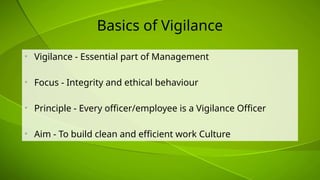
Basics of Vigilance
• Vigilance - Essential part of Management
• Focus - Integrity and ethical behaviour
• Principle - Every officer/employee is a Vigilance Officer
• Aim - To build clean and efficient work Culture
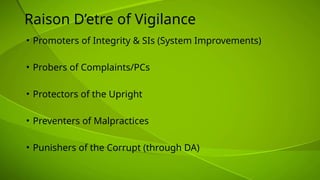
Raison D’etre of Vigilance
• Promoters of Integrity & SIs (System Improvements)
• Probers of Complaints/PCs
• Protectors of the Upright
• Preventers of Malpractices
• Punishers of the Corrupt (through DA)
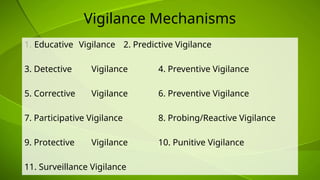
Vigilance Mechanisms
1. Educative Vigilance 2. Predictive Vigilance
3. Detective Vigilance 4. Preventive Vigilance
5. Corrective Vigilance 6. Preventive Vigilance
7. Participative Vigilance 8. Probing/Reactive Vigilance
9. Protective Vigilance 10. Punitive Vigilance
11. Surveillance Vigilance
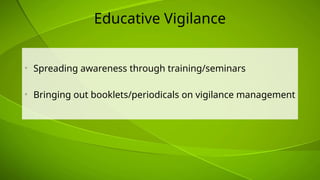
Educative Vigilance
• Spreading awareness through training/seminars
• Bringing out booklets/periodicals on vigilance management
Predictive Vigilance
• Foreseeing activity prejudicial to interest of institution.
• Suggest advance corrective measures to be taken
(modification of rules, technology, circumstances etc)
Detective Vigilance
• Fact Finding
• Investigation
• Ascertains causative factors
• Defines extent of accountability of officials
• Suggests measures to plug loopholes in the system
• Refer cases to CBI
Corrective Vigilance
• Analysis of results of detective vigilance
• Exploration of the reasons and contributory factors
• Finding solution to stop recurrence and activate alarm
• Updating the practices to keep pace with time
• Transparency in procedures & decision making
• Plugging of the loopholes – whistle blowing arrangements
• Prepare case study and educate employees
Preventive Vigilance
Includes
 simplifying rules/ procedures;
 curtailing discretion;
 improving transparency,
 fairness, competitiveness and accountability;
 promoting awareness among clients;
 educating/ sensitizing the officials through workshops,
seminars and training programmes;
 and posting officials of clean integrity on sensitive posts
Punitive Vigilance
• Focuses on penalizing malpractices and deterring others through
punishment.
• Involves investigating violations, collecting evidence, and
conducting departmental inquiries.
• Serves as a deterrent by creating a fear of consequences for
wrongdoing.
Participative Vigilance
• Seeks to involve stakeholders, such as the public, in decision-making
processes.
• Aims to increase transparency and incorporate suggestions for systemic
improvements.
• An example is inviting citizens to submit suggestions on how to improve
government systems.
Reactive Vigilance
The efforts of governmental or organizational vigilance departments to prevent and
detect corruption and to ensure integrity in public life.
Protective Vigilance
Surveillance Vigilance
Entails conducting surprise inspections;
scrutinizing Annual Property Returns;
and cultivating other sources for detecting corruption
entrepreneurs to ensure clean functioning in the organization.
Involves carrying out investigation and taking punitive action by
initiating disciplinary/ criminal proceedings against the corrupt
officials
Some definitions
• Corruption - Improper or selfish exercise of power & influence
attached to a public office or to a special position one occupies in
public life – Santhanam Committee.
• Misconduct - Wrongful, improper or unlawful conduct motivated
by premeditated or intentional purpose or by obstinate
indifference to consequences of one's act.
• Offence - Any Act or omission made punishable by any law for
the time being in force. – Sec 3(38) of General Clauses Act 1897
What is Vigilance Angle?
Obtaining valuables without consideration/ with inadequate
consideration from someone in official dealing directly/ indirectly;
Obtaining himself or for others valuables or pecuniary benefits by
corrupt or illegal means or by abusing power;
Possession of assets disproportionate to income;
Misappropriation, forgery or cheating etc; and
 Other irregularities, which cast doubt on integrity
Corruption
• Demanding or accepting illegal gratification.
• Obtaining valuable thing by corrupt or illegal means or abusing one’s position.
• Possession of disproportionate assets.
• Forgery, cheating or misappropriation.
• Gross or willful negligence.
• Reckless Decision making.
• Blatant violation of systems & procedures.
• Excessive discretion without public interest.
• Failure to inform controlling authorities of required transactions & issues on
time.
• Cause of undue loss or concomitant gain
• Undue or unjustified Delay
OFFICIAL REASONS – SANTHANAM COMMITTEE
• Personal Discretion
• Cumbersome Procedures
• Delays (encourage speed money)
• Overburdening of Officials
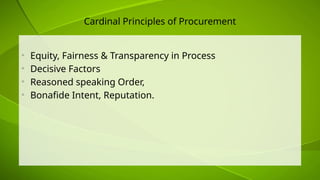
Cardinal Principles of Procurement
• Equity, Fairness & Transparency in Process
• Decisive Factors
• Reasoned speaking Order,
• Bonafide Intent, Reputation.
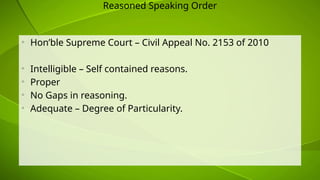
Reasoned Speaking Order
• Hon’ble Supreme Court – Civil Appeal No. 2153 of 2010
• Intelligible – Self contained reasons.
• Proper
• No Gaps in reasoning.
• Adequate – Degree of Particularity.
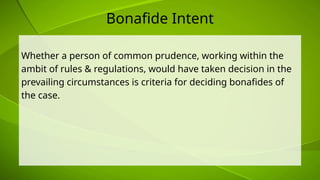
Bonafide Intent
Whether a person of common prudence, working within the
ambit of rules & regulations, would have taken decision in the
prevailing circumstances is criteria for deciding bonafides of
the case.
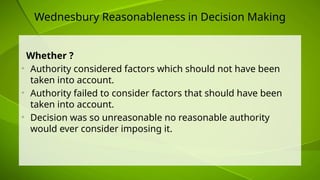
Wednesbury Reasonableness in Decision Making
Whether ?
• Authority considered factors which should not have been
taken into account.
• Authority failed to consider factors that should have been
taken into account.
• Decision was so unreasonable no reasonable authority
would ever consider imposing it.
Fundamental elements to ensure
corruption-free delivery
• ACT FAST
• A-ccountabilty
• C-ompetition
• T-ransparancy
• F-airness
• A-void discretion
• S-implification, and
• T-imeliness
STAGES IN PUBLIC PROCUREMENT
1. PRE-TENDER STAGE
2. TENDER STAGE
3. EXECUTION STAGE
PRE-TENDER STAGE
i. PROJECT FORMULATION
Dos:
 FORMULATE PROJECT COMPREHENSIVELY TO AVOID
GLARING DEVIATIONS & DELAYS DURING EXECUTION
TODAY’s PROBLEMS ARE DUE TO
YESTERDAY’S SHORT-SIGHTED SOLUTIONS
PRE-TENDER STAGE
ii. APPOINTMENT OF CONSULTANTS
DOs:
 FORMULATE GUIDELINES FOR APPOINTMENT OF
CONSULTANTS
 APPOINT CONSULTANT IN A FAIR AND TRANSPARENT WAY
(DETAILED DISCUSSIONS AT PREQUALIFICATION OF
CONTRACTOR)
 RETAIN DECISION MAKING WITH EXECUTIVES
(CONSULTANT’S ROLE SHOULD BE ONLY ADVISORY)
 FIX UPPER CEILLING FOR FEES.
 PROVIDE SAFE-GUARDS AGAINST CONSULTANT’S FAILURE,
SUCH AS PERFORMANCE GUARANTEE, PROFESSIONAL
LIABILITY INSURANCE etc.
PRE-TENDER STAGE
iii. PREPARATION OF DETAILED PROJECT REPORT
(ESTIMATE, DESIGN etc.)
Dos:
 PREPARE DPR AS PER ACTUAL SITE REQUIREMENT
OTHERWISE IT MAY LEAD TO DEVIATIONS & DELAYS
 ENSURE CONFORMITY AMONG NOMENCLATURE OF
ITEM , DRAWINGS AND SPECIFICATIONS TO AVOID
AMBIGUITIES AT LATER STAGE.
 FINALISE THE DPR IN CONSULTATION WITH FIELD STAFF
TENDER STAGE
PURPOSE OF TENDERING
i) QUALIFYING THE CONTRACTORS
ii) FREEZING OF TECHNICAL SPECIFICATIONS
iii) TYPE OF BIDS
 TECHNICAL BID
 PRICE BID (COMMERCIAL BID)
 SINGLE STAGE
 TWO STAGE
 ONE ENVELOPE
 TWO ENVELOPE
TENDER STAGE
i.) PREPARATION OF TENDER DOCUMENTS
 ADOPT UPDATED STANDARD BIDDING DOCUMENT
 ENSURE CONFORMITY AMONG NOMENCLATURE OF ITEMS,
SPECIFICATIONS , DRAWINGS,GENERAL AND SPECIAL CONDITIONS.
 AVOID STIPULATING SUCH CONDITIONS IN THE CONTRACT WHICH
ARE NOT FEASIBLE TO BE OPERATED.
 CONDUCT PRE-BID MEETING
i) TO BRING CLARITY REGARDING SPRIT OF VARIOUS
PROVISIONS
ii) TO BRING NECESSARY MODIFICATIONS , IF REQUIRED.
TENDER STAGE
i.)PREPARATION OF TENDER DOCUMENTS
 PROVIDE CLAUSE TO DEAL WITH
i) AMBIGUOUS PROVISIONS IN THE TENDER DOCUMENT.
ii) AMBIGUITY IN THE TENDER SUBMITTED BY THE CONTRACTOR
 NOTIFY OBJECTIVE EVALUATION CRITERIA IN THE TENDER
DOCUMENT.
 STIPULATE ALL PREVAILING GOVT. POLICY ORDERS SUCH AS
PURCHASE PREFERNCE POLICY , CUSTOMS EXEMPTIONS FOR
MATERIAL TO BE IMPORTED etc.
 STIPULATE CONDITION REGARDING SPLITTING OF QUANTITIES, IF
RQUIRED, IN THE TENDER DOCUMENT.
TENDER STAGE
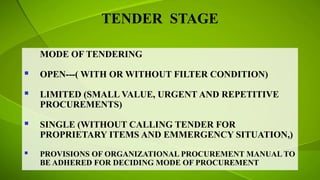
MODE OF TENDERING
 OPEN---( WITH OR WITHOUT FILTER CONDITION)
 LIMITED (SMALL VALUE, URGENT AND REPETITIVE
PROCUREMENTS)
 SINGLE (WITHOUT CALLING TENDER FOR
PROPRIETARY ITEMS AND EMMERGENCY SITUATION,)
 PROVISIONS OF ORGANIZATIONAL PROCUREMENT MANUAL TO
BE ADHERED FOR DECIDING MODE OF PROCUREMENT
TENDER STAGE
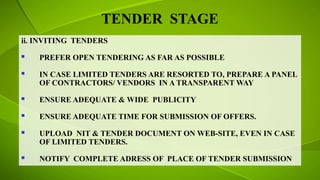
ii. INVITING TENDERS
 PREFER OPEN TENDERING AS FAR AS POSSIBLE
 IN CASE LIMITED TENDERS ARE RESORTED TO, PREPARE A PANEL
OF CONTRACTORS/ VENDORS IN A TRANSPARENT WAY
 ENSURE ADEQUATE & WIDE PUBLICITY
 ENSURE ADEQUATE TIME FOR SUBMISSION OF OFFERS.
 UPLOAD NIT & TENDER DOCUMENT ON WEB-SITE, EVEN IN CASE
OF LIMITED TENDERS.
 NOTIFY COMPLETE ADRESS OF PLACE OF TENDER SUBMISSION
TENDER STAGE
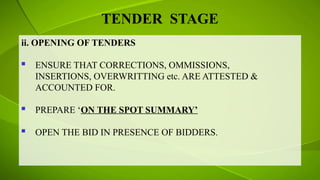
ii. OPENING OF TENDERS
 ENSURE THAT CORRECTIONS, OMMISSIONS,
INSERTIONS, OVERWRITTING etc. ARE ATTESTED &
ACCOUNTED FOR.
 PREPARE ‘ON THE SPOT SUMMARY’
 OPEN THE BID IN PRESENCE OF BIDDERS.
PREQUALIFICATION
Objective-
To bring competent contractors into competition having technical
& financial capability commensurate with requirement of the
particular procurement (project/supply of goods)
TENDER STAGE
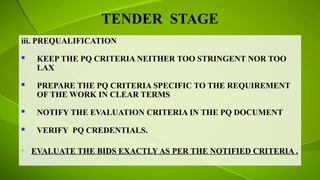
iii. PREQUALIFICATION
 KEEP THE PQ CRITERIA NEITHER TOO STRINGENT NOR TOO
LAX
 PREPARE THE PQ CRITERIA SPECIFIC TO THE REQUIREMENT
OF THE WORK IN CLEAR TERMS
 NOTIFY THE EVALUATION CRITERIA IN THE PQ DOCUMENT
 VERIFY PQ CREDENTIALS.
• EVALUATE THE BIDS EXACTLY AS PER THE NOTIFIED CRITERIA .
TENDER STAGE
iv. TENDER EVALUATION & AWARD OF WORK
 DEAL WITH EVALUATED L-1.
 BRING THE OFFER OF QUOTED L-1 AT PAR WITH
OTHERS AS PER BID CONDITIONS RATHER THAN
PROCEED WITH QUOTED L-1 RATES.
 DO NOT DILUTE THE SCOPE , SPECIFICATION AND
CONDITIONS OF THE CONTRACT AFTER OPENING OF
THE BIDS.
EXECUTION STAGE
 MATCH AGREEMENT WITH THE TENDER DOCUMENT,
PROPERLY DOCUMENT, SIGN AND SEAL
 DO NOT DEVIATE ANY CONTRACT CONDITION
 VERIFY AUTHENTICITY OF BGs & MONITOR THEIR
VALIDITY
Do Not be Afraid of Vigilance
Vigilance does not harass any personnel but helps the management in
improving the system and work environment through following
actions:
Protecting the honest personnel;
Encouraging whistle blowers;
Doing justice to the person who takes wrong decision in business
interest with no mala-fide;
Initiating action against corrupt officials; and
Creating ethical and healthy work culture.
CONCLUSION
 Vigilance is not a hostile outsider. It is an essential part of the
management.
 It helps to improve managerial and financial practices and working
procedure.
 It assists in better performance and greater customer satisfaction.
Are you ready...???
Functions are a must
Should be followed in letter + spirit
Thank You

Talk on Vigilance on Public Procurement.pptx

  • 1.
    BRIEF TALK ON “VIGILANCEIN PUBLIC PROCUREMENT” Ateev Kumar Guha Dy. General Manager/Finance & Accounts
  • 3.
    Basics of Vigilance •Vigilance - Essential part of Management • Focus - Integrity and ethical behaviour • Principle - Every officer/employee is a Vigilance Officer • Aim - To build clean and efficient work Culture
  • 4.
    Raison D’etre ofVigilance • Promoters of Integrity & SIs (System Improvements) • Probers of Complaints/PCs • Protectors of the Upright • Preventers of Malpractices • Punishers of the Corrupt (through DA)
  • 5.
    Vigilance Mechanisms 1. EducativeVigilance 2. Predictive Vigilance 3. Detective Vigilance 4. Preventive Vigilance 5. Corrective Vigilance 6. Preventive Vigilance 7. Participative Vigilance 8. Probing/Reactive Vigilance 9. Protective Vigilance 10. Punitive Vigilance 11. Surveillance Vigilance
  • 6.
    Educative Vigilance • Spreadingawareness through training/seminars • Bringing out booklets/periodicals on vigilance management
  • 7.
    Predictive Vigilance • Foreseeingactivity prejudicial to interest of institution. • Suggest advance corrective measures to be taken (modification of rules, technology, circumstances etc)
  • 8.
    Detective Vigilance • FactFinding • Investigation • Ascertains causative factors • Defines extent of accountability of officials • Suggests measures to plug loopholes in the system • Refer cases to CBI
  • 9.
    Corrective Vigilance • Analysisof results of detective vigilance • Exploration of the reasons and contributory factors • Finding solution to stop recurrence and activate alarm • Updating the practices to keep pace with time • Transparency in procedures & decision making • Plugging of the loopholes – whistle blowing arrangements • Prepare case study and educate employees
  • 10.
    Preventive Vigilance Includes  simplifyingrules/ procedures;  curtailing discretion;  improving transparency,  fairness, competitiveness and accountability;  promoting awareness among clients;  educating/ sensitizing the officials through workshops, seminars and training programmes;  and posting officials of clean integrity on sensitive posts
  • 11.
    Punitive Vigilance • Focuseson penalizing malpractices and deterring others through punishment. • Involves investigating violations, collecting evidence, and conducting departmental inquiries. • Serves as a deterrent by creating a fear of consequences for wrongdoing.
  • 12.
    Participative Vigilance • Seeksto involve stakeholders, such as the public, in decision-making processes. • Aims to increase transparency and incorporate suggestions for systemic improvements. • An example is inviting citizens to submit suggestions on how to improve government systems.
  • 13.
    Reactive Vigilance The effortsof governmental or organizational vigilance departments to prevent and detect corruption and to ensure integrity in public life. Protective Vigilance Surveillance Vigilance Entails conducting surprise inspections; scrutinizing Annual Property Returns; and cultivating other sources for detecting corruption entrepreneurs to ensure clean functioning in the organization. Involves carrying out investigation and taking punitive action by initiating disciplinary/ criminal proceedings against the corrupt officials
  • 14.
    Some definitions • Corruption- Improper or selfish exercise of power & influence attached to a public office or to a special position one occupies in public life – Santhanam Committee. • Misconduct - Wrongful, improper or unlawful conduct motivated by premeditated or intentional purpose or by obstinate indifference to consequences of one's act. • Offence - Any Act or omission made punishable by any law for the time being in force. – Sec 3(38) of General Clauses Act 1897
  • 15.
    What is VigilanceAngle? Obtaining valuables without consideration/ with inadequate consideration from someone in official dealing directly/ indirectly; Obtaining himself or for others valuables or pecuniary benefits by corrupt or illegal means or by abusing power; Possession of assets disproportionate to income; Misappropriation, forgery or cheating etc; and  Other irregularities, which cast doubt on integrity
  • 17.
    Corruption • Demanding oraccepting illegal gratification. • Obtaining valuable thing by corrupt or illegal means or abusing one’s position. • Possession of disproportionate assets. • Forgery, cheating or misappropriation. • Gross or willful negligence. • Reckless Decision making. • Blatant violation of systems & procedures. • Excessive discretion without public interest. • Failure to inform controlling authorities of required transactions & issues on time. • Cause of undue loss or concomitant gain • Undue or unjustified Delay
  • 19.
    OFFICIAL REASONS –SANTHANAM COMMITTEE • Personal Discretion • Cumbersome Procedures • Delays (encourage speed money) • Overburdening of Officials
  • 21.
    Cardinal Principles ofProcurement • Equity, Fairness & Transparency in Process • Decisive Factors • Reasoned speaking Order, • Bonafide Intent, Reputation.
  • 22.
    Reasoned Speaking Order •Hon’ble Supreme Court – Civil Appeal No. 2153 of 2010 • Intelligible – Self contained reasons. • Proper • No Gaps in reasoning. • Adequate – Degree of Particularity.
  • 23.
    Bonafide Intent Whether aperson of common prudence, working within the ambit of rules & regulations, would have taken decision in the prevailing circumstances is criteria for deciding bonafides of the case.
  • 25.
    Wednesbury Reasonableness inDecision Making Whether ? • Authority considered factors which should not have been taken into account. • Authority failed to consider factors that should have been taken into account. • Decision was so unreasonable no reasonable authority would ever consider imposing it.
  • 26.
    Fundamental elements toensure corruption-free delivery • ACT FAST • A-ccountabilty • C-ompetition • T-ransparancy • F-airness • A-void discretion • S-implification, and • T-imeliness
  • 28.
    STAGES IN PUBLICPROCUREMENT 1. PRE-TENDER STAGE 2. TENDER STAGE 3. EXECUTION STAGE
  • 29.
    PRE-TENDER STAGE i. PROJECTFORMULATION Dos:  FORMULATE PROJECT COMPREHENSIVELY TO AVOID GLARING DEVIATIONS & DELAYS DURING EXECUTION TODAY’s PROBLEMS ARE DUE TO YESTERDAY’S SHORT-SIGHTED SOLUTIONS
  • 30.
    PRE-TENDER STAGE ii. APPOINTMENTOF CONSULTANTS DOs:  FORMULATE GUIDELINES FOR APPOINTMENT OF CONSULTANTS  APPOINT CONSULTANT IN A FAIR AND TRANSPARENT WAY (DETAILED DISCUSSIONS AT PREQUALIFICATION OF CONTRACTOR)  RETAIN DECISION MAKING WITH EXECUTIVES (CONSULTANT’S ROLE SHOULD BE ONLY ADVISORY)  FIX UPPER CEILLING FOR FEES.  PROVIDE SAFE-GUARDS AGAINST CONSULTANT’S FAILURE, SUCH AS PERFORMANCE GUARANTEE, PROFESSIONAL LIABILITY INSURANCE etc.
  • 31.
    PRE-TENDER STAGE iii. PREPARATIONOF DETAILED PROJECT REPORT (ESTIMATE, DESIGN etc.) Dos:  PREPARE DPR AS PER ACTUAL SITE REQUIREMENT OTHERWISE IT MAY LEAD TO DEVIATIONS & DELAYS  ENSURE CONFORMITY AMONG NOMENCLATURE OF ITEM , DRAWINGS AND SPECIFICATIONS TO AVOID AMBIGUITIES AT LATER STAGE.  FINALISE THE DPR IN CONSULTATION WITH FIELD STAFF
  • 32.
    TENDER STAGE PURPOSE OFTENDERING i) QUALIFYING THE CONTRACTORS ii) FREEZING OF TECHNICAL SPECIFICATIONS iii) TYPE OF BIDS  TECHNICAL BID  PRICE BID (COMMERCIAL BID)  SINGLE STAGE  TWO STAGE  ONE ENVELOPE  TWO ENVELOPE
  • 33.
    TENDER STAGE i.) PREPARATIONOF TENDER DOCUMENTS  ADOPT UPDATED STANDARD BIDDING DOCUMENT  ENSURE CONFORMITY AMONG NOMENCLATURE OF ITEMS, SPECIFICATIONS , DRAWINGS,GENERAL AND SPECIAL CONDITIONS.  AVOID STIPULATING SUCH CONDITIONS IN THE CONTRACT WHICH ARE NOT FEASIBLE TO BE OPERATED.  CONDUCT PRE-BID MEETING i) TO BRING CLARITY REGARDING SPRIT OF VARIOUS PROVISIONS ii) TO BRING NECESSARY MODIFICATIONS , IF REQUIRED.
  • 34.
    TENDER STAGE i.)PREPARATION OFTENDER DOCUMENTS  PROVIDE CLAUSE TO DEAL WITH i) AMBIGUOUS PROVISIONS IN THE TENDER DOCUMENT. ii) AMBIGUITY IN THE TENDER SUBMITTED BY THE CONTRACTOR  NOTIFY OBJECTIVE EVALUATION CRITERIA IN THE TENDER DOCUMENT.  STIPULATE ALL PREVAILING GOVT. POLICY ORDERS SUCH AS PURCHASE PREFERNCE POLICY , CUSTOMS EXEMPTIONS FOR MATERIAL TO BE IMPORTED etc.  STIPULATE CONDITION REGARDING SPLITTING OF QUANTITIES, IF RQUIRED, IN THE TENDER DOCUMENT.
  • 35.
    TENDER STAGE MODE OFTENDERING  OPEN---( WITH OR WITHOUT FILTER CONDITION)  LIMITED (SMALL VALUE, URGENT AND REPETITIVE PROCUREMENTS)  SINGLE (WITHOUT CALLING TENDER FOR PROPRIETARY ITEMS AND EMMERGENCY SITUATION,)  PROVISIONS OF ORGANIZATIONAL PROCUREMENT MANUAL TO BE ADHERED FOR DECIDING MODE OF PROCUREMENT
  • 36.
    TENDER STAGE ii. INVITINGTENDERS  PREFER OPEN TENDERING AS FAR AS POSSIBLE  IN CASE LIMITED TENDERS ARE RESORTED TO, PREPARE A PANEL OF CONTRACTORS/ VENDORS IN A TRANSPARENT WAY  ENSURE ADEQUATE & WIDE PUBLICITY  ENSURE ADEQUATE TIME FOR SUBMISSION OF OFFERS.  UPLOAD NIT & TENDER DOCUMENT ON WEB-SITE, EVEN IN CASE OF LIMITED TENDERS.  NOTIFY COMPLETE ADRESS OF PLACE OF TENDER SUBMISSION
  • 37.
    TENDER STAGE ii. OPENINGOF TENDERS  ENSURE THAT CORRECTIONS, OMMISSIONS, INSERTIONS, OVERWRITTING etc. ARE ATTESTED & ACCOUNTED FOR.  PREPARE ‘ON THE SPOT SUMMARY’  OPEN THE BID IN PRESENCE OF BIDDERS.
  • 38.
    PREQUALIFICATION Objective- To bring competentcontractors into competition having technical & financial capability commensurate with requirement of the particular procurement (project/supply of goods)
  • 39.
    TENDER STAGE iii. PREQUALIFICATION KEEP THE PQ CRITERIA NEITHER TOO STRINGENT NOR TOO LAX  PREPARE THE PQ CRITERIA SPECIFIC TO THE REQUIREMENT OF THE WORK IN CLEAR TERMS  NOTIFY THE EVALUATION CRITERIA IN THE PQ DOCUMENT  VERIFY PQ CREDENTIALS. • EVALUATE THE BIDS EXACTLY AS PER THE NOTIFIED CRITERIA .
  • 40.
    TENDER STAGE iv. TENDEREVALUATION & AWARD OF WORK  DEAL WITH EVALUATED L-1.  BRING THE OFFER OF QUOTED L-1 AT PAR WITH OTHERS AS PER BID CONDITIONS RATHER THAN PROCEED WITH QUOTED L-1 RATES.  DO NOT DILUTE THE SCOPE , SPECIFICATION AND CONDITIONS OF THE CONTRACT AFTER OPENING OF THE BIDS.
  • 41.
    EXECUTION STAGE  MATCHAGREEMENT WITH THE TENDER DOCUMENT, PROPERLY DOCUMENT, SIGN AND SEAL  DO NOT DEVIATE ANY CONTRACT CONDITION  VERIFY AUTHENTICITY OF BGs & MONITOR THEIR VALIDITY
  • 42.
    Do Not beAfraid of Vigilance Vigilance does not harass any personnel but helps the management in improving the system and work environment through following actions: Protecting the honest personnel; Encouraging whistle blowers; Doing justice to the person who takes wrong decision in business interest with no mala-fide; Initiating action against corrupt officials; and Creating ethical and healthy work culture.
  • 43.
    CONCLUSION  Vigilance isnot a hostile outsider. It is an essential part of the management.  It helps to improve managerial and financial practices and working procedure.  It assists in better performance and greater customer satisfaction.
  • 44.
    Are you ready...??? Functionsare a must Should be followed in letter + spirit
  • 45.