Model-based
     Spreadsheet Engineering

                  Jácome Cunha
and the other team members of the SSaaPP and FATBIT
                   research projects


   HASLab / INESC TEC & Universidade do Minho


       FATBIT/SSaaPP Workshop 2012
               17-18 September
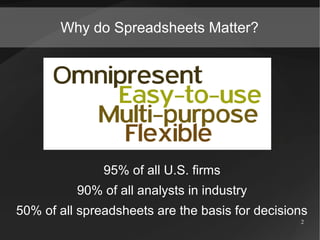
Why do Spreadsheets Matter?


               95% of all U.S. firms
          90% of all analysts in industry
50% of all spreadsheets are the basis for decisions
                                                 2
Still...


                                                3
http://www.eusprig.org/stories.htm
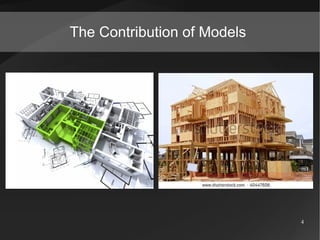
The Contribution of Models


                             4
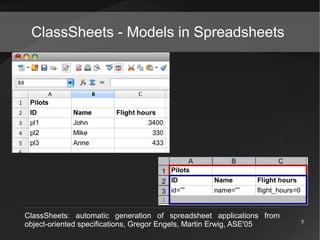
ClassSheets - Models in Spreadsheets


ClassSheets: automatic generation of spreadsheet applications from
                                                                      5
object-oriented specifications, Gregor Engels, Martin Erwig, ASE'05
Model-based Spreadsheet Engineering

      I. ClassSheet Model Inference
          [PEPM '09, VL/HCC '10]


II. Embedding ClassSheets in Spreadsheets
           [VL/HCC '11, SAC '12]


 III. Co-evolution of Models and Instances
       [FASE '11, ICMT '12, ICSE '12]
                                             6
I. ClassSheet Model Inference


                                7
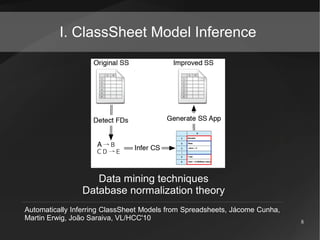
I. ClassSheet Model Inference


                   Data mining techniques
                Database normalization theory
Automatically Inferring ClassSheet Models from Spreadsheets, Jácome Cunha,
Martin Erwig, João Saraiva, VL/HCC'10                                        8
Pruning Functional Dependencies

●   Label semantics: usually keys are labeled
    “code” or “id”
●   Label arrangement: we prefer FDs respecting
    the order of columns
●   Antecedent size: small keys are preferable
●   Ratio: small antecedents and big consequents
●   Single value columns: columns always with the
    same value are too intrusive
                                                   9
II. Embedding ClassSheets in Spreadsheets


                                        10
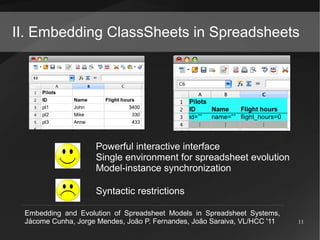
II. Embedding ClassSheets in Spreadsheets


                    Powerful interactive interface
                    Single environment for spreadsheet evolution
                    Model-instance synchronization

                    Syntactic restrictions

 Embedding and Evolution of Spreadsheet Models in Spreadsheet Systems,
 Jácome Cunha, Jorge Mendes, João P. Fernandes, João Saraiva, VL/HCC '11   11
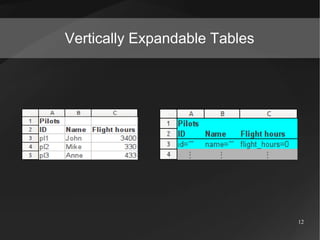
Vertically Expandable Tables


                               12
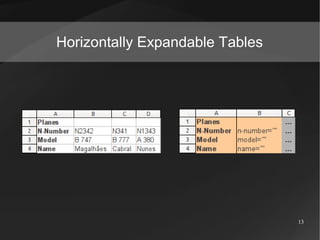
Horizontally Expandable Tables


                                 13
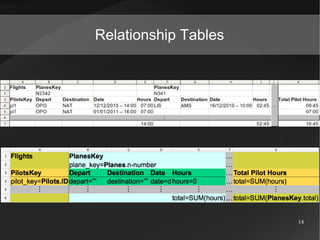
Relationship Tables


                      14
III. Co-evolution of Models and Instances


                                            15
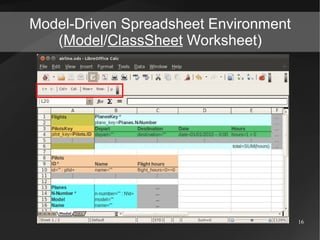
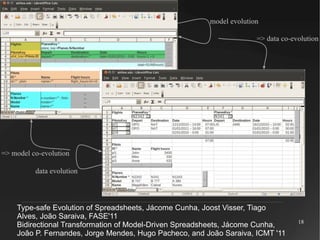
Model-Driven Spreadsheet Environment
   (Model/ClassSheet Worksheet)


                                       16
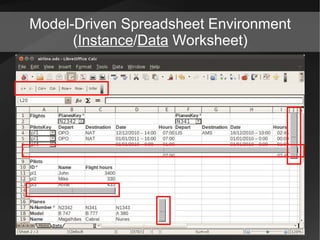
Model-Driven Spreadsheet Environment
      (Instance/Data Worksheet)


                                       17
Type-safe Evolution of Spreadsheets, Jácome Cunha, Joost Visser, Tiago
Alves, João Saraiva, FASE'11
                                                                            18
Bidirectional Transformation of Model-Driven Spreadsheets, Jácome Cunha,
João P. Fernandes, Jorge Mendes, Hugo Pacheco, and João Saraiva, ICMT '11
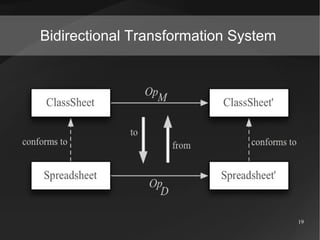
Bidirectional Transformation System


                                      19
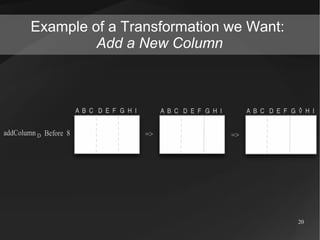
Example of a Transformation we Want:
         Add a New Column


                                       20
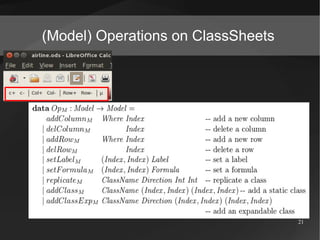
(Model) Operations on ClassSheets


                                    21
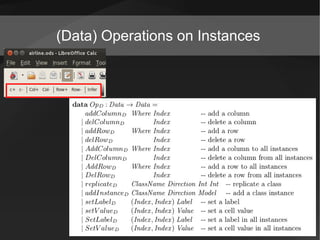
(Data) Operations on Instances


                                 22
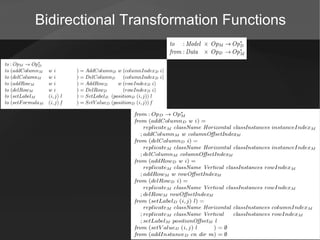
Bidirectional Transformation Functions


                                         23
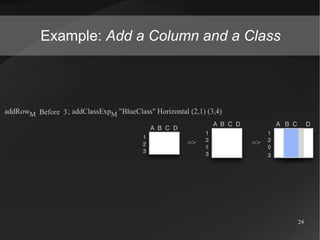
Example: Add a Column and a Class


                                    24
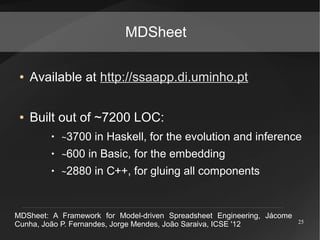
MDSheet

 ●   Available at http://ssaapp.di.uminho.pt

 ●   Built out of ~7200 LOC:
         ●
             ~3700   in Haskell, for the evolution and inference
         ●
             ~600   in Basic, for the embedding
         ●
             ~2880   in C++, for gluing all components


MDSheet: A Framework for Model-driven Spreadsheet Engineering, Jácome
                                                                        25
Cunha, João P. Fernandes, Jorge Mendes, João Saraiva, ICSE '12
Conclusions

●   We created a technique to infer ClassSheet
    models from legacy spreadsheets
●   We have embedded a visual DSL into a
    traditional spreadsheet system
●   This allows user to create models and
    instances in the same environment
●   We used a formal framework to design and
    implement co-evolution steps
●   The model and its instances are always
    synchronized                                 26
Conclusions


●   Framework for bidirectional transformations
       ●   When evolving the data a new model is inferred
       ●   When evolving the model the data changes
       ●   The data always conforms to the model

●   Available as a OpenOffice/LibreOffice
    extension

                                                            27
Thank You!

         SSaaPP:
http://ssaapp.di.uminho.pt

          FATBIT:
 http://fatbit.di.uminho.pt


                              28

Talk at the Joint SSaaPP/FATBIT 2012 Workshop

  • 1.
    Model-based Spreadsheet Engineering Jácome Cunha and the other team members of the SSaaPP and FATBIT research projects HASLab / INESC TEC & Universidade do Minho FATBIT/SSaaPP Workshop 2012 17-18 September
  • 2.
    Why do SpreadsheetsMatter? 95% of all U.S. firms 90% of all analysts in industry 50% of all spreadsheets are the basis for decisions 2
  • 3.
    Still... 3 http://www.eusprig.org/stories.htm
  • 4.
  • 5.
    ClassSheets - Modelsin Spreadsheets ClassSheets: automatic generation of spreadsheet applications from 5 object-oriented specifications, Gregor Engels, Martin Erwig, ASE'05
  • 6.
    Model-based Spreadsheet Engineering I. ClassSheet Model Inference [PEPM '09, VL/HCC '10] II. Embedding ClassSheets in Spreadsheets [VL/HCC '11, SAC '12] III. Co-evolution of Models and Instances [FASE '11, ICMT '12, ICSE '12] 6
  • 7.
  • 8.
    I. ClassSheet ModelInference Data mining techniques Database normalization theory Automatically Inferring ClassSheet Models from Spreadsheets, Jácome Cunha, Martin Erwig, João Saraiva, VL/HCC'10 8
  • 9.
    Pruning Functional Dependencies ● Label semantics: usually keys are labeled “code” or “id” ● Label arrangement: we prefer FDs respecting the order of columns ● Antecedent size: small keys are preferable ● Ratio: small antecedents and big consequents ● Single value columns: columns always with the same value are too intrusive 9
  • 10.
    II. Embedding ClassSheetsin Spreadsheets 10
  • 11.
    II. Embedding ClassSheetsin Spreadsheets Powerful interactive interface Single environment for spreadsheet evolution Model-instance synchronization Syntactic restrictions Embedding and Evolution of Spreadsheet Models in Spreadsheet Systems, Jácome Cunha, Jorge Mendes, João P. Fernandes, João Saraiva, VL/HCC '11 11
  • 12.
  • 13.
  • 14.
  • 15.
    III. Co-evolution ofModels and Instances 15
  • 16.
    Model-Driven Spreadsheet Environment (Model/ClassSheet Worksheet) 16
  • 17.
    Model-Driven Spreadsheet Environment (Instance/Data Worksheet) 17
  • 18.
    Type-safe Evolution ofSpreadsheets, Jácome Cunha, Joost Visser, Tiago Alves, João Saraiva, FASE'11 18 Bidirectional Transformation of Model-Driven Spreadsheets, Jácome Cunha, João P. Fernandes, Jorge Mendes, Hugo Pacheco, and João Saraiva, ICMT '11
  • 19.
  • 20.
    Example of aTransformation we Want: Add a New Column 20
  • 21.
    (Model) Operations onClassSheets 21
  • 22.
  • 23.
  • 24.
    Example: Add aColumn and a Class 24
  • 25.
    MDSheet ● Available at http://ssaapp.di.uminho.pt ● Built out of ~7200 LOC: ● ~3700 in Haskell, for the evolution and inference ● ~600 in Basic, for the embedding ● ~2880 in C++, for gluing all components MDSheet: A Framework for Model-driven Spreadsheet Engineering, Jácome 25 Cunha, João P. Fernandes, Jorge Mendes, João Saraiva, ICSE '12
  • 26.
    Conclusions ● We created a technique to infer ClassSheet models from legacy spreadsheets ● We have embedded a visual DSL into a traditional spreadsheet system ● This allows user to create models and instances in the same environment ● We used a formal framework to design and implement co-evolution steps ● The model and its instances are always synchronized 26
  • 27.
    Conclusions ● Framework for bidirectional transformations ● When evolving the data a new model is inferred ● When evolving the model the data changes ● The data always conforms to the model ● Available as a OpenOffice/LibreOffice extension 27
  • 28.
    Thank You! SSaaPP: http://ssaapp.di.uminho.pt FATBIT: http://fatbit.di.uminho.pt 28

Editor's Notes

  • #19 This generated spreadsheet guides users in introducing correct data The spreadsheet includes mechanisms that guarantee that the spreadsheet data always conforms to the model after an user update
  • #24 Baseado em haskell Integrado no OO Clicanca-se em botoes Espetacular Basic