

This report was written and researched by Mettl, one of the largest and fastest growing online talent
measurement companies globally, with contributions from different industry leaders.
We are very thankful to all the contributors for their sincere support in creating this report.
This material is copyrighted and is the property of Mettl.‘Talent Assessment Study 2018’is available for
general release and it along with its excerpts may be reproduced, downloaded from www.mettl.com or
transmitted in any form electronically, online or in print by permission of the copyright holder;
provided full accreditation is given to the Mettl brand.
Today, the war to acquire top talent is fiercer than ever. As the demand for this talent continues
to grow, organizations face bigger issues like that of talent scarcity. It turns out to be quite a
challenge for CXOs, human resource departments and hiring managers, especially in industries
like IT, BFSI, Retail, Manufacturing, Pharmaceuticals and Consulting that require highly skilled
employees.
In order to solve these challenges, the talent acquisition process needs to evolve in a manner
that it becomes more engaging, affordable, productive and faster. Our interactions with
industry leaders revealed two key takeaways that can solve major problems faced by recruiters.
Firstly, understanding the competency framework required for a job role. Secondly, use of
technology backed tools such as online assessments and simulators to measure the
competencies.
The hussle does not end at hiring, for it is just the tip of the iceberg. A bigger challenge that lies
ahead is retaining the top talent which is done through structured Learning and Development
programs to increase employee retention.
This is where talent assessments come in picture. They play a crucial role in enhancing the
employer brand value owing to their efficiency, affordability and practicality as compared to
traditional hiring practices.
The first edition of Mettl’s annual report is an attempt to unveil top assessment trends for hiring
and learning & development across 5 most anticipated industries for fiscal years 2016-2017.
We hope our efforts offer interesting insights and help you in making informed decisions.
FOREWORD
Executive Summary
Talent Assessment Usage Across Key Use Cases
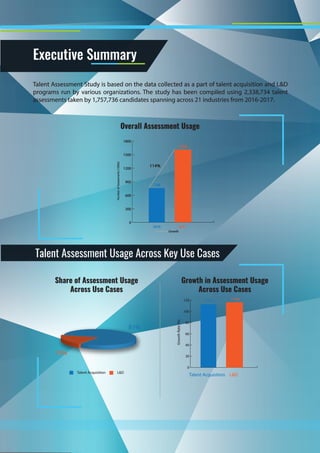
Talent Assessment Study is based on the data collected as a part of talent acquisition and L&D
programs run by various organizations. The study has been compiled using 2,338,734 talent
assessments taken by 1,757,736 candidates spanning across 21 industries from 2016-2017.
Share of Assessment Usage
Across Use Cases
Growth in Assessment Usage
Across Use Cases
0
20
40
60
80
100
120 114% 116%
GrowthRate(%)
81%
19%
Talent Acquisition L&D
Overall Assessment Usage
0
300
600
900
1200
1500
1800
744
114%
1594
2016 2017
Growth
NumberofAssessments(1000s)
Talent Assessment Usage Across Key Tools
6%
3%
11%
16%
6%
58%
Platform
Domain
Technical MCQ Cognitive
Psychometric Simulator
Talent Assessment Usage Across Key Industries
IT BFSI Consulting
Retail Pharma
IT BFSI Consulting
Retail Pharma
-100
-50
0
50
100
150
200
250
Platform
Domain
Technical MCQ Cognitive
Psychometric Simulator
49%
76%
34%
219%
165%
105%
0
50
100
150
200
250
84%
2%
2%
1%
5%
(%)
(%)
-24%
157%
-52%
217%
132%
Share of Assessment Usage
Across Industries in 2017
Growth in Assessment Usage
Across Industries from 2016 to 2017
Share of Assessment Usage Across
assessment tool Use Cases in 2017
Growth in Assessment Usage
Across Tools from 2016 to 2017
Key Assessment Trends in
BFSI Industry
An Overview of Changing
Landscape of Talent Assessments
0101
0202
0303
0404
0505
0606
0707
Introduction
Assessment Landscape in
Information Technology Industry
Assessment Landscape in
Banking Financial Services and Insurance Industry
Assessment Landscape in
Pharmaceutical Industry
Assessment Landscape in
Retail Industry
Assessment Landscape in
Consulting Industry
0808
CONTENT
Annexure
We would all agree that Talent and Technology trends are Transforming the Talent Acquisition
and L&D landscape. Here are the top trends across the famous 3T’s:
Talent Acquisition is one of the top 3 challenges faced by organizations in 2018 according to Mettl’s
report on ‘State of Talent Acquisition 2018’. With more and more innovative technologies for
talent assessment coming into play, and more stringent ways of skill testing being adopted by
organizations, the process of Talent Acquisition has been transformed into a marathon to bag
the best talent before others. With the changes in how Talent Acquisition is happening, the role
of HR and how organizations function is also changing.
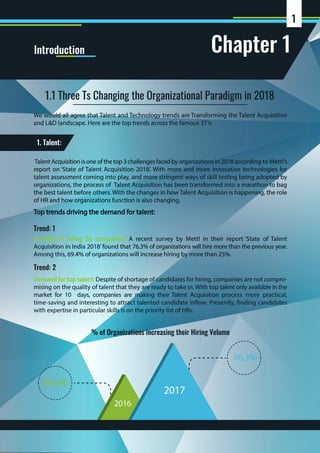
Increase in hiring by companies: A recent survey by Mettl in their report ‘State of Talent
Acquisition in India 2018’found that 76.3% of organizations will hire more than the previous year.
Among this, 69.4% of organizations will increase hiring by more than 25%.
Demand for top talent: Despite of shortage of candidates for hiring, companies are not compro-
mising on the quality of talent that they are ready to take in. With top talent only available in the
market for 10 days, companies are making their Talent Acquisition process more practical,
time-saving and interesting to attract talented candidate inflow. Presently, finding candidates
with expertise in particular skills is on the priority list of HRs.
1. Talent:
Trend: 1
Top trends driving the demand for talent:
Chapter 1
20172017
20162016
76.3%76.3%
64.5%64.5%
Introduction
1.1 Three Ts Changing the Organizational Paradigm in 2018
1
% of Organizations increasing their Hiring Volume
1. Talent:
2. Technology:
3. Transformation:
With the advent of technology such as AI and Automation, need for human resource has
become more exclusive and recruiters are no longer satisfied by hiring the average Joe. Highly
skilled employees who have a track record of great performance are the only talent that recruit-
ers are in pursuit of. In order to tap this talent, organizations need to up their game and use tech-
nologies to get hold of top talent.
Top technology trends that are impacting talent are:
Talent Acquisition Technologies: HR’s are moving away from traditional methods of identifying
top talent such as face-to-face interviews and resumes. More tangible and result oriented
objective way of testing candidates is giving way to more accurate hiring of quality candidates.
While AI and big data are changing the way candidates are sourced, gamification, simulations
and assessments centers are transforming how candidates can be tested based on skills and
behavioral indicators.
L&D Technologies: They test candidates on a variety of skills by identifying skills gaps and
training needs using technologies such as online assessments, assessment centers, 360
feedback, simulations, behavioral assessments and gamified assessments. Candidates
are tested on a range of attributes such as skill, individual and team performance,
communication, efficiency, accuracy, learning agility and more.
With talent and technology transforming how organizations function, there has been a
big change in HR functions and how talent is perceived. A major responsibility of Talent
Acquisition and L&D now lies in the hands of technology, and HR is focused on other
things such as employee experience, employee engagement and culture building
activities.
Trend: 1
Trend: 2
In order to become talent magnets and transform their people strategy, it is imperative
that companies start inculcating top technologies like online assessments and
simulations in their complete HR processes including Talent Acquisition, Learning &
Development and organizational planning.
‘
’
2
1. Talent:
Online talent assessments have an edge over traditional assessment methods such as
face-to-face interviews by being more intuitive, engaging and interesting. Lets have a look at
why online talent assessments are being increasingly adopted by organizations worldwide.
(a) Precise Talent Measurement: By adoption of new innovative assessment methods such as
simulations, gamification, hackathons, AI, big data and assessment centers, the accuracy level of
skill testing can be exponentially increased. Due to this high accuracy level, the adoption rate of
these tools is increasing.
(b) Improved Candidate Experience: The traditional Talent Acquisition process spoils the
candidate experience by being too lengthy, uninteresting and unstructured. Assessments via
simulations or games provide candidates with an engaging and meaningful experience which is
a concise, practical and result-oriented assessment approach. In this war for top talent,
candidates tend to prefer companies where they had a positive Talent Acquisition process
experience.
(c) Reduced Cost and Time Taken for Talent Assessment: The number of candidates applying for
a single job posting is ~50 in high demand industries. HRs and recruiting managers waste a lot
time and resources trying to remove the chaff by assessing each candidate manually. This can
be avoided by assessing candidates in bulk via use of online talent assessments which provide a
faster, cheaper and more comprehensive method of skill testing.
(d) Secure Method to Assist Talent: Features such as remote proctoring, allows candidates to
give assessments from remote locations while still maintaining the integrity of the assessment
process. This technology has revolutionized the Talent Acquisition and L&D process by allowing
candidates to become a part of these organizational processes from the comfort of their home
at their own convenient time. Owing to the huge value addition that remote proctoring brings
to the table, its usage has increased significantly (by 231%) from 2016 to 2017.
When used effectively, pre-hire assessments can have a major impact on key perfor-
mance indicators (KPIs), such as cost-to-and time per-hire, Talent Acquisition manag-
ers’satisfaction, employee retention, performance, and engagement.
 –Aberdeen Group Study (May 2015).
‘
’
1.2 Talent Assessments: Advantages over Traditional Methods
3
1. Talent:
Chapter 2
2.1 Overall Talent Assessment Landscape
Share of Assessment Usage
Across Use Cases in 2017
Growth in Assessment Usage
Across Use Cases
81%
19%
Talent Acquisition L&D
Overall Assessment Usage
NumberofAssessments(1000s)
0
300
600
900
1200
1500
1800
744
114%
1594
2016 2017
Growth
An Overview of the Changing
Landscape of Talent Assessments
4
Today, talent assessments are used in every
phase of the employee lifecycle ranging
from ranging from, Talent Acquisition to
training need identification to succession
planning to employee engagement. For the
ease of understanding, we refer to all use
cases for existing employees as Learning
and Development (L&D).
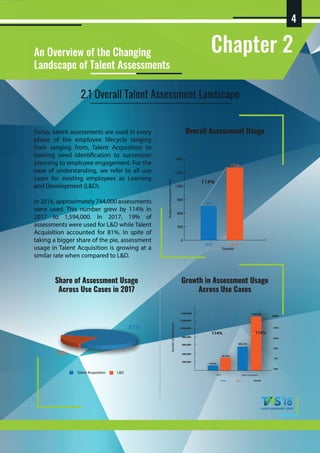
In 2016, approximately 744,000 assessments
were used. This number grew by 114% in
2017 to 1,594,000. In 2017, 19% of
assessments were used for L&D while Talent
Acquisition accounted for 81%. In spite of
taking a bigger share of the pie, assessment
usage in Talent Acquisition is growing at a
similar rate when compared to L&D.
NumberofAssessments
2016 2017 Growth
L & D Talent Acquisition
139,401
301,269
200,000
400,000
600,000
800,000
1,000,000
1,200,000
1,400,000
114%
605,118
1,292,946
116%
-50%
0%
50%
100%
150%
200%
2.2 Talent Assessment Tools
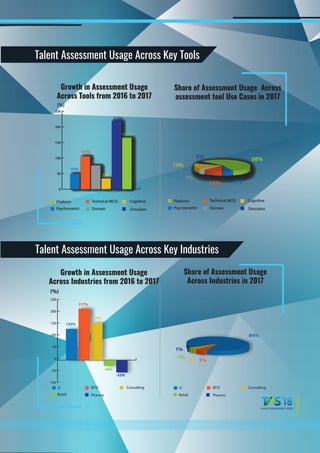
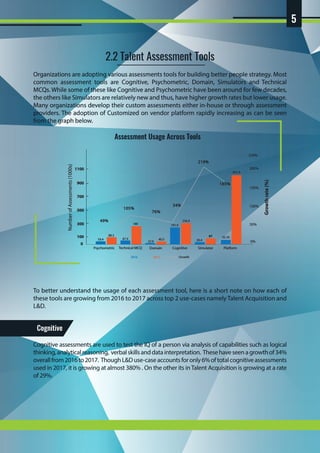
Organizations are adopting various assessments tools for building better people strategy. Most
common assessment tools are Cognitive, Psychometric, Domain, Simulators and Technical
MCQs. While some of these like Cognitive and Psychometric have been around for few decades,
the others like Simulators are relatively new and thus, have higher growth rates but lower usage.
Many organizations develop their custom assessments either in-house or through assessment
providers. The adoption of Customized on vendor platform rapidly increasing as can be seen
from the graph below.
To better understand the usage of each assessment tool, here is a short note on how each of
these tools are growing from 2016 to 2017 across top 2 use-cases namely Talent Acquisition and
L&D.
Cognitive assessments are used to test the IQ of a person via analysis of capabilities such as logical
thinking,analyticalreasoning, verbalskillsanddatainterpretation. Thesehaveseenagrowthof34%
overallfrom2016to2017. ThoughL&Duse-caseaccountsforonly6%oftotalcognitiveassessments
used in 2017, it is growing at almost 380% . On the other its inTalent Acquisition is growing at a rate
of 29%.
Cognitive
250%
5
Assessment Usage Across Tools
DomainTechnical MCQ CognitivePsychometric Simulator Platform
2016 2017 Growth
Growthrate(%)
NumberofAssessments(1000s)
0%
100%
200%
150%
50%
49%
76%
34%
105%
219%
59.4
88.3
87.9
180
22.9
40.5
191.9
256.9
35.18
931.4
30.4
97
0
100
300
500
700
900
1100
165%
Domain assessments test the subject matter knowledge of a person in a particular industry/job
field. Usage of domain assessments has grown by 76% from 2016 to 2017, led by an increase in
its usage during Talent Acquisition process (82%), which is also the biggest use case for domain
assessments accounting for 98% of total domain assessment usage.
Psychometric assessments are used to measure a person’s mental and behavioral abilities to test
their suitability for a particular job role. Use of psychometric assessments has grown by 49%
overall, led by an increase in its use during Learning and Development process. Although the
biggest use case for psychometric assessments is Talent Acquisition (accounting for 85% of total
psychometric usage), it is growing at a very slow pace of 29%, as compared to its significantly
higher growth rate of 780% in L&D, which accounts for 15% of the total psychometric assess-
ment usage.
Simulators are an authentic method of assessing employees as well as students based on their
behavioral attributes, on-job proficiency and organizational understanding. Usage of Simula-
tors have increased the most among all assessment tools, growing by 219% from 2016 to 2017.
Its growth is driven by increased usage in Talent Acquisition process (220%), which is also the
biggest use case for simulators, making up for 94% of total simulator usage. Use of simulators
during the L&D process is also increasing, showing a leap of 197% from 2016 to 2017.
Technical MCQ’s assess the knowledge base of a candidate in a particular field, in which they are
seeking a job. Usage of technical MCQs has increased by 105% from 2016 to 2017, driven by its
increased usage during Talent Acquisition and L&D process. Although technical MCQs are
majorly used during Talent Acquisition process (accounting for 94% of total usage), its usage
during L&D is quickly catching up by growing at a very high rate of 273% from 2016 to 2017.
Usage of Platforms is preferred by companies who need to update their assessment content
very frequently. Platforms account for 33% of total assessment usage. It is growing very fast at a
rate of 165% from 2016 to 2017, led by its increased usage during Talent Acquisition process
which accounts for 74% of total customized assessment usage. Its usage during L&D is also
growing rapidly, increasing at a rate of 95%. L&D accounts for 26% of total customized assess-
ment usage.
Domain
Psychometric
Simulator
Technical MCQs
Platforms
6
Assessment Trends in IT/ES In
Chapter 3Assessment Landscape in
Information Technology Industry
Share of Assessment Usage
Across Use Cases in 2017
Growth in Assessment Usage
Across Use Cases
81%
19%
Talent Acquisition L&D
Overall Assessment Usage
With hiring in tech roles driving the talent
demand across industries, IT and tech based
companies have to come up with a Talent
Acquisition and retention process that is
fast, affordable and effective.
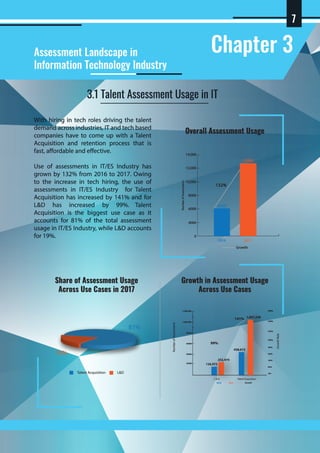
Use of assessments in IT/ES Industry has
grown by 132% from 2016 to 2017. Owing
to the increase in tech hiring, the use of
assessments in IT/ES Industry for Talent
Acquisition has increased by 141% and for
L&D has increased by 99%. Talent
Acquisition is the biggest use case as it
accounts for 81% of the total assessment
usage in IT/ES Industry, while L&D accounts
for 19%.
3.1 Talent Assessment Usage in IT
7
NumberofAssessments
GrowthRate
NumberofAssessments
0
4000
6000
8000
10,000
12,000
14,000
6000
132%
13000
2016 2017
Growth
L & D Talent Acquisition
2016 2017 Growth
0%
40%
80%
100%
120%
140%
160%
60%
20%
60000
80000
126,972
252,474
438,613
1,057,228
1,000,000
40000
20000
1,200,000
99%
141%
3.2 Talent Assessment Trends
Assessment Usage Across Tools
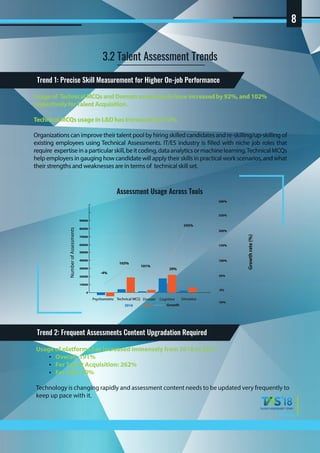
Usage of Technical MCQs and Domain assessments have increased by 92%, and 102%
respectively forTalent Acquisition.
Technical MCQs usage in L&D has increased by 272%
Organizations can improve their talent pool by hiring skilled candidates and re-skilling/up-skilling of
existing employees using Technical Assessments. IT/ES industry is filled with niche job roles that
require expertiseinaparticularskill,beitcoding,dataanalyticsormachinelearning.TechnicalMCQs
help employers in gauging how candidate will apply their skills in practical work scenarios, and what
their strengths and weaknesses are in terms of technical skill set.
Usage of platforms has increased immensely from 2016 to 2017:
Overall: 191%
For Talent Acquisition: 262%
For L&D: 90%
Technology is changing rapidly and assessment content needs to be updated very frequently to
keep up pace with it.
Growthrate(%)
NumberofAssessments
Trend 1: Precise Skill Measurement for Higher On-job Performance
Trend 2: Frequent Assessments Content Upgradation Required
8
DomainTechnical MCQ CognitivePsychometric Simulator
2016 2017 Growth
0
10000
20000
30000
40000
50000
60000
70000
80000
90000
0%
100%
200%
250%
300%
150%
50%
-50%
-4%
101%
29%
103%
243%
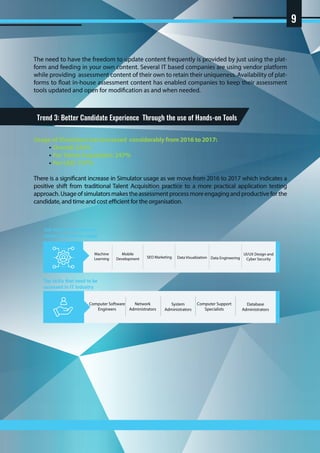
Usage of Simulators has increased considerably from 2016 to 2017:
Overall: 243%
ForTalent Acquisition: 247%
For L&D: 197%
There is a significant increase in Simulator usage as we move from 2016 to 2017 which indicates a
positive shift from traditional Talent Acquisition practice to a more practical application testing
approach.Usageofsimulatorsmakestheassessmentprocessmoreengagingandproductiveforthe
candidate, and time and cost efficient for the organisation.
The need to have the freedom to update content frequently is provided by just using the plat-
form and feeding in your own content. Several IT based companies are using vendor platform
while providing assessment content of their own to retain their uniqueness. Availability of plat-
forms to float in-house assessment content has enabled companies to keep their assessment
tools updated and open for modification as and when needed.
Trend 3: Better Candidate Experience Through the use of Hands-on Tools
Computer Software
Engineers
Network
Administrators
System
Administrators
Computer Support
Specialists
Database
Administrators
Top skills that need to be
assessed in IT Industry
Machine
Learning
Mobile
Development SEO Marketing Data Visualization Data Engineering
UI/UX Design and
Cyber Security
Job roles with maximum
talent assessment usage
9
Use Single Vendor For Assessment: Instead of using a different vendor for hosting different
types of assessments, organizations should use a single vendor to provide all assessment
platforms to avoid juggling various platforms and struggling with platform integration.
Leverage Customized Simulator: Instead of making a simulator in-house from scratch which is
a very time and cost extensive process, organizations should opt for vendors that create
simulators that are highly customized to meet the organizations specific requirements, to
save up on time and cost.
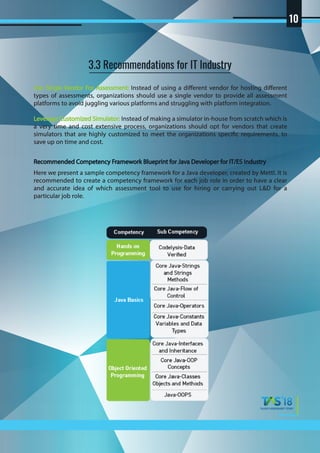
Here we present a sample competency framework for a Java developer, created by Mettl. It is
recommended to create a competency framework for each job role in order to have a clear
and accurate idea of which assessment tool to use for hiring or carrying out L&D for a
particular job role.
Recommended Competency Framework Blueprint for Java Developer for IT/ES Industry
3.3 Recommendations for IT Industry
10
About Client Company
The client company is a leading IT infrastructure and business consulting company.
Problem
As part of its campus engagement exercise, one of the client company’s ideas was to
come up with a contest that would test the skills of some B-school graduates on several
parameters. The idea was simple - to promote their brand as well as hand-pick students
to interact with their CXO team through a contest.
Solution
Mettl embraced this opportunity by creating a highly interactive online contest for the
IT Behemoth.
The first round of the contest was run across 27 business schools and had over 2,300
students participating in it from all over India, Dubai, Manila, and Singapore. Candi-
dates were tested using innovative simulation exercise, puzzles, cases and spreadsheet
analysis coupled with psychometric analysis.
Impact
The client was pleased with the volume of candidate engagement and the excitement
it created amongst students and various campuses. On the candidate side, 82% of the
candidates were happy with the quality of online assessment software, while 87% felt
quality of support was very efficient. The leaderboard feature helped keep the compet-
itive spirit alive, and results could be shared on media.
3.4 Case Study for IT Industry
11
Chapter 4Assessment Landscape in
Pharma Industry
Growth in Assessment Usage
Across Use Cases
Overall Assessment Usage
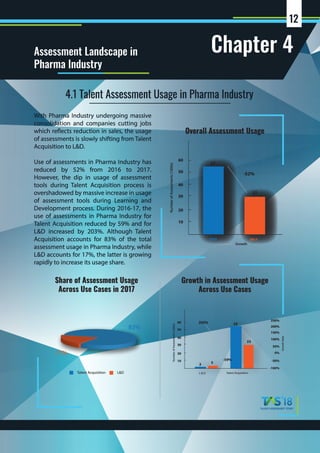
With Pharma Industry undergoing massive
consolidation and companies cutting jobs
which reflects reduction in sales, the usage
of assessments is slowly shifting from Talent
Acquisition to L&D.
Use of assessments in Pharma Industry has
reduced by 52% from 2016 to 2017.
However, the dip in usage of assessment
tools during Talent Acquisition process is
overshadowed by massive increase in usage
of assessment tools during Learning and
Development process. During 2016-17, the
use of assessments in Pharma Industry for
Talent Acquisition reduced by 59% and for
L&D increased by 203%. Although Talent
Acquisition accounts for 83% of the total
assessment usage in Pharma Industry, while
L&D accounts for 17%, the latter is growing
rapidly to increase its usage share.
4.1 Talent Assessment Usage in Pharma Industry
Share of Assessment Usage
Across Use Cases in 2017
Growth
NumberofAssessments(1000s)
83%
17%
Talent Acquisition L&D
12
NumberofAssessments(1000s)
GrowthRate
2016 2017
57
27
10
20
30
40
50
60
-52%
L & D Talent Acquisition
55
23
10
20
30
40
50
60
-59%
2 5
203%
-100%
-50%
0%
50%
100%
150%
200%
250%
4.2 Talent Assessment Trends
Assessment Usage Across Tools
Trend 1: Demand for Higher Logical and Analytical Skills
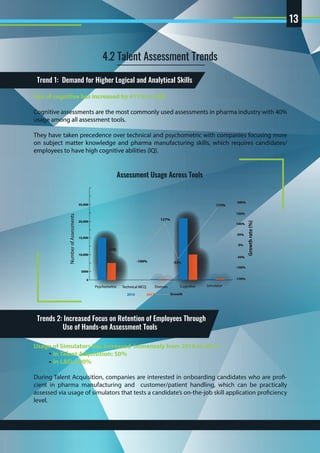
Use of cognitive has increased by 411% in L&D
Cognitive assessments are the most commonly used assessments in pharma industry with 40%
usage among all assessment tools.
They have taken precedence over technical and psychometric with companies focusing more
on subject matter knowledge and pharma manufacturing skills, which requires candidates/
employees to have high cognitive abilities (IQ).
Trends 2: Increased Focus on Retention of Employees Through
Use of Hands-on Assessment Tools
Usage of Simulators has increased immensely from 2016 to 2017:
In Talent Acquisition: 50%
In L&D: 200%
During Talent Acquisition, companies are interested in onboarding candidates who are profi-
cient in pharma manufacturing and customer/patient handling, which can be practically
assessed via usage of simulators that tests a candidate’s on-the-job skill application proficiency
level.
Growthrate(%)
NumberofAssessments
13
DomainTechnical MCQ CognitivePsychometric Simulator
2016 2017 Growth
0
5000
10,000
15,000
20,000
25,000
0%
100%
200%
150%
-150%
50%
-50%
-100%
-52%
127%
-53%-100%
175%
Trends 3: Developing a Positive Work Culture by Assessing Employee Behavior
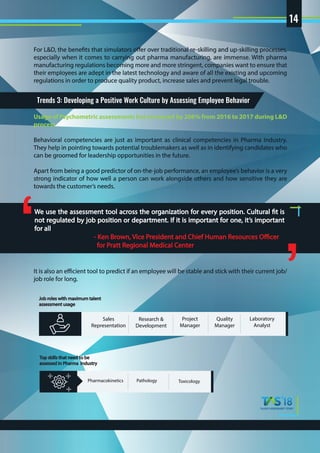
Usage of Psychometric assessments has increased by 206% from 2016 to 2017 during L&D
process
Behavioral competencies are just as important as clinical competencies in Pharma Industry.
They help in pointing towards potential troublemakers as well as in identifying candidates who
can be groomed for leadership opportunities in the future.
Apart from being a good predictor of on-the-job performance, an employee’s behavior is a very
strong indicator of how well a person can work alongside others and how sensitive they are
towards the customer’s needs.
It is also an efficient tool to predict if an employee will be stable and stick with their current job/
job role for long.
For L&D, the benefits that simulators offer over traditional re-skilling and up-skilling processes,
especially when it comes to carrying out pharma manufacturing, are immense. With pharma
manufacturing regulations becoming more and more stringent, companies want to ensure that
their employees are adept in the latest technology and aware of all the existing and upcoming
regulations in order to produce quality product, increase sales and prevent legal trouble.
We use the assessment tool across the organization for every position. Cultural fit is
not regulated by job position or department. If it is important for one, it’s important
for all
- Ken Brown, Vice President and Chief Human Resources Officer
for Pratt Regional Medical Center
‘
’Job roles with maximum talent
assessment usage
Sales
Representation
Research &
Development
Project
Manager
Quality
Manager
Laboratory
Analyst
Top skills that need to be
assessed in Pharma Industry
Pharmacokinetics Pathology Toxicology
14
Usage of Dark Personality Assessments along with Psychometrics can help reduce on-the-job
risk that employees can create by endangering the life of customer or harassing customers
and co-workers.
Creating an Accurate Competency Framework: The biggest challenge with Simulator is
deciding its structure and content. It should meet the business objectives rather than just
being an interesting engagement tool. Identifying the correct competency framework for a
job role can help create simulators that do a thorough and practical assessment of candidate's
skills.
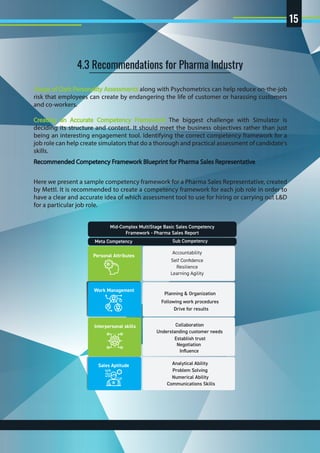
Here we present a sample competency framework for a Pharma Sales Representative, created
by Mettl. It is recommended to create a competency framework for each job role in order to
have a clear and accurate idea of which assessment tool to use for hiring or carrying out L&D
for a particular job role.
Mid-Complex MultiStage Basic Sales Competency
Framework - Pharma Sales Report
Meta Competency Sub Competency
Personal Attributes
Work Management
Interpersonal skills
Accountability
Self Confidence
Resilience
Learning Agility
Planning & Organization
Drive for results
Following work procedures
Sales Aptitude
Collaboration
Understanding customer needs
Establish trust
Negotiation
Influence
Analytical Ability
Problem Solving
Numerical Ability
Communications Skills
Recommended Competency Framework Blueprint for Pharma Sales Representative
4.3 Recommendations for Pharma Industry
15
Problem
Being part of such an extremely competitive ecosystem, the Pharma company – despite
their status as an industry leader– needed to turn their Talent Acquisition process into a
competitive edge.
Solution
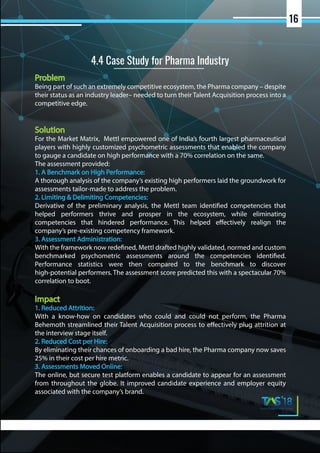
For the Market Matrix, Mettl empowered one of India’s fourth largest pharmaceutical
players with highly customized psychometric assessments that enabled the company
to gauge a candidate on high performance with a 70% correlation on the same.
The assessment provided:
1. A Benchmark on High Performance:
A thorough analysis of the company’s existing high performers laid the groundwork for
assessments tailor-made to address the problem.
2. Limiting & Delimiting Competencies:
Derivative of the preliminary analysis, the Mettl team identified competencies that
helped performers thrive and prosper in the ecosystem, while eliminating
competencies that hindered performance. This helped effectively realign the
company’s pre-existing competency framework.
3. Assessment Administration:
With the framework now redefined, Mettl drafted highly validated, normed and custom
benchmarked psychometric assessments around the competencies identified.
Performance statistics were then compared to the benchmark to discover
high-potential performers. The assessment score predicted this with a spectacular 70%
correlation to boot.
Impact
1. Reduced Attrition:
With a know-how on candidates who could and could not perform, the Pharma
Behemoth streamlined their Talent Acquisition process to effectively plug attrition at
the interview stage itself.
2. Reduced Cost per Hire:
By eliminating their chances of onboarding a bad hire, the Pharma company now saves
25% in their cost per hire metric.
3. Assessments Moved Online:
The online, but secure test platform enables a candidate to appear for an assessment
from throughout the globe. It improved candidate experience and employer equity
associated with the company’s brand.
4.4 Case Study for Pharma Industry
16
Chapter 5Assessment Landscape
in BFSI Industry
Share of Assessment Usage
Across Use Cases in 2017
Growth in Assessment Usage
Across Use Cases
Overall Assessment Usage
With shifting focus towards online banking
and digital currency, the talent demand in
BFSI Industry has moved towards
candidates who are highly skilled in IT and
well versed with latest technological
advancements in BFSI Industry.
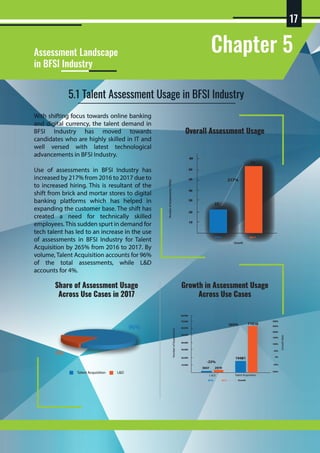
Use of assessments in BFSI Industry has
increased by 217% from 2016 to 2017 due to
to increased hiring. This is resultant of the
shift from brick and mortar stores to digital
banking platforms which has helped in
expanding the customer base. The shift has
created a need for technically skilled
employees.This sudden spurt in demand for
tech talent has led to an increase in the use
of assessments in BFSI Industry for Talent
Acquisition by 265% from 2016 to 2017. By
volume, Talent Acquisition accounts for 96%
of the total assessments, while L&D
accounts for 4%.
5.1 Talent Assessment Usage in BFSI Industry
Growth
NumberofAssessments(1000s)
96%
4%
Talent Acquisition L&D
NumberofAssessments
GrowthRate
17
-100%
L & D Talent Acquisition
19481
71010
10,000
20,000
30,000
40,000
50,000
60,000
70,000
80,000
-23%
3847 2979
265%
-50%
0%
50%
100%
150%
200%
250%
300%
2016 2017 Growth
2016 2017
23
74
10
20
30
40
50
60
80
217%
5.2 Talent Assessment Trends
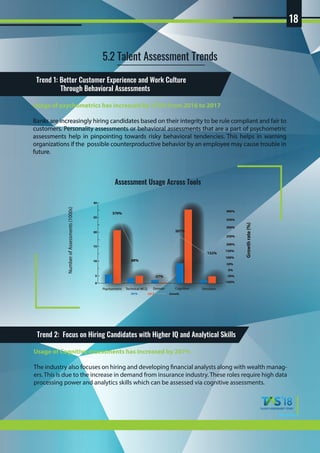
Usage of Cognitive assessments has increased by 207%
The industry also focuses on hiring and developing financial analysts along with wealth manag-
ers. This is due to the increase in demand from insurance industry. These roles require high data
processing power and analytics skills which can be assessed via cognitive assessments.
Trend 2: Focus on Hiring Candidates with Higher IQ and Analytical Skills
18
Usage of psychometrics has increased by 370% from 2016 to 2017
Banks are increasingly hiring candidates based on their integrity to be rule compliant and fair to
customers. Personality assessments or behavioral assessments that are a part of psychometric
assessments help in pinpointing towards risky behavioral tendencies. This helps in warning
organizations if the possible counterproductive behavior by an employee may cause trouble in
future.
Trend 1: Better Customer Experience and Work Culture
Through Behavioral Assessments
DomainTechnical MCQ CognitivePsychometric Simulator
2016 2017 Growth
0
5
10
15
20
25
30
0%
100%
250%
200%
300%
350%
400%
150%
50%
-50%
-100%
370%
-57%
88%
132%
207%
Assessment Usage Across Tools
Growthrate(%)
NumberofAssessments(1000s)
19
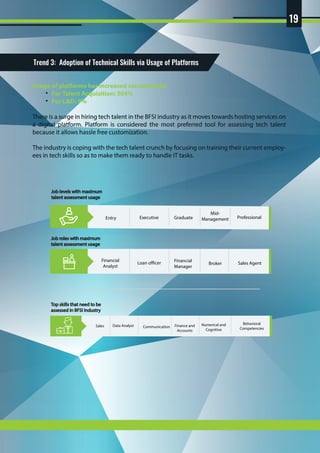
Usage of platforms has increased considerably:
For Talent Acquisition: 304%
For L&D: 9%
There is a surge in hiring tech talent in the BFSI industry as it moves towards hosting services on
a digital platform. Platform is considered the most preferred tool for assessing tech talent
because it allows hassle free customization.
The industry is coping with the tech talent crunch by focusing on training their current employ-
ees in tech skills so as to make them ready to handle IT tasks.
Trend 3: Adoption of Technical Skills via Usage of Platforms
Job levels with maximum
talent assessment usage
Entry Executive Graduate
Mid-
Management Professional
Job roles with maximum
talent assessment usage
Financial
Analyst
Loan officer Financial
Manager
Broker Sales Agent
Sales Communication Finance and
Accounts
Numerical and
Cognitive
Behavioral
Competencies
Top skills that need to be
assessed in BFSI Industry
Data Analyst
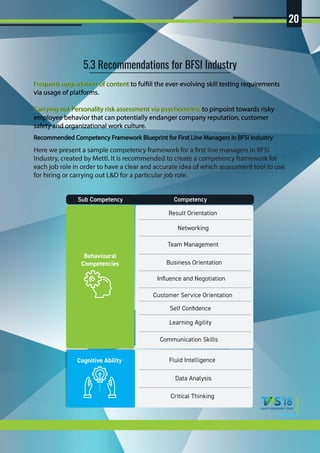
Here we present a sample competency framework for a first line managers in BFSI
Industry, created by Mettl. It is recommended to create a competency framework for
each job role in order to have a clear and accurate idea of which assessment tool to use
for hiring or carrying out L&D for a particular job role.
Frequent upgradation of content to fulfill the ever-evolving skill testing requirements
via usage of platforms.
Carrying out Personality risk assessment via psychometric to pinpoint towards risky
employee behavior that can potentially endanger company reputation, customer
safety and organizational work culture.
Recommended Competency Framework Blueprint for First Line Managers in BFSI Industry
5.3 Recommendations for BFSI Industry
Behavioural
Competencies
Networking
Team Management
Self Confidence
Business Orientation
Influence and Negotiation
Result Orientation
Customer Service Orientation
Cognitive Ability
Learning Agility
Critical Thinking
Communication Skills
Fluid Intelligence
Data Analysis
CompetencySub Competency
20
Problem
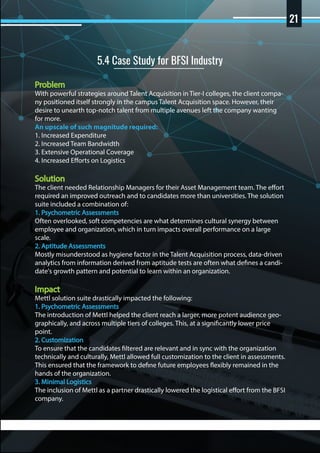
With powerful strategies around Talent Acquisition in Tier-I colleges, the client compa-
ny positioned itself strongly in the campus Talent Acquisition space. However, their
desire to unearth top-notch talent from multiple avenues left the company wanting
for more.
An upscale of such magnitude required:
1. Increased Expenditure
2. Increased Team Bandwidth
3. Extensive Operational Coverage
4. Increased Efforts on Logistics
Solution
The client needed Relationship Managers for their Asset Management team. The effort
required an improved outreach and to candidates more than universities. The solution
suite included a combination of:
1. Psychometric Assessments
Often overlooked, soft competencies are what determines cultural synergy between
employee and organization, which in turn impacts overall performance on a large
scale.
2. Aptitude Assessments
Mostly misunderstood as hygiene factor in the Talent Acquisition process, data-driven
analytics from information derived from aptitude tests are often what defines a candi-
date's growth pattern and potential to learn within an organization.
Impact
Mettl solution suite drastically impacted the following:
1. Psychometric Assessments
The introduction of Mettl helped the client reach a larger, more potent audience geo-
graphically, and across multiple tiers of colleges. This, at a significantly lower price
point.
2. Customization
To ensure that the candidates filtered are relevant and in sync with the organization
technically and culturally, Mettl allowed full customization to the client in assessments.
This ensured that the framework to define future employees flexibly remained in the
hands of the organization.
3. Minimal Logistics
The inclusion of Mettl as a partner drastically lowered the logistical effort from the BFSI
company.
5.4 Case Study for BFSI Industry
21
Chapter 6Assessment Landscape in
Retail Industry
Share of Assessment Usage
Across Use Cases in 2017
Growth in Assessment Usage
Across Use Cases
83%
17%
Talent Acquisition L&D
Overall Assessment Usage
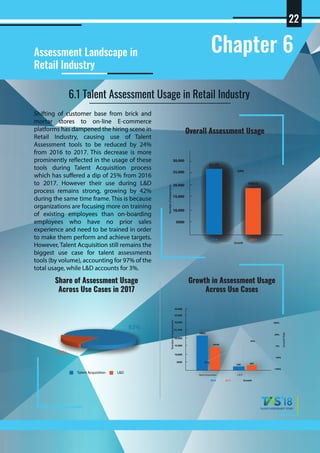
Shifting of customer base from brick and
mortar stores to on-line E-commerce
platforms has dampened the hiring scene in
Retail Industry, causing use of Talent
Assessment tools to be reduced by 24%
from 2016 to 2017. This decrease is more
prominently reflected in the usage of these
tools during Talent Acquisition process
which has suffered a dip of 25% from 2016
to 2017. However their use during L&D
process remains strong, growing by 42%
during the same time frame. This is because
organizations are focusing more on training
of existing employees than on-boarding
employees who have no prior sales
experience and need to be trained in order
to make them perform and achieve targets.
However, Talent Acquisition still remains the
biggest use case for talent assessments
tools (by volume), accounting for 97% of the
total usage, while L&D accounts for 3%.
6.1 Talent Assessment Usage in Retail Industry
Growth
NumberofAssessments
22
NumberofAssessments
GrowthRate
2016 2017
25177
19019
5000
10,000
15,000
20,000
25,000
30,000
-24%
2016 2017 Growth
-100%
L & DTalent Acquisition
339 483
5000
10,000
15,000
20,000
25,,000
30,000
35,000
40,000
-25%
24841
18540
42%
-50%
0%
50%
100%
6.2 Talent Assessment Trends
Assessment Usage Across Tools
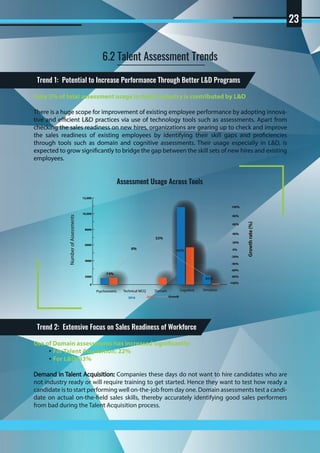
Only 3% of total assessment usage in Retail Industry is contributed by L&D
There is a huge scope for improvement of existing employee performance by adopting innova-
tive and efficient L&D practices via use of technology tools such as assessments. Apart from
checking the sales readiness on new hires, organizations are gearing up to check and improve
the sales readiness of existing employees by identifying their skill gaps and proficiencies
through tools such as domain and cognitive assessments. Their usage especially in L&D, is
expected to grow significantly to bridge the gap between the skill sets of new hires and existing
employees.
Trend 1: Potential to Increase Performance Through Better L&D Programs
Use of Domain assessments has increased significantly:
For Talent Acquisition: 22%
For L&D: 33%
Demand in Talent Acquisition: Companies these days do not want to hire candidates who are
not industry ready or will require training to get started. Hence they want to test how ready a
candidate is to start performing well on-the-job from day one. Domain assessments test a candi-
date on actual on-the-field sales skills, thereby accurately identifying good sales performers
from bad during the Talent Acquisition process.
Trend 2: Extensive Focus on Sales Readiness of Workforce
Growthrate(%)
NumberofAssessments
23
DomainTechnical MCQ CognitivePsychometric Simulator
2016 2017 Growth
0
2000
4000
6000
8000
10,000
12,000
-60%
-20%
40%
20%
60%
80%
100%
0%
-40%
-80%
-100%
-74%
22%
0%
-93%
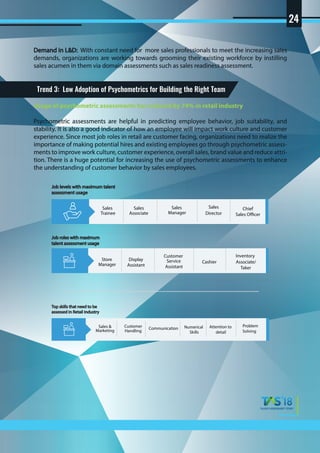
-43%
Demand in L&D: With constant need for more sales professionals to meet the increasing sales
demands, organizations are working towards grooming their existing workforce by instilling
sales acumen in them via domain assessments such as sales readiness assessment.
Usage of psychometric assessments has reduced by 74% in retail industry
Psychometric assessments are helpful in predicting employee behavior, job suitability, and
stability. It is also a good indicator of how an employee will impact work culture and customer
experience. Since most job roles in retail are customer facing, organizations need to realize the
importance of making potential hires and existing employees go through psychometric assess-
ments to improve work culture, customer experience, overall sales, brand value and reduce attri-
tion. There is a huge potential for increasing the use of psychometric assessments to enhance
the understanding of customer behavior by sales employees.
Trend 3: Low Adoption of Psychometrics for Building the Right Team
Job levels with maximum talent
assessment usage
Chief
Sales Officer
Sales
Trainee
Sales
Associate
Sales
Manager
Sales
Director
Job roles with maximum
talent assessment usage
Store
Manager
Display
Assistant
Customer
Service
Assistant
Cashier
Inventory
Associate/
Taker
Top skills that need to be
assessed in Retail industry
Sales &
Marketing
Customer
Handling
Communication Numerical
Skills
Attention to
detail
Problem
Solving
24
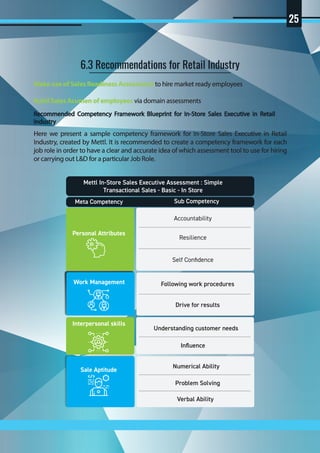
Here we present a sample competency framework for In-Store Sales Executive in Retail
Industry, created by Mettl. It is recommended to create a competency framework for each
job role in order to have a clear and accurate idea of which assessment tool to use for hiring
or carrying out L&D for a particular Job Role.
Make use of Sales Readiness Assessment to hire market ready employees
Build Sales Acumen of employees via domain assessments
Recommended Competency Framework Blueprint for In-Store Sales Executive in Retail
Industry
6.3 Recommendations for Retail Industry
Mettl In-Store Sales Executive Assessment : Simple
Transactional Sales - Basic - In Store
Meta Competency Sub Competency
Personal Attributes
Interpersonal skills
Accountability
Self Confidence
Resilience
Sale Aptitude
Understanding customer needs
Influence
Verbal Ability
Problem Solving
Numerical Ability
Work Management
Drive for results
Following work procedures
25
About
The client company is an Indian multinational company, headquartered in Gurgaon,
India. They specialize in scientific weight management solutions, beauty services, skin
and hair-care treatments, and personal care. The company operates in 323 locations
across 150 cities with a notable presence in 11 countries. They currently possess a
workforce about 4,000 strong.
Problem
While the company remained powerful within their Learning & Development process,
key decision makers realized that an improvement in the quality measurement of ROI
was not far behind.
An upscale of such magnitude required:
1. To uncover a defined set of competencies amidst high performers on scale.
2. To set a benchmark to better improve the L&D stakes.
3. To expand such findings across their global presence.
In an effort to reinvigorate their Learning & Development process, the client needed a
comprehensive solution suite.
Solution
The assessments for boosting client’s L&D process included:
1. A Skill Gap Identification Pilot with 35 Candidates,
2. A Comprehensive Psychometric Battery to measure core Behavioral Competencies
3. Situation/Scenario-Based Questions.
4. Full Freedom for Customization around the Assessment Content.
Impact
With the new processes in place, the client decided to expand partnership with Mettl
for providing the following services:
1. A Fresh Skill Gap Identification Program (135 Employees – First Batch),
2. Increased Return on Investment on their Learning & Development Model, and
3. Improved Processes in their Malaysia, Dubai, Singapore, and Qatar offices.
6.4 Case Study for Retail Industry
26
Chapter 7Assessment Landscape in
Consulting Industry
Share of Assessment Usage
Across Use Cases in 2017
Growth in Assessment Usage
Across Use Cases
Overall Assessment Usage
With games to replace traditional
interviews, the landscape of how Talent
Acquisition happens has changed
drastically. Many companies are now
allowing candidates to play games that
provide them with badges, points and
opportunity to role play, as a part of the
Talent Acquisition process. For example:
PwC, Hungary makes use of an online
simulation called ‘ Multipoly’ to carry out
campus hiring. The game that lasts for 12
days, invites the candidates to experience in
real life, what their job responsibilities will
be as a consultant.
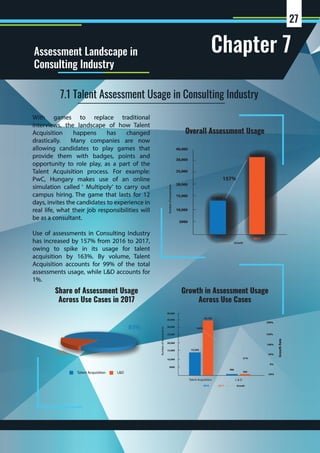
Use of assessments in Consulting Industry
has increased by 157% from 2016 to 2017,
owing to spike in its usage for talent
acquisition by 163%. By volume, Talent
Acquisition accounts for 99% of the total
assessments usage, while L&D accounts for
1%.
7.1 Talent Assessment Usage in Consulting Industry
83%
17%
Growth
NumberofAssessments
Talent Acquisition L&D
NumberofAssessments
27
2016 2017
13,829
35,510
5000
10,000
15,000
20,000
25,000
30,000
40,000
157%
2016 2017 Growth
L & DTalent Acquisition
GrowthRate
486
384
5000
10,000
15,000
20,000
25,000
30,000
35,000
40,000
163%
13,343
35,126
21%
-50%
0%
50%
100%
150%
200%
7.2 Talent Assessment Trends
Assessment Usage Across Tools
Usage of Psychometric assessments has increased considerably for L&D
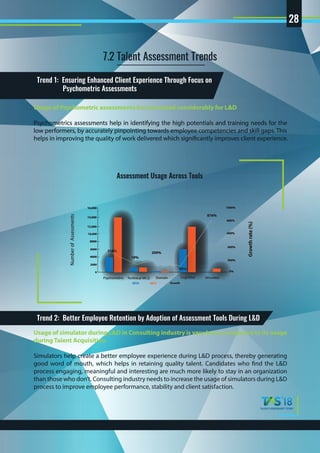
Psychometrics assessments help in identifying the high potentials and training needs for the
low performers, by accurately pinpointing towards employee competencies and skill gaps. This
helps in improving the quality of work delivered which significantly improves client experience.
Trend 1: Ensuring Enhanced Client Experience Through Focus on
Psychometric Assessments
Usage of simulator during L&D in Consulting industry is very low as compared to its usage
during Talent Acquisition
Simulators help create a better employee experience during L&D process, thereby generating
good word of mouth, which helps in retaining quality talent. Candidates who find the L&D
process engaging, meaningful and interesting are much more likely to stay in an organization
than those who don’t. Consulting industry needs to increase the usage of simulators during L&D
process to improve employee performance, stability and client satisfaction.
Trend 2: Better Employee Retention by Adoption of Assessment Tools During L&D
Growthrate(%)
NumberofAssessments
28
DomainTechnical MCQ CognitivePsychometric Simulator
2016 2017 Growth
0
2000
6000
10,000
400%
800%
1000%
600%
200%
0%
218% 209%
19%
876%
99%
4000
8000
12,000
14,000
16,000
Usage of simulator has increased by 876% for Talent Acquisition
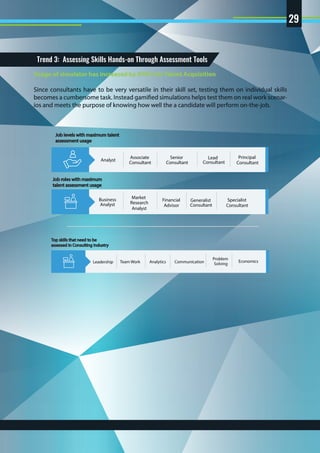
Since consultants have to be very versatile in their skill set, testing them on individual skills
becomes a cumbersome task. Instead gamified simulations helps test them on real work scenar-
ios and meets the purpose of knowing how well the a candidate will perform on-the-job.
Trend 3: Assessing Skills Hands-on Through Assessment Tools
Analyst
Senior
Consultant
Lead
Consultant
Principal
Consultant
Job levels with maximum talent
assessment usage
Associate
Consultant
Specialist
Consultant
Job roles with maximum
talent assessment usage
Business
Analyst
Market
Research
Analyst
Financial
Advisor
Generalist
Consultant
Top skills that need to be
assessed in Consulting industry
Leadership Team Work Analytics Communication
Problem
Solving
Economics
29
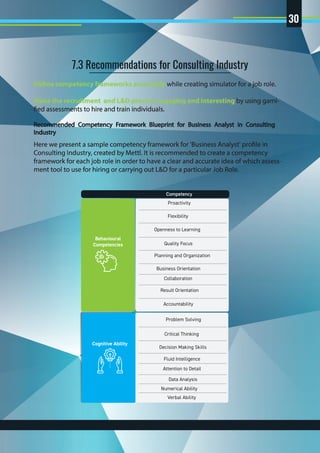
Here we present a sample competency framework for 'Business Analyst' profile in
Consulting Industry, created by Mettl. It is recommended to create a competency
framework for each job role in order to have a clear and accurate idea of which assess-
ment tool to use for hiring or carrying out L&D for a particular Job Role.
Define competency frameworks accurately while creating simulator for a job role.
Make the recruitment and L&D process engaging and interesting by using gami-
fied assessments to hire and train individuals.
Recommended Competency Framework Blueprint for Business Analyst in Consulting
Industry
7.3 Recommendations for Consulting Industry
Behavioural
Competencies
Business Orientation
Cognitive Ability
Critical Thinking
Data Analysis
Competency
Proactivity
Flexibility
Openness to Learning
Quality Focus
Planning and Organization
Collaboration
Result Orientation
Accountability
Problem Solving
Decision Making Skills
Fluid Intelligence
Attention to Detail
Numerical Ability
Verbal Ability
30
About
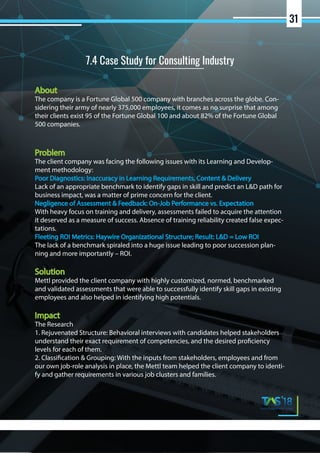
The company is a Fortune Global 500 company with branches across the globe. Con-
sidering their army of nearly 375,000 employees, it comes as no surprise that among
their clients exist 95 of the Fortune Global 100 and about 82% of the Fortune Global
500 companies.
Problem
The client company was facing the following issues with its Learning and Develop-
ment methodology:
Poor Diagnostics: Inaccuracy in Learning Requirements, Content & Delivery
Lack of an appropriate benchmark to identify gaps in skill and predict an L&D path for
business impact, was a matter of prime concern for the client.
Negligence of Assessment & Feedback: On-Job Performance vs. Expectation
With heavy focus on training and delivery, assessments failed to acquire the attention
it deserved as a measure of success. Absence of training reliability created false expec-
tations.
Fleeting ROI Metrics: Haywire Organizational Structure; Result: L&D = Low ROI
The lack of a benchmark spiraled into a huge issue leading to poor succession plan-
ning and more importantly – ROI.
Solution
Mettl provided the client company with highly customized, normed, benchmarked
and validated assessments that were able to successfully identify skill gaps in existing
employees and also helped in identifying high potentials.
Impact
The Research
1. Rejuvenated Structure: Behavioral interviews with candidates helped stakeholders
understand their exact requirement of competencies, and the desired proficiency
levels for each of them.
2. Classification & Grouping: With the inputs from stakeholders, employees and from
our own job-role analysis in place, the Mettl team helped the client company to identi-
fy and gather requirements in various job clusters and families.
7.4 Case Study for Consulting Industry
31
Annexure
Overall
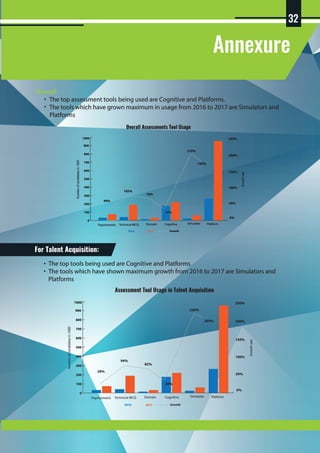
The top assessment tools being used are Cognitive and Platforms.
The tools which have grown maximum in usage from 2016 to 2017 are Simulators and
Platforms
DomainTechnical MCQ CognitivePsychometric Simulator Platform
2016 2017 Growth
0
100
200
300
500
600
700
800
0%
100%
200%
250%
150%
50%
49%
76%
34%
105%
219%
165%
400
900
1000
Growthrate
Numberofcandidatesin1000’
Overall Assessments Tool Usage
DomainTechnical MCQ CognitivePsychometric Simulator Platform
2016 2017 Growth
0
100
200
300
500
600
700
800
0%
100%
200%
250%
150%
50%
29%
82%
28%
94%
220%
204%
400
900
1000
Growthrate
Numberofcandidatesin1000’
Assessment Tool Usage in Talent Acquisition
For Talent Acquisition:
The top tools being used are Cognitive and Platforms
The tools which have shown maximum growth from 2016 to 2017 are Simulators and
Platforms
32
33
DomainTechnical MCQ CognitivePsychometric Simulator Platform
2016 2017 Growth
0
50
100
150
250
300
350
400
0%
100%
-100%
200%
300%
400%
500%
600%
700%
800%
900%
780%
-36%
273%
95%
387%
197%
200
450
1000
Growthrate
Numberofcandidatesin1000’
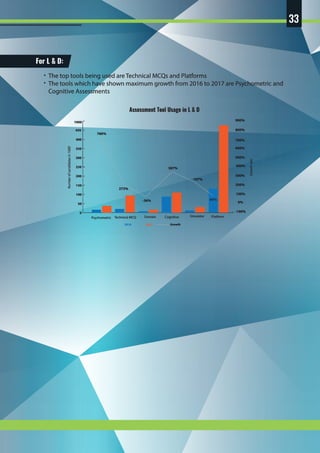
Assessment Tool Usage in L & D
For L & D:
The top tools being used are Technical MCQs and Platforms
The tools which have shown maximum growth from 2016 to 2017 are Psychometric and
Cognitive Assessments
34
DomainTechnical MCQ CognitivePsychometric Simulator Platform
2016 2017 Growth
0
100
200
300
500
600
700
800
0%
100%
200%
250%
300%
150%
50%
-4%
102%
28%
92%
247%
262%
400
900
1000
Growthrate
Numberofcandidatesin1000’
Growth in Assessment Tools Usage
for Talent Acquisition
Share of Assessment Tools Used For
Talent Acquisition in 2017
Share of Assessment Tools Used for
L&D in 2017
DomainTechnical MCQ CognitivePsychometric Simulator Platform
2016 2017 Growth
0
100
50
150
200
300
350
400
-50%
50%
100%
150%
200%
250%
300%
-14% -17%
272%
101%
0%
197%
90%
250
Growthrate
Numberofcandidatesin1000’
Growth in Assessment Tools Usage for L&D
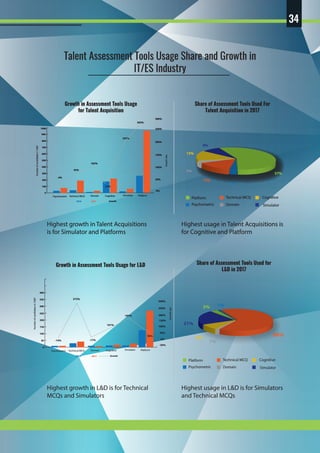
Talent Assessment Tools Usage Share and Growth in
IT/ES Industry
Platform
Domain
Technical MCQ Cognitive
Psychometric Simulator
Platform
Domain
Technical MCQ Cognitive
Psychometric Simulator
Highest growth in Talent Acquisitions
is for Simulator and Platforms
Highest usage in Talent Acquisitions is
for Cognitive and Platform
Highest growth in L&D is for Technical
MCQs and Simulators
Highest usage in L&D is for Simulators
and Technical MCQs
57%
3%
14%
3%
15%
8%
66%
1%
8%
21%
3% 1%
35
DomainTechnical MCQ CognitivePsychometric Simulator Platform
2016 2017 Growth
-100%
0%
100%
150%
200%
50%
-50%
-60%
150%
-59%
0%
50%
-58%
Growthrate
Numberofcandidates
Growth in Assessment Tools Usage
for Talent Acquisition
Share of Assessment Tools Used For
Talent Acquisition in 2017
Share of Assessment Tools Used for
L&D in 2017
DomainTechnical MCQ CognitivePsychometric Simulator Platform
2016 2017 Growth
0
400
200
600
800
1200
1400
1600
-50%
50%
100%
-100%
150%
-150%
200%
250%
300%
400%
450%
206%
-100%-100%
411%
0%
200%
124%
1000
Growthrate
Numberofcandidates
Growth in Assessment Tools Usage for L&D
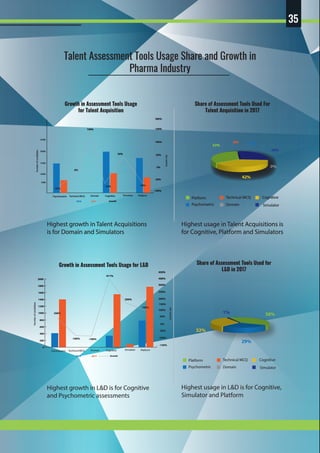
Talent Assessment Tools Usage Share and Growth in
Pharma Industry
Platform
Domain
Technical MCQ Cognitive
Psychometric Simulator
Platform
Domain
Technical MCQ Cognitive
Psychometric Simulator
Highest growth in Talent Acquisitions
is for Domain and Simulators
Highest usage in Talent Acquisitions is
for Cognitive, Platform and Simulators
Highest growth in L&D is for Cognitive
and Psychometric assessments
Highest usage in L&D is for Cognitive,
Simulator and Platform
1%
32%
38%
29%
5000
10000
15000
20000
25000
42%
0%
0%
26%
32% 0%
1800
2000
36
DomainTechnical MCQ CognitivePsychometric Simulator Platform
2016 2017 Growth
0%
100%
200%
250%
300%
350%
400%
450%
150%
50%
424%
199%
238%
88%
132%
304%
Growthrate
Numberofcandidates
Growth in Assessment Tools Usage
for Talent Acquisition
Share of Assessment Tools Used For
Talent Acquisition in 2017
Share of Assessment Tools Used for
L&D in 2017
DomainTechnical MCQ CognitivePsychometric Simulator Platform
2016 2017 Growth
0
400
200
600
800
1200
1400
1600
-80%
-40%
-20%
-100%
0%
-120%
20%
2%
-97%
0%
-14%
-60%
0%
9%
1000
Growthrate
Numberofcandidates
Growth in Assessment Tools Usage for L&D
Talent Assessment Tools Usage Share and Growth in
BFSI Industry
Platform
Domain
Technical MCQ Cognitive
Psychometric Simulator
Platform
Domain
Technical MCQ Cognitive
Psychometric Simulator
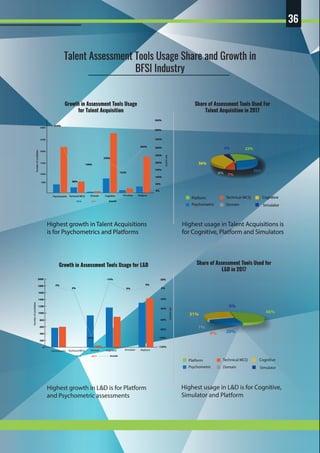
Highest growth in Talent Acquisitions
is for Psychometrics and Platforms
Highest usage in Talent Acquisitions is
for Cognitive, Platform and Simulators
Highest growth in L&D is for Platform
and Psychometric assessments
Highest usage in L&D is for Cognitive,
Simulator and Platform
1%
31% 48%
20%
5000
10000
15000
20000
25000
30000
1800
2000
36%
7%0%
4% 23%
30%
0%
0%
37
DomainTechnical MCQ CognitivePsychometric Simulator Platform
2016 2017 Growth
-100%
-60%
-20%
0%
20%
40%
60%
80%
-40%
-80%
-74%
22%
-43%
0%
-93%
-11%
Growthrate
Numberofcandidates
Growth in Assessment Tools Usage
for Talent Acquisition
Share of Assessment Tools Used For
Talent Acquisition in 2017
Share of Assessment Tools Used for
L&D in 2017
DomainTechnical MCQ CognitivePsychometric Simulator Platform
2016 2017 Growth
0
150
100
200
250
350
400
450
10%
20%
25%
5%
30%
0%
35%
0%
33%
0% 0%
15%
0%
6%
300
Growthrate
Numberofcandidates
Growth in Assessment Tools Usage for L&D
Talent Assessment Tools Usage Share and Growth in
Retail Industry
Platform
Domain
Technical MCQ Cognitive
Psychometric Simulator
Platform
Domain
Technical MCQ Cognitive
Psychometric Simulator
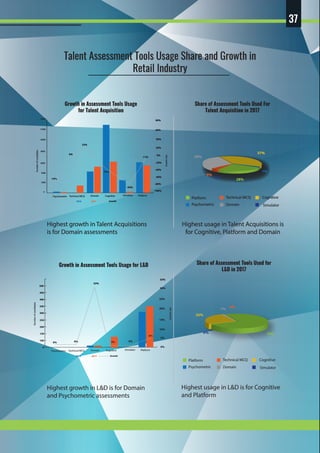
Highest growth in Talent Acquisitions
is for Domain assessments
Highest usage in Talent Acquisitions is
for Cognitive, Platform and Domain
Highest growth in L&D is for Domain
and Psychometric assessments
Highest usage in L&D is for Cognitive
and Platform
2000
0
4000
6000
8000
10000
12000
14000
500
28%
30%
0%
4%
1%
37%
0%
0%
1%
25%
74%
38
DomainTechnical MCQ CognitivePsychometric Simulator Platform
2016 2017 Growth
0%
200%
400%
500%
600%
700%
800%
900%
300%
100%
218%
209%
99%19%
876%
225%
Growthrate
Numberofcandidates
Growth in Assessment Tools Usage
for Talent Acquisition
Share of Assessment Tools Used For
Talent Acquisition in 2017
Share of Assessment Tools Used for
L&D in 2017
DomainTechnical MCQ CognitivePsychometric Simulator Platform
2016 2017 Growth
-70%
-50%
-40%
-80%
-30%
-90%
-20%
-10%
0%0%
-26%
0% 0%
-60%
0%
-77%
300
250
200
150
100
50
0
Growthrate
Numberofcandidates
Growth in Assessment Tools Usage for L&D
Talent Assessment Tools Usage Share and Growth in
Consulting Industry
Platform
Domain
Technical MCQ Cognitive
Psychometric Simulator
Platform
Domain
Technical MCQ Cognitive
Psychometric Simulator
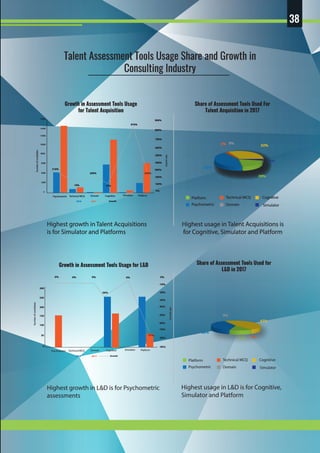
Highest growth in Talent Acquisitions
is for Simulator and Platforms
Highest usage in Talent Acquisitions is
for Cognitive, Simulator and Platform
Highest growth in L&D is for Psychometric
assessments
Highest usage in L&D is for Cognitive,
Simulator and Platform
2000
0
4000
6000
8000
10000
12000
14000
16000
20%
0%
3%
2%
43%
32%
0%
38%
0%
47%
15%
The following Mettl professionals contributed their experience and knowledge to produce
this report.
About the Think Tank
Ketan Kapoor
Co-Founder and CEO
ketan.kapoor@mettl.com
Tonmoy Shingal
Co-Founder and COO
tonmoy.shingal@mettl.com
Siddhartha Gupta
CRO
siddhartha.gupta@mettl.com
Radhika Katyal
Head, Marketing
radhika.katyal@mettl.com
Subhro Kanti Bera
Business Head, Psychometrics
subhro.bera@mettl.com
Parul Khare
Data Analyst
parul.khare@mettl.com
Romila Kanchan
Associate Manager
romila.kanchan@mettl.com
Keser Kapur
Designer
keser.kapur@mettl.com
Aman Sharma
Senior Graphic Designer
aman.sharma@mettl.com
About Mettl
Mettl is one of the largest and fastest growing online talent measurement solution provider
globally, and has been at the forefront of online assessment technology since its inception
in 2010. We enable organizations to build winning teams by taking credible people
decisions across two key areas: Talent Acquisition and Development. More than 2000+
corporates, 24 sector skill councils / government departments and 10+ educational
institutions have benefited from our award-winning solutions.
Using research-backed assessments & a robust technology platform, we deliver customized
assessments for use across the entire employee lifecycle, beginning with pre-hiring
screening and candidate skills assessment, training and development programs for
employees/students, certification exams, contests and more.
Mettl has won various accolades in the recent past - NSDC has selected Mettl as one of the
14 companies to drive innovation in the skills area in India and Thomas Friedman has
written about Mettl and its technology impact in New York Times.
Additionally, Mettl is a winner of the India Emerging 20 Award and the Michael Porter &
IFC-Mint Strategy Award for Technology Enabled Assessments, held annually to recognize
and honor the best Indian companies in different niche categories.
80+ Countries 20+ Languages 2000+ Clients 27+ Industries
INDIA OFFICE
+91-9555114444 Plot 85, Sector 44, Gurgaon,
Haryana, India - 122003
Mettl Technologies Inc.
113 Barksdale Professional Center,
Newark, Delaware 19711, USA
US OFFICE
+1-650-614-1816
Australia
Indonesia
Singapore
South Africa
UAE
UK
+61 3 90699664
+62 8 5574678938
+65 3 1386714
+27 8 75517192
+97 1 8000320460
+44 1 422400843
contact@mettl.com
Key Assessment Trends in BFSI Industry
Trusted by:

Talent assessment study 2018

  • 2.
    This report waswritten and researched by Mettl, one of the largest and fastest growing online talent measurement companies globally, with contributions from different industry leaders. We are very thankful to all the contributors for their sincere support in creating this report. This material is copyrighted and is the property of Mettl.‘Talent Assessment Study 2018’is available for general release and it along with its excerpts may be reproduced, downloaded from www.mettl.com or transmitted in any form electronically, online or in print by permission of the copyright holder; provided full accreditation is given to the Mettl brand.
  • 3.
    Today, the warto acquire top talent is fiercer than ever. As the demand for this talent continues to grow, organizations face bigger issues like that of talent scarcity. It turns out to be quite a challenge for CXOs, human resource departments and hiring managers, especially in industries like IT, BFSI, Retail, Manufacturing, Pharmaceuticals and Consulting that require highly skilled employees. In order to solve these challenges, the talent acquisition process needs to evolve in a manner that it becomes more engaging, affordable, productive and faster. Our interactions with industry leaders revealed two key takeaways that can solve major problems faced by recruiters. Firstly, understanding the competency framework required for a job role. Secondly, use of technology backed tools such as online assessments and simulators to measure the competencies. The hussle does not end at hiring, for it is just the tip of the iceberg. A bigger challenge that lies ahead is retaining the top talent which is done through structured Learning and Development programs to increase employee retention. This is where talent assessments come in picture. They play a crucial role in enhancing the employer brand value owing to their efficiency, affordability and practicality as compared to traditional hiring practices. The first edition of Mettl’s annual report is an attempt to unveil top assessment trends for hiring and learning & development across 5 most anticipated industries for fiscal years 2016-2017. We hope our efforts offer interesting insights and help you in making informed decisions. FOREWORD
  • 4.
    Executive Summary Talent AssessmentUsage Across Key Use Cases Talent Assessment Study is based on the data collected as a part of talent acquisition and L&D programs run by various organizations. The study has been compiled using 2,338,734 talent assessments taken by 1,757,736 candidates spanning across 21 industries from 2016-2017. Share of Assessment Usage Across Use Cases Growth in Assessment Usage Across Use Cases 0 20 40 60 80 100 120 114% 116% GrowthRate(%) 81% 19% Talent Acquisition L&D Talent Acquisition L&D Overall Assessment Usage 0 300 600 900 1200 1500 1800 744 114% 1594 2016 2017 Growth NumberofAssessments(1000s)
  • 5.
    Talent Assessment UsageAcross Key Tools 6% 3% 11% 16% 6% 58% Platform Domain Technical MCQ Cognitive Psychometric Simulator Talent Assessment Usage Across Key Industries IT BFSI Consulting Retail Pharma IT BFSI Consulting Retail Pharma -100 -50 0 50 100 150 200 250 Platform Domain Technical MCQ Cognitive Psychometric Simulator 49% 76% 34% 219% 165% 105% 0 50 100 150 200 250 84% 2% 2% 1% 5% (%) (%) -24% 157% -52% 217% 132% Share of Assessment Usage Across Industries in 2017 Growth in Assessment Usage Across Industries from 2016 to 2017 Share of Assessment Usage Across assessment tool Use Cases in 2017 Growth in Assessment Usage Across Tools from 2016 to 2017
  • 6.
    Key Assessment Trendsin BFSI Industry
  • 7.
    An Overview ofChanging Landscape of Talent Assessments 0101 0202 0303 0404 0505 0606 0707 Introduction Assessment Landscape in Information Technology Industry Assessment Landscape in Banking Financial Services and Insurance Industry Assessment Landscape in Pharmaceutical Industry Assessment Landscape in Retail Industry Assessment Landscape in Consulting Industry 0808 CONTENT Annexure
  • 8.
    We would allagree that Talent and Technology trends are Transforming the Talent Acquisition and L&D landscape. Here are the top trends across the famous 3T’s: Talent Acquisition is one of the top 3 challenges faced by organizations in 2018 according to Mettl’s report on ‘State of Talent Acquisition 2018’. With more and more innovative technologies for talent assessment coming into play, and more stringent ways of skill testing being adopted by organizations, the process of Talent Acquisition has been transformed into a marathon to bag the best talent before others. With the changes in how Talent Acquisition is happening, the role of HR and how organizations function is also changing. Increase in hiring by companies: A recent survey by Mettl in their report ‘State of Talent Acquisition in India 2018’found that 76.3% of organizations will hire more than the previous year. Among this, 69.4% of organizations will increase hiring by more than 25%. Demand for top talent: Despite of shortage of candidates for hiring, companies are not compro- mising on the quality of talent that they are ready to take in. With top talent only available in the market for 10 days, companies are making their Talent Acquisition process more practical, time-saving and interesting to attract talented candidate inflow. Presently, finding candidates with expertise in particular skills is on the priority list of HRs. 1. Talent: Trend: 1 Top trends driving the demand for talent: Chapter 1 20172017 20162016 76.3%76.3% 64.5%64.5% Introduction 1.1 Three Ts Changing the Organizational Paradigm in 2018 1 % of Organizations increasing their Hiring Volume
  • 9.
    1. Talent: 2. Technology: 3.Transformation: With the advent of technology such as AI and Automation, need for human resource has become more exclusive and recruiters are no longer satisfied by hiring the average Joe. Highly skilled employees who have a track record of great performance are the only talent that recruit- ers are in pursuit of. In order to tap this talent, organizations need to up their game and use tech- nologies to get hold of top talent. Top technology trends that are impacting talent are: Talent Acquisition Technologies: HR’s are moving away from traditional methods of identifying top talent such as face-to-face interviews and resumes. More tangible and result oriented objective way of testing candidates is giving way to more accurate hiring of quality candidates. While AI and big data are changing the way candidates are sourced, gamification, simulations and assessments centers are transforming how candidates can be tested based on skills and behavioral indicators. L&D Technologies: They test candidates on a variety of skills by identifying skills gaps and training needs using technologies such as online assessments, assessment centers, 360 feedback, simulations, behavioral assessments and gamified assessments. Candidates are tested on a range of attributes such as skill, individual and team performance, communication, efficiency, accuracy, learning agility and more. With talent and technology transforming how organizations function, there has been a big change in HR functions and how talent is perceived. A major responsibility of Talent Acquisition and L&D now lies in the hands of technology, and HR is focused on other things such as employee experience, employee engagement and culture building activities. Trend: 1 Trend: 2 In order to become talent magnets and transform their people strategy, it is imperative that companies start inculcating top technologies like online assessments and simulations in their complete HR processes including Talent Acquisition, Learning & Development and organizational planning. ‘ ’ 2
  • 10.
    1. Talent: Online talentassessments have an edge over traditional assessment methods such as face-to-face interviews by being more intuitive, engaging and interesting. Lets have a look at why online talent assessments are being increasingly adopted by organizations worldwide. (a) Precise Talent Measurement: By adoption of new innovative assessment methods such as simulations, gamification, hackathons, AI, big data and assessment centers, the accuracy level of skill testing can be exponentially increased. Due to this high accuracy level, the adoption rate of these tools is increasing. (b) Improved Candidate Experience: The traditional Talent Acquisition process spoils the candidate experience by being too lengthy, uninteresting and unstructured. Assessments via simulations or games provide candidates with an engaging and meaningful experience which is a concise, practical and result-oriented assessment approach. In this war for top talent, candidates tend to prefer companies where they had a positive Talent Acquisition process experience. (c) Reduced Cost and Time Taken for Talent Assessment: The number of candidates applying for a single job posting is ~50 in high demand industries. HRs and recruiting managers waste a lot time and resources trying to remove the chaff by assessing each candidate manually. This can be avoided by assessing candidates in bulk via use of online talent assessments which provide a faster, cheaper and more comprehensive method of skill testing. (d) Secure Method to Assist Talent: Features such as remote proctoring, allows candidates to give assessments from remote locations while still maintaining the integrity of the assessment process. This technology has revolutionized the Talent Acquisition and L&D process by allowing candidates to become a part of these organizational processes from the comfort of their home at their own convenient time. Owing to the huge value addition that remote proctoring brings to the table, its usage has increased significantly (by 231%) from 2016 to 2017. When used effectively, pre-hire assessments can have a major impact on key perfor- mance indicators (KPIs), such as cost-to-and time per-hire, Talent Acquisition manag- ers’satisfaction, employee retention, performance, and engagement.  –Aberdeen Group Study (May 2015). ‘ ’ 1.2 Talent Assessments: Advantages over Traditional Methods 3
  • 11.
    1. Talent: Chapter 2 2.1Overall Talent Assessment Landscape Share of Assessment Usage Across Use Cases in 2017 Growth in Assessment Usage Across Use Cases 81% 19% Talent Acquisition L&D Overall Assessment Usage NumberofAssessments(1000s) 0 300 600 900 1200 1500 1800 744 114% 1594 2016 2017 Growth An Overview of the Changing Landscape of Talent Assessments 4 Today, talent assessments are used in every phase of the employee lifecycle ranging from ranging from, Talent Acquisition to training need identification to succession planning to employee engagement. For the ease of understanding, we refer to all use cases for existing employees as Learning and Development (L&D). In 2016, approximately 744,000 assessments were used. This number grew by 114% in 2017 to 1,594,000. In 2017, 19% of assessments were used for L&D while Talent Acquisition accounted for 81%. In spite of taking a bigger share of the pie, assessment usage in Talent Acquisition is growing at a similar rate when compared to L&D. NumberofAssessments 2016 2017 Growth L & D Talent Acquisition 139,401 301,269 200,000 400,000 600,000 800,000 1,000,000 1,200,000 1,400,000 114% 605,118 1,292,946 116% -50% 0% 50% 100% 150% 200%
  • 12.
    2.2 Talent AssessmentTools Organizations are adopting various assessments tools for building better people strategy. Most common assessment tools are Cognitive, Psychometric, Domain, Simulators and Technical MCQs. While some of these like Cognitive and Psychometric have been around for few decades, the others like Simulators are relatively new and thus, have higher growth rates but lower usage. Many organizations develop their custom assessments either in-house or through assessment providers. The adoption of Customized on vendor platform rapidly increasing as can be seen from the graph below. To better understand the usage of each assessment tool, here is a short note on how each of these tools are growing from 2016 to 2017 across top 2 use-cases namely Talent Acquisition and L&D. Cognitive assessments are used to test the IQ of a person via analysis of capabilities such as logical thinking,analyticalreasoning, verbalskillsanddatainterpretation. Thesehaveseenagrowthof34% overallfrom2016to2017. ThoughL&Duse-caseaccountsforonly6%oftotalcognitiveassessments used in 2017, it is growing at almost 380% . On the other its inTalent Acquisition is growing at a rate of 29%. Cognitive 250% 5 Assessment Usage Across Tools DomainTechnical MCQ CognitivePsychometric Simulator Platform 2016 2017 Growth Growthrate(%) NumberofAssessments(1000s) 0% 100% 200% 150% 50% 49% 76% 34% 105% 219% 59.4 88.3 87.9 180 22.9 40.5 191.9 256.9 35.18 931.4 30.4 97 0 100 300 500 700 900 1100 165%
  • 13.
    Domain assessments testthe subject matter knowledge of a person in a particular industry/job field. Usage of domain assessments has grown by 76% from 2016 to 2017, led by an increase in its usage during Talent Acquisition process (82%), which is also the biggest use case for domain assessments accounting for 98% of total domain assessment usage. Psychometric assessments are used to measure a person’s mental and behavioral abilities to test their suitability for a particular job role. Use of psychometric assessments has grown by 49% overall, led by an increase in its use during Learning and Development process. Although the biggest use case for psychometric assessments is Talent Acquisition (accounting for 85% of total psychometric usage), it is growing at a very slow pace of 29%, as compared to its significantly higher growth rate of 780% in L&D, which accounts for 15% of the total psychometric assess- ment usage. Simulators are an authentic method of assessing employees as well as students based on their behavioral attributes, on-job proficiency and organizational understanding. Usage of Simula- tors have increased the most among all assessment tools, growing by 219% from 2016 to 2017. Its growth is driven by increased usage in Talent Acquisition process (220%), which is also the biggest use case for simulators, making up for 94% of total simulator usage. Use of simulators during the L&D process is also increasing, showing a leap of 197% from 2016 to 2017. Technical MCQ’s assess the knowledge base of a candidate in a particular field, in which they are seeking a job. Usage of technical MCQs has increased by 105% from 2016 to 2017, driven by its increased usage during Talent Acquisition and L&D process. Although technical MCQs are majorly used during Talent Acquisition process (accounting for 94% of total usage), its usage during L&D is quickly catching up by growing at a very high rate of 273% from 2016 to 2017. Usage of Platforms is preferred by companies who need to update their assessment content very frequently. Platforms account for 33% of total assessment usage. It is growing very fast at a rate of 165% from 2016 to 2017, led by its increased usage during Talent Acquisition process which accounts for 74% of total customized assessment usage. Its usage during L&D is also growing rapidly, increasing at a rate of 95%. L&D accounts for 26% of total customized assess- ment usage. Domain Psychometric Simulator Technical MCQs Platforms 6 Assessment Trends in IT/ES In
  • 14.
    Chapter 3Assessment Landscapein Information Technology Industry Share of Assessment Usage Across Use Cases in 2017 Growth in Assessment Usage Across Use Cases 81% 19% Talent Acquisition L&D Overall Assessment Usage With hiring in tech roles driving the talent demand across industries, IT and tech based companies have to come up with a Talent Acquisition and retention process that is fast, affordable and effective. Use of assessments in IT/ES Industry has grown by 132% from 2016 to 2017. Owing to the increase in tech hiring, the use of assessments in IT/ES Industry for Talent Acquisition has increased by 141% and for L&D has increased by 99%. Talent Acquisition is the biggest use case as it accounts for 81% of the total assessment usage in IT/ES Industry, while L&D accounts for 19%. 3.1 Talent Assessment Usage in IT 7 NumberofAssessments GrowthRate NumberofAssessments 0 4000 6000 8000 10,000 12,000 14,000 6000 132% 13000 2016 2017 Growth L & D Talent Acquisition 2016 2017 Growth 0% 40% 80% 100% 120% 140% 160% 60% 20% 60000 80000 126,972 252,474 438,613 1,057,228 1,000,000 40000 20000 1,200,000 99% 141%
  • 15.
    3.2 Talent AssessmentTrends Assessment Usage Across Tools Usage of Technical MCQs and Domain assessments have increased by 92%, and 102% respectively forTalent Acquisition. Technical MCQs usage in L&D has increased by 272% Organizations can improve their talent pool by hiring skilled candidates and re-skilling/up-skilling of existing employees using Technical Assessments. IT/ES industry is filled with niche job roles that require expertiseinaparticularskill,beitcoding,dataanalyticsormachinelearning.TechnicalMCQs help employers in gauging how candidate will apply their skills in practical work scenarios, and what their strengths and weaknesses are in terms of technical skill set. Usage of platforms has increased immensely from 2016 to 2017: Overall: 191% For Talent Acquisition: 262% For L&D: 90% Technology is changing rapidly and assessment content needs to be updated very frequently to keep up pace with it. Growthrate(%) NumberofAssessments Trend 1: Precise Skill Measurement for Higher On-job Performance Trend 2: Frequent Assessments Content Upgradation Required 8 DomainTechnical MCQ CognitivePsychometric Simulator 2016 2017 Growth 0 10000 20000 30000 40000 50000 60000 70000 80000 90000 0% 100% 200% 250% 300% 150% 50% -50% -4% 101% 29% 103% 243%
  • 16.
    Usage of Simulatorshas increased considerably from 2016 to 2017: Overall: 243% ForTalent Acquisition: 247% For L&D: 197% There is a significant increase in Simulator usage as we move from 2016 to 2017 which indicates a positive shift from traditional Talent Acquisition practice to a more practical application testing approach.Usageofsimulatorsmakestheassessmentprocessmoreengagingandproductiveforthe candidate, and time and cost efficient for the organisation. The need to have the freedom to update content frequently is provided by just using the plat- form and feeding in your own content. Several IT based companies are using vendor platform while providing assessment content of their own to retain their uniqueness. Availability of plat- forms to float in-house assessment content has enabled companies to keep their assessment tools updated and open for modification as and when needed. Trend 3: Better Candidate Experience Through the use of Hands-on Tools Computer Software Engineers Network Administrators System Administrators Computer Support Specialists Database Administrators Top skills that need to be assessed in IT Industry Machine Learning Mobile Development SEO Marketing Data Visualization Data Engineering UI/UX Design and Cyber Security Job roles with maximum talent assessment usage 9
  • 17.
    Use Single VendorFor Assessment: Instead of using a different vendor for hosting different types of assessments, organizations should use a single vendor to provide all assessment platforms to avoid juggling various platforms and struggling with platform integration. Leverage Customized Simulator: Instead of making a simulator in-house from scratch which is a very time and cost extensive process, organizations should opt for vendors that create simulators that are highly customized to meet the organizations specific requirements, to save up on time and cost. Here we present a sample competency framework for a Java developer, created by Mettl. It is recommended to create a competency framework for each job role in order to have a clear and accurate idea of which assessment tool to use for hiring or carrying out L&D for a particular job role. Recommended Competency Framework Blueprint for Java Developer for IT/ES Industry 3.3 Recommendations for IT Industry 10
  • 18.
    About Client Company Theclient company is a leading IT infrastructure and business consulting company. Problem As part of its campus engagement exercise, one of the client company’s ideas was to come up with a contest that would test the skills of some B-school graduates on several parameters. The idea was simple - to promote their brand as well as hand-pick students to interact with their CXO team through a contest. Solution Mettl embraced this opportunity by creating a highly interactive online contest for the IT Behemoth. The first round of the contest was run across 27 business schools and had over 2,300 students participating in it from all over India, Dubai, Manila, and Singapore. Candi- dates were tested using innovative simulation exercise, puzzles, cases and spreadsheet analysis coupled with psychometric analysis. Impact The client was pleased with the volume of candidate engagement and the excitement it created amongst students and various campuses. On the candidate side, 82% of the candidates were happy with the quality of online assessment software, while 87% felt quality of support was very efficient. The leaderboard feature helped keep the compet- itive spirit alive, and results could be shared on media. 3.4 Case Study for IT Industry 11
  • 19.
    Chapter 4Assessment Landscapein Pharma Industry Growth in Assessment Usage Across Use Cases Overall Assessment Usage With Pharma Industry undergoing massive consolidation and companies cutting jobs which reflects reduction in sales, the usage of assessments is slowly shifting from Talent Acquisition to L&D. Use of assessments in Pharma Industry has reduced by 52% from 2016 to 2017. However, the dip in usage of assessment tools during Talent Acquisition process is overshadowed by massive increase in usage of assessment tools during Learning and Development process. During 2016-17, the use of assessments in Pharma Industry for Talent Acquisition reduced by 59% and for L&D increased by 203%. Although Talent Acquisition accounts for 83% of the total assessment usage in Pharma Industry, while L&D accounts for 17%, the latter is growing rapidly to increase its usage share. 4.1 Talent Assessment Usage in Pharma Industry Share of Assessment Usage Across Use Cases in 2017 Growth NumberofAssessments(1000s) 83% 17% Talent Acquisition L&D 12 NumberofAssessments(1000s) GrowthRate 2016 2017 57 27 10 20 30 40 50 60 -52% L & D Talent Acquisition 55 23 10 20 30 40 50 60 -59% 2 5 203% -100% -50% 0% 50% 100% 150% 200% 250%
  • 20.
    4.2 Talent AssessmentTrends Assessment Usage Across Tools Trend 1: Demand for Higher Logical and Analytical Skills Use of cognitive has increased by 411% in L&D Cognitive assessments are the most commonly used assessments in pharma industry with 40% usage among all assessment tools. They have taken precedence over technical and psychometric with companies focusing more on subject matter knowledge and pharma manufacturing skills, which requires candidates/ employees to have high cognitive abilities (IQ). Trends 2: Increased Focus on Retention of Employees Through Use of Hands-on Assessment Tools Usage of Simulators has increased immensely from 2016 to 2017: In Talent Acquisition: 50% In L&D: 200% During Talent Acquisition, companies are interested in onboarding candidates who are profi- cient in pharma manufacturing and customer/patient handling, which can be practically assessed via usage of simulators that tests a candidate’s on-the-job skill application proficiency level. Growthrate(%) NumberofAssessments 13 DomainTechnical MCQ CognitivePsychometric Simulator 2016 2017 Growth 0 5000 10,000 15,000 20,000 25,000 0% 100% 200% 150% -150% 50% -50% -100% -52% 127% -53%-100% 175%
  • 21.
    Trends 3: Developinga Positive Work Culture by Assessing Employee Behavior Usage of Psychometric assessments has increased by 206% from 2016 to 2017 during L&D process Behavioral competencies are just as important as clinical competencies in Pharma Industry. They help in pointing towards potential troublemakers as well as in identifying candidates who can be groomed for leadership opportunities in the future. Apart from being a good predictor of on-the-job performance, an employee’s behavior is a very strong indicator of how well a person can work alongside others and how sensitive they are towards the customer’s needs. It is also an efficient tool to predict if an employee will be stable and stick with their current job/ job role for long. For L&D, the benefits that simulators offer over traditional re-skilling and up-skilling processes, especially when it comes to carrying out pharma manufacturing, are immense. With pharma manufacturing regulations becoming more and more stringent, companies want to ensure that their employees are adept in the latest technology and aware of all the existing and upcoming regulations in order to produce quality product, increase sales and prevent legal trouble. We use the assessment tool across the organization for every position. Cultural fit is not regulated by job position or department. If it is important for one, it’s important for all - Ken Brown, Vice President and Chief Human Resources Officer for Pratt Regional Medical Center ‘ ’Job roles with maximum talent assessment usage Sales Representation Research & Development Project Manager Quality Manager Laboratory Analyst Top skills that need to be assessed in Pharma Industry Pharmacokinetics Pathology Toxicology 14
  • 22.
    Usage of DarkPersonality Assessments along with Psychometrics can help reduce on-the-job risk that employees can create by endangering the life of customer or harassing customers and co-workers. Creating an Accurate Competency Framework: The biggest challenge with Simulator is deciding its structure and content. It should meet the business objectives rather than just being an interesting engagement tool. Identifying the correct competency framework for a job role can help create simulators that do a thorough and practical assessment of candidate's skills. Here we present a sample competency framework for a Pharma Sales Representative, created by Mettl. It is recommended to create a competency framework for each job role in order to have a clear and accurate idea of which assessment tool to use for hiring or carrying out L&D for a particular job role. Mid-Complex MultiStage Basic Sales Competency Framework - Pharma Sales Report Meta Competency Sub Competency Personal Attributes Work Management Interpersonal skills Accountability Self Confidence Resilience Learning Agility Planning & Organization Drive for results Following work procedures Sales Aptitude Collaboration Understanding customer needs Establish trust Negotiation Influence Analytical Ability Problem Solving Numerical Ability Communications Skills Recommended Competency Framework Blueprint for Pharma Sales Representative 4.3 Recommendations for Pharma Industry 15
  • 23.
    Problem Being part ofsuch an extremely competitive ecosystem, the Pharma company – despite their status as an industry leader– needed to turn their Talent Acquisition process into a competitive edge. Solution For the Market Matrix, Mettl empowered one of India’s fourth largest pharmaceutical players with highly customized psychometric assessments that enabled the company to gauge a candidate on high performance with a 70% correlation on the same. The assessment provided: 1. A Benchmark on High Performance: A thorough analysis of the company’s existing high performers laid the groundwork for assessments tailor-made to address the problem. 2. Limiting & Delimiting Competencies: Derivative of the preliminary analysis, the Mettl team identified competencies that helped performers thrive and prosper in the ecosystem, while eliminating competencies that hindered performance. This helped effectively realign the company’s pre-existing competency framework. 3. Assessment Administration: With the framework now redefined, Mettl drafted highly validated, normed and custom benchmarked psychometric assessments around the competencies identified. Performance statistics were then compared to the benchmark to discover high-potential performers. The assessment score predicted this with a spectacular 70% correlation to boot. Impact 1. Reduced Attrition: With a know-how on candidates who could and could not perform, the Pharma Behemoth streamlined their Talent Acquisition process to effectively plug attrition at the interview stage itself. 2. Reduced Cost per Hire: By eliminating their chances of onboarding a bad hire, the Pharma company now saves 25% in their cost per hire metric. 3. Assessments Moved Online: The online, but secure test platform enables a candidate to appear for an assessment from throughout the globe. It improved candidate experience and employer equity associated with the company’s brand. 4.4 Case Study for Pharma Industry 16
  • 24.
    Chapter 5Assessment Landscape inBFSI Industry Share of Assessment Usage Across Use Cases in 2017 Growth in Assessment Usage Across Use Cases Overall Assessment Usage With shifting focus towards online banking and digital currency, the talent demand in BFSI Industry has moved towards candidates who are highly skilled in IT and well versed with latest technological advancements in BFSI Industry. Use of assessments in BFSI Industry has increased by 217% from 2016 to 2017 due to to increased hiring. This is resultant of the shift from brick and mortar stores to digital banking platforms which has helped in expanding the customer base. The shift has created a need for technically skilled employees.This sudden spurt in demand for tech talent has led to an increase in the use of assessments in BFSI Industry for Talent Acquisition by 265% from 2016 to 2017. By volume, Talent Acquisition accounts for 96% of the total assessments, while L&D accounts for 4%. 5.1 Talent Assessment Usage in BFSI Industry Growth NumberofAssessments(1000s) 96% 4% Talent Acquisition L&D NumberofAssessments GrowthRate 17 -100% L & D Talent Acquisition 19481 71010 10,000 20,000 30,000 40,000 50,000 60,000 70,000 80,000 -23% 3847 2979 265% -50% 0% 50% 100% 150% 200% 250% 300% 2016 2017 Growth 2016 2017 23 74 10 20 30 40 50 60 80 217%
  • 25.
    5.2 Talent AssessmentTrends Usage of Cognitive assessments has increased by 207% The industry also focuses on hiring and developing financial analysts along with wealth manag- ers. This is due to the increase in demand from insurance industry. These roles require high data processing power and analytics skills which can be assessed via cognitive assessments. Trend 2: Focus on Hiring Candidates with Higher IQ and Analytical Skills 18 Usage of psychometrics has increased by 370% from 2016 to 2017 Banks are increasingly hiring candidates based on their integrity to be rule compliant and fair to customers. Personality assessments or behavioral assessments that are a part of psychometric assessments help in pinpointing towards risky behavioral tendencies. This helps in warning organizations if the possible counterproductive behavior by an employee may cause trouble in future. Trend 1: Better Customer Experience and Work Culture Through Behavioral Assessments DomainTechnical MCQ CognitivePsychometric Simulator 2016 2017 Growth 0 5 10 15 20 25 30 0% 100% 250% 200% 300% 350% 400% 150% 50% -50% -100% 370% -57% 88% 132% 207% Assessment Usage Across Tools Growthrate(%) NumberofAssessments(1000s)
  • 26.
    19 Usage of platformshas increased considerably: For Talent Acquisition: 304% For L&D: 9% There is a surge in hiring tech talent in the BFSI industry as it moves towards hosting services on a digital platform. Platform is considered the most preferred tool for assessing tech talent because it allows hassle free customization. The industry is coping with the tech talent crunch by focusing on training their current employ- ees in tech skills so as to make them ready to handle IT tasks. Trend 3: Adoption of Technical Skills via Usage of Platforms Job levels with maximum talent assessment usage Entry Executive Graduate Mid- Management Professional Job roles with maximum talent assessment usage Financial Analyst Loan officer Financial Manager Broker Sales Agent Sales Communication Finance and Accounts Numerical and Cognitive Behavioral Competencies Top skills that need to be assessed in BFSI Industry Data Analyst
  • 27.
    Here we presenta sample competency framework for a first line managers in BFSI Industry, created by Mettl. It is recommended to create a competency framework for each job role in order to have a clear and accurate idea of which assessment tool to use for hiring or carrying out L&D for a particular job role. Frequent upgradation of content to fulfill the ever-evolving skill testing requirements via usage of platforms. Carrying out Personality risk assessment via psychometric to pinpoint towards risky employee behavior that can potentially endanger company reputation, customer safety and organizational work culture. Recommended Competency Framework Blueprint for First Line Managers in BFSI Industry 5.3 Recommendations for BFSI Industry Behavioural Competencies Networking Team Management Self Confidence Business Orientation Influence and Negotiation Result Orientation Customer Service Orientation Cognitive Ability Learning Agility Critical Thinking Communication Skills Fluid Intelligence Data Analysis CompetencySub Competency 20
  • 28.
    Problem With powerful strategiesaround Talent Acquisition in Tier-I colleges, the client compa- ny positioned itself strongly in the campus Talent Acquisition space. However, their desire to unearth top-notch talent from multiple avenues left the company wanting for more. An upscale of such magnitude required: 1. Increased Expenditure 2. Increased Team Bandwidth 3. Extensive Operational Coverage 4. Increased Efforts on Logistics Solution The client needed Relationship Managers for their Asset Management team. The effort required an improved outreach and to candidates more than universities. The solution suite included a combination of: 1. Psychometric Assessments Often overlooked, soft competencies are what determines cultural synergy between employee and organization, which in turn impacts overall performance on a large scale. 2. Aptitude Assessments Mostly misunderstood as hygiene factor in the Talent Acquisition process, data-driven analytics from information derived from aptitude tests are often what defines a candi- date's growth pattern and potential to learn within an organization. Impact Mettl solution suite drastically impacted the following: 1. Psychometric Assessments The introduction of Mettl helped the client reach a larger, more potent audience geo- graphically, and across multiple tiers of colleges. This, at a significantly lower price point. 2. Customization To ensure that the candidates filtered are relevant and in sync with the organization technically and culturally, Mettl allowed full customization to the client in assessments. This ensured that the framework to define future employees flexibly remained in the hands of the organization. 3. Minimal Logistics The inclusion of Mettl as a partner drastically lowered the logistical effort from the BFSI company. 5.4 Case Study for BFSI Industry 21
  • 29.
    Chapter 6Assessment Landscapein Retail Industry Share of Assessment Usage Across Use Cases in 2017 Growth in Assessment Usage Across Use Cases 83% 17% Talent Acquisition L&D Overall Assessment Usage Shifting of customer base from brick and mortar stores to on-line E-commerce platforms has dampened the hiring scene in Retail Industry, causing use of Talent Assessment tools to be reduced by 24% from 2016 to 2017. This decrease is more prominently reflected in the usage of these tools during Talent Acquisition process which has suffered a dip of 25% from 2016 to 2017. However their use during L&D process remains strong, growing by 42% during the same time frame. This is because organizations are focusing more on training of existing employees than on-boarding employees who have no prior sales experience and need to be trained in order to make them perform and achieve targets. However, Talent Acquisition still remains the biggest use case for talent assessments tools (by volume), accounting for 97% of the total usage, while L&D accounts for 3%. 6.1 Talent Assessment Usage in Retail Industry Growth NumberofAssessments 22 NumberofAssessments GrowthRate 2016 2017 25177 19019 5000 10,000 15,000 20,000 25,000 30,000 -24% 2016 2017 Growth -100% L & DTalent Acquisition 339 483 5000 10,000 15,000 20,000 25,,000 30,000 35,000 40,000 -25% 24841 18540 42% -50% 0% 50% 100%
  • 30.
    6.2 Talent AssessmentTrends Assessment Usage Across Tools Only 3% of total assessment usage in Retail Industry is contributed by L&D There is a huge scope for improvement of existing employee performance by adopting innova- tive and efficient L&D practices via use of technology tools such as assessments. Apart from checking the sales readiness on new hires, organizations are gearing up to check and improve the sales readiness of existing employees by identifying their skill gaps and proficiencies through tools such as domain and cognitive assessments. Their usage especially in L&D, is expected to grow significantly to bridge the gap between the skill sets of new hires and existing employees. Trend 1: Potential to Increase Performance Through Better L&D Programs Use of Domain assessments has increased significantly: For Talent Acquisition: 22% For L&D: 33% Demand in Talent Acquisition: Companies these days do not want to hire candidates who are not industry ready or will require training to get started. Hence they want to test how ready a candidate is to start performing well on-the-job from day one. Domain assessments test a candi- date on actual on-the-field sales skills, thereby accurately identifying good sales performers from bad during the Talent Acquisition process. Trend 2: Extensive Focus on Sales Readiness of Workforce Growthrate(%) NumberofAssessments 23 DomainTechnical MCQ CognitivePsychometric Simulator 2016 2017 Growth 0 2000 4000 6000 8000 10,000 12,000 -60% -20% 40% 20% 60% 80% 100% 0% -40% -80% -100% -74% 22% 0% -93% -43%
  • 31.
    Demand in L&D:With constant need for more sales professionals to meet the increasing sales demands, organizations are working towards grooming their existing workforce by instilling sales acumen in them via domain assessments such as sales readiness assessment. Usage of psychometric assessments has reduced by 74% in retail industry Psychometric assessments are helpful in predicting employee behavior, job suitability, and stability. It is also a good indicator of how an employee will impact work culture and customer experience. Since most job roles in retail are customer facing, organizations need to realize the importance of making potential hires and existing employees go through psychometric assess- ments to improve work culture, customer experience, overall sales, brand value and reduce attri- tion. There is a huge potential for increasing the use of psychometric assessments to enhance the understanding of customer behavior by sales employees. Trend 3: Low Adoption of Psychometrics for Building the Right Team Job levels with maximum talent assessment usage Chief Sales Officer Sales Trainee Sales Associate Sales Manager Sales Director Job roles with maximum talent assessment usage Store Manager Display Assistant Customer Service Assistant Cashier Inventory Associate/ Taker Top skills that need to be assessed in Retail industry Sales & Marketing Customer Handling Communication Numerical Skills Attention to detail Problem Solving 24
  • 32.
    Here we presenta sample competency framework for In-Store Sales Executive in Retail Industry, created by Mettl. It is recommended to create a competency framework for each job role in order to have a clear and accurate idea of which assessment tool to use for hiring or carrying out L&D for a particular Job Role. Make use of Sales Readiness Assessment to hire market ready employees Build Sales Acumen of employees via domain assessments Recommended Competency Framework Blueprint for In-Store Sales Executive in Retail Industry 6.3 Recommendations for Retail Industry Mettl In-Store Sales Executive Assessment : Simple Transactional Sales - Basic - In Store Meta Competency Sub Competency Personal Attributes Interpersonal skills Accountability Self Confidence Resilience Sale Aptitude Understanding customer needs Influence Verbal Ability Problem Solving Numerical Ability Work Management Drive for results Following work procedures 25
  • 33.
    About The client companyis an Indian multinational company, headquartered in Gurgaon, India. They specialize in scientific weight management solutions, beauty services, skin and hair-care treatments, and personal care. The company operates in 323 locations across 150 cities with a notable presence in 11 countries. They currently possess a workforce about 4,000 strong. Problem While the company remained powerful within their Learning & Development process, key decision makers realized that an improvement in the quality measurement of ROI was not far behind. An upscale of such magnitude required: 1. To uncover a defined set of competencies amidst high performers on scale. 2. To set a benchmark to better improve the L&D stakes. 3. To expand such findings across their global presence. In an effort to reinvigorate their Learning & Development process, the client needed a comprehensive solution suite. Solution The assessments for boosting client’s L&D process included: 1. A Skill Gap Identification Pilot with 35 Candidates, 2. A Comprehensive Psychometric Battery to measure core Behavioral Competencies 3. Situation/Scenario-Based Questions. 4. Full Freedom for Customization around the Assessment Content. Impact With the new processes in place, the client decided to expand partnership with Mettl for providing the following services: 1. A Fresh Skill Gap Identification Program (135 Employees – First Batch), 2. Increased Return on Investment on their Learning & Development Model, and 3. Improved Processes in their Malaysia, Dubai, Singapore, and Qatar offices. 6.4 Case Study for Retail Industry 26
  • 34.
    Chapter 7Assessment Landscapein Consulting Industry Share of Assessment Usage Across Use Cases in 2017 Growth in Assessment Usage Across Use Cases Overall Assessment Usage With games to replace traditional interviews, the landscape of how Talent Acquisition happens has changed drastically. Many companies are now allowing candidates to play games that provide them with badges, points and opportunity to role play, as a part of the Talent Acquisition process. For example: PwC, Hungary makes use of an online simulation called ‘ Multipoly’ to carry out campus hiring. The game that lasts for 12 days, invites the candidates to experience in real life, what their job responsibilities will be as a consultant. Use of assessments in Consulting Industry has increased by 157% from 2016 to 2017, owing to spike in its usage for talent acquisition by 163%. By volume, Talent Acquisition accounts for 99% of the total assessments usage, while L&D accounts for 1%. 7.1 Talent Assessment Usage in Consulting Industry 83% 17% Growth NumberofAssessments Talent Acquisition L&D NumberofAssessments 27 2016 2017 13,829 35,510 5000 10,000 15,000 20,000 25,000 30,000 40,000 157% 2016 2017 Growth L & DTalent Acquisition GrowthRate 486 384 5000 10,000 15,000 20,000 25,000 30,000 35,000 40,000 163% 13,343 35,126 21% -50% 0% 50% 100% 150% 200%
  • 35.
    7.2 Talent AssessmentTrends Assessment Usage Across Tools Usage of Psychometric assessments has increased considerably for L&D Psychometrics assessments help in identifying the high potentials and training needs for the low performers, by accurately pinpointing towards employee competencies and skill gaps. This helps in improving the quality of work delivered which significantly improves client experience. Trend 1: Ensuring Enhanced Client Experience Through Focus on Psychometric Assessments Usage of simulator during L&D in Consulting industry is very low as compared to its usage during Talent Acquisition Simulators help create a better employee experience during L&D process, thereby generating good word of mouth, which helps in retaining quality talent. Candidates who find the L&D process engaging, meaningful and interesting are much more likely to stay in an organization than those who don’t. Consulting industry needs to increase the usage of simulators during L&D process to improve employee performance, stability and client satisfaction. Trend 2: Better Employee Retention by Adoption of Assessment Tools During L&D Growthrate(%) NumberofAssessments 28 DomainTechnical MCQ CognitivePsychometric Simulator 2016 2017 Growth 0 2000 6000 10,000 400% 800% 1000% 600% 200% 0% 218% 209% 19% 876% 99% 4000 8000 12,000 14,000 16,000
  • 36.
    Usage of simulatorhas increased by 876% for Talent Acquisition Since consultants have to be very versatile in their skill set, testing them on individual skills becomes a cumbersome task. Instead gamified simulations helps test them on real work scenar- ios and meets the purpose of knowing how well the a candidate will perform on-the-job. Trend 3: Assessing Skills Hands-on Through Assessment Tools Analyst Senior Consultant Lead Consultant Principal Consultant Job levels with maximum talent assessment usage Associate Consultant Specialist Consultant Job roles with maximum talent assessment usage Business Analyst Market Research Analyst Financial Advisor Generalist Consultant Top skills that need to be assessed in Consulting industry Leadership Team Work Analytics Communication Problem Solving Economics 29
  • 37.
    Here we presenta sample competency framework for 'Business Analyst' profile in Consulting Industry, created by Mettl. It is recommended to create a competency framework for each job role in order to have a clear and accurate idea of which assess- ment tool to use for hiring or carrying out L&D for a particular Job Role. Define competency frameworks accurately while creating simulator for a job role. Make the recruitment and L&D process engaging and interesting by using gami- fied assessments to hire and train individuals. Recommended Competency Framework Blueprint for Business Analyst in Consulting Industry 7.3 Recommendations for Consulting Industry Behavioural Competencies Business Orientation Cognitive Ability Critical Thinking Data Analysis Competency Proactivity Flexibility Openness to Learning Quality Focus Planning and Organization Collaboration Result Orientation Accountability Problem Solving Decision Making Skills Fluid Intelligence Attention to Detail Numerical Ability Verbal Ability 30
  • 38.
    About The company isa Fortune Global 500 company with branches across the globe. Con- sidering their army of nearly 375,000 employees, it comes as no surprise that among their clients exist 95 of the Fortune Global 100 and about 82% of the Fortune Global 500 companies. Problem The client company was facing the following issues with its Learning and Develop- ment methodology: Poor Diagnostics: Inaccuracy in Learning Requirements, Content & Delivery Lack of an appropriate benchmark to identify gaps in skill and predict an L&D path for business impact, was a matter of prime concern for the client. Negligence of Assessment & Feedback: On-Job Performance vs. Expectation With heavy focus on training and delivery, assessments failed to acquire the attention it deserved as a measure of success. Absence of training reliability created false expec- tations. Fleeting ROI Metrics: Haywire Organizational Structure; Result: L&D = Low ROI The lack of a benchmark spiraled into a huge issue leading to poor succession plan- ning and more importantly – ROI. Solution Mettl provided the client company with highly customized, normed, benchmarked and validated assessments that were able to successfully identify skill gaps in existing employees and also helped in identifying high potentials. Impact The Research 1. Rejuvenated Structure: Behavioral interviews with candidates helped stakeholders understand their exact requirement of competencies, and the desired proficiency levels for each of them. 2. Classification & Grouping: With the inputs from stakeholders, employees and from our own job-role analysis in place, the Mettl team helped the client company to identi- fy and gather requirements in various job clusters and families. 7.4 Case Study for Consulting Industry 31
  • 39.
    Annexure Overall The top assessmenttools being used are Cognitive and Platforms. The tools which have grown maximum in usage from 2016 to 2017 are Simulators and Platforms DomainTechnical MCQ CognitivePsychometric Simulator Platform 2016 2017 Growth 0 100 200 300 500 600 700 800 0% 100% 200% 250% 150% 50% 49% 76% 34% 105% 219% 165% 400 900 1000 Growthrate Numberofcandidatesin1000’ Overall Assessments Tool Usage DomainTechnical MCQ CognitivePsychometric Simulator Platform 2016 2017 Growth 0 100 200 300 500 600 700 800 0% 100% 200% 250% 150% 50% 29% 82% 28% 94% 220% 204% 400 900 1000 Growthrate Numberofcandidatesin1000’ Assessment Tool Usage in Talent Acquisition For Talent Acquisition: The top tools being used are Cognitive and Platforms The tools which have shown maximum growth from 2016 to 2017 are Simulators and Platforms 32
  • 40.
    33 DomainTechnical MCQ CognitivePsychometricSimulator Platform 2016 2017 Growth 0 50 100 150 250 300 350 400 0% 100% -100% 200% 300% 400% 500% 600% 700% 800% 900% 780% -36% 273% 95% 387% 197% 200 450 1000 Growthrate Numberofcandidatesin1000’ Assessment Tool Usage in L & D For L & D: The top tools being used are Technical MCQs and Platforms The tools which have shown maximum growth from 2016 to 2017 are Psychometric and Cognitive Assessments
  • 41.
    34 DomainTechnical MCQ CognitivePsychometricSimulator Platform 2016 2017 Growth 0 100 200 300 500 600 700 800 0% 100% 200% 250% 300% 150% 50% -4% 102% 28% 92% 247% 262% 400 900 1000 Growthrate Numberofcandidatesin1000’ Growth in Assessment Tools Usage for Talent Acquisition Share of Assessment Tools Used For Talent Acquisition in 2017 Share of Assessment Tools Used for L&D in 2017 DomainTechnical MCQ CognitivePsychometric Simulator Platform 2016 2017 Growth 0 100 50 150 200 300 350 400 -50% 50% 100% 150% 200% 250% 300% -14% -17% 272% 101% 0% 197% 90% 250 Growthrate Numberofcandidatesin1000’ Growth in Assessment Tools Usage for L&D Talent Assessment Tools Usage Share and Growth in IT/ES Industry Platform Domain Technical MCQ Cognitive Psychometric Simulator Platform Domain Technical MCQ Cognitive Psychometric Simulator Highest growth in Talent Acquisitions is for Simulator and Platforms Highest usage in Talent Acquisitions is for Cognitive and Platform Highest growth in L&D is for Technical MCQs and Simulators Highest usage in L&D is for Simulators and Technical MCQs 57% 3% 14% 3% 15% 8% 66% 1% 8% 21% 3% 1%
  • 42.
    35 DomainTechnical MCQ CognitivePsychometricSimulator Platform 2016 2017 Growth -100% 0% 100% 150% 200% 50% -50% -60% 150% -59% 0% 50% -58% Growthrate Numberofcandidates Growth in Assessment Tools Usage for Talent Acquisition Share of Assessment Tools Used For Talent Acquisition in 2017 Share of Assessment Tools Used for L&D in 2017 DomainTechnical MCQ CognitivePsychometric Simulator Platform 2016 2017 Growth 0 400 200 600 800 1200 1400 1600 -50% 50% 100% -100% 150% -150% 200% 250% 300% 400% 450% 206% -100%-100% 411% 0% 200% 124% 1000 Growthrate Numberofcandidates Growth in Assessment Tools Usage for L&D Talent Assessment Tools Usage Share and Growth in Pharma Industry Platform Domain Technical MCQ Cognitive Psychometric Simulator Platform Domain Technical MCQ Cognitive Psychometric Simulator Highest growth in Talent Acquisitions is for Domain and Simulators Highest usage in Talent Acquisitions is for Cognitive, Platform and Simulators Highest growth in L&D is for Cognitive and Psychometric assessments Highest usage in L&D is for Cognitive, Simulator and Platform 1% 32% 38% 29% 5000 10000 15000 20000 25000 42% 0% 0% 26% 32% 0% 1800 2000
  • 43.
    36 DomainTechnical MCQ CognitivePsychometricSimulator Platform 2016 2017 Growth 0% 100% 200% 250% 300% 350% 400% 450% 150% 50% 424% 199% 238% 88% 132% 304% Growthrate Numberofcandidates Growth in Assessment Tools Usage for Talent Acquisition Share of Assessment Tools Used For Talent Acquisition in 2017 Share of Assessment Tools Used for L&D in 2017 DomainTechnical MCQ CognitivePsychometric Simulator Platform 2016 2017 Growth 0 400 200 600 800 1200 1400 1600 -80% -40% -20% -100% 0% -120% 20% 2% -97% 0% -14% -60% 0% 9% 1000 Growthrate Numberofcandidates Growth in Assessment Tools Usage for L&D Talent Assessment Tools Usage Share and Growth in BFSI Industry Platform Domain Technical MCQ Cognitive Psychometric Simulator Platform Domain Technical MCQ Cognitive Psychometric Simulator Highest growth in Talent Acquisitions is for Psychometrics and Platforms Highest usage in Talent Acquisitions is for Cognitive, Platform and Simulators Highest growth in L&D is for Platform and Psychometric assessments Highest usage in L&D is for Cognitive, Simulator and Platform 1% 31% 48% 20% 5000 10000 15000 20000 25000 30000 1800 2000 36% 7%0% 4% 23% 30% 0% 0%
  • 44.
    37 DomainTechnical MCQ CognitivePsychometricSimulator Platform 2016 2017 Growth -100% -60% -20% 0% 20% 40% 60% 80% -40% -80% -74% 22% -43% 0% -93% -11% Growthrate Numberofcandidates Growth in Assessment Tools Usage for Talent Acquisition Share of Assessment Tools Used For Talent Acquisition in 2017 Share of Assessment Tools Used for L&D in 2017 DomainTechnical MCQ CognitivePsychometric Simulator Platform 2016 2017 Growth 0 150 100 200 250 350 400 450 10% 20% 25% 5% 30% 0% 35% 0% 33% 0% 0% 15% 0% 6% 300 Growthrate Numberofcandidates Growth in Assessment Tools Usage for L&D Talent Assessment Tools Usage Share and Growth in Retail Industry Platform Domain Technical MCQ Cognitive Psychometric Simulator Platform Domain Technical MCQ Cognitive Psychometric Simulator Highest growth in Talent Acquisitions is for Domain assessments Highest usage in Talent Acquisitions is for Cognitive, Platform and Domain Highest growth in L&D is for Domain and Psychometric assessments Highest usage in L&D is for Cognitive and Platform 2000 0 4000 6000 8000 10000 12000 14000 500 28% 30% 0% 4% 1% 37% 0% 0% 1% 25% 74%
  • 45.
    38 DomainTechnical MCQ CognitivePsychometricSimulator Platform 2016 2017 Growth 0% 200% 400% 500% 600% 700% 800% 900% 300% 100% 218% 209% 99%19% 876% 225% Growthrate Numberofcandidates Growth in Assessment Tools Usage for Talent Acquisition Share of Assessment Tools Used For Talent Acquisition in 2017 Share of Assessment Tools Used for L&D in 2017 DomainTechnical MCQ CognitivePsychometric Simulator Platform 2016 2017 Growth -70% -50% -40% -80% -30% -90% -20% -10% 0%0% -26% 0% 0% -60% 0% -77% 300 250 200 150 100 50 0 Growthrate Numberofcandidates Growth in Assessment Tools Usage for L&D Talent Assessment Tools Usage Share and Growth in Consulting Industry Platform Domain Technical MCQ Cognitive Psychometric Simulator Platform Domain Technical MCQ Cognitive Psychometric Simulator Highest growth in Talent Acquisitions is for Simulator and Platforms Highest usage in Talent Acquisitions is for Cognitive, Simulator and Platform Highest growth in L&D is for Psychometric assessments Highest usage in L&D is for Cognitive, Simulator and Platform 2000 0 4000 6000 8000 10000 12000 14000 16000 20% 0% 3% 2% 43% 32% 0% 38% 0% 47% 15%
  • 46.
    The following Mettlprofessionals contributed their experience and knowledge to produce this report. About the Think Tank Ketan Kapoor Co-Founder and CEO ketan.kapoor@mettl.com Tonmoy Shingal Co-Founder and COO tonmoy.shingal@mettl.com Siddhartha Gupta CRO siddhartha.gupta@mettl.com Radhika Katyal Head, Marketing radhika.katyal@mettl.com Subhro Kanti Bera Business Head, Psychometrics subhro.bera@mettl.com Parul Khare Data Analyst parul.khare@mettl.com Romila Kanchan Associate Manager romila.kanchan@mettl.com Keser Kapur Designer keser.kapur@mettl.com Aman Sharma Senior Graphic Designer aman.sharma@mettl.com
  • 47.
    About Mettl Mettl isone of the largest and fastest growing online talent measurement solution provider globally, and has been at the forefront of online assessment technology since its inception in 2010. We enable organizations to build winning teams by taking credible people decisions across two key areas: Talent Acquisition and Development. More than 2000+ corporates, 24 sector skill councils / government departments and 10+ educational institutions have benefited from our award-winning solutions. Using research-backed assessments & a robust technology platform, we deliver customized assessments for use across the entire employee lifecycle, beginning with pre-hiring screening and candidate skills assessment, training and development programs for employees/students, certification exams, contests and more. Mettl has won various accolades in the recent past - NSDC has selected Mettl as one of the 14 companies to drive innovation in the skills area in India and Thomas Friedman has written about Mettl and its technology impact in New York Times. Additionally, Mettl is a winner of the India Emerging 20 Award and the Michael Porter & IFC-Mint Strategy Award for Technology Enabled Assessments, held annually to recognize and honor the best Indian companies in different niche categories. 80+ Countries 20+ Languages 2000+ Clients 27+ Industries INDIA OFFICE +91-9555114444 Plot 85, Sector 44, Gurgaon, Haryana, India - 122003 Mettl Technologies Inc. 113 Barksdale Professional Center, Newark, Delaware 19711, USA US OFFICE +1-650-614-1816 Australia Indonesia Singapore South Africa UAE UK +61 3 90699664 +62 8 5574678938 +65 3 1386714 +27 8 75517192 +97 1 8000320460 +44 1 422400843 contact@mettl.com
  • 48.
    Key Assessment Trendsin BFSI Industry Trusted by: