SYNESTHETIC
ASSOCIATIONAL
PATTERNS
BETWEEN LETTERS
AND COLORS
Laura Mariah Herman |Vision Sciences Lab, Department of Psychology, Harvard University, Cambridge, MA
Pine Crest School, Fort Lauderdale, FL
BACKGROUND
• Synesthesia: inherent blending of the
  senses.
  – Grapheme-color is most common:
    letters/numbers→colors
  – Each synesthete associates each letter with different
    colors
  – Caused by excess neuronal connections per mutated
    enzyme
  – Single nucleotide polymorphism (16th chromosome)
• Genetically transmitted to ~0.01% of
  population
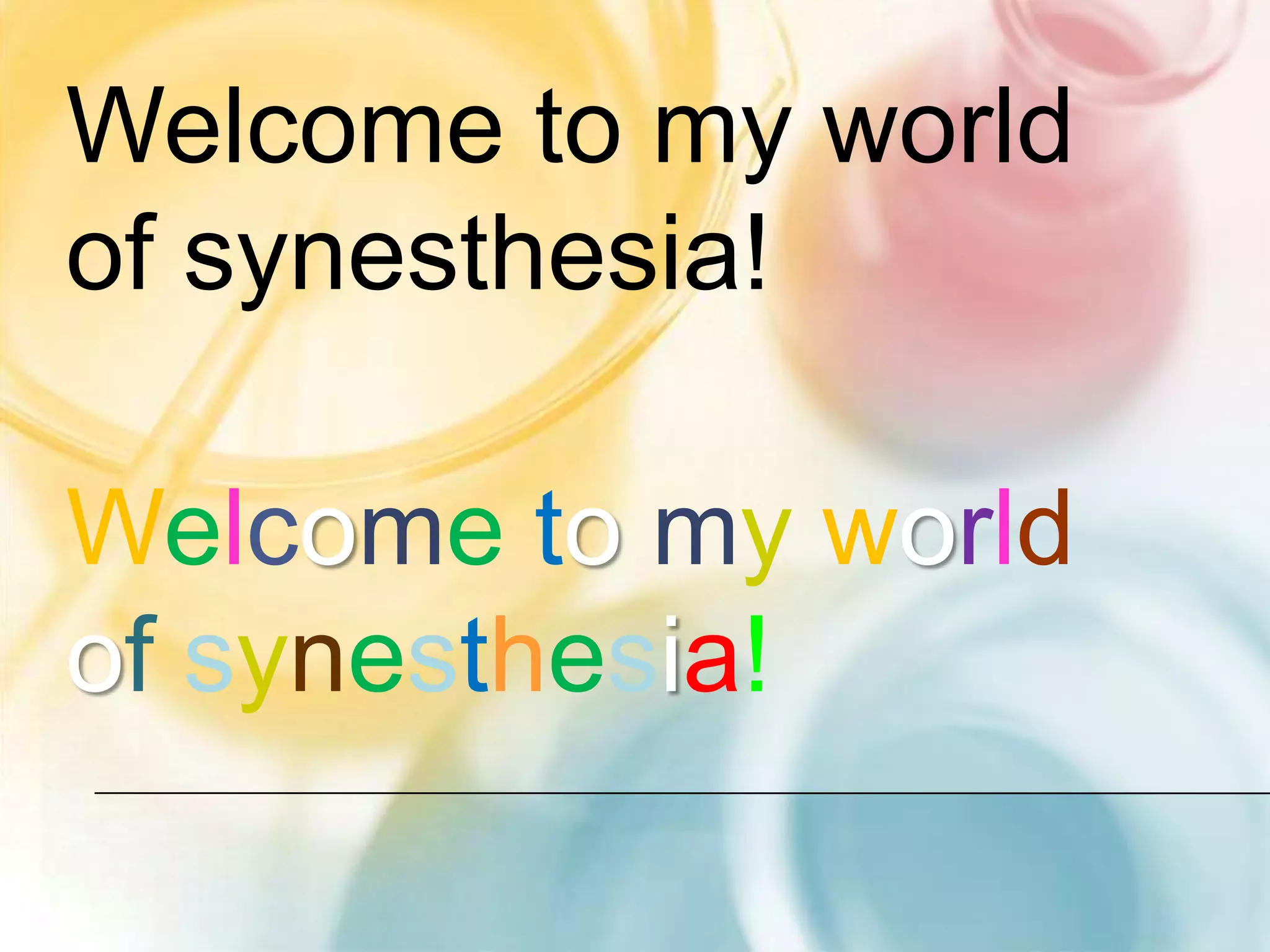
Welcome to my world
of synesthesia!

Welcome to my world
of synesthesia!
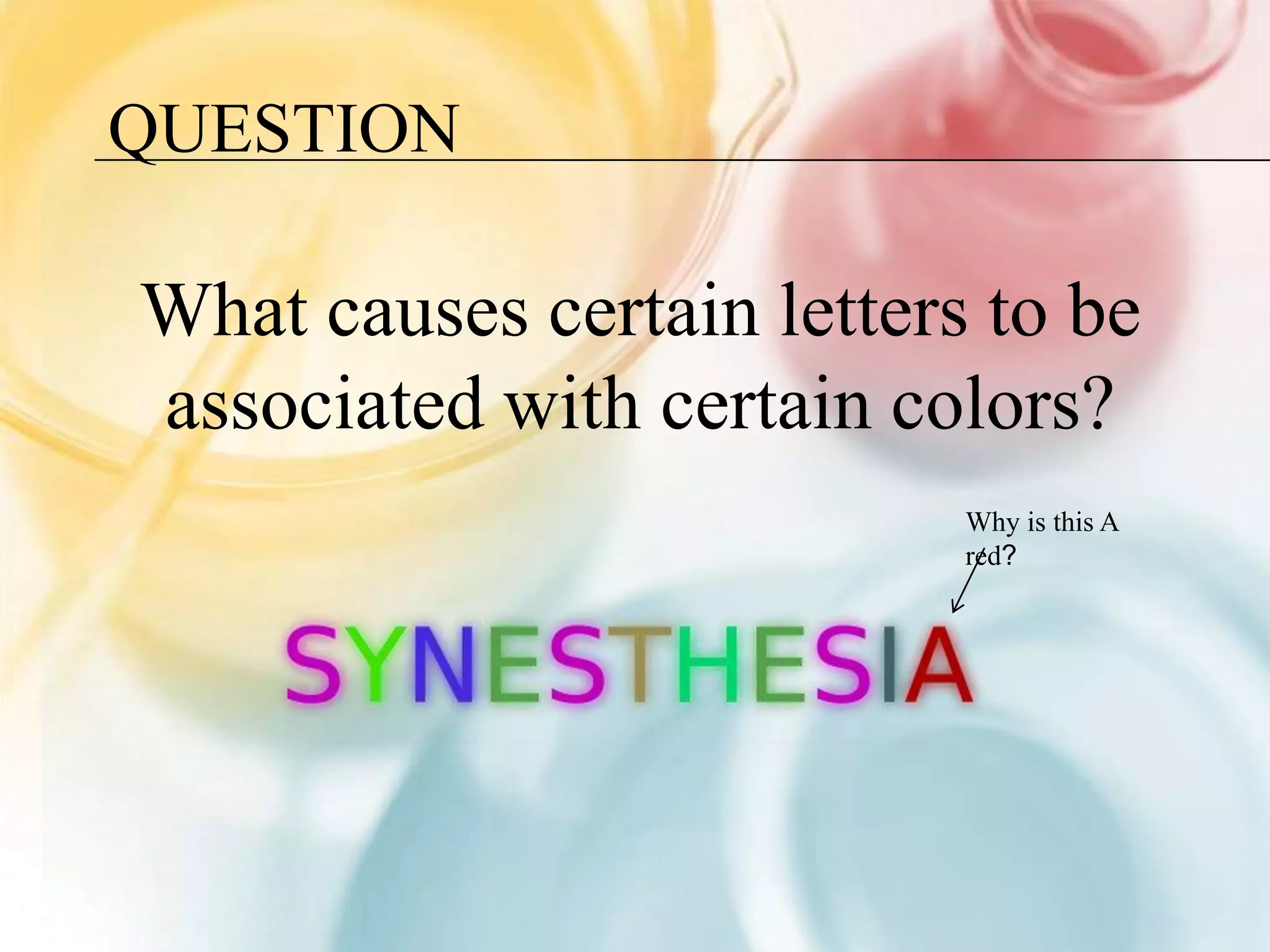
QUESTION

What causes certain letters to be
associated with certain colors?
                           Why is this A
                           red?
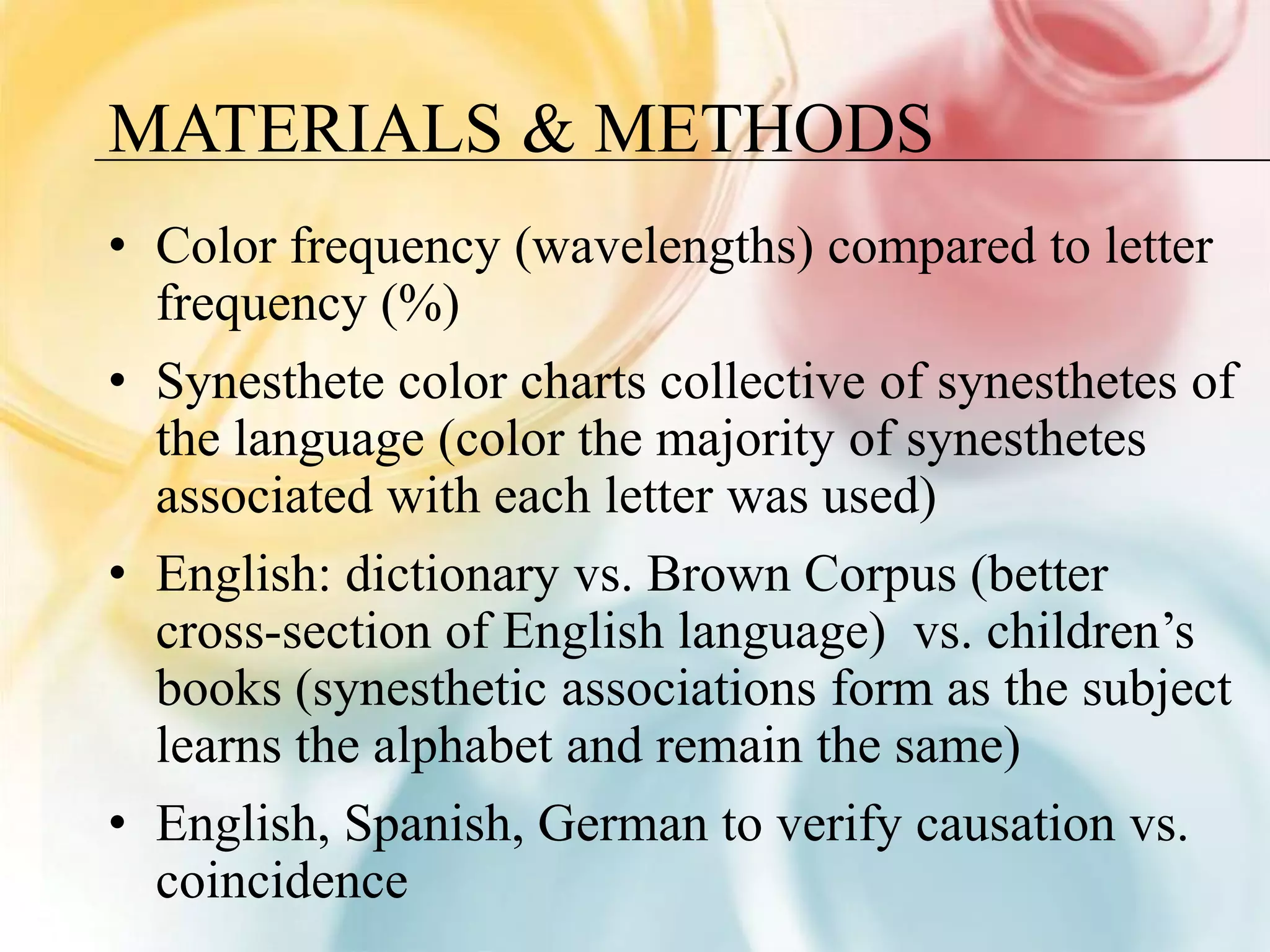
MATERIALS & METHODS
• Color frequency (wavelengths) compared to letter
  frequency (%)
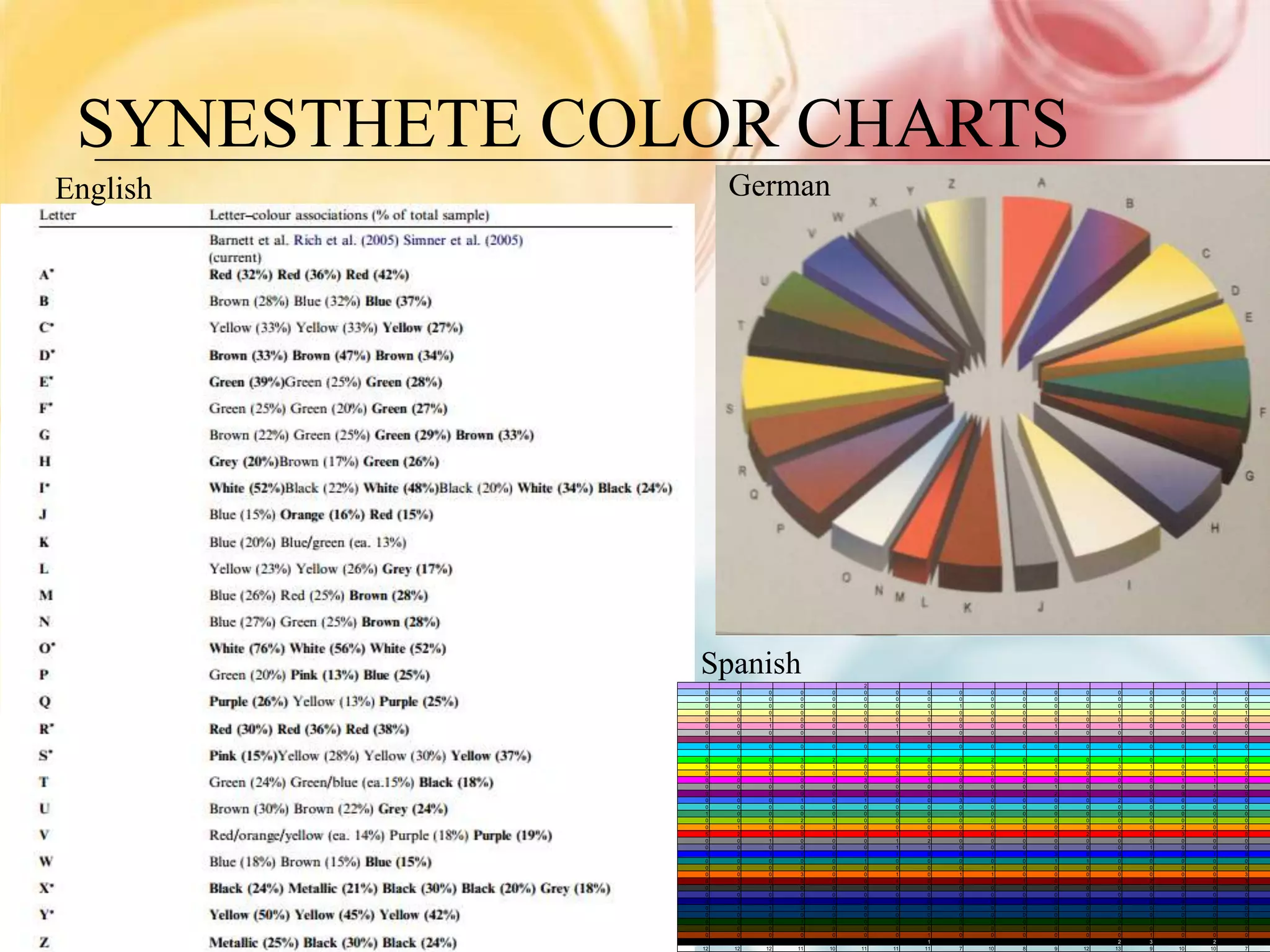
• Synesthete color charts collective of synesthetes of
  the language (color the majority of synesthetes
  associated with each letter was used)
• English: dictionary vs. Brown Corpus (better
  cross-section of English language) vs. children’s
  books (synesthetic associations form as the subject
  learns the alphabet and remain the same)
• English, Spanish, German to verify causation vs.
  coincidence
SYNESTHETE COLOR CHARTS
English             German


               Spanish
                0    0    0    0    0    2    0    0   0    0   0   0    0    0   0    0    0   0
                0    0    0    0    0    0    0    0   0    0   0   0    0    0   0    0    0   0
                0    0    0    0    0    0    0    0   0    0   0   0    0    0   0    0    1   0
                0    0    0    0    0    0    0    0   1    0   0   0    0    0   0    0    0   0
                0    0    0    0    0    0    0    1   0    0   0   0    1    1   0    0    0   1
                0    0    1    0    0    0    0    0   0    0   0   0    0    0   0    0    0   0
                0    0    1    0    0    0    1    1   0    0   0   1    0    1   0    0    0   0
                0    0    0    0    0    1    1    0   0    0   0   0    0    0   0    0    0   0
                0    0    0    0    0    0    0    0   0    0   0   0    0    0   0    0    0   0
                0    0    0    0    0    0    0    0   0    0   0   0    0    0   0    0    0   0
                0    0    0    0    0    0    0    0   0    0   0   0    0    0   0    0    0   0
                0    0    0    3    2    2    0    0   0    2   0   0    0    1   0    1    0   0
                5    0    3    0    1    0    0    0   2    3   1   1    2    3   1    0    1   0
                0    0    0    0    0    0    3    0   0    0   0   0    0    0   0    0    1   0
                0    0    1    0    1    3    0    1   0    0   2   0    0    0   0    1    1   0
                0    0    0    0    0    0    0    0   0    0   0   1    0    0   0    0    1   0
                0    0    0    0    0    0    0    1   0    1   1   2    1    1   0    0    2   0
                0    0    0    1    0    1    0    0   3    0   0   0    0    2   0    0    0   0
                0    0    0    0    0    0    0    0   0    0   0   0    0    0   0    0    0   0
                1    0    0    0    0    0    0    0   0    0   0   0    0    0   0    0    0   0
                0    0    0    2    1    0    0    0   0    0   0   0    0    0   0    0    0   0
                0    1    0    0    3    0    0    0   0    0   0   0    3    0   0    2    0   0
                5    2    1    0    1    0    1    1   0    0   1   0    2    2   0    3    0   0
                0    0    1    0    0    0    1    2   0    0   0   0    0    0   0    0    0   0
                0    0    0    0    0    0    1    1   0    0   0   0    0    0   1    0    0   0
                1    2    1    1    0    1    1    0   0    1   1   3    0    0   0    0    1   0
                0    0    0    0    0    1    0    0   0    0   0   1    1    0   0    0    0   0
                0    0    0    0    0    0    0    0   0    1   0   0    0    0   0    0    0   0
                0    0    0    3    0    0    1    0   1    1   0   0    0    0   0    0    0   3
                0    3    0    0    0    0    1    0   0    1   1   0    1    0   2    3    0   3
                0    3    1    0    0    0    0    0   0    0   0   0    0    0   0    0    0   0
                0    0    0    0    0    0    0    0   0    0   0   0    0    0   0    0    0   0
                0    0    1    0    1    0    0    0   0    0   0   0    1    0   0    0    0   0
                0    1    1    0    0    0    0    0   0    0   0   0    0    0   0    0    0   0
                0    0    0    0    0    0    0    0   0    0   0   0    0    0   0    0    0   0
                0    0    0    1    0    0    0    0   0    0   0   0    0    0   1    0    0   0
                0    0    0    0    0    0    0    0   0    0   1   0    0    0   0    0    0   0
                0    0    0    0    0    0    0    1   0    0   0   0    0    0   1    0    0   0
                0    0    0    0    0    0    0    1   0    0   0   0    0    2   3    0    2   0
               12   12   12   11   10   11   11   11   7   10   8   9   12   13   9   10   10   7
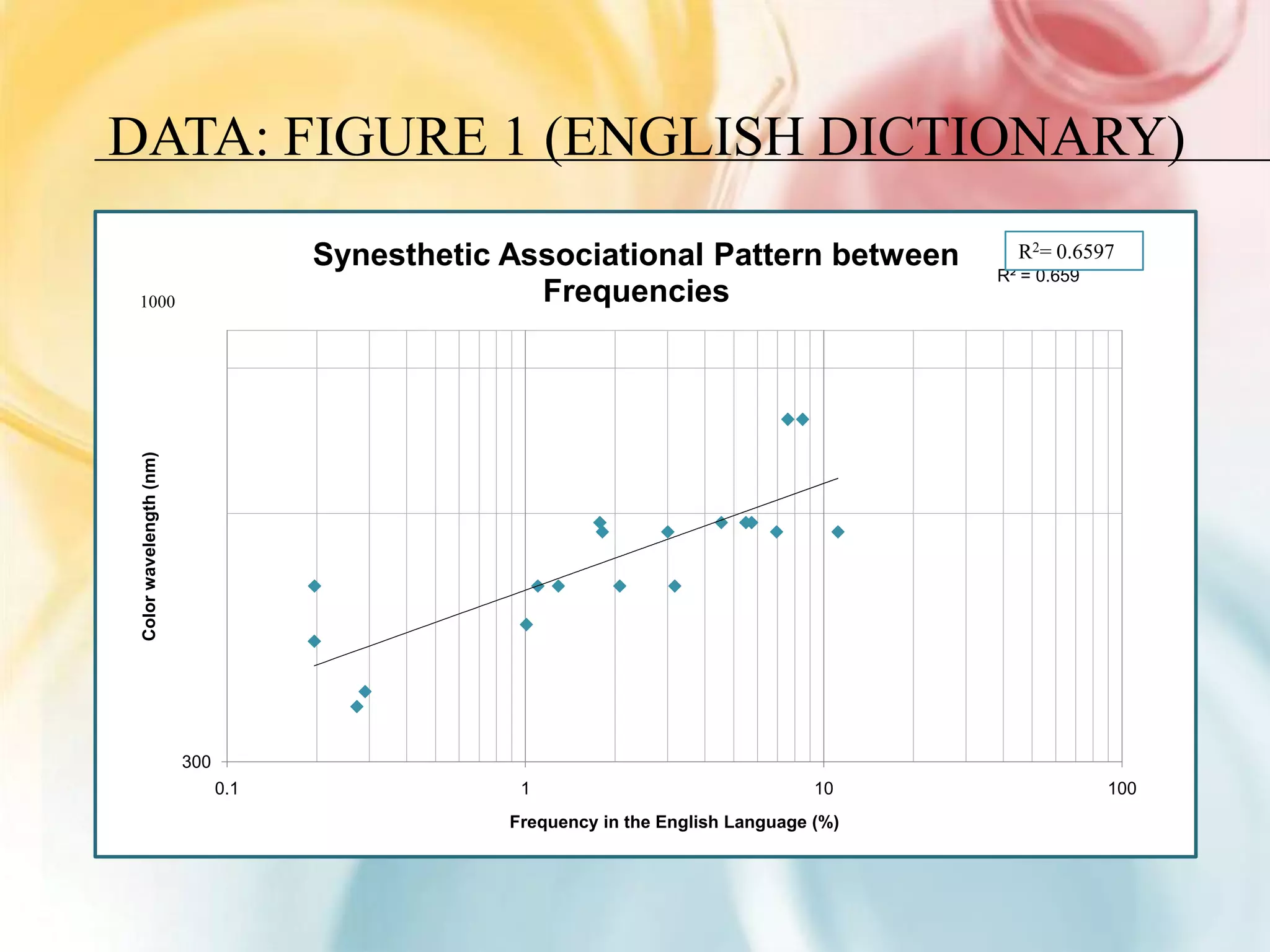
DATA: FIGURE 1 (ENGLISH DICTIONARY)
                                     Synesthetic Associational Pattern between             R2= 0.6597
                                                                                         R² = 0.659
 1000                                              Frequencies
 Color wavelength (nm)


                         300
                               0.1                1                                10                 100
                                                 Frequency in the English Language (%)
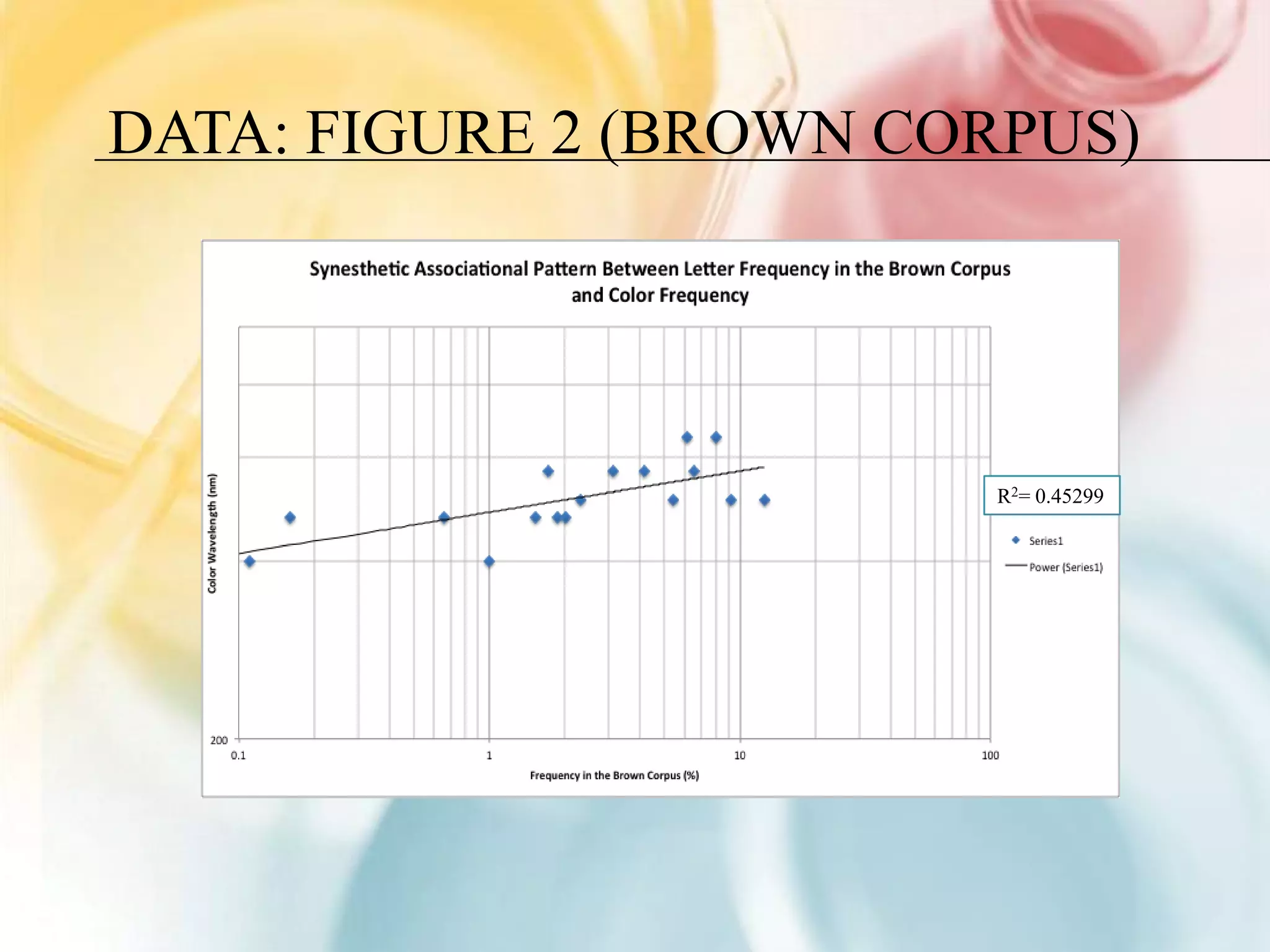
DATA: FIGURE 2 (BROWN CORPUS)


                        R2= 0.45299
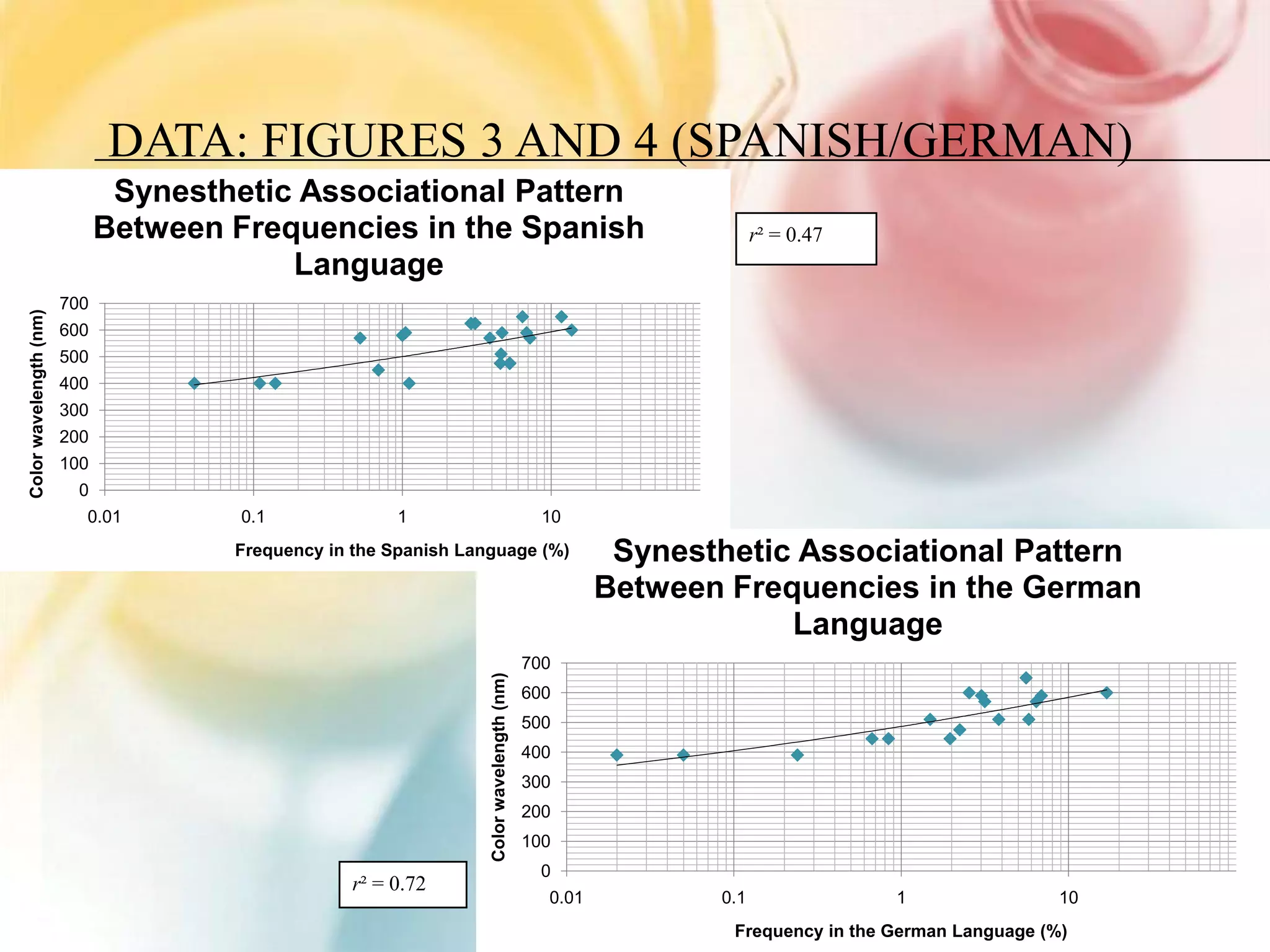
DATA: FIGURES 3 AND 4 (SPANISH/GERMAN)
                               Synesthetic Associational Pattern
                              Between Frequencies in the Spanish                                                r² = 0.47
                                          Language
                        700
Color wavelength (nm)


                        600
                        500
                        400
                        300
                        200
                        100
                          0
                          0.01         0.1             1                                    10
                                      Frequency in the Spanish Language (%)                         Synesthetic Associational Pattern
                                                                                                   Between Frequencies in the German
                                                                                                               Language
                                                                                          700
                                                                  Color wavelength (nm)


                                                                                          600
                                                                                          500
                                                                                          400
                                                                                          300
                                                                                          200
                                                                                          100
                                                                                            0
                                                  r² = 0.72
                                                                                            0.01          0.1               1                 10
                                                                                                           Frequency in the German Language (%)
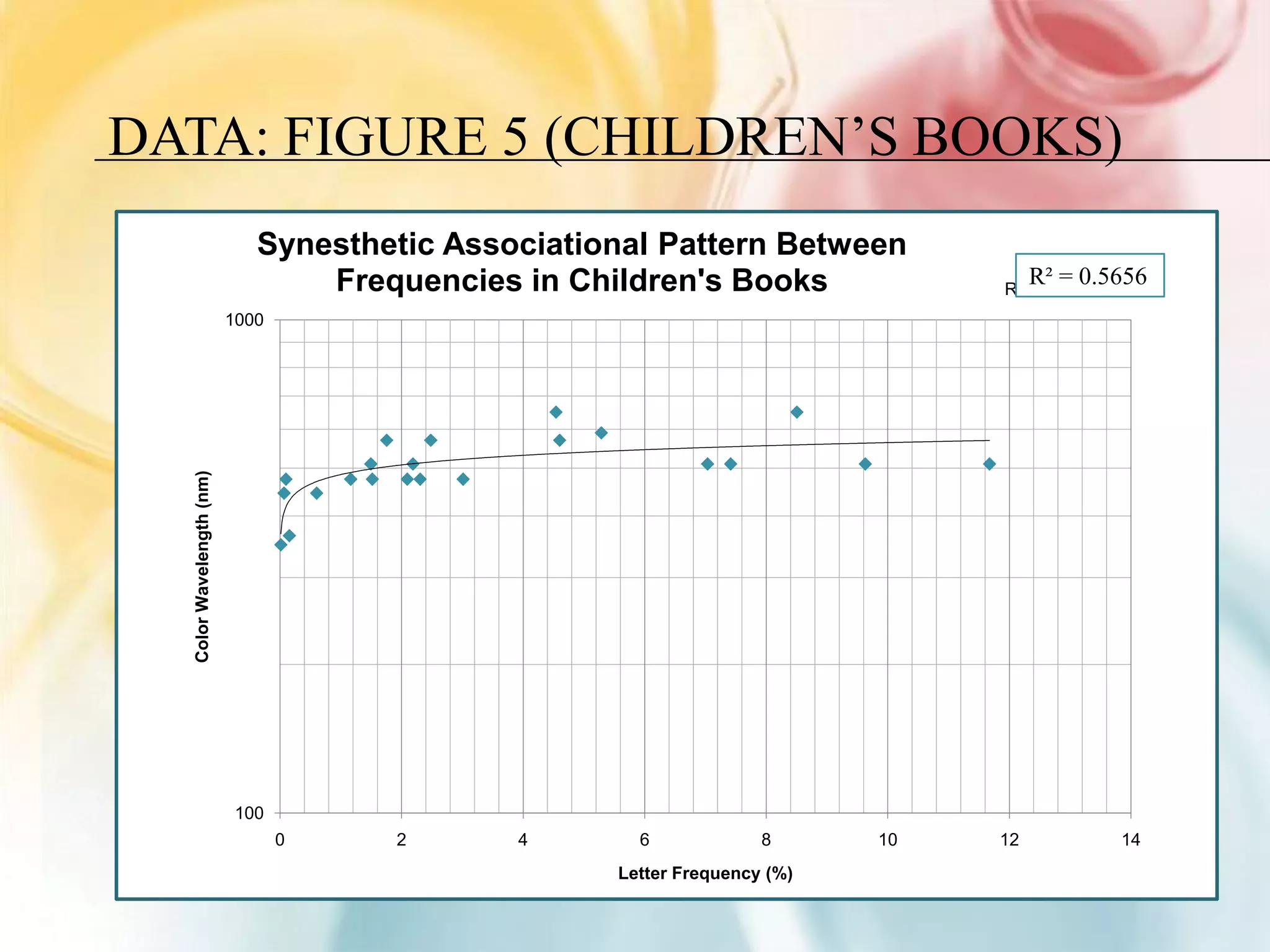
DATA: FIGURE 5 (CHILDREN’S BOOKS)
                             Synesthetic Associational Pattern Between
                                 Frequencies in Children's Books                    R² = 0.5656
                                                                               R² = 0.565
                          1000
  Color Wavelength (nm)


                           100
                                 0   2       4       6             8      10   12           14
                                                   Letter Frequency (%)
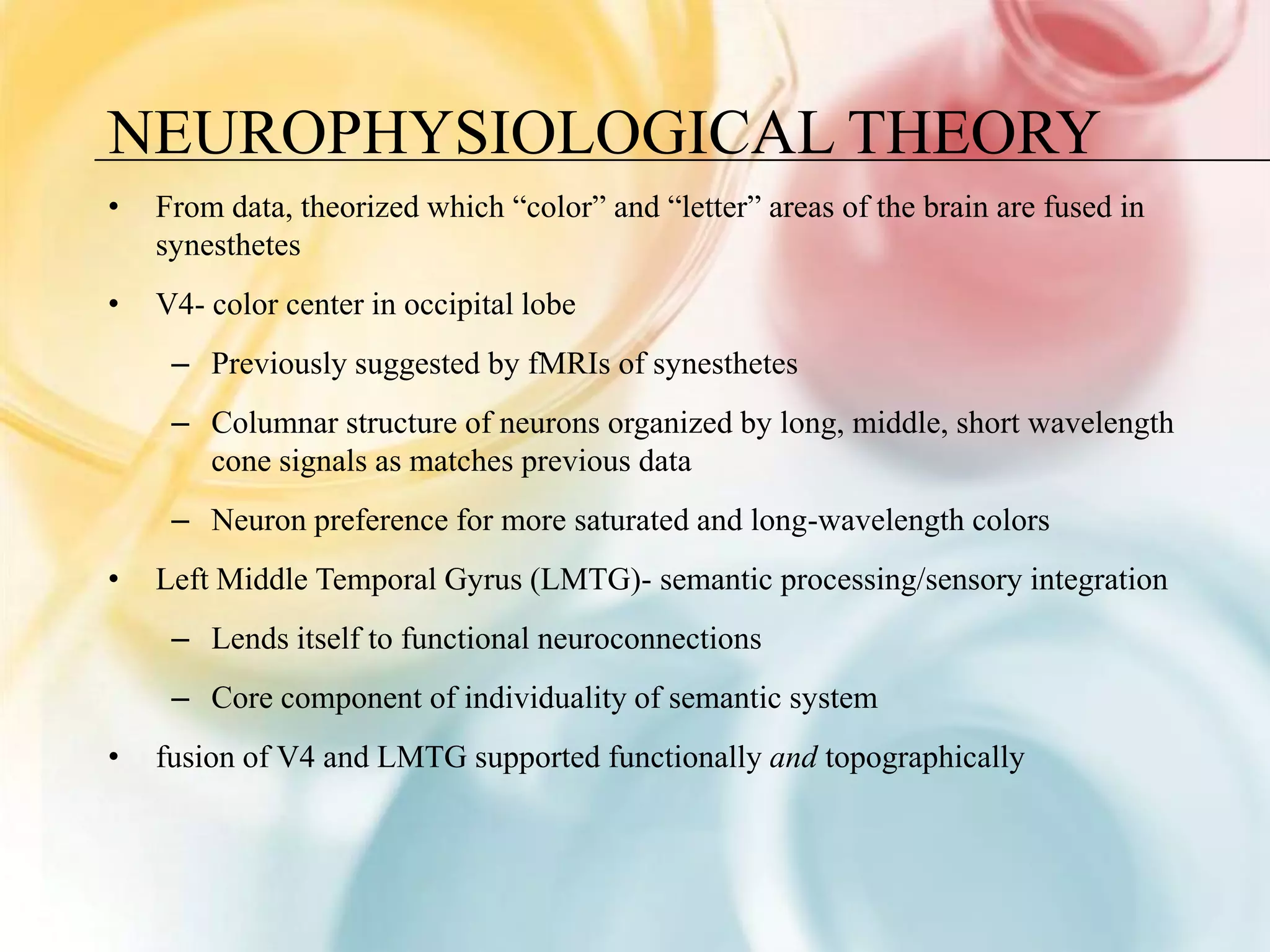
NEUROPHYSIOLOGICAL THEORY
•   From data, theorized which “color” and “letter” areas of the brain are fused in
    synesthetes
•   V4- color center in occipital lobe
     – Previously suggested by fMRIs of synesthetes
     – Columnar structure of neurons organized by long, middle, short wavelength
       cone signals as matches previous data
     – Neuron preference for more saturated and long-wavelength colors
•   Left Middle Temporal Gyrus (LMTG)- semantic processing/sensory integration
     – Lends itself to functional neuroconnections
     – Core component of individuality of semantic system
•   fusion of V4 and LMTG supported functionally and topographically
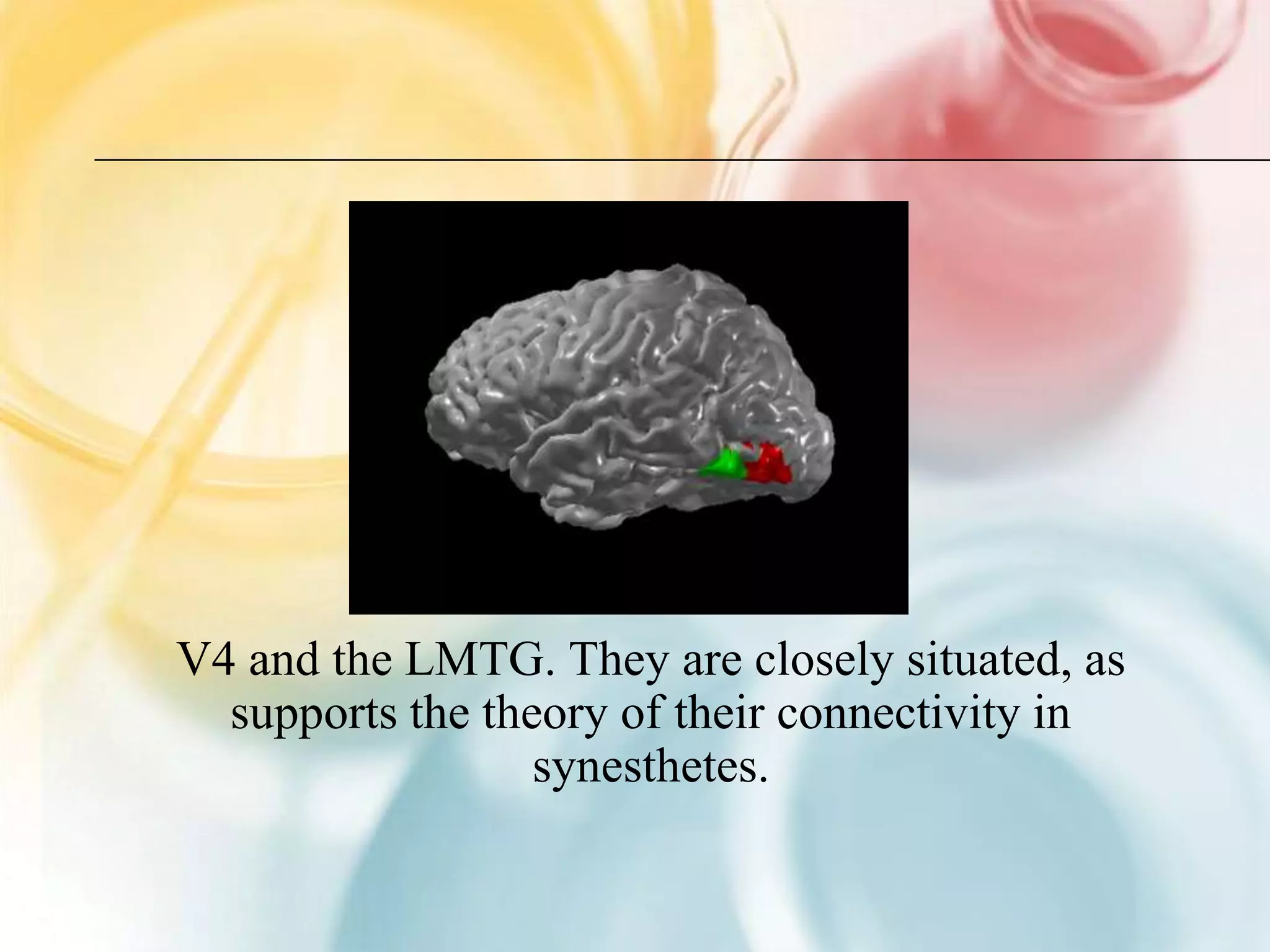
V4 and the LMTG. They are closely situated, as
  supports the theory of their connectivity in
                  synesthetes.
DISCUSSION AND APPLICATIONS
• First synesthetic color/letter association pattern found
• Mapping of not only synesthetic connections, but also
  V4/LMTG (perhaps the largely uncharted LMTG is
  organized according to frequency of letters, etc.)
• Induce (visual memory, artistic talent)/reduce
  (overwhelming colors for some synesthetes) synesthesia
• Autism, schizophrenia, and epilepsy also caused by
  excess neuronal connections- synesthetes provide a
  model brain not inhibited by medication or cognitive
  impairments.
   – For example, sensory areas of the brain connected with the
     limbic system (anger management) in autistics, causing
     simple sensory cues to extremely anger the patient
BIBLIOGRAPHY
 Barnett, K. J., Finucane, C., Asher, J.E., Bargary, G., Corvin, A. P., Newell, F.N., Mitchell, K.J. (2007). Familial patterns
and the origins of individual differences in synaesthesia. Cognition, 106, 871-893.
Beeli, G., Esslen, M., Jancke, L. (2007). Frequency Correlates in Grapheme-Color Synesthesia. Psychological
Science, 18-9: 788-792.
Berlin, B., & Kay, P. (1969). Basic color terms: Their universality and evolution. Berkeley: University of California Press.
Emrich, H., Schneider, U., Zedler, M. Welche Farbe hat der Montag? Berlin: S. Herzel Verlag, 2004.
Kotake, Y. (2009). Organization of Color-Selective Neurons in Macaque Visual Area V4. Journal of
Neurophysiology, 102, 15-27.
Nunn, J.A., Gregory, L.J., Brammer, M., Williams, S.C.R., Parslow, D.M., Morgan, M.J., Morris, R.G., Bullmore, E.T., Ba
ron-Cohen, S., Gray, J.A. (2002) Functional magnetic resonance imaging of synesthesia: activation of V4/V8 by spoken
words. Natural Neuroscience, 4, 371-5.
Rich, A.N., Bradshaw, J.L., Mattingley, J.B. (2004). A systematic, large-scale study of synaesthesia: implications for the
role of early experience in lexical-colour associations. Cognition. 98, 53–84.
Rissman, J. (2003). An Event-Related fMRI Investigation of Implicit Semantic Priming. Journal of Cognitive
Neuroscience, 8, 1160-75.
Scullion, Val., Treby, Marrion.,(2010). Creative Synaesthesia in E. T. A. Hoffmann’s Ritter Gluck. European Review. 18:
239-262.
Wei, Tao. (2012). Predicting Conceptual Processing Capacity from Spontaneous Neuronal Activity of the Left Middle
Temporal Gyrus. Journal of Neuroscience, 32, 481-9.
Roland, D., Dick, F., & Elman, J. L. (2007). Frequency of basic English grammatical structures: A corpus
analysis. Journal of Memory and Language, 57(3), 348-379.
THANK YOU FOR
YOUR TIME AND
CONSIDERATION!

Synesthetic Associational Patterns between Letters and Colors

  • 1.
    SYNESTHETIC ASSOCIATIONAL PATTERNS BETWEEN LETTERS AND COLORS LauraMariah Herman |Vision Sciences Lab, Department of Psychology, Harvard University, Cambridge, MA Pine Crest School, Fort Lauderdale, FL
  • 2.
    BACKGROUND • Synesthesia: inherentblending of the senses. – Grapheme-color is most common: letters/numbers→colors – Each synesthete associates each letter with different colors – Caused by excess neuronal connections per mutated enzyme – Single nucleotide polymorphism (16th chromosome) • Genetically transmitted to ~0.01% of population
  • 3.
    Welcome to myworld of synesthesia! Welcome to my world of synesthesia!
  • 4.
    QUESTION What causes certainletters to be associated with certain colors? Why is this A red?
  • 5.
    MATERIALS & METHODS •Color frequency (wavelengths) compared to letter frequency (%) • Synesthete color charts collective of synesthetes of the language (color the majority of synesthetes associated with each letter was used) • English: dictionary vs. Brown Corpus (better cross-section of English language) vs. children’s books (synesthetic associations form as the subject learns the alphabet and remain the same) • English, Spanish, German to verify causation vs. coincidence
  • 6.
    SYNESTHETE COLOR CHARTS English German Spanish 0 0 0 0 0 2 0 0 0 0 0 0 0 0 0 0 0 0 0 0 0 0 0 0 0 0 0 0 0 0 0 0 0 0 0 0 0 0 0 0 0 0 0 0 0 0 0 0 0 0 0 0 1 0 0 0 0 0 0 0 0 0 1 0 0 0 0 0 0 0 0 0 0 0 0 0 0 0 0 1 0 0 0 0 1 1 0 0 0 1 0 0 1 0 0 0 0 0 0 0 0 0 0 0 0 0 0 0 0 0 1 0 0 0 1 1 0 0 0 1 0 1 0 0 0 0 0 0 0 0 0 1 1 0 0 0 0 0 0 0 0 0 0 0 0 0 0 0 0 0 0 0 0 0 0 0 0 0 0 0 0 0 0 0 0 0 0 0 0 0 0 0 0 0 0 0 0 0 0 0 0 0 0 0 0 0 0 0 0 0 0 0 0 0 0 0 0 0 0 0 0 3 2 2 0 0 0 2 0 0 0 1 0 1 0 0 5 0 3 0 1 0 0 0 2 3 1 1 2 3 1 0 1 0 0 0 0 0 0 0 3 0 0 0 0 0 0 0 0 0 1 0 0 0 1 0 1 3 0 1 0 0 2 0 0 0 0 1 1 0 0 0 0 0 0 0 0 0 0 0 0 1 0 0 0 0 1 0 0 0 0 0 0 0 0 1 0 1 1 2 1 1 0 0 2 0 0 0 0 1 0 1 0 0 3 0 0 0 0 2 0 0 0 0 0 0 0 0 0 0 0 0 0 0 0 0 0 0 0 0 0 0 1 0 0 0 0 0 0 0 0 0 0 0 0 0 0 0 0 0 0 0 0 2 1 0 0 0 0 0 0 0 0 0 0 0 0 0 0 1 0 0 3 0 0 0 0 0 0 0 3 0 0 2 0 0 5 2 1 0 1 0 1 1 0 0 1 0 2 2 0 3 0 0 0 0 1 0 0 0 1 2 0 0 0 0 0 0 0 0 0 0 0 0 0 0 0 0 1 1 0 0 0 0 0 0 1 0 0 0 1 2 1 1 0 1 1 0 0 1 1 3 0 0 0 0 1 0 0 0 0 0 0 1 0 0 0 0 0 1 1 0 0 0 0 0 0 0 0 0 0 0 0 0 0 1 0 0 0 0 0 0 0 0 0 0 0 3 0 0 1 0 1 1 0 0 0 0 0 0 0 3 0 3 0 0 0 0 1 0 0 1 1 0 1 0 2 3 0 3 0 3 1 0 0 0 0 0 0 0 0 0 0 0 0 0 0 0 0 0 0 0 0 0 0 0 0 0 0 0 0 0 0 0 0 0 0 0 1 0 1 0 0 0 0 0 0 0 1 0 0 0 0 0 0 1 1 0 0 0 0 0 0 0 0 0 0 0 0 0 0 0 0 0 0 0 0 0 0 0 0 0 0 0 0 0 0 0 0 0 0 0 0 1 0 0 0 0 0 0 0 0 0 0 1 0 0 0 0 0 0 0 0 0 0 0 0 0 1 0 0 0 0 0 0 0 0 0 0 0 0 0 0 1 0 0 0 0 0 0 1 0 0 0 0 0 0 0 0 0 0 1 0 0 0 0 0 2 3 0 2 0 12 12 12 11 10 11 11 11 7 10 8 9 12 13 9 10 10 7
  • 7.
    DATA: FIGURE 1(ENGLISH DICTIONARY) Synesthetic Associational Pattern between R2= 0.6597 R² = 0.659 1000 Frequencies Color wavelength (nm) 300 0.1 1 10 100 Frequency in the English Language (%)
  • 8.
    DATA: FIGURE 2(BROWN CORPUS) R2= 0.45299
  • 9.
    DATA: FIGURES 3AND 4 (SPANISH/GERMAN) Synesthetic Associational Pattern Between Frequencies in the Spanish r² = 0.47 Language 700 Color wavelength (nm) 600 500 400 300 200 100 0 0.01 0.1 1 10 Frequency in the Spanish Language (%) Synesthetic Associational Pattern Between Frequencies in the German Language 700 Color wavelength (nm) 600 500 400 300 200 100 0 r² = 0.72 0.01 0.1 1 10 Frequency in the German Language (%)
  • 10.
    DATA: FIGURE 5(CHILDREN’S BOOKS) Synesthetic Associational Pattern Between Frequencies in Children's Books R² = 0.5656 R² = 0.565 1000 Color Wavelength (nm) 100 0 2 4 6 8 10 12 14 Letter Frequency (%)
  • 11.
    NEUROPHYSIOLOGICAL THEORY • From data, theorized which “color” and “letter” areas of the brain are fused in synesthetes • V4- color center in occipital lobe – Previously suggested by fMRIs of synesthetes – Columnar structure of neurons organized by long, middle, short wavelength cone signals as matches previous data – Neuron preference for more saturated and long-wavelength colors • Left Middle Temporal Gyrus (LMTG)- semantic processing/sensory integration – Lends itself to functional neuroconnections – Core component of individuality of semantic system • fusion of V4 and LMTG supported functionally and topographically
  • 12.
    V4 and theLMTG. They are closely situated, as supports the theory of their connectivity in synesthetes.
  • 13.
    DISCUSSION AND APPLICATIONS •First synesthetic color/letter association pattern found • Mapping of not only synesthetic connections, but also V4/LMTG (perhaps the largely uncharted LMTG is organized according to frequency of letters, etc.) • Induce (visual memory, artistic talent)/reduce (overwhelming colors for some synesthetes) synesthesia • Autism, schizophrenia, and epilepsy also caused by excess neuronal connections- synesthetes provide a model brain not inhibited by medication or cognitive impairments. – For example, sensory areas of the brain connected with the limbic system (anger management) in autistics, causing simple sensory cues to extremely anger the patient
  • 14.
    BIBLIOGRAPHY Barnett, K.J., Finucane, C., Asher, J.E., Bargary, G., Corvin, A. P., Newell, F.N., Mitchell, K.J. (2007). Familial patterns and the origins of individual differences in synaesthesia. Cognition, 106, 871-893. Beeli, G., Esslen, M., Jancke, L. (2007). Frequency Correlates in Grapheme-Color Synesthesia. Psychological Science, 18-9: 788-792. Berlin, B., & Kay, P. (1969). Basic color terms: Their universality and evolution. Berkeley: University of California Press. Emrich, H., Schneider, U., Zedler, M. Welche Farbe hat der Montag? Berlin: S. Herzel Verlag, 2004. Kotake, Y. (2009). Organization of Color-Selective Neurons in Macaque Visual Area V4. Journal of Neurophysiology, 102, 15-27. Nunn, J.A., Gregory, L.J., Brammer, M., Williams, S.C.R., Parslow, D.M., Morgan, M.J., Morris, R.G., Bullmore, E.T., Ba ron-Cohen, S., Gray, J.A. (2002) Functional magnetic resonance imaging of synesthesia: activation of V4/V8 by spoken words. Natural Neuroscience, 4, 371-5. Rich, A.N., Bradshaw, J.L., Mattingley, J.B. (2004). A systematic, large-scale study of synaesthesia: implications for the role of early experience in lexical-colour associations. Cognition. 98, 53–84. Rissman, J. (2003). An Event-Related fMRI Investigation of Implicit Semantic Priming. Journal of Cognitive Neuroscience, 8, 1160-75. Scullion, Val., Treby, Marrion.,(2010). Creative Synaesthesia in E. T. A. Hoffmann’s Ritter Gluck. European Review. 18: 239-262. Wei, Tao. (2012). Predicting Conceptual Processing Capacity from Spontaneous Neuronal Activity of the Left Middle Temporal Gyrus. Journal of Neuroscience, 32, 481-9. Roland, D., Dick, F., & Elman, J. L. (2007). Frequency of basic English grammatical structures: A corpus analysis. Journal of Memory and Language, 57(3), 348-379.
  • 15.
    THANK YOU FOR YOURTIME AND CONSIDERATION!

Editor's Notes

  • #8 0.6597
  • #9 0.45299
  • #11 R² = 0.5656
  • #12 Neurophysiologically, this pattern can be described by the wavelength-specific color receptor neurons of V4 being fused with the language processing neurons of the left middle temporal gyrus that are prone to perform semantic recognition. The characteristics of these two areas, such as frequency selectivity of V4, match the characteristics of synesthesia first discovered in this research: more frequent letters (interpreted in the LMTG) correspond with colors of longer wavelength (as are preferable in V4), corresponding with the letter frequencies of the native language of the synesthete.
  • #14 Priming, greek/hebrew case study, mturk, biological methylation epigenetics