SYNAPSE
By
Dr. Faraza Javaid
Synapse
Synapse is the junction between two
neurons. It is not an anatomical
continuation. But, it is only a
physiological continuity between two
nerve cells.
Synapse
CLASSIFICATION OF
SYNAPSE
Synapse is classified by two
methods:
A. Anatomical classification
B.Functional classification
ANATOMICAL
CLASSIFICATION
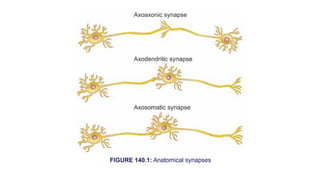
1. Axoaxonic synapse in which axon of
one neuron terminates on axon of
another neuron
2. Axodendritic synapse in which the
axon of one neuron terminates on
dendrite of another neuron
3. Axosomatic synapse in which axon
of one neuron ends on soma (cell body)
of another neuron
FUNCTIONAL
CLASSIFICATION
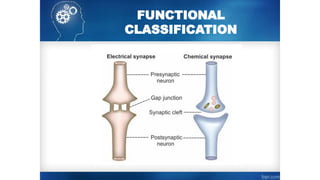
Functional classification of synapse is
on the basis of mode of impulse
transmission. According to this,
synapse is classified into two
categories:
1. Electrical synapse
2. Chemical synapse
However, generally the word synapse
refers to a chemical synapse.
FUNCTIONAL
CLASSIFICATION
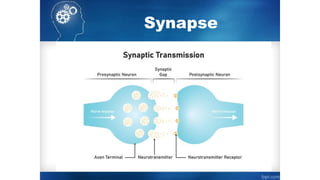
 Chemical synapse is the junction
between a nerve fiber and a muscle fiber
or between two nerve fibers, through
which the signals are transmitted by the
release of chemical transmitter.
 In the chemical synapse, there is no
continuity between the two neurons
because of the presence of a space
called synaptic cleft between the two
neurons.

Chemical Synapse
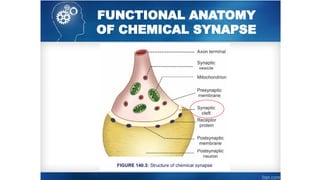
FUNCTIONAL ANATOMY
OF CHEMICAL SYNAPSE
Main function of the synapse is to
transmit the impulses. However, some of
the synapses inhibit these impulses. On
the basis of functions, synapses are
divided into two types:
1. Excitatory synapses, which transmit
the impulses (excitatory function)
2. Inhibitory synapses, which inhibit the
transmission of impulses (inhibitory
function)
FUNCTIONS OF SYNAPSE
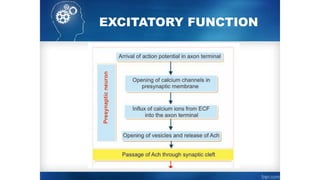
 When the action potential reaches the
presynaptic axon terminal, the voltage­
gated calcium channels at the
presynaptic membrane are opened.
 Calcium ions cause the release of
neurotransmitter substance from the
vesicles by means of exocytosis.
EXCITATORY FUNCTION
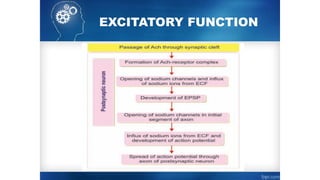
 Neurotransmitter, passes through
presynaptic membrane and synaptic cleft
and reaches the postsynaptic membrane.
 Now, the neurotransmitter binds with
receptor protein present in postsynaptic
membrane to form neurotransmitter­
receptor complex. Neurotransmitter­
receptor complex causes production of a
EPSP.
 Common excitatory neurotransmitter in a
synapse is acetylcholine and
norepinephrine.
EXCITATORY FUNCTION
EXCITATORY FUNCTION
EXCITATORY FUNCTION
INHIBITORY FUNCTION
Inhibition of synaptic transmission is
classified into five types:
1. Postsynaptic or direct inhibition
2. Presynaptic or indirect inhibition
3. Negative feedback or Renshaw cell
inhibition
4. Feedforward inhibition
5. Reciprocal inhibition
1. Postsynaptic or Direct
Inhibition
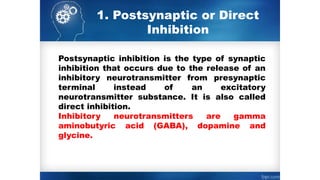
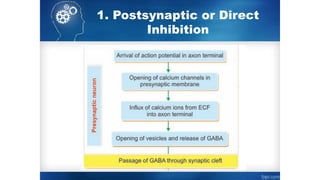
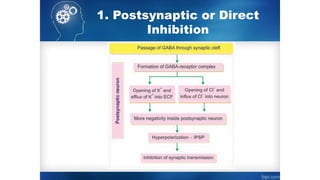
Postsynaptic inhibition is the type of synaptic
inhibition that occurs due to the release of an
inhibitory neurotransmitter from presynaptic
terminal instead of an excitatory
neurotransmitter substance. It is also called
direct inhibition.
Inhibitory neurotransmitters are gamma
aminobutyric acid (GABA), dopamine and
glycine.
1. Postsynaptic or Direct
Inhibition
1. Postsynaptic or Direct
Inhibition
2. Presynaptic or
Indirect Inhibition
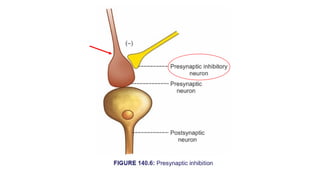
Presynaptic inhibition occurs due to the
failure of presynaptic axon terminal to
release sufficient quantity of excitatory
neurotransmitter substance.
It is also called indirect inhibition.
3. Negative Feedback
Inhibition
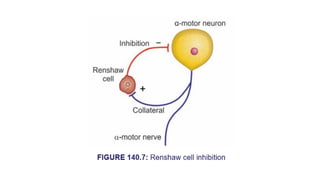
 Negative feedback inhibition is the type of
synaptic inhibition, which is caused by
Renshaw cells in spinal cord. Renshaw cells are
small motor neurons present in anterior gray
horn of spinal cord.
 When motor neurons send motor impulses,
some of the impulses reach the Renshaw cell,
Hence, the Renshaw cell is stimulated. In turn,
it sends inhibitory impulses to ­
motor neurons
so that, the discharge from motor neurons is
reduced.
4. Feedforward
Inhibition
Feedforward synaptic inhibition occurs
in cerebellum and it controls the
neuronal activity in cerebellum.
During the process of neuronal activity
in cerebellum, stellate cells and basket
cells, which are activated by granule
cells, inhibit the Purkinje cells by
releasing GABA. This type of inhibition
is called feedforward inhibition.
5. Reciprocal
Inhibition
Inhibition of antagonistic muscles when
a group of muscles are activated is
called reciprocal inhibition. It is
because of reciprocal innervation.
e.g. When biceps brachi muscle
increases activity, the triceps brachi
muscle decreases activity.
PROPERTIES OF
SYNAPSE
1. ONE WAY CONDUCTION – BELL-
MAGENDIE LAW
2. SYNAPTIC DELAY
3. FATIGUE
4. SUMMATION
5. ELECTRICAL PROPERTY
1. ONE WAY
CONDUCTION
According to Bell­
Magendie law,
the impulses are transmitted only
in one direction in synapse, i.e.
from presynaptic neuron to
postsynaptic neuron.
2. SYNAPTIC DELAY
Synaptic delay is a short delay that occurs
during the transmission of impulses through
the synapse. It is due to the time taken for:
i. Release of neurotransmitter
ii. Passage of neurotransmitter from axon
terminal to postsynaptic membrane
iii. Action of the neurotransmitter to open the
ionic channels in postsynaptic membrane.
Normal duration of synaptic delay is 0.3 to 0.5
millisecond.
3. FATIGUE
During continuous muscular activity, synapse
becomes the seat of fatigue. Fatigue at
synapse is due to the depletion of
neurotransmitter substance, acetylcholine.
Depletion of acetylcholine occurs because of
two factors:
i. Soon after the action, acetylcholine is
destroyed by acetylcholinesterase
ii. Due to continuous action, new
acetylcholine is not synthesized.
4. SUMMATION
Summation is the fusion of effects or
progressive increase in the excitatory
postsynaptic potential in post ­ synaptic
neuron when many presynaptic excitatory
terminals are stimulated simultaneously or
when single presynaptic terminal is
stimulated repeatedly.
4. SUMMATION
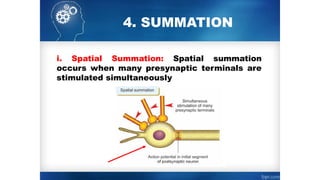
i. Spatial Summation: Spatial summation
occurs when many presynaptic terminals are
stimulated simultaneously
4. SUMMATION
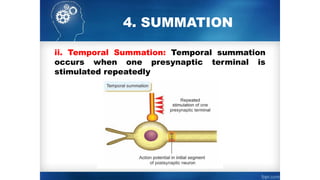
ii. Temporal Summation: Temporal summation
occurs when one presynaptic terminal is
stimulated repeatedly
5. ELECTRICAL
PROPERTY
Electrical property of synapse are the EPSP
(Excitatory post synaptic potential) and IPSP
(Inhibitory post synaptic potential).
CONVERGENCE &
DIVERGENCE
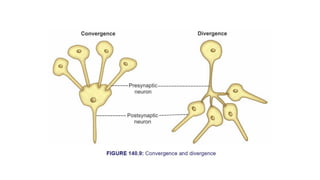
 Convergence in the process by which many
presynaptic neurons terminate on a single
post synaptic neuron.
 Divergence is the process by which one
presynaptic neuron terminates on many post
synaptic neurons.
Thank You

SYNAPSE, IT'S CLASSIFICATION & FUNCTIONS.pptx

  • 1.
  • 2.
    Synapse Synapse is thejunction between two neurons. It is not an anatomical continuation. But, it is only a physiological continuity between two nerve cells.
  • 3.
  • 4.
    CLASSIFICATION OF SYNAPSE Synapse isclassified by two methods: A. Anatomical classification B.Functional classification
  • 5.
    ANATOMICAL CLASSIFICATION 1. Axoaxonic synapsein which axon of one neuron terminates on axon of another neuron 2. Axodendritic synapse in which the axon of one neuron terminates on dendrite of another neuron 3. Axosomatic synapse in which axon of one neuron ends on soma (cell body) of another neuron
  • 7.
    FUNCTIONAL CLASSIFICATION Functional classification ofsynapse is on the basis of mode of impulse transmission. According to this, synapse is classified into two categories: 1. Electrical synapse 2. Chemical synapse However, generally the word synapse refers to a chemical synapse.
  • 8.
  • 9.
     Chemical synapseis the junction between a nerve fiber and a muscle fiber or between two nerve fibers, through which the signals are transmitted by the release of chemical transmitter.  In the chemical synapse, there is no continuity between the two neurons because of the presence of a space called synaptic cleft between the two neurons. Chemical Synapse
  • 10.
  • 11.
    Main function ofthe synapse is to transmit the impulses. However, some of the synapses inhibit these impulses. On the basis of functions, synapses are divided into two types: 1. Excitatory synapses, which transmit the impulses (excitatory function) 2. Inhibitory synapses, which inhibit the transmission of impulses (inhibitory function) FUNCTIONS OF SYNAPSE
  • 12.
     When theaction potential reaches the presynaptic axon terminal, the voltage­ gated calcium channels at the presynaptic membrane are opened.  Calcium ions cause the release of neurotransmitter substance from the vesicles by means of exocytosis. EXCITATORY FUNCTION
  • 13.
     Neurotransmitter, passesthrough presynaptic membrane and synaptic cleft and reaches the postsynaptic membrane.  Now, the neurotransmitter binds with receptor protein present in postsynaptic membrane to form neurotransmitter­ receptor complex. Neurotransmitter­ receptor complex causes production of a EPSP.  Common excitatory neurotransmitter in a synapse is acetylcholine and norepinephrine. EXCITATORY FUNCTION
  • 14.
  • 15.
  • 16.
    INHIBITORY FUNCTION Inhibition ofsynaptic transmission is classified into five types: 1. Postsynaptic or direct inhibition 2. Presynaptic or indirect inhibition 3. Negative feedback or Renshaw cell inhibition 4. Feedforward inhibition 5. Reciprocal inhibition
  • 17.
    1. Postsynaptic orDirect Inhibition Postsynaptic inhibition is the type of synaptic inhibition that occurs due to the release of an inhibitory neurotransmitter from presynaptic terminal instead of an excitatory neurotransmitter substance. It is also called direct inhibition. Inhibitory neurotransmitters are gamma aminobutyric acid (GABA), dopamine and glycine.
  • 18.
    1. Postsynaptic orDirect Inhibition
  • 19.
    1. Postsynaptic orDirect Inhibition
  • 20.
    2. Presynaptic or IndirectInhibition Presynaptic inhibition occurs due to the failure of presynaptic axon terminal to release sufficient quantity of excitatory neurotransmitter substance. It is also called indirect inhibition.
  • 22.
    3. Negative Feedback Inhibition Negative feedback inhibition is the type of synaptic inhibition, which is caused by Renshaw cells in spinal cord. Renshaw cells are small motor neurons present in anterior gray horn of spinal cord.  When motor neurons send motor impulses, some of the impulses reach the Renshaw cell, Hence, the Renshaw cell is stimulated. In turn, it sends inhibitory impulses to ­ motor neurons so that, the discharge from motor neurons is reduced.
  • 24.
    4. Feedforward Inhibition Feedforward synapticinhibition occurs in cerebellum and it controls the neuronal activity in cerebellum. During the process of neuronal activity in cerebellum, stellate cells and basket cells, which are activated by granule cells, inhibit the Purkinje cells by releasing GABA. This type of inhibition is called feedforward inhibition.
  • 25.
    5. Reciprocal Inhibition Inhibition ofantagonistic muscles when a group of muscles are activated is called reciprocal inhibition. It is because of reciprocal innervation. e.g. When biceps brachi muscle increases activity, the triceps brachi muscle decreases activity.
  • 26.
    PROPERTIES OF SYNAPSE 1. ONEWAY CONDUCTION – BELL- MAGENDIE LAW 2. SYNAPTIC DELAY 3. FATIGUE 4. SUMMATION 5. ELECTRICAL PROPERTY
  • 27.
    1. ONE WAY CONDUCTION Accordingto Bell­ Magendie law, the impulses are transmitted only in one direction in synapse, i.e. from presynaptic neuron to postsynaptic neuron.
  • 28.
    2. SYNAPTIC DELAY Synapticdelay is a short delay that occurs during the transmission of impulses through the synapse. It is due to the time taken for: i. Release of neurotransmitter ii. Passage of neurotransmitter from axon terminal to postsynaptic membrane iii. Action of the neurotransmitter to open the ionic channels in postsynaptic membrane. Normal duration of synaptic delay is 0.3 to 0.5 millisecond.
  • 29.
    3. FATIGUE During continuousmuscular activity, synapse becomes the seat of fatigue. Fatigue at synapse is due to the depletion of neurotransmitter substance, acetylcholine. Depletion of acetylcholine occurs because of two factors: i. Soon after the action, acetylcholine is destroyed by acetylcholinesterase ii. Due to continuous action, new acetylcholine is not synthesized.
  • 30.
    4. SUMMATION Summation isthe fusion of effects or progressive increase in the excitatory postsynaptic potential in post ­ synaptic neuron when many presynaptic excitatory terminals are stimulated simultaneously or when single presynaptic terminal is stimulated repeatedly.
  • 31.
    4. SUMMATION i. SpatialSummation: Spatial summation occurs when many presynaptic terminals are stimulated simultaneously
  • 32.
    4. SUMMATION ii. TemporalSummation: Temporal summation occurs when one presynaptic terminal is stimulated repeatedly
  • 33.
    5. ELECTRICAL PROPERTY Electrical propertyof synapse are the EPSP (Excitatory post synaptic potential) and IPSP (Inhibitory post synaptic potential).
  • 34.
    CONVERGENCE & DIVERGENCE  Convergencein the process by which many presynaptic neurons terminate on a single post synaptic neuron.  Divergence is the process by which one presynaptic neuron terminates on many post synaptic neurons.
  • 36.