Organization of the
Nervous System,
Basic Functions of
Synapses and
Neurotransmitters
Ma. Victoria B. Lim, MD
Department of Physiology
Davao Medical School Foundation, Inc.
OUTLINE
General Design of the Nervous System
Major levels of Central Nervous System Function
CNS Synapses
Special Characteristics of Synaptic Transmission
General Design of the
Nervous System
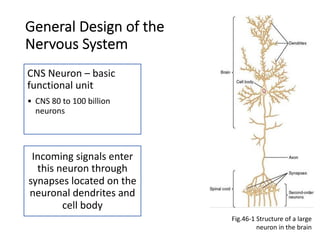
CNS Neuron – basic
functional unit
• CNS 80 to 100 billion
neurons
Incoming signals enter
this neuron through
synapses located on the
neuronal dendrites and
cell body
Fig.46-1 Structure of a large
neuron in the brain
General Design of the
Nervous System
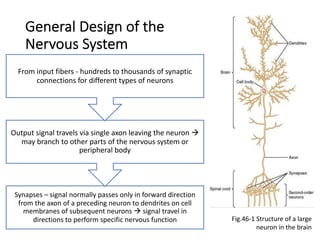
Synapses – signal normally passes only in forward direction
from the axon of a preceding neuron to dendrites on cell
membranes of subsequent neurons à signal travel in
directions to perform specific nervous function
Output signal travels via single axon leaving the neuron à
may branch to other parts of the nervous system or
peripheral body
From input fibers - hundreds to thousands of synaptic
connections for different types of neurons
Fig.46-1 Structure of a large
neuron in the brain
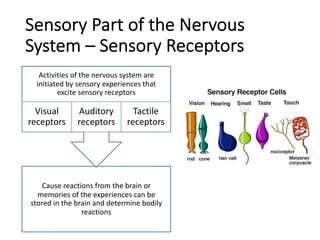
Sensory Part of the Nervous
System – Sensory Receptors
Cause reactions from the brain or
memories of the experiences can be
stored in the brain and determine bodily
reactions
Activities of the nervous system are
initiated by sensory experiences that
excite sensory receptors
Visual
receptors
Auditory
receptors
Tactile
receptors
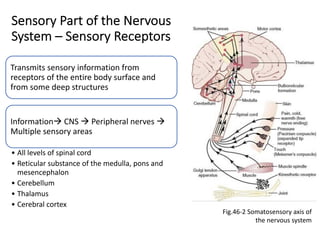
Sensory Part of the Nervous
System – Sensory Receptors
Fig.46-2 Somatosensory axis of
the nervous system
Transmits sensory information from
receptors of the entire body surface and
from some deep structures
Informationà CNS à Peripheral nerves à
Multiple sensory areas
• All levels of spinal cord
• Reticular substance of the medulla, pons and
mesencephalon
• Cerebellum
• Thalamus
• Cerebral cortex
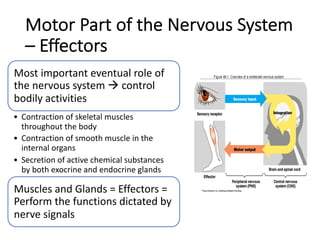
Motor Part of the Nervous System
– Effectors
Most important eventual role of
the nervous system à control
bodily activities
• Contraction of skeletal muscles
throughout the body
• Contraction of smooth muscle in the
internal organs
• Secretion of active chemical substances
by both exocrine and endocrine glands
Muscles and Glands = Effectors =
Perform the functions dictated by
nerve signals
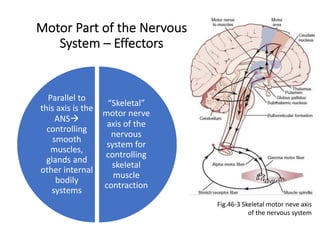
Motor Part of the Nervous
System – Effectors
“Skeletal”
motor nerve
axis of the
nervous
system for
controlling
skeletal
muscle
contraction
Parallel to
this axis is the
ANSà
controlling
smooth
muscles,
glands and
other internal
bodily
systems
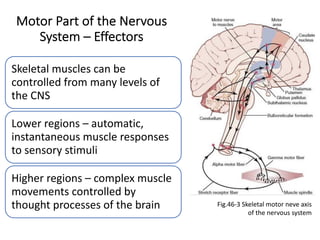
Fig.46-3 Skeletal motor neve axis
of the nervous system
Motor Part of the Nervous
System – Effectors
Skeletal muscles can be
controlled from many levels of
the CNS
Lower regions – automatic,
instantaneous muscle responses
to sensory stimuli
Higher regions – complex muscle
movements controlled by
thought processes of the brain Fig.46-3 Skeletal motor neve axis
of the nervous system
Processing of
Information –
Integrative Function
of the Nervous
System
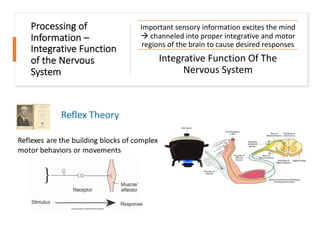
Important sensory information excites the mind
à channeled into proper integrative and motor
regions of the brain to cause desired responses
Integrative Function Of The
Nervous System
Role of
Synapses in
Processing
Information
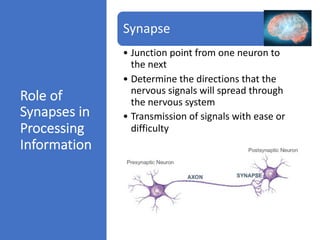
Synapse
• Junction point from one neuron to
the next
• Determine the directions that the
nervous signals will spread through
the nervous system
• Transmission of signals with ease or
difficulty
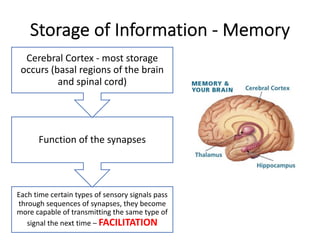
Storage of Information - Memory
Each time certain types of sensory signals pass
through sequences of synapses, they become
more capable of transmitting the same type of
signal the next time – FACILITATION
Function of the synapses
Cerebral Cortex - most storage
occurs (basal regions of the brain
and spinal cord)
Major Levels of CNS
Function
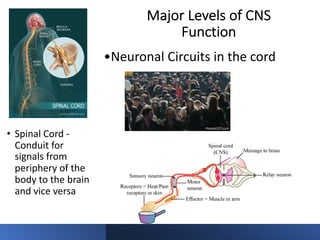
• Spinal Cord -
Conduit for
signals from
periphery of the
body to the brain
and vice versa
•Neuronal Circuits in the cord
Major Levels of CNS Function
Lower Brain or Subcortical
• Most of the subconscious
activities of the body are
controlled
• Medulla and Pons –
subconscious control of
arterial pressure and
respiration
• Control of equilibrium,
feeding reflexes and
emotional patterns
Higher Brain or Cortical
• The cortex never
functions alone but
always in association with
the lower centers of the
nervous system
• Without the cerebral
cortex, the functions of
the lower brain centers
are often imprecise
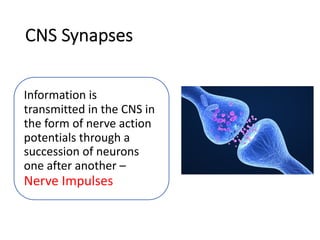
CNS Synapses
Information is
transmitted in the CNS in
the form of nerve action
potentials through a
succession of neurons
one after another –
Nerve Impulses
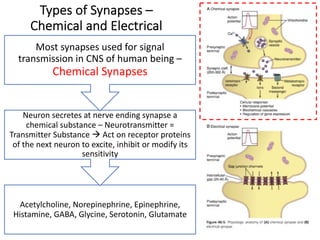
Types of Synapses –
Chemical and Electrical
Acetylcholine, Norepinephrine, Epinephrine,
Histamine, GABA, Glycine, Serotonin, Glutamate
Neuron secretes at nerve ending synapse a
chemical substance – Neurotransmitter =
Transmitter Substance à Act on receptor proteins
of the next neuron to excite, inhibit or modify its
sensitivity
Most synapses used for signal
transmission in CNS of human being –
Chemical Synapses
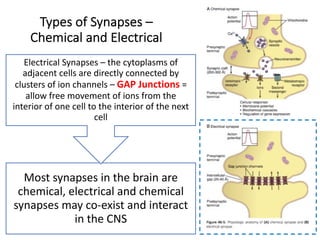
Most synapses in the brain are
chemical, electrical and chemical
synapses may co-exist and interact
in the CNS
Electrical Synapses – the cytoplasms of
adjacent cells are directly connected by
clusters of ion channels – GAP Junctions =
allow free movement of ions from the
interior of one cell to the interior of the next
cell
Types of Synapses –
Chemical and Electrical
Types of Synapses –
Chemical and Electrical
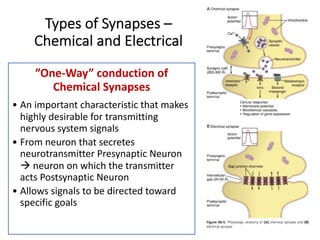
”One-Way” conduction of
Chemical Synapses
• An important characteristic that makes
highly desirable for transmitting
nervous system signals
• From neuron that secretes
neurotransmitter Presynaptic Neuron
à neuron on which the transmitter
acts Postsynaptic Neuron
• Allows signals to be directed toward
specific goals
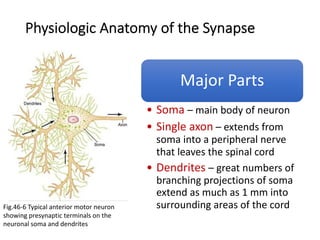
Physiologic Anatomy of the Synapse
Major Parts
• Soma – main body of neuron
• Single axon – extends from
soma into a peripheral nerve
that leaves the spinal cord
• Dendrites – great numbers of
branching projections of soma
extend as much as 1 mm into
surrounding areas of the cord
Fig.46-6 Typical anterior motor neuron
showing presynaptic terminals on the
neuronal soma and dendrites
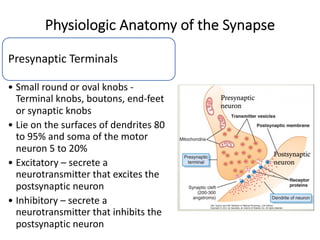
Physiologic Anatomy of the Synapse
Presynaptic Terminals
• Small round or oval knobs -
Terminal knobs, boutons, end-feet
or synaptic knobs
• Lie on the surfaces of dendrites 80
to 95% and soma of the motor
neuron 5 to 20%
• Excitatory – secrete a
neurotransmitter that excites the
postsynaptic neuron
• Inhibitory – secrete a
neurotransmitter that inhibits the
postsynaptic neuron
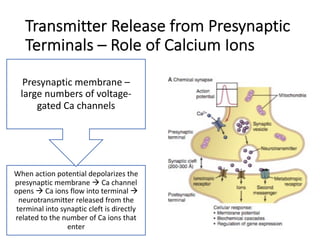
Transmitter Release from Presynaptic
Terminals – Role of Calcium Ions
When action potential depolarizes the
presynaptic membrane à Ca channel
opens à Ca ions flow into terminal à
neurotransmitter released from the
terminal into synaptic cleft is directly
related to the number of Ca ions that
enter
Presynaptic membrane –
large numbers of voltage-
gated Ca channels
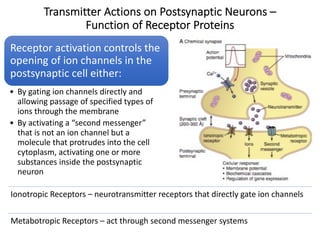
Transmitter Actions on Postsynaptic Neurons –
Function of Receptor Proteins
Receptor activation controls the
opening of ion channels in the
postsynaptic cell either:
• By gating ion channels directly and
allowing passage of specified types of
ions through the membrane
• By activating a “second messenger”
that is not an ion channel but a
molecule that protrudes into the cell
cytoplasm, activating one or more
substances inside the postsynaptic
neuron
Ionotropic Receptors – neurotransmitter receptors that directly gate ion channels
Metabotropic Receptors – act through second messenger systems
Ion Channels
Cation channels
Allow Na ions to pass when opened,
sometimes allow K and/or Ca
Lined with negative charges those
that conduct Na ions which attract
the positively charged Na ions into
the channel when channel diameter
increases larger than hydrated Na ion
Repel Cl ions and other anions
Anion channels
Allow Cl ions to pass and minute
quantities of other anions
When channel diameter becomes
large, Cl ions pass into the channels
to the opposite side; blocks Na, K
and Ca cations because hydrated
ions are too large
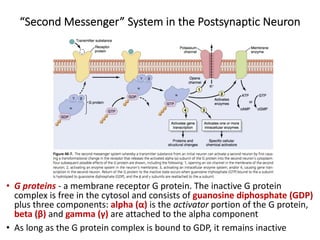
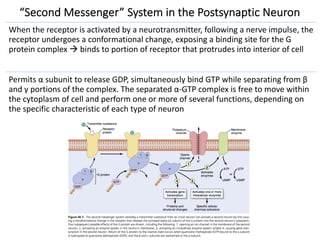
“Second Messenger” System in the Postsynaptic Neuron
• G proteins - a membrane receptor G protein. The inactive G protein
complex is free in the cytosol and consists of guanosine diphosphate (GDP)
plus three components: alpha (α) is the activator portion of the G protein,
beta (β) and gamma (γ) are attached to the alpha component
• As long as the G protein complex is bound to GDP, it remains inactive
“Second Messenger” System in the Postsynaptic Neuron
When the receptor is activated by a neurotransmitter, following a nerve impulse, the
receptor undergoes a conformational change, exposing a binding site for the G
protein complex à binds to portion of receptor that protrudes into interior of cell
Permits α subunit to release GDP, simultaneously bind GTP while separating from β
and γ portions of the complex. The separated α-GTP complex is free to move within
the cytoplasm of cell and perform one or more of several functions, depending on
the specific characteristic of each type of neuron
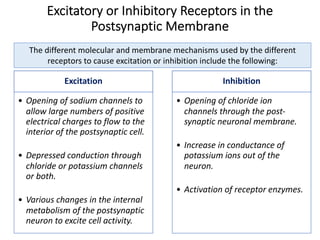
Excitatory or Inhibitory Receptors in the
Postsynaptic Membrane
Excitation
• Opening of sodium channels to
allow large numbers of positive
electrical charges to flow to the
interior of the postsynaptic cell.
• Depressed conduction through
chloride or potassium channels
or both.
• Various changes in the internal
metabolism of the postsynaptic
neuron to excite cell activity.
Inhibition
• Opening of chloride ion
channels through the post-
synaptic neuronal membrane.
• Increase in conductance of
potassium ions out of the
neuron.
• Activation of receptor enzymes.
The different molecular and membrane mechanisms used by the different
receptors to cause excitation or inhibition include the following:
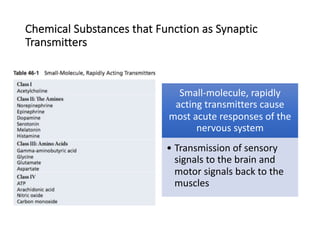
Chemical Substances that Function as Synaptic
Transmitters
Small-molecule, rapidly
acting transmitters cause
most acute responses of the
nervous system
• Transmission of sensory
signals to the brain and
motor signals back to the
muscles
Characteristics of Some Important
Small-Molecule Transmitters
Acetylcholine
• Secreted by neurons in many areas of the
nervous system
• ACh has an excitatory effect; known to
have inhibitory effects at some peripheral
parasympathetic nerve endings - inhibition
of the heart by the vagus nerves
Characteristics of Some Important
Small-Molecule Transmitters
Norepinephrine
• Secreted by terminals of many neurons whose cell
bodies are located in the brain stem and
hypothalamus
• In most areas, NorE probably activates excitatory
receptors, but in a few areas, it activates inhibitory
receptors
• Secreted by most postganglionic neurons of the
sympathetic nervous system, where it excites some
organs but inhibits others
Characteristics of Some Important
Small-Molecule Transmitters
Dopamine
• Secreted by neurons that originate in substantia nigra
• The termination is mainly in the striatal region of the
basal ganglia
• Effect of dopamine is usually inhibition
Glycine
• Secreted mainly at synapses in the spinal cord
• It is believed to always act as an inhibitory transmitter
Characteristics of Some Important
Small-Molecule Transmitters
Gamma-aminobutyric acid (GABA)
• Secreted by nerve terminals in spinal cord,
cerebellum, basal ganglia and areas of the
cortex
• inhibitory neurotransmitter in adult CNS
• In the early stages of brain development,
GABA is thought to serve as an excitatory
neurotransmitter
Characteristics of Some Important
Small-Molecule Transmitters
Glutamate
• Secreted by presynaptic terminals in many of sensory pathways
entering the CNS, areas of the cerebral cortex
• It probably always causes excitation
Serotonin
• Secreted by nuclei that originate in median raphe of the brain
stem and project to many brain and spinal cord areas, dorsal horns
of the spinal cord and hypothalamus
• Acts as an inhibitor of pain pathways in the cord; an inhibitor
action in higher regions of the nervous system is believed to help
control mood of the person, perhaps even to cause sleep
Characteristics of Some Important
Small-Molecule Transmitters
Nitric oxide
• Produced by nerve terminals in areas of the brain
responsible for long-term behavior and memory
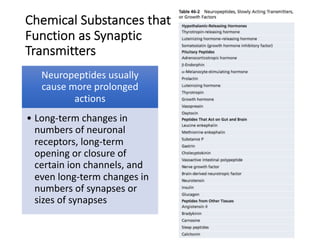
Chemical Substances that
Function as Synaptic
Transmitters
Neuropeptides usually
cause more prolonged
actions
• Long-term changes in
numbers of neuronal
receptors, long-term
opening or closure of
certain ion channels, and
even long-term changes in
numbers of synapses or
sizes of synapses
Neuropeptides
Often cause much more prolonged
actions
• Closure of calcium channels
• Changes in the metabolic machinery of cells
• Changes in activation or deactivation of
specific genes in the cell nucleus, and/or
prolonged alterations in numbers of
excitatory or inhibitory receptors
Neuropeptide and Small-Molecule
Transmitters May Coexist in the Same Neurons
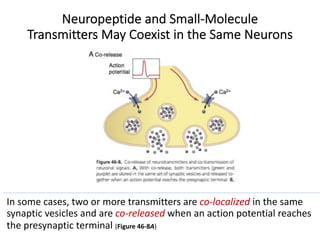
In some cases, two or more transmitters are co-localized in the same
synaptic vesicles and are co-released when an action potential reaches
the presynaptic terminal (Figure 46-8A)
Neuropeptide and Small-Molecule
Transmitters May Coexist in the Same Neurons
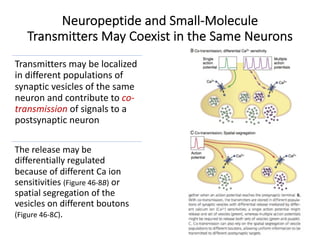
Transmitters may be localized
in different populations of
synaptic vesicles of the same
neuron and contribute to co-
transmission of signals to a
postsynaptic neuron
The release may be
differentially regulated
because of different Ca ion
sensitivities (Figure 46-8B) or
spatial segregation of the
vesicles on different boutons
(Figure 46-8C).
Electrical Events During Neuronal
Excitation
1. Resting Membrane Potential of the Neuronal Soma
2. Concentration Differences of Ions Across the Neuronal
Somal Membrane
3. Uniform Distribution of Electrical Potential Inside the
Neuronal Soma
4. Effect of Synaptic Excitation on the Postsynaptic Membrane
– Excitatory Postsynaptic Potential
5. Generation of Action Potentials in the Initial Segment of the
Axon Leaving the Neuron-Threshold for Excitation
Electrical Events During Neuronal
Excitation
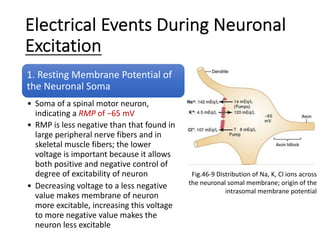
1. Resting Membrane Potential of
the Neuronal Soma
• Soma of a spinal motor neuron,
indicating a RMP of −65 mV
• RMP is less negative than that found in
large peripheral nerve fibers and in
skeletal muscle fibers; the lower
voltage is important because it allows
both positive and negative control of
degree of excitability of neuron
• Decreasing voltage to a less negative
value makes membrane of neuron
more excitable, increasing this voltage
to more negative value makes the
neuron less excitable
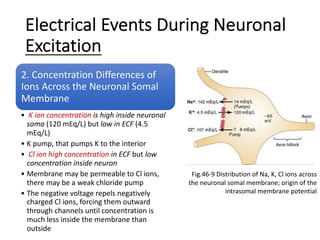
Fig.46-9 Distribution of Na, K, Cl ions across
the neuronal somal membrane; origin of the
intrasomal membrane potential
Electrical Events During Neuronal
Excitation
2. Concentration Differences of
Ions Across the Neuronal Somal
Membrane
• Concentration differences across
neuronal somal membrane of three
ions
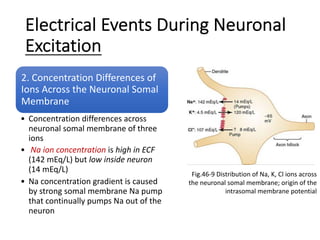
• Na ion concentration is high in ECF
(142 mEq/L) but low inside neuron
(14 mEq/L)
• Na concentration gradient is caused
by strong somal membrane Na pump
that continually pumps Na out of the
neuron
Fig.46-9 Distribution of Na, K, Cl ions across
the neuronal somal membrane; origin of the
intrasomal membrane potential
Electrical Events During Neuronal
Excitation
2. Concentration Differences of
Ions Across the Neuronal Somal
Membrane
• K ion concentration is high inside neuronal
soma (120 mEq/L) but low in ECF (4.5
mEq/L)
• K pump, that pumps K to the interior
• Cl ion high concentration in ECF but low
concentration inside neuron
• Membrane may be permeable to Cl ions,
there may be a weak chloride pump
• The negative voltage repels negatively
charged Cl ions, forcing them outward
through channels until concentration is
much less inside the membrane than
outside
Fig.46-9 Distribution of Na, K, Cl ions across
the neuronal somal membrane; origin of the
intrasomal membrane potential
Nernst potential
Electrical potential across cell membrane can oppose movement of ions
through a membrane if the potential is of proper polarity and magnitude
A potential that exactly opposes movement of ion is Nernst potential
for that ion
EMF (electromotive force) Nernst potential in mV on inside of the
membrane
The potential will be negative (−) for positive ions and positive (+) for
negative ions.
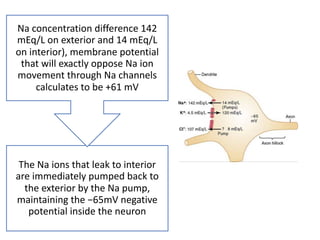
The Na ions that leak to interior
are immediately pumped back to
the exterior by the Na pump,
maintaining the −65mV negative
potential inside the neuron
Na concentration difference 142
mEq/L on exterior and 14 mEq/L
on interior), membrane potential
that will exactly oppose Na ion
movement through Na channels
calculates to be +61 mV
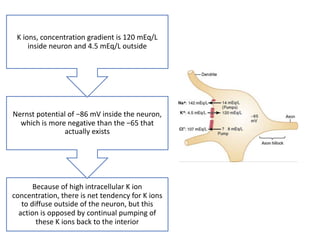
Because of high intracellular K ion
concentration, there is net tendency for K ions
to diffuse outside of the neuron, but this
action is opposed by continual pumping of
these K ions back to the interior
Nernst potential of −86 mV inside the neuron,
which is more negative than the −65 that
actually exists
K ions, concentration gradient is 120 mEq/L
inside neuron and 4.5 mEq/L outside
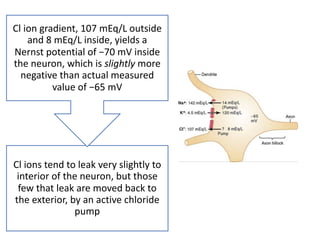
Cl ions tend to leak very slightly to
interior of the neuron, but those
few that leak are moved back to
the exterior, by an active chloride
pump
Cl ion gradient, 107 mEq/L outside
and 8 mEq/L inside, yields a
Nernst potential of −70 mV inside
the neuron, which is slightly more
negative than actual measured
value of −65 mV
Electrical Events During Neuronal
Excitation
3. Uniform Distribution of Electrical Potential
Inside the Neuronal Soma
• The interior of the neuronal soma contains highly
conductive electrolytic solution, the ICF of the neuron
• Any change in potential in any part of the intrasomal fluid
causes an almost exactly equal change in potential at all
other points inside the soma, as long as the neuron is not
transmitting an action potential
Electrical Events During Neuronal Excitation
4. Effect of Synaptic Excitation
on the Postsynaptic
Membrane – Excitatory
Postsynaptic Potential
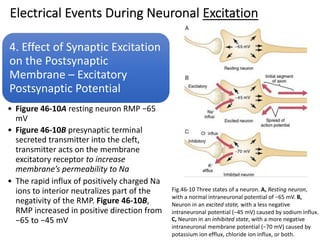
• Figure 46-10A resting neuron RMP −65
mV
• Figure 46-10B presynaptic terminal
secreted transmitter into the cleft,
transmitter acts on the membrane
excitatory receptor to increase
membrane’s permeability to Na
• The rapid influx of positively charged Na
ions to interior neutralizes part of the
negativity of the RMP. Figure 46-10B,
RMP increased in positive direction from
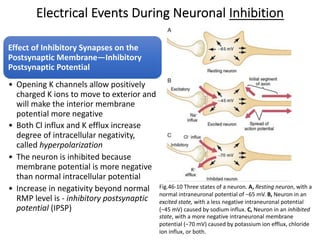
−65 to −45 mV
Fig.46-10 Three states of a neuron. A, Resting neuron,
with a normal intraneuronal potential of −65 mV. B,
Neuron in an excited state, with a less negative
intraneuronal potential (−45 mV) caused by sodium influx.
C, Neuron in an inhibited state, with a more negative
intraneuronal membrane potential (−70 mV) caused by
potassium ion efflux, chloride ion influx, or both.
5. Generation of Action
Potentials in the Initial
Segment of the Axon Leaving
the Neuron-Threshold for
Excitation
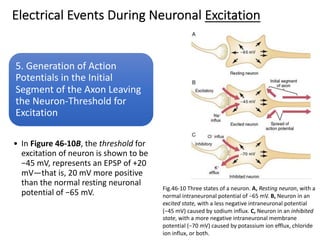
• In Figure 46-10B, the threshold for
excitation of neuron is shown to be
−45 mV, represents an EPSP of +20
mV—that is, 20 mV more positive
than the normal resting neuronal
potential of −65 mV.
Electrical Events During Neuronal Excitation
Fig.46-10 Three states of a neuron. A, Resting neuron, with a
normal intraneuronal potential of −65 mV. B, Neuron in an
excited state, with a less negative intraneuronal potential
(−45 mV) caused by sodium influx. C, Neuron in an inhibited
state, with a more negative intraneuronal membrane
potential (−70 mV) caused by potassium ion efflux, chloride
ion influx, or both.
Effect of Inhibitory Synapses on the
Postsynaptic Membrane—Inhibitory
Postsynaptic Potential
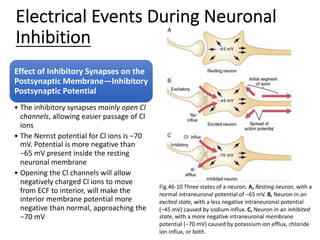
• The inhibitory synapses mainly open Cl
channels, allowing easier passage of Cl
ions
• The Nernst potential for Cl ions is −70
mV. Potential is more negative than
−65 mV present inside the resting
neuronal membrane
• Opening the Cl channels will allow
negatively charged Cl ions to move
from ECF to interior, will make the
interior membrane potential more
negative than normal, approaching the
−70 mV
Electrical Events During Neuronal
Inhibition
Fig.46-10 Three states of a neuron. A, Resting neuron, with a
normal intraneuronal potential of −65 mV. B, Neuron in an
excited state, with a less negative intraneuronal potential
(−45 mV) caused by sodium influx. C, Neuron in an inhibited
state, with a more negative intraneuronal membrane
potential (−70 mV) caused by potassium ion efflux, chloride
ion influx, or both.
Electrical Events During Neuronal Inhibition
Effect of Inhibitory Synapses on the
Postsynaptic Membrane—Inhibitory
Postsynaptic Potential
• Opening K channels allow positively
charged K ions to move to exterior and
will make the interior membrane
potential more negative
• Both Cl influx and K efflux increase
degree of intracellular negativity,
called hyperpolarization
• The neuron is inhibited because
membrane potential is more negative
than normal intracellular potential
• Increase in negativity beyond normal
RMP level is - inhibitory postsynaptic
potential (IPSP)
Fig.46-10 Three states of a neuron. A, Resting neuron, with a
normal intraneuronal potential of −65 mV. B, Neuron in an
excited state, with a less negative intraneuronal potential
(−45 mV) caused by sodium influx. C, Neuron in an inhibited
state, with a more negative intraneuronal membrane
potential (−70 mV) caused by potassium ion efflux, chloride
ion influx, or both.
Electrical Events During Neuronal
Inhibition
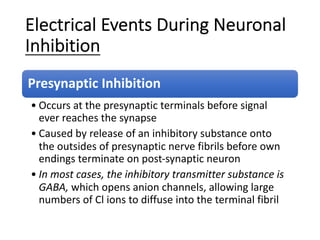
Presynaptic Inhibition
• Occurs at the presynaptic terminals before signal
ever reaches the synapse
• Caused by release of an inhibitory substance onto
the outsides of presynaptic nerve fibrils before own
endings terminate on post-synaptic neuron
• In most cases, the inhibitory transmitter substance is
GABA, which opens anion channels, allowing large
numbers of Cl ions to diffuse into the terminal fibril
Electrical Events During Neuronal Inhibition
Time Course of Postsynaptic Potentials
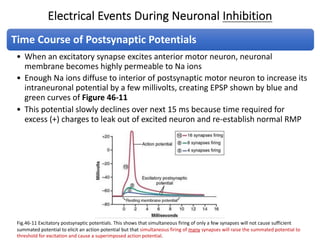
• When an excitatory synapse excites anterior motor neuron, neuronal
membrane becomes highly permeable to Na ions
• Enough Na ions diffuse to interior of postsynaptic motor neuron to increase its
intraneuronal potential by a few millivolts, creating EPSP shown by blue and
green curves of Figure 46-11
• This potential slowly declines over next 15 ms because time required for
excess (+) charges to leak out of excited neuron and re-establish normal RMP
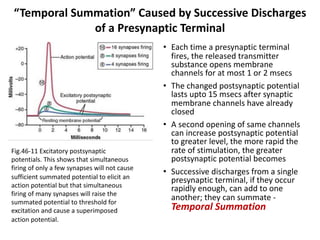
Fig.46-11 Excitatory postsynaptic potentials. This shows that simultaneous firing of only a few synapses will not cause sufficient
summated potential to elicit an action potential but that simultaneous firing of many synapses will raise the summated potential to
threshold for excitation and cause a superimposed action potential.
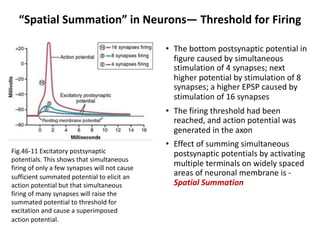
Fig.46-11 Excitatory postsynaptic
potentials. This shows that simultaneous
firing of only a few synapses will not cause
sufficient summated potential to elicit an
action potential but that simultaneous
firing of many synapses will raise the
summated potential to threshold for
excitation and cause a superimposed
action potential.
• The bottom postsynaptic potential in
figure caused by simultaneous
stimulation of 4 synapses; next
higher potential by stimulation of 8
synapses; a higher EPSP caused by
stimulation of 16 synapses
• The firing threshold had been
reached, and action potential was
generated in the axon
• Effect of summing simultaneous
postsynaptic potentials by activating
multiple terminals on widely spaced
areas of neuronal membrane is -
Spatial Summation
“Spatial Summation” in Neurons— Threshold for Firing
• Each time a presynaptic terminal
fires, the released transmitter
substance opens membrane
channels for at most 1 or 2 msecs
• The changed postsynaptic potential
lasts upto 15 msecs after synaptic
membrane channels have already
closed
• A second opening of same channels
can increase postsynaptic potential
to greater level, the more rapid the
rate of stimulation, the greater
postsynaptic potential becomes
• Successive discharges from a single
presynaptic terminal, if they occur
rapidly enough, can add to one
another; they can summate -
Temporal Summation
“Temporal Summation” Caused by Successive Discharges
of a Presynaptic Terminal
Fig.46-11 Excitatory postsynaptic
potentials. This shows that simultaneous
firing of only a few synapses will not cause
sufficient summated potential to elicit an
action potential but that simultaneous
firing of many synapses will raise the
summated potential to threshold for
excitation and cause a superimposed
action potential.
Special Functions of Dendrites For
Exciting Neurons
Large Spatial Field of Excitation of Dendrites
Most Dendrites Cannot Transmit Action Potentials – But They
Can Transmit Signals Within the Same Neuron by Electrotonic
Conduction
Decrement of Electrotonic Conduction in the Dendrites –
Greater Excitatory (or Inhibitory) Effect by Synapses Located
Near the Soma
Summation of Excitation and Inhibition in Dendrites
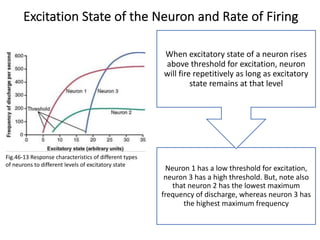
Excitation State of the Neuron and Rate of Firing
Neuron 1 has a low threshold for excitation,
neuron 3 has a high threshold. But, note also
that neuron 2 has the lowest maximum
frequency of discharge, whereas neuron 3 has
the highest maximum frequency
When excitatory state of a neuron rises
above threshold for excitation, neuron
will fire repetitively as long as excitatory
state remains at that level
Fig.46-13 Response characteristics of different types
of neurons to different levels of excitatory state
Special Characteristics of Synaptic
Transmission
Fatigue of Synaptic Transmission
• When excitatory synapses are repetitively stimulated at a
rapid rate, the number of discharges by postsynaptic
neuron is at first very great, but the firing rate becomes
progressively less in succeeding milliseconds or seconds
Effect of Acidosis or Alkalosis on Synaptic
Transmission
• Most neurons are highly responsive to changes in pH of
the surrounding interstitial fluids
Special Characteristics of Synaptic
Transmission
Effect of Hypoxia on Synaptic Transmission
• Neuronal excitability is also highly dependent on an
adequate supply of oxygen
Effect of Drugs on Synaptic Transmission
• Many drugs are known to increase the excitability of
neurons, and others are known to decrease excitability
• Caffeine, theophylline, and theobromine, all increase
neuronal excitability, presumably by reducing the
threshold for excitation of neurons
Special Characteristics of Synaptic
Transmission
Synaptic Delay
• During transmission of a neuronal signal from a presynaptic
neuron to postsynaptic neuron, an amount of time is
consumed
• (1) discharge of transmitter substance by presynaptic
terminal
• (2) diffusion transmitter to neuronal membrane
• (3) action of the transmitter on membrane receptor
• (4) action of receptor to increase the membrane permeability
• (5) inward diffusion of sodium to raise the EPSP to a high
enough level to elicit an action potential
SUMMARY OUTLINE
General Design of the Nervous System
Major levels of Central Nervous System Function
CNS Synapses
Special Characteristics of Synaptic Transmission

Ln 46 &47.pdf

  • 1.
    Organization of the NervousSystem, Basic Functions of Synapses and Neurotransmitters Ma. Victoria B. Lim, MD Department of Physiology Davao Medical School Foundation, Inc.
  • 2.
    OUTLINE General Design ofthe Nervous System Major levels of Central Nervous System Function CNS Synapses Special Characteristics of Synaptic Transmission
  • 3.
    General Design ofthe Nervous System CNS Neuron – basic functional unit • CNS 80 to 100 billion neurons Incoming signals enter this neuron through synapses located on the neuronal dendrites and cell body Fig.46-1 Structure of a large neuron in the brain
  • 4.
    General Design ofthe Nervous System Synapses – signal normally passes only in forward direction from the axon of a preceding neuron to dendrites on cell membranes of subsequent neurons à signal travel in directions to perform specific nervous function Output signal travels via single axon leaving the neuron à may branch to other parts of the nervous system or peripheral body From input fibers - hundreds to thousands of synaptic connections for different types of neurons Fig.46-1 Structure of a large neuron in the brain
  • 5.
    Sensory Part ofthe Nervous System – Sensory Receptors Cause reactions from the brain or memories of the experiences can be stored in the brain and determine bodily reactions Activities of the nervous system are initiated by sensory experiences that excite sensory receptors Visual receptors Auditory receptors Tactile receptors
  • 6.
    Sensory Part ofthe Nervous System – Sensory Receptors Fig.46-2 Somatosensory axis of the nervous system Transmits sensory information from receptors of the entire body surface and from some deep structures Informationà CNS à Peripheral nerves à Multiple sensory areas • All levels of spinal cord • Reticular substance of the medulla, pons and mesencephalon • Cerebellum • Thalamus • Cerebral cortex
  • 7.
    Motor Part ofthe Nervous System – Effectors Most important eventual role of the nervous system à control bodily activities • Contraction of skeletal muscles throughout the body • Contraction of smooth muscle in the internal organs • Secretion of active chemical substances by both exocrine and endocrine glands Muscles and Glands = Effectors = Perform the functions dictated by nerve signals
  • 8.
    Motor Part ofthe Nervous System – Effectors “Skeletal” motor nerve axis of the nervous system for controlling skeletal muscle contraction Parallel to this axis is the ANSà controlling smooth muscles, glands and other internal bodily systems Fig.46-3 Skeletal motor neve axis of the nervous system
  • 9.
    Motor Part ofthe Nervous System – Effectors Skeletal muscles can be controlled from many levels of the CNS Lower regions – automatic, instantaneous muscle responses to sensory stimuli Higher regions – complex muscle movements controlled by thought processes of the brain Fig.46-3 Skeletal motor neve axis of the nervous system
  • 10.
    Processing of Information – IntegrativeFunction of the Nervous System Important sensory information excites the mind à channeled into proper integrative and motor regions of the brain to cause desired responses Integrative Function Of The Nervous System
  • 11.
    Role of Synapses in Processing Information Synapse •Junction point from one neuron to the next • Determine the directions that the nervous signals will spread through the nervous system • Transmission of signals with ease or difficulty
  • 12.
    Storage of Information- Memory Each time certain types of sensory signals pass through sequences of synapses, they become more capable of transmitting the same type of signal the next time – FACILITATION Function of the synapses Cerebral Cortex - most storage occurs (basal regions of the brain and spinal cord)
  • 13.
    Major Levels ofCNS Function • Spinal Cord - Conduit for signals from periphery of the body to the brain and vice versa •Neuronal Circuits in the cord
  • 14.
    Major Levels ofCNS Function Lower Brain or Subcortical • Most of the subconscious activities of the body are controlled • Medulla and Pons – subconscious control of arterial pressure and respiration • Control of equilibrium, feeding reflexes and emotional patterns Higher Brain or Cortical • The cortex never functions alone but always in association with the lower centers of the nervous system • Without the cerebral cortex, the functions of the lower brain centers are often imprecise
  • 15.
    CNS Synapses Information is transmittedin the CNS in the form of nerve action potentials through a succession of neurons one after another – Nerve Impulses
  • 16.
    Types of Synapses– Chemical and Electrical Acetylcholine, Norepinephrine, Epinephrine, Histamine, GABA, Glycine, Serotonin, Glutamate Neuron secretes at nerve ending synapse a chemical substance – Neurotransmitter = Transmitter Substance à Act on receptor proteins of the next neuron to excite, inhibit or modify its sensitivity Most synapses used for signal transmission in CNS of human being – Chemical Synapses
  • 17.
    Most synapses inthe brain are chemical, electrical and chemical synapses may co-exist and interact in the CNS Electrical Synapses – the cytoplasms of adjacent cells are directly connected by clusters of ion channels – GAP Junctions = allow free movement of ions from the interior of one cell to the interior of the next cell Types of Synapses – Chemical and Electrical
  • 18.
    Types of Synapses– Chemical and Electrical ”One-Way” conduction of Chemical Synapses • An important characteristic that makes highly desirable for transmitting nervous system signals • From neuron that secretes neurotransmitter Presynaptic Neuron à neuron on which the transmitter acts Postsynaptic Neuron • Allows signals to be directed toward specific goals
  • 19.
    Physiologic Anatomy ofthe Synapse Major Parts • Soma – main body of neuron • Single axon – extends from soma into a peripheral nerve that leaves the spinal cord • Dendrites – great numbers of branching projections of soma extend as much as 1 mm into surrounding areas of the cord Fig.46-6 Typical anterior motor neuron showing presynaptic terminals on the neuronal soma and dendrites
  • 20.
    Physiologic Anatomy ofthe Synapse Presynaptic Terminals • Small round or oval knobs - Terminal knobs, boutons, end-feet or synaptic knobs • Lie on the surfaces of dendrites 80 to 95% and soma of the motor neuron 5 to 20% • Excitatory – secrete a neurotransmitter that excites the postsynaptic neuron • Inhibitory – secrete a neurotransmitter that inhibits the postsynaptic neuron
  • 21.
    Transmitter Release fromPresynaptic Terminals – Role of Calcium Ions When action potential depolarizes the presynaptic membrane à Ca channel opens à Ca ions flow into terminal à neurotransmitter released from the terminal into synaptic cleft is directly related to the number of Ca ions that enter Presynaptic membrane – large numbers of voltage- gated Ca channels
  • 22.
    Transmitter Actions onPostsynaptic Neurons – Function of Receptor Proteins Receptor activation controls the opening of ion channels in the postsynaptic cell either: • By gating ion channels directly and allowing passage of specified types of ions through the membrane • By activating a “second messenger” that is not an ion channel but a molecule that protrudes into the cell cytoplasm, activating one or more substances inside the postsynaptic neuron Ionotropic Receptors – neurotransmitter receptors that directly gate ion channels Metabotropic Receptors – act through second messenger systems
  • 23.
    Ion Channels Cation channels AllowNa ions to pass when opened, sometimes allow K and/or Ca Lined with negative charges those that conduct Na ions which attract the positively charged Na ions into the channel when channel diameter increases larger than hydrated Na ion Repel Cl ions and other anions Anion channels Allow Cl ions to pass and minute quantities of other anions When channel diameter becomes large, Cl ions pass into the channels to the opposite side; blocks Na, K and Ca cations because hydrated ions are too large
  • 24.
    “Second Messenger” Systemin the Postsynaptic Neuron • G proteins - a membrane receptor G protein. The inactive G protein complex is free in the cytosol and consists of guanosine diphosphate (GDP) plus three components: alpha (α) is the activator portion of the G protein, beta (β) and gamma (γ) are attached to the alpha component • As long as the G protein complex is bound to GDP, it remains inactive
  • 25.
    “Second Messenger” Systemin the Postsynaptic Neuron When the receptor is activated by a neurotransmitter, following a nerve impulse, the receptor undergoes a conformational change, exposing a binding site for the G protein complex à binds to portion of receptor that protrudes into interior of cell Permits α subunit to release GDP, simultaneously bind GTP while separating from β and γ portions of the complex. The separated α-GTP complex is free to move within the cytoplasm of cell and perform one or more of several functions, depending on the specific characteristic of each type of neuron
  • 26.
    Excitatory or InhibitoryReceptors in the Postsynaptic Membrane Excitation • Opening of sodium channels to allow large numbers of positive electrical charges to flow to the interior of the postsynaptic cell. • Depressed conduction through chloride or potassium channels or both. • Various changes in the internal metabolism of the postsynaptic neuron to excite cell activity. Inhibition • Opening of chloride ion channels through the post- synaptic neuronal membrane. • Increase in conductance of potassium ions out of the neuron. • Activation of receptor enzymes. The different molecular and membrane mechanisms used by the different receptors to cause excitation or inhibition include the following:
  • 27.
    Chemical Substances thatFunction as Synaptic Transmitters Small-molecule, rapidly acting transmitters cause most acute responses of the nervous system • Transmission of sensory signals to the brain and motor signals back to the muscles
  • 28.
    Characteristics of SomeImportant Small-Molecule Transmitters Acetylcholine • Secreted by neurons in many areas of the nervous system • ACh has an excitatory effect; known to have inhibitory effects at some peripheral parasympathetic nerve endings - inhibition of the heart by the vagus nerves
  • 29.
    Characteristics of SomeImportant Small-Molecule Transmitters Norepinephrine • Secreted by terminals of many neurons whose cell bodies are located in the brain stem and hypothalamus • In most areas, NorE probably activates excitatory receptors, but in a few areas, it activates inhibitory receptors • Secreted by most postganglionic neurons of the sympathetic nervous system, where it excites some organs but inhibits others
  • 30.
    Characteristics of SomeImportant Small-Molecule Transmitters Dopamine • Secreted by neurons that originate in substantia nigra • The termination is mainly in the striatal region of the basal ganglia • Effect of dopamine is usually inhibition Glycine • Secreted mainly at synapses in the spinal cord • It is believed to always act as an inhibitory transmitter
  • 31.
    Characteristics of SomeImportant Small-Molecule Transmitters Gamma-aminobutyric acid (GABA) • Secreted by nerve terminals in spinal cord, cerebellum, basal ganglia and areas of the cortex • inhibitory neurotransmitter in adult CNS • In the early stages of brain development, GABA is thought to serve as an excitatory neurotransmitter
  • 32.
    Characteristics of SomeImportant Small-Molecule Transmitters Glutamate • Secreted by presynaptic terminals in many of sensory pathways entering the CNS, areas of the cerebral cortex • It probably always causes excitation Serotonin • Secreted by nuclei that originate in median raphe of the brain stem and project to many brain and spinal cord areas, dorsal horns of the spinal cord and hypothalamus • Acts as an inhibitor of pain pathways in the cord; an inhibitor action in higher regions of the nervous system is believed to help control mood of the person, perhaps even to cause sleep
  • 33.
    Characteristics of SomeImportant Small-Molecule Transmitters Nitric oxide • Produced by nerve terminals in areas of the brain responsible for long-term behavior and memory
  • 34.
    Chemical Substances that Functionas Synaptic Transmitters Neuropeptides usually cause more prolonged actions • Long-term changes in numbers of neuronal receptors, long-term opening or closure of certain ion channels, and even long-term changes in numbers of synapses or sizes of synapses
  • 35.
    Neuropeptides Often cause muchmore prolonged actions • Closure of calcium channels • Changes in the metabolic machinery of cells • Changes in activation or deactivation of specific genes in the cell nucleus, and/or prolonged alterations in numbers of excitatory or inhibitory receptors
  • 36.
    Neuropeptide and Small-Molecule TransmittersMay Coexist in the Same Neurons In some cases, two or more transmitters are co-localized in the same synaptic vesicles and are co-released when an action potential reaches the presynaptic terminal (Figure 46-8A)
  • 37.
    Neuropeptide and Small-Molecule TransmittersMay Coexist in the Same Neurons Transmitters may be localized in different populations of synaptic vesicles of the same neuron and contribute to co- transmission of signals to a postsynaptic neuron The release may be differentially regulated because of different Ca ion sensitivities (Figure 46-8B) or spatial segregation of the vesicles on different boutons (Figure 46-8C).
  • 38.
    Electrical Events DuringNeuronal Excitation 1. Resting Membrane Potential of the Neuronal Soma 2. Concentration Differences of Ions Across the Neuronal Somal Membrane 3. Uniform Distribution of Electrical Potential Inside the Neuronal Soma 4. Effect of Synaptic Excitation on the Postsynaptic Membrane – Excitatory Postsynaptic Potential 5. Generation of Action Potentials in the Initial Segment of the Axon Leaving the Neuron-Threshold for Excitation
  • 39.
    Electrical Events DuringNeuronal Excitation 1. Resting Membrane Potential of the Neuronal Soma • Soma of a spinal motor neuron, indicating a RMP of −65 mV • RMP is less negative than that found in large peripheral nerve fibers and in skeletal muscle fibers; the lower voltage is important because it allows both positive and negative control of degree of excitability of neuron • Decreasing voltage to a less negative value makes membrane of neuron more excitable, increasing this voltage to more negative value makes the neuron less excitable Fig.46-9 Distribution of Na, K, Cl ions across the neuronal somal membrane; origin of the intrasomal membrane potential
  • 40.
    Electrical Events DuringNeuronal Excitation 2. Concentration Differences of Ions Across the Neuronal Somal Membrane • Concentration differences across neuronal somal membrane of three ions • Na ion concentration is high in ECF (142 mEq/L) but low inside neuron (14 mEq/L) • Na concentration gradient is caused by strong somal membrane Na pump that continually pumps Na out of the neuron Fig.46-9 Distribution of Na, K, Cl ions across the neuronal somal membrane; origin of the intrasomal membrane potential
  • 41.
    Electrical Events DuringNeuronal Excitation 2. Concentration Differences of Ions Across the Neuronal Somal Membrane • K ion concentration is high inside neuronal soma (120 mEq/L) but low in ECF (4.5 mEq/L) • K pump, that pumps K to the interior • Cl ion high concentration in ECF but low concentration inside neuron • Membrane may be permeable to Cl ions, there may be a weak chloride pump • The negative voltage repels negatively charged Cl ions, forcing them outward through channels until concentration is much less inside the membrane than outside Fig.46-9 Distribution of Na, K, Cl ions across the neuronal somal membrane; origin of the intrasomal membrane potential
  • 42.
    Nernst potential Electrical potentialacross cell membrane can oppose movement of ions through a membrane if the potential is of proper polarity and magnitude A potential that exactly opposes movement of ion is Nernst potential for that ion EMF (electromotive force) Nernst potential in mV on inside of the membrane The potential will be negative (−) for positive ions and positive (+) for negative ions.
  • 43.
    The Na ionsthat leak to interior are immediately pumped back to the exterior by the Na pump, maintaining the −65mV negative potential inside the neuron Na concentration difference 142 mEq/L on exterior and 14 mEq/L on interior), membrane potential that will exactly oppose Na ion movement through Na channels calculates to be +61 mV
  • 44.
    Because of highintracellular K ion concentration, there is net tendency for K ions to diffuse outside of the neuron, but this action is opposed by continual pumping of these K ions back to the interior Nernst potential of −86 mV inside the neuron, which is more negative than the −65 that actually exists K ions, concentration gradient is 120 mEq/L inside neuron and 4.5 mEq/L outside
  • 45.
    Cl ions tendto leak very slightly to interior of the neuron, but those few that leak are moved back to the exterior, by an active chloride pump Cl ion gradient, 107 mEq/L outside and 8 mEq/L inside, yields a Nernst potential of −70 mV inside the neuron, which is slightly more negative than actual measured value of −65 mV
  • 46.
    Electrical Events DuringNeuronal Excitation 3. Uniform Distribution of Electrical Potential Inside the Neuronal Soma • The interior of the neuronal soma contains highly conductive electrolytic solution, the ICF of the neuron • Any change in potential in any part of the intrasomal fluid causes an almost exactly equal change in potential at all other points inside the soma, as long as the neuron is not transmitting an action potential
  • 47.
    Electrical Events DuringNeuronal Excitation 4. Effect of Synaptic Excitation on the Postsynaptic Membrane – Excitatory Postsynaptic Potential • Figure 46-10A resting neuron RMP −65 mV • Figure 46-10B presynaptic terminal secreted transmitter into the cleft, transmitter acts on the membrane excitatory receptor to increase membrane’s permeability to Na • The rapid influx of positively charged Na ions to interior neutralizes part of the negativity of the RMP. Figure 46-10B, RMP increased in positive direction from −65 to −45 mV Fig.46-10 Three states of a neuron. A, Resting neuron, with a normal intraneuronal potential of −65 mV. B, Neuron in an excited state, with a less negative intraneuronal potential (−45 mV) caused by sodium influx. C, Neuron in an inhibited state, with a more negative intraneuronal membrane potential (−70 mV) caused by potassium ion efflux, chloride ion influx, or both.
  • 48.
    5. Generation ofAction Potentials in the Initial Segment of the Axon Leaving the Neuron-Threshold for Excitation • In Figure 46-10B, the threshold for excitation of neuron is shown to be −45 mV, represents an EPSP of +20 mV—that is, 20 mV more positive than the normal resting neuronal potential of −65 mV. Electrical Events During Neuronal Excitation Fig.46-10 Three states of a neuron. A, Resting neuron, with a normal intraneuronal potential of −65 mV. B, Neuron in an excited state, with a less negative intraneuronal potential (−45 mV) caused by sodium influx. C, Neuron in an inhibited state, with a more negative intraneuronal membrane potential (−70 mV) caused by potassium ion efflux, chloride ion influx, or both.
  • 49.
    Effect of InhibitorySynapses on the Postsynaptic Membrane—Inhibitory Postsynaptic Potential • The inhibitory synapses mainly open Cl channels, allowing easier passage of Cl ions • The Nernst potential for Cl ions is −70 mV. Potential is more negative than −65 mV present inside the resting neuronal membrane • Opening the Cl channels will allow negatively charged Cl ions to move from ECF to interior, will make the interior membrane potential more negative than normal, approaching the −70 mV Electrical Events During Neuronal Inhibition Fig.46-10 Three states of a neuron. A, Resting neuron, with a normal intraneuronal potential of −65 mV. B, Neuron in an excited state, with a less negative intraneuronal potential (−45 mV) caused by sodium influx. C, Neuron in an inhibited state, with a more negative intraneuronal membrane potential (−70 mV) caused by potassium ion efflux, chloride ion influx, or both.
  • 50.
    Electrical Events DuringNeuronal Inhibition Effect of Inhibitory Synapses on the Postsynaptic Membrane—Inhibitory Postsynaptic Potential • Opening K channels allow positively charged K ions to move to exterior and will make the interior membrane potential more negative • Both Cl influx and K efflux increase degree of intracellular negativity, called hyperpolarization • The neuron is inhibited because membrane potential is more negative than normal intracellular potential • Increase in negativity beyond normal RMP level is - inhibitory postsynaptic potential (IPSP) Fig.46-10 Three states of a neuron. A, Resting neuron, with a normal intraneuronal potential of −65 mV. B, Neuron in an excited state, with a less negative intraneuronal potential (−45 mV) caused by sodium influx. C, Neuron in an inhibited state, with a more negative intraneuronal membrane potential (−70 mV) caused by potassium ion efflux, chloride ion influx, or both.
  • 51.
    Electrical Events DuringNeuronal Inhibition Presynaptic Inhibition • Occurs at the presynaptic terminals before signal ever reaches the synapse • Caused by release of an inhibitory substance onto the outsides of presynaptic nerve fibrils before own endings terminate on post-synaptic neuron • In most cases, the inhibitory transmitter substance is GABA, which opens anion channels, allowing large numbers of Cl ions to diffuse into the terminal fibril
  • 52.
    Electrical Events DuringNeuronal Inhibition Time Course of Postsynaptic Potentials • When an excitatory synapse excites anterior motor neuron, neuronal membrane becomes highly permeable to Na ions • Enough Na ions diffuse to interior of postsynaptic motor neuron to increase its intraneuronal potential by a few millivolts, creating EPSP shown by blue and green curves of Figure 46-11 • This potential slowly declines over next 15 ms because time required for excess (+) charges to leak out of excited neuron and re-establish normal RMP Fig.46-11 Excitatory postsynaptic potentials. This shows that simultaneous firing of only a few synapses will not cause sufficient summated potential to elicit an action potential but that simultaneous firing of many synapses will raise the summated potential to threshold for excitation and cause a superimposed action potential.
  • 53.
    Fig.46-11 Excitatory postsynaptic potentials.This shows that simultaneous firing of only a few synapses will not cause sufficient summated potential to elicit an action potential but that simultaneous firing of many synapses will raise the summated potential to threshold for excitation and cause a superimposed action potential. • The bottom postsynaptic potential in figure caused by simultaneous stimulation of 4 synapses; next higher potential by stimulation of 8 synapses; a higher EPSP caused by stimulation of 16 synapses • The firing threshold had been reached, and action potential was generated in the axon • Effect of summing simultaneous postsynaptic potentials by activating multiple terminals on widely spaced areas of neuronal membrane is - Spatial Summation “Spatial Summation” in Neurons— Threshold for Firing
  • 54.
    • Each timea presynaptic terminal fires, the released transmitter substance opens membrane channels for at most 1 or 2 msecs • The changed postsynaptic potential lasts upto 15 msecs after synaptic membrane channels have already closed • A second opening of same channels can increase postsynaptic potential to greater level, the more rapid the rate of stimulation, the greater postsynaptic potential becomes • Successive discharges from a single presynaptic terminal, if they occur rapidly enough, can add to one another; they can summate - Temporal Summation “Temporal Summation” Caused by Successive Discharges of a Presynaptic Terminal Fig.46-11 Excitatory postsynaptic potentials. This shows that simultaneous firing of only a few synapses will not cause sufficient summated potential to elicit an action potential but that simultaneous firing of many synapses will raise the summated potential to threshold for excitation and cause a superimposed action potential.
  • 55.
    Special Functions ofDendrites For Exciting Neurons Large Spatial Field of Excitation of Dendrites Most Dendrites Cannot Transmit Action Potentials – But They Can Transmit Signals Within the Same Neuron by Electrotonic Conduction Decrement of Electrotonic Conduction in the Dendrites – Greater Excitatory (or Inhibitory) Effect by Synapses Located Near the Soma Summation of Excitation and Inhibition in Dendrites
  • 56.
    Excitation State ofthe Neuron and Rate of Firing Neuron 1 has a low threshold for excitation, neuron 3 has a high threshold. But, note also that neuron 2 has the lowest maximum frequency of discharge, whereas neuron 3 has the highest maximum frequency When excitatory state of a neuron rises above threshold for excitation, neuron will fire repetitively as long as excitatory state remains at that level Fig.46-13 Response characteristics of different types of neurons to different levels of excitatory state
  • 57.
    Special Characteristics ofSynaptic Transmission Fatigue of Synaptic Transmission • When excitatory synapses are repetitively stimulated at a rapid rate, the number of discharges by postsynaptic neuron is at first very great, but the firing rate becomes progressively less in succeeding milliseconds or seconds Effect of Acidosis or Alkalosis on Synaptic Transmission • Most neurons are highly responsive to changes in pH of the surrounding interstitial fluids
  • 58.
    Special Characteristics ofSynaptic Transmission Effect of Hypoxia on Synaptic Transmission • Neuronal excitability is also highly dependent on an adequate supply of oxygen Effect of Drugs on Synaptic Transmission • Many drugs are known to increase the excitability of neurons, and others are known to decrease excitability • Caffeine, theophylline, and theobromine, all increase neuronal excitability, presumably by reducing the threshold for excitation of neurons
  • 59.
    Special Characteristics ofSynaptic Transmission Synaptic Delay • During transmission of a neuronal signal from a presynaptic neuron to postsynaptic neuron, an amount of time is consumed • (1) discharge of transmitter substance by presynaptic terminal • (2) diffusion transmitter to neuronal membrane • (3) action of the transmitter on membrane receptor • (4) action of receptor to increase the membrane permeability • (5) inward diffusion of sodium to raise the EPSP to a high enough level to elicit an action potential
  • 60.
    SUMMARY OUTLINE General Designof the Nervous System Major levels of Central Nervous System Function CNS Synapses Special Characteristics of Synaptic Transmission