SCHEME AND SYLLABUS
For the Programme
Bachelor of Business Administration
(Choice Based Credit System – 2021 scheme)
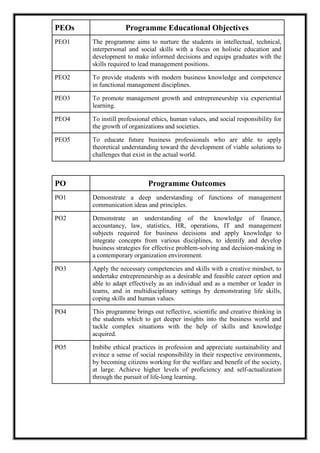
PEOs Programme Educational Objectives
PEO1 The programme aims to nurture the students in intellectual, technical,
interpersonal and social skills with a focus on holistic education and
development to make informed decisions and equips graduates with the
skills required to lead management positions.
PEO2 To provide students with modern business knowledge and competence
in functional management disciplines.
PEO3 To promote management growth and entrepreneurship via experiential
learning.
PEO4 To instill professional ethics, human values, and social responsibility for
the growth of organizations and societies.
PEO5 To educate future business professionals who are able to apply
theoretical understanding toward the development of viable solutions to
challenges that exist in the actual world.
PO Programme Outcomes
PO1 Demonstrate a deep understanding of functions of management
communication ideas and principles.
PO2 Demonstrate an understanding of the knowledge of finance,
accountancy, law, statistics, HR, operations, IT and management
subjects required for business decisions and apply knowledge to
integrate concepts from various disciplines, to identify and develop
business strategies for effective problem-solving and decision-making in
a contemporary organization environment.
PO3 Apply the necessary competencies and skills with a creative mindset, to
undertake entrepreneurship as a desirable and feasible career option and
able to adapt effectively as an individual and as a member or leader in
teams, and in multidisciplinary settings by demonstrating life skills,
coping skills and human values.
PO4 This programme brings out reflective, scientific and creative thinking in
the students which to get deeper insights into the business world and
tackle complex situations with the help of skills and knowledge
acquired.
PO5 Imbibe ethical practices in profession and appreciate sustainability and
evince a sense of social responsibility in their respective environments,
by becoming citizens working for the welfare and benefit of the society,
at large. Achieve higher levels of proficiency and self-actualization
through the pursuit of life-long learning.
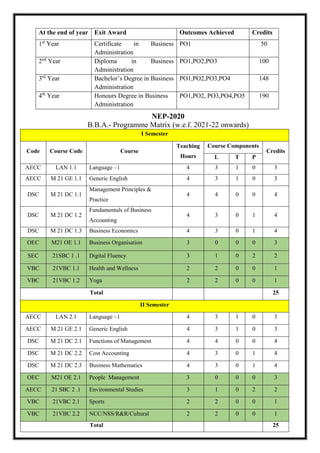
At the end of year Exit Award Outcomes Achieved Credits
1st
Year Certificate in Business
Administration
PO1 50
2nd
Year Diploma in Business
Administration
PO1,PO2,PO3 100
3rd
Year Bachelor’s Degree in Business
Administration
PO1,PO2,PO3,PO4 148
4th
Year Honours Degree in Business
Administration
PO1,PO2, PO3,PO4,PO5 190
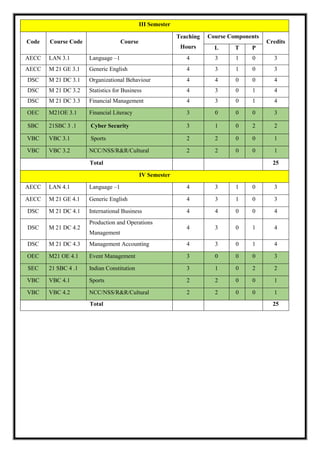
NEP-2020
B.B.A.- Programme Matrix (w.e.f. 2021-22 onwards)
I Semester
Code Course Code Course
Teaching
Hours
Course Components
Credits
L T P
AECC LAN 1.1 Language –1 4 3 1 0 3
AECC M 21 GE 1.1 Generic English 4 3 1 0 3
DSC M 21 DC 1.1
Management Principles &
Practice
4 4 0 0 4
DSC M 21 DC 1.2
Fundamentals of Business
Accounting
4 3 0 1 4
DSC M 21 DC 1.3 Business Economics 4 3 0 1 4
OEC M21 OE 1.1 Business Organisation 3 0 0 0 3
SEC 21SBC 1 .1 Digital Fluency 3 1 0 2 2
VBC 21VBC 1.1 Health and Wellness 2 2 0 0 1
VBC 21VBC 1.2 Yoga 2 2 0 0 1
Total 25
II Semester
AECC LAN 2.1 Language –1 4 3 1 0 3
AECC M 21 GE 2.1 Generic English 4 3 1 0 3
DSC M 21 DC 2.1 Functions of Management 4 4 0 0 4
DSC M 21 DC 2.2 Cost Accounting 4 3 0 1 4
DSC M 21 DC 2.3 Business Mathematics 4 3 0 1 4
OEC M21 OE 2.1 People Management 3 0 0 0 3
AECC 21 SBC 2 .1 Environmental Studies 3 1 0 2 2
VBC 21VBC 2.1 Sports 2 2 0 0 1
VBC 21VBC 2.2 NCC/NSS/R&R/Cultural 2 2 0 0 1
Total 25
III Semester
Code Course Code Course
Teaching
Hours
Course Components
Credits
L T P
AECC LAN 3.1 Language –1 4 3 1 0 3
AECC M 21 GE 3.1 Generic English 4 3 1 0 3
DSC M 21 DC 3.1 Organizational Behaviour 4 4 0 0 4
DSC M 21 DC 3.2 Statistics for Business 4 3 0 1 4
DSC M 21 DC 3.3 Financial Management 4 3 0 1 4
OEC M21OE 3.1 Financial Literacy 3 0 0 0 3
SBC 21SBC 3 .1 Cyber Security 3 1 0 2 2
VBC VBC 3.1 Sports 2 2 0 0 1
VBC VBC 3.2 NCC/NSS/R&R/Cultural 2 2 0 0 1
Total 25
IV Semester
AECC LAN 4.1 Language –1 4 3 1 0 3
AECC M 21 GE 4.1 Generic English 4 3 1 0 3
DSC M 21 DC 4.1 International Business 4 4 0 0 4
DSC M 21 DC 4.2
Production and Operations
Management
4 3 0 1 4
DSC M 21 DC 4.3 Management Accounting 4 3 0 1 4
OEC M21 OE 4.1 Event Management 3 0 0 0 3
SEC 21 SBC 4 .1 Indian Constitution 3 1 0 2 2
VBC VBC 4.1 Sports 2 2 0 0 1
VBC VBC 4.2 NCC/NSS/R&R/Cultural 2 2 0 0 1
Total 25
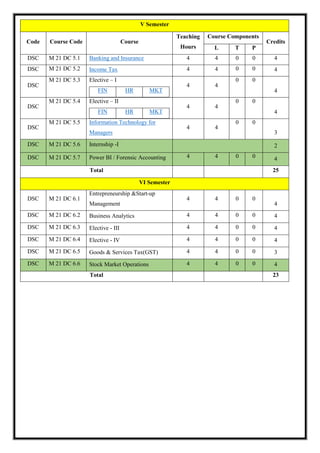
V Semester
Code Course Code Course
Teaching
Hours
Course Components
Credits
L T P
DSC M 21 DC 5.1 Banking and Insurance 4 4 0 0 4
DSC M 21 DC 5.2 Income Tax 4 4 0 0 4
DSC
M 21 DC 5.3 Elective – I
FIN HR MKT
4 4
0 0
4
DSC
M 21 DC 5.4 Elective – II
FIN HR MKT
4 4
0 0
4
DSC
M 21 DC 5.5 Information Technology for
Managers
4 4
0 0
3
DSC M 21 DC 5.6 Internship -I 2
DSC M 21 DC 5.7 Power BI / Forensic Accounting 4 4 0 0 4
Total 25
VI Semester
DSC M 21 DC 6.1
Entrepreneurship &Start-up
Management
4 4 0 0
4
DSC M 21 DC 6.2 Business Analytics 4 4 0 0 4
DSC M 21 DC 6.3 Elective - III 4 4 0 0 4
DSC M 21 DC 6.4 Elective - IV 4 4 0 0 4
DSC M 21 DC 6.5 Goods & Services Tax(GST) 4 4 0 0 3
DSC M 21 DC 6.6 Stock Market Operations 4 4 0 0 4
Total 23
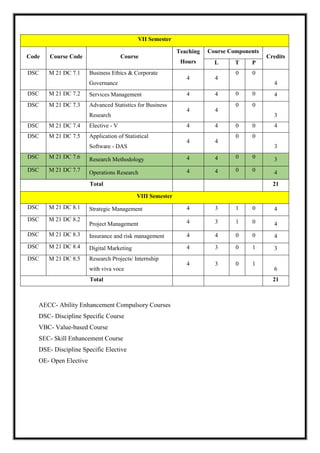
VII Semester
Code Course Code Course
Teaching
Hours
Course Components
Credits
L T P
DSC M 21 DC 7.1 Business Ethics & Corporate
Governance
4 4
0 0
4
DSC M 21 DC 7.2 Services Management 4 4 0 0 4
DSC M 21 DC 7.3 Advanced Statistics for Business
Research
4 4
0 0
3
DSC M 21 DC 7.4 Elective - V 4 4 0 0 4
DSC M 21 DC 7.5 Application of Statistical
Software - DAS
4 4
0 0
3
DSC M 21 DC 7.6 Research Methodology 4 4 0 0 3
DSC M 21 DC 7.7 Operations Research 4 4 0 0 4
Total 21
VIII Semester
DSC M 21 DC 8.1 Strategic Management 4 3 1 0 4
DSC M 21 DC 8.2
Project Management 4 3 1 0 4
DSC M 21 DC 8.3 Insurance and risk management 4 4 0 0 4
DSC M 21 DC 8.4 Digital Marketing 4 3 0 1 3
DSC M 21 DC 8.5 Research Projects/ Internship
with viva voce
4 3 0 1
6
Total 21
AECC- Ability Enhancement Compulsory Courses
DSC- Discipline Specific Course
VBC- Value-based Course
SEC- Skill Enhancement Course
DSE- Discipline Specific Elective
OE- Open Elective
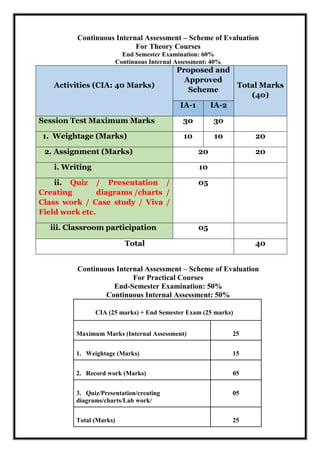
Continuous Internal Assessment – Scheme of Evaluation
For Theory Courses
End Semester Examination: 60%
Continuous Internal Assessment: 40%
Activities (CIA: 40 Marks)
Proposed and
Approved
Scheme
Total Marks
(40)
IA-1 IA-2
Session Test Maximum Marks 30 30
1. Weightage (Marks) 10 10 20
2. Assignment (Marks) 20 20
i. Writing 10
ii. Quiz / Presentation /
Creating diagrams /charts /
Class work / Case study / Viva /
Field work etc.
05
iii. Classroom participation 05
Total 40
Continuous Internal Assessment – Scheme of Evaluation
For Practical Courses
End-Semester Examination: 50%
Continuous Internal Assessment: 50%
CIA (25 marks) + End Semester Exam (25 marks)
Maximum Marks (Internal Assessment) 25
1. Weightage (Marks) 15
2. Record work (Marks) 05
3. Quiz/Presentation/creating
diagrams/charts/Lab work/
05
Total (Marks) 25
M 21 DC 1.1: Management Principles and Practice
Total Teaching Hours: 56 No. of Hours / Week: 04
[04 Credit]
CObj Course Objectives
CObj_1 To provide an understanding of the functions and responsibilities of managers.
CObj_2 To familiarize students with the tools and techniques to be used in the
performance of the managerial job.
CObj_3 To enhance students understanding to develop cognizance of the importance of
management principles.
CO Course Outcomes
CO1 Able to demonstrate their understanding of various concepts, principles, and
functions of business management.
CO2 Able to Demonstrate the roles, skills and functions of management
CO3 The ability to create organization structures based on authority, task and
responsibilities.
CO4 The ability to understand the complexities associated with management of
human resources in the organizations and integrate the learning in handling
these complexities.
CO5 The ability to understand the requirement of good control system and control
techniques
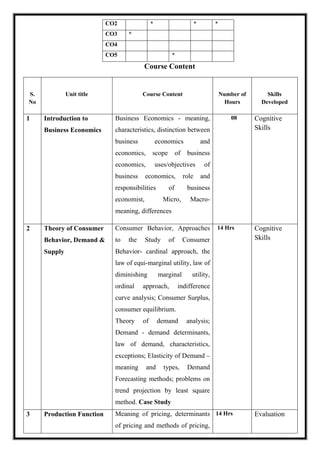
CO-PO Mapping
PO1 PO2 PO3 PO4 PO5
CO1
CO2 * * *
CO3 *
CO4
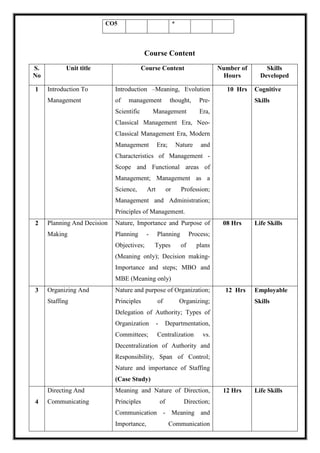
CO5 *
Course Content
S.
No
Unit title Course Content Number of
Hours
Skills
Developed
1 Introduction To
Management
Introduction –Meaning, Evolution
of management thought, Pre-
Scientific Management Era,
Classical Management Era, Neo-
Classical Management Era, Modern
Management Era; Nature and
Characteristics of Management -
Scope and Functional areas of
Management; Management as a
Science, Art or Profession;
Management and Administration;
Principles of Management.
10 Hrs Cognitive
Skills
2 Planning And Decision
Making
Nature, Importance and Purpose of
Planning - Planning Process;
Objectives; Types of plans
(Meaning only); Decision making-
Importance and steps; MBO and
MBE (Meaning only)
08 Hrs Life Skills
3 Organizing And
Staffing
Nature and purpose of Organization;
Principles of Organizing;
Delegation of Authority; Types of
Organization - Departmentation,
Committees; Centralization vs.
Decentralization of Authority and
Responsibility, Span of Control;
Nature and importance of Staffing
(Case Study)
12 Hrs Employable
Skills
4
Directing And
Communicating
Meaning and Nature of Direction,
Principles of Direction;
Communication - Meaning and
Importance, Communication
12 Hrs Life Skills
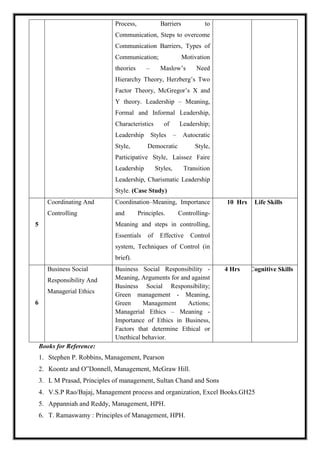
Process, Barriers to
Communication, Steps to overcome
Communication Barriers, Types of
Communication; Motivation
theories – Maslow’s Need
Hierarchy Theory, Herzberg’s Two
Factor Theory, McGregor’s X and
Y theory. Leadership – Meaning,
Formal and Informal Leadership,
Characteristics of Leadership;
Leadership Styles – Autocratic
Style, Democratic Style,
Participative Style, Laissez Faire
Leadership Styles, Transition
Leadership, Charismatic Leadership
Style. (Case Study)
5
Coordinating And
Controlling
Coordination–Meaning, Importance
and Principles. Controlling-
Meaning and steps in controlling,
Essentials of Effective Control
system, Techniques of Control (in
brief).
10 Hrs Life Skills
6
Business Social
Responsibility And
Managerial Ethics
Business Social Responsibility -
Meaning, Arguments for and against
Business Social Responsibility;
Green management - Meaning,
Green Management Actions;
Managerial Ethics – Meaning -
Importance of Ethics in Business,
Factors that determine Ethical or
Unethical behavior.
4 Hrs Cognitive Skills
Books for Reference:
1. Stephen P. Robbins, Management, Pearson
2. Koontz and O‟Donnell, Management, McGraw Hill.
3. L M Prasad, Principles of management, Sultan Chand and Sons
4. V.S.P Rao/Bajaj, Management process and organization, Excel Books.GH25
5. Appanniah and Reddy, Management, HPH.
6. T. Ramaswamy : Principles of Management, HPH.
M 21 DC 1.2: Fundamentals of Business Accounting
Total Teaching Hours: 56 No. of Hours / Week: 04
[04 Credit]
CObj Course Objectives
CObj_1 To acquaint students with the accounting concepts, tools and techniques
influencing business organizations.
CObj_2 To make the students understand the basic accounting concepts and conventions
CObj_3 To enable them to work with ratio analysis and bank reconciliation statement
CO Course Outcomes
CO1 Acquire the knowledge in accounting, system of maintenance of accounts, journal,
ledger, bill of exchange, and account current, average due date and bank reconciliation
statement. The Ability to pass journal entries and prepare ledger accounts.
CO2 Familiarized and understand the basic accounting concepts and conventions, preparation
of subsidiary books and final accounts, account of Consignment, Joint venture and non-
trading concerns.
CO3 Develop the analytical skills in accounting equation, preparation of trial balance and
suspense account, normal loss in consignment. Analysing the reasons for differences
between pass book and cash book transactions in the Bank Reconciliation Statement.
CO4 Acquire the ability to prepare the vertical and Horizontal Analysis and Ratio Analysis
CO5 Students will able to analyze and interpret published financial information.
CO-PO Mapping
PO1 PO2 PO3 PO4 PO5
CO1 *
CO2 *
CO3 *
CO4 *
CO5 *
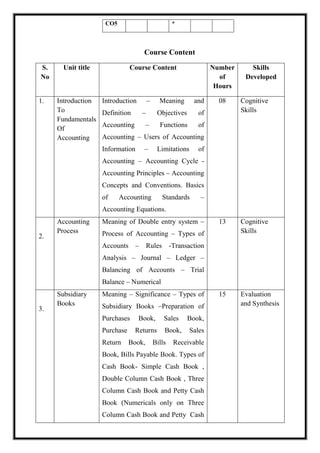
Course Content
S.
No
Unit title Course Content Number
of
Hours
Skills
Developed
1. Introduction
To
Fundamentals
Of
Accounting
Introduction – Meaning and
Definition – Objectives of
Accounting – Functions of
Accounting – Users of Accounting
Information – Limitations of
Accounting – Accounting Cycle -
Accounting Principles – Accounting
Concepts and Conventions. Basics
of Accounting Standards –
Accounting Equations.
08 Cognitive
Skills
2.
Accounting
Process
Meaning of Double entry system –
Process of Accounting – Types of
Accounts – Rules -Transaction
Analysis – Journal – Ledger –
Balancing of Accounts – Trial
Balance – Numerical
13 Cognitive
Skills
3.
Subsidiary
Books
Meaning – Significance – Types of
Subsidiary Books –Preparation of
Purchases Book, Sales Book,
Purchase Returns Book, Sales
Return Book, Bills Receivable
Book, Bills Payable Book. Types of
Cash Book- Simple Cash Book ,
Double Column Cash Book , Three
Column Cash Book and Petty Cash
Book (Numericals only on Three
Column Cash Book and Petty Cash
15 Evaluation
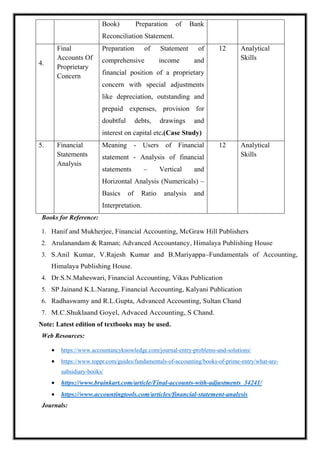
and Synthesis
Book) Preparation of Bank
Reconciliation Statement.
4.
Final
Accounts Of
Proprietary
Concern
Preparation of Statement of
comprehensive income and
financial position of a proprietary
concern with special adjustments
like depreciation, outstanding and
prepaid expenses, provision for
doubtful debts, drawings and
interest on capital etc.(Case Study)
12 Analytical
Skills
5. Financial
Statements
Analysis
Meaning - Users of Financial
statement - Analysis of financial
statements – Vertical and
Horizontal Analysis (Numericals) –
Basics of Ratio analysis and
Interpretation.
12 Analytical
Skills
Books for Reference:
1. Hanif and Mukherjee, Financial Accounting, McGraw Hill Publishers
2. Arulanandam & Raman; Advanced Accountancy, Himalaya Publishing House
3. S.Anil Kumar, V.Rajesh Kumar and B.Mariyappa–Fundamentals of Accounting,
Himalaya Publishing House.
4. Dr.S.N.Maheswari, Financial Accounting, Vikas Publication
5. SP Jainand K.L.Narang, Financial Accounting, Kalyani Publication
6. Radhaswamy and R.L.Gupta, Advanced Accounting, Sultan Chand
7. M.C.Shuklaand Goyel, Advaced Accounting, S Chand.
Note: Latest edition of textbooks may be used.
Web Resources:
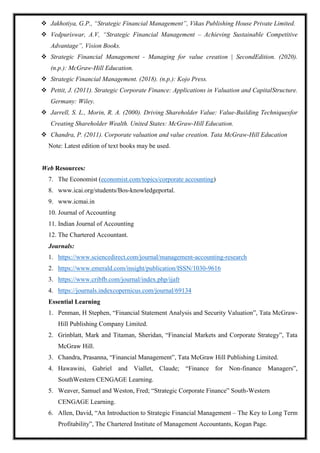
 https://www.accountancyknowledge.com/journal-entry-problems-and-solutions/
 https://www.toppr.com/guides/fundamentals-of-accounting/books-of-prime-entry/what-are-
subsidiary-books/
 https://www.brainkart.com/article/Final-accounts-with-adjustments_34241/
 https://www.accountingtools.com/articles/financial-statement-analysis
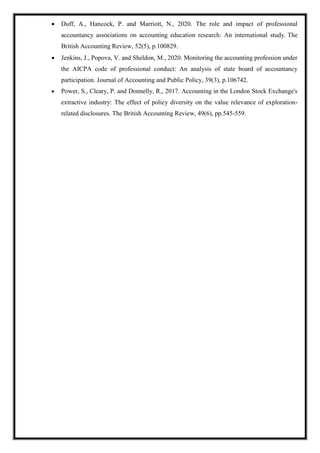
Journals:
 Duff, A., Hancock, P. and Marriott, N., 2020. The role and impact of professional
accountancy associations on accounting education research: An international study. The
British Accounting Review, 52(5), p.100829.
 Jenkins, J., Popova, V. and Sheldon, M., 2020. Monitoring the accounting profession under
the AICPA code of professional conduct: An analysis of state board of accountancy
participation. Journal of Accounting and Public Policy, 39(3), p.106742.
 Power, S., Cleary, P. and Donnelly, R., 2017. Accounting in the London Stock Exchange's
extractive industry: The effect of policy diversity on the value relevance of exploration-
related disclosures. The British Accounting Review, 49(6), pp.545-559.
M 21 DC 1.3: Business Economics
Total Teaching Hours: 56 No. of Hours / Week: 04
[04 Credit]
CObj Course Objectives
CObj_1 To impart the fundamentals of economics with an objective to develop
the application based knowledge
CObj_2 To apply micro economics concepts techniques in evaluating the
business decisions taken by the firms
CObj_3 To develop basic knowledge on production cost and revenue.
CO Course Outcomes
CO1 Students are able to understand fundamental concepts in Economics and
relate it to business
CO2 Able to analyze Consumer Behavior and understand how he behaves at
different levels of satisfaction and to know indifferent behavior of the
consumer.
TheAbilitytopreparetrialbalanceandfinalaccountsofproprietaryconcern.
CO3 Able to analyze Law of demand, concepts and determinants of demand
Computation of demand forecasting
CO4 Analyze the decisions made by the firm using different production
techniques with element of time involved it.
CO5 Able to understand macroeconomic concepts like NI, Business Cycle,
Fiscal and Monetary Policy
CO-PO Mapping
PO1 PO2 PO3 PO4 PO5
CO1
CO2 * * *
CO3 *
CO4
CO5 *
Course Content
S.
No
Unit title Course Content Number of
Hours
Skills
Developed
1 Introduction to
Business Economics
Business Economics - meaning,
characteristics, distinction between
business economics and
economics, scope of business
economics, uses/objectives of
business economics, role and
responsibilities of business
economist, Micro, Macro-
meaning, differences
08 Cognitive
Skills
2 Theory of Consumer
Behavior, Demand &
Supply
Consumer Behavior, Approaches
to the Study of Consumer
Behavior- cardinal approach, the
law of equi-marginal utility, law of
diminishing marginal utility,
ordinal approach, indifference
curve analysis; Consumer Surplus,
consumer equilibrium.
Theory of demand analysis;
Demand - demand determinants,
law of demand, characteristics,
exceptions; Elasticity of Demand –
meaning and types, Demand
Forecasting methods; problems on
trend projection by least square
method. Case Study
14 Hrs Cognitive
Skills
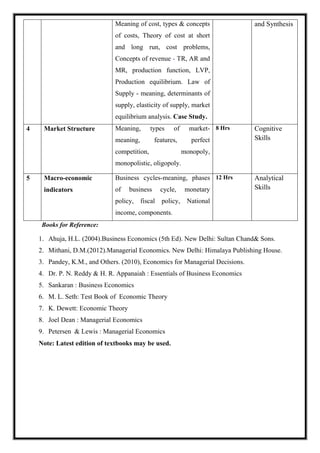
3 Production Function Meaning of pricing, determinants
of pricing and methods of pricing,
14 Hrs Evaluation
Meaning of cost, types & concepts
of costs, Theory of cost at short
and long run, cost problems,
Concepts of revenue - TR, AR and
MR, production function, LVP,
Production equilibrium. Law of
Supply - meaning, determinants of
supply, elasticity of supply, market
equilibrium analysis. Case Study.
and Synthesis
4 Market Structure Meaning, types of market-
meaning, features, perfect
competition, monopoly,
monopolistic, oligopoly.
8 Hrs Cognitive
Skills
5 Macro-economic
indicators
Business cycles-meaning, phases
of business cycle, monetary
policy, fiscal policy, National
income, components.
12 Hrs Analytical
Skills
Books for Reference:
1. Ahuja, H.L. (2004).Business Economics (5th Ed). New Delhi: Sultan Chand& Sons.
2. Mithani, D.M.(2012).Managerial Economics. New Delhi: Himalaya Publishing House.
3. Pandey, K.M., and Others. (2010), Economics for Managerial Decisions.
4. Dr. P. N. Reddy & H. R. Appanaiah : Essentials of Business Economics
5. Sankaran : Business Economics
6. M. L. Seth: Test Book of Economic Theory
7. K. Dewett: Economic Theory
8. Joel Dean : Managerial Economics
9. Petersen & Lewis : Managerial Economics
Note: Latest edition of textbooks may be used.
M21 OE 1.1: Business Organisation
Total Teaching Hours: 45 No. of Hours / Week: 03
[03 Credit]
CObj Course Objectives
CObj_1 To impart the fundamentals of Business Organisation with an
objective to develop the basic knowledge of operations and functions
of organization
CObj_2 To enable the use of basic concepts of management in business
organization
CObj_3 To have a proper understanding of social responsibility towards
business and principles of management
CO Course Outcomes
CO1 An understanding of the nature, objectives and social responsibilities
of business
CO2 An ability to describe the different forms of organizations
CO3 An understanding of the basic concepts of management
CO4 An understanding of functions of management.
CO5 An understanding of different types of business combinations
CO-PO Mapping
PO1 PO2 PO3 PO4 PO5
CO1
CO2 * * *
CO3 *
CO4
CO5 *
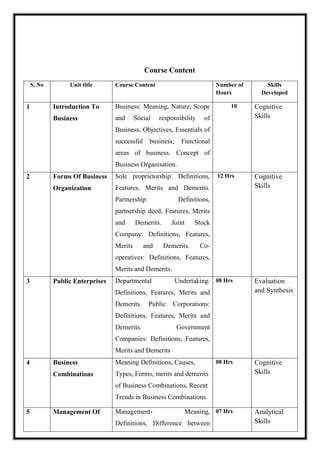
Course Content
S. No Unit title Course Content Number of
Hours
Skills
Developed
1 Introduction To
Business
Business: Meaning, Nature, Scope
and Social responsibility of
Business, Objectives, Essentials of
successful business; Functional
areas of business. Concept of
Business Organisation.
10 Cognitive
Skills
2 Forms Of Business
Organization
Sole proprietorship: Definitions,
Features, Merits and Demerits.
Partnership: Definitions,
partnership deed, Features, Merits
and Demerits. Joint Stock
Company: Definitions, Features,
Merits and Demerits. Co-
operatives: Definitions, Features,
Merits and Demerits.
12 Hrs Cognitive
Skills
3 Public Enterprises Departmental Undertaking:
Definitions, Features, Merits and
Demerits. Public Corporations:
Definitions, Features, Merits and
Demerits. Government
Companies: Definitions, Features,
Merits and Demerits
08 Hrs Evaluation
and Synthesis
4 Business
Combinations
Meaning Definitions, Causes,
Types, Forms, merits and demerits
of Business Combinations, Recent
Trends in Business Combinations.
08 Hrs Cognitive
Skills
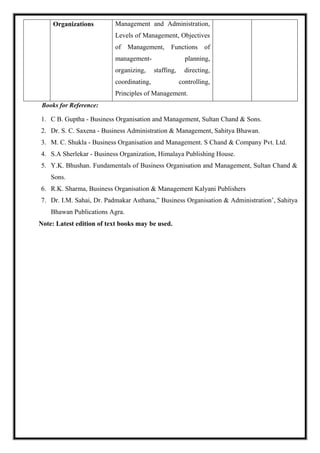
5 Management Of Management- Meaning,
Definitions, Difference between
07 Hrs Analytical
Skills
Organizations Management and Administration,
Levels of Management, Objectives
of Management, Functions of
management- planning,
organizing, staffing, directing,
coordinating, controlling,
Principles of Management.
Books for Reference:
1. C B. Guptha - Business Organisation and Management, Sultan Chand & Sons.
2. Dr. S. C. Saxena - Business Administration & Management, Sahitya Bhawan.
3. M. C. Shukla - Business Organisation and Management. S Chand & Company Pvt. Ltd.
4. S.A Sherlekar - Business Organization, Himalaya Publishing House.
5. Y.K. Bhushan. Fundamentals of Business Organisation and Management, Sultan Chand &
Sons.
6. R.K. Sharma, Business Organisation & Management Kalyani Publishers
7. Dr. I.M. Sahai, Dr. Padmakar Asthana,‟ Business Organisation & Administration’, Sahitya
Bhawan Publications Agra.
Note: Latest edition of text books may be used.
M21 DC 2.1: Functions of Management
Total Teaching Hours: 56 No. of Hours / Week: 04
[04 Credit]
CObj Course Objectives
CObj_1 To provide an idea on various types of management.
CObj_2 To improve the overall employability skills of students.
CObj_3 To provide an understanding to students in choosing their specialization
course of their interest.
CO Course Outcomes
CO1 Improved knowledge on various types of management.
CO2 Strong basics of all the different types of management.
CO3 Ease in choosing their specialization course of their interest.
CO4 Improved management skills and employability skills.
CO5 Improved skills in marketing, human resource, finance, events and
service management.
CO-PO Mapping
PO1 PO2 PO3 PO4 PO5
CO1 *
CO2 *
CO3 *
CO4 *
CO5 *
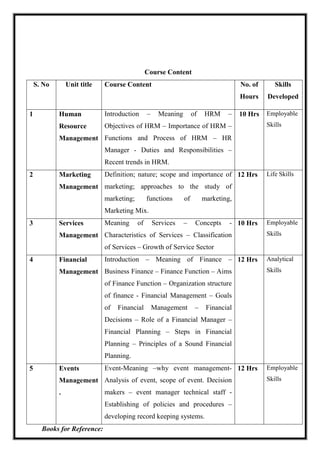
Course Content
S. No Unit title Course Content No. of
Hours
Skills
Developed
1 Human
Resource
Management
Introduction – Meaning of HRM –
Objectives of HRM – Importance of HRM –
Functions and Process of HRM – HR
Manager - Duties and Responsibilities –
Recent trends in HRM.
10 Hrs Employable
Skills
2 Marketing
Management
Definition; nature; scope and importance of
marketing; approaches to the study of
marketing; functions of marketing,
Marketing Mix.
12 Hrs Life Skills
3 Services
Management
Meaning of Services – Concepts -
Characteristics of Services – Classification
of Services – Growth of Service Sector
10 Hrs Employable
Skills
4 Financial
Management
Introduction – Meaning of Finance –
Business Finance – Finance Function – Aims
of Finance Function – Organization structure
of finance - Financial Management – Goals
of Financial Management – Financial
Decisions – Role of a Financial Manager –
Financial Planning – Steps in Financial
Planning – Principles of a Sound Financial
Planning.
12 Hrs Analytical
Skills
5 Events
Management
.
Event-Meaning –why event management-
Analysis of event, scope of event. Decision
makers – event manager technical staff -
Establishing of policies and procedures –
developing record keeping systems.
12 Hrs Employable
Skills
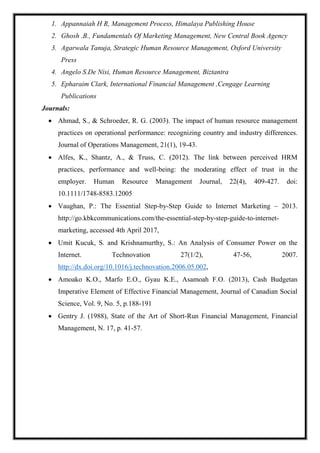
Books for Reference:
1. Appannaiah H R, Management Process, Himalaya Publishing House
2. Ghosh .B., Fundamentals Of Marketing Management, New Central Book Agency
3. Agarwala Tanuja, Strategic Human Resource Management, Oxford University
Press
4. Angelo S.De Nisi, Human Resource Management, Biztantra
5. Epharaim Clark, International Financial Management ,Cengage Learning
Publications
Journals:
 Ahmad, S., & Schroeder, R. G. (2003). The impact of human resource management
practices on operational performance: recognizing country and industry differences.
Journal of Operations Management, 21(1), 19-43.
 Alfes, K., Shantz, A., & Truss, C. (2012). The link between perceived HRM
practices, performance and well-being: the moderating effect of trust in the
employer. Human Resource Management Journal, 22(4), 409-427. doi:
10.1111/1748-8583.12005
 Vaughan, P.: The Essential Step-by-Step Guide to Internet Marketing – 2013.
http://go.kbkcommunications.com/the-essential-step-by-step-guide-to-internet-
marketing, accessed 4th April 2017,
 Umit Kucuk, S. and Krishnamurthy, S.: An Analysis of Consumer Power on the
Internet. Technovation 27(1/2), 47-56, 2007.
http://dx.doi.org/10.1016/j.technovation.2006.05.002,
 Amoako K.O., Marfo E.O., Gyau K.E., Asamoah F.O. (2013), Cash Budgetan
Imperative Element of Effective Financial Management, Journal of Canadian Social
Science, Vol. 9, No. 5, p.188-191
 Gentry J. (1988), State of the Art of Short-Run Financial Management, Financial
Management, N. 17, p. 41-57.
M21 DC 2.2: Cost Accounting
Total Teaching Hours: 56 No. of Hours / Week: 04
[04 credit]
CObj Course Objectives
CObj_1 The objective of this subject is to familiarize students with the various
Concepts and element of cost.
CObj_2 To enable students to reconcile results as per Cost and Financial Accounts
CObj_3 To enable students to discuss the concepts related to Process Costing and
enable them to make Process Accounts and Statements of joint products and
by-products.
CO Course Outcomes
CO1 Understand the concepts of preparation of cost sheet.
CO2 The various techniques used to find the pricing of materials.
CO3 The Ability to analyze the wage rates.
CO4 The Ability to prepare the machine hour rate and allocation of
overhead distribution.
CO5 Preparation of Reconciling the cost and financial accounts.
CO-PO Mapping
PO1 PO2 PO3 PO4 PO5
CO1 *
CO2 *
CO3 *
CO4 *
CO5 *
Course Content
S. No Unit title Course Content No. of
Hours
Skills
Developed
1 Introduction
To Cost
Accounting
Introduction – Meaning & amp; Definition
of Cost, Costing, Cost Accounting and
Comparison between Financial Accounting
and Cost Accounting – Cost Concepts -
Classification of Costs – Cost Unit –Cost
Center – Elements of Cost – Preparation of
Cost Sheet – Tenders and Quotations.
10 Hrs
2 Material
Cost Control
Meaning – Types – Direct Material –
Indirect Material - Material Control –
Purchasing Procedure – Store Keeping –
Techniques of Inventory Control – Setting
of Stock Levels –EOQ [Numerical] –
Methods of Pricing Material Issues – FIFO
– LIFO – Weighted Average Price Method
and Simple Average Price Method. ABC
Analysis – VED Analysis – Just In-Time –
Perpetual Inventory System – Documents
used in Material Accounting [Theory only]
14Hrs
3 Labour Cost
Control
Meaning – Types – Direct Labour –
Indirect Labour – Timekeeping – Time
booking – Idle Time – Overtime – Labour
Turn Over. Methods of Labour
Remuneration - Time Rate System – Piece
Rate System – Incentive Systems – Halsey
plan – Rowan Plan – Taylors differential
Piece Rate System and Merricks
10 HRS
Differential Piece Rate System [Numerical]
4 Overhead
Cost Control
Meaning and Definition – Classification of
Overheads – Procedure for Accounting and
Control of Overheads – Allocation of
Overheads – Apportionment of Overheads
– Primary Overhead Distribution Summary
– Secondary Overhead Distribution
Summary – Repeated Distribution Method
and Simultaneous Equations Method –
Absorption of Factory Overheads –
Methods of Absorption – Machine Hour
Rate [Numerical]
14Hrs
5 Reconciliation
of Cost and
Financial
Accounts
Need for Reconciliation – Reasons for
differences in Profit or Loss shown by Cost
Accounts and Profit or Loss shown by
Financial Accounts – Preparation of
Reconciliation Statement and
Memorandum Reconciliation Account.
08Hrs
Books for Reference:
1. N.K. Prasad: Cost Accounting
2. Nigam & Sharma: Cost Accounting
3. Khanna Pandey & Ahuja – Practical Costing
4. M.L. Agarwal: Cost Accounting
5. Jain &Narang: Cost Accounting
6. Palaniappan and Hariharan : Cost Accounting I.K. International Publishers
7. S.P. Iyengar: Cost Accounting
8. S.N. Maheshwari: Cost Accounting
9. M. N. Arora: Cost Accounting
10. Dutta: Cost Accounting
11. P. K Sinha – Accounting & Costing for Managers
Note: Latest edition of textbooks may be used.
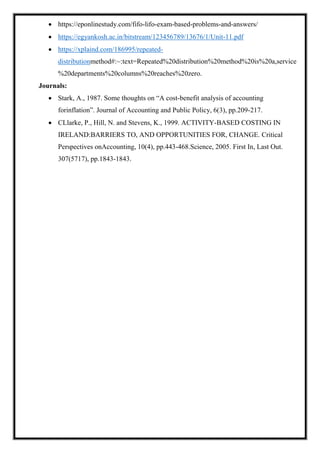
Web Resources:
 https://www.dynamictutorialsandservices.org/2019/04/cost-sheet-solved-practical-
problems-2_68.html
 https://eponlinestudy.com/fifo-lifo-exam-based-problems-and-answers/
 https://egyankosh.ac.in/bitstream/123456789/13676/1/Unit-11.pdf
 https://xplaind.com/186995/repeated-
distributionmethod#:~:text=Repeated%20distribution%20method%20is%20a,service
%20departments%20columns%20reaches%20zero.
Journals:
 Stark, A., 1987. Some thoughts on “A cost-benefit analysis of accounting
forinflation”. Journal of Accounting and Public Policy, 6(3), pp.209-217.
 CLlarke, P., Hill, N. and Stevens, K., 1999. ACTIVITY-BASED COSTING IN
IRELAND:BARRIERS TO, AND OPPORTUNITIES FOR, CHANGE. Critical
Perspectives onAccounting, 10(4), pp.443-468.Science, 2005. First In, Last Out.
307(5717), pp.1843-1843.
M21 DC 2.3: Business Mathematics
Total Teaching Hours: 56 No. of Hours / Week: 04
[04 credit]
CObj Course Objectives
CObj_1 To provide basic knowledge of mathematics and their application to
Commercial situations.
CObj_2 To make students equipped with the concepts of interest, rate of interest,
annuity and installments
CObj_3 To make students familiar with the concepts of ratio, proportion, variation
and percentage.
CO Course Outcomes
CO1 The Understanding of the basic concepts of business maths and apply them to
create solve and interpret application problems in business
CO2 Ability to solve problems on various types of equation.
CO3 Ability to solve problems on Matrices and execute the laws of indices, law of
logarithm and evaluate them.
CO4 Ability to apply the concept of simple interest and compound interest bills
discounted etc and applies them in day-to-day life.
CO5 Ability to solve problems on Arithmetic progression, Geometric progression
and construct logical application of these concepts.
CO-PO Mapping
PO1 PO2 PO3 PO4 PO5
CO1 *
CO2 *
CO3 *
CO4 *
CO5 *
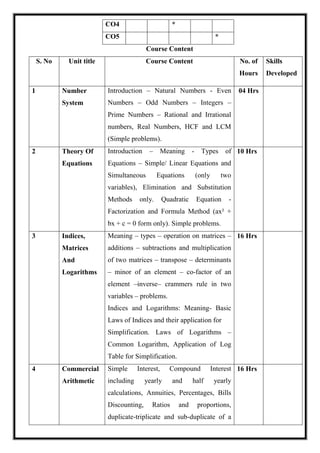
Course Content
S. No Unit title Course Content No. of
Hours
Skills
Developed
1 Number
System
Introduction – Natural Numbers - Even
Numbers – Odd Numbers – Integers –
Prime Numbers – Rational and Irrational
numbers, Real Numbers, HCF and LCM
(Simple problems).
04 Hrs
2 Theory Of
Equations
Introduction – Meaning - Types of
Equations – Simple/ Linear Equations and
Simultaneous Equations (only two
variables), Elimination and Substitution
Methods only. Quadratic Equation -
Factorization and Formula Method (ax² +
bx + c = 0 form only). Simple problems.
10 Hrs
3 Indices,
Matrices
And
Logarithms
Meaning – types – operation on matrices –
additions – subtractions and multiplication
of two matrices – transpose – determinants
– minor of an element – co-factor of an
element –inverse– crammers rule in two
variables – problems.
Indices and Logarithms: Meaning- Basic
Laws of Indices and their application for
Simplification. Laws of Logarithms –
Common Logarithm, Application of Log
Table for Simplification.
16 Hrs
4 Commercial
Arithmetic
Simple Interest, Compound Interest
including yearly and half yearly
calculations, Annuities, Percentages, Bills
Discounting, Ratios and proportions,
duplicate-triplicate and sub-duplicate of a
16 Hrs
ratio. Proportions: third, fourth and inverse
proportion - problems.
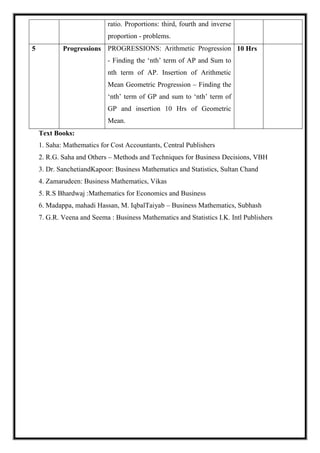
5 Progressions PROGRESSIONS: Arithmetic Progression
- Finding the ‘nth’ term of AP and Sum to
nth term of AP. Insertion of Arithmetic
Mean Geometric Progression – Finding the
‘nth’ term of GP and sum to ‘nth’ term of
GP and insertion 10 Hrs of Geometric
Mean.
10 Hrs
Text Books:
1. Saha: Mathematics for Cost Accountants, Central Publishers
2. R.G. Saha and Others – Methods and Techniques for Business Decisions, VBH
3. Dr. SanchetiandKapoor: Business Mathematics and Statistics, Sultan Chand
4. Zamarudeen: Business Mathematics, Vikas
5. R.S Bhardwaj :Mathematics for Economics and Business
6. Madappa, mahadi Hassan, M. IqbalTaiyab – Business Mathematics, Subhash
7. G.R. Veena and Seema : Business Mathematics and Statistics I.K. Intl Publishers
M 21 DC 3.1: Organizational Behavior
Total Teaching Hours: 56 No. of Hours / Week: 04
[04 credit]
CObj Course Objectives
CObj_1 To enable the students to understand the organisational behaviour and
organizational change and dynamics of group.
CObj_2 To enable the students to understand the importance of attitude and personality
CObj_3 To enable the students to understand the principles of learning.
CO Course Outcomes
CO1 Students will be able to identify behavioural issues in an Organization
CO2 Demonstrate the applicability of the concept of Perception, attitudes and personality to
understand the behaviour of people in the organization.
CO3 Able to analyze different types of learning followed by each individual.
CO4 Students will be able to understand different types of groups in an organization and how
it influences the behaviour of the individuals.
CO5 To understand the resistance for change, its causes and how to overcome.
CO-PO Mapping
PO1 PO2 PO3 PO4 PO5
CO1 *
CO2 *
CO3 * *
CO4 *
CO5 *
Course Content
S.
No
Unit title Course Content Number
of
Hours
Skills
Developed
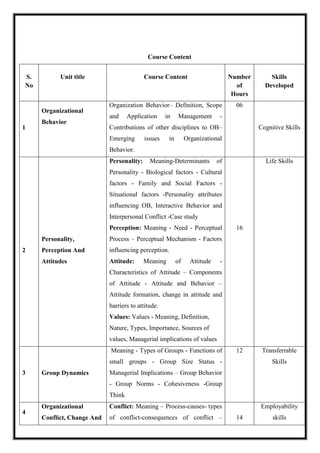
1
Organizational
Behavior
Organization Behavior– Definition, Scope
and Application in Management -
Contributions of other disciplines to OB–
Emerging issues in Organizational
Behavior.
06
Cognitive Skills
2
Personality,
Perception And
Attitudes
Personality: Meaning-Determinants of
Personality - Biological factors - Cultural
factors - Family and Social Factors -
Situational factors -Personality attributes
influencing OB, Interactive Behavior and
Interpersonal Conflict -Case study
Perception: Meaning - Need - Perceptual
Process – Perceptual Mechanism - Factors
influencing perception.
Attitude: Meaning of Attitude -
Characteristics of Attitude – Components
of Attitude - Attitude and Behavior –
Attitude formation, change in attitude and
barriers to attitude.
Values: Values - Meaning, Definition,
Nature, Types, Importance, Sources of
values, Managerial implications of values
16
Life Skills
3 Group Dynamics
Meaning - Types of Groups - Functions of
small groups - Group Size Status -
Managerial Implications – Group Behavior
- Group Norms - Cohesiveness -Group
Think
12 Transferrable
Skills
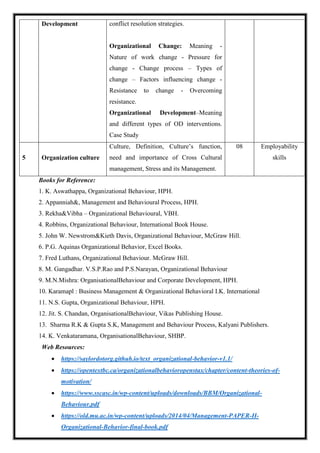
4
Organizational
Conflict, Change And
Conflict: Meaning – Process-causes- types
of conflict-consequences of conflict – 14
Employability
skills
Development conflict resolution strategies.
Organizational Change: Meaning -
Nature of work change - Pressure for
change - Change process – Types of
change – Factors influencing change -
Resistance to change - Overcoming
resistance.
Organizational Development–Meaning
and different types of OD interventions.
Case Study
5 Organization culture
Culture, Definition, Culture’s function,
need and importance of Cross Cultural
management, Stress and its Management.
08 Employability
skills
Books for Reference:
1. K. Aswathappa, Organizational Behaviour, HPH.
2. Appanniah&, Management and Behavioural Process, HPH.
3. Rekha&Vibha – Organizational Behavioural, VBH.
4. Robbins, Organizational Behaviour, International Book House.
5. John W. Newstrom&Kieth Davis, Organizational Behaviour, McGraw Hill.
6. P.G. Aquinas Organizational Behavior, Excel Books.
7. Fred Luthans, Organizational Behaviour. McGraw Hill.
8. M. Gangadhar. V.S.P.Rao and P.S.Narayan, Organizational Behaviour
9. M.N.Mishra: OrganisationalBehaviour and Corporate Development, HPH.
10. Karamapl : Business Management & Organizational Behavioral I.K. International
11. N.S. Gupta, Organizational Behaviour, HPH.
12. Jit. S. Chandan, OrganisationalBehaviour, Vikas Publishing House.
13. Sharma R.K & Gupta S.K, Management and Behaviour Process, Kalyani Publishers.
14. K. Venkataramana, OrganisationalBehaviour, SHBP.
Web Resources:
 https://saylordotorg.github.io/text_organizational-behavior-v1.1/
 https://opentextbc.ca/organizationalbehavioropenstax/chapter/content-theories-of-
motivation/
 https://www.sscasc.in/wp-content/uploads/downloads/BBM/Organizational-
Behaviour.pdf
 https://old.mu.ac.in/wp-content/uploads/2014/04/Management-PAPER-II-
Organizational-Behavior-final-book.pdf
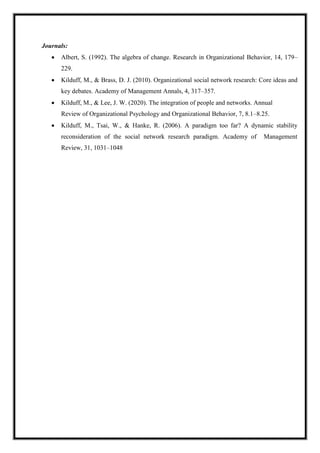
Journals:
 Albert, S. (1992). The algebra of change. Research in Organizational Behavior, 14, 179–
229.
 Kilduff, M., & Brass, D. J. (2010). Organizational social network research: Core ideas and
key debates. Academy of Management Annals, 4, 317–357.
 Kilduff, M., & Lee, J. W. (2020). The integration of people and networks. Annual
Review of Organizational Psychology and Organizational Behavior, 7, 8.1–8.25.
 Kilduff, M., Tsai, W., & Hanke, R. (2006). A paradigm too far? A dynamic stability
reconsideration of the social network research paradigm. Academy of Management
Review, 31, 1031–1048
M 21 DC 3.2: Statistics for Business
Total Teaching Hours: 60 Hours No. of Hours / Week:04 [04 credit]
CObj Course Objectives
CObj_1 To develop the students ability to deal with numerical and quantitative issues in
business
CObj_2 To enable the use of statistical, graphical and algebraic techniques wherever
relevant.
CObj_3 To have a proper understanding of Statistical applications in Economics and
Management.
CO Course Outcomes
CO1 Students acquire the conceptual skill and working knowledge of tabulation of data
and different types of samples
CO2 The method of solving problems on central tendency, measures of dispersion,
skewness and kurtosis.
CO3 Develop the knowledge of correlation and Regression analysis and interpretation of
results.
CO4 Acquire the basic concepts of probability and to use them to pose, solve and interpret
application problems in business.
CO5 Acquire the ability to use the statistical tools to perform analysis of data through
descriptive methods
CO-PO Mapping
PO1 PO2 PO3 PO4 PO5
CO1 *
CO2 *
CO3 * *
CO4 *
CO5 *
Course Content
S. No Unit title Course Content Number
of
Hours
Skills Developed
1
Introduction
to Statistics
Background and Basic concepts: introduction,
definition of statistics- Functions- scope-
limitations, classifications and Tabulations of
Data.
08 Analytical Skills
2.
Descriptive
Statistics
Average-Mean, Median and Mode [individual,
discrete and continuous series], Weighted
Average Measures of Dispersion, Range, Co-
efficient of Range, Quartiles, Inter-Quartile
Range and Quartile Deviation, Coefficient of
Quartile Deviation, Standard Deviation,
Coefficient of Variation, Skewness and
Kurtosis; Measures of Skewness: Absolute and
Relative; Co-efficient of Skewness: Karl
Pearson’s and Bowley’s.
20
Evaluation and
Synthesis
3
Inferential
Statistics
Introduction to Correlation, Co-efficient of
Correlation, Correlation through Scatter
diagrams, Interpretation of Correlation Co-
efficient. Regression-Spearmen’s Rank
Correlation- Karl Pearson Co-efficient of
Correlation- Co-efficient of determination.
10 Analytical Skills
4 Probability
Sample space and Events, Simple and
Compound Events, Probability and Probability
distributions: Normal Distribution, Binomial
and Poisson distribution- Bayes Theorem
12 Cognitive Skills
5
Index
Number
Meaning and Definition- Uses Classification
Construction of Index Numbers Methods of
constructing Index Numbers Simple Aggregate
Method Simple Average of Price Relative
Method Weighted Index numbers, Fishers
10 Evaluation and
Synthesis
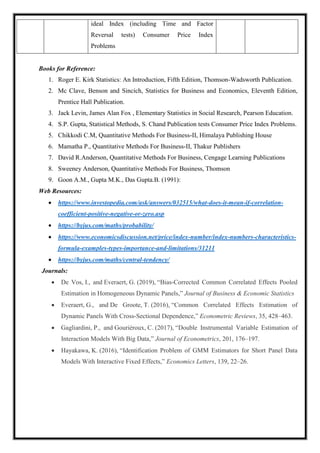
ideal Index (including Time and Factor
Reversal tests) Consumer Price Index
Problems
Books for Reference:
1. Roger E. Kirk Statistics: An Introduction, Fifth Edition, Thomson-Wadsworth Publication.
2. Mc Clave, Benson and Sincich, Statistics for Business and Economics, Eleventh Edition,
Prentice Hall Publication.
3. Jack Levin, James Alan Fox , Elementary Statistics in Social Research, Pearson Education.
4. S.P. Gupta, Statistical Methods, S. Chand Publication tests Consumer Price Index Problems.
5. Chikkodi C.M, Quantitative Methods For Business-II, Himalaya Publishing House
6. Mamatha P., Quantitative Methods For Business-II, Thakur Publishers
7. David R.Anderson, Quantitative Methods For Business, Cengage Learning Publications
8. Sweeney Anderson, Quantitative Methods For Business, Thomson
9. Goon A.M., Gupta M.K., Das Gupta.B. (1991):
Web Resources:
 https://www.investopedia.com/ask/answers/032515/what-does-it-mean-if-correlation-
coefficient-positive-negative-or-zero.asp
 https://byjus.com/maths/probability/
 https://www.economicsdiscussion.net/price/index-number/index-numbers-characteristics-
formula-examples-types-importance-and-limitations/31211
 https://byjus.com/maths/central-tendency/
Journals:
 De Vos, I., and Everaert, G. (2019), “Bias-Corrected Common Correlated Effects Pooled
Estimation in Homogeneous Dynamic Panels,” Journal of Business & Economic Statistics
 Everaert, G., and De Groote, T. (2016), “Common Correlated Effects Estimation of
Dynamic Panels With Cross-Sectional Dependence,” Econometric Reviews, 35, 428–463.
 Gagliardini, P., and Gouriéroux, C. (2017), “Double Instrumental Variable Estimation of
Interaction Models With Big Data,” Journal of Econometrics, 201, 176–197.
 Hayakawa, K. (2016), “Identification Problem of GMM Estimators for Short Panel Data
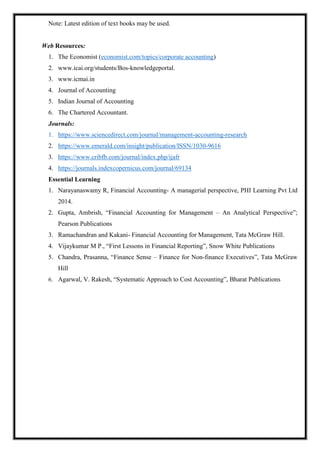
Models With Interactive Fixed Effects,” Economics Letters, 139, 22–26.
M 21 DC 3.3: Financial Management
Total Teaching Hours: 60 Hours No. of Hours / Week: 04 [04 credit]
CObj Course Objectives
CObj_1 To offer the students relevant, systematic, efficient and actual knowledge of
financial management
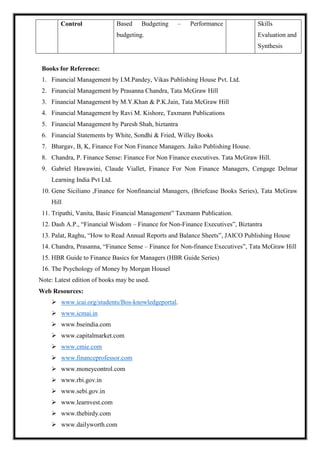
CObj_2 Develop knowledge on the allocation, management and funding of financial
resources.
CObj_3 Improving students’ understanding of the time value of money concept and the
role of a financial manager in the current competitive business scenario.
CO Course Outcomes
CO1 To familiarize students with the concept of fundamental financial concepts, especially
time value of money.
CO2 To create an awareness about capital structure
CO3 To make them understand the cost of capital in wide aspects
CO4 To provide knowledge about dividend policies
CO5 To enable them to understand working capital management
CO-PO Mapping
PO1 PO2 PO3 PO4 PO5
CO1 *
CO2 *
CO3 *
CO4 *
CO5 *
Course Content
S. No Unit title Course Content Number
of
Hours
Skills
Developed
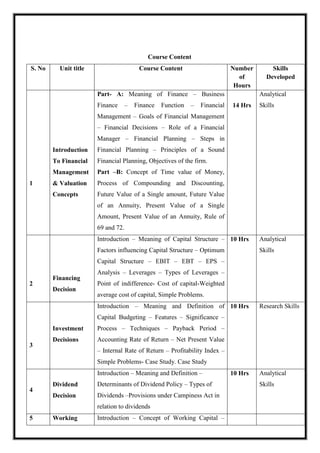
1
Introduction
To Financial
Management
& Valuation
Concepts
Part- A: Meaning of Finance – Business
Finance – Finance Function – Financial
Management – Goals of Financial Management
– Financial Decisions – Role of a Financial
Manager – Financial Planning – Steps in
Financial Planning – Principles of a Sound
Financial Planning, Objectives of the firm.
Part –B: Concept of Time value of Money,
Process of Compounding and Discounting,
Future Value of a Single amount, Future Value
of an Annuity, Present Value of a Single
Amount, Present Value of an Annuity, Rule of
69 and 72.
14 Hrs
Analytical
Skills
2
Financing
Decision
Introduction – Meaning of Capital Structure –
Factors influencing Capital Structure – Optimum
Capital Structure – EBIT – EBT – EPS –
Analysis – Leverages – Types of Leverages –
Point of indifference- Cost of capital-Weighted
average cost of capital, Simple Problems.
10 Hrs Analytical
Skills
3
Investment
Decisions
Introduction – Meaning and Definition of
Capital Budgeting – Features – Significance –
Process – Techniques – Payback Period –
Accounting Rate of Return – Net Present Value
– Internal Rate of Return – Profitability Index –
Simple Problems- Case Study. Case Study
10 Hrs Research Skills
4
Dividend
Decision
Introduction – Meaning and Definition –
Determinants of Dividend Policy – Types of
Dividends –Provisions under Campiness Act in
relation to dividends
10 Hrs Analytical
Skills
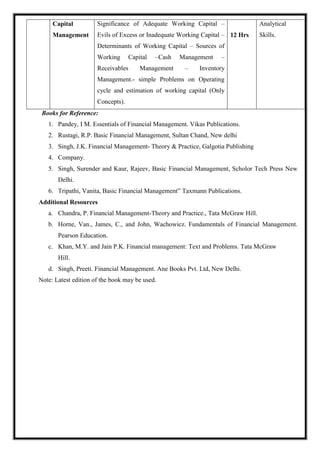
5 Working Introduction – Concept of Working Capital –
Capital
Management
Significance of Adequate Working Capital –
Evils of Excess or Inadequate Working Capital –
Determinants of Working Capital – Sources of
Working Capital –Cash Management –
Receivables Management – Inventory
Management.- simple Problems on Operating
cycle and estimation of working capital (Only
Concepts).
12 Hrs
Analytical
Skills.
Books for Reference:
1. Pandey, I M. Essentials of Financial Management. Vikas Publications.
2. Rustagi, R.P. Basic Financial Management, Sultan Chand, New delhi
3. Singh, J.K. Financial Management- Theory & Practice, Galgotia Publishing
4. Company.
5. Singh, Surender and Kaur, Rajeev, Basic Financial Management, Scholor Tech Press New
Delhi.
6. Tripathi, Vanita, Basic Financial Management” Taxmann Publications.
Additional Resources
a. Chandra, P. Financial Management-Theory and Practice., Tata McGraw Hill.
b. Horne, Van., James, C., and John, Wachowicz. Fundamentals of Financial Management.
Pearson Education.
c. Khan, M.Y. and Jain P.K. Financial management: Text and Problems. Tata McGraw
Hill.
d. Singh, Preeti. Financial Management. Ane Books Pvt. Ltd, New Delhi.
Note: Latest edition of the book may be used.
OEC 3.1: Financial Literacy
Total Teaching Hours: 45 Hours No. of Hours / Week: 03 [03 credit]
CObj Course Objectives
CObj_1 To familiarize non finance students with the essentials of finance and investments.
CObj_2 To enable the students to use financial data in planning, and decision making
CObj_3 To equip students with general knowledge, basic tools, and techniques for
managing their personal finance and investment decisions.
CO Course Outcomes
CO1 Be able to read, understand and interpret the financial statements of a company.
CO2 Demonstrate an understanding of role and importance of the finance function in
business.
CO3 Be able to take investment decisions for their personal portfolio.
CO4 Develop an attitude towards investments and be able to assess risk and returns.
CO5 Be able to apply basic skills in understanding and interpreting….
CO-PO Mapping
PO1 PO2 PO3 PO4 PO5
CO1 *
CO2 *
CO3 *
CO4 *
CO5 *
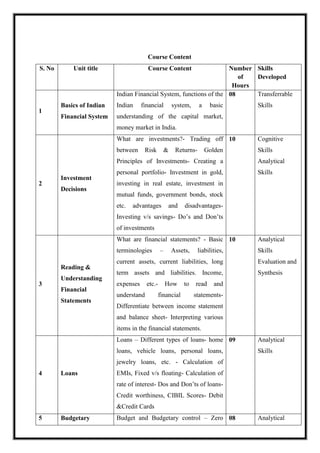
Course Content
S. No Unit title Course Content Number
of
Hours
Skills
Developed
1
Basics of Indian
Financial System
Indian Financial System, functions of the
Indian financial system, a basic
understanding of the capital market,
money market in India.
08 Transferrable
Skills
2
Investment
Decisions
What are investments?- Trading off
between Risk & Returns- Golden
Principles of Investments- Creating a
personal portfolio- Investment in gold,
investing in real estate, investment in
mutual funds, government bonds, stock
etc. advantages and disadvantages-
Investing v/s savings- Do’s and Don’ts
of investments
10 Cognitive
Skills
Analytical
Skills
3
Reading &
Understanding
Financial
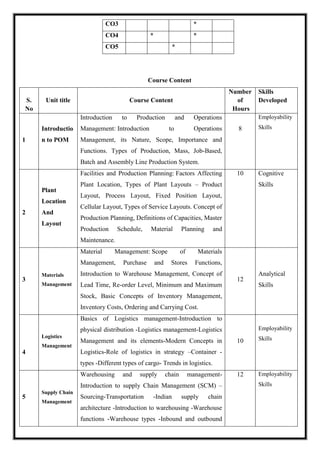
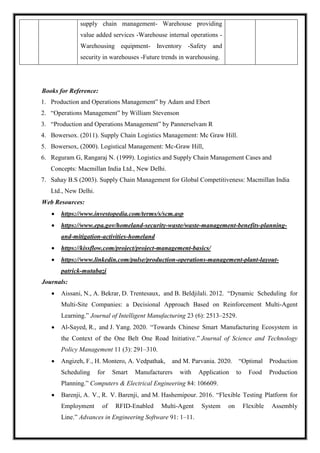
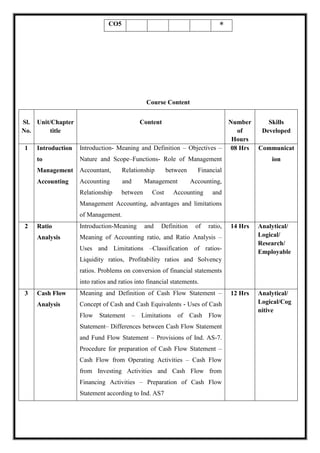
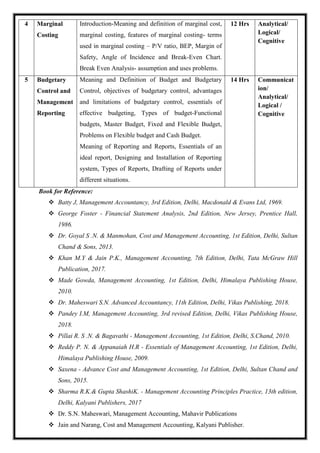
Statements
What are financial statements? - Basic
terminologies – Assets, liabilities,
current assets, current liabilities, long
term assets and liabilities. Income,
expenses etc.- How to read and
understand financial statements-
Differentiate between income statement
and balance sheet- Interpreting various
items in the financial statements.
10 Analytical
Skills
Evaluation and
Synthesis
4 Loans
Loans – Different types of loans- home
loans, vehicle loans, personal loans,
jewelry loans, etc. - Calculation of
EMIs, Fixed v/s floating- Calculation of
rate of interest- Dos and Don’ts of loans-
Credit worthiness, CIBIL Scores- Debit
&Credit Cards
09 Analytical
Skills
5 Budgetary Budget and Budgetary control – Zero 08 Analytical
Control Based Budgeting – Performance
budgeting.
Skills
Evaluation and
Synthesis
Books for Reference:
1. Financial Management by I.M.Pandey, Vikas Publishing House Pvt. Ltd.
2. Financial Management by Prasanna Chandra, Tata McGraw Hill
3. Financial Management by M.Y.Khan & P.K.Jain, Tata McGraw Hill
4. Financial Management by Ravi M. Kishore, Taxmann Publications
5. Financial Management by Paresh Shah, biztantra
6. Financial Statements by White, Sondhi & Fried, Willey Books
7. Bhargav, B, K, Finance For Non Finance Managers. Jaiko Publishing House.
8. Chandra, P. Finance Sense: Finance For Non Finance executives. Tata McGraw Hill.
9. Gabriel Hawawini, Claude Viallet, Finance For Non Finance Managers, Cengage Delmar
Learning India Pvt Ltd.
10. Gene Siciliano ,Finance for Nonfinancial Managers, (Briefcase Books Series), Tata McGraw
Hill
11. Tripathi, Vanita, Basic Financial Management” Taxmann Publication.
12. Dash A.P., “Financial Wisdom – Finance for Non-Finance Executives”, Biztantra
13. Palat, Raghu, “How to Read Annual Reports and Balance Sheets”, JAICO Publishing House
14. Chandra, Prasanna, “Finance Sense – Finance for Non-finance Executives”, Tata McGraw Hill
15. HBR Guide to Finance Basics for Managers (HBR Guide Series)
16. The Psychology of Money by Morgan Housel
Note: Latest edition of books may be used.
Web Resources:
 www.icai.org/students/Bos-knowledgeportal.
 www.icmai.in
 www.bseindia.com
 www.capitalmarket.com
 www.cmie.com
 www.financeprofessor.com
 www.moneycontrol.com
 www.rbi.gov.in
 www.sebi.gov.in
 www.learnvest.com
 www.thebirdy.com
 www.dailyworth.com
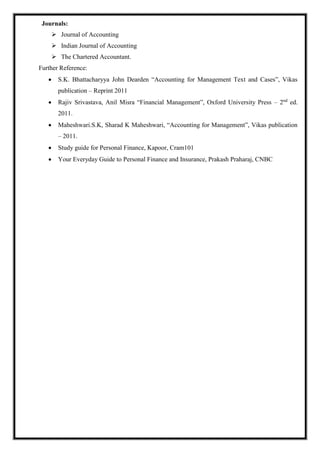
Journals:
 Journal of Accounting
 Indian Journal of Accounting
 The Chartered Accountant.
Further Reference:
 S.K. Bhattacharyya John Dearden “Accounting for Management Text and Cases”, Vikas
publication – Reprint 2011
 Rajiv Srivastava, Anil Misra “Financial Management”, Oxford University Press – 2nd
ed.
2011.
 Maheshwari.S.K, Sharad K Maheshwari, “Accounting for Management”, Vikas publication
– 2011.
 Study guide for Personal Finance, Kapoor, Cram101
 Your Everyday Guide to Personal Finance and Insurance, Prakash Praharaj, CNBC
M 21 DC 4.1: International Business
Total Teaching Hours: 60 No. of Hours / Week:4
[04 credit]
CObj Course Objectives
CObj_1 To provide an understanding of the importance of international business has on
the modern world.
CObj_2 To enable students to identify the factors that must be considered by a
multinational corporation before entering a different country.
CObj_3 To provide an understanding of how international trade affects economic
growth of a country.
CO Course Outcomes
CO1 Develop an ability to understand the stages of internationalisation.
CO2 Rationalise how a multinational company chooses its mode of entry into another
country.
CO3 Be able to analyse the strategies adopted by countries to expand globally.
CO4 Be able to apply and adopt the procedures followed in India’s import and export trade.
CO5 Analyse how fluctuations in foreign exchange affect trade.
CO-PO Mapping
PO1 PO2 PO3 PO4 PO5
CO1 *
CO2 *
CO3 *
CO4 *
CO5 *
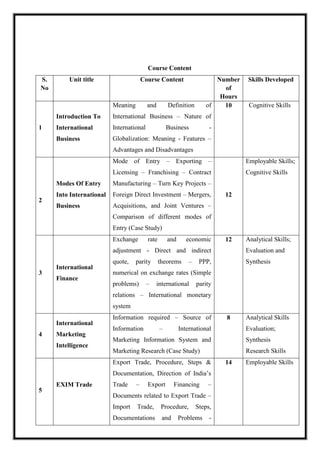
Course Content
S.
No
Unit title Course Content Number
of
Hours
Skills Developed
1
Introduction To
International
Business
Meaning and Definition of
International Business – Nature of
International Business -
Globalization: Meaning - Features –
Advantages and Disadvantages
10 Cognitive Skills
2
Modes Of Entry
Into International
Business
Mode of Entry – Exporting –
Licensing – Franchising – Contract
Manufacturing – Turn Key Projects –
Foreign Direct Investment – Mergers,
Acquisitions, and Joint Ventures –
Comparison of different modes of
Entry (Case Study)
12
Employable Skills;
Cognitive Skills
3
International
Finance
Exchange rate and economic
adjustment - Direct and indirect
quote, parity theorems – PPP,
numerical on exchange rates (Simple
problems) – international parity
relations – International monetary
system
12 Analytical Skills;
Evaluation and
Synthesis
4
International
Marketing
Intelligence
Information required – Source of
Information – International
Marketing Information System and
Marketing Research (Case Study)
8 Analytical Skills
Evaluation;
Synthesis
Research Skills
5
EXIM Trade
Export Trade, Procedure, Steps &
Documentation, Direction of India’s
Trade – Export Financing –
Documents related to Export Trade –
Import Trade, Procedure, Steps,
Documentations and Problems -
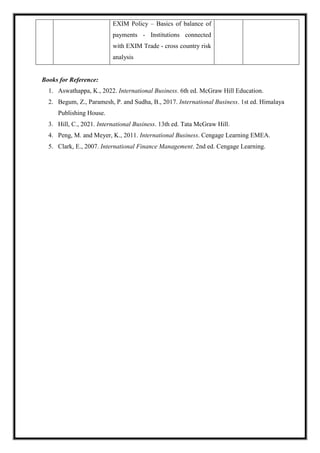
14 Employable Skills
EXIM Policy – Basics of balance of
payments - Institutions connected
with EXIM Trade - cross country risk
analysis
Books for Reference:
1. Aswathappa, K., 2022. International Business. 6th ed. McGraw Hill Education.
2. Begum, Z., Paramesh, P. and Sudha, B., 2017. International Business. 1st ed. Himalaya
Publishing House.
3. Hill, C., 2021. International Business. 13th ed. Tata McGraw Hill.
4. Peng, M. and Meyer, K., 2011. International Business. Cengage Learning EMEA.
5. Clark, E., 2007. International Finance Management. 2nd ed. Cengage Learning.
M 21 DC 4.2: Production & Operations Management
Total Teaching Hours: 60 No. of Hours / Week: 04 [04 credit]
CObj Course Objectives
CObj_1 To analyze the basics of production and operations management and the
responsible factors.
CObj_2 To facilitate the various activities relating to scheduling and measuring of
production take place and how control can be obtained on both product and
quality.
CObj_3 To create supply and logistics, distribution networks, and their management.
CO Course Outcomes
CO1 At the end of the course the students can apply the concept of operations
management in manufacturing and service sector and will be able to plan and
implement production and service related decisions.
CO2 The student will be able to plan production schedules and plan resources (material
and machine) required for production.
CO3 Explore employment opportunities in sales and operations positions with
transportation providers in the region.
CO4 Understand about logistics and supply chain strategies can create value generation
and utilize it with applications.
CO5 Develop an understanding of the importance of logistics in the formulation of the
business strategy.
CO-PO Mapping
PO1 PO2 PO3 PO4 PO5
CO1 *
CO2 *
CO3 *
CO4 * *
CO5 *
Course Content
S.
No
Unit title Course Content
Number
of
Hours
Skills
Developed
1
Introductio
n to POM
Introduction to Production and Operations
Management: Introduction to Operations
Management, its Nature, Scope, Importance and
Functions. Types of Production, Mass, Job-Based,
Batch and Assembly Line Production System.
8
Employability
Skills
2
Plant
Location
And
Layout
Facilities and Production Planning: Factors Affecting
Plant Location, Types of Plant Layouts – Product
Layout, Process Layout, Fixed Position Layout,
Cellular Layout, Types of Service Layouts. Concept of
Production Planning, Definitions of Capacities, Master
Production Schedule, Material Planning and
Maintenance.
10 Cognitive
Skills
3
Materials
Management
Material Management: Scope of Materials
Management, Purchase and Stores Functions,
Introduction to Warehouse Management, Concept of
Lead Time, Re-order Level, Minimum and Maximum
Stock, Basic Concepts of Inventory Management,
Inventory Costs, Ordering and Carrying Cost.
12
Analytical
Skills
4
Logistics
Management
Basics of Logistics management-Introduction to
physical distribution -Logistics management-Logistics
Management and its elements-Modern Concepts in
Logistics-Role of logistics in strategy –Container -
types -Different types of cargo- Trends in logistics.
10
Employability
Skills
5
Supply Chain
Management
Warehousing and supply chain management-
Introduction to supply Chain Management (SCM) –
Sourcing-Transportation -Indian supply chain
architecture -Introduction to warehousing -Warehouse
functions -Warehouse types -Inbound and outbound
12 Employability
Skills
supply chain management- Warehouse providing
value added services -Warehouse internal operations -
Warehousing equipment- Inventory -Safety and
security in warehouses -Future trends in warehousing.
Books for Reference:
1. Production and Operations Management” by Adam and Ebert
2. “Operations Management” by William Stevenson
3. “Production and Operations Management” by Pannerselvam R
4. Bowersox. (2011). Supply Chain Logistics Management: Mc Graw Hill.
5. Bowersox, (2000). Logistical Management: Mc-Graw Hill,
6. Reguram G, Rangaraj N. (1999). Logistics and Supply Chain Management Cases and
Concepts: Macmillan India Ltd., New Delhi.
7. Sahay B.S (2003). Supply Chain Management for Global Competitiveness: Macmillan India
Ltd., New Delhi.
Web Resources:
 https://www.investopedia.com/terms/s/scm.asp
 https://www.epa.gov/homeland-security-waste/waste-management-benefits-planning-
and-mitigation-activities-homeland
 https://kissflow.com/project/project-management-basics/
 https://www.linkedin.com/pulse/production-operations-management-plant-layout-
patrick-mutabazi
Journals:
 Aissani, N., A. Bekrar, D. Trentesaux, and B. Beldjilali. 2012. “Dynamic Scheduling for
Multi-Site Companies: a Decisional Approach Based on Reinforcement Multi-Agent
Learning.” Journal of Intelligent Manufacturing 23 (6): 2513–2529.
 Al-Sayed, R., and J. Yang. 2020. “Towards Chinese Smart Manufacturing Ecosystem in
the Context of the One Belt One Road Initiative.” Journal of Science and Technology
Policy Management 11 (3): 291–310.
 Angizeh, F., H. Montero, A. Vedpathak, and M. Parvania. 2020. “Optimal Production
Scheduling for Smart Manufacturers with Application to Food Production
Planning.” Computers & Electrical Engineering 84: 106609.
 Barenji, A. V., R. V. Barenji, and M. Hashemipour. 2016. “Flexible Testing Platform for
Employment of RFID-Enabled Multi-Agent System on Flexible Assembly
Line.” Advances in Engineering Software 91: 1–11.
 Benotsmane, R., G. Kovács, and L. Dudás. 2019. “Economic, Social Impacts and
Operation of Smart Factories in Industry 4.0 Focusing on Simulation and Artificial
Intelligence of Collaborating Robots.” Social Sciences 8 (5): 143.
 Bortolini, M., E. Ferrari, M. Gamberi, F. Pilati, and M. Faccio. 2017. “Assembly System
Design in the Industry 4.0 Era: A General Framework.” IFAC-Papers On Line 50
(1): 5700–5705.
M 21 DC 4.3: Management Accounting
Total Teaching Hours: 60 No. of Hours per Week: 04 [04credits]
CObj Course Objectives
CObj_1 Understand management accounting and various tools of financial analysis
CObj_2 Analyze profitability and financial status of a business based on ratios calculated and
Understand the preparation of Cash flow statement
CObj_3 Apply marginal costing technique in managerial decision making problems and
evaluate different proposals and Understand and further analyze different types of
budgets
CO Course Outcomes
CO1 Recognize the relationship between Cost, Financial and Management
Accounting
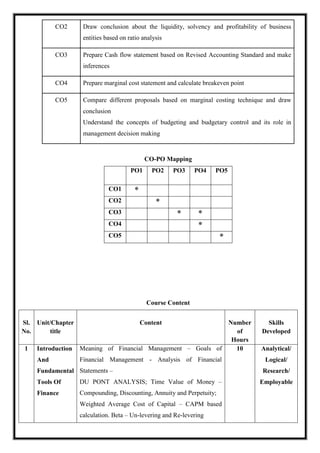
CO2 Draw conclusion about the liquidity, solvency and profitability of business
entities based on ratio analysis
CO3 Prepare Cash flow statement based on Revised Accounting Standard and make
inferences
CO4 Prepare marginal cost statement and calculate breakeven point
CO5 Compare different proposals based on marginal costing technique and draw
conclusion
Understand the concepts of budgeting and budgetary control and its role in
management decision making
CO-PO Mapping
PO1 PO2 PO3 PO4 PO5
CO1 *
CO2 *
CO3 * *
CO4 *
CO5 *
Course Content
Sl.
No.
Unit/Chapter
title
Content Number
of
Hours
Skills
Developed
1 Introduction
to
Management
Accounting
Introduction- Meaning and Definition – Objectives –
Nature and Scope–Functions- Role of Management
Accountant, Relationship between Financial
Accounting and Management Accounting,
Relationship between Cost Accounting and
Management Accounting, advantages and limitations
of Management.
08 Hrs Communicat
ion
2 Ratio
Analysis
Introduction-Meaning and Definition of ratio,
Meaning of Accounting ratio, and Ratio Analysis –
Uses and Limitations –Classification of ratios-
Liquidity ratios, Profitability ratios and Solvency
ratios. Problems on conversion of financial statements
into ratios and ratios into financial statements.
14 Hrs Analytical/
Logical/
Research/
Employable
3 Cash Flow
Analysis
Meaning and Definition of Cash Flow Statement –
Concept of Cash and Cash Equivalents - Uses of Cash
Flow Statement – Limitations of Cash Flow
Statement– Differences between Cash Flow Statement
and Fund Flow Statement – Provisions of Ind. AS-7.
Procedure for preparation of Cash Flow Statement –
Cash Flow from Operating Activities – Cash Flow
from Investing Activities and Cash Flow from
Financing Activities – Preparation of Cash Flow
Statement according to Ind. AS7
12 Hrs Analytical/
Logical/Cog
nitive
4 Marginal
Costing
Introduction-Meaning and definition of marginal cost,
marginal costing, features of marginal costing- terms
used in marginal costing – P/V ratio, BEP, Margin of
Safety, Angle of Incidence and Break-Even Chart.
Break Even Analysis- assumption and uses problems.
12 Hrs Analytical/
Logical/
Cognitive
5 Budgetary
Control and
Management
Reporting
Meaning and Definition of Budget and Budgetary
Control, objectives of budgetary control, advantages
and limitations of budgetary control, essentials of
effective budgeting, Types of budget-Functional
budgets, Master Budget, Fixed and Flexible Budget,
Problems on Flexible budget and Cash Budget.
Meaning of Reporting and Reports, Essentials of an
ideal report, Designing and Installation of Reporting
system, Types of Reports, Drafting of Reports under
different situations.
14 Hrs Communicat
ion/
Analytical/
Logical /
Cognitive
Book for Reference:
 Batty J, Management Accountancy, 3rd Edition, Delhi, Macdonald & Evans Ltd, 1969.
 George Foster - Financial Statement Analysis, 2nd Edition, New Jersey, Prentice Hall,
1986.
 Dr. Goyal S .N. & Manmohan, Cost and Management Accounting, 1st Edition, Delhi, Sultan
Chand & Sons, 2013.
 Khan M.Y & Jain P.K., Management Accounting, 7th Edition, Delhi, Tata McGraw Hill
Publication, 2017.
 Made Gowda, Management Accounting, 1st Edition, Delhi, Himalaya Publishing House,
2010.
 Dr. Maheswari S.N. Advanced Accountancy, 11th Edition, Delhi, Vikas Publishing, 2018.
 Pandey I.M, Management Accounting, 3rd revised Edition, Delhi, Vikas Publishing House,
2018.
 Pillai R. S .N. & Bagavathi - Management Accounting, 1st Edition, Delhi, S.Chand, 2010.
 Reddy P. N. & Appanaiah H.R - Essentials of Management Accounting, 1st Edition, Delhi,
Himalaya Publishing House, 2009.
 Saxena - Advance Cost and Management Accounting, 1st Edition, Delhi, Sultan Chand and
Sons, 2015.
 Sharma R.K.& Gupta ShashiK. - Management Accounting Principles Practice, 13th edition,
Delhi, Kalyani Publishers, 2017
 Dr. S.N. Maheswari, Management Accounting, Mahavir Publications
 Jain and Narang, Cost and Management Accounting, Kalyani Publisher.
Note: Latest edition of text books may be used.
Web Resources:
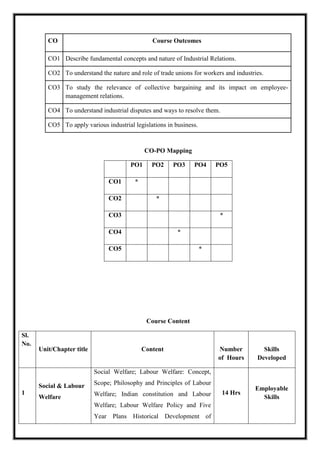
1. The Economist (economist.com/topics/corporate accounting)
2. www.icai.org/students/Bos-knowledgeportal.
3. www.icmai.in
4. Journal of Accounting
5. Indian Journal of Accounting
6. The Chartered Accountant.
Journals:
1. https://www.sciencedirect.com/journal/management-accounting-research
2. https://www.emerald.com/insight/publication/ISSN/1030-9616
3. https://www.cribfb.com/journal/index.php/ijafr
4. https://journals.indexcopernicus.com/journal/69134
Essential Learning
1. Narayanaswamy R, Financial Accounting- A managerial perspective, PHI Learning Pvt Ltd
2014.
2. Gupta, Ambrish, “Financial Accounting for Management – An Analytical Perspective”;
Pearson Publications
3. Ramachandran and Kakani- Financial Accounting for Management, Tata McGraw Hill.
4. Vijaykumar M P., “First Lessons in Financial Reporting”, Snow White Publications
5. Chandra, Prasanna, “Finance Sense – Finance for Non-finance Executives”, Tata McGraw
Hill
6. Agarwal, V. Rakesh, “Systematic Approach to Cost Accounting”, Bharat Publications
M21 DSC 4.3: Business Regulations
Total Teaching Hours: 60 Hours No. of Hours / Week: 04
[04 credit]
CObj Course Objectives
CObj_1 The Objective is to introduce the students to various regulations affecting business and
to familiarize the students with such regulations.
CObj_2 Understand the laws related to consumer protection.
CObj_3 The objective of this course is to provide the students with practical legal knowledge
of general business law issues.
CO Course Outcomes
CO1 Understand in details various laws related to business and able to work as legal
adviser of business enterprises.
CO2 Demonstrate recognition of the requirements of the contract agreement,
understanding of contract. Consideration and capacity, identify contract remedies.
CO3 Apply basic legal provisions of IT act 2000.
CO4 Learn how to pursue the consumer rights under consumer protection act 2019.
CO5 Understand the characteristics of different intellectual properties and protect them.
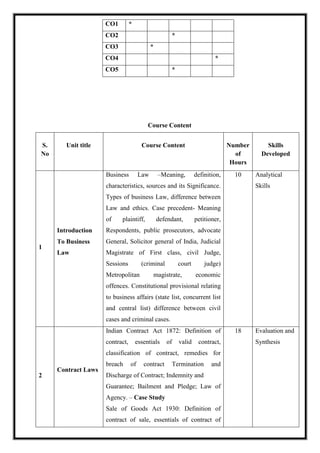
CO-PO Mapping
PO1 PO2 PO3 PO4 PO5
CO1 *
CO2 *
CO3 *
CO4 *
CO5 *
Course Content
S.
No
Unit title Course Content Number
of
Hours
Skills
Developed
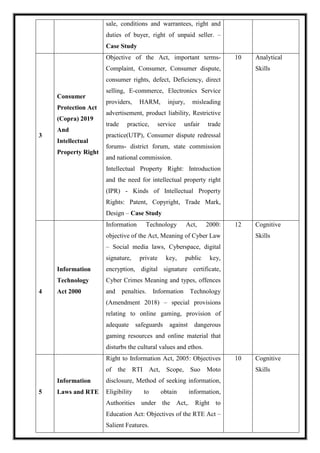
1
Introduction
To Business
Law
Business Law –Meaning, definition,
characteristics, sources and its Significance.
Types of business Law, difference between
Law and ethics. Case precedent- Meaning
of plaintiff, defendant, petitioner,
Respondents, public prosecutors, advocate
General, Solicitor general of India, Judicial
Magistrate of First class, civil Judge,
Sessions (criminal court judge)
Metropolitan magistrate, economic
offences. Constitutional provisional relating
to business affairs (state list, concurrent list
and central list) difference between civil
cases and criminal cases.
10 Analytical
Skills
2
Contract Laws
Indian Contract Act 1872: Definition of
contract, essentials of valid contract,
classification of contract, remedies for
breach of contract Termination and
Discharge of Contract; Indemnity and
Guarantee; Bailment and Pledge; Law of
Agency. – Case Study
Sale of Goods Act 1930: Definition of
contract of sale, essentials of contract of
18 Evaluation and
Synthesis
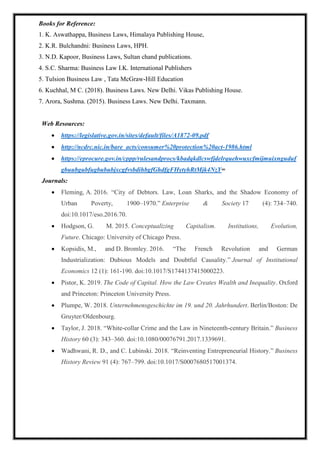
sale, conditions and warrantees, right and
duties of buyer, right of unpaid seller. –
Case Study
3
Consumer
Protection Act
(Copra) 2019
And
Intellectual
Property Right
Objective of the Act, important terms-
Complaint, Consumer, Consumer dispute,
consumer rights, defect, Deficiency, direct
selling, E-commerce, Electronics Service
providers, HARM, injury, misleading
advertisement, product liability, Restrictive
trade practice, service unfair trade
practice(UTP), Consumer dispute redressal
forums- district forum, state commission
and national commission.
Intellectual Property Right: Introduction
and the need for intellectual property right
(IPR) - Kinds of Intellectual Property
Rights: Patent, Copyright, Trade Mark,
Design – Case Study
10 Analytical
Skills
4
Information
Technology
Act 2000
Information Technology Act, 2000:
objective of the Act, Meaning of Cyber Law
– Social media laws, Cyberspace, digital
signature, private key, public key,
encryption, digital signature certificate,
Cyber Crimes Meaning and types, offences
and penalties. Information Technology
(Amendment 2018) – special provisions
relating to online gaming, provision of
adequate safeguards against dangerous
gaming resources and online material that
disturbs the cultural values and ethos.
12 Cognitive
Skills
5
Information
Laws and RTE
Right to Information Act, 2005: Objectives
of the RTI Act, Scope, Suo Moto
disclosure, Method of seeking information,
Eligibility to obtain information,
Authorities under the Act,. Right to
Education Act: Objectives of the RTE Act –
Salient Features.
10 Cognitive
Skills
Books for Reference:
1. K. Aswathappa, Business Laws, Himalaya Publishing House,
2. K.R. Bulchandni: Business Laws, HPH.
3. N.D. Kapoor, Business Laws, Sultan chand publications.
4. S.C. Sharma: Business Law I.K. International Publishers
5. Tulsion Business Law , Tata McGraw-Hill Education
6. Kuchhal, M C. (2018). Business Laws. New Delhi. Vikas Publishing House.
7. Arora, Sushma. (2015). Business Laws. New Delhi. Taxmann.
Web Resources:
 https://legislative.gov.in/sites/default/files/A1872-09.pdf
 http://ncdrc.nic.in/bare_acts/consumer%20protection%20act-1986.html
 https://eprocure.gov.in/cppp/rulesandprocs/kbadqkdlcswfjdelrquehwuxcfmijmuixnguduf
gbuubgubfugbububjxcgfvsbdihbgfGhdfgFHytyhRtMjk4NzY=
Journals:
 Fleming, A. 2016. “City of Debtors. Law, Loan Sharks, and the Shadow Economy of
Urban Poverty, 1900–1970.” Enterprise & Society 17 (4): 734–740.
doi:10.1017/eso.2016.70.
 Hodgson, G. M. 2015. Conceptualizing Capitalism. Institutions, Evolution,
Future. Chicago: University of Chicago Press.
 Kopsidis, M., and D. Bromley. 2016. “The French Revolution and German
Industrialization: Dubious Models and Doubtful Causality.” Journal of Institutional
Economics 12 (1): 161-190. doi:10.1017/S1744137415000223.
 Pistor, K. 2019. The Code of Capital. How the Law Creates Wealth and Inequality. Oxford
and Princeton: Princeton University Press.
 Plumpe, W. 2018. Unternehmensgeschichte im 19. und 20. Jahrhundert. Berlin/Boston: De
Gruyter/Oldenbourg.
 Taylor, J. 2018. “White-collar Crime and the Law in Nineteenth-century Britain.” Business
History 60 (3): 343–360. doi:10.1080/00076791.2017.1339691.
 Wadhwani, R. D., and C. Lubinski. 2018. “Reinventing Entrepreneurial History.” Business
History Review 91 (4): 767–799. doi:10.1017/S0007680517001374.
OE 4.1: Event Management
Total Teaching Hours: 45 Hours No. of Hours / Week: 03
[03 credit]
CObj Course Objectives
CObj_1 To provide the means to compare actual performance in an IT environment against
desired performance.
CObj_2 To Provide the entry point for many process and activities of Service Operation
CObj_3 To provide a basis for service assurance, reporting and service improvement.
CO Course Outcomes
CO1 Students will have the Capability to identify the key characteristics of an event.
CO2 Students can learn to recognize the key management competencies required in the
events industry and to use interpersonal and communications skills to pursue
career in events industry.
CO3 Students can learn the conceptual framework of Event Management, Event
Services, Conducting Event and Managing Public Relations.
CO4 The students will understand: The importance of communication for leadership &
decision making.
CO5 The students will acquire competencies to: Plan a proposal on management of an
event
CO-PO Mapping
PO1 PO2 PO3 PO4 PO5
CO1 *
CO2 *
CO3 *
CO4 * *
CO5 *
Course Content
S.
No
Unit title Course Content Number of
Hours
Skills
Developed
1.
Introduction to
Event Management
Event- Meaning- Why Event Management-
Analysis of Event, Scope of Event,
Decision Makers- Event Manager
Technical Staff- Establishing of Policies &
Procedure- Developing Record Keeping
Systems.
10 Evaluation
and
Synthesis
2.
Event Management
Procedure
Principles for holding an Event, General
Details, Permissions- Policies, Government
and Local Authorities, - Phonographic
Performance License, Utilities- Five
Bridge Ambulance Catering, Electricity,
Water Taxes Applicable.
10 Analytical
Skills
3.
Conduct Of An
Event
Preparing a Planning Schedule, Organizing
Tables, Assigning Responsibility,
Communication and Budget of Event-
Checklist, Computer aided Event
Management– Roles & Responsibilities of
Event Managers for Different Events.
10 Cognitive
Skills
4. Public Relations
Introductions to Public Relations-
Concept- Nature- Importance- Limitations-
Media- Types of Media- Media
Management, Public Relation Strategy &
Planning. Brain Storming Sessions-
Writings for Public Relations.
08 Transferrable
Skills
5. Corporate Events
Planning of Corporate Event, Job
Responsibility of Corporate Events
Organizer, Arrangements, Budgeting,
Safety of Guests and Participants, Creating
Blue Print, Need for Entertainment in
Corporate Events And Reporting.
07 Employable
Skills
Books for Reference:
 EventEntertainmentandProduction–
Author:MarkSondermCSEPPublisher:Wiley&Sons,Inc.ISBN:0-471-26306-0
 GhouseBasha –Advertising&MediaMgt
 AnneStephen–EventManagement
 SpecialEventProduction –DougMatthews–ISBN978-0-7506-8523-8
 TheCompleteGuidetosuccessfulEventPlanning–ShannonKilkenny
 HumanResourceManagementforEvents–LynnVanderWagen(Author)
 SuccessfulTeamManageemnt(Paperback)–NickHayed(Author)
 EventManagement &PublicRelationsbySavitaMohan–EnkayPublishingHouse
 EventManagement&PublicRelationsBySwarupK.Goyal–AdhyayanPublisher-2009
Web Resources:
 https://www.comit.ie/latest-news-from-comit/what-are-the-different-types-of-
pr.798.html
 https://www.celebritycorporatekit.com/our-blog/6-types-of-corporate-events-which-is-
right-for-your-organization/
 https://www.wildapricot.com/blog/how-to-plan-an-event
Journals:
 Camerlengo, Quirino. 2009. Il Cerimoniale, tra Stato e Regioni, e la Correttezza
Costituzionale [The Ceremonial, between State and Regions, and the Constitutional
Fairness]. In Le Regioni, n.3-4, 763- 775.
 De Lasio, Emiliana, Matthew Hibberd, Michael Higgins and Michele Sorice. 2012. La
Leadership Politica. Media e Costruzione del Consenso [Political Leadership. Media and
Consensus Building]. Roma: Carocci Editore.
 Maimone, Fabrizio. 2014. La Comunicazione Organizzativa. Comunicazione, Relazioni e
Comportamenti Nelle Imprese, Nella P.A. e nel no Profit [The Organisational
Communication. Communication, Relationships and Behaviors in Business, in P.A. and in
the no Profit]. Milano: Angelini.
 Ricci, Maurizio. 2016. Più Tecnologia, Meno Produttività [More Technology, Less
Productivity]. Roma: La Repubblica.
 Sgrelli, Massimo. 2016. Il Cerimoniale. Il Cerimoniale Moderno ed il Protocollo di Stato:
Regole Scritte e non Scritte [The Ceremonial. The Modern Ceremonial and the State
Protocol: Written and Unwritten Rules]. Aquila: Di Felice Editore.
M21DC5.1: Banking & Insurance
Total Teaching Hours: 60 Hours No. of Hours / Week: 04 [04 credits]
Cob_j Course Objectives
CObj_1 Introduce the students to the basic concept of banking as a financial
intermediation service and bank as a financial institution.
CObj_2 To Familiarize students with crucial banking operations and fundamentals of
bank lending.
CObj_3 To enlighten the students with the Introduction of insurance concepts.
CO Course Outcomes
CO1 After this course the students would have the fundamental knowledge of
banking as service and bank as an institution.
CO2 Understand the working and functioning of the Insurance Sector& study the
inter-relationship between Insurance & Risk Management.
CO3 Students will be updated with latest technology and innovation that are
currently being used in banks.
CO4 Students will be able to express opinions about banking in written and oral
form, based on the basic knowledge and skills acquired.
CO5 Obtain an overview of Regulatory Framework of Insurance Sector.
CO-PO Mapping
PO1 PO2 PO3 PO4 PO5
CO1 *
CO2 *
CO3 *
CO4 *
CO5 *
Course Content
S. No Unit title Course Content
Number of
Hours
Skills
Developed
1.
Introduction To
Banking
Evolution of Banking-Kinds of banks–primary
and secondary Functions of commercial banks –
structure of banking system in India-Credit
creation of commercial banks- General and
special relationship between banker and
customer.
12 Cognitive
2.
Negotiable
Instruments &
Innovations In
Banking
Kinds of Negotiable Instruments – Cheques:
types of crossing-Endorsements: Meaning –
Essentials – Kinds of Endorsement.
Banking innovations: New technology in
banking, RTGS, SWIFT, NEFT, MICR,
DEMAT, E-Services, Internet banking.
10 Employable
& Cognitive
3.
Principles Of
Bank Lending:
Sound Principles of bank lending- Non-
Performing Assets: Introduction, Provision for
NPAs, Management of NPA- Bankers Lien –
Right of set off –garnishee order- income tax
attachment order.
Reserve Bank of India: Organization, Role and
12 Cognitive
functions, Techniques of credit control.
4.
Risk and
Insurance
Defining risk, nature and types of risk, risk
management process, Risk and its relation with
insurance. Classification of insurance life and
non-life, general principles of insurance. Salient
features of IRDA Act.
12 Cognitive &
Employable
5.
Life and General
Insurance
Life insurance: Life - principles, products term
insurance endowment, insurance, pensions,
Group Insurance.
General Insurance: Fire Insurance: Meaning,
nature, Policies and conditions of fire insurance.
Subrogation and Reinsurance; Marine insurance:
Meaning, nature, Principles of marine insurance,
Policies and conditions to marine insurance,
Accident and motor insurance, Concept of health
insurance and Catastrophe insurance
14 Cognitive &
Employable
Reference:
 O. P. AGARWAL ,Banking and insurance.
 Dr. Sunil Kumar, Banking and insurance, Galgotia Publishing Company
 Gordon &Natrajan: Banking Theory Law and Practice, HPH.
 Maheshwari. S.N.: Banking Law and Practice, Kalyani Publishers
 Gagendra Naidu, S. K. Poddar , Law and Practice of Banking, VBH.
 M. Prakash – Banking Regulation & Operations, VBH.
 Tannan M.L: Banking Law and Practice in India, Wadhwa and company
Journals:
1. https://stmjournals.com/Journal-of-banking-and-Insurance-Laws.html
2. https://papers.ssrn.com/sol3/papers.cfm?abstract_id=4204338&dgcid=ejournal_htmlemail_ba
nking:insurance:ejournal_abstractlink
3. https://www.sciencedirect.com/journal/journal-of-banking-and finance?start_rank=42881
M21 DC 5.2: Income Tax
Total Teaching Hours: 60 Hours No. of Hours per Week: - 04[04 credits]
CObj Course Objectives
CObj_1 To enable the students to identify the basic concepts, definitions and terms
related to Income Tax and to determine the residential status of an individual and
scope of total income.
CObj_2 To enable the students to compute income under various heads namely income
from salaries, house property, business/ profession, and income from other
sources and also to discuss the various deductions under the Income tax act,
1961.
CObj_3 To enable the students to compute the net total taxable income of an individual.
CO Course Outcomes
CO1 Students would identify the technical terms related to Income Tax.
CO2 Students would determine the residential status of an individual and scope of total
income.
CO3 Students would compute income from salaries, house property, business/profession, and
income from other sources.
CO4 Students would discuss the various benefits/ deductions under the Income tax act, 1961.
CO5 Students would compute the net total income of an individual.
CO-PO Mapping
PO1 PO2 PO3 PO4 PO5
CO1 *
CO2 *
CO3 *
CO4 *
CO5 *
Course Content
Sl.
No.
Unit/Chapter title Content Number
of
Hours
Skills
Developed
1 Introduction To
Income Tax And
Residential Status
Brief history of Indian Income Tax, legal
framework, types of taxes, cannons of taxation,
definitions, assessment, assessment year, previous
year including exception, assesses person, income,
casual income, gross total income, agricultural
income, scheme of taxation, meaning and
classification of capital and revenue. Residential
status of an individual’s, Determination of
residential status, incidence of tax- problems
16 hrs Technical
Skills
2 Income From
Salary
Meaning, definitions, basis of charge, advance
salary, arrears of salary, allowances, perquisites,
profits in lieu of salary, provident fund, gratuity,
commutation of pension, encashment of earned
18 hrs Interpersona
l Skills
leave, deductions from salary U/S 16, problems on
computation of salary income.
3 Income From
House Property
Basis of charge, deemed owners, exempted income
from house property, composite rent, Annual value,
determination of Annual value, treatment of
unrealized rent, loss due to vacancy, deductions
from Annual value U/S 24, problems on
computation of income from house property
10 hrs Cognitive
Skills
4 Profits And
Gains From
Business Or
Profession
Meaning and Definition of Business Profession
Vocation, Expenses Expressly Allowed –
Allowable Losses, Expenses Expressly Disallowed,
Expenses Allowed on payments basis. Problems on
Business relating to Sole trader and Problems of
Profession relating to Chartered Accountant,
Advocate and Medical practitioners.
10 hrs Analytical
Skills
5 Deductions From
Gross Total
Income
Deductions u/s: 80 C, 80 CCC, 80 CCD, 80 D, 80
DD, 80 E, 80 G, 80 GG, 80 GGA, 80 QQB, 80 U.
(Simple problems)
6hrs Cognitive
Skills
Books for Reference:
 B. Lal: Direct Taxes, Konark Publisher (P) Ltd.
 Bhagwathi Prasad: Direct Taxes – Law and Practice, Wishwa Prakashana. Dinakar Pagare:
Law and Practice of Income Tax, Sultan Chand and Sons. Dr. Girish Ahuja & Dr. Ravi
Gupta: Income Tax
 Dr. Mehrotra & Dr.Goyal: Direct Taxes – Law and Practice, Sahitya Bhavan Publication.
 Dr. Vinod K. Singhania: Direct Taxes – Law and Practice, Taxmann Publication.
 Gaur & Narang: Income Tax.
Web Resources:
1. Tax Treatment on Income from Salary - https://taxguru.in/income-tax/tax-treatment-income-
salary.html
2. Deductions from IFHP - https://cleartax.in/s/deductions-under-section24-income-from-house-
property
3. Profit and Gains of Business and Profession - https://www.indiafilings.com/learn/profits-gains-
business-profession-income-tax/
Journals:
5. https://www.studocu.com/in/document/tamil-nadu-dr-ambedkar-law-university/taxation-
law/salary-chapter-notes-by-ca-rajat-mogha-sir/9970385
6. Chrome
extension://efaidnbmnnnibpcajpcglclefindmkaj/https://incometaxindia.gov.in/tutorials/12.%
20income-from-house-property.pdf
7. chrome-extension://efaidnbmnnnibpcajpcglclefindmkaj/https://www.vazecollege.net/wp-
content/uploads/2016/08/Unit_6-Business_Income.pdf
M 21 DC 5.3: Advanced Corporate Financial Management
Total Teaching Hours: 60 No. of Hours per Week: 04[04credits]
CObj Course Objectives
CObj_1 To provide knowledge on valuation of business enterprises.
CObj_2 To make students understand the various models of value-based management.
CObj_3 To give insight on various forms of corporate restructuring.
CO Course Outcomes
CO1 Recognize the relationship between Cost, Financial and Management
Accounting
CO2 Draw conclusion about the liquidity, solvency and profitability of business
entities based on ratio analysis
CO3 Prepare Cash flow statement based on Revised Accounting Standard and make
inferences
CO4 Prepare marginal cost statement and calculate breakeven point
CO5 Compare different proposals based on marginal costing technique and draw
conclusion
Understand the concepts of budgeting and budgetary control and its role in
management decision making
CO-PO Mapping
PO1 PO2 PO3 PO4 PO5
CO1 *
CO2 *
CO3 * *
CO4 *
CO5 *
Course Content
Sl.
No.
Unit/Chapter
title
Content Number
of
Hours
Skills
Developed
1 Introduction
And
Fundamental
Tools Of
Finance
Meaning of Financial Management – Goals of
Financial Management - Analysis of Financial
Statements –
DU PONT ANALYSIS; Time Value of Money –
Compounding, Discounting, Annuity and Perpetuity;
Weighted Average Cost of Capital – CAPM based
calculation. Beta – Un-levering and Re-levering
10 Analytical/
Logical/
Research/
Employable
2 Corporate
Valuation
Valuation of Firm and Valuation of Equity – Net
Assets Method, Earnings Capitalization Method,
Relative
Valuation, Chop Shop Method. Discounted Cash Flow
(DCF) Method, Adjusted Present Value (APV)
Method.
18 Analytical/
Logical/
Research/
Employable
3 Value Based
Management
Marakon Approach, Alcar Approach, McKinsey
Approach, Stern-Stewart Approach (EVA Method)
and
BCG Approach. Performance Measurement and
Analysis. Balanced Scorecard.
10 Analytical/
Logical/Cog
nitive
4 Corporate
Restructurin
g - I
Forms of Corporate Restructuring. Asset Restructuring
– Securitization, Sale and Lease; Financial
Restructuring – Designing and re-designing capital
structure; Restructuring of companies incurring
continuous losses, restructuring in the event of change
in law, Buy-back of shares.
12 Analytical/
Logical/
Cognitive
5 Corporate
Restructurin
g - II
Mergers and Acquisitions – Meaning and differences,
Reasons for Mergers, Types of Mergers, Valuation
of firms – Assets Approach, Market Price Approach &
EPS Approach– Problems.
10 Communicat
ion/
Analytical/
Logical /
Cognitive
Book for Reference:
 V. Rajesh Kumar, “Strategic Financial Management”, Mc Graw Hill Publishers.
 Bender, Ruth and Ward, Keith, “Corporate Financial Strategy”, Butterworth Heinemann.
 Damodaran, Aswath, “Damodaran on Valuation”, John Wiley.
 Damodaran, Aswath, “The Dark Side of Valuation”, John Wiley.
 Chandra, Prasanna, “Corporate Valuation and Value Creation”, Mc Graw Hill.
 Allen, David, “An Introduction to Strategic Financial Management – The Key to Long Term
Profitability”, The Chartered Institute of Management Accountants, Kogan Page.
 Allen, David, “Financial Decisions – A Guide to the Evaluation and Monitoring of Business
Strategy”, The Chartered Institute of Management Accountants, Kogan Page.
 Hampton, John, “Financial Decision Making – Concepts, Problems and Cases”, Prentice Hall
of India.
 Jakhotiya, G.P., “Strategic Financial Management”, Vikas Publishing House Private Limited.
 Vedpuriswar, A.V, “Strategic Financial Management – Achieving Sustainable Competitive
Advantage”, Vision Books.
 Strategic Financial Management - Managing for value creation | SecondEdition. (2020).
(n.p.): McGraw-Hill Education.
 Strategic Financial Management. (2018). (n.p.): Kojo Press.
 Pettit, J. (2011). Strategic Corporate Finance: Applications in Valuation and CapitalStructure.
Germany: Wiley.
 Jarrell, S. L., Morin, R. A. (2000). Driving Shareholder Value: Value-Building Techniquesfor
Creating Shareholder Wealth. United States: McGraw-Hill Education.
 Chandra, P. (2011). Corporate valuation and value creation. Tata McGraw-Hill Education
Note: Latest edition of text books may be used.
Web Resources:
7. The Economist (economist.com/topics/corporate accounting)
8. www.icai.org/students/Bos-knowledgeportal.
9. www.icmai.in
10. Journal of Accounting
11. Indian Journal of Accounting
12. The Chartered Accountant.
Journals:
1. https://www.sciencedirect.com/journal/management-accounting-research
2. https://www.emerald.com/insight/publication/ISSN/1030-9616
3. https://www.cribfb.com/journal/index.php/ijafr
4. https://journals.indexcopernicus.com/journal/69134
Essential Learning
1. Penman, H Stephen, “Financial Statement Analysis and Security Valuation”, Tata McGraw-
Hill Publishing Company Limited.
2. Grinblatt, Mark and Titaman, Sheridan, “Financial Markets and Corporate Strategy”, Tata
McGraw Hill.
3. Chandra, Prasanna, “Financial Management”, Tata McGraw Hill Publishing Limited.
4. Hawawini, Gabriel and Viallet, Claude; “Finance for Non-finance Managers”,
SouthWestern CENGAGE Learning.
5. Weaver, Samuel and Weston, Fred; “Strategic Corporate Finance” South-Western
CENGAGE Learning.
6. Allen, David, “An Introduction to Strategic Financial Management – The Key to Long Term
Profitability”, The Chartered Institute of Management Accountants, Kogan Page.
7. Vedpuriswar, A.V, “Strategic Financial Management – Achieving Sustainable Competitive
Advantage”, Vision Books.
8. Marshall, John and Bansal, Vipul, “Financial Engineering – A Complete Guide to
FinancialInnovation”.
9. Copeland, Tom, Koller, Tim and Murrin, Jack, “Valuation – Measuring and Managing the
Value of Companies”, McKinsey Quarterly, Wiley Finance.
M 21 DC 5.3: Employee Welfare and Industrial Relations
Total Teaching Hours: 60 Hours No. of Hours per Week: -- 4 Hours/ Week [04 credits]
CObj Course Objectives
CObj_1 The course aims at providing fundamental knowledge and exposure to the
industrial relations and related aspects prevailing in industries and to
familiarize the students with various Labour Legislations applicable to
businesses.
CObj_2 To learn the salient features of welfare and wage Legislations.
CObj_3 To learn the laws relating to Industrial Relations, Social Security and
Working conditions.
CO Course Outcomes
CO1 Describe fundamental concepts and nature of Industrial Relations.
CO2 To understand the nature and role of trade unions for workers and industries.
CO3 To study the relevance of collective bargaining and its impact on employee-
management relations.
CO4 To understand industrial disputes and ways to resolve them.
CO5 To apply various industrial legislations in business.
CO-PO Mapping
PO1 PO2 PO3 PO4 PO5
CO1 *
CO2 *
CO3 *
CO4 *
CO5 *
Course Content
Sl.
No.
Unit/Chapter title Content Number
of Hours
Skills
Developed
1
Social & Labour
Welfare
Social Welfare; Labour Welfare: Concept,
Scope; Philosophy and Principles of Labour
Welfare; Indian constitution and Labour
Welfare; Labour Welfare Policy and Five
Year Plans Historical Development of
14 Hrs
Employable
Skills
Labour Welfare in India- Emerging Issues
2
Indian Labour
Organization
Impact of ILO on Labour Welfare in India;
Agencies of Labour Welfare and their Roles,
Labour Welfare Programmes: Statutory and
Non-Statutory, Collective Bargaining
Welfare Centers; Welfare Officer: Role,
Status and Functions. Case study
12 Hrs
Analytical
Skills
3 Social Security
Concept and Scope; Social Assistance and
Social Insurance, Development of Social
Security in India; Social Security measures
for Industrial Employees. Case study
12 Hrs Logical Skills
4
Labour
Administration –
1
Evolution of Machinery for Labour
Administration; Central Labour
Administrative Machinery in India, Labour
Administration in India.
08 Hrs Research
Skills
5
Industrial
Relations
Concept- Evaluation -Background of
industrial Relations in India- Influencing
factors of IR in enterprise and the
consequences Role of various parties to IR –
Govt. – IR strategy – Factors affecting
Employee relations strategy – IR Divisions
Case study
14 Hrs
Cognitive
Skills
Books for Reference:
 Moorthy, M.V. Principles of Labour Welfare, Oxford & IBH Publishing Co., New
Delhi.
 Vaid, K.N. Labour Welfare in India, Sree Ram Centre for Industrial Relations and Human
Resources, New Delhi.
 K. Venkataramana, Employee Welfare & amp; Social Security, SHBP.
 Sharma, A.M. Aspects of Labour Welfare and Social Security, Himalaya Publishing, House,
Mumbai.
 Ram Chandra P. Singh, Labour Welfare Administration in India, Deep & Deep Pub.,
New Delhi.
 Punekar, S.D. Deodhar S.B., Sankaran, Saraswathi, Labour Welfare, Trade Unionism and
Industrial Relations, Himalaya Publishing House, Mumbai.
 Pant, S.C., Indian Labour Problems, Chaitanya Publishing House, Allahabad.
Web Resources:
1. Labor Welfare in Five Year Plans.(https://old.amu.ac.in/emp/studym/99999354.pdf)
2. Labor Welfare Officer (http://labourlawshcm.com/home/responsibilities-of-welfare-
officers/)
3. Social Security Measures (https://www.india-briefing.com/news/introduction-social-
security-system-india-6014.html/)
4. Industrial Relations (https://www.economicsdiscussion.net/industries/industrial-
relations/32249)
Journals:
1. https://www.researchgate.net/publication/283481802_EMPLOYEE_WELFARE_IS_THE_
KEY_AN_INSIGHT
2. https://www.jetir.org/view?paper=JETIR2105754
3. https://researchleap.com/impact-welfare-measures-quality-employees-performance-special-
reference-construction-industry/
M21 DC 5.3: Advertising and Sales Management
Total Teaching Hours: 60 No. of Hours / Week: 04 [04 Credits]
Cob_j Course Objectives
CObj_1 To develop the students ability to deal in advertising management and
media planning
CObj_2 To have a proper understanding on sales promotion techniques and the
tools used in sales promotion.
CObj_3 To develop the ability of students in identifying the proper media for the
advertising.
CO Course Outcomes
CO1 To enable the students to understand the history of advertising and the
operations of advertising agencies how an advertising agency operates.
CO2 Demonstrate an understanding of how media ratings are conducted and
knowing about the cost of media.
CO3 To enable the students to understand about the creative strategies
implemented by the advertisers and the advertisement budget for future
transactions.
CO4 Develop the knowledge about the forms and contents of sales promotion.
CO5 Develop the students to analyse about the tools of sales promotion and
development of various techniques for the integration of sales promotion and
advertisement.
CO-PO Mapping
PO1 PO2 PO3 PO4 PO5
CO1 *
CO2 *
CO3 * *
CO4 *
CO5 *
Course Content
S. No Unit title Course Content Number of
Hours
Skills
Developed
1.
Introduction &
Basic Concepts
History of advertising; Advertising purpose
and functions; Economic, social & ethical
aspects of advertising; Advertising & the
marketing mix, Advertising as a
10
Analytical
Skills
communication process; types of
advertising; Major Institutions of
Advertising Management.
2. Advertising
Media Strategy
Role of media; types of media; their
advantages and disadvantages; Media
research & advertising decisions; media
planning, selection & scheduling strategies.
Case study.
12 Evaluation
and
Synthesis
3.
Creative
Strategy &
Advertising
Budget
Creative approaches; The art of copywriting;
Advertising copy testing; creativity in
communication, motivational approaches &
appeals, Advertising budget process;
Methods of determining Advertising
appropriations.
15 Analytical
Skills
4.
Nature And
Forms Of Sales
Promotion
Nature and importance of sales promotion,
its role in marketing. Forms of sales
promotion: Consumer oriented sales
promotion; trade oriented sales promotion
and sales force oriented sales promotion.
10 Cognitive
Skills
5.
Tools of Sales
Promotion
Major tools of sales promotion: Samples,
point of purchase, displays and
demonstration. Exhibition and Fashion
shows, sales contest and game of chance and
skills, lotteries, gifts, offers, premium and
free goods, Prince packs, rebates, patronage,
rewards etc. Conventions, conference and
trade shows, specialties and novelties,
Developing a sales promotion programmes,
pre testing implementing, evaluating the
results and making necessary modification
Integration of Sales Promotion with
advertising [case study]
13
Evaluation
and
Synthesis
Books for Reference:
 Integrated Advertising, Promotion and Marketing Communications, Clow, Baack, Pearson.
Integrated Advertising, Promotion and Marketing Communications,Kruti shah, Alon
D’Souza, TMH.
 Advertising & Sales Promotion , SHHKazmi, Satish Batra, Excel.
 Advertising Management with integrated Brand Promotion, O’Guinn, Allen, Semenik,
Cengage.
 Advertising Management, Jethwaney, Jain, Oxford.
 Contemporary Advertising, Arens, TMH.
 Advertising, Sales and Promotion Management, S.A.Chunawalla, Himalaya.
 Sengupta, Subroto: Brand Positioning, Strategies for Competitive Advantages, Tata
McGraw Hill
 Sales Promotion by Julian Cummins
Web Resources:
1. https://www.google.com/search?q=ADVERTISING+AND+MEDIA+MANAGEMENT&rlz=
1C1CHBD_enIN811IN811&ei=mfaGY-Iv8I_j4Q-
2. https://www.google.com/search?q=SALES+PROMOTION+&rlz=1C1CHBD_enIN811IN81
1&ei=mfaGY-Iv8I_j4Q 13ZhY&ved=0ahUKEwii4KCCotX7AhXwxzgGHbUuBgsQ4dU
3. https://www.google.com/search?q=advertising+and+media+planning&rlz=1C1CHBD_enI
N811IN811&ei=zfaGY9Jaw5Dj4Q_274RQ&ved=0ahUKEwiS9YabotX7AhVDyDgGHf
4. https://www.google.com/search?q=advertisng+media+types&rlz=1C1CHBD_enIN811IN8
11&ei=7PaGY_SqBv7e4-EP8baHWA&ved=0ahUKEwj00PCpotX7AhV-7zgGHXHbA
Journals:
1. Barnes James G. (1975), “Factors Influencing Consumer Reaction to Retail Newspaper
‘Sale’ Advertising,” in Combined Proceedings of the American Marketing Association, Vol.
37, Mazze Edward M., ed. Chicago: American Marketing Association, 471–77.
2. Berkowitz Eric N., and Walton John R. (1980), “Contextual Influences on Consumer Price
Responses: An Experimental Analysis,” Journal of Marketing Research, 17(August), 349–
58.
3. Biswas Abhjit, and Blair Edward A. (1991), “Contextual Effects of Reference Prices in
Retail Advertisements,” Journal of Marketing, 55(July), 1–12.
4. Burton Scot, and Lichtenstein Donald R. (1988), “The Effect of Ad Claims and Ad Context
on Attitude Toward the Advertisement,” Journal of Advertising, 17(1), 3–11.
5. Bitta Delia, Albert J., Monroe Kent B., and McGinnis John M. (1981), “Consumer
Perceptions of Comparative Price Advertisements,” Journal of Marketing Research,
18(November), 416–27.
M21 DC 5.4: Security Analysis and Portfolio Management
Total Teaching Hours: 60 No. of Hours per Week: 04 [04 credits]
CObj Course Objectives
CObj_1 To provide a broad overview of investment management and the
application of finance theory.
CObj_2 To enable students perform a rudimentary analysis of financial
instruments.
CObj_3 To educate students with regard to the tools and analysis required for
portfolio building and management.
CO Course Outcomes
CO1 Provide a theoretical understanding of the investment and the modes of investment
available.
CO2 Evaluate risk and return that arise from different financial instruments.
CO3 Perform fundamental and technical analysis.
CO4 Demonstrate a basic understanding of security analysis and valuation.
CO5 Construct, evaluate and revise the optimum portfolio
CO-PO Mapping
PO1 PO2 PO3 PO4 PO5
CO1 *
CO2 * *
CO3 *
CO4 *
CO5 *
Course Content
Sl.
No.
Unit/Chapter
title
Content Number
of
Hours
Skills
Developed
1 Introduction
Investment
Management
Investment management, nature and scope,
investment avenues, types of financial assets and real
assets, Investment Vs Speculation, Gambling and
Arbitrage: Forms of investment-investment in
physical and financial assets; investment alternatives,
investment objectives, constraints; investment
process: direct and indirect investment. Macro-
economic factors influencing investment, Investment
environment in India. International funds
management, emerging opportunities
10 Analytical/
Logical/
2 Risk and
Return
Security return and risk – Systematic and
unsystematic risk - sources of risk, Measurement of
risk and return, sources of investment information,
Fixed income – securities – bonds, preference shares
– sources of risk, valuation, duration of bonds –
theory of interest rates – yield curve, Bond
innovations and their valuation.
16 Analytical/
Logical
3 Securities
Analysis
Analysis of variable income securities, fundamental
analysis – analysis of economy, industry analysis,
company analysis – financial and non – financial,
Equity valuation models, Options, futures, forwards,
warrants, and their valuations, Technical analysis –
Dow’s theory, charts – Efficient market hypothesis
and its implications, Tax aspects of investment,
Securities Trading procedure. A Critical Survey of
software packages for security analysis.
14 Research/
Analytical/
Logical
4 Portfolio
Management
Meaning of portfolio management, portfolio
analysis, why portfolios? Portfolio objectives,
portfolio management process, selection of
securities. Portfolio theory, Markowitz Model,
Sharpe’s single index model. Efficient frontier with
Lending and borrowing, optimal portfolio capital
Asset pricing model, Arbitrage pricing theory two
factor and multi factor models.
10 Employable/
Analytical
5 Portfolio
Management
Strategies
Bond Portfolio Management strategies, Equity
portfolio management strategies, strategies using
derivatives, hedging. Portfolio revision – rebalancing
plans, portfolio evaluation, Sharpe’s index, Treynor’s
measure and Jenson’s measure. Investors life cycle,
Personal investment, Personal Finance.
12 Employable/
Analytical
Books for Reference:
 Bombay Stock Exchange Directory.
 Donald E. Fischer and Ronald J. Jordan: Security Analysis and Portfolio Management, Pearson Ed.
 Stanely S.C. Haung Maury Stall: Investment Analysis and Management, Allyn and Bacon Inco.,
Massachustes.
 Jerome B. Cohen and Edward D. Zinbarg Etal: Investment Analysis and Portfolio Management,
Ricchard D., Irwin Inc., Illinois.
 J.C. Fancis: Investment Analysis and Management
 Panduan Puneethavarty, Securities Analysis and Portfolio Management, Vikas Pub. House.
 Fuller & Farrel, Modern Investment and Security Analysis, McGraw Hill International.
Web Resources:
1. The Economist (economist.com/topics/corporate accounting)
2. What Is Candlestick Chart? Basics Of Technical Analysis Candlestick Explained By CA Rachana
Ranade: https://www.youtube.com/watch?v=V47CdOCDo4s
3. What is Short Selling Explained by CA Rachana Ranade :
https://www.youtube.com/watch?v=5Hah_jffaHg
4. How to hedge your portfolio? | Safeguard using futures and options | CA Rachana Ranade:
https://www.youtube.com/watch?v=dfic0EacA00
5. www.investopedia.com
Journals:
1. https://www.emerald.com/insight/publication/ISSN/1030-9616
2. The Journal of finance - https://onlinelibrary.wiley.com/toc/15406261/2022/77/6
3. The Indian Journal of finance - http://www.indianjournaloffinance.co.in/
4. Journal of banking and finance - https://www.sciencedirect.com/journal/journal-of-banking-and-
finance
5. Journal of financial econometrics - https://academic.oup.com/jfec
M 21 DC 5.4: International HRM
Total Teaching Hours: 60 Hours No. of Hours per Week: -- 4 Hours/ Week
[04 credits]
CObj Course Objectives
CObj_1 To provide a basic understanding about the finer aspects of international business to
the students.
CObj_2 It is aimed at making the students realize that International Business is a combination
of multiple disciplines brought together in a systematic manner.
CObj_3 To familiarize the students about the implications of the globalization process,
challenges that changes in the international economy and manage the diversity of
HRM.
CO Course Outcomes
CO1 Integrated perspective on role of HRM in modern business. Ability to plan human
resources and implement techniques of job design
CO2 Competency to recruit, train, and appraise the performance of employees
CO3 Rational design of compensation and salary administration
CO4 Ability to handle employee issues and evaluate the new trends in HRM
CO5 Ability to train using various methods of Training
CO-PO Mapping
PO1 PO2 PO3 PO4 PO5
CO1 *
CO2 *
CO3 *
CO4 *
CO5 *
Course Content
Sl.
No.
Unit/Chapter title Content Number
of Hours
Skills
Developed
1 Introduction
IHRM Difference between Domestic and
International Manager, Issues in IHRM,
Developing, International Strategy,
Understanding Culture, Its Coverage,
Determinants, Cross-cultural Theory (Halls
& Lorange)
12 Hrs
Employable
Skills
2
IHRM
Organizational
Culture
Cross-cultural Negotiations, Planning and
Preparation Parameter, Types and Strategy
of Organizational Culture.
12 Hrs
Analytical
Skills
3
IHRM Strategies
And Approaches
International Business and IHRM:
Approaches, Globalization Approaches,
Globalization and the Strategy, The
Competency Required for International
Managers.
12 Hrs
Logical
Skills
4
International
Recruitment And
Selection
International Labour Market, Sources,
Recruitment and Selection, Training, Types
of Cross-cultural Training. Multinational
Performance Management, Developing
International Staff and Multinational Team.
12 Hrs
Analytical
Skills
5
International
Compensation
System
International Compensation System,
Objectives, Approaches and Practice,
Expatriation and Repatriation Process,
Managing People in International Firms.
12 Hrs
Employable
Skills
Books for Reference:
 International Human Resource Management, Peter Dowling and Denice Welch, Cengage
Learning
 International Human Resource Management, Tony Edwards, Pearson Education
 Global Human Growth Model, M.N Rudrabasavaraj, Himalaya
 International Human Resource Management, Monir Tayeb, Oxford
 Human Resource Management – Wayne Mondy: Pearson, 2010
 Human Resource Management- David Lepak & Mary Gowan: Pearson, 2009
 Human Resource Management- Snell & Bohlander: Cengage, 2007
Web Resources:
1. Domestic and International Manager.(https://www.usemultiplier.com/blog/domestic-hrm-
vs-international-hrm)
2. Cross Cultural Training (https://www.coursehero.com/file/36583849/chap-5-training-and-
development-cctpdf/)
3. International Compensation System (https://www.geektonight.com/international-
compensation-management/)
4. Approaches of IHRM (https://www.studocu.com/en-gb/document/loughborough-
university/international-human-resource-management/lecture-1-approaches-to-international-
hrm/18305650)
Journals:
1. https://www.sciencedirect.com/topics/economics-econometrics-and-finance/international-
human-resource-management
2. https://papers.ssrn.com/sol3/papers.cfm?abstract_id=2984119
3. https://onlinelibrary.wiley.com/journal/17488583
M 21 DC 5.4– Consumer Behavior
Total Teaching Hours: 60 Hours No. of Hours per Week: 04 [04 credits]
CObj Course Objectives
CObj_1 The basic objective of this course is to develop an understanding about the
consumer decision making process and its applications in marketing function of
firms.
CObj_2 This course is meant to equip undergraduate students with basic knowledge about
issues and dimensions of Consumer Behavior.
CObj_3 The primary purpose of this course is to provide the student with a useable,
managerial understanding of consumer behavior.
CO Course Outcomes
CO1 Able to explain the basic concepts and models of consumer behavior.
CO2 Able to analyze the effects of psychological, socio-cultural and demographic factors on
the consumer decision process with their results.
CO3 Able to distinguish the relationship between consumer behavior and marketing
practices.
CO4 Able to define the importance of consumer behavior for businesses
CO5 Able to compare the relationship between consumer behavior and other disciplines.
CO-PO Mapping
PO1 PO2 PO3 PO4 PO5
CO1 *
CO2 *
CO3 *
CO4 *
CO5 *
Course Content
Sl.
No.
Unit/Chapter title Content Number
of Hours
Skills
Developed
1
Introduction To
Consumer
Behavior
Meaning of Consumer Behavior, Features
and Importance Types of Consumer
(Institutional & Retail), Diversity of
consumers and their behavior- Types Of
Consumer Behavior Profiling the consumer
and understanding their needs Consumer
Involvement Application of Consumer
Behavior knowledge in Marketing Consumer
Decision Making Process and Determinants
of Buyer Behavior, factors affecting each
stage, and Need recognition.
12 Hrs Employable
Skills
2
Individual-
Determinants Of
Consumer
Behavior
Consumer Needs &Motivation (Theories –
Maslow, Mc Cleland).Personality – Concept,
Nature of personality, Trait theories,
Personality Traits and its Marketing
significance, Product personality and brand
personification. Self -Concept – Concept
Consumer Perception Learning – Theory,
Nature of Consumer Attitudes, Consumer
Attitude Formation & Change. Attitude –
Concept of attitude 12 Hrs Analytical
Skills
3
Environmental
Determinants of
Consumer
Behavior
Family Influences on Buyer Behavior, Roles
of different members, needs perceived and
evaluation rules. Factors affecting the need
of the family, family life cycle stage and
size. Social Class and Influences.
Group Dynamics & Consumer Reference
Groups, Social Class & Consumer Behavior
– Reference Groups, Opinion Leaders and
Social Influences In-group versus out-group
influences, role of opinion leaders in
12 Hrs Logical
Skills
diffusion of innovation and in purchase
process. Cultural Influences on Consumer
Behavior Understanding cultural and sub-
cultural influences on individual, norms and
their role, customs, traditions and value
system.
4
Consumer
Decision Making
Models And New
Trends
Consumer Decision making models: Howard
Sheth Model, Engel Blackwell, Miniard
Model, Nicosia Models of Consumer
Decision Making Diffusion of innovations
Process of Diffusion and Adoption,
Innovation, Decision process, Innovator
profiles E-Buying behavior The E-buyer vis-
a vis the Brick and Mortar buyer, Influences
on E-buying
12 Hrs Research
Skills
5
Consumer
Satisfaction &
Consumerism
Concept of Consumer Satisfaction; Working
towards enhancing consumer satisfaction;
Sources of consumer dissatisfaction; dealing
with consumer complaint. Concept of
consumerism; consumerism in India; the
Indian consumer; Reasons for growth of
consumerism in India; Consumer protection
Act 2022.
12 Hrs Cognitive
Skills
Books for Reference:
 Schiffman, L.G., Kanuk, L.L., & Kumar, S.R. (2011). Consumer Behaviour. (10th ed.).
Pearson.
 Solomon, M.R. (2009). Consumer Behaviour – Buying, Having, and Being. (8th ed.) New
Delhi: Pearson .
 Blackwell, R.D., Miniard, P.W., & Engel, J. F. (2009). Consumer Behaviour. New Delhi:
Cengage Learning.
 Hawkins, D.I., Best, R. J., Coney, K.A., & Mookerjee, A. (2007). Consumer Behaviour –
Building Marketing Strategy. (9th ed.). Tata McGraw Hill.
 Loudan, David L and Bitta, A.J. Della Consumer Behaviour
 Kotler, P. & Keller, K. L. (2012). Marketing Management (Global Edition) (14th
ed.). Pearson
 Nair, Suja R- Consumer Behaviour in Indian Perspective
Web Resources:
1. Consumer protection Act
2022.(http://ncdrc.nic.in/bare_acts/consumer%20protection%20act-1986.html)
2. CDM (https://www.lucidchart.com/blog/consumer-decision-making-process)
3. Theories of Personality ( https://www.wisdomjobs.com/e-university/consumer-behaviour-
tutorial-94/trait-theory-in-personality-10532.html)
4. Models in CB
(https://nscpolteksby.ac.id/ebook/files/Ebook/Business%20Administration/Consumer%20B
ehaviour%20and%20Advertising%20Management%20(2006)/21.%20Chapter%2020%20-
%20Models%20of%20Consumer%20Behaviour.pdf )
Journals:
1. https://www.researchgate.net/publication/256412209_Journal_of_Consumer_Behaviour6
2. https://journals.sagepub.com/doi/pdf/10.1177/2158244016645638
3. https://www.jois.eu/files/Vol_6_1_Makarewicz.pdf
M 21 DC 5.5: IT for Managers/E-Commerce for Managers
Total Teaching Hours: 60 No. of Hours / Week: 04 [04 credits]
CObj Course Objectives
CObj_1 To understand fundamentals of E-Commerce
CObj_2 To familiarize students with E-Commerce Business Models and to know the applications
of E-Commerce.
CObj_3 To know E-Commerce transaction security, payment systems and Network Infrastructure
CO Course Outcomes
CO1 Able to have fundamental understanding of E-Commerce concepts and applications.
CO2 Able to analyze and comprehend E-Business Models
CO3 Knowledge of E-Commerce applications
CO4 Assess E-Commerce transaction security, payment systems and Network
Infrastructure.
CO5 The ability to understand the requirement of latest technology and control techniques
CO-PO Mapping
PO1 PO2 PO3 PO4 PO5
CO1 * *
CO2 * * *
CO3 *
CO4 *
CO5 *
Course Content
S.
No
Unit title Course Content Number of
Hours
Skills
Developed
1
Introduction To
Electronic
Commerce
Concept Features, Functions of E-Commerce,
Comparison between E-Commerce and
traditional Business System, Early Business
Information Interchange Practices, Emergence
of the Internet and World Wide Web-Types of
E-Commerce, Transaction of E-Commerce in
India, Limitations of E-Commerce, E-
Commerce Opportunities for Industries,
Transition challenges for Indian Corporate.
12 Cognitive
Skills
2
E-Business Models
Business Model Concept, E-Business Concept,
E-Business Model based on the relationship of
transaction parties and transaction types, e-
Distributor, Electronic Data Interchange(EDI)-
e-CRM-e-SCM
15 Hrs Life Skills
3
E-Commerce
Network
Infrastructure
Introduction to Network Infrastructure -
Internet Client server applications-Network
and internets-Software Agents-Internet Service
Provider(ISP)-Web Servers and Software-
Usage and Application of HTML
8 Hrs Employabl
e Skills
4
Application of
E-Commerce
Online Marketing- e-Advertising-Internet
Marketing Trends-Target marketing-
Marketplace v/s Market Space-Impact of e-
Commerce on Market - Marketing Issues in E-
Marketing - e-Branding -Online Recruitment-
Online Learning.
15 Hrs Life Skills
5
Data Security and
Payment Systems
Information System Security-Internet Security
-E-Business Risk Management Issues-
Information Security Environment in India-
Payment Gateway-Concerns of Internet
Banking-Requirement of E-Payment Systems-
Functioning of Debit and Credit Cards-
Classification of New Payment Systems-
Cryptography- Digital Signature
11 Hrs Life Skills
Books for Reference:
 E-Commerce ,4th
Edition, Pete Loshin/John Vacca
E-Commerce: Business, Technology, Society, Kenneth C. Laudon, Carol Traver, Person
Publications, New Delhi
 E-Business & E-Commerce for Managers, Harvey M Deitel, Paul J. Deitel by Pearson
Publication
 Electronic Commerce,4th
Edition, Pete Loshin/John Vacca
 Electronic Commerce: A Manager’s Guide, Ravi Kalakota, Andrew Whinston
Web Resources:
E-books
1. The Ultimate Guide to Successful Ecommerce
2. The Conscious Creative: Practical Ethics for Purposeful Work by Kelly Small
Journals:
1. https://lib.bakeru.edu/electronic-commerce/scholarly-journals
2. https://www.omicsonline.org/e-commerce-journals-conferences-list.php

syllabus nep.docx

  • 1.
    SCHEME AND SYLLABUS Forthe Programme Bachelor of Business Administration (Choice Based Credit System – 2021 scheme)
  • 2.
    PEOs Programme EducationalObjectives PEO1 The programme aims to nurture the students in intellectual, technical, interpersonal and social skills with a focus on holistic education and development to make informed decisions and equips graduates with the skills required to lead management positions. PEO2 To provide students with modern business knowledge and competence in functional management disciplines. PEO3 To promote management growth and entrepreneurship via experiential learning. PEO4 To instill professional ethics, human values, and social responsibility for the growth of organizations and societies. PEO5 To educate future business professionals who are able to apply theoretical understanding toward the development of viable solutions to challenges that exist in the actual world. PO Programme Outcomes PO1 Demonstrate a deep understanding of functions of management communication ideas and principles. PO2 Demonstrate an understanding of the knowledge of finance, accountancy, law, statistics, HR, operations, IT and management subjects required for business decisions and apply knowledge to integrate concepts from various disciplines, to identify and develop business strategies for effective problem-solving and decision-making in a contemporary organization environment. PO3 Apply the necessary competencies and skills with a creative mindset, to undertake entrepreneurship as a desirable and feasible career option and able to adapt effectively as an individual and as a member or leader in teams, and in multidisciplinary settings by demonstrating life skills, coping skills and human values. PO4 This programme brings out reflective, scientific and creative thinking in the students which to get deeper insights into the business world and tackle complex situations with the help of skills and knowledge acquired. PO5 Imbibe ethical practices in profession and appreciate sustainability and evince a sense of social responsibility in their respective environments, by becoming citizens working for the welfare and benefit of the society, at large. Achieve higher levels of proficiency and self-actualization through the pursuit of life-long learning.
  • 3.
    At the endof year Exit Award Outcomes Achieved Credits 1st Year Certificate in Business Administration PO1 50 2nd Year Diploma in Business Administration PO1,PO2,PO3 100 3rd Year Bachelor’s Degree in Business Administration PO1,PO2,PO3,PO4 148 4th Year Honours Degree in Business Administration PO1,PO2, PO3,PO4,PO5 190 NEP-2020 B.B.A.- Programme Matrix (w.e.f. 2021-22 onwards) I Semester Code Course Code Course Teaching Hours Course Components Credits L T P AECC LAN 1.1 Language –1 4 3 1 0 3 AECC M 21 GE 1.1 Generic English 4 3 1 0 3 DSC M 21 DC 1.1 Management Principles & Practice 4 4 0 0 4 DSC M 21 DC 1.2 Fundamentals of Business Accounting 4 3 0 1 4 DSC M 21 DC 1.3 Business Economics 4 3 0 1 4 OEC M21 OE 1.1 Business Organisation 3 0 0 0 3 SEC 21SBC 1 .1 Digital Fluency 3 1 0 2 2 VBC 21VBC 1.1 Health and Wellness 2 2 0 0 1 VBC 21VBC 1.2 Yoga 2 2 0 0 1 Total 25 II Semester AECC LAN 2.1 Language –1 4 3 1 0 3 AECC M 21 GE 2.1 Generic English 4 3 1 0 3 DSC M 21 DC 2.1 Functions of Management 4 4 0 0 4 DSC M 21 DC 2.2 Cost Accounting 4 3 0 1 4 DSC M 21 DC 2.3 Business Mathematics 4 3 0 1 4 OEC M21 OE 2.1 People Management 3 0 0 0 3 AECC 21 SBC 2 .1 Environmental Studies 3 1 0 2 2 VBC 21VBC 2.1 Sports 2 2 0 0 1 VBC 21VBC 2.2 NCC/NSS/R&R/Cultural 2 2 0 0 1 Total 25
  • 4.
    III Semester Code CourseCode Course Teaching Hours Course Components Credits L T P AECC LAN 3.1 Language –1 4 3 1 0 3 AECC M 21 GE 3.1 Generic English 4 3 1 0 3 DSC M 21 DC 3.1 Organizational Behaviour 4 4 0 0 4 DSC M 21 DC 3.2 Statistics for Business 4 3 0 1 4 DSC M 21 DC 3.3 Financial Management 4 3 0 1 4 OEC M21OE 3.1 Financial Literacy 3 0 0 0 3 SBC 21SBC 3 .1 Cyber Security 3 1 0 2 2 VBC VBC 3.1 Sports 2 2 0 0 1 VBC VBC 3.2 NCC/NSS/R&R/Cultural 2 2 0 0 1 Total 25 IV Semester AECC LAN 4.1 Language –1 4 3 1 0 3 AECC M 21 GE 4.1 Generic English 4 3 1 0 3 DSC M 21 DC 4.1 International Business 4 4 0 0 4 DSC M 21 DC 4.2 Production and Operations Management 4 3 0 1 4 DSC M 21 DC 4.3 Management Accounting 4 3 0 1 4 OEC M21 OE 4.1 Event Management 3 0 0 0 3 SEC 21 SBC 4 .1 Indian Constitution 3 1 0 2 2 VBC VBC 4.1 Sports 2 2 0 0 1 VBC VBC 4.2 NCC/NSS/R&R/Cultural 2 2 0 0 1 Total 25
  • 5.
    V Semester Code CourseCode Course Teaching Hours Course Components Credits L T P DSC M 21 DC 5.1 Banking and Insurance 4 4 0 0 4 DSC M 21 DC 5.2 Income Tax 4 4 0 0 4 DSC M 21 DC 5.3 Elective – I FIN HR MKT 4 4 0 0 4 DSC M 21 DC 5.4 Elective – II FIN HR MKT 4 4 0 0 4 DSC M 21 DC 5.5 Information Technology for Managers 4 4 0 0 3 DSC M 21 DC 5.6 Internship -I 2 DSC M 21 DC 5.7 Power BI / Forensic Accounting 4 4 0 0 4 Total 25 VI Semester DSC M 21 DC 6.1 Entrepreneurship &Start-up Management 4 4 0 0 4 DSC M 21 DC 6.2 Business Analytics 4 4 0 0 4 DSC M 21 DC 6.3 Elective - III 4 4 0 0 4 DSC M 21 DC 6.4 Elective - IV 4 4 0 0 4 DSC M 21 DC 6.5 Goods & Services Tax(GST) 4 4 0 0 3 DSC M 21 DC 6.6 Stock Market Operations 4 4 0 0 4 Total 23
  • 6.
    VII Semester Code CourseCode Course Teaching Hours Course Components Credits L T P DSC M 21 DC 7.1 Business Ethics & Corporate Governance 4 4 0 0 4 DSC M 21 DC 7.2 Services Management 4 4 0 0 4 DSC M 21 DC 7.3 Advanced Statistics for Business Research 4 4 0 0 3 DSC M 21 DC 7.4 Elective - V 4 4 0 0 4 DSC M 21 DC 7.5 Application of Statistical Software - DAS 4 4 0 0 3 DSC M 21 DC 7.6 Research Methodology 4 4 0 0 3 DSC M 21 DC 7.7 Operations Research 4 4 0 0 4 Total 21 VIII Semester DSC M 21 DC 8.1 Strategic Management 4 3 1 0 4 DSC M 21 DC 8.2 Project Management 4 3 1 0 4 DSC M 21 DC 8.3 Insurance and risk management 4 4 0 0 4 DSC M 21 DC 8.4 Digital Marketing 4 3 0 1 3 DSC M 21 DC 8.5 Research Projects/ Internship with viva voce 4 3 0 1 6 Total 21 AECC- Ability Enhancement Compulsory Courses DSC- Discipline Specific Course VBC- Value-based Course SEC- Skill Enhancement Course DSE- Discipline Specific Elective OE- Open Elective
  • 7.
    Continuous Internal Assessment– Scheme of Evaluation For Theory Courses End Semester Examination: 60% Continuous Internal Assessment: 40% Activities (CIA: 40 Marks) Proposed and Approved Scheme Total Marks (40) IA-1 IA-2 Session Test Maximum Marks 30 30 1. Weightage (Marks) 10 10 20 2. Assignment (Marks) 20 20 i. Writing 10 ii. Quiz / Presentation / Creating diagrams /charts / Class work / Case study / Viva / Field work etc. 05 iii. Classroom participation 05 Total 40 Continuous Internal Assessment – Scheme of Evaluation For Practical Courses End-Semester Examination: 50% Continuous Internal Assessment: 50% CIA (25 marks) + End Semester Exam (25 marks) Maximum Marks (Internal Assessment) 25 1. Weightage (Marks) 15 2. Record work (Marks) 05 3. Quiz/Presentation/creating diagrams/charts/Lab work/ 05 Total (Marks) 25
  • 8.
    M 21 DC1.1: Management Principles and Practice Total Teaching Hours: 56 No. of Hours / Week: 04 [04 Credit] CObj Course Objectives CObj_1 To provide an understanding of the functions and responsibilities of managers. CObj_2 To familiarize students with the tools and techniques to be used in the performance of the managerial job. CObj_3 To enhance students understanding to develop cognizance of the importance of management principles. CO Course Outcomes CO1 Able to demonstrate their understanding of various concepts, principles, and functions of business management. CO2 Able to Demonstrate the roles, skills and functions of management CO3 The ability to create organization structures based on authority, task and responsibilities. CO4 The ability to understand the complexities associated with management of human resources in the organizations and integrate the learning in handling these complexities. CO5 The ability to understand the requirement of good control system and control techniques CO-PO Mapping PO1 PO2 PO3 PO4 PO5 CO1 CO2 * * * CO3 * CO4
  • 9.
    CO5 * Course Content S. No Unittitle Course Content Number of Hours Skills Developed 1 Introduction To Management Introduction –Meaning, Evolution of management thought, Pre- Scientific Management Era, Classical Management Era, Neo- Classical Management Era, Modern Management Era; Nature and Characteristics of Management - Scope and Functional areas of Management; Management as a Science, Art or Profession; Management and Administration; Principles of Management. 10 Hrs Cognitive Skills 2 Planning And Decision Making Nature, Importance and Purpose of Planning - Planning Process; Objectives; Types of plans (Meaning only); Decision making- Importance and steps; MBO and MBE (Meaning only) 08 Hrs Life Skills 3 Organizing And Staffing Nature and purpose of Organization; Principles of Organizing; Delegation of Authority; Types of Organization - Departmentation, Committees; Centralization vs. Decentralization of Authority and Responsibility, Span of Control; Nature and importance of Staffing (Case Study) 12 Hrs Employable Skills 4 Directing And Communicating Meaning and Nature of Direction, Principles of Direction; Communication - Meaning and Importance, Communication 12 Hrs Life Skills
  • 10.
    Process, Barriers to Communication,Steps to overcome Communication Barriers, Types of Communication; Motivation theories – Maslow’s Need Hierarchy Theory, Herzberg’s Two Factor Theory, McGregor’s X and Y theory. Leadership – Meaning, Formal and Informal Leadership, Characteristics of Leadership; Leadership Styles – Autocratic Style, Democratic Style, Participative Style, Laissez Faire Leadership Styles, Transition Leadership, Charismatic Leadership Style. (Case Study) 5 Coordinating And Controlling Coordination–Meaning, Importance and Principles. Controlling- Meaning and steps in controlling, Essentials of Effective Control system, Techniques of Control (in brief). 10 Hrs Life Skills 6 Business Social Responsibility And Managerial Ethics Business Social Responsibility - Meaning, Arguments for and against Business Social Responsibility; Green management - Meaning, Green Management Actions; Managerial Ethics – Meaning - Importance of Ethics in Business, Factors that determine Ethical or Unethical behavior. 4 Hrs Cognitive Skills Books for Reference: 1. Stephen P. Robbins, Management, Pearson 2. Koontz and O‟Donnell, Management, McGraw Hill. 3. L M Prasad, Principles of management, Sultan Chand and Sons 4. V.S.P Rao/Bajaj, Management process and organization, Excel Books.GH25 5. Appanniah and Reddy, Management, HPH. 6. T. Ramaswamy : Principles of Management, HPH.
  • 11.
    M 21 DC1.2: Fundamentals of Business Accounting Total Teaching Hours: 56 No. of Hours / Week: 04 [04 Credit] CObj Course Objectives CObj_1 To acquaint students with the accounting concepts, tools and techniques influencing business organizations. CObj_2 To make the students understand the basic accounting concepts and conventions CObj_3 To enable them to work with ratio analysis and bank reconciliation statement CO Course Outcomes CO1 Acquire the knowledge in accounting, system of maintenance of accounts, journal, ledger, bill of exchange, and account current, average due date and bank reconciliation statement. The Ability to pass journal entries and prepare ledger accounts. CO2 Familiarized and understand the basic accounting concepts and conventions, preparation of subsidiary books and final accounts, account of Consignment, Joint venture and non- trading concerns. CO3 Develop the analytical skills in accounting equation, preparation of trial balance and suspense account, normal loss in consignment. Analysing the reasons for differences between pass book and cash book transactions in the Bank Reconciliation Statement. CO4 Acquire the ability to prepare the vertical and Horizontal Analysis and Ratio Analysis CO5 Students will able to analyze and interpret published financial information. CO-PO Mapping PO1 PO2 PO3 PO4 PO5 CO1 * CO2 * CO3 * CO4 *
  • 12.
    CO5 * Course Content S. No Unittitle Course Content Number of Hours Skills Developed 1. Introduction To Fundamentals Of Accounting Introduction – Meaning and Definition – Objectives of Accounting – Functions of Accounting – Users of Accounting Information – Limitations of Accounting – Accounting Cycle - Accounting Principles – Accounting Concepts and Conventions. Basics of Accounting Standards – Accounting Equations. 08 Cognitive Skills 2. Accounting Process Meaning of Double entry system – Process of Accounting – Types of Accounts – Rules -Transaction Analysis – Journal – Ledger – Balancing of Accounts – Trial Balance – Numerical 13 Cognitive Skills 3. Subsidiary Books Meaning – Significance – Types of Subsidiary Books –Preparation of Purchases Book, Sales Book, Purchase Returns Book, Sales Return Book, Bills Receivable Book, Bills Payable Book. Types of Cash Book- Simple Cash Book , Double Column Cash Book , Three Column Cash Book and Petty Cash Book (Numericals only on Three Column Cash Book and Petty Cash 15 Evaluation and Synthesis
  • 13.
    Book) Preparation ofBank Reconciliation Statement. 4. Final Accounts Of Proprietary Concern Preparation of Statement of comprehensive income and financial position of a proprietary concern with special adjustments like depreciation, outstanding and prepaid expenses, provision for doubtful debts, drawings and interest on capital etc.(Case Study) 12 Analytical Skills 5. Financial Statements Analysis Meaning - Users of Financial statement - Analysis of financial statements – Vertical and Horizontal Analysis (Numericals) – Basics of Ratio analysis and Interpretation. 12 Analytical Skills Books for Reference: 1. Hanif and Mukherjee, Financial Accounting, McGraw Hill Publishers 2. Arulanandam & Raman; Advanced Accountancy, Himalaya Publishing House 3. S.Anil Kumar, V.Rajesh Kumar and B.Mariyappa–Fundamentals of Accounting, Himalaya Publishing House. 4. Dr.S.N.Maheswari, Financial Accounting, Vikas Publication 5. SP Jainand K.L.Narang, Financial Accounting, Kalyani Publication 6. Radhaswamy and R.L.Gupta, Advanced Accounting, Sultan Chand 7. M.C.Shuklaand Goyel, Advaced Accounting, S Chand. Note: Latest edition of textbooks may be used. Web Resources:  https://www.accountancyknowledge.com/journal-entry-problems-and-solutions/  https://www.toppr.com/guides/fundamentals-of-accounting/books-of-prime-entry/what-are- subsidiary-books/  https://www.brainkart.com/article/Final-accounts-with-adjustments_34241/  https://www.accountingtools.com/articles/financial-statement-analysis Journals:
  • 14.
     Duff, A.,Hancock, P. and Marriott, N., 2020. The role and impact of professional accountancy associations on accounting education research: An international study. The British Accounting Review, 52(5), p.100829.  Jenkins, J., Popova, V. and Sheldon, M., 2020. Monitoring the accounting profession under the AICPA code of professional conduct: An analysis of state board of accountancy participation. Journal of Accounting and Public Policy, 39(3), p.106742.  Power, S., Cleary, P. and Donnelly, R., 2017. Accounting in the London Stock Exchange's extractive industry: The effect of policy diversity on the value relevance of exploration- related disclosures. The British Accounting Review, 49(6), pp.545-559.
  • 15.
    M 21 DC1.3: Business Economics Total Teaching Hours: 56 No. of Hours / Week: 04 [04 Credit] CObj Course Objectives CObj_1 To impart the fundamentals of economics with an objective to develop the application based knowledge CObj_2 To apply micro economics concepts techniques in evaluating the business decisions taken by the firms CObj_3 To develop basic knowledge on production cost and revenue. CO Course Outcomes CO1 Students are able to understand fundamental concepts in Economics and relate it to business CO2 Able to analyze Consumer Behavior and understand how he behaves at different levels of satisfaction and to know indifferent behavior of the consumer. TheAbilitytopreparetrialbalanceandfinalaccountsofproprietaryconcern. CO3 Able to analyze Law of demand, concepts and determinants of demand Computation of demand forecasting CO4 Analyze the decisions made by the firm using different production techniques with element of time involved it. CO5 Able to understand macroeconomic concepts like NI, Business Cycle, Fiscal and Monetary Policy CO-PO Mapping PO1 PO2 PO3 PO4 PO5 CO1
  • 16.
    CO2 * ** CO3 * CO4 CO5 * Course Content S. No Unit title Course Content Number of Hours Skills Developed 1 Introduction to Business Economics Business Economics - meaning, characteristics, distinction between business economics and economics, scope of business economics, uses/objectives of business economics, role and responsibilities of business economist, Micro, Macro- meaning, differences 08 Cognitive Skills 2 Theory of Consumer Behavior, Demand & Supply Consumer Behavior, Approaches to the Study of Consumer Behavior- cardinal approach, the law of equi-marginal utility, law of diminishing marginal utility, ordinal approach, indifference curve analysis; Consumer Surplus, consumer equilibrium. Theory of demand analysis; Demand - demand determinants, law of demand, characteristics, exceptions; Elasticity of Demand – meaning and types, Demand Forecasting methods; problems on trend projection by least square method. Case Study 14 Hrs Cognitive Skills 3 Production Function Meaning of pricing, determinants of pricing and methods of pricing, 14 Hrs Evaluation
  • 17.
    Meaning of cost,types & concepts of costs, Theory of cost at short and long run, cost problems, Concepts of revenue - TR, AR and MR, production function, LVP, Production equilibrium. Law of Supply - meaning, determinants of supply, elasticity of supply, market equilibrium analysis. Case Study. and Synthesis 4 Market Structure Meaning, types of market- meaning, features, perfect competition, monopoly, monopolistic, oligopoly. 8 Hrs Cognitive Skills 5 Macro-economic indicators Business cycles-meaning, phases of business cycle, monetary policy, fiscal policy, National income, components. 12 Hrs Analytical Skills Books for Reference: 1. Ahuja, H.L. (2004).Business Economics (5th Ed). New Delhi: Sultan Chand& Sons. 2. Mithani, D.M.(2012).Managerial Economics. New Delhi: Himalaya Publishing House. 3. Pandey, K.M., and Others. (2010), Economics for Managerial Decisions. 4. Dr. P. N. Reddy & H. R. Appanaiah : Essentials of Business Economics 5. Sankaran : Business Economics 6. M. L. Seth: Test Book of Economic Theory 7. K. Dewett: Economic Theory 8. Joel Dean : Managerial Economics 9. Petersen & Lewis : Managerial Economics Note: Latest edition of textbooks may be used.
  • 18.
    M21 OE 1.1:Business Organisation Total Teaching Hours: 45 No. of Hours / Week: 03 [03 Credit] CObj Course Objectives CObj_1 To impart the fundamentals of Business Organisation with an objective to develop the basic knowledge of operations and functions of organization CObj_2 To enable the use of basic concepts of management in business organization CObj_3 To have a proper understanding of social responsibility towards business and principles of management CO Course Outcomes CO1 An understanding of the nature, objectives and social responsibilities of business CO2 An ability to describe the different forms of organizations CO3 An understanding of the basic concepts of management CO4 An understanding of functions of management. CO5 An understanding of different types of business combinations CO-PO Mapping PO1 PO2 PO3 PO4 PO5 CO1 CO2 * * * CO3 * CO4 CO5 *
  • 19.
    Course Content S. NoUnit title Course Content Number of Hours Skills Developed 1 Introduction To Business Business: Meaning, Nature, Scope and Social responsibility of Business, Objectives, Essentials of successful business; Functional areas of business. Concept of Business Organisation. 10 Cognitive Skills 2 Forms Of Business Organization Sole proprietorship: Definitions, Features, Merits and Demerits. Partnership: Definitions, partnership deed, Features, Merits and Demerits. Joint Stock Company: Definitions, Features, Merits and Demerits. Co- operatives: Definitions, Features, Merits and Demerits. 12 Hrs Cognitive Skills 3 Public Enterprises Departmental Undertaking: Definitions, Features, Merits and Demerits. Public Corporations: Definitions, Features, Merits and Demerits. Government Companies: Definitions, Features, Merits and Demerits 08 Hrs Evaluation and Synthesis 4 Business Combinations Meaning Definitions, Causes, Types, Forms, merits and demerits of Business Combinations, Recent Trends in Business Combinations. 08 Hrs Cognitive Skills 5 Management Of Management- Meaning, Definitions, Difference between 07 Hrs Analytical Skills
  • 20.
    Organizations Management andAdministration, Levels of Management, Objectives of Management, Functions of management- planning, organizing, staffing, directing, coordinating, controlling, Principles of Management. Books for Reference: 1. C B. Guptha - Business Organisation and Management, Sultan Chand & Sons. 2. Dr. S. C. Saxena - Business Administration & Management, Sahitya Bhawan. 3. M. C. Shukla - Business Organisation and Management. S Chand & Company Pvt. Ltd. 4. S.A Sherlekar - Business Organization, Himalaya Publishing House. 5. Y.K. Bhushan. Fundamentals of Business Organisation and Management, Sultan Chand & Sons. 6. R.K. Sharma, Business Organisation & Management Kalyani Publishers 7. Dr. I.M. Sahai, Dr. Padmakar Asthana,‟ Business Organisation & Administration’, Sahitya Bhawan Publications Agra. Note: Latest edition of text books may be used.
  • 21.
    M21 DC 2.1:Functions of Management Total Teaching Hours: 56 No. of Hours / Week: 04 [04 Credit] CObj Course Objectives CObj_1 To provide an idea on various types of management. CObj_2 To improve the overall employability skills of students. CObj_3 To provide an understanding to students in choosing their specialization course of their interest. CO Course Outcomes CO1 Improved knowledge on various types of management. CO2 Strong basics of all the different types of management. CO3 Ease in choosing their specialization course of their interest. CO4 Improved management skills and employability skills. CO5 Improved skills in marketing, human resource, finance, events and service management. CO-PO Mapping PO1 PO2 PO3 PO4 PO5 CO1 * CO2 * CO3 * CO4 * CO5 *
  • 22.
    Course Content S. NoUnit title Course Content No. of Hours Skills Developed 1 Human Resource Management Introduction – Meaning of HRM – Objectives of HRM – Importance of HRM – Functions and Process of HRM – HR Manager - Duties and Responsibilities – Recent trends in HRM. 10 Hrs Employable Skills 2 Marketing Management Definition; nature; scope and importance of marketing; approaches to the study of marketing; functions of marketing, Marketing Mix. 12 Hrs Life Skills 3 Services Management Meaning of Services – Concepts - Characteristics of Services – Classification of Services – Growth of Service Sector 10 Hrs Employable Skills 4 Financial Management Introduction – Meaning of Finance – Business Finance – Finance Function – Aims of Finance Function – Organization structure of finance - Financial Management – Goals of Financial Management – Financial Decisions – Role of a Financial Manager – Financial Planning – Steps in Financial Planning – Principles of a Sound Financial Planning. 12 Hrs Analytical Skills 5 Events Management . Event-Meaning –why event management- Analysis of event, scope of event. Decision makers – event manager technical staff - Establishing of policies and procedures – developing record keeping systems. 12 Hrs Employable Skills Books for Reference:
  • 23.
    1. Appannaiah HR, Management Process, Himalaya Publishing House 2. Ghosh .B., Fundamentals Of Marketing Management, New Central Book Agency 3. Agarwala Tanuja, Strategic Human Resource Management, Oxford University Press 4. Angelo S.De Nisi, Human Resource Management, Biztantra 5. Epharaim Clark, International Financial Management ,Cengage Learning Publications Journals:  Ahmad, S., & Schroeder, R. G. (2003). The impact of human resource management practices on operational performance: recognizing country and industry differences. Journal of Operations Management, 21(1), 19-43.  Alfes, K., Shantz, A., & Truss, C. (2012). The link between perceived HRM practices, performance and well-being: the moderating effect of trust in the employer. Human Resource Management Journal, 22(4), 409-427. doi: 10.1111/1748-8583.12005  Vaughan, P.: The Essential Step-by-Step Guide to Internet Marketing – 2013. http://go.kbkcommunications.com/the-essential-step-by-step-guide-to-internet- marketing, accessed 4th April 2017,  Umit Kucuk, S. and Krishnamurthy, S.: An Analysis of Consumer Power on the Internet. Technovation 27(1/2), 47-56, 2007. http://dx.doi.org/10.1016/j.technovation.2006.05.002,  Amoako K.O., Marfo E.O., Gyau K.E., Asamoah F.O. (2013), Cash Budgetan Imperative Element of Effective Financial Management, Journal of Canadian Social Science, Vol. 9, No. 5, p.188-191  Gentry J. (1988), State of the Art of Short-Run Financial Management, Financial Management, N. 17, p. 41-57.
  • 24.
    M21 DC 2.2:Cost Accounting Total Teaching Hours: 56 No. of Hours / Week: 04 [04 credit] CObj Course Objectives CObj_1 The objective of this subject is to familiarize students with the various Concepts and element of cost. CObj_2 To enable students to reconcile results as per Cost and Financial Accounts CObj_3 To enable students to discuss the concepts related to Process Costing and enable them to make Process Accounts and Statements of joint products and by-products. CO Course Outcomes CO1 Understand the concepts of preparation of cost sheet. CO2 The various techniques used to find the pricing of materials. CO3 The Ability to analyze the wage rates. CO4 The Ability to prepare the machine hour rate and allocation of overhead distribution. CO5 Preparation of Reconciling the cost and financial accounts. CO-PO Mapping PO1 PO2 PO3 PO4 PO5 CO1 * CO2 * CO3 *
  • 25.
    CO4 * CO5 * CourseContent S. No Unit title Course Content No. of Hours Skills Developed 1 Introduction To Cost Accounting Introduction – Meaning & amp; Definition of Cost, Costing, Cost Accounting and Comparison between Financial Accounting and Cost Accounting – Cost Concepts - Classification of Costs – Cost Unit –Cost Center – Elements of Cost – Preparation of Cost Sheet – Tenders and Quotations. 10 Hrs 2 Material Cost Control Meaning – Types – Direct Material – Indirect Material - Material Control – Purchasing Procedure – Store Keeping – Techniques of Inventory Control – Setting of Stock Levels –EOQ [Numerical] – Methods of Pricing Material Issues – FIFO – LIFO – Weighted Average Price Method and Simple Average Price Method. ABC Analysis – VED Analysis – Just In-Time – Perpetual Inventory System – Documents used in Material Accounting [Theory only] 14Hrs 3 Labour Cost Control Meaning – Types – Direct Labour – Indirect Labour – Timekeeping – Time booking – Idle Time – Overtime – Labour Turn Over. Methods of Labour Remuneration - Time Rate System – Piece Rate System – Incentive Systems – Halsey plan – Rowan Plan – Taylors differential Piece Rate System and Merricks 10 HRS
  • 26.
    Differential Piece RateSystem [Numerical] 4 Overhead Cost Control Meaning and Definition – Classification of Overheads – Procedure for Accounting and Control of Overheads – Allocation of Overheads – Apportionment of Overheads – Primary Overhead Distribution Summary – Secondary Overhead Distribution Summary – Repeated Distribution Method and Simultaneous Equations Method – Absorption of Factory Overheads – Methods of Absorption – Machine Hour Rate [Numerical] 14Hrs 5 Reconciliation of Cost and Financial Accounts Need for Reconciliation – Reasons for differences in Profit or Loss shown by Cost Accounts and Profit or Loss shown by Financial Accounts – Preparation of Reconciliation Statement and Memorandum Reconciliation Account. 08Hrs Books for Reference: 1. N.K. Prasad: Cost Accounting 2. Nigam & Sharma: Cost Accounting 3. Khanna Pandey & Ahuja – Practical Costing 4. M.L. Agarwal: Cost Accounting 5. Jain &Narang: Cost Accounting 6. Palaniappan and Hariharan : Cost Accounting I.K. International Publishers 7. S.P. Iyengar: Cost Accounting 8. S.N. Maheshwari: Cost Accounting 9. M. N. Arora: Cost Accounting 10. Dutta: Cost Accounting 11. P. K Sinha – Accounting & Costing for Managers Note: Latest edition of textbooks may be used. Web Resources:  https://www.dynamictutorialsandservices.org/2019/04/cost-sheet-solved-practical- problems-2_68.html
  • 27.
     https://eponlinestudy.com/fifo-lifo-exam-based-problems-and-answers/  https://egyankosh.ac.in/bitstream/123456789/13676/1/Unit-11.pdf https://xplaind.com/186995/repeated- distributionmethod#:~:text=Repeated%20distribution%20method%20is%20a,service %20departments%20columns%20reaches%20zero. Journals:  Stark, A., 1987. Some thoughts on “A cost-benefit analysis of accounting forinflation”. Journal of Accounting and Public Policy, 6(3), pp.209-217.  CLlarke, P., Hill, N. and Stevens, K., 1999. ACTIVITY-BASED COSTING IN IRELAND:BARRIERS TO, AND OPPORTUNITIES FOR, CHANGE. Critical Perspectives onAccounting, 10(4), pp.443-468.Science, 2005. First In, Last Out. 307(5717), pp.1843-1843.
  • 28.
    M21 DC 2.3:Business Mathematics Total Teaching Hours: 56 No. of Hours / Week: 04 [04 credit] CObj Course Objectives CObj_1 To provide basic knowledge of mathematics and their application to Commercial situations. CObj_2 To make students equipped with the concepts of interest, rate of interest, annuity and installments CObj_3 To make students familiar with the concepts of ratio, proportion, variation and percentage. CO Course Outcomes CO1 The Understanding of the basic concepts of business maths and apply them to create solve and interpret application problems in business CO2 Ability to solve problems on various types of equation. CO3 Ability to solve problems on Matrices and execute the laws of indices, law of logarithm and evaluate them. CO4 Ability to apply the concept of simple interest and compound interest bills discounted etc and applies them in day-to-day life. CO5 Ability to solve problems on Arithmetic progression, Geometric progression and construct logical application of these concepts. CO-PO Mapping PO1 PO2 PO3 PO4 PO5 CO1 * CO2 * CO3 *
  • 29.
    CO4 * CO5 * CourseContent S. No Unit title Course Content No. of Hours Skills Developed 1 Number System Introduction – Natural Numbers - Even Numbers – Odd Numbers – Integers – Prime Numbers – Rational and Irrational numbers, Real Numbers, HCF and LCM (Simple problems). 04 Hrs 2 Theory Of Equations Introduction – Meaning - Types of Equations – Simple/ Linear Equations and Simultaneous Equations (only two variables), Elimination and Substitution Methods only. Quadratic Equation - Factorization and Formula Method (ax² + bx + c = 0 form only). Simple problems. 10 Hrs 3 Indices, Matrices And Logarithms Meaning – types – operation on matrices – additions – subtractions and multiplication of two matrices – transpose – determinants – minor of an element – co-factor of an element –inverse– crammers rule in two variables – problems. Indices and Logarithms: Meaning- Basic Laws of Indices and their application for Simplification. Laws of Logarithms – Common Logarithm, Application of Log Table for Simplification. 16 Hrs 4 Commercial Arithmetic Simple Interest, Compound Interest including yearly and half yearly calculations, Annuities, Percentages, Bills Discounting, Ratios and proportions, duplicate-triplicate and sub-duplicate of a 16 Hrs
  • 30.
    ratio. Proportions: third,fourth and inverse proportion - problems. 5 Progressions PROGRESSIONS: Arithmetic Progression - Finding the ‘nth’ term of AP and Sum to nth term of AP. Insertion of Arithmetic Mean Geometric Progression – Finding the ‘nth’ term of GP and sum to ‘nth’ term of GP and insertion 10 Hrs of Geometric Mean. 10 Hrs Text Books: 1. Saha: Mathematics for Cost Accountants, Central Publishers 2. R.G. Saha and Others – Methods and Techniques for Business Decisions, VBH 3. Dr. SanchetiandKapoor: Business Mathematics and Statistics, Sultan Chand 4. Zamarudeen: Business Mathematics, Vikas 5. R.S Bhardwaj :Mathematics for Economics and Business 6. Madappa, mahadi Hassan, M. IqbalTaiyab – Business Mathematics, Subhash 7. G.R. Veena and Seema : Business Mathematics and Statistics I.K. Intl Publishers
  • 31.
    M 21 DC3.1: Organizational Behavior Total Teaching Hours: 56 No. of Hours / Week: 04 [04 credit] CObj Course Objectives CObj_1 To enable the students to understand the organisational behaviour and organizational change and dynamics of group. CObj_2 To enable the students to understand the importance of attitude and personality CObj_3 To enable the students to understand the principles of learning. CO Course Outcomes CO1 Students will be able to identify behavioural issues in an Organization CO2 Demonstrate the applicability of the concept of Perception, attitudes and personality to understand the behaviour of people in the organization. CO3 Able to analyze different types of learning followed by each individual. CO4 Students will be able to understand different types of groups in an organization and how it influences the behaviour of the individuals. CO5 To understand the resistance for change, its causes and how to overcome. CO-PO Mapping PO1 PO2 PO3 PO4 PO5 CO1 * CO2 * CO3 * * CO4 * CO5 *
  • 32.
    Course Content S. No Unit titleCourse Content Number of Hours Skills Developed 1 Organizational Behavior Organization Behavior– Definition, Scope and Application in Management - Contributions of other disciplines to OB– Emerging issues in Organizational Behavior. 06 Cognitive Skills 2 Personality, Perception And Attitudes Personality: Meaning-Determinants of Personality - Biological factors - Cultural factors - Family and Social Factors - Situational factors -Personality attributes influencing OB, Interactive Behavior and Interpersonal Conflict -Case study Perception: Meaning - Need - Perceptual Process – Perceptual Mechanism - Factors influencing perception. Attitude: Meaning of Attitude - Characteristics of Attitude – Components of Attitude - Attitude and Behavior – Attitude formation, change in attitude and barriers to attitude. Values: Values - Meaning, Definition, Nature, Types, Importance, Sources of values, Managerial implications of values 16 Life Skills 3 Group Dynamics Meaning - Types of Groups - Functions of small groups - Group Size Status - Managerial Implications – Group Behavior - Group Norms - Cohesiveness -Group Think 12 Transferrable Skills 4 Organizational Conflict, Change And Conflict: Meaning – Process-causes- types of conflict-consequences of conflict – 14 Employability skills
  • 33.
    Development conflict resolutionstrategies. Organizational Change: Meaning - Nature of work change - Pressure for change - Change process – Types of change – Factors influencing change - Resistance to change - Overcoming resistance. Organizational Development–Meaning and different types of OD interventions. Case Study 5 Organization culture Culture, Definition, Culture’s function, need and importance of Cross Cultural management, Stress and its Management. 08 Employability skills Books for Reference: 1. K. Aswathappa, Organizational Behaviour, HPH. 2. Appanniah&, Management and Behavioural Process, HPH. 3. Rekha&Vibha – Organizational Behavioural, VBH. 4. Robbins, Organizational Behaviour, International Book House. 5. John W. Newstrom&Kieth Davis, Organizational Behaviour, McGraw Hill. 6. P.G. Aquinas Organizational Behavior, Excel Books. 7. Fred Luthans, Organizational Behaviour. McGraw Hill. 8. M. Gangadhar. V.S.P.Rao and P.S.Narayan, Organizational Behaviour 9. M.N.Mishra: OrganisationalBehaviour and Corporate Development, HPH. 10. Karamapl : Business Management & Organizational Behavioral I.K. International 11. N.S. Gupta, Organizational Behaviour, HPH. 12. Jit. S. Chandan, OrganisationalBehaviour, Vikas Publishing House. 13. Sharma R.K & Gupta S.K, Management and Behaviour Process, Kalyani Publishers. 14. K. Venkataramana, OrganisationalBehaviour, SHBP. Web Resources:  https://saylordotorg.github.io/text_organizational-behavior-v1.1/  https://opentextbc.ca/organizationalbehavioropenstax/chapter/content-theories-of- motivation/  https://www.sscasc.in/wp-content/uploads/downloads/BBM/Organizational- Behaviour.pdf  https://old.mu.ac.in/wp-content/uploads/2014/04/Management-PAPER-II- Organizational-Behavior-final-book.pdf
  • 34.
    Journals:  Albert, S.(1992). The algebra of change. Research in Organizational Behavior, 14, 179– 229.  Kilduff, M., & Brass, D. J. (2010). Organizational social network research: Core ideas and key debates. Academy of Management Annals, 4, 317–357.  Kilduff, M., & Lee, J. W. (2020). The integration of people and networks. Annual Review of Organizational Psychology and Organizational Behavior, 7, 8.1–8.25.  Kilduff, M., Tsai, W., & Hanke, R. (2006). A paradigm too far? A dynamic stability reconsideration of the social network research paradigm. Academy of Management Review, 31, 1031–1048
  • 35.
    M 21 DC3.2: Statistics for Business Total Teaching Hours: 60 Hours No. of Hours / Week:04 [04 credit] CObj Course Objectives CObj_1 To develop the students ability to deal with numerical and quantitative issues in business CObj_2 To enable the use of statistical, graphical and algebraic techniques wherever relevant. CObj_3 To have a proper understanding of Statistical applications in Economics and Management. CO Course Outcomes CO1 Students acquire the conceptual skill and working knowledge of tabulation of data and different types of samples CO2 The method of solving problems on central tendency, measures of dispersion, skewness and kurtosis. CO3 Develop the knowledge of correlation and Regression analysis and interpretation of results. CO4 Acquire the basic concepts of probability and to use them to pose, solve and interpret application problems in business. CO5 Acquire the ability to use the statistical tools to perform analysis of data through descriptive methods CO-PO Mapping PO1 PO2 PO3 PO4 PO5 CO1 * CO2 * CO3 * *
  • 36.
    CO4 * CO5 * CourseContent S. No Unit title Course Content Number of Hours Skills Developed 1 Introduction to Statistics Background and Basic concepts: introduction, definition of statistics- Functions- scope- limitations, classifications and Tabulations of Data. 08 Analytical Skills 2. Descriptive Statistics Average-Mean, Median and Mode [individual, discrete and continuous series], Weighted Average Measures of Dispersion, Range, Co- efficient of Range, Quartiles, Inter-Quartile Range and Quartile Deviation, Coefficient of Quartile Deviation, Standard Deviation, Coefficient of Variation, Skewness and Kurtosis; Measures of Skewness: Absolute and Relative; Co-efficient of Skewness: Karl Pearson’s and Bowley’s. 20 Evaluation and Synthesis 3 Inferential Statistics Introduction to Correlation, Co-efficient of Correlation, Correlation through Scatter diagrams, Interpretation of Correlation Co- efficient. Regression-Spearmen’s Rank Correlation- Karl Pearson Co-efficient of Correlation- Co-efficient of determination. 10 Analytical Skills 4 Probability Sample space and Events, Simple and Compound Events, Probability and Probability distributions: Normal Distribution, Binomial and Poisson distribution- Bayes Theorem 12 Cognitive Skills 5 Index Number Meaning and Definition- Uses Classification Construction of Index Numbers Methods of constructing Index Numbers Simple Aggregate Method Simple Average of Price Relative Method Weighted Index numbers, Fishers 10 Evaluation and Synthesis
  • 37.
    ideal Index (includingTime and Factor Reversal tests) Consumer Price Index Problems Books for Reference: 1. Roger E. Kirk Statistics: An Introduction, Fifth Edition, Thomson-Wadsworth Publication. 2. Mc Clave, Benson and Sincich, Statistics for Business and Economics, Eleventh Edition, Prentice Hall Publication. 3. Jack Levin, James Alan Fox , Elementary Statistics in Social Research, Pearson Education. 4. S.P. Gupta, Statistical Methods, S. Chand Publication tests Consumer Price Index Problems. 5. Chikkodi C.M, Quantitative Methods For Business-II, Himalaya Publishing House 6. Mamatha P., Quantitative Methods For Business-II, Thakur Publishers 7. David R.Anderson, Quantitative Methods For Business, Cengage Learning Publications 8. Sweeney Anderson, Quantitative Methods For Business, Thomson 9. Goon A.M., Gupta M.K., Das Gupta.B. (1991): Web Resources:  https://www.investopedia.com/ask/answers/032515/what-does-it-mean-if-correlation- coefficient-positive-negative-or-zero.asp  https://byjus.com/maths/probability/  https://www.economicsdiscussion.net/price/index-number/index-numbers-characteristics- formula-examples-types-importance-and-limitations/31211  https://byjus.com/maths/central-tendency/ Journals:  De Vos, I., and Everaert, G. (2019), “Bias-Corrected Common Correlated Effects Pooled Estimation in Homogeneous Dynamic Panels,” Journal of Business & Economic Statistics  Everaert, G., and De Groote, T. (2016), “Common Correlated Effects Estimation of Dynamic Panels With Cross-Sectional Dependence,” Econometric Reviews, 35, 428–463.  Gagliardini, P., and Gouriéroux, C. (2017), “Double Instrumental Variable Estimation of Interaction Models With Big Data,” Journal of Econometrics, 201, 176–197.  Hayakawa, K. (2016), “Identification Problem of GMM Estimators for Short Panel Data Models With Interactive Fixed Effects,” Economics Letters, 139, 22–26.
  • 38.
    M 21 DC3.3: Financial Management Total Teaching Hours: 60 Hours No. of Hours / Week: 04 [04 credit] CObj Course Objectives CObj_1 To offer the students relevant, systematic, efficient and actual knowledge of financial management CObj_2 Develop knowledge on the allocation, management and funding of financial resources. CObj_3 Improving students’ understanding of the time value of money concept and the role of a financial manager in the current competitive business scenario. CO Course Outcomes CO1 To familiarize students with the concept of fundamental financial concepts, especially time value of money. CO2 To create an awareness about capital structure CO3 To make them understand the cost of capital in wide aspects CO4 To provide knowledge about dividend policies CO5 To enable them to understand working capital management CO-PO Mapping PO1 PO2 PO3 PO4 PO5 CO1 * CO2 * CO3 * CO4 * CO5 *
  • 39.
    Course Content S. NoUnit title Course Content Number of Hours Skills Developed 1 Introduction To Financial Management & Valuation Concepts Part- A: Meaning of Finance – Business Finance – Finance Function – Financial Management – Goals of Financial Management – Financial Decisions – Role of a Financial Manager – Financial Planning – Steps in Financial Planning – Principles of a Sound Financial Planning, Objectives of the firm. Part –B: Concept of Time value of Money, Process of Compounding and Discounting, Future Value of a Single amount, Future Value of an Annuity, Present Value of a Single Amount, Present Value of an Annuity, Rule of 69 and 72. 14 Hrs Analytical Skills 2 Financing Decision Introduction – Meaning of Capital Structure – Factors influencing Capital Structure – Optimum Capital Structure – EBIT – EBT – EPS – Analysis – Leverages – Types of Leverages – Point of indifference- Cost of capital-Weighted average cost of capital, Simple Problems. 10 Hrs Analytical Skills 3 Investment Decisions Introduction – Meaning and Definition of Capital Budgeting – Features – Significance – Process – Techniques – Payback Period – Accounting Rate of Return – Net Present Value – Internal Rate of Return – Profitability Index – Simple Problems- Case Study. Case Study 10 Hrs Research Skills 4 Dividend Decision Introduction – Meaning and Definition – Determinants of Dividend Policy – Types of Dividends –Provisions under Campiness Act in relation to dividends 10 Hrs Analytical Skills 5 Working Introduction – Concept of Working Capital –
  • 40.
    Capital Management Significance of AdequateWorking Capital – Evils of Excess or Inadequate Working Capital – Determinants of Working Capital – Sources of Working Capital –Cash Management – Receivables Management – Inventory Management.- simple Problems on Operating cycle and estimation of working capital (Only Concepts). 12 Hrs Analytical Skills. Books for Reference: 1. Pandey, I M. Essentials of Financial Management. Vikas Publications. 2. Rustagi, R.P. Basic Financial Management, Sultan Chand, New delhi 3. Singh, J.K. Financial Management- Theory & Practice, Galgotia Publishing 4. Company. 5. Singh, Surender and Kaur, Rajeev, Basic Financial Management, Scholor Tech Press New Delhi. 6. Tripathi, Vanita, Basic Financial Management” Taxmann Publications. Additional Resources a. Chandra, P. Financial Management-Theory and Practice., Tata McGraw Hill. b. Horne, Van., James, C., and John, Wachowicz. Fundamentals of Financial Management. Pearson Education. c. Khan, M.Y. and Jain P.K. Financial management: Text and Problems. Tata McGraw Hill. d. Singh, Preeti. Financial Management. Ane Books Pvt. Ltd, New Delhi. Note: Latest edition of the book may be used.
  • 41.
    OEC 3.1: FinancialLiteracy Total Teaching Hours: 45 Hours No. of Hours / Week: 03 [03 credit] CObj Course Objectives CObj_1 To familiarize non finance students with the essentials of finance and investments. CObj_2 To enable the students to use financial data in planning, and decision making CObj_3 To equip students with general knowledge, basic tools, and techniques for managing their personal finance and investment decisions. CO Course Outcomes CO1 Be able to read, understand and interpret the financial statements of a company. CO2 Demonstrate an understanding of role and importance of the finance function in business. CO3 Be able to take investment decisions for their personal portfolio. CO4 Develop an attitude towards investments and be able to assess risk and returns. CO5 Be able to apply basic skills in understanding and interpreting…. CO-PO Mapping PO1 PO2 PO3 PO4 PO5 CO1 * CO2 * CO3 * CO4 * CO5 *
  • 42.
    Course Content S. NoUnit title Course Content Number of Hours Skills Developed 1 Basics of Indian Financial System Indian Financial System, functions of the Indian financial system, a basic understanding of the capital market, money market in India. 08 Transferrable Skills 2 Investment Decisions What are investments?- Trading off between Risk & Returns- Golden Principles of Investments- Creating a personal portfolio- Investment in gold, investing in real estate, investment in mutual funds, government bonds, stock etc. advantages and disadvantages- Investing v/s savings- Do’s and Don’ts of investments 10 Cognitive Skills Analytical Skills 3 Reading & Understanding Financial Statements What are financial statements? - Basic terminologies – Assets, liabilities, current assets, current liabilities, long term assets and liabilities. Income, expenses etc.- How to read and understand financial statements- Differentiate between income statement and balance sheet- Interpreting various items in the financial statements. 10 Analytical Skills Evaluation and Synthesis 4 Loans Loans – Different types of loans- home loans, vehicle loans, personal loans, jewelry loans, etc. - Calculation of EMIs, Fixed v/s floating- Calculation of rate of interest- Dos and Don’ts of loans- Credit worthiness, CIBIL Scores- Debit &Credit Cards 09 Analytical Skills 5 Budgetary Budget and Budgetary control – Zero 08 Analytical
  • 43.
    Control Based Budgeting– Performance budgeting. Skills Evaluation and Synthesis Books for Reference: 1. Financial Management by I.M.Pandey, Vikas Publishing House Pvt. Ltd. 2. Financial Management by Prasanna Chandra, Tata McGraw Hill 3. Financial Management by M.Y.Khan & P.K.Jain, Tata McGraw Hill 4. Financial Management by Ravi M. Kishore, Taxmann Publications 5. Financial Management by Paresh Shah, biztantra 6. Financial Statements by White, Sondhi & Fried, Willey Books 7. Bhargav, B, K, Finance For Non Finance Managers. Jaiko Publishing House. 8. Chandra, P. Finance Sense: Finance For Non Finance executives. Tata McGraw Hill. 9. Gabriel Hawawini, Claude Viallet, Finance For Non Finance Managers, Cengage Delmar Learning India Pvt Ltd. 10. Gene Siciliano ,Finance for Nonfinancial Managers, (Briefcase Books Series), Tata McGraw Hill 11. Tripathi, Vanita, Basic Financial Management” Taxmann Publication. 12. Dash A.P., “Financial Wisdom – Finance for Non-Finance Executives”, Biztantra 13. Palat, Raghu, “How to Read Annual Reports and Balance Sheets”, JAICO Publishing House 14. Chandra, Prasanna, “Finance Sense – Finance for Non-finance Executives”, Tata McGraw Hill 15. HBR Guide to Finance Basics for Managers (HBR Guide Series) 16. The Psychology of Money by Morgan Housel Note: Latest edition of books may be used. Web Resources:  www.icai.org/students/Bos-knowledgeportal.  www.icmai.in  www.bseindia.com  www.capitalmarket.com  www.cmie.com  www.financeprofessor.com  www.moneycontrol.com  www.rbi.gov.in  www.sebi.gov.in  www.learnvest.com  www.thebirdy.com  www.dailyworth.com
  • 44.
    Journals:  Journal ofAccounting  Indian Journal of Accounting  The Chartered Accountant. Further Reference:  S.K. Bhattacharyya John Dearden “Accounting for Management Text and Cases”, Vikas publication – Reprint 2011  Rajiv Srivastava, Anil Misra “Financial Management”, Oxford University Press – 2nd ed. 2011.  Maheshwari.S.K, Sharad K Maheshwari, “Accounting for Management”, Vikas publication – 2011.  Study guide for Personal Finance, Kapoor, Cram101  Your Everyday Guide to Personal Finance and Insurance, Prakash Praharaj, CNBC
  • 45.
    M 21 DC4.1: International Business Total Teaching Hours: 60 No. of Hours / Week:4 [04 credit] CObj Course Objectives CObj_1 To provide an understanding of the importance of international business has on the modern world. CObj_2 To enable students to identify the factors that must be considered by a multinational corporation before entering a different country. CObj_3 To provide an understanding of how international trade affects economic growth of a country. CO Course Outcomes CO1 Develop an ability to understand the stages of internationalisation. CO2 Rationalise how a multinational company chooses its mode of entry into another country. CO3 Be able to analyse the strategies adopted by countries to expand globally. CO4 Be able to apply and adopt the procedures followed in India’s import and export trade. CO5 Analyse how fluctuations in foreign exchange affect trade. CO-PO Mapping PO1 PO2 PO3 PO4 PO5 CO1 * CO2 * CO3 * CO4 * CO5 *
  • 46.
    Course Content S. No Unit titleCourse Content Number of Hours Skills Developed 1 Introduction To International Business Meaning and Definition of International Business – Nature of International Business - Globalization: Meaning - Features – Advantages and Disadvantages 10 Cognitive Skills 2 Modes Of Entry Into International Business Mode of Entry – Exporting – Licensing – Franchising – Contract Manufacturing – Turn Key Projects – Foreign Direct Investment – Mergers, Acquisitions, and Joint Ventures – Comparison of different modes of Entry (Case Study) 12 Employable Skills; Cognitive Skills 3 International Finance Exchange rate and economic adjustment - Direct and indirect quote, parity theorems – PPP, numerical on exchange rates (Simple problems) – international parity relations – International monetary system 12 Analytical Skills; Evaluation and Synthesis 4 International Marketing Intelligence Information required – Source of Information – International Marketing Information System and Marketing Research (Case Study) 8 Analytical Skills Evaluation; Synthesis Research Skills 5 EXIM Trade Export Trade, Procedure, Steps & Documentation, Direction of India’s Trade – Export Financing – Documents related to Export Trade – Import Trade, Procedure, Steps, Documentations and Problems - 14 Employable Skills
  • 47.
    EXIM Policy –Basics of balance of payments - Institutions connected with EXIM Trade - cross country risk analysis Books for Reference: 1. Aswathappa, K., 2022. International Business. 6th ed. McGraw Hill Education. 2. Begum, Z., Paramesh, P. and Sudha, B., 2017. International Business. 1st ed. Himalaya Publishing House. 3. Hill, C., 2021. International Business. 13th ed. Tata McGraw Hill. 4. Peng, M. and Meyer, K., 2011. International Business. Cengage Learning EMEA. 5. Clark, E., 2007. International Finance Management. 2nd ed. Cengage Learning.
  • 48.
    M 21 DC4.2: Production & Operations Management Total Teaching Hours: 60 No. of Hours / Week: 04 [04 credit] CObj Course Objectives CObj_1 To analyze the basics of production and operations management and the responsible factors. CObj_2 To facilitate the various activities relating to scheduling and measuring of production take place and how control can be obtained on both product and quality. CObj_3 To create supply and logistics, distribution networks, and their management. CO Course Outcomes CO1 At the end of the course the students can apply the concept of operations management in manufacturing and service sector and will be able to plan and implement production and service related decisions. CO2 The student will be able to plan production schedules and plan resources (material and machine) required for production. CO3 Explore employment opportunities in sales and operations positions with transportation providers in the region. CO4 Understand about logistics and supply chain strategies can create value generation and utilize it with applications. CO5 Develop an understanding of the importance of logistics in the formulation of the business strategy. CO-PO Mapping PO1 PO2 PO3 PO4 PO5 CO1 * CO2 *
  • 49.
    CO3 * CO4 ** CO5 * Course Content S. No Unit title Course Content Number of Hours Skills Developed 1 Introductio n to POM Introduction to Production and Operations Management: Introduction to Operations Management, its Nature, Scope, Importance and Functions. Types of Production, Mass, Job-Based, Batch and Assembly Line Production System. 8 Employability Skills 2 Plant Location And Layout Facilities and Production Planning: Factors Affecting Plant Location, Types of Plant Layouts – Product Layout, Process Layout, Fixed Position Layout, Cellular Layout, Types of Service Layouts. Concept of Production Planning, Definitions of Capacities, Master Production Schedule, Material Planning and Maintenance. 10 Cognitive Skills 3 Materials Management Material Management: Scope of Materials Management, Purchase and Stores Functions, Introduction to Warehouse Management, Concept of Lead Time, Re-order Level, Minimum and Maximum Stock, Basic Concepts of Inventory Management, Inventory Costs, Ordering and Carrying Cost. 12 Analytical Skills 4 Logistics Management Basics of Logistics management-Introduction to physical distribution -Logistics management-Logistics Management and its elements-Modern Concepts in Logistics-Role of logistics in strategy –Container - types -Different types of cargo- Trends in logistics. 10 Employability Skills 5 Supply Chain Management Warehousing and supply chain management- Introduction to supply Chain Management (SCM) – Sourcing-Transportation -Indian supply chain architecture -Introduction to warehousing -Warehouse functions -Warehouse types -Inbound and outbound 12 Employability Skills
  • 50.
    supply chain management-Warehouse providing value added services -Warehouse internal operations - Warehousing equipment- Inventory -Safety and security in warehouses -Future trends in warehousing. Books for Reference: 1. Production and Operations Management” by Adam and Ebert 2. “Operations Management” by William Stevenson 3. “Production and Operations Management” by Pannerselvam R 4. Bowersox. (2011). Supply Chain Logistics Management: Mc Graw Hill. 5. Bowersox, (2000). Logistical Management: Mc-Graw Hill, 6. Reguram G, Rangaraj N. (1999). Logistics and Supply Chain Management Cases and Concepts: Macmillan India Ltd., New Delhi. 7. Sahay B.S (2003). Supply Chain Management for Global Competitiveness: Macmillan India Ltd., New Delhi. Web Resources:  https://www.investopedia.com/terms/s/scm.asp  https://www.epa.gov/homeland-security-waste/waste-management-benefits-planning- and-mitigation-activities-homeland  https://kissflow.com/project/project-management-basics/  https://www.linkedin.com/pulse/production-operations-management-plant-layout- patrick-mutabazi Journals:  Aissani, N., A. Bekrar, D. Trentesaux, and B. Beldjilali. 2012. “Dynamic Scheduling for Multi-Site Companies: a Decisional Approach Based on Reinforcement Multi-Agent Learning.” Journal of Intelligent Manufacturing 23 (6): 2513–2529.  Al-Sayed, R., and J. Yang. 2020. “Towards Chinese Smart Manufacturing Ecosystem in the Context of the One Belt One Road Initiative.” Journal of Science and Technology Policy Management 11 (3): 291–310.  Angizeh, F., H. Montero, A. Vedpathak, and M. Parvania. 2020. “Optimal Production Scheduling for Smart Manufacturers with Application to Food Production Planning.” Computers & Electrical Engineering 84: 106609.  Barenji, A. V., R. V. Barenji, and M. Hashemipour. 2016. “Flexible Testing Platform for Employment of RFID-Enabled Multi-Agent System on Flexible Assembly Line.” Advances in Engineering Software 91: 1–11.
  • 51.
     Benotsmane, R.,G. Kovács, and L. Dudás. 2019. “Economic, Social Impacts and Operation of Smart Factories in Industry 4.0 Focusing on Simulation and Artificial Intelligence of Collaborating Robots.” Social Sciences 8 (5): 143.  Bortolini, M., E. Ferrari, M. Gamberi, F. Pilati, and M. Faccio. 2017. “Assembly System Design in the Industry 4.0 Era: A General Framework.” IFAC-Papers On Line 50 (1): 5700–5705. M 21 DC 4.3: Management Accounting Total Teaching Hours: 60 No. of Hours per Week: 04 [04credits] CObj Course Objectives CObj_1 Understand management accounting and various tools of financial analysis CObj_2 Analyze profitability and financial status of a business based on ratios calculated and Understand the preparation of Cash flow statement CObj_3 Apply marginal costing technique in managerial decision making problems and evaluate different proposals and Understand and further analyze different types of budgets CO Course Outcomes CO1 Recognize the relationship between Cost, Financial and Management Accounting CO2 Draw conclusion about the liquidity, solvency and profitability of business entities based on ratio analysis CO3 Prepare Cash flow statement based on Revised Accounting Standard and make inferences CO4 Prepare marginal cost statement and calculate breakeven point CO5 Compare different proposals based on marginal costing technique and draw conclusion Understand the concepts of budgeting and budgetary control and its role in management decision making CO-PO Mapping PO1 PO2 PO3 PO4 PO5 CO1 * CO2 * CO3 * * CO4 *
  • 52.
    CO5 * Course Content Sl. No. Unit/Chapter title ContentNumber of Hours Skills Developed 1 Introduction to Management Accounting Introduction- Meaning and Definition – Objectives – Nature and Scope–Functions- Role of Management Accountant, Relationship between Financial Accounting and Management Accounting, Relationship between Cost Accounting and Management Accounting, advantages and limitations of Management. 08 Hrs Communicat ion 2 Ratio Analysis Introduction-Meaning and Definition of ratio, Meaning of Accounting ratio, and Ratio Analysis – Uses and Limitations –Classification of ratios- Liquidity ratios, Profitability ratios and Solvency ratios. Problems on conversion of financial statements into ratios and ratios into financial statements. 14 Hrs Analytical/ Logical/ Research/ Employable 3 Cash Flow Analysis Meaning and Definition of Cash Flow Statement – Concept of Cash and Cash Equivalents - Uses of Cash Flow Statement – Limitations of Cash Flow Statement– Differences between Cash Flow Statement and Fund Flow Statement – Provisions of Ind. AS-7. Procedure for preparation of Cash Flow Statement – Cash Flow from Operating Activities – Cash Flow from Investing Activities and Cash Flow from Financing Activities – Preparation of Cash Flow Statement according to Ind. AS7 12 Hrs Analytical/ Logical/Cog nitive
  • 53.
    4 Marginal Costing Introduction-Meaning anddefinition of marginal cost, marginal costing, features of marginal costing- terms used in marginal costing – P/V ratio, BEP, Margin of Safety, Angle of Incidence and Break-Even Chart. Break Even Analysis- assumption and uses problems. 12 Hrs Analytical/ Logical/ Cognitive 5 Budgetary Control and Management Reporting Meaning and Definition of Budget and Budgetary Control, objectives of budgetary control, advantages and limitations of budgetary control, essentials of effective budgeting, Types of budget-Functional budgets, Master Budget, Fixed and Flexible Budget, Problems on Flexible budget and Cash Budget. Meaning of Reporting and Reports, Essentials of an ideal report, Designing and Installation of Reporting system, Types of Reports, Drafting of Reports under different situations. 14 Hrs Communicat ion/ Analytical/ Logical / Cognitive Book for Reference:  Batty J, Management Accountancy, 3rd Edition, Delhi, Macdonald & Evans Ltd, 1969.  George Foster - Financial Statement Analysis, 2nd Edition, New Jersey, Prentice Hall, 1986.  Dr. Goyal S .N. & Manmohan, Cost and Management Accounting, 1st Edition, Delhi, Sultan Chand & Sons, 2013.  Khan M.Y & Jain P.K., Management Accounting, 7th Edition, Delhi, Tata McGraw Hill Publication, 2017.  Made Gowda, Management Accounting, 1st Edition, Delhi, Himalaya Publishing House, 2010.  Dr. Maheswari S.N. Advanced Accountancy, 11th Edition, Delhi, Vikas Publishing, 2018.  Pandey I.M, Management Accounting, 3rd revised Edition, Delhi, Vikas Publishing House, 2018.  Pillai R. S .N. & Bagavathi - Management Accounting, 1st Edition, Delhi, S.Chand, 2010.  Reddy P. N. & Appanaiah H.R - Essentials of Management Accounting, 1st Edition, Delhi, Himalaya Publishing House, 2009.  Saxena - Advance Cost and Management Accounting, 1st Edition, Delhi, Sultan Chand and Sons, 2015.  Sharma R.K.& Gupta ShashiK. - Management Accounting Principles Practice, 13th edition, Delhi, Kalyani Publishers, 2017  Dr. S.N. Maheswari, Management Accounting, Mahavir Publications  Jain and Narang, Cost and Management Accounting, Kalyani Publisher.
  • 54.
    Note: Latest editionof text books may be used. Web Resources: 1. The Economist (economist.com/topics/corporate accounting) 2. www.icai.org/students/Bos-knowledgeportal. 3. www.icmai.in 4. Journal of Accounting 5. Indian Journal of Accounting 6. The Chartered Accountant. Journals: 1. https://www.sciencedirect.com/journal/management-accounting-research 2. https://www.emerald.com/insight/publication/ISSN/1030-9616 3. https://www.cribfb.com/journal/index.php/ijafr 4. https://journals.indexcopernicus.com/journal/69134 Essential Learning 1. Narayanaswamy R, Financial Accounting- A managerial perspective, PHI Learning Pvt Ltd 2014. 2. Gupta, Ambrish, “Financial Accounting for Management – An Analytical Perspective”; Pearson Publications 3. Ramachandran and Kakani- Financial Accounting for Management, Tata McGraw Hill. 4. Vijaykumar M P., “First Lessons in Financial Reporting”, Snow White Publications 5. Chandra, Prasanna, “Finance Sense – Finance for Non-finance Executives”, Tata McGraw Hill 6. Agarwal, V. Rakesh, “Systematic Approach to Cost Accounting”, Bharat Publications
  • 55.
    M21 DSC 4.3:Business Regulations Total Teaching Hours: 60 Hours No. of Hours / Week: 04 [04 credit] CObj Course Objectives CObj_1 The Objective is to introduce the students to various regulations affecting business and to familiarize the students with such regulations. CObj_2 Understand the laws related to consumer protection. CObj_3 The objective of this course is to provide the students with practical legal knowledge of general business law issues. CO Course Outcomes CO1 Understand in details various laws related to business and able to work as legal adviser of business enterprises. CO2 Demonstrate recognition of the requirements of the contract agreement, understanding of contract. Consideration and capacity, identify contract remedies. CO3 Apply basic legal provisions of IT act 2000. CO4 Learn how to pursue the consumer rights under consumer protection act 2019. CO5 Understand the characteristics of different intellectual properties and protect them. CO-PO Mapping PO1 PO2 PO3 PO4 PO5
  • 56.
    CO1 * CO2 * CO3* CO4 * CO5 * Course Content S. No Unit title Course Content Number of Hours Skills Developed 1 Introduction To Business Law Business Law –Meaning, definition, characteristics, sources and its Significance. Types of business Law, difference between Law and ethics. Case precedent- Meaning of plaintiff, defendant, petitioner, Respondents, public prosecutors, advocate General, Solicitor general of India, Judicial Magistrate of First class, civil Judge, Sessions (criminal court judge) Metropolitan magistrate, economic offences. Constitutional provisional relating to business affairs (state list, concurrent list and central list) difference between civil cases and criminal cases. 10 Analytical Skills 2 Contract Laws Indian Contract Act 1872: Definition of contract, essentials of valid contract, classification of contract, remedies for breach of contract Termination and Discharge of Contract; Indemnity and Guarantee; Bailment and Pledge; Law of Agency. – Case Study Sale of Goods Act 1930: Definition of contract of sale, essentials of contract of 18 Evaluation and Synthesis
  • 57.
    sale, conditions andwarrantees, right and duties of buyer, right of unpaid seller. – Case Study 3 Consumer Protection Act (Copra) 2019 And Intellectual Property Right Objective of the Act, important terms- Complaint, Consumer, Consumer dispute, consumer rights, defect, Deficiency, direct selling, E-commerce, Electronics Service providers, HARM, injury, misleading advertisement, product liability, Restrictive trade practice, service unfair trade practice(UTP), Consumer dispute redressal forums- district forum, state commission and national commission. Intellectual Property Right: Introduction and the need for intellectual property right (IPR) - Kinds of Intellectual Property Rights: Patent, Copyright, Trade Mark, Design – Case Study 10 Analytical Skills 4 Information Technology Act 2000 Information Technology Act, 2000: objective of the Act, Meaning of Cyber Law – Social media laws, Cyberspace, digital signature, private key, public key, encryption, digital signature certificate, Cyber Crimes Meaning and types, offences and penalties. Information Technology (Amendment 2018) – special provisions relating to online gaming, provision of adequate safeguards against dangerous gaming resources and online material that disturbs the cultural values and ethos. 12 Cognitive Skills 5 Information Laws and RTE Right to Information Act, 2005: Objectives of the RTI Act, Scope, Suo Moto disclosure, Method of seeking information, Eligibility to obtain information, Authorities under the Act,. Right to Education Act: Objectives of the RTE Act – Salient Features. 10 Cognitive Skills
  • 58.
    Books for Reference: 1.K. Aswathappa, Business Laws, Himalaya Publishing House, 2. K.R. Bulchandni: Business Laws, HPH. 3. N.D. Kapoor, Business Laws, Sultan chand publications. 4. S.C. Sharma: Business Law I.K. International Publishers 5. Tulsion Business Law , Tata McGraw-Hill Education 6. Kuchhal, M C. (2018). Business Laws. New Delhi. Vikas Publishing House. 7. Arora, Sushma. (2015). Business Laws. New Delhi. Taxmann. Web Resources:  https://legislative.gov.in/sites/default/files/A1872-09.pdf  http://ncdrc.nic.in/bare_acts/consumer%20protection%20act-1986.html  https://eprocure.gov.in/cppp/rulesandprocs/kbadqkdlcswfjdelrquehwuxcfmijmuixnguduf gbuubgubfugbububjxcgfvsbdihbgfGhdfgFHytyhRtMjk4NzY= Journals:  Fleming, A. 2016. “City of Debtors. Law, Loan Sharks, and the Shadow Economy of Urban Poverty, 1900–1970.” Enterprise & Society 17 (4): 734–740. doi:10.1017/eso.2016.70.  Hodgson, G. M. 2015. Conceptualizing Capitalism. Institutions, Evolution, Future. Chicago: University of Chicago Press.  Kopsidis, M., and D. Bromley. 2016. “The French Revolution and German Industrialization: Dubious Models and Doubtful Causality.” Journal of Institutional Economics 12 (1): 161-190. doi:10.1017/S1744137415000223.  Pistor, K. 2019. The Code of Capital. How the Law Creates Wealth and Inequality. Oxford and Princeton: Princeton University Press.  Plumpe, W. 2018. Unternehmensgeschichte im 19. und 20. Jahrhundert. Berlin/Boston: De Gruyter/Oldenbourg.  Taylor, J. 2018. “White-collar Crime and the Law in Nineteenth-century Britain.” Business History 60 (3): 343–360. doi:10.1080/00076791.2017.1339691.  Wadhwani, R. D., and C. Lubinski. 2018. “Reinventing Entrepreneurial History.” Business History Review 91 (4): 767–799. doi:10.1017/S0007680517001374.
  • 59.
    OE 4.1: EventManagement Total Teaching Hours: 45 Hours No. of Hours / Week: 03 [03 credit] CObj Course Objectives CObj_1 To provide the means to compare actual performance in an IT environment against desired performance. CObj_2 To Provide the entry point for many process and activities of Service Operation CObj_3 To provide a basis for service assurance, reporting and service improvement. CO Course Outcomes CO1 Students will have the Capability to identify the key characteristics of an event. CO2 Students can learn to recognize the key management competencies required in the events industry and to use interpersonal and communications skills to pursue career in events industry. CO3 Students can learn the conceptual framework of Event Management, Event Services, Conducting Event and Managing Public Relations. CO4 The students will understand: The importance of communication for leadership & decision making. CO5 The students will acquire competencies to: Plan a proposal on management of an event
  • 60.
    CO-PO Mapping PO1 PO2PO3 PO4 PO5 CO1 * CO2 * CO3 * CO4 * * CO5 * Course Content S. No Unit title Course Content Number of Hours Skills Developed 1. Introduction to Event Management Event- Meaning- Why Event Management- Analysis of Event, Scope of Event, Decision Makers- Event Manager Technical Staff- Establishing of Policies & Procedure- Developing Record Keeping Systems. 10 Evaluation and Synthesis 2. Event Management Procedure Principles for holding an Event, General Details, Permissions- Policies, Government and Local Authorities, - Phonographic Performance License, Utilities- Five Bridge Ambulance Catering, Electricity, Water Taxes Applicable. 10 Analytical Skills 3. Conduct Of An Event Preparing a Planning Schedule, Organizing Tables, Assigning Responsibility, Communication and Budget of Event- Checklist, Computer aided Event Management– Roles & Responsibilities of Event Managers for Different Events. 10 Cognitive Skills
  • 61.
    4. Public Relations Introductionsto Public Relations- Concept- Nature- Importance- Limitations- Media- Types of Media- Media Management, Public Relation Strategy & Planning. Brain Storming Sessions- Writings for Public Relations. 08 Transferrable Skills 5. Corporate Events Planning of Corporate Event, Job Responsibility of Corporate Events Organizer, Arrangements, Budgeting, Safety of Guests and Participants, Creating Blue Print, Need for Entertainment in Corporate Events And Reporting. 07 Employable Skills Books for Reference:  EventEntertainmentandProduction– Author:MarkSondermCSEPPublisher:Wiley&Sons,Inc.ISBN:0-471-26306-0  GhouseBasha –Advertising&MediaMgt  AnneStephen–EventManagement  SpecialEventProduction –DougMatthews–ISBN978-0-7506-8523-8  TheCompleteGuidetosuccessfulEventPlanning–ShannonKilkenny  HumanResourceManagementforEvents–LynnVanderWagen(Author)  SuccessfulTeamManageemnt(Paperback)–NickHayed(Author)  EventManagement &PublicRelationsbySavitaMohan–EnkayPublishingHouse  EventManagement&PublicRelationsBySwarupK.Goyal–AdhyayanPublisher-2009 Web Resources:  https://www.comit.ie/latest-news-from-comit/what-are-the-different-types-of- pr.798.html  https://www.celebritycorporatekit.com/our-blog/6-types-of-corporate-events-which-is- right-for-your-organization/  https://www.wildapricot.com/blog/how-to-plan-an-event Journals:  Camerlengo, Quirino. 2009. Il Cerimoniale, tra Stato e Regioni, e la Correttezza Costituzionale [The Ceremonial, between State and Regions, and the Constitutional
  • 62.
    Fairness]. In LeRegioni, n.3-4, 763- 775.  De Lasio, Emiliana, Matthew Hibberd, Michael Higgins and Michele Sorice. 2012. La Leadership Politica. Media e Costruzione del Consenso [Political Leadership. Media and Consensus Building]. Roma: Carocci Editore.  Maimone, Fabrizio. 2014. La Comunicazione Organizzativa. Comunicazione, Relazioni e Comportamenti Nelle Imprese, Nella P.A. e nel no Profit [The Organisational Communication. Communication, Relationships and Behaviors in Business, in P.A. and in the no Profit]. Milano: Angelini.  Ricci, Maurizio. 2016. Più Tecnologia, Meno Produttività [More Technology, Less Productivity]. Roma: La Repubblica.  Sgrelli, Massimo. 2016. Il Cerimoniale. Il Cerimoniale Moderno ed il Protocollo di Stato: Regole Scritte e non Scritte [The Ceremonial. The Modern Ceremonial and the State Protocol: Written and Unwritten Rules]. Aquila: Di Felice Editore. M21DC5.1: Banking & Insurance Total Teaching Hours: 60 Hours No. of Hours / Week: 04 [04 credits] Cob_j Course Objectives CObj_1 Introduce the students to the basic concept of banking as a financial intermediation service and bank as a financial institution. CObj_2 To Familiarize students with crucial banking operations and fundamentals of bank lending. CObj_3 To enlighten the students with the Introduction of insurance concepts. CO Course Outcomes CO1 After this course the students would have the fundamental knowledge of banking as service and bank as an institution. CO2 Understand the working and functioning of the Insurance Sector& study the inter-relationship between Insurance & Risk Management. CO3 Students will be updated with latest technology and innovation that are currently being used in banks.
  • 63.
    CO4 Students willbe able to express opinions about banking in written and oral form, based on the basic knowledge and skills acquired. CO5 Obtain an overview of Regulatory Framework of Insurance Sector. CO-PO Mapping PO1 PO2 PO3 PO4 PO5 CO1 * CO2 * CO3 * CO4 * CO5 * Course Content S. No Unit title Course Content Number of Hours Skills Developed 1. Introduction To Banking Evolution of Banking-Kinds of banks–primary and secondary Functions of commercial banks – structure of banking system in India-Credit creation of commercial banks- General and special relationship between banker and customer. 12 Cognitive 2. Negotiable Instruments & Innovations In Banking Kinds of Negotiable Instruments – Cheques: types of crossing-Endorsements: Meaning – Essentials – Kinds of Endorsement. Banking innovations: New technology in banking, RTGS, SWIFT, NEFT, MICR, DEMAT, E-Services, Internet banking. 10 Employable & Cognitive 3. Principles Of Bank Lending: Sound Principles of bank lending- Non- Performing Assets: Introduction, Provision for NPAs, Management of NPA- Bankers Lien – Right of set off –garnishee order- income tax attachment order. Reserve Bank of India: Organization, Role and 12 Cognitive
  • 64.
    functions, Techniques ofcredit control. 4. Risk and Insurance Defining risk, nature and types of risk, risk management process, Risk and its relation with insurance. Classification of insurance life and non-life, general principles of insurance. Salient features of IRDA Act. 12 Cognitive & Employable 5. Life and General Insurance Life insurance: Life - principles, products term insurance endowment, insurance, pensions, Group Insurance. General Insurance: Fire Insurance: Meaning, nature, Policies and conditions of fire insurance. Subrogation and Reinsurance; Marine insurance: Meaning, nature, Principles of marine insurance, Policies and conditions to marine insurance, Accident and motor insurance, Concept of health insurance and Catastrophe insurance 14 Cognitive & Employable Reference:  O. P. AGARWAL ,Banking and insurance.  Dr. Sunil Kumar, Banking and insurance, Galgotia Publishing Company  Gordon &Natrajan: Banking Theory Law and Practice, HPH.  Maheshwari. S.N.: Banking Law and Practice, Kalyani Publishers  Gagendra Naidu, S. K. Poddar , Law and Practice of Banking, VBH.  M. Prakash – Banking Regulation & Operations, VBH.  Tannan M.L: Banking Law and Practice in India, Wadhwa and company Journals: 1. https://stmjournals.com/Journal-of-banking-and-Insurance-Laws.html 2. https://papers.ssrn.com/sol3/papers.cfm?abstract_id=4204338&dgcid=ejournal_htmlemail_ba nking:insurance:ejournal_abstractlink 3. https://www.sciencedirect.com/journal/journal-of-banking-and finance?start_rank=42881
  • 65.
    M21 DC 5.2:Income Tax Total Teaching Hours: 60 Hours No. of Hours per Week: - 04[04 credits] CObj Course Objectives CObj_1 To enable the students to identify the basic concepts, definitions and terms related to Income Tax and to determine the residential status of an individual and scope of total income. CObj_2 To enable the students to compute income under various heads namely income from salaries, house property, business/ profession, and income from other sources and also to discuss the various deductions under the Income tax act, 1961. CObj_3 To enable the students to compute the net total taxable income of an individual. CO Course Outcomes CO1 Students would identify the technical terms related to Income Tax. CO2 Students would determine the residential status of an individual and scope of total income.
  • 66.
    CO3 Students wouldcompute income from salaries, house property, business/profession, and income from other sources. CO4 Students would discuss the various benefits/ deductions under the Income tax act, 1961. CO5 Students would compute the net total income of an individual. CO-PO Mapping PO1 PO2 PO3 PO4 PO5 CO1 * CO2 * CO3 * CO4 * CO5 * Course Content Sl. No. Unit/Chapter title Content Number of Hours Skills Developed 1 Introduction To Income Tax And Residential Status Brief history of Indian Income Tax, legal framework, types of taxes, cannons of taxation, definitions, assessment, assessment year, previous year including exception, assesses person, income, casual income, gross total income, agricultural income, scheme of taxation, meaning and classification of capital and revenue. Residential status of an individual’s, Determination of residential status, incidence of tax- problems 16 hrs Technical Skills 2 Income From Salary Meaning, definitions, basis of charge, advance salary, arrears of salary, allowances, perquisites, profits in lieu of salary, provident fund, gratuity, commutation of pension, encashment of earned 18 hrs Interpersona l Skills
  • 67.
    leave, deductions fromsalary U/S 16, problems on computation of salary income. 3 Income From House Property Basis of charge, deemed owners, exempted income from house property, composite rent, Annual value, determination of Annual value, treatment of unrealized rent, loss due to vacancy, deductions from Annual value U/S 24, problems on computation of income from house property 10 hrs Cognitive Skills 4 Profits And Gains From Business Or Profession Meaning and Definition of Business Profession Vocation, Expenses Expressly Allowed – Allowable Losses, Expenses Expressly Disallowed, Expenses Allowed on payments basis. Problems on Business relating to Sole trader and Problems of Profession relating to Chartered Accountant, Advocate and Medical practitioners. 10 hrs Analytical Skills 5 Deductions From Gross Total Income Deductions u/s: 80 C, 80 CCC, 80 CCD, 80 D, 80 DD, 80 E, 80 G, 80 GG, 80 GGA, 80 QQB, 80 U. (Simple problems) 6hrs Cognitive Skills Books for Reference:  B. Lal: Direct Taxes, Konark Publisher (P) Ltd.  Bhagwathi Prasad: Direct Taxes – Law and Practice, Wishwa Prakashana. Dinakar Pagare: Law and Practice of Income Tax, Sultan Chand and Sons. Dr. Girish Ahuja & Dr. Ravi Gupta: Income Tax  Dr. Mehrotra & Dr.Goyal: Direct Taxes – Law and Practice, Sahitya Bhavan Publication.  Dr. Vinod K. Singhania: Direct Taxes – Law and Practice, Taxmann Publication.  Gaur & Narang: Income Tax. Web Resources: 1. Tax Treatment on Income from Salary - https://taxguru.in/income-tax/tax-treatment-income- salary.html 2. Deductions from IFHP - https://cleartax.in/s/deductions-under-section24-income-from-house- property
  • 68.
    3. Profit andGains of Business and Profession - https://www.indiafilings.com/learn/profits-gains- business-profession-income-tax/ Journals: 5. https://www.studocu.com/in/document/tamil-nadu-dr-ambedkar-law-university/taxation- law/salary-chapter-notes-by-ca-rajat-mogha-sir/9970385 6. Chrome extension://efaidnbmnnnibpcajpcglclefindmkaj/https://incometaxindia.gov.in/tutorials/12.% 20income-from-house-property.pdf 7. chrome-extension://efaidnbmnnnibpcajpcglclefindmkaj/https://www.vazecollege.net/wp- content/uploads/2016/08/Unit_6-Business_Income.pdf M 21 DC 5.3: Advanced Corporate Financial Management Total Teaching Hours: 60 No. of Hours per Week: 04[04credits] CObj Course Objectives CObj_1 To provide knowledge on valuation of business enterprises. CObj_2 To make students understand the various models of value-based management. CObj_3 To give insight on various forms of corporate restructuring. CO Course Outcomes CO1 Recognize the relationship between Cost, Financial and Management Accounting
  • 69.
    CO2 Draw conclusionabout the liquidity, solvency and profitability of business entities based on ratio analysis CO3 Prepare Cash flow statement based on Revised Accounting Standard and make inferences CO4 Prepare marginal cost statement and calculate breakeven point CO5 Compare different proposals based on marginal costing technique and draw conclusion Understand the concepts of budgeting and budgetary control and its role in management decision making CO-PO Mapping PO1 PO2 PO3 PO4 PO5 CO1 * CO2 * CO3 * * CO4 * CO5 * Course Content Sl. No. Unit/Chapter title Content Number of Hours Skills Developed 1 Introduction And Fundamental Tools Of Finance Meaning of Financial Management – Goals of Financial Management - Analysis of Financial Statements – DU PONT ANALYSIS; Time Value of Money – Compounding, Discounting, Annuity and Perpetuity; Weighted Average Cost of Capital – CAPM based calculation. Beta – Un-levering and Re-levering 10 Analytical/ Logical/ Research/ Employable
  • 70.
    2 Corporate Valuation Valuation ofFirm and Valuation of Equity – Net Assets Method, Earnings Capitalization Method, Relative Valuation, Chop Shop Method. Discounted Cash Flow (DCF) Method, Adjusted Present Value (APV) Method. 18 Analytical/ Logical/ Research/ Employable 3 Value Based Management Marakon Approach, Alcar Approach, McKinsey Approach, Stern-Stewart Approach (EVA Method) and BCG Approach. Performance Measurement and Analysis. Balanced Scorecard. 10 Analytical/ Logical/Cog nitive 4 Corporate Restructurin g - I Forms of Corporate Restructuring. Asset Restructuring – Securitization, Sale and Lease; Financial Restructuring – Designing and re-designing capital structure; Restructuring of companies incurring continuous losses, restructuring in the event of change in law, Buy-back of shares. 12 Analytical/ Logical/ Cognitive 5 Corporate Restructurin g - II Mergers and Acquisitions – Meaning and differences, Reasons for Mergers, Types of Mergers, Valuation of firms – Assets Approach, Market Price Approach & EPS Approach– Problems. 10 Communicat ion/ Analytical/ Logical / Cognitive Book for Reference:  V. Rajesh Kumar, “Strategic Financial Management”, Mc Graw Hill Publishers.  Bender, Ruth and Ward, Keith, “Corporate Financial Strategy”, Butterworth Heinemann.  Damodaran, Aswath, “Damodaran on Valuation”, John Wiley.  Damodaran, Aswath, “The Dark Side of Valuation”, John Wiley.  Chandra, Prasanna, “Corporate Valuation and Value Creation”, Mc Graw Hill.  Allen, David, “An Introduction to Strategic Financial Management – The Key to Long Term Profitability”, The Chartered Institute of Management Accountants, Kogan Page.  Allen, David, “Financial Decisions – A Guide to the Evaluation and Monitoring of Business Strategy”, The Chartered Institute of Management Accountants, Kogan Page.  Hampton, John, “Financial Decision Making – Concepts, Problems and Cases”, Prentice Hall of India.
  • 71.
     Jakhotiya, G.P.,“Strategic Financial Management”, Vikas Publishing House Private Limited.  Vedpuriswar, A.V, “Strategic Financial Management – Achieving Sustainable Competitive Advantage”, Vision Books.  Strategic Financial Management - Managing for value creation | SecondEdition. (2020). (n.p.): McGraw-Hill Education.  Strategic Financial Management. (2018). (n.p.): Kojo Press.  Pettit, J. (2011). Strategic Corporate Finance: Applications in Valuation and CapitalStructure. Germany: Wiley.  Jarrell, S. L., Morin, R. A. (2000). Driving Shareholder Value: Value-Building Techniquesfor Creating Shareholder Wealth. United States: McGraw-Hill Education.  Chandra, P. (2011). Corporate valuation and value creation. Tata McGraw-Hill Education Note: Latest edition of text books may be used. Web Resources: 7. The Economist (economist.com/topics/corporate accounting) 8. www.icai.org/students/Bos-knowledgeportal. 9. www.icmai.in 10. Journal of Accounting 11. Indian Journal of Accounting 12. The Chartered Accountant. Journals: 1. https://www.sciencedirect.com/journal/management-accounting-research 2. https://www.emerald.com/insight/publication/ISSN/1030-9616 3. https://www.cribfb.com/journal/index.php/ijafr 4. https://journals.indexcopernicus.com/journal/69134 Essential Learning 1. Penman, H Stephen, “Financial Statement Analysis and Security Valuation”, Tata McGraw- Hill Publishing Company Limited. 2. Grinblatt, Mark and Titaman, Sheridan, “Financial Markets and Corporate Strategy”, Tata McGraw Hill. 3. Chandra, Prasanna, “Financial Management”, Tata McGraw Hill Publishing Limited. 4. Hawawini, Gabriel and Viallet, Claude; “Finance for Non-finance Managers”, SouthWestern CENGAGE Learning. 5. Weaver, Samuel and Weston, Fred; “Strategic Corporate Finance” South-Western CENGAGE Learning. 6. Allen, David, “An Introduction to Strategic Financial Management – The Key to Long Term Profitability”, The Chartered Institute of Management Accountants, Kogan Page.
  • 72.
    7. Vedpuriswar, A.V,“Strategic Financial Management – Achieving Sustainable Competitive Advantage”, Vision Books. 8. Marshall, John and Bansal, Vipul, “Financial Engineering – A Complete Guide to FinancialInnovation”. 9. Copeland, Tom, Koller, Tim and Murrin, Jack, “Valuation – Measuring and Managing the Value of Companies”, McKinsey Quarterly, Wiley Finance. M 21 DC 5.3: Employee Welfare and Industrial Relations Total Teaching Hours: 60 Hours No. of Hours per Week: -- 4 Hours/ Week [04 credits] CObj Course Objectives CObj_1 The course aims at providing fundamental knowledge and exposure to the industrial relations and related aspects prevailing in industries and to familiarize the students with various Labour Legislations applicable to businesses. CObj_2 To learn the salient features of welfare and wage Legislations. CObj_3 To learn the laws relating to Industrial Relations, Social Security and Working conditions.
  • 73.
    CO Course Outcomes CO1Describe fundamental concepts and nature of Industrial Relations. CO2 To understand the nature and role of trade unions for workers and industries. CO3 To study the relevance of collective bargaining and its impact on employee- management relations. CO4 To understand industrial disputes and ways to resolve them. CO5 To apply various industrial legislations in business. CO-PO Mapping PO1 PO2 PO3 PO4 PO5 CO1 * CO2 * CO3 * CO4 * CO5 * Course Content Sl. No. Unit/Chapter title Content Number of Hours Skills Developed 1 Social & Labour Welfare Social Welfare; Labour Welfare: Concept, Scope; Philosophy and Principles of Labour Welfare; Indian constitution and Labour Welfare; Labour Welfare Policy and Five Year Plans Historical Development of 14 Hrs Employable Skills
  • 74.
    Labour Welfare inIndia- Emerging Issues 2 Indian Labour Organization Impact of ILO on Labour Welfare in India; Agencies of Labour Welfare and their Roles, Labour Welfare Programmes: Statutory and Non-Statutory, Collective Bargaining Welfare Centers; Welfare Officer: Role, Status and Functions. Case study 12 Hrs Analytical Skills 3 Social Security Concept and Scope; Social Assistance and Social Insurance, Development of Social Security in India; Social Security measures for Industrial Employees. Case study 12 Hrs Logical Skills 4 Labour Administration – 1 Evolution of Machinery for Labour Administration; Central Labour Administrative Machinery in India, Labour Administration in India. 08 Hrs Research Skills 5 Industrial Relations Concept- Evaluation -Background of industrial Relations in India- Influencing factors of IR in enterprise and the consequences Role of various parties to IR – Govt. – IR strategy – Factors affecting Employee relations strategy – IR Divisions Case study 14 Hrs Cognitive Skills Books for Reference:  Moorthy, M.V. Principles of Labour Welfare, Oxford & IBH Publishing Co., New Delhi.  Vaid, K.N. Labour Welfare in India, Sree Ram Centre for Industrial Relations and Human Resources, New Delhi.  K. Venkataramana, Employee Welfare & amp; Social Security, SHBP.  Sharma, A.M. Aspects of Labour Welfare and Social Security, Himalaya Publishing, House, Mumbai.
  • 75.
     Ram ChandraP. Singh, Labour Welfare Administration in India, Deep & Deep Pub., New Delhi.  Punekar, S.D. Deodhar S.B., Sankaran, Saraswathi, Labour Welfare, Trade Unionism and Industrial Relations, Himalaya Publishing House, Mumbai.  Pant, S.C., Indian Labour Problems, Chaitanya Publishing House, Allahabad. Web Resources: 1. Labor Welfare in Five Year Plans.(https://old.amu.ac.in/emp/studym/99999354.pdf) 2. Labor Welfare Officer (http://labourlawshcm.com/home/responsibilities-of-welfare- officers/) 3. Social Security Measures (https://www.india-briefing.com/news/introduction-social- security-system-india-6014.html/) 4. Industrial Relations (https://www.economicsdiscussion.net/industries/industrial- relations/32249) Journals: 1. https://www.researchgate.net/publication/283481802_EMPLOYEE_WELFARE_IS_THE_ KEY_AN_INSIGHT 2. https://www.jetir.org/view?paper=JETIR2105754 3. https://researchleap.com/impact-welfare-measures-quality-employees-performance-special- reference-construction-industry/ M21 DC 5.3: Advertising and Sales Management Total Teaching Hours: 60 No. of Hours / Week: 04 [04 Credits] Cob_j Course Objectives CObj_1 To develop the students ability to deal in advertising management and media planning
  • 76.
    CObj_2 To havea proper understanding on sales promotion techniques and the tools used in sales promotion. CObj_3 To develop the ability of students in identifying the proper media for the advertising. CO Course Outcomes CO1 To enable the students to understand the history of advertising and the operations of advertising agencies how an advertising agency operates. CO2 Demonstrate an understanding of how media ratings are conducted and knowing about the cost of media. CO3 To enable the students to understand about the creative strategies implemented by the advertisers and the advertisement budget for future transactions. CO4 Develop the knowledge about the forms and contents of sales promotion. CO5 Develop the students to analyse about the tools of sales promotion and development of various techniques for the integration of sales promotion and advertisement. CO-PO Mapping PO1 PO2 PO3 PO4 PO5 CO1 * CO2 * CO3 * * CO4 * CO5 * Course Content S. No Unit title Course Content Number of Hours Skills Developed 1. Introduction & Basic Concepts History of advertising; Advertising purpose and functions; Economic, social & ethical aspects of advertising; Advertising & the marketing mix, Advertising as a 10 Analytical Skills
  • 77.
    communication process; typesof advertising; Major Institutions of Advertising Management. 2. Advertising Media Strategy Role of media; types of media; their advantages and disadvantages; Media research & advertising decisions; media planning, selection & scheduling strategies. Case study. 12 Evaluation and Synthesis 3. Creative Strategy & Advertising Budget Creative approaches; The art of copywriting; Advertising copy testing; creativity in communication, motivational approaches & appeals, Advertising budget process; Methods of determining Advertising appropriations. 15 Analytical Skills 4. Nature And Forms Of Sales Promotion Nature and importance of sales promotion, its role in marketing. Forms of sales promotion: Consumer oriented sales promotion; trade oriented sales promotion and sales force oriented sales promotion. 10 Cognitive Skills 5. Tools of Sales Promotion Major tools of sales promotion: Samples, point of purchase, displays and demonstration. Exhibition and Fashion shows, sales contest and game of chance and skills, lotteries, gifts, offers, premium and free goods, Prince packs, rebates, patronage, rewards etc. Conventions, conference and trade shows, specialties and novelties, Developing a sales promotion programmes, pre testing implementing, evaluating the results and making necessary modification Integration of Sales Promotion with advertising [case study] 13 Evaluation and Synthesis Books for Reference:  Integrated Advertising, Promotion and Marketing Communications, Clow, Baack, Pearson. Integrated Advertising, Promotion and Marketing Communications,Kruti shah, Alon D’Souza, TMH.
  • 78.
     Advertising &Sales Promotion , SHHKazmi, Satish Batra, Excel.  Advertising Management with integrated Brand Promotion, O’Guinn, Allen, Semenik, Cengage.  Advertising Management, Jethwaney, Jain, Oxford.  Contemporary Advertising, Arens, TMH.  Advertising, Sales and Promotion Management, S.A.Chunawalla, Himalaya.  Sengupta, Subroto: Brand Positioning, Strategies for Competitive Advantages, Tata McGraw Hill  Sales Promotion by Julian Cummins Web Resources: 1. https://www.google.com/search?q=ADVERTISING+AND+MEDIA+MANAGEMENT&rlz= 1C1CHBD_enIN811IN811&ei=mfaGY-Iv8I_j4Q- 2. https://www.google.com/search?q=SALES+PROMOTION+&rlz=1C1CHBD_enIN811IN81 1&ei=mfaGY-Iv8I_j4Q 13ZhY&ved=0ahUKEwii4KCCotX7AhXwxzgGHbUuBgsQ4dU 3. https://www.google.com/search?q=advertising+and+media+planning&rlz=1C1CHBD_enI N811IN811&ei=zfaGY9Jaw5Dj4Q_274RQ&ved=0ahUKEwiS9YabotX7AhVDyDgGHf 4. https://www.google.com/search?q=advertisng+media+types&rlz=1C1CHBD_enIN811IN8 11&ei=7PaGY_SqBv7e4-EP8baHWA&ved=0ahUKEwj00PCpotX7AhV-7zgGHXHbA Journals: 1. Barnes James G. (1975), “Factors Influencing Consumer Reaction to Retail Newspaper ‘Sale’ Advertising,” in Combined Proceedings of the American Marketing Association, Vol. 37, Mazze Edward M., ed. Chicago: American Marketing Association, 471–77. 2. Berkowitz Eric N., and Walton John R. (1980), “Contextual Influences on Consumer Price Responses: An Experimental Analysis,” Journal of Marketing Research, 17(August), 349– 58. 3. Biswas Abhjit, and Blair Edward A. (1991), “Contextual Effects of Reference Prices in Retail Advertisements,” Journal of Marketing, 55(July), 1–12. 4. Burton Scot, and Lichtenstein Donald R. (1988), “The Effect of Ad Claims and Ad Context on Attitude Toward the Advertisement,” Journal of Advertising, 17(1), 3–11. 5. Bitta Delia, Albert J., Monroe Kent B., and McGinnis John M. (1981), “Consumer Perceptions of Comparative Price Advertisements,” Journal of Marketing Research, 18(November), 416–27.
  • 79.
    M21 DC 5.4:Security Analysis and Portfolio Management Total Teaching Hours: 60 No. of Hours per Week: 04 [04 credits] CObj Course Objectives CObj_1 To provide a broad overview of investment management and the application of finance theory.
  • 80.
    CObj_2 To enablestudents perform a rudimentary analysis of financial instruments. CObj_3 To educate students with regard to the tools and analysis required for portfolio building and management. CO Course Outcomes CO1 Provide a theoretical understanding of the investment and the modes of investment available. CO2 Evaluate risk and return that arise from different financial instruments. CO3 Perform fundamental and technical analysis. CO4 Demonstrate a basic understanding of security analysis and valuation. CO5 Construct, evaluate and revise the optimum portfolio CO-PO Mapping PO1 PO2 PO3 PO4 PO5 CO1 * CO2 * * CO3 * CO4 * CO5 * Course Content Sl. No. Unit/Chapter title Content Number of Hours Skills Developed
  • 81.
    1 Introduction Investment Management Investment management,nature and scope, investment avenues, types of financial assets and real assets, Investment Vs Speculation, Gambling and Arbitrage: Forms of investment-investment in physical and financial assets; investment alternatives, investment objectives, constraints; investment process: direct and indirect investment. Macro- economic factors influencing investment, Investment environment in India. International funds management, emerging opportunities 10 Analytical/ Logical/ 2 Risk and Return Security return and risk – Systematic and unsystematic risk - sources of risk, Measurement of risk and return, sources of investment information, Fixed income – securities – bonds, preference shares – sources of risk, valuation, duration of bonds – theory of interest rates – yield curve, Bond innovations and their valuation. 16 Analytical/ Logical 3 Securities Analysis Analysis of variable income securities, fundamental analysis – analysis of economy, industry analysis, company analysis – financial and non – financial, Equity valuation models, Options, futures, forwards, warrants, and their valuations, Technical analysis – Dow’s theory, charts – Efficient market hypothesis and its implications, Tax aspects of investment, Securities Trading procedure. A Critical Survey of software packages for security analysis. 14 Research/ Analytical/ Logical 4 Portfolio Management Meaning of portfolio management, portfolio analysis, why portfolios? Portfolio objectives, portfolio management process, selection of securities. Portfolio theory, Markowitz Model, Sharpe’s single index model. Efficient frontier with Lending and borrowing, optimal portfolio capital Asset pricing model, Arbitrage pricing theory two factor and multi factor models. 10 Employable/ Analytical
  • 82.
    5 Portfolio Management Strategies Bond PortfolioManagement strategies, Equity portfolio management strategies, strategies using derivatives, hedging. Portfolio revision – rebalancing plans, portfolio evaluation, Sharpe’s index, Treynor’s measure and Jenson’s measure. Investors life cycle, Personal investment, Personal Finance. 12 Employable/ Analytical Books for Reference:  Bombay Stock Exchange Directory.  Donald E. Fischer and Ronald J. Jordan: Security Analysis and Portfolio Management, Pearson Ed.  Stanely S.C. Haung Maury Stall: Investment Analysis and Management, Allyn and Bacon Inco., Massachustes.  Jerome B. Cohen and Edward D. Zinbarg Etal: Investment Analysis and Portfolio Management, Ricchard D., Irwin Inc., Illinois.  J.C. Fancis: Investment Analysis and Management  Panduan Puneethavarty, Securities Analysis and Portfolio Management, Vikas Pub. House.  Fuller & Farrel, Modern Investment and Security Analysis, McGraw Hill International. Web Resources: 1. The Economist (economist.com/topics/corporate accounting) 2. What Is Candlestick Chart? Basics Of Technical Analysis Candlestick Explained By CA Rachana Ranade: https://www.youtube.com/watch?v=V47CdOCDo4s 3. What is Short Selling Explained by CA Rachana Ranade : https://www.youtube.com/watch?v=5Hah_jffaHg 4. How to hedge your portfolio? | Safeguard using futures and options | CA Rachana Ranade: https://www.youtube.com/watch?v=dfic0EacA00 5. www.investopedia.com Journals: 1. https://www.emerald.com/insight/publication/ISSN/1030-9616 2. The Journal of finance - https://onlinelibrary.wiley.com/toc/15406261/2022/77/6 3. The Indian Journal of finance - http://www.indianjournaloffinance.co.in/ 4. Journal of banking and finance - https://www.sciencedirect.com/journal/journal-of-banking-and- finance 5. Journal of financial econometrics - https://academic.oup.com/jfec
  • 83.
    M 21 DC5.4: International HRM Total Teaching Hours: 60 Hours No. of Hours per Week: -- 4 Hours/ Week [04 credits]
  • 84.
    CObj Course Objectives CObj_1To provide a basic understanding about the finer aspects of international business to the students. CObj_2 It is aimed at making the students realize that International Business is a combination of multiple disciplines brought together in a systematic manner. CObj_3 To familiarize the students about the implications of the globalization process, challenges that changes in the international economy and manage the diversity of HRM. CO Course Outcomes CO1 Integrated perspective on role of HRM in modern business. Ability to plan human resources and implement techniques of job design CO2 Competency to recruit, train, and appraise the performance of employees CO3 Rational design of compensation and salary administration CO4 Ability to handle employee issues and evaluate the new trends in HRM CO5 Ability to train using various methods of Training CO-PO Mapping PO1 PO2 PO3 PO4 PO5 CO1 * CO2 * CO3 * CO4 * CO5 * Course Content
  • 85.
    Sl. No. Unit/Chapter title ContentNumber of Hours Skills Developed 1 Introduction IHRM Difference between Domestic and International Manager, Issues in IHRM, Developing, International Strategy, Understanding Culture, Its Coverage, Determinants, Cross-cultural Theory (Halls & Lorange) 12 Hrs Employable Skills 2 IHRM Organizational Culture Cross-cultural Negotiations, Planning and Preparation Parameter, Types and Strategy of Organizational Culture. 12 Hrs Analytical Skills 3 IHRM Strategies And Approaches International Business and IHRM: Approaches, Globalization Approaches, Globalization and the Strategy, The Competency Required for International Managers. 12 Hrs Logical Skills 4 International Recruitment And Selection International Labour Market, Sources, Recruitment and Selection, Training, Types of Cross-cultural Training. Multinational Performance Management, Developing International Staff and Multinational Team. 12 Hrs Analytical Skills 5 International Compensation System International Compensation System, Objectives, Approaches and Practice, Expatriation and Repatriation Process, Managing People in International Firms. 12 Hrs Employable Skills Books for Reference:  International Human Resource Management, Peter Dowling and Denice Welch, Cengage Learning  International Human Resource Management, Tony Edwards, Pearson Education  Global Human Growth Model, M.N Rudrabasavaraj, Himalaya  International Human Resource Management, Monir Tayeb, Oxford  Human Resource Management – Wayne Mondy: Pearson, 2010
  • 86.
     Human ResourceManagement- David Lepak & Mary Gowan: Pearson, 2009  Human Resource Management- Snell & Bohlander: Cengage, 2007 Web Resources: 1. Domestic and International Manager.(https://www.usemultiplier.com/blog/domestic-hrm- vs-international-hrm) 2. Cross Cultural Training (https://www.coursehero.com/file/36583849/chap-5-training-and- development-cctpdf/) 3. International Compensation System (https://www.geektonight.com/international- compensation-management/) 4. Approaches of IHRM (https://www.studocu.com/en-gb/document/loughborough- university/international-human-resource-management/lecture-1-approaches-to-international- hrm/18305650) Journals: 1. https://www.sciencedirect.com/topics/economics-econometrics-and-finance/international- human-resource-management 2. https://papers.ssrn.com/sol3/papers.cfm?abstract_id=2984119 3. https://onlinelibrary.wiley.com/journal/17488583 M 21 DC 5.4– Consumer Behavior
  • 87.
    Total Teaching Hours:60 Hours No. of Hours per Week: 04 [04 credits] CObj Course Objectives CObj_1 The basic objective of this course is to develop an understanding about the consumer decision making process and its applications in marketing function of firms. CObj_2 This course is meant to equip undergraduate students with basic knowledge about issues and dimensions of Consumer Behavior. CObj_3 The primary purpose of this course is to provide the student with a useable, managerial understanding of consumer behavior. CO Course Outcomes CO1 Able to explain the basic concepts and models of consumer behavior. CO2 Able to analyze the effects of psychological, socio-cultural and demographic factors on the consumer decision process with their results. CO3 Able to distinguish the relationship between consumer behavior and marketing practices. CO4 Able to define the importance of consumer behavior for businesses CO5 Able to compare the relationship between consumer behavior and other disciplines. CO-PO Mapping PO1 PO2 PO3 PO4 PO5 CO1 * CO2 * CO3 * CO4 * CO5 * Course Content
  • 88.
    Sl. No. Unit/Chapter title ContentNumber of Hours Skills Developed 1 Introduction To Consumer Behavior Meaning of Consumer Behavior, Features and Importance Types of Consumer (Institutional & Retail), Diversity of consumers and their behavior- Types Of Consumer Behavior Profiling the consumer and understanding their needs Consumer Involvement Application of Consumer Behavior knowledge in Marketing Consumer Decision Making Process and Determinants of Buyer Behavior, factors affecting each stage, and Need recognition. 12 Hrs Employable Skills 2 Individual- Determinants Of Consumer Behavior Consumer Needs &Motivation (Theories – Maslow, Mc Cleland).Personality – Concept, Nature of personality, Trait theories, Personality Traits and its Marketing significance, Product personality and brand personification. Self -Concept – Concept Consumer Perception Learning – Theory, Nature of Consumer Attitudes, Consumer Attitude Formation & Change. Attitude – Concept of attitude 12 Hrs Analytical Skills 3 Environmental Determinants of Consumer Behavior Family Influences on Buyer Behavior, Roles of different members, needs perceived and evaluation rules. Factors affecting the need of the family, family life cycle stage and size. Social Class and Influences. Group Dynamics & Consumer Reference Groups, Social Class & Consumer Behavior – Reference Groups, Opinion Leaders and Social Influences In-group versus out-group influences, role of opinion leaders in 12 Hrs Logical Skills
  • 89.
    diffusion of innovationand in purchase process. Cultural Influences on Consumer Behavior Understanding cultural and sub- cultural influences on individual, norms and their role, customs, traditions and value system. 4 Consumer Decision Making Models And New Trends Consumer Decision making models: Howard Sheth Model, Engel Blackwell, Miniard Model, Nicosia Models of Consumer Decision Making Diffusion of innovations Process of Diffusion and Adoption, Innovation, Decision process, Innovator profiles E-Buying behavior The E-buyer vis- a vis the Brick and Mortar buyer, Influences on E-buying 12 Hrs Research Skills 5 Consumer Satisfaction & Consumerism Concept of Consumer Satisfaction; Working towards enhancing consumer satisfaction; Sources of consumer dissatisfaction; dealing with consumer complaint. Concept of consumerism; consumerism in India; the Indian consumer; Reasons for growth of consumerism in India; Consumer protection Act 2022. 12 Hrs Cognitive Skills Books for Reference:  Schiffman, L.G., Kanuk, L.L., & Kumar, S.R. (2011). Consumer Behaviour. (10th ed.). Pearson.  Solomon, M.R. (2009). Consumer Behaviour – Buying, Having, and Being. (8th ed.) New Delhi: Pearson .  Blackwell, R.D., Miniard, P.W., & Engel, J. F. (2009). Consumer Behaviour. New Delhi: Cengage Learning.  Hawkins, D.I., Best, R. J., Coney, K.A., & Mookerjee, A. (2007). Consumer Behaviour – Building Marketing Strategy. (9th ed.). Tata McGraw Hill.  Loudan, David L and Bitta, A.J. Della Consumer Behaviour  Kotler, P. & Keller, K. L. (2012). Marketing Management (Global Edition) (14th ed.). Pearson
  • 90.
     Nair, SujaR- Consumer Behaviour in Indian Perspective Web Resources: 1. Consumer protection Act 2022.(http://ncdrc.nic.in/bare_acts/consumer%20protection%20act-1986.html) 2. CDM (https://www.lucidchart.com/blog/consumer-decision-making-process) 3. Theories of Personality ( https://www.wisdomjobs.com/e-university/consumer-behaviour- tutorial-94/trait-theory-in-personality-10532.html) 4. Models in CB (https://nscpolteksby.ac.id/ebook/files/Ebook/Business%20Administration/Consumer%20B ehaviour%20and%20Advertising%20Management%20(2006)/21.%20Chapter%2020%20- %20Models%20of%20Consumer%20Behaviour.pdf ) Journals: 1. https://www.researchgate.net/publication/256412209_Journal_of_Consumer_Behaviour6 2. https://journals.sagepub.com/doi/pdf/10.1177/2158244016645638 3. https://www.jois.eu/files/Vol_6_1_Makarewicz.pdf M 21 DC 5.5: IT for Managers/E-Commerce for Managers
  • 91.
    Total Teaching Hours:60 No. of Hours / Week: 04 [04 credits] CObj Course Objectives CObj_1 To understand fundamentals of E-Commerce CObj_2 To familiarize students with E-Commerce Business Models and to know the applications of E-Commerce. CObj_3 To know E-Commerce transaction security, payment systems and Network Infrastructure CO Course Outcomes CO1 Able to have fundamental understanding of E-Commerce concepts and applications. CO2 Able to analyze and comprehend E-Business Models CO3 Knowledge of E-Commerce applications CO4 Assess E-Commerce transaction security, payment systems and Network Infrastructure. CO5 The ability to understand the requirement of latest technology and control techniques CO-PO Mapping PO1 PO2 PO3 PO4 PO5 CO1 * * CO2 * * * CO3 * CO4 * CO5 * Course Content
  • 92.
    S. No Unit title CourseContent Number of Hours Skills Developed 1 Introduction To Electronic Commerce Concept Features, Functions of E-Commerce, Comparison between E-Commerce and traditional Business System, Early Business Information Interchange Practices, Emergence of the Internet and World Wide Web-Types of E-Commerce, Transaction of E-Commerce in India, Limitations of E-Commerce, E- Commerce Opportunities for Industries, Transition challenges for Indian Corporate. 12 Cognitive Skills 2 E-Business Models Business Model Concept, E-Business Concept, E-Business Model based on the relationship of transaction parties and transaction types, e- Distributor, Electronic Data Interchange(EDI)- e-CRM-e-SCM 15 Hrs Life Skills 3 E-Commerce Network Infrastructure Introduction to Network Infrastructure - Internet Client server applications-Network and internets-Software Agents-Internet Service Provider(ISP)-Web Servers and Software- Usage and Application of HTML 8 Hrs Employabl e Skills 4 Application of E-Commerce Online Marketing- e-Advertising-Internet Marketing Trends-Target marketing- Marketplace v/s Market Space-Impact of e- Commerce on Market - Marketing Issues in E- Marketing - e-Branding -Online Recruitment- Online Learning. 15 Hrs Life Skills 5 Data Security and Payment Systems Information System Security-Internet Security -E-Business Risk Management Issues- Information Security Environment in India- Payment Gateway-Concerns of Internet Banking-Requirement of E-Payment Systems- Functioning of Debit and Credit Cards- Classification of New Payment Systems- Cryptography- Digital Signature 11 Hrs Life Skills Books for Reference:
  • 93.
     E-Commerce ,4th Edition,Pete Loshin/John Vacca E-Commerce: Business, Technology, Society, Kenneth C. Laudon, Carol Traver, Person Publications, New Delhi  E-Business & E-Commerce for Managers, Harvey M Deitel, Paul J. Deitel by Pearson Publication  Electronic Commerce,4th Edition, Pete Loshin/John Vacca  Electronic Commerce: A Manager’s Guide, Ravi Kalakota, Andrew Whinston Web Resources: E-books 1. The Ultimate Guide to Successful Ecommerce 2. The Conscious Creative: Practical Ethics for Purposeful Work by Kelly Small Journals: 1. https://lib.bakeru.edu/electronic-commerce/scholarly-journals 2. https://www.omicsonline.org/e-commerce-journals-conferences-list.php