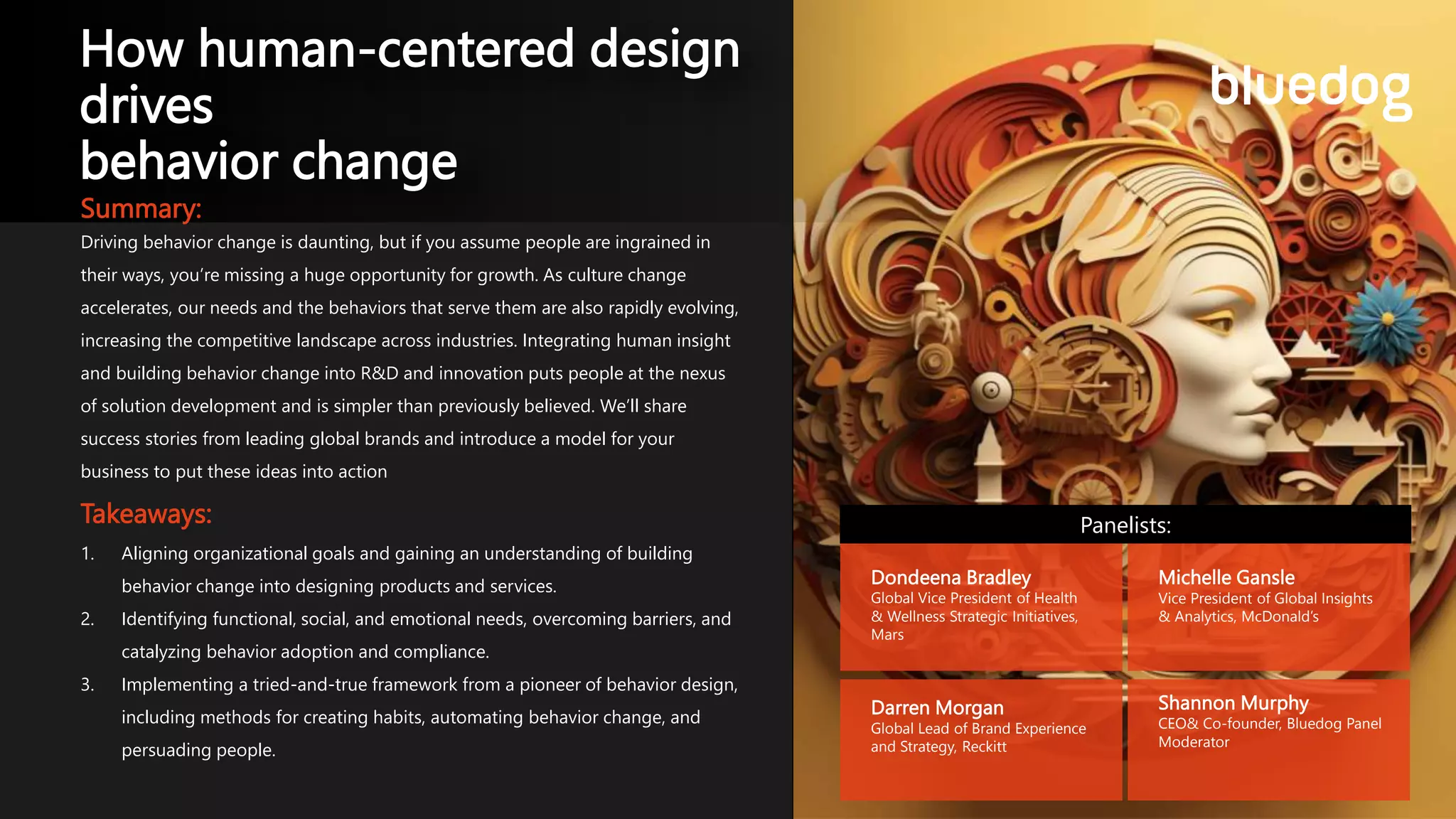
Dondeena Bradley
Global Vice President of Health
& Wellness Strategic Initiatives,
Mars
Michelle Gansle
Vice President of Global Insights
& Analytics, McDonald’s
Darren Morgan
Global Lead of Brand Experience
and Strategy, Reckitt
Shannon Murphy
CEO& Co-founder, Bluedog Panel
Moderator
How human-centered design
drives
behavior change
Summary:
Driving behavior change is daunting, but if you assume people are ingrained in
their ways, you’re missing a huge opportunity for growth. As culture change
accelerates, our needs and the behaviors that serve them are also rapidly evolving,
increasing the competitive landscape across industries. Integrating human insight
and building behavior change into R&D and innovation puts people at the nexus
of solution development and is simpler than previously believed. We’ll share
success stories from leading global brands and introduce a model for your
business to put these ideas into action
Takeaways:
1. Aligning organizational goals and gaining an understanding of building
behavior change into designing products and services.
2. Identifying functional, social, and emotional needs, overcoming barriers, and
catalyzing behavior adoption and compliance.
3. Implementing a tried-and-true framework from a pioneer of behavior design,
including methods for creating habits, automating behavior change, and
persuading people.
Panelists:
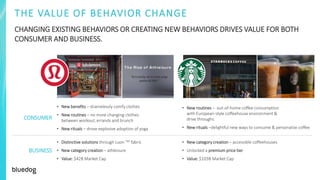
THE VALUE OF BEHAVIOR CHANGE
CONSUMER
• New benefits – shamelessly comfy clothes
• New routines – no more changing clothes
between workout, errands and brunch
• New rituals – drove explosive adoption of yoga
• New routines – out-of-home coffee consumption
with European-style coffeehouse environment &
drive throughs
• New rituals –delightful new ways to consume & personalize coffee
BUSINESS
• Distinctive solutions through Luon TM fabric
• New category creation – athleisure
• Value: $42B Market Cap
• New category creation – accessible coffeehouses
• Unlocked a premium price tier
• Value: $103B Market Cap
CHANGING EXISTING BEHAVIORS OR CREATING NEW BEHAVIORS DRIVES VALUE FOR BOTH
CONSUMER AND BUSINESS.
WHAT’S MAKING IT MORE RELEVANT & LESS CHALLENGING
RAPIDLY ACCELERATING PACE
IN COMPETITION & CULTURE
IT’S EASIER THAN
WE THOUGHT
CURRENT BEHAVIORS DON’T ALWAYS
SERVE PEOPLE
Culture
• Covid-19
• Climate change
• Digital revolution
Competition
• Lower barriers to market entry
• Lower cost marketing models
• DTC proliferation
As culture rapidly changes,
so does consumer behavior
We now have models that
tell us how to change behavior
• We’ll introduce you to a tried-and-
true framework today!
• As the world evolves, so do our
needs and the behaviors that serve
them.
PIONEERED BY PROFESSOR BJ FOGG,
founder & director of Stanford’s Behavior Design Lab,
which studies "methods for creating habits, showing what causes behavior,
automating behavior change, & persuading people.”
TRIGGERS
fail here
TRIGGERS
succeed here
BARRIERS
MOTIVATION
ABILITY
hard to do easy to do
high motivation
low motivation
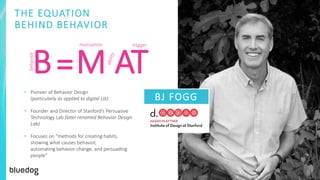
• Pioneer of Behavior Design
(particularly as applied to digital UX)
• Founder and Director of Stanford's Persuasive
Technology Lab (later renamed Behavior Design
Lab)
• Focuses on "methods for creating habits,
showing what causes behavior,
automating behavior change, and persuading
people”
B
b
ehavior
motivation trigger
T
BJ FOGG
=M A
THE EQUATION
BEHIND BEHAVIOR
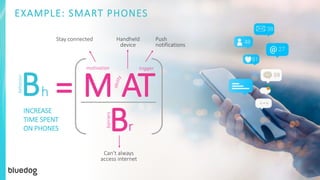
Stay connected Push
notifications
Handheld
device
INCREASE
TIME SPENT
ON PHONES
Can’t always
access internet
motivation trigger
T
= M A
Br
barriers
B
b
ehavior
h
EXAMPLE: SMART PHONES
Stay connected Push notifications
Handheld
device
Can’t always
access internet
motivation trigger
T
= M A
Br
barriers
B
b
ehavior
h
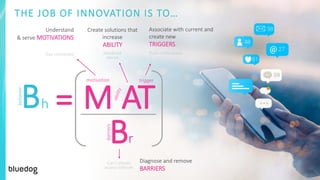
Understand
& serve MOTIVATIONS
Create solutions that
increase
ABILITY
Associate with current and
create new
TRIGGERS
Diagnose and remove
BARRIERS
THE JOB OF INNOVATION IS TO…
WE HOPE TO SEE YOU SOON!

SXSW 2024_PanePicker_Behavior Change Content Preview.pptx

  • 1.
    Dondeena Bradley Global VicePresident of Health & Wellness Strategic Initiatives, Mars Michelle Gansle Vice President of Global Insights & Analytics, McDonald’s Darren Morgan Global Lead of Brand Experience and Strategy, Reckitt Shannon Murphy CEO& Co-founder, Bluedog Panel Moderator How human-centered design drives behavior change Summary: Driving behavior change is daunting, but if you assume people are ingrained in their ways, you’re missing a huge opportunity for growth. As culture change accelerates, our needs and the behaviors that serve them are also rapidly evolving, increasing the competitive landscape across industries. Integrating human insight and building behavior change into R&D and innovation puts people at the nexus of solution development and is simpler than previously believed. We’ll share success stories from leading global brands and introduce a model for your business to put these ideas into action Takeaways: 1. Aligning organizational goals and gaining an understanding of building behavior change into designing products and services. 2. Identifying functional, social, and emotional needs, overcoming barriers, and catalyzing behavior adoption and compliance. 3. Implementing a tried-and-true framework from a pioneer of behavior design, including methods for creating habits, automating behavior change, and persuading people. Panelists:
  • 2.
    THE VALUE OFBEHAVIOR CHANGE CONSUMER • New benefits – shamelessly comfy clothes • New routines – no more changing clothes between workout, errands and brunch • New rituals – drove explosive adoption of yoga • New routines – out-of-home coffee consumption with European-style coffeehouse environment & drive throughs • New rituals –delightful new ways to consume & personalize coffee BUSINESS • Distinctive solutions through Luon TM fabric • New category creation – athleisure • Value: $42B Market Cap • New category creation – accessible coffeehouses • Unlocked a premium price tier • Value: $103B Market Cap CHANGING EXISTING BEHAVIORS OR CREATING NEW BEHAVIORS DRIVES VALUE FOR BOTH CONSUMER AND BUSINESS.
  • 3.
    WHAT’S MAKING ITMORE RELEVANT & LESS CHALLENGING RAPIDLY ACCELERATING PACE IN COMPETITION & CULTURE IT’S EASIER THAN WE THOUGHT CURRENT BEHAVIORS DON’T ALWAYS SERVE PEOPLE Culture • Covid-19 • Climate change • Digital revolution Competition • Lower barriers to market entry • Lower cost marketing models • DTC proliferation As culture rapidly changes, so does consumer behavior We now have models that tell us how to change behavior • We’ll introduce you to a tried-and- true framework today! • As the world evolves, so do our needs and the behaviors that serve them.
  • 4.
    PIONEERED BY PROFESSORBJ FOGG, founder & director of Stanford’s Behavior Design Lab, which studies "methods for creating habits, showing what causes behavior, automating behavior change, & persuading people.” TRIGGERS fail here TRIGGERS succeed here BARRIERS MOTIVATION ABILITY hard to do easy to do high motivation low motivation • Pioneer of Behavior Design (particularly as applied to digital UX) • Founder and Director of Stanford's Persuasive Technology Lab (later renamed Behavior Design Lab) • Focuses on "methods for creating habits, showing what causes behavior, automating behavior change, and persuading people” B b ehavior motivation trigger T BJ FOGG =M A THE EQUATION BEHIND BEHAVIOR
  • 5.
    Stay connected Push notifications Handheld device INCREASE TIMESPENT ON PHONES Can’t always access internet motivation trigger T = M A Br barriers B b ehavior h EXAMPLE: SMART PHONES
  • 6.
    Stay connected Pushnotifications Handheld device Can’t always access internet motivation trigger T = M A Br barriers B b ehavior h Understand & serve MOTIVATIONS Create solutions that increase ABILITY Associate with current and create new TRIGGERS Diagnose and remove BARRIERS THE JOB OF INNOVATION IS TO…
  • 7.
    WE HOPE TOSEE YOU SOON!

Editor's Notes

  • #3  Luon, which is trademarked by the brand, is 86 percent nylon and 14 percent Lycra.
  • #4 https://www.mckinsey.com/capabilities/growth-marketing-and-sales/our-insights/understanding-and-shaping-consumer-behavior-in-the-next-normal Such disruptions in daily experiences present a rare moment. In ordinary times, consumers tend to stick stubbornly to their habits, resulting in very slow adoption (if any) of beneficial innovations that require behavior change. Now, the COVID-19 crisis has caused consumers everywhere to change their behaviors—rapidly and in large numbers. In the United States, for example, 75 percent of consumers have tried a new store, brand, or different way of shopping during the pandemic. Even though the impetus for that behavior change may be specific to the pandemic and transient, consumer companies would do well to find ways to meet consumers where they are today and satisfy their needs in the postcrisis period. https://www.fastcompany.com/1844177/innovation-isnt-about-new-products-its-about-changing-behavior https://www.pointillist.com/blog/customer-behavior-data/