California State Park’s Central Valley Vision Great Valley Center's  Sacramento Valley Forum   Chico- October 27, 2010
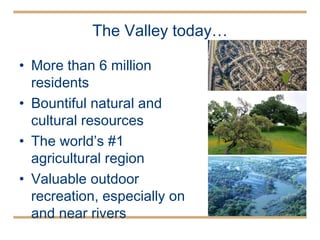
The Valley today… More than 6 million residents Bountiful natural and cultural resources  The world’s #1 agricultural region Valuable outdoor recreation, especially on and near rivers
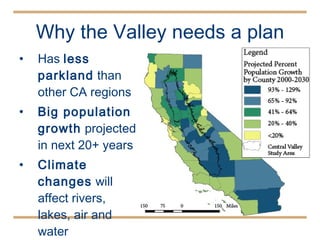
Why the Valley needs a plan Has  less parkland  than other CA regions  Big population growth  projected in next 20+ years Climate changes  will affect rivers, lakes, air and water
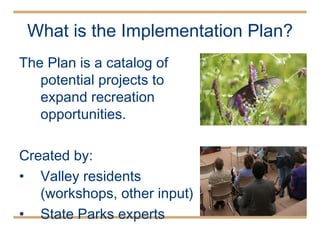
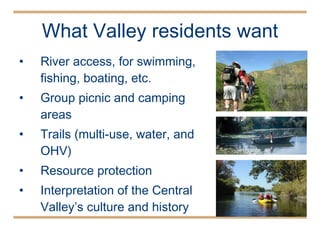
What is the Implementation Plan? The Plan is a catalog of potential projects to expand recreation opportunities. Created by: Valley residents (workshops, other input) State Parks experts
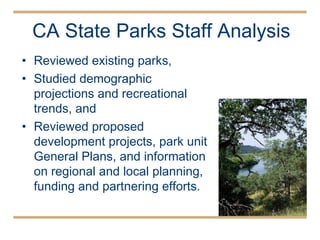
What Valley residents want River access, for swimming, fishing, boating, etc. Group picnic and camping areas Trails (multi-use, water, and OHV) Resource protection Interpretation of the Central Valley’s culture and history
CA State Parks Staff Analysis Reviewed existing parks,  Studied demographic projections and recreational trends, and Reviewed proposed development projects, park unit General Plans, and information on regional and local planning, funding and partnering efforts.
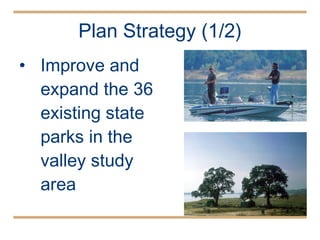
Improve and expand the 36 existing state parks in the valley study area Plan Strategy (1/2)
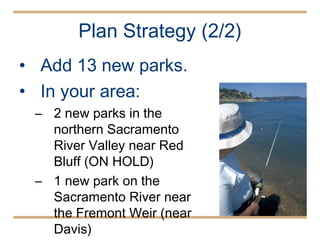
Add 13 new parks. In your area: 2 new parks in the northern Sacramento River Valley near Red Bluff (ON HOLD) 1 new park on the Sacramento River near the Fremont Weir (near Davis) Plan Strategy (2/2)
If fully implemented, the plan would: Almost triple the number of campsites in the Valley. More than double the number of picnic sites in the Valley Almost double the acres of State Parks land in the Valley. Plan Benefits
More Plan Features Heritage corridors  to interpret Valley history and culture  Boating trails  to link outdoor recreation areas along rivers and waterways.  “ Base camp” strategy  to maximize access to public lands and save money.
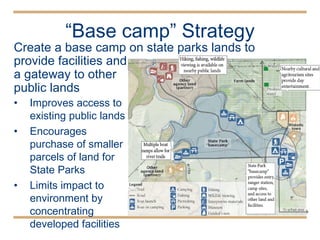
“Base camp” Strategy Improves access to existing public lands Encourages purchase of smaller parcels of land for State Parks Limits impact to environment by concentrating developed facilities Create a base camp on state parks lands to provide facilities and a   gateway to other public lands
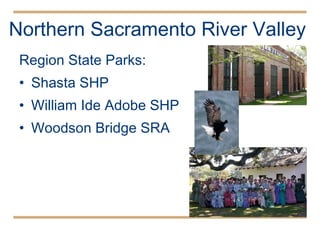
Northern Sacramento River Valley  Region State Parks: Shasta SHP William Ide Adobe SHP  Woodson Bridge SRA
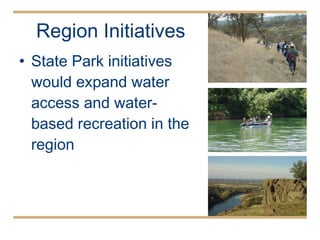
Region Initiatives State Park initiatives would expand water access and water-based recreation in the region
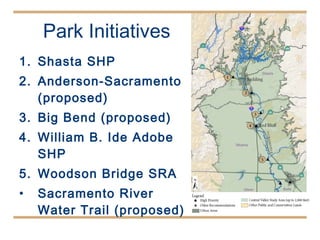
Park Initiatives Shasta SHP Anderson-Sacramento (proposed) Big Bend (proposed)  William B. Ide Adobe SHP Woodson Bridge SRA Sacramento River Water Trail (proposed)
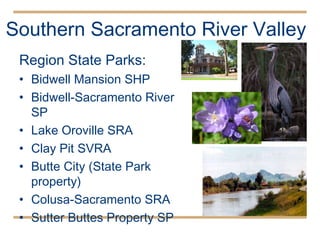
Southern Sacramento River Valley  Region State Parks: Bidwell Mansion SHP  Bidwell-Sacramento River SP Lake Oroville SRA Clay Pit SVRA Butte City (State Park property) Colusa-Sacramento SRA Sutter Buttes Property SP
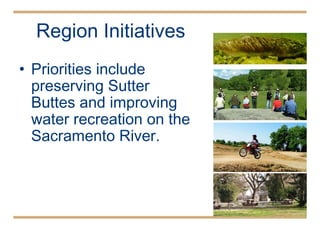
Region Initiatives Priorities include preserving Sutter Buttes and improving water recreation on the Sacramento River.
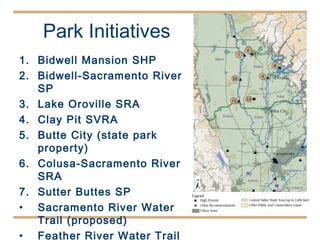
Park Initiatives Bidwell Mansion SHP Bidwell-Sacramento River SP Lake Oroville SRA Clay Pit SVRA Butte City (state park property) Colusa-Sacramento River SRA  Sutter Buttes SP  Sacramento River Water Trail (proposed) Feather River Water Trail (proposed)
Central Valley Vision www.parks.ca.gov Thank You!

California State Park’s Central Valley Vision

  • 1.
    California State Park’sCentral Valley Vision Great Valley Center's Sacramento Valley Forum Chico- October 27, 2010
  • 2.
    The Valley today…More than 6 million residents Bountiful natural and cultural resources The world’s #1 agricultural region Valuable outdoor recreation, especially on and near rivers
  • 3.
    Why the Valleyneeds a plan Has less parkland than other CA regions Big population growth projected in next 20+ years Climate changes will affect rivers, lakes, air and water
  • 4.
    What is theImplementation Plan? The Plan is a catalog of potential projects to expand recreation opportunities. Created by: Valley residents (workshops, other input) State Parks experts
  • 5.
    What Valley residentswant River access, for swimming, fishing, boating, etc. Group picnic and camping areas Trails (multi-use, water, and OHV) Resource protection Interpretation of the Central Valley’s culture and history
  • 6.
    CA State ParksStaff Analysis Reviewed existing parks, Studied demographic projections and recreational trends, and Reviewed proposed development projects, park unit General Plans, and information on regional and local planning, funding and partnering efforts.
  • 7.
    Improve and expandthe 36 existing state parks in the valley study area Plan Strategy (1/2)
  • 8.
    Add 13 newparks. In your area: 2 new parks in the northern Sacramento River Valley near Red Bluff (ON HOLD) 1 new park on the Sacramento River near the Fremont Weir (near Davis) Plan Strategy (2/2)
  • 9.
    If fully implemented,the plan would: Almost triple the number of campsites in the Valley. More than double the number of picnic sites in the Valley Almost double the acres of State Parks land in the Valley. Plan Benefits
  • 10.
    More Plan FeaturesHeritage corridors to interpret Valley history and culture Boating trails to link outdoor recreation areas along rivers and waterways. “ Base camp” strategy to maximize access to public lands and save money.
  • 11.
    “Base camp” StrategyImproves access to existing public lands Encourages purchase of smaller parcels of land for State Parks Limits impact to environment by concentrating developed facilities Create a base camp on state parks lands to provide facilities and a gateway to other public lands
  • 12.
    Northern Sacramento RiverValley Region State Parks: Shasta SHP William Ide Adobe SHP Woodson Bridge SRA
  • 13.
    Region Initiatives StatePark initiatives would expand water access and water-based recreation in the region
  • 14.
    Park Initiatives ShastaSHP Anderson-Sacramento (proposed) Big Bend (proposed) William B. Ide Adobe SHP Woodson Bridge SRA Sacramento River Water Trail (proposed)
  • 15.
    Southern Sacramento RiverValley Region State Parks: Bidwell Mansion SHP Bidwell-Sacramento River SP Lake Oroville SRA Clay Pit SVRA Butte City (State Park property) Colusa-Sacramento SRA Sutter Buttes Property SP
  • 16.
    Region Initiatives Prioritiesinclude preserving Sutter Buttes and improving water recreation on the Sacramento River.
  • 17.
    Park Initiatives BidwellMansion SHP Bidwell-Sacramento River SP Lake Oroville SRA Clay Pit SVRA Butte City (state park property) Colusa-Sacramento River SRA Sutter Buttes SP Sacramento River Water Trail (proposed) Feather River Water Trail (proposed)
  • 18.
    Central Valley Visionwww.parks.ca.gov Thank You!

Editor's Notes

  • #2 In 2003, California State Parks began work on its Central valley Vision Plan 2005 – CSP holds public outreach meetings in the Central Valley 2006 – CSP releases Central Valley Vision report 2007 – Governor Schwarzenegger signs in to law PRC Section 509.50, Chapter 1.57 calling for the Central Valley Vision Implementation Plan. 2009 – Draft Plan released to legislators.
  • #4 Key issues: Valley state parks are smaller and have fewer amenities than those in other areas of California. The San Joaquin Valley and Tulare Basin regions have particularly few state parks to serve their growing populations. The Valley lacks well-developed regional park systems such as those in some coastal counties and the Bay Area. The Valley study area is 19% of the area of California but contains only 4% of California’s public land. Additionally, these wildlife refuges and other agency landholdings, while large, have few recreation facilities; their purpose is mainly for wildlife habitat or dispersed recreation. Due to budget constraints, many government agencies struggle to maintain recreational facilities. Central Valley residents must travel an average of 50 minutes to reach their favorite recreation areas—up to twice as long as residents of southern California or the Bay Area. Population is projected to nearly double in the study area counties by 2030, going from about 7.8 million in 2000 to about 14 million. Ethnic composition of the valley is changing dramatically. For example, in 2000, Latinos made up about 30% of the population and Anglo-Europeans about 53%. In 2030, the Latino population, projected to be about 4.6 million, will exceed the Anglo-European population, projected to be about 3 million. The number of Californians over 60 years of age is projected to double between 1990 and 2020. Small agricultural-based towns and communities are becoming urbanized, negatively impacting water supply, open space and cultural and natural resources.
  • #5 California’s Legislature directed State Parks to prepare this Implementation Plan in 2007. Decisions about funding for particular initiatives will be made through annual updates to California State Parks’ Five-Year Infrastructure Plan and the State’s annual budget. These proposed lands and facilities will provide family-oriented recreation for new generations of residents.
  • #6 Survey data P ublic Opinions and Attitudes show that recreation activities at lakes, rivers and reservoirs are very highly valued. Popular activities include swimming, angling, motor boating and non-motorized boating, sail boating, windsurfing and beach activities. Of all California regions, angling is most popular in the Valley. Based on survey trends, walking, picnicking, developed camping, swimming, sightseeing and visiting nature centers and historic sites will continue to be perennial favorites that will dominate outdoor recreation. Public meetings . In Valley cities and towns, residents said they wanted state parks that provide: river access, for swimming, angling, boating and other water sports; varied recreation opportunities, including group picnic areas, updated and increased camping facilities, areas for sunning and open areas for kite flying, pickup games and unstructured play; trails, including multiuse trails for equestrians, walkers and bikers; water trails for rafters and boaters; and off-highway vehicle use areas; resource protection, including preservation of riparian woodlands, oak and sycamore groves, native grasslands and vernal pools; and interpretation of the Central Valley’s culture and history, especially related to California Indians, agriculture, water development, immigrants and the oil and gas industry. Oversight Committee. Guiding the project are agency policy leaders, community activists and State Park partners.
  • #7 Our activities/analysis
  • #8 In your area, includes: Shasta SHP William Ide Adobe SHP Woodson Bridge SRA Bidwell Mansion SHP Bidwell-Sacramento River SP Lake Oroville SRA Clay Pit SVRA Butte City (State Park property) Colusa-Sacramento SRA Sutter Buttes Property SP Woodland Opera House SHP Folsom Lake SRA and Folsom Powerhouse SHP Prairie City SVRA
  • #9 6 new parks in the San Joaquin Valley and Tulare Basin 2 new museums in Sacramento and 2 new parks in Yolo County—4 new park areas to serve the State Capitol’s growing metropolitan region and 1 new park in Solano County that will help link other conserved areas to the Delta.
  • #10 Initiatives would improve campsites, picnic areas, trails, boat landings, marinas, and other facilities at almost two-thirds of existing Valley parks. Almost tripling campsites, from 1,200 to 3,200 sites. More than doubling picnic sites, from almost 900 to almost 2,000 sites. Almost doubling the acres of State Parks land in the Valley, from about 110,000 to over 200,000 acres.
  • #11 Heritage Corridors: The California Delta Heritage Corridor would link historic Delta towns, recreation sites, nature areas and farm stands. Highlights: Historic communities such as Rio Vista and Locke; recreation areas such as Big Break; wildlife and fish habitats such as Woodbridge Ecological Reserve; agritourism attractions such as “U-pick” fruit orchards and festivals; trails such as parts of the American Discovery Trail; and Delta excursion boats. The Cross-California Ecological Corridor (already a heritage corridor) links natural areas and other examples of California ecosystems. Highlights: Rivers and their riparian habitats; marshes and wildlife-friendly rice farms; public recreation land such as Sutter National Refuge; public recreation land such as South Yuba River State Park; and wildlife areas. The Black Gold Heritage Corridor would connect sites associated with oil development in Kern and Kings counties. Highlights: Important oil fields such as Elk Hills; Bakersfield refineries; museums such as the Kern County Museum; and events such as “Bakersfield sound” performances at Buck Owens’ Crystal Palace. The Central Valley Farm Trails Heritage Corridor would link Highway 99 and Interstate 5 to local farm trails and other agricultural sites. Highlights: Local farm trails and “u-pick” farms; agritourism sites; historic farms, ranches and farm communities such as Colonel Allensworth State Historic Park; farm history museums; farm labor history sites; water facilities such as reservoirs; and state and county rodeos and charreadas, cook-offs and festivals. Echoes of Our Ancestors Corridor. The Great Central Valley has been home to many diverse cultural groups, beginning with California Indians. This heritage corridor take aspects of the history of California’s rich ethnic diversity and links them together.
  • #12 Cooperation with partners will: Aid CSP in creating a “base camp” strategy that will emphasize parks and facilities that enhance access to other agency’s public lands in the Valley Maximize funding efforts and volunteer contributions
  • #13 Local Resources Riparian forests, cattle ranches, and orchards; Beautiful Lake Shasta and the forested Cascades; Celebrated trout and salmon fishing, abundant wildlife, stunning views, and historic towns. Recreation Facilities Lake Shasta, Sundial Bridge at Turtle Bay, a BLM Conservation Area, and the Sacramento River National Wildlife Refuge. Local parks and marinas provide river access and other facilities. State Parks in the region Shasta SHP. Restored historic buildings preserve a slice of the Gold Rush era's northern mining district. William Ide Adobe SHP. Memorializing the leader of the 1846 Bear Flag Revolt, historic ranch buildings take visitors back to California's pioneer days. Woodson Bridge SRA. Riparian forests and oak woodlands are home to bald eagles and yellow-billed cuckoos. Visitors enjoy picnicking, camping, fishing and trails.
  • #14 State Park initiatives would expand water access and water-based recreation in the region, including: Two new State Parks linking Redding and Red Bluff recreation areas The addition of 5,200-5,800 acres of land, 140-160 campsites and 150-180 picnic sites, and restoration of about 200 acres Expanded hiking, biking, and equestrian trails; fishing access; boating facilities; and interpretation and education opportunities A Sacramento River Water Trail to connect riverside recreation facilities.
  • #15 Shasta SHP Continue historic preservation and interpretation activities. Acquire historic Bystle House. Protect the viewshed by securing about 165 acres from BLM. Anderson-Sacramento River (proposed) Acquire about 225 acres of riverfront property. Develop 25 campsites, 50 picnic sites, trails, angling access, boating facilities and an interpretive program. Big Bend (proposed) Acquire 4,000-4,700 acres of riverfront property. Develop about 100 campsites, 2 group campsites, 125 picnic sites, trails, angling access, boating facilities and an interpretive program. William B. Ide Adobe SHP Continue interpretive programs. Enhance river access. Woodson Bridge SRA Accept the 700 acre Kopta Slough property. Restore about 180 acres of wildlife habitat. Add a 25-person group campground and new trails, and improve accessibility and the campground center. Cooperate with U.S. Fish and Wildlife Service, Department of Fish and Game and The Nature Conservancy to manage and interpret resources . Sacramento River Water Trail (proposed) Develop a water trail along the river from Redding to Sacramento with campsites, boat ramps and day-use areas at existing parks and marinas.
  • #16 Local Resources Oaks and cottonwoods shade rivers and harbor songbirds that nest or migrate along waterways. The Sutter Buttes overlook marshes and rice farms where millions of waterbirds congregate each winter. The Sacramento and Feather Rivers offer boating and fishing. Water development projects, key to the success of the region's agriculture, include the Sacramento River Flood Control Project and the State Water Project's Lake Oroville reservoir. Over 427,000 people live here, primarily in Yuba City and Marysville. Travelers, who typically use Interstate 5 or Highway 99, spent about $488 million in region counties in 2006. Recreation facilities The region holds about 225,000 acres of outdoor recreation land, including twelve national wildlife refuges and state wildlife areas. Local parks, historic mining towns and farm centers are other regional facilities. State Parks in the Region Bidwell Mansion SHP. This Victorian mansion memorializes pioneers John and Annie Bidwell. Bidwell-Sacramento River SP. Angling and boating are popular activities; riparian forests are being restored. Lake Oroville SRA. Boating, camping, picnicking, and trails are all available at the 15,500-acre reservoir. Clay Pit SVRA. This off-highway use area is near Oroville. Butte City (State Park property). Access to the Sacramento River is a major feature of this 50-acre property. Colusa-Sacramento SRA. A favorite of anglers and boaters, the fishing here is some of the best in California. Sutter Buttes SP. Scenic oak woodlands and grasslands are preserved in this new, undeveloped park.
  • #17 Priorities include preserving Sutter Buttes and improving water recreation on the Sacramento River: Develop 350-400 campsites and 80-100 picnic sites, protect an additional 7,800-8,300 acres and restore about 1,000 acres of wildlife habitat at State Parks. Expanded hiking, biking, and equestrian trails; fishing access; boating facilities; and interpretation and education opportunities Develop water trails on the Sacramento and Feather Rivers so that boaters can cruise between State Parks, boat landings and other recreation lands.
  • #18 Bidwell Mansion SHP Continue restoration of mansion and grounds. Expand interpretive materials. Bidwell-Sacramento River SP Partner with DFG, WCB and USFWS to restore habitat. Add about 55 campsites, a visitor center, trails, and angling access. Lake Oroville SRA Assist DWR in adding 75-100 campsites, 20-50 picnic sites, and expanding trails and boating facilities. Partner with DWR and BLM on 5,800 acres around the lake. Clay Pit SVRA Add new track and day-use facilities. Interpret and protect vernal pools. Butte City (park property) Develop primitive campsites, trails, an interpretive program, and small boating and angling facilities. Provide day use access to the neighboring wildlife refuge. Colusa-Sacramento River SRA Acquire about 13 acres and restore about 140 acres of wildlife habitat. Add about 20 campsites, 10 picnic sites and interpretive opportunities. Enhance boating and angling facilities. State Park at Sutter Buttes Acquire about 1,800 acres. Develop about 150 campsites (outside of Peace Valley), 50 picnic sites, trails, and interpretation. Sacramento River Water Trail (proposed) Develop a water trail from Redding to Sacramento with campsites, boat ramps and day-use areas at existing parks and marinas. Feather River Water Trail (proposed) Develop a water trail from Oroville to the Sacramento R. with boat ramps and day-use at existing parks and marinas.