Supervised learning and
unsupervised learning
Supervised learning and
unsupervised learning are two main
types of machine learning, each with
distinct characteristics and use cases.
Here's a breakdown of their
differences:
Data Labeling
•Supervised Learning: Uses labeled data,
meaning each training example is paired with an
output label. For example, in image classification,
each image (input) has a corresponding category
(output label).
•Unsupervised Learning: Uses unlabeled data,
meaning the algorithm must find patterns and
relationships on its own, without any specific
guidance on what to look for.
Goal
•Supervised Learning: The goal is to learn a
mapping function from input variables to
output variables, enabling the model to predict
outputs for new inputs. It's like learning with a
teacher.
•Unsupervised Learning: The goal is to
discover hidden patterns or intrinsic structures
in the data. It's like learning without a teacher.
Types of Problems
•Supervised Learning: Typical tasks include
classification (e.g., spam detection) and
regression (e.g., predicting house prices).
•Unsupervised Learning: Typical tasks
include clustering (e.g., customer
segmentation), dimensionality reduction
(e.g., Principal Component Analysis), and
association (e.g., market basket analysis).
Evaluation
1.Supervised Learning: Model
performance can be easily evaluated
using the labeled data (e.g., accuracy,
precision, recall, F1 score).
2.Unsupervised Learning: Evaluation is
more challenging due to the absence of
ground truth labels. Often, domain
experts must manually evaluate the
results.
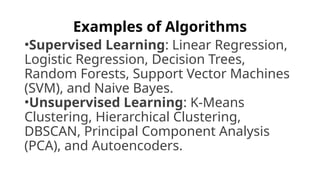
Examples of Algorithms
•Supervised Learning: Linear Regression,
Logistic Regression, Decision Trees,
Random Forests, Support Vector Machines
(SVM), and Naive Bayes.
•Unsupervised Learning: K-Means
Clustering, Hierarchical Clustering,
DBSCAN, Principal Component Analysis
(PCA), and Autoencoders.

Supervised learning and unsupervised learning new 2024.pptx

  • 1.
    Supervised learning and unsupervisedlearning Supervised learning and unsupervised learning are two main types of machine learning, each with distinct characteristics and use cases. Here's a breakdown of their differences:
  • 2.
    Data Labeling •Supervised Learning:Uses labeled data, meaning each training example is paired with an output label. For example, in image classification, each image (input) has a corresponding category (output label). •Unsupervised Learning: Uses unlabeled data, meaning the algorithm must find patterns and relationships on its own, without any specific guidance on what to look for.
  • 3.
    Goal •Supervised Learning: Thegoal is to learn a mapping function from input variables to output variables, enabling the model to predict outputs for new inputs. It's like learning with a teacher. •Unsupervised Learning: The goal is to discover hidden patterns or intrinsic structures in the data. It's like learning without a teacher.
  • 4.
    Types of Problems •SupervisedLearning: Typical tasks include classification (e.g., spam detection) and regression (e.g., predicting house prices). •Unsupervised Learning: Typical tasks include clustering (e.g., customer segmentation), dimensionality reduction (e.g., Principal Component Analysis), and association (e.g., market basket analysis).
  • 5.
    Evaluation 1.Supervised Learning: Model performancecan be easily evaluated using the labeled data (e.g., accuracy, precision, recall, F1 score). 2.Unsupervised Learning: Evaluation is more challenging due to the absence of ground truth labels. Often, domain experts must manually evaluate the results.
  • 6.
    Examples of Algorithms •SupervisedLearning: Linear Regression, Logistic Regression, Decision Trees, Random Forests, Support Vector Machines (SVM), and Naive Bayes. •Unsupervised Learning: K-Means Clustering, Hierarchical Clustering, DBSCAN, Principal Component Analysis (PCA), and Autoencoders.