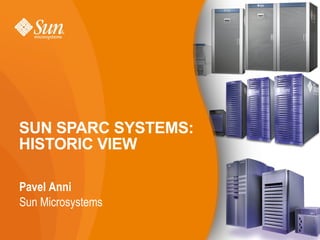
SUN SPARC SYSTEMS: HISTORIC VIEW Pavel Anni Sun Microsystems
Executive Summary According to historical data, typical life expectancy of Sun SPARC systems family is 6.5-7.5 years Systems families usually have 1.5 years overlap to allow customers make a smooth transition Systems have processor speedbumps over their lifetime; starting from Sun Fire family (2001) it is possible to have processor with different speeds in one system Technologies used in the systems families evolve over time, becoming more and more mature
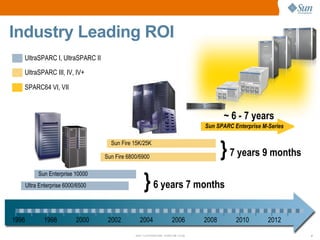
Industry Leading ROI 1996 1998 2000 2002 2004 2006 2008 2010 2012 UltraSPARC I, UltraSPARC II UltraSPARC III, IV, IV+ SPARC64 VI, VII }   6 years 7 months }  7  years 9 months ~ 6 - 7  years
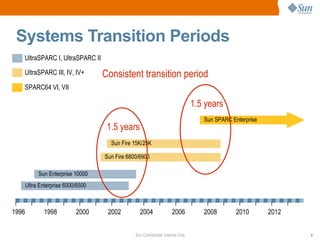
Systems Transition Periods 1996 1998 2000 2002 2004 2006 2008 2010 2012 UltraSPARC I, UltraSPARC II UltraSPARC III, IV, IV+ SPARC64 VI, VII 1.5 years 1.5 years Consistent transition period
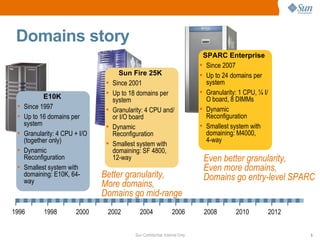
Domains story 1996 1998 2000 2002 2004 2006 2008 2010 2012 E10K Since 1997 Up to 16 domains per system Granularity: 4 CPU + I/O (together only) Dynamic Reconfiguration Smallest system with domaining: E10K, 64-way Sun Fire 25K Since 2001 Up to 18 domains per system Granularity: 4 CPU and/or I/O board Dynamic Reconfiguration Smallest system with domaining: SF 4800,  12-way SPARC Enterprise Since 2007 Up to 24 domains per system Granularity: 1 CPU, ¼ I/O board, 8 DIMMs Dynamic Reconfiguration Smallest system with domaining: M4000,  4-way  Better granularity,  More domains,  Domains go mid-range Even better granularity,  Even more domains,  Domains go entry-level SPARC
RAS story 1996 1998 2000 2002 2004 2006 2008 2010 2012 E10K No single point of failure POST and Automatic Reconfiguration Redundant systems boards, power supplies Hot-swap system boards, control boards, power supplies, disk drives ECC and parity protection Sun Fire 25K (in addition to the above) Auto Diagnosis and Recovery More ECC protection Survive more component failures Redundant system controllers and clocks Redundant and hot-swappable PCI-X cards Reconfigurable Logic Centerplane Field Replaceble Unit ID SPARC Enterprise (in addition to the above) Reduced component count CPU Instruction Retry Memory Patrol, Extended-ECC and Mirroring End-to-end ECC Tight integration with Solaris 10 FMA Chip level fault detection Automatic Dynamic Reconfiguration Preventive maintenance
THANK YOU! WHAT DO YOU THINK? Pavel Anni [email_address]

Sun SPARC Systems: Historic View

  • 1.
    SUN SPARC SYSTEMS:HISTORIC VIEW Pavel Anni Sun Microsystems
  • 2.
    Executive Summary Accordingto historical data, typical life expectancy of Sun SPARC systems family is 6.5-7.5 years Systems families usually have 1.5 years overlap to allow customers make a smooth transition Systems have processor speedbumps over their lifetime; starting from Sun Fire family (2001) it is possible to have processor with different speeds in one system Technologies used in the systems families evolve over time, becoming more and more mature
  • 3.
    Industry Leading ROI1996 1998 2000 2002 2004 2006 2008 2010 2012 UltraSPARC I, UltraSPARC II UltraSPARC III, IV, IV+ SPARC64 VI, VII } 6 years 7 months } 7 years 9 months ~ 6 - 7 years
  • 4.
    Systems Transition Periods1996 1998 2000 2002 2004 2006 2008 2010 2012 UltraSPARC I, UltraSPARC II UltraSPARC III, IV, IV+ SPARC64 VI, VII 1.5 years 1.5 years Consistent transition period
  • 5.
    Domains story 19961998 2000 2002 2004 2006 2008 2010 2012 E10K Since 1997 Up to 16 domains per system Granularity: 4 CPU + I/O (together only) Dynamic Reconfiguration Smallest system with domaining: E10K, 64-way Sun Fire 25K Since 2001 Up to 18 domains per system Granularity: 4 CPU and/or I/O board Dynamic Reconfiguration Smallest system with domaining: SF 4800, 12-way SPARC Enterprise Since 2007 Up to 24 domains per system Granularity: 1 CPU, ¼ I/O board, 8 DIMMs Dynamic Reconfiguration Smallest system with domaining: M4000, 4-way Better granularity, More domains, Domains go mid-range Even better granularity, Even more domains, Domains go entry-level SPARC
  • 6.
    RAS story 19961998 2000 2002 2004 2006 2008 2010 2012 E10K No single point of failure POST and Automatic Reconfiguration Redundant systems boards, power supplies Hot-swap system boards, control boards, power supplies, disk drives ECC and parity protection Sun Fire 25K (in addition to the above) Auto Diagnosis and Recovery More ECC protection Survive more component failures Redundant system controllers and clocks Redundant and hot-swappable PCI-X cards Reconfigurable Logic Centerplane Field Replaceble Unit ID SPARC Enterprise (in addition to the above) Reduced component count CPU Instruction Retry Memory Patrol, Extended-ECC and Mirroring End-to-end ECC Tight integration with Solaris 10 FMA Chip level fault detection Automatic Dynamic Reconfiguration Preventive maintenance
  • 7.
    THANK YOU! WHATDO YOU THINK? Pavel Anni [email_address]