SUMMER YOUTH CORPS An opportunity to collaborate with the faith community
The Challenge: Oregon’s Attrition
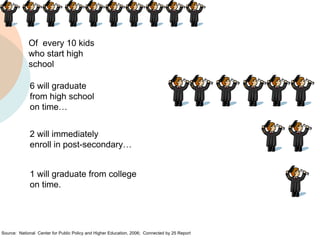
Of  every 10 kids who start high school 6 will graduate  from high school  on time… 2 will immediately  enroll in post-secondary… 1 will graduate from college on time. Source:  National  Center for Public Policy and Higher Education, 2006;  Connected by 25 Report
The Facts We lose kids during transitions from one grade to the next Top reasons for leaving include: boredom and disconnection  If we don’t pay now, we pay later: A high school drop out is 3 times more likely to be unemployed and 8 times more likely to end up in jail according to a 2004 Quality Education Commission report.
The Good News We can identify students by name Match them with workplace and post-secondary experiences to make learning more relevant and engaging Connection to a caring adult so they don’t feel “disconnected”
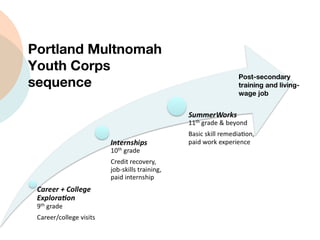
Post-secondary training and living-wage job Portland Multnomah Youth Corps sequence
Summer 2010: How you can help
Summer 2010 – How YOU Can help  Career+College Exploration (9th Graders as Target) Double the size from 500 to 1000 Credit Recovery+Internship (10th Graders as Target) Bring pilot program to scale from 35 to 500
Needs 250  adult volunteer coaches  Funds to provide these trips and paid internships. Businesses to host tours and sponsor internships.
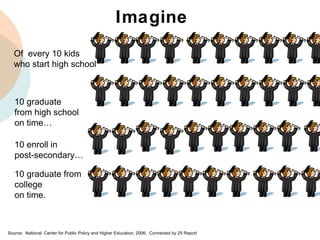
Of  every 10 kids  who start high school 10 graduate  from high school  on time… 10 enroll in  post-secondary… 10 graduate from  college on time. Imagine  Source:  National  Center for Public Policy and Higher Education, 2006;  Connected by 25 Report
CONNECT.  EXPLORE.   ACHIEVE.

Summer Youth Corps

  • 1.
    SUMMER YOUTH CORPSAn opportunity to collaborate with the faith community
  • 2.
  • 3.
    Of every10 kids who start high school 6 will graduate from high school on time… 2 will immediately enroll in post-secondary… 1 will graduate from college on time. Source: National Center for Public Policy and Higher Education, 2006; Connected by 25 Report
  • 4.
    The Facts Welose kids during transitions from one grade to the next Top reasons for leaving include: boredom and disconnection If we don’t pay now, we pay later: A high school drop out is 3 times more likely to be unemployed and 8 times more likely to end up in jail according to a 2004 Quality Education Commission report.
  • 5.
    The Good NewsWe can identify students by name Match them with workplace and post-secondary experiences to make learning more relevant and engaging Connection to a caring adult so they don’t feel “disconnected”
  • 6.
    Post-secondary training andliving-wage job Portland Multnomah Youth Corps sequence
  • 7.
    Summer 2010: Howyou can help
  • 8.
    Summer 2010 –How YOU Can help Career+College Exploration (9th Graders as Target) Double the size from 500 to 1000 Credit Recovery+Internship (10th Graders as Target) Bring pilot program to scale from 35 to 500
  • 9.
    Needs 250 adult volunteer coaches Funds to provide these trips and paid internships. Businesses to host tours and sponsor internships.
  • 10.
    Of every10 kids who start high school 10 graduate from high school on time… 10 enroll in post-secondary… 10 graduate from college on time. Imagine Source: National Center for Public Policy and Higher Education, 2006; Connected by 25 Report
  • 11.

Editor's Notes

  • #4 The early members of this Partnership looked at some data from the National Center for Public Policy and Higher Education. Shows that for every 10 kids in Ohio who start high school, only 7 will graduate on time, 4 will enroll immediately in college, 3 will still be enrolled in their Sophomore year and only 2 will graduate from college within 6 years. Local urban core numbers in Cincinnati are the same or even worse. This is unacceptable in a time in which all students need to be prepared for some form of education beyond high school in order to be prepared for a job in the knowledge economy. Statistics like this challenged tour group to think differently about the realities of academic success. One of the leaders raised the point that achievement is not dependent on programs, but the entire continuum of education back to early childhood and all the influences inside and outside the school walls.