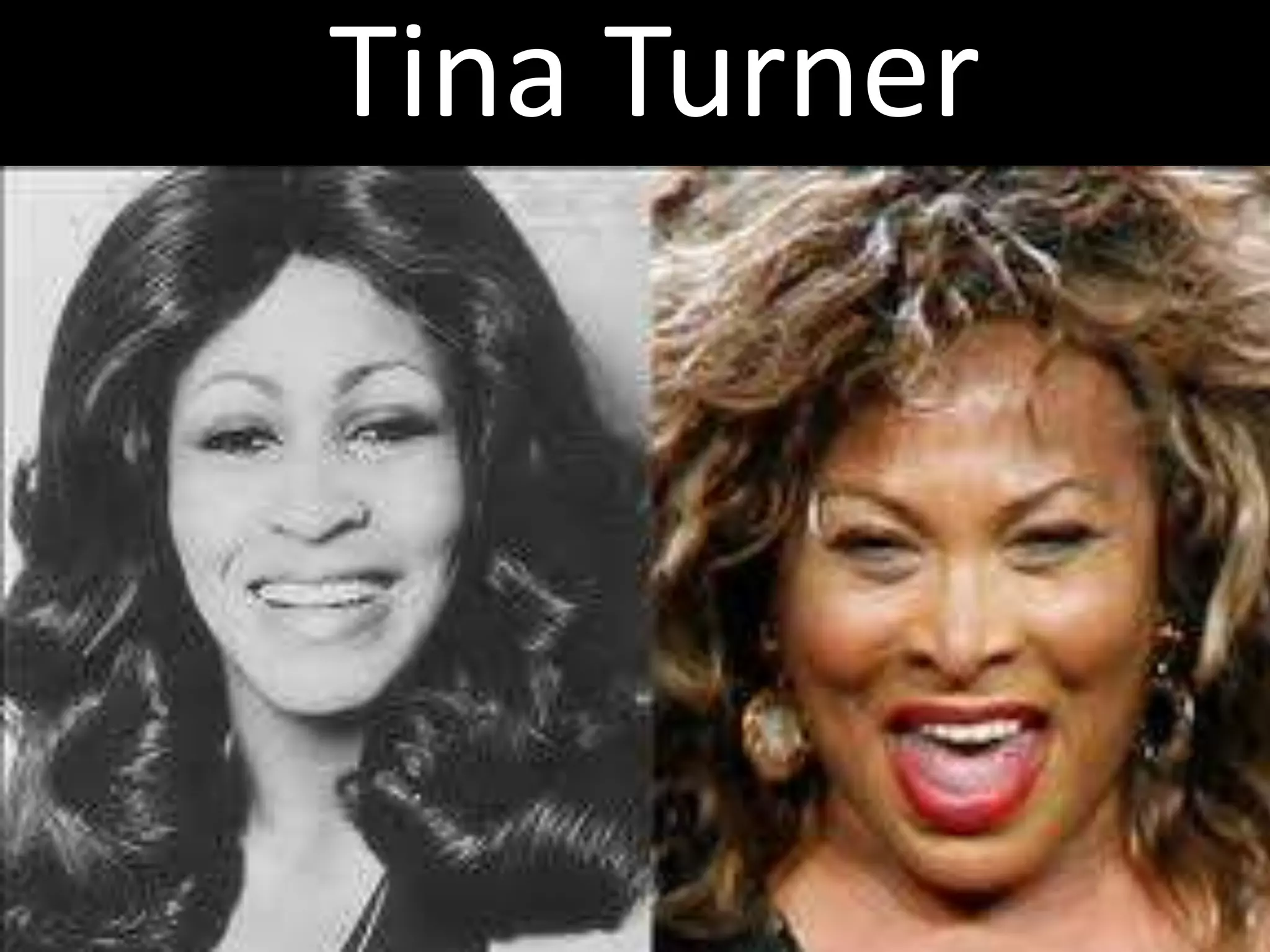
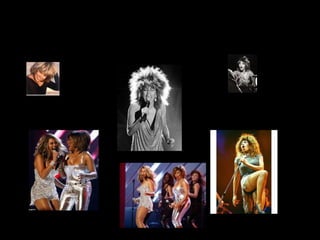
Tina Turner
Contributions to music: One of soul music's most incendiary performers With Ike Turner, a crucial link between R&B and the development of soul Helped bring gutbucket soul to the baby-boomer generation in the late Sixties Overcame bankruptcy and a violent marriage to orchestrate the most amazing comeback in the history of rock Soul music's first real diva A powerful singer with an impressive range; one of rock and roll's most accomplished interpretive stylistsEarly years:Young Anna Mae Bullock made her mark in St. Louis, where, as a 16-year-old student at Sumner High, she joined local R&B revue Ike Turner and the Kings of Rhythm (who'd already scored a hit three years earlier as Jackie Brenston and his Delta Cats with "Rocket 88"). After simply grabbing the mike on stage one night, the renamed Tina soon became the center of the show; when she became pregnant with the saxophonist's child, Ike took her into his house. A romantic relationship soon followed.Success: In 1959, Tina filled in for a missing (male) vocalist on a Sue Records session for Ike; the result, "A Fool In Love," was the first of several R&B smashes. By the mid-Sixties, the hits had dried up, but the revue, always a popular live act, kept recording for various labels. Tina's '66 classic "River Deep, Mountain High," produced by Phil Spector, also failed in the US; but a Rolling Stones tour helped redefine them for hippie fans, and they scored their definitive hit with 1970's "Proud Mary.“Later years:By that time, Ike had turned to physical violence to "control" the singer, and the Ike & Tina formula began to feel restricting; after a suicide attempt, Tina eventually left Ike in 1975 without a penny to her name. Though considered a has-been in the late-Seventies, she engineered a stunning comeback in the early Eighties thanks to Olivia Newton-John's management, scoring bigger hits than she'd ever had with Ike. She continues to record today, but is most popular, as always, as a concert draw.Decline in Popularity:Tina and Ike had a violent fight before an appearance at the Dallas Statler Hilton  in July 1976, where Tina was again physically abused. She left Ike that day, fleeing with nothing more than thirty-six cents and a Mobil gas station credit card in her possession. She spent the next few months hiding from Ike while staying with various friends.Tina would later credit her new-found Nichiren Buddhist faith and chanting Nam Myoho Renge Kyo, which she adopted while visiting a friend in 1974, with giving her the courage to strike out on her own. By walking out on Ike in the middle of a tour, she learned she was legally responsible to tour promoters for the canceled tour. Needing to earn a living, she became a solo performer, supplementing her income with TV appearances on shows such as The Hollywood Squares, Donny and MarieThe Sonny & Cher Show and The Brady Bunch Hour.The divorce was made final in 1978 after sixteen years of marriage. Tina later accused Ike of years of severe spousal abuse and rampant drug addiction in her autobiography I, Tina that was later adapted for the film What's Love Got to Do with It?.
What’s love got to do with it-1984"What's Love Got to Do with It" is the second single (after "Let's Stay Together") released from Tina Turner's fifth solo album Private Dancer. In Europe it was the third single following Turner's cover of The Beatles' "Help!". "What's Love Got to Do with It" became Turner's most successful single.
Turner had previously released two solo albums while still with her husband and musical partner Ike Turner. She split from him in 1976 and divorced him in 1978.
Following the divorce, she released two more solo albums, both of which failed on the charts. However, "What's Love Got to Do with It", from her fifth solo album, reached the top five in both the US and UK. The music video was directed by Mark Robinson.
 The song ranked #309 on Rolling Stone magazine's list of "The 500 Greatest Songs of All Time". It also ranked #38 on Songs of the Century. It was the 17th best-selling single of 1984 in the UK.
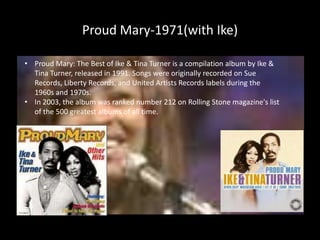
The song was originally recorded by UK pop group Bucks Fizz, but unreleased until 2000.[3] In 1993, the song's name was used as the title for What's Love Got to Do With It, a biographical film about Tina Turner's life.Proud Mary-1971(with Ike)Proud Mary: The Best of Ike & Tina Turner is a compilation album by Ike & Tina Turner, released in 1991. Songs were originally recorded on Sue Records, Liberty Records, and United Artists Records labels during the 1960s and 1970s.
In 2003, the album was ranked number 212 on Rolling Stone magazine's list of the 500 greatest albums of all time.Better be good to me-1984Better Be Good to Me" is a hit single from Tina Turner's solo album, Private Dancer. The song had originally been released in 1981 by Spider, a band from New York City with co-writer Holly Knight as a member. The Turner version was successful in the United States on the Hot 100 and the US R&B/Hip-Hop chart.
 It peaked at number five on the Billboard Hot 100 and number six on the US R&B/Hip-hop chart. At the 27th Grammy Awards in 1985, this song won Best Rock Vocal Performance, Female, one of four Grammys won by Turner in that ceremony.
The song was featured in the tenth episode of Miami Vice and was included on the first volume of the Miami Vice soundtrack.Private dancer-1985Private Dancer is the fifth solo album by Tina Turner, released on Capitol Records in 1984, which became her breakthrough solo album.

Summer task

  • 1.
  • 2.
    Contributions to music:One of soul music's most incendiary performers With Ike Turner, a crucial link between R&B and the development of soul Helped bring gutbucket soul to the baby-boomer generation in the late Sixties Overcame bankruptcy and a violent marriage to orchestrate the most amazing comeback in the history of rock Soul music's first real diva A powerful singer with an impressive range; one of rock and roll's most accomplished interpretive stylistsEarly years:Young Anna Mae Bullock made her mark in St. Louis, where, as a 16-year-old student at Sumner High, she joined local R&B revue Ike Turner and the Kings of Rhythm (who'd already scored a hit three years earlier as Jackie Brenston and his Delta Cats with "Rocket 88"). After simply grabbing the mike on stage one night, the renamed Tina soon became the center of the show; when she became pregnant with the saxophonist's child, Ike took her into his house. A romantic relationship soon followed.Success: In 1959, Tina filled in for a missing (male) vocalist on a Sue Records session for Ike; the result, "A Fool In Love," was the first of several R&B smashes. By the mid-Sixties, the hits had dried up, but the revue, always a popular live act, kept recording for various labels. Tina's '66 classic "River Deep, Mountain High," produced by Phil Spector, also failed in the US; but a Rolling Stones tour helped redefine them for hippie fans, and they scored their definitive hit with 1970's "Proud Mary.“Later years:By that time, Ike had turned to physical violence to "control" the singer, and the Ike & Tina formula began to feel restricting; after a suicide attempt, Tina eventually left Ike in 1975 without a penny to her name. Though considered a has-been in the late-Seventies, she engineered a stunning comeback in the early Eighties thanks to Olivia Newton-John's management, scoring bigger hits than she'd ever had with Ike. She continues to record today, but is most popular, as always, as a concert draw.Decline in Popularity:Tina and Ike had a violent fight before an appearance at the Dallas Statler Hilton in July 1976, where Tina was again physically abused. She left Ike that day, fleeing with nothing more than thirty-six cents and a Mobil gas station credit card in her possession. She spent the next few months hiding from Ike while staying with various friends.Tina would later credit her new-found Nichiren Buddhist faith and chanting Nam Myoho Renge Kyo, which she adopted while visiting a friend in 1974, with giving her the courage to strike out on her own. By walking out on Ike in the middle of a tour, she learned she was legally responsible to tour promoters for the canceled tour. Needing to earn a living, she became a solo performer, supplementing her income with TV appearances on shows such as The Hollywood Squares, Donny and MarieThe Sonny & Cher Show and The Brady Bunch Hour.The divorce was made final in 1978 after sixteen years of marriage. Tina later accused Ike of years of severe spousal abuse and rampant drug addiction in her autobiography I, Tina that was later adapted for the film What's Love Got to Do with It?.
  • 4.
    What’s love gotto do with it-1984"What's Love Got to Do with It" is the second single (after "Let's Stay Together") released from Tina Turner's fifth solo album Private Dancer. In Europe it was the third single following Turner's cover of The Beatles' "Help!". "What's Love Got to Do with It" became Turner's most successful single.
  • 5.
    Turner had previouslyreleased two solo albums while still with her husband and musical partner Ike Turner. She split from him in 1976 and divorced him in 1978.
  • 6.
    Following the divorce,she released two more solo albums, both of which failed on the charts. However, "What's Love Got to Do with It", from her fifth solo album, reached the top five in both the US and UK. The music video was directed by Mark Robinson.
  • 7.
    The songranked #309 on Rolling Stone magazine's list of "The 500 Greatest Songs of All Time". It also ranked #38 on Songs of the Century. It was the 17th best-selling single of 1984 in the UK.
  • 8.
    The song wasoriginally recorded by UK pop group Bucks Fizz, but unreleased until 2000.[3] In 1993, the song's name was used as the title for What's Love Got to Do With It, a biographical film about Tina Turner's life.Proud Mary-1971(with Ike)Proud Mary: The Best of Ike & Tina Turner is a compilation album by Ike & Tina Turner, released in 1991. Songs were originally recorded on Sue Records, Liberty Records, and United Artists Records labels during the 1960s and 1970s.
  • 9.
    In 2003, thealbum was ranked number 212 on Rolling Stone magazine's list of the 500 greatest albums of all time.Better be good to me-1984Better Be Good to Me" is a hit single from Tina Turner's solo album, Private Dancer. The song had originally been released in 1981 by Spider, a band from New York City with co-writer Holly Knight as a member. The Turner version was successful in the United States on the Hot 100 and the US R&B/Hip-Hop chart.
  • 10.
    It peakedat number five on the Billboard Hot 100 and number six on the US R&B/Hip-hop chart. At the 27th Grammy Awards in 1985, this song won Best Rock Vocal Performance, Female, one of four Grammys won by Turner in that ceremony.
  • 11.
    The song wasfeatured in the tenth episode of Miami Vice and was included on the first volume of the Miami Vice soundtrack.Private dancer-1985Private Dancer is the fifth solo album by Tina Turner, released on Capitol Records in 1984, which became her breakthrough solo album.