Summary
Post laryngectomy
Post laryngectomy speech options
1. Esophageal speech
2. Electrolarynx speech
3. Tracheoesophageal speech
Tracheoesophageal speech (TE speech)
• Every patient gets a voice prosthesis
• Start rehabilitation TE speech
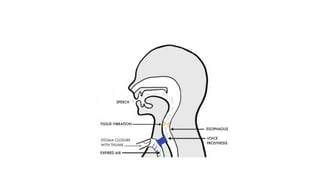
• Pulmonary air passes from the trachea to the esophagus through the
voice prosthesis, into the oral cavity, allowing formation of speech
voice prosthesis

Staffieri’s procedure 1979-80
•
Non-indwelling prostheses
:
to be handled by the patient
–
Blom-Singer 1980
-
Panje 1980
•
Indwelling prostheses
:
to be handled by the clinician
–
Groningen 1980
–
Provox 1988
-
Rationale for preference of indwelling voice prostheses in Europe (e.g.
Groningen, Provox) instead of non-indwelling devices in USA (e.g. Blom-
Singer, Panje)
• Advantages
– Designed to be inserted immediately at TEP, allowing primary
placement
– No replacement required by patient
– Shorter learning curve and little dexterity needed for daily care –
More robust design: longer device life
– With increasing age (loss of dexterity/visual acuity) still applicable.
• Disadvantage – Patients stays dependent of clinician, but non-
indwelling device patients also regularly require clinician’s help and
device aspirations are more frequent than with indwelling devices
Common problems related to Tracheoesophageal voice restoration:
1. Leakage through prosthesis
2. Leakage around prosthesis
3. Immediate aphonia or dysphonia
4. Hypertonicity problems
5. Delayed aphonia or dysphonia
6. Prosthesis versus puncture tract problems
7. Small or large tracheostoma
8. Granuloma
9. Hypotonic voice Excessive tracheostoma mucous discharge
10. Wet voice
11. Hypersensitive gag or cough
12. Excessive stomach gas
Electrolarynx speech
• Speech canal: – more or less unchanged
• Sound source:
– Electrolarynx vibrations transported through the skin into the pharynx
– Production of unvoiced consonants not possible
• Driving force: – Battery, i.e.. continuous speech is possible as long the battery is
active
• Pro: easy to learn, high success rate
• Con: mechanical unnatural sound and low acceptance rate
In electrolarynx, a fundamental sound is produced by battery powered
equipment consisting of a vibrating drum. This sound is then articulated
into words by the tongue, jaws, lips, and teeth.
The tone is designed to have a frequency range close to that of the average
human speaking voice, and is adjustable to suit individual preferences.
Electronic artificial larynges can be broadly divided into two subtypes based
on the source of the generated sound which is transmitted to the user:
• Neck placement devices
• Intraoral placement devices.
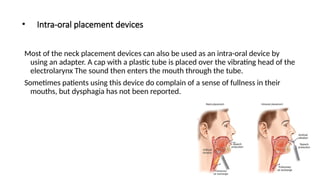
• Intra-oral placement devices
Most of the neck placement devices can also be used as an intra-oral device by
using an adapter. A cap with a plastic tube is placed over the vibrating head of the
electrolarynx The sound then enters the mouth through the tube.
Sometimes patients using this device do complain of a sense of fullness in their
mouths, but dysphagia has not been reported.
Advantages of electrolarynx
• All electro larynges are relatively easy to learn,
especially when compared with esophageal speech.
• Applicability, availability .
Disadvantages of electrolarynx
For intraoral
• The tub may collect saliva
• If patient has trismus or restricted jaw opening ,
placement of palatal prosthesis
• The device is not hands free, is the need to charge or
replace the batteries frequently.
Continue disadvantage of electrolarynx :
• The sound produce by most electronic devices dosent closely
approximate human vocal quality ( unlike nature speech ) all speech
sound produced with electrolarynx are voiced.
• Speaker use electrolarynx demonstrate difficulty with other methods
of a laryngeal speech that require more usual respiratory patterns.
Esophageal speech:
Refers to use of the upper esophageal sphincter (UES) also referred to as the
pharyngoesophageal segment (PES)as a vibratory sources inject and/or inhale air into
esophagus and then direct this back over the PES
Injection requires using the tongue as a sort of pump to elevate the supraglottal
pressure(as in production of plosive consonant)
Voice production is lower in frequency than normal on the order of 60-70HZ , even the
capacity of the esophagus (80-100)cc)even in lung (5-6L)so fewer syllable can be
produced per air expulsion, speaking rate is reduced .
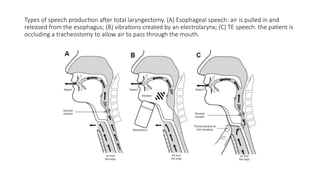
Types of speech production after total laryngectomy. (A) Esophageal speech: air is pulled in and
released from the esophagus; (B) vibrations created by an electrolarynx; (C) TE speech: the patient is
occluding a tracheostomy to allow air to pass through the mouth.
Principle of post laryngectomy voice and
speech:
• the pharyngoesophageal segment forms the new sound
source/neoglottis and the there induced mucosal vibrations are
subsequently processed in a more or less unchanged vocal tract
(patient thus keeps his/her ‘own voice’)
Esophageal speech: air supply is the 60-80 ml injected into the
esophagus; phonation time of 1-2 sec.
Voice prosthesis speech: pulmonary air supply of several liters;
phonation time approaching those of laryngeal voicing
The new sound source
(neoglottis or pharyngoesophageal segment)
• Formed by the musculature and overlying mucosa of the upper
esophageal sphincter and/or pharyngeal muscles
• Determining factor for voice quality
• Variable in location, anatomy and morphology
Prosthetic speech after total laryngectomy
• A voice prosthesis is a one-way valve that allows passage of air
towards the pharynx, and that prevents aspiration into the airway
Conclusion physiology of tracheoesophageal
voice and speech
• Basic physiology is evident:
– Pulmonary driven air supply
– Permanent connection between airway and voice source through a TE
fistula with voice prosthesis, acting as a one-way valve to prohibit aspiration
– The pharynx acts as the new sound source and although this is
anatomically and functionally variable, it essentially allows mucosal
vibrations through a Bernoulli effect (except in the hypotonic patients
– Speech is produced in the more or less unchanged speech canal
• Consequent implementation of physiological knowledge during surgery
should improve success rate of voice rehabilitation
Speech rehabilitation
Substitute speech:
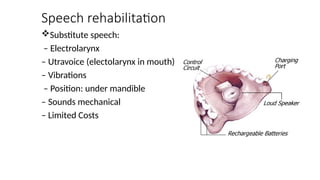
– Electrolarynx
– Utravoice (electolarynx in mouth)
– Vibrations
– Position: under mandible
– Sounds mechanical
– Limited Costs
Speech rehabilitation
Substitute speech:
– Esophageal speech
– Pumping up air
– Releasing air into mouth & articulate
– Quiet and few words (5-9 syllables per breath) Difficult to learn,
backup
Discharge
• Patient is capable of speaking
• Appointment for out patient clinic:
– 1/2 a week
– Speech rehabilitation
– Olfaction rehabilitation
– Decrease frequency of treatment depending on progress

Summary laryngectomy.. post laryngectomy

  • 1.
  • 2.
    Post laryngectomy speechoptions 1. Esophageal speech 2. Electrolarynx speech 3. Tracheoesophageal speech
  • 3.
    Tracheoesophageal speech (TEspeech) • Every patient gets a voice prosthesis • Start rehabilitation TE speech • Pulmonary air passes from the trachea to the esophagus through the voice prosthesis, into the oral cavity, allowing formation of speech
  • 5.
    voice prosthesis  Staffieri’s procedure1979-80 • Non-indwelling prostheses : to be handled by the patient – Blom-Singer 1980 - Panje 1980 • Indwelling prostheses : to be handled by the clinician – Groningen 1980 – Provox 1988 -
  • 6.
    Rationale for preferenceof indwelling voice prostheses in Europe (e.g. Groningen, Provox) instead of non-indwelling devices in USA (e.g. Blom- Singer, Panje) • Advantages – Designed to be inserted immediately at TEP, allowing primary placement – No replacement required by patient – Shorter learning curve and little dexterity needed for daily care – More robust design: longer device life – With increasing age (loss of dexterity/visual acuity) still applicable. • Disadvantage – Patients stays dependent of clinician, but non- indwelling device patients also regularly require clinician’s help and device aspirations are more frequent than with indwelling devices
  • 7.
    Common problems relatedto Tracheoesophageal voice restoration: 1. Leakage through prosthesis 2. Leakage around prosthesis 3. Immediate aphonia or dysphonia 4. Hypertonicity problems 5. Delayed aphonia or dysphonia 6. Prosthesis versus puncture tract problems 7. Small or large tracheostoma 8. Granuloma 9. Hypotonic voice Excessive tracheostoma mucous discharge 10. Wet voice 11. Hypersensitive gag or cough 12. Excessive stomach gas
  • 8.
    Electrolarynx speech • Speechcanal: – more or less unchanged • Sound source: – Electrolarynx vibrations transported through the skin into the pharynx – Production of unvoiced consonants not possible • Driving force: – Battery, i.e.. continuous speech is possible as long the battery is active • Pro: easy to learn, high success rate • Con: mechanical unnatural sound and low acceptance rate
  • 9.
    In electrolarynx, afundamental sound is produced by battery powered equipment consisting of a vibrating drum. This sound is then articulated into words by the tongue, jaws, lips, and teeth. The tone is designed to have a frequency range close to that of the average human speaking voice, and is adjustable to suit individual preferences. Electronic artificial larynges can be broadly divided into two subtypes based on the source of the generated sound which is transmitted to the user: • Neck placement devices • Intraoral placement devices.
  • 10.
    • Intra-oral placementdevices Most of the neck placement devices can also be used as an intra-oral device by using an adapter. A cap with a plastic tube is placed over the vibrating head of the electrolarynx The sound then enters the mouth through the tube. Sometimes patients using this device do complain of a sense of fullness in their mouths, but dysphagia has not been reported.
  • 11.
    Advantages of electrolarynx •All electro larynges are relatively easy to learn, especially when compared with esophageal speech. • Applicability, availability . Disadvantages of electrolarynx For intraoral • The tub may collect saliva • If patient has trismus or restricted jaw opening , placement of palatal prosthesis • The device is not hands free, is the need to charge or replace the batteries frequently.
  • 12.
    Continue disadvantage ofelectrolarynx : • The sound produce by most electronic devices dosent closely approximate human vocal quality ( unlike nature speech ) all speech sound produced with electrolarynx are voiced. • Speaker use electrolarynx demonstrate difficulty with other methods of a laryngeal speech that require more usual respiratory patterns.
  • 13.
    Esophageal speech: Refers touse of the upper esophageal sphincter (UES) also referred to as the pharyngoesophageal segment (PES)as a vibratory sources inject and/or inhale air into esophagus and then direct this back over the PES Injection requires using the tongue as a sort of pump to elevate the supraglottal pressure(as in production of plosive consonant) Voice production is lower in frequency than normal on the order of 60-70HZ , even the capacity of the esophagus (80-100)cc)even in lung (5-6L)so fewer syllable can be produced per air expulsion, speaking rate is reduced .
  • 14.
    Types of speechproduction after total laryngectomy. (A) Esophageal speech: air is pulled in and released from the esophagus; (B) vibrations created by an electrolarynx; (C) TE speech: the patient is occluding a tracheostomy to allow air to pass through the mouth.
  • 15.
    Principle of postlaryngectomy voice and speech: • the pharyngoesophageal segment forms the new sound source/neoglottis and the there induced mucosal vibrations are subsequently processed in a more or less unchanged vocal tract (patient thus keeps his/her ‘own voice’) Esophageal speech: air supply is the 60-80 ml injected into the esophagus; phonation time of 1-2 sec. Voice prosthesis speech: pulmonary air supply of several liters; phonation time approaching those of laryngeal voicing
  • 16.
    The new soundsource (neoglottis or pharyngoesophageal segment) • Formed by the musculature and overlying mucosa of the upper esophageal sphincter and/or pharyngeal muscles • Determining factor for voice quality • Variable in location, anatomy and morphology
  • 17.
    Prosthetic speech aftertotal laryngectomy • A voice prosthesis is a one-way valve that allows passage of air towards the pharynx, and that prevents aspiration into the airway
  • 18.
    Conclusion physiology oftracheoesophageal voice and speech • Basic physiology is evident: – Pulmonary driven air supply – Permanent connection between airway and voice source through a TE fistula with voice prosthesis, acting as a one-way valve to prohibit aspiration – The pharynx acts as the new sound source and although this is anatomically and functionally variable, it essentially allows mucosal vibrations through a Bernoulli effect (except in the hypotonic patients – Speech is produced in the more or less unchanged speech canal • Consequent implementation of physiological knowledge during surgery should improve success rate of voice rehabilitation
  • 19.
    Speech rehabilitation Substitute speech: –Electrolarynx – Utravoice (electolarynx in mouth) – Vibrations – Position: under mandible – Sounds mechanical – Limited Costs
  • 20.
    Speech rehabilitation Substitute speech: –Esophageal speech – Pumping up air – Releasing air into mouth & articulate – Quiet and few words (5-9 syllables per breath) Difficult to learn, backup
  • 21.
    Discharge • Patient iscapable of speaking • Appointment for out patient clinic: – 1/2 a week – Speech rehabilitation – Olfaction rehabilitation – Decrease frequency of treatment depending on progress