Networks and Suffering [email_address] NTNU, Trondheim
My/The Problem How to establish a  non-trivial   but  meaningful   description of suffering
“ non-trivial” Trivial 1: suffering is defined by the “sufferer” Problem: living together peacefully Common solution: deliberation or some other pragmatic process, which determines a hierarchy of suffering (which works well as long as everyone plays along) Trivial 2: suffering is defined by some normative idea about what a non-suffering individual should look like Problem: these definitions produce too much suffering themselves (a forgotten critique against the Fordist welfare state) Common solution: none, business as usual
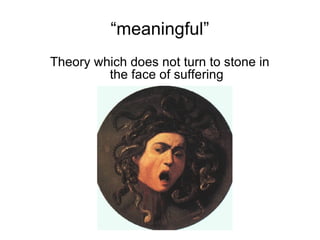
“ meaningful” Theory which does not turn to stone in  the face of suffering
My Tools «Old» network theory (Castells/Sassen/Machiavellian ANT) Irreversible and reversible translations (Michel Callon) and systematic relations between them After method (John Law)
One origin of ANT: STS Technoscience: Science based on technology, technology based on science, everyday life completely permeated by both (if you like it or not, sorry) Realism/Constructivism: Not many things left which are not made by people (if you like it or not, sorry). And those things made by people are in fact real!
Suffering and «old network theory» Sassen: Centres and margins of networks, globalisation from above and from below Castells: 'Elites are global, people are local', global flows wash away the “self”, inciting opposition using “projected identities” Machiavellian ANT: coalitions of people and things which act as mutual resources Connected/Disconnected/Degrees of connectedness (number of connections)
New (?) network theory A history of associations: how stable are the associations (producing a certain kind of nodes) of a given network, how easily are they replaced by alternative associations? (Callon 1991) The so-called feminist critique of ANT: Reproducing the worldview of the the system-builders excludes “invisible labour” one more time Instead: Mutual dependency of sets of less and more stable associations: Compensation Support ...
 
 
Suffering? Not the number of links Not the position within the network But in the mutual production of more and less stable sets of associations
And now: After method (Law 2004) Let's not mistake unstable or stable networks for suffering Let's accept that there are multiple, infinite, blurry objects “ fire objects” “ fluid objects” more? without having the project of turning them into “proper” objects But for this a completely new kind of technoscience needed!

Suffering in Networks

  • 1.
    Networks and Suffering[email_address] NTNU, Trondheim
  • 2.
    My/The Problem Howto establish a non-trivial but meaningful description of suffering
  • 3.
    “ non-trivial” Trivial1: suffering is defined by the “sufferer” Problem: living together peacefully Common solution: deliberation or some other pragmatic process, which determines a hierarchy of suffering (which works well as long as everyone plays along) Trivial 2: suffering is defined by some normative idea about what a non-suffering individual should look like Problem: these definitions produce too much suffering themselves (a forgotten critique against the Fordist welfare state) Common solution: none, business as usual
  • 4.
    “ meaningful” Theorywhich does not turn to stone in the face of suffering
  • 5.
    My Tools «Old»network theory (Castells/Sassen/Machiavellian ANT) Irreversible and reversible translations (Michel Callon) and systematic relations between them After method (John Law)
  • 6.
    One origin ofANT: STS Technoscience: Science based on technology, technology based on science, everyday life completely permeated by both (if you like it or not, sorry) Realism/Constructivism: Not many things left which are not made by people (if you like it or not, sorry). And those things made by people are in fact real!
  • 7.
    Suffering and «oldnetwork theory» Sassen: Centres and margins of networks, globalisation from above and from below Castells: 'Elites are global, people are local', global flows wash away the “self”, inciting opposition using “projected identities” Machiavellian ANT: coalitions of people and things which act as mutual resources Connected/Disconnected/Degrees of connectedness (number of connections)
  • 8.
    New (?) networktheory A history of associations: how stable are the associations (producing a certain kind of nodes) of a given network, how easily are they replaced by alternative associations? (Callon 1991) The so-called feminist critique of ANT: Reproducing the worldview of the the system-builders excludes “invisible labour” one more time Instead: Mutual dependency of sets of less and more stable associations: Compensation Support ...
  • 9.
  • 10.
  • 11.
    Suffering? Not thenumber of links Not the position within the network But in the mutual production of more and less stable sets of associations
  • 12.
    And now: Aftermethod (Law 2004) Let's not mistake unstable or stable networks for suffering Let's accept that there are multiple, infinite, blurry objects “ fire objects” “ fluid objects” more? without having the project of turning them into “proper” objects But for this a completely new kind of technoscience needed!