International Research Journal of Engineering and Technology (IRJET) e-ISSN: 2395-0056
Volume: 09 Issue: 08 | Aug 2022 www.irjet.net p-ISSN: 2395-0072
© 2022, IRJET | Impact Factor value: 7.529 | ISO 9001:2008 Certified Journal | Page 1171
STUDY OF A FLAT SLAB BUILDING WITH A SHEAR WALL AT PERIPHERY
AND FLAT SLAB WITH DROPS
AKSHANSH SINGH, VINAYAK MISHRA*
(M.Tech. Structural Eng.), Civil Engineering Department, Institute of Engineering and Technology, Lucknow
Assistant Professor, Civil Engineering Department, Institute of Engineering and Technology, Lucknow
---------------------------------------------------------------------------***----------------------------------------------------------------------
ABSTRACT
Flat slab construction practice faces great risk during severe earthquake shaking. In the study two different types of flat
slab buildings are taken into account; flat slab with drops and flat slab with shear wall at periphery. This lateral force
resisting mechanism strengthens structural stiffness of these flat slab structures. It is observed that the lateral force
resisting capacity of flat slab structure increases significantly with the use of shear wall.
KEYWORDS: shear wall, flat slab with shear wall at periphery, flat slab with drop, pushover, ETABS software, seismic
response.
INTRODUCTION
Seismic activity is one of nature's most damaging phenomena, and their occurrence is often unforeseeable. The
Traditional RC Frame structures are extensively utilized for construction in today's world. Flat slab construction has
significant benefits over traditional RC Frame construction in terms of architectural freedom, space use, ease of form
work, and construction speed. Earthquake are mostly caused by tectonic and volcano activity so, it is our responsibility to
fulfill the provision of earthquake resistant design IS1893 and IS13920 should be completely adhered. Here in this paper
two different types of flat slab buildings are taken into account. The behavior of flat slab building with 2 models was
analyzed, and a non linear static pushover analysis technique is used in the study.
LITEATURE REVIEW
Klemencic et al. conducted a several tests on post-tensioned wall connections with slab, and the findings revealed that
the joints fail at internal storey drift 5%.
Weidlinger and Ettouney studied the tectonic lateral disturbance of high rise building of flat slab in the New York City.
Vinod Goud (2015):- The structural behaviour of shear wall – flat slab interaction is studied; among the important
objectives some are resistance to various forces of action as well as the advantage of shear walls on the performance of
these buildings structures under seismic forces.
Robertson et al research concluded brittle punching failure caused by shear stresses and asymmetrical forces
transferred between slabs and columns Inconsistent moments also cause large shear stresses in the slab when subjected
to a flat slab with a drop and a shear wall at different locations during earthquake has been investigated intensively.
PUSHOVER ANALYSIS
Pushover analysis is used to identify the nonlinear behaviour of structures under dynamic loading, such as max storey
displacement, storey shear, overturning moment, storey drift, and max storey drift. That's a sort of non-linear static and
dynamic analysis in which the structure's strength is evaluated beyond its limit of proportionality.
Due to their effective span/depth ratios and the savings generated by constraining storey heights, concrete flat slab
systems are a common kind of reinforced concrete structures, primarily in medium-sized industries. These slabs are
prone towards gradual failure than slab-beam-column complexes because the pressure formerly absorbed by the
removed columns cannot be shifted in the absence of beams. It is consequently critical to evaluate the resistance to
progressive collapse of RC flat slab constructions. As a result, it was advised that in seismically prone areas, flat-slab
construction should only be implemented as the vertical structural members system in structures braced by framework
or shear walls responsible for the structure's transverse capacity. To withstand gravity loads, slab–column interfaces
International Research Journal of Engineering and Technology (IRJET) e-ISSN: 2395-0056
Volume: 09 Issue: 08 | Aug 2022 www.irjet.net p-ISSN: 2395-0072
© 2022, IRJET | Impact Factor value: 7.529 | ISO 9001:2008 Certified Journal | Page 1172
must absorb the lateral elastic deformation of the primary lateral load-resisting structural parts resulting punching
failure.
OBJECTIVE
To compare the results of displacement, base shear and storey drift parameters as specified in IS- 1893:2016 for various
flat slab also to maximize the performance of various flat slab building models in relation to various types of force
resisting systems further to investigate the nonlinear behaviour of flat slab buildings subjected to seismic stresses.
STRUCTURAL CONFIGURATION AND DESIGN
International Research Journal of Engineering and Technology (IRJET) e-ISSN: 2395-0056
Volume: 09 Issue: 08 | Aug 2022 www.irjet.net p-ISSN: 2395-0072
© 2022, IRJET | Impact Factor value: 7.529 | ISO 9001:2008 Certified Journal | Page 1173
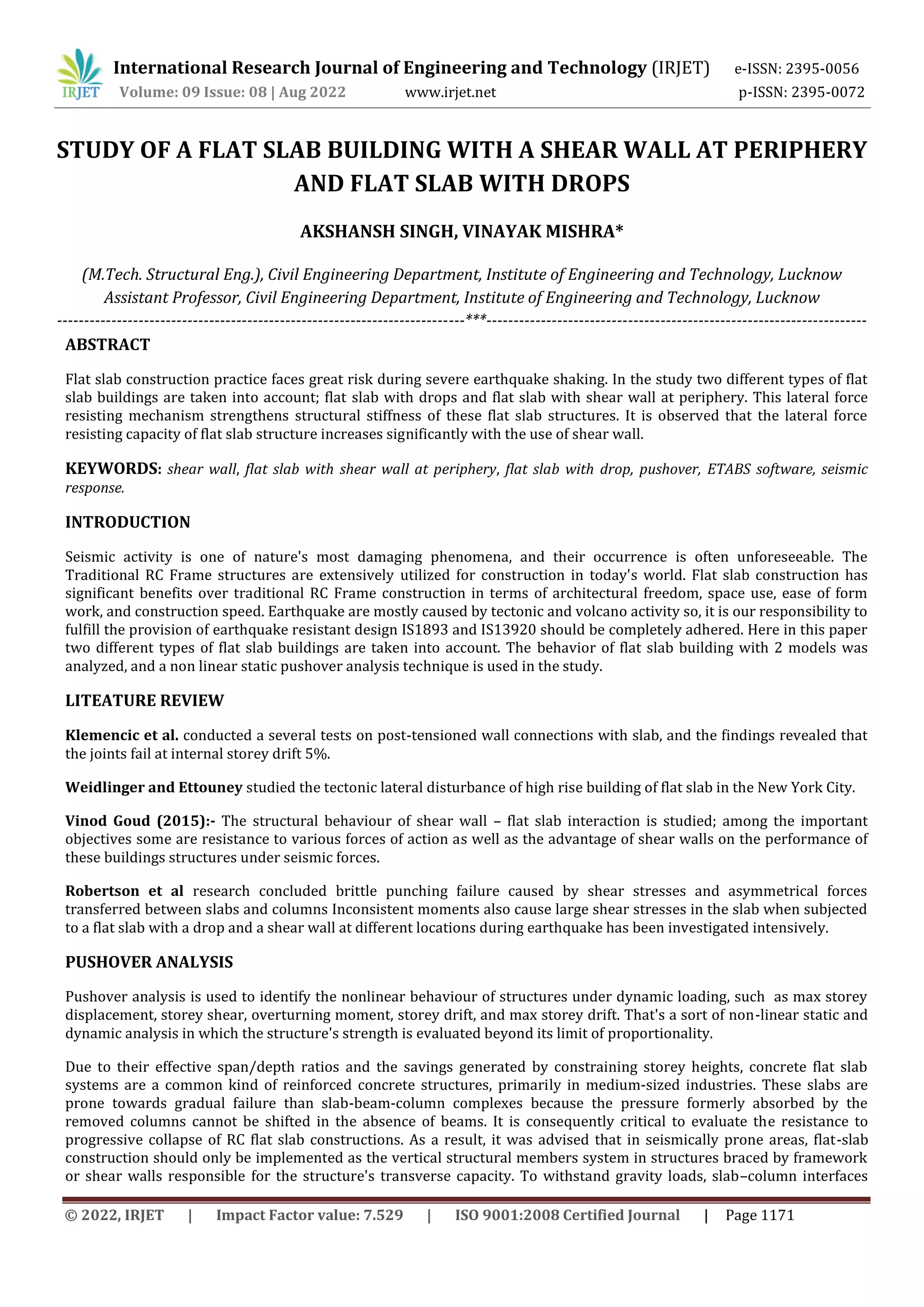
MODEL 1-FLAT SLAB WITH AT
PERIPHERY
METHODLOGY
MODEL 2-FLATSLAB WITH DROPS
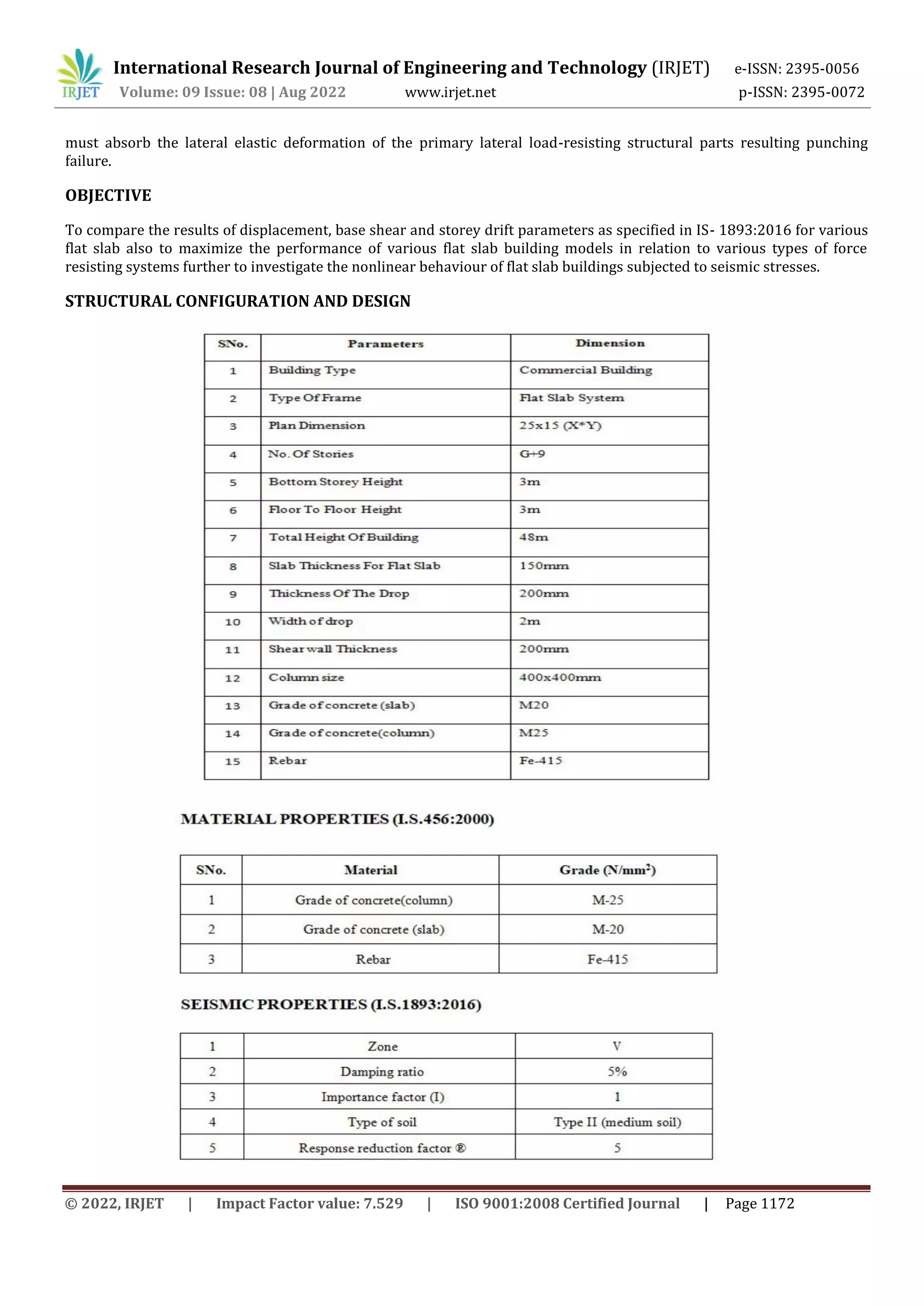
In this paper we model a G+9 BUILDING with plan layout of 25x15m. After this we assign material properties, section
properties and load condition using code IS 1893 (Part1) in ETABSv16 software. Then we perform pushover analysis to
analyze non-linear behaviour in both the models and compare more efficient and sustainable building of the two.
RESULT AND DISCUSSION
The comparative investigation was carried out under certain condition
OVERTURNING MOMENT
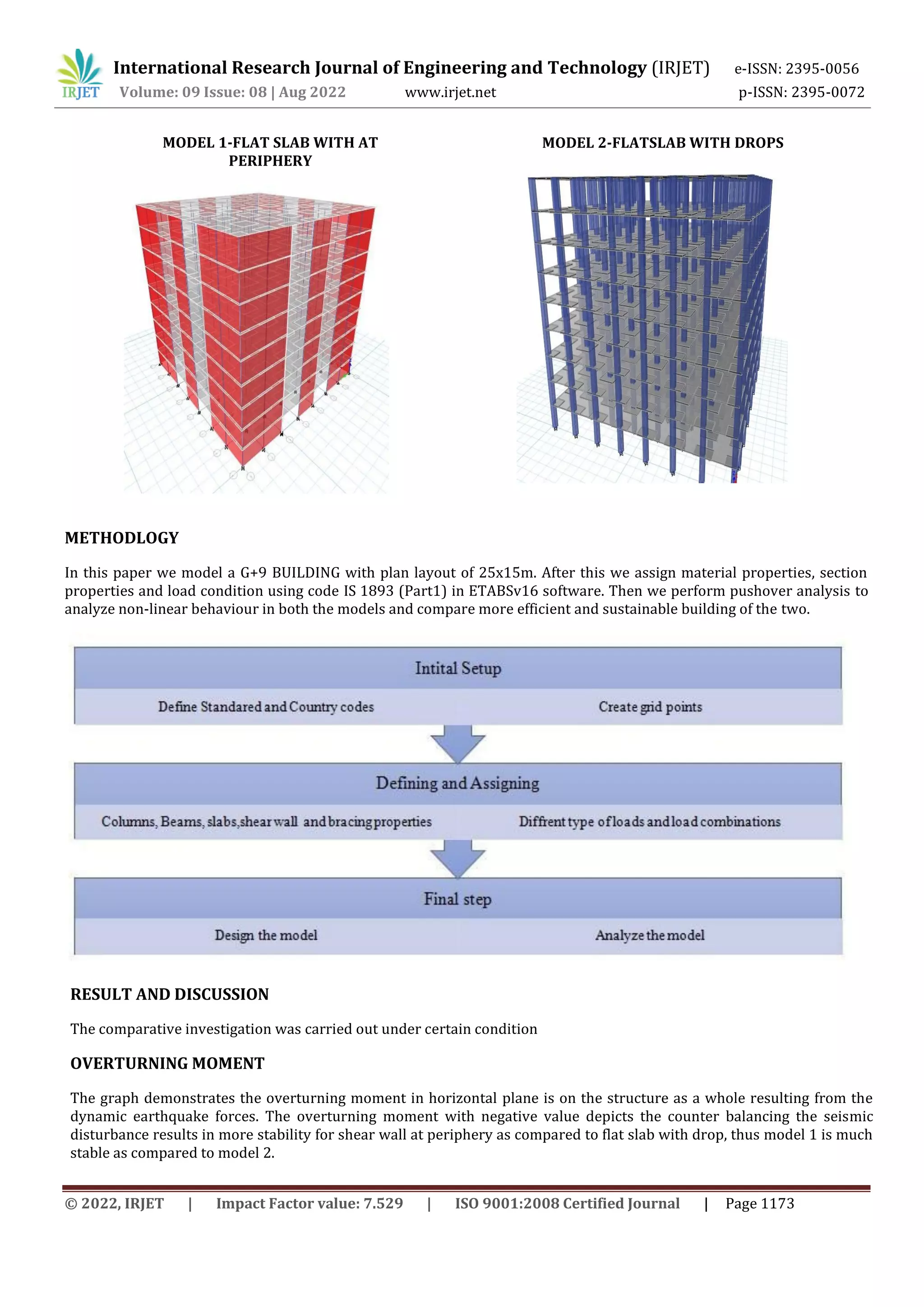
The graph demonstrates the overturning moment in horizontal plane is on the structure as a whole resulting from the
dynamic earthquake forces. The overturning moment with negative value depicts the counter balancing the seismic
disturbance results in more stability for shear wall at periphery as compared to flat slab with drop, thus model 1 is much
stable as compared to model 2.
International Research Journal of Engineering and Technology (IRJET) e-ISSN: 2395-0056
Volume: 09 Issue: 08 | Aug 2022 www.irjet.net p-ISSN: 2395-0072
© 2022, IRJET | Impact Factor value: 7.529 | ISO 9001:2008 Certified Journal | Page 1174
The restraining moment for building with shear wall at periphery is more as compared to building for flat slab with
drops. According to IS 456:20000, Cl. 20.1, structure stability in the event of resisting moment must be larger than 6/5
times the maximum moment due to the normal dead load and greater than 7/5 times the typical applied loads.
MAX STOREY DRIFT
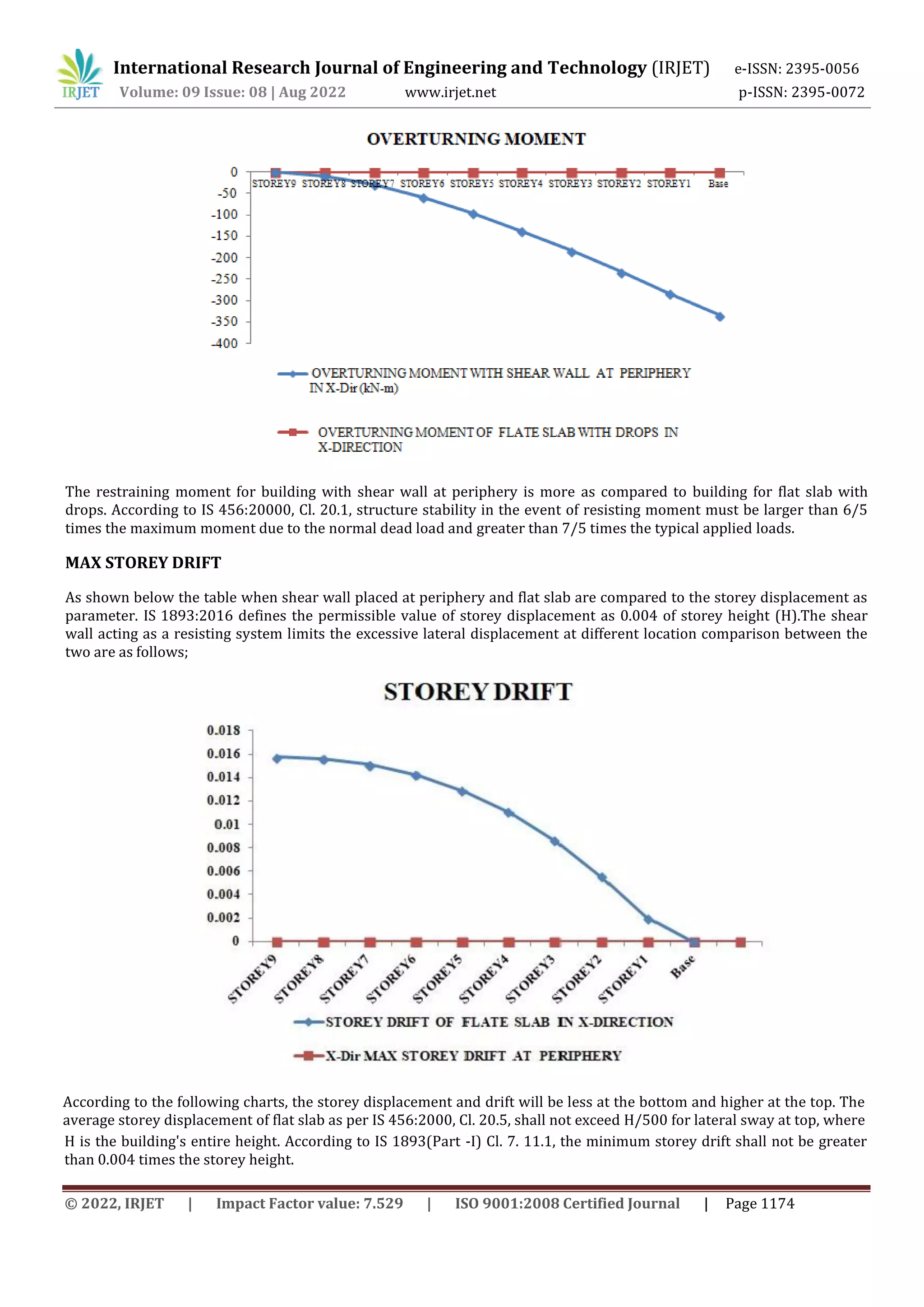
As shown below the table when shear wall placed at periphery and flat slab are compared to the storey displacement as
parameter. IS 1893:2016 defines the permissible value of storey displacement as 0.004 of storey height (H).The shear
wall acting as a resisting system limits the excessive lateral displacement at different location comparison between the
two are as follows;
According to the following charts, the storey displacement and drift will be less at the bottom and higher at the top. The
average storey displacement of flat slab as per IS 456:2000, Cl. 20.5, shall not exceed H/500 for lateral sway at top, where
H is the building's entire height. According to IS 1893(Part -I) Cl. 7. 11.1, the minimum storey drift shall not be greater
than 0.004 times the storey height.
International Research Journal of Engineering and Technology (IRJET) e-ISSN: 2395-0056
Volume: 09 Issue: 08 | Aug 2022 www.irjet.net p-ISSN: 2395-0072
© 2022, IRJET | Impact Factor value: 7.529 | ISO 9001:2008 Certified Journal | Page 1175
The building with flat slab with drop has storey drift is 0.015752 m whereas in building with shear wall at periphery
storey is 1.31E-07 m both are in max permissible limit is 0.192 m. Hence our building is safe, in y as a well as in x
direction, drift values are under permissible limit according to IS 1893.
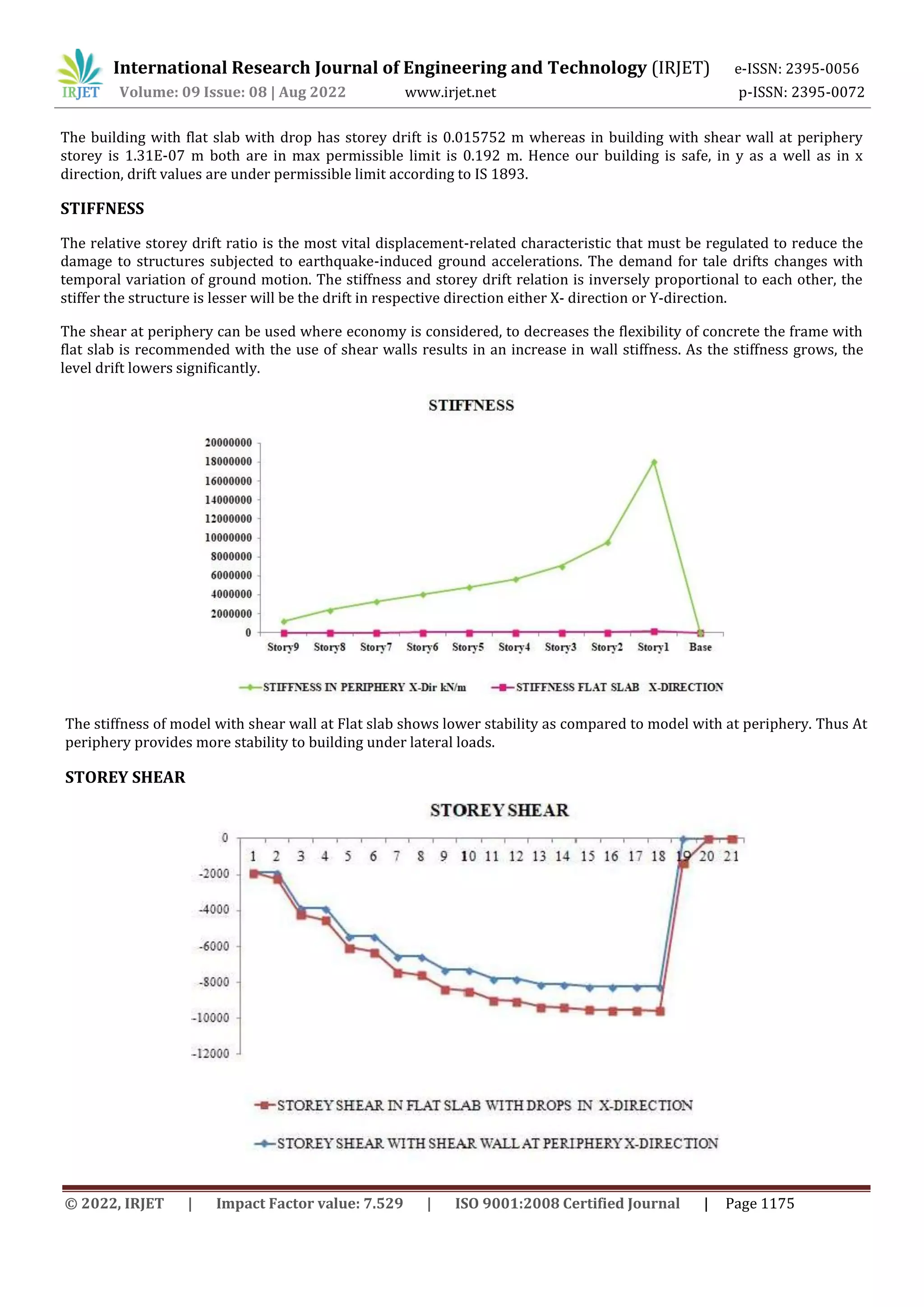
STIFFNESS
The relative storey drift ratio is the most vital displacement-related characteristic that must be regulated to reduce the
damage to structures subjected to earthquake-induced ground accelerations. The demand for tale drifts changes with
temporal variation of ground motion. The stiffness and storey drift relation is inversely proportional to each other, the
stiffer the structure is lesser will be the drift in respective direction either X- direction or Y-direction.
The shear at periphery can be used where economy is considered, to decreases the flexibility of concrete the frame with
flat slab is recommended with the use of shear walls results in an increase in wall stiffness. As the stiffness grows, the
level drift lowers significantly.
The stiffness of model with shear wall at Flat slab shows lower stability as compared to model with at periphery. Thus At
periphery provides more stability to building under lateral loads.
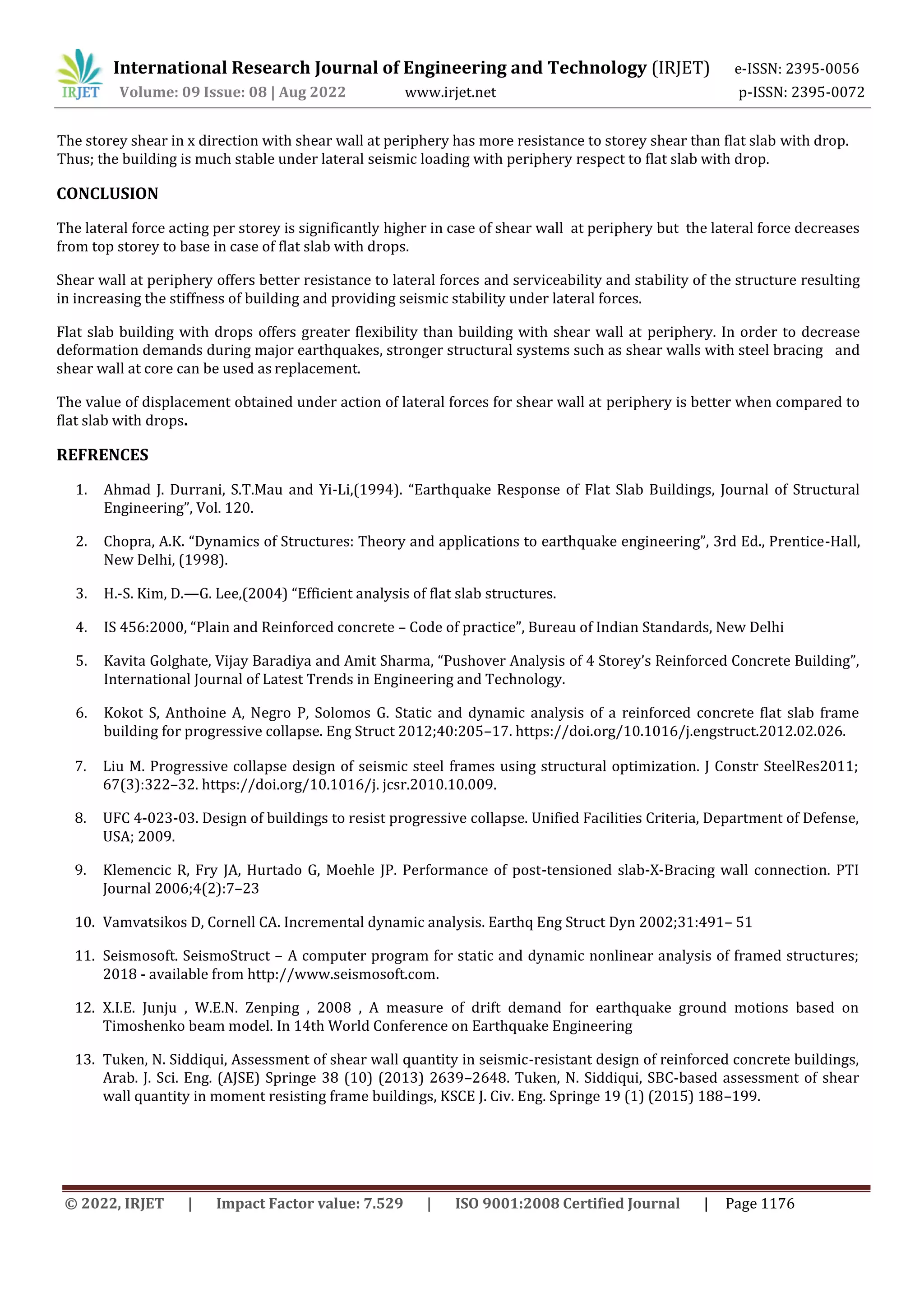
STOREY SHEAR
International Research Journal of Engineering and Technology (IRJET) e-ISSN: 2395-0056
Volume: 09 Issue: 08 | Aug 2022 www.irjet.net p-ISSN: 2395-0072
© 2022, IRJET | Impact Factor value: 7.529 | ISO 9001:2008 Certified Journal | Page 1176
The storey shear in x direction with shear wall at periphery has more resistance to storey shear than flat slab with drop.
Thus; the building is much stable under lateral seismic loading with periphery respect to flat slab with drop.
CONCLUSION
The lateral force acting per storey is significantly higher in case of shear wall at periphery but the lateral force decreases
from top storey to base in case of flat slab with drops.
Shear wall at periphery offers better resistance to lateral forces and serviceability and stability of the structure resulting
in increasing the stiffness of building and providing seismic stability under lateral forces.
Flat slab building with drops offers greater flexibility than building with shear wall at periphery. In order to decrease
deformation demands during major earthquakes, stronger structural systems such as shear walls with steel bracing and
shear wall at core can be used as replacement.
The value of displacement obtained under action of lateral forces for shear wall at periphery is better when compared to
flat slab with drops.
REFRENCES
1. Ahmad J. Durrani, S.T.Mau and Yi-Li,(1994). “Earthquake Response of Flat Slab Buildings, Journal of Structural
Engineering”, Vol. 120.
2. Chopra, A.K. “Dynamics of Structures: Theory and applications to earthquake engineering”, 3rd Ed., Prentice-Hall,
New Delhi, (1998).
3. H.-S. Kim, D.—G. Lee,(2004) “Efficient analysis of flat slab structures.
4. IS 456:2000, “Plain and Reinforced concrete – Code of practice”, Bureau of Indian Standards, New Delhi
5. Kavita Golghate, Vijay Baradiya and Amit Sharma, “Pushover Analysis of 4 Storey’s Reinforced Concrete Building”,
International Journal of Latest Trends in Engineering and Technology.
6. Kokot S, Anthoine A, Negro P, Solomos G. Static and dynamic analysis of a reinforced concrete flat slab frame
building for progressive collapse. Eng Struct 2012;40:205–17. https://doi.org/10.1016/j.engstruct.2012.02.026.
7. Liu M. Progressive collapse design of seismic steel frames using structural optimization. J Constr SteelRes2011;
67(3):322–32. https://doi.org/10.1016/j. jcsr.2010.10.009.
8. UFC 4-023-03. Design of buildings to resist progressive collapse. Unified Facilities Criteria, Department of Defense,
USA; 2009.
9. Klemencic R, Fry JA, Hurtado G, Moehle JP. Performance of post-tensioned slab-X-Bracing wall connection. PTI
Journal 2006;4(2):7–23
10. Vamvatsikos D, Cornell CA. Incremental dynamic analysis. Earthq Eng Struct Dyn 2002;31:491– 51
11. Seismosoft. SeismoStruct – A computer program for static and dynamic nonlinear analysis of framed structures;
2018 - available from http://www.seismosoft.com.
12. X.I.E. Junju , W.E.N. Zenping , 2008 , A measure of drift demand for earthquake ground motions based on
Timoshenko beam model. In 14th World Conference on Earthquake Engineering
13. Tuken, N. Siddiqui, Assessment of shear wall quantity in seismic-resistant design of reinforced concrete buildings,
Arab. J. Sci. Eng. (AJSE) Springe 38 (10) (2013) 2639–2648. Tuken, N. Siddiqui, SBC-based assessment of shear
wall quantity in moment resisting frame buildings, KSCE J. Civ. Eng. Springe 19 (1) (2015) 188–199.

STUDY OF A FLAT SLAB BUILDING WITH A SHEAR WALL AT PERIPHERY AND FLAT SLAB WITH DROPS

  • 1.
    International Research Journalof Engineering and Technology (IRJET) e-ISSN: 2395-0056 Volume: 09 Issue: 08 | Aug 2022 www.irjet.net p-ISSN: 2395-0072 © 2022, IRJET | Impact Factor value: 7.529 | ISO 9001:2008 Certified Journal | Page 1171 STUDY OF A FLAT SLAB BUILDING WITH A SHEAR WALL AT PERIPHERY AND FLAT SLAB WITH DROPS AKSHANSH SINGH, VINAYAK MISHRA* (M.Tech. Structural Eng.), Civil Engineering Department, Institute of Engineering and Technology, Lucknow Assistant Professor, Civil Engineering Department, Institute of Engineering and Technology, Lucknow ---------------------------------------------------------------------------***---------------------------------------------------------------------- ABSTRACT Flat slab construction practice faces great risk during severe earthquake shaking. In the study two different types of flat slab buildings are taken into account; flat slab with drops and flat slab with shear wall at periphery. This lateral force resisting mechanism strengthens structural stiffness of these flat slab structures. It is observed that the lateral force resisting capacity of flat slab structure increases significantly with the use of shear wall. KEYWORDS: shear wall, flat slab with shear wall at periphery, flat slab with drop, pushover, ETABS software, seismic response. INTRODUCTION Seismic activity is one of nature's most damaging phenomena, and their occurrence is often unforeseeable. The Traditional RC Frame structures are extensively utilized for construction in today's world. Flat slab construction has significant benefits over traditional RC Frame construction in terms of architectural freedom, space use, ease of form work, and construction speed. Earthquake are mostly caused by tectonic and volcano activity so, it is our responsibility to fulfill the provision of earthquake resistant design IS1893 and IS13920 should be completely adhered. Here in this paper two different types of flat slab buildings are taken into account. The behavior of flat slab building with 2 models was analyzed, and a non linear static pushover analysis technique is used in the study. LITEATURE REVIEW Klemencic et al. conducted a several tests on post-tensioned wall connections with slab, and the findings revealed that the joints fail at internal storey drift 5%. Weidlinger and Ettouney studied the tectonic lateral disturbance of high rise building of flat slab in the New York City. Vinod Goud (2015):- The structural behaviour of shear wall – flat slab interaction is studied; among the important objectives some are resistance to various forces of action as well as the advantage of shear walls on the performance of these buildings structures under seismic forces. Robertson et al research concluded brittle punching failure caused by shear stresses and asymmetrical forces transferred between slabs and columns Inconsistent moments also cause large shear stresses in the slab when subjected to a flat slab with a drop and a shear wall at different locations during earthquake has been investigated intensively. PUSHOVER ANALYSIS Pushover analysis is used to identify the nonlinear behaviour of structures under dynamic loading, such as max storey displacement, storey shear, overturning moment, storey drift, and max storey drift. That's a sort of non-linear static and dynamic analysis in which the structure's strength is evaluated beyond its limit of proportionality. Due to their effective span/depth ratios and the savings generated by constraining storey heights, concrete flat slab systems are a common kind of reinforced concrete structures, primarily in medium-sized industries. These slabs are prone towards gradual failure than slab-beam-column complexes because the pressure formerly absorbed by the removed columns cannot be shifted in the absence of beams. It is consequently critical to evaluate the resistance to progressive collapse of RC flat slab constructions. As a result, it was advised that in seismically prone areas, flat-slab construction should only be implemented as the vertical structural members system in structures braced by framework or shear walls responsible for the structure's transverse capacity. To withstand gravity loads, slab–column interfaces
  • 2.
    International Research Journalof Engineering and Technology (IRJET) e-ISSN: 2395-0056 Volume: 09 Issue: 08 | Aug 2022 www.irjet.net p-ISSN: 2395-0072 © 2022, IRJET | Impact Factor value: 7.529 | ISO 9001:2008 Certified Journal | Page 1172 must absorb the lateral elastic deformation of the primary lateral load-resisting structural parts resulting punching failure. OBJECTIVE To compare the results of displacement, base shear and storey drift parameters as specified in IS- 1893:2016 for various flat slab also to maximize the performance of various flat slab building models in relation to various types of force resisting systems further to investigate the nonlinear behaviour of flat slab buildings subjected to seismic stresses. STRUCTURAL CONFIGURATION AND DESIGN
  • 3.
    International Research Journalof Engineering and Technology (IRJET) e-ISSN: 2395-0056 Volume: 09 Issue: 08 | Aug 2022 www.irjet.net p-ISSN: 2395-0072 © 2022, IRJET | Impact Factor value: 7.529 | ISO 9001:2008 Certified Journal | Page 1173 MODEL 1-FLAT SLAB WITH AT PERIPHERY METHODLOGY MODEL 2-FLATSLAB WITH DROPS In this paper we model a G+9 BUILDING with plan layout of 25x15m. After this we assign material properties, section properties and load condition using code IS 1893 (Part1) in ETABSv16 software. Then we perform pushover analysis to analyze non-linear behaviour in both the models and compare more efficient and sustainable building of the two. RESULT AND DISCUSSION The comparative investigation was carried out under certain condition OVERTURNING MOMENT The graph demonstrates the overturning moment in horizontal plane is on the structure as a whole resulting from the dynamic earthquake forces. The overturning moment with negative value depicts the counter balancing the seismic disturbance results in more stability for shear wall at periphery as compared to flat slab with drop, thus model 1 is much stable as compared to model 2.
  • 4.
    International Research Journalof Engineering and Technology (IRJET) e-ISSN: 2395-0056 Volume: 09 Issue: 08 | Aug 2022 www.irjet.net p-ISSN: 2395-0072 © 2022, IRJET | Impact Factor value: 7.529 | ISO 9001:2008 Certified Journal | Page 1174 The restraining moment for building with shear wall at periphery is more as compared to building for flat slab with drops. According to IS 456:20000, Cl. 20.1, structure stability in the event of resisting moment must be larger than 6/5 times the maximum moment due to the normal dead load and greater than 7/5 times the typical applied loads. MAX STOREY DRIFT As shown below the table when shear wall placed at periphery and flat slab are compared to the storey displacement as parameter. IS 1893:2016 defines the permissible value of storey displacement as 0.004 of storey height (H).The shear wall acting as a resisting system limits the excessive lateral displacement at different location comparison between the two are as follows; According to the following charts, the storey displacement and drift will be less at the bottom and higher at the top. The average storey displacement of flat slab as per IS 456:2000, Cl. 20.5, shall not exceed H/500 for lateral sway at top, where H is the building's entire height. According to IS 1893(Part -I) Cl. 7. 11.1, the minimum storey drift shall not be greater than 0.004 times the storey height.
  • 5.
    International Research Journalof Engineering and Technology (IRJET) e-ISSN: 2395-0056 Volume: 09 Issue: 08 | Aug 2022 www.irjet.net p-ISSN: 2395-0072 © 2022, IRJET | Impact Factor value: 7.529 | ISO 9001:2008 Certified Journal | Page 1175 The building with flat slab with drop has storey drift is 0.015752 m whereas in building with shear wall at periphery storey is 1.31E-07 m both are in max permissible limit is 0.192 m. Hence our building is safe, in y as a well as in x direction, drift values are under permissible limit according to IS 1893. STIFFNESS The relative storey drift ratio is the most vital displacement-related characteristic that must be regulated to reduce the damage to structures subjected to earthquake-induced ground accelerations. The demand for tale drifts changes with temporal variation of ground motion. The stiffness and storey drift relation is inversely proportional to each other, the stiffer the structure is lesser will be the drift in respective direction either X- direction or Y-direction. The shear at periphery can be used where economy is considered, to decreases the flexibility of concrete the frame with flat slab is recommended with the use of shear walls results in an increase in wall stiffness. As the stiffness grows, the level drift lowers significantly. The stiffness of model with shear wall at Flat slab shows lower stability as compared to model with at periphery. Thus At periphery provides more stability to building under lateral loads. STOREY SHEAR
  • 6.
    International Research Journalof Engineering and Technology (IRJET) e-ISSN: 2395-0056 Volume: 09 Issue: 08 | Aug 2022 www.irjet.net p-ISSN: 2395-0072 © 2022, IRJET | Impact Factor value: 7.529 | ISO 9001:2008 Certified Journal | Page 1176 The storey shear in x direction with shear wall at periphery has more resistance to storey shear than flat slab with drop. Thus; the building is much stable under lateral seismic loading with periphery respect to flat slab with drop. CONCLUSION The lateral force acting per storey is significantly higher in case of shear wall at periphery but the lateral force decreases from top storey to base in case of flat slab with drops. Shear wall at periphery offers better resistance to lateral forces and serviceability and stability of the structure resulting in increasing the stiffness of building and providing seismic stability under lateral forces. Flat slab building with drops offers greater flexibility than building with shear wall at periphery. In order to decrease deformation demands during major earthquakes, stronger structural systems such as shear walls with steel bracing and shear wall at core can be used as replacement. The value of displacement obtained under action of lateral forces for shear wall at periphery is better when compared to flat slab with drops. REFRENCES 1. Ahmad J. Durrani, S.T.Mau and Yi-Li,(1994). “Earthquake Response of Flat Slab Buildings, Journal of Structural Engineering”, Vol. 120. 2. Chopra, A.K. “Dynamics of Structures: Theory and applications to earthquake engineering”, 3rd Ed., Prentice-Hall, New Delhi, (1998). 3. H.-S. Kim, D.—G. Lee,(2004) “Efficient analysis of flat slab structures. 4. IS 456:2000, “Plain and Reinforced concrete – Code of practice”, Bureau of Indian Standards, New Delhi 5. Kavita Golghate, Vijay Baradiya and Amit Sharma, “Pushover Analysis of 4 Storey’s Reinforced Concrete Building”, International Journal of Latest Trends in Engineering and Technology. 6. Kokot S, Anthoine A, Negro P, Solomos G. Static and dynamic analysis of a reinforced concrete flat slab frame building for progressive collapse. Eng Struct 2012;40:205–17. https://doi.org/10.1016/j.engstruct.2012.02.026. 7. Liu M. Progressive collapse design of seismic steel frames using structural optimization. J Constr SteelRes2011; 67(3):322–32. https://doi.org/10.1016/j. jcsr.2010.10.009. 8. UFC 4-023-03. Design of buildings to resist progressive collapse. Unified Facilities Criteria, Department of Defense, USA; 2009. 9. Klemencic R, Fry JA, Hurtado G, Moehle JP. Performance of post-tensioned slab-X-Bracing wall connection. PTI Journal 2006;4(2):7–23 10. Vamvatsikos D, Cornell CA. Incremental dynamic analysis. Earthq Eng Struct Dyn 2002;31:491– 51 11. Seismosoft. SeismoStruct – A computer program for static and dynamic nonlinear analysis of framed structures; 2018 - available from http://www.seismosoft.com. 12. X.I.E. Junju , W.E.N. Zenping , 2008 , A measure of drift demand for earthquake ground motions based on Timoshenko beam model. In 14th World Conference on Earthquake Engineering 13. Tuken, N. Siddiqui, Assessment of shear wall quantity in seismic-resistant design of reinforced concrete buildings, Arab. J. Sci. Eng. (AJSE) Springe 38 (10) (2013) 2639–2648. Tuken, N. Siddiqui, SBC-based assessment of shear wall quantity in moment resisting frame buildings, KSCE J. Civ. Eng. Springe 19 (1) (2015) 188–199.