Literary Elements
and Techniques of
Poetry
DONNA ROSE M. CABALLES
Lesson
Objectives
2
At the end of the period, the
students are expected to:
A. identify the various elements,
techniques, and literary devices
in specific forms of poetry;
B. analyze a poem based on the
elements and literary devices;
and
C. show appreciation of the
importance of the elements and
literary devices by incorporating
them in a poem.
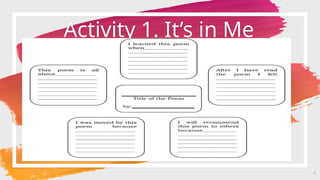
Activity 1. It’s in Me
Have you ever recited a poem in your younger
days? Do you still remember the one that you
loved the most? Think of the best poem that you
could recall and accomplish the diagram below.
3
Activity 1. It’s in Me
4
“
WHAT’S NEW?
5
“
WHAT IS IT?
6
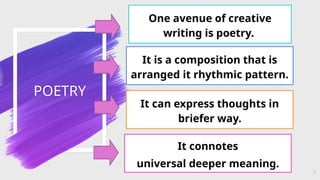
POETRY
7
One avenue of creative
writing is poetry.
It is a composition that is
arranged it rhythmic pattern.
It can express thoughts in
briefer way.
It connotes
universal deeper meaning.
THIS IS A
SLIDE TITLE
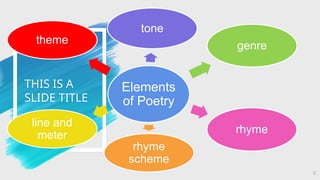
8
Elements
of Poetry
genre
tone
rhyme
rhyme
scheme
line and
meter
theme
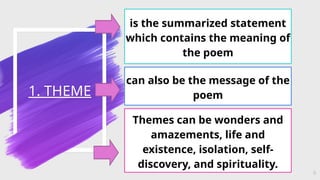
1. THEME
9
is the summarized statement
which contains the meaning of
the poem
can also be the message of the
poem
Themes can be wonders and
amazements, life and
existence, isolation, self-
discovery, and spirituality.
2. TONE
10
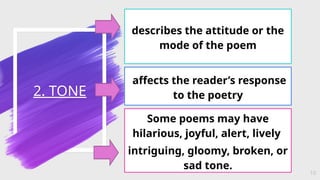
describes the attitude or the
mode of the poem
affects the reader’s response
to the poetry
Some poems may have
hilarious, joyful, alert, lively
intriguing, gloomy, broken, or
sad tone.
What is the theme and
tone of Desiderata?
3. RHYME
12
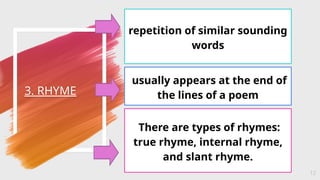
repetition of similar sounding
words
usually appears at the end of
the lines of a poem
There are types of rhymes:
true rhyme, internal rhyme,
and slant rhyme.
3. RHYME
13
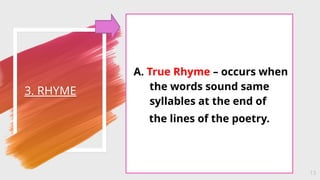
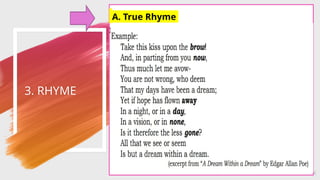
A. True Rhyme – occurs when
the words sound same
syllables at the end of
the lines of the poetry.
3. RHYME
14
A. True Rhyme
)
3. RHYME
15
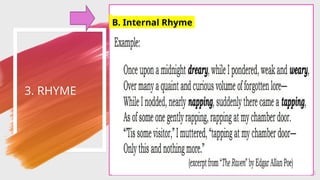
B. Internal Rhyme – unlike the
true rhyme, internal rhyme
happens two
words within the line of poetry
have rhyming sounds.
3. RHYME
16
B. Internal Rhyme
3. RHYME
17
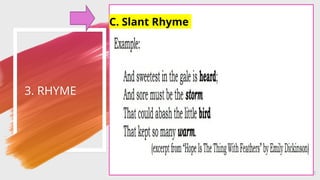
C. Slant Rhyme - a type of
rhyme where words sound
similar but do not
rhyme exactly.
3. RHYME
18
C. Slant Rhyme
4. RHYME
SCHEME
19
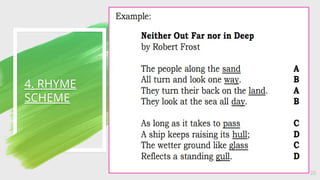
Rhyme Scheme is the pattern of
rhyme that comes at the end of
each line
in poetry, usually it is represented
or indicated by letters.
4. RHYME
SCHEME
20
4. RHYME
SCHEME
21
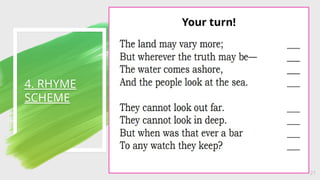
Your turn!
5. LINE AND
METER
22
Line refers to the line of words in
the poetry. When the lines are
formed in a unit or a group it is
called stanza.
5. LINE AND
METER
23
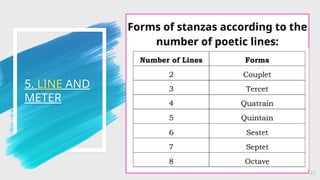
Forms of stanzas according to the
number of poetic lines:
5. LINE AND
METER
24
Meter is the systematic
arrangement of syllables or
accents in the line of
poetry. There varied metrical
patterns: syllabic meter and free
verse are just two of
those.
25
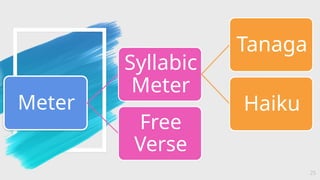
Meter
Syllabic
Meter
Tanaga
Haiku
Free
Verse
5. LINE AND
METER
26
A. Syllabic Meter / Syllabic Verse -
has a fixed number of syllables in
each line, though there may be a
varying number of stresses. In
other words, Syllabic Meter is
determined by the total number
of syllables per line, rather than
the number of stresses.
5. LINE AND
METER
27
A. Syllabic Meter / Syllabic Verse
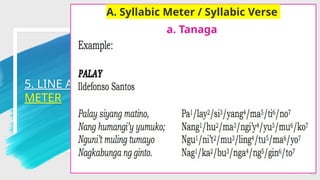
a. Tanaga is a type of short
Filipino poem with 4 lines
consisting 7 syllables on each line.
5. LINE AND
METER
28
A. Syllabic Meter / Syllabic Verse
a. Tanaga
5. LINE AND
METER
29
A. Syllabic Meter / Syllabic Verse
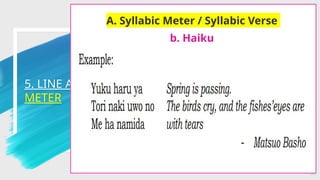
b. Haiku is a type of Japanese
poem with 3 lines where the
first and last lines have 5 syllables
and the second line has 5
syllables.
5. LINE AND
METER
30
A. Syllabic Meter / Syllabic Verse
b. Haiku
5. LINE AND
METER
31
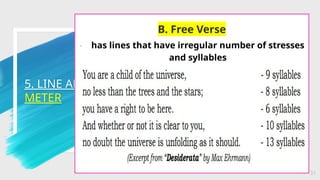
B. Free Verse
- has lines that have irregular number of stresses
and syllables
GENRES OF
POETRY
33
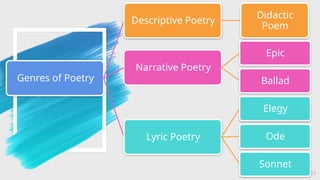
Genres of Poetry
Descriptive Poetry
Didactic
Poem
Narrative Poetry
Epic
Ballad
Lyric Poetry
Elegy
Ode
Sonnet
6. GENRES
OF POETRY
34
A. Descriptive Poetry
-is a type of poetry that deals or
focuses on the details of the
subject.
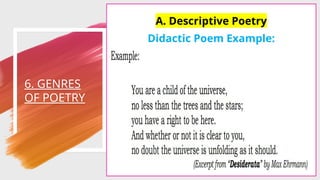
Didactic Poem aims primarily to
teach something, either in terms
of morals or by providing
knowledge of philosophy,
religion, arts, science, or skills.
6. GENRES
OF POETRY
35
A. Descriptive Poetry
Didactic Poem Example:
6. GENRES
OF POETRY
36
B. Narrative Poetry
- tells a story with a plot,
characters, and a setting.
- It is always told by a narrator.
- This genre could be epic or
ballad.
6. GENRES
OF POETRY
37
B. Narrative Poetry
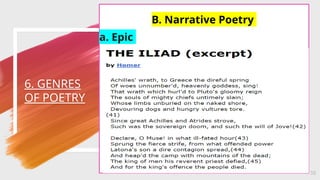
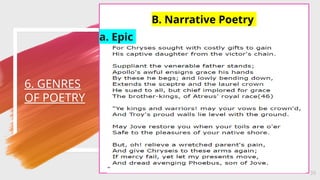
a. Epic
- is a long narrative poem about
the remarkable deed of gods or
heroes.
Examples:
The Epic of Gilgamesh
Bi-ag ni Lam-ang
Iliad
6. GENRES
OF POETRY
38
B. Narrative Poetry
a. Epic
6. GENRES
OF POETRY
39
B. Narrative Poetry
a. Epic
6. GENRES
OF POETRY
40
B. Narrative Poetry
b. Ballad
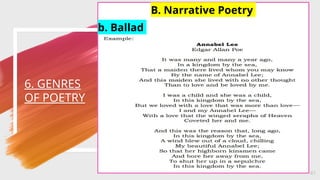
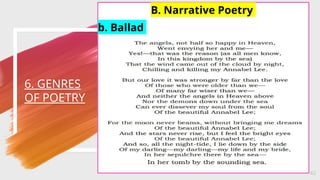
- a poem like a folk tale which
uses a repeated refrain. This
means that every few stanzas a
portion of the poem is repeated,
much like a song.
6. GENRES
OF POETRY
41
B. Narrative Poetry
b. Ballad
6. GENRES
OF POETRY
42
B. Narrative Poetry
b. Ballad
6. GENRES
OF POETRY
43
C. Lyric Poetry
- is a genre of poetry where the
main feature is the expression of
feelings and thoughts of the poet.
- The common forms of this genre
are elegy, sonnet, and ode.
6. GENRES
OF POETRY
44
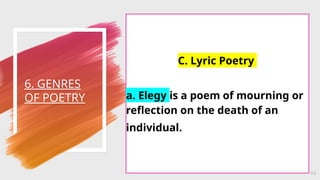
C. Lyric Poetry
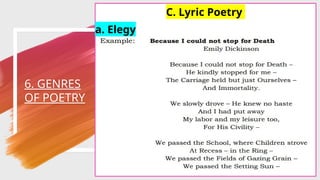
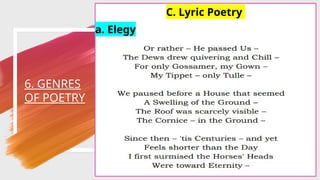
a. Elegy is a poem of mourning or
reflection on the death of an
individual.
6. GENRES
OF POETRY
45
C. Lyric Poetry
a. Elegy
6. GENRES
OF POETRY
46
C. Lyric Poetry
a. Elegy
6. GENRES
OF POETRY
47
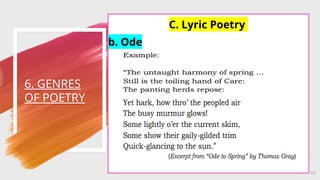
C. Lyric Poetry
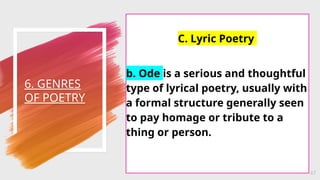
b. Ode is a serious and thoughtful
type of lyrical poetry, usually with
a formal structure generally seen
to pay homage or tribute to a
thing or person.
6. GENRES
OF POETRY
48
C. Lyric Poetry
b. Ode
6. GENRES
OF POETRY
49
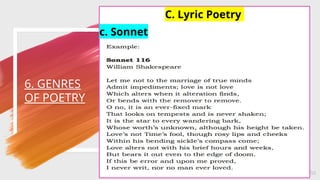
C. Lyric Poetry
c. Sonnet is a fourteen-line poem
which dealt with the lover’s
suffering and hopes.
6. GENRES
OF POETRY
50
C. Lyric Poetry
c. Sonnet
Literary
Devices in
Poetry
51
Imagery refers to the descriptive
language that are used to appeal to the
human senses: sight (visual imagery),
smell (olfactory imagery), hearing
(auditory imagery), taste (gustatory
imagery), and touch (tactile imagery),
and helps the readers to create clear
mental picture of the scene or subject
being described.
Literary Devices
in Poetry
Literary
Devices in
Poetry
53
Imagery refers to the descriptive
language that are used to appeal to the
human senses: sight (visual imagery),
smell (olfactory imagery), hearing
(auditory imagery), taste (gustatory
imagery), and touch (tactile imagery),
and helps the readers to create clear
mental picture of the scene or subject
being described.
Literary
Devices in
Poetry
54
Figurative Language (Figure of Speech)
has an important role in literary works.
It primarily works to communicate the
poets’ or writer’s ideas and emotions to
the readers, where it expands reader’s
comprehension beyond the literal
meaning of the lines (or the poem as a
whole).
End of Presentation
55

students-copy-creative-writing-week-2 (1).pptx