INTRODUCTION;
• In AncientGreece before the word “science”, the need to
understand the world and reality was bound with the need to
understand the self and the good life.
• ccording to Aristotle, “Truth” is the aim of the theoretical sciences,
the “good” isthe end goal of the practical ones. (One must find the
truth about what the good is before one can even try to locate that
which is good.)
3.
The Good Life
Thegood life is a term that refers to a
state that is primarily characterized by a
high standard of living for the adherence
to ethical and moral laws.
4.
“Not every personthat is living the
dream or the good life is actually
living the good life”
ARISTOTLE
• Best knownwork is NICHOMACHEAN ETHICS
Aristotle seeks to construct a framework by developing
an understanding about the highest good for human
beings.He points out that to most people, the highest
good consists either in the acquisition of wealth, the
pursuit of honor or the satisfying of bodily pleasures.
7.
• Aristotle concludesthat the highest good cannot consist
primarily out of these three aspects. Instead, the highest
good should be something that aims to maximize the
inherent faculties of man. It helps human beings to
develop that which separates them from animals.
8.
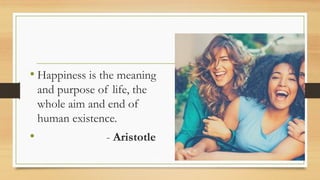
• Happiness isthe meaning
and purpose of life, the
whole aim and end of
human existence.
• - Aristotle
9.
EUDAIMONIA
• Eudaimonia comesfrom two Greek words:Eu-: good
Daimon: soul or “self.”
• In Greek philosophy, Eudaimonia means achieving the
best conditions possible for a human being, in every
sense–not only happiness, but also virtue, morality, and a
meaningful life.
10.
• A flourishinghuman life is a life filled with
noteworthy human activity.
• The ability to flourish enables the individual
to achieve eudaimonia, the highest end of the
human life.
11.
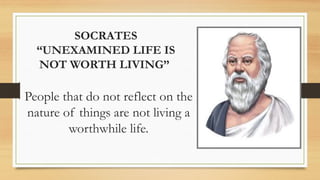
SOCRATES
“UNEXAMINED LIFE IS
NOTWORTH LIVING”
People that do not reflect on the
nature of things are not living a
worthwhile life.
12.
THREE ASPECTS OFTHE GOOD LIFE
Aspects of the good life
• Self mastery
• Learning or contemplation
•Civic Engagement
13.
SELF MASTERY
The abilityto take control of one's life
without being blown off course by
feelings, urges and circumstances.
“MIND OVER MATTER"
14.
LEARNING OR
CONTEMPLATION
• Throughthe process of contemplating and learning the
intellectual virtues can lead to good life.
• A person achieves happiness by contemplation, learning and the
mental strength to perform right actions. Such a person does not
only know what is right, but also acts accordingly and derives
happiness, fulfillment and purpose from it.
15.
CIVIC ENGAGEMENT
• Civicengagement means working to make a
difference in the civic life of our community and
developing the combination of knowledge, skills
values and motivation to make that difference. •
Promoting the quality of life in a community
through both political and non-political process.