SLIDESMANIA
Brain Stroke
Prediction
Group Name: Crocodiles
Submitted by:
Name Abdullah Al Miraj
ID: 2103910202106
Name Mohammad Sakib Khan
ID: 2103910202107
Name Tufail Ahamad Babo
ID: 2103910202123
Submitted to:
Avisheak Das
Lecturer,
Dept. of Computer Science and Engineering
Premier University, Chittagong
SLIDESMANIA
Contents
 Abstract
 Introduction
 Objective and scope
 Importance of the project
 Symptomof brain stoke
 Machine Learning Model
 Algorithm
 Dataset
 Training Process
 Frontend & backend
 Stroke prediction by givingpatients Data
 Result
 Conclusion
SLIDESMANIA
Abstract
 Stoke is destructive illness that typically influences individuals over the age
of 65 years age.
 Prediction of stroke is time consuming and tedious for doctors.
 Therefore, the project mainly aims at predicting the Chances of the
occurrence of stroke using emerging Machine learning techniques.
 Five different algorithms are used and a comparison is made for better
accuracy.
 Aim is to create an application with a user friendly interface that is easy to
navigate and enter inputs.
SLIDESMANIA
Introduction
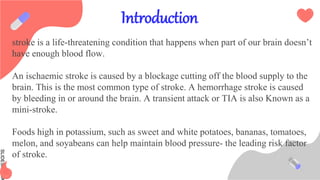
stroke is a life-threatening condition that happens when part of our brain doesn’t
have enough blood flow.
An ischaemic stroke is caused by a blockage cutting off the blood supply to the
brain. This is the most common type of stroke. A hemorrhage stroke is caused
by bleeding in or around the brain. A transient attack or TIA is also Known as a
mini-stroke.
Foods high in potassium, such as sweet and white potatoes, bananas, tomatoes,
melon, and soyabeans can help maintain blood pressure- the leading risk factor
of stroke.
SLIDESMANIA
Objective and scope
 The prime object of this project is to construct a prediction
model for predicting stroke using machine learning algorithm.
 The dataset was obtain from the kaggle website “Healthcare
dataset stroke data”
SLIDESMANIA
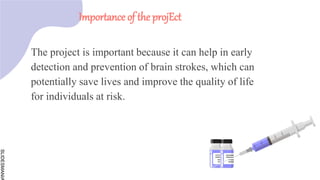
The project is important because it can help in early
detection and prevention of brain strokes, which can
potentially save lives and improve the quality of life
for individuals at risk.
Importance of the projEct
SLIDESMANIA
SLIDESMANIA
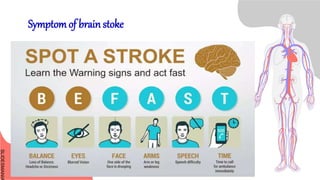
Symptom of brain stoke
SLIDESMANIA
SLIDESMANIA
Machine Learning Model
To train the machine learning model, we used a dataset
that consisted of various patient attributes such as age,
gender, blood pressure, and cholesterol levels. We
employed feature engineering techniques to select the
most relevant features and preprocess the data.
Additionally, we performed cross-validation to evaluate
the model's performance and fine-tuned the
hyperparameters to optimize its accuracy.
Techniques:
SLIDESMANIA

We used a supervised learning algorithm called
Random Forest for brain stroke prediction. Random
Forest is an ensemble learning method that combines
multiple decision trees to make predictions. It is
known for its high accuracy and ability to handle
large datasets with multiple features.
Algorithm
SLIDESMANIA
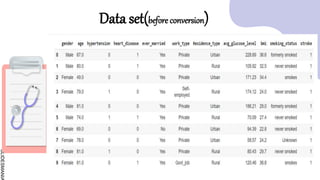
Data set(before conversion)
Pandas don’t hibernate.
It is estimated that more than 50 million kangaroos live there. They are
Australia’s national symbol and appear on postage stamps, coins, and
airplanes.
There are more kangaroos than humans in Australia.
Koalas don’t have much energy and, when not feasting on leaves, they spend
their time dozing in the branches. Believe it or not, they can sleep for up to 18
hours a day!
Koalas are even more lazy than cats.
When winter approaches, they head lower down their mountain homes to
warmer temperatures, where they continue to chomp away on bamboo!
SLIDESMANIA
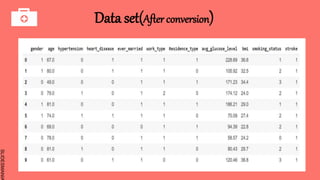
Data set(After conversion)
SLIDESMANIA
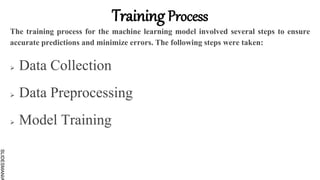
Training Process
The training process for the machine learning model involved several steps to ensure
accurate predictions and minimize errors. The following steps were taken:
 Data Collection
 Data Preprocessing
 Model Training
SLIDESMANIA
Frontend & backend
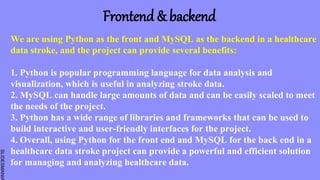
We are using Python as the front and MySQL as the backend in a healthcare
data stroke, and the project can provide several benefits:
1. Python is popular programming language for data analysis and
visualization, which is useful in analyzing stroke data.
2. MySQL can handle large amounts of data and can be easily scaled to meet
the needs of the project.
3. Python has a wide range of libraries and frameworks that can be used to
build interactive and user-friendly interfaces for the project.
4. Overall, using Python for the front end and MySQL for the back end in a
healthcare data stroke project can provide a powerful and efficient solution
for managing and analyzing healthcare data.
SLIDESMANIA
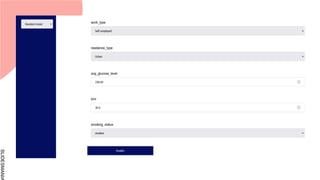
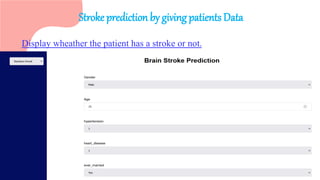
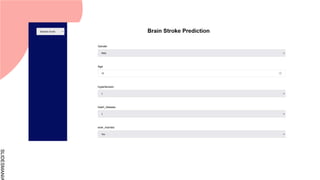
Stroke prediction by giving patients Data
Display wheather the patient has a stroke or not.
SLIDESMANIA
SLIDESMANIA
SLIDESMANIA
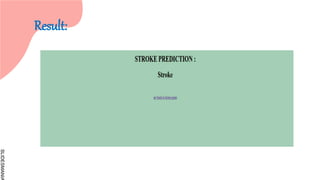
Result:
SLIDESMANIA
ConcluSion
Findings:
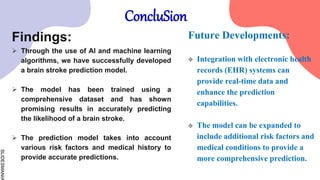
 Through the use of AI and machine learning
algorithms, we have successfully developed
a brain stroke prediction model.
 The model has been trained using a
comprehensive dataset and has shown
promising results in accurately predicting
the likelihood of a brain stroke.
 The prediction model takes into account
various risk factors and medical history to
provide accurate predictions.
Future Developments:
 Integration with electronic health
records (EHR) systems can
provide real-time data and
enhance the prediction
capabilities.
 The model can be expanded to
include additional risk factors and
medical conditions to provide a
more comprehensive prediction.
SLIDESMANIA
Thank you!

stroke prediction AIL Presentation_V1.pptx

  • 1.
    SLIDESMANIA Brain Stroke Prediction Group Name:Crocodiles Submitted by: Name Abdullah Al Miraj ID: 2103910202106 Name Mohammad Sakib Khan ID: 2103910202107 Name Tufail Ahamad Babo ID: 2103910202123 Submitted to: Avisheak Das Lecturer, Dept. of Computer Science and Engineering Premier University, Chittagong
  • 2.
    SLIDESMANIA Contents  Abstract  Introduction Objective and scope  Importance of the project  Symptomof brain stoke  Machine Learning Model  Algorithm  Dataset  Training Process  Frontend & backend  Stroke prediction by givingpatients Data  Result  Conclusion
  • 3.
    SLIDESMANIA Abstract  Stoke isdestructive illness that typically influences individuals over the age of 65 years age.  Prediction of stroke is time consuming and tedious for doctors.  Therefore, the project mainly aims at predicting the Chances of the occurrence of stroke using emerging Machine learning techniques.  Five different algorithms are used and a comparison is made for better accuracy.  Aim is to create an application with a user friendly interface that is easy to navigate and enter inputs.
  • 4.
    SLIDESMANIA Introduction stroke is alife-threatening condition that happens when part of our brain doesn’t have enough blood flow. An ischaemic stroke is caused by a blockage cutting off the blood supply to the brain. This is the most common type of stroke. A hemorrhage stroke is caused by bleeding in or around the brain. A transient attack or TIA is also Known as a mini-stroke. Foods high in potassium, such as sweet and white potatoes, bananas, tomatoes, melon, and soyabeans can help maintain blood pressure- the leading risk factor of stroke.
  • 5.
    SLIDESMANIA Objective and scope The prime object of this project is to construct a prediction model for predicting stroke using machine learning algorithm.  The dataset was obtain from the kaggle website “Healthcare dataset stroke data”
  • 6.
    SLIDESMANIA The project isimportant because it can help in early detection and prevention of brain strokes, which can potentially save lives and improve the quality of life for individuals at risk. Importance of the projEct
  • 7.
  • 8.
    SLIDESMANIA SLIDESMANIA Machine Learning Model Totrain the machine learning model, we used a dataset that consisted of various patient attributes such as age, gender, blood pressure, and cholesterol levels. We employed feature engineering techniques to select the most relevant features and preprocess the data. Additionally, we performed cross-validation to evaluate the model's performance and fine-tuned the hyperparameters to optimize its accuracy. Techniques:
  • 9.
    SLIDESMANIA  We used asupervised learning algorithm called Random Forest for brain stroke prediction. Random Forest is an ensemble learning method that combines multiple decision trees to make predictions. It is known for its high accuracy and ability to handle large datasets with multiple features. Algorithm
  • 10.
    SLIDESMANIA Data set(before conversion) Pandasdon’t hibernate. It is estimated that more than 50 million kangaroos live there. They are Australia’s national symbol and appear on postage stamps, coins, and airplanes. There are more kangaroos than humans in Australia. Koalas don’t have much energy and, when not feasting on leaves, they spend their time dozing in the branches. Believe it or not, they can sleep for up to 18 hours a day! Koalas are even more lazy than cats. When winter approaches, they head lower down their mountain homes to warmer temperatures, where they continue to chomp away on bamboo!
  • 11.
  • 12.
    SLIDESMANIA Training Process The trainingprocess for the machine learning model involved several steps to ensure accurate predictions and minimize errors. The following steps were taken:  Data Collection  Data Preprocessing  Model Training
  • 13.
    SLIDESMANIA Frontend & backend Weare using Python as the front and MySQL as the backend in a healthcare data stroke, and the project can provide several benefits: 1. Python is popular programming language for data analysis and visualization, which is useful in analyzing stroke data. 2. MySQL can handle large amounts of data and can be easily scaled to meet the needs of the project. 3. Python has a wide range of libraries and frameworks that can be used to build interactive and user-friendly interfaces for the project. 4. Overall, using Python for the front end and MySQL for the back end in a healthcare data stroke project can provide a powerful and efficient solution for managing and analyzing healthcare data.
  • 14.
    SLIDESMANIA Stroke prediction bygiving patients Data Display wheather the patient has a stroke or not.
  • 15.
  • 16.
  • 17.
  • 18.
    SLIDESMANIA ConcluSion Findings:  Through theuse of AI and machine learning algorithms, we have successfully developed a brain stroke prediction model.  The model has been trained using a comprehensive dataset and has shown promising results in accurately predicting the likelihood of a brain stroke.  The prediction model takes into account various risk factors and medical history to provide accurate predictions. Future Developments:  Integration with electronic health records (EHR) systems can provide real-time data and enhance the prediction capabilities.  The model can be expanded to include additional risk factors and medical conditions to provide a more comprehensive prediction.
  • 19.