Product: The Online Offer
Chapter 9 Objectives
 After reading Chapter 9, you will be able to:
 Define product and describe how it
contributes to customer value.
 Discuss how attributes, branding, support
services, and labeling apply to online
products.
 Outline some of the key factors in e-marketing
enhanced product development.
2
© 2014 Pearson Education, Inc.
The Google Story
 In 1998, co-founders Brin and Page delivered an
innovative new search strategy that ranked
results on popularity as well as keywords.
 Today, Google performs a bilion searches a day in
181 countries, speaks 146 languages and is the
most-visited U.S. Web site.
 Had revenues of $37.9B and 25.7% in net income
in 2011 and continues to grow in sales, new
markets, and new products offered.
3
© 2014 Pearson Education, Inc.
The Google Story, Cont.
 Uses a media e-business model to generate revenue
from several B2B markets:
 Licensing of its search services.
 Sales of advertising to Web advertisers, 96% of its revenues
from advertising.
 Google’s product mix includes 24 search products, 3
advertising products, 20 applications, and many
enterprise products.
 Pays close attention to user value, keeps costs low,
and delivers eyeballs to advertisers.
 What types of products do you think Google will launch
next?
 http://www.youtube.com/watch?v=EjN5avRvApk
4
© 2014 Pearson Education, Inc.
MANY PRODUCTS CAPITALIZE ON
INTERNET PROPERTIES
 A product is a bundle of benefits that satisfies needs
of organizations or consumers.
 Includes goods, services, ideas, people, and places.
 Products such as search engines are unique to the Internet
while others simply use the Internet as a new distribution
channel.
 Organizations use research to determine what is
important to customers when creating new products.
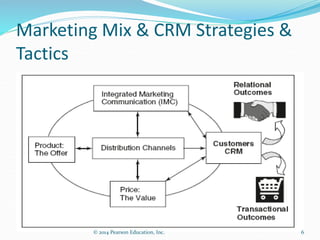
 The marketing mix 4 Ps and CRM work together to
produce relational and transactional outcomes with
consumers.
5
© 2014 Pearson Education, Inc.
Marketing Mix & CRM Strategies &
Tactics
6
© 2014 Pearson Education, Inc.
Creating Customer Value Online
 Customer value = benefits – costs
 Value is the entire product experience
 Value is defined wholly by the mental beliefs and
attitudes held by customers
 Value involves customer expectations
 Value is applied at all price levels
 Internet can increase benefits and lower costs but
it can also work in reverse
7
© 2014 Pearson Education, Inc.
PRODUCT BENEFITS
 The Internet created a new set of consumer
desired benefits. Users expect:
 effective web navigation,
 quick download speeds,
 clear site organization,
 attractive and useful site design,
 secure transactions,
 privacy,
 free information or services, and
 user-friendly Web browsing and e-mail reading.
8
© 2014 Pearson Education, Inc.
PRODUCT BENEFITS, Cont.
 Product decisions must be made that deliver
benefits to customers.
 Attributes
 Branding
 Support Services
 Labeling
 Packaging
9
© 2014 Pearson Education, Inc.
PRODUCT BENEFITS: Attributes
 Attributes include overall quality and specific
features.
 Product features can include color, taste, style, size,
and speed of service.
 Benefits also are the same features from a user
perspective (that is what will the attribute do to solve
problems or meet needs and wants? e.g. Facebook)
10
© 2014 Pearson Education, Inc.
PRODUCT BENEFITS: Attributes, Cont.
 The Internet increases customer benefits in ways that
have revolutionized marketing.
 Move from atoms to bits; media, music, software, and other
digital products can be presented on the Web.
 Mass customization is possible for:
 Tangible products (laptops can be sold at rock-
bottom prices)
 Intangible products goods (tremendous flexibility)
 User personalization of the shopping experience can
be achieved.
11
© 2014 Pearson Education, Inc.
PRODUCT BENEFITS: Branding
 A brand includes a name, symbol, or other identifying
information.
 When a firm registers the information with the U.S.
Patent Office, it becomes a trademark and is legally
protected from imitation.
 A trademark is a brand name.
 A trademark or service mark includes any word,
phrase, symbol or design, or any combination of used
or intended to be used to identify and distinguish the
goods / services of one party from those of others and
to indicate the source of the goods / services
12
© 2014 Pearson Education, Inc.
PRODUCT BENEFITS: Branding, Cont.
 A brand represents a promise or value proposition to
its customers.
 Delivering on this promise builds trust, lowers risk, and
helps customers by reducing stress of making product
switching decisions.
 A brand is a way for companies to differentiate
themselves from competitors.
 Customers and prospects become aware of brands
and develop beliefs and attitudes based on every
brand contacts, also called touch points through:
 One–way media; e.g. advertising & packaging
 Two–way communication; e.g. conversations with customer
service on phone, email…
13
© 2014 Pearson Education, Inc.
PRODUCT BENEFITS: Branding, Cont.
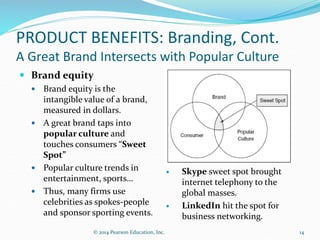
A Great Brand Intersects with Popular Culture
 Brand equity
 Brand equity is the
intangible value of a brand,
measured in dollars.
 A great brand taps into
popular culture and
touches consumers “Sweet
Spot”
 Popular culture trends in
entertainment, sports…
 Thus, many firms use
celebrities as spokes-people
and sponsor sporting events.
 Skype sweet spot brought
internet telephony to the
global masses.
 LinkedIn hit the spot for
business networking.
14
© 2014 Pearson Education, Inc.
PRODUCT BENEFITS: Branding, Cont.
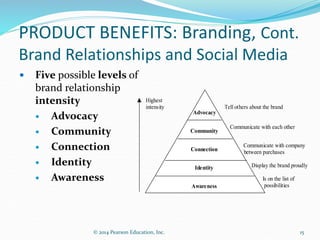
Brand Relationships and Social Media
Advocacy
Community
Connection
Identity
Awareness
Tell others about the brand
Communicate with each other
Communicate with company
between purchases
Display the brand proudly
Is on the list of
possibilities
Highest
intensity
 Five possible levels of
brand relationship
intensity
 Advocacy
 Community
 Connection
 Identity
 Awareness
15
© 2014 Pearson Education, Inc.
PRODUCT BENEFITS: Branding, Cont.
Brand Relationships and Social Media
 The explosion of social media sites escalates the
brand relationship process with peer-to-peer
communication about brands.
 Ernst & Young found that 63% of entertainment
and media CEOs used social media for brand
buildings.
 Forrester Research identified 3 roles for social
media in branding:
 Build trust.
 Differentiate the brand.
 Nurture consumers to build brand loyalty.
16
© 2014 Pearson Education, Inc.
PRODUCT BENEFITS: Branding, Cont.
Branding Decisions for Web Products
 Online companies must answer the question: What
brand names, to online products, should be
applied?
1. Firms can use existing brand names (Amazon)
or create new brands on the Internet.
 Some firms may use different names offline and online
for several reasons
 To avoid risk if the new product or channel should fail.
 Sports Illustrated created thriveonline.com.
 To reposition the offline brand if the new product or
channel succeeds (e.g. NBC & MSNBC)
 Differentiation the online version brand from the offline
 Wired magazine changed its online version name to
Hotwired. 17
© 2014 Pearson Education, Inc.
PRODUCT BENEFITS: Branding, Cont.
Branding Decisions for Web Products, Cont.
2. Creating New Brands for Internet Marketing
 Good brand names should:
 Suggest something about the product (MySpace.com)
 Differentiate the product from competitors.
 Be suitable for legal protection.
 On the Internet, a good brand name should be short,
memorable, easy to spell, and translate well into other
languages
 Dell Computer at dell.com vs Hammacher Schlemmer
hammacher.com the gift retailer.
18
© 2014 Pearson Education, Inc.
PRODUCT BENEFITS: Branding, Cont.
Branding Decisions for Web Products, Cont.
3. Co-Branding: Occurs when two different
companies form an alliance to work together
and put their brand names on a product:
• Sports Illustrated co-brands with CNN as
CNNSI.
• Yahoo! Has joined with TV Guide and Gist
to provide TV listings.
• Microsoft and NBC formed msnbc.com
• EarthLink (the 6th largest ISP) joined with
Sprint (the telephone company) in 1998 to
provide ISP services, with a new name
Earthlink-Sprint name and logo.
19
© 2014 Pearson Education, Inc.
PRODUCT BENEFITS: Branding, Cont.
Branding Decisions for Web Products, Cont.
4. Internet Domain Names
 Much time and money is spent developing powerful,
unique brand names
 A URL (Uniform Resource Locator) is a website address.
 Also called IP (internet protocol) address and domain
name.
 Domain names contain several levels hostnames, sub-
domains, top-level domains
 http:// indicates that the browser should expect data
using the hypertext protocol.
 “www” is no longer necessary and most sites register
their name with and without it.
 The top-level may be .com or a country name, such as .sa
for Saudi Arabia or .uk for the United Kingdom.
20
© 2014 Pearson Education, Inc.
PRODUCT BENEFITS: Branding, Cont.
Branding Decisions for Web Products, Cont.
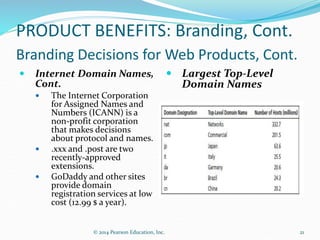
 Internet Domain Names,
Cont.
 The Internet Corporation
for Assigned Names and
Numbers (ICANN) is a
non-profit corporation
that makes decisions
about protocol and names.
 .xxx and .post are two
recently-approved
extensions.
 GoDaddy and other sites
provide domain
registration services at low
cost (12.99 $ a year).
 Largest Top-Level
Domain Names
21
© 2014 Pearson Education, Inc.
PRODUCT BENEFITS: Branding, Cont.
Branding Decisions for Web Products, Cont.
4. Internet Domain Names, Cont.
 More than 97% of words in the dictionary have already
been registered as domain names.
 Organizations should purchase alternative or related
names and spellings.
 Coca-Cola owns cocacola.com, coca-cola.com and
coke.com, among others.
 Picking the right domain name can make a huge
difference in:
 Directing people correctly to a site.
 Building consistency in marketing communications.
 E.g. Time Warner’s Pathfinder, www.pathfinder.com
22
© 2014 Pearson Education, Inc.
PRODUCT BENEFITS: Support Services
 Customer support, during and after purchases, is a
critical component in the value proposition.
 Customer service reps help customers with installation,
maintenance, product guarantees, service warranties,
etc. to increase customer satisfaction.
 Click-and-brick organization’s combine online and
offline service to maximize the customer experience
and minimize downtime and frustrations.
 CompUSA, Inc. combines online and offline channels
to increase customer support.
 Customer service as a product benefit is an important
part of customer relationship management (CRM)
23
© 2014 Pearson Education, Inc.
PRODUCT BENEFITS: Labeling
 Labels identify
 Brand names
 Sponsoring firms
 Product ingredients
 Provide instructions
 Create product recognition
 Labeling has digital equivalents in the online world.
 Online labels provide information about product usage and
features.
 Online labels also provide extensive legal information
about copyright use on their webpage (Microsoft).
 Online firms may add the Better Business Bureau logo or
TRUSTe privacy shield.
24
© 2014 Pearson Education, Inc.
E-MARKETING ENHANCED PRODUCT
DEVELOPMENT
 Developers are forced to combine digital text,
graphics, video, and audio, and use new Internet
delivery systems.
 They must also integrate front-end customer
service operations with back-end data collection.
 Factors that affect product development and
product mix strategies with new technologies are:
1. Customer Co-design via Crowdsourcing
2. Internet Properties Spawn Other Opportunities
3. New-Product Strategies for E-Marketing
25
© 2014 Pearson Education, Inc.
E-MARKETING ENHANCED PRODUCT
DEVELOPMENT, Cont.
1. Customer Co-design via Crowdsourcing
 The Internet has produced several successful &
unusual business partnerships for both business &
consumer collaboration.
 Partners form synergistic clusters to help design
customer products that deliver value
 The Internet allows collaboration electronically
among consumers and across international borders.
26
© 2014 Pearson Education, Inc.
E-MARKETING ENHANCED PRODUCT
DEVELOPMENT, Cont.
1. Customer Co-design via Crowdsourcing (Cont.)
 Software developers often seek customer input as they
develop new products
 Such as allowing users to download beta version
products, test them, and provide feedback (LEGO
software for creating virtual Designs)
 Good marketers look for customer feedback to
improve products.
 Some set up sites to gather customer ideas and input:
Dell’s ideastorm.com.
 Sometimes this feedback comes undesirable because
of video posting sites and “word of mouse”.
27
© 2014 Pearson Education, Inc.
E-MARKETING ENHANCED PRODUCT
DEVELOPMENT, Cont.
1. Customer Co-design via Crowdsourcing (Cont.)
 Research suggests that customer interaction in the
early and late stages of development increase product
success
 Today, some organizations allow customers to create
Web site content on their sites (Amazon: reviews)
 Many firms allow customers to assist in website
creation
 Blogs set up to gather customer ideas and input.
 Community bulletin boards
 RSS (really simple syndication)
 XML
28
© 2014 Pearson Education, Inc.
E-MARKETING ENHANCED PRODUCT
DEVELOPMENT, Cont.
2. Internet Properties Spawn Other Opportunities
 The Internet spawns new and unusual product
opportunities (GPS)
 The Internet is the great information equalizer
which means
 Fierce competition
 Lots of product imitation
 Short product life cycles
 Firms are forced to create, develop, and release
innovations in a matter of days or hours, rather
than months.
29
© 2014 Pearson Education, Inc.
E-MARKETING ENHANCED PRODUCT
DEVELOPMENT, Cont.
3. New-Product Strategies for E-Marketing
 Many new products, such as YouTube, Yahoo!, and
Twitter, were introduced by “one-pony” firms (that
introduce one successful online product and build the
firm around that product)
 Other firms have added internet products to an
already successful product mix (Microsoft).
 Product mix strategies can help marketers integrate
offline and online strategies.
 Companies can choose among six categories of new-
product strategies, based on marketing objectives, risk
tolerance, resource availability, etc.
30
© 2014 Pearson Education, Inc.
E-MARKETING ENHANCED PRODUCT
DEVELOPMENT, Cont.
3. New-Product Strategies (Cont.):
Product Mix Strategies
1. Discontinuous innovations are new-to-the-world
products. The highest-risk strategy.
 Shopping agents, Search engines, Social networking
 A Disruptive innovation changes the existing
market in a strong way
 Digital music downloads disrupted the CD Market.
2. New-product lines when firms take an existing brand
name and create new products in a completely different
category
 Microsoft Internet Explorer (Netscape was already
available)
31
© 2014 Pearson Education, Inc.
E-MARKETING ENHANCED PRODUCT
DEVELOPMENT, Cont.
New-Product Strategies (Cont.):
Product Mix Strategies
3. Additions to existing product lines when
organizations add a new flavor, size or other variation
to a current product line.
 The USA Today (slightly different version than hard
copy)
 Google (many different product lines)
4. Improvements or revisions of existing products
line – “new and improved”
 Web2Mail.com
 Hotmail
 Yahoo web mail
32
© 2014 Pearson Education, Inc.
E-MARKETING ENHANCED PRODUCT
DEVELOPMENT, Cont.
New-Product Strategies (Cont.): Product Mix
Strategies
5. Repositioned products current products that are
targeted to different markets or promoted for new
users
 Yahoo (from search engine to portal to Life Engine)
 MSNBC (younger viewers)
6. Me-too lower-cost products (price advantage)
introduced to compete with existing brands by
offering a price advantage, the least-risky strategy
 EarthNet (dropped prices against AOL)
33
© 2014 Pearson Education, Inc.
A Word About Return On Investment
(ROI)
 Marketers need a way to measure the success of a
company; ROI has been the generally accepted
method.
 This type of assessment is especially important
when introducing new products, online or
offline.
 Many experts are requiring a break-even point
within 3 months of inception to okay an online
project.
34
© 2014 Pearson Education, Inc.
9-35
All rights reserved. No part of this publication may be reproduced, stored in a retrieval
system, or transmitted, in any form or by any means, electronic, mechanical,
photocopying, recording, or otherwise, without the prior written permission of the
publisher. Printed in the United States of America.
Copyright © 2014 Pearson Education, Inc.
Publishing as Prentice Hall
© 2014 Pearson Education, Inc.

strauss_emktg6_ppt09_-_l_r_-_7_ed.ppt

  • 1.
  • 2.
    Chapter 9 Objectives After reading Chapter 9, you will be able to:  Define product and describe how it contributes to customer value.  Discuss how attributes, branding, support services, and labeling apply to online products.  Outline some of the key factors in e-marketing enhanced product development. 2 © 2014 Pearson Education, Inc.
  • 3.
    The Google Story In 1998, co-founders Brin and Page delivered an innovative new search strategy that ranked results on popularity as well as keywords.  Today, Google performs a bilion searches a day in 181 countries, speaks 146 languages and is the most-visited U.S. Web site.  Had revenues of $37.9B and 25.7% in net income in 2011 and continues to grow in sales, new markets, and new products offered. 3 © 2014 Pearson Education, Inc.
  • 4.
    The Google Story,Cont.  Uses a media e-business model to generate revenue from several B2B markets:  Licensing of its search services.  Sales of advertising to Web advertisers, 96% of its revenues from advertising.  Google’s product mix includes 24 search products, 3 advertising products, 20 applications, and many enterprise products.  Pays close attention to user value, keeps costs low, and delivers eyeballs to advertisers.  What types of products do you think Google will launch next?  http://www.youtube.com/watch?v=EjN5avRvApk 4 © 2014 Pearson Education, Inc.
  • 5.
    MANY PRODUCTS CAPITALIZEON INTERNET PROPERTIES  A product is a bundle of benefits that satisfies needs of organizations or consumers.  Includes goods, services, ideas, people, and places.  Products such as search engines are unique to the Internet while others simply use the Internet as a new distribution channel.  Organizations use research to determine what is important to customers when creating new products.  The marketing mix 4 Ps and CRM work together to produce relational and transactional outcomes with consumers. 5 © 2014 Pearson Education, Inc.
  • 6.
    Marketing Mix &CRM Strategies & Tactics 6 © 2014 Pearson Education, Inc.
  • 7.
    Creating Customer ValueOnline  Customer value = benefits – costs  Value is the entire product experience  Value is defined wholly by the mental beliefs and attitudes held by customers  Value involves customer expectations  Value is applied at all price levels  Internet can increase benefits and lower costs but it can also work in reverse 7 © 2014 Pearson Education, Inc.
  • 8.
    PRODUCT BENEFITS  TheInternet created a new set of consumer desired benefits. Users expect:  effective web navigation,  quick download speeds,  clear site organization,  attractive and useful site design,  secure transactions,  privacy,  free information or services, and  user-friendly Web browsing and e-mail reading. 8 © 2014 Pearson Education, Inc.
  • 9.
    PRODUCT BENEFITS, Cont. Product decisions must be made that deliver benefits to customers.  Attributes  Branding  Support Services  Labeling  Packaging 9 © 2014 Pearson Education, Inc.
  • 10.
    PRODUCT BENEFITS: Attributes Attributes include overall quality and specific features.  Product features can include color, taste, style, size, and speed of service.  Benefits also are the same features from a user perspective (that is what will the attribute do to solve problems or meet needs and wants? e.g. Facebook) 10 © 2014 Pearson Education, Inc.
  • 11.
    PRODUCT BENEFITS: Attributes,Cont.  The Internet increases customer benefits in ways that have revolutionized marketing.  Move from atoms to bits; media, music, software, and other digital products can be presented on the Web.  Mass customization is possible for:  Tangible products (laptops can be sold at rock- bottom prices)  Intangible products goods (tremendous flexibility)  User personalization of the shopping experience can be achieved. 11 © 2014 Pearson Education, Inc.
  • 12.
    PRODUCT BENEFITS: Branding A brand includes a name, symbol, or other identifying information.  When a firm registers the information with the U.S. Patent Office, it becomes a trademark and is legally protected from imitation.  A trademark is a brand name.  A trademark or service mark includes any word, phrase, symbol or design, or any combination of used or intended to be used to identify and distinguish the goods / services of one party from those of others and to indicate the source of the goods / services 12 © 2014 Pearson Education, Inc.
  • 13.
    PRODUCT BENEFITS: Branding,Cont.  A brand represents a promise or value proposition to its customers.  Delivering on this promise builds trust, lowers risk, and helps customers by reducing stress of making product switching decisions.  A brand is a way for companies to differentiate themselves from competitors.  Customers and prospects become aware of brands and develop beliefs and attitudes based on every brand contacts, also called touch points through:  One–way media; e.g. advertising & packaging  Two–way communication; e.g. conversations with customer service on phone, email… 13 © 2014 Pearson Education, Inc.
  • 14.
    PRODUCT BENEFITS: Branding,Cont. A Great Brand Intersects with Popular Culture  Brand equity  Brand equity is the intangible value of a brand, measured in dollars.  A great brand taps into popular culture and touches consumers “Sweet Spot”  Popular culture trends in entertainment, sports…  Thus, many firms use celebrities as spokes-people and sponsor sporting events.  Skype sweet spot brought internet telephony to the global masses.  LinkedIn hit the spot for business networking. 14 © 2014 Pearson Education, Inc.
  • 15.
    PRODUCT BENEFITS: Branding,Cont. Brand Relationships and Social Media Advocacy Community Connection Identity Awareness Tell others about the brand Communicate with each other Communicate with company between purchases Display the brand proudly Is on the list of possibilities Highest intensity  Five possible levels of brand relationship intensity  Advocacy  Community  Connection  Identity  Awareness 15 © 2014 Pearson Education, Inc.
  • 16.
    PRODUCT BENEFITS: Branding,Cont. Brand Relationships and Social Media  The explosion of social media sites escalates the brand relationship process with peer-to-peer communication about brands.  Ernst & Young found that 63% of entertainment and media CEOs used social media for brand buildings.  Forrester Research identified 3 roles for social media in branding:  Build trust.  Differentiate the brand.  Nurture consumers to build brand loyalty. 16 © 2014 Pearson Education, Inc.
  • 17.
    PRODUCT BENEFITS: Branding,Cont. Branding Decisions for Web Products  Online companies must answer the question: What brand names, to online products, should be applied? 1. Firms can use existing brand names (Amazon) or create new brands on the Internet.  Some firms may use different names offline and online for several reasons  To avoid risk if the new product or channel should fail.  Sports Illustrated created thriveonline.com.  To reposition the offline brand if the new product or channel succeeds (e.g. NBC & MSNBC)  Differentiation the online version brand from the offline  Wired magazine changed its online version name to Hotwired. 17 © 2014 Pearson Education, Inc.
  • 18.
    PRODUCT BENEFITS: Branding,Cont. Branding Decisions for Web Products, Cont. 2. Creating New Brands for Internet Marketing  Good brand names should:  Suggest something about the product (MySpace.com)  Differentiate the product from competitors.  Be suitable for legal protection.  On the Internet, a good brand name should be short, memorable, easy to spell, and translate well into other languages  Dell Computer at dell.com vs Hammacher Schlemmer hammacher.com the gift retailer. 18 © 2014 Pearson Education, Inc.
  • 19.
    PRODUCT BENEFITS: Branding,Cont. Branding Decisions for Web Products, Cont. 3. Co-Branding: Occurs when two different companies form an alliance to work together and put their brand names on a product: • Sports Illustrated co-brands with CNN as CNNSI. • Yahoo! Has joined with TV Guide and Gist to provide TV listings. • Microsoft and NBC formed msnbc.com • EarthLink (the 6th largest ISP) joined with Sprint (the telephone company) in 1998 to provide ISP services, with a new name Earthlink-Sprint name and logo. 19 © 2014 Pearson Education, Inc.
  • 20.
    PRODUCT BENEFITS: Branding,Cont. Branding Decisions for Web Products, Cont. 4. Internet Domain Names  Much time and money is spent developing powerful, unique brand names  A URL (Uniform Resource Locator) is a website address.  Also called IP (internet protocol) address and domain name.  Domain names contain several levels hostnames, sub- domains, top-level domains  http:// indicates that the browser should expect data using the hypertext protocol.  “www” is no longer necessary and most sites register their name with and without it.  The top-level may be .com or a country name, such as .sa for Saudi Arabia or .uk for the United Kingdom. 20 © 2014 Pearson Education, Inc.
  • 21.
    PRODUCT BENEFITS: Branding,Cont. Branding Decisions for Web Products, Cont.  Internet Domain Names, Cont.  The Internet Corporation for Assigned Names and Numbers (ICANN) is a non-profit corporation that makes decisions about protocol and names.  .xxx and .post are two recently-approved extensions.  GoDaddy and other sites provide domain registration services at low cost (12.99 $ a year).  Largest Top-Level Domain Names 21 © 2014 Pearson Education, Inc.
  • 22.
    PRODUCT BENEFITS: Branding,Cont. Branding Decisions for Web Products, Cont. 4. Internet Domain Names, Cont.  More than 97% of words in the dictionary have already been registered as domain names.  Organizations should purchase alternative or related names and spellings.  Coca-Cola owns cocacola.com, coca-cola.com and coke.com, among others.  Picking the right domain name can make a huge difference in:  Directing people correctly to a site.  Building consistency in marketing communications.  E.g. Time Warner’s Pathfinder, www.pathfinder.com 22 © 2014 Pearson Education, Inc.
  • 23.
    PRODUCT BENEFITS: SupportServices  Customer support, during and after purchases, is a critical component in the value proposition.  Customer service reps help customers with installation, maintenance, product guarantees, service warranties, etc. to increase customer satisfaction.  Click-and-brick organization’s combine online and offline service to maximize the customer experience and minimize downtime and frustrations.  CompUSA, Inc. combines online and offline channels to increase customer support.  Customer service as a product benefit is an important part of customer relationship management (CRM) 23 © 2014 Pearson Education, Inc.
  • 24.
    PRODUCT BENEFITS: Labeling Labels identify  Brand names  Sponsoring firms  Product ingredients  Provide instructions  Create product recognition  Labeling has digital equivalents in the online world.  Online labels provide information about product usage and features.  Online labels also provide extensive legal information about copyright use on their webpage (Microsoft).  Online firms may add the Better Business Bureau logo or TRUSTe privacy shield. 24 © 2014 Pearson Education, Inc.
  • 25.
    E-MARKETING ENHANCED PRODUCT DEVELOPMENT Developers are forced to combine digital text, graphics, video, and audio, and use new Internet delivery systems.  They must also integrate front-end customer service operations with back-end data collection.  Factors that affect product development and product mix strategies with new technologies are: 1. Customer Co-design via Crowdsourcing 2. Internet Properties Spawn Other Opportunities 3. New-Product Strategies for E-Marketing 25 © 2014 Pearson Education, Inc.
  • 26.
    E-MARKETING ENHANCED PRODUCT DEVELOPMENT,Cont. 1. Customer Co-design via Crowdsourcing  The Internet has produced several successful & unusual business partnerships for both business & consumer collaboration.  Partners form synergistic clusters to help design customer products that deliver value  The Internet allows collaboration electronically among consumers and across international borders. 26 © 2014 Pearson Education, Inc.
  • 27.
    E-MARKETING ENHANCED PRODUCT DEVELOPMENT,Cont. 1. Customer Co-design via Crowdsourcing (Cont.)  Software developers often seek customer input as they develop new products  Such as allowing users to download beta version products, test them, and provide feedback (LEGO software for creating virtual Designs)  Good marketers look for customer feedback to improve products.  Some set up sites to gather customer ideas and input: Dell’s ideastorm.com.  Sometimes this feedback comes undesirable because of video posting sites and “word of mouse”. 27 © 2014 Pearson Education, Inc.
  • 28.
    E-MARKETING ENHANCED PRODUCT DEVELOPMENT,Cont. 1. Customer Co-design via Crowdsourcing (Cont.)  Research suggests that customer interaction in the early and late stages of development increase product success  Today, some organizations allow customers to create Web site content on their sites (Amazon: reviews)  Many firms allow customers to assist in website creation  Blogs set up to gather customer ideas and input.  Community bulletin boards  RSS (really simple syndication)  XML 28 © 2014 Pearson Education, Inc.
  • 29.
    E-MARKETING ENHANCED PRODUCT DEVELOPMENT,Cont. 2. Internet Properties Spawn Other Opportunities  The Internet spawns new and unusual product opportunities (GPS)  The Internet is the great information equalizer which means  Fierce competition  Lots of product imitation  Short product life cycles  Firms are forced to create, develop, and release innovations in a matter of days or hours, rather than months. 29 © 2014 Pearson Education, Inc.
  • 30.
    E-MARKETING ENHANCED PRODUCT DEVELOPMENT,Cont. 3. New-Product Strategies for E-Marketing  Many new products, such as YouTube, Yahoo!, and Twitter, were introduced by “one-pony” firms (that introduce one successful online product and build the firm around that product)  Other firms have added internet products to an already successful product mix (Microsoft).  Product mix strategies can help marketers integrate offline and online strategies.  Companies can choose among six categories of new- product strategies, based on marketing objectives, risk tolerance, resource availability, etc. 30 © 2014 Pearson Education, Inc.
  • 31.
    E-MARKETING ENHANCED PRODUCT DEVELOPMENT,Cont. 3. New-Product Strategies (Cont.): Product Mix Strategies 1. Discontinuous innovations are new-to-the-world products. The highest-risk strategy.  Shopping agents, Search engines, Social networking  A Disruptive innovation changes the existing market in a strong way  Digital music downloads disrupted the CD Market. 2. New-product lines when firms take an existing brand name and create new products in a completely different category  Microsoft Internet Explorer (Netscape was already available) 31 © 2014 Pearson Education, Inc.
  • 32.
    E-MARKETING ENHANCED PRODUCT DEVELOPMENT,Cont. New-Product Strategies (Cont.): Product Mix Strategies 3. Additions to existing product lines when organizations add a new flavor, size or other variation to a current product line.  The USA Today (slightly different version than hard copy)  Google (many different product lines) 4. Improvements or revisions of existing products line – “new and improved”  Web2Mail.com  Hotmail  Yahoo web mail 32 © 2014 Pearson Education, Inc.
  • 33.
    E-MARKETING ENHANCED PRODUCT DEVELOPMENT,Cont. New-Product Strategies (Cont.): Product Mix Strategies 5. Repositioned products current products that are targeted to different markets or promoted for new users  Yahoo (from search engine to portal to Life Engine)  MSNBC (younger viewers) 6. Me-too lower-cost products (price advantage) introduced to compete with existing brands by offering a price advantage, the least-risky strategy  EarthNet (dropped prices against AOL) 33 © 2014 Pearson Education, Inc.
  • 34.
    A Word AboutReturn On Investment (ROI)  Marketers need a way to measure the success of a company; ROI has been the generally accepted method.  This type of assessment is especially important when introducing new products, online or offline.  Many experts are requiring a break-even point within 3 months of inception to okay an online project. 34 © 2014 Pearson Education, Inc.
  • 35.
    9-35 All rights reserved.No part of this publication may be reproduced, stored in a retrieval system, or transmitted, in any form or by any means, electronic, mechanical, photocopying, recording, or otherwise, without the prior written permission of the publisher. Printed in the United States of America. Copyright © 2014 Pearson Education, Inc. Publishing as Prentice Hall © 2014 Pearson Education, Inc.