Strategic
Management
Hours Allotted: 30
maximum Marks: 50
B.Sc. HHA, IGNOU/NCHMCT Curriculum
Organizational Strategy
4 hours (15% weightage)
• What is strategic Management?
• Definition
• Strategic management can be defined as the art and
science or formulating, implementation and
evaluation cross-functional decisions that enable an
organization to achieve its objectives.
• Therefore Strategic management focuses on
integrating management, marketing,
finance/accounting, production/operations, research
and development and computer information system to
achieve organizational success.
• Three stages of Strategic management process are,
Strategy formulation , Strategy implementation and
strategy evaluation .
Mission Statement: Elements
and Importance
• Definition of mission statement:
• Mission statements are “enduring statements of
purpose that distinguish one business from other
similar firms. A mission statement identifies the
scope of a firms operation in product and market
terms.”
• It addresses the basic question that faces all
strategists:
• What is our business?
• A clear mission statement describes the values and
priorities of an organization.
• Developing M/S compels strategists to think about
the nature an scope of present operations and to
assess the potential attractiveness of future
markets and d activities.
Importance of Mission
statement.
• Firms with formalized mission statements have
twice the average return on shareholders’ equity
that those firms without a formalized mission
statement. Ratrick and Vitton.
• There is a positive relationship between mission
statements and organizational performance. Bart
and Baetz
• Firms using mission statements have a 30% higher
return on certain financial measures that those
without such statements. Business week.
• O’Gorman and Doran however found that having a
mission statement does not directly contribute
positively to financial performance, The extent of
managers and employee involvement in developing
Elements/Characteristics of a
mission statement
• A declaration of attitude.
• A customer orientation
• A declaration of social policy
• IHCL's mission is to improve the quality of
life for the communities it serves globally,
while its vision is to be the most iconic and
profitable hospitality company in South Asia.
IHCL's values are guided by principles such as
serving stakeholders with dedication, creating
a happy environment, and celebrating diversity.
IHCL's culture is called Tajness, and its
strategy is called Ahvaan 2025.
• Apple's mission statement is to provide
customers with the best user experience through
its innovative hardware, software, and
services. Apple's vision statement is that they
are on earth to make great products, and that
this will not change.
• Google's mission is to organize the world's
information and make it universally accessible
and useful. Its vision is to provide access to
the world's information in one click.
• We believe in what people make possible. Our
mission is to empower every person and every
• Airtel's Mission, Vision and Values The Way
Ahead At airtel, we always put you at the heart
of what we do. We strive to enhance your
experience with us and build a lasting
relationship with you by delivering better
results every time. And this, reflects in our
mission too.
• Reliance To build a global enterprise for all
our stakeholders, and great future for our
country, To give millions of young Indians the
power to shape their destiny, The means to
Components of mission
statement
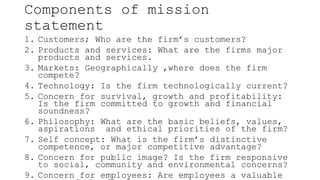
1. Customers; Who are the firm’s customers?
2. Products and services: What are the firms major
products and services.
3. Markets: Geographically ,where does the firm
compete?
4. Technology: Is the firm technologically current?
5. Concern for survival, growth and profitability:
Is the firm committed to growth and financial
soundness?
6. Philosophy: What are the basic beliefs, values,
aspirations and ethical priorities of the firm?
7. Self concept: What is the firm’s distinctive
competence, or major competitive advantage?
8. Concern for public image? Is the firm responsive
to social, community and environmental concerns?
9. Concern for employees: Are employees a valuable
Objectives
• Objectives are the results expected from pursuing
strategies.
• Nature of Objectives: The objectives must be:
• Quantitative
• Measurable
• Realistic
• Understandable
• Challenging
• Hierarchical
• Obtainable and congruent among organization al units.
• Time bound
• Objectives are commonly stated in terms of :
• Growth in assets
• Growth in sales
• Profitability
• Market share
• Degree and nature diversification
• Degree and nature of vertical integration, earning per
share, and social responsibility.
Necessity of formal objectives
• Provide direction
• Allow synergy
• Aid in evaluation
• Establish priorities
• Reduce uncertainty,
• minimize conflicts,
• stimulate exertion and
• Aids in allocation of resources and design of jobs.
Long term objectives are needed at the corporate,
divisional and functional levels in an organization .
They are important measure of managerial performance.
12
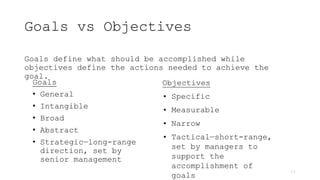
Objectives
• Specific
• Measurable
• Narrow
• Tactical—short-range,
set by managers to
support the
accomplishment of
goals
Goals
• General
• Intangible
• Broad
• Abstract
• Strategic—long-range
direction, set by
senior management
Goals define what should be accomplished while
objectives define the actions needed to achieve the
goal.
Goals vs Objectives
Developing strategies-Strategy
Formulation:
Meaning, Aspects, Process, Approaches and
Challenges.
• Strategy formulation is the process of offering proper
direction to a firm.
• Strategy Formulation seeks to set the long-term goals
that help a firm exploit its strengths fully and encash
the opportunities that are present in the environment.
• There is a conscious and deliberate attempt to focus
attention on what the firm can do better than its
rivals. To achieve this, a firm seeks to find out what
it can do best.
• Once the strengths are known, opportunities to be
exploited are identified; a long-term plan is chalked
out for concentrating resources and effort.
• Henry Mintzberg, after much research found that
strategy formulation is typically not a regular,
continuous process. “It is small often an irregular,
• Performance results are generally periodic
measurements of developments that occur during a
given time period like return on investment,
profits after taxes, earnings per share and market
share. Current performance results are compared
with the current objectives and with that of the
previous year’s performance results.
• If the results are equal to or greater than the
current objectives and past year’s results, the
company will mostly continue with the current
strategy otherwise, the strategy formulation
process begins in earnest.
• The strategic managers must evaluate the mission,
objectives and policies.
• In fact, the strategic managers are evaluated in
terms of management style, values and skills by
the top management.
• Henry Mintzberg has pointed out that a
Strategic Formulation
• 4 Important Subjective Aspects:
• Culture,
• Politics,
• Leadership, and
• Managerial Bias.
• Strategy formulation is as much an art as it is a science. In
fact, it is the art of strategy formulation that drives fast
growth and catapults a firm into newer horizons.
• Leaders should develop skills and capabilities to sense early
opportunities and be quick in making strategic moves. :The
successes of Airtel and Bharti Enterprises in India, and Google
and Southwest airlines abroad, are some examples.
• Cavin Kare, the Chennai- based FMCG company has moved from a
personal care product company into a major FMCG over the years
because of the bold strategic initiatives that it undertook.
• Similarly, snacks maker Haldirams has established its brand in
the food segment with a range of ready-to-eat food items from
ethnic India.
Modes of strategy formulation
include:
• Entrepreneurial Mode: Strategy is formulated by one
powerful individual. The focus is on opportunities
rather than on problems. Strategy is guided by the
founder’s own visions of direction.
• Adaptive Mode: This strategy formulation mode is
characterized by reactive solutions to existing
problems rather than a proactive search for new
opportunities.
• Planning Mode: Analysts assume main responsibility
for strategy formulation. Strategic planning
includes both the proactive search for new
opportunities and the reactive solution of existing
problems.
• Strategic factors
Adaptive search
• An adaptive approach to strategy is a way of
thinking about strategy that emphasizes
experimentation and adjustment in unpredictable
environments, rather than long-term planning
and analysis. It's based on the idea of
temporary advantage over time, rather than
sustainable competitive advantage. Adaptive
strategies can help businesses:
Intuition search
• An intuitive approach is based on feelings rather
than facts or proof. It's the ability to understand
or know something through instincts, emotions, or
"gut feelings" instead of rational thought or
examining facts. Intuition can be a common process
among people that's fed by subconscious information,
images, impressions, and sensations the brain
absorbs constantly. An intuitive approach is based
on feelings rather than facts or proof. It's the
ability to understand or know something through
instincts, emotions, or "gut feelings" instead of
rational thought or examining facts.
• In fact, intuition is the ability to have a grasp on
a situation or information without the comfort of
data analysis. It is like the leap of faith.
• In business, people may use intuition when facts are
Strategic factors
• The strategic factor approach to strategy
formulation is based on the different factors
that are important for an organization to
achieve its goals and objectives. These factors
can vary across different functions of the
organization, such as finance, marketing, and
operations.
• Strategic niche management (SNM) is a research
method that aims to create and nurture niches
for sustainable innovations through real-life
experiments. The goal is to trigger wider
systemic transitions by stimulating co-
evolution processes through experiments with
new technologies and socio-technical
arrangements.

Strategy and mission statement- Unit -1.pptx

  • 1.
    Strategic Management Hours Allotted: 30 maximumMarks: 50 B.Sc. HHA, IGNOU/NCHMCT Curriculum
  • 3.
    Organizational Strategy 4 hours(15% weightage) • What is strategic Management? • Definition • Strategic management can be defined as the art and science or formulating, implementation and evaluation cross-functional decisions that enable an organization to achieve its objectives. • Therefore Strategic management focuses on integrating management, marketing, finance/accounting, production/operations, research and development and computer information system to achieve organizational success. • Three stages of Strategic management process are, Strategy formulation , Strategy implementation and strategy evaluation .
  • 4.
    Mission Statement: Elements andImportance • Definition of mission statement: • Mission statements are “enduring statements of purpose that distinguish one business from other similar firms. A mission statement identifies the scope of a firms operation in product and market terms.” • It addresses the basic question that faces all strategists: • What is our business? • A clear mission statement describes the values and priorities of an organization. • Developing M/S compels strategists to think about the nature an scope of present operations and to assess the potential attractiveness of future markets and d activities.
  • 5.
    Importance of Mission statement. •Firms with formalized mission statements have twice the average return on shareholders’ equity that those firms without a formalized mission statement. Ratrick and Vitton. • There is a positive relationship between mission statements and organizational performance. Bart and Baetz • Firms using mission statements have a 30% higher return on certain financial measures that those without such statements. Business week. • O’Gorman and Doran however found that having a mission statement does not directly contribute positively to financial performance, The extent of managers and employee involvement in developing
  • 6.
    Elements/Characteristics of a missionstatement • A declaration of attitude. • A customer orientation • A declaration of social policy • IHCL's mission is to improve the quality of life for the communities it serves globally, while its vision is to be the most iconic and profitable hospitality company in South Asia. IHCL's values are guided by principles such as serving stakeholders with dedication, creating a happy environment, and celebrating diversity. IHCL's culture is called Tajness, and its strategy is called Ahvaan 2025.
  • 7.
    • Apple's missionstatement is to provide customers with the best user experience through its innovative hardware, software, and services. Apple's vision statement is that they are on earth to make great products, and that this will not change. • Google's mission is to organize the world's information and make it universally accessible and useful. Its vision is to provide access to the world's information in one click. • We believe in what people make possible. Our mission is to empower every person and every
  • 8.
    • Airtel's Mission,Vision and Values The Way Ahead At airtel, we always put you at the heart of what we do. We strive to enhance your experience with us and build a lasting relationship with you by delivering better results every time. And this, reflects in our mission too. • Reliance To build a global enterprise for all our stakeholders, and great future for our country, To give millions of young Indians the power to shape their destiny, The means to
  • 9.
    Components of mission statement 1.Customers; Who are the firm’s customers? 2. Products and services: What are the firms major products and services. 3. Markets: Geographically ,where does the firm compete? 4. Technology: Is the firm technologically current? 5. Concern for survival, growth and profitability: Is the firm committed to growth and financial soundness? 6. Philosophy: What are the basic beliefs, values, aspirations and ethical priorities of the firm? 7. Self concept: What is the firm’s distinctive competence, or major competitive advantage? 8. Concern for public image? Is the firm responsive to social, community and environmental concerns? 9. Concern for employees: Are employees a valuable
  • 10.
    Objectives • Objectives arethe results expected from pursuing strategies. • Nature of Objectives: The objectives must be: • Quantitative • Measurable • Realistic • Understandable • Challenging • Hierarchical • Obtainable and congruent among organization al units. • Time bound • Objectives are commonly stated in terms of : • Growth in assets • Growth in sales • Profitability • Market share • Degree and nature diversification • Degree and nature of vertical integration, earning per share, and social responsibility.
  • 11.
    Necessity of formalobjectives • Provide direction • Allow synergy • Aid in evaluation • Establish priorities • Reduce uncertainty, • minimize conflicts, • stimulate exertion and • Aids in allocation of resources and design of jobs. Long term objectives are needed at the corporate, divisional and functional levels in an organization . They are important measure of managerial performance.
  • 12.
    12 Objectives • Specific • Measurable •Narrow • Tactical—short-range, set by managers to support the accomplishment of goals Goals • General • Intangible • Broad • Abstract • Strategic—long-range direction, set by senior management Goals define what should be accomplished while objectives define the actions needed to achieve the goal. Goals vs Objectives
  • 13.
    Developing strategies-Strategy Formulation: Meaning, Aspects,Process, Approaches and Challenges. • Strategy formulation is the process of offering proper direction to a firm. • Strategy Formulation seeks to set the long-term goals that help a firm exploit its strengths fully and encash the opportunities that are present in the environment. • There is a conscious and deliberate attempt to focus attention on what the firm can do better than its rivals. To achieve this, a firm seeks to find out what it can do best. • Once the strengths are known, opportunities to be exploited are identified; a long-term plan is chalked out for concentrating resources and effort. • Henry Mintzberg, after much research found that strategy formulation is typically not a regular, continuous process. “It is small often an irregular,
  • 14.
    • Performance resultsare generally periodic measurements of developments that occur during a given time period like return on investment, profits after taxes, earnings per share and market share. Current performance results are compared with the current objectives and with that of the previous year’s performance results. • If the results are equal to or greater than the current objectives and past year’s results, the company will mostly continue with the current strategy otherwise, the strategy formulation process begins in earnest. • The strategic managers must evaluate the mission, objectives and policies. • In fact, the strategic managers are evaluated in terms of management style, values and skills by the top management. • Henry Mintzberg has pointed out that a
  • 15.
    Strategic Formulation • 4Important Subjective Aspects: • Culture, • Politics, • Leadership, and • Managerial Bias. • Strategy formulation is as much an art as it is a science. In fact, it is the art of strategy formulation that drives fast growth and catapults a firm into newer horizons. • Leaders should develop skills and capabilities to sense early opportunities and be quick in making strategic moves. :The successes of Airtel and Bharti Enterprises in India, and Google and Southwest airlines abroad, are some examples. • Cavin Kare, the Chennai- based FMCG company has moved from a personal care product company into a major FMCG over the years because of the bold strategic initiatives that it undertook. • Similarly, snacks maker Haldirams has established its brand in the food segment with a range of ready-to-eat food items from ethnic India.
  • 16.
    Modes of strategyformulation include: • Entrepreneurial Mode: Strategy is formulated by one powerful individual. The focus is on opportunities rather than on problems. Strategy is guided by the founder’s own visions of direction. • Adaptive Mode: This strategy formulation mode is characterized by reactive solutions to existing problems rather than a proactive search for new opportunities. • Planning Mode: Analysts assume main responsibility for strategy formulation. Strategic planning includes both the proactive search for new opportunities and the reactive solution of existing problems. • Strategic factors
  • 17.
    Adaptive search • Anadaptive approach to strategy is a way of thinking about strategy that emphasizes experimentation and adjustment in unpredictable environments, rather than long-term planning and analysis. It's based on the idea of temporary advantage over time, rather than sustainable competitive advantage. Adaptive strategies can help businesses:
  • 18.
    Intuition search • Anintuitive approach is based on feelings rather than facts or proof. It's the ability to understand or know something through instincts, emotions, or "gut feelings" instead of rational thought or examining facts. Intuition can be a common process among people that's fed by subconscious information, images, impressions, and sensations the brain absorbs constantly. An intuitive approach is based on feelings rather than facts or proof. It's the ability to understand or know something through instincts, emotions, or "gut feelings" instead of rational thought or examining facts. • In fact, intuition is the ability to have a grasp on a situation or information without the comfort of data analysis. It is like the leap of faith. • In business, people may use intuition when facts are
  • 19.
    Strategic factors • Thestrategic factor approach to strategy formulation is based on the different factors that are important for an organization to achieve its goals and objectives. These factors can vary across different functions of the organization, such as finance, marketing, and operations.
  • 20.
    • Strategic nichemanagement (SNM) is a research method that aims to create and nurture niches for sustainable innovations through real-life experiments. The goal is to trigger wider systemic transitions by stimulating co- evolution processes through experiments with new technologies and socio-technical arrangements.

Editor's Notes

  • #14 Strategic planning is a systemic and disciplined exercise to formulate strategies. It relates to the enterprise as a whole or to particular business units (identified as strategic business units – SBUs) of a divisionalised organization. It consists of making risk- taking decisions -entrepreneurial decisions – for the future with the best possible knowledge of their probable outcome and effects. In short, strategic planning concerns itself with the formulation of strategic alternatives to obtain sanctions for one of the alternatives which is to be ultimately interpreted and communicated in operational terms. Thus, strategic planning is a forward-looking exercise which determines the future posture of the enterprise with special reference to its products-market posture, profitability, size, rate of innovation and external institutions. Strategic planning differs from project planning tactical, planning and operational planning. Strategic planning is more comprehensive, for strategy is dealt with at corporate level and is concerned mainly with the long-term aspects of business. It deals with what business the company wants to be in.Project planning involves looking for new markets for existing products, developing new products, creating demand for the same, and utilising the existing facilities if they have the capacity to meet the marketing and selling requirements of the new product. Tactical planning is done at the functional level. It is concerned more with the present than the future. It implies an ad hoc approach based on expediency with a time schedule. Operational planning, on the other hand, is essentially concerned with the existing product-market operations – the ‘bread and butter lines’ of the business. The scope of operational planning is restricted to the operations in themarket with which the company has built up a rapport with the existing range of products through the facilities which are already in harness.
  • #15 Choice activity consists of selecting the most appropriate strategy from among the alternatives. This framework is helpful in understanding the essential elements involved in strategy formulation. But the sequence of intelligence, design and choice activity may not be practiced in the same order. It is possible for a strategic planner to first choose a preferred strategy, then develop other options (alternatives) to analyse for rationalising the choice. The degree of uncertainty in tactical planning and operational planning is of a low order. It is of a higher order in project planning, while in strategic planning risk and uncertainty involved are much greater. The time span of discretion is relatively shorter in tactical and operational planning than in project planning. It is much longer in strategic planning as compared with that of project planning. Thus the value of judgment is of much greater significance in strategic planning than in project planning or operational planning.
  • #16 Some of the important subjective aspects of strategy formulation are culture, politics, leadership, and managerial bias. All these aspects are capable of being skewed by personal experience, individual understanding, and prejudice. Although these might not necessarily be ill-motivated or falsified they digress from purely scientific decision-making and could be risky to that extent.i. Cultural Aspects:Culture defines the way of life or decision making in the firm. Culture includes values, beliefs, norms, and attitudes and could be positive, neutral, or negative. Culture evolves and changes according to the changing circumstances or if a need is felt among organizational members. We will see here how it can influence strategy formulation.Culture could be passive and submissive. In such cultural situations, there is an inability to speak up to senior management. There have been traditional companies that are promoted by extraordinary entrepreneurs, who have meticulously grown the business. There are a number of family-owned businesses that have grown big, but have not become entirely professional.Cultural features also relate to societal involvement and orientation towards strategy. In India, dairy cooperatives are highly successful in Gujarat because such a style involves more democracy and has no gender bias. However, the same amount of success could not be achieved in dairy cooperatives in Uttar Pradesh and Maharashtra. Ironically, these states are not against cooperatives.For instance, sugar cooperatives are highly successful in both the states, especially in Maharashtra. One of the reasons could be that animal husbandry and dairy farming is usually led by women and needs more social and economic freedom, whereas sugar cooperatives are led by leaders with links to the political system. Thus, cultural traits could be critical for strategy formulation.